
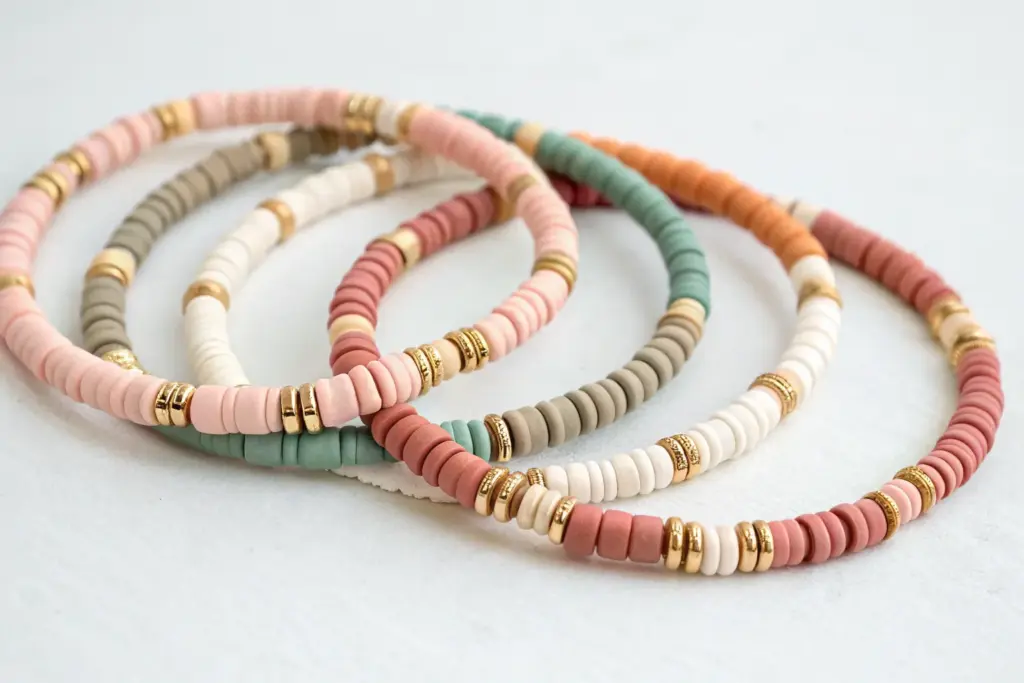
Whenever I need a quick creative win, I reach for clay beads—especially those flat Heishi beads that make every color combo look instantly fun. Here are my favorite clay bead ideas for bracelets, starting with the classics and drifting into the extra-playful, studio-day experiments.
Classic Rainbow-Order Heishi Bead Bracelet
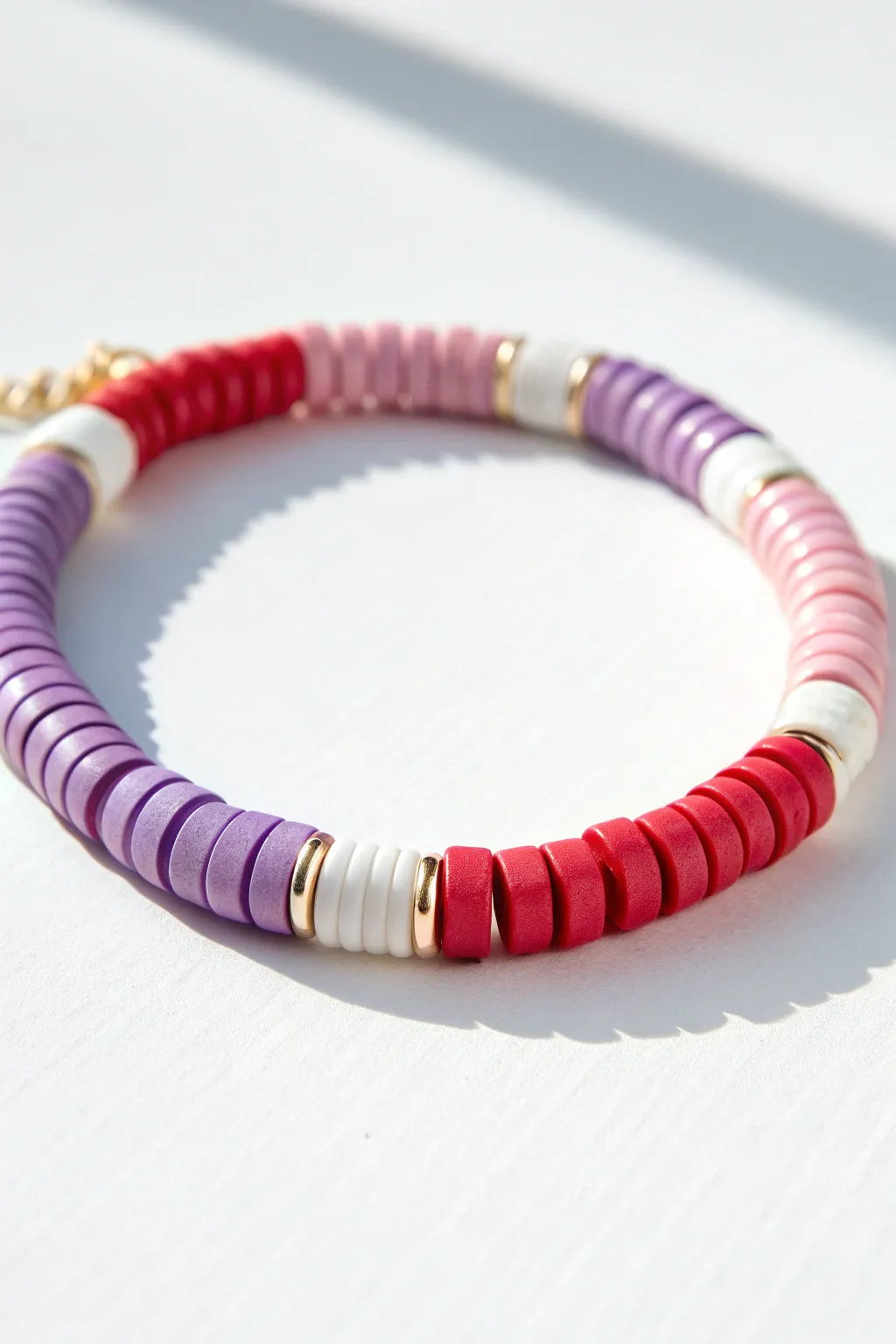
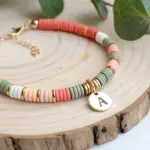
This trendy accessory combines a playful mix of red, lilac, pink, and white clay disc beads with bold gold accents for a polished finish. The color-block design gives it a modern, sophisticated look that pairs perfectly with almost any outfit.
How-To Guide
Materials
- 6mm Heishi polymer clay disc beads (Red, Lilac/Purple, Light Pink, White)
- 6mm Gold polygon or disc spacer beads
- 0.8mm Elastic beading cord (clear)
- Small gold lobster clasp
- Gold jump rings (open)
- Gold extender chain (optional)
- Hypo-cement or jewelry glue
- Scissors
Step 1: Planning and Preparation
-
Measure your wrist:
Wrap a piece of string around your wrist to find your size, then add about half an inch for comfort. I usually aim for a total length of 6.5 to 7 inches for a standard adult fit. -
Cut the elastic:
Cut a piece of elastic cord about 10-12 inches long. This extra length is crucial so you have plenty of room to tie a secure knot at the end without struggling. -
Pre-stretch the cord:
Give the elastic cord a few firm tugs before you start beading. This pre-stretching prevents the bracelet from loosening up immediately after you finish making it. -
Secure the end:
Place a piece of tape or a binder clip on one end of the cord to stop your beads from sliding off while you work.
Symmetrical Stacking
For a pro look, count your beads exactly for each color block (e.g., exactly 12 red, 12 pink). Consistency makes the finished piece look store-bought rather than handmade.
Step 2: Stringing the Beads
-
Start the pattern:
Begin by threading on the first color block section. For this design, I recommend starting with the purple (lilac) segment. Use approximately 10-15 beads to create a distinct block of color. -
Add separation:
Slide on a gold spacer bead, followed by 3-5 white clay discs, and then another gold spacer bead. This distinct separator highlights the color transitions beautifully. -
Add the red block:
Thread on your next block of deep red beads. Aim to use the same number of beads as your purple section to keep the design symmetrical, roughly 10-15 discs. -
Insert the next spacer:
Repeat the separator sequence: one gold spacer, a small stack of white beads, and another gold spacer. -
Add the pink block:
Add your block of light pink beads. Check your length occasionally by wrapping the unfinished strand around your wrist to ensure the blocks fit nicely. -
Continue the pattern:
Repeat the pattern (Color Block -> Gold -> White -> Gold) until you reach your desired bracelet length, ending after a full color block section.
Step 3: Finishing Touches
-
Add hardware:
Once you have the correct length, thread a crimp bead (if using) or simply slide your jump ring and lobster clasp onto one end of the elastic. -
Tie the knot:
Remove the tape/clip and bring both ends of the elastic together. Tie a strong surgeon’s knot (right over left, left over right, looping through twice) pulling it very tight. -
Secure with glue:
Apply a tiny dot of Hypo-cement or jewelry glue directly onto the knot. Wait a few moments for it to become tacky and set before moving on. -
Hide the knot:
If size permits, gently slide one of the adjacent clay beads over the knot to conceal it inside the bead’s hole. -
Add the chain:
Use pliers to open a jump ring and attach the extender chain to the side opposite the clasp. This allows for adjustable sizing. -
Final trim:
Once the glue is completely dry, trim the excess elastic tails close to the knot with your sharp scissors.
Curling Beads?
If your heishi beads look wonky or curved when strung, your cord might be too thick. Switch to a 0.5mm or 0.6mm elastic so the flat discs can sit flush against each other.
Wear your colorful creation solo or stack it with other gold jewelry for a chic, layered wrist
Easy Color-Blocked Clay Bead Segments
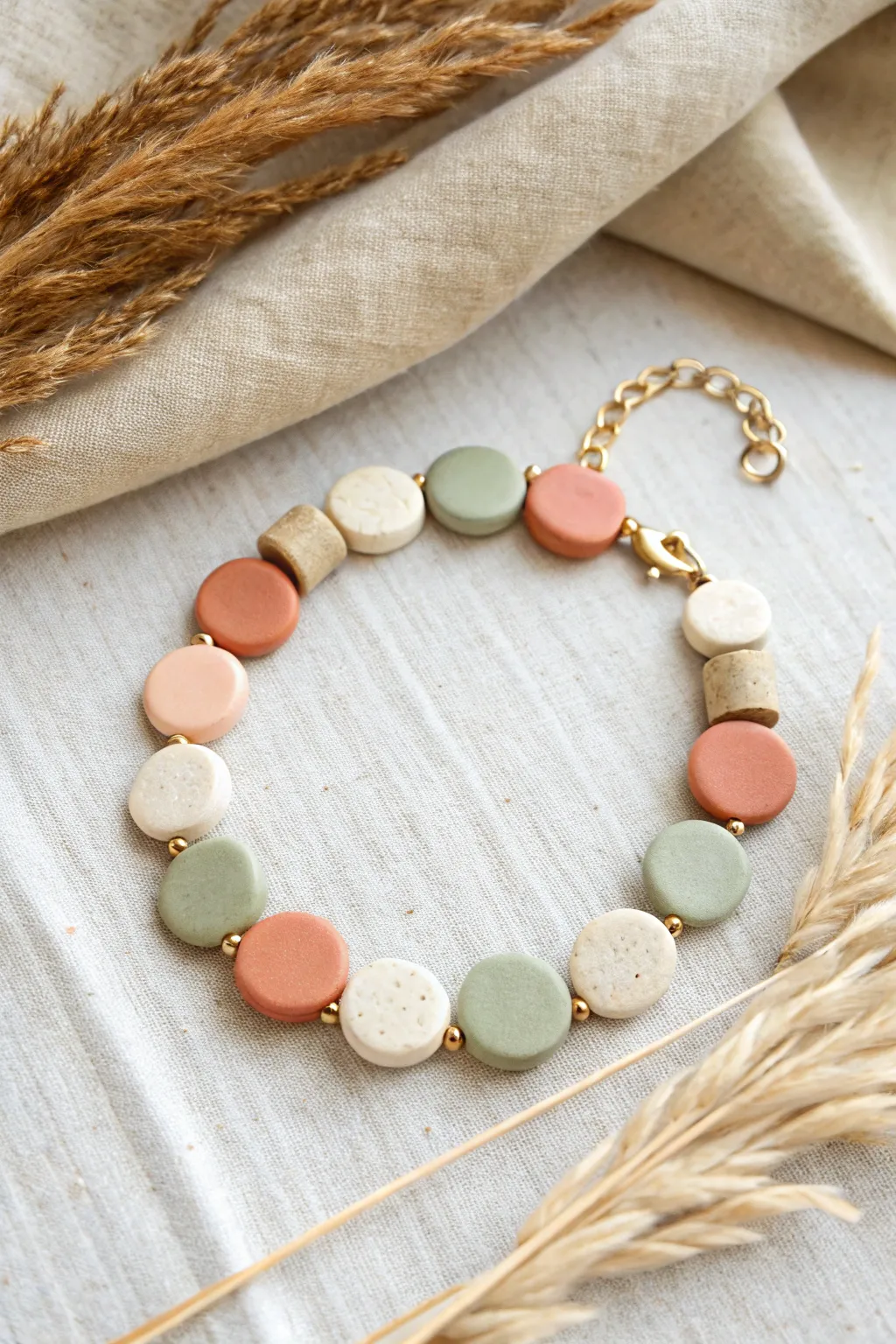
This project features a serene palette of earthy, muted tones using flat disc beads for a modern, minimalist look. The alternating gold spacer beads add just the right amount of metallic shine to elevate this simple design into an elegant accessory.
Detailed Instructions
Materials
- Polymer clay in muted sage green, terracotta, cream, and beige colors
- Small round clay cutters (approx. 10-12mm diameter)
- Small gold seed beads or metal spacer beads (2-3mm)
- Beading wire (tiger tail) or strong elastic cord
- Gold lobster clasp
- Gold extension chain
- 2 Gold crimp beads
- 2 Gold crimp covers (optional)
- Jewelry pliers (flat nose and cutting pliers)
- Toothpick or bead piercing tool
- Rolling pin or pasta machine for clay conditioning
Step 1: Crafting the Clay Beads
-
Condition the Clay:
Begin by kneading each color of polymer clay—sage green, terracotta, cream, and beige—until they are soft and pliable. This conditioning step is crucial to prevent cracks during baking. -
Roll Out Sheets:
Use a rolling pin or a clay pasta machine to roll each color into an even sheet. Aim for a thickness of about 3-4mm. Uniform thickness across all colors will ensure your bracelet looks professional. -
Create Texture (Optional):
For the cream and beige beads, you can add a speckled effect by mixing in a tiny amount of black pepper or sand-colored clay, or simply gently press a textured sponge onto the surface before cutting. -
Cut the Discs:
Using your small round circle cutter, punch out discs from each color sheet. You will need approximately 15-18 beads total, depending on your wrist size, so cut a few extras just in case. -
Pierce the Holes:
Carefully poke a hole through the center of each disc using a toothpick or piercing tool. I find that twisting the tool gently while pushing helps keep the bead from distorting. -
Smooth the Edges:
Before baking, gently run your finger around the edge of each bead to smooth out any rough spots or fingerprints left from handling. -
Bake the Beads:
Arrange your beads on a baking sheet lined with parchment paper. Bake according to your polymer clay package instructions (usually around 275°F or 135°C for 15-30 minutes). Let them cool completely before handling.
Step 2: Assembling the Bracelet
-
Plan Your Pattern:
Lay out your cooled beads on a bead board or soft cloth. Experiment with the order—try alternating colors like sage, cream, terracotta, then beige to create a balanced rhythm. -
Cut the Wire:
Cut a piece of beading wire approximately 9-10 inches long. This gives you plenty of room to work with the clasp attachments without struggling. -
Attach the Clasp:
Thread a crimp bead onto one end of the wire, followed by the lobster clasp. Loop the wire back through the crimp bead. -
Secure the First End:
Use your flat nose pliers to flatten the crimp bead tightly, securing the clasp. Trim the short excess tail of wire close to the crimp. -
String the Beads:
Begin threading your beads onto the wire. Between every clay disc bead, add a small gold metal spacer bead. This separation prevents the clay discs from rubbing together and adds a polished finish. -
Check the Length:
Once all your beads are strung, wrap the bracelet around your wrist to check the fit. Remember that the clasp and extension chain will add a little extra length. -
Finish the End:
Thread a crimp bead onto the open end of the wire, followed by the extension chain link. Loop the wire back through the crimp bead and pull it taut against the last bead. -
Secure and Trim:
Flatten the final crimp bead securely with your pliers. Trim the excess wire tail as close as possible for a neat finish. -
Add Covers (Optional):
If you are using crimp bead covers, place them over your flattened crimps and gently squeeze them shut with pliers to make them look like round gold beads.
Fixing Distortion
If your beads become oval-shaped while piercing holes, let the clay sit for 10 minutes to firm up slightly before piercing, or drill holes after baking.
Terrazzo Twist
Mix tiny chopped bits of different colored clay into your main bead colors before rolling them out to create a trendy terrazzo stone effect.
Now you have a custom handcrafted piece ready to stack with your favorite gold jewelry
Clean Monochrome With Gold Spacer Beads
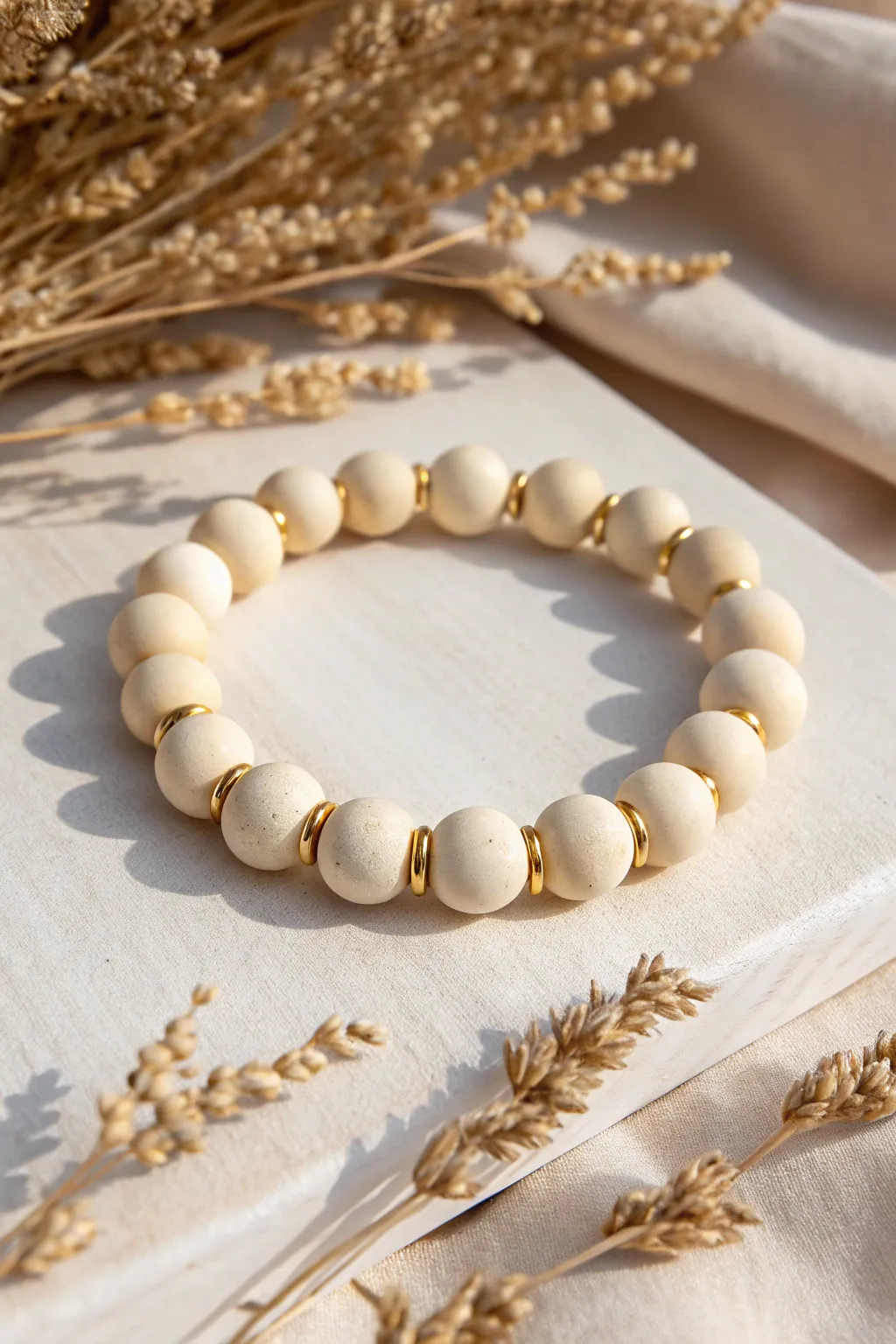
Elevate simple monochrome clay beads with the strategic placement of gold accents in this sophisticated design. The result is a creamy, luxurious bracelet that looks high-end but is incredibly simple to string together for effortless style.
Step-by-Step Tutorial
Materials
- 10mm round polymer clay beads (cream color/matte finish)
- Small gold disc spacer beads (heishi style)
- Stretch cord (0.8mm or 1mm)
- Super glue or jewelry cement
- Scissors or bead nippers
- Bead design board (optional but helpful)
- Tape or binder clip
Step 1: Preparation
-
Measure your wrist:
Wrap a measuring tape loosely around your wrist to find your size. Add about half an inch to this measurement to ensure the bracelet isn’t too tight. -
Prepare the cord:
Cut a piece of stretch cord about 10-12 inches long. This extra length makes tying the final knot much easier. -
Pre-stretch the cord:
Gently pull on the ends of your cord several times. Pre-stretching prevents the bracelet from sagging or loosening immediately after you wear it. -
Secure the end:
Attach a piece of tape or a binder clip to one end of the cord so your beads don’t slide off while you are working.
Spacer Sizing Matters
If the gold spacers are vanishing, they are too small relative to the clay beads. Ensure the spacer diameter is nearly equal to the clay bead width.
Step 2: Stringing the Pattern
-
Plan your layout:
Lay out your beads on a design board or a piece of felt. Notice the pattern in the reference image: it’s not simply alternating one-for-one. -
Analyze the sequence:
Look closely at the photo. Most of the bracelet consists of single gold spacers between single clay beads. However, there are sections where two clay beads sit together without a spacer. -
Start with clay:
Thread your first cream clay bead onto the cord. -
Add a spacer:
Slide on one gold disc spacer bead right after the clay bead. -
Repeat the main unit:
Continue this specific pattern—one clay bead followed by one gold spacer—for about three or four repetitions. -
Create the variation:
To mimic the organic feel of the original, identifying where the pattern breaks is key. Thread two cream beads next to each other, skipping the gold spacer in between them. -
Continue the pattern:
Resume the alternating pattern (clay, gold, clay, gold) for the majority of the bracelet length. -
Check the fit:
Wrap the beaded strand around your wrist to check the size. Add or remove beads as needed until the ends touch comfortably.
Step 3: Finishing Touches
-
Prepare the knot:
Remove the tape or clip from the end of the cord. Bring the two ends together. -
Tie a surgeon’s knot:
Cross the ends like a standard knot, but loop the top strand through the bottom loop twice before pulling tight. This creates a secure surgeon’s knot. -
Tighten effectively:
Pull the knot tight, but be careful not to snap the cord. I find giving it a firm tug from all four directions helps secure it best. -
Secure with glue:
Apply a tiny dab of jewelry cement or super glue directly onto the knot. Let this dry for a few minutes. -
Hide the knot:
Once dry, trim the excess cord ends close to the knot. Gently pull on the adjacent beads to slide the knot inside the hole of the nearest clay bead to hide it.
Textured Touch
Swap the standard smooth cream beads for speckled or ‘lava stone’ textured clay beads to add an earthy, organic dimension to the sleek gold.
Slip on your new bracelet and enjoy the subtle elegance of this creamy monochrome design



Fruit-Focused Clay Bead Bracelet
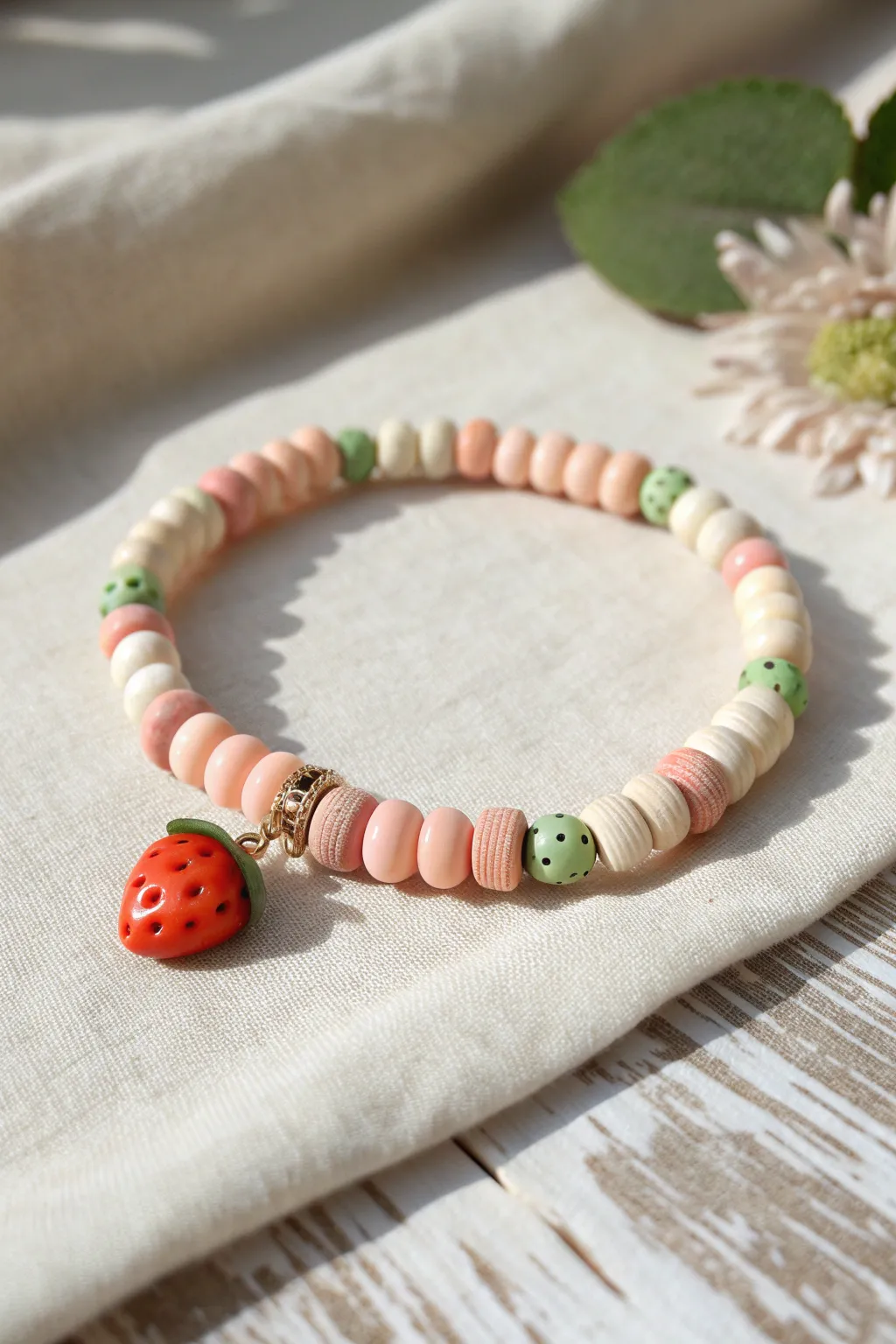
Capture the essence of summer with this adorable fruit-themed accessory featuring handmade clay beads in soft pastels and a charming strawberry focal point. The mix of textures and the delightful speckled green accents make this a wearable piece of art that looks good enough to eat.
Detailed Instructions
Materials
- Polymer clay in peach, white/cream, light green, red, and dark green
- Black acrylic paint or a fine-tip permanent marker
- Elastic jewelry cord (0.7mm or 0.8mm)
- Gold tone crimp beads or knot covers
- A small gold jump ring
- Gold tone rondelle spacer bead (ornate style)
- Clay roller or pasta machine
- Small round bead cutters or a drinking straw
- Needle tool or toothpick for piercing
- Super glue or jewelry adhesive
- Oven for baking clay
Step 1: Creating the Strawberry Charm
-
Shape the Base:
Start by conditioning a small ball of red polymer clay until it’s soft and pliable. Roll it into a smooth sphere, then gently pinch and roll one end to create a tapered teardrop shape resembling a strawberry. -
Add Texture:
Using a needle tool or a dull toothpick, gently press small indentations all over the surface of the strawberry to mimic seed pockets. Don’t press too deep; just mark the surface. -
Create the Leaves:
Take a tiny amount of dark green clay and flatten it into a small, thin disk. Use a craft knife to cut a small star or flower shape, or simply shape tiny triangles with your fingers. -
Attach the Cap:
Press the green cap onto the wider, rounded end of your red strawberry. Smooth the edges down slightly so it bonds well with the red clay. -
Add a Loop:
Because this is a charm, you need a hanging mechanism. Insert a small metal eyepin into the center of the green cap, or create a loop of wire and push the ends deep into the berry. Secure the clay around the wire.
Step 2: Making the Patterned Beads
-
Roll the Coils:
Condition your peach, cream, and light green clays separately. Roll each color into a long, even snake or log shape, roughly equal in thickness to the size you want your finished beads. -
Cut Consistent Sizes:
Use a sharp blade to slice the clay logs into uniform segments. For the disc-like beads seen in the example, cut thinner slices. For the rounder beads, cut larger chunks that you can roll into spheres. -
Shape the Rounds:
Take the cut segments intended to be round beads (peach and cream) and roll them between your palms until they are perfectly smooth spheres. I find rolling them in a circular motion on a piece of paper helps keep them uniform. -
Create the Green Berry Beads:
Roll your light green segments into spheres. To get the speckled look, use a needle tool to add tiny dots of black acrylic paint later, or mix very tiny specks of black clay into the green before rolling. -
Piercing the Beads:
Carefully pierce a hole through the center of every bead using your needle tool. Twist the tool gently as you push through to avoid squashing the bead’s shape. -
Baking:
Arrange all your beads and the strawberry charm on a baking tray or ceramic tile. Bake according to your brand of polymer clay instructions (usually around 275°F/135°C for 15-30 minutes). Let them cool completely. -
Finishing the Green Beads:
If you didn’t add specks earlier, use a fine-tip permanent marker or a toothpick dipped in black paint to add tiny ‘seeds’ to the green beads now that they are baked and cooled.
Sticky Situation?
If fingerprints are showing on your raw clay beads, lightly dust your fingertips with cornstarch before rolling, or wipe the unbaked clay with a tiny bit of baby oil.
Step 3: Assembly
-
Prepare the Cord:
Cut a length of elastic cord about 10 inches long. This gives you plenty of extra room for tying knots without struggling. -
String the Pattern:
Begin stringing your beads. Follow the pattern in the image: group a few peach beads, then a textured or flat bead, then a green speckled bead, followed by cream beads. Repeat this rhythm until you reach the desired length. -
Add the Centerpiece:
Once you have enough beads to go halfway around your wrist, slide on the gold ornate spacer bead. This will sit next to your charm. -
Attach the Charm:
Open a gold jump ring using two pairs of pliers. Slide the loop of your baked strawberry charm onto the ring, then hook the ring around the elastic cord next to the gold spacer bead. Close the jump ring securely. -
Tie the Knot:
Bring the two ends of the elastic together. Tie a surgeon’s knot (loop the cord through twice before pulling tight) to secure the bracelet. Pull it tight enough so there are no gaps between beads. -
Secure and Trim:
Add a tiny drop of super glue or jewelry cement to the knot for extra security. Once dry, trim the excess elastic ends close to the knot, or tuck the knot inside a neighboring bead hole if possible.
Glaze It Up
Make your fruit beads look juicy! Apply a coat of gloss polyurethane varnish or UV resin to the strawberry charm and the green beads after baking for a shiny finish.
Now you have a refreshing, handmade accessory ready to brighten up any outfit.

The Complete Guide to Pottery Troubleshooting
Uncover the most common ceramic mistakes—from cracking clay to failed glazes—and learn how to fix them fast.
Beachy Neutrals With Shell Charms
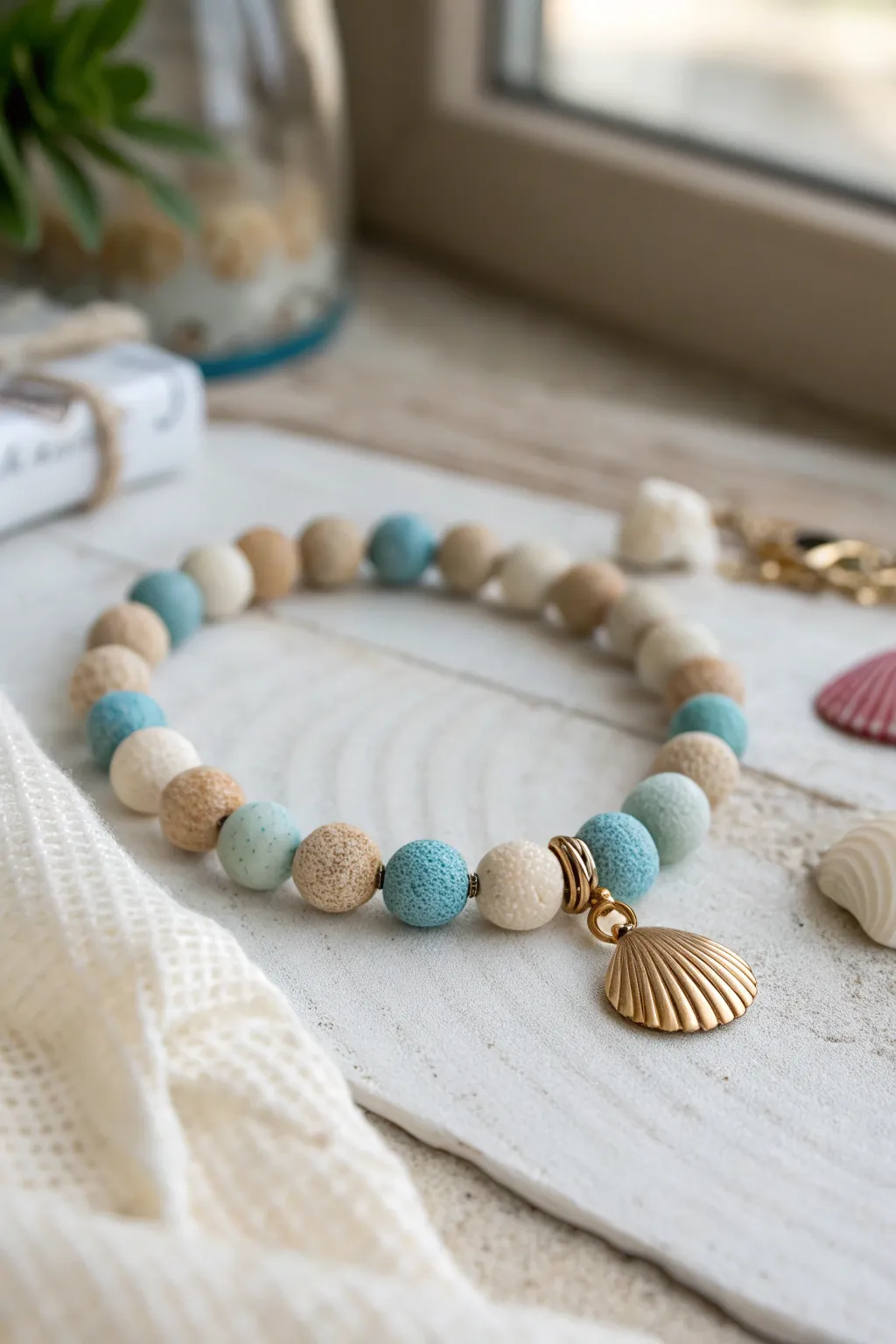
Capture the calm essence of the coast with this simple yet elegant beaded bracelet. Featuring textured beads in soft sandy beige, ocean blue, and sea foam white, it’s anchored by a shining gold shell charm that brings the whole beachy look together.
How-To Guide
Materials
- Polymer clay (beige, light blue, white, granite/speckled mix)
- Texture tool (salt, sandpaper, or a stiff toothbrush)
- Stretch cord (0.8mm or 1mm)
- Gold scallop shell charm
- 2 Gold jump rings (6mm)
- Jewelry pliers (round nose and flat nose)
- Bead reamer or toothpick
- Super glue or jewelry adhesive
- Oven for baking clay
Step 1: Crafting the Beads
-
Mix your colors:
Start by conditioning your polymer clay blocks. You want soft, muted tones, so if your blue is too bright, mix in a tiny bit of white or beige to soften it into a sea glass shade. -
Create consistent sizes:
Roll your clay into logs of equal thickness. Slice the logs into even segments to ensure all your finished beads will be roughly the same size, about 8-10mm in diameter. -
Roll spheres:
Take each segment and roll it between your palms to create smooth, round spheres. Don’t worry about perfection yet, as texturing will hide minor flaws. -
Add the beachy texture:
To mimic the porous look of lava stone or weathered pebbles seen in the photo, roll your unbaked spheres gently over a piece of coarse sandpaper or tap them all over with a stiff toothbrush. -
Refine the surface:
Roll the textured beads very lightly in your hands again to knock down any sharp peaks, leaving just the pitted, organic surface. -
Pierce the holes:
Carefully insert a toothpick or bead pin through the center of each sphere. I find twisting the tool as you push helps prevent the bead from squishing out of shape. -
Bake the beads:
Arrange your beads on a baking sheet or tile. Bake them according to your specific brand of clay’s instructions—usually around 275°F (135°C) for 15-30 minutes. -
Cool and inspect:
Let the beads cool completely before handling. Check that the holes are clear; use a bead reamer to widen them if necessary.
Knot Slipping Out?
If bead holes are too large for the knot to stay hidden, add a small gold spacer bead over the knot to cover it instead of hiding it inside.
Step 2: Assembly & Finishing
-
Plan your pattern:
Lay out your cooled beads on a design board. The photo shows an alternating pattern: blue, beige, white, repeating. This keeps the look balanced. -
Prepare the cord:
Cut a piece of stretch cord about 10-12 inches long. Pre-stretch it by pulling it gently a few times; this stops the bracelet from stretching out permanently later. -
String the beads:
Thread your beads onto the cord following your planned pattern. Check the length against your wrist as you go. -
Add the charm connector:
Between two specific beads, slide on a larger gold jump ring. This will serve as the anchor point for your shell charm later. -
Tie the knot:
Tie a surgeon’s knot (right over left, left over right twice). Pull the cord ends tight to secure the beads together snugly. -
Secure the knot:
Place a tiny drop of super glue or jewelry adhesive directly on the knot. Let it dry for a moment before trimming the excess cord tails close to the knot. -
Hide the knot:
Gently tug the bracelet so the glued knot slips inside the hole of the nearest bead, making the finish invisible. -
Attach the charm:
Open a second jump ring using your pliers by twisting it sideways. Hook it onto your gold shell charm, and then link it to the anchor ring already on the bracelet. -
Close the ring:
Twist the jump ring back ensuring the gap is perfectly aligned and flush so the charm doesn’t slip off.
Level Up: Scent Diffuser
Since these textured clay beads mimic lava stone, add a drop of essential oil to the porous pitted areas to turn this into an aromatherapy bracelet.
Now you have a breezy accessory perfect for carrying summer vibes with you year-round
Soft Ombre Fade Using Polymer Clay Beads
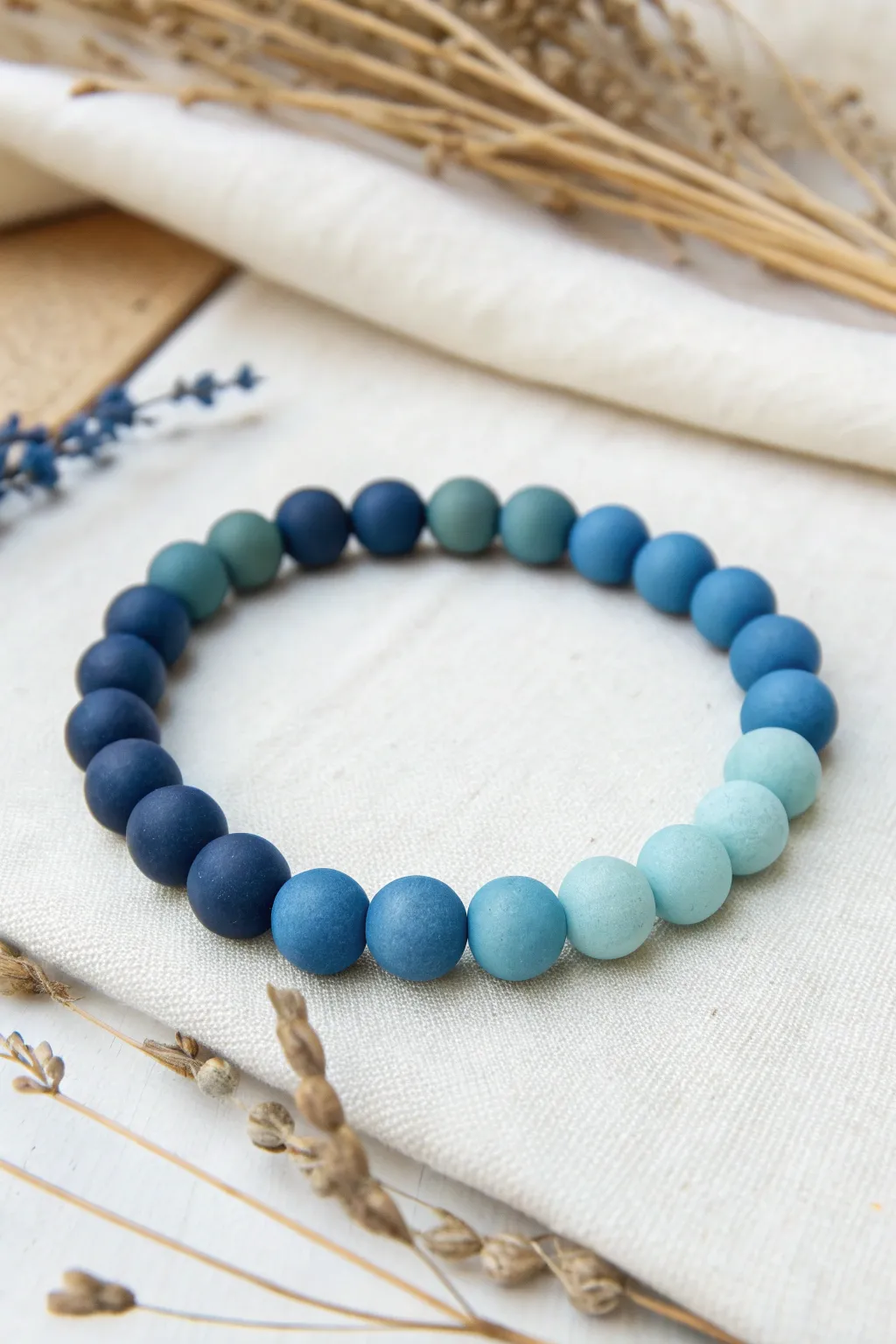
This serene bracelet captures the soothing spectrum of ocean hues, transitioning gracefully from deep midnight navy to soft seafoam teal. Using matte-finish polymer clay beads creates a sophisticated, velvety texture that feels as good as it looks.
Step-by-Step
Materials
- Polymer clay in 4-5 shades of blue (Navy, Medium Blue, Teal, Light Blue, White for mixing)
- Bead roller tool or acrylic block
- Toothpicks or bead pins
- Baking tile or tray
- Medium-grit sandpaper (optional for matte finish)
- 0.8mm elastic cord
- Super glue or jewelry adhesive
- Scissors
Step 1: Mixing & Forming Beads
-
Condition the clay:
Start by warming up your polymer clay in your hands. Knead your darkest navy blue and your lightest teal or sky blue until they are soft and pliable. -
Create custom shades:
To achieve a seamless ombre, you’ll need intermediate colors. Mix small amounts of your dark blue with lighter blues or white to create 5-6 distinct, gradual shades. -
Portion the clay:
Pinch off equal amounts of clay for each bead. Aim for marble-sized portions, roughly 8-10mm in diameter. I find using a small circle cutter on a flattened sheet ensures every bead is the exact same volume. -
Roll spheres:
Roll the clay portions between your palms to form rough balls. For perfect spheres, use a bead roller tool or roll them gently on a work surface under an acrylic block in a circular motion. -
Pierce the holes:
While the clay is still raw, gently insert a toothpick or bead pin through the center of each sphere. Twist the pin slightly as you push to avoid squashing the bead’s round shape. -
Smooth the edges:
Inspect the exit hole where the pin came through. If the clay has puckered out, gently pat it back down with your fingertip to ensure a clean opening.
Sticky Bead Holes?
If bead holes close up slightly during baking, re-drill them gently with a small hand drill or twisting a craft knife tip inside.
Step 2: Baking & Finishing
-
Bake the beads:
Arrange your beads on a baking tile, making sure they aren’t touching. Bake according to your specific brand’s package instructions—usually around 275°F (130°C) for 15-30 minutes. -
Cool down completely:
Let the beads cool fully before handling. Only once they are cool will they achieve their final hardness. -
Achieve the matte look:
If your beads look too shiny after baking, lightly buff them with a medium-grit sandpaper or a denim cloth. This removes fingerprints and creates that soft, stone-like texture shown in the image.
Step 3: Assembly
-
Layout the gradient:
Lay your beads out on a mat or tray. Arranging them before stringing is crucial here; line them up from darkest to lightest and back to dark again to visualize the ombre transition. -
Prepare the cord:
Cut a piece of elastic cord about 10-12 inches long. This extra length makes tying the final knot much easier. -
Pre-stretch the elastic:
Give the elastic cord a few firm tugs. This pre-stretching prevents the bracelet from becoming loose and sagging the first time you wear it. -
String the beads:
Thread the beads onto the elastic, following your pre-arranged gradient pattern. Maintain the color flow carefully. -
Check the fit:
Wrap the strand around your wrist to check the size. Add or remove beads as needed, ensuring the color transition still looks smooth. -
Tie the knot:
Tie a surgeon’s knot (right over left, left over right twice). Pull it tight so there are no gaps between the beads. -
Secure and trim:
Dab a tiny drop of super glue or jewelry cement onto the knot. Allow it to dry for a moment, then slide the knot inside the hole of an adjacent bead to hide it. -
Final trim:
Trim the excess cord ends close to the bead hole using sharp scissors.
Pro Tip: Cornstarch Bath
Roll raw beads in a little cornstarch before baking. It prevents fingerprints and creates an ultra-smooth, matte finish without sanding.
Wear your new gradient bracelet solo or stacked with silver bangles to highlight those cool blue tones


What Really Happens Inside the Kiln
Learn how time and temperature work together inside the kiln to transform clay into durable ceramic.
Pastel “Preppy” Mix With Alternating Gold Spacers
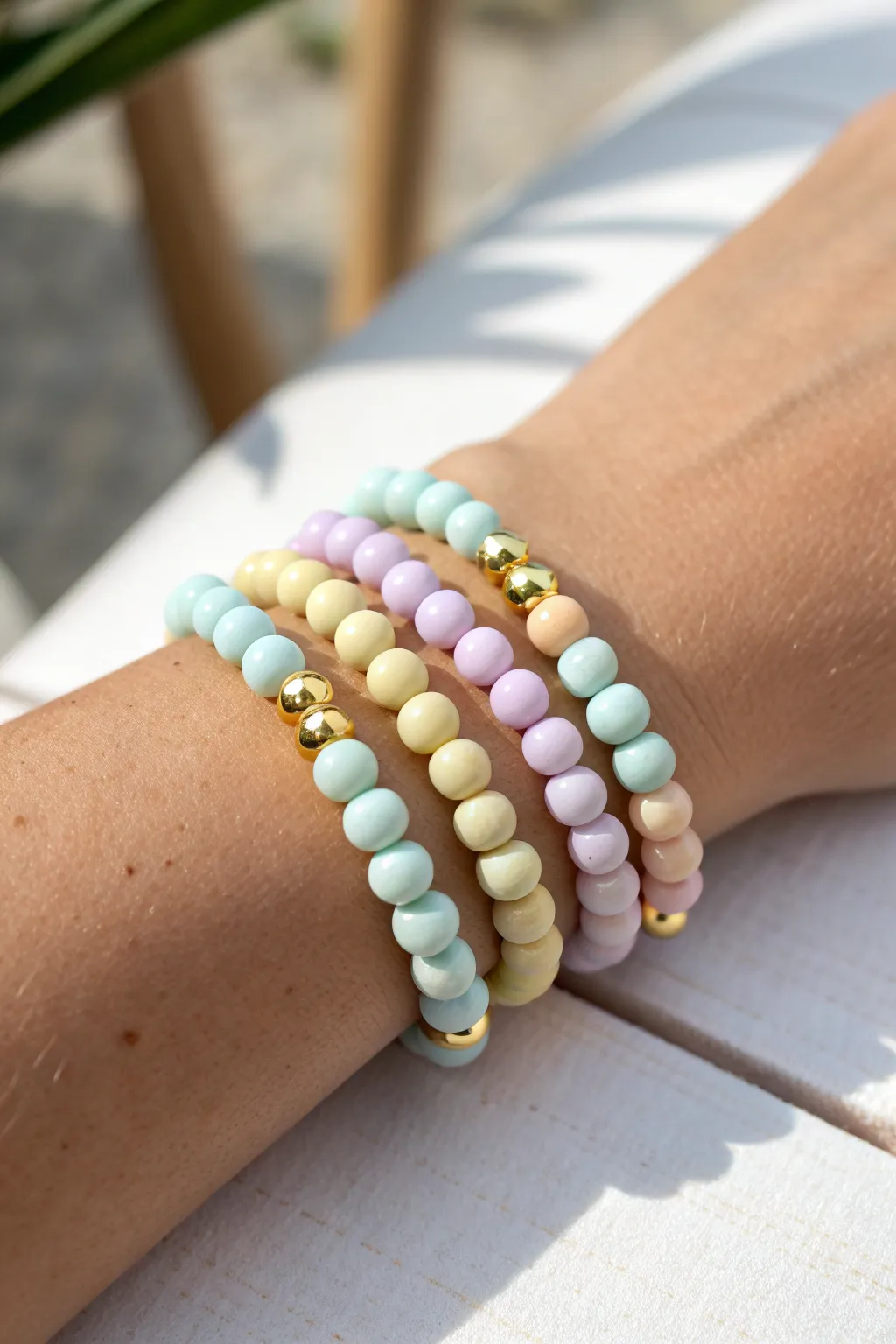
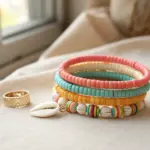
Capture the essence of spring with this delightful stack of four beaded bracelets featuring soft pastel hues. By alternating round clay beads with striking gold accents, you create a polished, preppy look that transitions effortlessly from beach days to brunch dates.
Detailed Instructions
Materials
- Round polymer clay or ceramic beads (6mm or 8mm) in pastel mint/aqua
- Round polymer clay or ceramic beads (6mm or 8mm) in pastel yellow
- Round polymer clay or ceramic beads (6mm or 8mm) in pastel lavender
- Round polymer clay or ceramic beads (6mm or 8mm) in pastel peach/pink
- Gold spherical spacer beads (metal or plated, 4mm-6mm)
- Stretch cord (0.7mm or 0.8mm typical)
- Jewelry glue or clear nail polish
- Scissors
Step 1: Planning Your Stack
-
Measure your wrist:
Before you begin, wrap a piece of string around your wrist to find your comfortable size, then add about half an inch to ensure the bracelets won’t be too tight. -
Cut the cord:
Cut four lengths of stretch elasticity cord, each about 10-12 inches long. Having this extra length makes tying the final knots much easier. -
Pre-stretch the cord:
Give each piece of cord a few firm tugs. This is a crucial step that prevents your bracelets from stretching out and becoming loose after you wear them for the first time.
Step 2: Creating the Mint & Gold Bracelet
-
Start the pattern:
Begin creating the first bracelet by threading on your pastel mint/aqua beads. Thread about 12-15 beads initially. -
Add the focal point:
Slide on two gold spherical spacer beads right next to each other. This creates the metallic highlight shown in the bottom bracelet of the stack. -
Finish the strand:
Continue threading the mint beads until you have reached the total length required for your wrist size.
Knot Security Tip
When tying elastic cord, always pull the knot tight from all four strands (the two tails and the two loop sides) to lock it firmly in place.
Step 3: Creating the Lavender & Yellow Bracelets
-
Lavender strand:
For the second bracelet, follow a similar simple pattern. Thread your lavender beads until the strand is complete, but this time, stick to a pure color block without gold spacers for a clean look. -
Yellow strand setup:
Begin the third bracelet using the pastel yellow beads. Thread approximately 6-8 yellow beads onto the cord. -
Insert gold spacers:
Add a pair of gold spacer beads. I like to stagger where these gold accents sit on the wrist compared to the other bracelets, so they don’t all line up perfectly. -
Complete the yellow loop:
Finish the strand with the remaining yellow beads to match your wrist measurement.
Texture Twist
Swap the spherical gold spacers for multifaceted geometric gold beads or gold discs to add a modern, edgy sparkle to the soft pastels.
Step 4: The Mixed Pastel Bracelet
-
Design the mix:
For the top bracelet in the stack, you will alternate colors. Start with a segment of mint/aqua beads. -
Add gold transition:
Place two gold spacer beads after the mint segment. -
Color blocking:
Switch to a few peach or soft pink beads, followed by more gold spacers, and then a segment of mint beads again. -
Finalize the pattern:
Continue this alternating pattern until the bracelet is complete, ensuring the colors balance well with the solid-colored bracelets you’ve already made.
Step 5: Finishing Touches
-
Tie the knot:
Take the ends of your first bracelet and tie a surgeon’s knot (right over left, left over right, and loop through an extra time) to secure it tightly. -
Apply adhesive:
Place a tiny drop of jewelry glue or clear nail polish directly onto the knot. This prevents the slippery elastic from coming undone. -
Hide the knot:
Let the glue dry for a moment, then trim the excess cord ends close to the knot. If the hole of a nearby bead is large enough, gently tug the knot inside it to hide it. -
Repeat:
Repeat the tying and gluing process for the remaining three bracelets to complete your stack.
Enjoy mixing and matching your new pastel stack with your favorite summer outfits
Mixed-Texture Stack With Clay Beads and Pearl-Style Accents
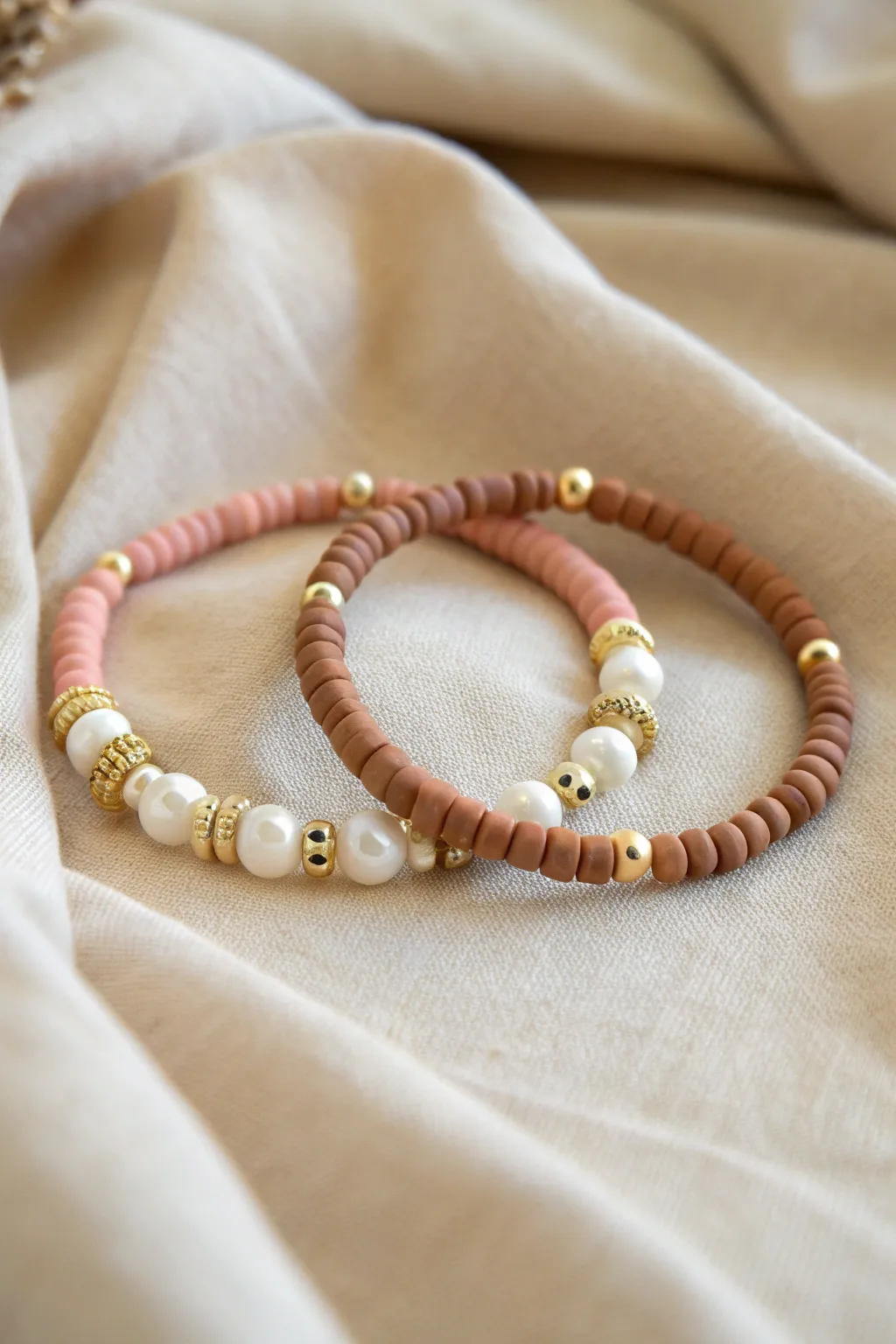
These two coordinating bracelets create a warm, textural stack by blending matte heishi beads with glossy pearl accents and glimmering gold spacers. The combination of earthy terracotta and soft rose hues makes this set versatile for everyday wear.
How-To Guide
Materials
- Polymer clay heishi beads (approx. 6mm) in soft rose/salmon color
- Polymer clay heishi beads (approx. 6mm) in terracotta/brown color
- Faux pearl beads (approx. 8-10mm)
- Small gold ball spacer beads (3-4mm)
- Texture gold rondelle or disc spacers (5-6mm)
- Elastic clear beading cord (0.8mm or 1mm thickness)
- Scissors
- Jewelry glue or clear nail polish
- Bead stopper or tape
Step 1: Planning the Rose Bracelet
-
Measure your wrist:
Cut a length of elastic cord about 10-12 inches long. This gives you plenty of extra room for tying knots later. -
Secure the end:
Attach a bead stopper or a piece of tape to one end of the cord so your beads don’t slide off while you work. -
Begin with clay:
String approximately 2-3 inches of the rose-colored clay heishi beads. This will form the minimal back section of the bracelet. -
Add a gold accent:
Slide on one small gold ball spacer bead right after the clay section. -
Continue the clay pattern:
Add another short section of rose clay beads, perhaps about an inch long, followed by another gold ball spacer.
Knot Hider Tip
Use a pearl with a slightly larger hole as one of your end beads. It’s much easier to pull the finished knot inside a pearl than into the tiny hole of a clay heishi bead.
Step 2: Creating the Focal Section
-
Start the pearl sequence:
Slide on a textured gold rondelle spacer, followed by a large pearl bead. The textured gold adds a nice vintage feel next to the smoothness of the pearl. -
Build the center texture:
Add another textured gold spacer, then a pearl, and repeat this pattern until you have about 4-5 pearls spanning the front of the bracelet. -
Interject ball spacers:
Notice in the image how some pearls are separated by textured discs and others by smooth gold balls? Mix these up to create visual rhythm. For example, use a textured disc, then a pearl, then a gold ball, then a pearl. -
Close the focal area:
Finish the pearl section with a final gold spacer to mirror how you started the pattern. -
Finish stringing:
Fill the rest of the cord with rose clay beads until the bracelet fits comfortably around your wrist without stretching. I usually aim for about 7 inches total length for an average wrist.
Step 3: Creating the Terracotta Bracelet
-
Mirror the design:
Cut a second piece of elastic. String your brown/terracotta clay beads, but try shifting the placement of the gold ball spacers slightly compared to the first bracelet for an organic look. -
Alternate the focal point:
For the brown bracelet’s centerpiece, try a slightly different pattern. Use two pearls separated by a textured gold rondelle, then perhaps a section of clay beads, then another pearl. -
Check sizing:
Hold both strands together around your wrist to ensure they are the same size before tying them off.
Mix It Up
Swap the classic pearls for freshwater pearls. Their irregular, organic shapes look incredible against the uniform flatness of the clay discs.
Step 4: Finishing Touches
-
Pre-stretch the cord:
Gently pull on the ends of the elastic a few times. This pre-stretching prevents the bracelet from loosening up after the first time you wear it. -
Knot the ends:
Remove the bead stopper and tie the ends together using a surgeon’s knot (right over left, left over right twice). -
Secure the knot:
Pull the knot very tight. Dab a tiny drop of jewelry glue or clear nail polish onto the knot and let it dry for a few minutes. -
Hide the mechanics:
Snip the excess cord close to the knot. If possible, gently tug the bracelet so the knot slides inside the hole of the nearest large pearl or gold spacer to hide it.
Enjoy mixing and matching your new textural stack with different outfits

TRACK YOUR CERAMIC JOURNEY
Capture glaze tests, firing details, and creative progress—all in one simple printable. Make your projects easier to repeat and improve.
Marbled Palette Mix With Polymer Clay Beads
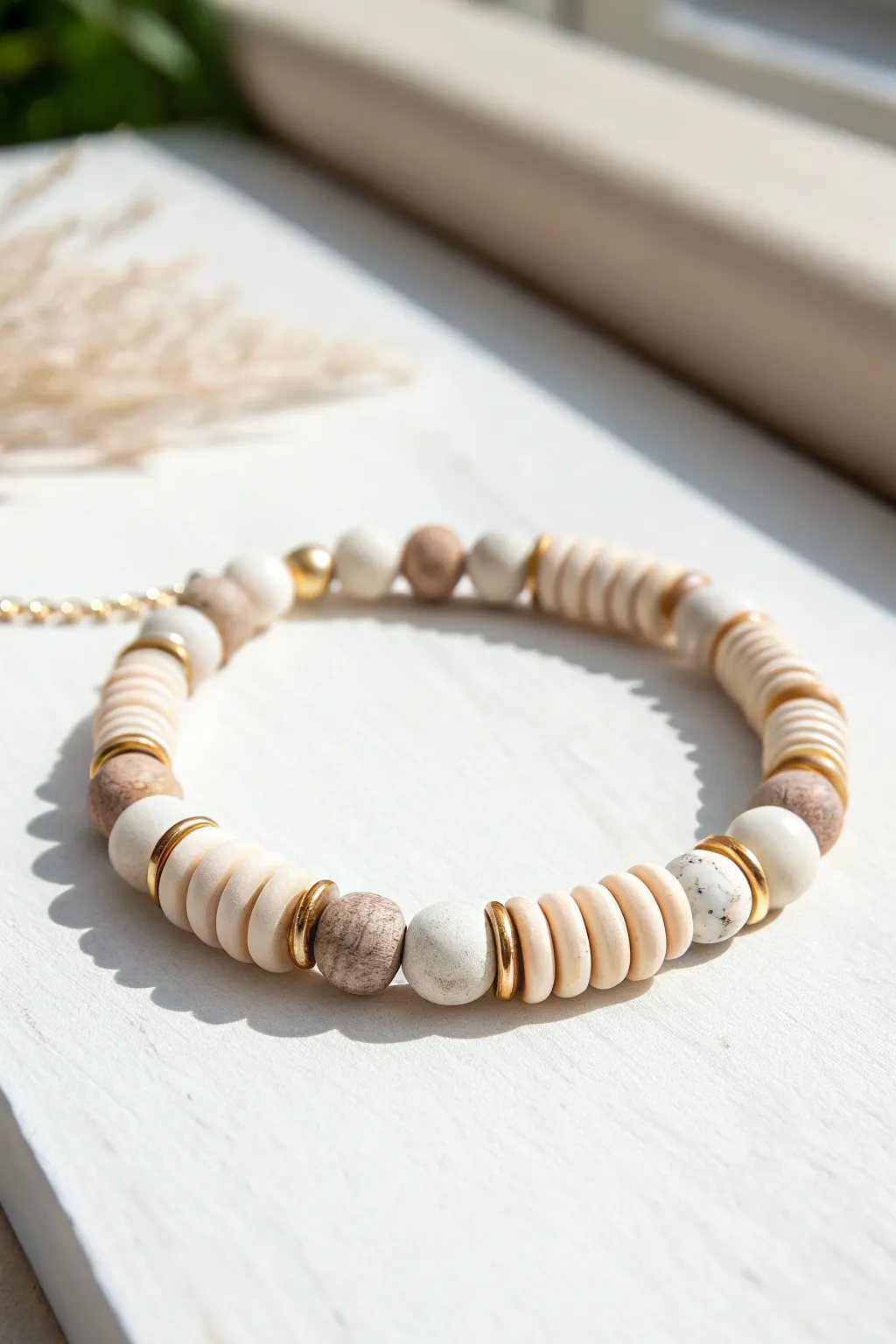
Embrace a natural, earthy aesthetic with this beautiful mixed-media bracelet that combines texture and neutral tones. By alternating creamy polymer clay discs with organic wood and marbled stone accents, you’ll create a sophisticated accessory perfect for everyday wear.
Step-by-Step Guide
Materials
- Cream or beige polymer clay heishi beads (6mm flat discs)
- Round wooden beads (8mm, natural finish)
- White or cream round stone beads (8mm, matte finish)
- Marbled white stone bead (8mm, Howlite or similar)
- Gold tone disc spacer beads
- Small gold round spacer bead (4mm)
- Strong elastic beading cord
- Jewelry adhesive or super glue
- Scissors or jewelry snips
- Bead stopper or tape
Step 1: Planning and Preparation
-
Measure your wrist:
Start by wrapping the elastic cord loosely around your wrist to determine the needed length. Add about 3 extra inches to allow plenty of room for tying the final knot comfortably. -
Secure the end:
Attach a bead stopper or simply use a piece of tape on one end of your cut elastic cord. This small step saves you the frustration of beads sliding right off while you work. -
Sort your beads:
Lay out your materials on a bead board or a soft cloth. Having your heishi discs, wood beads, stone accents, and gold spacers separated makes the patterning process much smoother.
Knot Slipping?
If your elastic knot keeps slipping undone before you can glue it, try rubbing the area of the cord you’re tying with a little beeswax to add grip.
Step 2: Creating the Pattern Sections
-
Start the sequence:
Begin threading by adding a single gold disc spacer, followed by a round wooden bead, another gold disc spacer, and a creamy white stone bead. -
Add first clay stack:
Thread on a stack of about 4 to 5 cream polymer clay heishi beads. These flat discs add a wonderful modern texture that contrasts with the round beads. -
Insert gold accent:
Place a gold disc spacer after the clay stack, followed by a round wooden bead, and another gold disc spacer to frame the wood. -
Second clay stack:
Add another group of 4 to 5 polymer clay heishi beads. I find that keeping these stacks consistent in number helps the bracelet look balanced. -
Introduce the marble bead:
Thread a gold disc spacer, then your featured marbled stone bead (like Howlite), and sandwich it with another gold disc spacer. -
Middle section:
Repeat the pattern with a stack of polymer clay discs, a framed round white stone bead, and another stack of clay discs. -
Continue patterning:
Work your way around the bracelet, alternating the framed round beads (wood or stone) with the sections of flat clay discs. Aim for symmetry, but don’t worry if it’s not perfectly identical on both sides. -
Check the length:
Periodically wrap the strand around your wrist. You want the beads to touch comfortably without gaps, but not be so tight that they pinch.
Step 3: Closing the Bracelet
-
Add the final gold bead:
Finish your pattern near the end. If needed, use a small 4mm round gold bead as the very last item; this can act as a subtle cover for your knot. -
Pre-stretch the cord:
Before tying, gently pull on both ends of the elastic. Pre-stretching prevents the bracelet from sagging or loosening up after the first time you wear it. -
Tie the knot:
Remove the bead stopper and tie a surgeon’s knot. This is a standard overhand knot, but you loop the cord through twice before pulling tight. -
Secure with glue:
Apply a tiny dab of jewelry adhesive or super glue directly onto the knot. Let it dry for a minute to ensure the bond is secure. -
Hide the knot:
If possible, gently tug the elastic so the knot slides inside the hole of the nearest large bead (usually the wood or stone bead works best for this). -
Trim excess:
Once the glue is fully cured, use your scissors to snip off the excess cord tails close to the knot.
Texture Twist
Try sanding the polymer clay discs lightly with fine-grit sandpaper before stringing. This gives them a matte, organic feel matching the wood.
Slip on your new bracelet and enjoy the subtle elegance of mixed textures in your daily style
Terrazzo-Inspired Confetti With Clay Bead Colors
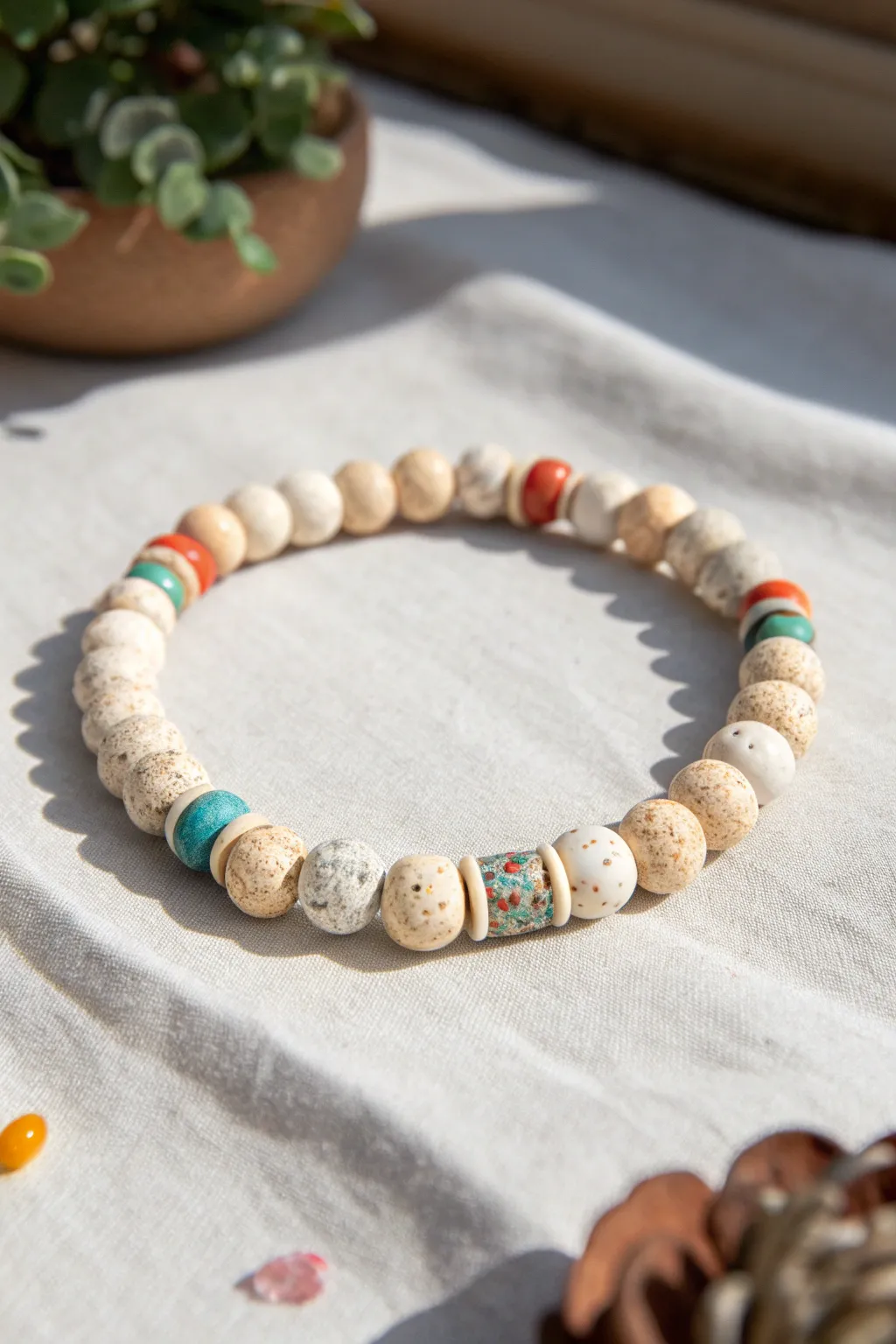
Embrace the earthy, textured charm of polymer clay with this bracelet tutorial that mimics the look of natural stone and terrazzo. The combination of subtle speckling and vibrant confetti beads creates a sophisticated accessory that pairs perfectly with linen and sunlight.
How-To Guide
Materials
- Polymer clay (white, beige/ecru, translucent, terracotta)
- Acrylic paints (turquoise, teal, white, burnt orange)
- Coarse black pepper or dried used coffee grounds (for speckling textured beads)
- Fimo Deco Gel or liquid polymer clay
- Bead piercing pins or toothpicks
- Sandpaper or a nail file (fine grit)
- Clear elastic cord (0.7mm or 0.8mm)
- Jewelry glue or clear nail polish
- Oven for baking clay
- Optional: Gloss varnish for select beads
Step 1: Creating the Speckled Base
-
Prepare the base mixture:
Start by conditioning a large block of ecru or beige polymer clay until it’s soft and pliable. This will act as the primary color for most of your beads. -
Add texture:
To achieve that organic, stone-like appearance, knead in a small pinch of coarse black pepper or dried coffee grounds. Don’t overmix; you want the specks to remain visible rather than turning the clay grey. -
Form the rounds:
Roll the speckled clay into a long log and slice it into equal segments. Roll each segment between your palms to create approximately 25-30 round beads, aiming for about 8-10mm in diameter. -
Pierce the beads:
Carefully poke a hole through the center of each bead using a piercing pin. I find a slow, twisting motion prevents the clay from squishing out of shape.
Confetti Falling Off?
If your terrazzo chips peel after baking, add a drop of liquid clay (like Sculpey Bake & Bond) under the chips before pressing them in to ensure a permanent bond.
Step 2: Crafting the Feature Beads
-
Make the terrazzo focal bead:
Take a small ball of your beige clay and flatten it slightly into a cylinder shape. Chop tiny, irregular bits of turquoise and burnt orange clay to create ‘confetti’. -
Embed the confetti:
Press the colored chips firmly onto the cylinder surface. Roll the cylinder gently on your work surface to smooth the chips flush with the base clay so it feels like one solid piece. -
Create the spacer discs:
Roll out a thin sheet of white or cream clay. Cut small circles using a mini cutter or the end of a straw to create thin disc spacers that will sit between the focal beads. -
Accent color beads:
Set aside 4-5 of your round speckled beads. Paint narrow bands of turquoise or burnt orange around the center, or mix custom colored clay to create solid accent beads in those hues.
Step 3: Baking and Finishing
-
Bake the batch:
Arrange all your beads on a baking sheet lined with parchment paper. Bake according to your clay manufacturer’s instructions (usually 230°F – 265°F for 15-30 minutes). -
Cool and inspect:
Allow the beads to cool completely before handling. Check for any rough edges around the bead holes. -
Sand for matte effect:
Lightly buff the speckled round beads with fine-grit sandpaper. This removes fingerprints and enhances the dry, stone-like texture visible in the photo. -
Seal the terrazzo:
For the confetti focal bead, apply a very thin coat of matte or satin varnish to protect the small colored chips and make the colors pop slightly without adding too much shine.
Stone Effect Upgrade
Mix translucent clay (1 part) to your beige clay (3 parts). This adds depth and creates a faux-stone look that is less opaque and more realistic.
Step 4: Assembly
-
Plan the pattern:
Lay your beads out on a bead board or towel. The pattern in the image relies on asymmetry: place the cylindrical terrazzo bead as the centerpiece, flanked by white discs and feature beads. -
Stringing:
Cut a piece of elastic cord about 10 inches long. Pre-stretch it by pulling on the ends gently to prevent the finished bracelet from sagging later. -
Thread the beads:
String your beads according to your design. Alternate the plain speckled rounds with your painted accent beads and the focal terrazzo cylinder. -
Tie the knot:
Tie a surgeon’s knot (a square knot with an extra loop) to secure the bracelet. Pull it tight, ensuring there are no gaps between beads. -
Secure and hide:
Dab a tiny drop of jewelry glue on the knot. Once dry, trim the excess cord and gently tug the knot inside the hole of a neighboring bead to hide it.
Now you have a stunning, nature-inspired piece ready to stack or wear solo.
Intentional “Negative Space” With Spaced Clay Beads
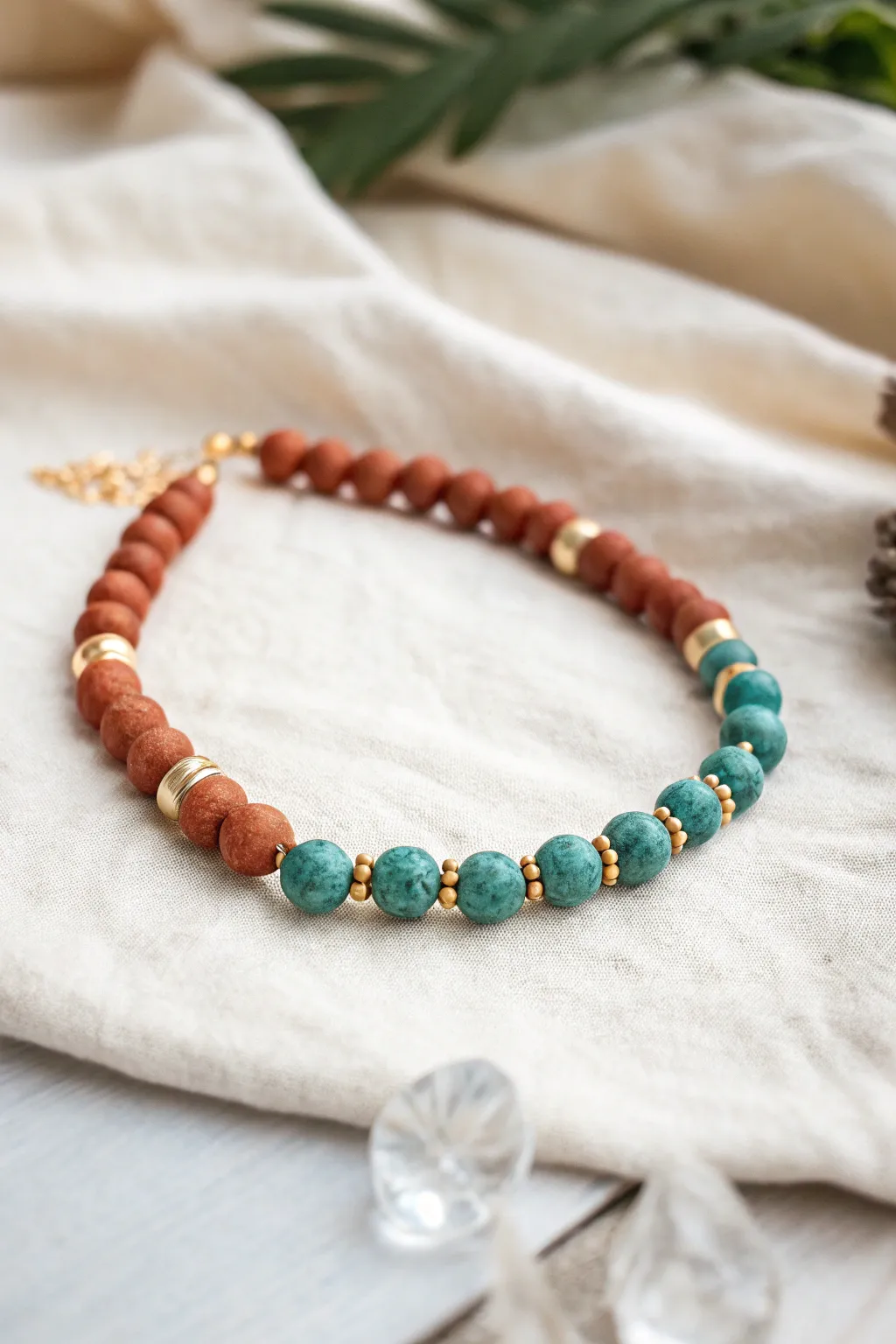
This earthy, bohemian design combines the warmth of textured terracotta clay beads with the cool tones of faux turquoise. The thoughtful spacing using gold accents creates a sophisticated rhythm that elevates simple beading into a statement piece.
Step-by-Step Guide
Materials
- Terracotta-colored polymer clay (or pre-made terracotta beads)
- Turquoise polymer clay (or faux turquoise stone beads)
- Gold spacer beads (small balls)
- Gold tube beads or crimp covers (larger accents)
- Beading wire (such as Tiger Tail)
- Gold crimp beads
- Gold lobster clasp and extender chain
- Wire cutters
- Chain nose pliers
- Crimping pliers
- Toothpick or bead reamer
- Texture sponge or sandpaper (if making beads)
Step 1: Creating the Beads (If DIY)
-
Form the terracotta base:
If you are making your own beads, condition your terracotta-colored polymer clay until soft. Roll small, even spheres approximately 8-10mm in diameter. -
Add texture:
To mimic the rustic look in the photo, gently roll your raw clay spheres over a clean piece of sandpaper or a texture sponge. This gives them that organic, stone-like surface. -
Form the turquoise beads:
Repeat the process with turquoise clay, perhaps marbling in a tiny bit of black or dark grey for a natural stone effect. Keep these roughly the same size as the brown beads. -
Pierce the holes:
Use a toothpick or bead pin to carefully pierce a hole through the center of each bead. I like to twist the tool gently as I push through to avoid deforming the sphere. -
Baking:
Bake your clay beads according to the manufacturer’s instructions on the package. Let them cool completely before handling.
Uneven Spacing?
If gaps appear between beads when the necklace curves, your wire is too tight. Restring and leave a tiny bit of slack near the clasp before crimping.
Step 2: Designing the Pattern
-
Prepare the wire:
Cut a length of beading wire about 4 inches longer than your desired finished necklace length to allow ample room for finishing the ends. -
Secure the first end:
Thread a crimp bead onto one end of the wire, followed by the clasp. Loop the wire back through the crimp bead and use your crimping pliers to flatten it securely. -
Start with terracotta:
Begin threading your terracotta beads. String about 8-10 of the brown beads onto the wire to form the back section of the necklace. -
Insert a gold accent:
Place a larger gold tube bead or a thick gold spacer after this first block of brown beads to mark the transition. -
Continue the brown section:
Add another small section of 3-4 terracotta beads.
Step 3: The Center Focal Section
-
Transition to turquoise:
Slide on a gold tube bead or a flat gold spacer to separate the color zones. -
Begin the spaced pattern:
This is the ‘negative space’ technique. Thread one turquoise bead, followed by two small gold spacer balls. -
Repeat the rhythm:
String another turquoise bead, then two more small gold spacer balls. Repeat this pattern for the entire center section (usually about 7-9 turquoise beads). -
Check the balance:
Hold the necklace up to your neck to ensure the turquoise section sits centered where you want it. -
Mirror the design:
Finish the turquoise section with a final gold accent bead, mirroring the one you used on the other side.
Level Up: Scent Diffuser
Use unsealed terracotta or lava stone beads for the brown section. Add a drop of essential oil to them to turn your jewelry into a wearable diffuser.
Step 4: Finishing Touches
-
Complete the strand:
String the remaining terracotta beads to match the length of the first side. -
Add the final crimp:
Thread a crimp bead and the jump ring (or extender chain) onto the end of the wire. -
Secure the wire:
Pass the wire back through the crimp bead and a few of the adjacent clay beads. Pull everything taut but not stiff—the beads need a little wiggle room to drape properly. -
Crimp and trim:
Flatten the crimp bead firmly with your pliers and trim the excess wire tail close to the beads so it doesn’t poke the skin.
Now you have a beautifully balanced necklace that merges natural textures with elegant spacing
Charm-Cluster Focal Point on a Clay Bead Bracelet
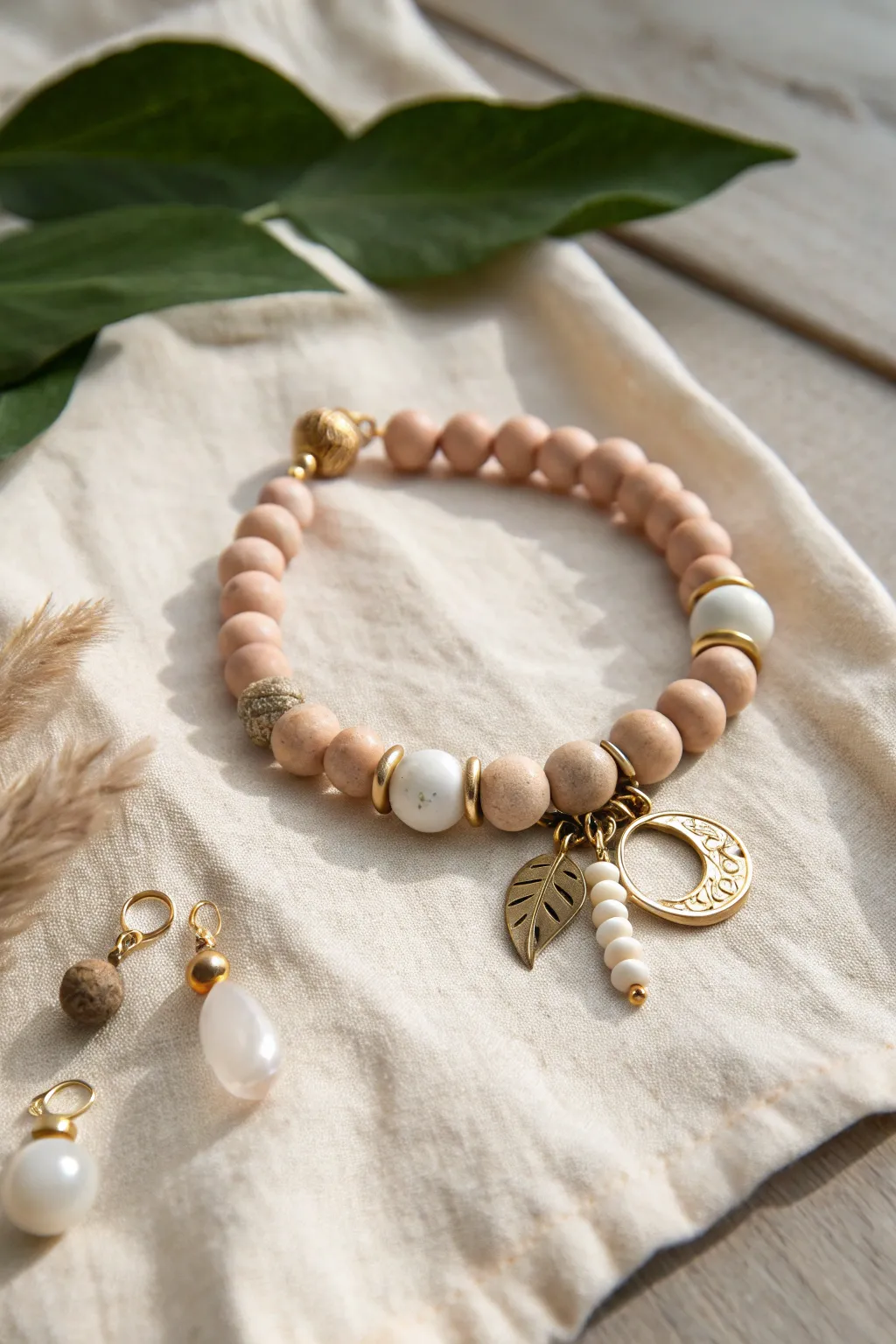
This project marries the earthy texture of matte peach-toned clay or wood beads with the elegance of gold and crisp white accents. The standout feature is a centralized cluster of charms that adds movement and personality to an otherwise minimalist design.
Step-by-Step Tutorial
Materials
- Approx. 20-22 round matte peach clay or sandalwood beads (8mm)
- 2 large white ceramic or bone beads (10-12mm)
- 4 textured gold ring spacer beads (flat disc shape)
- 1 large gold textured focal bead (optional, for back closure)
- 1 textured gold accent bead (smaller, heavily textured)
- Gold leaf charm
- Gold crescent moon charm
- 3-4 small white spacer beads (4mm)
- 2 gold jump rings (6mm)
- 1 gold headpin
- Elastic beading cord (0.8mm clear)
- Jewelry glue (GS Hypo Cement recommended)
- Chain nose pliers
- Round nose pliers
- Wire cutters
- Scissors
Step 1: Creating the Charm Components
-
Prepare the beaded dangle:
Before stringing the main bracelet, construct the small beaded charm. Slide three to four small 4mm white spacer beads onto a gold headpin. -
Finish the beaded dangle:
Use your round nose pliers to create a wrapped loop at the top of the bead stack. Snip off any excess wire with your wire cutters. -
Assemble the charm cluster:
Open a single sturdy jump ring using two pairs of pliers (twist sideways, don’t pull apart). Thread on the gold leaf charm, a separate jump ring holding the moon charm, and your newly created white bead dangle. -
Close the cluster:
Close the main jump ring securely, ensuring all charms hang freely. Set this completed cluster aside.
Knot Hider
If the knot won’t fit inside a bead hole, widen the hole gently with a bead reamer tool, or ensure your ‘closure bead’ has a specifically large bore (2mm+).
Step 2: Designing the Bead Pattern
-
Measure your elastic:
Cut a piece of elastic cord about 10-12 inches long. This gives you plenty of room to knot it later without struggling. Pre-stretch the elastic slightly to prevent sagging later. -
Start the sequence:
Begin by stringing about 8 of your main peach-toned clay/wood beads. These will form one side of the bracelet. -
Add a textured accent:
Slide on the small, heavily textured gold bead. This adds a subtle asymmetry to the design. -
Continue the base:
Add approximately 3 more peach beads after the textured gold accent. -
Build the focal section framing:
Now, thread on one gold disc spacer, followed by one large white ceramic bead, and another gold disc spacer. This frames your first focal bead.
Step 3: Installing the Focal Point
-
Add the center bridge:
Thread on two more peach beads. These will sit directly in the center of the bracelet. -
Attach the charms:
Slide the jump ring of your pre-made charm cluster onto the elastic cord. Let it rest between the beads. -
Complete the center:
Slide on one more peach bead to secure the charm cluster’s position visually. -
Mirror the framing:
Repeat the frame pattern: one gold disc spacer, your second large white ceramic bead, and a final gold disc spacer.
Matching Earrings
Use leftover white beads and gold headpins to create simple drop earrings that echo the dangle charm on the bracelet for a cohesive set.
Step 4: Finishing the Bracelet
-
Finish the strand:
Fill the rest of the cord with the remaining peach beads until the bracelet reaches your desired length (usually about 7 inches total). Check the fit around your wrist. -
Add the closure bead:
If using the large gold textured bead for the back, thread it on last. This can act as a decorative knot hider. -
Tie the knot:
Tie a surgeon’s knot (right over left twice, pull tight; left over right once, pull tight). Pull the elastic taut to secure the beads tightly together. -
Adding security:
Apply a tiny dab of jewelry glue to the knot. I find waiting about 30 seconds for it to get tacky helps it hold better. -
Hide the mechanism:
Trim the excess cord ends to about 2mm. Gently tug the bracelet so the knot slips inside the hole of the large gold bead or one of the adjacent clay beads.
Enjoy the gentle clinking sound of your new charm cluster bracelet as you wear it.