
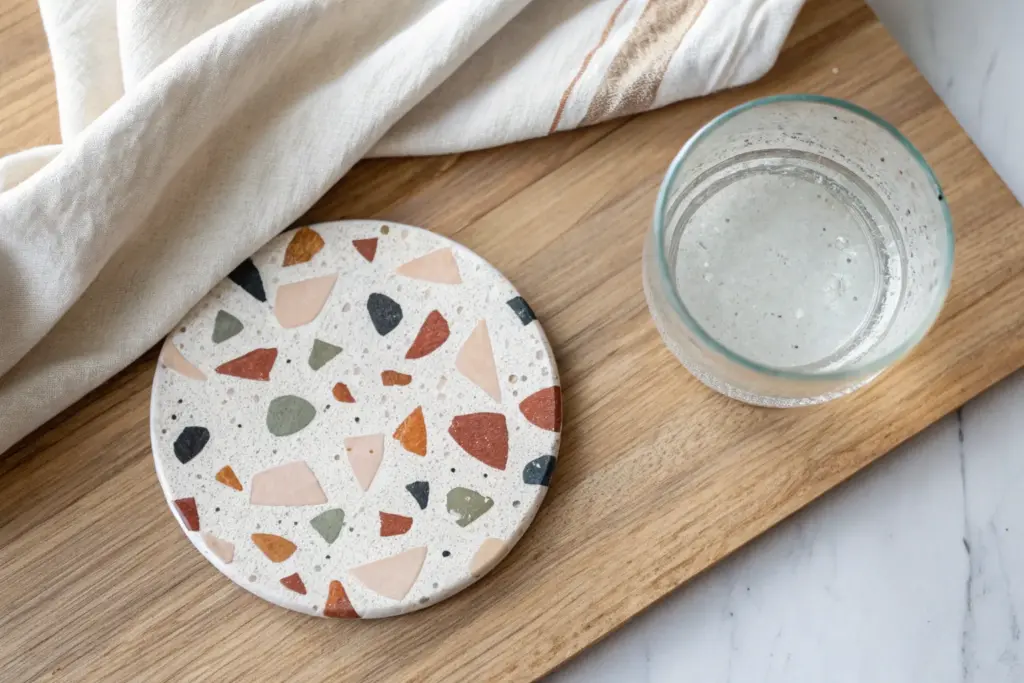
Clay coasters are my favorite quick win because they’re genuinely useful, but they still feel like a tiny piece of handmade art. These clay coaster ideas give you tons of style options—from classic botanical imprints to modern patterns—without needing anything fancy to pull them off.
Classic Round Air-Dry Clay Coasters With Smooth Edges
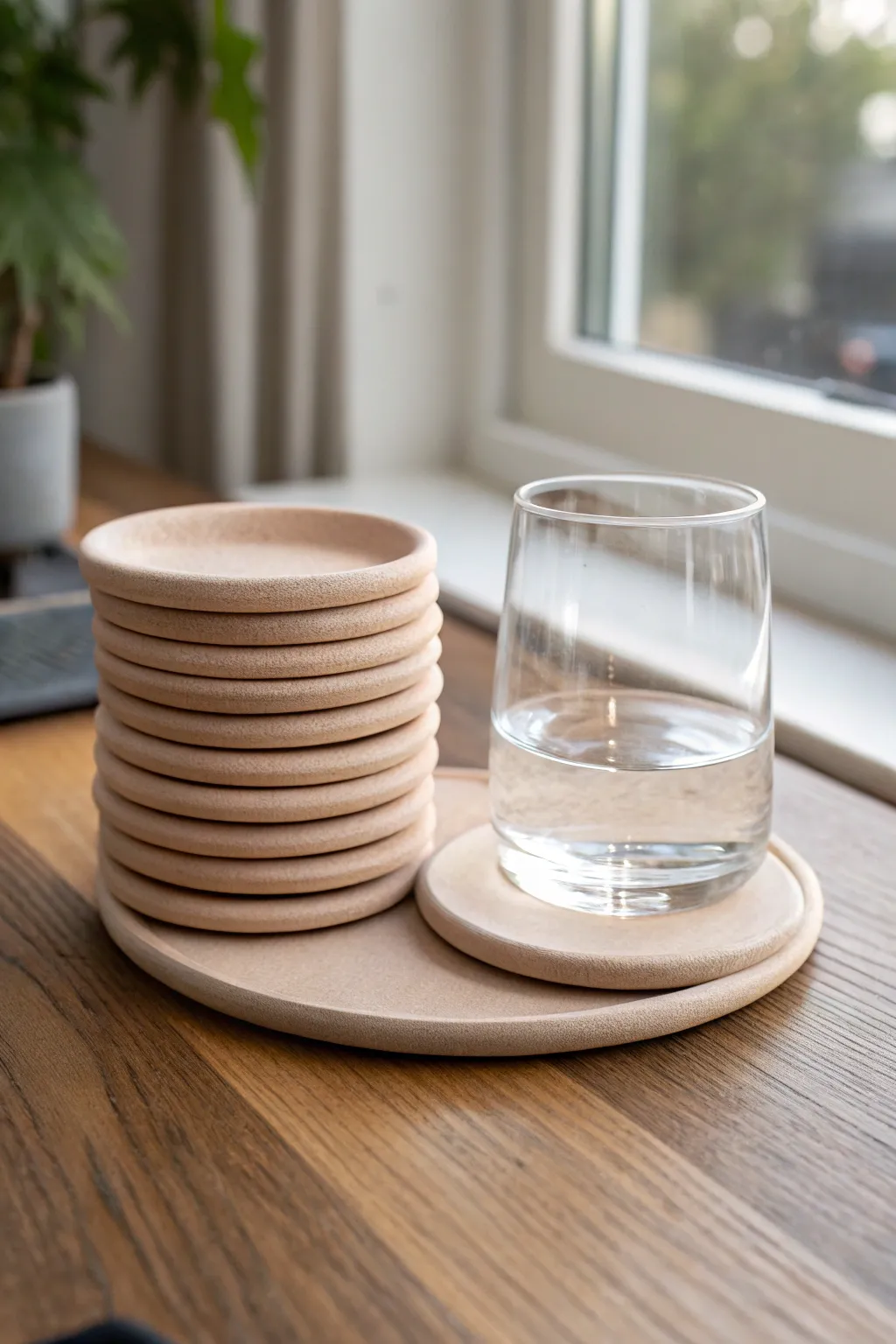
These elegant, stackable coasters feature a beautiful raised-lip design and a natural, sandstone-like texture that feels incredibly modern. Perfect for minimalist homes, this project uses air-dry clay to create a uniform set complete with a matching serving tray.
Step-by-Step Tutorial
Materials
- Beige or terracotta colored air-dry clay (approx. 1kg)
- Rolling pin
- Two guide sticks (approx. 5mm thickness)
- Round cookie cutters (one approx. 9cm for coasters, one 20cm for tray)
- Small sponge
- bowl of water
- Sandpaper (medium and fine grit)
- Matte acrylic varnish or sealant spray
- Canvas or cloth work surface
Step 1: Preparation and Rolling
-
Condition the Clay:
Begin by taking a large chunk of your air-dry clay and kneading it thoroughly in your hands. You want it to be warm, pliable, and free of any air bubbles before you start rolling. -
Set Up Guides:
Place your canvas or cloth on a flat table to prevent sticking. Arrange your two guide sticks parallel to each other, slightly wider than the width of your intended clay slab. -
Roll the Slab:
Place the kneaded clay ball between the sticks. Using the rolling pin, roll the clay out until the pin rests on the guide sticks, ensuring a perfectly even thickness across the entire surface.
Fixing Cracks
Make a thick paste using clay scraps and water. Press this ‘slurry’ into any cracks that appear during drying, let dry, and sand smooth.
Step 2: Shaping the Coasters
-
Cut the Base Circles:
Press your 9cm round cutter firmly into the clay slab to cut out your coaster bases. Remove the excess clay from around the circles before lifting the circles themselves to avoid distortion. -
Create the Lip Coils:
Roll out long, thin snakes of clay, aiming for a thickness of about 4-5mm. Try to keep the coil very consistent, as this will form the raised edge of your coaster. -
Score and Slip:
Using a needle tool or toothpick, gently scratch rough marks (scoring) around the top outer edge of your base circle. Dab a little water (slip) onto the scratched area. -
Attach the Rim:
Carefully place the clay coil onto the scored edge of the base. Cut the coil where the ends meet and gently blend the seam together so it looks like one continuous ring. -
Blend the Seams:
Use a modeling tool or your fingertip to smooth the clay coil downwards onto the base, both on the inside and outside of the rim. The goal is to make the rim and base look like a single, solid piece. -
Repeat for the Tray:
Repeat the rolling and cutting process using the larger 20cm cutter (or a bowl as a template) to create the base tray. Attach a slightly thicker coil to the rim using the same score, slip, and blend method.
Level Up: Cork Bottoms
Cut circles of adhesive cork sheet slightly smaller than the coaster base and stick them underneath to protect your table and prevent sliding.
Step 3: Refining and Drying
-
Smooth the Surfaces:
Dip your small sponge into water and squeeze it out until it’s just damp. Gently wipe over the entire coaster to remove fingerprints and smooth out any uneven blending marks. -
Refine the Rim Shape:
While the clay is still damp, check that the tops of the rims are flat. I find gently flipping the coaster upside down and pressing it lightly onto the table helps level the top edge perfectly. -
Texture Appearance:
To achieve the specific sandy look in the photo, you can gently pat the surface with a stiff brush or a textured sponge while damp, or rely on the natural grain of stone-effect clay if you purchased that specific type. -
Slow Drying:
Place all pieces on a wire rack or a piece of parchment paper away from direct heat or sunlight. Let them dry slowly for 24-48 hours. Flip them occasionally to prevent curling.
Step 4: Finishing Touches
-
Sand for Perfection:
Once fully bone dry, take your medium grit sandpaper and smooth the outer rim to make it perfectly round. Switch to fine grit to smooth the top lip and the inner basin of the coaster. -
Create the Stone Effect:
If your clay is plain white or grey, you can now spray paint them with a ‘stone effect’ spray paint available at craft stores to get that speckled beige texture seen in the image. -
Seal Against Moisture:
Apply 2-3 coats of a matte acrylic varnish or a waterproof sealant spray. This step is crucial for coasters, as they need to withstand condensation from cold glasses.
Stack your finished set on the tray for a functional centerpiece that looks like high-end ceramic design


Pressed Leaf Imprint Botanical Coasters
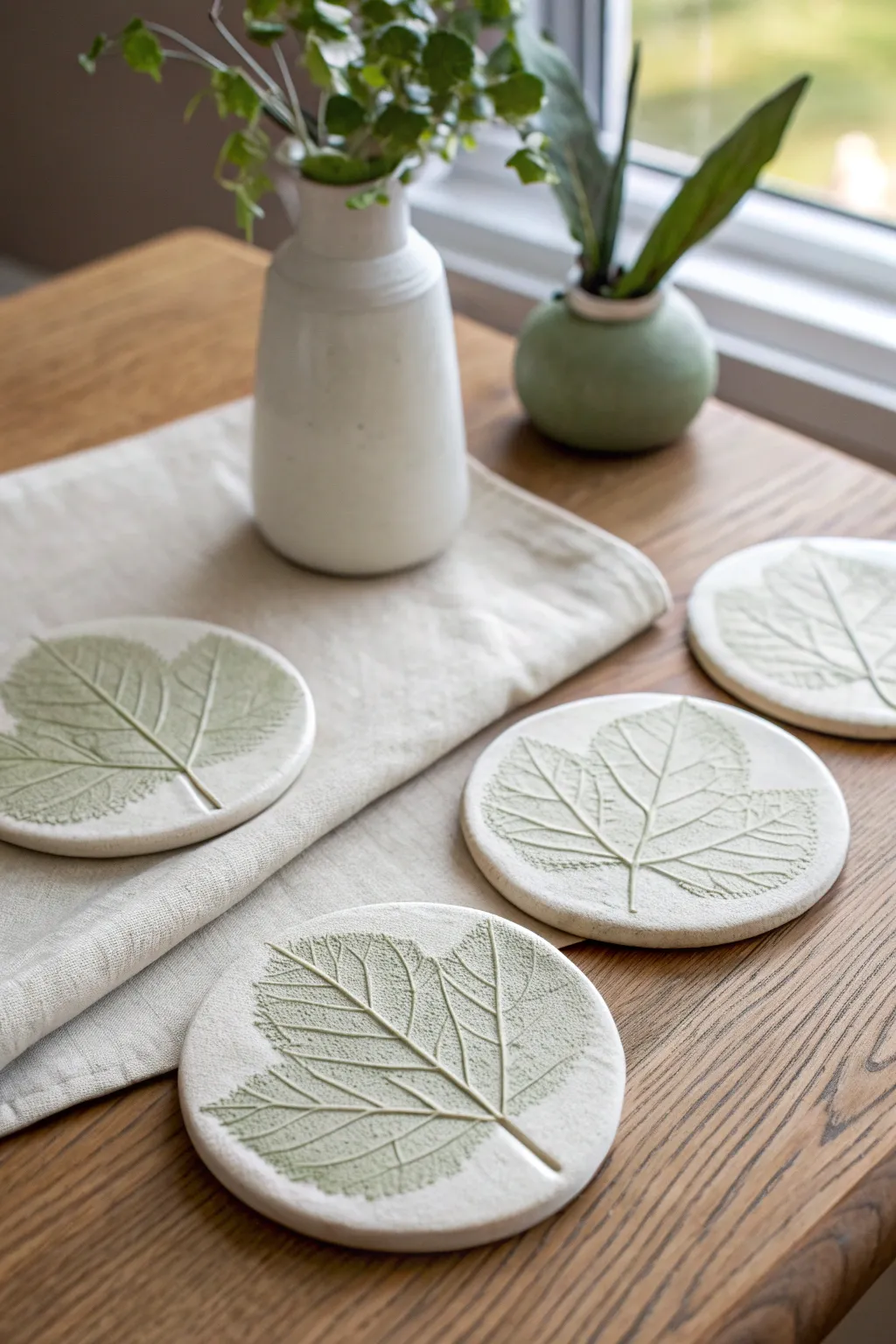
Capture the delicate veins and textures of your favorite garden foliage with these elegant botanical coasters. The result is a set of clean, white clay discs featuring soft green leaf impressions that bring a touch of the outdoors to your coffee table.
How-To Guide
Materials
- White air-dry clay (or polymer clay)
- Fresh leaves with prominent veins (grape, maple, or sage work well)
- Rolling pin
- 4-inch round cookie cutter or a large jar lid
- Parchment paper or canvas mat
- Small craft knife (X-Acto)
- Fine-grit sandpaper (220-400 grit)
- Green acrylic paint (sage or moss green)
- Small sponge or foam brush
- Paper towels
- Clear matte sealant spray or varnish
Step 1: Preparation and Rolling
-
Prepare your workspace:
Lay down parchment paper or a canvas mat on a flat, stable surface. This prevents the clay from sticking and ensures a smooth removal later. -
Condition the clay:
Take a handful of white air-dry clay and knead it well in your hands until it becomes soft, pliable, and free of cracks. Warm clay is much easier to work with. -
Roll the slab:
Place the clay ball on your prepared surface. Using a rolling pin, roll it out into an even slab. Aim for a thickness of about 1/4 inch—too thin and they might crack; too thick and they take forever to dry. -
Smooth the surface:
Before impressing anything, run a slightly damp finger or the back of a spoon over the clay to smooth out any rolling pin marks or creases.
Uneven Impressions?
If the leaf isn’t pressing evenly, try placing a piece of paper over the leaf before rolling. This distributes pressure better and prevents the roller from tearing delicate foliage.
Step 2: Impressing and Cutting
-
Position the leaf:
Select a fresh leaf with strong veining on the back. Place the leaf vein-side down onto the clay slab. Ensure it’s centered or positioned artistically where you plan to cut the circle. -
Create the impression:
Gently roll over the leaf with the rolling pin. Apply firm, even pressure to push the veins deep into the clay, but be careful not to make the slab too thin. The leaf should become flush with the clay surface. -
Cut the shape:
Place your 4-inch round cutter directly over the leaf impression. Press down firmly to cut the circle. Do this while the leaf is still embedded in the clay to prevent distortion. -
Remove excess clay:
Peel away the excess clay from the outside of the cutter first, then carefully lift the cutter vertically. -
Reveal the print:
Find the stem of the leaf and very carefully peel it upward and away from the clay. This is the most satisfying part, revealing the intricate network of veins. -
Refine the edges:
Dip your finger in a little water and gently smooth the cut edges of the circle to round them off slightly, removing any sharp ridges left by the cutter.
Level Up: Color Gradient
Instead of a single color wash, try blending two shades of green or adding a touch of brown near the stem for a realistic, autumnal gradient effect as you paint the veins.
Step 3: Drying and Finishing
-
Let it dry:
Allow the coasters to air dry completely. This usually takes 24-48 hours depending on humidity. I recommend flipping them over halfway through the process to ensure even drying and prevent warping. -
Sand for smoothness:
Once fully hard, take fine-grit sandpaper and lightly sand the edges and the top surface (avoiding the deep leaf impression) to remove any imperfections. -
Apply the wash:
Mix a small amount of sage green acrylic paint with water to create a thin wash. Brush this liberally over the leaf impression, ensuring it gets into every tiny crevice. -
Wipe back:
Immediately use a slightly damp paper towel to wipe the surface. The paint will stay trapped in the depressed veins while wiping clean off the raised areas, creating that beautiful contrast. -
Seal the piece:
To protect your coaster from moisture, apply 2-3 coats of a clear matte sealant spray or brush-on varnish. Let each coat dry fully before adding the next.
Now you have a stunning set of personalized coasters ready to protect your tabletops with botanical style


Delicate Flower Texture Coasters With Petal Impressions
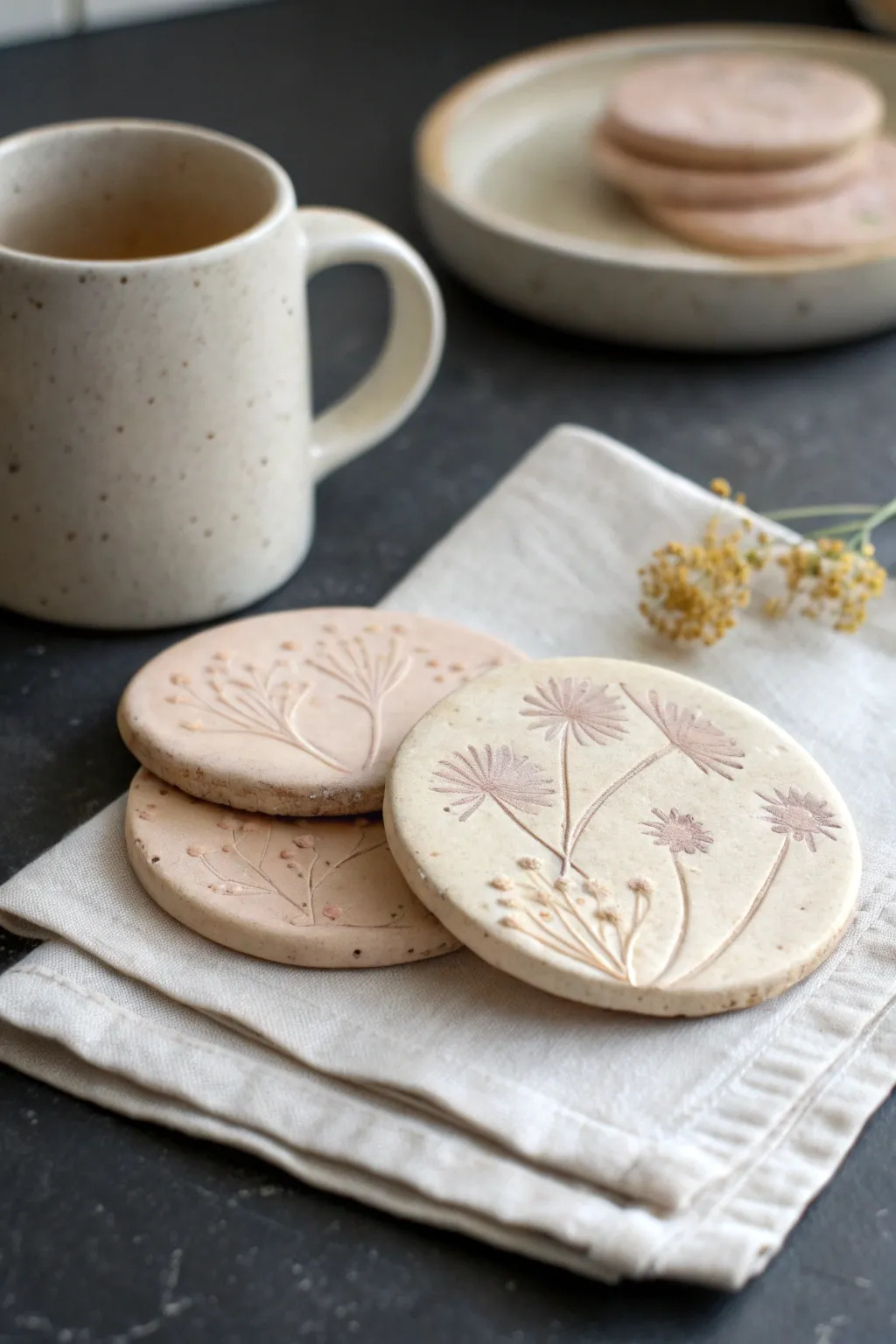
Capture the delicate beauty of wildflowers forever with these elegant clay coasters. Using real botanicals impressed into soft clay creates a subtle, tactile relief that is both functional and artistic.
Detailed Instructions
Materials
- Air-dry clay (white or terra cotta)
- Wide rolling pin
- Circle cookie cutter (approx. 4 inches)
- Fresh or dried delicate wildflowers (dill, Queen Anne’s lace, baby’s breath)
- Parchment paper or canvas mat
- Fine-grit sandpaper (220 grit)
- Clear matte acrylic varnish or clay sealant
- Soft synthetic brush
- Sponge and water
- Small bowl with water
Step 1: Preparation & Rolling
-
Prepare your workspace:
Lay down a sheet of parchment paper or a canvas working mat. This prevents the clay from sticking to your table and picks up a nice texture on the bottom. -
Condition the clay:
Take a handful of air-dry clay and knead it in your hands for a minute until it feels warm and pliable. This removes air bubbles and prevents cracking later. -
Roll the slab:
Place the clay ball on your mat and flatten it slightly with your palm. Use your rolling pin to roll it out to a consistent thickness of about 1/4 inch. -
Check thickness:
Ensure the thickness is even across the entire slab to avoid warping during the drying phase.
Keep it Clean
For cleaner impressions, lightly dust your flowers with cornstarch before pressing. This acts as a release agent and prevents sticky plant bits from getting trapped in the clay.
Step 2: Creating the Impressions
-
Arrange your composition:
Select your botanical stems. Lay them gently onto the clay slab, arranging them slightly off-center for a natural, artistic look. I like to let stems cross slightly for realism. -
The initial press:
Gently press the flowers into the clay with your fingertips just enough so they don’t slide around. -
Roll in the texture:
Take your rolling pin and roll firmly over the flowers once. Do not roll back and forth; commit to one smooth motion to embed the plants cleanly into the surface. -
Reveal the design:
Carefully find the stem edges and use tweezers or your fingernails to slowly lift the plant material out of the clay. This reveals the intricate negative space left behind. -
Cut the shape:
Position your circle cutter over the best part of the impression. Press straight down firmly, give a little twist to release, and lift the cutter.
Step 3: Refining & Finishing
-
Remove excess clay:
Peel away the excess scrap clay from around your circle before attempting to move the coaster. -
Smooth the edges:
Dip your finger in a little water and run it gently around the cut rim of the coaster to soften the sharp edge left by the cutter. -
Initial drying:
Transfer the coaster to a flat drying board or fresh parchment paper. Let it sit undisturbed for at least 24 hours in a draft-free area. -
Flip for even drying:
After the top feels dry to the touch, flip the coaster over to let the bottom dry completely. This helps prevent curling. -
Sand for smoothness:
Once fully cured (usually 24-48 hours), use the fine-grit sandpaper to buff away any burrs on the edges or surface irregularities, being careful not to sand off your flower impression. -
Optional tinting:
If you want the print to pop, you can lightly brush a very diluted bit of brown or pink watercolor into the crevices, then wipe the surface clean, leaving color only in the grooves. -
Seal the coaster:
Apply a thin coat of matte acrylic varnish to the top and sides. This waterproofs the coaster against condensation from cold drinks. -
Final coat:
After the first coat dries, apply a second coat for extra durability. Let it cure fully before using.
Warping Woes
If your coasters start curling up at the edges while drying, gently weigh them down with a heavy book placed over a piece of paper once they are ‘leather hard’ (semi-dry).
Set your finished coasters on the coffee table as a permanent reminder of a beautiful garden walk

Swirled Marbled Polymer Clay Coasters
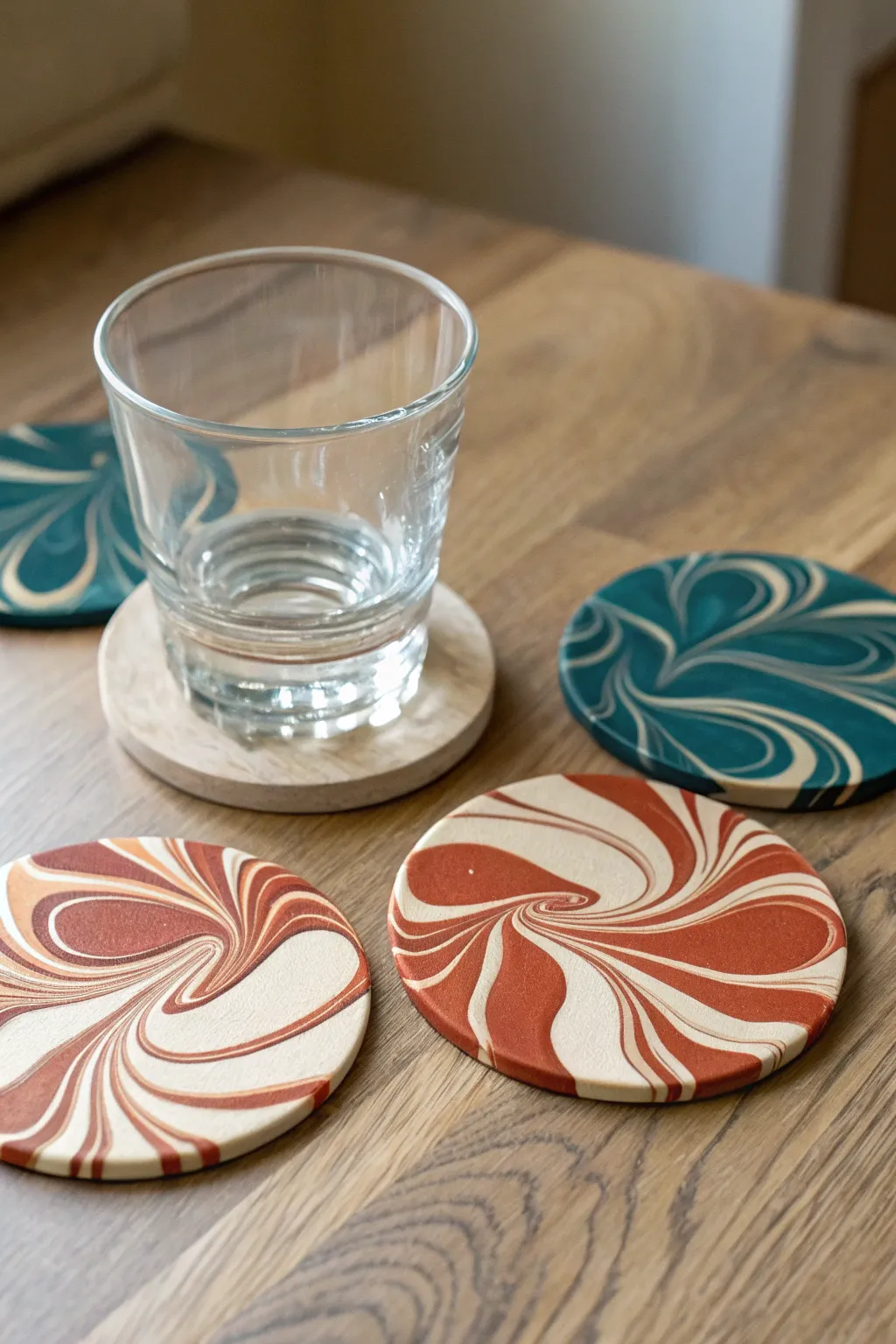
Bring a touch of modern elegance to your coffee table with these mesmerizing polymer clay coasters. The swirling technique creates a unique, psychedelic pattern reminiscent of retro candy, blending rich terracotta or deep teal with creamy white.
Step-by-Step
Materials
- Polymer clay (white, terracotta, and teal)
- Acrylic roller or pasta machine
- Circle clay cutter (approx. 4 inches) or a round template and craft knife
- Ceramic tile or glass work surface
- Toaster oven or conventional oven dedicated to craft use
- Fine-grit sandpaper (400 to 1000 grit)
- Polyurethane varnish or glaze (matte or glossy)
- Soft paintbrush
- Felt or cork adhesive backing (optional)
Step 1: Preparing the Clay
-
Condition the clay:
Begin by kneading your chosen block of polymer clay in your hands. You want it warm and pliable so it doesn’t crack when flattened. Do this for each color separately to avoid premature mixing. -
Create logs:
Roll the terracotta (or teal) clay into a long, snake-like cylinder about half an inch thick. Repeat this process with the white clay so you have two logs of roughly equal length and thickness. -
Twist the colors:
Press the two logs together side-by-side. Holding one end stationary, twist the other end to create a candy-cane stripe effect. keep twisting until the stripes are relatively thin and tight. -
Double the roll:
Fold the twisted log in half upon itself and twist it again. This increases the complexity of the marbling. You can repeat this folding and twisting process one or two more times depending on how fine you want the lines to be.
Step 2: Creating the Swirl
-
Form a coil:
Take your long, twisted rope of clay and place it on your work surface. Start at one end and roll it inward like a snail shell or cinnamon roll, creating a tight, flat spiral. -
Compact the spiral:
Once coiled, gently press the sides inward with your hands to close any gaps between the rings of the coil. The goal is a solid puck of clay without air pockets. -
Flatten deeply:
Using your acrylic roller, roll somewhat firmly over the coiled puck. Roll in different directions—up and down, then side to side—to disturb the perfect spiral and create that elongated, warped ‘psychedelic’ look seen in the photo. -
Check thickness:
Keep rolling until the sheet is approximately 1/4 inch thick. I try to keep it slightly thicker than I think I need, as sanding later will remove some height.
Clean Cuts Only
Use a piece of plastic wrap between the clay and your cutter. Pressing down creates a soft, domed pillow edge rather than a sharp, flat one.
Step 3: Cutting and Baking
-
Cut the shape:
Place your circle cutter over the most interesting part of the pattern. Press down firmly to cut the disk. If using a knife and template, trace carefully for a clean edge. -
Smooth the edges:
Before baking, run your finger lightly along the rim of the coaster to soften any sharp cutting ridges. This saves a lot of sanding time later. -
Bake carefully:
Place the coasters on a ceramic tile or a parchment-lined baking sheet. Bake according to your customized clay brand’s instructions (usually around 275°F or 135°C) for 30 minutes to ensure durability. -
Cool down:
Allow the coasters to cool completely in the oven with the door slightly ajar. Rapid cooling can sometimes cause warping in flat pieces like these.
Bubbles in Clay?
If you see an air bubble trapped under the surface while rolling, pierce it gently with a needle tool and smooth the air out with your finger.
Step 4: Finishing Touches
-
Wet sanding:
Dip your coaster and fine-grit sandpaper in water. Sand the surface in circular motions to remove fingerprints and bumps. The water keeps dust down and creates an ultra-smooth finish. -
Dust off:
Rinse the coaster thoroughly and dry it with a lint-free cloth to ensure no sanding residue remains. -
Seal the surface:
Apply a thin, even coat of polyurethane varnish with a soft brush. This protects the pattern from condensation when used with cold drinks. -
Add backing:
Once the varnish is fully cured, attach a circle of adhesive cork or felt to the bottom. This adds a professional feel and protects your furniture from scratches.
Stack your new set on the coffee table and enjoy the functional art you created

The Complete Guide to Pottery Troubleshooting
Uncover the most common ceramic mistakes—from cracking clay to failed glazes—and learn how to fix them fast.
Chic Terrazzo Speckle Coasters With Color Chips
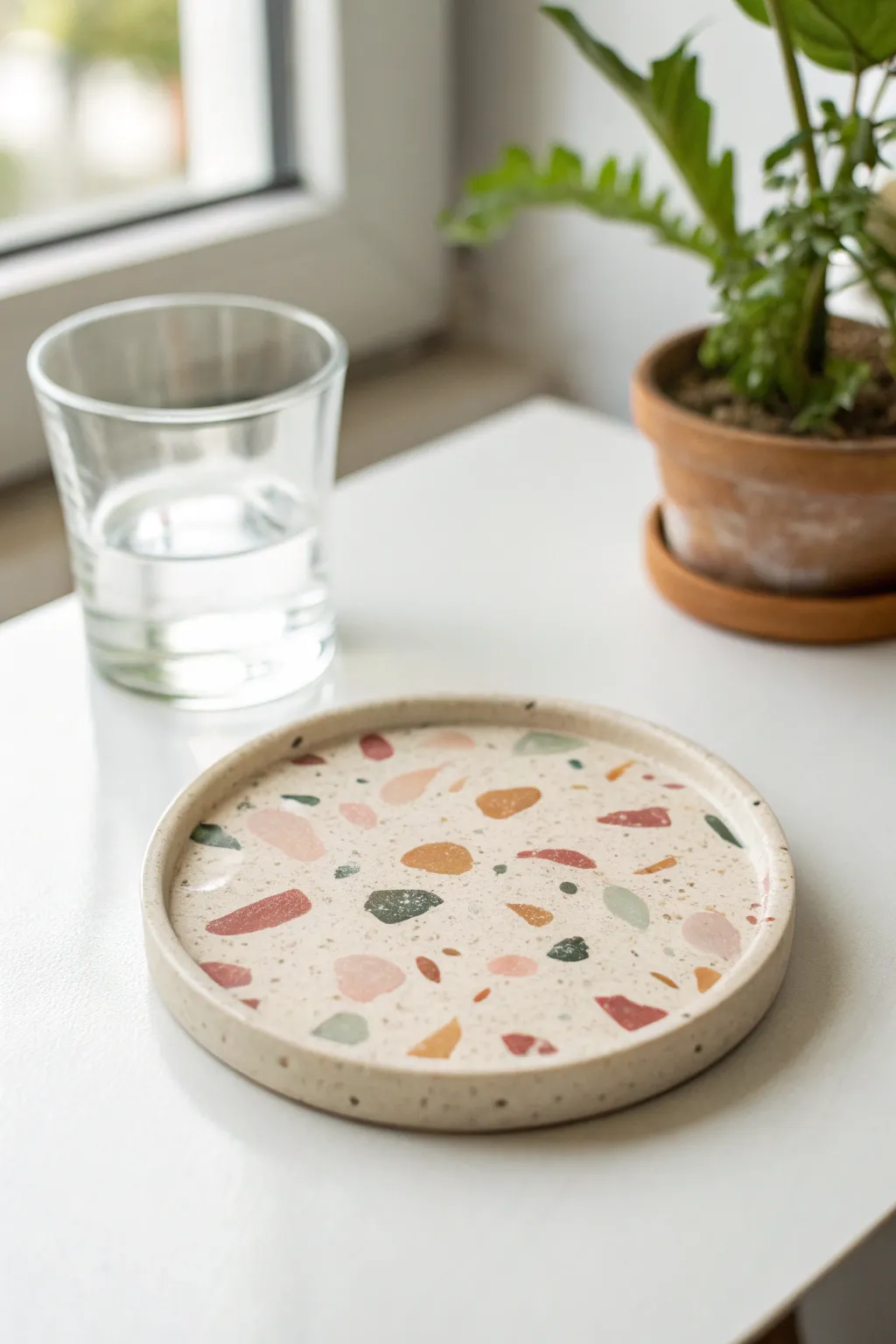
Achieve that high-end, designer home decor look for a fraction of the price with these stunning terrazzo-style coasters. By mixing your own colored clay chips into a creamy white base, you can customize the palette to perfectly match your interior mood.
How-To Guide
Materials
- Polymer clay in various colors (white, granite/speckled, dusty pink, mustard yellow, rust, sage green)
- Acrylic rolling pin
- Circle cutter (approx. 4 inches diameter)
- X-Acto knife or clay blade
- Parchment paper or silicone baking mat
- Fine-grit sandpaper (400 to 1000 grit)
- Small rimmed bowl or plate (for shaping)
- Matte finish varnish (polyurethane or clay-specific)
- Soft brush
- Oven
Step 1: Prepping the Chips
-
Roll Color Sheets:
Start by conditioning your colored clays (pink, mustard, rust, sage). Roll each color out into a thin sheet, roughly 1-2mm thick. The thinner the sheet, the more delicate your final chips will look. -
Bake the Sheets:
Place these flat color sheets on a baking tray lined with parchment paper. Bake them for about 10-15 minutes at the temperature recommended on your clay package. They need to be hard enough to shatter. -
Cool and Crumble:
Once baked, let the sheets cool completely. Then, using your fingers or a craft knife, break and chop these sheets into small, irregular shards. Aim for a mix of sizes—some tiny specks and some larger, defining chunks.
Clean Cuts
If your clay drags when cutting the chips or the circle, try putting the clay slab in the fridge for 10 minutes first. Cold clay cuts much cleaner.
Step 2: Creating the Base
-
Prepare Base Clay:
Take a large block of white polymer clay. To get that subtle sandy look seen in the photo, I like to mix in a very small amount of granite-effect clay or actual black pepper. -
Roll Out Base:
Condition the white clay thoroughly until it’s soft and pliable. Roll it into a thick slab, approximately 5mm thick. This needs to be sturdy enough to hold the chips. -
Embed the Chips:
Scatter your baked colored chips generously over the top of the white slab. Press them gently into the surface so they adhere. -
Roll to Integrate:
Use your acrylic roller to go over the slab again. Applying firm pressure, roll the chips *into* the white clay until the surface is completely flat and smooth. The chips should be flush with the base. -
Cut the Shape:
Place your large circle cutter onto the patterned slab. Press down firmly to cut your coaster shape. If you don’t have a cutter, trace around a wide mug or bowl with a knife.
Add Metallic Flair
For a luxe touch, mix gold leaf flakes in with your colored baked chips before rolling them into the white base for a subtle sparkle.
Step 3: Forming and Finishing
-
Create the Rim:
To get the slight lipped edge shown in the image, take a long, thin snake of white clay (or the terrazzo mix if you have leftovers). Wrap it around the circumference of your circle base. -
Blend the Seam:
Use a modeling tool or your finger to smooth the inside seam where the rim meets the base. The outside should also be smoothed so it looks like one solid piece of stone. -
Final Shape Check:
Ensure the rim stands up straight and the base is flat. You can gently place the raw clay circle inside a shallow, oven-safe bowl to help it hold a curved rim shape if you prefer a more bowl-like coaster. -
Bake:
Bake the finished coaster according to the manufacturer’s instructions, usually around 275°F (130°C) for 30 minutes. Let it cool fully before handling. -
Sand for Texture:
Once cool, wet sand the surface under running water using 400 grit sandpaper, moving up to 1000 grit. This reveals the crisp edges of the chips and makes the surface buttery smooth. -
Seal:
Wipe away any sanding dust. Apply a thin coat of matte varnish to seal the clay and protect it from moisture without making it look plasticky.
Enjoy styling your coffee table with this uniquely handmade piece of modern decor
Crisp Geometric Color-Block Coasters
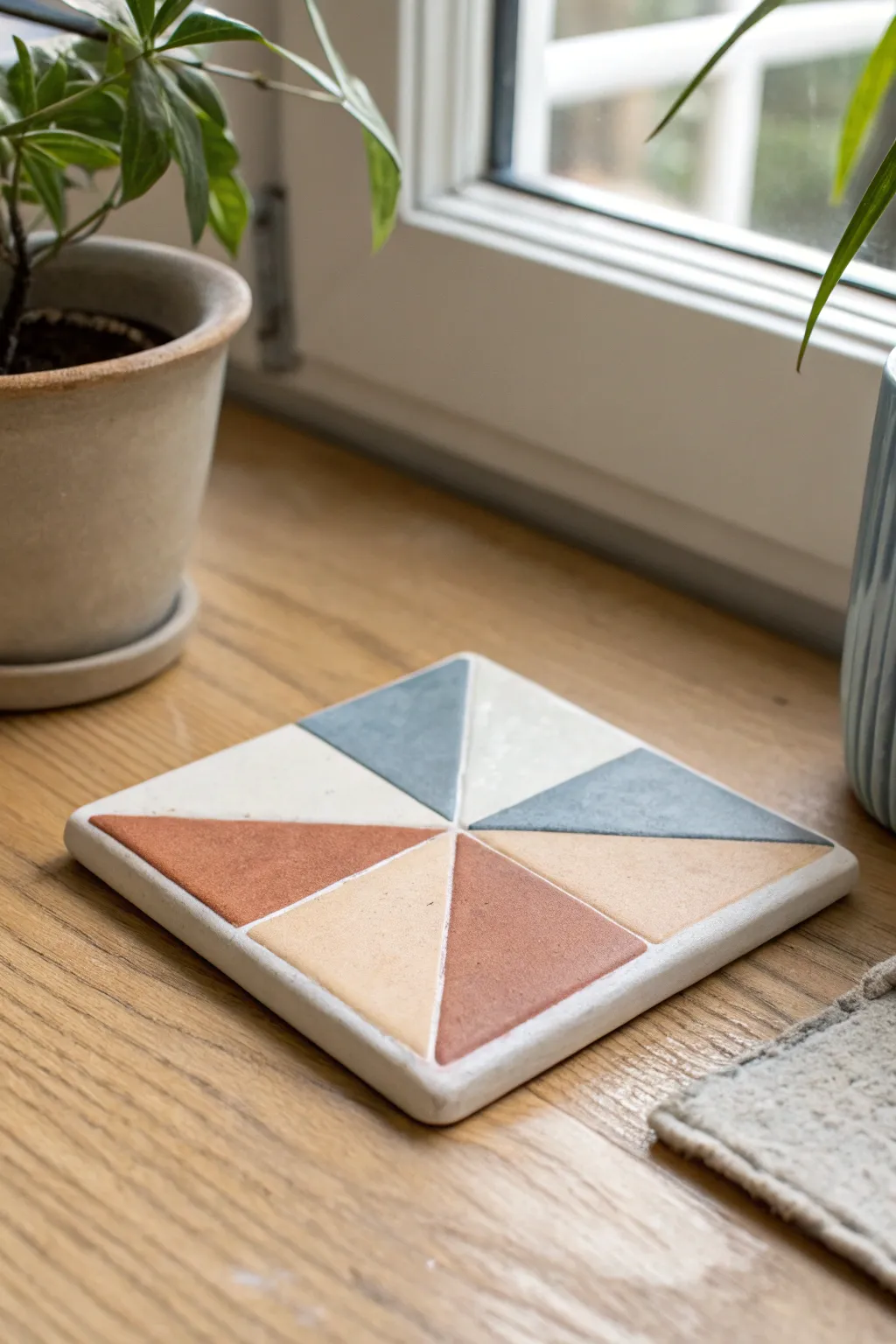
Bring a touch of modern warmth to your table with these crisp, triangle-patterned coasters. The earthy color palette of terracotta, peach, slate, and cream creates a sophisticated look that pairs perfectly with natural wood surfaces.
Step-by-Step Tutorial
Materials
- Air-dry clay (white)
- Acrylic rolling pin
- Square cookie cutter (approx. 4 inches) or craft knife and ruler
- Fine-grit sandpaper (220-400 grit)
- Pencil and ruler
- Masking tape or painter’s tape (low tack)
- Acrylic paints (Terracotta, Peach/Beige, Slate Blue, Cream White)
- Flat shader paintbrush (small)
- Detail brush
- Spray varnish or waterproof sealant (matte finish)
- Small bowl of water
- Felt or cork backing (optional)
Step 1: Shaping the Base
-
Prepare the Clay:
Begin by kneading a handful of white air-dry clay to condition it. Warm it up in your hands until it feels pliable and smooth, removing any potential air bubbles. -
Roll it Out:
Place the clay on a smooth, non-stick surface. Use your acrylic rolling pin to flatten the clay to an even thickness of about 1/4 inch. Making it too thin might cause it to warp later, so keep it sturdy. -
Cut the Shape:
Press your square cutter firmly into the clay. If you don’t have a cutter, use a ruler and craft knife to measure and cut a perfect 4×4 inch square. -
Smooth the Edges:
Dip your finger into a little water and gently run it along the cut edges of the square to soften any sharp corners and smooth out imperfections. -
Initial Drying:
Place the clay square on a clean wire rack or mesh screen to dry. This ensures air circulates on both sides to prevent warping. -
Flip and Dry:
Let the clay dry for 24-48 hours. I usually flip the coaster over halfway through the drying process to ensure both sides dry evenly and stay flat.
Tape Trick
Before painting, brush a tiny amount of clear matte medium or white base paint along the tape edge. This seals the gap and guarantees a razor-sharp colored line.
Step 2: Designing and Painting
-
Sand for Smoothness:
Once fully dry and hard, lightly sand the surface and edges with fine-grit sandpaper. This creates the perfect canvas for your crisp lines. -
Draw the Pattern:
Using a pencil and ruler, lightly draw straight lines connecting opposite corners to create an ‘X’, dividing the square into four large triangles. -
Divide Again:
Measure the midpoint of each side of the square. Draw a line connecting the top midpoint to the bottom midpoint, and left to right, creating a ‘+’ shape. You should now have eight triangular sections radiating from the center. -
Tape the First Sections:
Apply masking tape along the pencil lines to isolate the triangles you want to paint slate blue. Press the edges of the tape down firmly to prevent paint bleed. -
Apply Blue and White:
Paint the two contrasting slate blue triangles and the single cream white triangle according to the pattern shown. Use smooth, even strokes. -
Remove Tape and Dry:
Gently peel back the tape while the paint is still slightly wet to get the cleanest line. Allow these sections to dry completely before moving on. -
Tape Remaining Sections:
Once the first colors are dry, tape off the borders for the terracotta and peach sections. It connects nicely if you tape carefully over the dry edge of the previously painted sections. -
Paint Warm Tones:
Fill in the remaining triangles with your terracotta and peach acrylics. You may need two thin coats for the lighter colors to get solid coverage. -
The White Rim:
Leave the very outer rim of the coaster unpainted to show the raw white clay, or paint it a clean white to frame the design sharply.
Step 3: Sealing and Finishing
-
Final Dry:
Let the paint cure fully. This usually takes a few hours, but patience here prevents smudging when you seal it. -
Seal the Surface:
In a well-ventilated area, apply a coat of matte waterproof sealant or varnish. This is crucial to protect the clay from condensation on cold drinks. -
Add Backing (Optional):
For extra furniture protection, you can cut a square of felt or thin cork and glue it to the underside of the coaster once the sealant is dry.
Level Up: Texture
Before the clay dries, gently press a piece of linen fabric onto one or two of the triangle sections to create a subtle woven texture that contrasts with the painted areas.
Now you have a stunning, handmade accent piece ready to protect your surfaces with style



What Really Happens Inside the Kiln
Learn how time and temperature work together inside the kiln to transform clay into durable ceramic.
Easy Stamped Pattern Coasters for Clean, Repeating Texture
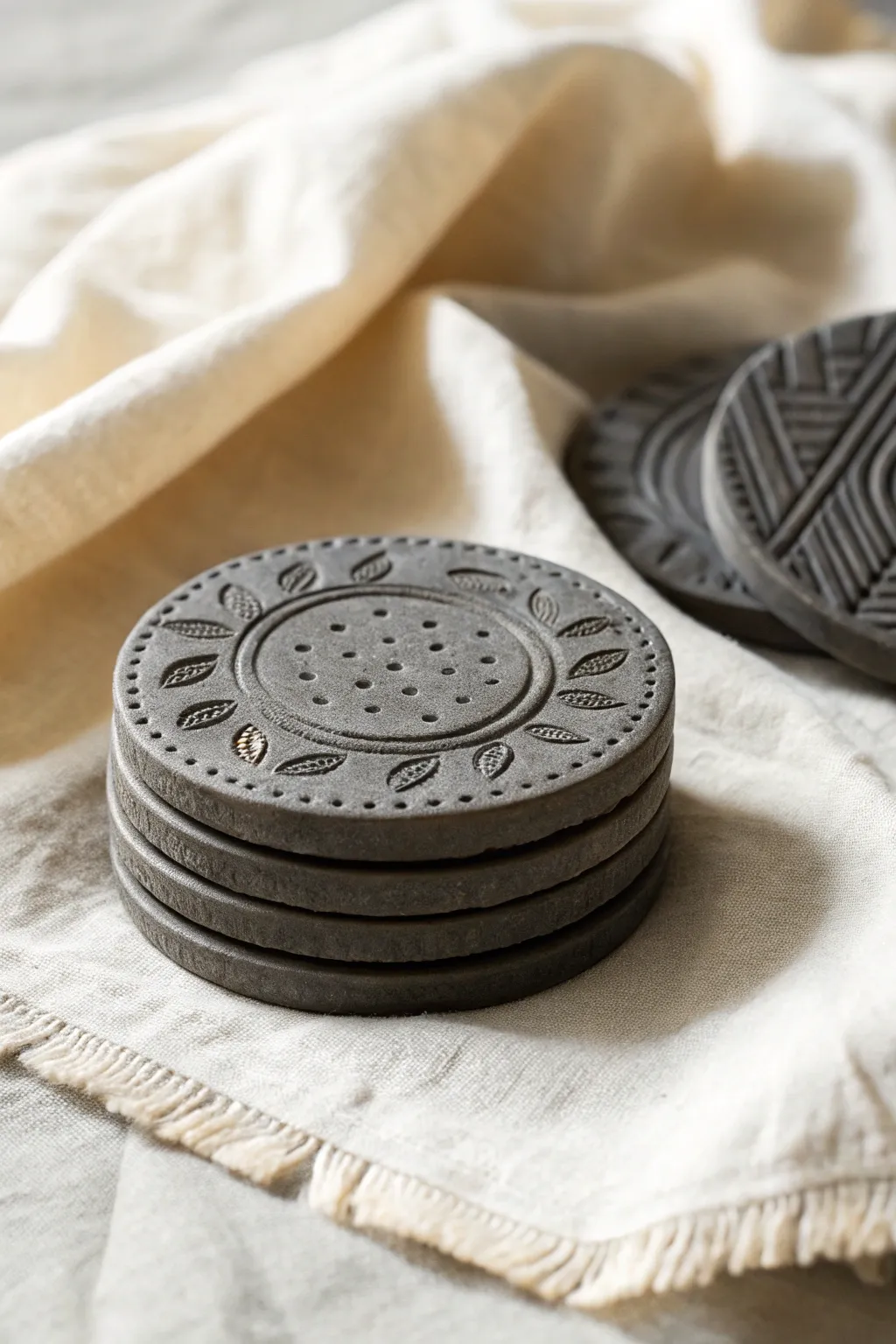
These sophisticated coasters combine the raw, matte texture of charcoal-colored clay with delicate, stamped botanical motifs. The result is a set of functional art pieces that feel both modern and grounded, perfect for adding an organic touch to your coffee table.
Step-by-Step Guide
Materials
- Black or charcoal stoneware clay (air-dry or kiln-fire)
- Circular clay cutter (approx. 4 inches)
- Rolling pin with guide rings (1/4 inch thickness)
- Canvas or cotton cloth for rolling
- Various leather stamps or clay texture tools (leaf and dot shapes)
- Sponge and water bowl
- Fine-grit sandpaper
- Circle template or compass (optional)
- Needle tool
- Matte sealant (for air-dry clay) or clear matte glaze (for kiln-fire)
Step 1: Preparation & Shaping
-
Prepare the workspace:
Lay down a piece of canvas or heavy cotton cloth on your work surface. This prevents the dark clay from sticking and adds a very subtle texture to the bottom of your coasters. -
Condition the clay:
Take a handful of your charcoal clay and knead it briefly to remove air bubbles and ensure it’s pliable. If you’re using darker clays, be aware they can stain hands temporarily. -
Roll out the slab:
Using a rolling pin with guide rings set to about 1/4 inch thickness, roll the standout into an even slab. Rotate the clay occasionally to ensure uniform thickness. -
Cut the circles:
Press your circular cutter firmly into the slab to create your coaster bases. Gently lift the shapes and smooth the cut edges with a damp finger to remove any sharp burrs.
Fixing Warped Clay
If edges curl while drying, slightly dampen the concave side and weigh the coaster down between two wooden boards or heavy books for a day to flatten it back out.
Step 2: Design & Stamping
-
Mark the inner ring:
Lightly trace a smaller circle about an inch inside the outer edge using a circle template or a jar lid. Don’t press deep; you just want a faint guideline for your pattern. -
Create the border:
Using a needle tool or small stamp, indent a dotted line or solid groove along the guideline you just traced. I like to make two concentric circles close together to frame the center clearly. -
Stamp the leaf motif:
Select a leaf-shaped stamp. Press it into the clay in the outer ring (the space between the edge and your center circle lines), spacing them evenly around the perimeter. -
Add connecting details:
Between each leaf stamp, use a small dotting tool or the head of a dull needle to add tiny textural dots. This connects the leaves visually into a continuous wreath. -
Detail the center:
In the very center of the coaster, create a grid or random scatter of dots using a blunt tool. Press firmly enough to create shadow, but not so hard you puncture the coaster. -
Refine the edges again:
Handling the clay during stamping might have warped the circle slightly. Carefully reshape the round edge and smooth it one last time with a slightly damp sponge.
Step 3: Finishing
-
Controlled drying:
Place the coasters between two sheets of drywall or on a wire rack away from direct heat. Let them dry slowly for 24-48 hours to prevent curling edges. -
Sand for smoothness:
Once fully dry (bone dry), use fine-grit sandpaper to essentially polish the rim and the surface. Wipe away all dust with a barely damp cloth. -
Fire or seal:
If using kiln clay, bisque fire and then apply a matte clear glaze before the final firing. For air-dry clay, apply 2-3 coats of a waterproof matte sealant to protect against moisture. -
Add protective backing:
Cut circles of felt or cork slightly smaller than your coaster and glue them to the bottom. This protects your furniture from scratches.
Gilded Accent
After the clay is dry and sealed, use a tiny brush to apply liquid gold leaf or metallic wax into just one or two of the stamped leaf impressions for a luxe pop.
Now you have a stunning set of textured coasters ready to hold your favorite beverages
Minimal Gold Rim Accent Coasters
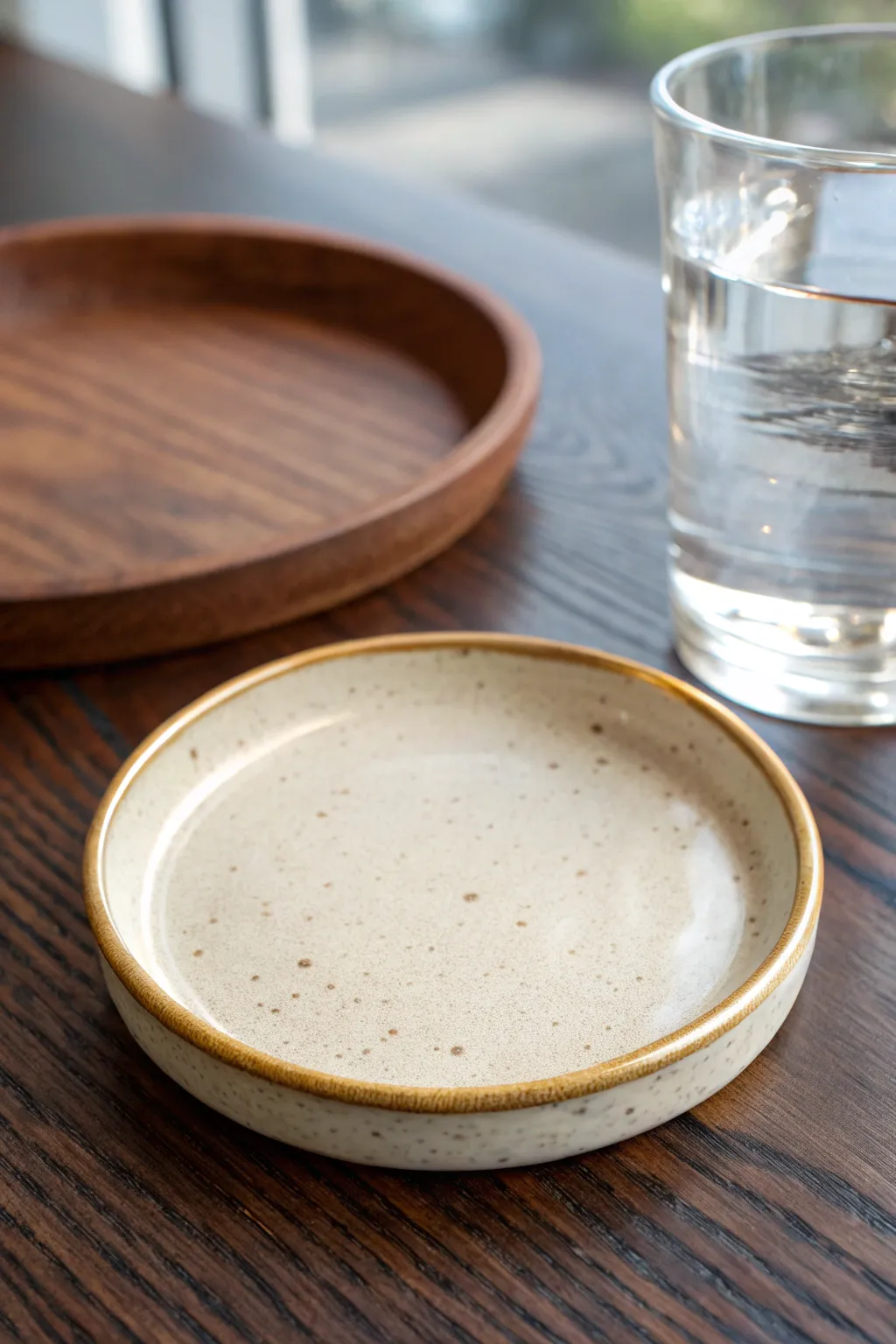
Embrace understated elegance with this shallow, rimmed coaster project that mimics the look of high-end speckled stoneware. The natural clay body is enhanced with faux stone texturing and finished with a striking metallic gold edge, perfect for protecting your surfaces in style.
Step-by-Step Tutorial
Materials
- White or cream polymer clay (approx. 2oz per coaster)
- Course black pepper or dried coffee grounds (for speckling)
- Rolling pin or acrylic roller
- Round cookie cutter (approx. 4-inch diameter)
- Small flat-edged modeling tool or butter knife
- Liquid gilding or high-quality gold acrylic paint
- Fine detail paintbrush
- Gloss varnish or resin (optional, for waterproofing)
- Fine grit sandpaper (400-600 grit)
- Oven and baking sheet
Step 1: Preparing the Clay Body
-
Condition and Speckle:
Begin by conditioning your block of white or cream polymer clay until it is soft and pliable. To create that organic stoneware look, knead in a small pinch of coarse black pepper or dried coffee grounds. -
Mix Thoroughly:
Continue kneading and folding the clay until the speckles are evenly distributed throughout the entire ball. Add more speckles gradually if you want a denser pattern. -
Roll Out the Slab:
Place the clay on a smooth work surface. Use your rolling pin or acrylic roller to flatten the clay into a slab that is approximately 1/4 inch thick. Aim for an even thickness to ensure the coaster sits flat.
Sticky Situation
If your clay sticks to the table or roller, dust your surface lightly with cornstarch before rolling. It acts like flour for dough and won’t affect the clay colour.
Step 2: Shaping and Forming
-
Cut the Base:
Using your 4-inch round cookie cutter, press firmly into the clay slab to cut out a perfect circle. Remove the excess clay from around the cutter before lifting it. -
Smooth the Edges:
Gently run your finger along the cut edge of the circle to soften any sharpness left by the cutter, ensuring a smooth, handmade feel. -
Create the Rim:
To form the raised edge seen in the photo, you have two options. You can gently pinch and lift the outer 1/4 inch of the disc upwards with your fingers, rotating as you go. -
Refine the Wall:
Alternatively, roll a thin snake of clay from your scraps. Place this coil on top of the circle’s outer edge. -
Blend the Coil:
If using the coil method, use a modeling tool to blend the clay downwards into the base on the inside and outside seams until the join is invisible and the wall stands upright. -
Flatten the Bottom:
Once the rim is shaped, gently press down on the center of the coaster again to ensure the bottom remains perfectly flat for holding a glass. -
Final Smoothing:
Use a tiny bit of baby oil or cornstarch on your finger to smooth out any fingerprints or tool marks on the surface and the rim.
Rim Perfection
For an extra clean gold line, use the side of a flat brush rather than the tip. Glide it horizontally along the rim’s top edge.
Step 3: Baking and Finishing
-
Bake the Clay:
Place your formed coaster on a baking sheet lined with parchment paper. Bake according to your specific brand’s package instructions (usually 275°F for 15-30 minutes per 1/4 inch of thickness). -
Cool Down:
Allow the piece to cool completely in the oven with the door open. This gradual cooling helps prevent cracking. -
Sand the Edges:
Once cool, use fine-grit sandpaper to buff the top rim. This creates a slightly porous surface that helps the gold paint adhere better. -
Paint the Gold Rim:
Dip a fine detail brush into your liquid gilding or gold acrylic paint. I find that resting my pinky finger on the center of the coaster helps steady my hand while I paint. -
Apply the Gold:
Carefully paint the top edge of the rim. Let the gold slightly overlap onto the inner and outer slope of the rim for a professional, dipped look. -
Let Dry:
Allow the paint to dry completely according to the manufacturer’s time (usually 1-2 hours for acrylics, less for gilding). -
Seal the piece:
To make the coaster water-resistant for sweaty cold drinks, apply a coat of gloss varnish or a thin layer of UV resin over the entire inside surface and rim.
Place these on your coffee table and enjoy the sophisticated touch they add to your decor

TRACK YOUR CERAMIC JOURNEY
Capture glaze tests, firing details, and creative progress—all in one simple printable. Make your projects easier to repeat and improve.
Modern Hexagon Coaster Set With Sharp Lines
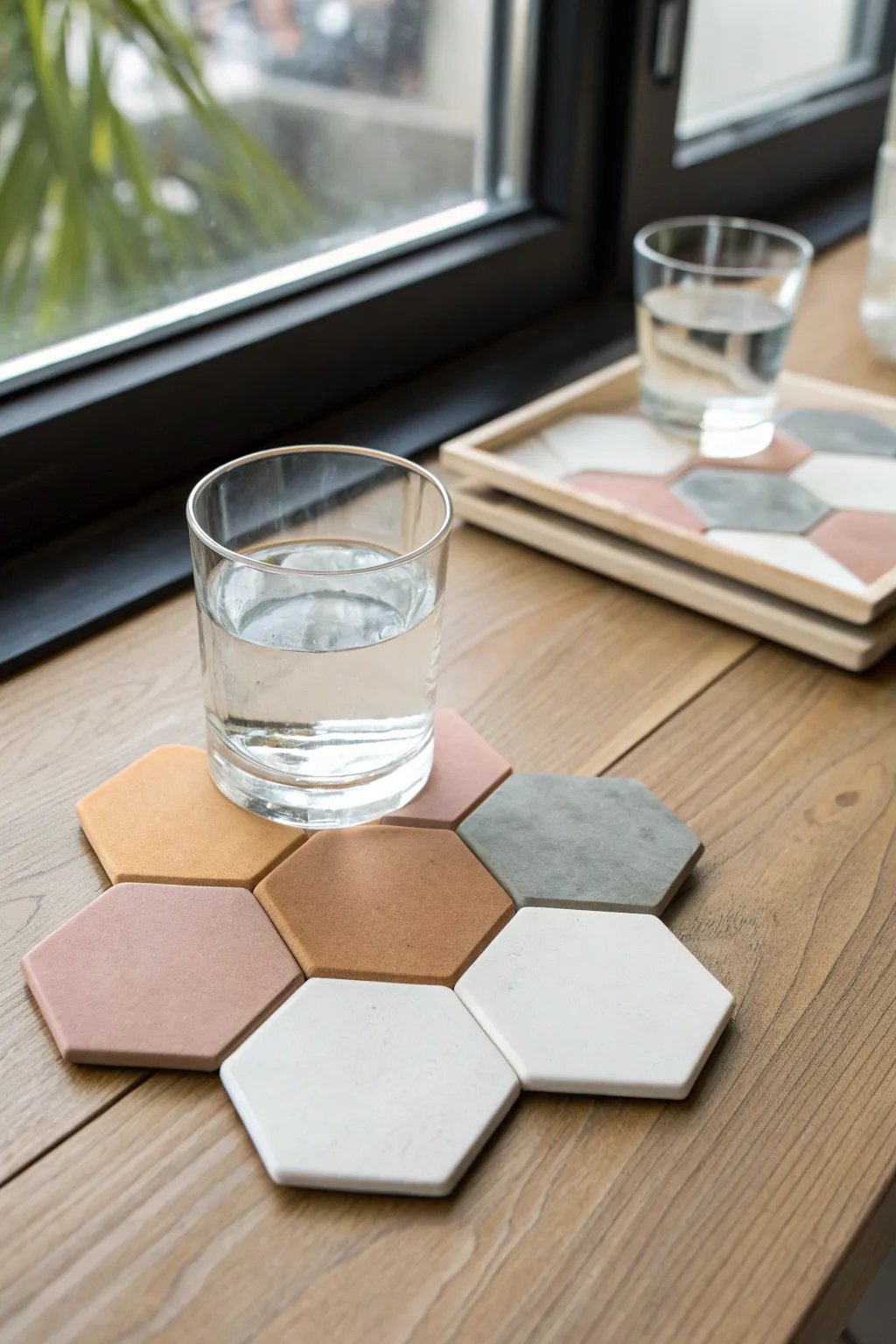
Bring a touch of modern sophistication to your coffee table with this modular hexagon coaster set. The clean lines and muted earth tones create a stunning geometric honeycomb pattern that functions as both surface protection and interactive decor.
Step-by-Step
Materials
- Polymer clay (white, terracotta, beige/mustard, granite/grey)
- Hexagon cookie cutter (approx. 3-4 inches)
- Acrylic rolling pin
- Parchment paper or silicone work mat
- Craft knife or tissue blade
- Fine-grit sandpaper (400 and 600 grit)
- Baking sheet
- Oven
- Optional: Matte varnish or sealant
- Optional: Cork backing sheet
Step 1: Clay Preparation
-
Condition the Polymer Clay:
Start by warming up each color of polymer clay in your hands. Knead them individually until they are soft, pliable, and free of cracks. -
Create Custom Shades:
To achieve the muted, natural palette shown, you might need to mix colors. Try blending a little white into the terracotta for a softer pink-clay look, or mixing grey with a touch of beige for a warmer stone tone. -
Roll Out the Slabs:
Place a ball of conditioned clay between two sheets of parchment paper. Use your acrylic roller to flatten it into an even slab, aiming for a consistent thickness of about 1/4 inch (6mm) for durability. -
Check for Air Bubbles:
Inspect the surface of your rolled slabs. If you see any air bubbles trapped under the surface, gently pierce them with a needle tool and smooth over the hole with your finger.
Warping Woes?
If your coasters curl up while baking, place a ceramic tile or a heavy baking sheet directly on top of the clay pieces while they are in the oven to weigh them down flat.
Step 2: Cutting and Shaping
-
Cut the Hexagons:
Press your hexagon cookie cutter firmly into the clay slab. Wiggle it slightly to ensure a clean cut all the way through, then lift the cutter. Repeat for each color to create a variety of tiles. -
Release the Clay:
If the clay sticks to the cutter, I find that dipping the cutter into cornstarch before pressing it down helps it release effortlessly. -
Clean the Edges:
After removing the excess clay, you may notice slightly ragged edges. Gently run your finger along the perimeter of each hexagon to smooth these down while the clay is still raw. -
Add Texture (Optional):
For a stone-like finish similar to the grey coaster in the reference, you can gently press a piece of coarse sandpaper or a stone texture mat onto the surface before baking.
Terrazzo Twist
Make a ‘terrazzo’ hexagon by taking small monochromatic scraps from your other colors, sprinkling them onto a white slab, and rolling flat before cutting.
Step 3: Baking and Finishing
-
Prepare for Baking:
Transfer your cut hexagons onto a parchment-lined baking sheet. Ensure they are laying perfectly flat so they don’t warp during the heating process. -
Bake the Coasters:
Bake according to the manufacturer’s instructions on your specific package of clay (usually 275°F/135°C for 15-30 minutes per 1/4 inch of thickness). -
Cool Down:
Remove the tray from the oven and allow the coasters to cool completely on a flat surface. Do not attempt to sand them while they are still warm. -
Sand for Smoothness:
Once cool, place a sheet of 400-grit wet/dry sandpaper on a flat surface. Add a little water and rub the coaster face-down in a circular motion to flatten the top. -
Refine the Edges:
Use the finer 600-grit sandpaper to gently smooth the sharp edges and corners, ensuring they are pleasant to touch. -
Clean Up Dust:
Rinse the coasters under cool water to remove any clay dust from sanding and pat them dry with a lint-free towel. -
Seal the Surface (Optional):
Although polymer clay is waterproof, applying a thin layer of matte varnish can protect light colors from coffee stains. Apply lightly with a brush and let dry. -
Add Cork Backing:
Trace your hexagon shape onto a thin sheet of cork and cut it out slightly smaller than the clay piece. Glue this to the bottom for extra grip and furniture protection.
Arrange your new hexagonal tiles in a playful honeycomb pattern and enjoy a stylish spot for your next drink
Soft-Edged Organic Shape Coasters That Feel Hand-Formed
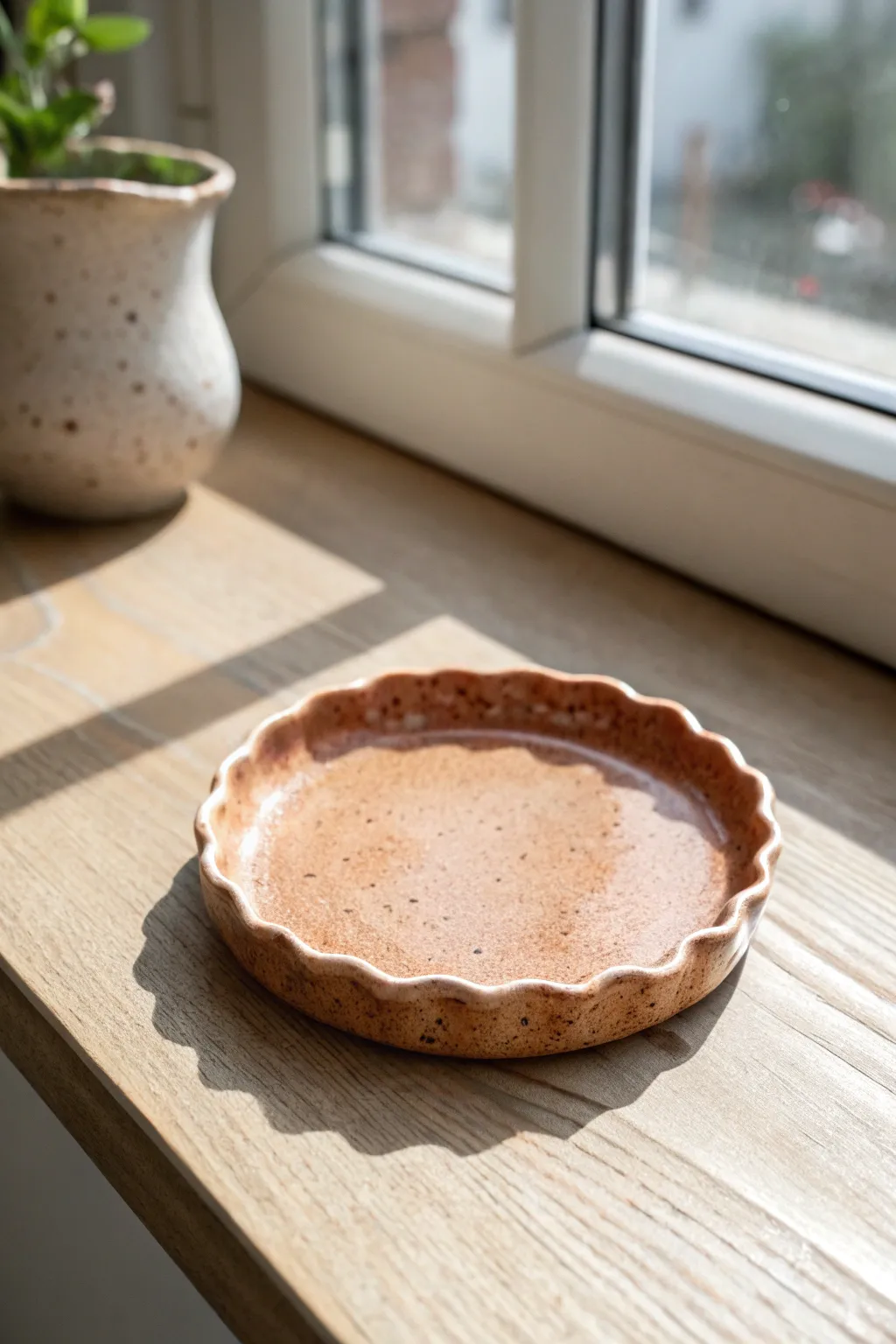
Embrace the imperfect beauty of this warm, speckled ceramic coaster featuring a gentle scalloped edge that mimics a flower or a pie crust. Its glossy finish and organic rim create a grounded, earthy aesthetic perfect for catching jewelry or resting your favorite mug.
Detailed Instructions
Materials
- Speckled brown stoneware clay (e.g., Laguna Speckled Buff)
- Rolling pin
- Canvas mat or slab roller
- Circular guide or plain round cookie cutter (approx. 4-5 inches)
- Fettling knife or needle tool
- Sculpting sponge
- Wooden modeling tool or your fingers
- Clear transparent glossy glaze
- Kiln (or access to a firing service)
Step 1: Preparation & Base Formation
-
Wedge the clay:
Begin by thoroughly wedging a ball of speckled stoneware clay to remove air bubbles and ensure particle alignment, making the clay easier to work with. -
Roll the slab:
Place the clay on your canvas mat and roll it out into an even slab. Aim for a thickness of about 1/4 inch (6mm)—too thin and it might warp; too thick and it will feel clunky. -
Compress the slab:
Run a rubber rib or a damp sponge lightly over the surface of the slab in multiple directions. This compresses the clay particles and helps prevent cracking during drying. -
Cut the circle:
Place your circular template or cookie cutter onto the slab and cut out your base shape using a needle tool or fettling knife.
Uneven Drying?
If edges lift while drying, flip the coaster onto a foam sheet and place a small weight bag in the center to gently press it flat again.
Step 2: Sculpting the Scalloped Rim
-
Pinch the rim:
Gently pinch the outer 1/2 inch of the circle upwards to create a shallow wall. Keep the pressure even as you rotate the piece so the height remains consistent. -
Create the waves:
Using your index finger inside the rim and two fingers on the outside, gently push the clay outward while supporting the sides to form a soft wave. -
Define the scallops:
Move about half an inch over and repeat the push-and-support motion. Continue this around the entire circumference to create the rhythmic scalloped edge. -
Refine the shape:
Go back around the rim with a damp sponge. Smooth out any sharp fingerprints or jagged bits on the peaks and valleys of your scallops. -
Soften the lip:
I prefer to run a wet finger gently along the very top edge to round it off, ensuring the fired piece will be pleasant to touch. -
Flatten the interior:
If the bottom bowed up during handling, gently press the center flat again using a slightly damp sponge to ensure a stable surface for a cup.
Level Up: Oxide Wash
Wipe a light iron oxide wash into the crevices of the scallops before glazing to emphasize the depth and organic texture.
Step 3: Drying, Firing & Glazing
-
Controlled drying:
Place the coaster on a ware board and cover it loosely with plastic. Let it dry slowly to the leather-hard stage to prevent warping. -
Bone dry check:
Once leather hard, uncover and let it dry completely until it is bone dry and room temperature to the touch. -
Bisque fire:
Load the piece into the kiln for a bisque firing (typically Cone 04 or 06). This hardens the clay and prepares it for glazing. -
Prepare for glazing:
Wipe the bisque-fired piece with a damp sponge to remove any kiln dust, which can cause glaze defects like crawling. -
Apply clear glaze:
Dip the coaster into a clear glossy glaze, or brush on three smooth, even coats. The clear glaze allows the natural speckles of the clay body to shine through. -
Clean the foot:
Wipe the very bottom (the foot) of the coaster completely clean of glaze with a sponge to prevent it from sticking to the kiln shelf. -
Glaze fire:
Fire the piece again to the maturation temperature of your specific clay and glaze (often Cone 5 or 6 for stoneware).
Once cooled, your coaster is ready to bring a touch of warm, handmade charm to your coffee table
Sweet Scalloped Edge Coasters With a Vintage Feel
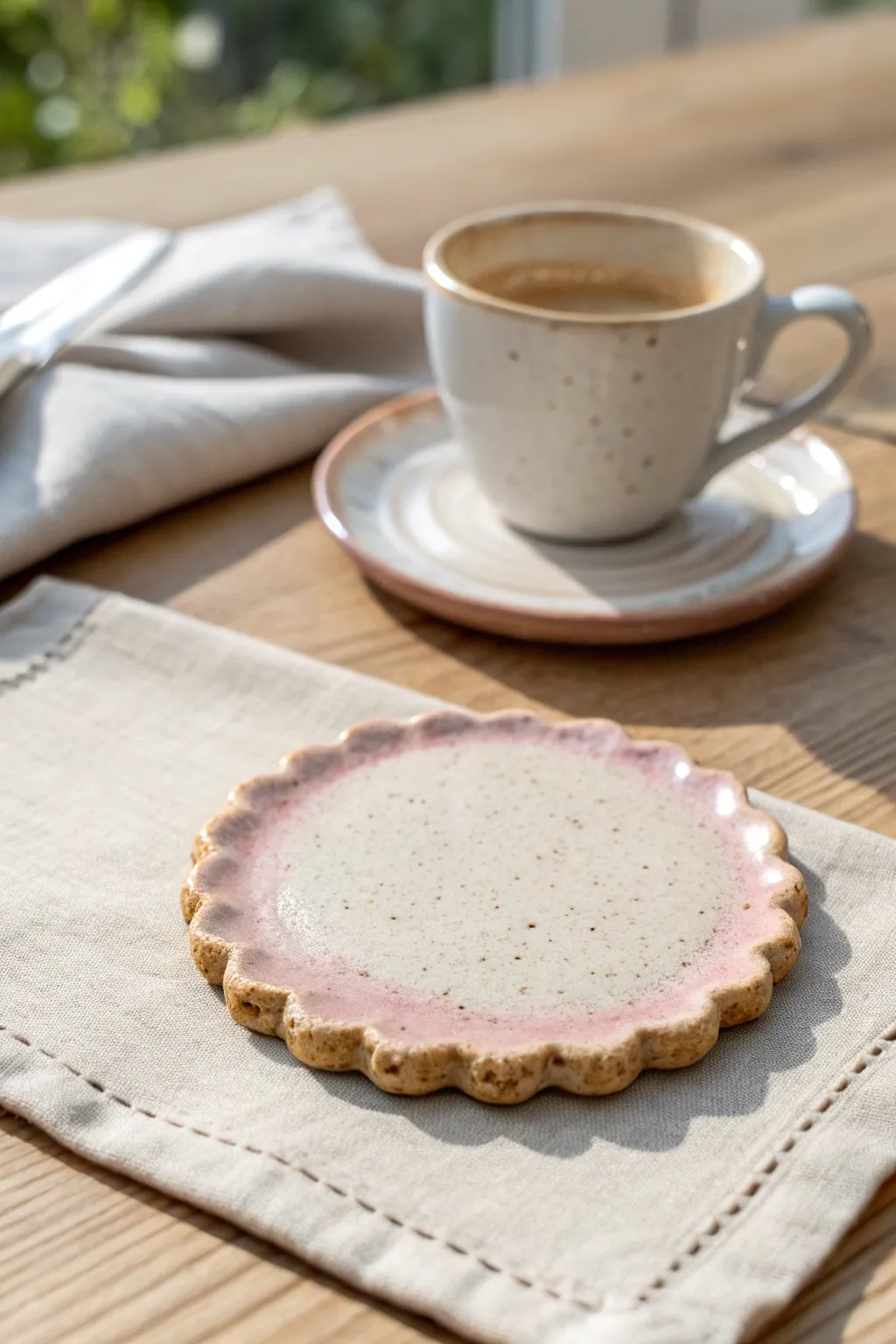
Capture the charm of vintage teaware with this hand-built clay coaster, featuring a delightful scalloped edge and a soft, two-tone glaze. The speckled finish and organic shape give it a cozy, artisanal quality perfect for your morning coffee spot.
Step-by-Step Guide
Materials
- Speckled stoneware clay (or polymer clay for a non-fired version)
- Rolling pin
- Canvas mat or slab roller
- Round cookie cutter (approx. 4-5 inches diameter)
- Small round modeling tool or wooden dowel
- Sponge
- Kiln (if using ceramic clay) or oven (if polymer)
- Speckled cream/oatmeal glaze
- Pastel pink glaze
- Small soft bristle brush
- Clear glaze (optional)
Step 1: Shaping the Clay Base
-
Prepare your clay:
Begin by wedging your speckled stoneware clay thoroughly to remove any air bubbles, ensuring a smooth and workable consistency. -
Roll the slab:
Roll the clay out onto your canvas mat until it is an even slab, approximately 1/4 inch thick. I find using guide sticks on either side of the rolling pin helps keep the thickness uniform. -
Cut the circle:
Press your large round cookie cutter firmly into the clay to create the base shape. Alternatively, trace a bowl with a needle tool for a custom size. -
Smooth the edges:
Lift the circle gently and use a damp sponge to smooth down the sharp cut edges, softening the perimeter before you start shaping.
Keep it clean
Use a damp sponge to constantly clean your workspace. Clay dust can mar the smooth finish of your coaster, so wiping tools often keeps the surface pristine.
Step 2: Creating the Scalloped Edge
-
Mark the intervals:
Lightly mark even intervals around the edge of your circle with a needle tool to guide where your scallops will go. -
Form the scallops:
Using your thumb or the side of a wooden dowel, gently press the edge of the clay inward at each marked interval to create an indentation. -
Refine the curves:
Use your fingers to pinch and shape the clay between the indentations, pushing them slightly outward to exaggerate the curved, petal-like shape. -
Lift the rim:
Gently lift the outer edge of the coaster slightly upward to create a very shallow lip. This adds dimension and helps contain any condensation from cups. -
Final smoothing:
Run a damp sponge or finger over the scalloped rim one last time to ensure all curves are soft and fluid, removing any fingerprints. -
Dry the piece:
Allow the clay to dry slowly to the leather-hard stage, then fully dry to bone dry. If using ceramic clay, bisque fire it according to the clay manufacturer’s cone recommendation.
Step 3: Glazing and Finishing
-
Apply the base glaze:
Dip or brush the entire top surface of the bisque-fired coaster with the speckled cream or oatmeal glaze. Let this layer dry to the touch. -
Add the pink rim:
Load a soft brush with the pastel pink glaze. Gently dab or sweep the color along the scalloped rim, allowing it to fade naturally toward the center. -
Blend the transition:
While the pink glaze is still damp, feather the inner edge where it meets the cream color to create a soft, ombre-like transition rather than a hard line. -
Check the bottom:
Wipe the bottom of the coaster clean with a wet sponge to ensure no glaze remains on the foot, which could stick to the kiln shelf. -
Final wipe:
Inspect the scalloped edges for any drips and smooth them out with your finger. -
Glaze fire:
Fire the piece in the kiln again for the glaze firing schedule appropriate for your specific glazes.
Dual-Purpose Design
Make a matching set in different sizes. A larger version works beautifully as a trinket dish for jewelry or a base for a pillar candle.
Now you have a charming spot to rest your warm beverage and protect your table surfaces
Faux Concrete Look Coasters With Subtle Mottling
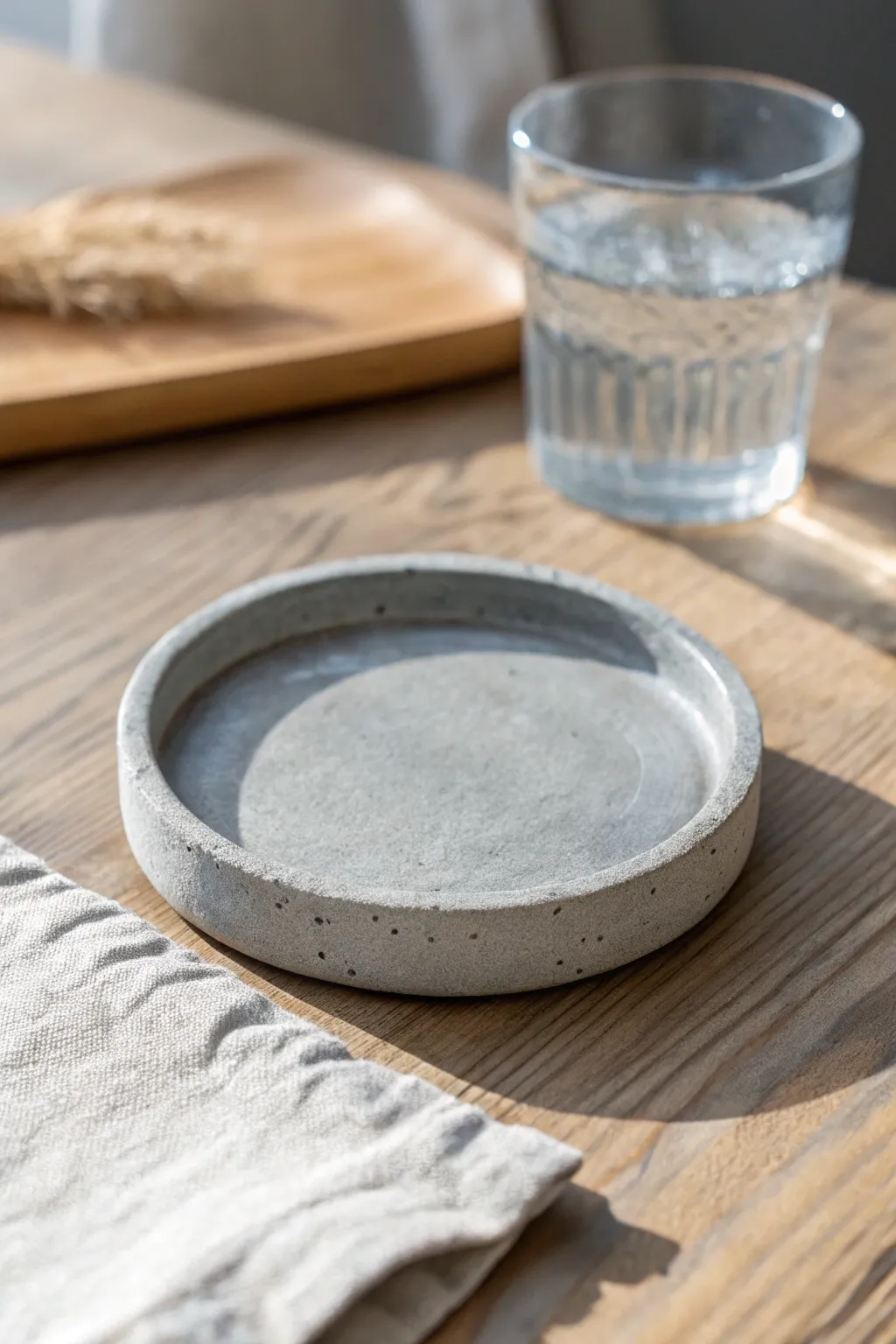
Achieve the sturdy, minimalist aesthetic of cast concrete without the mess of cement mixing by using polymer or air-dry clay. This project features a convincing speckled finish and a practical raised rim to catch condensation, perfect for modernizing your coffee table.
How-To Guide
Materials
- Light grey polymer clay or air-dry clay (approx. 3-4 oz per coaster)
- Black acrylic paint or black coarse sand
- Rolling pin or pasta machine
- Round cookie cutter (approx. 4 inches)
- Small round object (slightly smaller than cutter) or jar lid to form the rim
- Toothbrush or stipple sponge
- Fine-grit sandpaper
- Matte spray varnish or sealer
- Precision knife
Step 1: Preparing the Clay Base
-
Conditioning:
Start by thoroughly conditioning your grey clay until it is soft and pliable. If you want a darker grey than what comes in the package, mix in a tiny pinch of black clay now. -
Adding Texture:
To mimic the speckled aggregate found in real concrete, we need to add impurities. Sprinkle a very small amount of coarse black sand or black pepper into the clay. -
Mixing It In:
Fold the clay over the speckles and knead it repeatedly. You want the black specks to be distributed unevenly throughout the clay body rather than creating a solid grey color. -
Initial Rolling:
Roll your clay out into a slab that is roughly 1/4 inch thick. Keep the thickness consistent to ensure your coaster sits flat. -
Creating Surface Grain:
Concrete holds a porous texture. Before cutting, gently press a piece of coarse sandpaper or a rough stone onto the surface of the slab to imprint a subtle grain.
Step 2: shaping the Form
-
Cutting the Circle:
Use your large round cookie cutter to punch out the main disk shape. Remove the excess clay from around the edges. -
Forming the Lip:
To create the raised edge seen in the photo, you need to depress the center. I find that pressing a flat-bottomed jar or a slightly smaller lid into the center of the clay disk works best. -
Refining the Edge:
While the center is depressed, gentle push the outer rim upwards with your fingertips to define the wall. It should be slightly taller than the center floor of the coaster. -
Final Texturing:
Some smoothing might have occurred during handling. Take an old toothbrush and lightly dab the exterior walls and the top of the rim to bring back that aerated concrete look. -
Adding Pitting:
Real concrete has small air bubbles. Use a needle tool or the tip of your knife to poke shallow, random holes along the outer rim. Vary the size for realism.
Tip: Weight it Down
To prevent the flat center from puffing up during baking, place a small piece of parchment paper inside the coaster and weigh it down with ceramic baking weights or dry beans.
Step 3: Finishing and Curing
-
Baking or Drying:
If using polymer clay, bake according to the manufacturer’s instructions (usually 275°F for 15-30 minutes). If using air-dry clay, let it sit in a cool, dry place for 24-48 hours. -
Sanding:
Once fully cured or dry, use fine-grit sandpaper to smooth any sharp edges on the rim, but leave the side texture rough. -
The Wash Technique:
Create a very watery wash of black acrylic paint. Brush it over the entire coaster, letting it settle into the pits and textured areas. -
Wiping Back:
Immediately wipe the wet paint off the high points with a paper towel or rag. This leaves the dark color in the recesses, enhancing the depth and ‘mottled’ effect. -
Sealing:
Since coasters handle moisture, apply 2-3 coats of a matte spray varnish. This protects the finish without making it look glossy or plastic.
Troubleshooting: Warped Bottom
If the coaster rocks or doesn’t sit flat after curing, glue a circle of cork sheet or felt to the bottom. This levels it out and protects your table surfaces.
Enjoy styling these industrial pieces around your home for a clean, modern touch
Carved Sgraffito Lines on Two-Tone Coasters
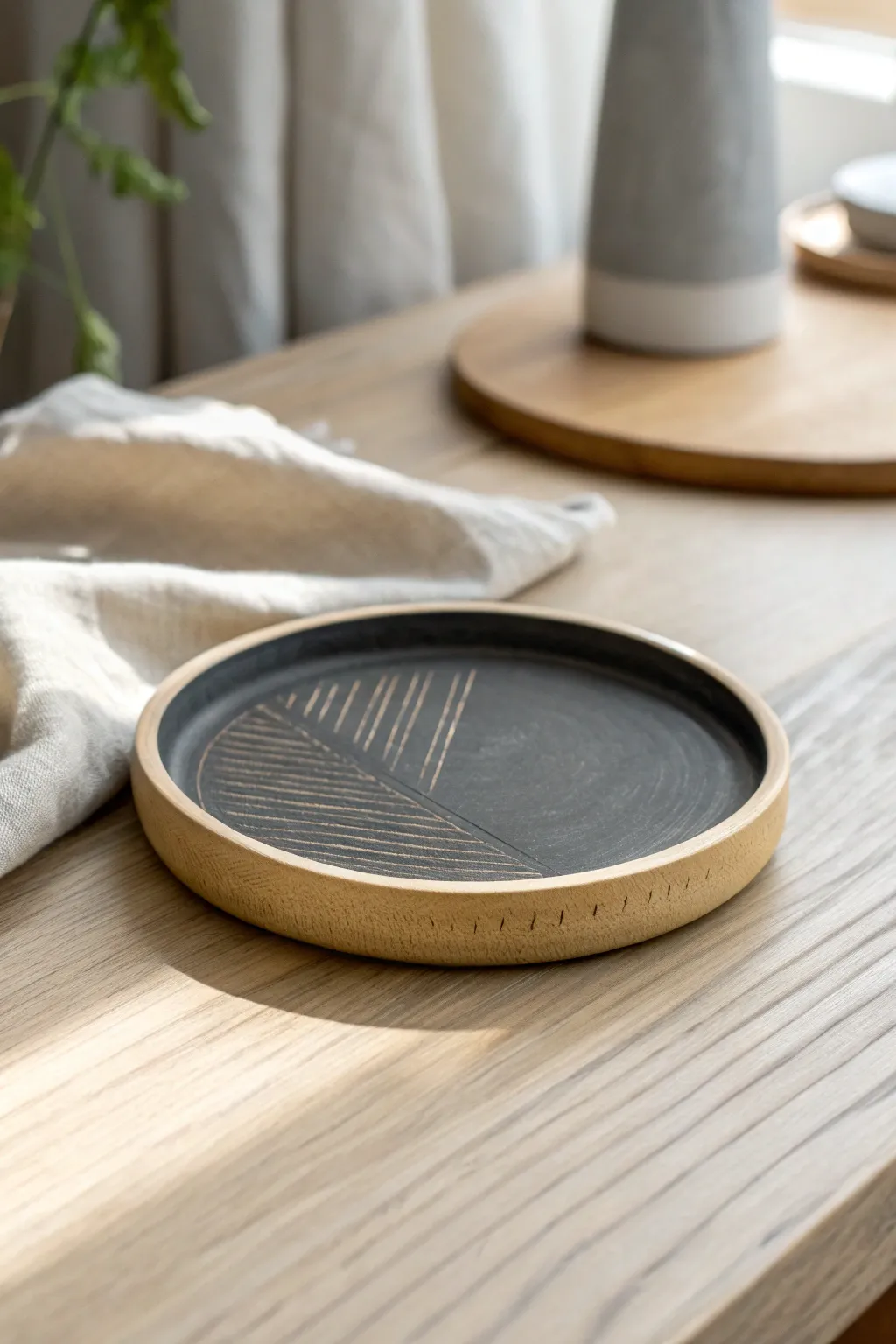
Marrying earthy textures with sleek modern design, this coaster project uses the sgraffito technique to carve striking linear patterns into a dark surface. The result is a sophisticated two-tone piece that reveals the raw clay body beneath a matte black finish.
Step-by-Step Guide
Materials
- Light-colored polymer clay (beige, ecru, or wood-effect)
- Black acrylic paint or black underglaze (if firing)
- Rolling pin or pasta machine
- Circle cutter (approx. 4-5 inches)
- Small carving tool, needle tool, or etching scribe
- Fine-grit sandpaper
- Matte varnish or sealant
- Small flat paintbrush
- Ruler (optional)
Step 1: Shaping the Base
-
Prepare the Clay:
Begin by conditioning your light-colored polymer clay until it is soft and pliable. If you want a speckled, natural finish like the photo, you can mix in a tiny pinch of ground black pepper or sand. -
Roll the Slab:
Roll out the clay to a uniform thickness of about 1/4 inch. Ensure the surface is smooth and free of air bubbles or lint. -
Cut the Circle:
Use your large circle cutter to punch out the coaster base. If you don’t have a cutter largely enough, trace a bowl rim and carefully cut around it with a craft knife. -
Create the Rim:
Roll a long, thin snake of clay, roughly the same thickness as your base. Gently press this coil onto the outer edge of your circle to form a raised rim. -
Blend the Seams:
Use a modeling tool or your fingertip to blend the seam where the coil meets the base on the inside and outside edge. The goal is to make it look like one solid carved piece, not two separate parts. -
Smooth the Surface:
Go over the entire piece with a little water (if using water-based clay) or baby oil (for polymer) to smooth out any fingerprints or tool marks. Let the clay firm up slightly if it feels too soft.
Clean Lines Pro Tip
Keep a scrap piece of clay handy. Wipe your carving tool on it after every few strokes to prevent paint build-up from dulling your fresh lines.
Step 2: The Sgraffito Technique
-
Paint the Center:
Using a flat brush, apply a smooth, even layer of black acrylic paint (or underglaze) to the inside flat surface of the coaster. Be careful to keep the paint strictly on the floor of the coaster, leaving the rim natural. -
Dry Until Leather Hard:
Allow the paint to dry completely to the touch. If the paint is still wet, your carving tool will drag and smear rather than cutting clean lines. -
Plan Your Divisions:
Visualize the geometric sections. The design features a large triangular segment offset against negative space. You can lightly mark the main dividing line with the tip of your tool before committing to the cut. -
Carve the Main Line:
Use your carving tool to scratch a firm, straight line dividing the painted area. Apply enough pressure to scrape away the black paint and reveal the light clay underneath. -
Add Side Details:
Create the second boundary line to form your triangle shape on the left side of the coaster. -
Etch Parallel Lines:
Inside the triangle shape you just defined, carve a series of closely spaced parallel lines. Start from the center and work outward to maintain even spacing. -
Rotate and Repeat:
In the adjacent section, change the angle of your lines to create visual contrast. I find rotating the coaster itself, rather than moving my hand awkwardly, produces much straighter lines. -
Refine the Rim:
For extra texture as seen in the inspiration image, use your needle tool to add tiny, subtle vertical ticks around the exterior of the rim. -
Clean Up Dust:
Gently blow away or brush off the paint crumbs created by the carving process. Be careful not to smudge them into the light-colored rim.
Step 3: Finishing Touches
-
Bake or Dry:
Follow the manufacturer’s instructions for your specific clay type to bake (polymer) or dry (air-dry) the coaster completely. -
Light Sanding:
Once fully cured and cool, examine the rim. If there are any sharp edges, use fine-grit sandpaper to gently soften them. -
Seal the Work:
Apply a thin coat of matte varnish over the painted area to protect the design from moisture, which is essential for a functional coaster.
Level Up: Gold Fill
After baking, rub ‘antiquing’ gold wax or metallic acrylic paint into the carved grooves, then wipe the surface clean for a luxe inlaid gold effect.
Now you have a stunning, modern coaster ready to protect your table with style
Romantic Lace Impression Coasters With Raised Detail
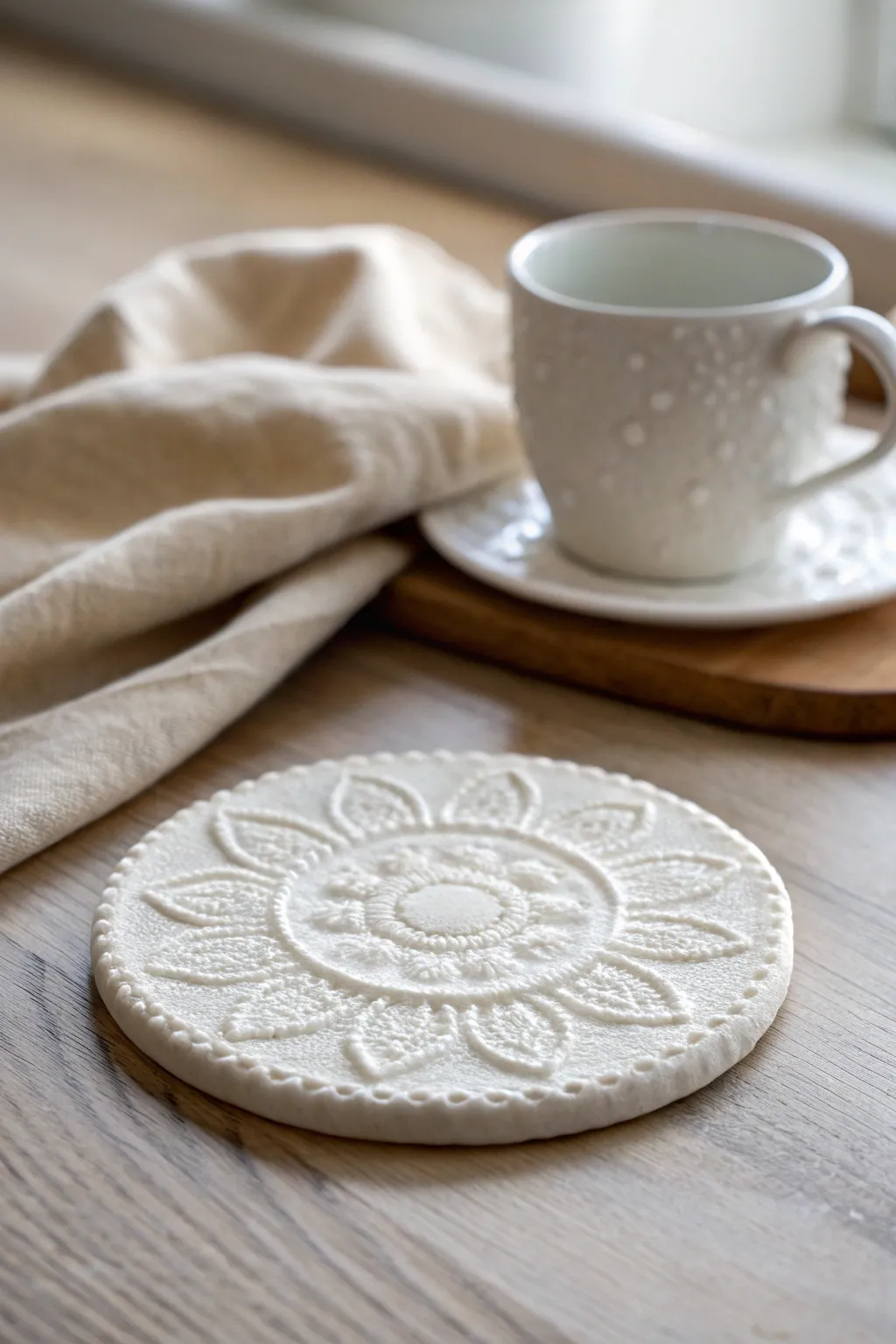
Bring a touch of vintage romance to your table with these beautiful, texture-rich coasters that look far more complicated than they actually are. By using simple items to create deep impressions, you can achieve a stunning raised-relief look on plain white clay.
Detailed Instructions
Materials
- White classic air-dry clay (or polymer clay)
- Doily with thick, defined texture (crochet or plastic)
- Rolling pin (acrylic or wooden)
- Round cookie cutter (approx. 4 inches) or a bowl and craft knife
- Fine-grit sandpaper (400-600 grit)
- Small bowl of water
- Parchment paper or non-stick craft mat
- Clear matte acrylic sealer/varnish
- Optional: Felt backing sheet
Step 1: Preparing the Base
-
Prepare your workspace:
Lay down a sheet of parchment paper or a non-stick craft mat to protect your table and prevent the clay from sticking. This also makes it easier to peel the finished coaster off later. -
Condition the clay:
Take a handful of white air-dry clay and knead it well in your hands. You want it to be warm, pliable, and free of any air bubbles before you start rolling. -
Roll the slab:
Place the ball of clay on your mat and flatten it slightly with your palm. Using your rolling pin, roll the clay out evenly until it is about 1/4 inch thick. Try to keep the thickness consistent across the entire surface. -
Smooth the surface:
Before adding texture, dip your finger in a tiny bit of water and gently run it over the clay surface to remove any initial cracks or fingerprints.
Troubleshooting: Curling Edges
If your coaster starts lifting at the edges while drying, place a lightweight book on top of it (sandwich it between parchment paper first) once it’s semi-dry to weigh it down flat.
Step 2: Creating the Impression
-
Position the lace:
Place your chosen doily or textured lace directly onto the rolled clay slab. If you want a specific part of the pattern (like the center flower shown in the photo) to be in the middle, align it carefully now. -
Roll the texture:
Take your rolling pin and firmly roll over the doily. You need to apply consistent, heavy pressure to ensure the pattern transfers deeply into the clay. Do not roll back and forth; roll one firm pass in a single direction. -
Reveal the design:
Carefully lift one edge of the doily and peel it back slowly. You should see a crisp, raised impression of the lace pattern left behind in the clay.
Level Up: Antique Wash
Mix a tiny drop of brown paint with water and brush it over the dried texture. Wipe it back immediately with a damp paper towel. The color will stay in the deep grooves for a vintage look.
Step 3: Cutting and Refining
-
Cut the shape:
Position your round cookie cutter over the most attractive part of the pattern. Press down firmly to cut the circle. If using a bowl as a template, place it face down and trace around it with a craft knife. -
Remove excess clay:
Peel away the excess clay from the outside of the circle. You can ball this up and store it in an airtight container for future projects. -
Add the beaded edge:
To mimic the dotted border seen in the image, take a small blunt tool (like the end of a paintbrush or a dotting tool) and gently press small indentations evenly around the very edge of the circle. -
Smooth the edges:
Dip your finger in water again and run it along the cut edge of the coaster to soften the sharp angle left by the cutter. This gives it a more finished, ceramic look.
Step 4: Drying and Finishing
-
Let it dry:
Allow the coaster to dry completely. For air-dry clay, this usually takes 24 to 48 hours depending on humidity. I recommend flipping it over gently halfway through the drying process to prevent curling. -
Sand imperfections:
Once fully dry and hard, take your fine-grit sandpaper and very lightly sand the edges or any rough spots on the surface. Be gentle so you don’t erase the texture. -
Dust off:
Wipe the coaster with a slightly damp cloth or a dry brush to remove any clay dust created by sanding. -
Seal the coaster:
Apply a coat of clear matte acrylic sealer. This is crucial for coasters as it protects the clay from moisture/condensation from cups. Let the first coat dry, then apply a second coat for durability. -
Add backing (optional):
For extra furniture protection, trace your coaster shape onto a piece of felt, cut it out slightly smaller than the clay circle, and glue it to the bottom.
Now you have a set of sophisticated, custom-textured coasters ready to grace your coffee table
Embedded Pressed Flowers Under a Clear Sealed Finish
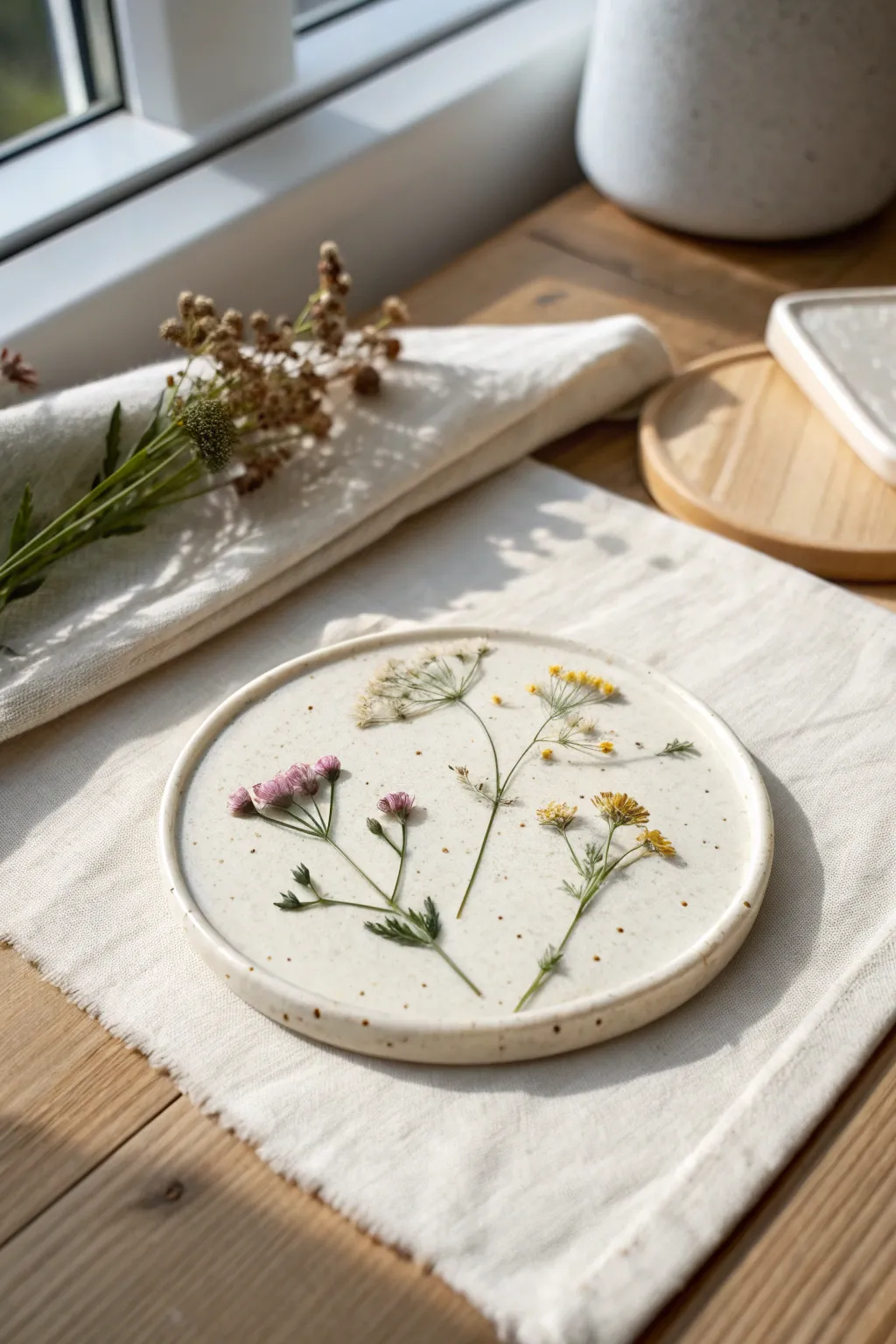
Capture the delicate elegance of nature with this sophisticated clay coaster project. Featuring a warm, speckled finish and real pressed wildflowers preserved under a glossy seal, these coasters look like high-end ceramic pieces but are surprisingly simple to make.
Step-by-Step Guide
Materials
- Air-dry clay (white)
- Acrylic rolling pin
- Circle cookie cutter or bowl (approx. 4 inches)
- Fine sandpaper
- Various small dried pressed flowers (pink, yellow, white)
- Speckle effect paint (brown or beige) or an old toothbrush
- Glossy Mod Podge or clear resin
- Soft synthetic brushes
- Parchment paper
- Small cup of water
Step 1: Shaping the Clay Base
-
Condition the clay:
Begin by taking a handful of white air-dry clay and kneading it in your hands until it feels soft, warm, and pliable. -
Roll out the slab:
Place the clay on a sheet of parchment paper to prevent sticking. Use your acrylic rolling pin to roll it out to an even thickness of about 1/4 inch. -
Cut the shape:
Press your circle cutter or a bowl firmly into the clay to create a clean specific round shape. Remove the excess clay from around the edges. -
Create the rim:
To achieve the shallow dish look from the image, gently pinch the very outer edge of the circle upwards. Smooth this raised rim carefully with a dampened finger. -
Dry the base:
Allow the clay coaster to dry completely according to the package instructions. Flip it over halfway through drying to prevent curling. -
Smooth the surface:
Once fully cured and hard, use fine-grit sandpaper to gently smooth out any fingerprints or rough spots on the rim and surface.
Step 2: Adding the Speckled Finish
-
Prepare the speckle mix:
Dilute a small amount of brown or dark beige acrylic paint with water until it’s quite runny. -
Apply the speckles:
Dip an old toothbrush into the watery paint. Hold it over the coaster and run your thumb across the bristles to flick tiny droplets onto the surface, mimicking a stoneware ceramic look. -
Let the paint dry:
Allow the speckles to dry completely. This usually only takes about 10-15 minutes since the droplets are so fine. -
Initial seal:
Apply a very thin layer of Mod Podge over the speckled surface to seal the paint so it doesn’t smear during the next steps.
Flower Pressing Hack
Don’t have a flower press? Place fresh blooms between parchment paper sheets inside a heavy book. Microwave in 30-second bursts until dry and flat.
Step 3: Embedding the Flora
-
Plan the layout:
Arrange your dried pressed flowers on the dry coaster first to find a composition you like. I prefer keeping stems distinct and separated like a botanical diagram. -
Apply adhesive base:
Lift one flower at a time and paint a small amount of Mod Podge or decoupage glue directly onto the clay where the flower will sit. -
Position the flowers:
Gently press the flower into the wet glue. Use tweezers for precision if the stems are delicate. -
Flatten the petals:
If any petals are sticking up, gently press them down with your finger or a clean, dry brush to ensure they lie completely flat against the clay. -
Top coat application:
Once the flowers are secured and the glue is dry, brush a generous layer of glossy Mod Podge or prepare a small batch of clear resin. -
Seal the coaster:
Pour or brush your sealant over the entire top surface, ensuring the flowers are completely covered and the finish reaches the raised rim. -
Remove bubbles:
If using resin, gently blow on the surface or use a heat gun to pop any bubbles. If using Mod Podge, brush slowly to avoid creating foam. -
Final cure:
Set the coaster on a flat, level surface in a dust-free area and allow the sealant to cure fully according to the manufacturer’s directions.
Foggy Finish?
If your sealer looks cloudy after drying, it might be due to trapped moisture in the flowers. Ensure flowers are 100% dry and crispy before sealing.
Enjoy using your lovely botanical coaster for your morning coffee or as a decorative tray for jewelry
Inlaid Mosaic Tile Coasters Using Tiny Clay Pieces
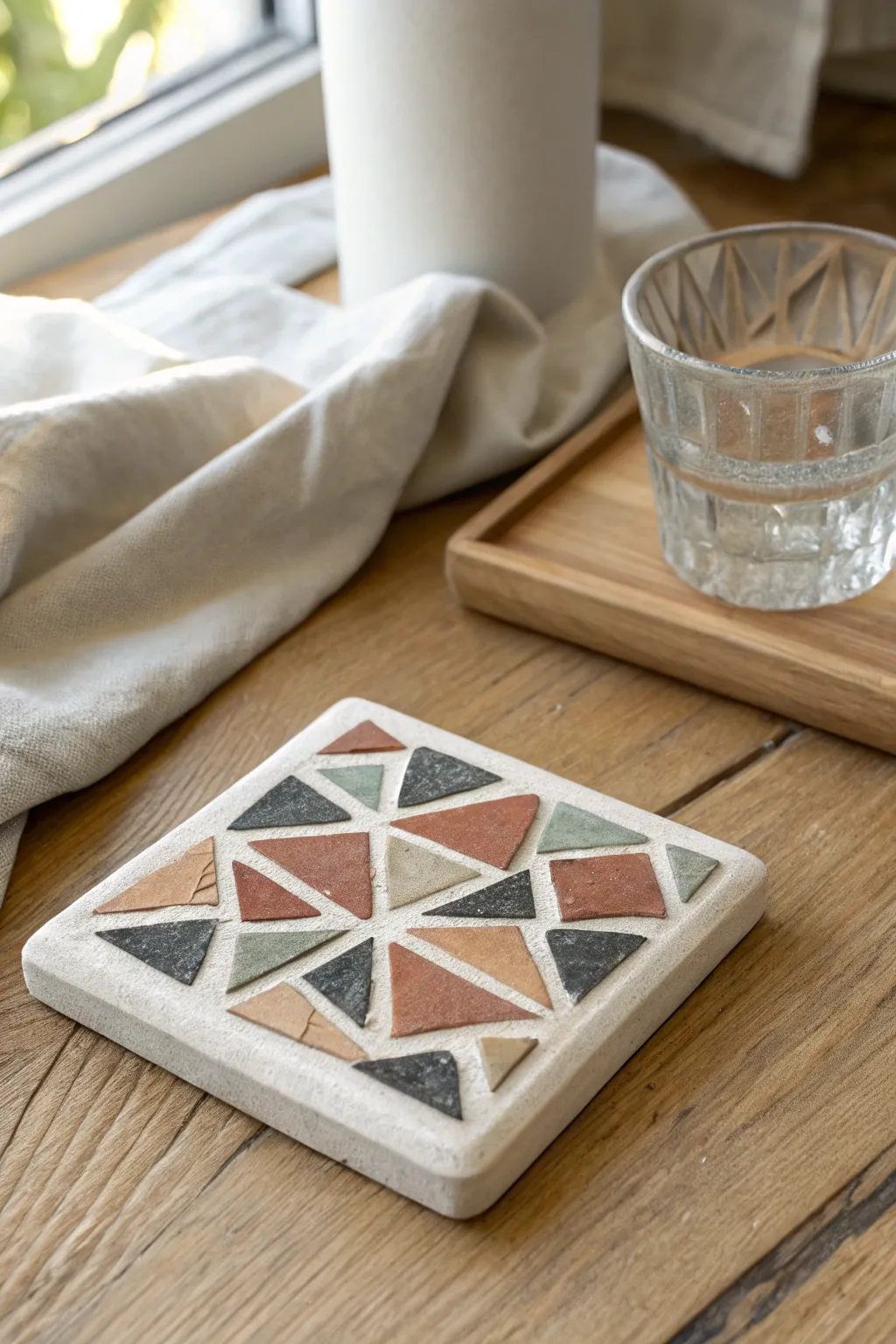
Achieve the high-end look of terrazzo or authentic mosaic tiling with this clever inlaid clay technique. By embedding custom-cut colored clay triangles into a solid white base, you create a sophisticated, textured surface that looks like it came from a boutique home goods store.
Detailed Instructions
Materials
- White or stone-effect polymer clay (for the base)
- Polymer clay in earth tones (terracotta, slate grey, sage green, tan)
- Acrylic rolling pin
- Square clay cutter (approx. 4×4 inches) or ruler and craft knife
- Sharp craft knife or tissue blade
- Baking parchment or ceramic tile
- Sandpaper (various grits: 400, 600, 1000)
Step 1: Prepping the Clay Tiles
-
Condition the colors:
Start by conditioning your colored clays—the terracotta, slate, green, and tan—until they are soft and pliable. I find it helpful to mix a tiny bit of translucent clay into the colored blocks to give them a more realistic, stony depth. -
Roll out thin sheets:
Roll each colored clay ball into a thin, even sheet, aiming for a thickness of about 2mm. Consistency is key here so your final surface remains level. -
Cut the triangles:
Using a sharp blade, cut random triangles from your colored sheets. They don’t need to be uniform; a mix of right-angled, isosceles, and scalene triangles adds to the organic, mosaic aesthetic. -
Bake the pieces:
Place your tiny clay triangles on a baking sheet and bake them according to the package instructions (usually 275°F/135°C for 15 minutes). Let them cool completely. Pre-baking ensures they maintain their crisp geometric shapes when pressed into the base.
Step 2: Creating the Base
-
Prepare the base clay:
Take a large block of white or stone-effect clay and condition it thoroughly. You want this block to be substantial, as it forms the body of the coaster. -
Roll the slab:
Roll out the white clay into a thick slab, approximately 6-8mm thick. It needs to be thick enough to accommodate the inlaid pieces without becoming flimsy. -
Cut the square:
Use your square cutter or a ruler and knife to cut a clean 4×4 inch square from the thick white slab. -
Round the edges:
Gently tap the sides of the square and smooth the corners with your finger to soften the sharp edges, mimicking the tumbled stone look in the photo.
Clean Lines Pro-Tip
When pre-baking the triangles, under-bake them slightly (by 5 mins). This keeps them hard enough to handle but allows them to bond better with the raw base during the final bake.
Step 3: Inlaying the Mosaic
-
Plan your pattern:
Before pressing them in, lay out your pre-baked triangles on top of the raw white base to test the arrangement. Aim for a balanced distribution of colors and shapes, leaving small gaps of white space between them. -
Press the pieces:
One by one, press the hard, baked triangles into the soft, raw white clay. Push them down until they are flush with the surface or purely slightly embedded. -
Level the surface:
Once all pieces are placed, gently roll over the entire coaster with your acrylic roller. This ensures the clay bonds around the edges of the triangles and creates a flat top. -
Final bake:
Bake the entire coaster according to the instructions for the base clay (typically 30-45 minutes). Tent it with foil to prevent the white clay from yellowing.
Level Up: Texture
Mix dried used coffee grounds or cracked black pepper into the white base clay before rolling. This creates a speckled ‘granite’ look that enhances the natural aesthetic.
Step 4: The Finishing Touch
-
Cool and inspect:
Allow the coaster to cool completely on a flat surface to prevent warping. -
Sand for stone effect:
Place your sandpaper on a flat surface and rub the face of the coaster against it in circular motions. Start with 400 grit to level any uneven spots where the clay meets the inserts. -
Refine the finish:
Move to 600 and then 1000 grit sandpaper. This sanding process reveals the clean lines of the triangles and gives the white clay a matte, stone-like texture. -
Wash and dry:
Rinse the coaster under water to remove any sanding dust and buff dry with a soft cloth.
Now you have a durable, stylish coaster that brings a touch of modern artistry to your coffee table
Hand-Painted Abstract Brushstroke Coasters
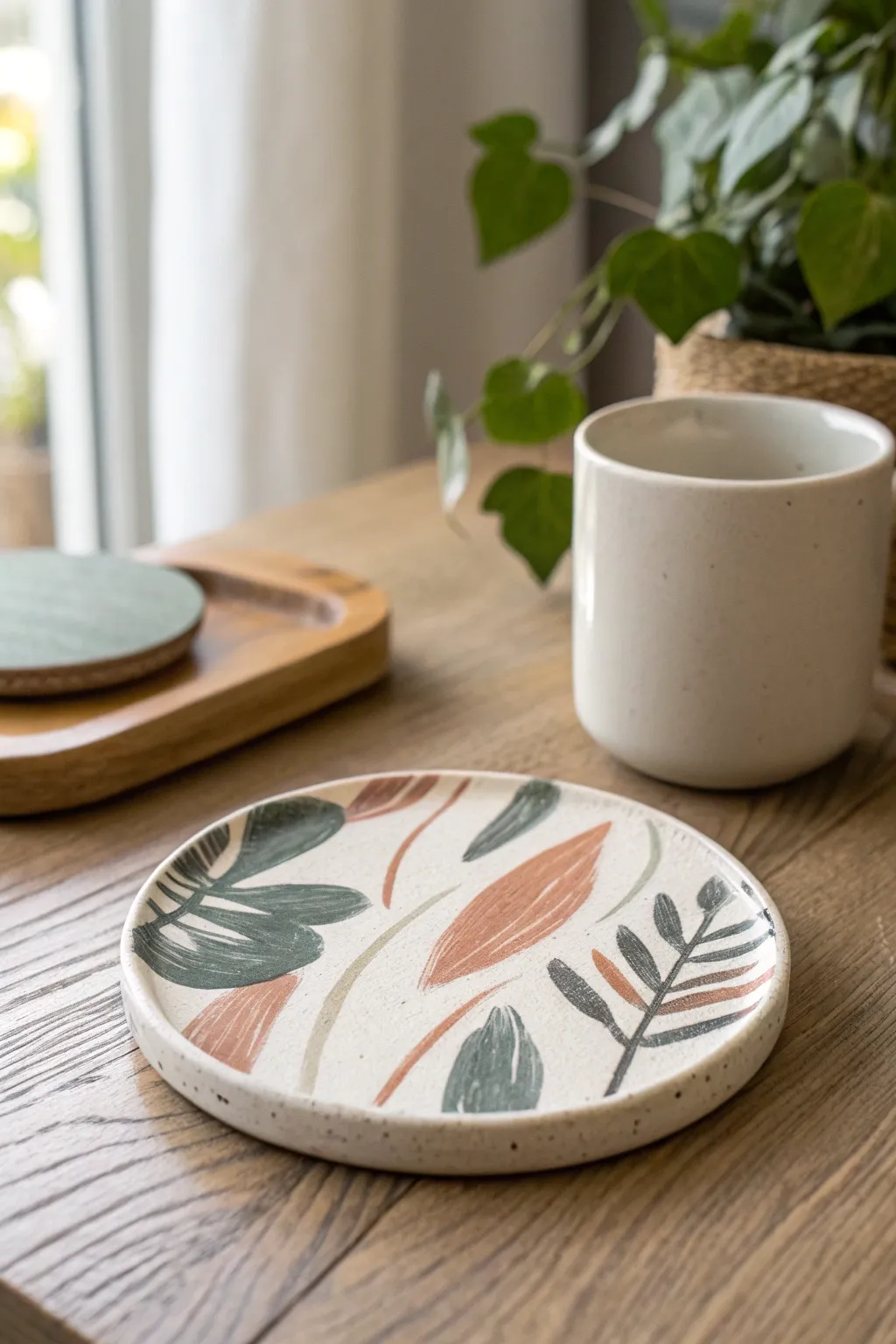
Bring an earthy, organic touch to your coffee table with these speckled clay coasters featuring charming abstract botanicals. Using simple brushstrokes and a muted color palette, you’ll create functional art that feels both modern and handmade.
Step-by-Step
Materials
- Air-dry clay (white or light beige)
- Round cookie cutter (approx. 4 inches) or a jar lid
- Acrylic rolling pin
- Rolling guides or wooden slats (approx. 1/4 inch thick)
- Sandpaper (fine grit)
- Acrylic paints (terracotta, sage green, forest green, light olive)
- Small round brushes (sizes 2 and 4)
- Fine liner brush
- Matte spray varnish or Mod Podge Sealer
- Old toothbrush (for speckling)
- Brown or black acrylic paint (watered down for speckling)
- Felt sheet (optional backing)
Step 1: Shaping the Base
-
Prepare your workspace:
Lay down a canvas cloth or parchment paper to prevent the clay from sticking to your table. Take a handful of air-dry clay and knead it briefly until it’s pliable and smooth. -
Roll out the slab:
Place your rolling guides on either side of the clay ball. Using the acrylic roller, flatten the clay until the roller rests on the guides, ensuring a perfectly even thickness of about 1/4 inch across the entire surface. -
Cut the shape:
Press your round cookie cutter firmly into the clay slab. Give it a tiny wiggle to separate the edges, then lift the cutter. Carefully peel away the excess clay from the outside. -
Define the rim:
For that professional lipped edge seen in the photo, gently press your thumb into the center of the coaster and work your way outward, pushing the clay slightly up at the very rim to create a shallow dish shape. -
Smooth the edges:
Dip your finger in a little water and run it along the rim to smooth out any cracks or roughness. The water acts as a slip to polish the surface. -
Let it cure:
Place the coaster on a wire rack or a piece of mesh to dry. Allow it to air dry for 24-48 hours, flipping it halfway through to prevent curling. -
Sand perfectly smooth:
Once fully bone-dry, use fine-grit sandpaper to gently buff the surface and rim. Wipe away any dust with a slightly damp cloth or sponge.
Step 2: Painting the Botanicals
-
Mix your palette:
Prepare your colors on a palette. You’ll need a terracotta orange, a few shades of green (from sage to deep forest), and a very watered-down brown or black for the speckle effect. -
Add that speckled texture:
Before painting the leaves, we need that faux-ceramic look. Dip an old toothbrush into your watered-down brown paint. Run your thumb across the bristles to flick tiny splatters across the white clay surface. Let this dry completely. -
Draft the layout:
Lightly visualize where your three main leaf clusters will go. The design in the image uses a flowing, non-symmetrical layout with stems curving inward. -
Paint the broad leaves:
Using a size 4 round brush loaded with sage or light olive green, paint the broad, swooping leaves. Press the brush down firmly at the start of the leaf and lift as you pull back to create a tapered point. -
Add terracotta accents:
Wash your brush and switch to the terracotta paint. Add similar organic swoops and singular leaf shapes interspersed between the greens. I find keeping the paint slightly sheer mimics a watercolor glaze. -
Detail the structured fronds:
Switch to a smaller size 2 brush and the forest green paint. Create the more detailed fern-like branch by painting a central stem line, then adding short, quick dashes on either side for leaves. -
Layering the dark leaves:
Paint the large, dark green leaf cluster on the left side. Use broad strokes to fill the shape, allowing the natural bristle marks to remain visible for texture. -
Add fine veining:
Once the base leaf shapes are dry to the touch, use a fine liner brush and contrasting colors (like terracotta on green or white on dark green) to add delicate vein lines down the center of select leaves. -
Connect with stems:
Use a light hand to paint long, thin stems connecting your floating leaves, creating a loose, flowing composition across the coaster.
Smooth Operator Tip
To get a perfectly smooth clay surface without fingerprints, lightly roll a piece of plastic wrap over the clay before cutting. It softens the edges instantly.
Step 3: Sealing and Finishing
-
Apply varnish:
Since these are coasters, protection is key. Apply 2-3 coats of matte spray varnish or brush-on sealer, allowing ample drying time between coats. -
Back the coaster:
Trace your coaster shape onto a sheet of felt and cut it out slightly smaller than the rim. Glue this to the bottom to protect your furniture surfaces from scratches.
Level Up: Gold Luxe
Elevate the design by painting the very rim of the coaster with liquid gold leaf or metallic gold paint after the varnish has dried for a chic finish.
Now you have a stunning set of faux-ceramic coasters ready to hold your morning brew
Mix-and-Match Puzzle Pair Coasters That Fit Together
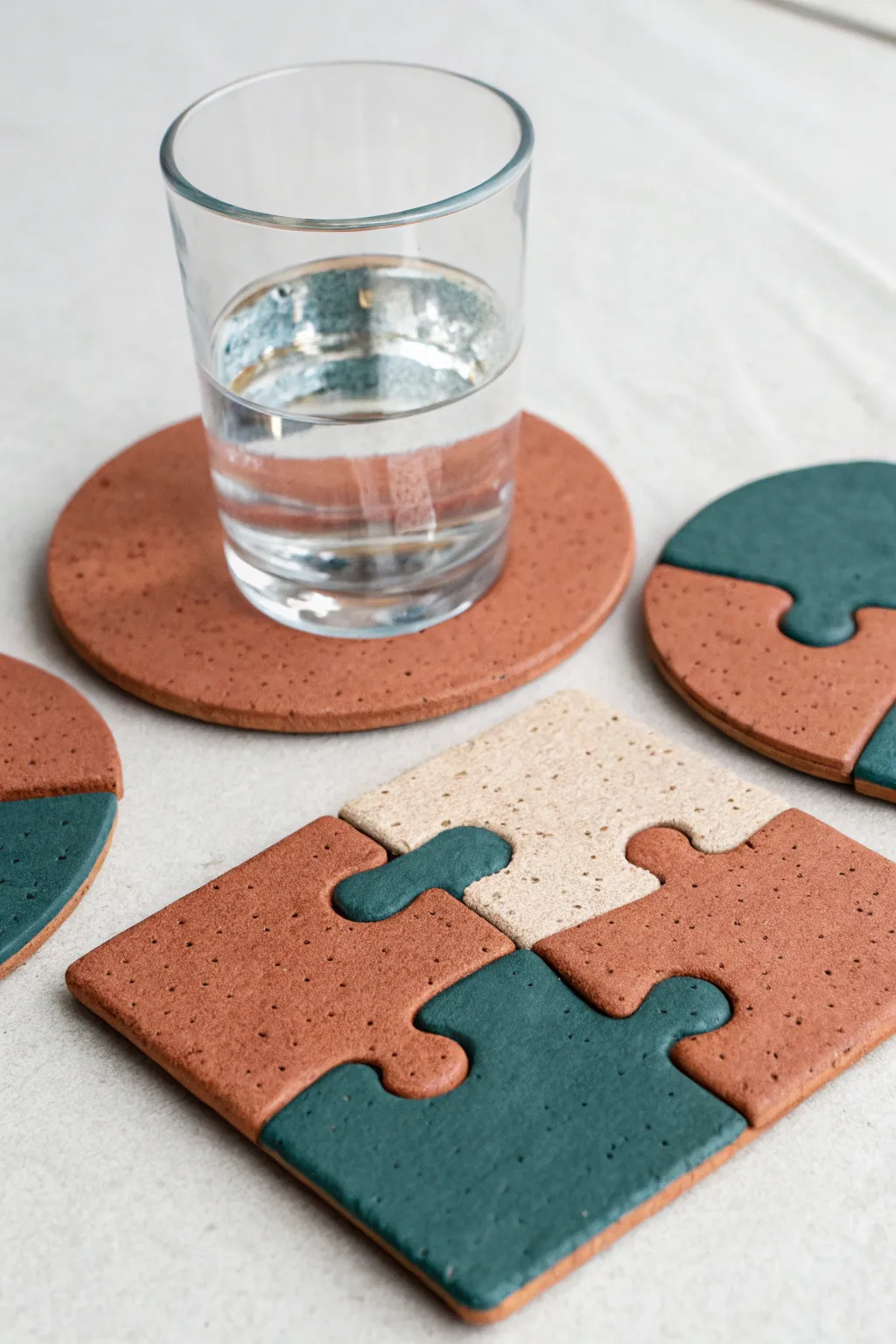
Bring a playful, modern touch to your coffee table with these charming puzzle piece coasters. Crafted from speckled polymer clay in earthy terracotta, sage green, and cream tones, they interlock perfectly to create larger trivets or separate into individual drink spots.
How-To Guide
Materials
- Polymer clay (terracotta/rust, sage/forest green, cream/beige)
- Speckled clay additive or black pepper/sand (optional for texture)
- Rolling pin or pasta machine
- Puzzle piece cookie cutter (large)
- Circle cookie cutter (approx. 4 inches)
- Exacto knife or clay blade
- Ceramic tile or glass work surface
- Parchment paper
- Sandpaper (fine grit)
- Matte varnish or sealant
Step 1: Preparation & Mixing
-
Condition the clay:
Begin by kneading your polymer clay blocks until they are soft and pliable. If you want that lovely speckled stone look shown in the photo but only have solid colors, mix in a tiny pinch of black pepper or craft sand now. -
Roll it out:
Roll each color—terracotta, green, and cream—into flat sheets. Aim for a thickness of about 1/4 inch (6mm) to ensure your coasters feel substantial and sturdy. -
Smooth the surface:
Run a roller lightly over the top one last time to remove any fingerprints. I find laying a piece of parchment paper on top before rolling helps get that perfectly matte, smooth finish.
Seamless Tip
When joining two colors for the round coaster, slice the clay edges at a 45-degree angle (beveling) before pressing them together. This creates a stronger bond and a cleaner surface transition.
Step 2: Cutting the Shapes
-
Plan the square coaster:
For the square coaster made of four pieces, you’ll need to cut four puzzle shapes. Use your large puzzle cutter to punch out shapes from different colored clay sheets. -
Assemble the square:
Arrange four contrasting puzzle pieces (e.g., two rust, one green, one cream) on your baking tile so they interlock perfectly into a square. Press the seams gently to test the fit, but keep them separate for baking if you want them detachable. -
Create the split circle:
For the round two-tone coaster, roll out a sheet of green and a sheet of terracotta clay side-by-side. -
Cut the connection:
Use the puzzle cutter (or freehand with a knife for a unique curve) to cut a ‘male’ connector shape out of the green clay and a matching ‘female’ slot out of the terracotta clay. -
Join the halves:
Fit the green and terracotta pieces together on your work surface so they form a single sheet. Gently smooth the seam with your finger so they bond. -
Cut the circle:
Place your large circle cutter centered over the joined seam and press down firmly to cut out the final round coaster shape. -
Make the solid coaster:
For the simple solid terracotta coaster, cut a single large circle from your rolled-out rust-colored clay.
Make It Magnetic
Embed small, strong magnets into the edges of the puzzle pieces before baking. They will ‘snap’ together satisfyingly and stay connected tightly when used as a larger trivet.
Step 3: Refining & Baking
-
Texture check:
Inspect all your pieces. If you want to enhance the stone-like texture, you can gently tap the surface with an old toothbrush or a crumpled ball of foil. -
Clean edges:
Before baking, use your fingertip with a tiny dab of baby oil or cornstarch to smooth any rough edges left by the cutters. -
Bake the pieces:
Place your tile with the clay pieces into the oven. Follow the temperature instructions on your specific brand of clay (usually 275°F/135°C). -
Timing is key:
Bake for approximately 30 minutes. Since these are thick coasters, don’t rush this step or they may be brittle. -
Cool down:
Turn off the oven and let the pieces cool partially inside with the door cracked. This gradual cooling helps prevent warping.
Step 4: Finishing Touches
-
Sand the edges:
Once fully cool, use fine-grit sandpaper under running water to smooth the rim of the coasters and ensure the puzzle connections slide together easily. -
Wipe clean:
Wash off any sanding dust and dry the coasters thoroughly with a lint-free cloth. -
Seal the surface:
Apply a thin layer of matte varnish to protect the clay from water rings. I prefer matte over gloss here to keep that natural, stonewear aesthetic. -
Add backing (optional):
If you’re worried about sliding, cut small circles of cork or felt and glue them to the bottom of each piece.
Now you have a functional, geometric art piece that keeps your surfaces safe