
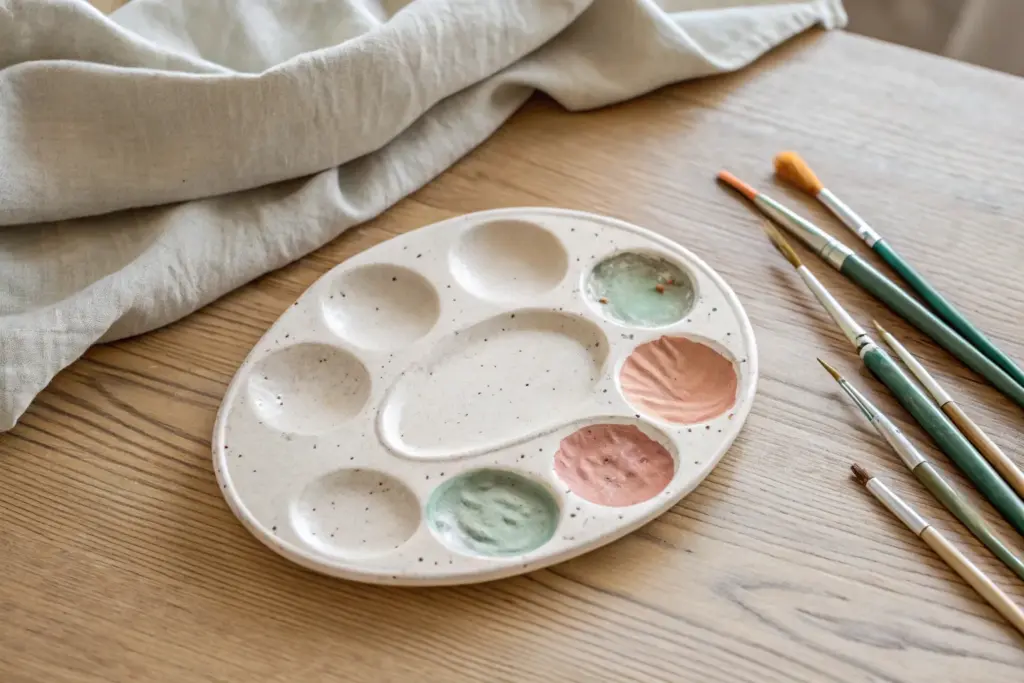
If you’ve ever wished your paint setup felt as beautiful as the art you’re making, a clay paint palette is such a fun upgrade. I love how clay lets you build a palette that’s not only functional, but totally your style—smooth, speckled, whimsical, or perfectly simple.
Classic Kidney-Shaped Clay Paint Palette
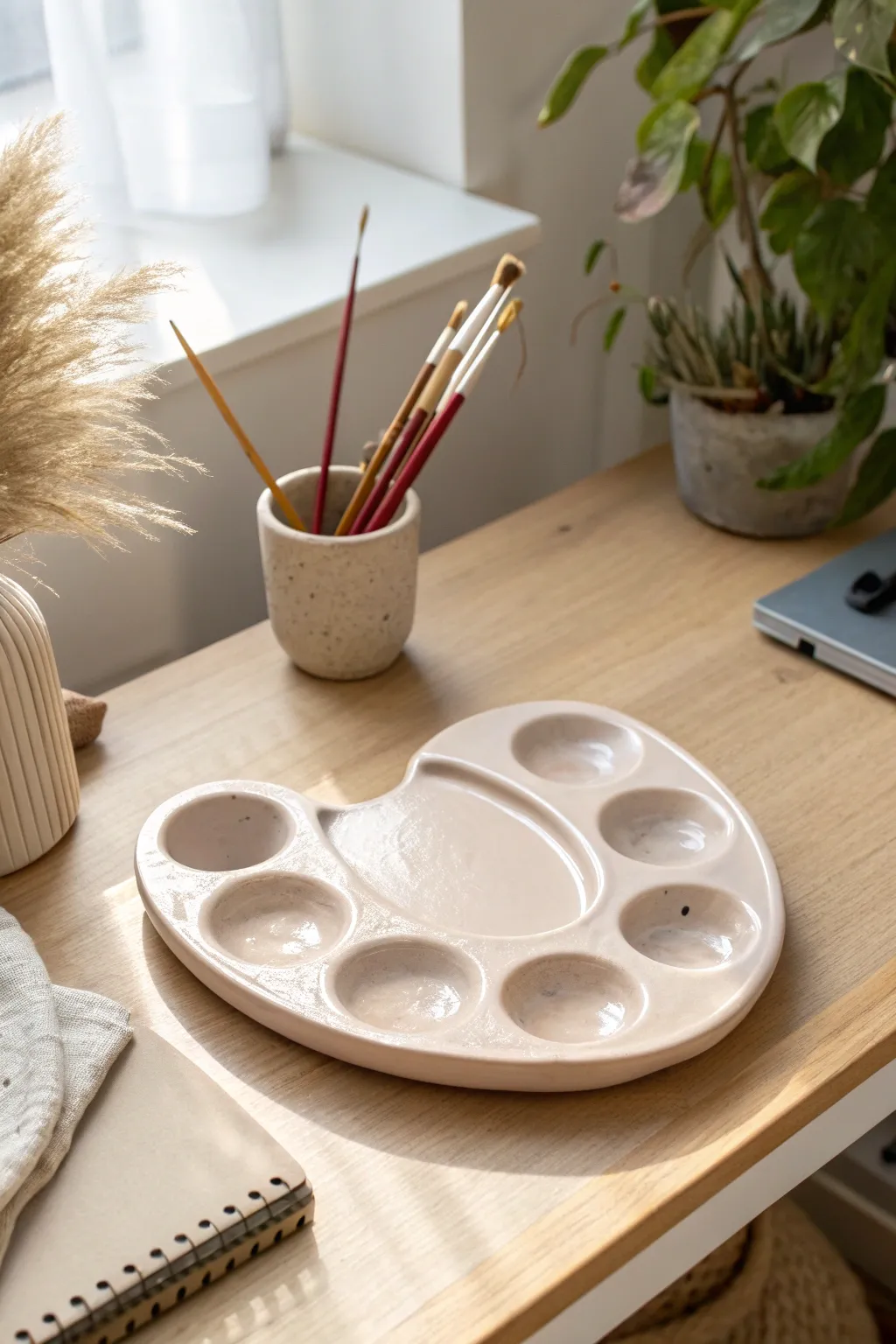
This elegant clay palette combines the classic kidney bean shape with soft curves and a glossy, cream-colored finish. Its spacious mixing well and seven smaller paint reservoirs make it perfectly functional while looking like a sculptural art object on your desk.
Step-by-Step
Materials
- Air-dry clay (white or cream)
- Clean rolling pin
- Rolling guides or wooden slats (about 1/4 inch thick)
- Craft knife or needle tool
- Small bowl of water
- Soften watercolor brush or sponge
- Fine-grit sandpaper (220-400 grit)
- Glossy acrylic varnish or waterproof sealer (like polyurethane or resin)
- Round object for shaping wells (like a measuring spoon or large marble)
- Parchment paper or a silicone mat
Step 1: Planning and Shaping the Base
-
Prepare your workspace:
Lay down parchment paper or a silicone mat on a flat surface to prevent the clay from sticking. Tape the edges if necessary to keep it taut. -
Condition the clay:
Take a generous handful of air-dry clay and knead it until it’s warm and pliable. This removes air bubbles and makes the clay easier to work with. -
Roll out the slab:
Place your rolling guides on either side of the clay ball. Roll the clay out into a smooth, even slab that is roughly 1/4 to 1/3 inch thick. -
Outline the shape:
Using a needle tool, lightly sketch a kidney bean or heart-like shape onto the clay surface. Aim for soft, rounded curves rather than sharp indents. -
Cut the form:
Once you are happy with the outline, use your craft knife to cut cleanly through the clay. Remove the excess material and set it aside for future use. -
Smooth the edges:
Dip your finger in a little water and run it along the cut edges to round them off. You want to eliminate any sharp angles or burrs left by the knife.
Use Water Sparingly
When smoothing air-dry clay, use very little water. Too much moisture weakens the structure and increases the risk of cracking as it dries.
Step 2: Sculpting the Wells
-
Mark reservoir placement:
Lightly press small circles onto the slab to plan where your paint wells will go. Looking at the image, arrange about seven small circles along the outer curve and a large area in the center. -
Form the paint wells:
Use a rounded object, like the back of a metal measuring spoon, to press firmly into the clay where you marked the circles. Rotate the spoon gently to widen and smooth the indentation. -
Create the mixing area:
For the large central mixing area, I find it easiest to use my thumbs. Gently press and sweep the clay outwards to create a shallow, oval depression, leaving a raised border between this area and the smaller wells. -
Refine the walls:
Check the walls between the wells. If they have become distorted, gently pinch and smooth them back into shape with damp fingers. -
Final smooth:
Take a damp sponge or soft brush and go over the entire surface. Pay special attention to the inside of the wells to ensure there are no fingerprints or rough textures that could trap paint later.
Step 3: Finishing and Sealing
-
Let it dry slowly:
Place the palette in a cool, dry place away from direct sunlight. To prevent curling, you can place a light board on top for the first few hours, or flip it gently once a day. -
Sand for perfection:
Once the clay is bone dry (usually 24-48 hours), use fine-grit sandpaper to buff away any remaining unevenness on the edges or surface. Wear a dust mask for this part. -
Wipe clean:
Use a barely damp cloth or a dry brush to remove all the sanding dust. The surface needs to be pristine before sealing. -
Apply the first coat:
Brush on a layer of glossy waterproof sealer. Make sure to get into all the nooks of the wells. Let it dry completely according to the manufacturer’s instructions. -
Add protective layers:
Apply 2-3 additional coats of varnish to ensure the palette is fully waterproof. This is crucial so moisture doesn’t seep into the clay during use. -
Cure completely:
Allow the final coat to cure for several days before using the palette with wet paints. This ensures the finish is hard and durable.
Fixing Cracks
If small hairline cracks appear during drying, mix a tiny bit of fresh clay with water to make a paste (slip) and fill them in before sanding.
Now you have a stunning, custom tool ready to assist in your next watercolor masterpiece

Simple Slab Palette With Pressed Mixing Wells
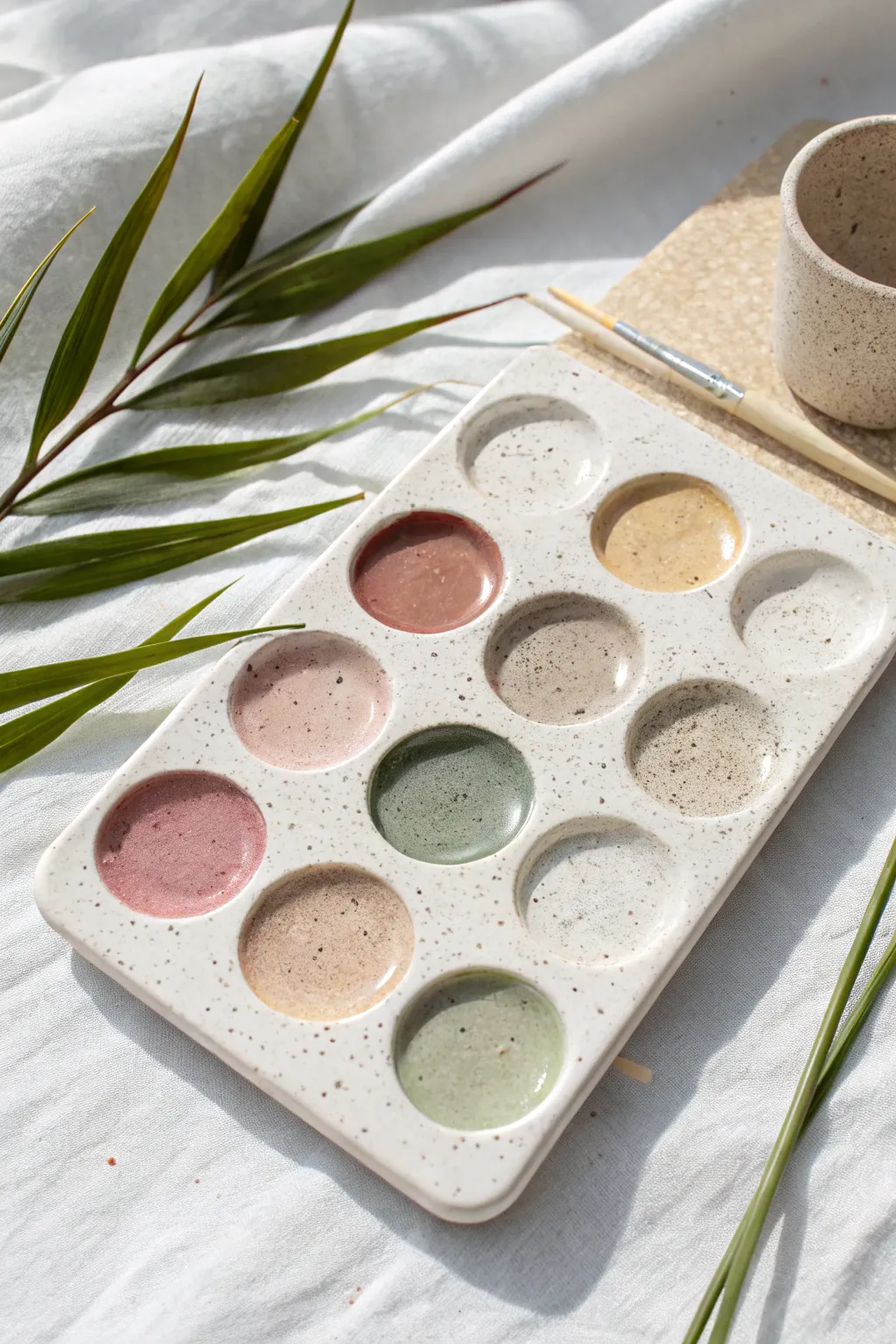
This minimalist palette features a simple slab construction with neatly pressed wells, perfect for organizing your watercolors or gouache. The speckled clay body adds a natural, earthy texture while the glossy white glaze makes for an easy-to-clean mixing surface.
Step-by-Step Tutorial
Materials
- Speckled cone 6 stoneware clay
- Rolling pin
- Two wooden guide strips (approx. 1/4 inch thick)
- Circular cookie cutter or small jar lid (approx. 1.5 inch diameter)
- Fettling knife or needle tool
- Smoothing rib (rubber or wood)
- Sponge
- Smooth wooden board or bat
- Glossy white glaze
- Dense foam pad or soft cushion
Step 1: Preparing the Slab
-
Wedge the clay:
Begin by thoroughly wedging a ball of speckled stoneware clay to remove any air bubbles and ensure an even consistency. -
Flatten the base:
Press the clay ball down onto your canvas or work surface with the palm of your hand to create a thick pancake shape. -
Set up guides:
Place your wooden guide strips on either side of the clay. This ensures your slab will have a completely uniform thickness. -
Roll the slab:
Using the rolling pin, roll the clay out until the pin rests flat against the guide strips. Roll in multiple directions to compress the clay particles. -
Smooth the surface:
Run a rubber rib firmly across the surface of the slab to compress the clay and remove any canvas texture or rolling pin marks.
Warping Woes?
If your slab curls up while drying, flip it over and place a lightweight board on top. Dry it slowly under plastic to keep moisture even.
Step 2: Shaping the Palette
-
Cut the rectangle:
Using a ruler and a fettling knife, cut a clean rectangle from your slab. A size of roughly 5×8 inches works well for a portable palette. -
Round the corners:
Gently soften the sharp 90-degree corners of your rectangle by tapping them with your finger or using a small round cutter to trim just the distinctive edge. -
Smooth the edges:
Dip your finger or a sponge in a tiny bit of water and run it along the cut edges to round them over and remove any sharp burrs.
Make it Yours
Before the clay dries, stamp your initials or a small logo on the underside for a professional, personalized finish.
Step 3: Pressing the Wells
-
Prepare the pressing tool:
I like to use a small, rounded object like a measuring spoon or a smooth stone as a pressing tool. If use a cookie cutter, you’ll need to press gently inside it. -
Mark the grid:
Lightly sketch a grid on the surface to plan your well placement. This palette features three columns with four wells each. -
Support the slab:
Place your slab onto a piece of dense foam. This allows the back of the palette to deform slightly without cracking when you press down. -
Press the impressions:
Firmly press your round object into the clay at your marked interval points. Apply even pressure and rock slightly to create a concave mixing well. -
Refine the rims:
The pressing action may cause the clay to bulge slightly around the wells. Smooth these raised edges back down with a damp sponge. -
Final smooth:
Give the entire piece one last wipe with a very smooth, slightly damp sponge to ensure the surface is flawless before drying.
Step 4: Firing and Glazing
-
Slow drying:
Cover the palette loosely with plastic to let it dry slowly over several days. This helps prevent warping, which is common with flat slabs. -
Bisque fire:
Once bone dry, fire the piece to cone 04 (or your clay’s specific bisque temperature). -
Apply glaze:
Dip or brush a glossy white glaze over the top surface. Make sure the glaze isn’t too thick in the wells, or it might crawl. -
Clean the foot:
The bottom of the palette must be completely free of glaze. Wipe it clean with a wet sponge. -
Glaze fire:
Fire the piece to cone 6 to mature the clay and melt the glaze into a durable, glassy surface.
Now you have a stunning, reusable ceramic palette ready for your next painting session


Round Color Wheel Palette for Color Mixing
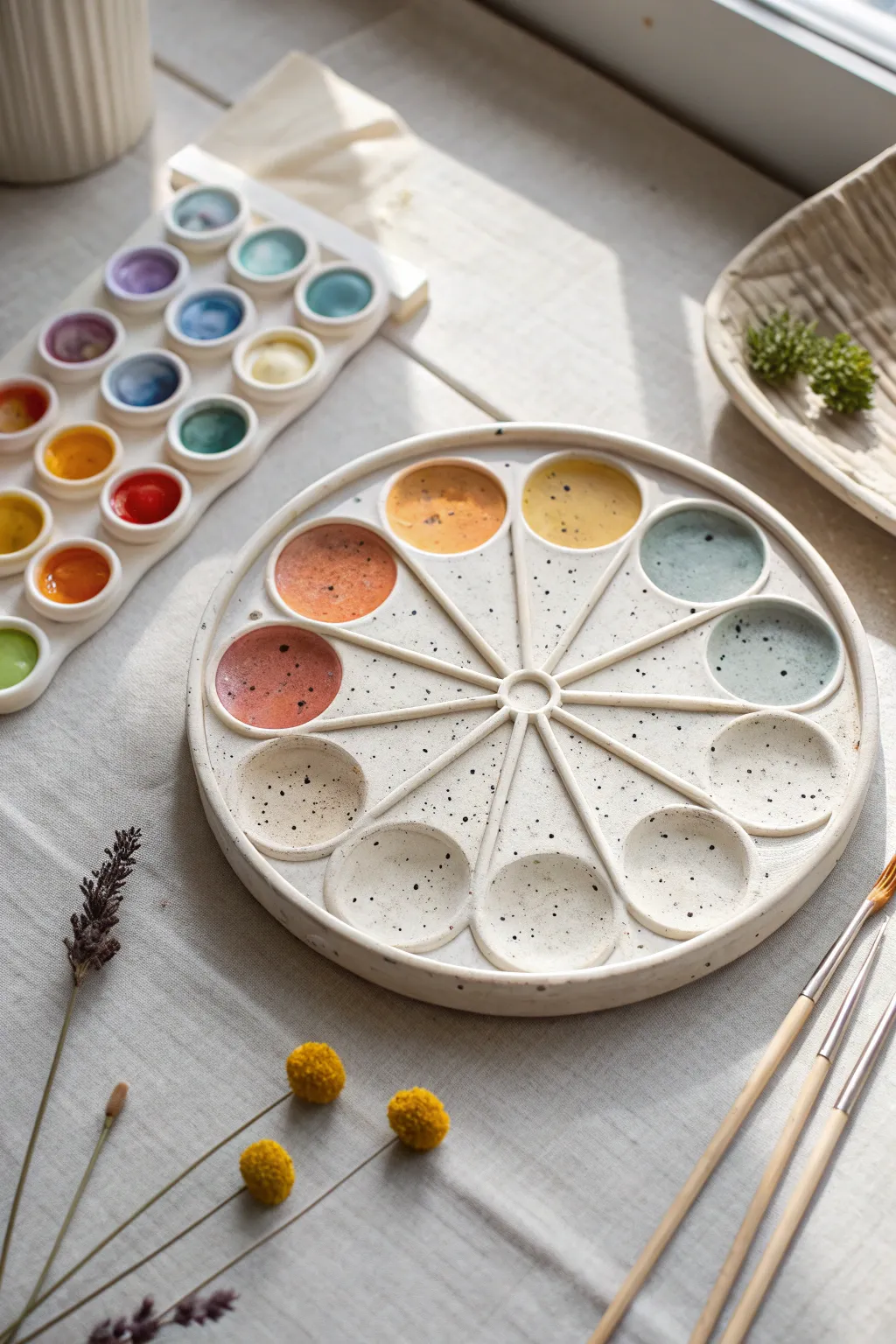
This artist-grade wheel palette combines functional color theory with beautiful craftsmanship, featuring twelve distinct wells for mixing and a central reservoir. Its distinctive speckled finish mimics natural stone, creating an inspiring surface for your watercolor adventures.
Step-by-Step
Materials
- White polymer clay or air-dry stoneware clay (approx. 1 lb)
- Black pepper or dried coffee grounds (for speckling)
- Rolling pin or clay roller
- Large circular cookie cutter or bowl (approx. 7-8 inches)
- Small circular cutter or bottle cap (approx. 1 inch)
- Sculpting tools (needle tool, smoothing tool)
- Ruler
- Sandpaper (fine grit)
- Waterproof varnish or resin (if using air-dry clay)
- Gloss glaze (if firing ceramic clay)
Step 1: Preparing the Base
-
Mix the Speckles:
Begin by conditioning your white clay until it is soft and pliable. To achieve that gorgeous stone-like effect, knead in a small amount of coarse black pepper or dried coffee grounds. Fold the clay repeatedly until the speckles are evenly distributed throughout the batch. -
Roll the Slab:
Place your clay on a flat, clean surface. Using your rolling pin, roll the clay out into a smooth, even slab that is approximately 1/4 inch thick. Try to keep the thickness consistent so the palette sits flat. -
Cut the Circle:
Place your large circular cutter or a bowl template onto the clay slab. Press down firmly to cut out the main circle shape. Remove the excess clay from around the edges, setting it aside for the dividers. -
Smooth the Edges:
Dip your finger in a little bit of water (or clay softener/oil if using polymer) and run it along the cut edge of the circle. This smooths out any sharpness or burrs left by the cutter, giving it a professional finish.
Clean Lines Pro-Tip
Use a damp paintbrush (water for air-dry, baby oil for polymer) to smooth the inner corners of the wells. It reaches where fingers can’t.
Step 2: Creating the Wells and Dividers
-
Create the Outer Rim:
Roll a long snake of clay about 1/4 inch thick. Carefully attach this coil to the outer circumference of your base circle. Blend the clay downwards onto the base on the inside and outside ensuring a seamless connection. -
Mark the Center:
Using a ruler, lightly find and mark the exact center of your circle. From a scrap of clay, create a small ring or use a very small circle cutter to create the central hub. Attach this directly over your center mark. -
Section the Wheel:
Lightly score lines radiating from the center hub to the outer rim like a pizza, dividing the circle into twelve equal slices. This will guide where your dividers go. -
Form the Dividers:
Roll thin coils of clay for the spokes. Measure them against your scored lines, cut to size, and press them firmly onto the base. They should connect the center hub to the outer rim. -
Add the Paint Cups:
This step requires precision. Roll a ball of clay for each of the twelve sections. Flatten them slightly and press them into the wedge shapes, or use a small rounded tool to indent the clay within each section to form the cup itself. -
Refine the Shapes:
Use a smoothing tool to refine the walls of each divider. You want them to be sharp and distinct so colors don’t bleed into each other. I find a small, slightly damp sponge is perfect for getting these transitions smooth.
Step 3: Finishing Touches
-
Uniform Height Check:
Look at the palette from the side. Ensure the outer rim and the inner spokes are roughly the same height. Trim or add small bits of clay where necessary to level it out. -
Final Smoothing:
Go over the entire piece with a soft brush or your finger to remove fingerprints. Pay special attention to the bottom of the wells to ensure they are smooth for easy paint mixing. -
Drying or Baking:
If using polymer clay, bake according to the package instructions (usually 275°F for 15-30 minutes). If using air-dry clay, let it sit in a cool, dry place for 24-48 hours until completely hard. -
Sanding:
Once fully cured or dried, use fine-grit sandpaper to gently buff the edges and surface. This removes any final imperfections and makes the clay feel like smooth stone. -
Sealing:
This is crucial for functionality. Apply 2-3 coats of a waterproof varnish (for air-dry/polymer) or fire with a clear glaze (for ceramic). Ensure the wells are perfectly sealed so they don’t absorb water.
Clay Cracking?
If air-dry clay cracks while drying, fill the fissures with a ‘slip’ made of clay mixed with water, then smooth over and let dry again.
Once sealed and cured, your custom wheel is ready to be filled with your favorite pigments for your next masterpiece



Deep-Well Palette for Gouache and Acrylic
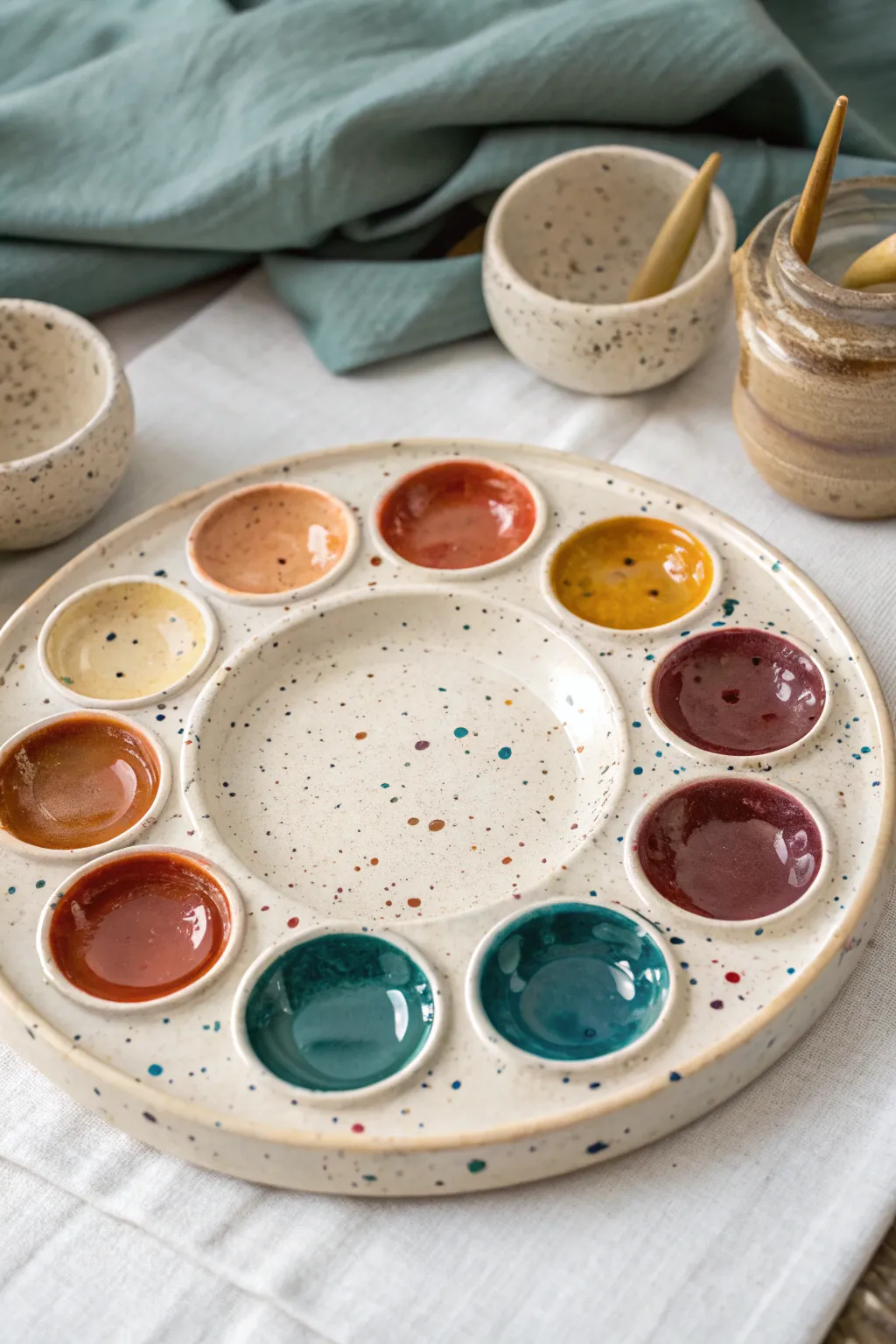
Craft a professional-grade ceramic palette perfect for gouache or acrylics featuring generous, deep wells and a central mixing area. This handmade piece combines functionality with a charming, speckled glaze finish that makes every color mixing session feel special.
How-To Guide
Materials
- Speckled buff stoneware clay (approx. 2 lbs)
- Rolling pin
- Canvas work surface
- Circular bat or banding wheel
- Rib tool (wooden or rubber)
- Pin tool or needle tool
- Circular cookie cutters (sizes: 1.5-inch and 4-inch)
- Sponge
- Potter’s knife
- Clear or milky white dipping glaze
- Kiln access
Step 1: Forming the Base
-
Prepare the slab:
Begin by wedging your speckled clay thoroughly to remove air bubbles. Roll it out on your canvas into a smooth slab that is approximately 1/2 inch thick ensuring it is large enough for your desired palette diameter. -
Cut the main circle:
Place a circular template or use a large bowl upside down to trace a circle about 8-10 inches in diameter. Cut cleanly around the edge using your pin tool and remove the excess clay. -
Smooth the surface:
Run a rubber rib gently over the surface of your clay circle. This compresses the clay particles and creates the smooth finish crucial for mixing paints later. -
Create the rim:
Roll a long coil of clay, roughly the thickness of your pinky finger. Score the outer edge of your base slab and apply slip, then attach the coil to create a raised barrier around the entire palette. -
Blend the rim:
Use your thumb or a modeling tool to blend the coil seamlessly into the base, smoothing both the inside and outside seams until the rim looks like an integrated part of the slab.
Warping Woes?
Flat objects love to warp. Dry your palette on a piece of drywall or intricate wire rack, flipped occasionally, to ensure air hits both sides evenly.
Step 2: Creating the Wells
-
Plan the layout:
Lightly mark where your paint wells will go using your 1.5-inch cutter without pressing through. Arrange them in a circle, leaving space for the large central mixing area. -
Form the well walls:
Roll more coils of clay. For each marked circle, form a ring of clay, score the base, slip, and attach the ring to create the individual paint wells. -
Refine the wells:
Using a small modeling tool or your fingers, smooth the inside of each small well. This is critical—you want a rounded, scoopable bottom so no paint gets stuck in corners. -
Define the mixing area:
Create a larger raised ring in the center using the same coil method. I like to make the walls of this central area slightly lower than the outer wells to allow for easier brush movement. -
Level the heights:
Place a flat board gently on top of the palette to check that all well walls are roughly the same height. Trim any high spots with a fettling knife if necessary.
Brush Rests
Before drying, use a round paintbrush handle to gently press indentations into the outer rim. These act as perfect rests for wet brushes while painting.
Step 3: Finishing and Firing
-
Drying phase:
Cover the palette loosely with plastic and let it dry very slowly for several days. Uneven drying in a flat piece like this can cause warping, so patience is key here. -
Bisque fire:
Once bone dry, fire the piece in the kiln to cone 04 (or your clay’s specific bisque temperature). This hardens the clay and prepares it for glazing. -
Apply wax resist:
Apply wax resist to the very bottom of the palette to prevent it from fusing to the kiln shelf. Ensure the wax doesn’t touch the sides of the rim. -
Glazing:
Dip the entire bisqued palette into a clear or semi-opaque milky white glaze. Shake gently to remove excess drips, as a pool of glaze in the wells can ruin the shape. -
Clean connections:
Check the crevices between the wells. If glaze has pooled thickly there, use a brush to wick some of it away to prevent crawling or bubbling. -
Final firing:
Fire the glazed piece to the maturity temperature of your clay (likely Cone 5 or 6). Once cool, sand the bottom smooth if needed before use.
Fill your new wells with your favorite pigments and enjoy the smooth mixing experience of ceramic

What Really Happens Inside the Kiln
Learn how time and temperature work together inside the kiln to transform clay into durable ceramic.
Air-Dry Clay Palette Sealed for Easy Cleanup
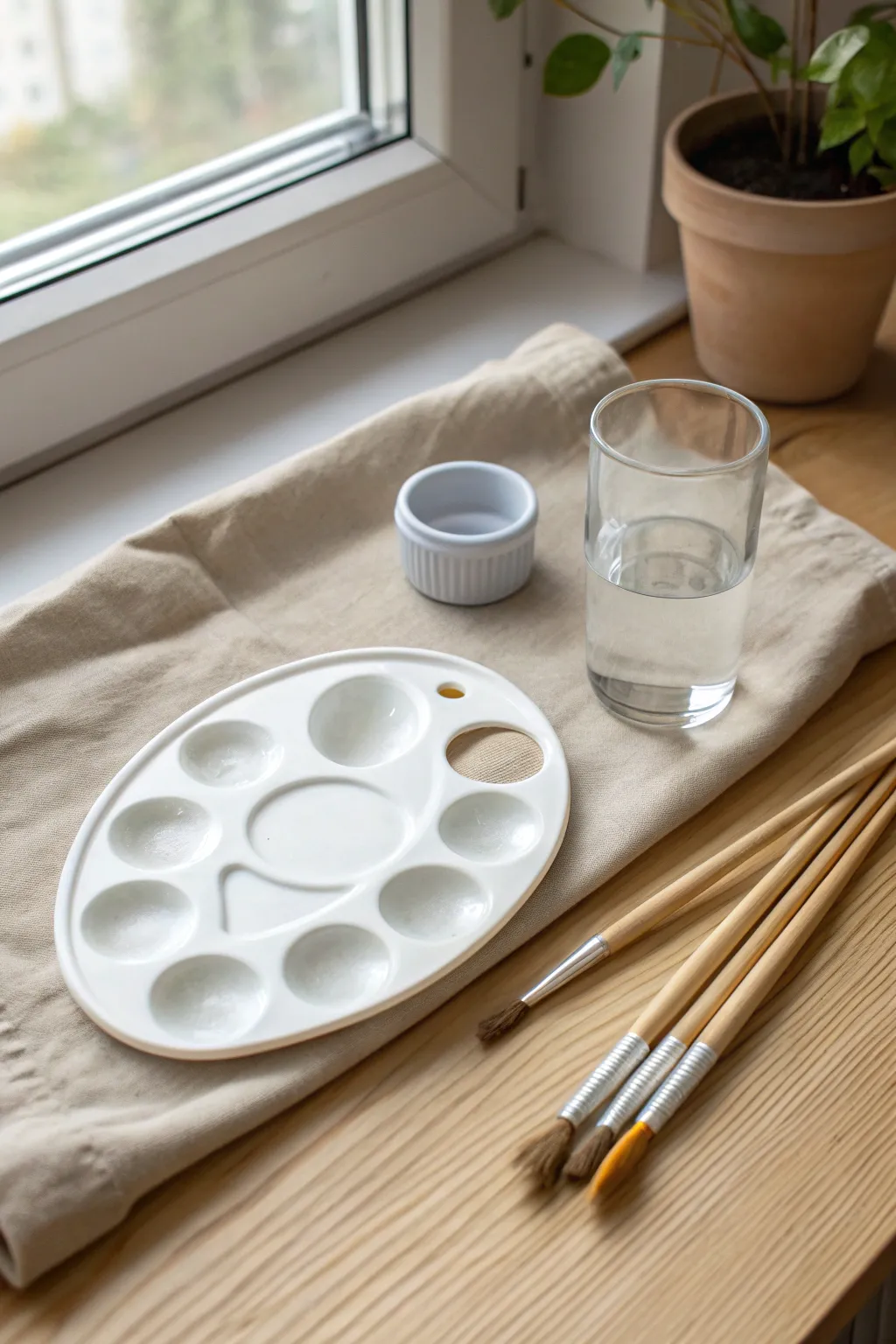
Create your own custom artist’s tool with this charming, organic air-dry clay palette featuring a classic oval shape and multiple mixing wells. Sealed for durability and easy cleaning, this glossy white palette adds a touch of handmade elegance to your creative workspace.
Step-by-Step
Materials
- White air-dry clay
- Rolling pin
- Clay sculpting tools or a spoon
- Craft knife
- Sandpaper 9sanding sponge and fine grit)
- Small bowl of water
- White acrylic paint (optional)
- High-gloss waterproof varnish or resin
- Parchment paper
- Canvas or cloth work surface
Step 1: Shaping the Base
-
Prepare the Clay:
Begin by taking a generous amount of white air-dry clay and kneading it in your hands until it becomes warm, pliable, and free of cracks. -
Roll the Slab:
Place the clay on a piece of canvas or parchment paper to prevent sticking. Use a rolling pin to flatten it into an even slab, aiming for a thickness of about 1/4 to 1/2 inch to ensure sturdiness. -
Cut the Shape:
Using a craft knife or a needle tool, lightly sketch an oval shape onto the clay slab. Once satisfied with the dimensions, cut firmly along the line to remove the excess clay. -
Smooth the Edges:
Dip your finger in a little water and run it along the cut edge of the oval to round it off and remove any harsh angles or burrs from the cutting process.
Water-Smooth Finish
Keep a small detailed brush handy dipped in water. Brush over the wet clay like you are painting it to erase fingerprints instantly.
Step 2: Forming the Wells
-
Mark the Positions:
Lightly press a round object or tool into the surface to map out where your paint wells will go. Looking at the example, plan for about six to seven small circular wells around the perimeter and a larger mixing area in the center. -
Indent the Wells:
Use your thumbs or a teaspoon to gently press into the clay at your marked spots. Rotate the tool in a circular motion to widen and deepen the hollows without breaking through the bottom. -
Create the Thumb Hole:
If you want a traditional painters palette grip, use a small circular cookie cutter or a bottle cap to punch a hole through the clay near one edge. -
Refine the Walls:
As you press the wells down, the clay will displace. Gently push the clay back straight to define the walls between the wells, ensuring they are high enough to keep paints separate. -
Final Smoothing:
Dip a sponge or your fingertips in water and smooth out the inside of every well and the entire top surface. This is crucial for a professional finish, as rough textures will be harder to clean later.
Step 3: Finishing and Sealing
-
Dry Completely:
Set the palette aside on a drying rack or mesh screen. Allow it to air dry for at least 24-48 hours. I find flipping it over halfway through helps it dry evenly and prevents warping. -
Sand Imperfections:
Once fully dry and hard, use fine-grit sandpaper to gently buff away any remaining fingerprints, bumps, or rough edges on the rim. -
Dust Off:
Wipe the entire piece down with a slightly damp cloth or a dry brush to remove all sanding dust before moving to the painting stage. -
Paint (Optional):
If the dried clay looks off-white or grayish, apply a coat or two of titanium white acrylic paint to achieve a bright, clean surface that won’t distort your color mixing. -
Apply Sealer:
Apply a coat of high-gloss waterproof varnish or resin. Cover every nook and cranny, especially inside the wells. -
Second Coat:
Let the first coat dry according to the manufacturer’s instructions, then apply a second (and even third) coat. Multiple thin layers provide better water resistance than one thick gloppy one. -
Cure Time:
Allow the varnish or resin to fully cure for several days before using the palette with water and wet paints to ensure the seal is impenetrable.
Preventing Warping
If the edges start curling while drying, place a light book on top of the drying palette (sandwiched between paper towels) to keep it flat.
Now you have a beautifully bespoke tool ready for your next watercolor painting session
Palette With Built-In Brush Rest Ridge
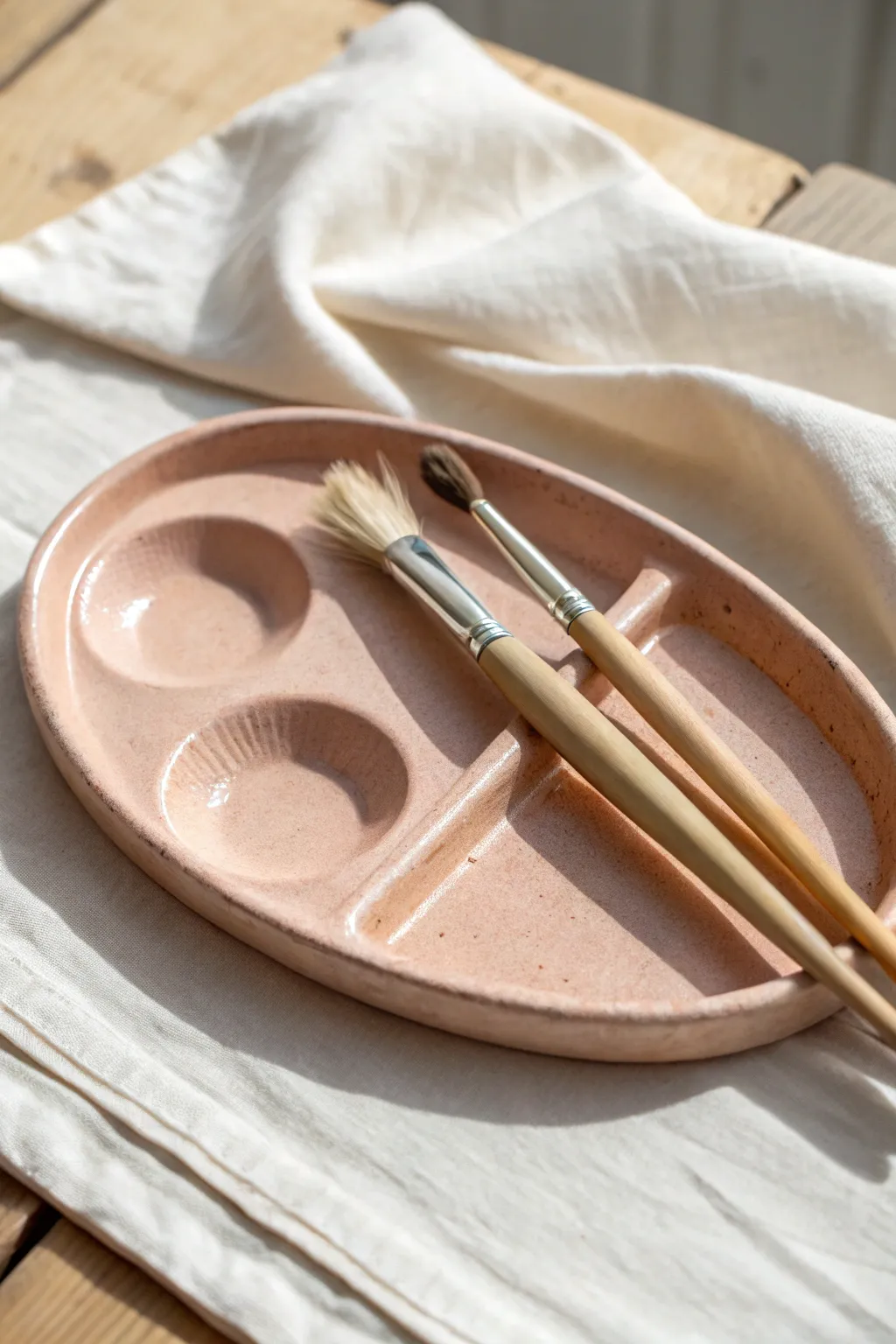
This charming oval palette features a clever raised ridge that doubles as a mixing barrier and a convenient brush rest. Its soft terracotta pink glaze and organic shape make it a beautiful and functional addition to any watercolor or gouache setup.
Step-by-Step Tutorial
Materials
- Light-colored stoneware clay or air-dry clay (sealed)
- Rolling pin
- Oval template (paper or cardstock)
- Needle tool or fettling knife
- Rib tool (wooden and rubber)
- Sponge
- Small circular cookie cutter or bottle cap
- Scoring tool or old fork
- Slip (clay mixed with water)
- Soft pink/terracotta glaze (food safe if desired)
- Kiln (if using stoneware)
Step 1: Shaping the Base
-
Roll the slab:
Begin by rolling out your clay to a consistent thickness of about 1/4 inch. If you are using stoneware, compressing the slab with a rib tool on both sides helps prevent warping later. -
Cut the oval:
Place your paper oval template onto the clay slab. Using a needle tool, trace around the template to cut out the main shape of your palette. -
Create the rim:
Roll a long, thin coil of clay, roughly the thickness of a pencil. This will become the outer wall of your palette. -
Attach the rim:
Score the outer edge of your oval base and apply a generous amount of slip. Score one side of your coil as well. -
Blend the coil:
Place the coil onto the scored edge. Use your thumb or a wooden tool to blend the clay from the coil down into the base on the inside, ensuring a seamless connection. -
Refine the outside:
Repeat the blending process on the outside edge. I personally like to use a small rubber rib here to smooth out the transition so it looks like one solid piece.
Fixing a Wobbly Base
If the base warps during drying, try placing a weighted board on top of it while it’s still leather hard to flatten it back out.
Step 2: Adding Features
-
Form the paint wells:
Roll two balls of clay and flatten them slightly. Secure them to one side of the palette using the score-and-slip method. -
Indent the wells:
Press your thumb or a rounded tool into the center of these flattened circles to create concave depressions for holding paint. -
Create the ridge:
Roll a shorter, slightly thicker coil for the central divider. Measure it against the width of the palette to ensure it fits snugly between the walls. -
Install the ridge:
Score and slip the location on the base where the ridge will sit. Press the coil firmly into place, spanning the width of the palette. -
Shape the brush rest:
Pinch the top of the ridge slightly to create a tapered crest. This narrow top allows brushes to balance easily without rolling off. -
Smooth the transitions:
Use a damp sponge to smooth all joints where the wells and ridge meet the base. Eliminate any sharp creates where paint could get stuck. -
Refine the surface:
Once the clay is leather-hard, do a final pass with a damp sponge to soften the lip of the palette and the edges of the wells.
Add Texture
Before glazing, gently press a textured sponge or fabric into the wet clay of the mixing area to create ‘teeth’ that help grab pigment from brushes.
Step 3: Finishing
-
Dry slowly:
Place plastic loosely over the palette to let it dry slowly over a few days. This is crucial for preventing the flat base from warping or curling up at the edges. -
Bisque fire:
If using ceramic clay, fire the piece to bisque temperature (usually cone 04) once it is bone dry. -
Apply glaze:
Dip or brush on a soft pink or terracotta-colored glaze. Ensure the coat is even, especially inside the wells. -
Wipe the bottom:
Clean off any glaze from the very bottom of the palette so it doesn’t stick to the kiln shelf. -
Final firing:
Fire the piece again to the maturation temperature of your specific clay and glaze body.
Now you have a custom tool that is as lovely to look at as it is to use

The Complete Guide to Pottery Troubleshooting
Uncover the most common ceramic mistakes—from cracking clay to failed glazes—and learn how to fix them fast.
Palette With Attached Water Cup
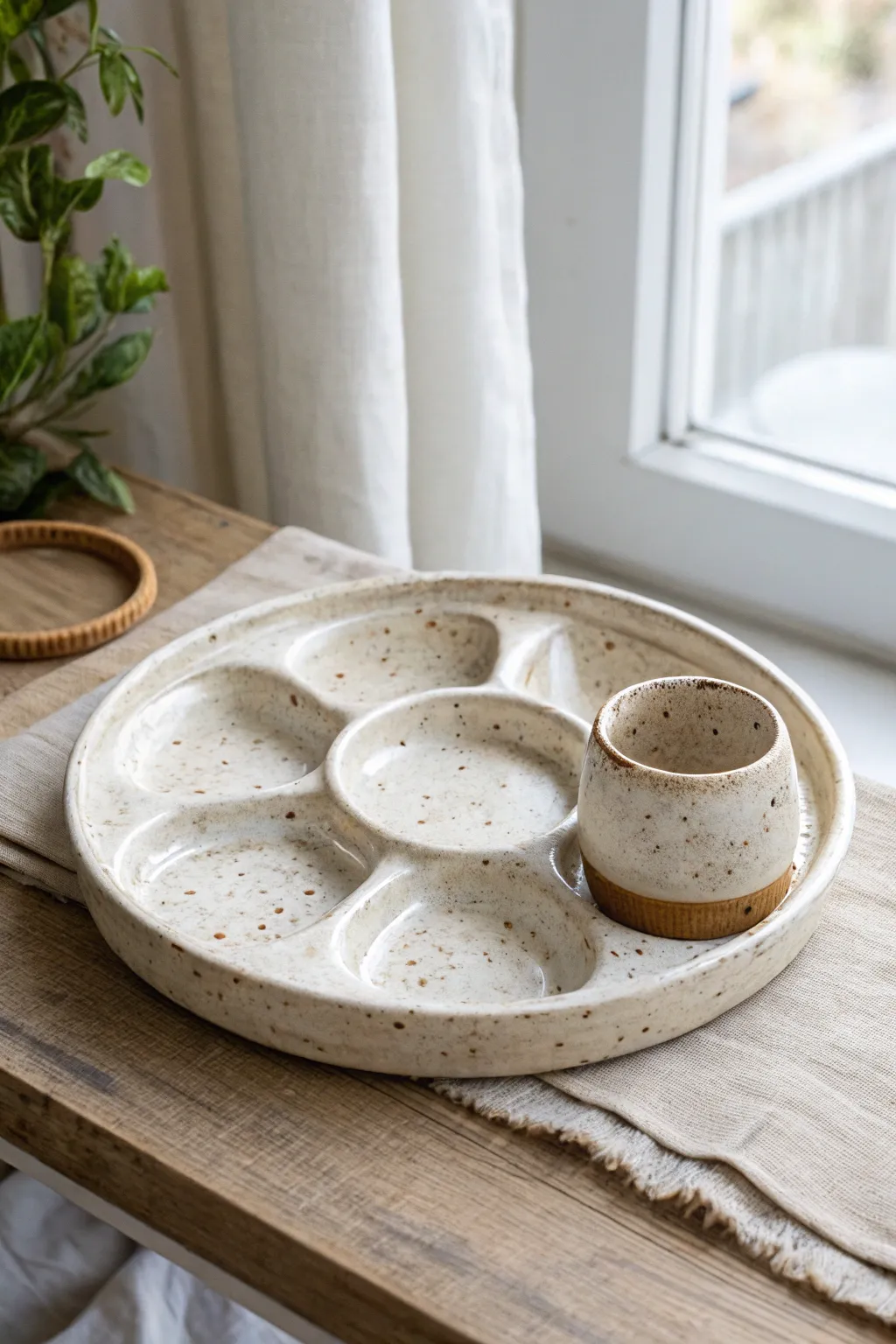
This elegant ceramic palette combines six deep paint wells with a dedicated water cup, all unified by a warm, speckled cream glaze. It is perfect for watercolorists who want a tidy, all-in-one workstation that feels as beautiful as the art it helps create.
Detailed Instructions
Materials
- Speckled buff stoneware clay (approx. 2-3 lbs)
- Rolling pin and guide strips (1/4 inch thick)
- Circle template or compass
- Fettling knife or needle tool
- Scoring tool (serrated rib)
- Slip (clay mixed with water)
- Sponge
- Carving tool or loop tool (for hollowing)
- Creamy white dipping glaze (food safe recommended)
- Kiln access (bisque and glaze firing)
Step 1: Forming the Base
-
Prepare the slab:
Begin by wedging your speckled buff clay to remove air bubbles. Roll it out into a uniform slab using guide strips set to about 1/4 inch thickness to ensure an even base. -
Cut the circle:
Use a circle template, plate, or compass to mark a circle approximately 8-9 inches in diameter. Cut cleanly around this line with your needle tool or fettling knife. -
Create the heavy rim:
Roll a long coil of clay, roughly the thickness of your thumb. Score and slip the outer edge of your circular slab, then attach the coil on top to create a raised barrier. -
Blend the rim:
Gently blend the coil into the slab on the inside edge to create a seamless transition, but keep the outside edge distinct and vertical. I like to smooth this with a damp sponge to erase finger marks.
Step 2: building the Interior
-
Outline the interior sections:
Lightly sketch your design onto the slab floor with a needle tool. You need a central circle for mixing, surrounded by six smaller circles for paint, leaving one spot open for the cup. -
Form the dividers:
Roll thinner coils of clay. Place these coils over your sketched lines to create the walls between the paint wells and the central mixing area. -
Refine the walls:
Blend these divider coils down onto the base so they are firmly attached. Use a modeling tool to smooth them into rounded, organic ridges rather than sharp walls. -
Smooth the wells:
Use your thumb or a rounded tool to compress the clay inside each well, ensuring the transitions are smooth so paint won’t get stuck in sharp corners.
Iron Speckle Pop
Use a translucent cream glaze rather than an opaque white one. This allows the iron speckles in the buff clay to burn through strongly during firing.
Step 3: Adding the Cup component
-
Throw or build the cup:
You can either wheel-throw a small specific cylinder without a bottom, or hand-build one using a small slab. It should be roughly 2.5 inches tall and wide enough to fit your designated empty space. -
Attach the cup:
Score and slip the specific area of the palette base where the cup will sit. Place your cup cylinder onto the base. -
Secure the joint:
Reinforce the connection by adding a tiny coil around the base of the cup where it meets the palette floor. Blend this completely so it looks like one continuous piece. -
Refine the rim:
Smooth the rim of the cup with a chamois or damp sponge. It should differ slightly in texture from the palette rim to stand out as a separate functional element.
Crack Fixes
If you see hairline cracks where the cup meets the base while drying, score the area immediately, add a tiny bit of vinegar slip, and compress with a tool.
Step 4: Finishing and Glazing
-
Slow drying:
Cover the piece loosely with plastic to let it dry slowly. Because the base and walls vary in thickness, drying too fast can cause warping. -
Bisque fire:
Once bone dry, fire the piece to bisque temperature (usually cone 04 or 06 depending on your clay body). -
Wax resist application:
Apply wax resist to the bottom of the entire palette and the bottom half-inch of the water cup’s exterior. This creates the raw clay accent seen in the image. -
Glaze application:
Dip the palette into a creamy white glaze. The speckles in the clay body will naturally show through the glaze, especially if the application isn’t too thick. -
Clean up:
Wipe away any glaze droplets from the waxed areas with a damp sponge to ensure a crisp line. -
Final firing:
Fire to the glaze temperature recommended for your specific clay and glaze combination (often Cone 5 or 6 for stoneware).
Once cooled, your durable stoneware palette is ready to hold your favorite watercolors
Stackable Mini Paint Palettes for Travel
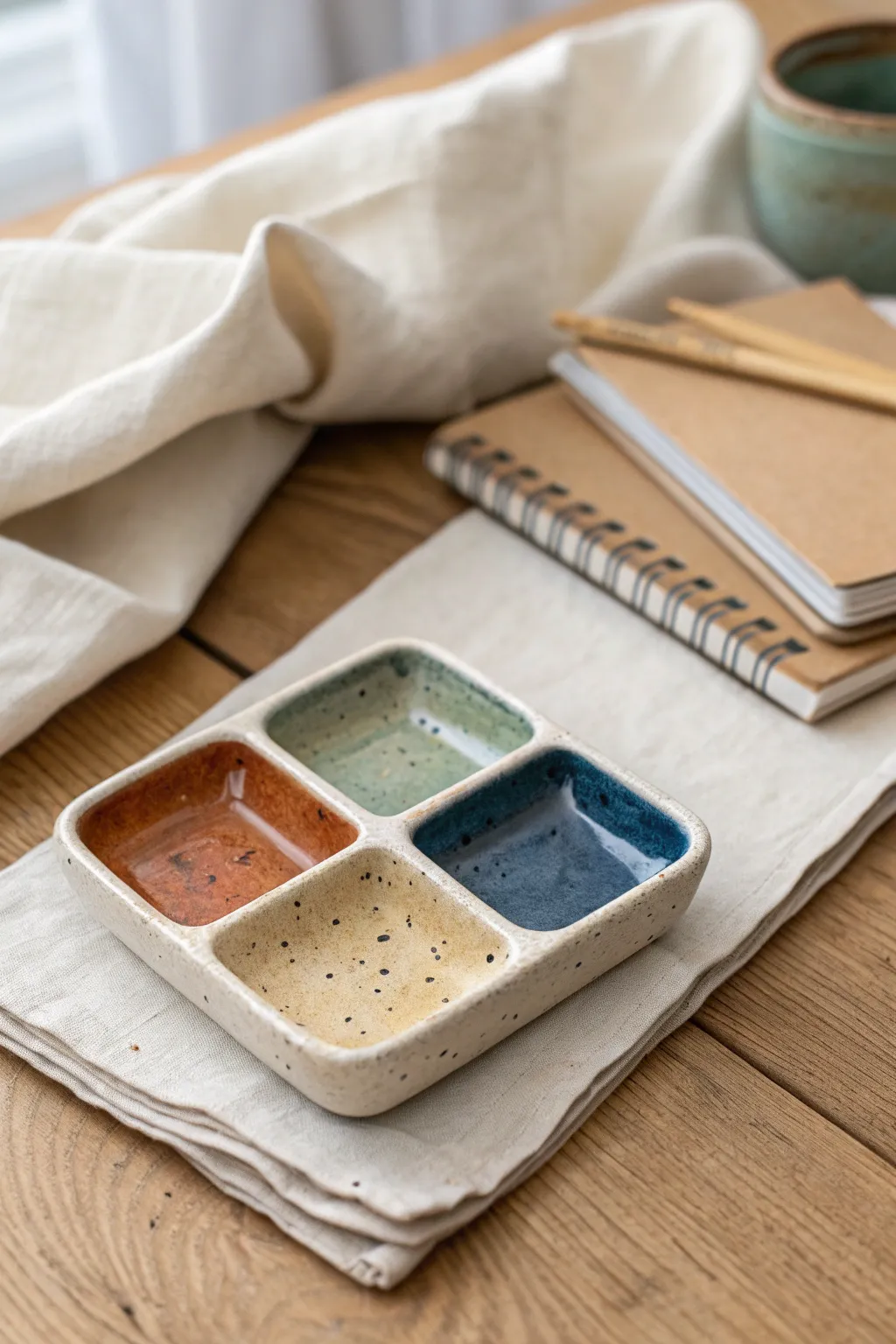
This charming ceramic paint palette features four deep, square wells perfect for holding watercolors or gouache during your travels. The design combines a creamy, speckled clay body with vibrant, glossy interior glazes in earth tones for a rustic yet modern aesthetic.
Step-by-Step Tutorial
Materials
- Speckled stoneware clay (mid-fire or low-fire depending on kiln availability)
- Square slump mold or template (approx. 4×4 inches)
- Rolling pin and guide strips (sann slats)
- Needle tool
- Fettling knife
- Scoring tool or serrated kidney
- Slip (liquid clay)
- Modeling tool or wooden rib
- Sponge
- Interior glazes: Deep Orange, Sage Green, Mustard Yellow, Navy Blue
- Clear or Satin Matte glaze (for the exterior)
Step 1: Forming the Base
-
Prepare the Clay:
Begin by wedging your speckled stoneware clay thoroughly to remove air bubbles. Roll it out into an even slab about 1/4 inch thick using guide strips to ensure consistency. -
Cut the Main Square:
Using a square template or ruler, cut out a 5×5 inch square from the slab. This extra inch accounts for the height of the walls when formed. -
Create the Dividers:
From the remaining slab, cut two long strips of clay that match the width of your square. These should be slightly taller than the intended depth of your wells. -
Notch the Dividers:
Cut a notch halfway through the center of each strip so they can interlock, forming a cross shape. This provides the internal structure.
Warping Woes?
If your square shape warps during drying, try drying it on a piece of drywall or inside a damp box to maintain even moisture distribution.
Step 2: Assembling the Palette
-
Shape the Outer Walls:
Gently lift the edges of your main square base to form the walls. You can press this into a square slump mold for easier shaping, or hand-build the walls by pinching and smoothing the corners. -
Insert the Cross:
Place the interlocked clay cross into the center of your square dish to test the fit. Trim the edges of the cross if it pushes the outer walls too wide. -
Score and Slip:
Remove the cross. Score (scratch) the bottom of the dish where the cross will sit, and score the bottom edges of the cross itself. Apply slip generously to the scored areas. -
Secure the Dividers:
Press the cross firmly back into place. Use a modeling tool to smooth the clay where the dividers meet the floor and walls of the dish, creating seamless transitions. -
Refine the Corners:
Use a small, damp sponge to round out the inner corners of each of the four wells. Sharp corners trap paint, so a gentle curve is much better for mixing. -
Smooth the Rim:
I like to run a damp chamois or sponge along the top rim of the palette to ensure it feels soft to the touch. The rim should be level so the colors remain separate.
Pro Tip: Better Cleaning
Make the inner corners of the wells noticeably rounded rather than square. It makes cleaning dried paint out of the corners significantly easier.
Step 3: Drying and Bisque Fire
-
Slow Drying:
Cover the palette loosely with plastic and let it dry slowly for a few days. Uneven drying can cause warping, which makes stacking difficult later. -
Bone Dry:
Once the piece is bone dry and no longer feels cool to the touch, inspect it for sharp burrs and sand them down gently. -
Bisque Fire:
Load the palette into the kiln for a bisque firing (usually Cone 04). This hardens the clay and prepares it for glazing.
Step 4: Glazing
-
Wax Resist:
Apply wax resist to the bottom foot of the palette to prevent it from sticking to the kiln shelf. -
Glaze the Wells:
Pour a small amount of deep orange glaze into one well, swirl to coat, and pour out the excess. Repeat this process with the sage green, mustard yellow, and navy blue glazes for the other three sections. -
Clean the Rims:
Carefully wipe any colored glaze off the top rim of the dividers and outer walls using a damp sponge. This keeps the colors distinct. -
Exterior Glaze:
Brush a clear or satin matte glaze over the exterior walls and the top rims. This seals the clay while letting the natural speckles show through. -
Final Fire:
Fire the piece again to the temperature required by your clay and glaze (typically Cone 5 or 6 for stoneware). Allow the kiln to cool completely before unloading.
Now you have a durable, custom studio tool that is ready to hold your favorite pigments

TRACK YOUR CERAMIC JOURNEY
Capture glaze tests, firing details, and creative progress—all in one simple printable. Make your projects easier to repeat and improve.
Speckled Glaze Palette for a Handmade Studio Look
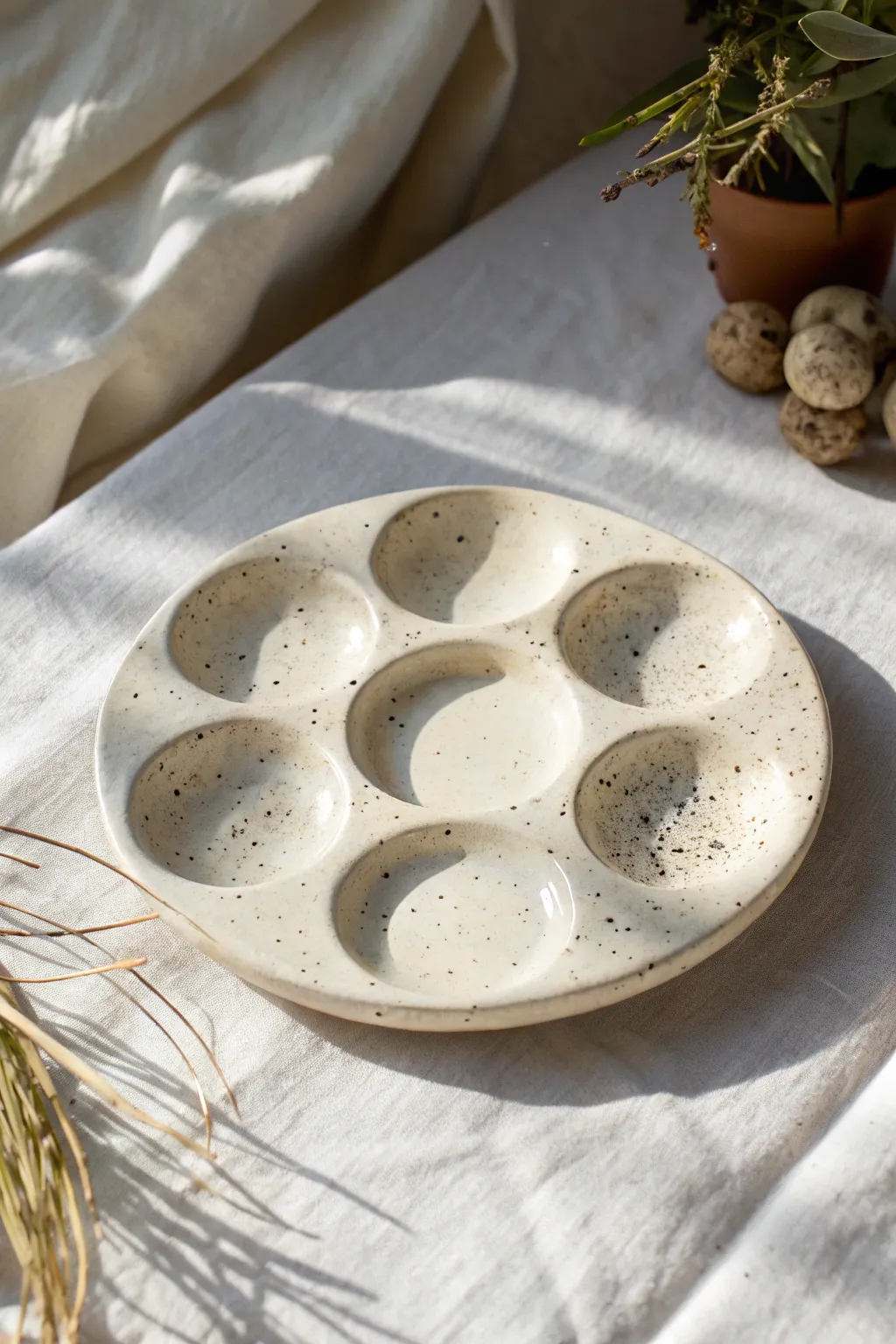
Bring the earthy warmth of a pottery studio directly to your desk with this handmade seven-well palette. Featuring an organic shape and a creamy speckled glaze, this functional tool is perfect for mixing watercolors while doubling as a beautiful object of art.
Step-by-Step
Materials
- White stoneware clay (mid-fire) or speckled clay body
- Rolling pin
- Two wooden guide strips (approx. 1/4 inch thick)
- Circular template or bowl (approx. 6-7 inches diameter)
- Needle tool or fettling knife
- Small sponge
- Rubber kidney rib
- Loop carving tool (medium round profile)
- Speckled cream glaze (or transparent glaze if using speckled clay)
- Kiln access (or use air-dry clay with a glossy sealant for decorative use)
Step 1: Forming the Base
-
Prepare the Clay Slab:
Begin by wedging your white stoneware clay to remove air bubbles. Place the clay between two wooden guide strips on a canvas mat and roll it out until it is perfectly even and about 1/4 inch thick. -
Smooth the Surface:
Before cutting, take a slightly damp rubber kidney rib and compress the surface of the slab. This aligns the clay particles which helps prevent warping later and gives you a pristine canvas. -
Cut the Circle:
Place your circular template or an overturned bowl onto the slab. Using your needle tool, cut straight down around the edge to create the main disc shape of your palette. -
Refine the Edges:
Once the circle is cut, run a damp sponge or your finger along the sharp edge to round it over gently. A soft, rounded rim feels much better in the hand than a sharp cut.
Step 2: Creating the Wells
-
Mark Well Positions:
Very lightly sketch the positions of your seven wells using the needle tool. Aim for one central circle surrounded by six evenly spaced circles. They shouldn’t touch; leave at least a half-inch of clay ‘wall’ between each. -
Begin Carving:
Using your loop tool, gently carve out the clay from the center circle first. Don’t dig too deep initially; remove layers in shallow scoops to maintain control. -
Shape the Outer Wells:
Proceed to carve the surrounding six wells. Try to keep your depth consistent across all of them, leaving about 1/8 inch of clay at the bottom floor of each well. -
Smooth the Interiors:
The carving process often leaves tool marks. Use your finger dipped in a tiny bit of water to smooth the interior of every well, blending the transition from the floor to the walls. -
Sponge Finish:
Give the entire piece a final pass with a well-wrung sponge. This is the time to remove any tiny clay burrs or sharp ridges created during the carving process.
Warping Woes?
Flat discs love to warp. Dry very slowly under plastic, and flip the piece over every day during the drying phase to expose both sides to air evenly.
Step 3: Firing and Glazing
-
Slow Drying:
Place the palette on a board and cover it loosely with plastic. Let it dry very slowly over several days to prevent the flat shape from curling up at the edges. -
Bisque Fire:
Once bone dry, fire the piece in a kiln to cone 04 (or according to your clay body’s specifications). This transforms the fragile greenware into durable bisque ceramic. -
Clean the Bisque:
Wipe the fired bisque with a damp sponge to remove any dust, which can prevent glaze from adhering properly. -
Apply Speckled Glaze:
Stir your creamy white speckled glaze thoroughly to suspend the heavy speckles. Dip the palette into the glaze or brush on 3 even coats, allowing each coat to dry to the touch before adding the next. -
Wipe the Foot:
Using a sponge, completely wipe away any glaze from the bottom of the palette so it doesn’t fuse to the kiln shelf during firing. -
Glaze Fire:
Load the kiln again for the final glaze firing, typically to cone 5 or 6 for stoneware. This melts the glaze into that glossy, durable finish shown in the photo.
Brush Rest Feature
Before firing, use a small round tool to press gentle indentations into the rim between the wells. These act as perfect rests for wet paintbrushes.
Once the kiln cools, your custom palette is ready to be filled with color and put to work on your next masterpiece
Scalloped Edge Palette for a Soft, Floral Vibe
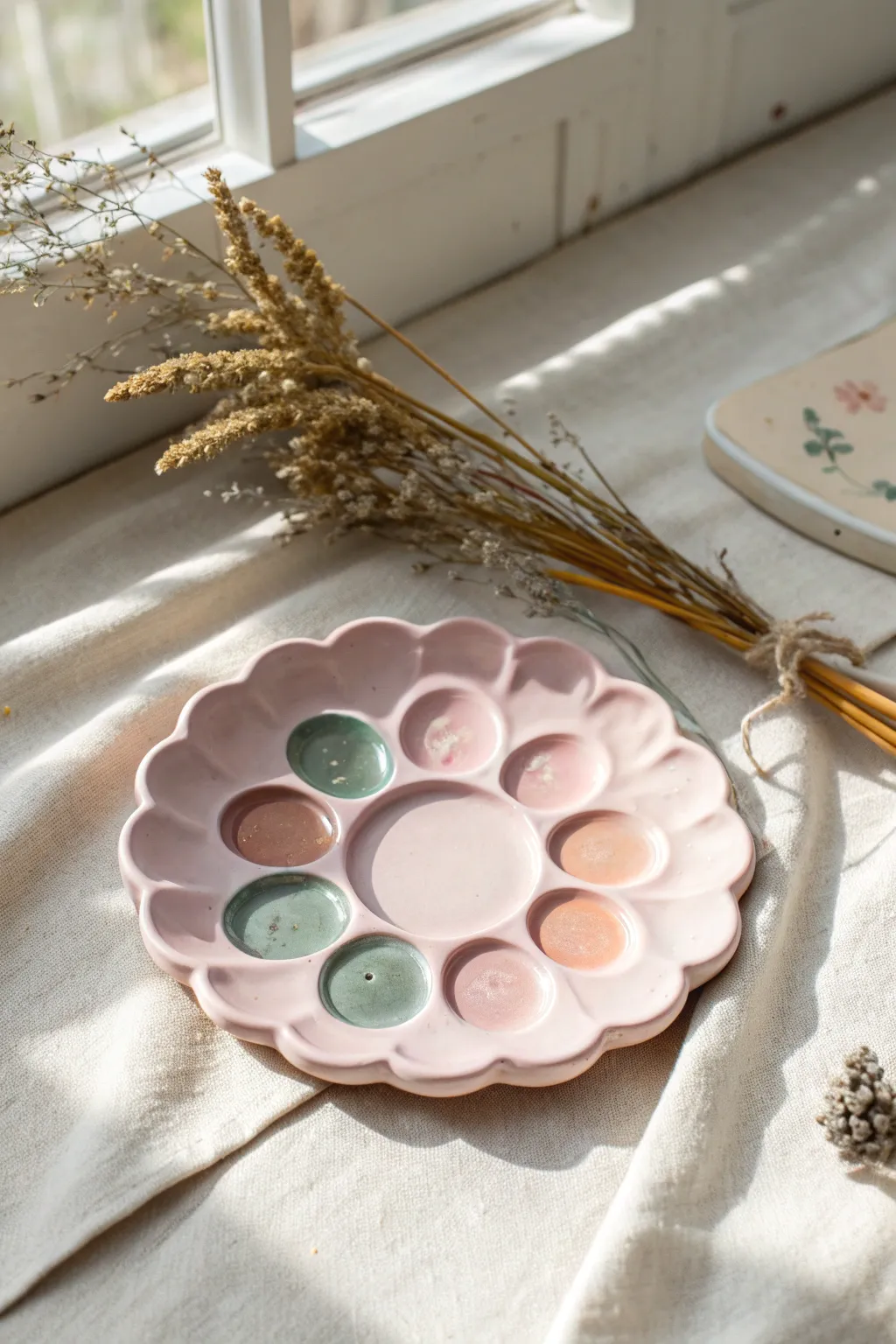
This charming paint palette combines functionality with a sweet, floral aesthetic thanks to its gentle scalloped edges and milky pink finish. It features a large central mixing area surrounded by individual wells, making it perfect for your next watercolor or gouache session.
Step-by-Step Tutorial
Materials
- Air-dry clay or white ceramic clay
- Rolling pin
- Canvas mat or parchment paper
- Circle cutter (approx. 6-7 inches)
- Small circle cutter or bottle cap (approx. 1 inch)
- Medium circle cutter or jar lid (approx. 2 inches)
- Modeling tool or knife
- Sponge and water
- Sandpaper (fine grit)
- Acrylic paint (pale pink)
- Glossy varnish or resin (waterproof)
- Small paintbrush
Step 1: Shaping the Base
-
Prepare your clay:
Start by kneading a large ball of clay to remove any air bubbles and ensure it is pliable. This prevents cracking later on. -
Roll out the slab:
Place your clay on a canvas mat or parchment paper. Use a rolling pin to flatten it into an even slab, aiming for a thickness of about 1/4 to 3/8 of an inch. -
Cut the main circle:
Using your largest circle cutter or a bowl as a template, cut out the main round shape of the palette. Remove the excess clay.
Fixing Cracks
If hairline cracks appear while drying, mix a tiny bit of fresh clay with water to make a paste (slip) and fill the cracks, then sand smooth once dry.
Step 2: Creating the Wells
-
Mark the positions:
Lightly press your medium cutter in the center and the smaller cutter around the perimeter to mark where your paint wells will go. Don’t press all the way through yet. -
Form the center well:
Using your thumbs, gently press into the marked center circle, compressing the clay downwards to create a shallow depression. Keep the bottom flat. -
Create the outer wells:
Repeat this compression technique for the smaller circles surrounding the center. I find using the back of a measuring spoon helps keep these uniform. -
Refine the walls:
Smooth the ridges of clay that have risen between the wells. You want distinct separation so paints won’t bleed into each other.
Custom Brush Rest
While the clay is still soft, press the handle of a paintbrush into the rim between two scallops to create a convenient groove for resting your brush.
Step 3: Scalloping and Refining
-
Cut the scallops:
Using a small round cutter or a knife, carefully trim the outer edge of the palette into a scalloped flower petal pattern. Align each scallop with an outer well if possible for symmetry. -
Smooth the edges:
Dip a sponge lightly in water and run it over all cut edges and rims to soften them. The goal is a rounded, organic look rather than sharp cuts. -
Dry the piece:
Place the palette on a flat surface to dry. If using air-dry clay, turn it over occasionally to ensure even drying and prevent warping. Allow 24-48 hours. -
Sand for smoothness:
Once fully dry, use fine-grit sandpaper to buff away any fingerprints or rough spots, paying special attention to the inside of the wells.
Step 4: Finishing Touches
-
Clear dust:
Wipe the entire piece with a slightly damp cloth or dry brush to remove all sanding dust before painting. -
Apply base color:
Paint the entire palette with a pale, milky pink acrylic paint. You may need two or three thin coats for opaque coverage. -
Seal the surface:
This is crucial: apply several coats of a waterproof glossy varnish or a layer of resin. This ensures the palette can hold wet paint without damaging the clay. -
Final cure:
Let the varnish or resin cure completely according to the manufacturer’s instructions before using the palette with paints.
Now you have a beautiful, custom palette ready to inspire your next floral watercolor masterpiece
Geometric Palette With Clean Angles and Wells

This seven-well geometric palette combines minimalist lines with organic textures, featuring a unique honeycomb-embossed mixing well. The speckled off-white glaze contrasts beautifully with the raw clay edges, creating a functional art piece that is perfect for watercolor or gouache mixing.
Detailed Instructions
Materials
- White stoneware clay with speckles (or plain stoneware)
- Rolling pin
- Guide strips or slab roller (approx. 1/4 inch thick)
- Hexagon cookie cutter (approx. 2-3 inches wide)
- Needle tool or fettling knife
- Bubble wrap (small bubbles) or honeycomb texture stamp
- Slip and scoring tool (serrated rib)
- Sponge and water
- Modeling tool or wooden stick for smoothing
- Clear or glossy white glaze (food safe recommended)
- Kiln access
Step 1: Creating the Base Elements
-
Roll the slab:
Begin by rolling out your speckled stoneware clay into a smooth, even slab. Use guide strips to ensure a uniform thickness of about 1/4 inch so the walls are sturdy but not clunky. -
Cut the hexagons:
Using your hexagon cutter, punch out seven individual hexagon shapes. These will form the floor of each well. Punch out an eighth hexagon to use as a template for your layout. -
Create the walls:
Re-roll remaining clay to the same thickness and cut long strips that are roughly 3/4 inch tall. These will become the vertical walls of your honeycomb structure. -
Add texture:
Take one of your seven base hexagons and press a piece of small-bubble bubble wrap or a honeycomb stamp firmly into the surface. This creates the textured mixing area seen in the top-left well of the reference.
Clean Lines Tip
When separating the walls, use a slightly stiff brush dipped in water to smooth the ‘V’ joints. This creates a seamless transition without denting the clay walls.
Step 2: Assembly and Construction
-
Arrange the base layout:
Lay out your seven hexagon bases on a ware board. Place one in the center and arrange the other six around it so their flat sides touch, forming a large flower-like shape. -
Join the bases:
Score the edges where the hexagon bases touch and apply a small amount of slip. Press them together firmly on the board to create one unified base plate. Smooth the seams on the top face so the floor looks continuous. -
Measuring the wall lengths:
Take your long clay strips and measure them against the sides of the hexagon bases. You’ll need to cut segments that match the length of each hexagon side. -
Attaching the outer walls:
Score and slip the outer perimeter of your base. Attach clay strips to form the exterior wall of the entire large hexagon shape. Reinforce the connection by smoothing a small coil of clay on the inside seam. -
Building the inner dividers:
Score and slip lines across the base where the original seven hexagons met. Place clay strips here to create the interior walls that separate the wells. -
Connecting the intersections:
Pay close attention to where the interior walls meet in the center. I find it helpful to roll a tiny thin coil and press it vertically into these Y-shaped corners to strengthen the join.
Step 3: Refining and Finishing
-
Smooth the rims:
Once the clay has stiffened slightly to leather-hard, use a damp sponge to round over the top edges of all the walls. This creates that soft, finished look shown in the image and prevents sharp edges. -
Clean the wells:
Use a modeling tool to smooth the interior bottom seams of each well. Ensure there are no crevices where paint could get stuck permanently. -
Dry and bisque fire:
Allow the palette to dry slowly under loose plastic to prevent warping. Once bone dry, bisque fire the piece according to your clay body’s specifications (usually cone 04). -
Glazing technique:
Apply a glossy off-white or clear glaze to the interior of the wells and the exterior sides. To recreate the look in the photo, wipe the glaze off the top rims with a damp sponge to expose the raw, toasted clay body. -
Final firing:
Glaze fire the piece to the appropriate temperature for your clay (likely cone 5 or 6). The speckles in the clay will show through the glaze, adding that lovely organic dimension.
Custom Brush Rest
Before firing, carve small U-shaped notches into the outer rim of one or two wells. This creates a dedicated spot to rest your wet paintbrush so it doesn’t roll away.
Now you have a stunning, durable palette ready to inspire your next painting session
Marbled Polymer Clay Palette With Glossy Finish
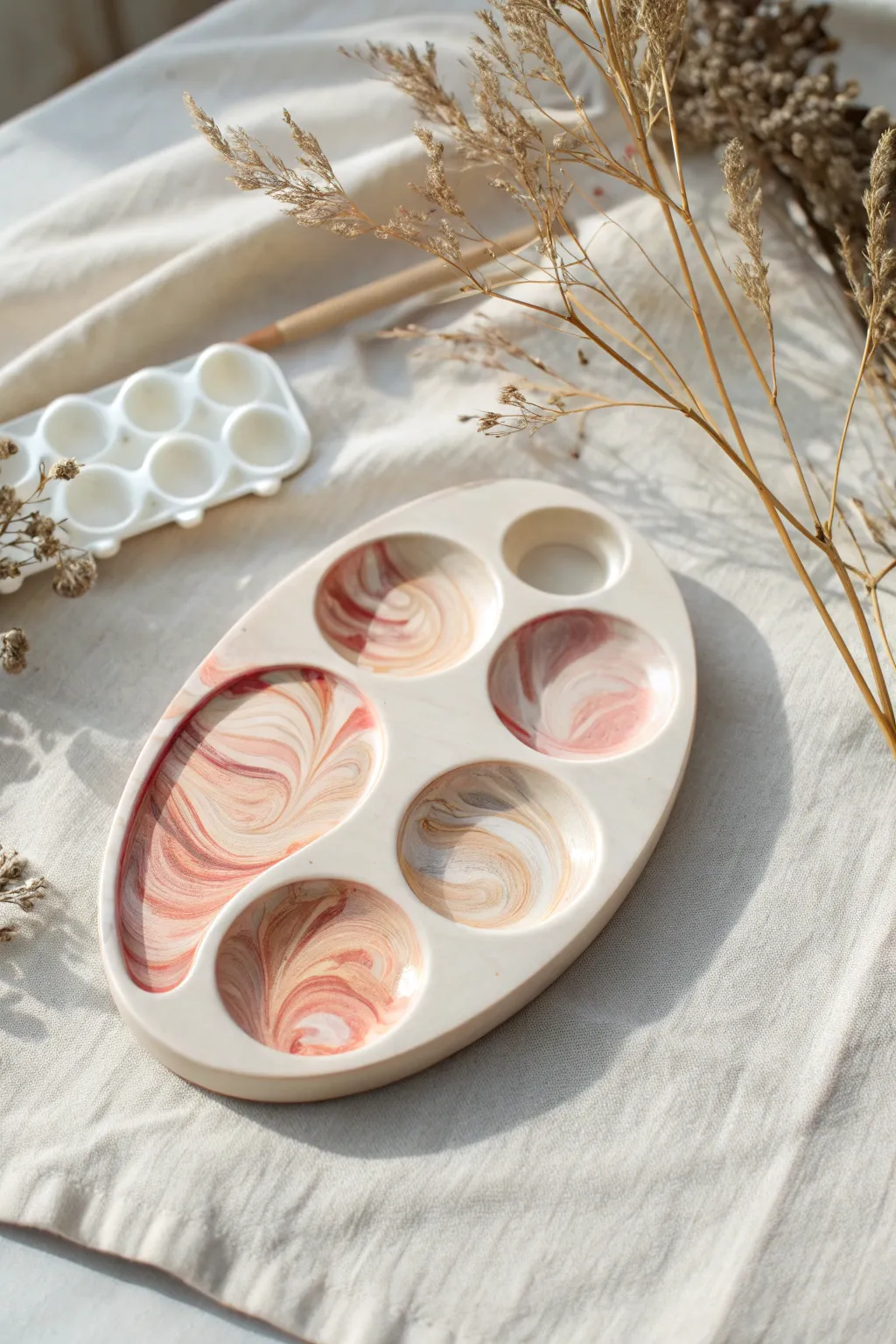
Elevate your painting sessions with this elegant, oval-shaped artist’s palette featuring a mesmerizing marble effect. The swirls of warm terracotta, soft beige, and crisp white are sealed under a high-gloss finish, making it as functional as it is beautiful.
Step-by-Step
Materials
- Polymer clay (White, Beige/Tan, Terracotta/Reddish-Brown)
- Acrylic rolling pin or clay pasta machine
- Oval cutter or craft knife with a template
- Ball stylus tools (various large sizes) or measuring spoons
- Sandpaper (wet/dry, grits 400 to 1000)
- UV resin or glossy polyurethane varnish
- UV lamp (if using resin)
- Small paintbrush (for glazing)
- Ceramic tile or glass work surface
- Oven
Step 1: Marbling the Clay
-
Condition the Clay:
Begin by kneading each color of polymer clay separately until they are soft and pliable. You will need roughly equal parts of white and beige, with a smaller amount of the terracotta color for the accent swirls. -
Create Snakes:
Roll each color into long, thin snakes. The thickness doesn’t need to be perfectly uniform, but aiming for pencil-thickness is a good start. -
Twist and Combine:
Group the snakes together, twisting them into one large rope. Fold this rope in half and twist again. Repeat this process a few times—stop before the colors blend completely into a new muddy color; you want distinct streaks. -
Roll out the Slab:
Roll the twisted clay into a ball, compressing it tightly to remove air bubbles. Using your acrylic roller or pasta machine, flatten the ball into a slab about 1/4 inch thick. This thickness ensures the palette is sturdy enough to hold paint.
Fixing Cloudy Resin
If your resin finish looks cloudy after curing, wipe the surface with a lint-free cloth soaked in rubbing alcohol to remove the sticky inhibition layer.
Step 2: Shaping the Palette
-
Cut the Oval Base:
Use a large oval cutter to stamp out the main shape. if you don’t have a cutter that size, sketch an oval on paper, cut it out as a template, place it on the clay, and trace around it with a craft knife. -
Plan the Layout:
Before pressing, lightly mark where your wells will go. Looking at the design, you’ll need one large kidney-bean shape on the left, four medium circles in the center and bottom, and one small circle at the top right. -
Create the Paint Wells:
Use the back of a large measuring spoon or a large ball tool to press indentations into the clay. Press firmly but don’t go all the way through to the work surface. -
Form the Kidney Shape:
For the large, curved well on the left, press two overlapping circles initially, then use your finger or a modeling tool to smooth the ridge between them, creating one continuous curved depression. -
Refine the Edges:
Gently smooth the edges of each well with your fingertip to remove any sharp ridges created by the tool. I find a tiny drop of baby oil on my finger helps glide over the clay without leaving prints. -
Smooth the Perimeter:
Run your finger along the outer rim of the oval to round off the cut edge, giving it a more finished, ceramic-like look.
Depth Precision
Use metal measuring spoons to press the wells nicely. The rounded bottoms create perfect, consistent hemispheres that are easy to clean paint out of.
Step 3: Baking and Finishing
-
Bake the Piece:
Place the palette on a ceramic tile or a parchment-lined baking sheet. Bake according to your clay manufacturer’s instructions (usually 275°F/135°C for 15-30 minutes depending on brand). -
Cool Down:
Allow the palette to cool completely in the oven with the door slightly ajar. This gradual cooling helps prevent thermal shock cracks. -
Wet Sanding:
Once cool, submerge the palette in a bowl of water and sand the edges and surface with 400 grit sandpaper, moving up to 1000 grit. This removes fingerprints and creates a silky smooth surface for the glaze. -
Wash and Dry:
Rinse the palette thoroughly to remove all sanding dust and dry it completely with a lint-free cloth. Any moisture left behind can cloud your finish. -
Apply the Gloss:
Using a soft brush, apply a thin, even layer of UV resin or glossy polyurethane varnish to the top surface. Ensure you get into the wells without letting the liquid pool too thickly at the bottom. -
Cure or Dry:
If using UV resin, place the palette under a UV lamp for 2-3 minutes until hard and tack-free. If using varnish, let it air dry in a dust-free area for the time recommended on the bottle.
Now you have a stunning, reusable palette that makes color mixing a joy.
Mushroom-Shaped Clay Paint Palette
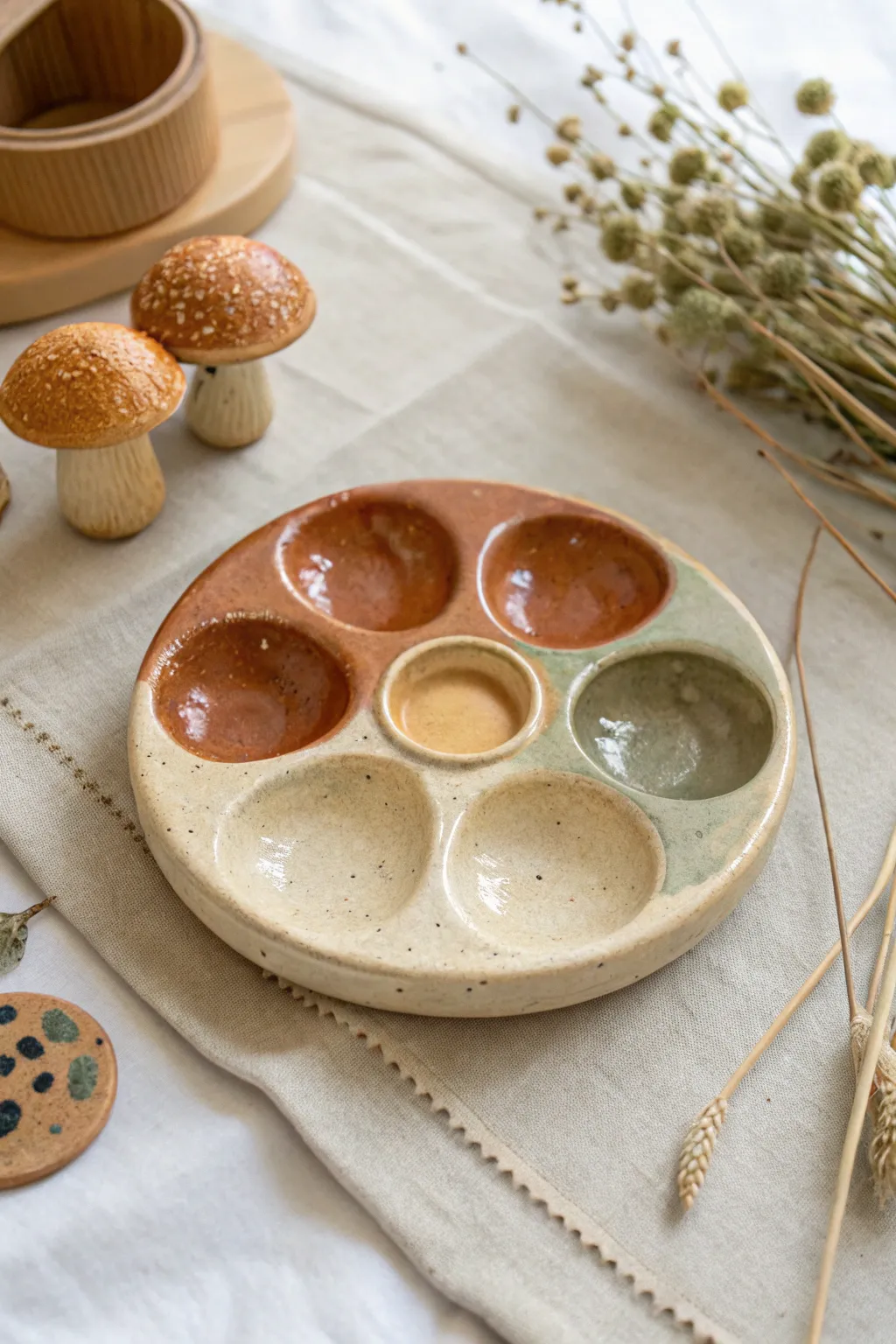
Create a stunning, functional artist’s tool with this circular clay palette featuring six deep wells and a central mixing area. The design mimics the warm hues of mushrooms and nature, combining a speckled clay body with glossy amber and sage glazes.
Step-by-Step Guide
Materials
- Speckled stoneware clay (approx. 1 lb)
- Rolling pin
- Two wooden guide strips (1/4 inch thick)
- Circular template or cookie cutter (approx. 6 inch diameter)
- Small sponge
- Loop tool or carving tool
- Needle tool
- Pottery ribs (metal and rubber)
- Kiln (or access to a firing service)
- Glazes: Amber/Rust Gloss, Sage Green Gloss, Clear Gloss (optional)
Step 1: Forming the Base
-
Prepare the slab:
Begin by wedging your speckled clay thoroughly to remove air bubbles. Place the clay between two 1/4 inch wooden guide strips and roll it out into a smooth, even slab. -
Cut the circle:
Place your circular template or large cookie cutter onto the slab. Using a needle tool, cut cleanly around the edge to create your palette’s base shape. -
Smooth the edges:
Take a damp sponge and gently run it along the cut rim of the circle to soften any sharp angles. Smoothing now saves sanding time later. -
Mark the wells:
Lightly sketch the position of your wells on the clay surface using the needle tool. Aim for six evenly spaced circles around the perimeter and one smaller circle in the absolute center.
Step 2: Carving the Wells
-
Hollow the center:
Using a loop tool, gently carve out the clay from the central circle first. Keep the bottom smooth and curved, leaving about 1/4 inch of clay at the base. -
Carve the outer wells:
Proceed to carve out the six surrounding wells. Work slowly in a circular motion to create deep, bowl-like depressions that will hold paint effectively. -
Refine the walls:
Ensure the walls between the wells are distinct but not too thin. Use your finger or a small rubber rib to compress and smooth the inside of each hollow, removing tool marks. -
Check the depth:
I like to periodically check that all perimeter wells are roughly the same depth, creating a balanced weight for the finished piece. -
Clean the surface:
Use a barely damp sponge to wipe the flat upper surfaces between the wells, ensuring the transition from flat top to curved well is seamless.
Warping Woes?
If your slab lifts at the edges while drying, flip it over daily or weigh down the edges with small sandbags during the leather-hard stage.
Step 3: Drying and Bisque Firing
-
Slow drying:
Place the palette on a ware board and cover it loosely with plastic. Let it dry slowly for several days to prevent warping, which is common with flat slabs. -
Bone dry check:
Once the clay is room temperature and no longer cool to the touch (bone dry), inspect it for any final rough spots and gently sand them if necessary. -
Bisque fire:
Load the piece into the kiln for a bisque firing, typically to Cone 04 or 06 depending on your clay body specifications.
Brush Rest Notch
Carve small notches into the rim of the palette between wells before firing. This transforms the edge into a convenient rest for wet paintbrushes.
Step 4: Glazing and Final Firing
-
Clean bisque ware:
Wipe the bisque-fired palette with a damp sponge to remove any kiln dust, which helps the glaze adhere properly. -
Glaze the warm tones:
Pour a small amount of Amber or Rust glaze into three adjacent wells on the left side. Carefully brush or pour the glaze to coat the insides of these wells, avoiding the flat top surface. -
Glaze the cool tones:
Apply the Sage Green glaze to the remaining perimeter wells on the right side. This split-tone effect gives the palette its organic, earthy look. -
Glaze the center:
For the center well, you can use a lighter yellow or mix the amber thinly to distinguish it as the primary mixing area. -
Clear coat details:
If you want the flat surface (the uncoloured speckled clay) to be shiny and non-porous, brush a clear glaze over the entire top face, covering both the raw clay areas and the colored wells. -
Wipe the bottom:
Flip the palette and meticulously wipe any glaze off the bottom foot to prevent it from sticking to the kiln shelf during firing. -
Glaze fire:
Fire the piece again to the maturity temperature of your clay and glaze, often Cone 5 or 6 for stoneware. Let the kiln cool completely before opening.
Now you have a durable, custom-made palette ready for your next watercolor session
Abstract Organic Blob Palette With Negative Space Handle
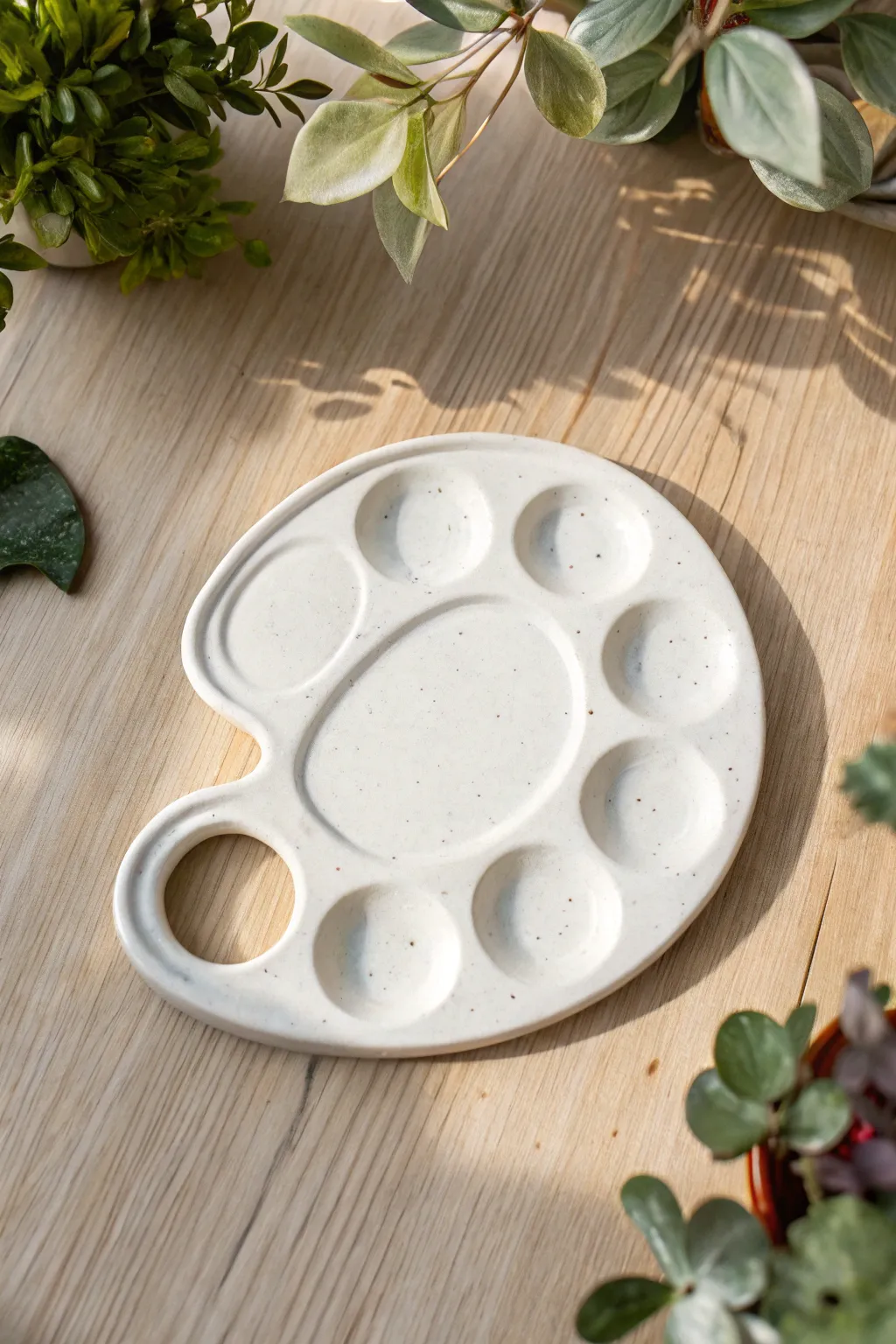
Embrace the beauty of imperfection with this organic, blob-shaped paint palette featuring earthy speckled clay. The smooth, milky glaze highlights the delicate iron flecks while the negative space thumb handle adds both function and a modern sculptural aesthetic.
Detailed Instructions
Materials
- Speckled stoneware clay (white body with iron specks)
- Rolling pin
- Canvas work surface or slab mat
- Needle tool or fettling knife
- Paper template (optional)
- Small bowl related tools or circular cookie cutters (various sizes)
- Sponge
- Rib tool (rubber or wooden)
- Loop tool or carving tool
- Clear or glossy white glaze (food safe recommended)
Step 1: Slab Preparation
-
Wedge the clay:
Start by thoroughly wedging a ball of speckled stoneware clay to remove any air bubbles. This ensures your final piece is strong and won’t crack during firing. -
Roll the slab:
On your canvas or work mat, flatten the ball with your palm. Use a rolling pin to roll it out into an even slab, aiming for a thickness of about 1/4 to 3/8 inch. Consistency is key here. -
Smooth the surface:
Take a rubber rib tool and gently compress both sides of the slab. This aligns the clay particles, smooths out the canvas texture, and prepares the surface for shaping.
Step 2: Shaping the Palette
-
Define the perimeter:
Using a needle tool, cut out an organic, asymmetrical oval shape. Think of a natural river stone or a soft blob rather than a perfect geometric oval. -
Create the thumb hole:
Near one of the narrower ends of your shape, use a small circular cutter or freehand a circle with your needle tool to create the negative space handle. This hole should be large enough for your thumb to rest comfortably. -
Smooth the edges:
Use a slightly damp sponge to round over the cut edges of both the outer perimeter and the inner thumb hole. Sharp edges can become brittle after firing, so soften them now.
Warping Worries?
If the palette edges curl up while drying, flip it over periodically or gently weigh down the edges with small sandbags during the leather-hard stage.
Step 3: Adding the Wells
-
Plan the well layout:
Lightly sketch the positions of your paint wells on the surface. You’ll want one large central area for mixing, surrounding by smaller wells for individual colors. -
Form the central mixing area:
For the large central well, you can use a technique called pinching or carving. I prefer to gently press a smooth stone or a large spoon into the clay to create a depression, ensuring not to push all the way through. -
Create paint wells:
For the smaller surrounding circles, press a small measuring spoon or round object into the clay. Alternatively, use a loop tool to carefully carve out shallow depressions. -
Create the raised border:
If you carved the wells, you already have separation. If you pressed them, use a small modeling tool to gently define the ridges between the wells, ensuring paint won’t accidentally flow from one to another. -
Refine the surface:
Go over the entire piece with a damp sponge or your finger to smooth out any tool marks inside the wells. The smoother the wells, the easier they will be to clean later.
Brush Rest Notch
Before drying, carve 1-2 small notches on the outer rim or ridges. This gives you a perfect safe spot to rest wet paintbrushes while you work.
Step 4: Drying and Firing
-
Slow drying:
Place your palette on a flat board and cover it loosely with plastic. Let it dry slowly over several days to preventing warping, especially around the thumb hole area. -
Bisque fire:
Once bone dry, fire the piece to a bisque temperature (usually cone 04 or 06, depending on your clay body). -
Glazing:
Dip or brush your bisque-fired palette with a clear or milky white glossy glaze. This allows the natural speckles of the clay to show through while providing a waterproof surface for mixing paint. -
Wipe the foot:
Ensure the bottom of the palette is completely free of glaze so it doesn’t stick to the kiln shelf. -
Final firing:
Fire the glazed piece to the maturity temperature of your clay (typically Cone 5 or 6 for stoneware). Let the kiln cool completely before retrieving your finished palette.
Enjoy mixing your colors on this beautiful custom surface that is as pleasing to hold as it is to look at