
When the air gets crisp, my bead tray magically fills up with burnt orange, mustard yellow, and creamy neutrals that just beg to be strung into something cute. These fall clay bead bracelet ideas are the kind you can make in an afternoon, then mix and stack all season long.
Classic Pumpkin Spice Heishi Stack
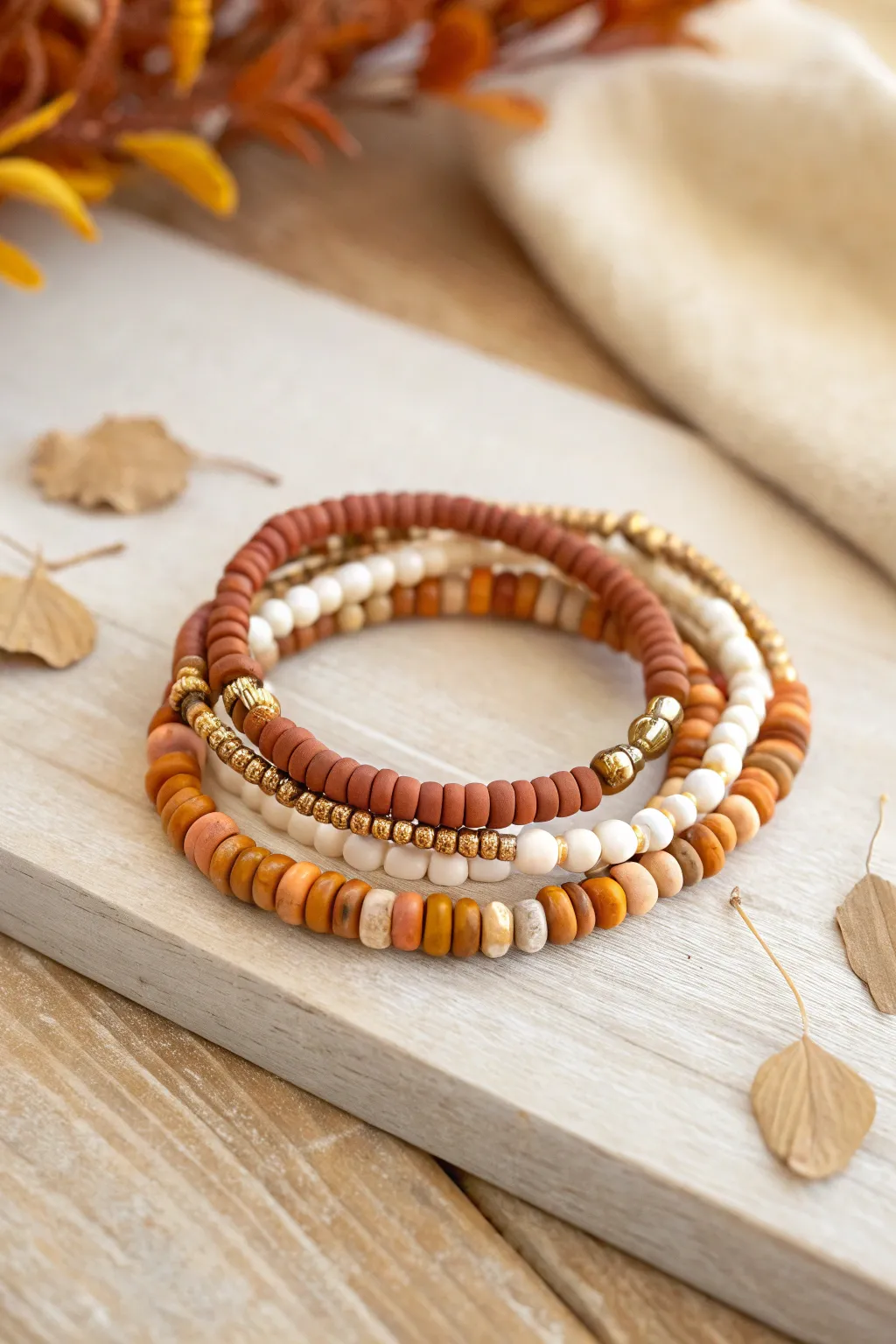
Capture the cozy essence of autumn with this warm-toned bracelet stack featuring rich terracotta, creamy whites, and golden accents. The combination of matte clay heishi beads and textural spacers creates a sophisticated, layered look perfect for sweater weather.
How-To Guide
Materials
- Terracotta brown polymer clay heishi beads (6mm)
- Creamy off-white polymer clay heishi beads (6mm)
- Mixed warm amber/tan natural stone or wooden rondelle beads (6mm-8mm)
- Gold tone metallic spacer beads (small rounds)
- Small gold tone metallic heishi spacer discs (dainty)
- Large gold tone focal beads (rondelle or irregular shape)
- Gold crimp beads and crimp covers
- Strong elastic cord (0.8mm recommended)
- Jewelry glue (GS Hypo Cement)
- Scissors or bead snips
- Bead stopper or tape
- Measuring tape
Step 1: Preparation & Design
-
Measure your wrist:
Wrap a measuring tape comfortably around your wrist to find your size. Add about 0.5 inches to this measurement to ensure the bracelets fit comfortably without pinching. -
Prepare your workspace:
Lay out a bead mat or towel to prevent your beads from rolling away. Having a soft surface helps keep these flat heishi beads organized. -
Cut the elastic:
Cut three lengths of elastic cord, each about 10-12 inches long. This generous length gives you plenty of room to tie secure knots later. Pre-stretch the elastic slightly by pulling on both ends gently to prevent future sagging.
Knot Slipping?
If your elastic knots feel slippery, try tightening them slowly while pulling firmly on all four strands (the two tails and the two loop ends) simultaneously.
Step 2: Creating the Terracotta Strand
-
Secure the cord:
Place a bead stopper or a piece of tape on one end of your first elastic strand. -
Begin the pattern:
Thread on about 2 inches of the solid terracotta heishi beads. -
Add gold accents:
Slide on a small gold spacer disc, followed by a gold rondelle bead, and another gold spacer disc. This creates a dedicated metallic section. -
Complete the strand:
Continue threading only terracotta beads until you reach the desired bracelet length. Verify the fit by wrapping it around your wrist before moving on.
Step 3: Crafting the Cream & Gold Strand
-
Start the second strand:
Secure the second piece of elastic. This bracelet will feature an alternating pattern for more visual texture. -
Create the alternating rhythm:
Thread three cream heishi beads, followed by one tiny gold spacer bead. Repeat this ‘three cream, one gold’ pattern for about one-third of the bracelet length. -
Design the focal section:
Transition into a solid section of cream beads for the middle portion of the bracelet to let the eye rest. -
Finish the pattern:
Resume the alternating pattern (three cream, one gold) for the final third of the strand to balance the design.
Seamless Style
Use a crimp bead cover over your knot if you can’t hide it inside a bead. It looks like a regular gold bead and adds a professional finish.
Step 4: Building the Mixed Texture Strand
-
Sort your mixed beads:
For the final strand, select your amber, tan, and brown natural stone or wooden beads. Arrange them in a gradient or random mix depending on your preference. -
Thread the base:
String the mixed amber and tan beads onto your final piece of elastic. -
Intersperse spacers:
I prefer to occasionally slide a thin gold heishi spacer between every 4-5 stone beads. This subtle glimmer ties this rustic strand back to the other two more polished bracelets. -
Check consistency:
Ensure this final strand is exactly the same length as the first two so they stack perfectly without bunching.
Step 5: Finishing the Stack
-
Remove stoppers:
Carefully remove the bead stopper from one strand, holding both ends of the elastic firmly. -
Tie the surgeon’s knot:
Cross the ends, wrap one end under the other twice, and pull tight. Repeat with a second standard overhand knot to lock it in place. -
Secure with glue:
Place a tiny dab of jewelry glue specifically on the knot. Let it dry for a minute so it becomes tacky and secure. -
Hide the knot:
If possible, gently tug the elastic so the knot slides inside the hole of a nearby large bead. If the hole is too small, just ensure the knot is trimmed neatly. -
Trim excess:
Use your scissors to snip off the excess elastic tail, being careful not to cut the main knot. -
Repeat for all strands:
Follow the same tying and gluing process for the remaining two bracelets to complete your autumn stack.
Enjoy wearing your new autumn-inspired accessories with your favorite cozy outfit
Burnt Orange and Cream Color-Block Bracelet
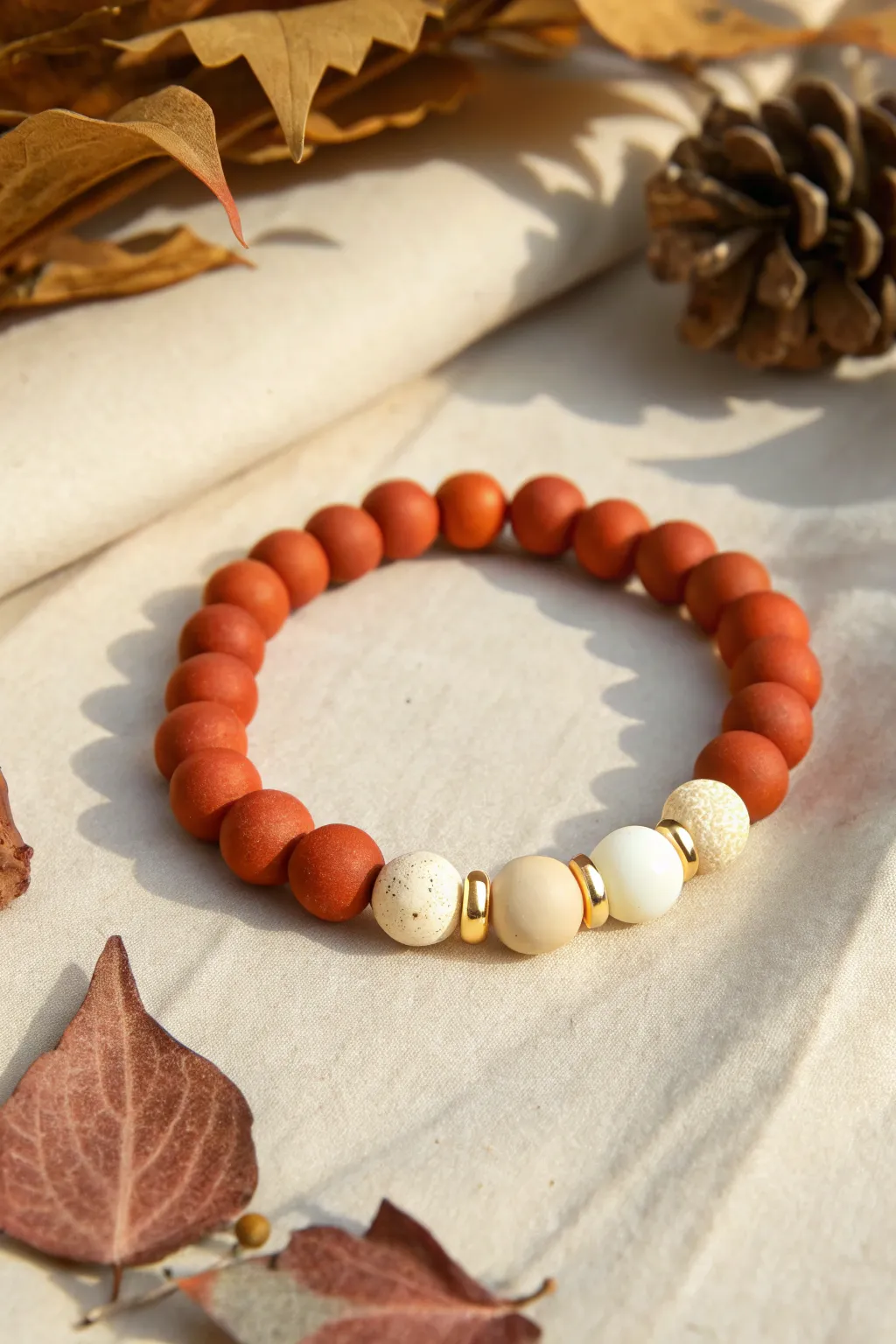
Capture the essence of a crisp fall day with this warm, textural bracelet featuring a cozy burnt orange and cream palette. The combination of matte solids, speckled accents, and bright gold spacers creates a sophisticated accessory perfect for sweater weather.
Detailed Instructions
Materials
- Polymer clay (burnt orange, beige, white, black/brown for speckles)
- Gold tube spacer beads (approx. 4mm)
- Stretch cord (0.8mm or similar)
- Bead rolling tool or acrylic block
- Pin or bead reamer
- Jewelry glue or clear nail polish
- Scissors
Step 1: Prepping the Clay
-
Condition the orange clay:
Begin by taking your burnt orange polymer clay and kneading it thoroughly in your hands until it becomes soft and pliable. This conditioning step prevents cracks later. -
Condition the accent colors:
Repeat the conditioning process with your beige and white clays separately, ensuring they are smooth and ready for shaping. -
Create the speckled mix:
For the textured white beads, take a small portion of white clay and mix in tiny, almost dust-like shavings of black or brown clay. Fold and knead until the speckles are evenly distributed like vanilla bean ice cream. -
Size the portions:
Roll your conditioned clays into long snakes of equal thickness. Slice them into equal-sized segments to ensure all your finished beads will be the same size. You’ll need about 18-20 orange segments and 4-5 accent segments.
Smooth Surface Secret
To remove fingerprints from raw clay beads before baking, gently brush them with a tiny amount of baby oil or cornstarch.
Step 2: Forming the Beads
-
Roll the orange beads:
Take an orange segment and roll it between your palms to form a rough sphere. For a perfect matte finish, refine the shape using a bead roller or by gently swirling it under a flat acrylic block. -
Shape the accent beads:
Roll your beige and speckled white segments into spheres using the same technique. I find that being gentle here preserves the roundness better than pressing hard. -
Pierce the holes:
Holding a bead gently (to avoid fingerprinting), carefully insert a bead pin or toothpick through the center. twist it as you push to avoid squashing the bead. -
Bake the beads:
Arrange your raw clay beads on a baking sheet or tile. Bake according to your clay package instructions (usually 275°F/135°C for 15-30 minutes). -
Cool down:
Allow the beads to cool completely before determining if they need any touching up. Sanding usually isn’t necessary if you rolled them smooth, but you can buffer rough edges now.
Texture Twist
For the speckled bead, mix in real ground black pepper or dried used coffee grounds into the white clay for an organic, gritty texture.
Step 3: Assembly
-
Cut the cord:
Cut a piece of stretch cord about 10-12 inches long. This gives you plenty of extra slack for tying the knot later. -
Pre-stretch the cord:
Give the elastic creates a few firm tugs. This pre-stretching helps prevent the bracelet from loosening up immediately after you wear it. -
Secure the end:
Place a piece of tape or a bead stopper on one end of the cord so your beads don’t slide right off while you work. -
Thread the orange section:
Begin threading your burnt orange beads. String about 16 to 18 of them, forming the main color block of the bracelet. -
Add the focal section:
Now for the pattern: thread a speckled white bead, followed by a gold spacer, then a smooth beige bead, another gold spacer, and finally a plain white bead or another speckled one. -
Check the fit:
Wrap the unfinished strand around your wrist. If it’s too tight, add one or two more orange beads to the back section. -
Tie the knot:
Remove the tape and tie a surgeon’s knot (right over left twice, then left over right). Pull the elastic tight to secure the tension. -
Secure and trim:
Add a tiny drop of jewelry glue to the knot. Let it dry for a minute, then trim the excess cord ends close to the knot. -
Hide the knot:
Gently pull the elastic so the knot slides inside the hole of one of the neighboring beads, hiding it from view.
Now you have a stunning, handmade accessory ready to complement your favorite fall wardrobe staples
Maple Leaf Palette Stripe Bracelet
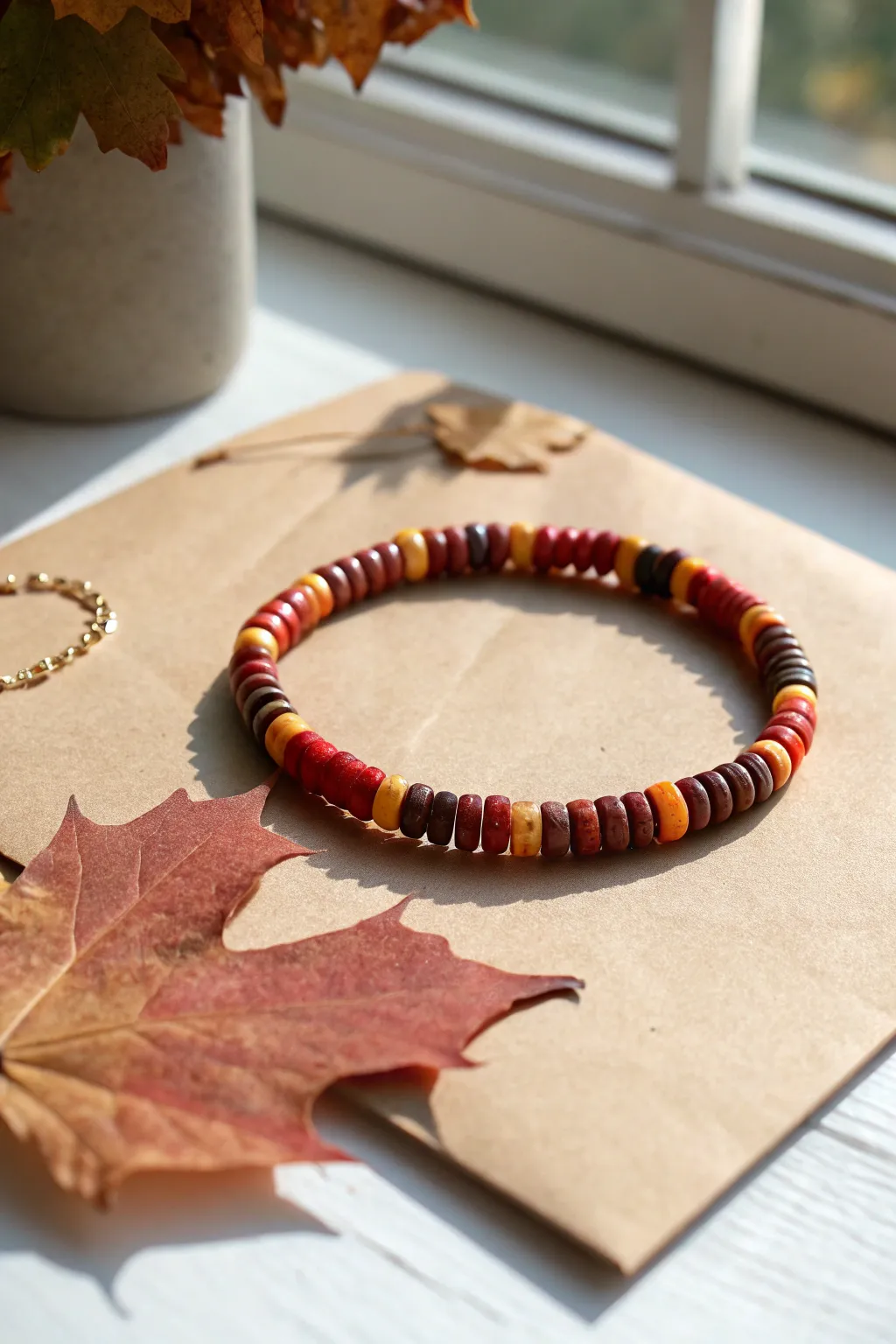
Capture the essence of a crisp autumn walk with this striking striped bracelet. Using a repeating yet organic pattern of polymer clay heishi beads, this accessory blends burgundy, burnt orange, mustard yellow, and deep brown into a wearable tribute to changing leaves.
Step-by-Step
Materials
- Polymer clay heishi beads (6mm or 4mm) in: Burgundy (Deep Red), Burnt Orange, Mustard Yellow, and Dark Brown
- Stretch cord (0.8mm or 1mm thickness, transparent)
- Scissors or jewelry snips
- Super glue or jewelry adhesive
- Bead stopper or a binder clip
- Beading board or a soft felt cloth
- Tape measure
Step 1: Preparation & Design
-
Measure your wrist:
Before you begin, wrap a tape measure around your wrist to find your size. Add about half an inch to this measurement to ensure the bracelet fits comfortably without pinching. -
Cut the cord:
Cut a piece of stretch cord about 10-12 inches long. You want plenty of excess cord on both ends to make tying the final knot easier. -
Secure the end:
Place a bead stopper or a simple binder clip on one end of the cord. This prevents your beads from sliding off while you work. -
Pre-stretch the cord:
Gently pull on the cord a few times to pre-stretch it. This helps prevent the bracelet from sagging or loosening permanently after you wear it for the first time.
Color Mixing Pro-Tip
Mix two shades of red (like dried cranberry and bright apple) within the red sections. This subtle variation mimics real leaves transitioning colors.
Step 2: Creating the Pattern
-
Establish the color rhythm:
This design relies on blocks of color. The core pattern shown is roughly: 5-7 burgundy beads, followed by 1-2 mustard yellow beads. -
Add depth:
After the yellow accent, thread on 3-4 dark brown beads. This dark tone grounds the brighter colors. -
Introduce the orange:
String 4-5 burnt orange beads next. The variation in segment lengths mimics the natural irregularity of fall foliage. -
Repeat the sequence:
Continue repeating your sequence: Burgundy block, Yellow accent, Brown block, Orange block. Don’t stress perfect symmetry; slight variations in bead counts make it look more organic. -
Check the length:
Periodically wrap the strand around your wrist. Stop adding beads when the ends touch comfortably without stretching the cord.
Knot Slipping?
If your stretch cord feels too slick and knots won’t hold, lightly sand the very ends of the cord with an emery board before tying to add grip.
Step 3: Finishing the Bracelet
-
Prepare to tie:
Remove the bead stopper carefully, holding both ends of the cord firmly so no beads escape. -
Tie the first knot:
Cross the left cord over the right and pull tight to form a basic overhand knot. Pull it snugly against the beads. -
Tie a surgeon’s knot:
For the second knot, cross the cords again but loop the end through the circle twice instead of once before pulling tight. This extra loop adds significant security. -
Reinforce the knot:
Here I recommend adding a tiny dab of jewelry glue or super glue directly onto the knot. Let it dry for a few minutes. -
Hide the knot:
If the hole of your nearest bead is large enough, gently tug the cord to slide the knot inside a bead to conceal it. -
Trim the excess:
Using your sharp scissors or snips, trim the remaining cord tails close to the knot (or the bead hiding the knot), being careful not to cut the main bracelet cord.
Slip on your new bracelet and enjoy carrying the warm colors of autumn with you everywhere you go
Neutral Fall Bracelet With Warm Metallic Spacers
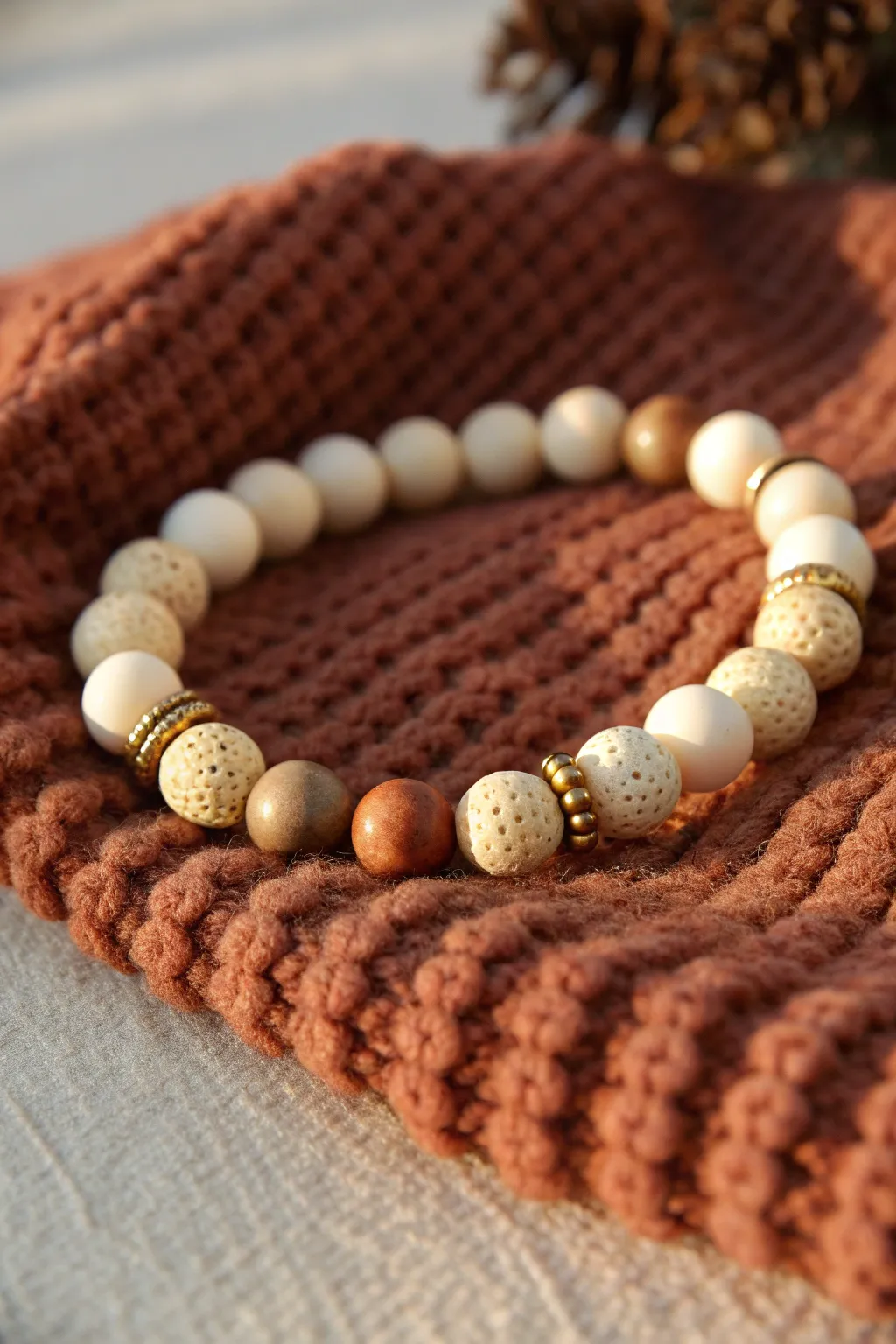
Embrace the cozy vibes of fall with this warm, textural beaded bracelet featuring earthy tones and elegant gold accents. The combination of smooth cream beads, porous lava stones, and rich wood creates a balanced design that pairs perfectly with your favorite chunky sweaters.
Step-by-Step Guide
Materials
- Cream or beige matte round beads (8mm or 10mm)
- Porous lava stone beads the same size as the cream beads (cream or off-white color)
- Round wood bead (medium brown/terracotta)
- Round polished stone bead (taupe/light brown)
- Gold tone metallic spacer beads (daisy spacer style or textured rings)
- Gold tone metallic round beads (small)
- Elastic beading cord (0.7mm or 0.8mm)
- Jewelry adhesive or clear nail polish
- Scissors
Step 1: Planning Your Layout
-
Measure your wrist:
Before cutting any cord, wrap a measuring tape around your wrist to find your size. Add about 1/2 inch to this measurement comfortably fit the bracelet, noting that larger beads take up more inner circumference. -
Cut the cord:
Cut a piece of elastic cord about 3-4 inches longer than your final bracelet size. I usually cut about 10-11 inches total just to make tying the knots easier at the end. -
Pre-stretch the elastic:
Gently pull on both ends of the elastic cord a few times. This pre-stretching prevents the bracelet from sagging or expanding too much after you’ve worn it for a while. -
Secure one end:
Place a piece of tape on one end of the cord or use a bead stopper clip. This keeps your beads from sliding off while you design the pattern.
Step 2: Creating the Central Focal Point
-
Start with the focal beads:
Our design centers around two distinct colored beads. Thread the terracotta-colored wood bead onto the cord first. -
Add the taupe bead:
Next to the wood bead, slide on the smooth, polished taupe stone bead. These two create the dark anchor point of the bracelet. -
Place the flanking lava beads:
On either side of this two-bead center, add one porous lava stone bead. If you are stringing continuously from one end, place one lava bead before the wood/taupe pair and one after. -
Insert the gold accents:
Slide a gold metallic spacer next to each flanking lava bead. Use a textured ring spacer or stack 2-3 tiny gold daisy spacers to get that rich metallic look shown in the photo.
Essential Diffuser Tip
Since this design uses porous lava beads, add a drop of cinnamon or clove essential oil to them. They act as natural diffusers for cozy fall scents.
Step 3: Completing the Pattern
-
Begin the alternating pattern:
Moving outward from your gold accents, add a porous lava bead on each side. -
Add cream smooth beads:
Next, transition to the smoother texture by adding a solid cream bead. This creates a nice contrast against the rougher lava stone. -
Continue the pattern:
Continue stringing beads, generally alternating between the porous lava beads and the smooth cream beads. You want about 5-6 beads on either side of that central focal section, depending on your wrist size. -
Add side gold accents:
About halfway up the side of the bracelet, insert another gold spacer element to balance the design. In the photo, this separates a lava bead from a cream bead. -
Fill the back section:
Finish the rest of the length with the plain smooth cream beads. These will sit at the underside of your wrist and provide a comfortable fit. -
Check the fit:
Wrap the unfinished strand around your wrist to check the length. The ends should touch without stretching the cord, and it should sit comfortably against your skin.
Texture Twist
Swap the smooth cream beads for matte frosted agate or light map stone. The matte finish adds an even softer, more modern autumn aesthetic.
Step 4: Finishing Touches
-
Preparing to knot:
Remove the tape or bead stopper carefully. Bring the two ends of the elastic cord together, ensuring there is no slack between the beads. -
Tie a surgeon’s knot:
Cross the ends like a normal knot, loop one end through a second time, and pull tight. Repeat this knotting process once more for extra security. -
Apply adhesive:
Dab a tiny drop of jewelry glue or clear nail polish directly onto the knot. This prevents the smooth elastic from slipping undone over time. -
Hide the knot:
Once the glue is tacky but not fully dry, trim the excess cord ends close to the knot. Gently tug the cord to pull the knot inside one of the larger hole beads (like the lava or wood bead) to hide it.
Slip on your new textured accessory and enjoy the subtle elegance it adds to your autumn wardrobe

The Complete Guide to Pottery Troubleshooting
Uncover the most common ceramic mistakes—from cracking clay to failed glazes—and learn how to fix them fast.
Harvest Mix-and-Match Bracelet Stack
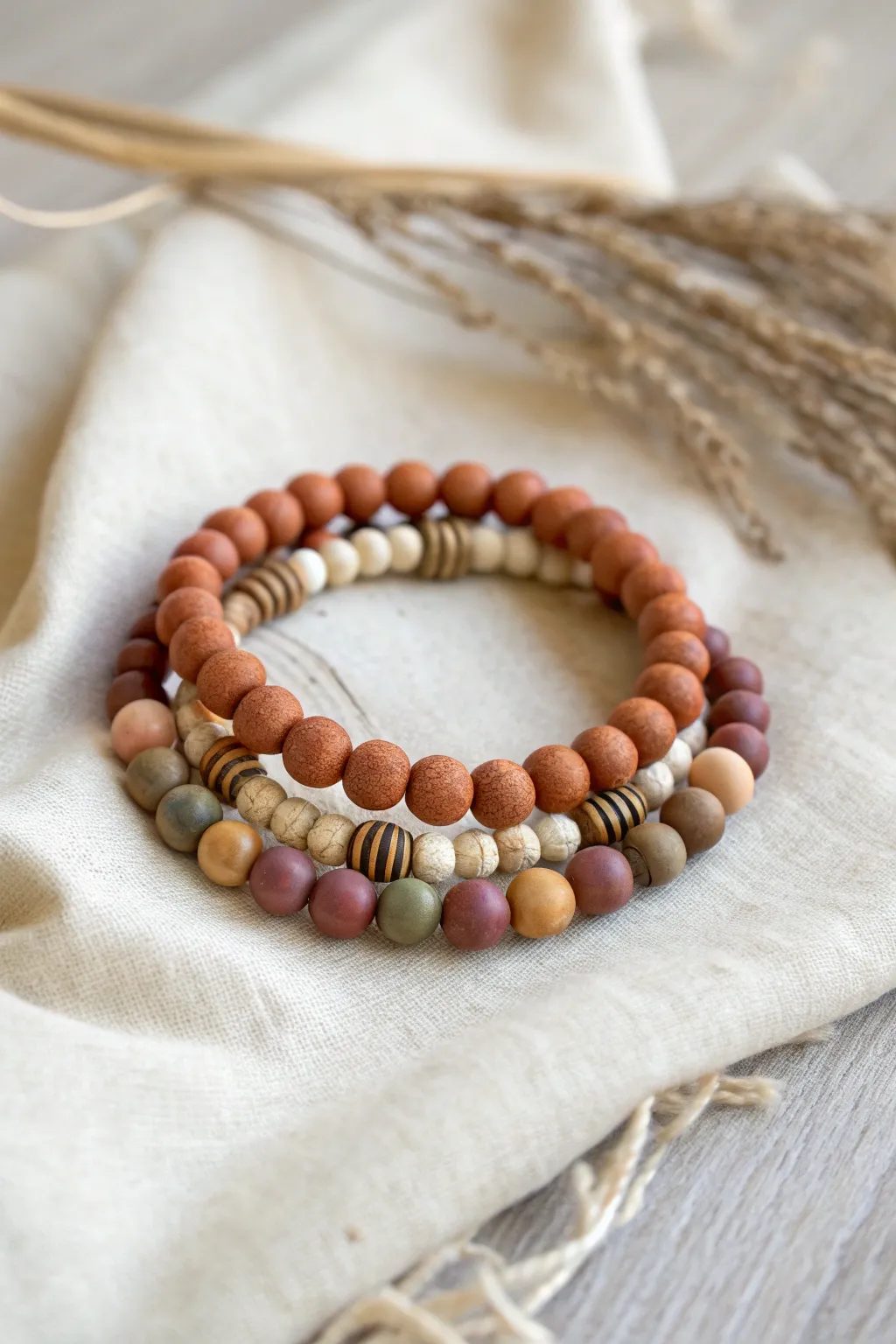
Embrace the cozy tones of autumn with this trio of textured clay and wood bead bracelets. Combining terracotta, earthy greens, and natural creams creates a sophisticated, nature-inspired stack perfect for the season.
Detailed Instructions
Materials
- Terracotta polymer clay beads (10mm, round/rough texture)
- Small cream/white textured stone or clay beads (6mm)
- Round wood beads (varying sizes: 8mm and 10mm)
- Olive green matte beads (10mm)
- Burnt sienna/burgundy matte beads (10mm)
- Mustard yellow matte beads (10mm)
- Striped wood accent beads (barrel or round shape)
- Flat disc spacer beads (wood or coconut shell)
- Strong elastic cord (0.8mm or 1mm)
- Jewelry glue or clear nail polish
- Scissors
Step 1: Planning and Preparation
-
Measure your wrist:
Before cutting any cord, wrap a measuring tape around your wrist to find your size. Add about 0.5 to 1 inch to this measurement depending on how loose you like your bracelets to fit. -
Cut the elastic:
Cut three pieces of elastic cord, making each about 4-5 inches longer than your final bracelet length. This extra length is crucial for tying secure knots later. -
Pre-stretch the cord:
Gently pull on each strand of elastic a few times. This pre-stretching prevents the bracelets from sagging or stretching out permanently after the first wear.
Knot Mastery
Hide your final knot inside a large-hole wood bead rather than a small clay one. Wood beads usually have larger drilling channels, making the finishing tuck much easier.
Step 2: Creating the Terracotta Strand
-
Start the first pattern:
Begin your first bracelet using the large terracotta-colored clay beads. These appear to have a slightly rough, pitted texture resembling lava stone or raw ceramic. -
Insert the focal point:
Thread about 15-18 terracotta beads onto the cord. In the center, create a focal section by adding two flat wooden disc spacers. -
Add contrast beads:
Between those spacers, place a series of smaller cream-colored beads. Use about 5-6 of these smaller textured beads to create a lighter break in the dark orange pattern. -
Finish the loop:
Continue adding terracotta beads until the strand reaches your desired length.
Step 3: Assembling the Mixed Earth Tone Strand
-
Begin the mixed strand:
For the second bracelet (the bottom one in the stack), you will mix various finishes. Start with a section of the small cream/white textured beads. -
Introduce wood accents:
Add a striped wooden barrel bead as a unique visual anchor. Follow this with a few naturally stained round wood beads. -
Color blocking:
Now, alternate your solid matte colors. Thread on an olive green bead, followed by a burgundy/burnt sienna bead, and then a mustard yellow bead. -
Create symmetry or random flow:
Continue this alternating pattern. This bracelet often looks best with an organic, slightly asymmetrical arrangement, so don’t be afraid to mix up the order of the olive, burgundy, and mustard beads. -
Intersperse texture:
Occasionally place a raw wood bead or a striped accent bead between the colored sections to tie it back to the natural theme.
Scent Your Stack
Since this project uses porous wood and clay beads, add a drop of essential oil (like cedarwood or cinnamon) to the raw wood beads to make it a wearable diffuser.
Step 4: Crafting the Natural Wood & Cream Strand
-
Layout the third design:
The final bracelet relies heavily on neutral tones. Start with a long run of the small cream textured beads. -
Add flat spacers:
Break up the cream section by threading on 3-4 flat wooden disc spacers in a row. This creates a ribbed texture effect. -
Incorporate large wood beads:
Transition into larger round wooden beads. Use a mix of light tan wood and slightly darker stained wood for depth. -
Create a focal accent:
Just like the other strands, add a special accent. A large striped wooden bead works perfectly here to coordinate with the mixed-color bracelet.
Step 5: Finishing Touches
-
Check the fit:
Before tying, wrap each strand around your wrist to ensure they sit comfortably together. The stack should feel substantial but not tight. -
Tie the knots:
For each bracelet, tie a surgeon’s knot (right over left, left over right loops) and pull tightly. I always pull the elastic taut while knotting to clear out any gaps between beads. -
Secure the knots:
Dab a tiny drop of jewelry glue or clear nail polish onto each knot. Let it dry completely before trimming the excess cord. -
Hide the knots:
Ideally, tug the knot gently so it slides inside the hole of a neighboring large bead, hiding it from view perfectly.
Enjoy wearing these warm, earthy textures all through the season
Woodland Greens and Rust Accent Bracelet
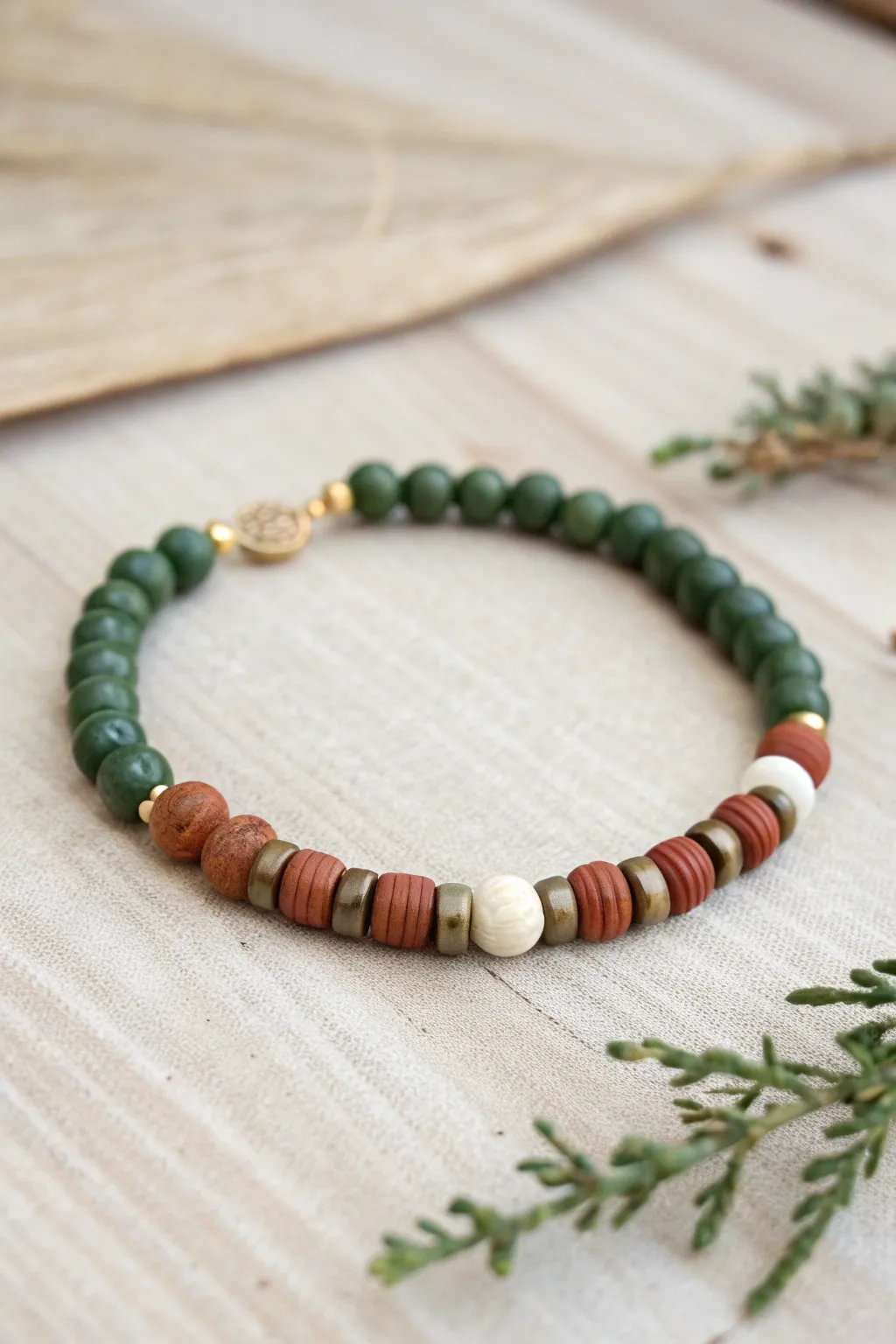
Evoke the quiet beauty of an autumn forest floor with this earthy bracelet design, combining deep moss greens with warm rust tones and natural textures. This piece balances smooth round beads with uniquely textured clay discs for a sophisticated woodland aesthetic.
Step-by-Step Tutorial
Materials
- Approx. 20-25 round matte green beads (6mm or 8mm) – jasper or dyed wood work well
- 2 large round terracotta-colored wooden beads (approx. 8mm-10mm)
- Small heishi-style clay disc beads in rust orange
- Small heishi-style metal spacer beads in antique bronze
- 2 round bone or cream-colored beads (one focal, one accent)
- Elastic beading cord (0.7mm or 0.8mm)
- Small gold crimp beads (optional, for finishing)
- Gold tone jump rings and a decorative circular charm or tag
- Beading needle (optional but helpful)
- jewelry glue
- Scissors
Step 1: Planning the Design
-
Measure your wrist:
Wrap a piece of string around your wrist to find your size, then add about half an inch for a comfortable fit. Lay out your bead board or a soft cloth to prevent beads from rolling away. -
Layout the focal section:
Start by arranging the center ‘rust’ section first as this is the most complex part. Place a cream-colored round bead in the very center. -
Build outward from center:
On either side of that central cream bead, place a bronze spacer disc, then a stack of 3-4 rust clay discs. Repeat this pattern—spacer, rust stack—moving outwards symmetrically. -
Add texture variation:
After your stacks of clay discs, place the larger, textured terracotta wooden beads on the ends of this focal section to transition into the main bracelet body.
Step 2: Stringing the Beads
-
Prepare the cord:
Cut a length of elastic cord about 10-12 inches long. Pre-stretch the elastic by giving it a few gentle tugs; this prevents the bracelet from stretching out permanently later. -
Secure the end:
Place a piece of tape or a bead stopper on one end of your cord so your work doesn’t slide off while you string. -
String the focal section:
Thread on your pre-arranged focal pattern: starting from the left terracotta bead, through the spacer discs and clay stacks, the central cream bead, and finishing with the right terracotta bead. -
Add gold accents:
Slide a tiny gold spacer bead on both sides of your focal section to give it a polished, finished edge. -
String the green beads:
Now, thread the round matte green beads onto the remaining length of the cord. These will form the back and sides of the bracelet. -
Check sizing:
Once you have strung enough green beads to nearly complete the circle, wrap it around your wrist to check the fit. Add or remove green beads as necessary.
Knot Security
Don’t trim your elastic tails immediately after gluing! Let the glue cure for at least 15 minutes before cutting to ensure the knot doesn’t spring open.
Step 3: Finishing Touches
-
Add the charm:
Before tying the knot, slide a small decorative gold charm or tag onto the cord so it sits among the green beads, ideally opposite your focal section. -
Tie the knot:
Remove the tape or stopper. Bring the two ends of the elastic together and tie a strong surgeon’s knot (right over left, left over right, looping through twice). -
Secure the knot:
Pull the cord tight to secure the knot. I find applying a tiny drop of jewelry glue directly onto the knot ensures it never slips. -
Hide the knot:
If one of your green beads has a large enough hole, gently tug the elastic until the knot slips inside the bead to hide it. -
Trim excess:
Once the glue is dry (usually just a few minutes), use sharp scissors to trim the excess cord ends close to the beads.
Layered Look
Make a stacked set by creating two more bracelets: one entirely of the green beads and gold spacers, and another using just the rust clay discs and bronze spacers.
Your wrist now carries the serene colors of a walk through the woods in late October

What Really Happens Inside the Kiln
Learn how time and temperature work together inside the kiln to transform clay into durable ceramic.
Cranberry and Blush Apple Orchard Bracelet
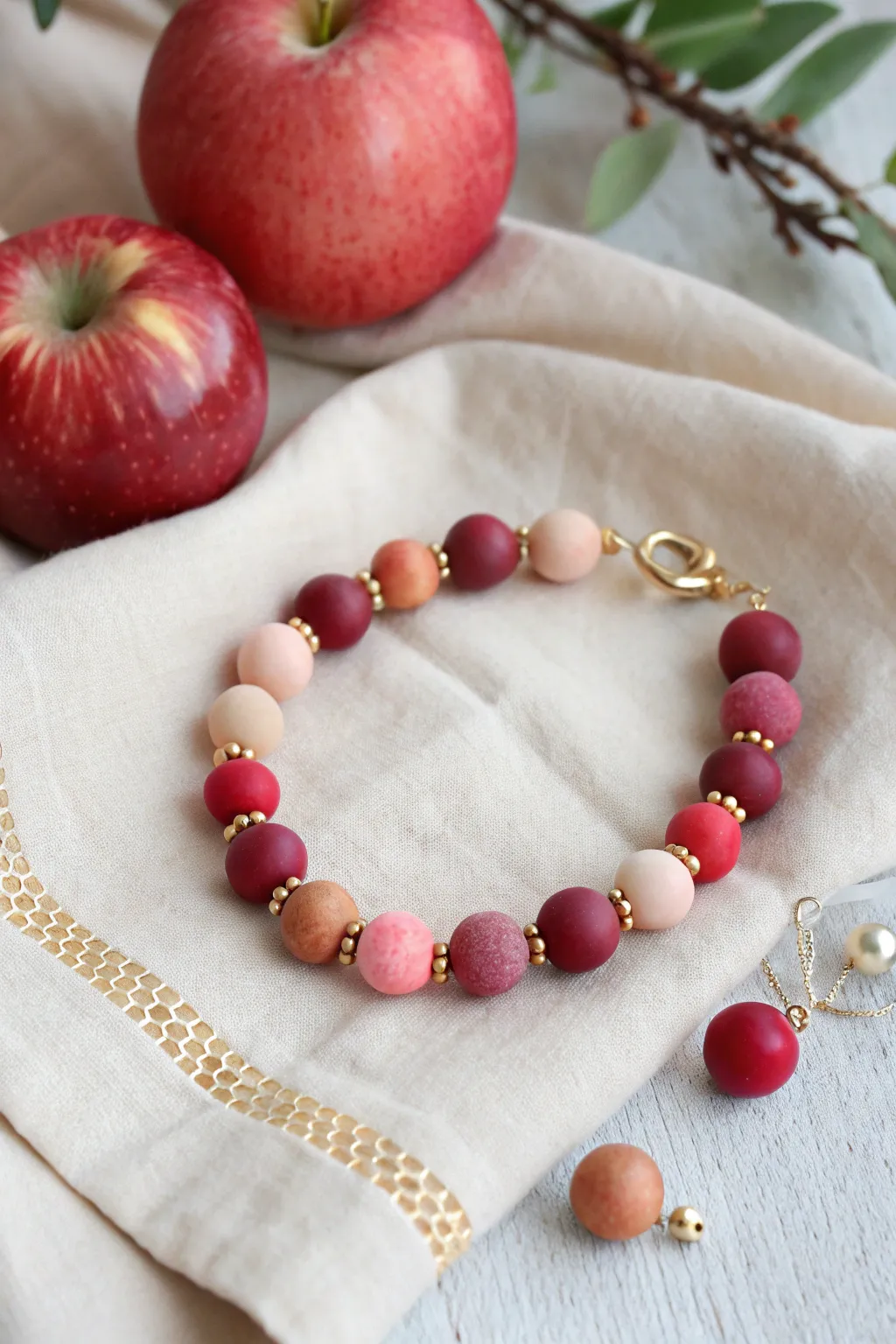
Capture the cozy essence of an autumn harvest with this charming beaded bracelet featuring warm tones of deep cranberry, soft blush, and russet apple reds. Using polymer clay allows you to mix custom shades that perfectly mimic the variegated colors found in a sun-ripened orchard.
How-To Guide
Materials
- Polymer clay in deep red, bright red, beige, white, and translucent
- Gold seed beads or small gold spacer beads (approx. 2-3mm)
- Gold jewelry wire (flexible beading wire like Tiger Tail)
- Gold lobster clasp and jump ring
- 2 Crimp beads
- Needle tool or toothpick
- Acrylic roller or pasta machine
- Bead reamer (optional)
- Small jewelry pliers (flat nose and wire cutters)
- Oven for baking
- Sandpaper (fine grit, 400-800)
- Tile or baking sheet
Step 1: Mixing and Forming the Clay Beads
-
Condition the Clay:
Begin by warming up your polymer clay by kneading it in your hands until it becomes soft and pliable. This prevents cracking and makes color mixing much smoother. -
Mix Custom Shades:
Create your color palette. For the cranberry shade, mix deep red with a tiny pinch of black or brown. For the blush, mix a large amount of white with a speck of red and beige. -
Create the Russet Tone:
To achieve that earthy, apple-skin look seen in the photo, mix bright red with a little beige and translucent clay. Don’t mix it completely thoroughly; leaving slight swirls adds a natural texture. -
Roll Smooth Spheres:
Pinch off equal-sized pieces of each clay color. Roll them between your palms to create smooth, round spheres approximately 8-10mm in diameter. -
Texture the Beads (Optional):
If you want the matte, stone-like texture visible on some of the beads, gently roll the unbaked clay sphere over a piece of coarse sandpaper or use a toothbrush to stipple the surface lightly. -
Pierce the Holes:
Using a needle tool or toothpick, carefully pierce a hole through the center of each bead. I find twisting the tool as you push through prevents the bead from squishing out of shape. -
Check the Fit:
Ensure the hole is large enough for your beading wire to pass through, keeping in mind that the clay won’t shrink significantly during baking. -
Bake the Clay:
Arrange your beads on a ceramic tile or baking sheet. Bake according to your specific brand’s package instructions (usually around 275°F/135°C for 15-30 minutes). -
Cool and Refine:
Let the beads cool completely. If there are any fingerprints or rough edges around the holes, gently sand them away with fine-grit sandpaper.
Step 2: Stringing and Assembly
-
Prepare the Wire:
Cut a length of gold beading wire about 9-10 inches long. This gives you plenty of extra room to work with the clasp without struggling. -
Start the Pattern:
String one crimp bead onto one end of the wire, followed by the gold jump ring (or the ring part of the toggle clasp/lobster claw). -
Secure the First End:
Loop the wire back through the crimp bead. Use your flat nose pliers to flatten the crimp bead tightly, securing the wire. -
Begin Beading:
Thread your beads onto the wire. Between every clay bead, add two or three small gold spacer beads. This creates the metallic separation seen in the project image. -
Vary the Colors:
Slide on the clay beads in a pleasing, semi-random order. Alternating between the dark cranberry, the bright matte pink, and the neutral blush creates dynamic visual rhythm. -
Check Length:
Periodically wrap the strand around your wrist to check the fit. Remember that the clasp will add about half an inch to the final length. -
Add the Clasp:
Once you are happy with the length, string on a crimp bead followed by the lobster clasp. -
Loop and Crimp:
Thread the wire back through the crimp bead and through the last couple of beads on the strand. Pull it taut so there are no large gaps, but not so tight the bracelet becomes stiff. -
Final Secure:
Use your pliers to flatten the final crimp bead securely. Trim any excess wire close to the bead with your wire cutters. -
Finishing Touches:
Wipe the clay beads with a soft cloth to remove any dust from the assembly process, ensuring the matte finish looks pristine.
Fixing Squished Beads
If your beads distort while piercing holes, pop them in the fridge for 10 minutes before piercing. The firm clay resists fingerprints and holds its round shape much better under pressure.
Add Apple Texture
For a ‘sugared’ look on the pink beads, roll the raw clay in ultra-fine clear glitter or salt before baking. If using salt, rinse the beads after baking to dissolve it, leaving tiny pits.
Enjoy wearing your handcrafted piece of autumn or wrap it up as a thoughtful seasonal gift
Ombre Sunset Fade Heishi Bracelet
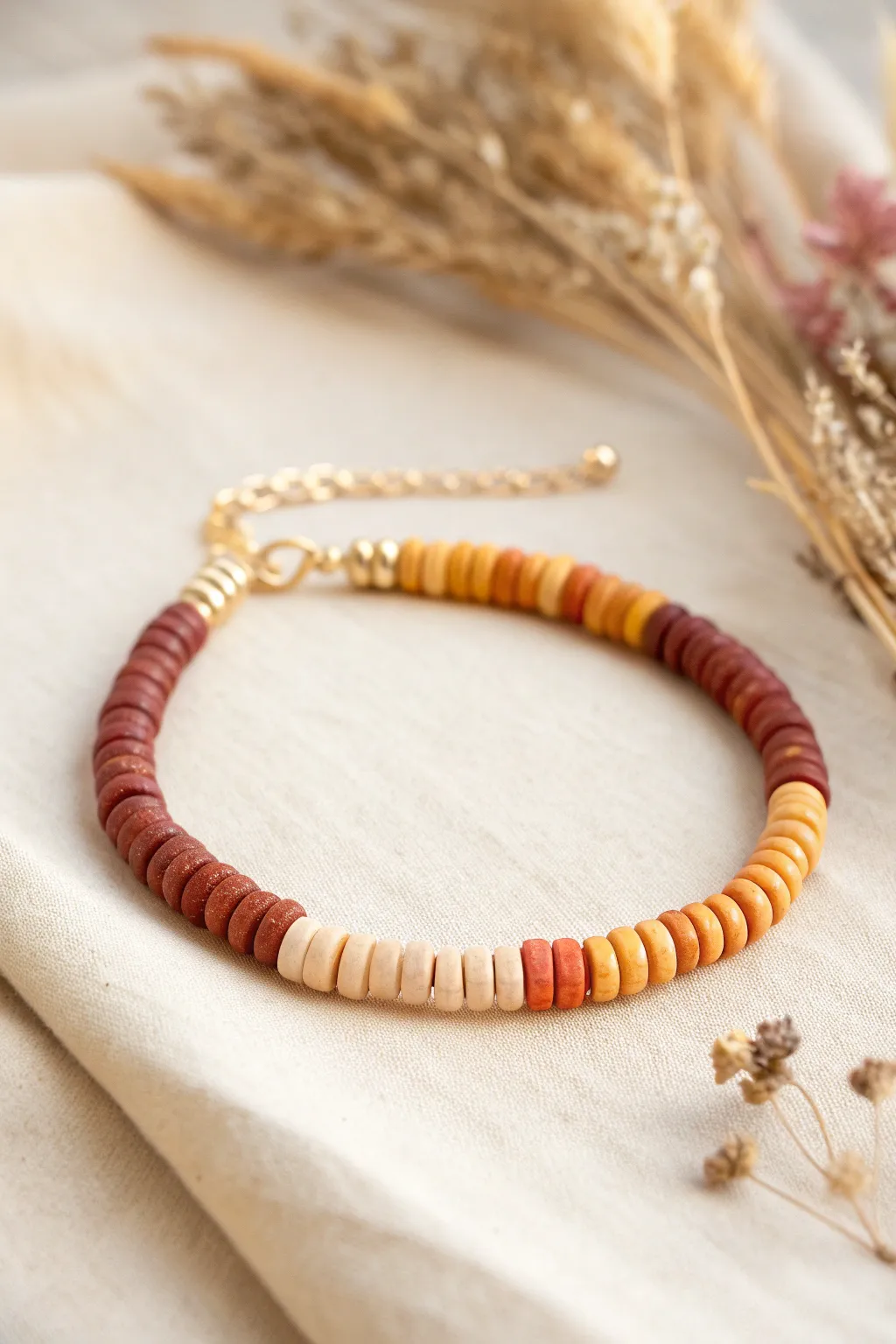
Capture the warm, glowing hues of an autumn sunset with this elegant polymer clay bead bracelet. The design features a sophisticated color block pattern that transitions from deep burgundy to soft cream, accented with touches of gold.
Detailed Instructions
Materials
- Polymer clay heishi disc beads (6mm): Deep burgundy/maroon
- Polymer clay heishi disc beads (6mm): Rust/terracotta orange
- Polymer clay heishi disc beads (6mm): Mustard yellow
- Polymer clay heishi disc beads (6mm): Cream/off-white
- Strong beading wire or tigertail wire (0.38mm)
- Gold tone crimp beads (2mm)
- 2 Gold tone wire guardians
- Gold tone lobster clasp
- Gold tone extension chain
- 2 gold tone spacer beads (3mm or 4mm round)
- Small coil end springs (optional, for covering crimps)
- Flat nose pliers
- Wire cutters
- Crimping pliers
Step 1: Preparation & Planning
-
Measure your wrist:
Wrap a measuring tape loosely around your wrist to determine your size. Add about 1/2 inch to this measurement to account for the bulk of the beads. -
Cut the wire:
Cut a length of beading wire approximately 10 inches long. This gives you plenty of extra slack to work with on both ends. -
Sort the colors:
Separate your heishi beads into piles: burgundy, rust orange, mustard yellow, and cream. Having them ready makes the stringing process much faster.
Uneven Tension?
If the bracelet feels stiff or kinks, you’ve strung it too tightly. Before the final crimp, curve the bracelet into a circle to ensure it has enough ‘give’ to drape naturally.
Step 2: Starting the Clasp
-
Attach the wire guardian:
Thread a crimp bead onto one end of your wire, followed by the wire guardian. Loop the wire through the guardian and back down through the crimp bead. -
Secure the crimp:
Use your crimping pliers to flatten the crimp bead securely. Give the wire a gentle tug to ensure it holds tight. -
Add the clasp:
Open a jump ring (or thread directly if the clasp allows) and attach the lobster clasp to the loop created by the wire guardian. -
Cover the crimp:
Thread a gold spring coil or a gold spacer bead over the short tail and the main wire to hide the crimp bead for a polished look.
Mix It Up
Try adding single gold wafer beads between every color transition. It adds a subtle metallic shimmer that defines the color blocks more clearly.
Step 3: Stringing the Pattern
-
Begin the burgundy section:
Start by stringing about 2 inches of the deep burgundy heishi beads. This will form the darkest part of the ombre gradient. -
Transition to rust:
Add approximately 1 inch of the rust/terracotta orange beads. Keep the beads snug but not overly tight against each other. -
Add the yellow segment:
Thread on about 1 inch of the mustard yellow beads. Step back occasionally to check that your color blocks are balanced. -
Create the cream focal point:
String roughly 1.5 inches of cream beads. This lighter section acts as a highlight in the gradient. -
Reverse the gradient:
Now, mirror the pattern to finish the loop. Add 1 inch of mustard yellow, followed by small touches of rust and burgundy until you reach your desired length. -
Add gold accents:
Insert a small round gold spacer bead at the very end of the bead strand to finish the sequence professionally.
Step 4: Finishing Touches
-
Prepare the end:
Thread a crimp bead and a wire guardian onto the remaining wire end. -
Attach the extension chain:
Loop the wire through the guardian, hooking the extension chain into the loop created, and pass the wire back through the crimp bead and into the last few heishi beads. -
Tighten the slack:
Pull the wire taut so there are no gaps between beads, but ensure the bracelet remains flexible and isn’t stiff. -
Secure final crimp:
Crimp the bead firmly with your pliers. -
Trim excess wire:
Using your flush cutters, trim the excess wire tail as close to the beads as possible without cutting your main strand.
Wear your new bracelet stacked with other gold jewelry for the perfect autumn accessory look

TRACK YOUR CERAMIC JOURNEY
Capture glaze tests, firing details, and creative progress—all in one simple printable. Make your projects easier to repeat and improve.
Harvest Plaid-Inspired Micro-Stripe Bracelet
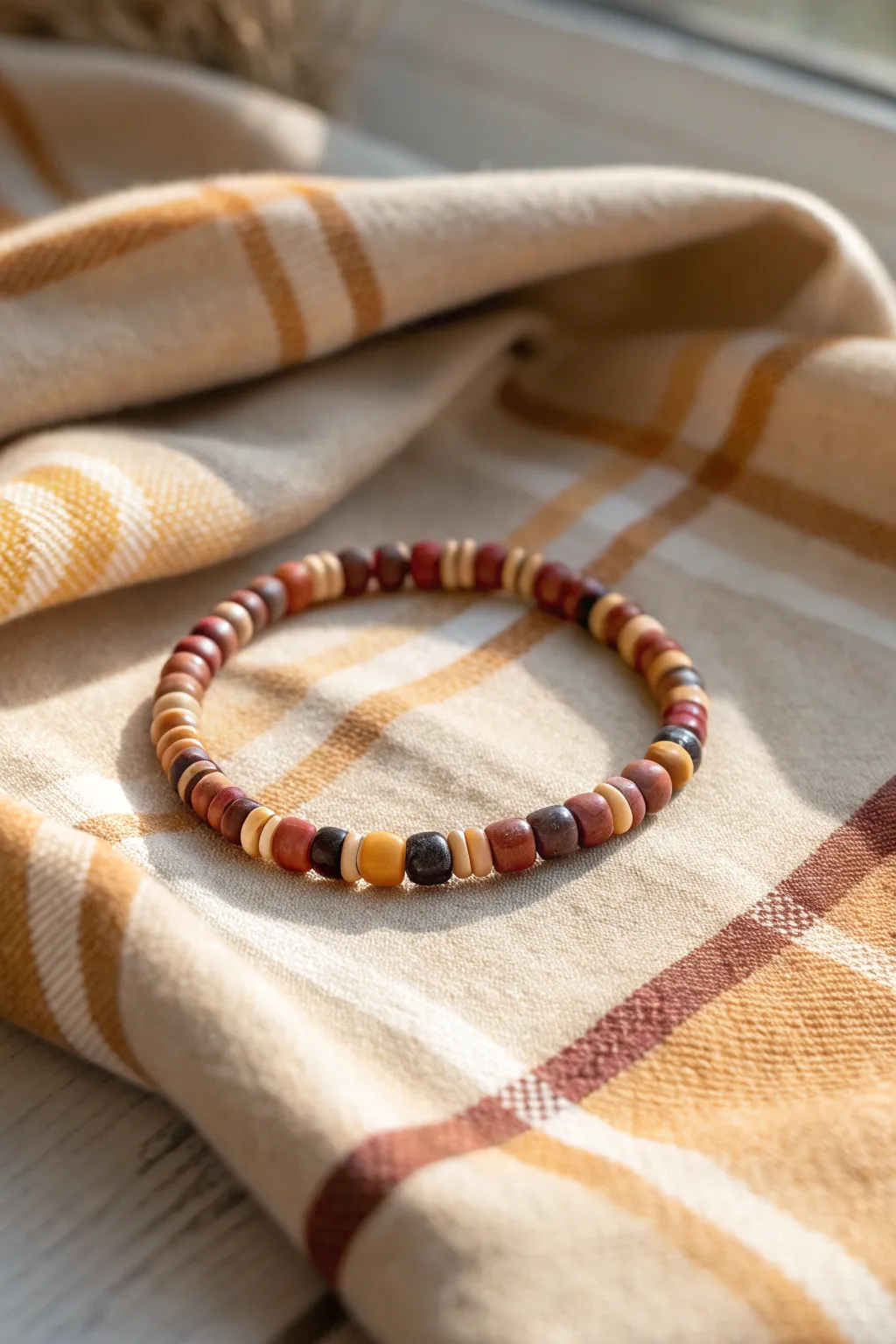
Echo the cozy warmth of your favorite flannel shirt with this understated bracelet design. Using polymer clay heishi beads in varied earthy tones, you’ll create a textured, harvest-inspired accessory that stacks perfectly with chunky knits.
How-To Guide
Materials
- Polymer clay heishi beads (4mm-6mm) in: dark chocolate brown, maroon/burgundy, burnt orange/rust, golden yellow, beige/cream, and charcoal grey
- Elastic stretch cord (0.8mm or 1mm)
- Beading needle (optional, often helpful for stringing)
- Scissors
- Hypo-cement or clear jewelry glue
- Bead layout board or a simple masking tape strip
Step 1: Planning and Sorting
-
Measure your wrist:
Before you begin, wrap a piece of string around your wrist to find your comfortable size, then add about half an inch to that measurement to account for the bulk of the beads. -
Prepare your palette:
Pour out a small amount of each bead color onto your workspace. Separating them into distinct piles helps you visualize the color balance before you start stringing. -
Establish the pattern logic:
Examine the reference image closely. The pattern isn’t a strict A-B-C repeat; instead, it uses small ‘blocks’ of color separated by contrasting spacers. -
Create color blocks:
Decide on your main color groupings. In this design, the ‘blocks’ consist of 2-3 beads of the same color (like deep maroon or charcoal) placed together to create visual weight. -
Select your spacers:
Identify the lighter beads—the creams and beiges—which act as the ‘stripes’ in the plaid pattern, breaking up the darker, heavier colors.
Knot Slipping?
If your elastic knot feels loose, tighten it by pulling all four strands (the two tails and the two bracelet sides) simultaneously before gluing.
Step 2: Stringing the Beads
-
Secure the cord:
Cut a length of elastic cord about 10-12 inches long. Pre-stretch it gently by pulling on both ends to prevent the finished bracelet from sagging later. -
Start with a neutral base:
Begin by threading two beige or cream beads onto the cord. Use a piece of tape on the tail end of the cord so beads don’t slide off as you work. -
Add a dark accent:
Slide on a single dark bead, such as the charcoal grey or dark chocolate brown. This acts as a sharp divider. -
Build a color section:
Thread on two to three burnt orange or mustard yellow beads. Grouping them like this mimics the wider bands found in plaid fabric. -
Insert a contrast bead:
Follow your orange section with another single dark bead or a single cream bead to delineate the section. -
Add a maroon segment:
Now, thread on two maroon or burgundy beads. I generally like to vary the number of beads slightly—using two here and three mostly elsewhere keeps the pattern organic. -
Repeat the separation:
Add a light cream spacer bead to brighten the strand before moving to the next dark color. -
Incorporate the darkest tones:
Add a small block of two charcoal beads. These dark segments ground the design and make the harvest colors pop. -
Continue the sequence:
Repeat this loose pattern—small block of color, spacer, small block of color, spacer—alternating your ‘block’ colors between orange, maroon, chocolate, and yellow. -
Check the fit:
Periodically wrap the strand around your wrist. Stop adding beads when the ends touch comfortably without stretching the cord tight.
Step 3: Finishing Touches
-
Tie the knot:
Once you have the desired length, remove the tape. Tie a surgeon’s knot (a square knot with an extra loop through) to secure the ends firmly. -
Apply adhesive:
Place a tiny drop of hypo-cement or jewelry glue directly onto the knot. This is crucial for elastic cord longevity. -
Hide the knot:
While the glue is still slightly tacky but not wet, gently pull the knot inside the hole of the nearest large bead if possible. -
Trim the tails:
Allow the glue to dry completely (usually 15-20 minutes). Then, use your sharp scissors to trim the excess cord as close to the bead as possible without clipping the knot.
Add Texture
Mix in one or two real wooden beads or lava stones in place of a clay color block to add organic, tactile texture to the stack.
Slip on your new bracelet and enjoy those warm, autumnal vibes on your wrist
Pumpkin Bread Speckle Bead Bracelet
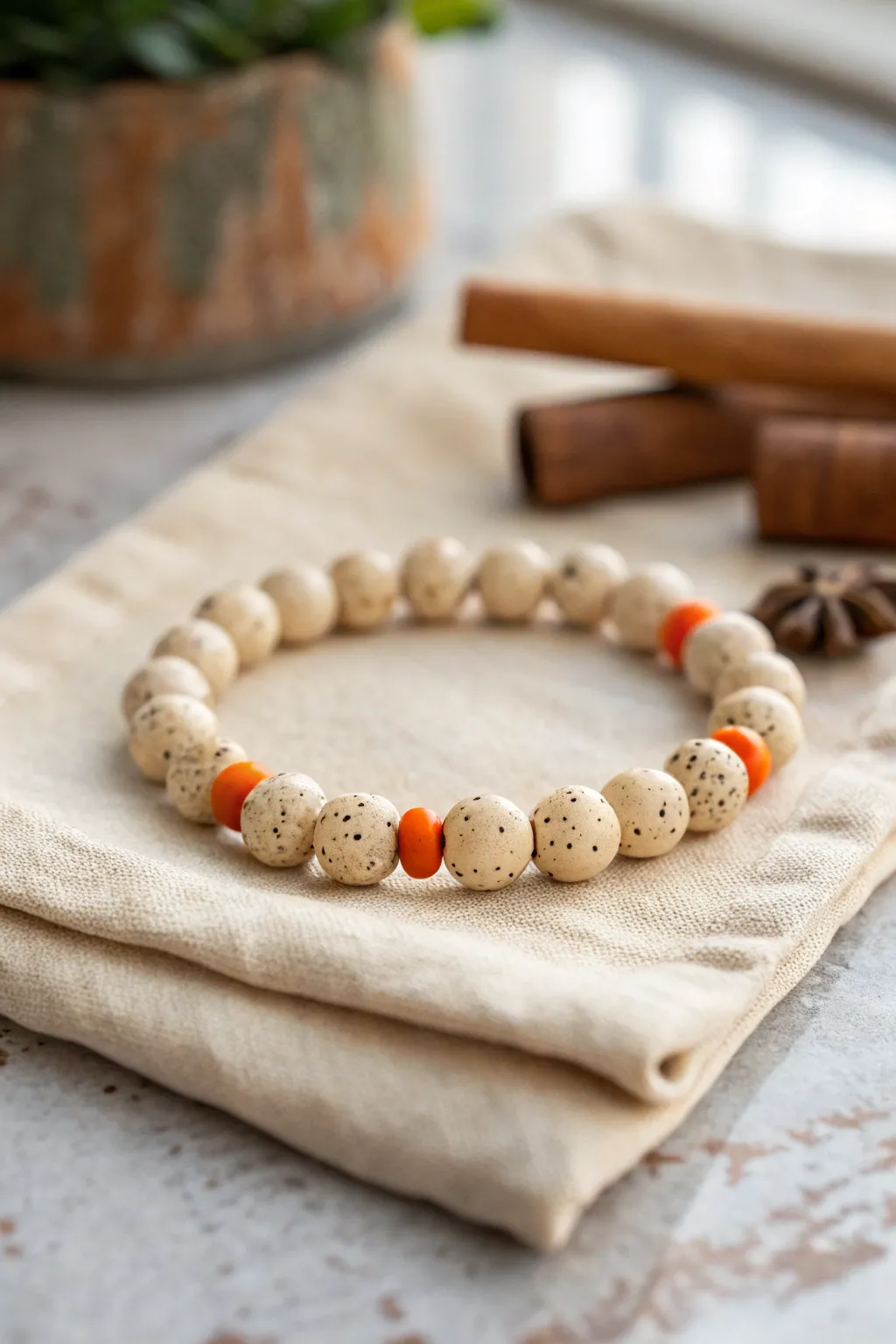
Capture the cozy essence of autumn baking with this deceptively simple bracelet project. By mixing polymer clays and adding clever speckles, you’ll create beads that look good enough to eat, reminiscent of pumpkin bread batter and vanilla bean glaze.
Step-by-Step Guide
Materials
- Ecru or translucent white polymer clay
- Opaque white polymer clay
- Bright pumpkin orange polymer clay
- Finely ground black pepper or dried vanilla bean specks
- Black acrylic paint (optional alternative to pepper)
- Stretch cord (0.7mm or 0.8mm)
- Clay roller or pasta machine
- Small round bead roller tool (optional but helpful)
- Toothpick or bead piercing pin
- Beading needle (optional)
- Super glue or jewelry adhesive
- Oven for baking
Step 1: Preparing the ‘Dough’
-
Condition the base clay:
Start by warming up the ecru and opaque white polymer clay in your hands until it is pliable. I like to mix about two parts white to one part ecru to get that perfect creamy off-white dough color. -
Add the speckles:
Flatten your conditioned clay mixture into a pancake. Take a pinch of finely ground black pepper (or real dried vanilla bean if you have it!) and sprinkle it across the surface. This creates the signature organic texture. -
Incorporate the texture:
Fold the clay over the pepper and roll it thoroughly. Continue folding and rolling until the black specks are evenly distributed throughout the batch. You want it random, not clumped. -
Prep the accent color:
Condition your pumpkin orange clay separately. Make sure this batch is perfectly smooth and uniform in color to contrast with the speckled beads.
Hole Distortion?
If your beads squish into ovals when piercing, let the clay rest for 10 minutes to cool/firm up before trying again, or use a thinner needle.
Step 2: Shaping the Beads
-
Create a uniform log:
Roll your speckled clay into an even snake, roughly the thickness you want your final beads to be. -
Section the clay:
Use a clay blade to slice the log into equal segments. Consistency here is key for a polished look. -
Roll the main beads:
Roll each segment between your palms to create a smooth sphere. If you have a bead roller tool, this will help ensure they are perfectly round. -
Create orange spacers:
Repeat the process with the orange clay, but shape these slightly flatter or smaller if desired to act as distinct spacers. The image shows small, slightly flattened disc shapes. -
Refine the surface:
Check the speckled beads for fingerprints. Gently buff them with your finger to smooth them out before piercing.
Step 3: Piercing and Baking
-
Pierce the holes:
Holding a bead gently, use a twisting motion with your piercing pin/toothpick to create a hole straight through the center. Don’t push straight through, or you might squash the sphere. -
Bake carefully:
Arrange your beads on a baking sheet or tile. Bake according to your brand of clay’s instructions (usually around 275°F/130°C for 15-30 minutes). Watch closely so the white clay doesn’t scorch. -
Cool down:
Allow the beads to cool completely to room temperature before handling. They are fragile when hot.
Scented Accents
Mix a tiny drop of clove or cinnamon essential oil into the clay before baking for a bracelet that actually smells like autumn baking.
Step 4: Assembly
-
Measure the cord:
Cut a piece of stretch cord about 10-12 inches long. Pre-stretch it by pulling it firmly a few times; this prevents the bracelet from loosening later. -
Plan the pattern:
Lay your beads out. The design in the photo uses a pattern: one orange spacer followed by three speckled rounds, repeated around the wrist. -
String the beads:
Thread the beads onto the cord following your pattern. Keep checking the length against your wrist as you go. -
Secure the knot:
Tie a surgeon’s knot (right over left twice, then left over right). Pull tight to secure the beads snugly together. -
Final touches:
Add a tiny dab of jewelry glue to the knot. Once dry, trim the excess cord and tuck the knot inside one of the bead holes to hide it.
Enjoy wearing this lovely piece of fall flair that pairs perfectly with oversized sweaters
Cinnamon Swirl Marbled Bead Bracelet
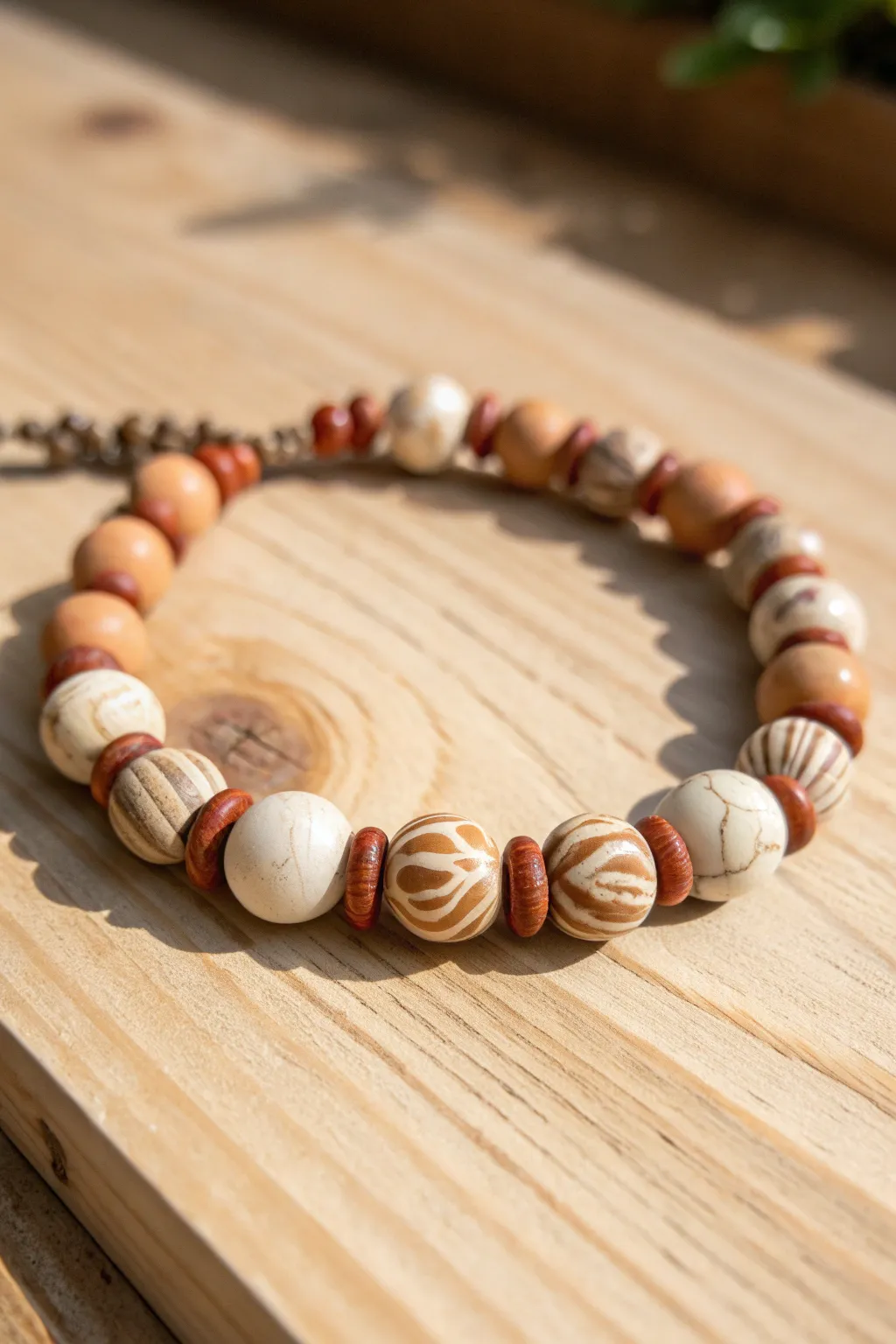
Embrace cozy autumn vibes with this rustic, earthy bracelet featuring marbled clay beads that mimic the look of latte art or warm cinnamon rolls. The combination of creamy whites, wood tones, and intricate swirls creates a textured accessory perfect for sweater weather.
How-To Guide
Materials
- Polymer clay (translucent white or cream)
- Polymer clay (warm cinnamon brown or terracotta)
- Small wooden spacer beads (approx. 4mm, reddish-brown stained)
- Medium wooden beads (approx. 8-10mm, light natural finish)
- Elastic beading cord (0.7mm or 0.8mm)
- Clay roller or pasta machine
- Bead piercing pin or needle tool
- Baking sheet and parchment paper
- Oven (for baking clay)
- Optional: Clay glaze (matte or satin finish)
- Super glue or jewelry cement
Step 1: Creating the Marbled Clay Canes
-
Condition the clay:
Start by thoroughly kneading your white/cream and cinnamon brown polymer clays separately until they are soft and pliable. This warmth helps prevent cracking later. -
Form base logs:
Roll the white clay into a thick log about 1 inch in diameter. Roll the brown clay into a much thinner snake, roughly 1/4 inch thick. -
Create the swirl components:
Cut the brown clay snake into several segments. Place these strips lengthwise along the white log to create stripes. -
Twist and roll:
Gently roll the combined log on your work surface to smooth the seams. Once it is a single cylinder, hold both ends and twist them in opposite directions to create a spiral pattern inside. -
Double the marble:
Fold the twisted log in half and roll it out again. Repeat this folding and twisting process 2-3 times until you see a rich, intricate marbling effect, but stop before the colors blend into a single muddy hue.
Keep it Clean
Wipe your hands with a baby wipe before rolling the white clay to prevent dust or lint from ruining the pristine creamy color.
Step 2: Forming the Beads
-
Portion the clay:
Slice your marbled log into equal-sized segments using a clay blade. Aim for enough clay to create beads roughly 10-12mm in diameter. -
Roll into spheres:
Take a segment and roll it between your palms to form a smooth, round ball. I find using a light circular motion helps keep the shape perfectly spherical. -
Vary the patterns:
For variety, you can create some solid white beads or beads with just a hint of marbling to break up the pattern on the final bracelet. -
Pierce the holes:
Gently insert your bead piercing pin through the center of each clay sphere. Rotate the pin while pushing to avoid squashing the bead’s shape. -
Refine the shape:
If the bead deformed slightly during piercing, give it a gentle roll on the table with the pin still inserted to true up the roundness.
Step 3: Baking and Finishing
-
Bake the beads:
Arrange the beads on a baking sheet lined with parchment paper. Bake according to your specific clay brand’s instructions (usually around 275°F/135°C for 15-30 minutes). Let them cool completely. -
Sand and buff:
If there are fingerprints, lightly sand the cooled beads with fine-grit sandpaper. Buff them with a soft cloth to bring out a natural sheen. -
Prepare the cord:
Cut a length of elastic cord about 10 inches long to give yourself plenty of room for tying. -
String pattern group A:
Begin threading your beads. Create specific sections by stringing one marbled clay bead, followed by a small flat wooden spacer, then a plain wooden bead, and another spacer. -
String pattern group B:
Alternate the pattern by placing two marbled beads separated only by a spacer. Mix and match the order (clay, spacer, wood, spacer) until the bracelet reaches your desired wrist size. -
Tie the knot:
Bring the ends of the elastic together and tie a strong surgeon’s knot (right over left, left over right, looped twice). -
Secure the bond:
Apply a tiny drop of super glue or jewelry cement to the knot. Pull the knot firmly and slide it inside one of the larger bead holes to hide it. -
Trim excess:
Once the glue is dry, carefully trim the excess elastic cord close to the bead hole.
Texture Twist
Before baking, gently roll the clay beads over a piece of coarse sandpaper or denim fabric to give them a subtle, stone-like texture.
Slip on your new bracelet and enjoy the warm, artisanal touch it adds to your autumn wardrobe
Mini Pumpkin Charm Centerpiece Bracelet
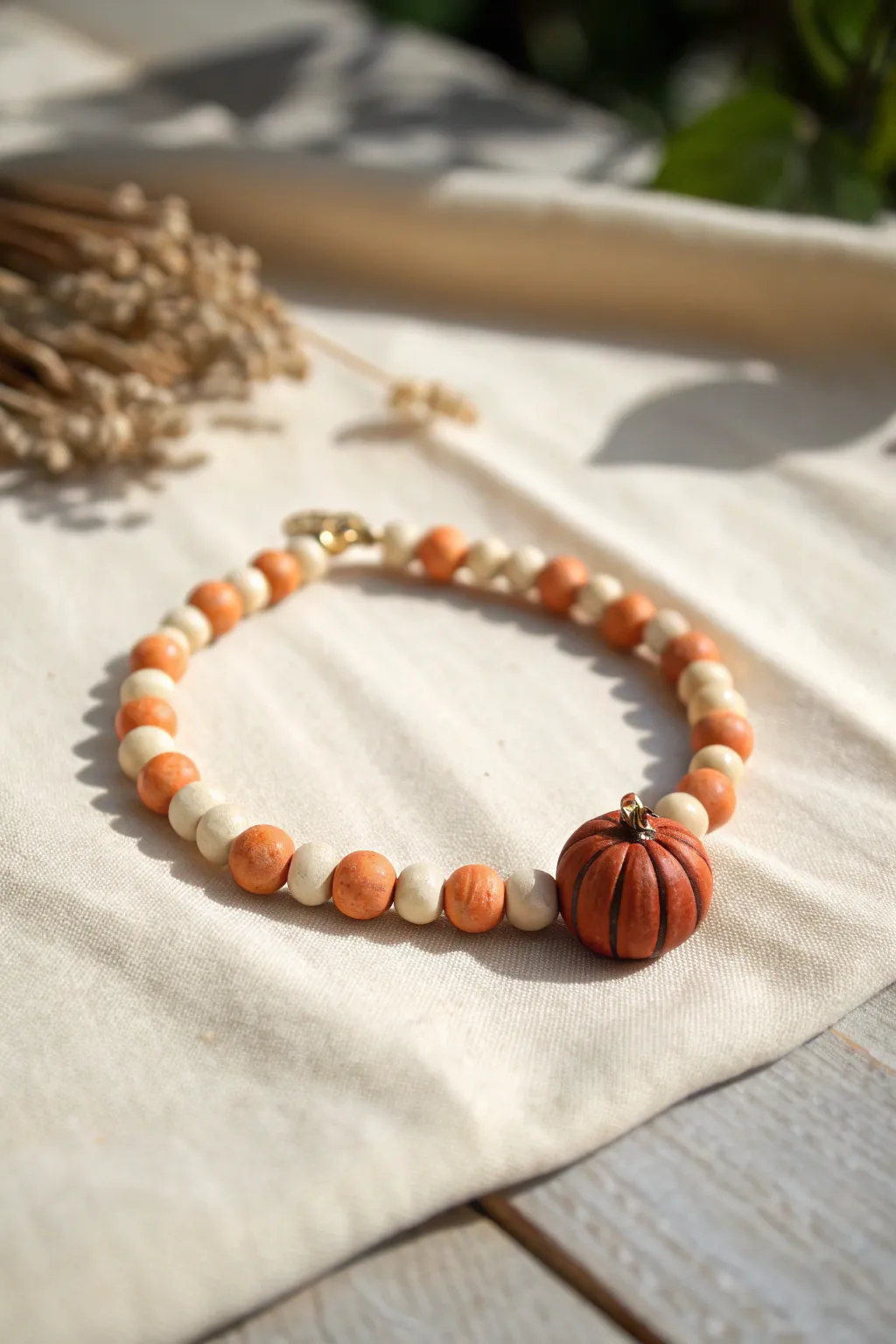
Celebrate the harvest season with this charming beaded bracelet featuring a delightful mini pumpkin as its focal point. The alternating pattern of natural wood and warm orange beads creates a rustic, earthy look perfect for cozy autumn days.
Step-by-Step Guide
Materials
- Polymer clay (burnt orange, dark brown, and gold/metallic)
- Small round wooden beads (natural unfinished)
- Small round wooden beads (dyed orange)
- Elastic stretch cord (0.8mm or 1mm)
- Clay sculpting tools (needle tool/toothpick)
- Super glue or jewelry glue
- Gold jump ring (optional, if making a dangling charm)
- Oven for baking clay
- Gloss glaze (optional)
Step 1: Sculpting the Pumpkin Charm
-
Prepare the Clay:
Begin by conditioning a small amount of burnt orange polymer clay until it is soft and pliable. Roll it into a smooth ball approximately the size of a large marble or a hazelnut. -
Shape the Pumpkin Body:
Gently press the ball down slightly to flatten the bottom and top, giving it a squat, pumpkin-like silhouette. -
Create the Ribs:
Use a needle tool or the side of a toothpick to press vertical indentations around the exterior of the ball. Start from the center top hole and drag down to the bottom center, repeating this all the way around to create the pumpkin’s distinctive segments. -
Add Realistic Details:
Take a tiny amount of dark brown clay and roll it into very thin, thread-like strings. Lay these gently into the indentations you just made to accentuate the shadows between the ribs. -
Form the Stem:
Roll a small piece of gold or metallic clay into a tiny cone shape. Attach this firmly to the top center of your pumpkin. -
Create the Attachment Point:
Carefully poke a horizontal hole through the upper part of the pumpkin (near the stem base) using a needle tool if you want it to string directly, or insert a small eye pin into the top if you prefer it to dangle. -
Bake:
Bake your clay pumpkin according to the manufacturer’s specific temperature and time instructions. I usually let mine cool completely in the oven to prevent cracking.
Clay Texture Tip
For a more organic look, lightly texture the orange clay with a piece of sandpaper or a toothbrush before baking to mimic real pumpkin skin.
Step 2: Assembling the Bracelet
-
Measure the Cord:
Cut a length of elastic stretch cord about 10-12 inches long. This extra length makes tying the final knot much easier. -
Pre-stretch the Elastic:
Give your cord a few firm tugs before stringing. This helps prevent the bracelet from stretching out and becoming loose after the first few times you wear it. -
Start the Pattern:
Begin threading your wooden beads onto the cord. Alternate between one natural bead and one orange bead to establish the striped pattern shown in the photo. -
Check Length:
Continue stringing until you have enough beads to cover almost your entire wrist circumference, leaving a gap of about 0.5 to 0.75 inches for the centerpiece. -
Add the Pumpkin:
Thread your baked and cooled pumpkin charm onto the cord. Since it is the focal point, ensure it sits centered between the ends of your bead strand. -
Verify Fit:
Wrap the unfinished strand around your wrist to check the size. It should fit comfortably snug without pinching. -
Tie the Knot:
Tie the ends of the elastic cord together using a surgeon’s knot (looping the cord through twice on the first pass). Pull it tight. -
Secure the Ends:
Place a tiny drop of super glue or jewelry glue directly onto the knot. Allow it to dry for a few moments to ensure it won’t slip. -
Hide the Knot:
Trim the excess cord ends close to the knot, then gently tug on the beads so the knot slides inside the hole of the nearest wooden bead, hiding it from view.
Level Up: Painted Accents
After baking, dry brush a tiny bit of white acrylic paint onto the pumpkin’s ridges to give it a rustic, farmhouse-style finish.
Slip on your new bracelet and enjoy the subtle touch of autumn flair it adds to your outfit
Acorn and Leaf Dangle Charm Fall Bracelet
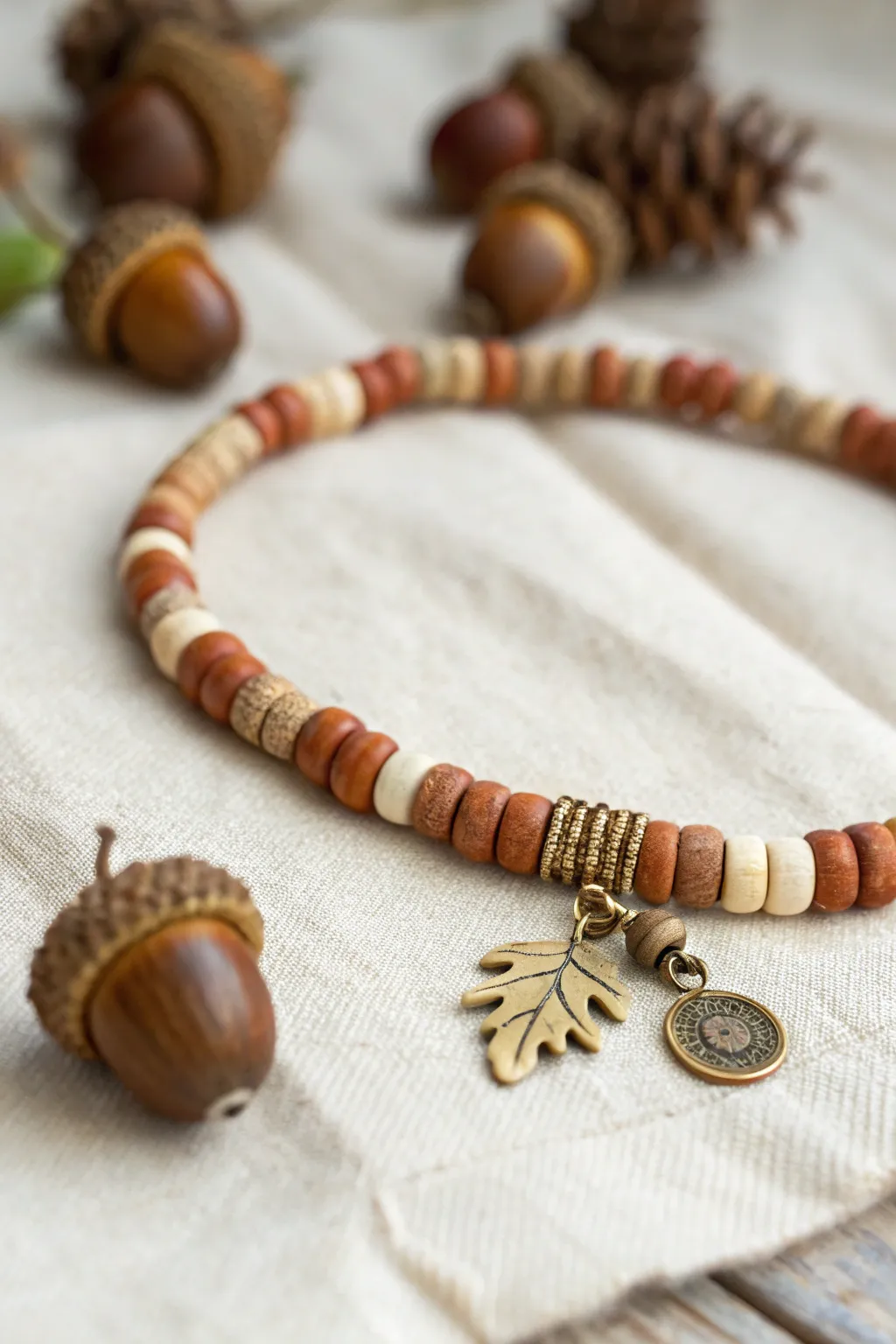
Embrace the cozy vibes of the season with this rustic, earth-toned bracelet featuring a mix of polymer clay spacer beads and charming autumnal dangles. The blend of terracotta, cream, and brown textured beads creates a warm palette that pairs perfectly with the brass acorn and leaf accents.
Detailed Instructions
Materials
- Durable elastic beading cord (0.7mm or 0.8mm)
- Heishi polymer clay spacer beads: Terracotta/burnt orange
- Heishi polymer clay spacer beads: Cream/off-white
- Textured wood or porous clay beads: Medium brown
- Gold-tone coiled spacer bails or jump ring hanger
- Gold-tone etched leaf charm
- Gold-tone circular coin charm
- Small jump rings (4mm-6mm)
- Small wooden accent bead (for charm dangle)
- Jewelry glue or clear nail polish
- Scissors
Step 1: Planning and Stringing
-
Measure your wrist:
Cut a length of elastic cord about 10-12 inches long. This generous length gives you plenty of room to knot securely later without the beads slipping off. -
Stretch the cord:
Before adding any beads, firmly tug on the elastic strand a few times. This ‘pre-stretching’ helps prevent the bracelet from sagging or loosening after you start wearing it. -
Establish the pattern:
Look closely at the bead sequence. The pattern shown relies on repeating segments: three terracotta heishi beads, one cream heishi bead, and one textured brown bead. -
Begin the beadwork:
Start threading your pattern onto the elastic. I like to secure one end with a piece of tape or a bead stopper so nothing slides off while I work. -
Check the length:
Continue the pattern until the beaded section wraps comfortably around your wrist. Aim for a fit that is snug but not tight, remembering that the charm cluster will add a focal point. -
Add the centerpiece:
Once your main strand is bead-filled, you need to add the focal section. Thread on a gold coiled spacer bail (or a large jump ring hanger) right in the middle of your pattern, or at the closure point if you prefer the charms near the knot.
Knotting Pro Tip
To ensuring your knot never slips, try the ‘stretch and fold’ method. After tying, stretch the knot while the glue is wet. It helps wiggle the knot deeper into the bead hole for a seamless finish.
Step 2: Creating the Charm Cluster
-
Prepare the leaf charm:
Open a small jump ring using two pairs of pliers (twist sideways, don’t pull apart). Attach the gold leaf charm to the ring. -
Attach the coin charm:
Using a separate jump ring and a headpin, or just threading directly if the hole allows, attach the circular coin charm. In the image, this charm hangs slightly lower than the leaf. -
Add the wooden accent:
Notice the small wooden bead sitting just above the coin charm. Thread a small headpin through this wooden bead, create a loop at the top, and attach it to the same jump ring holding the coin charm for a layered look. -
Cluster the charms:
Attach your prepared jump rings (one with the leaf, one with the coin/bead combo) onto the main bail or hanger you strung onto the bracelet earlier.
Level Up: Scented Beads
Use unfinished wooden beads for the brown accents and add a drop of essential oil (like cedarwood or cinnamon) to them. Your bracelet will carry a subtle, customized autumn scent.
Step 3: Finishing Touches
-
The surgeon’s knot:
Bring the two ends of your elastic cord together. Tie a standard overhand knot, then tie a second knot, passing the tail through the loop twice instead of once. -
Tighten securely:
Pull the cords tight from all four sides—pull the two tails, and pull the two beaded sides apart—to lock that knot firmly in place. -
Secure with glue:
Apply a tiny dab of jewelry glue or clear nail polish directly onto the knot. Let this dry completely before moving to the next step. -
Hide the knot:
Once the glue is dry, trim the excess elastic tails close to the knot. Carefully slide an adjacent large-hole bead (like one of the textured brown ones) over the knot to conceal it.
Slip this charming accessory on your wrist and enjoy a touch of fall elegance wherever you go
Halloween Night Fall Stack With Black Accents
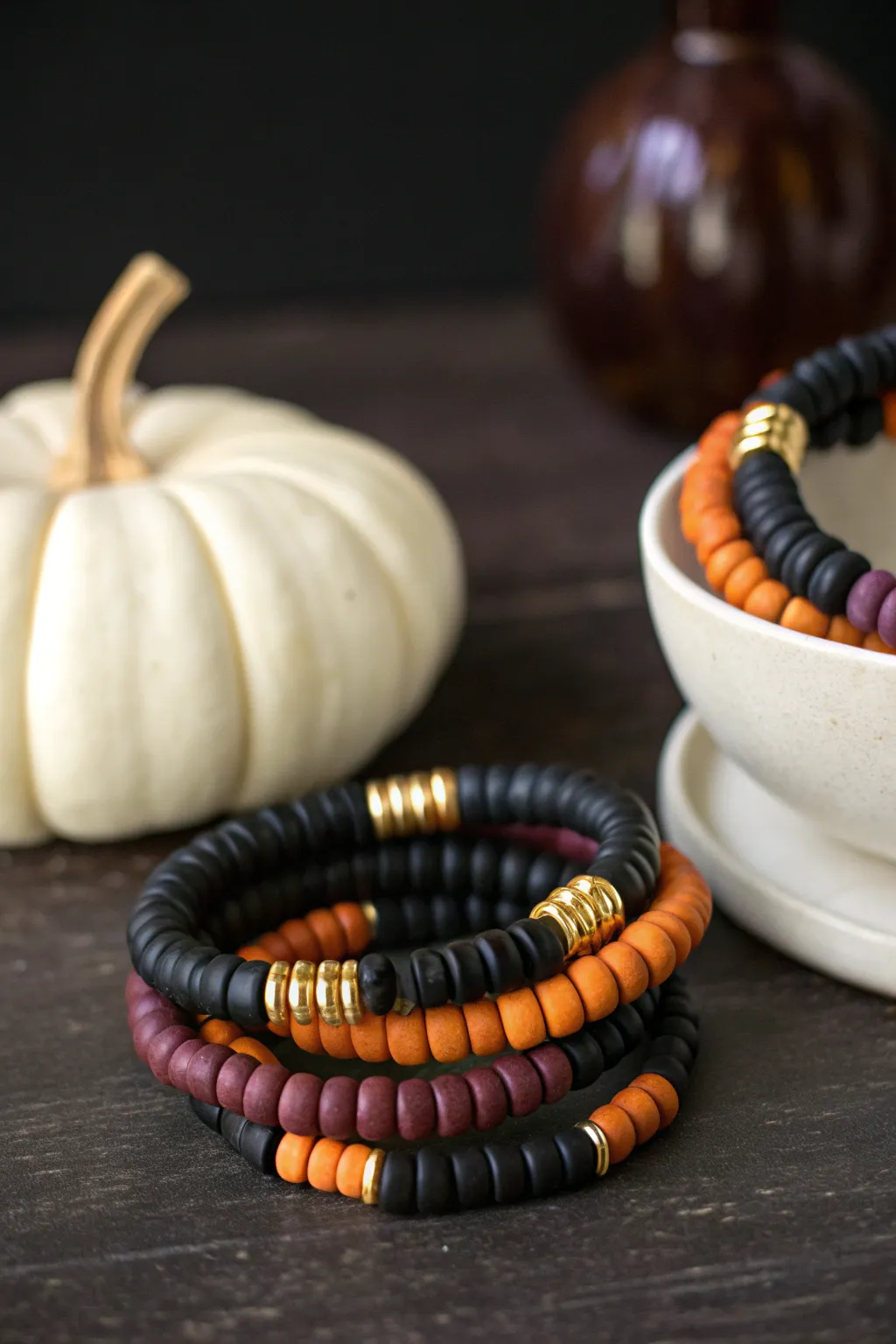
Embrace the eerie elegance of Halloween night with this striking stack of clay bead bracelets. Featuring a moody palette of matte black, burnt orange, and deep maroon accented by flashes of gold, this set adds a sophisticated touch to any autumn outfit.
Step-by-Step Tutorial
Materials
- 6mm polymer clay heishi beads (matte black)
- 6mm polymer clay heishi beads (burnt orange)
- 6mm polymer clay heishi beads (deep maroon/plum)
- 6mm gold hei-shi spacer beads or flat metal discs
- Strong elastic bead cord (0.7mm or 0.8mm)
- Jewelry glue or clear nail polish
- Scissors
- Bead stopper or tape
- Ruler or measuring tape
Step 1: Planning & Prep
-
Measure your wrist:
Before cutting any cord, wrap a measuring tape around your wrist to find your size. Add about 1/2 inch to this measurement for a comfortable fit, then add another 3-4 inches excess for tying the knot. -
Prepare the cord:
Cut three lengths of elastic cord based on your calculations. I like to pre-stretch the elastic slightly by pulling it gently; this often prevents the bracelet from stretching out too much later. -
Secure the ends:
Attach a bead stopper to one end of each cord. If you don’t have a stopper, a piece of masking tape folded over the end works perfectly to keep your beads from sliding off.
Step 2: Design 1: The Gold Triplet
-
Start with black:
Begin threading matte black heishi beads onto your first cord. Fill about one-third of your desired bracelet length with just the black discs. -
Add first gold section:
Slide on three gold spacer beads. These should sit tightly together to form a solid metallic block. -
Continue the pattern:
Add another section of black beads (about 1.5 to 2 inches), followed by another set of three gold spacers. Repeat this until you reach your desired length, aiming for 3-4 gold stations total.
Knot Slipping?
If your elastic knot feels loose, try tying the knot while the cord is under tension. Pulling tight as you glue helps lock the fibers together securely.
Step 3: Design 2: The Color Block
-
Start the sequence:
For the second bracelet, we want to mix the colors. Begin with about 1 inch of burnt orange beads. -
Add separation:
Thread on a single black bead, followed by a thick gold spacer, and another single black bead. This creates a bold divider. -
Switch to maroon:
Thread on about 1 inch of the deep maroon clay beads. -
Repeat the divider:
Add the black-gold-black divider sequence again. -
Finish with black:
Complete the rest of the strand with solid black beads to create an asymmetrical, modern look.
Add a Charm
Make it extra spooky by attaching a small gold skull, pumpkin, or spider charm to one of the gold spacer sections using a jump ring.
Step 4: Design 3: The Mixed Stripe
-
Create the pattern:
For the final bracelet in the stack, alternate small sections. Thread 10 black beads followed by 10 burnt orange beads. -
Insert accents:
Place a single gold spacer between every color switch to tie the whole collection together visually. -
Check sizing:
Wrap the unfinished strand around your wrist to double-check the fit against the other two before tying.
Step 5: Finishing Touches
-
Tie the surgeon’s knot:
Remove the stopper or tape. Cross the ends, loop one side through twice, and pull tight. Repeat this knotting process 2-3 times for security. -
Secure with glue:
Apply a tiny dab of jewelry glue or clear nail polish directly onto the knot. Let it dry completely before touching it to ensure it sets hard. -
Hide the knot:
Once dry, trim the excess elastic close to the knot. Gently tug the beads so the knot slides inside one of the larger bead holes to conceal it.
Wear your new stack together for maximum impact or share them with friends for a matching seasonal accessory
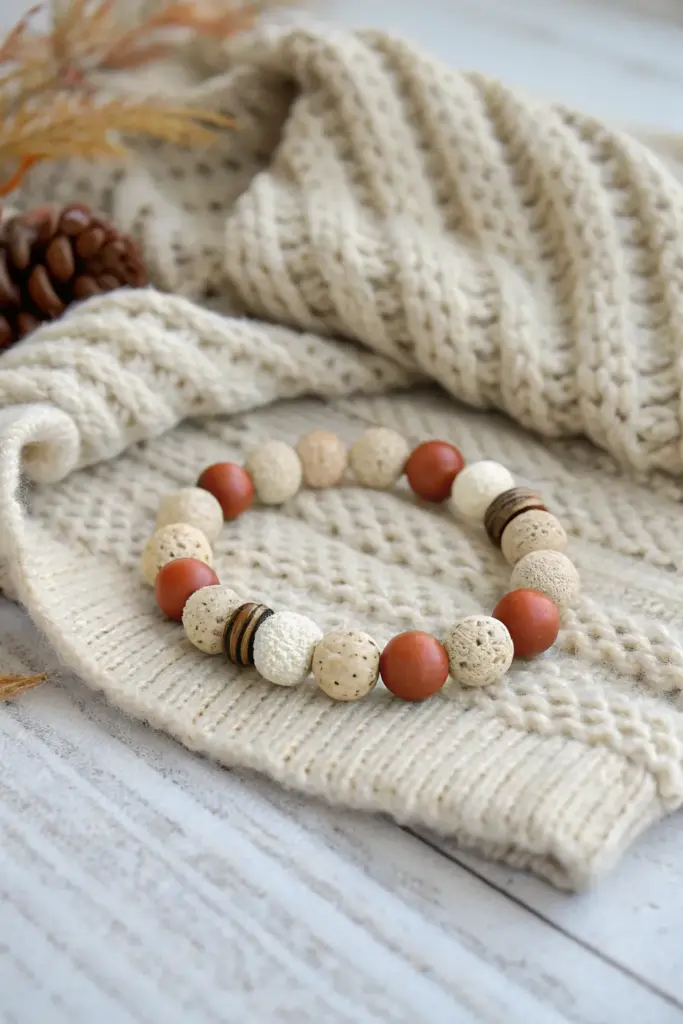
Cozy Sweater-Texture Beads in Warm Taupe
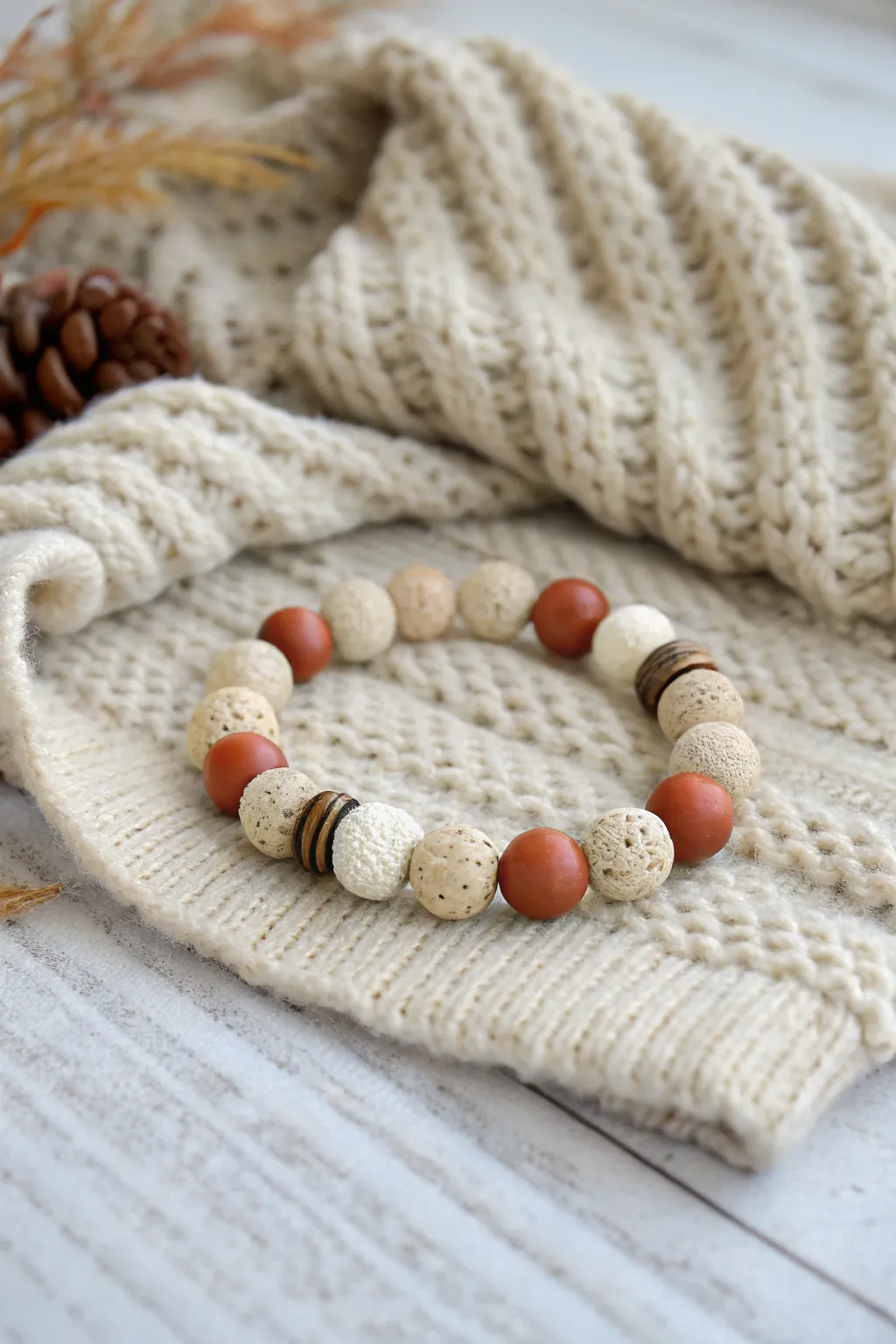
Bring the cozy feeling of your favorite fall sweater to your wrist with this earthy, textured bracelet. Combining porous lava stones, warm terracotta hues, and rustic wooden accents, this piece captures the essential palette of autumn.
Detailed Instructions
Materials
- Cream or antique white lava stone beads (10mm)
- Terracotta or rust-colored matte round beads (10mm)
- Dark wood coin spacers or heishi beads
- Striped wooden accent beads (optional alternative)
- Strong elastic beading cord (0.8mm or 1mm)
- Bead stopper or masking tape
- Jewelry adhesive (e.g., G-S Hypo Cement or E6000)
- Scissors
Step 1: Planning Your Design
-
Measure your wrist:
Before you begin, measure your wrist with a flexible measuring tape. Add about 1/2 to 3/4 of an inch to this measurement to ensure the bracelet fits comfortably without being too tight, especially given the bulk of 10mm beads. -
Lay out the pattern:
Start by arranging your beads on a bead board or a towel to prevent them from rolling away. For this specific look, you’ll want to create an alternating rhythm between the light textured surfaces and the smooth warm tones. -
Establish the rhythm:
Identify your pattern. The design shown typically uses a sequence like: three cream lava beads, one rust bead, one cream lava bead, one wood accent, one rust bead. This irregular pattern gives it an organic, handmade feel rather than a strict factory-made symmetry. -
Position the focal points:
Decide where you want your darkest elements. The wooden washer beads act as visual anchors. I like to sandwich a cream bead between two rust beads, or place the wood element next to a cream bead to make the texture pop.
Aromatherapy Hack
Lava stones are naturally porous. Add a drop of cinnamon or cedarwood essential oil to the white beads to make your bracelet smell like autumn.
Step 2: Stringing the Beads
-
Prepare the cord:
Cut a length of elastic cord about 12 inches long. This gives you plenty of extra room for tying knots later. Pre-stretch the cord by pulling it gently a few times; this prevents the bracelet from stretching out permanently after wearing it. -
Secure the end:
Attach a bead stopper or a piece of masking tape to one end of the cord so your beads don’t slide off while you work. -
Begin threading:
Start stringing your beads according to your laid-out design. Pay attention to the hole sizes of your lava beads; sometimes the natural pores can be mistaken for the hole, so ensure you are threading through the center. -
Incorporate texture:
When adding the wooden spacers, ensure they sit flush against the round beads. If you are using striped wooden beads, check that the grain or stripes align horizontally with the cord for a tidy appearance. -
Check the length:
Once all beads are strung, wrap the strand around your wrist to check the fit. It should sit comfortably without gaps showing between beads, but not dig into your skin. Add or remove a bead if necessary.
Add Metallic Warmth
Intersperse tiny antique copper or brass spacer beads between the stone beads. The metal adds a subtle shine that complements the rust tones perfectly.
Step 3: Finishing the Bracelet
-
Prepare to knot:
Remove the bead stopper carefully, holding both ends of the elastic securely. Bring the two ends together to form a circle. -
Tie the first knot:
Tie a simple overhand knot. Pull the elastic tight enough so the beads touch, but not so tight that the bracelet puckers or curls. -
The surgeon’s knot:
Tie a surgeon’s knot for extra security. This is like a standard square knot, but you loop the cord through twice before pulling tight. This extra friction helps hold the elastic in place. -
Apply adhesive:
Put a tiny drop of jewelry adhesive directly onto the knot. You don’t need much—just enough to fuse the cord fibers. -
Hide the knot:
While the glue is still slightly tacky, pull the elastic firmly so the knot slides inside the hole of the nearest large bead (preferably a lava bead, as their holes are often larger). -
Trim the excess:
Once the glue has fully dried (check your glue instructions for timing), trim the excess cord ends carefully with sharp scissors, getting as close to the bead hole as possible without cutting the knot.
Slip on your new textured accessory and enjoy the cozy autumn vibes all season long