
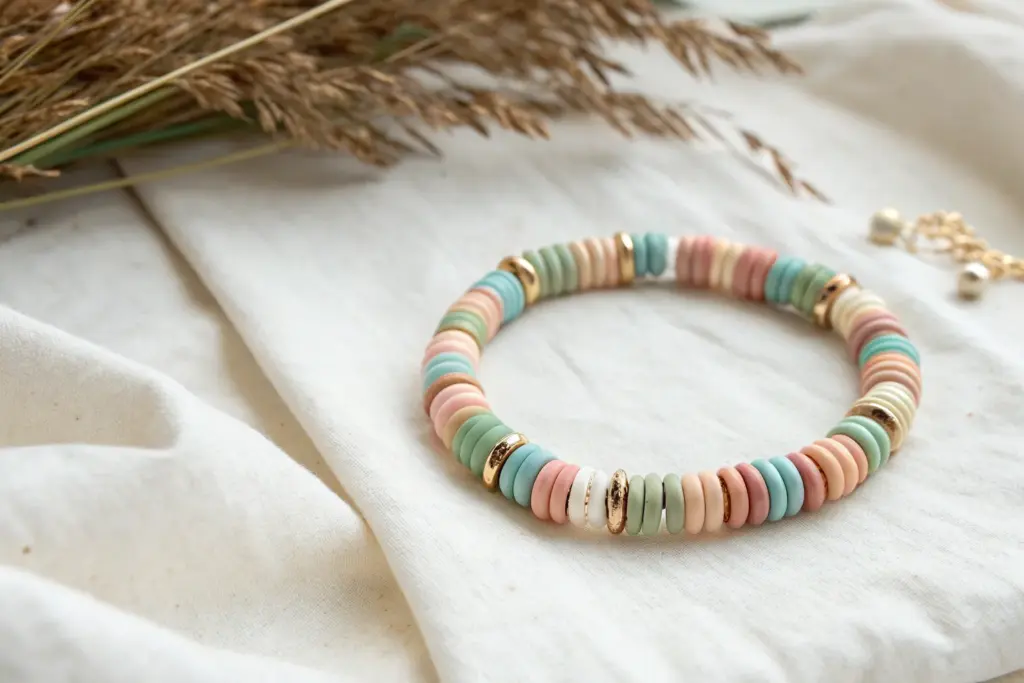
If you’ve got a bowl of polymer clay beads and an itch to make something cute in one sitting, clay bead bracelets are the happiest little project. Here are my favorite polymer clay bead bracelet ideas—starting with the classics everyone loves, then drifting into the fun “ooh, I have to try that” designs.
Classic Rainbow Heishi Stack
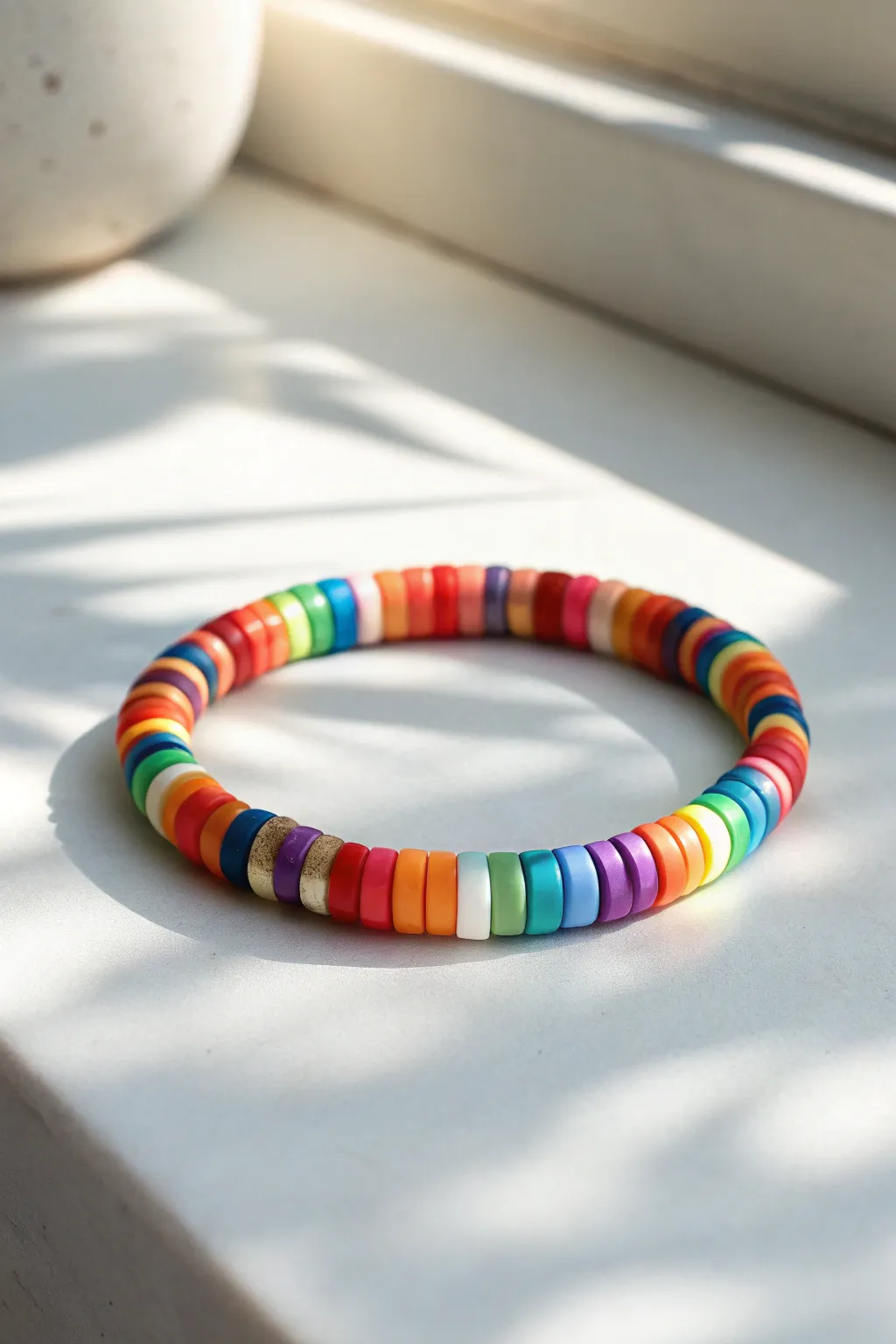
Brighten up your wrist stack with this vibrant burst of color featuring smooth polymer clay heishi beads. This cheerful design mixes a complete spectrum of hues with subtle gold accents for a polished, professional finish.
Step-by-Step
Materials
- Polymer clay heishi beads (6mm diameter) in varied rainbow colors: red, orange, yellow, green, teal, blue, purple, light pink, hot pink, white
- 2 Gold spacer beads (heishi style, brass or gold-plated)
- Elastic jewelry cord (0.8mm or 1mm thickness)
- Jewelry glue or clear nail polish
- Scissors
Step 1: Preparation
-
Measure Your Wrist:
Wrap the elastic cord loosely around your wrist to find the perfect fit. Add about 3-4 inches of extra length to both ends to ensure you have plenty of room for tying the finishing knot. -
Pre-stretch the Cord:
Before adding any beads, give your cut piece of elastic a few gentle tugs. This is a crucial step that helps prevent the finished bracelet from stretching out and becoming loose over time. -
Plan Your Pattern:
Lay your beads out on a bead board or a piece of felt cloth. You will need to organize your colors into small groups of 3-5 monochromatic beads, but keep the order random to achieve that effortless, mixed rainbow look. -
Secure the End:
Attach a piece of tape or a bead stopper to one end of your elastic cord so your beads don’t slide right off while you work.
Tape Trick
Using a bead board? Stick a strip of masking tape sticky-side-up to your table to hold beads in order before stringing them.
Step 2: Stringing the Beads
-
Start the Sequence:
Begin threading your beads onto the elastic. Start with a block of color, for example, four dark purple beads. -
Build the Rainbow blocks:
Continue adding small blocks of single colors. For this specific look, aim for 2-4 beads of the same color before switching to a contrasting one. -
Vary the Block Sizes:
Don’t make every color block identical. Use two light blue beads, then perhaps three dark blue ones, followed by a single teal bead. This irregularity keeps the design playful. -
Insert the First Gold Accent:
Once you have strung about one-third of your bracelet length, slide on your first gold spacer bead. I like to sandwich it between two darker colors, like purple and navy, to make the metal pop. -
Continue the Color Run:
Resume your color blocking pattern. Introduce your warmer tones now—yellows, oranges, reds, and pinks—keeping the segments short and sweet. -
Add White Highlights:
Make sure to intersperse a few small sections of white or cream beads. These act as palate cleansers and make the other bright colors stand out more clearly. -
Place the Second Gold Accent:
Add the second gold spacer bead just a few beads away from the first one (separated by a small block of color like purple). This asymmetrical placement creates a distinct focal point. -
Check the Fit:
Wrap the unfinished strand around your wrist to check the length. The ends should touch comfortably without stretching the elastic too much. Add or remove beads as needed.
Knot Slipping?
If your slippery elastic keeps untying before you can glue it, try a ‘surgeon’s knot’—loop the elastic through twice on the first pass for extra grip.
Step 3: Finishing
-
Tie the Knot:
Remove the tape or stopper. Bring the two ends of the elastic together and tie a standard square knot (right over left, left over right). -
Secure with Glue:
Apply a tiny drop of jewelry glue or clear nail polish directly onto the knot. This seals the fibers and prevents the slippery elastic from coming undone. -
Hide the Knot:
While the glue is still slightly tacky but not wet, gently pull the knot inside the hole of the nearest bead to conceal it. -
Trim Excess:
Once the glue is fully dry, use your scissors to snip off the excess tail ends of the elastic as close to the bead as possible.
Now you have a happy, colorful accessory that is ready to wear alone or stack with your favorite gold jewelry

Simple Monochrome Minimal Bracelet
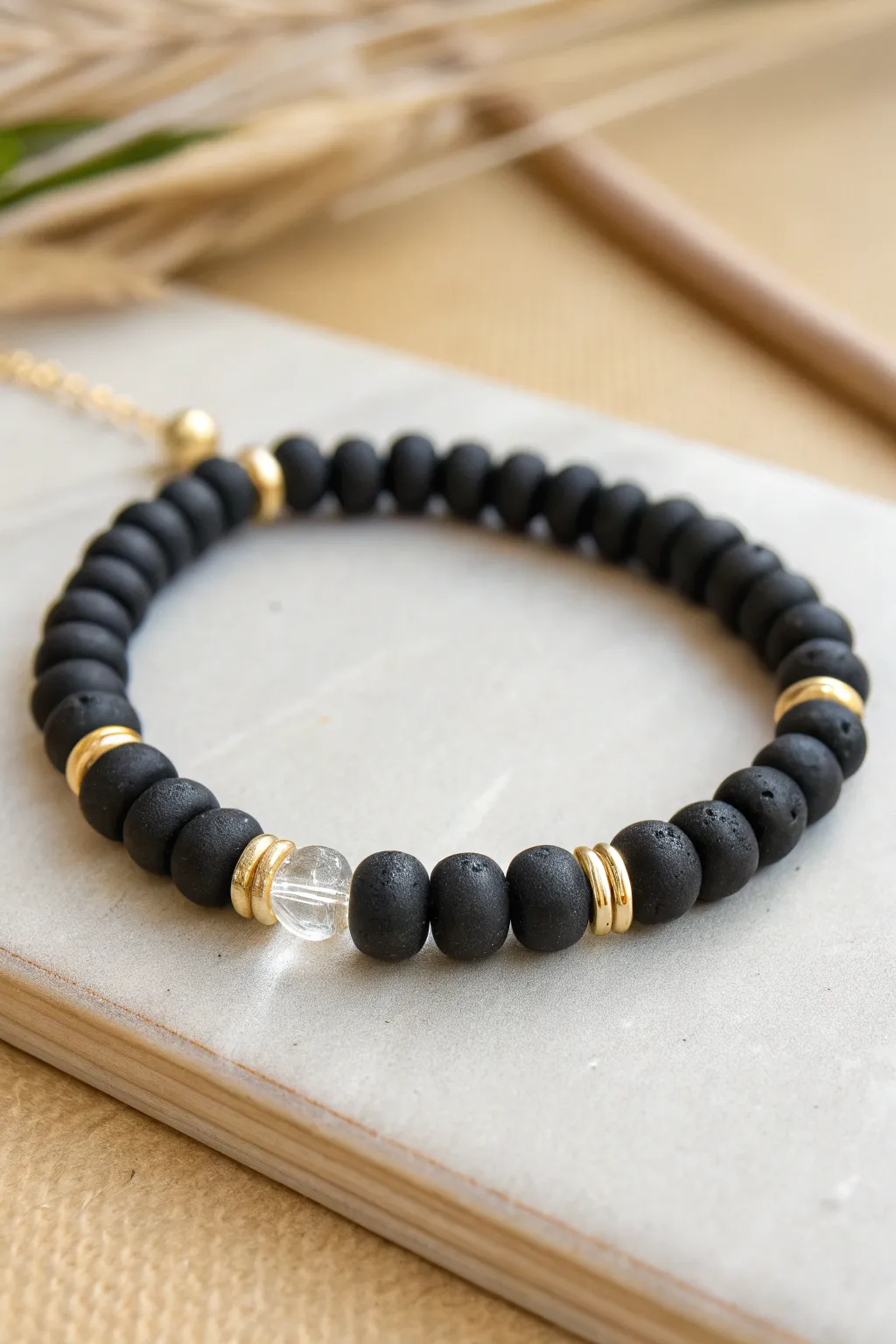
Embrace sophistication with this ultra-minimal bracelet that pairs the matte texture of black polymer clay with striking gold spacers. This design proves that simple monochrome palettes can make a bold statement, especially when highlighted by a single translucent focal bead.
Step-by-Step Guide
Materials
- Black polymer clay (e.g., Fimo Soft or Premo)
- Translucent polymer clay or pre-made clear quartz bead (approx 6-8mm)
- Gold-plated spacer beads (disc or ring shape)
- Gold-plated nugget bead (optional, near clasp)
- Elastic beading cord (0.8mm recommended)
- Bead roller tool (optional but helpful for consistency)
- Needle tool or toothpick
- Medium grit sandpaper (optional for texture)
- Super glue or jewelry adhesive
- Scissors
Step 1: Crafting the Clay Beads
-
Condition the clay:
Start by warming your black polymer clay in your hands. Knead it thoroughly until it is soft, pliable, and free of any air bubbles. -
Portion the clay:
Roll the clay into a long snake about the thickness of a pencil. Use a clay blade to slice equal sized segments—aim for pieces that will roll into 6mm balls. -
Roll spheres:
Take each segment and roll it between your palms to create a smooth sphere. I often check the first few against a ruler to ensure I’m hitting that 6mm size. -
Create texture (optional):
To mimic the matte, slightly porous look in the photo, gently roll the uncured beads over a piece of medium-grit sandpaper or tap them lightly with a stiff toothbrush. -
Pierce the beads:
Using your needle tool or a toothpick, carefully pierce a hole through the center of each bead. Twist the tool gently as you push through to avoid distorting the round shape. -
Bake the clay:
Arranged your beads on a baking sheet lined with parchment paper. Bake according to the manufacturer’s instructions (usually around 230°F – 275°F for 15-30 minutes). Let them cool completely.
Step 2: Assembly & Design
-
Prepare the cord:
Cut a length of elastic cord about 10-12 inches long. This gives you plenty of extra room to tie knots without struggling. -
Pre-stretch the elastic:
Give the cord a few firm tugs. This is a crucial step that prevents your bracelet from sagging or stretching out permanently after the first wear. -
Start the pattern:
Thread on about 10 to 12 black clay beads to start the back section of the bracelet. -
Add first accents:
Slide on a gold spacer ring, followed by three black beads, and then another gold spacer ring. This creates a symmetrical flank. -
The focal point:
Add three black beads, then flank your translucent focal bead with two stacked gold spacers on either side to frame it beautifully. -
Finish the symmetry:
Reverse the pattern: add three black beads, a gold spacer, three black beads, another gold spacer, and finish with the remaining black beads needed to fit your wrist.
Clean Bead Holes
If your bead holes shrank during baking, use a small hand drill or bead reamer to widen them before stringing. This protects the elastic from fraying.
Step 3: Finalizing the Piece
-
Add the clasp accent:
Thread the optional gold nugget bead last; this adds a professional finish near where the knot will reside. -
Check the fit:
Wrap the strand around your wrist to check the sizing. It should be snug but not tight. Add or remove black beads from the ends if necessary. -
Tie the knot:
Tie a surgeon’s knot (right over left, left over right twice). Pull the cords tight until you feel the elastic give slightly. -
Secure the bond:
Apply a tiny dab of jewelry glue or super glue specifically to the knot. Let it dry for a moment before trimming the excess cord close to the knot.
Stone Effect
Mix a tiny pinch of white or grey clay into your black clay but don’t blend fully. This creates a marbled ‘real stone’ variety to your matte beads.
Enjoy styling this versatile piece alongside a gold watch or heavily stacked with other monochromatic bracelets

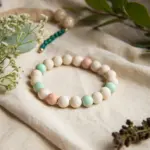

Pastel Ombre Gradient Bracelet
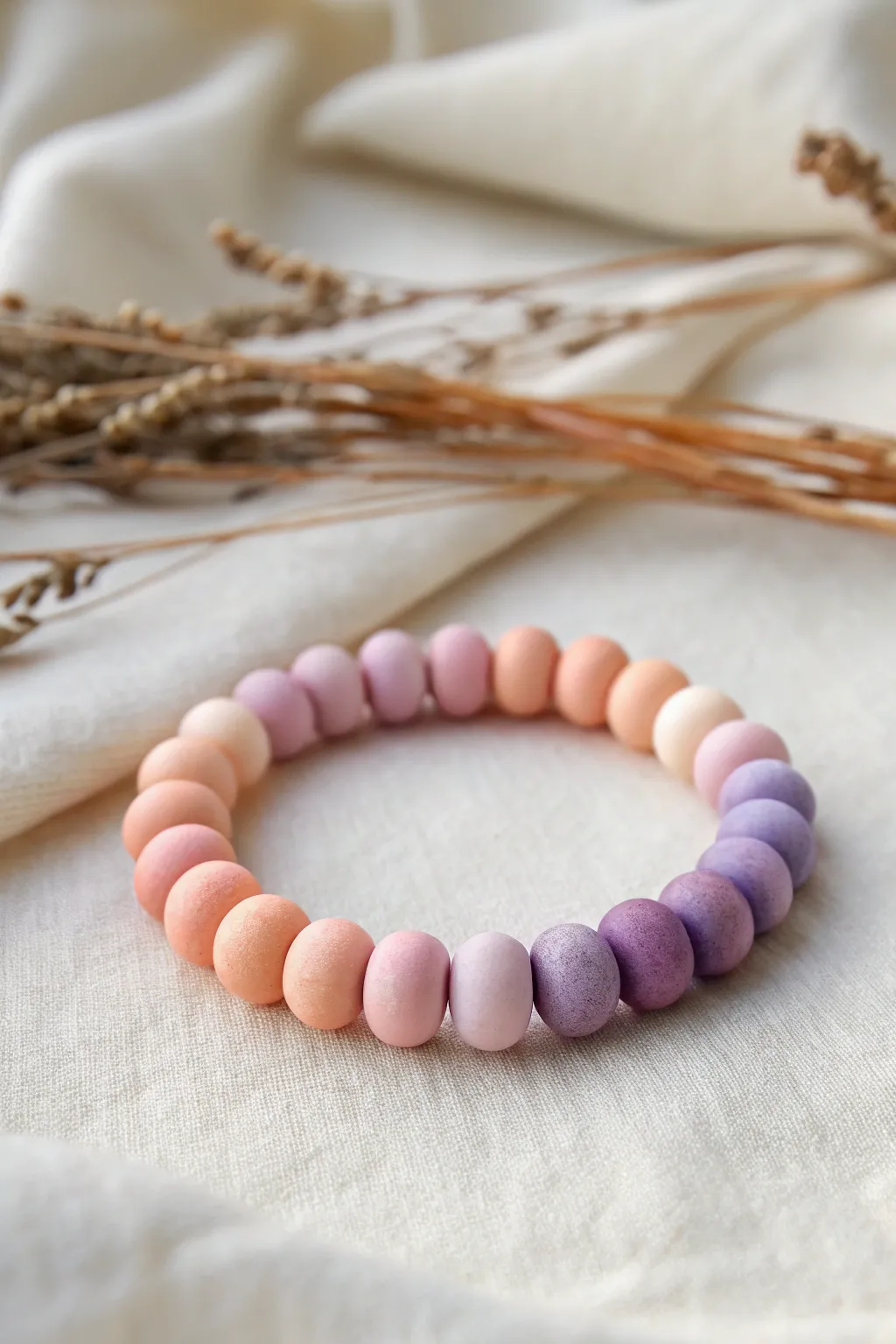
Capture the soft hues of a sunset with this polymer clay bracelet, showcasing a seamless gradient from delicate peach to deep lavender. The slightly textured, matte beads give it a modern, organic feel that’s perfect for stacking or wearing as a standalone statement piece.
Step-by-Step Tutorial
Materials
- Polymer clay (white, peach/orange, pink, purple/violet)
- Acrylic rolling pin or clay conditioning machine
- Small round clay cutter (approx. 1cm diameter) or a straw
- Bead piercing pin or needle tool
- Sandpaper or a stiff toothbrush (for texture)
- Elastic jewelry cord (0.8mm or 1mm)
- Super glue or jewelry cement
- Parchment paper-lined baking sheet
- Oven
Step 1: Color Mixing Mastery
-
Condition the clay:
Start by warming up your white, peach, pink, and purple clays in your hands until they are soft and pliable. This prevents cracking later on. -
Create your base tones:
You need a spectrum of colors. To achieve that seamless ombre, you rarely use colors straight from the packet. Mix small amounts of white into your main colors to soften them into pastels. -
Blend custom shades:
To bridge the gap between peach and pink, mix a tiny marble-sized ball of peach clay with a ball of pink clay. Repeat this process for the transition between pink and purple, creating as many intermediate shades as you desire. -
Organize your gradient:
Line up your balls of clay on your work surface in their color order: Peach -> Peach-Pink -> Pink -> Pink-Lavender -> Lavender -> Purple. Visualizing the layout now ensures you have enough clay for the full loop.
Step 2: Shaping the Beads
-
Roll spheres:
Pinch off equal amounts of clay from each color blend. Roll them between your palms into consistent spheres, aiming for about 10-12mm in diameter. -
Flatten slightly:
Gently press each sphere down on your work surface with your thumb or an acrylic block. You want a thick disc shape, not a flat pancake—think of a chubby rondelle shape. -
Add texture (optional):
The beads in the image have a lovely, subtle matte texture. I like to gently roll the surface of the unbaked bead over a piece of medium-grit sandpaper or tap it lightly with a stiff toothbrush to mimic this stone-like effect. -
Pierce the holes:
Using your bead piercing pin, carefully drill a hole through the center of each disc. Twist the pin as you push to avoid squishing the bead’s shape. -
Refine the openings:
Flip the bead over and poke the pin through the other side to ensure the hole is clean and open on both ends.
Fixing Wonky Holes
If you squash a bead while piercing it, don’t panic. Simply re-roll it gently between your fingers while the pin is still inside to restore the round shape before pulling the tool out.
Step 3: Baking and Assembly
-
Arrange for baking:
Place your beads on a baking sheet lined with parchment paper. Ensure they aren’t touching each other so they don’t fuse together. -
Bake the clay:
Bake according to your specific polymer clay brand’s instructions (usually around 275°F/135°C for 15-30 minutes). Do not overbake, as lighter pastels can darken or scorch easily. -
Cool down:
Let the beads cool completely on the tray before handling. They are fragile when hot but harden as they cool. -
Test the arrangement:
Lay out the cooled beads in your ombre circle again to double-check the gradient flow before stringing. -
String the beads:
Cut a length of elastic cord about 10 inches long. Thread your beads corresponding to your color gradient. -
Check the fit:
Wrap the strand around your wrist to check the size. Add or remove beads if necessary to get a comfortable fit. -
Tie the knot:
Tie a strong surgeon’s knot (right over left, left over right). Pull the elastic tight to secure the knot. -
Secure and hide:
Add a tiny drop of super glue to the knot. Once dry, trim the excess cord ends and gently tug the knot inside one of the bead holes to hide it.
Level Up: Gold Accents
Add sophistication by inserting tiny gold spacer beads or flat gold discs between every third polymer bead. The metallic shine makes the matte pastel colors pop beautifully.
Enjoy styling your new handmade accessory individually or stacked with other textures

Color-Blocked Stripes With Gold Spacers
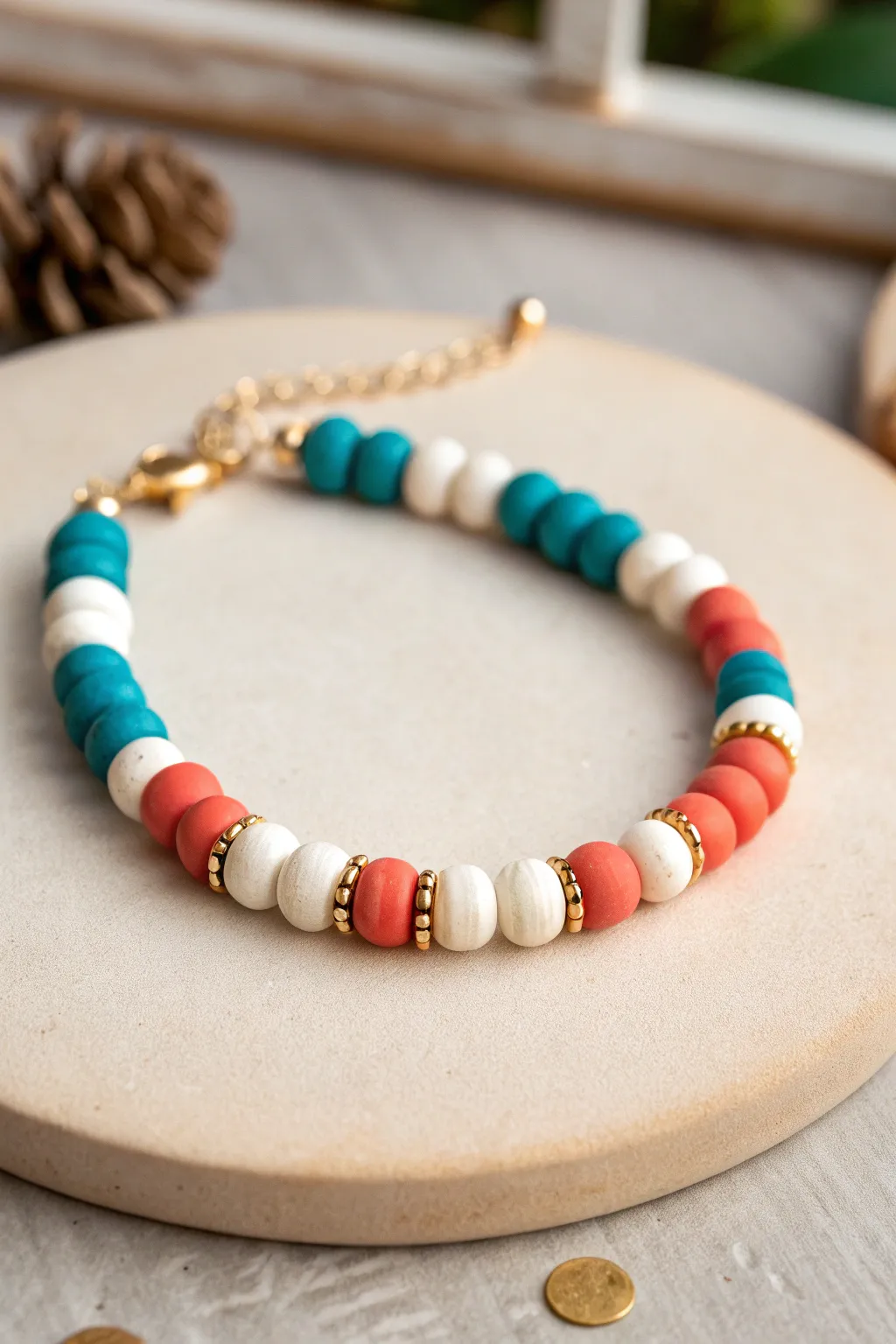
Capture the hues of a coastal sunset with this elegant color-blocked bracelet design. Combining matte polymer clay heishi beads in varied widths with shimmering gold accents creates a sophisticated accessory perfect for stacking or wearing solo.
Step-by-Step
Materials
- Teal polymer clay heishi beads (approx. 6mm disc style)
- Coral/terracotta polymer clay heishi beads (approx. 6mm disc style)
- White or cream polymer clay heishi beads (approx. 6mm disc style, varying thicknesses)
- Gold tone metal spacer beads (small rondelle or daisy shape)
- Gold tone lobster clasp
- Gold tone extension chain
- 2 small gold jump rings (4mm or 5mm)
- Beading wire (flexible, 7-strand or 49-strand coated wire)
- 2 gold tone crimp beads
- Wire cutters
- Chain nose pliers
- Crimping pliers (optional but recommended)
Step 1: Preparation and Planning
-
Measure your wrist:
Before cutting any wire, measure your wrist with a flexible measuring tape. Add about 1 inch to this measurement to account for the bulk of the larger beads and the clasp assembly. -
Cut the beading wire:
Cut a length of beading wire that is at least 3-4 inches longer than your final desired length. This extra length is crucial for easy handling when attaching the clasps later. -
Sort your beads:
Organize your teal, coral, and white clay beads into piles. Notice that some are slightly thicker than others; grab your gold spacers so they are ready to act as dividers. -
Attach the first clasp component:
Thread a crimp bead onto one end of your wire, followed by a jump ring attached to the extension chain. Loop the wire back through the crimp bead. -
Secure the first end:
Slide the crimp bead close to the jump ring (leave a tiny bit of wiggle room) and use your crimping pliers or chain nose pliers to flatten it securely. Trim the short excess wire tail, but leave just enough to tuck into the first few beads.
Uneven Bead Edges?
Polymer clay beads can have rough edges. If a bead looks jagged, rub the edge gently against a nail file or fine sandpaper before stringing it to smooth the silhouette.
Step 2: Beading the Pattern
-
Start with the teal block:
Begin threading your beads. Start with a block of teal beads. Use approximately 4-6 teal discs to create a solid section of color about 1-1.5cm long. -
Add a white contrast:
Following the teal, string on roughly 3-4 white beads. This creates a crisp, clean break between the deeper colors. -
Repeat the teal:
String another block of teal beads, matching the length of your first teal section to maintain symmetry at the ends of the bracelet. -
Transition to white:
Add a slightly longer section of white beads now, perhaps 4-5 beads, to act as a buffer before the warm tones begin. -
Begin the coral section with spacers:
This is the central feature. String on a block of coral beads. After about 4 coral beads, slide on a gold spacer, then two white beads, then another gold spacer. -
Create the central focal point:
Continue the pattern: add a small block of coral (3 beads), a gold spacer, two white beads, a gold spacer, and another block of coral. I find laying this pattern out on a bead board first helps visualize the spacing. -
Mirror the pattern:
Now, reverse the sequence to finish the second half. Add your white buffer section, followed by a teal block, a small white section, and a final teal block. -
Check the length:
Wrap the beaded wire around your wrist to check the fit. If it’s too short, add a few more beads to the ends of the teal sections; if too long, remove a bead or two from each end.
Crimp Cover Upgrade
To make your finish look store-bought, clamp a gold crimp cover over your flattened crimp bead. It looks just like a gold bead and hides the mechanical connection.
Step 3: Finishing Touches
-
Prepare the final crimp:
Thread a crimp bead onto the open end of the wire, followed by the remaining jump ring attached to the lobster clasp. -
Loop and tighten:
Pass the wire back through the crimp bead and pull it tight. Ensure there are no large gaps between your beads, but don’t pull so tight that the bracelet becomes stiff and rigid. -
Secure the second end:
Flatten the crimp bead firmly with your pliers. Give the wire a gentle tug to ensure it is locked in place. -
Hide the tail:
Thread the remaining wire tail back through the first few teal beads adjacent to the clasp. This hides the sharp end and adds extra security. -
Trim excess wire:
Using your flush cutters, snip off any remaining wire as close to the beads as possible so nothing pokes your wrist.
Now you have a stunning, beach-ready accessory ready to elevate your outfit.

The Complete Guide to Pottery Troubleshooting
Uncover the most common ceramic mistakes—from cracking clay to failed glazes—and learn how to fix them fast.
Name or Word Bracelet With Letter Beads
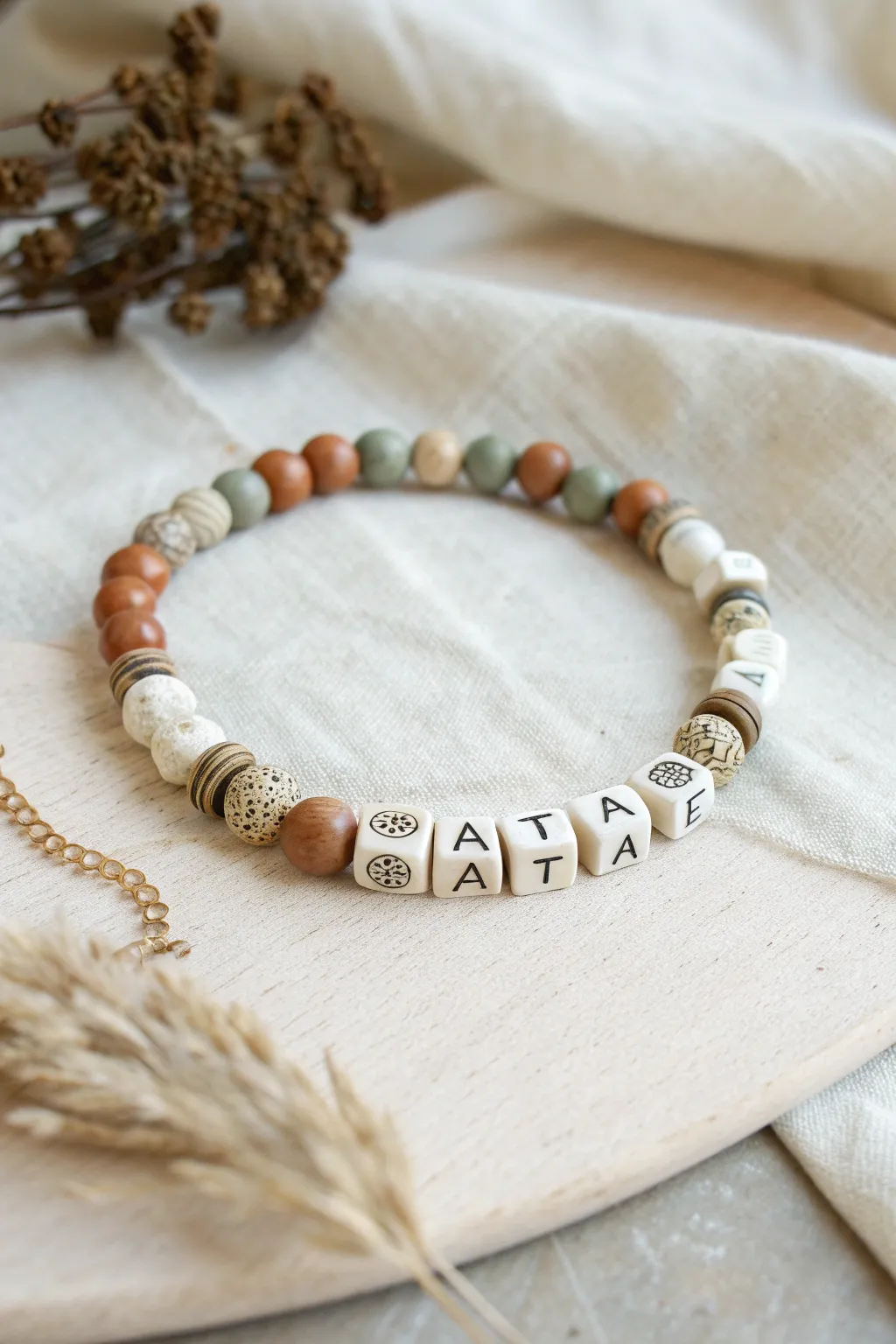
This rustic, nature-inspired bracelet combines muted greens, browns, and creams for a grounded aesthetic. Featuring a mix of wooden, stone, and polymer clay textures alongside personalized letter beads, it’s a perfect accessory for effortless, everyday style.
Detailed Instructions
Materials
- Elastic stretch cord (0.7mm or 0.8mm)
- White square letter beads (A, T, E shown here)
- Small decorative symbol beads (square, matching letter beads)
- Brown wooden round beads (approx. 6mm)
- Muted sage green round beads (polymer clay or matte stone, approx. 6mm)
- Speckled or textured cream round beads (polymer clay or stone)
- patterned polymer clay spacer beads (disc or round)
- Beading needle (optional but helpful)
- Scissors
Step 1: Planning and Preparation
-
Measure your wrist:
Start by measuring your wrist circumference with a flexible tape measure. Add about half an inch to this measurement to ensure the bracelet fits comfortably without pinching. -
Cut the cord:
Cut a piece of elastic cord roughly 10-12 inches long. Having this extra length makes tying the final knot significantly easier than struggling with short ends. -
Pre-stretch the elastic:
Hold the ends of your cut cord and give it a few firm tugs. This pre-stretching prevents the bracelet from loosening up and sagging immediately after you wear it. -
Layout your design:
Using a bead design board or a piece of felt, lay out your beads in the desired order. This is crucial for visualizing the pattern, especially with the letter spacing. -
Secure the end:
Place a piece of tape or a bead stopper on one end of the cord so your beads don’t slide off while you work.
Step 2: Creating the Pattern
-
Start with the focal point:
Begin by stringing the central customized section. Thread a decorative symbol bead, followed by the letter ‘A’, then ‘T’, then ‘A’, then ‘E’, and finish with another symbol bead. Notice how the example uses a symbol block on either end to frame the word. -
Add flanking beads:
On both sides of your letter block, add a medium-sized brown wooden bead. This helps transition from the square shape of the letters to the round beads of the strand. -
Build the first textured section:
Working outwards from the wooden beads, add a speckled cream bead, followed by a flat disc spacer or patterned bead, and then another speckled bead. Repeat this on the other side to maintain symmetry. -
Create the color run:
Now, start stringing the main body of the bracelet. Alternate between the brown wooden beads and the sage green beads. I like to group them slightly—perhaps two browns, then a green, then a patterned beige bead—to keep the look organic rather than perfectly rigid. -
Incorporate patterned accents:
Intersperse the patterned polymer clay beads (the ones looking like stone or etched clay) every 3 or 4 beads to add visual interest to the back of the bracelet. -
Check the length:
Wrap the unfinished strand around your wrist to check the size. Add or remove the simple green and brown beads at the ends until the two ends of the cord meet comfortably without gaps.
Knot Slipping?
If your elastic knot feels insecure, apply a tiny dab of jewelry glue or clear nail polish to the knot before trimming the ends. Let it dry completely before hiding it inside a bead.
Step 3: The Finishing Knot
-
Prepare for the knot:
Remove the tape or stopper. Bring the two ends of the elastic together carefully. -
Tie a surgeon’s knot:
Cross the ends like a standard knot, but loop the top strand through twice instead of once. Pull it tight, but be gentle so the elastic doesn’t snap. -
Secure with a second knot:
Tie a regular overhand knot on top of your surgeon’s knot for extra security. Pull all four strands (the two tails and the two loop sides) to cinch it down firmly. -
Hide the knot:
Trim the excess cord, leaving about 2mm of tail. If the hole of a neighboring bead is large enough, gently slide that bead over the knot to conceal it.
Add Texture
Swap smooth round beads for lava stones. Not only do they add a porous texture that matches the earthy vibe, but you can also add essential oils to them for a scented accessory.
Slip on your new custom bracelet and enjoy the personalized, natural touch it adds to your outfit
Preppy Brights With Fun Charms
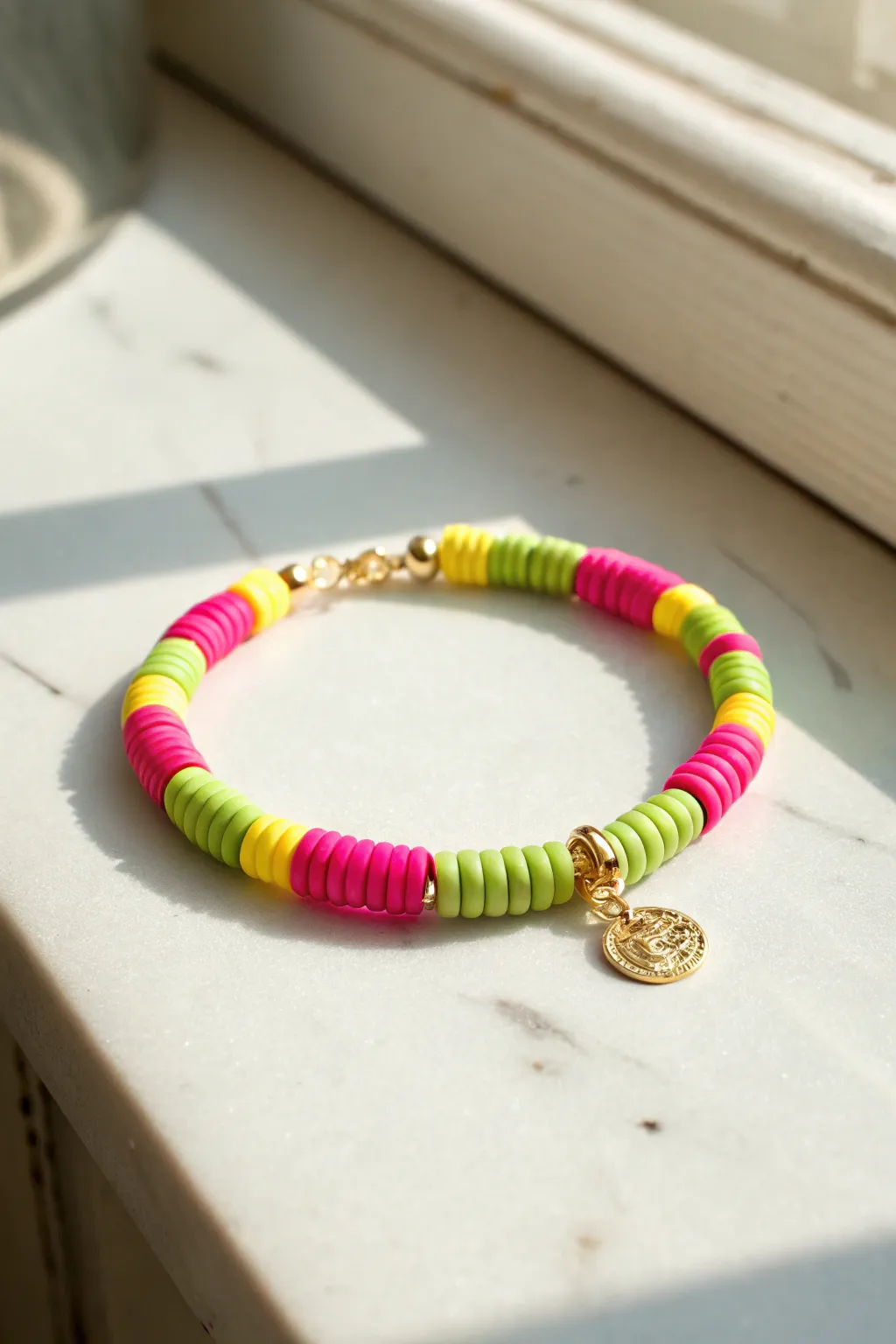
Capture the essence of a bright summer day with this vibrant heishi bead bracelet, featuring an energetic mix of neon pink, lime green, and lemon yellow. The playful pattern is grounded by elegant gold accents and a dangling coin charm, giving it that perfect preppy-chic aesthetic.
Step-by-Step
Materials
- Polymer clay heishi beads (disc beads) in neon pink
- Polymer clay heishi beads (disc beads) in lime green
- Polymer clay heishi beads (disc beads) in bright lemon yellow
- Strong elastic jewelry cord (approx 0.8mm)
- Gold-plated coin charm (approx 10-12mm)
- Gold jump ring (6mm or 8mm)
- Gold ball bead or crimp cover (optional for hiding knot)
- Gold crimp beads (if using a clasp method)
- Gold lobster clasp and jump ring receiver (optional, though the image shows a clasp)
- Jewelry pliers (flat nose and round nose)
- Scissors or jewelry nippers
- Bead stopper or tape
- Ruler
Step 1: Planning and Prep
-
Measure your wrist:
Start by measuring your wrist with a flexible measuring tape to determine the total length needed. Add about 0.5 inches for a comfortable fit. -
Cut the cord:
Cut a piece of elastic cord about 10-12 inches long. Having this extra length makes tying the knot or attaching the clasp much easier later. -
Secure the end:
Place a bead stopper or a piece of tape on one end of the cord to prevent your colorful beads from sliding right off while you work. -
Prepare your pattern:
Review the color pattern shown in the image: it alternates between blocks of color. Each color block consists of roughly 6-8 disc beads. -
Attach the initial clasp hardware:
Thread a crimp bead onto the cord, followed by your gold lobster clasp. Loop the cord back through the crimp bead and use your flat nose pliers to squash the crimp flat, securing the clasp. Trim the short tail. -
Cover the crimp:
If you want a polished look like the inspiration photo, gently close a gold crimp cover over the mashed crimp bead using your pliers to make it look like a seamless gold ball.
Seamless Color Blocks
To keep your color distinct, ensure all beads in a single block are the same thickness. Discard any wonky or ultra-thin discs.
Step 2: Beading the Pattern
-
Begin with yellow:
Start your pattern by threading on about 5 to 6 lemon yellow heishi beads. Push them down to the gold hardware. -
Add the green block:
Next, thread on the lime green leads. Looking closely at the image, you’ll need about 7 to 8 green beads for this section. -
Switch to pink:
Add your neon pink block. Use roughly 7 to 8 beads here as well to maintain visual balance. -
Repeat the sequence:
Continue this alternating pattern: Yellow, Green, Pink. Keep checking the length against your wrist as you go. -
Find the center point:
Once you have strung about half the length of the bracelet, pause. This is where we will attach the charm focal point. -
Prepare the charm:
Using two pairs of pliers, carefully twist open a gold jump ring. Slide your gold coin charm onto it. -
Attach the charm helper:
Instead of stringing the jump ring directly onto the elastic (which can sit awkwardly), I like to thread on a gold bail or a large gold spacer bead first. -
Alternative charm method:
If you don’t have a bail, simply thread the jump ring with the charm directly onto the cord between two color blocks. In the photo, it sits between a green and yellow section. -
Finish the beading:
Resume your color pattern (Green, then Yellow, etc.) until you reach your desired total length.
Level Up: Layer It
Make a matching stack! Create two more bracelets using just solid colors (one all pink, one all green) with gold spacer beads scattered throughout.
Step 3: Finishing Touches
-
Double check symmetry:
Before closing, ensure the pattern ends on a color that complements the start. If you started with yellow, try to end with pink or green so two yellow blocks don’t touch when clasped. -
Add closing hardware:
Thread on a crimp bead and then a closed gold jump ring (this will be what the lobster clasp hooks into). -
Secure the loop:
Thread the cord back through the crimp bead, pulling it snug but not too tight—you want the bracelet to remain flexible. -
Crimp to finish:
Use your flat nose pliers to flatten the crimp bead securely. Give it a gentle tug to minimize the risk of breakage. -
Final trim:
Trim the excess elastic cord close to the crimp bead. If you have another crimp cover, apply it now for that professional finish.
Now you have a stunning, beach-ready accessory that adds a pop of neon joy to any outfit



What Really Happens Inside the Kiln
Learn how time and temperature work together inside the kiln to transform clay into durable ceramic.
Black-and-White Checker Rhythm
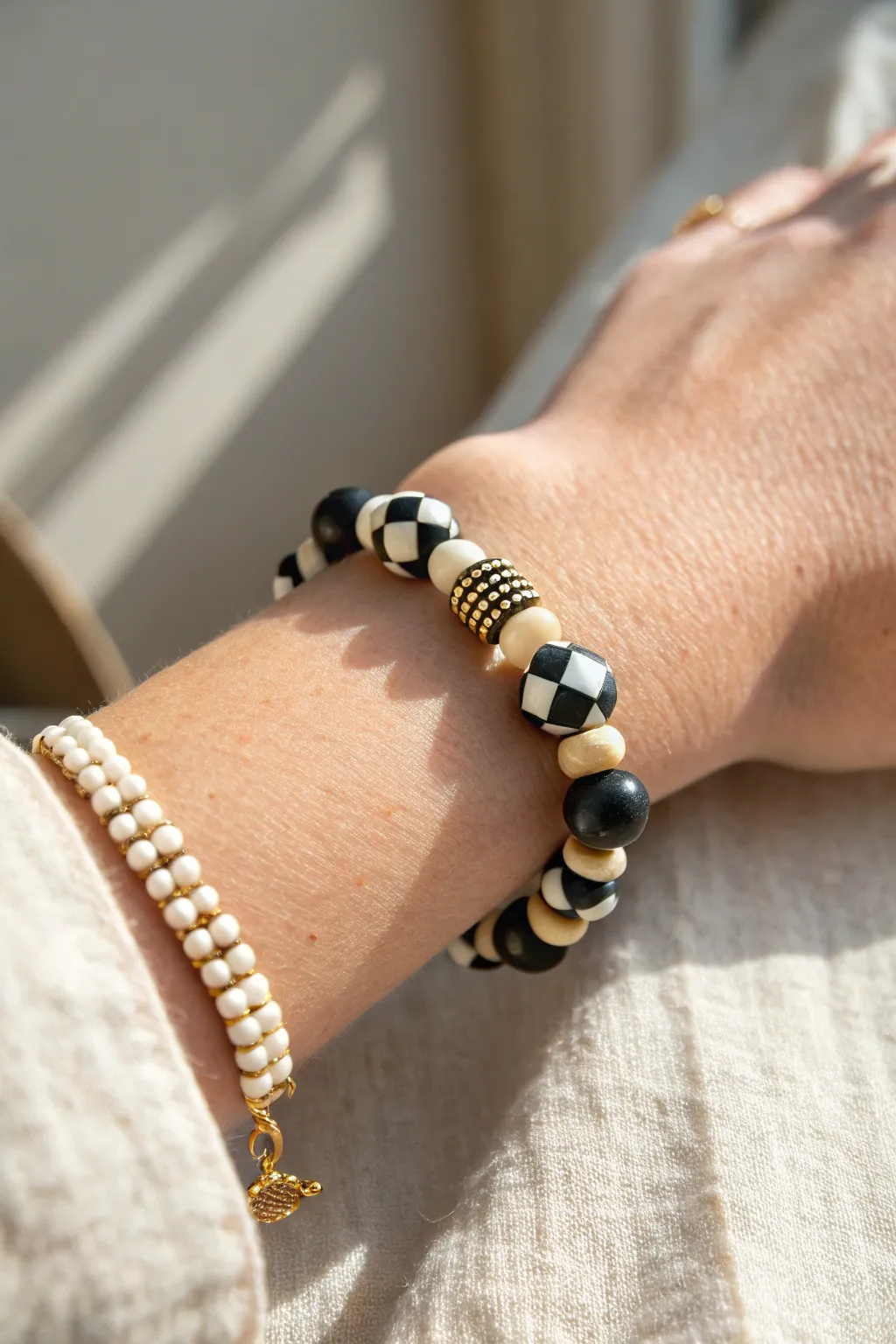
This striking bracelet updates the classic black-and-white trend with chunky geometric beads and warm gold accents. It blends handcrafted checkerboard polymer clay beads with solid black spheres and natural wood tones for a sophisticated, rhythmic look.
Detailed Instructions
Materials
- Black polymer clay
- White polymer clay
- Gold-tone spacer beads (studded or textured cylinder style, approx. 6mm)
- Small wooden beads (blonde or natural finish, approx. 6-8mm)
- Black wooden or polymer round beads (approx. 10mm)
- Strong elastic stretch cord (0.8mm or 1mm)
- Clay slicer or craft knife
- Bead roller (optional but helpful)
- Clay oven and baking sheet
- Super glue or jewelry adhesive
- Toothpick or bead piercing tool
- Wet/dry sandpaper (400 to 1000 grit) – optional
- Buffing cloth or denim
Step 1: Creating the Checkerboard Cane
-
Condition the Clay:
Begin by conditioning your black and white polymer clay separately until they are soft and pliable. Roll both colors into square logs of equal thickness, roughly 1/2 inch wide. -
Slice and Arrange:
Cut four equal strips from the black log and four from the white log. Arrange them into a 2×2 grid to form a larger square log: place a black strip next to a white strip on the bottom row, and reverse the order on the top row. -
Reduce the Cane:
Gently squeeze and pull the square log to elongate it, reducing its width while maintaining the square shape. This sharpens your checkerboard pattern. -
Assemble the Complex Cane:
Once lengthened, cut this log into four equal lengths. Stack them again into a 2×2 grid to create a finer, more complex checkerboard pattern with more squares. Gently compress to adhere them together.
Step 2: Forming the Beads
-
Prepare the Core:
Roll small balls of scrap or plain white clay to serve as the base for your checkerboard beads. These should be slightly smaller than your desired finished size, around 10mm. -
Slice the Cane:
Use your tissue blade to slice thin, uniform veneers from your checkerboard cane. Aim for slices about 1-2mm thick. -
Apply the Pattern:
Carefully place the checkerboard slices onto the core clay balls. Only cover the ‘equator’ or central band of the bead if you want the caps to remain plain, or tile them to cover the entire surface for a full pattern. -
Roll Smooth:
Gently roll the bead between your palms or using a bead roller. This pressure smooths the seams between the slices and merges the pattern into a single cohesive surface. -
Create Solid Beads:
Roll several spheres of solid black polymer clay to match the size of your checkered beads. I like to make these slightly matte by textured rolling, but smooth works perfectly too. -
Pierce the Holes:
Use a bead piercing pin or toothpick to carefully create holes in all your clay beads. Twist the tool gently as you push through to avoid distorting the shape. -
Bake:
Arrange your beads on a baking sheet or in a bead rack. Bake according to your clay manufacturer’s instructions (usually 275°F/130°C for 30-60 minutes).
Clean Cuts Only
Chill your clay cane in the refrigerator for 15 minutes before slicing. Keeps the checker pattern crisp and prevents the colors from dragging or smearing.
Step 3: Finishing and Assembly
-
Sand and Buff:
Once the beads are completely cool, dip them in water and lightly sand with wet/dry sandpaper to remove any fingerprints. Buff them vigorously with a denim cloth to create a soft, natural sheen. -
Design the Pattern:
Lay out your design on a bead board or soft cloth. Follow the rhythm from the image: Checkered Bead > Small Wood Bead > Textured Gold Cylinder > Small Wood Bead > Solid Black Bead. -
String the Bracelet:
Cut a piece of elastic cord about 12 inches long. Pre-stretch it by pulling firmly a few times to prevent sagging later. -
Add Beads:
Thread the beads onto the cord following your laid-out pattern. Check the length against your wrist periodically to ensure a comfortable fit. -
Tie the Knot:
Once strung, tie the ends together using a surgeon’s knot (loop the thread through twice on the first pass). Pull the knot tight. -
Secure and Hide:
Place a tiny drop of super glue on the knot. Once dry, trim the excess cord ends and gently tug the knot inside one of the larger beads to hide it.
Make it Matte
Swap the glossy finish for a modern matte look by skipping the buffing step and lightly sanding the baked beads with a coarse grit sandpaper for texture.
Wear your new geometric bracelet stacked with gold chains for an effortlessly chic vibe
Beachy Neutrals With a Shell Accent
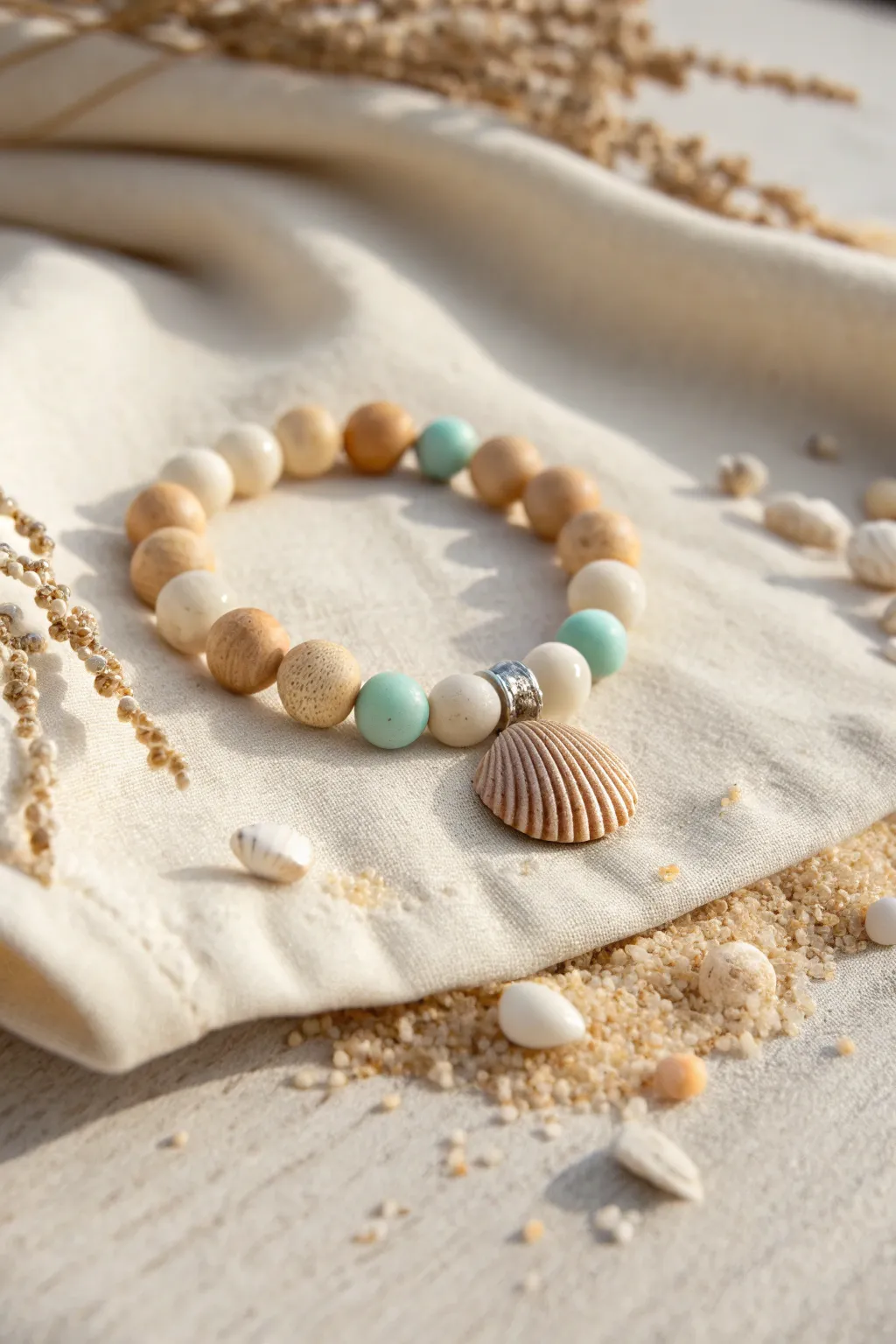
Capture the calm of the coast with this beautifully textured bracelet featuring sandy hues, hints of aqua, and a delicate shell focal point. The combination of faux-wood textures and smooth matte beads creates an organic, high-end feel perfect for summer styling.
Step-by-Step Guide
Materials
- Polymer clay in beige/sand, white, and translucent
- Polymer clay in light turquoise or aqua
- Coarse sandpaper or a stiff-bristled toothbrush (for texturing)
- Small round bead roller (optional but helpful)
- Elastic beading cord (0.8mm or 1mm)
- Small seashell charm (natural or metal)
- Jump ring (6mm or 8mm)
- Silver spacer bead or bail bead
- Beading needle
- Super glue or jewelry cement
- Oven for baking
Step 1: Creating the Sand-Textured Beads
-
Mix the Sand Color:
Start by conditioning your beige polymer clay. To get that organic beach-wood look, I like to mix equal parts beige and translucent clay, adding a tiny speck of brown if the color feels too flat. -
Portion the Clay:
Cut your mixed clay into equal-sized chunks, aiming for roughly 12-14mm diameter beads. Roll each chunk into a smooth ball between your palms. -
Add Texture:
Before piercing, roll the smooth balls over a piece of coarse sandpaper or gently tap them with a stiff toothbrush. This creates the porous, wood-like texture visible in the photo. -
Pierce the Beads:
Use a bead pins or a thick needle to carefully pierce a hole through the center of each bead. Keep rotating the bead as you push to ensure the hole is centered without squashing the shape. -
Create White Accent Beads:
Condition plain white clay and roll it into slightly smaller balls (about 10mm). Keep these smooth to contrast with the textured sand beads. -
Pierce White Beads:
Create holes in your white beads, ensuring the opening is large enough for your elastic cord.
Knot Slipping?
If your surgeon’s knot isn’t holding, try roughing up the ends of the elastic cord with sandpaper before tying, or use a flexible jewelry glue like G-S Hypo Cement for a stronger bond.
Step 2: Making the Aqua Accents
-
Mix Aqua Color:
Blend your turquoise clay with a significant amount of white to achieve a soft, pastel sea-glass hue. You want it to look washed out. -
Form Aqua Beads:
Roll 3-4 beads in this color, matching the size of your white accent beads (approx. 10mm). -
Pierce and Refine:
Pierce holes in these aqua beads. Smooth away any fingerprints very gently with a drop of baby oil.
Step 3: Baking and Assembly
-
Bake the Beads:
Arrange all your beads on a tile or baking sheet lined with parchment paper. Bake according to your clay manufacturer’s instructions, usually around 275°F (130°C) for 30 minutes. -
Cool and Finish:
Allow the beads to cool completely. If you want a matte finish like the image, no varnish is needed. If you want a slight shine, buff them gently with a soft cloth. -
Prepare the Charm:
Attach your seashell charm to the silver bail bead using a jump ring. Open the jump ring sideways with pliers, slide on the shell and the bail loop, then close it securely. -
Layout Design:
Lay out your beads on a bead board or towel. Follow the pattern: a cluster of sand beads, then white, then an aqua accent, repeating to create a balanced look. Place the charm assembly in the center. -
String the Bracelet:
Cut a piece of elastic cord about 10 inches long. Pre-stretch it by pulling firmly a few times to prevent it from sagging later. Thread your needle and string the beads following your layout. -
Tie the Knot:
Once all beads are on, double-check the fit on your wrist. Tie a surgeon’s knot (right over left twice, pull tight; left over right once, pull tight). -
Secure and Trim:
Place a tiny drop of super glue on the knot. Let it dry for a minute before trimming the excess cord close to the knot. -
Hide the Knot:
Gently pull the elastic until the knot slides inside the hole of one of the larger sand beads to hide it completely.
Level Up: Real Wood
Replace the ‘sand’ polymer beads with actual unfinished wooden beads. The mix of real wood grain and smooth polymer clay creates an even more authentic, high-end texture contrast.
You now have a seaside-inspired accessory that carries the calm of the beach wherever you go

TRACK YOUR CERAMIC JOURNEY
Capture glaze tests, firing details, and creative progress—all in one simple printable. Make your projects easier to repeat and improve.
Fruity Pop Bracelet With One Statement Bead
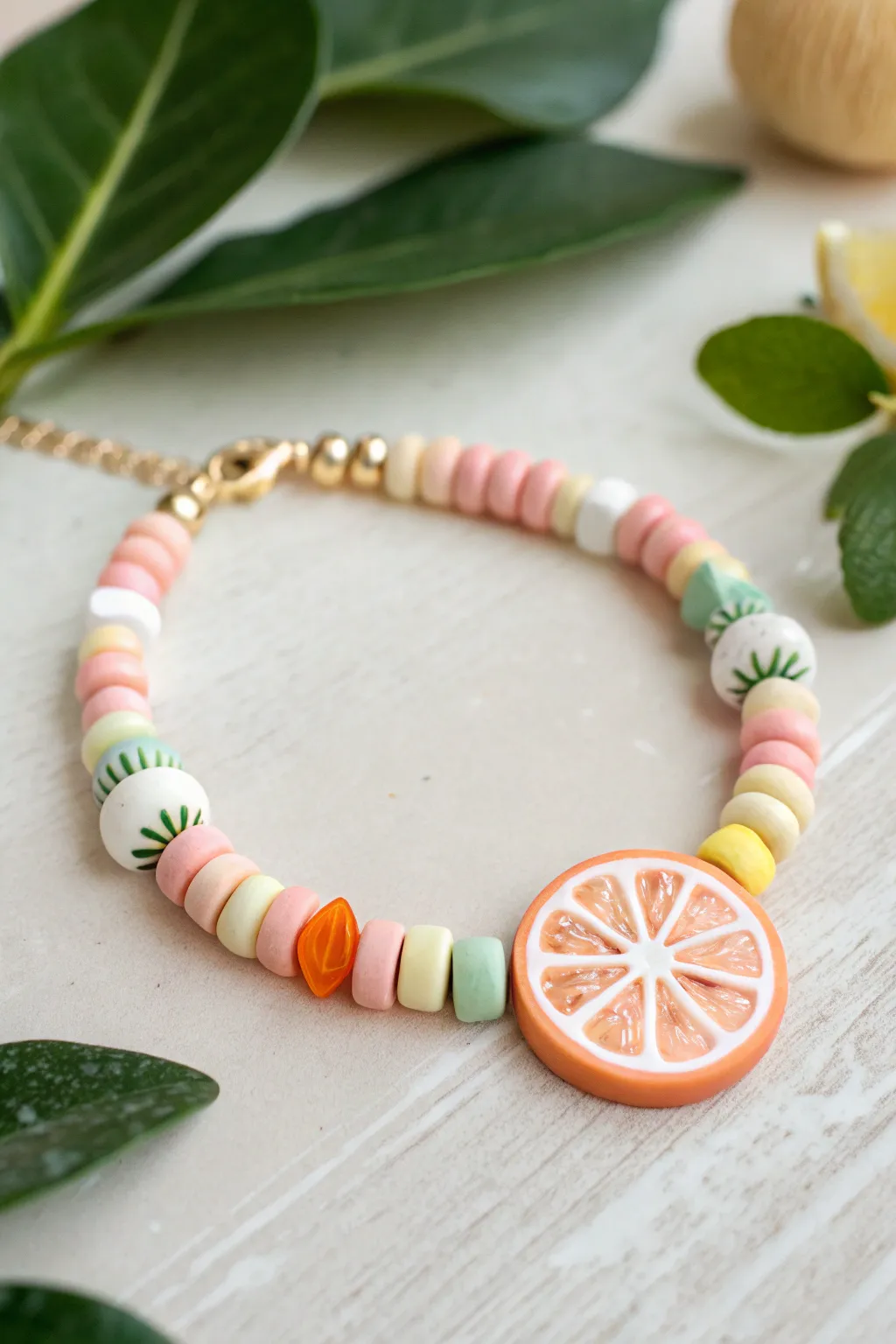
Brighten up your wrist stack with this cheerful design that puts a juicy citrus slice front and center. By combining simple heishi-style disc beads with a few custom-sculpted accents, you’ll create a pastel accessory that feels perfectly ripe for summer days.
Step-by-Step Tutorial
Materials
- Polymer clay in pastel pink, peach, light yellow, mint green, white, and translucent orange
- Liquid polymer clay (optional, for texture)
- Bead roller or small round cutter (approx. 5mm) for spacer beads
- Large circular cutter (approx. 20-25mm) for the statement bead
- Bead piercing pins or toothpicks
- Gloss glaze or UV resin
- Flexible beading wire or elastic cord
- Gold finish jewelry findings: crimp beads, crimp covers, lobster clasp, jump rings, extender chain
- Jewelry pliers (flat nose and cutting)
- Acrylic rolling pin
- Detail needle tool
Step 1: Sculpting the Statement Slice
-
Create the heavy base:
Condition a 25mm ball of translucent orange polymer clay and flatten it into a thick disc, about 5-6mm tall. Smooth the edges so they are perfectly round. -
Add the rind:
Roll a thin sheet of opaque peach or light orange clay. Cut a strip equal to the height of your disc and wrap it around the outer edge to form the rind, smoothing the seam. -
Segment the fruit:
Using a thin strip of white clay, create a wheel-spoke pattern on the face of the orange disc to divide it into eight triangular segments. -
Texturize the pulp:
Use a needle tool to gently poke and disturb the translucent clay inside each segment. This creates that realistic, juicy citrus pulp texture. -
Drill the hole:
Carefully pierce a hole horizontally through the entire slice, ensuring it passes straight through the middle so the bead hangs correctly.
Step 2: Making Disc & Accent Beads
-
Roll the clay sheets:
Roll out your pastel colors (pink, peach, yellow, mint) into even slabs, approximately 3-4mm thick. -
Cut the discs:
Use a small round cutter or a drinking straw to punch out numerous small circles from each color. You will need about 30-40 total depending on your wrist size. -
Pierce the beads:
Gently poke a hole through the center of each disc bead using a bead pin. Rotating the pin as you push helps prevent the bead from squishing. -
Create leafy accents:
Form two small balls of white clay. Use a needle tool to scratch small lines radiating from the bottom, painting a tiny bit of mint green clay into the crevices to look like leaf veins. -
Form the mini gem:
Shape a tiny piece of translucent orange clay into a small, faceted diamond or oval shape to sit next to your fruit slice. -
Bake everything:
Arrange all your beads on a tile or parchment-lined tray. I prefer to bake the large statement bead for slightly longer, but generally, bake according to your clay package instructions (usually 275°F/135°C for 15-30 minutes).
Citrus sculpting tip
For ultra-realistic fruit pulp, mix a tiny drop of liquid clay with your translucent solid clay before texturing. It helps hold those needle marks without smoothing out.
Step 3: Assembly & Finishing
-
Glaze the fruit:
Once cooled, brush a coat of gloss glaze or UV resin over the inner face of the fruit slice to make the ‘pulp’ look wet and shiny. -
Plan your pattern:
Lay out your beads securely on a bead board. Place the fruit slice in the center, flanked by the translucent gem and mint bead, then alternate your pastel discs in color blocks. -
String the beads:
Cut a length of beading wire and attach a crimp bead and clasp to one end. Thread your beads, starting with the smaller discs and working toward the center statement piece. -
Balance the weight:
Ensure the patterned white beads are placed symmetrically on the sides to frame the design effectively. -
Close the loop:
Finish the other end with a crimp bead, wire guardian (optional), and a jump ring attached to an extender chain. -
Final touches:
Cover your crimp beads with gold crimp covers for a polished, professional look.
Mix it up
Don’t stop at oranges! Create a whole fruit salad stack by making lemon, lime, and pink grapefruit versions using different shades of translucent clay.
Wear your fresh, fruity creation alone or stack it to add a pop of color to any outfit
Pearl-and-Clay Mix for Soft Glam
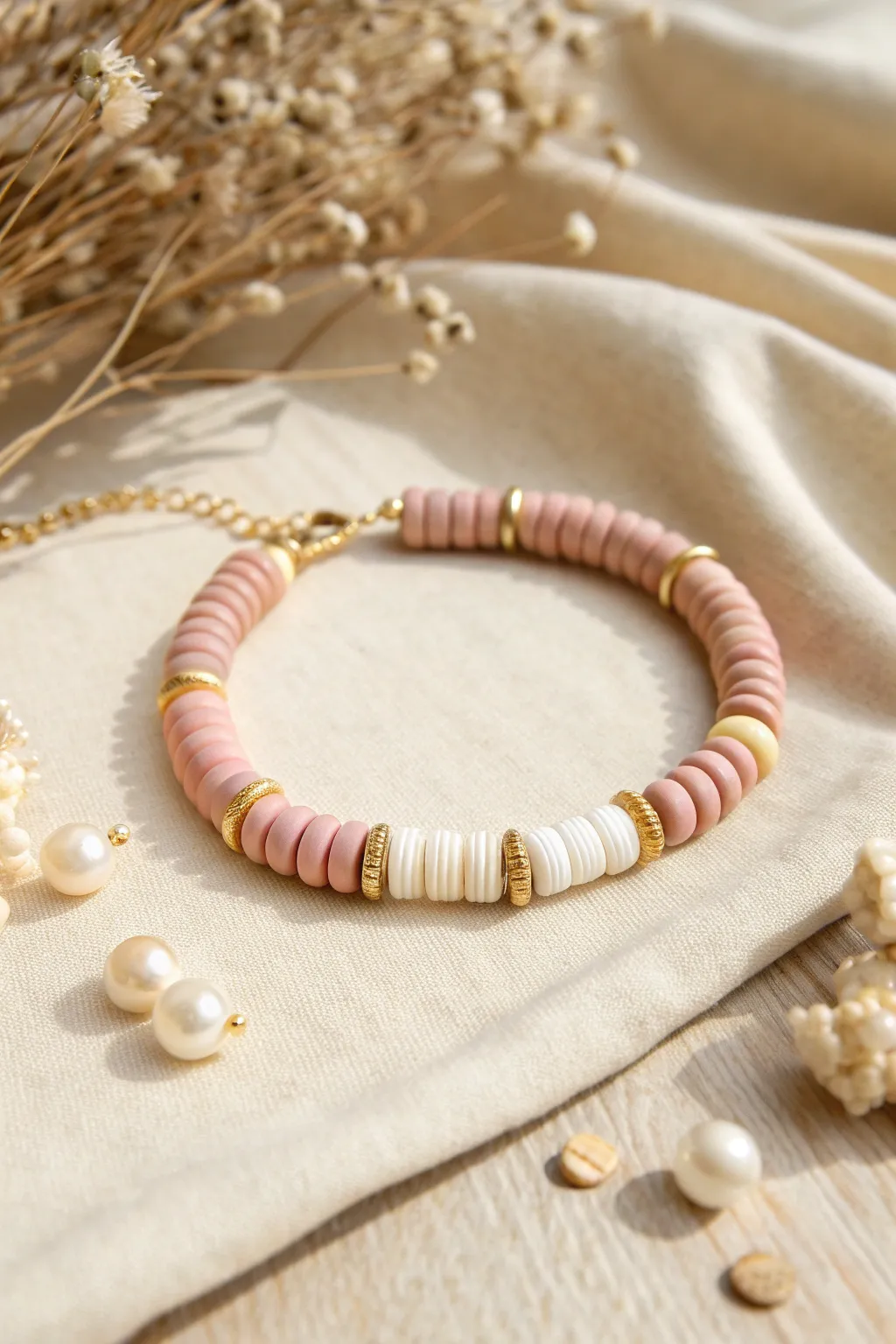
This project combines the earthy texture of polymer clay discs with the gentle shimmer of gold accents for a look that is both grounded and glamorous. The soft mauve and creamy white palette creates a versatile accessory perfect for stacking or wearing as a subtle statement piece.
Step-by-Step Guide
Materials
- Polymer clay heishi beads (6mm, flat disc shape) in dusty rose or mauve
- Polymer clay heishi beads (6mm, flat disc shape) in bright white
- One round or barrel accent bead in soft buttery yellow
- Textured gold spacer beads (thick ring shape)
- Small smooth gold spacer beads
- Gold beading wire or strong elastic cord (0.8mm)
- Gold crimp beads
- Two gold crimp covers
- Two gold wire protectors (optional)
- Gold lobster clasp
- Gold extension chain
- Two gold jump rings
- Flush cutters
- Flat nose pliers
- Crimping pliers
Step 1: Preparation & Layout
-
Measure your wrist:
Before you cut anything, wrap a soft measuring tape around your wrist to find your size. Add about 0.5 inches to this measurement to ensure a comfortable fit that isn’t too tight. -
Cut the wire:
Cut a length of beading wire approximately 10-12 inches long. This gives you plenty of excess space to work with the clasps without struggling. -
Secure the first end:
Thread a crimp bead and then a wire protector onto one end of your wire. Pass the wire back through the crimp bead to create a loop. Use your crimping pliers to flatten the crimp bead securely. -
Attach the clasp:
Open a jump ring with your flat nose pliers and attach the lobster clasp to the loop you just created. I like to do this early so the beads don’t slide off while I’m working. -
Cover the crimp:
Place a crimp cover over the flattened crimp bead and gently squeeze it shut with pliers until it looks like a round gold bead.
Step 2: Stringing the Pattern
-
Start with mauve:
Begin stringing roughly 2 to 2.5 inches of the dusty rose/mauve clay heishi beads. This will form one side of the bracelet. -
Add first gold accent:
Slide on one of the thicker, textured gold spacer rings followed by a small section (about 5-6 beads) of the mauve clay. -
Insert the yellow feature:
Thread on the single butter-yellow accent bead. Follow this immediately with another short segment of mauve clay beads. -
Transition to white:
Place a textured gold spacer bead, followed by five white clay discs, another textured gold spacer, and then five more white clay discs. -
Finish the focal point:
Add one final textured gold spacer to close off the white section. -
Complete the loop:
Fill the rest of the wire with the mauve clay beads until the bracelet reaches your desired length minus the clasp size.
Keep It Flexible
Don’t pull the wire too tight before crimping! If the beads are jammed together, the bracelet will stay stiff and won’t drape naturally around your wrist.
Step 3: Finishing Touches
-
Check the fit:
Wrap the beaded wire around your wrist one last time to ensure the pattern sits centrally and the length is correct. -
Secure the end:
Thread a crimp bead and a wire protector onto the remaining tail. Loop the wire back through the crimp bead and pull it taut against the clay beads, but leave just a tiny bit of wiggle room so the bracelet stays flexible. -
Crimp and trim:
Flatten the crimp bead firmly with your crimping pliers. Use your flush cutters to snip off the excess wire tail close to the bead. -
Hide the hardware:
Apply the second crimp cover over the visible crimp bead, gently closing it with pliers for a professional finish. -
Add the extension:
Finally, use a jump ring to attach the gold extension chain to the loop on this end.
Mix Your Metals
Swap the textured gold spacers for hammered silver or rose gold rings to change the warmth of the piece while keeping the soft clay aesthetic.
Now you have a chic, boutique-style bracelet ready to elevate your everyday outfits
Metallic Accent Pattern Every Five Beads
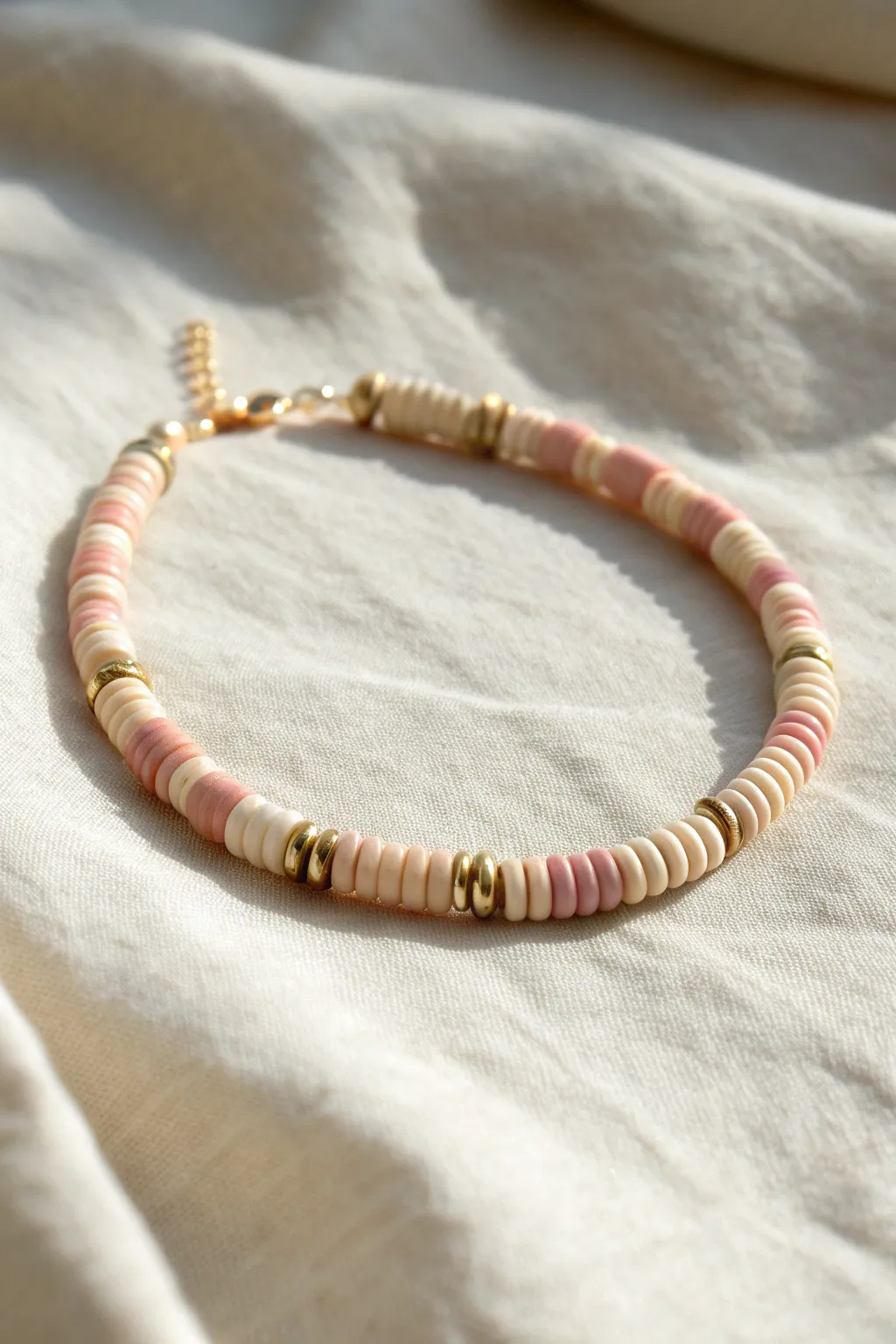
Elevate a simple strand of polymer clay discs with strategically placed golden accents that catch the light beautifully. This design combines soft blush tones, creamy neutrals, and metallic shine for a sophisticated, beach-ready accessory.
Detailed Instructions
Materials
- Polymer clay Heishi beads (cream color)
- Polymer clay Heishi beads (blush pink color)
- Gold tone spacer beads (various flat and rounded shapes)
- Elastic beading cord (0.8mm clear)
- Small gold crimp beads
- Gold clamshell bead tips (calottes)
- Gold jump rings (4mm)
- Gold lobster clasp
- Extension chain (optional but recommended)
- Super glue or jewelry adhesive
- Scissors or jewelry wire cutters
- Flat nose pliers
- Bead design board (optional)
Step 1: Planning and Preparation
-
Measure your wrist:
Before cutting any string, measure your wrist circumference and add about half an inch for a comfortable fit. This will guide your total length. -
Cut the cord:
Cut a length of elastic cord about 4 inches longer than your measurement to give yourself plenty of room for tying knots later. -
Pre-stretch the elastic:
Hold the ends of your elastic cord and give it a firm, steady pull several times. This pre-stretching prevents the bracelet from drooping or loosening after the first few times you wear it. -
Lay out the pattern:
Using a bead board or a towel, arrange your beads loosely to visualize the pattern. For this look, aim for blocks of color separated by gold accents.
Spacer Bead Gaps?
If gold spacer beads create large gaps or sit awkwardly, try using two thinner spacers instead of one thick one. This helps the flat heishi beads sit flush against the metal.
Step 2: Creating the Bead Pattern
-
Start the sequence:
Begin by threading on four cream-colored clay disc beads. These flat beads stack tightly, so ensure they are facing the same direction if they have a curved edge. -
Add first gold accent:
Slide on a single, rounded gold spacer bead. This creates the ‘every five’ rhythm mentioned in the section theme. -
Continue the cream section:
Thread on another four cream clay beads, followed by another gold spacer. Repeat this mini-sequence until you have a solid section of cream—about 1.5 inches long. -
Transition to pink:
Now, introduce the blush pink beads. Thread on a stack of three pink discs. -
Create the focal accent:
Between color transitions, use a more substantial gold accent. I like adding a flat gold washer bead next to a rounded one here for extra texture. -
Build the pink section:
Add three more pink discs, followed by a gold spacer. Repeat this pattern for a short segment, perhaps just an inch, to create asymmetrical color blocking. -
Return to cream:
Switch back to the cream beads, using double gold spacers (two thin gold discs side-by-side) to mark the return to the main color. -
Check the length:
Wrap the beaded strand around your wrist to check the fit. Add or remove cream beads at the ends until the ends meet comfortably without gaps.
Mix Up Mechanics
Swap the lobster clasp for a simple surgeon’s knot hidden inside a large gold bead for a seamless, slip-on style without hanging hardware.
Step 3: Finishing the Closure
-
Attach the first clamshell:
Thread one end of your elastic through the bottom hole of a clamshell bead tip so the cup faces the beads. -
Secure with a knot:
Tie a sturdy double or surgeon’s knot at the very end of the cord, nesting it inside the cup of the clamshell. -
Add glue and close:
Place a tiny drop of super glue on the knot for security. Using your flat nose pliers, gently squeeze the clamshell closed over the knot. -
Repeat on the other side:
Thread the other end of the elastic through a second clamshell tip. Pull the cord taut so there are no gaps between beads, tie your knot, glue, and close the shell. -
Trim excess cord:
Once the glue is fully dry, carefully trim any excess elastic sticking out of the clamshells. -
Attach hardware:
Open a jump ring with your pliers. Slide it onto the loop of the clamshell and attach the lobster clasp. Close the ring securely. -
Add the extension chain:
On the opposite side, use another jump ring to attach a short length of extension chain. This adds a professional finish and adjustable sizing.
You now have a chic, custom-fit bracelet ready to be stacked or worn solo
Two-Tone Twist Stack Bracelet
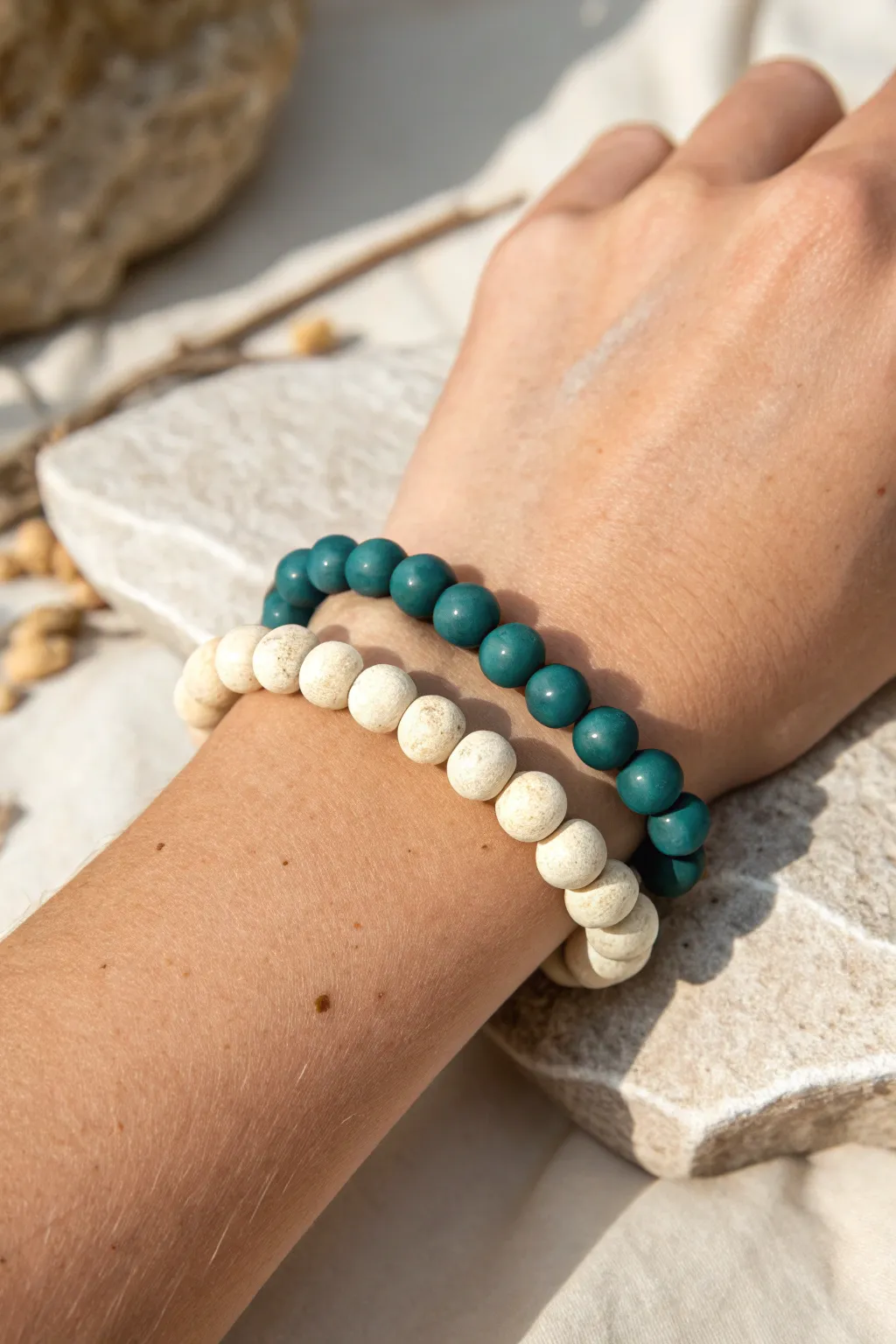
Embrace the contrast of textures and tones with this simple yet striking bracelet set. One strand features smooth, deep teal spheres while the other showcases rough, stone-like textured beads in a creamy off-white, creating a perfect balance for everyday wear.
Step-by-Step Guide
Materials
- Polymer clay in deep teal (or mix emerald green with a touch of blue)
- Polymer clay in beige or ecru
- Coarse salt or sandpaper (for texturing)
- Bead piercing pins or toothpicks
- Elastic beading cord (0.8mm or 1mm)
- Super glue or jewelry adhesive
- Acrylic roller or pasta machine
- Baking sheet and parchment paper
- Cornstarch (optional, for smoothing)
- Oven (for curing)
Step 1: Prepping the Clay
-
Condition the Teal Clay:
Begin by kneading your chosen teal clay until it is soft and pliable. If the color isn’t quite right, I like to mix a tiny bit of black into bright turquoise to deepen it. The goal is a uniform, smooth consistency. -
Condition the Cream Clay:
Repeat the conditioning process with your beige or ecru clay. This clay will form the textured, stone-like beads, so ensure it is free of air bubbles. -
Create Uniform Logs:
Roll each color of clay into a long, even snake or log shape. Aim for a thickness of about 1/2 inch (roughly 1.2 cm), though you can adjust this if you prefer larger or smaller beads. -
Measure and Cut Segments:
Use a tissue blade or knife to cut the logs into equal-sized segments. Keeping the pieces consistent now will ensure your finished beads are all the same size.
Step 2: Forming the Beads
-
Roll the Teal Spheres:
Take each segment of the teal clay and roll it between your palms to create perfect spheres. These should remain smooth, so be gentle to avoid fingerprints. -
Smooth Imperfections:
If you notice fingerprints on the teal beads, lightly dust your fingers with cornstarch and give them a final gentle roll to buff them out. -
Roll the Cream Spheres:
Roll the beige clay segments into spheres just like the teal ones. Don’t worry about them being perfectly smooth, as we are about to add texture. -
Apply Stone Texture:
To achieve the rough, porous look seen in the photo, roll the unbaked beige beads gently over a piece of coarse sandpaper. -
Alternative Texture Method:
Alternatively, you can roll the beads in a small bowl of coarse seal salt to press indentations into the surface. Brush off any excess salt before baking.
Fixing Flat Spots
If your beads developed flat spots during baking, gently sand the area with fine-grit sandpaper after they have cooled to restore the round shape.
Step 3: Piercing and Baking
-
Pierce the Teal Beads:
Carefully push a bead pin or toothpick through the center of each teal sphere. Rotate the pin as you push to avoid squashing the round shape. -
Pierce the Textured Beads:
Repeat the piercing process for the textured cream beads. Since these have a rough surface, you don’t need to be quite as delicate, but try to keep the hole centered. -
Arrange for Baking:
Place all your beads on a baking sheet lined with parchment paper. If possible, rest the pins on the rim of a baking dish so the beads are suspended, preventing flat spots. -
Bake the Beads:
Bake the clay according to the manufacturer’s package instructions (usually around 275°F or 130°C for 15-30 minutes). Let them cool completely before handling.
Level Up: Speckled Stone
Mix black pepper or dried tea leaves into the cream clay before rolling. This adds realistic dark specks, enhancing the natural stone effect.
Step 4: Assembly
-
Measure the Cord:
Wrap your elastic cord around your wrist to find the desired length, adding about 3-4 inches extra for tying the knot. -
String the Teal Bracelet:
Thread the cooled teal beads onto one piece of elastic cord. Check the fit against your wrist as you go to ensure it’s not too tight. -
String the Cream Bracelet:
Thread the textured cream beads onto a second piece of elastic cord, matching the size of the first bracelet. -
Tie the Knots:
Complete each bracelet by tying a strong surgeon’s knot. Pull the elastic tight to secure the knot properly. -
Secure and Trim:
Apply a tiny drop of super glue or jewelry adhesive to the knots for extra security. Once dry, snip off the excess cord and slip the knot inside a bead hole to hide it.
Wear your new bracelet stack together for a chic contrast or share one with a friend for a stylish handmade gift
Terrazzo-Inspired Speckled Clay Bead Bracelet
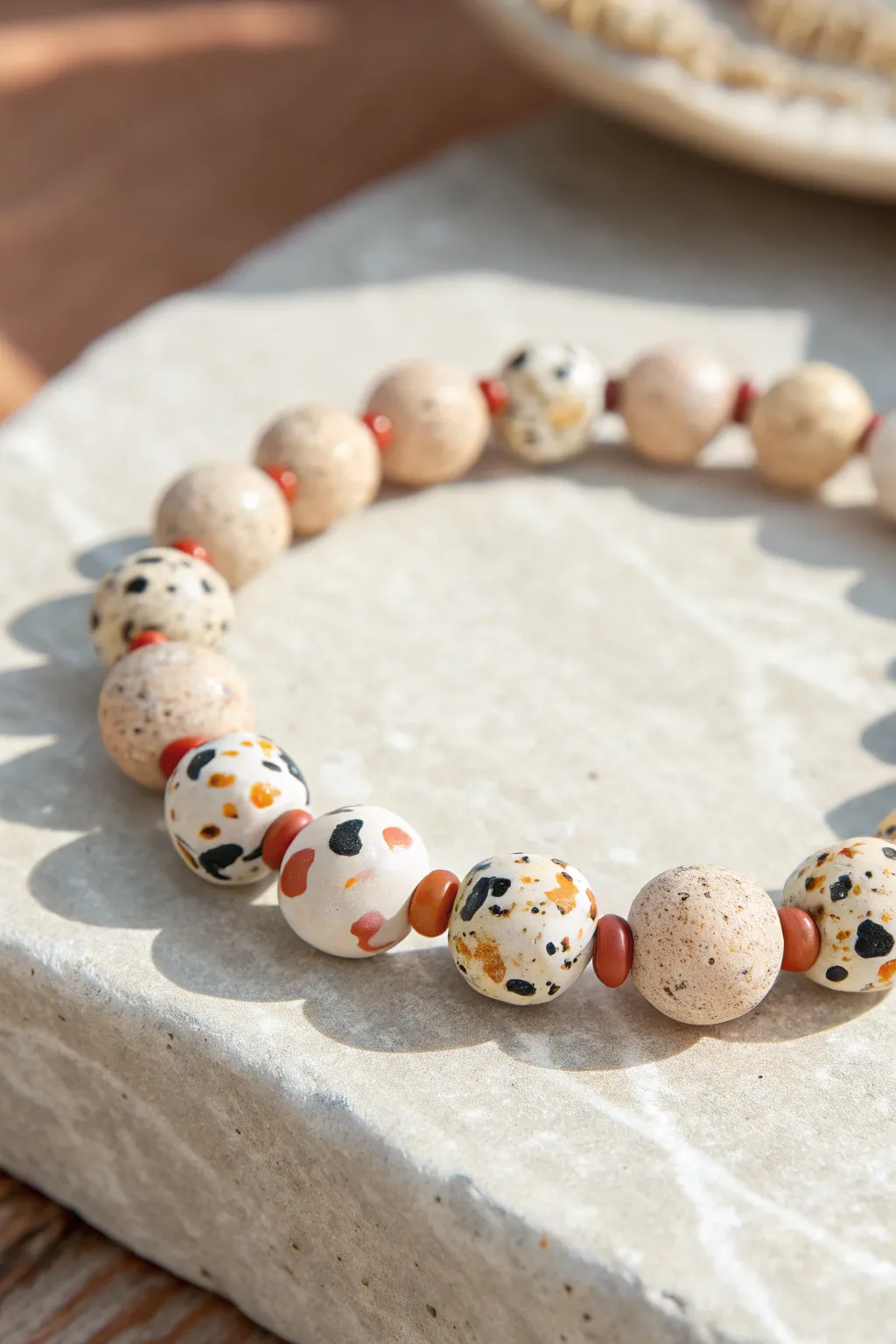
Embrace organic textures with this speckled polymer clay bracelet that mimics the look of natural stone and terrazzo tile. The alternating pattern of chunky patterned beads and rustic sandy spheres, separated by terracotta accents, creates a polished yet earthy accessory perfect for everyday wear.
Step-by-Step Tutorial
Materials
- Polymer clay in white, translucent, black, terracotta/rust, and beige/tan
- Coarse black pepper or dried coffee grounds (optional for texture)
- Acrylic rolling pin or pasta machine
- Circle cutters (approx. 1.5 cm diameter)
- Bead piercing pins or toothpicks
- Strong elastic cord (0.8mm or 1mm)
- Super glue or jewelry cement
- Sandpaper (wet/dry, various grits)
- Ceramic tile or baking sheet
- Oven
Step 1: Mixing the Clays
-
Create the Terrazzo Base:
Start by conditioning a block of white polymer clay until soft. Mix in a very small amount of beige to warm it up to an off-white or cream tone. Flatten this into a medium-thick sheet. -
Prepare the Chips:
Take small amounts of black and terracotta clay. Roll them into extremely thin sheets—paper thin is ideal here. Bake these thin sheets for just 5-10 minutes to harden them slightly, then let cool. -
Chop the Chips:
Once cool, crumble or chop the thin baked sheets into tiny, irregular shards using a craft knife. You want a mix of microscopic specks and slightly larger chunks to mimic real terrazzo. -
Embed the Pattern:
Sprinkle the colored shards onto your raw cream base. Fold the clay over and pass it through the pasta machine or use a roller once or twice to embed the chips without blending the colors together. -
Mix the Sandstone Clay:
For the second bead type to mimic sandstone, mix translucent clay with beige clay in a 1:1 ratio. I like to add a pinch of real black pepper or coffee grounds here to give it that authentic gritty texture.
Keeping White Clay Clean
White clay attracts dust like a magnet. Always clean your hands and work surface with baby wipes or rubbing alcohol before handling light colors, or wear latex finger cots.
Step 2: Forming the Beads
-
Measure Uniform Amounts:
Roll both your terrazzo clay mix and your sandstone mix into thick logs of equal diameter. Slice them into equal segments to ensure your beads end up the same size. -
Roll the Spheres:
Roll each segment between your palms to create smooth, round spheres. You’ll need roughly 8-10 of each type, depending on your wrist size. -
Create the Spacers:
Using the plain terracotta clay, roll a thin snake. Slice off tiny discs and flatten them slightly with your finger to create the small spacers shown in the image. -
Pierce the Holes:
Gently insert a bead pin or toothpick through the center of each bead. Rotate the bead while piercing to avoid distorting the spherical shape. -
Bake:
Arrange your beads on a ceramic tile or baking sheet. Bake according to your clay manufacturer’s instructions (usually 275°F/130°C for 30 minutes). Let them cool completely before handling.
Step 3: Finishing and Assembly
-
Buff and Sand:
This step is crucial for the stone look. Wet sand the beads under running water using 400 grit, then 600 grit sandpaper. This exposes the terrazzo chips and smooths the surface. -
Clean the Holes:
Use a small drill bit or a reaming tool to clear out any clay debris from inside the bead holes to ensure the elastic won’t snag. -
String the Pattern:
Cut a length of elastic cord about 10 inches long. Pre-stretch it by pulling on it firmly a few times to prevent it from loosening later. -
Add Beads:
Thread the beads, alternating between one terrazzo bead, one terracotta spacer, one sandstone bead, and another spacer. Repeat until the bracelet fits comfortably around your wrist. -
Tie the Knot:
Tie a secure surgeon’s knot (right over left, left over right, passing through the loop twice). Pull tight. -
Secure and Hide:
Apply a tiny drop of super glue to the knot. Once dry, trim the excess cord and gently tug the knot inside one of the larger beads to hide it.
Matte Stone Finish
To enhance the natural stone effect, skip any glossy glazes. Instead, vigorously buff the cooled beads with a piece of denim or heavy canvas to create a soft, silky sheen.
Enjoy styling your new handcrafted stone-effect jewelry with your favorite casual outfits
Faux Marble Palette With Cool Neutrals
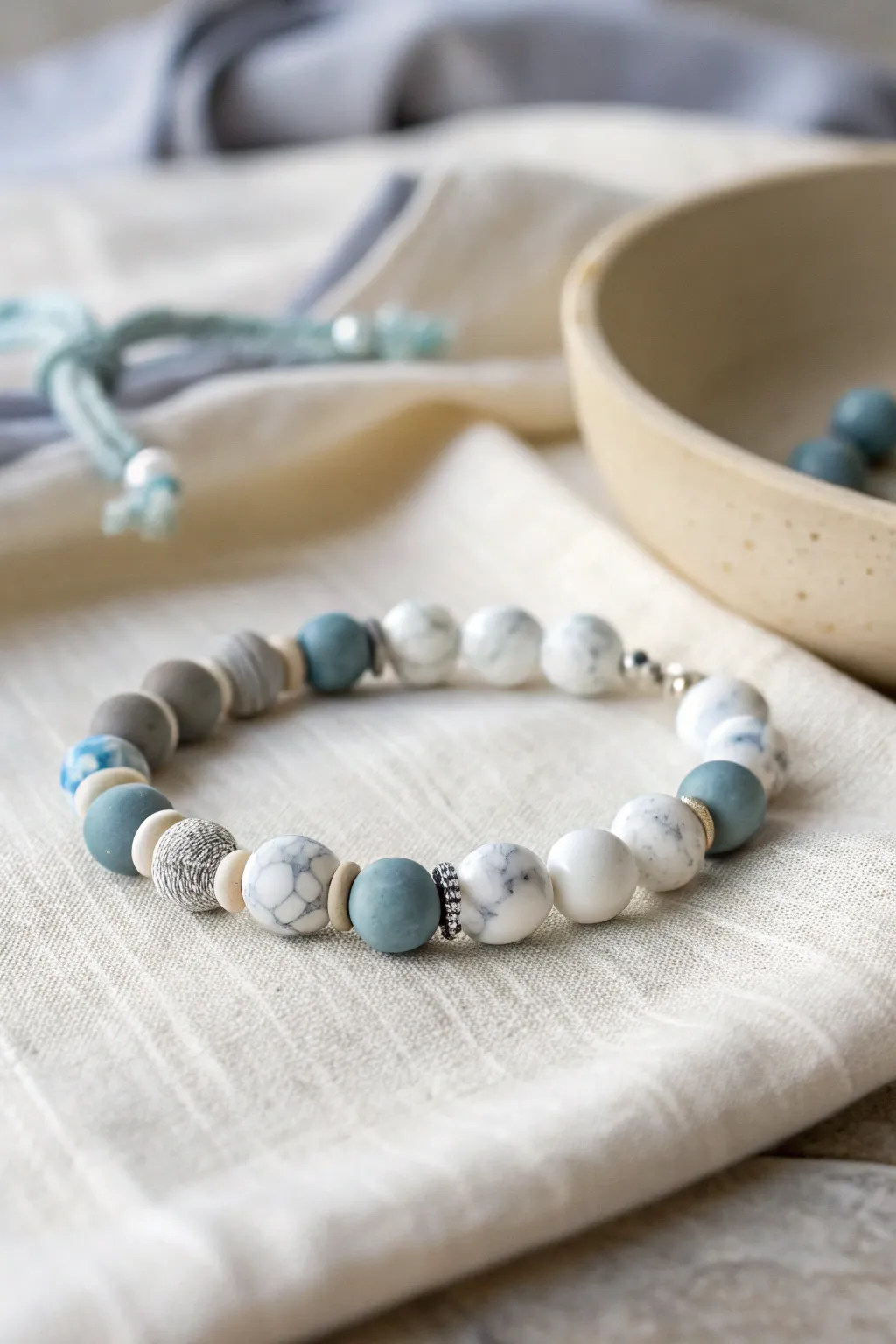
This sophisticated bracelet blends the timeless elegance of faux marble with modern matte textures in a soothing palette of cool blues and greys. It’s a perfect beginner-friendly project that teaches you how to create varied bead finishes using simple polymer clay techniques.
Step-by-Step Guide
Materials
- White polymer clay
- Black polymer clay
- Slate blue or cool grey polymer clay
- Granite or speckled effect polymer clay
- Strong elastic bead cord (0.8mm or similar)
- Bead roller (optional but helpful)
- Toothpicks or bead pins
- Baking sheet and parchment paper
- Fine grit sandpaper (400-600 grit)
- Small metal spacer beads (silver and gold tones)
- Jewelry glue
Step 1: Creating the Faux Marble Beads
-
Condition the base:
Start by conditioning a block of white polymer clay until it is soft and pliable. Use your hands or a clay machine to ensure it is smooth. -
Add veining:
Take a very small amount of black clay and roll it into extremely thin, thread-like snakes. -
marble mix:
Lay the black threads randomly over a small log of white clay. Twist the log like a candy cane, fold it in half, and twist again. Repeat this twist-and-fold process 2-3 times until you see gentle streaks. -
Form the beads:
Cut the marbled log into equal segments. Roll each segment between your palms to create round sphere beads. Aim for about 10-12mm in diameter.
Step 2: Creating Matte Solid & Textured Beads
-
Solid color beads:
Condition your slate blue or cool grey clay. Roll this clay into a consistent log and cut equal segments, slightly smaller than your marble beads (around 8-10mm). -
Matte finish prep:
Roll these blue segments into smooth spheres. To achieve the matte look shown, you will lightly sand them after baking, but ensure they are finger-print free now. -
Textured beads:
Using the granite or speckled clay, form simpler round beads. For the specific textured grey bead seen in the design, take a grey bead and gently roll it over fine sandpaper or a piece of fabric before baking to imprint a subtle texture. -
Piercing:
Carefully pierce a hole through the center of every bead using a toothpick or piercing tool. Gently twist the tool as you push through to avoid distorting the sphere shape. -
Baking:
Arrange all your beads on a baking sheet lined with parchment paper. Bake according to your brand of clay’s instructions (usually 275°F/135°C for 30 minutes). Let them cool completely.
Natural Stone Look
For realistic marble, stop twisting sooner than you think! Over-mixing makes the clay turn grey instead of distinct white with veins.
Step 3: Assembly & Finishing
-
Sanding for matte effect:
Once cool, take your solid blue and grey beads. Wet sand them lightly with fine-grit sandpaper under running water. This removes any shine and gives that soft, stone-like matte finish. -
Buffing the marble:
For the marble beads, you can buff them vigorously with a soft denim cloth if you want a slight natural sheen, or leave them as-is to match the matte aesthetic. -
Layout design:
Lay out your beads on a bead board or towel. Alternate the large marble beads with the matte blue beads. Use the textured grey beads as unique accents on one side. -
Adding spacers:
Insert small metal spacer beads (silver or gold rings) between specific focal beads. In the image, these are used sparingly—place them on either side of the main marble cluster and occasionally between color transitions. -
Stringing:
Cut a piece of elastic cord about 10 inches long. Pre-stretch the cord by pulling it gently a few times. Thread your arranged pattern onto the cord. -
Tying the knot:
Check the fit around your wrist. If it’s good, tie a surgeon’s knot (right over left, left over right twice). Pull the knot tight securely. -
Final Glue:
Add a tiny dot of jewelry glue to the knot. Let it dry, then trim the excess cord ends, tucking the knot inside a neighboring bead if the hole is large enough.
Level Up: Gold Leaf
Add tiny flecks of gold leaf to your white marble clay before rolling. The metallic flakes will mimic real quartz veins.
Enjoy wearing your handcrafted piece that looks just like expensive gemstone jewelry
Coordinated Message Stack Set
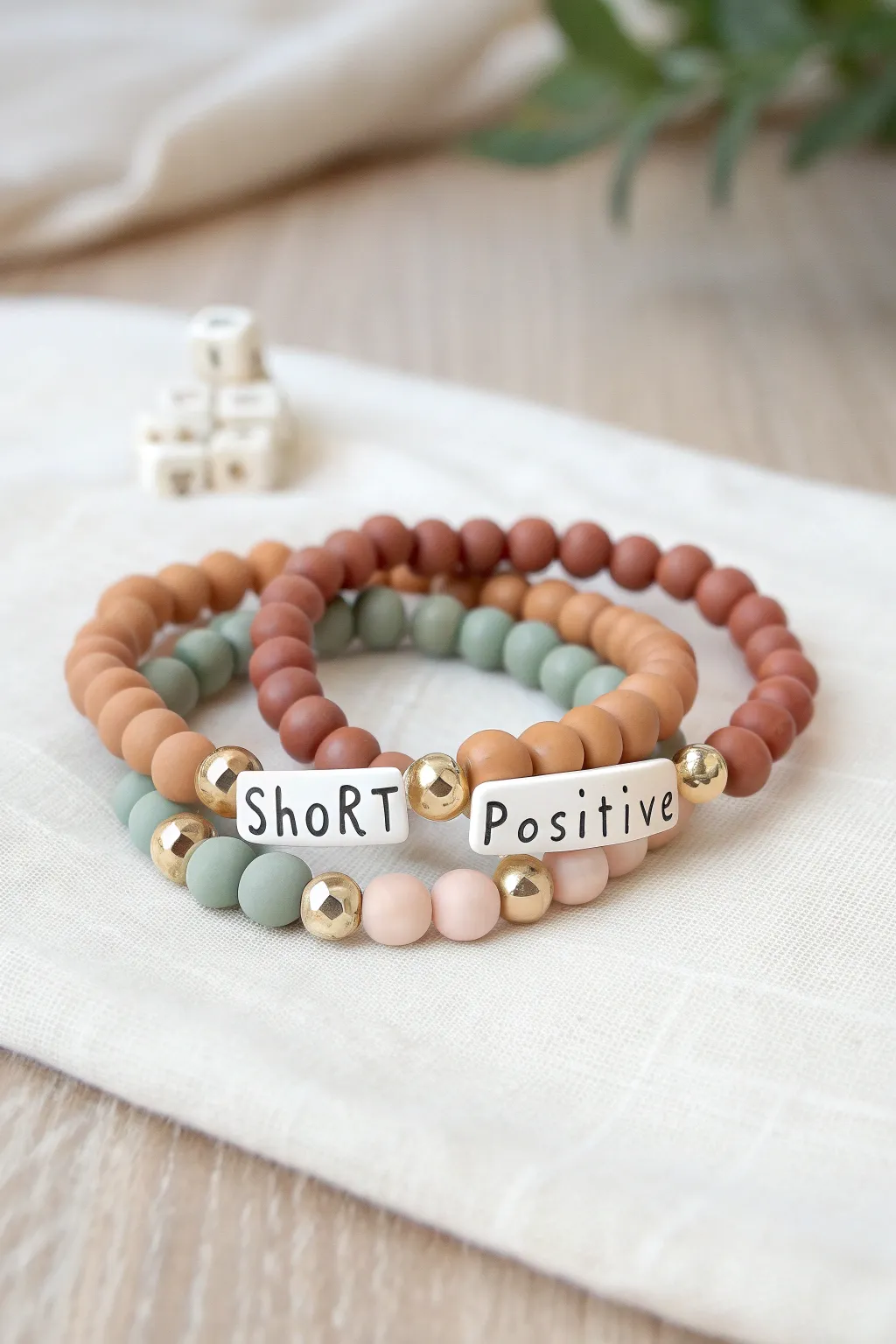
Create a grounded and uplifting accessory set with this coordinated stack of polymer clay bead bracelets. The warm terracotta, sage green, and soft pink tones combine beautifully with gold accents to frame a simple, encouraging message.
How-To Guide
Materials
- 6mm or 8mm matte polymer clay round beads (Rust/Terracotta color)
- 6mm or 8mm matte polymer clay round beads (Sage Green color)
- 6mm or 8mm matte polymer clay round beads (Blush Pink color)
- Rectangular white letter beads with black text (letters for ‘ShoRT’ and ‘Positive’)
- 6mm faceted or smooth gold spacer beads
- Strong elastic cord (0.8mm or 1mm recommended)
- Super glue or jewelry adhesive (specifically for knots)
- Scissors or bead nippers
- Beading needle (optional but helpful)
- Bead design board or a towel to prevent rolling
Step 1: Planning and Preparation
-
Measure your wrist:
Before cutting any cord, measure your wrist circumference. Add about one inch to this measurement to determine the finished length of the bracelets for a comfortable fit. -
Cut the elastic:
Cut three pieces of elastic cord, each about 10-12 inches long. Having extra length makes tying the final knots much easier than struggling with short ends. -
Pre-stretch the cord:
Gently pull on each strand of elastic a few times. This pre-stretching prevents the bracelets from stretching out and becoming loose immediately after you finish making them.
Sticky Bead Fix
If polymer clay beads seem stuck together or the holes are clogged with paint, gently use a bead reamer or a thick T-pin to clear the channel before stringing.
Step 2: Crafting the Solid Rust Bracelet
-
Start the first strand:
Secure one end of your first cord with a piece of tape or a bead stopper. This is the simplest bracelet in the stack, made entirely of the rust/terracotta colored beads. -
String the beads:
Thread the matte rust beads onto the cord until you reach your desired length. Check the fit by wrapping it around your wrist; the ends should touch comfortably without gaps.
Step 3: Crafting the Mixed ‘Short’ Bracelet
-
Layout the design:
For the second bracelet, lay out your design on a board first. You will need a section of rust beads, a gold spacer, the letters ‘S-h-o-R-T’, another gold spacer, and then a strand of sage green beads. -
String the green section:
Begin threading the sage green matte beads. You will want these to cover about half of the bracelet’s circumference. -
Add the first gold accent:
Slide on a faceted gold spacer bead. These shiny elements add a nice pop of contrast against the matte texture of the clay beads. -
Add the word ‘Short’:
Thread your rectangular letter beads in order. Double-check that they are facing the correct way so the word reads left-to-right when worn. -
Complete with rust beads:
Add a second gold spacer bead after the letter ‘T’, then finish the strand with the rust-colored beads until the bracelet matches the length of the first one.
Variation Upgrade
Swap the sage green for a muted mustard yellow or slate blue to change the seasonal vibe while keeping the earthy, matte aesthetic intact.
Step 4: Crafting the Mixed ‘Positive’ Bracelet
-
Prepare the third design:
This bracelet features the word ‘Positive’. Plan a pattern that uses sage green beads on one side and a few blush pink beads near the text for variety. -
String the green base:
Thread sage green beads to form the back half of the bracelet. -
Insert the gold spacer:
Place a gold spacer bead. I like to use the faceted ones here because they catch the light beautifully next to the white letter block. -
Spell ‘Positive’:
Thread the rectangular beads to spell ‘Positive’. Ensure the orientation matches the ‘Short’ bracelet if you plan to wear them exactly as shown. -
Add the pink accent:
Add your second gold spacer bead, followed by 3-4 blush pink beads. Finish the rest of the strand with more rust or green beads to complete the circle.
Step 5: Finishing the Stack
-
Tie the knots:
remove the tape/stopper. Cross the two ends of the elastic and tie a regular overhand knot. Pull it tight. Then, tie a surgeon’s knot (looping through twice) for extra security. -
Secure the knots:
Apply a tiny dot of jewelry glue or super glue specifically to the knot. Let it dry completely before trimming the excess cord. -
Hide the knot:
For a professional finish, gently tug the elastic so the knotted section pulls inside the hole of the nearest bead, hiding it from view.
Slide your new bracelet stack onto your wrist for an instant reminder to stay positive
Unexpected Shapes Mixed Into Heishi Beads
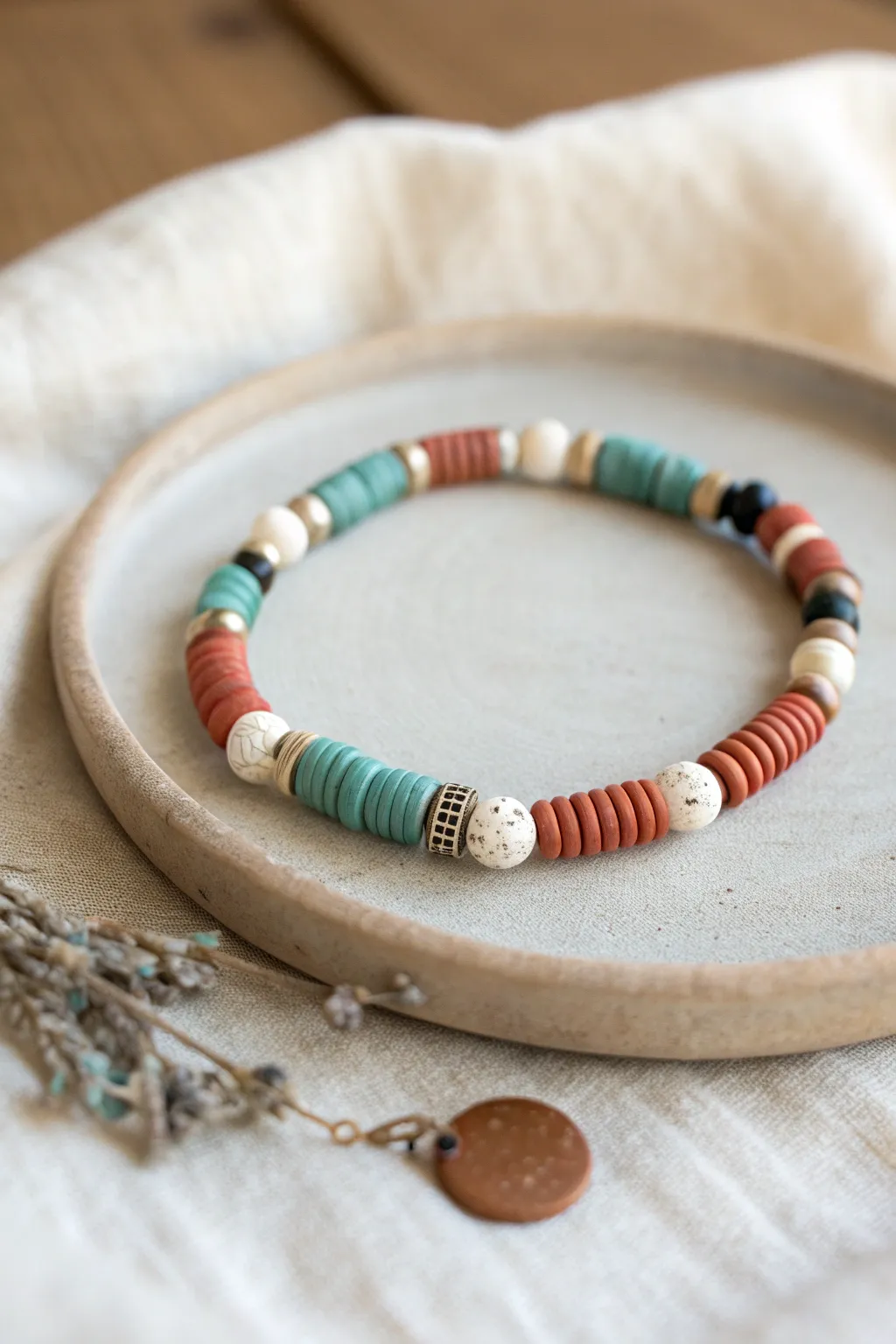
Elevate the classic flat heishi style by introducing surprise elements of texture and shape. This bracelet mixes matte terracotta and teal heishi discs with speckled round beads and metallic accents for a sophisticated, bohemian look.
Detailed Instructions
Materials
- Teal polymer clay heishi beads (approx. 4-6mm)
- Terracotta/Rust polymer clay heishi beads (approx. 4-6mm)
- Speckled cream or white round beads (approx. 8mm, stone or ceramic)
- Small gold spacer beads (discs or nuggets)
- Small black spacer beads (round or bicone)
- Textured cylindrical metal spacer (antiqued bronze or brass style)
- Elastic stretch cord (0.7mm or 0.8mm)
- Super glue or jewelry cement
- Scissors or bead snips
- Bead stopper or loose tape
Step 1: Planning & Preparation
-
Measure your wrist:
Wrap a measuring tape loosely around your wrist to find your size. Add about 0.5 inches to this measurement to ensure a comfortable fit that isn’t too tight. -
Cut the cord:
Cut a piece of elastic cord roughly 10-12 inches long. Having this extra length makes tying the final knot much easier than fighting with short ends. -
Secure the end:
Attach a bead stopper or simply tape down one end of your cord to a table. This prevents your carefully strung beads from sliding off while you design.
Knot Slipping?
If your elastic knot feels loose, try a drop of ‘G-S Hypo Cement’ inside the knot before pulling tight. It stays flexible and won’t crack like super glue often does.
Step 2: Creating the Pattern
-
Start with a focal point:
Thread on a section of teal heishi beads first, about 1/2 inch in length. Follow this with your featured textured metal cylinder bead to act as a central accent. -
Add first contrast:
Immediately following the metal cylinder, string a single speckled cream round bead. The size contrast here is key to the ‘unexpected shapes’ look. -
Build a terracotta block:
String a long section of the terracotta heishi beads, roughly 3/4 to 1 inch long. This warm block of color balances the cool tones of the teal. -
Insert a speckled pause:
Add another speckled cream round bead to break up the flat disc texture again. Follow it immediately with a small gold spacer for a hint of shine. -
Create a teal section:
Thread on about 1/2 inch of teal heishi beads. I like to sandwich these colored sections with thin metallic spacers occasionally to keep the look refined. -
Vary the rhythm on the back:
As you move toward the back of the bracelet, switch up the pattern. Add a small black spacer, then a single gold spacer, followed by a short stack (3-4 beads) of teal heishi. -
Mix shapes freely:
Continue the rest of the strand by alternating short blocks of terracotta and teal heishi beads (about 1/4 inch each). Separate these blocks with random single round beads—either the white speckled ones, small black spacers, or gold nuggets. -
Check the symmetry:
You don’t need perfect symmetry. In fact, placing a random black bead or a lone gold disc on just one side adds to the organic feel.
Level Up: Charms
Attach a small jump ring and a stamped clay or metal tag (like the one in the corner of the photo) to one of the gold spacer beads for a personalized touch.
Step 3: Finishing the Bracelet
-
Check the fit:
Wrap the unfinished strand around your wrist. The ends should meet comfortably without stretching the cord yet. Remove or add heishi discs as needed. -
Pre-stretch the cord:
Give the ends of the cord a gentle tug. Pre-stretching helps prevent the bracelet from loosening up after you’ve worn it a few times. -
Tie the knot:
Tie a secure surgeon’s knot. Imagine tying a standard shoelace knot, but loop the end through twice before pulling it tight. Repeat this twice. -
Secure with glue:
Place a tiny drop of jewelry glue or super glue specifically on the knot. Allow it to try for a few minutes; don’t rush this part or the knot might slip. -
Hide the knot:
If one of your beads has a large enough hole (like the speckled round beads), try to slide the knot inside it. Otherwise, trim the excess cord close to the knot.
Enjoy wearing your new bracelet stack or gifting it to a friend who loves bohemian style