
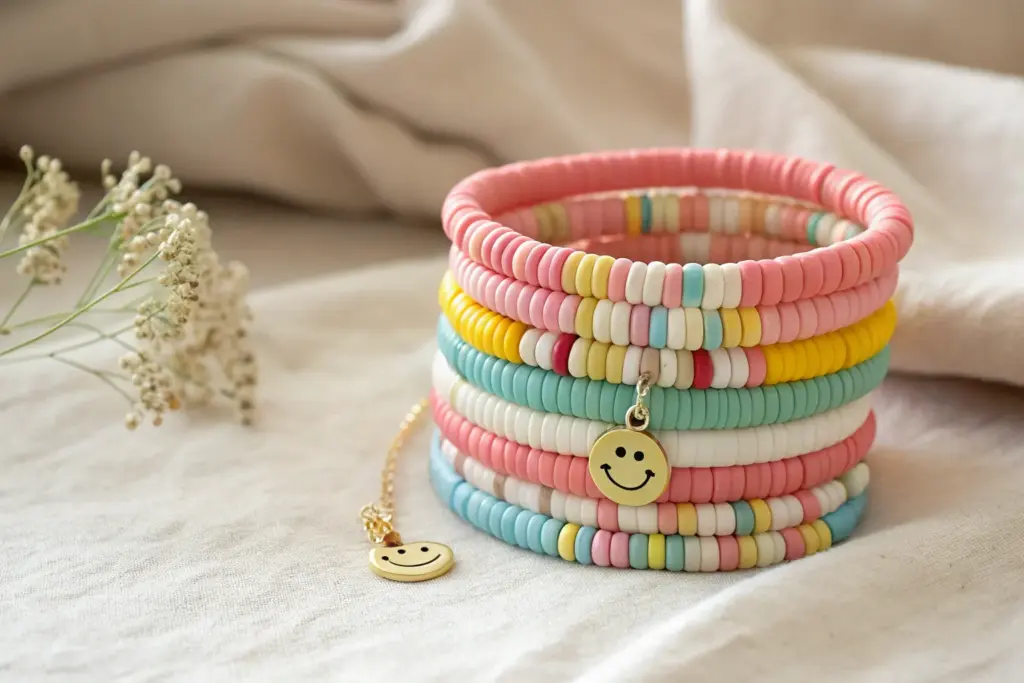
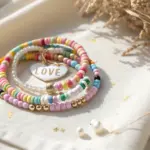
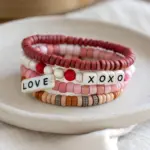
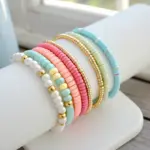
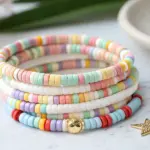
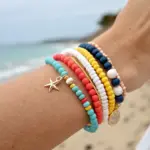
If you love that sweet, playful look of Heishi beads, you’re going to have so much fun building your own bracelet lineup. Here are my favorite cute clay bead bracelet ideas—starting with the classics everyone reaches for, then moving into some extra-fun twists.
Pastel Candy Mix
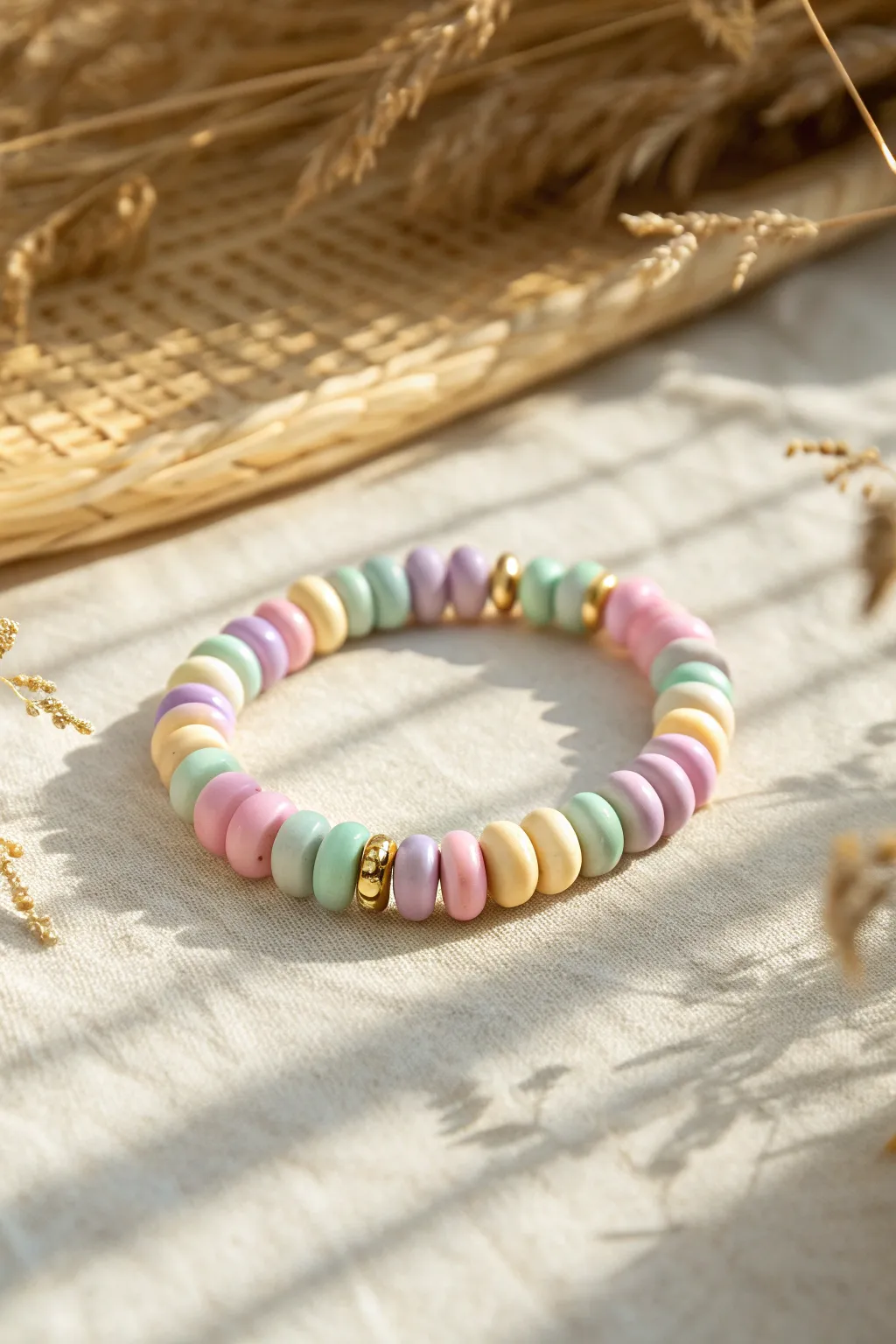
This sweet and simple bracelet captures the essence of nostalgic candy hearts with its soft, matte finish and muted pastel palette. The alternating pattern of gentle greens, pinks, lilacs, and creams is punctuated by elegant gold accents for a sophisticated twist on a playful classic.
Step-by-Step
Materials
- Polymer clay disc beads (6mm) in pastel mint green
- Polymer clay disc beads (6mm) in soft lilac
- Polymer clay disc beads (6mm) in baby pink
- Polymer clay disc beads (6mm) in buttercream yellow
- Gold round spacer beads (4mm or 5mm)
- Strong elastic beading cord (0.8mm)
- Beading needle (optional but helpful)
- G-S Hypo Cement or superglue
- Scissors
- Clean towel or bead board
- Tape or binder clip
Step 1: Preparation & Planning
-
Measure your wrist:
Wrap a piece of string or flexible measuring tape comfortably around your wrist. Add about half an inch to this measurement to ensure the bracelet isn’t too tight once the beads take up space. -
Cut the cord:
Cut a length of elastic cord about 10-12 inches long. Having extra length makes tying the final knot much easier without fumbling. -
Pre-stretch the elastic:
Hold both ends of the cord and give it several firm tugs. This pre-stretching prevents the bracelet from loosening up and sagging after your first few times wearing it. -
Secure the end:
Attach a piece of tape or a binder clip to one end of your cord to act as a stopper so your beads don’t slide right off while you work. -
Sort your beads:
Pour a small amount of each color onto your bead board or towel. A towel is great because it stops the round beads from rolling away.
Step 2: Creating the Pattern
-
Analyze the color flow:
Take a moment to look at the pattern shown. It’s not a strict A-B-C-D repeat. It relies on small clusters of pairs and trios of colors that shift organically. -
Start the sequence:
Begin threading your beads. I like to start with a grouping of three pastel discs, for example, a pink, a lilac, and a mint. -
Add the first gold accent:
Slide on one gold round spacer bead. These gold beads act as the section dividers. -
Build the second section:
Thread on a new combination of clay discs. Try two mint greens followed by a soft yellow and a lilac. -
Vary the clusters:
This design looks best when it isn’t perfectly symmetrical. Between your next gold spacer, place five or six clay discs in a random pastel order. -
Check the spacing:
Aim to place a gold spacer bead roughly every half-inch to inch of clay beads. This keeps the ‘candy’ look consistent without being overwhelming. -
Continue beading:
Keep adding beads until the strand reaches your target wrist measurement. Be sure to periodically wrap it around your wrist to check the fit. -
Final adjustments:
Ensure your design ends with a clay bead section rather than a gold bead, so the knot can be hidden between softer clay textures or seamlessly joined.
Sticky Situation?
If the knot won’t slide into a bead, don’t force it! Instead, slide a gold spacer bead (which usually has a larger hole) over the knot before gluing to cover it up.
Step 3: Finishing Touches
-
Prepare to knot:
Remove the tape or clip from the end. Bring the two ends of the elastic together carefully. -
Tie the first knot:
Tie a simple overhand knot, pulling the elastic tight enough that the beads sit snugly against each other but not so tight that they buckle. -
Tie a surgeon’s knot:
For extra security, tie a surgeon’s knot. Make a loop, pass the tail end through the loop twice, and pull tight. -
Secure with glue:
Apply a tiny dot of G-S Hypo Cement or superglue directly onto the knot. This is crucial for longevity. -
Let it dry:
Allow the glue to dry for a few minutes before touching it. Patience here prevents a sticky mess. -
Hide the knot:
Once dry, trim the excess cord ends close to the knot. Gently pull the elastic to slide the knot inside the hole of the nearest bead.
Pattern Variety
To get the natural ‘mix’ look, don’t pre-plan every bead. Grab random colors from your pile as you go to avoid accidental rigid stripes and keep it whimsical.
Enjoy styling your new pastel wrist candy alongside your favorite spring outfits
Simple Color-Block Bands
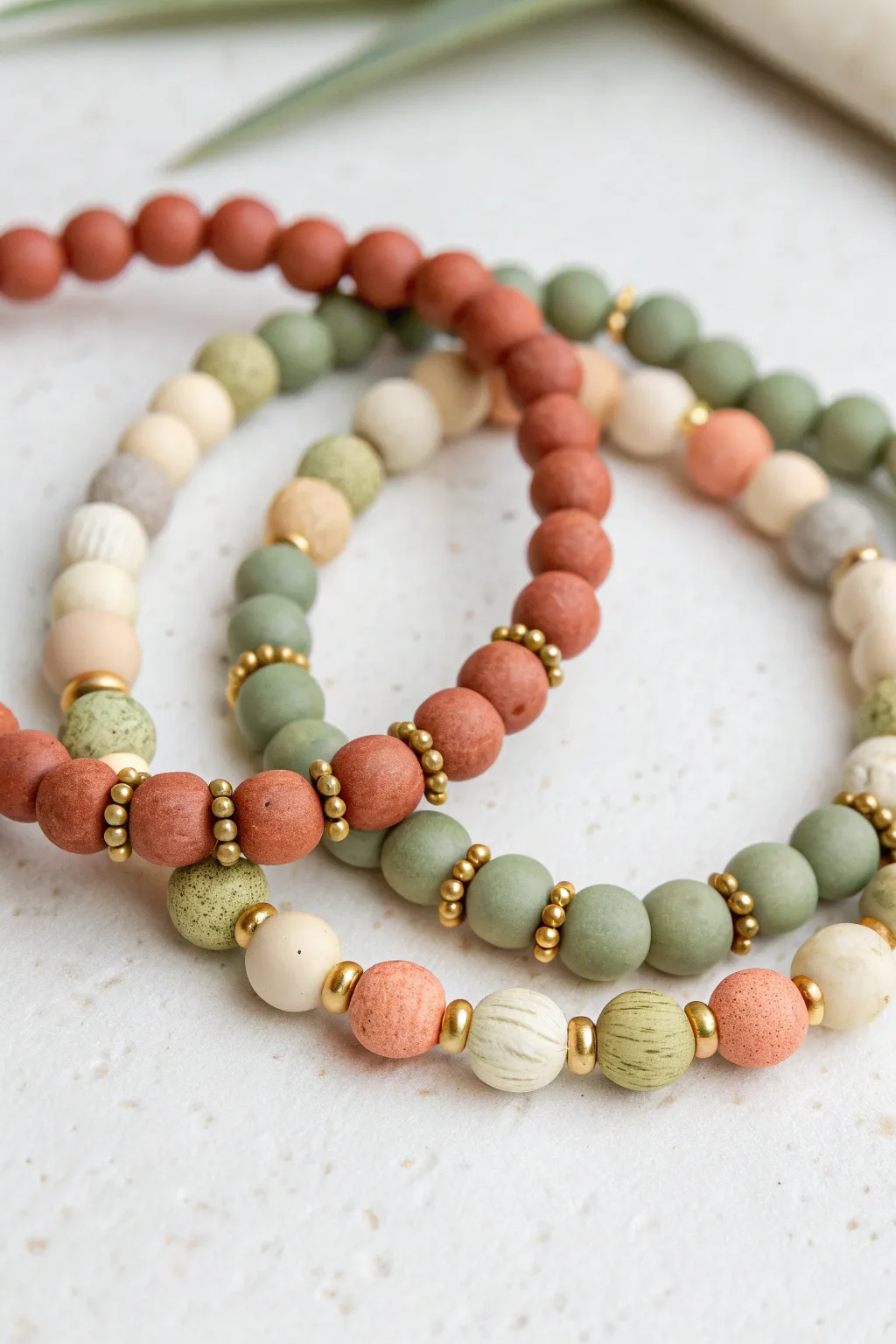
Create a set of effortlessly chic stretch bracelets featuring matte polymer clay beads in warm terracotta, sage green, and cream tones. Interspersed with tiny gold accents, these bands offer a sophisticated take on simple color-blocking that looks perfect stacked together.
Step-by-Step Tutorial
Materials
- Matte round polymer clay beads (8mm or 10mm) in terracotta/rust
- Matte round polymer clay beads (8mm or 10mm) in sage green
- Matte round polymer clay beads (8mm or 10mm) in cream/beige
- Optionally: Speckled or textured clay beads for variety
- Small gold spacer beads (daisy spacers or tiny rounds)
- Strong elastic cord (0.8mm crystal string recommend)
- jewelry glue (e.g., G-S Hypo Cement)
- Scissors
Step 1: Planning Your Designs
-
Measure your wrist:
Before you begin, wrap a piece of string around your wrist to find your comfortable size, usually adding about half an inch for a comfortable fit. -
Lay out the Rust Bracelet:
For the first design, we’ll focus on a solid color block. Lay out approximately 20-22 rust-colored beads in a straight line on your bead board or a towel. -
Add gold accents:
Insert a small gold spacer bead between every single rust bead. This creates that high-end, segmented look seen in the top bracelet. -
Design the Sage & Cream Mix:
For the second bracelet, create a pattern. layout sections of 3-5 sage green beads, followed by a ‘focal’ section of cream, textured, or mixed beads. -
Incorporate spacers strategically:
Instead of placing gold spacers between every bead this time, place two gold spacers flanking specific focal beads or at the transitions between color blocks. -
Create the Third Mixed Strand:
For the final bracelet, mix all your colors. Try an alternating pattern: one rust, one gold spacer, one sage, one gold spacer, and one cream.
Knot Slipping?
If your elastic knot feels insecure, try a surgeon’s knot instead. It’s just like a square knot, but you loop the elastic through twice on the first pass for extra friction.
Step 2: Stringing
-
Prepare the elastic:
Cut a piece of elastic cord about 10-12 inches long. This extra length makes tying the final knot much easier than fighting with short ends. -
Pre-stretch the cord:
Give the elastic a firm tug a few times. Pre-stretching prevents the bracelet from becoming loose and sagging after the first few wears. -
Secure the end:
Place a piece of tape over one end of the cord or attach a bead stopper so your beads don’t slide off while you work. -
Thread the first bracelet:
Begin threading your rust and gold pattern. I find threading the larger clay bead first, followed by the tiny spacer, creates a good rhythm. -
Check the fit:
Once all beads are on, carefully wrap the strand around your wrist. The beads should touch comfortably without gaps showing the elastic. -
String the remaining designs:
Repeat the threading process for your sage/cream combo and your mixed-pattern bracelet, checking the length of each against the first one to ensure uniformity.
Matte Finish Pro-Tip
To keep that soft, matte finish on polymer clay beads, avoid getting oils or lotions on them initially. If they look dusty, wipe them gently with a baby wipe to restore the color.
Step 3: Finishing Touches
-
Tie the knot:
Remove the tape/stopper. Bring the two ends together and tie a standard square knot (right over left, left over right). -
Tighten securely:
Pull the elastic ends firmly to tighten the knot. You want it tight enough that there is no gap between beads, but not so tight the bracelet buckles. -
Apply adhesive:
Dab a tiny drop of jewelry glue directly onto the knot. Be careful not to get glue on the clay beads themselves as it can alter the matte finish. -
Hide the knot:
While the glue is still slightly wet, pull the knot gently inside the hole of the nearest large clay bead to hide it. -
Trim excess:
Once the glue is fully dry (wait at least 15 minutes), use your scissors to trim the excess elastic tails as close to the bead hole as possible.
Enjoy mixing and matching your new sophisticated stacks with your favorite outfits
Smiley Charm Pop
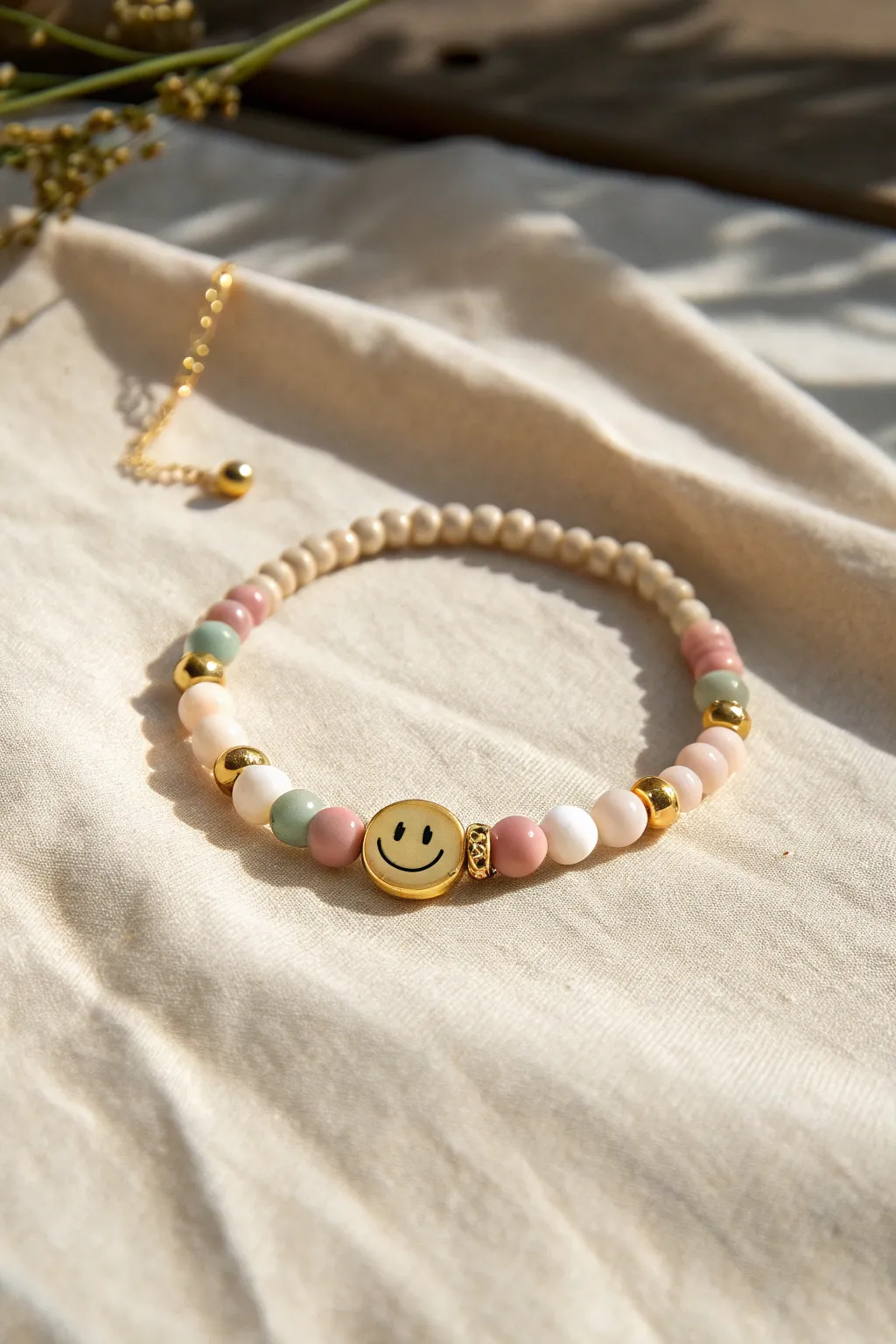
Brighten your day with this cheerful bracelet featuring a delightful smiley face centerpiece. Combining soft pastel clay beads with elegant gold accents, this piece strikes the perfect balance between playful charm and sophisticated style.
How-To Guide
Materials
- Stretch cord (0.8mm clear elastic)
- Gold-rimmed enamel smiley face charm (yellow/gold)
- 6mm round ceramic or opaque glass beads (Beige/Cream)
- 6mm round ceramic or opaque glass beads (Muted Pink/Rose)
- 6mm round ceramic or opaque glass beads (Muted Sage Green)
- 6mm round ceramic or opaque glass beads (White)
- 4mm gold filled spacer beads (round)
- Gold heishi spacer beads (flat)
- Small gold charm connector ring (optional)
- Jewelry glue or clear nail polish
- Scissors
Step 1: Setting the Stage
-
Measure your cord:
Cut a piece of stretch cord about 10-12 inches long. This gives you plenty of extra room to tie knots later without struggling with a short string. -
Secure the end:
Place a piece of tape or a bead stopper on one end of the cord to prevent your beads from sliding off while you design.
Knot Slipping?
If your surgeon’s knot feels slippery, try dusting the elastic ends with a tiny bit of cornstarch or baby powder before tying for extra grip.
Step 2: Designing the Pattern
-
Start with the back:
Begin stringing the solid beige/cream colored beads. You’ll want about 14-16 of these, as they form the simple back section of the bracelet. -
Create the first transition:
After the beige section, add a muted pink bead followed immediately by a muted sage green bead. -
Add a gold accent:
Slide on a 4mm round gold spacer bead. This adds a nice metallic break before the pattern shifts again. -
Layer the lighter tones:
String a round white bead, then another gold spacer bead. -
Mirrored spacing:
Add another white bead, followed by a sage green bead, and then a muted pink bead.
Seamless Style
Use a crimp bead cover over your knot instead of hiding it inside a bead. This looks like another gold spacer and keeps the finish professional.
Step 3: The Centerpiece
-
Prepare the charm area:
Slide on the smiley face charm. If the hole runs horizontally through the bead, string it directly. If it’s a pendant style, use a small gold jump ring or connector ring to attach it so it faces forward. -
Add texture:
On the immediate right side of the smiley charm, I prefer to add a small textured gold bead or a tiny stack of flat gold heishi spacers for visual interest. -
Mirror the front pattern:
Now, recreate the pattern from the left side in reverse order. Start with a muted pink bead, then a white bead. -
Continue the sequence:
Add a round white bead, followed by a round gold spacer bead. -
Finish the transition:
Add a pink bead, then a sage green bead to complete the colorful front section. -
Close the loop:
Finally, add a round gold spacer bead to connect back to your starting beige beads.
Step 4: Finishing Touches
-
Check fit:
Wrap the unfinished strand around your wrist to check the size. Add or remove beige beads from the back section if you need to adjust the fit. -
Pre-stretch:
Gently pull on both ends of the cord a few times. This pre-stretching helps prevent the bracelet from loosening up immediately after you wear it. -
Tie the knot:
Tie a surgeon’s knot (right over left, left over right) and pull it tight. The elastic should stretch slightly as you secure it. -
Secure with glue:
Dab a tiny drop of jewelry glue or clear nail polish onto the knot. Let it dry completely before trimming. -
Trim and hide:
Cut the excess cord close to the knot. If the hole of a neighboring bead is large enough, gently pop the knot inside to hide it.
Wear your new smiley bracelet stacked with gold chains or let it shine on its own as a happy little statement piece
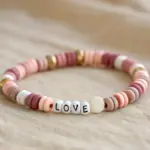
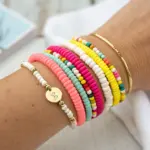
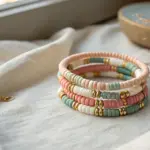
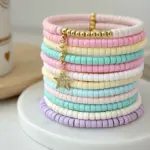
Name or Nickname Letters
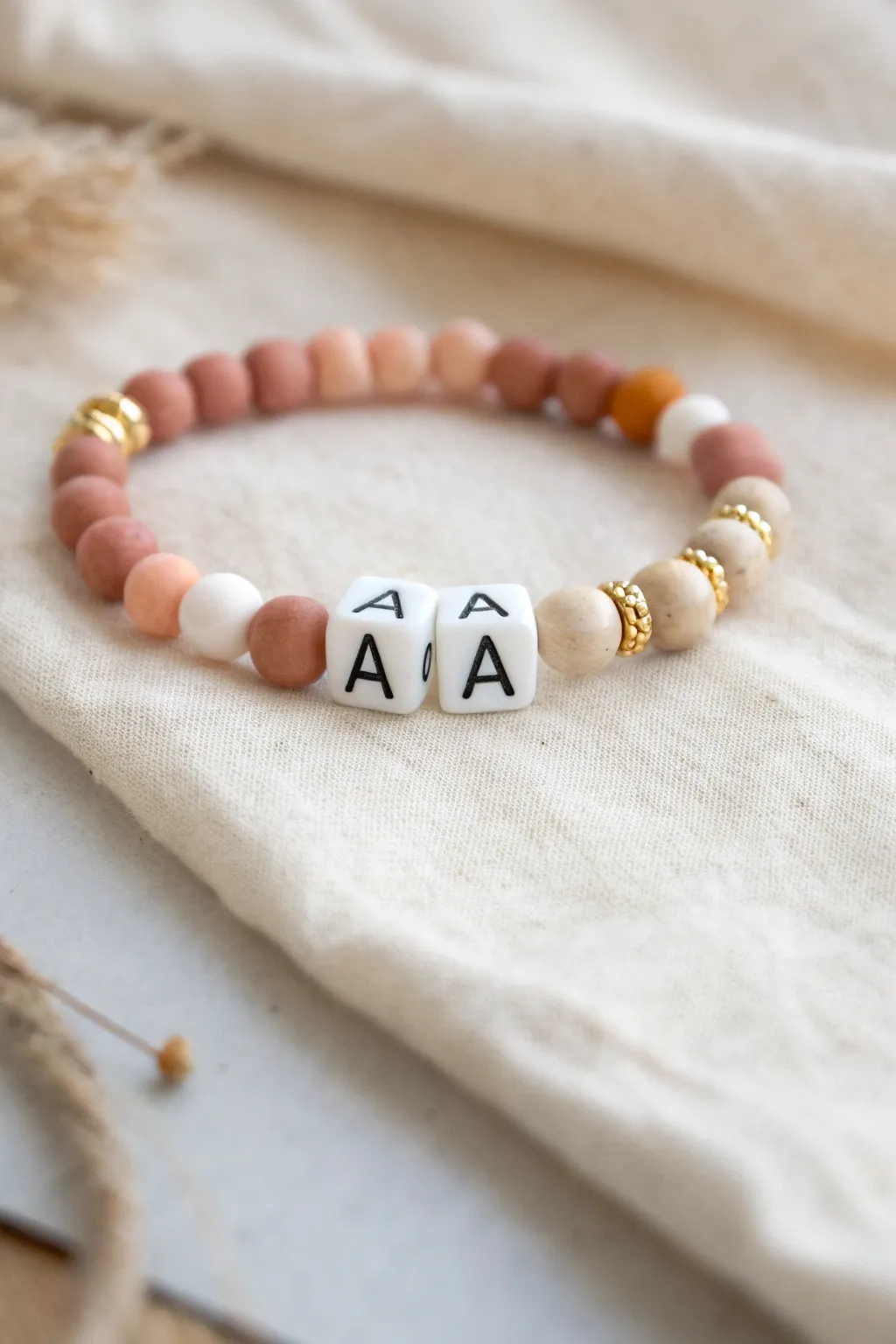
Create a personalized accessory that blends earthy tones with a modern touch using this simple yet stylish design. This bracelet features a gradient of terracotta and cream clay beads accented with gold spacers and square letter blocks for a custom initial look.
Step-by-Step Tutorial
Materials
- Polymer clay heishi beads (terracotta, peach, white/cream, beige/tan, brown)
- White square alphabet beads (letters ‘A’ and ‘A’ or your choice)
- Gold spacer beads (small, rounded disc or ring shape)
- Gold accent bead (larger, spherical or geometric)
- Elastic stretch cord (0.7mm or 0.8mm)
- Jewelry glue or clear nail polish
- Scissors
Step 1: Planning and Layout
-
Measure your wrist:
Cut a piece of elastic cord about 10-12 inches long. This gives you plenty of extra room to tie the knot later without losing beads. -
Arrange the centerpiece:
Start by laying out your design on a bead board or a towel to stop them from rolling away. For this look, place your two square letter beads side-by-side in the center. -
Plan the right side:
To the right of the letters, place the following sequence: one beige natural stone or wooden bead, a gold spacer, another beige bead, a gold spacer, and a third beige bead. This creates a distinct section next to the letters. -
Plan the left side:
To the left of the letters, balance the look with a single terracotta bead followed by a cream/white bead. This asymmetry is key to the organic, boho feel.
Step 2: Stringing the Beads
-
Start stringing:
Using one end of the cord, thread on your central arrangement first so the initials end up right in the middle. -
Build the gradient:
On the left side (after the initial cream bead), add a sequence of terracotta and peach-colored clay beads. I find creating a subtle ombre effect works best here, transitioning from lighter peach to deeper rust tones. -
Add the gold accent:
About halfway around the left side, thread on the larger gold geometric or spherical bead. This acts as a textural break in the clay pattern. -
Continue the pattern:
Continue adding clay beads in your rust/terracotta mixture until you reach the back of the bracelet. -
Complete the right side:
Now move to the right side of the bracelet (after the beige beads). Add a few mixed rust and cream beads, perhaps a darker brown bead for contrast, and continue filling with the terracotta clay beads until the strand is long enough for your wrist. -
Check the fit:
Wrap the unfinished strand around your wrist to check the size. It should fit comfortably without gaps but shouldn’t be so loose it slides off.
Cord longevity tip
Use a specialized elastic cord like ‘Stretch Magic’ rather than generic crafting string. It resists fraying and holds its snap-back quality much longer.
Step 3: Finishing Touches
-
Pre-stretch the cord:
This is a crucial step often missed. Gently pull on both ends of the elastic cord to stretch it out slightly. This prevents the bracelet from stretching out permanently the first time you wear it. -
Tie the first knot:
Bring the two ends together and tie a single overhand knot, pulling it tight so the beads sit flush against each other. -
Secure with a surgeon’s knot:
Tie a second knot, but this time loop the end through the circle twice before pulling tight. This is a surgeon’s knot and offers much better security. -
Apply adhesive:
Dab a tiny drop of jewelry glue or clear nail polish directly onto the knot. Be careful not to get glue on the neighboring beads. -
Hide the knot:
While the glue is still tacky, gently pull the cord so the knot slides inside the hole of one of the larger beads (like the beige ones) if possible. -
Trim the excess:
Once the glue is fully dry, trim the excess elastic cord close to the bead, ensuring the ends are hidden.
Trouble threading?
If the elastic end frays and won’t go through the beads, apply a tiny bit of clear nail polish to the tip and let it stiffen into a makeshift needle.
Wear your new bracelet stacked with others for a trendy look or let it stand alone as a simple statement piece

The Complete Guide to Pottery Troubleshooting
Uncover the most common ceramic mistakes—from cracking clay to failed glazes—and learn how to fix them fast.
Tiny Positive Word Bracelet
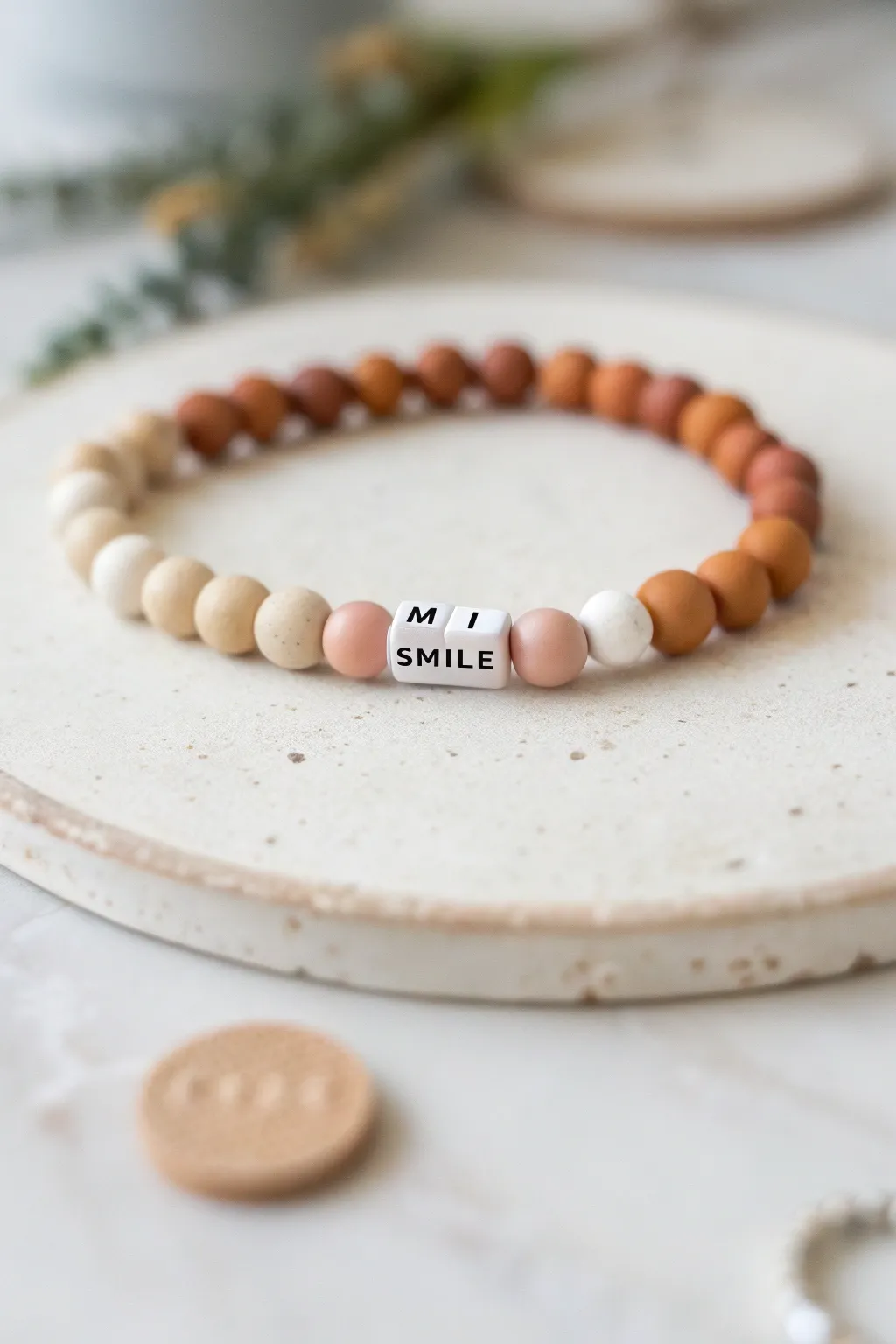
Embrace the soothing palette of nature with this minimalist bracelet featuring a gradient of warm, matte beads. Centered with a sweet, positive message, this accessory combines modern boho style with a personal touch.
Step-by-Step
Materials
- Polymer clay or silicone beads (6mm or 8mm) in cream, beige, soft pink, rust, and terracotta
- Square white alphabet beads with black lettering (customizable letters)
- Stretch cord (0.8mm or 1.0mm depending on bead hole size)
- Jewelry glue or clear nail polish
- Scissors
Step 1: Planning and Preparation
-
Measure your wrist:
Before you begin, wrap a piece of string or a soft measuring tape around your wrist to determine the correct size. Add about half an inch to this measurement for a comfortable fit. -
Cut the cord:
Cut a length of stretch cord about 10-12 inches long. Having this extra length makes tying the final knot much easier than struggling with short ends. -
Pre-stretch the cord:
Give your cut piece of stretch cord a gentle tug several times. This ‘pre-stretching’ technique prevents the bracelet from drooping or stretching out permanently after you wear it a few times. -
Design your gradient:
Lay your beads out on a bead board or a towel to prevent rolling. Arrange them in a color gradient from lightest (cream/white) to darkest (terracotta/rust). -
Establish the pattern:
For this specific look, aim for a symmetrical design where the colors mirror each other on either side of the central word. Start with your darkest colors at the ‘back’ of the bracelet and fade into lighter creams toward the center.
Sticky Situation?
If the knot won’t slide into a bead hole, don’t force it. Instead, trim the ends very short and rotate the beads so the knot sits at the back of the wrist.
Step 2: Stringing the Beads
-
Start with the back section:
Begin threading your darkest rust-colored beads first. String about 8-10 of these, depending on your wrist size. -
Transition the colors:
Next, add 3-4 medium terracotta beads, followed by 3-4 beige or tan beads. The gradual shift creates that lovely ombre effect. -
Add the lightest accents:
String 2-3 of the lightest cream beads. These will act as a bright frame leading into the center focal point. -
Border the word:
Add one soft pink bead. Then, thread your square alphabet beads to spell your chosen word (like ‘SMILE’). Follow the word with another single soft pink bead and one white accent bead to balance the center. -
Complete the second half:
Now work in reverse order from how you started. Add your cream beads, then beige, then terracotta, finishing with the rust beads until you reach the desired length. -
Check the fit:
Carefully bring the two ends together and wrap the bracelet around your wrist to verify the size. Add or remove the dark rust beads at the ends if adjustments are needed.
Step 3: Finishing Touches
-
Tie the first knot:
Make a simple overhand knot, pulling the cord tight enough so there are no gaps between beads, but not so tight that the bracelet puckers. -
Secure with a surgeon’s knot:
Follow up with a surgeon’s knot for extra security. Loop the string through twice before pulling tight. I find this holds significantly better than a standard square knot. -
Apply adhesive:
Dab a tiny drop of jewelry glue or clear nail polish directly onto the knot. Wait a moment for it to become tacky. -
Hide the knot:
Ideally, pull the knot inside the hole of one of the larger clay beads nearby to conceal it completely. -
Trim the excess:
Once the glue is fully dry, trim the excess cord ends carefully with your scissors, getting closest to the bead hole without cutting the knot itself.
Level Up Your Beadwork
Add tiny gold spacer discs between every color change. The metallic flash adds a sophisticated, store-bought finish to the earthy clay texture.
Slip on your new custom bracelet and enjoy the subtle pop of positivity on your wrist
All-White With Gold Spacers
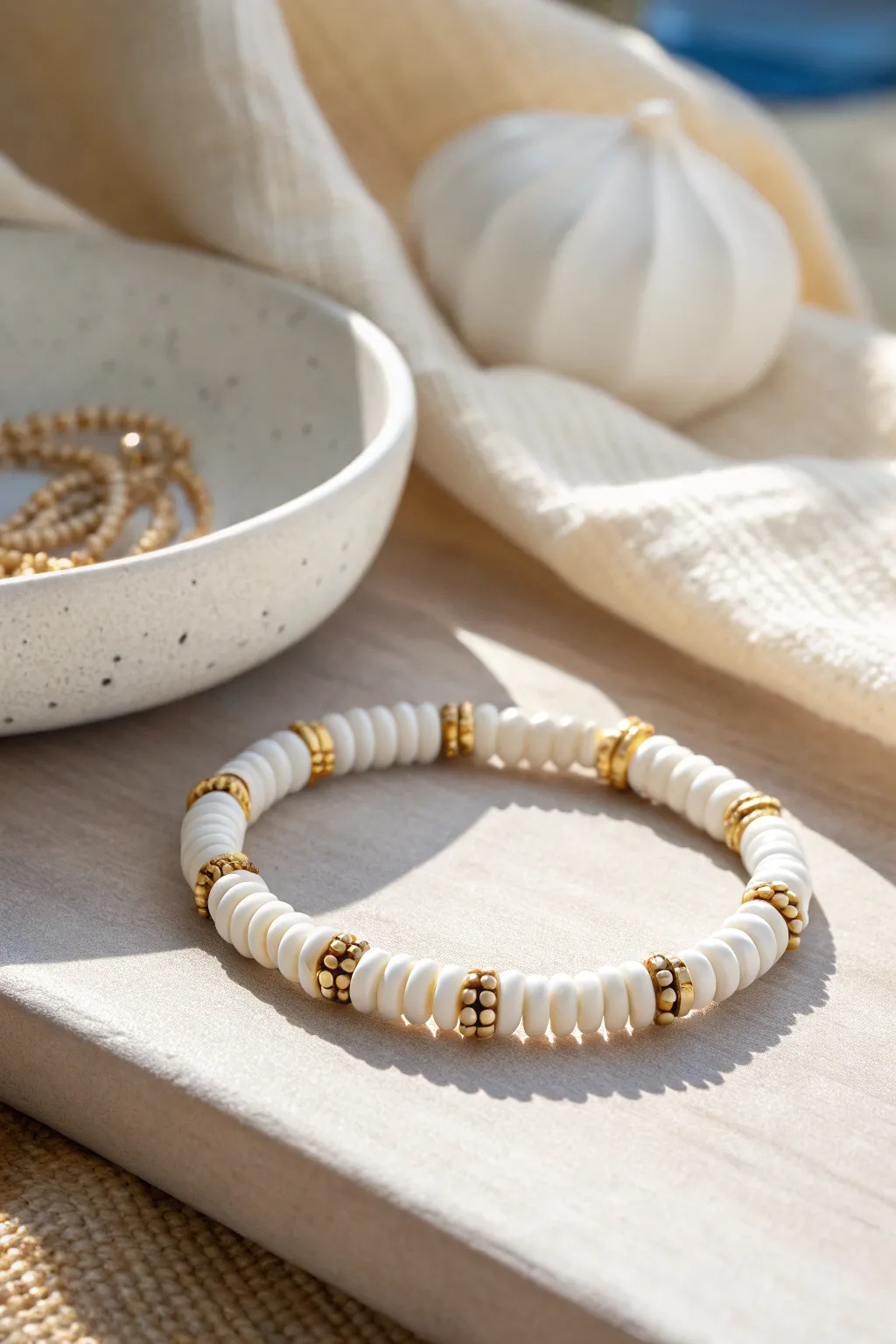
Elevate the classic clay bead trend with this sophisticated design that pairs crisp white discs with textured gold accents. It is a perfect, stackable piece that feels both beachy and elegant enough for an evening out.
Step-by-Step Tutorial
Materials
- 6mm White polymer clay Heishi beads
- Gold-plated decorative textured cylinder spacer beads (approx. 5-6mm wide)
- Strong elastic stretch cord (0.7mm or 0.8mm)
- Jewelry glue or clear nail polish
- Scissors
Step 1: Planning and Preparation
-
Measure your wrist:
Before you begin, wrap a piece of string around your wrist to find your comfortable size, then add about half an inch for ease. This ensures the bracelet won’t be too tight once the beads take up space on the inner circumference. -
Cut the cord:
Cut a length of elastic cord about 10-12 inches long. You want plenty of extra slack on both ends to make tying the final knot much easier without fumbling. -
Pre-stretch the elastic:
Hold the cord securely at both ends and give it a few gentle firm tugs. This crucial step prevents the bracelet from sagging or stretching out permanently after your first wear. -
Secure the end:
Attach a piece of tape or a bead stopper clip to one end of the cord so your beads don’t slide right off while you are working.
Step 2: Creating the Pattern
-
Start with the main color:
Begin by threading on four white Heishi clay beads. Using a bead board or a simple towel on your table helps keep them from rolling away. -
Add first gold accent:
Slide on one of your decorative gold cylinder spacers. Ensure the gold tone matches any other jewelry you plan to stack this with for a cohesive look. -
Establish the repeat:
Thread on another group of four white Heishi beads. Notice how the stark white contrasts beautifully with the metallic sheen. -
Continue the sequence:
Repeat the pattern: one gold textured spacer followed by four white clay beads. I find this simple ratio creates a balanced, high-end look without feeling too cluttered. -
Check the length:
Periodically wrap the beaded cord around your wrist to check the fit. Clay beads can sit differently than round glass beads, so a physical check is better than just measuring. -
Adjust the pattern end:
You want the pattern to be continuous when tied. If you started with white beads, try to end with a gold spacer, or adjust your final group of white beads so the join is invisible.
Knot Hiding Trick
Make sure your gold spacer bead has a large enough hole to accommodate the knot. If the knot is too bulky, try hiding it inside two adjacent Heishi beads instead.
Step 3: Finishing Touches
-
Prepare to tie:
Once the bracelet is the perfect length, carefully remove the tape or clip. Bring the two ends of the cord together, keeping tension so no gaps form between the beads. -
Tie the first knot:
Cross the ends and tie a simple overhand knot. Pull it tight, bringing the beads snugly together. -
Secure with a surgeon’s knot:
For the second knot, loop the cord through twice instead of once before pulling tight. This extra pass creates friction that prevents the slippery elastic from coming undone. -
Apply adhesive:
Dab a tiny drop of jewelry glue or clear nail polish directly onto the knot. Be careful not to get glue on the surrounding beads, as it can discolor the clay. -
Let it cure:
Allow the glue to dry completely for the time recommended on the bottle. Patience here prevents a sticky mess later. -
Hide the knot:
Once dry, trim the excess cord ends to about 2mm. Gently pull the elastic so the knot slides inside one of the gold spacer beads to hide it completely from view.
Gap Prevention
If you see gaps between beads after tying, you likely didn’t pull the elastic taut enough while knotting. The elastic should be slightly stretched when you secure it.
Slip on your new chic accessory and enjoy that custom-fit feeling

What Really Happens Inside the Kiln
Learn how time and temperature work together inside the kiln to transform clay into durable ceramic.
Black-and-White Dainty Contrast
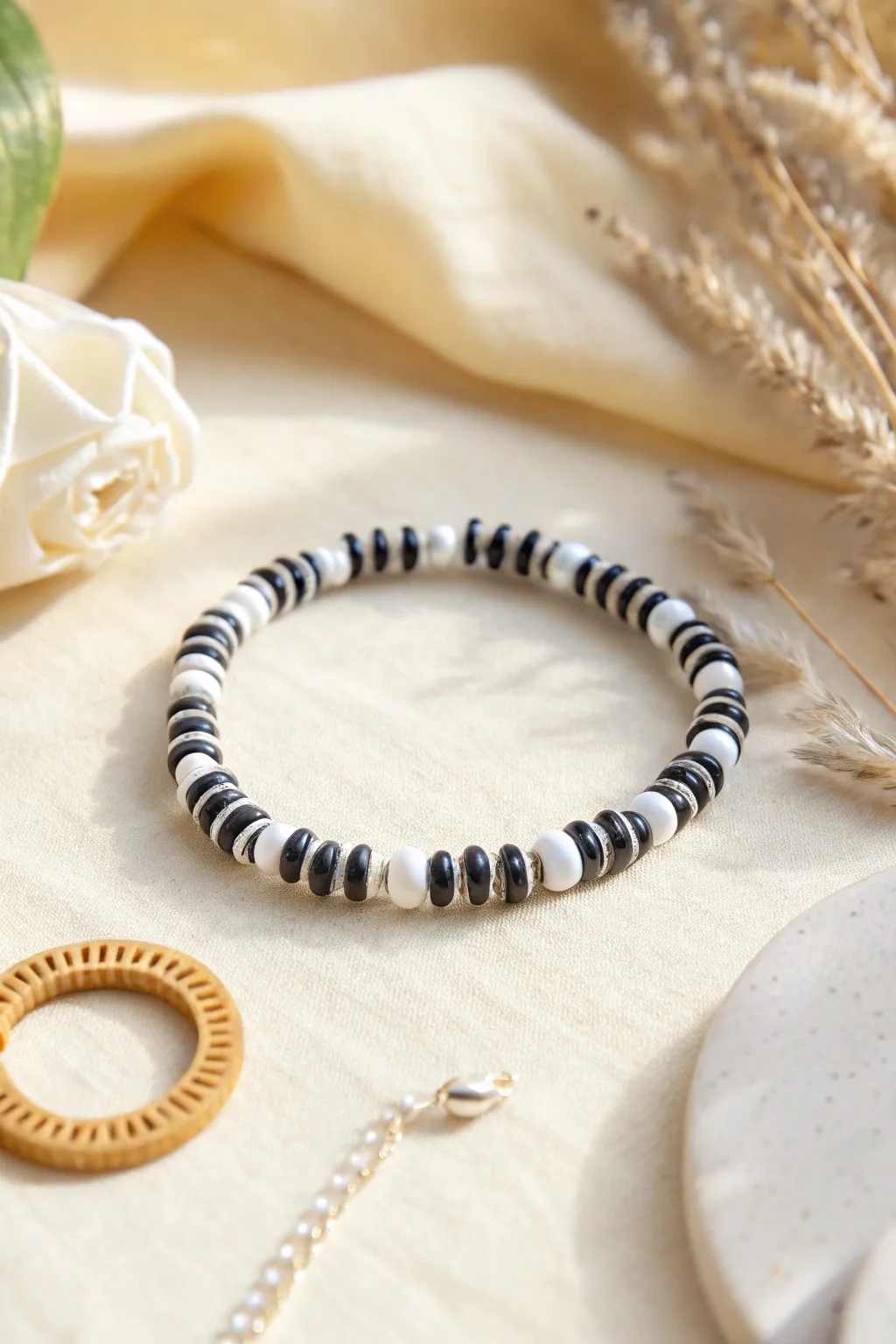
Achieve a sophisticated, minimalist look with this high-contrast black and white bracelet. Using flat heishi beads mixed with delicate seed bead accents creates a pattern that feels both modern and timeless.
How-To Guide
Materials
- Black polymer clay heishi beads (flat disc beads, approx. 4mm-6mm)
- White polymer clay heishi beads (flat disc beads, approx. 4mm-6mm)
- Small silver spacer beads or seed beads (size 11/0 or similar)
- Elastic stretch cord (0.5mm or 0.8mm, specifically for jewelry making)
- Hypo-cement or clear jewelry glue
- Scissors or nippers
- Beading needle (optional but helpful for elastic)
- Bead tray or soft cloth
- Tape or bead stopper
Step 1: Preparation
-
Measure the cord:
Cut a piece of elastic cord about 10-12 inches long. This gives you plenty of extra slack for tying the knot later without struggling against tension. -
Pre-stretch the elastic:
Give the cord a few gentle tugs along its length. Pre-stretching helps prevent the finished bracelet from sagging after you wear it a few times. -
Secure the end:
Place a piece of tape or a bead stopper on one end of the cord to keep your beads from sliding off while you design.
Spacer Strategy
Use textured or ‘daisy’ style silver spacers instead of smooth rounds. The texture catches the light better and adds a vintage feel.
Step 2: Creating the Pattern
-
Understand the sequence:
Study the pattern in the image: it uses segments of black beads separated by single white beads, with tiny silver spacers nestled between specific transitions. -
Start with a black segment:
String on three black heishi beads to begin your first dark section. -
Add a silver spacer:
Slide on one tiny silver spacer bead. This adds a subtle metallic glint that separates the solid colors beautifully. -
Insert the white accent:
Add one single white heishi bead. This white bead acts as the high-contrast highlight in the design. -
Mirror the transition:
Place another silver spacer bead on the cord immediately after the white bead. -
Complete the first unit:
Finish this sequence unit by adding three more black heishi beads. -
Repeat the pattern:
Continue this pattern: Silver Spacer – White Bead – Silver Spacer – Three Black Beads. Wait, looking closer at the image, the pattern varies slightly. It looks like groups of 3-4 black beads separated by a highlight section. -
Refining the rhythm:
Let’s be precise: String 3 black beads. Then add your highlight group: one silver spacer, one white bead, one silver spacer. Follow this with 3 more black beads. -
Check the length:
Continue repeating this full sequence until the beaded portion measures just enough to wrap around your wrist comfortably. I usually aim for about 6.5 to 7 inches for a standard fit. -
Verify the pattern alignment:
Ensure your pattern ends in a way that will look seamless when joined. If you started with black beads, try to end just after a white/silver spacer section so the flow isn’t interrupted.
Step 3: Finishing Touches
-
Prepare to tie:
Remove the tape or bead stopper carefully, holding both ends of the elastic firmly. -
Tie the first knot:
Make a simple overhand knot and pull it down gently against the beads to remove slack, but don’t pull so tight that the beads bunch up or curve awkwardly. -
Secure with a surgeon’s knot:
Tie a surgeon’s knot (looping the elastic through twice instead of once) for extra security. Pull tight. -
Hide the knot:
Apply a tiny dot of jewelry glue to the knot. While the glue is wet, slide the knot inside the hole of the nearest white or black heishi bead if the hole is large enough. -
Trim the excess:
Once the glue works its magic and dries (usually 10-15 minutes), trim the excess elastic cord close to the bead, being careful not to cut the main knot.
Gold Upgrade
Swap the silver spacers for gold-plated discs or tiny brass hex nuts to give the bracelet a warmer, more classic luxury aesthetic.
This simple yet striking accessory adds an effortless monochromatic edge to any outfit stack
Beachy Shell Centerpiece
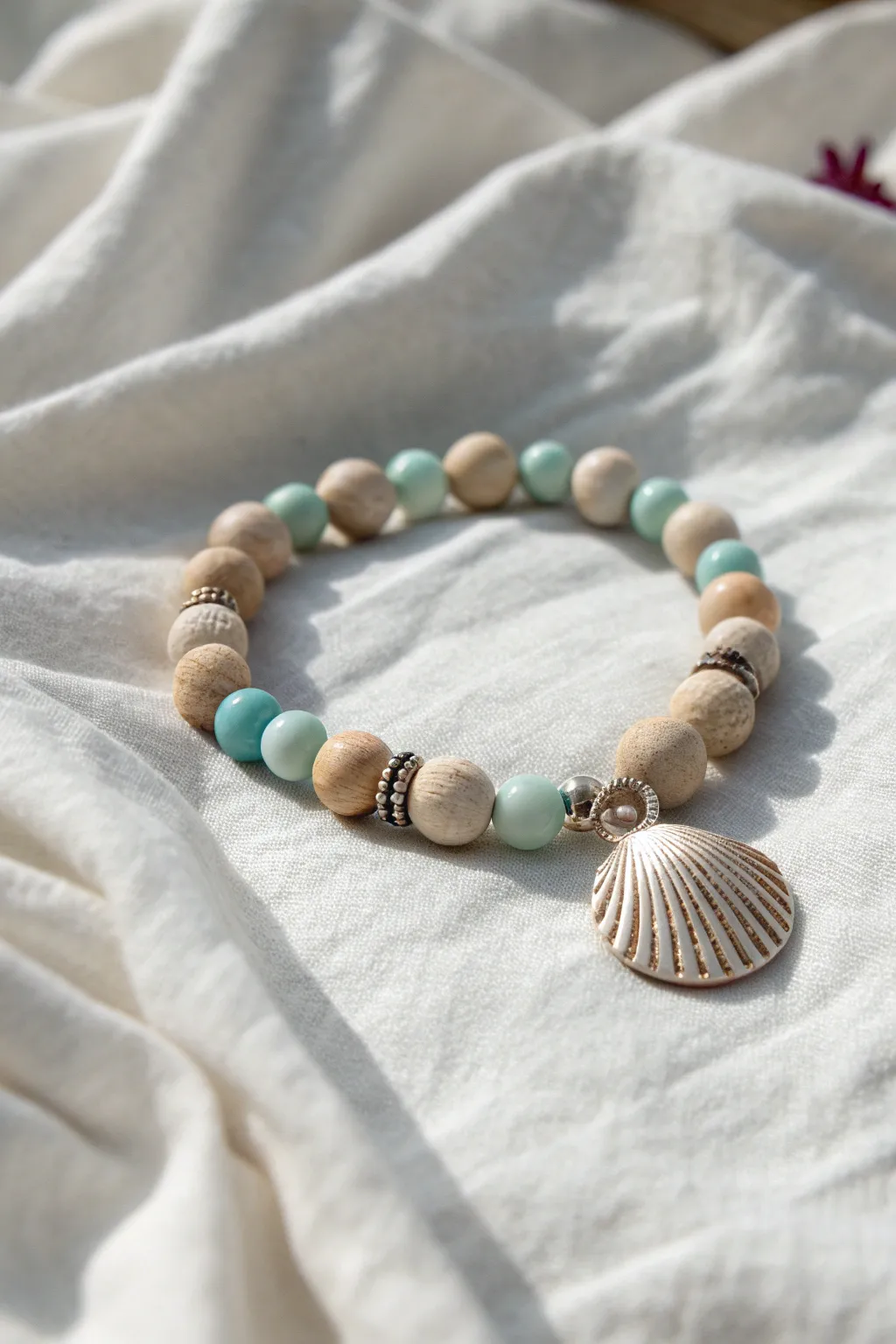
Capture the essence of a tranquil beach walk with this soothing combination of natural wood textures and soft sea-glass hues. The striking silver shell pendant creates an elegant focal point that elevates this from a simple craft to a wearable piece of ocean-inspired art.
Step-by-Step
Materials
- Light unfinished wood rounds (8-10mm)
- Pale turquoise or mint gemstone/glass beads (8-10mm)
- Large silver scallop shell pendant with top loop
- Silver textured spacer wheels (daisy spacers)
- Silver bead cap or small round silver spacer bead
- Strong elastic beading cord (0.7-1mm)
- Jewelry glue (e.g., G-S Hypo Cement)
- Scissors or jewelry snips
- Bead stopper or tape
Step 1: Planning the Pattern
-
Measure your wrist:
Before stringing, wrap a piece of string around your wrist to find your comfortable fit, adding about half an inch for ease. This helps determine how many beads you’ll ultimately need. -
Lay out the design:
Visualize your pattern by laying the beads out on a bead board or a towel. The pattern shown alternates between two wood beads and one blue bead for the main sections. -
Define the focal point:
Place your shell pendant at the very center of your layout to serve as the anchor for the design. -
Accentuate the center:
Arrange the beads immediately flanking the pendant: use one wood bead on each side, followed by a silver spacer, and then transition into the repeating pattern.
Step 2: Stringing the Design
-
Prepare the cord:
Cut a length of elastic cord about 10-12 inches long. This extra length makes tying the final knot much easier. -
Secure the end:
Attach a bead stopper or a piece of tape to one end of the cord to prevent your beads from sliding off as you work. -
Start the sequence:
Begin stringing with the main body pattern. Slide on two wood beads followed by one turquoise bead. Repeat this ‘two-wood, one-blue’ sequence three or four times. -
Transition to the center:
After your last turquoise bead of the side section, add two wood beads. -
Add silver details:
Slide on a textured silver spacer bead. These spacers frame the central area beautifully and hide the transition between materials. -
Place the centerpiece:
Thread the cord through the loop or bail of your silver shell pendant. Ensure the shell faces outward. -
Add a balancing detail:
If your pendant loop is large, you might want to add a small silver round bead next to it for stability, though simply letting it hang between the wood beads works too. -
Mirror the design:
Add the second silver spacer bead immediately after the shell pendant area to create symmetry. -
Complete the second half:
Resume the pattern in reverse order: two wood beads, then one turquoise bead. Continue this pattern until the bracelet reaches your desired length.
Knot Slipping?
If your elastic is slippery, dust the knot area with a tiny bit of cornstarch before pulling tight. The powder adds grip and helps the knot hold securely.
Step 3: Finishing Touches
-
Check the fit:
Carefully bring the two ends of the cord together and wrap the bracelet around your wrist to check the sizing one last time. Add or remove wood beads at the ends if necessary. -
Pre-stretch the cord:
I always give the elastic a few gentle tugs before tying. This pre-stretching prevents the bracelet from loosening up after the first few wears. -
Tie the knot:
Tie a surgeon’s knot (right over left, left over right, looping through twice) to secure the ends firmly. -
Secure with glue:
Apply a tiny dot of jewelry glue to the knot. Let it dry completely according to the glue manufacturer’s instructions. -
Hide the knot:
Trim the excess cord ends close to the knot, then gently pull the cord so the knot slides inside the hole of one of the adjacent wood beads.
Natural Wood Tip
Unfinished wood beads can absorb oils. Rub a tiny bit of coconut oil on them before stringing to seal them and deepen their color slightly.
Wear your new bracelet stacked with other textures or let it shine solo as a reminder of sunny days

TRACK YOUR CERAMIC JOURNEY
Capture glaze tests, firing details, and creative progress—all in one simple printable. Make your projects easier to repeat and improve.
Fruit-Sweet Summer Bracelet
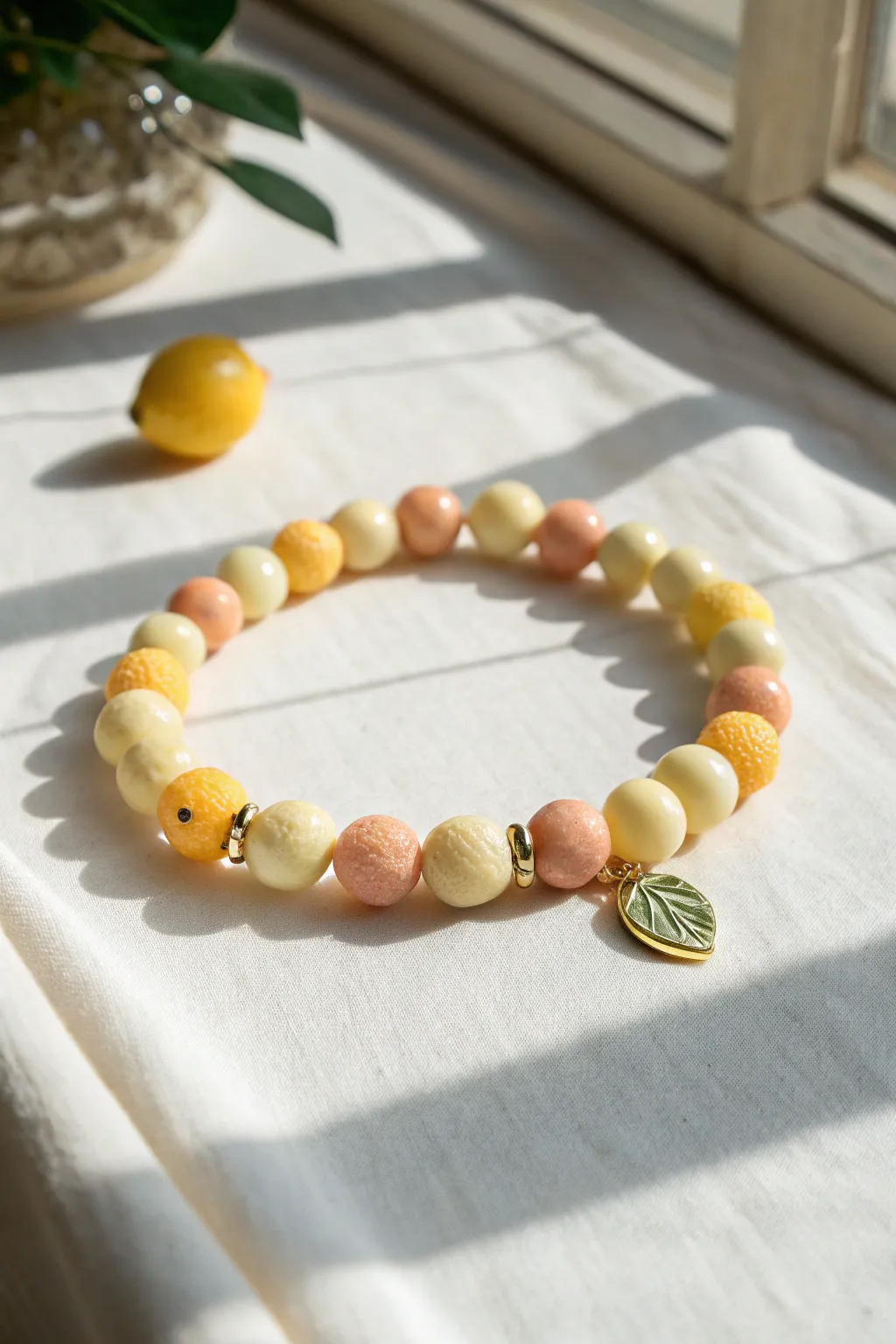
Capture the essence of summer with this delightful polymer clay bracelet featuring textured beads in shades of lemon, cream, and peach. The mix of smooth and sugar-textured finishes creates a playful, tactile accessory finished with a delicate gold leaf charm.
Step-by-Step Guide
Materials
- Polymer clay in pastel yellow
- Polymer clay in pastel peach/coral
- Polymer clay in white or cream
- Coarse salt or white sand (for texture)
- Gold leaf charm with green enamel/resin inlay
- Gold jump ring
- Gold spacer beads (small, flat disc style)
- Elastic beading cord (0.8mm recommended)
- Super glue or jewelry cement
- Clay roller or pasta machine
- Small round bead cutter (optional, or roll by hand)
- Bead piercing pin or needle
- Baking tray and parchment paper
Step 1: Prepping Your Clay Palette
-
Condition the Clay:
Start by warming up your yellow, peach, and cream clays in your hands until they are soft and pliable. -
Mix Custom Shades:
To achieve the soft, milky look in the photo, mix a small amount of white clay into your yellow and peach blocks. Aim for a ‘sherbet’ tone rather than a neon brightness. -
Portion Control:
Pinch off small pieces of clay for your beads. You want them to be uniform in size, roughly 8-10mm in diameter. I like to roll a long snakes of clay and cut equal segments to ensure consistency.
Texturing Tip
For a ‘rind’ look, use a stiff toothbrush or sandpaper to stipple the raw clay instead of the salt method. It gives a finer, more realistic citrus peel texture.
Step 2: Creating Texture and Form
-
Roll Smooth Spheres:
Roll each segment between your palms to create perfect spheres. You will need about 20-24 beads total, depending on your wrist size. -
Create the ‘Sugared’ Citrus Beads:
Select about half of your yellow and peach beads to be textured. Pour a small pile of coarse salt or white sand onto your work surface. -
Apply the Texture:
Gently roll these selected beads in the salt or sand. Press lightly so the granules embed into the clay surface, mimicking the rind of a lemon or a sugar coating. -
Pierce the Holes:
Using your bead piercing pin, carefully poke a hole through the center of every bead. Rotate the pin as you push through to prevent squashing the round shape. -
Final Shape Check:
Inspect your beads. If the piercing distorted them, gently reshape them back into spheres, being careful not to smooth out your textured ones.
Hole Distortion?
If your beads squash when piercing, let the raw clay sit in the fridge for 15 minutes first. The cooler clay is firmer and holds its shape better against the needle.
Step 3: Baking and Finishing
-
Bake the Beads:
Arrange the beads on a parchment-lined baking tray. Bake according to your brand of clay’s instructions (usually around 275°F/135°C for 15-30 minutes). -
Cool Down:
Let the beads cool completely before handling. If you used salt for texture, now is the time to rinse the beads under warm water to dissolve the salt, leaving behind a pitted, citrus-rind texture. -
Arrange the Pattern:
Lay out your design on a bead board or soft cloth. The pattern in the image alternates between smooth cream, textured yellow, smooth peach, and textured peach beads. -
Add Gold Accents:
Identify the spot where your charm will hang. Place the two gold spacer beads on either side of a central bead (like the cream one shown) to frame the focal point. -
String the Beads:
Cut a piece of elastic cord about 10 inches long. Pre-stretch it by pulling on it firmly a few times. Thread your beads following your planned pattern. -
Attach the Charm:
Open a gold jump ring using pliers. Slide on your leaf charm, then loop the jump ring onto the elastic cord between the two gold spacers. -
Tie the Knot:
Bring the ends of the elastic together. Tie a surgeon’s knot (right over left twice, then left over right) and pull tight. -
Secure and Hide:
Apply a tiny drop of super glue to the knot. Once dry, trim the excess cord and gently tuck the knot inside the hole of a neighboring bead.
Step 4: Alternative Option
-
Using Premade Beads:
If you aren’t making the beads from scratch, you can source ‘frosted acrylic’ or ‘sugar finish’ beads online to replicate this look instantly.
Slip this sunny accessory on your wrist and enjoy a little zest in your daily style
Heart Focal Bead Moment
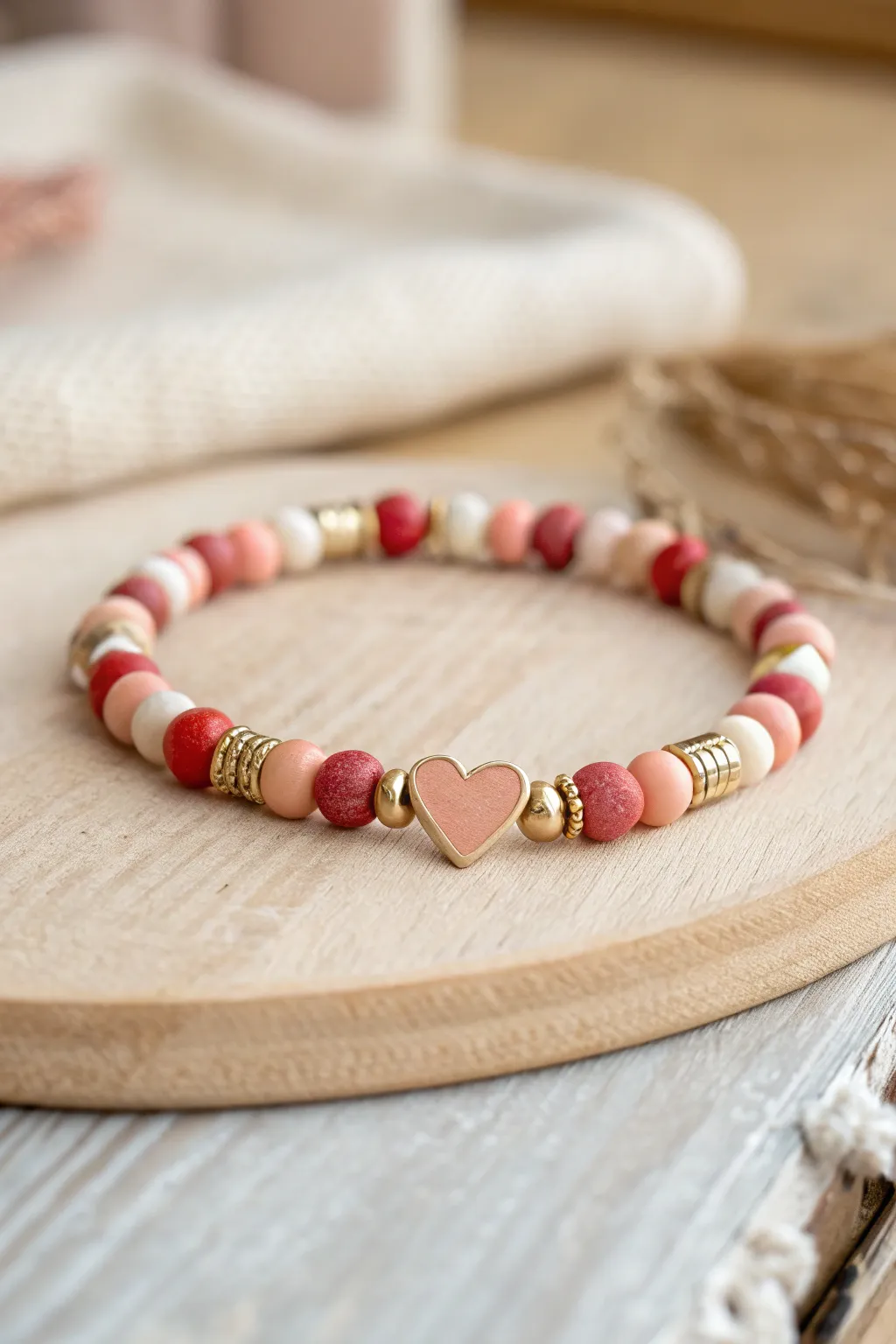
Centered around a delightful gold-rimmed enamel heart, this bracelet combines matte clay textures with high-shine metallic accents. The warm palette of rust red, soft peach, and creamy white makes it a versatile accessory that feels both handcrafted and elegant.
Detailed Instructions
Materials
- Stretch cord (0.8mm or 1mm thickness)
- Gold-rimmed pink enamel heart connector or charm (double-sided loops ideal, or single loop)
- 6mm-8mm polymer clay beads (Rust Red, Peach/Salmon, Cream/White)
- Small gold spacer beads (smooth round)
- Gold-plated decorative spacer beads (ribbed or textured rings)
- Jewelry glue (e.g., G-S Hypo Cement)
- Scissors
Step 1: Setting the Focal Point
-
Prepare the cord:
Cut a piece of stretch cord about 10-12 inches long. This generous length gives you plenty of room to tie knots later without struggling. Pre-stretch the cord slightly by pulling on both ends gently to prevent it from sagging after you wear it. -
Attach the heart:
Slide your gold-rimmed heart charm onto the center of the cord. If your charm has a horizontal hole, simply thread it through. If it’s a pendant style, you might need a small gold jump ring to make it sit flat against the wrist. -
Frame the heart:
On the immediate left and right of the heart, thread on a small, smooth gold sphere bead. These act as tiny guards that help the heart stand out. -
Add texture:
Next to the smooth gold beads on both sides, add a single Rust Red clay bead.
Knot Slipping?
If the knot won’t stay tight while gluing, use a piece of tape or a binder clip to hold the first half of the knot in tension while you tie the second half.
Step 2: Building the Pattern
-
Create the symmetrical accent:
Following the red bead on each side, slide on a Peach/Salmon clay bead. This softens the transition from the dark red. -
Insert gold spacers:
Now, add a textured gold ring spacer on each side. These ribbed beads add a touch of sophisticated detail that elevates the design beyond a simple beaded strand. -
Begin the main sequence:
After the gold spacers, add a Rust Red bead on each side. We are now moving away from the focal point and establishing the repeating pattern. -
Establish the color rhythm:
The pattern for the rest of the bracelet is loosely random but balanced. Thread on a mix of Cream, Peach, and Rust Red beads. I find that alternating light and dark beads helps keep the design looking dynamic. -
Incorporate varied gold accents:
Interspersed within your random clay color mix, occasionally slide on a flat gold disc spacer or another smooth round gold bead. Try to place these every 5 or 6 beads to carry the metallic theme all the way around. -
Check the sizing:
Pause periodically and wrap the strand around your wrist. The ends should just barely touch without stretching the cord.
Stackable Style
Make two companion bracelets using only the gold spacers and one solid color of clay beads (all cream or all rust) to create a matching stack set.
Step 3: Finishing Touches
-
Ending the pattern:
Ensure that the last beads on both ends of your strand are clay beads rather than gold spacers; clay beads establish a better grip for the knot. -
The surgeon’s knot:
Bring the two ends of the cord together. Tie a standard overhand knot, but loop the end through the circle a second time before pulling tight. This creates a secure surgeon’s knot. -
Tighten safely:
Pull the knot tight by tugging on all four strands (the two tail ends and the two bracelet sides). Do this gently to avoid snapping the elastic. -
Secure with glue:
Apply a tiny dot of jewelry glue directly onto the knot. Wait a few moments for it to become tacky, then let it dry completely according to the glue instructions. -
Trim the excess:
Once the glue is fully dry, use sharp scissors to trim the excess cord tails. Leave about 1-2mm of tail just in case the knot settles further. -
Hide the knot:
Gently pull tightly on the bracelet to slide the knot inside the hole of the nearest clay bead. This creates a seamless, professional finish.
Now you have a charming, romantic accessory ready to wear or gift to someone special
Confetti Sprinkle Mix
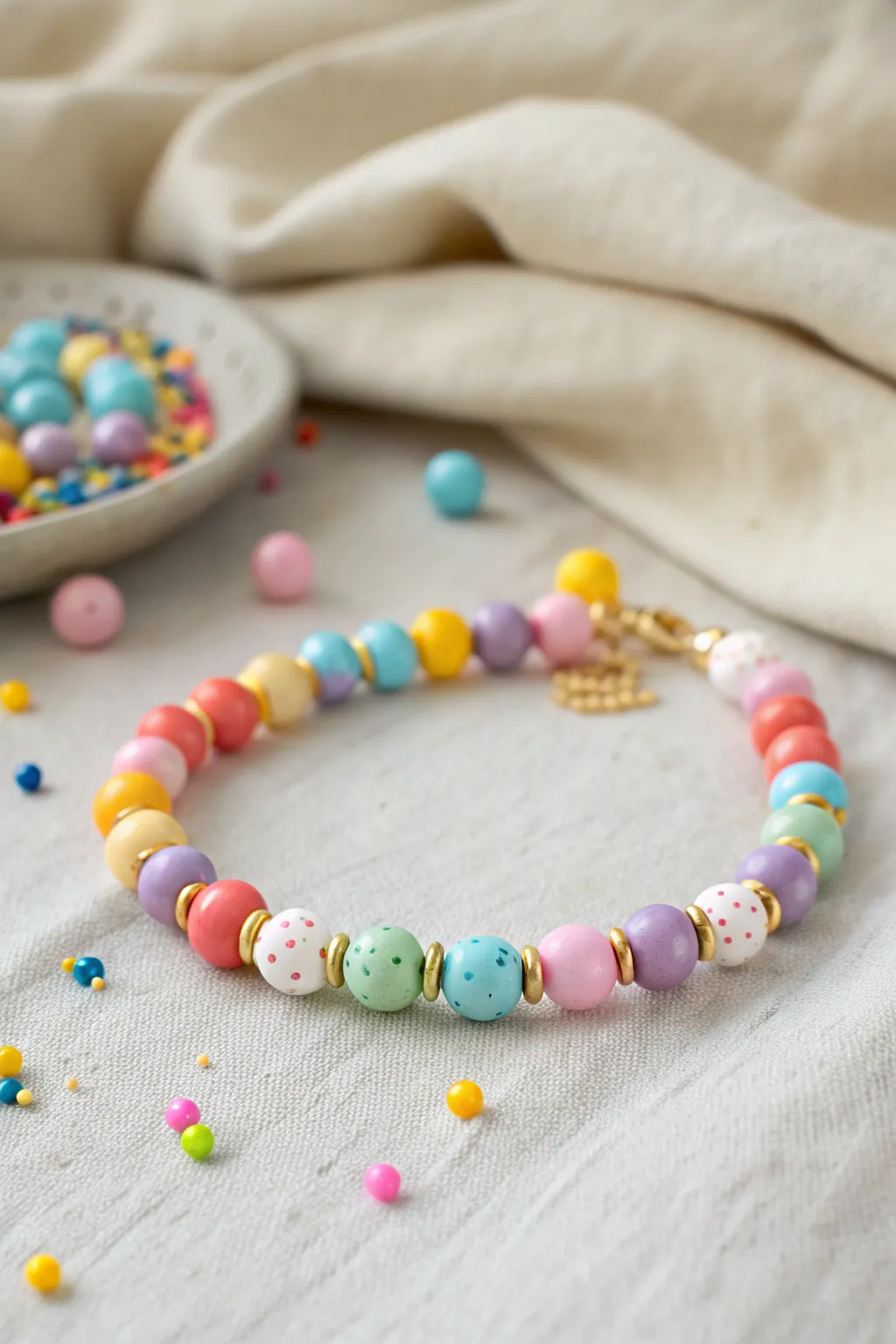
This delightful bracelet captures the joy of a funfetti cake with its mix of solid pastels and speckled “sprinkle” beads. Accented with elegant gold spacers, it adds a sweet, playful pop of color to any wrist stack.
How-To Guide
Materials
- Polymer clay (white, pink, yellow, blue, turquoise, purple, coral)
- Gold disc spacer beads (approx. 4mm)
- Elastic beading cord (0.8mm or 1mm)
- Jewelry glue (e.g., E6000 or Hypo Cement)
- Beading needle (optional but helpful)
- Acrylic paint (pink, blue, green) for speckling
- Old toothbrush or stiff paintbrush
- Gloss glaze or resin (optional)
- Clay rolling tool
- Small round bead roller (or your palms)
- Toothpicks or bead piercing tool
- Scissors
Step 1: Prepping the Clay Beads
-
Condition the clay:
Start by warming up your polymer clay colors in your hands until they are soft and pliable. Use a variety of cheerful pastels: soft pink, sunshine yellow, lilac, mint, and coral. -
Roll spheres:
Pinch off small, equal-sized pieces of each clay color. Roll them into smooth spheres between your palms or use a bead roller for perfect consistency. Aim for beads roughly 8-10mm in diameter. -
Create the confetti beads:
Set aside a few white or very pale beads. These will become your speckled feature beads. You can also mix tiny flecks of colored clay into white clay before rolling for an embedded sprinkle look. -
Pierce the holes:
Before baking, carefully pierce a hole through the center of each bead using a toothpick or piercing tool. Gently twist as you push through to avoid squishing the perfectly round shape. -
Bake the beads:
Arrange your beads on a baking sheet or tile. Bake according to your specific polymer clay package instructions (usually around 275°F/135°C for 15-30 minutes). Let them cool completely.
Smooth Operator
To remove fingerprints from raw clay beads before baking, lightly brush them with a drop of baby oil or cornstarch.
Step 2: Adding the Sparkle & Shine
-
Speckle technique:
Take the white or pale beads you set aside. Dip an old toothbrush into a small amount of watered-down acrylic paint (pink, blue, or green). Run your thumb over the bristles to flick tiny paint droplets onto the beads for that classic confetti look. -
Seal the deal:
Once the paint is totally dry, I recommend coating all your clay beads with a gloss glaze. This mimics the shiny finish seen in the photo and protects the paint speckles from wearing off.
Step 3: Stringing and Assembly
-
Measure the cord:
Cut a piece of elastic cord about 10-12 inches long. Is helps to pre-stretch the elastic by pulling it firmly a few times; this prevents the bracelet from loosening up later. -
Plan your pattern:
Lay out your beads on a design board or piece of felt. You want a random, playful look, so mix up the solids. Place the speckled confetti beads at regular intervals to balance the design. -
Start stringing:
Begin threading your beads onto the elastic. Between every single clay bead, add a gold disc spacer. This gold hardware elevates the look from simple craft to chic jewelry. -
Check the fit:
Wrap the strand around your wrist to check the size. Add or remove beads as needed, ensuring the pattern flows nicely. -
Secure the knot:
Tie the ends of the elastic together using a strong surgeon’s knot (right over left, left over right, and pull tight). Pull the cord tight enough so the beads touch comfortably. -
Glue and hide:
Dab a tiny drop of jewelry glue onto the knot. Let it dry for a moment, then trim the excess cord ends. -
Final touch:
If possible, tug the knot gently inside one of the bead holes to hide it. Add a small gold charm or tag near the knot for a professional finish if you have one.
Level Up: Charm It
Attach a gold clasp and extender chain instead of elastic for a more adjustable, high-end finish suitable for gifting.
Wear your colorful creation with pride and enjoy the sweet candy vibes it brings to your day
Sunset Ombré Fade
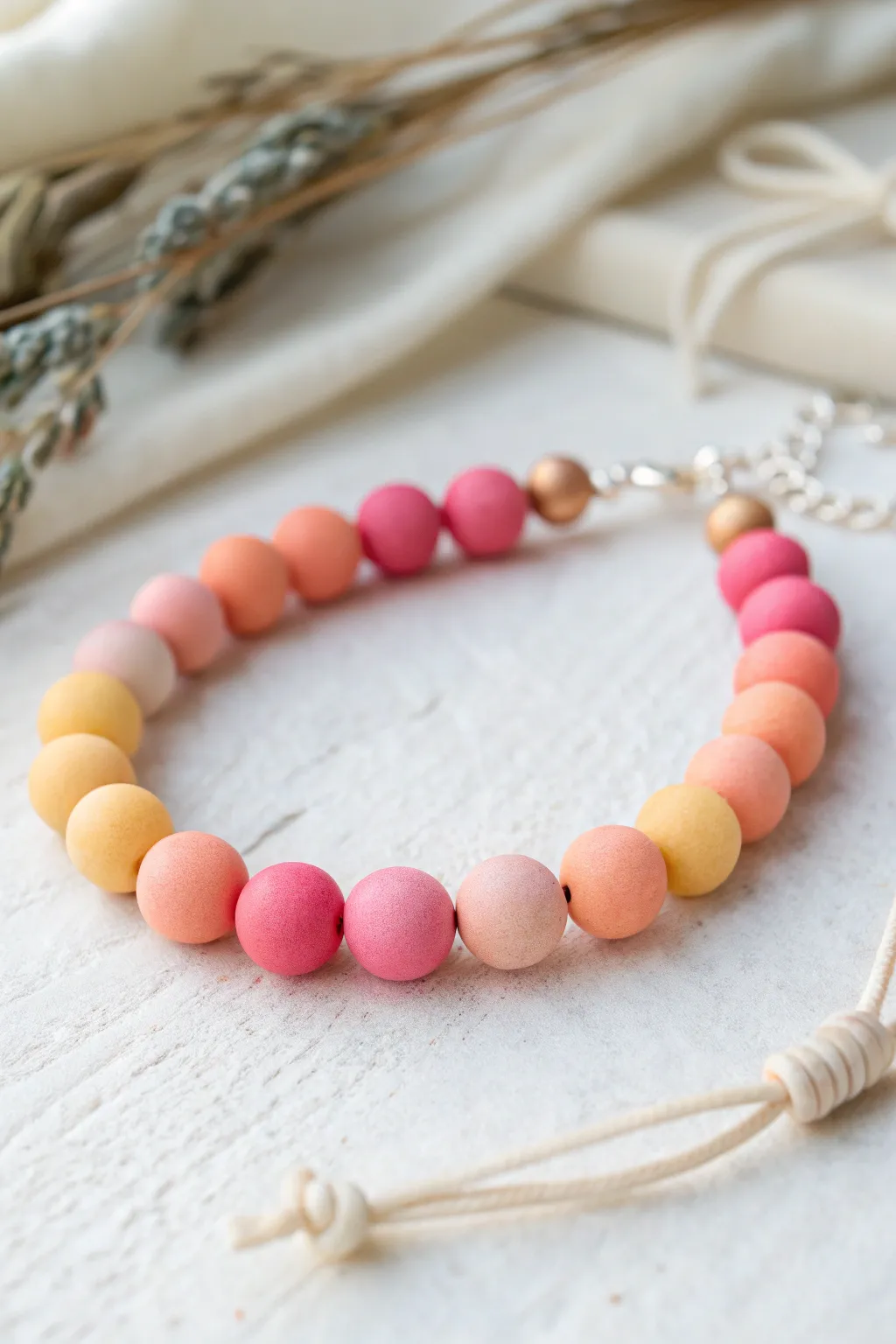
Capture the warmth of a setting sun on your wrist with this stunning polymer clay bead bracelet, featuring a seamless gradient from deep poppy pinks to soft buttery yellows. The matte finish of the handmade beads gives it a sophisticated, modern texture that elevates it beyond simple craft jewelry.
Detailed Instructions
Materials
- Polymer clay in 5 colors: Deep pink, coral, peach, pastel orange, and butter yellow
- 2 small gold spacer beads (approx 4-6mm)
- Beading wire or strong stretch cord (0.8mm)
- 2 crimp beads (if using wire)
- 2 crimp bead covers (optional, gold tone)
- Lobster clasp and jump ring
- Chain extender
- Needle tool or toothpick
- Acrylic roller or pasta machine
- Baking sheet and parchment paper
- Wire cutters and flat nose pliers
- Wet sandpaper (400-800 grit)
Step 1: Creating the Clay Beads
-
Condition the clay:
Begin by thoroughly conditioning each color of polymer clay until it is soft and pliable. Use your hands or run it through a pasta machine on the widest setting several times to ensure there are no air bubbles. -
Portion for uniform size:
To ensure all your beads end up the same size, roll each color into a consistent ‘snake’ or log shape. Then, use a blade to cut equal segments from each log. aim for chunks about the size of a large pea. -
Roll the spheres:
Take each segment and roll it between your palms to create a perfect sphere. You will need roughly 3-4 beads of each color to recreate the gradient pattern shown. -
Create the holes:
Gently hold a clay sphere between your thumb and forefinger. Using a needle tool or toothpick, pierce the center of the bead with a twisting motion to create the hole without squashing the round shape. Repeat for all beads. -
Refine the surface:
Once pierced, you might notice fingerprints. Gently roll the bead lightly between your fingers one last time to smooth it out, being careful not to close the hole. -
Bake the beads:
Arrange your beads on a parchment-lined baking sheet. Bake them according to your specific clay brand’s package instructions—usually around 275°F (130°C) for 15-30 minutes. -
Cool and finish:
Allow the beads to cool completely. If you want that ultra-smooth matte look from the photo, lightly buff each bead under running water with wet sandpaper to remove any lint or uneven texture.
Pro Tip: Perfect Shaping
To prevent flat spots while baking, string your raw clay beads onto a stiff wire and suspend the wire across the rim of an oven-safe dish so the beads hang freely in the air.
Step 2: Assembling the Bracelet
-
Prepare your stringing material:
Cut a length of beading wire about 10-12 inches long. This gives you plenty of excess room to work with the clasps. I find it easier to work with too much wire than too little. -
Start the clasp end:
Thread one crimp bead onto the wire, followed by the jump ring or wire guardian. Loop the wire back through the crimp bead. -
Secure the wire:
Use flat nose pliers to squash the crimp bead flat, locking the wire in place. If you are using a crimp cover, place it over the flattened crimp and gently close it to look like a gold bead. -
Add the first accent:
String on one gold spacer bead first. This acts as a polished bookend for your clay colors. -
Plan the gradient:
Lay your clay beads out on a table before stringing. Arrange them in a repeating mirror pattern or a continuous fade: Deep pink, coral, peach, orange, yellow, then reverse back to pink, or repeat the sequence. -
String the beads:
Thread your clay beads onto the wire in your chosen order. Ensure they sit snugly against one another. -
Finish the bead row:
Once you have reached your desired length (usually about 6-7 inches for an average wrist), add the second gold spacer bead to the end. -
Add the closure:
Thread on your second crimp bead, followed by the lobster clasp (or the ring attached to the chain extender). Loop the wire back through the crimp bead and into the first few clay beads. -
Final crimp:
Pull the wire taut so there are no large gaps between beads, but not so tight the bracelet creates a stiff circle. Flatten the crimp bead with your pliers to secure the design. -
Trim excess wire:
Using your wire cutters, trim the excess tail of the beading wire as close to the beads as possible so it doesn’t poke the wearer.
Troubleshooting: Lint Issues
If you see dust or lint on your raw clay, wipe the bead gently with a baby wipe or a q-tip dipped in rubbing alcohol before baking to ensure a pristine finish.
Now you have a beautifully blended accessory that holds the colors of perpetual golden hour
Pearl-and-Clay Soft Mix
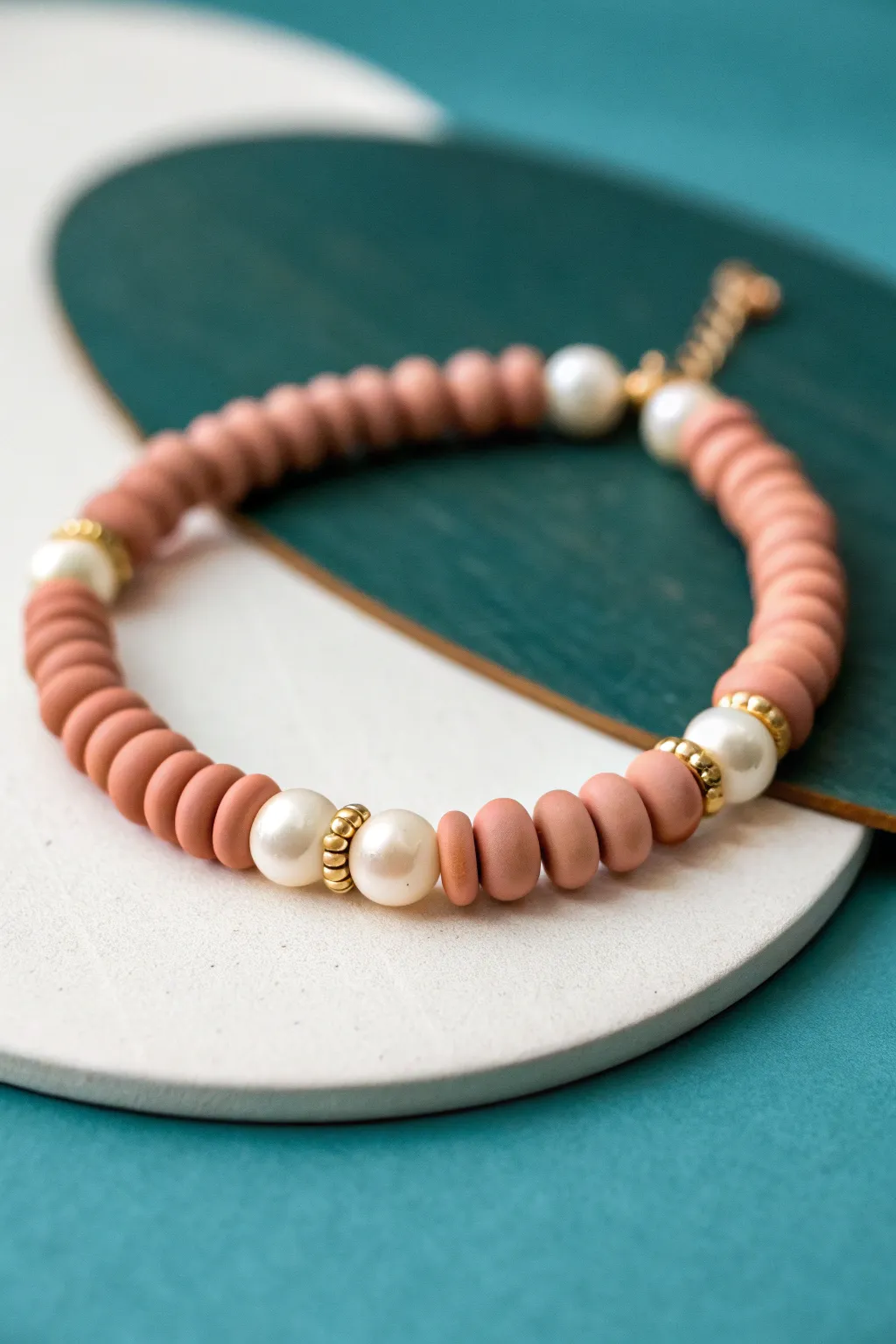
Elegance meets everyday wear in this sophisticated design that pairs matte terracotta polymer clay discs with the classic sheen of faux pearls. The interspersed gold accents add just the right amount of sparkle to elevate this from a simple craft to a boutique-worthy accessory.
Detailed Instructions
Materials
- Matte polymer clay heishi beads (terracotta or dusty pink)
- 6mm or 8mm white faux pearl beads
- Small gold spacer beads or gold seed beads
- Beading wire (0.38mm or 0.45mm)
- Two crimp beads
- Two crimp covers (gold)
- Lobster clasp and extension chain (gold)
- Wire cutters
- Crimping pliers
Step 1: Preparation & Pattern Planning
-
Cut the wire:
Start by measuring your wrist and adding about 4 inches to that length. Cut a piece of beading wire to this size to ensure you have plenty of room to work with the clasp. -
Secure the start:
Thread a crimp bead onto one end of the wire, followed by the loop of your jump ring (or the loop at the end of the extension chain). Loop the wire back through the crimp bead. -
Crimp firmly:
Use your crimping pliers to flatten the crimp bead securely, locking the wire in place. For a polished look, I always like to gently close a gold crimp cover over the flattened bead at this stage. -
Establish the clay base:
Begin your pattern by threading on a substantial section of the terracotta heishi beads. You’ll want about 1.5 to 2 inches of these clay discs to create the first solid block of color.
Pro Tip: Stiffness Check
Before the final crimp, curve the bracelet into a circle. If you pull the wire too tight while it’s straight, the bracelet will be rigid and stiff when coiled.
Step 2: Creating the Pearl Accents
-
Add the first gold touch:
Once your first clay section is done, slide on a single gold spacer bead. This acts as a visual buffer between the matte clay and the shiny pearl. -
Thread the pearl:
Add one white faux pearl next. Ensure the hole is large enough for your wire but not so big that it wobbles excessively. -
Complete the bracket:
Follow the pearl immediately with another gold spacer bead. This creates a symmetrical ‘framed’ look for the pearl. -
The short clay segment:
Thread on a very short section of clay heishi beads—approximately 5 to 7 discs. This acts as a bridge between your pearl focal points. -
Creating the centerpiece:
Repeat the gold spacer, pearl, gold spacer combination. This will likely sit near the center of the bracelet depending on your wrist size. -
Double pearl feature:
For the specific look in the photo, you can create a focal point by placing two pearls close together. Do this by stringing: Gold Spacer -> Pearl -> Gold Spacer -> 3 Clay Beads -> Gold Spacer -> Pearl -> Gold Spacer.
Step 3: Mirroring & Finishing
-
The long clay stretch:
After your pearl section is complete, mirror the beginning of the bracelet by threading on a final long section of terracotta heishi beads (another 1.5 to 2 inches). -
Check the fit:
Wrap the unfinished strand around your wrist. The ends should almost touch, leaving just enough gap for the clasp hardware. -
Prepare the closure:
Slide a crimp bead onto the end of the wire, followed by the lobster clasp. -
Thread back:
Take the tail of the wire and feed it back down through the crimp bead and into the first few clay beads. Pull it tight enough to remove slack, but loose enough so the bracelet remains flexible. -
Final crimp:
Flatten the crimp bead with your pliers to secure the clasp. -
Conceal the hardware:
Place a crimp cover over the flat crimp bead and gently squeeze it closed with pliers until it looks like a round gold bead. -
Trim excess:
Use your wire cutters to snip off any remaining tail of wire as close to the beads as possible so it doesn’t poke your skin.
Troubleshooting: Uneven Pearls
If your pearls keep spinning to the underside of your wrist, try creating two symmetric pearl sections on the sides rather than one heavy cluster in the center.
Slip on your new creation and enjoy the soft, warm tones against your skin
Mismatch-but-Matching Wrist Stack
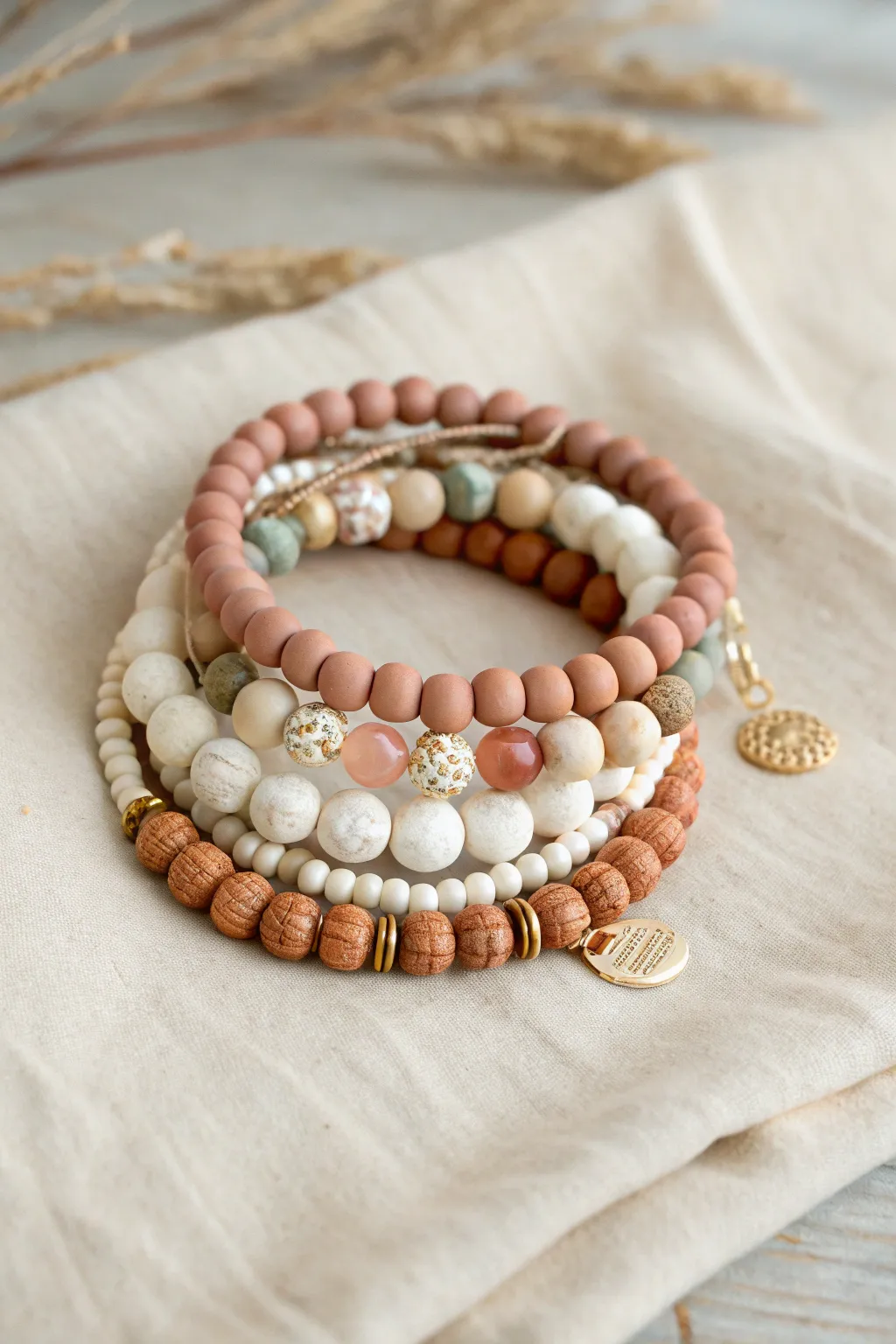
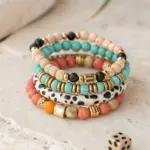
Embrace the beauty of harmonious imperfection with this multi-strand bracelet stack that blends natural textures like wood, clay, and stone. Combining matte finishes with subtle gold accents creates a warm, bohemian look perfect for everyday wear.
Step-by-Step Tutorial
Materials
- Matte terracotta polymer clay beads (8mm round)
- Faceted wooden beads (8mm-10mm, warm brown)
- White or cream matte stone beads (various sizes: 4mm, 8mm, 10mm)
- Pink agate or rose quartz beads (8mm)
- Speckled ceramic or polymer accent beads
- Gold tone disk spacer beads (wavy or flat)
- Gold tone metal charms (mandala or coin style)
- Strong elastic cord (0.8mm or 1.0mm)
- Jewelry glue (optional)
- Scissors
Step 1: Planning Your Palette
-
Sorting textures:
Begin by separating your beads into piles based on texture: matte clay, faceted wood, smooth stone, and metallic spacers. This stack works because it repeats colors but varies the finishes. -
Establish the color story:
Pull out your core colors: terracotta rust, creamy white, warm brown, and soft blush pink. Keep a few sage green or mottled stone beads aside for subtle contrast.
Loose Elastic?
Make sure to pre-stretch your cord before stringing! Pull it firmly a few times. If it still feels loose, use a slightly thicker cord like 1.0mm for heavier stone beads.
Step 2: Creating the Terracotta Strand
-
Measure and cut:
Cut a piece of elastic cord about 10-12 inches long to give yourself plenty of room for tying knots later. -
Stringing the clay:
Thread the matte terracotta round beads onto the cord. This bracelet is uniform, so you simply need to fill the strand until it fits comfortably around your wrist (usually 6.5 to 7 inches). -
Adding interest:
Near the center point, you can swap one clay bead for a small gold spacer or a single mottled stone bead if you want to break the uniformity, though a solid color works well as a grounding element.
Step 3: The Focal Beads Strand
-
Pattern layout:
This strand uses larger beads for impact. Arrange a pattern on your design board: three large cream stone beads, followed by a gold spacer, a sparkly or speckled accent bead, a pink agate bead, and another gold spacer. -
Repeating the sequence:
Repeat this pattern, or create a random ‘bead soup’ style using the larger 10mm beads. The key is mixing the speckled white beads with the translucent pink ones. -
Check the fit:
Because larger beads take up more inner circumference, wrap this strand around your wrist to check the fit before tying off. It may need to be slightly longer than the smaller bead strands.
Add a Scent
Since this stack uses unfinished wooden beads, apply a drop of essential oil (like sandalwood or lavender) to the wood. They act as a subtle, natural diffuser.
Step 4: The Wooden Texture Strand
-
Threading the wood:
On a new piece of cord, start stringing the faceted wooden beads. These add a crucial organic texture that contrasts with the smooth stone. -
Inserting gold accents:
Between every 5 or 6 wooden beads, insert a thin gold disc spacer. I find this elevates the bracelet from simple craft to chic jewelry. -
Attaching the charm:
Slide a gold mandala or coin charm onto a jump ring, and thread the jump ring onto the cord so it sits centrally among the wooden beads.
Step 5: The Mixed Mini Strand
-
Using smaller beads:
For the final filler bracelet, use the smaller 4mm – 6mm white or cream beads. Start by stringing about 2 inches of these smaller beads. -
Creating a focal section:
Transition into a section of larger, mixed beads—perhaps a few leftover sage green stones or speckled clay beads—to create an asymmetrical look.
Step 6: Finishing Touches
-
Pre-stretching the elastic:
Before tying any knots, give each beaded cord a gentle tug. This pre-stretches the elastic so the bracelets won’t sag after the first time you wear them. -
Tying the knots:
For each bracelet, tie a secure surgeon’s knot (right over left, left over right twice). Pull tight. -
Securing with glue:
Dab a tiny drop of jewelry glue on each knot. Let it dry completely before trimming the excess cord close to the bead. -
Hiding the knot:
If the bead holes are large enough, gently tug the elastic so the knotted section slips inside a bead, hiding it from view.
Now slide on your stack and enjoy the satisfying click of stone against wood.