
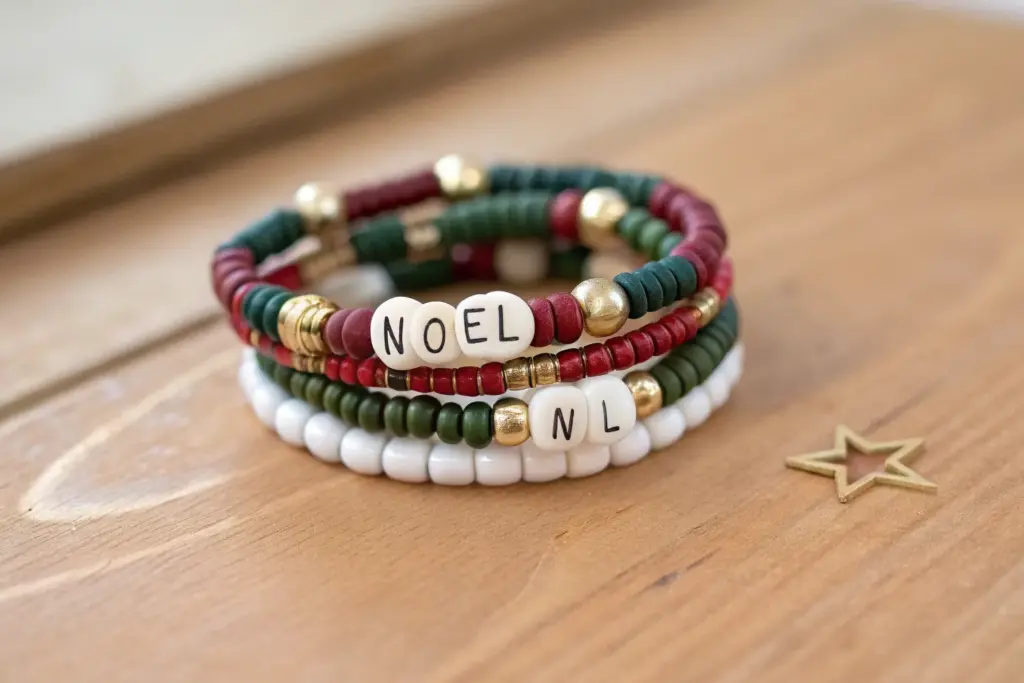
Winter is basically the best excuse to play with cozy color palettes and a little extra sparkle in your jewelry. Here are my favorite winter clay bead bracelet ideas that feel festive, frosty, and totally wearable all season long.
Candy Cane Heishi Stripes
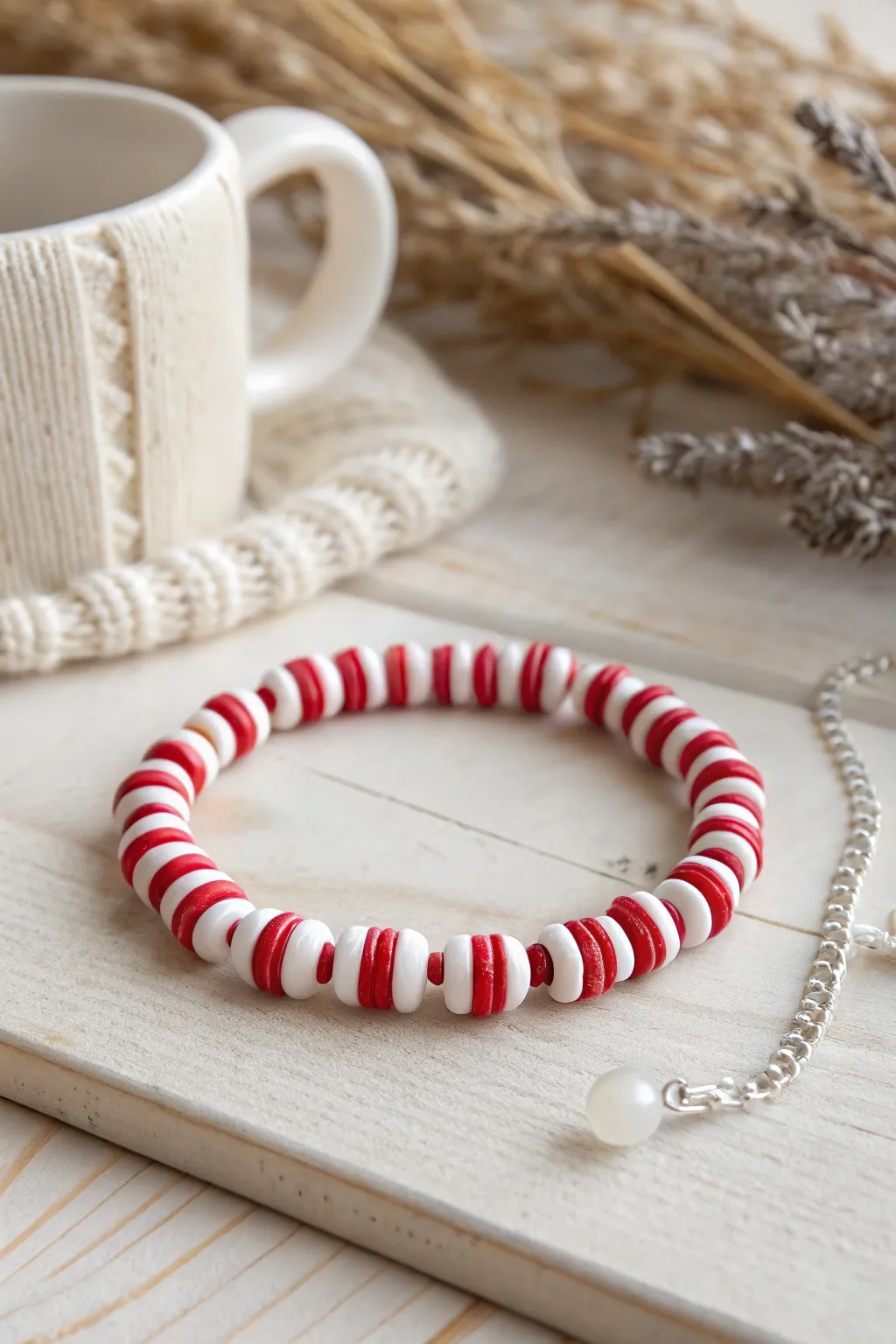
Capture the classic sweetness of a candy cane with this festive heishi bead bracelet. Alternating red and white flat disc beads creates a delightful peppermint stripe that pairs perfectly with winter whites and holiday reds.
How-To Guide
Materials
- Red polymer clay heishi beads (approx. 6mm diameter)
- White polymer clay heishi beads (approx. 6mm diameter)
- Elastic stretch cord (0.8mm or 1mm gauge)
- Jewelry glue or clear nail polish
- Scissors or jewelry snips
- Bead stopper or tape
Step 1: Preparation and Setup
-
Measure the Cord:
Cut a length of elastic cord about 10-12 inches long. This gives you plenty of extra room for tying knots without struggling against tension. -
Secure the End:
Attach a bead stopper or simply place a piece of tape folded over one end of the cord to prevent your beads from sliding off while you work. -
Pre-stretch the Elastic:
Gently pull on the elastic cord several times to give it a pre-stretch. This simple trick prevents the bracelet from loosening up the first time you wear it.
Uneven Stripes?
If your stripes look prominent on one side but disappear on the other, your beads may be wedge-shaped. Rotate irregular beads until they nest flat.
Step 2: Beading the Pattern
-
Start the Sequence:
Looking at the reference image, the pattern relies on a specific rhythm: two white beads followed by two red beads. Thread your first two white heishi beads onto the cord. -
Add the Red Stripes:
Slide on two red heishi beads next. Push them down so they sit flush against the white beads. -
Establish the Rhythm:
Repeat this sequence: two white, then two red. Consistency is key here to achieve that clean, candy cane look. -
Check Bead Thickness:
Occasionally, heishi beads vary slightly in thickness. If you find an unusually thin bead, you might need to use three instead of two to maintain the visual balance of the stripe width. -
Continue Stringing:
Keep adding beads in the 2-white, 2-red pattern. Periodically wrap the strand around your wrist to check the length. -
Final Length Check:
Stop adding beads when the bracelet fits comfortably around your wrist with just a little bit of slack. Remember that the knot will take up a tiny bit of space. -
Verify the Pattern Loop:
Ensure your pattern ends correctly. If you started with white beads, try to end with red beads so the pattern flows seamlessly when connected.
Pattern Variations
For a ‘crushed peppermint’ effect, mix in a section where you alternate single beads (1 red, 1 white) before returning to the 2-by-2 pattern.
Step 3: Finishing Touches
-
Remove the Stopper:
Carefully remove the bead stopper or tape from the end, holding both ends of the cord firmly. -
Tie the First Knot:
Cross the ends and tie a simple overhand knot. Pull it tight, bringing the two ends of the pattern together. -
Secure with a Surgeon’s Knot:
For extra security, tie a surgeon’s knot next. Loop the cord through twice before pulling tight. This creates a much stronger bind than a standard knot. -
Apply Adhesive:
Dab a tiny drop of jewelry glue or clear nail polish directly onto the knot. I like to let this dry for a few minutes while holding it away from the beads so they don’t get glued to the cord. -
Hide the Knot:
Once the glue is tacky or dry, trim the excess elastic close to the knot. Gently tug the bracelet to pull the knot inside one of the adjacent heishi beads to hide it.
Slip on your new peppermint-striped accessory and enjoy a touch of holiday cheer on your wrist
Evergreen and Gold Accents
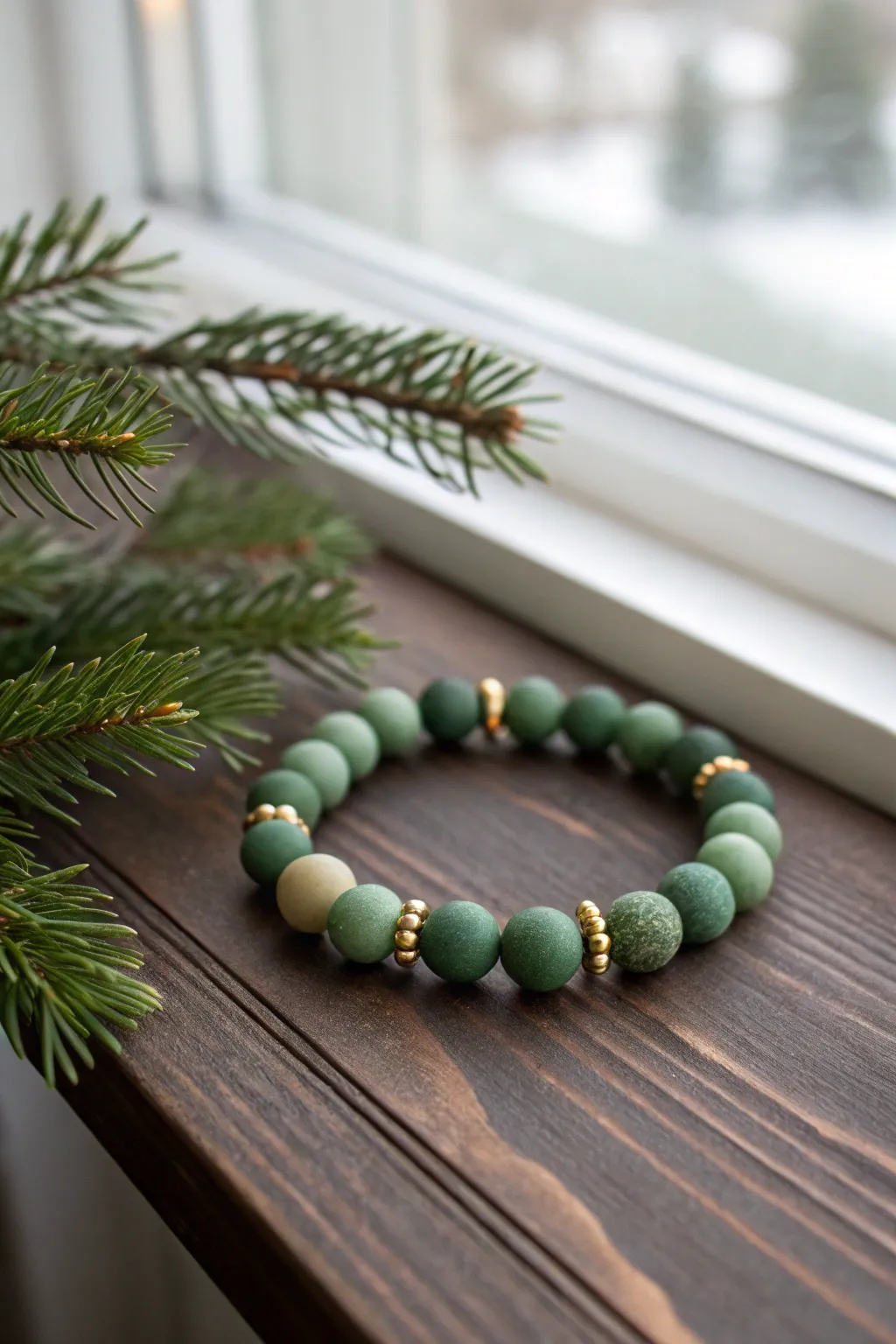
Capture the serene beauty of a winter woodland with this sophisticated bracelet featuring matte clay beads in varying shades of evergreen and sage. The simple addition of textured gold spacers adds a touch of holiday warmth without overwhelming the natural palette.
Step-by-Step
Materials
- Matte polymer clay beads (8mm or 10mm) in dark forest green
- Matte polymer clay beads in medium olive green
- Matte polymer clay beads in light sage green
- One matte beige or cream feature bead
- Small gold ribbed spacer beads
- Small gold smooth rondelle beads
- Strong elastic beading cord (0.8mm or 1mm)
- Jewelry glue or clear nail polish
- Scissors
- Bead stopper or tape
- Beading needle (optional)
Step 1: Preparation and Design
-
Project Setup:
Begin by clearing a flat workspace. I find that using a bead board or a soft felt mat prevents the round beads from rolling away while you are planning your design. -
Measure Wrist:
Wrap a measuring tape loosely around your wrist to determine the desired length. For an average adult wrist, aim for about 7 to 7.5 inches of total length. -
Cut the Cord:
Cut a piece of elastic cord approximately 12 inches long. This generous length gives you plenty of room to tie a secure knot later without struggling. -
Pre-stretch Elastic:
Hold the ends of the cord and give it several firm tugs. Pre-stretching the elastic is crucial to prevent the bracelet from sagging or loosening after you start wearing it. -
Secure the End:
Place a bead stopper or a piece of masking tape on one end of the cord to stop your beads from sliding off as you work.
Knot Slipping Out?
If the knot won’t stay hidden, try enlarging the hole of one clay bead slightly using a hand drill or a round file to create a cozy pocket for it.
Step 2: Stringing the Pattern
-
Start the Gradient:
Begin by stringing 3-4 of your darkest forest green beads. This establishes a strong base color. -
Add a Gold Accent:
Slide on one gold ribbed spacer bead. These textured spacers catch the light beautifully against the matte finish of the clay. -
Transition Shades:
Follow the gold spacer with 3 medium olive green beads. We want the colors to shift naturally, mimicking pine needles. -
Group the Lighter Tones:
Add a small smooth gold rondelle, then thread on 3-4 of the light sage green beads. -
Create the Focal Point:
Between two ribbed gold spacers, place your single beige or cream bead. This asymmetry creates a focal point that breaks up the green tones. -
Complete the Circle:
Continue adding remainder beads, mixing the medium and dark greens, until you reach your desired length. Check the fit by wrapping it around your wrist.
Step 3: Finishing Touches
-
Prepare to Knot:
Remove the bead stopper carefully, holding both ends of the elastic securely. -
Tie the Surgeon’s Knot:
Cross the ends, wrap one side around the other twice, and pull tight. This is a surgeon’s knot and is much more secure than a standard overhand knot. -
Tighten the Knot:
Pull the elastic firmly but gently to cinch the knot down between two beads. You usually want to hide this knot inside a bead with a slightly larger hole if possible. -
Secure with Glue:
Apply a tiny dot of jewelry glue or clear nail polish directly onto the knot. Let this dry completely before moving on. -
Trim Excess:
Using sharp scissors, trim the excess elastic tails close to the knot, being careful not to nick the main cord. -
Hide the Knot:
If the knot is still visible, gently tug the adjacent beads until the knot slips inside the hole of a neighboring bead for a seamless finish.
Elevate the Look
Add a tiny gold pinecone charm or a small snowflake pendant next to the focal beige bead for an extra festive winter touch.
Slip on your new bracelet to add a subtle, organic touch of winter style to your daily outfit
Snowflake Charm Centerpiece
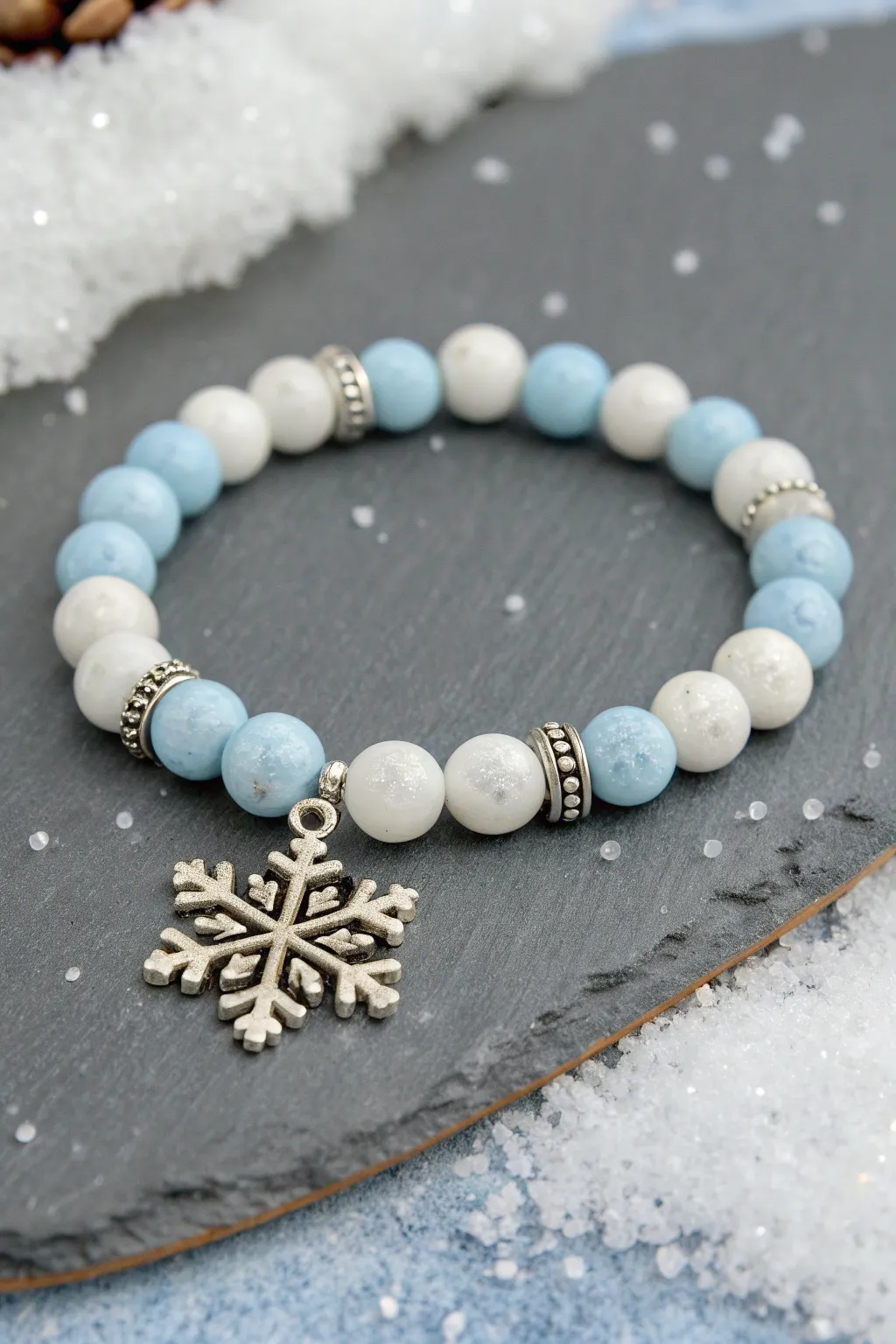
Capture the serene beauty of a winter snowfall with this elegant beaded bracelet featuring icy white and soft blue tones. The centerpiece is a striking silver snowflake charm that dangles playfully, making it the perfect accessory for the chilly season.
How-To Guide
Materials
- 10mm light blue round beads (polished finish)
- 10mm white round beads (pearlescent or shimmer finish)
- Silver rhinestone rondelle spacer beads (approx. 6-8mm)
- Silver snowflake charm
- Silver jump ring (6-8mm)
- Strong elastic bead cord (0.8mm or 1mm)
- Jewelry glue or clear nail polish
- Scissors
Step 1: Planning and Preparation
-
Measure your wrist:
Before cutting anything, wrap a piece of string around your wrist to find your size, then add about an inch to account for the bulk of the 10mm beads. -
Cut the cord:
Cut a length of elastic cord about 10-12 inches long. I always like to have plenty of extra slack on both ends to make tying the final knot much easier. -
Pre-stretch the elastic:
Hold the cord firmly at both ends and give it a few gentle tugs. This pre-stretching step prevents the bracelet from sagging or loosening up immediately after you wear it. -
Attach the charm:
Using your fingers or small pliers, open the jump ring by twisting it sideways. Slide the snowflake charm onto the ring, then loop the jump ring onto a specifically chosen silver carrier bail or directly onto the cord if you prefer. -
Secure the jump ring:
Close the jump ring securely by twisting it back into place, ensuring there is no gap where the charm could slip off.
Knot Security
Use a surgeon’s knot (looping through twice) and always add a dab of G-S Hypo Cement. Hide the knot inside a large bead hole for a professional finish.
Step 2: Stringing the Beads
-
Start the pattern:
Begin by stringing the silver carrier bail (with the charm attached) to the center of your cord so it acts as the focal point. -
Add focal accents:
On the immediate left and right of the charm, thread on a white shimmering bead followed by a silver rhinestone rondelle spacer. -
Create the color rhythm:
Establish a repeating pattern working outwards from the center. Thread a light blue bead, then a white bead, alternating colors as you move away from the central charm. -
Insert silver spacers:
Place a silver rondelle spacer bead after every set of 3 or 4 colored beads to break up the pattern and add a touch of metallic sparkle. -
Check the fit:
Periodically wrap the strand around your wrist. You want the beads to touch comfortably without gaps, but not be so tight that they pinch your skin. -
Symmetry check:
Ensure that both sides of the bracelet mirror each other roughly in length so the clasp knot will end up hidden at the back, opposite the heavy charm.
Frosty Texture
Mix finishes for depth! Use matte or ‘frosted’ glass beads alongside shiny polished ones to mimic the texture of real ice and snow.
Step 3: Finishing Touches
-
Tie the first knot:
Bring the two ends of the elastic cord together. Tie a simple overhand knot and pull it tight to bring the beads together into a circle. -
Secure with a surgeon’s knot:
Tie a surgeon’s knot by crossing the ends, looping one end under twice, and pulling firmly. This type of knot is much less likely to slip on slick elastic material. -
Apply adhesive:
Place a tiny drop of jewelry glue or clear nail polish directly onto the knot. This seals the bond and prevents it from unraveling over time. -
Hide the knot:
While the glue is still slightly tacky but not wet, gently pull the elastic so the knot slides inside the hole of the nearest large bead (preferably a white or blue one, not a spacer). -
Trim excess cord:
Once the glue is fully dry, precise-cut the excess elastic tails as close to the bead hole as possible without nicking the main knot.
Slip on your sparkly creation and carry a bit of winter magic wherever you go
JOY Letter Bead Bracelet
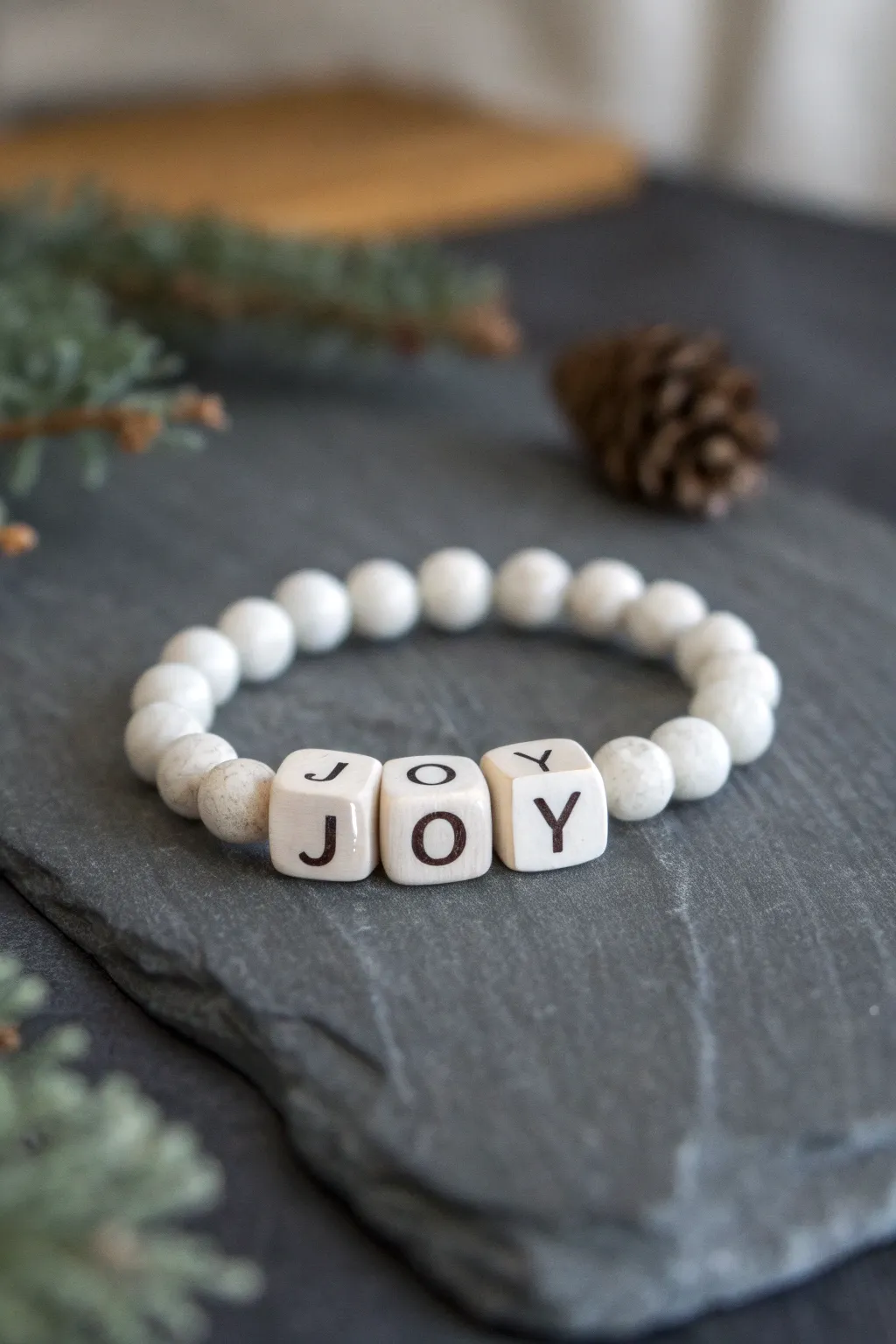
Capture the essence of the season with this minimalist white bracelet featuring natural-looking beads and a simple message. This understated accessory combines faceted textures with clean lettering for a piece that pairs perfectly with cozy winter sweaters.
Step-by-Step Tutorial
Materials
- Stretch cord (0.7mm or 0.8mm transparent elastic)
- Faceted white round beads (8mm or 10mm, likely white howlite or speckled ceramic)
- 3 Square wooden or bone letter beads (J, O, Y)
- Scissors
- Hypo-cement or clear jewelry glue
- Bead stopper or masking tape
- Ruler or tape measure
Step 1: Preparation & Sizing
-
Measure your wrist:
Before cutting anything, wrap a measuring tape around your wrist to find your size. Add about 0.5 inches to this measurement so the bracelet fits comfortably without pinching. -
Prepare the cord:
Cut a piece of stretch cord about 10-12 inches long. This generous length gives you plenty of room to tie knots later without struggling. -
Stretch the elastic:
Gently pull on the elastic cord a few times to ‘pre-stretch’ it. This is a crucial little trick that prevents your bracelet from sagging or stretching out permanently after wearing it the first time. -
Secure the end:
Attach a bead stopper to one end of the cord, or simply use a piece of masking tape folded over the end, to stop your beads from sliding straight off while you work.
Step 2: Designing the Centerpiece
-
Locate letter beads:
Select your J, O, and Y letter beads. The project image shows cream-colored cube beads with simple serif fonts, possibly wood or bone, which adds a nice rustic touch. -
Check orientation:
Before threading, lay the letters down on a flat surface to ensure they are all right-side up and facing the correct reading direction. -
String the letters:
While holding the cord, slide on the ‘J’ first, followed by ‘O’, and then ‘Y’. Let them slide down to your stopper.
Sticky Situation?
If the knot won’t fit inside the bead hole, don’t force it. Just trim the ends very short and rotate the bracelet so the knot sits on the the underside of your wrist.
Step 3: Adding the Beading
-
Count your accent beads:
Estimate how many faceted white beads you will need to fill the rest of the bracelet. For an average adult wrist, this is usually around 18-20 beads total, minus the space the letters take up. -
Start the first side:
Thread about half of your required white faceted beads onto the cord, pushing them down against the ‘J’ side of your centerpiece. -
Balance the design:
Thread the remaining half of your white faceted beads onto the other side (next to the ‘Y’). I invariably adjust the count here to ensure the wording stays perfectly centered when worn. -
Verify the length:
Wrap the unfinished strand around your wrist to check the fit. The two ends of beads should meet comfortably. Add or remove a bead if it feels too tight or too loose.
Gold & Glam
Elevate the look by adding a small gold spacer bead between each letter block, or use gold-filled beads instead of white stone for a luxury holiday version.
Step 4: Finishing the Bracelet
-
Prepare to knot:
Remove the bead stopper or tape carefully, holding both ends of the elastic firmly so no beads escape. -
Tie the first knot:
Cross the ends and make a simple overhand knot. Pull it tight to bring the beads together, removing any slack in the circle. -
Secure with a surgeon’s knot:
Perform a surgeon’s knot for extra security: cross the threads as if making a normal knot, but loop the end through the hole twice instead of once before pulling tight. -
Apply adhesive:
Dab a tiny drop of hypo-cement or jewelry glue directly onto the knot. This prevents the slippery elastic from slowly untying itself over time. -
Hide the knot:
While the glue is still tacky, gently pull the elastic so the knot slides inside the hole of the nearest faceted bead. This creates a seamless, professional finish. -
Trim excess:
Once the glue has set for a moment, use your scissors to trim the excess cord ends as close to the bead hole as possible without cutting the knot itself.
Slip on your new accessory and enjoy a little reminder of joy throughout your day

The Complete Guide to Pottery Troubleshooting
Uncover the most common ceramic mistakes—from cracking clay to failed glazes—and learn how to fix them fast.
Red, Green, and White Color Blocks
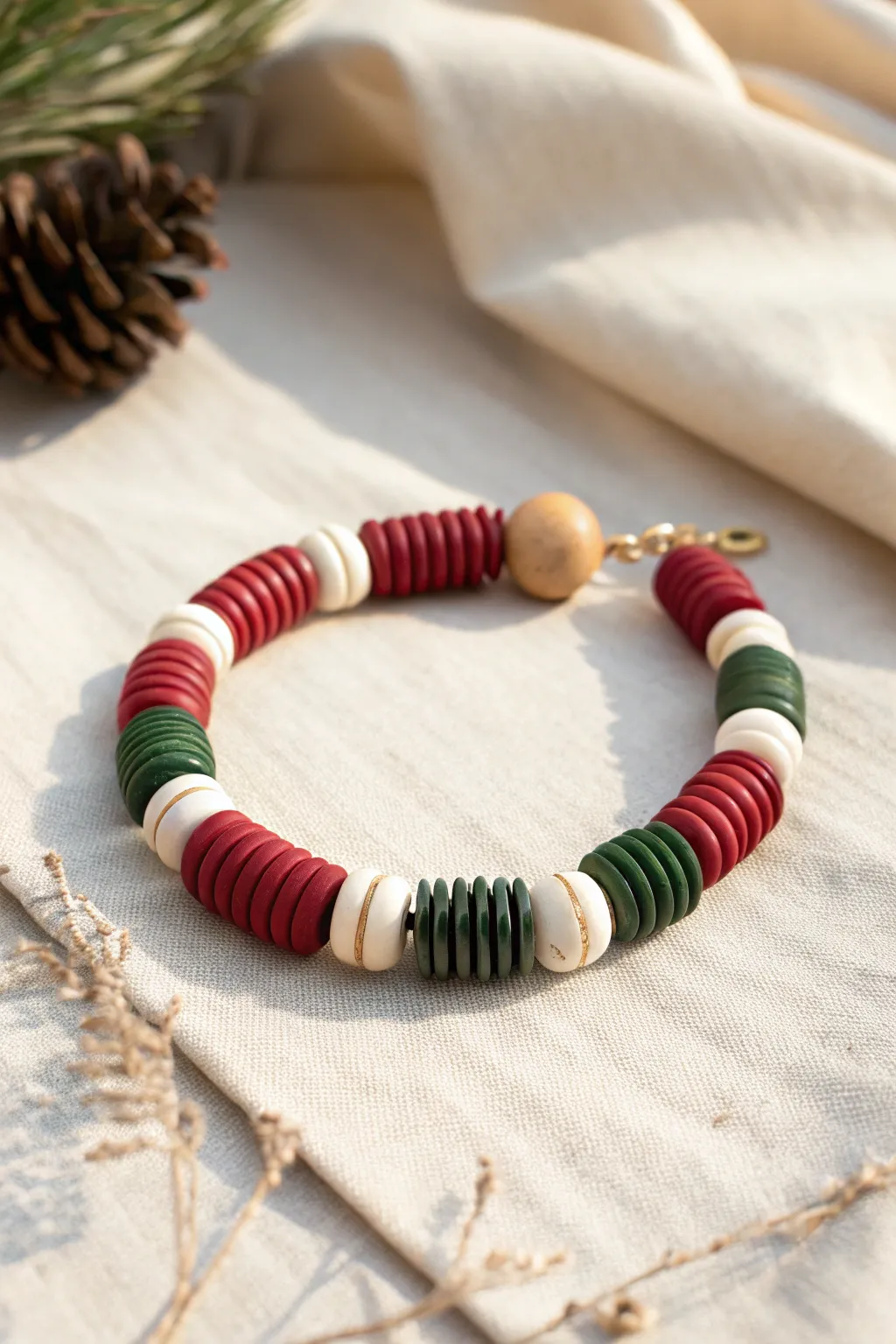
Embrace the holiday season with this sophisticated take on traditional colors, featuring distinct blocks of deep red, forest green, and creamy white. The gold-accented spacer beads add a touch of warmth and luxury to the matte finish of the polymer clay heishi beads.
Step-by-Step
Materials
- Polymer clay heishi beads (4mm-6mm): Dark Red, Forest Green, and Cream/White
- Gold-plated or raw brass flat spacer beads or thick jump rings (approx. 4-5mm)
- Large round wooden bead (approx. 10-12mm)
- Strong elastic stretch cord (0.8mm or 1.0mm recommended)
- Jewelry glue (e.g., E6000 or GS Hypo Cement)
- Scissors or bead snippers
- Bead stopper or tape
- Ruler or measuring tape
- Optional: Crimp beads and crimp cover (if not knotting directly against the bead)
Step 1: Preparation & Design
-
Measure your wrist:
Wrap a measuring tape comfortably around your wrist to determine the circumference. Add about half an inch to this measurement to ensure the chunkier clay beads don’t feel too tight. -
Cut the cord:
Cut a length of elastic cord about 10-12 inches long. Having this extra length makes the final knotting process significantly less frustrating. -
Secure the end:
Attach a bead stopper or simply use a piece of tape on one end of your cord to prevent your carefully arranged beads from sliding off while you work. -
Plan your pattern:
Before stringing, lay out your beads on a flat surface. The pattern relies on asymmetry: use sections of 10-15 red beads, alternating with shorter sections of 5-8 green beads, separated by single or double white accent beads.
Knot Slipping?
If your elastic knot feels insecure, try a ‘square knot’ followed by a ‘surgeon’s knot’. Pull very tight until the elastic turns lighter in color.
Step 2: Stringing the Color Blocks
-
Start with the focal point:
Thread the large round wooden bead onto the cord first. This will act as the closure accent or central focal point depending on how the bracelet turns on your wrist. -
Begin the first red block:
Slide on approximately 10 to 12 dark red heishi beads. Ensure they sit flush against each other to create that solid ‘block’ of color. -
Add a white separator:
To break up the dark colors, add one thick cream/white bead. This acts as a visual palate cleanser between the bold hues. -
Create a green segment:
Thread on a section of forest green beads. I usually make this section slightly shorter than the red ones, perhaps 6 to 8 beads, for visual interest. -
Insert gold accents:
Frame your next white bead with thin gold spacer rings on either side. This tiny metallic glint elevates the bracelet from simple to chic. -
Build the second red block:
Add another substantial section of red beads. Try varying the length slightly from your first red block—maybe 15 beads this time—to avoid looking too uniform. -
String the central white feature:
Thread a single cream bead, followed by a gold spacer, and then another cream bead. This double-white section creates a nice highlight. -
Complete the pattern loop:
Continue alternating your red and green blocks, separated by the white and gold accents, until you reach your desired bracelet length. Check the fit by wrapping it around your wrist occasionally.
Level Up: Texture
Mix in a few textured gold beads or swap the smooth wooden bead for a faceted one to catch the light and add dimension.
Step 3: Finishing Touches
-
Pre-stretch the cord:
Hold both ends of the elastic and give the bracelet a gentle tug. This pre-stretching prevents the elastic from sagging or loosening immediately after you wear it. -
Tighten the beads:
Push all beads snugly together so there are no visible gaps on the cord, but ensure the bracelet remains flexible and not stiff. -
Tie the knot:
Remove the bead stopper and tie a surgeon’s knot (right over left, left over right, looping through twice). Pull the knot tight. -
Secure with glue:
Apply a tiny dab of jewelry glue specifically to the knot. Let it tack up for a moment before moving to the next step. -
Hide the knot:
If the hole of your large wooden bead is big enough, carefully pull the knot inside it. If not, try to tuck it inside one of the adjacent clay beads. -
Trim excess cord:
Once the glue is fully dry (check the manufacturer’s instructions), trim the excess elastic tails with sharp scissors. Be careful not to clip the main knot.
Enjoy wearing your handcrafted piece that perfectly balances cozy winter tones with elegant design
Classic Winter Bracelet Stack
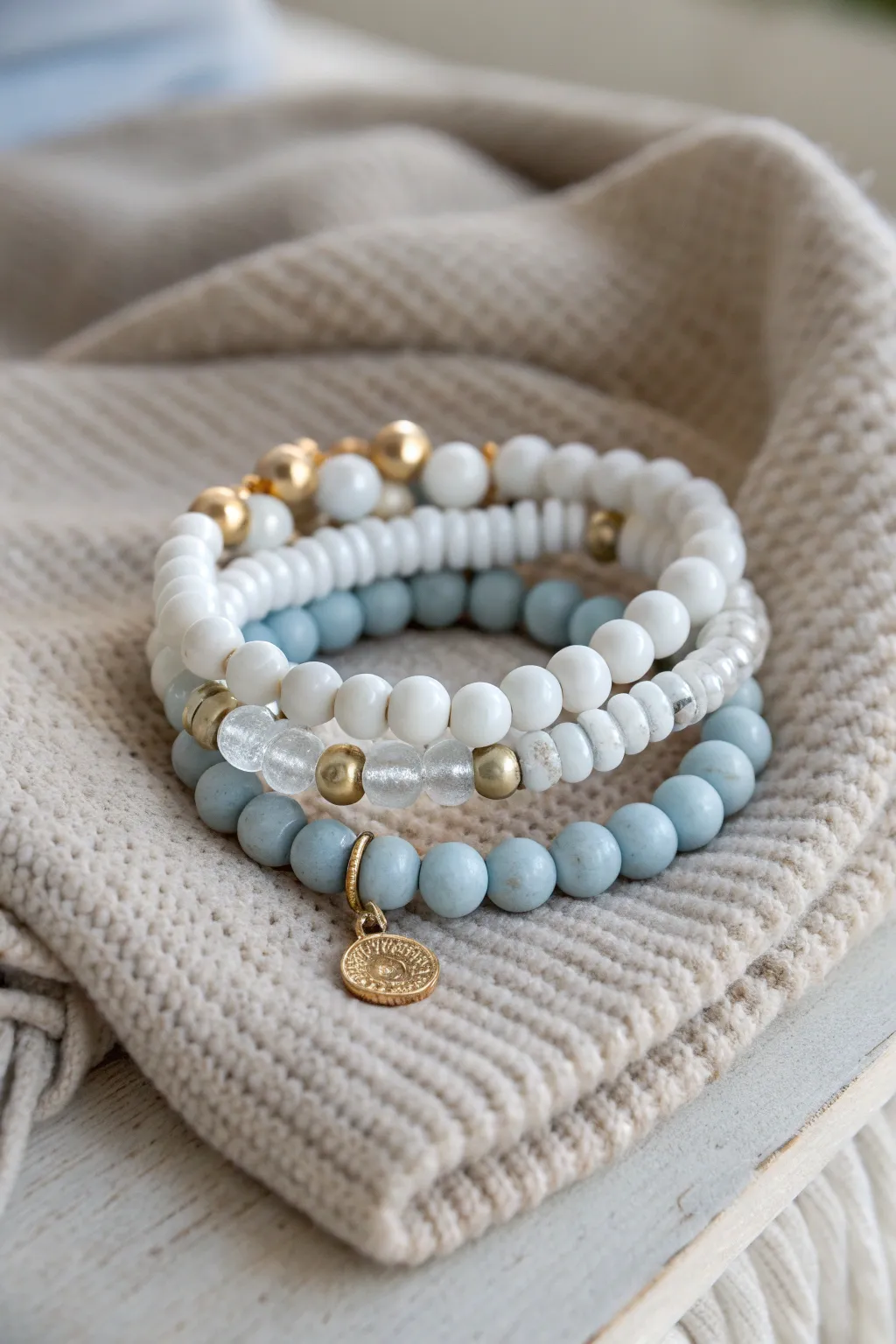
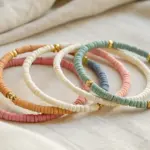
Capture the serene essence of a winter shoreline with this stack of three complementary bracelets. Mixing matte textures, milky glass, and soft blues creates a sophisticated accessory perfect for cozy sweater weather.
How-To Guide
Materials
- Elastic beading cord (0.7mm or 0.8mm transparent)
- 6mm matte pale blue round beads (amazonite or dyed jade)
- 6mm glossy white round beads (ceramic or agate)
- 4mm white Heishi clay disc beads
- 8mm translucent/crackle quartz round beads
- Gold saucer spacer beads (approx. 4mm)
- 4mm gold round beads
- Small gold coin charm or pendant
- Gold jump ring (5mm)
- Jewelry adhesive (e.g., E6000 or GS Hypo Cement)
- Scissors or bead snips
- Beading needle (optional but helpful)
- Bead stopper or masking tape
Step 1: Bracelet 1: The Matte Blue Charm
-
Measure and Cut:
Cut a piece of elastic cord about 9-10 inches long. This gives you plenty of room to knot later. Secure one end with a bead stopper or a piece of tape. -
Start the Pattern:
Begin stringing your 6mm matte blue beads. These stones have a lovely, soft finish that anchors the whole stack. -
Add the Centerpiece:
Find the approximate middle point of your strand. Here, slide on the gold coin charm using a jump ring. -
Complete the Strand:
Continue adding blue beads until the strand measures about 6.5 to 7 inches, or whatever length fits your wrist comfortably. -
Pre-stretch the Cord:
Give the cord a gentle tug on both ends. This ‘pre-stretching’ helps prevent the bracelet from sagging after you wear it a few times. -
Knot Securely:
Tie a surgeon’s knot (right over left, left over right, looping the second pass twice). Pull it tight. -
Glue and Trim:
Dab a tiny drop of jewelry adhesive on the knot. Let it dry for a moment, then trim the excess cord close to the knot, tucking it inside a bead if the hole allows.
Knot Slipping?
If your elastic knots feel slippery, try ‘sanding’ the very ends of the cord with a nail file before tying. The rougher texture grips better.
Step 2: Bracelet 2: The Textured White Stack
-
Set the Foundation:
Cut another length of elastic cord and secure the end just like before. -
Create Sections:
String a section of about 10-12 white Heishi clay disc beads. These flat beads add that classic ‘clay’ texture. -
Insert Gold Accents:
Slide on three gold spacer beads: a small gold round bead sandwiched between two saucer beads, or simply three gold rounds for a simpler look. -
Mix Bead Types:
Transition to the 6mm glossy white round beads for the next section. String about 8-10 of these. -
Repeat the Pattern:
Return to the Heishi discs, then add another gold accent grouping. I like to alternate these textures to keep the eye moving around the wrist. -
Check Fit and Close:
Wrap the strand around your wrist to check the sizing against the first blue bracelet. Once happy, knot, glue, and trim as described previously.
Step 3: Bracelet 3: The Crystal & Gold Mix
-
Prepare the Cord:
Cut your final piece of elastic. Since we are using slightly heavier beads here, ensure your knotting area is clean. -
String the Focal Section:
Start with the ‘frosty’ section: String three 8mm translucent crackle quartz beads. -
Add Gold Dividers:
Place a gold saucer bead on either side of this 3-bead crystal focal point to frame it. -
Fill the Rest:
Finish the rest of the circle using a mix of the white Heishi beads and the glossy white round beads. Randomizing this part slightly makes it feel organic. -
Final Assembly:
Check that this bracelet sits nicely alongside the other two. Secure with a strong surgeon’s knot, apply glue, and snip the ends. -
The Final Stack:
Slide all three bracelets onto your wrist or a display pillow to see how the textures—matte, glossy, and metallic—play together beautifully.
Winter Sparkle
Swap the white glossy beads for silver-lined clear seed beads or faceted moonstone to give the stack an icier, more shimmering appearance.
Enjoy the crisp, elegant look of your new winter bracelet stack all season long

What Really Happens Inside the Kiln
Learn how time and temperature work together inside the kiln to transform clay into durable ceramic.
Peppermint Swirl Focal Beads
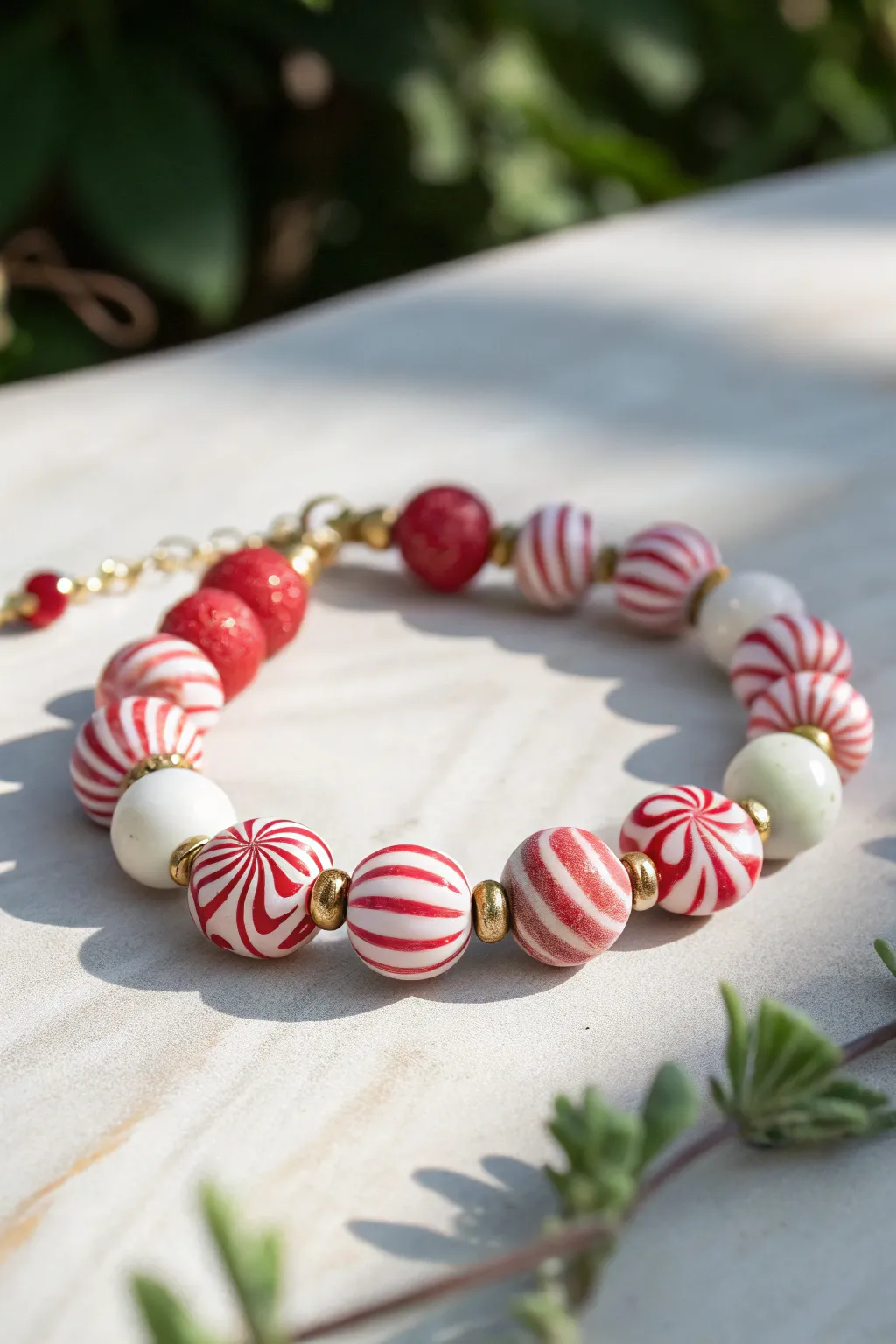
Capture the sweetness of the season with this delightful bracelet featuring handmade polymer clay peppermint beads. The mix of swirled candy patterns, sparkly textured reds, and elegant gold accents makes for a perfect holiday accessory.
Detailed Instructions
Materials
- White polymer clay
- Red polymer clay
- Translucent liquid polymer clay (optional)
- Red glitter (fine)
- Small gold spacer beads (metal or acrylic)
- Gold finish jewelry chain and extender
- Gold finish lobster clasp
- Crimp beads and crimp covers (gold finish)
- Beading wire (nylon coated)
- Glossy glaze or UV resin
- Beading needle/awl (for piercing holes)
- Clay roller or pasta machine
- Clay slicing blade
Step 1: Creating the Peppermint Canes
-
Condition the Clay:
Begin by conditioning your white and red polymer clay separately until they are soft and pliable. This prevents cracking later on. -
Form the Base Logs:
Roll a thick log of white clay (about 1 inch thick) and a thinner log of red clay. You will need roughly twice as much white clay as red. -
Slice and Stack:
Cut the white log into four distinct wedges lengthwise, like slicing a pie. Place thin strips of red clay between these white wedges to create a striped circular log. -
Add Exterior Stripes:
Roll very thin snakes of red clay and press them gently onto the outside of your reconstructed white log to add more detail to the pattern. -
Reduce the Cane:
Gently squeeze and roll the log to reduce its diameter. Start from the center and work outward to elongate it without distorting the internal pattern. -
Twist the Cane:
Once the log is about 1/2 inch thick, hold each end and twist in opposite directions. This creates the classic peppermint swirl effect seen in the focal beads.
Step 2: Shaping and Baking Beads
-
Form Peppermint Rounds:
Slice the twisted cane into equal segments. Roll each segment into a smooth ball between your palms. The swirling lines should wrap around the sphere. -
Create Glitter Beads:
Take small portions of plain red clay and roll them into balls. I like to roll the raw clay balls directly into fine red glitter to coat them fully, pressing the glitter into the surface. -
Make Spacer Spheres:
Roll a few small, plain white balls of clay to act as neutral spacers between the busier patterns. -
Pierce the Holes:
Using a bead piercing pin or thick needle, carefully create a hole through the center of each bead. Twist the pin as you push through to avoid squishing the shape. -
Bake:
Arrange your beads on a baking sheet or tile. Bake according to your clay manufacturer’s specific temperature instructions (usually around 275°F for 15-30 minutes). -
Glaze:
Once cooled, coat the peppermint beads with a glossy glaze or a thin layer of UV resin to give them that hard-candy shine.
Smudged Red Lines?
If red clay smears onto the white while rolling, let the cane rest in the fridge for 20 minutes before slicing. Firm clay holds sharp lines much better than warm clay.
Step 3: Assembling the Bracelet
-
Prepare the Wire:
Cut a length of beading wire about 9-10 inches long to allow plenty of room for finishing. -
Secure the First End:
Thread a crimp bead onto one end, followed by a jump ring attached to one part of your clasp chain. Loop the wire back through the crimp bead and flatten it securely with pliers. -
String the Pattern:
Begin stringing your beads. Use gold spacer beads between every clay bead to separate them and add a touch of luxury. Vary the pattern by alternating peppermint swirls, glitter reds, and plain whites. -
Finish the Strand:
Once you reach your desired length (typically 6.5 to 7 inches for an adult wrist), add a crimp bead and the second half of your clasp assembly. -
Final Securement:
Feed the wire back through the crimp bead and pull tight so there are no large gaps, but the beads can still move slightly. Flatten the crimp bead and trim the excess wire.
Level Up: Scented Beads
Mix a tiny drop of peppermint essential oil into the clay before baking (or rub it on the unfinished wood/clay beads after) for a scratch-and-sniff accessory.
Wear your sweet creation to your next holiday gathering for a festive touch that looks good enough to eat
Gingerbread Spice Neutrals
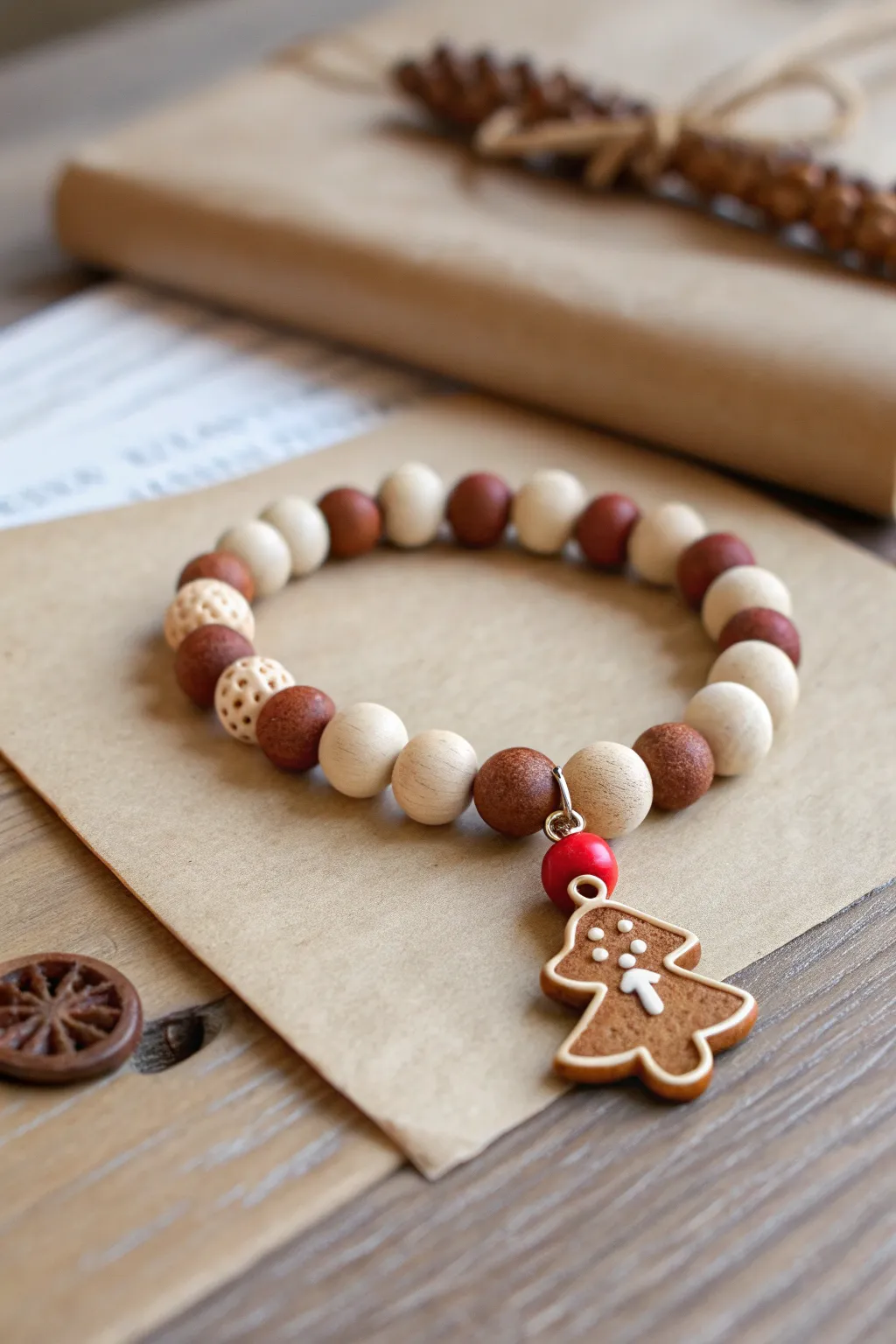
Cozy up your winter wardrobe with this charming bracelet that combines warm, spicy wood tones with sugary textured accents. Featuring a delightful gingerbread man charm, this accessory perfectly captures the nostalgic scent of holiday baking in a wearable form.
Step-by-Step Tutorial
Materials
- Polymer clay in ‘Gingerbread’ (dark brown), ‘Cookie Dough’ (light beige/cream), white, and cherry red
- Liquid polymer clay (translucent or white)
- Fine white glitter or white embossing powder (for sugar texture)
- Elastic beading cord (0.7mm or 0.8mm)
- Jewelry headpin or eye pin (gold or silver tone)
- Gold or silver jump rings (small)
- Bead piercing pins or toothpicks
- Small circle cutter (approx. 10-12mm)
- Gingerbread man clay cutter (micro size, approx. 1.5 – 2cm)
- Super glue or jewelry adhesive
- Needle-nose pliers and wire cutters
- Oven for baking polymer clay
Step 1: Crafting the Beads
-
Condition the clay:
Start by thoroughly conditioning your ‘Gingerbread’ dark brown and ‘Cookie Dough’ light beige clay separately until they are soft and pliable. -
Roll the base logs:
Roll both colors into long, even logs with a diameter of roughly 10mm to ensure your beads will be uniform in size. -
Slice segments:
Using a tissue blade or craft knife, cut the logs into equal-sized segments. You’ll need about 10-12 segments of each color for a standard adult wrist. -
Shape the rounds:
Roll each segment between your palms to form perfect spheres. Aim for a smooth surface, smoothing out any seams or fingerprints gently. -
Piercing the beads:
Using a bead piercing pin, carefully bore a hole through the center of each sphere. I find rotating the pin while pushing helps keep the hole round and prevents the bead from squashing. -
Create the ‘Sugar’ beads:
Take two of your unbaked ‘Cookie Dough’ light beads. Coat them lightly in liquid polymer clay, then roll them in fine white glitter or embossing powder to create a textured, sugar-coated look. -
Texturing (alternate method):
If you don’t have glitter, use a toothbrush or stiff brush to stipple the surface of two beads, giving them a porous, baked-good texture.
Step 2: Making the Charm
-
Cut the gingerbread shape:
Roll out a small slab of the dark ‘Gingerbread’ clay to about 3mm thickness. Use your micro gingerbread cutter to punch out a shape. -
Smooth the edges:
Clean up any rough edges on the charm with your fingertip or a silicone tool to ensure a polished look. -
Mix the icing:
Mix a tiny amount of liquid clay with white solid clay until you have a thick paste consistency, similar to real royal icing. -
Decorate the cookie:
Using a needle tool or toothpick, apply the ‘icing’ to draw a squiggly line at the base for legs, buttons, and a simple face on the gingerbread man. -
Insert the hardware:
Carefully insert a small eye pin or headpin loop into the top of the gingerbread man’s head so it can hang later. -
Make the bail bead:
Create a very small red bead (about 4-5mm) and pierce it. This will sit on top of the charm. -
Bake everything:
Arrange all your standard beads, the two sugar beads, the red bail bead, and the charm on a baking tile. Bake according to your clay manufacturer’s instructions (usually 275°F/135°C for 15-30 minutes).
Baking Pro-Tip
Bake your round beads on a bed of cornstarch or accordion-folded cardstock. This prevents flat spots from forming on the bottom of the spheres where they touch the tray.
Step 3: Assembly
-
Prepare the charm assembly:
Once cool, threading the charm onto the jump ring is easier if you secure the red bead first. Slide the small red bead onto a headpin, form a loop, and attach it to the gingerbread man, or simply thread the elastic through the red bead and attach the charm below it. -
Layout the pattern:
Lay out your alternating pattern: dark brown, light beige, dark brown. Place the two ‘sugar’ textured beads opposite where the charm will hang for visual balance. -
String the beads:
Thread your elastic cord through the beads. When you reach the center point, slide on your gingerbread charm assembly. -
Tie the knot:
Finish stringing until the bracelet reaches your desired length. Tie a secure surgeon’s knot with the elastic, pulling it tight to minimize gaps between beads. -
Secure and hide:
Add a tiny drop of super glue to the knot. Once dry, trim the excess cord and gently tug the knot inside one of the adjacent wood-tone beads to hide it.
Scent Level Up
After baking and cooling, place the beads in a sealed bag with a cotton ball soaked in cinnamon essential oil for 2 days. The clay will absorb the scent for a true scratch-and-sniff effect.
Now you have a sweet wrist accessory that captures the wholesome spirit of the season

TRACK YOUR CERAMIC JOURNEY
Capture glaze tests, firing details, and creative progress—all in one simple printable. Make your projects easier to repeat and improve.
Cozy Sweater Texture Beads
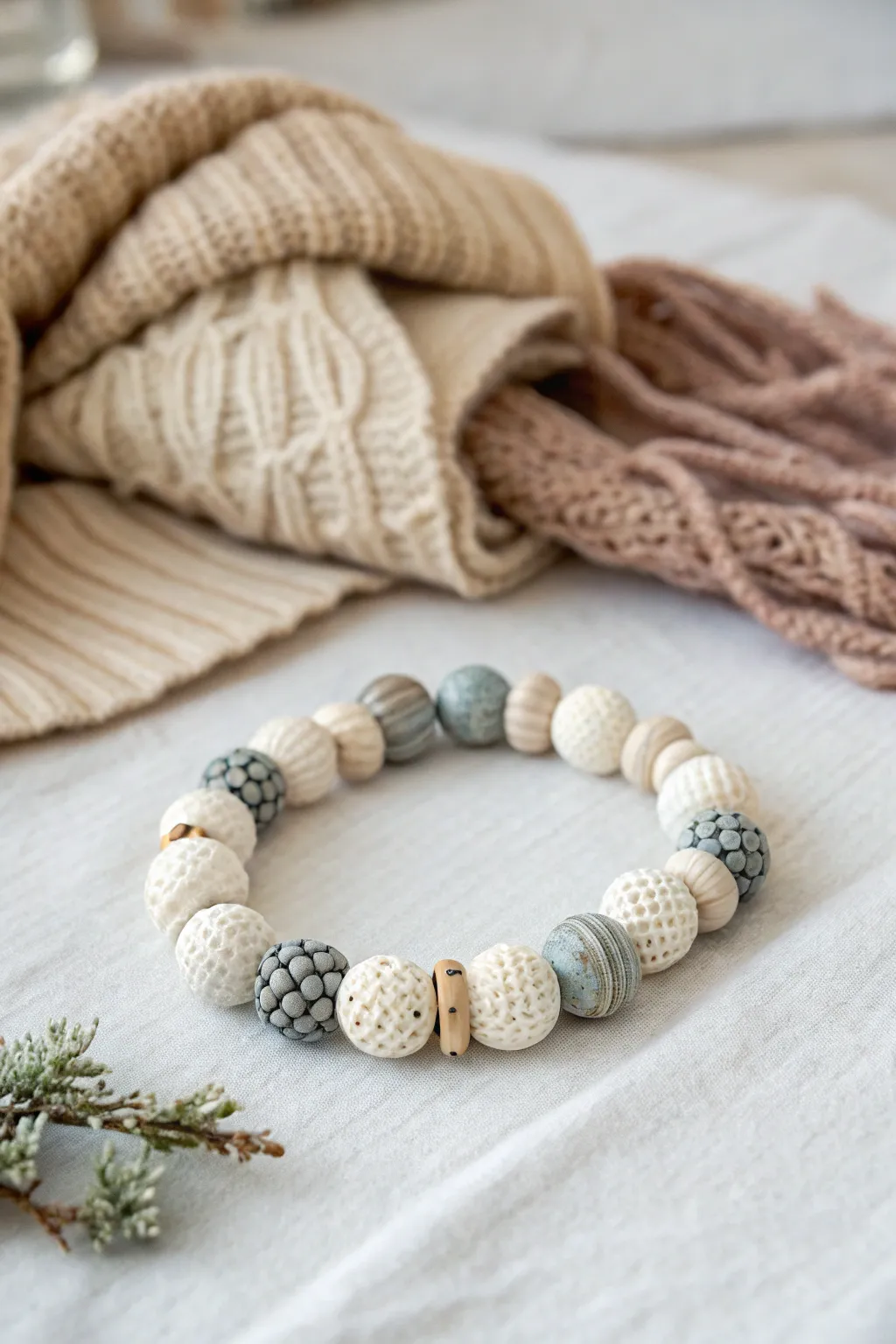
Capture the cozy essence of your favorite winter sweater with this textured polymer clay bracelet. Featuring beads that mimic cable knits, stone textures, and soft woven fabrics in a soothing palette of creams, slate blues, and natural wood tones, it’s the perfect accessory for chilly days.
Step-by-Step Guide
Materials
- Polymer clay (white, slate blue, beige/translucent mix)
- Small wooden accent beads (natural finish)
- Texturing tools: cheesecloth, sandpaper, needle tool, rubber stamps
- Small round piping tip or straw (optional for cutting)
- Elastic jewelry cord (0.8mm)
- Bead reamer or piercing tool
- Baking sheet and parchment paper
- Gloss or matte varnish (optional)
- Acrylic paint (black or dark grey) for antiquing
- Paper towels
Step 1: Creating the Sweater Texture Beads
-
Condition the clay:
Start by conditioning your white polymer clay until it is soft and pliable. Roll it into a smooth snake, roughly 1/2 inch thick. -
Form the base beads:
Cut the snake into equal segments and roll them into spheres. These will be your main white textured beads. -
Apply textile texture:
Take a piece of cheesecloth or loose-weave fabric and press it firmly deeply into the surface of the clay spheres. Rock the bead gently to imprint the texture all the way around without squashing the round shape. -
Create the ‘bubble’ knit beads:
For the more distinct, honeycomb-like white beads, use a small, blunt tool (like the end of a paintbrush) or a specific rubber stamp to press deep, repetitive indentations into the clay surface.
Pro Tip: Seamless Texture
When texturing round beads with fabric, wrap the cloth fully around the ball and roll it between your palms. This creates an even pattern without visible ‘seams’ or bald spots.
Step 2: Crafting the Accent Beads
-
Mix the slate blue color:
Blend blue clay with a touch of grey and white to achieve that muted, stony winter blue seen in the reference. -
Form the ‘berry’ cluster beads:
To make the grey bobble beads, create a small core ball of clay. Then, roll tiny little pellets of the slate blue clay and press them gently all over the surface of the core until it resembles a blackberry or beaded cluster. -
Make the striped connector beads:
Stack thin flattened pancakes of blue, grey, and white clay. Compress the stack, slice through it to reveal the layers, and roll slices onto a small bead core to create a striped, agate-like effect. -
Texturize the striped beads:
Roll these striped beads gently over fine-grit sandpaper to give them a matte, stone-like finish rather than a shiny polymer look. -
Select wooden spacers:
Choose small, natural wooden beads or create faux-wood beads using beige clay with a tiny drop of brown, swirled but not fully mixed.
Level Up: Faux Stone
Add cracked black pepper or sand into your translucent clay mix before baking. This gives the non-textured beads a realistic, speckled granite appearance.
Step 3: Assembly and Finishing
-
Pierce the holes:
Before baking, carefully pierce a hole through the center of every clay bead. I find twisting the tool as you push through prevents the bead from deforming. -
Bake the clay:
Arranged your beads on parchment paper. Bake according to your customized clay package instructions (usually 275°F/135°C for 15-30 minutes). Let them cool completely. -
Antique the textures (Optional):
To make the white sweater textures pop, brush diluted dark grey acrylic paint over the beads and immediately wipe the surface with a paper towel. The paint will stay in the crevices. -
Arrange the pattern:
Lay out your design on a bead board or towel. Alternate the large white textured beads with the grey berry beads, using the wooden spacers and striped beads as transitions. -
String the bracelet:
Cut a piece of elastic cord about 10 inches long. Pre-stretch it by pulling it firmly a few times to prevent sagging later. -
Thread the beads:
String your pattern onto the elastic. Check the fit around your wrist periodically to ensure you have the right length. -
Tie the knot:
Tie a surgeon’s knot (a square knot with an extra loop through) to secure the bracelet. Pull it tight. -
Hide the knot:
Apply a tiny dab of jewelry glue to the knot. Once dry, trim the excess cord and gently tuck the knot inside the hole of a neighboring bead.
Slip on your new textured creation and enjoy the warmth of handmade style all winter long.
Frosted Clear and White Mix
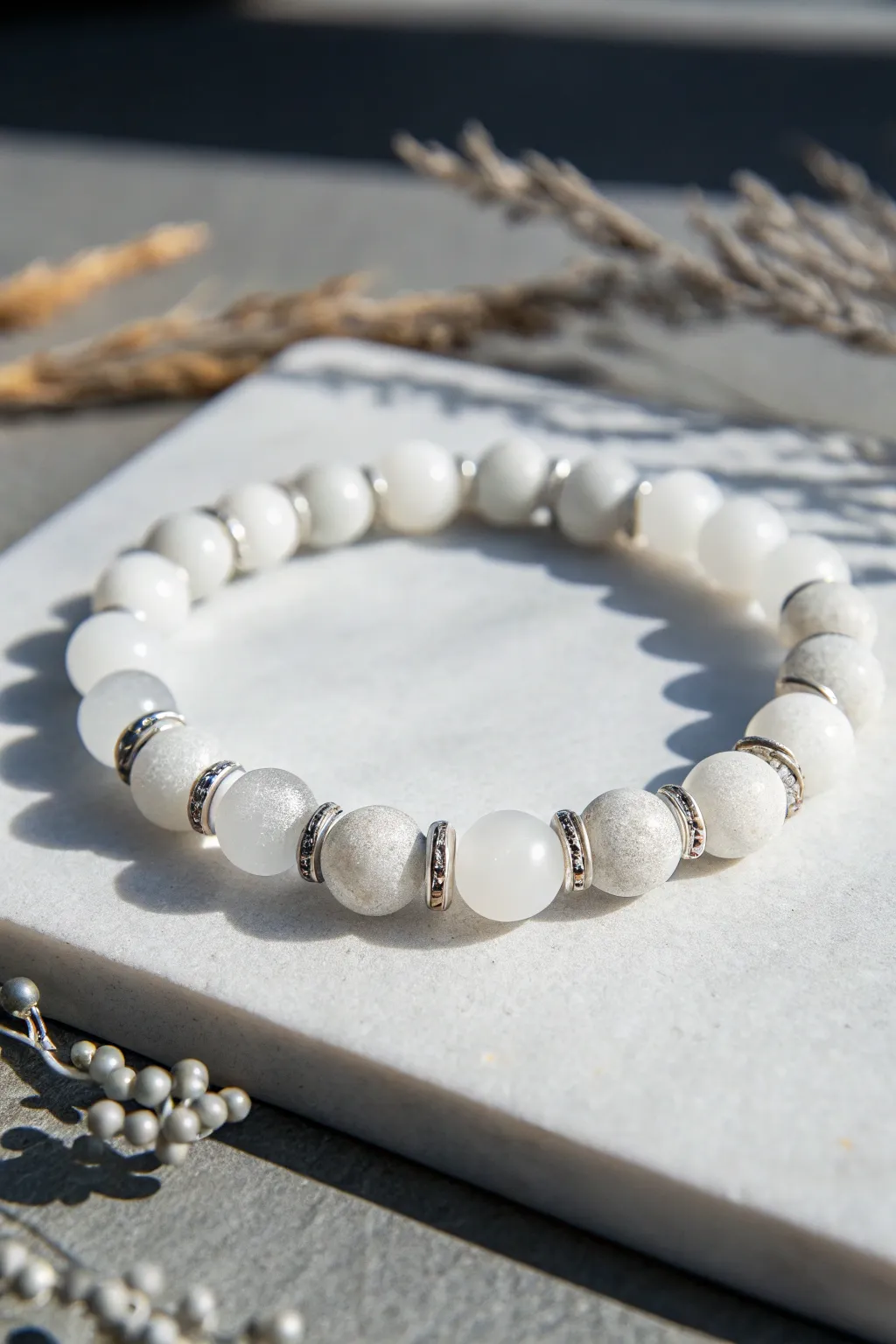
Embrace the serene beauty of winter with this elegant bracelet that combines the softness of milky white spheres with the icy texture of frosted stardust beads. The interplay of smooth and textured finishes, accented by sparkling silver spacers, creates a sophisticated accessory perfect for snowy days.
Step-by-Step Tutorial
Materials
- 8mm milky white quartz or smooth agate round beads
- 8mm frosted ‘stardust’ or textured white beads
- Silver rhinestone rondelle spacer beads (approx. 6mm or 8mm)
- Strong elastic bead cord (0.8mm or 1.0mm recommended)
- Beading needle (optional but helpful)
- Jewelry glue (GS Hypo Cement or E6000)
- Scissors or precise bead cutters
- Bead design board or soft mat
Step 1: Preparation & Design
-
Measure your wrist:
Before cutting any string, use a measuring tape around your wrist where you want the bracelet to sit. Add about half an inch to this measurement for a comfortable fit that isn’t too tight. -
Cut the elastic:
Cut a piece of elastic cord about 10-12 inches long. Having this extra length makes tying the final knot much easier than struggling with short ends. -
Pre-stretch the cord:
Give your cut elastic several firm tugs. This pre-stretching ensures the bracelet won’t sag or expand unexpectedly after you’ve worn it a few times. -
Secure the end:
Place a bead stopper or simply a piece of tape on one end of the cord to prevent your beads from sliding off while you work. -
Lay out the pattern:
Use a bead board to arrange your beads before stringing. For the ‘front’ section, alternate the frosted stardust beads with smooth milky beads, placing a silver rhinestone spacer between each one. -
Plan the back section:
For the rest of the bracelet (the part that sits under the wrist), simpler pattern works well. You can switch to just the smooth milky beads separated by simple silver spacers or no spacers at all for comfort.
Knot Hiding Trick
If your beads have very small holes, ream one bead slightly larger with a bead file before stringing, or simply place a metal crimp cover over the knot.
Step 2: Stringing the Beads
-
Start the sequence:
Begin threading your beads onto the elastic. I prefer to start with a bead that has a slightly larger hole if possible, as this will help hide the knot later. -
Create the focal point:
Thread the main pattern: silver spacer, frosted bead, silver spacer, smooth bead. Repeat this sequence for the central 6-8 beads that will sit on top of your wrist. -
Check the texture:
As you string the frosted stardust beads, handle them gently to ensure the textured coating remains pristine and sharp. -
Complete the length:
Continue adding remainder of the smooth white beads until you reach your measured length. Wrap the strand around your wrist to check the fit before tying. -
Verify symmetry:
Look at the pattern one last time to ensure the spacers are facing the correct way and the sequence hasn’t been accidentally broken.
Step 3: Finishing Touches
-
Tie the surgeon’s knot:
Remove the tape/stopper. Cross the ends, loop one over twice, and pull tight. Then cross again and loop over once. This creates a secure surgeon’s knot. -
Tighten securely:
Pull all four strands (the two loose ends and the bracelet loop sides) firmly to cinch the knot down tight against the beads. -
Apply adhesive:
Dab a tiny amount of jewelry glue directly onto the knot. You don’t need much; just enough to fuse the elastic strands together. -
Hide the knot:
While the glue is still tacky, gently tug on the bracelet so the knot slides inside the hole of the adjacent bead. This makes the finish seamless. -
Let it cure:
Allow the bracelet to sit undisturbed for the recommended drying time of your glue (usually at least 24 hours for full strength) before trimming the excess tails. -
Final trim:
Once dry, use sharp scissors to snip the remaining elastic tails as close to the bead hole as possible without nicking the main cord.
Winter Sparkle
Add a single snowflake charm or a dangling crystal drop near the clasp area to enhance the icy winter theme without overwhelming the simple design.
Enjoy wearing this crisp, snowy accessory all winter long
Cranberry and Cream Garland Pattern
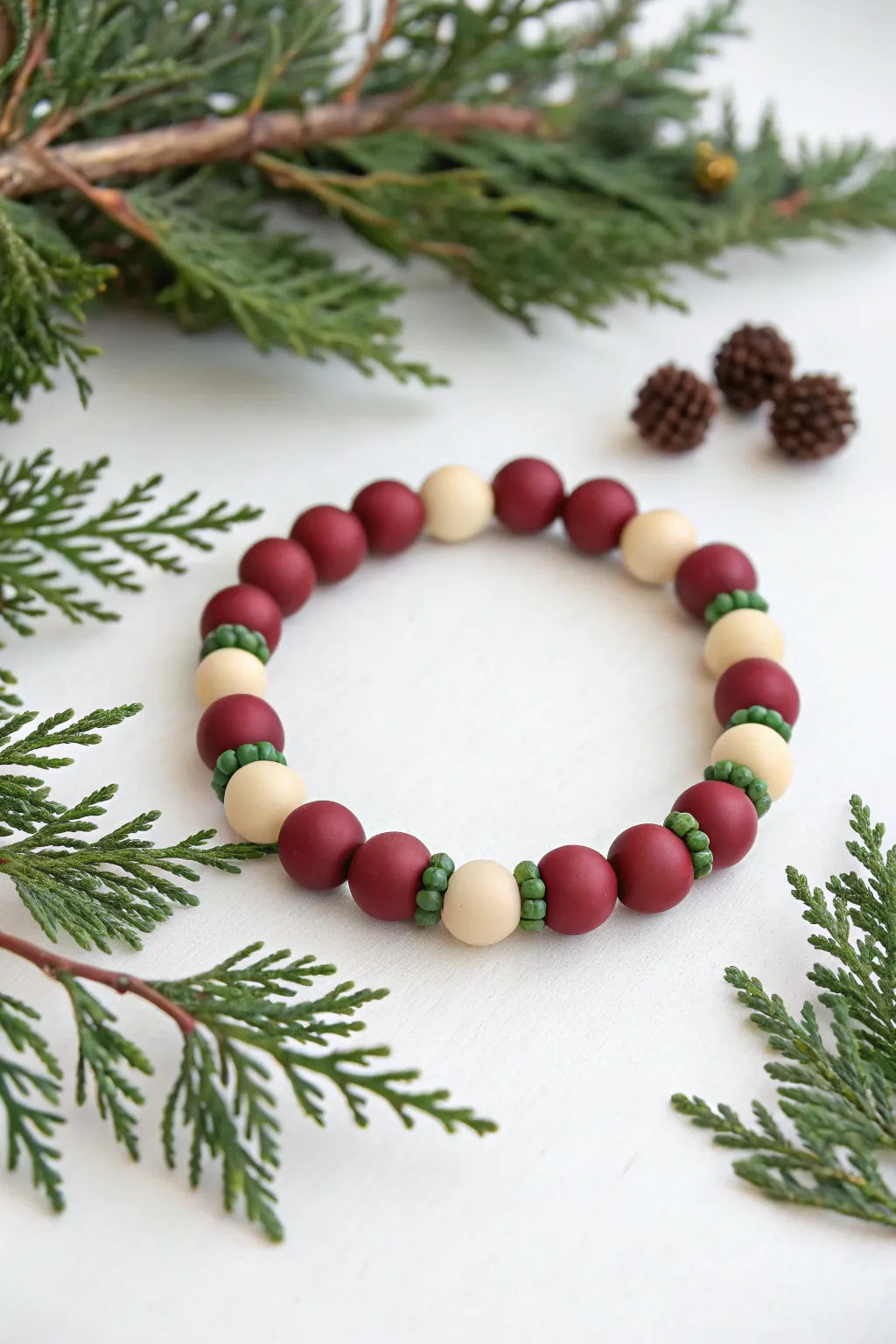
Inspired by the look of popcorn and cranberry garlands strung on a tree, this bracelet combines deep reds and soft creams with subtle green accents. The matte finish of the clay beads gives it a sophisticated, modern holiday feel that works perfectly for winter wear.
Step-by-Step
Materials
- 10mm round polymer clay beads (matte deep burgundy/cranberry)
- 10mm round polymer clay beads (matte cream/ivory)
- Small glass seed beads (matte olive green or evergreen), approx size 11/0 or 8/0
- Strong elastic display cord (0.8mm or 1.0mm depending on bead hole size)
- Super glue or jewelry cement
- Scissors
Step 1: Preparation and Design
-
Measure your wrist:
Start by wrapping the elastic cord loosely around your wrist to determine the length needed, but don’t cut it off the spool yet. Keeping it on the spool prevents beads from slipping off the other end while you work. -
Pre-stretch the cord:
Give your elastic cord a few firm tugs. This is a crucial step that pre-stretches the material so your bracelet won’t sag or loosen up after the first few times you wear it. -
Lay out the pattern:
Before stringing, lay your beads out on a bead board or a towel to visualize the sequence. The pattern for this bracelet relies on asymmetrical spacing, alternating between solid blocks of color and detailed spacers.
Hiding the Ends
Ensure the hole of the clay bead next to your knot is large enough to hide it. If the hole is tight, use a bead reamer or a thick needle to gently widen it before gluing.
Step 2: Stringing the Beads
-
Start with cranberries:
On your prepared cord, string three of the deep burgundy clay beads. This creates your first solid block of color. -
Add a cream bead:
Slide on one cream-colored clay bead next. This single bead acts as a subtle highlight. -
Repeat the cranberry block:
Add another set of three deep burgundy beads. You now have a sequence of three red, one white, three red. -
Begin the garland section:
Now we change the texture. String one cream clay bead to serve as the base for the next decorative section. -
Create a green spacer:
Thread on roughly 4-5 of the small olive green seed beads. These act as the ‘pine needles’ between the larger ‘popcorn’ pieces. -
Add a single red bead:
Slide on one burgundy bead. This breaks up the lighter colors. -
Add the second green spacer:
String another small cluster of 4-5 green seed beads. -
Place a cream bead:
Add one cream bead. Notice how the pattern creates a specific rhythm: cream, green spacer, red, green spacer, cream. -
The central red accent:
Thread one burgundy bead, followed by another cluster of green seed beads. -
Another cream accent:
Add a cream bead, then another green seed bead cluster. -
Complete the sequence:
Finish this complex section with one burgundy bead. At this point, check your length; loop it around your wrist to see if it meets ends comfortably. -
Duplicate or adjust:
If you need more length for a larger wrist, I suggest repeating the ‘Green Spacer’ sequence (bead, seeds, bead) until you reach the desired size. The image shows a mix of solid blocks and spaced garland sections, so feel free to improvise the order slightly.
Texture Twist
Swap the matte clay beads for velvet-finish beads to make the bracelet feel even softer and more luxurious, mimicking real cranberry texture.
Step 3: Finishing Touches
-
Check the fit:
Wrap the beaded strand around your wrist one final time. It should sit comfortably without gaps between beads, but not dig into your skin. -
Tie the knot:
Tie a surgeon’s knot (right over left twice, then left over right) to secure the bracelet. Pull the elastic tight so the knot is as small as possible. -
Secure with glue:
Apply a tiny dab of super glue or jewelry cement directly onto the knot. Let it dry for about 30 seconds. -
Hide the knot:
Once the glue is tacky but not fully hard, pull the knot gently inside the hole of the nearest large clay bead to hide it. -
Trim excess cord:
Use your scissors to trim the remaining tails of the elastic cord close to the bead, ensuring nothing pokes out.
Slip on your beautiful new winter bracelet and enjoy the festive, handcrafted touch it adds to your outfit
Silver Icicle Spacer Rhythm
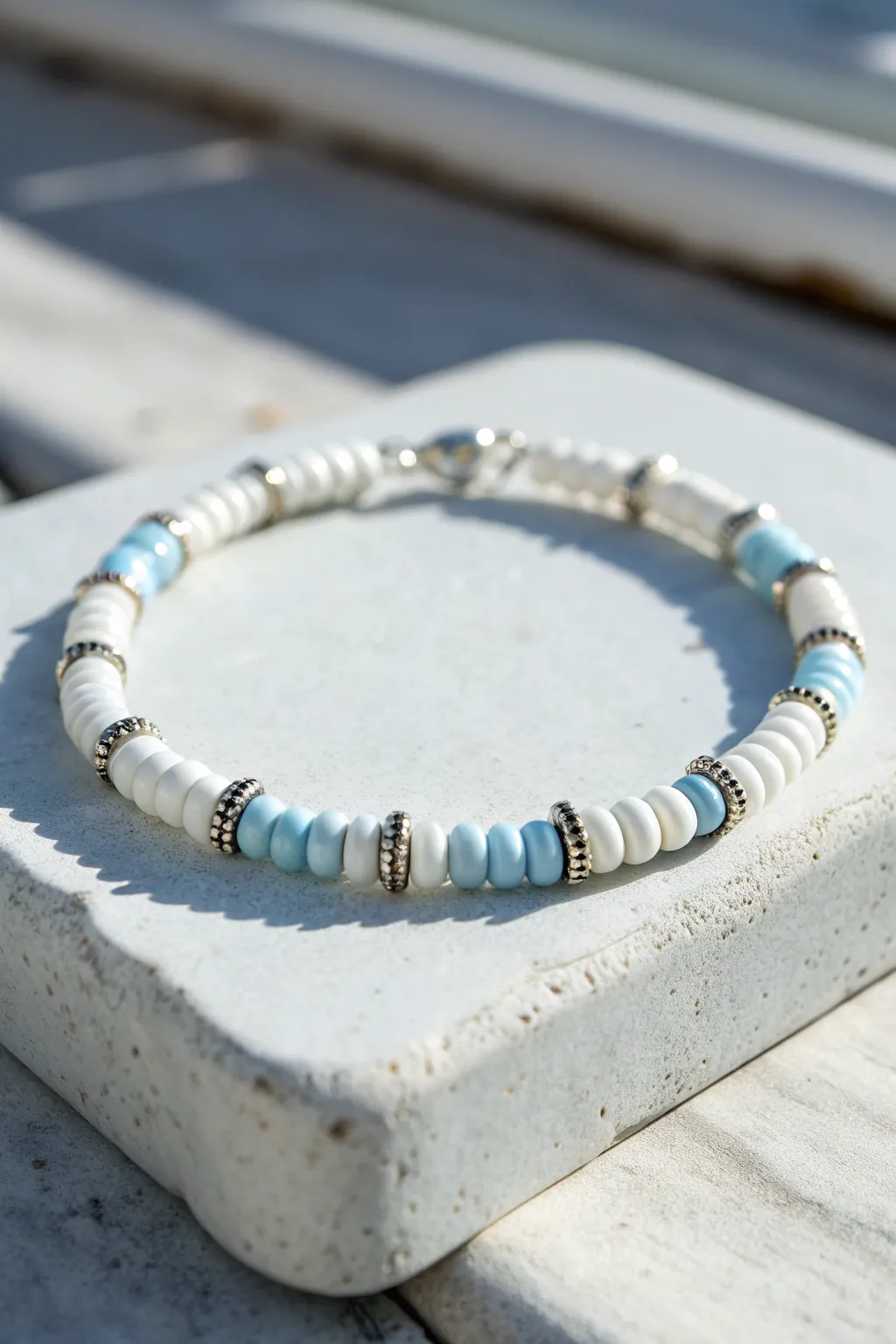
Evoke the quiet beauty of a frozen landscape with this elegant bead design, where matte white and icy blue clay beads are punctuated by shimmering silver spacers. The textured metallic accents act like sparkling icicles breaking up a snowy horizon, creating a sophisticated rhythm perfect for winter styling.
Detailed Instructions
Materials
- 6mm flat polymer clay heishi beads (Bright White)
- 6mm flat polymer clay heishi beads (Ice Blue/Baby Blue)
- 6mm decorative antique silver spacer beads (textured/studded rim)
- 0.8mm clear elastic stretch cord
- Super glue or jewelry cement (e.g., G-S Hypo Cement)
- Scissors
- Bead stopper or masking tape
- Beading needle (optional, for easier threading)
Step 1: Preparation & First Sequence
-
Measure and cut:
Begin by measuring your wrist with a flexible measuring tape. Add about 3-4 inches to this measurement to ensure you have enough slack for tying the final knot. Cut your elastic cord to this length. -
Secure the end:
Attach a bead stopper to one end of your elastic cord. If you don’t have a stopper, a simple piece of masking tape folded over the end works perfectly to keep beads from sliding off. -
Start the pattern:
Thread on your first decorative silver spacer bead. This will act as the anchor point for your visual rhythm. -
The snowy section:
Slide on three white clay heishi beads. Ensure they sit flat against each other. -
The icy accent:
Follow the white beads with two ice blue clay beads. This 3-white, 2-blue ratio creates a subtle, asymmetrical color block. -
Finish the first block:
Add one more section of three white clay beads to mirror the start of the sequence.
Spacer Squeeze
If the knot won’t hide inside the metal spacer because the hole is too small, hide it inside the softer clay beads instead, which have a bit more ‘give’ to them.
Step 2: Establishing the Rhythm
-
Insert the spacer:
Place a silver textured spacer bead next. This completes one full ‘segment’ of the pattern: Spacer – 3 White – 2 Blue – 3 White – Spacer. -
Create the second segment:
Repeat the pattern sequence exactly: three white beads, followed by two blue beads, and ending with three white beads. -
Add the metallic break:
Slide on another silver spacer. Notice how the silver defines the boundaries of the clay sections. -
Check fit occasionally:
Continue repeating this specific sequence (3 white, 2 blue, 3 white, silver spacer) until the beaded strand wraps comfortably around your wrist. -
Sizing adjustment:
If I find the bracelet is slightly too short to close but adding a full sequence makes it too big, I simply add a few extra white beads on either end to bridge the gap without disrupting the main pattern.
Step 3: Finishing Touches
-
Pre-stretch the cord:
Before tying, give the ends of the elastic a gentle but firm tug. This pre-stretching step prevents the bracelet from sagging out of shape the first time you wear it. -
Tie the knot:
Remove the bead stopper and bring the ends together. Tie a surgeon’s knot (right over left twice, then left over right) for maximum security. -
Secure with glue:
Apply a tiny dot of jewelry cement or super glue directly onto the knot. Let it dry for a minute or two. -
Hide the knot:
Once the glue is tacky but not fully hard, try to slide the knot inside the hole of the nearest silver spacer bead if the opening allows it. -
Trim excess:
Use your scissors to trim the excess elastic tails close to the knot, being careful not to nick the main structural cord.
Add Some Frost
Replace the central two blue beads in every other section with faceted clear crystal beads to make the bracelet catch the light like real ice.
Slip this cool-toned accessory on your wrist to carry a bit of winter’s sparkle wherever you go
Midnight Sky Winter Bracelet
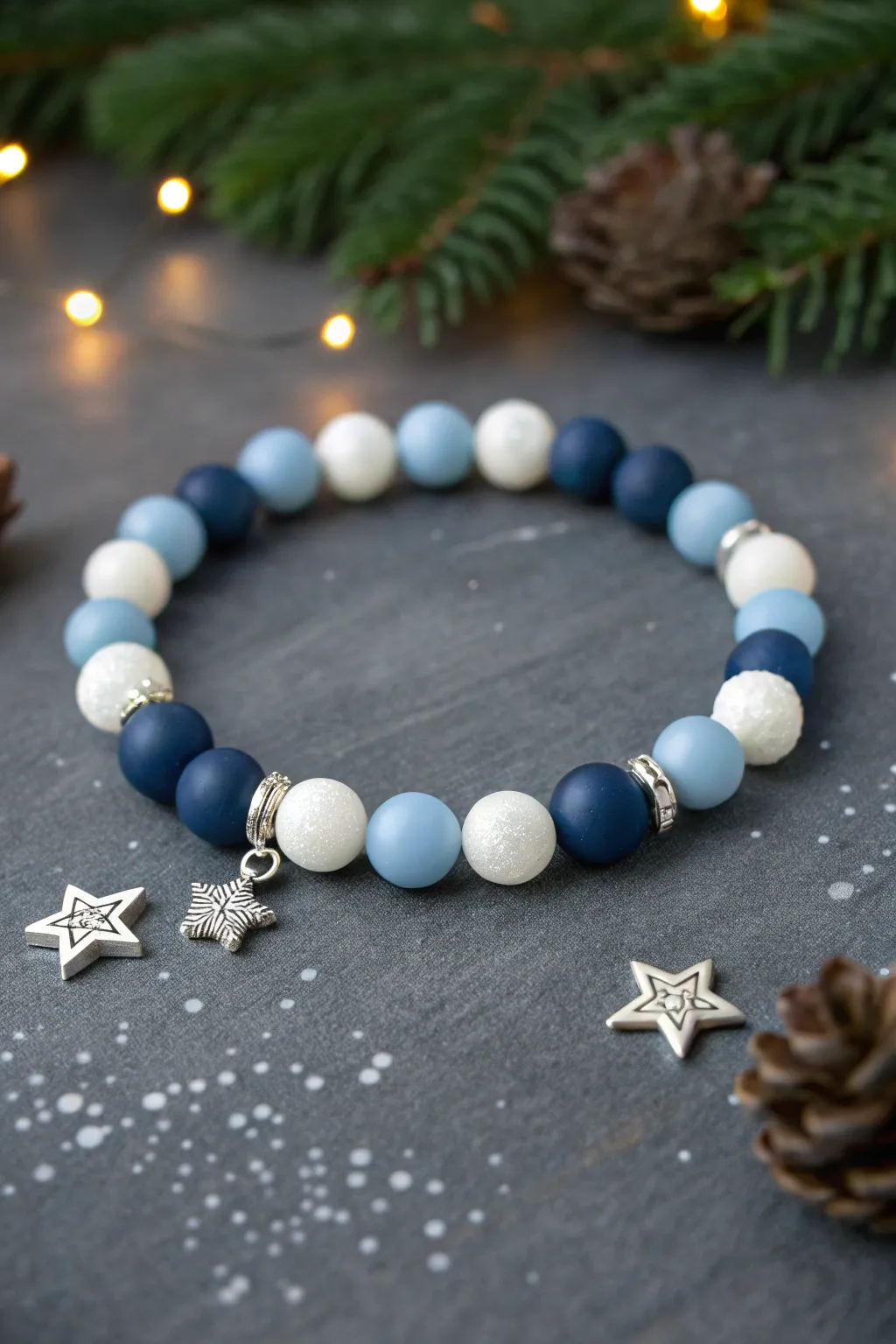
Capture the serene beauty of a crisp winter night with this elegant beaded bracelet featuring shades of navy, icy blue, and shimmering white. A delicate silver star charm adds a touch of celestial magic, making it the perfect accessory for the colder months.
Step-by-Step Tutorial
Materials
- Polymer clay beads (10mm or 12mm) in navy blue matte
- Polymer clay beads (10mm or 12mm) in light cornflower blue matte
- Polymer clay beads (10mm or 12mm) in white glitter/shimmer finish
- Polymer clay beads (10mm or 12mm) in plain white matte
- Elastic beading cord (0.8mm or 1.0mm recommended)
- Silver rhinestone spacer beads or rondelles
- Silver bead bail (hanger bead)
- Silver snowflake or star charm
- Jump ring (4mm or 6mm silver)
- Jewelry adhesive (e.g., E6000 or G-S Hypo Cement)
- Scissors
- Bead stopper or tape
- Pliers (chain nose and bent nose for jump rings)
Step 1: Preparation & Charm Assembly
-
Measure the cord:
Cut a piece of elastic cord about 10-12 inches long. This generous length gives you plenty of room to tie secure knots without struggling with tension. -
Pre-stretch the elastic:
Hold the cord at both ends and give it several gentle tugs to pre-stretch it. This prevents the bracelet from loosening up after you start wearing it. -
Secure one end:
Attach a bead stopper to one end of your cord, or simply tape it down to your work surface prevents beads from rolling off while you design. -
Prepare the charm:
Using your pliers, gently twist open the silver jump ring. I find using two pairs of pliers makes this easier to control. -
Attach the bail:
Slide your star or snowflake charm onto the open jump ring, then hook the ring onto the loop of your silver bead bail. -
Close the ring:
Use the pliers to twist the jump ring closed again, ensuring the ends meet perfectly flush so the charm doesn’t slip off.
Sparkle Secret
Mix bead finishes for depth! Use matte beads for the navy and blue tones, but choose glitter or pearlescent finishes for the white beads to mimic sparkling snow.
Step 2: Beading the Pattern
-
Plan your design:
Lay your beads out on a mat before stringing. The pattern generally alternates between colors: Navy, Light Blue, White. Note that the image uses varied groupings, sometimes placing two blues together. -
Start stringing:
Begin threading your beads onto the elastic. Start with a sequence like: Navy, Light Blue, White Glitter, Navy. -
Insert spacer beads:
Periodically add the silver rhinestone spacer beads. In the reference, they frame specific sections. Try placing one on either side of a ‘focal’ bead group, roughly at the 4 o’clock and 8 o’clock positions. -
Add the charm:
Decide where you want the front of the bracelet to be. Slide on the silver bail (with the charm attached) so it sits centered between a navy and a white or light blue bead. -
Continue the pattern:
Finish stringing until the strand is long enough to wrap comfortably around your wrist. For an average adult wrist, this is usually about 6.5 to 7 inches of beads. -
Check the fit:
Wrap the unfinished strand around your wrist to check the size. It should be snug but not tight, as the beads take up some inner circumference.
Step 3: Finishing and Tying
-
Prepare for the knot:
Remove the bead stopper or tape. Bring the two ends of the elastic together carefully. -
The first crossover:
Cross the left end over the right and pull it tight to snug the beads together, eliminating any gaps between them. -
Tie a surgeon’s knot:
Tie a standard overhand knot, but loop the end through twice instead of once before pulling tight. This extra loop creates friction that holds the elastic in place. -
Secure with glue:
Put a tiny dab of jewelry adhesive directly onto the knot. You only need a pinhead-sized amount. -
Hide the knot:
While the glue is still tacky, gently pull the elastic so the knot slides inside the hole of the nearest large bead. -
Trim the ends:
Once dry, use sharp scissors to trim the excess cord as close to the bead hole as possible without nipping the knot itself.
Winter Wonderland Set
Create a matching stack by making two more bracelets: one entirely of white glitter beads and another featuring only navy beads with silver spacers.
Slide on your new creation and enjoy a piece of winter sparkle on your wrist
Nordic Pattern Color Bands
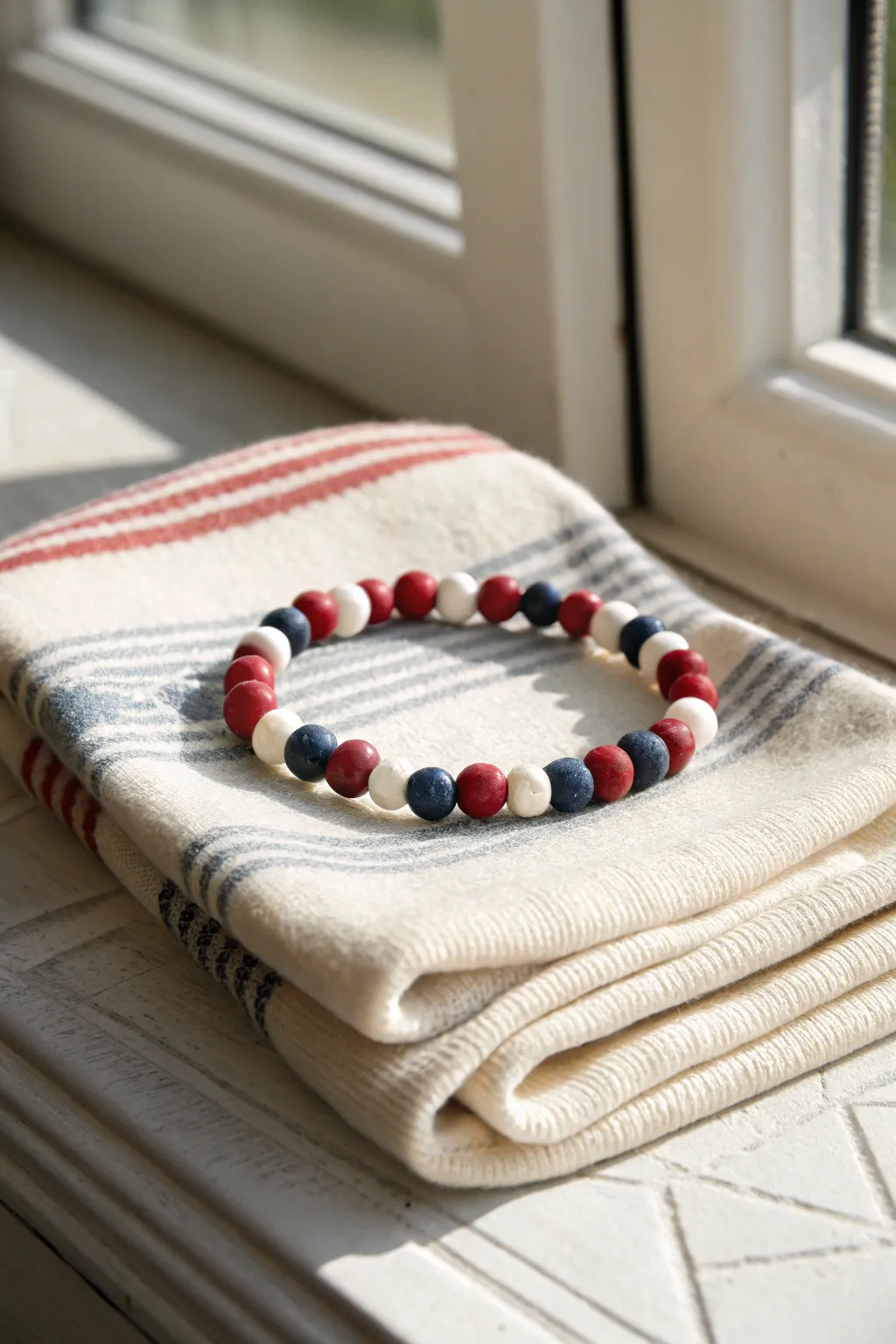
Embrace a cozy aesthetic with this simple yet striking clay bead bracelet that mimics the classic colors of winter woolens. Using deep navy, warm red, and creamy white beads, you’ll create a repeating pattern that pairs perfectly with your favorite chunky sweater.
Step-by-Step
Materials
- Polymer clay (Deep Navy, Barn Red, White/Cream)
- Bead roller tool (optional, for uniform sizing)
- Toothpicks or a bead piercing pin
- Baking sheet with parchment paper
- Stretch cord (0.8mm or 1mm thickness)
- Super glue or jewelry cement
- Scissors
- Beading needle (optional)
Step 1: Crafting the Clay Beads
-
Condition the Clay:
Begin by thoroughly kneading your three colors of polymer clay—navy, red, and white—until they are soft and pliable. This prevents cracking and ensures a smooth finish. -
Portion Evenly:
Pinch off small, equal-sized pieces of clay from each color block. Aim for pieces that will roll into roughly 8mm to 10mm spheres. -
Roll the Spheres:
Roll each piece of clay between your palms or use a bead roller to create perfectly round spheres. You will need about 20-25 beads in total, so make around 7-9 of each color to be safe. -
Texture the Surface:
For that matte, slightly organic look seen in the photo, gently roll the finished spheres over a piece of canvas or textured fabric before baking. This removes fingerprints and adds a subtle, non-shiny finish. -
Pierce the Holes:
Carefully insert a toothpick or piercing pin through the center of each bead. I find twisting the bead onto the pin rather than pushing the pin through helps maintain the round shape. -
Bake the Beads:
Arrange your pierced beads on a parchment-lined baking sheet. Bake according to your brand of clay’s instructions (usually around 275°F for 15-30 minutes). -
Cool Down:
Let the beads cool completely on the tray. They will be slightly soft when hot but will harden fully as they reach room temperature.
Uneven Bead Sizes?
If hand-rolling leads to varied sizes, calculate your sizes by weight using a kitchen scale or use a small circular cookie cutter on a rolled slab.
Step 2: Assembling the Pattern
-
Prepare the Cord:
Cut a length of stretch cord about 10-12 inches long. Pre-stretch the cord by pulling it firmly a few times; this prevents the bracelet from stretching out later. -
Sort Your Color Mix:
Lay out your cooled beads on a soft surface. Create a random-but-balanced sequence. The pattern in the image isn’t a strict A-B-C repeat, but rather alternates groups of colors (e.g., Red-White-Blue-Red-White-Blue) to feel organic. -
Plan the Sequence:
Look closely at your layout. Ensure you don’t have too many of the darkest navy beads clumped together, which can make the design look heavy on one side. -
String the Beads:
Thread the beads onto the cord in your chosen sequence. If the holes are tight, a flexible beading needle can save you frustration here. -
Check the Fit:
Wrap the strung beads around your wrist to check the size. Add or remove beads as necessary, aiming for a comfortable fit that sits slightly loose. -
Secure the Knot:
Tie a surgeon’s knot (cross over twice, then tie normally) to secure the bracelet. Pull tight enough so no gaps show between beads, but not so tight that the bracelet puckers. -
Glue and Finish:
Place a tiny drop of super glue or jewelry cement exactly on the knot. Allow it to dry for a few moments. -
Hide the Ends:
Trim the excess cord close to the knot, leaving just barely 1mm. Gently pull the knot inside the hole of the nearest bead to hide it completely.
Winter Frost Finish
Before baking, roll your white beads in a tiny bit of clear or iridescent glitter to give them a ‘frosted snow’ appearance.
Slip on your new winter-themed accessory and enjoy the handmade charm it brings to your outfit
Aurora Gradient Winter Lights
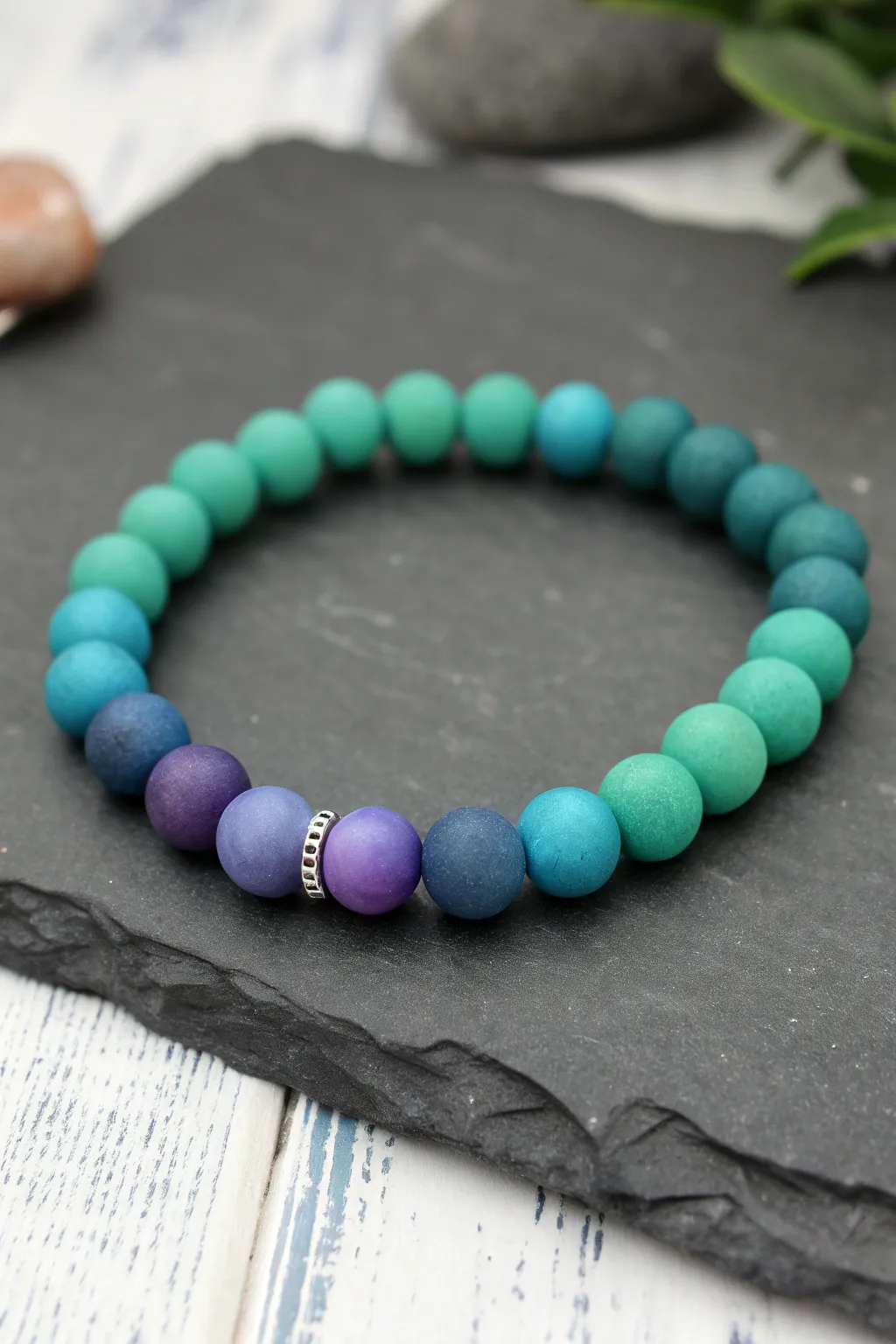
Reflecting the ethereal glow of the Aurora Borealis, this bracelet blends matte beads in a stunning cool-toned gradient. The seamless transition from deep purples to icy teals captures the magic of winter skies in a wearable accessory.
Step-by-Step Tutorial
Materials
- 8mm matte round beads (frosted agate or polymer clay)
- Purple beads (approx. 2-3)
- Indigo/Dark Blue beads (approx. 2)
- Light Blue/Cyan beads (approx. 3-4)
- Teal/Aqua beads (approx. 4-5)
- Deep Green/Sea Green beads (approx. 8-10)
- Silver rhondelle spacer bead with crystal accents
- 0.8mm clear elastic stretch cord
- Jewelry crafting glue (e.g., G-S Hypo Cement)
- Scissors
Step 1: Planning the Gradient
-
Analyze the Colors:
Before stringing, examine your bead selection. You want a spectrum that mimics the northern lights: starting with purple, moving into indigo, shifting to cyan, then teal, and finally a large section of deep forest greens. -
Lay Out the Design:
Use a bead board or a soft towel to lay out your beads in a circle. This prevents them from rolling away and helps you visualize the color transition. -
Establish the Focal Point:
Place one purple bead, then the silver spacer bead, then another purple bead. This metallic accent will serve as the visual anchor of the bracelet. -
Arrange the Transition:
To the right of the purple section, place your indigo beads, followed by the cyan/light blue ones to begin the cool shift. -
Complete the Circle:
Continue adding beads in order: after the cyan, add your teal beads, and fill the remaining majority of the circle with the deep green beads. This creates an asymmetrical, organic gradient rather than a simple repeating pattern. -
Check the Length:
Wrap the laid-out design around your wrist to check the fit. Add or remove green beads at the back of the design if you need to adjust the size.
Knot Slipping?
If your elastic keeps slipping while tying, try rubbing a scrap of beeswax on the cord ends. The tackiness helps the knot grip.
Step 2: Stringing and Finishing
-
Prepare the Cord:
Cut a piece of elastic cord about 12 inches long. I always cut more than I need because having extra slack makes tying the final knot much easier. -
Pre-stretch the Elastic:
Give the elastic cord a few firm tugs. This pre-stretching step is crucial to prevent the bracelet from sagging or loosening after you wear it a few times. -
Start Stringing:
Begin threading your beads onto the cord. Start with the green section first; this ensures your knot will end up hidden among the darker, more uniform beads rather than near the focal purple point. -
Maintain the Pattern:
Carefully transfer your beads from your layout to the string, moving from the green section, through teal, cyan, indigo, into the purples and the silver spacer, and back. -
Verify the Design:
Once all beads are strung, hold the two ends of the cord together to lift the bracelet. Check that your gradient flows smoothly and that the silver spacer is positioned where you want it. -
Tie the Knot:
Tie a surgeon’s knot to secure the bracelet. To do this, cross the ends, loop one underneath twice, pull tight, then cross again and loop underneath once more. -
Secure the Knot:
Apply a tiny dab of jewelry glue directly onto the knot. Be careful not to get glue on the neighboring beads, as it can mar the matte finish. -
Hide the Knot:
While the glue is still slightly tacky but not wet, slide the nearest bead over the knot to conceal it inside the bead hole. -
Trim Excess:
Once the glue has fully dried (check your glue’s instructions, usually 10-15 minutes), use sharp scissors to trim the excess cord tails as close to the bead as possible.
Frosty Effect
Swap the silver spacer for a clear crackle-glass bead to make the bracelet look like it has a chunk of actual ice frozen into the design.
Now you have a serene accessory that carries the cool beauty of a winter night wherever you go
Après-Ski Lodge Neutrals
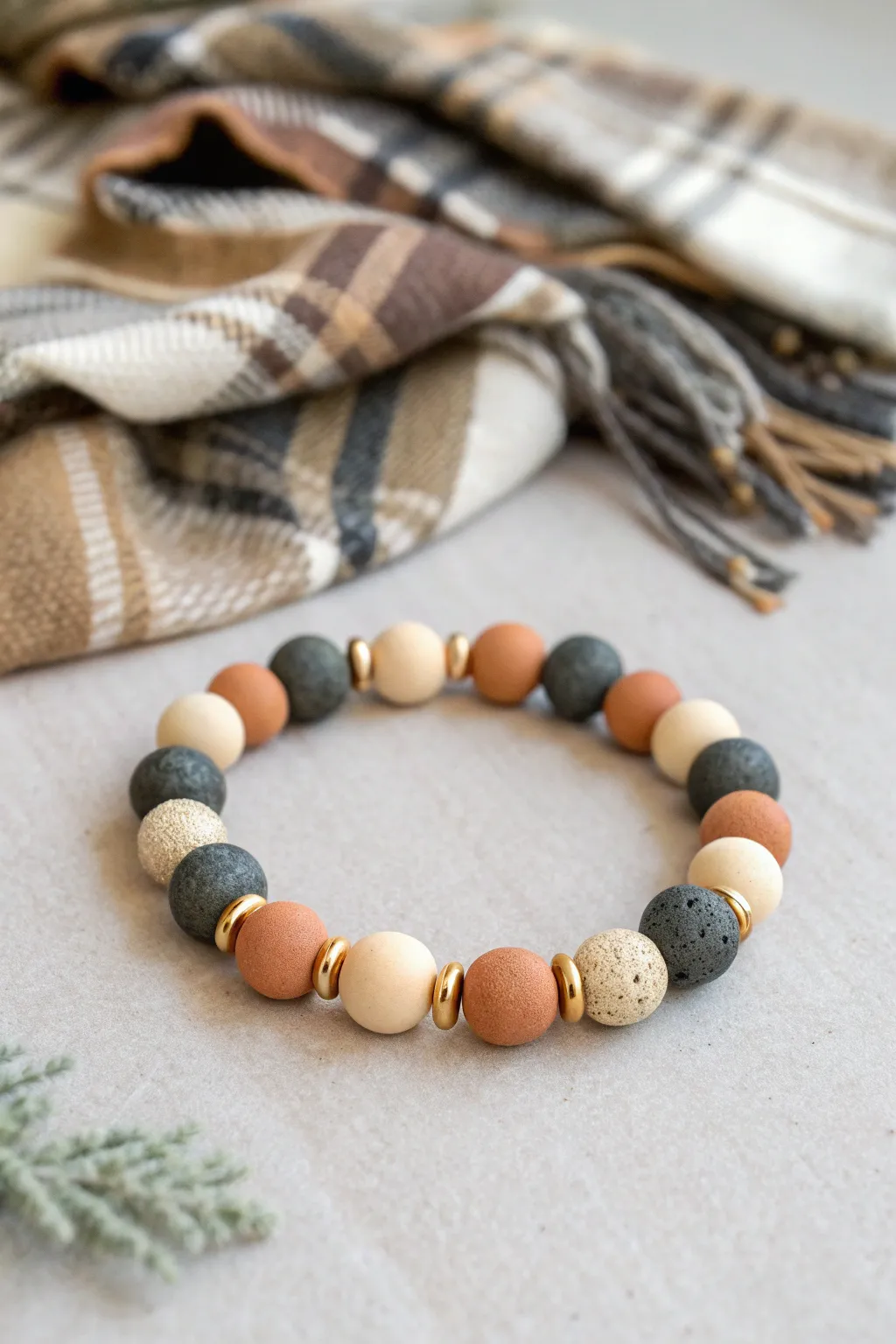
Capture the cozy elegance of a mountain chalet with this sophisticated bead bracelet featuring a mix of matte textures and warm metallic accents. The palette combines charcoal greys, creamy beiges, and terracotta hues, mimicking the soothing tones of a winter lodge fireplace.
Step-by-Step Guide
Materials
- Polymer clay round beads (approx. 10-12mm): Charcoal grey (matte)
- Polymer clay round beads (approx. 10-12mm): Terracotta/rust
- Polymer clay round beads (approx. 10-12mm): Cream/ivory
- Speckled stone or lava beads (10-12mm): Light sandstone speckle
- Lava beads (10-12mm): Dark charcoal/black
- Gold-plated spacer beads (flat disc or wheel shape, approx. 6mm)
- Strong elastic cord (0.8mm or 1mm distinct clear stretch cord)
- Scissors or jewelry snips
- Hypo-allergenic jewelry glue or clear nail polish
- Bead design board (optional but helpful)
- Tape (masking or washi)
Step 1: Inspiration & Layout
-
Analyze the pattern:
Before stringing, examine the visual rhythm of the bracelet. Notice that it isn’t a strict ‘A-B-C’ repeat. It uses clusters of colors separated by textures. -
Set up your workspace:
Place your bead board or a soft piece of felt on a flat surface. This prevents your round beads from rolling away while you plan your design. -
Plan the gold accents:
Identify where the gold spacers go. In the focal section, gold spacers are placed between every single bead to create a highlighted ‘feature area’ of about five beads. -
Lay out the rest:
Arrange the remaining beads in loose color blocks. Alternate a dark charcoal bead, a cream bead, and a terracotta bead, occasionally swapping a solid clay bead for a textured lava or speckled stone bead to add depth.
Knot Slipping?
If the knot refuses to stay hidden inside a bead hole, widen the hole slightly using a bead reamer tool, or ensure your knot is next to a large-hole lava bead rather than a clay one.
Step 2: Stringing the Design
-
Prepare the cord:
Cut a piece of elastic cord about 10-12 inches long. This generous length makes tying the knot much easier later. -
Secure the end:
Pre-stretch your elastic cord by giving it a few firm tugs to prevent sagging later. I like to tape one end of the cord to your work surface so beads don’t slide off while you work. -
Start with the focal point:
Begin stringing the section with the heavy gold accents first. Slide on a gold spacer, a terracotta bead, a gold spacer, a cream bead, a gold spacer, another terracotta, and a final gold spacer. -
Add the speckled texture:
Next, add the light sandstone speckled bead. This light textured bead acts as a nice transition from the smooth clay beads. -
Continue the pattern:
Follow with a dark lava bead, then a cream clay bead. The dark lava adds that essential rugged, volcanic look. -
Balance the colors:
Continue adding beads according to your planned layout. Aim for a mix where no two identical colors touch, unless separated by a gold spacer. -
Check the fit:
Once you have strung about 6.5 to 7 inches of beads (or your specific wrist measurement), wrap the strand around your wrist to check the size. Ideally, it should sit comfortably without pinching skin.
Scent Infusion
Place a drop of essential oil (like pine, cedarwood, or vanilla) onto the porous lava beads. They will act as a natural diffuser, carrying a cozy winter scent with you all day.
Step 3: Finishing Touches
-
Prepare the knot:
Remove the tape from the end of the cord. Bring both ends together, ensuring there is no slack between the beads. -
The surgeon’s knot:
Cross the ends like a normal knot, but loop the tail through the loop a second time before pulling tight. This extra friction holds the elastic better. -
Tighten securely:
Pull the knot tight. You should see the elastic stretch slightly as you pull the knot down into the gap between two beads. -
Seal the deal:
Apply a tiny dot of jewelry glue or clear nail polish directly onto the knot. Allow it to dry for a minute or two. -
Trim the excess:
Using your scissors, trim the excess cord ends close to the knot, leaving about 2mm of tail just to be safe. -
Hide the mechanism:
Gently tug the beaded strand so that the knot (and the tiny tails) slips inside the hole of the nearest large bead, disappearing completely from view.
Slip on your new bracelet and enjoy the subtle texture of your winter-ready accessory