
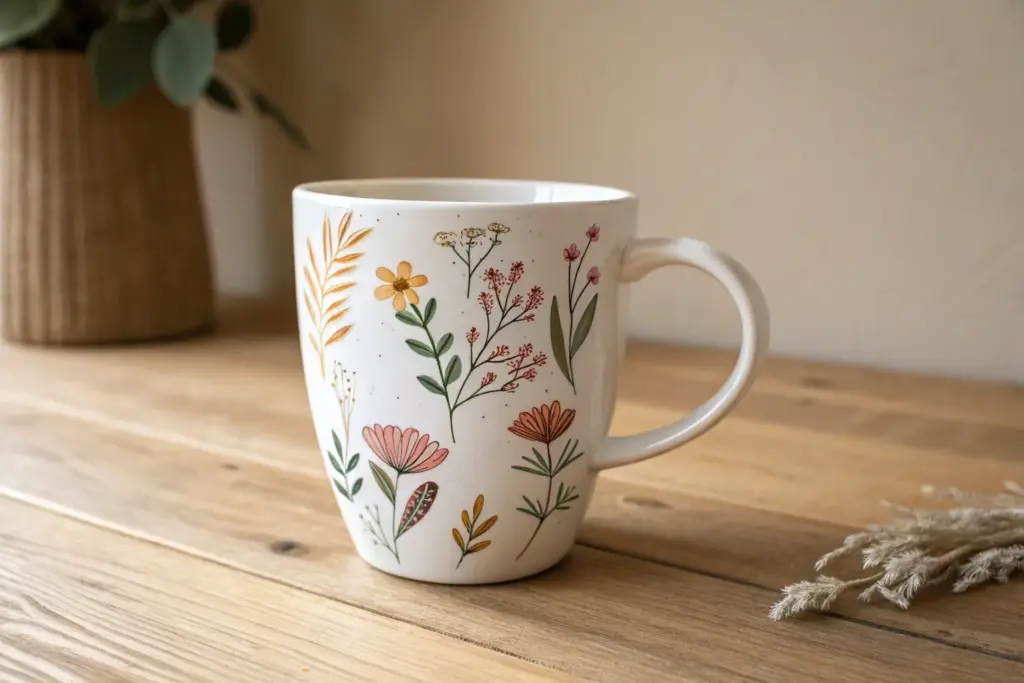
If you’ve got a plain mug and a love for flowers, you’re already halfway to something adorable. These mug painting ideas are all about simple, doable floral designs that look great on a curved surface and feel extra special at coffee or tea time.
Simple Daisy Cluster
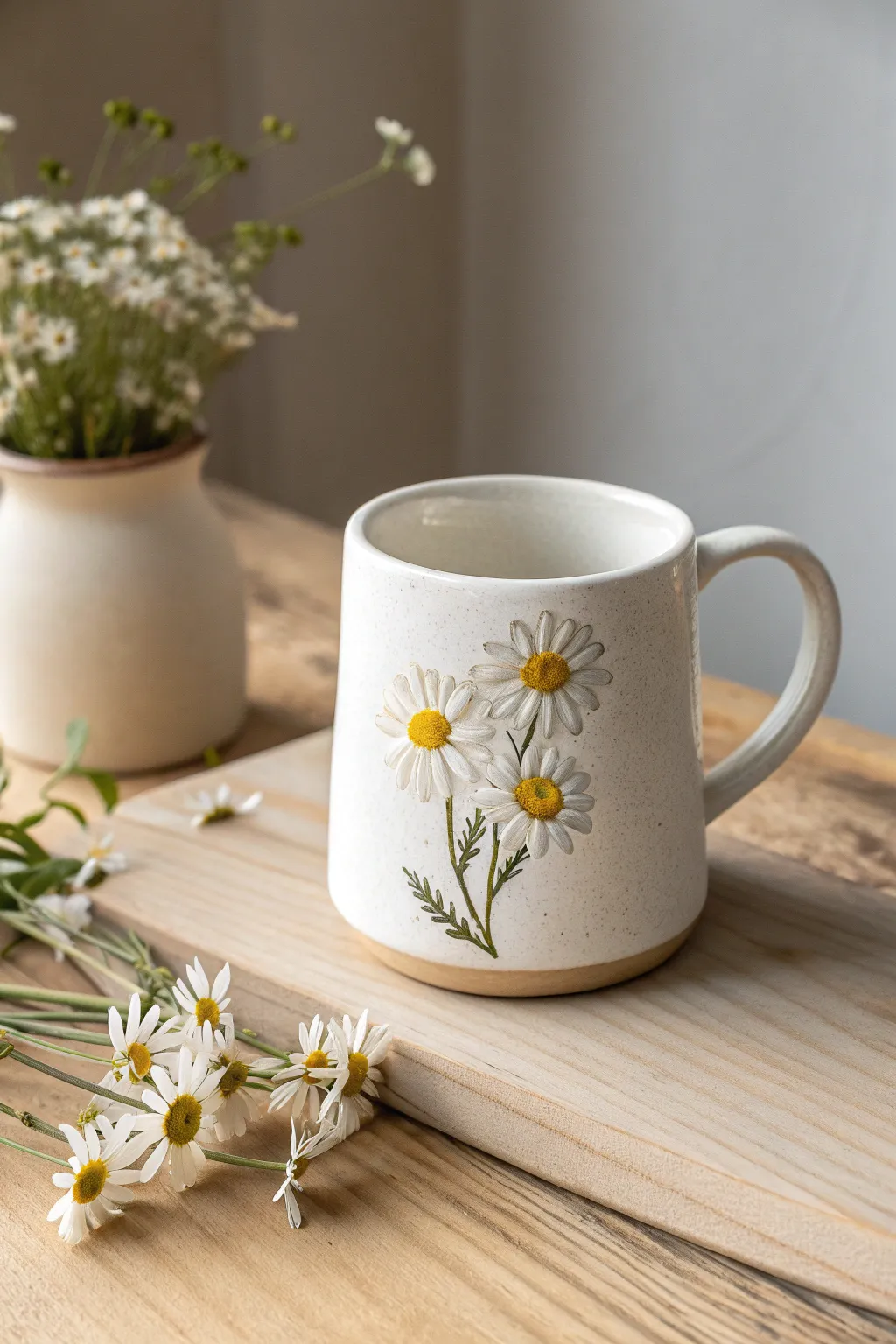
This project captures the delicate charm of a field of daisies on your morning coffee mug. With its slightly raised petals and gentle speckling, this design adds a lovely tactile quality to the smooth ceramic surface.
Detailed Instructions
Materials
- Blank ceramic mug (cream or off-white, ideally speckled)
- Ceramic or porcelain paints (opaque white, sunny yellow, dark olive green)
- Small round brushes (size 0 and 2)
- Fine liner brush
- Rubbing alcohol and cotton pads
- Paper palette or small plate
- Oven (for baking/curing)
- Pencil (optional)
Step 1: Preparation and Planning
-
Clean surface:
Before you unscrew any paint caps, thoroughly wipe down the exterior of your mug with rubbing alcohol. This removes invisible oils from your fingers that could prevent the paint from bonding properly. -
Plan placement:
Identify the center of the mug face where you want the main flower cluster. Visualize a loose triangle shape for the three blooms: one high on the right, one slightly lower on the left, and one at the bottom center. -
Light sketch:
If you are hesitant about free-handing, you can lightly sketch the centers of the flowers with a pencil. The graphite will burn off in the oven later, so don’t worry about erasing perfectly.
Step 2: Painting the Petals
-
Load white paint:
Squeeze a generous dot of opaque white ceramic paint onto your palette. You want a consistency that is thick enough to hold its shape slightly, providing that lovely textured look. -
Start the top bloom:
Using a size 2 round brush, create the first petal by pressing the belly of the brush down near the imaginary center and lifting as you pull outward. This creates a petal that is wider near the center and tapers at the tip. -
Complete the circle:
Continue painting petals around the center point for the top right flower. Don’t worry if they aren’t perfectly symmetrical; slightly irregular petals look more organic and natural. -
Second flower:
Move to the left side, slightly lower than the first, and repeat the petal process for the second daisy. I like to let a few petals from this flower barely touch or overlap the first one for a clustered effect. -
Third flower:
Paint the third and final flower below the first two, forming a gentle triangle. Keep the petals distinct but dense. -
Add texture:
While the white paint is still wet, you can go back over the petals with a clean, slightly damp brush to drag tiny lines through them, mimicking the veins of a real daisy petal.
Impasto Effect
To get raised petals like in the photo, mix a tiny bit of baking soda into your acrylic enamel paint before applying. It creates a thicker paste that holds 3D texture.
Step 3: Centers and Stems
-
Dry check:
Allow the white petals to dry until they are tacky or dry to the touch. This prevents the yellow centers from bleeding into the beautiful white petals you just painted. -
Apply yellow centers:
Dip a size 0 brush or a dotting tool into sunny yellow paint. Place a dome of paint right in the middle of each flower. Dab it gently to give it a rough, pollen-like texture. -
Detail the centers:
For extra dimension, mix a tiny speck of brown or orange into your yellow and dot the very bottom edge of each yellow center. This creates a shadow that makes the center look 3D. -
Paint main stems:
Switch to your fine liner brush and load it with dark olive green paint. Draw thin, graceful lines extending downward from each flower head, bringing them closer together as they reach the bottom of the mug. -
Add leaves:
Along the stems, paint small, feathery leaves. Daisies have jagged foliage, so use short, flicking strokes branching off the main stem rather than painting smooth ovals. -
Refine connections:
Check where the stems meet the flower heads. If there’s a gap, paint tiny green sepals (little leaf-like structures) cupping the bottom of the petals to connect everything seamlessly.
Uneven Petals?
If your petal shapes look messy, use a toothpick dipped in rubbing alcohol to gently ‘erase’ or reshape the edges while the paint is still wet.
Step 4: Finishing Up
-
Final drying:
Let the mug sit undisturbed for at least 24 hours. The paint needs to fully dry and settle before the heat setting process. -
Bake to set:
Place your mug in a cool oven, then turn the heat to 300°F (150°C)—check your specific paint brand’s instructions for exact temps. Bake for 30-40 minutes. -
Cool down:
Turn the oven off and leave the mug inside until the oven is completely cold. Removing it too early can cause thermal shock and crack your beautiful new artwork.
Once cooled, your durable daisy mug is ready for a soothing cup of tea or coffee

Wildflower Meadow From the Base
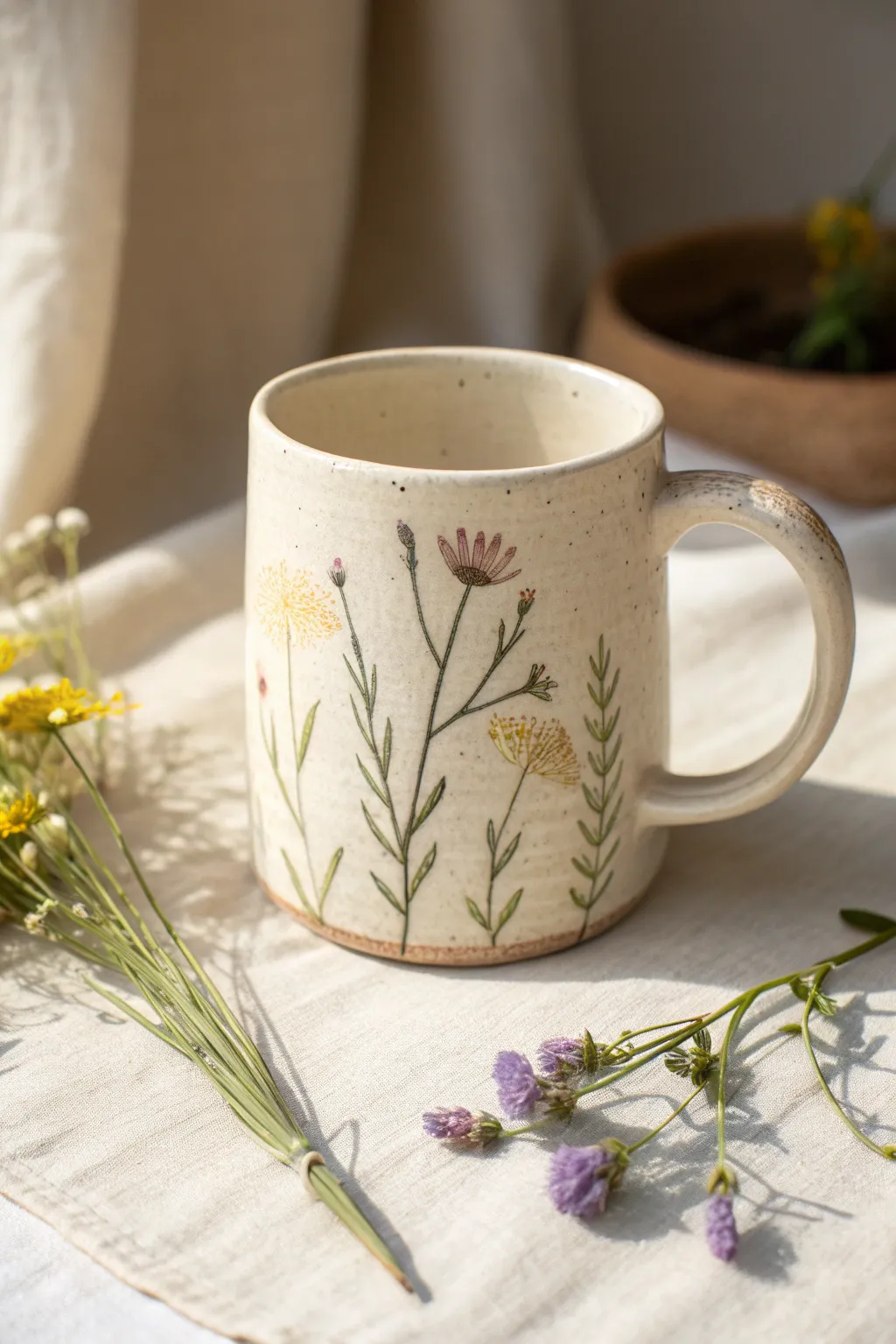
Capture the untamed beauty of a meadow with this botanical design, where slender stems stretch upward directly from the mug’s base. The look relies on fine linework and muted, natural tones to create an airy, organic feel against a speckled background.
Step-by-Step Tutorial
Materials
- White or cream ceramic mug (bisque or glazed, depending on paint used)
- Ceramic paints or porcelain markers (earthen green, dusty pink, mustard yellow, lavender)
- Fine liner brush (size 00 or 000)
- Small round brush (size 1)
- Rubbing alcohol and cotton pads
- Paper palette or ceramic tile
- Oven (for curing)
Step 1: Preparation & Planning
-
Clean the surface:
Before making a single mark, wipe the entire exterior of the mug with rubbing alcohol to remove any natural oils or fingerprints. This ensures the paint adheres perfectly to the ceramic surface. -
Establish the horizon line:
Visualize the very bottom edge of the mug as your ‘ground.’ You won’t be painting dirt or grass roots; instead, imagine the stems are emerging from just underneath the visible base rim.
Step 2: Painting the Stems
-
Load the liner brush:
Mix a small amount of earthen green paint. Using your finest liner brush, thin the paint slightly with a drop of water (or medium, if specified by your paint brand) to an ink-like consistency for smooth flow. -
Draft the main stalks:
Starting from the absolute bottom edge of the mug, pull your brush upward in long, gentle vertical strokes. Vary the heights—some should reach near the rim, others stay lower. Keep the lines incredibly thin. -
Add gentle curves:
Nature isn’t perfectly straight. Allow some of the stems to have a slight bend or waver as they rise, mimicking how wildflowers sway in a breeze. -
Branch out:
From your main stalks, paint tiny, hair-thin branches extending outward. These Y-shaped splits are where your leaves and smaller buds will eventually sit.
Clean Lines Only
If your paint keeps blotching, your brush is likely carrying too much product. Wipe excess paint on a paper towel before touching the ceramic to ensure thin, crisp stems.
Step 3: Adding Foliage
-
Paint long leaves:
For the taller grass-like plants, press the brush down slightly at the base of the leaf to widen the stroke, then lift as you pull upward to create a sharp point. These should cluster near the bottom. -
Create fern-like fronds:
On one of the stems, use short, quick dashes on either side of the stalk to create a fern or yarrow leaf pattern. Keep these symmetrical but imperfect. -
Add detail leaves:
Along the main flower stems, add tiny, sparse leaves. I find that keeping the leaves small prevents the design from looking cluttered and maintains that delicate meadow aesthetic.
Level Up: Speckled Effect
Before painting flowers, flick a toothbrush loaded with diluted brown paint over the mug to create a faux-pottery speckled glaze effect.
Step 4: Blossoming the Flowers
-
Paint the pink daisy:
Choose a prominent stem for your main flower. Using the dusty pink paint and the size 1 round brush, dab small, elongated oval shapes radiating from a center point. Leave a tiny gap in the middle. -
Add the daisy center:
Once the pink petals are dry to the touch, use the very tip of your brush to place a tiny cluster of brown or dark yellow dots in the center. -
Create yellow clusters:
For the dandelion or yarrow-style flowers, switch to mustard yellow. Use a stippling technique—tapping the tip of the brush repeatedly—to create a fuzzy, round head of color at the top of a stem. -
Add texture to yellow blooms:
Layer a few dots of a slightly lighter yellow or white on top of the mustard patches to give the flower heads depth and volume. -
Paint lavender buds:
On a different stem, paint small, teardrop-shaped buds using lavender paint. These can be closed buds at the very tip of thin branches. -
Detail the sepals:
Return to your green paint and add tiny ‘cups’ (sepals) underneath the pink and purple flower heads connecting them smoothly to their stems.
Step 5: Finishing Touches
-
Review and refine:
Spin the mug slowly. If any areas look too empty, add a very short, faint blade of grass at the bottom to fill the visual gap without adding weight. -
Dry thoroughly:
Let the paint dry completely. Most ceramic paints require at least 24 hours of air drying before curing. -
Bake to cure:
Place the mug in a cool oven, then set the temperature to 350°F (or per your paint’s instructions). Bake for 30 minutes, then turn the oven off and let the mug cool completely inside before removing.
Enjoy sipping from your personal garden every morning with this lovely handmade piece



Lavender Dot Stems
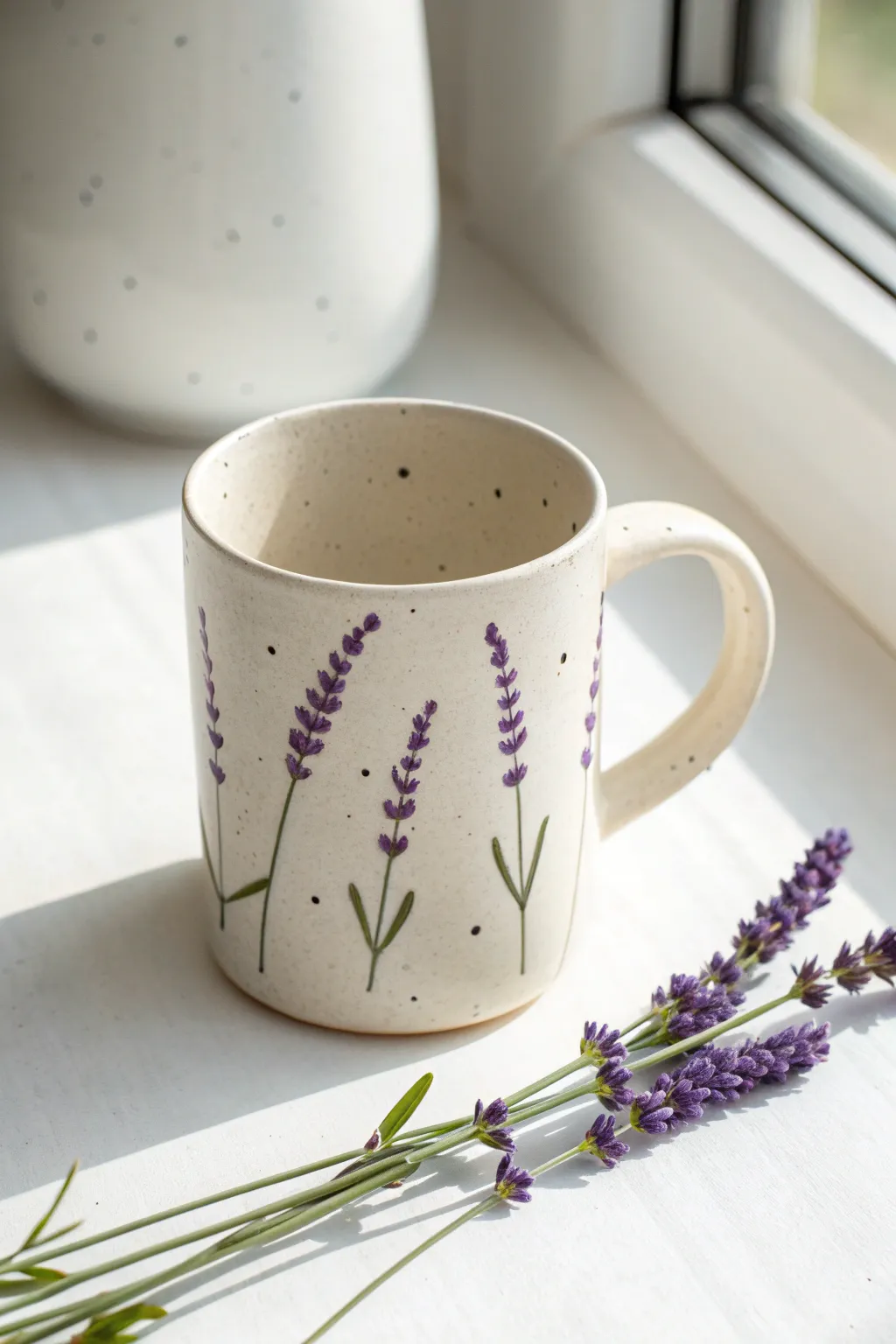
This project captures the delicate charm of fresh lavender with a minimalist, hand-painted design on a creamy ceramic mug. The combination of gentle purple hues and scattering of tiny dots creates a rustic, wildflower aesthetic that feels both modern and timeless.
Step-by-Step Guide
Materials
- A plain, cream-colored ceramic mug (matte or satin finish preferred)
- Porcelain paints or ceramic paint markers (Deep Purple, Light Lavender, Olive Green, Black)
- Fine detail paintbrush (size 0 or 00)
- Small round paintbrush (size 2)
- Palette for mixing paint
- Rubbing alcohol and cotton pads
- Oven (for baking the design)
- Paper towels
- Optional: Toothpick or dotting tool
Step 1: Preparation
-
Clean surface:
Before you begin painting, it is crucial to remove any oils or fingerprints from the mug. Wipe the entire outer surface thoroughly with rubbing alcohol on a cotton pad and let it dry completely. -
Plan placement:
Visualize where you want your lavender stems to go. Aim for roughly four to five main stems spaced unevenly around the mug to keep the look organic rather than perfectly symmetrical.
Natural Texture Hack
To mimic the imperfect texture of real lavender buds, let your paint thicken slightly on the palette before applying, creating a raised, tactile effect.
Step 2: Painting the Stems
-
Mix green shade:
On your palette, prepare your olive green paint. If it’s too bright, mix in a tiny pinprick of black or brown to muddy it slightly for a more natural, dried-herb look. -
Paint main stalks:
Using your fine detail brush (size 0 or 00), paint thin, vertical lines for the main stems. Vary the heights; some should be taller and reach near the rim, while others can be shorter. -
Add gentle curves:
Don’t make the lines perfectly straight. A slight wobble or curve mimics the natural growth of wildflowers. -
Create leaves:
Near the base of the stems, paint simple, slender leaves. To do this, press the brush down slightly to widen the stroke and then lift up to create a sharp point. Keep these leaves sparse—just one or two per stem.
Add a Bee Friend
Paint a tiny, fuzzy bumblebee hovering near one of the lavender tips using small dots of yellow and black for a lively garden touch.
Step 3: Adding the Blooms
-
Prepare purples:
Squeeze out your deep purple and light lavender paints. I usually like to dab a little bit of the light color into the dark to create a mid-tone transition shade as well. -
Paint the bottom buds:
Start about halfway up the stem. Using the tip of your small round brush or the detail brush, make small, tear-drop shaped dabs angling upward on either side of the stem. -
Build the flower spike:
Continue adding pairs of small dabs as you move upward along the stem. As you reach the top, make the dabs slightly smaller and closer together. -
Taper the top:
Finish the flower spike with a single, tiny dab of paint at the very tip of the stem to create a pointed, conical shape. -
Layering color:
Once the initial purple layer is tacky but not fully dry, add tiny highlights of the lighter lavender on top of a few buds to create depth.
Step 4: The Speckled Effect
-
Create the speckles:
Dip a toothpick or the very tip of your smallest brush into the black paint. You want just a tiny amount of paint. -
Apply random dots:
Gently dot the mug surface randomly around the lavender stems. These should look like ceramic speckles, so keep them irregular in size and spacing. -
Refine the look:
Add a few tiny dots in between the flower petals or near the leaves to integrate the design with the background.
Step 5: Finishing
-
Dry time:
Allow the mug to dry completely for at least 24 hours. This ensures the moisture evaporates from the paint before baking. -
Bake to set:
Place the mug in a cool oven, then set the temperature to 350°F (175°C). Once the oven reaches temperature, bake for 30 minutes. Turn the oven off and let the mug cool down completely inside to prevent cracking.
Now you have a charming, botanical mug perfect for sipping herbal tea on a quiet afternoon

Single Statement Bloom
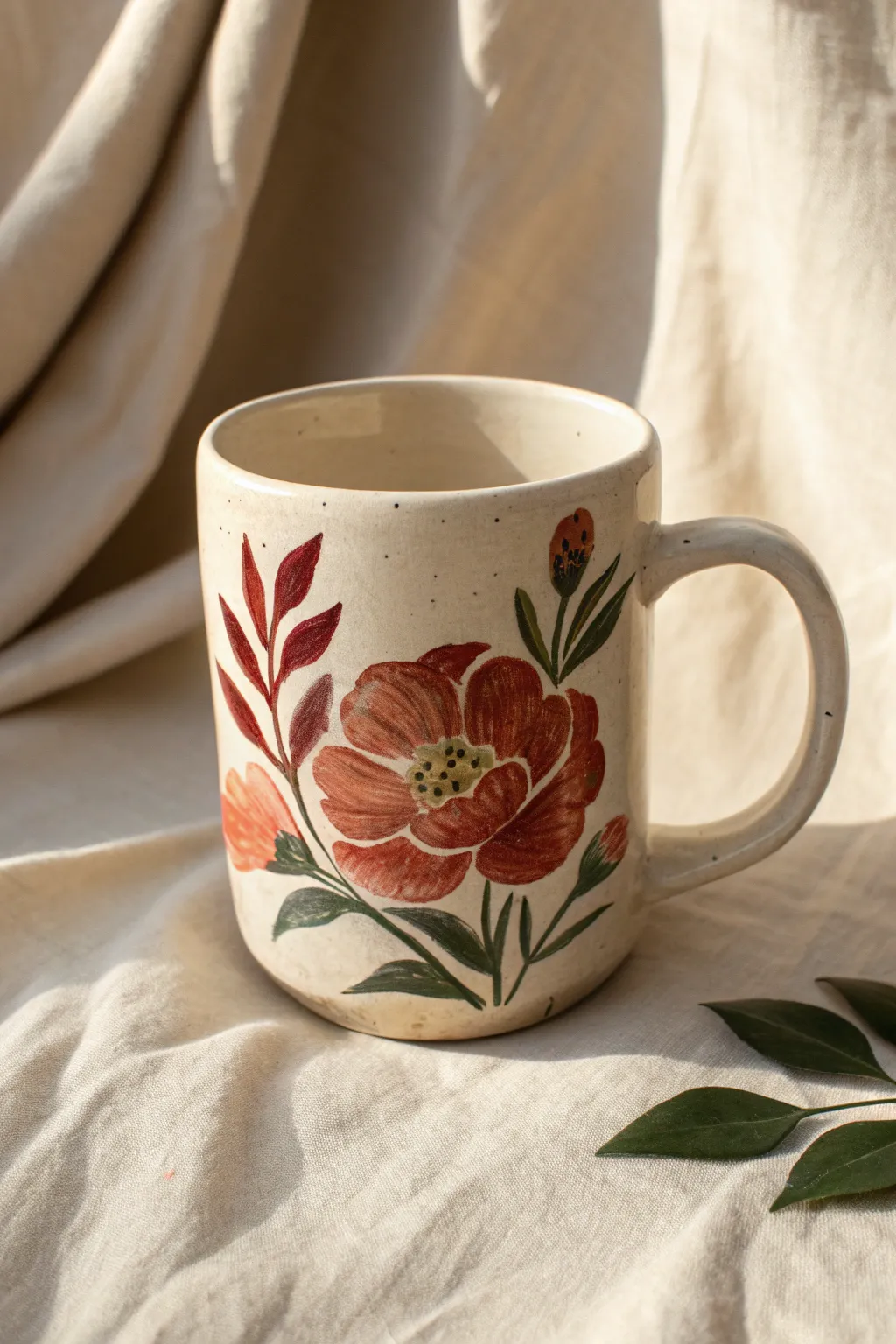
Capture the charm of retro botanical illustrations with this earthy, warm-toned design. Featuring a large, central rusty-red bloom flanked by deep green foliage and delicate buds, this project transforms a simple ceramic mug into a piece of functional art with a lovely handmade feel.
Step-by-Step
Materials
- Plain ceramic mug (cream or off-white glaze)
- Ceramic paints (Rust Red, Deep Olive Green, Golden Yellow, Burnt Orange)
- Fine liner brush (size 0 or 00)
- Small round brush (size 2)
- Pencil for sketching
- Rubbing alcohol
- Cotton pads
- Palette or small plate
- Paper towels
- Oven (for curing)
Step 1: Preparation & Sketching
-
Clean surface:
Before laying down any color, thoroughly wipe the exterior of the mug with rubbing alcohol on a cotton pad. This removes oils and invisible residues that could prevent the paint from adhering properly. -
Plan composition:
Look at the face of the mug opposite the handle. Mentally divide the space so your main flower sits slightly off-center to the right, leaving room for the height of the leaves on the left. -
Light sketch:
Using a pencil, very lightly sketch the basic shapes. Draw a large oval for the main bloom, a vertical stem line, and sweeping curves for the surrounding leaves. Don’t worry about graphite marks; they usually burn off in the oven.
Step 2: Painting the Main Bloom
-
Base petals:
Load your round brush with Rust Red. Start painting the large outer petals of the main flower. Use a ‘push and pull’ stroke: press down to widen the petal and lift up to create a narrower edge near the center. -
Layering shapes:
Paint the inner petals slightly smaller, leaving a small negative space (unpainted area) in the very center for the pollen. Keep the paint application somewhat sheer to mimic a watercolor effect. -
Adding the bud:
Near the top right of the main flower, paint a small, tight oval using the same Rust Red for the unbloomed bud. Add a tiny dot of Burnt Orange near the tip for dimension. -
Secondary bloom:
On the lower left side, paint a smaller, half-open flower using a mix of Burnt Orange and a touch of Rust Red. This adds variety to the color palette without clashing. -
Defining petals:
Once the red base is touch-dry, use your fine liner brush with a slightly more saturated Rust Red to outline the individual petals. This separates them visually and gives that illustrative look.
Uneven Coverage?
If brushstrokes look too streaky, don’t overwork wet paint. Let the first sheer layer dry completely, then apply a second thin coat for opacity.
Step 3: Adding Greenery & Details
-
Main stems:
Switch to Deep Olive Green on your liner brush. Draw thin, confident lines connecting the main flower, the bud, and the secondary bloom to a central point near the base of the mug. -
Leaf structures:
Paint the long, slender leaves. For the foliage on the left, use multiple strokes to create a slightly broader leaf shape, tapering to a sharp point. -
Bud sepals:
carefully paint the green sepals hugging the bottom of the top-right bud and the small orange flower. These should look like little cups holding the petals. -
The red sprig:
To the far left, above the orange flower, paint a specialized spray of leaves using the Rust Red color instead of green. This artistic choice creates a beautiful vintage contrast. -
Flower center:
Return to the main flower’s center. Dab a wash of pale green in the middle circle. I like to let this dry briefly before adding the next layer. -
Pollen dots:
Using the very tip of your smallest brush or a toothpick, dot tiny specks of Deep Olive Green over the pale green center to represent the stamen. -
Stylized speckles:
For a true pottery-studio look, dilute a tiny bit of brown or black paint. Flick the bristles of an old brush to create subtle speckles across the background, avoiding the main flower petals.
Use Negative Space
Leave tiny slivers of the bare mug showing between petals and leaves. These white lines act as natural highlights and keep the design breathable.
Step 4: Curing
-
Dry time:
Allow the mug to dry completely for at least 24 hours. The paint needs to be bone-dry before heat setting to prevent bubbling. -
Baking:
Place the mug in a cool oven. Turn the heat to 350°F (175°C) and bake for 30 minutes. Turn the oven off and let the mug cool down completely inside the oven to prevent cracking.
Now you have a stunning custom mug ready for your morning coffee or to gift to a flower-loving friend

The Complete Guide to Pottery Troubleshooting
Uncover the most common ceramic mistakes—from cracking clay to failed glazes—and learn how to fix them fast.
Tiny Floral Border Around the Rim
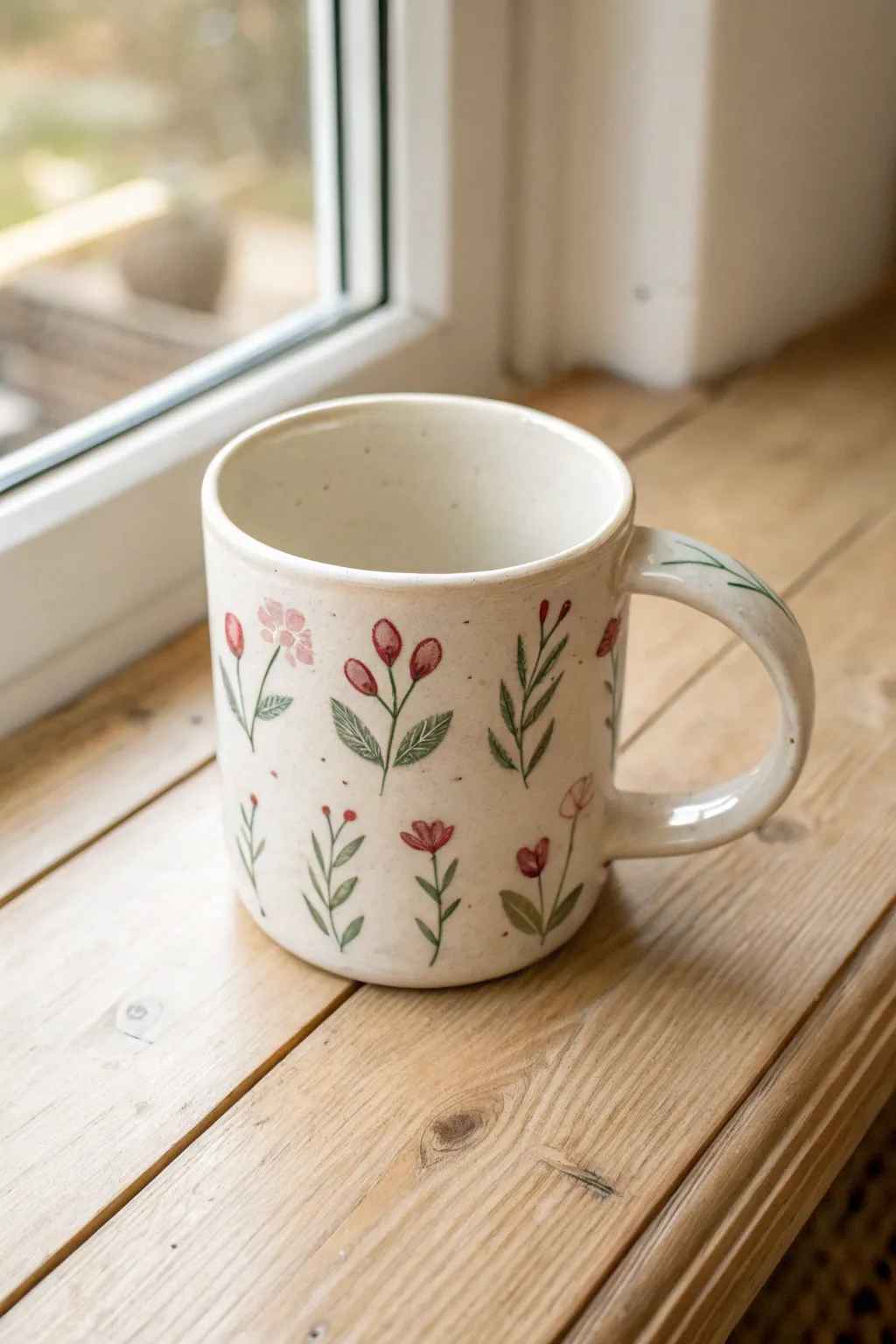
Transform a plain ceramic mug into a beautiful garden scene with this dainty wildflower design. Featuring scattered sprays of red buds, pink blossoms, and delicate greenery, this project creates a cozy, cottage-core aesthetic perfect for your morning coffee.
Step-by-Step Guide
Materials
- Plain bisque or glazed ceramic mug (creamy white)
- Ceramic paints or underglazes (sage green, forest green, deep red, soft pink, burgundy)
- Fine detail paintbrush (size 0 or 00 round)
- Medium round brush (size 2)
- Palette or small plate for mixing
- Water cup and paper towels
- Clear dipping glaze (if using bisque/underglazes)
- Kiln access or oven (depending on paint type used)
Step 1: Preparation & Layout
-
Clean surface:
Begin by thoroughly cleaning your mug to remove any dust or oils. If you are painting on bisque, wipe it down with a slightly damp sponge. For a glazed mug, use rubbing alcohol to ensure the paint adheres properly. -
Plan spacing:
Visualize the layout of your flowers. The charm of this design lies in the alternating heights and varieties of the plants. You can use a pencil to lightly mark vertical guidelines where each stem will go, spacing them about an inch apart around the mug’s circumference.
Step 2: Main Stems and Greenery
-
Mix green tones:
On your palette, prepare two shades of green: a standard sage green and a slightly darker forest green for variety. You can even mix a tiny bit of brown into the sage for an earthy, natural tone. -
Paint vertical stems:
Using your fine detail brush (size 0), paint thin, vertical lines for the stems. Vary the heights slightly so they don’t look like a picket fence. Some should be short, others tall enough to reach near the rim. -
Add simple leaves:
For the first type of greenery, paint small, simple leaves branching directly off the stem in a ‘V’ shape. Keep these strokes light and airy. -
Create fern-like leaves:
Choose a few stems to become fern-like plants. Starting from the bottom, paint slightly longer, curved leaves that get progressively smaller as they reach the top of the stem. -
Add broad leaves:
For the stems that will hold the larger red buds, paint two broad leaves near the base using the size 2 brush. Press down to widen the stroke and lift up to create a point. -
Detail the broad leaves:
Once the broad leaves are semi-dry, use your finest brush with a darker green or thin white line to add a central vein down the middle of each leaf for texture.
Fixing Smudges
Make a mistake? Don’t wipe wet paint, which spreads the stain. Wait for it to dry completely, then scrape the error off gently with a toothpick or craft knife.
Step 3: Floral Details
-
Paint red buds:
Dip your medium round brush into deep red paint. Create the tulip-like buds by pressing the brush down once firmly at the top of a stem, then lifting. Repeat with a second stroke right next to it to form a closed bud shape. -
Add pink blossoms:
Switch to soft pink. For the open flowers, dab three to four small, round petals in a loose cluster at the top of a short stem. These should look soft and not overly geometric. -
Create tiny berries:
On the smallest, thinnest stems, add tiny dots of red or burgundy at the tips to represent berries or very small flower buds. Use just the very tip of your smallest brush for this. -
Layering colors:
Go back to your red buds. If the first layer is dry, add a tiny streak of burgundy at the base of the bud to give it dimension and shadow. -
Handle details:
Don’t forget the handle. Paint a single, long creeping vine that follows the curve of the handle, adding just a few small leaves to tie the design together.
Add a hidden detail
Paint a single tiny ladybug or a small fallen petal on the inside bottom of the mug. It’s a delightful surprise that reveals itself as you finish your drink.
Step 4: Finishing Touches
-
Speckled effect (Optional):
To mimic the clay body in the photo, you can flick a toothbrush dipped in watered-down brown paint across the mug. Practice on paper first to control the splatter size. -
Clean up:
Check the rim and the bottom of the mug. If any paint smudged where it shouldn’t be, scratch it off gently with a wooden skewer or wipe it with a damp cotton swab. -
Dry thoroughly:
Allow the paint to dry completely. If you are using underglazes, this usually takes 24 hours to be bone dry. If using bake-on enamel paints, follow the bottle instructions. -
Glaze and fire:
If working with pottery, dip the mug in clear glaze and fire it in the kiln. If using home oven paints, bake the mug according to the manufacturer’s specific time and temperature instructions to set the design.
Enjoy sipping from your new favorite botanical mug, bringing a touch of nature to your daily routine
Scattered Mini Posies
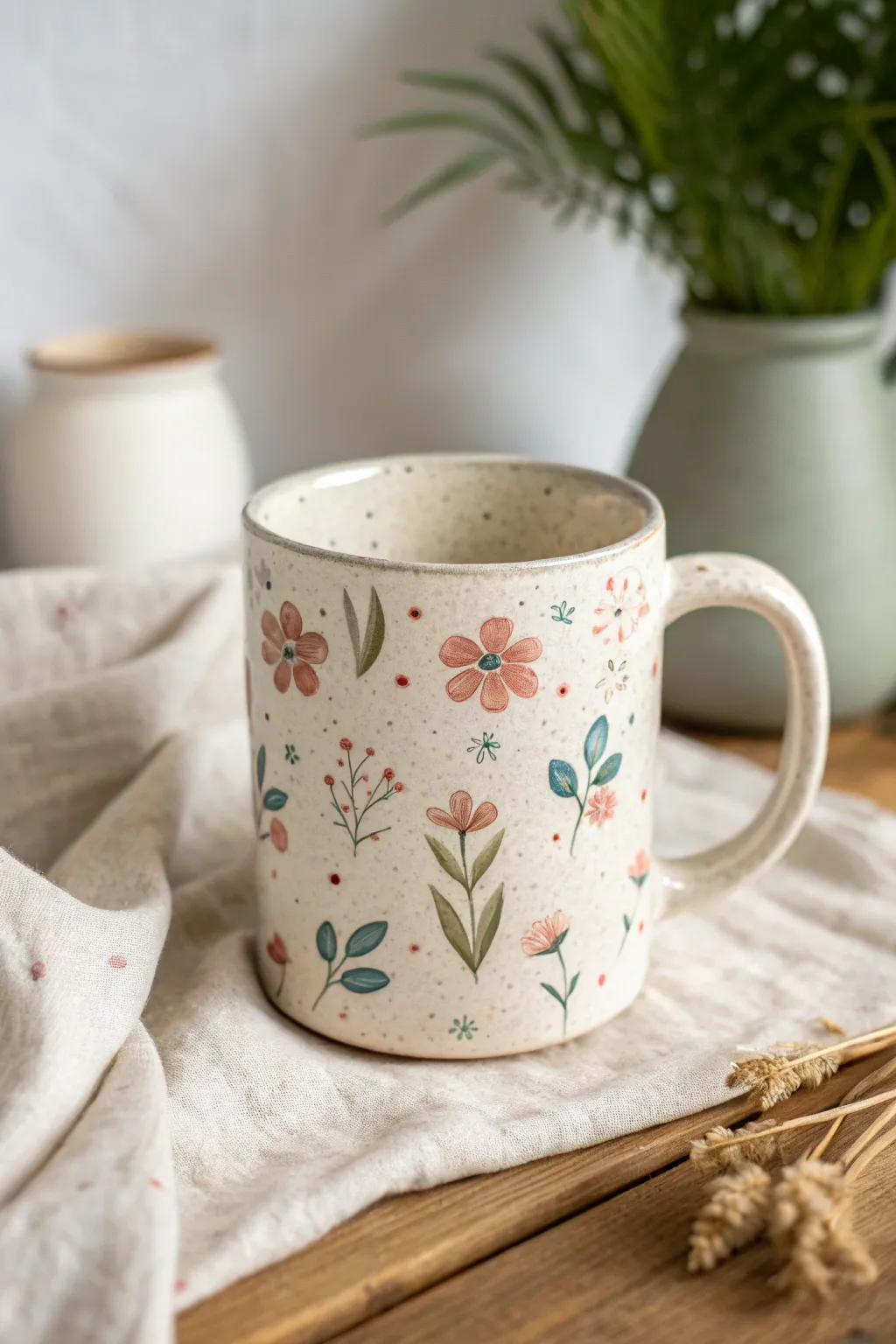
Transform a plain ceramic mug into a charming botanical keepsake features scattered mini posies in soft, earthy tones. The delicate, illustrative style pairs perfectly with a speckled glaze, creating a cozy cottagecore aesthetic.
Step-by-Step Tutorial
Materials
- Plain ceramic mug (cream or off-white, ideally speckled)
- Porcelain paints or ceramic markers (colors: dusty rose, terracotta, sage green, forest green, deep teal, mustard yellow)
- Rubbing alcohol and cotton pads
- Fine detail paintbrushes (sizes 0 and 00)
- Palette for mixing paints
- Q-tips (for cleanup)
- Oven (for curing)
Step 1: Preparation & Base Planning
-
Clean surface:
Before you begin painting, it’s crucial to remove any oils or fingerprints from the mug. Wipe the entire surface thoroughly with rubbing alcohol and let it air dry completely. -
Visualize the layout:
Look at your mug as a 360-degree canvas. The goal is a random, scattered look, so don’t worry about perfect symmetry. Imagine small clusters of flowers spaced out with plenty of ‘breathing room’ in between.
Pro Tip: Faux-Speckle Trick
If you can’t find a speckled mug, create the effect yourself! Dilute brown paint slightly and flick it onto the mug with a stiff brush before painting your flowers.
Step 2: Painting the Main Flowers
-
Mix your colors:
On your palette, prepare your primary floral shades. I find that mixing a tiny bit of white into the terracotta and rose paints softens them, giving that gentle, vintage look seen in the photo. -
Paint the five-petal flowers:
Using a size 0 brush loaded with dusty rose, paint five small, rounded petals meeting in a center point. Keep the paint relatively thin so it lays flat against the ceramic. -
Add variety with side-view blooms:
Create some flowers that look like they are facing sideways. Paint a flattened oval or ‘U’ shape in terracotta, and add two smaller petals above it to suggest a cup shape. -
Include tiny filler flowers:
Dip the very tip of your brush into a lighter peach or cream tone. Dot tiny clusters of three or four specs in empty spaces to represent small buds or baby’s breath. -
Paint the centers:
Once the petal base layers are touch-dry, use your smallest brush to add a contrasting center. A deep teal or forest green dot looks lovely inside the pink flowers.
Level Up: Handle Details
Don’t leave the handle blank. Paint a single, trailing vine wrapping around the handle or add a lonely little flower near the thumb rest for a hidden surprise.
Step 3: Adding Greenery & Details
-
Paint single leaves:
Using sage green, paint simple, almond-shaped leaves floating independently in the white space. Vary the size so some are tiny and others are more prominent. -
Create leafy stems:
Draw thin, curving lines with forest green to act as stems. Add pairs of leaves extending from these stems, keeping strokes loose and organic. -
Detail the side-view flowers:
Return to your ‘cup-shaped’ flowers. Paint a thin green stem extending downward and add tiny sepals—small green strokes cradling the bottom of the flower head. -
Add teal sprigs:
For a pop of cool color, use deep teal paint to create small branches with rounded, berry-like leaves. This contrast brings the warm floral tones to life. -
Draw delicate twigs:
With a diluted brown or dark green paint, create very fine, twiggy structures with tiny red dots on the ends to mimic berries or budding branches. -
Add decorative specks:
To enhance the ‘speckled pottery’ look, use a toothpick or fine brush to add tiny, intentional dots of terracotta and green in the negative spaces.
Step 4: Finishing Touches
-
Clean up edges:
If any lines look messy or too thick, dampen a Q-tip with water (or rubbing alcohol if the paint is stubborn) and gently shape the edges while the paint is still workable. -
Dry thoroughly:
Allow your mug to dry for at least 24 hours. The paint needs to fully dehydrate before baking to prevent bubbling. -
Bake to cure:
Place the mug in a cold oven. Set the temperature to the manufacturer’s instructions for your specific paint (usually around 300°F/150°C) and bake for 30-40 minutes. -
Cool down:
Turn the oven off and let the mug cool down completely inside the oven with the door closed. This gradual temperature change prevents cracking.
Once baked and cooled, your custom floral mug is ready for your morning coffee or to be gifted to a nature-loving friend



What Really Happens Inside the Kiln
Learn how time and temperature work together inside the kiln to transform clay into durable ceramic.
Loose Watercolor-Style Petals
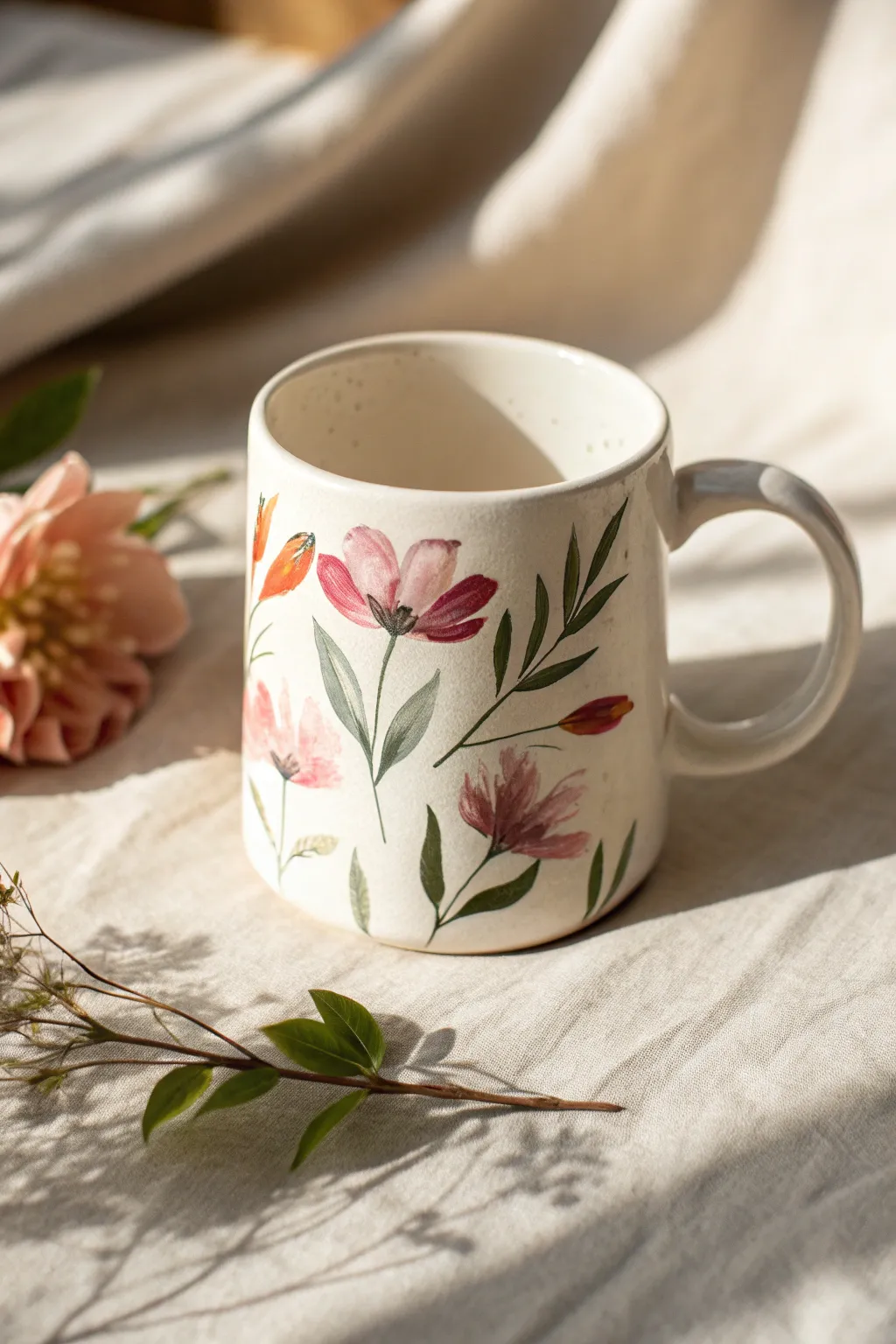
Capture the delicate beauty of a garden in full bloom with this loose, watercolor-style mug design. Using specialized ceramic paints, you’ll create floaty petals and sweeping stems that give this piece an effortlessly artistic, hand-painted charm.
How-To Guide
Materials
- Plain white ceramic mug (smooth surface)
- Ceramic or porcelain paints (water-based is best for this loose effect)
- Colors: Pale pink, magenta, deep mauve, sage green, forest green, orange, yellow ochre
- Soft synthetic brushes: Round #4, Liner #0 or #1
- Rubbing alcohol and cotton pads
- Paper palette or ceramic tile
- Jar of water
- Oven (for curing, check paint instructions)
Step 1: Preparation & Planning
-
Clean surface:
Before you begin painting, it is crucial to remove any oils or dust from the mug. Wipe the entire outer surface thoroughly with rubbing alcohol and a cotton pad, handling it only by the handle or rim afterwards. -
Plan your layout:
Visualize where your main flowers will go. Notice how the design in the photo feels organic by spacing the flowers unevenly around the mug rather than in a straight line.
Fixing paint blobs
If paint pools too thickly, don’t wipe it yet. Let it dry slightly, then lift the excess with a dry brush corner. This preserves the ‘stain’ underneath.
Step 2: Painting the Blooms
-
Mix your pinks:
On your palette, prepare a watery wash of pale pink and a slightly thicker dab of magenta. You want the paint to be fluid enough to mimic watercolor but not so runny that it drips. -
Create the main flower:
Load your #4 round brush with the pale pink. Press the belly of the brush down to create the wide, outer petals of the central flower, lifting up as you pull toward the center to create a tapered point. -
Add depth:
While the pink is still slightly tacky but not wet, stroke a small amount of magenta into the center of the petals. Let the colors blend slightly for that soft, gradient look. -
Paint side profiles:
For the buds and side-facing flowers, paint simple teardrop shapes. Use an orange hue for one bud and a soft mauve for another to add variety to your floral arrangement. -
Detail the centers:
Once the flower bases are semi-dry, use the very tip of your brush or the liner brush with a dark charcoal or deep purple mix. Add tiny stamen lines radiating from the center of the open flower.
Level Up: Gold Accents
Once the initial design is baked and cooled, apply liquid gold leaf to the stamens or leaf tips for a touch of luxury, but remember it won’t be microwave safe.
Step 3: Foliage & Stems
-
Mix greens:
Prepare two shades of green: a pale, dusty sage for light leaves and a deeper forest green for stems and contrast. I find mixing a tiny touch of brown into the green makes it look more natural. -
Draw the stems:
Switch to your liner brush. Load it with the darker green paint diluted slightly with water for flow. Paint thin, sweeping lines connecting your floating flower heads to the bottom of the mug. -
Add broad leaves:
Using the round brush and the sage green, paint broader leaves near the base. Press the brush down fully and drag, then lift to create a leaf shape that is wide in the middle and pointy at the end. -
Paint fine leaves:
With the liner brush and dark green, add wispy, fern-like sprigs branching off the main stems. Keep your wrist loose to get those elegant, curved lines. -
Layering foliage:
Overlap some stems and leaves over the bottom edges of the petals. This layering technique helps ground the flowers and makes the design look integrated rather than like stickers.
Step 4: Finishing Touches
-
Add speckles:
For a bit of texture, dilute a small amount of brown or grey paint. Use an old toothbrush or stiff brush to lightly flick tiny specks onto the background white space, avoiding the main flowers if possible. -
Clean up:
If you made any stray marks, use a damp Q-tip to wipe them away before the paint sets fully. -
Dry thoroughly:
Let the mug sit undisturbed for at least 24 hours. This allows the water to evaporate completely from the paint, which is essential for a durable finish. -
Bake to cure:
Place the mug in a cold oven. Set the temperature to the manufacturer’s recommendation (usually around 300°F/150°C). Once it reaches temperature, bake for 30–35 minutes. -
Cool down:
Turn the oven off and leave the mug inside until it is completely cool. Removing it while hot can cause the ceramic to crack.
Now you have a stunning, dishwasher-safe piece of art perfect for your morning coffee routine
Line-Art Flowers With a Pop of Color
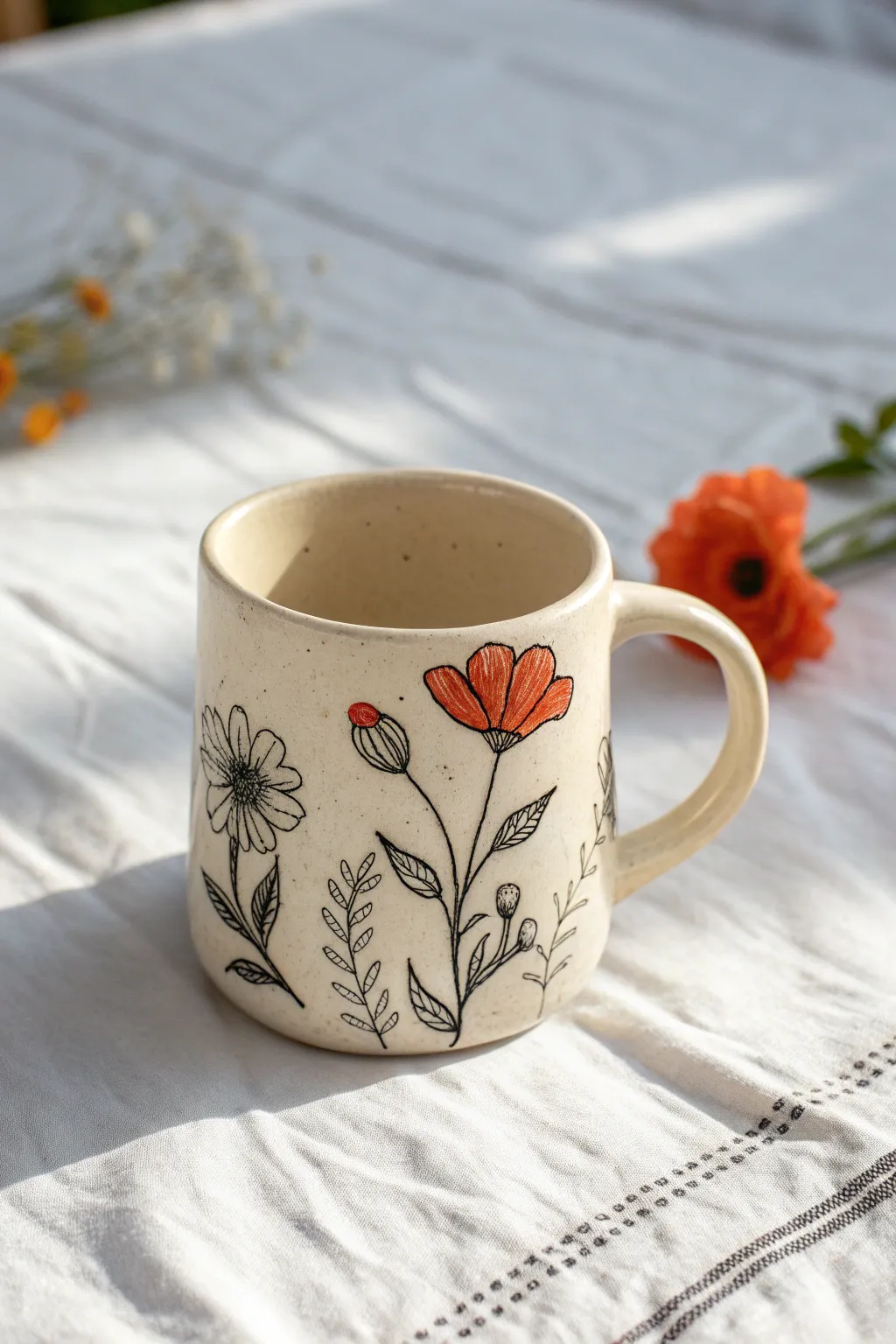
Embrace the delicate beauty of botanical illustrations with this deceptively simple mug design. By combining stark black linework with just a single accent color, you create a modern, sophisticated piece that feels right at home in a cozy cottage kitchen.
Step-by-Step Guide
Materials
- Plain ceramic mug (cream or speckle glaze)
- Black porcelain marker or ceramic fine-liner pen
- Orange porcelain paint marker (bullet tip)
- Rubbing alcohol
- Cotton pads
- Pencil (optional for sketching)
- Oven (for curing)
Step 1: Preparation and Planning
-
Clean surface:
Before you make a single mark, wipe the entire exterior of the mug with rubbing alcohol on a cotton pad. This removes invisible finger oils that prevent paint adhesion. -
Plan placement:
Visualize where your main focal flower will sit. I usually aim for the center of the side facing outward when held. -
Light sketch:
If you are nervous about freehanding, lightly sketch the flower placement with a regular pencil. The graphite will burn off in the oven later.
Pro Tip: Line Variation
Press harder on the downward strokes of your leaves and lighter on upward flicks. This varies line thickness and makes the drawing look much more professional.
Step 2: Drawing the Focal Flower
-
Outline the petals:
Using your black fine-liner, draw the outline of the main poppy-like flower. Keep the lines thin and organic, allowing for slight wobbles to mimic nature. -
Add the stem:
Draw a long, slender stem curving gently downwards from the flower head. Extend it all the way to the base of the mug. -
Draw the bud:
To the left of the main bloom, add a smaller stem branching off. Top this with a tight bud shape, drawing vertical lines on the pod for texture. -
Detail the center:
Add tiny stippled dots or short lines near the base of the petals where they meet the stem to create depth and shadow. -
Add leaves:
Draw slender, pointed leaves along the main stem. Use quick, confident strokes to create the veins inside the leaves.
Troubleshooting: Inky Smudges
Did you smudge a wet line? Don’t wipe it immediately! Let it dry completely, then gently scratch the mistake off with a craft knife or a toothpick.
Step 3: Adding Composition Elements
-
Draw the daisy:
To the far left, draw a simple daisy shape. Start with a textured center circle and radiate petals outward, keeping them slightly separated. -
Create foliage variety:
In the negative space between the flowers, draw a fern-like sprig. Create a central line and add tiny pairs of leaves all the way up. -
Add side details:
On the right side near the handle, add another trailing stem with small, round seed pods to balance the composition. -
Verify lines:
Check your black lines. If any look too faint, re-trace them carefully. Ensuring solid black contrast is key to this look.
Step 4: Applying Color
-
Fill the poppy:
Product instructions vary, so shake your orange marker well to prime the nib. Carefully color inside the petals of the main flower. -
Create texture:
Instead of a solid block of color, use directional strokes that follow the curve of the petal. This creates a hand-drawn illustration style. -
Color the bud:
Add a tiny touch of orange just peaking out at the very top of the closed bud on the left. -
Avoid the black:
Try not to drag the orange marker directly over the wet black lines, or you might smear the ink. Work around the outlines carefully. -
Check opacity:
Let the first layer of orange dry for a few minutes. If it looks too translucent, add a second coat for vibrancy.
Step 5: Finishing Up
-
Clean errors:
If you made any mistakes, use a cotton swab dipped in rubbing alcohol or water (depending on your marker type) to wipe them away before curing. -
Air dry:
Let the mug sit undisturbed for at least 24 hours to allow the pigments to fully set before baking. -
Bake to cure:
Place the mug in a cold oven. Set temperature to 350°F (175°C) and bake for 30 minutes. Turn the oven off and let the mug cool completely inside before removing.
Now you have a stunning, minimalist floral mug ready for your morning coffee

TRACK YOUR CERAMIC JOURNEY
Capture glaze tests, firing details, and creative progress—all in one simple printable. Make your projects easier to repeat and improve.
Minimal Stem and Buds
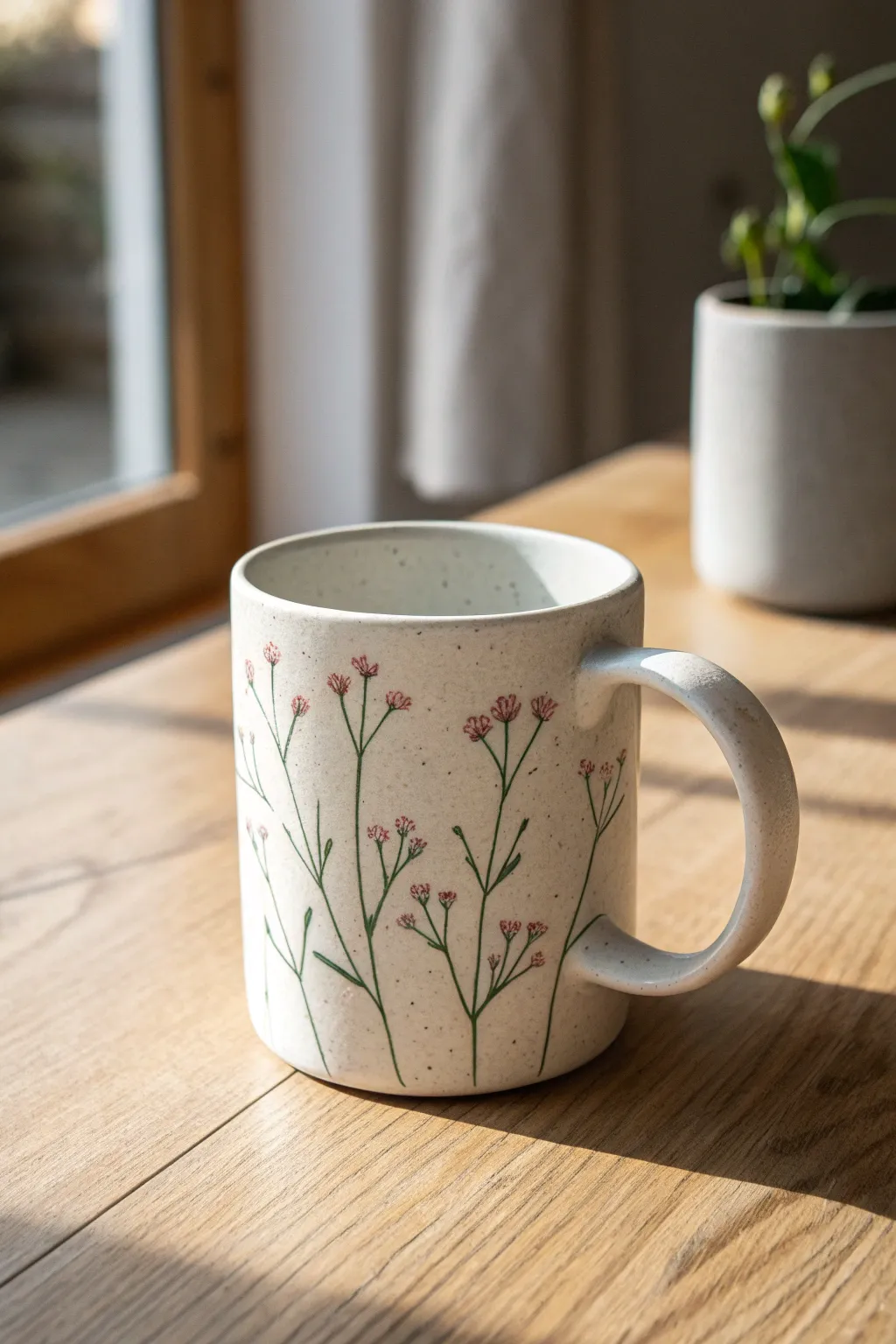
Capture the airy elegance of a summer meadow with this minimalist mug design featuring long, slender stems and tiny pink blooms. The sparse, organic layout celebrates negative space, making it a perfect project for beginners looking to practice fine details.
Detailed Instructions
Materials
- White or speckled ceramic mug (clean and dry)
- Pebeo Porcelaine 150 paint (or similar ceramic paint) in Olive Green
- Pebeo Porcelaine 150 paint (or similar ceramic paint) in Dusty Pink or Coral
- Fine liner brush (size 0 or 00)
- Detailed spotter brush (size 000)
- Rubbing alcohol and paper towel
- Palette or ceramic tile
- Oven (for curing)
Step 1: Preparation & Planning
-
Clean the Surface:
Before you start painting, it’s crucial to remove any oils or fingerprints. Wipe the entire outer surface of the mug thoroughly with rubbing alcohol and a paper towel. -
Dry Completely:
Allow the alcohol to evaporate completely for a minute or two. Avoid touching the painting area with your bare hands after this step. -
Prepare Your Palette:
Dispense a small amount of the olive green and dusty pink paint onto your palette. You don’t need much, as these lines are very fine.
Steady Hand Trick
Rest your pinky finger on the mug surface while painting to stabilize your hand. Just make sure you’re resting it on a dry, unpainted spot to avoid smudging.
Step 2: Painting the Stems
-
Load the Liner Brush:
Dip your fine liner brush into the olive green paint. Roll the brush slightly on the palette to shape the bristles into a sharp point, ensuring it isn’t overloaded with paint. -
Start the Main Stem:
Starting near the bottom curve of the mug, pull your brush upward in a gentle, slightly wavy motion. Let the line break naturally or vary in thickness to create an organic feel. -
Vary Articulation:
As you paint more main stems around the mug, angle them slightly differently. I like to have some lean left and others lean right so they don’t look like soldiers in a row. -
Add Branching Stems:
From the main vertical lines, paint shorter, thinner offshoots. These should branch out at upward angles, mimicking how real wildflowers grow toward the sun. -
Refine the Tips:
Ensure the very tips of your stems taper off gently. If a line looks too thick at the end, simply extend it slightly with a cleaner, quicker stroke. -
Review Spacing:
Step back and look at the mug. You want plenty of white space between the plants. If there’s a large gap, add a small, shorter stem rather than another tall one.
Step 3: Adding the Blooms
-
Switch Brushes:
Clean your green brush or switch to the ultra-fine spotter brush for the flower details. -
Load the Pink Paint:
Pick up a tiny amount of the dusty pink or coral paint. The consistency should be fluid enough to dab easily but not so runny that it drips. -
Create the Flower Base:
At the very tip of a green branch, press the brush tip down gently to create a small central dot. This anchors the flower cluster. -
Add Petal Clusters:
Around that central point, dab 3 to 4 tiny specks of pink. These don’t need to be perfect circles; irregular dabs look more like natural buds. -
Vary the Sizes:
Make some flower clusters slightly larger at the top of the main stems, and keep the clusters on the lower side branches smaller and tighter. -
Optional Two-Tone Effect:
If you want more depth, mix a tiny bit of white into your pink and add a single highlight dot to the larger flower clusters while the paint is still wet. -
Inspect the Composition:
Rotate the mug slowly. Check for any stems that look incomplete and add a tiny bud to the end of every green line.
Speckled Effect
If your mug isn’t already speckled, flick a stiff toothbrush loaded with diluted brown paint over the surface before painting the flowers for a ceramic studio look.
Step 4: Curing
-
Initial Drying:
Let the paint air dry for at least 24 hours. This is critical for durability, so don’t rush this stage. -
Bake to Set:
Place the mug in a cold oven. Turn the heat to 300°F (150°C) and bake for 35 minutes (or follow your specific paint manufacturer’s instructions). -
Cool Down:
Turn the oven off and leave the mug inside until the oven is completely cool. Removing it while hot can cause the ceramic to crack.
Enjoy your morning coffee knowing those delicate blooms are there to stay
Botanical Leaves and Blooms Mix
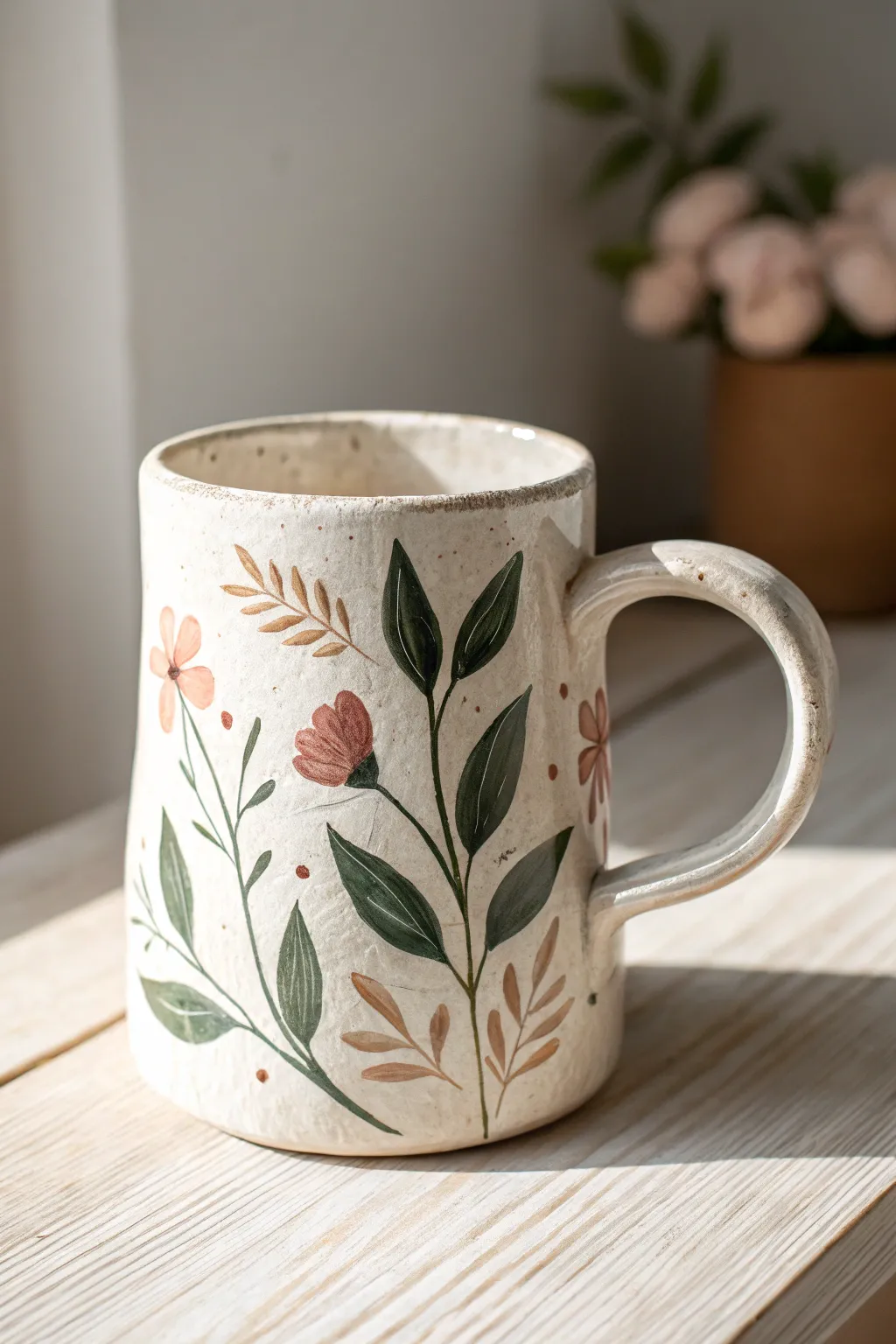
Capture the charm of a woodland garden with this earthy botanical design. The combination of sweeping dark leaves and delicate blush blooms creates a sophisticated yet organic look perfect for cozy mornings.
Step-by-Step Guide
Materials
- White or cream ceramic mug (preferably with a matte or textured finish)
- Ceramic paints or underglazes (Forest Green, Sage, Blush Pink, Rust/Terra Cotta)
- Round synthetic brushes (sizes 2 and 4)
- Fine liner brush (size 0 or 00)
- Rubbing alcohol and cotton pads
- Palette or small dish for mixing
- Oven (if using heat-set paints) or clear food-safe sealant
Step 1: Preparation & Layout
-
Clean the Surface:
Wipe down the entire outer surface of your mug with rubbing alcohol. This removes any finger oils or dust that might prevent the paint from adhering properly. -
Plan Your Composition:
Visualize three main vertical stems rising from the bottom of the mug. You don’t need to sketch them perfectly, but knowing where your main ‘anchors’ will be helps balance the design.
Step 2: Painting the Greenery
-
Mix Your Greens:
On your palette, prepare two shades of green. A deep forest green will serve as the primary leaf color, while a softer sage green mixed with a touch of white adds variety. -
Paint the Central Stem:
Using the size 2 brush and the dark green, paint a thin, slightly curved line starting near the base and reaching two-thirds up the mug. This is your main central stalk. -
Add Large Leaves:
From this central stem, paint almond-shaped leaves extending outward. Press the belly of the brush down to widen the leaf and lift up as you reach the tip to create a sharp point. -
Create Leaf Veins:
While the green paint is still wet, use a clean, dry detail brush to gently lift a thin line of paint from the center of each leaf, revealing the white mug underneath for a subtle vein effect. -
Layer in Secondary Stems:
Paint two smaller, thinner stems on either side of the main one. I like to make these slightly curved and wandering to mimic natural growth wildness. -
Add Lower Foliage:
Near the base of the mug, add a few broader, lower leaves in your lighter sage mix. This grounds the design and adds depth to the ‘garden’ floor.
Fixing Wobbly Lines
If your stems look shaky, thicken them slightly or turn the wobble into a branching point for a new leaf. Nature isn’t perfectly straight anyway
Step 3: Adding the Blooms
-
Mix Floral Colors:
Prepare a dusty pink and a warm rust-orange color. These should be opaque enough to stand out against the white background. -
Paint the Main Flower head:
Choose a spot on one of your upper stems for the focal flower. Using the size 4 brush and rust color, dab a loose, tulip-like shape or a semi-circle that faces upward. -
Add Smaller Buds:
Switch to the pale pink. Dot small, 5-petal flower shapes on the tips of the thinner, wandering stems you painted earlier. -
Paint Fern Accents:
Using the rust or terra cotta shade, paint a fern-like frond. Draw a central spine and then quick, short strokes outward on both sides. This creates a contrasting texture to the broad green leaves. -
Add Tiny Details:
Dip your fine liner brush into the rust paint. Add tiny dots floating near the flowers or at the ends of stems to represent pollen or small berries.
Speckled Pottery Look
Flick a stiff toothbrush loaded with watered-down brown paint over the mug before sealing to mimic a rustic clay speckle pattern.
Step 4: Finishing Touches
-
Connect the Blooms:
Use your liner brush and the dark green paint to ensure every flower head is connected to a stem with a very thin, delicate line. -
Clean Up Edges:
If any paint smudged, use a damp cotton swab or a toothpick to gently scrape away unwanted marks before the paint fully hardens. -
Dry Completely:
Let the mug sit undisturbed for at least 24 hours (or as directed by your specific paint manufacturer) to ensure the design is fully dry deep down. -
Bake or Seal:
Place the mug in a cold oven and heat to the temperature specified on your paint bottle (usually around 350°F/176°C) for 30 minutes to set the design permanently. -
Cool Down:
turn the oven off and leave the mug inside until it is completely cool. Removing it while hot can cause the ceramic to crack.
Now you have a piece of functional art that brings a touch of nature to your daily routine
Monochrome Floral Silhouettes
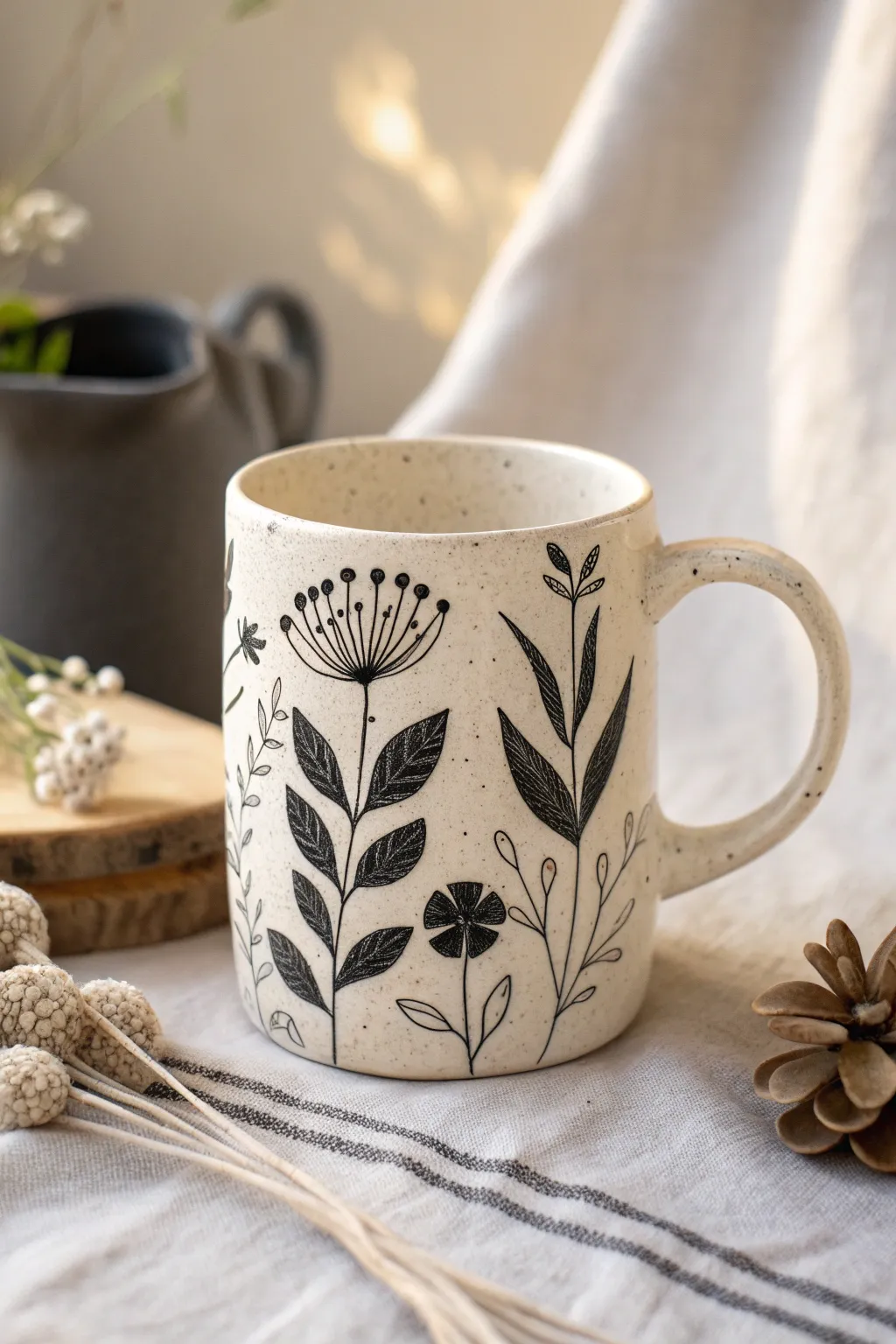
Embrace the beauty of simplicity with this elegant project, featuring delicate black floral silhouettes against a creamy, speckled ceramic background. The fine line work mimics classic botanical illustrations, turning a plain mug into a piece of functional art.
How-To Guide
Materials
- Cream or beige ceramic mug (ideally with a speckled glaze)
- Black porcelain paint marker (fine tip, e.g., Pebeo Porcelaine 150)
- Rubbing alcohol
- Cotton pads
- Pencil (optional for sketching)
- Paper towel
- Oven (for curing)
Step 1: Preparation & Planning
-
Clean the Surface:
Before you begin, wipe the entire outer surface of the mug with rubbing alcohol on a cotton pad. This removes any oils or fingerprints that might prevent the paint from adhering properly. -
Sketch the Layout:
Visualize three main floral stems spaced evenly around the mug. If you’re nervous about freehanding, lightly sketch the main vertical stems with a pencil; the graphite will wash or burn off later. -
Test Your Marker:
Press the tip of your porcelain marker onto a paper towel to get the ink flowing. Ensure you have a consistent, dark line before touching the mug surface.
Ink Flow Tip
Store your marker tip-down for 10 minutes before starting. This ensures the ink is saturated and ready for smooth, unbroken lines without needing to press hard.
Step 2: Drawing the Main Stems
-
First Stem: The Umbel:
Start by drawing a tall, straight vertical line for the first flower. This will be the base for the dandelion-like seed head (umbel). -
Second Stem: The Leafy Branch:
Rotate the mug slightly and draw a second vertical line, slightly curved at the bottom, for the leafy branch design. -
Third Stem: The Minimalist Sprig:
Draw the third vertical line for the simpler, thinner sprig. Varying heights between these three main elements adds visual interest.
Add Gold Accents
Once the black ink is baked and cooled, add tiny dots of gold porcelain paint to the center of the flowers for a subtle, luxurious shimmer.
Step 3: Detailing the Flora
-
Draw the Umbel Crown:
Return to your first stem. Draw several lines radiating outward from the top of the stem like a fan. Add small dots or circles at the end of each radiating line to create the seed heads. -
Add Serrated Leaves:
On the first stem, draw large, pointed leaves extending from the lower half. Fill them in with dense, diagonal hatching lines to create a dark, textured look without distinct veins. -
Create the Leafy Branch Pattern:
Move to the second stem. Draw pairs of upward-reaching, lance-shaped leaves. Instead of solid black, use quick, sketchy strokes to fill them, leaving some negative space for texture. -
Detail the Veins:
Draw a single, solid black line down the center of each leaf on the second stem to represent the midrib vein. -
Add a Small Daisy:
Near the base of the stems, draw a small, low flower. Create five or six petals with a dark center. Cross-hatch the petals heavily so they appear nearly solid black. -
Draw Tiny Sprigs:
Fill the empty spaces between the main plants with delicate, wispy lines. Add tiny tear-drop shapes for leaves on these smaller filler stems. -
Incorporate Dots:
If your mug doesn’t have natural speckles, gently tap the tip of your marker around the empty background spaces to create faux ceramic speckles. Keep them random and sparse.
Step 4: Finishing Touches
-
Review and Refine:
Rotate the mug and look for any lines that need thickening. The charm of this style lies in the contrast between thin stems and darker, heavier leaves. -
Clean Up Mistakes:
If you made a smudge, use a Q-tip dipped in rubbing alcohol to wipe it away immediately while the paint is still wet. -
Dry Time:
I like to let this dry for at least 24 hours before baking to ensure the paint settles completely. Place it in a dust-free area. -
Bake to Set:
Place the mug in a cold oven. Set the temperature to 300°F (150°C) or according to your paint manufacturer’s instructions. Once it reaches temperature, bake for 30-35 minutes. -
Cooling Down:
Turn the oven off and leave the mug inside until completely cool. This gradual temperature change prevents the ceramic from cracking.
Now your custom botanical mug is ready for a cozy morning coffee or tea
Bouquet Panel on One Side
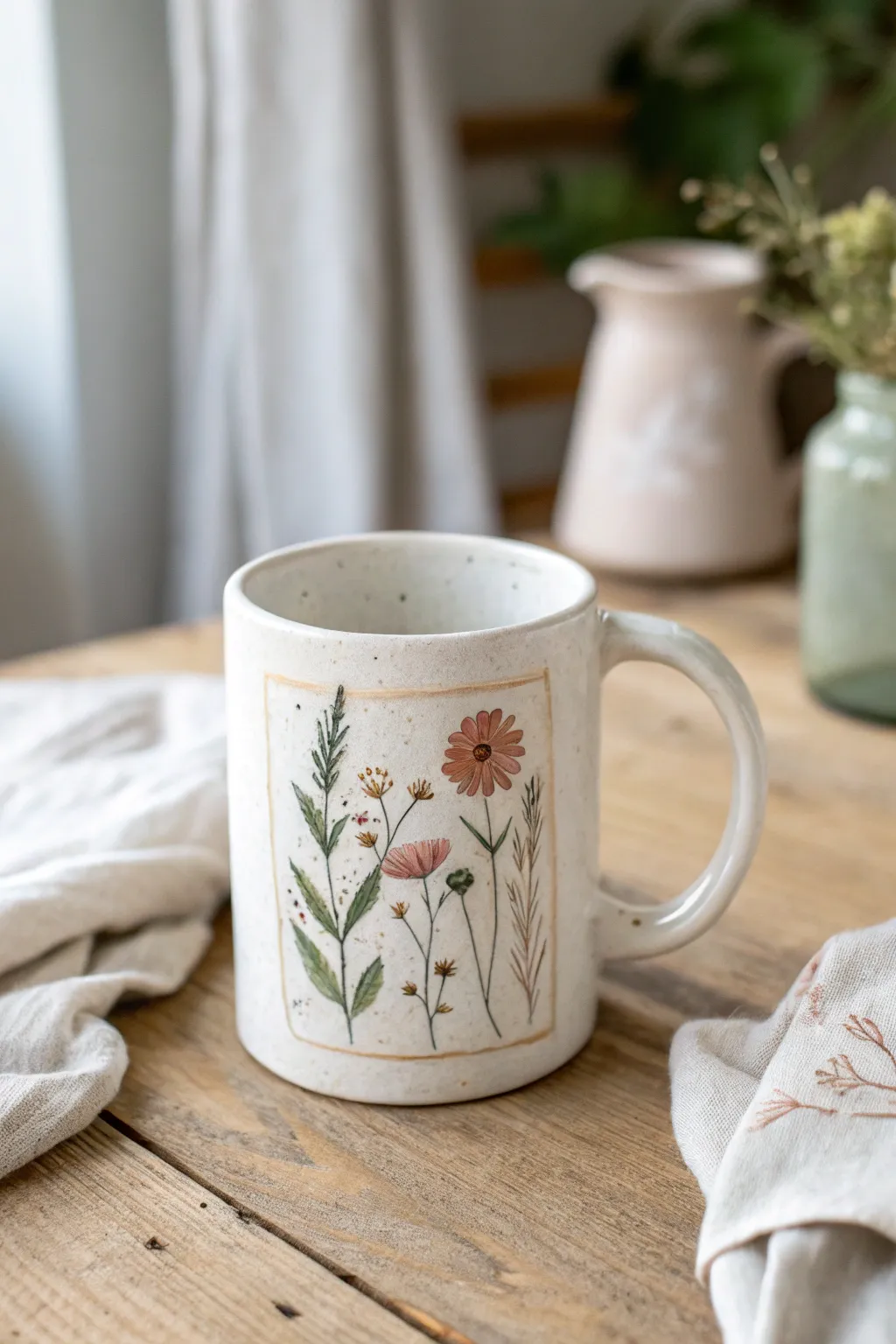
Capture the delicate beauty of a meadow with this elegant mug design featuring a neat rectangular panel filled with slender wildflowers. The speckled cream background and fine line work give it a charming, hand-crafted pottery feel that perfects any morning coffee ritual.
Step-by-Step Tutorial
Materials
- Plain white or cream ceramic mug (clean and dry)
- Ceramic or porcelain paints (Sage Green, Forest Green, Dusty Pink, Terracotta, Golden Brown)
- Fine detail paintbrush (size 0 or 00)
- Flat shader brush (small)
- pencil or erasable ceramic marker
- Ruler or straight edge
- Rubbing alcohol
- Oven for curing (if required by paint type)
Step 1: Preparation and Layout
-
Clean the surface:
Before you begin, wipe the mug’s surface thoroughly with rubbing alcohol on a lint-free cloth or paper towel. This removes oils and dust, ensuring your paint adheres perfectly. -
Mark the panel boundaries:
Using a pencil or erasable marker and a small flexible ruler, lightly draw a vertical rectangle on the face of the mug. Aim for dimensions around 2.5 inches wide by 3 inches tall, centered opposite the handle. -
Paint the frame border:
Load a fine detail brush with thinned Golden Brown paint. Carefully trace over your pencil lines to create a delicate frame. I find it helpful to anchor my pinky finger against the mug for stability while pulling these long straight lines. -
Add speckling (optional):
To mimic the stonewear look in these photos, flick a toothbrush loaded with diluted grey or brown paint across the mug surface. Keep it subtle, and wipe away any large blobs immediately.
Step 2: Painting the Foliage
-
Sketch the main stems:
Using your Sage Green paint and the fine liner brush, paint three to four main vertical lines starting from the bottom of your framed panel. Vary their heights, with the tallest ones reaching about three-quarters up the frame. -
Create the leafy frond:
On the leftmost stem, paint small, upward-sweeping dashes along both sides to create a fern-like or feathery texture. Use a darker Forest Green here to add depth and contrast. -
Add broad leaves:
For the lower sections of the other stems, press the belly of your brush down and lift sharply to create tear-drop shaped leaves. Keep these clustered near the bottom third of the design. -
Paint the wispy grass:
On the far right side of the panel, paint a very faint, thin vertical stalk with tiny, hair-like branches coming off it using a diluted brown or tan color to resemble dried grass.
Wobbly Lines?
If your straight lines are shaky, try using masking tape to mark the rectangle. Paint the border edge, let it dry slightly, and peel the tape for a crisp line.
Step 3: Adding the Blooms
-
Paint the main daisy:
Near the top right of the panel, paint the largest flower. Use Dusty Pink to create long, slender petals radiating from a central point. Leave a small open circle in the middle. -
Detail the daisy center:
Once the pink petals are tacky or dry, dab a small dot of Golden Brown or dark orange in the center of the flower. -
Add the secondary bloom:
Below the main flower and slightly to the left, paint a smaller, cup-shaped flower using a lighter pink or Terracotta wash. This one should look like it’s facing upward or slightly sideways. -
Include tiny filler flowers:
scattered between the main stems, add tiny clusters of dots or miniature star shapes in yellow or tan. These represent wildflowers like baby’s breath or dried seeds. -
Connect flowers to stems:
Use your finest brush and green paint to draw very thin connecting lines from your new flower heads down to the main stems you painted earlier.
Add Dimension
Mix a tiny amount of white into your pink paint and add highlights to the tips of the petals for a 3D effect that pops off the ceramic.
Step 4: Finishing Touches
-
Refine the frame:
Check your rectangular border. If the paint has thinned or looks uneven, go over it one more time with the Golden Brown to bolster the frame’s definition. -
Clean up edges:
If any paint went outside the rectangular border, use a damp cotton swab or a toothpick to gently scrape or wipe it away while it’s still damp. -
Let it dry completely:
Allow the mug to sit undisturbed for at least 24 hours. The paint needs to fully surface-cure before the baking process. -
Bake to set:
Place your mug in a cool oven, then set the temperature according to your paint manufacturer’s instructions (usually around 300°F – 350°F). Bake for 30-40 minutes, then turn the oven off and let the mug cool down purely inside heavily to prevent cracking.
Once baked and cooled, your custom floral mug is ready to hold your favorite warm beverage
Floral Wreath Initial
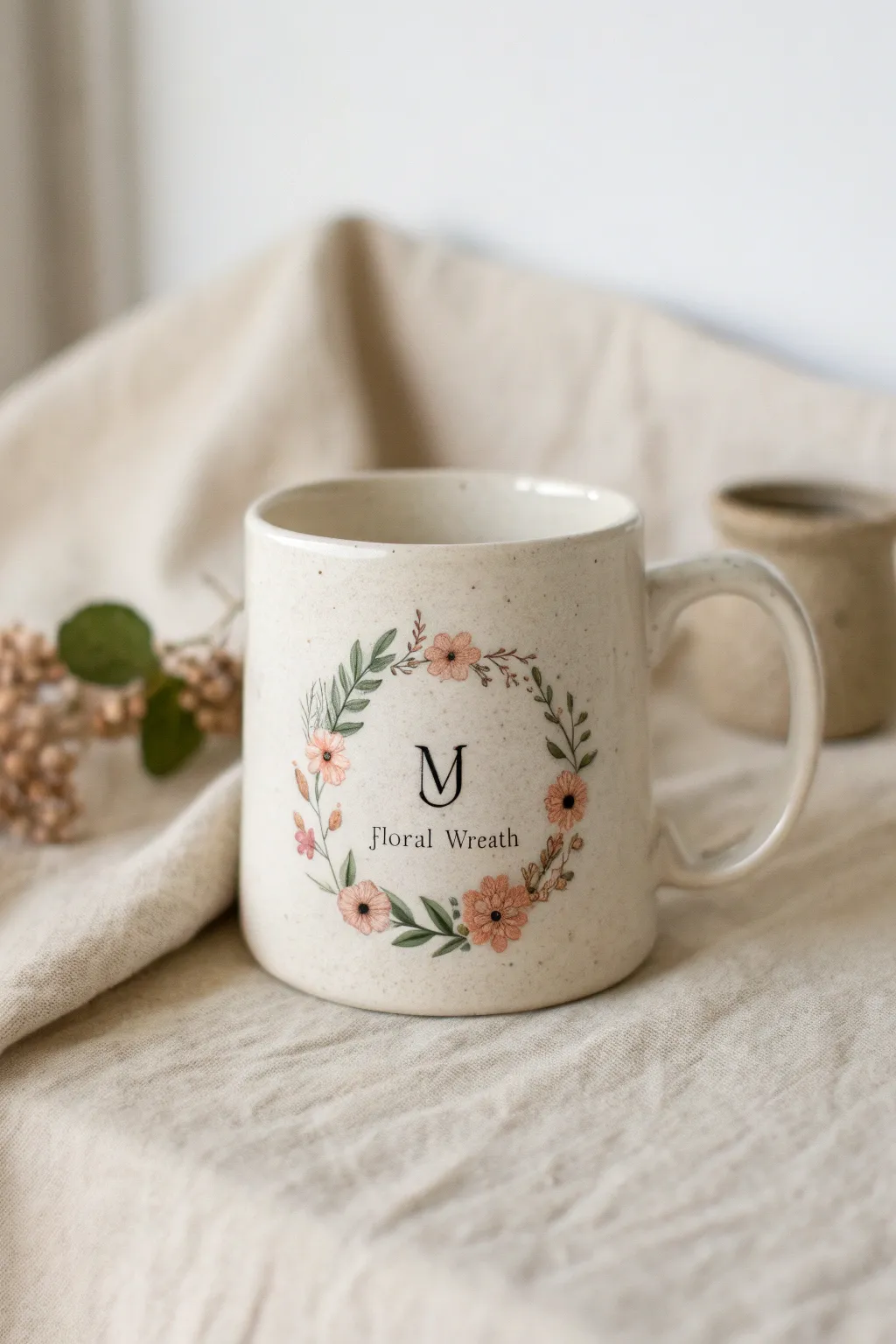
Customize your morning brew with this elegant floral wreath design surrounding a sleek initial. The combination of earthy speckles and soft peach blossoms creates a cozy, personalized piece perfect for gifting or keeping.
How-To Guide
Materials
- Ceramic mug (preferably speckled cream or beige)
- Pebeo Porcelaine 150 paints (or similar baked ceramic paint) in: Peach, Salmon Pink, Olive Green, Forest Green, Black
- Fine liner brush (size 0 or 00)
- Small round brush (size 2)
- Rubbing alcohol and cotton pads
- Carbon paper and pencil (for tracing)
- Cotton swabs (for cleanup)
- Paper plate or palette
- Oven (for curing)
Step 1: Preparation & Layout
-
Clean the surface:
Before you specificially start painting, wipe down the entire outer surface of the mug with rubbing alcohol. This removes oils and fingerprints that could prevent the paint from adhering properly. -
Design the monogram:
Sketch your chosen initial and the circular wreath guide lightly on paper first. If you aren’t confident freehanding, transfer the ‘M’ (or your chosen letter) onto the mug using carbon paper to ensure it is centered. -
Paint the text first:
Using your finest liner brush and black paint, carefully paint the initial in the center. Add the serif details slowly. If you want to include the text ‘Floral Wreath’ or a name underneath, add that now using extremely light pressure for thin lines.
Step 2: Building the Wreath
-
Map out anchor flowers:
Mix a soft salmon pink color. Using the size 2 round brush, dot the centers of your three main flowers: one at the 5 o’clock position (bottom right), one at the 3 o’clock position (right), and one at the 11 o’clock position (top left). -
Paint the petals:
Around those centers, pull small strokes outward to create the petals. Keep the paint somewhat sheer for a watercolor effect. Vary the sizes, making the bottom-right flower the largest. -
Add secondary buds:
Switch to a lighter peach shade. Add smaller, simpler three-petal bud shapes at the 8 o’clock and 2 o’clock positions to balance the wreath without overcrowding it. -
Darken the flower centers:
Once the base petals are tacky dry, take the fine liner brush with a tiny amount of black or dark brown paint. Dot the very center of each open flower to add depth and realism.
Clean Edges Instantly
Keep a damp cotton swab or a toothpick handy while painting. If a leaf goes astray or a line gets too thick, you can wipe or scrape it away immediately before it sets.
Step 3: Foliage & Details
-
Create the main vines:
Mix your Olive Green paint. With your liner brush, draw thin, curving lines connecting the flowers. These shouldn’t act as a perfect circle but rather wandering vines that suggest a circular shape. -
Add large leaves:
Using the Forest Green, paint larger, elongated leaves near the main flowers. Press down at the base of the leaf and lift up as you drag to create a sharp point. -
Fill with fern sprigs:
I like to add texture here by using the lighter Olive Green to paint feathery, fern-like sprigs. Place these in the empty gaps, particularly on the left side of the wreath. -
Insert filler botanical:
For extra detail, add tiny brown or darkly colored twigs sticking out from the main wreath line. These add a whimsical, dried-flower aesthetic to the composition. -
Review and refine:
Step back and look at the mug. If the wreath looks lopsided, add a small floating leaf or a tiny pink bud to balance the visual weight.
Add Metallic Flair
Swap the black centers of the flowers for metallic gold ceramic paint. This adds a subtle shimmer that catches the light and makes the mug look high-end.
Step 4: Curing
-
Let it dry completely:
Allow the mug to air dry for at least 24 hours. The paint needs to fully set before the baking process begins. -
Bake the mug:
Place the mug in a cold oven. Turn the heat to 300°F (150°C—or match your specific paint’s instructions). -
Timing the bake:
Once the oven reaches temperature, bake for 35 minutes. Turn the oven off and leave the mug inside until it is completely cool to prevent cracking.
Now you have a beautiful, bespoke mug ready for your favorite warm drink
Two-Mug Matching Floral Set
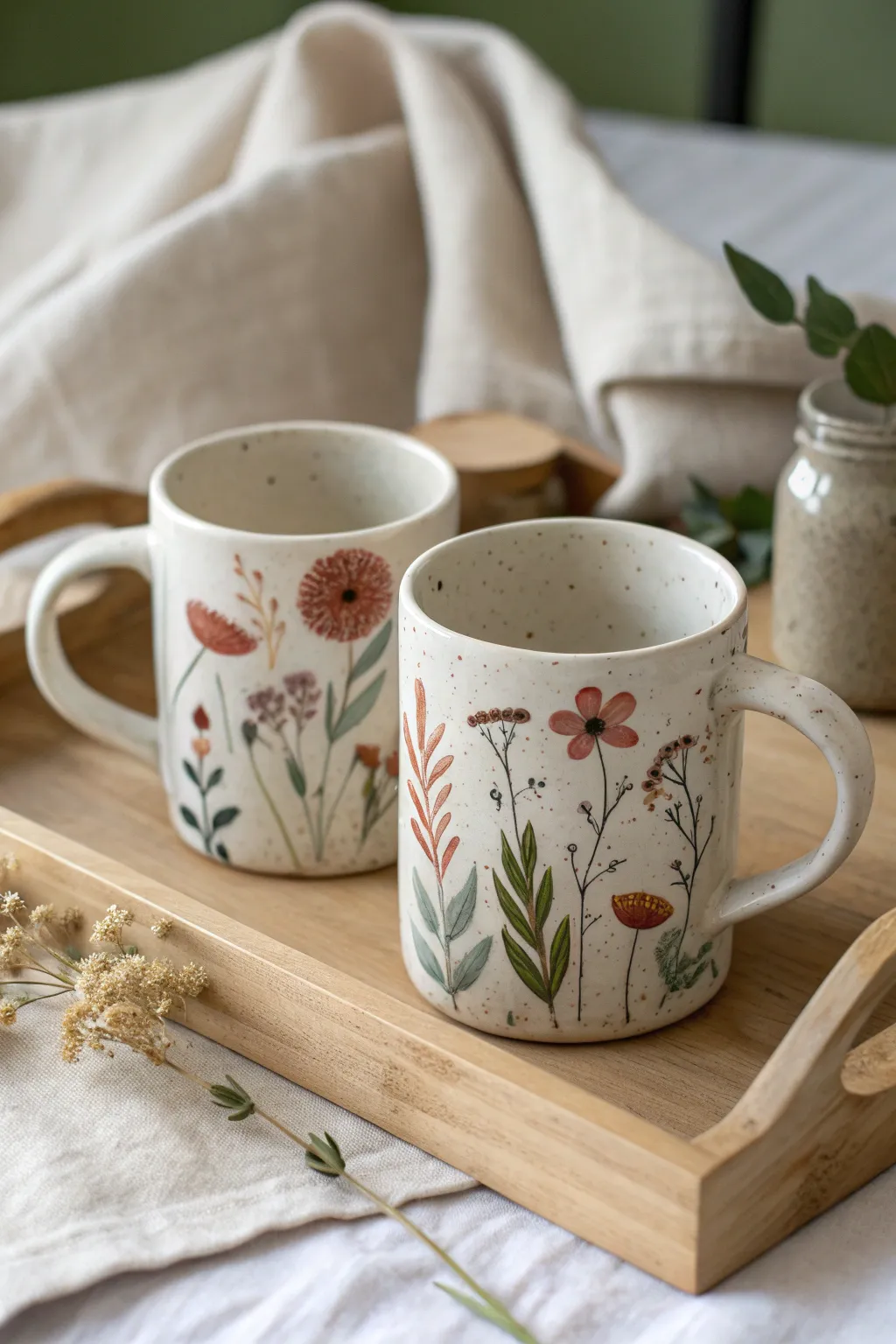
Bring the charm of a wildflower field to your morning coffee with this delightful matching mug set. Using ceramic paints and a clever speckling technique, you’ll transform plain stoneware into a rustic, hand-painted botanical garden.
Step-by-Step Tutorial
Materials
- Two plain cream or off-white ceramic mugs (stoneware finish preferred)
- Pebeo Porcelaine 150 paints (or similar bake-to-cure ceramic paint)
- Palette colors: Rust red, olive green, sage green, mustard yellow, dusty pink, charcoal grey
- Fine detail brushes (sizes 0/0 and 0)
- Small flat brush (size 2)
- Old toothbrush (for speckling)
- Rubbing alcohol and paper towels
- Palette or small ceramic dish for mixing
- Oven (for curing)
Step 1: Preparation & Base Texture
-
Clean surface:
Begin by wiping the entire exterior surface of both mugs with rubbing alcohol on a paper towel. This removes any finger oils or dust that might prevent the paint from adhering properly. -
Mix the speckle color:
Dilute a small amount of charcoal grey paint with water until it reaches an inky consistency. You want it fluid enough to flick, but not so watery that it runs immediately. -
Apply the speckles:
Dip an old toothbrush into your diluted grey mixture. Hold the brush about 6 inches from the mug and run your thumb across the bristles to flick tiny droplets onto the surface. -
Check density:
Aim for a random, organic scattering. I like to rotate the mug constantly while flicking to ensure even coverage without creating large puddles. Let this dry for at least 30 minutes.
Pro Tip: Translucency
Mix a tiny drop of painting medium or water into your petal colors. This semi-transparent look mimics watercolor and lets the ceramic texture show.
Step 2: Painting Mug One: The Warm Blooms
-
Start the main flower:
On the first mug, use a size 2 brush and rust red paint to create a large bloom. Paint a circular shape using short, radiating strokes from a central point, leaving the edges slightly ragged for texture. -
Add the center:
Once the red loop is slightly tacky, dot the very center with charcoal grey or dark brown to create depth. -
Paint secondary flowers:
To the left of the main bloom, paint a smaller, bowl-shaped flower in dusty pink. Use upward strokes to mimic petals reaching for the sun. -
Create stems:
Switch to your size 0 liner brush and olive green paint. Draw thin, wavering lines extending down from your flower heads to the base of the mug. -
Add sparse foliage:
Along the stems, paint elongated, thin leaves. For the rust flower, keep the leaves broader; for the pink one, make them delicate and grass-like. -
Fill the gaps:
In the empty spaces, paint faint, ghostly stems using a diluted sage green. Add tiny clusters of dots at the tips to suggest seed pods or distant wildflowers.
Step 3: Painting Mug Two: The Cool Botanicals
-
Paint the focal leaf:
On the second mug, instead of a central flower, anchor the design with a large vertical stem of leaves. Use sage green and paint paired, pointed leaves climbing up a central stalk. -
Add a pink poppy:
To the right of the leaves, paint a four-petaled flower using dusty pink. Make the center distinct with a dark dot, leaving negative space around it for contrast. -
Introduce warm tones:
Balance the cool greens by adding a small, mustard-yellow pod lower down on the mug. Paint a semi-circle and add vertical detail lines inside it. -
Detail the wild carrot:
Use your finest brush and charcoal grey to draw a tall, thin stem. At the top, paint a flat cluster of tiny dots to mimic Queen Anne’s Lace or wild carrot flowers. -
Incorporate rusty sprigs:
Using the rust color from the first mug, paint a tall, fern-like sprig on the left side. Use quick, upward dashes to create the leaflets. -
Final unifying details:
Add a few more tiny black specks near the base of the stems if the design feels too top-heavy.
Level Up: Handle Art
Don’t stop at the mug body! Continue a single, tiny vine or a row of small speckles running down the spine of the handle for a seamless 360-degree finish.
Step 4: Curing the Design
-
Let it cure:
Most ceramic paints require 24 hours of air drying before baking. Place the mugs in a dust-free area and wait patiently. -
Bake to set:
Place the mugs in a cold oven. Set the temperature to 300°F (150°C) and bake for 35 minutes (or as directed by your paint manufacturer). Letting the oven heat up with the mugs inside prevents cracking. -
Cool down:
Turn the oven off but leave the door closed. Let the mugs cool completely inside the oven before removing them.
Once cooled, your custom botanical mugs are ready to hold your favorite hot beverage or be gifted to a nature-loving friend
Negative Space Flower Shapes
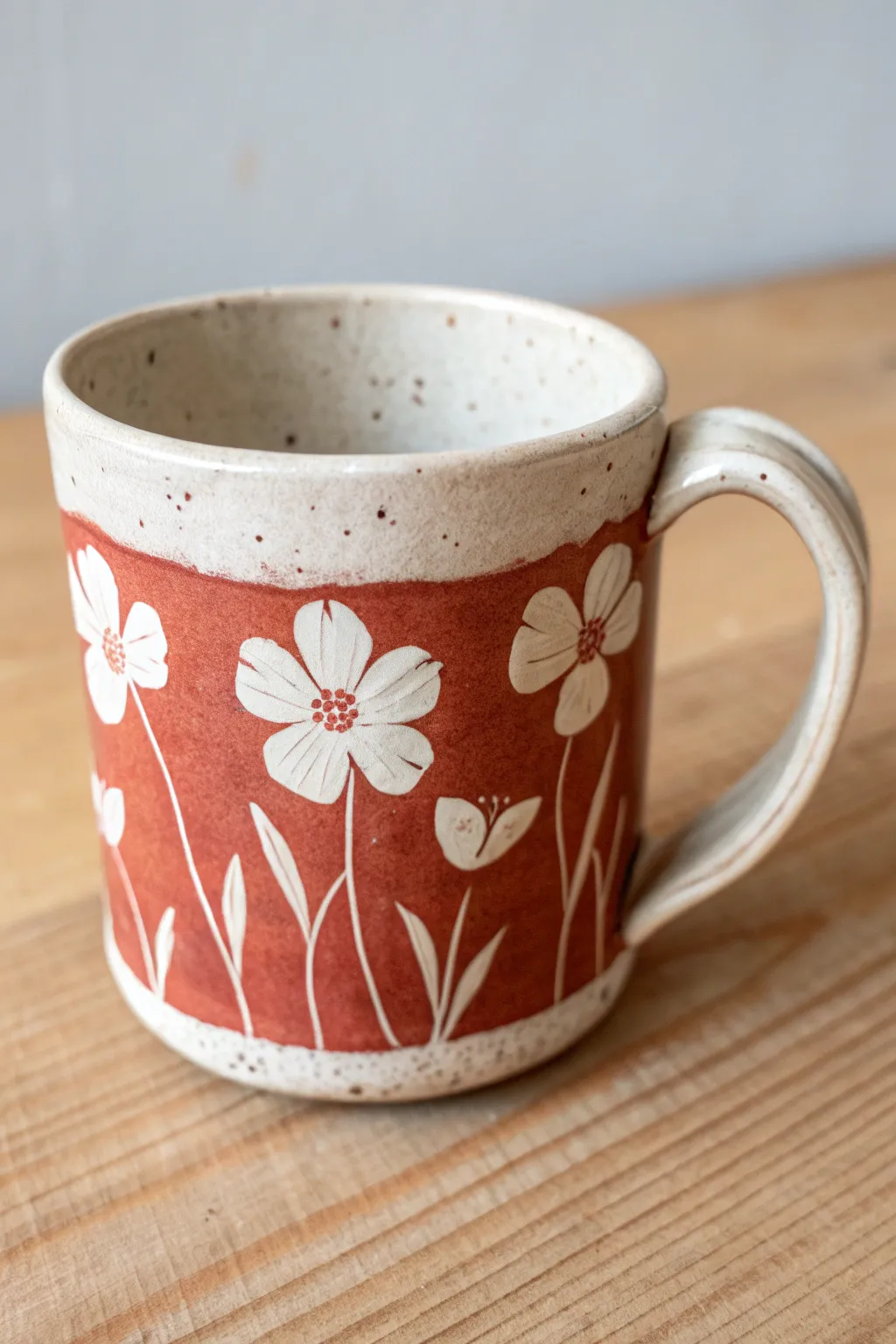
This project transforms a simple ceramic mug into a striking piece of folk art using a technique called sgraffito. By carving through a layer of rich, rusty-red underglaze, you’ll reveal the speckled clay body beneath, creating stunning negative space white flowers.
Step-by-Step Guide
Materials
- Bisque-fired ceramic mug (speckled clay body preferred)
- Red-orange or terracotta underglaze
- Wide, soft fan brush
- Pencil (optional)
- Small loop tool or sgraffito carving tool
- Needle tool
- Damp sponge
- Clear transparent glaze
- Kiln access
Step 1: Preparation and Base Coat
-
Clean surface:
Begin by wiping down your greenware or leather-hard mug with a slightly damp sponge. This removes any dust that might prevent the underglaze from adhering properly. -
Define the borders:
Visualize where you want your colored band to sit. You want to leave a rim of raw clay at the top and bottom, roughly half an inch wide, to frame the design. -
Apply first coat:
Using a soft fan brush, apply a smooth, even layer of the red-orange underglaze around the center of the mug. Keep your brush strokes horizontal to match the wheel-thrown lines. -
Layering up:
Let the first coat dry until it loses its sheen. Apply a second and third coat to ensure the color is opaque and solid. I find three coats usually prevents streakiness. -
Leather hard drying:
Allow the underglaze to dry to a ‘leather hard’ state. It shouldn’t be wet to the touch, but it shouldn’t be bone dry either, or it will chip when carved.
Step 2: Carving the Design
-
Sketch placement:
Lightly sketch the outline of your flowers using a pencil directly on the dry underglaze. Don’t worry about marks; the pencil graphite will burn off in the kiln. -
Outline the petals:
Using your needle tool or a fine point carving tool, trace the outlines of your large, open flower petals. Press firmly enough to cut through the red layer to the clay below. -
Clear the petals:
Switch to a small loop tool to scrape away the red underglaze inside the petal outlines. Work carefully near the edges to keep the flower shapes crisp. -
Add detail lines:
Inside each clear petal, use a needle tool to scratch fine lines radiating from the center. This adds texture and mimics the veins of the flower. -
Create the center:
In the center of the flower, leave the red underglaze intact but poke a cluster of small dots through it using the needle tool to represent pollen stamen. -
Add smaller buds:
between the large flowers, carve out smaller, cup-shaped buds. These can be simple semicircle shapes with a tiny carved detail in the middle. -
Carve the stems:
Draw long, flowing lines extending from the bottom of your flowers and buds down to the unpainted clay border. Vary the curve of the stems to create movement. -
Add leaves:
Along the stems, carve simple, elongated leaf shapes. Scrape away the interior of the leaves just like you did for the flower petals. -
Clean up crumbs:
Use a large, dry soft brush to gently sweep away the clay crumbs created by carving. Do not use water or a sponge here, or you might smudge the red underglaze into the white areas.
Clean Lines Tip
If your carving tool feels like it’s dragging or chipping the clay excessively, the clay is likely too dry. Mist it lightly with water and wait 10 mins.
Step 3: Finishing and Firing
-
Bisque fire:
Once the mug is bone dry, fire it in a kiln to bisque temperature (usually cone 04 or 06). This sets the underglaze permanently. -
Glazing:
Dip the entire mug into a clear, transparent glaze. This will seal the clay and make the colors pop while keeping the surface food-safe. -
Final wipe:
Wipe the foot of the mug clean of any glaze to prevent it from sticking to the kiln shelf. -
Glaze fire:
Fire the mug again to the maturation temperature of your specific clay and glaze (often cone 5 or 6). This final firing melts the clear coat into a glossy finish.
Level Up: Texture
Try leaving some texture in the ‘cleared’ white areas. Instead of scraping perfectly smooth, let tool marks show for a woodcut print effect.
Once it comes out of the kiln, you’ll have a durable, rustic mug that beautifully highlights the natural color of the clay
Dipped Color Base With Florals Above
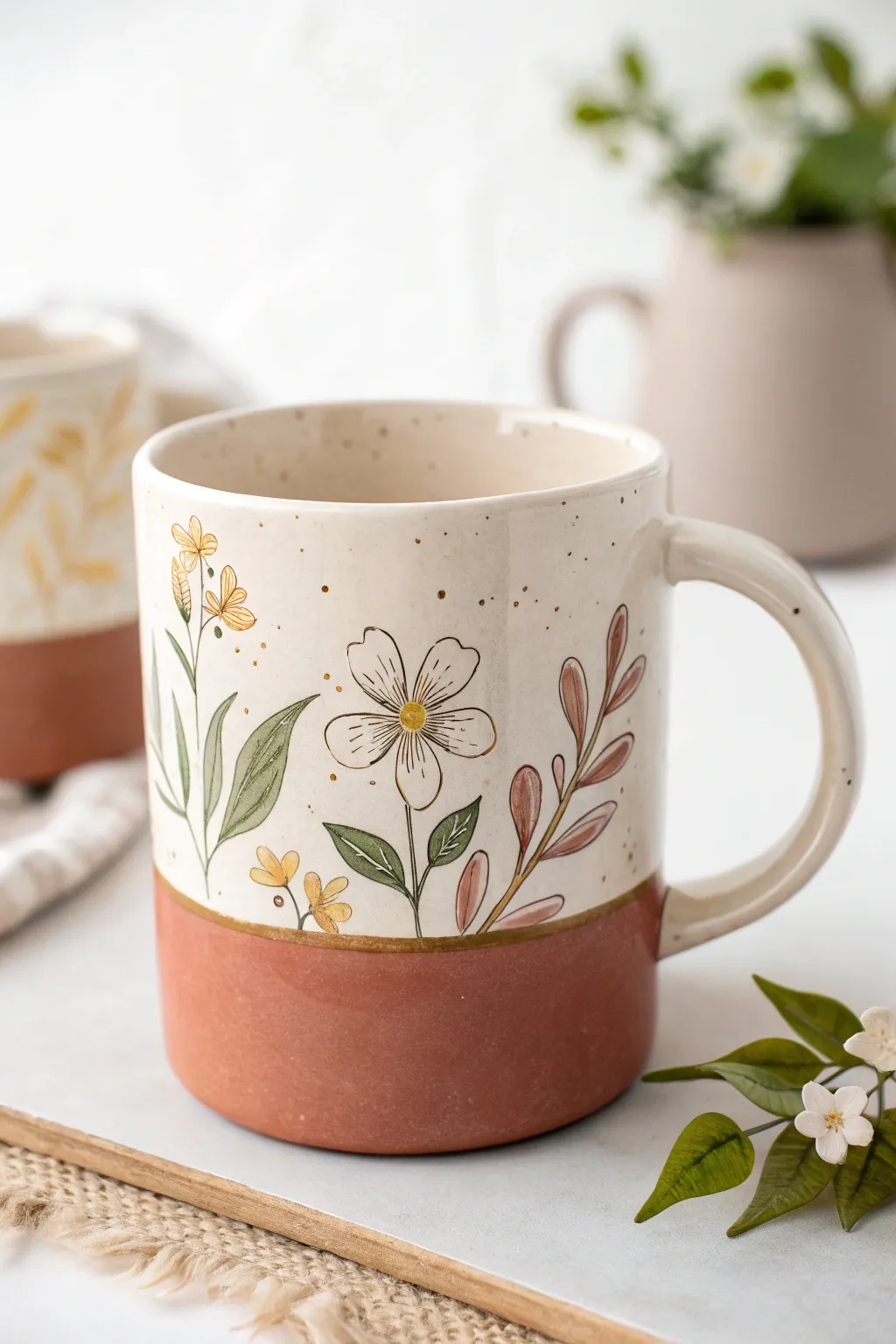
This charming project combines the rustic warmth of exposed terracotta with delicate floral illustrations for a mug that feels both earthy and elegant. The design features a dipped-look base topped with whimsical wildflowers, making it perfect for your morning coffee or as a thoughtful handmade gift.
Step-by-Step Tutorial
Materials
- White or cream ceramic mug (bisque or glazed)
- Pebeo Porcelaine 150 paints (or similar ceramic paints)
- Colors: Terracotta/Rust, Anthracite Black, Olive Green, Golden Yellow, Cream White
- Medium flat paintbrush (size 6-8)
- Fine liner paintbrush (size 0 or 00)
- Rubbing alcohol
- Cotton rounds
- Painter’s tape or masking tape
- Pencil (optional)
- Oven for baking
Step 1: Preparation & Base Block
-
Clean surface:
Begin by wiping down your entire mug with rubbing alcohol on a cotton round to remove any oils or fingerprints, which helps the paint adhere properly. -
Tape the line:
Measure about one-third of the way up from the bottom of the mug. Apply a strip of painter’s tape smoothly around the circumference, pressing down firmly to seal the edge to prevent bleeding. -
Paint the base:
Using your flat brush, apply the Terracotta/Rust paint to the bottom third of the mug below the tape. Use long, horizontal strokes to mimic a dipped glaze look. -
Second coat:
Allow the first layer to dry for about 15 minutes. If the coverage looks streaky, apply a second coat for an opaque, matte finish. I find two thin coats usually work better than one thick one. -
Remove tape:
Carefully peel off the painter’s tape while the paint is still slightly tacky to ensure a crisp, clean line. -
Paint the border (optional):
Using a very small amount of gold or bronze paint on a fine brush, you can add a thin separating line between the terracotta base and the white upper section, though the example shows a clean transition.
Uneven Lines?
If paint bleeds under your tape, wait for it to dry completely, then gently scrape the excess away with a toothpick or craft knife for a sharp edge.
Step 2: Painting the Florals
-
Plan placement:
Visualize your floral arrangement: a large central flower, tall stems on the left, and leafy branches on the right. You can lightly sketch this with a pencil if you’re nervous about free-handing. -
Outline the stems:
Dip your fine liner brush into the Anthracite Black (thinned slightly with water if needed). Paint delicate, thin lines for the stems rising from the terracotta base. -
Create the main flower:
For the central daisy, outline five distinct petals using the black liner. Keep the lines slightly organic and wavy rather than perfectly geometric. -
Fill the petals:
Mix a tiny bit of Cream White paint to fill in the petals of the central flower. Don’t worry about perfect coverage; a slightly translucent look adds to the watercolor effect. -
Paint the yellow buds:
On the left stems, use the Golden Yellow paint to dab small clusters of flowers. For the tiny buds, just press the tip of your brush down gently. -
Add the greenery:
Switch to Olive Green. Paint the leaves on the central flower’s stem and the tall grassy leaves on the left side. Paint the veins on the larger leaves with your fine black liner after the green dries. -
Create the reddish leaves:
For the branch on the right, mix a little Terracotta with white or pink to get a soft, dusty rose hue. Fill in the oval-shaped leaves on this stem. -
Add details:
Use the Golden Yellow to paint the center of the main daisy. Add tiny black dots inside the yellow center for texture. -
Speckling effect:
To achieve that speckled pottery look, dilute a small amount of brown or gold paint. Load an old toothbrush or stiff brush and flick the bristles with your thumb to spray tiny dots across the white background.
Level Up: Texture
Mix baking soda into the terracotta paint for the base layer. This creates a gritty, realistic clay texture that feels great in your hands.
Step 3: Finishing
-
Dry thoroughly:
Let the mug sit undisturbed for at least 24 hours to handle air-curing before baking. -
Bake to set:
Place the mug in a cold oven. Set the temperature to 300°F (150°C). Once the oven hits temperature, bake for 35 minutes. -
Cool down:
Turn off the oven and leave the mug inside to cool down gradually with the oven door closed. This prevents thermal shock and cracking.
Now you have a beautifully custom mug ready for your favorite warm drink
Textured Raised Flower Accents
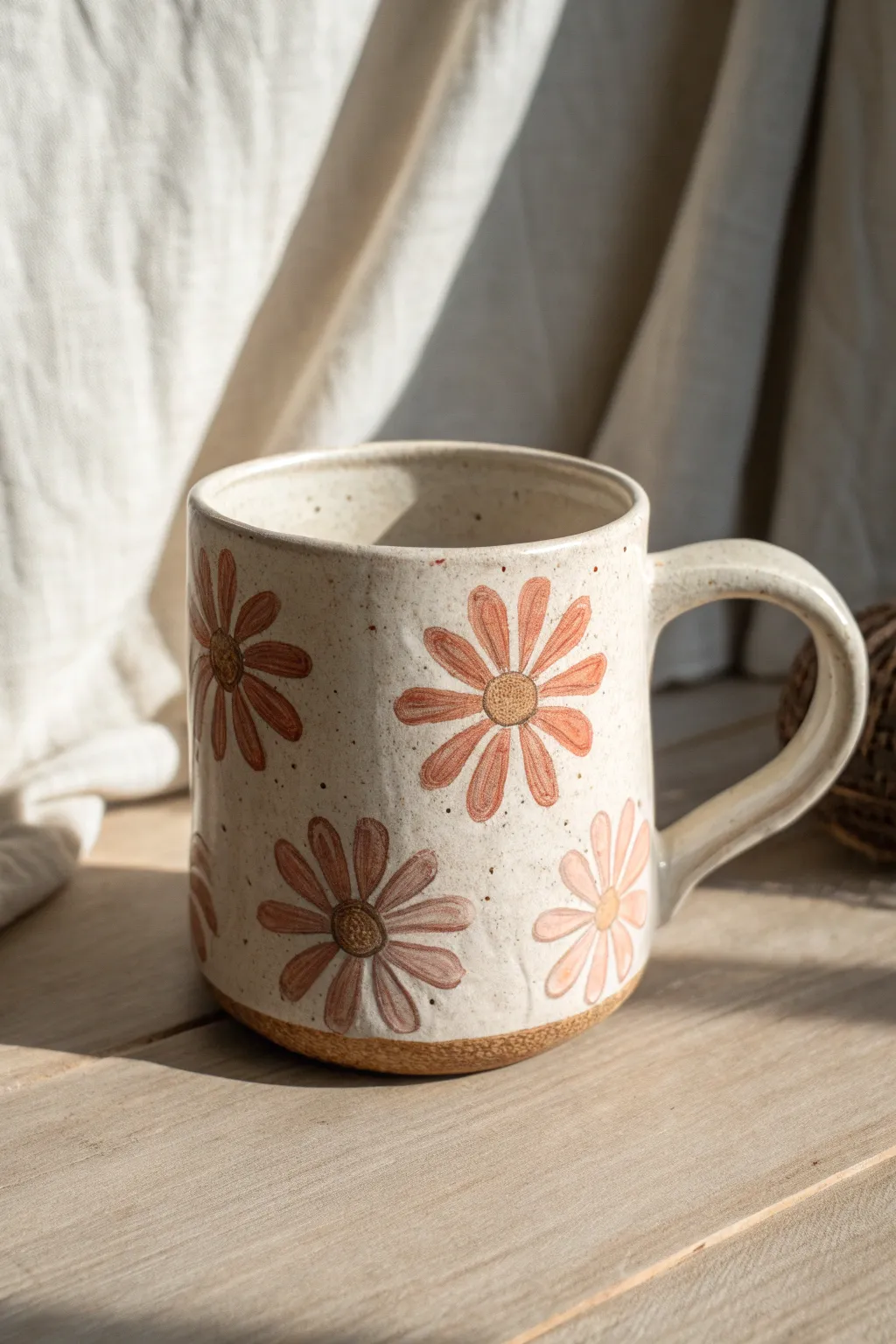
Capture the charm of retro ceramics by adding gentle texture and warmth to a plain mug with these raised floral accents. The creamy, speckled finish paired with muted rust and terracotta tones creates a cozy, handcrafted feel perfect for your morning brew.
Detailed Instructions
Materials
- Bisque-fired stoneware mug
- Underglaze (Rust/Terracotta)
- Underglaze (Muted Pink/Blush)
- Underglaze (Warm Brown)
- Underglaze (Cream/White for speckling)
- Clear matte dipping glaze or brush-on glaze
- Small round paintbrush (size 2 or 4)
- Slip trailer or fine-tip writer bottle (filled with slip or thickened underglaze)
- Sponge
- Pencil
- Old toothbrush (for speckling)
- Kiln (or access to a pottery firing service)
Step 1: Planning the Pattern
-
Clean surface:
Begin by wiping down your bisque mug with a slightly damp sponge to remove any dust or oils that might resist the glaze. -
Sketch placement:
Using a pencil, lightly mark the center points where you want your flowers to sit. Don’t worry about being too precise, as pencil lines will burn off in the kiln. -
Vary the positions:
Distribute your flower centers randomly around the mug, allowing some to wrap around the bottom edge or sit near the rim for a natural, scattered look.
Step 2: Creating Texture
-
Prepare the trailer:
Fill your slip trailer or fine-tip writer bottle with thick ceramic slip or a thickened underglaze mixture. -
Outline the petals:
Squeeze gently to pipe the outline of long, oval petals radiating from your marked centers. The goal is a slightly raised ridge, not a high peak. -
Fill slightly:
Add a small amount of slip inside the petal outlines to give them a slightly puffed, convex shape. -
Texture the centers:
Pipe a small circle for the flower center. While the slip is still wet, gently tap it with the tip of a dry brush to create a stippled, seed-like texture. -
Let it dry completely:
Allow the raised slip work to dry until it turns bone dry. This is crucial before applying color to prevent smearing the texture.
Slip Too Runny?
If your slip lines flatten out immediately, let the slip sit in an open container for an hour to evaporate excess water and thicken up before piping.
Step 3: Painting the Blooms
-
Mix your palette:
Pour out small amounts of your rust, blush pink, and warm brown underglazes onto a palette. -
Apply base petal color:
Using a small round brush, paint the petals. Alternate colors between flowers—make some predominantly rust and others a softer blush pink. -
Layering for depth:
I like to water down the underglaze slightly for a watercolor effect, letting the brush strokes follow the curve of the petals. -
Detail the centers:
Paint the textured centers with the warm brown underglaze. Dab the brush rather than stroking to ensure the pigment gets into the crevices of your stippling. -
Add definition:
Once the base color is dry, use a very fine liner brush and a darker rust or brown to outline the petals loosely, emphasizing the raised edges.
Variation Idea
Swap the clear glaze for a semi-opaque milky white glaze. It will break over the raised edges of the petals, highlighting the texture even more.
Step 4: Finishing Touches
-
Expose the clay body:
Leave the bottom quarter-inch of the mug unpainted to create a raw clay ‘foot’ that adds rustic contrast. -
Create speckles:
Dip an old toothbrush into slightly watered-down brown or iron oxide wash. Flick the bristles with your thumb to spray fine speckles over the entire mug surface. -
Glazing:
Apply a clear matte glaze over the entire piece (except the bottom foot). A dipping glaze works best to settle nicely around the raised textures without pooling too thickly. -
Final check:
Wipe the bottom foot clean with a sponge to ensure no glaze touches the kiln shelf, then fire according to your clay’s temperature guidelines.
Once fired, you will have a wonderfully tactile mug that feels as cozy in your hands as it looks on the shelf
Night Garden Florals on a Dark Base
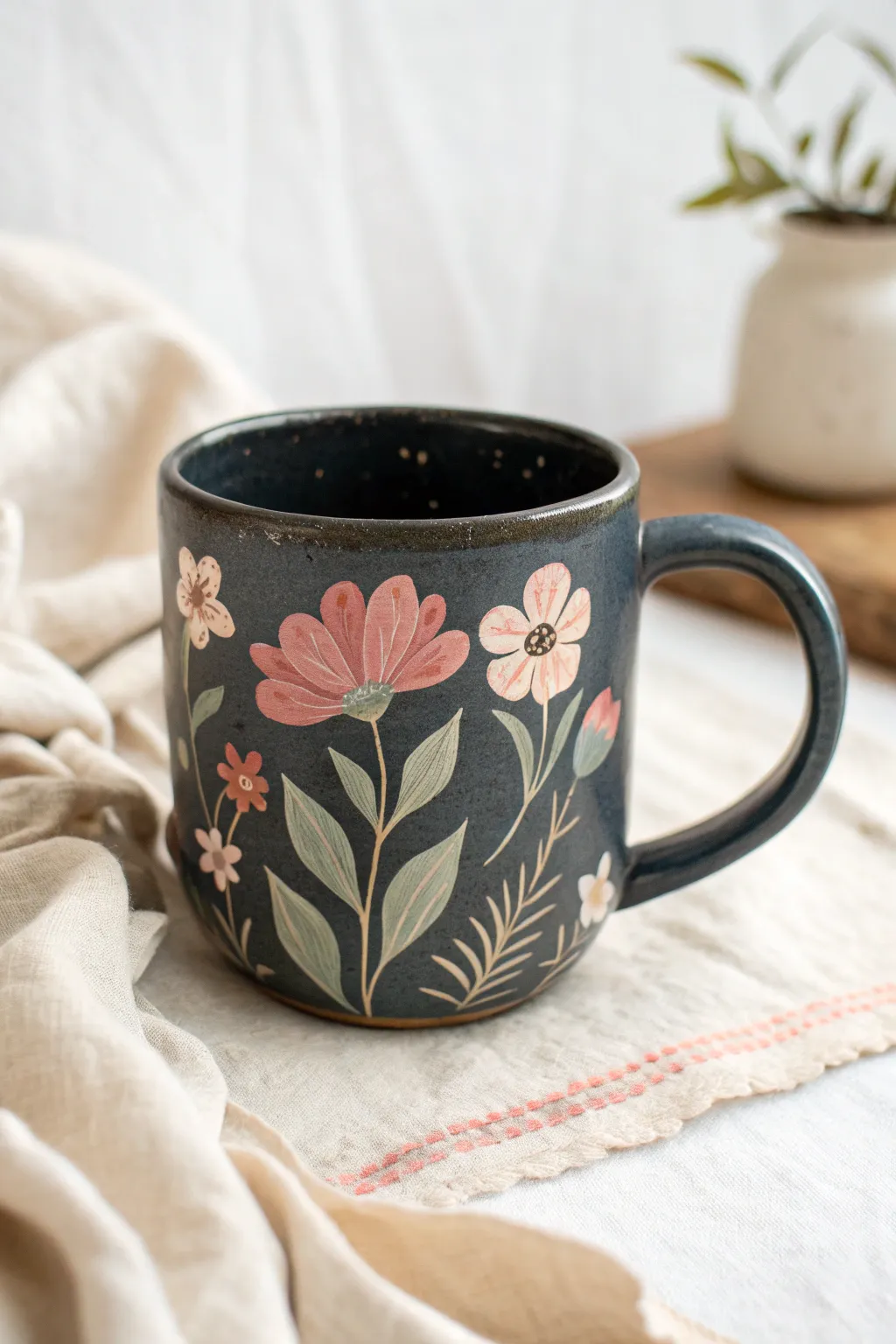
Capture the magic of moonlight on petals with this striking mug design. Using a dark matte base makes the soft pinks and creams of the wildflowers pop, creating an enchanting night garden effect right in your hands.
How-To Guide
Materials
- Ceramic mug (bisque or glazed, pre-fired)
- Deep midnight blue or charcoal underglaze or ceramic paint
- Assorted ceramic paints (muted pink, cream, sage green, terracotta)
- Fine liner brush (size 0 or 00)
- Small round brush (size 2)
- Glazing medium (if using ceramic paints)
- Clear food-safe glaze
- Pencil for sketching (optional)
- Water cup and paper towels
Step 1: Preparing the Canvas
-
Clean surface:
Begin by wiping down your mug with a damp sponge or cloth to remove any dust or oils. A clean surface ensures the base coat adheres perfectly without bubbling. -
Base coat application:
Using a soft, wide brush, apply your midnight blue or charcoal base color. For that deep, starry-night depth seen in the photo, apply 2-3 even coats, letting each dry until it’s no longer shiny before adding the next. -
Rim detailing:
When painting near the rim, you can leave a tiny sliver of the natural clay showing or thin out the paint slightly to create that rustic, worn edge look.
Step 2: Painting the Main Blooms
-
Sketch placement:
If you’re nervous about freehanding, use a pencil to lightly mark where the center of your three main flowers will sit. The pencil marks will burn off in the kiln. -
Central pink flower:
Starting with the large central flower, mix a muted dusty pink. Use your round brush to press and pull petals outward from the center, keeping them slightly irregular for a wildflower feel. -
Layering petals:
To give the flower dimension, add a second, shorter layer of petals near the center using a slightly lighter shade of pink while the first layer is still tacky. -
Cream daisy:
To the right, paint the cream-colored daisy. Use simple, ovular strokes for the petals. I find that leaving small gaps between petals helps the dark background peek through, adding definition without outlining. -
Small buds:
Add the smaller floral elements, like the tiny pink buds on the left and the tulip-shaped bud on the right, using the tip of your round brush.
Smudged Paint?
If you smudge a light petal onto the dark background, don’t wipe it! Let it dry completely, then carefully paint over the mistake with your dark background color.
Step 3: Foliage and Details
-
Greenery base:
Mix a sage green color. Using your fine liner brush, draw thin, curving stems connecting your flowers down toward the base of the mug. -
Painting leaves:
For the leaves, press down with the belly of the brush and lift as you pull away to create tapered tips. Vary the shades of green slightly by mixing in a touch of white for some leaves to create depth. -
Leaf details:
Once the green leaves are dry to the touch, use your finest liner brush with a very diluted white or cream to add delicate veins down the center of the larger leaves. -
Fern accents:
Fill in the empty negative spaces near the bottom with fern-like sprigs. Use quick, light flicks of a creamy yellow or beige paint to suggest dried grasses or wheat.
Add Texture
Use a technique called ‘sgraffito’: after painting the leaves, gently scratch through the wet paint with a needle tool to reveal the dark base or clay underneath for sharp veins.
Step 4: Finishing Touches
-
Flower centers:
Return to the main blooms. Add a cluster of small dots in the center of the cream flower using dark brown or black. For the pink flower, add a textured yellow or green center. -
Speckling (optional):
To mimic the starry texture on the dark background, you can gently flick a toothbrush with thinned white or light blue paint over the empty dark spaces. -
Drying:
Let the mug dry completely for at least 24 hours. The paint must be bone dry before any clear glaze is applied. -
Glazing:
Apply a clear, food-safe glaze over the entire design according to the manufacturer’s instructions. This seals the artwork and makes it shiny. -
Firing or baking:
Fire the mug in a kiln or bake it in a domestic oven, depending on the specific type of ceramic paint or underglaze you chose to use.
Enjoy your cozy new mug that brings a touch of midnight serenity to your morning coffee