
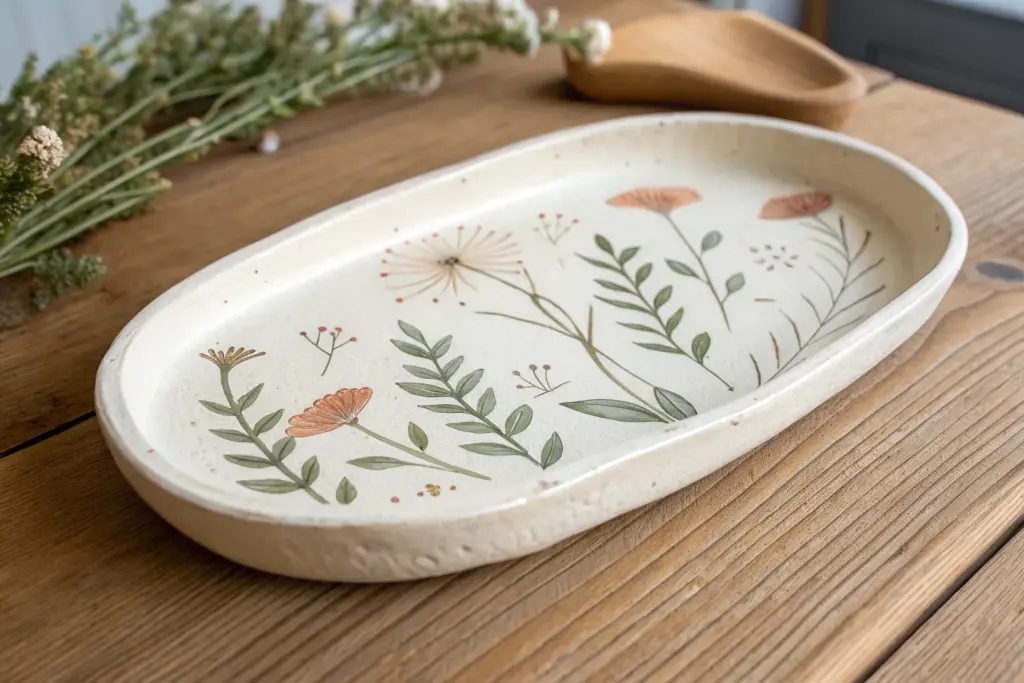
A good clay tray is that sweet spot where function meets “I made this with my own hands” charm. Here are my favorite aesthetic clay tray ideas—from timeless, minimal catchalls to whimsical statement pieces that still feel totally doable at your kitchen table.
Minimal Oval Catchall Tray
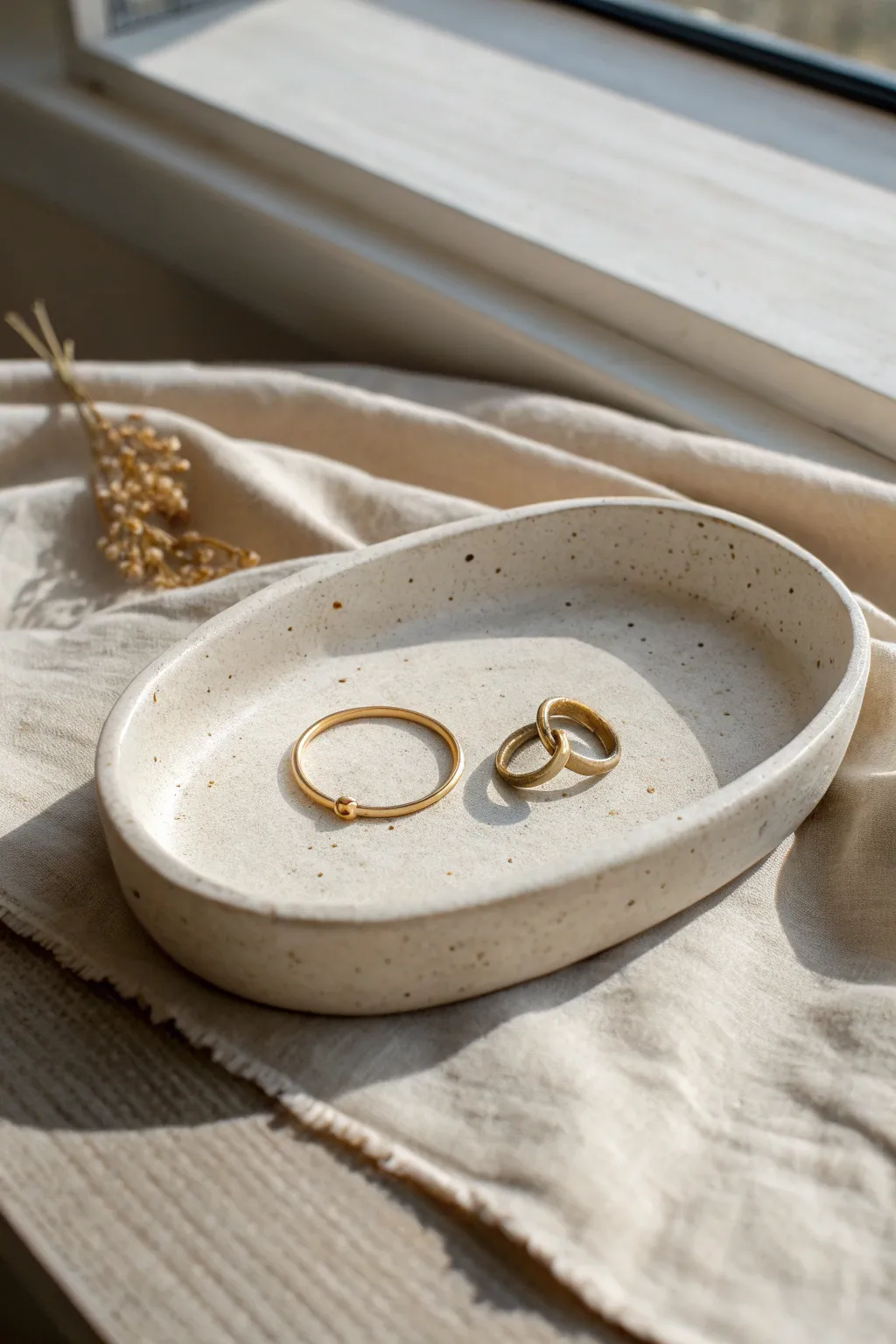
Embrace the beauty of minimalism with this understated oval catchall tray, perfect for showcasing your favorite rings. Featuring a gentle, organic rim and a classic speckled stone finish, this piece brings a touch of calm sophistication to any vanity or windowsill.
Step-by-Step Tutorial
Materials
- Speckled beige polymer clay (e.g., Fimo or Sculpey ‘Granite’ or ‘Sand’)
- Acrylic roller or glass bottle
- Oval cutter (or a paper template and craft knife)
- Parchment paper or ceramic tile
- Fine-grit sandpaper (400 to 1000 grit)
- Matte polymer clay varnish (optional)
- Soft paintbrush
- Oven
Step 1: Preparing the Base
-
Condition the clay:
Begin by taking a block of your speckled beige polymer clay. Warm it up in your hands, kneading and rolling it until it is soft, pliable, and free of cracks. This conditioning step is crucial for preventing breakage later. -
Roll out a slab:
Place the ball of clay onto parchment paper or a smooth ceramic tile. Using your acrylic roller, flatten the clay into an even slab. Aim for a thickness of about 1/4 inch (approx. 6mm) to give the tray sturdy weight. -
Cut the shape:
Press a large oval cookie cutter firmly into the slab. If you don’t have a cutter this size, simply sketch an oval on heavy paper, cut it out as a template, lay it on the clay, and trace around it carefully with a craft knife. -
Smooth the edges:
Remove the excess clay from around your oval. gently run your finger along the cut edge to soften any sharp corners left by the cutter or knife, ensuring the perimeter is nice and rounded.
Air Pocket Woes?
If you see a bubble while rolling or baking, pierce it gently with a needle and smooth the air out with your finger. This prevents unsightly bumps.
Step 2: Forming the Rim
-
Create a snake:
Take the excess clay you trimmed away and re-roll it into a long, thin rope (or ‘snake’) on your work surface. Try to keep the thickness consistent, roughly 1/4 inch thick. -
Measure the circumference:
Lay the clay rope loosely around the top edge of your oval base to gauge the length needed. Trim the rope to size, cutting the ends at a diagonal angle so they will join together seamlessly. -
Attach the rim:
Place the rope directly on top of the outer edge of the oval base. Gently press it down so it makes contact all the way around. -
Blend the seams: Outside:
Using a modeling tool or just your thumb, smear the clay from the rope downwards onto the base on the *outside* created wall. Do this all the way around until the seam disappears and it looks like one solid piece. -
Blend the seams: Inside:
Repeat the blending process on the *inside* of the tray. Smooth the clay from the rope down onto the floor of the tray. I find a curved modeling tool works best here to keep the inside curve gentle. -
Refine the shape:
Once the coil is blended, use your fingers to pinch and shape the wall slightly upwards. The goal is a low, subtle rim rather than a high bowl shape. Keep the look organic; it doesn’t need to be mechanically perfect.
Step 3: Finishing Touches
-
Smoothing texture:
Check the surface for fingerprints. Dip your finger in a tiny bit of baby oil or cornstarch and lightly buff the raw clay to smooth out any unwanted marks before baking. -
Bake the tray:
Transfer your parchment paper or tile to a baking sheet. Bake the tray according to the specific temperature and time instructions on your package of clay (usually around 275°F/135°C for 15-30 minutes). -
Cool completely:
Remove the tray from the oven and let it cool completely. Do not handle it while it’s hot, as polymer clay is slightly fragile until fully cured and cooled. -
Sand for smoothness:
Once cool, submerge the tray in a small bowl of water and wet-sand it using fine-grit sandpaper. Focus on the rim and any rough spots to achieve that stone-like, matte finish. -
Rinse and dry:
Wash off any milky residue from sanding and pat the tray dry with a lint-free towel. -
Optional sealing:
If you want extra protection, apply a very thin layer of matte varnish. However, for this raw stone look, leaving it unvarnished is perfectly acceptable.
Level Up: DIY Speckles
Can’t find speckled clay? Mix black pepper or decorative sand into plain white or beige clay to create your own custom textured stone effect.
Place your creation on a sunny ledge and enjoy the organized serenity it brings to your space
Organic Wavy-Edge Trinket Tray
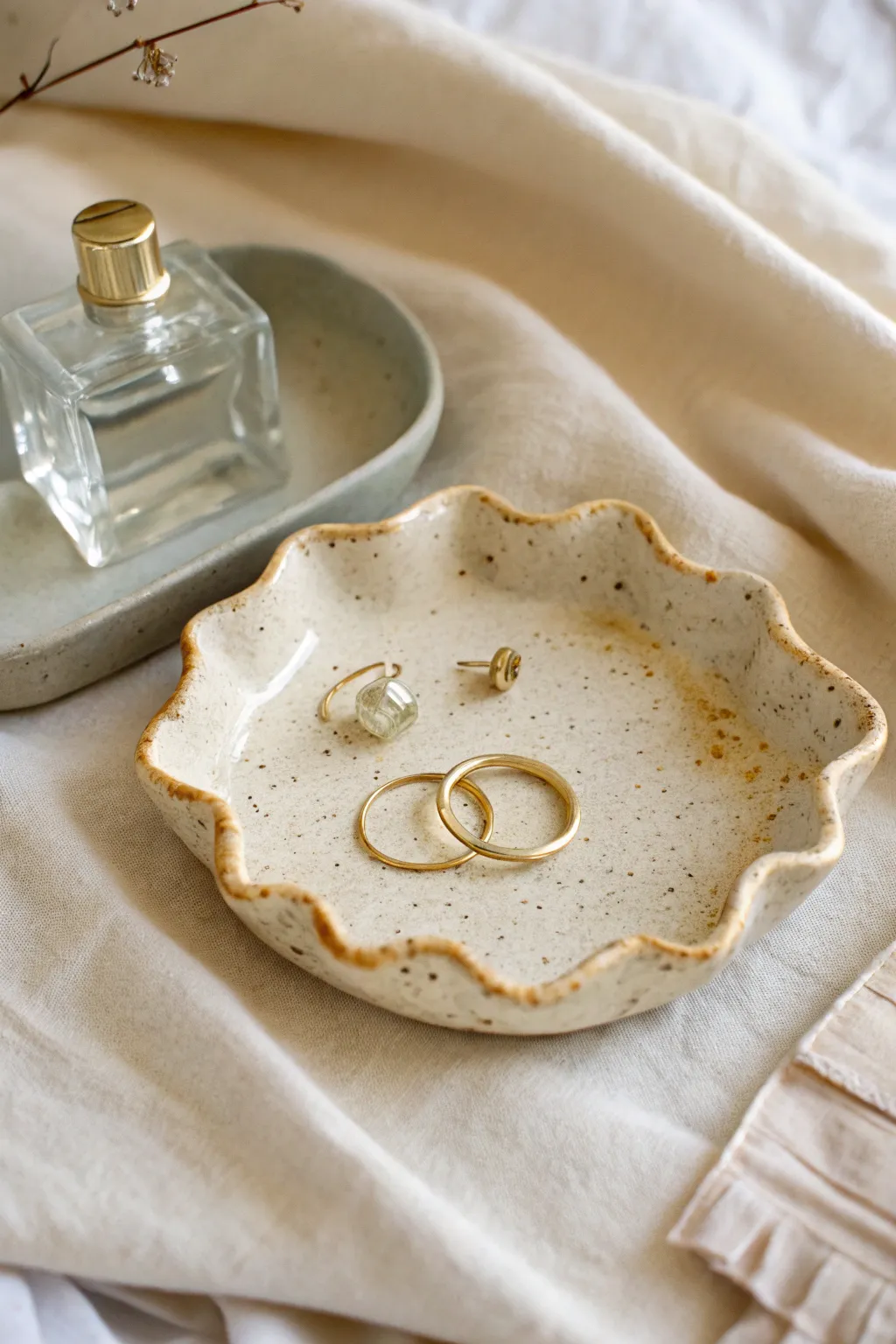
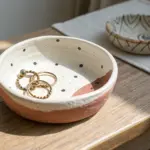
Bring an earthy, artisanal touch to your nightstand with this charming wavy-edged trinket dish. Mimicking the look of fired speckled stoneware, this project achieves a high-end ceramic aesthetic using accessible air-dry clay and clever painting techniques.
How-To Guide
Materials
- White air-dry clay (or polymer clay)
- Acrylic rolling pin or glass bottle
- Circle cookie cutter (approx. 4-5 inches) or a bowl to trace
- Craft knife
- Small bowl or curved palette to use as a drying form
- Sandpaper (fine grit)
- Acrylic paints: Cream/Off-white, Burnt Umber or Brown, Gold (optional)
- Old toothbrush or stiff bristle brush
- Small round paintbrush
- Glossy varnish or sealant (Mod Podge Gloss or polyurethane)
Step 1: Shaping the Clay
-
Condition the clay:
Take a handful of air-dry clay and knead it in your hands until it becomes soft, pliable, and free of cracks. If it feels too dry, add a tiny drop of water. -
Roll it out:
Place the clay on a smooth surface or a silicone mat. use your rolling pin to flatten it into an even sheet, approximately 1/4 inch thick. Aim for consistent thickness to prevent cracking later. -
Cut the circle:
Press your large circle cookie cutter firmly into the clay. If you don’t have a cutter, place a bowl upside down on the clay and trace around it with a craft knife to cut out your base circle. -
Create the waves:
Gently pinch the edges of the circle between your thumb and forefinger at regular intervals. Push the clay slightly upward and inward to create that organic, fluted scallop shape seen in the image. -
Refine the form:
Smoothing the edges with a bit of water on your finger helps remove any harsh angles or fingerprints. Ensure the rim looks soft and rounded rather than sharp. -
Set the shape:
Ideally, place your clay circle inside a slightly larger curved bowl to dry. This ensures the edges stay lifted and the dish retains a concave shape that will hold jewelry securely.
Pro Tip: Wet Finger Smoothing
Before drying, dip your finger in water and run it along the rim continuously. This melts the clay slightly, removing all jagged cuts and creating that professional fired-pottery smoothness.
Step 2: Drying and Refining
-
Initial dry time:
Allow the clay to dry undisturbed for at least 24-48 hours. I find that flipping it over gently halfway through the process helps the bottom dry evenly. -
Sand for smoothness:
Once fully cured and hard, take fine-grit sandpaper and lightly sand the entire surface. Pay special attention to the rim to ensure those waves feel smooth to the touch. -
Dust off:
Wipe the entire piece down with a slightly damp cloth or a dry brush to remove all the sanding dust before painting.
Troubleshooting: Curling Edges
If the edges curl unevenly while drying, gently weigh down the center of the dish with a small bag of rice or beans to keep the base flat against the drying form.
Step 3: Painting the Faux-Ceramic Look
-
Base coat:
Paint the entire dish (top, bottom, and sides) with a creamy off-white acrylic paint. You may need two coats for full opacity, letting each dry completely in between. -
Prepare the speckles:
Dilute a small amount of brown or burnt umber acrylic paint with water until it is quite fluid, almost like ink. -
Apply the splatter:
Dip an old toothbrush into the diluted brown paint. Hold it over the dish and run your thumb across the bristles to flick tiny speckles onto the surface. Practice on paper first to control the spray size. -
Let speckles dry:
Wait for the splatter effect to dry completely so you don’t smudge the tiny dots during the next step. -
Paint the rim:
Using a small round brush, carefully paint the very edge of the wavy rim with a golden-brown or burnt orange color. Let the line be slightly uneven to mimic the natural glazing of kiln-fired pottery. -
Seal the piece:
Apply a coat of glossy varnish or sealant over the entire dish. This gives it that shiny, glazed ceramic look and protects the paint from scratching. -
Final cure:
Let the varnish cure according to the manufacturer’s instructions before placing any jewelry inside.
Now you have a beautiful, custom spot to keep your favorite rings and earrings safe
Scalloped Border Dish in Soft Pastels
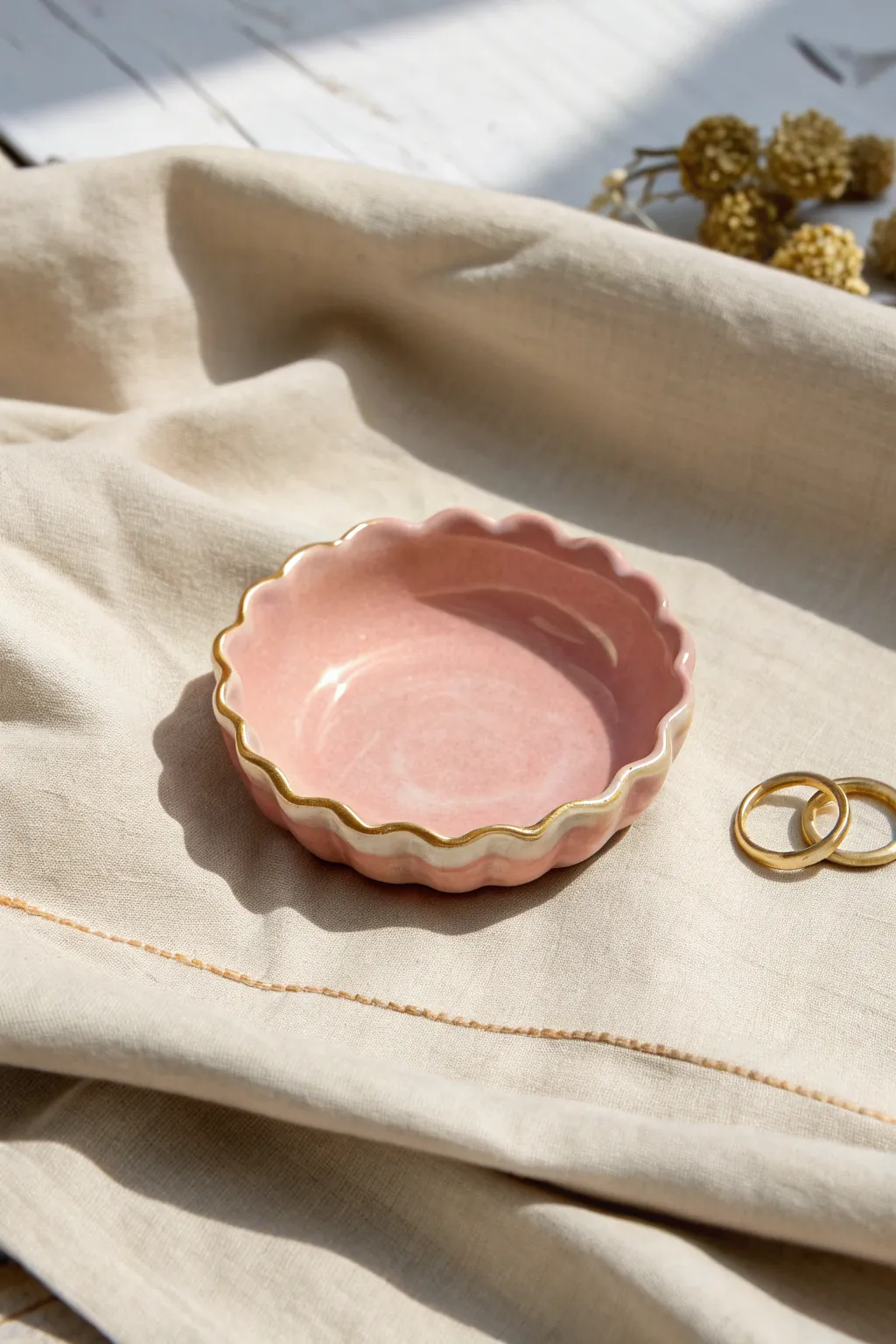
This charming trinket dish combines a soft blush pink hue with a luxurious gold rim, making it the perfect resting place for your favorite rings. The scalloped edges mimic the gentle curve of flower petals, creating a sweet and sophisticated piece suitable for any vanity.
Step-by-Step Tutorial
Materials
- Polymer clay (plain white or pre-colored soft pink)
- Acrylic rolling pin
- Circle cookie cutter (approx. 3-4 inches diameter)
- Small round piping tip or marker cap (for scalloping)
- Soft pink acrylic paint (if using white clay)
- Gloss glaze (polyurethane or resin-based)
- Gold leaf liquid paint or gold luster dust mixed with varnish
- Fine detail paintbrush
- Medium soft paintbrush
- Small oven-safe clear glass bowl (to use as a form)
- Craft knife
- Baking sheet and parchment paper
- Sandpaper (400 and 800 grit)
Step 1: Prepping the Clay Base
-
Condition the Clay:
Begin by warming your polymer clay in your hands. Knead and twist it repeatedly until it becomes soft, pliable, and free of cracks. If you are mixing colors to get that perfect blush pink, do it now until the streaks disappear. -
Roll the Slab:
Place your conditioned clay on a smooth work surface or silicone mat. Using the acrylic roller, roll the clay out evenly. Aim for a thickness of about 1/4 inch—too thin and it might crack; too thick and it looks chunky. -
Cut the Circle:
Position your large circle cutter on the clay slab. Press down firmly and twist slightly to get a clean cut, then carefully peel away the excess clay from the outside. -
Smooth the Edges:
Run your finger gently around the circumference of the clay circle to soften the sharp edge left by the cutter. A little water on your fingertip can help smooth out any tiny imperfections.
Uneven Scallops?
If the scallops look uneven during the shaping phase, flip the clay circle onto a piece of grid paper. Use the grid lines to guide where you press your tool for perfectly symmetrical spacing.
Step 2: Creating the Scalloped Rim
-
Marking the Scallops:
Take your small round piping tip or a marker cap. Gently press the side of the round object into the edge of the clay circle to create an indentation. You aren’t cutting through the clay, just pushing the edge inward to effect a curve. -
Repeat the Pattern:
Continue pressing these indentations evenly around the entire perimeter of the circle. Try to space them so they meet perfectly, creating a continuous flower-like border. -
Refine the Shapes:
Use your fingertip or a clay sculpting tool to gently smooth the peaks between the scallops. You want them to look soft and organic rather than sharp and mechanical. -
Form the Bowl Shape:
Pick up your clay circle and lay it gently inside your oven-safe glass bowl. Press it down lightly in the center so it takes the curved shape of the bowl. Don’t press the scallops too hard against the glass, or you’ll flatten the texture.
Marbled Effect
Before rolling, twist white and translucent clay together with your pink clay. Stop mixing before it’s fully blended to create gorgeous, realistic stone-like swirls in the final piece.
Step 3: Baking and Finishing
-
Bake the Piece:
Place the glass bowl (with clay inside) on a baking sheet. Bake according to your clay manufacturer’s instructions—usually around 275°F (130°C) for 15-30 minutes. Let it cool completely inside the oven to prevent thermal shock. -
Unmold and Sand:
Once fully cooled, pop the clay dish out of the glass bowl. If there are any rough spots on the rim, use the 400 grit sandpaper to gently buff them away, followed by the 800 grit for a silky finish. -
Apply Base Color:
If you used white clay, paint the entire dish with two coats of soft pink acrylic paint, allowing it to dry fully between layers. If your clay was pre-colored, you can skip this step. -
Glazing:
Apply a coat of gloss glaze over the entire surface of the dish. This gives it that ceramic-like shine shown in the photo. Let this layer dry completely according to the bottle’s instructions. -
Painting the Gold Rim:
Using your finest detail brush, carefully paint the very edge of the scallops with liquid gold leaf. I find that resting my pinky finger on the table helps steady my hand for this delicate line. -
Add Inner Rim Detail:
Extend the gold paint slightly down the inner wall of the scallop dips, just a millimeter or two, to exaggerate the thickness of the rim and add a touch of luxury. -
Final Seal:
Depending on the type of gold leaf used, you may need a final clear coat over just the rim to prevent tarnishing. Check your product label. Let the dish cure for at least 24 hours before use.
Place your delicate new dish on your dresser to hold your most treasured rings and earrings
Marbled Clay Swirl Tray
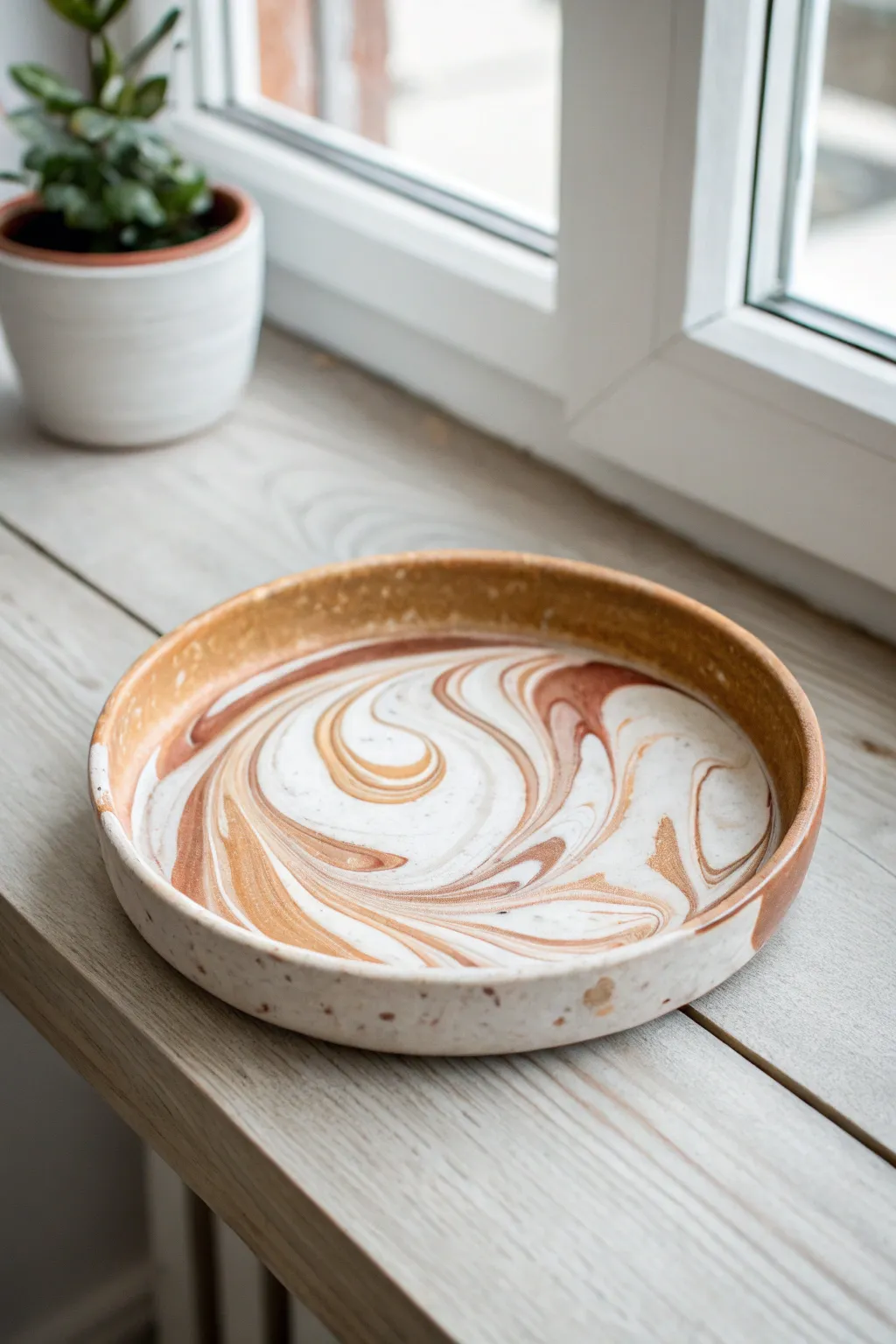
Capture the warmth of earthy tones with this sophisticated marbled tray that mimics the look of natural agate. The organic swirl of cream, tan, and rust creates a mesmerizing centerpiece perfect for holding jewelry or keys.
Detailed Instructions
Materials
- White polymer clay (or air-dry clay)
- Tan/terracotta polymer clay
- Dark reddish-brown polymer clay
- Rolling pin or acrylic roller
- Round cookie cutter or template (approx. 6-8 inches)
- Small bowl or knife for trimming
- Speckled clay (optional, for the rim)
- Gloss varnish or glaze
- Soft paintbrush
- Fine-grit sandpaper
Step 1: Preparing the Clay
-
Conditioning:
Start by warming up your clay blocks in your hands. Knead the white, tan, and reddish-brown clays separately until they are soft and pliable. -
Rolling Snakes:
Roll each color into long, even snakes about the thickness of a pencil. You will want roughly 60% white, 25% tan, and 15% reddish-brown to achieve the light, airy look in the reference image. -
Twisting:
Gather your clay snakes into a bundle. Twist them together tightly like a candy cane to begin combining the colors without blending them completely. -
Folding and Rolling:
Fold the twisted rope in half and roll it out into a snake again. Repeat this twist-fold-roll process 2-3 times. Be careful not to over-mix, or the colors will turn muddy.
Marbling Pro-Tip
Make the white ‘snakes’ slightly thicker than the colored ones. This ensures the white remains the dominant background color, preventing the darker colors from taking over.
Step 2: Creating the Swirl Pattern
-
Balled Up:
Roll your marbled snake into a tight ball. This compresses the layers and prepares the internal pattern for flattening. -
Flattening:
Using your acrylic roller or rolling pin, flatten the ball into a smooth slab about 1/4 inch thick. Roll in different directions to encourage the swirl pattern to spread organically. -
Cutting the Base:
Once you are happy with the swirl design, use your round cutter or a knife around a template to cut out a perfect circle for the tray base. -
Creating the Rim Strip:
For the rim, you can either use leftover marbled clay or a contrasting speckled clay like I prefer for that textured look. Roll a long, flat strip about 1 inch wide and long enough to wrap around the circumference of your base.
Level Up: Gold Speckles
Before baking, press tiny flakes of gold leaf into the clay surface or mix in a pinch of grounded black pepper for a natural, speckled stone effect.
Step 3: Assembly and Finishing
-
Attaching the Rim:
Wrap the long strip around the edge of the circular base. If using polymer clay, gently press the seams together. -
Blending Seams:
On the outside and inside edges where the rim meets the base, use a modeling tool or your finger to smooth the clay downward, blending the two pieces into a single solid unit. -
Smoothing:
Run your finger dipped in a little cornstarch (or water for air-dry clay) along the top edge of the rim to round it off and remove any sharp angles. -
Baking or Drying:
If using polymer clay, bake according to the package instructions (usually 275°F/135°C for 15-30 minutes). If using air-dry clay, let it sit in a cool, dry place for 24-48 hours. -
Sanding:
Once fully cured and cooled, use fine-grit sandpaper to smooth out any rough fingerprints or uneven edges on the rim. -
Glazing:
Apply a thin coat of gloss varnish to the interior of the tray to make those marbled colors pop and protect the surface from scratches. -
Final Cure:
Allow the glaze to dry completely before placing the tray on your windowsill or vanity.
Now you have a stunning, organic catch-all tray that brings a touch of earthy elegance to any room

The Complete Guide to Pottery Troubleshooting
Uncover the most common ceramic mistakes—from cracking clay to failed glazes—and learn how to fix them fast.
Speckled Stoneware-Look Tray
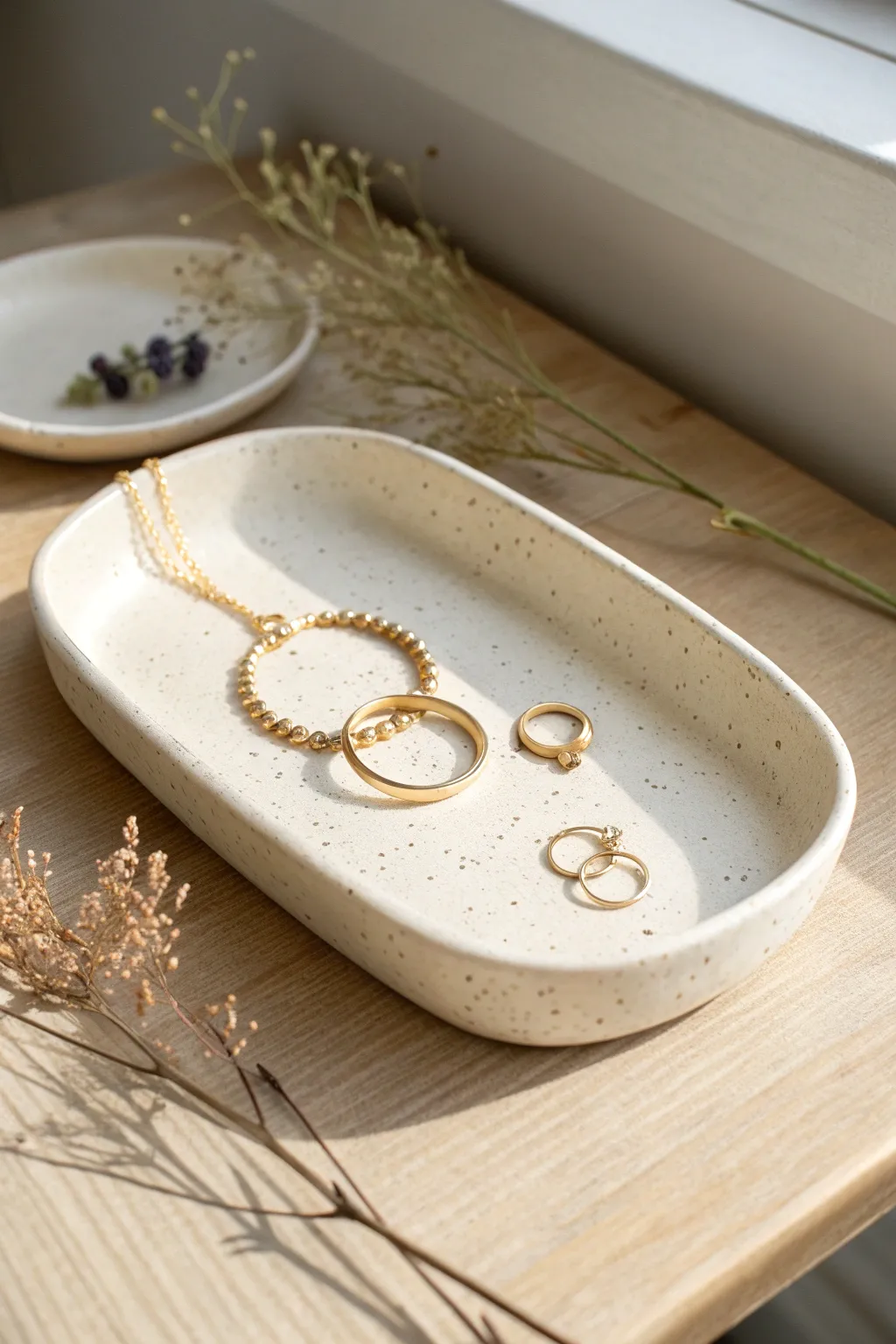
Achieve the high-end look of fired ceramic stoneware without needing a kiln using this polymer clay technique. This elegant oval tray features a soft cream base peppered with realistic “sediment” speckles, creating the perfect minimalist home for your daily gold jewelry.
Step-by-Step
Materials
- White or translucent polymer clay (approx. 2oz)
- Beige or ecru polymer clay (approx. 2oz)
- Black pepper (ground) or dried used coffee grounds
- Rolling pin or acrylic roller
- Oval template (paper or cardstock)
- Craft knife or scalpel
- Fine-grit sandpaper (400 and 800 grit)
- Matte water-based polyurethane varnish
- Paintbrush (soft bristle)
- Oven-safe baking tile or glass sheet
- Small bowl slightly larger than the oval (optional, for shaping)
Step 1: Preparing the Speckled Dough
-
Condition the clays:
Begin by warming up your white and beige polymer clays in your hands separately. Knead them until they are soft and pliable, ensuring there are no air bubbles trapped inside. -
Create a custom mix:
Mix the white and beige clay together to achieve a warm, creamy off-white shade. I like to aim for a 60% white to 40% beige ratio for that perfect natural stone color. -
Add the speckles:
Flatten your conditioned clay into a pancake. Sprinkle a pinch of coarse ground black pepper or thoroughly dried coffee grounds onto the surface. Don’t overdo it initially; you can always add more. -
Incorporate the texture:
Fold the clay over the speckles and knead thoroughly. Continue folding and rolling until the dark specs are evenly distributed throughout the entire clay ball. If the speckling looks too sparse, add another tiny pinch.
Step 2: Shaping the Form
-
Roll the slab:
Place your warm clay on a smooth work surface or parchment paper. Using your acrylic roller, roll the clay out to an even thickness of about 1/4 inch (6mm). Turn the slab occasionally to ensure it doesn’t stick. -
Position the template:
Lightly place your oval paper template onto the rolled clay slab. Gently smooth it down with your finger so it doesn’t shift during cutting. -
Cut the shape:
Holding your craft knife vertically, carefully trace around the template. Use long, smooth drawing motions rather than sawing back and forth to get the cleanest edge possible. -
Soften the edges:
Remove the excess clay. Dip your finger in a tiny bit of water (or baby oil) and run it gently along the cut edge to smooth out any sharpness or drag marks from the knife.
Specs Smearing?
If your black pepper specs are leaving streaks when you sand, your clay wasn’t baked long enough. Bake it for another 15 minutes, let cool, and try sanding again.
Step 3: Creating the Rim
-
Lift the edges:
To create the shallow dish shape, you need to curve the edges upward. You can gently pinch the perimeter with your thumb and forefinger, lifting the clay slightly. -
Use a form (Optional):
For a very uniform curve, you can lay your clay oval inside a large, shallow bowl or on a curved plate. Press it gently so it adopts the subtle curve of the container. -
Refine the lip:
Work your way around the oval, ensuring the wall height is consistent. The look we want is organic but intentional, not lumpy. -
Smooth the surface:
Check the inner surface for fingerprints. Lightly buff them away with a soft brush or your finger before baking.
Pro Tip: Realistic texture
Add semi-translucent clay to your mix. It adds depth and makes the ‘stone’ look less like plastic and more like high-end quartz or ceramic.
Step 4: Baking and Finishing
-
Bake the piece:
Place your tray on a baking tile or parchment-lined sheet. Bake according to your clay manufacturer’s instructions (usually around 275°F/135°C for 30 minutes per 1/4 inch of thickness). -
Cool down:
Once bakes, let the clay cool completely in the oven with the door slightly ajar. This gradual cooling helps prevent thermal shock cracking. -
Sand for stone texture:
Wet your fine-grit sandpaper. Gently sand the edges and surface under running water. This reveals more of the ‘speckles’ and gives the clay a true smooth-stone feel. -
Clean the dust:
Wash the tray with mild soap to remove any sanding residue and dry it thoroughly with a lint-free cloth. -
Seal the piece:
Apply a thin coat of matte water-based varnish. This seals the pepper/coffee inclusions and protects the surface while maintaining that natural, unglazed ceramic appearance.
Place your favorite gold rings on your new tray and enjoy the organic warmth it adds to your vanity
Terrazzo Confetti Aesthetic Tray
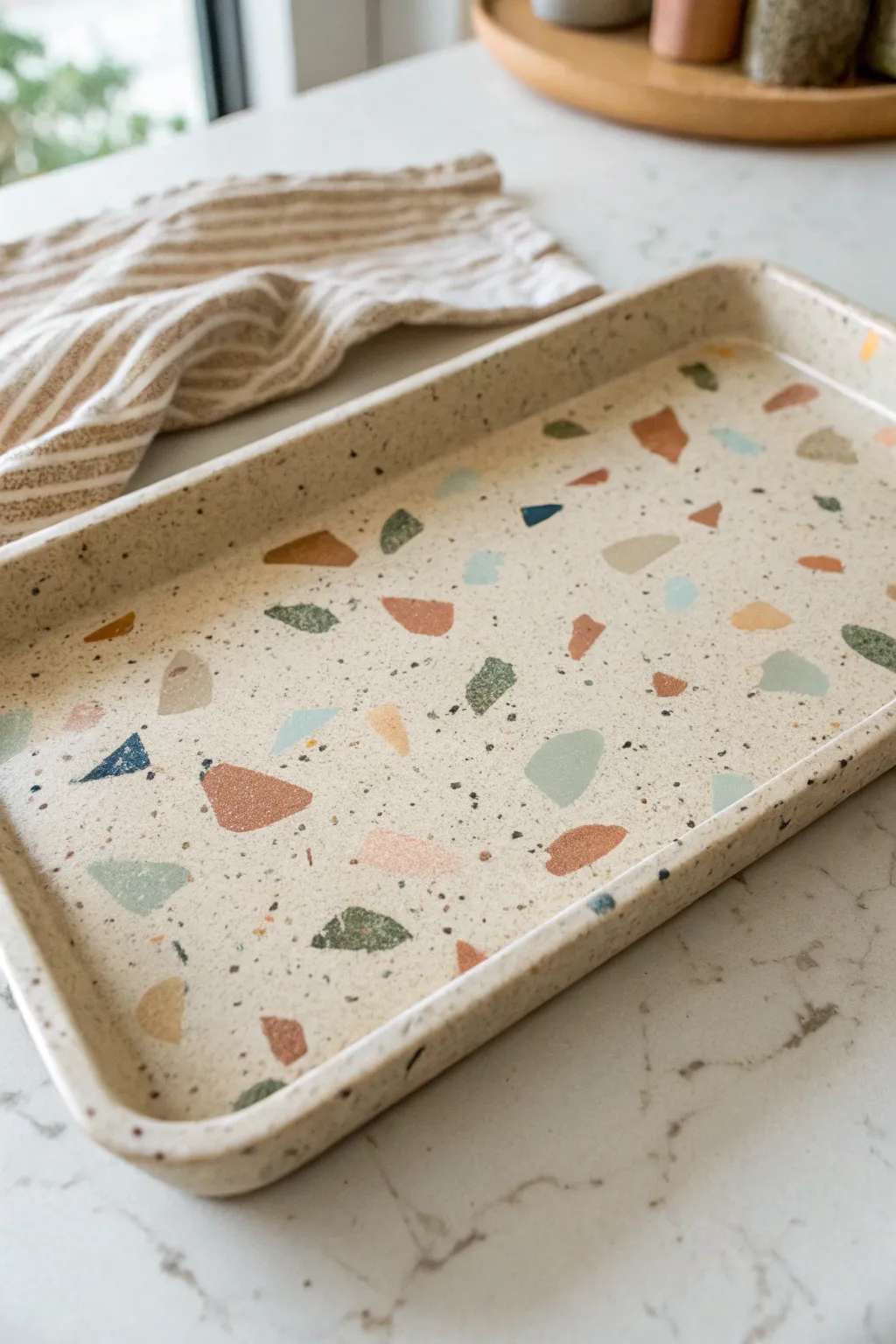
Bring a pop of modern playfulness to your home with this terrazzo-style clay tray. The speckled confetti effect is easier to achieve than it looks and creates a sophisticated, stone-like finish perfect for holding jewelry or keys.
How-To Guide
Materials
- Polymer clay (Beige/Ecru for base)
- Polymer clay (Various colors: terra cotta, sage green, mustard, teal, slate blue)
- Acrylic rolling pin
- Clay slicer or craft knife
- Rectangular clay cutter (or template and knife)
- Parchment paper or ceramic tile work surface
- Fine-grit sandpaper (400 to 1000 grit)
- Matte or satin varnish (optional)
- Oven
Step 1: Preparing the Chips
-
Condition the colors:
Start by conditioning your colored clays individually until they are soft and pliable. You want a palette that includes earthy tones like terra cotta, sage, and mild yellows. -
Flatten the colors:
Roll each colored piece of clay out very thinly, about the thickness of cardstock. It doesn’t need to be neat or uniform. -
Bake the thin sheets (Partial Cure):
Place the thin sheets on a baking tray and bake them for about 5-8 minutes at the manufacturer’s recommended temperature. This partial cure makes them crumbly rather than squishy. -
Create the confetti:
Once cool, chop the baked sheets into small, irregular shards using your blade. Vary the sizes—some tiny specks and some larger chunks—to mimic real stone aggregate.
Uneven Chips?
If your chips are sticking up after baking, use a coarser grit sandpaper (around 220) to level the surface aggressively before moving to finer polishing papers.
Step 2: Building the Base
-
Condition the base clay:
Take a large block of your beige or Ecru clay and condition it thoroughly. It needs to be soft enough to accept the inclusions. -
Mix in the speckles:
Take a pinch of raw black pepper or very finely chopped raw black clay and mix it directly into the beige block for that subtle ‘granite’ dust look seen in the background. -
Roll out the slab:
Roll the beige clay into a thick slab, roughly 1/4 inch thick. Make sure it’s slightly larger than your intended final tray dimensions. -
Apply the chips:
Scatter your chopped baked chips onto the surface of the raw beige slab. Press them gently so they stick, ensuring a good distribution of colors. -
Embed the pattern:
Place a piece of parchment paper over the confetti-covered slab to prevent sticking, then roll over it with your acrylic roller. Apply firm pressure to force the chips flush with the surface. -
Smooth the surface:
continue rolling until the surface is completely level and the chips are fully embedded. If the slab has gotten too thin, you can fold it and roll it again, but this will distort the sharp edges of your chips.
Pro Tip: Depth trick
Mix some translucent clay into your beige base. When sanded, this creates visual depth, making the colorful chips look like they are floating deep inside the stone.
Step 3: Shaping and Finishing
-
Cut the shape:
Use a large rectangular cutter or a paper template with a craft knife to cut out the straight-sided rectangle base. -
Form the rim:
Roll a long snake of beige clay to create the walls. Flatten it into a long strip about the same thickness as your base. -
Attach the rim:
Wrap the strip around the edge of your rectangular base. Use a blending tool or your finger to smooth the seam where the wall meets the floor on the inside and outside. -
Refine the edges:
Gently curve the corners so they are rounded rather than sharp 90-degree angles. Smooth the top lip of the rim so it looks polished. -
Final Bake:
Bake the assembled tray according to package directions, usually 275°F (135°C) for 30-45 minutes depending on thickness. -
Sanding:
Once fully cooled, wet-sand the piece under running water. Start with 400 grit to reveal the chips clearly and proceed to higher grits for a smooth finish. This step is crucial for the terrazzo look. -
Seal (Optional):
Create a slight sheen by applying a thin layer of water-based polyurethane or glaze if you prefer a glossy look over the natural matte finish.
Now you have a chic, speckled catch-all that looks just like real terrazzo stone


What Really Happens Inside the Kiln
Learn how time and temperature work together inside the kiln to transform clay into durable ceramic.
Sun and Moon Minimal Boho Tray
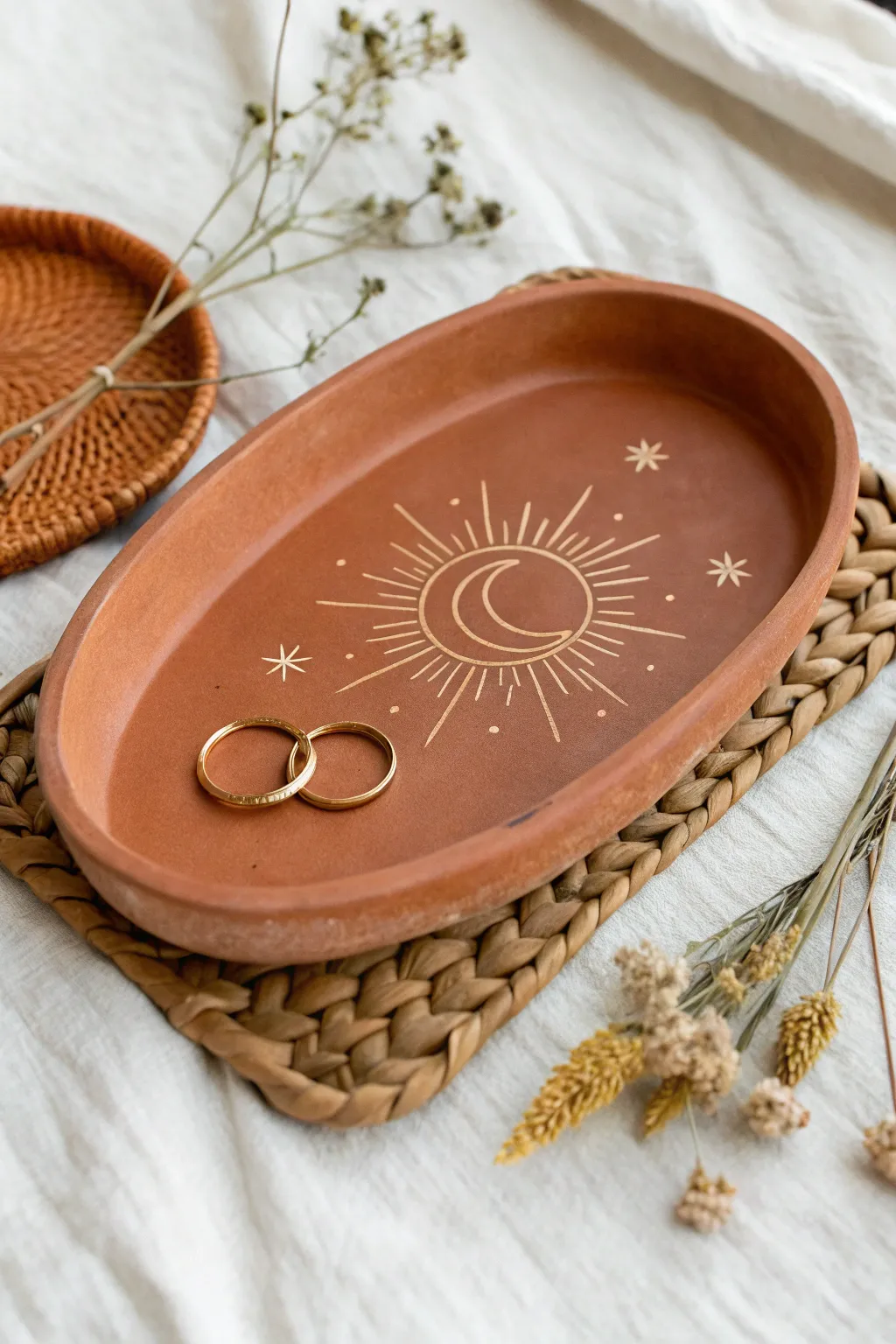
Capture the magic of the cosmos with this earthy, bohemian-style oval tray featuring a delicate line-art sun and moon design. The warm terracotta hues combined with crisp white detailing make this the perfect resting spot for your favorite everyday jewelry pieces or small crystals.
How-To Guide
Materials
- Air-dry clay (terracotta color)
- Small rolling pin
- Oval template (paper or cardboard)
- Craft knife or scalpel
- Small bowl of water
- Sponge
- Fine-grit sandpaper (220-400 grit)
- White or cream acrylic paint (or a fine-tip paint pen)
- Fine detail paintbrush (size 00 or 0)
- Matte varnish or sealant
- Pencil (optional)
Step 1: Shaping the Base
-
Condition the clay:
Start by taking a generous handful of terracotta air-dry clay and kneading it in your hands until it becomes soft, pliable, and free of cracks. -
Roll it out:
Using your rolling pin, flatten the clay into a smooth slab. aim for a consistent thickness of about 1/4 inch (6mm) to ensure durability without being too chunky. -
Cut the shape:
Place your paper oval template onto the clay slab. Use your craft knife to carefully trace around the template, cutting away the excess clay at a 90-degree angle for a clean edge. -
Create the rim:
Roll a separate long snake of clay, roughly the thickness of a pencil. This will become the raised edge of your tray. -
Attach the rim:
Score the outer edge of your oval base and the underside of the clay snake with a craft knife (making little hashtag marks). Apply a little water to the scored areas to create a ‘slip’ or glue. -
Blend the seams:
Press the snake coil onto the edge of the base. Use your thumb or a modeling tool to smear the clay from the coil down onto the base on both the inside and outside, blending the seam until it disappears completely. -
Smooth everything out:
Dip your finger or a sponge into water and gently run it over the entire surface, particularly the rim, to remove fingerprints and smooth out any bumps. I like to spend extra time here to get that professional finish.
Step 2: Finishing and Design
-
Let it dry completely:
Allow your tray to dry for 24-48 hours. Turn it over halfway through so the bottom dries evenly. It will lighten in color when fully dry. -
Sand for perfection:
Once bone dry, take your fine-grit sandpaper and gently sand the rim and surface to remove any remaining rough spots or sharp edges. -
Dust off:
Wipe the tray down with a slightly damp cloth or dry brush to ensure no clay dust remains before painting. -
Sketch the celestial design:
Lightly sketch the central moon crescent and surrounding sunburst rays with a pencil. Don’t press too hard; you just want a faint guide. -
Outline the crescent:
Using your fine detail brush and cream acrylic paint (or a paint pen), carefully paint the double-lined crescent moon in the center. -
Add the rays:
Paint fine lines radiating outward from the moon. Alternate between longer and shorter rays to create that dynamic sunburst effect. -
Paint the stars:
Add small four-point stars and tiny dots scattered around the main design to fill out the negative space on either side. -
Seal the piece:
After the paint is fully dry, apply a coat of matte varnish over the entire tray. This protects the paint from scratching and seals the clay against moisture.
Smooth Moves
Use a little bit of baby oil on your fingertips during the final smoothing stage. It eliminates fingerprints without adding excess water that can weaken the clay.
Make it Gold
Instead of cream paint, try using liquid gold leaf or metallic gold acrylic for the celestial design. It adds a luxurious shimmer that looks amazing against the terracotta.
Place your rings in their new celestial home and enjoy the handmade warmth it brings to your space
Cloudy Sky Gradient Tray
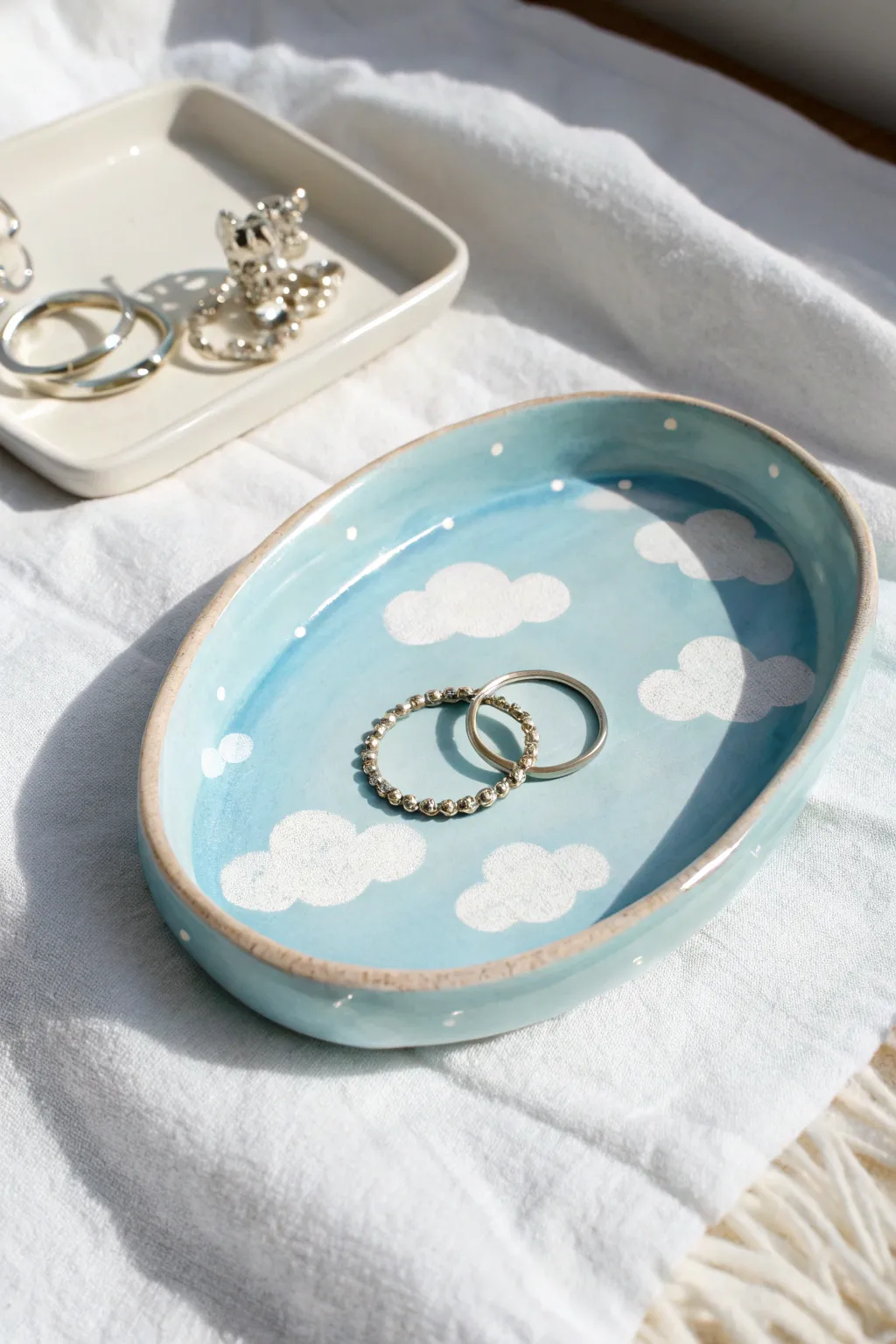
Bring a little piece of the sky into your room with this whimsical, hand-sculpted trinket dish. The soft blue gradient and fluffy white clouds create a serene resting spot for your favorite rings and small treasures.
Step-by-Step Guide
Materials
- Air-dry clay or polymer clay (white)
- Acrylic paints (light blue, teal/turquoise, white)
- Rolling pin
- Oval template (paper or cardstock)
- Craft knife or clay cutter
- Small bowl of water
- Sponge or smoothing tool
- Fine grit sandpaper
- Small flat paintbrush
- Detail paintbrush
- Glossy varnish or sealant (Mod Podge or polyurethane)
Step 1: Sculpting the Base
-
Prepare the Clay:
Start by kneading a generous ball of clay until it is warm, soft, and pliable. This conditioning step prevents cracks from forming later. -
Roll the Slab:
Using your rolling pin, flatten the clay into a smooth slab about 1/4 inch thick. Try to keep the thickness even across the entire surface. -
Cut the Shape:
Place your oval template onto the slab. Using a craft knife, carefully trace around the edge to cut out your tray shape. Remove the excess clay. -
Form the Rims:
Gently lift the edges of the oval upward using your fingertips to create a slight lip or rim. Pinch and smooth the clay as you go to shape a shallow bowl form. -
Smooth the Edges:
Dip your finger or a sponge into a little water and run it along the rim and the interior surface. This will erase any fingerprints and create a professional, seamless finish. -
Let it Dry:
Allow the clay to dry completely according to the package instructions. Air-dry clay typically takes 24-48 hours, while polymer clay will need baking. -
Sand for Perfection:
Once fully cured, use fine-grit sandpaper to gently buff away any rough spots on the rim or surface. Wipe away the dust with a barely damp cloth.
Cracked Clay Fix
If small cracks appear while drying, don’t panic. Make a paste of clay and water (slip) to fill the gaps, let dry, and sand smooth.
Step 2: Painting the Sky
-
Mix the Base Blue:
Create a nice sky blue by mixing a drop of teal into your white acrylic paint. You want a very pale, airy color. -
Apply the Base Coat:
Using a flat brush, paint the entire interior of the dish with your mixed blue. I like to apply two thin coats rather than one thick one for better coverage. -
Create a Gradient:
While the paint is still slightly wet, add a touch of darker blue to the edges and blend it inward toward the center to create subtle depth. -
Paint the Rim:
Paint the top edge of the rim. You can leave the outside natural for an earthy look, or paint it blue to match the inside.
Step 3: Adding Clouds & Stars
-
Start the Clouds:
Load a detail brush with pure white paint. Paint small, organic cloud shapes by dabbing the brush to create fluffy, rounded edges. -
Layer the White:
Once the first layer of clouds is dry, go over them again with more white paint. This makes the clouds pop against the blue background. -
Add Tiny Stars:
Using the very tip of your detail brush or a toothpick, dot tiny white speckles randomly across the blue sky to represent distant stars. -
Seal the Artwork:
Finally, protect your beautiful painting with a coat of glossy varnish. This gives the tray a ceramic-like shine and protects it from scratches.
Fluffier Clouds
Instead of a brush, use a tiny piece of torn sponge dipped in white paint to dab on the clouds for a soft, textured texture.
Place your new celestial dish on your nightstand and enjoy the peaceful vibe it brings to your space

TRACK YOUR CERAMIC JOURNEY
Capture glaze tests, firing details, and creative progress—all in one simple printable. Make your projects easier to repeat and improve.
Strawberry Pattern Cottagecore Tray
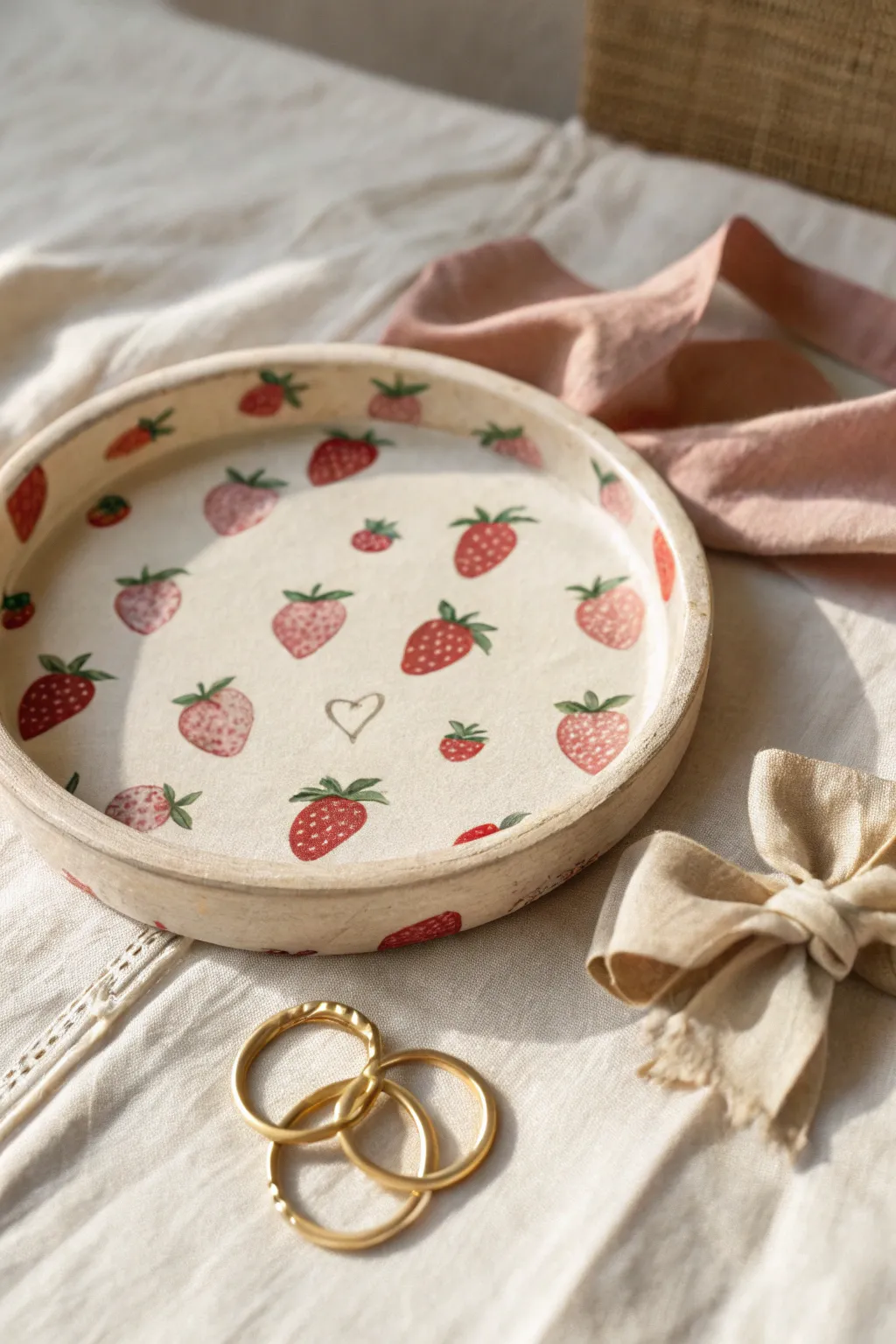
Capture the essence of summer markets with this darling cottagecore tray, featuring whimsical hand-painted strawberries and a delicate heart motif. Its imperfect, textured edges gives it a cozy, rustic charm perfect for displaying your favorite jewelry.
How-To Guide
Materials
- Air-dry clay (white or cream)
- Wide-mouth bowl or rolling pin
- Circle template (or large plate)
- Clay knife or craft blade
- Sponge and cup of water
- Acrylic paints (Red, Pink, Green, White, and Brown)
- Fine detail paintbrushes (Size 0 and 2)
- Matte or satin varnish/sealant
- Fine grit sandpaper
Step 1: Sculpting the Base
-
Prepare the Clay:
Begin by kneading a large ball of air-dry clay until it is warm and pliable. This conditioning step prevents cracking later on. Aim for a ball slightly larger than a grapefruit. -
Roll the Slab:
On a smooth surface or canvas mat, roll the clay out to an even thickness of about 1/4 inch. Ensure you roll from the center outward in all directions to maintain uniform density. -
Cut the Circle:
Place your circle template or a dinner plate over the clay slab. Use your craft knife to trace around the edge, cutting out a clean, perfect circle for the tray’s base. -
Form the Rim:
Roll a long snake of clay, ensuring it is thick enough to form a sturdy wall (about 1/2 inch thick). Lay this coil directly on top of the outer edge of your circular base. -
Blend the Seams:
This is crucial: Using your thumb or a modeling tool, drag clay from the coil down onto the base on the inside, and from the base up onto the coil on the outside. Blend until the seam completely disappears. -
Smooth the Surfaces:
Dip a sponge lightly in water (wring it out well) and run it over the entire surface. Use this moment to soften the top edge of the rim, creating that gentle, rounded look seen in the photo. -
Dry Completely:
Allow the tray to dry for at least 24-48 hours. Flip it halfway through the drying process to ensure the bottom dries evenly and doesn’t warp. -
Refine the Shape:
Once fully bone dry, use fine-grit sandpaper to gently smooth out any rough patches or fingerprints, paying special attention to the rim.
Rim Separation?
If the clay coil starts separating from the base while drying, wet the crack slightly and fill it with a soft ‘slip’ (clay mixed with water into a paste), then smooth over.
Step 2: Painting the Strawberries
-
Base Tone:
The clay itself acts as the background. If your clay dried greyish, paint a coat of warm cream or parchment white over the entire tray first. -
Mix Your Reds:
Prepare two shades of red acrylic: a bold, true crimson and a softer, milky pink. This variation adds depth and interest to the pattern. -
Paint Berry Shapes:
Using a size 2 brush, paint scattered strawberry shapes (essentially rounded triangles) across the interior and the outer rim. Alternate between the red and pink shades randomly. -
Add Greenery:
Once the red layer is dry, mix a deep sap green. With a fine tip brush, paint three small leaves at the top of each berry, pulling the brush upward to create little stems. -
Seed Details:
Use your smallest brush (size 0) or even a toothpick. Dip it into creamy white paint and carefully dot small seeds onto the red and pink luscious berries. -
The Heart Accent:
Find a small empty space near the center of the tray. Using watered-down grey or brown paint, sketch a loose, thin outline of a heart for a personalized touch. -
Protect Your Work:
Wait for the paint to cure completely. Finally, seal the entire piece with two thin coats of matte varnish to protect the design from moisture and dust.
Make it Vintage
Mix a tiny amount of brown paint with water to create a wash. Brush it over the dried tray and wipe it off immediately with a paper towel to antique the crevices.
Now your charming tray is ready to keep your trinkets safe and add a touch of sweetness to your dresser
Lily Pad Pond-Inspired Tray
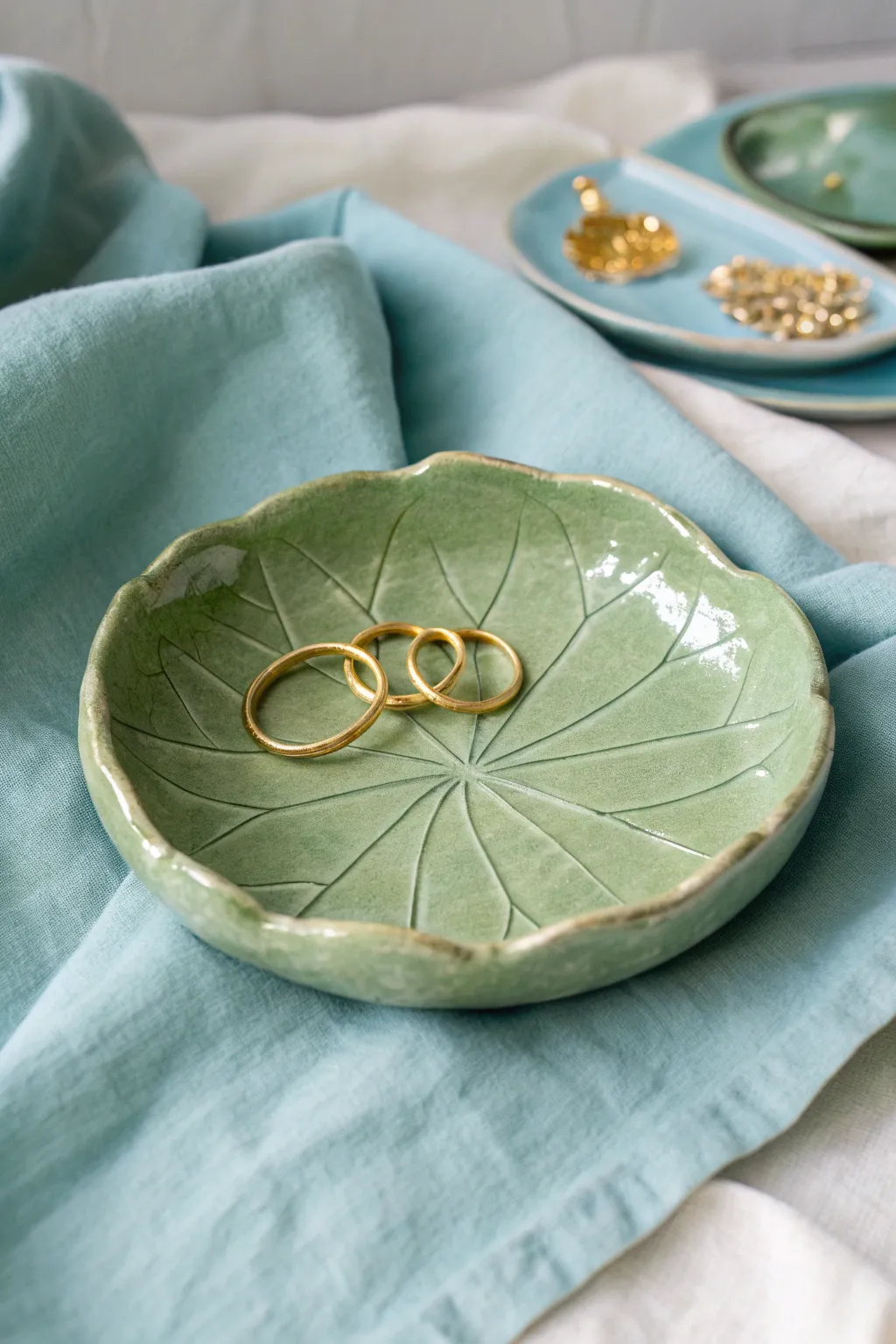
Bring the tranquility of a pond indoors with this ceramic-look lily pad tray. Featuring gentle, scalloped edges and realistic vein carvings, the finished piece shines with a glassy glaze that beautifully mimics water while holding your favorite rings.
Detailed Instructions
Materials
- Air-dry clay (white or light grey)
- Rolling pin
- Parchment paper or canvas mat
- Needle tool or toothpick
- Fettling knife or X-Acto knife
- Sponge
- Small bowl (for shaping)
- Acrylic paints (Mint Green, Sage Green, White)
- High-gloss varnish or resin
- Fine grit sandpaper
- Paintbrushes (flat and fine liner)
Step 1: Shaping the Pad
-
Condition the clay:
Begin by taking a handful of air-dry clay and kneading it in your warm hands until it feels pliable and smooth, ensuring there are no air bubbles trapped inside. -
Roll it out:
Place the clay on parchment paper or a canvas mat. Use your rolling pin to flatten it into an even slab, aiming for a thickness of about 1/4 inch so it’s sturdy but elegant. -
Cut the circle:
Find a circular template, like a bowl or a lid, that is roughly 4-5 inches in diameter. Place it gently on the clay and trace around it with a needle tool to create your base shape. -
Sculpt the edges:
Using your knife or even just your fingers, gently push and pinch the edges of the circle inward at irregular intervals to create a wavy, organic scalloped rim. -
Refine the rim:
Dip your finger in a little bit of water and run it along the cut edge to smooth out any harsh angles or crumbles; you want the lily pad to look soft and natural. -
Add the curve:
Carefully lift your clay circle and drape it inside a shallow bowl. Press gently so it takes on a slight concave curve, preventing your jewelry from rolling off later.
Clay Cracking?
If your clay cracks while drying, mix a tiny bit of fresh clay with water to make a paste (slip) and fill in the cracks, then sand smooth once dry.
Step 2: Detailing & Texture
-
Mark the center:
Locate the approximate center of your dish. Make a very light indentation—not a hole—to serve as the focal point for the vein pattern. -
Carve the straight veins:
Using a needle tool, draw straight lines radiating outward from that center point like rays of sun, stopping just short of the rim. Vary the pressure so lines are deeper near the center and faint at the ends. -
Add connecting veins:
Between the main radiating lines, lightly scratch in smaller, shorter branching lines. This subtle texture adds the botanical realism seen in the photo. -
Smooth the surface:
Take a slightly damp sponge and gently pat the surface. This softens the carved lines so they look like organic indentations rather than sharp scratches. -
Dry completely:
Set the tray aside in a cool, dry place. I prefer to let clay dry for at least 24-48 hours to ensure it’s fully hardened and won’t crack during sanding.
Golden Edge Tip
For an elevated look, run a gold leaf pen along the very top edge of the rim after glazing. It makes the organic green color pop beautifully.
Step 3: Painting & Glazing
-
Sand imperfections:
Once fully bone dry, lightly rub the edges and surface with fine-grit sandpaper to remove any roughness or stray clay burrs. -
Mix the base color:
Create a soft ‘sage mint’ hue by mixing sage green with a generous amount of white and a tiny dot of mint acrylic paint. -
Apply the first coat:
Paint the entire top surface of the tray. Use a slightly watered-down paint for this first layer so it seeps into the carved vein crevices. -
Highlight the texture:
While the first coat is still slightly tacky, wipe the surface very gently with a paper towel. This leaves darker paint in the grooves while lifting it from the high points. -
Paint the rim:
Using a lighter shade of your green mix, carefully paint the very rim of the dish to highlight the waviness and add dimension. -
Seal for shine:
To achieve that wet, ceramic-like look, apply 2-3 coats of high-gloss varnish. Let each coat dry fully before applying the next for maximum glassiness.
Now you have a serene little spot for your treasures that looks like it was plucked straight from a garden pond
Mushroom Mini-Diorama Trinket Tray
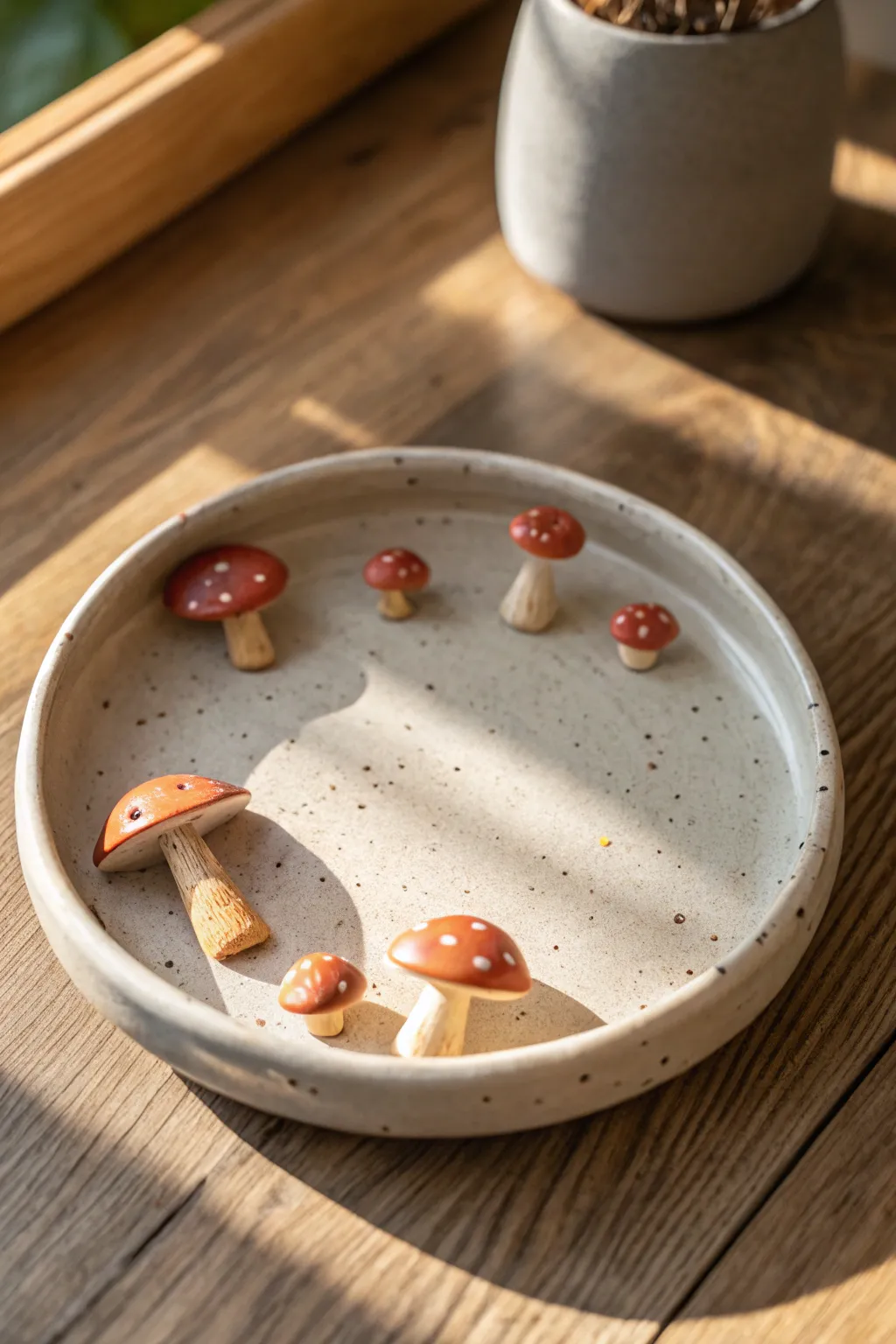
Bring a touch of forest charm to your desk or bedside table with this delightful hand-built ceramics project. This speckled clay tray features a playful circle of red-capped mushrooms growing right out of the base, perfect for holding rings or small treasures.
Step-by-Step Tutorial
Materials
- Speckled puff clay or stoneware clay
- Underglaze (bright red and white)
- Clear transparent glaze
- Rolling pin and guide sticks (approx. 1/4 inch)
- Needle tool or fettling knife
- Scoring tool (or an old toothbrush)
- Slip (clay mixed with water)
- Sponge
- Small round paintbrush
- Rolling mat or canvas
- Kiln access (or air-dry clay alternatives if not firing)
Step 1: Forming the Tray Base
-
Roll the slab:
Begin by wedging your speckled clay to remove air bubbles, then roll it out into an even slab using your guide sticks to maintain a consistent 1/4 inch thickness. I like to flip the clay over once or twice while rolling to ensure it doesn’t stick to the texture of the canvas. -
Cut the circle:
Use a round template like a small plate or a bowl (about 5-6 inches in diameter) and trace around it with your needle tool to cut a perfect circle from the slab. -
Create the rim:
Roll a long coil of clay, slightly thinner than a pencil. Gently score the outer edge of your circular base. -
Attach the wall:
Apply slip to the scored edge and place your coil on top. Smooth the coil onto the base using your thumb or a modeling tool, pulling clay from the coil down onto the floor of the plate to merge them seamlessly. -
Refine the height:
Pinch the wall gently to shape it upwards, creating a shallow rim about 1/2 to 3/4 inch high. Use a damp sponge to smooth the rim and the connection point inside the tray so no seam is visible.
Loose Mushroom Rescue
If a mushroom pops off during drying, score both surfaces deeply, add vinegar (magic for clay repair!), press together, and wrap the joint with a tiny fresh coil.
Step 2: Sculpting the Fungi
-
Roll the stems:
Pinch off small bits of clay and roll them into tapered cylinders for the mushroom stems. Vary them in size—some short and stout, others slightly taller and leaning. -
Shape the caps:
Roll small balls of clay and gently flatten them into dome shapes. Use your thumb to create a slight indentation underneath where the stem will connect. -
Assemble the mushrooms:
Score the top of a stem and the underside of a cap, apply a dot of slip, and press them together. Twist slightly to secure the bond. -
Create a downed mushroom:
For extra narrative charm (like the one in the photo), create one larger mushroom and plan to lay it sideways rather than standing it upright. This one should have the gills exposed for detail. -
Score the tray placement:
Plan where your mushrooms will sit. They should be scattered mostly around the perimeter but not perfectly symmetrical. Mark these spots with your needle tool. -
Attach the mushrooms:
Score the bottom of each stem and the marked spots on the tray heavily. Add slip and press the mushrooms firmly onto the tray floor. Use a small tool to smooth the clay at the base of the stem into the tray floor for a strong connection. -
Detail the fallen mushroom:
For the sideways mushroom, use your needle tool to draw fine lines radiating from the center of the underside to mimic gills before attaching it to the tray.
Step 3: Glazing and Finishing
-
Bisque fire:
Allow the piece to dry slowly, covered loosely with plastic for a day or two to prevent the delicate mushrooms from cracking. Once bone dry, bisque fire the piece according to your clay body’s instructions. -
Paint the caps:
Apply 2-3 coats of bright red underglaze to the mushroom caps. Be careful to keep the edges crisp where the red meets the stem. -
Add the spots:
Dip the handle end of a paintbrush into white underglaze and dot it onto the dried red caps to create the classic fly agaric look. -
Highlight the stems:
If you want the stems to differ from the raw speckle, create a very watered-down wash of light brown underglaze and brush it onto the stems and “gills,” wiping most of it back so it just sits in the textures. -
Apply clear glaze:
Dip the entire tray into a clear transparent glaze or brush it on carefully. This will make the speckles in the clay pop and make the tray food-safe and shiny. -
Final firing:
Fire the piece a second time to the maturation temperature of your glaze and clay body.
Natural Texture
Don’t over-smooth the stems! Leaving slight finger ridges or tooling marks makes the organic shapes look more realistic under the glaze.
Once fired, place this enchanting little tray on a windowsill to catch the light and hold your favorite rings
Frog Pond Aesthetic Tray Scene
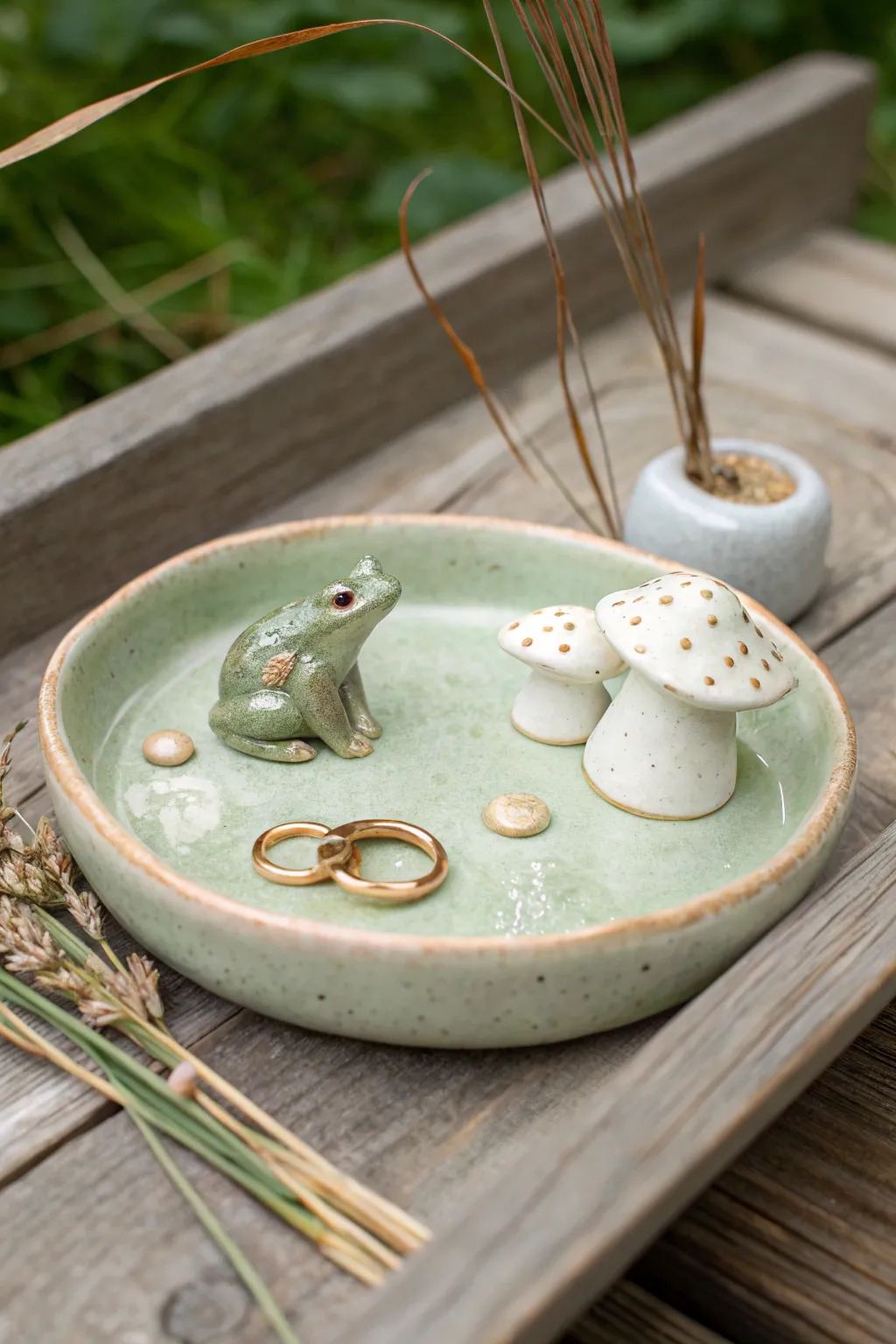
Bring a touch of cottagecore charm to your nightstand with this delightful handcrafted ring dish. Featuring a sculpted frog friend and speckled mushrooms rising from a glossy green pond, it’s the perfect spot to keep your jewelry safe.
Detailed Instructions
Materials
- Air-dry clay or polymer clay (white)
- Clay sculpting tools (needle tool, ball stylus)
- Small bowl or round cutter (for the base)
- Acrylic paints (sage green, creamy white, brown, black, metallic gold)
- Fine detail paintbrushes
- High-gloss varnish or UV resin
- Water cup and sponge (for smoothing)
- Rolling pin
- Sandpaper (fine grit)
Step 1: Forming the Base
-
Roll the Slab:
Begin by rolling out a ball of white clay until it is about 1/4 inch thick. Aim for an even thickness to prevent cracking during the drying process. -
Cut the Circle:
Use a round cookie cutter or trace around a small bowl (approx. 4-5 inches diameter) to cut out a perfect circle from your clay slab. -
Create the Rim:
Gently curve the edges of the circle upwards to create a shallow dish shape. Smooth the lip with a damp sponge or your finger to ensure it’s rounded and soft, not sharp. -
Add Texture Details:
While the base is still soft, I like to gently impress a few tiny, uneven divots into the floor of the dish to mimic natural ground texture.
Step 2: Sculpting the Inhabitants
-
Shape the Frog Body:
Roll a small marble-sized ball of clay into a teardrop shape for the frog’s body. Press the wider bottom gently onto the dish where you want him to sit. -
Add Frog Legs:
Roll two tiny sausages of clay. Fold them into a ‘Z’ shape for the hind legs and attach them to the sides of the body, blending the seams with a rubber tool or water. -
Refine Frog Features:
Add two tiny beads of clay for eyes. Use a needle tool to scratch in a small mouth line and tiny toes on the front feet. -
Sculpt Mushroom Stems:
Roll two thick, short cylinders for mushroom stems. Attach them firmly to the dish floor opposite the frog, lightly scoring the attachment points for a better grip. -
Create Caps:
Fashion two dome shapes for the mushroom caps—one larger, one smaller. Attach these to the stems, smoothing the underneath connection so they don’t fall off. -
Add Decorative Pebbles:
Roll two or three extremely small, flattened spheres and place them randomly on the dish floor to act as decorative stones or gold nuggets. -
Dry Completely:
Allow the entire piece to dry fully. For air-dry clay, this usually takes 24-48 hours; for polymer, bake according to package instructions.
Cracked Clay Solution
If small cracks appear as your air-dry clay dries, mix a tiny amount of fresh clay with water to make a ‘slip’ paste and fill the cracks, then sand smooth once dry.
Step 3: Painting and Finishing
-
Paint the Base:
Mix a watery wash of sage green paint. Apply this to the entire dish surface, letting it pool slightly in recesses to create a glazed ceramic look. -
Detail the Frog:
Paint the frog with a slightly darker, more opaque green. Once dry, use a toothpick to dot the eyes black and add tiny metallic gold highlights or spots on its back. -
Paint the Mushrooms:
Paint the stems and caps a creamy off-white. Let this layer dry completely before moving to the next step. -
Add Mushroom Specs:
Using the very tip of a fine brush, dab small brown or gold dots onto the mushroom caps to give them that classic woodland texture. -
Highlight the Pebbles:
Paint the small scattered pebbles with solid metallic gold paint for a luxurious accent. -
Speckle the Rim:
Dilute some brown paint and use an old toothbrush or a stiff brush to flick tiny speckles over the green base and rim for an earthy, pottery effect. -
Seal the piece:
Finish with two coats of high-gloss varnish. This mimics the look of fired ceramic glaze and protects your paint from chipping.
Make it a Set
Create a matching tiny ring holder by making a separate, smaller toadstool sculpture on its own base to sit alongside your main tray.
Now you have an adorable, functional piece of art ready to hold your treasures safe
Iridescent Glossy “Aura” Tray
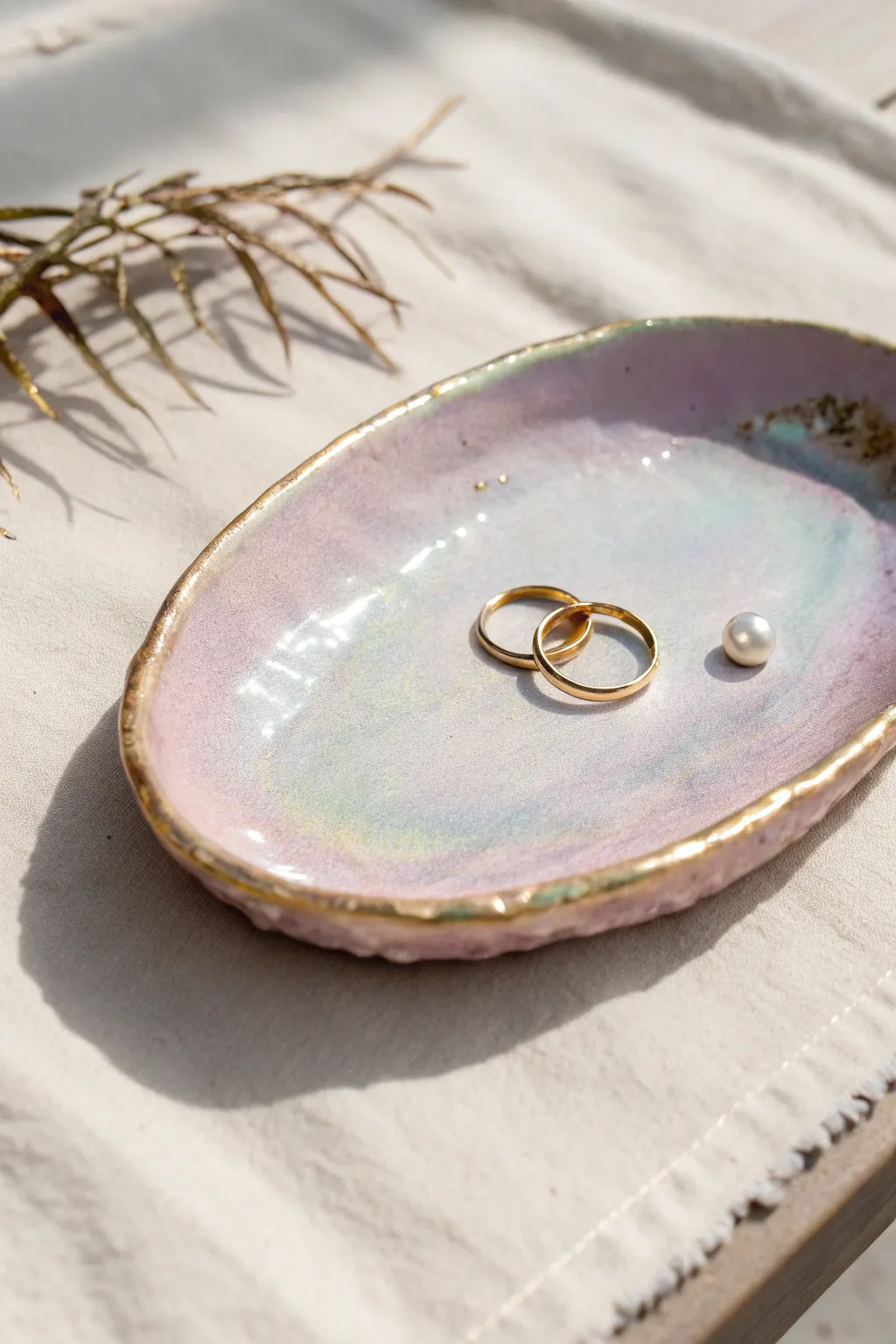
Capture the magic of a seashell with this stunning oval trinket dish, featuring a mesmerizing pearlescent glaze that shifts between soft pinks and blues. The organic, hand-molded shape and luxe gold rim make it the perfect resting place for your most treasured jewelry.
How-To Guide
Materials
- White sculpting clay (air-dry or polymer, depending on kiln access)
- Rolling pin
- Canvas or silicone mat
- Needle tool or craft knife
- Sponge and water
- Sandpaper (fine grit)
- White base coat (acrylic or gesso)
- Iridescent medium or color-shift acrylic paints (pink/blue/violet)
- Soft synthetic flair brushes
- Liquid gold leaf or metallic gold enamel
- High-gloss varnish or resin
- Small detail brush
Step 1: Shaping the Form
-
Roll the clay:
Begin by conditioning your white clay until it is soft and pliable. Roll it out on your mat to a thickness of about 1/4 inch, ensuring an even surface. -
Cut the oval:
Sketch a loose oval shape lightly into the clay first if you need a guide, or simply cut a freehand oval using your needle tool or craft knife for that organic feel. -
Soften edges:
Dip your finger or a small sponge in a little water and run it along the cut edges to smooth out any sharpness or crumbs from the cutting process. -
Create the rim:
Gently pinch and lift the edges of the oval upwards to create a shallow rim. I like to use my thumb to press the center down while my fingers pull the edge up. -
Add texture:
To mimic the handmade look in the photo, don’t smooth the rim perfectly. Leave slight undulations or press softly with your fingertips to create a uneven, rippled lip. -
Dry or bake:
Follow the instructions for your specific clay type. If using air-dry clay, let it dry for 24-48 hours until stark white; if polymer, bake according to the package temperature. -
Sand smooth:
Once fully cured, use fine-grit sandpaper to gently buff the interior surface. You want the glaze to glide on smoothly, so remove any fingerprints or bumps in the center bowl.
Step 2: Painting the Aura
-
Prime the surface:
Apply a solid coat of white gesso or white acrylic paint to the entire tray. This bright white base is crucial for making the iridescent colors pop later. -
Mix your colors:
Prepare your palette with a small amount of iridescent medium mixed with a tiny drop of pink acrylic, and a separate mix for blue. Alternatively, use pre-mixed color-shift paints. -
Apply the first wash:
Using a damp brush, wash a very sheer layer of the iridescent pink across the majority of the tray, keeping the strokes fluid and light. -
Blend the shift:
While the surface is still slightly tacky, introduce the blue iridescent paint in patches, specifically focusing on one side or the center to create a ‘galaxy’ or ‘mother of pearl’ effect. -
Soft transitions:
Use a clean, slightly damp soft brush to feather the edges where the pink and blue meet. You want a dreamy, cloud-like transition rather than hard lines. -
Add sparkle:
Flick the bristles of a stiff brush loaded with a tiny bit of gold or pure pearlescent medium to add very faint, microscopic speckles if desired, adding depth. -
Seal the color:
Once the paint is completely dry, apply a coat of high-gloss varnish. This mimics the wet look of ceramic glaze and protects your paint job.
Fixing sticky paint
If your iridescent medium feels tacky after drying, apply a thin layer of clear spray sealer or cornstarch powder dusted lightly to remove the stickiness instantly.
Step 3: The Golden Touch
-
Outline the rim:
Dip a fine detail brush into your liquid gold leaf or metallic enamel. Carefully paint the very top edge of the uneven rim you created. -
Let it drip:
Allow the gold to naturally follow the bumps and dips of the clay. Don’t worry about a perfect line; the charm lies in the wavering thickness. -
Final cure:
Let the gold leaf dry completely according to the manufacturer’s instructions. Avoid touching the rim until fully set to prevent tarnishing or fingerprints.
Level Up: Texture
Before baking, press a piece of lace or a textured sea sponge gently into the exterior/bottom of the tray for hidden tactile detail that contrasts with the smooth top.
Place your favorite rings or a single pearl in the center and admire the shifting colors of your handmade creation