
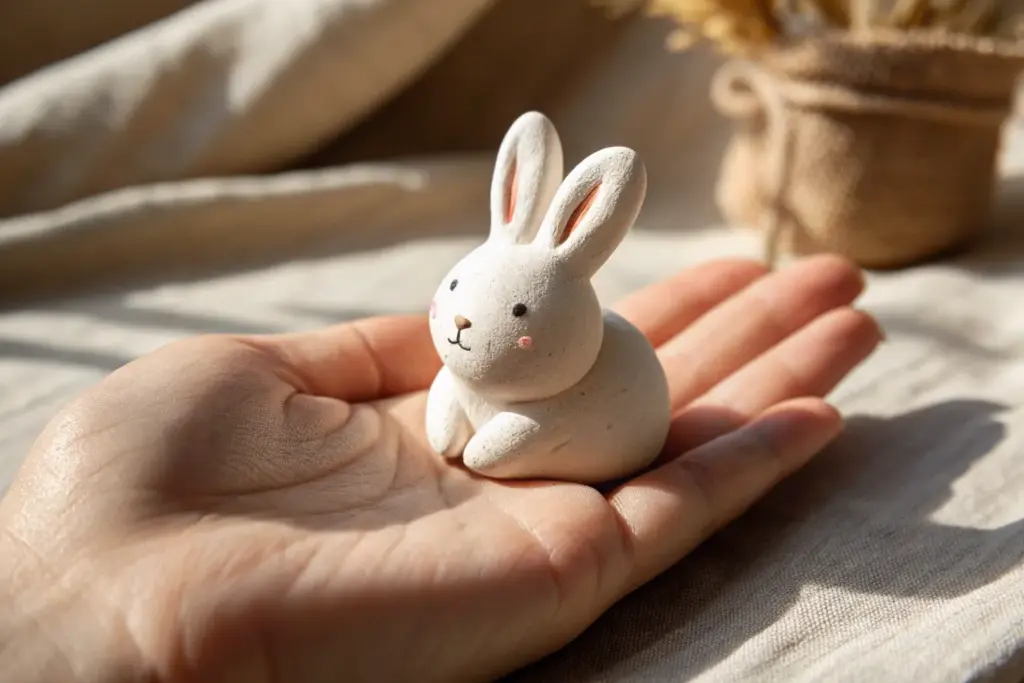
When you only have a little time (and a little lump of clay), air dry clay is perfect for making tiny, satisfying projects that actually turn out cute. These little air dry clay ideas are the kinds of small wins I love—quick to shape, easy to paint, and totally beginner-friendly.
Mini Pinch Pot Trinket Bowls
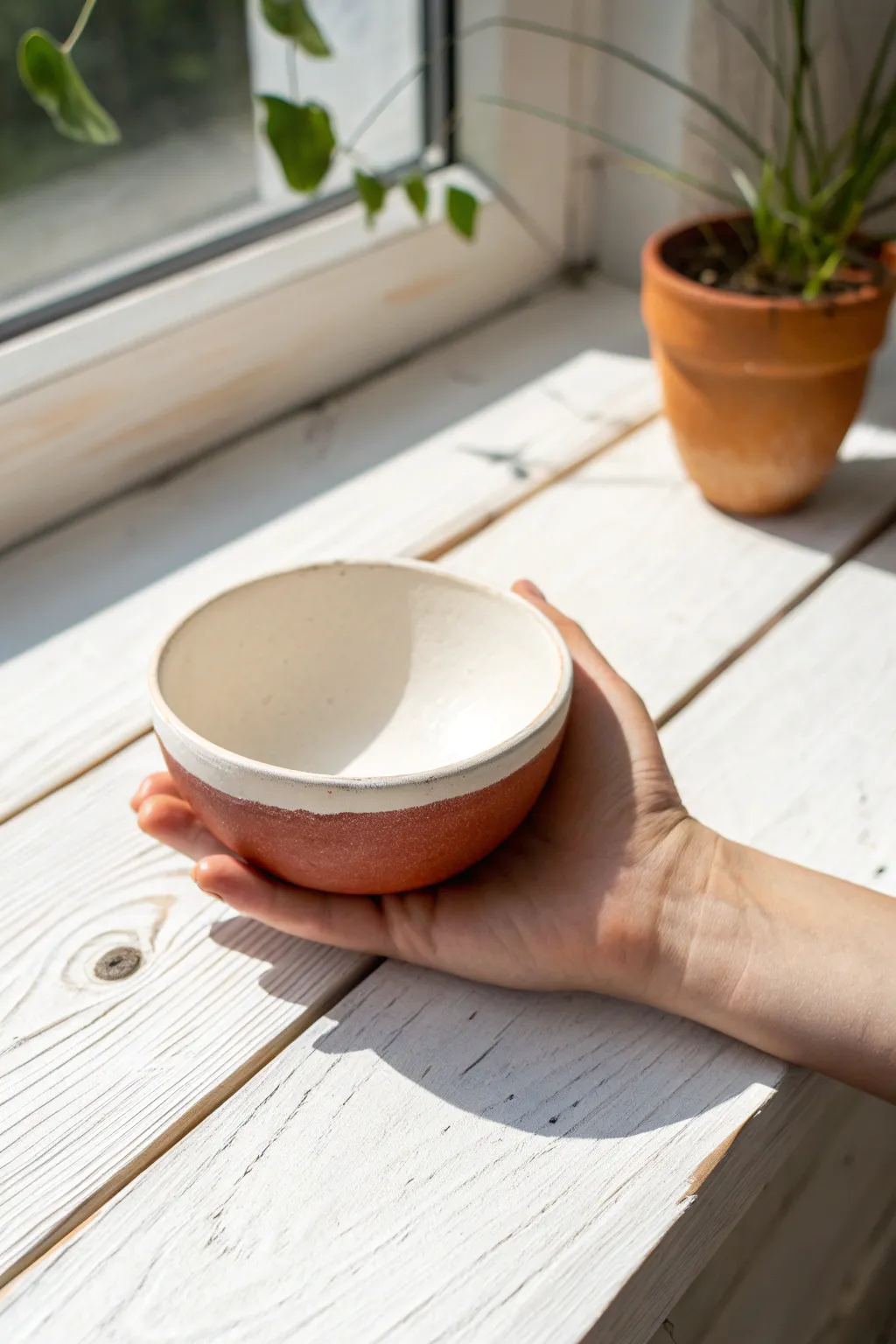
Learn to shape this charmingly rustic trinket bowl that combines the warm, earthy look of terracotta with a crisp white interior. This simple two-tone design highlights the handmade texture of the clay while offering a clean, modern finish.
Detailed Instructions
Materials
- Terracotta-colored air dry clay
- White acrylic paint
- Glossy varnish or sealant (Mod Podge or similar)
- Small bowl or cup of water
- Fine grit sandpaper
- Medium paintbrush
- Sponge or paper towel
Step 1: Shaping the Clay
-
Prepare the clay:
Start by taking a handful of terracotta air dry clay, roughly the size of a tennis ball. Knead it in your hands for a minute until it feels soft, warm, and pliable without being sticky. -
Form a sphere:
Roll the clay firmly between your palms to create a smooth, round ball. Try to smooth out any major cracks or lines now, as they are harder to fix later. -
Begin the pinch pot:
Hold the ball in one hand and push your thumb gently into the center. Don’t push all the way through; stop when you feel there is about a half-inch of clay left at the bottom. -
Pinch the walls:
With your thumb still inside, use your fingers on the outside to gently pinch and lift the clay walls. Rotate the ball slightly with each pinch to ensure even thickness all around. -
Refine the shape:
Continue pinching and turning until you have a bowl shape. Aim for walls that are about a quarter-inch thick. Don’t worry if it’s not perfectly round; the organic shape adds character. -
Smooth the surfaces:
Dip your finger in a little water and run it over the interior and exterior of the bowl to smooth out fingerprints and tiny cracks. Be careful not to use too much water, or the clay will become slushy. -
Define the rim:
Pay special attention to the rim. Run a wet finger along the top edge to round it off slightly so it isn’t sharp or jagged. -
Create a flat base:
Gently tap the bottom of the bowl against your work surface. This flattens the base slightly so the bowl will sit securely without wobbling. -
Dry completely:
Set the pot aside to dry for at least 24-48 hours. I find that flipping it over halfway through the drying process helps the bottom dry thoroughly.
Uneven Drying Tip
To prevent warping, dry the bowl slowly away from direct heat or sunlight. Drape a loose piece of plastic wrap over it for the first 12 hours to slow moisture loss.
Step 2: Sanding and Painting
-
Sand for smoothness:
Once the clay is bone dry and turns a lighter color, take fine-grit sandpaper and gently buff the surface. Focus on any rough spots on the rim or the exterior. -
Wipe away dust:
Use a slightly damp sponge or cloth to wipe away all the clay dust from sanding. A clean surface is crucial for the paint to stick. -
Paint the interior:
Load your brush with white acrylic paint. Carefully paint the entire inside of the bowl. Apply the paint thick enough to be opaque but thin enough to avoid globs. -
Create the dipped look:
Bring the white paint up and over the rim. Paint a messy, organic line just slightly down the outside edge of the bowl, mimicking a dipped glaze look. -
Dry and repeat:
Let the first coat of white paint dry. This usually takes about 20 minutes. Apply a second coat to ensure the terracotta color doesn’t show through the white. -
Seal the interior:
Once the white paint is completely dry, apply a coat of glossy varnish or sealant over the painted white areas only to give it a ceramic-like shine. -
Seal the exterior:
For the unpainted terracotta exterior, apply a matte sealant if you want to keep the natural clay look, or use the gloss varnish if you prefer an all-over shine. -
Final dry:
Let the finished bowl cure according to your varnish instructions before placing any trinkets inside.
Cracks Appearing?
Mix a tiny bit of fresh clay with water to make a paste (slip). Fill the crack with this paste, smooth it over with your finger, and let it dry again.
Now you have a beautiful handmade vessel perfect for holding rings or coins on your windowsill
Tiny Ring Cone Holders
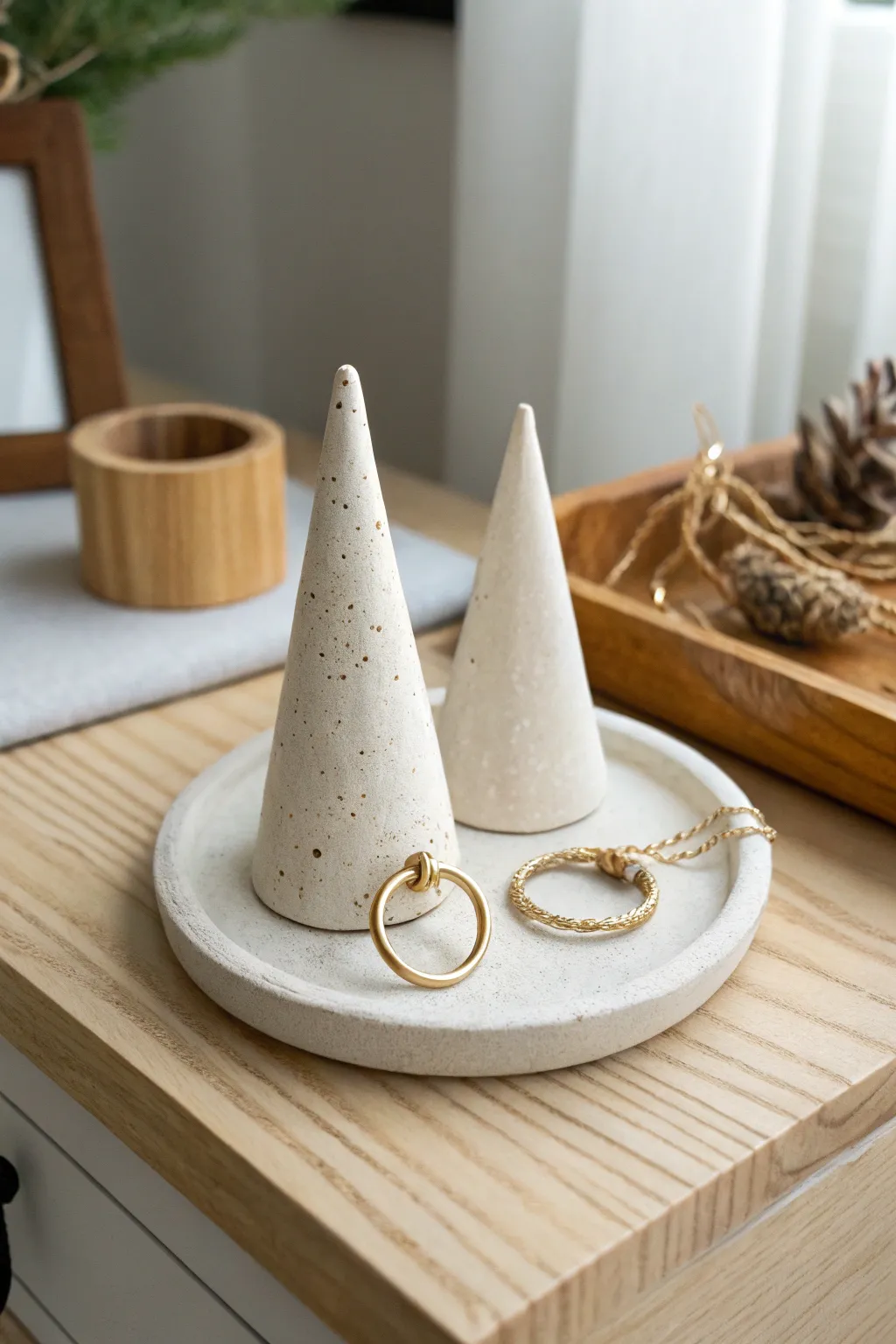
Create a modern, serene display for your favorite jewelry with these speckled ring cones and matching catch-all tray. The natural stone look is achieved surprisingly easily with air dry clay, bringing a touch of high-end boutique style to your dresser.
Step-by-Step Guide
Materials
- White air dry clay
- Rolling pin
- Clay cutting tool or craft knife
- Fine grit sandpaper
- Acetate sheet or smooth rolling surface
- Small bowl of water
- Round cookie cutter (approx. 4-5 inches)
- Old toothbrush
- Brown and black acrylic paint
- Matte spray varnish
Step 1: Forming the Cones
-
Condition the clay:
Begin by taking a chunk of white air dry clay and kneading it in your warm hands. Manipulating it for a minute or two makes it pliable and reduces the chance of cracks forming while you shape it. -
Shape the initial ball:
Roll two separate pieces of clay into smooth balls. One should be slightly larger than the other to create the height difference seen in the photo. -
Create the taper:
Place a ball on your smooth rolling surface. using the flats of your palms, roll the clay back and forth while applying more pressure to one side. This will naturally start to encourage a cone shape. -
Refine the height:
Stand the cone up on its base. Gently stroke upward from the base to the tip with damp fingers to smooth out any bumps and refine the height. You want a distinct, sharp point at the top. -
Flatten the base:
Pick up the cone and tap the bottom firmly against your work surface a few times. This ensures it sits perfectly flat and won’t wobble when holding your rings. -
Smooth the surface:
Dip your finger in a tiny bit of water and run it over the entire surface of the cone to remove fingerprints. Repeat the entire process for the second, smaller cone.
Cracking Up?
If small cracks appear while drying, don’t panic. Make a focused paste of clay and water (slip) and fill the crack, then smooth it over with a wet finger.
Step 2: Creating the Tray
-
Roll out the base:
Take a larger ball of clay and roll it flat with your rolling pin until it is about 1/4 inch thick. Aim for an even thickness throughout. -
Cut the circle:
Use your large round cookie cutter (or trace a bowl) to cut a perfect circle from the slab. Remove the excess clay. -
Make a coil:
Roll a long, thin snake of clay, approximately the thickness of a pencil. This will become the rim of your tray. -
Attach the rim:
Score the outer edge of your clay circle and the underside of the coil with a needle tool or old fork. Dab a little water on the scored areas. -
Blend the seams:
Press the coil onto the edge of the circle. Use your thumb or a modeling tool to drag clay from the coil down into the base, smoothing the seam completely so it looks like one solid piece. -
Final smoothing:
Go over the entire tray with a damp sponge or finger to ensure the rim is uniform and the surface is silky smooth.
Step 3: Faux Stone Finish
-
Let it dry:
Allow all three pieces (two cones and the tray) to dry completely. This usually takes 24-48 hours depending on humidity. Flip them occasionally to ensure even drying. -
Sand imperfections:
Once bone dry, use fine grit sandpaper to gently buff away any remaining uneven spots or sharp edges on the rims. -
Prepare the speckle mix:
Dilute a small amount of brown acrylic paint with water until it is very runny. I like to add a tiny dot of black to deepen the tone. -
Splatter technique:
Dip an old toothbrush into the watery paint mix. Hold it over your clay pieces and run your thumb along the bristles to flick tiny droplets onto the white surface. -
Control the density:
Apply the speckles lightly at first. You can always add more, but you can’t take them away. Aim for a random, organic distribution. -
Seal the project:
Once the paint speckles are fully dry, spray the cones and tray with a matte varnish. This protects the clay from moisture and gives it that finished ceramic feel.
Make it Marble
Instead of painting speckles, knead a small amount of grey or tan clay into your white clay before rolling. Stop before it’s fully blended for a marble effect.
Now you have a chic, custom-made spot to keep your everyday treasures organized
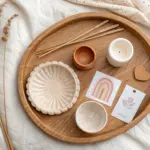
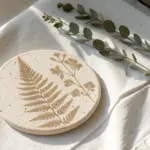
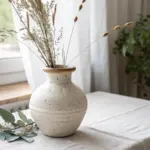
Little Heart Fridge Magnets
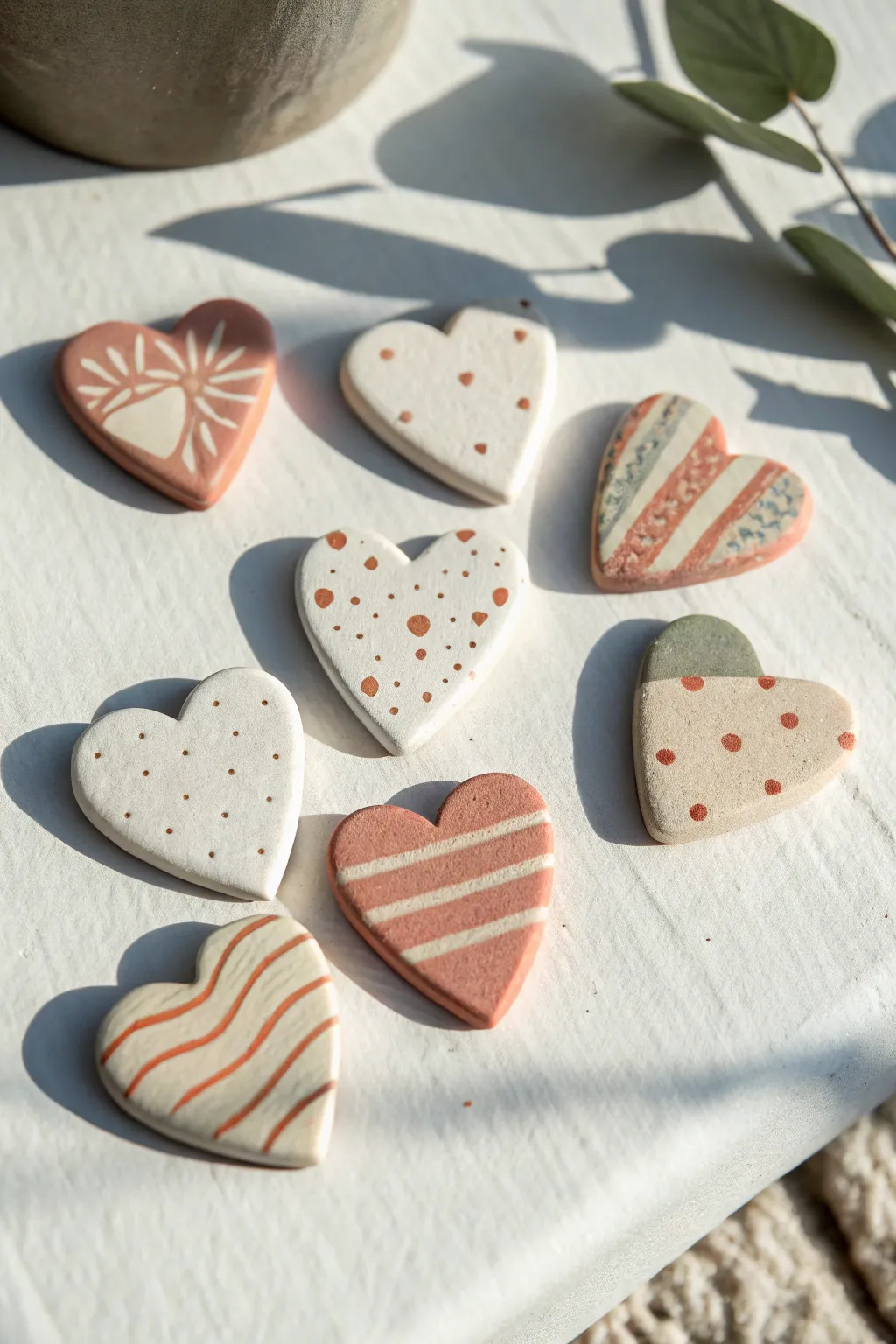
These charming, earthy patterned hearts are perfect for adding a touch of handmade warmth to your fridge or magnetic board. With simple geometric designs and a muted terracotta palette, they mimic the look of expensive ceramic pieces without the need for a kiln.
Step-by-Step
Materials
- Air dry clay (white or light grey)
- Rolling pin
- Heart-shaped cookie cutter (approx. 2 inches)
- Sandpaper (fine grit)
- Acrylic paints (terracotta/rust, cream, sage green)
- Small round paintbrushes (size 0 and 2)
- Matte varnish or sealant
- Strong craft magnets
- Super glue or E6000
- Palette for mixing
- Cup of water
Step 1: Shaping the Hearts
-
Roll out the clay:
Begin by kneading a portion of air dry clay until it is soft and pliable. Roll it out on a smooth surface to an even thickness of about 1/4 inch. If you want them to look substantial like ceramic tiles, don’t roll them too thin. -
Cut the shapes:
Press your heart-shaped cookie cutter firmly into the clay. Give it a tiny wiggle before lifting to ensure a clean cut. -
Smooth the edges:
Dip your finger in a little water and run it gently around the cut edges of each heart. This softens the sharp angles left by the cutter, giving the piece a more finished, pottery-like appearance. -
Let them dry:
Place the hearts on a wire rack or a piece of parchment paper to dry. Flip them over halfway through the drying process to prevent curling. Allow 24-48 hours depending on humidity. -
Sand for perfection:
Once fully cured and hard, take a piece of fine-grit sandpaper and lightly buff the surface and edges. This creates a professional, smooth canvas for your painted designs.
Step 2: Painting the Base
-
Choose your palette:
Prepare your acrylic paints. You’ll want a creamy off-white, a quintessential terracotta rust color, and a muted sage green. Mixing a tiny bit of brown into your red can achieve that perfect earthy rust tone. -
Apply base coats:
Paint some hearts entirely in cream and others in the terracotta shade. For the unique two-tone heart shown in the image, mask off the top curve with tape and paint the bottom cream and the top green. -
Second coat:
The clay is porous and will soak up the first layer. Apply a second coat to ensure solid, opaque coverage. Let this dry completely before starting pattern work.
Clean Lines Hack
For ultra-crisp stripes, use thin washi tape or painter’s tape to mask off areas. Peel the tape away while the paint is still slightly wet to avoid peeling up edges.
Step 3: Adding Patterns & Finishing
-
Create the polka dots:
For the dotted hearts, use the handle end of a paintbrush. Dip it into your contrasting paint (rust on cream, or cream on rust) and press gently onto the heart. Vary the spacing for an organic feel. -
Paint the stripes:
Using your smallest brush, paint horizontal stripes across one of the rust-colored hearts. Don’t worry if lines aren’t perfectly straight; a little wobble adds to the handmade charm. -
Wavy line design:
For the wave pattern, start at the bottom left and paint flowing, diagonal curvy lines moving toward the top right using the rust paint on a cream base. -
Botanical detail:
On a rust-colored heart, use cream paint to create a stylized floral or sunburst motif. Start from a bottom corner and paint radiating lines outward. -
Complex patterns:
For the intricate patterned heart, careful brushwork is key. Paint thick diagonal stripes first, then go back and add small details like zig-zags or dots inside the stripes once the first layer is dry. -
Seal the work:
Once the designs are thoroughly dry, apply a coat of matte varnish. This protects the paint from chipping and mimics the texture of unglazed bisque ceramic. -
Attach magnets:
Flip the hearts over. Apply a dab of strong super glue or E6000 to the back center of each heart and press a magnet firmly into place. Let the glue cure completely before sticking them to your fridge.
Textured Variation
Before the clay dries, gently press a textured fabric or stamp into the surface of one heart to create an imprinted relief pattern instead of painting it.
Your unique set of boho magnets is now ready to hold up your favorite photos and notes
Chubby Mini Animal Figurines
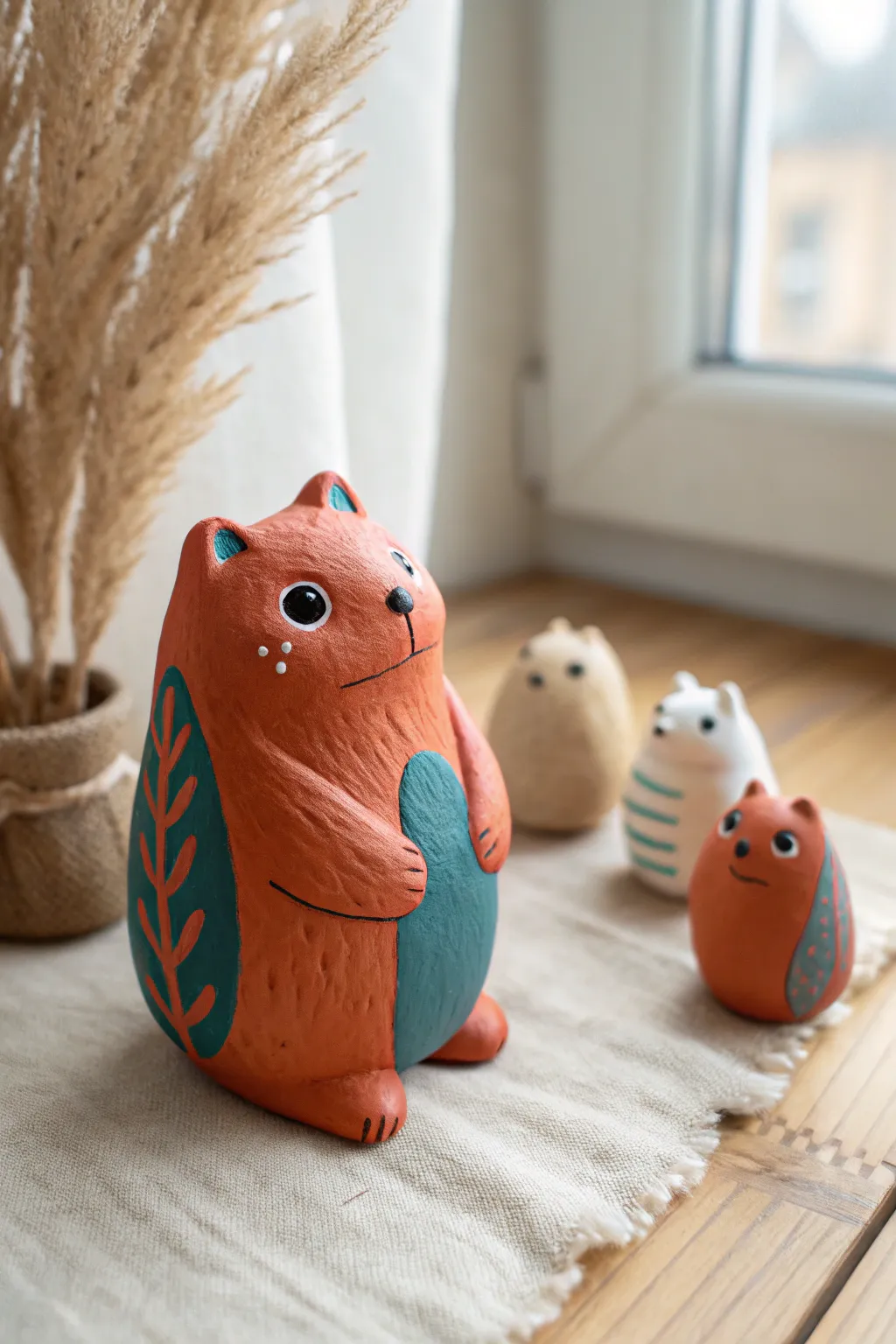
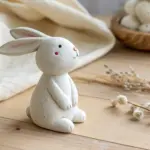
These delightfully round animal figurines bring a touch of woodland magic to any shelf with their smooth, organic shapes and folk-art inspired paint details. Their charmingly chubby bodies and minimalist features make them a perfect beginning project for learning to sculpt simple forms.
Step-by-Step Tutorial
Materials
- Air dry clay (white or terracotta)
- Acrylic paints (terracotta orange, teal green, off-white, black)
- Fine grit sandpaper
- Small cup of water
- Sculpting tools (needle tool and smoothing tool)
- Fine detail paintbrushes (round size 0 and 2)
- Matte varnish or sealant
Step 1: Shaping the Base Forms
-
Roll the main body:
Start with a generous handful of clay for the large bear figure. Roll it into a smooth ball first to remove air pockets, then gently elongate it into a thick, egg-like cylinder that is wider at the bottom for stability. -
Pinch the ears:
Instead of attaching separate pieces, use your thumb and forefinger to gently pinch up two small triangles at the very top of the head. Smooth the transition so they look like they grew naturally from the shape. -
Form the arms:
Roll two small sausage shapes for the arms. Carefully score (scratch) the clay on the body where you want to attach them, add a drop of water, and press the arms onto the sides, curving them inward toward the tummy. -
Blend the seams:
Use a smoothing tool or your finger dipped in a tiny bit of water to completely seamless blend the clay from the arms into the main body. The connection should be invisible. -
Add feet and texture:
Create two small flattened ovals for feet and attach them at the base. While the clay is still damp, lightly scratch vertical texture lines into the ‘fur’ area using a needle tool, avoiding the smooth mask area of the face. -
Create the mini companions:
For the smaller background friends, repeat the egg-shape process on a much smaller scale. Vary their heights and widths to create a diverse little family.
Smooth Surface Secret
Before drying, brush the raw clay with a tiny bit of water on your finger. This creates a ‘slip’ that fills micro-cracks and leaves a porcelain-smooth finish.
Step 2: Drying and Refining
-
Let it cure completely:
Set your figures in a cool, dry place. Because the main bear is thick, it may take 48-72 hours to dry fully. Flip them occasionally to ensure the bottom dries evenly. -
Sand for smoothness:
Once bone dry, take fine-grit sandpaper and gently buff out any fingerprints or rough bumps, focusing especially on the face and tummy areas where you want the paint to lay flat.
Step 3: Painting and Details
-
Apply the base coat:
Paint the entire body of the large figure with a warm terracotta orange acrylic. You may need two coats for full opacity. Let this dry completely before moving on. -
Block out the tummy:
Using a teal green or muted blue color, paint a large, rounded oval shape on the belly. I find it helpful to outline the shape lightly with a pencil first to ensure it’s centered. -
Paint the side pattern:
On the side of the bear, paint a matching teal patch that curves like a wing or leaf. Once that dries, use the terracotta orange to paint simple vine lines and leaf shapes over the teal background. -
Add facial features:
Using your smallest brush and black paint, carefully dab two round eyes and a small nose. Paint a thin, straight line for the mouth. Add tiny white highlights to the eyes to bring them to life. -
Detail the ears and cheeks:
Fill the inner triangles of the ears with the teal color. Add decorative details like three white dots on the cheeks using the tip of a toothpick or a dotting tool. -
Paint the small friends:
Paint the smaller figures in complementary colors—cream, white, and rust red. Give them simple patterns like horizontal stripes or tiny polka dots to coordinate with the main figure. -
Seal the work:
Finish by applying a coat of matte varnish. This removes the chalky feel of the dried clay and protects your paint job from dust and fading.
Make it a Rattle
Before sealing the bottom base, hollow out the inside slightly and insert a small dried bean or bead wrapped in paper. Seal it up, and your figurine will rattle when shaken.
Arranging your little clay family on a windowsill creates a cozy display you can enjoy every day

The Complete Guide to Pottery Troubleshooting
Uncover the most common ceramic mistakes—from cracking clay to failed glazes—and learn how to fix them fast.
Tiny Animal Charms for Keychains
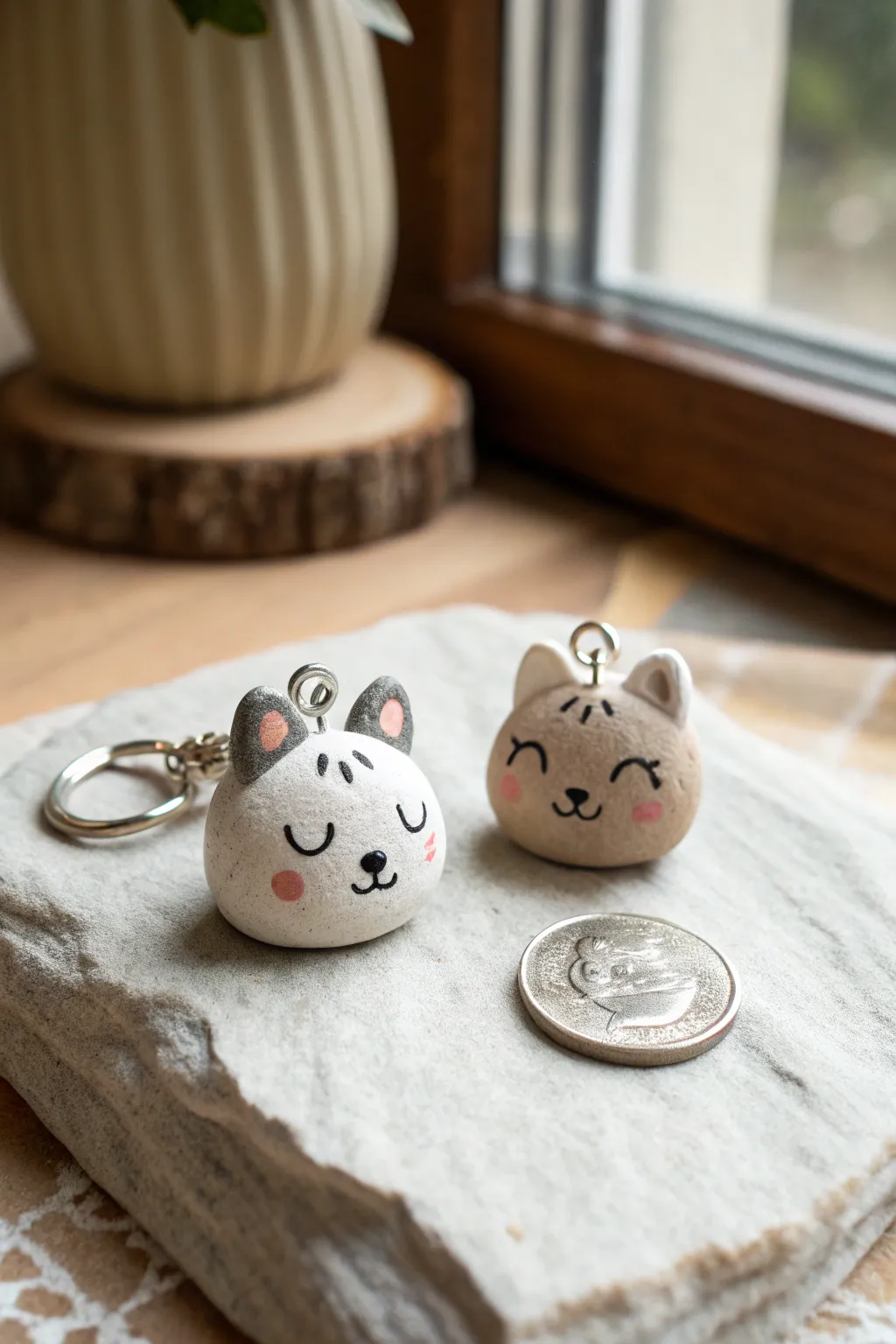
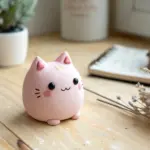
These adorable, coin-sized cat heads are perfect for adding a touch of handmade charm to your keyring or zipper pull. With their sweet, sleepy expressions and simple round shapes, they are an ideal beginner project for working with air-dry clay.
How-To Guide
Materials
- White or light grey air-dry clay
- Silver screw eye pins
- Fine-grit sandpaper
- Black fine liner pen or black acrylic paint with a detail brush
- Pink acrylic paint or pink marker (for cheeks)
- Grey acrylic paint (for ears, optional)
- Clear matte varnish or sealant
- Small bowl of water
- Sculpting tool or toothpick
- Keyring hardware
Step 1: Shaping the Base
-
Condition the clay:
Take a small portion of air-dry clay, roughly the size of a large gum ball. Knead it in your hands until it becomes soft, pliable, and free of cracks. -
Roll a sphere:
Roll the clay between your palms to create a smooth, perfect sphere. If you see any cracks forming, dab a tiny bit of water on your finger and smooth them out. -
Form the head shape:
Gently press the sphere onto your work surface to create a flat bottom so the head can stand upright. Then, slightly flatten the front face just a touch to make a better surface for painting later. -
Pinch the ears:
Using your thumb and forefinger, gently pinch two small triangles at the top of the sphere to form the cat’s ears. I find it helpful to support the back of the ear with my index finger while shaping. -
Smooth the transitions:
Dip your finger in water and smooth the area where the ears meet the head. You want the ears to look like they are growing out of the head naturally, not just stuck on.
Step 2: Refining and Drying
-
Insert hardware:
Take a screw eye pin and gently twist it into the very center top of the head, between the ears. Twist it until only the loop is visible. -
Secure the pin:
Remove the eye pin carefully. Add a tiny dab of glue or simply dampen the hole, then screw the pin back in. This helps it bond securely as the clay shrinks around the threads. -
Final smooth:
Do a final check for fingerprints. Lightly stroke the surface with a damp finger or a soft brush to ensure a porcelain-like finish. -
Let it dry:
Place your charm in a safe, dry spot away from direct sunlight. Allow it to dry completely for 24-48 hours. The clay will become lighter in color and hard to the touch. -
Sand imperfections:
Once fully dry, inspect your charm. Use a piece of fine-grit sandpaper to gently buff away any rough spots or unevenness, especially around the base and ears.
Cracking Up?
If small cracks appear as the clay dries, mix a tiny bit of fresh clay with water to make a paste (slip). Fill the cracks, smooth it over, and let dry again.
Step 3: Painting and Finishing
-
Add ear details:
If you are making the grey-eared cat, use a small brush to paint the front and back of the ear triangles with grey acrylic paint. For the beige cat, leave the ears natural or paint the inner ear white. -
Draw the face:
Using a fine black liner pen (ensure it is waterproof) or very fine brush, draw two curved lines for sleepy closed eyes. Keep them symmetrical. -
Add nose and mouth:
Draw a small rounded triangle for the nose just below the eyes. Connect a small ‘w’ shape or two curved lines coming down from the nose to form the mouth. -
Details and blush:
Use a pink marker or a very dry brush with pink paint to dab on rosy cheeks. You can also add three tiny dots on the forehead for whiskers or markings. -
Add inner ear color:
For a pop of color, paint a small pink spot inside the grey ears, or leave them simple depending on your design preference. -
Seal the charm:
Apply a coat of clear matte varnish over the entire charm. This protects the clay from moisture and prevents the ink from smudging. Let this layer dry completely. -
Attach keychain:
Use small pliers to open the jump ring on your keychain hardware. Thread it through the eye pin on top of the cat head and close the jump ring securely.
Make it Sparkle
Mix a pinch of fine glitter into your clear varnish before sealing. This gives the cat a subtle, stone-like shimmer that catches the light beautifully.
Now you have a sweet little companion to accompany your keys wherever you go
Mini Mushroom Trinket Dishes
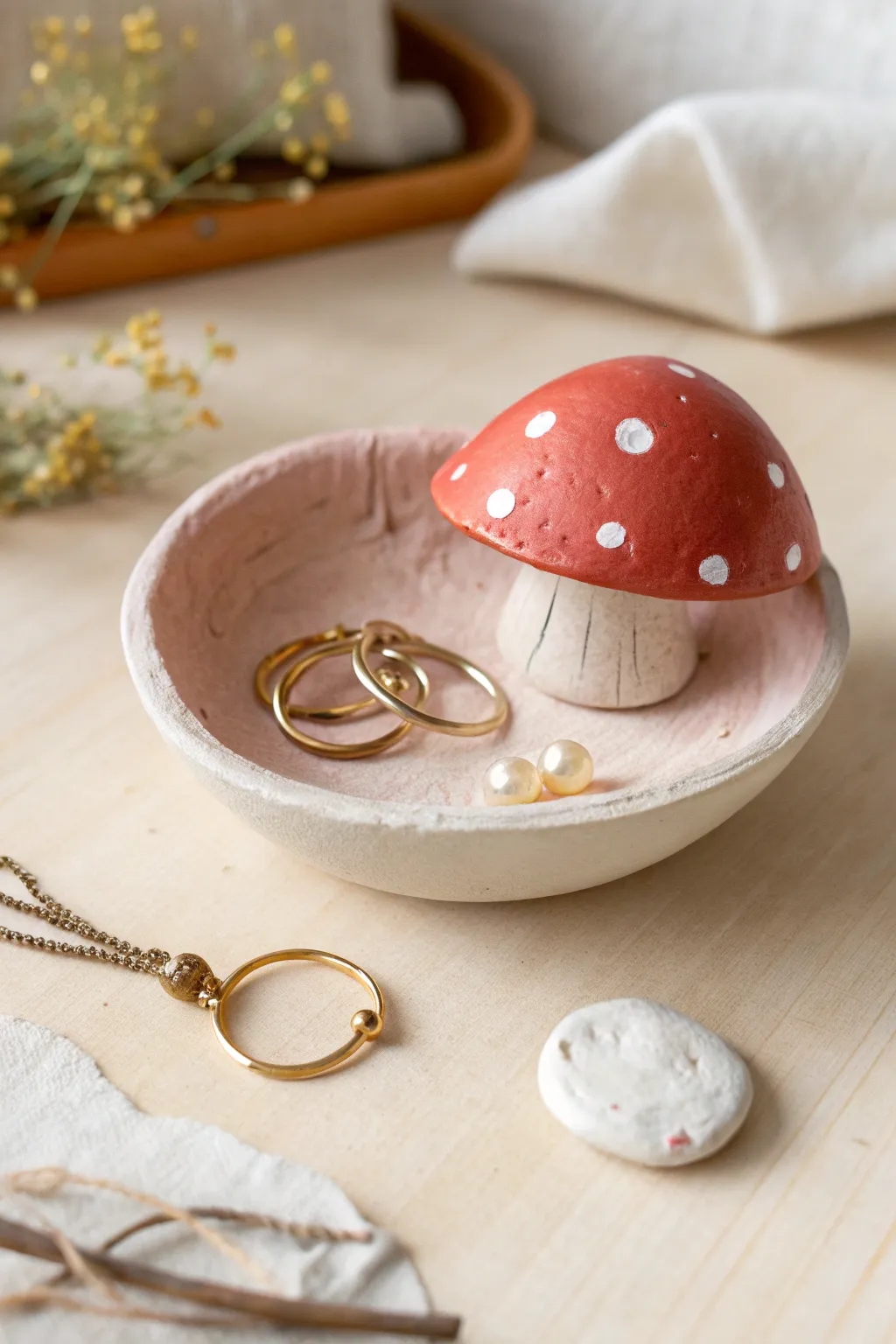
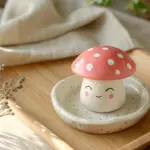
This whimsical trinket dish brings a touch of forest magic to your vanity, perfect for corralling small rings and stud earrings. The handcrafted, slightly imperfect finish gives it a charming, rustic cottagecore aesthetic that feels cozy and personal.
Detailed Instructions
Materials
- Air dry clay (white or terracotta)
- Acrylic paints (red, white, soft pink)
- Small rolling pin or glass jar
- Clay sculpting tools (or a toothpick and butter knife)
- Small bowl (to use as a mold)
- Sandpaper (fine grit)
- Paintbrushes (medium flat and fine detail)
- Gloss varnish or sealant
- Water cup
Step 1: Sculpting the Base Dish
-
Prepare the clay:
Start by taking a ball of air dry clay about the size of a tangerine. Knead it in your hands until it is warm, pliable, and free of cracks. -
Roll out the slab:
Roll the clay ball into a flat circle, aiming for a consistent thickness of about 1/4 inch. If the edges crack, smooth them down with a little water on your finger. -
Shape the bowl:
Gently press your clay circle into a small bowl to give it a curved shape, or simply pinch up the edges with your fingers to create a shallow rim. The edges don’t need to be perfect; a wavy, organic rim adds character. -
Smooth the surface:
Dip your finger in water and run it over the interior and exterior of the dish to smooth out any fingerprints or rough textures.
Smooth Seams
For a seamless look where the mushroom meets the bowl, roll a tiny ‘snake’ of clay, wrap it around the base of the stem, and blend it downwards with a wet tool.
Step 2: Creating the Mushroom
-
Form the stem:
Roll a small, thick cylinder of clay for the stem. It should be sturdy enough to support the cap but short enough to fit comfortably inside the dish. -
Texture the stem:
Using a needle tool or toothpick, gently scratch vertical lines up the stem to mimic the natural texture found on mushrooms. -
Shape the cap:
Roll a slightly larger ball of clay and flatten the bottom while doming the top to create the classic toadstool cap shape. -
Attach the pieces:
Score the top of the stem and the underside of the cap (scratch hatching lines), add a drop of water or liquid clay slip, and press them firmly together. -
Secure to the dish:
Score the bottom of the mushroom stem and the center of your dish. Press the mushroom firmly into the center of the bowl. Use a sculpting tool to blend the clay at the seam so the mushroom is securely anchored. -
Let it dry:
Set the project aside in a dry, cool place. Allow it to air dry completely for 24 to 48 hours, flipping it occasionally if possible to ensure the bottom dries evenly.
Step 3: Painting and Finishing
-
Sanding:
Once bone dry, lightly sand any rough edges on the rim of the bowl or the mushroom cap to get a cleaner finish. -
Base coat the dish:
Paint the exterior of the bowl and the mushroom stem in a soft white or cream color. While painting, I like to dilute the paint slightly so the natural texture of the clay still peeks through. -
Paint the interior:
Paint the inside of the bowl a soft, dusty pink. You can leave the brushstrokes visible for a more hand-crafted look. -
Color the cap:
Carefully paint the mushroom cap a deep, earthy red. You may need two coats to get a solid, opaque color. -
Add the spots:
Using a fine detail brush or the back end of a paintbrush, dot small white circles onto the red cap once it’s dry. -
Seal the piece:
Finally, apply a coat of gloss varnish over the entire piece to protect the paint and give the mushroom a ceramic-like shine.
Make it a Set
Make a trio of dishes in varying sizes. Try sculpting different fungi, like tall skinny morels or flat shelf mushrooms, for a complete forest floor collection.
Place your finished dish on your bedside table and enjoy your new woodland organizer



What Really Happens Inside the Kiln
Learn how time and temperature work together inside the kiln to transform clay into durable ceramic.
Teeny Photo and Card Holders
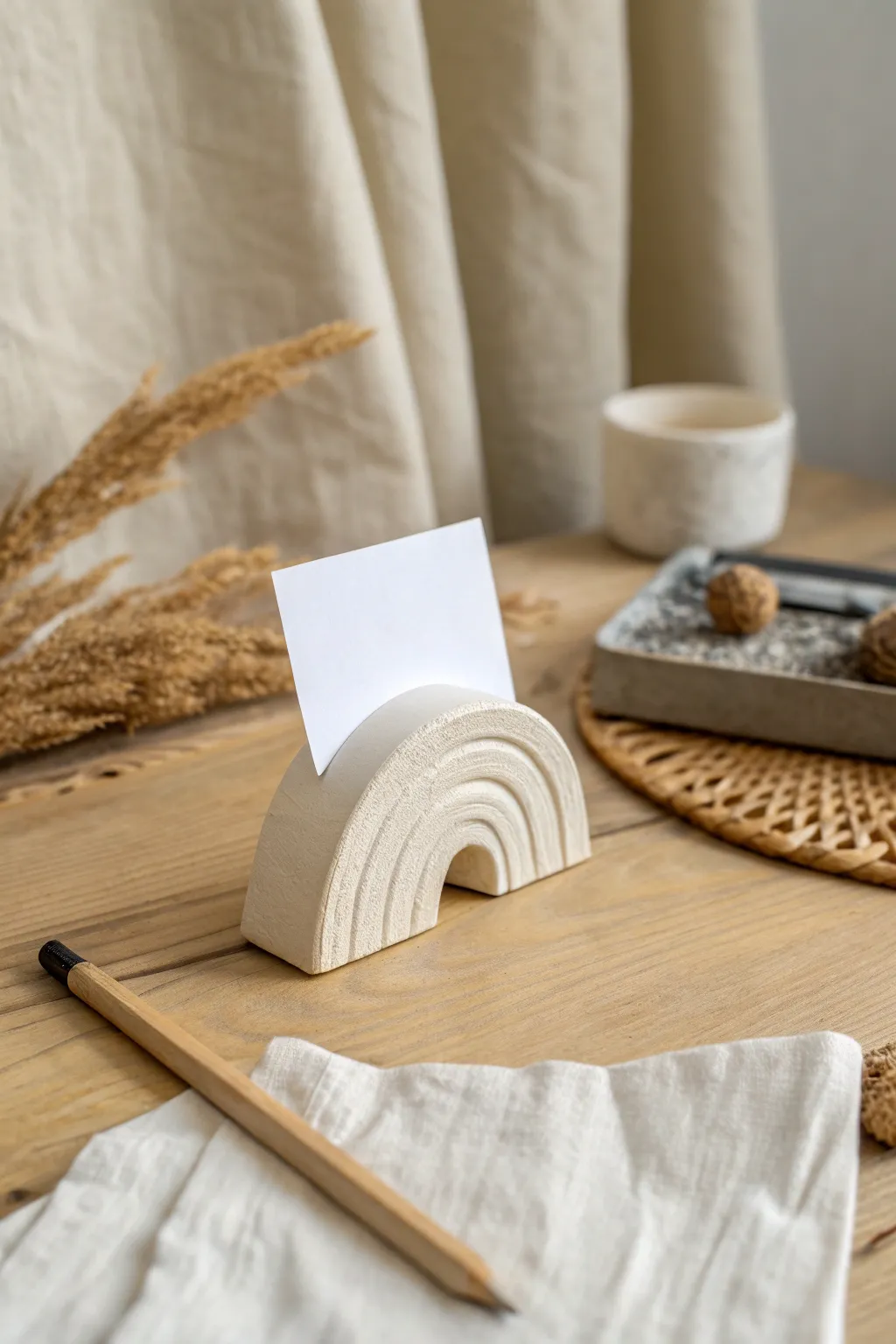
This minimalist, cream-colored rainbow arch adds a touch of modern bohemian charm to any desk or shelf. It’s perfectly sized to hold a favorite photo, business card, or simple affirmation note.
Step-by-Step Tutorial
Materials
- White or cream air dry clay
- Rolling pin
- Sharp crafting knife or X-Acto blade
- Clay carving tool or toothpick (for detailing)
- Small bowl of water
- Fine-grit sandpaper (optional)
- Ruler
- Sheet of paper (for template)
- Scissors
Step 1: Shaping the Base
-
Prepare your template:
Before touching the clay, draw a semi-circle rainbow shape on a piece of paper. The base should be about 3-4 inches wide. Cut this out to use as your guide. -
Knead the clay:
Take a generous handful of air dry clay and knead it well. This warms it up and removes air bubbles, making it easier to work with. -
Roll out a slab:
Roll the clay into a thick slab. You want this project to be sturdy and stand on its own, so aim for a thickness of about 3/4 to 1 inch. -
Cut the primary shape:
Place your paper template on top of the clay slab. Using your craft knife, carefully cut around the curved edge and the straight bottom edge to create a semi-circle block. -
Cut the inner arch:
To create the rainbow opening, use a smaller circular object or freehand a smaller semi-circle at the bottom center of your block. Carefully slice this piece out and remove it. -
Smooth the edges:
Dip your finger in a little bit of water and run it along all the cut edges. This softens the sharp angles left by the knife and gives it that finished, ceramic look.
Fixing Cracks
If small cracks appear while drying, mix a tiny bit of fresh clay with water to make a paste (slip). Fill the cracks with this paste and smooth it over with your finger.
Step 2: Adding the Details
-
Mark the card slot:
Identify the top center of your arch. Use your ruler to gently press a straight line across the top where the card will sit, ensuring it is centered. -
Cut the slot:
Slice vertically into the clay along your marked line. You will need to wiggle the knife slightly to create a gap wide enough for cardstock, going about half an inch deep. -
Clean the slot opening:
If the clay pulls up around the knife, gently pat it back down with a damp finger to keep the top surface flat. -
Sketch the rainbow lines:
Using a blunt tool or a toothpick, very lightly etch where your rainbow arches will go on the face of the clay. This acts as a guide before you commit to deep carving. -
Carve the outer arch:
Using your carving tool, press firmly to trace your first guideline. I find dragging the tool slowly creates a smoother, more confident line than using short strokes. -
Carve remaining arches:
Repeat the carving process for the inner arches. Aim for three to four distinct concentric lines that echo the shape of your cut-out center. -
Add texture:
To mimic the stone-like texture in the photo, gently tap a crumpled ball of aluminum foil or a stiff-bristled toothbrush over the surface of the clay, avoiding the carved lines.
Step 3: Finishing Up
-
Initial drying:
Set the piece upright in a cool, dry place away from direct sunlight. Let it rest for about 24 hours. -
Rotate the piece:
After the first day, turn the rainbow on its side or back to ensure the bottom and center dry evenly. -
Sanding:
Once fully cured (usually 48-72 hours), use fine-grit sandpaper to gently smooth any rough burrs or sharp corners, especially around the bottom base. -
Dust off:
Wipe the piece down with a dry cloth to remove any clay dust from the sanding process. -
Optional sealing:
Since this is decorative, sealing isn’t strictly necessary, but a matte varnish can help protect the white clay from dirt and fingerprints over time.
Make it Splash
Mix acrylic paint into a darker clay color and lightly splatter it onto your finished white arch with a toothbrush for a trendy terrazzo-inspired speckled effect.
Set your finished holder on your desk and enjoy the simple, organic vibe it brings to your workspace
Little Beaded-Edge Dishes
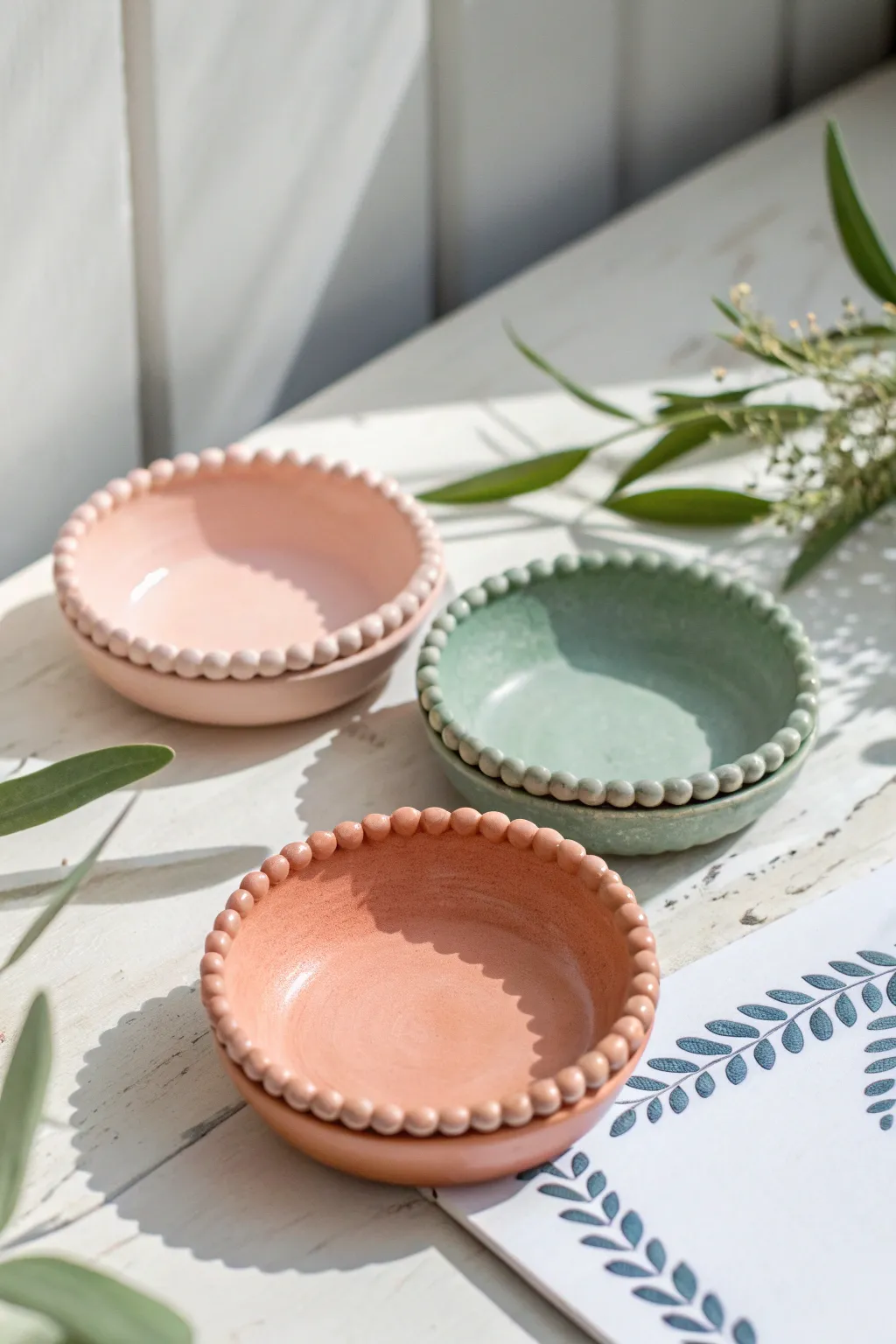
Elevate your jewelry storage with these chic, minimalist bowls featuring a distinctive beaded rim. The combination of smooth bowl interiors and the tactile pebbled edge creates a sophisticated look that mimics high-end ceramic studio pottery perfectly.
Detailed Instructions
Materials
- White air-dry clay (or terracotta colored if preferred)
- Acrylic rolling pin
- Circle cutter (approx. 4-5 inches wide) or a small bowl to trace
- Craft knife
- Small bowl or sphere mold for shaping
- Sponges (damp)
- Sandpaper (fine grit)
- Acrylic paints (Soft Pink, Sage Green, Terracotta)
- Gloss or matte varnish/sealant
- Small paintbrushes
- Water cup
Step 1: Shaping the Base Bowl
-
Condition the clay:
Begin by taking a handful of air-dry clay and kneading it in your hands until it becomes warm, pliable, and free of cracks. -
Roll it out:
Roll the clay onto a smooth workspace or silicone mat until it is about 1/4 inch thick. Aim for an even thickness throughout to prevent cracking during the drying phase. -
Cut the circle:
Place your circle cutter or an overturned bowl onto the rolled clay. Press down firmly or trace around the bowl with a craft knife to create a perfect clay disc. -
Soften the edges:
Dip your finger into a little water and run it along the cut edge of the disc to smooth out any sharpness or burrs left by the knife. -
Form the curve:
Gently lift the clay disc and drape it inside a small bowl or over a sphere mold to establish its concave shape. Press gently so it takes the form without becoming too thin.
Beads falling off?
If beads detach during drying, the clay was likely too dry when attaching. Repair by gluing the dry bead back on with strong white craft glue or superglue before painting.
Step 2: Creating the Beaded Rim
-
Roll small spheres:
Pinch off tiny pieces of clay and roll them between your palms to create small balls. You will need roughly 30 to 40 balls per dish, depending on the circumference. -
Check consistency:
Try to keep the balls as uniform in size as possible, roughly the size of a pea or a small blueberry, for a polished final look. -
Score the rim:
Take a needle tool or toothpick and gently scratch (score) the very top edge of your clay bowl where the beads will sit. -
Attach the beads:
Dab a tiny amount of water or liquid clay slip onto the scored rim. One by one, press the small clay balls onto the rim, ensuring they touch each other snugly. -
Secure the bond:
Once a few beads are placed, gently smudge the *underside* of each bead into the bowl rim with a modeling tool or your fingertip to lock them in place without ruining the spherical shape on top. -
Smooth the connection:
Use a slightly damp paintbrush to smooth over the underside connection points, ensuring the beads look like an integrated part of the rim rather than just glued on.
Step 3: Finishing and Painting
-
Dry completely:
Allow the dishes to dry untouched for at least 24 to 48 hours. I find that flipping them over halfway through the drying process helps the bottom dry evenly. -
Sand imperfections:
Once fully hardened, use fine-grit sandpaper to gently smooth the interior of the bowl and the underside rim. Be very gentle around the beads to avoid snapping them off. -
Apply base color:
Mix your acrylic paints to achieve soft, earthy tones like sage, blush pink, or terracotta. Apply a thin, even coat over the entire dish, including the beads. -
Add a second coat:
Let the first layer dry, then apply a second coat for opacity. Use a smaller brush to get paint into the tiny crevices between the beads. -
Seal the piece:
Finish by applying two coats of a gloss or satin varnish to protect the clay from moisture and give it that fired ceramic sheen.
Pro Tip: Seamless Beads
After rolling your beads, let them sit for 5 minutes before attaching. Slightly firmer beads hold their round shape better when you press them onto the rim.
Now you have a set of charming, handmade dishes perfect for holding rings or simply brightening up your nightstand

TRACK YOUR CERAMIC JOURNEY
Capture glaze tests, firing details, and creative progress—all in one simple printable. Make your projects easier to repeat and improve.
Tiny Leaf-Stamp Jewelry Trays
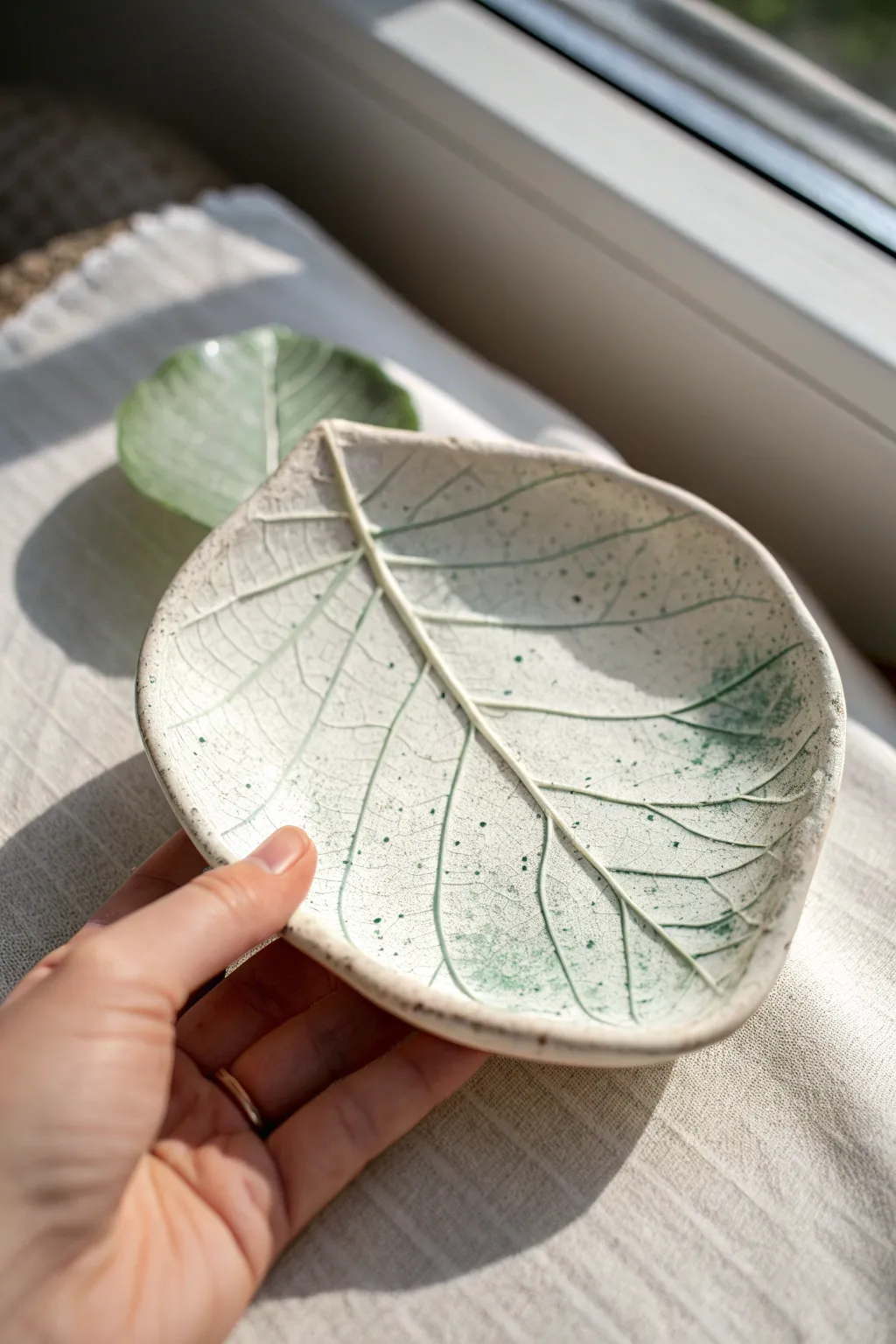
Capture the delicate beauty of nature with these charming leaf-impression trinket trays. Using simple air-dry clay and actual foliage from your garden, you can create a textured, organic dish finished with a subtle watercolor wash for an earthy, rustic feel.
Step-by-Step
Materials
- White or light grey air-dry clay
- Fresh, sturdy leaves with prominent veins (like Hydrangea or Hosta)
- Rolling pin
- Sharp craft knife or scalpel
- Small bowl or curved surface (for drying)
- Sandpaper (fine grit)
- Green acrylic paint or watercolor
- Water
- Soft paintbrush
- Paper towels
- Gloss or matte varnish (optional)
Step 1: Shaping the Clay
-
Prepare the Clay:
Take a handful of air-dry clay and knead it until it is soft, pliable, and free of cracks. If the clay feels too dry, you can dip your fingers in water to rehydrate it slightly. -
Roll out the Slab:
On a clean, flat surface or a silicone mat, roll the clay out to an even thickness of about 1/4 inch (approx. 5-6mm). Try to roll it wide enough to accommodate your chosen leaf. -
Position the Leaf:
Take your fresh leaf and place it vein-side down onto the clay slab. The underside of the leaf usually has the most prominent veins, which gives the best impression. -
Create the Impression:
Gently roll over the leaf with your rolling pin. Apply steady, firm pressure to push the veins deep into the clay, but be careful not to make the clay too thin. I like to do one confident pass rather than rolling back and forth. -
Cut the Shape:
Using a sharp craft knife or scalpel, carefully trace around the edge of the leaf to cut out the clay shape. Keep the blade upright for a clean edge. -
Reveal the Texture:
Slowly peel the leaf away from the clay starting at the stem end to reveal the intricate vein pattern imprinted underneath. -
Smooth the Edges:
Dip your finger in a little water and gently run it along the cut edges of the clay leaf to smooth out any roughness or sharp corners left by the knife.
Clay Cracking?
If small cracks appear while drying, don’t panic. Mix a tiny bit of fresh clay with water to make a paste (slip) and fill the cracks, then smooth over.
Step 2: Drying and Refining
-
Form the Curve:
Carefully lift your clay leaf and place it inside a small shallow bowl or on a curved object. This will give the tray its slightly cupped shape as it dries. Let gravity help settle it into the curve. -
Dry Completely:
Allow the clay to dry undisturbed for at least 24-48 hours. The drying time will depend on humidity and thickness. It should be fully hard and turn a lighter color when ready. -
Sand Imperfections:
Once bone dry, take fine-grit sandpaper and lightly sand the edges to make them perfectly smooth. Be gentle with the textured surface to avoid sanding away the vein details. -
Dust Off:
Wipe the piece down with a dry brush or cloth or blow away any clay dust from sanding before you start painting.
Level Up: Gilded Edge
After the green wash dries, paint a thin line of liquid gold leaf or metallic paint along the very rim of the dish for an elegant, high-end finish.
Step 3: Finishing Touches
-
Prepare the Wash:
Mix a small amount of green acrylic paint with plenty of water to create a thin, translucent wash. You want the consistency of watery milk, not thick paint. -
Apply the Color:
Generously brush the green wash over the entire textured surface of the leaf, ensuring the liquid pools into the deep vein depressions. -
Wipe Back:
Immediately take a crumpled paper towel or rag and wipe across the surface of the clay. This removes the paint from the raised areas while leaving the green color trapped in the veins and textures. -
Add Speckles:
To mimic the natural speckling seen in the photo, dip an old toothbrush or stiff brush into slightly thicker green paint. Run your thumb across the bristles to flick tiny splatters of paint onto the dish. -
Seal the Piece:
Once the paint is completely dry, apply a coat of varnish to protect the surface, especially if you plan to use it for holding jewelry or keys.
Now you have a serene, nature-inspired tray perfect for holding your favorite rings or trinkets
Mini Alphabet Tokens and Tags
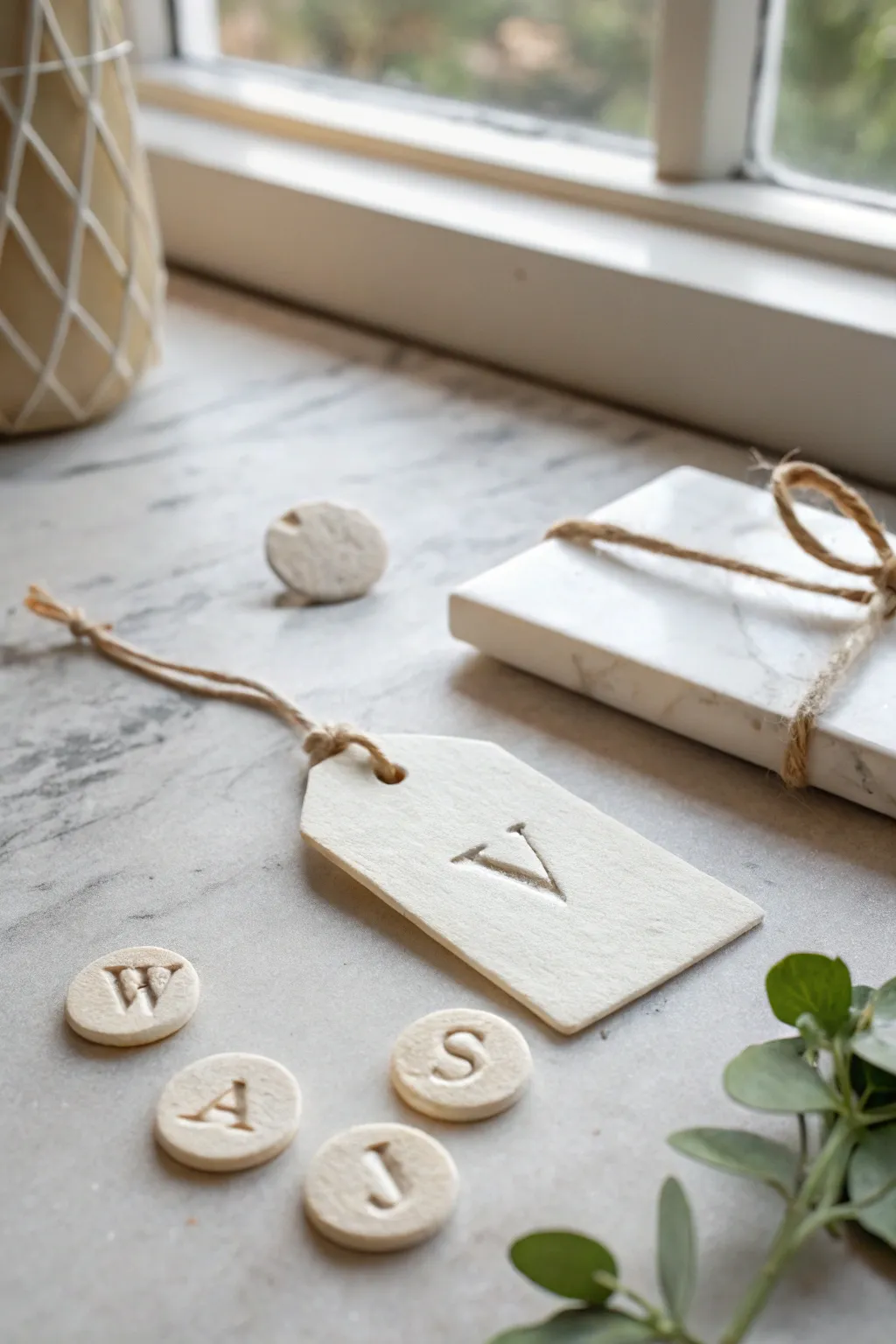
These charming, minimalist tokens and gift tags add a thoughtful, handcrafted touch to any present or table setting. Using simple air dry clay, you can create rustic, stamped monograms that look effortlessly elegant against marble or natural textures.
How-To Guide
Materials
- White air dry clay
- Rolling pin or smooth glass jar
- Small circle cookie cutter (approx. 1 inch)
- Sharp craft knife or ruler edge
- Alphabet stamp set
- Drinking straw or skewer (for holes)
- Fine sandpaper (optional)
- Jute twine
- Parchment paper or craft mat
- Small bowl of water
Step 1: Preparation and Rolling
-
Prepare your workspace:
Lay down a sheet of parchment paper or a silicone craft mat to prevent the clay from sticking to your table. Take a handful of air dry clay and knead it in your hands until it feels pliable and warm. -
Roll out the clay:
Place the clay ball on your mat and use a rolling pin to flatten it. Aim for an even thickness of about 1/8 to 1/4 inch. If you want a smoother surface, dip your finger in a little water and gently run it over the clay.
Stamps sticking?
If your stamps pull up the clay, lightly dust the stamp face with cornstarch or dip it in a tiny bit of olive oil before pressing. This acts as a release agent.
Step 2: Creating the Tokens
-
Cut the circles:
Use a small circular cookie cutter or a bottle cap to punch out round shapes. Wiggle the cutter slightly before lifting to ensure a clean release. -
Smooth the edges:
Dip your finger in water and gently tap down any rough ridges around the circumference of your circles. They don’t need to be perfect; a little organic irregularity adds to the rustic charm shown in the photo. -
Stamp the letters:
Select your desired letters from the alphabet stamp set. Press the stamp firmly into the center of each circle. Apply even pressure so the impression is deep and legible, but be careful not to push all the way through the clay.
Highlight intent
To make the letters pop, dilute a little brown acrylic paint with water, brush it into the grooves, and immediately wipe the surface clean with a damp cloth.
Step 3: Crafting the Gift Tag
-
Cut the basic rectangle:
From your rolled slab, use a craft knife to cut a rectangle approximately 2 inches wide by 3.5 inches long. A ruler helps keep the lines straight, but freehand cutting works for a more organic look. -
Shape the tag corners:
To get that classic tag shape, snip off the top two corners at a 45-degree angle. I like to cut one corner first, save the triangle piece I cut off, flip it over, and use it as a template for the other side to keep them symmetrical. -
Add the punched hole:
Using a drinking straw or a skewer, punch a hole centered near the top of the tag. Make sure the hole is wide enough to thread your chosen twine through later. -
Stamp the initial:
Just like with the tokens, press a large letter stamp into the center of the tag. If you are making the ‘V’ tag from the image, center it vertically and horizontally.
Step 4: Finishing Touches
-
Drying time:
Carefully move your pieces to a flat, dry surface. Let them air dry for 24-48 hours. Flip them over halfway through the drying process to prevent curling and ensure even drying on both sides. -
Sand for perfection:
Once fully cured and hard, check the edges. If there are any sharp or jagged bits, gently buff them away with fine-grit sandpaper for a professional finish. -
Threading:
Cut a length of natural jute twine. Fold it in half, push the loop through the hole in your tag, and pull the loose ends through the loop to create a girth hitch knot, exactly as seen in the photo.
Tie these onto a gift or scatter the tokens on a dining table for a uniquely personal presentation that feels grounded and real
Little Incense Holders With Dots and Waves
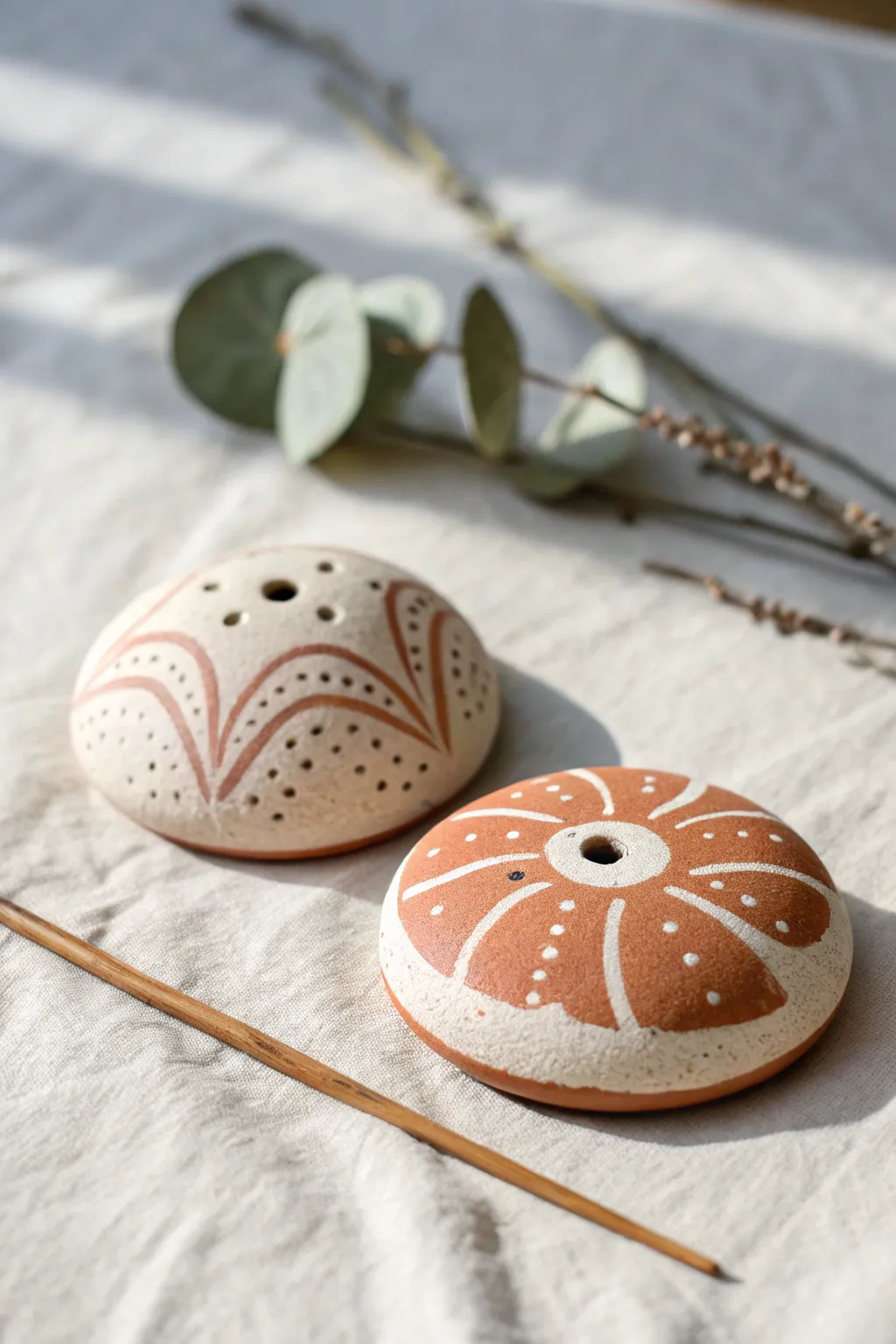
These charming, pebble-shaped incense holders combine earthy terracotta tones with creamy white clay for a modern bohemian aesthetic. Their simple rounded forms are elevated by delicate hand-painted patterns of radiating dots and flowing waves.
Step-by-Step
Materials
- White air dry clay
- Terracotta colored acrylic paint
- White acrylic paint
- Fine grit sandpaper
- Small round paintbrush (size 0 or 1)
- Dotting tool or toothpick
- Rolling pin
- Small bowl relative to your desired size (for shaping)
- Wooden skewer or chopstick
- Matte varnish or sealant
Step 1: Shaping the Clay Base
-
Condition the clay:
Begin by taking a chunk of white air dry clay roughly the size of a golf ball. Knead it in your hands for a minute until it feels warm, pliable, and free of cracks. -
Form a ball:
Roll the clay between your palms to create a smooth, tight sphere. Try to smooth out any fold lines or seams during this stage to save sanding time later. -
Flatten into a disc:
Gently press the ball down against your work surface using the palm of your hand. You want a thick, rounded disc shape—think of a river stone or a macaron, not a pancake. -
Smooth the edges:
Dip your finger in a tiny bit of water and run it along the circumference of the disc to soften the sharp edge where the clay meets the table. You want a continuous, organic curve. -
Create the incense hole:
Take your wooden skewer or chopstick and press it vertically into the exact center of the dome. Don’t go all the way through; stop about 3/4 of the way down to ensure the ash serves as a catch. -
Widen gently:
Give the skewer a very slight wiggle to ensure the hole is wide enough for an incense stick, remembering that clay shrinks slightly as it dries. -
Allow to dry:
Set your pieces aside on a wire rack or piece of parchment paper. Let them dry completely for 24-48 hours, flipping them occasionally to ensure the bottom dries evenly.
Cracked Clay Fix
If small cracks appear while drying, don’t restart! Mix a tiny bit of fresh clay with water to make a paste (slip) and fill the cracks, then sand smooth once dry.
Step 2: Painting and Patterning
-
Sand for smoothness:
Once fully dry and hard, take your fine-grit sandpaper and gently buff the surface. Focus on any fingerprints or rough textures left from shaping for a professional finish. -
Base coat (Optional):
The example image shows one piece left natural (white clay) and one painted. For the terracotta-colored one, paint the entire surface with terracotta acrylic paint and let dry completely. For the white one, leave the raw clay visible. -
Drafting the design:
If you’re nervous about freehanding, use a pencil to very lightly sketch your pattern guidelines. For the wave design, draw four main arches radiating from the center hole. -
Painting the wave outlines:
Using a fine liner brush and terracotta paint on the white disc, carefully trace the arched guidelines. Create a ‘V’ shape between each arch where they meet near the bottom edge. -
Inner wave details:
Paint a second, smaller arch inside the first one. This creates a framed space for your dot details. -
Adding dots:
Dip a dotting tool or the blunt end of a skewer into your paint. Carefully place a row of dots following the curve inside your double arches. I find it helps to start at the center and work outward to keep spacing even. -
Creating the starburst flow:
For the terracotta disc, use white paint to create eight petals radiating from the center hole. Paint the outline of the petals first, keeping the lines fluid and organic. -
Filling the petals:
Instead of filling the petals solidly, use your dotting tool to create a line of graduating dots down the center of each petal shape. -
Adding external details:
Add tiny clusters of three dots in the negative space between the petal tips near the outer edge of the disc to balance the composition. -
Sealing the work:
Once all paint is bone dry, apply a coat of matte varnish. This protects the paint from ash and heat while preserving the natural, earthy look of the clay.
Speckled Pottery Look
Before sealing, flick a toothbrush loaded with diluted brown or black paint over the finished piece. This creates a faux ceramic ‘speckled’ glaze effect.
Now you have a serene little spot to burn your favorite scents and enjoy some calm moments
Tiny Salt Spoons for a Pinch Jar
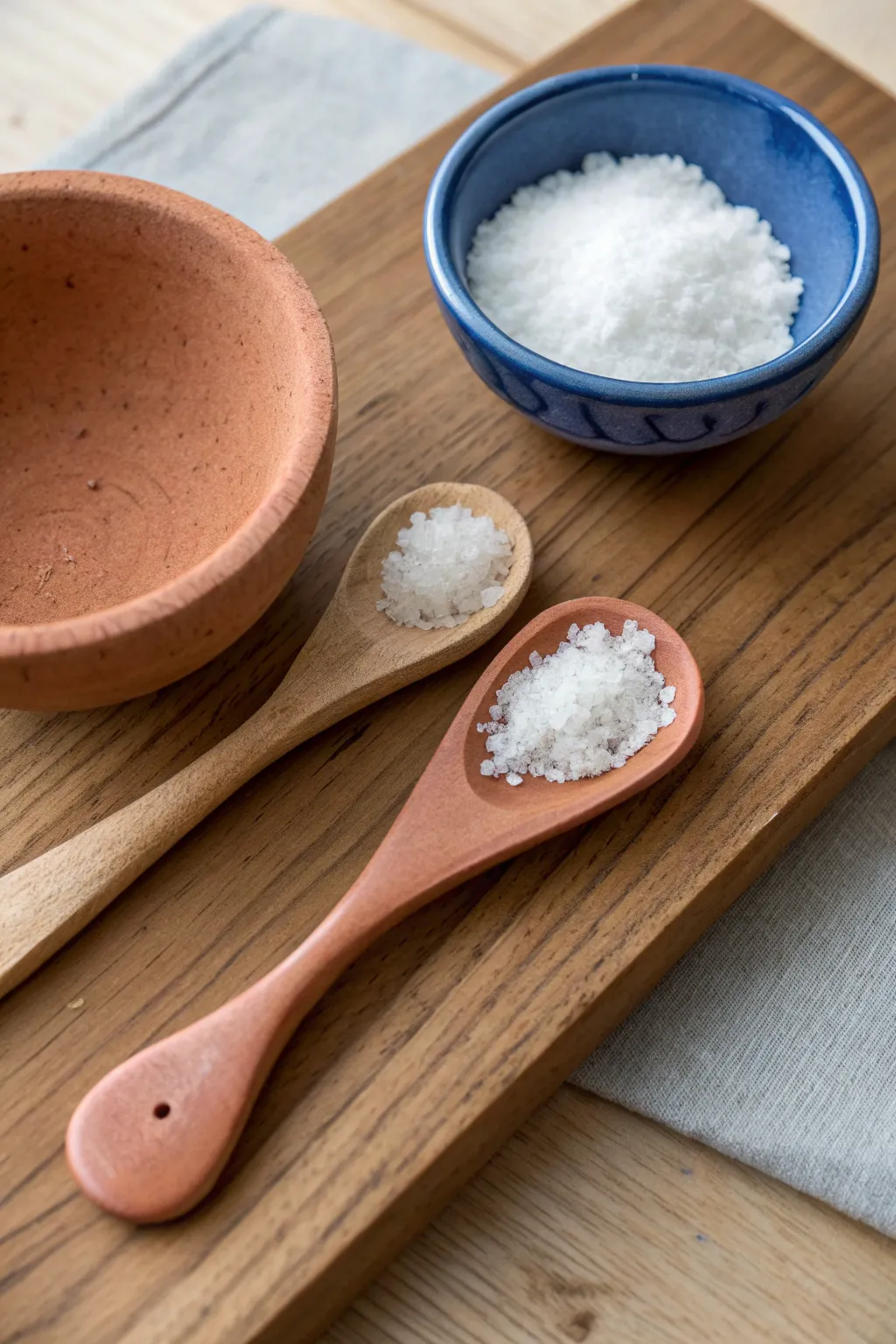
These charming little spoons are perfectly sized for pinch pots and spice jars, adding a rustic, handmade touch to your kitchen counter. Using air dry clay, you can mimic the earthy look of terracotta or light wood without needing a kiln or carving tools.
Step-by-Step Tutorial
Materials
- Air dry clay (white or terracotta colored)
- Acrylic paint (burnt sienna, raw umber, cream)
- Small craft knife or clay tool
- Sandpaper (fine grit)
- Water in a small cup
- Food-safe sealant (like Mod Podge Dishwasher Safe or a food-safe resin)
- Paintbrushes
- Clear matte varnish (optional, for non-food contact parts)
Step 1: Shaping the Spoons
-
Roll the clay:
Start by pinching off a small amount of air dry clay, roughly the size of a marble. Roll this between your palms or on a flat surface to create a smooth, elongated cylinder about 3 to 4 inches long. -
Form the bowl:
Press one end of the cylinder gently with your thumb to flattened it into a round disc shape. This will become the scoop of the spoon. -
Shape the scoop:
Using your thumb or the rounded end of a paintbrush, gently press into the center of the flattened disc to create a shallow indentation. Smooth the edges as you go to prevent cracking. -
Refine the handle:
Roll the handle portion between your fingers to ensure it is even. You can taper it slightly towards the end for a delicate look or keep it uniform for a rustic feel. -
Add the handle detail:
For the reddish spoon shown, slightly flatten the very tip of the handle. Use a needle tool or toothpick to poke a small hole through this flattened end, perfect for hanging if desired. -
Smooth imperfections:
Dip your finger in a tiny bit of water and run it over the entire surface of the spoon. This ‘slip’ technique helps erase fingerprints and tiny micro-cracks before drying. -
Let it dry:
Place your spoons on a piece of parchment paper or a drying rack. Allow them to dry completely for 24-48 hours, flipping them once halfway through to ensure even drying.
Cracks Appearing?
If you see tiny cracks forming as the clay dries, mix a tiny bit of fresh clay with water to make a paste and fill them in immediately, then smooth over.
Step 2: Sanding and Painting
-
Sand for smoothness:
Once fully dry and hard, take a piece of fine-grit sandpaper and gently buff the spoon. Focus on the rim of the scoop and the handle end to remove any sharp edges or rough spots. -
Mix your colors:
To recreate the terracotta look seen in the bottom spoon, mix burnt sienna with a touch of red. For the wooden look of the top spoon, mix cream with a tiny drop of raw umber. -
Apply the base coat:
Paint the entire spoon with your chosen color. You may need two thin coats for full coverage, letting the paint dry fully between layers. -
Add texture (optional):
For a more realistic finish, I like to use a dry brush with a slightly darker shade to lightly stipple or streak the surface, mimicking wood grain or clay variations.
Step 3: Sealing for Use
-
Prepare for sealing:
Ensure the paint is completely cured. Since these are intended for salt, sealing is crucial to prevent moisture from ruining the clay. -
Apply food-safe sealant:
Coat the entire spoon, paying special attention to the bowl area, with a food-safe sealant. Follow the manufacturer’s instructions for curing times strictly. -
Dry and cure:
Let the sealant cure fully. This often takes longer than standard drying—sometimes up to a few weeks for dishwasher-safe formulas—so patience is key here.
Make it a Set
Create a matching pinch pot using the same clay and painting technique. The spoons rest perfectly inside, making a lovely hostess gift set.
Once fully cured, your custom spoons are ready to scoop sea salt or spices with rustic elegance
Little Stud and Pendant Shapes
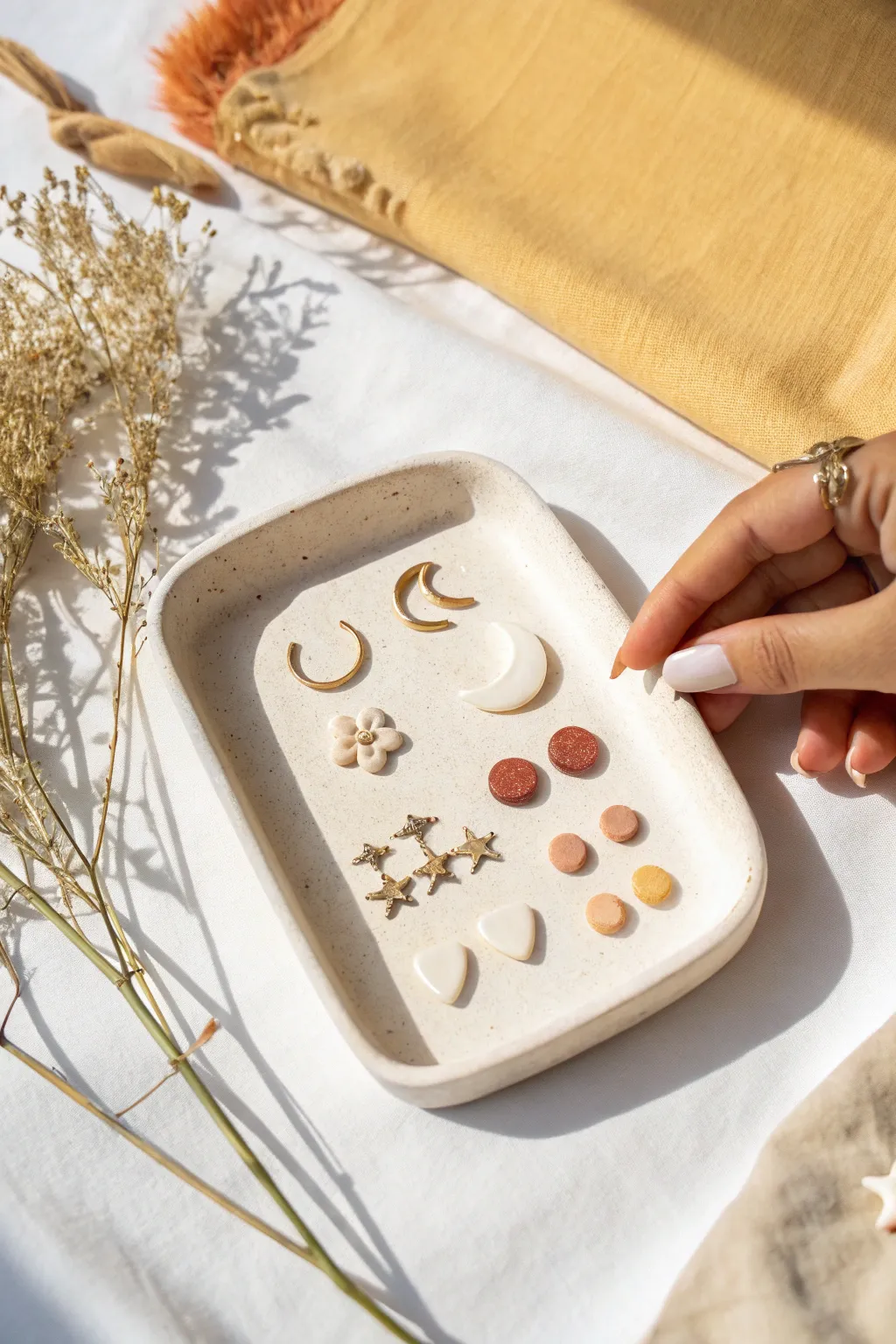
Create a delicate collection of tiny celestial and geometric jewelry components perfect for turning into studs or pendant accents. These bite-sized shapes, featuring moons, stars, and simple circles, have a soft matte finish that pairs beautifully with gold hardware.
How-To Guide
Materials
- White air-dry clay (smooth texture)
- Small rolling pin
- Parchment paper or clay mat
- X-acto knife or clay blade
- Tiny cookie cutters (circle, moon, star, flower)
- Sand paper (fine grit)
- Terracotta or rust-colored acrylic paint
- Mustard/ochre acrylic paint
- Glaze or varnish (glossy and matte)
- Earring posts and superglue (optional, for assembly)
- Gold jump rings (optional)
Step 1: Preparation & Tinting
-
Condition the clay:
Begin by taking a small handful of white air-dry clay. Knead it in your hands until it is warm, pliable, and free of cracks. -
Roll it out:
Place the clay on a sheet of parchment paper. Use your rolling pin to flatten the clay to an even thickness, aiming for about 3mm (1/8 inch), which is sturdy enough for earrings but not too heavy. -
Create colored batches:
Separate two small grape-sized balls of clay. Knead a drop of terracotta paint into one and mustard paint into the other until the color is fully uniform. You should now have plain white, rust, and mustard clay.
Step 2: Shaping the Components
-
Cut the moons and rounds:
For the crescent shape, use a small circle cutter to punch a hole, then move the cutter slightly over and punch again to slice out a moon shape. Use standard small cutters for the full circles. -
Hand-cut stars:
If you don’t have a tiny star cutter, use the tip of your X-acto knife to carefully cut small four-pointed or five-pointed star shapes from flattened white clay. -
Form the flower:
To make the 3D flower, roll five tiny balls of white clay. Press them together in a circle and flatten slightly with your thumb. Use a rounded tool to press an indentation in the center of each petal. -
Add texture (optional):
For the rust-colored circles, take an old toothbrush or a piece of sandpaper and gently press it into the surface of the wet clay to create a stone-like texture. -
Smoothing edges:
Dip your finger in a tiny bit of water and gently run it along any cut edges to remove jagged bits before drying. This saves sanding time later. -
Drying time:
Arrange all your pieces on a flat surface away from direct heat. Let them dry for at least 24-48 hours, flipping them over halfway through so they dry evenly without warping.
Clean Cuts
If your clay sticks to the cutters, dip the cutter into a little cornstarch or baby powder before pressing it into the clay. This acts as a release agent.
Step 3: Finishing Touches
-
Sand for perfection:
Once fully cured, use fine-grit sandpaper to smooth out any remaining rough edges or fingerprints gently. -
Seal the pieces:
Apply a coat of varnish. Use matte varnish for the flowers and white moons to keep them looking like porcelain, and a gloss varnish for the rust circles if you want them to catch the light. -
Attach gold accents:
For the star dangle earrings shown, glue a small gold star charm onto the clay star, or simply paint a star pattern using gold metallic paint. -
Assemble jewelry:
Use superglue to attach flat earring posts to the back of the studs. Allow the glue to cure completely before wearing.
Galaxy Glitter
Knead a pinch of fine gold glitter directly into the rust-colored clay batch before rolling it out to give your studs a subtle, built-in sparkle.
Enjoy mixing and matching your new handmade jewelry collection for a subtle, earthy look
Mini Desk Buddy Blob Characters
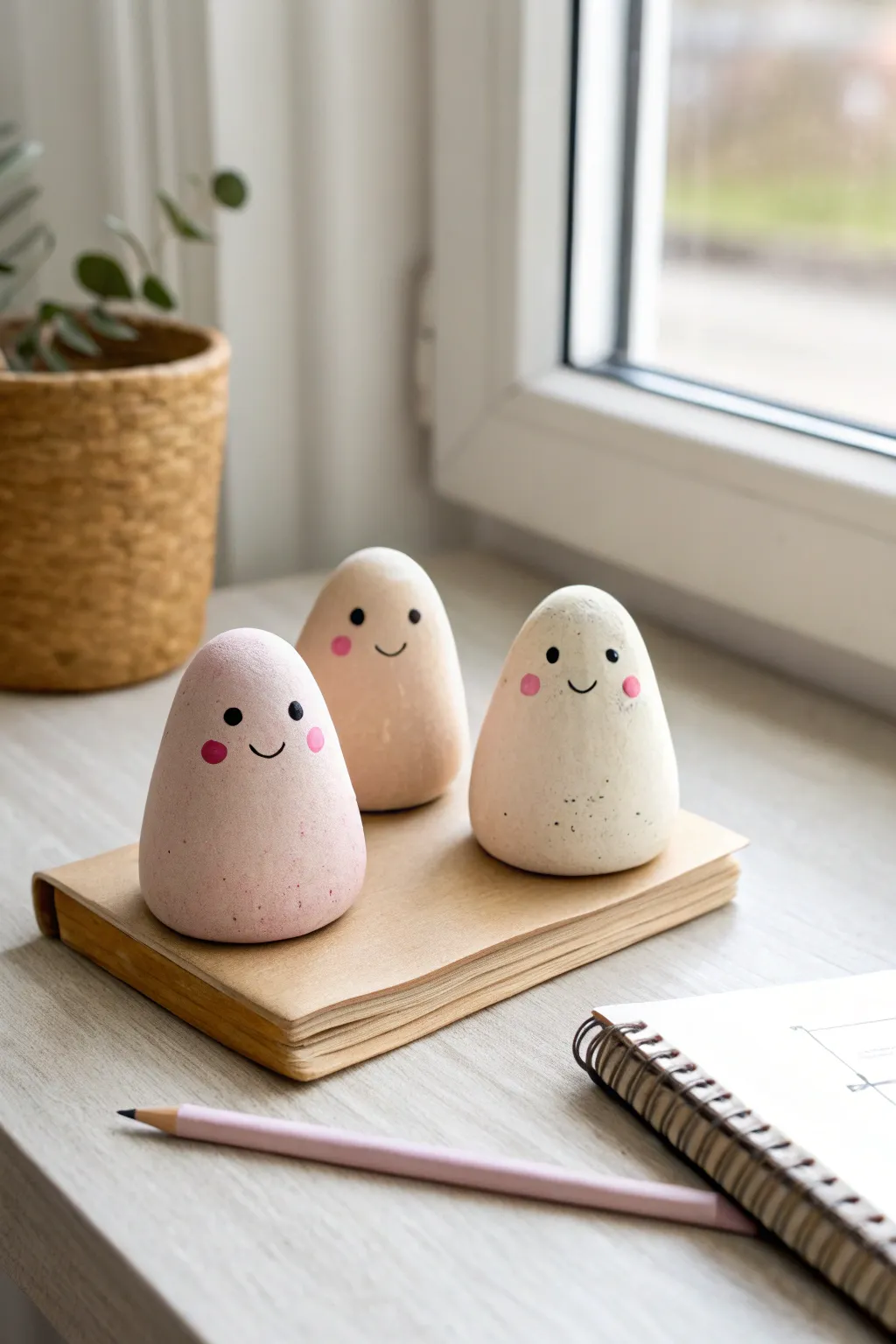
These charming little blob creatures are the perfect minimal desk companions, adding a soft touch of whimsy to your workspace. With their smooth pebble-like shapes and sweet expressions, they are incredibly easy to sculpt and customize in gentle pastel tones.
Step-by-Step
Materials
- Air dry clay (white)
- Acrylic paints (white, pastel pink, peach/beige, black)
- Fine grit sandpaper
- Small cup of water
- Paintbrushes (soft flat brush and fine detail brush)
- Dotting tool or toothpick
- Matte varnish or sealant (optional)
Step 1: Sculpting the Base
-
Portion the clay:
Start by taking a chunk of white air dry clay about the size of a golf ball or slightly smaller. Knead it well in your hands to warm it up and remove air bubbles. -
Form a ball:
Roll the clay firmly between your palms to create a smooth, tight sphere. The smoother you get it now, the less sanding you’ll have to do later. -
Shape the cone:
Gently roll one side of the ball against your work surface to taper it upward. You want a rounded cone shape—think of a very soft, melted triangle or a heavy raindrop sitting on the ground. -
Flatten the bottom:
Press the bottom of the shape firmly onto a flat surface to create a stable base so the figure stands upright without wobbling. -
Smooth imperfections:
Dip your finger into a little water and gently glide it over surface cracks or fingerprints. I find this creates a porcelain-like finish even before drying. -
Create variations:
Repeat the process to make two more buddies. Try varying the height or width slightly—make one a bit taller and narrower, and another slightly shorter and rounder for a natural group dynamic. -
Dry thoroughly:
Let the figures dry completely. Depending on your humidity and clay brand, this usually takes 24 to 48 hours. Turn them occasionally to ensure the bottom dries too.
Smooth Moves
If your clay is drying too fast while shaping, keep a damp sponge nearby to moisten your fingers, but don’t soak the clay or it will crack later.
Step 2: Refining and Painting
-
Sand the surface:
Once bone dry, use fine-grit sandpaper to gently buff away any remaining bumps or rough textures. Wipe away the dust with a slightly damp cloth. -
Apply base coats:
Mix your acrylic paints to get soft pastel shades. Paint one figure a dusty rose pink, one a warm peach, and leave one off-white (or paint it a creamy white for consistency). -
Layer the paint:
Apply a second coat if the clay color shows through, ensuring the texture looks matte and smooth. Let the paint dry completely between layers. -
Add the eyes:
Using a dotting tool or the back of a paintbrush handle dipped in black paint, place two small dots for eyes. Position them slightly wide apart for that cute ‘kawaii’ look. -
Paint the smile:
With your finest detail brush and black paint, carefully draw a tiny, shallow ‘U’ shape between the eyes. Keep the line thin and delicate. -
Add rosy cheeks:
Dip a fingertip or a dry brush into pink paint and dab it off on paper until almost dry. Gently dab two soft circles under the eyes for blushing cheeks. -
Add darker blush details:
To match the image style, you can add a more opaque, smaller pink dot on top of the blushing area for a stylized look. -
Seal the work:
Finish by applying a coat of matte varnish. This protects the paint from dust and scratches while preserving that soft, stone-like appearance.
Make it Magnetic
Before the clay dries, press a small, strong magnet into the back of the figure. Once dry, glue it in place to create adorable fridge magnets.
Set your new trio on a windowsill or desk book for instant cheer
Tiny Fossil-Style Impression Tiles
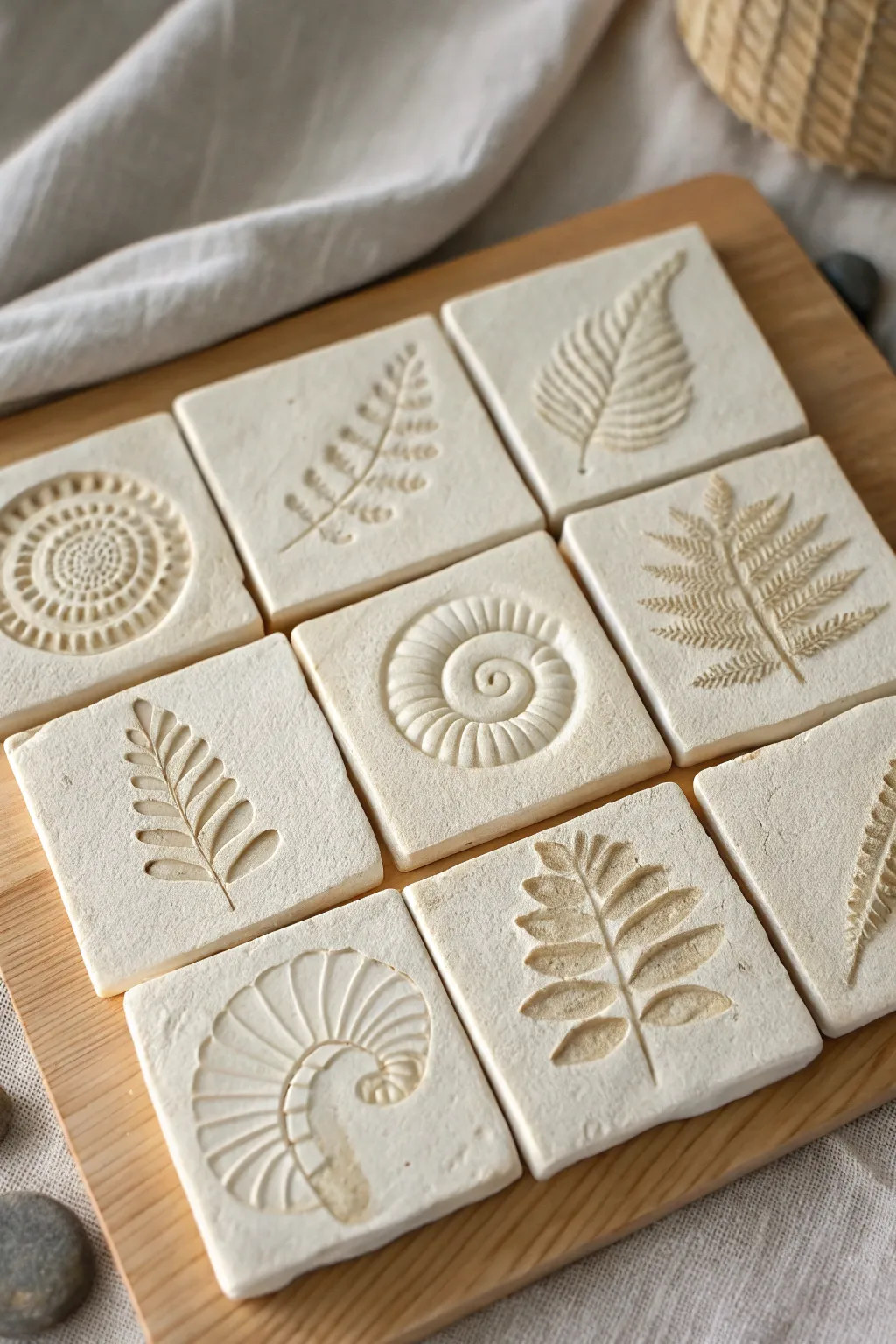
Create your own museum-worthy collection with these elegant clay tiles that capture the delicate details of ferns and fossils. The natural, matte finish and deep relief impressions give them an authentic, archaeological feel perfect for modern rustic decor.
Step-by-Step Tutorial
Materials
- White or natural air dry clay
- Rolling pin
- Square cookie cutter (approx. 3-4 inches) or ruler and knife
- Parchment paper or canvas mat (to prevent sticking)
- Fresh fern leaves, sturdy herbs, or botanical stamps
- Pottery tools (needle tool, smoothers)
- Seashells (optional, for ammonite shapes)
- Fine-grit sandpaper
- Acrylic matte sealer (optional)
Step 1: Preparing the Clay Base
-
Condition the Clay:
Begin by taking a generous amount of air dry clay and kneading it in your hands. You want it to be pliable and warm, removing any air bubbles that might cause cracks later. -
Roll out a Slab:
Place your clay on a piece of parchment paper or a canvas mat. Using your rolling pin, roll the clay out to a consistent thickness of about 1/4 inch to 1/3 inch. Using guide sticks on either side can help ensure it’s perfectly even. -
Cut the Squares:
Press your square cookie cutter deeply into the clay to create uniform shapes. If you don’t have a cutter, measure squares with a ruler and carefully slice them with a craft knife. -
Smooth the Edges:
After lifting away the excess clay, dip your finger in a little bit of water and run it gently along the cut edges of each square to soften any sharp corners or drag marks.
Preventing Curling
Clay curls because the top dries faster than the bottom. Dry tiles slowly under a loose plastic sheet, or flip them every few hours.
Step 2: Creating the Impressions
-
Prepare Your Botanicals:
Select fresh leaves that have prominent veins on the backside, like ferns or sage. If using fossils or stamps, ensure they are clean and dry. -
Position the Element:
Place your leaf (vein-side down) or object gently onto the center of a clay square. I like to arrange them slightly diagonally for a dynamic composition. -
Press for Detail:
Using the rolling pin, roll firmly over the leaf once. Don’t go back and forth, as this can shift the image; just one confident pass with firm pressure is best. -
Create Spiral Patterns:
For the ammonite or spiral designs, you can press a real shell into the clay, or use a sculpting tool to carve a spiral groove, pressing deeper as you move toward the center. -
Sculpting the Ridges:
If hand-sculpting the spiral, use a small modeling tool to make rhythmic indentations along the spiral line to mimic the segmented look of a fossil shell. -
Geometric Patterns:
For the circular sun-like design, press various circular tools or caps into the clay in expanding rings, varying the pressure to create texture. -
Reveal the Imprint:
Carefully find the stem or edge of your botanical and peel it back slowly to reveal the intricate impression left behind.
Step 3: Finishing Touches
-
Initial Drying:
Place the tiles on a wire rack to allow air to circulate underneath. Let them dry for about 24 hours away from direct sunlight. -
Flip for Flatness:
Midway through the drying process, flip the tiles over. This helps prevent the edges from curling up as the moisture evaporates. -
Sanding:
Once fully cured (usually 2-3 days), take a piece of fine-grit sandpaper and very gently buff the edges and surface to remove any burrs or fingerprints. -
Clean Up:
Wipe away any clay dust with a slightly damp cloth or a soft, dry paintbrush. -
Optional Tinting:
If you want to highlight the texture, you can apply a very watered-down brown paint (a wash) into the crevices and wipe the surface clean immediately. -
Determine a Display:
Decide if you want to mount these on a board, frame them in a shadow box, or keep them loose as coaster-style decor objects.
Crisper Impressions
If your leaf stick to the clay, lightly dust the clay surface with cornstarch before pressing. It acts as a release agent and brushes off later.
Arranging your finished fossil tiles creates a stunningly serene visual texture for any shelf or table
Little Mini Planters for Faux Sprigs
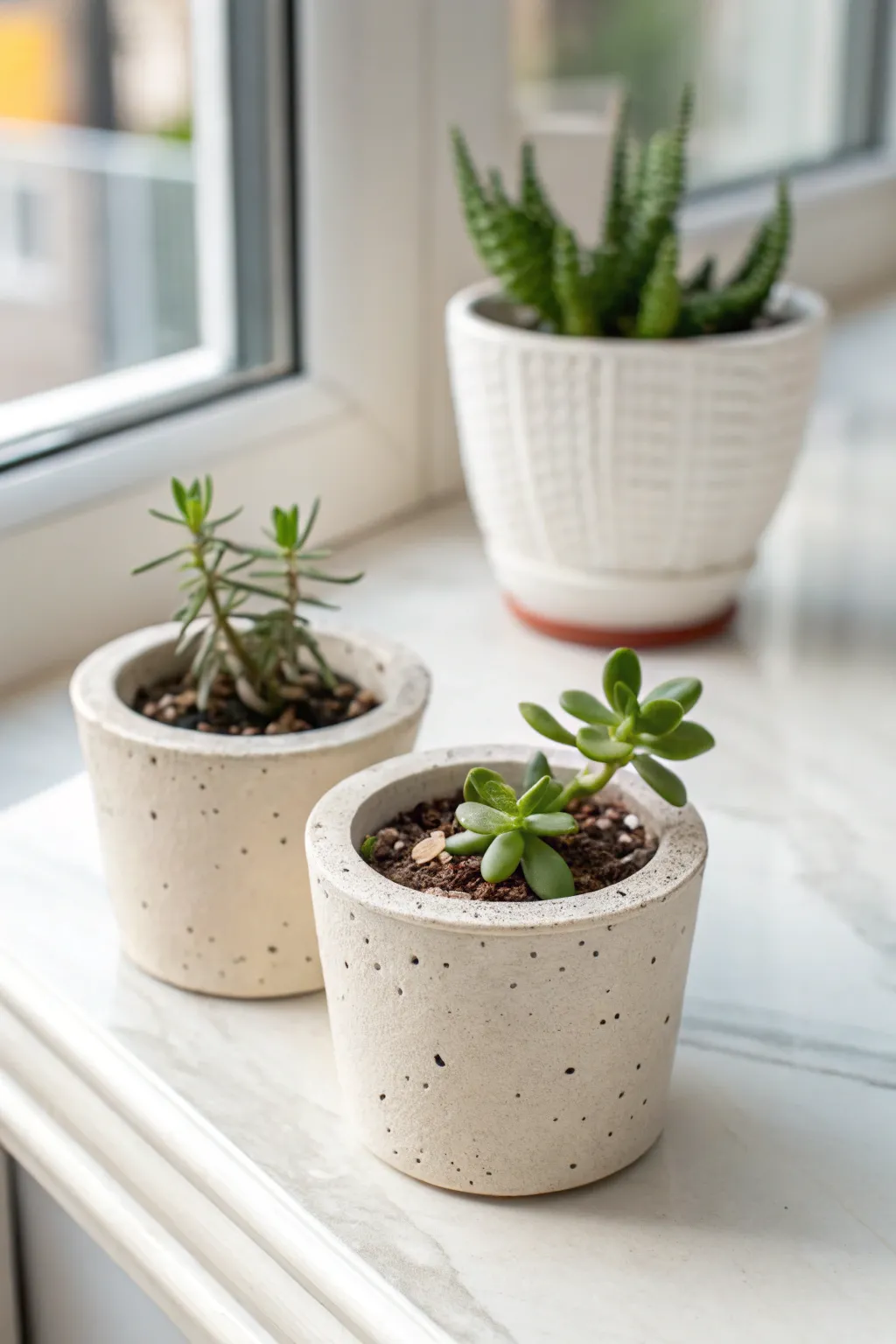
These charming, minimalist planters mimic the look of trendy terrazzo or raw concrete but are crafted entirely from lightweight air dry clay. Their clean cylindrical shape and speckled texture make them the perfect modern home for your favorite faux succulent sprigs.
Detailed Instructions
Materials
- White air dry clay
- Used coffee grounds (dried)
- Non-stick rolling pin
- Small cylindrical container or cookie cutter (approx. 2.5-3 inches diameter)
- Craft knife
- Fine-grit sandpaper
- Small bowl of water
- Matte sealant or varnish
- Faux succulent stems
- Small pebbles or faux soil for filling
Step 1: Preparing the Clay Body
-
Condition the clay:
Begin by taking a handful of white air dry clay and kneading it in your hands to warm it up and make it pliable. -
Add texture:
Sprinkle a small pinch of dried used coffee grounds onto the clay. I prefer to start with a tiny amount and add more gradually. -
Mix the speckles:
Knead the coffee grounds thoroughly into the white clay until the dark specks are evenly distributed throughout the mass, resembling stone. -
Roll out the base:
Roll a portion of the clay out on a flat surface to about 1/4 inch thickness. -
Cut the bottom:
Use your circular cutter or a template to cut out a perfect circle for the base of the pot.
Step 2: Building the Walls
-
Roll the side wall:
Roll out the remaining clay into a long rectangular strip, maintaining that same 1/4 inch thickness. -
Measure the length:
Wrap the strip loosely around your base circle to measure the circumference, then trim the strip to the exact length needed, adding just a tiny overlap for joining. -
Trim the edges:
Use a craft knife and a straight edge to ensure the top and bottom of your rectangular strip are perfectly straight and parallel. -
Score the clay:
Use your craft knife to make small hatch marks (scoring) along the outer edge of the circular base and the bottom edge of your wall strip. -
Attach the wall:
Apply a little water to the scored areas and wrap the wall around the base, pressing firmly to connect them. -
Seal the seam:
Blend the vertical seam where the wall ends meet by smoothing the clay across the join with a wet finger until it disappears. -
Smooth the interior:
Reach inside and smooth the clay where the wall meets the floor to ensure a strong bond.
Grounds Control
Ensure your coffee grounds are 100% bone dry before mixing. Wet grounds can introduce mold inside the clay as it dries.
Step 3: Finishing Touches
-
Refine the rim:
Dip your finger in water and run it along the top rim to smooth out any sharp edges or unevenness from cutting. -
Prying texturing:
If the exterior became too smooth during handling, gently tap it with a toothbrush to bring back a stone-like surface texture. -
Dry completely:
Let the pots sit in a cool, dry place for 24-48 hours. Turn them upside down halfway through to ensure the bottom dries evenly. -
Sand for perfection:
Once bone dry, use fine-grit sandpaper to gently remove any remaining bumps or fingerprints, especially around the top rim. -
Seal the surface:
Apply a coat of matte sealant to protect the clay and give it a finished look without adding unnatural shine. -
Add greenery:
Fill the pots with small pebbles or dried moss and insert your faux succulent sprigs securely.
Make It Glossy
For a more polished ceramic look instead of raw stone, swap the matte sealant for a high-gloss glaze or clear nail top coat.
Place your new trio of speckled planters on a sunny windowsill to enjoy the greenery without the maintenance
Micro Keepsake Charm Set for a Jar
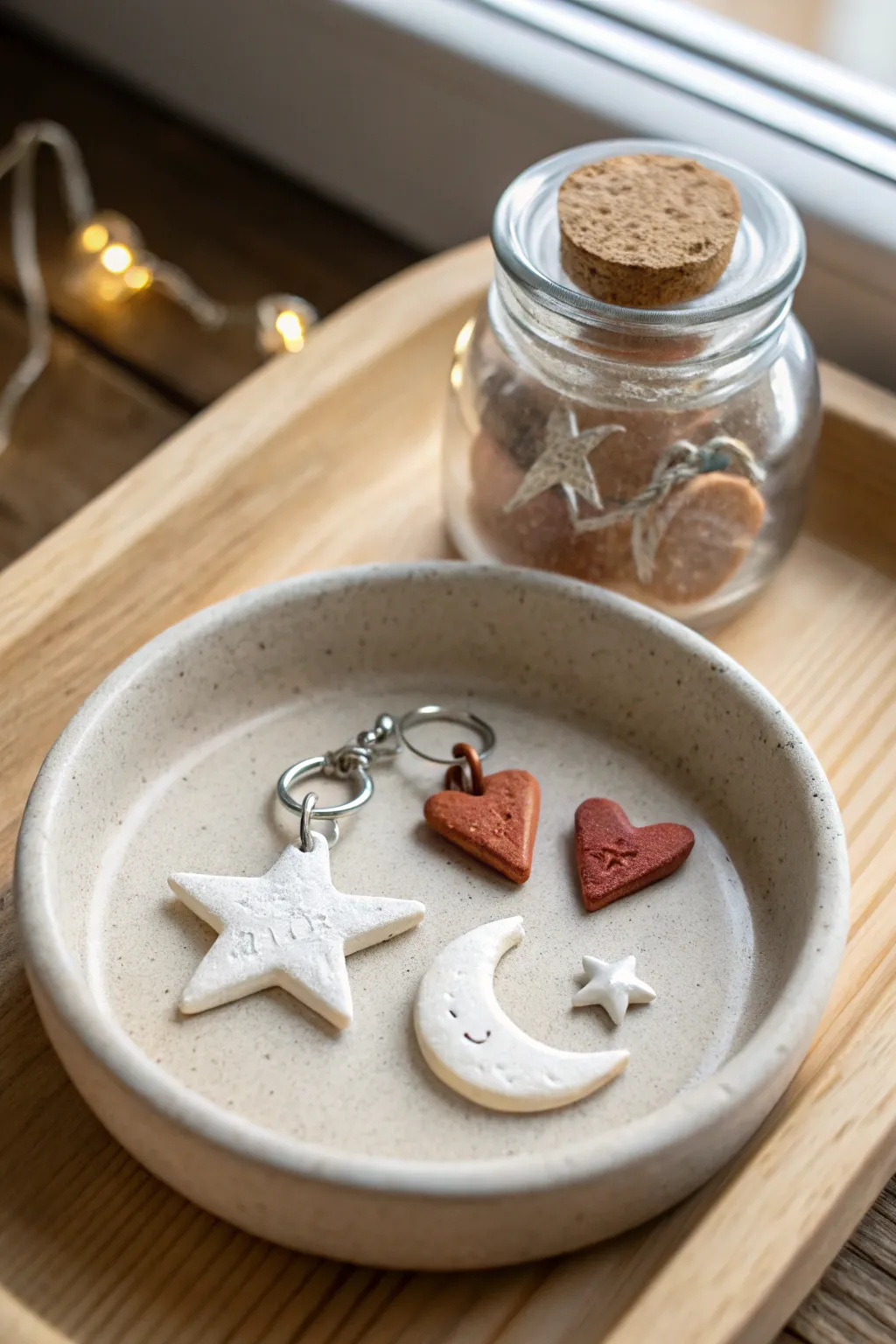
These delicate celestial tokens—featuring moons, stars, and tiny hearts—make perfect pocket keepsakes or keychain additions. Their smooth, stone-like finish and minimalist impressed details give them a timeless, handcrafted appeal that fits beautifully inside a gift jar.
Step-by-Step
Materials
- White smooth air dry clay
- Small star and moon cookie cutters (optional)
- Small heart cookie cutter
- Rolling pin
- Precision knife or needle tool
- Keychain jump rings and clasp hardware
- Fine-grit sandpaper (400-600 grit)
- Terracotta or rust-colored acrylic paint
- Small paintbrush or sponge
- Gloss or matte varnish (for sealing)
- Letter stamps (optional, for the star)
Step 1: Shaping the Celestial Bodies
-
Condition the clay:
Begin by kneading a walnut-sized ball of white air dry clay until it is warm, pliable, and free of cracks. -
Roll it out:
Roll the clay out on a smooth surface to an even thickness of about 4-5mm. You want them thick enough to be durable but thin enough to look delicate. -
Cut the stars:
Use a star cutter or freehand cut a five-pointed star shape with your precision knife. For the keychain charm, create a larger star; for the filler charm, make a tiny version. -
Sculpt the moon:
Cut a crescent moon shape. If cutting freehand, I find using a round cookie cutter to make the first curve and then shifting it to cut the inner curve creates the perfect crescent. -
Create the hearts:
Cut out two small heart shapes from the same rolled slab. -
Add texture and details:
For the moon, use a needle tool to gently indent a small smile and closed sleepy eyes. On the larger star, you can stamp a date or name if desired. -
Pierce for hardware:
Using a needle tool or toothpick, create a hole near the top point of the large star. Wiggle the tool slightly to ensure the hole is large enough for your jump ring. -
Smooth the edges:
Dip your finger in a little water and gently run it along all cut edges to soften any sharp corners or ragged bits.
Keep it Clean
Work on a piece of wax paper or a silicone mat. This prevents the clay from sticking to your table and picking up dust or lint while you roll and shape it.
Step 2: Finishing and Assembly
-
Let them dry:
Place all pieces on a drying rack or parchment paper. Let them dry for 24-48 hours, flipping them halfway through to prevent curling. -
Sand for perfection:
Once fully dry and hard, use fine-grit sandpaper to gently buff the surfaces and edges until they feel like smooth porcelain. -
Paint the hearts:
Mix a rust or terracotta acrylic paint. Paint the two heart charms completely, giving them an earthy contrast to the white celestial pieces. -
Seal the pieces:
Apply a thin coat of matte or satin varnish to all the charms. This protects them from moisture and gives them a finished look. -
Add hardware:
Open a silver jump ring with pliers and thread it through the hole in the large white star. -
Secure the clasp:
Attach the rest of the keychain clasp mechanism to the jump ring and close it securely. -
Final arrangement:
Arrange the loose moon, tiny star, and hearts alongside the main keychain, ready to be gifted or placed in a decorative jar.
Fixing Cracks
If you notice small hairline cracks as the clay dries, mix a tiny bit of fresh clay with water to make a paste (slip) and smooth it into the cracks with your finger.
Now you have a charming collection of miniature sculptures ready to brighten up a keychain or sit prettily on a shelf