
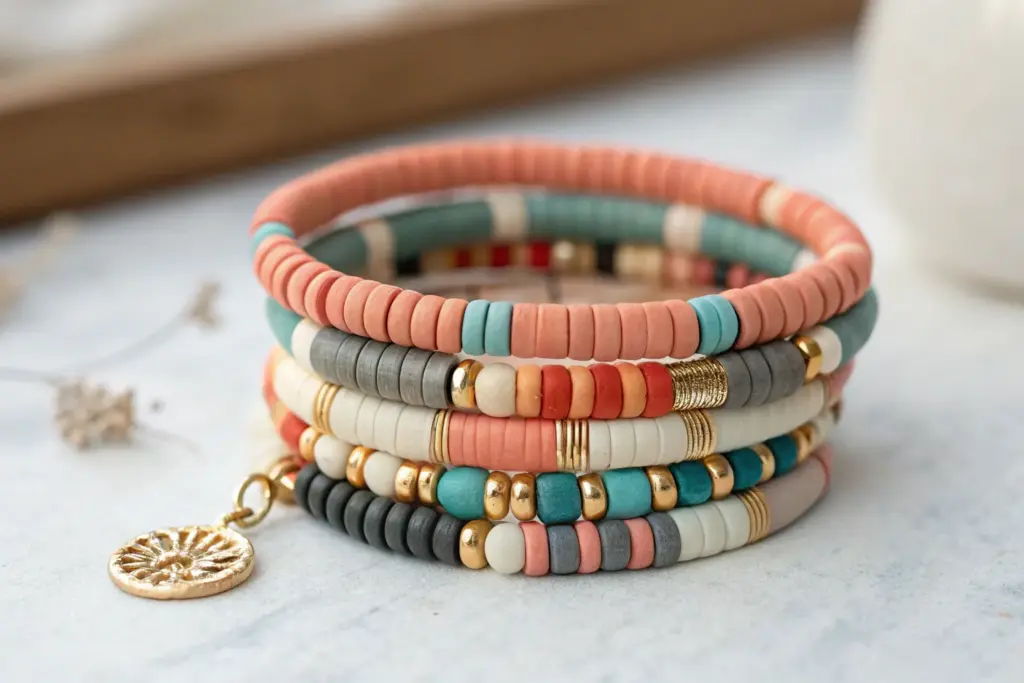
If you’re in the mood for easy, happy bracelet making that looks instantly put-together, clay bead bracelets are my go-to. I’m sharing my favorite “copy-this” clay beads design recipes—starting with the classics and ending with a few playful curveballs.
Classic Rainbow Order Stack
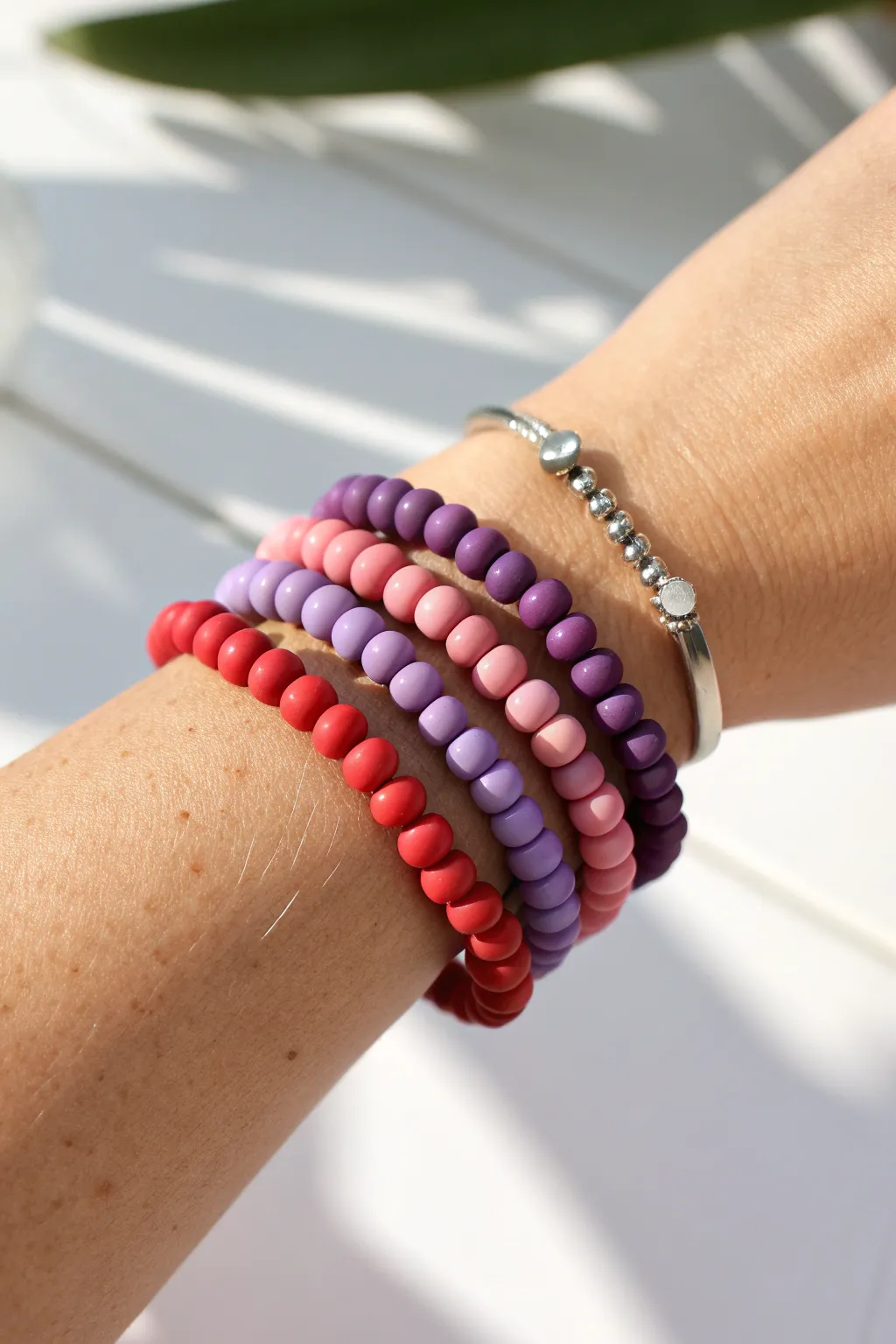
These velvety matte bracelets create a stunning ombre effect on your wrist, transitioning from deep purple to vibrant red. The smooth, soft-touch finish of the beads adds a sophisticated texture that pairs beautifully with the sleek silver accent bangle.
Step-by-Step
Materials
- 6mm or 8mm matte round beads in dark purple/plum
- 6mm or 8mm matte round beads in lavender/lilac
- 6mm or 8mm matte round beads in soft pink/rose
- 6mm or 8mm matte round beads in bright red
- Strong elastic cord (0.8mm or 1.0mm recommended)
- Hypo-cement or jewelry glue
- Scissors
- Bead stopper or masking tape
- Optional: Silver bangle with ball ends to complete the look
Step 1: Preparation & Planning
-
Measure your wrist:
Before cutting any cord, wrap a measuring tape around your wrist to find your size. Add about 0.5 to 1 inch to this measurement depending on how loose you want the fit. -
Cut the cord:
Cut four lengths of elastic cord, making each one about 10-12 inches long. Having extra length makes knotting much easier later. -
Pre-stretch the elastic:
Give each piece of cord a firm tug a few times. This pre-stretching step is crucial because it prevents the bracelet from stretching out and becoming loose after just a few wears. -
Secure the ends:
Place a bead stopper or a piece of masking tape on one end of each cord to stop beads from sliding off while you work.
Matte Finish Pro-Tip
Matte beads can show oils from your hands more easily than glossy ones. Wipe them gently with a soft, dry cloth after finishing to remove any fingerprints.
Step 2: Beading the Gradient
-
Create the plum bracelet:
Start with your darkest purple beads. Thread them onto the first cord until you reach your desired length. Check the fit by wrapping it around your wrist; the ends should touch comfortably without gaps. -
String the lavender layer:
Moving to the second cord, string on the lavender or lilac beads. I like to double-check that this strand is the exact same length as the first one by holding them side-by-side. -
Add the pink tier:
For the third bracelet, use your soft pink or rose-colored beads. As you string, inspect the beads to ensure none are chipped or misshapen, maintaining that smooth matte look. -
Finish with red:
Thread the final cord with the bright red beads. This vibrant pop of color anchors the gradient and adds real warmth to the stack.
Step 3: Securing the Knots
-
Tie the surgeon’s knot:
Take the ends of your first bracelet. Cross right over left and loop it under once. Then cross left over right, but loop it under twice. This extra loop creates a very secure surgeon’s knot. -
Tighten securely:
Pull all four strands (the two tail ends and the two bracelet sides) firmly to tighten the knot. You should feel the elastic stretch slightly as the knot cinches down. -
Apply adhesive:
Dab a tiny drop of jewelry glue or hypo-cement directly onto the knot. Be careful not to get glue on the surrounding beads, as it can mar the matte finish.
Level Up: Texture Mix
Swap one matte bead on each bracelet for a pave crystal bead or a shiny gold spacer to add a subtle sparkle that breaks up the solid color blocks.
Step 4: Finishing Touches
-
Hide the knot:
While the glue is still slightly tacky but not wet, slide a bead over the knot to hide it inside. If the hole is too small, simply let the knot dry fully first. -
Trim excess cord:
Once the glue is completely dry, use sharp scissors to trim the excess cord ends close to the knot. -
Repeat for all strands:
Follow the same tying, gluing, and trimming process for the remaining three beaded bracelets. -
Assemble the stack:
Slide all four beaded bracelets onto your wrist. Start with the dark purple, then lavender, pink, and finally red to recreate the ombre transition. -
Add the metal accent:
Slip on a silver bangle or cuff to sit between the darker purple layers or at the top of the stack, adding a bit of shine to contrast with the matte beads.
Wear your new berry-toned stack with pride and enjoy the satisfying soft texture on your wrist
Pastel Preppy Color Blocks
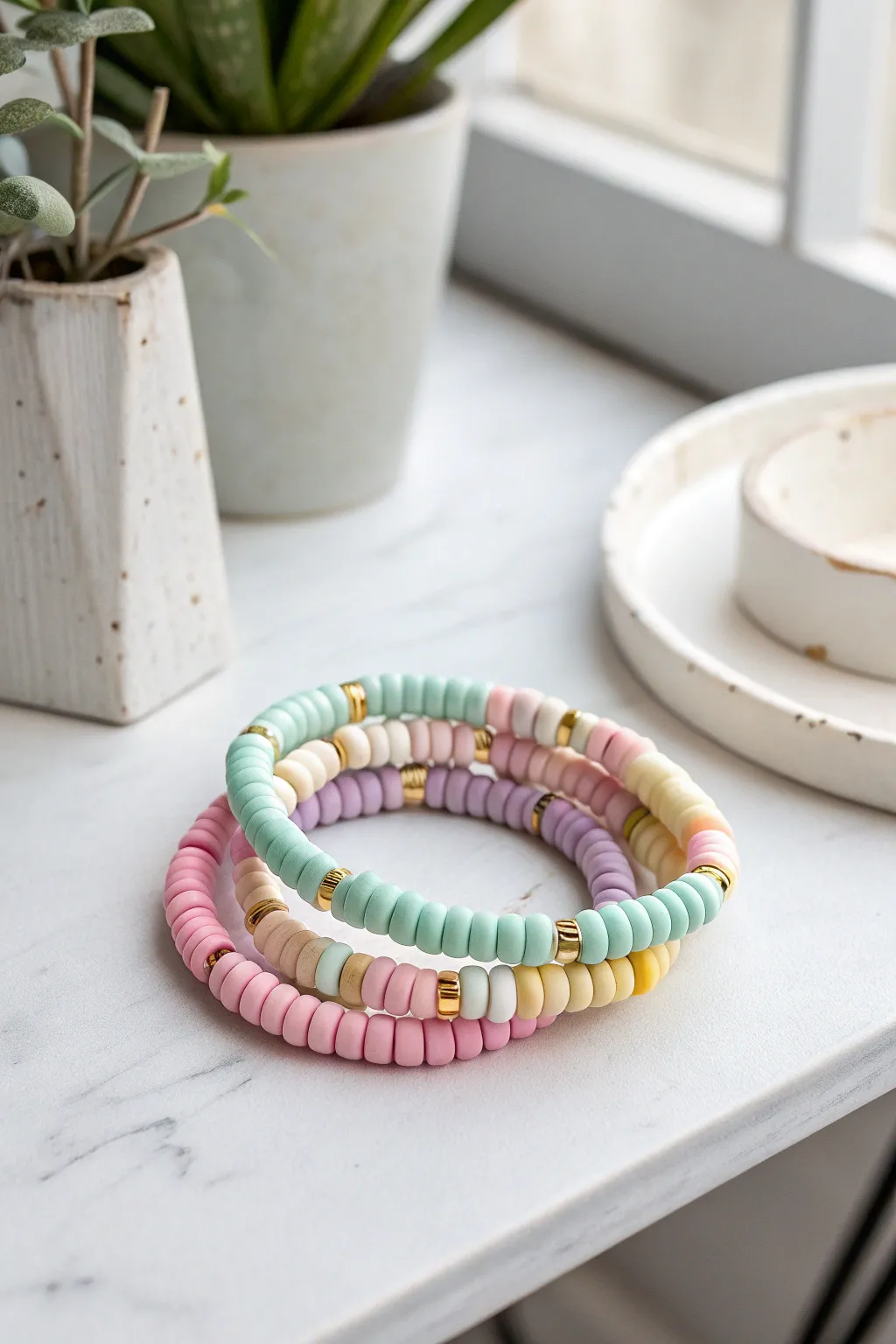
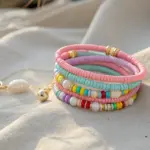
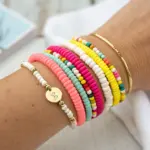
These simple yet chic bracelets rely on the beauty of soft, blocked colors separated by striking metallic accents. By grouping pastel clay heishi beads into unified sections, you create a sophisticated ‘preppy’ look that is perfect for stacking.
Step-by-Step Guide
Materials
- Polymer clay heishi beads (pastel mint, light pink, lavender, cream, light yellow)
- Gold disc spacer beads (approx. 4-6mm)
- Stretch cord (0.8mm clear elastic)
- Jewelry glue or clear nail polish
- Scissors
- Bead stopper or tape
- Masking tape or ruler (optional for measuring sections)
Step 1: Preparation & Design
-
Cut the Cord:
Cut a piece of stretch cord to about 10-12 inches long. This gives you plenty of extra room to tie knots later without straining the elastic. -
Secure the End:
Attach a bead stopper to one end of the cord, or simply tape it down to your table. This prevents your beads from sliding off while you design. -
Pre-stretch the Elastic:
Give the cord a few gentle tugs. Pre-stretching helps prevent the bracelet from loosening up after the first time you wear it.
Knot Slipping?
If your elastic knot feels loose, try tying the strands while the cord is slightly stretched tensioned. A Surgeon’s knot is much more secure than a standard square knot for this slippery material.
Step 2: The Mint & Pink Bracelet
-
Start with Mint:
Thread on approximately 2 inches of mint green clay beads. You want a solid block of color here. -
Add a Gold Spacer:
Slide on one gold disc spacer bead. This will act as the divider between your color blocks. -
Create the Pink Section:
Add a short section of light pink beads, about 1/2 inch in length. -
Add Texture:
Place another gold spacer, followed by a small section (approx. 1/4 inch) of cream or white beads. -
Finish the Pattern:
Add a final gold spacer and fill the rest of the length with lavender or another pastel shade until the bracelet fits your wrist.
Step 3: The Solid Pink & Spacer Design
-
Begin the Second Bracelet:
For the pink-heavy bracelet shown at the bottom of the stack, begin threading solid pink beads for about 1.5 inches. -
Insert Gold Detail:
Add a gold spacer, then a very short block (about 5-6 beads) of cream color, followed by another gold spacer. -
Continue the Pink:
Return to the pink beads for another long section, repeating the small cream-and-gold interruption periodically if you like, or keeping it as a focal point.
Mix It Up
Add a single letter bead in the center of the smallest color block for a personalized initial bracelet. Gold letter beads look particularly high-end against these pastels.
Step 4: The Multi-Block Lavender Mix
-
Start the Third Bracelet:
For the middle bracelet, create a more frequent pattern shift. Start with 1 inch of lavender beads. -
Mix the Colors:
After a gold spacer, switch to a 1-inch block of yellow, then a spacer, then a 1-inch block of mint. -
Vary the Block Sizes:
I like to make one color block slightly longer than the others to create visual interest rather than perfect symmetry.
Step 5: Finishing Touches
-
Check the Fit:
Wrap the beaded cord around your wrist to ensure it fits comfortably without gaps. -
Tie the Knot:
Remove the beat stopper and tie a surgeon’s knot (right over left, left over right, and loop it through twice). -
Secure with Glue:
Dab a tiny drop of jewelry glue on the knot. Pull the knot tight and let it dry. -
Hide the Knot:
If hole size permits, gently slide a bead over the knot to hide it. -
Trim Excess:
Snip off the extra elastic tail with sharp scissors, being careful not to cut firmly against the knot itself.
Now you have a stunning set of pastel bracelets ready to wear together or share with friends
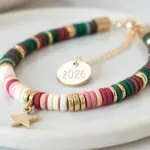
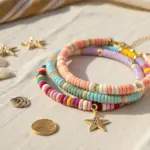
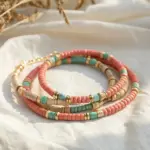
Monochrome Tone-on-Tone Gradient
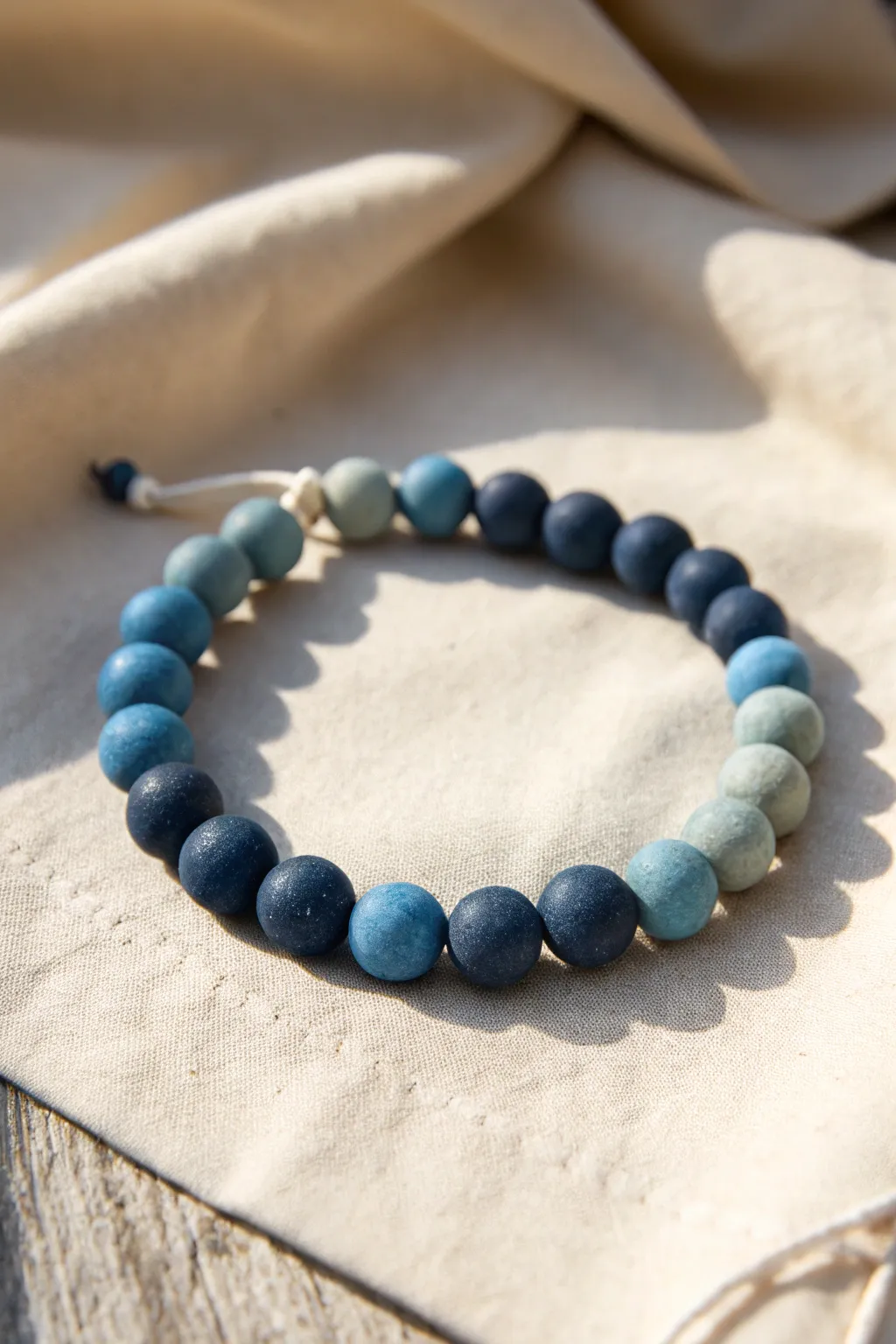
Capture the serene hues of the ocean with this sophisticated monochrome gradient bracelet. Using polymer clay beads in shifting shades of blue, from deep navy to airy sky, you can create a seamless transition that looks professionally crafted and feels wonderfully tactile.
How-To Guide
Materials
- Polymer clay in Navy Blue, Teal, White, and Grey
- Alternatively: Pre-made matte round beads (approx. 8mm) in 5-6 shades of blue
- 1mm or 0.8mm waxed cotton cord or nylon macramé cord (white or cream)
- Bead reamer or large needle
- Scissors
- Lighter (optional, for sealing cord ends)
- Clear nail polish or jewelry glue
- Oven (if making your own beads)
- Baking sheet and parchment paper
Step 1: Creating the Clay Colors
-
Prepare base colors:
Start by conditioning your polymer clay blocks until they are soft and pliable. You will need a strong navy blue, a medium teal or denim blue, and plenty of white. -
Mix the gradient:
Create 5 distinct color blends. Start with pure navy for your darkest shade. For the next shade, mix 3 parts navy with 1 part white. -
Continue the transition:
For the middle tone, mix equal parts navy/teal with white. Continue lightening the subsequent mixtures by adding increasing amounts of white and a touch of grey to desaturate the colors for that matte, stony look. -
Final lightest shade:
Your lightest shade should be mostly white with just a tiny crumb of blue and grey mixed in, resulting in a pale, dusty powder blue.
Step 2: Forming the Beads
-
Measure equal portions:
Roll your clay blends into logs of equal thickness. Slice them into equal-sized segments to ensure your finished beads are uniform in size, roughly 8mm to 10mm. -
Roll the spheres:
Take each segment and roll it vigorously between your palms. Use a circular motion to create perfect spheres. I find that wearing latex gloves helps prevent fingerprints on the clay surface. -
Poke the holes:
Gently pierce the center of each bead with a needle or bead pin. twisting the needle slightly as you go through to avoid squashing the sphere shape. -
Texture the surface (Optional):
To achieve the matte, stone-like texture seen in the photo, gently roll the unbaked beads over a piece of coarse sandpaper or texturing sponge. -
Bake the beads:
Arrange the beads on a parchment-lined baking sheet. Bake according to your clay package instructions (usually 275°F/135°C for 15-30 minutes). Let them cool completely.
Stone Effect Tip
After baking, rub beads with a denim scrap or very fine sandpaper. This removes shine and enhances the matte, organic ‘faux stone’ finish.
Step 3: Stringing the Ombré Design
-
Prepare the cord:
Cut a piece of your waxed cord about 12 inches long. If the ends are fraying, carefully graze them with a lighter flame to melt and seal them into a stiff needle-like point. -
Arrange the layout:
Lay out your cooled beads on a design board or cloth. Arrange them in a color gradient: darkest navy, followed by slate, mid-blue, light blue, and finally the palest tone. -
Refine the pattern:
The pattern in the image mirrors itself or cycles through. Decide if you want a linear fade (dark to light) or a cyclical fade (dark, medium, light, medium, dark). The example uses blocks of 3-4 beads per color shade. -
String the beads:
Thread the beads onto the cord in your chosen order. Check the fit around your wrist periodically to ensure you have enough length.
Level Up: Spacer Accent
Add one small gold or silver geometric spacer bead between the color transitions to make the gradient sections pop even more.
Step 4: Finishing the Closure
-
Add the anchor knot:
Once all beads are strung, bring the two ends of the cord together. Tie a simple overhand knot close to the beads to keep them secure, but leave a tiny bit of wiggle room so the bracelet isn’t stiff. -
Create the sliding knott:
Cross the two tail ends over each other. Use a separate scrap piece of cord (about 5 inches) to tie a series of 3-4 square knots (macramé) over the overlapped tails. This acts as the sliding mechanism. -
Secure the slider:
Trim the excess from your short knotting cord and dab a tiny drop of glue on the cut ends (being careful not to glue the slider to the main cords). -
Finish the tails:
Tie a small knot at the very end of each cord tail to prevent them from slipping through the slider. Trim any excess.
Slide your new bracelet on and enjoy the calming rhythm of blue tones on your wrist
Minimal Black-and-White Stripe
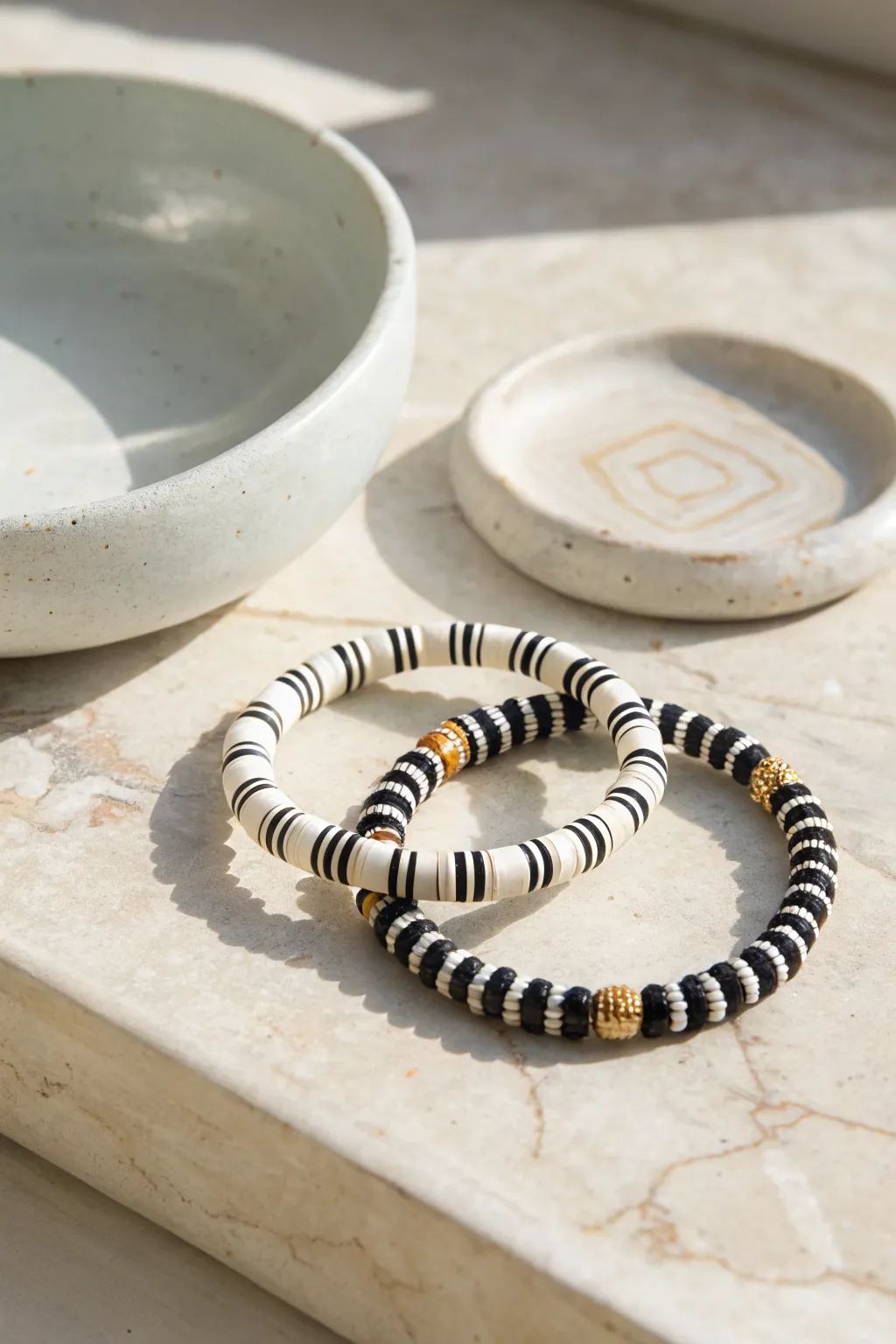
Create a sophisticated, minimalist statement with this pair of black-and-white bracelets that play with negative space and bold contrast. Using flat vinyl disc beads, often called Heishi beads, you can alternate patterns to achieve a modern, graphic look that stacks perfectly together.
Step-by-Step
Materials
- 6mm loose vinyl disc beads (Heishi beads) in matte white
- 6mm loose vinyl disc beads (Heishi beads) in matte black
- Gold-plated decorative spacer beads (textured rounds or rondelles)
- Strong elastic cord (0.8mm or 1mm thickness)
- Super glue or jewelry cement
- Scissors
Step 1: Preparation and Design
-
Measure your wrist:
Wrap a piece of string around your wrist to find your comfortable fit, then add about half an inch for slack. Cut a length of elastic cord about 3-4 inches longer than this measurement to give yourself plenty of room for tying knots later. -
Pre-stretch the elastic:
Gently pull tightly on your cut piece of elastic cord several times. This pre-stretching step prevents the bracelet from expanding and becoming loose shortly after you start wearing it. -
Secure one end:
Attach a piece of tape or a bead stopper to one end of your elastic cord so your beads don’t slide right off while you are working.
Step 2: Bracelet 1: The White-Dominant Stripe
-
Establish the pattern:
For the first style, you are aiming for a primarily white look with thin black accents. Pick up your white vinyl disc beads and slide about 5 to 6 of them onto the cord. -
Add the contrast:
Slide a single black vinyl disc bead onto the cord, pushing it flush against the stack of white beads. This creates the thin pinstripe effect seen in the reference. -
Continue the rhythm:
Repeat this pattern—5 or 6 white beads followed by 1 black bead—until you have covered about half of your desired bracelet length. Consistency is key for a polished look. -
Insert the focal point:
Choose a decorative gold spacer bead. Slide it onto the cord to break up the pattern and add a touch of metallic warmth. -
Finish the strand:
Resume your white-and-black stripe pattern immediately after the gold bead. Continue until the bracelet length matches your wrist measurement. -
Check fit:
Wrap the unfinished strand around your wrist to ensure it sits comfortably. Add or remove a pattern repeat if necessary.
Knot Slipping?
If your elastic knot feels insecure, try a drop of GS Hypo Cement. It has a pinpoint applicator perfect for tiny knots and stays flexible when dry.
Step 3: Bracelet 2: The Black-Dominant Texture
-
Start the second strand:
Prepare a second piece of elastic just like the first. For this bracelet, you will reverse the dominance to create a darker, richer texture. -
Create the heavy stripe:
Thread on 3 or 4 black vinyl beads. These act as your base color. -
Add the light accent:
Thread on a single white vinyl bead. Because the black sections are shorter than the white sections on the previous bracelet, this one will feel denser and more energetic. -
Build the pattern:
Continue alternating the small stack of black beads with single white beads. Watch the texture build up as the discs sit unevenly against each other, creating a lovely organic feel. -
Add dual metallic accents:
Instead of one center bead, try adding two gold focal beads spaced apart. Place one about 1/3 of the way through, and another 2/3 of the way through the strand to balance the darker visual weight.
Level Up: Mixed Metals
Swap the single gold bead for a mix of copper and silver spacers. Mixing metals adds an edgy, contemporary vibe to the classic black and white palette.
Step 4: Finishing Touches
-
Tie the knot:
Remove the tape or stopper. Bring both ends of the elastic together and tie a surgeon’s knot (loop it through twice instead of once) for extra security. -
Tighten securely:
Pull the elastic ends firmly to tighten the knot. I always pull from all four directions (the two tail ends and the two bracelet sides) to ensure it locks in tight. -
Seal the deal:
Apply a tiny dot of super glue or jewelry cement directly onto the knot. Let it dry for a minute or two before touching it. -
Hide the knot:
Once the glue is dry, trim the excess elastic tails close to the knot. If possible, gently tug the bracelet so the knot slides inside the hole of the nearest large bead to hide it.
Now you have a chic stack of bracelets that look effortlessly stylish worn together or separate

The Complete Guide to Pottery Troubleshooting
Uncover the most common ceramic mistakes—from cracking clay to failed glazes—and learn how to fix them fast.
Shiny Spacer Bead Rhythm
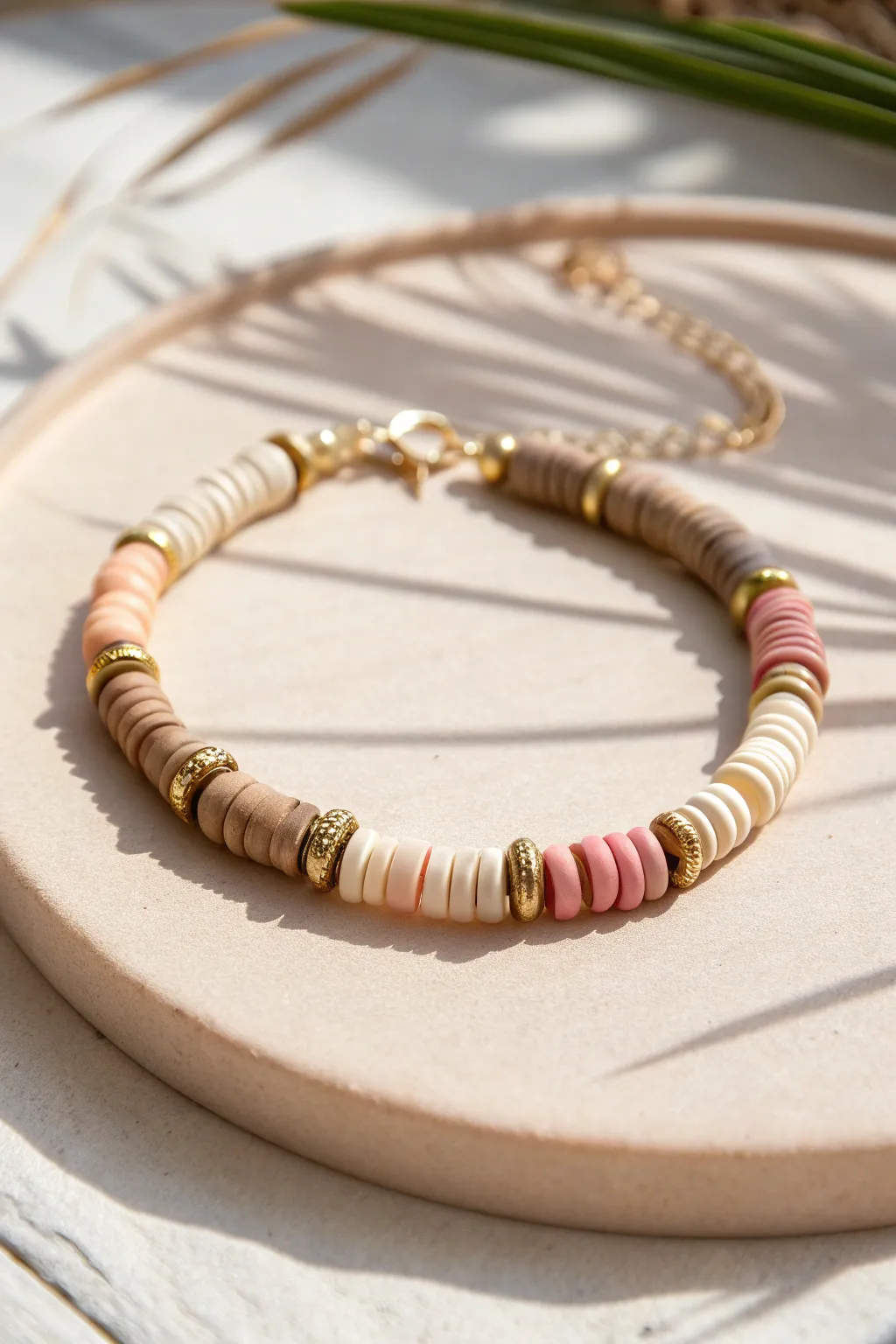
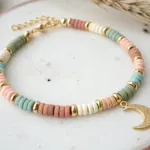
This trendy bracelet design alternates calming earth tones with warm pops of rose and gold for a look that is both grounded and elegant. By separating color blocks with textured gold spacers, you create a satisfying rhythmic pattern that elevates simple clay discs into jewelry store quality.
Step-by-Step Tutorial
Materials
- Polymer clay Heishi beads (6mm or similar): Cream/Off-white
- Polymer clay Heishi beads: Light peach
- Polymer clay Heishi beads: Dusty rose/Mauve
- Polymer clay Heishi beads: Mocha brown/Tan
- Gold textured donut spacer beads (approx 4-5mm)
- Small smooth gold disc spacer beads (optional, for ends)
- Stretch cord (0.8mm crystal string)
- Jewelry glue (such as G-S Hypo Cement)
- Scissors or bead nippers
- Bead stopper or tape
- Gold crimp beads or knot covers (optional)
- Gold plated extension chain and lobster clasp (if not making a simple stretch version)
Step 1: Preparation and Planning
-
Measure your wrist:
Before cutting any string, wrap a measuring tape around your wrist to find your size. Add about 0.5 inches (1.2 cm) for a comfortable fit. -
Cut the cord:
Cut a length of stretch cord about 10-12 inches long. Having extra length makes tying the finishing knots much easier. I always prefer to waste an inch of string rather than struggle with tiny ends. -
Secure the end:
Attach a bead stopper to one end of your cord, or simply tape it down to your work surface to prevent beads from sliding off as you work.
Step 2: Creating the Pattern
-
Start with neutral tones:
Begin stringing your beads. Start with a segment of the cream/off-white heishi beads. Use about 8-10 beads to create a block approximately 1cm long. -
Add the first accent:
Slide on one of the textured gold donut spacer beads. This acts as a visual break between your color blocks. -
Introduce the peach color:
String on a segment of the light peach beads. Aim for the same length as your first block to keep the rhythm consistent. -
Place another spacer:
Add another textured gold spacer bead after the peach segment. -
Add the brown tone:
Thread on a segment of the mocha brown beads. This darker tone adds depth and contrast to the lighter pastel shades. -
Insert the next gold break:
Slide on your third textured gold spacer. -
String the rose segment:
Add a block of the dusty rose/mauve beads. This color provides a nice warmth next to the brown. -
Complete the cycle:
Add a final textured gold spacer to complete one full pattern repeat. -
Repeat until length is reached:
Continue this pattern: Cream -> Gold -> Peach -> Gold -> Brown -> Gold -> Rose -> Gold. Repeat until the beaded portion matches your wrist measurement.
Sticky Spacers?
Polymer clay beads sometimes stick together in the packaging. Gently roll a stuck stack between your fingers to separate them without chipping the edges.
Step 3: Finishing Touches
-
Optional hardware check:
If you are adding a clasp and chain like in the photo, stop beading about 0.5 inches short of your total length to account for the hardware. -
Pre-stretch the cord:
Gently pull on both ends of the elastic cord to pre-stretch it. This prevents the bracelet from sagging or loosening after you wear it a few times. -
Tie the knot:
Remove the bead stopper. Cross the two ends of the cord and tie a standard surgeon’s knot (right over left, left over right twice). -
Secure with glue:
Apply a tiny dab of jewelry glue directly onto the knot. This is crucial for longevity with stretch cord. -
Hide the knot:
If hole size permits, gently tug the cord to slide the knot inside one of the adjacent clay beads or gold spacers. -
Trim excess:
Once the glue is tacky or dry, trim the excess cord close to the bead, being careful not to cut the main knot.
Symmetry Hack
Count exactly how many beads you use in your first color block (e.g., 8 beads). Use this exact number for every subsequent block for perfect symmetry.
Slip on your new bracelet and enjoy the customized rhythm of colors on your wrist
Smiley Focal Bead Pop
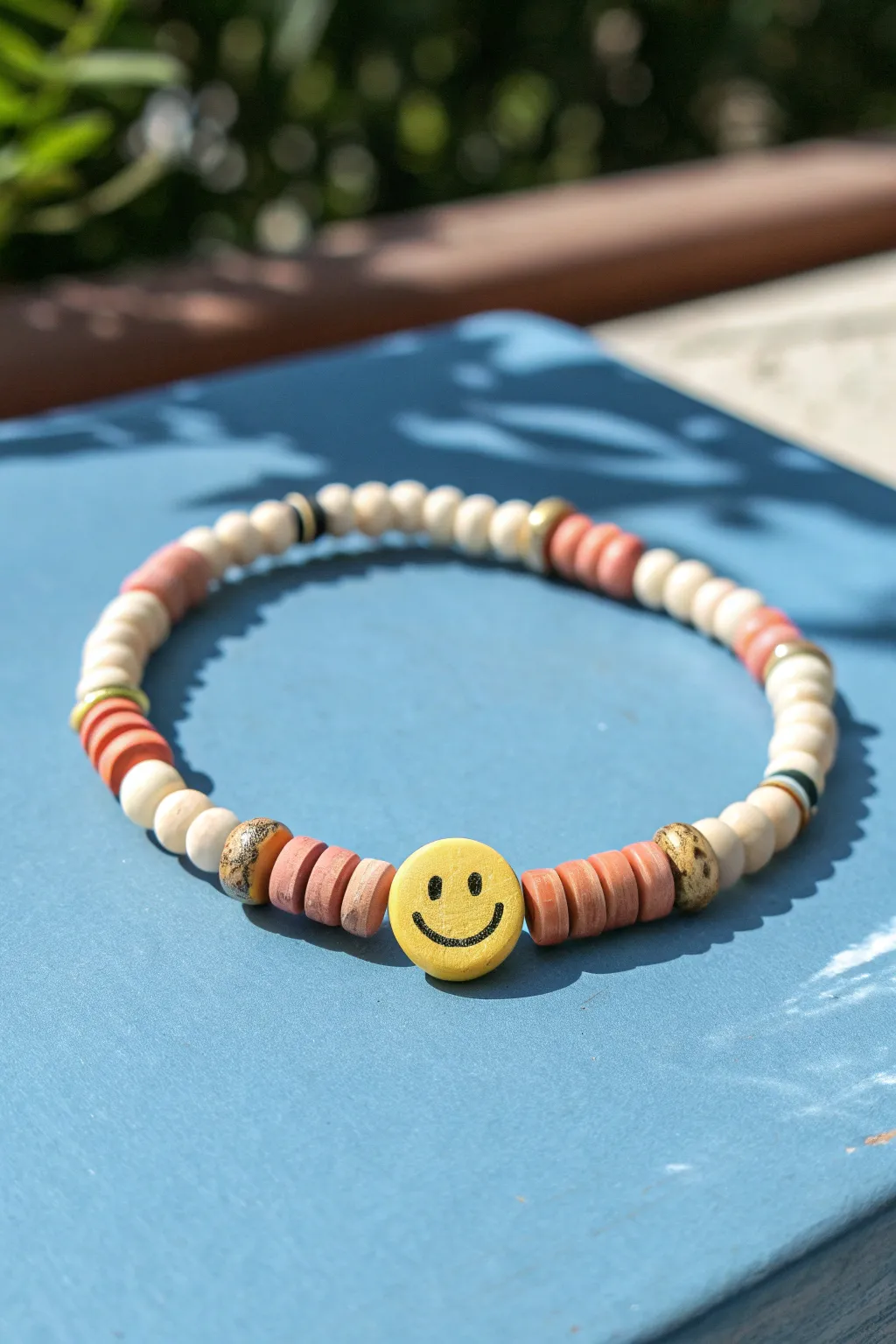
Brighten your wrist stack with this cheerful design that centers around a classic yellow smiley face. Combining matte wooden textures with pop-of-color clay discs, this bracelet strikes the perfect balance between earthy and playful.
Step-by-Step Tutorial
Materials
- Stretch cord (0.8mm or 1mm)
- Yellow wooden smiley face bead (approx. 10-12mm)
- Terra cotta or coral flat polymer clay heishi beads (6mm)
- Cream or off-white round wooden beads (6mm)
- Speckled brown ceramic or textured metal spacer beads
- Gold disc spacer beads (small)
- Round striped resin beads (optional, seen near the back)
- Jewelry glue or clear nail polish
- Scissors
Step 1: Preparation
-
Measure your cord:
Cut a piece of stretch cord about 10-12 inches long. This gives you plenty of extra room to tie knots without struggling to hold onto tiny ends. -
Pre-stretch the elastic:
Give the cord a few firm tugs before you begin beading. This ‘pre-stretching’ technique helps prevent the bracelet from sagging or loosening up after you wear it a few times. -
Secure the end:
Place a piece of tape or a bead stopper on one end of your cord to stop your beads from sliding right off as you work.
Sticky Situation?
If the knot won’t slide inside a bead hole, don’t force it! The bead might crack. Instead, try hiding the knot inside one of the heishi beads or leave it visible but neatly trimmed.
Step 2: Building the Focal Section
-
Thread the smiley:
Start by sliding your yellow smiley face bead onto the center of the cord. Ensure the face is oriented correctly so it sits right-side up. -
Add first color blocks:
On the immediate left side of the smiley, thread three terra cotta heishi beads. Repeat this on the immediate right side so the smiley is hugged by color. -
Insert textured spacers:
Slide one speckled brown ceramic bead (or textured gold bead) onto each side, right next to the heishi stacks. These add a nice organic touch and separate the sections. -
Extend the color:
Add three more terra cotta heishi beads on both the left and right sides. Your pattern should now look symmetrical: heishi-spacer-heishi-smiley-heishi-spacer-heishi.
Cord Longevity Tip
Use a 0.8mm crystal string for stability. If the bead holes are large enough, double the cord up before you start beading for an extra-durable bracelet.
Step 3: Creating the Band
-
Transition with wood:
Now, switch to your cream wooden rounds. Add about 5-6 wooden beads to the left side and 5-6 to the right side. -
Add accents:
Interrupt the wooden bead run by adding a tiny gold disc spacer followed by a small stack of 2-3 terra cotta heishi beads on each side. -
Continue the pattern:
Resume adding the cream wooden beads. At this point, I usually like to check the sizing against my wrist to see how many more are needed. -
Symmetry check:
For the back section (opposite the smiley), you can mirror the front pattern or keep it simple with just wooden beads. In the image, there is a small striped bead added for visual interest near the back. -
Final sizing:
Wrap the unfinished strand around your wrist. The ends should touch comfortably without stretching the cord; add or remove a few wooden beads until the fit is perfect.
Step 4: Finishing Touches
-
Prepare the knot:
Remove the tape or bead stopper carefully. bring the two ends of the elastic together. -
Tie a surgeon’s knot:
Cross right over left, then wrap it twice. Pull tight. Then cross left over right and wrap once. Pull tight again to secure. -
Apply adhesive:
Dab a tiny drop of jewelry glue or clear nail polish directly onto the knot. This prevents it from unraveling over time. -
Hide the knot:
While the glue is still slightly tacky but not wet, slide the nearest large-hole bead (like one of the wooden rounds) over the knot to conceal it. -
Trim excess:
Once the glue is fully dry, use your scissors to trim the excess cord tails as close to the bead as possible without cutting the knot itself.
Wear your new smiley bracelet as a daily reminder to find joy in the little things

What Really Happens Inside the Kiln
Learn how time and temperature work together inside the kiln to transform clay into durable ceramic.
Heart Bead Sweet Spot
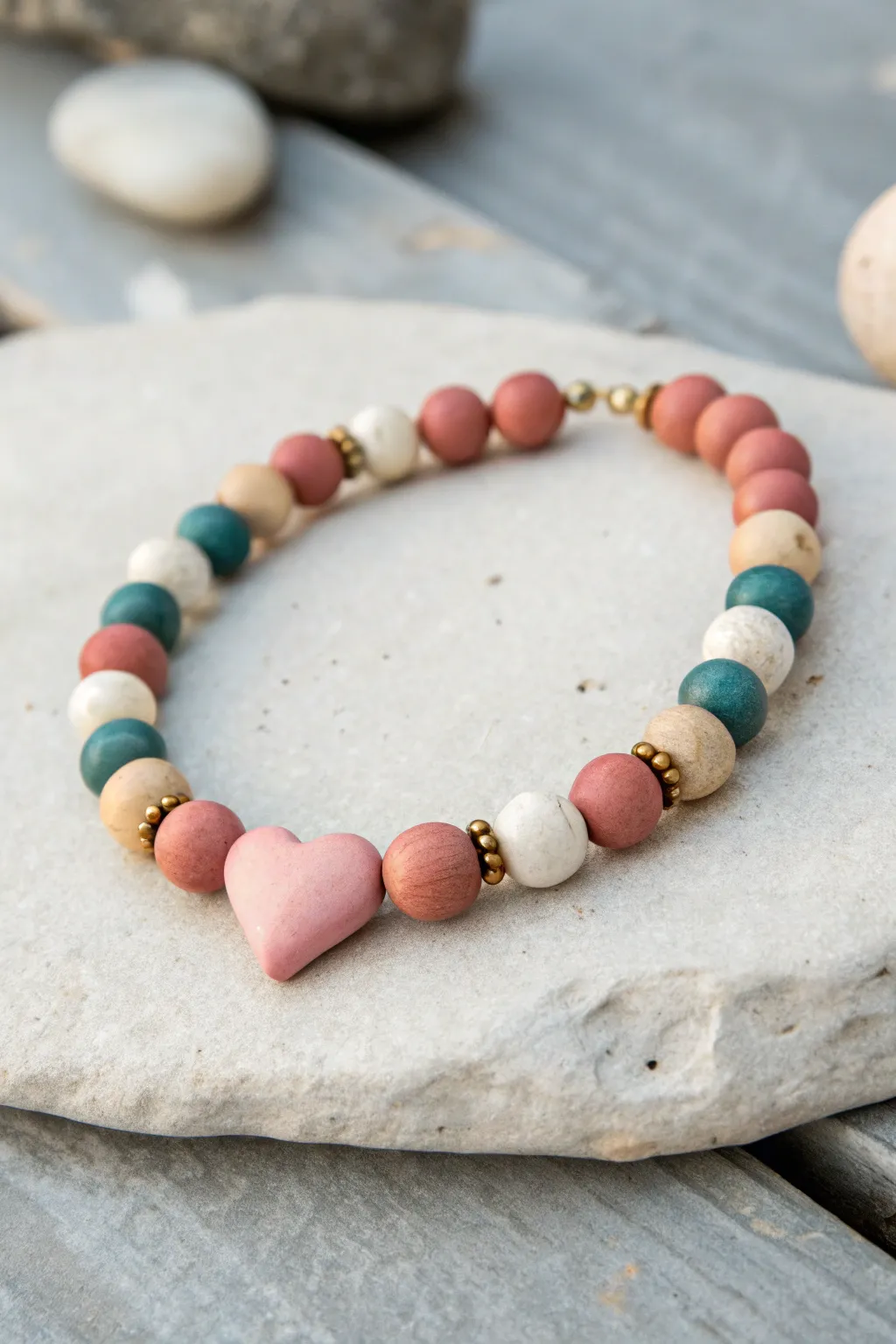
This charming beaded bracelet combines earthy tones with a sweet pop of romance, featuring a standout heart bead as its centerpiece. With its mix of matte textures and subtle golden accents, it’s a perfect accessory for adding a touch of warmth to any outfit.
Detailed Instructions
Materials
- Matte round beads (8mm or 10mm): terracotta/pink, cream/white, teal/blue, light tan/wood
- One large heart-shaped bead (pink ceramic or polymer clay)
- Small gold spacer beads (daisy spacers or tiny rounds)
- Strong elastic cord (0.8mm or 1mm)
- Bead design board or a soft towel
- Scissors
Step 1: Planning Your Design
-
Set up your workspace:
Lay out a bead design board or a clean, soft towel on a flat surface. This prevents your beads from rolling away while you plan the pattern. -
Center the heart:
Place your heart-shaped bead in the very center of your layout channel. This will be the focal point of the bracelet. -
Place the anchors:
Immediately on either side of the heart bead, place one pink/terracotta round bead. These frame the heart beautifully. -
Add metallic accents:
Slide a small gold spacer bead next to each of those framing pink beads. These tiny gold accents add a professional, finished look to the transitions. -
Establish the pattern rhythm:
Start building outwards. On the right side, add a cream bead, then a gold spacer, then a pink bead. Repeat a similar logic on the left. -
Incorporate color variety:
Continue the pattern by introducing the teal and tan beads towards the back sections. Looking at our inspiration, try alternating teal, cream, and pink with occasional gold spacers to break up solid blocks of color. -
Check the length:
Once you have your full strand laid out, wrap the design loosely around your wrist to check the fit. Aim for about 7 inches for an average wrist, or adjust by adding or removing beads from the back section (opposite the heart).
Knot Secure Pro-Tip
Add a tiny dab of flexible jewelry glue or clear nail polish to the knot before pulling it inside a bead. This prevents slipping permanently.
Step 2: Stringing and Finishing
-
Prepare the elastic:
Cut a piece of elastic cord about 12 inches long. Having extra length makes tying the final knot much easier than struggling with short ends. -
Pre-stretch the cord:
Gently pull on the elastic cord a few times before stringing. I always do this because it prevents the bracelet from loosening up after the first few wears. -
Start stringing:
Begin picking up beads from one end of your layout. It’s usually easiest to start at the back of the design so your knot will end up hidden away from the decorative front section. -
Double-check the pattern:
Pause halfway through stringing to ensure your pattern matches your layout, especially the placement of those tiny gold spacers. -
Add the focal bead:
Thread the heart bead. Ensure it is oriented correctly so it sits flat against the wrist and isn’t twisted relative to the round beads. -
Finish the strand:
String the remaining beads until the entire design is on the cord. -
Prepare to knot:
Bring the two ends of the elastic together, removing any slack from the bead line without making it too tight and stiff. -
Tie the surgeon’s knot:
Cross the ends, wrap one end around the other twice, and pull tight. This is a standard surgeon’s knot which holds elastic very securely. -
Secure the knot:
Tie a second simple overhand knot on top of the surgeon’s knot for extra security. Pull firmly on all four strands (the two ends and the bracelet loop itself). -
Hide the end:
Trim the excess elastic, leaving about 2-3mm of tail. Ideally, tuck this knot inside the hole of one of the larger beads next to it.
Texture Play Level-Up
Use essential oil diffuser lava beads for the black or dark porous beads to turn this into an aromatherapy accessory.
Now you have a custom, boutique-style bracelet ready to stack or wear solo
Yin-Yang Graphic Centerpiece
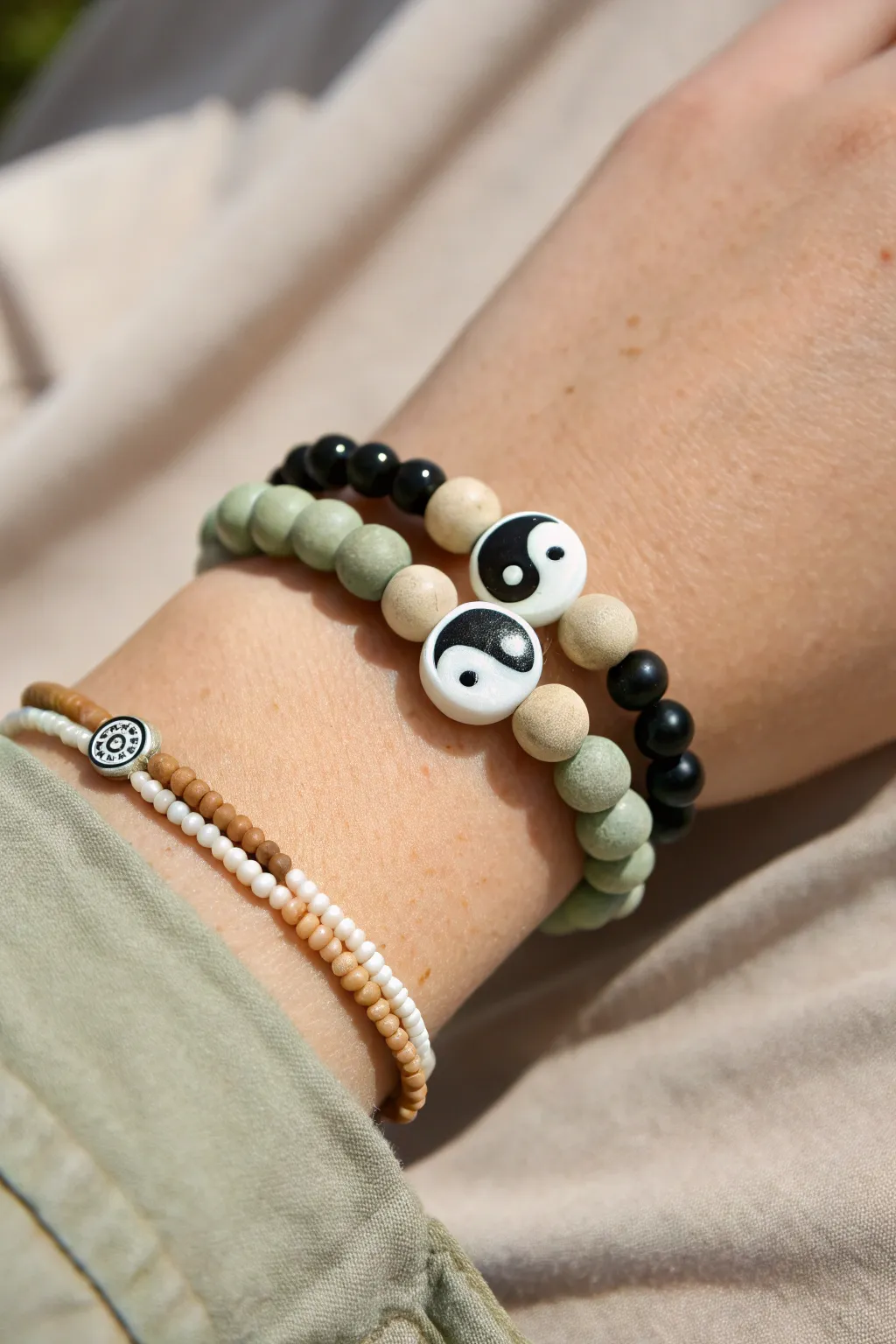
These stylish stretch bracelets combine the classic Yin-Yang symbol with earthy tones for a look that is both grounded and trendy. The set features two distinct bead sizes for texture, creating a perfectly stacked aesthetic that represents balance.
Step-by-Step Tutorial
Materials
- Stretch cord (0.8mm or 1mm thickness)
- White or black circular Yin-Yang beads (flat, approximately 10-12mm)
- Black onyx or glass round beads (8mm)
- Matte sage green round beads (8mm) – possibly aventurine or frosted glass
- Natural wood or beige stone spacer beads (8mm)
- Tiny seed beads (white, tan, and brown mix)
- Small circular connector charm (optional, for the delicate bracelet)
- Jewelry glue or clear nail polish
- Scissors
Step 1: Designing the Yin-Yang Stacks
-
Measure your wrist:
Before you begin stringing, measure your wrist and add about half an inch for comfort. This ensures the larger beads won’t pinch your skin once the bracelet is tied. -
Plan the first bracelet pattern:
Lay out your first design on a bead board or a towel. For the top bracelet shown, start with a white Yin-Yang bead as the focal point. -
Arrange the flanking beads:
Place one natural beige stone or wood bead on either side of the Yin-Yang bead to frame it. -
Create the color block:
Continue the pattern by placing about 8-10 black beads on the right side of your layout. -
Finish the first layout:
On the left side, arrange a sequence of matte sage green beads followed by more black beads until you reach your desired length. -
Plan the second bracelet:
For the second stacker, use another Yin-Yang bead (perhaps inverted colors if available) as the center. Frame it again with the beige beads. -
Reverse the color flow:
To create visual interest, swap the color placement. Put the sage green beads on the right side this time, and use black beads sparingly to connect the sections.
Step 2: Stringing and Securing
-
Pre-stretch the cord:
Cut a piece of elastic cord about 10 inches long. Give it a few firm tugs to pre-stretch it; this prevents the bracelet from sagging later. -
String the beads:
Thread your beads onto the cord following the layout you created. I find it easiest to start from the back sections and add the centerpiece last so it stays centered while tying. -
Check the fit:
Wrap the unfinished strand around your wrist to verify the size. Add or remove a bead or two if necessary. -
Tie the knot:
Tie a surgeon’s knot (right over left, left over right, and loop through again) to secure the ends. Pull it tight. -
Secure with glue:
Dab a tiny dot of jewelry glue or clear nail polish onto the knot. Let it dry completely before trimming the excess cord close to the knot. -
Hide the knot:
Gently pull the elastic until the knot slides inside the hole of the nearest large bead to hide it.
Hiding the Knot
Make sure your knot is next to a bead with a larger hole (like the wooden ones). It makes hiding the knot much easier than trying to force it into a stone bead.
Step 3: Bonus: The Delicate Seed Bead Accent
-
Selecting seed beads:
To make the third delicate bracelet, mix tiny seed beads in white, tan, and dark brown. -
Start the pattern:
Thread a thinner elastic cord through a small circular metal charm if you have one. This will act as your mini focal point. -
Create color sections:
String the seed beads in seemingly random color blocks—perhaps ten white, followed by five tan, then five brown—to create an organic, earthy look. -
Finish the set:
Tie off this thinner bracelet with a standard double knot and a dot of glue, just like the larger ones.
Knot Slipping?
If your elastic knot feels slippery, try a surgeon’s knot. Loop the cord through the knot an extra time before pulling tight for extra grip.
Slip on your new stack of bracelets and enjoy the peaceful vibe they bring to your outfit

TRACK YOUR CERAMIC JOURNEY
Capture glaze tests, firing details, and creative progress—all in one simple printable. Make your projects easier to repeat and improve.
Fruit Charm Summer Stack
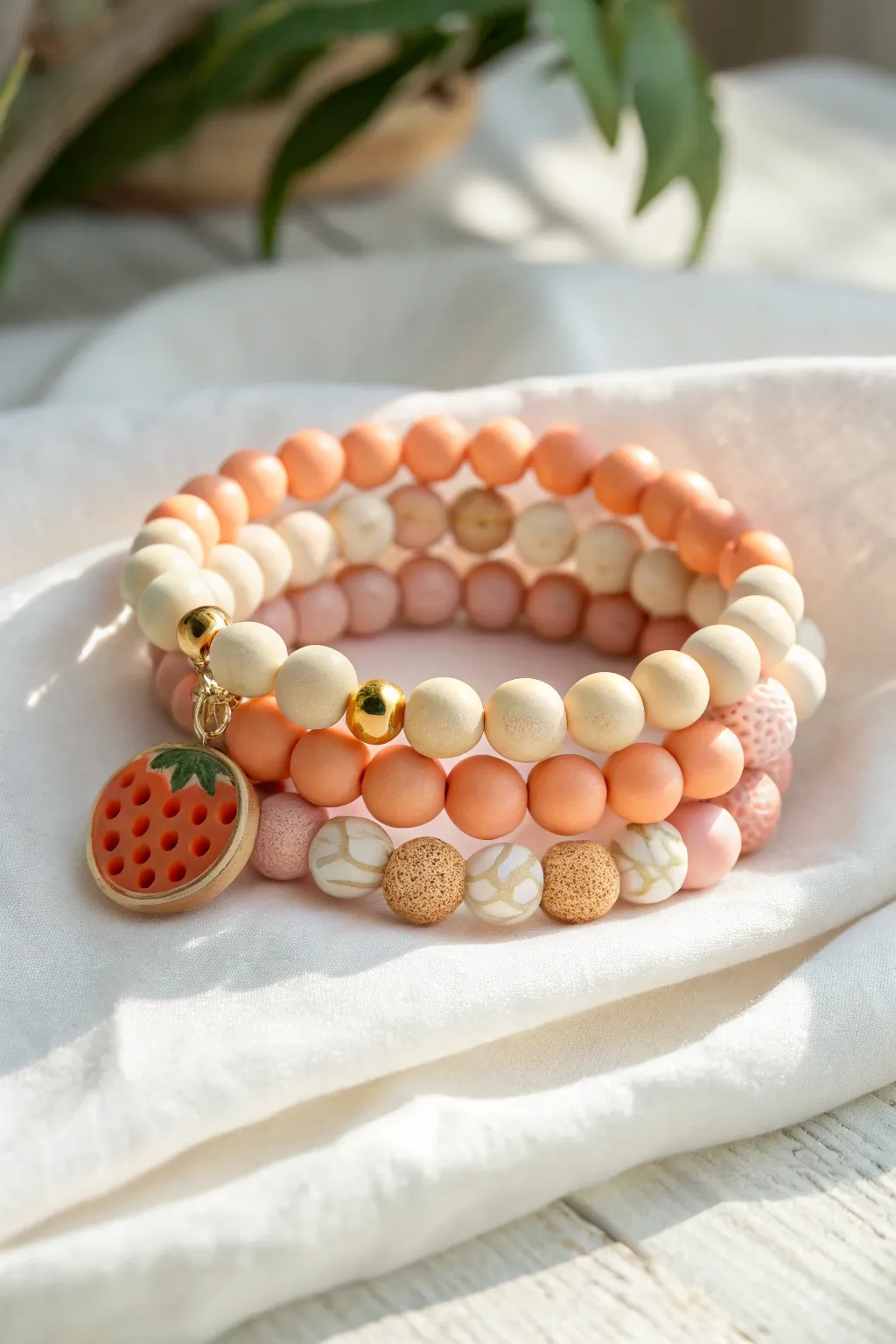
Capture the essence of a warm summer afternoon with this delightful stack of beaded bracelets featuring a charming fruit slice charm. The combination of matte peach tones, creamy neutrals, and textured accents creates a soft, cohesive look perfect for sunny days.
Step-by-Step Guide
Materials
- Elastic stretch cord (0.7mm or 0.8mm)
- Matte round beads (8mm) in peach/soft orange
- Matte round beads (8mm) in cream/off-white
- Textured round beads (8mm) in speckled beige/cork look
- Patterned round beads (8mm) – white with gold or beige crackle
- Gold tone spacer beads (small round)
- Gold tone large hole bead (optional, as focal)
- Fruit slice charm (strawberry or orange) with gold enamel finish
- Gold jump ring (6mm or 8mm)
- Jewelry glue (E6000 or G-S Hypo Cement)
- Scissors or jewelry cutters
- Bead stopper or tape
Step 1: Preparation
-
Measure and cut:
Cut three lengths of elastic cord, each about 10-12 inches long. This gives you plenty of room to tie knots without struggling. -
Pre-stretch the cord:
Hold each piece of cord by the ends and give it a firm tug several times. This pre-stretching prevents the bracelets from stretching out and becoming loose after the first wear. -
Secure the ends:
Place a bead stopper or a piece of masking tape on one end of each cord to stop beads from sliding off while you design.
Knot Pro-Tip
When pulling your knot tight, pull on all four strand ends (the two tails and the two loop sides) for maximum tightness.
Step 2: Bracelet 1: The Charm Focal
-
Start the pattern:
Begin stringing your beads. For this strand, alternate between the matte cream beads and the matte peach beads to create a soft, alternating rhythm. -
Add gold accents:
Every third or fourth bead, slip on a small gold spacer bead to add a touch of warmth and break up the matte texture. -
Attach the charm:
Locate the center of your strand. Use your pliers to open the jump ring and attach the fruit slice charm to the cord, or simply thread the charm’s loop directly onto the cord if it fits comfortably. -
Add a large gold bead:
Right next to your charm, add a slightly larger gold bead. This acts as an anchor and draws the eye to the focal point. -
Finish the strand:
Continue your alternating pattern until the beaded section measures about 6.5 to 7 inches, or your desired wrist size.
Level Up: Scented Beads
Use unfinished wood beads for the ‘cork’ accents and add a drop of essential oil (like sweet orange) for a scented stack.
Step 3: Bracelet 2: The Textured Mix
-
Create texture variety:
For the second bracelet, focus on the unique beads. Thread on three of the white crackle/patterned beads. -
Introduce the cork look:
Follow the patterned beads with two of the speckled beige or cork-textured beads. The contrast between smooth and rough textures is key here. -
Balance with solids:
Fill the rest of the strand with solid matte peach beads, occasionally interspersing a gold spacer. I find that keeping the textured beads in a clump creates a nice ‘feature section’ rather than spreading them out too thinly. -
Check the length:
Wrap this strand around your wrist alongside the first one to ensure they are the same size before tying off.
Step 4: Bracelet 3: The Simple Solid
-
String the base:
The final bracelet acts as a grounding element. String a continuous line of just the matte peach or matte orange beads. -
Optional variation:
If you want a slight variation, you can do a ‘color block’ style by doing half the bracelet in peach and the other half in cream.
Step 5: Finishing Touches
-
Tie the knots:
Remove the bead stoppers. For each bracelet, tie a surgeon’s knot: cross right over left, then left over right and loop it through twice before pulling tight. -
Secure with glue:
Apply a tiny dot of jewelry glue directly onto the knot. Be careful not to get glue on the surrounding beads, as it can ruin the matte finish. -
Hide the knot:
While the glue is still slightly tacky but set, gently pull the knot inside the hole of the nearest large-hole bead to hide it. -
Trim excess:
Once fully dry, trim the excess elastic cord close to the bead hole using your scissors or cutters.
Now you have a refreshing, fruit-inspired stack ready to brighten up any outfit
Cowrie Shell Beachy Break
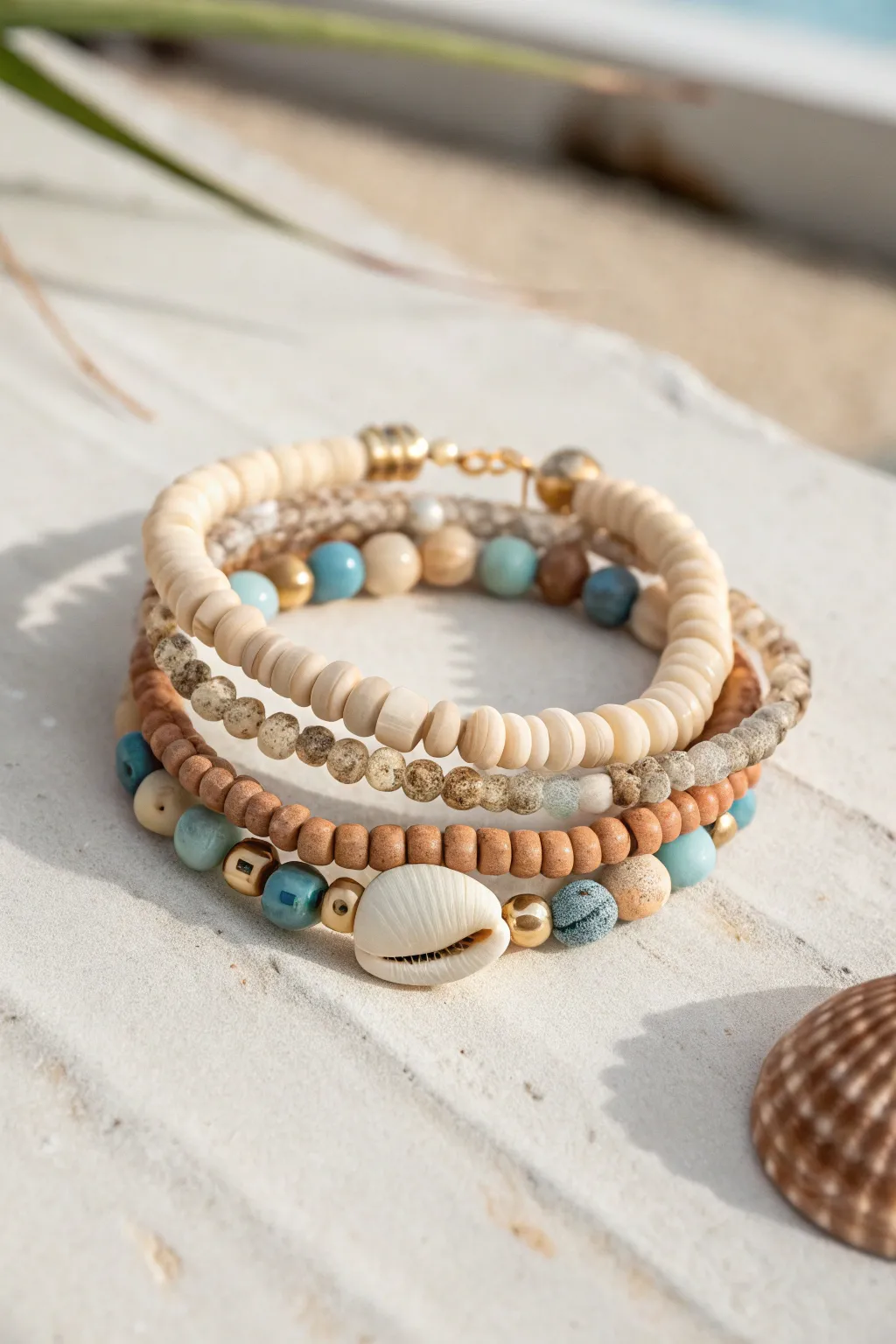
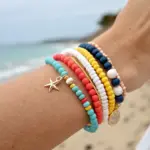
Capture the essence of a sun-soaked shore with this multi-textured bracelet stack. Combining matte clay heishi beads, rustic stone accents, and a statement cowrie shell, this set creates an effortless bohemian accessory perfect for beach days.
Detailed Instructions
Materials
- Elastic beading cord (0.5mm – 0.8mm clear stretchy string)
- Cream or off-white clay heishi beads (flat discs)
- Natural cowrie shell bead (pre-drilled or side-drilled)
- Small round stone beads (approx. 4mm, textured grey/brown)
- Turquoise gemstone beads (round, 6mm)
- Gold spherical spacer beads (various sizes, 3mm-5mm)
- Small wooden or coconut spacer beads (brown discs)
- Clear jewelry glue or super glue
- Scissors
Step 1: The Heishi Disc Layer
-
Measure the cord:
Cut a piece of elastic cord roughly 10 inches long. This gives you plenty of slack for tying knots later without struggling. -
Prepare the pattern:
This first bracelet relies on a simple rhythm. Lay out your cream heishi beads. You’ll primarily be stringing these solid sections of cream discs. -
String the base:
Thread about 2 inches of cream heishi beads onto the elastic. I prefer using a bead spinner if available, but hand-stringing works perfectly fine too. -
Add accent beads:
Interrupt the cream pattern by adding a gold spherical bead, followed by a turquoise round bead, and another gold bead. This adds a pop of color. -
Fill and finish:
Continue adding cream heishi beads until the bracelet reaches your desired wrist size (standard is around 6.5 to 7 inches). -
Secure the strand:
Tie a secure surgeon’s knot (right over left, left over right, loop through twice). Pull tight, add a dot of glue to the knot, let it dry, and trim the excess cord.
Step 2: The Textured Stone Strand
-
Start the second strand:
Cut another 10-inch length of elastic cord. This layer focuses on earthy textures rather than flat discs. -
Mix your textures:
Create a random but balanced mix using the small textured grey/brown stone beads. Intersperse them occasionally with a single cream heishi bead to tie it back to the first bracelet. -
Incorporate color:
Every inch or so, swap a stone bead for a turquoise bead or a large wooden bead to add warmth and contrast to the grey tones. -
Check the fit:
Wrap the strand around your wrist to check the length, ensuring it sits comfortably alongside the first bracelet without being too tight. -
Knot and seal:
Tie off this bracelet using the same surgeon’s knot method. Apply glue and hide the knot inside one of the larger beads if the hole size permits.
Shell Orientation
Cowrie shells often flip over. String it tightly between two flat beads or smaller spacers to minimize movement and keep the open side facing up.
Step 3: The Cowrie Shell Feature Piece
-
Prep the centerpiece:
For the final and most prominent bracelet, cut a slightly longer piece of cord (11 inches). Locate your cowrie shell and check the hole orientation. -
String the focal point:
Thread the elastic through the cowrie shell. Immediately flank the shell on both sides with a large gold spacer bead to frame it elegantly. -
Build the sides:
On either side of the gold spacers, add a pattern of brown wooden disc beads. String about 10-15 of these on each side to create a dark, warm section flanking the white shell. -
Transition the pattern:
After the wooden section, transition into a mix of turquoise beads and cream heishi beads for the back portion of the bracelet. -
Add variance:
Include a few textured stone beads near the back to harmonize with the second bracelet you made. -
Final assembly:
Bring the ends together. Because the shell is heavy, ensure your knot is extra tight so the weight doesn’t stretch the knot open. -
Finish the set:
Glue the final knot, let it cure completely, and trim the ends. Stack all three bracelets together to complete the beach-ready look.
Pre-stretching Elastic
Before you start stringing, give your elastic cord a few firm tugs. This pre-stretching prevents the bracelet from becoming loose and saggy after the first wear.
Slip on your new stack and enjoy the immediate coastal vibes it brings to any outfit
Tassel Dangle Accent Bracelet
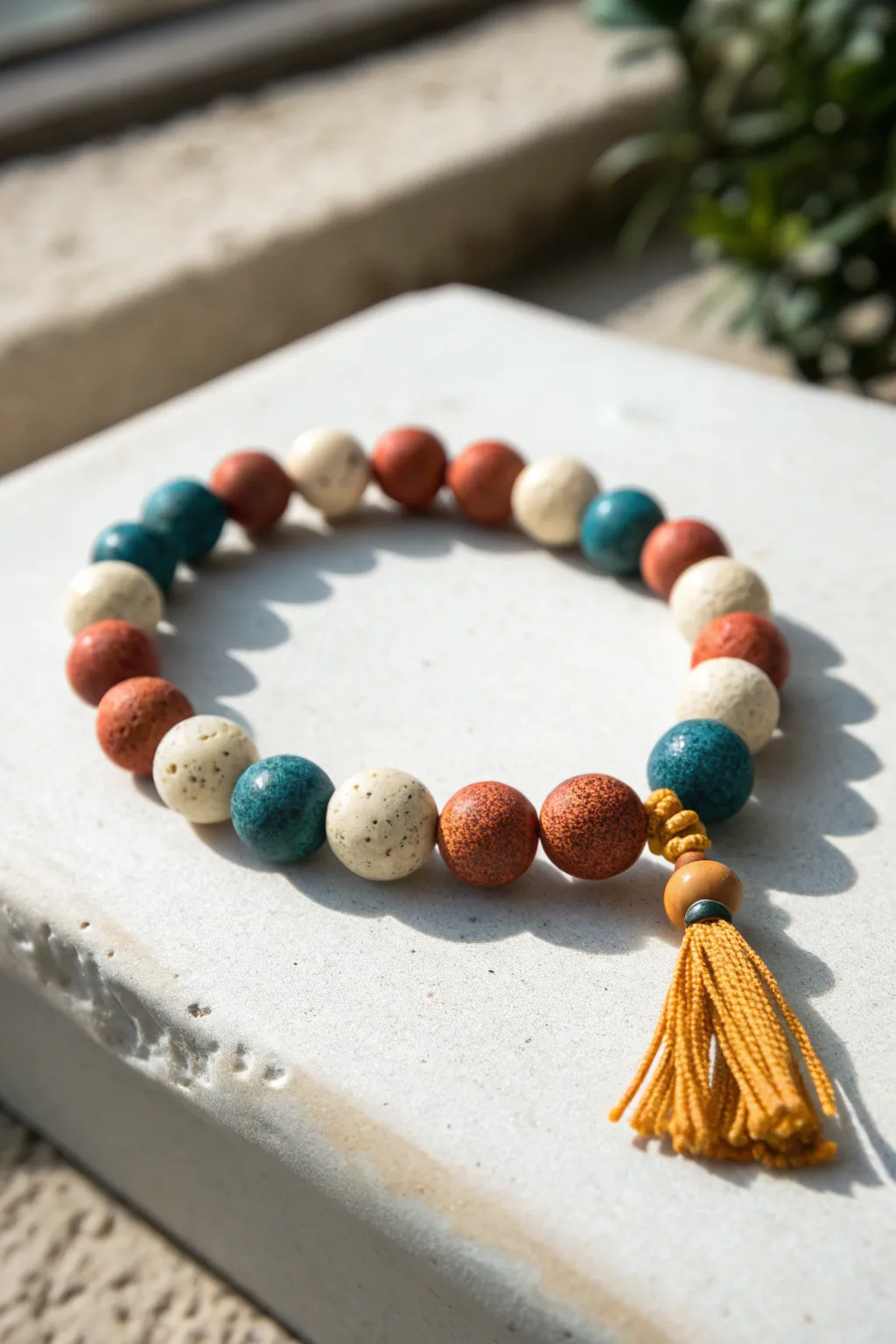
Embrace earthy vibes with this charming clay bead bracelet featuring a classic southwestern color palette. The mix of speckled cream, rich terracotta, and deep teal beads creates a balanced, rhythmic pattern finished with a playful golden tassel.
Step-by-Step Guide
Materials
- Polymer clay (terracotta, cream/white, teal/turquoise)
- Black acrylic paint or pepper (for speckling)
- Elastic cord (0.8mm or 1mm)
- Large-eye beading needle
- Yellow embroidery floss or pre-made tassel
- Small wooden bead (for tassel header)
- Super glue or jewelry adhesive
- Toothpicks or bead piercing tool
- Sandpaper (optional)
- Scissors
Step 1: Creating the Clay Beads
-
Condition the clay:
Start by warming up your polymer clay in your hands until it becomes soft and pliable. Use separate piles for terracotta, cream, and teal to avoid color transfer. -
Add texture:
For that natural, organic stone look seen in the photo, mix a tiny amount of black pepper or craft sand into the cream clay. You can also lightly stipple the surface of the colored clays with a toothbrush before baking. -
Roll the beads:
Pinch off equal amounts of clay and roll them into spheres in your palms. Aim for beads that are roughly 10-12mm in diameter. I find using a small circle cutter ensures every piece uses the exact same amount of clay. -
Pierce the holes:
Carefully insert a toothpick or piercing tool through the center of each sphere. Rotate the bead gently as you push through to keep the shape round. -
Bake:
Arrange your beads on a baking sheet or tile. Bake according to your brand of polymer clay instructions (usually around 275°F/135°C for 15-30 minutes). Let them cool completely.
Stone Effect Trick
To make polymer clay look like faux stone, rub a little acrylic paint into the baked beads and wipe it off quickly. The paint stays in the crevices.
Step 2: Crafting the Tassel
-
Wind the floss:
Wrap your yellow embroidery floss around three fingers (or a piece of cardboard about 2 inches wide) approximately 20-30 times for a nice fullness. -
Tie the top:
Cut a separate 6-inch strand of floss. Slide it under the top loops of your wound bundle and tie it tightly with a double knot. Leave the tails long; these will attach to the bracelet. -
Create the neck:
Cut another piece of floss and wrap it tightly around the bundle, about 1/4 inch down from the top. Knot it securely and tuck the ends inside the tassel using a needle. -
Cut the loops:
Use sharp scissors to cut through the bottom loops of the bundle so strands hang free. -
Add the header bead:
Thread both long tails from the very top of your tassel through a small wooden or contrasting bead. This acts as a decorative cap and connects the tassel to the bracelet cord.
Scent Infusion
Make this an aromatherapy bracelet by using porous lava stone beads for the black specs, or leaving the wood bead unsealed to absorb essential oils.
Step 3: Assembly
-
Prepare the cord:
Cut a length of elastic cord about 10-12 inches long. Pre-stretch it by pulling on it gently a few times; this prevents the finished bracelet from sagging later. -
Plan the pattern:
Lay your cooled beads out on a mat. Following the image, try a pattern like: two terracotta, one cream, one teal, one cream. Repeat this sequence until you reach your desired wrist length. -
String the beads:
Thread your elastic onto the beading needle. Begin stringing your beads according to your layout. -
Attach the tassel:
Once all clay beads are on, thread the elastic through the loop at the top of your tassel (above the wooden header bead). -
Tie the knot:
Remove the needle. Tie the two ends of the elastic cord together using a surgeon’s knot (right over left, left over right twice). Pull tight. -
Secure and hide:
Add a tiny drop of super glue or jewelry adhesive to the knot for security. Let it dry for a moment. -
Trim ends:
Trim the excess elastic cord (but not too close to the knot). If one of your clay beads has a slightly larger hole, gently tuck the knot inside it to hide the mechanics.
Enjoy wearing your handcrafted accessory that brings a touch of earthy elegance to any outfit
Confetti Scramble Mix
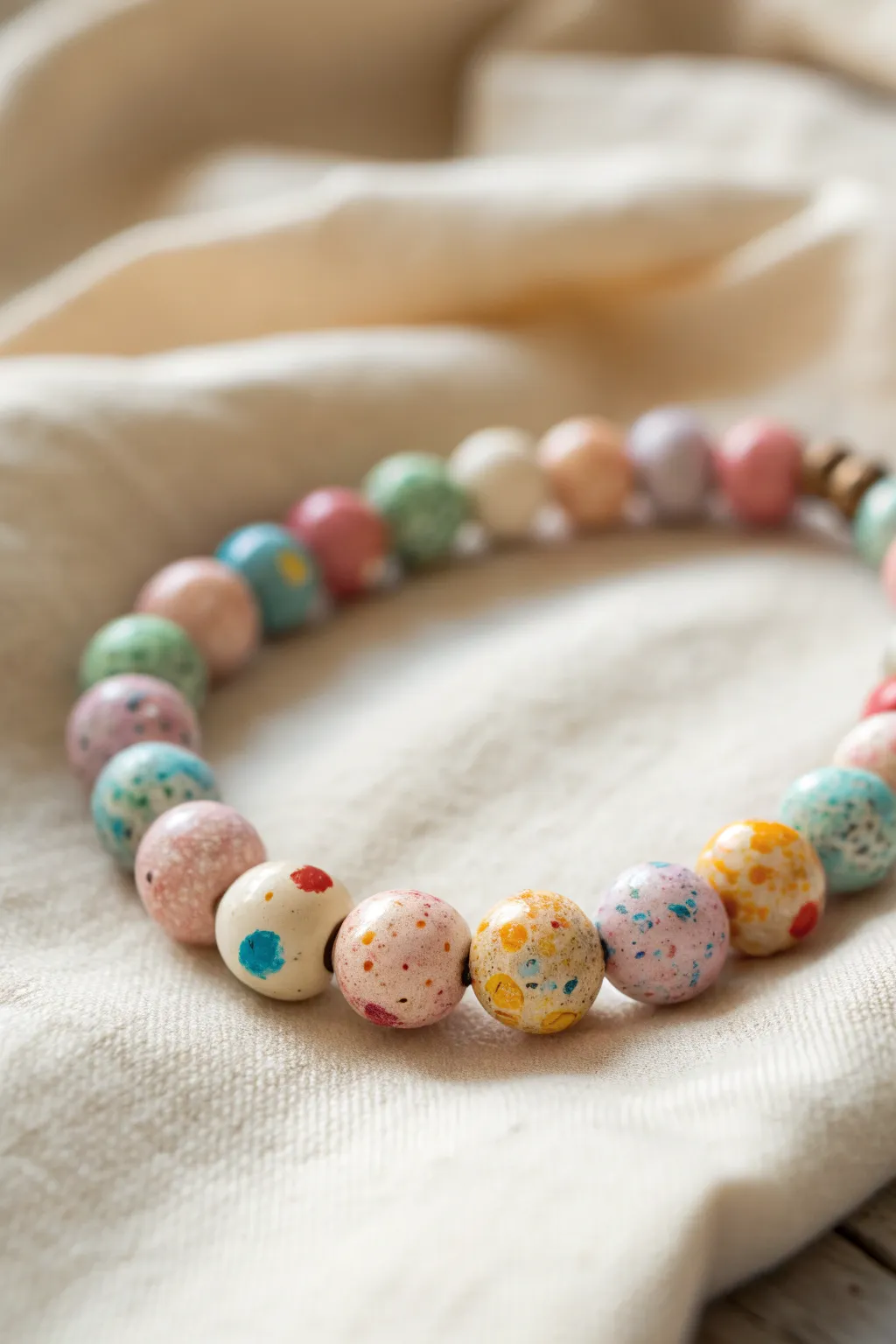
Bring a pop of joyful color to your wrist with this playful bracelet featuring handmade speckled clay beads. The design mimics the fun, scattered look of confetti on a creamy base, creating a charmingly imperfect and organic accessory.
Detailed Instructions
Materials
- Polymer clay (base color: cream or white)
- Polymer clay (various colors: pink, blue, yellow, teal, green, orange)
- Acrylic rolling pin
- Small bead roller tools (optional)
- Bead piercing pins or toothpicks
- Baking sheet and parchment paper
- Gloss or matte glaze (optional)
- Elastic cord (0.8mm or 1mm)
- Super glue or jewelry cement
- Scissors
Step 1: Creating the Confetti Cane
-
Prepare the Colors:
Start by conditioning your colored clays. We need tiny amounts of pink, blue, yellow, teal, green, and orange. Roll each color into a very thin snake, roughly the thickness of a piece of spaghetti. -
Chop the ‘Confetti’:
Use a clay blade or a craft knife to chop these thin snakes into tiny, irregular bits. Vary the sizes slightly—some can be mere specks, others slightly larger rounds. Keep them separated by color for now. -
Mix the Base:
Condition a large block of your cream or white clay until it is soft and pliable. This will form the main body of every bead. -
Incorporate the Specks:
Take your cream clay and gently press the chopped colored bits onto the surface. Don’t mix them in completely yet; you want distinct spots of color, not a muddy blend. -
The Chopping Method (Optional):
If I want a more randomized look, I like to gently chop the cream block with the colors on it, stack the pieces, and press them back together. This distributes the confetti bits throughout the inside of the clay, not just the outside.
Smooth Rolling Hack
To remove fingerprints from your raw clay beads before baking, gently roll them with a dusting of cornstarch. It acts as a buffer and washes off easily after baking.
Step 2: Forming the Beads
-
Portion the Clay:
Pinched off uniform amounts of your speckled clay mixture. Aim for pieces about the size of a marble. You can use a small cookie cutter on a rolled sheet to ensure every piece has the exact same volume. -
Roll Spheres:
Roll each piece between your palms to create a smooth ball. Apply gentle pressure to avoid smearing the colored specks too much, though a little movement adds to the artistic effect. -
Refine the Shape:
Inspect the surface. If you see a large gap without color, you can press a tiny leftover colored bit onto the surface and roll it again carefully to smooth it in. -
Pierce the Beads:
Hold a bead gently and insert a bead piercing pin or toothpick directly through the center. Rotate the pin while pushing to keep the hole clean and prevent the bead from squashing. -
Baking Prep:
Place your pierced beads on a baking sheet lined with parchment paper. If possible, bake them on the pins suspended over a foil tray to prevent flat spots, though placing them directly on the paper works fine for a rustic look. -
Bake:
Bake according to your polymer clay package instructions (usually 275°F/135°C for 15-30 minutes). Let them cool completely before handling.
Metallic Accent
Add sophistication by incorporating tiny flecks of gold leaf into your clay mix alongside the colored bits for a festive, high-end confetti look.
Step 3: Assembly
-
Finishing Touch:
Once cool, deciding on a finish is key. Leave them matte for a raw ceramic look, or apply a thin coat of gloss glaze to make the ‘confetti’ colors pop. -
Stringing:
Cut a piece of elastic cord about 10 inches long. Pre-stretch the cord by pulling it firmly a few times; this prevents the bracelet from stretching out later. -
arrange the Design:
Thread your beads onto the elastic. You can replicate the random scramble shown in the photo, or try grouping similar colored speckles together. -
Check the Fit:
Wrap the strung beads around your wrist to check the size. Add or remove beads until it sits comfortably without digging into your skin. -
Tie the Knot:
Tie a surgeon’s knot (right over left, left over right twice). Pull the elastic tight so the knot is secure. -
Secure and Trim:
Place a tiny drop of super glue on the knot. Let it dry for a minute, then trim the excess cord ends close to the knot. If the hole of a neighboring bead is large enough, slide the knot inside to hide it.
Now you have a wonderful, custom piece of jewelry that captures the excitement of a party on your wrist
Two-Color Checker Pattern
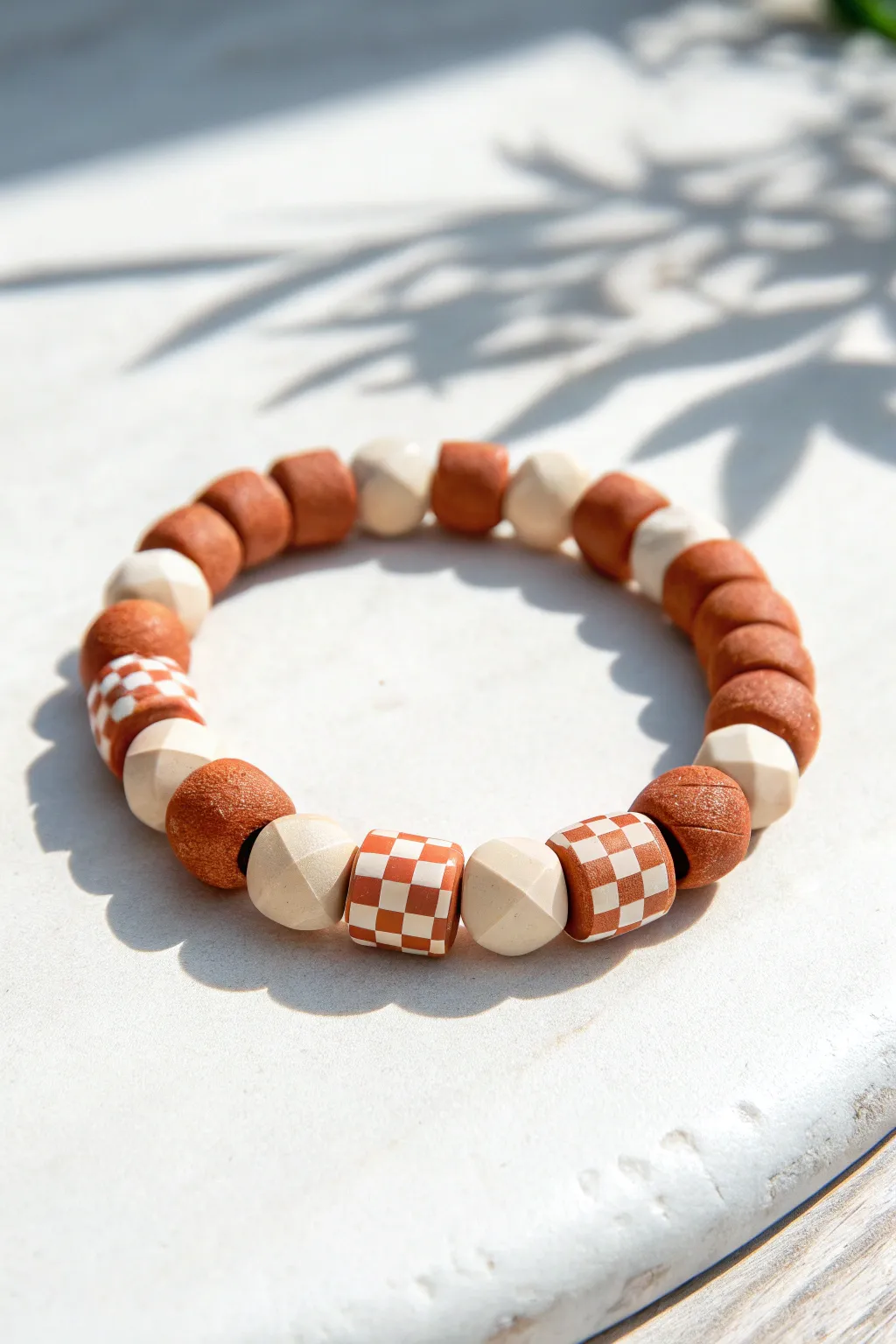
Bring a touch of modern earthiness to your wrist with this handmade polymer clay bracelet. Featuring a mix of solid terracotta and cream beads alongside striking checkerboard focal beads, this accessory balances rustic textures with geometric flair.
How-To Guide
Materials
- Polymer clay in Terracotta/Burnt Orange
- Polymer clay in Cream/Beige
- Clay roller or pasta machine
- Sharp tissue blade
- Bead roller tool (for round beads)
- Bead piercing pins or skewers
- Elastic jewelry cord (0.8mm)
- Super glue or jewelry adhesive
- Oven and baking sheet
- Cornstarch (optional, for smoothing)
Step 1: Creating the Solid Beads
-
Condition the clay:
Start by thoroughly kneading your terracotta and cream clays separately until they are soft and pliable. This prevents cracking later on. -
Form the round beads:
Roll out a log of the terracotta clay. Cut equal-sized segments—you will need about 20-25 pieces depending on your wrist size. Repeat this with a smaller amount of cream clay to make about 4 segments. -
Roll into spheres:
Using your palms or a bead roller, roll the terracotta segments into smooth, round balls. Do the same for the cream segments, but try pincling the cream ones slightly to form geometric faceted shapes if desired, as seen in the photo, or keep them round. -
Texture the terracotta:
To achieve the rustic finish shown in the image, gently roll the terracotta spheres on a piece of coarse sandpaper or dab them lightly with a stiff toothbrush. -
Pierce holes:
Carefully insert a bead pin or skewer through the center of each bead. Rotate the pin as you push to avoid squishing the shape. Leave these beads on the pins for baking if possible.
Smudged Checks?
If your checkerboard pattern smears when slicing, your clay is likely too warm. Pop the cane in the fridge for 15 minutes to firm it up before cutting again.
Step 2: Designing the Checkerboard Beads
-
Create clay slabs:
Roll out both the cream and terracotta clay into flat sheets of equal thickness, roughly 3mm thick. -
Cut strips:
Use your tissue blade to cut long, even strips from both colors. The strips should have a square cross-section, so the width matches the thickness of the slab. -
Assemble the checkerboard logs:
Lay a terracotta strip next to a cream strip. Continue alternating them until you have a flat layer (e.g., orange-cream-orange-cream). Stack a second layer on top, alternating the colors so an orange strip sits on top of a cream strip. -
Consolidate the cane:
Gently squeeze the square log (cane) you’ve built to ensure all the strips adhere to each other without air gaps. You should see a clear checkerboard pattern on the end. -
Slice the beads:
Use your sharp blade to slice thick segments off your checkerboard cane. These slices will become your cylindrical connector beads. -
Shape into cylinders:
Take each slice and gently roll it between your fingers or on your work surface to round the sharp edges slightly, forming a short tube shape. Make about 3-4 of these. -
Pierce the checker beads:
Make a hole through the center of the cylinder, running parallel to the checker pattern so the squares are visible on the sides effectively.
Step 3: Baking and Assembly
-
Bake the batch:
Arrange all your beads on a baking sheet. Follow the specific temperature and time instructions on your brand of polymer clay packaging. I usually tent foil over them to prevent the cream clay from scorching. -
Cool down:
Let the beads cool completely before handling them. They harden fully as they return to room temperature. -
Plan the layout:
Lay out your design on a bead board or towel. A great pattern is to group the solid terracotta beads, breaking them up occasionally with a cream geometric bead or a checkerboard cylinder. -
String the beads:
Cut a piece of elastic cord about 10 inches long. String your beads according to your planned pattern. -
Check the fit:
Wrap the strand around your wrist to ensure it fits comfortably. Add or remove a terracotta spacer bead if necessary. -
Tie the knot:
Tie a secure surgeon’s knot (right over left, left over right). Pull the elastic tight to engage the knot. -
Secure and hide:
Dab a tiny drop of super glue on the knot. Once dry, trim the excess cord and gently tuck the knot inside the hole of the nearest large bead.
Level Up: Glossy Finish
For a high-end look, apply a coat of satin or gloss water-based varnish to just the checkerboard beads after baking, leaving the terracotta beads matte.
Now you have a stylish, earthy accessory ready to wear or gift.
Sunset Ombre With Warm Spacers
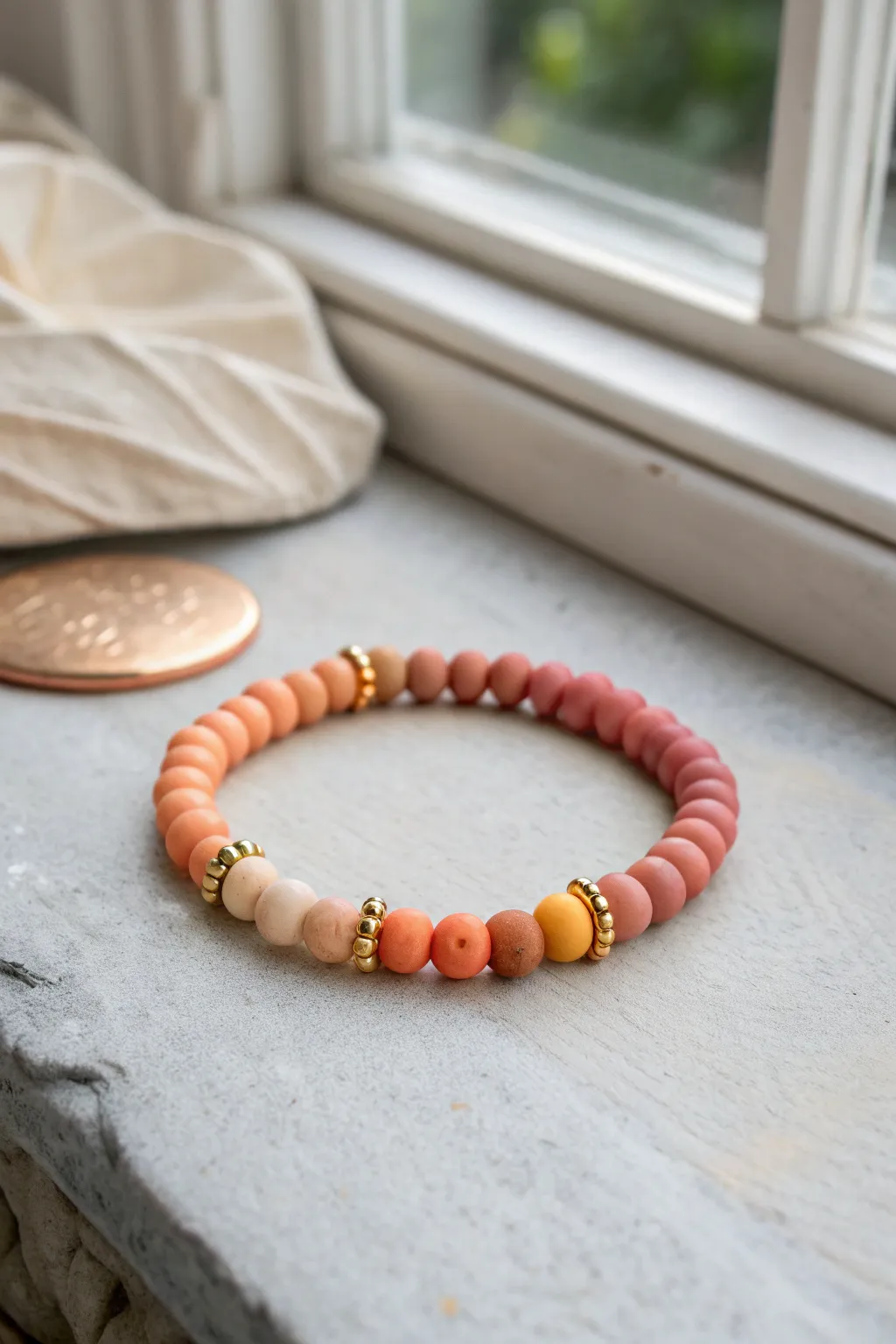
Capture the fleeting beauty of twilight with this stunning clay bead bracelet. By carefully arranging shades of coral, peach, and terracotta, you’ll create a seamless ombre effect punctuated by elegant gold accents.
Step-by-Step
Materials
- Polymer clay beads (6mm or 8mm) in the following colors: deep terracotta/rose, medium coral/salmon, light peach, cream/beige, and mustard yellow
- Gold spacer beads (wheel or rondelle shape)
- Elastic stretch cord (0.8mm or 1mm thickness)
- Scissors
- Bead design board (optional but helpful)
- Hypo-cement or strong jewelry glue
- Tape or binder clip
Step 1: Planning the Gradient
-
Analyze the pattern:
Before restringing, look closely at the color flow. The bracelet relies on a smooth transition from dark to light and back again, rather than a random mix. -
Setup your workspace:
Lay out your bead board tailored to your wrist size. If you don’t have one, a piece of felt or a towel prevents beads from rolling away. -
Sort your hues:
Group your clay beads by shade. You should have a pile for the deep rose/terracotta, one for the medium coral, one for the lighter peach, and a few individual feature beads in cream and mustard. -
Lay out the main ombre:
Start arranging the beads in a circle. Begin with the darkest terracotta shade, utilizing about 8-10 beads for this section. -
Transition the color:
Next to the terracotta, place 4-5 beads of the medium coral shade. Notice how the colors start to soften. -
Add the lightest tones:
Continue the circle with 4-5 beads of the lightest peach color. -
Insert the gold accents:
Place a gold spacer bead at the end of your light peach section. This marks the beginning of the focal area.
Spacer Selection
Choose spacers with a large enough hole to hide your knot later. Gold plating lasts longer than basic brass paint.
Step 2: Creating the Focal Section
-
Add the focal beads:
Between two gold spacers, arrange a mix of unique colors. Following the photo, use a cream bead, a beige bead, a slightly textured terracotta bead, a bright coral bead, and a mustard yellow bead. -
Vary the texture:
I like to use beads here that might have a slightly more matte or ‘raw’ clay finish to add tactile interest, contrasting with the smoother ombre section. -
Close the focal section:
Place another gold spacer bead at the end of this mixed color run. -
Complete the loop:
Fill in any remaining gap on your design board with the medium coral or terracotta beads to ensure the gradient loops back seamlessly to where you started.
Step 3: Stringing and Finishing
-
Prepare the cord:
Cut a piece of elastic cord about 10-12 inches long. This gives you plenty of room to tie knots without struggling. -
Pre-stretch the elastic:
Give the cord a few firm tugs. This prevents the bracelet from stretching out and becoming loose after the first few wears. -
Secure the end:
Place a piece of tape or a binder clip on one end of the cord so beads don’t slide off while you work. -
Transfer the beads:
Carefully thread your arranged pattern onto the cord, maintaining the exact order you laid out. -
Check the fit:
Wrap the strung beads around your wrist. It should be snug but comfortable; add or remove a bead from the back (the solid color section) if needed. -
Tie the knot:
Remove the tape and tie a surgeon’s knot (right over left, left over right twice). Pull the elastic tight to secure it. -
Apply adhesive:
Dab a tiny drop of jewelry glue onto the knot. Let it dry for a moment before trimming the excess cord. -
Hide the knot:
Gently pull the elastic so the knot slides inside the hole of one of the adjacent clay beads or gold spacers to conceal it.
Texture Play
Mix smooth polymer clay beads with a few ‘lava rock’ or raw terracotta beads (like the textured orange one shown) for an organic feel.
Now you have a warm, sophisticated accessory perfect for stacking or wearing solo
Negative Space With Spacer “Gaps”
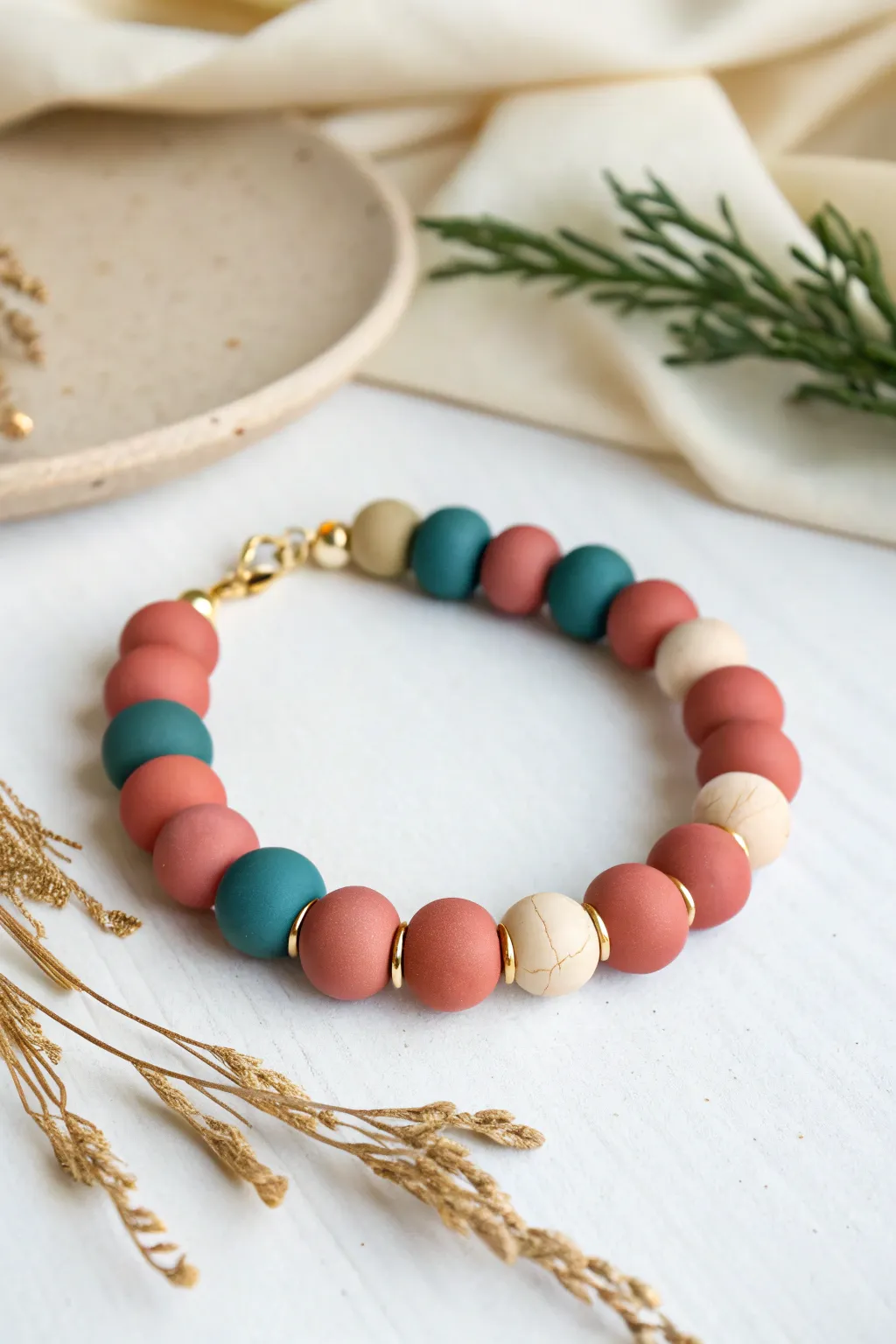
This sophisticated bracelet combines matte polymer clay beads in rich earth tones with elegant gold spacers for a chic, modern accessory. The strategic placement of spacer beads creates negative space that elevates the simple round forms into a boutique-quality piece.
Step-by-Step Guide
Materials
- Round polymer clay beads (10-12mm): Terracotta/Burnt Sienna, Deep Teal, Cream/Beige
- Gold flat disc spacer beads (heishi style or thin washers)
- Gold round spacer beads (3-4mm)
- Beading wire (flexible 49-strand recommended)
- Gold lobster clasp
- Gold jump rings
- 2 Gold crimp beads
- 2 Gold crimp covers (optional)
- Wire cutters
- Crimping tool or flat-nosed pliers
Step 1: Preparation & Planning
-
Measure your wrist:
Before cutting any wire, measure your wrist with a flexible tape measure. Add about 1 inch to this measurement to account for the bulk of the larger beads. -
Cut the wire:
Cut a length of beading wire approximately 10-12 inches long. Having extra length makes it much easier to finish the ends without frustration. -
Secure one end:
Start by threading a crimp bead and a jump ring onto one end of your wire. Pass the wire back through the crimp bead to create a loop. -
Crimp the loop:
Use your crimping tool to flatten the crimp bead securely. Give it a gentle tug to ensure it holds. You can cover this with a crimp cover now or later for a polished look. -
Plan your pattern:
Lay your beads out on a bead board or soft cloth. The pattern shown generally follows a sequence of: 2-3 terracotta beads, 1 teal bead, or a cream accent, separated occasionally by gold spacers. Notice that the pattern isn’t strictly symmetrical, which adds organic charm.
Uneven Spacing?
If gaps appear between beads when the bracelet curves, your wire is too tight. Restring and leave a tiny bit of slack (about 1-2mm) before crimping.
Step 2: Stringing the Beads
-
Start with small gold accents:
Thread 1-2 small round gold spacer beads first to hide the crimp area and refine the connection to the clasp. -
Begin the main sequence:
Slide on a cream bead followed by a teal bead. This establishes the cooler tones before moving into the warmer sections. -
Add the first terracotta section:
Add two terracotta beads. I prefer to place them directly next to each other without a spacer here to create a block of color. -
Introduce the teal accent:
Slide on a teal bead next. This creates a bold contrast against the warm terracotta. -
Create a spacer grouping:
Now, add a sequence that uses the gold flat disc spacers. Thread a terracotta bead, a gold spacer, a cream bead, another gold spacer, and a terracotta bead. -
Check the visual gap:
Look closely at how those gold spacers sit. They should sandwich the cream bead, creating a distinct ‘highlight’ section in your bracelet. -
Continue the pattern:
Follow with another terracotta bead, then a teal bead. Continue recreating the rhythmic pattern from your layout, adjusting if necessary to fit your specific length. -
Add final focal section:
Near the end, creating a section with a teal bead flanked by two warm terracotta beads looks lovely. Ensure the last bead is consistent with your design flow.
Matte Bead Tip
Polymer clay beads can arrive dusty. Before stringing, wipe them gently with a baby wipe or a damp cloth to reveal their rich, true color.
Step 3: Finishing the Clasp
-
Add end spacers:
Just like the beginning, finish the stringing with 1-2 small round gold balls to taper the design down to the clasp. -
Prepare the crimp:
Thread on a crimp bead, followed by your lobster clasp. -
Loop back:
Pass the wire tag end back through the crimp bead and through the first few beads of your bracelet. Pull the wire tight so there is no slack, but not so tight the bracelet becomes stiff and rigid. -
Secure the crimp:
Use your crimping pliers to flatten the crimp bead securely. I always test the hold here before cutting anything. -
Trim excess wire:
Using flush cutters, trim the excess wire tail close to the beads so it disappears inside the bead hole. -
Optional crimp cover:
If you are using crimp covers, gently close them over the flattened crimp beads using your pliers to make them look like simple gold beads.
Now you have a stunning, boutique-style bracelet ready to stack or wear alone for a pop of earthy color
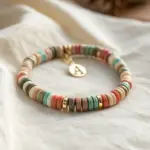
Double-Strand Clay Bead Twist Stack
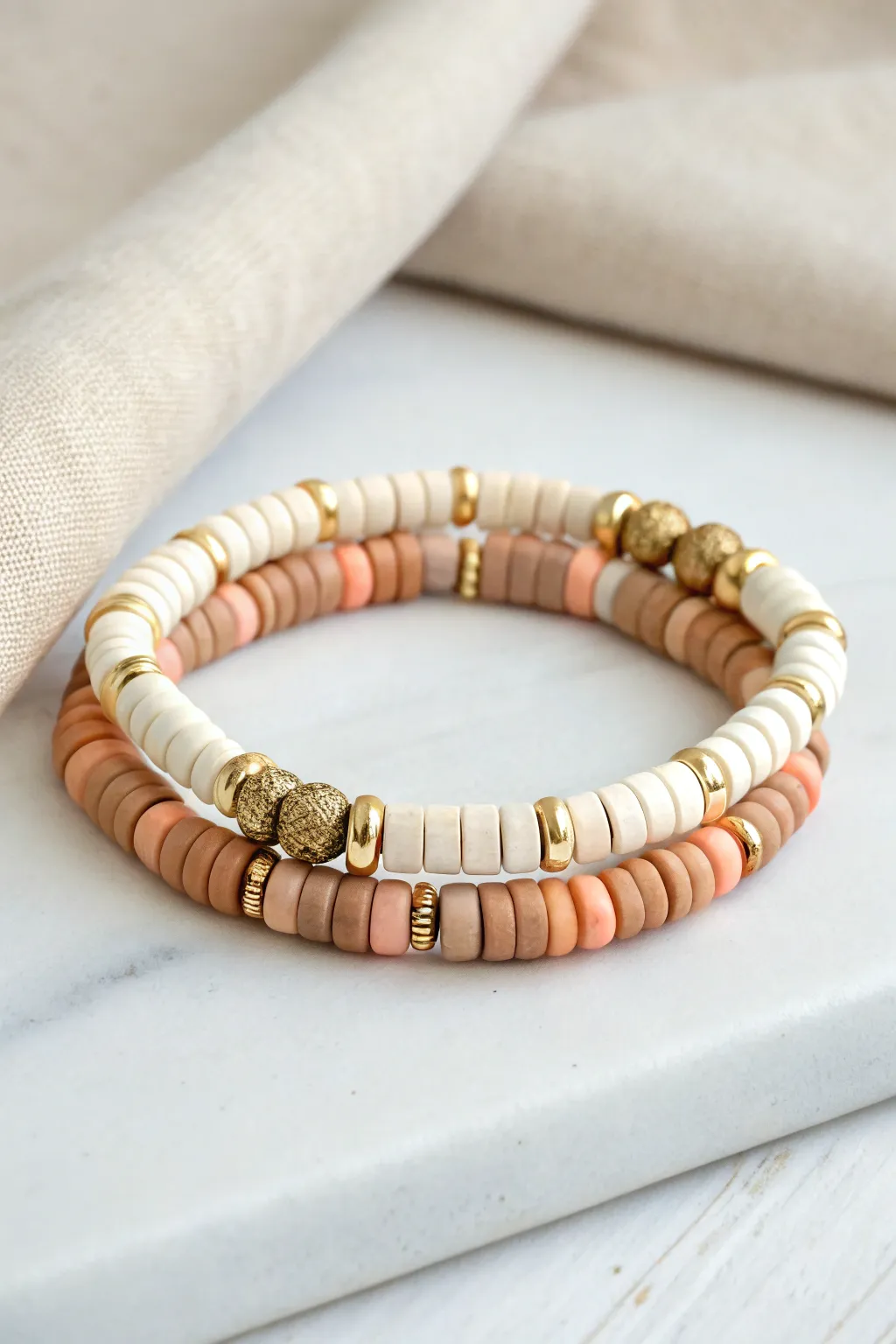
Create this sophisticated duo of clay bead bracelets featuring a harmonious blend of cream, tan, and peach tones accented with luxurious gold hardware. The juxtaposition of smooth heishi discs and textured focal beads gives this stack a high-end, boutique feel perfect for everyday wear.
Step-by-Step
Materials
- Cream/White polymer clay heishi beads (6mm)
- Tan/Caramel polymer clay heishi beads (6mm)
- Peach/Coral polymer clay heishi beads (6mm)
- Gold tone smooth round spacer beads (4mm)
- Gold tone ridged or daisy spacer beads (4mm)
- 2 Large gold tone textured/stardust round beads (8mm-10mm)
- Elastic cord (0.8mm clear stretch cord recommended)
- Bead stopper or masking tape
- Scissors
Step 1: Planning and Prep
-
Measure and cut:
Begin by measuring your wrist circumference. Cut two lengths of elastic cord, each about 10-12 inches long. This extra length ensures you have plenty of room for tying knots without struggling. -
Secure the ends:
Attach a bead stopper or simply place a piece of folded masking tape on one end of each elastic strand. This prevents your beads from sliding off while you design your pattern. -
Lay out the design:
Before stringing, lay your beads out on a bead board or soft cloth. This helps you visualize the balance of colors, especially for the multi-colored strand.
Knot Security Pro-Tip
Before tieing, string the final knot between two clay beads rather than metal ones. The flexible clay surface grips the knot better than slippery metal.
Step 2: Creating the Cream Strand
-
Start the cream pattern:
For the top bracelet, begin threading the cream heishi beads. Thread about 10-12 cream discs onto the cord. -
Add first gold accent:
Slide on a smooth gold round spacer bead. Follow this immediately with another section of 6-8 cream heishi beads. -
Build the texture:
Thread on another gold spacer, then a small group of 3 cream beads, and another gold spacer. This varies the rhythm of the bracelet. -
Insert focal beads:
Now, thread on the two large textured ‘stardust’ gold beads. These act as the centerpiece for this strand. Placing them side-by-side creates a bold metal statement. -
Finish the loop:
Continue the pattern on the other side of the focal beads: a gold spacer, 3 cream beads, a gold spacer, then longer sections of cream beads separated by single gold spacers until the strand fits your wrist.
Step 3: Creating the Multi-Tone Strand
-
Mix the colors:
For the bottom bracelet, you’ll be mixing tan, brown, and peach beads. Grab a small handful of each color to have ready. -
Create color blocks:
Thread a section of about 8 tan beads. I find that grouping colors together rather than alternating one-by-one looks more modern. -
Add ridged spacers:
Slide on a gold ridged spacer bead. These have a different texture than the smooth ones used above, adding interesting detail. -
Introduce peach tones:
Add a small block of 3-4 peach beads next. Follow this with another ridged gold spacer. -
Continue the pattern:
Thread a darker brown section of 6-8 beads. Continue alternating between these color blocks (tan, peach, brown) using the ridged gold spacers as dividers. -
Check the randomness:
Don’t make the pattern too rigid. Let some color sections be longer than others to achieve that organic, effortless look seen in the photo. -
Verify sizing:
Wrap this strand around your wrist to check the fit against the first bracelet. They should be identical in circumference.
Level Up: Texture
Add a single wooden bead or a freshwater pearl into the neutral strand. The mix of organic materials with the sleek clay creates a luxe bohemian vibe.
Step 4: Finishing Touches
-
Pre-stretch the cord:
Gently pull on the ends of the elastic cord for each bracelet. prestretching helps prevent the bracelet from sagging later after you’ve worn it. -
Tie the knots:
Remove the bead stopper. Tie a surgeon’s knot (right over left, left over right, looping through twice) on each bracelet. Pull tight to secure. -
Hide the knot:
Adding a dab of flexible jewelry glue or clear nail polish to the knot ensures it stays put. Once dry, trim the excess cord carefully. -
Concealment:
If precisely measured, try to slide the knot inside one of the larger beads or a gold spacer to hide it completely.
Stack these beauties together or wear them separately for a versatile accessory that complements any outfit