
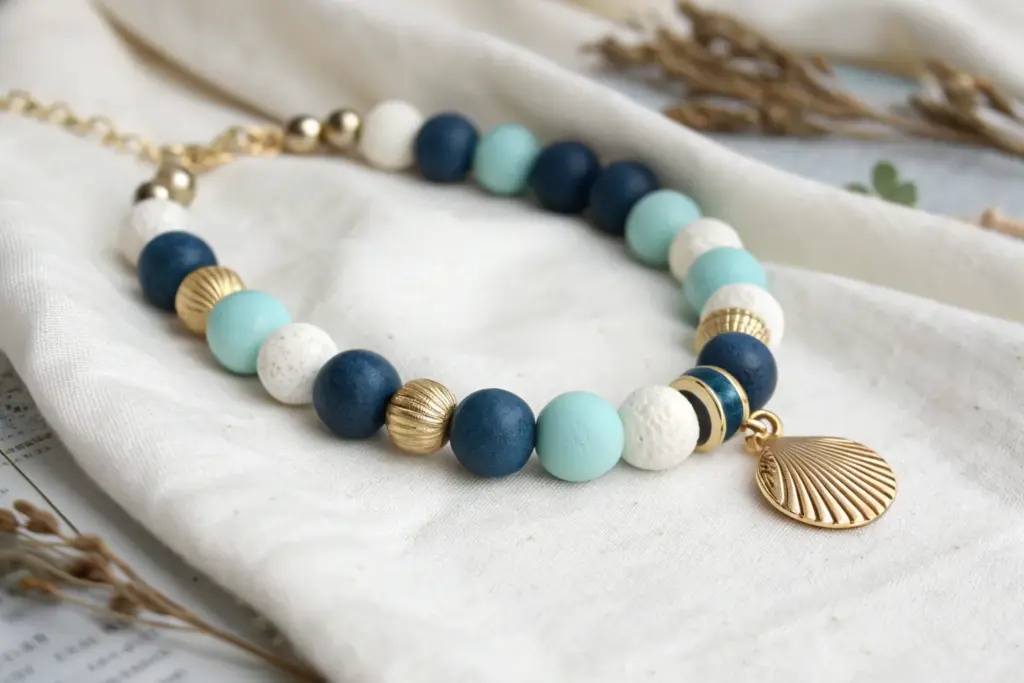
Whenever I’m craving that salty-air kind of creativity, I reach for ocean clay beads and start playing with beachy color palettes right at my studio table. These bracelet ideas are all about easy, wearable designs that feel like sea glass, seafoam, and sunshine wrapped around your wrist.
Classic Ocean Ombre Heishi Bracelet
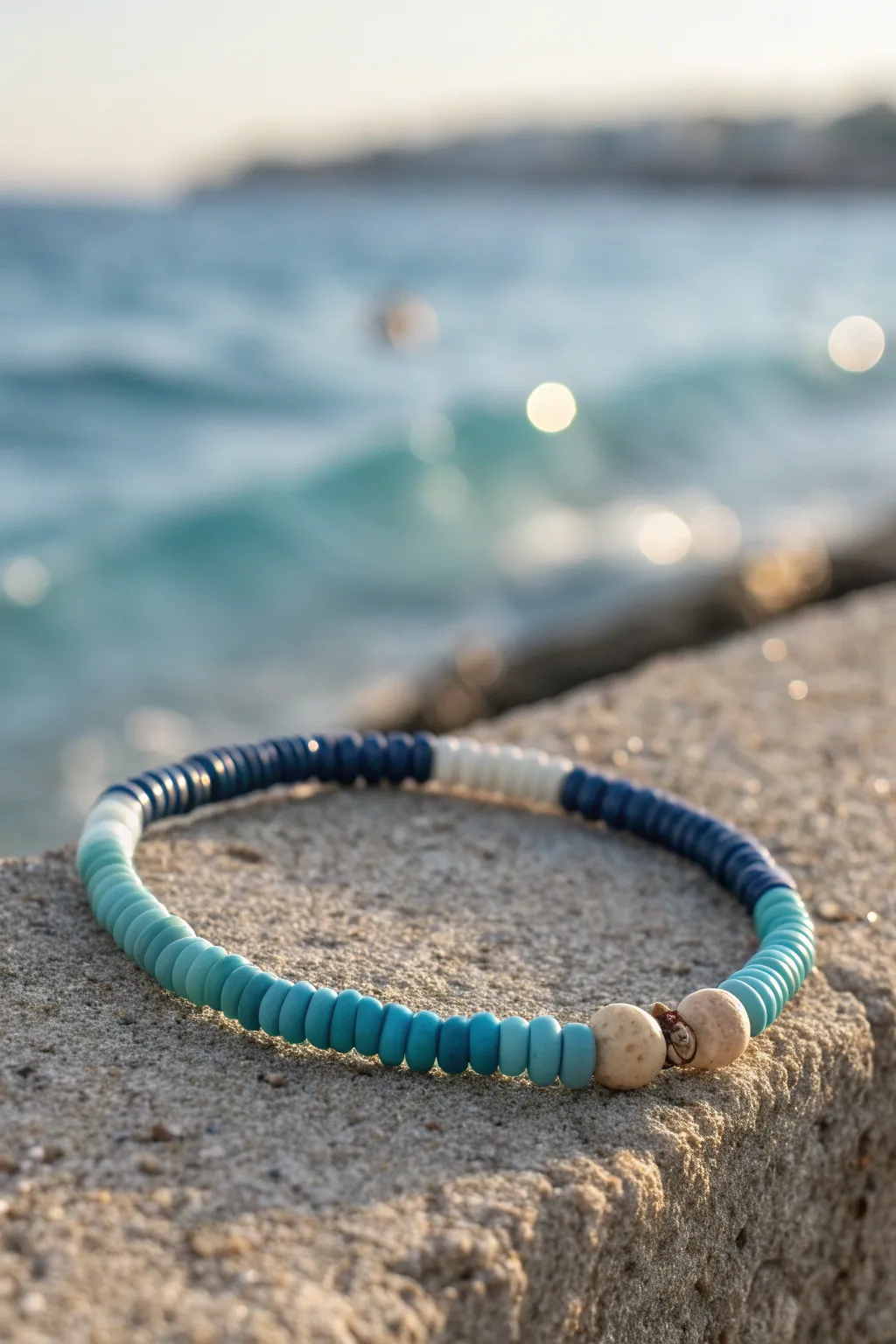
Capture the rhythm of crashing waves with this serene clay heishi bead bracelet. Featuring a soothing ombré transition from deep navy to soft white and vibrant turquoise, creating this accessory is as relaxing as a day at the beach.
Step-by-Step Tutorial
Materials
- 6mm polymer clay heishi disc beads (Dark Navy Blue)
- 6mm polymer clay heishi disc beads (Teal/Turquoise)
- 6mm polymer clay heishi disc beads (Solid White)
- 2 round rustic wood or cork beads (about 8-10mm)
- Elastic cord (0.8mm clear stretch cord recommended)
- Scissors
- Hypo cement or strong jewelry adhesive
- Beading needle (optional) or masking tape
- Ruler
Step 1: Preparation and Setup
-
Measure the cord:
Cut a piece of elastic cord about 10-12 inches long. This generous length gives you plenty of room to knot it securely later without frustration. -
Secure the end:
Place a small piece of masking tape over one end of the cord to act as a bead stopper, preventing your work from sliding off. -
Stretch the elastic:
Give your cut cord a few gentle tugs before adding beads; pre-stretching helps prevent the bracelet from loosening up after you start wearing it.
Pro Tip: Seamless Look
Use a needle to re-thread the tail end of your elastic back through two adjacent beads before trimming. This adds security and keeps ends hidden.
Step 2: Creating the Ombré Pattern
-
Start with Turquoise:
Begin by threading on your teal or turquoise heishi beads. You want this to be the largest block of color, covering about half of the bracelet’s circumference. -
Check the length:
Continue adding teal beads until you have a section roughly 3 to 3.5 inches long, depending on your wrist size. -
Begin the transition:
Switch to your white heishi beads. Thread a small section, approximately 0.5 inches long, to act as the ‘foam’ between the turquoise water and the deep ocean blue. -
Add the Dark Navy:
Now, thread on the dark navy blue beads. Create a section that mirrors the teal section but is slightly shorter, perhaps around 2 to 2.5 inches. -
Test the fit:
Wrap the strand around your wrist. The ends should almost touch, leaving a small gap of about half an inch for the accent beads.
Step 3: Adding Accents and Finishing
-
Add wooden accents:
Thread the two rustic wood or cork beads onto the cord. These should sit right next to the teal section to create a textural contrast. -
Prepare for the knot:
Double-check your pattern. The sequence should flow: Large Teal Section -> Wooden Beads -> Small White Section -> Dark Navy Section -> back to Teal (once tied). -
Tie the first knot:
Remove the tape and bring the two ends together. Tie a simple overhand knot, pulling it tight so the beads nestle closely together without buckling. -
Secure with a surgeon’s knot:
For extra security, tie a surgeon’s knot. Loop the right cord over the left twice, then pull tight. This friction knot holds elastic incredibly well. -
Apply glue:
I prefer to dab a tiny drop of hypo cement or jewelry glue directly onto the knot. Be careful not to get glue on the surrounding clay beads. -
Hide the knot:
While the glue is still tacky, gently slide one of the larger wooden beads over the knot to conceal it inside the bead hole. -
Final trim:
Once the glue has fully dried (wait at least 15 minutes), use your sharp scissors to trim the excess cord ends as close to the bead as possible.
Troubleshooting: Gappy Beads
If gaps appear between beads when wearing it, your elastic wasn’t pulled tight enough during knotting. Try pre-stretching the cord more next time.
Enjoy wearing your new shoreline-inspired accessory throughout the summer season
Seafoam White and Aqua Alternating Pattern
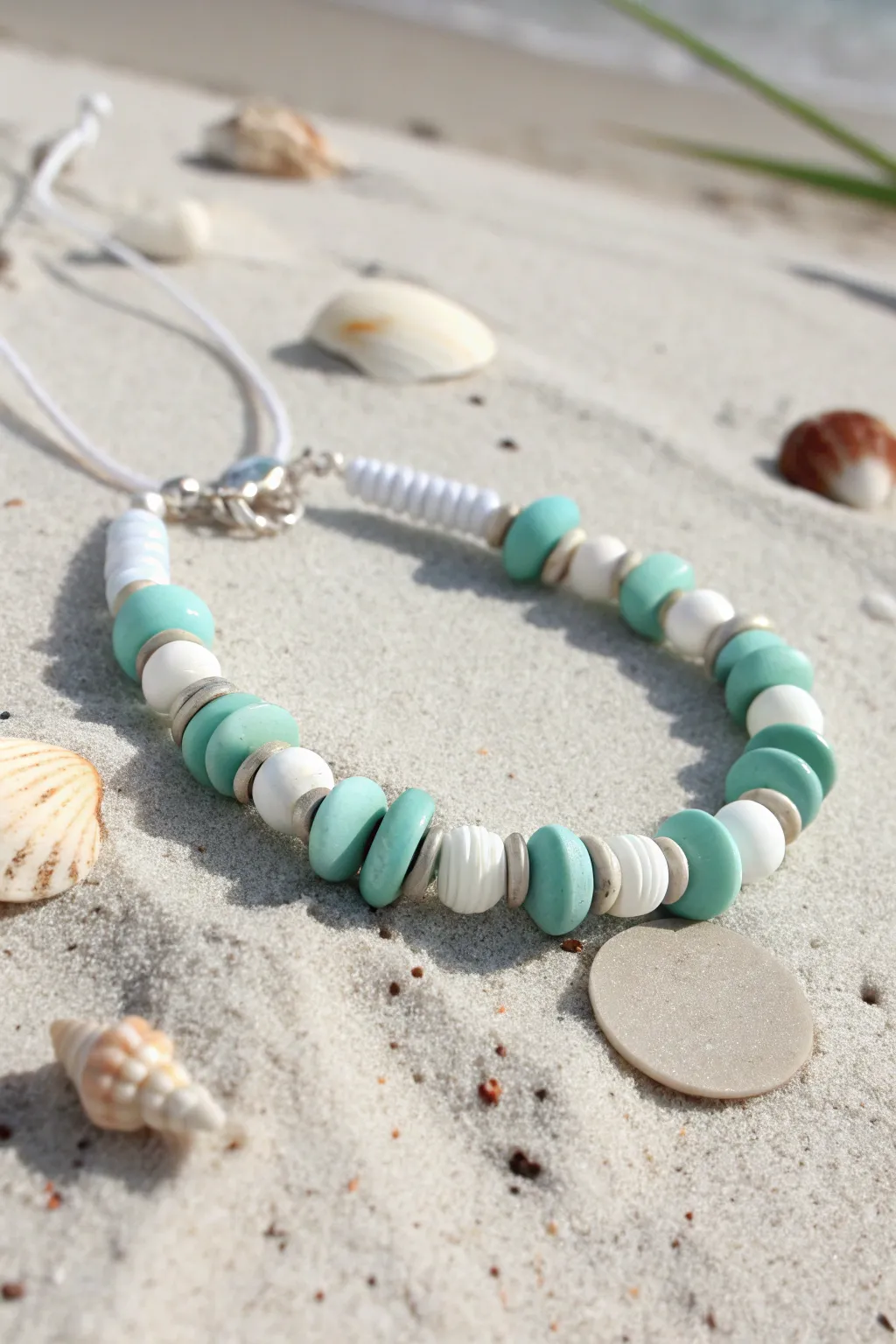
Capture the essence of a serene beach day with this beautiful bracelet featuring alternating aqua and white clay disc beads. The addition of silver spacers and textured white accents gives it a sophisticated yet relaxed coastal vibe perfect for summer wear.
Step-by-Step Guide
Materials
- White nylon beading cord (0.8mm or 1mm)
- Aqua/turquoise polymer clay heishi beads (approx. 6mm)
- White polymer clay heishi beads (approx. 6mm)
- Textured/grooved white round beads (approx. 6mm or 8mm)
- Silver-tone metal spacer discs or rings
- 2 Silver crimp end caps (cord ends)
- 2 Silver jump rings
- Silver lobster clasp
- Jewelry pliers (flat nose)
- Scissors
- Tape or bead stopper
Step 1: Preparation
-
Measure and cut:
Cut a piece of white nylon cord approximately 10-12 inches long. This gives you plenty of extra room to work with for knots or crimping. -
Secure one end:
Place a piece of tape over one end of the cord or attach a bead stopper. This prevents your beads from sliding off while you work on the design.
Loose Beads?
If the clay beads toggle or flip too much, your cord might be too thin. Try stringing a second strand of cord through simultaneously to fill the hole.
Step 2: Creating the Pattern
-
Start the sequence:
Begin by feeding about 6 to 8 plain white clay heishi beads onto the cord. This creates a neat, tapered start near the clasp. -
Add the first spacer:
Slide on a single silver spacer disc. These metal accents will separate the color sections and add a touch of shine. -
The first aqua accent:
Add one aqua clay bead next. Follow it immediately with a white clay bead, and then another aqua bead. -
Grouping the beads:
For the main pattern, think in groups of three. Between the metal spacers, arrange your beads. A common pattern seen here involves an aqua bead, a white bead, and another aqua bead sandwiched between silver spacers. -
Introduce texture:
As you move toward the center of the bracelet, substitute the plain white flat beads with the textured, grooved white round beads. This adds dimension. -
Build the center section:
Create the focal point by stringing a silver spacer, an aqua bead, a textured white bead, an aqua bead, and another silver spacer. -
Maintain consistency:
Repeat this central motif: silver spacer, aqua disc, textured white bead, aqua disc, silver spacer. Do this for the middle 2-3 inches of the bracelet. -
Mirror the design:
Once you pass the center, reverse your pattern. Switch back to the plain flat white beads instead of the textured ones. -
Finish the beadwork:
End the main beading mirroring the start: a small section of aqua and white patterns, followed by a final run of 6-8 plain white heishi beads. -
Check the length:
Wrap the unfinished strand around your wrist. The ends of the beaded section should almost touch on the underside of your wrist.
Step 3: Attaching the Clasp
-
Prepare the crimp ends:
I like to trim the cord ends so they are fresh and not frayed. Place a crimp end cap over the last white beads on one side. -
Secure the crimp:
Using your flat nose pliers, squeeze the center of the crimp end cap firmly so it grips the cord. Pull gently to ensure it’s secure. -
Attach the first jump ring:
Open a jump ring by twisting it sideways with your pliers. Loop it through the eye of the crimp end cap you just attached. -
Add the clasp:
Before closing the jump ring, slide the lobster clasp onto it. Twist the jump ring closed securely. -
Finish the other side:
Repeat the crimping process on the other end of the bracelet. Ensure you’ve removed the tape or stopper and pushed the beads flush against the first crimp before securing the second one. -
Final connection:
Add the second jump ring to the final crimp end. This will serve as the ring for the lobster clasp to latch onto.
Level Up: Shell Charm
Add a small cowrie shell or pearlescent charm to the center jump ring. It amplifies the beach theme without disrupting the bead pattern.
Your new ocean-inspired accessory is ready to wear on your next seaside adventure
Cowrie Shell Centerpiece Strand
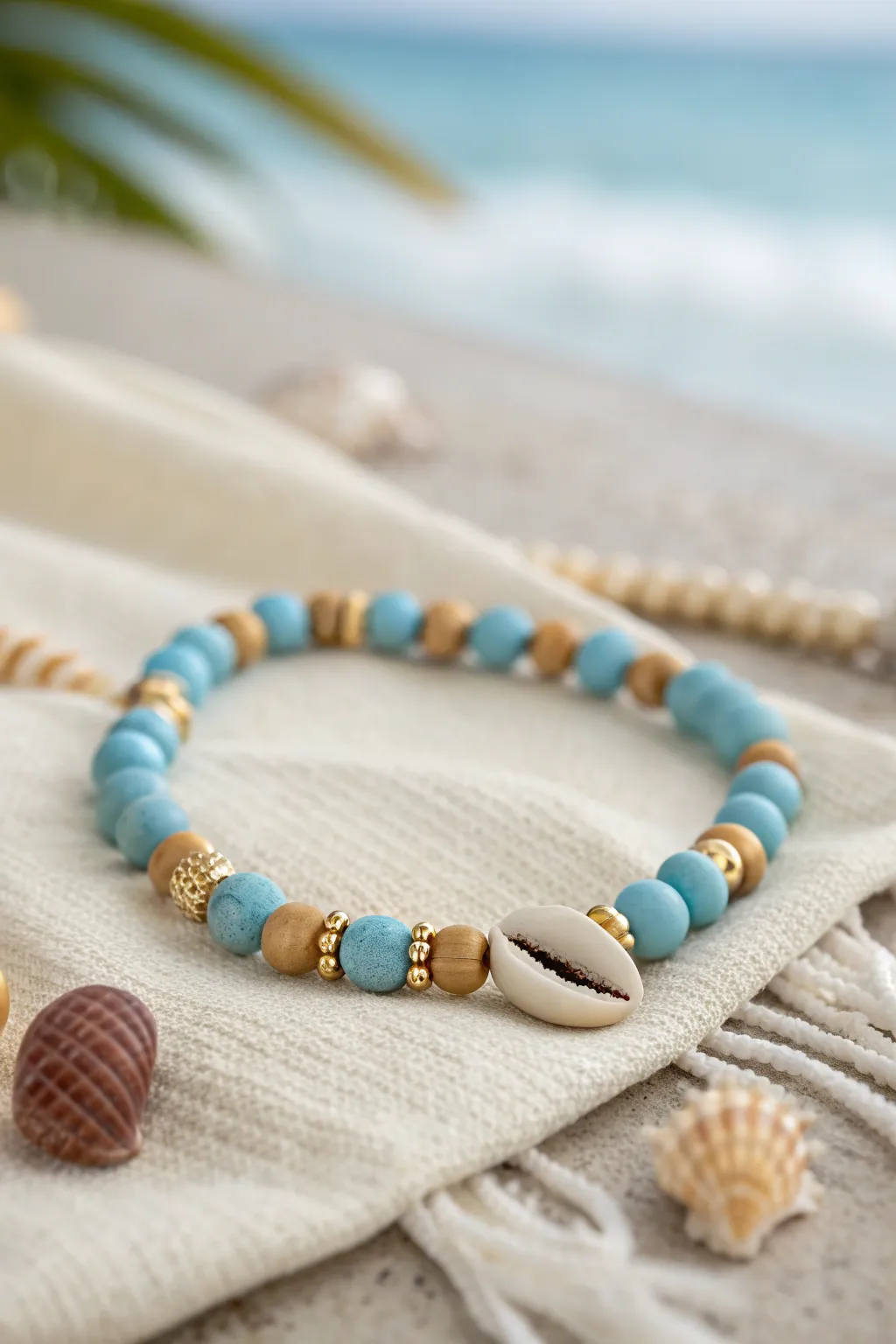
Capture the essence of a serene beach day with this beautiful beaded bracelet featuring soft turquoise tones and natural wood accents. The focal cowrie shell adds an unmistakable seaside charm, making this the perfect accessory for summer styling.
Step-by-Step
Materials
- Matte turquoise/light blue round beads (approx. 6mm-8mm)
- Natural wood round beads (same size as turquoise beads)
- Small gold spacer beads (smooth round)
- Small gold spacer discs or rondelles
- One medium-sized natural cowrie shell (drilled or open back)
- Textured gold accent beads (stardust or filigree style)
- Elastic beading cord (0.7mm or 0.8mm)
- Beading needle (collapsible eye recommended)
- Scissors
Step 1: Preparation
-
Measure your cord:
Cut a length of elastic beading cord about 10-12 inches long. This generous length gives you plenty of room to knot the ends securely without struggling. -
Pre-stretch:
Hold the ends of the cord and give it a few gentle tugs. Pre-stretching prevents the bracelet from loosening up after you wear it for the first time.
Step 2: Creating the Focal Point
-
Thread the cowrie shell:
Start by threading your elastic through the center of the cowrie shell. If your shell has two holes drilled, pass the string through both; if it’s open-backed, simply loop it through so the shell sits flat against the wrist. -
Add gold anchors:
On the immediate left and right of the cowrie shell, string one smooth wooden bead each to cushion the shell. -
Insert gold spacers:
Next to each wooden bead, add a small gold spacer disc or bead group. In the design shown, small clusters of three tiny gold beads are used as separators.
Knot Hiding Trick
If your knot won’t fit inside the holes of the stone beads, try hiding it inside one of the wooden beads instead, as their holes are often slightly larger and more forgiving.
Step 3: Building the Pattern
-
Start the sequence:
Begin the main pattern on one side of the centerpiece: add one turquoise bead, then one wooden bead. -
Place textured accents:
After the first wooden bead in the sequence, add a textured or “stardust” gold bead for a bit of sparkle. -
Continue the pattern:
Resume the alternating pattern: one turquoise bead, one wooden bead. This creates the rhythmic, natural look of the strand. -
Integrate simple spacers:
As you move further from the center focal point, you can swap the fancy textured gold beads for simple small gold spacers between the wood and turquoise sections to keep the design from looking too busy. -
Check the symmetry:
Repeat the exact same sequence on the other side of the cowrie shell. I find it helpful to lay the bracelet flat on a bead mat occasionally to ensure both sides match perfectly.
Golden Glamour
For a luxe upgrade, replace the simple wooden beads with gold lava stone beads or matte gold hematite beads to create a heavier, more jewelry-store quality piece.
Step 4: Finishing the Strand
-
Fill the back:
Continue beading until you reach the desired length for your wrist (usually about 6.5 to 7 inches for an average fit). The back of the bracelet looks best with just the simple alternating turquoise and wood pattern. -
Test the fit:
Wrap the unfinished strand around your wrist to check the size. It should sit comfortably without digging into your skin or sliding off too easily. -
Prepare the knot:
Bring the two ends of the elastic cord together. Remove any slack so the beads touch, but don’t pull so tight that the bracelet puckers. -
Tie the surgeon’s knot:
Tie a standard overhand knot, but loop the tail through the loop an extra time before pulling tight. This is a surgeon’s knot and holds elastic much better. -
Secure the ends:
Pull the knot tight from all four directions (the two tails and the two bracelet sides). You can add a tiny dab of jewelry glue or clear nail polish to the knot for extra security. -
Hide the knot:
Once the glue is tacky or dry, trim the excess cord ends close to the knot. Gently pull the elastic to slide the knot inside the hole of the nearest wooden or turquoise bead to hide it.
Now you have a stunning, beach-ready accessory to wear alone or stack with other favorites
Starfish Charm With Sunny Spacers
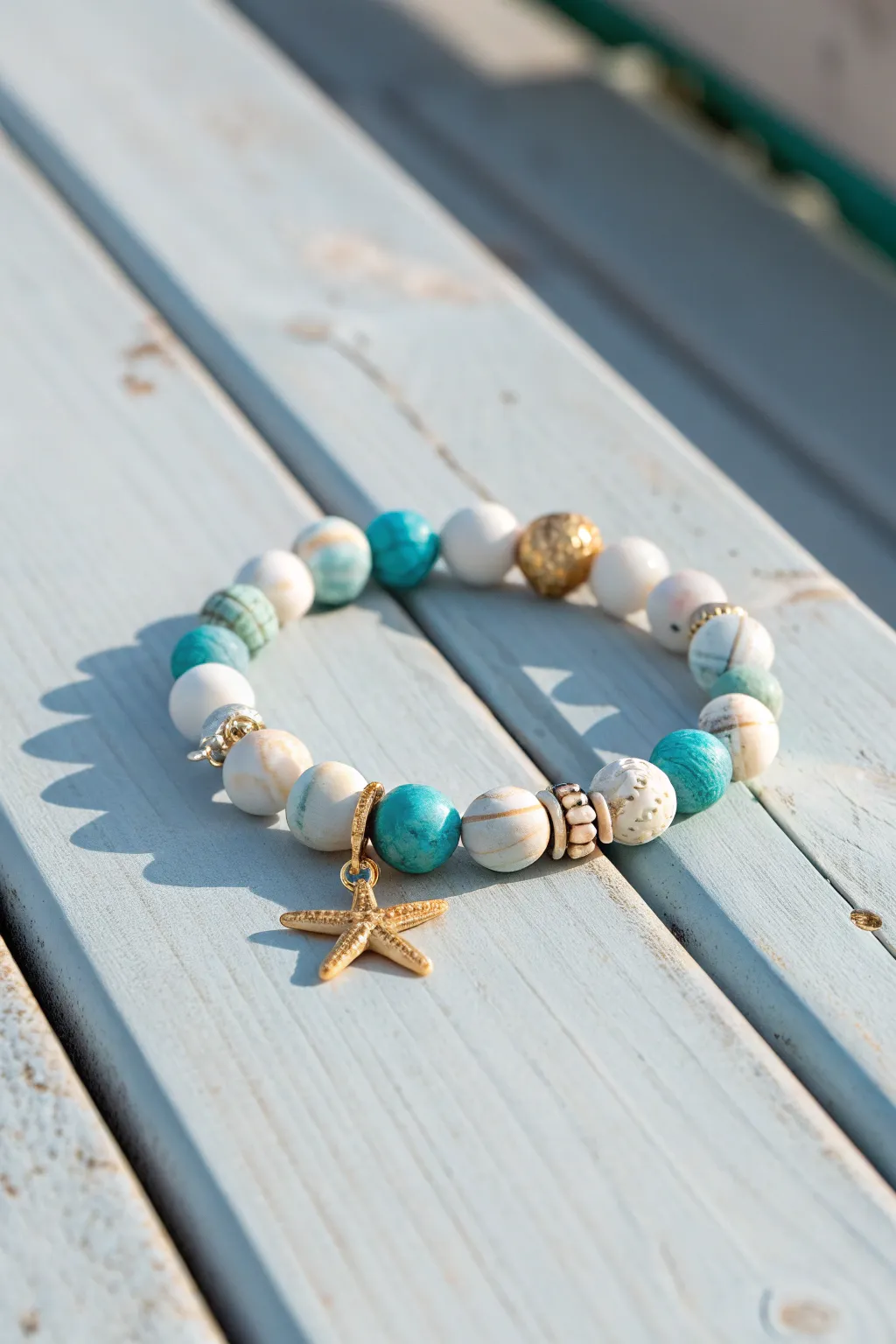
Capture the feeling of sun-drenched shores with this stunning stretch bracelet featuring a mix of textures and oceanic hues. The focal gold starfish charm and textured spacer beads add a touch of luxury to the natural stone and polymer clay look.
How-To Guide
Materials
- Elastic stretch cord (0.8mm or 1mm)
- White or cream marbled round beads (approx 10mm)
- Turquoise blue round beads (approx 10mm, likely dyed stone or ceramic)
- Gold-tone bumpy/textured metal bead
- Gold-tone spacer beads (small discs or rondelles)
- Small gold ribbed or corrugated spacer beads
- Gold starfish charm
- Gold jump ring (open)
- Jewelry glue (e.g., E6000 or GS Hypo Cement)
- Scissors
Step 1: Preparation and Charm Attachment
-
Measure your wrist:
Wrap a flexible measuring tape around your wrist to find your size, then add about half an inch for a comfortable fit. Cut a piece of elastic cord about 3-4 inches longer than this measurement to give yourself plenty of room for tying knots. -
Pre-stretch the cord:
Before you begin stringing, hold both ends of your elastic cord and give it a few firm pulls. This crucial step pre-stretches the material so your finished bracelet won’t sag or loosen right after you make it. -
Secure the charm:
Using your fingers or two pairs of pliers, carefully twist open the gold jump ring. Slide the loop of your gold starfish charm onto the open ring. -
Close the ring:
Twist the jump ring closed securely so the gap disappears completely, ensuring your charm won’t slip off later. -
Attach to cord:
Slide the jump ring with the attached starfish onto the center of your elastic cord to serve as the starting point.
Knot Slipping?
If your elastic knot keeps untying before you can glue it, clamp a binder clip over the first simple knot to hold tension while you prepare the surgeon’s knot.
Step 2: Stringing the Pattern
-
Start the pattern:
On the left side of the charm, thread on one bright turquoise bead followed by a cream marbled bead. On the right side of the charm, do the same: one turquoise bead, then one cream marbled bead. -
Add first spacers:
On the left side, after the cream bead, slide on a small gold ribbed spacer, followed by a bumpy white bead. -
Create the spacer cluster:
On the right side, create a detailed section by threading three flat gold disc spacers in a row, followed by a ribbed gold spacer. -
Continue the right side:
After that cluster of gold spacers, add a cream marbled bead, then a turquoise bead, and another cream bead. -
Continue the left side:
Return to the left strand. Add a gold spacer, a cream bead, a turquoise bead, and another cream bead to balance the design. -
Insert the feature bead:
Add the large, textured gold ball bead. I like to place this roughly opposite the starfish charm to act as a secondary focal point on the underside of the wrist. -
Fill in the remaining length:
Continue adding beads in a random or alternating pattern of turquoise and cream until you reach your desired length. The photo shows an organic mix, so don’t worry about perfect symmetry here. -
Check the fit:
Wrap the unfinished strand around your wrist to check the sizing. The beads should touch comfortably without gaps, but shouldn’t dig into your skin.
Step 3: Finishing Touches
-
Tie the first knot:
Bring the two ends of the elastic cord together. Tie a simple overhand knot (like the first step of tying a shoelace) and pull it tight securely against the beads. -
Tie the surgeon’s knot:
For extra security, tie a surgeon’s knot. Cross the wires again, but loop one end through twice before pulling tight. This creates friction that holds better than a standard knot. -
Apply adhesive:
Place a tiny drop of jewelry glue or clear nail polish directly onto the knot. This prevents the elastic from slipping over time. -
Hide the knot:
While the glue is still slightly wet, pull the elastic firmly so the knot slides inside the hole of the nearest large bead (preferably one of the cream marbled ones with a larger hole). -
Trim the excess:
Once the glue has fully dried and the knot is hidden, use small sharp scissors to trim the excess cord as close to the bead hole as possible without nicking the main strand.
Design Balance
To keep the bracelet balanced on your wrist, ensure the heavy gold bead is exactly halfway around the circle from the starfish charm.
Now you have a breezy, ocean-inspired accessory ready to wear on your next beach adventure

The Complete Guide to Pottery Troubleshooting
Uncover the most common ceramic mistakes—from cracking clay to failed glazes—and learn how to fix them fast.
Sea Turtle Charm in Teal Tones
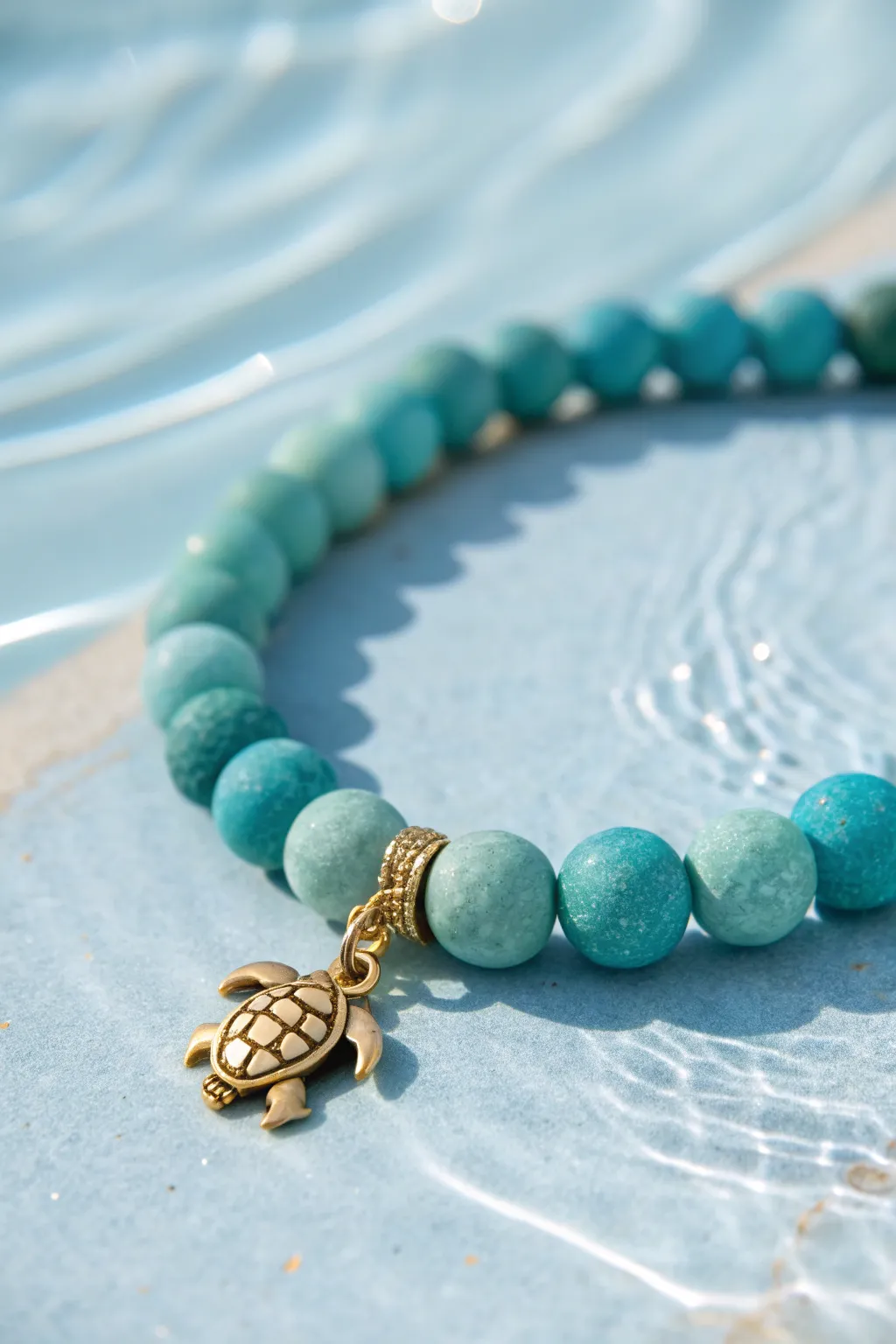
Capture the tranquil blues of shallow ocean waters with this elegant beaded bracelet featuring a charming gold sea turtle. Using a gradient of teal and turquoise matte stone beads creates a natural, sea-glass effect that pairs perfectly with warm metallic accents.
Step-by-Step Guide
Materials
- 8mm matte Amazonite or turquoise round beads
- 8mm textured/weathered teal agate or quartz beads
- Gold sea turtle charm with enamel inlay (approx. 15mm)
- Gold textured bail bead or hanger bead (large hole)
- Strong elastic beading cord (0.8mm or 1.0mm)
- Jewelry adhesive (e.g., G-S Hypo Cement)
- Scissors or bead nippers
- Tape or bead stopper
- Bead sorting tray or soft cloth
Step 1: Planning Your Design
-
Measure your wrist:
Before you begin, wrap a measuring tape around your wrist to determine the length. Add about 0.5 to 1 inch to this measurement depending on how loose you want the fit. -
Sort your beads:
Pour your beads onto a tray or soft cloth. Separate the smooth matte amazonite beads from the more textured, darker teal beads to see exactly what shades you have to work with. -
Lay out the pattern:
Arrange the beads in a straight line on your workspace. To mimic the photo, aim for a randomly organic look rather than a strict pattern, mixing the lighter turquoise beads with the darker teal ones. -
Position the focal point:
Find the center of your design and place the gold bail bead there. This will be the anchor for your turtle charm. -
Check the count:
Count your beads to ensure the strand matches your intended length. An average adult bracelet usually requires about 21-23 beads of 8mm size.
Stone Selection Tip
For that authentic ocean look, use ‘frosted’ or matte beads. The lack of shine mimics sea glass found on the beach better than polished stones.
Step 2: Stringing the Bracelet
-
Prepare the cord:
Cut a piece of elastic cord about 10-12 inches long. This extra length makes tying the final knot much easier without fumbling. -
Secure the end:
Place a piece of tape or a bead stopper on one end of the cord to prevent beads from sliding off while you work. -
Pre-stretch the elastic:
Give the cord a few gentle tugs. This simple trick prevents the bracelet from stretching out and becoming loose immediately after you wear it. -
String the first half:
Begin threading the beads onto the cord, starting from one end of your layout and stopping just before you reach the center bail. -
Add the charm holder:
Thread the gold bail bead onto the cord. Ensure the loop hangs downwards where the charm will eventually sit. -
Attach the turtle:
If your charm has a jump ring, use pliers to open it gently, slide it onto the bail’s loop, and close it securely. If the turtle has a built-in loop, you might attach it directly to the bail before stringing. -
Finish stringing:
Continue adding the remaining stone beads according to your laid-out pattern until all beads are on the cord.
Knot Slipping?
If your elastic knot feels insecure, try tying it while the elastic is slightly stretched. The tension helps ‘bite’ the cord into itself for a lock.
Step 3: Finishing Touches
-
Check the fit:
Carefully wrap the unfinished strand around your wrist to verify the size. Add or remove a bead if necessary, keeping the charm centered. -
Tie the knot:
Bring both ends of the cord together. Tie a surgeon’s knot (loop left over right twice, then right over left) and pull it tight. You want tension, but not so much that the beads bunch up. -
Secure with glue:
I like to dab a tiny drop of jeweler’s glue directly onto the knot. This ensures it won’t slip over time. -
Hide the knot:
Once the glue is tacky but not fully hard, slide the knot inside the hole of the nearest large bead to conceal it. -
Trim excess cord:
After the glue has dried completely, use your scissors to snip off the excess elastic tails as close to the bead as possible without cutting the knot.
Enjoy wearing your new ocean-inspired accessory that carries the calm of the sea with you
Wave Stripe Pattern in Blues and White
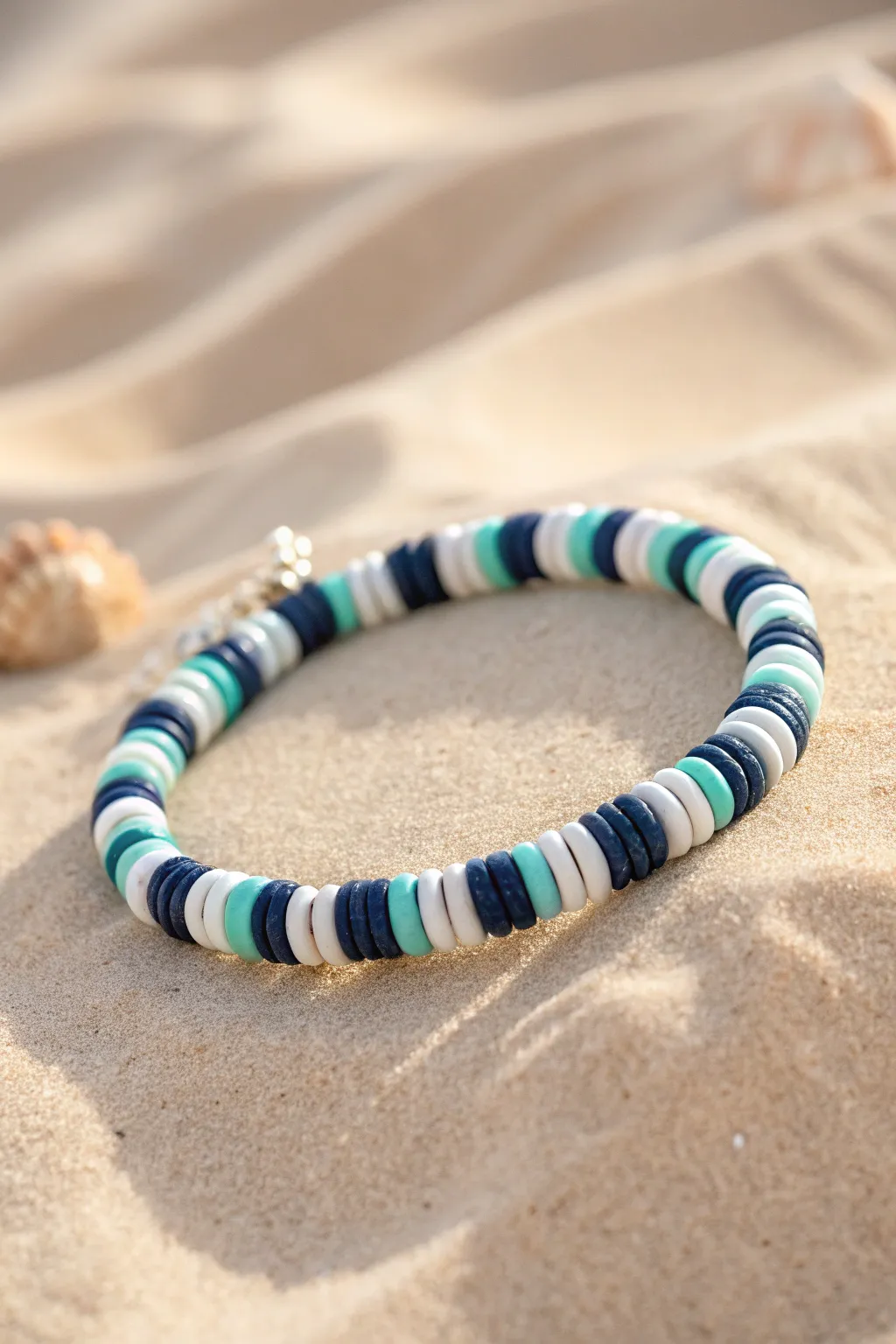
Capture the rhythm of rolling ocean waves with this simple yet striking heishi bead bracelet. The alternating blocks of navy, turquoise, and white create a crisp, modern stripe pattern that feels right at home on sandy shores.
Step-by-Step
Materials
- 6mm polymer clay disc beads (heishi beads) in Navy Blue
- 6mm polymer clay disc beads in White
- 6mm polymer clay disc beads in Turquoise or Mint
- Elastic cord (0.8mm or 1.0mm recommended)
- Scissors
- Super glue or jewelry cement
- Bead stopper or tape
- Measuring tape
- Silver spacer bead or charm (optional, visible near the knot)
Step 1: Preparation
-
Measure your wrist:
Wrap a measuring tape comfortably around your wrist to determine the desired length, then add about half an inch for a comfortable fit. -
Cut the cord:
Cut a piece of elastic cord about 10-12 inches long. Having extra length makes tying the final knot much easier. -
Pre-stretch the elastic:
Hold the cord ends and give them a few gentle tugs. Pre-stretching prevents the bracelet from becoming loose after you wear it a few times. -
Secure one end:
Attach a bead stopper to one end of the cord, or simply tape it down to your table so your beads don’t slide off while you work.
Knot Slipping?
If your elastic knot feels loose, try a surgeon’s knot: wrap the cord through the loop two times instead of once before pulling tight. It holds much better on slick cording.
Step 2: Creating the Pattern
-
Understand the sequence:
The pattern follows a repeating block structure rather than single alternating beads. We will group colors to create distinct stripes. -
Start with Navy:
String on three Navy Blue heishi beads. This forms the dark base of our ‘wave’ pattern. -
Add the Turquoise accent:
Slide on one single Turquoise bead. This pop of color mimics the light hitting the water. -
Create the White stripe:
Add two White beads. This creates a crisp contrast against the darker colors. -
Repeat the accent:
String on one more single Turquoise bead to bracket the white section. -
Repeat the Navy block:
Add three more Navy Blue beads. -
Vary the pattern slightly:
To mimic the organic feel of the bracelet in the photo, alternate between blocks of 2 or 3 beads for the solid colors. For example, your next white section could be three beads wide.
Step 3: Finishing Up
-
Continue beading:
Repeat the sequence (Navy block – Turquoise – White block – Turquoise) until the strand reaches your desired length. -
Check the fit:
Wrap the unfinished strand around your wrist to ensure it sits comfortably without gaps. -
Add a feature bead:
If desired, thread on a small silver spacer bead or charm near the end of the pattern to cover the knot area later. -
Tie the knot:
Remove the bead stopper and cross the two ends. Tie a standard square knot first—right over left, then left over right. -
Secure the knot:
Pull the elastic tight so the knot disappears between two beads. I like to tie a second surgeon’s knot (looping through twice) for extra security. -
Glue and trim:
Apply a tiny dot of super glue or jewelry cement to the knot itself. Let it dry for a minute, then trim the excess cord ends close to the knot.
Add Some Texture
Replace one of the turquoise accent beads with a gold or silver disc spacer bead every third repetition to add a touch of metallic shine to your coastal design.
Slip on your new bracelet and enjoy the cool, coastal vibes it brings to your outfit

What Really Happens Inside the Kiln
Learn how time and temperature work together inside the kiln to transform clay into durable ceramic.
Nautical Navy and White With Anchor Accent
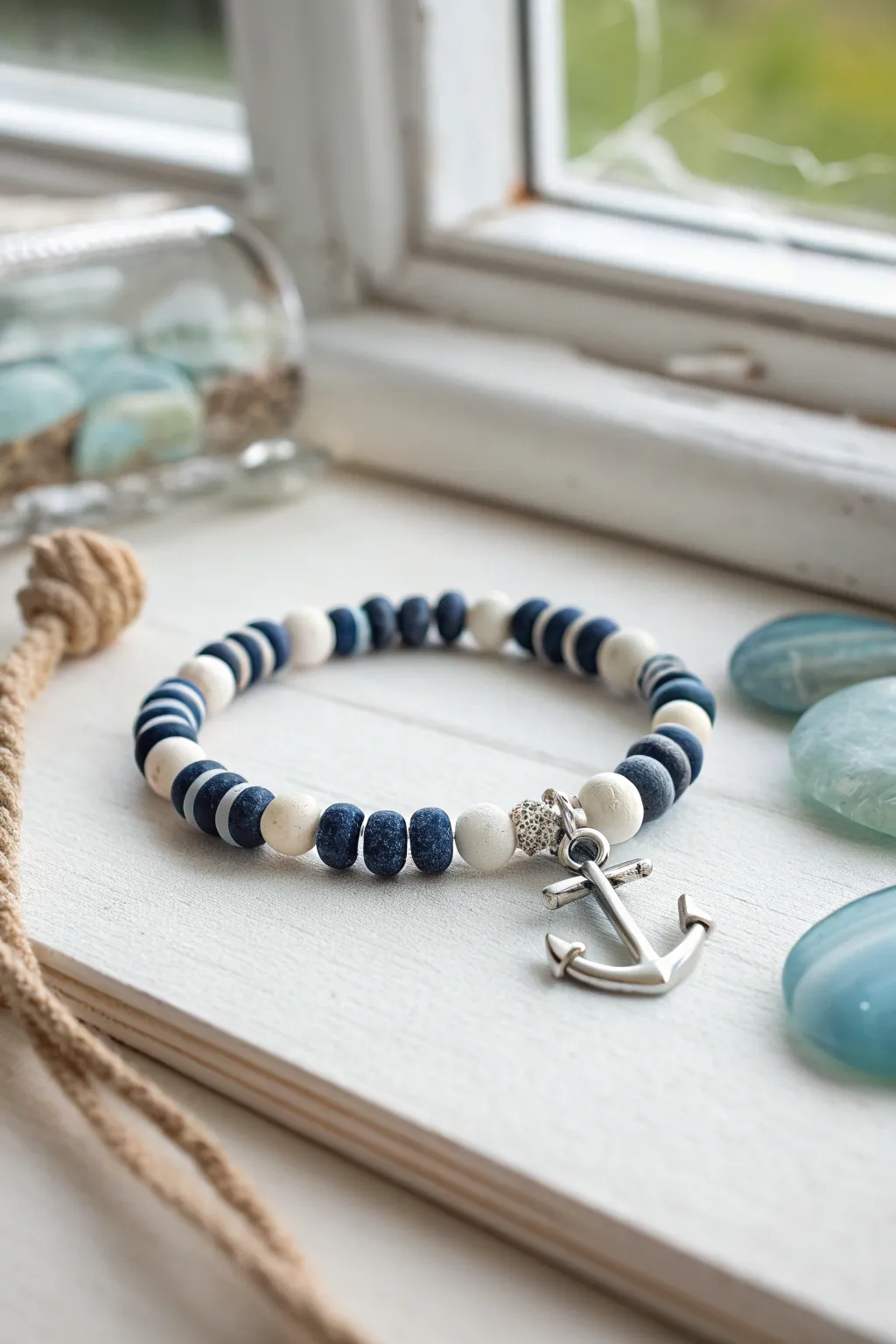
Capture the spirit of the sea with this crisp nautical design featuring deep navy and stark white clay beads. The silver anchor charm serves as the perfect centerpiece, making this accessory feel like a treasure found on a windswept dock.
Step-by-Step Guide
Materials
- Navy blue polymer clay saucer/rondelle beads (approx. 6-8mm)
- White polymer clay round beads (approx. 8mm)
- White or cream bone/stone round beads (approx. 8mm, with stripe detail if available)
- Silver anchor charm
- Silver textured spacer bead (large hole)
- Silver jump rings (6mm or 8mm)
- Strong elastic beading cord (0.8mm or 1mm)
- Jewelry adhesive or super glue
- Scissors or jewelry snips
- Bead stopper or tape
Step 1: Preparation & Bead Selection
-
Measure your wrist:
Before cutting any cord, measure your wrist and add about 1/2 inch to determining the comfortable finished length for the bracelet. -
Prepare the cord:
Cut a piece of elastic cord about 10-12 inches long. This extra length gives you plenty of room to tie knots securely later without struggling. -
Secure the end:
Attach a bead stopper or simply place a piece of tape on one end of the cord to prevent your beads from sliding off while you design. -
Sort your pattern:
Lay out your beads on a mat or towel. The pattern shown uses a specific rhythm: segments of navy saucer beads separated by larger white accent beads.
Knot Security
When hiding the knot, pull gently. If the hole of the large bead is too small, I often use a bead reamer to widen it slightly just on one side to accommodate the knot.
Step 2: Stringing the Design
-
Start with the navy segments:
Begin by threading on four navy blue saucer beads. These should nestle together closely to form a solid block of color. -
Add a white accent:
Slide on one of the larger white round beads. This creates a sharp contrast against the dark blue. -
Create the repeating pattern:
Continue this pattern: four navy beads followed by one white bead. Repeat this sequence until you have covered about half the length needed for your wrist. -
Incorporate striped beads:
If you are using striped or alternative focal beads like the ones shown near the charm, swap a few standard white beads for these to add texture and visual interest. -
Check the fit:
Wrap the strung beads around your wrist to check the size. Remember you still need to add the focal section, which takes up space.
Step 3: Adding the Anchor Focal Point
-
Position the textured spacer:
Once your main beading is done, slide on the silver textured spacer bead. This acts as a decorative bail for the charm. -
Prepare the charm:
Open a silver jump ring using jewelry pliers (or your fingers if the metal is soft enough). Slide the anchor charm onto the ring. -
Attach the charm:
Loop the open jump ring around the bracelet cord directly next to the textured spacer bead, or attach it to the loop on the spacer bead if it has one. Close the jump ring securely so there is no gap. -
Complete the circle:
Thread the final end of the cord through the first few beads of your starting sequence to bring the circle together.
Level Up: Weathered Look
For a truly authentic beach look, lightly sand the navy clay beads with fine-grit sandpaper to give them a matte, sea-glass finish before stringing.
Step 4: Finishing Touches
-
Pre-stretch the elastic:
Gently pull on both ends of the cord to stretch the elastic slightly. This helps prevent the bracelet from sagging or loosening after the first time you wear it. -
Tie the knot:
Tie a surgeon’s knot (right over left, left over right, looping through twice on the second pass). Pull it tight. -
Secure with glue:
Dab a tiny drop of jewelry adhesive or super glue directly onto the knot. Be careful not to get glue on the beads themselves. -
Hide the knot:
While the glue is still slightly tacky but not wet, pull the knot inside the hole of the nearest large white bead to hide it. -
Trim the excess:
Once the glue is fully dry, trim the excess cord ends close to the bead hole using your scissors.
Slip on your new nautical bracelet and enjoy the breezy, coastal vibe it adds to your outfit
Beach Word Letter Bead Bracelet
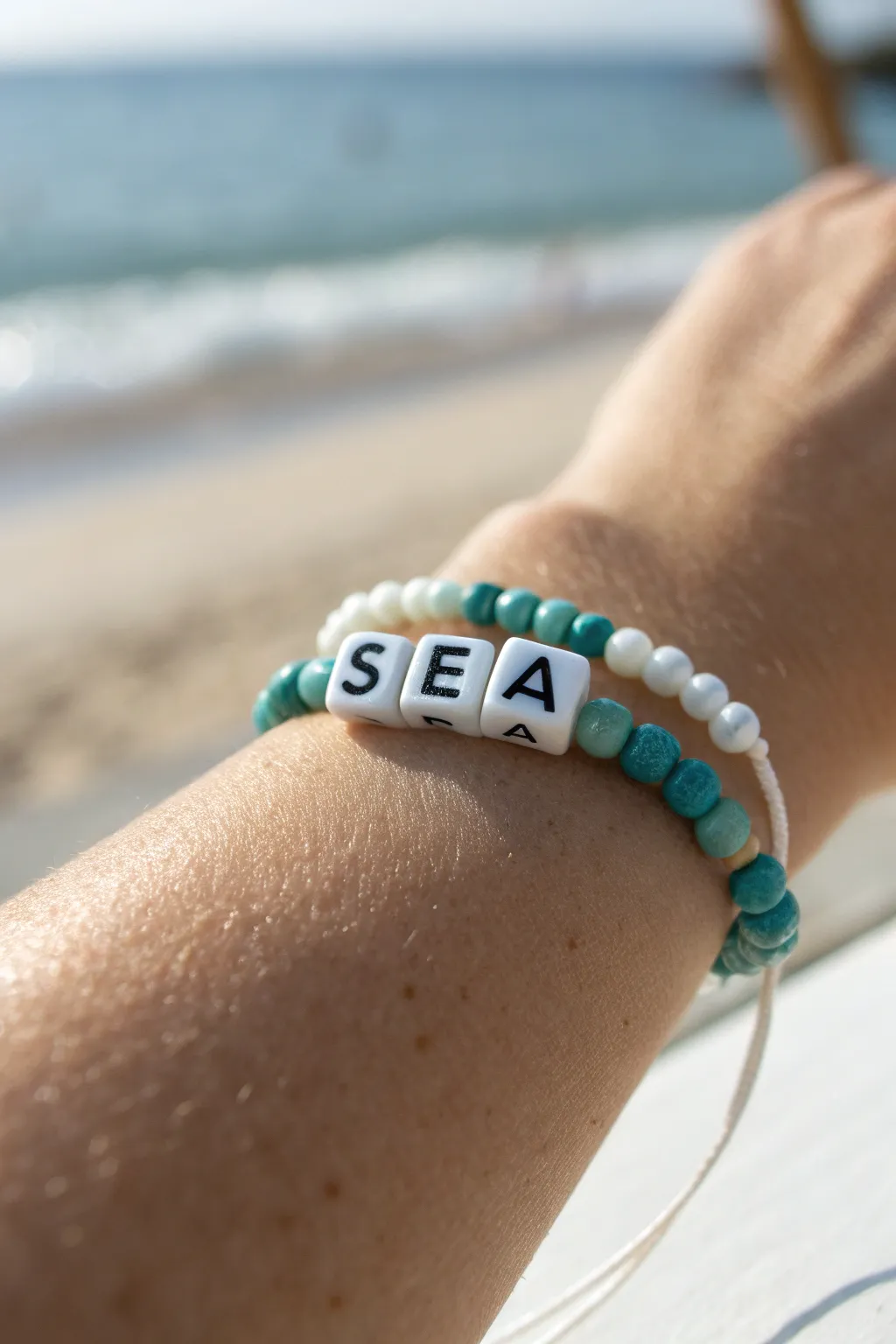
Capture the calm of the coast with this turquoise and white heishi bead stack featuring a personalized letter bracelet. The blend of sea-glass hues and crisp white pearls creates a perfect summer accessory that looks beautiful against a tan.
Step-by-Step Tutorial
Materials
- Turquoise clay heishi beads (approx. 4mm – 6mm)
- White or ivory small round beads (pearl or glass, approx. 4mm)
- White cube letter beads with black text (S, E, A)
- White nylon cord or jewelry elastic (0.5mm – 0.8mm)
- Scissors
- Super glue or jewelry cement (optional)
- Beading needle (optional but helpful)
- Tape or clipboard
Step 1: Planning the Design
-
Measure your wrist:
Wrap a piece of string around your wrist to find the circumference, then add about half an inch for a comfortable fit. Keep in mind that for this stack, you are making two separate bracelets. -
Cut the cord:
Cut a length of white cord for each bracelet. If you plan to make an adjustable sliding knot, cut about 12-14 inches per bracelet to leave plenty of room for knotting. If using elastic, 10 inches is usually sufficient. -
Secure the end:
Tape one end of your first cord down to a table or attach it to a clipboard. This prevents your beads from sliding off while you design the pattern.
Step 2: Creating the ‘SEA’ Bracelet
-
Sort your letter beads:
Locate your ‘S’, ‘E’, and ‘A’ cube beads. It’s best to set them aside first so you don’t have to hunt for them mid-stringing. -
Start the turquoise section:
Begin threading the turquoise clay heishi beads onto the cord. I find that grouping them in sections of 10-15 beads gives a nice solid block of color before adding any accents. -
Add variance (optional):
Notice in the image that some beads have slightly different shades of teal. Mix darker and lighter turquoise beads randomly to mimic the natural variation of ocean waves. -
Center the word:
Once you have strung enough turquoise beads to cover almost half your wrist size, thread on the ‘S’, ‘E’, and ‘A’ beads. Ensure they are facing the correct direction so the word is legible. -
Finish the strand:
Continue stringing turquoise beads on the other side of the letters until the beaded section reaches your desired length. -
Check the fit:
Wrap the unfinished strand around your wrist to ensure the word ‘SEA’ sits centered on top and the length is correct.
Knot Slipping?
If your elastic knot won’t stay tight, try a ‘surgeon’s knot.’ It’s like a square knot, but you loop the string through twice on the first pass for extra friction.
Step 3: Creating the Accent Strand
-
Start the second cord:
Set the first bracelet aside carefully and tape down your second piece of cord for the accent bracelet. -
Begin the pattern:
Start by threading a small section of turquoise beads, perhaps 5 or 6, to tie the color scheme together with the first bracelet. -
Transition to white:
Add your white round beads. The image shows a block of white beads followed by turquoise again. You can do a 50/50 split or alternate small groups. -
Add a focal bead:
If you have a slightly larger or different textured bead (like the creamy bead seen on the right in the photo), place it in the center or as a transition point between colors. -
Complete the strand:
Finish stringing until this bracelet matches the length of your first one.
Golden Hour Glow
Add 2-3 gold spacer beads between the turquoise sections and the white letters. The gold pops against the teal and elevates the bracelet from casual to chic.
Step 4: Finishing Up
-
Tie the knots:
If using elastic: cross the ends, pull tight to remove slack, and tie a square knot (right over left, left over right). Pull firmly to lock it. -
Add security:
Dab a tiny drop of super glue or jewelry cement onto the knot. Let this dry completely before trimming any excess string. -
Hide the knot:
Once dry, try to slide the knot inside the hole of the nearest large bead to conceal it for a professional finish. -
Sliding knot option:
If using non-stretch cord (as seen in the dangling ends of the photo), overlap your cord ends and tie a series of square knots with a separate small piece of cord to create a sliding closure. -
Trim the ends:
Cut the excess cord close to the knot for elastic, or leave small tails with a knot at the very end for the adjustable slider style.
Now you have a breezy set of bracelets ready for your next beach trip or just to brighten up a Tuesday

TRACK YOUR CERAMIC JOURNEY
Capture glaze tests, firing details, and creative progress—all in one simple printable. Make your projects easier to repeat and improve.
Ocean Blues With Evil Eye Accent
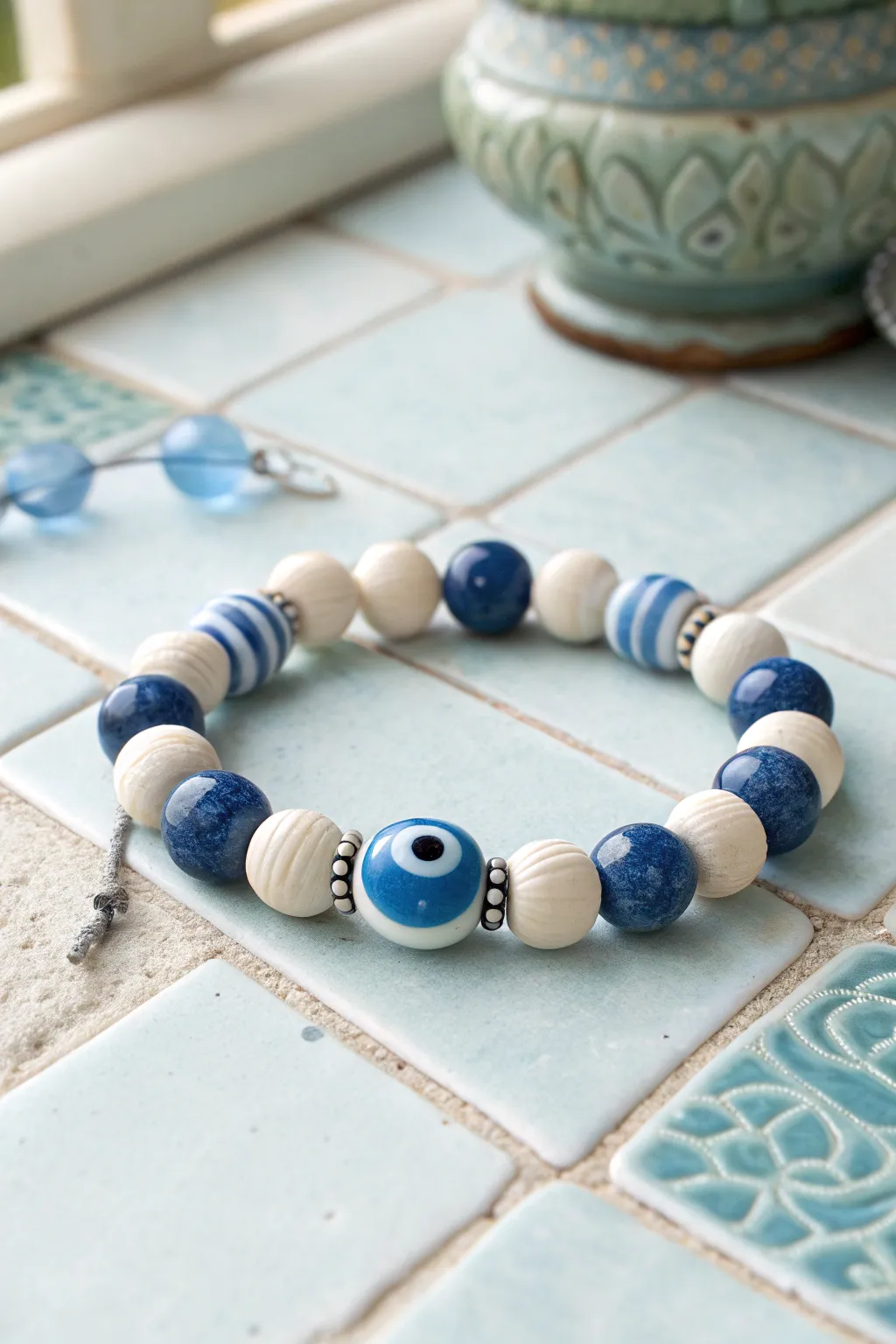
Channel the calming hues of the Mediterranean with this striking beaded bracelet, featuring a central protective Evil Eye bead. The combination of creamy white clay, deep oceanic blues, and nautical stripes creates a piece that feels both grounded and tailored.
How-To Guide
Materials
- One large (10-12mm) round blue Evil Eye glass lampwork bead
- Cream/off-white polymer clay beads (round)
- Deep blue speckled ceramic or stone beads (round)
- Blue and white striped resin or clay beads
- Solid navy blue round beads
- Silver-tone spacer beads with small granule detailing
- Heavy-duty stretch cord (0.8mm or 1mm thickness)
- Jewelry adhesive (e.g., E6000 or GS Hypo Cement)
- Scissors or bead nippers
- Bead design board (optional but helpful)
Step 1: Planning the Layout
-
Measure your wrist:
Before you begin stringing, wrap a piece of string around your wrist to find your measurement. Add about a half-inch to this number for a comfortable fit that isn’t too tight. -
Prepare the design space:
Lay out your bead board or a soft towel on your workspace. This prevents round beads from rolling away while you finalize your pattern. -
Center the focal point:
Place your Evil Eye lampwork bead in the exact center of your layout channel. This will be the anchor for the entire symmetry of the bracelet. -
Establish the flanks:
On either immediate side of the Evil Eye bead, place a silver-tone granulate spacer. Follow these spacers with a cream-colored textured clay bead on each side. -
Add deep blue accents:
Next to the cream beads, place the deep blue speckled stone or ceramic beads. I like to create strong contrast here by placing another cream bead after the blue one. -
Create the pattern rhythm:
Continue building outwards symmetrically. A suggested pattern for the remaining length is: deep blue stone, cream bead, blue/white striped bead, cream bead, solid navy bead, and cream bead. -
Check the symmetry:
Stand back and look at the layout. Ensure that the left side mirrors the right side perfectly for a balanced visual weight.
Step 2: Stringing and Finishing
-
Cut the cord:
Cut a piece of stretch cord about 10-12 inches long. This extra length makes tying the knot significantly easier later on. -
Pre-stretch the cord:
Firmly pull on the ends of the cord a few times to toggle out any slack. This prevents the bracelet from stretching out permanently after the first wear. -
Secure one end:
Place a piece of tape or a bead stopper on one end of the cord so your beads don’t slide off as you work. -
Begin stringing:
Transfer your beads from the board to the cord one by one. I genuinely find it easiest to start from one end and work straight across to keep the order correct. -
Verify the length:
Once all beads are strung, carefully lift the bracelet and wrap it around your wrist to check the fit. Add or remove beads from the ends (the back of the bracelet) if adjustment is needed. -
Prepare the knot:
Remove the tape/stopper. Bring the two ends of the cord together, ensuring there are no large gaps between beads. -
Tie a surgeon’s knot:
Cross the ends, wrap one side over and under twice, and pull tight. Repeat this process to secure the knot firmly. -
Apply adhesive:
Add a tiny drop of jewelry adhesive directly onto the knot. This is crucial for longevity with stretch bracelets. -
Hide the knot:
While the glue is still tacky, gently pull the knot inside the hole of the nearest large bead to conceal it. -
Final trim:
Once the glue has fully cured (usually 24 hours), trim the excess cord ends close to the bead.
Knot Security
Use a surgeon’s knot (looping twice instead of once) for extra grip. Always pre-stretch your cord before stringing; this stops the bracelet from going slack later.
Texture Twist
Mix finishes for depth! Use matte polymer clay against shiny glass beads, or swap the smooth blue beads for rough-hewn lapis lazuli for an earthier feel.
Wear your new bracelet as a daily reminder of calm waters and protection.
Pearl and Sea-Blue Mixed Stack
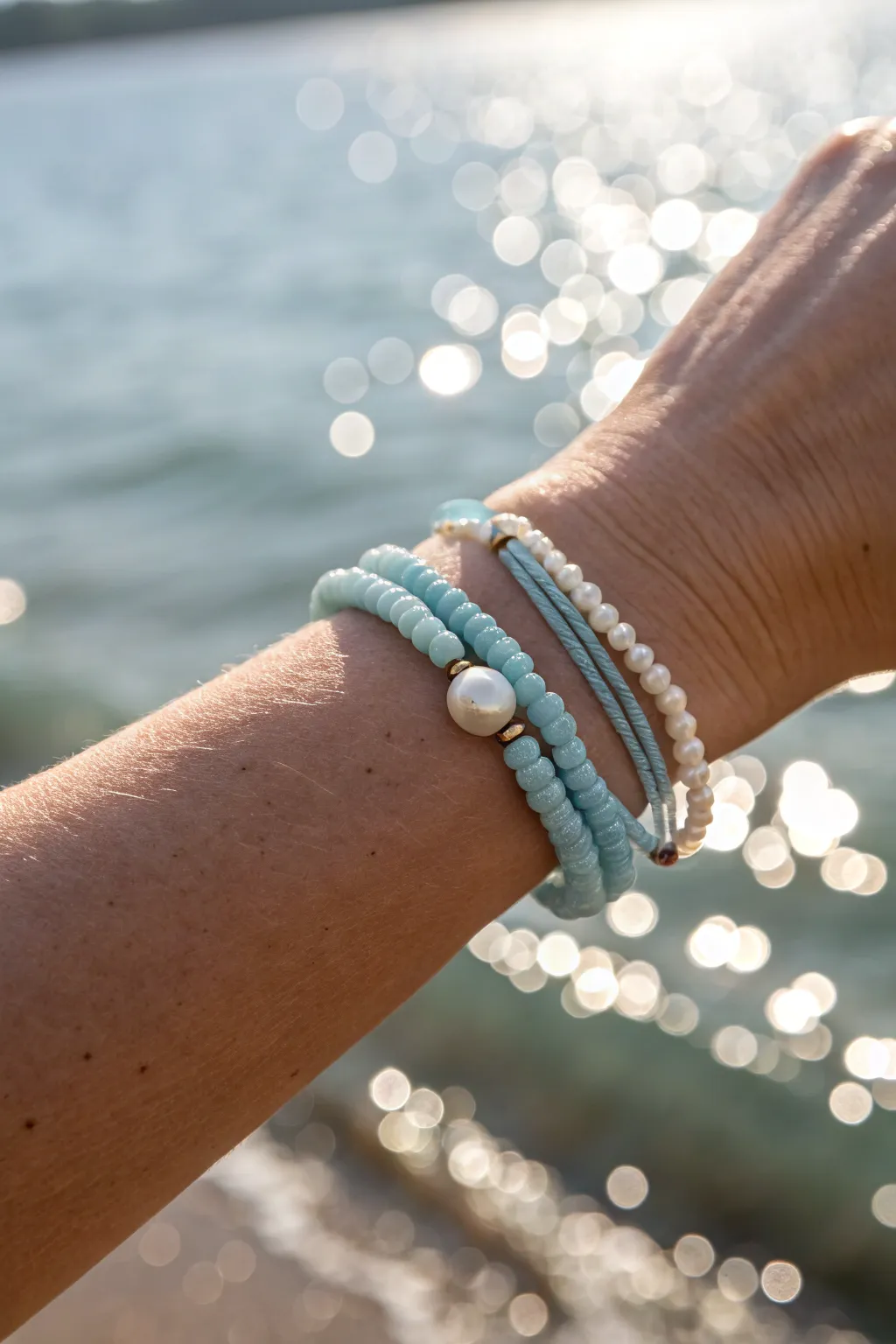
Capture the essence of a shimmering day at the beach with this sophisticated trio of bracelets. Mixing matte textures with glossy pearls and woven cord creates a layered look that feels organic yet polished.
Step-by-Step
Materials
- Light blue/seafoam round glass or gemstone beads (6mm)
- Large white freshwater pearl (approx. 10mm) with horizontal drill hole
- Small gold spacer beads (3mm)
- Small white seed pearls or fresh water pearls (3-4mm)
- Light blue waxed polyester jewelry cord (approx 1mm thick)
- Elastic beading cord (0.8mm)
- Gold seed beads (size 11/0 or 8/0)
- Jewelry glue or clear nail polish
- Scissors
Step 1: The Pearl Centerpiece Bracelet
-
Measure and cut elastic:
Cut a piece of elastic cord about 10 inches long to give yourself plenty of room for tying knots later. -
Start beading:
Begin threading your 6mm light blue beads onto the elastic. You’ll want to string enough to cover about half of your wrist’s circumference. -
Add the focal point:
Slide on a small gold spacer bead, followed by the large freshwater pearl, and then a second gold spacer bead to frame the centerpiece. -
Finish the strand:
Continue adding the blue beads until the bracelet reaches your desired length slightly snugger than usual since the beads are larger. -
Secure the knot:
Tie a surgeon’s knot (looping the elastic twice before pulling tight). Add a tiny dot of jewelry glue to the knot before trimming the excess cord.
Pearl Hole Too Small?
If your elastic won’t fit through the pearls, use a bead reamer to gently widen the hole, or switch to a thinner gauge wire and attach a clasp instead.
Step 2: The Delicate Pearl Strand
-
Prepare the cord:
Cut another 10-inch length of elastic cord. Pre-stretching the elastic slightly helps prevent it from sagging later. -
String the pearls:
Thread your small white seed pearls onto the cord. Since the holes in pearls can be tiny, you might need a thin beading needle here. -
Add accent details:
Periodically intersperse a gold seed bead or two among the pearls if you want extra sparkle, though a solid pearl strand looks classic. -
Check sizing:
Wrap the strand around your wrist to check the fit against the first blue bracelet. They should sit comfortably together without pinching. -
Finalize:
Tie off this bracelet securely with a knot and glue, tucking the knot inside the hole of a pearl if possible.
Step 3: The Woven Cord Bracelet
-
Cut the cord:
Cut two strands of the light blue waxed cord, roughly 12 inches each. -
Create the base:
Hold the two strands together. Tie a simple overhand knot about 3 inches from one end to create a starting point. -
Twist or braid:
You can do a simple two-strand twist here or a very tight 3-strand braid if you have a third cord. The goal is a textured, rope-like appearance. -
Incorporate accents:
If desired, slide a tiny gold bead onto both cords periodically as you twist to unify the stack’s design. -
Form the closure:
Once the twisted section covers your wrist, tie an ending overhand knot. This bracelet is often best finished with a sliding macramé square knot closure using a separate 4-inch piece of cord. -
Alternative closure:
If you prefer simplicity, you can just tie the two ends together securely and trim, making it a permanent bangle style.
Knot Security
Hide your elastic knots! Pull the knot firmly inside the nearest large bead hole after gluing. This protects it from wear and looks cleaner.
Wear your new stack together for a breezy summer look or separate them for subtle daily style
Sand and Surf Neutral Palette Bracelet
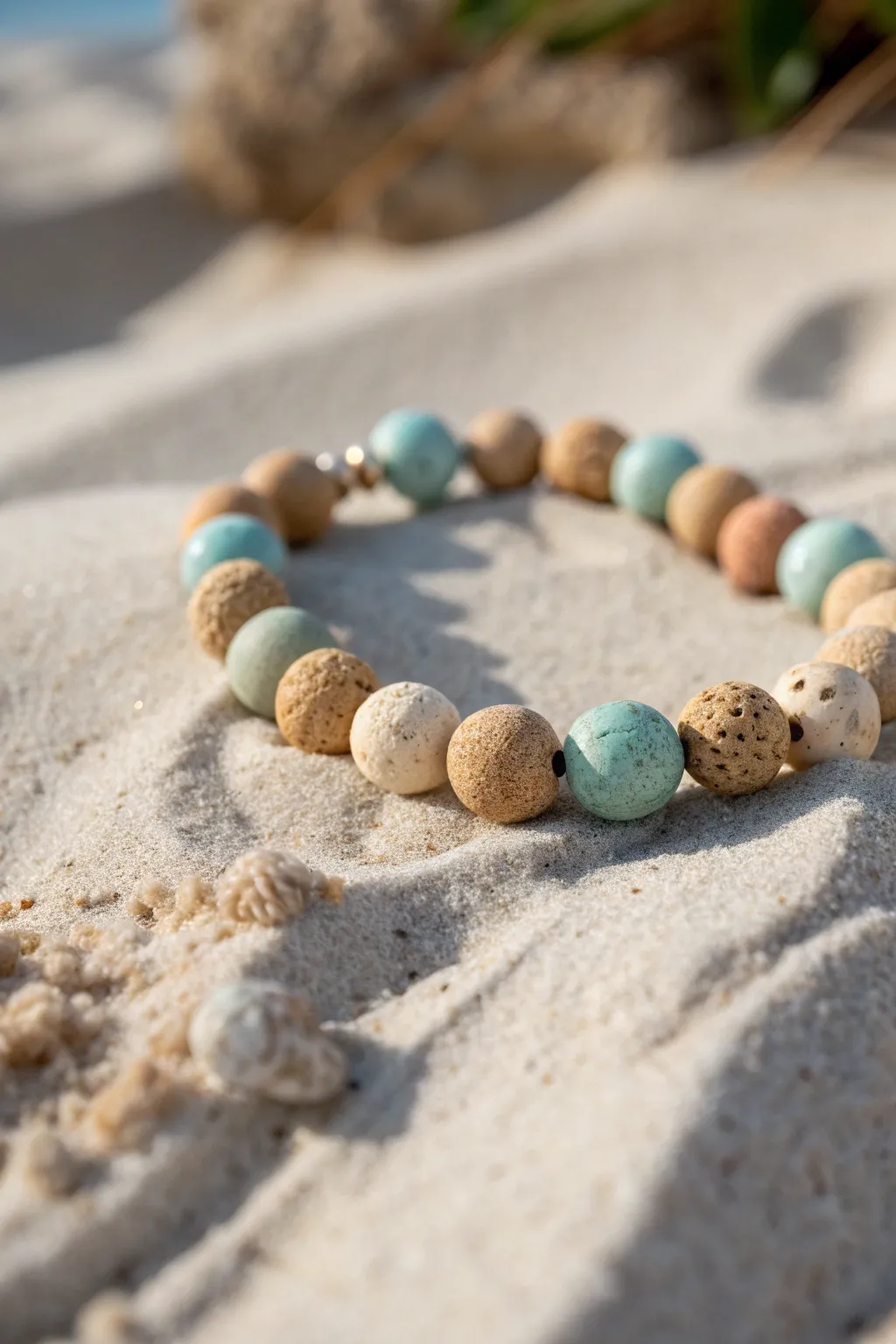
Capture the serene essence of a quiet beach day with this textured bracelet that blends sandy neutrals and soft sea-glass blues. By combining porous diffuser beads with smooth clay or stone accents, you’ll create a wearable piece of the coastline that looks perfectly at home resting on the dunes.
Step-by-Step Guide
Materials
- Stretch cord (0.8mm or 1mm clear elastic)
- Beige lava rock beads (8mm or 10mm)
- White or cream lava rock beads (8mm or 10mm)
- Matte Amazonite or turquoise clay beads (10mm)
- Sandalwood or unfinished wood beads (optional for texture variety)
- Small gold spacer bead (optional)
- Super glue or G-S Hypo Cement
- Scissors
- Bead stopper or tape
- Ruler or measuring tape
Step 1: Planning the Palette
-
Measure your wrist:
Start by wrapping the measuring tape around your wrist to find your comfortable size. Add about 0.5 to 1 inch to this measurement depending on how loose you like your bracelets to fit. -
Cut the cord:
Cut a piece of stretch cord about 3-4 inches longer than your final bracelet size. This extra length is crucial for tying the knot securely later without struggle. -
Secure the end:
Place a bead stopper or simply a piece of masking tape on one end of the cord to prevent your beads from sliding off while you design your pattern. -
Lay out the design:
Before stringing, lay your beads out on a flat surface or a bead board. The beauty of this design lies in its random, organic feel, so avoid a strict repeating pattern.
Aromatic Addition
Add 1-2 drops of essential oil (like sandalwood or sea salt scent) to the porous lava beads. They act as natural diffusers, carrying the scent for days.
Step 2: Stringing the Coastal Elements
-
Start with texture:
Begin stringing by alternating the textures. I like to start with a porous beige lava bead followed by a smoother stone or wood bead to establish the tactile contrast immediately. -
Incorporate the ‘sea’:
Thread on a matte Amazonite or turquoise clay bead. These blue-green pops represent the ocean water against the sandy neutral beads. -
Mix the neutrals:
Continue adding beads, mixing the beige lava, white lava, and any wood beads randomly. Try grouping two similar neutral tones together before breaking them up with another blue bead. -
Check the spacing:
Aim to place the blue accents roughly at the ‘clock’ positions—3, 6, 9, and 12—if you were looking at the bracelet as a circle, though perfect symmetry isn’t necessary for this rustic look. -
Add the metallic accent:
If using the small gold spacer bead, thread it on now. It serves as a subtle ‘glint’ of sun and can also be a good marker to hide your knot next to later. -
Test the length:
Wrap the strung cord around your wrist to check the fit. There should be no gaps, but it shouldn’t squeeze your skin. Add or remove neutral filler beads as needed.
Beachcomber Style
Drill a small hole in a tiny seashell found on your travels and attach it using a jump ring next to the gold spacer for an authentic seaside charm.
Step 3: Finishing Touches
-
Pre-stretch the cord:
Hold both ends of the cord and give the bracelet a gentle tug. This pre-stretching prevents the elastic from sagging immediately after you finish the project. -
Tie the surgeon’s knot:
Remove the tape or stopper. Cross the left end over the right, then loop it through twice (instead of once like a regular shoelace knot). Pull tight. -
Secure the knot:
Repeat the process, crossing right over left this time, looping twice, and pulling firmly. This creates a secure surgeon’s knot. -
Apply adhesive:
Dab a tiny drop of super glue or jewelry cement directly onto the knot. Be careful not to get glue on the beads themselves, as it can discolor porous stones. -
Hide the mechanics:
While the glue is still tacky, slide the nearest large-hole bead (like a lava bead) over the knot to conceal it inside. -
Trim the excess:
Once the glue is completely dry, trim the excess cord ends close to the bead hole using sharp scissors.
Slip on your creation and enjoy the calming, nature-inspired textures against your skin all day long
Coral Reef Pops With Aqua Base
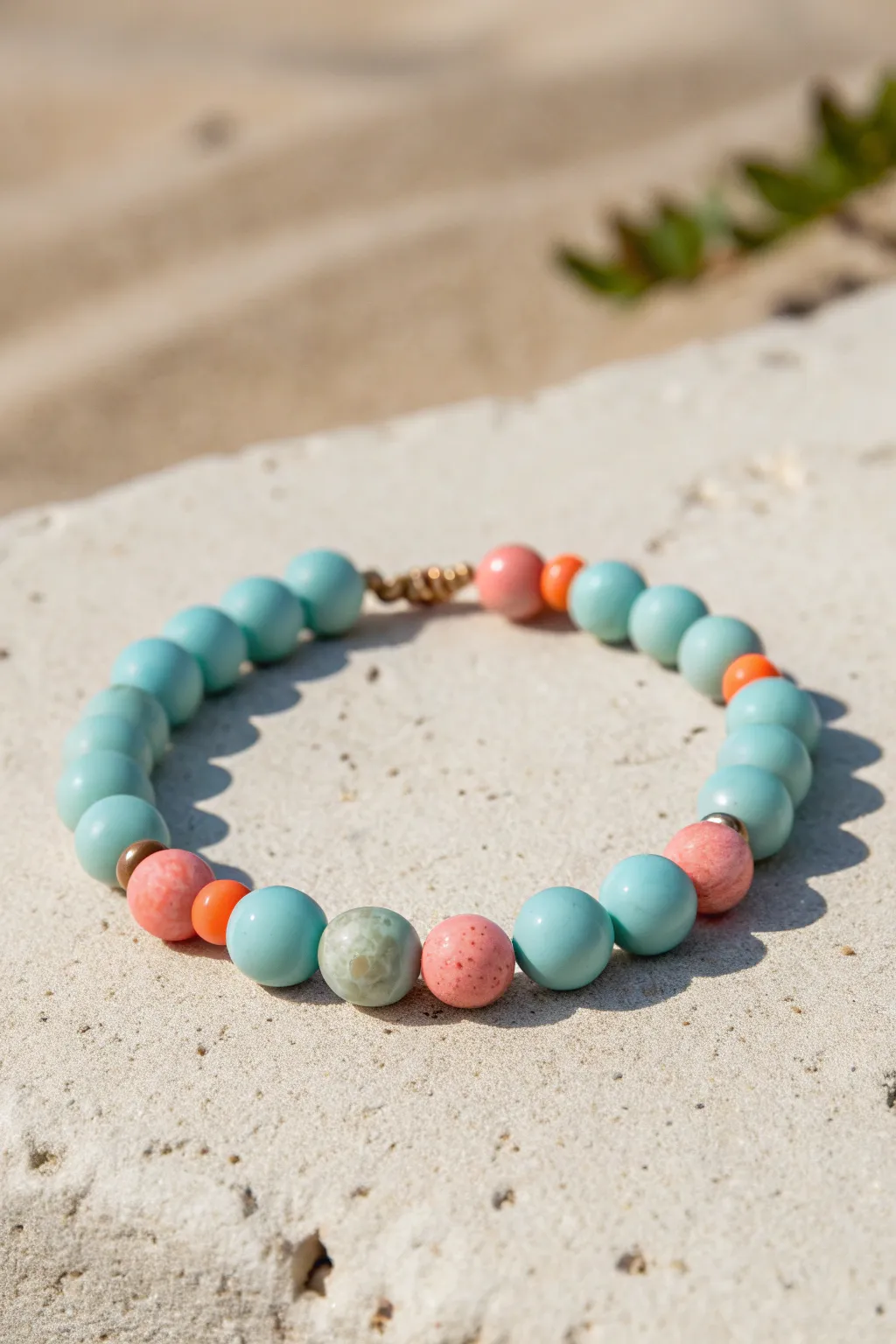
This refreshing bracelet evokes sun-drenched tide pools by pairing smooth aqua beads with pops of coral pink and bright orange. The asymmetrical design features varied bead sizes and textures, creating an organic, sea-tumbled look perfect for beachside accessorizing.
Step-by-Step
Materials
- 10mm round aqua blue ceramic or gemstone beads (approx. 14)
- 10mm textured coral pink round beads (3)
- 10mm mottled green-grey accent bead (1)
- 6mm smooth bright orange round beads (3)
- Small gold spacer beads or crimps
- Gold tone clasp (lobster claw or toggle)
- Beading wire (flexible, 49-strand recommended)
- 2 gold crimp tubes
- Crimping pliers
- Wire cutters
- Bead design board or soft cloth
Step 1: Design & Preparation
-
Measure your wrist:
Wrap a flexible measuring tape around your wrist. Add about 0.5 to 0.75 inches to this measurement to ensure the chunky beads sit comfortably without pinching. -
Cut the wire:
Cut a length of beading wire about 4 inches longer than your final bracelet size. Extra length makes finishing the clasp much easier. -
Lay out the pattern:
Before stringing, arrange your beads on a design board or cloth. Start with the main focal section: place a large aqua bead, a mottled green-grey bead, and a textured pink bead together. -
Establish the asymmetry:
To the left of your focal group, add a small orange bead followed by a textured pink bead. Note how the image places these sporadically to break up the blue. -
Fill the length:
Fill in the rest of the strand primarily with the smooth aqua beads. Intersperse the remaining small orange beads and textured pink beads randomly on the opposite side to balance the weight.
Step 2: Stringing
-
Secure the first end:
Thread one crimp tube and one half of your clasp onto the wire. Loop the wire back through the crimp tube. -
Crimp the loop:
Use your crimping pliers to flatten the tube securely, locking the wire in place. I always give a gentle tug here to make sure it holds firm. -
Begin stringing:
Thread your beads onto the wire, following the pattern you laid out. Adjust the sequence if needed as you go to ensure the colors are distributed nicely. -
Add accent spacers:
If desired, slip a tiny gold spacer bead next to the textured pink beads to highlight their unique color, similar to the metallic hint seen near the clasp. -
Check the length:
Periodically wrap the strand around your wrist. The large 10mm beads take up inner circumference space, so ensure it feels loose enough before finishing.
Loose Beads?
If the bracelet feels too stiff, you pulled too tight. Leave a tiny gap (1mm) of wire before the final crimp to allow beads to roll and sit comfortably.
Step 3: Finishing Touches
-
Prepare the final crimp:
Once all beads are strung, feed a crimp tube onto the open tail end of the wire. -
Attach the clasp:
Add the second half of your clasp (or a jump ring), then thread the wire back down through the crimp tube and into the first one or two beads. -
Tighten the strand:
Pull the wire tail to tighten the loop, removing slack from the beads. Be careful not to make it rigid; the bracelet needs flexibility to drape around your wrist. -
Final crimp:
Use the crimping pliers to secure this final tube. -
Trim excess wire:
Using flush cutters, trim the remaining wire tail as close to the bead hole as possible so no sharp ends poke out. -
Hide the crimp (optional):
If you have gold crimp covers, gently close one over each crimp tube to make them look like smooth gold beads for a polished finish.
Level Up: Charms
Attach a small gold seashell or starfish charm near the clasp using a jump ring to emphasize the ocean theme.
Enjoy the cool, coastal vibes of your new handmade accessory
Faux Sea Glass Chunky Clay Beads
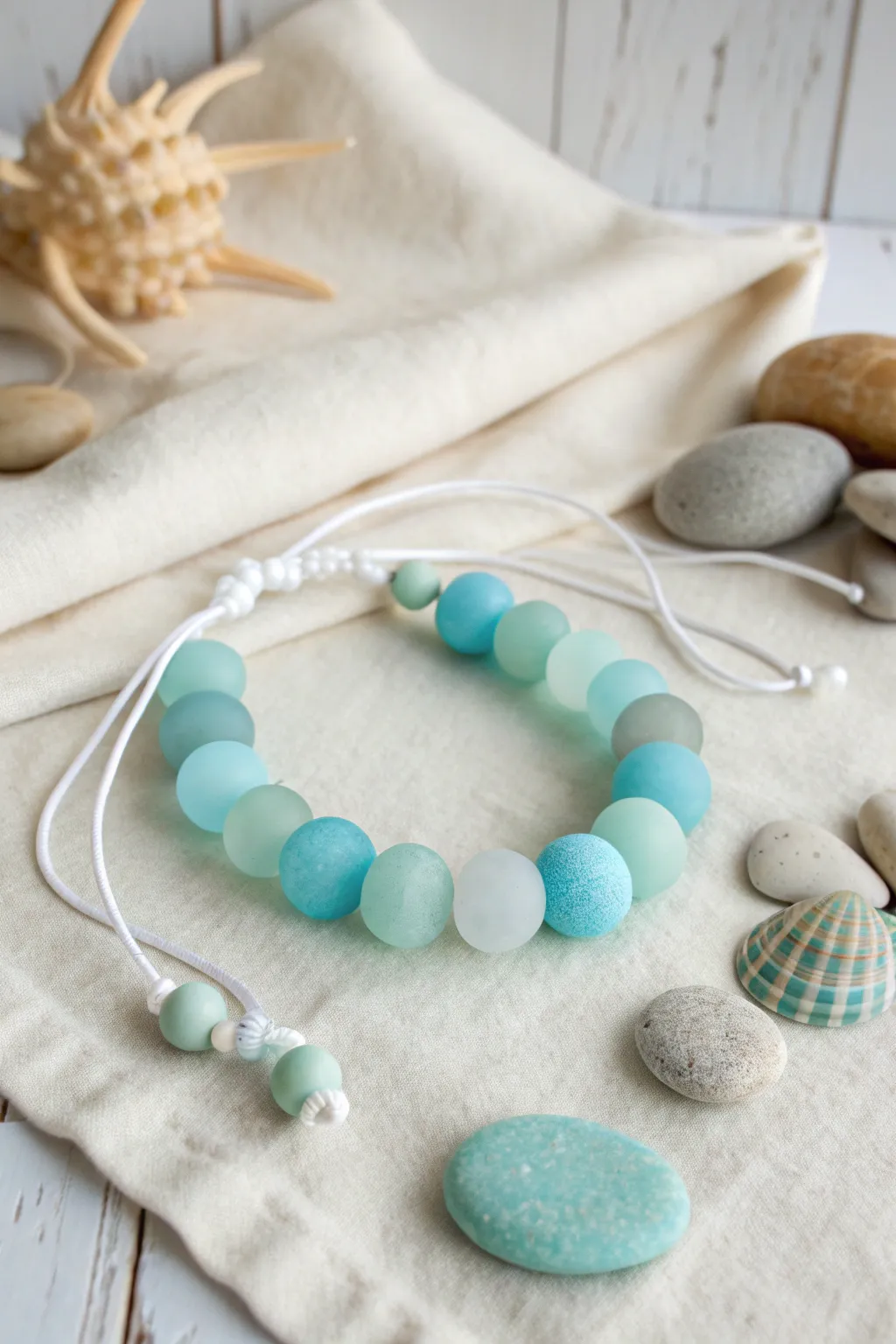
Capture the serene beauty of the ocean with this chunky bracelet featuring polymer clay beads that mimic the look of tumbled sea glass. The frosted finish and soft aqua tones make this accessory perfect for beach lovers and summer days.
Detailed Instructions
Materials
- Translucent polymer clay (white or colorless)
- Alcohol inks (blue, teal, green)
- Small round cutter or measuring spoons
- Medium-grit sandpaper (around 400-600 grit)
- Coarse sea salt or sugar (for texturing)
- Toothpicks or a bead piercing tool
- White nylon cord or waxed cotton cord (1mm)
- Oven for baking clay
- Baking sheet and parchment paper
- Lighter (to seal cord ends)
Step 1: Creating the Faux Glass Clay
-
Condition the Clay:
Begin by thoroughly conditioning your translucent polymer clay until it is soft and pliable. Divide the clay into three or four equal portions to create your color palette. -
Tint the Clay:
Add a single drop of alcohol ink to each portion, aiming for a gradient: one light aqua, one deep teal, one pale blue, and leave one portion plain translucent white. Knead the ink in until the color is fully uniform. Wear gloves to keep your hands clean. -
Portion the Beads:
Roll each colored lump into a thick snake. Cut equal-sized segments from each snake to ensure your finished beads are relatively uniform in size, though slight variation adds to the organic look. -
Roll into Spheres:
Roll each segment between your palms to create smooth spheres. You will need about 15-18 beads for the main bracelet and 2 smaller beads for the cord ends.
Step 2: Adding Texture and Baking
-
Apply Salt Texture:
Pour coarse sea salt onto a flat surface. Gently roll each uncooked bead in the salt so the grains embed slightly into the surface. This creates the pitted texture characteristic of weathered sea glass. -
Pierce the Holes:
Using a toothpick or piercing tool, carefully poke a hole through the center of each bead. I like to rotate the bead as I pierce to prevent it from squishing out of shape. Make sure the hole is wide enough for your cord. -
Bake the Beads:
Arrange the beads on a parchment-lined baking sheet. Bake according to the manufacturer’s instructions for your specific brand of clay (usually 275°F/135°C for 15-30 minutes). -
Cool and Soak:
Once baked, let the beads cool completely. Transfer them to a bowl of warm water and let them soak for 10 minutes to dissolve the salt crystals. -
Scrub and Sand:
Use a stiff brush to scrub away any remaining salt. Then, gently sand the dry beads with medium-grit sandpaper to enhance the matte, frosted finish that mimics real sea glass.
Stubborn Salt?
If salt crystals are stuck deep inside the clay after baking, try soaking the beads in warm water with a splash of vinegar for 20 minutes to help dissolve them completely.
Step 3: Assembling the Bracelet
-
Prepare the Cord:
Cut a piece of white nylon cord approximately 24 inches long. Use a lighter to quickly melt the very tips of the cord so they don’t fray while stringing. -
String the Beads:
Thread your beads onto the cord in a random or ombre pattern, mixing the blues, teals, and translucent whites. Center the beads on the cord. -
Create the Closure:
Bring the two cord ends together to form a circle. Cut a separate 10-inch piece of cord to create a sliding square knot (macramé knot) over the two crossed main cords. -
Tie the Sliding Knot:
Tie 4-5 square knots with the short piece over the main cords. Trim the excess from the knotting cord and carefully melt the ends with a lighter to fuse them, ensuring you don’t burn the main sliding cords. -
Add End Beads:
Thread one of the smaller spare beads onto each dangling end of the main cord. Tie a simple overhand knot below each bead to secure it. -
Final Trim:
Trim any excess cord below the end knots and lightly singe the tips to seal them. Your sea glass bracelet is now ready to wear.
Ocean Sparkle
Before baking, mix a tiny pinch of white or iridescent glitter into the translucent clay. This mimics the sun catching minerals inside real sea glass.
Enjoy the soothing feel of these frosted beads on your wrist
Deep Sea Marble Swirl Discs
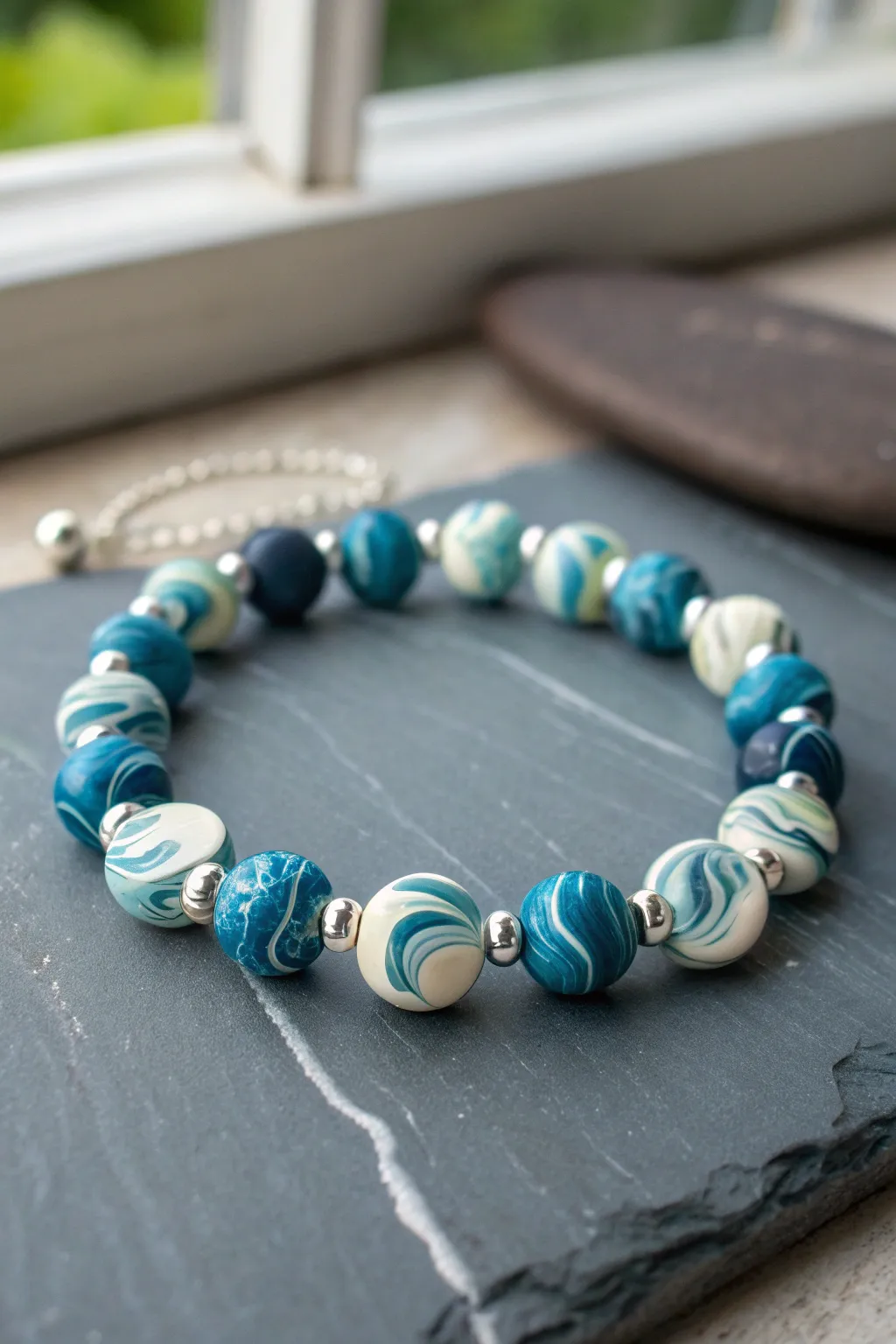
Capture the churning energy of ocean waves with this striking polymer clay bracelet. By combining deep teal, navy, and cream in a controlled marble, you’ll create beads that look like rolling tides frozen in time.
Step-by-Step Guide
Materials
- Polymer clay in teal, navy blue, white, and translucent
- Silver spacer beads (approx. 4mm)
- Strong elastic cord (0.8mm or 1mm)
- Bead piercing pins or toothpicks
- Ceramic tile or glass work surface
- Clay slicer blade
- Wet/dry sandpaper (400 to 1000 grit)
- Buffing cloth or denim scrap
- Oven for baking
Step 1: Creating the Marbled Clay
-
Condition the clay:
Start by thoroughly conditioning your teal, navy, white, and translucent clay separately until they are soft and pliable. Warm clay mixes better and cracks less. -
Form clay ropes:
Roll each color into a glowing snake or rope, keeping them roughly equal in thickness but varying in length based on your desired dominant color. I usually make the teal and white ropes longest for a brighter ocean look. -
Twist the colors:
Gather your ropes together into a bundle. Holding one end in each hand, twist them together tightly until you have a single, spiraled log that looks like a candy cane. -
Fold and roll:
Fold the twisted log in half and roll it smooth again on your work surface. Repeat this ‘fold, roll, and twist’ process two or three times. Be careful not to over-mix, or the colors will turn muddy instead of distinct swirls. -
Consolidate the log:
Roll the final marbled log until it is smooth and uniform in diameter, roughly the size you want your finished beads to be (about 1.5 cm thick).
Step 2: Shaping and Baking
-
Slice portions:
Use your slicing blade to cut equal segments from your log. Keeping the slices consistent ensures your beads will be the same size. -
Roll into spheres:
Take a slice and roll it between your palms using a cupped circular motion. Apply gentle pressure initially, then lighten your touch to smooth out any fingerprints. -
Inspect the swirl:
Check each bead. If you don’t like a particular swirl pattern, you can gently reshape it or give it a tiny extra twist before re-rolling. -
Pierce the holes:
Gently insert a bead pin through the center of each sphere. Use a twisting motion to avoid squashing the bead. I prefer to pierce halfway from one side, then flip and meet in the middle for a cleaner hole. -
Bake the beads:
Arrange your beads on the piercing pins or a bed of cornstarch on a baking tile. Bake according to your clay manufacturer’s instructions, usually around 275°F (135°C) for 30-45 minutes. -
Cool down:
Let the beads cool completely inside the oven with the door slightly ajar. This gradual cooling tempers the clay and makes it stronger.
Why is my clay cracking?
Cracking after baking usually means the clay wasn’t conditioned enough. Spend more time kneading and warming it in your hands before rolling.
Step 3: Finishing and Assembly
-
Sand for smoothness:
Once cool, wet-sand each bead under running water. Start with 400 grit to remove any bumps or fingerprints, then move to 800 and 1000 grit for a silky finish. -
Buff to shine:
Rub each bead vigorously with a piece of denim or a buffing cloth. The friction heat will bring out a natural, soft sheen in the clay without needing varnish. -
Prepare the elastic:
Cut a length of elastic cord about 10-12 inches long. Pre-stretch it by pulling firmly a few times; this prevents the bracelet from loosening later. -
String the pattern:
Thread your beads onto the elastic, alternating one clay bead with one silver spacer bead. This separation highlights the unique swirl of each clay sphere. -
Check the fit:
Wrap the strand around your wrist to verify sizing. Add or remove beads as necessary to ensure a comfortable fit. -
Tie the knot:
Tie off the elastic with a surgeon’s knot (looping the elastic through twice on the first pass). Pull it tight and secure with a tiny dab of super glue on the knot. -
Hide the knot:
Once dry, trim the excess cord ends and gently tug the knot inside the hole of one of the clay beads to conceal it.
Add a glassy finish
Instead of buffing, coat finished beads in UV resin or gloss glaze. This makes the translucent clay pop and mimic wet sea glass.
Now you have a stunning piece of wearable art that carries the soothing blues of the ocean wherever you go
Mermaid Scale Textured Heishi Bracelet
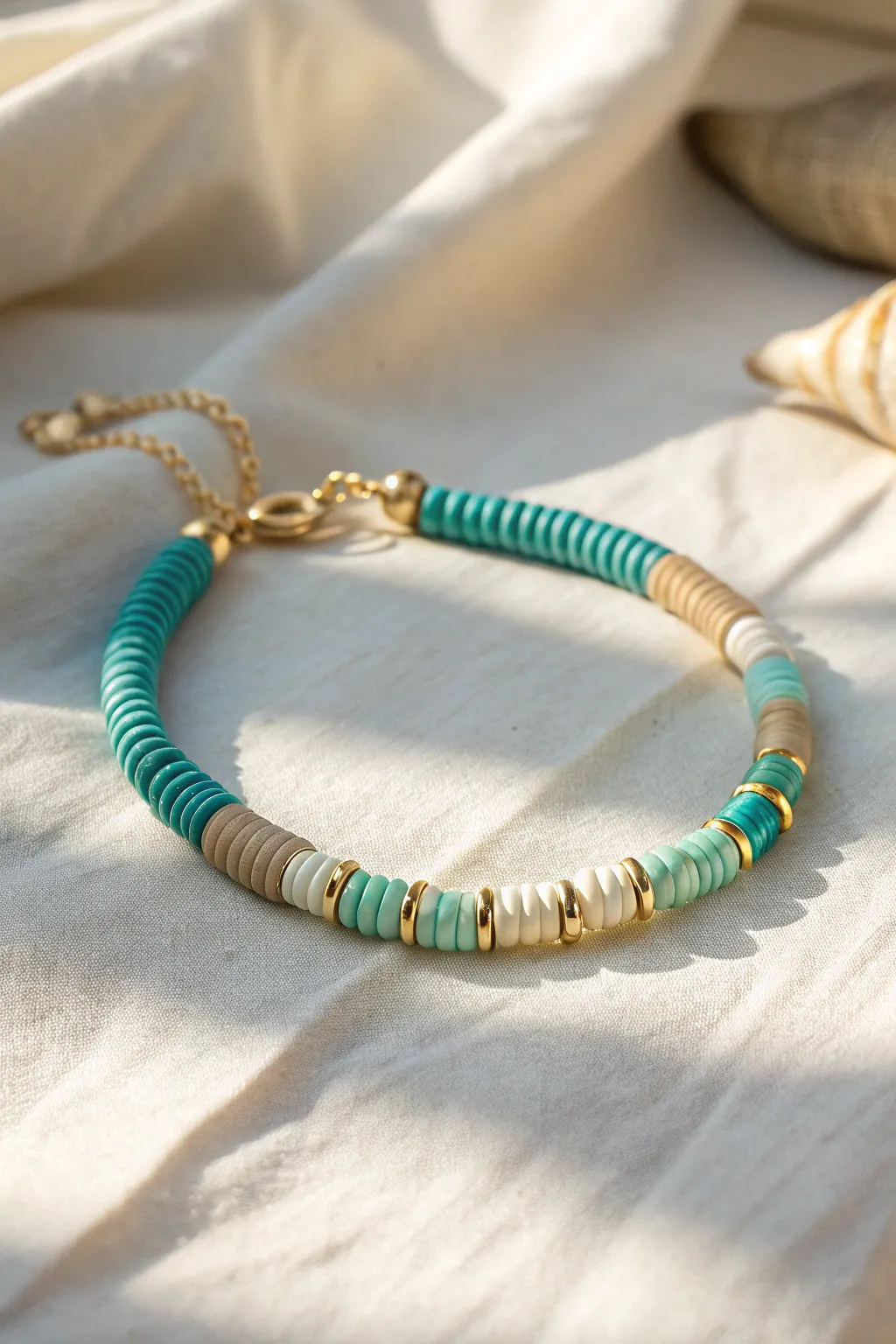
Capture the essence of a serene shoreline with this elegant heishi bead bracelet. Featuring a soothing palette of muted teal, sandy beige, and crisp white interspersed with polished gold accents, it strikes the perfect balance between casual beach vibes and refined jewelry.
Step-by-Step Tutorial
Materials
- Polymer clay heishi beads (flat disc beads): Muted Teal/Turquoise (6mm)
- Polymer clay heishi beads: Sandy Beige/Tan (6mm)
- Polymer clay heishi beads: White/Cream (6mm)
- Gold tone spacer beads (flat disc or slightly rounded edges, 3-4mm)
- Small gold round beads (3mm) for crimp finishing
- Beading wire (gold color or clear, 0.38mm or 0.45mm)
- 2 Crimp beads (gold filled or plated)
- 2 Crimp covers (gold filled or plated, 3mm)
- 2 Wire guards (gold tone)
- Extension chain made of simple gold links
- Lobster clasp (gold tone)
- 2 jump rings (4-5mm open)
- Flat nose pliers
- Crimping pliers
- Wire cutters
- Bead design board or masking tape
Step 1: Planning the Pattern
-
Analyze the color blocks:
Observe the bracelet’s design: it isn’t a simple repeating pattern. It features large solid blocks of teal on the sides, transitioning into a mixed center section. -
Lay out the base:
Using a bead board, measure out about 7 inches for a standard wrist. Start by laying down a long segment of just teal beads for one side, approximately 1.5 to 2 inches long. -
Design the first transition:
After the large teal block, place about 10-12 beige beads to create the first sandy section. -
Create the mixed focal point:
The center is the most detailed part. Arrange a sequence like this: 2 white, 1 gold spacer, 3 teal, 1 gold spacer, 3 teal, 1 gold spacer, 3 white, 1 gold spacer. -
Continue the center pattern:
Follow that immediately with: 3 white, 1 gold spacer, 3 teal, 1 gold spacer, 3 teal, 1 gold spacer, 2 white. -
Mirror the transition:
Add another block of 10-12 beige beads to mirror the side you already created. -
Finish the layout:
Complete the strand with another long 1.5 to 2-inch block of teal beads. Adjust the length of these end teal sections to fit your wrist size perfectly.
Uneven Spacing?
If gaps appear near the clasp after crimping, hide the exposed wire by covering it with a slightly larger gold crimp cover bead.
Step 2: Stringing the Beads
-
Prepare the wire:
Cut a piece of beading wire about 10-12 inches long. This gives you plenty of extra room to manipulate the ends without frustration. -
Secure the start:
Place a piece of masking tape on one end of the wire so beads don’t slide off while you work. -
String the first teal section:
Thread on your first large block of teal beads needed for one side of the bracelet. -
Add spacing elements:
I find it helpful to double-check the gold spacers as I thread them to ensure they aren’t stuck together, which is common with metal plating. -
Complete the threading:
Continue stringing the beige section, the complex mixed center with gold spacers, the second beige section, and the final teal block.
Step 3: Adding the Clasp & Finishing
-
Prepare the first crimp:
Remove the tape. Slide on a crimp bead, followed by a wire guard. Thread the wire up through one side of the guard and down the other. -
Attach the clasp:
Before closing the loop, slide your lobster clasp onto the wire guard loop (or attach it later with a jump ring). -
Secure the crimp:
Pass the wire tail back through the crimp bead and pull tight, leaving just a tiny bit of slack so the connection isn’t stiff. Use crimping pliers to flatten or fold the crimp bead securely. -
Cover the hardware:
Place a crimp cover over the smashed crimp bead. Using flat nose pliers, gently close the cover until it looks like a round gold bead. -
Add a gold bead cap (optional):
Slide a small 3mm gold round bead over the tail and main wire to sit flush against the crimp cover for a professional finish, then feed the tail into the first few teal beads. -
Repeat on the other side:
Repeat the crimping process on the other end: Crimp bead, wire guard, looping back through. Ensure the beads are snug but the bracelet is still flexible before crimping. -
Attach the extension chain:
Open a gold jump ring using two pliers (twist, don’t pull). Hook it through the wire guard on the non-clasp side and attach your extension chain. -
Final trim:
Using your flush cutters, trim any excess wire tails as clase as possible to the beads so they don’t scratch your skin.
Ocean Texture
Mix in a few slightly darker turquoise beads randomly within the teal sections to mimic the natural color variation of ocean water.
Enjoy wearing your coastal creation that brings a touch of summer to any outfit
Tidal Pool Speckle Pattern Bracelet
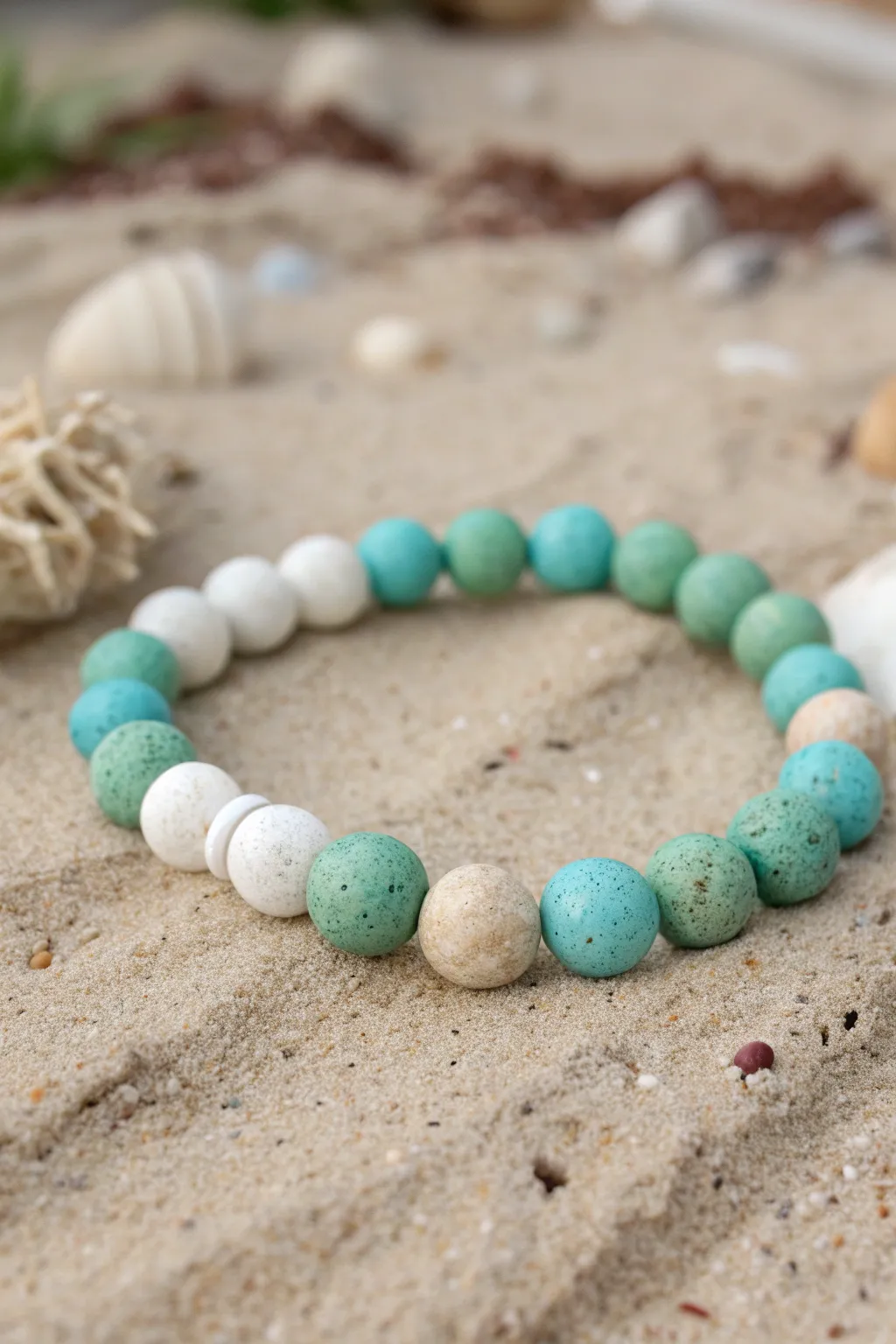
Capture the essence of a serene beach day with this beautiful polymer clay bracelet. The sand-colored and sea-glass hues are enhanced with a unique speckled technique that mimics the texture of natural stones found in tidal pools.
How-To Guide
Materials
- Polymer clay (white, beige/sand, turquoise, teal, mint green)
- Black acrylic paint or black pepper (for speckling)
- Old toothbrush (if using paint)
- Bead rolling tool or clear acrylic block
- Toothpicks or bead piercing pins
- Baking sheet and parchment paper
- Medium-grit sandpaper (optional)
- Elastic clear beading cord (0.7mm or 0.8mm)
- Super glue or jewelry cement
Step 1: Preparing the Clay Colors
-
Condition the base clay:
Start by thoroughly conditioning your white polymer clay until it is soft and pliable. Divide this white clay into four equal portions to serve as the base for your different color mixes. -
Mix the sandy beige:
Take one portion of white and mix in a very small amount of beige or light brown clay. Knead until the color is uniform. Aim for a very pale, sandy tone rather than a dark brown. -
Create the sea tones:
For the remaining portions, mix one with a dab of turquoise, one with teal, and one with mint green. Add the color gradually; you want soft, pastel-leaning sea glass shades rather than neon brights. -
Add the speckled texture:
Here I prefer to use ground black pepper for a natural look. Flatten each colored ball of clay and sprinkle a generous pinch of coarse black pepper or dried coffee grounds onto it. Fold the clay over and knead it repeatedly until the specks are distributed evenly throughout the clay.
Natural Texture Hack
Instead of pepper, mix in fine crafting sand or embossing powder to give the beads a gritty, realistic stone feel.
Step 2: Forming the Beads
-
Portion the clay:
Roll each color of clay into a consistent log or snake shape. Cut the logs into equal-sized segments to ensure your finished beads are uniform in size. -
Roll the spheres:
Take each segment and roll it between your palms to form a rough ball. For a perfectly round shape, place the ball on your work surface and use a flat acrylic block or bead roller to rotate it in circular motions. -
Pierce the holes:
While the bead is still soft, gently insert a toothpick or bead pin through the center. Rotate the pin as you push to avoid squashing the bead’s round shape. Poke through one side, then stop and come in from the other side to meet in the middle for a clean hole. -
Refine the surface:
Once pierced, lightly roll the bead between your fingers again to smooth out any fingerprints or distortion caused by the piercing tool.
Hole Distortion?
If your beads squash while piercing, try refrigerating the clay balls for 10 minutes to firm them up before making the holes.
Step 3: Baking and Finishing
-
Arrange for baking:
Place your pierced beads on a baking sheet lined with parchment paper. If you want to prevent flat spots, you can bake them directly on the piercing pins suspended over a foil tray. -
Bake the beads:
Bake according to your polymer clay package instructions—typically around 275°F (135°C) for 15–30 minutes depending on size. Let them cool completely before handling. -
Optional paint splatter:
If your pepper speckles aren’t visible enough, you can add external texture now. Dip an old toothbrush in watered-down black acrylic paint and flick the bristles to spray fine droplets over the cooled beads. Let dry. -
Matte finish:
These beads look best with a natural, matte stone finish. If the clay is too shiny after baking, lightly buff the surface with medium-grit sandpaper or a denim cloth to dull the sheen.
Step 4: Assembly
-
Plan the pattern:
Lay out your finished beads on a bead board or towel. Arrange them in a color block pattern: group 3-4 whites together, followed by the teals, mints, and sandy beige beads to mimic the gradient of the ocean meeting the shore. -
String the beads:
Cut a piece of elastic cord about 10 inches long. Pre-stretch the cord by pulling it gently a few times. String your beads onto the cord following your planned pattern. -
Check the fit:
Wrap the strung beads around your wrist to check the size. Add or remove beads as necessary for a comfortable fit. -
Tie the knot:
Tie a surgeon’s knot (right over left, left over right, looping the second tie through twice). Pull the elastic tight to secure the knot close to the beads. -
Secure and hide:
Add a tiny drop of super glue or jewelry cement to the knot. Let it dry for a moment, then trim the excess cord and gently tug the knot inside the hole of a neighboring bead to hide it.
Now you have a stunning, beach-inspired accessory that carries the calming vibes of the ocean wherever you go
Seashell Mini Beads as Spacers
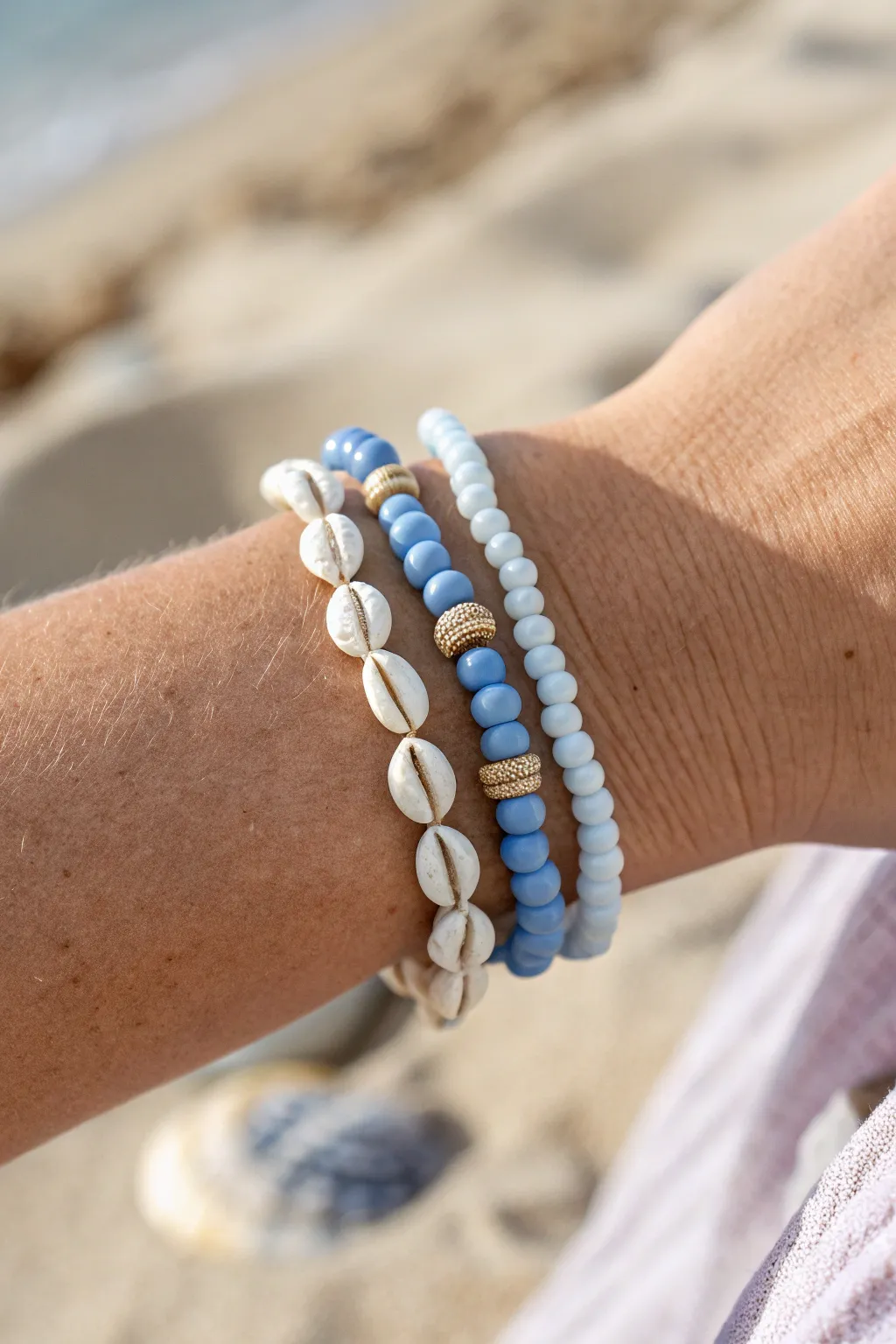
Capture the essence of a beach day with this coordinated stack of three bracelets, mixing natural puka shells with varying shades of ocean-blue beads. This set combines texture and color gradients to create a breezy, effortless coastal look perfect for summer wear.
Step-by-Step
Materials
- White puka (cowrie) shells with holes drilled through the back
- Medium blue ceramic or glass pony beads (approx. 6mm)
- Pale icy blue or white milky glass beads (approx. 4mm)
- Gold tone textured spacer beads or disc beads (approx. 5-6mm)
- Elastic cord (0.8mm or 1.0mm depending on bead hole size)
- Jewelry glue or clear nail polish
- Scissors
Step 1: Bracelet 1: The Classic Puka Shell
-
Measure and cut:
Cut a piece of elastic cord about 10-12 inches long. This generous length gives you plenty of room to tie knots without struggling. -
Pre-stretch the cord:
Hold both ends of the elastic and give it a few firm tugs. This pre-stretching prevents the bracelet from sagging or loosening after you wear it a few times. -
Inspect the shells:
Sort through your puka shells. Look for shells that are similar in size and shape for a uniform look, or vary them intentionally for a wilder, natural vibe. Ensure the holes are clear of debris. -
String the shells:
Thread the elastic through the backs of the cowrie shells. If the shells have a natural curve, string them all facing the same direction so they nestle against each other smoothly. -
Check the fit:
Wrap the strand around your wrist to check the length. Add or remove shells until it fits comfortably—remember that shells are bulky, so you might need a slightly longer length than a standard bead bracelet. -
Tie it off:
Tie a surgeon’s knot (right over left, left over right, looping through twice). Pull tight, add a dab of glue to the knot, let it dry, and trim the excess cord.
Knot Slipping?
If your elastic knot feels insecure, try a ‘square knot’ followed by an extra overhand knot on top. Always pull all four strands (the two tails and the two loop sides) tight to lock it.
Step 2: Bracelet 2: The Blue & Gold Accent
-
Prep the cord:
Cut another length of elastic cord and pre-stretch it just as you did for the first bracelet. -
Establish the pattern:
For this bracelet, you will alternate sections of blue beads with gold spacers. String approximately 4 to 5 medium blue beads. -
Add structure:
Slide on one gold textured spacer bead. The gold adds a touch of warmth and separates the blue segments. -
Repeat the sequence:
Continue this pattern—4-5 blue beads, followed by one gold spacer—until you reach your desired wrist size. -
Close the loop:
Bring the ends together. Try to end the pattern so the knot can hide inside one of the larger-hole beads or adjacent to a spacer. Tie securely with a surgeon’s knot, glue, and trim.
Hiding the Knot
For the cleanest look, gently tug the finished knot inside the hole of the bead with the largest opening. A drop of glue inside that bead will hold the knot permanently in place.
Step 3: Bracelet 3: The Icy Minimalist
-
Select the smallest beads:
Prepare your final piece of elastic. This strand uses the smallest, palest blue or milky white beads for a delicate contrast. -
String simply:
Thread the beads continuously onto the cord. I prefer to check for any chipped beads before stringing them to ensure a smooth finish. -
Measure against the others:
hold this strand up against the first two finished bracelets. It should be roughly the same circumference, but since the beads are smaller, it will sit closer to the skin. -
Secure the final knot:
Tie your final surgeon’s knot. Because these beads are small, ensure the knot is tight and compact so it doesn’t create a large gap between beads. -
Finishing touches:
Apply a tiny drop of glue to the knot, allow it to dry completely, and trim the ends close.
Stack these three together for an instant beach-ready accessory that matches any summer outfit
Beach Pebble Bead Bracelet in Ocean Colors
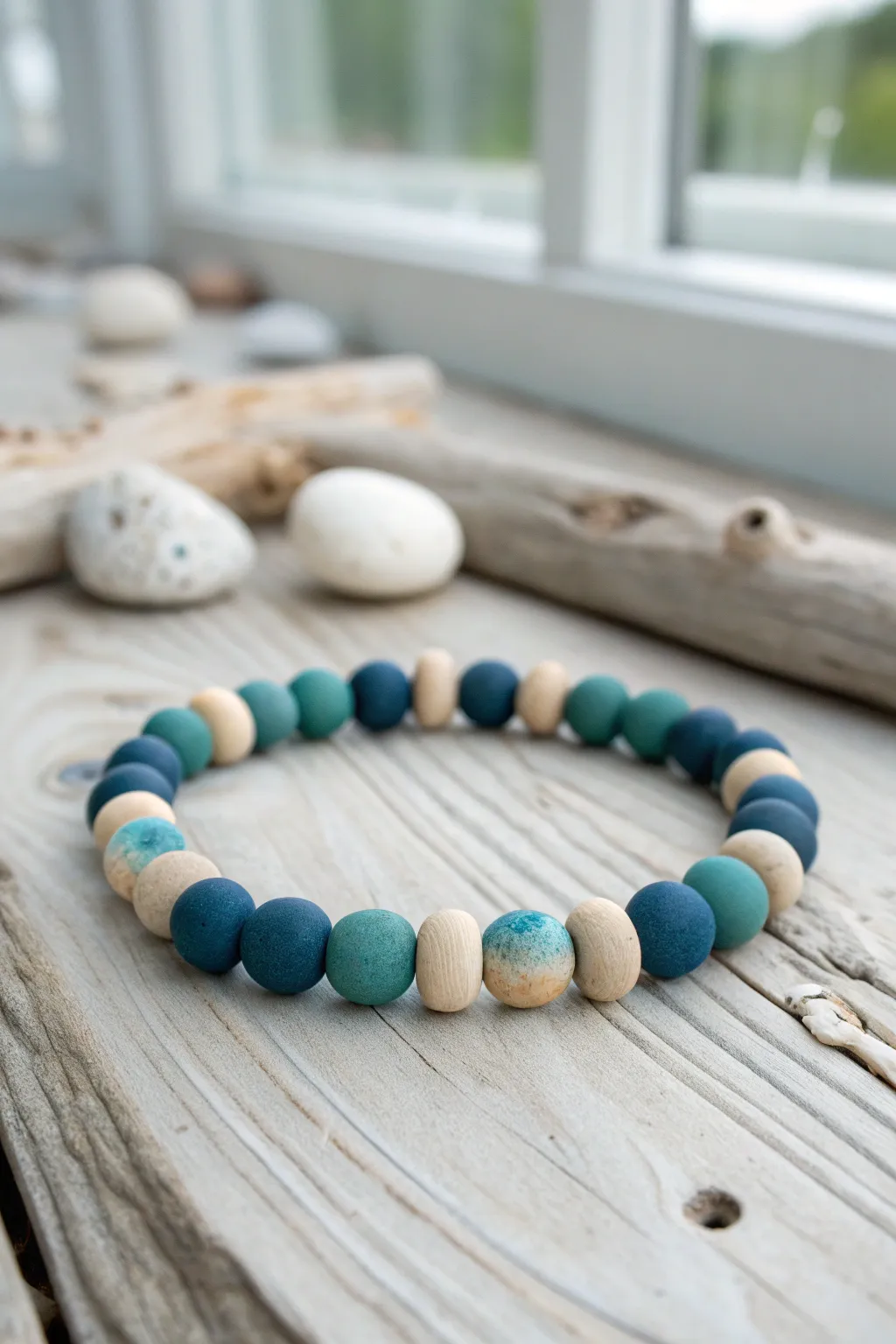
Capture the essence of a tranquil beach walk with this polymer clay bead bracelet, featuring matte textures and calming ocean hues. The finished piece mimics worn sea glass and beach pebbles, blending deep navies, soft teals, and sandy neutrals into a wearable keepsake.
Step-by-Step Guide
Materials
- Polymer clay in Navy Blue, Teal, Turquoise, White, and Beige (or Translucent)
- Acrylic roller or pasta machine
- Medium-grit sandpaper (for texture)
- Fine-grit sandpaper (for finishing)
- Coarse sea salt or sugar (optional for texture)
- Toothpicks or a bead piercing tool
- Baking sheet and parchment paper
- Elastic stretch cord (0.8mm or 1mm)
- Jewelry glue or clear nail polish
- Small stiff-bristled brush (optional)
- Oven
Step 1: Clay Mixing & Color Prep
-
Condition the base clays:
Start by warming up the navy, teal, and beige clays in your hands. Knead them until they are soft and pliable, which prevents cracking later. -
Create custom ocean shades:
Mix a small amount of navy into the teal to create a deep ocean green. Mix white into teal for a lighter sea-glass look. Keep the navy pure for contrast. -
Blend the sandy tones:
For the beige beads, I like to mix a tiny bit of white and translucent clay into the beige. This gives it a more natural, stone-like depth rather than a flat plastic look. -
Create the signature speckled beads:
To make the two-tone ‘tide pool’ beads shown in the photo, take a small ball of beige and a smaller pinch of teal. Gently press them together but don’t fully blend—you want distinct patches of color.
Step 2: Forming the Beads
-
Portion the clay:
Roll your clay colors into long logs of equal thickness. Slice them into equal segments to ensure your beads will be roughly the same size. -
Roll spheres:
Roll each segment between your palms to form smooth balls. Aim for a size of about 8-10mm. -
Add organic texture:
Gently roll the beads over a piece of medium-grit sandpaper or lightly press them with a stiff brush. This removes fingerprints and creates a matte, stone-like surface. -
Texture the speckled beads:
For the beige/teal mixed beads, roll them in a tiny bit of coarse salt or sugar before baking to create pitting, or simply rough them up more with the sandpaper for that eroded beach rock effect. -
Pierce the holes:
Using a toothpick or bead pin, carefully pierce a hole through the center of each bead. Rotate the bead as you push the tool through to avoid distorting the spherical shape. -
Double-check the holes:
Ensure the exit hole is clean and wide enough for your elastic cord. Wiggle the tool slightly to widen the channel.
Uneven Bead Shapes?
Don’t stress if your spheres aren’t perfect! Real beach pebbles are irregular. Embrace the slight wobbles; they make the bracelet look more authentic and organic.
Step 3: Baking & Finishing
-
Prepare for baking:
Arrange the beads on a parchment-lined baking sheet. For cleaner holes, you can bake them directly on the pins or toothpicks suspended over a foil tray. -
Bake the beads:
Bake according to your clay manufacturer’s instructions (usually around 275°F or 130°C) for 30–45 minutes. Longer baking makes the clay stronger. -
Cool down:
Allow the beads to cool completely. If you used salt or sugar for texture, rinse the beads now to dissolve the crystals. -
Define the matte finish:
Lightly sand any rough edges near the holes or shiny spots. Unlike many clay projects, we are skipping the varnish to maintain that dry, sea-worn stone appearance.
Level Up: Faux Stone
Mix black pepper or dried tea leaves into your beige clay before rolling. These tiny specks simulate the natural sediment found in real sandstone and granite.
Step 4: Assembly
-
Layout the design:
Arrange your beads on a table. Follow the pattern seen in the image: alternate solid blues and teals, interspersed with the beige and speckled beads for contrast. -
String the beads:
Cut a piece of elastic cord about 10-12 inches long. Carefully thread your beads onto the cord in your chosen order. -
Check the fit:
Wrap the strand around your wrist to check the size. Add or remove beads as necessary for a comfortable fit. -
Tie the knot:
Tie a strong surgeon’s knot (right over left, left over right). Pull the elastic tight to secure the knot. -
Secure and trim:
Apply a tiny drop of jewelry glue or clear nail polish to the knot. Let it dry, then trim the excess cord and tuck the knot inside a neighboring bead.
Wear your new bracelet and enjoy the calming coastal vibes it brings to your day
Bioluminescent Night-Ocean Accent Bracelet
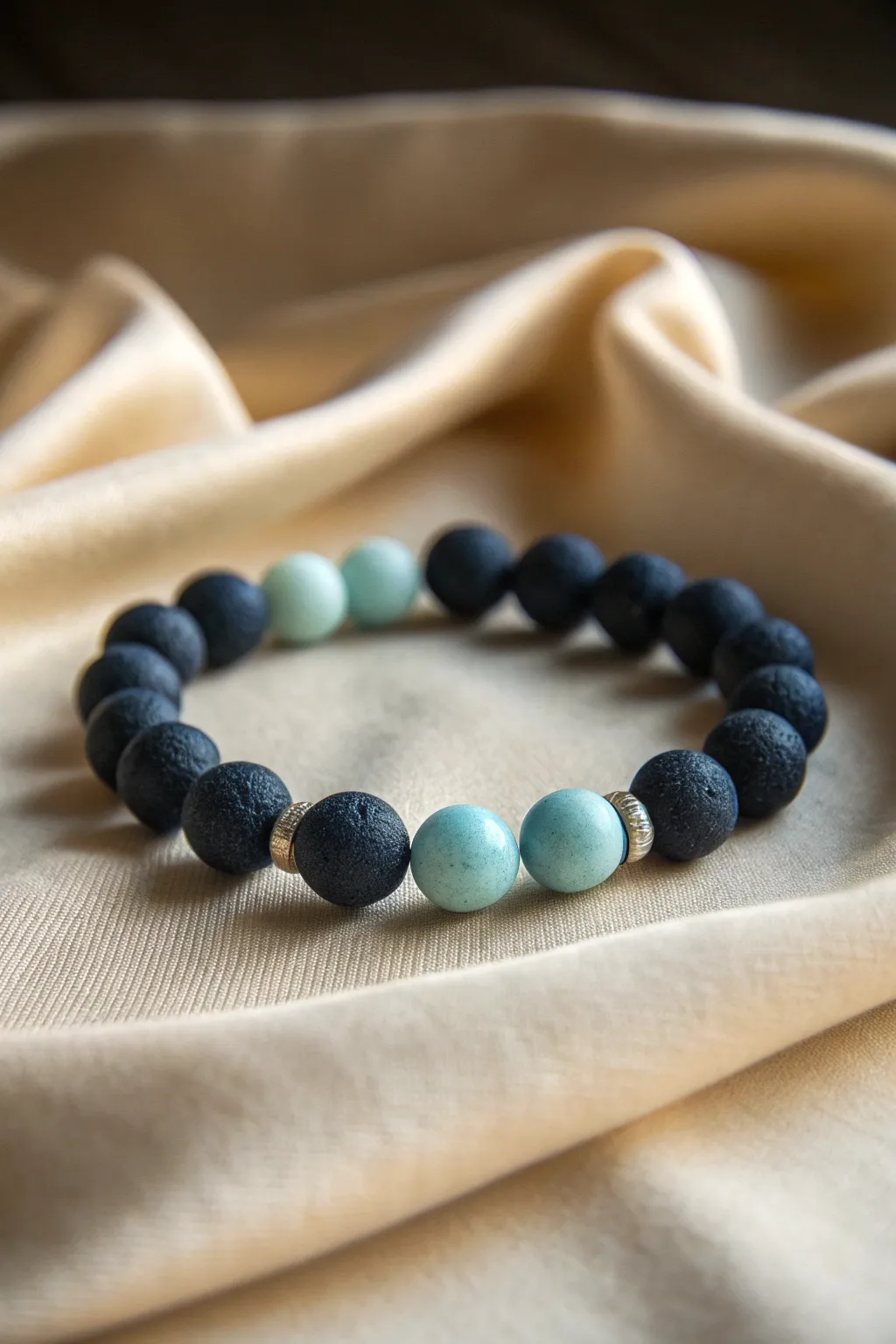
Capture the mysterious glow of deep-sea bioluminescence with this striking beaded bracelet. Contrasting matte black clay beads with smooth, luminous turquoise accents creates a design that feels both organic and modern.
How-To Guide
Materials
- Black polymer clay (fimo or sculpey)
- Turquoise or light blue polymer clay
- Glow-in-the-dark polymer clay (optional, for mixing)
- Metallic silver or gold spacer beads (small rings)
- Strong elastic cord (0.8mm or 1mm)
- Beading needle (optional)
- Sandpaper or a rough stone (for texturing)
- Needle tool or toothpick
- Oven for baking
- Super glue or jewelry cement
Step 1: Creating the Deep Sea Base
-
Condition the black clay:
Begin by thoroughly kneading your black polymer clay until it is soft and malleable. This prevents cracking later on. -
Roll the base beads:
Pinch off small, uniform chunks of clay, roughly the size of a large pea. Roll each piece between your palms to form perfect spheres. You will need about 16-18 black beads depending on your wrist size. -
Create the lava texture:
To mimic the organic, porous look of volcanic rock seen in the image, roll each black bead gently over a piece of coarse sandpaper or press a rough stone against the surface. Rotate the bead to ensure the texture is even but natural. -
Pierce the holes:
Using your needle tool or a toothpick, carefully pierce a hole through the center of each textured bead. I like to twist the tool as I push through to prevent squashing the bead’s shape.
Hole Distortion?
If piercing the bead squashes it into an oval, let the clay rest for 15 minutes to firm up, or gently re-roll the bead while the pin is still inside to reshape it.
Step 2: Forming the Luminous Accents
-
Mix the ocean color:
Take your turquoise clay. If you want a softer, sea-glass look, mix in a tiny amount of translucent or white clay. For a true bioluminescent effect, blend in some glow-in-the-dark clay. -
Shape the focal beads:
Roll two spheres of this blue mix. These should act as your front focal points. -
Create secondary accents:
Roll two more blue beads, perhaps slightly lighter in shade (add more white) for the back section of the bracelet. -
Smooth the surface:
Unlike the black beads, keep these blue accents perfectly smooth. Roll them gently in your palm to remove fingerprints. -
Pierce the accent beads:
Create holes in these four blue beads just as you did with the black ones. Ensure the holes are wide enough for your elastic cord.
Glow Up
Mix glow-in-the-dark powder directly into the varnish you use on the blue beads. This creates a stronger, starry luminescence than just using glow clay.
Step 3: Baking and Assembly
-
Bake the beads:
Arrange all your beads on a baking sheet or tile. Bake according to your clay package’s instructions (usually 275°F/135°C for 15-30 minutes). Let them cool completely before handling. -
Prepare the cord:
Cut a length of elastic cord about 10-12 inches long. Pre-stretch it by pulling firmly on both ends a few times; this prevents the bracelet from loosening later. -
Start the pattern:
String the beads. Start with the back section: thread your two lighter blue accent beads, followed by about 6-7 black textured beads. -
Add the focal section:
Slide on a metallic spacer bead, then one turquoise focal bead, then another turquoise bead, and finally the second metallic spacer. This creates the ‘bioluminescent’ highlighted center. -
Finish the loop:
Add the remaining black textured beads until the strand fits comfortably around your wrist. -
Check the fit:
Wrap the un-tied strand around your wrist to ensure the size is correct. Add or remove black beads if necessary. -
Knot the elastic:
Tie a secure surgeon’s knot (right over left, left over right). Pull the elastic tight to ensure no gaps show between beads. -
Secure and hide:
Apply a tiny dot of super glue to the knot. once dry, snip the excess cord closely and gently tug the knot inside one of the black beads to hide it.
Now you have a stunning piece of jewelry that evokes the silent beauty of the ocean floor