
If you love the look of clay bead bracelets but you’re over the whole white spacer bead thing, you’re in the right lane. These ideas keep the color turned up and the vibe super punchy, with no white breaking up the pattern.
Full-Spectrum Rainbow Without White
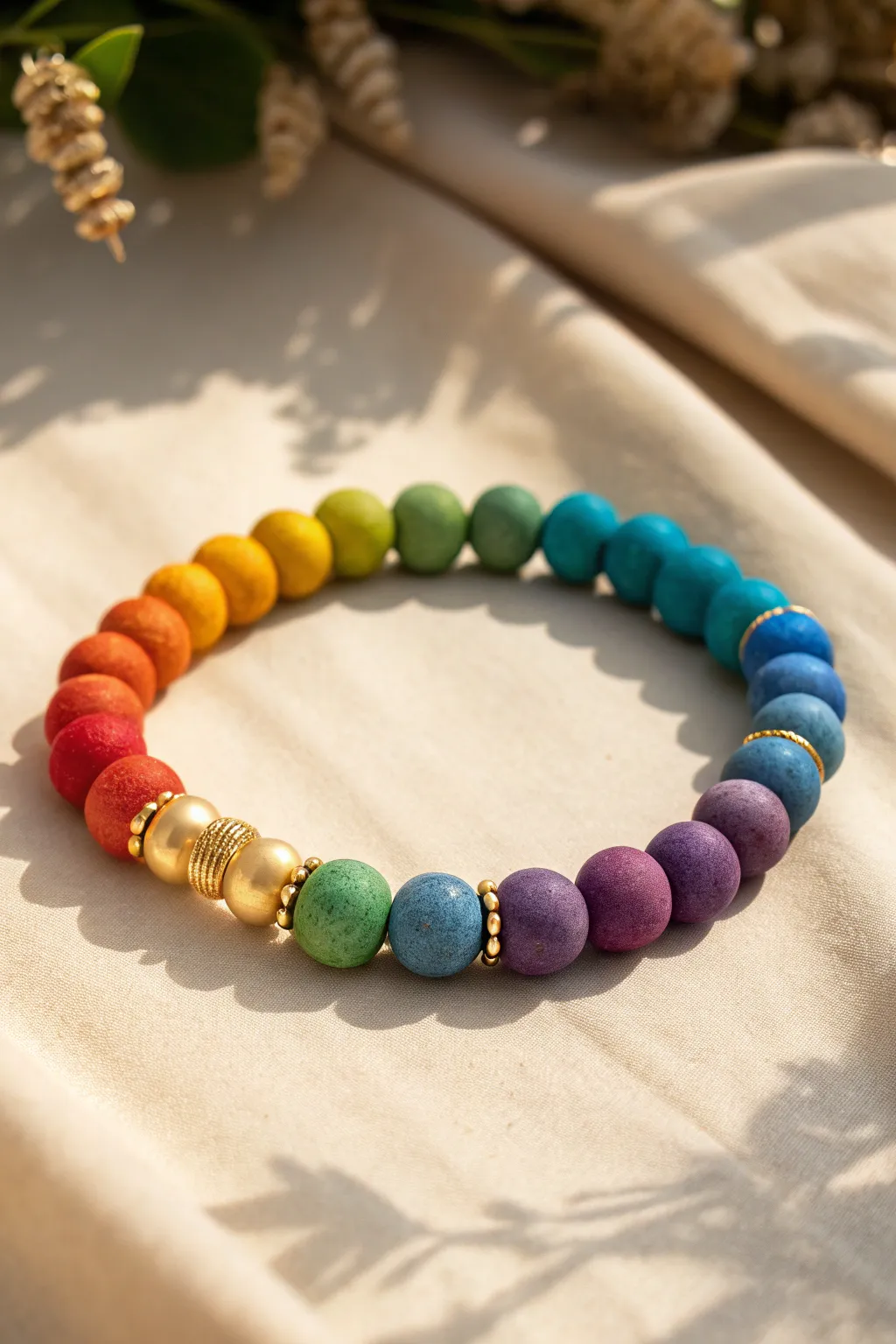
This project creates a sophisticated take on the classic rainbow design by utilizing matte polymer clay beads for a soft, velvety texture. Instead of separating colors with white, the beads flow seamlessly from warm reds to cool purples, accented by elegant gold hardware.
Step-by-Step Tutorial
Materials
- Matte polymer clay round beads (8mm or 10mm) in the following colors: deep red, bright red, red-orange, orange, yellow-orange, yellow, lime green, grass green, forest green, teal, bright blue, indigo, navy blue, violet, purple
- 2 Gold round spacer beads (4mm)
- 2 Gold textured/ribbed accent beads (6mm or 8mm)
- 1 Gold smooth round focal bead (8mm or 10mm)
- 2 small gold spacer rings or discs
- Strong elastic cord (0.8mm or 1.0mm recommended)
- Bead stopper or binder clip
- Jewelry adhesive or clear nail polish
- Scissors
Step 1: Planning the Gradient
-
Sort your spectrum:
Before restringing, lay your matte beads out on a bead board or velvet cloth. Organize them into a continuous color gradient starting with deep red and moving through orange, yellow, green, blue, and finally into purples. -
Check the transition:
Look closely at where the colors shift. If the jump from green to blue looks too harsh, try swapping in a teal bead to soften the change. The goal is a smooth visual flow. -
Measure your wrist:
Wrap a piece of string around your wrist to find your measurement. Add about half an inch to this length for a comfortable fit. -
Select your accent quantity:
This design features a specific metallic focal section. Locate your three main gold beads (two textured, one smooth) and the smaller gold spacers.
Step 2: Stringing the Design
-
Prepare the elastic:
Cut a piece of elastic cord about 10-12 inches long. This extra length makes tying the knot much easier later. -
Secure the end:
Attach a bead stopper or a binder clip to one end of the elastic so your beads don’t slide off while you work. -
Start with the cool tones:
Begin stringing with your purple beads. Thread on a deep plum color, followed by a lighter violet. -
Add the first gold accent:
After the purples, slide on a tiny gold disc spacer followed by a textured gold bead. This marks the beginning of the focal section. -
Place the centerpiece:
Thread the large, smooth gold round bead. This will sit right in the center of the metallic cluster. -
Complete the metallic section:
Mirror the pattern by adding the second textured gold bead followed by the second tiny gold disc spacer. -
Resume the gradient:
Transition into the cool blues. I like to start with a greenish-teal bead here as it bridges the gap nicely, followed by your bright blue and navy beads. -
Move into greens:
Thread on your forest green bead, followed by grass green, and finally the lime green tones. -
String the warm tones:
Continue the flow by adding yellow, yellow-orange, orange, red-orange, and finally your red beads. -
Check the length:
Wrap the unfinished strand around your wrist. If it’s too short, add extra beads at the ‘ends’ of the rainbow (more red or more purple) so the gold focal point stays centered. -
Verify the flow:
Hold the two ends together to see how the red meets the purple. Ensure the gradient looks pleasing all the way around before tying.
Tight Fit?
If the bracelet feels stiff or kinks up, you’ve tied it too tight. The beads need a tiny bit of wiggle room to drape naturally around the curve of your wrist.
Step 3: Finishing Touches
-
Pre-stretch the cord:
Gently pull on both ends of the elastic cord a few times. This pre-stretching prevents the bracelet from sagging or loosening after the first wear. -
First knot:
Remove the bead stopper and tie a simple overhand knot, pulling it tight against the beads. -
Surgeon’s knot:
Tie a surgeon’s knot for extra security. Loop the elastic through twice before pulling tight. -
Secure with glue:
Place a tiny drop of jewelry adhesive directly onto the knot. Be careful not to get glue on the visible parts of the matte beads. -
Hide the knot:
While the glue is still slightly tacky, gently pull the knot inside one of the adjacent beads relative to the seam—usually the purple or red bead works best. -
Trim the excess:
Once the glue is fully dry (I recommend waiting at least 15 minutes), use sharp scissors to trim the excess elastic tails as close to the bead holes as possible.
Matte Protection Idea
Matte beads can absorb oils from lotions or skin over time. Keep them looking fresh by wiping the bracelet gently with a damp microfiber cloth after wearing.
Enjoy the smooth feel of your new gradient bracelet on your wrist
Monochrome Pop in One Color Family
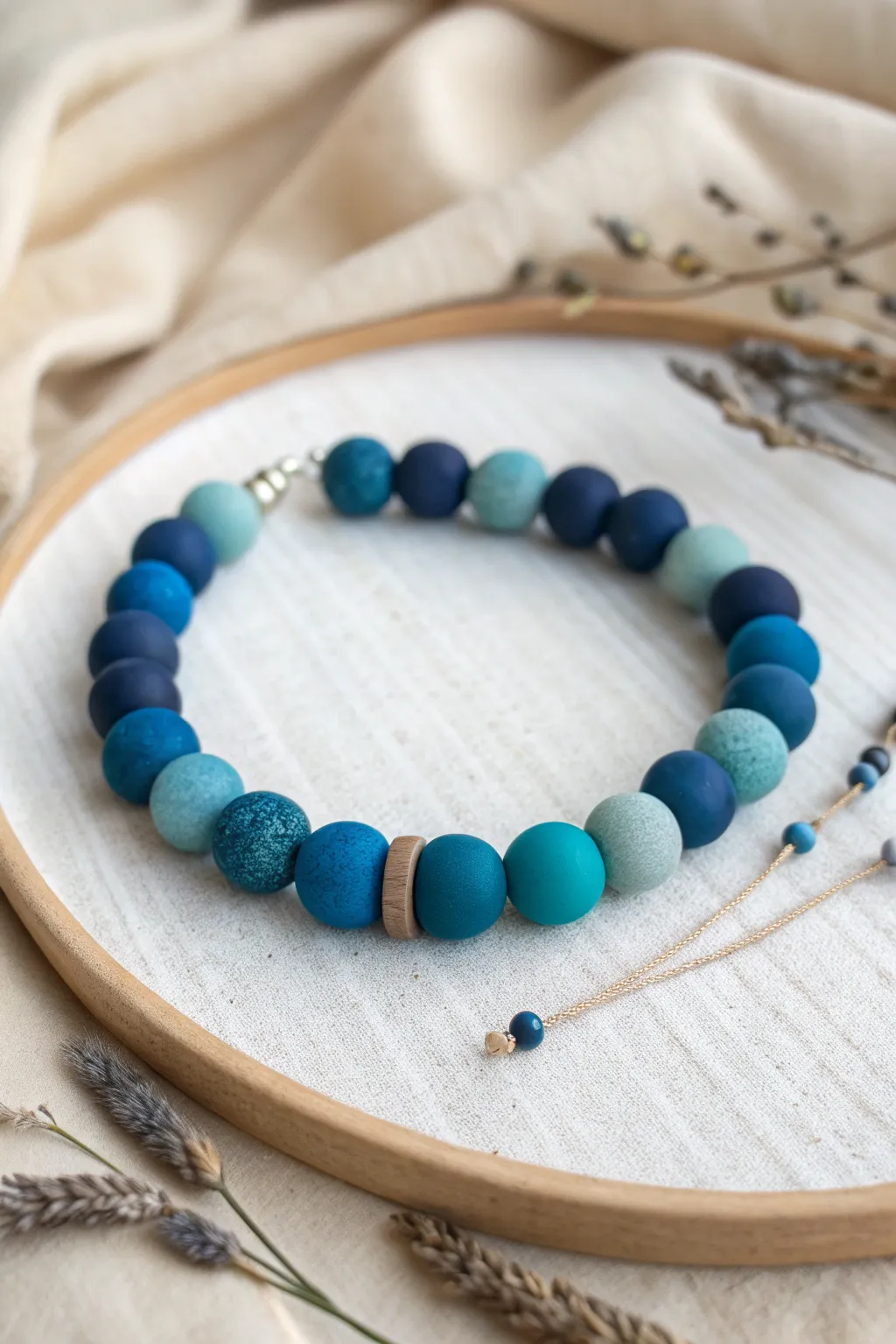
This stunning polymer clay project captures the depth of the sea by blending varying shades of blue into a cohesive, monochrome accessory. By mixing your own clay colors and adding subtle textures, you’ll create a sophisticated piece that looks uninterrupted and fluid without stark white contrasts.
Detailed Instructions
Materials
- Polymer clay in Navy Blue, Turquoise, and Teal
- Polymer clay in translucent or frost (optional for lighter beads)
- Small amount of beige or light wood-colored clay
- Bead rolling tool or acrylic block
- Sandpaper or a rough stone for texturing
- Beading needle
- Toothpick or bead piercer
- Strong elastic beading cord (0.8mm)
- Jewelry glue or clear nail polish
- Clean work surface (ceramic tile or glass)
- Small silver spacer bead (optional)
- Scissors
Step 1: Color Mixing and Preparation
-
Establish your palette:
Begin by conditioning all your blue clay blocks until they are soft and pliable. You want a spectrum of about 5-6 distinct shades. -
Create intermediate shades:
Mix portions of the navy and turquoise together to create a deep teal. I usually like to mix a little teal with the translucent clay to create that softer, frosted blue shade seen in the lighter beads. -
Portion the clay:
Pinch off equal amounts of clay for each bead. Aim for chunks that are roughly 1/2 inch in diameter to ensure consistent bead sizing. -
Create the wood-accent bead:
Take a very small amount of beige clay and flatten it into a thick disc rather than a sphere. This will act as the singular ‘wooden’ focal point.
Sticky Situation?
If fingerprints are stubborn on unbaked clay, a light brush of baby oil can smooth them out instantly without altering the shape.
Step 2: Shaping and Texturing
-
Roll the spheres:
Roll each blue portion into a smooth ball between your palms. Use an acrylic block to roll them gently against your work surface if you want perfectly round spheres. -
Apply texture to select beads:
Select 2-3 beads (preferably the medium-blue tones) to texturize. Gently roll them over rough sandpaper or a clean stone surface to create the pitted, matte surface seen in the reference. -
Refine the surface:
For the non-textured beads, smooth out any fingerprints by lightly buffing them with a tiny bit of cornstarch on your finger designated for smoothing. -
Pierce the holes:
Using a bead piercer or toothpick, carefully poke a hole through the center of each bead. Twist the tool gently as you push through to avoid deforming the shape. -
Bake the beads:
Arrange the beads on a baking sheet or tile. Bake according to your specific polymer clay package instructions (usually 275°F for 15-30 minutes). Let them cool completely before handling.
Pro Tip: Matte Finish
To get the velvety matte look shown here, skip the glaze. Instead, buff baked beads with denim fabric for a soft, natural sheen.
Step 3: Assembly
-
Plan your layout:
Lay the cooled beads out on a bead board or cloth. arrange them in a gradient or random monochrome pattern, ensuring the beige disc bead is placed centrally between two contrasting blues. -
Cut the cord:
Cut a length of elastic cord about 10-12 inches long. Pre-stretch the cord by pulling it firmly a few times; this prevents the bracelet from drooping later. -
String the beads:
Thread your needle and string the beads onto the elastic. If you are adding a tiny silver spacer, place it near where your knot will be to help hide it. -
Check the fit:
Wrap the strand around your wrist to check the size. Add or remove beads if necessary to get a comfortable fit. -
Secure the knot:
Tie a surrealist knot or a strong double knot. Pull it tight, securing it with a dab of jewelry glue. -
Hide the knot:
Once the glue is tacky but not fully hard, carefully slide a bead over the knot to conceal it inside the hole. -
Final trim:
Trim any excess cord close to the bead, being careful not to cut the knot itself.
Now you have a serene, monochromatic accessory ready to wear or gift
Ocean Ombré in Cool Tones
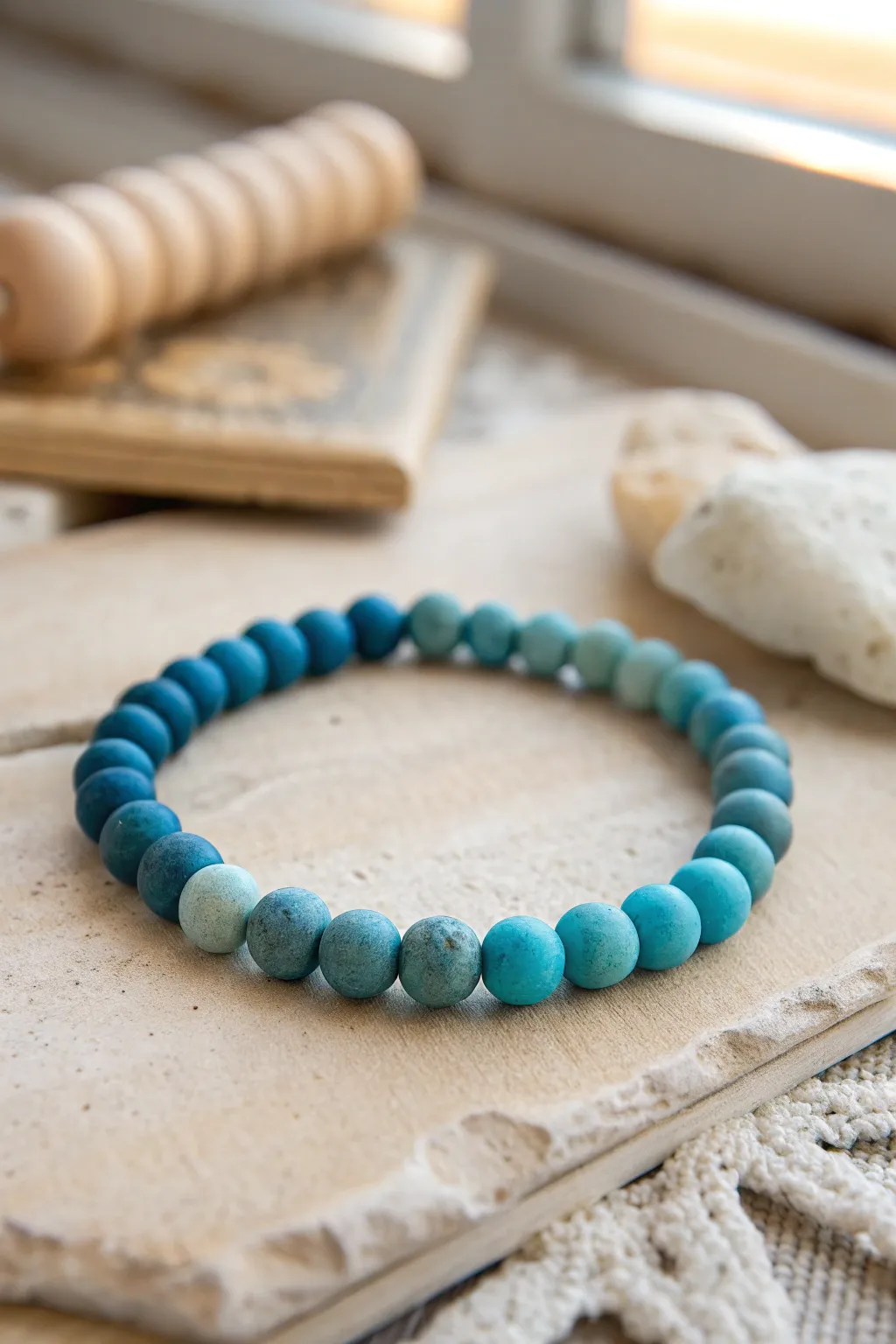
Capture the serene transition of deep sea depths to tropical shallows with this sophisticated beaded bracelet. Using matte-finish beads creates a natural, stone-like texture that makes the rich teal and indigo gradient feel organic and grounded.
Step-by-Step Tutorial
Materials
- Matte round beads (6mm or 8mm) in Dark Navy/Indigo
- Matte round beads (6mm or 8mm) in Teal Blue
- Matte round beads (6mm or 8mm) in Turquoise
- Matte round beads (6mm or 8mm) in Pale Aqua/Seafoam
- Strong elastic bead cord (0.8mm or 1mm)
- Beading needle (collapsible eye recommended)
- Scissors or jewelry snips
- Super glue or jewelry cement (e.g., G-S Hypo Cement)
- Bead design board or a soft towel
- Tape or binder clip
Step 1: Designing the Gradient
-
Measure your wrist:
Before you begin, wrap a piece of string around your wrist to find your comfortable size. Add about half an inch to this measurement to account for the bulk of the 6mm or 8mm beads. -
Prepare your workspace:
Lay out a bead design board or a soft towel. The towel prevents the round beads from rolling away while you plan your pattern. -
Sort your colors:
Separate your matte beads into distinct color groups: Dark Navy, Teal, Turquoise, and Pale Aqua. Seeing them in piles helps visualize the available spectrum. -
Create the transition pattern:
Arrange the beads in a straight line on your board. Start with a block of the darkest navy beads (about 6-8 beads). -
Blend into teal:
Next to the navy section, place 1-2 beads that are slightly lighter navy, followed by your block of teal beads. -
Shift to turquoise:
After the teal section, transition into the brighter turquoise beads. I like to mix one teal and one turquoise bead at the junction to make the fade look softer rather than abrupt. -
End with the lightest tone:
Finish the linear layout with the pale aqua or seafoam beads. Ensure the total length matches your measured wrist size plus the extra allowance.
Step 2: Stringing and Securing
-
Cut the elastic:
Cut a piece of elastic cord about 10-12 inches long. This generous length gives you plenty of room to tie the knot comfortably later. -
Pre-stretch the cord:
Hold the cord firmly at both ends and give it a few gentle but firm tugs. This pre-stretching step is crucial to prevent the bracelet from sagging after you wear it a few times. -
Secure the end:
Place a piece of tape or a binder clip on one end of the elastic cord to stop beads from sliding off as you work. -
Thread the needle:
If using a collapsible eye needle, thread the other end of the elastic through it. This makes picking up the beads much faster. -
String the beads:
Transfer your beads onto the cord one by one, following the exact pattern you laid out. Maintain the order of the gradient carefully. -
Check the fit:
Once all beads are strung, carefully bring the ends together to form a circle around your wrist. If it feels too tight, add one more bead to the darkest section; if too loose, remove one. -
Tie the first knot:
Remove the tape/clip and needle. Hold both ends and tie a simple overhand knot. Pull it tight, bringing the beads snugly together. -
Tie a surgeon’s knot:
For the main securing knot, cross the strands, wrap one end through the loop twice (instead of once), and pull tight. This extra wrap creates significant friction. -
Apply adhesive:
While holding the knot taut, apply a tiny dot of jewelry cement or super glue directly onto the knot. Let it dry for about 30 seconds. -
Hide the knot:
Trim the excess elastic ends close to the knot (leave about 2mm). Then, gently tug the bracelet so the knot slides inside the hole of the nearest bead, disappearing completely.
Sticky Situation?
If the knot refuses to slide into a bead hole, use a toothpick to gently widen the opening of the neighboring bead before tucking the knot inside.
Texture Twist
For added visual interest, swap one or two of the matte beads with a porous lava stone or a wooden bead to break up the smooth texture.
Enjoy wearing your calm, ocean-inspired accessory that brings a touch of nature to any outfit
Preppy Bright Mix With Zero White
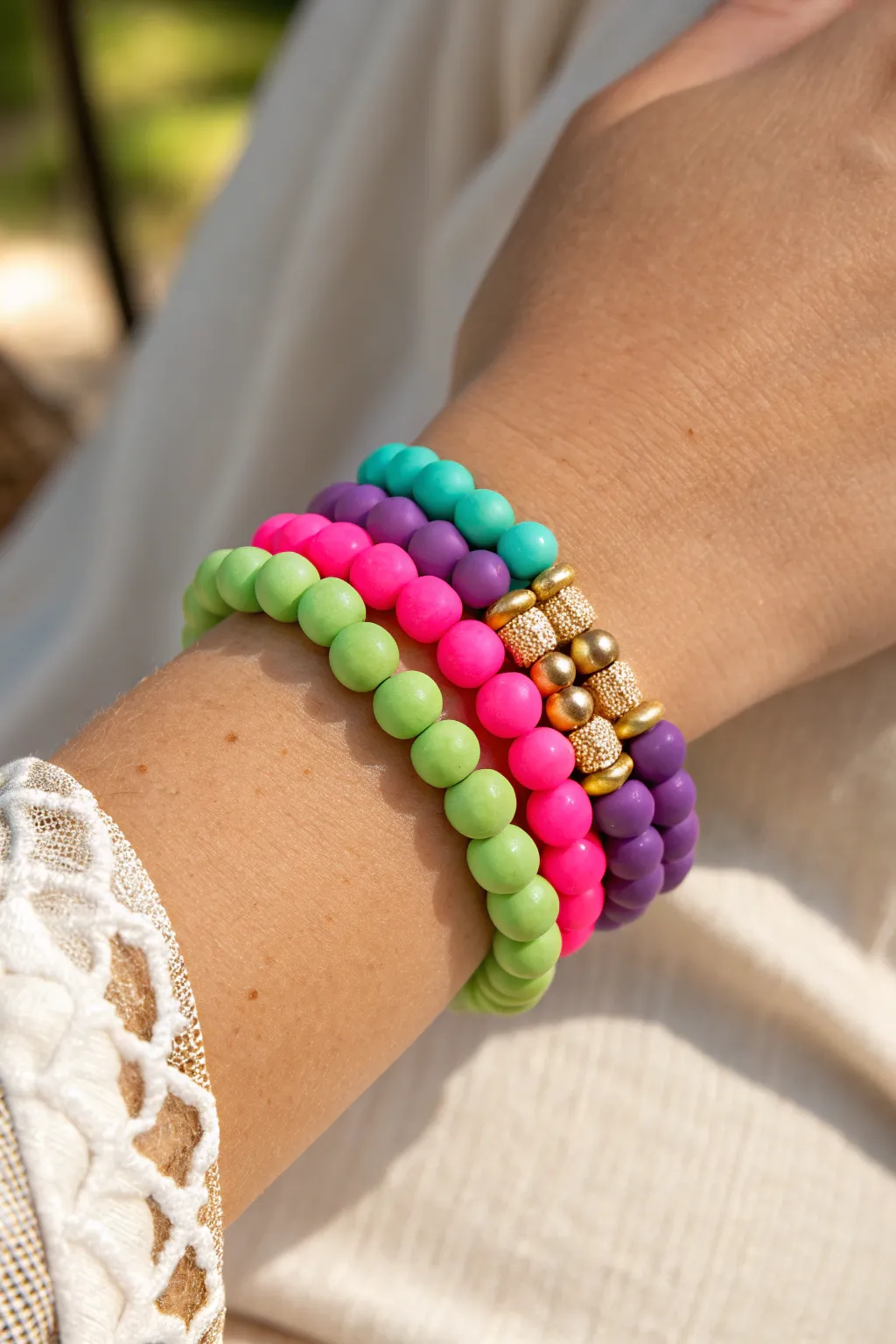
This vibrant stack embraces bold, saturated hues without a single white bead in sight, perfect for a preppy, high-energy look. By mixing matte polymer clay rounds with textured gold accents, you create a sophisticated yet playful set that pops against any skin tone.
Step-by-Step
Materials
- Matte round beads (6mm or 8mm) in lime green
- Matte round beads (6mm or 8mm) in hot pink
- Matte round beads (6mm or 8mm) in deep purple
- Matte round beads (6mm or 8mm) in teal or turquoise
- Gold tone textured spacer beads (drum or rondelle shape)
- Gold tone smooth rondelle spacer beads
- Gold tone small round spacer beads
- Strong elastic bead cord (0.8mm or 1.0mm recommended)
- Jewelry glue or clear nail polish
- Scissors
Step 1: The Lime Green Strand
-
Measure your cord:
Cut a piece of elastic cord about 10-12 inches long. This generous length makes tying the final knot much easier than struggling with short ends. -
Pre-stretch:
Before adding any beads, firmly tug on the elastic several times to pre-stretch it. This prevents the bracelet from sagging or stretching out permanently after the first wear. -
String the beads:
Thread your lime green matte beads onto the cord one by one. Continue stringing until the beaded section measures exactly the circumference of your wrist. -
Secure the strand:
Tie a secure surgeon’s knot (right over left, left over right, looping through twice on the second pass). Dab a tiny drop of glue on the knot, pull it tight, and trim the excess cord.
Step 2: The Hot Pink Strand
-
Prepare the cord:
Cut another 10-12 inch length of elastic and pre-stretch it just like the first strand. -
String the pink beads:
Load on the hot pink matte beads. Since this bracelet sits in the middle of the stack, ensure it is the same length as your green strand for a uniform fit. -
Knot and finish:
Tie off this strand with a strong knot, apply a dot of adhesive, let it dry for a moment, and trim the tails close to the knot.
Keep it Snug
Make the bracelets slightly smaller than your exact wrist measurement. The elastic will stretch when worn, and a snug fit keeps the heavy gold accents centered on top of your wrist.
Step 3: The Teal & Purple Focal Strand
-
Start the mixed strand:
This bracelet is the distinct focal point. Cut your elastic and begin by threading about 8-10 teal matte beads first. -
Create the gold transition:
Now, add your gold accent series. Slide on a gold spacer, followed by a textured gold drum bead, and another gold spacer. This creates a luxurious metallic break in the color. -
Switch colors:
Following the gold section, switch to your deep purple matte beads. String enough purple beads to complete the circle, ensuring the gold section will sit nicely on top of the wrist. -
Close the loop:
Bring the teal and purple ends together and tie your finishing knot securely. Ideally, hide the knot inside one of the teal or purple beads next to the gold section if the hole size permits.
Mix Up Textures
For a truly custom look, try sanding a few clay beads lightly with a nail buffer to give them an even flatter, chalkier matte finish that contrasts beautifully with the shiny gold.
Step 4: The Purple & Gold Statement Strand
-
Plan the design:
This final strand features a heavy gold segment. Cut your cord and start by stringing the deep purple beads that will form the back and sides of the bracelet. -
Build the gold center:
When you have string about 2/3 of the bracelet length in purple, start the gold pattern. Thread a pattern like: small gold spacer, textured gold bead, smooth rondelle, textured gold bead, and finish with a small spacer. -
Verify length:
Check the total length against the other finished bracelets. If it’s too short, add a few more purple beads to the ends; if too long, remove one. -
Final assembly:
Tie your final surgeon’s knot tight. I usually apply the glue here and wait a full minute before trimming to ensure the heavier gold beads don’t pull the knot apart while it’s wet.
Once the glue is fully cured, stack them all together for a bright, cheerful pop of color on your wrist

The Complete Guide to Pottery Troubleshooting
Uncover the most common ceramic mistakes—from cracking clay to failed glazes—and learn how to fix them fast.
Black as the Bold Neutral
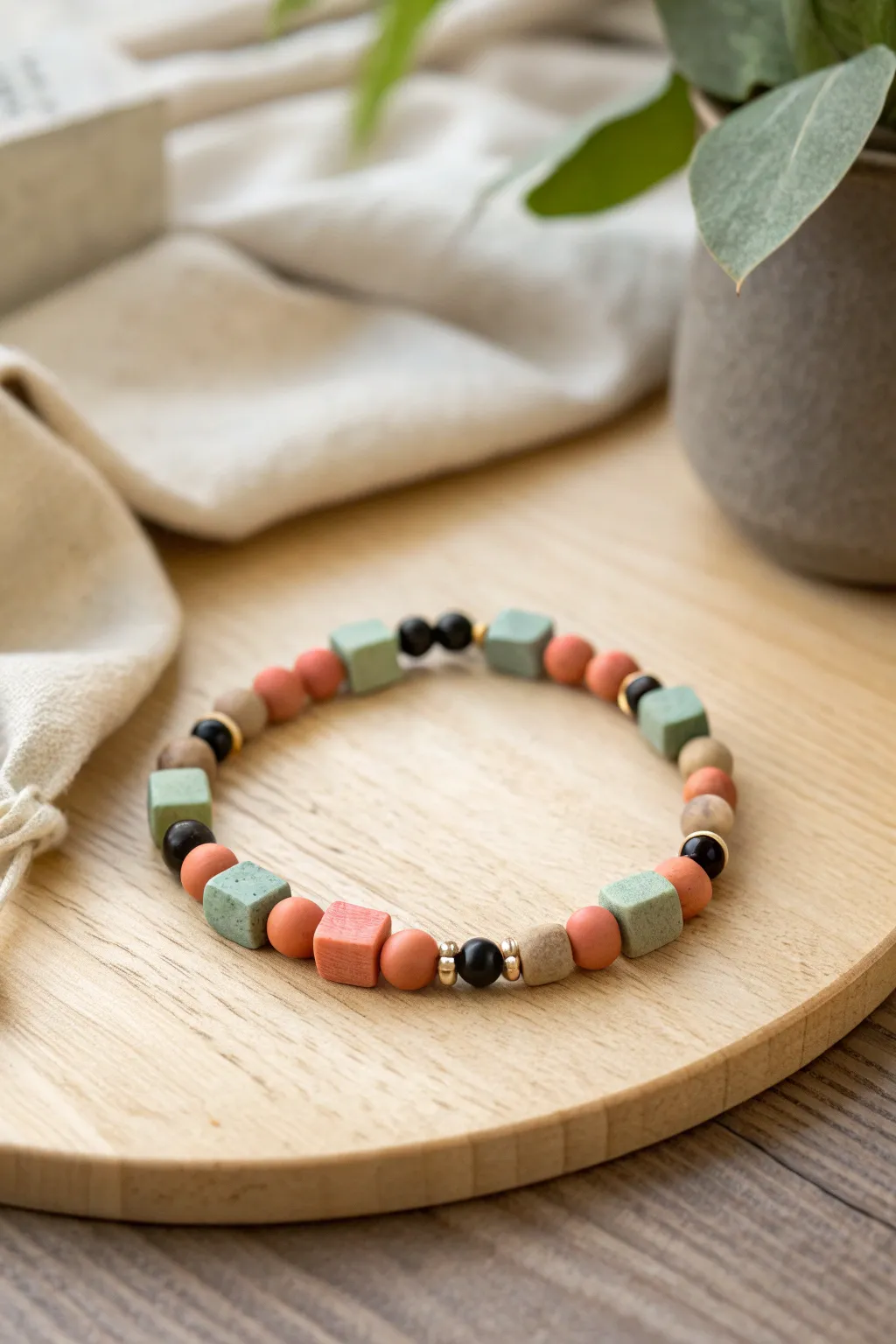
This sophisticated beaded bracelet proves that neutrals don’t have to be boring. By mixing matte terracotta and sage green clay beads with glossy black accents and gold spacers, you achieve a modern, organic look perfect for everyday wear.
Detailed Instructions
Materials
- Polymer clay square beads (matte sage green)
- Polymer clay square beads (matte terracotta/rust)
- Polymer clay round beads (8mm, matte terracotta/rust)
- Polymer clay round beads (8mm, matte warm grey/taupe)
- Glossy black round beads (6mm, likely Onyx or glass)
- Small gold spacer beads (smooth disc or rounded tire shape)
- Strong elastic beading cord (0.8mm or 1mm)
- Jewelry adhesive (e.g., G-S Hypo Cement)
- Scissors
Step 1: Planning and Preparation
-
Measure the cord:
Cut a piece of elastic cord about 10-12 inches long. This gives you plenty of extra room for tying knots without struggling to hold the tension. -
Pre-stretch the elastic:
Grab both ends of the cord and give it several firm tugs. I always do this to prevent the bracelet from stretching out permanently after the first time you wear it. -
Sort your beads:
Lay out your bead selection on a bead mat or soft towel. This prevents them from rolling away and lets you visualize the color palette before stringing. -
Identify the pattern:
Notice the repeating but varied rhythm: the bracelet primarily alternates between sections of round matte beads and square feature beads, punctuated by the smaller black and gold accents.
Step 2: Stringing Section A (The Sage Focus)
-
Start the first segment:
Thread on a glossy black bead, followed by a gold spacer, and then a 8mm matte taupe round bead. -
Add the focal square:
Slide on a matte sage green square bead. -
Complete the segment:
Follow the square bead with one matte terracotta round bead.
Knot Slipping?
If your elastic knot feels insecure, try a ‘square knot’ instead of a surgeon’s knot. Pull all four strands (the two tails and the two loop sides) firmly to lock it.
Step 3: Stringing Section B (The Terracotta Focus)
-
String the connector:
Add a matte reddish-terracotta square bead. Note that in the image, there is occasionally a red square right next to a taupe round, creating asymmetry. -
Add the dark contrast:
Slide on one glossy black bead, then a gold spacer. -
Add the double accent:
Thread on another glossy black bead. The pattern sometimes uses single black beads and sometimes doubles them for variety.
Level It Up
Swap the matte terracotta clay beads for real Red Jasper or Carnelian stones to add weight and a slightly higher-end gemstone feel.
Step 4: Building the Body
-
Establish the main rhythm:
For the majority of the bracelet, follow this sequence: one round matte bead (alternating taupe and terracotta), one square sage bead, one round matte bead, one glossy black bead. -
Insert gold spacers:
Place the small gold spacers specifically on either side of the black beads or taupe beads to brighten the design. -
Mix up the shapes:
Don’t be afraid to break the pattern slightly. As seen in the reference, sometimes two round beads sit next to each other, or a square bead stands alone between rounds. -
Check the length:
Wrap the strand around your wrist. The ends should touch comfortably without stretching the cord yet. Add or remove a bead sequence if necessary.
Step 5: Finishing the Bracelet
-
Tie the first knot:
Bring the two ends of the elastic together and tie a simple overhand knot to bring the beads into a circle. -
Secure with a surgeon’s knot:
Tie a second knot, but loop the cord through twice before pulling tight. This is a surgeon’s knot and holds energetic elastic much better. -
Apply adhesive:
Dab a tiny drop of jewelry cement onto the knot. Be careful not to get glue on the neighboring beads, especially the matte ones as it will stain them. -
Hide the knot:
While the glue is still tacky, gently pull the knot inside the hole of the nearest large bead (the square ones usually have larger holes ideal for this). -
Trim the excess:
Once the glue is fully dry (wait at least 15 minutes), use your sharp scissors to trim the excess cord as close to the bead as possible.
Enjoy styling this versatile accessory that bridges the gap between earthy textures and minimal chic
Gold Beads as the New Break
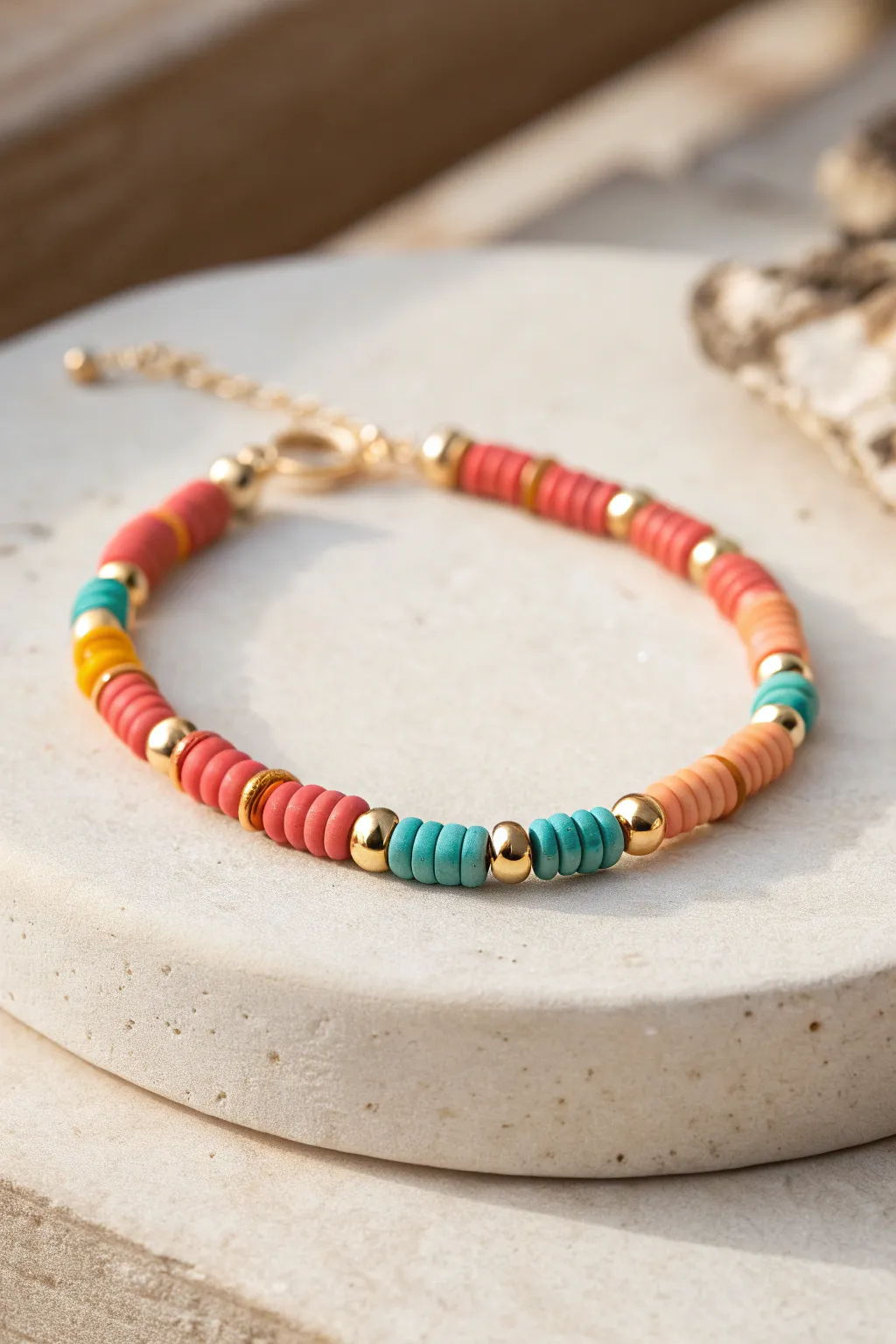
Elevate the standard clay bead bracelet trend by swapping out simple white breaks for luxurious gold accents. This design features warm coral, earthy terracotta, and a splash of turquoise, perfectly spaced with gleaming metallic spheres for a sophisticated finish.
Step-by-Step
Materials
- Heishi polymer clay beads (flat disc) in coral/salmon pink
- Heishi polymer clay beads (flat disc) in turquoise/teal
- Heishi polymer clay beads (flat disc) in terracotta/peach
- Heishi polymer clay beads (flat disc) in mustard yellow
- 4mm or 5mm round gold spacer beads (plated brass or gold-filled recommended)
- Small flat gold spacer discs (optional, used near clasp)
- Gold beading wire or strong elastic cord (0.8mm)
- Gold lobster clasp
- Gold jump rings
- Gold extender chain
- Crimp beads and crimp covers (if using wire)
- Jewelry pliers (flat nose and cutting pliers)
- Bead stopper or tape
Step 1: Planning the Pattern
-
Measure your wrist:
Before stringing a single bead, measure your wrist and add about half an inch for a comfortable fit. This design relies on segments, so knowing your total length helps plan how many repeated sections you’ll need. -
Draft the sequence:
Lay out your beads on a design board or a towel. The pattern shown uses uneven color blocking: longer sections of coral, medium sections of peach, and short pops of turquoise and yellow, all separated by gold rounds.
Prevent Tarnishing
Since the gold beads touch skin constantly, coat them with a thin layer of clear nail polish or jewelry shield before stringing to keep them shiny longer.
Step 2: Stringing the Beads
-
Secure the end:
Cut a piece of wire or elastic about 10 inches long. Attach a bead stopper or a piece of tape to one end to prevent beads from sliding off while you work. -
Start the sequence:
Begin with a small 3-bead section of mustard yellow heishi beads to anchor the clasp area later. -
Add the first gold break:
Slide on one round gold spacer bead. These gold spheres are the star of this ‘no white’ concept, acting as the visual pause between colors. -
Create a coral section:
Thread on a longer segment of the coral/salmon heishi beads. Aim for about 10-12 beads for this primary color block. -
Insert gold separator:
Add another round gold spacer bead to close the coral section. -
String the terracotta block:
Add a segment of terracotta or peach beads. Make this section slightly shorter than the coral one, using about 8-9 beads for visual variety. -
Add the turquoise pop:
Slide on a gold spacer, followed by a short burst of turquoise beads (about 5-6 beads). I find this cool tone really makes the warm gold and coral pop. -
Sandwich with gold:
Finish the turquoise section with another round gold spacer bead. -
Repeat the pattern:
Continue this pattern—Gold / Coral / Gold / Terracotta / Gold / Turquoise / Gold—until the bracelet is close to your desired length. -
Check the symmetry:
As you near the end, try to mirror the starting pattern so the clasp sits neatly between balanced color blocks.
Step 3: Finishing Touches
-
Prepare the first end:
If using beading wire: slide on a crimp bead, then thread the wire through the loop of a jump ring or directly through the lobster clasp loop. -
Secure the wire:
Loop the wire back through the crimp bead and pull tight, leaving just a tiny bit of slack so the bracelet moves fluidly. -
Crimp down:
Use your flat nose pliers to smash the crimp bead flat, locking the wire in place. Trim the excess wire tail close to the bead. -
Hide the crimp (optional):
If you have crimp covers, carefully place one over the flattened crimp bead and gently squeeze it closed with pliers to make it look like a seamless gold bead. -
Finish the second end:
Remove the tape or bead stopper from the beginning of the strand. Repeat the crimping process on this side, attaching a jump ring and the extender chain. -
Double check security:
Give the bracelet a gentle tug to ensure your crimps are holding firm before wearing.
Texture Play
Instead of smooth round gold beads, switch to faceted gold beads or stardust finish beads. This adds extra sparkle that catches the light differently.
Now you have a chic, warm-toned accessory that proves bright white isn’t necessary for a fresh look

What Really Happens Inside the Kiln
Learn how time and temperature work together inside the kiln to transform clay into durable ceramic.
Mixed Metallic Spacers (No White)
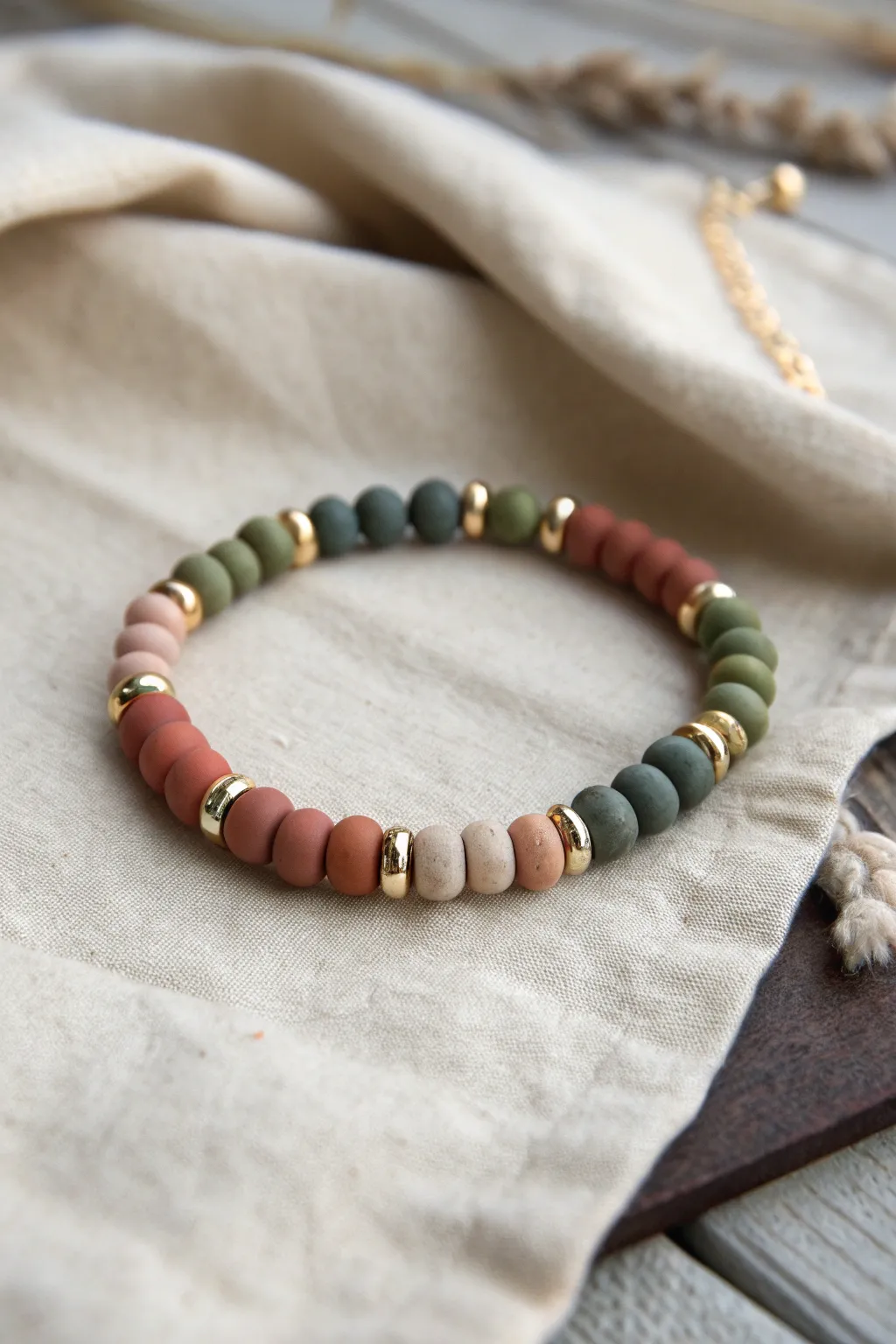
This sophisticated bracelet combines matte polymer clay Heishi beads in a warm, earthy palette with striking gold accents. The absence of white allows the rich terracotta, olive, and teal tones to create a grounded, organic aesthetic perfect for everyday wear.
Step-by-Step Tutorial
Materials
- Polymer clay Heishi beads (6mm or 8mm) in: Terracotta/Rust
- Polymer clay Heishi beads in: Olive Green
- Polymer clay Heishi beads in: Dark Teal/Slate Blue
- Polymer clay Heishi beads in: Beige/Sand
- Polymer clay Heishi beads in: Pale Blush Pink
- Gold geometric spacer beads (rondelle or disc shape)
- Strong elastic cord (0.8mm or 1mm recommended)
- Jewelry glue (e.g., G-S Hypo Cement)
- Scissors
Step 1: Planning the Pattern
-
Measure your wrist:
Wrap a piece of string around your wrist to find your comfortable size, adding about half an inch for a comfortable fit. -
Cut the elastic:
Cut a length of elastic cord about 10-12 inches long. Having extra length makes tying the final knot significantly easier than struggling with short ends. -
Pre-stretch the cord:
Give the elastic a few firm tugs. This pre-stretching prevents the bracelet from loosening up immediately after you wear it for the first time. -
Establish the color groups:
Sort your beads into small piles by color. The design relies on blocks of 3-5 clay beads in a single color, separated by a gold spacer.
Use a Bead Board
Lay out your design on a flocked bead board or a textured towel before stringing. This stops beads rolling away and lets you visualize color balance.
Step 2: Stringing the Beads
-
Start with a spacer:
Thread a single gold spacer bead onto the elastic first. This will act as a nice anchor point for your knot later. -
The terracotta section:
String on three to five terracotta (rust-colored) clay beads. The variation in number creates a more organic feel, so don’t worry about being perfectly symmetrical. -
Add a gold accent:
Slide on another gold spacer bead. These metallic breaks are crucial for elevating the look from simple craft to jewelry. -
The beige section:
Add a small group of three beige or sand-colored beads. I find this neutral tone helps bridge the gap between the darker colors. -
Insert another spacer:
Follow the beige group with another gold spacer. -
The teal transition:
Thread three dark teal or slate blue beads. This cool tone contrasts beautifully with the warm terracotta you started with. -
Gold spacer break:
Add your next gold spacer bead. -
The olive green block:
String on four olive green beads. This earthy green anchors the nature-inspired palette. -
Add a gold spacer:
Place a gold spacer after the green section. -
The blush accent:
Add three pale blush or light pink beads. This subtle pop of lightness replaces the need for stark white. -
Continue the pattern:
Repeat this sequence—color block, gold spacer, new color block—mixing up the order until you reach your desired bracelet length. Aim for a randomized look rather than a strict repeating pattern.
Step 3: Finishing Touches
-
Check the fit:
Wrap the strung beads around your wrist to check the size. Ideally, the ends should meet comfortably without gaps. -
Tie the surgeon’s knot:
Cross the ends of the elastic, loop one end under twice, and pull tight. Repeat this process securely. -
Secure with glue:
Dab a tiny drop of jewelry glue directly onto the knot. Be careful not to get glue on the surrounding clay beads. -
Let it cure:
Allow the glue to dry completely according to the package instructions before trimming. -
Hide the knot:
Trim the excess elastic close to the knot, then gently slide the knot inside one of the gold spacer beads or the hole of a clay bead.
Dual Texture
Mix in one or two faceted crystal beads in a matching earth tone (like smoky quartz) alongside the gold spacers for a subtle sparkle.
Enjoy styling your new bracelet stack with denim or neutral linens for a chic, grounded look
Checkerboard Color Rhythm
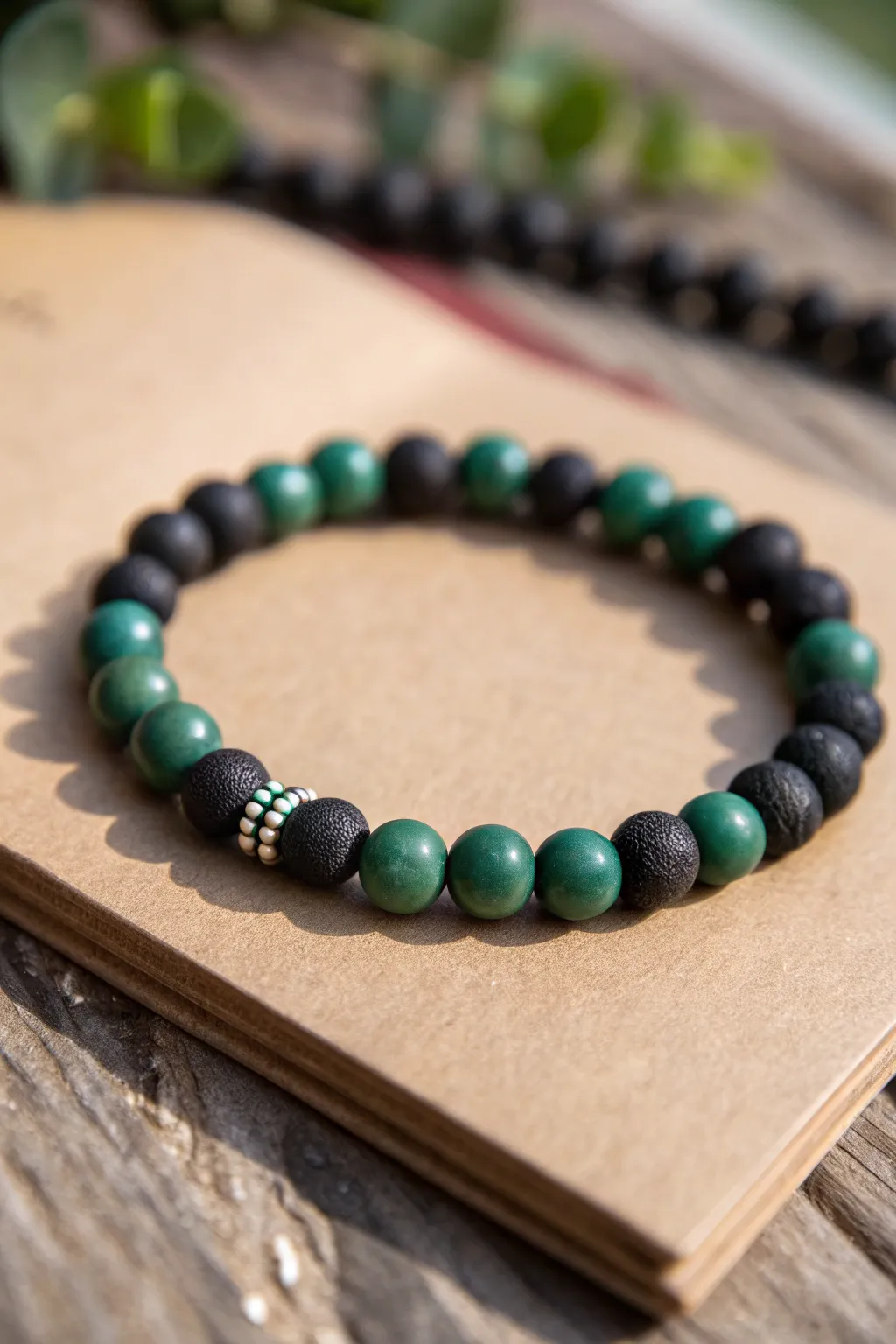
Embrace the contrast of nature-inspired textures with this rhythmic bracelet design. By alternating smooth, moss-green rounds with textured, lava-like black beads, you create a sophisticated accessory that feels both rugged and refined.
How-To Guide
Materials
- Matte green stone or clay beads (8mm or 10mm)
- Black lava rock or textured polymer clay beads (8mm or 10mm)
- Strong elastic bead cord (0.8mm or 1mm)
- Small silver spacer beads with inlaid detail (optional)
- Jewelry glue or clear nail polish
- Scissors
Step 1: Preparation
-
Measure your wrist:
Wrap a piece of string around your wrist to find the circumference. Add about half an inch to this measurement to ensure the bracelet fits comfortably without pinching. -
Select your beads:
Lay out your green and black beads. For an average adult wrist, you will likely need roughly 22-24 beads total, depending on their size (8mm is standard, 10mm is chunkier). -
Pre-stretch the cord:
Cut a length of elastic cord about 12 inches long. Give it a few firm tugs to pre-stretch it; this prevents the bracelet from drooping or loosening immediately after you finish making it.
Knot Master
If the knot won’t hide inside a bead, don’t force it. Instead, start your stringing with a bead that has a larger hole, like the metal spacer or a specific lava bead drilled wider.
Step 2: Creating the Pattern
-
Establish the rhythm:
The core aesthetic here is a simple ABA pattern. Start stringing one green bead followed by one black bead. -
Continue the sequence:
Repeat this alternating pattern until you have filled about half the length of your measured string. -
Check the texture:
Pause to ensure your black beads are orienting nicely. If you are using real lava stone, some sides may be more pitted than others—face the best texture outward. -
Create the focal point:
Approximately halfway through the strand, break the pattern slightly to add visual interest. Instead of a direct switch, insert a small decorative silver spacer. -
Sandwich the spacer:
Place the silver spacer between two black textured beads, or between a green and a black bead, depending on where your pattern landed. This acts as a subtle ‘centerpiece’ for the design. -
Resume alternating:
Continue the green-black-green-black pattern for the remainder of the strand. -
Group variation (optional):
Notice in the reference that there is a small section where three green beads sit together comfortably. You can mimic this asymmetry by placing 2-3 green beads in a row near the end of your strand before closing.
Step 3: Finishing Touches
-
Test the fit:
Wrap the unfinished strand around your wrist. The ends should meet comfortably with no large gaps, but it shouldn’t be tight enough to leave indentations on your skin. -
Tie the first knot:
Bring the two ends of the elastic cord together. Tie a simple overhand knot, pulling it gently but firmly so the beads sit flush against each other. -
Secure with a surgeon’s knot:
For the second knot, loop the elastic through twice instead of once before pulling tight. This extra friction helps hold the elastic in place. -
Apply adhesive:
I like to dab a tiny drop of jewelry glue or clear nail polish directly onto the knot. This fuses the fibers and prevents the slippery elastic from undoing itself. -
Hide the knot:
While the glue is still slightly tacky, pull the elastic so the knot slides inside the hole of the nearest bead (preferably one of the black lava beads, as they often have larger holes). -
Trim the excess:
Once the glue is fully dry, use sharp scissors to trim the remaining tail ends of the elastic cord as close to the bead as possible.
Scent Infusion
Since lava stones are porous, you can add a drop of essential oil to the black beads. Your bracelet will act as a personal diffuser throughout the day.
Now you have a striking, earth-toned bracelet ready to wear or gift.

TRACK YOUR CERAMIC JOURNEY
Capture glaze tests, firing details, and creative progress—all in one simple printable. Make your projects easier to repeat and improve.
Two-Color Micro-Alternation
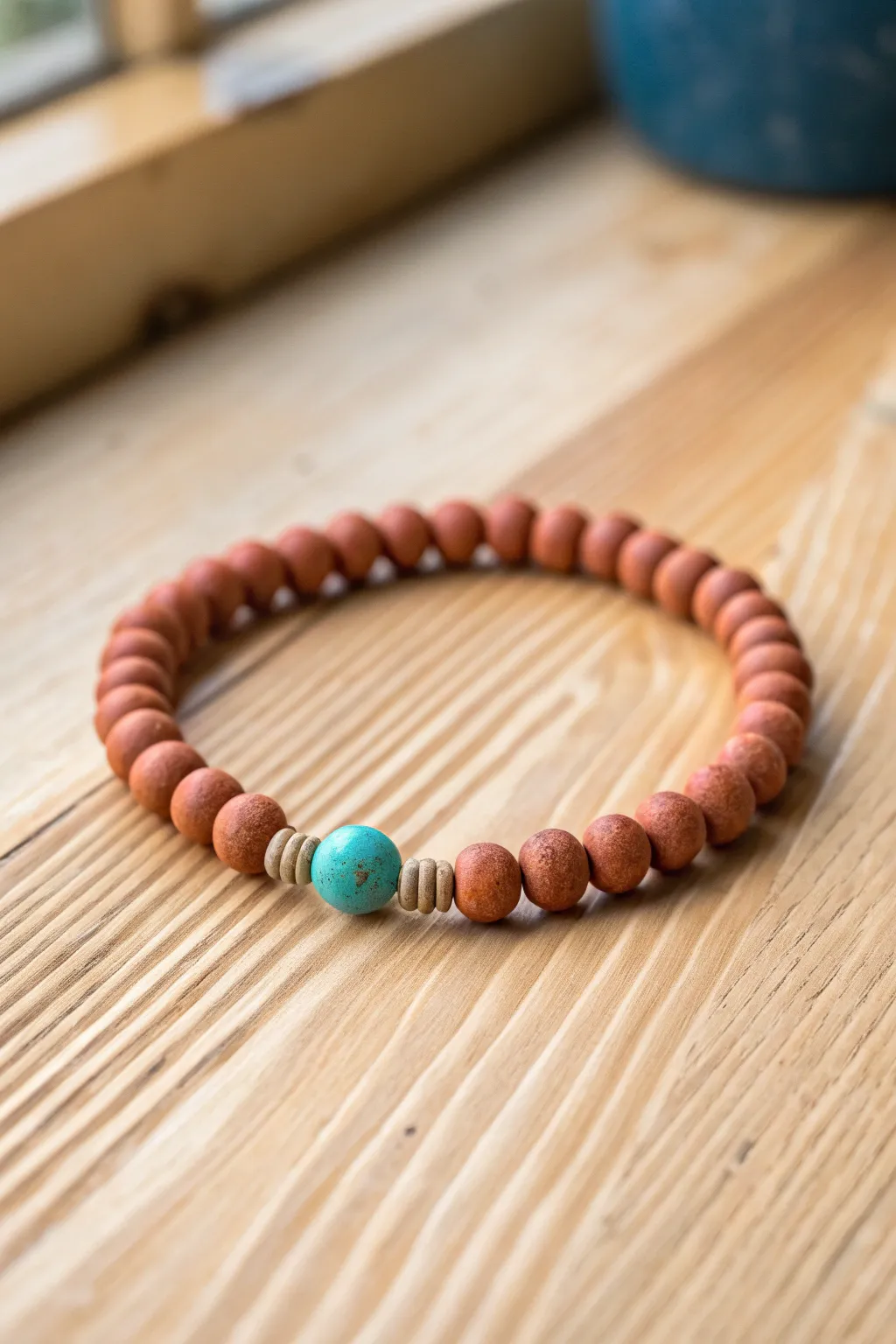
This grounded, minimalist design pairs the warm, matte texture of terracotta clay with a striking pop of turquoise. The result is a rustic, nature-inspired accessory that feels organic and timeless on the wrist.
Step-by-Step Tutorial
Materials
- Matte terracotta or red clay round beads (approx. 8mm)
- One large turquoise or teal round bead (approx. 10mm)
- Small beige or tan heishi disc spacer beads (approx. 4mm)
- Strong elastic beading cord (0.8mm or 1mm)
- Jewelry adhesive or clear nail polish
- Scissors
Step 1: Preparation
-
Measure your wrist:
Wrap a piece of the elastic cord loosely around your wrist to determine the comfortable length. Add about 2-3 inches extra to this measurement to ensure you have plenty of room for tying the knots later. -
Pre-stretch the cord:
Before you thread a single bead, give your elastic cord a few firm tugs. This pre-stretching prevents the bracelet from sagging or becoming permanently loose after the first few times you wear it. -
Secure the end:
Place a piece of tape or a bead stopper clamp on one end of your cut cord. This simple step saves you from the frustration of beads sliding right off the other side while you work.
Taming Rough Beads
If the clay bead holes feel rough or gritty inside, run a bead reamer or a small round file through them first. This prevents the sharp ceramic material from sawing through your elastic over time.
Step 2: Beading the Pattern
-
Calculate bead count:
Lay your beads out on a bead board or soft cloth alongside the ruler measurement of your wrist size. You want the turquoise bead to sit exactly opposite the knot, so divide your terracotta beads into two equal piles. -
Thread the first half:
Begin stringing the first pile of red clay beads onto the elastic. These matte beads have a lovely texture, so check each hole to ensure there are no sharp clay burrs that might cut the string. -
Add first spacers:
Slide on three of the small beige heishi disc spacers. These act as a visual buffer, transitioning from the warm clay to the cool blue tone. -
Place the focal bead:
Thread your single turquoise bead. It is slightly larger than the clay beads, giving the piece a nice dimension. Make sure it sits snugly against the spacers. -
Add second spacers:
mirror the design by adding three more beige heishi spacers on the other side of the turquoise bead. -
Finish the strand:
Thread the remaining pile of terracotta beads. Periodically check the length by wrapping it around your wrist; the spacers add length you might not have accounted for initially.
Scent Diffuser
Since terracotta clay is porous, these red beads work perfectly as oil diffusers. Add a drop of essential oil to the clay beads (avoid the elastic) to carry a subtle scent with you all day.
Step 3: Finishing Touches
-
Prepare to knot:
Remove the tape or bead stopper from the end. Bring both ends of the elastic together, ensuring there is no slack between the beads but not pulling so tight that the bracelet puckers. -
Tie a surgeon’s knot:
Cross the ends like a standard shoelace knot, but loop the top string through the bottom loop twice instead of once. Pull tight. -
Secure the knot:
Tie a standard overhand knot on top of the surgeon’s knot for extra security. Pull the elastic firmly—you should feel the knot ‘lock’ into place. -
Apply adhesive:
Dab a tiny drop of jewelry glue or clear nail polish directly onto the knot. I find using a toothpick helps apply it precisely without getting glue on the adjacent beads. -
Hide the knot:
While the glue is still tacky, gently tug on the cord to slide the knot inside the hole of the nearest terracotta bead. This hides the mechanics and creates a seamless look. -
Trim the excess:
Once the glue is fully dry (wait at least 15 minutes), use sharp scissors to trim the excess tail ends of the cord as close to the bead hole as possible without nicking the knot itself.
Enjoy the grounded, natural feel of your new handcrafted accessory
Clear Bead “Breathers” Instead of White
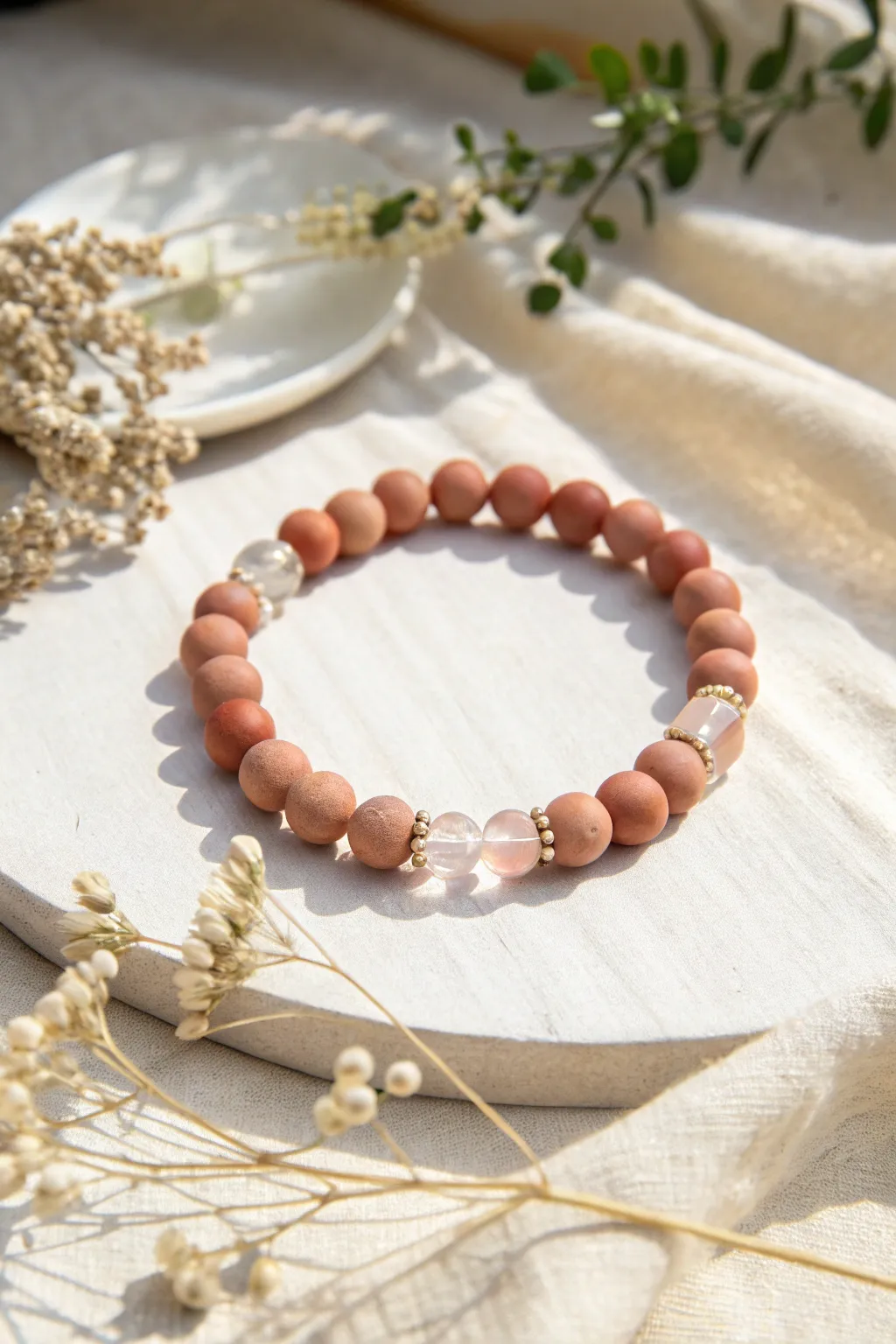
This rustic yet elegant design pairs the earthy warmth of matte reddish-brown clay or stone beads with the airy lightness of translucent quartz accents. It’s a perfect example of how clear beads can act as ‘breathers’ in a design without resorting to stark white spacers.
Step-by-Step
Materials
- 8mm matte terracotta or red jasper round beads (approx. 20-22 beads)
- 6-8mm clear quartz or translucent rose quartz round beads (3 beads)
- Small clear quartz coin bead or faceted spacer (1 bead)
- Small gold spacer beads or tiny gold seed beads (approx. 4-6 pieces)
- Clear elastic beading cord (0.7mm or 0.8mm)
- Jewelry adhesive or clear nail polish
- Scissors
Step 1: Setting the Pattern
-
Measure and Cut:
Cut a piece of elastic cord about 10-12 inches long. This generous length makes tying the final knot much easier than fighting with short ends. -
Pre-stretch the Cord:
Hold the cord firmly at both ends and give it a few gentle tugs. Pre-stretching helps prevent the bracelet from loosening up immediately after you wear it. -
Secure Your Strand:
Place a piece of tape or a bead stopper clip on one end of your cord so your beads don’t slide right off while you work.
Sticky Situation
If the knot won’t slide into a bead hole, gently use jewelry pliers to ream the hole slightly wider, or simply hide the knot between two beads.
Step 2: Beading the Sequence
-
Start with Clay Tones:
Begin by threading on about 9 or 10 of your matte terracotta beads. This will form the solid back section of the bracelet. -
Add the First Accent:
For the first ‘breather’ section, slide on one small clear quartz coin bead or spacer. Depending on your wrist size, you might want to flank this with a regular clay bead on either side. -
Continue the Clay Base:
Add another long section of the matte clay beads, roughly 6 to 8 of them, creating the curve leading to the focal point. -
Prepare the Focal Point:
Before adding the center clear beads, slide on a small gold spacer bead to act as a metallic frame. -
The Centerpiece:
Thread on two round clear quartz (or very pale rose quartz) beads side-by-side. These are the main ‘breathers’ that break up the visual weight of the clay. -
Frame the Center:
Finish the focal arrangement by adding another small gold spacer bead immediately after the two clear beads. -
Close the Loop:
Finish by adding the remaining clay beads until the strand wraps comfortably around your wrist. Aim for a fit that is snug but not tight—usually about 7 inches total.
Natural Texture
Create a diffuser bracelet by swapping 2-3 clay beads for porous lava stones. Add a drop of essential oil for a functional scent accessory.
Step 3: Finishing Touches
-
Check the Fit:
Bring the two ends of the cord together to form a circle. Wrap it around your wrist to verify sizing before knotting. -
Tie the Knot:
Remove the tape or stopper. Tie a standard square knot: right over left, then left over right. Pull the cords tight. -
Reinforce:
For extra security, I like to add a surgeon’s knot here (looping the cord through twice instead of once) on top of the square knot. -
Hide the Evidence:
Apply a tiny dab of jewelry glue to the knot. Let it dry for a moment, then slide the knot inside the hole of one of the adjacent matte beads to hide it. -
Trim Excess:
Once the glue is fully set, use your scissors to trim the excess cord tails as close to the bead hole as possible without cutting the knot itself.
Enjoy styling your new bracelet stack with these fresh, airy accents
Earthy-Jewel Tone Mashup (Still No White)
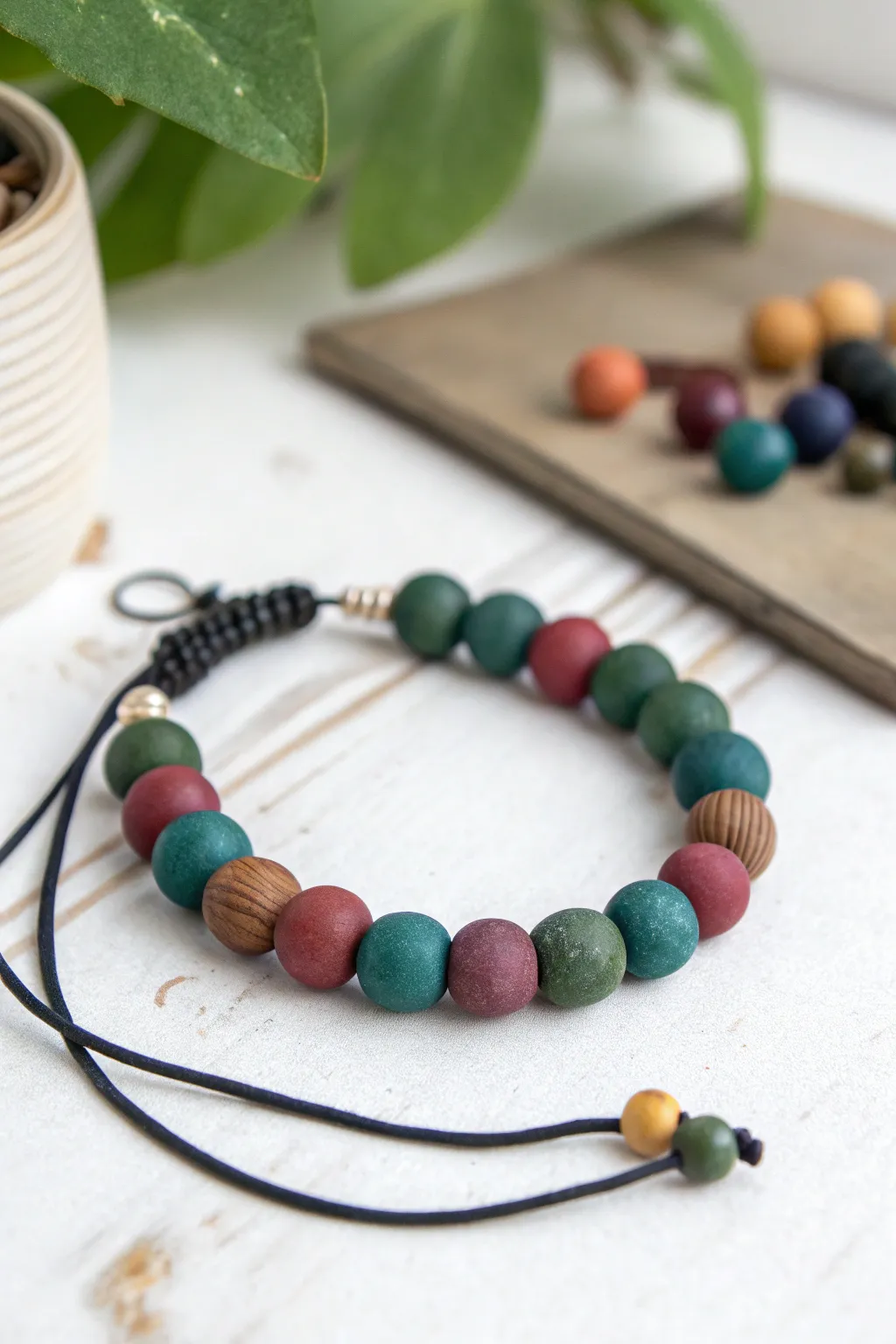
This earthy bracelet combines the rich, muted tones of a forest floor with a clever adjustable closure, proving you don’t need brights or whites to make a statement. The mix of matte clay and wood-texture beads creates a grounded, organic look perfect for everyday wear.
Step-by-Step Tutorial
Materials
- 10mm round polymer clay beads (matte finish: teal, deep red, sage green, forest green)
- 10mm round wood-look beads (or actual wood)
- Small brass or gold spacer bead
- 1mm black waxed cotton or nylon cord
- Scissors
- Lighter (for sealing cord ends)
- Clip or tape (to hold work in place)
Step 1: Preparing the Cord
-
Cut your lengths:
Cut two pieces of your black cord. The first piece (the base strand) should be about 12 inches long. The second piece (for the sliding knot) should be about 10 inches long. -
Create a stopper knot:
Take your longer base strand and tie a simple overhand knot about 3 inches from one end. This will stop your beads from sliding off while you work. -
Thread the accent bead:
Slide the small gold or brass spacer bead onto the cord until it hits your stopper knot. This little metallic touch adds a nice contrast to the matte beads.
Step 2: Stringing the Design
-
Begin the pattern:
Start threading your main beads. Looking at the design, begin with a matte olive green bead, followed by a deep red clay bead. -
Add deep tones:
Next, add a dark teal bead. Follow this with a wood-texture bead to introduce that organic grain into the mix. -
Continue the sequence:
Now thread a muted matte red bead, followed by another teal one. The lack of a strict repeating pattern is what gives this piece its relaxed charm, so don’t worry about being too symmetrical. -
Focus on texture:
Add a purple-mauve bead next, then a speckled sage green bead. I find mixing solid colors with slightly speckled or textured ones adds so much depth. -
Finish the bead row:
Complete your strand with the remaining beads: a teal, a textured brown wood bead, a forest green, a matte red, and finally a deep dark green. You should have about 13-14 beads total. -
Secure the other side:
Tie another overhand knot snugly against the last bead (the dark green one) to lock the entire beaded section in place.
Knot Security
When melting cord ends, use the blue part of the flame. It’s hotter and cleaner, so it won’t leave black soot marks on your nice cord.
Step 3: The Sliding Closure
-
Overlap the ends:
Bring the two tail ends of your bracelet together so they overlap parallel to each other. Temporarily tape or clip these overlapping cords to a table so they stay taut. -
Position the knotting cord:
Take your shorter 10-inch piece of cord and slide it under the two overlapped base cords, centering it. -
Start the square knot:
Take the right end of the knotting cord, pass it over the base cords and under the left knotting cord. Then take the left end, go under the base cords and up through the loop created on the right. -
Tighten and reverse:
Pull both ends tight. Now repeat the process starting with the left side to complete one full square knot. Continue this alternating pattern until you have a closure about 0.5 inches long. -
Seal the closure:
Trim the excess lengths of the knotting cord (not the base cords!) close to the knot. Carefully use a lighter to melt the short stubs and press them against the knot to seal it.
Texture Play
Try sanding a few smooth polymer beads with coarse sandpaper before stringing. It creates a faux-stone texture that matches this earthy vibe perfectly.
Step 4: Final Touches
-
Add end beads:
On the dangling tail ends of the base cord, slide one small bead onto each side. Use a yellow-ochre bead on one and a dark green on the other for variety. -
Knot the tails:
Tie a small knot at the very end of each tail to secure these final beads. Trim any excess cord and carefully singe the tips with your lighter so they don’t fray.
Now slide the adjustable knot to fit your wrist and enjoy your unique, nature-inspired accessory