
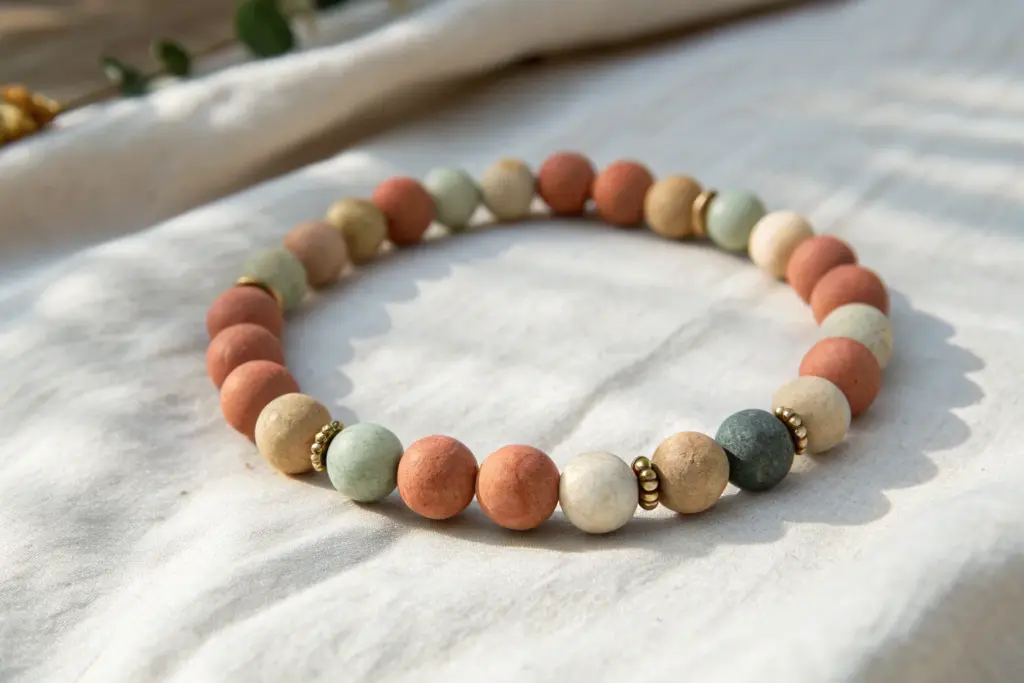
When I’m planning clay bead color combos, I treat it like mixing glazes: a tiny shift in tone can totally change the vibe. These palette ideas are my go-to “color recipes” for heishi bead bracelets that look pulled-together the moment you string them.
Classic Rainbow Order
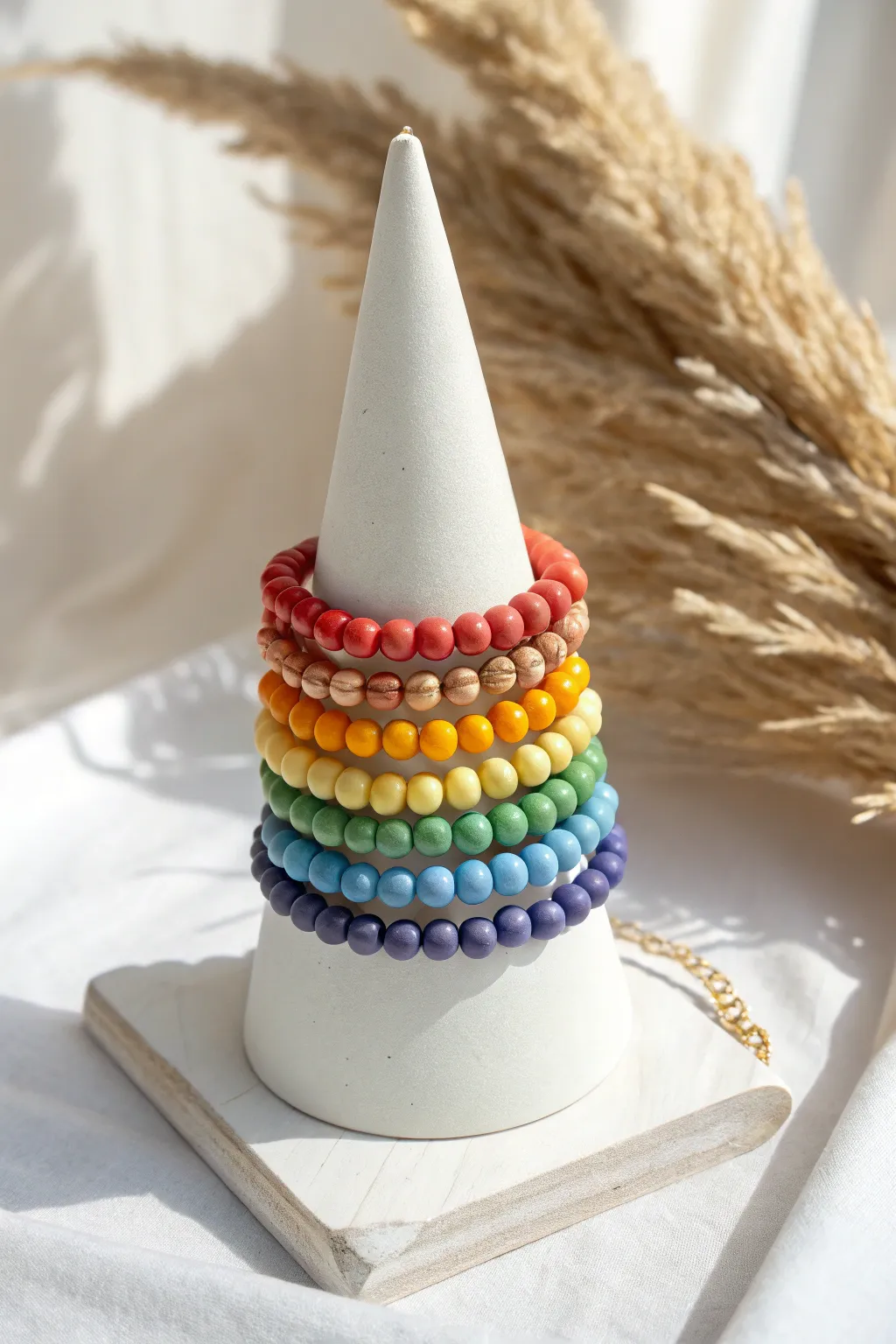
Capture the full spectrum of color with this neatly stacked set of polymer clay bead bracelets. By arranging simple solid-colored beads into distinct bands, you create a cohesive and eye-catching accessory set that looks beautiful worn all together or mixed and matched.
Step-by-Step Guide
Materials
- Polymer clay beads (round, approx. 6mm or 8mm) in: deep red, coral/terracotta, metallic bronze/gold, mustard yellow, bright yellow, pale yellow, lime green, kelly green, sky blue, cornflower blue, royal blue, purple
- Elastic stretch cord (0.8mm or 1mm distinct)
- Super glue or jewelry adhesive
- Scissors
- Bead stopper or tape
- Ruler or tape measure
Step 1: Planning the Palette
-
Organize your spectrum:
Begin by laying out your bead colors in the order shown in the image to visualize the gradient. Start with the deep red at the top, moving through coral, the metallic bronze accent, then the yellows, greens, and finally the blues and purple at the bottom. -
Measure your wrist:
Wrap a measuring tape around your wrist to determine the circumference. Add about 0.5 to 1 inch to this measurement to ensure the bracelets sit comfortably without pinching. -
Prep the cord:
Cut a piece of elastic cord about 10-12 inches long for your first bracelet. I find having plenty of extra slack makes the tying process much less frustrating later on. -
Secure the end:
Place a bead stopper or a piece of masking tape on one end of the cord so your beads don’t slide right off while you work.
Knot Security
Pre-stretch your elastic cord by pulling it firmly a few times before stringing. This prevents the bracelet from sagging or loosening up after you wear it for the first time.
Step 2: Stringing the Set
-
Start with Red:
Begin creating the top bracelet using only the deep red beads. String enough beads to match your measured length. -
Verify the fit:
Wrap the strung beads around your wrist to double-check the sizing before tying. It should feel snug but not tight. -
Tie the knot:
Tie a surgical knot or a square knot. Pull the elastic tight enough that the knot is secure, but be careful not to snap the cord. -
Secure with glue:
Dab a tiny drop of super glue onto the knot. Let it dry for a minute, then trim the excess cord tails close to the knot. If the beads have large enough holes, gently tug the knot inside a bead to hide it. -
Repeat for Warm Tones:
Repeat this entire stringing and tying process for the coral/terracotta beads. -
Add the Metallic Accent:
Create the third bracelet using the metallic bronze or gold beads. This breaks up the rainbow slightly and adds a touch of shine to the stack.
Step 3: Completing the Spectrum
-
String the Yellows:
Make three separate bracelets for the yellow spectrum: one mustard/orange-yellow, one bright sunshine yellow, and one pale pastel yellow. -
Move to Greens:
Create the next two bands using lime green beads followed by a darker kelly green. -
Create the Blue Gradient:
String three separate blue bracelets, starting with a light teal or sky blue, moving to a medium cornflower blue, and finishing with a darker royal blue. -
Finish with Purple:
Complete the set with your final bracelet using the deep purple beads. -
Final Stretch Test:
Once all bracelets are glued and trimmed, give each one a gentle pull to ensure the knots are holding strong before wearing them.
Level Up: Texture Mix
Swap the texture on just one or two strands. Try using frosted glass beads for the blue layer or wooden beads for the yellow layer to add tactile variety to the visual gradient.
Now you have a stunning, versatile stack of bracelets ready to brighten up any outfit
Black-and-White Clean Mix
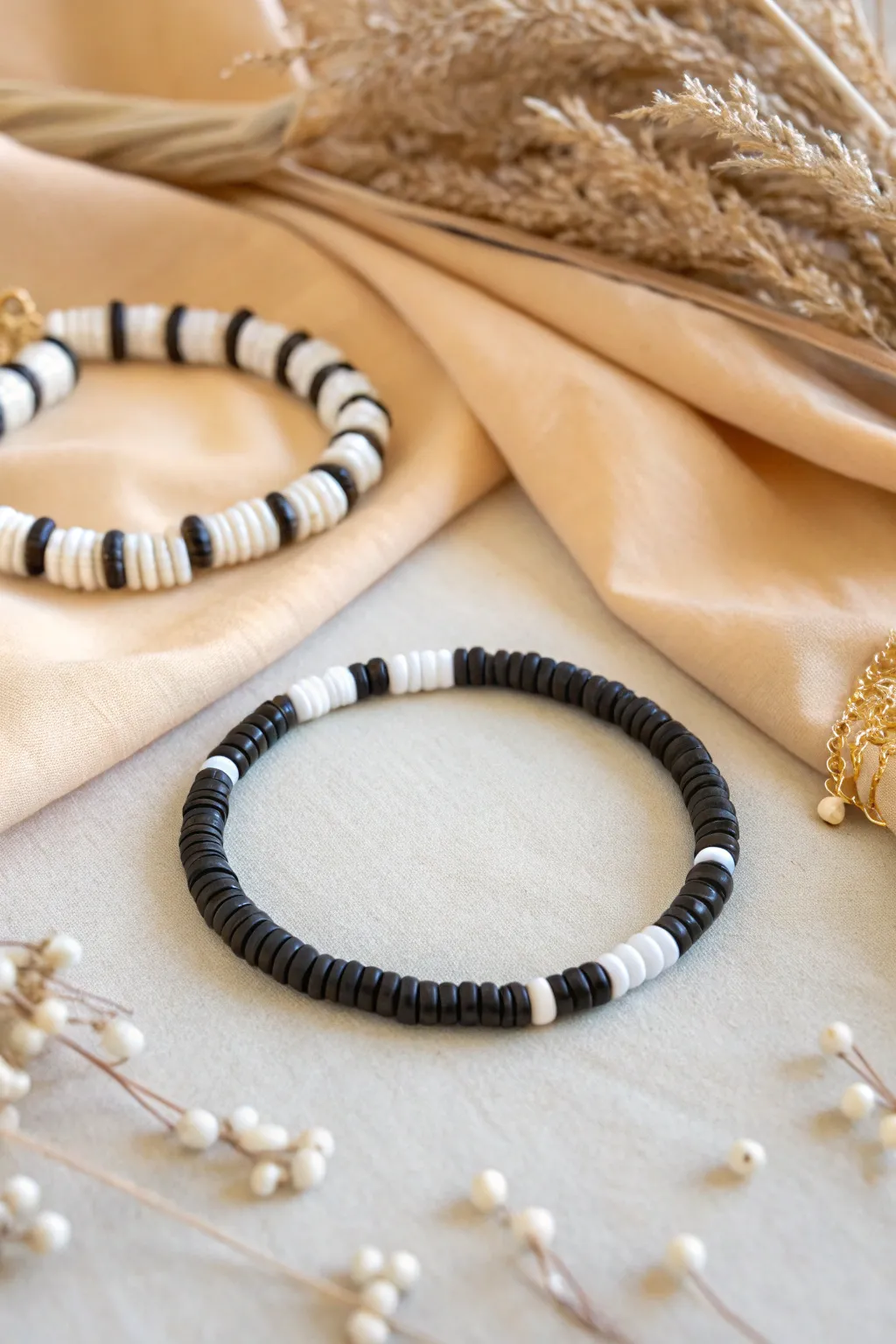
These sleek black-and-white bracelets prove that high contrast is always in style. Using flat polymer clay heishi beads, you can create two distinct yet complementary patterns that look fantastic stacked together or worn individually.
Step-by-Step
Materials
- 6mm flat disc polymer clay beads (Heishi beads) in matte black
- 6mm flat disc polymer clay beads (Heishi beads) in matte white
- 0.8mm clear elastic stretch cord
- Super glue or jewelry cement (e.g., G-S Hypo Cement)
- Scissors
- Bead stopper or masking tape
- Ruler or measuring tape
Step 1: Preparation
-
Measure your wrist:
Wrap a measuring tape loosely around your wrist where you want the bracelet to sit. Add about 0.5 inches to this measurement to ensure a comfortable fit that isn’t too tight. -
Prepare the cord:
Cut a piece of elastic cord about 10-12 inches long. This extra length helps immensely when tying the final knot. -
Secure the end:
Attach a bead stopper to one end of the cord, or simply fold a piece of tape over the end, to prevent your beads from sliding off while you work. -
Pre-stretch the elastic:
Gently pull tightly on the elastic cord a few times. This pre-stretching prevents the bracelet from sagging or loosening immediately after you finish it.
Knot Slipping?
If your elastic is slippery, try a surgeon’s knot instead of a square knot. Be sure to pull the elastic very taut while tightening to lock it in place.
Step 2: Beading the Black Bracelet
-
Start the base:
Begin by stringing a long section of black beads. For the pattern shown, you’ll need roughly 2-3 inches of solid black. -
Add the first accent:
Insert a single white bead to break up the dark color. -
Short black section:
Add about 4-5 black beads immediately after the white one. -
Create the white block:
String 3 white beads in a row to create a bold, bright segment. -
Mirror the pattern:
Add another 4-5 black beads, followed by a single white bead. -
Finish the loop:
Continue adding solid black beads until the strand reaches your desired total length.
Step 3: Beading the White Bracelet
-
Start with pattern blocks:
For the background bracelet, the look is more rhythmic. Start by stringing 5 white beads. -
Add contrast:
Add a single black bead. -
Repeat the sequence:
Continue this alternating pattern: 5 white beads, then 1 black bead. Repeat this sequence until you have nearly covered the length of your cord.
Gold Accent Upgrade
Swap out the single accent beads (the lone white or black ones) for a gold spacer bead to add a touch of luxury to the monochrome palette.
Step 4: Finishing Touches
-
Check the fit:
Wrap the beaded strand around your wrist to verify the size. Add or remove a few base color beads if necessary. -
Tie the knot:
Remove the tape or stopper. Bring both ends together and tie a standard square knot (right over left, left over right). -
Tighten securely:
Pull all four strands (the two loose ends and the two bracelet sides) firmly to tighten. This is where I like to check that no gaps are showing between beads. -
Secure with glue:
Apply a tiny dot of jewelry glue directly onto the knot. Let it dry completely according to the glue manufacturer’s instructions. -
Trim excess:
Once the glue is dry, use your scissors to snip off the excess cord as close to the knot as possible, then tuck the knot inside a neighboring bead hole to hide it.
Enjoy mixing and matching your new monochrome stack with any outfit
Neutrals With a Pop Color
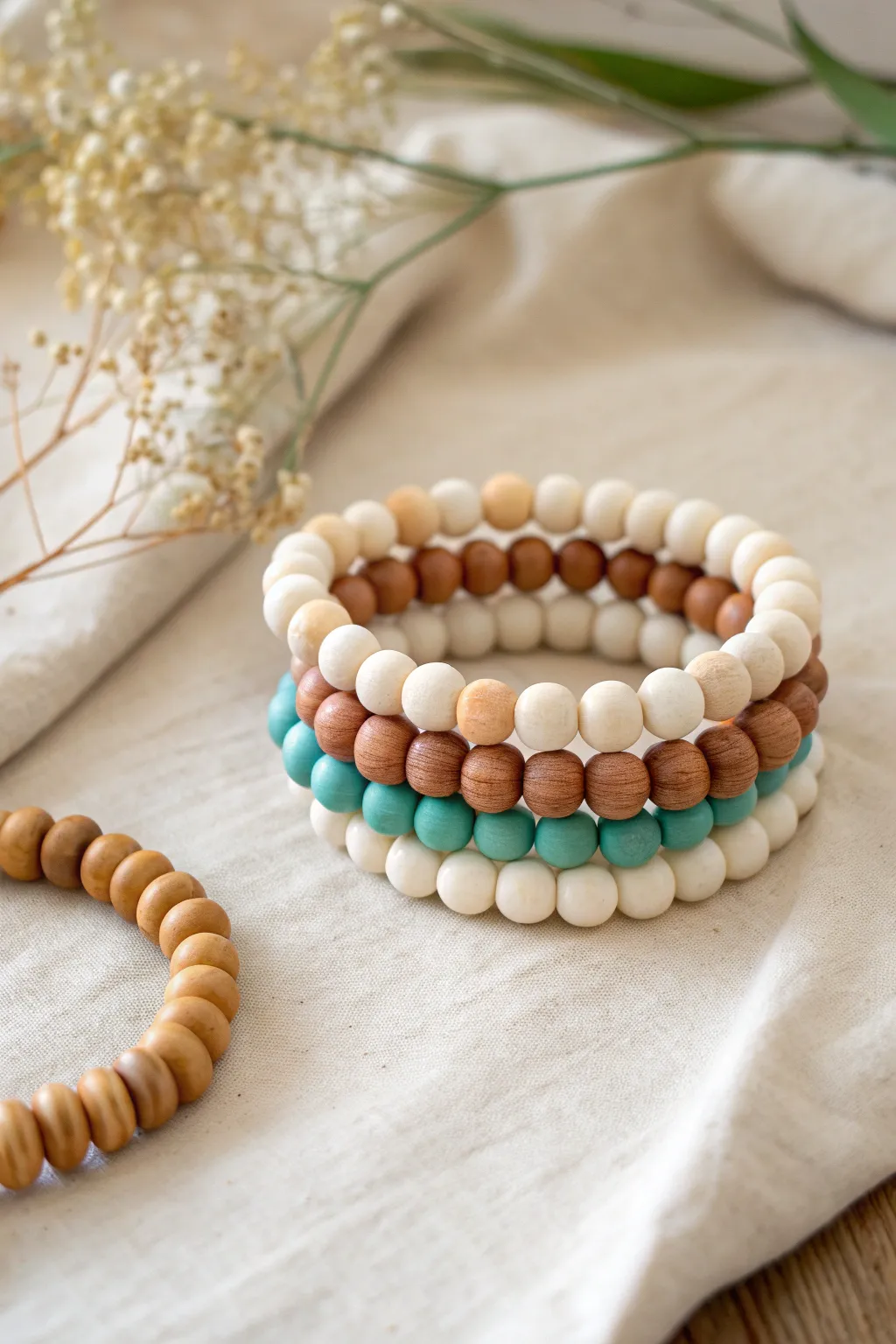
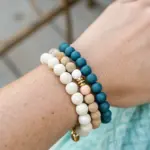
This serene bracelet stack combines the earthy warmth of natural wood with the cool freshness of teal, all grounded by creamy off-white tones. It’s the perfect example of how a single pop of color can elevate neutral textures into a chic, everyday accessory set.
Step-by-Step Guide
Materials
- Round wooden beads (approx. 8-10mm) in medium walnut stain
- Round wooden beads (approx. 8-10mm) in raw/blonde finish
- Round matte acrylic or coated wood beads in teal/turquoise (8-10mm)
- Round wooden beads in cream/off-white (8-10mm)
- Strong elastic cord (0.7mm or 0.8mm)
- Jewelry glue or clear nail polish
- Scissors
Step 1: Preparation
-
Measure your wrist:
Before you begin, wrap a piece of string around your wrist to find a comfortable fit. Add about half an inch to this measurement so the bracelets can roll on easily. -
Pre-stretch the elastic:
Cut three lengths of elastic cord, each about 10-12 inches long. Give each piece a few firm tugs to pre-stretch it; this prevents the bracelets from sagging later on.
Knot Hiding Trick
If your bead holes are too small to hide the knot, try threading the elastic through the last bead twice before tying. This often pulls the knot partially inside automatically.
Step 2: Creating the Cream & Wood Foundation
-
Start the cream strand:
Secure one end of an elastic cord with a bead stopper or a piece of tape. Begin threading the cream-colored wooden beads onto the cord. -
Add accent beads:
To mimic the top bracelet in the stack, create a subtle pattern. Thread about 15-20 cream beads, then interrupt them with 3-4 raw blonde wood beads in a row. -
Finish the pattern:
Continue with more cream beads until you reach the desired length. The variation in wood tones adds a lovely organic feel. -
Check the fit:
Wrap the unfinished strand around your wrist to ensure it sits comfortably without pinching. -
Tie the knot:
Tie a surgical knot (left over right, right over left) or a strong square knot. Pull it very tight. -
Secure and trim:
Dab a tiny drop of jewelry glue on the knot and let it dry. Trim the excess cord ends close to the knot, then hide the knot by sliding it inside a nearby bead hole.
Scent Your Stack
Since you are using unfinished wooden beads, drop different essential oils onto the raw wood beads. They act as a natural diffuser and carry the scent all day.
Step 3: Building the Mixed Stack
-
Design the middle layer:
For the middle bracelet, you will mix textures. Thread your medium walnut wood beads for about half the length of the bracelet. -
Incorporate the pop color:
Switch to the teal beads for the second half. Alternatively, you can alternate sections of 5 brown beads and 5 teal beads for a more integrated look. -
Secure the second strand:
Tie off this second bracelet using the same strong knotting and gluing method as the first. -
Create the bottom anchor:
For the bottom bracelet shown in the stack, use a mix of the teal beads and cream beads. -
Arrange the pattern:
Thread a long section of teal beads, followed by a section of cream beads. This creates a color-blocked effect when worn. -
Final assembly:
Tie, glue, and trim this final strand. Try stacking them in different orders to see which arrangement highlights the teal best.
Step 4: Bonus Strand (Optional)
-
The segmented look:
Looking at the bracelet in the bottom left, you can create a fourth strand using flatter, disc-shaped wooden beads or by grouping round beads tightly. -
Grouping beads:
Use the medium walnut wood beads entirely for this one to add a solid, dark anchor to your light and airy stack.
Stack these beauties together or mix and match them with gold bangles for a sophisticated coastal vibe
Sunset Fade
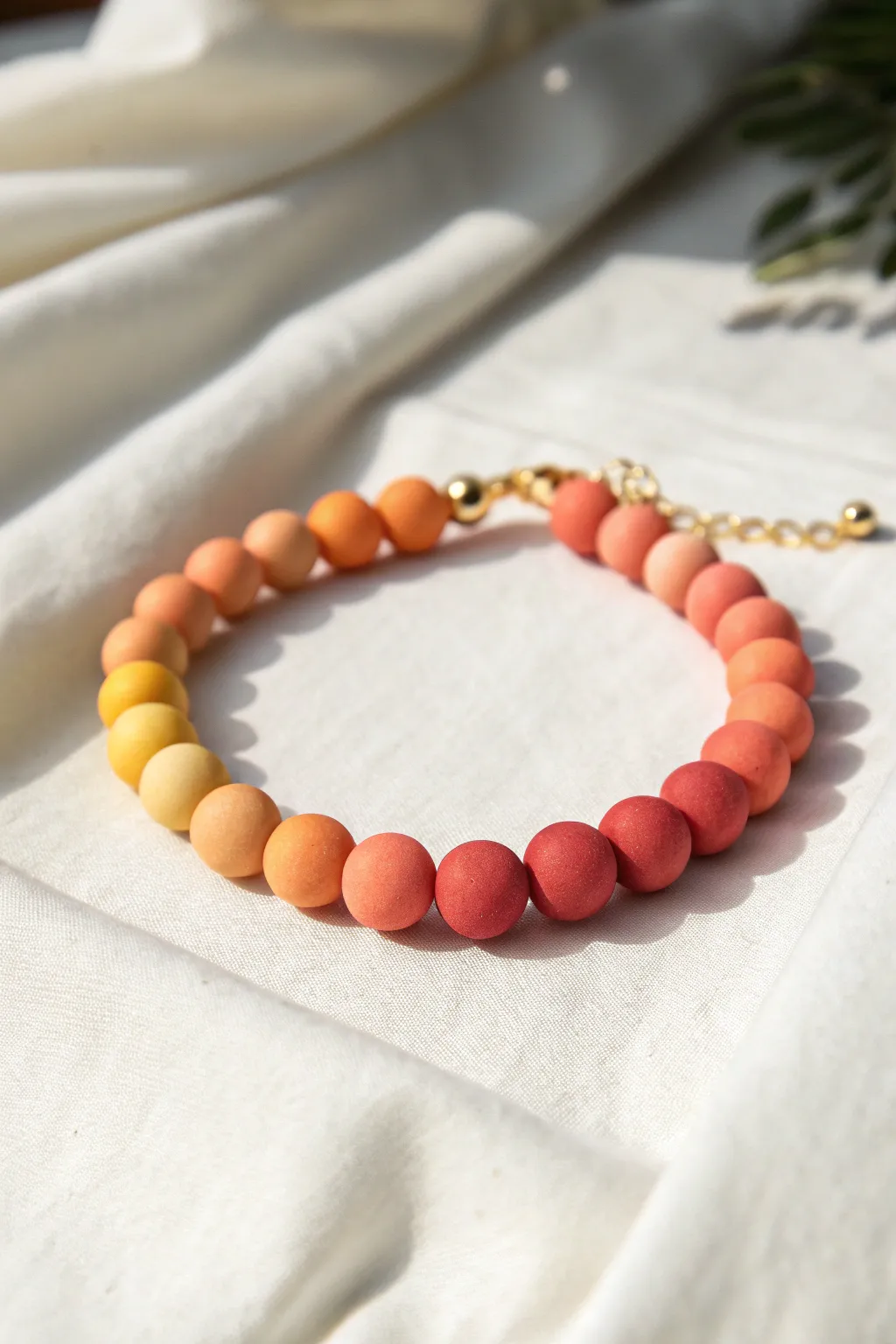
Capture the warmth of the setting sun on your wrist with this radiant polymer clay bead bracelet, featuring a seamless gradient from soft butter yellow to deep rust red. The matte finish of the clay gives it a modern, sophisticated texture that elevates the simple beaded design.
Step-by-Step
Materials
- Polymer clay in 5 shades: pale yellow, golden yellow, light orange, dark orange, Rust red
- Bead roller tool (optional but helpful for uniform size)
- Beading needle
- Gold finish lobster clasp
- Gold finish extension chain
- 2 Gold crimp beads
- 2 small Gold clam shell bead tips (or calottes)
- Strong beading wire (e.g., Tigertail)
- Flat nose pliers
- Wire cutters
- Oven for baking clay
- Toothpick or bead piercing pin
Step 1: Crafting the Clay Beads
-
Conditioning the clay:
Start by warming up your polymer clay in your hands. Knead each color separately until it is soft and pliable, ensuring there are no air bubbles trapped inside. -
Portioning the clay:
Pinch off small, equal-sized pieces of clay from each color block. Aim for pieces that are roughly the size of a pea. You will need about 5-6 beads of each color for a standard wrist size. -
Rolling the spheres:
Roll each piece of clay between your palms or use a bead roller to create smooth, perfect spheres. I find using a clear acrylic block over the balls on a flat surface helps get them perfectly round. -
Creating the piercings:
Gently hold a clay sphere without squishing it and use a toothpick or bead pin to pierce a hole straight through the center. While the bead is still on the pin, give it a tiny roll to smooth out the entry and exit points. -
Baking the beads:
Arrange your raw beads on a baking sheet lined with parchment paper or a ceramic tile. Bake them according to the package instructions for your specific brand of polymer clay (usually 275°F/135°C for 15-30 minutes). -
Cooling down:
Once baked, turn off the oven and let the beads cool completely before handling them. They harden fully as they cool.
Step 2: Stringing the Gradient
-
Planning the layout:
Lay your cooled beads out on a bead board or soft cloth. Arrange them in the gradient order shown: Pale Yellow -> Golden Yellow -> orange -> Deep Orange -> Rust Red -> Deep Orange -> Orange -> Golden Yellow -> Pale Yellow. This creates a mirrored sunset effect. -
Preparing the wire:
Cut a length of beading wire approximately 9-10 inches long to give yourself plenty of room to work. -
Starting the strand:
Thread one end of the wire through a bead tip (clam shell) and then a crimp bead. Flatten the crimp bead securely with pliers, trim the excess wire, and close the clam shell over the crimp. -
Stringing the beads:
Thread your beads onto the wire following your laid-out pattern. Check the length against your wrist as you go; add or remove beads from the ends to adjust the size. -
Testing the fit:
Wrap the unfinished strand around your wrist to ensure the gradient sits where you want it. Usually, the darkest red looks best centered on top of the wrist.
Fingerprint Problems?
If you see fingerprints on your raw clay beads, lightly brush them with a little cornstarch or baby powder before baking to smooth the surface.
Step 3: Finishing Touches
-
Securing the end:
Once all beads are strung, thread the open end of the wire through the second bead tip and a final crimp bead. -
Tightening the wire:
Pull the wire taut so there are no gaps between the beads, but not so tight that the bracelet becomes stiff. It needs a little flexibility to drape comfortably. -
Crimping off:
Flatten the final crimp bead very close to the beads, trim the excess wire with your flush cutters, and close the clam shell over the crimp. -
Attaching the hardware:
Use your pliers to open the small loop on one clam shell and attach the lobster clasp. Close the loop securely. -
Adding the chain:
On the other end, attach the extension chain to the clam shell loop. This allows for adjustable sizing and adds a nice decorative dangle.
Pro Tip: Custom Colors
Can’t find the perfect transition shade? Create intermediate colors by mixing equal parts of your two neighboring clay colors together.
Now you have a stunning accessory that carries the glow of golden hour with you all day long

The Complete Guide to Pottery Troubleshooting
Uncover the most common ceramic mistakes—from cracking clay to failed glazes—and learn how to fix them fast.
Ocean Blues and Seafoam
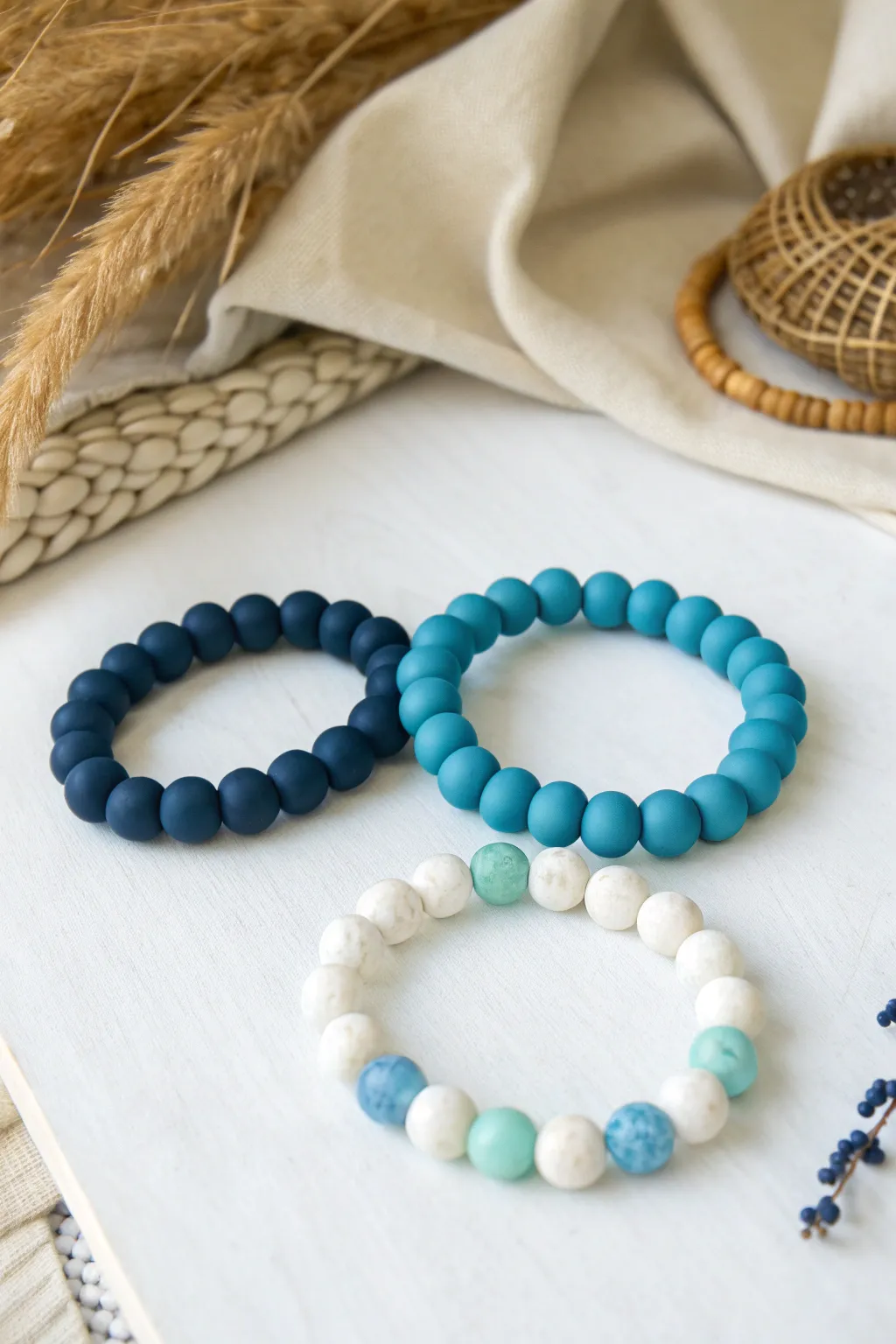
Capture the soothing essence of the seaside with this trio of bracelets featuring deep navy, vibrant turquoise, and a speckled sandy-white mix. These matte-finish beads evoke sea glass and ocean depths, creating a stack that feels both grounded and refreshing.
Step-by-Step Tutorial
Materials
- Matte finish round beads (10mm or 12mm) in Dark Navy Blue silicone or stone
- Matte finish round beads (10mm or 12mm) in Turquoise/Teal silicone or stone
- Textured round beads (10mm or 12mm) in White/Cream ‘lava stone’ or speckled ceramic
- Accent beads (10mm or 12mm) in Aqua Blue and darker Blue speckled/variegated stone
- Strong elastic cord (0.8mm or 1.0mm clear stretch cord)
- Scissors
- Bead stopper or sturdy tape
- Jewelry glue or clear nail polish (optional)
Step 1: Preparation
-
Measure your wrist:
Wrap a piece of string around your wrist to find your size, then add about half an inch for a comfortable fit. Cut three lengths of elastic cord, each about 3-4 inches longer than your measurement to allow ample room for tying knots. -
Secure the ends:
Place a bead stopper or a piece of tape on one end of each cord segment. This little trick saves you from the frustration of beads sliding right off while you work.
Knot Slipping?
If your elastic knot feels loose, try ‘pre-stretching’ the cord before you string beads. Pulling it taut a few times removes slack and helps knots bite tighter.
Step 2: The Deep Ocean Bracelet
-
Select your navy beads:
Gather your dark navy blue matte beads. These have a uniform, solid color that anchors the set visually. -
String the beads:
Thread the navy beads onto your first cord one by one until you reach your desired length. Check the fit by wrapping it around your wrist; the ends should touch without stretching. -
Tie the knot:
Remove the stopper and bring the two ends together. Tie a standard surgeon’s knot (right over left, left over right, looping the top strand through twice) and pull tight. -
Secure and trim:
Dab a tiny drop of jewelry glue on the knot for extra security. Once dry, snip the excess cord close to the knot and gently pull a nearby bead over the knot to hide it.
Step 3: The Teal Tides Bracelet
-
Choose the turquoise beads:
Pick out your bright turquoise or teal matte beads. This color provides the pop that mimics tropical waters. -
String and check:
Repeat the stringing process with these teal beads. I generally like to check the length against the first bracelet to ensure they are consistent in size. -
Finish the second strand:
Tie off this bracelet using the same surgeon’s knot technique, apply glue, and conceal the knot inside a bead bead hole if possible.
Level Up: Scent Diffuser
Use unfinished wood or genuine lava stone for the white beads. You can then add a drop of essential oil to them, turning your stack into a wearable diffuser.
Step 4: The Sandy Shores Mixed Bracelet
-
Design the pattern:
Lay out your white textured beads and your blue/aqua accent beads on a flat surface. Create a pattern where the colored beads are interspersed among the white ones—for example, five white beads, then one aqua, then five white, then one blue. -
Start stringing:
Begin threading your pattern onto the final cord. Pay attention to the spacing so the colored accents will sit comfortably apart when worn. -
Adjust the accents:
If you notice the colored beads are clustering too much on one side, adjust your count of white spacer beads to balance the look. -
Final knotting:
Tie your final surgeon’s knot securely. The textured beads often have slightly larger holes, making it easier to hide your knot inside. -
Final stretch test:
Give each finished bracelet a gentle experimental tug to ensure the knots are holding firm and the elastic has settled.
Enjoy styling your new ocean-inspired stack with your favorite summer outfits
Watermelon Brights
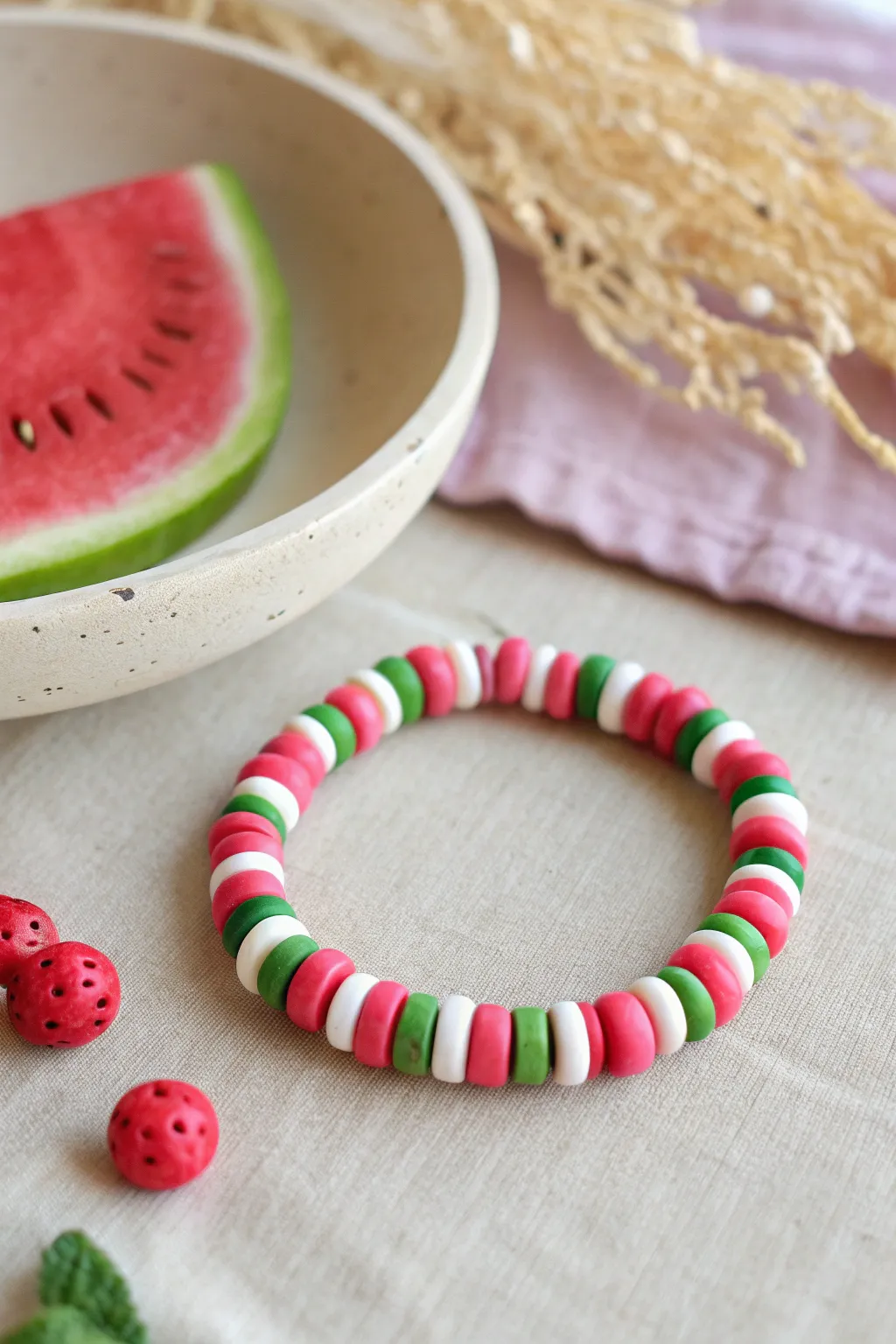
Capture the refreshing vibe of a summer picnic with this vibrant watermelon-themed bracelet. Using a repeating pattern of bold pink, crisp white, and grassy green, this accessory adds a juicy pop of color to any wrist stack.
Detailed Instructions
Materials
- Polymer clay heishi beads (hot pink/watermelon red)
- Polymer clay heishi beads (white)
- Polymer clay heishi beads (kelly green)
- Elastic stretch cord (0.8mm or 0.5mm)
- Super glue or jewelry cement
- Scissors
- Bead stopper or masking tape
Step 1: Preparation
-
Measure your wrist:
Wrap a piece of string or a soft measuring tape around your wrist to find your size. Add about half an inch to this measurement for a comfortable fit. -
Cut the cord:
Cut a length of elastic cord about 10-12 inches long. This extra length makes tying the knot much easier later on. -
Pre-stretch the elastic:
Hold both ends of the cord and give it a few gentle tugs. Pre-stretching prevents the bracelet from sagging or loosening after you start wearing it. -
Secure the end:
Place a bead stopper on one end of the cord, or tape it down to your table with masking tape so your beads don’t slide off while you work.
Clean Cuts
When trimming the elastic, use sharp precision scissors. Dull scissors can fray the cord, making it harder to hide the knot inside a bead hole.
Step 2: Creating the Pattern
-
Study the sequence:
Looking closely at the design, the pattern mimics a watermelon slice: a thick section of pink (the fruit), followed by white (the rind), and green (the skin). -
Start with pink:
Thread on two hot pink heishi beads. This establishes the main color of the fruit flesh. -
Add the rind:
Slide on one white bead. The white separates the vibrant colors and really makes the pattern pop. -
Add the skin:
Thread one green bead next. This completes a single ‘slice’ sequence. -
Repeat the unit:
Continue this specific pattern: two pinks, one white, one green. I find it helpful to say the colors out loud as I go to keep the rhythm. -
Check for consistency:
Every few inches, pause and scan your strand. Ensure you haven’t accidentally skipped a white bead or doubled up on green. -
Check the length:
Occasionally wrap the beaded strand around your wrist to check the fit. Stop adding beads when the ends meet comfortably. -
Ending the pattern:
Try to finish your strand so the pattern loops continuously. For example, if you started with pink, try to end with a green bead.
Step 3: Finishing Up
-
Prepare to tie:
Remove the bead stopper or tape. Hold both ends of the elastic carefully so no beads escape. -
Tie the first knot:
Cross the ends and tie a simple overhand knot. Pull it tight, eliminating any gaps between beads. -
Secure with a surgeon’s knot:
Tie a second knot, but loop the end through twice before pulling tight. This creates a surgeon’s knot which is much more secure for elastic. -
Reinforce the knot:
Apply a tiny drop of super glue or jewelry cement directly onto the knot. Be careful not to glue the beads to the cord. -
Let it dry:
Allow the glue to dry completely according to the package instructions before handling. -
Hide the knot:
Trim the excess cord ends close to the knot. Then, gently tug the bracelet to slide the knot inside the hole of a nearby bead to hide it.
Add Some Seeds
Swap one pink bead for a black bead occasionally to mimic watermelon seeds, or add a gold spacer bead between the green and pink for sparkle.
Enjoy wearing your fresh and fruity accessory all summer long

What Really Happens Inside the Kiln
Learn how time and temperature work together inside the kiln to transform clay into durable ceramic.
Cotton Candy Swirl
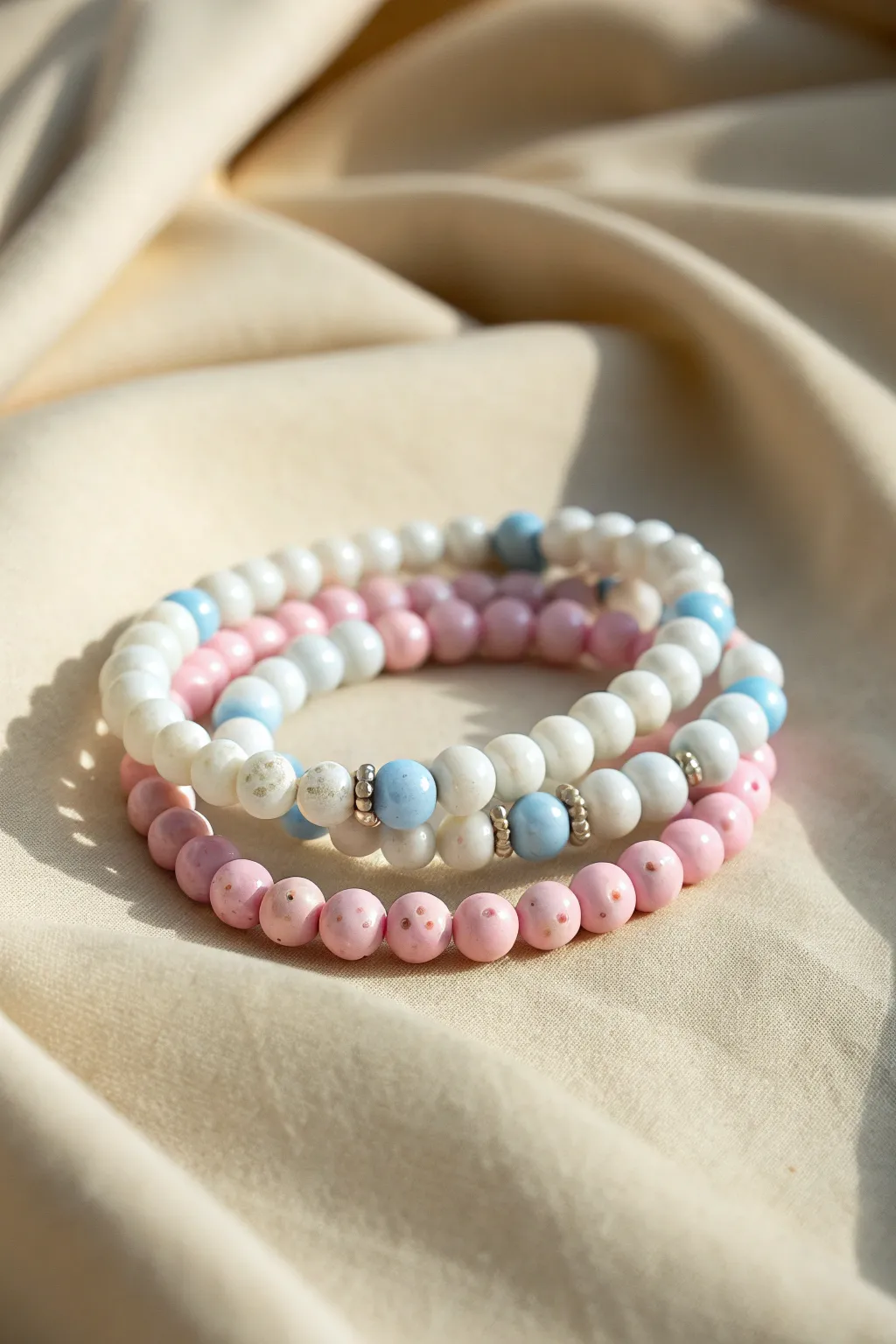
Evoke the sweetness of a summer carnival with this delightful stack of three beaded bracelets featuring a soft palette of matte pink, serene blue, and creamy white. This ‘Cotton Candy Swirl’ set combines simple stringing patterns with elegant silver accents for a playful yet polished accessory.
How-To Guide
Materials
- 8mm round clay or ceramic beads (Matte Pink)
- 8mm round clay or ceramic beads (Creamy White)
- 8mm round clay or ceramic beads (Pastel Blue)
- Silver tone spacer beads (daisy or rondelle style)
- Strong elastic beading cord (0.8mm or 1mm)
- Bead stopper or masking tape
- Scissors
- Hypo cement or clear jewelry glue
Step 1: Preparation
-
Measure and Cut:
Cut three lengths of elastic cord, each about 10-12 inches long. This generous length makes tying the final knots much easier. Pre-stretch the elastic by giving it a few gentle tugs to prevent the bracelet from loosening later. -
Secure the End:
Attach a bead stopper or simply place a piece of folded masking tape on one end of each cord to prevent your beads from sliding off while you design.
Knot Slipping?
If your elastic knot won’t hold tight, try a standard square knot but loop the elastic through twice on the second pass before pulling tight.
Step 2: Creating the Pink Solid Bracelet
-
String Pure Pink:
For the bottom bracelet in the stack, thread on approximately 22-24 matte pink beads. This number will vary based on your wrist size, so wrap it around your wrist periodically to check the fit. -
Check Consistency:
Before tying, look over your beads to ensure none are chipped or misshapen, as the solid color makes imperfections more noticeable. -
Tie it Off:
Secure the bracelet with a surgeon’s knot (right over left, then left over right twice). Pull tight, add a dab of glue to the knot, let it dry, and trim the excess cord.
Step 3: Creating the Blue & White Accent Bracelet
-
Start the Pattern:
For the middle bracelet, begin by stringing approximately 10-12 creamy white beads to form the back section of the bracelet. -
Build the Focal Section:
Now, create the detailed front section. Add one silver spacer, one pastel blue bead, and another silver spacer. This frames the color beautifully. -
Add White Separators:
Thread on two creamy white beads next. -
Repeat the Accent:
Add another silver spacer, a pastel blue bead, and a silver spacer. Follow this immediately with two more white beads. -
Finish the Pattern:
Complete the focal pattern with a final set: silver spacer, blue bead, silver spacer. Then fill the rest of the cord with white beads until it matches the length of your pink bracelet. -
Secure the Knot:
Tie off this bracelet using the same surgeon’s knot technique, glue, dry, and trim.
Hide Imperfections
Use a bead reclamer or large-hole crimp cover over the knot if you can’t pull it inside a bead. It looks like a decorative silver bead!
Step 4: Creating the Mixed Mix Bracelet
-
Plan the randomness:
For the top bracelet, you want a more organic feel. Prepare a mix of mostly white beads, with a handful of pink and blue beads ready to grab. -
String Sections:
Start with a section of 4-5 white beads. Then add a small cluster of color, such as two pinks followed by a blue. -
Vary the Rhythm:
Continue stringing, but switch up the pattern. Maybe do three white beads, then one pink, then four white beads, then a blue. I find this irregular spacing mimics the swirl of cotton candy best. -
Balance the Colors:
Ensure you have visually balanced the pink and blue accents around the bracelet so one side isn’t too heavy with color. -
Final Finish:
Once the length matches the others, tie your final surgeon’s knot. Apply a tiny drop of glue, wait for it to set, and snip the ends close to the knot. -
Hide the Knots:
If the bead holes are large enough, gently tug the elastic to pull the knots inside a neighboring bead for a seamless professional finish.
Wear your sweet new stack together or share them with friends for a charming accessory upgrade
Lemon and Sky Blue
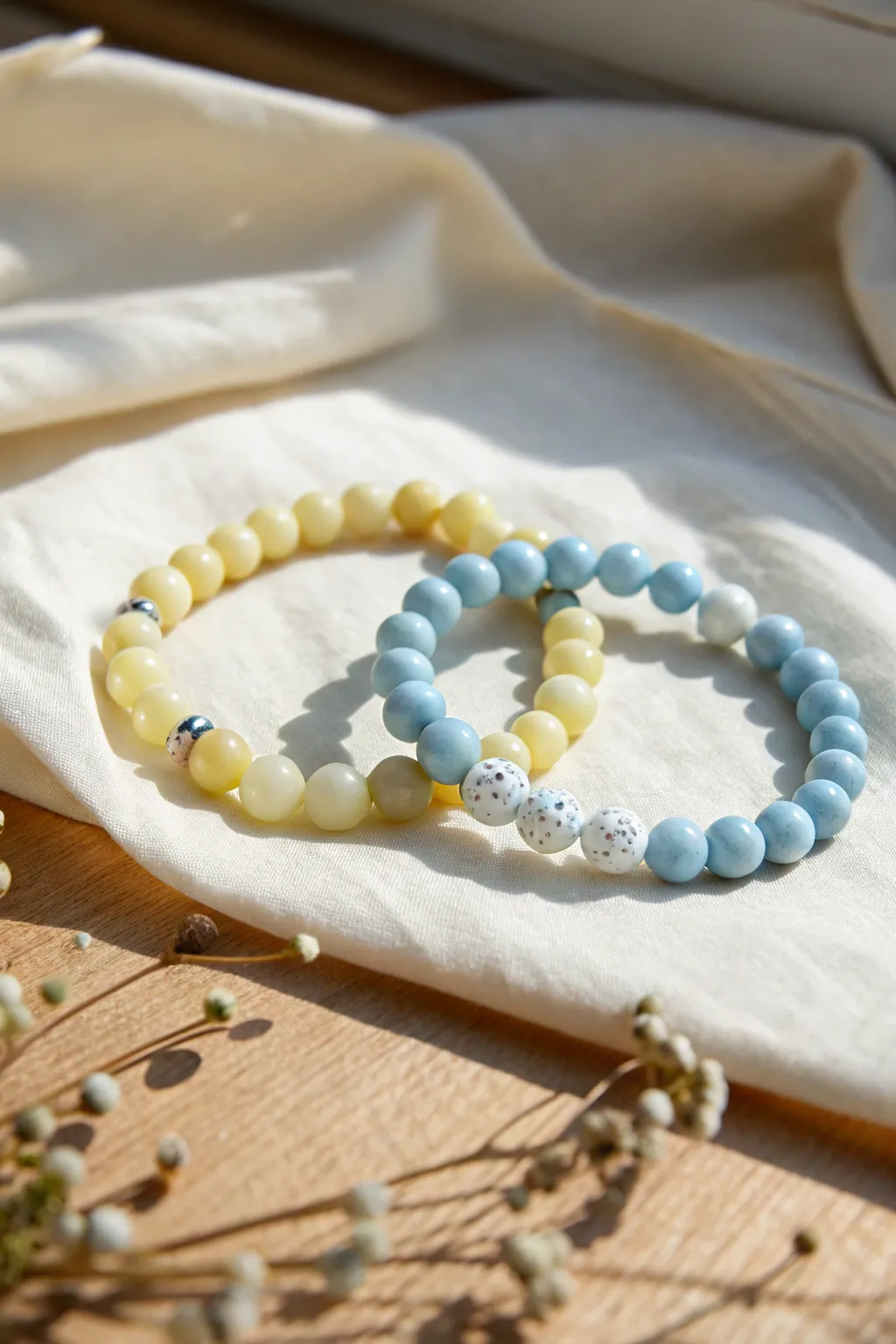
Capture the freshness of a bright summer day with this delightful pair of Lemon and Sky Blue bracelets. The combination of glossy yellow agate-style beads and matte blue stones creates a beautiful textural contrast perfect for stacking.
Step-by-Step Guide
Materials
- 8mm round pale yellow beads (polished agate or jade style)
- 8mm round sky blue beads (matte finish, e.g., matte angelite or turquoise)
- 8mm white splatter/speckled pattern beads (ceramic or stone)
- Small silver spacer beads or crimp covers (optional)
- 0.8mm clear elastic stretch cord
- Jewelry adhesive (e.g., G-S Hypo Cement)
- Scissors
- Clip or tape (to hold the string end)
- Bead design board (optional but helpful)
Step 1: Planning and Stringing
-
Measure your materials:
Cut two lengths of elastic cord, measuring about 10-12 inches each. This gives you plenty of extra room for tying knots later without struggling with short ends. -
Pre-stretch the cord:
Gently pull on your elastic strands a few times. This prevents the bracelet from loosening up or sagging immediately after you wear it for the first time. -
Secure the end:
Attach a bead stopper, a small piece of tape, or a binder clip to one end of your first elastic string to keep the beads from rolling off as you work. -
Design the Lemon bracelet:
For the yellow bracelet, lay out your pale yellow beads on a design board or cloth. Plan to insert two metallic silver spacers or white speckled beads opposite each other for a touch of interest. -
String the Lemon beads:
Thread the yellow beads onto the elastic. I like to double-check the sizing against my wrist halfway through to ensure I don’t need to add or remove a bead. -
Design the Sky Blue bracelet:
For the blue bracelet, select your matte blue beads. Locate three white speckled beads to serve as a focal section. -
String the Sky Blue beads:
Begin threading the blue beads. Place the three speckled beads together in a group, rather than spacing them out, to create the specific look shown in the photo. -
Check the fit:
Wrap both strands around your wrist before tying. They should feel comfortable—not tight enough to leave marks, but not so loose they slide over your hand.
Step 2: Finishing and Tying
-
Prepare the knot:
Remove the tape or clip from the end of the yellow bracelet. Bring both ends of the elastic together carefully. -
Tie a surgeon’s knot:
Cross the ends over each other like a regular knot, but loop the top string through twice before pulling tight. This extra loop adds friction and security. -
Tighten securely:
Pull the elastic ends firmly to cinch the knot. You want the beads to touch snugly, but don’t pull so hard that the elastic puckers or breaks. -
Apply adhesive:
Dab a tiny drop of jewelry glue (like G-S Hypo Cement) directly onto the knot. This is crucial for longevity and prevents the slick elastic from unraveling. -
Let it cure:
Ideally, let the glue dry for at least 15-20 minutes before manipulating the bracelet further. -
Hide the knot:
Once the glue is tacky or dry, gently tug the elastic so the knot slides inside the hole of an adjacent bead. This gives the bracelet a seamless, professional finish. -
Trim the excess:
Using sharp scissors, trim the leftover elastic tail close to the bead hole, being extremely careful not to nick the main cord. -
Repeat for the blue set:
Follow the same tying, gluing, and hiding steps for your Sky Blue bracelet. Enjoy wearing this sunny, calming stack together.
Hiding the Knot
To easily hide the knot, finish your pattern next to a bead with a slightly larger hole size. This makes sliding that bulky knot inside much smoother.
Bead Rolling?
If beads keep rolling away while planning, work on a velvet mat or even a folded towel. The texture grabs the beads so your pattern stays put.
Now you have a refreshing set of bracelets that brings a pop of color to any outfit

TRACK YOUR CERAMIC JOURNEY
Capture glaze tests, firing details, and creative progress—all in one simple printable. Make your projects easier to repeat and improve.
Red, White, and Candy Stripes
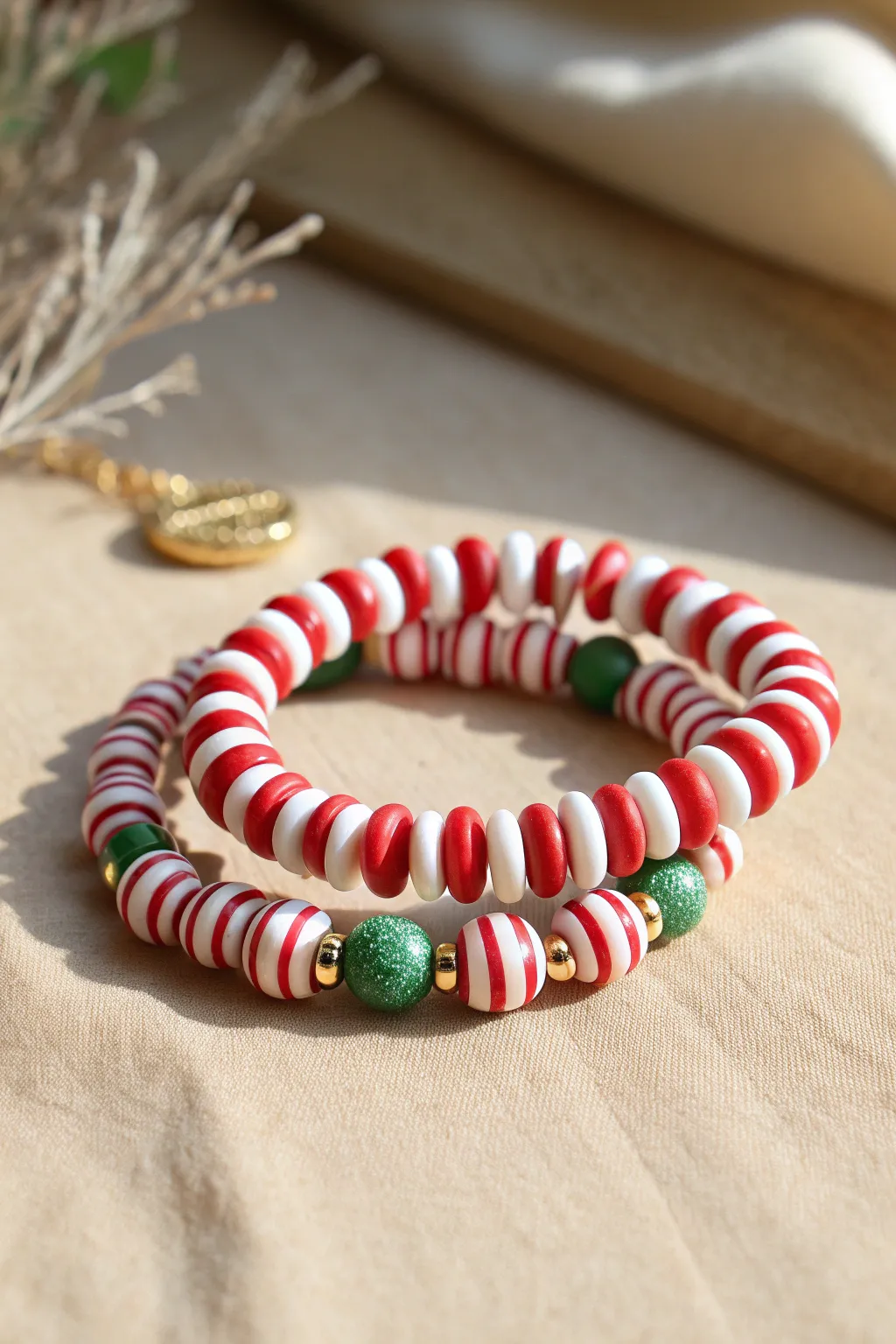
Capture the sweetness of the holiday season with these peppermint-inspired clay bead bracelets. Featuring a festive mix of red, white, and sparkly green, this stacked set mimics the look of classic candy canes and winter treats.
How-To Guide
Materials
- Red polymer clay heishi beads (flat discs)
- White polymer clay heishi beads (flat discs)
- Red and white striped clay beads (candy pattern)
- Green glitter or shimmer round beads (approx. 8-10mm)
- Gold spacer beads (small, round or disc-shaped)
- Elastic stretch cord (0.8mm or 1mm)
- Super glue or jewelry cement
- Scissors
- Bead stopper or tape
- Measuring tape
Step 1: Preparation
-
Measure your wrist:
Wrap a measuring tape specifically around your wrist where you want the bracelets to sit. Add about half an inch to this measurement to ensure a comfortable fit that isn’t too tight. -
Cut the cord:
Cut two lengths of elastic cord, each about 10-12 inches long. This extra length gives you plenty of room to tie secure knots later without struggling. -
Secure the end:
Attach a bead stopper to one end of each cord, or simply tape the end down to your work surface prevents beads from sliding off while you design.
Step 2: Designing the Striped Bracelet
-
Start the pattern:
For the first bracelet, begin by threading on three striped ‘candy’ beads. -
Add gold accents:
Slide on one small gold spacer bead, followed by a large green sparkly bead, and then another gold spacer. These gold touches frame the green focal bead beautifully. -
Repeat the sequence:
Continue this pattern: three striped beads, gold spacer, green bead, gold spacer. Repeat this until you have reached your desired length. -
Check the fit:
Wrap the unfinished strand around your wrist to check the size. Add or remove a pattern repetition if necessary to get the perfect circumference.
Sticky Situations
Use a toothpick to apply the super glue to the knot. This prevents glue from overflowing onto visible beads.
Step 3: Creating the Solid Color Mix
-
Create color blocks:
For the second bracelet, you will focus on alternating solid colors. Thread three solid red heishi beads onto the second cord. -
Add white contrast:
Follow the red section with three solid white heishi beads. This creates a bold, blocky pattern reminiscent of a peppermint stick. -
Incorporate the focal point:
roughly halfway through the strand, break the red-white pattern by adding a gold spacer, a green sparkly bead, and another gold spacer to match the first bracelet. -
Finish the strand:
Resume the alternating pattern of three red beads and three white beads until the second bracelet matches the length of the first one.
Festive Variations
Make matching charms! Add a small gold snowflake or a tiny clay gingerbread man charm to the gold spacer sections.
Step 4: Finishing Touches
-
Pre-stretch the cord:
Before tying, give the ends of the elastic a gentle tug. I find this pre-stretching step crucial because it prevents the bracelet from loosening up the first time you wear it. -
Tie the knot:
Remove the bead stopper and tie a strong surgeon’s knot (right over left, left over right, and loop through again) on each bracelet. -
Secure with glue:
Place a tiny dab of jewelry cement or super glue directly onto the knot. Let it dry for a few minutes to ensure it is completely fused. -
Hide the knot:
Once dry, trim the excess string carefully. If the hole of a nearby bead is large enough, gently tug the knot inside it for a seamless finish.
Stack your new creations together for a double dose of holiday cheer that brightens up any winter outfit
Earthy Boho Blend
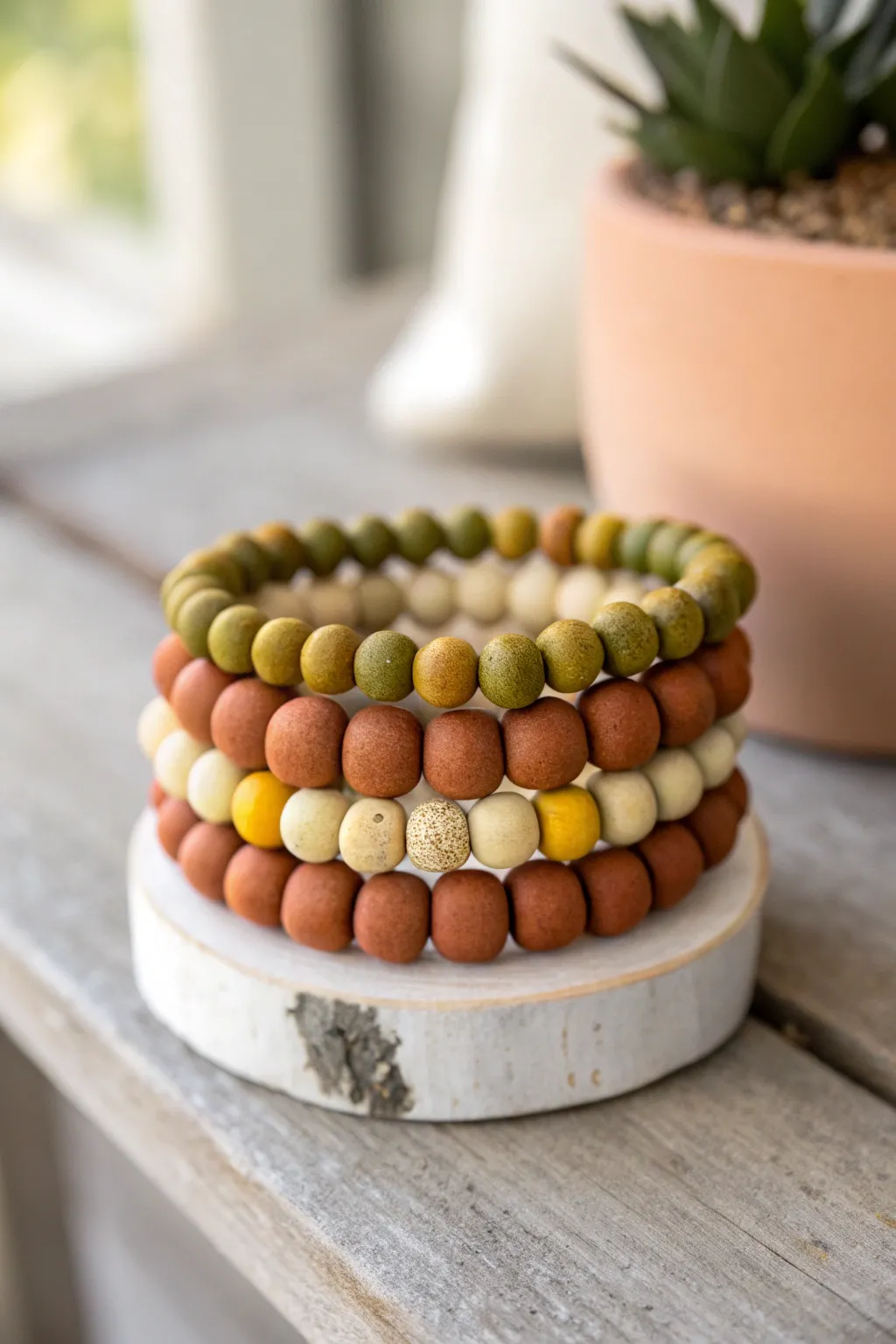
Capture the grounded essence of nature with this beautiful stack of bracelets featuring organic tones like moss green, terracotta, and creamy oat. The variation in bead textures, including the stunning speckled accent bead, creates a cozy, bohemian accessory perfect for everyday wear.
Step-by-Step Tutorial
Materials
- Polymer clay round beads (approx. 8mm) in: Moss Green, Terracotta Brown, Cream/Oat, Mustard Yellow
- Specialty speckled clay bead (round, approx. 8-9mm) for the focal point
- Elastic stretch cord (0.7mm or 0.8mm clear)
- Super glue or G-S Hypo Cement
- Scissors
- Beading needle (optional but helpful)
- Bead tray or soft cloth to work on
- Tape or binder clip
Step 1: Planning Your Palette
-
Sort your beads:
Separate your beads by color into small piles on your bead tray. You will need roughly 25-30 beads per bracelet depending on your wrist size. -
Measure your wrist:
Wrap a flexible measuring tape around your wrist, adding about half an inch for a comfortable fit. -
Pre-stretch the cord:
Cut four lengths of elastic cord, each about 10-12 inches long. Give each piece a few gentle tugs; this pre-stretching prevents the bracelets from stretching out permanently later. -
Secure the ends:
Place a piece of tape or a binder clip on one end of each cord to stop beads from sliding off while you work.
Knot Slipping?
If your elastic knots slip apart, add a second dot of glue later. Let it dry completely tailored to the glue instructions—sometimes 24 hours—before wearing to ensure maximum strength.
Step 2: Creating the Solid Color Layers
-
String the Moss Green strand:
Begin your first bracelet by threading only the moss green beads. Keep checking the length against your wrist measurement until it fits comfortably. -
Tie off the first bracelet:
Remove the tape and tie a surgeon’s knot (right over left, left over right twice). Pull tight to secure. -
String the Terracotta strands:
Repeat the process for the top and bottom terracotta layers. This stack features two distinct bands of that warm, brownish-red hue—one solid band located second from the top, and one comprising the very bottom layer. -
Hide the knots:
Dab a tiny drop of glue on the knots of your finished solid strands. Once dry, tuck the knot inside a neighboring bead hold if possible, then trim the excess cord.
Step 3: Building the Accent Strand
-
Start the third layer:
This fourth bracelet (positioned third from the top in the stack) is the complex one. Start by stringing about 10-12 cream or oat-colored beads. -
Add the first color pop:
Thread on one mustard yellow bead. This acts as a frame for the center section. -
Insert the spacers:
Add two more cream beads next to the yellow one. -
Place the focal bead:
Thread on your special speckled bead. I usually verify this bead has a slightly larger hole to accommodate the knot if needed, but here it serves as the beautiful center star. -
Mirror the pattern:
Continue the pattern in reverse: add two cream beads, then one mustard yellow bead. -
Finish the loop:
Fill the rest of the strand with cream beads until it matches the length of your other three completed bracelets. -
Final assembly:
Tie your surgeon’s knot, glue it securely, and trim the ends carefully once the glue has fully cured.
Level Up: Texture Mix
Swap the solid terracotta beads for unpolished wood beads in the same shade. The mix of smooth polymer clay and rough natural wood creates an even deeper, tactile boho experience.
Stack them all together on your wrist for an effortlessly chic look that brings a touch of nature to any outfit
Moody Forest Greens
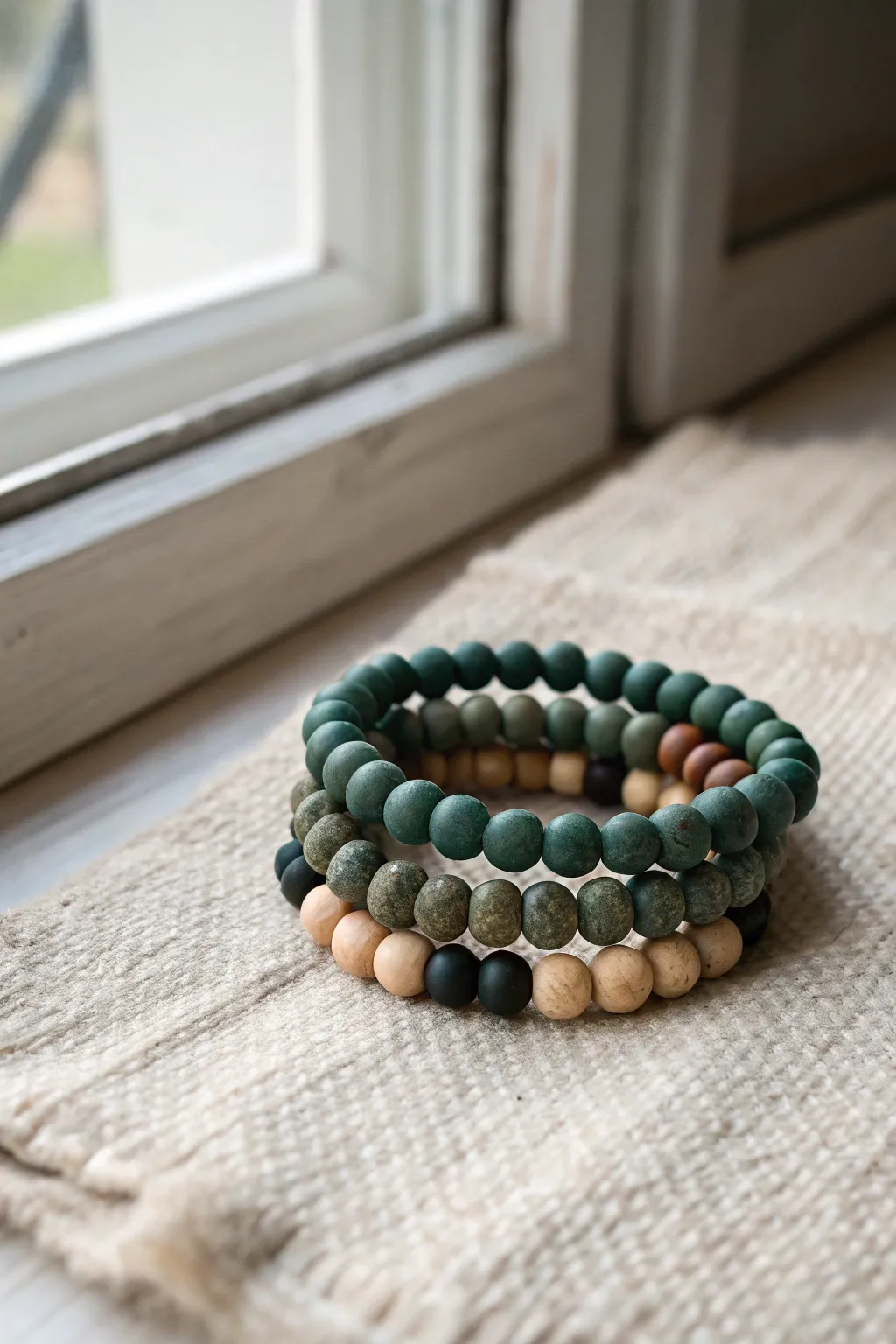
Evoke the quiet serenity of a woodland walk with this stack of three complementary bracelets. Featuring a blend of deep moss greens, earthy timber browns, and smooth cream stones, this accessory set adds a grounded, natural touch to any outfit.
Step-by-Step Guide
Materials
- Matte round beads (8mm) in forest green
- Matte round beads (8mm) in sage or olive green
- Matte round beads (8mm) in speckled/mossy green
- Natural wood beads (8mm) in light cream/beige
- Natural wood beads (8mm) in medium brown
- Matte black onyx or acrylic beads (8mm)
- Strong elastic cord (0.8mm or 1mm)
- Jewelry glue or clear nail polish
- Scissors
- Bead stopper or tape
- Beading needle (optional, for easier threading)
Step 1: Preparation & Design
-
Measure your wrist:
Wrap a measuring tape comfortably around your wrist to determine the circumference. Add about 0.5 inches to this measurement to ensure the bracelets aren’t too tight. -
Sort your palette:
Lay out all your beads on a bead board or a soft cloth. Group them by color: the deep forest greens, the lighter sage tones, the speckled mossy variations, the natural woods, and the singular black accent beads. -
Cut the elastic:
Cut three strands of elastic cord, each about 10-12 inches long. Having extra length makes the final knotting process much less frustrating. -
Secure the ends:
Place a bead stopper or a piece of masking tape on one end of each elastic strand to prevent beads from sliding off while you work.
Knot Security Pro-Tip
Don’t trim your elastic tails flush with the knot immediately! Leave about 1/4 inch of tail. The elastic often retracts slightly as it settles.
Step 2: Bracelet 1: The Deep Green Solid
-
Select primary beads:
For the top bracelet shown in the stack, select your solid matte forest green beads. These will form the majority of the loop. -
String the green section:
Thread approximately 18-20 forest green beads onto the cord, checking the length against your wrist measurement as you go. -
Add the focal accents:
To break up the solid color like the original design, add a small cluster of contrasting beads. Thread two medium brown wooden beads, followed by one single matte black bead. -
Close the loop:
Finish this strand by adding enough green beads to complete the circle, ensuring the pattern matches your size requirements.
Essential Oil Diffuser
Use unfinished wood beads or porous lava stone beads within the stack. Add a drop of cedarwood or pine oil to turn your jewelry into a forest-scented diffuser.
Step 3: Bracelet 2: The Speckled Ombré
-
Establish the gradient:
This middle bracelet relies on texture. Start by threading your speckled mossy green beads. These usually have a rougher, stonelike appearance compared to the smooth matte beads. -
Create the transition:
String about half of the bracelet length with these textured moss beads to create a rugged foundation. -
Inject warmth:
Transition into a section of the lighter sage green beads mixed with 2-3 light cream wood beads. This mimics sunlight filtering through leaves. -
Variation check:
I like to hold this strand next to the first one before tying it off to ensure the colors harmonize without matching perfectly.
Step 4: Bracelet 3: The Earthy Mix
-
Mix materials:
For the bottom bracelet on the stack, you will create a lighter, mixed aesthetic. Alternate between the light cream wood beads and the darkest green beads. -
Create the wood section:
String a distinct section of 5-6 light cream wood beads in a row. This light section brightens the overall look of the stack. -
Add dark contrast:
Follow the wood section with two matte black beads. The stark black against the light wood creates a modern, graphic pop. -
Fill the rest:
Complete the strand using a mix of the speckled moss beads and sage green beads to tie all the elements of the previous two bracelets together.
Step 5: Finishing Touches
-
Pre-stretch the cord:
Before tying, gently stretch each beaded strand a few times. This prevents the elastic from sagging later after you’ve worn it. -
Tie the surgeon’s knot:
For each bracelet, remove the stopper and tie a surgeon’s knot (right over left, left over right, looping the top strand through twice). -
Secure with glue:
Dab a tiny drop of jewelry glue or clear nail polish onto the knot. Let it dry completely before trimming the excess cord. -
Hide the knot:
If the hole of an adjacent bead is large enough, gently tug the elastic so the knot slides inside the bead, hiding it from view.
Wear your new stack together for a rich, layered look or separate them for a subtle touch of nature
Jewel Tones With Cream
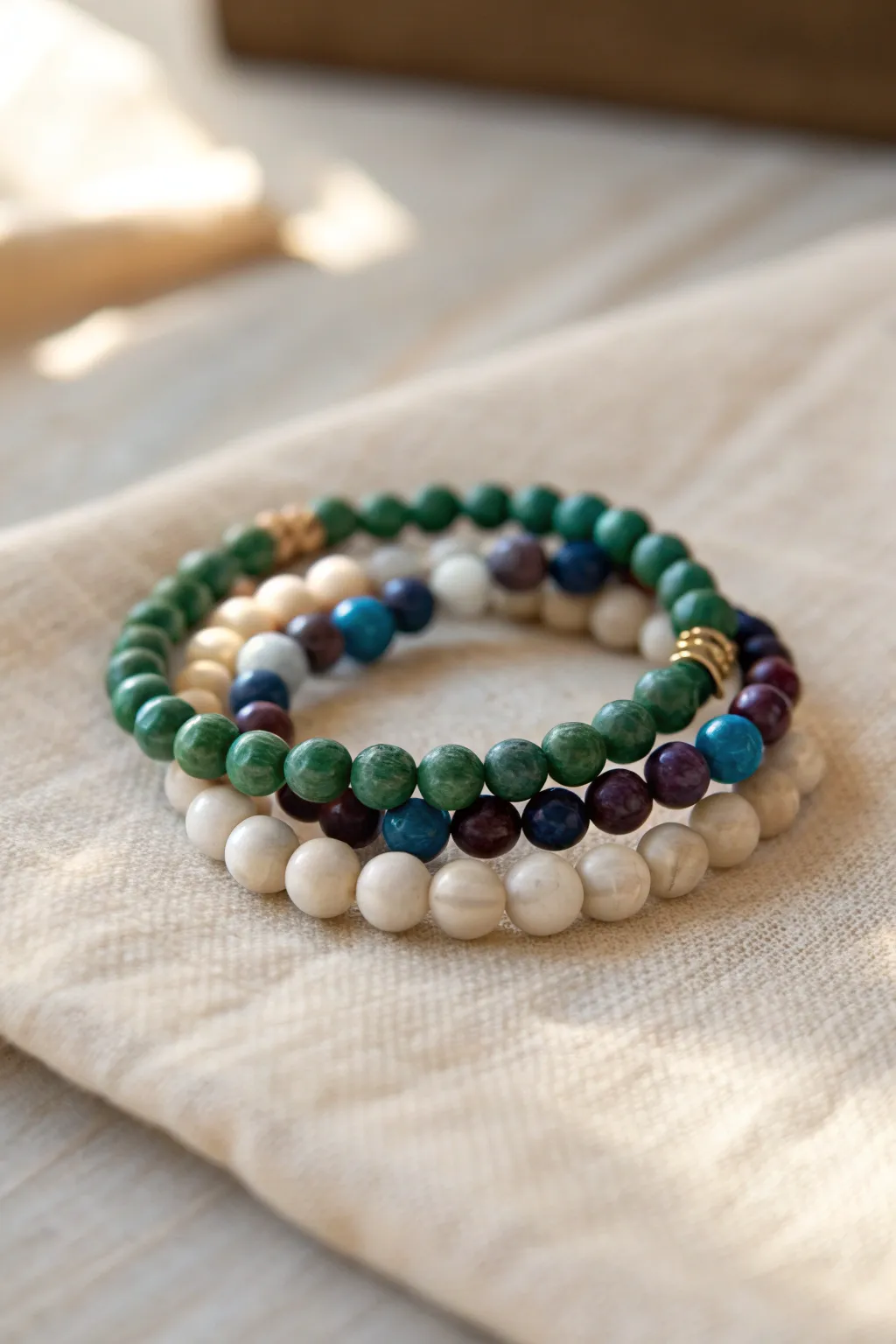
These three stretch bracelets combine the milky softness of cream beads with deep, rich jewel tones like forest green, sapphire, and amethyst. This balanced stack looks elegant worn together but each piece is substantial enough to stand alone.
How-To Guide
Materials
- 8mm round beads in cream (stone or ceramic)
- 8mm round beads in forest green (malachite or jasper)
- 8mm round beads in deep purple (amethyst)
- 8mm round beads in sapphire blue (lapis or agate)
- 8mm round beads in teal/green-blue
- Gold tone twisted spacer rings (approx 4mm thick)
- 0.8mm clear elastic bead cord
- Jewelry glue (like G-S Hypo Cement)
- Scissors
- Bead stopper or tape
Step 1: Planning the Designs
-
Measure your wrist:
Before cutting any cord, wrap a measuring tape around your wrist. Add about half an inch to this measurement for a comfortable fit, then cut three strands of elastic cord, each about 10-12 inches long to give yourself plenty of tying room. -
Secure the ends:
Place a bead stopper or a piece of masking tape on one end of each elastic strand. This simple step prevents your carefully arranged beads from sliding off while you work. -
Sort your palette:
Separate your beads into piles by color. You will need a large pile of the forest green, a moderate pile of cream, and smaller accents of the blue, purple, and teal stones.
Knot Security
When pulling your knot tight, pull on all four strands (the two tails and the two loop sides) to ensusre it is as small and tight as possible before gluing.
Step 2: Creating the Solid Green Bracelet
-
Start the green strand:
For the first bracelet, which acts as a grounding element, thread on roughly 22-24 forest green beads. I like to double-check the length against my wrist periodically to ensure a custom fit. -
Add the focal point:
Once you have enough green beads to almost circle your wrist, slide on three gold twisted spacer rings. These should be grouped together to create a singular metallic focal point. -
Close the loop:
Finish the strand with one or two more green beads to sandwich the gold spacers, ensuring the pattern feels continuous.
Texture Play
Mix bead finishes for more depth. Use matte stones for the green and polished ones for the cream to create a subtle textual contrast.
Step 3: Creating the Mixed Jewel Tone Bracelet
-
Plan the randomness:
The second bracelet relies on an ‘organic’ pattern. You want to mix the jewel tones—purple, sapphire, teal, and green—with the cream beads acting as occasional spacers. -
String the mixed beads:
Begin threading your beads. Alternate between 2-3 jewel tone beads and 1 cream bead. Don’t be afraid to put two dark colors next to each other; the lack of a rigid pattern is what gives this piece its charm. -
Incorporate gold accents:
About halfway through the strand, insert two or three gold twisted spacers. Unlike the green bracelet, you might separate these with a single dark bead for variety.
Step 4: Creating the Cream-Dominant Bracelet
-
Establish the base:
For the final bracelet, cream is the star. Thread mostly cream beads onto your cord, creating sections of about 5-6 white beads at a time. -
Inject color:
Between the long cream sections, add a grouping of 3 mixed jewel tone beads (for example: one blue, one purple, one green). This ties the lightest bracelet back to the darker ones. -
Final sizing check:
Hold all three un-tied strands together around your wrist. Adjust the bead counts now so they all sit comfortably at the same diameter.
Step 5: Finishing Touches
-
Pre-stretch the cord:
Before tying, gently pull on the ends of the elastic cord for each bracelet. This pre-stretching prevents the elastic from sagging or loosening after the first time you wear it. -
Tie the knots:
Remove the bead stoppers. Tie a surgeon’s knot (loop the elastic twice instead of once on the first pass) for each bracelet. Pull the knot tight. -
Secure with glue:
Dab a tiny drop of G-S Hypo Cement or strong jewelry glue onto each knot. Let this sit for at least 10 minutes to become tacky and firm. -
Hide the mechanism:
Once the glue is dry, trim the excess elastic tails close to the knot. If the hole of the adjacent bead is large enough, gently tug the knot inside it to hide it completely.
Stack these beautiful pieces together for an effortlessly chic look that transitions perfectly from day to night
Retro Sorbet Mix
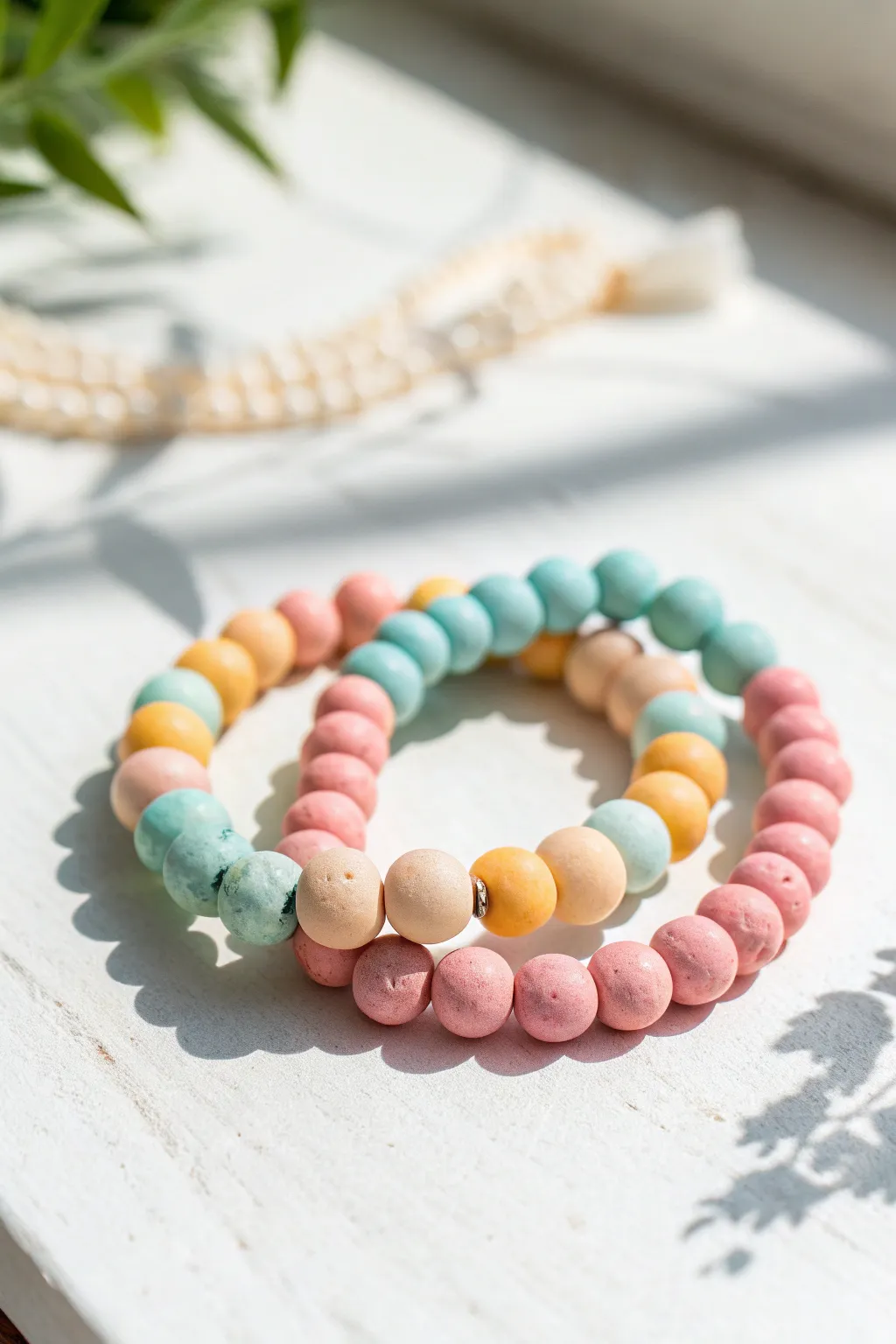
Capture the nostalgic sweetness of a summer treat with these matte clay bead bracelets featuring a soft, muted color palette. The combination of dusty rose, seafoam teal, peach, and mustard yellow creates a perfectly balanced “Retro Sorbet” aesthetic.
Step-by-Step Guide
Materials
- Matte round clay or ceramic beads (8mm or 10mm)
- Colors needed: Dusty Rose/Pink, Seafoam Teal/Mint, Mustard Yellow, Peach/Light Orange, Cream/Beige
- Strong elastic cord (0.8mm or 1mm thickness)
- Jewelry glue or clear nail polish
- Scissors
- Bead stopper or tape
- Small metal spacer beads (optional, silver or gold)
Step 1: Planning Your Palette
-
Analyze the pattern:
Before stringing, lay your beads out on a bead board or soft cloth. Notice carefully that these bracelets aren’t random; they use color blocking. One bracelet is dominant in pinks, while the other mixes teal and yellow more heavily. -
Design the first strand:
For the top bracelet design shown, separate out a large section of seafoam teal beads. You will need roughly 10-12 teal beads for half the bracelet. -
Create the transition:
Plan the second half of this bracelet using a repeating pattern: Peach, Mustard, Peach, Teal. This creates that lovely alternating ‘sorbet’ look. -
Design the second strand:
For the bottom bracelet, pull your dusty rose beads. This design features a long solid run of about 15-18 pink beads that anchors the look. -
Add the accent section:
To finish the pink bracelet loop, select 2 Cream/Beige beads, 2 Mustard Yellow beads, and perhaps a small silver spacer bead in between them for a tiny hint of sparkle.
Step 2: Stringing the Beads
-
Prepare the elastic:
Cut a piece of elastic cord about 10-12 inches long. This generous length makes tying knots much easier later. I always prestretch the elastic by pulling it firmly a few times to prevent it from stretching out later. -
Secure the end:
Place a bead stopper or a piece of tape on one end of your cord so beads don’t slide off while you work. -
Thread the teal design:
String your first bracelet design onto the cord. Start with the block of seafoam teal beads, then follow with your alternating peach and yellow pattern. -
Check the fit:
Wrap the unfinished strand around your wrist. The beads should touch comfortably without gaps, but shouldn’t feel tight. -
Thread the pink design:
Repeat the process for the second cord, loading the long run of dusty rose beads first, followed by the cream and mustard yellow accent beads. -
Verify bead texture:
Ensure all beads are sitting flush against one another. If any beads have rough clay debris around the hole, gently pick it off so the strand lays smooth.
Sticky Situation?
If the knot won’t hide inside a bead hole, don’t force it or you might break a bead. Instead, ensure the knot is between two larger beads and trim closely.
Step 3: Finishing Touches
-
Prepare for the knot:
Remove the bead stopper and bring both ends of the elastic together carefully. -
The surgeon’s knot:
Tie a surgeon’s knot. This is like a standard overhand knot, but you loop the elastic through the hole twice before pulling tight. This extra loop adds critical friction. -
Tighten securely:
Pull the elastic ends firmly to tighten the knot. You want the beads to pull together snugly, hiding as much of the elastic as possible between them. -
Apply adhesive:
Dab a tiny drop of jewelry glue or clear nail polish directly onto the knot. This prevents it from slipping over time. -
Hide the knot:
While the glue is still slightly tacky but not wet, gently pull the elastic so the knot slides inside the hole of the nearest bead. This makes the finish seamless. -
Trim excess:
Once the glue is fully dry (wait about 5-10 minutes), use sharp scissors to trim the excess elastic tails as close to the bead as possible without cutting the knot.
Scent Infusion
Since these are unglazed clay or lava-style beads, try adding a drop of essential oil to the porous surface. They will act as a wearable diffuser all day.
Now you have a charming set of retro-inspired bracelets perfect for stacking or sharing with a friend
Primary Colors, Balanced
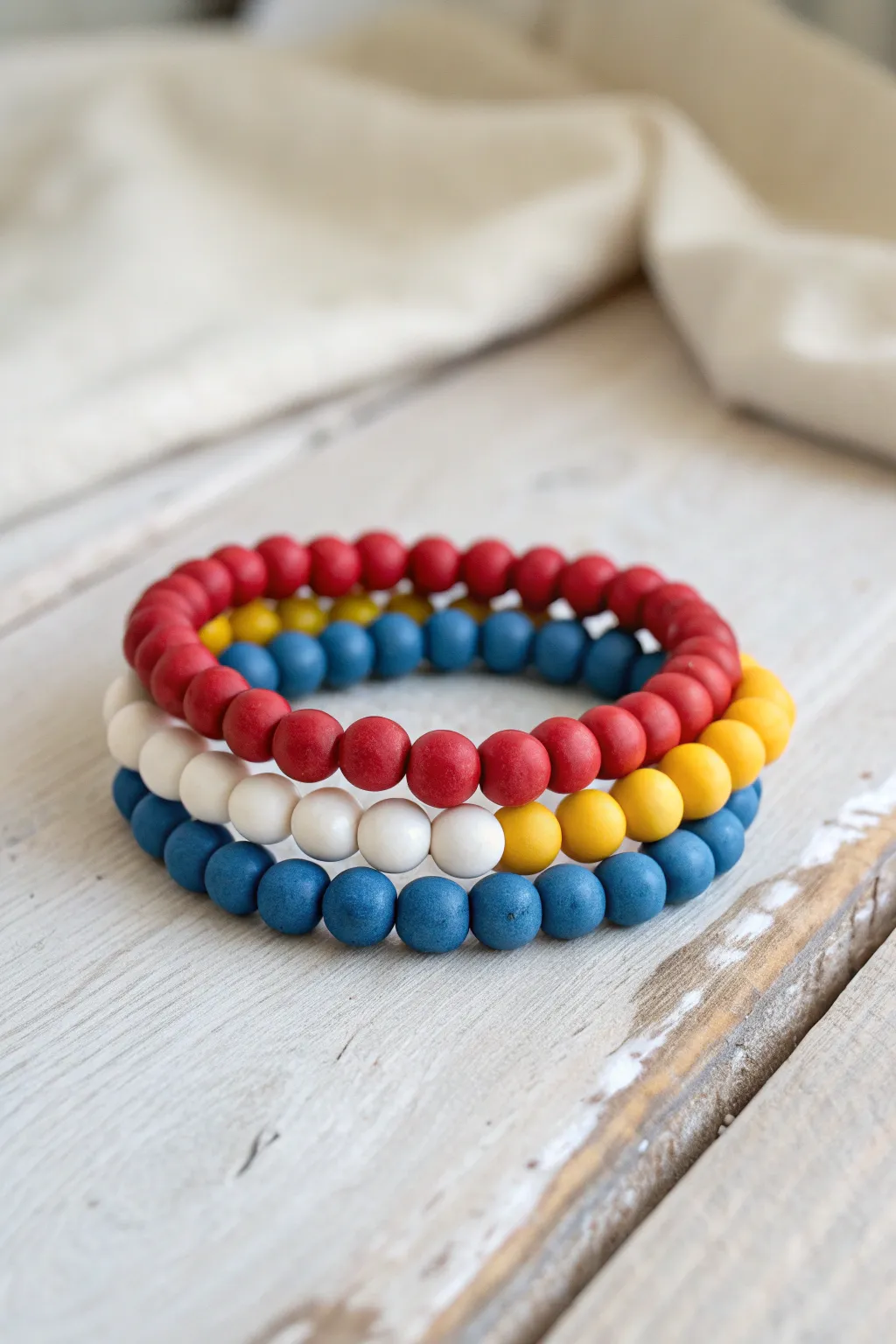
Embrace the bold simplicity of primary colors with this perfectly balanced bracelet stack. The combination of matte red, deep yellow, solid white, and denim blue beads creates a crisp, classic look that feels both playful and polished.
How-To Guide
Materials
- Matte round beads (8mm or 10mm) in Red
- Matte round beads (8mm or 10mm) in Mustard Yellow
- Matte round beads (8mm or 10mm) in White
- Matte round beads (8mm or 10mm) in Denim Blue
- Strong elastic cord suitable for jewelry (.8mm or 1mm)
- Hypo-cement or super glue
- Scissors
- Bead stopper or masking tape
- Ruler or measuring tape
Step 1: Planning Your Stack
-
Measure your wrist:
Start by measuring your wrist circumference with a flexible tape measure. Add about half an inch to this measurement to ensure the bracelets sit comfortably without pinching. -
Calculate bead count:
Lay out your beads along a ruler to match your target length. For a standard adult wrist, this usually means around 21-24 beads if using an 8mm size. -
Visualize the design:
Note that this stack consists of three distinct bracelet designs: one solid red, one mixed strand, and one split-color strand. Organizing them mentally first helps the process flow smoothly.
Step 2: Bracelet 1: The Solid Red Anchor
-
Prepare the cord:
Cut a piece of elastic cord about 10-12 inches long. This extra length is crucial for tying a secure knot later without struggling. -
Secure the end:
Place a bead stopper or a piece of masking tape on one end of the elastic to prevent beads from sliding off as you work. -
String the beads:
Thread your matte red beads onto the cord until you reach your desired length. -
Check the fit:
Wrap the strand around your wrist to verify the size. Adjust by adding or removing a bead if necessary. -
Pre-stretch the cord:
Gently tug on the ends of the elastic. Pre-stretching helps prevent the bracelet from sagging or loosening after the first few wears. -
Tie it off:
Remove the stopper and tie a strong surgeon’s knot (right over left, left over right). Pull tight to secure the shape.
Matte Finish Magic
To get the exact look in the photo, ensure your beads are ‘matte’ or ‘frosted’ acrylic or wood. Shiny plastic beads won’t give that soft, modern texture.
Step 3: Bracelet 2: The Color Block Split
-
Design the pattern:
For the middle bracelet shown in the image, you’ll need a distinct split. Plan for approximately one-half of the strand to be white, and the other half to be blue. -
String the white section:
Start stringing your white beads. Stop when you have covered about half of your total required length. -
Add the blue section:
Switch to the denim blue beads and continue stringing until the bracelet size matches the red one you just finished. -
Close the loop:
Repeat the stretching and knotting process, ensuring the knot is tight and secure between a white and blue bead.
Knot Slipping?
If your elastic keeps slipping while tying, try adding a second surgeon’s knot on top of the first. The glue is essential to locking it permanently.
Step 4: Bracelet 3: The Tri-Color Mix
-
Identify the segments:
The third bracelet (often worn in the middle or top) uses three segments: red, yellow, and blue. Divide your total bead count by three to find how many beads you need for each color block. -
Start with red:
Cut your third piece of elastic and string your first segment of red beads. -
Transition to blue:
Add your segment of blue beads next. I find checking the length against the other finished bracelets helps keep everything uniform. -
Finish with yellow:
Complete the circle by adding the yellow bead segment. This creates that striking primary color pop. -
Final connection:
Tie off this final bracelet securely with a surgeon’s knot.
Step 5: Finishing Touches
-
Secure the knots:
Apply a tiny dab of hypo-cement or super glue to each knot. Let this dry completely before moving on. -
Hide the mechanics:
Once the glue is dry, trim the excess elastic tails close to the knot. -
Tuck the knot:
Gently pull the elastic so the knot slides inside the hole of an adjacent bead, hiding it from view for a professional finish.
Now you have a vibrant, coordinated set of bracelets perfect for brightening up any casual outfit
Two-Tone Opposites
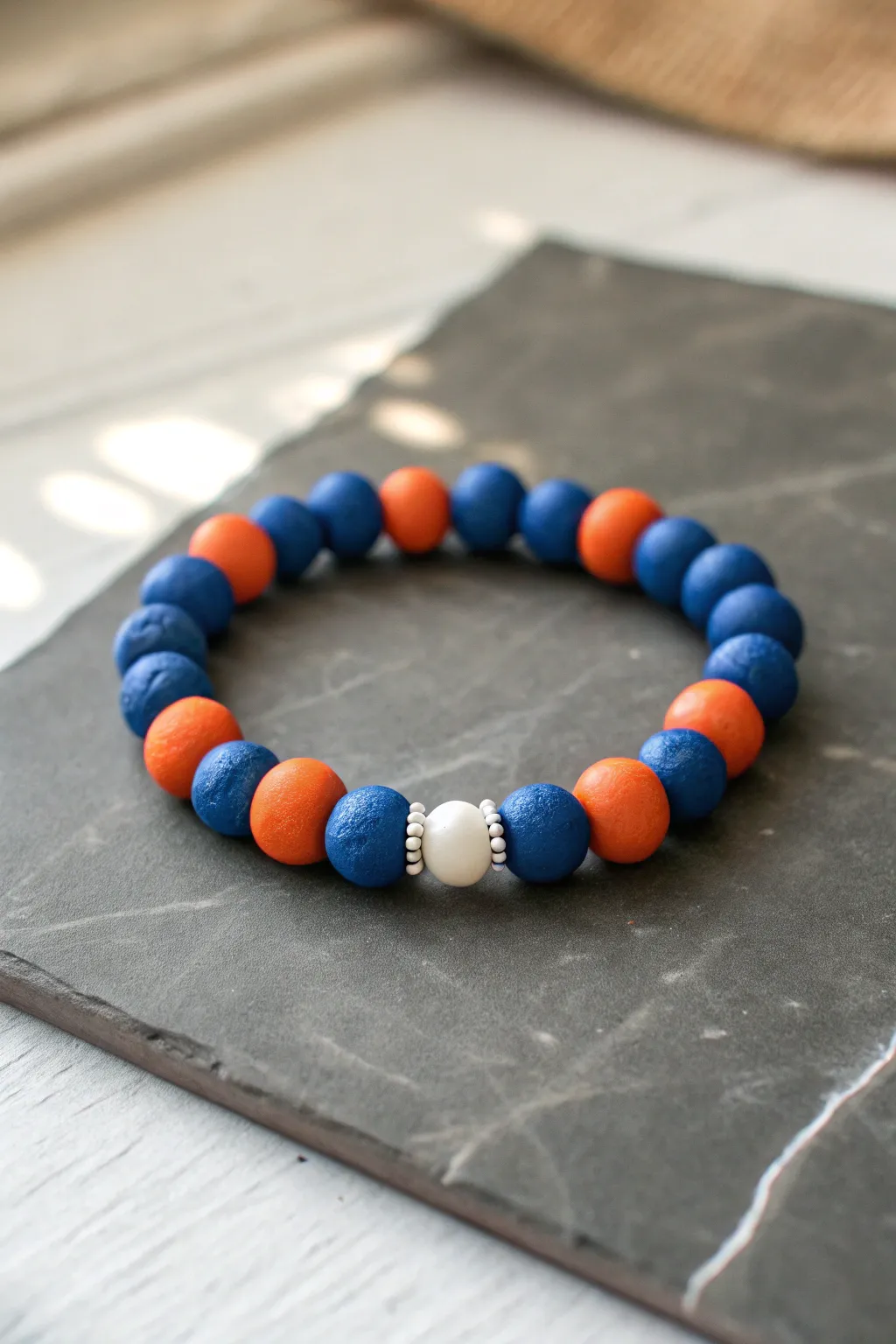
Embrace the bold energy of complementary colors with this simple yet impactful clay bead project. By offsetting deep royal blue with vibrant tangerine orange and centering it with a clean white focal point, you create a wrist accessory that truly pops against any outfit.
Step-by-Step Tutorial
Materials
- Polymer clay (Royal Blue, Tangerine/Orange, White)
- Small bead roller tool (optional but helpful for uniform size)
- Beading elastic cord (0.8mm or 1mm thickness)
- Small silver or white spacer beads (daisy spacers or tiny seed beads)
- Toothpicks or a bead piercing tool
- Baking sheet and parchment paper
- Super glue or jewelry adhesive
- Scissors
Step 1: Creating the Clay Beads
-
Condition the clay:
Start by warming up your orange and blue polymer clay in your hands until it is soft and pliable. This prevents cracking later on. -
Portion the clay:
Pinch off small, equal-sized pieces of both the blue and orange clay. You will need roughly 12–14 blue beads and 8–10 orange beads, depending on your wrist size. -
Roll the main beads:
Roll each piece between your palms or use a bead roller to create smooth, round spheres approximately 8mm to 10mm in diameter. -
Texture the surface:
For that matte, stone-like texture seen in the photo, gently roll the finished spheres over a piece of coarse sandpaper or dab them lightly with a stiff toothbrush before baking. -
Create the focal bead:
Take a piece of white clay and roll it into a slightly larger sphere than your colored beads to act as the centerpiece. -
Pierce the holes:
Carefully insert a toothpick or piercing tool through the center of each bead. I like to twist the tool gently as I push through to avoid squashing the sphere shape. -
Bake the beads:
Arrange your beads on a baking sheet lined with parchment paper. Bake according to the manufacturer’s instructions for your specific brand of clay (usually around 275°F/135°C for 15–30 minutes). -
Cool down:
Let the beads cool completely before handling them; they harden fully as they return to room temperature.
Fixing Squished Spheres
If your beads flatten when piercing them, let the raw clay sit in the fridge for 10 minutes first. Cold clay holds its shape much better against the pressure of the tool.
Step 2: Assembling the Design
-
Prepare the elastic:
Cut a length of elastic cord about 10 inches long. This gives you plenty of extra room to tie the knot comfortably. -
Pre-stretch the cord:
Give your elastic a few gentle tugs to pre-stretch it. This crucial step prevents the bracelet from sagging or stretching out permanently after you wear it. -
Start the center sequence:
Thread on a blue bead, followed by three tiny spacer beads, then your large white focal bead, three more spacers, and another blue bead. -
Build the pattern outwards:
Begin adding the rest of your beads. The pattern in the image is slightly irregular rather than a strict 1-for-1. Try adding an orange bead, then a blue, then another blue, varying the rhythm slightly to keep it organic. -
Check the symmetry:
While the pattern is random, try to balance the amount of blue and orange on either side of the white centerpiece so the weight feels even. -
Size the bracelet:
Wrap the strand around your wrist to check the fit. Add or remove beads from the ends until it sits comfortably without digging into your skin. -
Tie the knot:
Tie a secure surgeon’s knot (right over left, left over right) and pull tight. The elastic should be taut enough that the beads touch but don’t buckle. -
Secure and trim:
Apply a tiny dot of super glue to the knot. Once dry, snip the excess cord ends close to the knot, and tuck the knot inside of a neighboring bead if the hole is large enough.
Pro Tip: Matte Finish
For that ultra-matte, stone-like look in the photo, skip the glaze varnish. Instead, buff the baked beads lightly with denim cloth to give them a soft, professional sheen.
Now you have a bold, sporty accessory perfect for game days or adding a splash of color to a neutral outfit
Marble-Inspired Neutrals
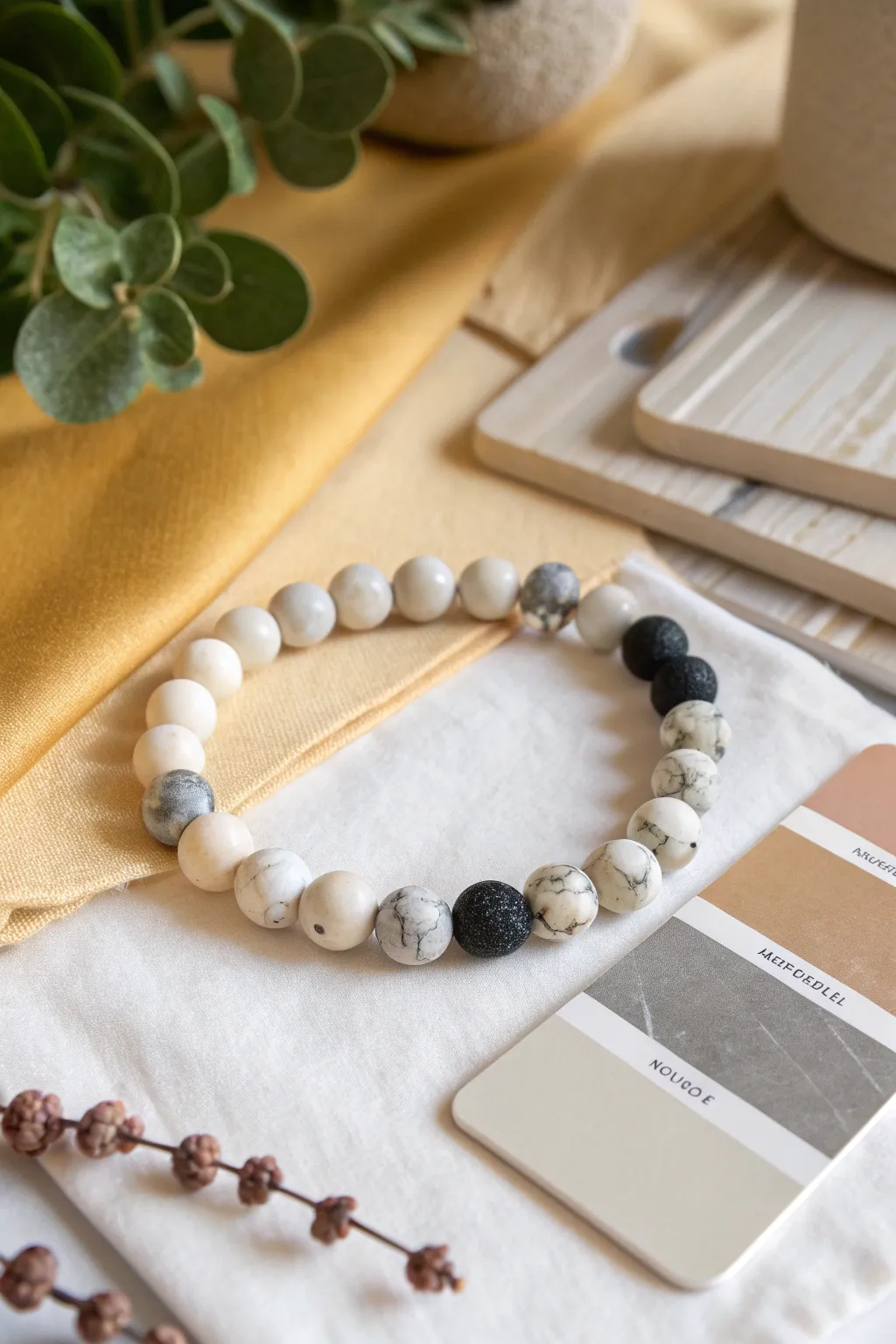
Embrace the sophisticated simplicity of natural stone textures with this neutral bracelet design. Combining creamy off-whites, marbled greys, and stark black accents creates a versatile accessory that feels both earthy and modern.
Step-by-Step
Materials
- 8mm white howlite beads (or white clay beads with subtle marbling)
- 8mm matte cream or beige stone beads
- 8mm grey map stone or jasper beads
- 8mm black lava stone beads
- Strong elastic cord (0.8mm or 1.0mm recommended)
- Jewelry glue or clear nail polish
- Scissors
Step 1: Planning and Preparation
-
Measure your wrist:
Before you begin, wrap a piece of string around your wrist to find your comfortable fit, then add about half an inch for slack so the beads don’t pinch. -
Cut the elastic:
Cut a piece of elastic cord about 10-12 inches long. Having this extra length makes tying the final knot much easier than struggling with short ends. -
Pre-stretch the cord:
Give your cut elastic a few firm tugs. This pre-stretching step is crucial because it prevents the bracelet from sagging or stretching out permanently after wearing it for a few days. -
Secure the end:
Place a piece of tape on one end of the cord or attach a binder clip. This acts as a ‘bead stopper’ so your beautifully arranged beads don’t slide right off the other side while you work.
Knot Slipping?
If your elastic knot keeps coming undone before you can glue it, try rubbing the elastic ends with a little beeswax or chalk to add friction and grip to the cord.
Step 2: Creating the Pattern
-
Start with the focal section:
Begin by threading one black lava stone bead. This will act as a striking anchor point in the design. -
Add texture contrast:
On the right side of the black bead, add one marbled white howlite bead. Follow this with another black lava stone to create a small repeating accent section. -
Transition to white:
Next to your initial black/white cluster, thread on three to four white howlite beads. Look for beads with distinct grey veining to enhance the marble effect. -
Insert a grey accent:
Break up the white section by adding a single grey map stone or jasper bead. This subtle shift in tone adds depth to the neutral palette. -
Build the cream section:
Continue the strand with five or six matte cream or beige beads. These warmer tones soften the starkness of the black and white marble. -
Add the final grey touch:
Thread on another grey map stone bead to bookend the cream section. -
Complete the circle:
Finish stringing by adding more white howlite beads until you reach your desired length. Check the fit by wrapping it around your wrist before tying.
Step 3: Finishing Touches
-
Prepare the knot:
Remove the tape or clip from the end. Bring both ends of the elastic together carefully. -
Tie a surgeon’s knot:
Cross the ends, wrap one side over twice, and pull tight. Repeat this process to create a secure surgeon’s knot, which holds much better than a standard square knot. -
Hide the knot:
Apply a tiny dot of jewelry glue to the knot itself. While the glue is still wet, gently pull the knot inside the hole of the nearest large bead to hide it. -
Trim the excess:
Once the glue has fully dried (I usually wait about 15 minutes to be safe), use your sharp scissors to trim the excess elastic cord as close to the bead hole as possible without nicking the knot.
Aromatic Additions
Add a drop of essential oil to the porous black lava beads. They act as natural diffusers, carrying your favorite scent throughout the day.
Enjoy styling your new textural bracelet with any outfit for a grounded, earthy look
Glow-Style Night Pops
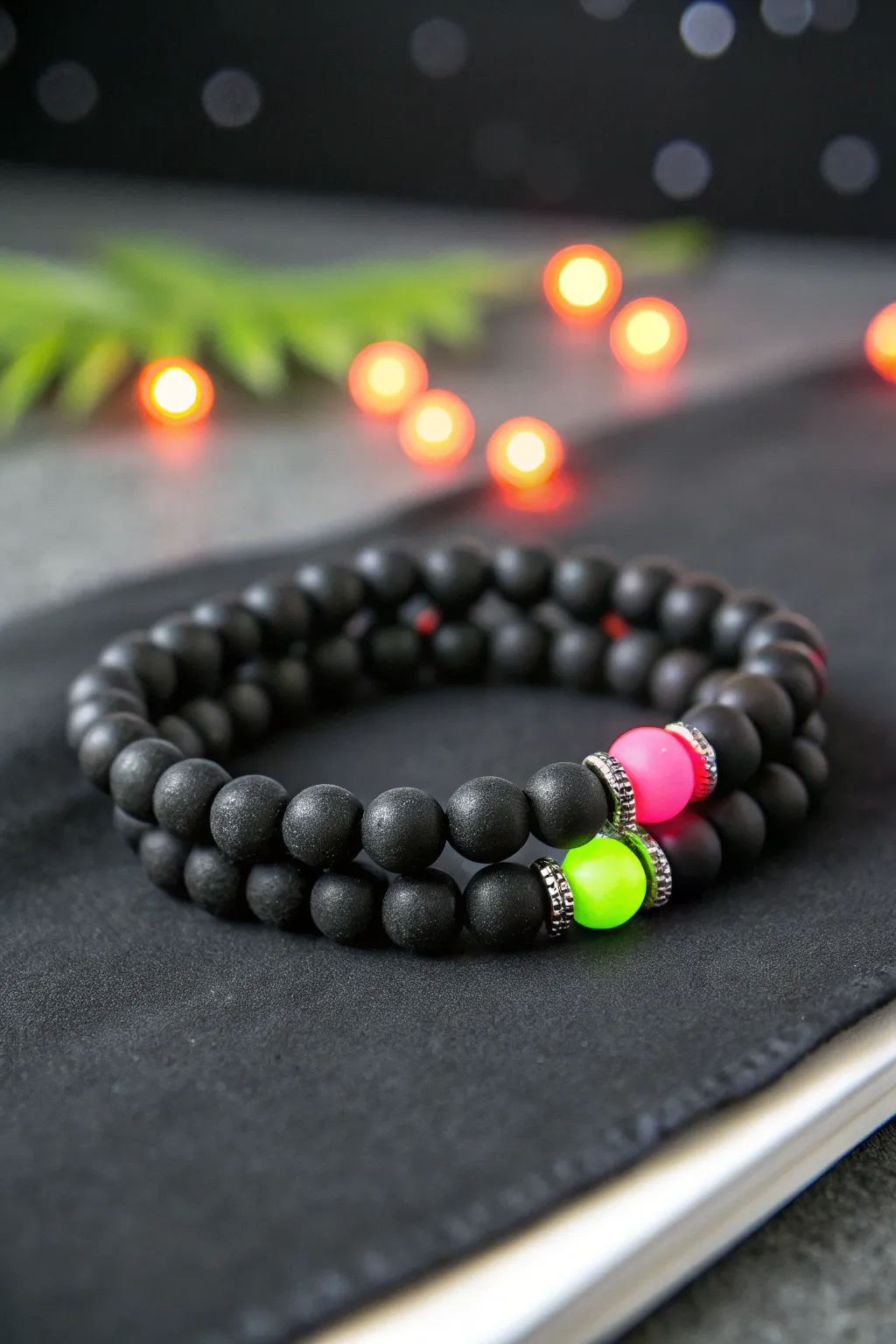
Embrace the contrast of deep matte black against vivid neon pops with this sophisticated yet playful bracelet stack. The frosted finish of the black beads provides a perfect dark canvas that makes the single neon accent beads absolutely glow.
Step-by-Step Guide
Materials
- 8mm matte black agate or onyx beads (approx. 40-50 total)
- 8mm neon pink acrylic or glass bead (1)
- 8mm neon green acrylic or glass bead (1)
- 4mm silver rhinestone rondelle spacer beads (4)
- High-quality elastic cord (0.8mm or 1.0mm recommended)
- Jewelry adhesive or clear nail polish
- Scissors
Step 1: Planning Your Stack
-
Measure your wrist:
Start by wrapping a measuring tape lightly around your wrist where you want the bracelet to sit. Note this number. -
Calculate bead count:
For a standard 7-inch wrist, you will typically need about 22-24 beads of this 8mm size. Lay them out in a straight line next to a ruler to double-check the final length before stringing. -
Design the Pink Bracelet layout:
On a bead board or soft cloth, arrange a row of the matte black beads. Find the center point and remove one black bead. -
Insert the neon accent:
Place the single neon pink bead in that center gap. Flank it immediately on both sides with silver rhinestone spacers to create a focal point. -
Repeat for Green Bracelet:
Prepare a second layout identical to the first, simply swapping the neon pink bead for the neon green one.
Step 2: Stringing the Bracelets
-
Prepare the cord:
Cut a piece of elastic cord about 12 inches long. Having extra length makes tying the final knot much easier than struggling with short ends. -
Pre-stretch the elastic:
I always give the elastic a few firm tugs before stringing. This ‘pre-stretching’ prevents the bracelet from sagging or loosening up immediately after you wear it. -
Secure the end:
Place a bead stopper or simply a piece of strong tape on one end of the cord to stop beads from sliding off as you work. -
String the beads:
Thread your beads onto the elastic, following your layout. I find it easiest to start with the black beads on one side, add the first spacer, the neon bead, the second spacer, and then finish with the remaining black beads. -
Check the fit:
Wrap the unfinished strand around your wrist. Detailed fit matters, so add or remove a black bead now if it feels too loose or too tight.
Knot Hiding Trick
Make sure the black bead adjacent to the knot has a slightly larger hole if possible. This makes ‘popping’ the knot inside much smoother nicely without fraying the elastic.
Step 3: Finishing Touches
-
Prepare for the knot:
Remove the tape or bead stopper. Bring the two ends of the elastic together carefully. -
Tie the surgeon’s knot:
Cross the ends, wrap them around each other, and pull tight. Then, cross them again, wrap twice (instead of once) through the loop, and pull firmly to cinch the knot. -
Add adhesive:
Apply a tiny dab of jewelry glue or clear nail polish directly onto the knot. Let it dry for a few minutes to ensure it won’t slip. -
Hide the knot:
Once dry, trim the excess cord ends close to the knot (but not too close!). Gently pull the elastic so the knot slides inside the hole of the nearest black bead to hide it. -
Final set up:
Repeat the stringing and tying process for the second bracelet with the green bead to complete your set.
Elastic Issues?
If your elastic keeps breaking when you tighten the knot, switch to a multi-strand fabric-covered elastic, which is much more durable than clear plasticky cords.
Now you have a striking duo that perfectly balances matte sophistication with electric color