
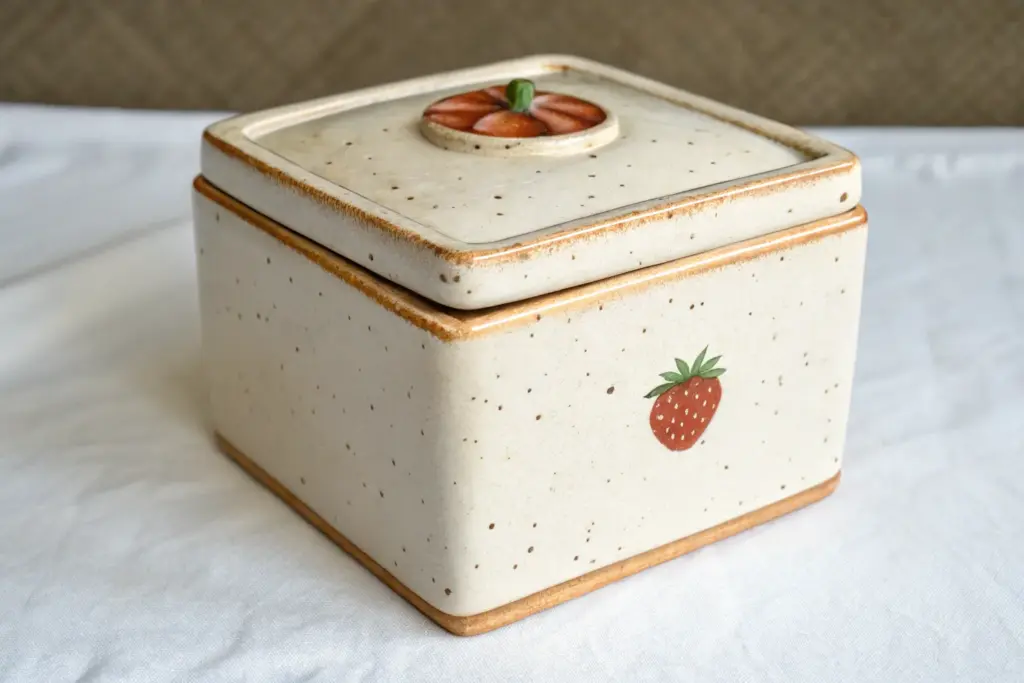
If you love crisp edges, satisfying right angles, and that magical moment when a flat sheet of clay turns into a real object, slab containers are your happy place. I pulled together my favorite clay slab container ideas—starting with the classic boxes everyone wants to make, then drifting into the more playful, unexpected designs.
Classic Lidded Slab Box
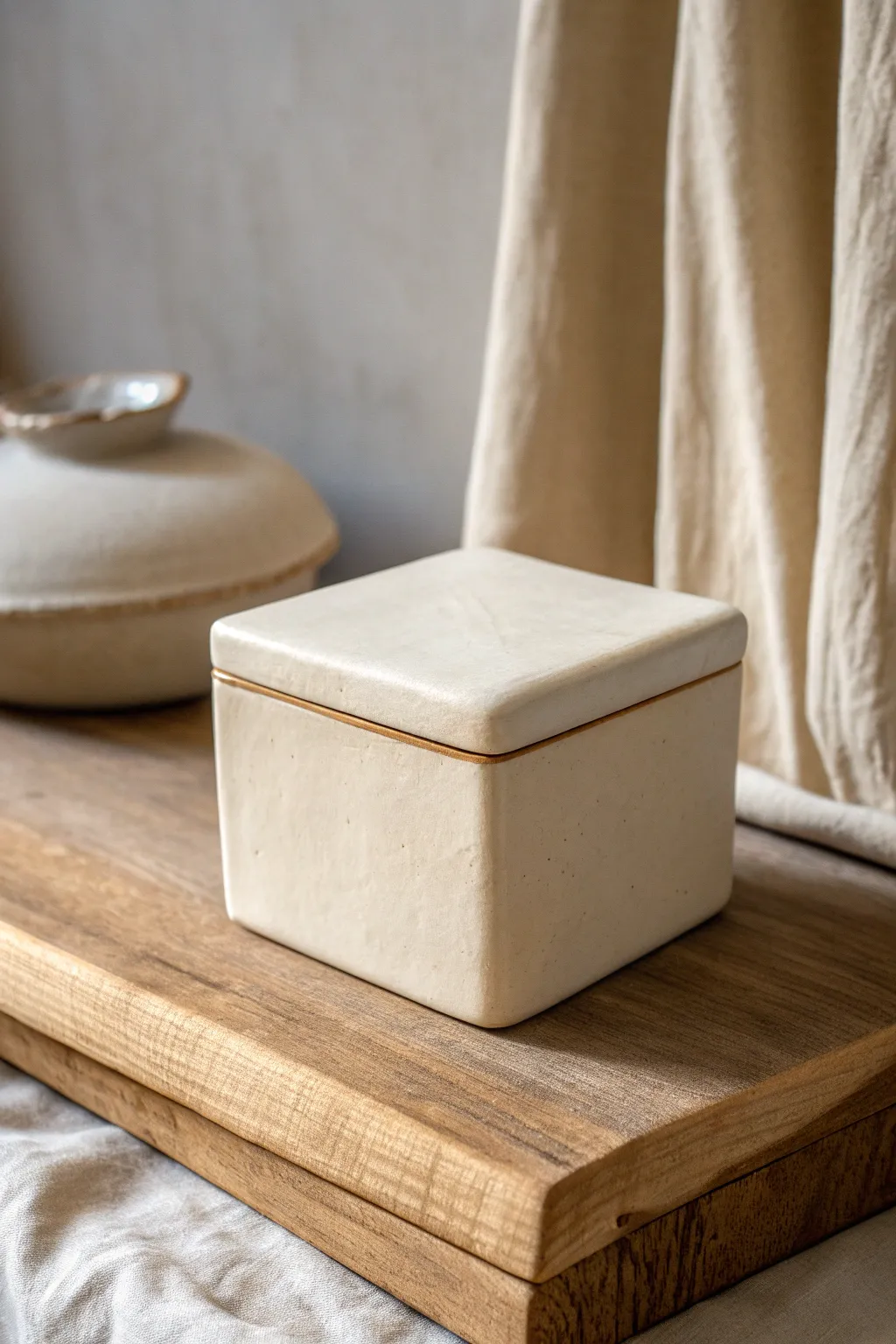
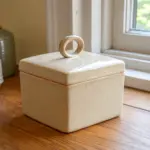
This elegant square box showcases the beauty of simple geometry and clean lines, perfect for storing small treasures or serving as a modern decorative accent. The matte, off-white glaze and subtle raw clay edge detail give it a timeless, organic warmth.
Detailed Instructions
Materials
- Stoneware clay (light color, fine grog recommended)
- Rolling pin
- Two wooden guide strips (approx. 1/4 inch thick)
- Fettling knife or X-Acto blade
- Ruler or square template
- Scoring tool or serrated rib
- Slip (clay slurry)
- Wooden paddle
- Damp sponge
- Matte cream or white glaze
- Kiln
Step 1: Preparation & Cutting Slabs
-
Roll out the clay:
Begin by wedgeing your clay thoroughly to remove air bubbles. Place the clay between two wooden guide strips on a canvas surface and use your rolling pin to create an even slab about 1/4 inch thick. -
Smooth the surface:
Before cutting, take a rubber rib or a damp sponge and gently compress the slab on both sides. This aligns the clay particles, preventing warping later, and creates that smooth canvas we need for the minimalist look. -
Measure and cut walls:
Using a ruler and a fettling knife, cut four identical rectangles for the sides. For a box like the one pictured, 3×3 inches or 4×4 inches works well depending on your desired scale. -
Cut the base and lid:
Cut two identical squares for the top and bottom. They should be slightly larger than the assembled box dimensions to account for wall thickness, or cut them to match the exact outer dimensions if you plan to bevel the edges. -
Leather hard stage:
Let all your cut pieces sit until they reach a ‘leather hard’ stage. They should be firm enough to hold their shape without bending but still soft enough to be scored and joined.
Dry With Lid On
Always dry and fire the box with the lid in place. This ensures they shrink together at the same rate, keeping the fit perfect.
Step 2: Assembly
-
Bevel the edges:
For the crispest corners, cut a 45-degree angle (miter) on the vertical edges of your four wall pieces. This allows them to fit together seamlessly like a picture frame. -
Score and slip:
Rough up the mitered edges with a scoring tool and apply a generous amount of slip. Press two walls together to form a right angle, ensuring the corner is straight. -
Complete the square:
Attach the remaining two walls. Check that the box is perfectly square by measuring diagonal corner to diagonal corner—the measurements should match. -
Attach the base:
Score the bottom edges of your wall assembly and the perimeter of your base square. Apply slip and press the walls firmly onto the base. -
Reinforce the interior:
Roll a very thin coil of soft clay. Place it into the interior seams where the walls meet the floor and the corners. Smooth this coil out with a modeling tool to strengthen the joints. -
Paddle into shape:
Gently tap the exterior walls with a wooden paddle. This helps seal the seams and flattens any slight bowing, giving you those distinctively straight, architectural sides.
Warped Walls?
If walls bow inward while drying, place a supportive block of rigid foam or crumpled newspaper inside until the clay stiffens.
Step 3: Creating the Lid & Finishing
-
Add a flange system:
To keep the lid secure, you need a gallery or flange. I prefer to attach a smaller square of clay to the underside of the lid slab. This inner square should fit snugly just inside the box walls. -
Attach the lid slab:
Alternatively, you can add small clay tabs on the inside corners of the lid. Ensure the lid sits flat on top of the box walls without rocking. -
Softening the edges:
Once assembled, use a damp sponge to slightly soften the sharp 90-degree corners. You want them defined but not sharp enough to chip easily. -
Create the reveal line:
The image shows a subtle unglazed line or ‘reveal’ between the lid and box. You can achieve this by slightly beveling the outer edge where the lid meets the box, creating a tiny shadow gap. -
Slow drying:
Loosely cover the box with plastic and let it dry very slowly. Uneven drying is the main cause of warped lids. -
Bisque firing:
Fire the piece to cone 04 (or your clay’s bisque temperature). Keep the lid on the box during firing to help them maintain their fit. -
Glazing:
Apply a matte cream or off-white glaze. To recreate the look in the photo, wipe back the glaze just slightly at the rim where the lid meets the box to reveal a hint of the raw clay body. -
Final firing:
Fire to the glaze maturity temperature. If you glazed the contact points (the rim and lid underside), remember to use wax resist or wipe them perfectly clean so the lid doesn’t fuse shut.
Once fired, you will have a sophisticated, quiet object that feels wonderful to hold and use
Rectangular Keepsake Container
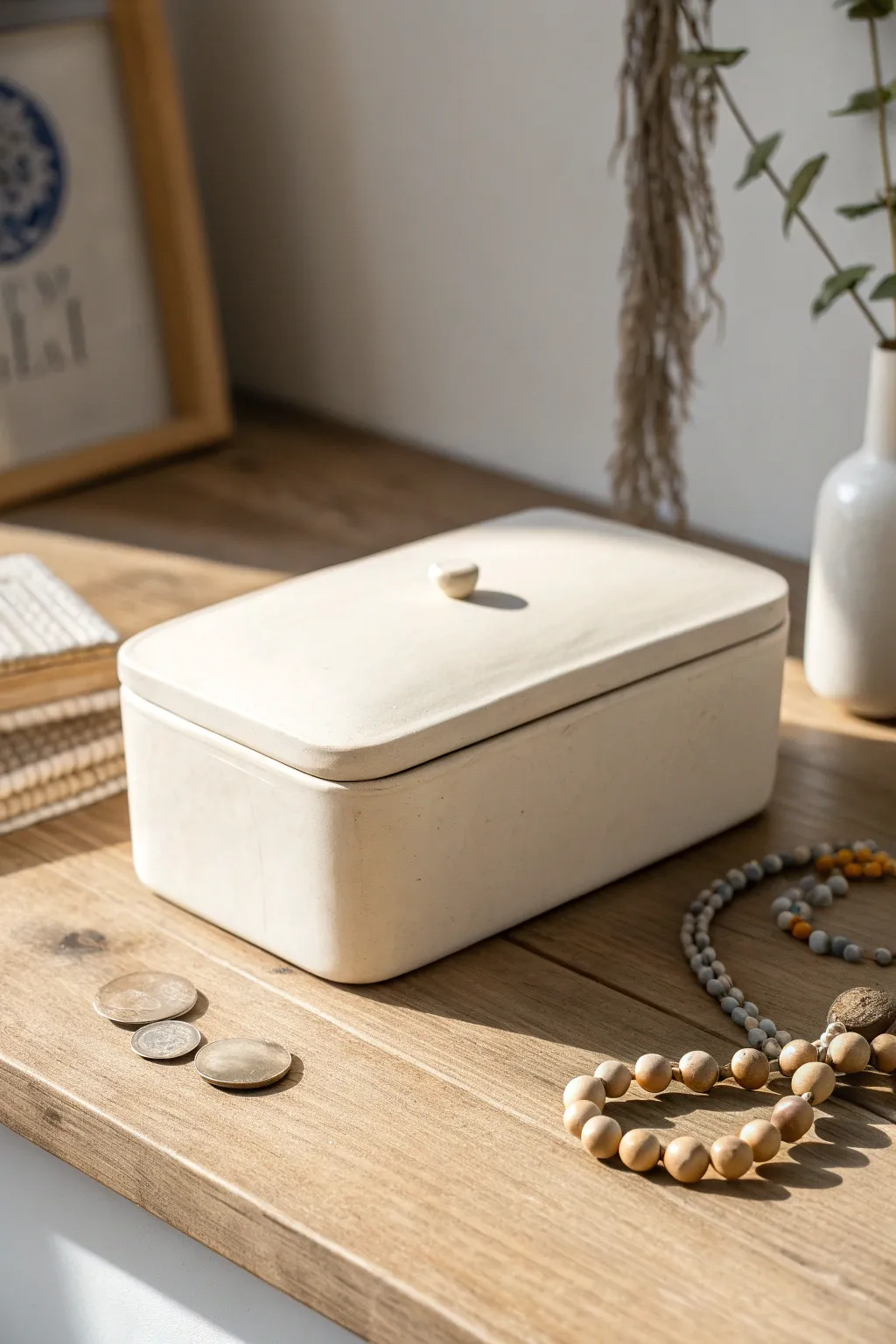
This elegant rectangular keepsake box features smooth lines and a creamy, matte finish that feels both modern and organic. Perfect for storing jewelry or loose change, its simple slab construction makes it an approachable project for intermediate potters.
How-To Guide
Materials
- White stoneware or porcelain clay body
- Rolling pin and guide sticks (1/4 inch thick)
- Fettling knife or X-Acto blade
- Ruler and square
- Slip and scoring tool (or serrated rib)
- Wooden modeling tool
- Soft sponge
- Small round kiln stilt (optional)
- White or clear matte glaze
Step 1: Creating the Slabs
-
Roll the Clay:
Begin by wedging your white stoneware clay thoroughly to remove air bubbles. Roll it out into a large, even slab using 1/4 inch guide sticks to ensure uniform thickness. -
Compress the Slabs:
Use a rubber rib to compress the clay on both sides. This aligns the clay particles, preventing future warping and creating that smooth surface texture seen in the photo. -
Let it Set:
Allow the slab to stiffen to a soft leather-hard state. It needs to be sturdy enough to stand up without slumping but soft enough to join easily.
Step 2: Cutting and Assembly
-
Measure and Cut:
Using your ruler and square, measure and cut your components: one base (e.g., 4×6 inches), two long side walls (6 inches long), two short side walls (4 inches long), and a lid that is slightly larger than the base (about 4.25 x 6.25 inches). -
Miter the Edges:
For clean corners, I prefer to cut the vertical edges of the wall pieces at a 45-degree angle. This helps hide the seams better than a butt joint. -
Score and Slip:
Thoroughly score the edges of the base and the bottom of the walls. Apply slip generousy to the scored areas. -
Construct the Walls:
Attach the walls to the base and to each other. Press them firmly together, wiping away excess slip squeezing out from the joints. -
Reinforce Seams:
Roll a very thin coil of clay and press it into the interior corners of the box. Smooth this out with a wooden tool to reinforce the structure.
Dry Slowly
Dry the box with the lid ON. This ensures they shrink at the exact same rate and prevents the walls from warping out of alignment.
Step 3: Finishing and Lid
-
Refine the Box Shape:
Use a straight edge or paddle to gently tap the walls, ensuring the box is perfectly rectangular and the walls are straight. -
Smooth the Rim:
Smooth the top rim of the box with a damp sponge or chamois so the lid will sit flush. -
Create the Flange:
Cut a smaller rectangle of clay or four small strips and attach them to the *underside* of the lid slab, slightly inset from the edge. This flange will keep the lid from sliding off the box. -
Check fit:
Gently place the lid on the box to ensure the flange fits inside. Make adjustments while the clay is still workable. -
Add the Knob:
Roll a small ball of clay into a flattened pebble shape. Score and slip the center of the lid top and attach the knob securely.
Texture Twist
Before assembling, press a piece of canvas or linen into the soft slab to give the final surface a subtle, tactile fabric texture.
Step 4: Drying and Firing
-
Refine Surfaces:
Once the piece is bone dry, use a slightly damp sponge to wipe away any final imperfections or sharp edges. -
Bisque Fire:
Fire the piece to cone 04 (or your clay’s specific bisque temperature). -
Glaze Application:
Apply a white matte or satin glaze. For the finish shown, dipping provides the most even coverage, though brushing works if you lay it on thick. -
Glaze Firing:
Stilt the lid separately from the box to prevent them fusing together. Fire to the final maturity temperature of your clay body (likely cone 5 or 6).
Once cooled, your sleek ceramic box creates a sophisticated spot for your quiet treasures
Tray-and-Lid Matchbox Style
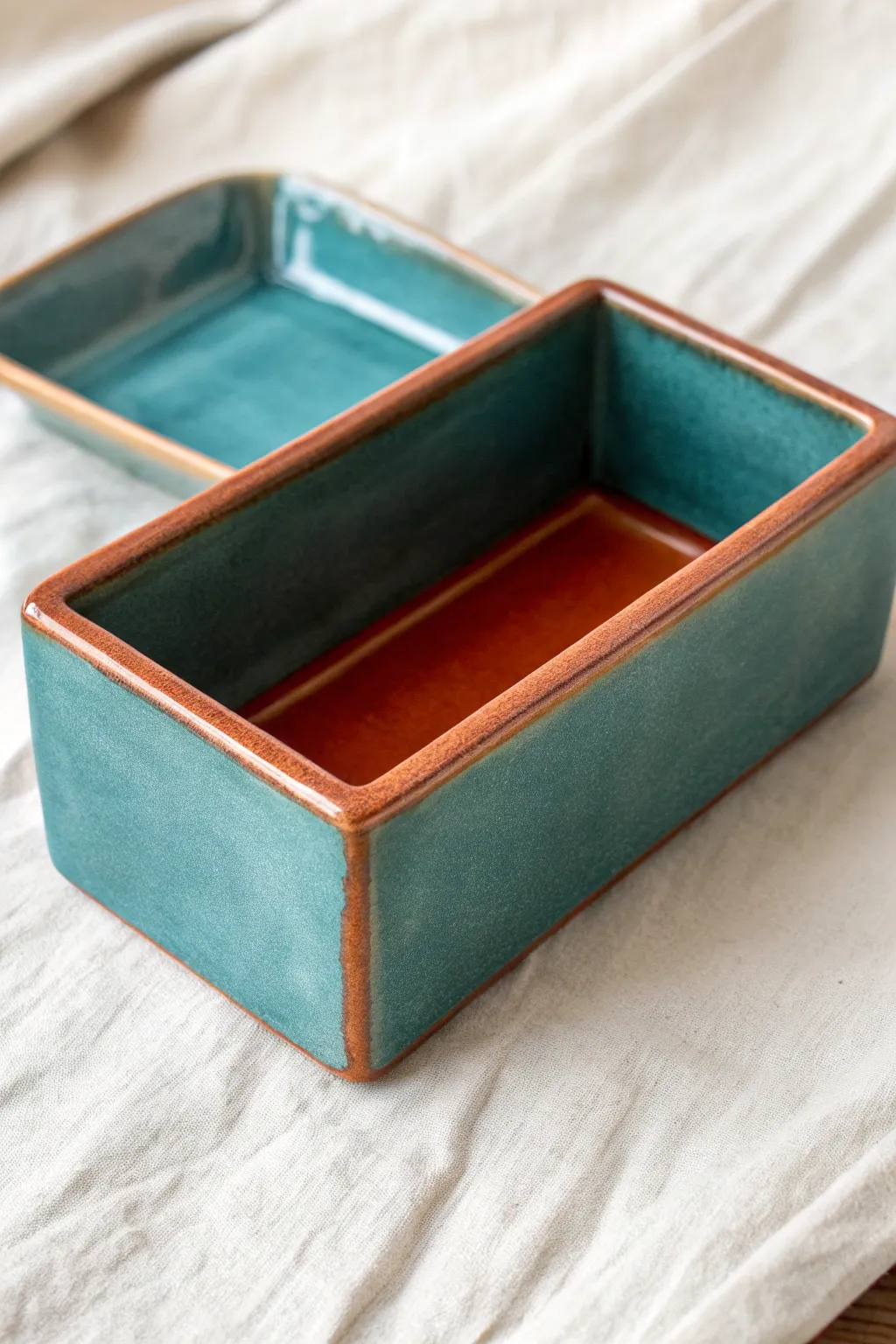
This elegant rectangular container combines sharp, modern lines with a rustic glaze palette. The contrast between the cool teal exterior and the warm, rust-colored rim creates a sophisticated finish perfect for storing trinkets or jewelry.
Step-by-Step Guide
Materials
- Mid-fire stoneware clay
- Rolling pin
- Guide strips (1/4 inch thickness)
- Fettling knife
- Ruler
- Serrated rib or scoring tool
- Slip
- Soft rib
- Sponge
- Teal gloss glaze
- Rust/Tenmoku glaze
- Wax resist
Step 1: Creating the Slabs
-
Roll out the clay:
Begin by wedging your clay thoroughly to remove air bubbles. Roll it out into a large, even slab using 1/4 inch guide strips to ensure consistent thickness throughout. -
Compress the slab:
Use a soft rib to compress the clay on both sides. This aligns the clay particles, preventing future warping and creating a smooth canvas for your glaze. -
Measure and cut templates:
Create paper templates for accuracy. You will need a bottom piece (e.g., 3×6 inches), two long side walls (6 inches long), and two short side walls (3 inches long). Determine your desired height—about 2.5 inches works well here. -
Cut the clay pieces:
Lay your templates over the leather-hard slab. Using a fettling knife and a ruler, cut out all your components. Cut a second piece identical to the bottom to serve as the lid.
Step 2: Assembling the Box
-
Bevel the edges:
For crisp 90-degree corners, cut the vertical edges of your wall pieces at a 45-degree angle. Leave the bottom edges flat to sit on the base slab. -
Score and slip:
Aggressively score the contact points—the edges of the base and the beveled sides—using a serrated rib. Apply a generous amount of slip to these roughened areas. -
Attach the walls:
Press the long walls onto the base first, then fit the short walls between them. The beveled corners should lock together cleanly. -
Secure the seams:
Roll a very thin coil of clay and press it into the interior seams to reinforce them. Smooth this coil down until it is invisible. -
Refine the exterior:
Use a flat paddle or a block of wood to gently tap the walls straight. This helps sharpen the corners and ensures the box isn’t bowing outward. -
Smooth the rim:
Run a damp sponge or chamois over the top rim to round it slightly. Sharp edges can chip easily after firing, so a soft curve is more durable.
Sharp Corners
Wait until the clay is a true ‘leather hard’ before assembling. If the clay is too soft, the walls will slump and you’ll lose that crisp, rectangular shape shown in the image.
Step 3: Lid Construction & Finishing
-
Create the lid flange:
To keep the lid from sliding off, you need a flange. Roll a coil or cut thin strips of clay and attach them to the *underside* of your lid slab, insetting them about 1/4 inch from the edge so they fit inside the box opening. -
Dry slowly:
Place the lid on the box with a piece of newspaper in between to prevent sticking. Wrap the entire piece loosely in plastic to let it dry slowly and evenly, which prevents warping. -
Bisque fire:
Once bone dry, fire the piece to bisque temperature (usually Cone 04) to prepare it for glazing.
Lid Fit Issues
If your lid rocks after firing, use a piece of wet/dry sandpaper or a grinding stone on a flat surface. Rub the box rim in a figure-eight motion to level it out.
Step 4: Glazing
-
Wax the bottom:
Apply wax resist to the bottom of the box and the underside rim of the lid where it will touch the kiln shelf. -
interior base glaze:
Pour a rust or amber-colored glaze into the bottom of the box. Swirl it to coat the floor and just the very bottom edge of the walls, then pour out the excess. Wipe away any splashes on the upper walls. -
Exterior glazing:
Dip the exterior of the box and the top of the lid into a teal gloss glaze. I prefer to use tongs for the lid to get an even coat without finger marks. -
Resulting rim effect:
The rust-colored rim in the photo is achieved by the clay body breaking through the glaze or using a specific reactive glaze combo. To mimic this, wipe the teal glaze slightly off the sharp edges of the rim, or brush a line of iron oxide wash along the top edge. -
Final fire:
Fire to the maturation temperature of your clay and glaze (likely Cone 5 or 6). Allow the kiln to cool completely before removing your finished box.
Now you have a stunning, functional piece of pottery that looks professionally made
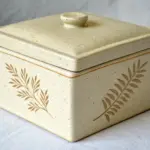
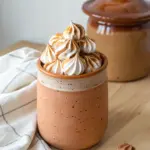
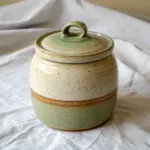
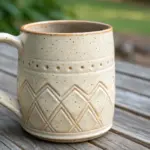
Inset Lid With Finger Notch
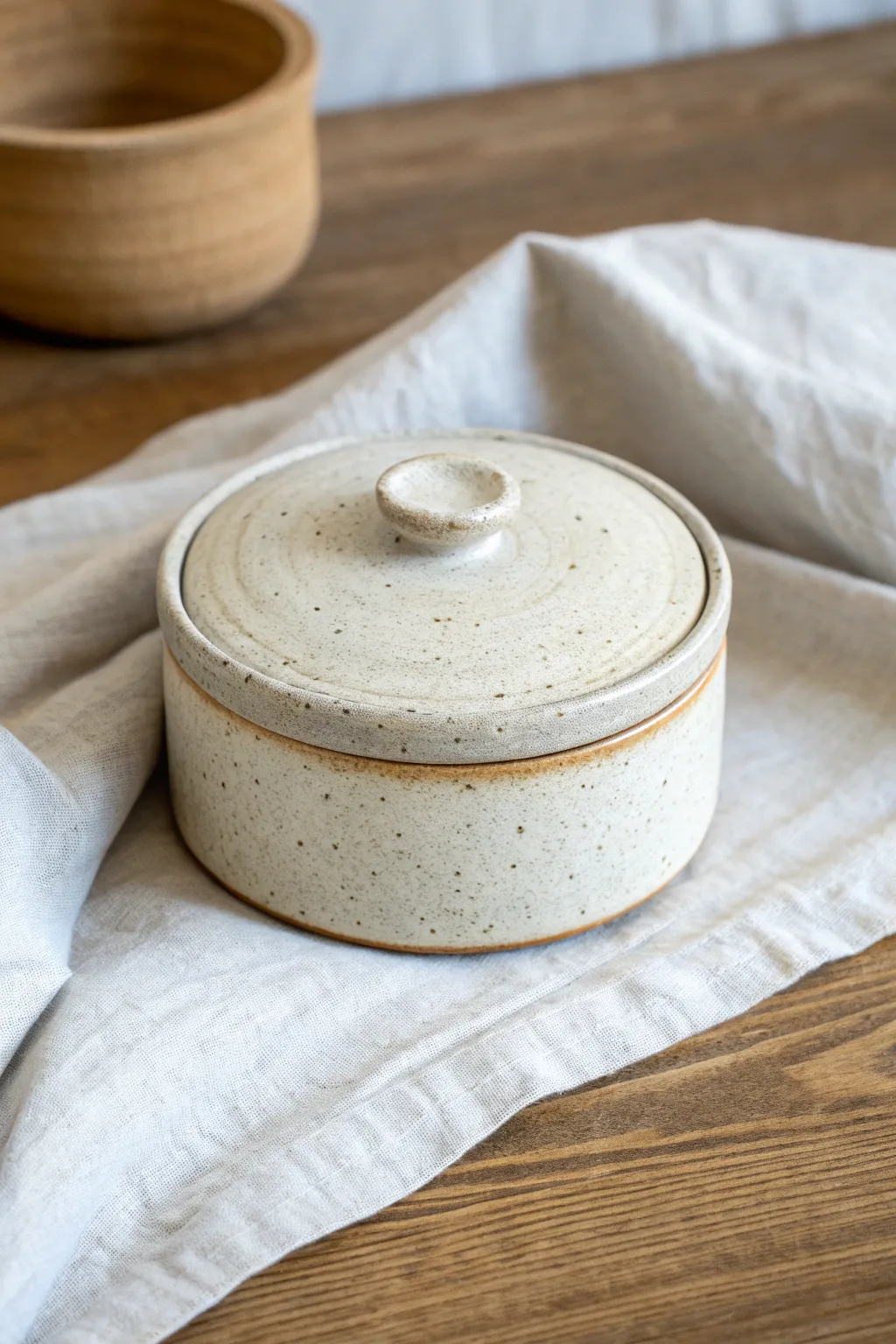
This elegant ceramic container features a clean, minimalist cylinder shape with a perfectly fitted inset lid and a delicate button knob. The warm, speckled glaze breaks beautifully over the edges, highlighting the subtle iron spots in the clay body for a timeless, rustic-modern look.
Step-by-Step
Materials
- Speckled stoneware clay (mid-fire)
- Rolling pin and guide strips (3/8 inch thickness)
- Fettling knife or needle tool
- Flexible metal kidney rib
- Serrated rib or scoring tool
- Slip (clay mixed with water)
- Soft sponge
- Wooden modeling tool
- Translucent matte white glaze
Step 1: Forming the Main Body
-
Roll the Slab:
Start by wedging your speckled clay well to remove air bubbles. Roll out a uniform slab about 3/8 inch thick using guide strips to ensure evenness, then compress both sides with a kidney rib to aligning the clay particles. -
Cut the Components:
Cut a long rectangular strip for the walls (circumference plus overlap) and two circles: one for the base and one slightly smaller circle that will eventually become the lid. -
Bevel the Edges:
On your rectangular strip, cut the short ends at 45-degree angles in opposite directions. This allows for a stronger, seamless overlap joint when you form the cylinder. -
Construct the Cylinder:
Score the beveled edges thoroughly and apply slip. Stand the wall up and curve it into a circle, pressing the beveled ends together firmly. Use a wooden tool to blend the seam inside and out until it disappears. -
Attach the Base:
Score and slip the bottom edge of your cylinder and the outer rim of your base circle. Press the cylinder onto the base, using a tool to drag clay from the base up onto the wall to seal the connection. -
Refine the Form:
Use a paddle or a flat board to gently tap the cylinder into a perfect circle. Run a damp sponge around the form to smooth any rough texture.
Warpage Prevention
Dry the lid on the pot during the greenware stage! Put a small piece of paper towel between lid and gallery to prevent sticking. This ensures they shrink together and stay perfectly round.
Step 2: Creating the Gallery and Lid
-
Make the Inner Gallery Coil:
Roll a coil of clay about the thickness of a pencil. This will support your lid. -
Install the Gallery:
Score and slip the inside of the cylinder rim, about half an inch down. Press the coil firmly into place, smoothing the bottom edge of the coil into the interior wall so it creates a seamless shelf. -
Test the Lid Fit:
Take your second clay circle and test the fit against the gallery. It should sit comfortably on the shelf with a tiny bit of wiggle room to account for glaze later. Trim the edge if necessary. -
Refine the Gallery:
Use a squared-off wooden tool or the corner of a credit card to sharpen the angle of the gallery shelf, ensuring it is flat and level so the lid won’t wobble. -
Add a Bevel to the Lid:
Flip the lid upside down and use a damp sponge or finger to slightly bevel the bottom edge. This helps it slide into the gallery more easily.
Step 3: Finishing Touches and Glazing
-
Form the Knob:
Roll a small ball of clay and flatten it slightly into a button shape. Score the center of the lid and the bottom of the knob, then attach it securely. -
Refine the Knob:
While the clay is soft, use your thumb to press a gentle indentation into the top of the knob for better grip and visual interest. -
Review and Dry:
Check all seams and wipe down the surfaces with a very slightly damp sponge to expose the grog/speckles. Let the piece dry very slowly under loose plastic to prevent warping. -
Bisque Fire:
Once bone dry, fire the piece to bisque temperature (usually Cone 06/04). -
Wax the Contact Points:
Before glazing, carefully apply wax resist to the underside of the lid rim and the top face of the gallery shelf inside the jar. This prevents the lid from fusing to the pot during firing. -
Glaze Application:
Dip or brush your translucent matte white glaze. I find dipping gives a smoother coat. Allow the glaze to break slightly thinner over the rim and knob edges. -
Avoid the Bottom:
Wipe the bottom of the pot and approximately 1/8 inch up the side wall completely clean of glaze. -
Final Firing:
Fire to the maturation point of your clay and glaze (likely Cone 5 or 6). Don’t fire with the lid on unless you are exceptionally confident in your waxing; firing side-by-side is safer.
Stuck Lid?
If your lid fits too tightly after the bisque firing, use a sanding block or rotary tool to gently grind down the edge of the lid before you glaze. Remember, glaze adds thickness.
Now you have a functional piece of art ready to hold sugar, tea, or keepsakes on your counter

The Complete Guide to Pottery Troubleshooting
Uncover the most common ceramic mistakes—from cracking clay to failed glazes—and learn how to fix them fast.
Round-Edged Slab Container (Soft Corners)
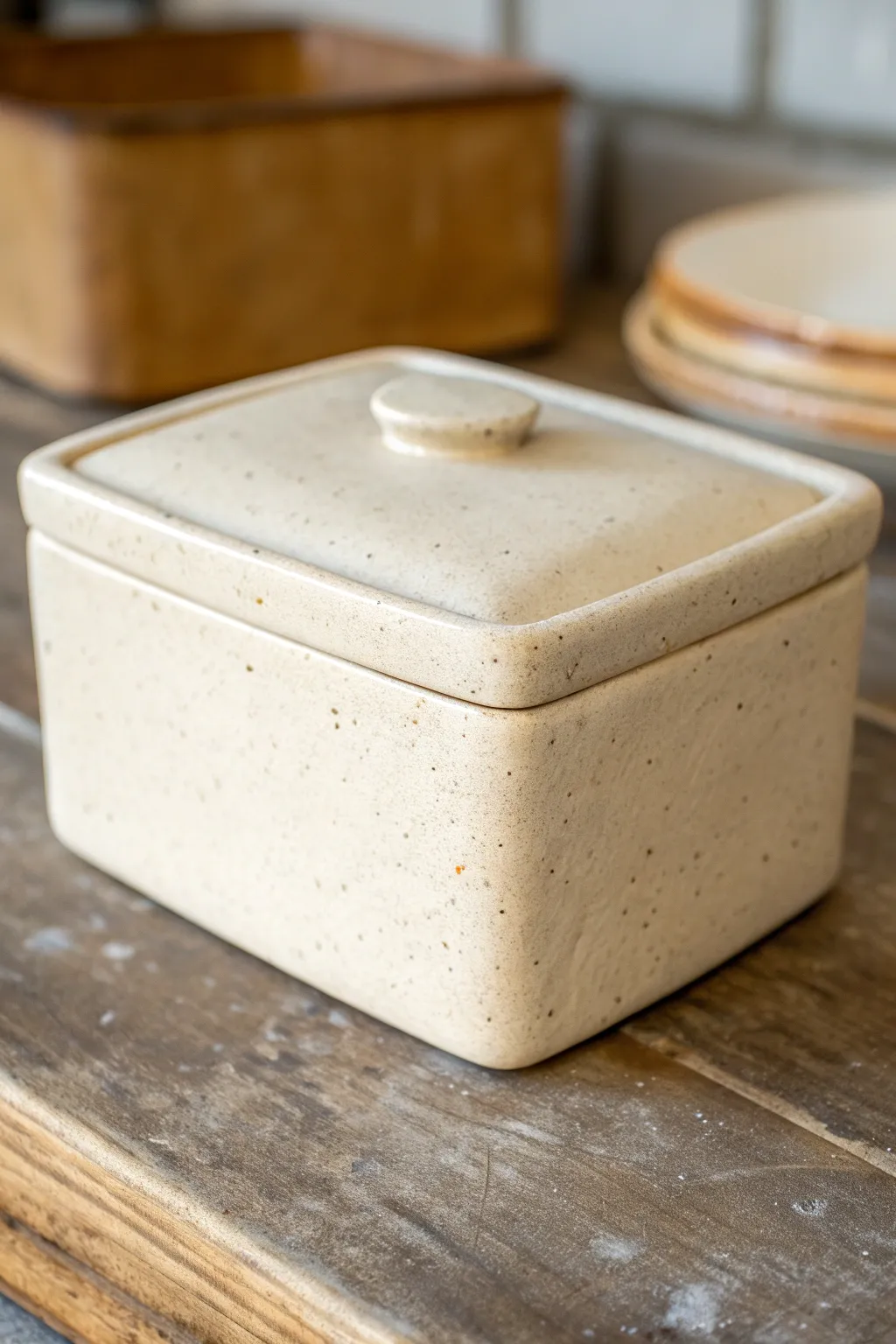
This charming lidded container combines clean lines with gentle, rounded corners for a soft, approachable feel. The understated speckled cream glaze highlights the natural warmth of the clay, making it a perfect functional piece for your kitchen counter.
Step-by-Step Guide
Materials
- Speckled buff stoneware clay
- Rolling pin
- Guide sticks or slab roller (approx. 1/4 inch thick)
- Fettling knife or needle tool
- Paper templates (base, walls, lid)
- Serrated rib or scoring tool
- Slip or magic water
- Soft rib (red or yellow)
- Wooden paddle
- Sponge
- Satin cream/white glaze
- Small disk cutter or cookie cutter (for handle)
Step 1: Slab Preparation
-
Roll out the clay:
Begin by rolling out a generous slab of speckled buff clay to an even thickness, aiming for about 1/4 inch. If you want the walls slightly sturdier, go just a hair thicker, but uniformity is key here. -
Compress the slab:
Use a rib to smooth and compress the clay on both sides. This aligns the clay particles, preventing warping later and giving you a lovely smooth canvas for the speckled glaze. -
Cut the components:
Using your paper templates, cut out the base rectangle, the four wall sections (or one long strip if you prefer wrapping), and the lid piece. For this soft-corner look, cut the base slightly smaller than the outer perimeter of the walls. -
Let it firm up:
Allow the cut pieces to dry to a sturdy leather-hard state. They need to hold their shape without slumping when stood upright, but still be flexible enough to bend slightly.
Step 2: Assembling the Box
-
Bevel the edges:
Cut 45-degree angles on the vertical edges of your wall pieces where they will meet. This miter joint creates a stronger bond and seamless corner. -
Score and slip:
Aggressively score the beveled edges and apply slip. Stand the walls up on the base (score and slip the bottom connection too) and press the corners together firmly. -
Reinforce the interior:
For extra stability, roll a tiny coil of soft clay and press it into the interior seams. Smooth it out with a modeling tool or your finger so it disappears completely. -
Paddle the corners:
This is the signature step. Once the box is assembled, take a wooden paddle and gently tap the sharp 90-degree outer corners. Keep tapping until the sharp edge rounds over, giving that soft, pillowy silhouette. -
Smooth the exterior:
Use a soft rib to smooth away any paddle marks or canvas texture, ensuring the transition from flat wall to rounded corner is seamless.
Use a Balloon
To prevent sagging while paddling the corners, lightly inflate a balloon inside the box to support the walls from within.
Step 3: Creating the Lid
-
Form the lid slab:
Take your lid slab piece, which should be slightly larger than the box opening. gently curve the edges downward or add a small rim strip underneath so it sits securely on the box without sliding off. -
Refine the lid shape:
Just like the box, gently paddle or sponge the edges of the lid to remove sharpness. You want it to look like it flowed into shape, not like it was sliced. -
Make the handle:
Cut a small circle or oval from a thick slab for the handle. I like to bevel the underside slightly so it lifts off the lid surface, creating a shadow line. -
Attach the handle:
Score and slip the center of the lid and the handle. Press it down firmly, checking for alignment. Clean up any oozing slip immediately with a damp brush. -
Dry slowly:
Place the lid on the box with a piece of newspaper or plastic in between to prevent sticking. Wrap the whole piece loosely in plastic to dry slowly and evenly, preventing warping.
Add a Gallery
Instead of a simple lid, carve a ‘gallery’ (a ledge) into the rim of the box walls for the lid to sit flush inside for a sleeker profile.
Step 4: Glazing
-
Bisque fire:
Once bone dry, fire the piece to bisque temperature (usually cone 04). -
Wax the foot:
Apply wax resist to the bottom of the box and the rim where the lid touches to prevent the lid from fusing shut during the glaze firing. -
Apply the glaze:
Pour or dip the piece in a satin cream or oatmeal glaze. Avoid thick drips near the bottom. -
Final fire:
Fire to the maturation temperature of your clay body (likely cone 5 or 6) to bring out the iron speckles through the creamy glaze.
Now you have a beautifully understated container ready for butter, jewelry, or precious keepsakes
Footed Slab Box With Tiny Ball Feet
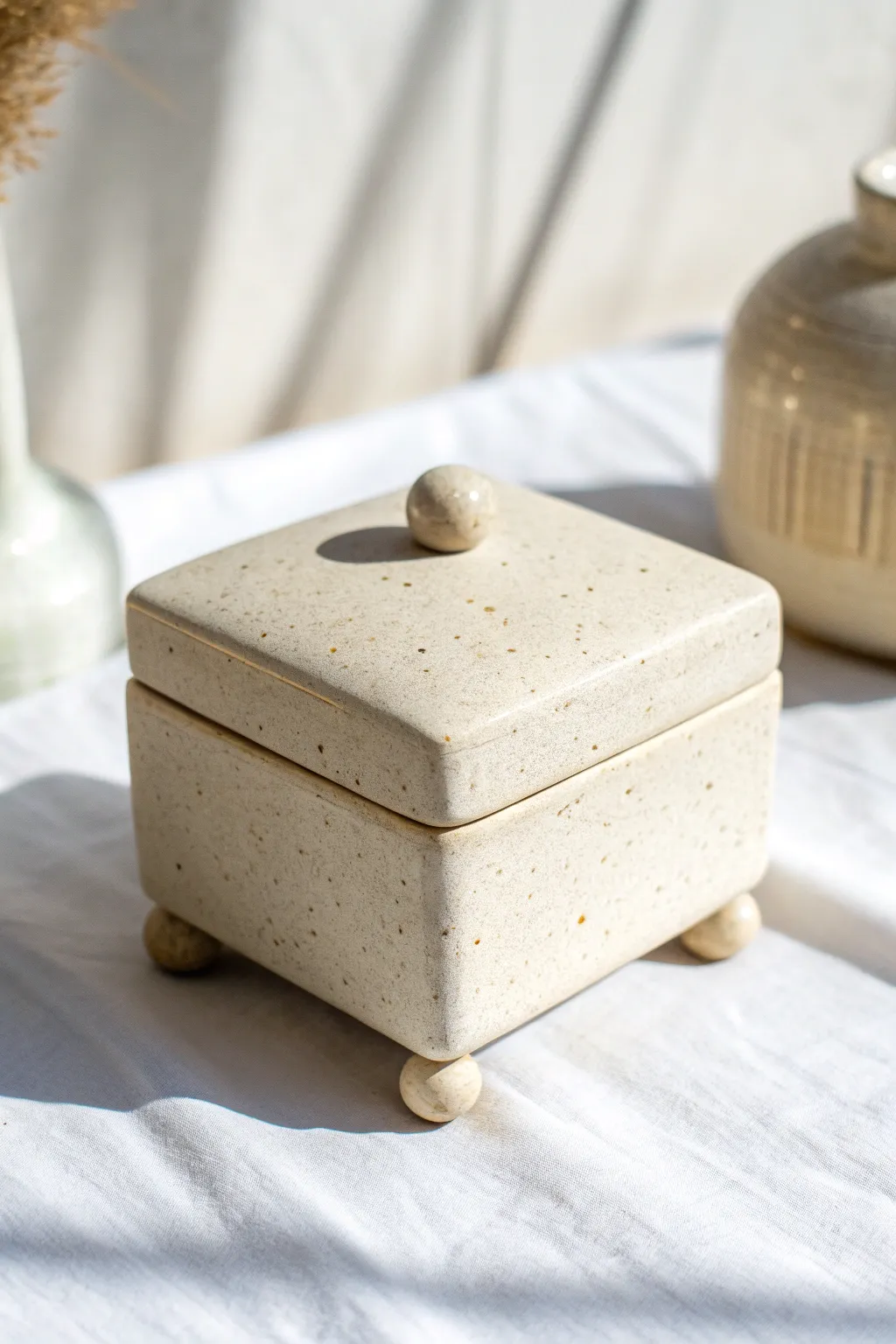
This charming ceramic box combines clean lines with playful spherical details for a modern yet organic feel. The creamy, speckled finish highlights the simple slab construction, making it a perfect container for trinkets or jewelry.
Step-by-Step Tutorial
Materials
- Speckled stoneware clay
- Rolling pin
- Canvas or slab mat
- Guide sticks (about 1/4 inch thick)
- Ruler
- Fettling knife or needle tool
- Scoring tool or serrated rib
- Slip
- Sponge
- Creamy semi-matte glaze
Step 1: Prepping the Slabs
-
Roll the clay:
Begin by rolling out a generous slab of speckled stoneware clay on your canvas. Use your guide sticks on either side to ensure an even thickness of roughly 1/4 inch throughout. -
Smooth the surface:
Before cutting, take a rubber rib and compress the clay slab on both sides. This removes any canvas texture and aligns the clay particles, which helps prevent warping later. -
Measure and cut:
Using your ruler and fettling knife, cut out five squares for the box body. Four will be side walls and one will be the base. For the lid, cut a slightly larger square that will overhang the edges just a hair, plus a smaller square that will fit snugly inside the box opening to keep the lid in place. -
Leather hard stage:
Set your cut pieces aside on a flat board to firm up. You want them to reach a soft leather-hard state where they can stand up without bending but are still moist enough to join easily.
Air Trap Warning
Make sure you poke a tiny, invisible pinhole on the underside of the hollow lid flange or any enclosed hollow forms. This lets expanding air escape in the kiln so your piece doesn’t explode.
Step 2: Assembling the Box
-
Bevel the edges:
For crisp corners, cut 45-degree angles on the side edges of your wall pieces and the edges of the base. This miter joint creates a stronger bond and a cleaner look than a simple butt joint. -
Score and slip:
Thoroughly score (scratch up) the beveled edges and apply a generous amount of slip. I like to be messy here—excess slip is better than a dry joint. -
Join the walls:
Attach two side walls to the base first, pressing the seams firmly together. Then add the remaining walls. Use a small coil of soft clay on the interior seams to reinforce them, smoothing it out with your fingertip or a modeling tool. -
Refine the exterior:
Once the box is assembled, use a wooden paddle to gently tap the walls straight and square. Smooth the external corners with a rib to seamlessly blend the joints.
Step 3: Creating the Lid and Details
-
Assemble the lid:
Center the smaller interior square onto the bottom of the larger lid slab. Score distinct marks, add slip, and press them firmly together. This ‘flange’ style keeps the lid from sliding off. -
Make the spheres:
Roll five small balls of clay. Four will be the feet, and one will be the handle. Aim for about the size of a large marble, ensuring they are all consistent. -
Attach the feet:
Flip your box body upside down. Score the four corners of the base and the contact point on four of your clay spheres. Attach the spheres using slip, pressing gently so they don’t deform too much but adhere well. -
Level check:
Turn the box right-side up and gently press it down onto a level board to ensure all four feet sit flat and the box doesn’t wobble. -
Add the handle:
Find the exact center of your lid top. Score and slip that spot and the final sphere, attaching it securely as a knob.
Make it a Set
Create a nesting set by making two additional boxes, scaling the dimensions down by 1 inch each time. Keep the ball feet proportional for a cohesive look.
Step 4: Finishing and Glazing
-
Clean up:
Use a damp sponge to wipe away any sharp edges or burrs. Smooth the transition points around the feet and the handle knob so they look integrated rather than just stuck on. -
Drying and Bisque:
Allow the box to dry slowly under loose plastic to prevent uneven shrinkage. Once bone dry, bisque fire the piece to cone 04 (or your clay body’s recommendation). -
Glaze application:
Dip or brush on a creamy, semi-matte glaze. Avoid glazes that are too thick or opaque if you want the natural speckles of the clay to show through. -
Glaze footing:
Wipe the bottoms of the four ball feet perfectly clean of glaze. Any glaze left here will fuse your beautiful box to the kiln shelf. -
Final Fire:
Glaze fire to the temperature appropriate for your clay and glaze combination, typically cone 5 or 6 for stoneware.
Once fired, place this elegant little box on your dresser as a minimalist treasure chest

What Really Happens Inside the Kiln
Learn how time and temperature work together inside the kiln to transform clay into durable ceramic.
Ribbed Strip Texture Container
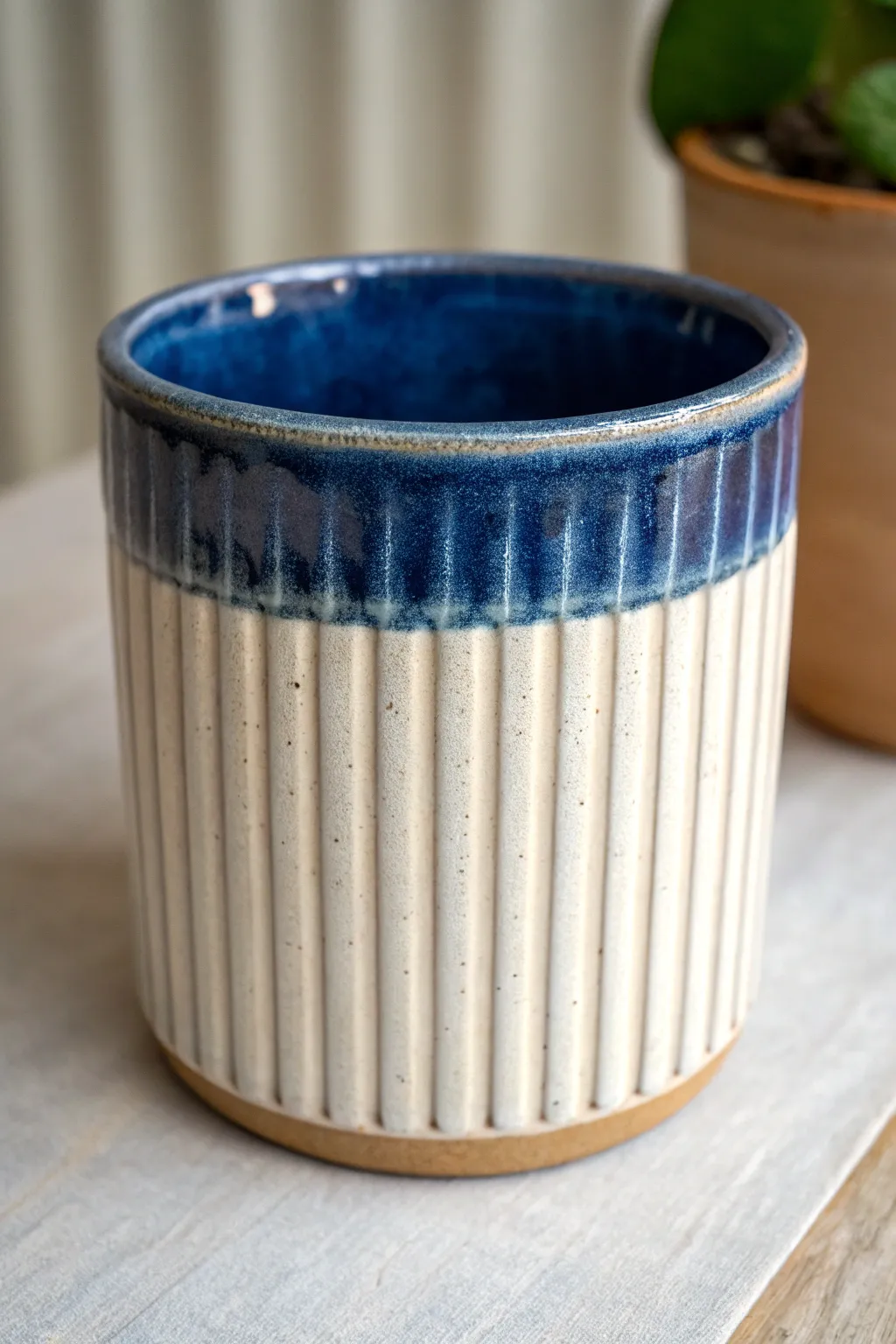
This project features a clean, architectural cylinder with deep vertical fluting that adds distinct tactile appeal. The sophisticated finish relies on a sharp contrast between a glossy midnight blue rim and a creamy, speckled base, creating a modern classic perfect for holding utensils or plants.
Detailed Instructions
Materials
- Stoneware clay slab (approx. 3/8 inch thick)
- Slip and scoring tool
- Circle cutter or template (for base)
- Rectangular template (for walls)
- Wide-toothed rib or fluting tool (e.g., a texture comb)
- Potter’s knife or fettling knife
- Banding wheel
- Sponge
- Dark blue glossy glaze
- Creamy matte/satin glaze (speckled)
- Wax resist (liquid)
Step 1: Creating the Textured Slab
-
Roll out the slab:
Begin by rolling out a generous slab of stoneware clay to an even thickness of about 3/8 inch. Ensure the slab is large enough to cut a long rectangle for the wall and a circle for the base. -
Add the ribbed texture:
While the slab is flat on your work surface, take your wide-toothed rib or fluting tool. Drag it firmly and evenly across the entire length of the clay in straight, parallel lines to create the deep vertical grooves. -
Compress the texture:
Gently smooth over the high points of the ribs with a very soft rib or your finger just to remove any sharp clay burrs, but be careful not to flatten the texture you just created. -
Cut the forms:
Using your rectangular template, cut the wall piece so that the ribs run vertically (perpendicular to the table). Cut a circle for the base using your circle cutter or template.
Step 2: Assembling the Cylinder
-
Bevel the edges:
On the short sides of your rectangular wall piece, cut 45-degree angles in opposite directions. This beveling helps create a stronger, seamless join where the cylinder closes. -
Score and slip the base:
deeply score the outer edge of your circular base and apply a generous amount of slip. Do the same to the bottom edge of your rectangular wall. -
Form the cylinder:
Lift the wall piece and curve it into a cylinder shape. I find it easiest to overlap the beveled edges first to check fit before pressing them together. -
Join the seam:
Press the beveled ends together firmly. Use a wooden modeling tool to blend the seam on the inside until it’s invisible. On the outside, carefully blend the seam, trying to match the ribbed pattern as best as possible so the join disappears. -
Attach wall to base:
Place the cylinder onto the scored base. Press down firmly from the inside to secure the wall to the floor. Use a tool to smooth the interior connection. -
Refine the rim:
Smooth the top rim with a damp sponge or chamois cloth. The rim should be rounded and comfortable to the touch.
Warped Walls?
If your cylinder slumps while building, the slab was likely too wet. Let your textured slab stiffen to a ‘soft leather hard’ stage before assembling.
Step 3: Glazing and Finishing
-
Bisque fire:
Allow the piece to dry slowly to prevent warping, then bisque fire it according to your clay body’s instructions. -
Wax the foot:
Apply a band of wax resist to the bottom ¼ inch of the exterior and the entire underside of the pot. This creates that lovely exposed clay line at the bottom seen in the photo. -
Glaze the interior:
Pour the dark blue glossy glaze into the interior, roll it around to coat every surface, and pour out the excess. Wipe any drips off the exterior immediately. -
Dip the top section:
Hold the pot by the base and dip the top 1/3 of the exterior (rim down) into the dark blue glaze. Hold it there for a few seconds for an even coat, then shake gently to remove drips as you pull it out. -
Dip the bottom section:
Once the blue glaze is dry to the touch, hold the pot by the rim (or use tongs) and dip the bottom 2/3 into the creamy matte glaze. Overlap the blue glaze slightly if you want a blended transition, or stop just short for a hard line. -
Clean up:
Use a sponge to wipe away any glaze beads that have formed on the waxed foot ring. -
Final firing:
Glaze fire the piece to the appropriate cone (likely Cone 5 or 6 for stoneware). The heat will cause the glazes to interact and the speckles in the cream glaze to pop.
Dual-Tone Dip Trick
To get a straight glaze line without dipping, apply masking tape around the circumference. Glaze one side, let dry, remove tape, then wax that area before glazing the rest.
Once fired, fill your striking two-tone container with pencils or a potted plant to enjoy your handiwork daily
Stamped Pattern Slab Container
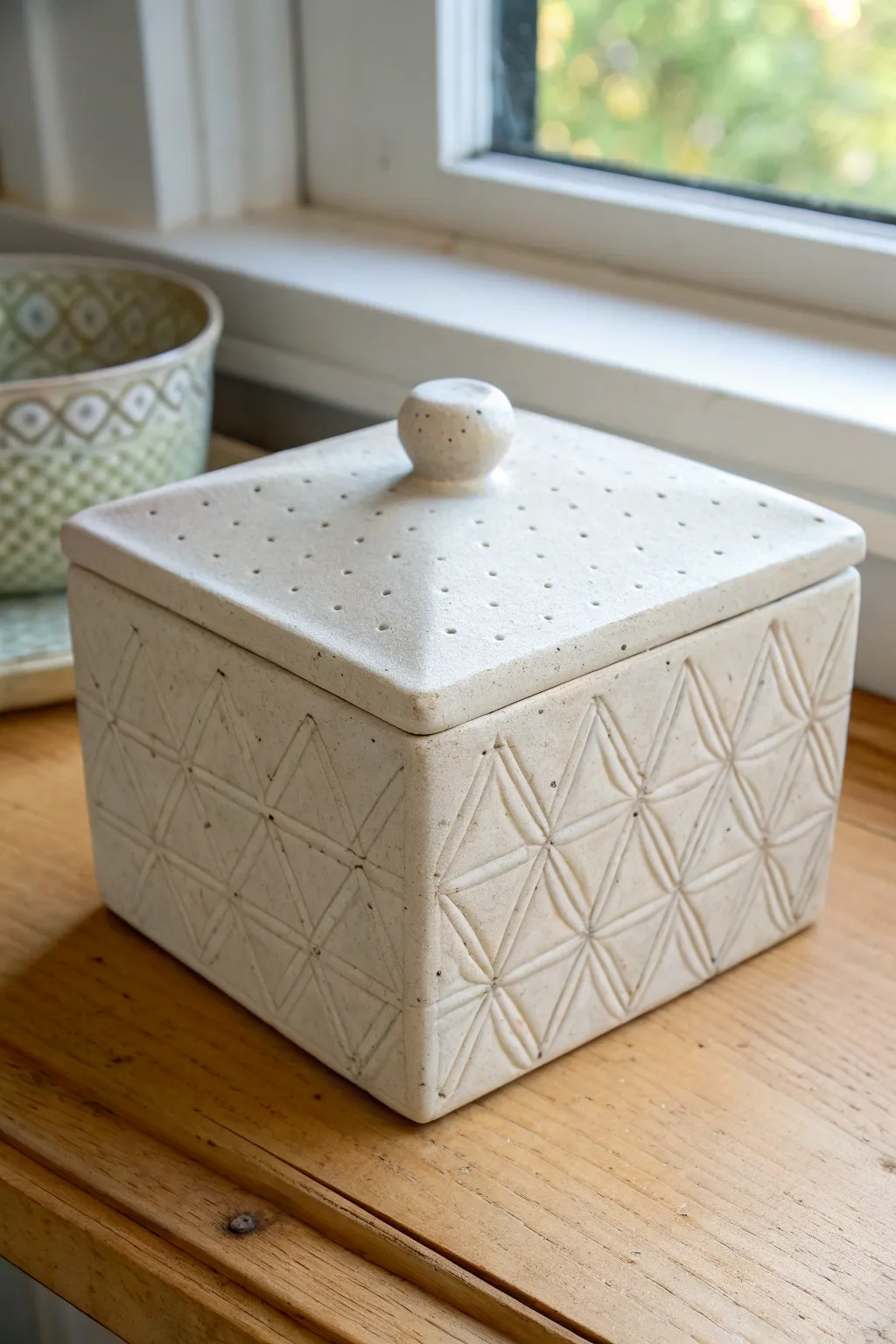
This elegant square lidded box combines clean lines with a textural, stamped geometric pattern. Constructed from clay slabs, it features a fitted pyramid-style lid with delicate perforation detailing, making it perfect for storing treasures or serving as a decorative accent.
Step-by-Step
Materials
- Stoneware clay (smooth or lightly grogged light-colored body)
- Rolling pin
- Two wooden thickness strips (3/8 inch)
- Fettling knife or needle tool
- Ruler
- Scoring tool or serrated rib
- Slip (clay mixed with water)
- Geometric stamp (triangle or diamond shape)
- Small round tool or drill bit (for lid dots)
- Sponge
- Plastic sheet
Step 1: Preparing the Slabs
-
Roll the clay:
Begin by wedging your clay to remove air bubbles, then roll it out into a large, even sheet using a rolling pin and your thickness strips. This ensures the walls of your box will be uniform. -
Smooth the surface:
Before cutting anything, take a rib tool or a slightly damp sponge to compress and smooth the surface of the clay slab. This removes canvas texture and prevents cracking later. -
Cut the base and walls:
Using a ruler and fettling knife, measure and cut one square for the base (e.g., 4×4 inches) and four rectangular side panels. The height is up to you, but keep the width matching your base. -
Stiffen the slabs:
Let the cut pieces sit on a ware board until they reach a ‘leather-hard’ state. They should be firm enough to hold their shape when stood up, but soft enough to score and slip.
Warped Walls?
If walls start bowing inward during drying, stuff the box loosely with crumpled newspaper or foam to support the shape until bone dry.
Step 2: Building the Box Body
-
Stamp the pattern:
While the slabs are flat but firm, press your geometric stamp into the four wall panels. Align the stamps carefully to create the repeating diamond or triangle motif seen in the photo. Be sure to support the back of the clay so you don’t distort the slab’s shape. -
Bevel the edges:
Cut 45-degree angles (miters) on the vertical edges of your wall pieces and around the perimeter of the base. This creates stronger, cleaner corner joints. -
Score and slip:
Roughen all the beveled edges with your scoring tool and apply a generous amount of slip. This acts as the glue for your clay. -
Assemble the walls:
Attach the first wall to the base, pressing firmly. Add the adjacent wall, pressing the vertical seam together. Continue until all four walls are attached and the box is formed. -
Reinforce the interior:
Roll a very thin coil of clay and press it into the bottom interior seams. Smooth it out with your finer or a modeling tool to ensure a watertight seal.
Texture Pop
Use a dark wash (like iron oxide) over the texture before glazing. Wipe it back so the dark color remains only in the deep stamped lines.
Step 3: Creating the Lid
-
Measure the lid base:
Measure the outer dimensions of your now-assembled box. Cut a square slab slightly larger than this measurement to form the lid. -
Shape the pyramid:
To get that gentle pyramid slope, I like to pinch the center of the lid slab gently upwards or press the edges downwards while supporting the center. Alternatively, you can add extra clay to the center and carve it back. -
Add the knob:
Form a small ball of clay, slightly flattened at the bottom. Score and slip the center of the lid peak and attach the knob securely. -
Create the fitters:
To keep the lid from sliding off, attach small strips of clay or ‘lugs’ to the underside of the lid, inset just enough to fit snugly inside the box opening. -
Detail the lid surface:
Using a small, blunt tool or the back of a drill bit, gently press rows of small dots radiating from the center knob down the slopes of the lid.
Step 4: Finishing Touches
-
Clean up edges:
Once the box is fully leather hard, use a sponge to soften any sharp corners on the lid and box rim. -
Dry slowly:
Place the lid on the box and cover the whole piece loosely with plastic. Dry very slowly to prevent warping, especially where the walls meet the base. -
Bisque fire:
Fire the piece to cone 04 (or your clay’s specific bisque temperature). -
Glaze application:
Apply a matte white or cream glaze. To highlight the stamped texture, wipe back the glaze slightly with a sponge so it stays thicker in the recesses and thinner on the high points. -
Final smooth firing:
Glaze fire the piece to the maturity temperature of your clay (likely cone 5 or 6 for stoneware).
Now you have a beautifully textured ceramic vessel ready to organize your space with style

TRACK YOUR CERAMIC JOURNEY
Capture glaze tests, firing details, and creative progress—all in one simple printable. Make your projects easier to repeat and improve.
Carved Sgraffito Story Box
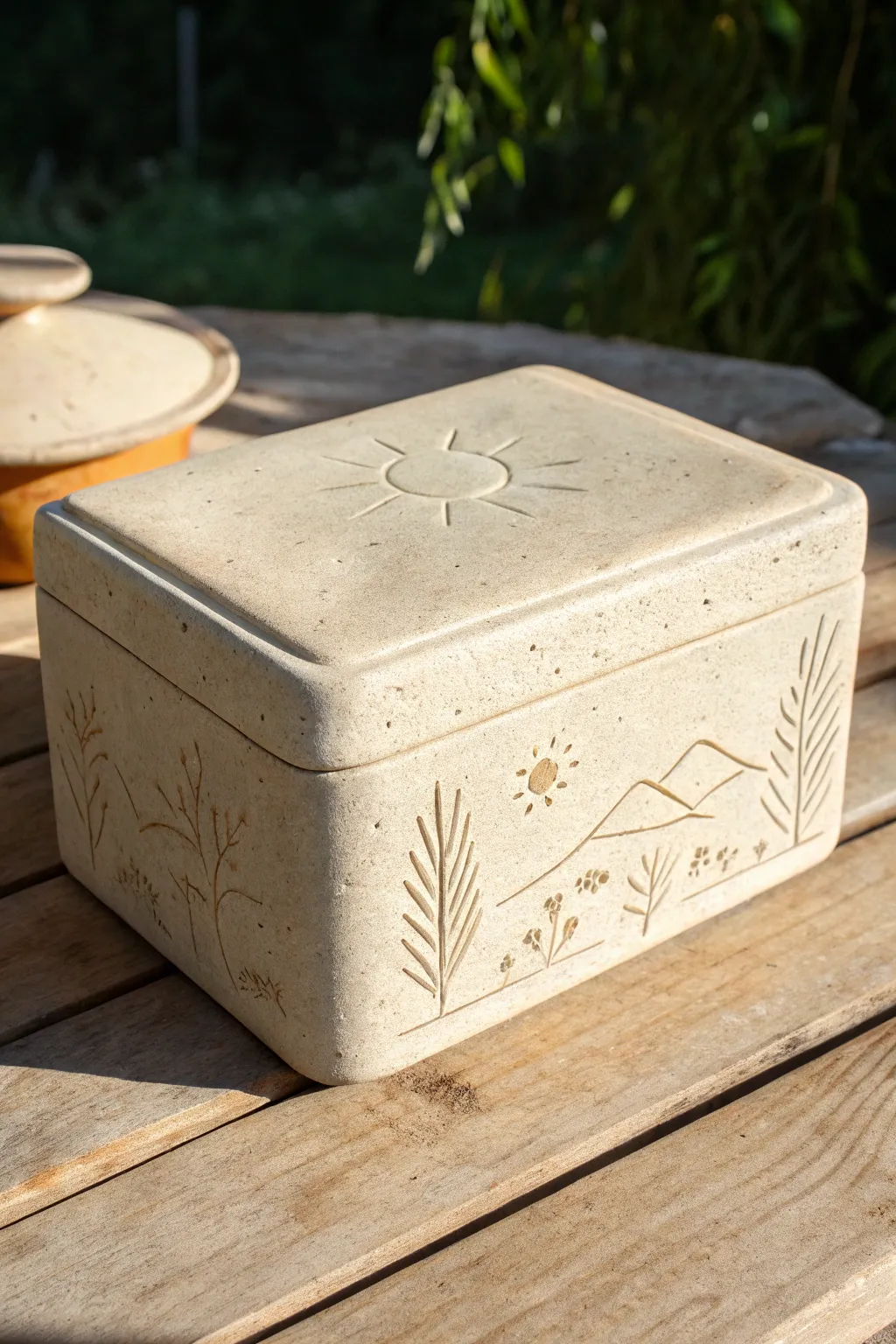
This charming lidded box features a serene, carved landscape that wraps around its exterior, bringing a touch of nature to your storage. Built from sturdy clay slabs and decorated with simple line carvings, the finished piece has a lovely, organic texture that feels wonderful to hold.
Step-by-Step Tutorial
Materials
- Light-colored stoneware clay (buff or white)
- Templates (cardstock rectangles for walls, base, and lid)
- Rolling pin and guide strips (3/8 inch thickness)
- Fettling knife or needle tool
- Serrated rib or scoring tool
- Slip (clay mixed with water)
- Carving tools (loop tool or sgraffito stylus)
- Soft sponge
- Wide paddle (optional)
Step 1: Creating the Basic Form
-
Roll the Slabs:
Begin by rolling out your clay to an even 3/8-inch thickness using guide strips. You want the clay firm enough to stand but soft enough to bend slightly without cracking. -
Cut Components:
Using your cardstock templates, cut out the floor, four walls, and a lid slightly larger than the floor dimensions. Let these slabs stiffen to a soft leather-hard stage so they hold their shape. -
Miter the Edges:
For a seamless corner, cut the vertical edges of your wall pieces at a 45-degree angle. This creates a stronger bond and hides the join better than a butt joint. -
Score and Slip:
Rough up the edges of the base and the mitered wall ends deeply with your serrated rib. Apply a generous amount of slip to all joining surfaces. -
Assemble Walls:
Press the walls onto the base and against each other. I like to secure one long wall and one short wall first to create a corner, then add the remaining sides. -
Reinforce Interiors:
Roll a very thin coil of clay and press it into the bottom interior seams. Smooth it out with your fingertip or a modeling tool to ensure a watertight seal. -
Paddle into Shape:
Gently paddle the exterior walls with a wooden paddle to compress the joins and square up the box. This also helps remove any warping that occurred during handling.
Step 2: The Lid and refinement
-
Create the Flange:
To keep the lid from sliding off, attach a smaller slab or a coil rectangle to the underside of your lid piece. Measure the inside of your box opening carefully so this flange fits snugly inside. -
Rounded Corners:
Use a damp sponge or your fettling knife to gently round over the sharp corners and edges of both the box and the lid. This gives the piece the soft, stone-like quality seen in the photo. -
Refine Surfaces:
Smooth out the flat surfaces with a rubber rib. At this point, let the box dry slowly under plastic until it reaches a firm leather-hard state suitable for carving.
Warped Walls?
If walls bow inward while drying, place a piece of foam or crumpled newspaper inside the box to support the sides until they become leather hard.
Step 3: Carving the Narrative
-
Sketch the Design:
Lightly trace your landscape design onto the surface using a needle tool or a soft pencil. Plan a continuous horizon line that wraps around the corners. -
Carve the Sun:
On the lid, carve a simple circle with radiating lines. Keep the pressure consistent so the lines are deep enough to catch glaze or stain later. -
Detail the Landscape:
Carve the stylized trees and mountains on the sides. Use short, decisive strokes for the pine needles and flowing lines for the hills. -
Add Texture:
For the wildflowers and smaller plants, use poke marks or tiny dashes. Don’t worry about perfect realism; the charm lies in the folk-art simplicity. -
Clean Up Burrs:
Once the carving is totally dry, brush away the little clay crumbs (burrs) with a stiff brush. Don’t wipe them while wet, or you’ll re-fill your lines. -
Bisque and Finish:
Fire the piece to bisque temperature. To highlight the carving as shown, brush a dark oxide wash (like iron oxide) into the lines and wipe the surface clean with a damp sponge before the final glaze firing.
Clean Lines
Wait until the clay is truly firm leather-hard before carving. The tool should cut clean ribbons of clay rather than dragging through mush.
Once fired, this quiet little landscape box will be ready to hold your treasures
Patchwork Slab Container With Inlays
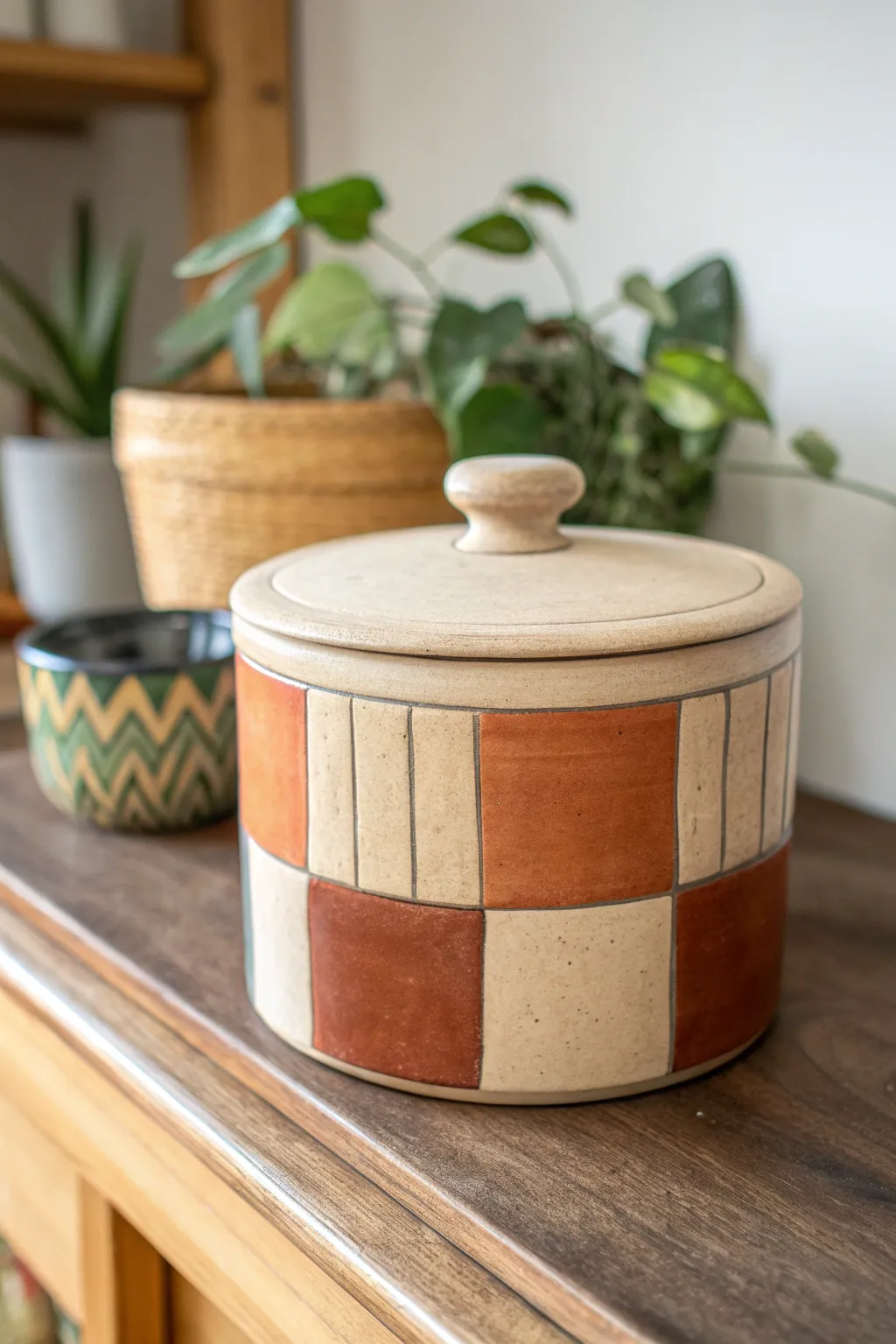
This charming ceramic jar features a warm, earthy aesthetic created by alternating blocks of smooth terra cotta and textured cream clay. The precise slab-building technique results in a clean cylindrical form perfect for kitchen storage or decorative display.
Detailed Instructions
Materials
- Stoneware clay (speckled cream)
- Terra cotta clay (or red Stoneware)
- Clay slab roller or rolling pin with guide strips
- Fettling knife or sharp craft blade
- Metal rib and flexible rubber rib
- Scoring tool (serrated rib)
- Slip (made from your clay bodies)
- Ruler
- Needle tool
- Sponge
- Black underglaze or iron oxide wash
- Clear matte glaze
Step 1: Creating the Patchwork Slab
-
Roll your slabs:
Begin by rolling out slabs of both the cream speckled clay and the red terra cotta clay to an even thickness, approximately 1/4 inch. Smooth both sides with a rubber rib to compress the clay particles. -
Cut squares:
Using a ruler and a sharp fettling knife, cut precise squares from both clay bodies. A 2-inch or 2.5-inch square is a good manageable size for this scale. -
Arrange the pattern:
Lay out your squares in a checkerboard pattern on a canvas board. Alternate between red and cream squares to create two or three rows, depending on your desired height. -
Join the squares:
Score and slip the edges of each square thoroughly. Press them together firmly on a flat surface to create a single, long rectangular strip. I like to lay a piece of canvas over the top and gently roll over the seams to bond them without distorting the pattern. -
Add texture:
On the cream-colored squares, use a ruler and a needle tool (or a dull blade) to gently press vertical lines into the surface. Don’t cut all the way through; just create indentations for later detailing.
Cracking Seams?
Using clays with different shrinkage rates can cause gaps. Ensure both clay bodies have nearly identical shrinkage stats before starting.
Step 2: Assembling the Cylinder
-
Form the cylinder:
Wait until the patchwork slab is leather hard—stiff enough to hold its shape but flexible enough to bend. Stand it up and curve it into a cylinder. -
Seal the vertical seam:
Score and slip the ends where they meet. Be careful to match the pattern so the checkerboard continues seamlessly. Compress the seam well from both the inside and outside. -
Add the base:
Roll a separate slab of cream clay for the base. Place your cylinder on top, trace around it, and cut the circle slightly larger than the cylinder. -
Attach the floor:
Score and slip the bottom edge of the cylinder and the perimeter of the base. Press them together firmly. Use a modeling tool to smooth the connection on the outside, then clean up the interior seam with a damp sponge on a stick if your hand doesn’t fit.
Step 3: Sculpting the Lid
-
Measure the opening:
Measure the exact inner and outer diameter of your jar’s rim. -
Cut the lid slab:
Cut a circle from a cream clay slab that matches the outer diameter of your jar. Smooth the edges with a damp sponge. -
Create the flange:
Cut a smaller ring or a thick coil of clay that fits just inside the jar’s opening. Score and slip this onto the underside of the main lid circle. This flange prevents the lid from sliding off. -
Throw or sculpt the knob:
You can hand-model a knob or throw a small one on the wheel. The shape in the example implies a mushroom-style knob. Attach it to the center of the lid using the score and slip method.
Mix Up The Patterns
Try inlaying small spheres or coils of contrasting clay into the squares before rolling them flat for a terrazzo or inlaid floral effect.
Step 4: Finishing and Glazing
-
Bisque fire:
Allow the piece to dry slowly under plastic to prevent cracking at the seams. Once bone dry, bisque fire in the kiln. -
Apply oxide wash:
Mix a black underglaze or iron oxide wash with water. Brush it into the vertical lines on the cream squares and the seams between the patchwork. -
Wipe back:
Use a damp sponge to wipe the surface clean, leaving the dark color trapped only in the recessed lines and crevices to highlight the geometry. -
Glaze application:
Dip or brush a clear matte glaze over the entire piece. This protects the clay while allowing the natural red and cream clay colors to remain the star of the show. -
Final firing:
Fire the jar to the maturity temperature of your clay body (likely Cone 5 or 6 for stoneware).
Fill your new handmade canister with coffee beans or treats and enjoy the warmth it brings to your countertop
Two-Tone Slip-Dipped Container
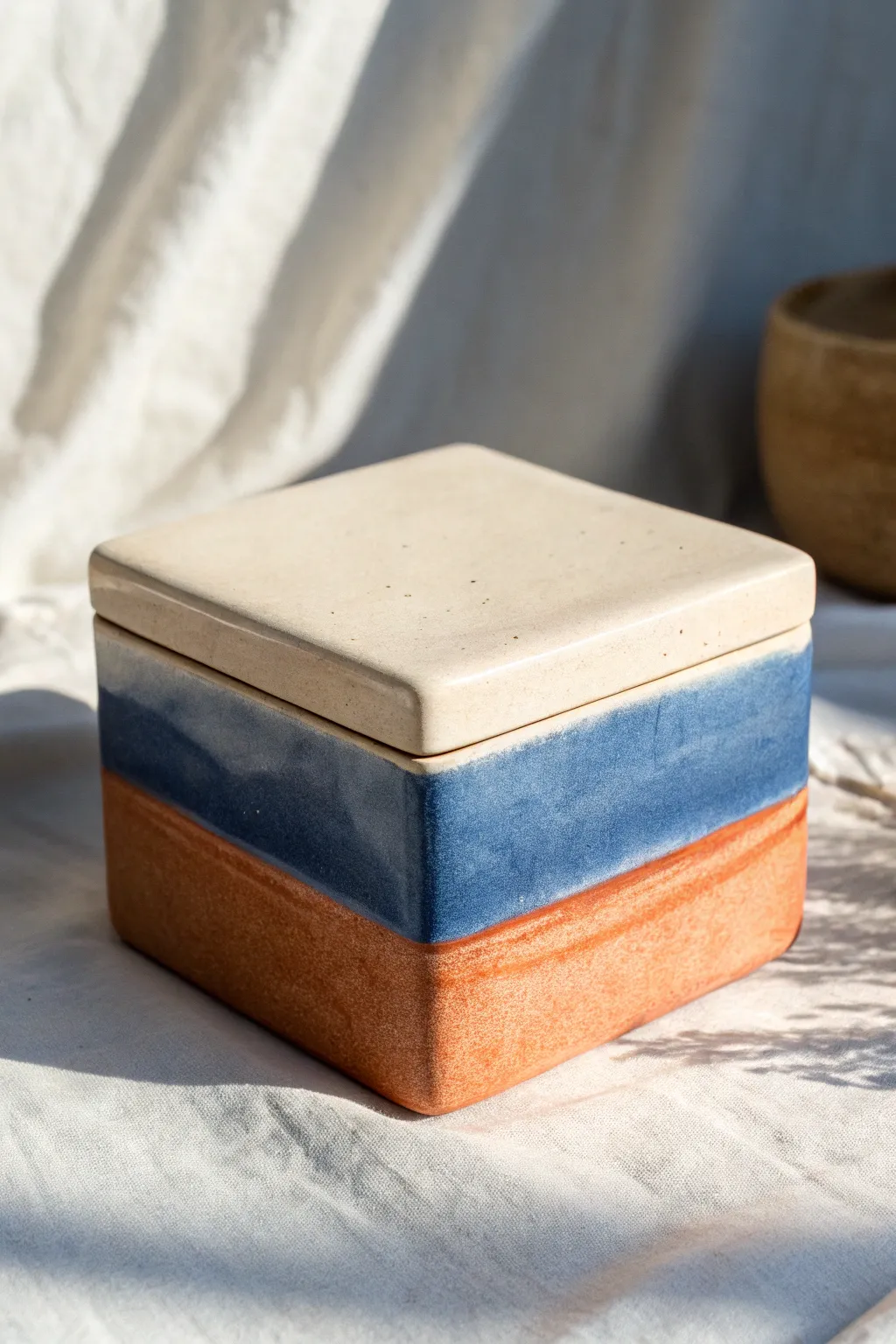
This elegant lidded box captures the serene colors of a shoreline with its distinct bands of deep ocean blue and warm terracotta orange against a creamy white clay body. By using a clever dipping technique with colored decorative slips, you can achieve clean, crisp lines without needing painterly skills.
Step-by-Step Tutorial
Materials
- White or cream stoneware clay body
- Rolling pin
- Wooden guide strips (approx. 1/4 inch thick)
- Fettling knife or craft knife
- Ruler/Speed square
- Serrated rib or scoring tool
- Slip (liquid clay)
- Small paintbrush
- Deep blue colored slip or underglaze
- Terracotta/Orange colored slip or underglaze
- Clear transparent glaze
- Paddle tool
- Sponge
Step 1: Forming the Box
-
Roll the Slabs:
Begin by rolling out your white stoneware clay into an even slab using your rolling pin and guide strips. Aim for a distinct thickness, around 1/4 inch, to give the box straight, sturdy walls. -
Cut the Components:
Using a ruler and fettling knife, carefully measure and cut four equal squares for the walls (e.g., 4×4 inches) and two slightly larger squares for the floor and lid. Let these leather-harden slightly until they can stand up without slumping. -
Bevel the Edges:
For the crispest 90-degree corners, cut the vertical edges of your four wall pieces at a 45-degree angle. This simple miter joint hides the seam and makes the box look seamless. -
Score and Slip:
Aggressively score the beveled edges and apply a generous amount of plain slip. Press the walls together to form a square tube, wiggling them slightly to lock the clay particles together. -
Attach the Base:
Score and slip the bottom edge of your square tube and attach it firmly to one of the larger square slabs. Trim away any excess clay flush with the walls using your knife. -
Reinforce Seams:
Roll a very thin coil of clay and work it into the interior corners of the box for added strength. Smooth it out with a rounded tool or your finger so it becomes invisible. -
Paddle into Shape:
Gently tap the outside walls with a wooden paddle. This standardizes the shape, tightens the corners, aud helps erase any warping that happened during construction.
Uneven Diping Lines?
Use drafting tape (or automotive masking tape) to mask off perfect straight lines before dipping. Peel the tape off immediately after dipping while slip is wet.
Step 2: Creating the Lid
-
Measure the Flange:
Take your remaining slab square (the lid) and measure a smaller square of clay that fits exactly inside the rim of your box opening. This will act as the flange to keep the lid from sliding off. -
Attach the Flange:
Score, slip, and center this smaller square onto the underside of your main lid slab. Press firmly to eliminate air bubbles and ensure a secure bond. -
Smooth and Round:
Use a damp sponge to soften the sharp edges of the lid, giving it that pillowy, ‘soft’ look seen in the photo. Pay special attention to the top corners.
Step 3: The Dipping Process
-
Prepare for Color:
Allow the entire box to reach bone dry stage or a very stiff leather hard. The drier the clay, the faster it will absorb the colored slip, creating clean lines. -
Mix Your Slips:
Prepare your deep blue and terracotta slips in wide, shallow containers that can accommodate the width of the box. Stir them well to ensure the consistency is like heavy cream. -
Dip the Bottom:
Holding the box by the upper rim, dip the bottom third of the box straight down into the terracotta slip. Lift it straight out and hold it upside down for a few seconds to let drips settle back into the colored area. -
Dry the Layer:
Let this orange layer dry until the sheen has disappeared and it is dry to the touch. This prevents the colors from bleeding into each other during the next step. -
Dip the Middle:
Now, carefully dip the box into the blue slip, submerging it just deep enough to create the middle band. I prefer to stop just short of the orange line to avoid overlapping, or overlap slightly if you want a third, darker tone at the junction. -
Clean the Rim:
If any slip splashed onto the top rim or the interior, wipe it away cleanly with a sponge. The top section and lid should remain the natural creamy clay color.
Level Up: Texture Contrast
Leave the dipped slip areas unglazed (raw finish) and only apply clear glaze to the white clay lid and interior for a beautiful matte vs. shiny tactile contrast.
Step 4: Finishing
-
Bisque Fire:
Once the slip is completely dry, load the box and lid into the kiln for a bisque firing. -
Apply Clear Glaze:
After the bisque, dip or brush a clear transparent glaze over the entire piece (lid and box). This will seal the clay and make the slip colors pop. -
Final Fire:
Fire the piece to the maturity temperature of your clay body (likely cone 5 or 6). Be careful not to let the lid glaze touch the box rim, or fuse them together—wiping the contact points with wax resist helps here.
This modern, geometric container is perfect for holding tea, jewelry, or simply sitting as a sculptural object on your shelf
Sculptural Knob Lid (Mini Theme Topper)
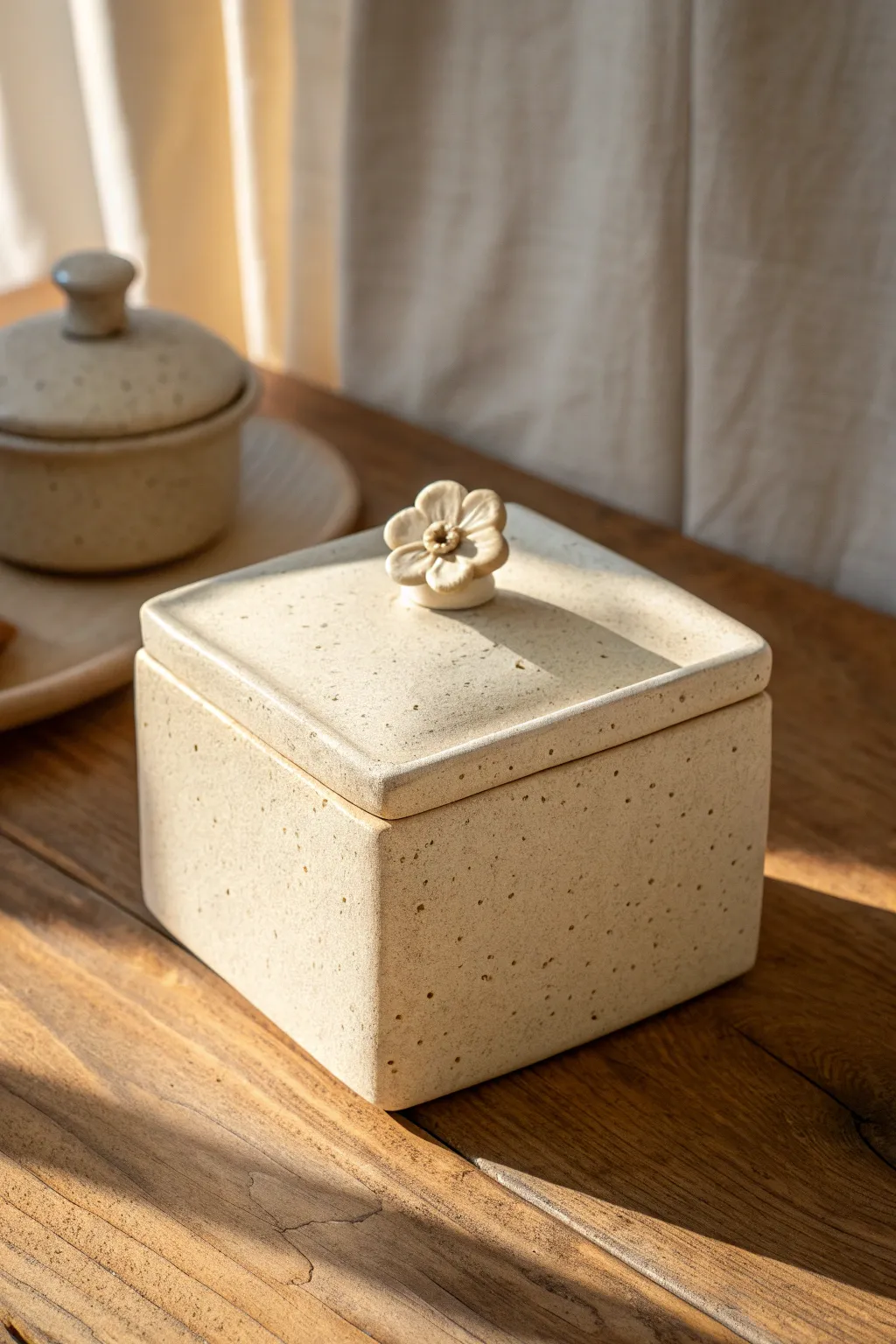
This charming, earthy container combines simple slab construction with a delicate, sculptural touch. Its speckled beige clay body and dainty flower topper create a piece that feels both rustic and refined, perfect for storing jewelry or trinkets.
Step-by-Step
Materials
- Speckled stoneware clay (beige/buff)
- Rolling pin
- Two 1/4 inch wooden guide strips
- Needle tool
- Fettling knife
- Ruler or square template
- Serrated rib or scoring tool
- Slip (clay and water slurry)
- Wooden modeling tool
- Smoothing sponge
- Small paintbrush
- Clear matte glaze
Step 1: Creating the Slabs
-
Roll the clay:
Begin by wedging your speckled clay to remove air bubbles. Place the clay between two 1/4 inch wooden guide strips and roll it out until you have a smooth, uniform slab. Compression is key here, so run a rib over the surface to align the particles. -
Cut the base and walls:
Using a ruler or a square paper template, measure and cut five identical squares for the box body. For the lid, cut a slightly larger square—add about 1/4 inch to the dimensions on all sides to allow for a slight overhang. -
Leather hard stage:
Let the slabs stiffen up to a leather-hard state. This is crucial for square boxes; if the clay is too soft, the walls will sag. I like to leave them on a wooden board covered loosely with plastic for a few hours until they hold their shape firmly.
Warped Lid Woes?
If your lid wobbles after firing, verify drying speed. Always dry the lid ON the box. This ensures they shrink together and maintain a perfect fit.
Step 2: Assembling the Box
-
Bevel the edges:
For crisp 90-degree corners, cut the vertical edges of four wall pieces and all edges of the base piece at a 45-degree angle. This miter joint creates a stronger bond and a cleaner look than a butt joint. -
Score and slip:
Rough up the beveled edges using a serrated rib or needle tool. Apply a generous amount of slip to the scored areas. -
Attach the walls:
Press the first wall onto the base, ensuring the corners align perfectly. Attach the remaining walls one by one, pressing the mitered corners together firmly. -
Reinforce the interior:
Roll a very thin coil of clay and press it into the interior seams of the box. Use a modeling tool to blend this coil smoothly into the walls and floor, reinforcing the joints. -
Clean the exterior:
On the outside corners, use a flat wooden paddle to gently tap the walls straight. Smooth away any excess slip with a sponge, being careful not to round over your crisp corners too much.
Step 3: Creating the Lid and Flower
-
Add the flange:
Flip your lid slab over. Measure the inner opening of your box. Roll four small rectangular strips and attach them to the underside of the lid slab to create a flange that will sit just inside the box rim, keeping the lid secure. -
Shape the flower base:
Roll a small ball of clay and flatten it slightly to form the center of your flower knob. Attach this to the precise center of the lid top using the score and slip method. -
Form the petals:
Create 5 or 6 small teardrop shapes from fresh clay. Flatten them gently between your thumb and forefinger to create organic-looking petals. Score the back of each petal. -
Assemble the flower:
Attach the petals in a circle around the center point, pressing them down firmly. Use a modeling tool to create a small indentation in the center of the flower for detail. -
Refine the stamens:
Roll tiny little balls or a textured button for the very center of the flower. Place this in the indentation to mimic the flower’s reproductive parts. -
Final drying:
Place the lid on the box seamlessly. Wrap the entire piece loosely in plastic to let the moisture equalize. This slow drying prevents the lid from warping differently than the box.
Pro Tip: Texture Pop
Add a few drops of white vinegar to your joining slip. It acts as a flocculant, making the slip stickier and reducing cracks at the delicate flower joints.
Step 4: Finishing
-
Bisque fire:
Once bone dry, fire the piece in the kiln to bisque temperature (usually centered around Cone 04). -
Glazing:
Apply a clear matte glaze to the entire piece. The matte finish enhances the natural stone-like texture of the clay, while the clear coat allows those beautiful speckles to show through clearly. -
Final wipe:
Wipe the bottom of the box with a damp sponge to remove any glaze from the foot, preventing it from sticking to the kiln shelf. -
Glaze fire:
Fire the piece a second time to the maturation temperature of your specific clay and glaze (often Cone 5 or 6).
Enjoy the tactile satisfaction of using this hand-built vessel in your daily routine
Drippy Edge Lid for a Faux Dessert Container
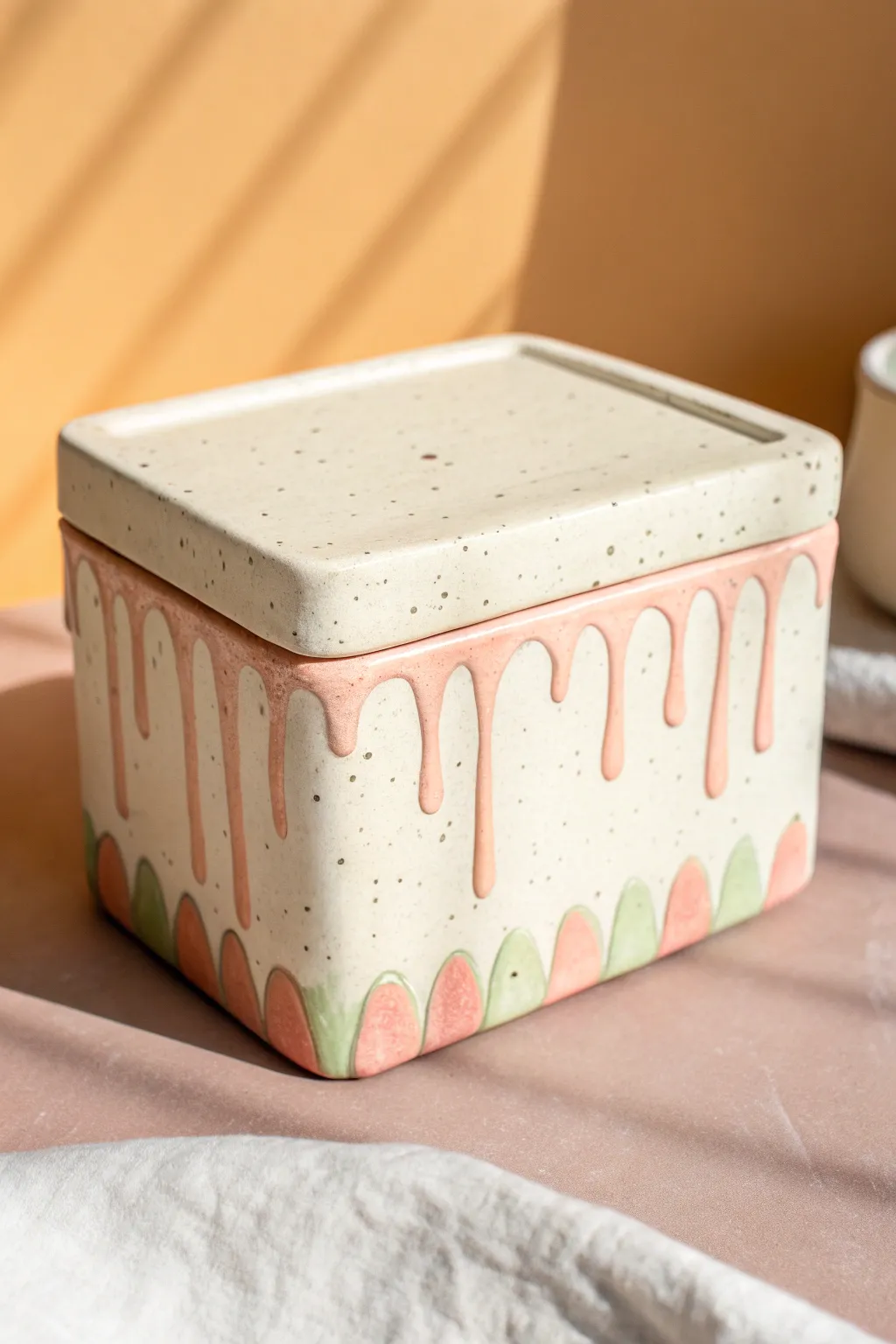
Transform simple clay slabs into a delightful faux-dessert container that looks good enough to eat. This project mimics the charm of a frosted cake with piped icing details and a luscious drippy glaze effect.
Step-by-Step Guide
Materials
- Speckled Stoneware Clay
- Rolling pin and guide strips (approx. ¼ inch)
- Fettling knife or needle tool
- Slab ruler or straight edge
- Scoring tool (serrated rib)
- Slip (clay mixed with water)
- Wooden modeling tool or paddle
- Sponge
- Cardstock for templates
- Underglaze (Pink, Light Green)
- Clear or Translucent White Glaze
- Wax resist (optional)
Step 1: Slab Construction
-
Prepare templates:
Cut four rectangles from cardstock for the walls (e.g., 5×5 inches) and two squares for the top and bottom (slightly larger to account for wall thickness). The lid needs an inner flange piece slightly smaller than the opening. -
Roll the slabs:
Roll out your speckled clay to a uniform ¼ inch thickness using guide strips. Smooth the surface with a soft rib to compress the clay particles. -
Cut the shapes:
Place your templates on the leather-hard clay and cut out your four walls, the floor, and the lid pieces. Let them firm up until they can hold their shape without slumping. -
Bevelling edges:
For a crisp box corner, bevel the side edges of your wall pieces at a 45-degree angle. This creates a stronger miter joint. -
Assemble the walls:
Score the beveled edges thoroughly and apply slip. Stand the walls up, pressing the corners together firmly to create a square tube. Reinforce the inside seams with a thin coil of clay. -
Attach the floor:
Score and slip the bottom edge of your box walls and attach it to the floor slab. Trim away any excess clay from the outside edge flush with the walls. -
Create the lid:
Take the main lid slab and attach the smaller flange square to its underside. Ensure the flange fits comfortably inside the box opening with just a little wiggle room for shrinkage. -
Refine the form:
Use a paddle to gently straighten any warped walls. Soften the sharp corners slightly with a damp sponge to give it that soft, fondant-like appearance.
Gravity Defying Drips
For thicker drips that don’t run all the way to the kiln shelf, mix high-viscosity glaze or add a pinch of CMC gum to your glaze batch to thicken it.
Step 2: Adding the Details
-
Base decoration:
Once the piece is bone dry, carefully wipe it down to remove dust. I like to sketch my design lightly with a pencil directly on the raw clay first. -
Create the bottom scallops:
Using a small brush, paint alternating scalloped semi-circles along the very bottom edge. Use pink and light green underglaze, mimicking the look of piped frosting or ladyfingers. -
Bisque fire:
Load the pieces into the kiln and bisque fire them to Cone 04 (or your clay body’s specifications). This prepares the surface for the glazing step. -
Glaze the interior:
Pour a food-safe clear or white liner glaze inside the box, swirl to coat, and pour out the excess. Wipe the rim clean. -
Apply the ‘icing’ drip:
This is the crucial step. Mix a thick batch of pink glaze or use a heavy bulb syringe. Apply glaze heavily along the top rim of the box exterior, intentionally encouraging it to run down in uneven, organic drips. -
Glaze the rest:
Dip the rest of the exterior (avoiding the already painted bottom scallops if you want them matte, or cover them with clear glaze) into a translucent creamy white glaze. The speckles from the clay should show through. -
Glaze the lid:
Dip or brush the lid with the same creamy white glaze. Ensure the underside flange is unglazed or waxed so it doesn’t fuse to the box. -
Final Fire:
Fire the kiln to the maturity temperature of your glaze and clay (typically Cone 5/6 for stoneware). The thick pink glaze will melt and solidify into those delicious-looking drips.
Add Sprinkles!
Before the pink glaze dries, press actual clean clay ‘sprinkles’ (tiny coils of colored clay) into the wet glaze for added 3D texture.
Now you have a charming ceramic box perfect for hiding sweets or special trinkets
Book-Shaped Slab Container
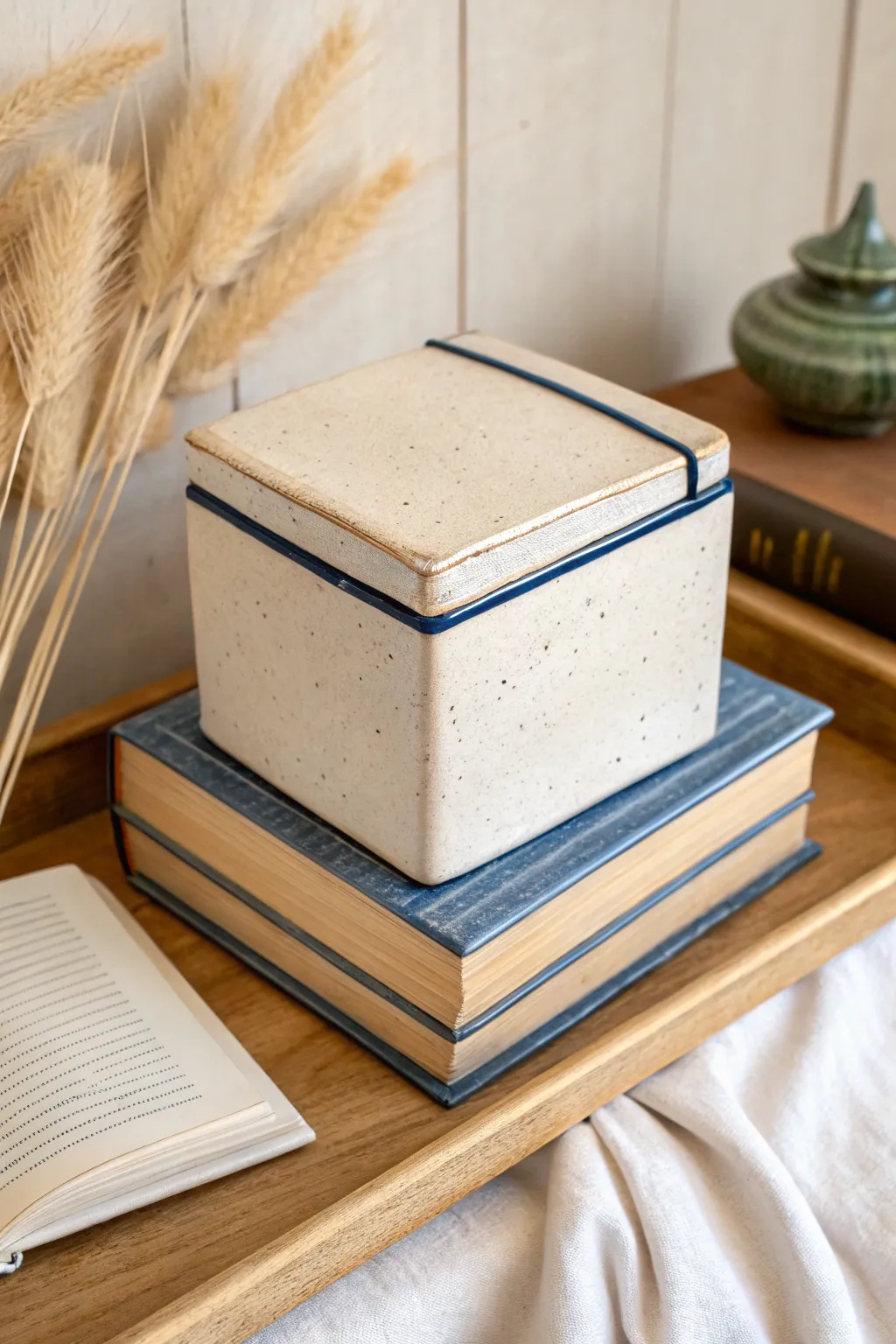
Emulate the timeless charm of vintage storage with this structured ceramic slab box. Featuring sharp corners, a speckled cream finish, and a distinct blue-accented rim, this piece sits beautifully atop a stack of books or on a vanity.
Step-by-Step
Materials
- Speckled stoneware clay (mid-fire)
- Rolling pin with 1/4 inch guide sticks
- Slab roller (optional)
- Fettling knife or needle tool
- Ruler and set square
- Scoring tool (serrated rib)
- Slip or vinegar
- Wooden paddle
- Clean sponge
- Cream matte glaze
- Cobalt blue underglaze
- Fine detail brush
- Soft fan brush
Step 1: Creating the Forms
-
Roll out the clay:
Begin by rolling out your speckled clay into a large, even slab approximately 1/4 inch thick. Compress the clay on both sides with a rib to align the particles and prevent warping later. -
Measure and cut walls:
Using your ruler and set square, cut four identical rectangular panels for the walls and one square (or rectangle) for the base. For a box like the one pictured, 4×4 inch squares work well for a cube shape. -
Cut the lid pieces:
Cut a top slab that is slightly larger than your base to account for the lid overhang. Additionally, cut four narrow strips (about 1/2 inch wide) to create the inner flange that will keep the lid in place. -
Leather hard stage:
Allow all your cut pieces to dry to a sturdy leather-hard state. They should hold their shape without bending but still be soft enough to score and join.
Clean Corner Pro-Tip
After joining your mitered corners, run a slightly damp sponge along the sharp edge. This compresses the clay slightly, making the corner less likely to chip after firing.
Step 2: Assembly
-
Bevel the edges:
For the crispest corners, bevel the vertical edges of your wall pieces at a 45-degree angle. This creates a stronger miter joint than a simple butt joint. -
Score and slip:
Aggressively score the beveled edges and apply slip. Join the four walls together, pressing firmly to ensure a solid bond. Check your angles with a set square immediately. -
Attach the base:
Score the bottom edges of your wall box and the perimeter of your base slab. Press the walls onto the base. I like to run a thin coil on the interior seam and blend it repeatedly for extra stability. -
Paddle the shape:
Once the main box is assembled, gently tap the outside walls with a wooden paddle. This tightens the form, sharpens the corners, and helps erase any finger marks. -
Construct the lid:
Flip your lid slab over. Score and attach the narrow flange strips in a square shape that fits *inside* the opening of your main box. Test the fit gently; it should be snug but not tight. -
Refine the lid profile:
With the lid on the box, smooth the outer edges. You can slightly round the top edge of the lid with a damp sponge to give it that soft, pillowy look seen in the photo.
Step 3: Surface & Glazing
-
Bisque fire:
Dry the piece slowly under loose plastic to prevent warping, then bisque fire according to your clay body’s specifications. -
Apply the blue rim:
Using a fine detail brush and cobalt blue underglaze, paint a steady line along the bottom rim of the lid and the top rim of the box. You might need two coats for opacity. -
Wax resist the blue:
Once the underglaze is completely dry, carefully apply wax resist over the blue lines. This ensures your cream glaze won’t obscure that crisp detailed edge. -
Glaze application:
Dip or brush your cream matte glaze over the entire piece (except the foot). If brushing, use a soft fan brush and apply 2-3 even coats to ensure the speckles show through but the clay color is masked. -
Check the fit:
Ensure no glaze has dripped onto the flange or the rim where the lid meets the box, otherwise they will fuse together in the kiln. Wipe these contact points clean with a sponge. -
Final firing:
Glaze fire the piece. Once cooled, check the lid fit again; if it rocks slightly, you can grind the contact points with wet sandpaper or a grinding stone for a perfect seal.
Warping Woes?
If your lid rocks after firing, place a tiny dab of grinding compound on the rim, put the lid on, and twist back and forth manually to grind them into a perfect match.
With its clean lines and functional design, this box makes a satisfying addition to any ceramic collection
Mini Landscape Lid Diorama Container
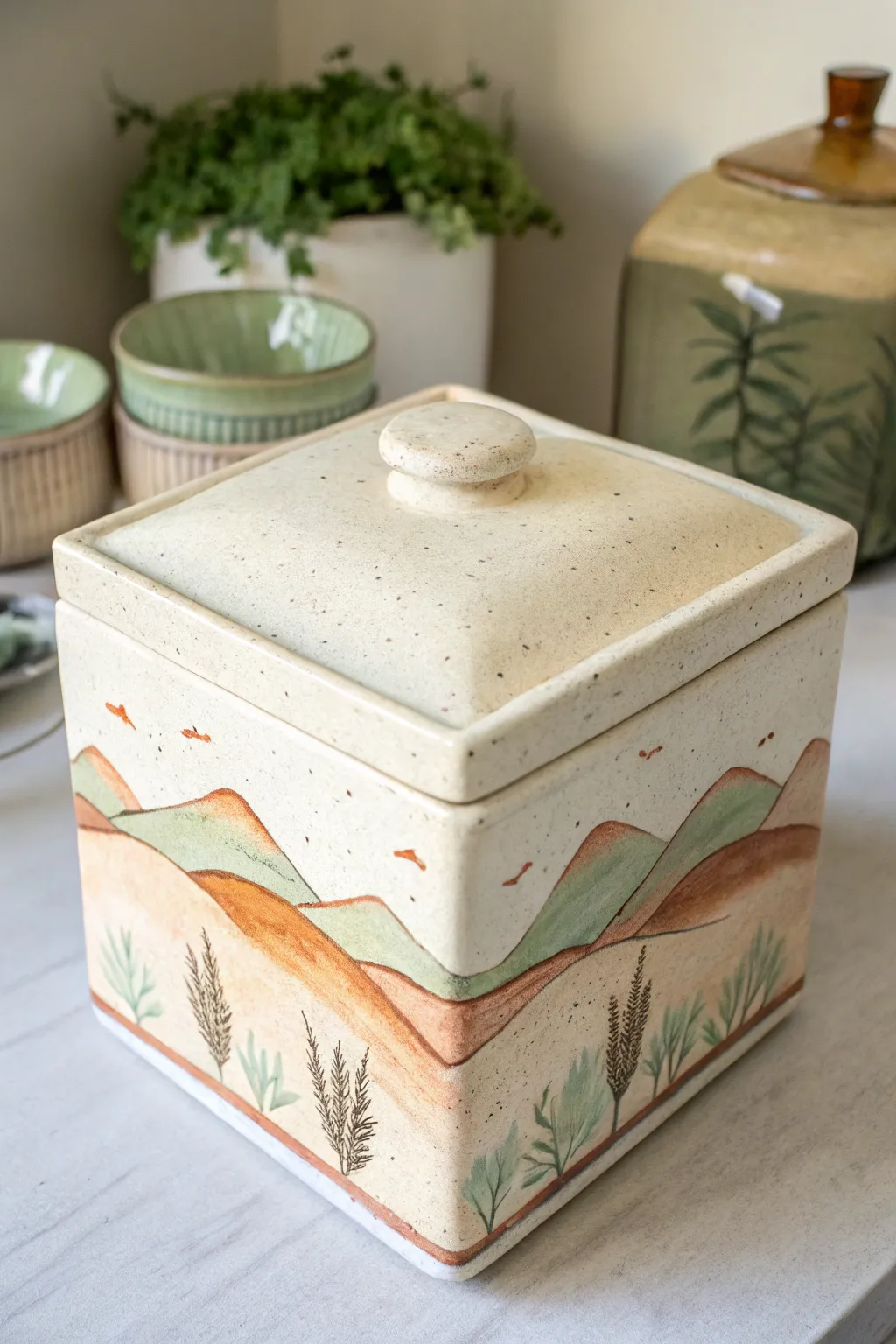
Bring the serene beauty of the outdoors inside with this charming square ceramic canister. Constructed from clay slabs, it features a gentle, hand-painted landscape of rolling hills and swaying grasses on a speckled creamy background.
Detailed Instructions
Materials
- Stoneware clay (speckled or buff)
- Rolling pin with guide strips (approx. 1/4 inch thick)
- Fettling knife or craft knife
- Ruler and square template / paper pattern
- Scoring tool or serrated rib
- Slip (clay and water slurry)
- Underglazes (terracotta orange, sage green, forest green, dark brown)
- Fine detail brushes
- Clear or transparent matte glaze
- Sponge allowing for smoothing
Step 1: Forming the Box
-
Prepare the slabs:
Begin by rolling out your speckled clay to an even thickness of about 1/4 inch. Use guide strips or dowels to ensure uniformity, as uneven walls can warp during firing. -
Cut the components:
Using a ruler and fettling knife, cut a square base (e.g., 5×5 inches) and four rectangular side walls (e.g., 5 inches wide by 6 inches tall). Let these pieces stiffen to a soft leather-hard stage so they can stand up without slumping. -
Bevel the edges:
For stronger, cleaner corners, cut 45-degree bevels on the vertical edges of your side walls and the adjoining edges of the base. This increases surface area for joining. -
Score and slip:
Aggressively score all beveled edges and apply a generous amount of slip. I always make sure the slip is really gooey here to get a solid bond. -
Assemble the walls:
Attach the first wall to the base, pressing firmly. Add the adjacent wall, pressing the vertical seam together. Continue until all four walls are attached, reinforcing the interior corners with a thin coil of clay and smoothing it out completely.
Step 2: Creating the Lid
-
Construct the lid slab:
Cut a square slab slightly larger than your box opening (about 1/4 inch overhang on all sides). You may want to gently dome the center by resting it on a foam pad and pressing lightly. -
Add a flange:
To keep the lid secure, attach a smaller square of clay or four small strips to the underside of the lid slab. These should fit loosely inside the box opening to prevent sliding. -
Sculpt the knob:
Roll a small ball of clay and flatten it slightly into a mushroom shape. Score and slip the center of the lid, then attach the knob, smoothing the transition at the base so it looks seamless.
Warped Walls?
If walls bow inward while drying, stuff the box loosely with crumpled newspaper or foam until it reaches the bone-dry stage to maintain shape.
Step 3: Painting the Landscape
-
Sketch the design:
Once the piece is bone dry, lightly sketch your horizon line with a pencil. The graphite will burn off in the kiln, leaving only your underglaze design. -
Paint the hills:
Mix a terracotta underglaze for the foreground hills and a sage green for the distant mountains. Apply 2-3 coats for opacity, letting each layer dry in between. -
Add vegetation details:
Using a dark brown underglaze and a very fine liner brush, paint delicate vertical stalks for the tall grasses. Add feathery leaves at the base using forest green to create depth. -
Paint the sky elements:
With the tip of your brush and a rusty orange underglaze, add tiny v-shapes in the ‘sky’ area to represent distant birds in flight. -
Bisque fire:
Fire the piece to cone 04 (or your clay’s specific bisque temperature) to set the shape and the underglaze decoration. -
Glaze application:
Dip or brush the entire piece (except the bottom and lid contact points) in a clear or transparent matte glaze. The transparency is crucial to let the speckled clay body show through as the ‘sky’. -
Final firing:
Glaze fire the piece to the maturity temperature of your clay body (typically cone 5 or 6 for stoneware) to finish the project.
Textured Touch
Carve lightly into the clay along the mountain outlines before painting. The glaze will pool in these grooves, adding a beautiful dimensional effect.
Now you have a functional piece of art ready to hold cookies or keepsakes
Facet-Wall Slab Container (Unexpected Angles)
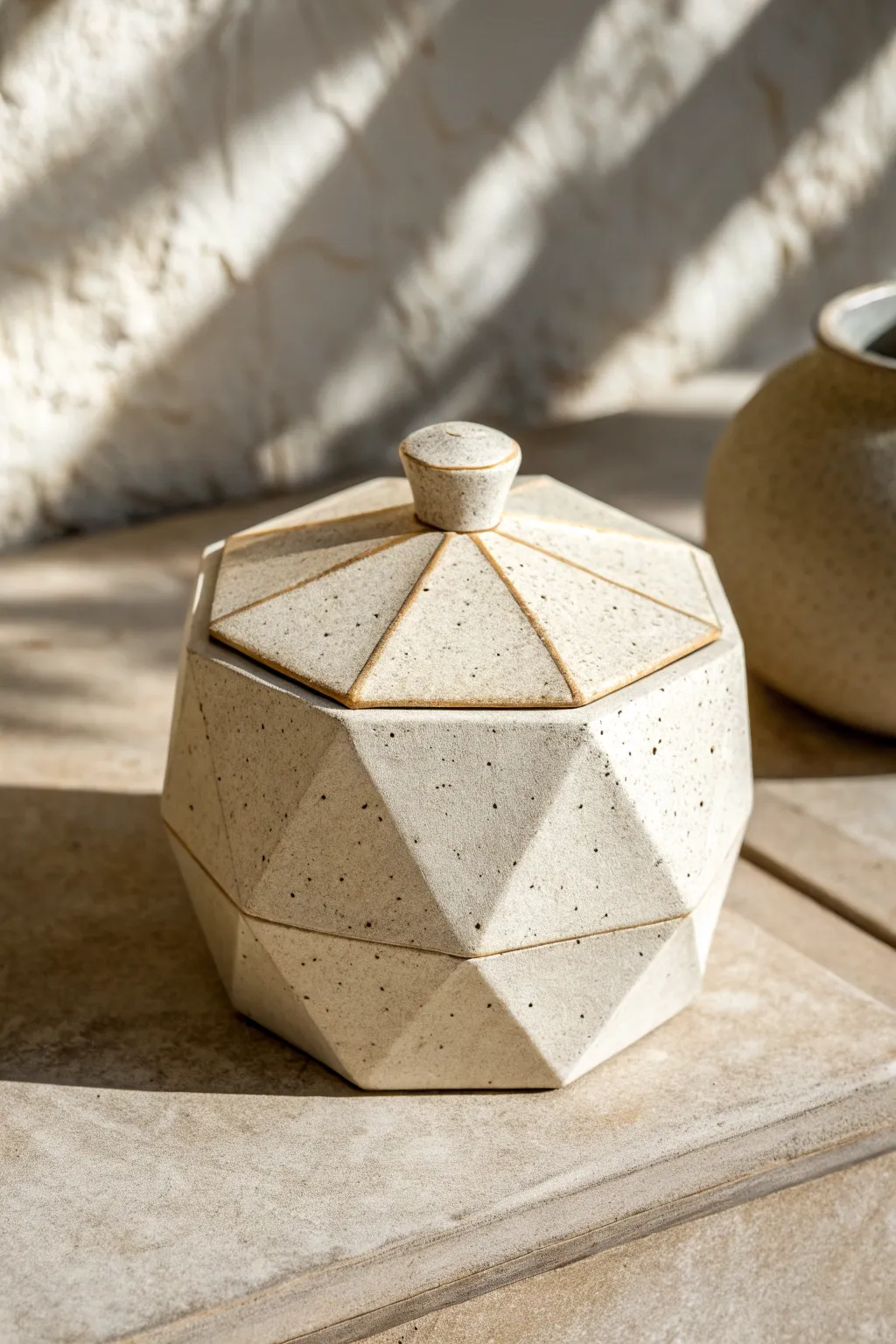
This striking lidded jar trades smooth curves for bold architectural lines, creating a gem-like vessel perfect for storing small treasures. Using a speckled clay body enhances the natural, earthy vibe of the sharp geometric planes.
How-To Guide
Materials
- Speckled Stoneware Clay
- Rolling Pin
- Guide Sticks or Slab Roller (1/4 inch thick)
- Paper Templates (Triangles)
- Needle Tool or Fettling Knife
- Scoring Tool (Serrated Rib)
- Slip
- Rubber Rib (Soft)
- Sponge
- Paddle (optional)
Step 1: Preparing the Slabs
-
Roll out the clay:
Begin by wedging your speckled stoneware thoroughly to remove air pockets. Roll out a large slab of clay to a consistent thickness of about 1/4 inch. Using guide sticks or a slab roller is crucial here, as uneven walls will make the geometric assembly difficult. -
Compress the slab:
Run a soft rubber rib over the surface of the clay in multiple directions. This compresses the particles, preventing warping during the firing process, and creates that smooth, stone-like canvas for the speckles to shine. -
Wait for leather hard:
This is the most critical step for geometric work: let the slab stiffen to a firm leather-hard stage. It should be rigid enough to hold its shape without slumping when lifted, but soft enough to be scored and joined.
Clean Lines Pro-Tip
After joining seams, run a slightly damp finger or the back of a spoon along the facet edges to sharpen them, emphasizing the geometric look.
Step 2: Cutting and Assembly
-
Cut the shapes:
Using paper templates, cut out your repeating geometric shapes. For this design, you will primarily need equilateral triangles for the lid and a mix of triangles or trapezoids for the body, depending on your specific geodesic pattern. Be precise with your knife cuts. -
Bevel the edges:
For clean, sharp corners, bevel the edges of your clay pieces at a 45-degree angle. This allows the facets to meet flush against each other without leaving thick, messy seams on the interior. -
Score and slip:
Aggressively score the beveled edges of your base pieces and apply slip. I like to use a bit of vinegar in my slip to really act as a strong glue for these angular joints. -
Assemble the bottom ring:
Connect the first ring of facets to shape the base of the pot. Press the seams firmly together. Support the walls from the inside with one hand while gently smoothing the outside seam with the other. -
Construct the upper body:
Continue building upward, attaching the next row of facets. As the form closes inward, you create the shoulder of the jar. Ensure the rim—the final opening—remains level. -
Smooth the seams:
Once the main body is assembled, use a thin coil of clay to reinforce the interior seams if necessary. On the exterior, use a slightly damp sponge to clean up the joints, but try to maintain the crispness of the angles.
Slumping Walls?
If the angled walls start to sag during assembly, the clay is too wet. Use a heat gun briefly to stiffen the pieces, or prop them up with foam until dry.
Step 3: The Lid and Finishing
-
Create the lid gallery:
Measure the opening of your pot. Create a small flange or gallery inside the rim of the pot (or on the lid itself) so the lid will seat securely and not slide off. -
Assemble the lid facets:
Using smaller triangular slabs, assemble the low-profile pyramidal shape of the lid. Join them using the same score, slip, and bevel technique as the body. -
Add the knob:
Roll a small ball of clay and taper it slightly to form the knob. Attach it to the center peak of the lid. You can refine its shape by spinning it slightly while smoothing it with a sponge. -
Refine the surface:
Once constructed, let the piece dry very slowly under plastic to equalise moisture. Once bone dry, gently sand any sharp burs, but keep the facet lines distinctive. -
Glaze application:
Apply a satin or matte cream glaze. Avoid thick, runny glazes that might obscure the sharp lines of your facets. Wipe the bottom clean and fire to cone 6 (or your clay’s specific temperature).
Now you have a modern, architectural vessel that highlights the beauty of simple geometry