
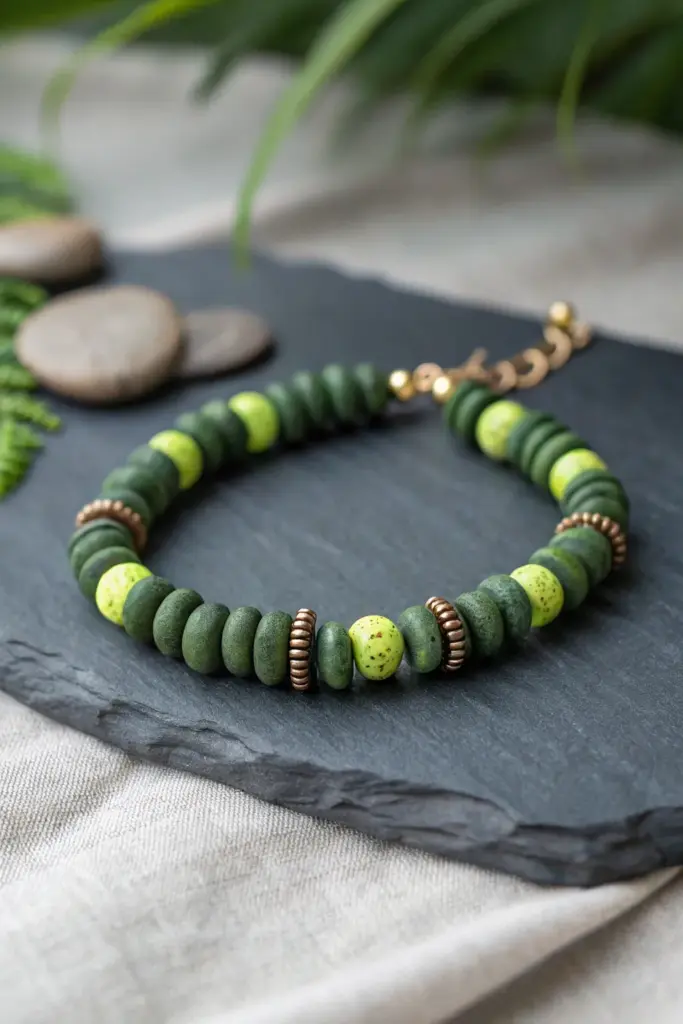
If you’re craving fresh green clay bracelet inspiration, I’ve got you—green is one of those colors that can go earthy, preppy, beachy, or totally bold just by shifting the shade mix. Here are my favorite green heishi bead patterns and palette combos that look polished even when you keep the supplies simple.
Monochrome Green Clay Heishi Stack
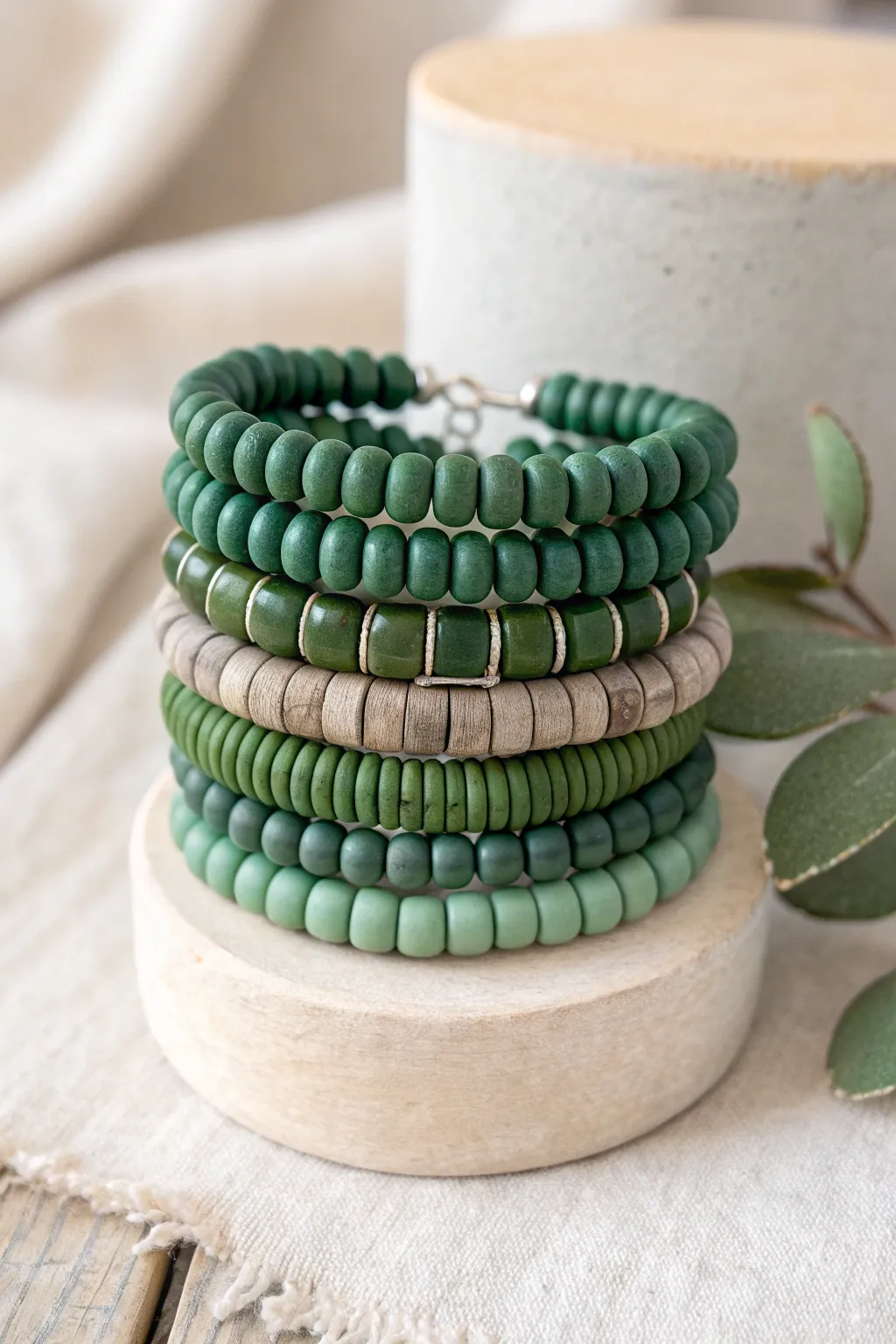
This project creates a stunning harmonious stack of bracelets featuring various shades of green polymer clay heishi beads accented by natural wood tones. The mix of matte and slightly glossy finishes adds depth and texture to this monochromatic collection.
Detailed Instructions
Materials
- Polymer clay in varying shades of green: dark hunter green, olive, sage, mint, and seafoam
- Beige or light tan polymer clay (for wood-look beads)
- Black acrylic paint (for wood grain effect)
- Strong elastic jewelry cord (0.7mm or 0.8mm)
- Super glue or jewelry cement
- Basic clay tools: roller, tissue blade
- Heishi bead cutter or small circular cutters (approx 6-8mm)
- Skewer or toothpick (for piercing)
- Silver spacer beads or crimps (optional for closure)
- Oven for baking
Step 1: Clay Preparation & Color Mixing
-
Create your palette:
Begin by conditioning your green clays. You want a distinct gradient, so aim for at least four hues: a deep forest green, a medium olive, a muted sage, and a light mint. If your block colors are too vibrant, mix in a tiny pinch of brown or black to desaturate them for that earthy look. -
Sheet the clay:
Roll out each color of conditioned clay into a flat slab. Aim for a thickness of about 3mm to 4mm. I find that using the thickest setting on a pasta machine gives the most consistent results for these chunky heishi beads. -
Prep the wood-look clay:
For the beige accent bracelet, condition your tan clay. To create a faux wood grain, add a tiny speck of black paint or brown clay, but don’t mix it completely—stop when you have streaks, then roll it into a sheet.
Smooth Seams
To avoid fingerprints on your raw clay beads, lightly dust your fingertips with cornstarch or baby powder before handling the cut circles to round the edges.
Step 2: Cutting and Forming Beads
-
Cut the discs:
Using a small circular cutter (match the diameter of your desired bead size), punch out numerous circles from each color sheet. You will need roughly 40-50 beads per bracelet depending on your wrist size. -
Smooth the edges:
Gently tap the sharp cut edges of each disc with your fingertip to round them slightly. This gives the finished beads a softer, tumbled stone appearance rather than a sharp, manufactured look. -
Pierce the holes:
Use a toothpick or skewer to poke a hole directly through the center of each disc. Ensure the hole is large enough to accommodate your elastic cord freely. -
Create the square accents:
For the specific dark olive bracelet that uses square beads, cut a long strip of clay approximately 6mm wide and 6mm thick. Use your blade to slice off cubes. Pierce them through the side to create tube-like square beads.
Beads Stuck?
If your beads are sticking to the baking surface, bake them on a bed of baking soda or cornstarch. This supports their shape and prevents flat spots on the bottom.
Step 3: Baking & Finishing
-
Bake the clay:
Arrange your raw beads on a baking sheet lined with parchment paper or cardstock. Bake according to your brand of polymer clay instructions (usually around 275°F or 135°C for 15-30 minutes). Let them cool completely before handling. -
Optional texture:
For the beige wood-look beads, once cooled, you can lightly sand them with coarse sandpaper to enhance the rustic texture shown in the middle bracelet.
Step 4: Assembly
-
Sort your gradient:
Layout your beads in piles by color. Plan your stack: you’ll make separate bracelets for the dark green, the square olive beads, the beige wood-look, the sage, and the mint. -
Design the square bead strand:
For the unique bracelet in the middle of the stack, alternate your square clay beads with small silver wire spacers or silver seed beads between every few clay cubes to replicate the metallic detail seen in the image. -
String the strands:
Cut a length of elastic cord about 10-12 inches long. Pre-stretch the elastic slightly to prevent sagging later. -
Thread the beads:
Thread the remaining monochromatic strands, filling each one with a single color. Keep the tension consistent but not too tight, or the bracelet will stiffen and lose its drape. -
Tie the knot:
Once the strand fits comfortably around your wrist, tie a surgeon’s knot (a square knot with an extra loop). Pull it tight. -
Secure and hide:
Apply a tiny dot of super glue or jewelry cement to the knot for extra security. Once dry, slide the knot inside the hole of a nearby bead if space allows, and trim the excess cord.
Wear your entire stack together for a bold statement or separate them for subtle touches of color.

Sage Green and White Disc Alternation
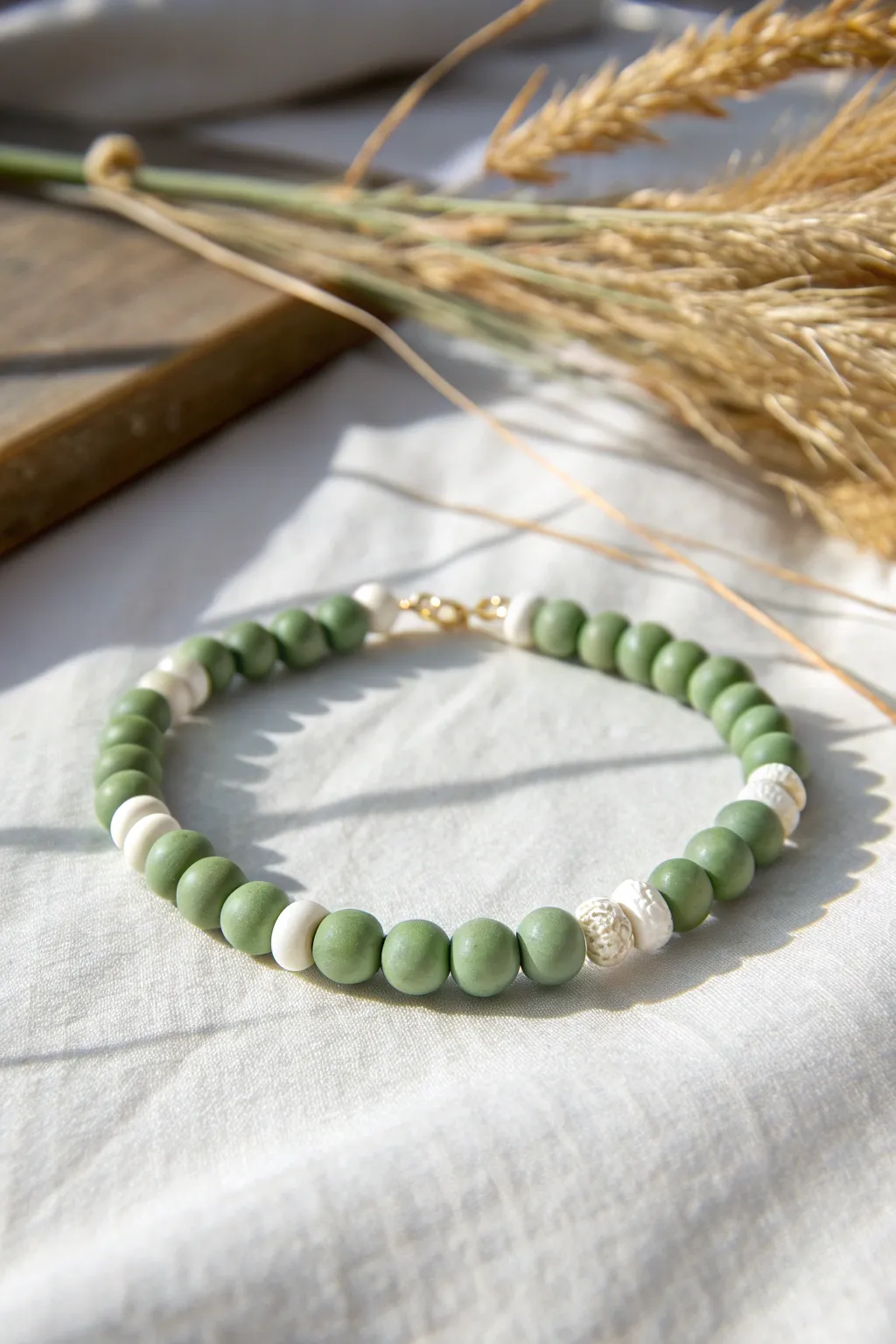
This elegant bracelet balances earthy sage green tones with crisp white accents for a look that feels both organic and refined. The gentle matte finish of the polymer clay beads gives the piece a soft, stone-like texture that pairs beautifully with gold hardware.
Step-by-Step Guide
Materials
- Polymer clay (Sage Green)
- Polymer clay (White or Cream)
- Gold lobster clasp
- Gold jump rings (4mm or 5mm)
- Beading wire (flexible, coated)
- 2 Gold crimp beads
- Bead roller tool (optional but helpful)
- Piercing tool or thick needle
- Baking sheet with parchment paper
- Wet/dry sandpaper (400-600 grit)
- Wire cutters
- Chain nose pliers
- Oven
Step 1: Creating the Clay Beads
-
Condition the sage clay:
Begin by taking a block of sage green polymer clay and kneading it in your hands until it becomes soft and pliable. This conditioning step is crucial to prevent cracks during baking. -
Roll the sage rope:
On a clean, flat surface, roll the conditioned green clay into a long, even snake or rope. Aim for a thickness of about 8mm to 10mm, depending on how chunky you want your final beads. -
Portion the sage beads:
Use a tissue blade or a sharp craft knife to slice the rope into equal segments. Consistency is key here to ensure your beads are all the same size. -
Shape the spheres:
Roll each green segment between your palms to form smooth, round spheres. I like to wipe my hands with a baby wipe beforehand to keep the clay clean. -
Create the white accents:
Repeat the previous steps with a smaller amount of white or cream polymer clay. You won’t need as many of these, as they serve as spacers and accents. -
Add texture (optional):
Looking closely at the bracelet, a few of the white beads have a rougher, porous texture almost like lava stone. To mimic this, take a few white beads and gently poke the surface repeatedly with a stiff toothbrush or a ball of crumpled foil. -
Pierce the beads:
Carefully pierce the center of each bead with your needle or piercing tool. Gently twist the bead as you push the tool through to avoid distorting the round shape. -
Bake the beads:
Arrange your beads on a parchment-lined baking sheet. Bake them according to the manufacturer’s instructions on your specific package of clay (usually 275°F/135°C for 15-30 minutes). -
Cool and sand:
Once baked and fully cooled, inspect your beads. If there are fingerprints or uneven spots, lightly sand them under running water with fine-grit sandpaper for that perfect matte finish.
Smooth Operator
To remove annoying fingerprints before baking, gently brush your raw clay beads with a tiny amount of cornstarch or baby oil.
Step 2: Assembling the Bracelet
-
Cut the wire:
Measure your wrist and cut a length of beading wire that is about 4 inches longer than your measurement to allow room for crimping. -
Secure one end:
Thread a crimp bead onto one end of the wire, followed by a jump ring attached to one part of the clasp. Loop the wire back through the crimp bead. -
Crimp the bead:
Slide the crimp bead close to the clasp (but leave it loose enough to wiggle) and use your chain nose pliers to flatten it securely. Trim the excess short tail of wire. -
Plan your pattern:
Lay out your beads before stringing. The design shown uses a pattern of loosely grouped green beads broken up by single white discs or small groups of white beads. -
String the beads:
Thread your beads onto the wire following your layout. A common sequence seen here is: 4-5 green beads, 1 white bead, 4-5 green beads, repeated. -
Add texture variety:
As you string, place your textured white beads strategically—perhaps near the center or opposite the clasp—to draw the eye. -
Check the fit:
Periodically wrap the beaded wire around your wrist to check the sizing. Remember the clasp will add a small amount of extra length. -
Finish the second end:
Once all beads are strung, thread on your second crimp bead and the jump ring for the other side of the clasp. -
Secure the loop:
Pass the wire back through the crimp bead and through the last bead or two on the strand. Pull it taut so there are no gaps between beads. -
Final crimp:
Flatten the final crimp bead securely with your pliers. Trim any excess wire flush with the beads so it doesn’t poke you.
Hole Distortion?
If your bead holes squish while piercing, let the rolled beads rest in the fridge for 10 minutes to firm up before poking them.
Now you have a serene, nature-inspired accessory ready to complement any outfit


Olive Green With Gold-Toned Spacers
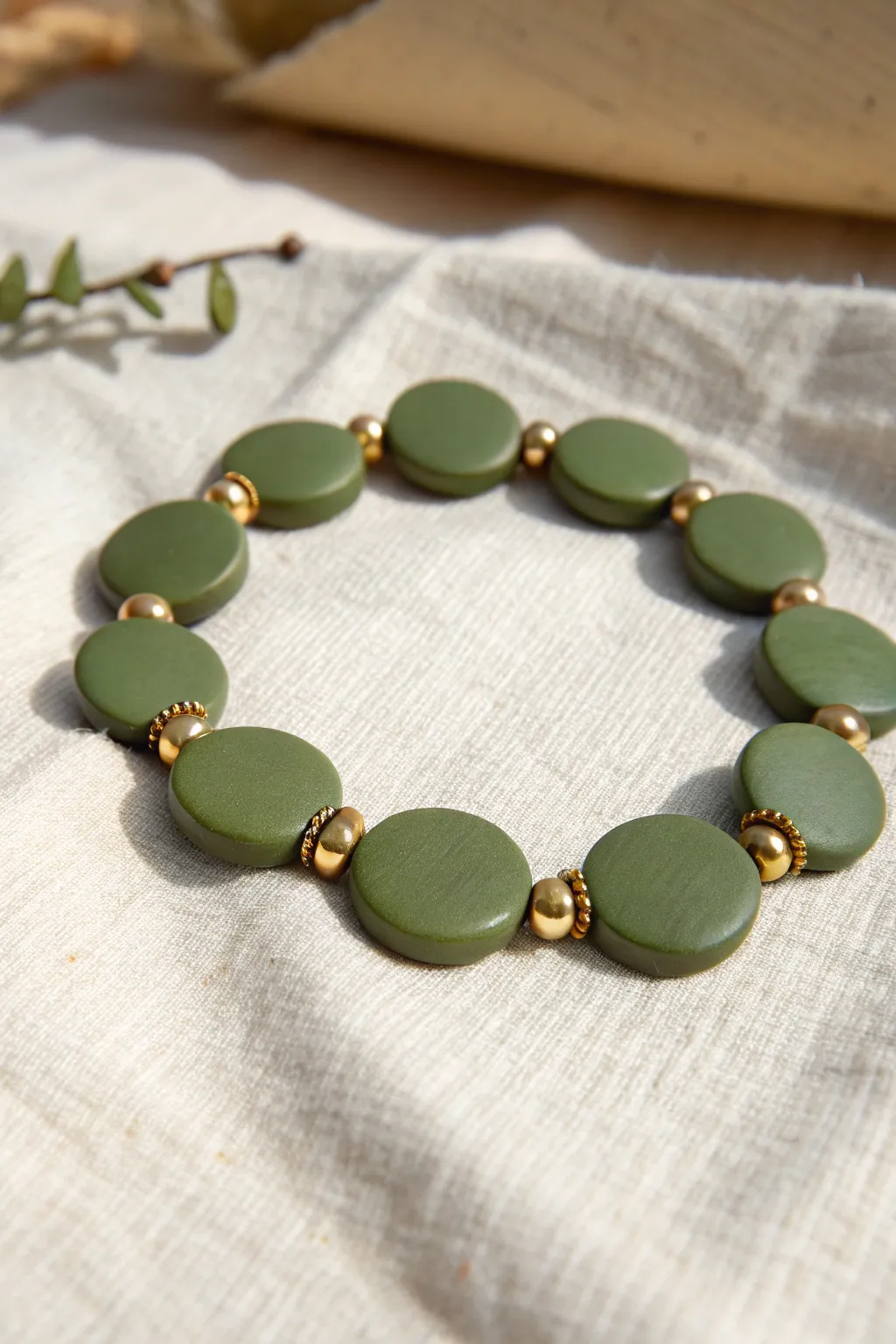
This sophisticated bracelet combines earthy olive green polymer clay discs with the luxurious gleam of gold-toned spacers for a versatile everyday accessory. The flat coin shape of the clay beads creates a comfortable fit that sits flush against the wrist, perfect for stacking or wearing solo.
Step-by-Step
Materials
- Olive green polymer clay
- Gold-toned smooth round spacer beads (approx. 4mm)
- Gold-toned daisy spacer beads (approx. 3-4mm)
- Strong elastic stretch cord (0.7mm or 0.8mm)
- Circular clay cutter (approx. 12-15mm diameter)
- Acrylic roller or pasta machine
- Toothpick or bead piercing pin
- Superglue or jeweler’s cement
- Parchment paper-lined baking sheet
- Gloss or matte varnish (optional)
Step 1: Preparing the Clay Discs
-
Condition the Clay:
Begin by warming the olive green polymer clay in your hands, kneading it thoroughly until it creates a smooth, pliable ball without any dry cracks. -
Roll out a Slab:
Flatten the ball and use an acrylic roller to create an even sheet. Aim for a thickness of about 4-5mm—you want the beads to be chunky enough to be durable but not too heavy. -
Cut the Circles:
Press your circular cutter firmly into the clay to punch out your bead shapes. For a standard wrist size, you will likely need between 10 and 12 discs. -
Smooth the Edges:
Gently rub the perimeter of each clay circle with your fingertip to soften the sharp cut edge and remove any stray clay bits. -
Pierce the Holes:
Using a bead pin or toothpick, carefully pierce a hole directly through the side diameter of the disc (like a coin bead), not through the flat face. Rotate the tool gently as you push through to avoid distorting the circle. -
Refine the Holes:
I like to poke the tool through from the opposite side as well to ensure the channel is clean and the exit hole isn’t puckered. -
Bake the Beads:
Arrange the beads on your lined baking sheet and bake according to your specific clay package’s instructions (usually around 275°F/135°C for 30 minutes). -
Cool and Finish:
Allow the beads to cool completely. If desired, apply a light coat of varnish to seal them, or buff them with a soft cloth for a natural sheen.
Hole Distortion?
If piercing the side of the bead squashes the circle into an oval, try chilling the clay discs in the fridge for 10 minutes before piercing to firm them up.
Step 2: Assembly & Strung Sequence
-
Cut the Cord:
Cut a piece of elastic cord about 10-12 inches long. This extra length makes tying the final knot much easier. -
Pre-stretch the Elastic:
Give the elastic section several firm tugs. This pre-stretching step is crucial to prevent the bracelet from sagging after you wear it a few times. -
Secure the End:
Place a piece of tape or a bead stopper on one end of the cord so your beads don’t slide off while you work. -
Start with Clay:
Thread one olive green clay disc onto the cord to begin your pattern. -
Add the Gold Cluster:
String on one gold daisy spacer, followed by one smooth round gold bead, and then another gold daisy spacer. This trio creates the detailed metallic accent shown in the image. -
Repeat the Pattern:
Continue alternating one clay disc with the three-piece gold spacer cluster (daisy, round, daisy) until the bracelet reaches your desired length. -
Check the Fit:
Wrap the strand around your wrist to check the size. Ideally, the ends should meet comfortably without gaps, but not be tight enough to pinch. -
Tie the Knot:
Remove the tape and tie a surgeon’s knot (right over left, left over right, and loop through an extra time) to secure the bracelet loop. -
Secure and Trim:
Place a tiny dot of superglue or jewelry cement on the knot. Once dry, trim the excess cord ends carefully, tucking the knot inside one of the clay bead holes if space allows.
Knot Hiding Tip
Use a larger drill bit to slightly widen the hole of just ONE clay bead after baking. This creates a perfect cavity to completely hide your elastic knot.
Now you have a chic, custom-sized bracelet that brings a touch of organic elegance to any outfit

Mint-and-Emerald Color-Block Bracelet
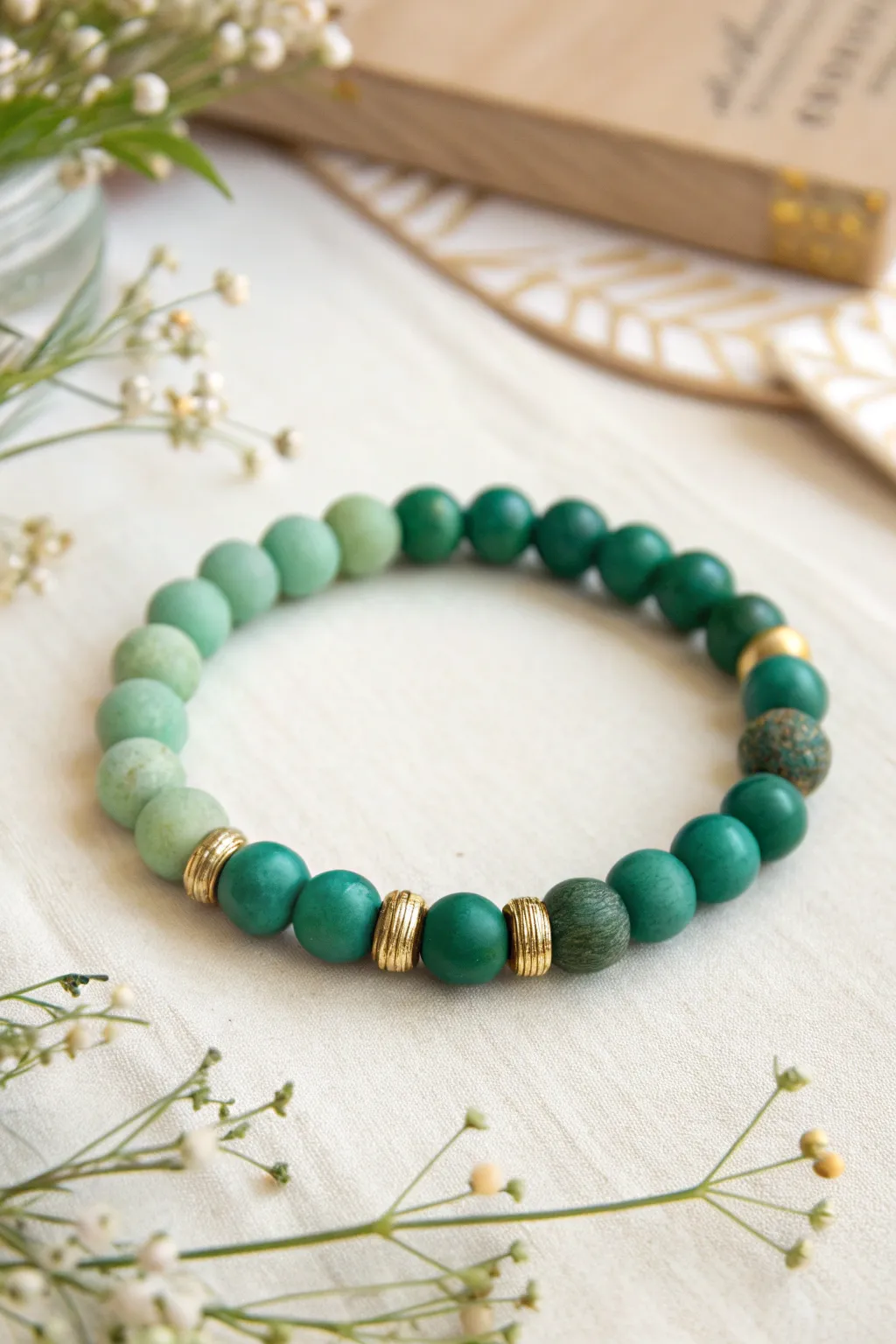
This sophisticated bracelet project combines the organic feel of handcrafted clay beads with the elegance of gold accents. The design features a stunning color-block transition from soft mint to deep forest emerald, punctuated by textured gold spacers for a professional finish.
Detailed Instructions
Materials
- Polymer clay in White, translucent, Mint Green, Emerald Green, and Navy Blue
- Gold metallic polymer clay or pre-made textured gold spacer beads
- Bronze or gold metallic acrylic paint (optional for antiquing)
- Stretch cord (0.8mm or 1mm)
- Bead piercing pins or toothpicks
- Acrylic roller
- Small circle cutter (approx. 1cm) or bead roller tool
- Sandpaper (400-800 grit)
- Gloss or matte varnish (optional)
- Super glue (for knotting)
Step 1: Mixing the Bead Palette
-
Establish base colors:
Condition your clay by kneading it until pliable. You will need three distinct shades of green: a pale mint, a mid-tone grass green, and a deep emerald or forest green. -
Create the mint shade:
Mix a large portion of white clay with a tiny amount of mint green and a speck of translucent. This creates the soft, matte pastel look seen on the left side of the bracelet. -
Create the mid-tone green:
For the middle transition beads, use your standard grass or leaf green. If it feels too bright, dampen it with a tiny pinch of brown or beige to make it more earthy. -
Create the deep emerald:
To achieve that rich dark green, mix emerald green with a small amount of navy blue. This adds depth without turning it black. -
Create the textured accent bead:
Set aside a small ball of the deep emerald clay. Mix in some coarse salt or textured sand, or gently press a rough sponge onto the surface to replicate the stone-like bead seen near the gold accent.
Step 2: Forming the Beads
-
Measure consistent sizes:
Roll your clay into sheets of equal thickness using the acrylic roller. Use a small circle cutter to punch out equal amounts of clay for each bead to ensure uniform size. -
Roll the spheres:
Roll the punched circles into smooth spheres between your palms. I find a clear acrylic bead roller helps get them perfectly round without fingerprints. -
Make the gold spacers (Option A):
If making your own spacers, roll gold metallic clay into a thin snake. Flatten it slightly, wrap it around a skewer to form a ring, and use a needle tool to press vertical lines into the sides for that ribbed texture. -
Pierce the beads:
Carefully insert a bead pin or toothpick through the center of each sphere. Rotate the pin as you push to avoid squashing the bead’s shape.
Uneven Bead Holes?
If your bead holes distort while piercing, let the raw clay sit in the fridge for 15 minutes before piercing. The firmer clay resists squishing better.
Step 3: Baking and Finishing
-
Bake the beads:
Arrange your beads on a baking sheet or suspended on a bead rack. Bake according to your brand’s instructions (usually 275°F/130°C for 15-30 minutes). -
Cool and inspect:
Allow the beads to cool completely inside the oven to prevent cracking. Once cool, check the holes to ensure they are clear of debris. -
Sand for matte finish:
Lightly sand the green beads with fine-grit sandpaper under running water. This removes fingerprints and gives them the smooth, matte stone finish shown in the photo. -
Seal (Optional):
If you want extra durability, apply a very thin layer of matte varnish. Avoid glossy finishes to maintain the natural stone aesthetic.
Add Natural Textures
Before baking, roll your raw clay beads gently over a piece of coarse sandpaper or denim fabric to imprint a realistic, stone-like pitted texture.
Step 4: Assembly
-
Layout the design:
Lay your beads out on a mat. Start with the block of pale mint beads, transition into one or two mid-tone greens, then the block of deep emerald beads. -
Insert spacers:
Place your gold spacer beads strategically. Notice in the image there is a cluster of three spacers separating the bright green from the dark green, and a single gold bead on the opposite side. -
String the bracelet:
Cut a length of stretch cord about 10 inches long. Pre-stretch it by pulling firmly a few times to prevent sagging later. -
Thread the beads:
Thread your pattern onto the cord. Check the size on your wrist before tying it off; you generally want about 7 inches of beads for an average wrist. -
Secure the knot:
Tie a secure surgeon’s knot (right over left, left over right, loop through twice). Pull tight, add a drop of super glue to the knot, let dry, and trim the excess cord closer to the bead. -
Hide the knot:
Gently pull the elastic so the knot slides inside the hole of one of the larger beads to conceal it.
Slip this elegant bracelet on your wrist and enjoy the beautiful gradient hues you’ve created.

The Complete Guide to Pottery Troubleshooting
Uncover the most common ceramic mistakes—from cracking clay to failed glazes—and learn how to fix them fast.
Forest-to-Mint Ombre Green Clay Fade
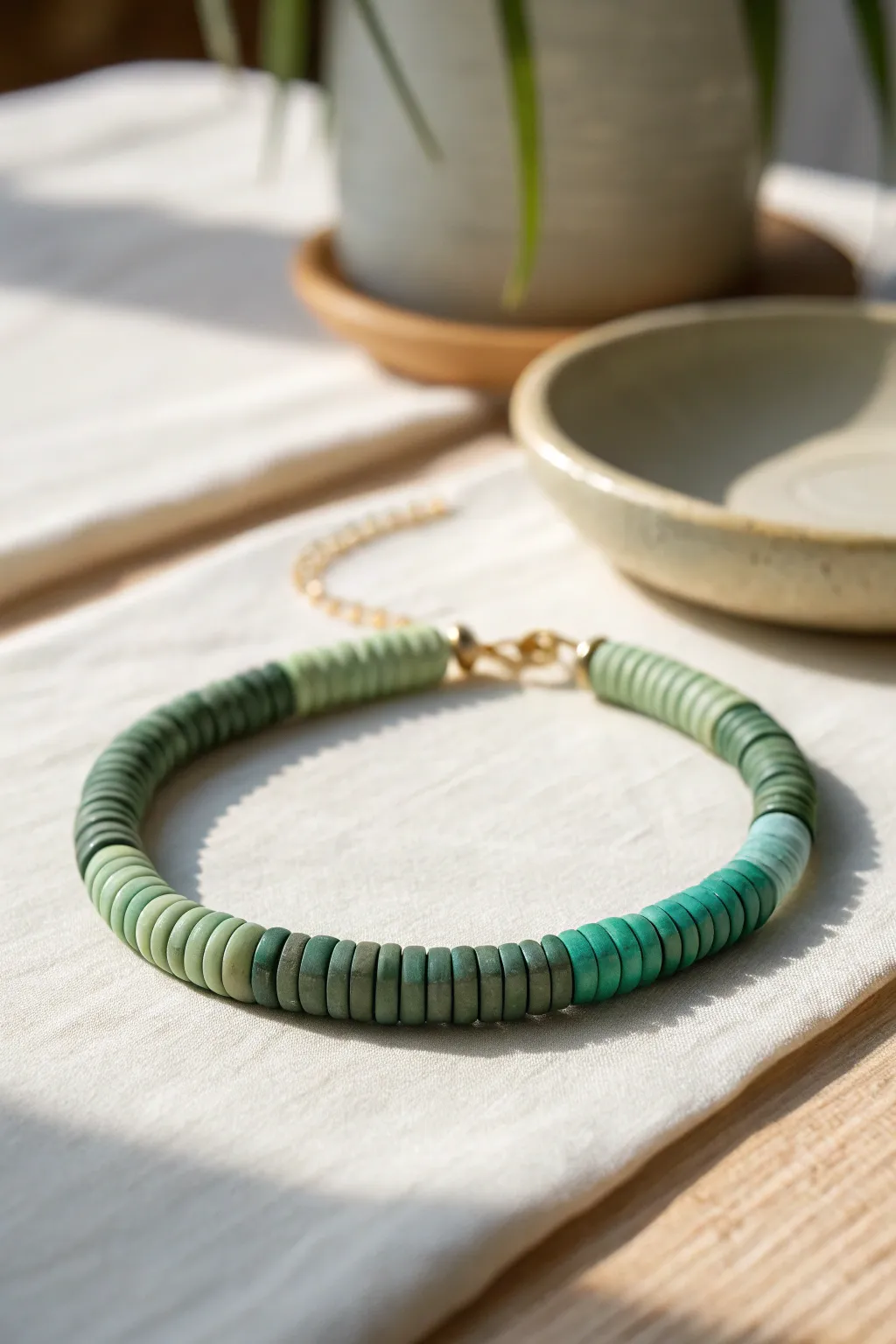
This project transforms simple polymer clay into a stunning gradient accessory that transitions from deep forest hues to soft minty greens. The result is a smooth, sophisticated heishi-style bead strand that looks professionally crafted but is entirely handmade.
Step-by-Step Guide
Materials
- Polymer clay in three shades: Deep Forest Green, Teal/Turquoise, and Mint Green
- Polymer clay in White (for mixing)
- Acrylic rolling pin or clay pasta machine
- Circle cutters (approx. 6-8mm diameter for the bead)
- Small straw, toothpick, or 1mm cutter (for the holes)
- Beading wire or flexible nylon thread
- 2 Crimp beads
- 2 Crimp covers (gold)
- 2 Wire guardians (optional but recommended)
- Lobster clasp and extension chain (gold finish)
- Flat-nose jewelry pliers
- Baking sheet and parchment paper
- Wet/dry sandpaper (400 and 800 grit)
Step 1: Preparing the Clay Colors
-
Condition the Clay:
Begin by thoroughly conditioning your three main green clays (Forest, Teal, Mint) and your White clay. Knead them until they are soft, pliable, and free of cracks. -
Create Custom Blends:
To achieve a smooth ombre effect like the photo, you cannot rely mainly on the three base colors. You need transitional shades. Mix a small amount of Forest Green with Teal to bridge the darkest section. -
Lighten the Mint:
Take half of your Mint Green clay and mix it with an equal part of White. This creates an ultra-pale ‘Pastel Mint’ for the lightest end of your gradient. -
Roll Out Sheets:
Roll each color out into a sheet of uniform thickness. Since these are heishi-style beads, you want the clay to be relatively thick—around 2mm to 3mm is perfect for that chunky look.
Step 2: Cutting and Baking the Beads
-
Cut the Circles:
Using your 6-8mm circle cutter, punch out roughly 20-30 discs from each color sheet. I generally cut a few extras just in case some break during drilling or baking. -
Create Center Holes:
Use a small straw, toothpick, or tiny 1mm cutter to pierce the center of every disc. Try to be as centered as possible, but slight variations add to the organic charm. -
Smooth the Edges:
Gently tap the edges of each raw clay disc with your finger to remove any sharp ridges left by the cutter. This saves sanding time later. -
Arrangement for Baking:
Place the beads on a parchment-lined baking sheet. Ensure they aren’t touching each other to prevent them from fusing. -
Bake:
Bake the beads according to the manufacturer’s instructions for your specific brand of clay (usually around 275°F/130°C vs 15-30 minutes). Let them cool completely before handling.
Uneven Clay Thickness?
If you don’t have a pasta machine, place two stacks of playing cards on either side of your clay and roll your pin over them. This acts as a guide for perfectly even sheets.
Step 3: Finishing and Assembly
-
Sanding (Optional):
If your beads look rough, gently sand the edges under running water using wet/dry sandpaper. This gives them that matte, stone-like finish visible in the photo. -
Plan the Ombre:
Lay your beads out on a bead board or cloth. arrange them in groups: Forest Green -> Forest/Teal Mix -> Teal -> Mint -> Pastel Mint. Play with the transitions until the fade looks seamless. -
Start Stringing:
Cut a length of beading wire. Attach one end to a crimp bead and wire guardian loop, securing it with pliers. Then, slide on your first jump ring or the clasp. -
Thread the Beads:
String your beads following your laid-out pattern. Start with the darkest Forest Green and work your way toward the lightest mint tone. -
Check Length:
Once all beads are strung, wrap it around your wrist to check the fit. Remember, the clasp will add about half an inch to the final length. -
Close the Loop:
Thread the end of the wire through a crimp bead, then through the wire guardian and link of the extension chain. Loop the wire back through the crimp bead. -
Secure the Bracelet:
Use your flat-nose pliers to flatten the crimp bead securely. I prefer to cover the crimp bead with a gold crimp cover for a polished, professional look. -
Trim Excess Wire:
Snip off any excess wire tail close to the crimp bead so it doesn’t poke the skin.
Add Gold Accents
Elevate the design by inserting flat gold spacer beads between every color transition. It adds a metallic pop and makes the ombre shift more distinct.
Now you have a custom color-fade bracelet that perfectly captures earthy, natural tones
Green “Confetti” Mix With White Pops
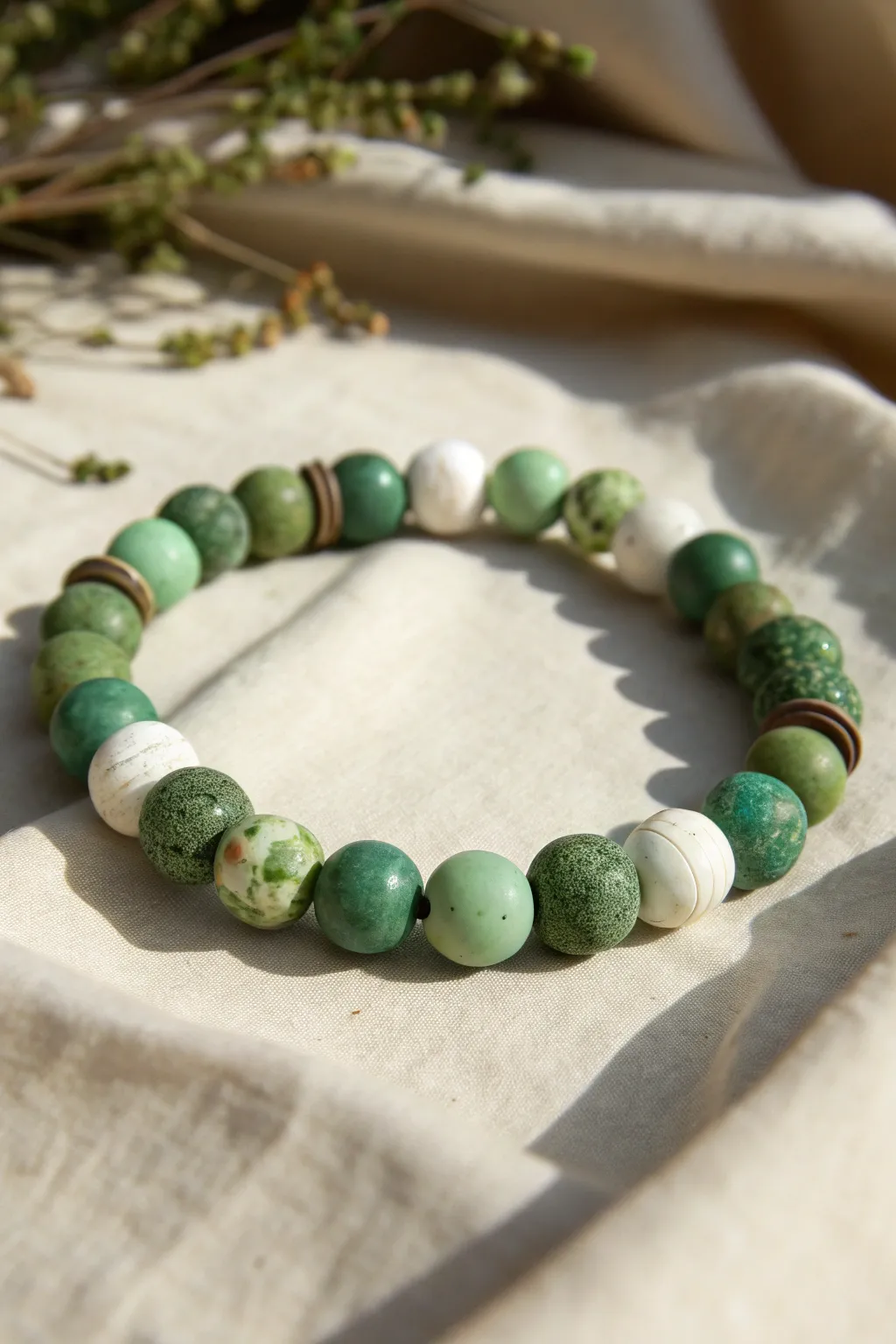
This charming beaded stretch bracelet combines varied shades of green clay beads with crisp white accents and rustic wooden spacers for a natural, grounded look. The mix of textures—from speckled “confetti” patterns to smooth solids—creates a playful yet sophisticated accessory perfect for everyday wear.
How-To Guide
Materials
- Polymer clay in various greens: Forest Green, Mint, Jade, Leaf Green
- White or translucent polymer clay
- Coarse black pepper or dried herbs (for speckling)
- Acrylic roller or pasta machine
- Small circle cutters or a bead rolling tool
- Needle tool or toothpick
- Elastic stretch cord (0.8mm or 1mm)
- Small wooden or coconut spacer discs (brown)
- Bead crafting glue (e.g., G-S Hypo Cement)
- Wet/dry sandpaper (400-800 grit)
- Polymer clay oven or toaster oven
- Baking sheet with cardstock
Step 1: Clay Preparation & Mixing
-
Establish your palette:
Begin by conditioning all your green clays. You want a diverse range of about 4-5 distinct shades, ranging from a deep, mossy green to a light, airy mint. -
Creates the speckled mix:
To achieve the textural ‘confetti’ look seen in the darker beads, take a portion of your forest green clay and knead in some coarse black pepper or finely crushed dried herbs. This adds organic spots. -
Marbling technique:
For the lighter, swirled beads, take a small amount of white clay and partially mix it with a medium green. Stop mixing before it’s uniform so you have lovely streaks of white running through the stone-like spheres. -
Create the white accents:
Condition a pure white block of clay; you can add a tiny speck of grey or beige if you want it to look more like natural bone or stone rather than stark plastic white.
Fingerprint Fix
If your raw beads have fingerprints, lightly dust your hands with cornstarch before the final roll. This smooths them out instantly.
Step 2: Forming the Beads
-
Measure your portions:
Roll your various clay mixes into logs of equal thickness. Slice uniform segments to ensure your beads will be roughly the same size, about 8-10mm in diameter. -
Roll spheres:
Using the palms of your hands or an acrylic bead roller, roll each segment into a smooth, round ball. I find cupping my hands slightly helps keep them from becoming oval. -
Make the ribbed white bead:
Take one of your white spheres and gently press the side of a toothpick or needle tool into it to create parallel indentations. This mimics the carved bone bead seen in the reference. -
Pierce the holes:
While the clay is still raw, gently twist a needle tool through the center of each bead. Rotate the bead as you pierce to keep the shape round and prevent distortion at the exit hole. -
Check the fit:
Slide one bead onto your elastic cord just to check the hole size is sufficient, then remove it. You want the cord to pass through easily without forcing it.
Faux Stone Finish
After baking, tumble your beads in a rock tumbler with plastic pellets and water for a few hours. It gives them an incredibly realistic, matte stone finish.
Step 3: Baking & Finishing
-
Bake the beads:
Arrange your beads on a baking sheet lined with cardstock or batting to prevent flat spots. Bake according to your clay manufacturer’s instructions (usually 275°F/130°C for 15-30 minutes). -
Cool and inspect:
Allow the beads to cool completely. Check for any sharp edges around the holes or fingerprints. -
Sanding for smoothness:
Dip your sanding paper in water and gently buff the surface of the beads. This is crucial for the ‘stone’ look—it removes the plastic sheen and fingerprints. -
Optional buffing:
If you want a satin sheen like polished stone, vigorously rub the beads with a piece of denim or a soft cotton cloth after sanding.
Step 4: Assembly
-
Layout design:
Lay your beads out on a bead board or towel. Alternate the shades of green to distribute the color evenly. Place the white beads as occasional bright pops. -
Insert spacers:
Intersperse the thin wooden spacer discs between grouped sections of green beads. Notice in the photo how they often frame a specific bead or break up a run of similar colors. -
Stringing:
Cut a piece of elastic cord about 10-12 inches long. Pre-stretch the cord by pulling it firmly a few times to prevent the bracelet from loosening later. -
Thread the pattern:
String your beads following your layout. Make sure to check the length against your wrist as you go, aiming for a total length of about 7 inches for an average fit. -
Tying the knot:
Tie a surgeon’s knot (right over left twice, then left over right). Pull the elastic tight to secure the knot. -
Secure and hide:
Dab a tiny drop of crafting cement on the knot. Once dry, trim the excess cord, leaving about 2mm, and gently tug the knot inside specifically one of the larger-hole beads to hide it.
Now you have a serene, nature-inspired bracelet that looks like it was gathered from a forest floor

What Really Happens Inside the Kiln
Learn how time and temperature work together inside the kiln to transform clay into durable ceramic.
Green Clay With Pearl-Like Accents
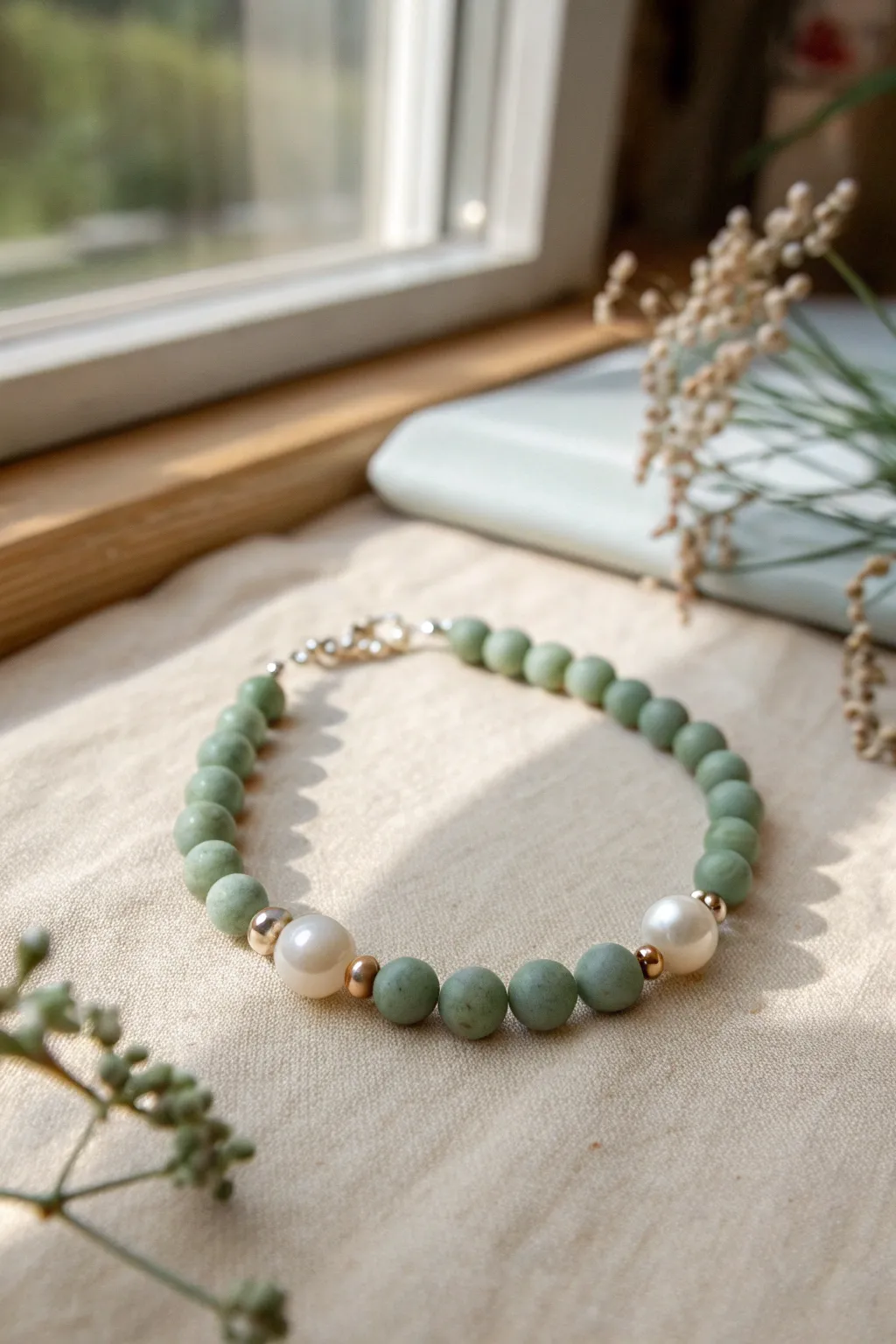
This elegant bracelet couples the matte, earthy texture of sage green clay beads with the luster of large faux pearls. The addition of tiny gold spacer beads adds a touch of sophistication, making it perfect for both casual wear and special occasions.
Detailed Instructions
Materials
- Green polymer clay (sage or matte green)
- Small bead roller tool (optional, for uniform size)
- Beading awl or toothpick
- Two 8mm-10mm white faux pearl beads
- Four 3mm gold-fill or brass spherical spacer beads
- Flexible beading wire (0.015-0.018 inch)
- Two crimp beads (gold)
- Two crimp covers (gold, optional)
- Two wire guardians (gold, optional but recommended)
- Lobster claw clasp and jump ring (gold)
- Crimping pliers
- Wire cutters
- Oven for baking clay
Step 1: Creating the Clay Stone Beads
-
Condition the Green Clay:
Begin by softening your green polymer clay in your hands until it becomes pliable. To achieve that mottled, stone-like look seen in the photo, you can mix a tiny speck of grey or translucent clay into your green, but don’t blend it completely smooth. -
Measure Uniform Portions:
Roll the clay into a long snake about uniform thickness. Slice equal segments of clay to ensure your beads will be consistent in size. Aiming for roughly 6mm diameter beads works beautifully for this design. -
Roll the Beads:
Take each segment and roll it between your palms or use a bead roller to create perfect spheres. If you are doing this by hand, applying light pressure helps keep them round rather than ovoid. -
Pierce the Holes:
While the beads are still raw, gently pierce a hole through the center of each sphere using a beading awl or toothpick. Rotate the tool as you push through to prevent deforming the bead. -
Add Texture (Optional):
For a true matte ‘stone’ finish like the image, I like to gently roll the raw beads over a piece of fine sandpaper or canvas cloth before baking. This removes fingerprints and adds a subtle, earthy texture. -
Bake the Clay:
Arrange your beads on a baking sheet or tile. Follow the package instructions for your specific brand of clay regarding temperature and time. Let them cool completely before handling.
Stone Effects
To mimic the speckled look of real semi-precious stone, mix some black pepper or dried tea leaves into your raw green clay before rolling the beads.
Step 2: Assembling the Design
-
Cut the Beading Wire:
Cut a length of flexible beading wire about 10-12 inches long. This gives you plenty of extra room to work with the crimps without struggling. -
Start the Strand:
Slide a crimp bead onto one end of the wire, followed by a wire guardian if using one. Loop the wire through your jump ring (or the closed ring part of the clasp set) and back through the crimp bead. -
Secure the First End:
Use your crimping pliers to flatten or fold the crimp bead securely. Trim the excess short tail of the wire, or leave a half-inch to tuck into the first few beads. -
String the Green Base:
Begin stringing your cooled green clay beads. String approximately 7 to 9 beads, depending on your wrist size. This section will form the side of the bracelet. -
Add the First Pearl Accent:
Now for the focal point. Slide on one small gold spacer bead, followed by one large pearl bead, and finish with another small gold spacer bead. -
Create the Bridge:
Add a small section of green clay beads between the pearls. In the photo, there are four green beads separating the two pearl sections. This creates a balanced visual break. -
Add the Second Pearl Accent:
Repeat the accent sequence: one gold spacer, your second pearl bead, and another gold spacer. -
Finish the Green Strand:
Finish stringing the rest of your green clay beads until you reach your desired total length. Make sure the number of green beads on this end roughly matches the starting side for symmetry.
Mix It Up
Instead of pearls, try using large faceted crystal beads or rough-cut quartz in the center for a sparkle that contrasts beautifully with the matte clay.
Step 3: Finishing Touches
-
Prepare the Closure:
Slide a crimp bead onto the remaining open end of the wire, followed by a wire guardian and the lobster claw clasp. -
Close the Loop:
Feed the wire back down through the crimp bead and through the first one or two green beads to hide the tail. Pull everything snug, but ensure the bracelet still bends loosely and isn’t stiff. -
Crimp and Trim:
Use your pliers to secruely crimp the bead shut. Cut off any remaining excess wire close to the beads using flush cutters. -
Cover Crimps (Optional):
If you are using crimp covers, gently place them over your flattened crimp beads and squeeze them shut with pliers to make them look like smooth gold rounds.
Enjoy wearing your handcrafted piece of nature-inspired elegance
Personalized Word Bracelet in Green
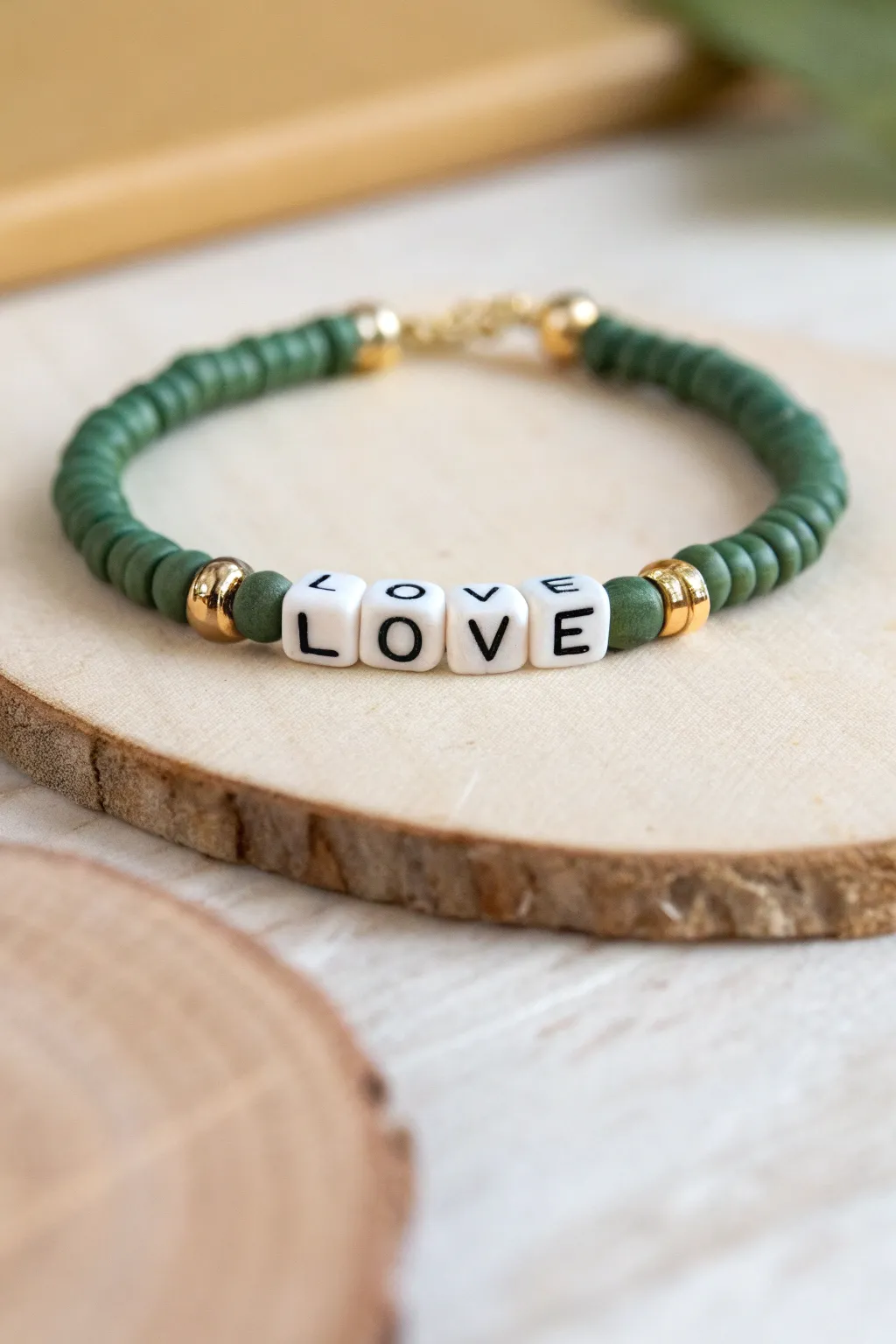
This charming bracelet combines the earthy texture of green polymer clay disc beads with the sleek shine of gold accents. The crisp white letter cube beads create a bold, personalized focal point that stands out beautifully against the olive green tones.
Step-by-Step Guide
Materials
- Olive green polymer clay heishi disc beads (6mm)
- White square alphabet beads with black lettering (L, O, V, E)
- Gold tone metallic spacer beads (rounded/smooth, 6mm or similar)
- Small gold crimp beads (2mm)
- Gold jump rings (4mm or 5mm)
- Gold lobster claw clasp
- Clear jewelry elastic cord or beading wire (0.8mm)
- Jewelry pliers (chain nose and flat nose)
- Scissors or wire cutters
- Bead stopper or masking tape
- Super glue or jewelry cement (optional)
Step 1: Planning and Layout
-
Measure your wrist:
Before cutting any cord, measure your wrist circumference to determine the total length needed. A standard bracelet size is often around 7 inches, but customizing it ensures a perfect fit. -
Design the pattern:
Lay out your beads on a bead board or a soft towel. Start with the centerpiece: the letters ‘L’, ‘O’, ‘V’, ‘E’. Place one green heishi bead between the ‘V’ and ‘E’ if you want slight separation, though directly touching usually looks cleaner for words. -
Add metallic accents:
On either side of your word, place one green clay bead, followed by a gold metallic spacer bead. This gold accent frames the text perfectly. -
Fill the length:
Arrange the remaining green heishi beads equally on both sides of the central design until you reach your desired total length.
Step 2: Stringing the Beads
-
Prepare the cord:
Cut a piece of elastic cord or beading wire about 10-12 inches long. This extra length makes tying knots or attaching clasps much easier. -
Secure the end:
Place a bead stopper or a piece of masking tape on one end of the cord to prevent beads from sliding off while you work. -
String the first half:
Thread the green clay beads for the first side onto the cord. I like to double-check the count to ensure symmetry later. -
Bead the gold accent:
Slide on one gold spacer bead, followed by a single green clay bead. -
Add the word:
Thread your letter beads in order: L, O, V, E. Ensure they are all facing the same direction so the word is legible. -
Finish the accents:
Add one green clay bead, followed by the second gold spacer bead. -
Complete the strand:
Finish stringing the remaining green heishi beads for the second side.
Knot Security
If using elastic instead of a clasp, tie a surgeon’s knot and dab a tiny drop of super glue on the knot before hiding it inside a bead hole.
Step 3: Finishing and Clasping
-
Add crimp bead:
Thread a small gold crimp bead onto the end of the wire, followed by a jump ring or the loop of your lobster clasp. -
Loop back:
Take the end of the wire and thread it back through the crimp bead, creating a small loop around the hardware. -
Secure the crimp:
Use your flat nose pliers to squeeze the crimp bead firmly flat. This locks the wire in place. Give it a gentle tug to test security. -
Repeat on the other side:
Repeat the crimping process on the other end of the bracelet. Attach a jump ring here to catch the lobster clasp. -
Hide wire tails:
Thread the excess wire tail back through the first few green beads adjacent to the crimp. This hides the sharp end and adds stability. -
Trim excess:
Carefully trim any remaining wire close to the beads using your wire cutters or scissors.
Layered Look
Make two more bracelets using only the green heishi beads and gold spacers to create a stacked set that complements the word bracelet.
Slip on your new custom accessory and enjoy the personalized touch added to your daily style

TRACK YOUR CERAMIC JOURNEY
Capture glaze tests, firing details, and creative progress—all in one simple printable. Make your projects easier to repeat and improve.
Centered Charm on a Green Clay Bracelet
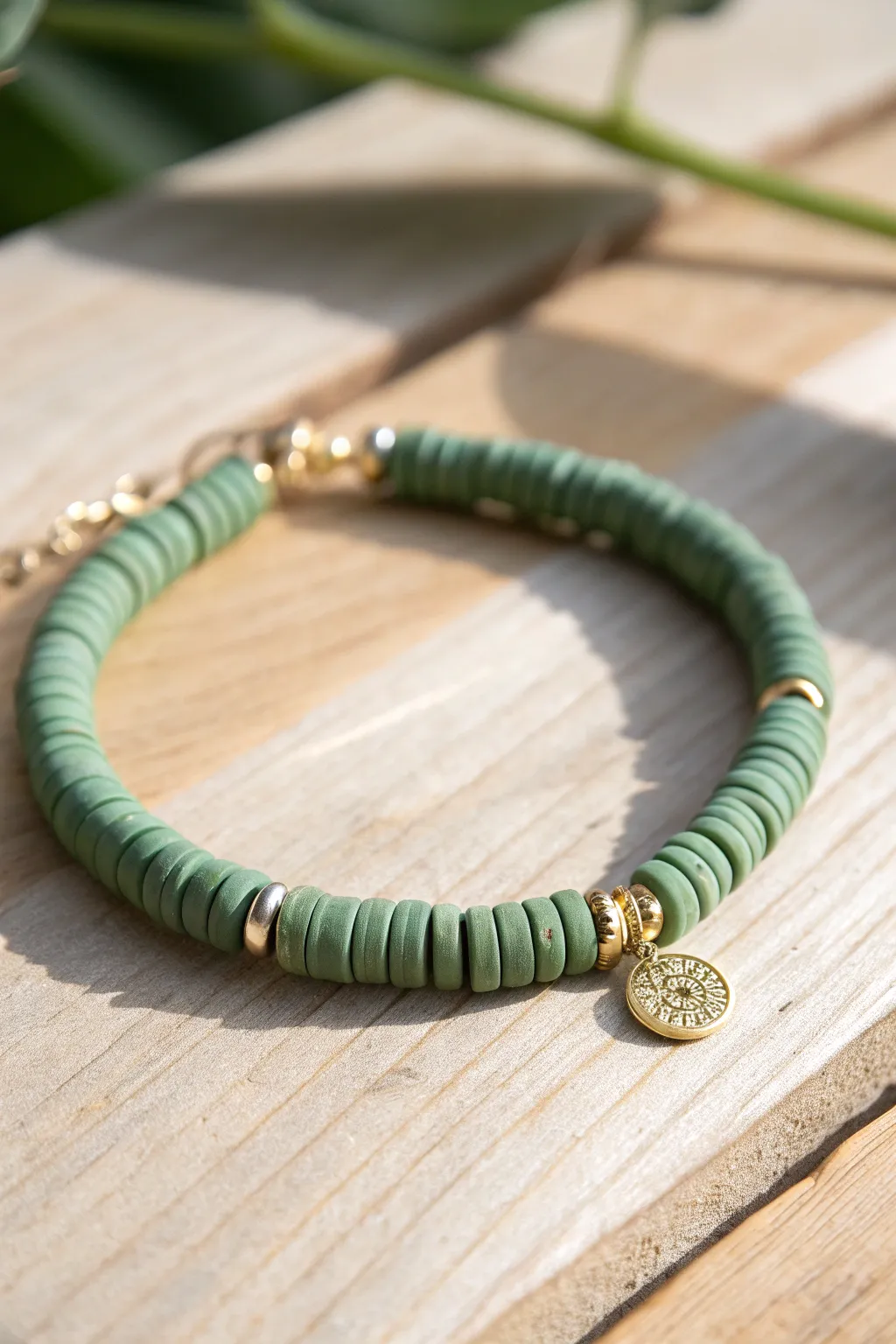
This earthy yet elegant bracelet combines the trendiness of polymer clay heishi beads with the classic appeal of metallic accents and a centered charm. The muted sage green tone pairs beautifully with gold and silver spacers, making it a versatile accessory for everyday wear or stacking.
Detailed Instructions
Materials
- Green polymer clay heishi beads (approx. 6mm diameter)
- Gold tone metallic spacer beads (round)
- Silver tone metallic spacer beads (round)
- Gold tone patterned coin charm (small)
- Small gold jump ring
- Gold tone crimp beads
- Gold tone crimp covers (optional but recommended)
- Jewelry wire or strong elastic cord (0.8mm typical)
- Gold tone lobster clasp and extender chain
- Jewelry pliers (chain nose and flat nose)
- Scissors or wire cutters
Step 1: Preparation and Planning
-
Measure your wrist:
Before cutting any wire, wrap a measuring tape around your wrist to determine the desired length. Add about an inch to this measurement to account for the beads’ thickness and the fastening mechanism. -
Cut the cord:
Cut a length of jewelry wire or elastic cord. I always cut about 3-4 inches extra beyond my calculated length to give myself plenty of room to work with the knots or crimps at the end. -
Prepare the charm:
Using your chain nose pliers, carefully open the small gold jump ring. Slide the patterned coin charm onto the ring. -
Isolate the center:
Select two gold spacer beads that have a slightly decorative or textured edge, similar to the ones flanking the charm in the image. These will frame your centerpiece.
Step 2: Stringing the Beads
-
Secure the first end:
If using wire, thread a crimp bead onto one end, loop it through the jump ring on your extender chain, pass it back through the crimp bead, and flatten it with pliers. If using elastic, you can use a bead stopper or simply tape the end down. -
Begin the green sequence:
Start threading the green heishi beads. You’ll want to string enough to cover approximately one-third of your total bracelet length. -
Add the first accent:
Slide on a smooth gold spacer bead followed by a single silver spacer bead. This mixed-metal look adds subtle visual interest without overwhelming the green tones. -
The middle section:
Continue adding green heishi beads until you are approaching the halfway point of the bracelet strand. -
Create the centerpiece:
Thread on one of your decorative gold spacer beads. Next, slide on the jump ring holding your coin charm so it dangles freely. -
Complete the center:
Immediately follow the charm with the second decorative gold spacer bead. This sandwiches the charm and keeps it highlighted in the middle. -
Mirror the design:
Add the second section of green heishi beads, matching the length of the section before the center charm. -
Add the second accent:
Place a silver spacer bead followed by a smooth gold spacer bead onto the wire, mirroring the placement of the accents on the first side. -
Finish the bead strand:
Thread the remaining green heishi beads until the bracelet reaches your desired total length, ensuring symmetry with the starting end.
Prevent stiffness
Don’t string beads too tightly! Leave a millimeter of slack before crimping. If heishi beads are jammed together, the bracelet will be rigid and won’t drape nicely.
Step 3: Finishing Touches
-
Check the fit:
Carefully wrap the unfinished bracelet around your wrist one last time to ensure the size is correct and the charm sits nicely in the center. -
Attach the clasp:
Thread a crimp bead onto the open end of the wire. Pass the wire through the loop of your lobster clasp. -
Secure the wire:
Loop the wire back through the crimp bead and pull it taut, but leave just a tiny bit of slack so the bracelet moves fluidly. -
Crimp and trim:
Use your flat nose pliers to crush the crimp bead firmly. Snip off the excess wire tail close to the bead. -
Add crimp covers:
For a polished look, place a crimp cover over the crushed crimp beads at both ends. Gently close them with pliers to make them look like regular gold beads.
Try asymmetrical accents
Instead of mirroring exactly, try placing three gold spacers on one side and two on the other for a more organic, bohemian vibe.
Now you have a serene, nature-inspired piece ready to complement your wardrobe
Green Daisy Pattern Clay Bracelet
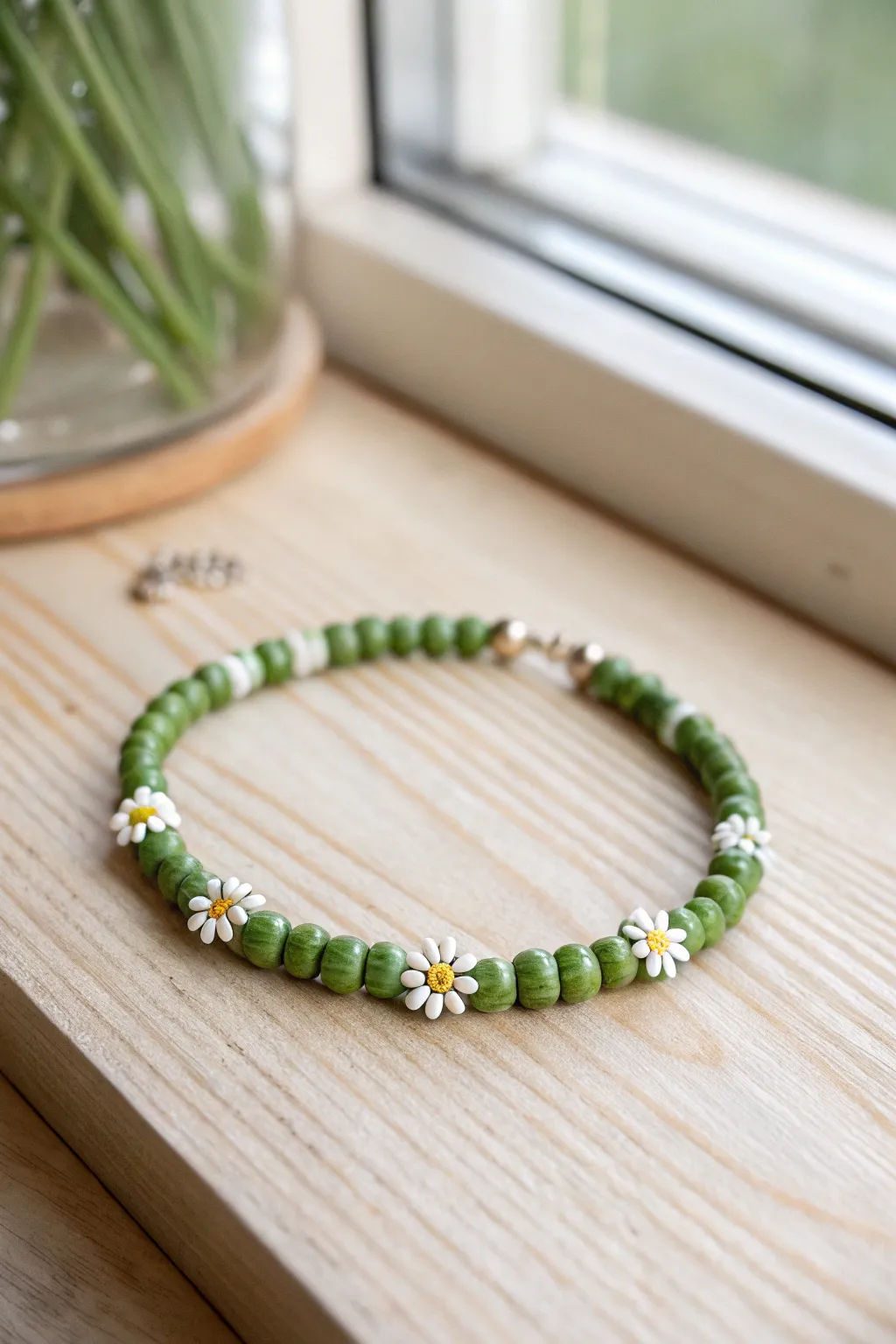
Capture the fresh essence of a meadow with this charming beaded choker featuring earthy olive tones and delicate daisy accents. The matte finish and organic shapes give it a beautifully handcrafted, nature-inspired aesthetic that pairs perfectly with casual linen or denim.
Step-by-Step
Materials
- Olive green polymer clay
- White polymer clay
- Yellow polymer clay
- Beading wire (approx. 0.38mm or 0.45mm)
- 2 Crimp beads
- 2 Crimp covers (silver or gold tone)
- Lobster clasp and jump ring set
- Pointed clay tool or toothpick
- Acrylic roller or pasta machine
- Circle cutter (small, approx. 6mm)
- Small blade or craft knife
- Sandpaper or buffing cloth (optional)
Step 1: Crafting the Green Beads
-
Condition the Clay:
Start by warming up your olive green polymer clay in your hands. Knead and roll it until it becomes soft, pliable, and free of any air bubbles. -
Roll a Log:
Roll the green clay into a long, even snake shape. Aim for a thickness of about 6-8mm, which will determine the final size of your beads. -
Cut Even Segments:
Use your craft blade to slice the log into equal segments. Consistency is key here for a uniform look, though a little variation adds to the organic charm. -
Shape the Rounds:
Roll each green segment between your palms to create smooth, round spheres. If you notice fingerprints, lightly dust your fingers with cornstarch before rolling. -
Pierce the Holes:
Gently pierce each green sphere directly through the center using your pointed tool or toothpick. Rotate the bead as you push the tool through to prevent distorting the round shape.
Clean Core
To keep the bead holes clean during baking, try baking your beads directly on a dedicated bead baking rack or strung on a stiff wire suspended over a foil tray.
Step 2: Sculpting the Daisies
-
Prepare White Petals:
Roll a very thin snake of white clay. Slice tiny, rice-grain-sized pieces. You will need roughly 5-6 pieces for each flower. -
Form the Flower Base:
Take a green bead (one you haven’t pierced yet) or create a small flat green disc as a base. Press the tiny, white rice-shaped pieces onto it in a circle pattern to form petals. -
Add the Center:
Roll a tiny ball of yellow clay. I place this directly in the center of the white petals and press down gently to secure the flower structure. -
Texture the Center:
Use a needle tool or the tip of a toothpick to stipple the yellow center, giving it that realistic, pollen-like texture. -
Create the Bead Structure:
Ensure your flower is fused to a backing bead or form it into a bead shape itself, then carefully pierce a hole through the side so it will string flat against the wrist or neck. -
Bake:
Arrange all your green rounds and daisy beads on a baking sheet or ceramic tile. Bake according to your clay manufacturer’s specific temperature and time instructions. -
Cool and Finish:
Allow the beads to cool completely. If there are rough spots near the holes, you can gently smooth them with fine-grit sandpaper.
Step 3: Assembly
-
Stringing Setup:
Cut a length of beading wire about 2-3 inches longer than your desired finished length. Attach a crimp bead and one half of your clasp to one end, securing it tightly. -
Begin Patterning:
Start threading your beads. Begin with a sequence of about 8 to 10 green beads to establish the base color. -
Insert First Daisy:
Slide on your first daisy bead. Ensure the flower face is oriented outward. -
Continue the Rhythm:
Repeat the pattern—roughly 8-10 green beads followed by one daisy—until you reach your desired length. Check the fit against your wrist or neck as you go. -
Final Connection:
Thread a crimp bead onto the loose end, followed by the jump ring or receiver half of the clasp. Loop the wire back through the crimp bead and pull tight. -
Secure the End:
Flatten the crimp bead with pliers to lock the wire in place. Trim any excess wire tail close to the bead. -
Cover Crimps:
Place a crimp cover over the flattened crimp bead and gently close it with pliers to make it look like a seamless silver bead.
Two-Tone Twist
Mix a tiny amount of translucent clay into half your olive green batch. Alternating these slightly different shades creates depth and a natural stone effect.
Enjoy wearing your handmade slice of nature wherever you go
Marbled “Jade” Green Clay Bracelet
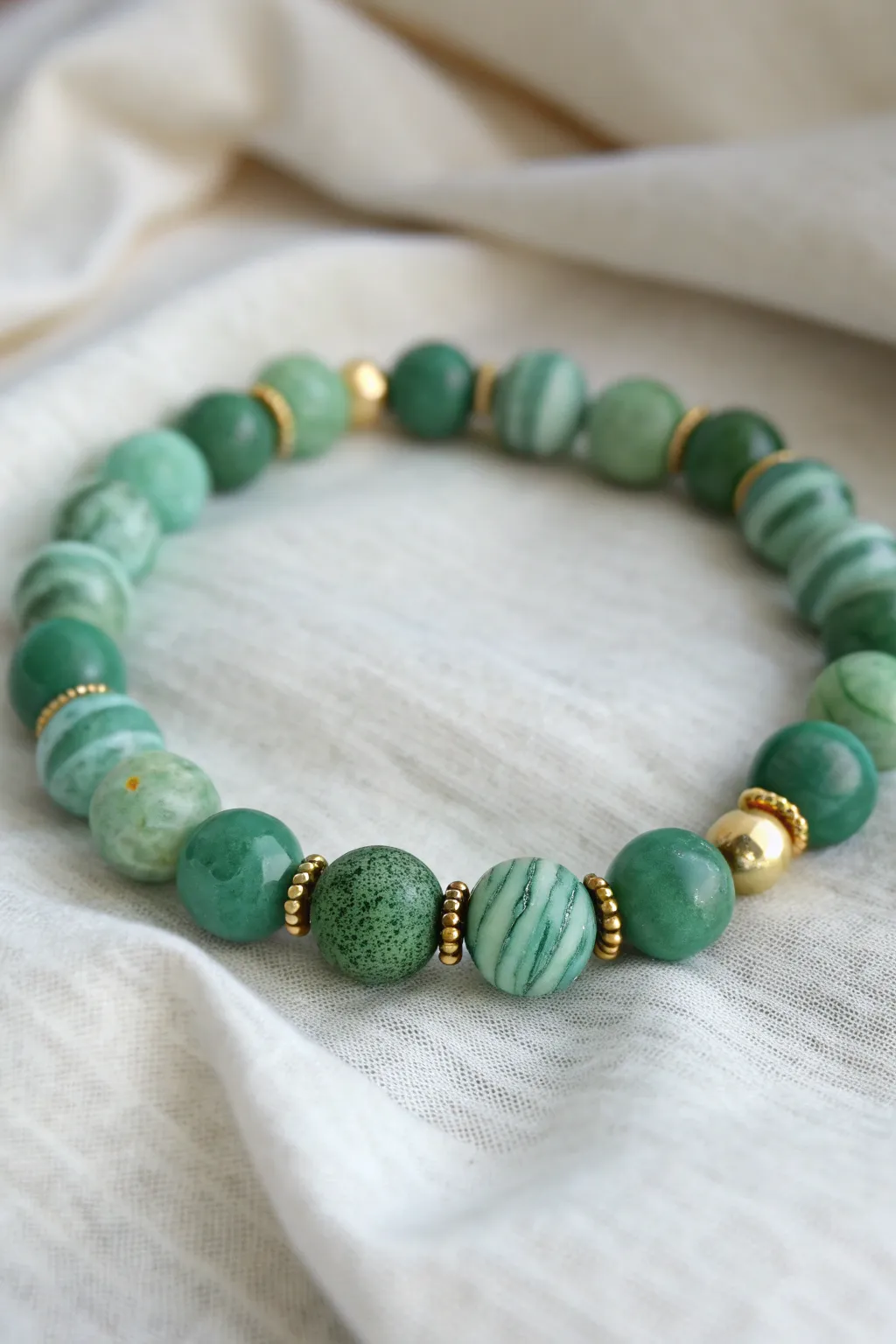
Capture the elegance of natural stone with this polymer clay project that mimics the soothing variations of jade. By combining marbling techniques with textured finishes, you’ll create a sophisticated accessory that looks far more expensive than it is.
Step-by-Step Guide
Materials
- Polymer clay (Dark Emerald Green)
- Polymer clay (Translucent)
- Polymer clay (White)
- Coarse black pepper or dried herbs (for speckling)
- Gold spacer beads (daisy spacers or small discs)
- One large gold accent bead (approx. 8mm)
- Elastic stretch cord (0.8mm)
- Bead piercing tool or toothpick
- Gloss glaze or resin (optional)
- Clay roller or pasta machine
- Blade or craft knife
- Jewelry glue
Step 1: Mixing the Clay Colors
-
Prepare the Base Green:
Start by conditioning a block of emerald green clay. If the color feels too flat, mix in a tiny amount of translucent clay to give it depth similar to real stone. -
Create the Lighter Shade:
To make the lighter contrast color, take a portion of your emerald green and mix it with an equal part of white clay. Knead until fully blended. -
Prepare the Speckled Mix:
Take a small ball of the emerald green clay and sprinkle a pinch of coarse black pepper or dried herbs onto it. Fold the clay over and knead it until the speckles are evenly distributed.
Step 2: Creating the Patterns
-
Technique 1: Solid Jade:
Roll several spheres of pure emerald green clay. I like to keep these around 10mm in size for a substantial feel. -
Technique 2: The Marbled Effect:
Roll a snake of dark green and a snake of the lighter green/white mix. Twist them together like a candy cane. -
Fold and Compress:
Fold the twisted snake in half and twist it again. Do not over-mix, or the distinct lines will turn muddy. You want clear striations. -
Form the Marbled Beads:
Cut segments from your marbled log and roll them into balls. As you roll, the swirls will stretch and organic patterns will emerge. -
Technique 3: The Speckled Stone:
Roll your pepper-infused clay into balls of the same size as your other beads. This texture adds a wonderful grit that mimics natural mineral inclusions.
Uneven Holes?
If your bead holes distort during piercing, put the beads in the fridge for 15 mins to firm up the clay before drilling.
Step 3: Forming and Baking
-
Check for Uniformity:
Line up all your unbaked beads to ensure they are roughly the same size. Gently re-roll any that feel inconsistent. -
Piercing the Holes:
Using a bead piercing pin or a toothpick, carefully drill a hole through the center of each bead. Rotate the bead as you push to avoid squishing the shape. -
Smooth the Edges:
Check the exit hole of each bead; if the clay pushed out creates a jagged edge, smooth it down gently with your fingertip. -
Baking:
Place the beads on a baking sheet or cardstock. Bake according to your brand of clay’s instructions (usually 275°F/135°C for 15-30 minutes). -
Cooling and Finishing:
Allow the beads to cool completely. If you want a high-gloss ‘polished stone’ look, apply a thin coat of gloss glaze or UV resin now.
Level Up: Stone Texture
After baking, lightly sand the beads with wet/dry sandpaper (400 to 1000 grit) and buff vigorously with denim for a satin finish.
Step 4: Assembly
-
Layout Design:
Arrange your beads on a bead board or towel. Alternate between solid, marbled, and speckled beads to create visual rhythm. -
Adding Metals:
Place small gold spacer beads between select clay beads, particularly framing the speckled or key marbled ones. -
The Focal Point:
Choose a spot for your large gold accent bead. This acts as a visual anchor for the bracelet. -
Stringing:
Cut a piece of elastic cord about 10 inches long. String your pattern onto the cord carefully. -
Knotting:
Check the fit on your wrist. Tie a surgeon’s knot (right over left twice, then left over right), pull tight, and secure with a dot of jewelry glue before trimming the ends.
Wear your new creations stacked together or solo for a perfect touch of earth-toned style
Terrazzo-Style Speckled Green Bracelet
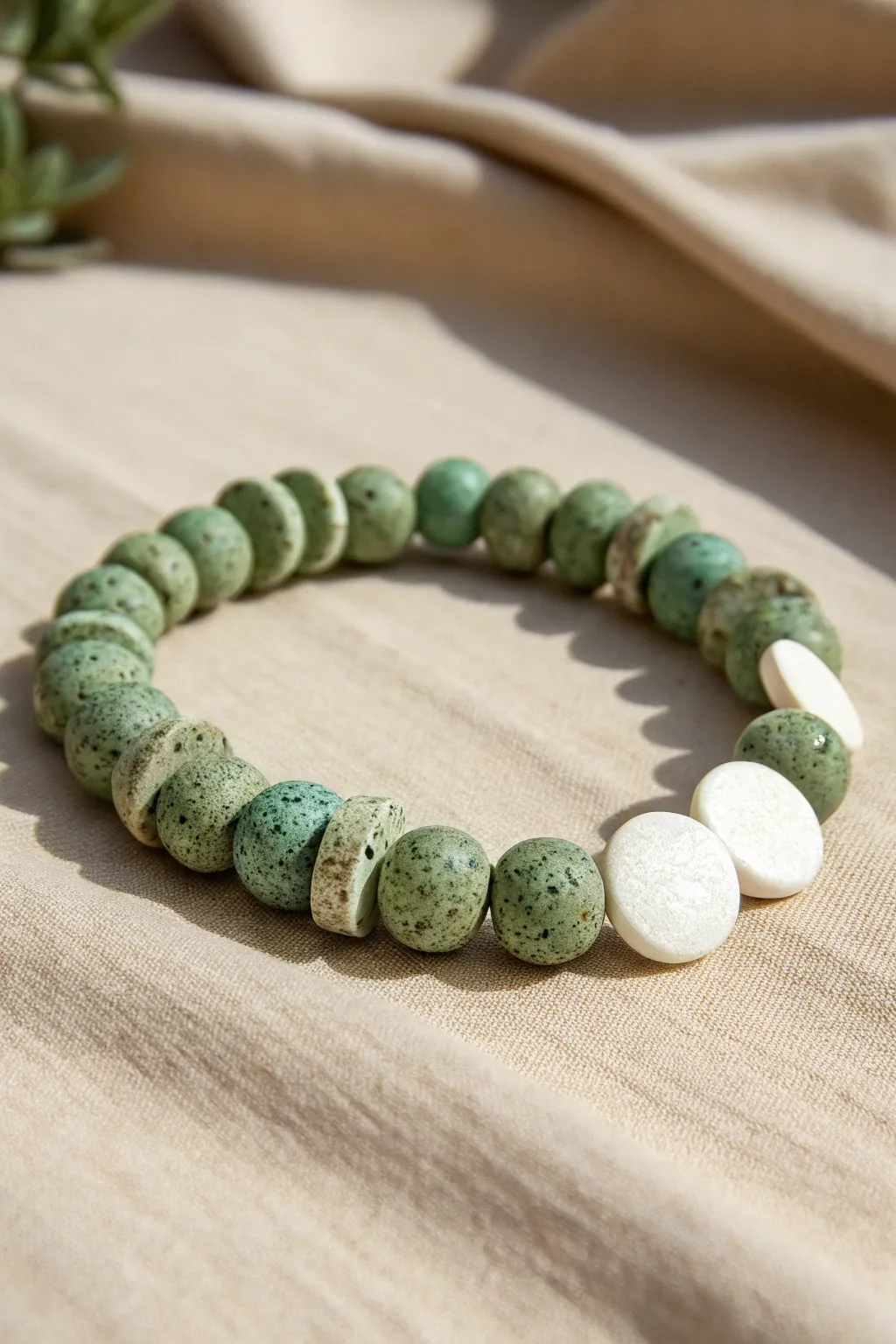
Embrace the natural beauty of imperfection with this lovely terrazzo-style bracelet, featuring muted green and cream discs. The speckled finish gives these handmade clay beads a distinct, stone-like quality that feels both rustic and modern.
Step-by-Step
Materials
- Polymer clay (muted sage green, translucent, and white)
- Black pepper or dried coffee grounds (for speckling)
- Acrylic rolling pin or pasta machine
- Small circular clay cutter (approx. 10-12mm)
- Needle tool or toothpick
- Baking sheet and parchment paper
- Elastic stretch cord (0.7mm or 0.8mm)
- Super glue or jewelry cement
- Wet/dry sandpaper (400 and 800 grit)
- Oven (for curing)
Step 1: Clay Preparation
-
Create the green base:
Start by conditioning your sage green polymer clay until it is soft and pliable. If the green is too bright, mix in a tiny pinch of brown or grey to mute the tone for that earthy look. -
Add texture:
Flatten the green clay slightly and sprinkle a generous amount of coarse black pepper or dried coffee grounds onto the surface. This creates the organic, speckled stone effect seen in the photo. -
Mix the inclusions:
Fold the clay over the speckles and knead thoroughly until the particles are evenly distributed throughout the green block. -
Prepare the cream accent:
Condition a separate block of white clay. To give it a more natural, ceramic appearance, I like to mix in a very small amount of translucent clay, which reduces the plastic look of pure white. -
Sheet the clay:
Roll out both your speckled green clay and your white clay into sheets of even thickness. Aim for about 4mm to 5mm thick so the beads have substantial rounded edges later.
Hole distortion?
If the clay disk squishes when you pierce the hole, let the raw cutouts sit in the fridge for 20 minutes before piercing. The firmer clay holds its shape better.
Step 2: Shaping & Baking
-
Cut the discs:
Using your small circular cutter, punch out circles from the green sheet. You will need about 20-25 green beads depending on your wrist size. -
Cut accent beads:
Cut 3 to 4 circles from the white clay sheet to serve as the focal point of the bracelet. -
Soften the edges:
Gently pick up each cut circle and lightly tap the edges with your finger to round them off slightly, removing the sharp cut marks for a softer, tumbled look. -
Pierce the holes:
Using a needle tool, carefully pierce a hole through the center of each disc edge-to-edge (horizontally through the thickness), not through the flat face. Rotate the needle while piercing to prevent distortion. -
Bake carefully:
Arrange the beads on a parchment-lined baking sheet. Bake according to your brand’s specific time and temperature instructions (usually 275°F/135°C for 30 minutes). -
Cool down:
Allow the beads to cool completely in the oven with the door cracked open to prevent thermal shock cracks.
Level Up: Stone Look
After baking while beads are warm, tumble them in a jar with coarse sand for 10 minutes. This creates a pitted texture looking exactly like real river stones.
Step 3: Finishing & Assembly
-
Sand for matte finish:
Once cool, wet sand the beads briefly with 400 grit, then 800 grit paper. This removes fingerprints and exposes the speckles further, enhancing the stone effect. -
Rinse and dry:
Wash the beads in soapy water to remove sanding dust and dry them thoroughly with a lint-free towel. -
Layout design:
Lay your beads out on a mat. Group the three white beads together, then surround them with the green speckled beads to complete the circle. -
Stringing:
Cut a piece of elastic cord about 10 inches long. Pre-stretch the cord by pulling it firmly a few times to prevent sagging later. Thread your beads onto the cord. -
Secure the knot:
Tie a surgeon’s knot (looping twice instead of once on the first pass). Pull it tight so the beads sit snugly against each other. -
Final touch:
Add a tiny drop of super glue to the knot. Let it dry, then trim the excess cord and gently tuck the knot inside one of the bead holes.
Wear your new earthy bracelet stacked with others or alone as a simple statement piece
Matte-and-Gloss Green Texture Mix
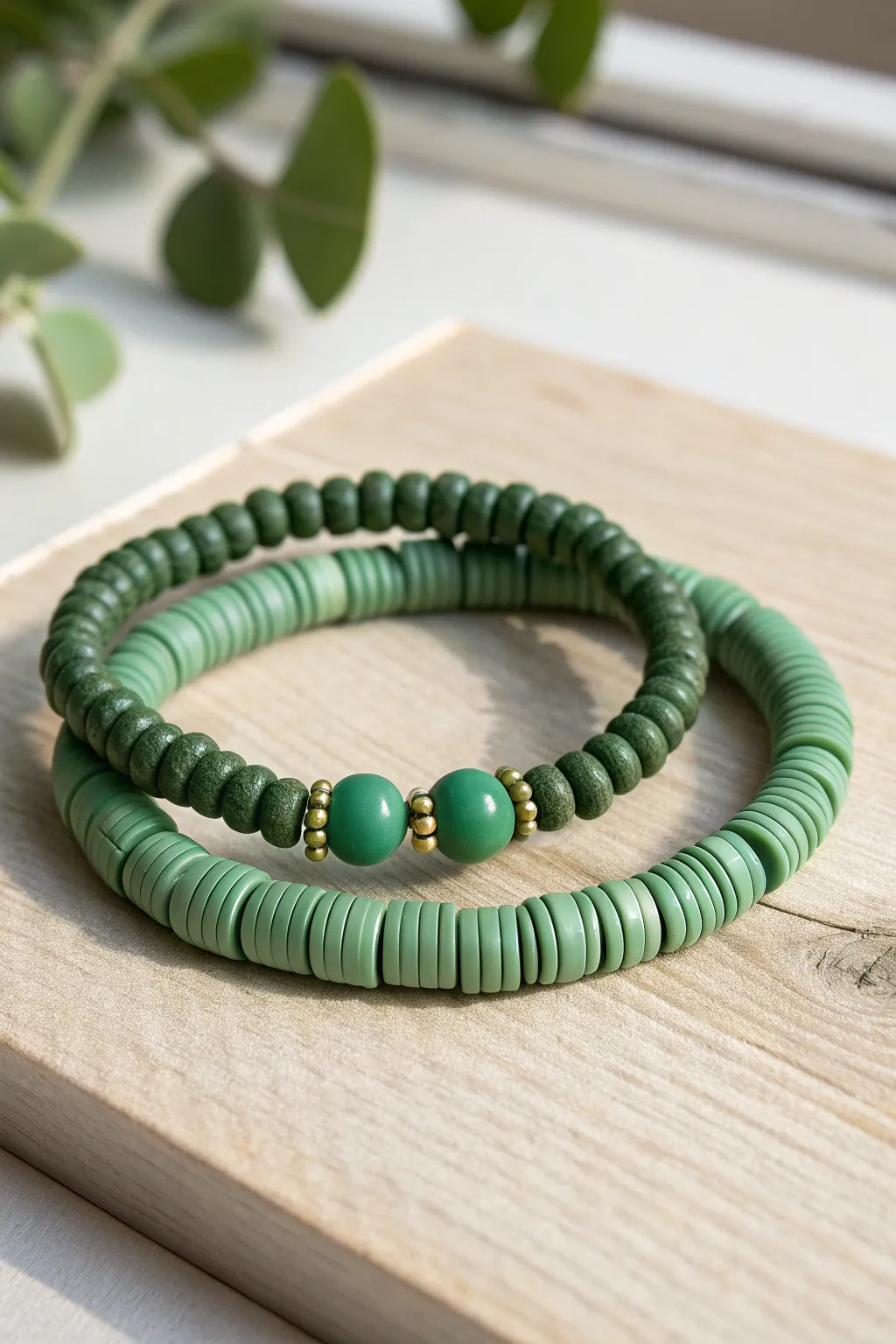
This earthy duo combines two distinct textures and shades of green for a sophisticated, nature-inspired look. Featuring matte olive rounds and smooth sage heishi discs, these bracelets are perfect for stacking or wearing solo.
How-To Guide
Materials
- Polymer clay (Sage Green for heishi beads)
- Polymer clay (Dark Olive Green for round beads)
- Polymer clay (Bright Jade Green for focal beads)
- Small gold spacer beads (daisy spacers or tiny rounds)
- Flexible beading elastic cord (0.8mm or 1mm)
- Clay extruder with disc attachment (optional but helpful)
- Tissue blade or sharp craft knife
- Rolling pin or pasta machine
- Bead piercing pin or toothpick
- Super glue or jewelry cement
- Oven for baking
- Sandpaper (fine grit)
Step 1: Creating the Sage Heishi Beads
-
Condition the Clay:
Begin by thoroughly conditioning your sage green polymer clay until it is soft and pliable. Use a pasta machine or rolling pin to create a uniform sheet about 2-3mm thick. -
Cut the Strips:
Using a tissue blade, slice the clay sheet into long, even strips. The width of the strip will determine the diameter of your beads, so aim for roughly 6-8mm wide. -
Extruder Method (Alternative):
If you have a clay extruder, you can simply extrude a long snake of clay. I find this helps keep the diameter perfectly consistent without measuring. -
Slice the Discs:
Whether you have a square strip or a round snake, use your blade to slice thin, wafer-like discs. Try to keep them all the same thickness for a uniform look. -
Piercing the Holes:
Gently pierce the center of each disc with a bead pin. Perform this step carefully to avoid distorting the circle shape; twisting the pin as you push helps reduce drag. -
Baking Batch One:
Arrange the discs on a baking sheet lined with parchment paper. Bake according to your clay manufacturer’s instructions, usually around 275°F (130°C) for 15-30 minutes.
Smooth Edges Pro-Tip
Does your heishi bead slicing look rough? Pop the clay snake in the freezer for 10 minutes before slicing. The firmer clay cuts cleanly without squishing.
Step 2: Forming the Olive Round Beads
-
Prepare the Dark Green:
Condition the dark olive green clay. Roll it into a snake of uniform thickness, then slice it into equal segments to ensure your beads will be the same size. -
Roll Spheres:
Take each segment and roll it between your palms to form a smooth, perfect sphere. These should be roughly 6mm in diameter. -
Texture Option:
For a matte, organic texture like the photo, lightly roll the unbaked beads over a piece of sandpaper or canvas fabric before piercing. -
Create the Focal Beads:
Using the brighter jade green clay, create two slightly larger spheres (approx 8mm). Keep these very smooth and glossy—do not texture them. -
Pierce and Bake:
Pierce holes through the center of all round beads. Bake them on a separate tray or alongside the discs if the temperature requirements match.
Level Up: Pattern Mix
Add variety by mixing a few gold spacers randomly into the solid heishi bracelet, or use a tiny bit of gold leaf on the olive beads before baking.
Step 3: Assembly & Finishing
-
Prepare the Cord:
Cut two lengths of elastic cord, measuring about 10 inches each to allow plenty of room for tying knots. -
String the Heishi Bracelet:
Thread the baked sage green discs onto the first cord. String enough beads to wrap comfortably around your wrist, usually about 6.5 to 7 inches. -
Layout the Olive Bracelet:
For the second bracelet, plan your pattern. The sequence shown is: mostly olive rounds, then the focal section. -
String the Focal Point:
Thread the beads in this order: Olive rounds > Gold spacer > Jade focal bead > Gold spacer > Gold spacer > Jade focal bead > Gold spacer > Olive rounds. -
Pre-stretch the Elastic:
Before tying, give the elastic a few gentle tugs. This pre-stretching prevents the bracelet from loosening up the first time you wear it. -
Knotting:
Tie a secure surgeon’s knot (right over left, left over right, and loop through twice). Pull tight. -
Secure the Knot:
Apply a tiny drop of super glue or jewelry cement to the knot. Let it dry completely before trimming the excess cord close to the knot. -
Hide the Knot:
If hole sizes allow, gently tug the elastic so the knot slides inside one of the adjacent beads to hide it from view.
Enjoy styling these versatile greens with your favorite casual outfits
Green Clay Bracelet With Tiny Bead Frames
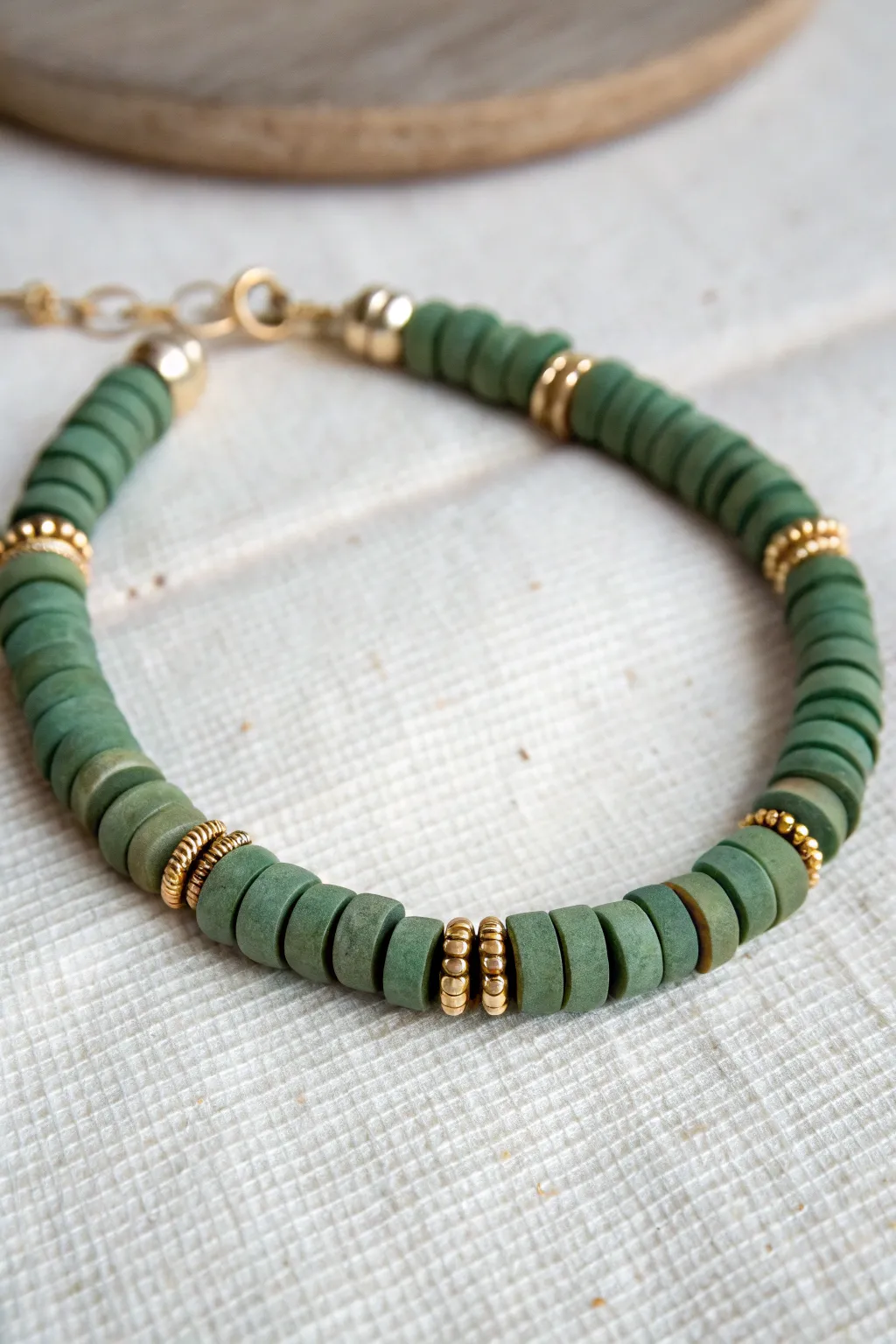
This sophisticated bracelet combines the earthy texture of green heishi clay beads with the luxurious shine of gold spacers. The pattern groups the green tones into segments separated by intricate metallic frames, creating a piece that feels both organic and polished.
Step-by-Step
Materials
- Green polymer clay disc beads (heishi beads), approx 6mm
- Gold tone spacer beads (various textures: smooth discs and ribbed/beaded edges)
- Gold crimp beads (2mm)
- Gold crimp bead covers (3mm)
- Flexible beading wire (gold or clear, 0.015-0.018 inch diameter)
- Gold lobster clasp
- Gold chain extender with jump ring
- Wire cutters
- Crimping pliers (or chain-nose pliers)
Step 1: Planning and Prep
-
Measure your wrist:
Wrap a flexible measuring tape around your wrist to find your size. Add about 0.5 to 1 inch to this measurement to ensure the bracelet fits comfortably without being too tight against the skin. -
Cut the wire:
Cut a length of beading wire approximately 10 inches long. I always prefer to have a few extra inches of wire to work with, as it makes finishing the ends much less frustrating. -
Secure the first end:
Thread a crimp bead onto one end of the wire, followed by the jump ring attached to your chain extender. Loop the wire back through the crimp bead. -
Crimp it tight:
Use your crimping pliers to flatten the crimp bead securely. Give it a gentle tug to make sure it holds. Cover the flattened crimp with a crimp cover for a professional finish.
Uneven Strands?
Since clay heishi beads vary in thickness, count length in millimeters/inches rather than number of beads to keep colorful sections perfectly symmetrical.
Step 2: Beading the Pattern
-
Start the sequence:
Begin by sliding on a single gold spacer bead to sit flush against the clasp hardware. This acts as a nice bookend. -
First green segment:
Thread on approximately 8 to 10 green clay discs. These clay beads often vary slightly in thickness, so you may need to adjust the count to get a visually consistent length for each section. -
Add a gold frame:
Insert a textured gold spacer bead. In the photo, these look like tiny ribbed frames or stacked seed beads. This creates the first visual break in the green color. -
Second green segment:
Add another set of green clay discs. Try to match the length of this segment to your first one. -
Create the center patterns:
For the main visual interest, you can vary the spacers. Slide on two thin gold spacers with a tiny gap or a different textured gold bead in between them. -
Continue the rhythm:
Continue adding segments of green clay beads, separating each block with your gold spacers. Alternate between single gold beads and the double-spacer look to replicate the organic feel of the original piece. -
Check the length:
Periodically wrap the beaded wire around your wrist. You want the beaded portion to almost meet around your wrist, leaving just enough room for the clasp. -
Balance the ends:
Ensure your final segment of green beads is roughly the same length as your starting segment so the bracelet looks symmetrical when worn. -
Final gold touch:
Finish the beading sequence with one last gold spacer bead, mirroring how you started.
Step 3: Finishing Up
-
Add the clasp hardware:
Thread on a crimp bead, followed by the lobster clasp. Creating a loop, pass the wire back through the crimp bead and through the last few beads on your strand. -
Pull and tighten:
Pull the wire end so the loop tightens up against the clasp. You want it snug, but leave a tiny bit of wiggle room so the beads can move flexibly and the bracelet isn’t stiff. -
Secure:
Flatten the crimp bead firmly with your pliers. Trim the excess wire tail close to the beads with your cutter. -
Hide the crimp:
Place a crimp cover over the flattened crimp bead and gently squeeze it shut until it looks like a round gold bead.
Mix Your Metals
To elevate the design, mix in a few copper or rose gold spacers alongside the yellow gold. It adds subtle warmth that pairs beautifully with the olive green.
This casually elegant accessory is now ready to add a touch of earth-toned style to your wrist
Green Clay and Clear Faceted Bead Mix
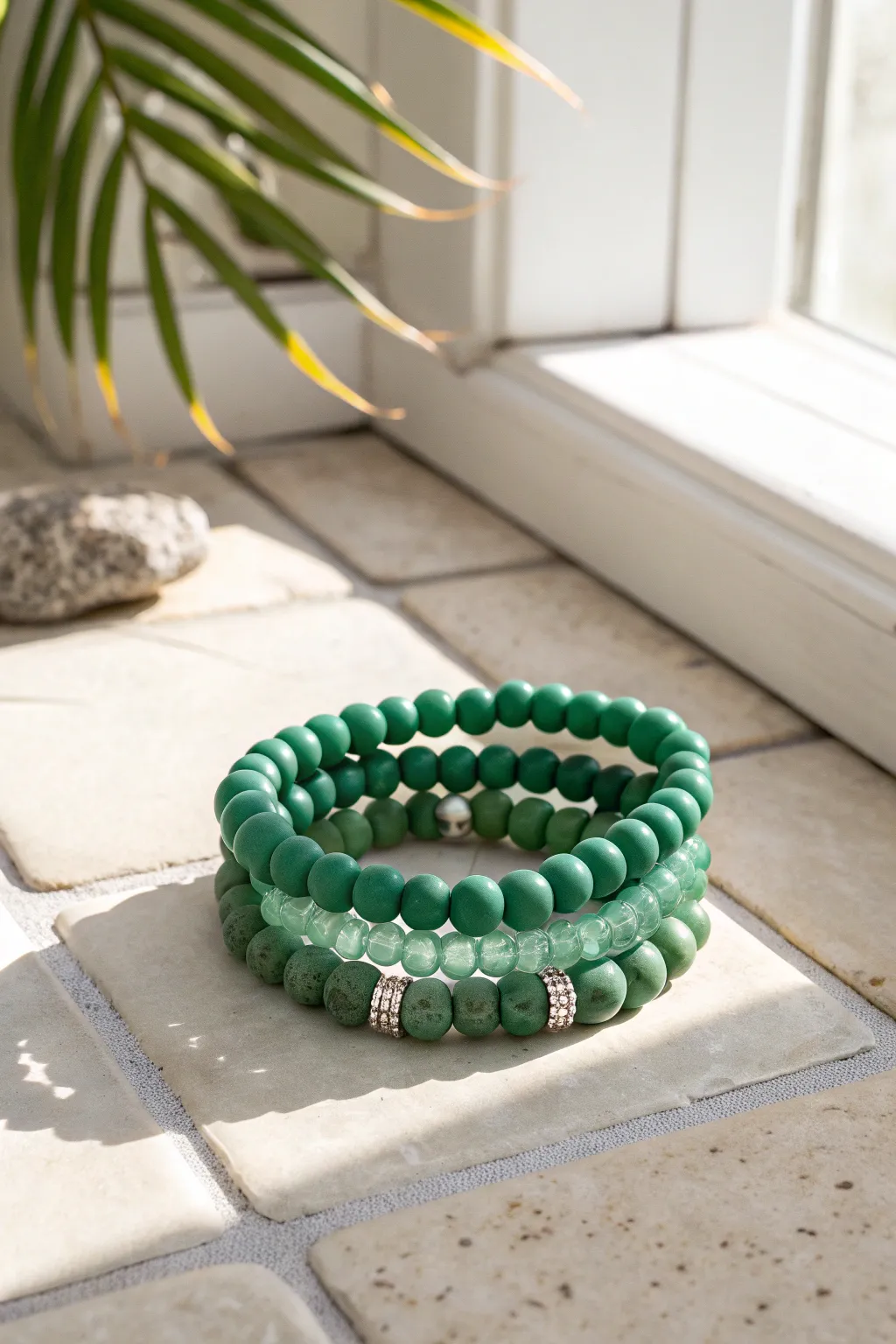
Embrace the soothing tones of nature with this elegant trio of stacked bracelets, combining earthy clay textures with the refreshing sparkle of clear glass. This project creates a cohesive, layered look that feels both organic and polished, perfect for everyday wear.
Step-by-Step Tutorial
Materials
- Matte sage green polymer clay (or pre-made matte green round beads, approx. 6mm)
- Translucent pale green or clear glass spacer beads (approx. 4-6mm)
- Textured irregular clay beads in moss green (approx. 8mm)
- Small silver rondelle spacer beads with crystal accents
- Silver crimp beads
- Silver crimp covers (optional)
- Strong elastic bead cord (0.7mm or 0.8mm)
- Jewelry glue or clear nail polish
- Scissors or bead nippers
- Bead stopper or tape
Step 1: Creating the Matte Spherical Strand
-
Measure the Cord:
Cut a piece of elastic cord about 10-12 inches long. Give it a gentle pre-stretch to prevent your bracelet from loosening over time. -
Secure the End:
Place a bead stopper or simply tape one end of the cord to your work surface to stop beads from sliding off while you work. -
String the Matte Beads:
Thread approximately 25-30 of the matte sage green round beads onto the cord. Test the length around your wrist; it should sit comfortably without pinching. -
Add a Focal Accent:
Optionally, you can add a single silver bead or a slightly larger bead in the center to hide the knot later, though a seamless continuous loop works beautifully too. -
Tie the Knot:
Tie a surgeon’s knot (right over left, left over right twice) and pull tight. Make sure the tension is firm but the beads aren’t buckling. -
Secure and Trim:
Dab a tiny drop of jewelry glue on the knot. Let it dry for a moment, then trim the excess cord, tucking the knot inside a bead if possible.
Step 2: Crafting the Glass Translucent Strand
-
Prepare the Cord:
Cut a second length of elastic cord, similar to the first, and secure the end. -
Begin Stringing:
Start threading the translucent pale green glass beads. I find that alternating slightly different clarities here creates a lovely ‘sea glass’ effect. -
Check Consistency:
Ensure this strand is exactly the same length as your first matte strand so they stack uniformly on the wrist. -
Finalize:
Tie off this strand using the same surgeon’s knot method, glue securely, and trim the ends close to the knot.
Knot Hider
Use a bead with a larger hole (2mm+) right next to your knot. This allows you to pull the glued knot inside the bead, making the finish completely invisible.
Step 3: Assembling the Textured Accent Strand
-
Select Texture Beads:
For the bottom layer, sort out your irregular, textured moss green clay beads. These should look a bit more rustic than the top layer. -
Plan the Design:
Lay out the design on a bead board or towel first. You will want two silver rondelle spacers placed symmetrically, separating a central trio of beads. -
Start Stringing:
Thread the textured clay beads until you reach about one-third of the total bracelet length. -
Insert Spacers:
Slide on one silver crystal rondelle spacer, followed by three clay beads, and then the second silver spacer. -
Finish the Pattern:
Continue threading the remaining textured clay beads until you complete the circle. -
Close the Loop:
Tie your reliable surgeon’s knot, apply a dot of adhesive, and trim away the excess cord once dry. -
Final Arrangement:
Stack all three bracelets together on your wrist, placing the translucent strand in the middle to break up the solid textures of the green clay.
Level Up: Charm It
Attach a small silver leaf or tree charm to the crystal spacer bead for an extra woodland vibe without adding bulk.
Enjoy wearing this serene stack that brings a touch of calm greenery to your daily outfit
Double-Strand Twisted Green Clay Bracelet
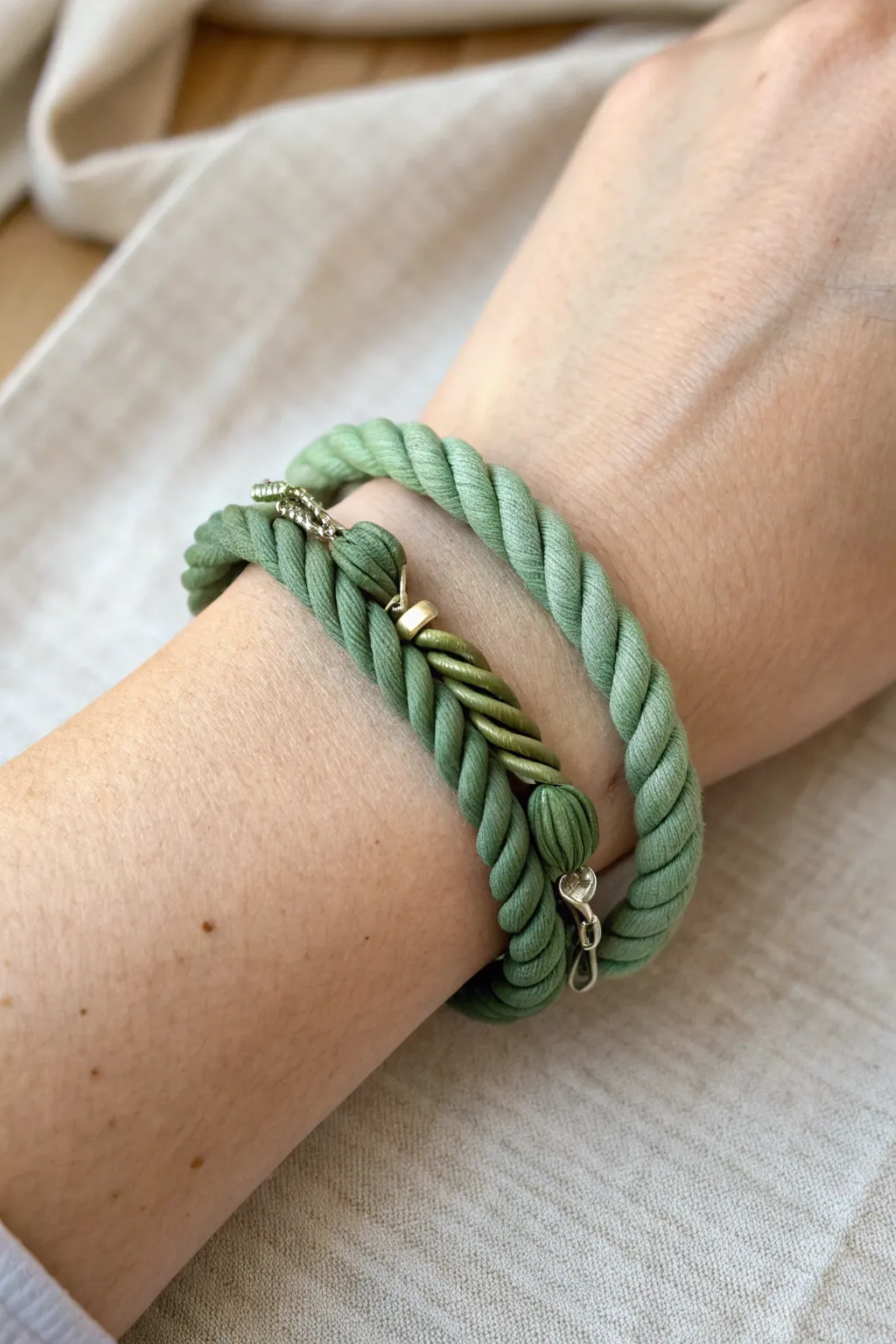
Deceive the eye with this clever polymer clay project that mimics the texture of twisted fabric cord. This double-strand bracelet features a soft sage green hue and intricate rope detailing, finished with elegant metallic findings for a sophisticated look.
Step-by-Step
Materials
- Sage green polymer clay (flexible type recommended, like Soufflé or Premo)
- Clay extruder with medium round disc (or careful hand-rolling skills)
- Metallic cord ends (gold or silver)
- Jump rings and lobster clasp
- Strong jewelry glue (E6000 or similar)
- Acrylic roller
- Tissue blade or craft knife
- Baking tile or parchment paper
- Oven
Step 1: Creating the Clay ‘Rope’
-
Condition the Clay:
Begin by thoroughly conditioning your sage green polymer clay until it is warm and pliable. This is crucial for extrusion, as stiff clay can produce jagged edges. -
Extrude or Roll Strands:
Load your clay extruder with a medium round disc. Extrude several long snakes of clay. If you don’t have an extruder, roll out very even snakes of clay by hand on your work surface using an acrylic block to keep the pressure consistent. -
Create the Initial Twist:
Take two strands of extruded clay and pinch them together at one end. Gently twist them around each other in a clockwise direction. Keep the twist tight and even along the entire length. -
Double the Twist (The Rope Effect):
Now, take your twisted strand and fold it in half. The natural tension will want to make it twist back on itself. Guide this counter-twist to create a thick, rope-like texture. -
Repeat the Process:
Repeat the previous steps to create a second rope strand. You want enough length to wrap around your wrist twice, or two separate lengths depending on your desired final style. -
Check the Texture:
Inspect your clay ropes. If any spots look uneven, gently roll the finished rope on your work surface to smooth out the twists without flattening the texture.
Seamless Twists
For the most realistic rope look, ensure you twist the two initial strands in one direction (e.g., clockwise), and then twist them together in the OPPOSITE direction.
Step 2: Sizing and Shaping
-
Measure Your Wrist:
drape the unbaked clay rope around your wrist to find the perfect length. Remember to leave a small gap for the clasp and consider that the clay won’t stretch like elastic. -
Cut to Size:
Using a sharp tissue blade, cut the rope ends cleanly. I find slicing straight down prevents the twisted ends from squishing together too much. -
Refine the Ends:
Gently taper the very tips of the cut ends by rolling them slightly between your fingers. This ensures they will fit snugly into the metal cord caps later. -
Curve for Baking:
Arrange the bracelet on your baking tile in a circular shape or the shape of a wrist. Baking it flat in a straight line can make it harder to wear later, as the clay might resist curving.
Step 3: Curing and Assembly
-
Bake the Pieces:
Bake the clay according to the manufacturer’s instructions. A typical range is 275°F (135°C) for about 30 minutes, but check your specific package. -
Cool Down:
Let the clay cool completely on the tile. Do not attempt to bend or handle it while warm, as it is most fragile then. -
Prepare the Findings:
Test the fit of your metallic cord ends on the baked clay tips. If the clay is slightly too thick, you can carefully sand the very tips down. -
Glue the Caps:
Apply a small dab of strong jewelry glue inside the metal cord end. Press the clay tip firmly into the cap and hold for a few seconds to set. -
Attach Hardware:
Using pliers, open a jump ring and attach it to the loop on the cord end. Add your lobster clasp to one side and a plain jump ring to the other side. -
Final Polish:
Give the clay a quick buff with a soft cloth to remove any fingerprints and enhance the matte finish of the faux rope.
Add a Knot
Before baking, tie a decorative knot in the center of the bracelet while the clay is still soft. It adds a nautical touch and acts as a focal point.
Enjoy wearing this tactile, woven-look piece that combines the durability of clay with the softness of textiles
Succulent-Inspired Green Gradient Stack
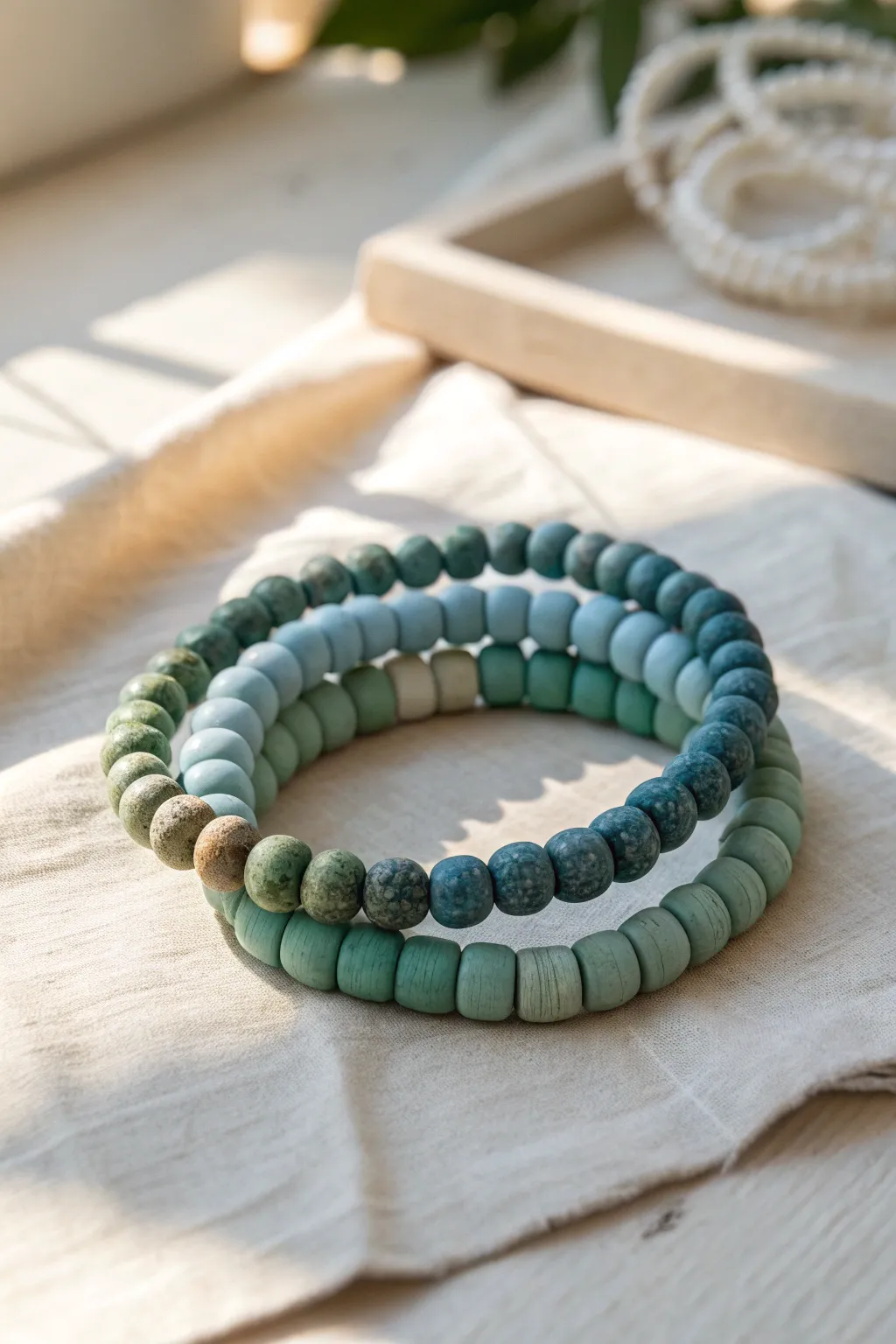
Capture the serene beauty of a desert garden with this trio of polymer clay bracelets featuring a calming gradient of sage, seafoam, and aloe greens. The matte, gently textured finish gives these beads a modern, organic feel that perfectly mimics the dusty bloom found on succulent leaves.
Step-by-Step Tutorial
Materials
- Polymer clay in White, translucent, Moss Green, and Teal
- Acrylic paint in dark brown or black (for speckling)
- Old toothbrush or stiff bristle brush
- Bead rolling tool or clear acrylic block
- Needle tool or bead piercing pins
- Elastic beading cord (0.7mm or 0.8mm)
- Super glue or jewelry cement
- Wet/dry sandpaper (400 and 600 grit)
- Oven for baking clay
- Soft cloth for buffing (optional)
Step 1: Mixing the Gradient Palette
-
Base Color Prep:
Begin by conditioning your white polymer clay until it is soft and pliable. You will need a large amount of white as the base for all your pastel shades. -
Create the Deep Teal:
Mix a small amount of teal into a marble-sized ball of white clay. To deepen it slightly towards a natural stone look, add a tiny speck of black or dark brown. This will be your darkest accent color. -
Mix the Sage Green:
For the middle tone, combine moss green with white in a 1:4 ratio. Add a pinch of translucent clay to give the bead a slight visual depth rather than a flat plastic look. -
Blend the Pale Seafoam:
Take a small portion of your sage green mixture and blend it into a large chunk of plain white clay. You want a whisper-light green that almost looks cream-colored. -
Create the Gradient:
Arrange your three primary mixtures and create intermediate shades by blending them together. Aim for about 5-6 distinct shades ranging from deep teal-green to pale cream.
Sticky Situation?
If clay sticks to your hands or the rolling block, dust your palms lightly with cornstarch. This helps maintain the matte texture and prevents deformation.
Step 2: Faux Stone Texturing
-
Speckling Process:
Flatten your mixed clay colors into pancakes on your work surface. Dilute a drop of dark brown acrylic paint with water on a palette. -
Spatter Technique:
Dip an old toothbrush into the paint wash. Run your thumb across the bristles to flick tiny speckles onto the clay sheets. Let the paint dry completely before moving on. -
Integrating the Texture:
Once the paint is dry, fold the clay over and run it through a pasta machine or roll it out, then fold again. Repeat this folding and rolling process (known as the ‘inclusion’ technique) until the specks are distributed throughout the clay body, looking like natural sediment.
Step 3: Forming and Baking
-
Portioning:
Roll each color into a uniform snake or log. Cut equal-sized segments from each log to ensure your beads will be consistent in size. -
Rolling Rounds:
Roll the segments into smooth balls between your palms. For the ‘rondelle’ shape seen in the bottom bracelet, I like to gently press the ball between two acrylic blocks to flatten the poles slightly. -
Piercing:
Using a needle tool, carefully pierce the center of each bead. Twist the needle as you push through to avoid deforming the shape. -
Baking:
Arrange the beads on a baking sheet or bead rack. Bake according to your clay manufacturer’s instructions (usually 275°F/135°C for 30-45 minutes). Let them cool completely.
Natural Variation
Mix a tiny pinch of beige or ecru into the green blends. This subtle impurity makes the clay look more like organic stone and less like plastic.
Step 4: Finishing and Assembly
-
Sanding:
Place the cooled beads in a bowl of water with a drop of dish soap. Sand each bead with 400 grit, then 600 grit sandpaper to remove fingerprints and create that soft matte finish. -
Buffing:
Dry the beads vigorously with a soft cloth. Do not varnish them; the natural matte look is key to the succulent aesthetic. -
Stringing First Strand:
Cut a piece of elastic cord about 10 inches long. Pre-stretch it by pulling firmly on both ends. String your palest beads mixed with a few sage accents. -
Stringing the Gradient:
For the second bracelet, arrange beads in a subtle ombré pattern, transitioning from light to dark teal. -
Stringing the Dark Strand:
Create the final bracelet using predominantly the darker teal and sage beads, mixing in the flattened rondelle shapes for variety. -
Securing the Knots:
Tie a surgeon’s knot (right over left twice, left over right) for each bracelet. Add a tiny dot of super glue to the knot, let it dry, and trim the excess cord.
Slip these cool-toned beauties onto your wrist and enjoy the calming, natural vibes they bring to your outfit
Deep Green Base With Neon Lime Highlights
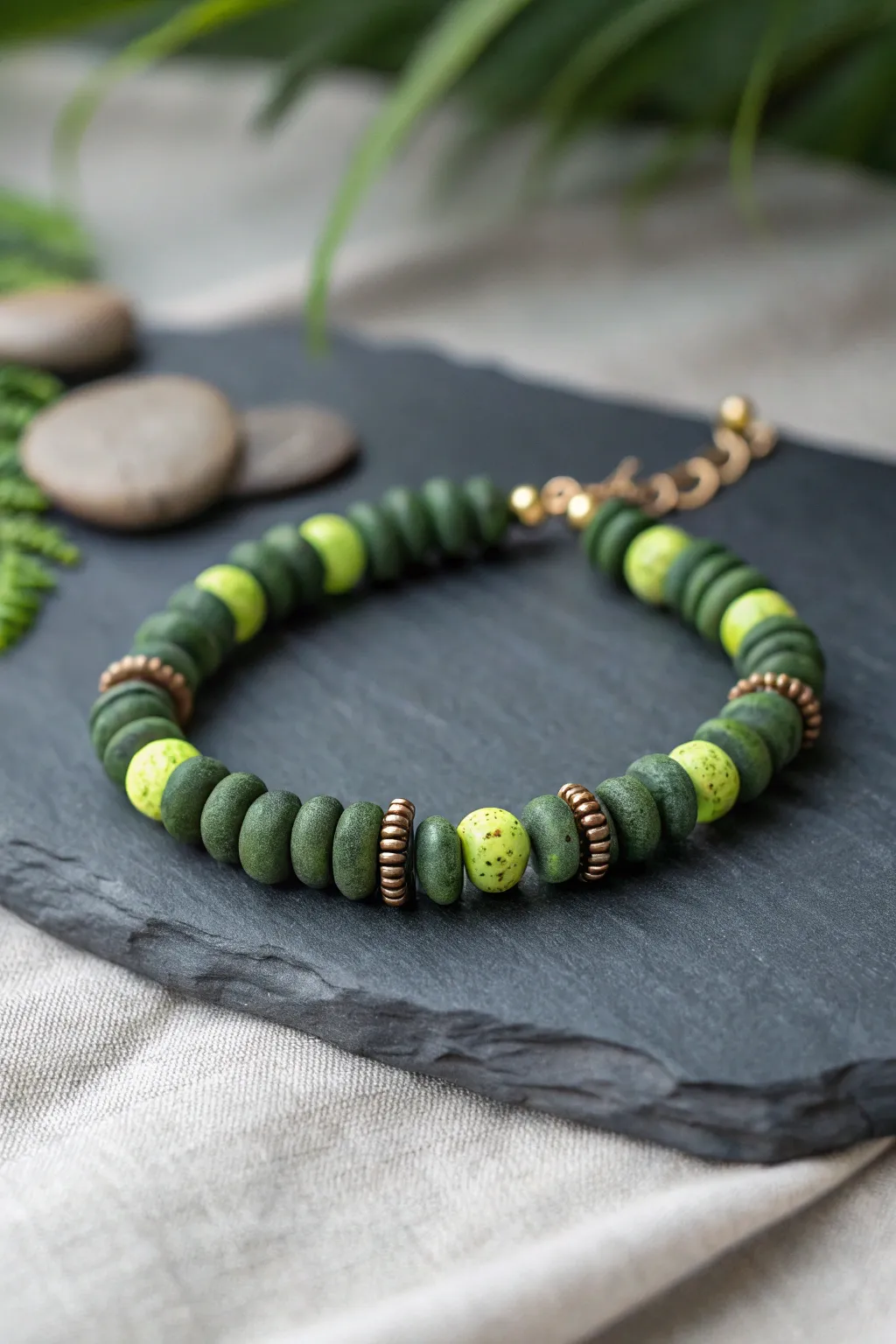
This striking bracelet design juxtaposes the organic, matte texture of deep forest green clay with electric pops of neon lime speckles. The addition of copper spacers adds a touch of industrial warmth, making it a perfect accessory for both casual and dressy outfits.
Detailed Instructions
Materials
- Polymer clay (Deep Forest Green)
- Polymer clay (Neon Lime/Chartreuse)
- Black acrylic paint or black pepper (for speckling)
- Copper disc spacer beads (heishi style)
- Gold finish crimp beads and covers
- Gold finish lobster clasp and extension chain
- Beading wire (0.38mm or similar)
- Sandpaper (fine grit)
- Buffing cloth or denim
- Needle tool or toothpick
- Wire cutters
- Crimping pliers
Step 1: Creating the Clay Beads
-
Condition the dark clay:
Begin by conditioning the deep forest green polymer clay until it is soft and pliable. Roll it into a uniform log about 1cm in diameter. -
Cut equal segments:
Slice the log into equal segments to ensure your main beads are consistent in size. Aim for slices that are about 5-6mm thick. -
Shape the dark beads:
Roll each green slice into a ball first, then gently flatten it into a thick rondelle (disc) shape. Smooth out any fingerprints. -
Condition the neon clay:
Clean your hands thoroughly to avoid color transfer, then condition the neon lime clay. -
Add the speckles:
To achieve the speckled egg look on the neon beads, you can mix in a tiny pinch of black pepper or black embossing powder. Alternatively, you can flick thinned black acrylic paint onto the raw clay with a toothbrush before shaping. -
Shape the neon beads:
Form the neon clay into small, round beads. These should be slightly smaller in diameter than your green discs to create visual variance. -
Pierce the holes:
Using a needle tool, carefully pierce a hole through the center of every bead. Twist the tool gently as you push through to avoid distorting the shape.
Natural Stone Texture
Mix a tiny amount of translucent clay into your dark green batch. After baking and sanding, this adds a realistic depth that mimics natural serpentine stone.
Step 2: Baking and Finishing
-
Bake the beads:
Arrangement the beads on a ceramic tile or baking sheet lined with parchment paper. Bake according to the manufacturer’s instructions for your specific brand of clay (usually 275°F/135°C for 15-30 minutes). -
Cool and inspect:
Allow the beads to cool completely. Once cool, check the holes to ensure they are clear of debris. -
Sand for texture:
To get that gorgeous matte visuals shown in the photo, lightly sand the curved edges of the green beads with fine-grit sandpaper. This removes any shine and gives them a stone-like feel. -
Buff clean:
Wipe all beads down with a piece of denim or a soft cloth to remove sanding dust.
Step 3: Assembly
-
Prepare the wire:
Cut a length of beading wire approximately 10 inches long to give yourself plenty of working room. -
Secure the first end:
Thread a crimp bead onto one end of the wire, followed by the jump ring of your extension chain. Loop the wire back through the crimp bead and use flat-nose pliers to squash it flat. Cover with a crimp cover for a polished look. -
Plan the pattern:
Lay out your beads on a design board. The pattern shown uses groups of 4-6 flat green beads, separated by a sequence of: copper spacer, neon bead, copper spacer. -
String the beads:
Thread the beads onto the wire following your pattern. I find it helpful to start and end with green sections for symmetry. -
Check the fit:
Wrap the strung wire around your wrist to check the length. Add or remove green spacer beads as needed to achieve your desired size. -
Finish the strand:
Add a crimp bead and the lobster clasp to the open end. Loop the wire back through the crimp bead and pull it tight, leaving just a tiny bit of slack so the bracelet moves fluidly. -
Final crimp:
Secure the crimp bead with your pliers, trim the excess wire close to the bead, and hide the crimp with a gold cover.
Holes Closing Up?
If bead holes shrink during baking, use a small hand drill or a bead reamer to gently widen them after the clay has fully cooled and hardened.
Enjoy wearing your sophisticated, handcrafted piece that perfectly balances earthy tones with modern flair