
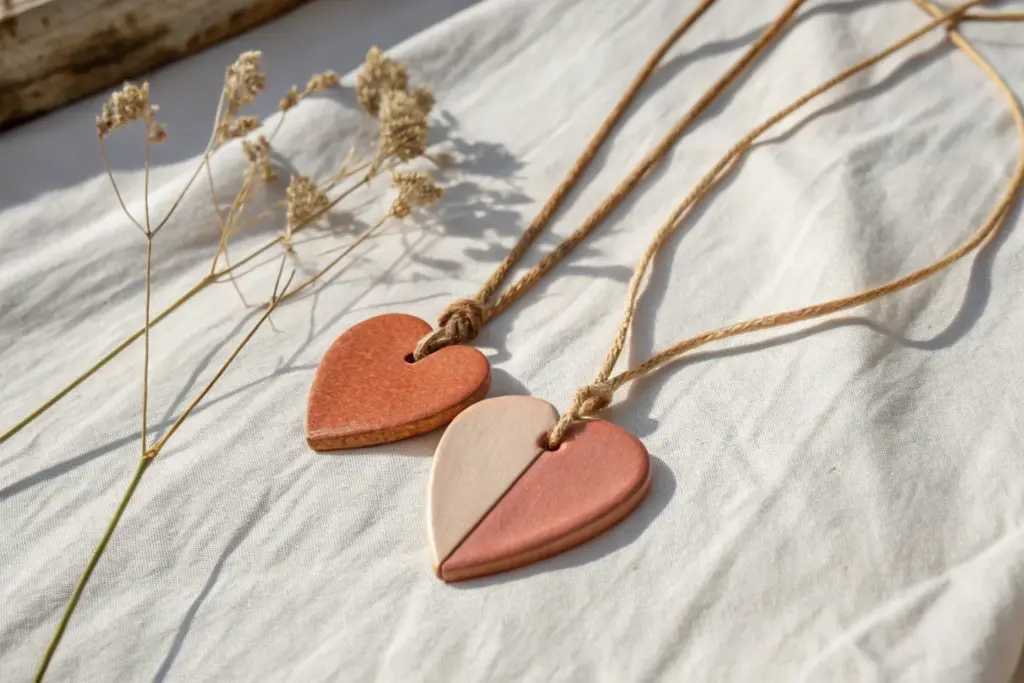
Some of my favorite clay projects are the ones you make in pairs, because they’re basically little love notes you can wear or keep close. If you’re craving friendship clay ideas that feel meaningful (but still totally doable), these are the go-to designs I see friends get excited about again and again.
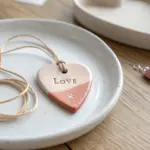
Split Heart Pendant Set
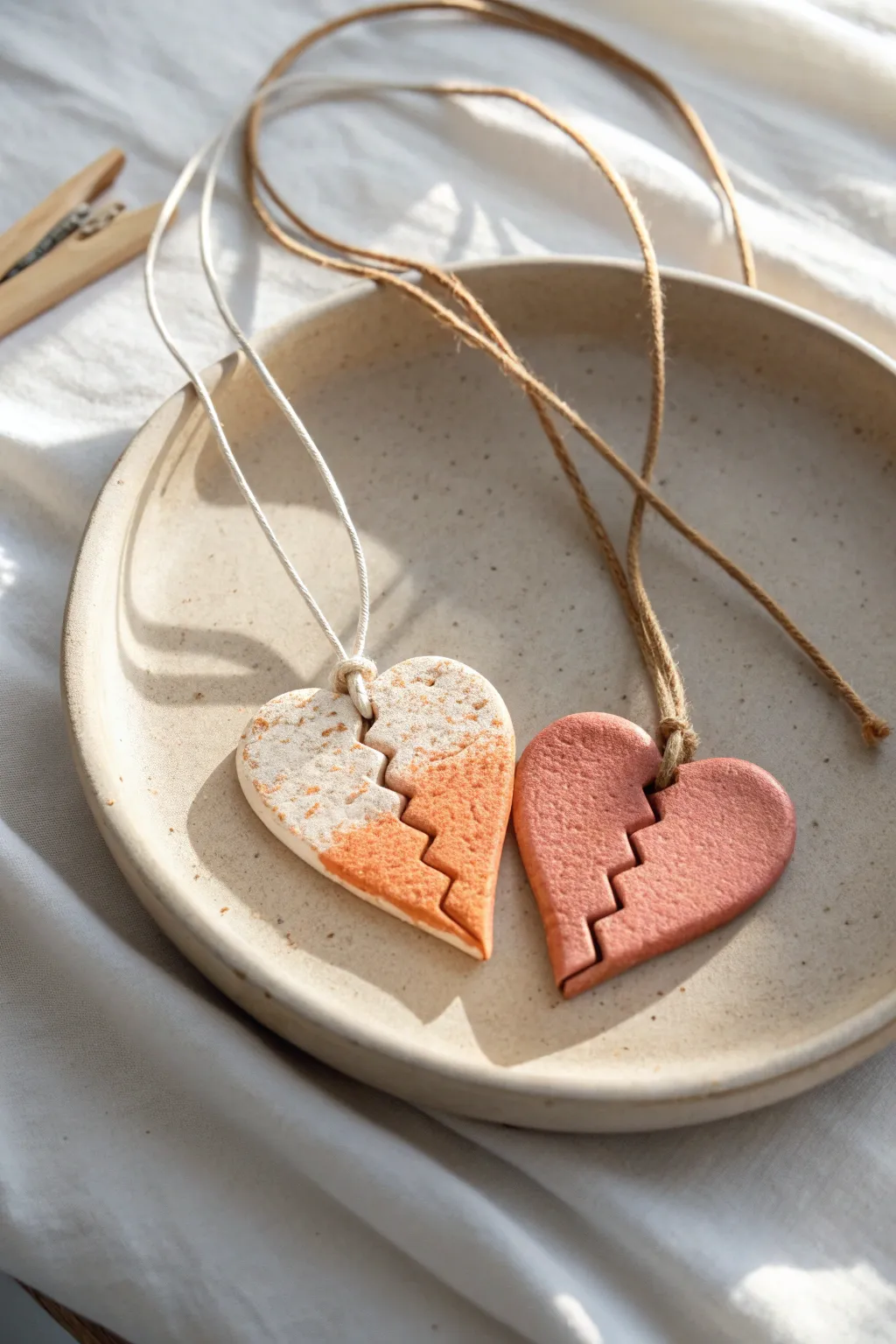
Celebrate your closest bond with these charming, rustic clay pendants that fit perfectly together. Featuring a speckled finish and a soft terracotta gradient, these necklaces offer a modern, handcrafted twist on the classic friendship charm.
Step-by-Step Tutorial
Materials
- White air-dry clay or polymer clay
- Terracotta colored polymer clay (or paint for air-dry)
- Small rolling pin
- Heart-shaped cookie cutter (approx. 2-3 inches)
- Craft knife or X-Acto blade
- Sandpaper (fine grit)
- Acrylic paint (burnt orange/terracotta shade)
- Old toothbrush or stiff bristle brush
- Toothpick or skewer
- Hemp cord or thin cotton rope (cream and natural)
- Matte sealant or varnish
Step 1: Shaping the Clay Base
-
Prepare the workspace:
Lay down a smooth work mat or parchment paper to prevent sticking. Ensure your hands are clean and dry before handling the white clay to keep it pristine. -
Condition the clay:
Take a walnut-sized ball of white clay and knead it until it’s soft and pliable. If you are making the second solid-colored heart, prepare your terracotta clay now as well. -
Roll out the slab:
Use your rolling pin to flatten the clay to an even thickness, aiming for about 1/4 inch (5-6mm). You want it substantial enough to be durable but not too heavy. -
Cut the heart shapes:
Press your heart-shaped cookie cutter firmly into the rolled clay. Gently wiggle it to ensure a clean cut, then remove the excess clay from around the shape.
Clean Cuts Pro Tip
coat your craft knife blade with a tiny bit of cornstarch or baby powder before cutting the zigzag. This prevents the clay from dragging and creates sharp, crisp lines.
Step 2: Creating the Split & Texture
-
Draw the fracture line:
Using the tip of a toothpick, lightly sketch a zigzag line down the center of the heart. This guide doesn’t need to be perfect; irregular zags look more natural. -
Cut the zigzag:
With your craft knife, carefully cut along the zigzag line. Keep the blade vertical to ensure straight edges that will fit back together nicely later. -
Smooth the edges:
Dip your finger in a little water (for air-dry clay) or baby oil (for polymer) and gently run it over the cut edges to soften any sharp burrs without losing the crisp zigzag shape. -
Make the hanging holes:
Use a skewer or straw to poke a hole through the top of one lobe on each heart half. Make sure the hole is large enough to accommodate your cord.
Step 3: Adding Color & Finish
-
Create the speckles:
Dilute a tiny drop of brown or terracotta paint with water. Dip an old toothbrush into it and flick the bristles with your thumb to spray fine speckles over the white clay pieces. -
Apply the ombre effect:
For the two-tone heart shown, sponge a little terracotta paint onto the bottom half of the white clay while it’s still damp (or raw), fading it upward into the white. -
Bake or dry:
Follow the manufacturer’s instructions for your specific clay. Air-dry clay will need 24-48 hours; polymer clay usually bakes at 275°F (135°C) for 15-30 minutes. -
Sand for smoothness:
Once fully cured and cooled, lightly sand the back and sides of the pendants with fine-grit sandpaper to remove any fingerprints or rough texture. -
Seal the surface:
Apply a thin coat of matte varnish or sealant. This protects the speckles and gives the piece a professional, finished look without being overly glossy.
Warping Issues?
If your air-dry clay curls up while drying, gently flip the pieces over every few hours. Dry them on a wire cooling rack to ensure airflow reaches both sides evenly.
Step 4: Assembly
-
Measure the cords:
Cut your hemp or cotton cord to your desired necklace length, usually around 24 inches for a comfortable fit that can slip over the head. -
Attach the pendant:
Fold the cord in half to create a loop. Push this loop through the hole in the pendant from front to back. -
Secure with a lark’s head knot:
Thread the loose ends of the cord through the loop you just pushed through and pull tight. This creates a secure, neat knot right at the top of the heart. -
Final check:
Hold the two necklace halves together to ensure the zigzag connects perfectly, symbolizing the bond between friends.
Now you have a beautiful set of handmade keepsakes to share with your favorite person

Matching Initial Charm Necklaces
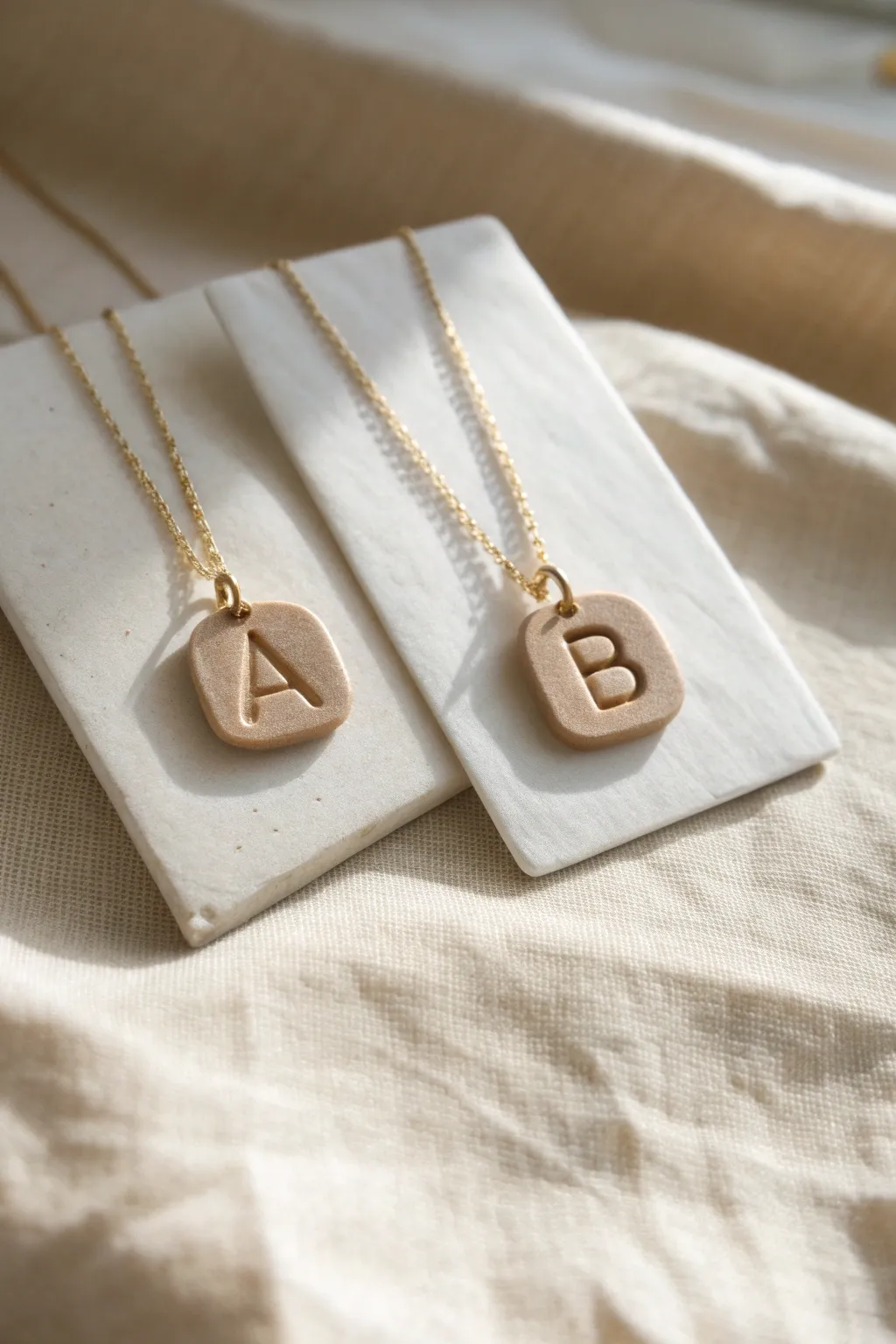
These elegant, minimalist charm necklaces feature soft, rounded squares of shimmering clay impressed with a single initial. They make for a thoughtful, personalized gift that feels both modern and timeless.
Step-by-Step
Materials
- Polymer clay (metallic beige, champagne, or pearl color)
- Small letter stamps (serif font)
- Small square clay cutter (approx. 15mm – 20mm with rounded corners)
- Acrylic rolling pin
- Parchment paper or ceramic tile (for baking)
- Needle tool or small drill bit
- Jump rings (gold finish)
- Fine chain necklace (gold finish)
- Jewelry pliers
- Gloss glaze (optional, for extra shine)
- Soft brush
Step 1: Shaping the Charms
-
Condition the Clay:
Begin by warming the polymer clay in your hands. Knead it thoroughly until it becomes soft, pliable, and free of any cracks or air bubbles. -
Roll it Out:
Place the clay on a clean, flat surface. Using your acrylic rolling pin, roll the clay out to an even thickness of about 3mm to 4mm. You want it substantial enough to hold the impression without warping. -
Cut the Base Shape:
Position your small square cutter over the clay. I find that pressing straight down firmly and lifting straight up gives the cleanest edge. Create as many squares as you need for your initials. -
Soften the Edges:
Even if your cutter has rounded corners, the cut edges can be sharp. Gently tap the sides and edges with your fingertip to soften the look, creating that smooth, organic feel seen in the photo. -
Smooth the Surface:
Check the front surface of your clay square. If there are any fingerprints, lightly brush them away with a tiny drop of baby oil or cornstarch on your finger.
Clean Stamp Impressions
Dust your letter stamp lightly with cornstarch or mica powder before pressing into the clay. This prevents sticking and ensures a crisp, clean letter indentation.
Step 2: Detailing and Baking
-
Position the Stamp:
Select your letter stamp. Hover it over the center of the clay square to align it perfectly before making contact. -
Impress the Letter:
Press the stamp down gently but firmly into the clay. Do not push all the way through; you just want a clean, deep indentation. Wiggle it almost imperceptibly to ensure the edges are distinct before lifting. -
Create the Hanging Hole:
Using a needle tool, pierce a hole at the top center of the square for the jump ring. Ensure the hole is large enough for your hardware but not so close to the edge that it creates a weak spot. -
Double Check:
Look at the back of the charm. Sometimes piercing the hole pushes clay out the back. Smooth this down gently if needed. -
Bake the Charms:
Place your charms on a parchment-lined baking sheet or a ceramic tile. Bake according to your specific clay brand’s instructions (usually around 275°F or 130°C for 15-30 minutes). -
Cool Down:
Once baking is complete, turn off the oven and let the pieces cool completely inside or on a wire rack before handling. They are fragile while warm.
Gold Leaf Accents
For a luxe touch, gently press small flakes of gold leaf onto the corners of the raw clay before baking, or paint the inside of the impressed letter with liquid gold leaf after baking.
Step 3: Assembly
-
Inspect and Refine:
Once cool, check the edges one last time. If there are any rough spots, you can gently sand them with super fine-grit sandpaper. -
Add a Glaze (Optional):
If you want a glossy finish like the inspiration photo, apply a thin layer of polymer clay gloss glaze or resin. Let it dry completely according to the product instructions. -
Open the Jump Ring:
Take two pairs of jewelry pliers. Grip a jump ring on either side of the split and twist one hand forward and the other back to open it laterally—never pull it apart sideways. -
Attach the Charm:
Slide the open jump ring through the hole you pierced in the clay charm. -
Connect to Chain:
Slip the end of your fine gold chain onto the jump ring as well. Or, if the chain is finished, slide the ring over the chain itself. -
Close the Ring:
Using the pliers, twist the jump ring back into position so the two ends meet perfectly flush, securing your charm.
Wear your new customized initial necklace solo or layer it with other chains for a stylish, personalized look


Best Friends Stamped Tag Charms
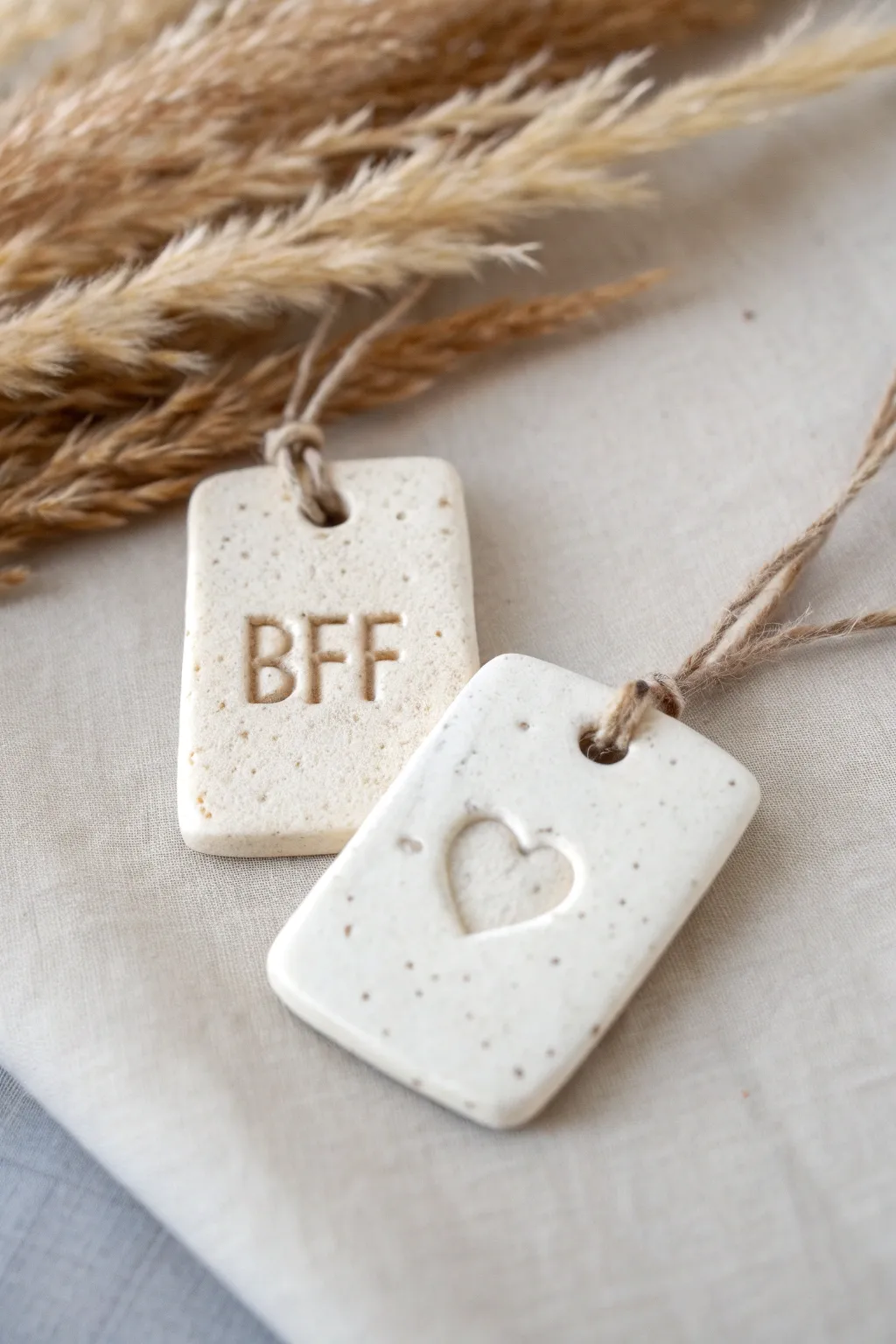
These simple yet sentimental clay tags are the perfect handmade token for your best friend. Featuring a rustic speckled finish and minimalist stamped designs, they make lovely keychains or gift toppers.
Detailed Instructions
Materials
- White or cream polymer clay
- Coarse black pepper or dried coffee grounds (for speckles)
- Acrylic rolling pin
- Rectangular clay cutter (approx. 1 x 1.5 inches)
- Small letter stamps (serif font)
- Small heart cutter or stamp tool
- Straw or stylus tool for creating holes
- Jute twine or hemp cord
- Sandpaper (fine grit)
- Gloss glaze (optional, for the heart tag look)
- Matte varnish (optional, for the ‘BFF’ tag look)
- Baking sheet and parchment paper
Step 1: Preparing the Speckled Clay
-
Condition the clay:
Begin by kneading your white or cream polymer clay in your hands until it becomes soft, pliable, and warm to the touch. -
Add the texture:
To achieve that organic, stone-like look, flatten your clay slightly and sprinkle a tiny pinch of coarse black pepper or dry coffee grounds onto the surface. -
Mix it in:
Fold the clay over the speckles and knead thoroughly until the particles are evenly distributed throughout the entire ball of clay. I find this usually takes about 2-3 minutes of mixing to look natural. -
Roll it out:
Using your acrylic rolling pin, roll the clay out into an even slab that is approximately 1/4 inch thick. You want it substantial enough to hold the impression without warping.
Step 2: Cutting and Stamping
-
Cut the shapes:
Press your rectangular cutter firmly into the slab to cut out two identical shapes. If you don’t have a cutter, you can use a craft knife and a ruler. -
Smooth the edges:
Gently rub your finger along the cut edges of the rectangles to soften any sharp corners or clay burrs created by the cutter. -
Create the hanging hole:
Use a straw or a stylus tool to poke a hole near the top center of each rectangle. Ensure the hole is wide enough to accommodate your jute twine later. -
Stamp the text:
On the first tag, carefully align your letter stamps. Press ‘B’, ‘F’, and ‘F’ firmly into the center of the clay, ensuring deep, clean impressions without pushing all the way through. -
Create the heart:
On the second tag, center your small heart cutter or stamp tool. Press it gently into the clay to create an indented heart shape.
Clean Stamping Tip
Dust your stamps lightly with cornstarch or baby powder before pressing into the clay. This prevents the clay from sticking to the stamp and ensures crisp, clean letters.
Step 3: Baking and Finishing
-
Bake the tags:
Transfer your tags to a parchment-lined baking sheet. Bake according to your brand of polymer clay’s instructions (usually 275°F/135°C for 15-30 minutes per 1/4 inch of thickness). -
Cool down:
Let the tags cool completely on the baking sheet before handling them. They are fragile while warm. -
Sand the surface:
Once cool, lightly sand the edges and surface with fine-grit sandpaper if needed to remove any fingerprints or imperfections. -
Apply finish (Optional):
For the heart tag shown in the example, apply a coat of gloss glaze to make it shine. For the ‘BFF’ tag, you can leave it raw or use a matte varnish for protection without sheen. -
Thread the twine:
Cut a length of jute twine or hemp cord, about 6 inches long. -
Create a loop:
Fold the twine in half and push the folded loop end through the hole from the front to the back. -
Secure the knot:
Pull the loose ends of the twine through the loop you just created and pull tight to secure it with a lark’s head knot.
Make It a Keychain
Instead of jute twine, thread a metal jump ring through the hole and attach a swivel lobster clasp. This makes the charm durable enough for daily use on a keyring or backpack.
Give one to your best friend and keep one for yourself to celebrate your special bond

Coordinated Clay Bead Bracelets
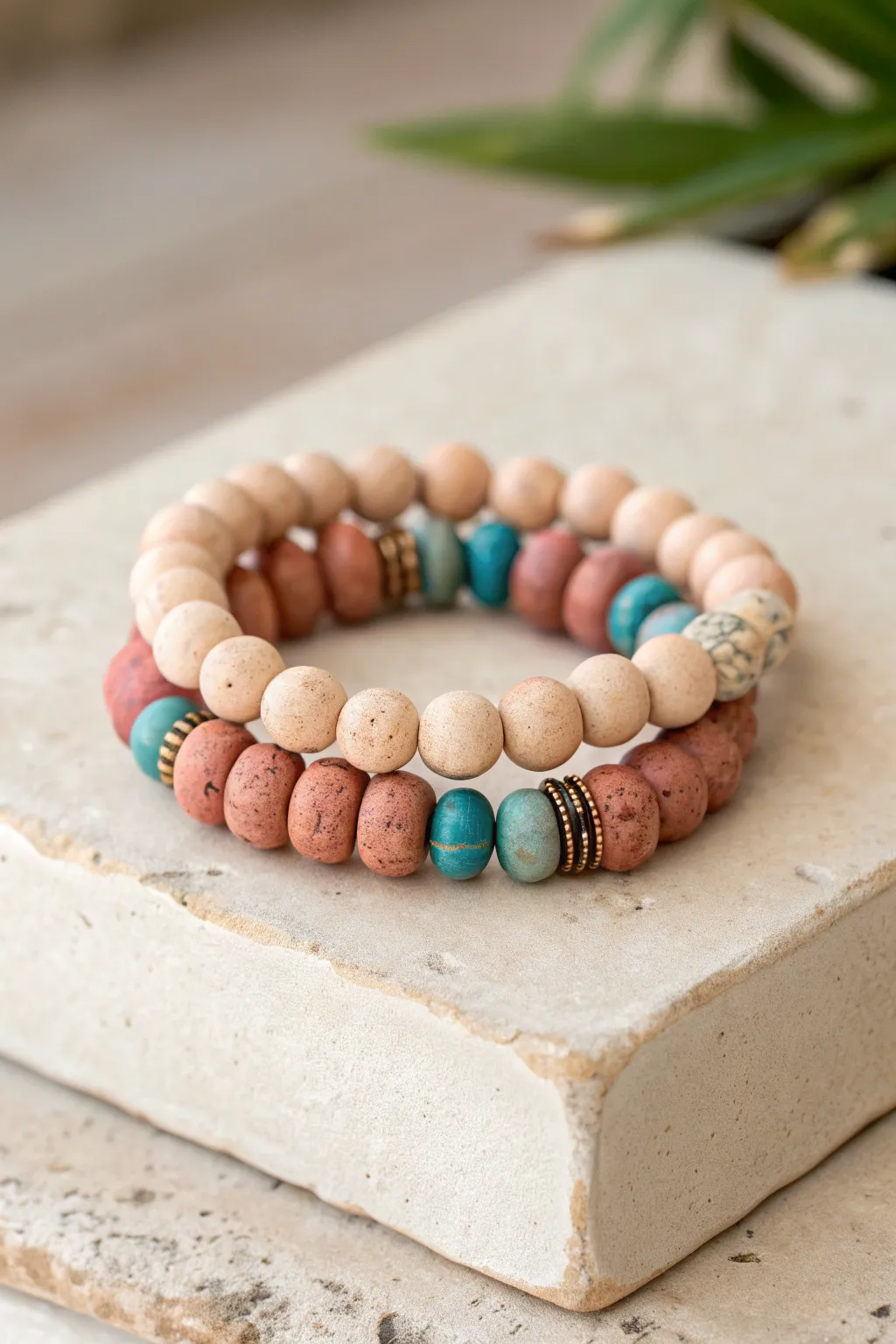
Capture the essence of natural beauty with this set of coordinated clay bead bracelets, featuring warm terracotta tones, calming teal accents, and raw wood textures. These bracelets combine rustic charm with a modern aesthetic, perfect for sharing with a friend or stacking on your own wrist.
How-To Guide
Materials
- Polymer clay (terracotta/brick red)
- Polymer clay (teal/turquoise)
- Polymer clay (pale beige or cream)
- Textured stone bead (white/grey speckled)
- Wooden spacer beads (natural light wood)
- Gold-toned metal spacer discs (ridged)
- Elastic cord (0.8mm or 1mm)
- Toothpick or bead piercing tool
- Cornstarch or baby powder (for texturing)
- Sandpaper (coarse grit)
- Super glue or jewelry cement
Step 1: Crafting the Clay Beads
-
Condition the Clay:
Begin by kneading your terracotta, teal, and beige polymer clays separately until they are soft and pliable. This ensures your beads won’t crack during baking. -
Form the Base Shapes:
Roll the terracotta clay into a long log and slice it into equal segments. Roll each segment into a round ball; these will be your primary colored beads. -
Create the Disc Shape:
Gently press each terracotta ball between your thumb and forefinger to flatten them slightly into thick, rounded discs rather than perfect spheres. This gives them that organic, handmade look. -
Add Texture:
To mimic the porous look of real ceramic or stone, lightly roll the unbaked beads in a small amount of coarse salt or tap them with coarse sandpaper. I like to press a little harder on the edges to make them look weathered. -
Create Teal Accents:
Repeat the rolling and flattening process with your teal clay. You will need fewer of these, as they act as vibrant focal points. -
Make the Neutral Beads:
Roll your beige clay into smooth, perfectly round spheres. Leave these untextured to provide a smooth visual contrast to the rougher colored beads. -
Pierce the Holes:
Use a toothpick or bead piercing tool to create a hole through the center of each bead. Twist the tool gently as you push through to avoid deforming the shape. -
Bake:
Arrange your beads on a baking sheet lined with parchment paper. Bake according to your polymer clay package instructions (usually around 275°F or 135°C for 15-30 minutes). Let them cool completely.
Step 2: Assembly and Finishing
-
Prepare the Cord:
Cut two lengths of elastic cord, each about 10 inches long. This gives you plenty of extra room for tying knots later. -
Pre-stretch the Elastic:
Gently tug on the elastic strands several times. This pre-stretching prevents the bracelet from loosening up significantly after the first wear. -
Layout Design 1 (Terracotta Focus):
For the first bracelet, arrange a pattern alternating between groups of terracotta disc beads and single teal beads. Insert gold ridged spacers on either side of the teal beads to frame them. -
Layout Design 2 (Neutral Focus):
For the second bracelet, use the smooth beige clay beads as the main body. Incorporate natural wooden spacers and that single textured stone bead as a unique centerpiece. -
Stringing:
Thread your beads onto the elastic cord following your planned layouts. Use a bead stopper or simply a piece of tape at the end of the cord so beads don’t slide off. -
Check the Fit:
Wrap the strung beads around your wrist to check the size. Add or remove beads as necessary to ensure a comfortable fit that isn’t too tight. -
Tying the Knot:
Tie a surgeon’s knot (right over left, left over right) and pull tight. The elastic should be taut enough that the beads touch but not so tight that they buckle. -
Secure the Knot:
Place a tiny dot of super glue or jewelry cement directly on the knot. Allow it to dry for a few minutes before trimming the excess cord. -
Hide the Knot:
If hole size permits, gently tug the elastic so the knot slides inside one of the larger beads, hiding it from view.
Stone Texture Secret
Mix a tiny pinch of black pepper or dried coffee grounds into your beige clay before rolling. It creates realistic speckling that looks just like natural stone.
Fingerprint Fix
If you see fingerprints on your raw clay beads, lightly brush them with a little baby oil or cornstarch before baking to smooth the surface instantly.
Enjoy wearing your handcrafted, earthy accessories that bring a touch of nature to any outfit

The Complete Guide to Pottery Troubleshooting
Uncover the most common ceramic mistakes—from cracking clay to failed glazes—and learn how to fix them fast.
Puzzle Piece Keychain Pair
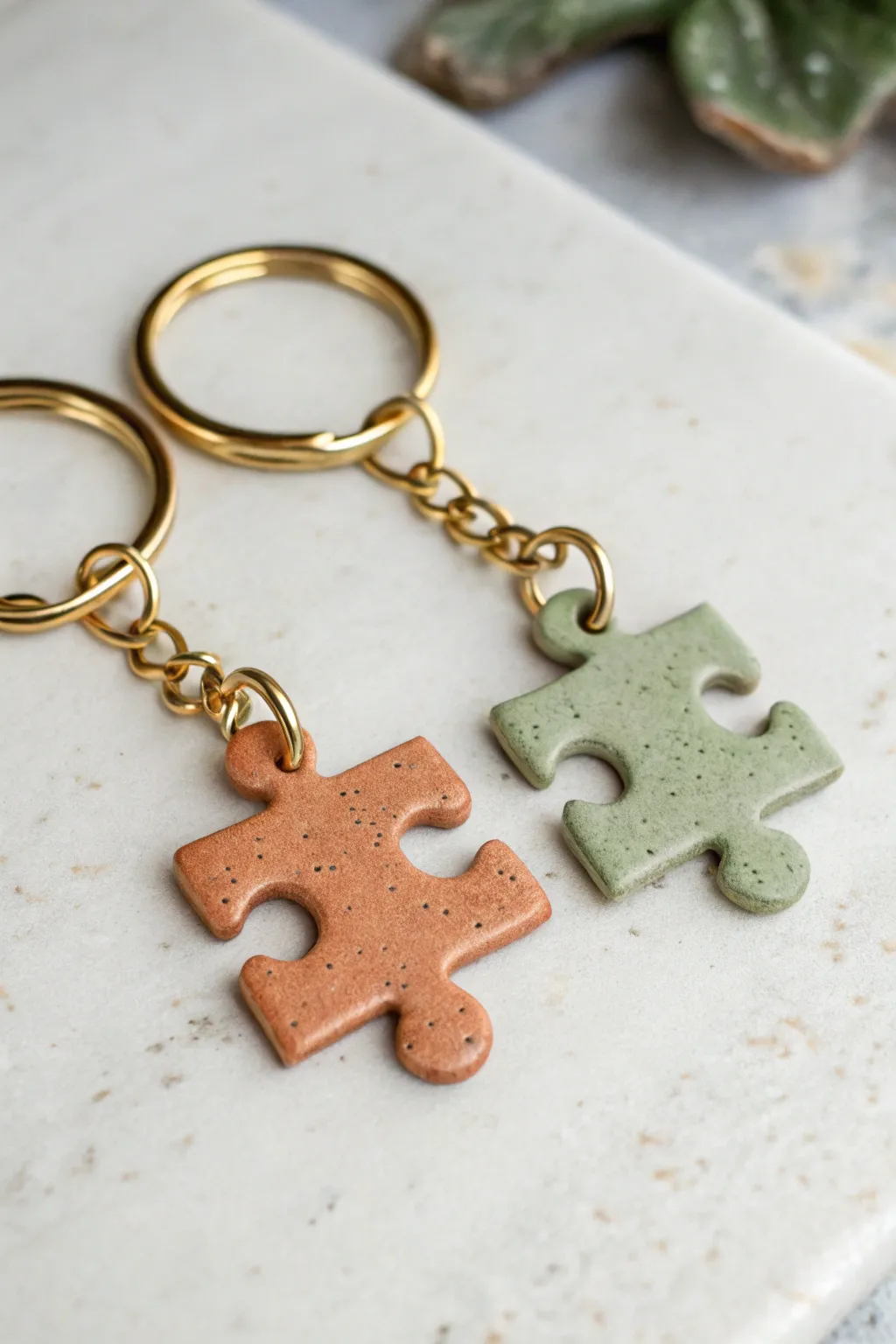
Celebrate your connection with these adorable, interlocking puzzle piece keychains that fit perfectly together. The simple terracotta and sage green polymer clay designs are elevated with a subtle speckled finish and polished gold hardware.
Step-by-Step Tutorial
Materials
- Polymer clay (terracotta or reddish-brown)
- Polymer clay (sage green)
- Black pepper or faux granite clay for speckling
- Acrylic roller or rolling pin
- Puzzle piece cookie cutter (small)
- Cardstock (optional, for template)
- Craft knife or X-Acto blade
- Small circle cutter or straw (for hole)
- Fine-grit sandpaper (400-800 grit)
- Gold keychains with chains
- Gold jump rings (6mm or 8mm)
- Jewelry pliers (flat nose and chain nose)
- Oven based on clay package instructions
- Parchment paper
Step 1: Preparing the Clay
-
Condition the terracotta clay:
Start by kneading the terracotta-colored clay in your hands until it becomes soft, pliable, and warm. -
Add the speckles:
To achieve that stony, natural look, mix in a tiny pinch of ground black pepper or a very small amount of black granite-effect clay. Fold the clay over itself repeatedly until the speckles are evenly distributed throughout the block. -
Repeat for the green clay:
Wipe your hands clean, then repeat the conditioning and speckling process with your sage green clay. Keeping hands clean prevents color transfer. -
Roll out the slabs:
Using your acrylic roller, roll out both clay balls into even slabs. Aim for a thickness of about 1/4 inch (6mm) so they are sturdy enough for daily use.
Clean Edges Tip
Place a sheet of plastic wrap over your clay slab before pressing down your cutter. This creates a beautifully rounded, ‘domed’ edge that requires much less sanding later.
Step 2: Shaping the Puzzle Pieces
-
Cut the shapes:
Press your puzzle piece cutter firmly into the terracotta slab. If you don’t have a cutter, print a puzzle shape on cardstock, cut it out, place it on the clay, and trace around it carefully with your craft knife. -
Create the matching side:
Cut the second piece from the green clay. I prefer to test the fit immediately by gently sliding the two raw clay pieces together to ensure they interlock perfectly before baking. -
Smooth the edges:
Dip your finger in a little bit of rubbing alcohol or corn scratch and gently run it along the cut edges of both pieces to soften any sharp corners or drag marks from the blade. -
Punch the holes:
Use a small circle cutter, a drinking straw, or a toothpick to create a hole at the top corner of each piece. Make sure the hole is wide enough to fit your jump ring comfortably.
Step 3: Baking and Finishing
-
Bake the pieces:
Place your clay pieces on a baking sheet lined with parchment paper. Bake according to your specific brand of polymer clay’s instructions (usually around 275°F/135°C for 15-30 minutes). -
Cool down:
Allow the pieces to cool completely on the baking sheet. They will harden fully as they return to room temperature. -
Sand for smoothness:
Once cool, use fine-grit sandpaper to buff the edges and flat surfaces. This gives the clay that professional, matte stone finish shown in the photo. -
Rinse and dry:
Wash off any sanding dust with water and dry the pieces thoroughly with a soft cloth.
Make It Glossy
Prefer a ceramic look? After baking and sanding, coat your pieces with UV resin or a gloss polyurethane varnish for a high-shine, glazed pottery effect.
Step 4: Assembly
-
Open the jump ring:
Using two pairs of pliers, grip a gold jump ring on either side of the split. Twist one hand forward and one backward to open the ring (never pull it apart sideways). -
Attach the clay piece:
Slide the open jump ring through the hole you created in the terracotta puzzle piece. -
Connect the chain:
Loop the bottom link of the keychain hardware onto the same jump ring. -
Close the ring:
Use your pliers to twist the jump ring back into a closed position, ensuring the two ends meet perfectly flush so nothing slips out. -
Finish the set:
Repeat the assembly steps for the green puzzle piece to complete your matching pair.
Gift one half to your best friend and keep the other as a daily reminder of how well you fit together
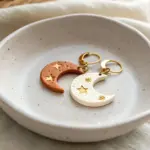
Sun and Moon Charm Duo
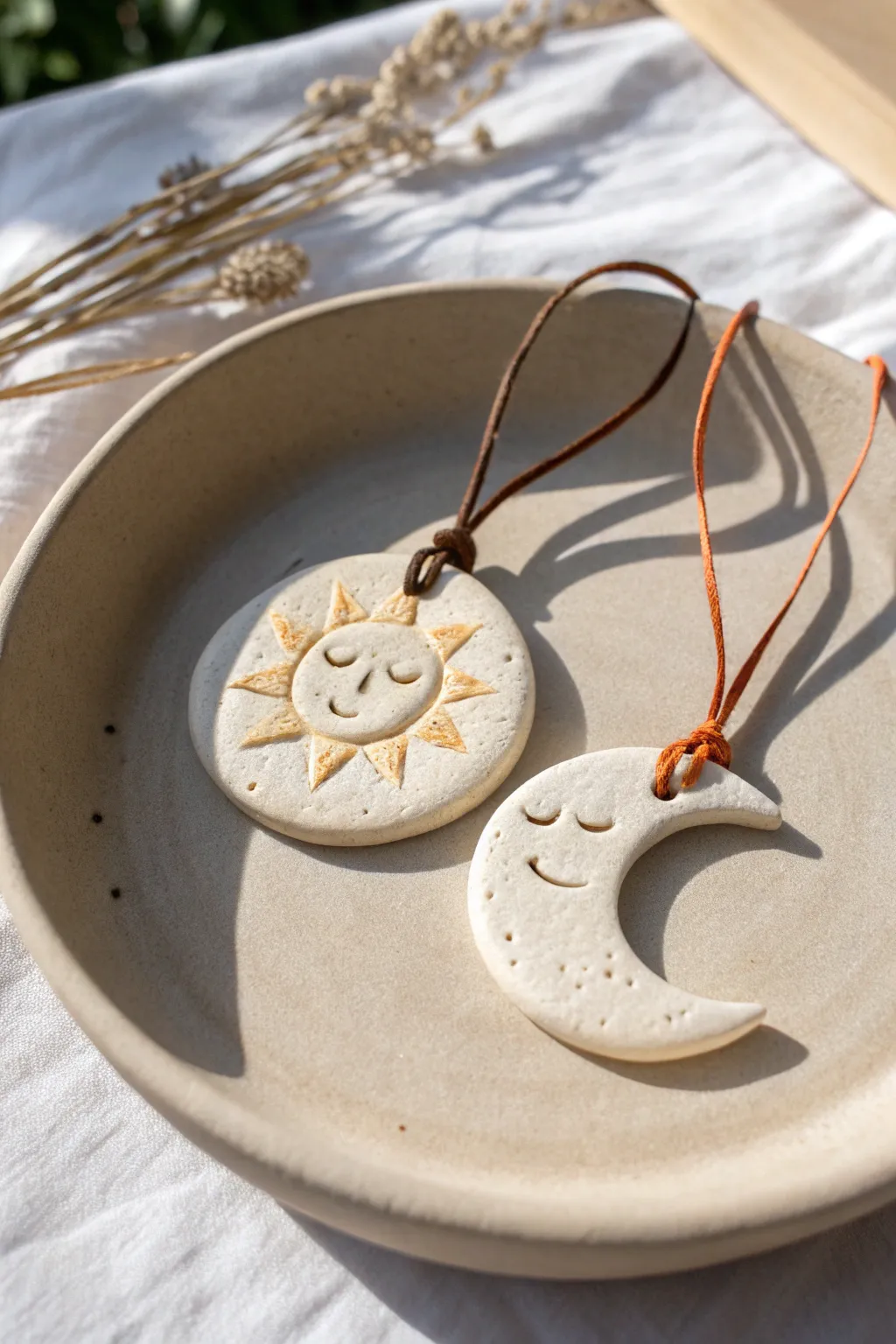
Celebrate an inseparable bond with this charming sun and moon duo, crafted to symbolize friendship that spans day and night. These clay pieces feature sweet, sleepy expressions and a rustic, pottery-style finish that makes them perfect for necklaces, ornaments, or unique gift tags.
How-To Guide
Materials
- White or cream air-dry clay (or polymer clay)
- Rolling pin
- Circle cookie cutter (approx. 2-3 inches)
- Needle tool or toothpick
- Small straw or specialized hole cutter
- Sandpaper (fine grit)
- Acrylic paint (golden yellow or metallic gold)
- Small paintbrush
- Water
- Brown cord or leather string
- Orange cord or embroidery floss
- Clear matte varnish (optional)
Step 1: Shaping the Celestial Bodies
-
Prepare the clay:
Begin by kneading your clay until it is soft, pliable, and free of air bubbles. If the clay feels too dry, add a tiny drop of water to smooth it out. -
Roll it out:
Roll the clay into an even slab, approximately 1/4 inch thick. Aim for a uniform thickness so both charms dry at the same rate and have a substantial feel. -
Cut the sun:
Use your circle cutter to punch out a perfect round shape. This will become the sun charm. Set aside the excess clay for the next step. -
Create the moon:
Punch out a second circle identical to the first. To turn this into a crescent moon, move your cutter slightly off-center over the circle you just made and cut again, removing an oval section to leave a C-shaped crescent. -
Smooth the edges:
Dip your finger in a little water and gently run it along the cut edges of both the sun and moon to soften any sharp ridges left by the cutter. -
Add hanging holes:
Using a small straw or a tool, punch a clean hole near the top center of the sun and the top curve of the moon. Make sure the hole is big enough for your cord to pass through later.
Cracks while Drying?
If small hairline cracks appear as the clay shrinks, mix a tiny bit of fresh clay with water to make a paste and smooth it into the cracks. Let it re-dry.
Step 2: Adding Details
-
Carve the sun’s face:
With a needle tool, gently press two small, curved lines for sleepy eyes in the center of the sun. Add a small U-shape for the nose and a wider curve for a gentle smile. -
Sculpt the rays:
Draw triangular rays around the perimeter of the sun’s face. Instead of just outlining them, lightly carve out the clay between the triangles to give the rays a raised, relief effect. -
Carve the moon’s face:
Repeat the facial features on the crescent moon, placing the sleepy eye, nose, and smile along the inner curve of the crescent shape. -
Add texture:
For a rustic look, use your needle tool to poke tiny, shallow dots sporadically around the edges of the moon or the cheeks of the sun. This mimics a porous stone texture. -
Let it dry:
Place your pieces on a flat surface lined with parchment paper. Let them dry completely, which usually takes 24-48 hours for air-dry clay. Flip them halfway through to prevent curling.
Make it Sparkle
Press tiny glass seed beads or small crystals into the surface of the clay before it dries to add subtle stars or decoration to the moon.
Step 3: Finishing Touches
-
Sand for smoothness:
Once fully dry, lightly sand any rough edges or uneven spots on the surface. Wipe away the dust with a barely damp cloth. -
Apply a gold wash:
Mix a small amount of golden paint with water to create a thin wash. Paint this specifically into the carved rays of the sun, then immediately wipe the surface with a paper towel so the gold stays only in the recessed lines. -
Seal (Optional):
If you want extra durability, apply a thin coat of clear matte varnish. I find this helps protect the white clay from getting dirty over time. -
String the sun:
Take a length of brown cord. Fold it in half, push the loop through the sun’s hole, and pull the loose ends through the loop to create a lark’s head knot. -
String the moon:
Repeat the knotting process with the orange cord for the moon charm.
Now you have a pair of celestial tokens ready to share with your best friend, keeping you connected wherever you go


What Really Happens Inside the Kiln
Learn how time and temperature work together inside the kiln to transform clay into durable ceramic.
Friendship Ring Dish Pair
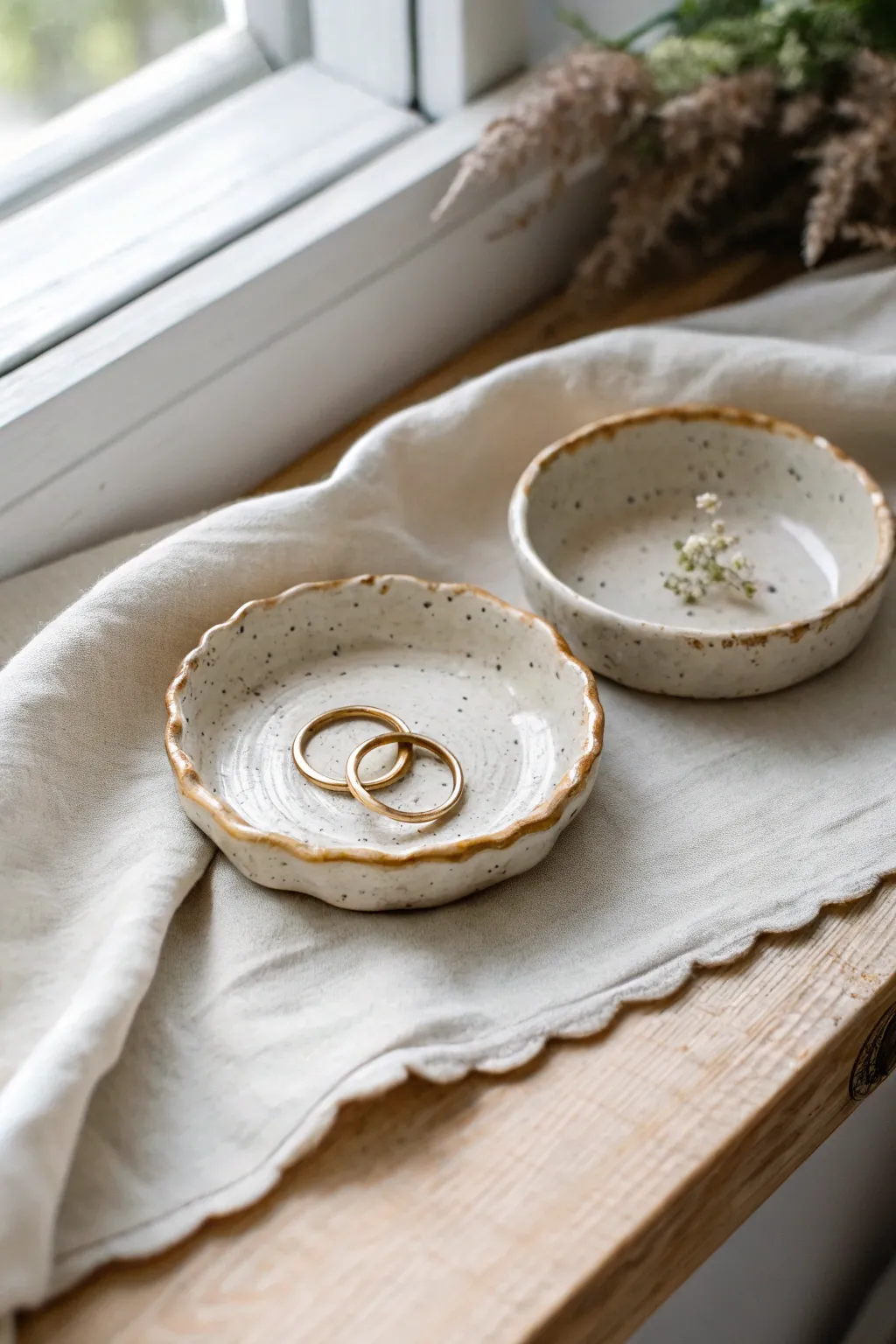
These charming, organic ring dishes mimic the look of speckled stoneware pottery using accessible air-dry or polymer clay. One features a sweet scalloped edge while its partner keeps things simple, creating a complementary set perfect for gifting to a best friend.
Detailed Instructions
Materials
- White air-dry clay or polymer clay
- Rolling pin
- Canvas mat or parchment paper
- Round cookie cutters (approx. 3-4 inches)
- Small bowl with water
- Sponge
- Modelling tool or chopstick
- Brown acrylic paint (burnt umber)
- Old toothbrush
- Gold or caramel-colored acrylic paint for rim
- High-gloss varnish or polymer clay glaze
- Fine grit sandpaper
Step 1: Shaping the Clay Forms
-
Condition the Clay:
Begin by kneading your white clay until it is soft, warm, and pliable. This prevents cracks from forming later in the drying process. -
Roll It Out:
On your canvas mat or parchment paper, roll the clay out to an even thickness of about 1/4 inch. Try to keep the pressure consistent so one side isn’t thicker than the other. -
Cut the Circles:
Use your round cookie cutters to stamp out two circles. If you don’t have cutters, you can trace around a glass or bowl with a needle tool. -
Form the Simple Dish:
Take one circle and gently pinch the edges upward to create a lip. Use your thumbs to press the center down slightly while curling the rim up, aiming for a natural, slightly organic wall. -
Create the Scalloped Dish:
For the second dish, start the same way by lifting the rim. Then, use your finger or the handle of a paintbrush to gently press indentations into the rim at regular intervals, pushing outwards while supporting the clay from the outside to form a wavy, scalloped edge. -
Smooth the Edges:
Dip your finger in a tiny bit of water and run it along the rims and inside the dishes to smooth out any cracks or harsh fingerprints. Don’t use too much water, or the clay will get mushy.
Step 2: Adding the Speckled Texture
-
Prepare the Speckle Paint:
While the clay is still damp (or after baking if using polymer), dilute a small amount of dark brown acrylic paint with water until it’s very fluid, like ink. -
Splatter Technique:
Dip an old toothbrush into the diluted brown paint. Hold it over your clay dishes and run your thumb across the bristles to flick tiny speckles onto the surface. Test on a paper towel first to control the spray. -
Dry the Clay:
Let your air-dry clay sit for 24-48 hours until bone dry and white. If using polymer clay, bake according to the package instructions and let cool completely. -
Sand for Perfection:
Once fully dry or cured, gently sand the edges with fine-grit sandpaper to remove any sharp burrs or rough spots.
Fixing Big Blobs
If your toothbrush splatters a large, unwanted blob of paint, quickly dab it gently with a dry Q-tip to lift the excess liquid, then blend the edges with a clean damp brush.
Step 3: Glazing and Finishing
-
Paint the Rim:
Using a fine detail brush, paint the very top edge of the rim with a gold or caramel-brown acrylic paint. Let the line be slightly uneven to enhance the handmade ceramic feel. -
Initial Varnish Coat:
Apply a coat of high-gloss varnish to the entire surface of the dish. This seals the clay and begins to build that ceramic-like shine. -
Build the Gloss:
I like to let this dry briefly and then apply 2-3 more coats of gloss varnish. The multiple layers add depth and make the finish look like fired glaze rather than just painted clay. -
Final Cure:
Allow the varnish to cure completely according to the bottle’s instructions—usually 24 hours—before placing any jewelry inside to ensure it doesn’t stick.
Pro Tip: Faux-Ceramic Weight
To make air-dry clay feel heavier like real ceramic, you can mix a small amount of fine sand into the clay before rolling, or glue a heavy washer to the base before painting.
Now you have a stunning set of faux-ceramic dishes ready to hold your most treasured rings
Pinkie Promise Mini Sculptures
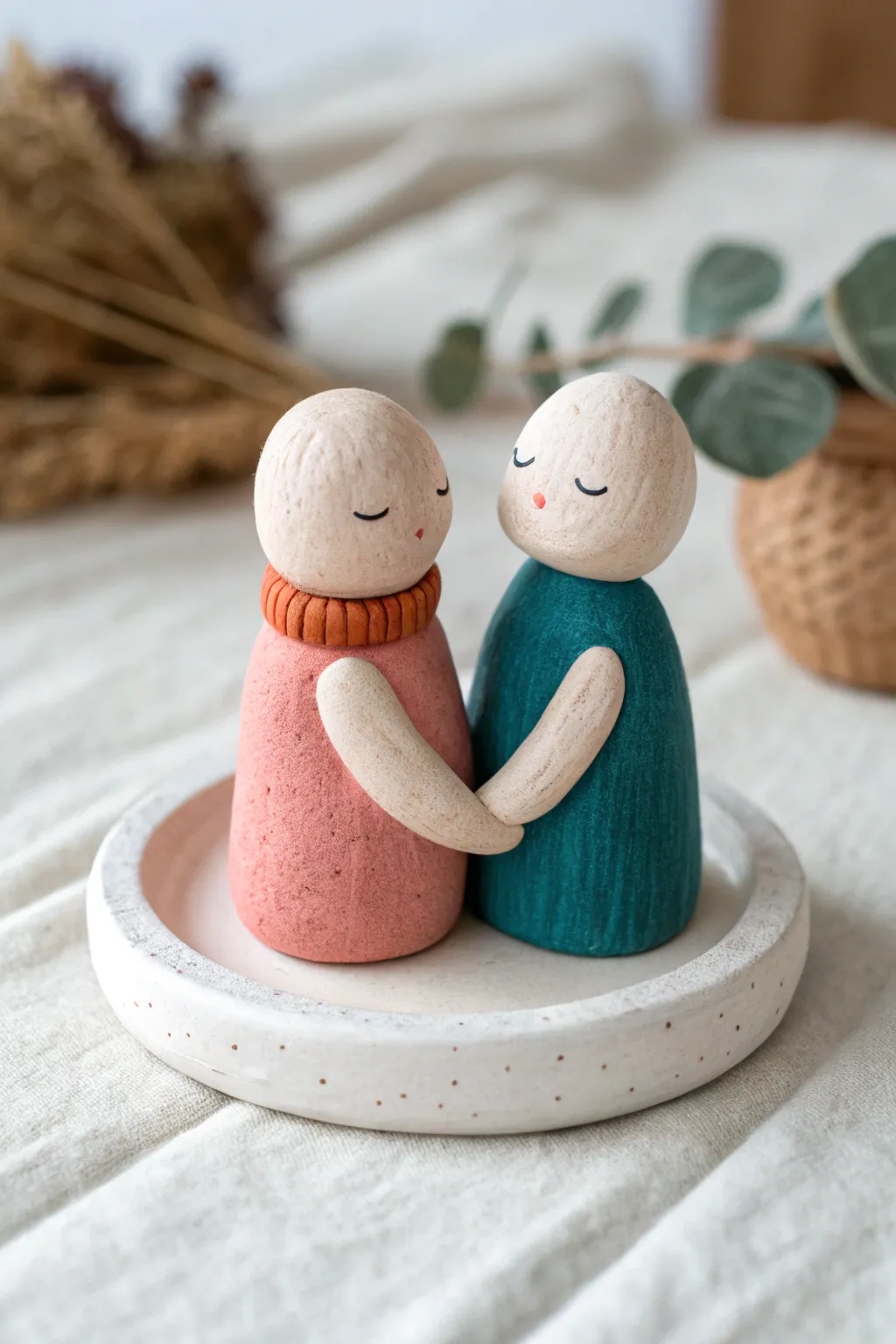
Create a heartwarming keepsake of friendship with these charming, minimalist clay figures locked in a sweet embrace. This project uses simple shapes and soft, matte finishes to capture a tender moment between two stylized characters.
Step-by-Step Tutorial
Materials
- Polymer clay (white or beige, pink, teal, orange)
- Acrylic paints (black, tiny bit of red/pink)
- Fine detail paintbrush (size 000)
- Clay sculpting tools (needle tool, smoothing tool)
- Aluminum foil (for armature)
- Oven for baking (if using polymer clay)
- Matte varnish or sealant
- Liquid clay or bake-and-bond
- Small round display dish (optional)
Step 1: Sculpting the Base Bodies
-
Form the core:
Start by rolling two balls of aluminum foil, each about the size of a large grape. Compressing foil creates a lightweight core and saves clay. -
Cover the first figure:
Knead your pink clay until soft and pliable. Flatten a piece into a pancake and wrap it completely around one foil ball, smoothing the seams until invisible. -
Shape the torso:
Gently roll the clay-covered ball into a tapered cylinder shape, slightly wider at the base so it stands sturdily. Flatten the bottom against your work surface. -
Create the second figure:
Repeat the process with the teal clay, covering the second foil ball and shaping it into a matching tapered cylinder. Place them next to each other to ensure they are similar in height.
Uneven Standing?
If figures wobble, gently press the base onto sandpaper and rub in a circular motion. This flattens the bottom perfectly without distorting the shape.
Step 2: Adding Heads and Details
-
Roll the heads:
Using beige or natural-colored clay, roll two smooth spheres for the heads. These should be proportionate to the bodies—think large marble size. -
Attach the heads:
Use a small dab of liquid clay or bake-and-bond on top of each body torso. Press the beige spheres firmly into place. I like to twist them slightly as I press down to create a stronger bond. -
Make the collar:
Roll a small snake of orange clay. Wrap it around the neck of the pink figure. -
Texture the collar:
With a needle tool or knife, press small vertical lines all around the orange snake to create a ribbed, knitted texture.
Step 3: Creating the Embrace
-
Shape the arms:
Roll two sausages of beige clay for the arms. They should be thicker at the shoulder end and taper slightly towards the ‘hand’ end, although we are keeping them stylized without fingers. -
Curve the arms:
Gently bend each arm into a soft curve. Test the fit against the bodies to see naturally where they would fall. -
Position the figures:
Place the two figures close together, angled slightly toward one another. -
Connect the hands:
Apply liquid clay to the sides of the bodies and the arm ends. Press the arms onto the bodies so that the hands meet in the center, overlapping slightly to look like they are holding hands. -
Smooth the joints:
Use a silicone tool or your finger to gently blend the shoulder area of the arm into the body clay just a little bit for stability, though leaving a distinct seam is stylistically fine here.
Texture Play
Before baking, gently roll a piece of fabric or a clean toothbrush over the body clay (pink and teal parts) to give the ‘clothing’ a soft, fabric-like texture.
Step 4: Finishing Touches
-
Bake the clay:
Follow your specific polymer clay package instructions for baking temperatures and times (usually 275°F for 15-30 minutes). Let them cool completely before painting. -
Paint facial features:
Using your finest brush and black acrylic paint, carefully paint two small, curved ‘U’ shapes for sleeping eyes on each face. -
Add the mouth:
Dip the very tip of a toothpick or detail brush into pink or red paint and dot a tiny mouth in the center of the face, just below the eyes. -
Seal the work:
Once the paint is fully dry, coat the figures with a matte varnish to protect the surface and give it a professional, finished look. -
Final display:
Place your finished duo on a small ceramic dish or coaster to complete the scene.
Enjoy your handmade symbol of connection and display it somewhere special

TRACK YOUR CERAMIC JOURNEY
Capture glaze tests, firing details, and creative progress—all in one simple printable. Make your projects easier to repeat and improve.
Cloud and Raindrop Pair
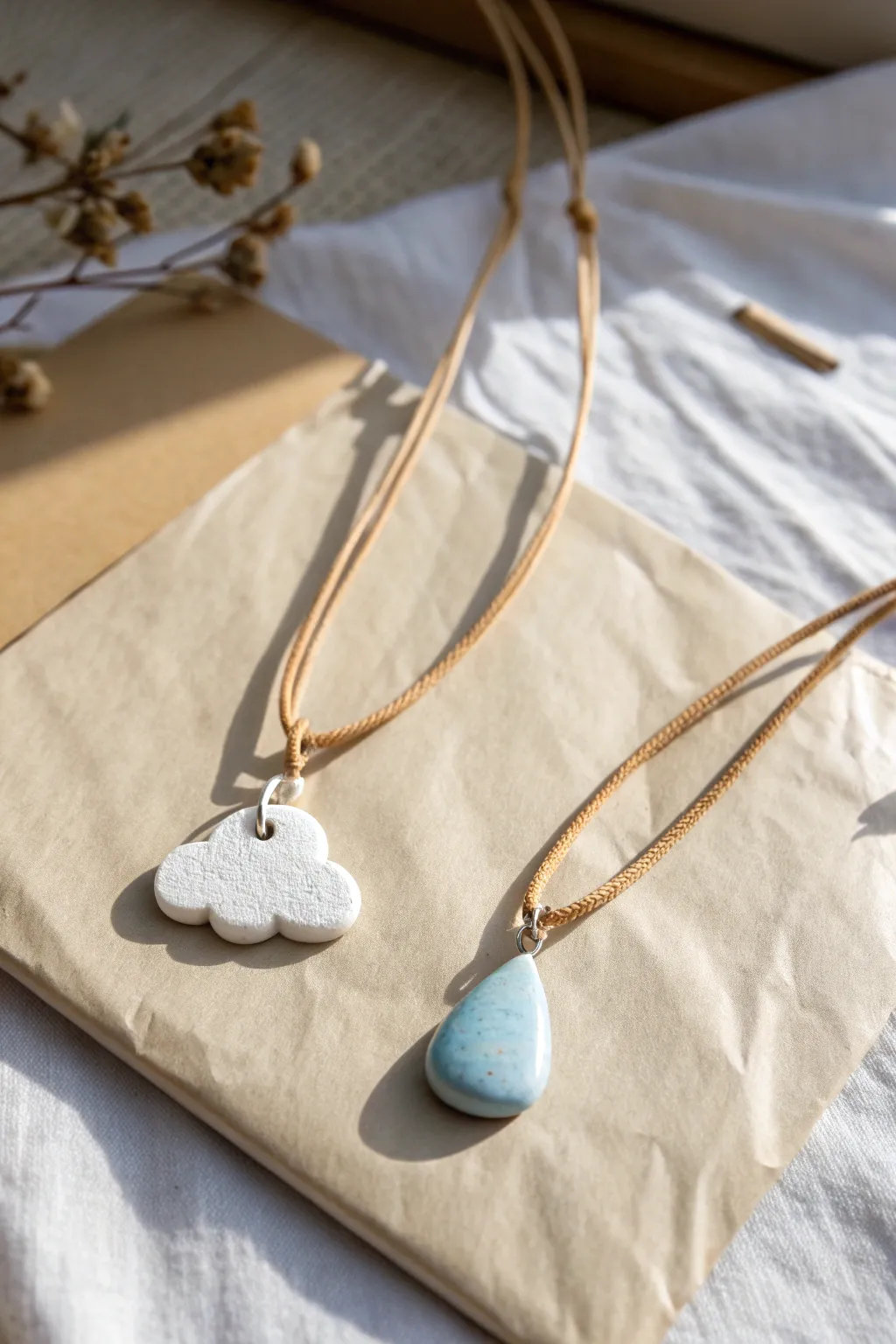
Celebrate your connection with these charming complementary pendants that capture the beauty of a rainy day. One friend wears the fluffy white cloud while the other dons the soothing blue raindrop, creating a sweet narrative when you’re together. The textured white clay contrasts beautifully with the smooth, glossy finish of the blue drop.
Detailed Instructions
Materials
- White liquid polymer clay (for texture)
- White block polymer clay
- Light blue polymer clay
- Speckled blue or granite effect polymer clay (optional, for the drop)
- Clay roller or pasta machine
- Cloud shaped cutter (or craft knife)
- Teardrop shaped cutter
- Needle tool or toothpick
- Sandpaper (various grits)
- UV resin or glossy varnish
- Jewelry jump rings (silver tone)
- Light brown cord or suede lace
- Jewelry pliers
Step 1: Sculpting the Cloud
-
Condition the white clay:
Begin by kneading your white polymer clay block until it is soft and pliable. This conditioning step is crucial to prevent cracks later on. -
Roll the base slab:
Roll out the white clay to a thickness of about 4mm to 5mm. You want a chunky, substantial feel for these pendants rather than something thin and fragile. -
Cut the shape:
Use a small cloud cutter to punch out your shape. If you don’t have a specific cutter, lightly sketch a cloud outline with a needle tool and carefully cut it out with a craft knife. -
Soften the edges:
Gently tap the edges of the cloud with your finger to round them slightly, removing the sharp ‘cookie cutter’ look. I find this makes the final piece feel more organic. -
Add texture:
To achieve the fluffy, stone-like texture seen in the photo, dab a little liquid clay onto the surface. Alternatively, use a toothbrush or a ball of aluminum foil to gently press texture into the raw clay.
Uneven Texture?
If your cloud texture looks too uniform, try using two different tools (like a stiff brush and a crumpled foil ball) to create varied depths.
Step 2: Forming the Raindrop
-
Mix the blue shade:
Knead your light blue clay. To replicate the speckled look in the image, you can mix in a tiny amount of granite-effect clay or very finely ground black pepper into the blue. -
Shape the drop:
Roll a ball of the blue clay and flatten it slightly. Pinch one end to form a teardrop shape. Aim for a smooth, rounded surface that is slightly thicker in the middle. -
Refine the contour:
Smooth out any fingerprints with a drop of baby oil or clay softener. The raindrop relies on being sleek and smooth to contest with the textured cloud. -
Create holes:
Using your needle tool, pierce a hole near the top center of the cloud and the pointed top of the raindrop. Make sure the hole is large enough to fit your jump rings.
Make it Sparkle
Mix a tiny pinch of white mica powder or iridescent glitter into the white clay before texturing. It gives the cloud a magical ‘silver lining’ shimmer.
Step 3: Baking and Finishing
-
Bake the pieces:
Place both pendants on a ceramic tile or parchment-lined baking sheet. Bake according to your specific clay brand’s instructions (usually 275°F/130°C for 15-30 minutes). -
Cool and sand:
Let the pieces cool completely. If there are any rough spots on the edges or back, gently sand them down with fine-grit sandpaper under running water. -
Glaze the raindrop:
Apply a coat of UV resin or glossy varnish specifically to the blue raindrop to give it a wet, glass-like appearance. Cure the resin under a UV lamp or let the varnish dry fully. -
Keep the cloud matte:
Leave the white cloud unglazed to maintain that dry, fluffy texture. This difference in finish emphasizes the contrast between the two elements. -
Attach hardware:
Open a silver jump ring using two pairs of pliers (twist sideways, never pull apart). Thread it through the hole in the cloud and close it securely. Repeat for the raindrop. -
Prepare the cords:
Cut two lengths of light brown cord suited to your desired necklace length. Tie a simple knot at the designated center point where the pendant will sit. -
Attach the pendants:
Slide the jump ring of the pendant onto the cord, resting it against the knot you just tied. You can tie another knot on the other side to lock it in place, or let it slide freely depending on your preference. -
Finish the necklace:
Tie sliding knots at the ends of the cords so the necklace is adjustable, or add a clasp if you prefer a fixed length.
Now you and your best friend have a wearable reminder that you’ll weather any storm together
Fingerprint Texture Token Pair
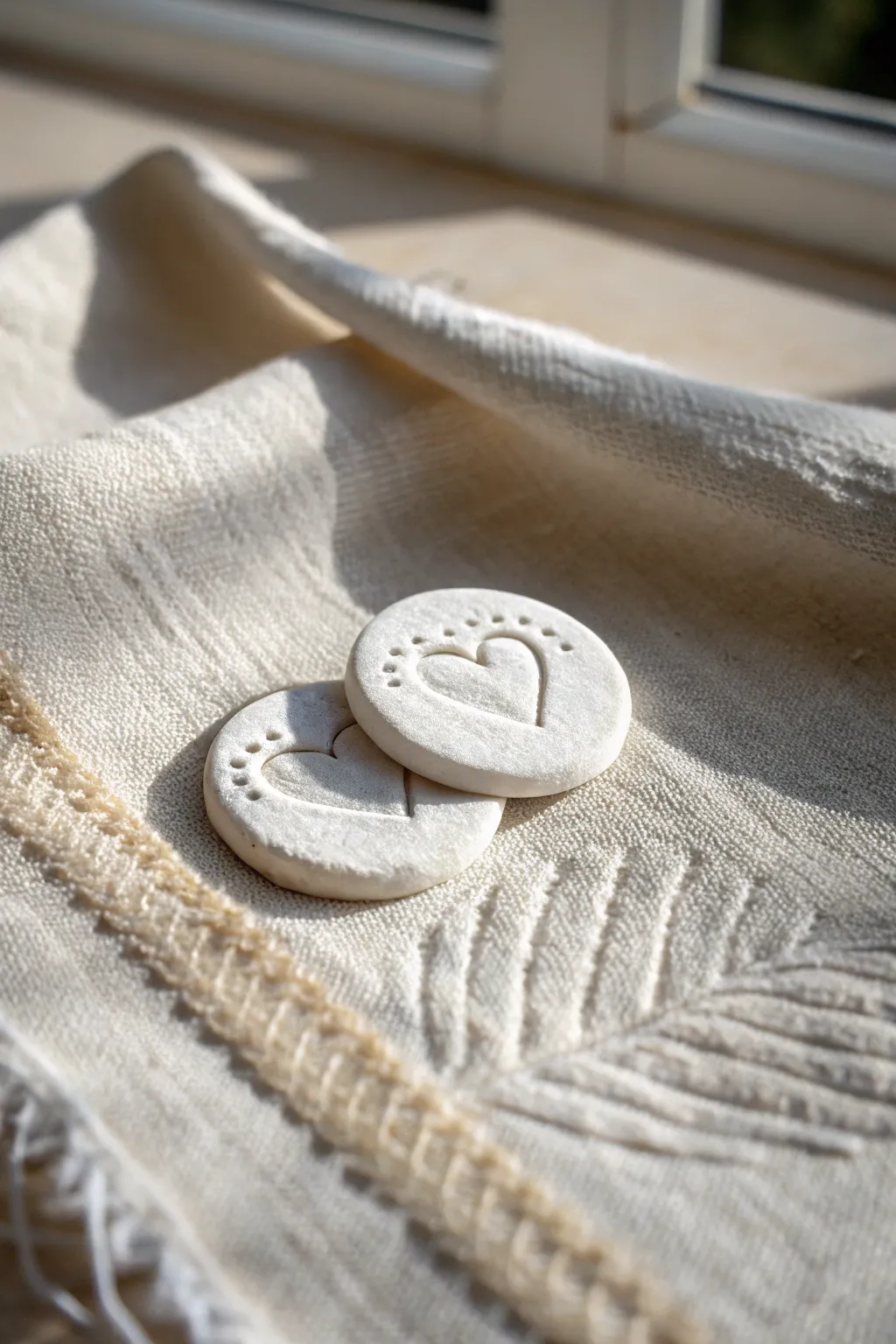
Create a subtle yet meaningful symbol of connection with these textured clay tokens. Perfect for carrying in a pocket or keeping on a bedside table, these bright white discs feature an imprinted heart motif crowned with delicate stippling.
How-To Guide
Materials
- White air-dry clay (or polymer clay)
- Small circular cookie cutter (approx. 1.5 inches)
- Rolling pin
- Parchment paper or smooth work surface
- Small heart stamp or a heart-shaped object
- Toothpick, needle tool, or dull pencil point
- Fine-grit sandpaper (optional)
- Matte spray sealant (optional)
Step 1: Shaping the Base
-
Prepare the workspace:
Lay down a sheet of parchment paper to prevent your clay from sticking. Ensure your hands are clean and dry to keep the white clay pristine. -
Condition the clay:
Take a small ball of white air-dry clay and knead it in your hands until it is soft, pliable, and free of cracks. This conditioning step is crucial for a smooth finish. -
Roll the slab:
Using your rolling pin, flatten the clay ball into an even slab. Aim for a thickness of about 1/4 inch (6mm) so the token feels substantial but not chunky. -
Cut the circles:
Press your circular cutter firmly into the clay to create two identical discs. Twist slightly and lift to get clean edges. -
Smooth the edges:
Dip your finger in a tiny bit of water and gently run it around the circumference of each circle to smooth out any ragged clay bits left by the cutter.
Step 2: Adding the Design
-
Center the heart:
Take your heart stamp or tool and position it directly in the center of the first disc. -
Impress the shape:
Press down firmly but evenly. You want the indentation to be deep enough to see clearly, but not so deep that it distorts the circular shape of the token. -
Check the impression:
Gently lift the stamp. If the edges of the heart look rough, you can smooth them slightly with a very small modeling tool or your pinky finger. -
Create the arch guide:
Imagine an invisible arch hovering just above the top curves of the heart. This is where your dotted design will go. -
Start dots from the center:
Using your toothpick or dull pencil point, make the first indentation directly above the center dip of the heart. -
Complete the arch:
Continue pressing dots outward to the left and right of that center dot, maintaining equal spacing. Try to follow the curve of the token’s edge. -
Repeat for the pair:
Follow the exact same stamping and dotting process on the second token. I find that doing them side-by-side helps ensure the pressure and spacing match perfectly.
Cracks while rolling?
If the clay edges act crumbly or crack while rolling, your clay is too dry. Dip your fingers in water and knead it back into the ball to rehydrate before rolling again.
Step 3: Finishing Touches
-
Initial drying:
Place the tokens on a clean sheet of parchment paper in a safe spot away from direct heat. Let them air dry for at least 24 hours. -
Flip for flat drying:
Halfway through the drying process, flip the tokens over carefully. This helps the moisture evaporate evenly and prevents the edges from curling upward. -
Refine the surface:
Once fully cured and hard, inspect the edges. If there are any sharp spots, very gently buff them away with fine-grit sandpaper. -
Remove dust:
Wipe the tokens with a dry, soft cloth or brush to remove any clay dust from the sanding process. -
Seal the piece:
To protect that bright white finish from dirt and oils over time, give both tokens a light coat of matte spray sealant.
Use a makeshift stamp
No heart stamp? No problem. Bend a paperclip into a V-shape for the bottom and use the rounded end of a bobby pin to press the two top arches of the heart.
Give one token to a friend and keep the other as a tangible reminder of your bond
Handwritten Message Imprint Pendant
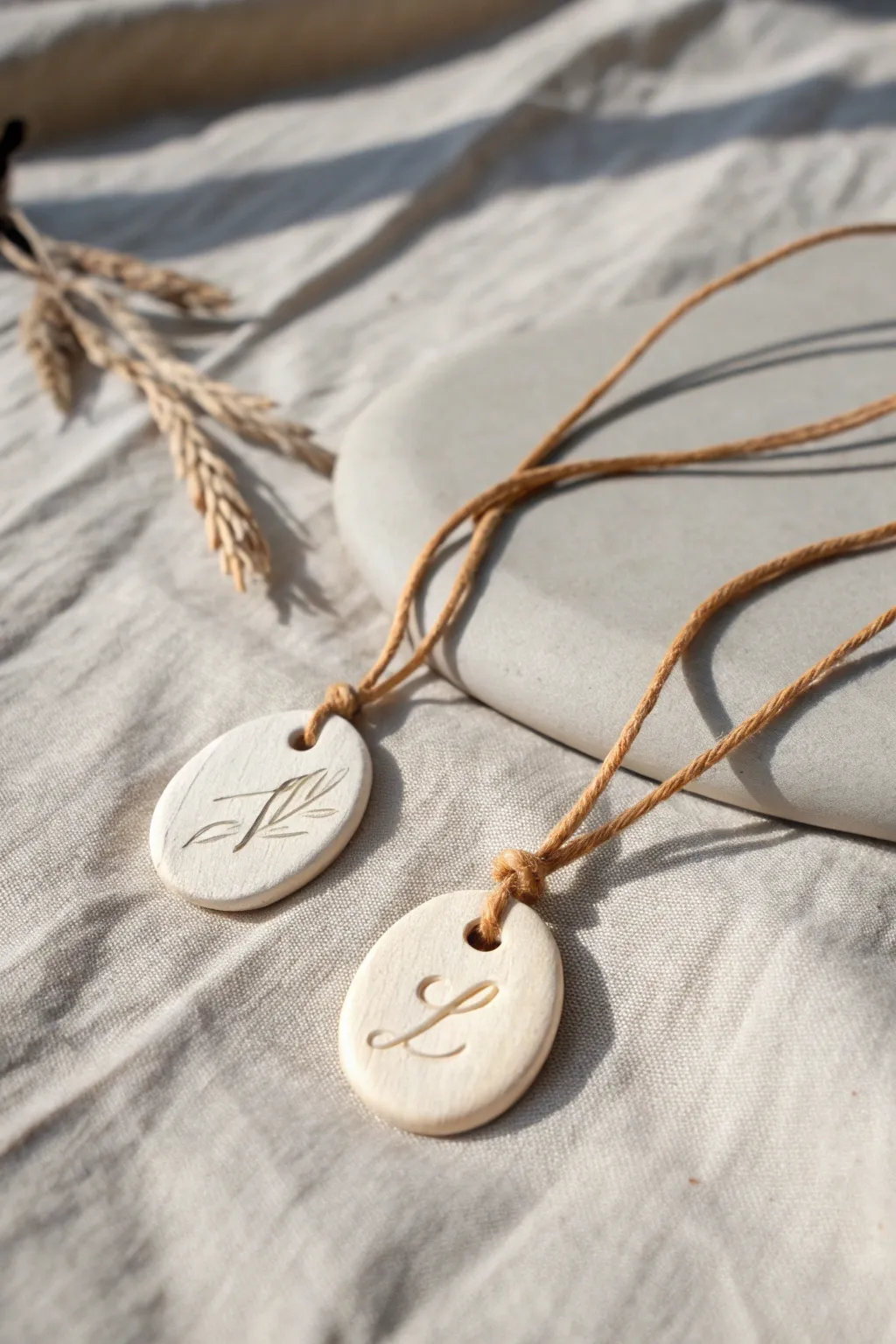
Create beautiful, personalized keepsakes with these minimalist clay pendants, featuring delicate botanical imprints and flowing initials. The natural white clay and simple cord create an earthy, organic look that makes for a thoughtful and intimate friendship gift.
Step-by-Step Guide
Materials
- White air-dry clay or polymer clay
- Rolling pin or smooth glass jar
- Small oval cookie cutter (approx. 1.5 – 2 inches)
- Sandpaper (fine grit)
- Toothpick, skewer, or small drinking straw
- Sculpting needle tool or sharp pencil
- Brown waxed cotton cord or hemp twine
- Small bowl of water
- Acrylic sealer (matte finish, optional)
Step 1: Shaping the Clay Base
-
Condition the clay:
Begin by taking a small ball of white clay and kneading it in your hands until it becomes soft, pliable, and free of cracks. Warm hands help this process go faster. -
Roll out the slab:
Place the clay on a clean, smooth surface. Using a rolling pin, flatten the clay to an even thickness of about 1/4 inch (6mm). Avoid rolling it too thin, as you want the pendant to have some substance. -
Cut the shapes:
Press your oval cutter firmly into the rolled clay. If you don’t have a cutter, you can hand-shape an oval or cut around a paper template with a craft knife. -
Smooth the edges:
Dip your finger lightly in water and run it along the cut edges of the oval to smooth out any sharpness or roughness left by the cutter. -
Create the hanging hole:
Using a skewer or a small straw, punch a hole near the top of the oval. Make sure the hole is centered and large enough to accommodate your cord, leaving about 3-4mm of clay above the hole so it doesn’t break.
Clean Lines Tip
To get perfectly smooth carved lines without jagged edges, lay a piece of cling film over the clay before carving your design through the plastic.
Step 2: Designing and Drying
-
Draft your design:
Before marking the clay, sketch your initial or leaf design lightly on paper to get a feel for the spacing. -
Imprint the initial:
Holding the needle tool at a slight angle like a pen, gently carve the cursive letter into the surface. Use a light touch first to map it out, then go back over the lines to deepen them. -
Add botanical details:
For the leaf design, press the needle tool deeper at the base of the leaf and lift up as you drag outward to create a tapered, organic look. -
Clean up debris:
Carving often leaves little ‘crumbs’ of clay. Lightly brush these away with a soft dry brush or blow them off gently. Don’t press them back into the surface. -
Final smoothing:
Check the back of the pendant for fingerprints. I like to lightly smooth the entire surface one last time with a slightly damp finger to ensure a pristine finish. -
Dry the pendants:
Place the pendants on a piece of parchment paper or a wire rack. Let them dry completely according to your clay’s package instructions. For air-dry clay, flip them over halfway through drying to prevent warping.
Cracking Clay?
If you see tiny hairline cracks while drying, mix a tiny bit of fresh clay with water to make a paste and fill them in, then sand smooth once dry.
Step 3: Finishing Touches
-
Sand for perfection:
Once fully cured and hard, use fine-grit sandpaper to gently buff the edges and surface. This removes any tiny imperfections and gives the piece that professional, smooth stone look. -
Dust off:
Wipe the pendant with a slightly damp cloth or paper towel to remove all sanding dust. -
Seal (Optional):
Apply a thin layer of matte acrylic sealer if you want to protect the pendant from moisture, keeping the natural matte look intact. -
Prepare the cord:
Cut a length of brown cord, roughly 24-30 inches depending on how low you want the pendant to hang. -
Attach the pendant:
Thread one end of the cord through the front of the pendant hole and pull it through until the pendant is centered on the cord. -
Secure with a knot:
Instead of a lark’s head knot, simply tie an overhand knot right above the pendant hole. This secures the pendant in place and adds a decorative rustic touch. -
Tie the ends:
Finish the necklace by tying the two loose ends of the cord together with a strong double knot or a sliding knot for adjustable length.
Now you have a set of handcrafted matching pendants ready to share with your closest friend
Mini Photo Portrait Magnet Pair
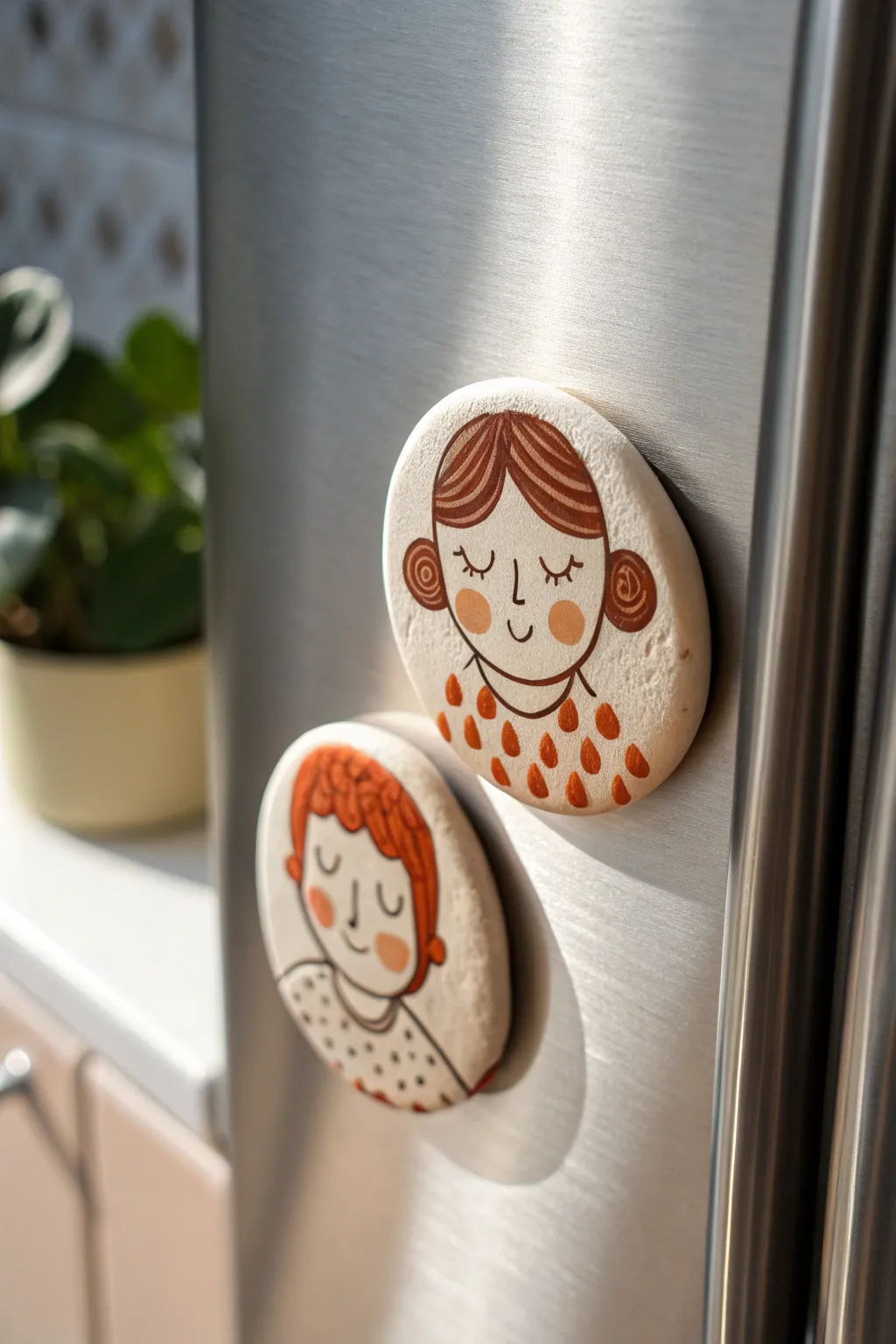
Immortalize your friendship with these charming, folk-art style ceramic magnets. Using air-dry clay and simple painting techniques, these round tokens serve as sweet, daily reminders of your favorite people right on the fridge.
Step-by-Step Tutorial
Materials
- White classic air-dry clay (or polymer clay)
- Circle cookie cutter (approx. 2-3 inches)
- Acrylic paints (terracotta, burnt sienna, cream/white, black)
- Fine detail paintbrushes (sizes 0 and 00)
- Rolling pin
- Parchment paper
- Sandpaper (fine grit)
- Matte varnish or sealant
- Strong craft magnets
- Super glue or E6000
Step 1: Shaping the Canvas
-
Condition the clay:
Begin by kneading a ball of white air-dry clay until it is smooth, warm, and pliable. Remove any air bubbles to preventing cracking later. -
Roll it out:
Place the clay between two sheets of parchment paper to prevent sticking. Roll it out to an even thickness of about 1/4 inch. -
Cut the circles:
Using your circle cookie cutter, press firmly into the clay to create your magnet bases. If you don’t have a cutter, trace a jar lid and cut with a craft knife. -
Smooth the edges:
Dip your finger in a little water and gently run it along the cut edges of the clay circles to round them off and remove any sharp ridges. -
Dry completely:
Place the discs on a flat surface away from direct heat. Flip them over every few hours to ensure they dry evenly and remain flat. Let them cure for 24-48 hours. -
Sand for smoothness:
Once fully hard, use fine-grit sandpaper to lightly buff the surface and edges. You want a perfectly smooth canvas for your painting.
Smooth Surface Secret
Before drying, gently wipe the raw clay surface with a baby wipe or a damp sponge. This removes fingerprints and creates a porcelain-like finish without needing heavy sanding later.
Step 2: Painting the Portraits
-
Sketch lightly:
Using a pencil with a very light touch, draw the outline of the hair, face shape, and neckline. Keep the style simple and geometric like the example. -
Base skin tone:
Mix a small amount of cream or off-white acrylic paint. Fill in the face area, avoiding the hair section. The natural clay color is lovely, but a painted base adds finish. -
Paint the hair base:
Choose a hair color—burnt sienna or a reddish-orange work well for that folk-look. Fill in the main hair shape with a solid coat of paint. -
Add hair details:
Once the base hair color is dry, use a slightly darker shade or thinned brown paint to add sweeping lines for strands. For the buns, paint spirals. -
The features:
Switch to your finest brush and black paint. Carefully paint two U-shaped curves for closed eyes, a simple ‘L’ or vertical line for the nose, and a small curve for the smile. -
Rosy cheeks:
Mix a soft terracotta or coral pink. Paint small, solid circles on the cheeks. This specific stylized look relies on these prominent cheek spots. -
Clothing details:
Paint a simple neckline. Add patterns like polka dots or teardrops using contrasting earthy tones (like the orange teardrops on the brown-haired figure). -
Let paint cure:
Allow the acrylics to dry completely for at least an hour. I find rushing this step can cause the sealant to smear the delicate black lines.
Make it a Gift Set
Don’t stop at two. Create a whole family set or a group of college friends. Paint their names or the year on the back of the magnet for a personalized keepsake.
Step 3: Finishing
-
Seal the artwork:
Apply a thin layer of matte varnish over the entire front and sides. This protects the clay from moisture and gives it a professional, finished look. -
Attach the magnet:
Flip the dry clay disc over. Apply a dot of strong super glue or E6000 to the center of the back. -
Secure and set:
Press the magnet firmly into the glue. Let the adhesive cure according to the package instructions before sticking it to your fridge.
Now you have a sweet set of custom magnets ready to hold up your favorite photos and memories
Two-Part Secret Capsule Charm
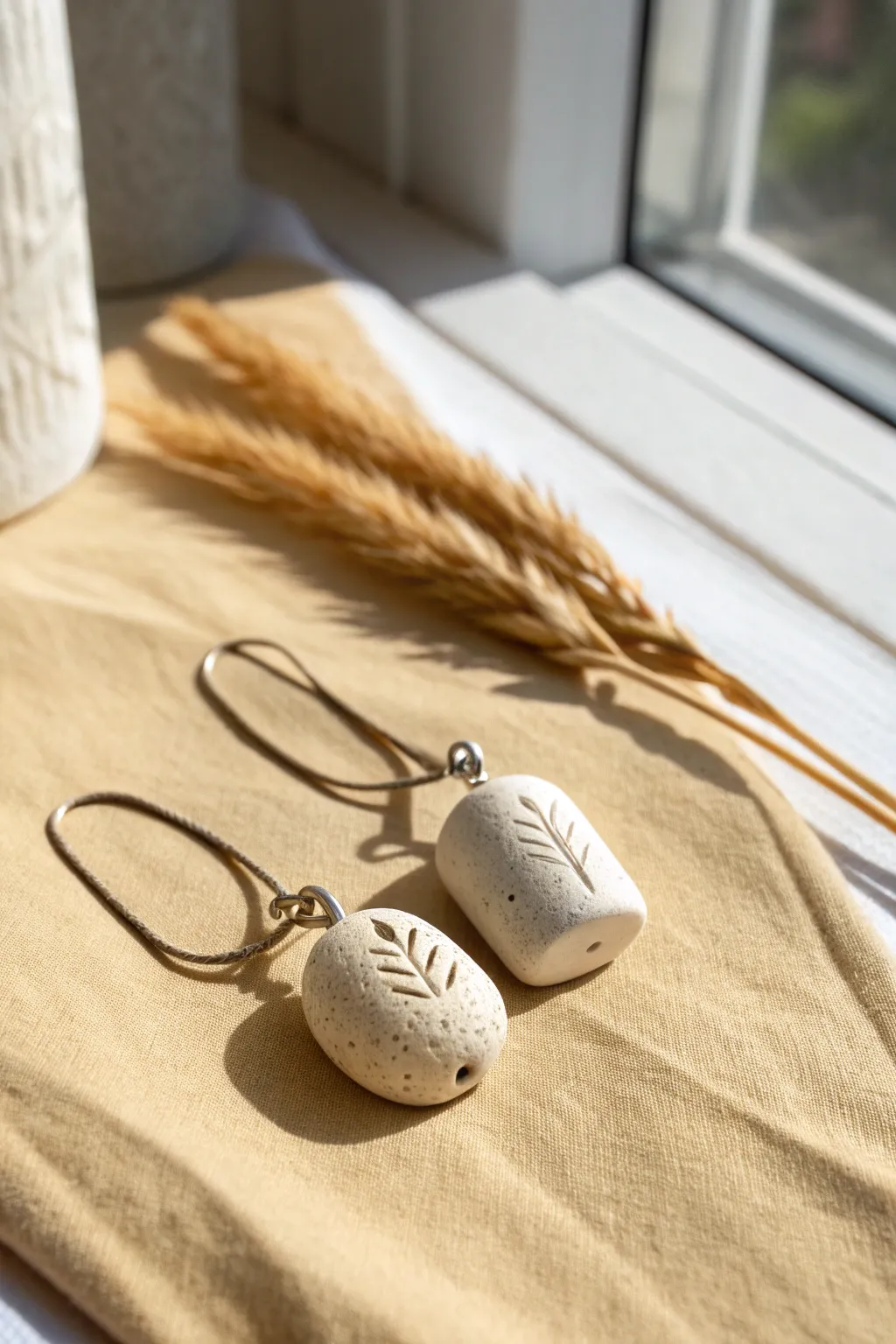
Create a meaningful keepsake with these tactile, speckled clay capsule charms featuring a delicate fern impression. While they look like solid stone beads, the hidden hollow inside makes them perfect for stashing a tiny rolled-up note to a friend.
Detailed Instructions
Materials
- White polymer clay with granite/speckle effect (e.g., Fimo Effect or Premo Granite)
- Acrylic rolling pin or clay machine
- Small carving tool or needle tool
- Toothpick or bead reamer
- Small craft knife or blade
- Silver jewelry wire (20 gauge)
- Wire cutters and round-nose pliers
- Sandpaper (fine grit)
- Oven for baking polymer clay
- Optional: Parchment paper for baking
Step 1: Shaping the Capsules
-
Condition the clay:
Begin by warming the speckled clay in your hands, kneading it until it is soft and pliable. This prevents cracks later. -
Form the base log:
Roll the clay into a thick cylinder or log, about 1/2 inch to 3/4 inch in diameter. Try to keep the thickness consistent. -
Cut to size:
Using your craft blade, cut two equal segments from the log. These should be roughly 1 inch long each, creating a chunky bead shape. -
Soften the edges:
Gently tap the cut ends against your work surface to blunt the sharp edges. Roll the cylinder lightly between your palms to softly round off the corners into an organic, stone-like pebble shape.
Uneven Impressions?
If your fern leaves look messy, try covering the clay with a piece of plastic wrap before pressing the tool in. This creates softer, smoother indentations.
Step 2: Creating the Secret Hollow
-
Create the entry hole:
Using a toothpick or a bead piercing pin, carefully drill a hole through the top of the charm where the bail will go. Wiggle it slightly to ensure the wire can pass through later. -
Hollow the bottom:
On the bottom face of the charm, press a slightly larger tool (like the end of a paintbrush handle) upwards into the clay to create a recess. This doesn’t need to go all the way through; it’s just a small nook for a tiny scrolled paper. -
Refine the shape:
Handling the clay might have distorted the shape, so gently roll it again to restore that smooth, cylindrical pebble form.
Antiquing Trick
To make the fern carving pop, rub a tiny bit of brown acrylic paint into the grooves after baking and wipe the surface clean immediately.
Step 3: Adding the Fern Motif
-
Mark the stem:
With a needle tool or the very tip of your knife, gently press a vertical line down the center of the charm’s face to create the main stem of the fern. -
Press the leaves:
Starting at the bottom of the stem, press small angled dashes upward on either side. Apply firm, even pressure so the impression is deep enough to see but doesn’t warp the bead. I usually do about three or four pairs of leaves. -
Clean up debris:
If the carving created any tiny burrs of clay, gently brush them away with a soft brush or your finger.
Step 4: Finishing and Assembly
-
Bake the pieces:
Place your clay charms on parchment paper and bake according to the manufacturer’s instructions (usually 230°F/110°C for 30 minutes depending on brand). -
Cool down:
Let the pieces cool completely inside the oven with the door slightly ajar to prevent thermal shock cracks. -
Sand for stone effect:
Once cool, briefly rub the surface with fine-grit sandpaper. This removes fingerprints and enhances the matte, stone-like texture. -
Create the wire bail:
Cut a small piece of silver wire. Create a small loop with your round-nose pliers, leaving a tail. -
Attach the bail:
Thread the tail through the top hole of the charm. Bend the wire up on the other side and wrap it around the base of the loop to secure it messy-style, or simply create a matching loop on the other side. -
Add the hoop:
Slide your finished charm bail onto the larger silver kidney ear wires or a chain necklace.
Now you can write a tiny secret note, roll it up tight, and tuck it into the bottom recess before gifting this special token to a friend