
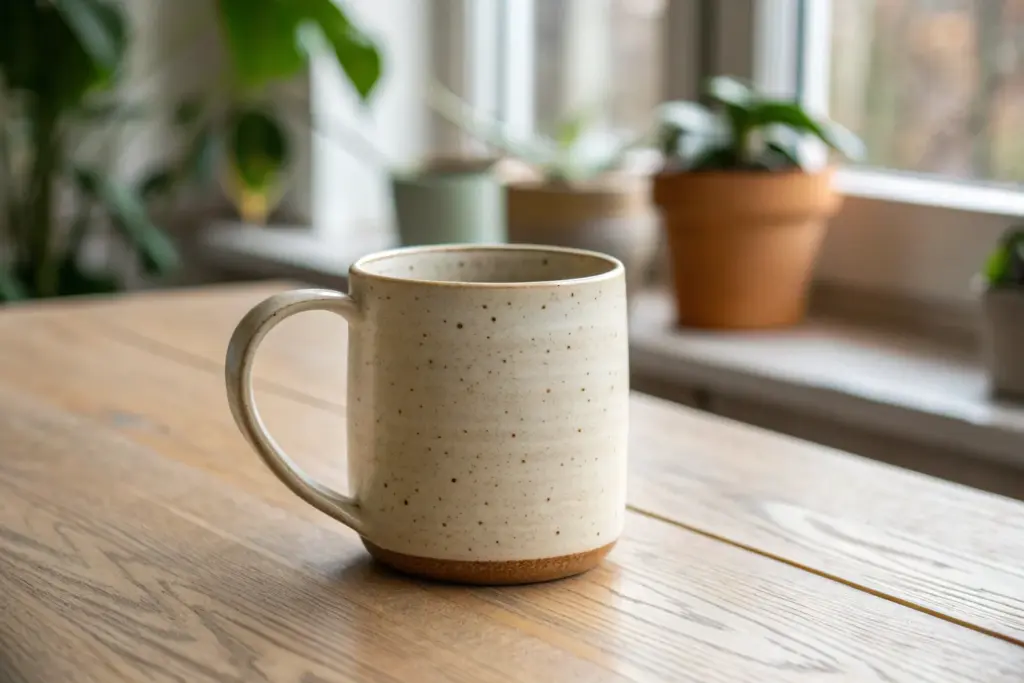
A great mug can totally flop if the clay mug handle feels awkward, so I love treating handles like their own mini design project. Here are my favorite clay mug handle ideas—from classic, comfy shapes to playful statement handles that make the whole mug feel more “you.”
Classic Pulled Handle Curve
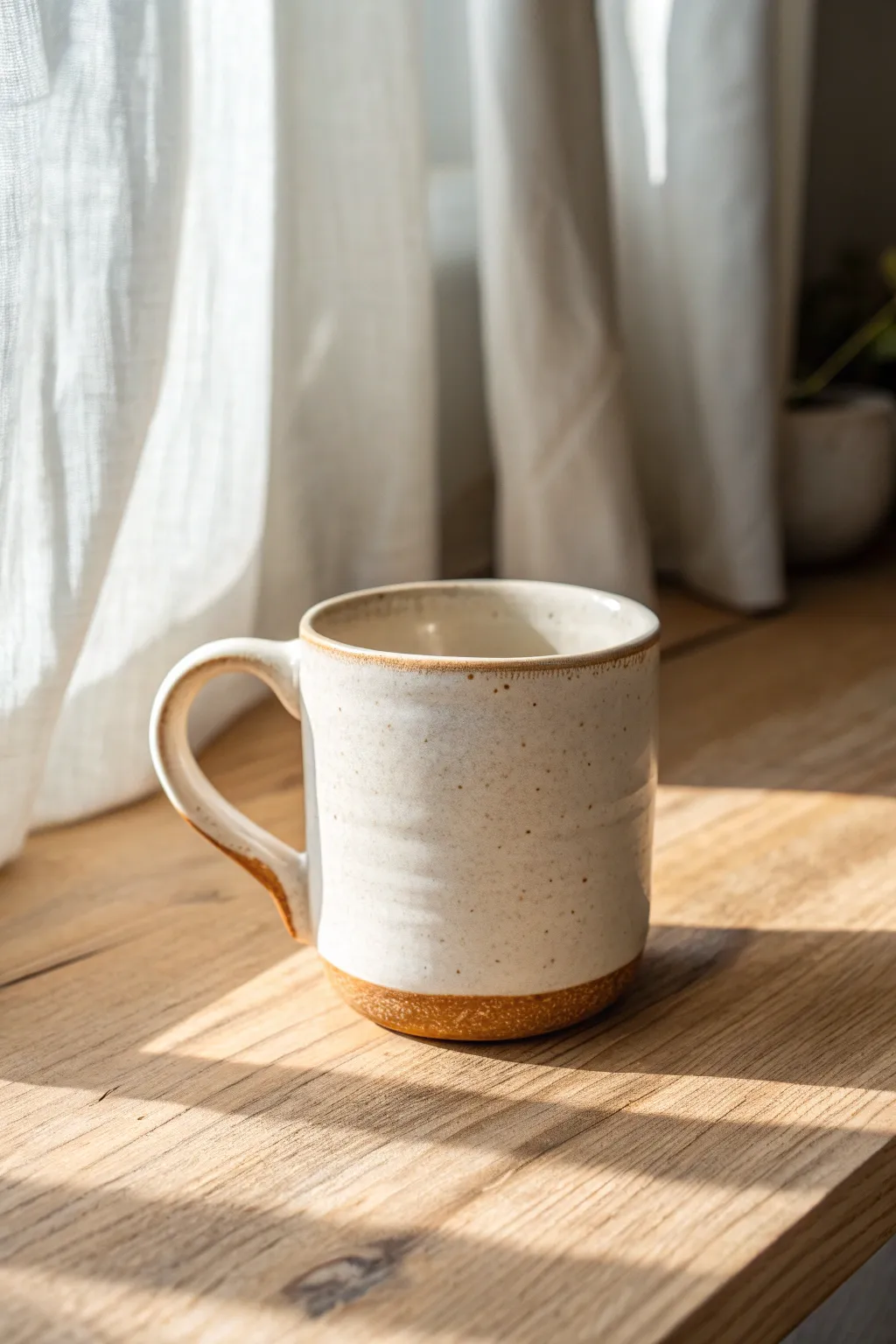
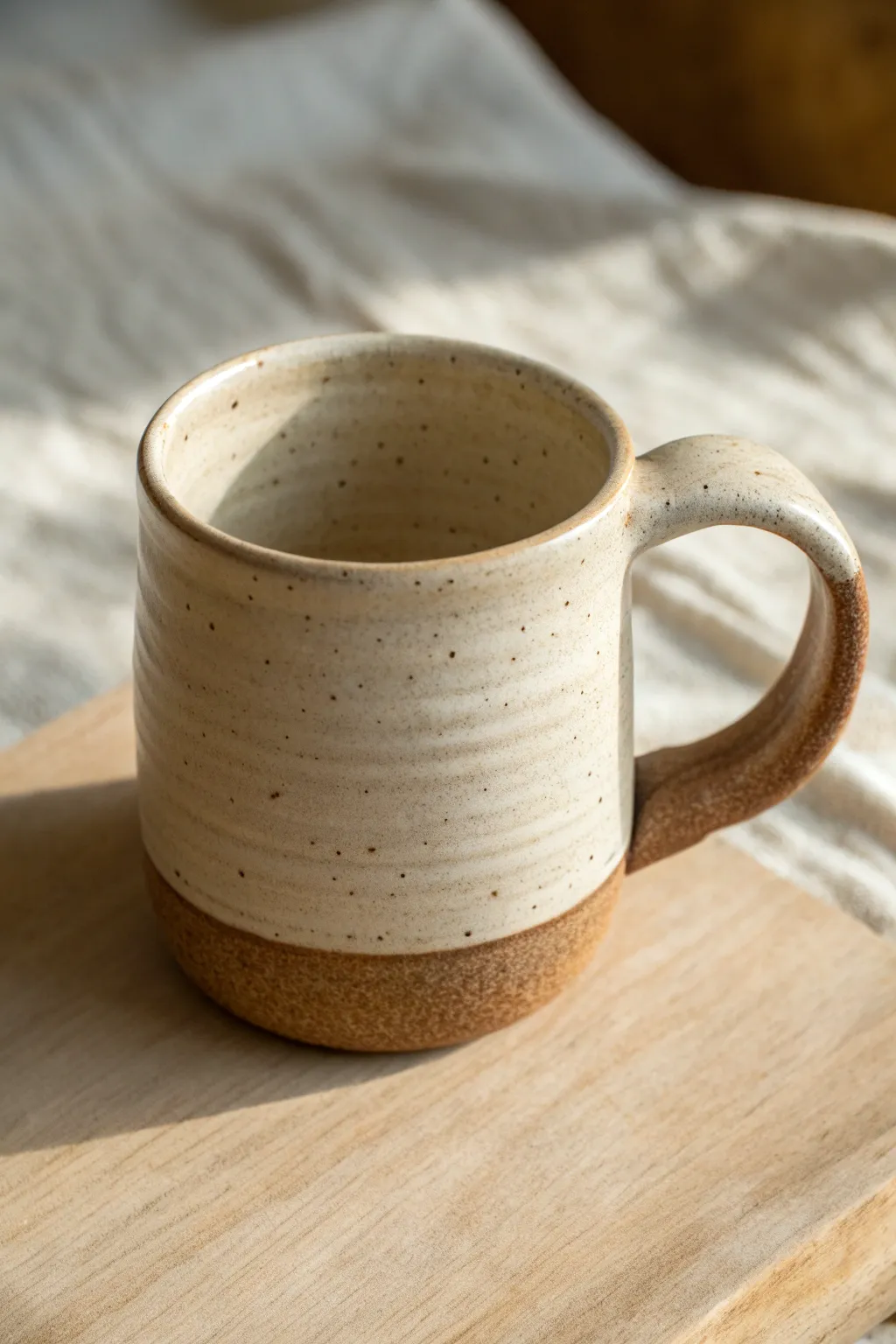
This cozy, farmhouse-style mug features a tapered form with a bare, toasted stoneware base and a beautifully proportionate pulled handle. The soft white glaze allows the natural speckles of the clay to shine through, creating an earthy aesthetic perfect for your morning brew.
Step-by-Step
Materials
- Speckled stoneware clay (mid-fire)
- Pottery wheel
- Throwing tools (sponge, metal rib, wooden knife)
- Wire cutter
- Trimming tools
- Serrated rib or score tool
- Water bucket and sponge
- Creamy matte white glaze (translucent)
- Wax resist (optional)
Step 1: Throwing the Cylinder
-
Center and open:
Begin with about 1-1.5 lbs of speckled stoneware clay. Center it firmly on the wheel head and open the well, leaving the floor about a half-inch thick to allow later trimming of foot. -
Pull the walls:
Pull the walls up to create a cylinder. Aim for a height of about 4-5 inches. Keep the rim slightly compressed to prevent cracking. -
Shape the faint taper:
Using a metal rib on the inside and your fingers on the outside, gently belly out the form just slightly, then collar the rim in ever so slightly to create a subtle inward taper. This keeps heat in your coffee longer. -
Refine the surface:
Use a flexible metal rib on the exterior while the wheel creates a slow rotation to smooth out major throwing rings, though leaving a few subtle ridges adds to the handmade character. -
Cut underneath:
Use your wooden knife to undercut the base, then slide your wire cutter through to release it from the wheel. Set aside to dry to leather hard.
Thumb Rest Trick
While the handle is wet, gently press your thumb into the top curve to create a natural resting spot. It improves comfort immensely.
Step 2: Trimming & Handle Pulling
-
Trim the foot:
Once leather hard, center the mug upside down on the wheel. Trim away excess clay from the bottom, creating a clean, defined foot ring. This exposed area will remain unglazed. -
Prepare the handle slug:
Take a carrot-shaped lump of clay. Hold the thick end in one hand and wet the other hand generously. -
Pull the handle:
Using water as lubrication, stroke the clay downward rhythmically, rotating it occasionally to keep it round. You want a smooth, tapered strap that fits comfortably in the hand. -
Create the curve:
Once the handle is the desired thickness and length, slice it off the main lump. Lay it on a board in a ‘C’ curve shape and let it stiffen up until it can hold its shape without slumping. -
Score and slip:
Score the attachment points on the mug body (near the rim and lower belly) and on the handle ends. Apply slip generously. -
Attach the handle:
In pottery, connection is key. I always press the top attachment firmly first, blending the clay into the rim, then align perfectly straight before pressing the bottom tail into the body. -
Clean connections:
Use a damp sponge or small brush to wipe away excess slip around the joints. Smooth the transition so it looks like the handle grew out of the mug.
Dual-Tone Handle
Leave the very bottom ‘tail’ of the handle unglazed to match the foot ring. It creates a beautiful visual link between the form’s elements.
Step 3: Glazing & Firing
-
Bisque fire:
Slow dry the finished mug to bone dry, then bisque fire to Cone 04 (or your clay body’s specifications). -
Wax the foot:
Apply wax resist to the bottom inch of the mug and the foot ring. This ensures the raw, toasted clay aesthetic shown in the photo. -
Apply glaze:
Dip the mug into your creamy matte white glaze. A quick 3-second dip is usually enough to get coverage without hiding the clay’s natural speckles. -
Check the rim:
If the glaze looks too thin on the rim, dab a tiny bit extra there with a finger, as the glaze breaks nicely over edges. -
Final firing:
Glaze fire to Cone 5/6 (mid-fire) in an oxidation atmosphere to bring out the warm, toasty color of the unglazed stoneware base.
Now you have a beautifully balanced mug ready for your favorite warm beverage

Clean Extruded Handle D-Shape
Achieve a timeless look with this speckled mug, featuring a raw clay base and a perfectly proportioned extruded handle. The creamy glaze against the toasted stoneware creates a comforting, rustic aesthetic ideal for your daily coffee ritual.
Step-by-Step Tutorial
Materials
- Speckled Stoneware Clay (cone 5-6)
- Clay Extruder with circular die
- Pottery Wheel
- Throwing tools (sponge, rib, wire tool)
- Trimming tools
- Serrated rib or scoring tool
- Slip
- Fettling knife
- Cream/Oatmeal Matte Glaze
- Wax resist
- Brush for wax
Step 1: Throwing the Body
-
Center the clay:
Begin with about 1 lb of speckled stoneware clay. Center it firmly on the wheel head, coning up and down to align the clay particles. -
Open and pull:
Open the clay and establish a flat floor. Pull the walls vertically to create a cylinder, aiming for a consistent thickness of about 1/4 inch. -
Shape the profile:
Using a rib on the outside and your hand on the inside, gently belly the form out slightly, keeping the rim straight. Leave gentle throwing rings visible if you desire that tactile texture shown in the image. -
Refine the rim:
compress the rim with a chamois or sponge to ensure it is smooth and comfortable for drinking. Cut the pot off the wheel and let it firm up to leather hard.
Step 2: Trimming and Extruding
-
Trim the foot:
Once the mug is leather hard, center it upside down on the wheel. Trim the bottom to create a defined foot ring, removing excess weight from the base. -
Smooth the transition:
Ensure the transition from the trimmed foot to the side wall is seamless. This lower section will be left unglazed later. -
Prepare the extruder:
Select a circular die slightly larger than your desired handle thickness, as the clay will shrink. Load your extruder with fresh, wedged clay. -
Extrude the coil:
Apply steady pressure to extrude a long, consistent coil. Catch it gently so it doesn’t deform. -
Curve the handle:
Cut a segment of the extruded coil. Immediately gently curve it into a D-shape or ear shape before it dries, laying it on its side to firm up slightly.
Smooth Extrusions
If your extruded clay has ragged edges, your clay is too dry. Spritz the clay with water and re-wedge before loading the extruder again for a silky finish.
Step 3: Handle Attachment
-
Cut to fit:
Hold the handle up to the mug to gauge proportions. Use a fettling knife to cut the attachment points at an angle matching the curve of the mug wall. -
Score the surfaces:
Aggressively score both the attachment points on the handle and the corresponding spots on the mug body. -
Apply slip:
Dab a generous amount of slip onto the scored areas. -
Wiggle and compress:
Press the handle firmly onto the mug with a slight wiggling motion to key the clay particles together. I find this creates a much stronger bond than just pressing straight on. -
Blend the seams:
Use a small wooden tool or your thumb to blend the clay from the handle onto the mug body, ensuring there are no visible cracks. -
Clean the connection:
Use a damp sponge or brush to wipe away excess slip and smooth the attachment area, making the handle look like it grew out of the mug.
Dual-Tone Handle
For a unique twist, wax the bottom third of the handle attachment point as well, connecting the raw clay zone visually from the base up into the handle.
Step 4: Glazing and Firing
-
Bisque fire:
Allow the mug to dry completely, slowly, to prevent handle cracks. Bisque fire to cone 04. -
Apply wax resist:
After wiping the bisque ware down, apply liquid wax resist to the bottom inch of the mug and the foot. This creates the straight line between the raw clay and the glaze. -
Dip the glaze:
Hold the mug by the foot and dip it essentially fast into a bucket of cream or oatmeal matte glaze. Shake off excess drips. -
Clean the distinct line:
Use a sponge to wipe any glaze beads off the waxed area, ensuring a crisp separation line. -
Final fire:
Glaze fire the piece to the temperature recommended for your clay and glaze combination (usually cone 5 or 6).
Enjoy the warmth of your handmade vessel with your favorite brew



Simple Slab Strap Handle
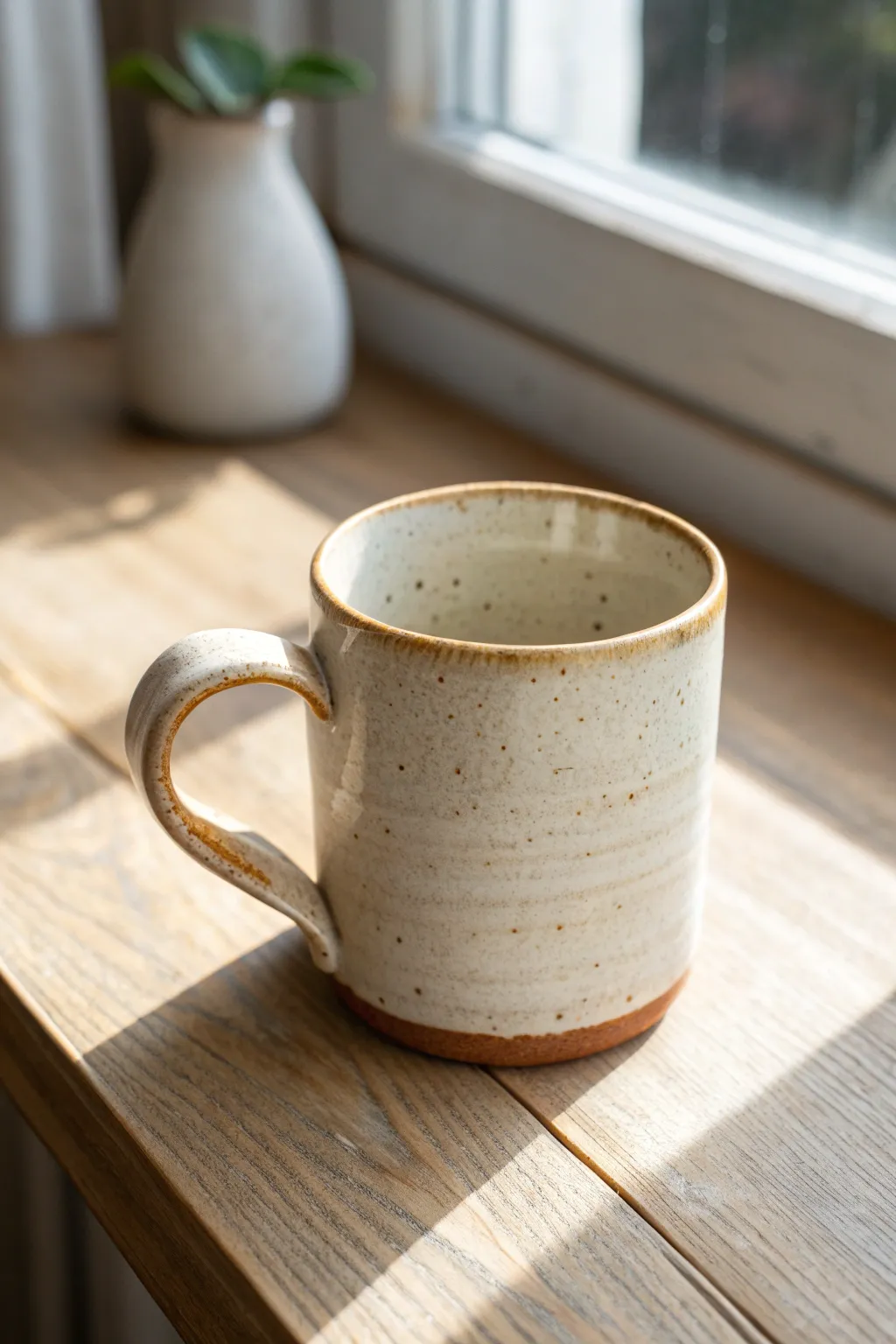
This project features a rustic, speckle-glazed stoneware mug with a distinctive yet simple slab strap handle. The charm lies in the visible throwing lines and the warm, unglazed iron-rich clay band at the bottom that grounds the piece.
Detailed Instructions
Materials
- Speckled stoneware clay (mid-fire)
- Pottery wheel
- Throwing sponge
- Wire cutter
- Needle tool
- Rib tool (wooden or metal)
- Fettling knife
- Serrated rib or scoring tool
- Slip
- Glossy white glaze
- Wax resist (optional)
Step 1: Throwing the Body
-
Center and open:
Begin with about 1 – 1.5 lbs of speckled stoneware clay. Center it firmly on the wheel head and open the clay to create a flat internal floor. -
Pull the cylinder:
Pull the walls up into a cylinder shape. Aim for a height of about 4-5 inches. Don’t worry about making the walls perfectly smooth; leaving subtle finger ridges adds to the handmade aesthetic seen in the photo. -
Refine the rim:
Compress the rim with a chamois or your finger to make it rounded and durable. This prevents chipping later. -
Trim the foot:
Undercut the base slightly with a wooden knife to create a shadow line. Wire the pot off the bat and let it firm up to leather-hard consistency.
Tip: Handle Memory
Drop your clay slab on the table firmly once before cutting. This aligns particle structure and prevents the handle from warping or twisting during the drying process.
Step 2: Creating the Slab Handle
-
Roll the slab:
While the body firms up, roll out a small slab of clay, roughly 1/4 inch thick. You can do this with a rolling pin or by tossing the clay against a canvas board. -
Cut the strap:
Using a fettling knife and a ruler, cut a strip about 3/4 inch wide and 5 inches long. This flat ‘strap’ profile is key to the style. -
Smooth the edges:
Run a damp sponge or your finger along the sharp cut edges of the strap to round them over comfortably. You don’t want sharp angles cutting into your fingers. -
Shape the curve:
Bend the strap into an ear-like ‘C’ shape. I like to let this stiffen up for about 15-20 minutes so it holds its arch better during attachment.
Step 3: Assembly and Finishing
-
Score the attachment points:
Hold the handle up to the mug to gauge placement. Mark the spots, then score the mug surface and the ends of the handle thoroughly with a serrated tool. -
Apply slip:
Dab a generous amount of slip onto the scored areas of both the mug and the handle. -
Attach the handle:
Press the handle firmly onto the mug. Support the wall from the inside with one hand while pressing from the outside to avoid warping the cylinder. -
Reinforce the join:
Use a small modeling tool or your thumb to smooth the clay from the handle onto the mug body, blending the seam so it looks integrated but still distinct. -
Clean up:
Wipe away excess slip with a slightly damp brush. Check the negative space inside the handle; it should be large enough for two or three fingers. -
Dry slowly:
Cover the mug loosely with plastic to ensure the handle and body dry at the same rate. This prevents cracking at the seams.
Fix: S-Cracks
If you see cracks forming at the handle connection while drying, wrap the handle tightly in damp paper towels and bag the whole mug for 24 hours to rehydrate safely.
Step 4: Glazing
-
Bisque fire:
Once bone dry, bisque fire the mug to cone 04 (or your clay body’s recommendation). -
Wax the foot:
Apply wax resist to the bottom 1/2 inch of the exterior wall and the entire bottom. This creates that beautiful raw clay band seen in the image. -
Dip and wipe:
Dip the mug into a glossy white glaze. The iron speckles in the clay will bleed through the white during firing. Wipe any glaze drips off the waxed area immediately. -
Glaze fire:
Fire to the glaze’s maturity temperature (likely Cone 5 or 6). The unglazed section will turn a warm, toasted orange-brown, contrasting beautifully with the speckles.
Enjoy your morning coffee with the satisfaction of holding a handle you shaped yourself




Soft Coil-Built Handle With Gentle Taper
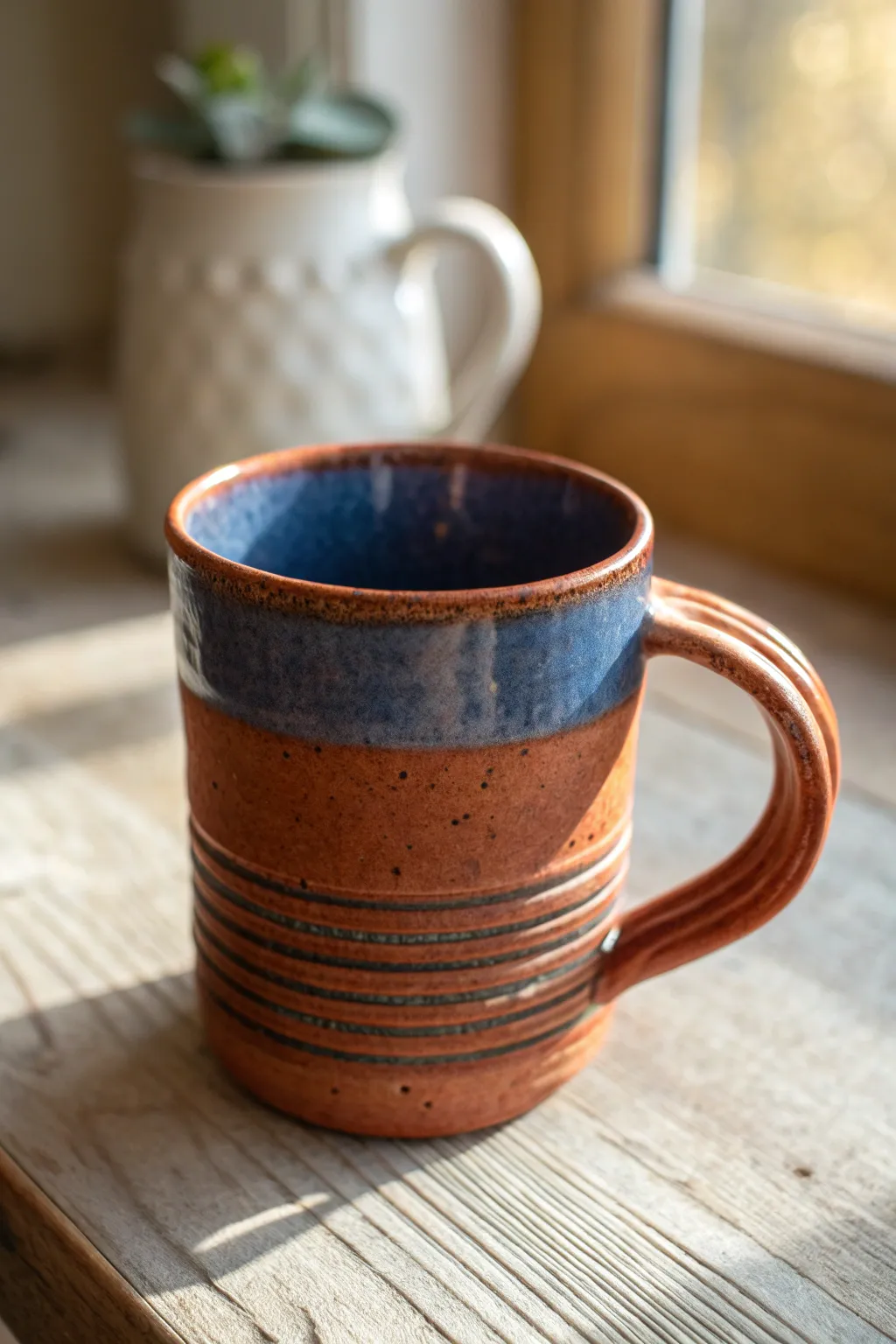
Embrace the rustic charm of this two-toned stoneware mug featuring a distinctive, comfortable handle formed from joined coils. The design pairs a smooth indigo rim with a textured, terracotta base accented by rhythmic carved rings.
How-To Guide
Materials
- Stoneware clay (terracotta or reddish-brown body)
- Pottery wheel (or coil building tools)
- Needle tool
- Rib tool (wooden or silicone)
- Fettling knife
- Sponge
- Water or slip
- Loop tool (for trimming)
- Small carving tool
- Shiny blue glaze
- Clear glaze (optional)
Step 1: Throwing the Cylinder
-
Center and open:
Begin by centering about 1 to 1.5 pounds of clay on your wheel. Open the center and pull up the walls to create a tall, straight cylinder, aiming for an even thickness from bottom to top. -
Shape the profile:
Using a rib tool on the outside, gently belly out the form slightly while keeping the walls relatively vertical. Ensure the rim is compressed and smooth for comfortable drinking. -
Establish the foot:
Use a wooden modeling tool to undercut the base slightly, defining where the foot of the mug will be. Wire the pot off the bat and set it aside until it reaches leather-hard consistency.
Cracking at the Join?
If hairline cracks appear where the handle meets the mug as it dries, wrap the entire piece tightly in plastic for 24 hours. The humidity allows the moisture levels to equalize and the clay to relax.
Step 2: Carving & Trimming
-
Trim the base:
Once leather-hard, center the mug upside down on the wheel. Use a sharp loop tool to trim the bottom, creating a neat foot ring. -
Mark the design area:
While the wheel is spinning slowly, visualize the bottom third of the mug where the horizontal stripes will go. -
Carve grooves:
Using a small carving tool or the edge of a loop tool, press gently into the spinning clay to affect horizontal bands. Create about 6-8 distinct lines, varying the pressure slightly for a handmade feel. -
Smooth the texture:
Run a damp finger or soft sponge lightly over the carved lines to soften any sharp burrs without erasing the texture.
Step 3: Creating the Tapered Handle
-
Roll two coils:
Roll out two even coils of clay about the thickness of a pencil. I like to keep these slightly moist to prevent cracking during bending. -
Join the coils:
Lay the two coils side-by-side and gently press them together so they adhere but still maintain their individual rounded shapes. This creates the double-ridged look. -
Taper the form:
Gently roll one end of the joined pair to slightly taper it, making the bottom attachment point thinner than the top. -
Curve the arch:
Bend the clay into a question-mark shape or ‘ear’ shape, ensuring a generous loop for fingers. -
Score and slip:
Score the attachment points on both the mug body and the handle ends. Apply slip generously to the scored areas. -
Attach the handle:
Press the thicker top end of the handle near the rim and the tapered bottom end near the start of the carved section. Ideally, the bottom of the handle should align with the second or third carved ring. -
Clean connections:
Wipe away excess slip with a damp brush and smooth the connection points so the handle appears to grow naturally out of the mug.
Smooth Sipping
After dipping the blue rim glaze, run a damp finger lightly over the very edge of the lip while the glaze is still powdery. This softens the transition and feels better on the mouth.
Step 4: Glazing & Firing
-
Bisque fire:
Allow the mug to dry completely (bone dry) before loading it into the kiln for a bisque firing. -
Wax resist:
Apply wax resist to the foot ring and slightly up the bottom edge to prevent glaze from running onto the kiln shelf. -
Dip the rim:
Hold the mug by the foot and dip the top third into a glossy blue glaze. Hold it there for 3 seconds, then lift and shake off the last drip. -
Enhance textue:
For the bottom section, wipe a very thin wash of dark oxide or stain into the carved lines, then sponge the surface clean so the color remains only in the recesses. -
Final fire:
Fire the mug to maturity (Cone 5 or 6 depending on your clay). The unglazed clay body will toast to a warm orange-brown, contrasting beautifully with the blue rim.
Enjoy your morning coffee in a mug that perfectly balances smooth cool tones with warm, tactile earthiness

The Complete Guide to Pottery Troubleshooting
Uncover the most common ceramic mistakes—from cracking clay to failed glazes—and learn how to fix them fast.
Comfy Thumb Rest at the Top
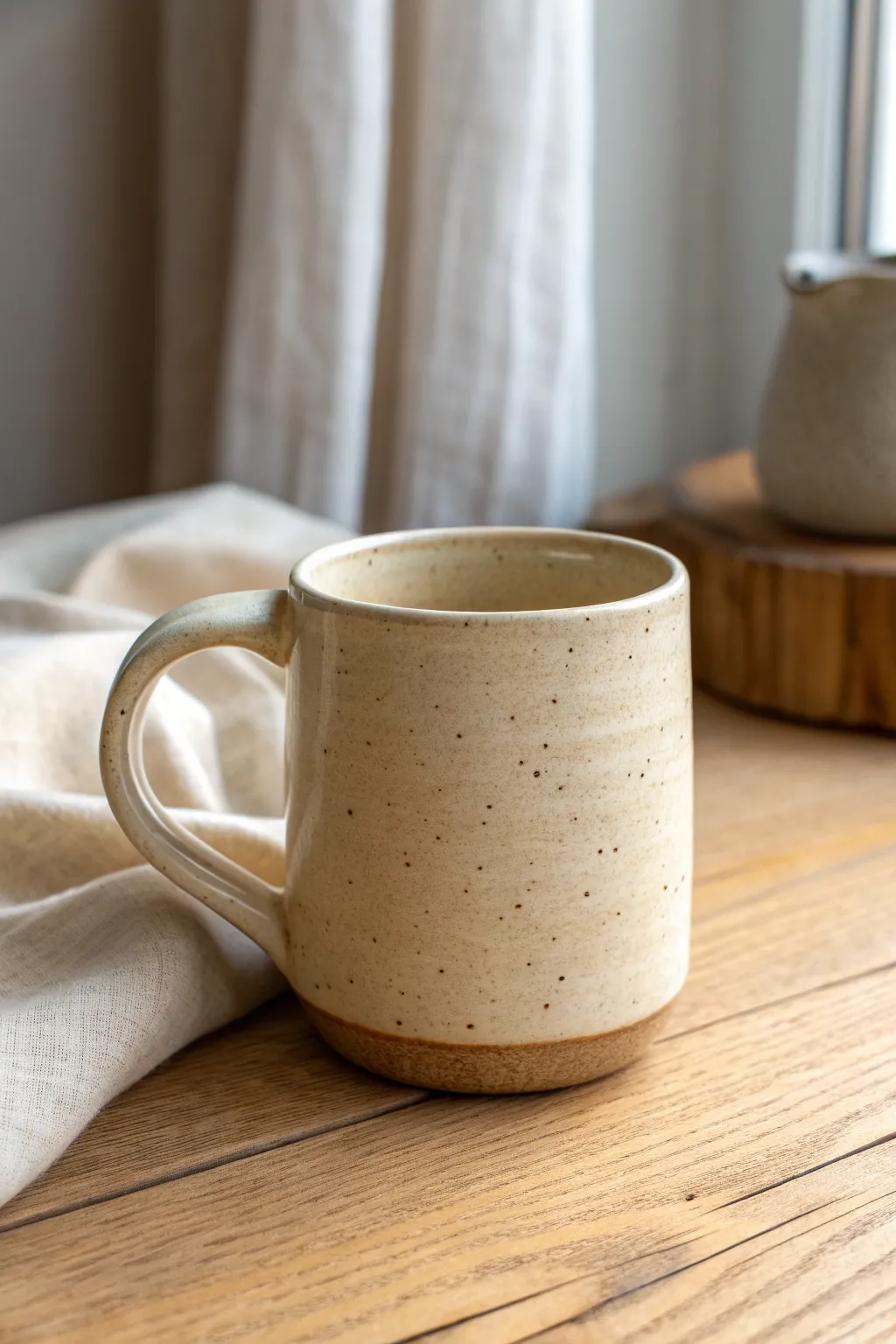
This project features a generously sized, ergonomic mug handle specifically designed with a flat top curve for your thumb to rest comfortably upon. The speckled cream glaze over warm stoneware clay creates a cozy, modern rustic aesthetic that feels great in the hand.
Step-by-Step
Materials
- Speckled stoneware clay (mid-fire)
- Pottery wheel (or slab roller/rolling pin for hand building)
- Clay cutting wire
- Ribs (metal and wooden)
- Needle tool
- Scoring tool (serrated rib or toothbrush)
- Slip (made from the same clay body)
- Sponge
- Fettling knife
- Creamy matte speckled glaze
- Wax resist (optional)
Step 1: Throwing the Mug Body
-
Center and open:
Begin with about 1 – 1.25 lbs of well-wedged speckled stoneware clay. Center it firmly on the wheel head and open the clay to create a flat interior floor, leaving about a 1/4 inch thickness at the bottom. -
Pull the walls:
Pull the walls up into a simple cylinder shape. Aim for a distinct vertical profile with straight sides, rather than a rounded bowl shape, to match the reference image’s modern silhouette. -
Refine the rim:
Compress the rim with a chamois or your sponge to ensure it is smooth and pleasant to drink from. Slight thickening at the very lip adds durability. -
Trim the foot:
Allow the cylinder to dry to leather-hard. Trim the bottom to create a clean, sharp angle where the wall meets the base, exposing the raw clay texture seen in the photo.
Step 2: Sculpting the Handle
-
Pull a strap:
Take a lug of clay and pull a handle strap using plenty of water. Aim for a wide, flattened oval cross-section rather than a perfect circle. This width is crucial for the thumb rest. -
Shape the thumb rest:
While the strap is still malleable but stable, lay it on a board. Gently flatten the very top curve of the ‘question mark’ shape more than the rest to exaggerate the landing pad for the thumb. -
Curve and dry:
Form the strap into a large ear-shaped curve and let it stiffen to a firm leather-hard state. I like to hold it up to the refined mug body to ensure the scale feels generous. -
Cut attachment points:
Using a fettling knife, cut the ends of the handle at an angle that matches the straight vertical walls of your mug.
Finding the sweet spot
Attach the top of the handle about 1/2 inch below the rim. This keeps the center of gravity balanced when the mug is full of liquid.
Step 3: Attachment and Glazing
-
Score the surfaces:
Hold the handle against the mug to mark the attachment spots. Vigorously score both the handle ends and the marked areas on the mug using a serrated rib. -
Apply slip:
Dab a generous amount of slip onto the scored areas. It should be the consistency of thick yogurt. -
Attach firmly:
Press the handle firmly onto the mug body. Wiggle it slightly to lock the clay particles together. -
Reinforce the join:
Use a small coil of soft clay around the attachment points if needed, blending it completely so the transition is seamless. -
Clean connection points:
Wipe away excess slip with a damp sponge, smoothing the area around the handle attachments for a clean look. -
Detailed handle check:
Run your thumb over the top curve one last time. If edges feel sharp, compress them gently with a damp sponge. -
Bisque fire:
Slowly dry the mug under plastic to equalize moisture, then bisque fire to cone 04 (or your clay’s specific bisque temp). -
Wax the base:
Apply wax resist to the bottom half-inch of the mug exterior to create that distinct line between the glaze and the raw clay base. -
Glaze application:
Dip the mug into a cream speckled glaze. Hold it upside down for a few seconds to let excess drips run off. -
Final wipe:
If any glaze dripped onto the waxed raw clay section, sponge it off cleanly to maintain the sharp separation line. -
Focus on the handle:
Check the underside of the handle for glaze drips and smooth them with a finger to prevent sharp spots after firing. -
Glaze fire:
Fire the mug to maturity (Cone 5 or 6 typically for mid-fire stoneware) in an oxidation kiln.
Cracks at the seam?
This usually means the moisture content differed too much. Ensure the mug and handle are the exact same leather-hardness before joining.
Now brew your favorite coffee and enjoy the comfort of your custom-made mug.
Stepped D-Handle for Three-Point Grip
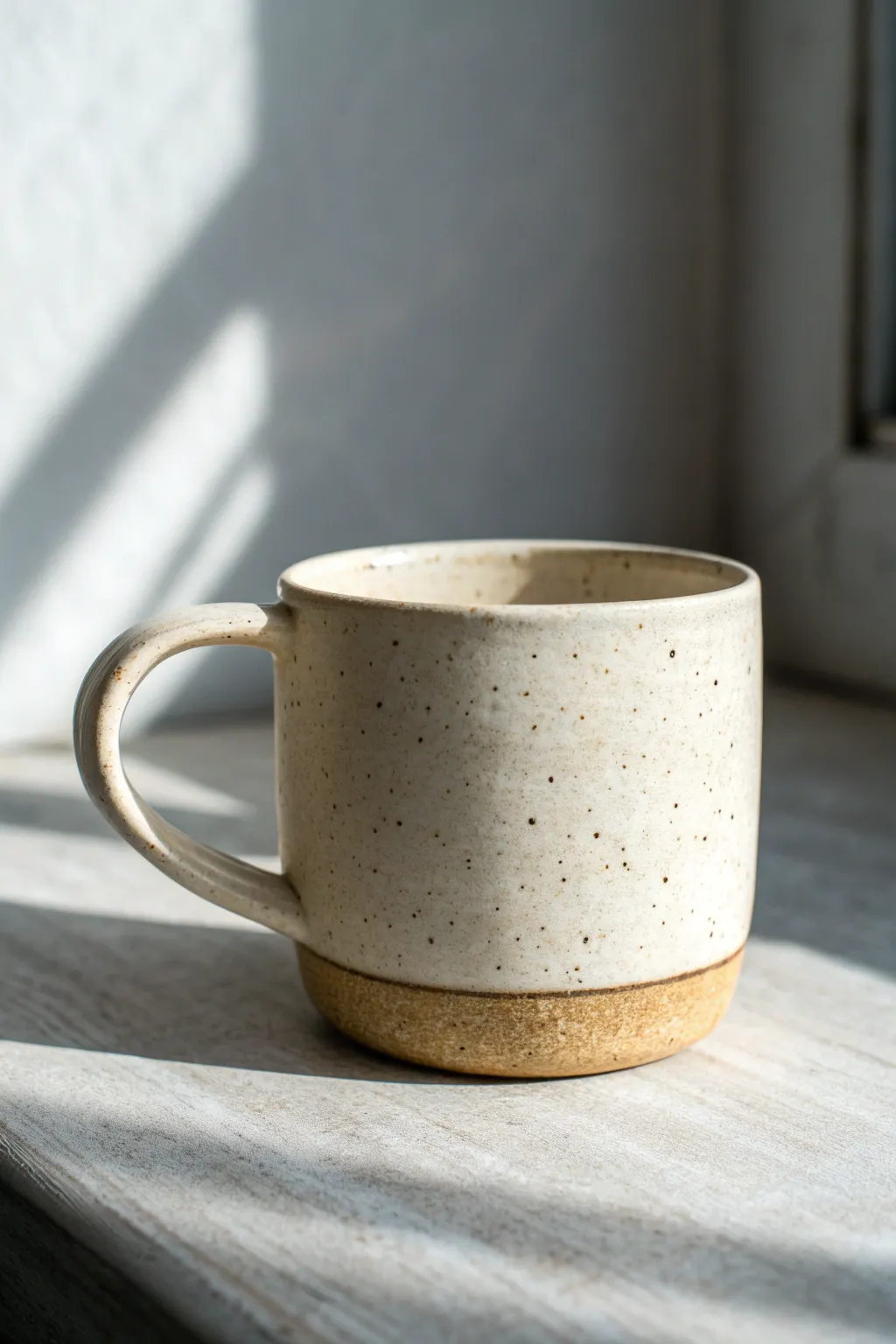
Create a stunning, minimalist mug featuring a comfortable three-point grip handle and a beautiful contrast between raw clay and speckled glaze. This project focuses on throwing a consistent cylinder and attaching a specialized handle designed for balance and ergonomics.
Detailed Instructions
Materials
- Speckled Stoneware Clay (e.g., Laguna Speckled Buff)
- Pottery Wheel
- Throwing Sponge
- Wire Clay Cutter
- Pin Tool
- Wooden Rib
- Metal Rib
- Trimming Tools
- Serrated Rib or Scoring Tool
- Slip (clay and water slurry)
- Small Sponge for smoothing
- Matte White or Cream Speckled Glaze
- Wax Resist (optional)
Step 1: Throwing the Cylinder
-
Center the Clay:
Begin with about 1 – 1.25 lbs of speckled stoneware clay. Center it firmly on the wheel head, ensuring a stable mound before opening. -
Open and Pull:
Open the clay to create the floor, leaving it about 1/4 inch thick. Compress the floor with your sponge, then perform three to four consistent pulls to raise the walls into a straight cylinder. -
Shape the Walls:
Using a wooden rib on the outside against your supporting hand on the inside, gently shape the walls to be perfectly vertical with a slight, almost imperceptible taper inward at the rim. -
Refine the Rim:
Use a chamois or your sponge to compress and round the rim. This makes drinking more comfortable later. -
Define the Foot:
Use a wooden modeling tool to undercut the base slightly, defining where the unglazed section will eventually be. Wire cut the mug from the bat and set it aside to dry to a leather-hard state.
Ergonomic Balance
Attach the handle slightly higher than the midpoint. The weight of the liquid will balance better, making the mug feel lighter in the hand.
Step 2: Creating the Stepped D-Handle
-
Pull a Lug:
While the mug dries, pull a thick strap handle from a fresh lump of clay. You want a profile that is slightly flattened but still rounded on the edges, roughly 3/4 inch wide. -
Curve the Shape:
Curve the pulled strap into a ‘D’ shape and lay it on its side on a ware board. Let it stiffen up until it holds its shape without flopping, matching the leather-hard state of the mug body. -
Trim for Attachment:
Cut the top and bottom of the handle at angles that match the curve of the mug wall. For the ‘stepped’ effect, ensure the top attachment point is significantly thicker and flows downward before curving out. -
Score and Slip:
Hold the handle up to the mug (usually closer to the top rim for balance). Mark the attachment spots, then aggressively score both the handle ends and the mug wall. Apply a generous amount of slip. -
Attach and Smooth:
Press the handle firmly onto the mug. Use a small wooden tool to meld the clay together at the seams, ensuring no air bubbles are trapped. -
Refine the Negative Space:
Use a damp sponge to wipe away excess slip. Pay attention to the negative space inside the handle—it should comfortably fit two or three fingers. -
Final Shaping:
Check the profile. The ‘step’ comes from the way the top attachment moves straight out briefly before curving down, providing a thumb rest. Adjust the curve gently while the clay is still workable.
Handle Cracking?
If the handle cracks at the seam during drying, cover the whole mug tightly in plastic for 2 days to equalize moisture, then repair with vinegar slip.
Step 3: Trimming and Finishing
-
Trim the Foot:
Once the handle is secure and the body is leather hard, center the mug upside down on the wheel (using a checking chuck or clay lugs). Trim the bottom portion to reveal the raw clay texture seen in the photo. -
Create the Glaze Line:
Use a sharp trimming tool to create a distinct line or slight indentation about half an inch up from the bottom. This acts as a physical break for the glaze. -
Bisque Fire:
Allow the mug to dry completely (slowly, under plastic if necessary to prevent handle cracks). Fire to bisque temperature (usually cone 04). -
Wax the Base:
Apply wax resist to the bottom inch of the mug, following the trim line you created. This ensures the raw speckled clay remains visible and unglazed. -
Glaze Application:
Pour a matte cream or white speckled glaze into the mug, swirl to coat the interior, and pour out. Then, dip the exterior straight down into the glaze bucket up to the waxed line. -
Touch Ups:
Sponge off any stray droplets on the raw clay base. Check the rim for any pinholes in the glaze. -
Glaze Fire:
Load the kiln and fire to the maturity temperature of your clay and glaze (typically cone 5 or 6 for stoneware). Let the kiln cool naturally before unloading.
Now brew your favorite coffee and enjoy the tactile pleasure of your handmade aesthetic mug




What Really Happens Inside the Kiln
Learn how time and temperature work together inside the kiln to transform clay into durable ceramic.
Tall Full-Hand Handle for Big Mugs
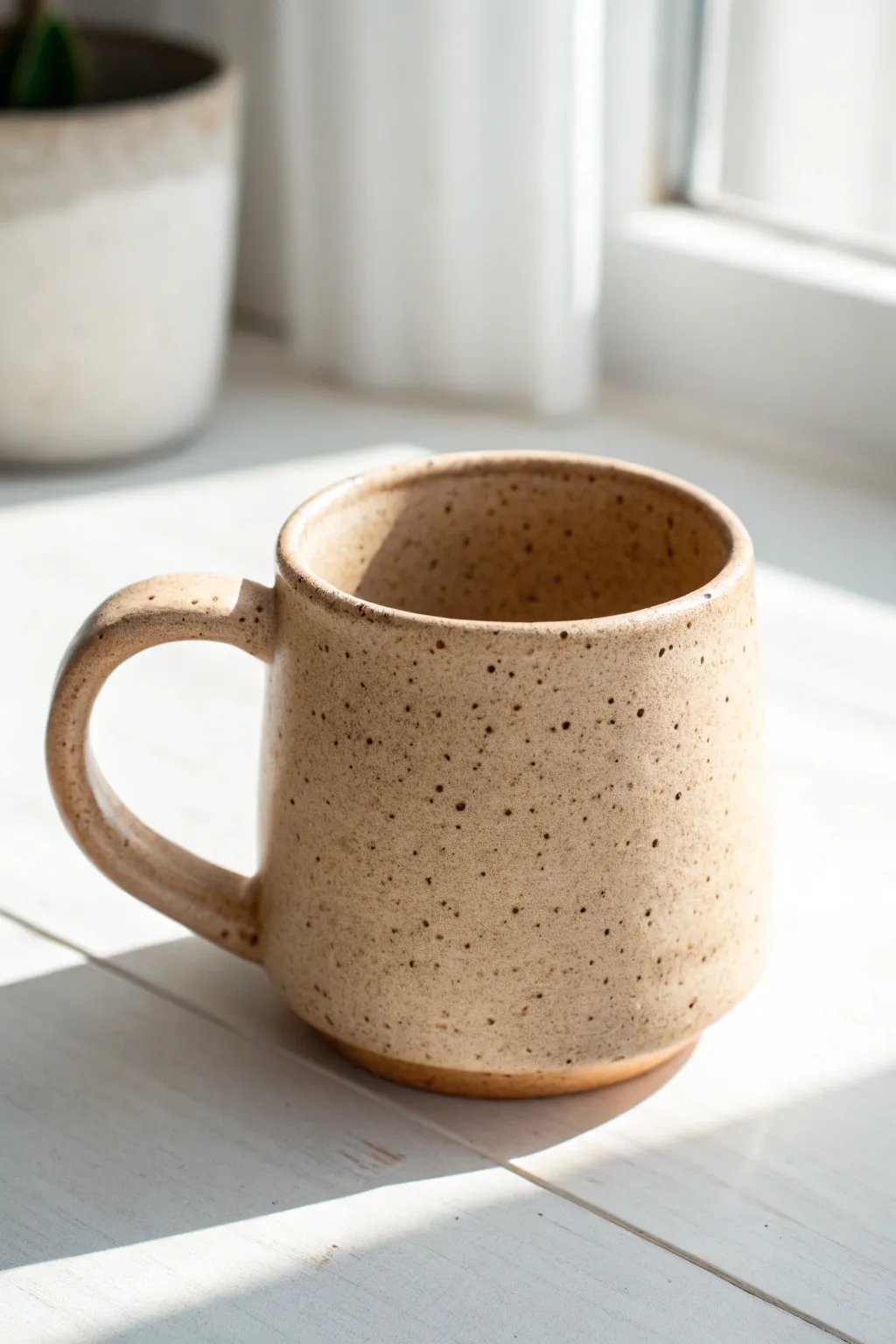
This project features a generously sized, C-shaped handle designed to accommodate a full hand for cozy, two-handed sipping. The finish is a warm, sandy speckled glaze that gives the piece an earthy, organic feel perfect for morning coffee.
Step-by-Step Tutorial
Materials
- Speckled Stoneware Clay (e.g., Laguna Speckled Buff)
- Pottery Wheel
- Throwing Tools (sponge, rib, wire cutter)
- Needle Tool
- Scoring Tool or serrated rib
- Slip (clay mixed with water)
- Wooden Modeling Tool
- Stylus or Fettling Knife
- Clear or Matte White Glaze (to let the speckles show)
- Kiln
Step 1: Throwing and Trimming the Vessel
-
Center and open:
Begin with about 1.5 lbs of speckled stoneware clay. Center it on the wheel and open the form, aiming for a wider base than a standard cylinder to create a tapered, sturdy look. -
Pull the walls:
Pull the walls up to a height of about 4-5 inches. As you pull, gently taper the walls inward slightly towards the rim to keep the heat in your beverage later. -
Shape the profile:
Use a smooth kidney rib to compress the outside walls. Create a straight-sided profile with a very subtle angle, wider at the bottom and slightly narrower at the top. -
Refine the rim:
Chamois or compress the rim to make it rounded and comfortable for drinking. Cut the pot from the bat with a wire tool. -
Leather hard drying:
Allow the mug body to dry to a leather-hard state. It should be firm enough to handle without deforming but still cool to the touch. I usually cover mine loosely with plastic overnight. -
Trim the foot:
Place the mug back on the wheel, center it, and trim the bottom. Create a distinct, slightly angled foot ring at the base as seen in the photo, which adds visual lift.
Preventing Handle Cracks
If hairline cracks appear at the connection points while drying, wrap the handle tightly in damp paper towels and plastic to rehydrate the joint, then compress and smooth the area again.
Step 2: Crafting the Full-Hand Handle
-
Pinch the handle lug:
Take a separate ball of clay and roll it into a thick coil. Flatten it slightly into a strap shape, keeping it thick, about 3/4 inch wide. -
Extrude or pull the strap:
Using water and a pulling motion, lengthen the strap until it is smooth and tapered. You want a consistent thickness of about 1/4 inch throughout the arch. -
Form the ‘C’ curve:
Curve the clay strap into a large, exaggerated ‘ear’ or ‘C’ shape. Lay it on a board to firm up briefly until it holds its arch without sagging. -
Mark attachment points:
Hold the handle up to the mug to gauge placement. The top attachment should be about an inch below the rim, and the bottom attachment near the base, leaving ample negative space for four fingers. -
Score and slip:
Aggressively score the attachment points on both the mug body and the handle ends. Apply a generous amount of slip to both surfaces. -
Attach the handle:
Press the handle firmly onto the mug body. Wiggle it slightly to ensure a strong bond between the clay particles. -
Reinforce the joints:
Use a wooden modeling tool to blend the seams where the handle meets the mug. Smooth the clay so it looks like the handle is growing out of the pot, creating a seamless transition. -
Align vertically:
Check the mug from all angles to ensure the handle is perfectly vertical and not twisting to the left or right.
Step 3: Finishing and Glazing
-
Slow drying:
Loosely cover the entire mug with plastic to let the handle and body dry at the same rate. This prevents cracking at the attachment points. -
Bisque fire:
Once bone dry, fire the piece in a bisque kiln to Cone 04 (or your clay body’s specification). -
Wax the foot:
Apply wax resist to the bottom foot ring and the very bottom edge of the mug to keep the raw clay exposed, creating that lovely contrast. -
Glaze application:
Dip the mug into a transparent or semi-opaque matte glaze. The goal is to allow the natural iron speckles in the clay to bleed through the glaze during firing. -
Glaze firing:
Fire the mug to maturity (likely Cone 5 or 6 depending on your stoneware). Let the kiln cool completely before unloading to avoid thermal shock.
Ergonomic check
Before attaching permanently, hold the handle curve against your hand. It should feel spacious enough that your knuckles don’t touch the potentially hot wall of the mug.
Enjoy the comforting weight of your new handmade mug every morning
Tiny One-Finger Loop for Espresso Mugs
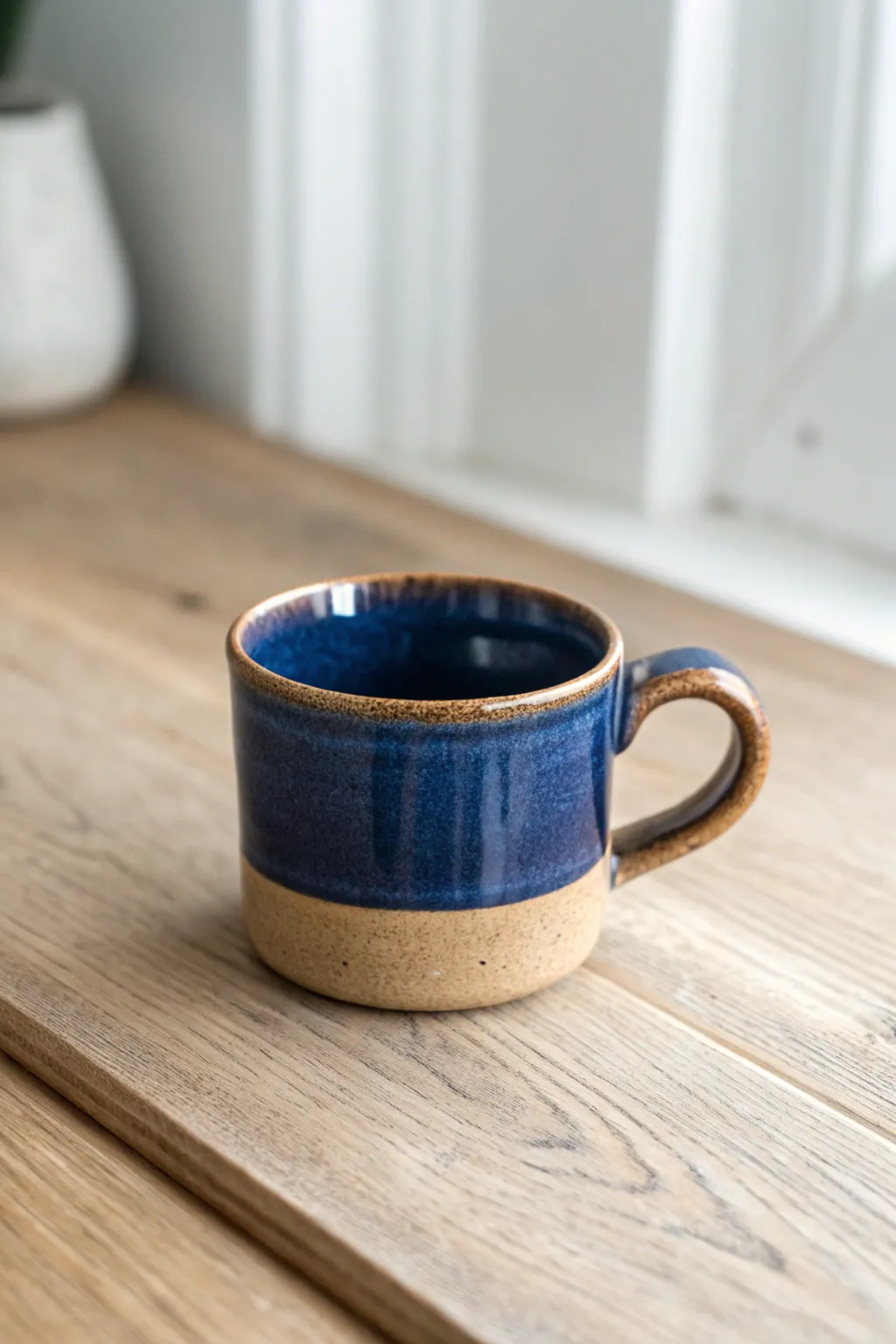
This project features a stout, comforting espresso mug defined by its deep indigo glaze and contrasting raw, speckled clay base. The star of the show consists of the compact, one-finger loop handle that tucks perfectly against the side for a secure grip.
How-To Guide
Materials
- Speckled stoneware clay (mid-fire)
- Pottery wheel
- Throwing tools (sponge, needle tool, rib, wire cutter)
- Trimming tools
- Scoring tool or serrated rib
- Slip (made from the same clay body)
- Deep glossy blue dipping glaze
- Wax resist
- Small sponge or brush for wax
- Kiln
Step 1: Throwing the Body
-
Center the clay:
Start with a small ball of speckled stoneware clay, about 3/4 to 1 pound. Center it firmly on the wheel head, ensuring it’s anchored well before opening. -
Open and pull:
Open the clay and pull up the walls. Aim for a straight, cylindrical shape with a flat bottom, keeping the walls relatively thick to retain heat for espresso. -
Define the rim:
Use a chamois or your sponge to compress and round the rim. A slightly thickened rim feels better on the lips and adds visual weight to match the sturdy handle. -
Shape the profile:
Using a rib on the outside, refine the cylinder so it is vertically straight but with a very subtle outward curve near the bottom for stability. -
Cut and dry:
Wire the mug off the bat and let it dry to a leather-hard state. It needs to be firm enough to handle without warping.
Drooping Handle Loop
If your tiny loop sags, the clay was too wet. Prop the handle up with a small piece of sponge or balled-up paper towel while it dries to leather-hard.
Step 2: Creating the One-Finger Loop
-
Pull a strap:
With a small nugget of clay, pull a short handle strap. Keep it thick and roughly square in cross-section initially, then slightly flatten it. -
Curve the loop:
Curve the strap into a tight ‘ear’ shape. Since this is a one-finger loop, the opening should be just large enough to fit an index finger comfortably. -
Trim to size:
Cut the attachment points at an angle that matches the curve of your mug wall. Let the handle stiffen slightly so it holds its curve. -
Score and slip:
Score the attachment sites on the mug and the ends of the handle deeply. Apply a generous amount of slip to both surfaces. -
Attach the handle:
Press the handle firmly onto the mug. The top of the loop should sit just below the rim, and the bottom should attach near the midpoint of the wall. -
Blend the seams:
I like to use a small wooden tool to smudge the clay from the handle onto the mug body, ensuring a seamless, strong connection. -
Clean and refine:
Smooth out the attachment points with a damp sponge. Run a wet finger along the inside of the handle loop to ensure it is perfectly smooth for the user.
Step 3: Glazing and Finishing
-
Bisque fire:
Once bone dry, load the mug into the kiln for a bisque firing according to your clay body’s specifications. -
Wax resist application:
This is crucial for the two-tone look. Apply wax resist to the bottom third of the mug’s exterior and the entire underside. Create a clean, straight line where the glaze will stop. -
Clean the transition:
If your wax line is shaky, use a fettling knife to carefully scrape away excess wax to create a sharp horizon line. -
Dip the glaze:
Holding the mug by the foot (or using dipping tongs if preferred), submerge the mug into the deep blue glaze, stopping exactly at the wax line. -
Dip the interior:
Pour glaze inside the mug and pour it out quickly, or dip the rim to ensure the interior is fully coated. -
Wipe back:
Use a damp sponge to wipe any glaze droplets off the waxed bottom section. The raw clay needs to be completely clean to show off the speckles. -
Glaze fire:
Fire the mug to maturity (likely Cone 5 or 6). The heat will melt the glaze into that deep, glossy finish while toasting the raw clay to a sandy beige.
Pro Tip: Comfort Test
Before the clay fully dries, hold the mug as if drinking. The ‘one-finger’ loop requires the middle finger to rest against the wall for support, so smooth that contact point.
Enjoy your morning espresso with the tactile texture of raw clay against your palm

TRACK YOUR CERAMIC JOURNEY
Capture glaze tests, firing details, and creative progress—all in one simple printable. Make your projects easier to repeat and improve.
Low-Profile Lug Handle Pinch Grip
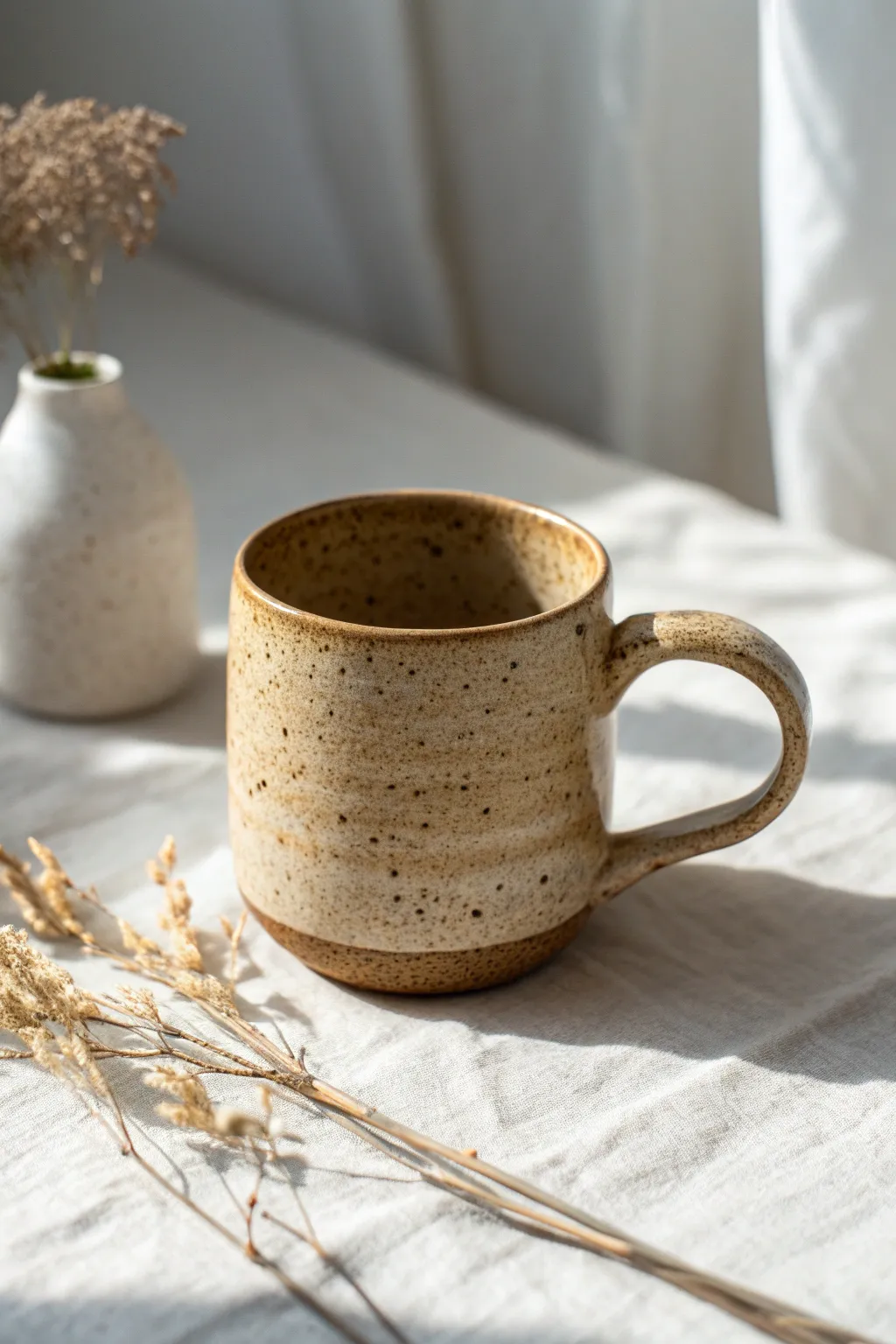
This project guides you through creating a classic, earthy mug featuring a comfortable, low-profile lug handle that invites a cozy pinch grip. The speckled finish and raw clay base give it a beautifully grounded, rustic aesthetic perfect for your morning coffee ritual.
Step-by-Step
Materials
- Speckled stoneware clay (mid-fire)
- Pottery wheel
- Throwing tools (sponge, rib, wire cutter)
- Trimming tools
- Fettling knife
- Serrated rib or scoring tool
- Slip
- Sponge
- Clear or transparent matte glaze
Step 1: Throwing the Body
-
Center the clay:
Start with about 1 to 1.5 lbs of speckled stoneware clay. Center it firmly on the wheel head, ensuring a focused base before opening. -
Open and pull walls:
Open the clay to create a flat inside bottom. Begin pulling the walls upward, aiming for a straight cylinder shape initially to ensure even thickness. -
Shape the belly:
Using a rib on the inside and gentle pressure on the outside, push the walls outward slightly to create a very subtle curve, wider at the base and slightly tapering in at the rim. -
Refine the rim:
Compress the rim with a chamois or your finger to ensure it’s smooth and pleasant for drinking. -
Create the texture:
While the wheel is spinning slowly, hold a throwing sponge against the exterior to smooth it, but leave slight finger ridges near the bottom third if you want that subtle hand-thrown character. -
Wire off:
Cut the mug from the bat using a wire tool and set it aside until it reaches leather-hard consistency.
Step 2: Trimming and Handle Making
-
Trim the foot:
Once leather hard, center the mug upside down on the wheel. Trim the excess clay from the bottom, creating a clean, defined foot ring that separates the glazed body from the unglazed base. -
Form the lug handle coil:
Roll a thick coil of clay, roughly the thickness of your thumb. It should be substantial enough to grip but not overly heavy. -
Shape the lug curve:
Curve the coil into a ‘C’ shape. For this specific low-profile style, the top attachment point should flow directly horizontally from the rim, while the bottom curves back into the body just below the midpoint. -
Refine the handle profile:
Flatten the coil slightly to create an oval cross-section. This feels much better in the hand than a perfectly round coil. -
Cut to size:
Using a fettling knife, cut the ends of the handle at an angle that matches the curve of your mug’s wall.
Pro Tip: Handle Comfort
Before attaching, hold the handle in your hand as if drinking. If the curve feels tight, widen the loop slightly to accommodate a ‘pinch grip’ comfortably.
Step 3: Attachment and Finishing
-
Score the surfaces:
Hold the handle up to the mug to check the fit. Mark the attachment points, then thoroughly score both the handle ends and the mug body where they will join. -
Apply slip:
Dab a generous amount of slip onto the scored areas. -
Attach the handle:
Press the handle firmly onto the mug. I like to wiggle it slightly to ensure a solid bond between the clay bodies. -
Blend the seams:
Use a small wooden tool or your thumb to drag clay from the handle onto the mug body, blending the seam until it’s seamless and strong. -
Smooth the transition:
Take a damp sponge and wipe around the attachment points to remove excess slip and refine the shape. -
Dry slowly:
Cover the mug loosely with plastic to let it dry slowly. This prevents the handle from drying faster than the body, which causes cracks. -
Bisque fire:
Once bone dry, bisque fire the mug to cone 04 (or your clay’s specific bisque temperature). -
Glaze application:
Dip the mug into a clear or transparent matte glaze. Be careful to stop just above the foot ring, leaving that bottom section of raw speckled clay exposed as seen in the photo. -
Final firing:
Glaze fire the piece to maturity (likely cone 5 or 6 depending on your stoneware).
Troubleshooting: Cracking
If hairline cracks appear at the handle join during drying, wrap the handle in damp paper towel and plastic to rehydrate the seam, then compress it again.
Once fired, fill your new handmade mug with a warm drink and enjoy the tactile comfort of your craftsmanship
Bold Ring Handle Statement
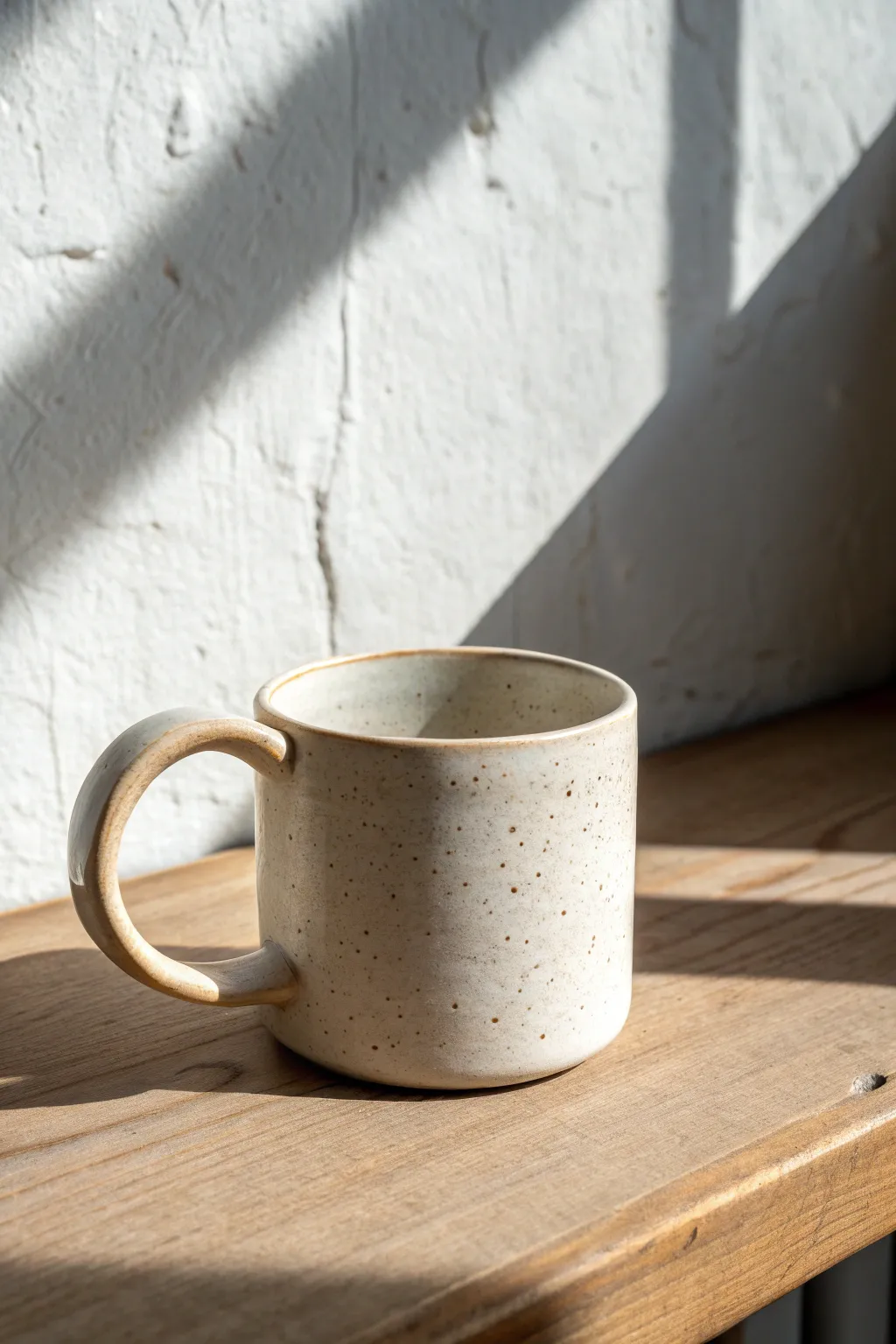
Embrace simplicity with this speckled cream stoneware mug featuring a bold, half-ring handle that is as comfortable as it is striking. The clean cylindrical form allows the subtle iron speckles and the distinctive handle shape to take center stage.
How-To Guide
Materials
- Speckled stoneware clay (white or cream)
- Pottery wheel
- Throwing tools (sponge, wire cutter, rib)
- Needle tool
- Scoring tool
- Slip
- Pulling bucket with water
- Clear or satin white glaze
Step 1: Throwing the Cylinder
-
Prepare the Clay:
Wedge about 1lb to 1.5lbs of speckled stoneware clay thoroughly to remove air bubbles. This clay body is essential for achieving that natural, spotted finish. -
Center and Open:
Center the clay on the wheel head. Open up the center, ensuring you leave a flat bottom about a quarter-inch thick. -
Pull the Walls:
Pull up the walls to form a straight cylinder. Aim for vertical sides rather than a tapered or bellied shape to match the modern aesthetic of the reference photo. -
Refine the Shape:
Use a metal or wooden rib to smooth the exterior, removing throwing lines to create a clean canvas for the speckles. Ensure the rim is slightly rounded and comfortable for drinking. -
Wire Off:
Cut the mug from the wheel using your wire tool and set it aside to stiffen to a leather-hard state.
Handle sagging?
If the ring loses its shape while drying, prop it up with a small piece of foam or a crumpled paper towel underneath the curve until it stiffens.
Step 2: Creating the Handle
-
Prepare a Coil:
Roll out a thick coil of clay, roughly the thickness of your thumb. I find it helpful to taper the ends slightly. -
Pull the Handle:
Using plenty of water, pull the handle in a traditional manner to align the clay particles, but keep the profile round rather than flat. You want a sturdy, circular cross-section. -
Shape the Curve:
Curve the pulled coil into a tight ‘C’ or half-circle shape. Lay it on a board to stiffen until it holds its curve without sagging. -
Trim to Size:
Once leather hard, cut the handle ends at an angle to match the curve of the mug wall. Hold it up to the mug to test the fit; the handle should protrude significantly, creating that bold silhouette.
Clean Transitions
After attaching the handle, use a tiny damp paintbrush to smooth the very inner crease of the join. This removes excess slip and ensures a professional look.
Step 3: Assembly and Finishing
-
Score the Attachment Points:
Mark where the handle will attach to the mug body. Score both the mug surface and the handle ends aggressively with a serrated tool. -
Apply Slip:
Dab a generous amount of slip onto the scored areas. This acts as the glue for your joint. -
Attach the Handle:
Press the handle firmly onto the mug. Wiggle it slightly to lock the clay particles together. -
Reinforce and smooth:
Use a modeling tool or your finger to smooth the seam where the handle meets the mug. You want a seamless transition that looks like the handle grew out of the wall. -
Bisque Fire:
Allow the mug to dry slowly to prevent handle cracks. Once bone dry, bisque fire it to roughly Cone 04. -
Glaze Application:
Dip the entire mug into a clear or semi-opaque satin white glaze. Wipe the foot clean. -
Final Fire:
Glaze fire to the temperature appropriate for your clay body (usually Cone 5, 6, or 10) to bring out the iron speckles through the glaze.
Enjoy your morning coffee in a mug that perfectly balances modern design with rustic texture
Hollow Thimble-Style Handle
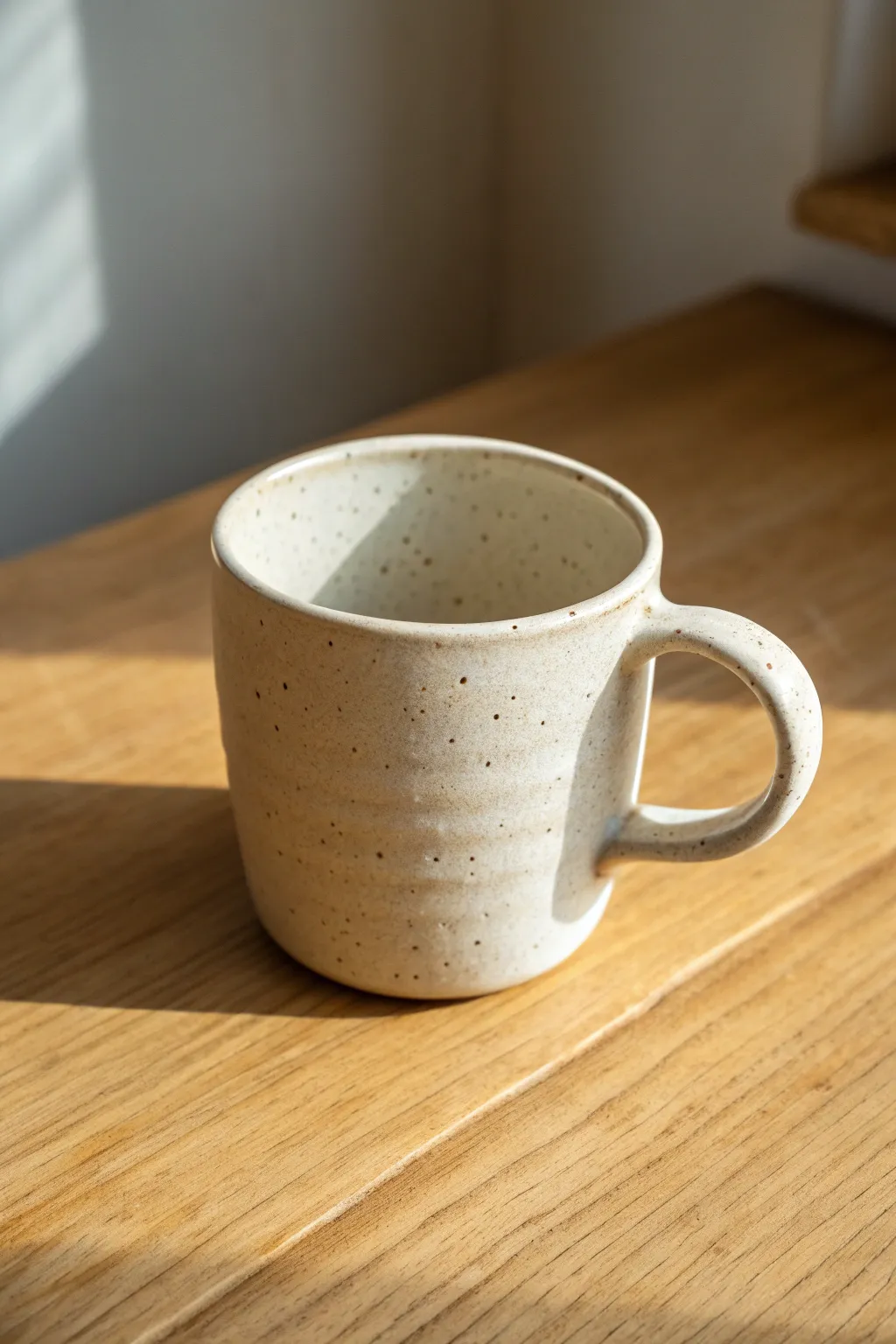
Recreate the rustic charm of this pottery studio staple with a technique that emphasizes tactile comfort and visual simplicity. This project features a lightly ridged, speckled clay body paired with a hollow, thimble-style handle that feels substantial yet lightweight in the hand.
Step-by-Step
Materials
- Speckled stoneware clay (mid-fire)
- Pottery wheel
- Throwing tools (sponge, rib, wire cutter)
- Needle tool
- Fettling knife
- Scoring tool (serrated rib or needle)
- Slip
- Wooden dowel (3/4 inch diameter) or handle extruder
- Clear or matte white glaze
- Loop tool for trimming
Step 1: Throwing the Cylinder
-
Center the clay:
Start with about 1 pound of speckled stoneware clay. Wedge it thoroughly to remove air pockets, then slam it onto your wheel head. Center the clay using firm pressure and water until it spins without wobbling. -
Open the form:
Press your thumbs into the center of the mound to open it, leaving about a quarter-inch of clay at the bottom for the foot. Pull the floor out to your desired width—aim for standard mug diameter. -
Pull the walls:
Using a sponge and your fingertips, pull the walls upward. Keep the pressure consistent to ensure even thickness, but don’t worry about smoothing the outside perfectly just yet. -
Create the throwing ridges:
Instead of using a metal rib to smooth the exterior, leave the subtle horizontal finger trails as you pull up. If they are too faint, gently press the corner of a wooden rib against the spinning pot to accentuate these horizontal lines. -
Refine the rim:
Compress the rim with a chamois or your sponge to round it off, making sure it’s pleasant to drink from. Use a wire cutter to slice under the pot and set it aside to stiffen to leather-hard.
Don’t Forget the Vent
Crucial Step: Always poke a pin-sized hole in a hollow handle before firing! Trapped air expands in the kiln and will cause the handle to burst without an escape route.
Step 2: Creating the Hollow Handle
-
Roll a coil:
While the body firms up, roll out a thick coil of fresh clay. It should be slightly thicker than you want your final handle to be. -
Hollow the coil:
Carefully insert a slightly greased wooden dowel into the center of the coil. Roll the clay gently against a table with the dowel inside to thin the walls and expand the diameter, creating a tube. -
Shape the thimble:
Slide the clay tube off the dowel. Gently bend it into a ‘C’ or ear shape. The hollow structure makes this handle lighter than a solid pulled handle while looking robust. -
Seal the ends:
Since we are aiming for a seamless look, pinch the ends of the hollow tube closed so no air is trapped inside the attachment points, or plug them with small bits of clay.
Step 3: Assembly and Finishing
-
Trim the base:
Once the mug body is leather-hard, center it upside down on the wheel. Use a loop tool to trim away excess weight from the bottom and define a clean foot ring. -
Cut handle angles:
Use a fettling knife to cut the ends of your hollow handle at an angle that matches the curve of your mug wall. Hold it up to the mug to check the fit. -
Score the attachment points:
Mark where the handle will attach on the mug body. Use a serrated rib or needle tool to scratch up (score) both the mug surface and the handle ends aggressively. -
Apply slip:
Dab a generous amount of slip (liquid clay) onto the scored areas. This acts as the glue for your join. -
Attach the handle:
Press the handle firmly onto the mug body. Wiggle it slightly to ensure a strong bond. The slip should ooze out slightly around the seam. -
Clean the seams:
Use a small, damp brush or a sculpting tool to wipe away excess slip and smooth the transition between the handle and the mug. I find a soft paintbrush works best here to avoid marring the surface. -
Poke a vent hole:
Because the handle is hollow and sealed, you must use a needle tool to poke a tiny, inconspicuous hole (perhaps under the handle curve) to let expanding air escape during firing so it doesn’t explode. -
Bisque fire:
Let the mug dry slowly under plastic to prevent cracking. Once bone dry, bisque fire it to cone 04. -
Glaze application:
Dip the mug into a semi-opaque white or cream glaze. The iron speckles in the clay will bleed through the glaze during the final firing, creating that signature spotted look. -
Final firing:
Glaze fire the piece to the maturity temperature of your clay (usually cone 6 for stoneware). Allow the kiln to cool completely before unloading.
Expose the Speckles
If your glaze is too thick, potential speckles might get hidden. Wipe the rim with a damp sponge after glazing to thin the application slightly and let more clay character show through.
Now brew your favorite coffee and enjoy the warmth of your handmade speckled mug
Ribbon Loop With a Twist
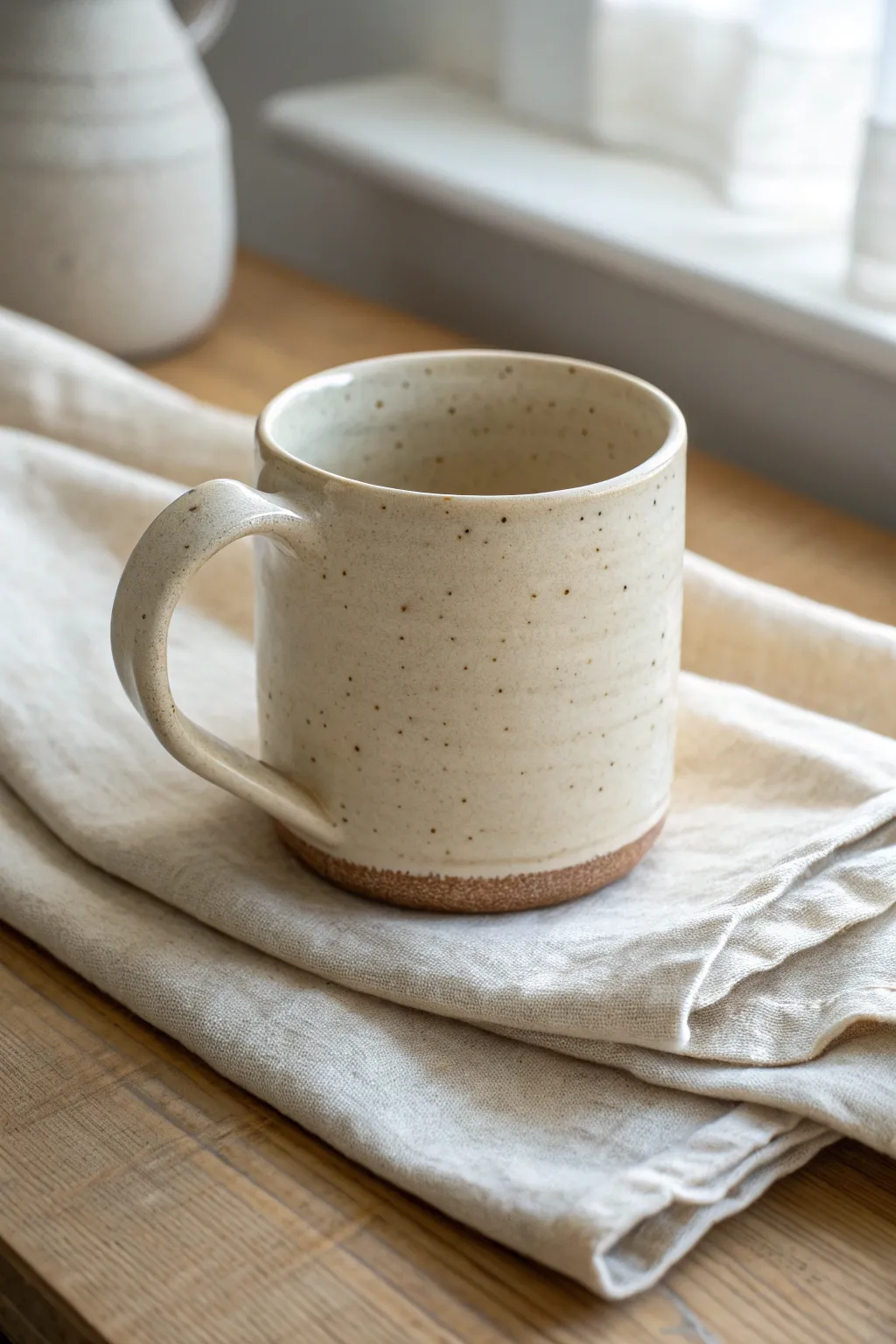
This project features a beautifully minimalist mug that highlights the natural texture of speckled stoneware. The focal point is a comfortable, pulled-style ribbon handle that arcs gracefully from the rim to the base, offering a timeless handmade aesthetic.
Step-by-Step Tutorial
Materials
- Speckled stoneware clay (mid-fire)
- Pottery wheel
- Throwing tools (sponge, needle tool, rib, wire cutter)
- Trimming tools
- Serrated rib or scoring tool
- Slip
- Bucket of water
- Creamy white matte glaze
- Wax resist (for the bottom)
- Kiln
Step 1: Throwing the Cylinder
-
Prepare the Clay:
Wedge about 1 pound of speckled stoneware clay thoroughly to remove air bubbles. This clay body is essential for achieving the spotted look shown in the final piece. -
Center on the Wheel:
Slap the clay onto the wheel head and center it using steady pressure and water. Ensure it runs true before opening. -
Open the Form:
Press your thumbs into the center to open the clay, leaving about a 1/4 inch thickness for the floor. Pull the base out to your desired width—this mug has a sturdy, flat bottom. -
Pull the Walls:
Begin pulling the walls upward. Aim for a straight, vertical cylinder. This design relies on simple lines, so try to keep the walls uniform from bottom to top. -
Shape the Profile:
Using a metal or wooden rib, compress the outside wall to remove throwing lines for a smoother surface, though leaving a faint spiral adds character. Slight finger pressure from the inside helps create a very subtle curve. -
Refine the Rim:
Use a chamois or a wet sponge to round off the rim. A smooth drinking edge is crucial for a functional mug.
Pulling Pro-Tip
When pulling the handle strap, use your thumb to create a subtle central groove. This ‘spine’ adds strength and guides the glaze to break beautifully over the edges.
Step 2: Trimming and Handle Prep
-
Leather Hard Stage:
Allow the cylinder to dry to a leather-hard state. It should be firm enough to handle without deforming but soft enough to carve. -
Trim the Foot:
Invert the mug on the wheel and trim the excess clay from the bottom. Create a distinct separation line where the glaze will stop, leaving the raw clay exposed at the base. -
Pull a Strap:
Take a separate lug of clay and wet your hand. Pull a long strap of clay directly from the lump, using plenty of water to create a tapered, ribbon-like strip. It should be wider at the top and slightly narrower at the bottom. -
Shape the Curve:
Cut the strap free and lay it on a board to set up slightly. I usually curve it gently while it rests so it begins to take on the arch shape, preventing cracking later.
Glaze Drip Fix
If glaze runs onto the raw clay foot, scrape it off with a fettling knife before firing. Sponge the area clean to prevent it from sticking to the kiln shelf.
Step 3: Attaching the Handle
-
Score the Attachment Points:
Hold the handle up to the mug to gauge placement. Score the mug surface heavily where the top and bottom of the handle will attach. -
Add Slip:
Apply a generous amount of slip to the scored areas on both the mug and the handle ends. -
Secure the Top:
Press the top of the handle firmly against the mug wall, just below the rim. Blend the clay downwards into the body of the mug for a seamless transition. -
Form the Loop:
Pull the handle strap gently downward to create a pleasing ‘ear’ or loop shape. Ensure there is enough room for fingers to fit comfortably. -
Attach the Bottom:
Press the bottom of the handle onto the lower attachment point. Unlike the top step, you can leave this connection slightly more defined rather than fully blended, or smudge it just enough to stick. -
Clean Up:
Wipe away any excess slip with a damp sponge or brush. Run a wet finger along the edges of the handle specifically to smooth any sharp angles.
Step 4: Glazing and Firing
-
Bisque Fire:
Once bone dry, fire the mug in the kiln to bisque temperature (usually cone 04 or 06). -
Wax Resist:
Paint wax resist along the bottom edge of the mug, covering the trimmed foot area. This ensures the raw speckled clay remains visible and unglazed. -
Dip Glaze:
Dip the mug into a creamy white matte glaze. Hold it for 3-5 seconds to get an even coat. The speckles from the clay will bleed through this lighter glaze during firing. -
Final Fire:
Fire the mug to maturity (Cone 5 or 6 depending on your clay body). Let the kiln cool completely before unloading.
Now you have a stunning, cozy mug ready for your morning coffee routine
Elegant Scroll-End Handle Attachments
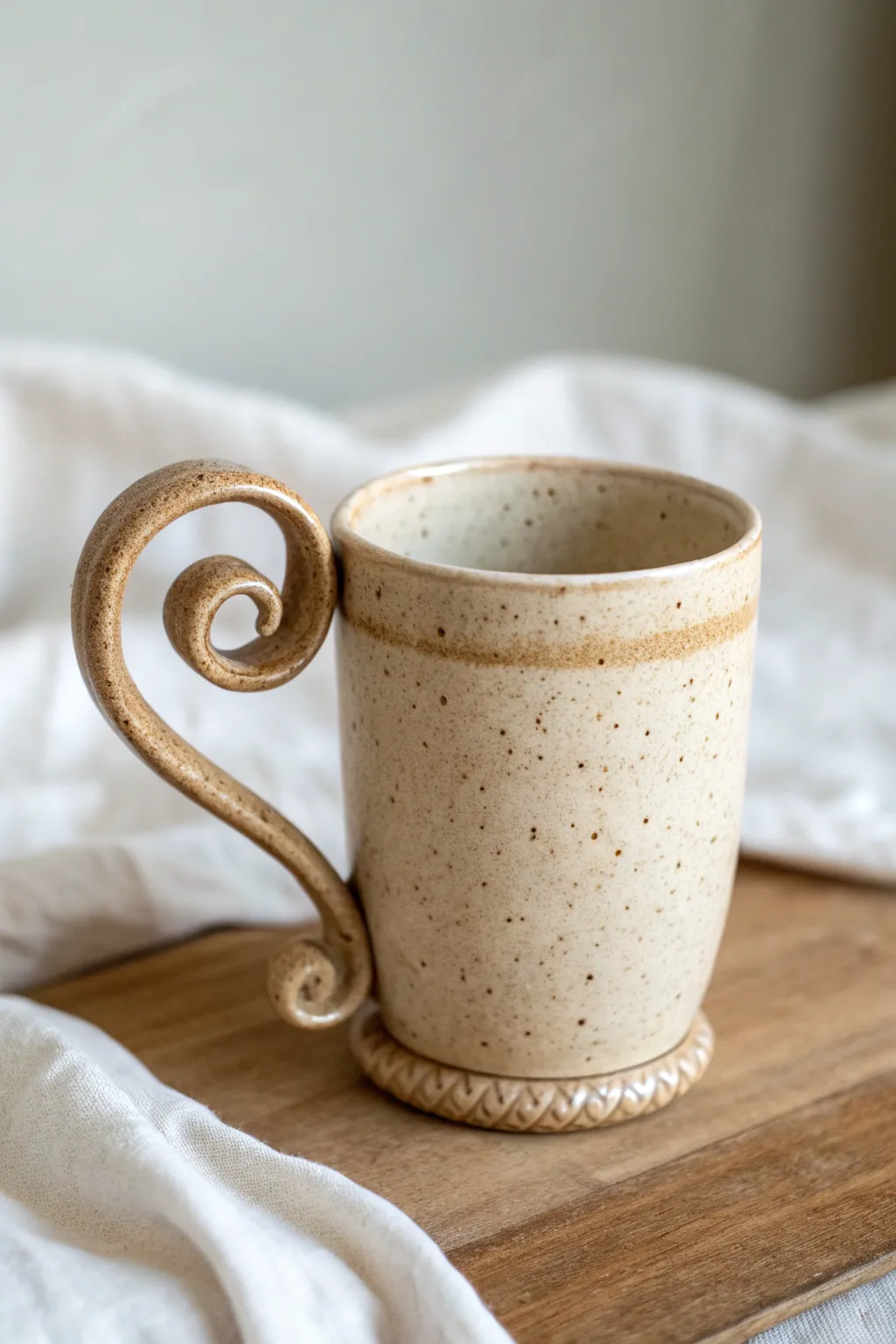
This project combines a classic cylindrical form with a whimsical, S-curve scroll handle that looks like it curled right out of a fairytale. The speckled cream glaze and braided base add rustic elegance, making it a perfect cozy addition to your cupboard.
Detailed Instructions
Materials
- Speckled buff stoneware clay
- Rolling pin
- Canvas work surface
- Pottery knife or fettling knife
- Serrated rib tool
- Slip (clay slurry)
- Wooden modeling tool
- Sponge
- Translucent cream or oatmeal glaze
Step 1: Forming the Mug Body
-
Roll the slab:
Begin by rolling out a slab of speckled stoneware clay to an even thickness of about 1/4 inch. Smooth out any canvas texture with a rib. -
Cut the rectangle:
Cut a rectangle roughly 10 inches long by 4 inches tall (adjust based on your shrinkage rate and desired mug size). -
Bevel the edges:
Bevel the short sides of the rectangle at 45-degree angles in opposite directions to create a seamless overlap. -
Form the cylinder:
Score the beveled edges and apply slip. Bring the ends together to form a tube, pressing the seam firmly. I find using a wooden tool on the inside seam helps compress the join perfectly. -
Add the floor:
Place the cylinder on a fresh piece of clay slab. Trace around the bottom, cut out the circle, and attach it by scoring and slipping. Smooth the connection.
Cracked Handle?
Scroll handles are prone to cracking due to tension. To prevent this, wrap the handle in wax resist immediately after attaching it, forcing it to dry slower than the mug body.
Step 2: Creating the Braided Base
-
Roll thin coils:
Roll out two very thin, long coils of clay about the thickness of a shoelace. -
Twist the coils:
Gently twist the two coils together to create a tight rope pattern. -
Attach the braid:
Score the bottom outer edge of your mug. Brush on slip, then wrap the twisted rope around the base. Trim the excess and meld the ends together seamlessly.
Step 3: Crafting the Scroll Handle
-
Pull a tapered coil:
Instead of a slab strip, roll a thick coil that tapers slightly toward one end. Briefly pull it like a traditional handle to align the clay particles, keeping it round in cross-section. -
Form the large top scroll:
Take the thicker end of the coil and curl it tightly inward to create the top spiral. This will be the main attachment point. -
Shape the S-curve:
Bend the rest of the clay down and back out to form a graceful ‘S’ shape. -
Create the bottom scroll:
Curl the thinner, bottom tail into a very small, tight spiral facing the opposite direction of the top scroll. -
Dry to leather hard:
Let the handle stiffen up significantly on a board. If you attach it while soft, gravity will ruin the delicate curves.
Make it a Set
Use the same ‘twisted rope’ technique from the base to add a decorative ring around the rim of the mug, or apply a thin oxide wash to the scrolls before glazing to highlight the spiral.
Step 4: Assembly and Glazing
-
Score attachment points:
Hold the handle up to the mug to mark where the scrolls touch. Thoroughly score these spots on the mug body and the back of the scrolls. -
Attach the handle:
Apply slip generously. Press the scroll handle firmly onto the mug. Use a modeling tool to blend just the hidden underside of the attachment points so the scrolls look like they are merely resting on the surface. -
Clean up:
Wipe away excess slip with a damp sponge and smooth the lip of the mug. -
Bisque fire:
Slowly dry the mug under loose plastic to prevent handle cracking, then bisque fire to cone 04. -
Glaze application:
Dip or brush your translucent cream glaze over the entire piece. The speckles in the clay will show through beautifully. -
Final firing:
Glaze fire to cone 5/6 (or your clay’s specific temperature). The glaze should break slightly brown over the texture of the braid and handle curves.
Enjoy the tactile comfort of your new scroll handle mug with your morning coffee
Textured Handle That Matches the Mug
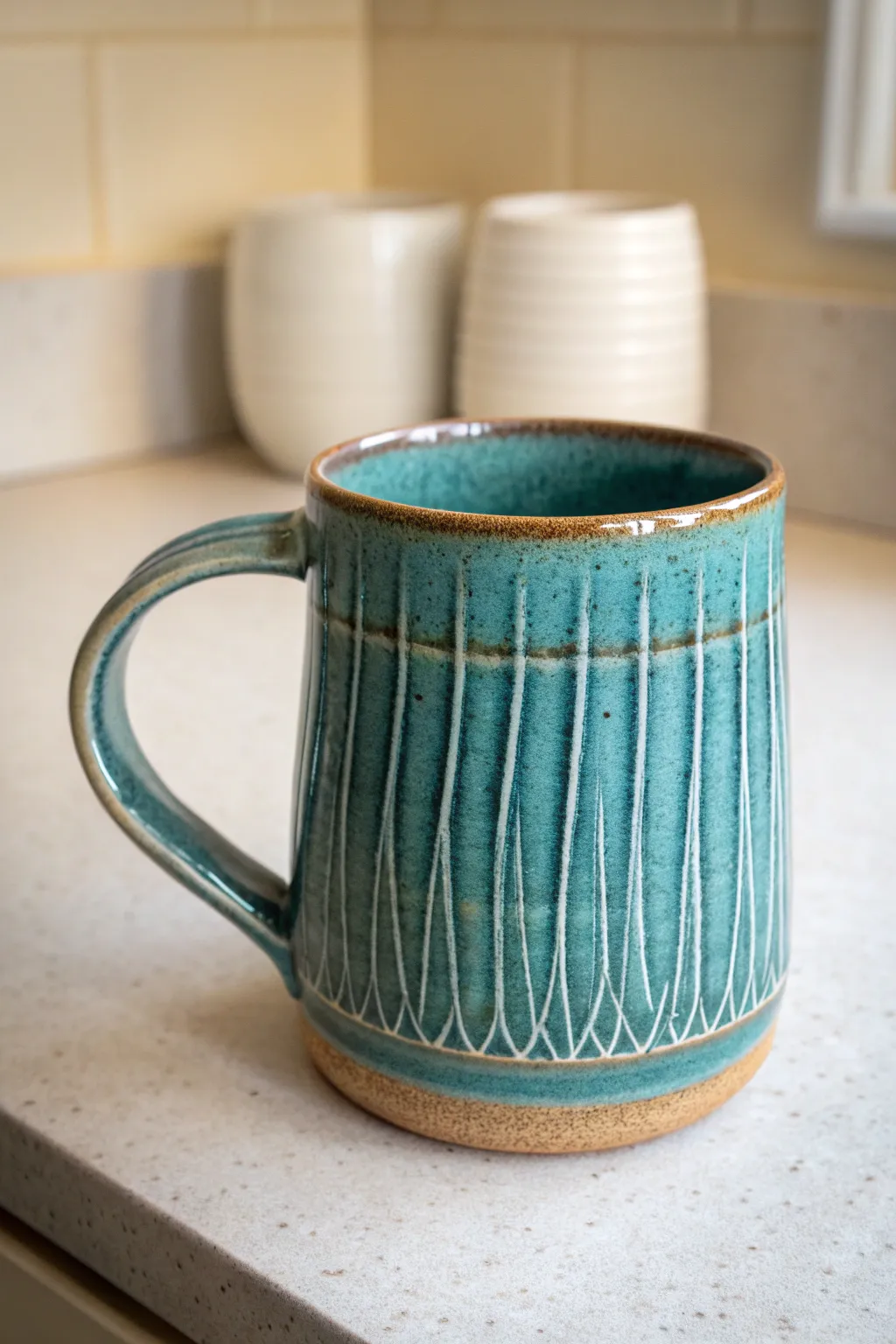
This project focuses on creating a harmonious connection between form and surface by extending the carved texture of the mug body directly onto the handle. The result is a stunning teal vessel with raw clay accents and vertical linework that feels unified and thoughtfully designed.
Step-by-Step Guide
Materials
- Stoneware clay body (speckled buff recommended)
- Pottery wheel
- Throwing tools (sponge, ribs, wire cutter)
- Loop tool for trimming
- Carving tool (small loop or v-tip)
- Teal stoneware glaze (breaking/flowing type)
- Clean sponge
- Wax resist (optional)
Step 1: Throwing and Trimming
-
Throw the cylinder:
Begin by centering your clay on the wheel and opening it up. Pull the walls to create a tall, straight-sided cylinder, aiming for a consistent thickness. -
Shape the vessel:
Collar the top slightly to form a gentle curve inward near the rim. Use a rib tool to smooth the outer walls, removing any throwing rings for a clean canvas. -
Dry to leather hard:
Allow the cylinder to dry until it reaches a leather-hard state where it is stiff but still carveable. -
Trim the foot:
Invert the mug on the wheel and trim the base. Define a clear foot ring, leaving a nice band of unglazed clay area at the bottom.
Step 2: Pulling and Integrating the Handle
-
Pull the handle:
Pull a strap of clay for the handle. Aim for a medium thickness that feels comfortable in the hand, keeping the edges slightly rounded. -
Shape the curve:
Set the pulled handle on a curved surface or hang it to dry slightly until it holds its shape without cracking. -
Attach the handle:
Score the mug body and the attachment points of the handle. Apply slip and press the handle firmly into place, smoothing the seams. -
Refine the profile:
Ensure the handle has a generous ear shape—rising slightly before curving down—to mimic the elegant profile in the photo.
Breaking Perfection
Choose a glaze labeled ‘breaking’ or ‘semi-opaque.’ Opaque glazes will fill the carved lines and hide your texture, while breaking glazes highlight the ridges.
Step 3: Carving the Texture
-
Mark vertical guides:
Using a needle tool, lightly sketch vertical lines around the body to ensure your spacing is even before committing to deep cuts. -
Carve the body:
Use a carving tool to cut long, vertical gouges from the shoulder down to just above the foot. I like to vary the pressure slightly to give the lines an organic feel. -
Carve the handle:
Continue the carving theme onto the handle itself. Create two or three deep grooves running the length of the handle strap, matching the depth of the body carving. -
Connect horizontal lines:
Carve a few horizontal rings around the top rim area to frame the vertical lines, breaking up the pattern visually. -
Clean up burrs:
Once bone dry, lightly rub the surface with a non-abrasive pad to remove any sharp clay crumbs or burrs created during carving.
Thumb Rest Trick
Flatten the top curve of the handle slightly and add a small clay pad there. Carve it to match the body for a custom, ergonomic thumb rest.
Step 4: Glazing and Finishing
-
Bisque fire:
Load the mug into the kiln and bisque fire it according to your clay body’s specifications. -
Wax the foot:
Apply wax resist to the bottom inch of the mug and the foot ring to keep the raw, speckled clay exposed. -
Wax the rim (optional):
To achieve the brown rim effect shown, apply a thin line of wax to the very lip, or simply wipe the glaze away later. -
Dip in teal glaze:
Dip the entire mug into a teal glaze that is known to ‘break’ over texture. This ensures the carved lines appear lighter where the glaze thins out. -
Wipe the rim:
If you didn’t wax the rim, use a damp sponge to carefully wipe the glaze off the very edge, exposing the clay body underneath. -
Clean the foot:
Double-check the foot ring and wipe away any stray drips of glaze. -
Glaze fire:
Fire the mug to maturity (likely cone 5 or 6). The glaze will pool in the recesses and break over the high points, highlighting your carving work.
Enjoy your morning coffee knowing the texture in your hand is entirely your own creation
Sculptural Branch-Inspired Handle
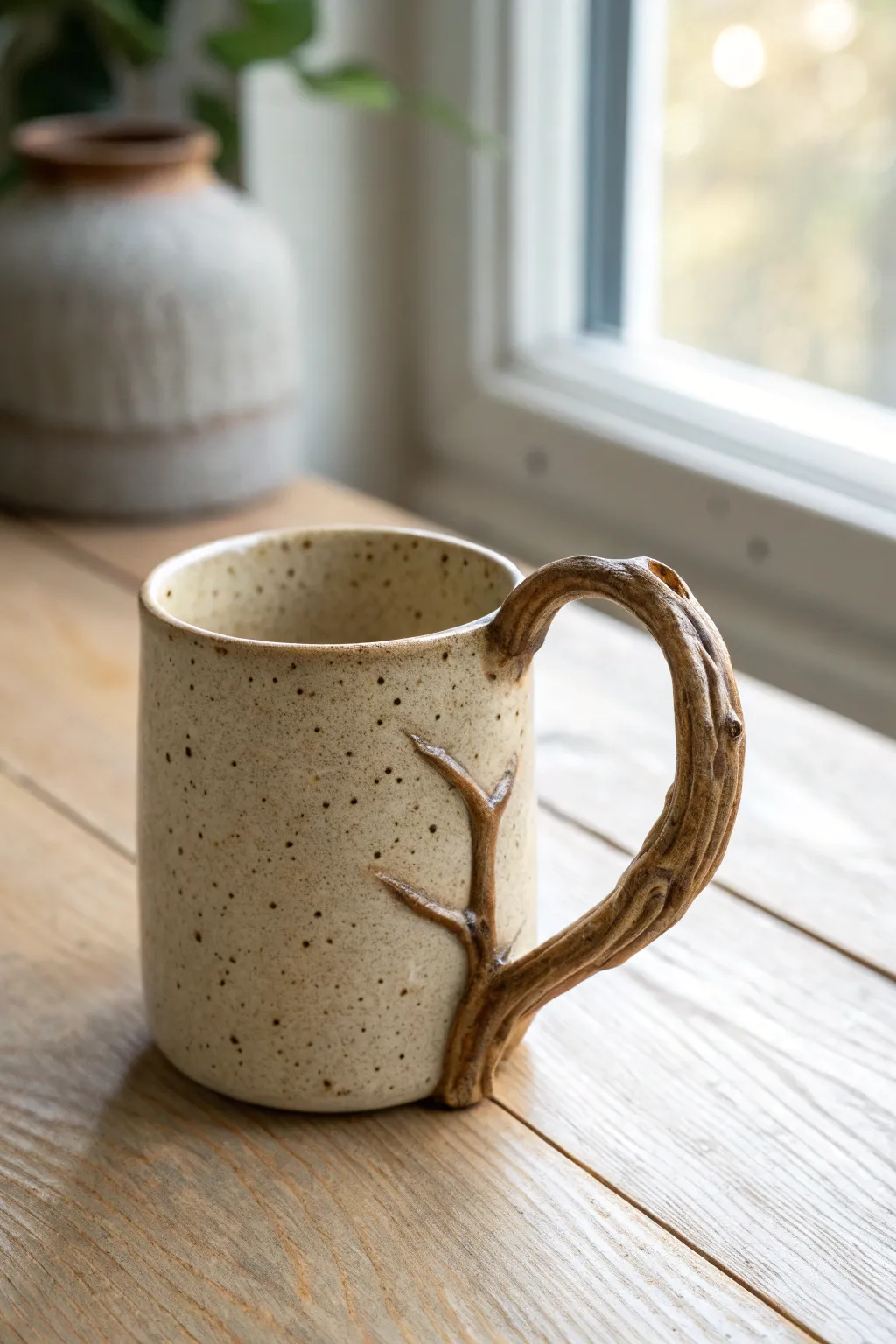
Bring a touch of the forest into your morning routine with this nature-inspired mug handle. This project transforms a simple cylinder into an organic statement piece by sculpting a realistic, textured branch that appears to grow right out of the clay body.
How-To Guide
Materials
- Stoneware clay (speckled or light-colored)
- Pottery wheel or slab roller (for the mug body)
- Needle tool
- Scoring tool or serrated rib
- Slip (clay slurry)
- Refining tools (wooden modeling tools)
- Sponge
- Brown underglaze or wood-ash glaze
- Clear or transparent cream glaze
Step 1: Forming the Base
-
Create the mug body:
Throw a simple cylinder on the wheel or hand-build one using the slab method. Keep the walls even and the rim smooth. -
Refine the shape:
Trim the bottom of your leather-hard mug to give it a clean foot if desired, though a flat, sturdy bottom works well for this rustic look. -
Prepare the surface:
Smooth the exterior with a damp sponge to erase any fingerprints, ensuring the canvas is ready for the handle attachment.
Step 2: Sculpting the Branch
-
Roll a coil:
Roll a coil of clay slightly thicker than a standard pencil. This will become the main branch of your handle. -
Taper and texture:
Gently taper one end of the coil to mimic a natural branch tip. Without attaching it yet, curve it into a comfortable ‘C’ shape to test the fit against your mug. -
Create bark texture:
Using a needle tool or a small wooden tool, drag irregular lines down the length of the coil. Twist the clay slightly as you work to simulate the organic growth patterns of wood. -
Add nature’s details:
Press small indentations or ‘knots’ into the clay where you imagine twigs might have snapped off. I find that randomness is key here; nature isn’t perfectly symmetrical.
Natural Texture Hack
Instead of drawing lines manually, press a piece of real, rough tree bark or a coarse rock into the soft clay coil to create an instant, hyper-realistic wood texture.
Step 3: Attachment and Integration
-
Score the contact points:
Identify where the top and bottom of the handle will meet the mug. Score these areas heavily on both the mug and the handle ends. -
Apply slip:
Dab a generous amount of slip onto the scored areas to act as glue. -
Attach the main branch:
Press the handle firmly onto the mug body. Wiggle it slightly to lock the clay particles together. -
Blend the seams:
Use a modeling tool to smooth the clay where it touches the mug, but don’t over-smooth—you want it to look like the branch is emerging from the cup. -
Form the offshoots:
Roll tiny, thin coils of clay to act as small twigs. These are the decorative elements seen on the side of the mug. -
Attach the twigs:
Score, slip, and attach these smaller twigs so they branch off from the main handle attachment points, extending onto the body of the mug. -
Blend twig connections:
Seamlessly blend the base of these small twigs into the main branch so they look like a single unit.
Level Up: Oxide Wash
Apply a red iron oxide wash to the handle and wipe it back with a sponge. The oxide will stay in the textured grooves, creating deeper contrast and a striking realistic look.
Step 4: Finishing Touches
-
Final texture check:
Go back over your seams and connections with your texture tool to ensure the bark pattern continues uninterrupted across the joints. -
Slow drying:
Cover the mug loosely with plastic to let it dry very slowly. This prevents the handle from cracking away from the body as it shrinks. -
Bisque fire:
Once bone dry, fire the piece to bisque temperature. -
Glaze application:
Coat the entire mug in a transparent cream or speckled glaze. For the handle, you can wipe back the glaze slightly to let the toasted clay color show through, or apply a wash of iron oxide to enhance the wood effect. -
Final firing:
Fire the mug to maturity according to your clay body’s specifications.
Enjoy the sturdy, earthy feel of your new favorite mug every time you take a sip