
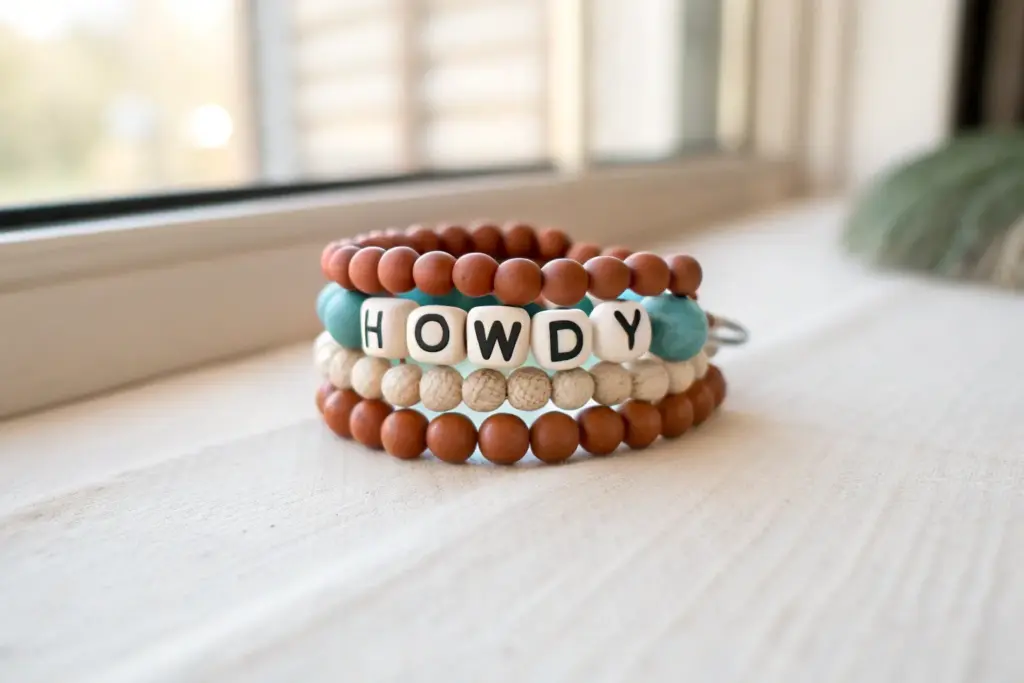
Cowgirl style is basically a whole mood, and clay bead bracelets are the easiest way to wear it on your wrist. Here are my favorite cowgirl clay bead bracelet ideas—from classic turquoise stacks to extra-fun charms and patterns that feel straight out of the wide-open West.
Classic Turquoise and Tan Heishi Stack
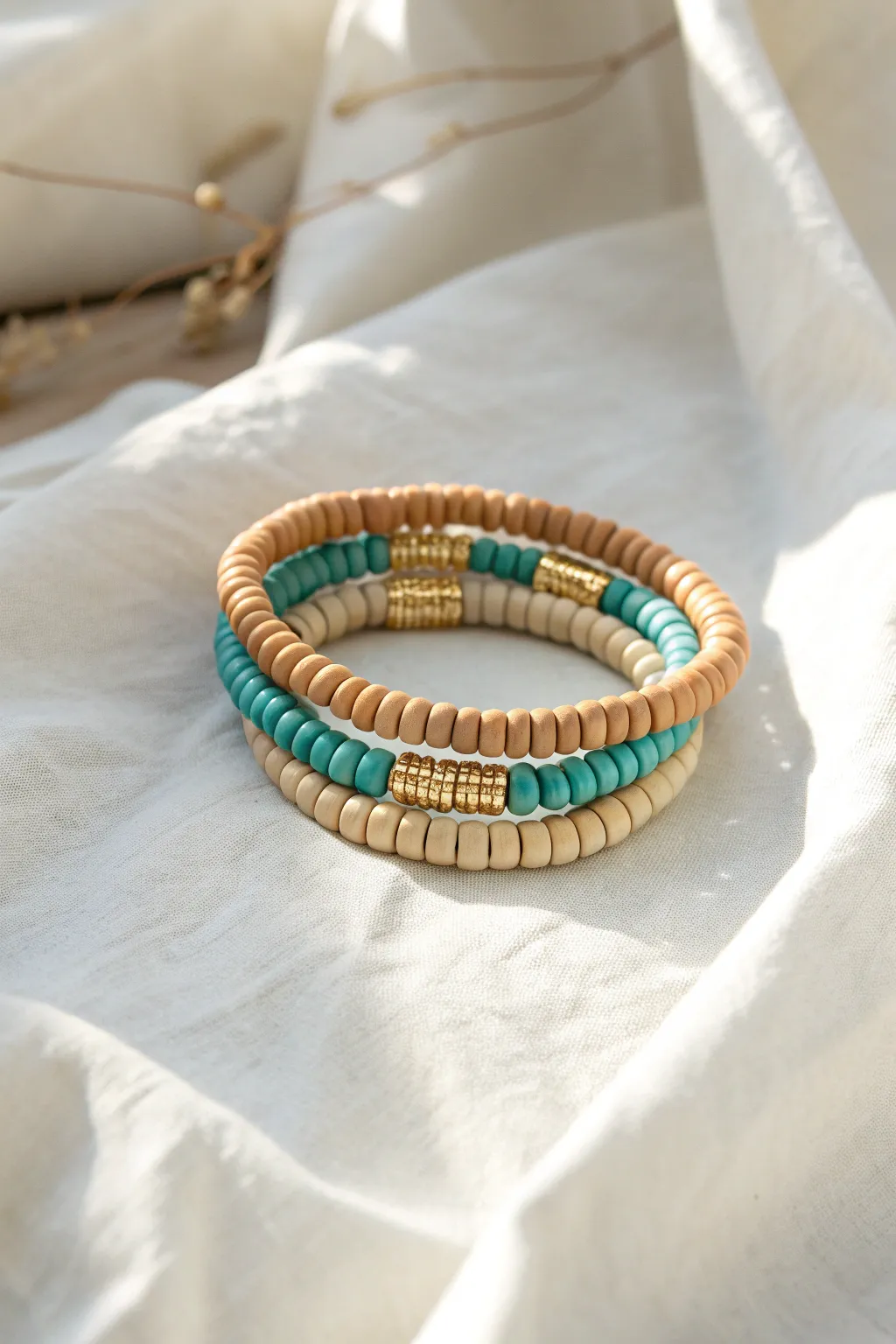
Capture the spirit of the Southwest with this earthy trio of heishi bead bracelets featuring a harmonious blend of warm tan, cool turquoise, and striking gold accents. This stack is perfect for everyday wear, bringing a subtle bohemian touch to any outfit.
Detailed Instructions
Materials
- 6mm Polymer clay heishi beads (Tan/Light Brown)
- 6mm Polymer clay heishi beads (Turquoise/Teal)
- 6mm Polymer clay heishi beads (Cream/Beige)
- Gold tone spacer beads (cylindrical stack style preferred)
- Strong elastic stretch cord (0.8mm or 1mm)
- Super glue or jewelry cement
- Scissors
Step 1: Preparation
-
Measure your wrist:
Before cutting any cord, wrap a measuring tape loosely around your wrist to find your comfortable circumference. Add about an inch to this measurement to determine the length of the beaded portion. -
Pre-stretch the cord:
Cut three pieces of elastic cord, each about 10-12 inches long. Give each piece a firm tug a few times; this ‘pre-stretching’ helps prevent the bracelets from sagging later. -
Secure the ends:
Place a piece of tape or a bead stopper on one end of each cord to stop your beads from sliding off while you work.
Knot Security Tip
When tightening your elastic knot, pull on all four strands (the two tail ends and the two bracelet loops) simultaneously to ensure it locks tight.
Step 2: Creating the Tan Bracelet
-
Begin the pattern:
Start by threading on your tan/light brown heishi beads. You want to create a solid block of color that covers roughly half the bracelet’s circumference. -
Add the focal point:
Slide on a cluster of gold cylinder spacer beads. In the image, we used about 5-6 thin gold discs stacked together to create a solid metallic segment. -
Complete the loop:
Continue adding tan beads until you reach your desired length. Check the fit against your wrist occasionally to ensure it sits comfortably.
Level Up: Texture Mix
Replace one gold section with a single freshwater pearl or a wooden geometric bead to add organic texture to your western-style stack.
Step 3: Crafting the Turquoise Bracelet
-
Start the second strand:
Moving to your second cord, begin threading the turquoise heishi beads. Aim to match the bead count of the first half of your tan bracelet. -
Insert gold accents:
Add your gold spacer beads. For a varied look, try placing these slightly off-center compared to where the gold sits on the tan bracelet, or keep them aligned for uniformity. -
Finish with turquoise:
Fill the rest of the cord with turquoise beads until it matches the length of your first completed bracelet.
Step 4: Assembling the Cream Bracelet
-
Thread the base:
Take your final cord and begin stringing the cream or beige heishi beads. This lighter tone adds a lovely contrast to the deeper tan and vibrant turquoise. -
Place the final gold detail:
In the image, the cream bracelet actually features *two* gold sections. Thread a small stack of 3-4 gold spacers, add about an inch of cream beads, and then add another identical stack of gold spacers. -
Conclusion of beading:
Finish stringing the remaining cream beads until this bracelet matches the size of the previous two.
Step 5: Finishing Touches
-
First knot:
Take the ends of your first bracelet and remove the tape of stopper. Cross right over left, then left over right to form a square knot. Pull it tight. -
Reinforce the knot:
I like to tie a second simple overhand knot on top of the square knot for extra security. Pull the elastic firmly—you should see the knot shrink slightly. -
Apply adhesive:
Place a tiny drop of super glue or jewelry cement directly onto the knot. Be careful not to get glue on the surrounding clay beads, as it can discolor them. -
Hide the mechanics:
While the glue is still slightly tacky but not wet, slide a bead over the knot to hide it inside the hole. If the hole is too small, simply trim the excess string closely once the glue is fully dry. -
Repeat for the set:
Repeat the knotting and gluing process for the remaining two bracelets. -
Final trim:
Once the glue is completely cured (wait at least 15 minutes), use sharp scissors to trim any remaining cord tails as close to the knot as possible without cutting the knot itself.
Slip on your new stack and enjoy the casual western vibe they bring to your style
Howdy Letter Bead Centerpiece
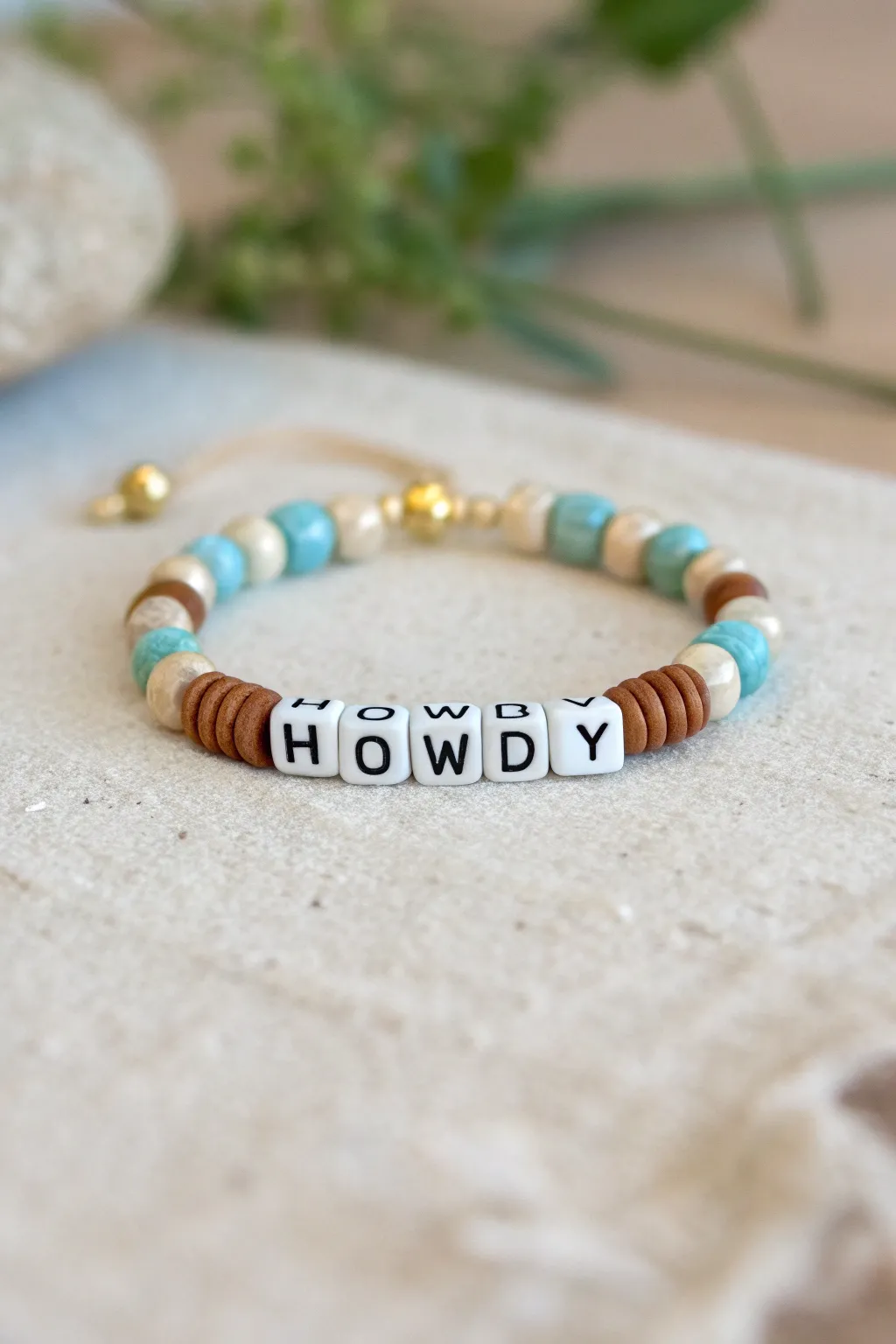
Giddy up with this charming beaded bracelet that puts a friendly greeting front and center. Featuring a mix of turquoise tones, creamy neutrals, and earthy clay discs, this accessory perfectly captures a modern western aesthetic.
How-To Guide
Materials
- Elastic beading cord (0.8mm or 1mm)
- White square alphabet beads (H, O, W, D, Y)
- Brown polymer clay disc beads (heishi beads)
- Turquoise round beads (approx 6mm, stone or acrylic)
- Creamy beige round beads (approx 6mm, possibly wood or jasper)
- Small gold spacer beads (round)
- Medium gold accent bead (for the back closure look)
- Scissors
- Super glue or jewelry cement
- Beading needle (optional but helpful)
- Tape or bead stopper
Step 1: Setting the Foundation
-
Measure the cord:
Cut a piece of elastic cord about 10-12 inches long. This generous length gives you plenty of room to tie knots without struggling. -
Secure the end:
Place a piece of tape or a bead stopper on one end of the cord to prevent your hard work from sliding off while you bead. -
Pre-stretch the elastic:
Gently tug on the elastic cord a few times. Pre-stretching helps prevent the bracelet from sagging or loosening up after you wear it for the first time.
Knot Strength Tip
When tightening your final knot, pull on all four strands individually (the two tail ends and the two bracelet loop sides) to ensure the knot is as compact as possible.
Step 2: Creating the Centerpiece
-
Stack the left side:
Thread on four brown polymer clay disc beads. These flat ‘heishi’ style beads act as a textured frame for your letters. -
Spell it out:
Slide on your white square alphabet beads in the correct order: H, O, W, D, Y. Make sure the letters are all facing the same direction, so they read clearly. -
Stack the right side:
Finish the centerpiece frame by adding four more brown polymer clay disc beads immediately after the ‘Y’ bead.
Step 3: Building the Pattern
-
Start the main sequence:
On the right side of your clay discs, add one cream round bead followed by one turquoise round bead. -
Add a wooden accent:
Thread on a brown wooden or spacer bead next, creating a nice transition between the sections. -
Continue the pattern:
Repeat the pattern of alternating cream and turquoise beads. For a balanced look similar to the photo, use about 3-4 beads of each color on this side before reaching the halfway point. -
Mirror the design:
Now, go to the other end of your cord (the left side of the ‘Howdy’). Remove the tape or stopper carefully and repeat the exact same bead sequence: cream, turquoise, brown accent, then alternating cream and turquoise. -
Check the sizing:
Wrap the unfinished strand around your wrist. You want the ends to just barely touch or have a small gap where the knot will go.
Loose Pattern?
If the beads feel too loose and show gaps of string, undo the knot and add one or two small gold spacer beads near the back to fill the empty space snugly.
Step 4: Finishing the Back
-
Add back accents:
To finish the loop, thread a few small gold round spacer beads onto each end of the cord. -
The focal gold bead:
Add one slightly larger gold accent bead to just one side of the cord. This will sit right over your knot, hiding it and acting as a decorative element. -
Tie the surgeon’s knot:
Bring both ends together and tie a surgeon’s knot. This is like a standard overhand knot, but you loop the elastic through twice before pulling tight. -
Secure the knot:
Pull the cord firmly. I like to dab a tiny drop of super glue or jewelry cement directly onto the knot for extra security. -
Hide the knot:
While the glue is still wet, gently tug on the cord to slide the knot inside the larger gold bead you added. -
Trim the excess:
Wait for the glue to dry completely, then use sharp scissors to trim the excess cord as close to the bead hole as possible.
Slip on your new western-inspired creation and enjoy the customized flair it adds to your daily outfit

Yeehaw Pop-Color Word Bracelet
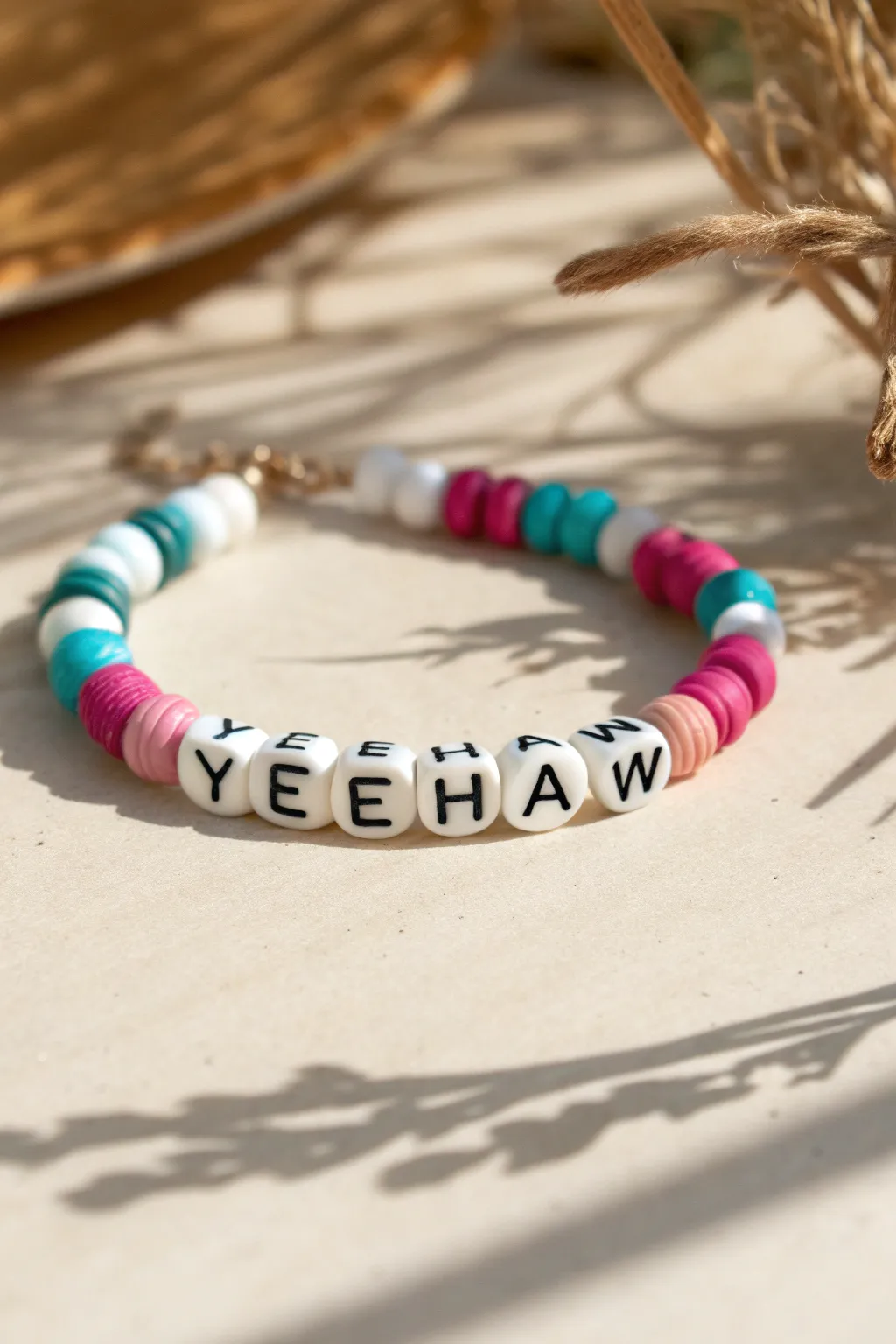
Embrace your inner cowgirl with this vibrant and playful bracelet that spells out a country-style greeting. Combining polymer clay disc beads in bright pops of color with bold letter beads, this accessory adds a fun western touch to any outfit.
Detailed Instructions
Materials
- Elastic cord (0.8mm crystal string)
- Polymer clay heishi beads (hot pink, teal, white, light pink)
- White cube letter beads with black text (Y, E, E, H, A, W)
- Gold tone crimp beads or knot covers
- Gold tone jump rings
- Gold tone lobster clasp
- Gold tone extender chain (optional)
- Scissors
- Jewelry pliers (flat nose)
- Bead stopper or painter’s tape
- Super glue or clear nail polish
Step 1: Planning and Prep
-
Measure the cord:
Cut a piece of elastic cord about 10-12 inches long. Having extra length makes it much easier to tie knots securely later on. -
Secure the end:
Attach a bead stopper to one end of the cord, or tape it down to your work surface, so your beads don’t slide off while you’re stringing. -
Lay out the design:
Before stringing anything, lay out your beads on a design board or piece of felt. This helps visualize the pattern: chunks of teal, white, and pink, centered around the ‘YEEHAW’ text.
Twisting Letters?
If letter cubes spin around, use slightly thicker elastic or double up your string. The tighter fit keeps square beads flat against the wrist.
Step 2: Stringing the Beads
-
Start with the pattern:
Begin stringing from the side opposite the clasp. Based on the photo, start with a sequence of teal heishi beads. -
Add color blocks:
Transition into a block of white beads, followed by a section of hot pink beads. Keep each color block roughly equal in length, about 0.5 inches each. -
Create symmetry:
Continue the pattern (white, then teal again) until you reach the halfway point of the non-text section. This ensures the bracelet looks balanced on the wrist. -
Transition to the centerpiece:
As you approach the center where the text will go, add a small section of light pink beads to frame the word gently. -
String the first letters:
Thread on the ‘Y’, ‘E’, and second ‘E’. Make sure they are facing the correct direction so they read left-to-right when worn. -
Check spacing:
Ensure the letter cubes sit flush against the clay discs. The flat edges of the heishi beads help keep the square letters sitting straight. -
Finish the word:
Thread on the ‘H’, ‘A’, and ‘W’ to complete the phrase. -
Mirror the pattern:
After the ‘W’, add your matching light pink section, followed by hot pink, white, teal, and so on, mirroring the pattern you started with. -
Check the fit:
Wrap the unfinished strand around your wrist to check the size. Add or remove a few heishi beads at the ends if it feels too tight or too loose.
Add a Charm
Make it extra western by attaching a tiny gold cowboy boot or hat charm to the jump ring near the clasp for a hidden detail.
Step 3: Finishing Touches
-
Prepare for closure:
Once sized correctly, thread a gold crimp bead onto each end of the elastic cord. -
Attach the hardware:
Thread one end of the cord through the loop of a jump ring (attached to the lobster clasp) and loop the cord back through the crimp bead. -
Secure the crimp:
Use your flat nose pliers to squash the crimp bead flat, securing the loop. Repeat this process on the other side with the extender chain or a receiving jump ring. -
Tie a knot:
For extra security, I like to tie a double surgeon’s knot with the elastic tails right against the crimp bead before trimming. -
Glue the knot:
Apply a tiny dot of super glue or clear nail polish to the knot and let it dry completely to prevent it from slipping. -
Trim excess cord:
Use your scissors to snip off the excess elastic tail as close to the crimp bead as possible without cutting the knot. -
Hide the mechanism:
If you used a knot cover instead of just a crimp bead, gently close the clam-shell cover over the knot using your pliers for a polished, professional look.
Now you are ready to stack this lively piece with other accessories for a complete western-chic look

Rodeo Red, Cream, and Turquoise Trio
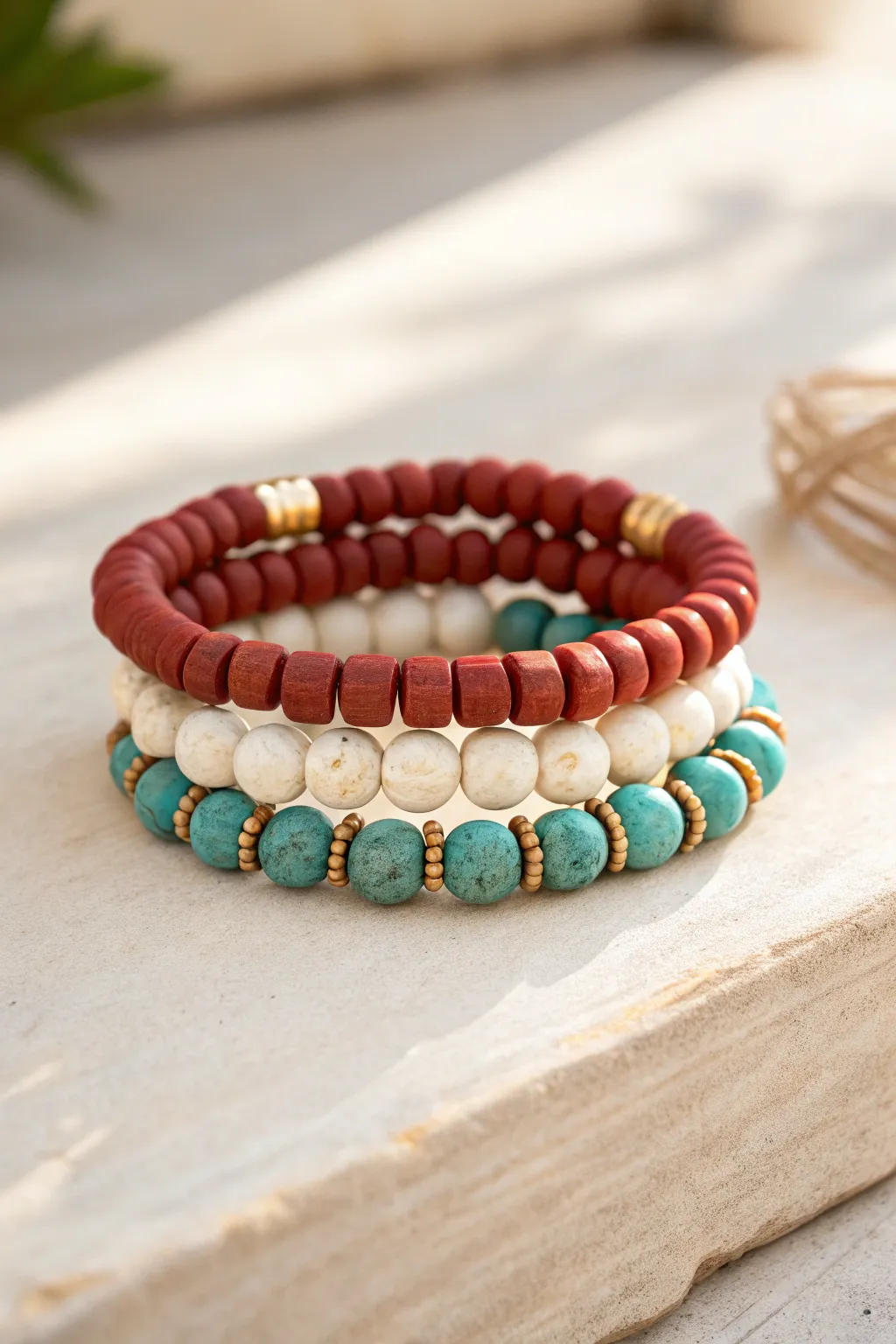
Capture the true spirit of the West with this easy-to-wear stack of three stretch bracelets combining earthy red clay, rustic cream stone, and vibrant turquoise. This trio balances bold textures with classic cowgirl colors for a seamless everyday accessory.
Step-by-Step Guide
Materials
- Red-brown polymer clay heishi disk beads (6mm)
- Cream/off-white rustic round beads (8mm, possibly bone, wood, or matte stone)
- Turquoise round gemstone beads (8mm, slightly varied matrix)
- Small gold metallic spacer beads (flat disk style)
- Very small gold metallic spacer beads (daisy spacer or tiny round style)
- Elastic stretch cord (0.7mm or 0.8mm)
- Jewelry glue (optional)
- Scissors or bead snips
- Bead stopper or tape
Step 1: The Red Clay Heishi Strand
-
Measure and prepare:
Cut a piece of elastic cord about 10-12 inches long. This generous length gives you plenty of room to tie a secure knot later without struggling. Pre-stretch the cord gently by pulling on it a few times to prevent sagging later. -
Secure the end:
Place a bead stopper or a piece of tape on one end of your cord so your beads don’t slide right off as you work. -
Start the red sequence:
Thread on a long sequence of the red-brown heishi disk beads. Aim for about 2 inches of solid red beads to start. -
Add gold accents:
Slide on three flat gold spacer beads together to create a solid metallic block. This breaks up the matte texture of the clay. -
Continue the pattern:
Add another long section of red clay beads. In the image, the gold accents appear sparingly, perhaps just twice or three times around the entire bracelet, so spacing them evenly is key. -
Check the fit:
Wrap the strand around your wrist. The goal is a comfortable fit that isn’t tight. Add or remove red disks until the two ends meet perfectly. -
Tie it off:
Tie a surgeon’s knot (right over left, left over right, and pull tight). I like to add a tiny dot of jewelry glue to the knot before trimming the excess cord.
Knot Slipping?
If your elastic knots won’t hold, try an extra loop on the first part of the surgeon’s knot. Pull all four tail ends firmly to cinch it down tight before gluing.
Step 2: The Rustic Cream Strand
-
Prep the second cord:
Cut and pre-stretch another 12-inch length of elastic cord, securing the end as before. -
String the cream beads:
Thread on your cream-colored round beads. These beads have a unique, speckled texture, so try to rotate them as you string to show off their best sides. -
Hide the knot:
Since these beads have larger holes, plan to hide your knot inside one of them. String enough beads to fit your wrist comfortably. -
Secure the cream bracelet:
Tie your reliable surgeon’s knot, pull it tight, and add a dab of glue. Once dry, pull the knot inside the nearest bead hole to conceal it completely.
Step 3: The Turquoise & Gold Strand
-
Prep the final cord:
Prepare your third piece of elastic cord just like the previous two. -
Begin the beaded pattern:
This strand requires alternating beads. Start by sliding on one round turquoise bead. -
Insert spacers:
Add two or three tiny gold metallic spacers. These act as separators that make the blue color truly pop against the red and cream strands. -
Repeat the sequence:
Continue the pattern: one turquoise bead, followed by the small cluster of gold spacers. Repeat this until you have reached your desired length. -
Final adjustments:
Check the size against the other two finished bracelets to ensure they will stack nicely without one being significantly looser than the others. -
Finish the trio:
Tie your final knot securely, glue, and trim. Once dry, roll all three bracelets onto your wrist together to complete the look.
Charm It Up
Add a small cactus, horseshoe, or cowboy boot charm to the gold spacer section of the red bracelet for an extra touch of western personality.
Wear your new stack with your favorite denim jacket or sundress for an effortless touch of western flair

The Complete Guide to Pottery Troubleshooting
Uncover the most common ceramic mistakes—from cracking clay to failed glazes—and learn how to fix them fast.
Boot Charm Focal Bracelet
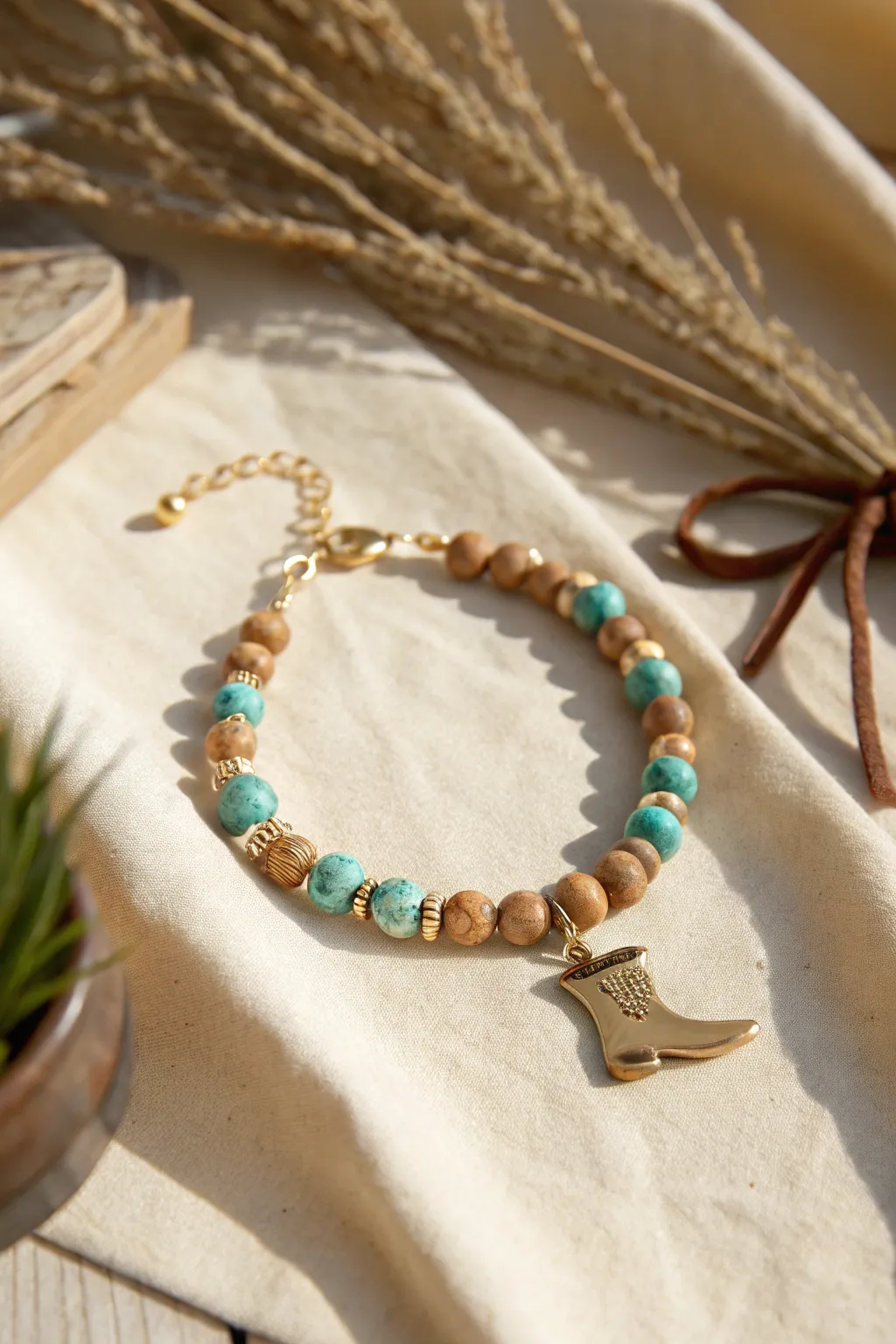
Capture the spirit of the open range with this delightful beaded bracelet, centering on a playful golden cowboy boot charm. The blend of faux-wood clay beads and textured turquoise stones creates a high-end, earthy look that is perfect for everyday wear.
How-To Guide
Materials
- Flexible beading wire (gold or clear)
- Round wood-effect clay or wooden beads (approx. 6mm)
- Round turquoise/jasper composite beads (approx. 6-8mm)
- Gold tone heishi spacer beads (small discs)
- Gold tone fluted/corrugated round spacer beads
- Large gold textured round beads (focal spacers)
- Gold cowboy boot charm
- Open gold jump ring (6-7mm)
- 2 small gold crimp beads
- 2 crimp bead covers (gold)
- 2 wire guards (optional, gold)
- Gold lobster clasp
- Gold extension chain with drop charm
- Jewelry pliers (chain nose and crimping pliers)
- Wire cutters
Step 1: Planning and Preparation
-
Measure your wrist:
Start by measuring your wrist to determine the total length needed. A standard bracelet is about 7 inches, but aiming for a bit of slack is wise since the beads are chunky. Cut about 10-12 inches of beading wire to give yourself plenty of room to work. -
Design your bead pattern:
Before stringing, lay your beads out on a bead board or a piece of felt. I always find this helps visualize the final look. The pattern in this piece alternates sections of 2-3 wood beads with single turquoise stones, separated by various gold spacers.
Step 2: Creating the Central Focal Point
-
Attach the boot charm:
Locate the center point of your design. Using your chain nose pliers, open a sturdy 6-7mm jump ring by twisting the ends sideways (never pull them apart). Loop the jump ring through the top of your gold cowboy boot charm. -
Secure the charm to the wire:
Slide the jump ring onto the center of your beading wire. The charm will hang freely from this point, acting as the anchor for your symmetrical pattern. -
Add flanking beads:
On either side of the charm, thread on a specific sequence: first a small gold heishi spacer, then a wood bead, then a fluted gold spacer. This frames the boot nicely.
Sticky Clasps?
If your crimp bead slips, make sure you’re using the right size for your wire. A 2mm crimp usually works best for standard beading wire. Don’t over-flatten it or it might crack.
Step 3: Stringing the Sides
-
Build the first section:
Working outwards from the center on one side, add a turquoise bead. Follow this with a gold heishi spacer, then three wood beads, and another heishi spacer. -
Introduce texture:
Add your next turquoise bead. To make this stand out, flank it with slightly larger gold components, like the textured round gold beads seen on the left side of the bracelet. -
Continue the pattern:
Repeat the alternating pattern: wood beads (grouped in twos or threes) separated by small spacers, and turquoise accent beads. Maintain symmetry with the other side of the bracelet wire as you go. -
Check the length:
Periodically wrap the strand around your wrist. Remember that the clasp and extension chain will add about an inch to the final length, so stop beading slightly short of your full wrist measurement.
Add Sparkle
Swap standard wood beads for faceted sandalwood or bronzite stone beads. The facets catch the light subtly, elevating the rustic look to something more glamorous.
Step 4: Finishing the Ends
-
Prepare the first crimp:
On one end of the wire, slide on a crimp bead. If you are using a wire guard (which protects the wire from wear), thread the wire up through one side of the guard. -
Attach the clasp:
Hook the loop of the wire guard (or just the wire loop) through the small ring at the base of your lobster clasp. Thread the wire back down through the crimp bead. -
Secure the crimp:
Pull the wire snug but not too tight—you want the beads to have movement. Use your crimping pliers to flatten or fold the crimp bead securely. Trim the excess wire tail close to the bead. -
Cover the crimp:
Place a gold crimp cover over the flattened crimp bead. Gently squeeze it closed with your regular pliers until it looks like a textured gold bead. -
Finish the second side:
Repeat the crimping process on the other end of the bracelet. Instead of a clasp, attach the extension chain here. Make sure to pull out any gaps in the beads before crimping this final side. -
Final touches:
Trim any remaining wire tails. Give the bracelet a gentle tug to ensure everything is secure and the connections are solid.
Enjoy showing off your chic western accessory at your next rodeo or casual outing
Cowboy Hat Charm With Desert Neutrals
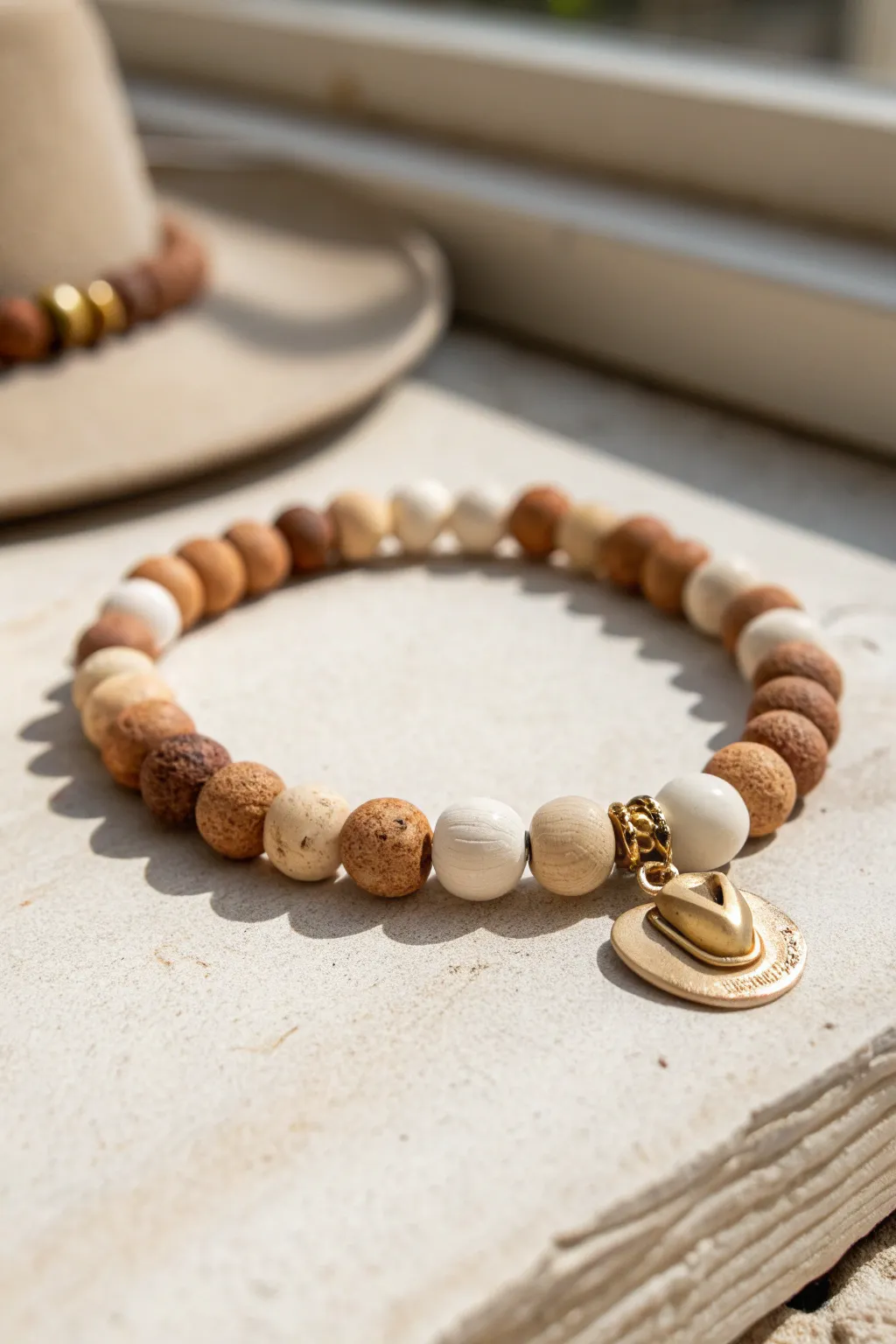
Capture the spirit of the Wild West with this earthy, textured bracelet featuring desert-inspired neutral tones. The combination of matte clay beads in varying shades of brown and cream creates a rustic backdrop for a shining gold cowboy hat charm.
Step-by-Step Tutorial
Materials
- Polymer clay (white, beige, translucent, dark brown, terracotta)
- Elastic beading cord (0.8mm or 1mm)
- Gold cowboy hat charm with jump ring
- Gold bail bead (large enough hole for cord)
- Bead rolling tool or acrylic block
- Needle or bead reamer
- Super glue or jewelry adhesive
- Oven and baking sheet
- Sandpaper (fine grit)
- Texturing tool (toothbrush or stiff brush)
Step 1: Crafting the Clay Beads
-
Mix your colors:
Start by conditioning your polymer clay. You want to create a palette of desert neutrals. Mix white with a tiny bit of beige for a creamy off-white. Mix terracotta with dark brown for a deep rust color. Create a third mid-tone tan by mixing beige, white, and a speck of brown. -
Portion the clay:
Pinch off small, uniform chunks of clay from each color mix. Aim for pieces that will roll into beads approximately 8-10mm in diameter. -
Roll spheres:
Roll each chunk between your palms or using an acrylic block to form smooth, round spheres. I like to keep a few slight imperfections to maintain that organic, handmade feel. -
Add texture:
For the darker brown and rust-colored beads, gently tap the surface with a toothbrush or a stiff-bristled brush. This creates a porous, stone-like texture that contrasts beautifully with the smoother cream beads. -
Pierce the beads:
Using a needle or bead piercing tool, carefully create a hole through the center of each bead. Twist the tool gently as you push through to avoid distorting the sphere shape. -
Bake the clay:
Arrange your beads on a baking sheet lined with parchment paper. Bake according to the manufacturer’s instructions for your specific brand of polymer clay, usually around 275°F (135°C) for 15-30 minutes. -
Cool and finish:
Allow the beads to cool completely. If any hole openings look rough, lightly sand them with fine-grit sandpaper or twist a bead reamer inside to ensure the cord will slide through smoothly.
Sticky Situation
If your clay beads are sticking to your piercing tool, dip the needle in cornstarch or water before piercing. This acts as a release agent and keeps the holes clean.
Step 2: Assembling the Bracelet
-
Measure the cord:
Cut a piece of elastic cord about 10-12 inches long. This generous length makes it much easier to tie the finishing knot without struggling. -
Pre-stretch the elastic:
Give the elastic cord a few firm tugs. This pre-stretching step prevents the bracelet from sagging or loosening shortly after you start wearing it. -
Prepare the charm:
Open the jump ring on your gold cowboy hat charm using pliers. Attach it to the loop of your decorative gold bail bead, then close the jump ring securely. -
Plan your pattern:
Lay out your cooled beads on a design board or a piece of felt. Arrange them in a random, organic pattern, mixing the cream, tan, and textured rust beads evenly. -
String the beads:
Thread the beads onto the elastic cord one by one, following your layout. Stop halfway through to slide on the bail bead holding your cowboy hat charm. -
Finish stringing:
Continue adding the remaining clay beads until the strand reaches your desired wrist size (standard size is usually 7 inches). -
Tie the knot:
Bring the two ends of the cord together. Tie a surgeon’s knot (which is just a square knot with an extra loop through in the first pass) and pull it tight. -
Secure and hide:
Apply a tiny drop of super glue or jewelry adhesive to the knot. Let it dry for a moment, then trim the excess cord ends closely. Gently tug the knot inside the hole of a neighboring bead to hide it.
Turquoise Twist
Add a pop of color by substituting three or four of the neutral beads with faux turquoise polymer clay beads to enhance the southwestern aesthetic.
Now you have a chic, western-inspired accessory ready for your next rodeo or casual day out

What Really Happens Inside the Kiln
Learn how time and temperature work together inside the kiln to transform clay into durable ceramic.
Lone Star Charm and Spacer Beads
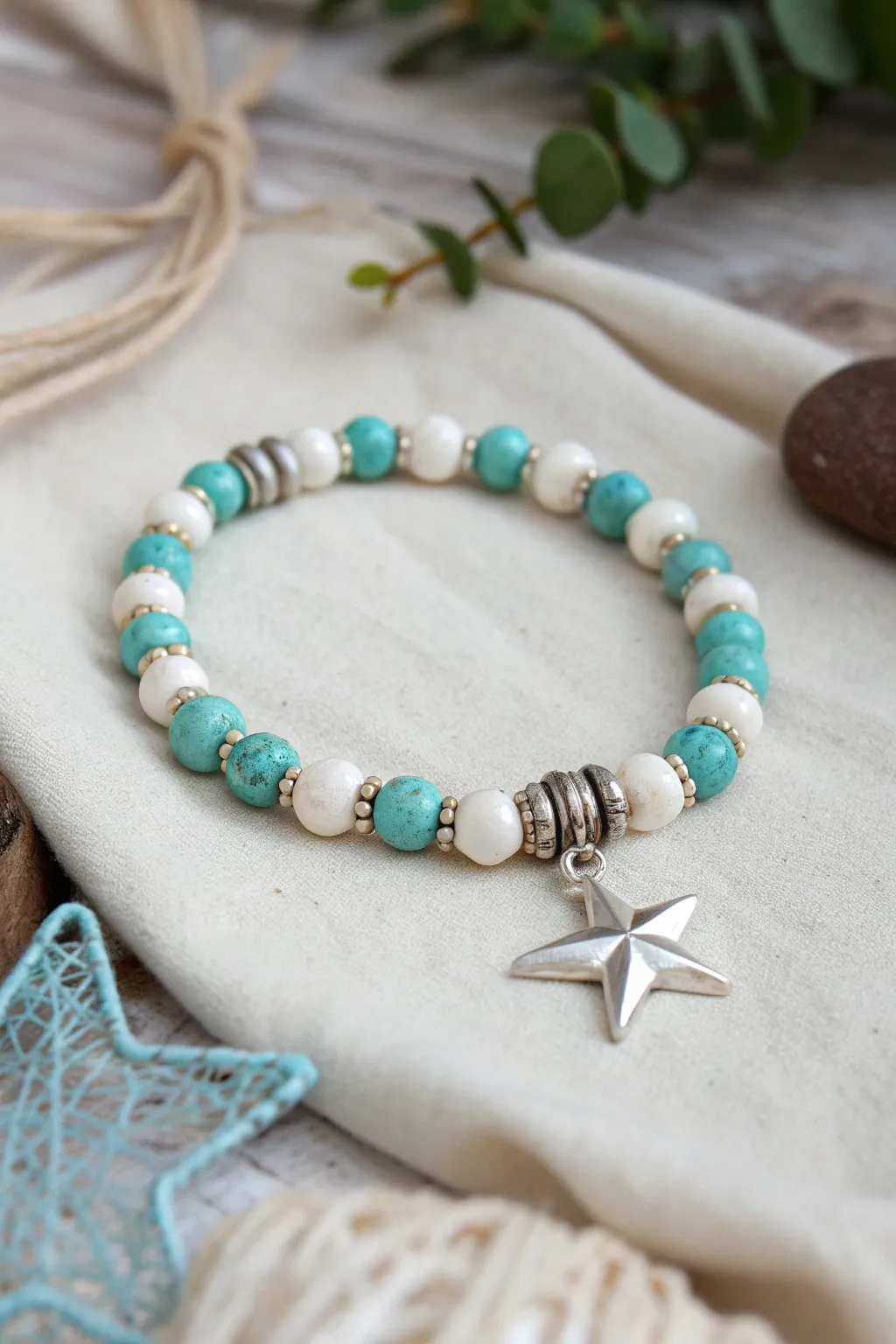
Embrace a rustic western aesthetic with this charming beaded bracelet featuring a striking silver star pendant. The alternating rhythm of turquoise and white beads, accented by antique silver spacers, creates a classic jewelry piece perfect for everyday cowgirl chic.
Step-by-Step
Materials
- Turquoise (or dyed magnesite) round beads (approx. 8mm)
- White stone or acrylic round beads (approx. 8mm)
- Silver star charm with attachment loop
- Silver disk/washer spacer beads (antique finish)
- Small silver ball spacer beads (approx. 2-3mm)
- Large-hole silver bail bead or jump ring connector
- Elastic beading cord (0.7mm or 0.8mm)
- Super glue or jewelry adhesive
- Scissors
Step 1: Planning and Prep
-
Measure your wrist:
Before cutting any cord, wrap a measuring tape loosely around your wrist to determine the desired length. Add about 3-4 inches to this measurement to ensure you have plenty of slack for tying the final knot. -
Prepare the elastic:
Cut your elastic cord to the calculated length. I always like to give the elastic a few gentle tugs to ‘pre-stretch’ it; this helps prevent the bracelet from sagging or loosening immediately after you finish making it. -
Secure the end:
Attach a bead stopper or simply use a piece of tape on one end of your cord. This is a crucial safety measure to stop your beads from sliding right off while you work.
Step 2: Creating the Pattern
-
Start the sequence:
Begin threading your beads. The core pattern relies on alternating colors. Slide on one turquoise bead, followed by a small silver ball spacer. -
Add the contrast bead:
Next, thread on a white round bead, followed by another small silver ball spacer. This creates the basic repeating unit: Turquoise – Spacer – White – Spacer. -
Repeat the rhythm:
Continue this alternating pattern until you have filled about one-third of your intended bracelet length. Keep checking the pattern against your wrist to gauge sizing. -
Insert accent spacers:
To break up the uniformity, add a visual pause in the pattern. After a white bead, slide on three flat silver washer beads. Then resume the bead pattern. You can place these washer accents on opposite sides of the bracelet for balance. -
Continue beading:
Resume the turquoise-spacer-white-spacer pattern until you reach the center point where you want your charm to hang.
Knot Slipping?
If your elastic knot feels slippery, try a double surgeon’s knot (looping through twice on the first pass). A dab of clear nail polish works if you lack super glue.
Step 3: Adding the Focal Point
-
Prepare the charm assembly:
Locate the center of your design. Thread on a larger silver washer bead, followed by your center bail or a large jump ring that holds the star charm. -
Secure the charm:
Follow the charm connector immediately with two more silver washer beads. This creates a bold, metallic focal section that frames the star perfectly. -
Complete the circle:
Finish the rest of the strand by mirroring the pattern you created on the first side. Ensure the ends of the bracelet will meet seamlessly—usually, you’ll want to end with a spacer bead to nest against the starting bead.
Textured Twist
Swap the smooth white beads for crackle quartz or lava stone beads. The rougher texture adds an earthy, rugged feel that perfectly complements the western theme.
Step 4: Finishing Touches
-
Check the fit:
Carefully bring the two ends of the elastic together and wrap it around your wrist one last time. It should sit comfortably without pinching skin or drooping excessively. -
Tie the knot:
Remove the tape or bead stopper. Tie a standard surgeon’s knot: cross right over left and loop under, then left over right and loop under. Pull tight. -
Secure with glue:
Apply a tiny dot of jewelry adhesive or super glue directly onto the knot. This prevents the slick elastic form unraveling over time. -
Hide the knot:
Once the glue is tacky but not fully set, gently pull the cord so the knot slides inside the hole of the nearest large bead. Ideally, hide it inside one of the turquoise or white beads rather than a spacer. -
Trim the excess:
Once the glue is completely dry, carefully trim the excess cord ends as close to the bead hole as possible without nicking the main knot.
Slip on your new star bracelet and enjoy the casual western flair it adds to your outfit
Cactus Green and Sandstone Gradient
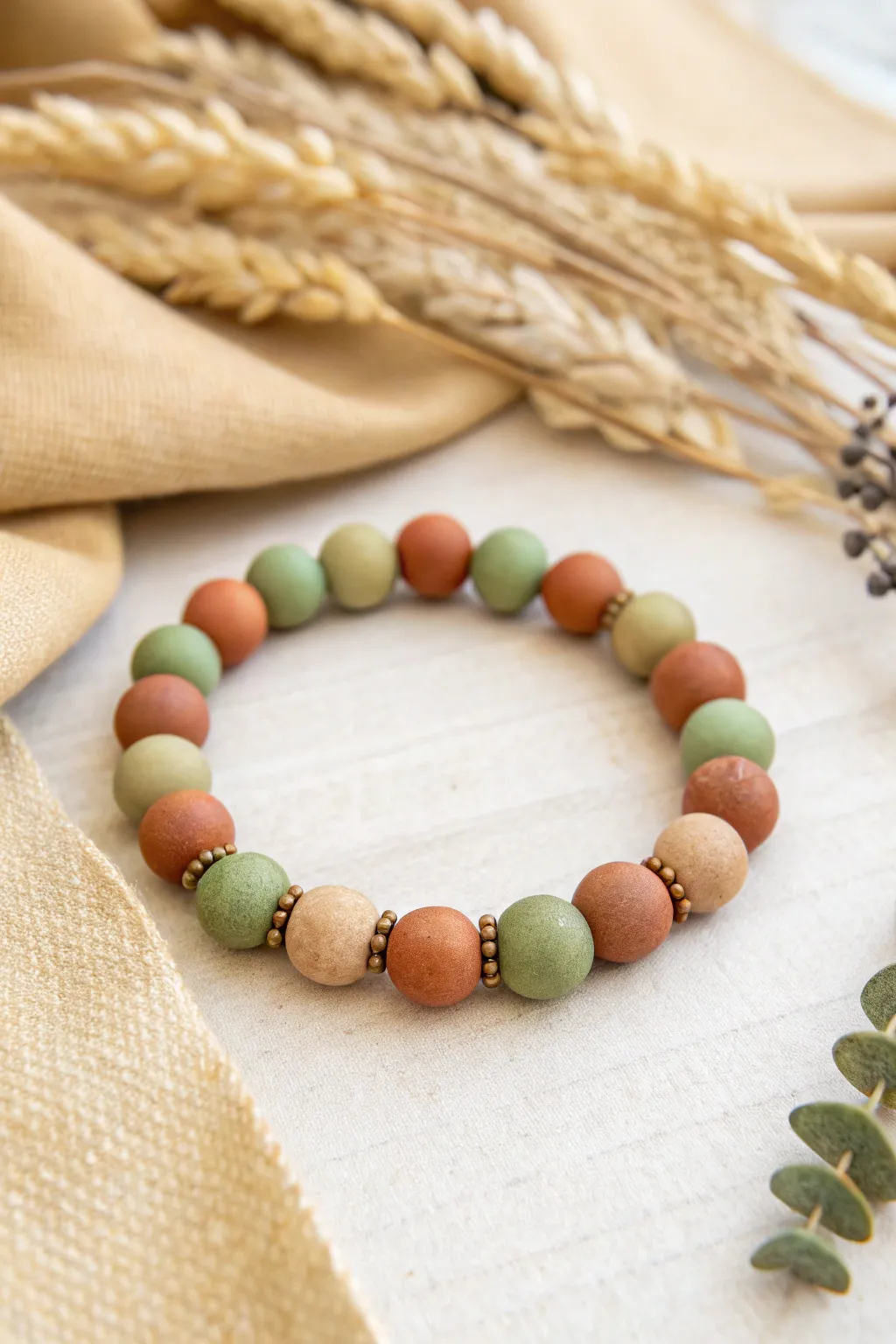
Capture the rustic warmth of the American Southwest with a bracelet that blends earthy terracotta, calming sage green, and natural sandstone hues. This matte-finish design is punctuated by antique bronze accents for a perfectly understated cowgirl accessory.
Step-by-Step Guide
Materials
- Matte polymer clay round beads (10mm) in Terracotta/Burnt Orange
- Matte polymer clay round beads (10mm) in Sage Green
- Matte polymer clay round beads (10mm) in Sandstone/Beige
- Antique bronze daisy spacer beads (4mm or 5mm)
- Strong elastic cord (0.8mm or 1.0mm thickness)
- Jewelry glue or clear nail polish
- Scissors
Step 1: Planning the Design
-
Measure your wrist:
Before you begin, wrap a piece of string around your wrist to find your comfortable size, then add about half an inch for a comfortable fit. -
Sort your beads:
Lay out your beads on a bead board or a soft towel. This prevents them from rolling away and helps you visualize the pattern before stringing. -
Establish the pattern:
Look closely at the design. The core pattern alternates colors randomly but purposefully: often grouping a classic 1-1-1 pattern (Terracotta, Green, Sandstone) or occasionally placing two colors next to each other to break uniformity. -
Identify spacer placement:
Notice that the metallic daisy spacers aren’t between every single bead. In this design, they are used to highlight specific focal sections, usually bracketing a group of three beads or accenting the lighter sandstone beads.
Step 2: Stringing the Beads
-
Prepare the cord:
Cut a length of elastic cord about 10-12 inches long. Having extra length makes the final knotting process much easier than struggling with short ends. -
Pre-stretch the elastic:
Give the cord a few firm tugs. This is a crucial step I always do because it prevents the bracelet from stretching out and becoming loose after the first few wears. -
Start with the focal section:
Thread a bronze daisy spacer, followed by a Green bead, another spacer, a Sandstone bead, a spacer, a Terracotta bead, and a final spacer. This creates the detailed section seen at the bottom of the photo. -
Continue the pattern:
Moving away from the focal section, thread the rest of your beads. Try alternating: Terracotta, Green, Sandstone, Green, Terracotta. Keep the matte texture consistent. -
Check the spacing:
Decide on a secondary accent area. About halfway through the remaining beads, add a single bronze spacer on either side of a Sandstone bead to echo the main focal point. -
Test the length:
Wrap the strung beads around your wrist. The ends should meet comfortably without gaps, but the elastic shouldn’t be stretched tight yet. -
Adjust if necessary:
If it feels too tight, add one more bead (perhaps a Green one to balance the colors). If it’s too loose, remove one bead from the back section.
Tip: Matte Magic
If you can’t find matte clay beads, you can gently buff regular glossy polymer clay beads with fine-grit sandpaper or a sanding sponge to achieve that rustic sandstone look.
Step 3: Finishing Touches
-
Prepare to knot:
Bring the two ends of the elastic together. Tie a simple overhand knot, but don’t pull it fully tight just yet. -
The surgeon’s knot:
Tie a second knot over the first, but this time loop the end through the circle a second time (a surgeon’s knot). This adds friction and security. -
Tighten securely:
Pull the cords firmly in opposite directions to tighten the knot. You should see the elastic stretch slightly as the knot creates a tiny, tight ball. -
Apply adhesive:
Dab a tiny drop of jewelry glue or clear nail polish directly onto the knot. Be careful not to get glue on the matte beads, as it will ruin their finish. -
Hide the knot:
While the glue is still tacky, gently pull the elastic so the knot slides inside the hole of the nearest large bead. This creates a seamless professional finish. -
Trim the excess:
Once dry, use sharp scissors to trim the excess cord as close to the bead hole as possible without nipping the knot itself.
Level Up: Leather Accents
Add a small tassel made of suede or tan leather cord to one of the jump rings or directly onto the elastic for an even stronger Western aesthetic.
Now slip on your new accessory and enjoy the natural, earthy vibe it adds to your outfit

TRACK YOUR CERAMIC JOURNEY
Capture glaze tests, firing details, and creative progress—all in one simple printable. Make your projects easier to repeat and improve.
Navajo-Inspired Stripe Rhythm
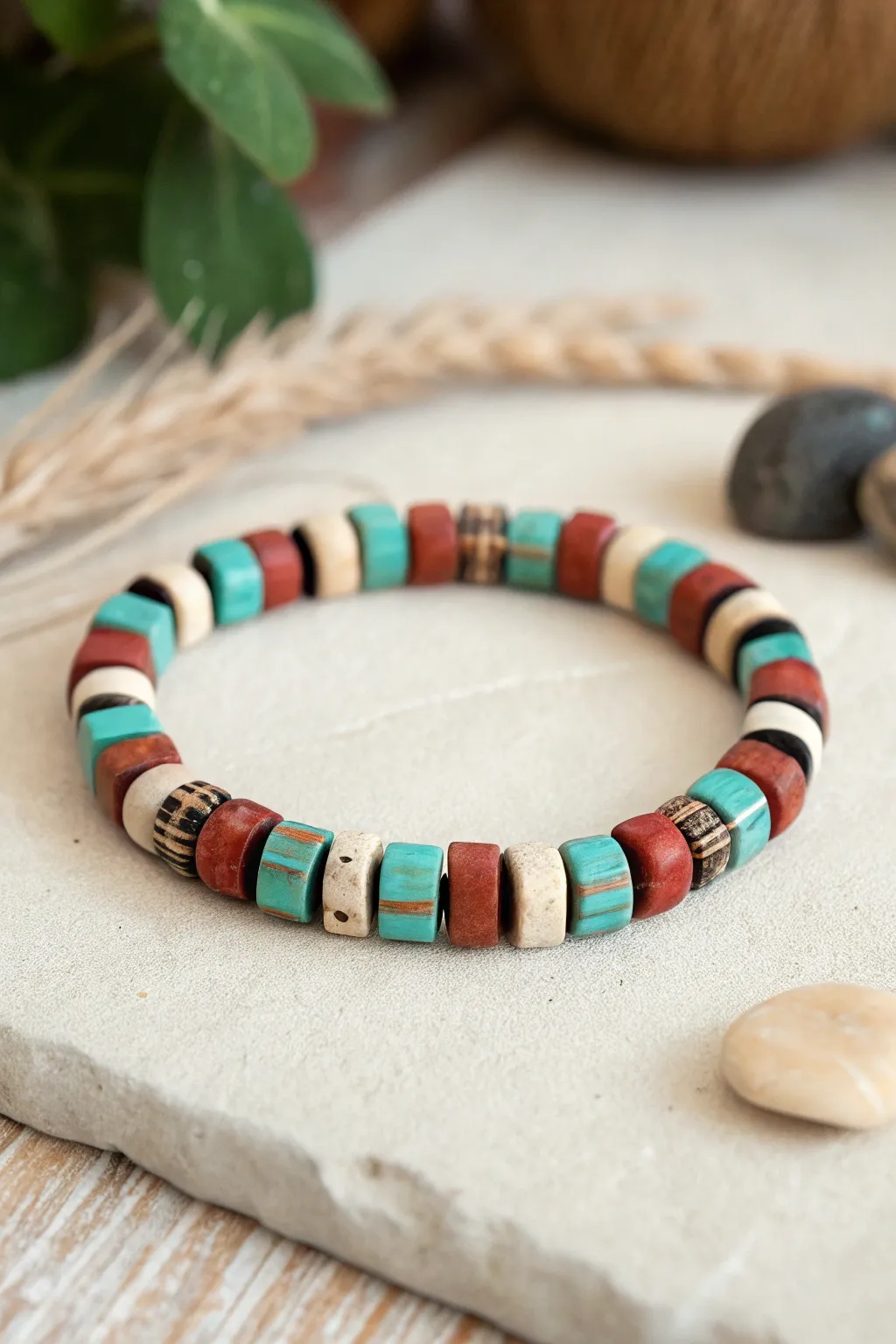
Capture the spirit of the Southwest with this earthy, rhythmic bracelet design that blends rusted reds, turquoise blues, and sandy creams. The alternating pattern of polymer clay heishi beads creates a timeless, rugged look perfect for everyday wear.
How-To Guide
Materials
- Polymer clay heishi beads (6mm or 8mm) in Turquoise
- Polymer clay heishi beads in Rust Red/Terracotta
- Polymer clay heishi beads in Cream/Off-White
- Speckled or patterned accent heishi beads (wood-look or striped)
- Stretch magic cord or elastic string (0.8mm)
- Super glue or jewelry adhesive
- Scissors
- Bead stopper or tape
- Ruler
Step 1: Preparation & Setup
-
Measure your wrist:
Wrap a flexible measuring tape around your wrist to find your size. Add about half an inch to this measurement to ensure the bracelet fits comfortably without pinching. -
Cut the cord:
Cut a piece of elastic cord about 10-12 inches long. Having extra length makes tying the final knot significantly easier than struggling with short ends. -
Secure the end:
Attach a bead stopper to one end of your elastic cord, or simply tape it down to your work surface. This prevents your carefully placed beads from sliding off while you work. -
Sort your palette:
Lay out your beads by color. Separate the solids from the patterned ones. Notice in the photo how some turquoise beads have brown striations and some cream beads are speckled; identify these distinct textures now.
Step 2: Creating the Pattern
-
Establish the rhythm:
The core pattern relies on blocks of color rather than single beads. Start by threading two Rust Red beads followed by one Cream bead to begin the sequence. -
Add the turquoise pop:
Slide on two Turquoise beads. I like to choose one solid blue bead and one with a bit of brownish matrix pattern to give it that authentic stone look. -
Insert the accent:
Place one Cream bead, followed by a special patterned bead (like the striped wood-look bead shown in the image), and then another Cream bead. This creates a focal section. -
Repeat the sequence:
Return to the main rhythm: two Rust Red beads, one Cream bead, two Turquoise beads. Continue this alternating flow along the cord. -
Vary the texture:
As you build the length, don’t be afraid to swap a regular bead for a textured or speckled one. Occasionally spotting in a “patterned” bead instead of a solid color keeps the eye moving. -
Check the length:
Periodically wrap the beaded strand around your wrist. The beads take up space, so the inner circumference might feel tighter than the loose cord did. Ensure it meets end-to-end comfortably.
Stone Effect
Mix ‘clean’ solid color beads with ones that have stripes or specks. This mimics real turquoise and jasper stones for a high-end look.
Step 3: Finishing Touches
-
Pre-stretch the cord:
Once all beads are strung, hold both ends of the cord and give it a gentle tug. This pre-stretching prevents the bracelet from loosening up permanently after the first time you wear it. -
Tie the knot:
Remove the bead stopper. Tie a simple overhand knot, but don’t pull it tight yet. Follow this with a surgeon’s knot (looping the end through twice) for extra security. -
Tighten securely:
Pull the cords firmly to tighten the knot. You want the beads to touch snugly without buckling or bunching up. -
Secure with glue:
Apply a tiny dab of jewelry glue or super glue directly onto the knot. Let it dry for a moment before proceeding. -
Hide the mechanics:
Ideally, slide the adjacent bead over the knot to hide it inside. If the bead hole is too small, simply trim the excess string close to the knot after the glue is fully cured.
Rugged Texture
Sand a few clay beads lightly with rough sandpaper before stringing. It removes the plastic shine and gives them a weathered, ancient vibe.
Slip on your new bracelet and enjoy the desert vibes it brings to your outfit
Pearl-and-Clay Cowgirl Glam Stack
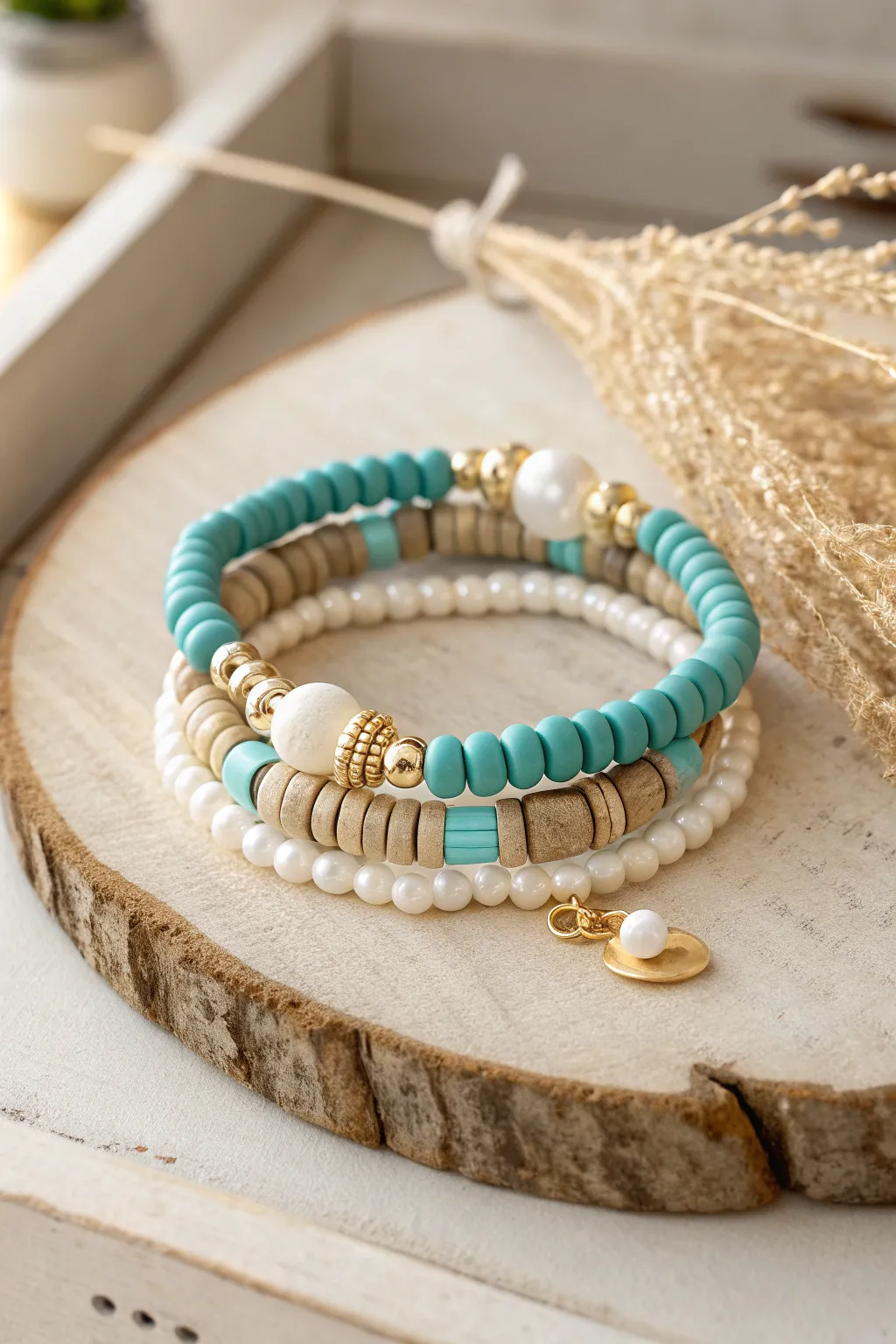
This stunning three-piece stack combines the rugged charm of natural wood and clay with the timeless elegance of faux pearls. It’s the perfect ‘cowgirl glam’ accessory, blending earthy textures with a pop of bright turquoise and shiny gold accents.
Step-by-Step Tutorial
Materials
- Turquoise polymer clay heishi beads (6mm)
- Natural wood heishi spacer beads (6mm or 8mm)
- Small white faux pearl beads (4mm)
- Large white faux pearl beads (10mm)
- Small gold spherical spacer beads (3mm)
- Detailed gold rondelle spacer beads (6mm)
- Gold jump rings (4mm and 6mm)
- Flat gold disc charm
- Small pearl drop charm
- Elastic beading cord (0.7mm or 0.8mm)
- Jewelry adhesive (e.g., E6000 or G-S Hypo Cement)
- Scissors
- Beading needle (optional but helpful)
Step 1: The Turquoise Top Layer
-
Prepare your cord:
Cut a piece of elastic cord about 10-12 inches long. Give it a gentle pre-stretch to prevent your bracelet from sagging later. -
Start the pattern:
Begin threading your turquoise clay heishi beads. You want to string enough to cover about one-third of your wrist circumference. -
Add the first accent:
Slide on a small gold spherical spacer, followed by a large white pearl, and cap it off with another gold spherical spacer. -
Continue the base:
Resume stringing the turquoise clay beads for the rest of the length. Check the fit against your wrist occasionally. -
Tie it off:
Once you have the desired length (usually 6.5 to 7 inches), tie a secure surgeon’s knot. Apply a tiny dab of jewelry adhesive to the knot, let it dry, and trim the excess cord.
Knot Hiding Trick
If the hole of your bead is large enough, tug the elastic gently after gluing to pull the knot inside a bead. This makes the finish look seamless and professional.
Step 2: The Mixed Wood & Gold Middle
-
Create the focal section:
Cut another 12-inch cord. Start by threading a pattern: gold rondelle, large white pearl (or white wooden bead), gold rondelle, gold sphere, turquoise clay bead, gold sphere. -
Build the wooden body:
On either side of this focal center, begin stringing your natural wood heishi beads. I like to interrupt the wood pattern every inch or so with a single turquoise bead for continuity. -
Add texture:
In the back section of the bracelet, mix in a few gold rondelles between standard wooden beads to add some metallic shine where the bracelet rests on the wrist. -
Check the stack fit:
Before tying, hold this strand next to your completed turquoise bracelet. Ensure they are roughly the same size so they stack neatly without twisting. -
Secure the second strand:
Tie a strong surgeon’s knot, glue carefully, and trim the tails close to the knot. Hide the knot inside a larger wooden bead if possible.
Curling Beads?
If your flat heishi beads are curving or twisting too much, your tension is likely too tight. Retie the knot with a little more slack so the beads can sit flat.
Step 3: The Dainty Pearl Anchor
-
String the base pearls:
For the final bracelet, cut your cord and string the small 4mm white faux pearls. This strand relies on simplicity to balance the chunkier layers. -
Create the charm cluster:
Midway through stringing, pause to add a closed jump ring. This will serve as the anchor point for your charms later. -
Finish the pearl strand:
Continue stringing the small pearls until you match the length of the previous two bracelets. Tie off with a surgeon’s knot and glue. -
Assemble the charms:
Open a 6mm jump ring using pliers (twist, don’t pull). Slide on your gold disc charm and the small pearl drop charm. Hook this ring onto the closed jump ring you added to the bracelet earlier. -
Close the hardware:
Twist the jump ring back into a closed position, ensuring the gap is perfectly flush so the charms don’t slip off.
Now you have a gorgeous, coordinated stack ready to pair with your favorite denim jacket
Bronc Spirit With “WILD” Letters
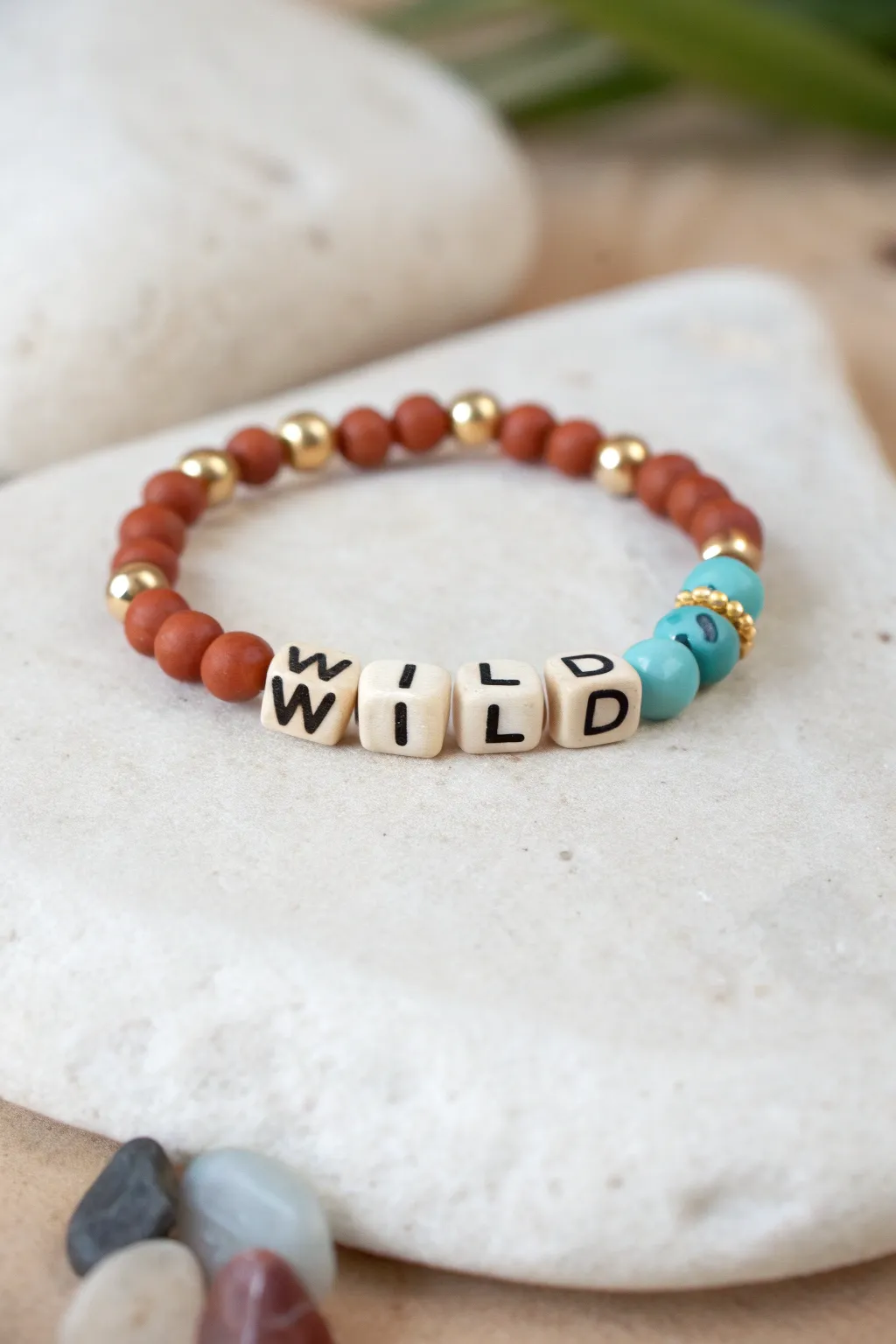
Capture the essence of the frontier with this rust and turquoise beaded bracelet featuring bold letter beads. The combination of earthy clay tones, bright turquoise accents, and gold spacers creates a piece that feels both rugged and chic.
Detailed Instructions
Materials
- Stretch cord (0.8mm or 1mm thickness)
- Reddish-brown matte jasper or clay beads (6mm or 8mm)
- Turquoise round beads (8mm, slightly larger than the brown ones)
- Gold tone round spacer beads (4mm or 5mm)
- Gold tone daisy spacer beads (small)
- Square wooden or cream-colored alphabet beads (W, I, L, D)
- Scissors or jewelry snips
- Jewelry glue or clear nail polish
- Tape or a bead stopper
Step 1: Preparation
-
Measure the cord:
Cut a piece of stretch cord about 10-12 inches long. This generous length gives you plenty of room to tie the knot comfortably without losing beads. -
Secure the end:
Place a piece of tape or a bead stopper on one end of your cord. This simple step prevents your beads from sliding off while you design the pattern. -
Double check letters:
Locate your ‘W’, ‘I’, ‘L’, and ‘D’ beads. I like to lay them out on a table first to ensure I don’t accidentally spell it backward when stringing.
Step 2: Stringing the Pattern
-
Start with the letters:
Thread the alphabet beads onto the cord first. For the text to be readable when wearing it, thread them in order: W – I – L – D. -
Add the first connector:
Slide one large turquoise bead next to the ‘D’. This creates a bright pop of color immediately following the word. -
Create the turquoise segment:
Add a gold daisy spacer, followed by a second turquoise bead. Add another gold daisy spacer, and finish this segment with a third turquoise bead. -
Transition to the main color:
After the last turquoise bead, slide on one reddish-brown bead to start the main chain. -
Begin the repeating pattern:
Working away from the turquoise section, add a gold round spacer bead. -
Build the pattern:
Add two reddish-brown beads, followed by one gold round spacer. Repeat this ‘two brown, one gold’ pattern until the bracelet is nearly long enough to fit your wrist. -
Check the fit:
Wrap the unfinished bracelet around your wrist. The ends should meet comfortably with just a little bit of slack. -
Adjust the length:
If it’s too short, continue the ‘two brown, one gold’ pattern. If it’s too long, remove a set. Ensure you finish with a brown bead so it matches the other side of the ‘W’. -
Close the loop:
Bring the two ends of the cord together. The start of your strand (the ‘W’) should meet the end of your brown bead pattern.
Hiding the Knot
Plan your knot placement next to one of the large-hole wooden letter beads. It’s much easier to pull and hide a bulky knot inside a wooden bead.
Step 3: Finishing Touches
-
Tie the knot:
Remove the tape or stopper. Tie a standard square knot (right over left, left over right) and pull it tight. Stretch the cord slightly and tie a second knot for security. -
Secure with glue:
Apply a tiny dab of jewelry glue or clear nail polish directly onto the knot. This prevents it from slipping over time. -
Let it dry:
Allow the glue to dry completely before cutting the excess string. This usually takes just a few minutes. -
Trim the ends:
Snip off the excess cord close to the knot, being careful not to cut the main bracelet string. Since the bead holes are large, you can often tuck the knot inside one of the adjacent beads to hide it.
Western Flair Upgrade
Swap the round gold spacers for tiny turquoise heishi beads or miniature silver conchos to give the bracelet an even more authentic cowgirl aesthetic.
Now you have a rugged, stackable accessory ready for your next adventure
Bandana-Red Accent Bead Spacing
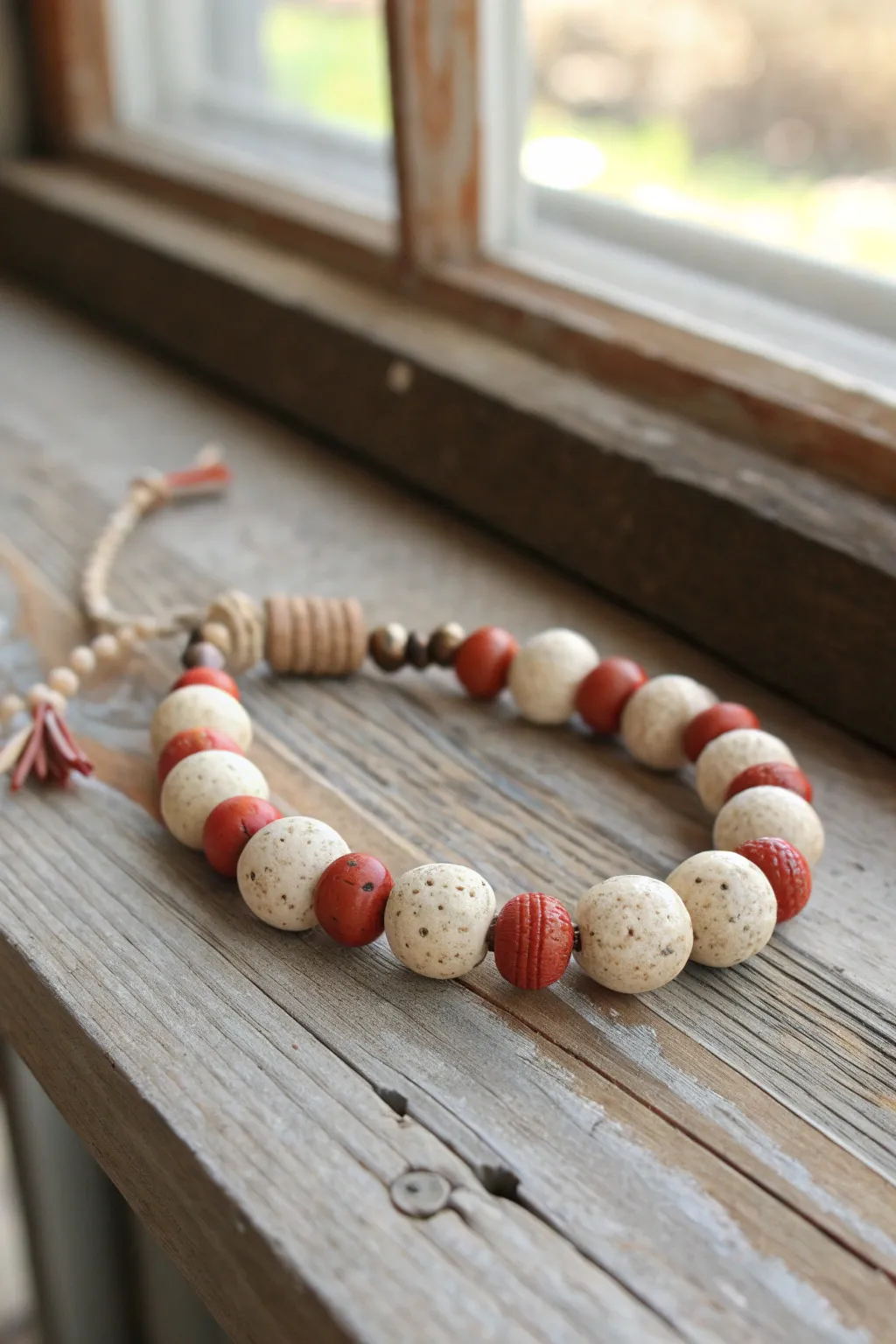
This charming, Western-inspired bracelet features large, speckled cream beads alternated with deeply textured bandana-red accents for a rugged yet feminine look. The natural jute cord and textured finish give it an authentic, hand-crafted feel perfect for stacking or wearing solo.
Step-by-Step Guide
Materials
- Polymer clay (cream/white granite effect)
- Polymer clay (terracotta or brick red)
- Thick jute twine or hemp cord (approx. 2mm)
- Wooden rings or large-hole wooden spacer beads
- Small antique brass or copper spacer beads
- Texture tools (sandpaper, toothbrush, or crumpled foil)
- Skewers or knitting needle (for piercing bead holes)
- Baking sheet and parchment paper
- Oven
- Scissors and strong craft glue
Step 1: Crafting the Clay Beads
-
Form the cream beads:
Start by conditioning your cream-colored granite polymer clay. Roll approximately 8-10 spheres, roughly 1 inch in diameter. Keep them relatively uniform but allow for slight organic variations. -
Texture the surface:
Roll each cream sphere gently over a piece of coarse sandpaper or tap it repeatedly with a clean toothbrush. This mimics the look of natural stone or pumice. -
Create the red accent beads:
Roll out smaller spheres using the brick red clay. These should be about half the volume of the cream beads. You’ll need roughly 8-10 of these to alternate between the larger ones. -
Add the bandana texture:
For the specific look in the image, roll the red beads over a textured surface like a fine mesh screen or press a fabric scrap into them to create a woven pattern. Alternatively, gently score vertical lines around the circumference. -
Pierce the holes:
Using a thick skewer or knitting needle, pierce a hole through the center of every bead. Ensure the hole is wide enough to accommodate your jute twine—make it slightly larger than you think you need, as clay can shrink slightly. -
Bake the beads:
Arrange all clay beads on a parchment-lined baking sheet. Bake according to the manufacturer’s instructions for your specific brand of clay, usually at 275°F (135°C) for 15-30 minutes. -
Effective cooling:
Let the beads cool completely in the oven with the door cracked open. This annealing process helps prevent cracking.
Hole Size Check
Jute twine frays easily. Before baking, test that your bead holes are wide enough by sliding a scrap piece of twine through a raw bead. Widen if needed.
Step 2: Assembling the Bracelet
-
Prepare the cord:
Cut a length of jute twine approximately 20 inches long. Fold it in half to create a loop at one end if you want a loop-and-toggle closure, or leave it single stranded for a tie closure. -
Create the twisted focal point:
At the start of your beading section, knot a small piece of extra twine around the main cord and wrap it tightly roughly 5-6 times to create a frayed, coiled stopper knot. -
Add wooden spacers:
Slide on the large wooden ring beads or flat wooden washers immediately after your coiled stopper. This transitions from the cord to the clay beads nicely. -
Begin the metal transition:
Thread on 3-4 small antique brass or copper spacer beads. These act as metallic separators before the main clay sequence begins. -
String the pattern:
Begin your main pattern: one red bead, followed by one large cream bead. Continue this alternating pattern until the strand is long enough to wrap comfortably around your wrist. -
Finish with metals:
Mirror the start of the bracelet by adding another set of small metallic spacer beads at the end of the clay sequence. -
Another wooden accent:
Add a final wooden washer or ring bead to balance the design. -
Secure the end:
Tie a secure overhand knot flush against the last wooden bead. I find putting a drop of craft glue inside the knot ensures it never slips.
Level Up: Scent it!
Since these beads are porous (especially the lava-like cream ones in appearance), add a drop of essential oil to the finished wood or clay beads for a diffuser bracelet.
Step 3: Final Touches
-
Make the tassel:
Cut 5-6 short strands of twine (about 3 inches long). Fold them in half over the tail end of your main bracelet cord. -
Wrap the tassel neck:
Take a separate thin piece of twine or thread and wrap it tightly around the top of the folded bundle to create the ‘head’ of the tassel. Tie off and hide the ends inside. -
Trim to size:
Trim the ends of the tassel evenly with sharp scissors so they hang neatly, adding a final rustic flair to the closure.
Enjoy the rugged, distinctive style of your new accessory, perfect for adding a bit of cowboy flair to any outfit
Silver-Tone Spacer “Rhinestone Cowgirl” Shine
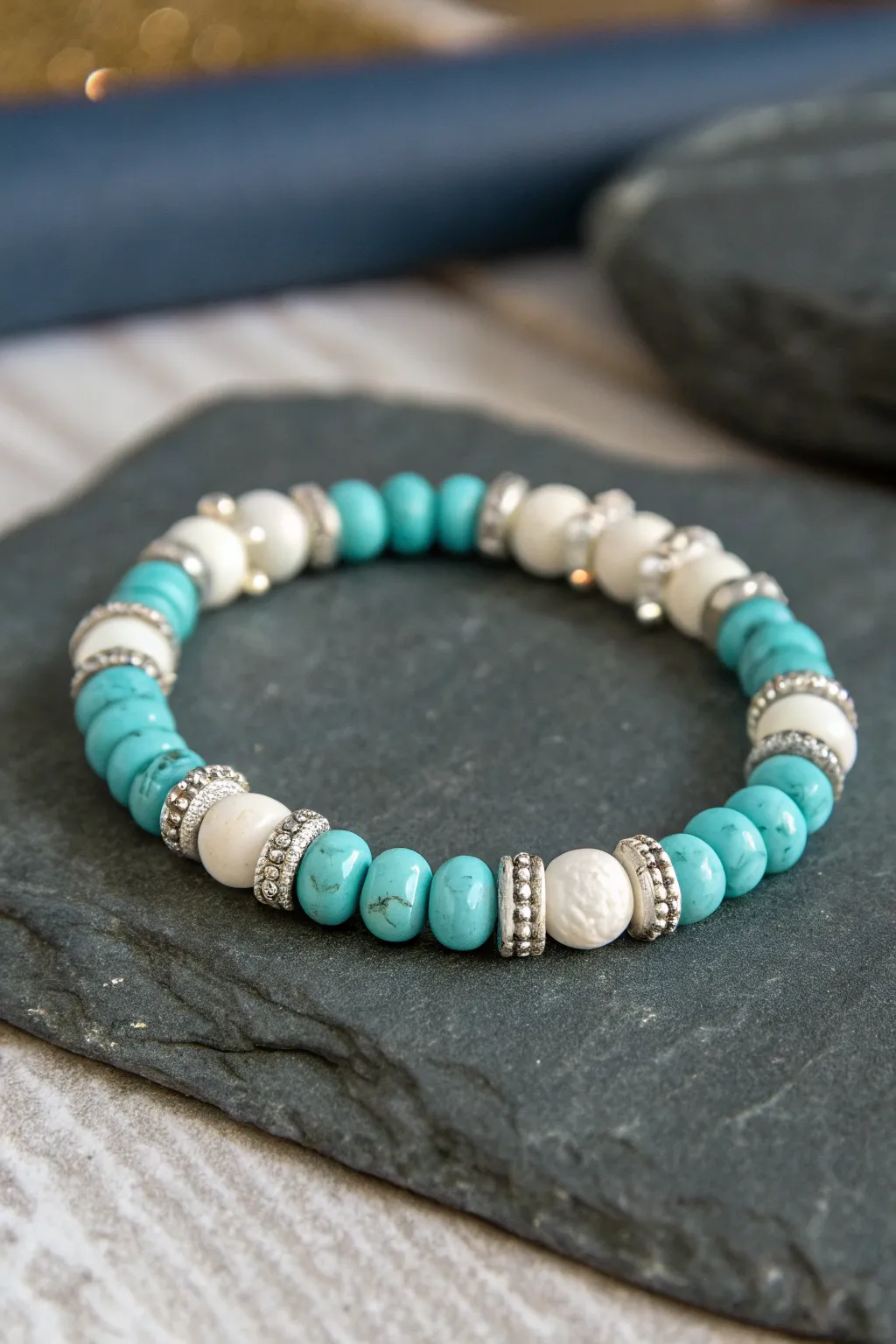
This striking bracelet combines the earthy vibes of turquoise clay with the glamor of sparkling silver accents. The alternating pattern creates a rhythmic and balanced design perfect for adding a touch of cowgirl flair to any outfit.
How-To Guide
Materials
- Turquoise polymer clay round beads (approx 6-8mm)
- White polymer clay or natural stone round beads (approx 8mm)
- Silver-tone rhinestone rondelle spacer beads
- Silver-tone textured metal spacer beads (disc or small heishi style)
- Strong elastic beading cord (0.8mm or 1mm)
- Super glue or jewelry cement (GS Hypo Cement recommended)
- Scissors
Step 1: Preparation
-
Measure your wrist:
Wrap a flexible measuring tape around your wrist to determine the desired length, then add about 0.5 to 1 inch for a comfortable fit. -
Cut the cord:
Cut a piece of elastic cord about 10-12 inches long. Having extra length makes tying the knot at the end much easier than struggling with short ends. -
Pre-stretch the elastic:
Hold both ends of the elastic cord and give it a few firm pulls. This crucial step prevents the bracelet from stretching out and becoming loose after you wear it a few times. -
Secure one end:
Place a piece of tape or a bead stopper clip on one end of the cord so your beads don’t slide off while you are working.
Hiding the Knot
Try to plan your pattern so the knot lands next to the large white bead. Its hole is usually larger, making it easier to hide the knot inside.
Step 2: Creating the Pattern
-
Start the sequence:
Begin by threading on three turquoise clay beads. These will form the colorful segments of your pattern. -
Add first silver accent:
Slide on one silver-tone textured metal spacer bead. I find these textured spacers add a nice rustic touch compared to smooth metal. -
Add the focal bead:
Thread one large white round bead next. This acts as a bright separator between the turquoise sections. -
Add the sparkle:
Follow the white bead with a rhinestone rondelle spacer. Ensure the rhinestones are facing outward for maximum shine. -
Repeat the silver accent:
Because the pattern isn’t perfectly symmetrical in every single segment in the photo, you can choose to flank the white bead with rhinestones on both sides, or mix it up. For the main repeating section shown clearly: add another silver textured spacer after the white bead section. -
Build the rhythm:
Repeat the core pattern: three turquoise beads, one silver spacer, one white bead, one rhinestone spacer. Continue adding this sequence along the cord. -
Check the fit:
Pause occasionally to wrap the beaded cord around your wrist. You want the ends to meet comfortably without gaps, but without being too tight. -
Adjust the pattern:
If you need more length but not a full segment, add an extra turquoise bead or an extra silver spacer to the final section to close the gap invisibly.
Step 3: Finishing Touches
-
Prepare to knot:
Remove the tape or bead stopper carefully, holding both ends of the elastic securely. -
Tie the surgeon’s knot:
Cross the ends, wrap one end under twice, and pull tight. Then cross them again and pull tight to secure. This knot is much stronger than a standard granny knot. -
Secure with glue:
Apply a tiny drop of jewelry cement or super glue directly onto the knot. Be careful not to get glue on the neighboring beads if possible. -
Hide the knot:
While the glue is still slightly tacky, slide one of the beads (preferably a larger white one or a spacer with a large hole) over the knot to conceal it. -
Trim the ends:
Once the glue is fully dry, trim the excess elastic cord close to the bead, ensuring you don’t accidentally clip the knot itself.
Level Up The Look
Swap the white bead for a genuine Howlite stone or a freshwater pearl for a more luxurious, high-end jewelry feel.
Slip on your new sparkling turquoise bracelet and enjoy the compliments on your handcrafted accessory
Rust and Turquoise “Southwest Sunset” Palette
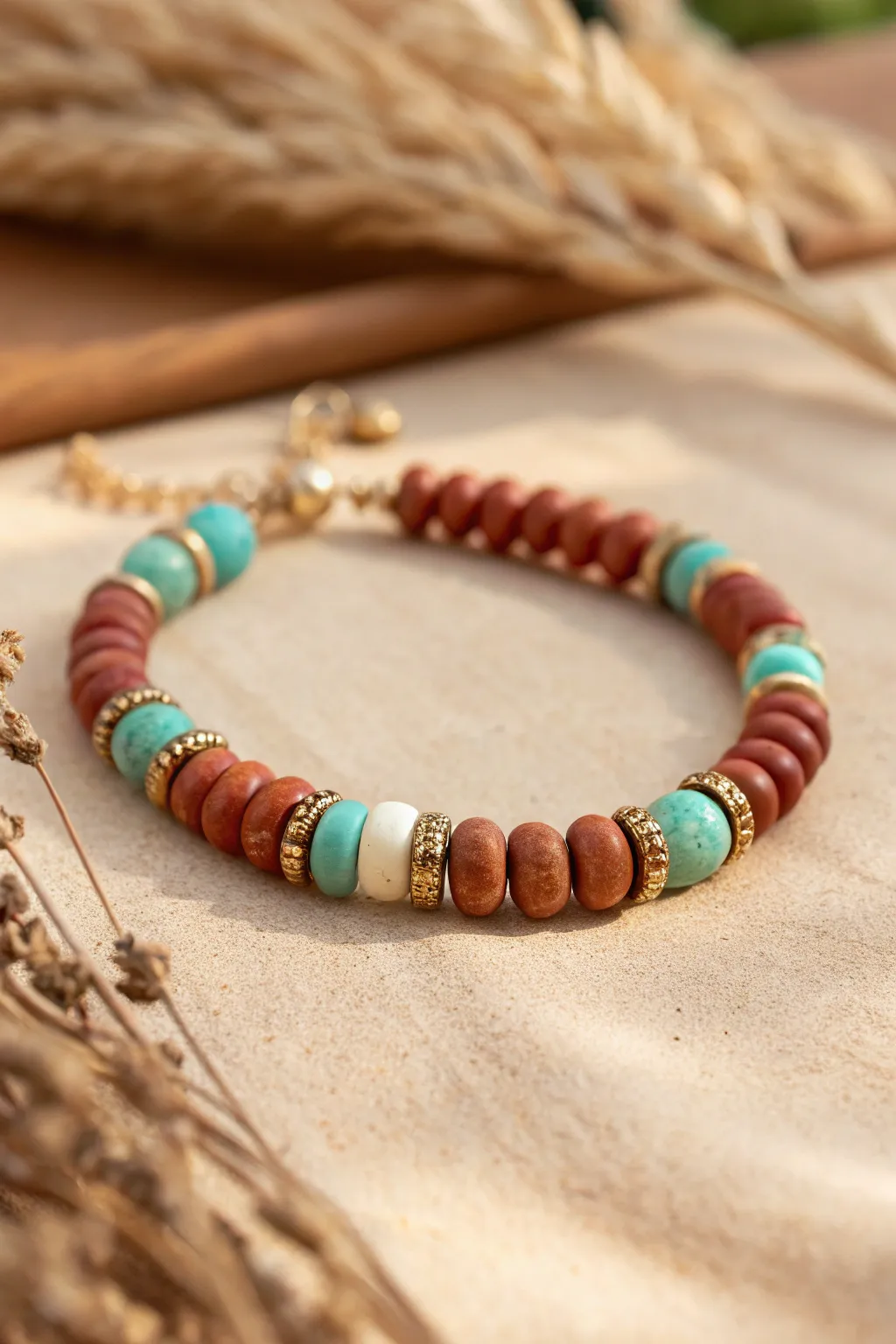
Capture the warm, earthy tones of a desert dusk with this stunning beaded bracelet. Combining rustic terracotta clay discs with pops of vibrant turquoise and gold accents, this piece is the perfect accessory for a chic cowgirl aesthetic.
Detailed Instructions
Materials
- Rust/terracotta polymer clay heishi beads (6mm)
- Turquoise gemstone round beads (6mm or 8mm)
- White or cream polymer clay heishi beads (6mm)
- Gold rhinestone rondelle spacer beads (6mm)
- Gold saucer or flat disc spacer beads
- Elastic stretch cord (0.7mm or 0.8mm)
- Jewelry glue or clear nail polish
- Scissors
- Bead stopper or tape
- Ruler or measuring tape
Step 1: Setting Up Your Workspace
-
Measure and Cut:
Begin by measuring your wrist and adding about 3 inches to that length. Cut a piece of elastic cord to this size to ensure you have plenty of room for tying knots later. -
Secure the End:
Attach a bead stopper to one end of your cord, or simply tape it securely to your work surface. This prevents your beads from sliding off as you work. -
Sorting Your Palette:
Lay out your beads on a bead mat or soft cloth. Group them by type: rust clay discs, turquoise rounds, gold spacers, and the single white accent bead to visualize the pattern before threading.
Step 2: Creating the Bead Pattern
-
Start the Sequence:
This design relies on sections of rust clay beads separated by focal points. Start by threading about 8 to 10 rust clay heishi beads onto the cord. -
First Gold Accent:
Slide on a gold saucer spacer bead, followed by a turquoise round bead, and then another gold saucer spacer. This frames the turquoise beautifully. -
Repeat the Rust Section:
Add another section of rust clay heishi beads. Aim for the same number used in the first section to keep the bracelet symmetrical. -
Adding Texture:
For the next focal point, use a texturized rhinestone rondelle spacer instead of the plain saucer spacer. Thread the rondelle, a turquoise bead, and another rondelle. -
Continue the Pattern:
Repeat the rust clay section again. Alternating between the smooth gold spacers and the sparkly rondelles adds a nice depth to the piece. -
The Centerpiece:
Create the central feature of the bracelet. Thread a gold rondelle, a turquoise bead, a few rust clay discs, a gold rondelle, a single white clay bead, another gold rondelle, and then mirror the rust and turquoise pattern on the other side. -
Check the Length:
Wrap the beaded cord around your wrist to check the fit. Add or remove rust clay beads from the ends of the sections until it sits comfortably without gaps.
Smooth Operator
Use a bead reamer or a thick needle to clear any clay debris from the heishi bead holes before stringing to ensure they sit perfectly flat.
Step 3: Finishing Touches
-
Pre-tensing the Cord:
Before tying, give the ends of the elastic a gentle stretch. This pre-stretches the cord so the bracelet won’t loosen up immediately after you wear it. -
Tying the Knot:
Remove the bead stopper and bring the two ends together. Tie a standard square knot (right over left, left over right) and pull it tight. -
Secure with Glue:
Apply a tiny drop of jewelry glue or clear nail polish directly onto the knot. I find a toothpick helps apply the glue precisely without getting it on the beads. -
Hide the Knot:
While the glue is still slightly tacky but set, gently pull the cord so the knot slides inside the hole of one of the adjacent clay or turquoise beads. -
Trim the Excess:
Once the glue is completely dry, use your scissors to trim the excess cord tails as close to the bead hole as possible.
Knot Slipping?
If your elastic knot feels loose, try a surgeon’s knot instead. Loop the cord through twice on the first pass before pulling tight for extra grip.
Enjoy styling your new bracelet with denim jackets or flowy sundresses for that perfect western-boho vibe
Checkerboard Rodeo Pattern
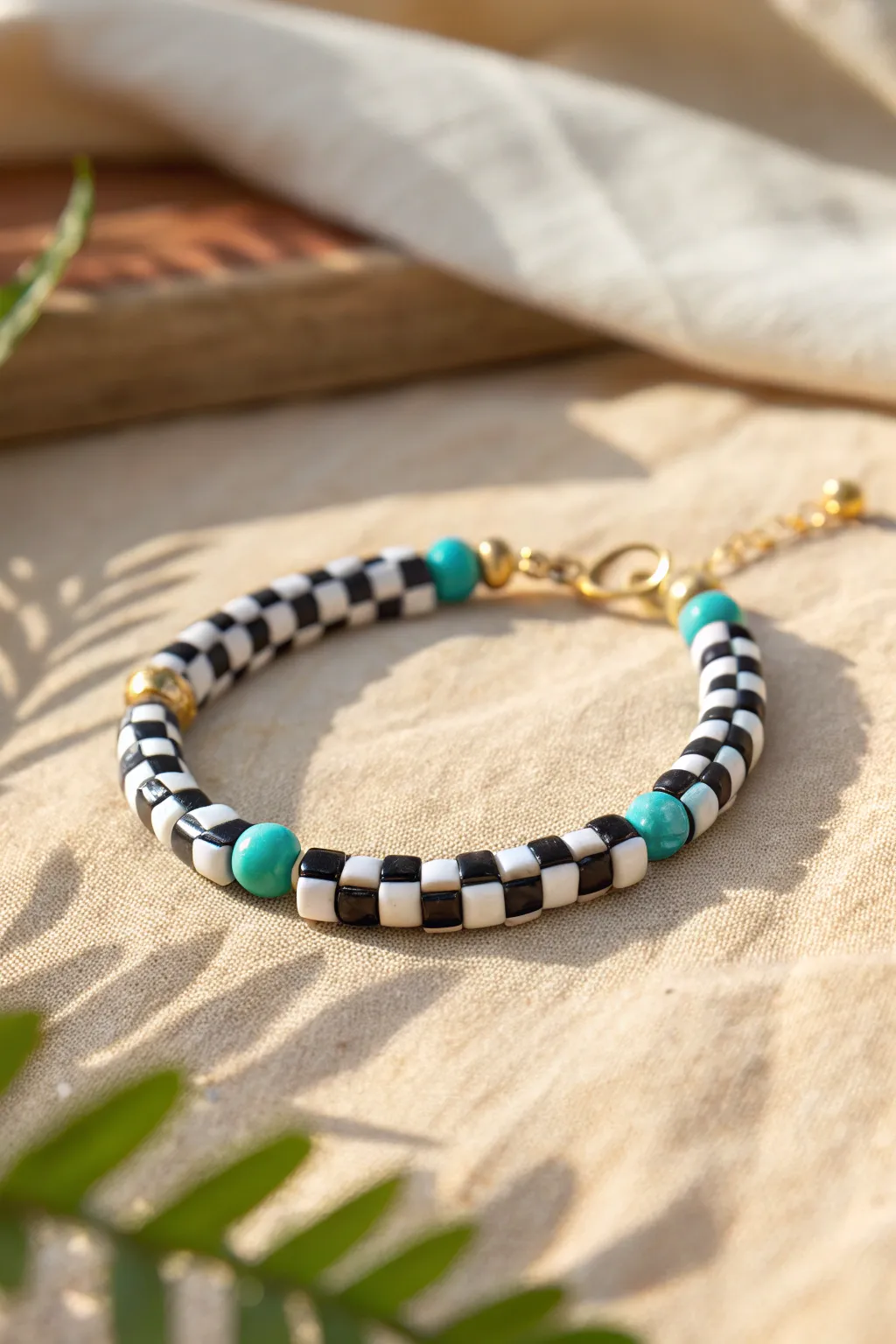
Channel distinctive western vibes with this striking checkerboard pattern bracelet that mixes bold monochrome with pops of turquoise. The pairing of geometric square heishi beads with smooth round stones creates a playful texture perfect for a modern cowgirl aesthetic.
Step-by-Step
Materials
- Elastic beading cord (0.7mm or 0.8mm)
- Black square polymer clay (heishi) beads
- White or cream square polymer clay (heishi) beads
- 4 Round turquoise beads (approx 6-8mm)
- 2 Small gold spacer beads (bicone or multifaceted shape)
- 2 Large gold connector beads or crimp covers (optional decorative ends)
- Gold tone lobster clasp
- Gold tone jump rings and extender chain
- Jewelry glue (like G-S Hypo Cement)
- Scissors
Step 1: Preparation and Pattern Planning
-
Measure your wrist:
Before cutting any string, wrap a measuring tape around your wrist to find your size. Add about 1/2 inch to this measurement for a comfortable fit. -
Cut the cord:
Cut a piece of elastic cord about 10-12 inches long. Having this extra length makes tying the final knots much easier than struggling with short ends. -
Pre-stretch the elastic:
Give your elastic cord a few firm tugs. This pre-stretching prevents the bracelet from drooping or loosening up after you wear it for the first time. -
Secure the end:
Attach a piece of tape or a bead stopper to one end of your cord so your beads don’t slide off while you are working.
Square Bead Alignment
Square beads can twist. When stringing, keep them aligned flat-to-flat. Tight tension at the end is key to snapping them into a straight rod shape.
Step 2: Stringing the Checkerboard Design
-
Start the pattern:
Begin by stringing approximately 8 to 10 pairs of square beads to create the first checkerboard segment. To achieve the specific look in the photo, alternate strictly between one black bead and one white bead. -
Refining the checkerboard:
As you string, ensure the flat square beads sit flush against each other. The tension of the elastic will eventually pull them into that satisfying, tight checkered line. -
Add first gold accent:
Slide on one of the multifaceted gold spacer beads. This acts as a metallic break in the pattern. -
Continue the monochrome:
String another segment of alternating black and white square beads. This section should be roughly the same length as your first, about 1.5 inches. -
Insert turquoise pop:
String your first round turquoise bead. The change in shape from square to round adds essential visual interest. -
Create a short segment:
Add a shorter segment of checkerboard beads—about 6 to 8 alternating beads total. -
Add central turquoise:
Thread on another turquoise bead. Repeat the short checkerboard segment, then another turquoise bead, creating a focused section of color. -
Finish the beadwork:
Complete the bracelet length with a final segment of checkerboard beads, mirroring the start, and finish with the second gold spacer bead if desired near the closure.
Step 3: Finishing Touches
-
Check the fit:
Wrap the unfinished strand around your wrist to verify the size. Add or remove a few checkerboard beads if necessary to get the perfect fit. -
Tie the knot:
Remove the tape or stopper. Bring the two ends together and tie a surgeon’s knot (loop the elastic through twice before pulling tight) to secure the circle. -
Secure with glue:
Apply a tiny dab of jewelry glue specifically to the knot. I find putting a focused drop right in the center ensures it never slips. -
Hide the knot:
If possible, gently tug the elastic so the knot slides inside one of the larger turquoise or gold beads to conceal it. -
Add hardware (Optional):
If you prefer a clasp over a stretch style, tie your elastic onto jump rings at each end instead of a circle, then use pliers to attach the gold lobster clasp and extender chain to the rings. -
Trim excess:
Once the glue is fully dry, trim the excess cord ends carefully with scissors, being careful not to nick the knot itself.
Sagging Pattern?
If gaps appear between square beads, your elastic isn’t tight enough. Retie the knot with more tension so the elastic remains slightly stretched inside.
Slip on your new accessory and enjoy the stylish blend of western flair and geometric fun
Mixed Shape Beads for Saddle-Style Texture
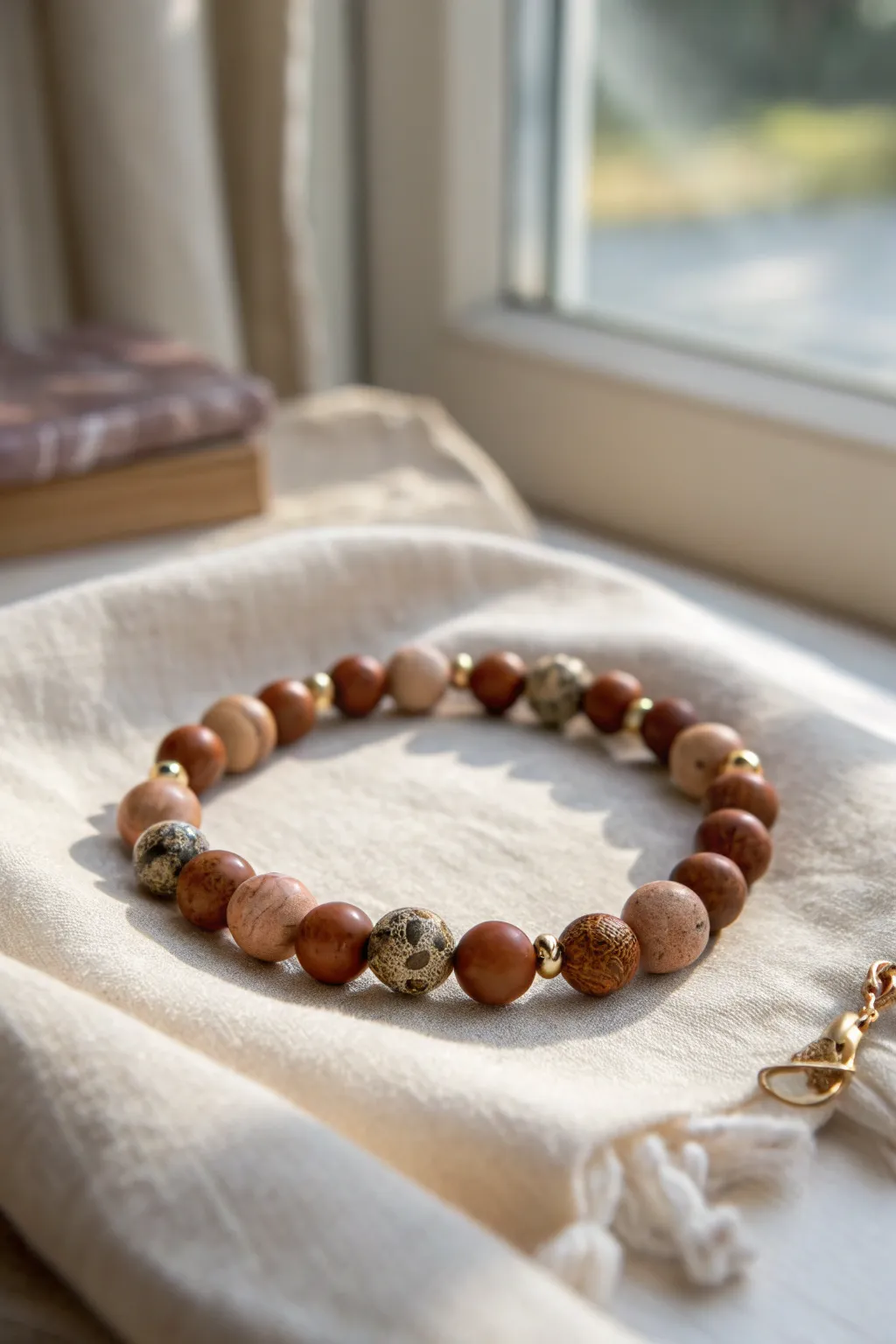
This rustic, nature-inspired bracelet combines the warm, grounding tones of saddle leather with varying textures that evoke the rugged beauty of the West. It’s a simple stringing project that relies on a specific rhythm of bead sizes and patterns to achieve that effortlessly chic cowgirl aesthetic.
How-To Guide
Materials
- Stretch cord (0.7mm or 0.8mm clear elastic)
- 8mm Round Jasper beads (Red Creek or similar earthy variety)
- 10mm Wood grain or sandstone textured beads
- 8mm Speckled granite or Dalmatian jasper beads
- 6mm Smooth brown agate or wood beads
- 4mm Gold spacer beads (tiny round balls)
- Jewelry glue (GS Hypo Cement recommended)
- Scissors
Step 1: Preparation
-
Pre-stretch the cord:
Cut a piece of stretch cord about 10-12 inches long. Before you add a single bead, give the cord several firm tugs to pre-stretch it. This prevents the bracelet from sagging or becoming loose after you wear it a few times. -
Sort your palette:
Lay out your beads on a bead board or a soft piece of fabric like the one in the photo. Group them by type: the smooth reddish-brown jaspers, the textured wood-like rounds, the speckled cream/grey accents, and the tiny gold spacers. Seeing them separated helps visualization.
Step 2: Creating the Pattern
-
Establish the rhythm:
The charm of this piece is that it isn’t perfectly symmetrical, but it does follow a rhythm. I like to think of it as grouping ‘warm’ tones with ‘cool’ speckled accents. -
Start with a focal section:
Begin threading by placing a 10mm textured bead (the largest wood-grain style) followed by a tiny gold spacer. The gold acts as a highlight between the earthy textures. -
Add color depth:
Next, slide on a smooth, reddish-brown 8mm bead. This smooth texture contrasts nicely against the rougher focal bead you just placed. -
Introduce the speckle:
Thread on one of the speckled granite or Dalmatian jasper beads. This lighter color breaks up the heavy brown tones and adds that ‘saddle’ complexity. -
Build a cluster:
Add another smooth brown bead, then a gold spacer. Repeat a similar small grouping: maybe a textured bead, a gold spacer, and then a lighter tan wood bead.
Natural Variation
Since these are faux-stone or clay beads, slight color differences are good! Don’t cull the ‘imperfect’ beads; they add to the organic Western vibe.
Step 3: Completing the Strand
-
Continue the random-organic flow:
Keep stringing until you reach the desired length (usually about 6.5 to 7 inches for an average wrist). Don’t worry about perfect symmetry; instead, ensure you alternate the large textured beads with the smoother, smaller ones to keep the visual weight balanced. -
Check the fit:
Wrap the unfinished strand around your wrist. The ends should touch comfortably without stretching the cord, but without gaping spaces. -
Verify the spacers:
Look closely at your pattern. Ensure you have the small gold spacer beads strategically placed—usually flanking the most interesting or largest beads to draw the eye to them.
Knot Slipping?
If your elastic knot feels slick, roll the knot between your fingers with a tiny bit of rosin or even hairspray before tightening to add grip.
Step 4: Finishing
-
Prepare the knot:
Bring the two ends of the elastic together carefully. Remove any final slack in the beads so they sit flush against each other. -
Tie the surgeon’s knot:
Tie a standard overhand knot, but do not pull tight yet. Make a second loop through the knot (like the beginning of shoelaces, but looped twice) and then pull firmly. This extra loop is the key to a secure hold. -
Apply adhesive:
While holding the knot taut, dab a tiny drop of jewelry glue directly onto the knot. You don’t need much; just enough to saturate the thread intersection. -
Hide the mechanics:
If one of your beads acts as a ‘large hole’ bead (often the wooden or textured ones do), slide the knot inside that bead while the glue is still slightly tacky. -
Final trim:
Once the glue has set for a moment, trim the excess elastic cord close to the knot with sharp scissors, being careful not to nick the main structural cord.
Slip on your new bracelet to add a touch of desert warmth to any outfit
Tiny Lariat Loop Charm Moment
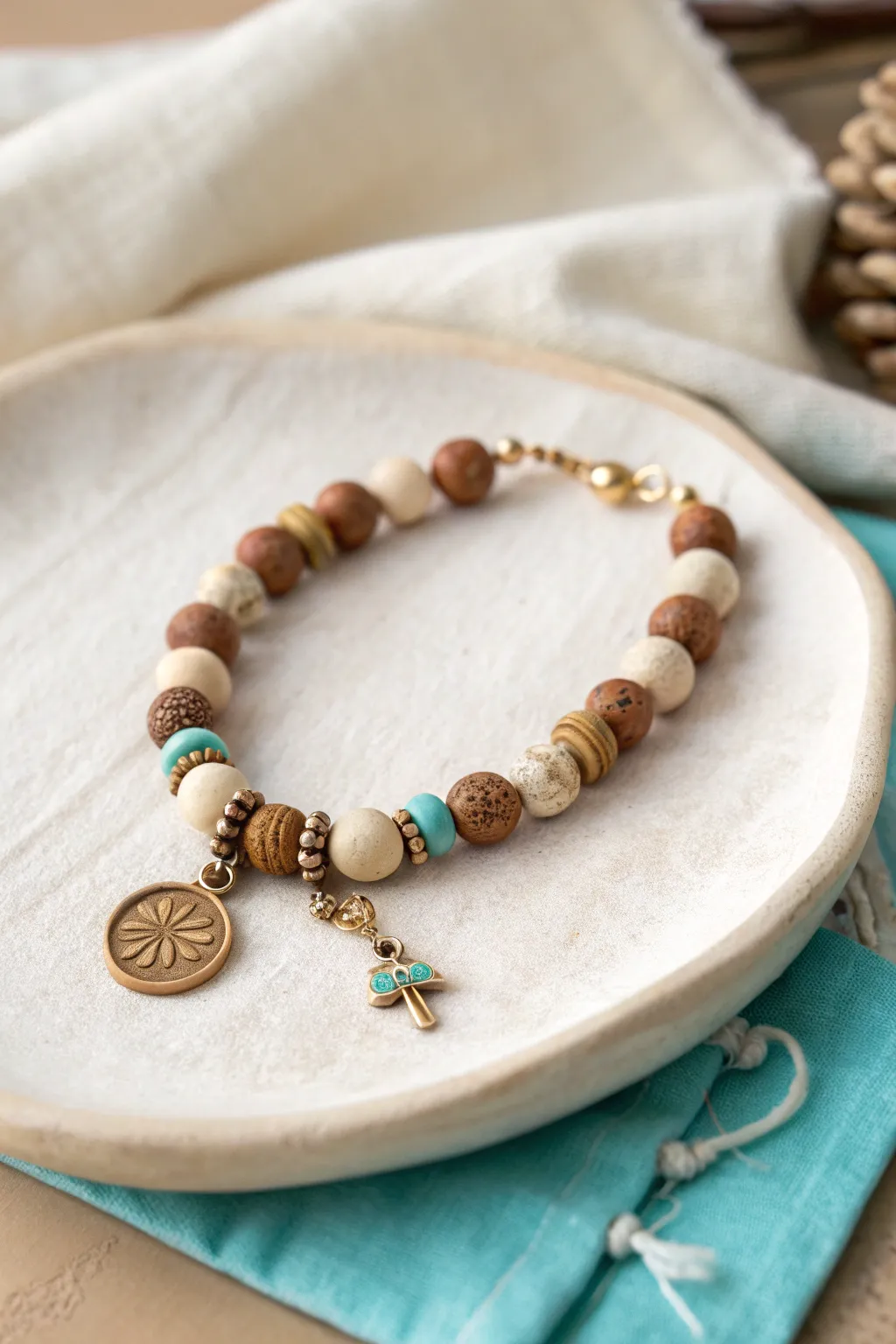
Embrace the rustic charm of the Southwest with this earthy beaded bracelet, blending textured clay tones with vibrant turquoise accents. The unique double-charm feature adds a playful lariat-style movement that sets this piece apart.
Step-by-Step
Materials
- Polymer clay beads (8mm-10mm mix: terra cotta, speckled cream, beige)
- Small turquoise heishi or spacer beads (4-6mm)
- Gold spacer beads or disc beads
- Gold bead caps (daisy style or small rounds)
- Textured wood or ribbed clay feature beads
- Gold flower-stamped coin charm
- Gold mushroom or totem charm with turquoise inlay
- Beading wire (0.38mm or 0.45mm)
- 2 Crimp beads
- 2 Crimp covers
- 2 Wire guards (optional)
- Gold lobster clasp and jump ring
- Small jump rings (for the charms)
- Chain nose pliers
- Flush cutters
- Crimping tool
Step 1: Planning and Preparation
-
Design your pattern:
Lay out your bead design on a bead board or soft cloth. The pattern shown uses an asymmetrical but balanced mix of smooth round beads, speckled textures, and ribbed accent beads. -
Establish the focal point:
Identify the center of your design where the charms will hang. This section features a specific sequence: turquoise spacer, beige round, gold spacers, ribbed focus bead, gold spacers, beige round, turquoise spacer. -
Prepare the wire:
Cut a piece of beading wire approximately 10-12 inches long. This gives you plenty of slack to work with on both ends.
Secure That Dangle
Use ‘locking’ jump rings or add a tiny drop of jewelry glue to the closure of your charm rings. Charms get snagged easily, and this prevents them from pulling open and getting lost.
Step 2: Stringing the Beads
-
Start the strand:
Attach a crimp bead to one end of the wire, loop it through your jump ring (or wire guard if using), and pass back through the crimp. Flatten the crimp secure and cover with a crimp cover for a polished look. -
String first section:
Begin stringing from one side of the clasp towards the center. Alternate between the darker brown clay beads, the creamy speckled beads, and the occasional ribbed wood-tone bead. -
Add texture variation:
Don’t be afraid to mix sizes slightly. Use smaller gold spacers between larger clay beads to add flexibility and a touch of shine to the strand. -
Create the charm zone:
When you reach the center, thread the first turquoise spacer, followed by a cream bead. Now, thread a jump ring directly onto the main beading wire—this will hold your flower coin charm. -
Add the central feature bead:
Thread a few gold daisy spacers, then your central ribbed brown bead, and a few more gold spacers. -
Add the second charm holder:
Thread another jump ring onto the main wire—this is for the mushroom charm. Follow this with a cream bead and the second turquoise spacer. -
Finish the strand:
Continue the pattern on the other side, mirroring the feel of the first half until you reach your desired length (usually 6.5 to 7 inches for a standard wrist).
Step 3: Finishing Touches
-
Close the loop:
Thread a crimp bead and then your lobster clasp onto the end of the wire. -
Secure the crimp:
Pass the wire back through the crimp bead and the first few beads of your strand. Pull tight enough to remove slack but leave a tiny bit of wiggle room so the bracelet drapes naturally. -
Final crimp:
Use your crimping tool to flat or fold the crimp bead securely. I always double-check the tightness here before trimming. -
Trim and cover:
Trim the excess wire flush against the beads with your flush cutters. Place a crimp cover over the crimp bead and gently close it with pliers to make it look like a gold bead. -
Attach the coin charm:
Open the jump ring you threaded earlier (on the left side of the center bead) using two pairs of pliers. Slide on the gold flower coin charm and close the ring securely. -
Attach the secondary charm:
Repeat the process for the second jump ring on the right side of the center bead, attaching the small turquoise-inlay mushroom charm.
Make It Yours
Swap the turquoise spacers for real turquoise nuggets for a more valuable finish, or use leather cord instead of wire and tie knots between beads for a rugged, casual look.
Slip on your new bracelet and enjoy how the charms chime softly as you move through your day
Monochrome Cowgirl With One Turquoise Pop
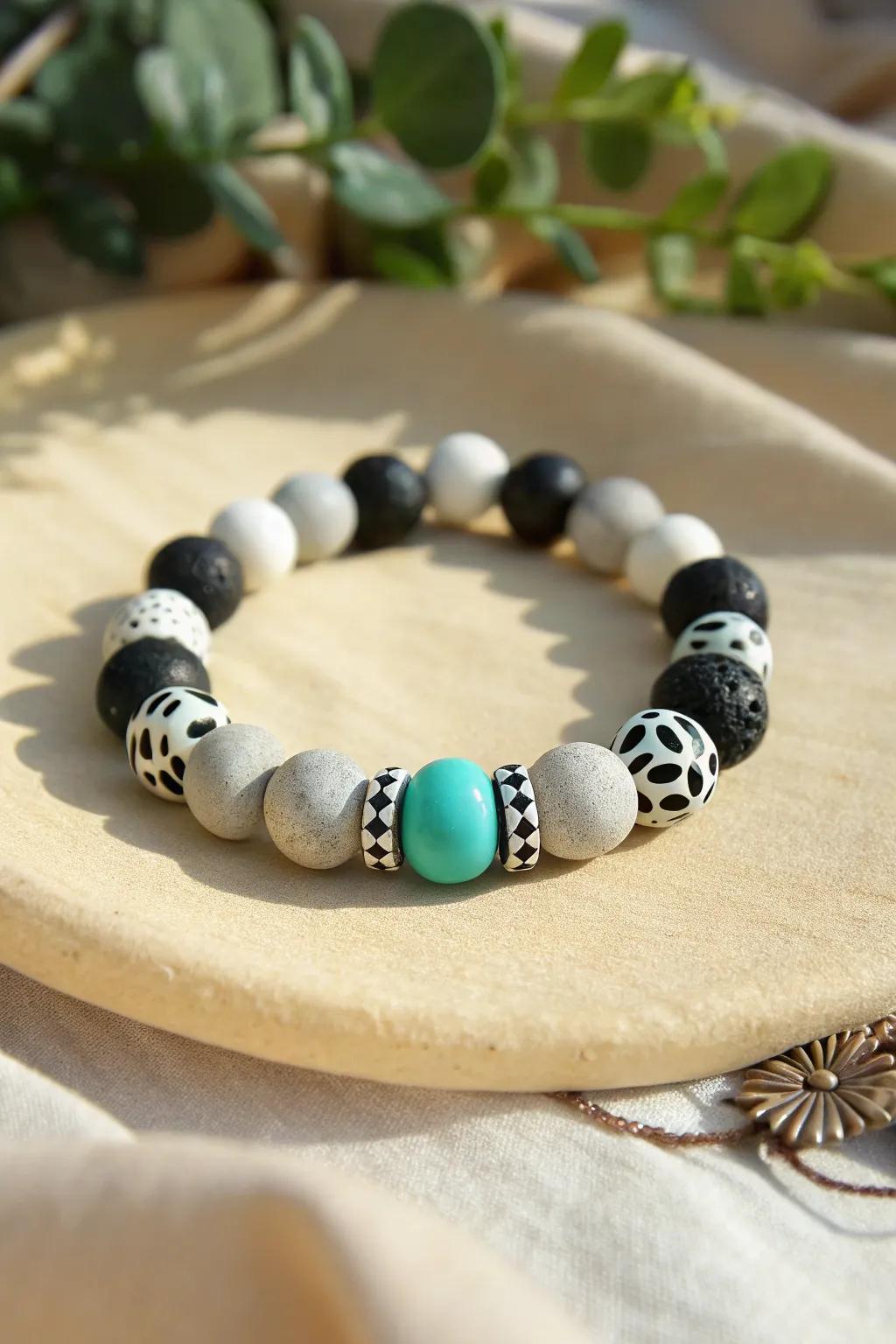
This striking bracelet balances the rustic charm of porous lava stone with the smooth, modern finish of polymer clay beads. The high-contrast monochrome palette makes the single turquoise focal bead sing, creating a piece that feels both grounded and spirited.
Detailed Instructions
Materials
- Polymer clay (black, white, grey, granite/stone effect, turquoise)
- Black acrylic paint
- Small round paintbrush or dotting tool
- Needle tool or toothpick
- Baking tray and parchment paper
- Oven (for baking clay)
- Elastic jewelry cord (0.8mm or 1mm thickness)
- Jewelry glue or clear nail polish
- Scissors
- Optional: Bead reamer
- Optional: Store-bought black lava stone beads (if not making faux ones from clay)
Step 1: Creating the Focal & Accent Beads
-
Shape the turquoise focal:
Condition a small amount of turquoise polymer clay until soft. Roll it into a smooth ball about 12mm in diameter. -
Check the shape:
Gently gently roll the ball between your thumb and forefinger to create a slightly pill-shaped or oval bead rather than a perfect sphere. Keep the surface completely smooth. -
Form the checkerboard spacers:
Create two flat, disc-like beads using white clay. They should be slightly smaller in diameter than your turquoise focal bead to act as caps. -
Paint the checkers:
Once you’ve shaped the discs, use a very fine brush to paint black diamond shapes around the edge. Alternatively, you can create a cane with black and white clay for a more advanced inlaid look, but paint works perfectly for beginners. -
Pierce the holes:
Use your needle tool to carefully pierce a hole through the center of the turquoise bead and the two checkered discs. Rotate the needle as you push through to prevent squashing the bead.
Uneven Holes?
If your bead holes shrank during baking and the cord won’t fit, use a manual bead reamer or a small drill bit twisted by hand to gently widen the channel without cracking the clay.
Step 2: Crafting the Monochrome Pattern Beads
-
Make the spotted beads:
Roll four balls of white polymer clay, approximately 10-12mm in size. -
Add the spots:
Take tiny pinches of black clay, roll them into minuscule balls, and press them randomly onto the white beads. Roll the entire bead in your palms again to flatten the spots flush with the surface. -
Create the faux lava stone:
Roll several balls of black clay. Use a stiff toothbrush or a ball tool to texture the surface deeply, mimicking the pitted look of igneous rock. -
Form the matte grey beads:
Mix a small amount of black into white clay to get a soft, matte grey. Roll three smooth beads from this mixture. -
Create the granite effect:
Using granite-effect or speckled clay, roll three beads. Texture these slightly with sandpaper or a stiff brush to give them a stone-like feel. -
Pierce all remaining beads:
Carefully create holes in every bead you’ve just made, ensuring the hole size matches your elastic cord thickness.
Step 3: Baking and Assembly
-
Bake the clay:
Arrange all your beads on a parchment-lined baking sheet. Bake according to the manufacturer’s instructions for your specific brand of clay (usually 275°F/135°C for 15-30 minutes). -
Cool down completely:
Let the beads cool fully before handling. They harden as they cool. This is a great time to verify your layout on a bead board or soft cloth. -
Measure your cord:
Cut a piece of elastic cord about 10 inches long. I always stretch the cord firmly a few times before stringing to prevent the bracelet from sagging later. -
Begin stringing with the focal:
Thread the turquoise bead first, followed immediately by a checkered disc on either side. -
Add the textured grey beads:
Next to the checkered discs, string one granite-effect bead on each side to create a texturally interesting transition. -
Create the pattern rhythm:
Continue stringing the remaining beads, alternating textures. Place a spotted white bead, then a black lava bead, then a smooth grey bead. Repeat this pattern symmetrically on both sides. -
Check the fit:
Wrap the strung beads around your wrist. If it’s too tight, add an extra black lava bead to the back; if too loose, remove one grey bead. -
Tie the knot:
Tie a surgeon’s knot (right over left, left over right twice). Pull the elastic tight enough that the beads touch but don’t buckle. -
Secure and hide:
Add a tiny drop of jewelry glue to the knot. Once dry, trim the excess cord and gently tuck the knot inside the hole of the nearest large bead.
Glossy Contrast
Wait until fully baked, then apply a high-gloss glaze ONLY to the turquoise bead and the spotted white beads. Leave the grey and lava beads matte for a sophisticated texture clash.
Slip this rugged yet chic accessory on to add a touch of western flair to any outfit
Stacked Theme Set: Words, Patterns, and Charms
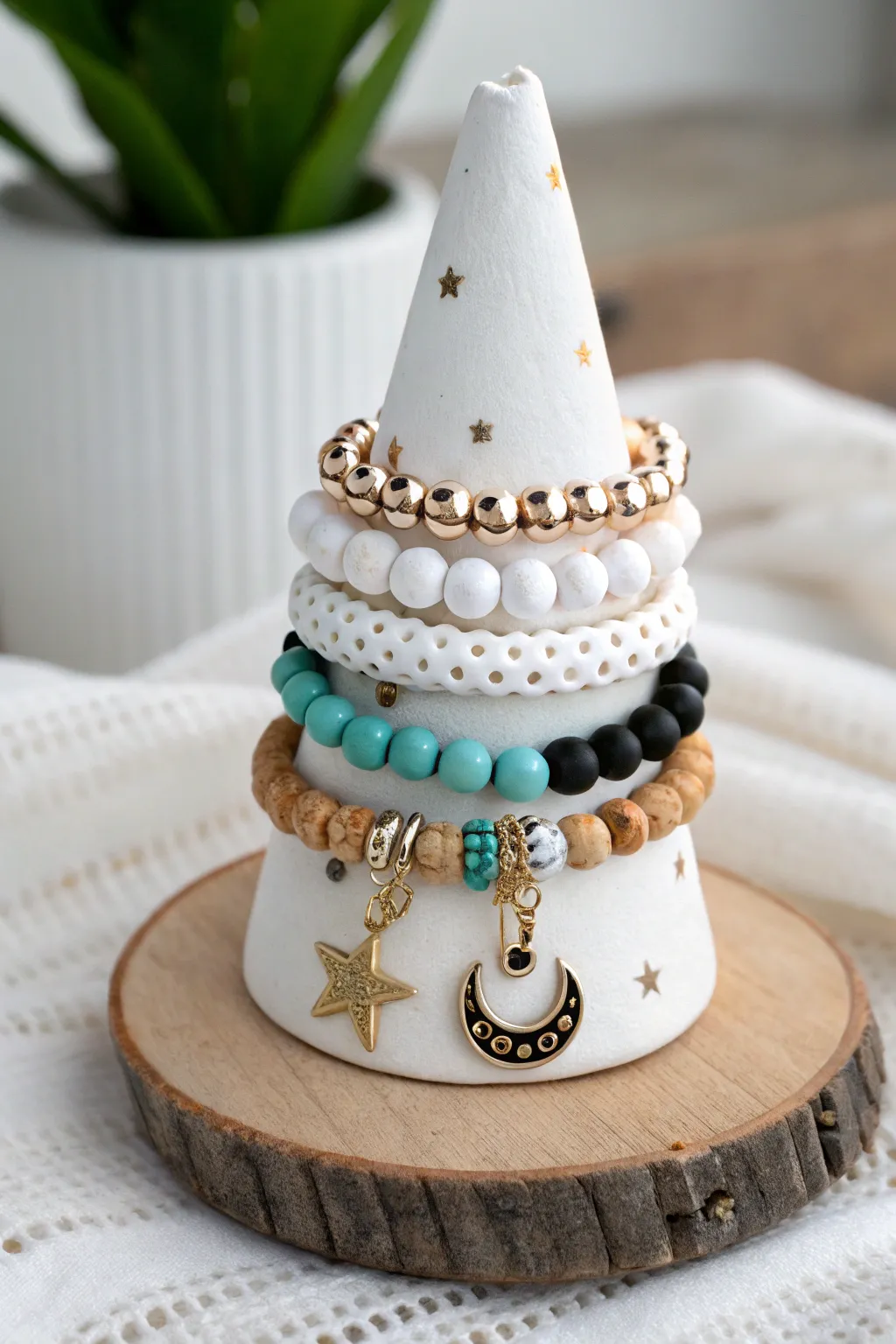
Capture the magic of the night sky with this stunning five-bracelet stack featuring a mix of gold, turquoise, and earthy tones. This project combines various textures—from smooth metallic spheres to rustic wood and woven beads—accented by dangling celestial charms for a dreamy, bohemian finish.
Step-by-Step Tutorial
Materials
- Stretch cord (0.8mm or 1mm thickness)
- 6mm-8mm gold metallic round beads
- 8mm white faceted agate or white lava rock beads
- White heishi beads or flat disc beads (for the textured look)
- Small gold spacer beads (optional)
- 8mm turquoise round beads (dyed howlite or similar)
- 8mm matte black onyx beads
- 8mm wood jasper or picture jasper beads
- Detailed gold star charm
- Enamel crescent moon charm (black and gold)
- Gold jump rings (4mm and 6mm)
- Jewelry glue (E6000 or G-S Hypo Cement)
- Scissors
Step 1: Gold Sphere Bracelet
-
Measure and cut:
Measure your wrist and cut a piece of stretch cord about 3-4 inches longer than your measurement to allow ample room for tying knots. -
Pre-stretch the cord:
Give the elastic cord a few firm tugs before you begin stringing. This simple trick prevents the bracelet from loosening up over time. -
String the gold beads:
Thread the 6mm-8mm gold metallic round beads onto the cord until you reach your desired length. -
Tie and secure:
Tie a surgeon’s knot (right over left, left over right) and pull tight. Apply a tiny dot of jewelry glue to the knot, let it dry for a moment, and trim the excess cord.
Step 2: White Faceted & Honeycomb Bracelets
-
Create the white stone strand:
For the second bracelet, string your white faceted agate or lava rock beads onto a new piece of pre-stretched cord. The faceted texture adds a nice contrast to the smooth gold. -
Assemble the honeycomb texture:
For the third, textured white bracelet, you can use specialized honeycomb beads if available. Alternatively, you can mimic this look by tightly restringing white heishi beads in a specific pattern or using a pre-made white textured spacer bead. -
Check the fit:
Wrap the strands around your wrist to ensure they sit comfortably without pinching. Adjust bead counts if necessary. -
Knot and glue:
Secure both white bracelets with surgeon’s knots and a dab of glue, hiding the knots inside a bead hole if the hole size permits.
Knot Hiding Trick
If bead holes are too small to hide the knot, thread the tail ends through adjacent beads *before* trimming. This tucks the knot away neatly.
Step 3: Turquoise & Black Split Design
-
Plan the color block:
This fourth bracelet features a split design. Plan to string turquoise beads for roughly half the length and matte black onyx beads for the other half. -
Add a focal spacer:
Insert a small gold spacer bead or a decorative bead exactly where the two colors meet on one side to create a deliberate transition point. -
String and finish:
Thread the turquoise beads first, add your spacer, then finish with the black beads. Tie off and glue securely as with previous steps.
Add Extra Sparkle
Mix in a few crystal pavé beads among the gold or white strands to catch the light and add a touch of glamour to your stack.
Step 4: Earth & Charm Bracelet
-
Select earthy beads:
For the final bottom bracelet, pick out your wood jasper or picture jasper beads. Their natural beige and brown variations ground the stack perfectly. -
Incorporate accent beads:
Designate a front section for this bracelet. In the center, substitute 3-4 standard jasper beads with a mix of special accents: perhaps a gold rondelle, a turquoise spacer, or a marbled black-and-white bead to create visual interest. -
Prepare the charms:
Open a gold jump ring using two pliers (twist, don’t pull). Slide on your gold star charm. Repeat this process for the crescent moon charm. -
Attach charms:
Attach the jump rings directly onto the cord between the accent beads you just placed, or attach them to specific gold carrier beads if you prefer them to slide less. I find attaching them between beads keeps them better positioned. -
Final assembly:
Finish stringing the rest of the jasper beads to complete the circle. Tie your final knot tightly, apply glue, and trim.
Stack them all together on your wrist or a display cone to enjoy your handcrafted celestial jewelry set