
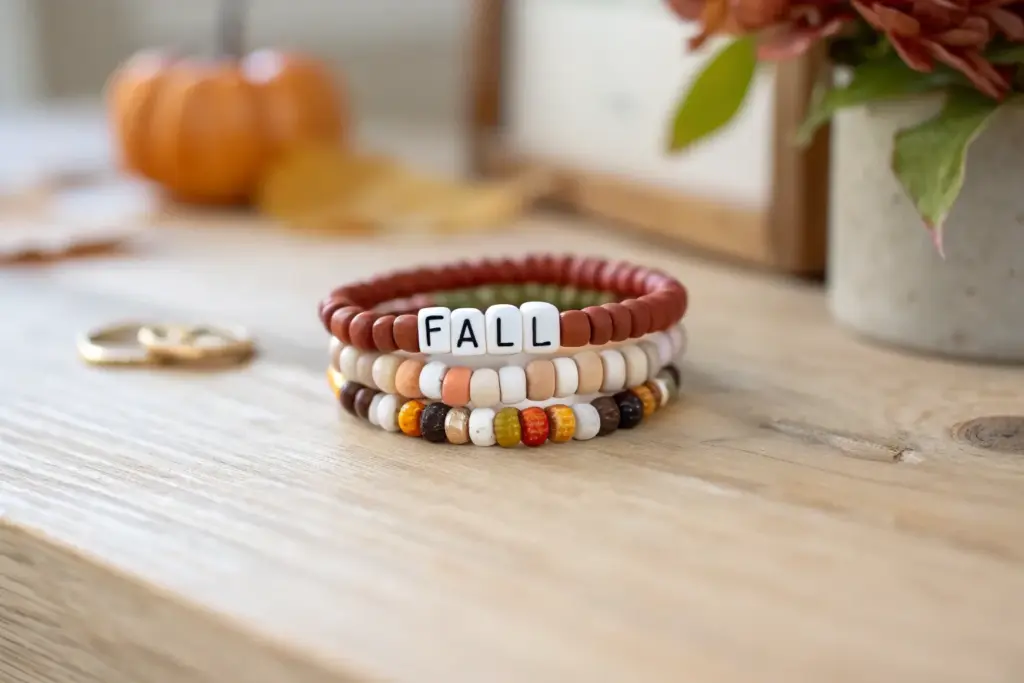
When the weather turns crisp, I start reaching for cute fall clay bead bracelets in all my favorite cozy colors. Here are a bunch of easy, wearable ideas you can mix, match, and stack for instant autumn vibes.
Warm Earth-Tone Heishi Stack
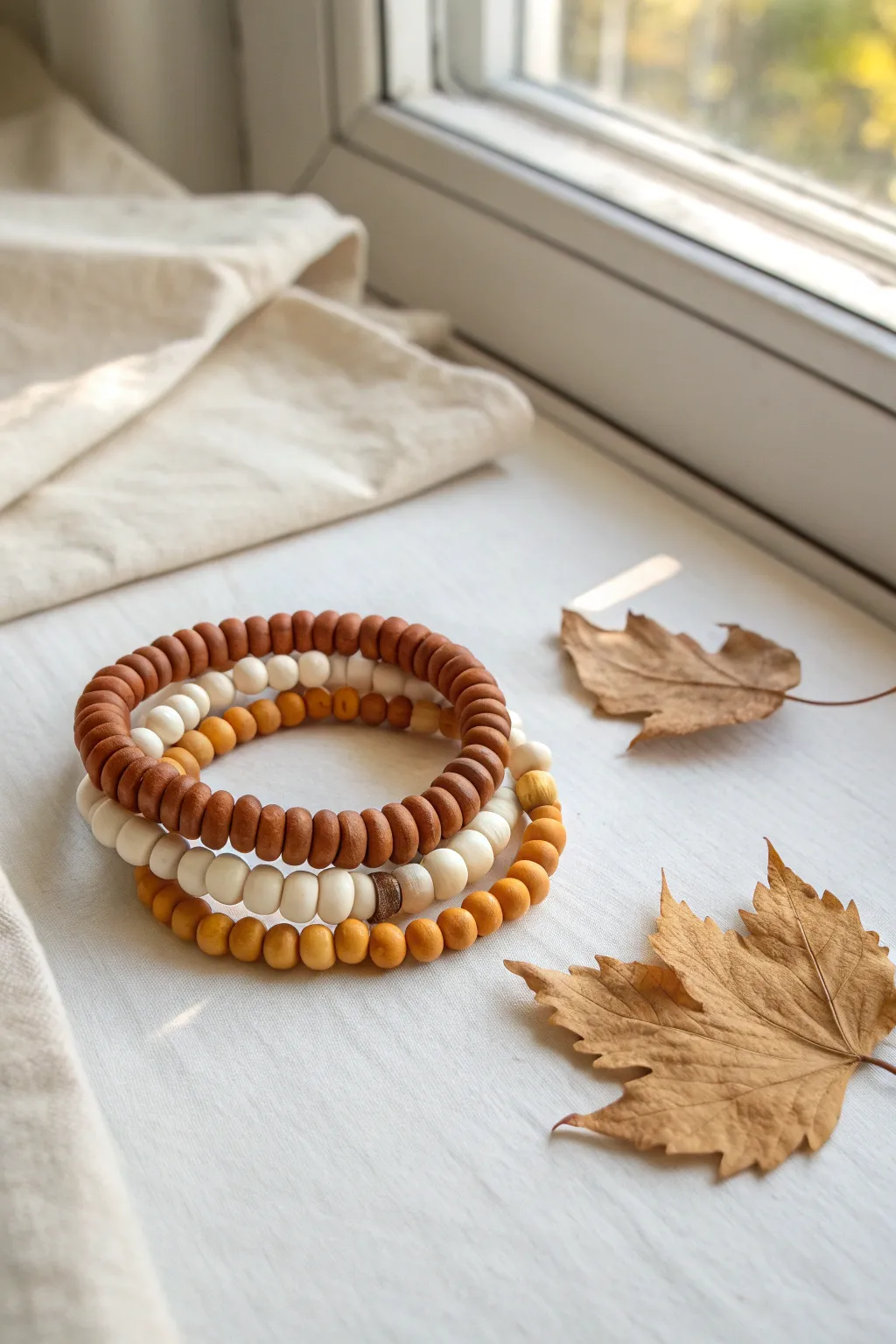
This charming trio of bracelets captures the essence of a cozy autumn afternoon with its mix of warm wooden textures and rich terracotta hues. The stack combines classic round beads with modern heishi disks for a varied, tactile look that pairs perfectly with fall sweaters.
Step-by-Step
Materials
- Terracotta brown polymer clay heishi beads (6mm)
- Cream/off-white round wooden beads (8mm)
- Mustard yellow/ochre round wooden beads (8mm)
- Elastic beading cord (0.7mm or 0.8mm)
- Super glue or jewelry adhesive
- Scissors
- Beading needle (optional but helpful)
- One focal accent bead (textured wooden or metallic spacer)
Step 1: Preparation
-
Measure the cord:
Cut three lengths of elastic cord, each about 10-12 inches long. This generous length gives you plenty of room to tie secure knots without fighting against tension. -
Pre-stretch the elastic:
Before you thread a single bead, give each piece of cord a firm tug several times. This pre-stretching prevents the bracelets from sagging or loosening up after the first time you wear them. -
Secure the end:
Place a piece of tape over one end of your first cord, or attach a bead stopper, so your beads don’t slide right off the other side while you work.
Step 2: The Terracotta Heishi Band
-
Start threading the heishi beads:
Begin threading the flat, terracotta-colored clay disk beads onto your first cord. Because these are thin, you will need quite a few to go around your wrist. -
Check consistency:
As you string them, check for any beads that might be chipped or unevenly sliced, removing them to keep the stack looking uniform and professional. -
Test the length:
Wrap the strand around your wrist occasionally. You want a comfortable fit that isn’t tight, usually around 6.5 to 7 inches for an average adult wrist. -
Double check the fit:
Add or remove a few disks until the ends meet comfortably without stretching the elastic.
Knot Hiding Trick
If the knot won’t fit inside the heishi bead hole, expand the hole slightly using a bead reamer or a thick needle before sliding the knot in.
Step 3: The Cream Wooden Strand
-
Thread the white beads:
Take your second cord and begin stringing the 8mm cream-colored wooden beads. I find the larger hole size on wooden beads makes this step go very quickly. -
Add the focal point:
About halfway through the strand, slide on your textured accent spacer bead. This breaks up the pattern and adds a subtle rustic detail to the middle layer. -
Finish the strand:
Continue adding the cream beads until this bracelet matches the length of your first heishi bracelet.
Avoid Snap-Back
If your bracelets feel tight or snap when putting them on, you likely skipped pre-stretching the elastic. Give the finalized stack a gently tug on all sides.
Step 4: The Ochre Wooden Strand
-
Create the yellow layer:
On the third cord, string the mustard yellow wooden beads. These add a pop of fall color that ties the lighter cream and darker brown tones together. -
Verify sizing:
Ensure this third bracelet is the same length as the previous two so they stack neatly without sliding over one another.
Step 5: Finishing Touches
-
Tie the first knot:
Remove the tape or stopper. Bring the ends of the cord together and tie a simple overhand knot, pulling it tight against the beads. -
Secure with a surgeon’s knot:
Follow up with a surgeon’s knot (looping the end through twice instead of once) for extra security. Pull the elastic taut as you tighten it. -
Apply adhesive:
Dab a tiny drop of super glue or jewelry cement directly onto the knot. Be careful not to glue the beads to the cord, as this can make the bracelet stiff. -
Hide the knot:
Once the glue is tacky but not fully set, gently pull the knot inside the hole of the nearest wooden bead. For the heishi bracelet, the knot may remain visible but will blend in if distinct and small. -
Trim the excess:
Allow the glue to dry completely, then use your sharp scissors to trim the excess cord ends close to the beads.
Enjoy wearing your new stack of autumn-inspired wrist candy
Pumpkin Spice Letter Bead Bracelet
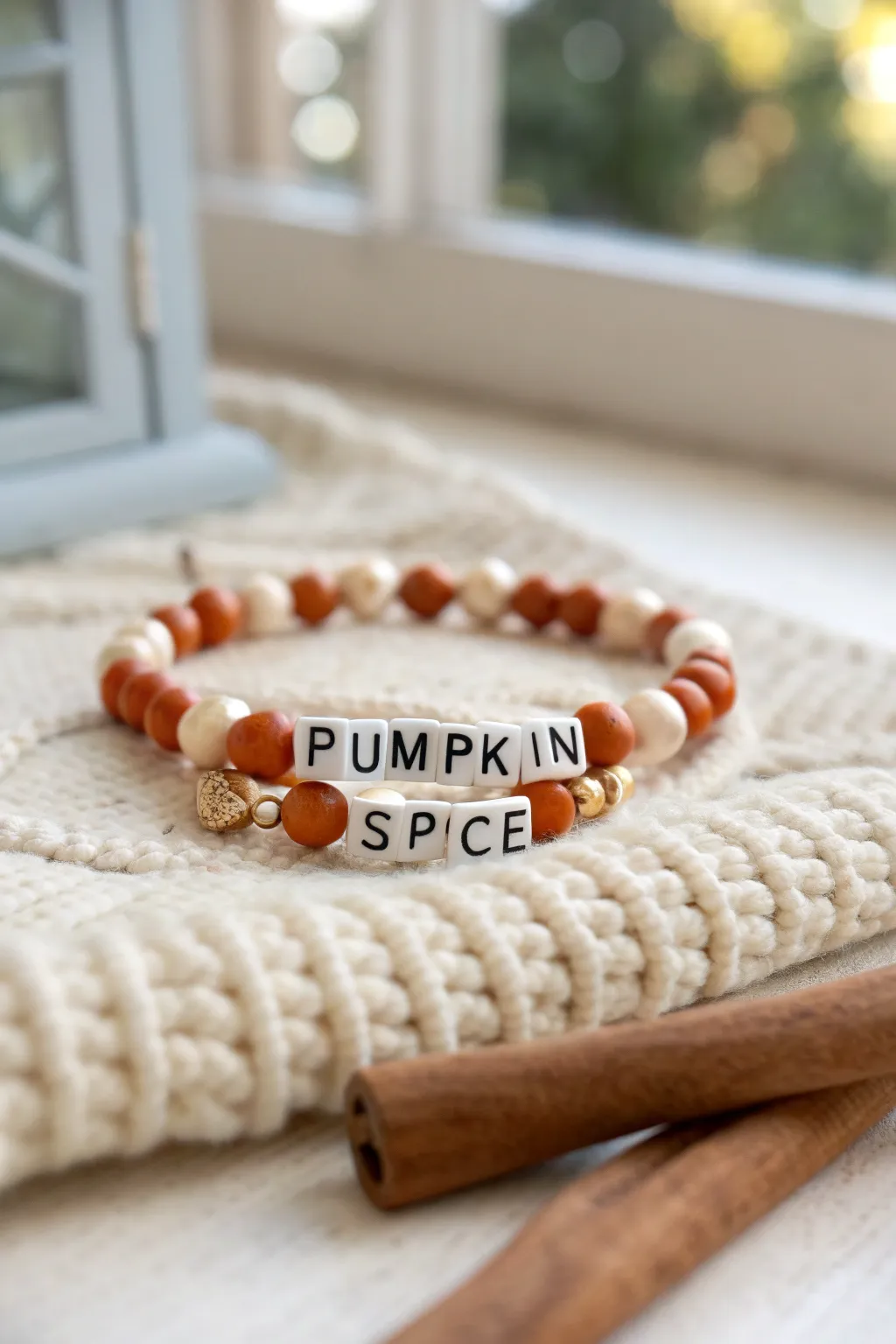
Embrace the cozy vibes of autumn with this charming beaded bracelet featuring warm terracotta and cream tones. This simple yet festive accessory spells out the season’s favorite flavor, making it the perfect addition to your fall wardrobe.
Step-by-Step Tutorial
Materials
- Elastic stretch beading cord (0.7mm or 0.8mm)
- Round wood or clay beads (approx. 8mm) in burnt orange/terracotta
- Round wood or clay beads (approx. 8mm) in cream/off-white
- Square alphabet beads (white with black letters) spelling ‘PUMPKIN’ and ‘SPICE’
- Small gold spacer beads (round)
- Small gold heart charm (optional)
- Jewelry glue or clear nail polish
- Scissors
- Beading needle (optional but helpful)
- Tape or a bead stopper
Step 1: Planning & Preparation
-
Measure your wrist:
Before cutting anything, wrap a piece of string or a flexible measuring tape around your wrist to find your size. Add about half an inch for a comfortable fit. -
Cut the cord:
Cut a length of elastic cord about 10-12 inches long. Having extra length makes tying the final knot much easier than struggling with short ends. -
Secure the end:
Place a piece of tape or a bead stopper on one end of the cord. This prevents your beads from sliding right off while you work. -
Layout your design:
Lay your beads out on a bead board or a towel. Arrange the ‘PUMPKIN’ letter beads for the top strand and ‘SPICE’ for the bottom part of the loop, flanked by the colored beads.
Step 2: First Half – The Orange & Cream Pattern
-
Start the pattern:
Begin threading your round beads onto the cord. Alternate between one burnt orange bead and one cream bead to create the striped pattern seen in the back of the bracelet. -
Check the length:
Continue this alternating pattern until you’ve covered about half of the bracelet’s circumference. Hold it up to your wrist to gauge if you need more or fewer beads. -
Verify symmetry:
Aim to end with a cream bead if you started with an orange one, or vice versa, to keep the pattern consistent when it meets the letter section.
Knot Slipping?
If your elastic knot feels insecure, try a surgeon’s knot: overlap ends, wrap one end through the loop twice instead of once before pulling tight.
Step 3: Adding the Letters
-
Transition beads:
Before adding letters, slide on one burnt orange bead to act as a visual bookend for your text. -
Spell the first word:
Thread the ‘PUMPKIN’ letter beads onto the cord. Double-check that they are facing the correct way and spelled correctly before moving on. -
Add a spacer:
Insert a single burnt orange bead after the word ‘PUMPKIN’ to separate the two words. -
Spell the second word:
Next, thread the ‘SPICE’ letter beads. Sometimes I verify the letter orientation again here to ensure the whole phrase reads left-to-right when worn. -
Add gold accents:
Slide on two small gold spacer beads after the final ‘E’. If using a heart charm, thread it on here between the spacers or next to them for a bit of sparkle.
Make It a Set
Create a matching stack by making two solid-color bracelets—one fully terracotta and one cream—to wear alongside your letter bead creation.
Step 4: Finishing Touches
-
Complete the loop:
Finish the bead strand by adding any remaining round beads needed to complete the circle, ensuring the pattern meets up nicely. -
Check fit:
Carefully bring the two ends of the elastic together and wrap it around your wrist one last time to ensure it isn’t too loose or too tight. -
Pre-stretch the cord:
Give the ends of the cord a gentle tug. Pre-stretching helps prevent the bracelet from sagging or loosening up after you wear it a few times. -
Tie the knot:
Tie a surgeon’s knot (right over left, left over right, and loop through an extra time) to secure the bracelet. Pull it tight. -
Secure with glue:
Add a tiny drop of jewelry glue or clear nail polish to the knot. Let it dry completely before trimming the excess cord close to the knot. -
Hide the knot:
If possible, gentle tug the cord to slide the knot inside the hole of one of the adjacent beads to hide it from view.
Slip on your new creation and enjoy the warmth it brings to your autumn style
Orange and Black Halloween Pop
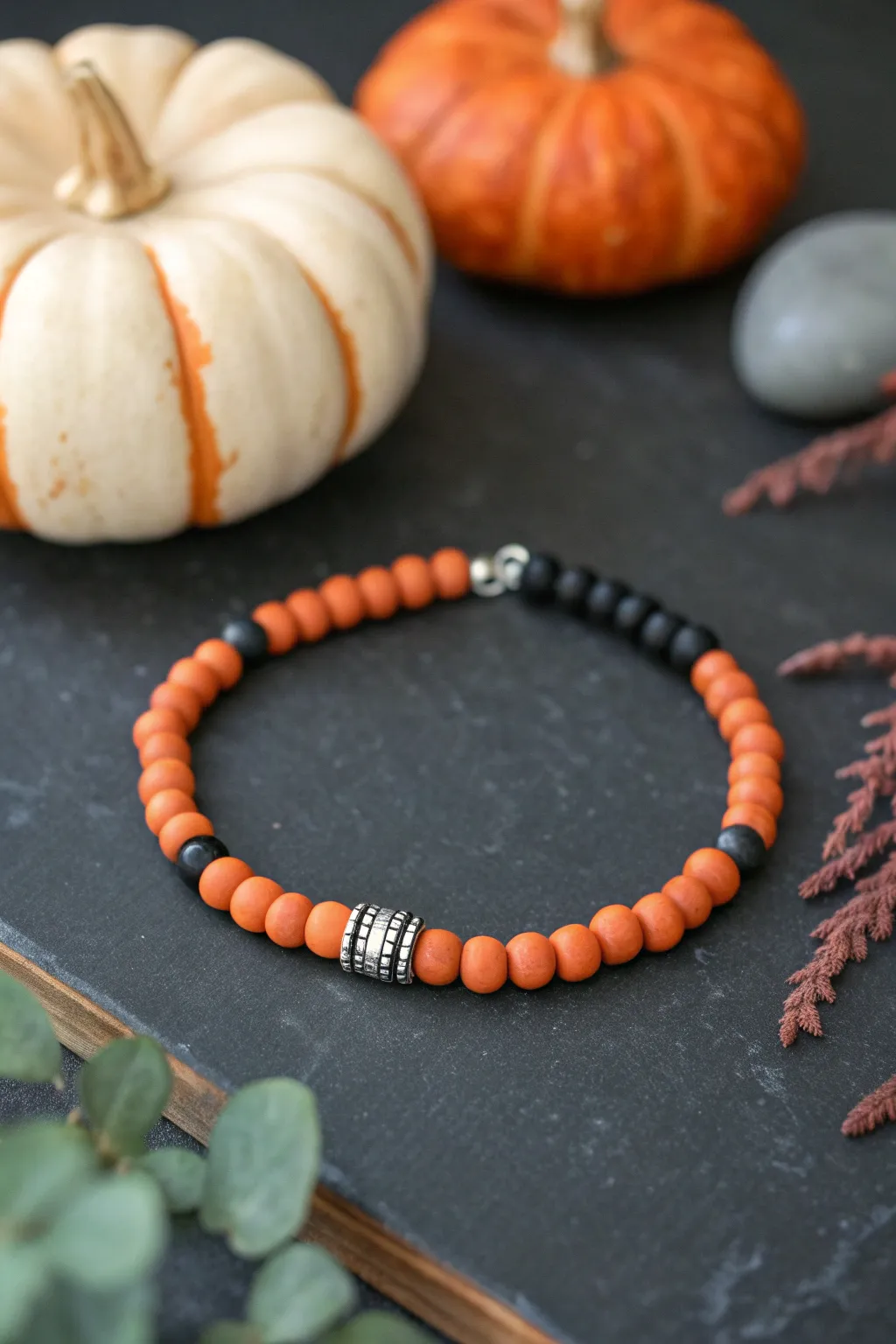
Embrace the spooky season with this simple yet striking clay bead bracelet featuring classic Halloween hues. The matte orange beads contrast beautifully with the stark black accents and a central silver focal point, making it a subtle nod to autumn style.
How-To Guide
Materials
- Matte orange polymer clay beads (approx. 6mm)
- Matte black polymer clay beads (approx. 6mm)
- Silver spacer bead or tube focal bead (approx. 8-10mm)
- Strong elastic beading cord (0.7mm or 0.8mm recommended)
- Beading needle (optional but helpful)
- Jewelry glue or clear nail polish
- Scissors
Step 1: Preparation
-
Measure your wrist:
Before cutting any cord, wrap a measuring tape around your wrist to find your exact size. Add about half an inch to this measurement for a comfortable fit, then add another 3-4 inches to account for tying the knot later. -
Prepare the cord:
Cut a length of elastic cord based on your calculation. It is always better to have too much cord than too little, so I usually cut about 10-12 inches total to give myself plenty of room to work. -
Stretch the elastic:
Gently pull tightly on the elastic cord several times before you begin stringing. This ‘pre-stretching’ technique prevents the bracelet from drooping or becoming loose immediately after you wear it for the first time. -
Secure the end:
Place a piece of tape or a bead stopper at one end of the cord. This crucial step ensures your beads won’t slide right off the other side while you are focused on your design pattern.
Pro Tip: Hiding Knots
If your bead holes are too small to hide the knot, start and end your pattern next to the silver focal bead. Silver beads usually have larger holes that can easily swallow the knot.
Step 2: Creating the Pattern
-
Start with the clasp area:
Begin stringing your beads starting with the section that will sit opposite the focal bead. Thread on approximately 6 matte black beads to create the dark anchor section of the design. -
Transition to orange:
String on about 10-12 matte orange beads. This creates the first large sweep of color that leads toward the center of the bracelet. -
Add a black accent:
Place a single black bead onto the cord. This solitary dark bead acts as a visual punctuation mark before the focal point. -
Mid-section orange:
Add 4 more orange beads. These few beads create a small buffer zone that frames the central silver piece nicely. -
Place the focal bead:
Slide on your silver tube bead or decorative spacer. This should sit right in the center of the design, so ensure the pattern looks balanced leading up to it. -
Mirror the mid-section:
Now, reverse the pattern to complete the other side. Start by adding 4 orange beads immediately after the silver focal bead. -
Add the second accent:
Thread on one single black bead to mirror the accent mark you made on the first side. -
Finish the orange run:
String the final long section of 10-12 orange beads. Double-check your length here by wrapping it around your wrist; add or remove a few orange beads if necessary to adjust the fit. -
Close the black section:
Finish the stringing process by adding about 3-4 more black beads. When combined with the starting beads, this will create a continuous block of black at the back of the wrist.
Level Up: Texture Mix
Swap the plain silver tube for a small silver skull bead or a pumpkin charm to lean harder into the Halloween theme without changing the color scheme.
Step 3: Finishing Touches
-
Remove the stopper:
Carefully remove the tape or bead stopper from the first end of the cord, taking care not to let any beads slip loose. -
Tie the first knot:
Bring both ends of the elastic together and tie a simple overhand knot. Pull it taut gently to bring the beads together so there are no gaps. -
Secure with a surgeon’s knot:
Tie a surgeon’s knot for extra security. This is done just like a regular knot, but you loop the cord through twice before pulling it tight. -
Apply glue:
Dab a tiny drop of jewelry glue or clear nail polish directly onto the knot. This helps fuse the elastic fibers and prevents the knot from slipping undone over time. -
Hide the knot:
Once the glue is tacky but not fully hard, try to slide the knot inside the hole of the nearest black bead if the hole is large enough. If not, clip the excess cord close to the knot.
Now you have a stylish autumn accessory ready to wear for pumpkin picking or candy dispensing
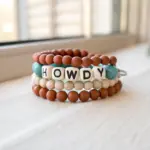
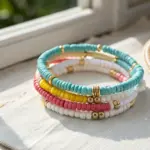
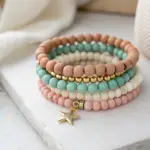
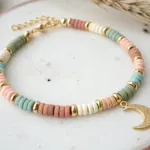
Neutrals With Gold-Tone Spacers
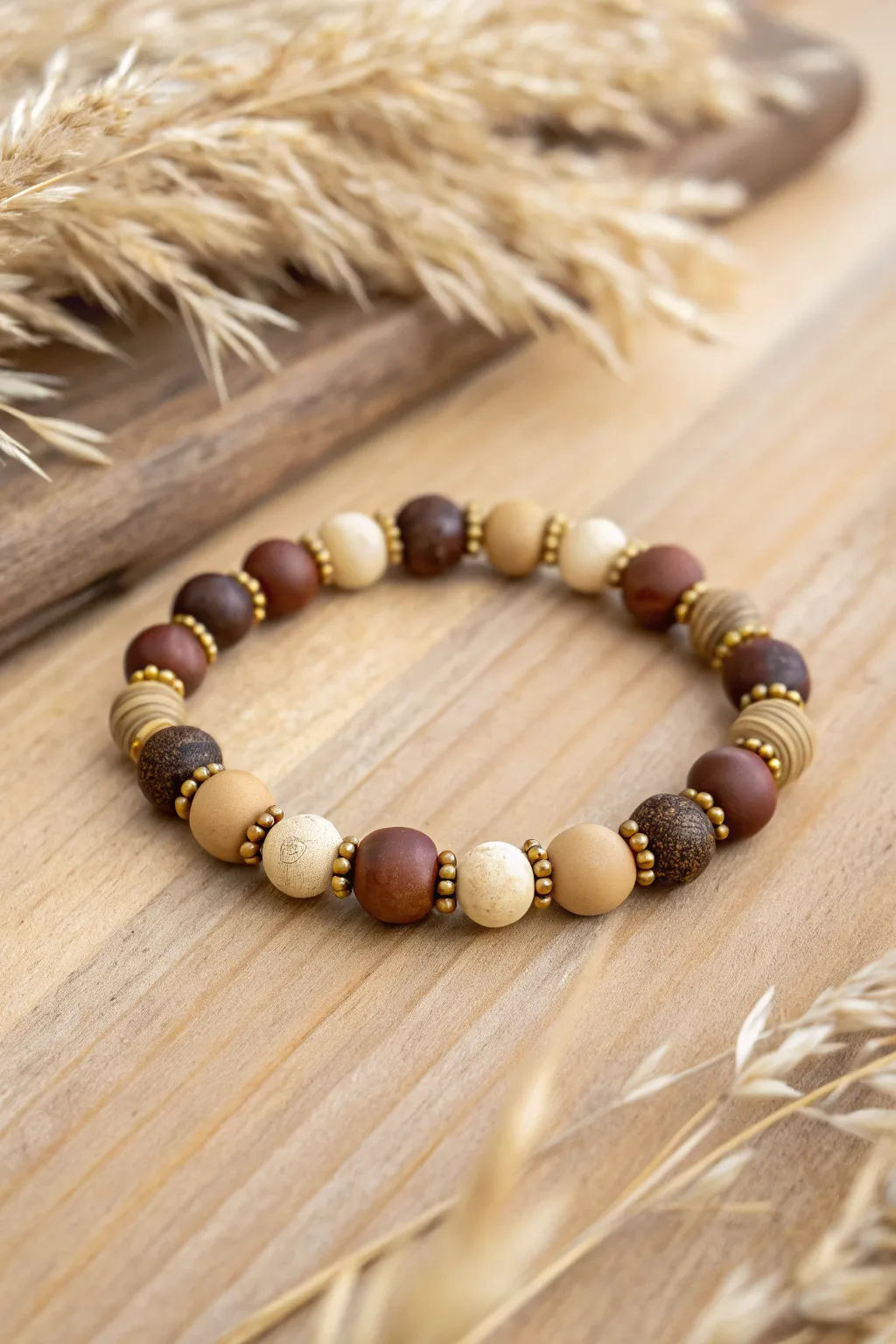
Embrace the cozy vibes of autumn with this sophisticated neutral bracelet featuring a mix of textures and smooth finishes. The interplay between matte clay tones, ribbed accents, and shimmering gold spacers creates a versatile accessory perfect for stacking or wearing solo.
Detailed Instructions
Materials
- Polymer clay beads (8mm-10mm round): dark chocolate brown, terracotta, latte beige, and cream
- Textured/ribbed wood or clay beads (8mm-10mm) in beige and tan
- Dark speckled/lava stone style beads (8mm-10mm)
- Gold-tone metal daisy spacers or tiny 2-3mm gold seed beads
- Elastic cord (0.8mm or 1mm thickness)
- Jewelry glue or clear nail polish
- Scissors
Step 1: Planning Your Layout
-
Measure your wrist:
Before you begin, wrap a piece of string around your wrist to find your size, then add about half an inch for a comfortable fit. -
Cut the elastic:
Cut a piece of elastic cord about 10-12 inches long. This extra length makes it much easier to tie the finishing knot without struggling. -
Pre-stretch the cord:
Gently pull on either end of the elastic cord a few times; this helps prevent the bracelet from stretching out permanently after you first wear it. -
Create a bead stopper:
Place a piece of tape or a bead stopper clip on one end of the cord so your beads don’t slide off while you work. -
Select your palette:
Gather your beads, focusing on a gradient of fall neutrals: deep browns, warm tans, soft creams, and the textured accent beads.
Knot Slipping?
If your elastic knot feels insecure, try a surgeon’s knot: loop the elastic through twice on the first pass instead of once before pulling tight.
Step 2: Stringing the Design
-
Start the pattern:
Begin by threading a large focal bead, such as one of the dark brown round beads, onto the cord. -
Add gold accents:
Thread two or three tiny gold spacer beads immediately after the main bead. These act as metallic separators that make the earth tones pop. -
Alternate colors:
Follow the spacers with a contrasting light cream or beige bead to establish the alternating pattern shown in the inspiration piece. -
Repeat the spacing:
Add another set of 2-3 gold spacers after the light bead. -
Incorporate texture:
Now, slip on one of the ribbed or textured beads. I find that placing these textured elements every 3rd or 4th main bead creates a nice visual rhythm. -
Continue the sequence:
Keep stringing in this order: Main Bead -> Gold Spacers -> Main Bead -> Gold Spacers. Remember to alternate your dark, medium, and light main beads randomly for an organic look. -
Check the fit:
Periodically wrap the strand around your wrist to check the size. You want the ends to meet comfortably without gaps.
Texture Variety
Mix materials! Combine polymer clay with real wood or lava stone beads. The difference in weight and warmth makes the piece feel high-end.
Step 3: Finishing Touches
-
Prepare to tie:
Once you have reached your desired length, remove the tape or stopper from the end carefully. -
Tie the knot:
Tie a standard square knot (right over left, left over right) and pull tight. The elastic should stretch slightly as you secure it. -
Secure with glue:
Dab a tiny drop of jewelry glue or clear nail polish directly onto the knot. This ensures it won’t slip undone over time. -
Hide the knot:
Before the glue fully hardens, gently tug the elastic so the knot slides inside the hole of the nearest large bead. -
Trim the excess:
Use sharp scissors to trim the remaining tails of the elastic cord close to the bead hole, being careful not to cut the main knot. -
Final stretch test:
Give the bracelet a gentle tug all around to distribute the tension evenly between all the beads.
Now you have a stunning, nature-inspired accessory ready to complement your favorite autumn sweater

The Complete Guide to Pottery Troubleshooting
Uncover the most common ceramic mistakes—from cracking clay to failed glazes—and learn how to fix them fast.
Leaf Charm Centerpiece Bracelet
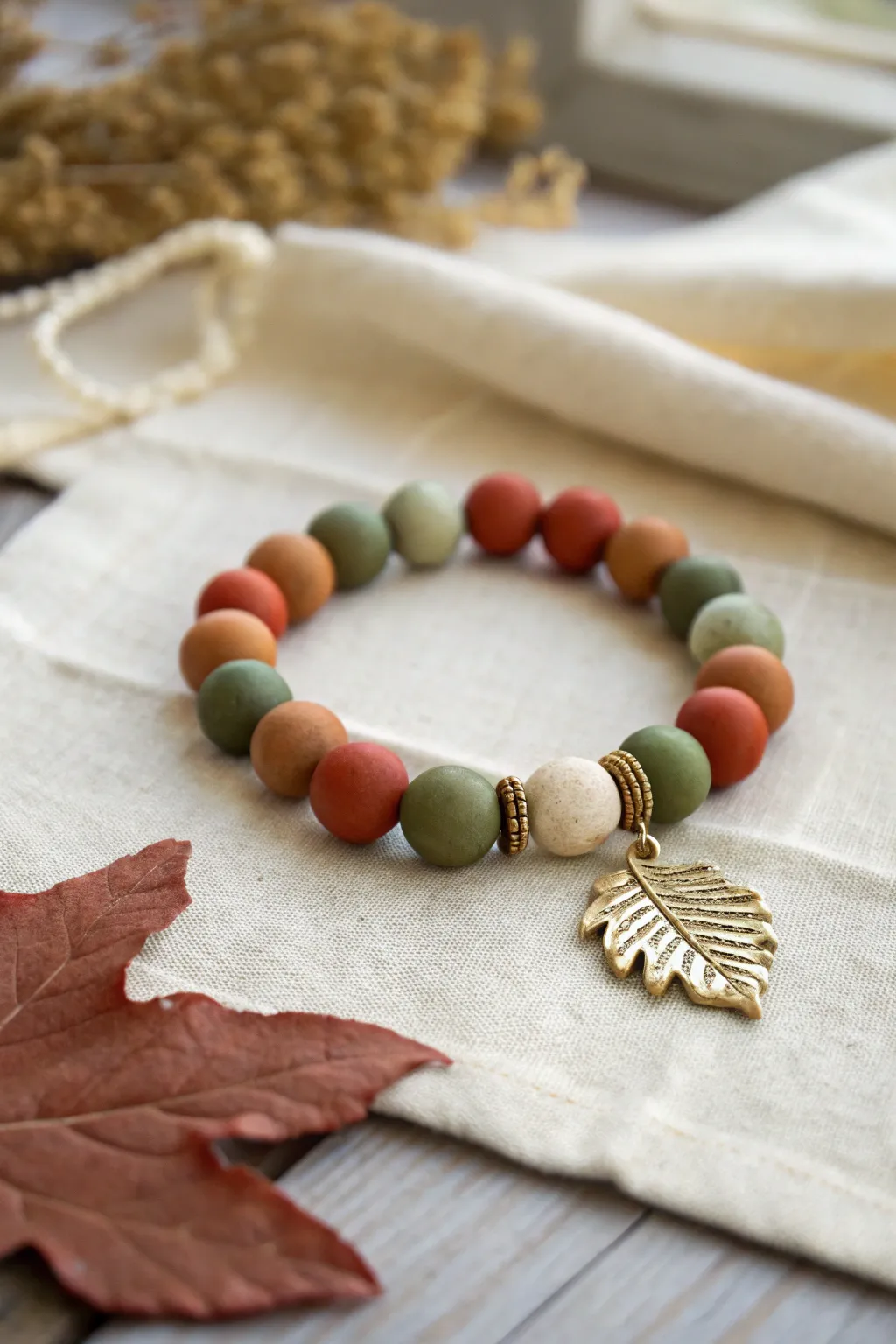
Capture the essence of a crisp fall day with this charming stretch bracelet featuring matte clay beads in earthy tones. The burnt orange, sage green, and terra cotta hues are perfectly accented by a singular gold leaf charm that dangles delicately from the center.
Step-by-Step
Materials
- Polymer clay (burnt orange, terra cotta/rust, sage green, darker olive green, off-white with speckles)
- Bead rolling tool or acrylic block
- Toothpicks or bead pins
- Baking sheet and parchment paper
- High-quality elastic cord (0.8mm or 1mm)
- Gold leaf charm
- Gold jump ring (6mm or 8mm)
- 2 Gold spacer beads (antique gold finish, ring or disc shape)
- Jewelry glue (e.g., E6000 or G-S Hypo Cement)
- Scissors
Step 1: Creating the Clay Clay Beads
-
Condition the clay:
Start by warming up your polymer clay in your hands. Knead each color—burnt orange, rust, sage, olive, and speckled white—separately until they are soft and pliable to prevent cracking later. -
Portion the clay:
Pinch off small pieces of clay for each bead. Aim for chunks that are roughly equal in volume to ensure your finished beads are a consistent size, about 10mm to 12mm in diameter. -
Roll the spheres:
Roll each piece of clay between your palms in a circular motion to create smooth spheres. I like to use an acrylic block on a flat surface for this step to get them perfectly round. -
Pierce the holes:
Hold a clay sphere gently between your thumb and forefinger. Carefully twist a toothpick or bead pin through the center. Rotate the bead as you pierce to keep the hole centered and prevent the bead from squishing into an oval. -
Refine the shape:
Once the hole is pierced, you might need to give the bead a gentle roll again to smooth out any fingerprints or distortion caused by the toothpick. -
Bake the beads:
Arrange your raw beads on a baking sheet lined with parchment paper. Follow the baking temperature and time instructions specific to your brand of polymer clay (usually around 275°F or 135°C for 15-30 minutes). Let them cool completely before handling.
Step 2: Assembling the Bracelet
-
Prepare the elastic:
Cut a piece of elastic cord about 10-12 inches long. This extra length makes tying the knot much easier later. Pre-stretch the elastic by pulling it firmly a few times to prevent it from sagging after wear. -
Attach the charm:
Open your gold jump ring using two pairs of pliers (or your fingers if the metal is soft enough). Slide the gold leaf charm onto the ring and close it securely. -
Begin the pattern:
Start by threading the single speckled off-white bead onto the center of your elastic. This will be the focal point where the charm hangs. -
Add gold accents:
Slide one antique gold spacer bead onto the elastic on the left side of the white bead, and another onto the right side. These frame the focal bead beautifully. -
Install the charm:
Slide the jump ring (with the leaf charm attached) over the white bead so it rests between the bead and one of the gold spacers. Alternatively, you can attach the jump ring to the gold spacer itself if that bead has a loop. -
String the remaining beads:
Begin threading your colored clay beads on either side of the centerpiece. Alternate the colors randomly—mixing the sage, olive, rust, and orange—to create that organic, natural fall look seen in the photo. -
Check the fit:
Continue adding beads until the strand wraps comfortably around your wrist. For an average adult wrist, you will likely need about 6.5 to 7.5 inches of beading length. -
Tie the knot:
Bring the two ends of the elastic together. Tie a standard square knot (right over left, left over right). Pull the elastic tight to secure the knot close to the beads. -
Secure with glue:
Apply a tiny dab of jewelry glue specifically to the knot. Let it dry for a few minutes to ensure it won’t slip undone. -
Hide the knot:
Once the glue is tacky or dry, trim the excess elastic ends close to the knot. Gently pull the adjacent bead over the knot to hide it inside the hole for a seamless finish.
Texturing Tip
To get that matte, stone-like texture, roll your raw clay beads on a piece of medium-grit sandpaper before baking. It removes fingerprints instantly.
Make It a Set
Create a matching stack by making two more bracelets: one using only the sage green beads and another using only the rust orange beads.
Enjoy wearing your new autumn accessory that captures all the warm colors of the changing season
Tiny Pumpkin Accent Bead
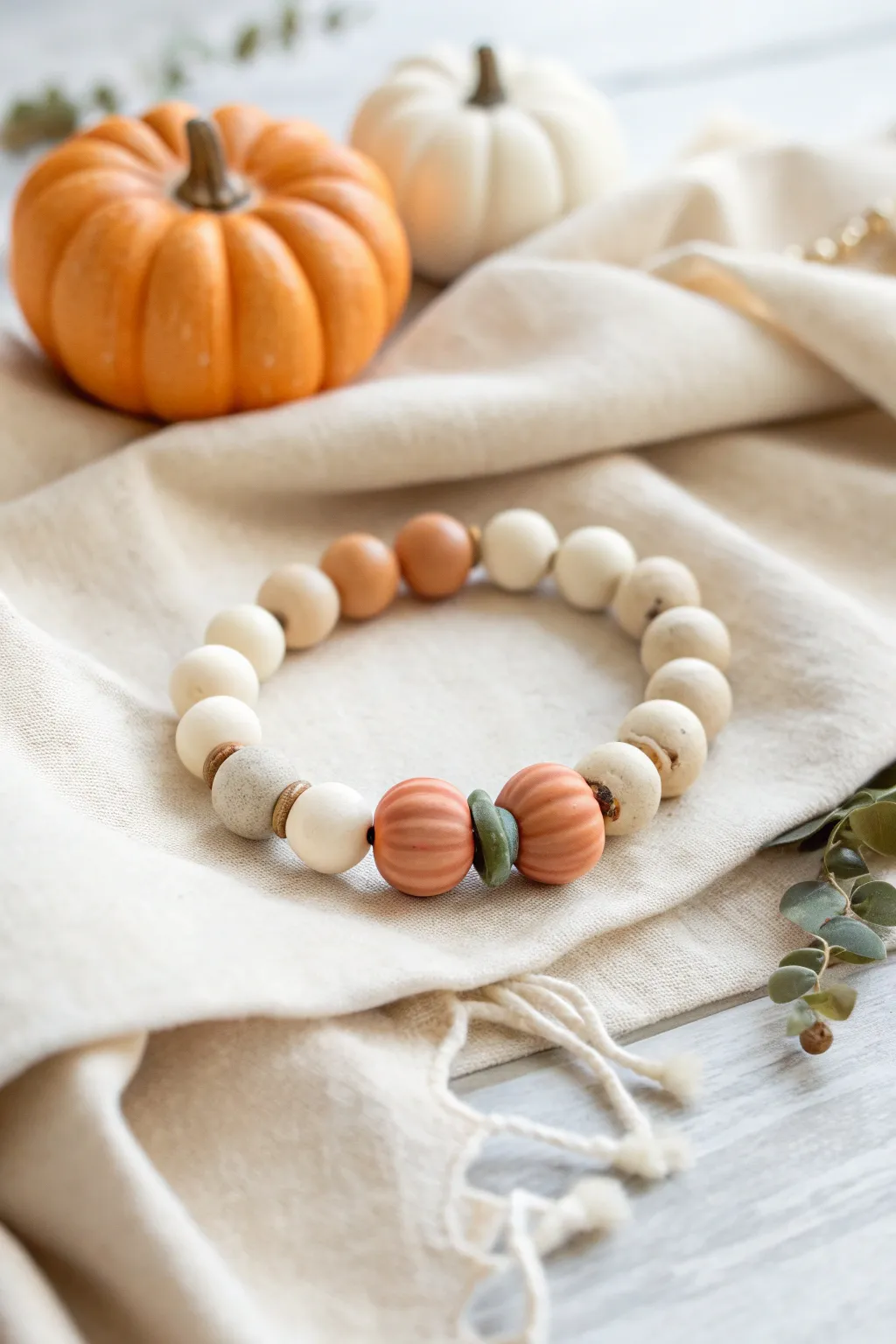
Celebrate the harvest season with this charming beaded bracelet featuring handcrafted clay pumpkin accents. The mix of natural wood tones and creamy whites makes the orange pumpkins pop, creating a subtle yet festive accessory perfect for autumn outings.
Step-by-Step Guide
Materials
- Polymer clay (burnt orange, sage green, and white)
- Round wooden beads (approx. 10-12mm, natural unfinished)
- White or cream wooden beads (approx. 10-12mm)
- Elastic stretch cord (0.8mm or 1mm)
- Super glue or jewelry cement
- Clay sculpting tools (needle tool or toothpick, ball stylus)
- Beading needle (optional)
- Baking sheet and parchment paper
- Gold tone spacer beads (flat disc style)
- One speckled stone or clay bead (grey/beige)
- Oven
Step 1: Sculpting the Clay Beads
-
Mix your pumpkin color:
Start by conditioning your orange polymer clay. If the color is too bright, mix in a tiny pinch of brown or beige to achieve that muted, realistic pumpkin tone seen in the photo. -
Form the base shapes:
Roll two equal-sized balls of the orange clay, aiming for about 12mm in diameter. Slightly flatten the top and bottom of each ball to create a squat, pumpkin-like silhouette. -
Add texture:
Using a needle tool or toothpick, press vertical lines down the sides of the orange balls. Start from the center of the top hole and curve down to the bottom to mimic pumpkin ribs. -
Create the center leaf spacer:
Condition a small piece of sage green clay. Roll it into a thick disc or wheel shape, slightly smaller in diameter than your pumpkins. This will sit between them. -
Create the holes:
Carefully pierce the center of your pumpkins and green spacer with a tool that matches the thickness of your elastic cord. Wiggle it gently to ensure the hole is clean and wide enough for threading later. -
Bake the clay:
Arrange your clay beads on a parchment-lined baking sheet. Bake according to your clay manufacturer’s instructions (usually 275°F for 15-30 minutes). Let them cool completely before handling.
Step 2: Designing the Pattern
-
Prepare the cord:
Cut a length of elastic cord about 10-12 inches long. I always cut extra to make tying the final knot much easier. -
Pre-stretch the elastic:
Give the cord a few gentle tugs. This is a crucial step that prevents the bracelet from stretching out and becoming loose after the first few times you wear it. -
Start with the focal point:
Thread one orange clay pumpkin, then the green clay spacer, followed by the second orange pumpkin onto the cord. This creates the centerpiece of your design. -
Add texture accents:
Slide a wooden bead onto one side of the pumpkin cluster. On the other side, add the speckled grey stone bead, flanking it with two thin gold antique-style spacers for a touch of separation. -
Build the white sections:
Add about three to four cream-colored wooden beads on either side of your central accent area to brighten the strand. -
Finish with neutrals:
Fill in the rest of the bracelet length by alternating the natural wood beads and the remaining cream beads until you reach your desired wrist size. -
Balance the colors:
To echo the center, you can add two plain orange wooden beads or clay balls on the opposite side of the circle to balance the visual weight.
Hole Distortion?
If your bead holes squish while piercing, let the clay sit in the fridge for 10 minutes to firm up before poking. Pierce halfway from top, then flip and meet in the middle.
Step 3: Assembly and Finishing
-
Check the fit:
Wrap the unfinished strand around your wrist to check the size. Add or remove one or two wooden beads if necessary for a comfortable fit. -
Tie the knot:
Bring the ends together and tie a surgeon’s knot (loop the thread through twice before pulling tight). Pull the elastic firmly to secure. -
Secure with glue:
Apply a tiny dot of super glue or jewelry cement directly onto the knot. Let it dry for a few minutes to ensure it won’t slip. -
Hide the knot:
If the hole of a nearby wooden bead is large enough, gently tug the elastic to slide the knot inside the bead, hiding it from view. -
Trim the excess:
Using sharp scissors, trim the excess cord ends close to the knot (or the bead hiding the knot), being careful not to nick the main elastic.
Add a Stem
For extra detail, use a tiny bit of brown clay to form a small, curved stem loop at the top of your pumpkins. Just ensure the hole still runs through the bead body.
Slip on your new pumpkin bracelet to add a touch of handmade warmth to your favorite sweater weather outfit


What Really Happens Inside the Kiln
Learn how time and temperature work together inside the kiln to transform clay into durable ceramic.
Candy Corn Stripe Pattern
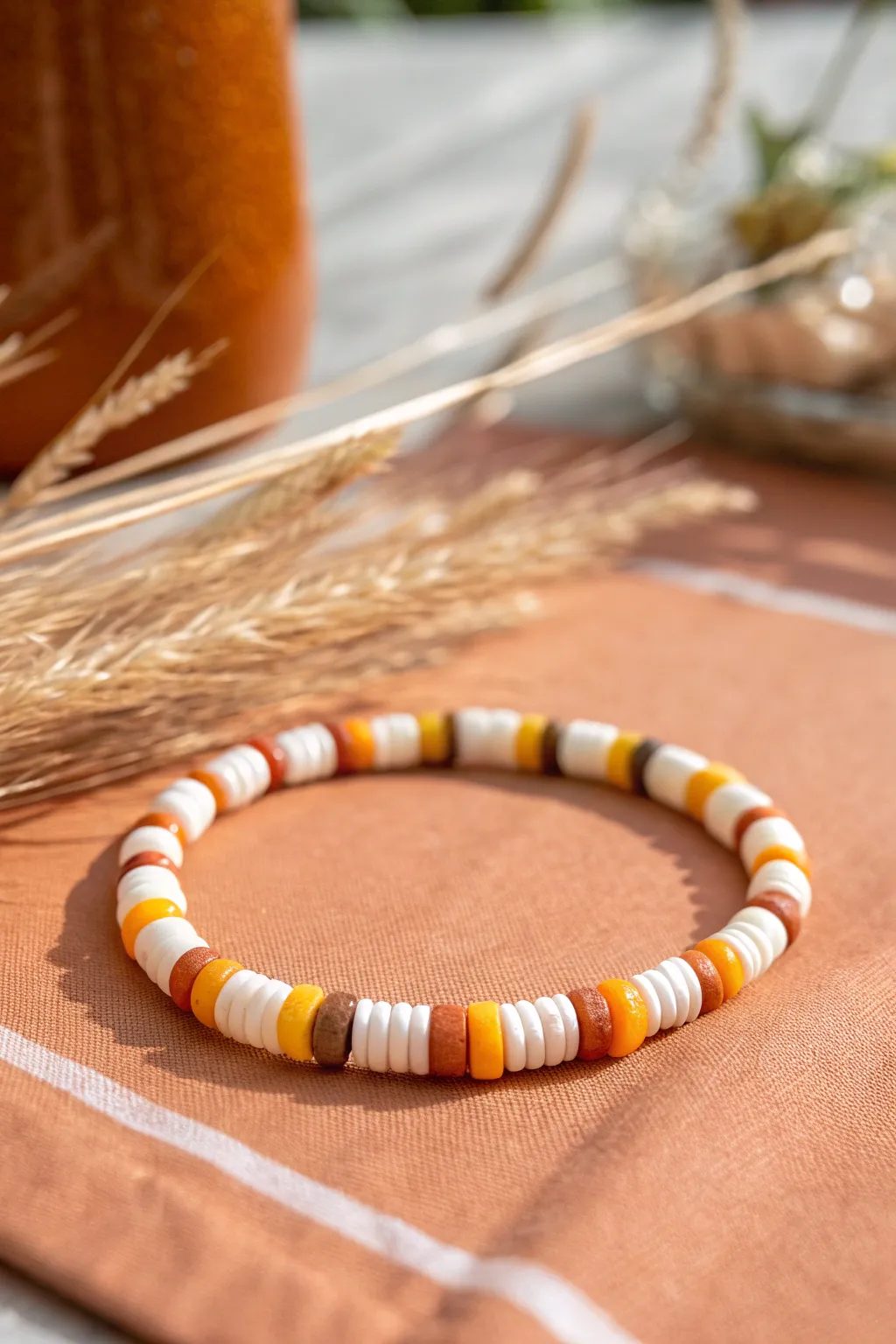
Embrace the cozy vibes of autumn with this simple yet striking clay bead bracelet. Featuring a pattern reminiscent of candy corn and harvest fields, this accessory combines crisp whites with warm yellows, oranges, and earthy browns for a perfect seasonal stack.
Step-by-Step
Materials
- Polymer clay heishi disc beads (6mm) in White
- Polymer clay heishi disc beads (6mm) in Yellow
- Polymer clay heishi disc beads (6mm) in Orange (or Terracotta)
- Polymer clay heishi disc beads (6mm) in Brown (or Dark Chocolate)
- Elastic stretch cord (0.8mm recommended)
- Scissors
- Super glue or jewelry cement
- Tape or a bead stopper clip
- Beading needle (optional but helpful)
Step 1: Preparation
-
Measure your wrist:
Wrap the elastic cord loosely around your wrist to determine the comfortable length. Add about 3-4 inches of extra cord to ensure you have plenty of room for tying the knots later. -
Secure the end:
Cut your measured length of cord. Attach a piece of tape or a bead stopper clip to one end so your beads don’t slide off while you are stringing them. -
Pre-stretch the cord:
Gently pull on the elastic cord a few times before starting. This helps prevent the bracelet from stretching out and becoming loose after you wear it for the first time.
Keep It Random
Don’t stress over a perfect repeating pattern. The charm of this bracelet is the “trail mix” look, so mixing up the color order makes it more authentic.
Step 2: Establishing the Pattern
-
Begin with white:
Start your pattern by threading on a small stack of white beads. For this specific look, aim for about 3 to 4 white disc beads to act as a spacer. -
Add first color accent:
Slide on one yellow bead followed immediately by one orange (or terracotta) bead. This creates a quick pop of candy corn color. -
Repeat white spacer:
Add another set of 3 to 4 white beads. Keeping these white sections relatively consistent helps the colors stand out more. -
Second color variation:
Now, switch up the accent. Thread on one brown bead followed by a yellow bead. The irregularity is key here; don’t worry about repeating the exact same color order every time. -
Vary white sections:
Occasionally, you can make the white section slightly shorter (2 beads) or longer (5 beads) to give the bracelet an organic, handmade feel. -
Mix single colors:
For some sections, try using just a single colored bead between the white stacks. For example, place one dark brown bead between two white sections for high contrast. -
Create a gradient cluster:
Once or twice in the pattern, thread a yellow, then an orange, then a brown bead all together without white spacers to create a heavier block of fall color.
Add Some Shine
Replace one of the yellow or orange clay beads with a gold spacer bead every few inches. The metallic flash elevates the rustic clay look instantly.
Step 3: Finishing the Bracelet
-
Check the length:
Continue the pattern until the beaded section wraps comfortably around your wrist. The ends should just meet without stretching the cord. -
Prepare to knot:
Remove the tape or bead stopper carefully while pinching the end of the cord so beads don’t fly off. -
Tie the first knot:
Cross the two ends of the cord and tie a simple overhand knot. Pull it tight, bringing the beads together snugly so there are no gaps. -
Secure with a square knot:
Tie a second knot, preferably a square knot (right over left, left over right). This is much more secure than a standard double knot. -
Reinforce with glue:
Add a tiny drop of super glue or jewelry cement directly onto the knot. I like to let this dry briefly for about 30 seconds to ensure it bonds well. -
Hide the knot:
If the hole of your nearest bead is large enough, gently tug the cord so the glued knot slides inside the bead, hiding it from view. -
Trim excess cord:
Once the glue is fully dry, use your scissors to snip off the excess cord tails as close to the knot (or the hiding bead) as possible.
Slip on your new bracelet and enjoy the warm autumnal touch it adds to your outfit
Cozy Plaid Color Blocks
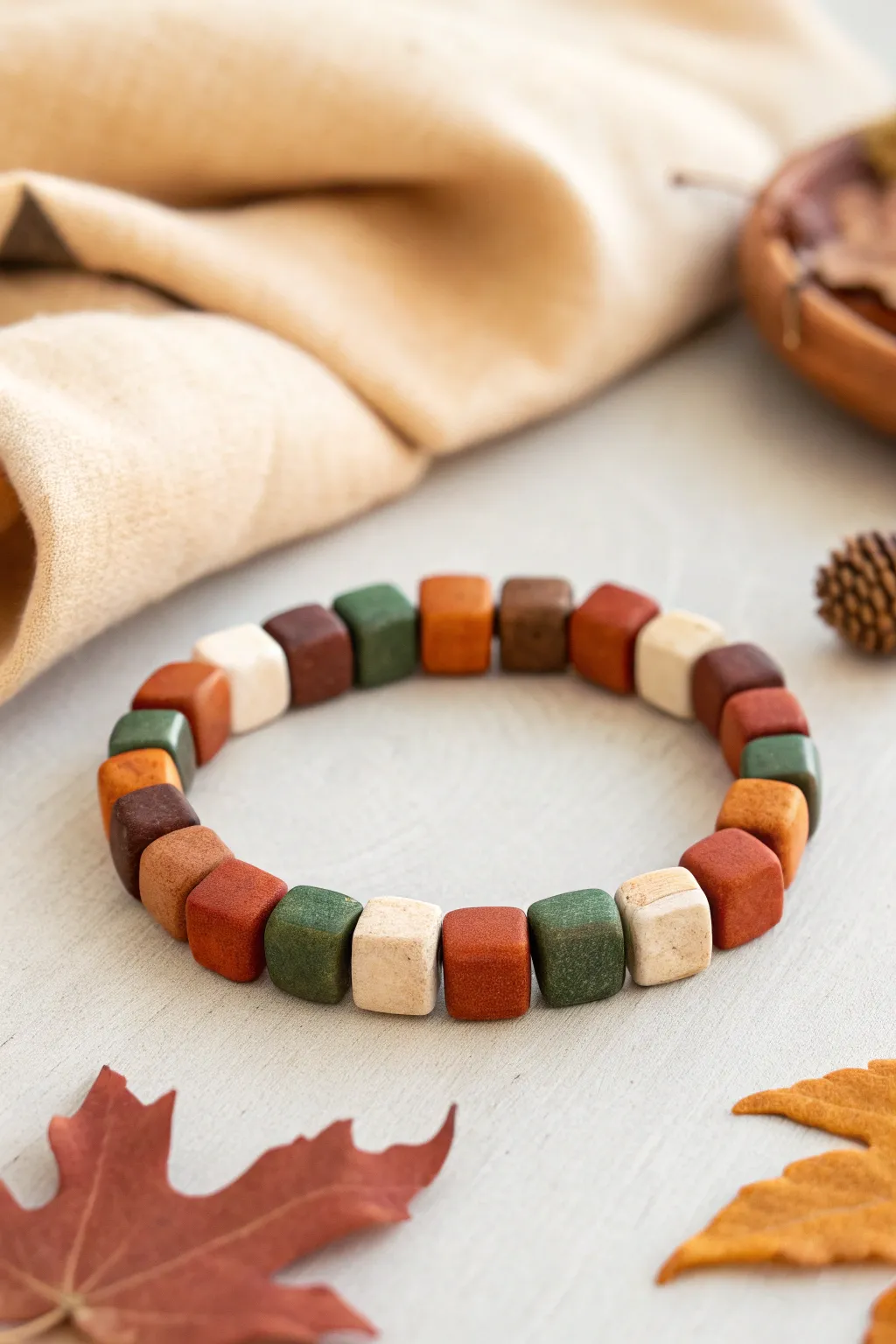
Capture the cozy essence of a fall flannel shirt with this charming block bead bracelet. Featuring a matte finish and a palette of warm rusts, deep greens, and creamy neutrals, this accessory brings a subtle autumn touch to any outfit.
Detailed Instructions
Materials
- Polymer clay (rust orange, forest green, chocolate brown, mustard yellow, cream/beige)
- Elastic cord (0.8mm or 1mm clear)
- Clay blade or sharp craft knife
- Rolling pin or pasta machine
- Ruler
- Toothpick or bead piercing tool
- Bead reamer (optional)
- Super glue or jewelry cement
- Cornstarch or baby powder (for texturing)
- Baking sheet with parchment paper
- Oven
Step 1: Creating the Clay Blocks
-
Condition the clay:
Start by warming up each color of polymer clay in your hands until it becomes soft and pliable. Use separate chunks for your rust, green, brown, yellow, and cream colors. -
Roll out strands:
Roll each color into a thick log or snake shape. Aim for a uniform thickness of about 1/4 inch (approx. 6-7mm) for each log to ensure your beads end up the same size. -
Shape the logs:
Gently press the round logs against your work surface to flatten four sides, transforming the round snake into a long rectangular prism. Rotate frequently to keep the corners sharp. -
Cut the cubes:
Using your clay blade, slice the rectangular logs into even cubes. You will want them to be roughly square, so space your cuts according to the thickness of the log. -
Refine the shape:
Pick up each cube and gently tap the sides against your work surface to sharpen up any edges that squished during cutting. I find a light tap on all six sides makes a huge difference. -
Add texture:
To mimic the matte, organic look in the photo, lightly dust the cubes with a tiny bit of cornstarch and roll them very gently in your palm or tap them with a textured sponge. This removes fingerprints and adds that stone-like finish. -
Pierce the holes:
Use a toothpick or bead piercing tool to create a hole through the center of each cube. Twist the tool gently as you push through to avoid deforming the square shape.
Stone Effect
For a speckled, stone-like look, mix tiny flecks of black pepper or translucent clay into your solid colors before rolling them out.
Step 2: Baking and Assembly
-
Bake the beads:
Arrange your beads on a parchment-lined baking sheet. Bake according to the manufacturer’s instructions for your specific brand of clay (usually around 275°F/135°C for 15-30 minutes). -
Cool completely:
Let the beads cool down fully before handling. They are slightly fragile when hot and harden as they return to room temperature. -
Check the holes:
Once cool, test your elastic cord through a few beads. If the holes shrank slightly during baking, use a bead reamer or a small drill bit to widen them carefully. -
Plan your pattern:
Lay out your beads on a design board or towel. The pattern shown uses a random mix of ‘color blocks’ rather than a strict alternating sequence, giving it that patchy, plaid aesthetic. -
String the beads:
Cut a piece of elastic cord about 10 inches long. Thread your beads onto the cord in your desired order until the bracelet reaches your wrist size. -
Tie the knot:
Pre-stretch the elastic slightly by pulling on both ends. Tie a surgeon’s knot (right over left twice, then left over right) to secure the bracelet. -
Secure and finish:
Add a tiny drop of super glue or jewelry cement to the knot for extra security. Let it dry, then trim the excess cord ends close to the knot. -
Hide the knot:
Gently pull the elastic so the knot slides inside the hole of the nearest bead, hiding it from view for a seamless finish.
Squished Beads?
Refrigerate your clay logs for 15 minutes before slicing. Cold clay is firmer and holds its sharp square shape much better under the blade.
Wear your new autumn colors proudly or stack them for an even cozier look

TRACK YOUR CERAMIC JOURNEY
Capture glaze tests, firing details, and creative progress—all in one simple printable. Make your projects easier to repeat and improve.
Cinnamon Brown Ombre Fade
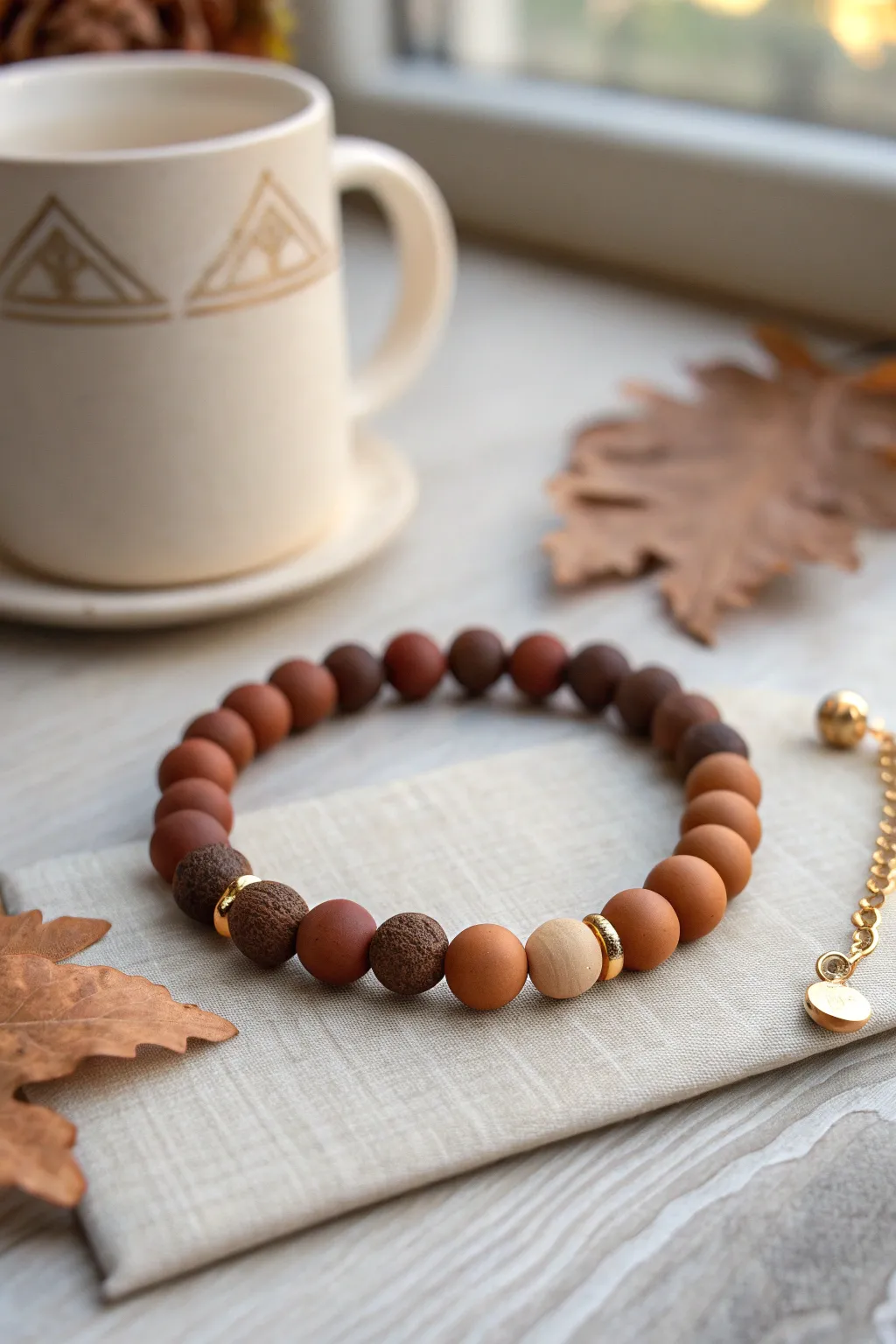
Embrace the cozy tones of autumn with this warm, earth-toned clay bead bracelet. Featuring a gentle ombre fade from deep espresso to creamy latte, accented with textured elements and gold touches, this accessory is the perfect companion for your favorite fall sweater.
Step-by-Step
Materials
- Polymer clay (Dark Brown, Terracotta/Rust, Burnt Sienna, Beige/Ecru)
- Textured lava beads (dark brown, approx. 8-10mm)
- Smooth wooden bead (light natural wood, approx. 10mm)
- Gold spacer beads or jump rings (approx. 4mm)
- Strong elastic cord (0.8mm or 1mm)
- Super glue or jewelry adhesive
- Rolling pin or clay machine
- Small round cutter or bead roller
- Toothpick or bead piercing pin
- Baking sheet and parchment paper
- Toaster oven or conventional oven
Step 1: Crafting the Clay Beads
-
Condition the Clay:
Begin by thoroughly kneading your polymer clay blocks (Dark Brown, Terracotta, Burnt Sienna) until they are soft and pliable. -
Mix Custom Shades:
To achieve the subtle ombre effect, mix small amounts of the Dark Brown into the Terracotta to create intermediate rust shades. Aim for a gradient: dark chocolate, reddish-brown, and soft rust orange. -
Shape the Spheres:
Pinch off equal-sized portions of clay. Roll them vigorously between your palms to create perfectly smooth spheres, approximately 10mm in diameter. -
Check for Uniformity:
Line up your raw beads to ensure they are roughly the same size. Consistency is key for a professional look, though slight handmade variations add charm. -
Pierce the Holes:
Gently twist a toothpick or piercing pin through the center of each sphere. Rotate the bead as you push to prevent flattening the shape. -
Bake the Beads:
Arrange the beads on a parchment-lined baking sheet. Bake according to your brand’s specific package instructions (usually 275°F/135°C for 15-30 minutes). -
Cool Down:
Once baked, turn off the oven and let the beads cool completely before handling them. They will harden fully as they cool.
Smooth Operator
To remove fingerprints from raw clay beads before baking, lightly brush them with a drop of baby oil or cornstarch for a flawless matte finish.
Step 2: Assembly & Design
-
Cut the Cord:
Cut a piece of elastic cord about 10-12 inches long. This gives you plenty of extra slack for tying the knot later. -
Pre-stretch the Elastic:
I always give the elastic a few firm tugs before stringing. This prevents the bracelet from loosening up immediately after you wear it. -
Lay Out the Pattern:
Arrange your beads on a layout board or cloth. Start with the darkest brown clay beads, transition into the rust tones, and identify the focal point section. -
Create the Focal Section:
For the focal point, place a textured dark brown lava bead, followed by a gold spacer ring, then a russet clay bead, another textured lava bead, a rust clay bead, and finally the singular light wooden bead flanked by the second gold spacer. -
String the Beads:
Thread the beads onto the elastic cord, following your laid-out pattern. The design works best if the lighter colors and gold accents are grouped together. -
Check the Fit:
Wrap the strung beads around your wrist to check the size. Add or remove a dark brown clay bead at the back (opposite the focal point) if adjustments are needed. -
Tie the Knot:
Tie a surgeon’s knot (loop the elastic through twice on the first pass, then tie a standard overhand knot on top). Pull it very tight. -
Secure the Knot:
Apply a tiny dot of super glue or jewelry cement directly onto the knot. Let it dry for a minute. -
Hide the Knot:
Trim the excess elastic close to the knot, leaving about 2mm tails. Gently tug the bracelet so the knot slides inside the hole of the nearest large bead to hide it.
Scent of Autumn
Add a drop of cinnamon or pumpkin spice essential oil to the porous lava beads. Your bracelet will act as a personal diffuser all day long.
Now you have a stunning, handmade accessory that perfectly captures the essence of the changing seasons
Harvest Sunset Gradient Mix
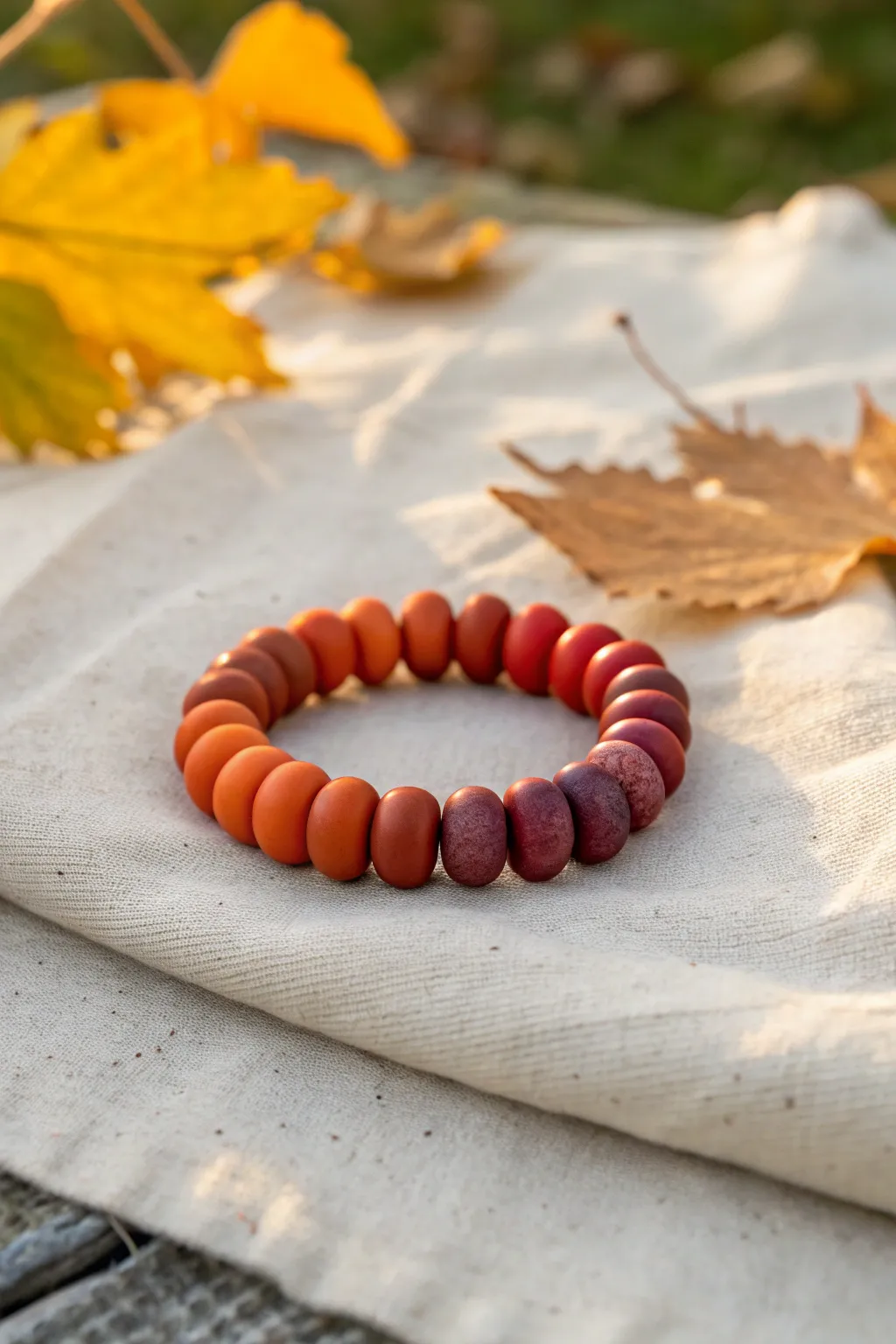
Capture the fleeting beauty of a late autumn sunset with this stunning gradient bracelet. Using a custom blend of polymer clay beads, this accessory transitions smoothly from deep plum purples into warm ambers and bright oranges.
Detailed Instructions
Materials
- Polymer clay in five colors: dark plum purple, brick red, burnt orange, golden orange, and soft peach
- Elastic beading cord (0.8mm or 1mm thickness)
- Clay roller or pasta machine
- Small round clay cutter (approx. 10mm diameter)
- Toothpick or bead piercing pin
- Oven for baking clay
- Baking sheet and parchment paper
- Super glue or jewelry adhesive
- Scissors
Step 1: Preparing the Clay Colors
-
Condition the Clay:
Start by kneading each block of polymer clay separately until it is soft and pliable. This is crucial for preventing cracks later. -
Mix Custom Shades:
To achieve the gradient seen in the photo, you may need to mix colors. I like to blend a little brown into purple for the darkest beads, and mix orange with a touch of red for the mid-tones. -
Roll Out Sheets:
Using a clay roller or a pasta machine on a thick setting, roll each color into a slab. Aim for a thickness of about 4-5mm so the beads have a nice, chunky profile.
Sticky Situation?
If fingerprints are showing up on your raw clay beads, lightly dust your fingertips with a bit of cornstarch before smoothing the edges.
Step 2: Creating the Beads
-
Cut the Discs:
Take your small round cutter and punch out circles from each color sheet. You will need roughly 4-5 beads of each color shade to complete a full loop. -
Smooth the Edges:
Gently pick up each circle and run your finger around the perimeter to smooth the cut edge. You want them to look slightly rounded and organic, not sharp. -
Pierce the Holes:
Hold a clay disc gently between your thumb and forefinger. Using a toothpick or bead pin, pierce a hole directly through the center. -
Widen the Channel:
Give the toothpick a little wiggle inside the hole to ensure it’s wide enough for your elastic cord. Do this for every single bead. -
Create Texture (Optional):
Looking closely at the darker purple beads in the artwork, they have a slight stone-like texture. You can achieve this by lightly dabbing them with a stiff toothbrush before baking.
Adding Sparkle
Knead a small amount of gold leaf flake into the ‘burnt orange’ clay batch to give your sunset gradient a subtle, shimmering metallic vein.
Step 3: Baking and Assembly
-
Arrange for Baking:
Place all your formed raw beads onto a baking sheet lined with parchment paper. Ensure they aren’t touching each other. -
Bake the Beads:
Bake according to your specific polymer clay package instructions (usually around 275°F / 135°C for 15-30 minutes). Let them cool completely before handling. -
Plan the Gradient:
Lay your cooled beads out on a table in a line. Arrange them from darkest purple to lightest orange to check the flow of the transition. -
String the Beads:
Cut a 10-inch piece of elastic cord. Begin threading your beads, following your laid-out pattern: Dark purple, brick red, burnt orange, golden orange, then repeat the sequence if resizing is needed. -
Check the Fit:
Wrap the strung beads around your wrist. The bracelet should be snug but comfortable. Add or remove a bead if necessary. -
Secure the Knot:
Tie a surgeon’s knot (a square knot with an extra loop) to secure the bracelet. Pull it tight. -
Glue and Finish:
Dab a tiny drop of super glue onto the knot. Slide an adjacent bead over the knot to hide it while the glue dries, then trim the excess cord ends.
Enjoy wearing your cozy autumn accessory all season long
Apple Orchard Red-and-Green Twist
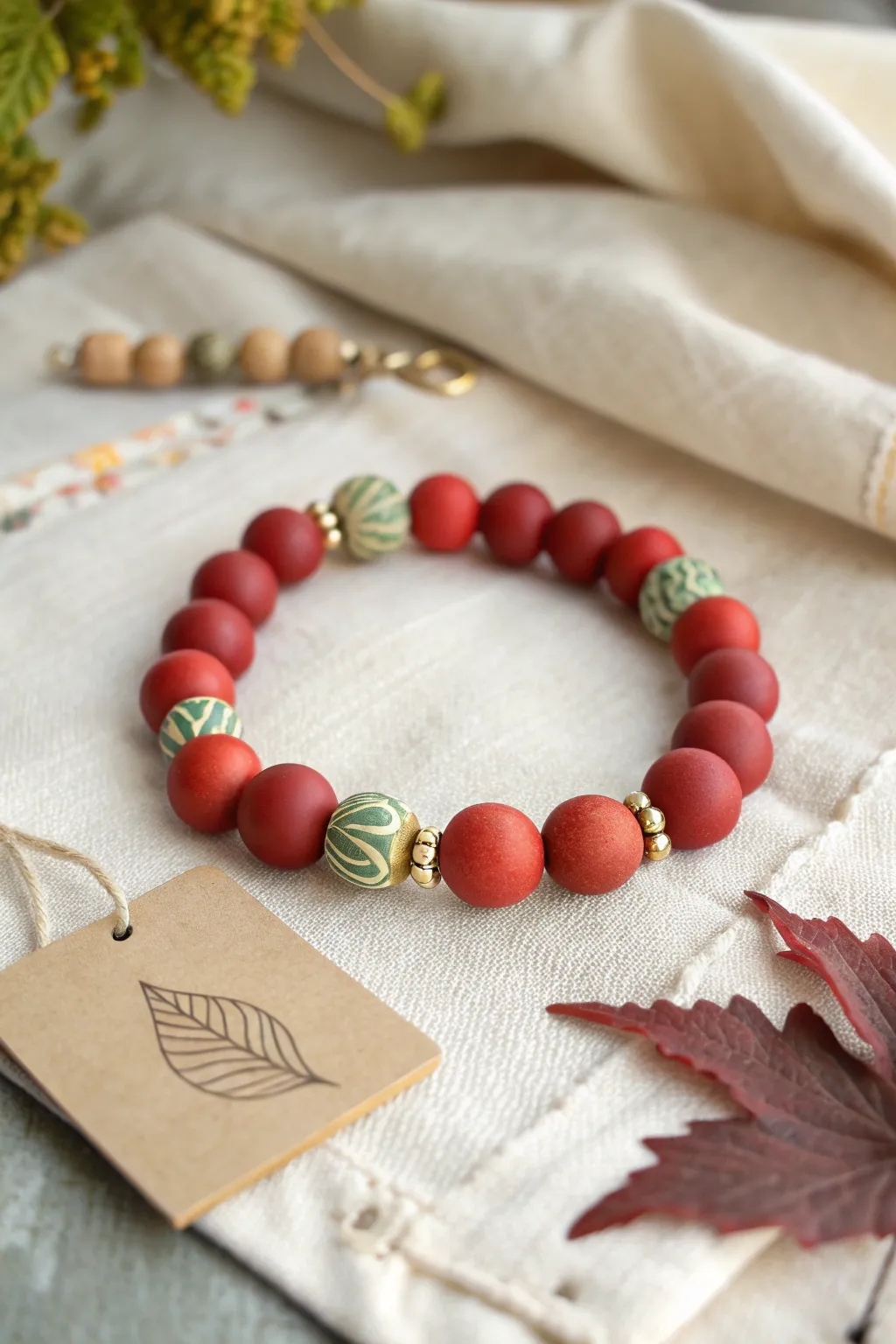
Capture the crisp feeling of apple picking with this stunning clay bead bracelet that pairs rich, matte red solids with unique green patterned accents. The gold hardware adds a touch of warmth, making it the perfect fall accessory to stack or wear solo.
How-To Guide
Materials
- Polymer clay (Deep Red or Burgundy)
- Polymer clay (Sage Green and Beige/Cream)
- Small gold spacer beads (approx. 3-4mm)
- Gold rondelle spacer beads
- Elastic stretch cord (0.8mm or 1mm)
- Bead or toothpick for piercing
- Super glue or jewelry cement
- Clay roller or pasta machine
- Circular clay cutter (small)
- Oven for baking
Step 1: Creating the Solid Red Beads
-
Condition the clay:
Start by warming up your deep red polymer clay in your hands until it is soft and pliable. This prevents cracking later. -
Roll a log:
Roll the conditioned red clay into a long, even snake or log shape on a clean work surface. -
Measure and cut:
Use a tissue blade or knife to cut the log into equal-sized segments. Aim for enough pieces to make roughly 16-18 beads. -
Form the spheres:
Roll each individual segment between your palms to create perfectly smooth, round spheres. I like to inspect each one to ensure there are no fingerprints left behind. -
Pierce the holes:
Using a bead piercing pin or a toothpick, gently bore a hole through the center of each red sphere, being careful not to distort the round shape.
Smooth Operator
Before baking, lightly dust your raw clay beads with cornstarch. This removes fingerprints and creates that velvety matte finish seen in the photo.
Step 2: Crafting the Patterned Accent Beads
-
Mix your colors:
For the patterned beads, prepare your sage green and cream clays. You will be using a simple cane technique or a marbling technique. -
Create the pattern:
Flatten a sheet of green clay and place thin strips or a cane of cream clay on top in a leaf-like pattern. Gently roll over them to merge the layers into a flat, patterned slab. -
Cut and roll:
Cut circles from your patterned slab using a small cutter. Take each circle and carefully roll it into a ball, ensuring the pattern wraps around the outside surface. -
Pierce and refine:
Like the red beads, pierce a hole through the center of each of your four patterned beads. -
Bake the beads:
Arrange all your beads on a baking sheet or tile. Bake according to your brand of clay’s instructions (usually around 275°F/135°C for 15-30 minutes). Let them cool completely.
Step 3: Assembly
-
Prepare the cord:
Cut a length of elastic cord about 10-12 inches long. Pre-stretch the cord by pulling it gently a few times to prevent it from sagging later. -
Plan your layout:
On a bead board or towel, lay out your pattern. The sequence shown uses: 3 red beads, 1 patterned bead, 3 red beads, 1 patterned bead, and so on. -
Add gold accents:
To elevate the look, I place a small gold spacer bead on either side of the patterned beads. For the focal point bead (shown at the bottom), crowd it with two small gold spacers and slightly larger gold rondelles. -
String the beads:
Thread your beads onto the elastic cord following your layout. Check the fit around your wrist periodically. -
Secure the knot:
Tie a secure surgeon’s knot (right over left, left over right). Pull tight to close any gaps between beads. -
Gluing:
Apply a tiny dot of jewelry glue to the knot. Let it dry for a moment, then slide the knot inside the hole of the nearest bead to hide it. -
Final trim:
Trim the excess cord ends close to the bead, ensuring not to cut the main knot.
Golden Hour
Swap the standard gold spacers for antique brass or copper beads. These darker metals complement the deep red and sage green for a rustier, vintage autumn vibe.
Enjoy the cozy, handcrafted charm this bracelet brings to your autumn wardrobe
Maple Latte Swirl Beads
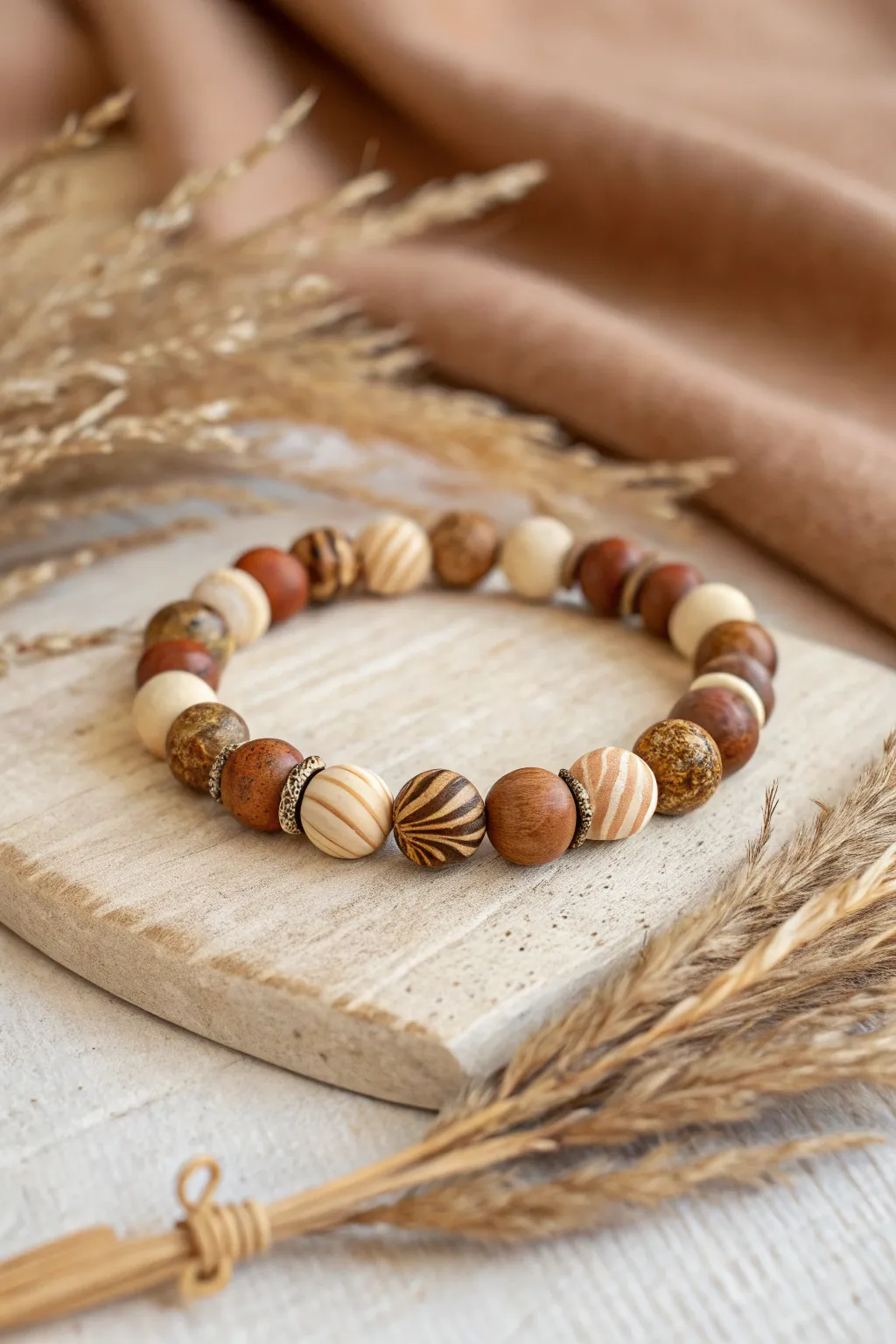
Embrace cozy autumn vibes with this mixed-texture bracelet featuring warm browns, creamy beiges, and intricate swirled patterns. The combination of faux-wood clay beads and speckled stone effects creates a sophisticated accessory perfect for pairing with your favorite sweater.
Step-by-Step Tutorial
Materials
- Polymer clay (white, translucent, chocolate brown, tan/beige)
- Granite-effect polymer clay or coarse black pepper for speckling
- Bead roller or acrylic block
- Needle tool or bead pins
- Baking sheet and parchment paper
- Sandpaper (various grits from 400 to 1000)
- Polyurethane gloss varnish (optional)
- Strong elastic cord (0.8mm or 1mm)
- Jewelry glue (e.g., G-S Hypo Cement)
- Metal spacer beads or bead caps (antique bronze finish)
Step 1: Creating the Clay Canes
-
Mix your base colors:
Condition your polymer clay by kneading it until soft. Mix custom shades to match the photo: a deep chocolate brown, a warm caramel tan, and a milky cream color. I like to add a touch of translucent clay to the cream to give it depth like real stone or wood. -
Create the swirl technique:
To make the striped/swirled beads, layer thin sheets of the deep brown and cream clay. Jelly-roll them together into a log, then gently lengthen and twist the log to distort the lines. -
Form the latte art pattern:
For the more intricate ‘latte art’ looking beads, take your twisted log and fold it back on itself, then roll it smooth again. Repeat this folding and twisting process until you have fine, sophisticated marbling without muddying the colors completely. -
Make the speckled stone mix:
For the darker speckled beads, mix the brown clay with a small amount of granite-effect clay. If you don’t have granite clay, a tiny pinch of coarse black pepper kneaded into the brown clay creates a convincing organic texture.
Smudged Pattern?
If your swirls look muddy, you may be over-handling the clay. Chill the cane in the fridge for 15 minutes before slicing or rolling to keep the distinct darker lines crisp.
Step 2: Forming and Baking
-
Measure your portions:
Use a small circle cutter or a measuring spoon to scoop equal amounts of clay for each bead type. You’ll want about 6-8 marbled beads, 6 solid brown beads, and 6 speckled beads. -
Roll the spheres:
Roll each portion into a smooth ball between your palms. Use a bead roller or an acrylic block moving in a circular motion if you want them perfectly spherical, though slightly organic shapes add to the rustic charm. -
Piercing the beads:
Gently twist a needle tool through the center of each bead. To prevent distortion, pierce halfway through, pull the needle out, and pierce through the other side to meet in the middle. -
Bake carefully:
Arrange your beads on a baking sheet lined with parchment paper. If you have a bead rack, use it to avoid flat spots. Bake according to your clay manufacturer’s instructions, usually at 275°F (135°C) for 30-45 minutes. -
Cooling down:
Allow the beads to cool completely in the oven with the door slightly ajar. This gradual cooling tempers the clay and makes the beads stronger.
Step 3: Finishing and Assembly
-
Sand for smoothness:
Once cool, wet-sand the beads under running water, starting with 400 grit and working up to 1000 grit. This reveals the clarity of the swirl patterns and gives the clay a professional, soft-touch finish. -
Buff or varnish:
Vigorously buff the beads with a denim cloth for a natural sheen. If you prefer the high-gloss look seen on the darker beads in the image, apply a thin coat of polyurethane gloss varnish. -
Layout your design:
Lay out your beads on a bead board or soft cloth. Alternate the patterned swirl beads with the solid brown and speckled ones to create a balanced rhythm. -
Add metal accents:
Place the antique bronze spacer rings between select beads. In the reference image, they frame the focal beads nicely, adding a touch of metallic contrast to the organic clay textures. -
String it up:
Cut a piece of elastic cord about 10 inches long. Pre-stretch the cord by pulling it firmly a few times to prevent sagging later. -
Thread the beads:
String your beads onto the elastic. Check the size around your wrist; add or remove a spacer bead if necessary to get the perfect fit. -
Secure the knot:
Tie a surgeon’s knot (right over left twice, left over right). Pull the knot tight while compressing the beads together to minimize gaps. -
Final glue:
Apply a tiny dot of jewelry glue to the knot. Let it dry for a moment, then slide the knot inside the hole of a neighboring bead to hide it.
Level Up: Scented Beads
Use unsealed wood beads for the solid brown spacers and add a drop of cinnamon or vanilla essential oil directly to them for a scratch-and-sniff autumn experience.
Slip on your new bracelet and enjoy the compliments on your hand-crafted accessory
Autumn Smiley Face Beads
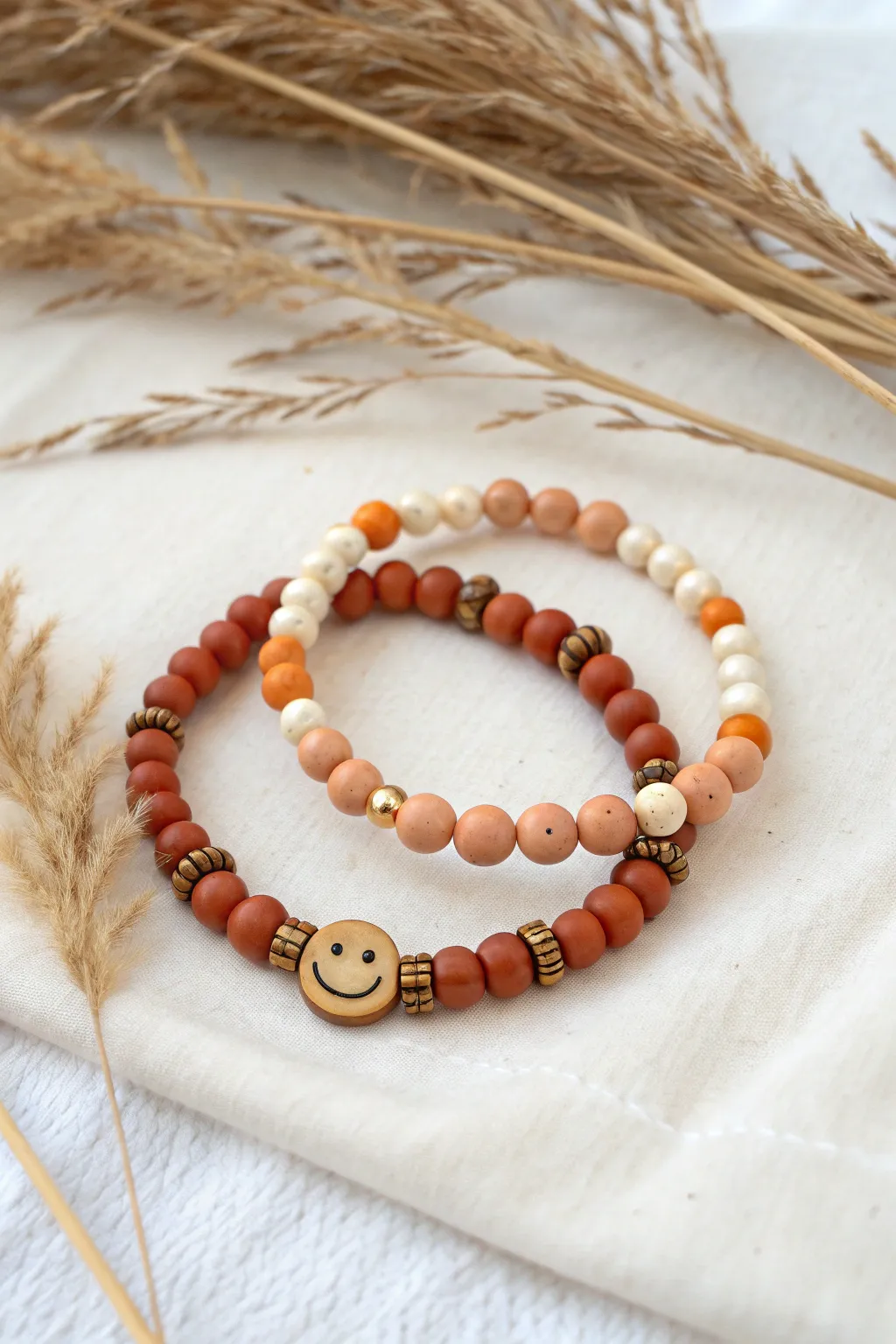
Embrace the cozy vibes of fall with these warm-toned beaded stretch bracelets featuring a cheerful wooden smiley face focal point. The mix of terracotta clay, wooden accents, and creamy whites creates a perfect rustic duo that looks great stacked or worn singly.
Detailed Instructions
Materials
- Stretch cord (0.8mm or 1mm elastic)
- Round terracotta/red-brown clay beads (approx. 6-8mm)
- Round cream/white wooden or clay beads (approx. 6-8mm)
- Round light orange/peach wooden beads (approx. 6-8mm)
- Flat round wooden smiley face bead (approx. 10-12mm)
- Flat disc spacer beads (antique gold/bronze finish)
- Cylinder/tube spacer beads (antique gold/bronze/striped)
- Dark wood patterned accent beads (barrel or round shape)
- Strong craft glue or jewelry cement
- Scissors
Step 1: Planning and Preparation
-
Measure your wrist:
Before cutting your cord, wrap a piece of string around your wrist to find the circumference. Add about 3-4 inches to this measurement to ensure you have plenty of slack for tying knots later. -
Cut the cord:
Cut two lengths of stretch elastic cord based on your measurement. It is always better to have too much cord than too little while stringing. -
Secure the ends:
Place a piece of tape or a bead stopper clip on one end of each cord to prevent your beads from sliding off while you design your pattern.
Knot Slipping?
If your elastic knot feels loose, try tying it while the cord is under tension. A second set of hands helps, or use a bead awl to hold the loop tight.
Step 2: Creating the Smiley Bracelet
-
Start the center focal:
Thread three flat antique gold disc spacer beads onto the cord, followed by your wooden smiley face bead. -
Finish the focal arrangement:
Immediately add three more flat disc spacers on the other side of the smiley face to frame it perfectly. -
Add red-brown clay beads:
On both sides of the focal section, thread two red-brown clay beads. This begins to build the warm base color of the bracelet. -
Insert decorative spacers:
After the clay beads, slide on a textured cylinder spacer (bronze or striped wood look) on each side to break up the pattern visually. -
Build the pattern outwards:
Continue stringing the red-brown clay beads on either side. Every 5-7 beads, you can add a small ridged spacer ring to add texture, though keeping it simple works too. -
Check the length:
Wrap the strand around your wrist occasionally. Stop adding beads once the ends meet comfortably without stretching the cord.
Step 3: Creating the Companion Bracelet
-
Begin the irregular pattern:
This bracelet uses a more organic, color-blocked style. Start by stringing about 6-8 of the red-brown clay beads. -
Add a dark accent:
Slide on a dark patterned wood bead followed by another red-brown bead, then perhaps another dark wood bead to create a transition zone. -
Transition to white:
Add a small gold ball spacer, then switch to your cream or white beads. String a section of about 8-10 white beads. -
Introduce the orange tones:
Transition into the light peach/orange wooden beads. Mix them slightly with the white beads (one white, one orange) before doing a solid run of 5-6 orange beads. -
Close the loop:
Finish stringing until the strand matches the length of your first bracelet. The asymmetry is part of the charm, so don’t worry about perfect mirroring.
Level Up: Texture Mix
Incorporate lava stone beads into the red-brown sections. You can add a drop of essential oil like cinnamon or clove for a scented fall accessory.
Step 4: Finishing Touches
-
Pre-stretch the cord:
Gently pull on both ends of your beaded strands. This pre-stretching prevents the elastic from sagging immediately after you wear it. -
Tie the knots:
Remove the tape or clips. Tie a surgeon’s knot (right over left, left over right) for each bracelet. Pull tight to secure the beads together. -
Apply adhesive:
I like to dab a tiny drop of jewelry glue or clear nail polish onto the knot to ensure it never slips undone. -
Hide the knot:
If one of your beads has a large enough hole, gently tug the cord to slide the knot inside that bead. Otherwise, trim the excess cord close to the knot after the glue dries.
Stack these together with your favorite chunky sweater for an instant seasonal update to your outfit
Cute Mushroom Motif Beads
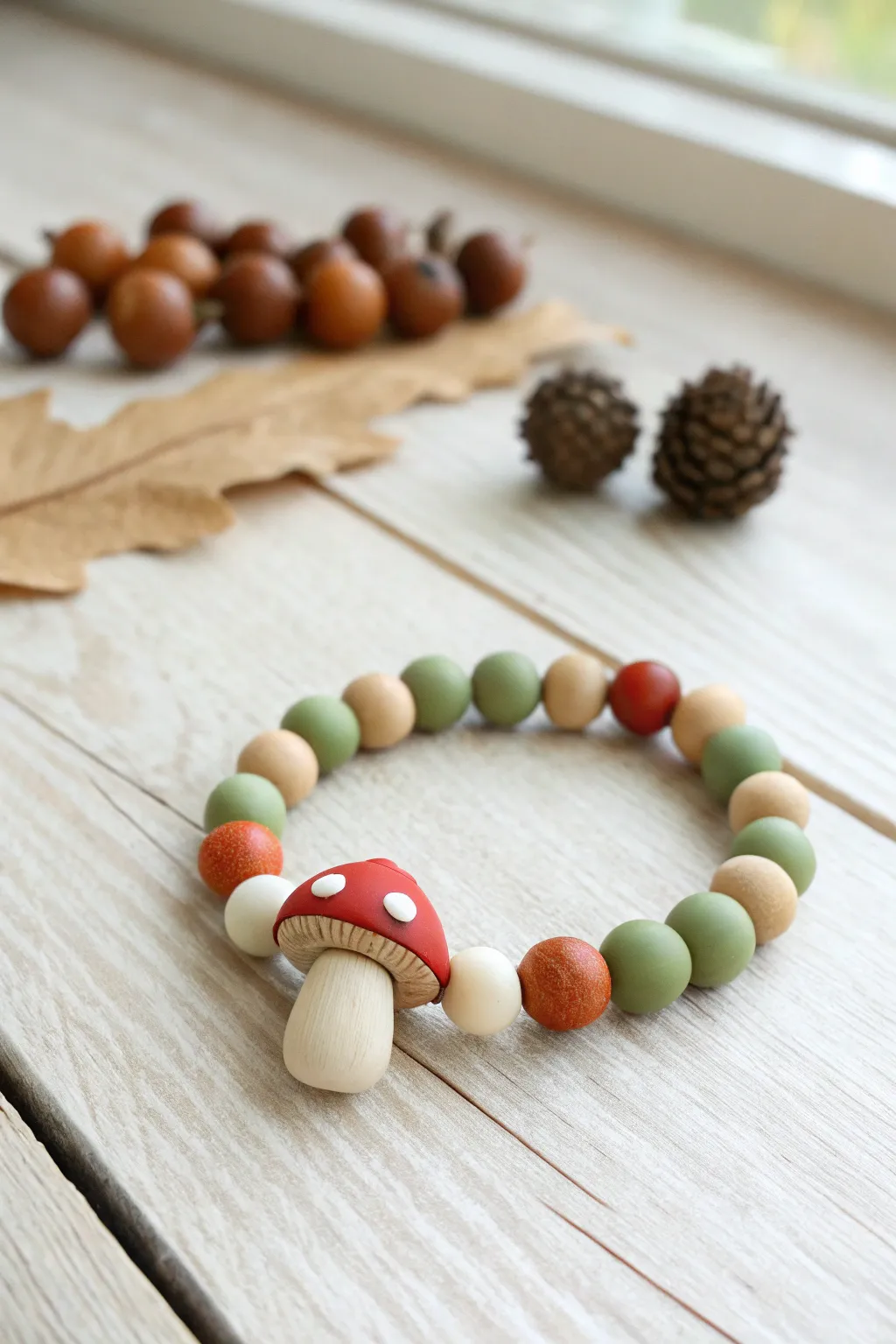
Embrace the cozy vibes of autumn with this adorable mushroom-themed bracelet featuring earthy tones and a handmade focal bead. The soft matte finish of the polymer clay beads perfectly mimics natural textures, making it a charming accessory for any fall outfit.
How-To Guide
Materials
- Polymer clay in crimson red, white, sage green, and olive green
- Polymer clay in beige or light wood tone
- Translucent liquid polymer clay (optional)
- Elastic beading cord (0.7mm or 0.8mm)
- Sculpting tools (needle tool, ball stylus)
- Clay roller or pasta machine
- Bead piercing tool or toothpick
- Oven for baking clay
- Matte varnish (optional)
- Small circle cutter (approx. 5mm)
- Sandpaper (fine grit)
Step 1: Sculpting the Mushroom Charm
-
Shape the stem:
Start with a chunk of beige clay about the size of a marble. Roll it into a thick cylinder that tapers slightly at the top, creating a classic mushroom stalk shape. Flatten the bottom gently so it stands but retains a rounded edge. -
Texture the stem:
Using a needle tool, lightly etch vertical lines from the base towards the top of the stem to mimic the fibrous texture of a real mushroom stalk. -
Create the cap base:
Form a small disc of beige clay, slightly larger than the top of your stem, to act as the underside of the cap. Press this onto the top of the stem. -
Detail the gills:
Use your needle tool or a craft knife to press fine lines radiating from the center of the underside disc out to the edges to simulate mushroom gills. -
Form the red cap:
Take a ball of crimson red clay and flatten it into a dome shape. Smooth it until it’s perfectly round and free of fingerprints. -
Attach the cap:
Place the red dome over the beige gill piece. Gently press the edges down so they meet the beige underside, creating a seamless join where the red cap curves over. -
Add the spots:
Roll tiny, varied sizes of white clay balls. Press them flat onto the red cap. I like to press them down until they are almost flush with the red surface for a cleaner look. -
Pierce the bead hole:
Carefully insert a bead piercing pin or toothpick horizontally through the stem, just below the cap. Rotate the pin as you push to avoid distorting the shape.
Uneven Bead Holes?
If the exit hole of your bead is blown out or messy, try piercing halfway through from one side, then flipping the bead and piercing the rest of the way from the other side to meet in the middle.
Step 2: Creating the Round Beads
-
Prepare your colors:
Condition your sage green, olive green, beige, and a mix of burnt orange (mix red and beige if needed) clays. -
Portion the clay:
Use a small circle cutter to punch out equal amounts of clay for each bead to ensure uniform size. You will need about 18-20 portions total, depending on wrist size. -
Roll the beads:
Roll each portion vigorously between your palms to create perfectly round spheres. -
Texture the accent beads:
For the burnt orange beads, lightly roll them over a piece of sandpaper or use a toothbrush to stipple the surface, giving them a speckled, organic texture. -
Pierce the beads:
Gently pierce a hole through the center of each sphere. If the bead deforms, gently reshape it while it’s on the piercing tool.
Add Some Shine
For a ‘fresh rain’ look, apply a coat of gloss glaze only to the red cap of the mushroom while leaving the stem and other beads matte. It creates a lovely contrast.
Step 3: Baking and Assembly
-
Bake the clay:
Arrange all your beads and the mushroom charm on a baking sheet or tile. Bake according to your brand of clay’s instructions (usually 275°F/135°C for 30 minutes). -
Cool down:
Let the beads cool completely inside the oven or on the counter before handling to prevent cracking. -
Layout the design:
Lay out your beads to plan the pattern. Position the mushroom in the center, flanked by the white/beige beads, then alternate the sage, olive, and textured orange beads for a varied rhythm. -
String the beads:
Cut a piece of elastic cord about 10 inches long. Pre-stretch the cord by pulling it firmly a few times to prevent sagging later. -
Thread the pattern:
String the beads onto the elastic, following your planned layout. Ensure the mushroom charm sits centrally. -
Tie the knot:
Bring the ends together and tie a double or surgeon’s knot. Pull tight to secure the beads significantly close to each other. -
Secure and hide:
Place a tiny drop of super glue or clear nail polish on the knot. Once dry, tuck the knot inside one of the adjacent beads.
Wear your new woodland treasure and enjoy the handmade touch of autumn on your wrist
Ghost and Bat Charm Mix
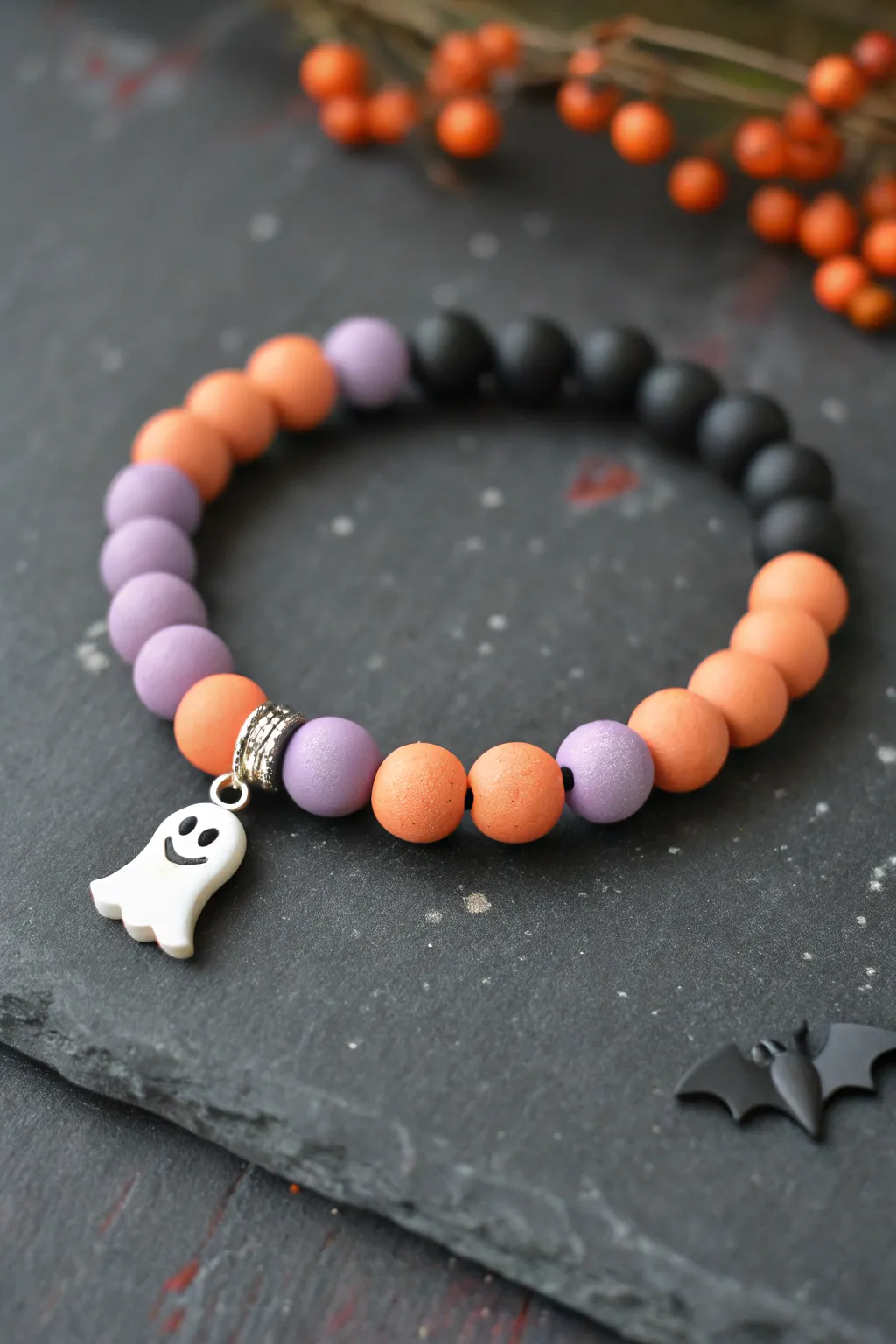
Celebrate the spooky season with this simple yet charming Halloween bracelet featuring a matte finish and a friendly ghost charm. The color palette combines classic orange and black with a soft purple for a modern, playful twist on autumn accessories.
Step-by-Step
Materials
- Matte round beads (approx. 8mm or 10mm): Black, Orange, Lavender/Purple
- Elastic beading cord (clear, 0.8mm or 1mm thickness)
- Ghost charm (white enamel or resin)
- Silver-tone bail bead or charm hanger (wide hole)
- Jump ring (silver, 4mm or 6mm)
- Jewelry adhesive (e.g., E6000 or G-S Hypo Cement)
- Scissors
Step 1: Preparation
-
Measure your wrist:
Wrap a piece of string around your wrist to find the circumference, then add about half an inch for a comfortable fit. -
Cut the cord:
Cut a length of elastic cord about 10-12 inches long. This extra length makes tying the knot much easier at the end. -
Pre-stretch the elastic:
Hold both ends of your cut cord and give it a few firm tugs. This crucial step prevents the bracelet from drooping or stretching out permanently after you wear it. -
Secure the end:
Place a bead stopper or simply tape one end of the cord to your table to prevent beads from sliding off while you work.
Step 2: Creating the Pattern
-
Start with the focal point:
Begin by sliding on one lavender bead, followed by the silver charm bail, and then another lavender bead. This sets the center of your design. -
Add the first orange accents:
Slide one orange bead onto each side of your purple-and-bail center cluster. Note that the image shows a symmetrical pattern radiating from the ghost. -
Build the right side:
Continuing from the orange bead on the right, string: one lavender bead, four orange beads, and then begin your black section. -
Build the left side:
Repeat the pattern on the left side: add one lavender bead and then four orange beads to mirror the right side. -
Complete the loop:
Use the black matte beads to fill in the rest of the bracelet length until you reach your desired size. The back section acts as a solid anchor for the colorful front design.
Pro Tip: Matte Magic
Matte acrylic or clay beads often have a ‘soft touch’ feel. If the holes are clogged with coating, use a bead reamer or a thick needle to clear them before stringing.
Step 3: Assembly and Finishing
-
Attach the charm:
Open a jump ring using two pairs of pliers (twist sideways, don’t pull apart). Slide on your ghost charm and loop it through the ring on the silver bail bead. -
Close the jump ring:
Twist the jump ring back into a closed position, ensuring the ends meet perfectly flush so the charm doesn’t slip off. -
Check the fit:
Wrap the beaded strand around your wrist to double-check the size before tying. Add or remove black beads at the back if necessary. -
Tie the knot:
Bring the two ends of the elastic together and tie a surgeon’s knot (loop the right end over the left, then the left over the right twice). -
Secure the knot:
Pull the knot tight. Apply a tiny dot of jewelry adhesive directly onto the knot and let it dry for a few minutes. -
Hide the knot:
Once dry, trim the excess elastic carefully. If the hole of the adjacent black bead is large enough, gently tug the knot inside to hide it.
Troubleshooting: Loose Charm
If your charm bail slides around too much, the hole is too big for the cord. Use a bail with a smaller hole or sandwich it tightly between slightly larger beads.
Now you have a festive accessory ready to wear for trick-or-treating or just adding a subtle ghostly vibe to your day
Speckled “Dried Florals” Beads
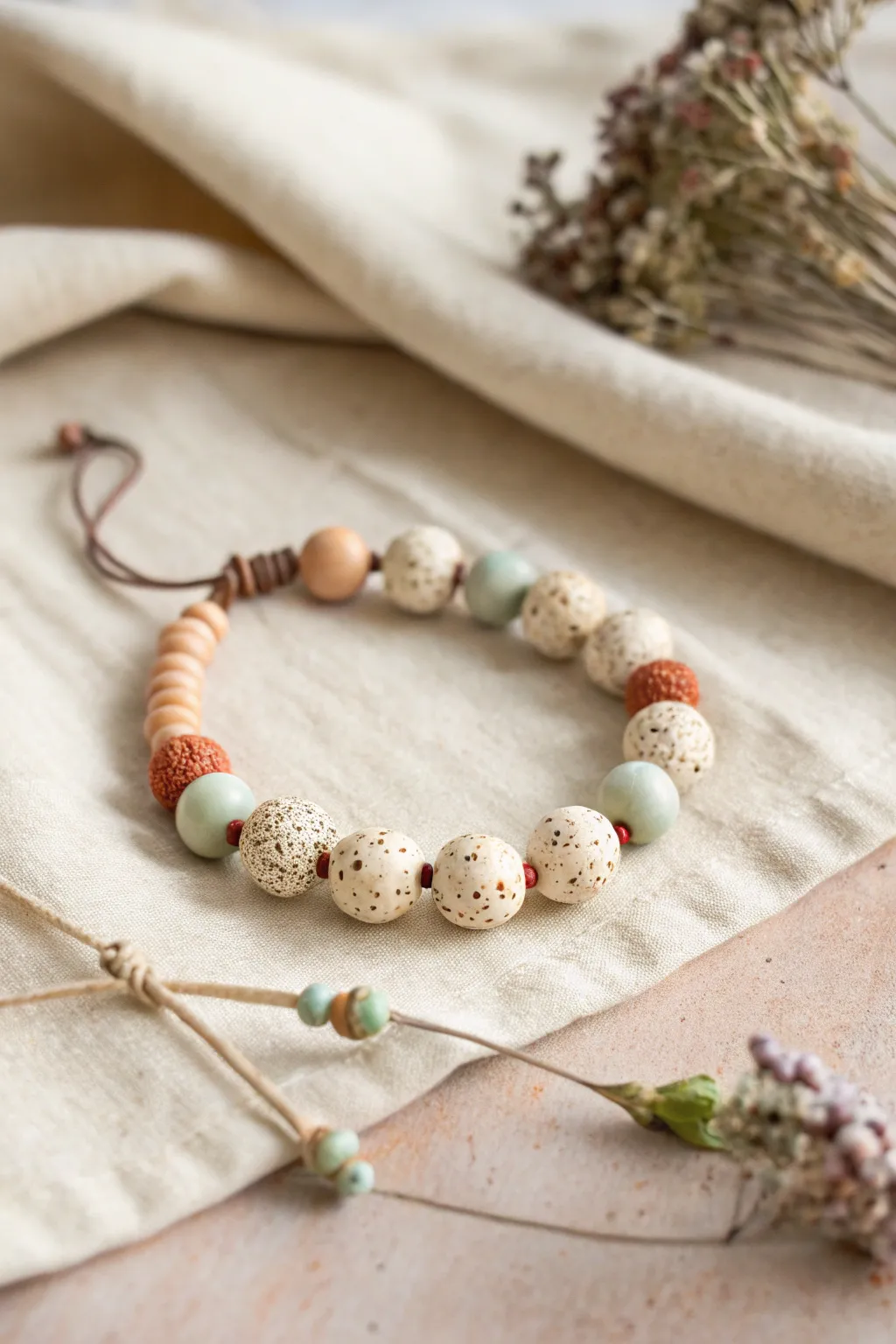
Capture the muted beauty of dried floral arrangements with this textured polymer clay bracelet. Featuring hand-rolled speckled beads paired with earthy terracotta and sage tones, this piece creates a perfect rustic autumn accessory.
Step-by-Step Guide
Materials
- Polymer clay (white, black, sage green, terracotta, peach)
- Round wooden beads (approx. 8mm)
- Leather or waxed cotton cord (1mm, dark brown)
- Toothpicks or bead pins
- Baking sheet and parchment paper
- Sandpaper (fine grit)
- Texturing tool (rough sponge or sandpaper)
- Small round cutter (optional)
- Clay roller or pasta machine
- Needle tool for piercing
Step 1: Creating the Speckled Clay
-
Condition the base:
Start by conditioning a block of white polymer clay until it is soft and pliable. Use your hands to warm it up or pass it through a pasta machine on a medium setting. -
Add the speckles:
Finely chop or grate a very small amount of black polymer clay. You want tiny crumbs, almost like black pepper dust. -
Mix the colors:
Sprinkle the black ‘pepper’ over the white clay sheet. Fold the clay over and roll it out. Repeat the folding and rolling process just enough to distribute the specks evenly without blending the black into a grey smear.
Pepper Effect
Instead of black clay, try mixing real dried coffee grounds or black pepper into the white clay. It creates an incredibly realistic organic texture during baking.
Step 2: Forming the Beads
-
Roll the main beads:
Take portions of your speckled clay and roll them into balls between your palms. Aim for a size of about 10-12mm. Make roughly 6-8 of these depending on your desired length. -
Create sage accents:
Using the sage green clay, roll smaller, smooth rounds, slightly smaller than your speckled beads (approx. 8mm). -
Texture the terracotta:
Roll two beads from the terracotta clay. Before piercing, gently roll the surface over a piece of coarse sandpaper or dab it with a rough sponge to create a pitted, stone-like texture. -
Make the peach discs:
Roll a snake of peach clay and slice it into small, even segments. Flatten these slightly into thick disc shapes rather than perfect spheres. -
Pierce the holes:
Use a needle tool or toothpick to pierce a hole through the center of each bead. I find twisting the tool while pushing gently helps prevent the bead from squishing out of shape. -
Widen the holes:
Double-check that the holes are large enough to accommodate your leather cord; widen them slightly if necessary.
Step 3: Baking and Finishing
-
Bake the beads:
Arrange your beads on a parchment-lined baking sheet. Bake according to your clay package instructions (usually around 275°F/135°C for 15-30 minutes per 1/4 inch thickness). -
Cool down:
Let the beads cool completely on the tray before handling them to ensure they harden fully. -
Sand for finish:
Once cool, lightly sand the speckled and sage beads if there are any fingerprints, but leave the terracotta ones rough to maintain that earthy texture.
Glaze It Up
Apply a matte varnish to the sage and wood beads, but use a high-gloss glaze on just the speckled white beads to make them look like polished ceramic stones.
Step 4: Assembly
-
Prepare the cord:
Cut a length of leather cord approximately 12 inches long. Tie a simple overhand knot heavily to one side to act as a stopper. -
String the pattern:
Thread the beads, starting with the stack of peach discs. Follow with a mix of the speckled beads, sage rounds, terracotta accents, and natural wood beads. Use the image as a guide for the asymmetrical rhythm. -
Close the loop:
Once all beads are strung, tie another knot snugly against the last bead to secure them in place. -
Create the sliding knot:
Overlap the two ends of the cord. Cut a separate short piece of cord (about 4 inches) and use it to tie a sliding square knot or a macramé spiral around the overlapped strands. -
Finish the ends:
Trim the excess sliding knot cord. On the main cord tails, add one small sage or wooden bead to each end and knot securely so they don’t slip through the closure.
Enjoy the soothing tactile feel of your new handcrafted accessory
Woodland Acorn Texture Mix
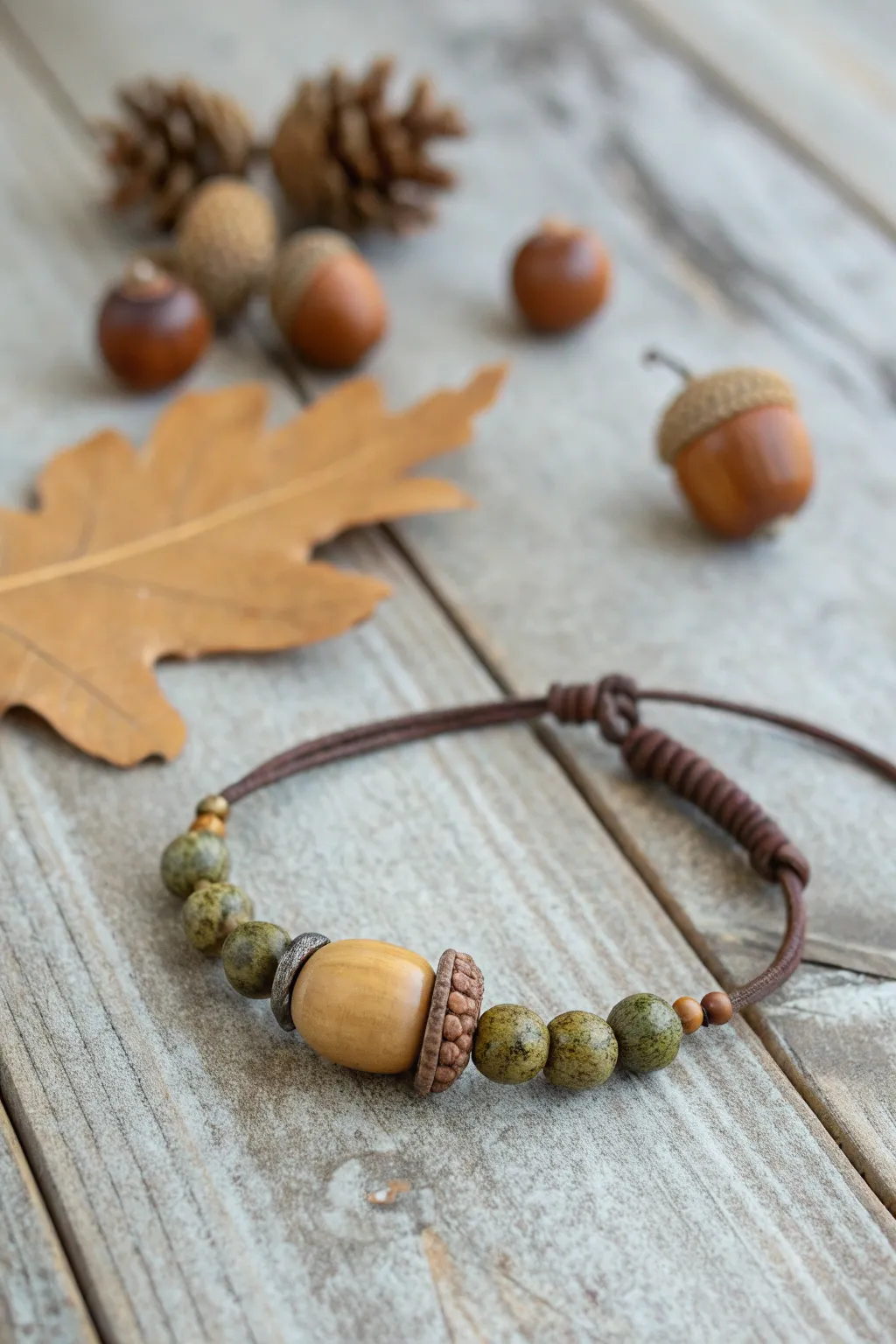
Capture the essence of an autumn forest walk with this charming beaded bracelet featuring earthy tones and a clever acorn-inspired focal point. The mix of textures—smooth wood, speckled stone, and rugged cord—creates a cozy accessory perfect for sweater weather.
Detailed Instructions
Materials
- 1.5mm brown leather or waxed cotton cord (approx. 20 inches)
- Large oval wooden bead (natural finish)
- Small textured bead cap or spacer (copper or bronze tone)
- Textured polymer clay or wooden ring spacer (to mimic acorn cap)
- 6 round moss agate or jasper beads (6-8mm, green/brown mix)
- 2 small wooden spacer beads (3-4mm)
- 2 tiny metal spacer beads (antique brass)
- Scissors
- Hypo-cement or strong craft glue (optional)
Step 1: Preparing the Acorn Centerpiece
-
Select your focal beads:
To create the acorn look, you need two distinct parts: the nut and the cap. Choose your large oval wooden bead for the ‘nut’ section. -
Choose the cap component:
Find a textured spacer bead that fits snugly against the top of your oval wooden bead. A thick, textured ring spacer or a bead cap with a nubby texture works best to mimic the rough top of an acorn. -
Visual check:
Slide the cap bead and the nut bead onto a spare piece of wire or cord just to ensure they sit flush together and resemble an acorn shape before committing to the final cord.
Knot Security
When gluing the sliding knot ends, use a toothpick to apply glue precisely. Avoid getting glue on the main cords or the slider won’t move.
Step 2: Stringing the Design
-
Cut the cord:
Cut a length of your brown cord to about 20 inches. This gives you plenty of slack for the sliding knots later. -
Thread the centerpiece:
Slide the large wooden ‘nut’ bead onto the center of the cord, followed immediately by your textured ‘cap’ bead. Position them right in the middle. -
Add flanking spacers:
On the left side of the wooden nut, add a thin, antique metal spacer bead. On the right side of the acorn cap, do the same. This frames your focal point. -
String the stone beads:
Thread three moss agate beads onto the cord on the left side of your centerpiece. Repeat this on the right side, so you have three stone beads flanking the acorn on either side. -
Add separation spacers:
After the last stone bead on each side, thread on one tiny wooden spacer bead. This helps transition from the beadwork to the bare cord. -
Secure the beads:
Tie a simple overhand knot firmly against the last wooden spacer bead on both sides. This keeps all your beads centered and prevents them from sliding around.
Step 3: Creating the Sliding Closure
-
Form the overlap:
Bring the two tail ends of the cord together so they overlap, forming a circle. The ends should be pointing in opposite directions. -
Prepare the knotting cord:
If you have excess cord cut off from earlier, or a new 8-inch piece, use this for the sliding knot. Lay this short piece under the two overlapped main cords. -
Start the cobra knot:
Begin a square knot (macrame style) or a simple coil knot. For the look in the photo, a coiled ‘barrel’ style knot or repeated square knots work well. Wrap the knotting cord tightly around both main cords. -
Continue knotting:
Continue your chosen knotting technique for about 1/2 to 3/4 of an inch. I find keeping the tension consistent here makes the sliding mechanism smoother. -
Finish the slider:
Once the knot is long enough, pull the ends of the knotting cord tight. Trim the knotting cord ends close to the knot (be careful not to cut your main bracelet cords!). -
Secure the knot ends:
Dab a tiny amount of hypo-cement or jewelry glue on the cut ends of the knotting cord to prevent fraying. -
Knot the tail ends:
Finally, tie a small overhand knot at the very end of each main cord tail to prevent them from slipping through the slider loop.
Texture Twist
Use polymer clay to hand-sculpt the acorn ‘cap’ bead. Stipple it with a toothbrush for realistic texture before baking.
Enjoy wearing your little piece of the forest, effortlessly adjusting it to fit perfectly.
Harvest Moon Night Sky Bracelet
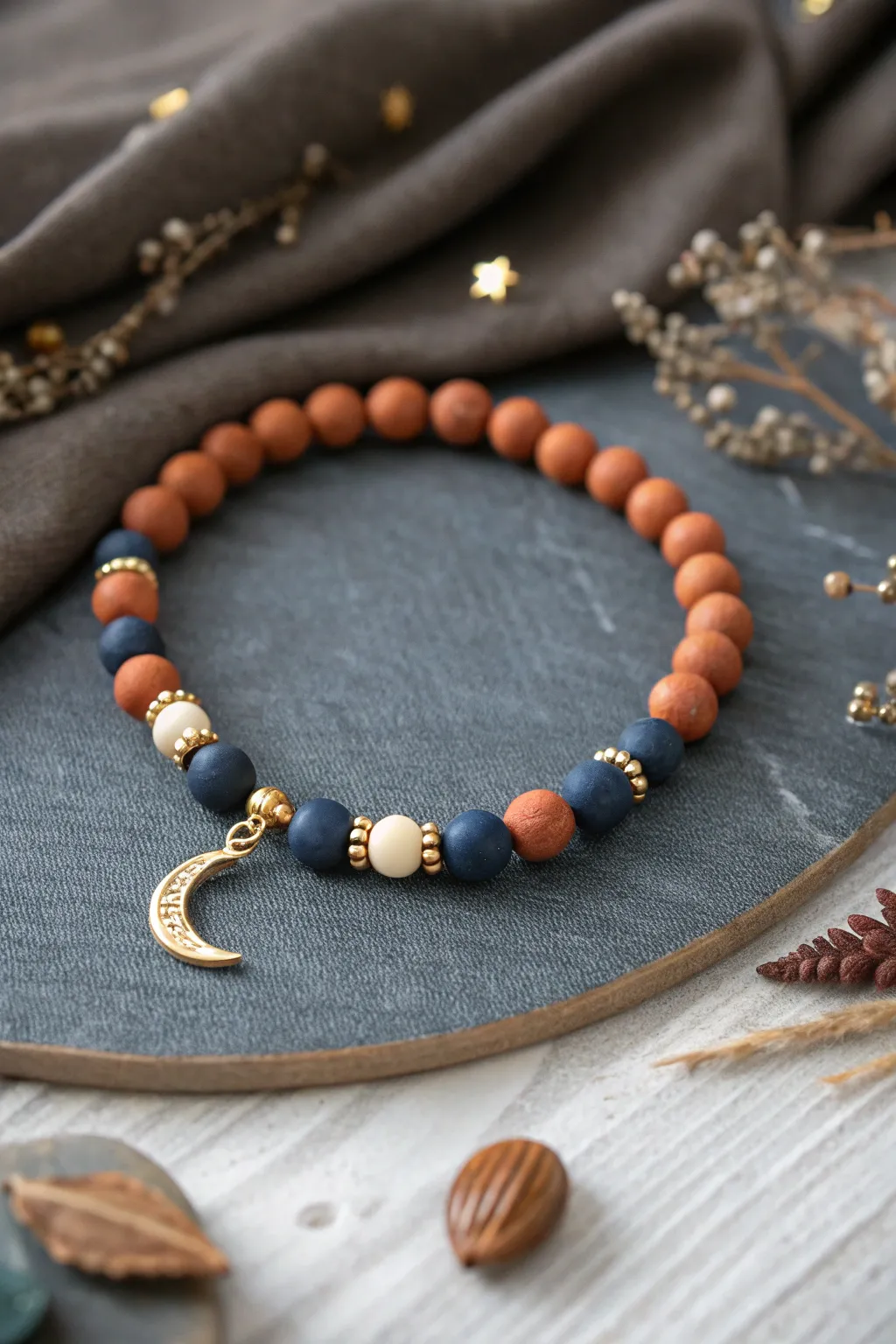
Capture the magic of an autumnal evening with this celestial-inspired design featuring matte clay beads in rust and midnight blue. The warm terracotta tones balance beautifully with the deep blues and gold accents, creating a wearable piece of harvest twilight.
Step-by-Step Guide
Materials
- Matte round polymer clay beads (6mm or 8mm) in terracotta/rust orange
- Matte round polymer clay beads (6mm or 8mm) in midnight blue/navy
- Matte round polymer clay beads (6mm or 8mm) in cream/off-white
- Gold tone spacer beads (small rondelles or discs)
- Small gold bead caps (optional, for the cream beads)
- Gold crescent moon charm with attachment ring
- Gold jump ring (4mm or 5mm)
- Elastic stretch cord (0.7mm or 0.8mm)
- Jewelry adhesive or super glue
- Scissors
- Bead stopper or tape
- Chain nose pliers (for the jump ring)
Step 1: Planning and Preparation
-
Measure your wrist:
Wrap a piece of string around your wrist to find your comfortable size, then add about half an inch for a good fit. Cut a length of elastic cord about 10-12 inches long to give yourself plenty of room for tying knots later. -
Secure the cord:
Attach a bead stopper or a piece of masking tape to one end of your elastic cord. This simple step saves you from the frustration of beads sliding right off while you work. -
Layout the design:
Before stringing, lay your beads out on a bead board or a soft cloth towel. The specific pattern shown has a symmetrical focal section and a solid back section.
Step 2: Stringing the Focal Section
-
Start with the moon:
Using your pliers, twist open the gold jump ring and attach your crescent moon charm. Do not close it yet if you are attaching it directly to the cord, but normally, we slide the charm onto the cord via the jump ring or a bail. Slide the charm to the center of your cord. -
Create the center symmetry:
On the immediate right side of the charm, slide on one gold spacer, one midnight blue bead, another gold spacer, and then a cream bead. Repeat this exact sequence on the left side of the charm so it is perfectly mirrored. -
Extend the dark sky:
Moving outwards on the right side, add a gold spacer after the cream bead, then add two midnight blue beads. Repeat this on the left side. You should now have a core section of cream and blue framing the moon. -
Transition to harvest colors:
After the blue sections on both sides, add a gold spacer bead. Then, add one single terracotta bead on each side. Follow this with one more midnight blue bead on each side. -
Final accent:
Place a gold spacer bead after that last blue bead on both sides. This gold accent marks the end of the ‘night sky’ section and the beginning of the solid harvest color.
Knot Slipping?
If your elastic knot feels slippery, try dotting it with clear nail polish if you lack jewelry glue. Hold the knot taut for 30 seconds while it sets to ensure it stays tight.
Step 3: Completing the Bracelet
-
String the rest:
Fill the remainder of the cord length with the solid terracotta beads only. Continue adding them until the bracelet reaches your desired length. -
Check the fit:
Carefully wrap the strand around your wrist to check the sizing. The beads should touch comfortably without stretching the elastic so much that gaps appear between them. -
Pre-stretch the cord:
Give the ends of the elastic a few gentle tugs. This pre-stretching helps prevent the bracelet from loosening up significantly after the first few times you wear it.
Add Sparkle
Swap the plain gold spacers for rhinestone rondelles to make the bracelet twinkle like real stars, or use a star charm instead of a moon for a different celestial vibe.
Step 4: Finishing Touches
-
Tie the knot:
Remove the bead stopper and tie a surgeon’s knot. This is just a standard square knot but with an extra loop through on the first pass. Pull the elastic tight so the knot is secure. -
Secure with glue:
Dab a tiny drop of jewelry adhesive onto the knot. Let it dry for a moment before trimming the excess cord. I like to leave about 2mm of tail rather than cutting flush against the knot. -
Hide the knot:
Ideally, gently pull the elastic so the knot slides inside the hole of one of the adjacent terracotta beads. This gives your finish a seamless, professional look.
Slip on your new bracelet and enjoy the cozy autumn vibes it brings to any outfit