
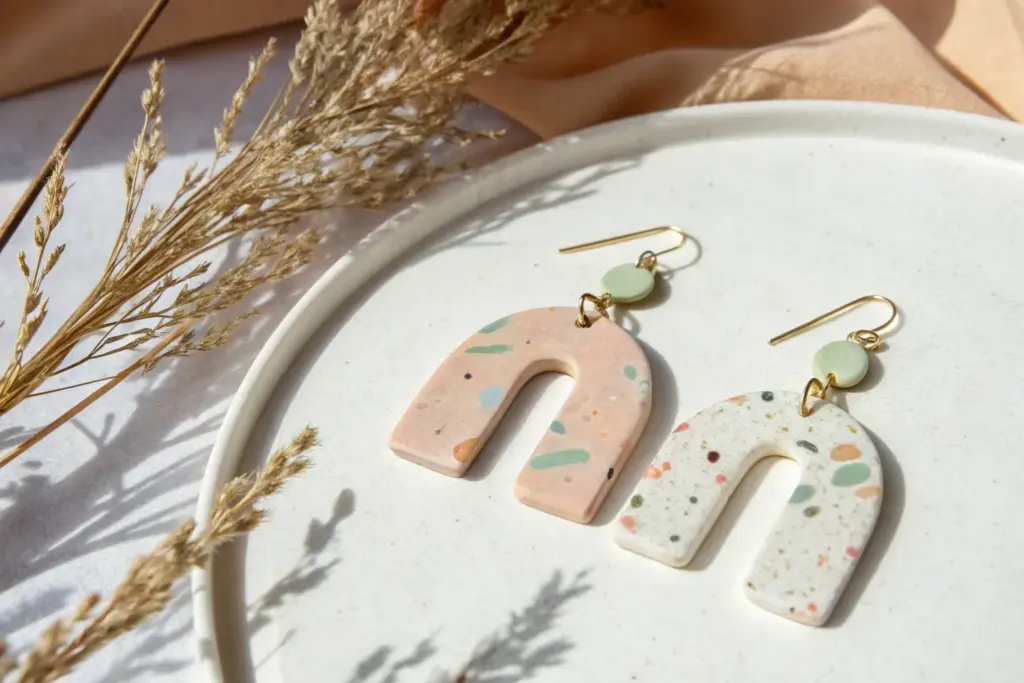
When you want cute accessories without a complicated setup, easy polymer clay jewelry is my favorite sweet spot: simple shapes, quick bakes, and big style payoff. Here are beginner-friendly ideas I’d totally make with you at my studio table—nothing fussy, just fun, wearable wins.
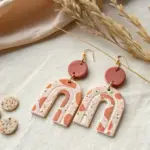
Polymer Clay Arch Dangle Earrings
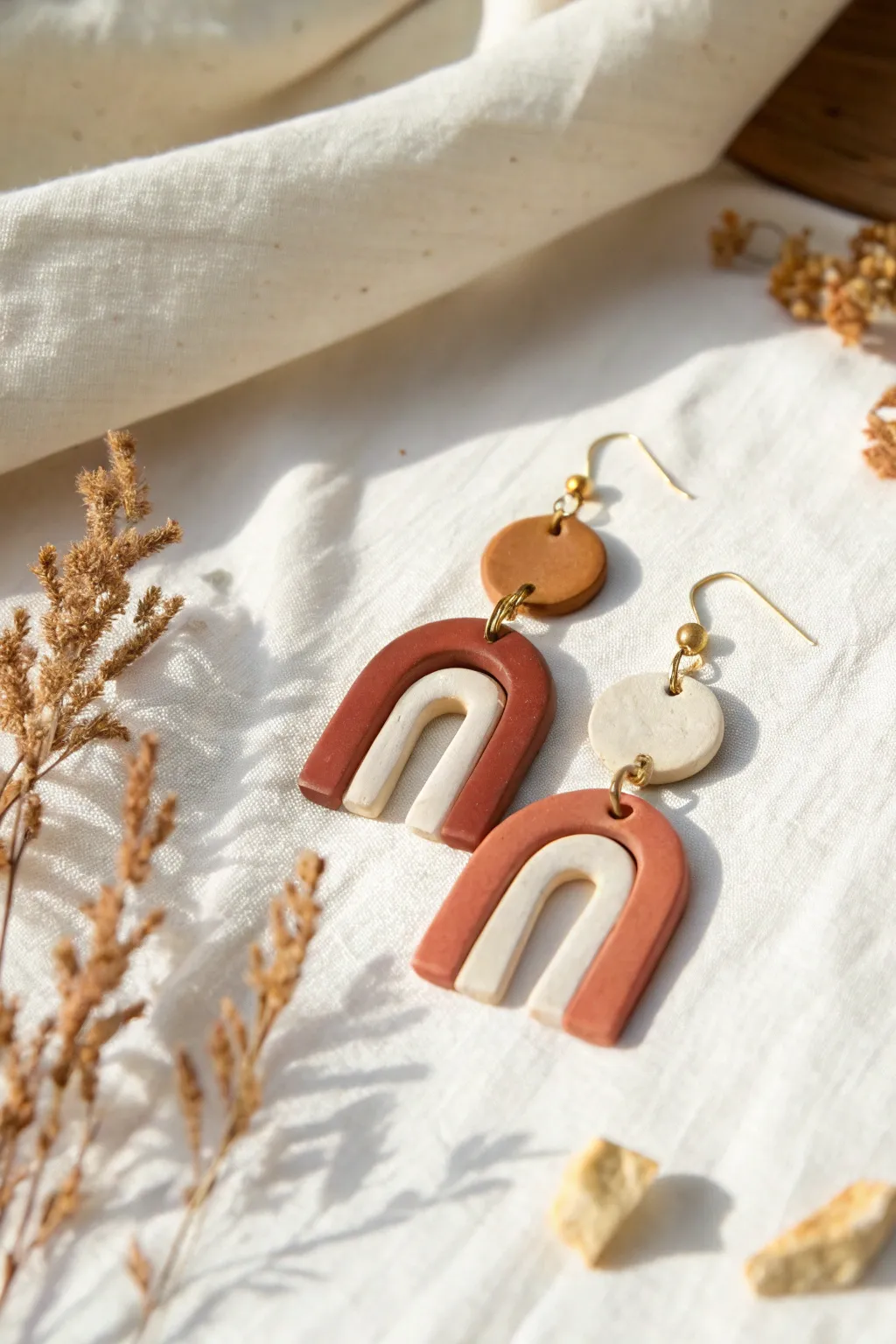
These stylish dangle earrings combine warm terracotta tones with speckled cream for a modern, architectural look. The nested arch design is surprisingly simple to achieve and adds a sophisticated touch to any outfit.
Step-by-Step
Materials
- Polymer clay (terracotta/rust orange)
- Polymer clay (white or cream)
- Black pepper or dried vanilla bean specks (optional)
- Rolling pin or pasta machine
- U-shaped clay cutters (two sizes)
- Small circle cutter (approx. 10mm)
- Needle tool or toothpick
- Jump rings (gold finish)
- Earring hooks (gold finish)
- Jewelry pliers
- Baking tile or parchment paper
- Piece of cardstock or paper
- Super glue (optional, if using posts instead of hooks)
Step 1: Preparing the Clay
-
Condition the Clay:
Begin by warming up your clay in your hands. Knead the terracotta clay until it is soft, pliable, and free of cracks. Do the same for the cream clay. -
Create Speckled Effect:
If your cream clay isn’t pre-speckled, mix in a tiny pinch of ground black pepper or dried vanilla bean specs. Fold and knead the clay until the specks are evenly distributed for that natural, stony look. -
Roll Out Sheets:
Roll out both clay colors into even slabs. Aim for a thickness of about 3mm—roughly the thickness of a coin. Using a pasta machine on a medium setting ensures perfectly even sheets.
Sticky Cutters?
If clay sticks inside your cutters, dip them into a small pile of cornstarch or flour before pressing down. The powder acts as a release agent and brushes off easily after baking.
Step 2: Shaping the Arches
-
Cut the Initial Shapes:
Using your larger U-shaped cutter, press firmly into the terracotta sheet to cut out two large arch shapes. Wiggle slightly to release the clay from the surface. -
Create the Inner Arch:
Use the smaller U-shaped cutter on the cream sheet to create two smaller arches. These will nest inside the larger ones. -
Hollow the Large Arch:
Take the smaller U-shaped cutter again. Carefully align it inside the large terracotta arch you just cut. Press down to remove the center, leaving a thick terracotta rainbow band. -
Assemble the Design:
Gently place the solid cream arch inside the hollow terracotta band. They should fit snugly together like puzzle pieces. Smooth the seam gently with your finger on the back to bond them slightly. -
Cut Top Circles:
Use your small circle cutter to punch out two discs for the top connectors. You can replicate the photo by making one terracotta and one cream for an asymmetrical look, or make them match. -
Smooth Edges:
Dip your finger in a little bit of water (or baby oil) and gently run it along the cut edges of all your clay pieces to smooth out any harsh lines or fingerprints. -
Pierce Holes:
Using a needle tool, poke a hole at the top center of each main arch piece. Make sure the hole is big enough for your jump rings. Create a corresponding hole at the bottom of each circle stud, and another at the top for the earring hook.
Step 3: Baking and Assembly
-
Bake the Pieces:
Arrange your clay pieces on a ceramic tile or baking sheet covered with parchment. Bake according to your brand’s specific instructions (usually 275°F/130°C for 15-30 minutes). -
Cool Down:
Allow the pieces to cool completely before handling. I like to let them sit inside the oven while it cools down to prevent any thermal shock cracking. -
Open Jump Rings:
Using two pairs of pliers, twist your jump rings open laterally—never pull them apart outward, as this weakens the metal. -
Attach Components:
Hook a jump ring through the top of the arch and the bottom of the circle stud. Close the ring securely by twisting it back into place. -
Add Earring Hardware:
Open the loop on your earring hook slightly. Thread it through the top hole of the circle stud piece. Close the loop securely. -
Final Check:
Inspect all your connections to ensure jump rings are fully closed so your beautiful new earrings won’t slip apart while wearing.
Pro Tip: Flat Backs
Bake your pieces on a plain piece of printer paper or cardstock instead of shiny metal or glass. This prevents the back of the clay from getting a shiny, glossy spot.
Enjoy wearing your handmade geometric statement pieces

Polymer Clay Textured Circle Stud Earrings
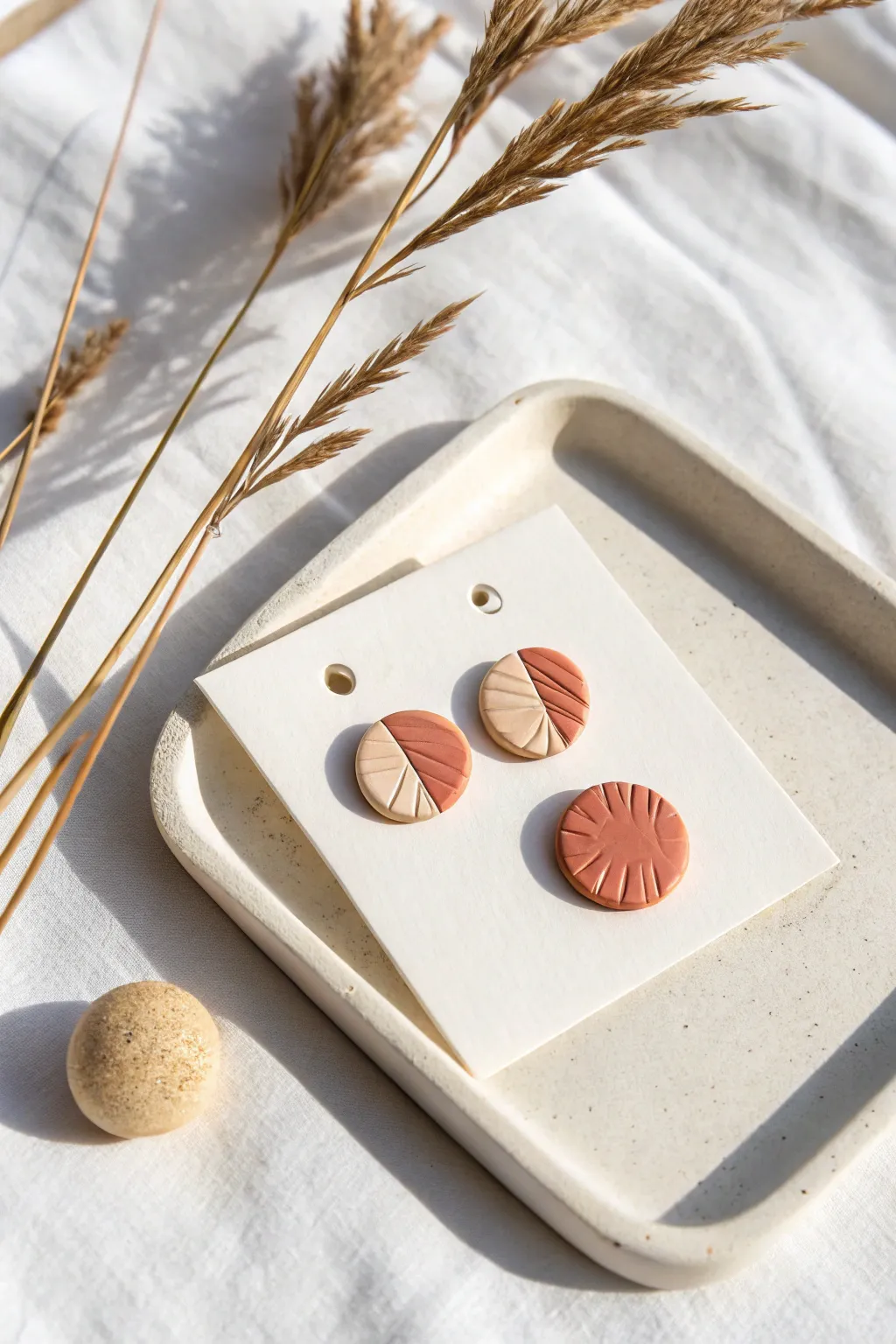
These earthy, minimalist earrings combine warm terracotta tones with soft beige for a modern bohemian look. The simple geometric textures create a lovely sunburst effect that adds just the right amount of detail to a classic circle shape.
Step-by-Step Guide
Materials
- Polymer clay in Terracotta (burned orange) and Beige (sand)
- Small circular clay cutters (approx. 10-15mm)
- Acrylic rolling pin or clay machine
- Tissue blade or X-Acto knife
- Needle tool or toothpick
- Ceramic tile or glass work surface
- Flat earring posts and butterfly backs
- Strong jewelry glue (E6000 or similar)
- Rubbing alcohol and cotton swabs (for cleaning)
Step 1: Preparation & Color Mixing
-
Condition the clay:
Start by warming the polymer clay in your hands. Knead both the terracotta and beige blocks separately until they are soft, pliable, and free of any cracks. -
Roll out slabs:
Using your acrylic roller or clay machine, roll both colors into sheets of even thickness. Aim for about 3mm thick—sturdy enough for a stud but not too heavy. -
Clean surface check:
Before assembling, wipe your work surface with a little rubbing alcohol to ensure no dust or lint gets trapped in your light beige clay.
Step 2: Creating the Two-Tone Design
-
Cut straight edges:
Use your tissue blade to cut a straight, clean line across both the beige and terracotta slabs. -
Join the seams:
Place the cut edge of the beige clay directly against the cut edge of the terracotta clay. Press them together gently on the work surface so they bond without distorting the shape too much. -
Smooth the connection:
I like to gently roll over the seam with the acrylic roller just once or twice to flatten the join and ensure the two colors become a single sheet. The seam should be tight with no gaps.
Clean Cut Tip
Place a piece of plastic cling wrap over the clay before using your circle cutter. This creates naturally domed, smooth edges that require almost no sanding later.
Step 3: Cutting & Texturing
-
Cut the circles:
Position your small circle cutter directly over the seam line. Try to angle it so the diagonal split is visibly pleasing, with roughly half of each color included. Press down firmly to cut your shapes. -
Cut solid options:
For variety, cut a few circles entirely from the leftover terracotta slab to make matching solid-colored studs. -
Soften edges:
Gently gently rub the edges of the cut circles with your fingertip to remove any sharp ridges left by the cutter. -
Add radial lines:
Using a needle tool or toothpick, gently press lines radiating from the center outward to the edge. Don’t drag the tool; press it down to make an imprint. -
Vary the lengths:
Alternate between longer lines that reach the center and shorter dashes near the rim to create a sunburst or eye-like pattern. -
Texture the second half:
On the two-tone studs, continue the pattern across both colors, ensuring the lines flow naturally over the seam. -
Final smooth check:
Inspect the surface for fingerprints. If you see any, lightly brush them away with a little cornstarch or a soft brush before baking.
Level Up: Resin Finish
After baking, apply a very thin layer of UV resin to the surface and cure under a UV lamp. This will make the matte texture pop and add a durable, glossy shine.
Step 4: Baking & Assembly
-
Bake the pieces:
Place your clay circles on a ceramic tile or parchment-lined tray. Bake according to your brand’s package instructions (usually 275°F/135°C for 15-30 minutes). -
Cool down:
Allow the pieces to cool completely before removing them from the tray. They will be slightly flexible when warm but harden as they cool. -
Prepare the backs:
Flip the cooled clay pieces over. Apply a tiny dot of strong jewelry glue to the center of the back. -
Attach posts:
Press the flat pad of the earring post into the glue. Let it cure undisturbed for at least 24 hours for maximum strength.
Wear your new geometric studs with a casual outfit to add a subtle artistic touch to your day
Polymer Clay Simple Half-Moon Dangles
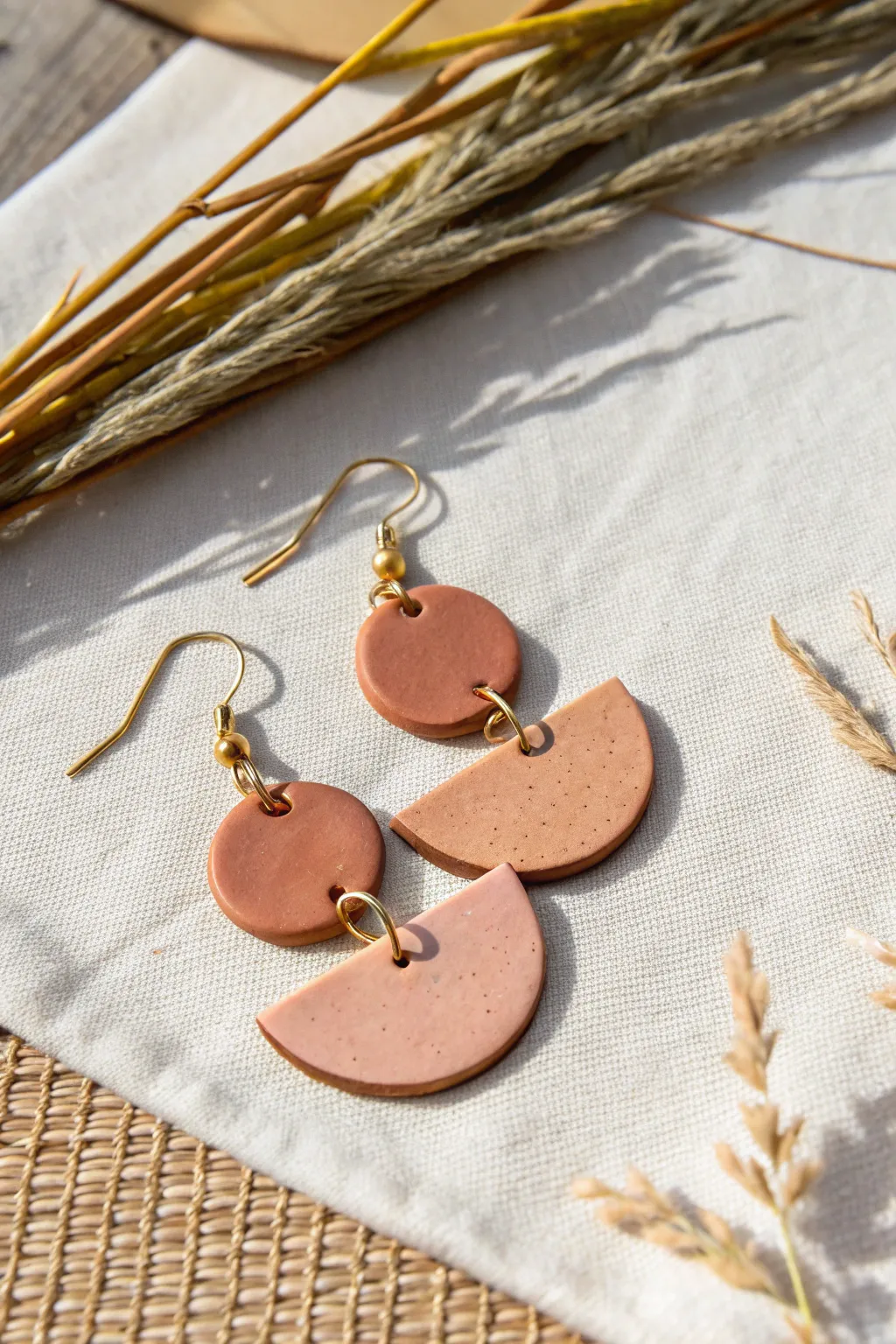
Capture the warmth of earthy tones with these elegant polymer clay earrings featuring a classic circle and semicircle design. The subtle speckled texture gives them a sophisticated, stone-like finish perfect for everyday wear.
How-To Guide
Materials
- Polymer clay in terracotta or cinnamon
- Polymer clay in beige or sand
- Black pepper or dried coffee grounds (for speckling)
- Acrylic rolling pin
- Circle clay cutter (approx. 15mm)
- Circle clay cutter (approx. 30mm)
- Tissue blade or craft knife
- Hand drill or needle tool
- Golden earring hooks (fishhook style)
- 4 Golden jump rings
- Jewelry pliers
- Baking sheet and parchment paper
- Fine grit sandpaper (optional)
Step 1: Preparing the Clay
-
Condition the base colors:
Begin by warming up your terracotta and beige polymer clays separately in your hands. Knead them until they are soft, pliable, and free of any cracks. -
Create the custom blend:
Mix the terracotta and beige clay together to achieve a warm, muted earth tone. You can adjust the ratio until you reach a shade that resembles natural pottery clay. -
Add texture:
To get that organic, stone-effect look, sprinkle a pinch of ground black pepper or very fine dried coffee grounds onto your conditioned clay. -
Integrate the speckles:
Fold the clay over the speckles and knead thoroughly until the particles are evenly distributed throughout the entire batch. -
Roll out the slab:
Place the clay on a clean, flat surface or cutting mat. Use your acrylic roller to flatten the clay into an even slab, aiming for a thickness of about 3mm to 4mm.
Clean Edges Trick
Place a piece of plastic wrap over the clay before pressing down your cutters. This creates a beautifully domed, rounded edge and saves time on sanding later.
Step 2: Cutting and Shaping
-
Cut the top circles:
Using your smaller 15mm circle cutter, punch out two solid circles. These will be the top studs of your dangles. -
Cut the bottom shapes:
Take the larger 30mm circle cutter and punch out two large circles from the remaining clay slab. -
Create the half-moons:
With your tissue blade, carefully slice each of the two large circles exactly in half. You now have four half-moons (you only need two for this project, so save the extras!). -
Smooth the edges:
Gently run your finger along the cut edges of all your clay pieces to soften any sharp corners or drag marks left by the cutters. -
Pierce the connection holes:
Using a needle tool, poke a hole near the bottom edge of the small circles and the top center of the straight edge on the half-moons. Ensure the hole is large enough for your jump rings. -
Add holes for hooks:
Add a second hole at the very top of the small circles for the earring hooks to attach later.
Make It Glossy
For a different vibe, apply a thin layer of UV resin or glossy polyurethane varnish after baking to verify the colors and make the speckles pop.
Step 3: Baking and Assembly
-
Bake the pieces:
Arrange your clay shapes on a baking sheet lined with parchment paper. Bake according to your brand of clay’s instructions (usually around 275°F or 130°C for 15-30 minutes). -
Cool down:
Allow the clay pieces to cool completely on the baking sheet before handling them, as they are fragile when hot. -
Sand for perfection:
If there are any rough spots, I suggest using fine-grit sandpaper under running water to gently smooth the edges for a professional finish. -
Open the jump rings:
Using two pairs of pliers, twist your golden jump rings open sideways (never pull them apart outward). -
Connect the shapes:
Thread an open jump ring through the bottom hole of a small circle and the top hole of a half-moon, then close the ring securely. -
Attach the hooks:
Open the small loop on your earring hook (or use a second jump ring if needed) and attach it to the top hole of the small circle. -
Final check:
Ensure all metal findings are closed tightly and aligned properly so the earrings hang straight.
Wear your new geometric dangles with a neutral outfit to let those earthy tones really shine
Polymer Clay Color-Block Rectangle Earrings
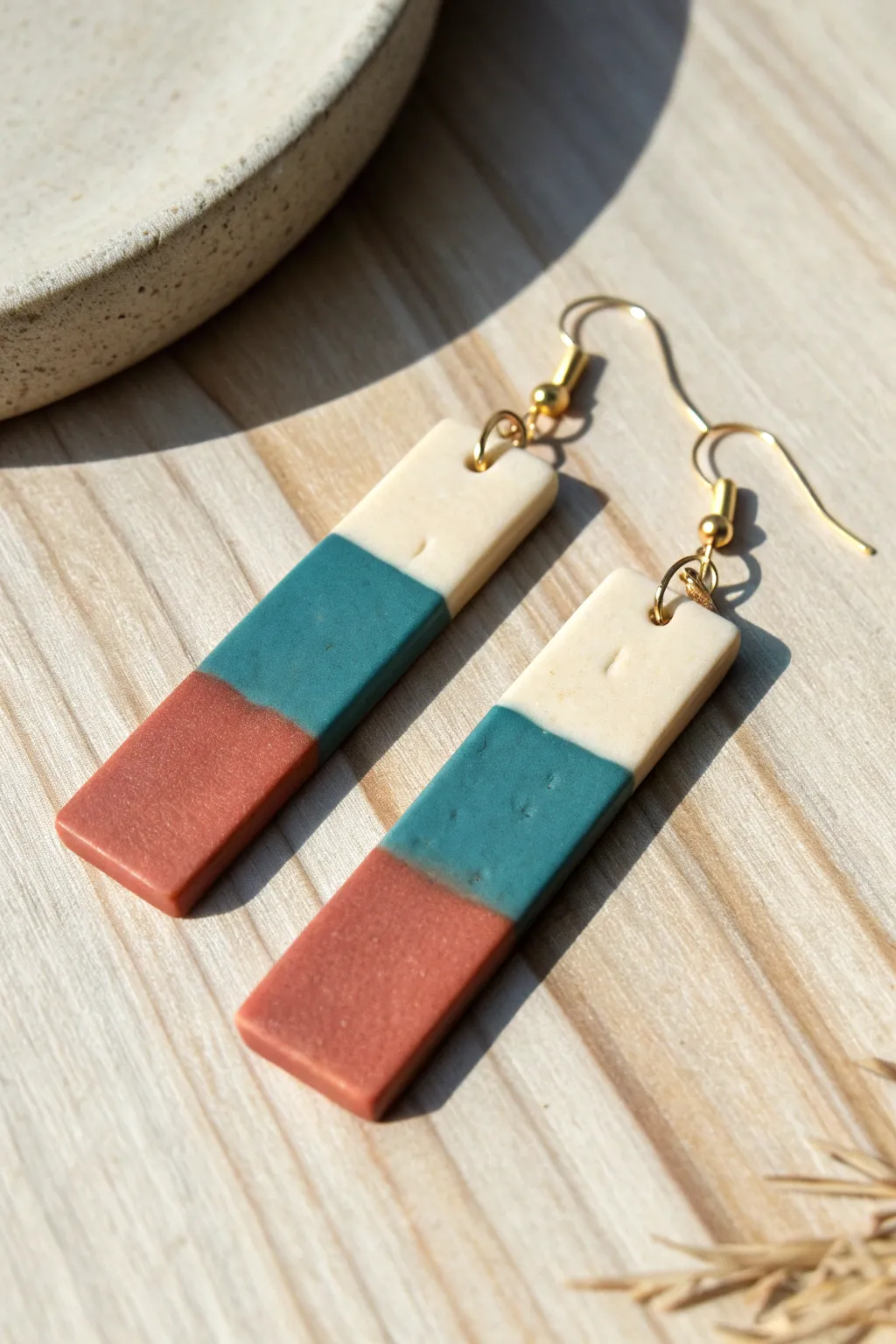
Achieve a modern, geometric look with these sleek rectangular earrings featuring a harmonious palette of cream, teal, and terracotta. This beginner-friendly project uses a simple splicing technique to create crisp, clean lines without the need for paint.
Step-by-Step
Materials
- Polymer clay in cream/beige
- Polymer clay in teal/deep turquoise
- Polymer clay in terracotta/rust red
- Acrylic rolling pin or pasta machine
- Clay slicer blade (flexible tissue blade)
- Rectangle cutter (approx. 2 inches long) or a ruler and knife
- Parchment paper or ceramic tile for baking
- Small round cutter or toothpick (for piercing)
- Fine-grit sandpaper (400-800 grit)
- Jump rings (gold finish)
- French hook ear wires (gold finish)
- Jewelry pliers (flat nose and round nose)
Step 1: Preparing the Clay Slab
-
Condition the clay:
Start by kneading each color of polymer clay—cream, teal, and terracotta—separately until they are soft and pliable. This prevents cracks and makes the colors easier to blend. -
Roll out sheets:
Using an acrylic roller or a pasta machine on a medium setting (approx. 2-3mm thick), roll each color into a flat, even sheet. Ensure all three sheets are the exact same thickness for a flush surface. -
Cut linear strips:
With your clay slicer blade, cut a clean, straight strip from each color sheet. The strips should be roughly 1 inch wide, though length doesn’t matter yet. -
Join the seams:
Lay the strips on your work surface side-by-side in vertical order: cream on top, teal in the middle, and terracotta at the bottom. Gently press the cut edges together so they stick. -
Smooth the slab:
Place a piece of parchment paper over your joined clay strips. Gently roll over the paper with your acrylic roller to fuse the seams and create a single, unified slab. I find rolling in the direction of the seams (horizontally) first helps keep lines straight.
Seamless Connections
To ensure your color strips don’t separate after baking, apply a tiny amount of liquid polymer clay (Bake & Bond) to the edges before pressing them together.
Step 2: Cutting and Baking
-
Cut the rectangles:
Position your rectangle cutter over the striped slab so that it captures all three colors evenly. Press down firmly to cut out your earring shapes. If you don’t have a specific cutter, use a ruler and blade to slice two identical rectangles. -
Refine the edges:
Gently lift the shapes and smooth any rough edges with your finger. If the clay has dragged slightly during cutting, gently push it back into shape. -
Pierce holes:
Use a small piercing tool or a toothpick to create a hole at the top center of the cream section. Make sure the hole is set down at least 2-3mm from the edge to ensure durability. -
Bake the pieces:
Transfer the cut pieces to a ceramic tile or parchment-lined baking sheet. Bake according to the manufacturer’s instructions for your specific brand of clay (usually 275°F/135°C for 30 minutes). -
Cool down:
Allow the pieces to cool completely inside the oven or on a wire rack before handling them, as warm clay is fragile.
Step 3: Finishing and Assembly
-
Sand for smoothness:
Once cool, use fine-grit sandpaper to buff the edges and surface. Wet sanding (dipping the paper in water) works best to keep dust down and achieve a velvety matte finish. -
Clean the surface:
Wash the earrings with a tiny bit of soap and water to remove any sanding residue or oils, then dry thoroughly with a soft cloth. -
Open the jump rings:
Using two pairs of pliers, twist a gold jump ring open sideways (never pull it apart). Hook it through the hole you created in the clay. -
Attach ear wires:
Before closing the jump ring, slide on the loop of your French hook ear wire. Ensure the earring front is facing the correct way relative to the hook. -
Close the hardware:
Twist the jump ring back into a closed position using your pliers, ensuring the gap is completely flush so the hook doesn’t slip out.
Add Texture
Before baking, gently press a coarse sandpaper or a stiff fabric onto the clay surface to give the earrings a stone-like or linen texture.
Enjoy wearing these chic, minimal accessories that add a perfect pop of color to any outfit

The Complete Guide to Pottery Troubleshooting
Uncover the most common ceramic mistakes—from cracking clay to failed glazes—and learn how to fix them fast.
Polymer Clay Terrazzo Speckle Statement Earrings
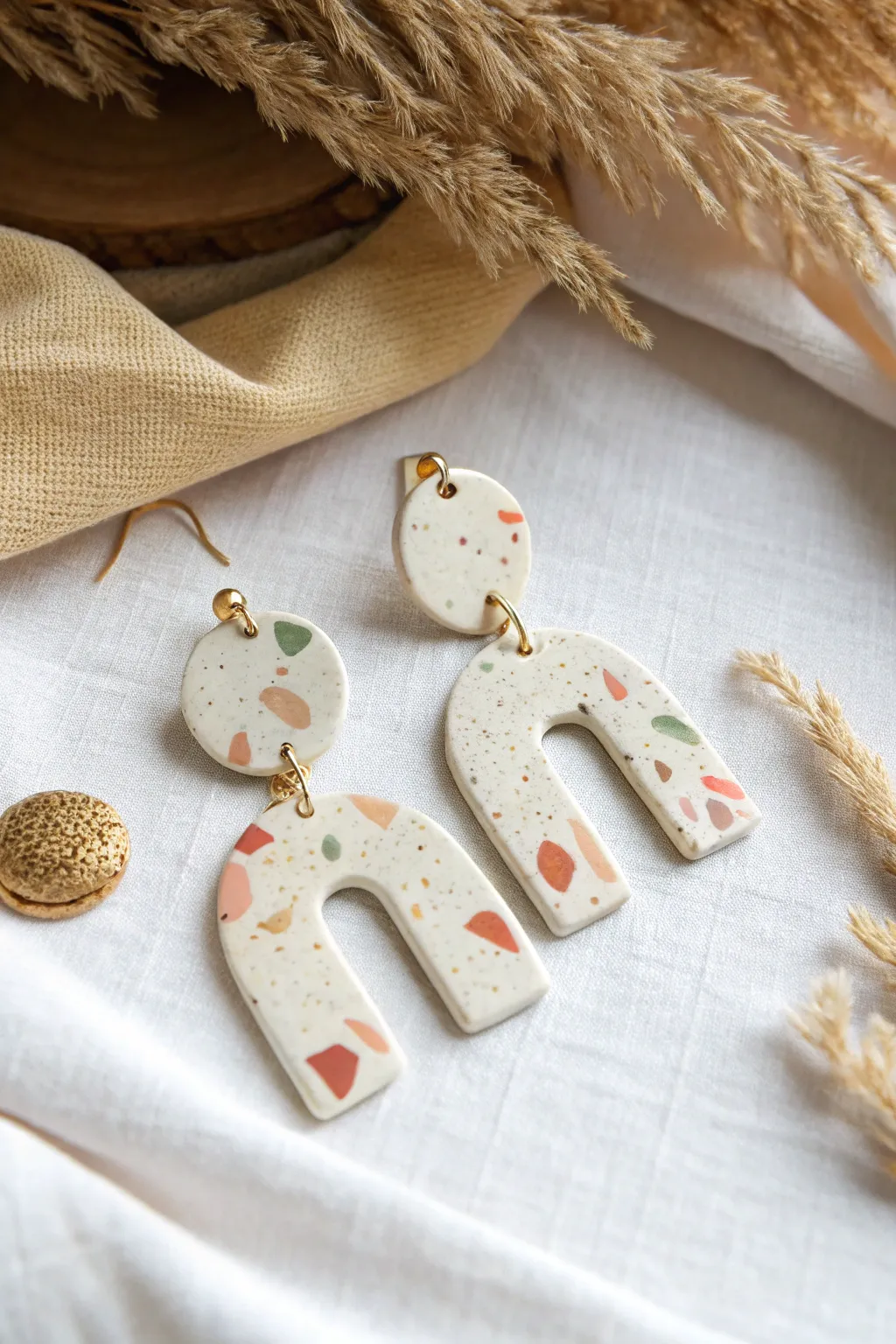
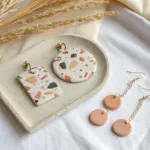
These lightweight statement earrings feature a sophisticated terrazzo pattern with subtle earth tones embedded in a creamy white base. The modern U-shape arch and polished gold hardware give them a boutique store finish that is surprisingly easy to achieve at home.
Step-by-Step Tutorial
Materials
- Polymer clay (White or Ecru for the base)
- Polymer clay (Terracotta, Sage Green, Beige, Black/Brown for speckles)
- Black pepper or pre-baked clay crumbs (for fine grit texture)
- Acrylic rolling pin or pasta machine
- U-shape clay cutter
- Small circle clay cutter (approx. 10-12mm)
- Clay blade or craft knife
- Parchment paper or ceramic tile
- Hand drill or pin vibe
- Sandpaper (various grits from 400 to 1200)
- Gold ball post earring studs
- Gold jump rings
- Jewelry pliers
Step 1: Preparing the Terrazzo Chips
-
Mix your palette:
Begin by conditioning small amounts of your colored clays: terracotta, sage green, and beige. You want these colors to be earthy and muted. -
Create thin sheets:
Roll each colored piece of clay out very thinly. The thinner the sheet, the more delicate your final chips will be. -
Bake the sheets (optional but recommended):
For the crispest terrazzo edges, I prefer to flash-bake these thin color sheets for about 10 minutes. Once cooled, chop them into tiny, irregular shards with your clay blade. -
Or chop raw:
Alternatively, if you prefer a softer, smeared look, simply chop the raw clay sheets into tiny, random geometric pieces.
Step 2: Forming the Base Slab
-
Condition the base:
Take your white or ecru clay and condition it thoroughly until it is soft and pliable. Roll it into a medium-thick slab, about 3-4mm thickness. -
Add texture:
Sprinkle a tiny pinch of cracked black pepper or extremely fine dark brown baked clay dust over the white slab. This creates that realistic ‘stone’ grit effect seen in the photo. -
Scatter the terrazzo:
Randomly place your chopped colored shards onto the white slab. Leave some negative space; don’t overcrowd the slab, as rolling will spread the colors. -
Embed the pattern:
Cover the slab with a piece of parchment paper to prevent sticking. Use your acrylic roller to firmly press the chips into the base clay until the surface is completely smooth and level.
Smudged Pattern?
If your terrazzo chips smear too much when rolling, your base clay might be too soft. Let the prepared slab sit in the fridge for 10 minutes before rolling flat.
Step 3: Cutting and Baking
-
Cut the shapes:
Using your U-shape cutter, punch out two arch shapes. Then, use the small circle cutter to punch out two corresponding stud tops. Ensure you are cutting on a surface like a generic tile so you don’t distort the shapes when lifting. -
Refine the edges:
Before baking, gently smooth the edges of your cut shapes with your fingertip to remove any harsh drag marks from the cutters. -
Bake:
Bake the pieces according to your clay manufacturer’s instructions, typically between 230°F to 275°F (110°C – 135°C) for 30-45 minutes. Tent with foil to prevent yellowing.
Make it Shine
For a glossier, ceramic look instead of matte stone, coat the cured pieces with UV resin and cure under a UV lamp for 2 minutes. This makes the colors pop vividly.
Step 4: Finishing Assembly
-
Sand for smoothness:
Once fully cooled, wet-sand the pieces starting with 400 grit and working up to 1200 grit. This reveals the terrazzo pattern clearly and creates a professional matte finish. -
Buff (optional):
Rub a tiny amount of denim or a microfiber cloth over the surface to give it a soft sheen. -
Drill Holes:
Use a hand drill to make a hole at the top center of the U-shape and the bottom center of the circle stud. -
Assemble:
Use pliers to open a jump ring and connect the circle top to the U-shape bottom. Close the ring securely. -
Attach posts:
Glue the flat pad of the gold ball post to the back of the circle top using strong jewelry glue or liquid clay (re-baked briefly).
Wear your new sophisticated stone-effect earrings with pride or gift them to a lucky friend
Polymer Clay Easy Marble Swirl Drops
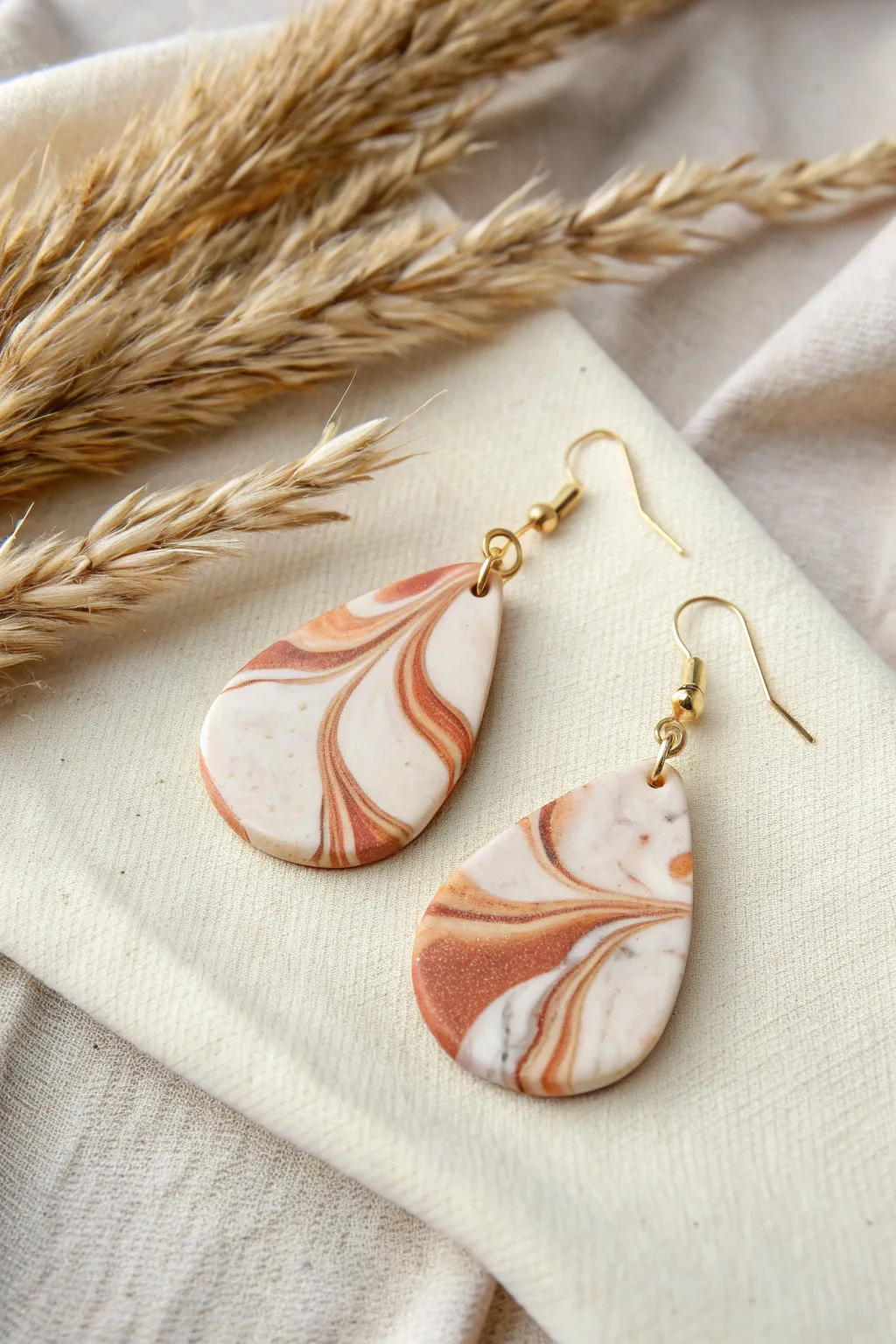
These elegant earrings feature a warm, organic marbled pattern that mimics natural stone. The swirling mix of cream, beige, and terracotta tones creates a sophisticated look that is deceptively simple to achieve.
Detailed Instructions
Materials
- Polymer clay (white, beige/translucent, terracotta/metallic copper)
- Acrylic rolling pin or pasta machine
- Teardrop shape cutter
- Sharp tissue blade
- Small hand drill or toothpick
- Two gold fishhook earring wires
- Four gold jump rings
- Jewelry pliers
- Sandpaper (fine grit)
- Parchment paper or ceramic tile
Step 1: Creating the Marbled Slab
-
Condition the Clay:
Begin by thoroughly kneading each color of polymer clay separately until they are soft and pliable. You’ll need about twice as much white clay as the other two accent colors combined. -
Form Snakes:
Roll each color into a long, thin rope or ‘snake’. The white snake should be thicker than the beige and terracotta ones. -
Combine the Colors:
Twist the three snakes together into one large candy-cane shape. Fold this large rope in half and twist it again. -
Roll and Twist:
Roll the twisted rope on your work surface to lengthen it, then fold and twist once more. Repeat this process 2-3 times, but be careful not to over-mix, or the colors will turn muddy. -
Create a Ball:
Squish the twisted rope into a rough ball shape. This helps combine the vertical lines into more organic swirls. -
Flatten the Clay:
Using your acrylic roller or pasta machine, roll the ball out into a flat slab about 3-4mm thick. I prefer to roll in different directions to stretch the pattern interestingly. -
Check the Pattern:
Examine your slab. If you don’t love the pattern, you can cut it in half, stack the pieces, and roll it out one more time.
Muddy Colors?
If your colors look brown instead of swirled, you over-mixed. Stop twisting sooner next time. The slab should still show distinct lines of white.
Step 2: Cutting and Baking
-
Cut the Shapes:
Place your teardrop cutter over the sections of the slab with the most attractive marbling. Press down firmly to cut out two shapes. -
Smooth the Edges:
Before lifting the shapes, gently rub your finger over the edges to smooth down any clay that might be sticking up. -
Lift Carefully:
Use your sharp tissue blade to slide under the cut shapes and lift them off the work surface without distorting their form. -
Create Holes:
Use a toothpick to poke a small hole at the top of each teardrop for the jump ring. Ensure the hole is big enough for your metal findings but not too close to the edge. -
Bake:
Place the pieces on a ceramic tile or parchment-lined baking sheet. Bake according to your clay manufacturer’s instructions (usually around 275°F/135°C for 30 minutes). -
Cool Down:
Allow the pieces to cool completely before handling them. They are fragile while warm.
Add Sparkle
Mix a tiny amount of gold leaf or glitter into the translucent or white clay before twisting for a subtle, embedded shimmer.
Step 3: Finishing and Assembly
-
Sand the Edges:
Once cool, use fine-grit sandpaper to gently smooth away any roughness or fingerprints on the edges of the earrings. -
Buff (Optional):
For a slight sheen like the photo, rub the surface vigorously with a piece of denim or a soft cotton cloth. -
Open Jump Rings:
Using two pairs of pliers, twist your jump rings open. Never pull them apart; always twist side-to-side to maintain their round shape. -
Attach Findings:
Thread a jump ring through the hole in the clay piece, then add the earring hook. Twist the jump ring closed securely. -
Final Check:
Repeat for the second earring and ensure both hooks are facing the correct direction so the pattern shows when worn.
Wear your new stone-effect earrings with pride and enjoy the lightweight feel of your handmade art


What Really Happens Inside the Kiln
Learn how time and temperature work together inside the kiln to transform clay into durable ceramic.
Polymer Clay Stacked Disc Dangle Earrings
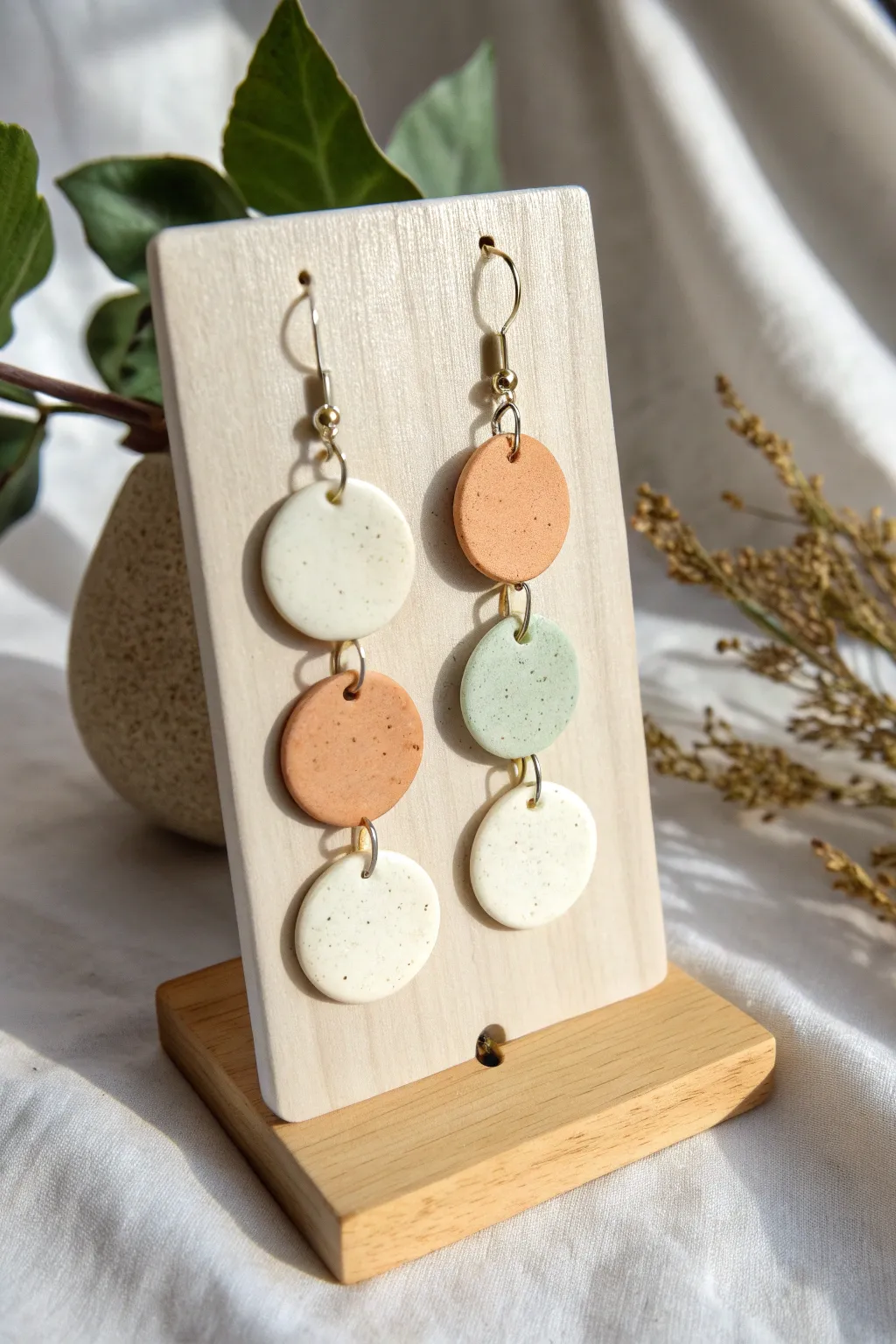
These stacked dangle earrings embrace a modern, minimalist aesthetic with a soft, earthy color palette of sage, terracotta, and cream. The speckled texture creates a sophisticated stone-like finish that looks professional yet is wonderfully simple to achieve at home.
Step-by-Step
Materials
- Polymer clay in white, translucent, terra cotta, and sage green (or generic beige/green)
- Black pepper or coarse black sand (for speckling)
- Acrylic rolling pin or pasta machine
- Small circular clay cutter (approx. 1 cm to 1.5 cm diameter)
- Needle tool or toothpick
- Jump rings (gold or brass, 6mm or 7mm)
- Earring hooks (fishhook style, gold or brass)
- Jewelry pliers (flat nose and chain nose)
- Baking sheet with parchment paper
- Oven
Step 1: Preparing the Clay
-
Condition the base colors:
Start by thoroughly kneading your white, terra cotta, and sage green clays separately until they are soft and pliable. If the colors are too saturated, you can mix in a little white to soften them into the pastel hues seen in the example. -
Create the speckled mixture:
To achieve the stone effect, flatten each color into a pancake. Sprinkle a pinch of ground black pepper or very fine black sand onto the clay. I like to fold the clay over and knead it repeatedly until the specks are evenly distributed throughout the batch. -
Roll out sheets:
Using an acrylic roller or a pasta machine on a medium setting (approx. 2-3mm thick), roll out each of your three speckled colors into flat, even sheets. Ensure there are no air bubbles trapped underneath.
Uneven Edges?
If your baked discs have sharp edges or fingerprints, dip a Q-tip in 100% acetone and gently rub the rims. This melts the clay slightly for a flawless finish.
Step 2: Cutting and Baking
-
Cut the discs:
Use your small circular cutter to punch out your shapes. You will need pairs for symmetry: two cream, two terra cotta, and two sage green circles. This specific design uses a repeating pattern, so deciding your order now is helpful. -
Smooth the edges:
Gently pick up each disc and run your finger along the rim to smooth out any ragged clay bits left by the cutter. A smooth edge makes the final piece look much higher quality. -
Piercing holes:
Using a needle tool, pierce two holes in the middle discs (terra cotta and sage green in the example photo)—one at the very top and one at the very bottom, close to the edge but leaving at least 2mm of clay for strength. -
Piercing end pieces:
For the top and bottom discs of each earring, you only need one hole. Pierce the top of the upper disc and the top of the bottom disc. -
Double check alignment:
Before baking, lay the pieces out in a line to ensure your holes line up vertically so the earrings hang straight. -
Bake the clay:
Arrange the pieces on a parchment-lined baking sheet. Bake according to your brand’s package instructions (usually 275°F/135°C for 15-30 minutes). Let them cool completely before handling.
Level Up: Glossy Finish
Seal your finished pieces with UV resin or a gloss polyurethane varnish. This protects the faux stone effect and gives the earrings a high-end ceramic look.
Step 3: Assembly
-
Open jump rings:
Using two pairs of pliers, twist your jump rings open. Remember to twist the ends away from each other (side-to-side), never pull them apart, to maintain the circle shape. -
Connect the bottom tier:
Slide an open jump ring through the single hole of your bottom cream disc and connect it to the bottom hole of the middle terra cotta disc. Close the ring securely. -
Connect the middle tier:
Take another jump ring and connect the top hole of that terra cotta disc to the bottom hole of your top cream disc. Repeat this process for the second earring which features the sage green middle piece. -
Attach the hardware:
Insert a final jump ring through the single top hole of your uppermost disc on each earring stack. -
Add the hook:
Slide the earring hook onto that top jump ring before closing it. Check that the hook is facing the correct direction so the visible side of the clay faces forward. -
Final check:
Hold the earrings up to ensure all jump rings are fully closed and the discs dangle freely without getting stuck.
Now you have a stunning pair of organic-looking earrings ready to wear or gift
Polymer Clay Minimal Bar Drop Earrings
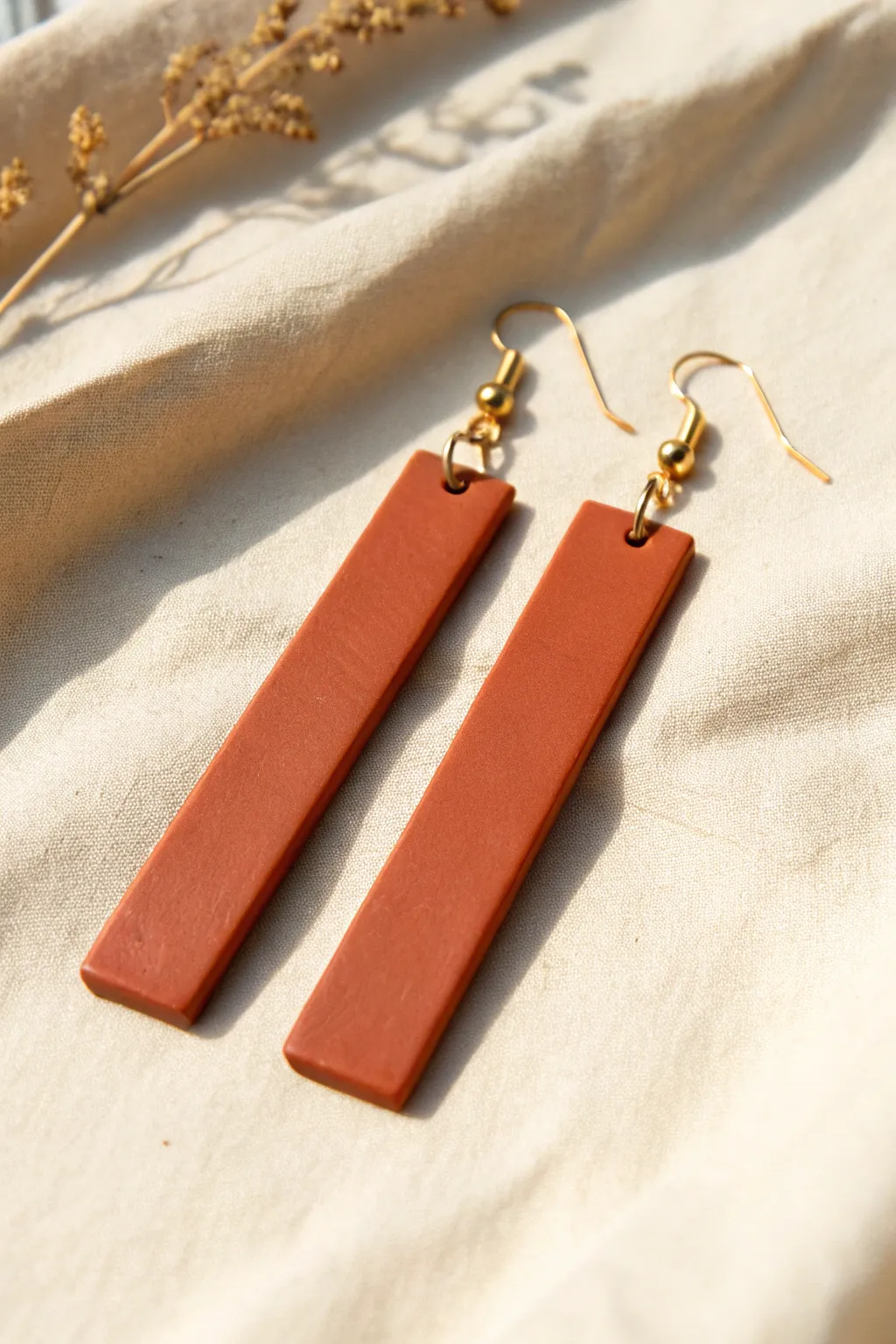
These sleek, minimal drop earrings feature long, slender bars of clay in a rich, earthy terracotta hue. They combine a modern geometric shape with warm tones, making them a versatile accessory for everyday wear.
Step-by-Step Guide
Materials
- Polymer clay (Terracotta or Burnt Orange color)
- Acrylic rolling pin or pasta machine
- Tissue blade or very sharp craft knife
- Ruler
- Needle tool or 2mm drill bit
- Fine-grit wet/dry sandpaper (400, 600, 800 grit)
- 2 Gold earring hooks (fishhook style)
- 4 Gold jump rings (roughly 4-6mm)
- Flat-nose jewelry pliers
- Ceramic tile or baking sheet
- Optional: Parchment paper
Step 1: Clay Preparation
-
Condition the Clay:
Begin by taking your terracotta or burnt orange polymer clay and kneading it thoroughly in your hands. You want the clay to be warm, pliable, and free of any air pockets or crumbly bits. -
Roll out a Slab:
Using an acrylic rolling pin or a pasta machine on a medium setting (around 3mm thickness), roll the clay into an even sheet. Ensure the surface is smooth and free of lint or fingerprints. -
Secure for Cutting:
Place your clay slab onto a ceramic tile or a piece of parchment paper. It is best to cut on the surface you will bake on to avoid distorting the long shapes when moving them.
Clean Cuts Pro Tip
Chill your clay slab in the fridge for 10 minutes before cutting. Firm clay resists dragging against the blade, resulting in much cleaner, sharper straight lines.
Step 2: Shaping & Baking
-
Measure the Width:
Use your ruler to mark a uniform width for your bars. For the look in the photo, aim for approximately 8mm to 10mm wide. -
Make the Long Cuts:
Lay your ruler along the clay as a guide. Using your tissue blade or sharp craft knife, make long, straight vertical cuts to create two strips. -
Trim the Length:
Cut across the strips horizontally to define the length. These particular earrings look elegant at a longer length, so aim for about 5cm to 6cm long each. Remove the excess clay. -
Smooth the Edges:
Gently tap the sides of the rectangles with your finger or the flat side of your blade to soften the sharp cut edges slightly without losing the geometric shape. -
Create Hanging Holes:
Using a needle tool, poke a hole centered near the top edge of each bar. Ensure the hole is large enough for your jump rings but not too close to the edge to prevent tearing. -
Double-Check Clearance:
I always verify that the hole goes cleanly through to the back; sometimes the clay ‘heals’ slightly at the exit point, so wiggle the needle gently. -
Bake the Clay:
Place the tile with your clay pieces into the oven. Follow the specific temperature and time instructions on your brand of polymer clay (usually 275°F/135°C for 30-45 minutes). -
Cool Down:
Once baked, remove the clay from the oven and let it cool completely on the tile before handling to ensure maximum strength.
Level Up: Texture
Before baking, gently press a piece of coarse sandpaper or denim onto the raw clay surface to give the bars a subtle, stone-like texture instead of a smooth finish.
Step 3: Finishing & Assembly
-
Sand the Edges:
Dip your fine-grit sandpaper in a little water and gently sand the edges and corners of your cooled bars. This removes any tiny burrs or fingerprints for a professional matte finish. -
Open the Jump Rings:
Using two pairs of pliers (or pliers and your fingers), twist open a jump ring laterally—push one side away and pull the other toward you, rather than pulling them apart. -
Attach to Clay:
Thread the open jump ring through the hole you created in the clay bar. Before closing it, determine if you need a second jump ring depending on how you want the bar to face. -
Correction for Orientation:
If using standard fishhook ear wires, the loop usually faces ‘sideways’. To make the flat bar face ‘forward’, you usually need two jump rings linked together between the clay and the hook. -
Link the Earring Hook:
Attach the earring hook (and the second jump ring if needed) and use your pliers to twist the jump ring strictly closed until the ends meet perfectly. -
Repeat for the Second Earring:
Follow the same assembly steps for the matching bar, ensuring both hang at the exact same length.
Enjoy styling these warm, minimalist drops with your favorite casual outfits

TRACK YOUR CERAMIC JOURNEY
Capture glaze tests, firing details, and creative progress—all in one simple printable. Make your projects easier to repeat and improve.
Polymer Clay Stamped Initial Tag Necklace
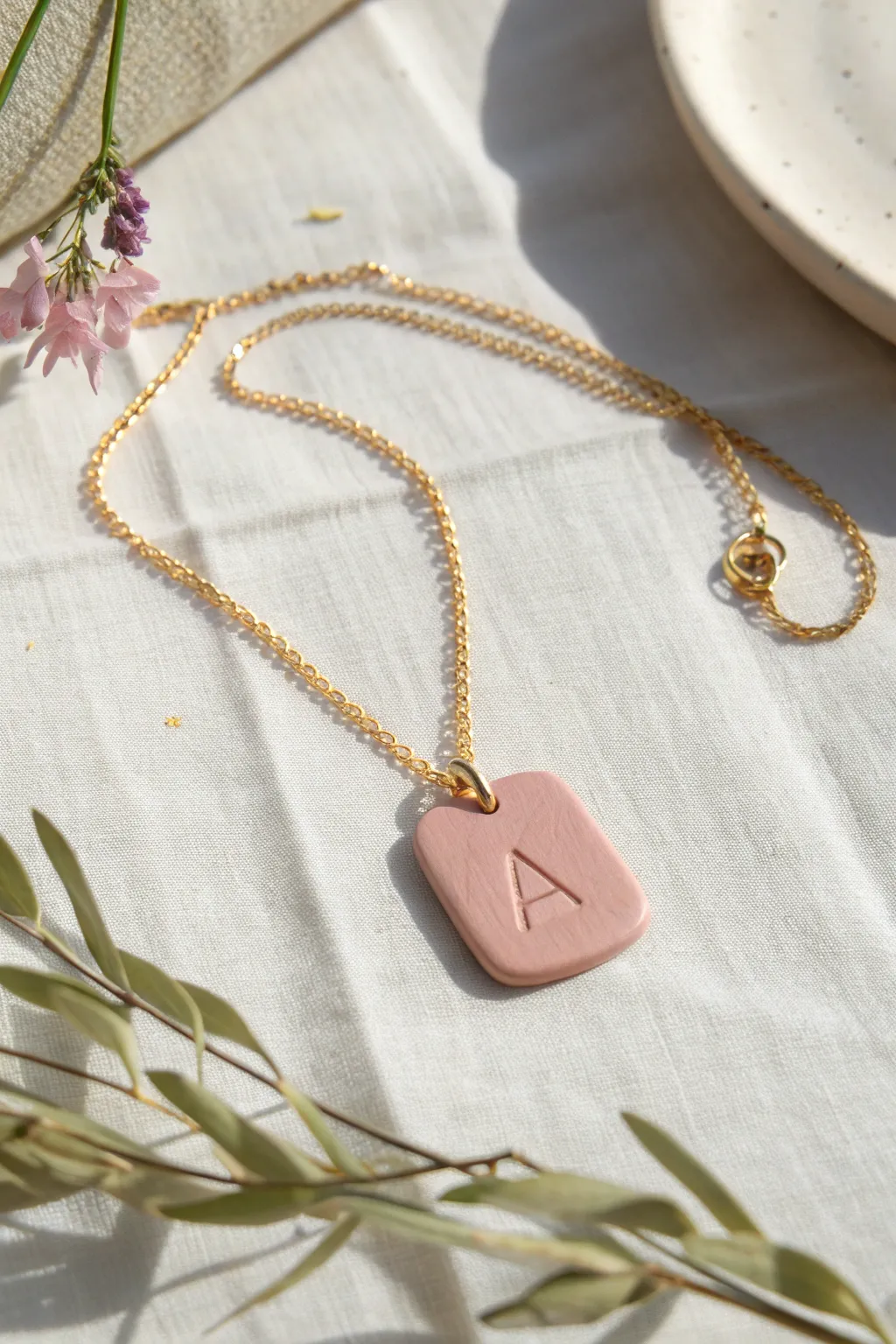
This minimalist initial tag necklace combines soft, blush-toned clay with delicate gold hardware for a sophisticated yet personal accessory. Its smooth, matte finish and clean typography make it a perfect everyday piece or a thoughtful handmade gift.
Detailed Instructions
Materials
- Polymer clay (blush pink or dusty rose)
- Acrylic rolling pin
- Small rectangular clay cutter (approx. 1 inch)
- Letter stamp set (serif font)
- Small jump rings (gold)
- Gold chain necklace with clasp
- Jewelry pliers (flat nose)
- Hand drill or needle tool
- Cornstarch or baby powder
- Baking tile or parchment paper
- Fine-grit sandpaper (optional)
- Oven
Step 1: Shaping the Tag
-
Condition the Day:
Begin by warming a small amount of blush pink polymer clay in your hands. Knead it thoroughly until it is soft, pliable, and free of any air bubbles. -
Roll Smooth:
Place the clay on your work surface. Using your acrylic rolling pin, roll the clay out to an even thickness of about 3 to 4 millimeters. You want it substantial enough to hold the stamp impression without warping. -
Cut the Shape:
Press your small rectangular cutter firmly into the clay. If you don’t have a cutter, you can carefully cut a freehand rectangle using a craft knife. -
Soften the Edges:
Gently gently tap the edges of the raw clay rectangle with your fingertip. This removes the sharp ‘cut’ look and gives the edges the soft, rounded appearance seen in the photo. -
Create the Hanger Hole:
Use a needle tool or a small straw to punch a hole at the top center of the rectangle. Ensure the hole is large enough for your heavy-gauge jump ring but not so close to the edge that the clay might break.
Stamp Stuck?
If your stamp pulls the clay up when you lift it, the clay is too warm or sticky. Refrigerate the flattened clay for 5 mins before stamping, or use more cornstarch.
Step 2: Stamping and Baking
-
Prepare the Stamp:
Select the initial letter from your stamp set. I find that lightly dusting the stamp with a tiny bit of cornstarch prevents it from sticking to the raw clay and ensures a clean lift. -
Make the Impression:
Position the stamp in the center of the lower two-thirds of the tag. Press down firmly and evenly, but not so hard that you distort the rectangle’s shape. -
Clean Up:
Inspect the clay for any fingerprints or lint. You can gently smooth these away with a little baby oil on your finger or a q-tip if necessary. -
Bake:
Place your pendant on a ceramic tile or a baking sheet lined with parchment paper. Bake according to the specific temperature and time directions on your package of polymer clay. -
Cool Down:
Once baken, turn off the oven and let the piece cool down completely before handling it. The clay hardens fully only after it has cooled.
Make it Luxe
After baking, dip a very fine brush in gold acrylic paint and carefully fill inside the stamped letter indentation to make the initial pop against the pink.
Step 3: Assembly
-
Sand (Optional):
If there are any rough spots on the edges after baking, lightly buff them with fine-grit sandpaper under running water. -
Open the Jump Ring:
Using two pairs of jewelry pliers, grip a gold jump ring. Twist the ring open sideways—never pull it apart—to preserve its circular shape. -
Attach the Pendant:
Slide the open jump ring through the hole you created in the top of the clay tag. -
Connect the Chain:
Before closing the ring, slip the gold chain onto the jump ring as well. The pendant should now hang freely from the chain. -
Secure the Closure:
Use your pliers to twist the jump ring back into a closed position, ensuring the two ends meet perfectly flush so the chain doesn’t slip out.
Wear your new personalized tag solo or layer it with other gold chains for a trendy stacked look
Polymer Clay Single Bead Pendant Necklace
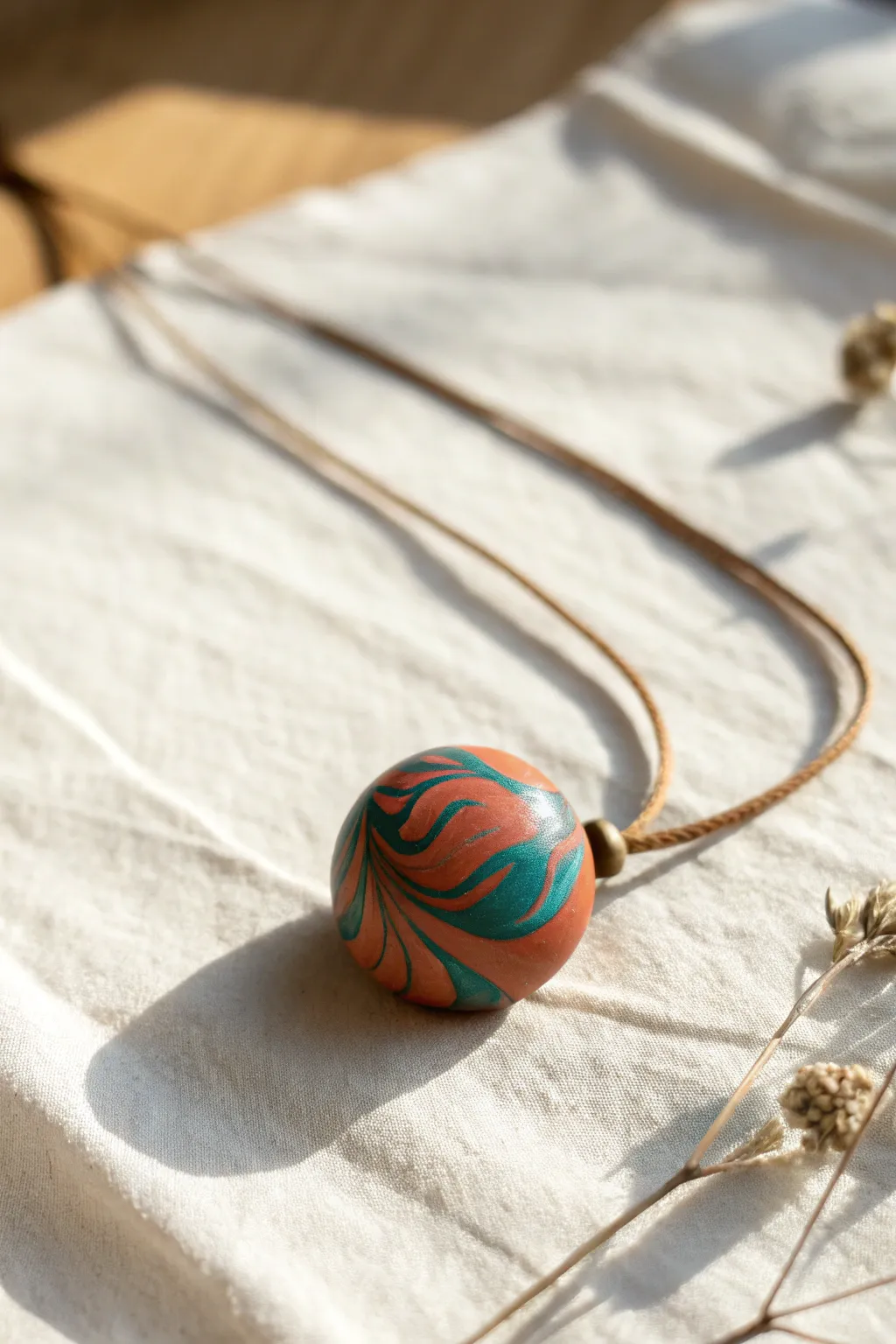
Create a striking focal point with this single bead pendant, featuring an organic swirl of terracotta and teal tones that mimics polished stone. This project introduces the classic marbling technique, resulting in a smooth, sophisticated sphere that brings an earthy elegance to any outfit.
Step-by-Step
Materials
- Polymer clay in terracotta (red-brown)
- Polymer clay in teal or dark turquoise
- Polymer clay in translucent (optional, for depth)
- Bead piercing pin or toothpick
- Acrylic rolling pin or clay machine
- Wet/dry sandpaper (400, 600, 1000 grit)
- Buffing cloth or denim scrap
- Waxed cotton cord or leather cord (brown)
- Small brass bead or spacer
- Clay slicer or craft blade
- Oven
Step 1: Prepping the Clay
-
Condition the clay:
Start by warming the terracotta and teal clays in your hands separately. Knead them until they are soft, pliable, and free of any cracks. -
Create logs:
Roll each color into a long, thin cylinder. Aim for snakes that are roughly equal in thickness, about 1/4 inch diameter. -
Twist together:
Hold the two colored logs together and twist them around each other like a candy cane. This is the foundation of your marble pattern. -
Fold and roll:
Fold the twisted log in half and roll it out smoothly again. Repeat this twisting, folding, and rolling process 2-3 times. -
Consolidate into a ball:
Once the colors are streaked but not muddied, roll the entire log into a smooth ball. Ensure there are no air seams or trapped bubbles.
Smooth Surface Secret
Before baking, lightly dust your palms with cornstarch and do a final roll. This eliminates sticky fingerprints and ensures a perfectly matte, professional texture.
Step 2: Shaping and Refining
-
Perfect the sphere:
Place the ball between your palms and roll vigorously in a circular motion to make it perfectly round. The friction will also help smooth the surface. -
Inspect the pattern:
Look at your sphere from all angles. If you want more swirls, you can gently reshape it back into a log and re-roll, but serve caution to not over-mix. -
Pierce the bead hole:
Holding the bead gently so as not to deform it, insert a piercing pin or toothpick through the center. I find twisting the pin while pushing helps it glide through cleanly. -
Check alignment:
Make sure the entrance and exit holes are centered. If the bead warped slightly, give it a gentle roll between your fingers with the pin still inside. -
Bake the bead:
Place the bead on a baking sheet or tile. Bake according to your polymer clay manufacturer’s instructions (usually 275°F/130°C for 30 minutes).
Step 3: Finishing Touches
-
Cool down:
Allow the bead to cool completely inside the oven or on the counter before handling. It is fragile while hot. -
Sand for smoothness:
Using wet automotive sandpaper, sand the surface under running water. Start with 400 grit to remove fingerprints, then move to 600 and 1000 for a satiny finish. -
Buff to a shine:
Rub the dry bead vigorously with a piece of denim or a buffing cloth. The friction creates a natural, soft sheen and deepens the colors. -
Prepare the cord:
Cut a length of brown cord to your desired necklace length. Thread the small brass spacer bead onto the cord first. -
Assemble the pendant:
Thread your marbled clay bead onto the cord so it sits below the brass spacer. -
Secure the ends:
Tie a simple knot at the open ends of the cord, or attach a clasp if preferred. The bead should now hang freely with the brass accent sitting directly on top.
Add Metallic Veins
For a luxe geology look, incorporate a very thin snake of gold or copper leaf clay into your initial twist. The metallic shimmer will appear as fine veins in the marble.
Wear your new modern pendant with pride or gift it to a friend who loves earthy styles
Polymer Clay Round Bead Stretch Bracelet
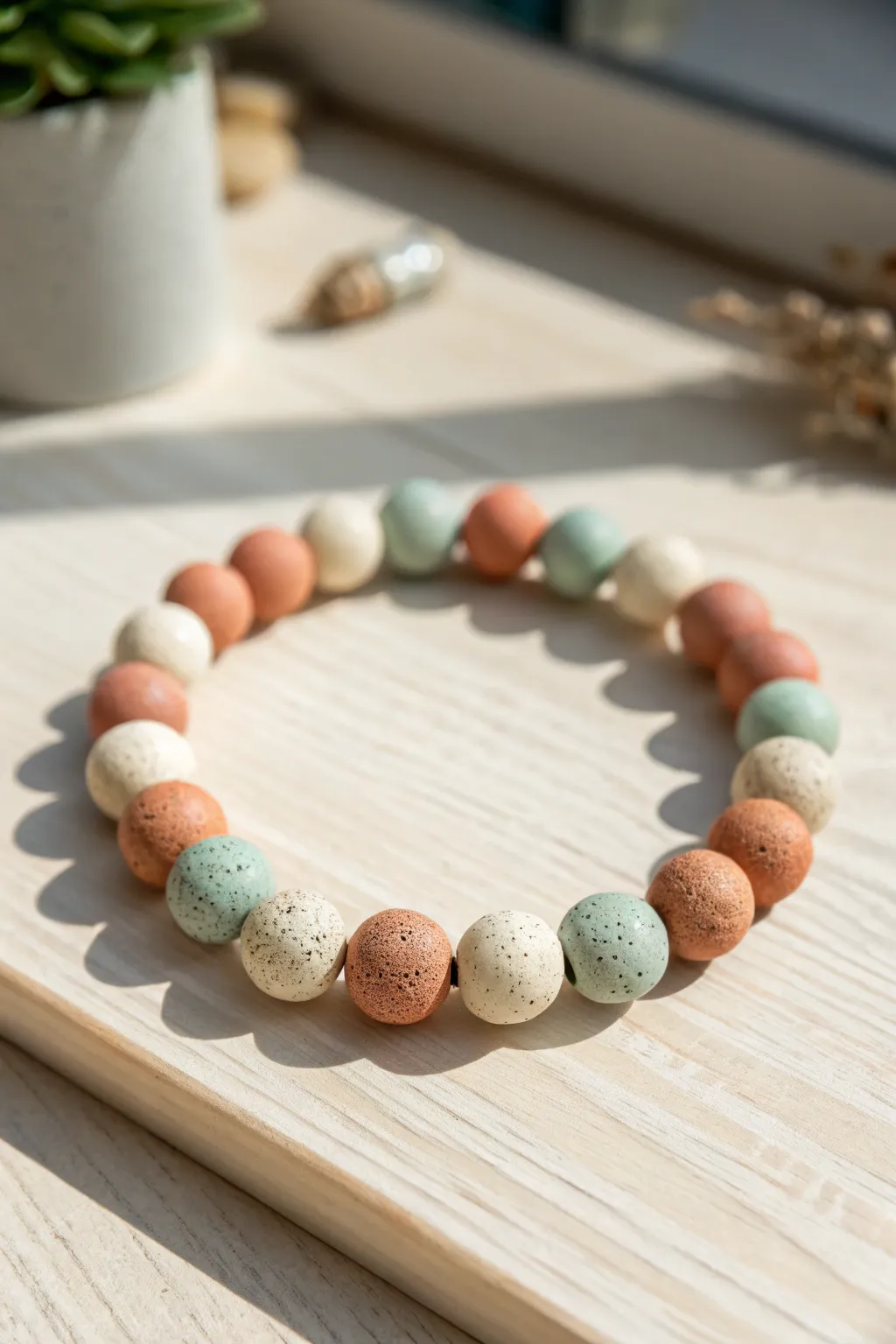
Capture the organic beauty of natural stone with this remarkably simple polymer clay project. These round beads feature a lovely speckled texture in earthy tones of terracotta, sage, and cream, strung together on a comfortable stretch cord.
Step-by-Step Tutorial
Materials
- Polymer clay (terracotta, white, sage green)
- Black pepper or dried coffee grounds (for speckling)
- Bead rolling tool or acrylic block
- Toothpick or bead piercing pin
- Elastic stretch cord (0.7mm or 0.8mm)
- Jewelry glue (GS Hypo Cement or similar)
- Ruler
- Ceramic tile or baking sheet
- Oven
Step 1: Preparing the Clay
-
Color Mixing:
Start by conditioning your three main colors of clay: terracotta, sage green, and white (or cream). If you don’t have exact shades, mix a little white into brown/orange for the terracotta, and a touch of green into white for the sage. -
Adding Texture:
To achieve that natural, stony look, flatten each of your conditioned clay balls into a pancake. Sprinkle a generous pinch of coarse black pepper or dried used coffee grounds onto the clay. -
Incorporating the Speckles:
Fold the clay over the speckles and knead thoroughly. Repeat the process of flattening and sprinkling until the particles are evenly distributed throughout the clay, giving it a consistent faux-granite appearance. -
Portioning:
Roll each color into a long, even log or snake about 1/2 inch in diameter. Use a blade to slice these logs into equal-sized segments to ensure your finished beads are uniform.
Natural Texture
Gently gently roll the unbaked beads over coarse sandpaper or a scrubbing sponge before piercing. This adds a subtle pitted surface that mimics real rock.
Step 2: Shaping & Piercing
-
Rolling Spheres:
Take a clay segment and roll it between your palms to form a rough ball. For a perfectly spherical shape, I like to place the ball on a work surface and roll it in a circular motion with a flat acrylic block or bead roller. -
Refining the Surface:
Check each bead for fingerprints. If you find any, gently smooth them out with a light touch of your finger or by re-rolling them under the acrylic block. -
Piercing the Holes:
Hold a bead gently without squishing it. Insert a toothpick or bead piercing pin into the center and push it through while twisting gently. -
Clean Exit:
Stop when the point of the tool just starts to poke through the other side. Remove the tool, turn the bead around, and insert the tool into the small exit hole to complete the channel cleanly. -
Arranging for Baking:
Place your pierced beads onto a ceramic tile or a baking sheet lined with parchment paper. Some crafters use a bead rack to keep them perfectly round, but laying them gently on a flat spot works if you don’t press down. -
Baking:
Bake the beads according to your polymer clay manufacturer’s instructions (usually around 275°F or 130°C for 15-30 minutes). Let them cool completely before handling.
Step 3: Assembly
-
Planning the Pattern:
Lay out your cooled beads on a bead board or towel. Create a random repeating pattern using your three colors—try alternating groups of two or three same-colored beads with single contrasting ones. -
Sizing:
Measure your wrist and add about 1/2 inch to determining the length of your bead strand. Adjust the number of beads in your layout accordingly. -
Stringing:
Cut a piece of elastic cord about 10-12 inches long. Pre-stretch the cord by pulling on it firmly a few times; this prevents the bracelet from loosening later. -
Adding Beads:
Thread the beads onto the cord following your planned pattern. Hold the end of the cord or use a bead stopper clip so they don’t slide off. -
Tying the Knot:
Once all beads are strung, bring the ends together. Tie a surgeon’s knot (a regular overhand knot, but loop the end through twice before pulling tight). -
Securing:
Pull the knot tight securely. Add a tiny drop of flexible jewelry glue (like GS Hypo Cement) directly onto the knot. -
Hiding the Finish:
While the glue is still tacky, gently slide an adjacent bead over the knot to hide it inside. Snip off the excess cord tails close to the bead.
Hole Distortion
If your beads get squashed while piercing, try letting the rolled balls rest in the fridge for 15 minutes first. Cooler clay holds its shape better.
Wear your new earthy bracelet solo or stack it with others for a stylish bohemian look
Polymer Clay Flat Disk Bead Anklet
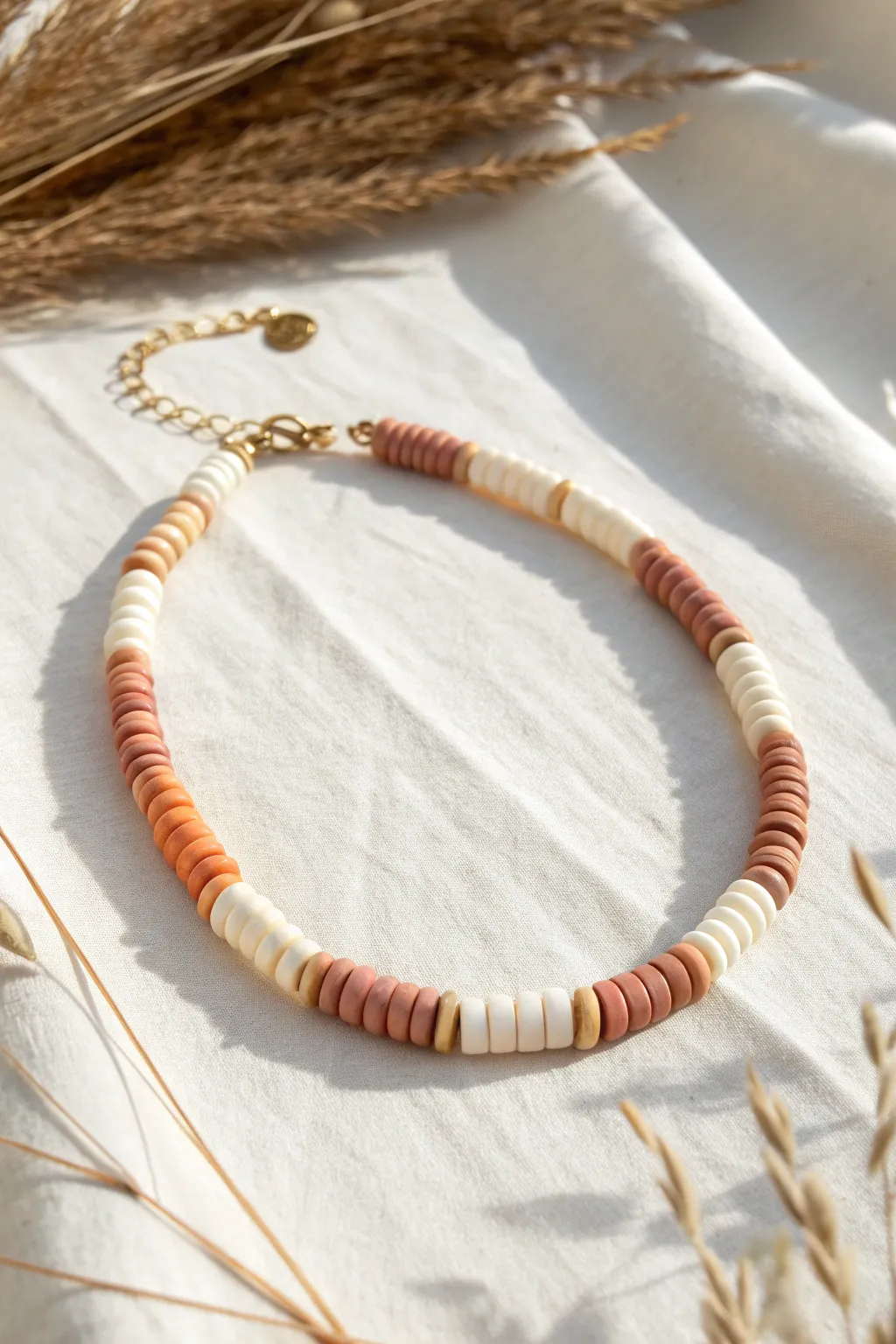
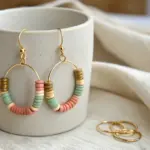
Embrace the effortless style of summer with this DIY polymer clay disk bead anklet, featuring a warm palette of terracotta, cream, and peach. These custom-made Heishi-style beads are surprisingly simple to craft at home, giving you a high-end boutique look for a fraction of the price.
How-To Guide
Materials
- Polymer clay in terracotta, cream/white, and peach blending colors
- Gold tone disk spacer beads (small)
- Beading wire or strong stretch cord
- Gold tone lobster clasp
- Gold tone extension chain
- Crimp beads
- Jump rings
- Clay roller or pasta machine
- Rigid clay blade or tissue slicer
- Small circular cutter (approx. 4-6mm diameter) OR a drinking straw
- Needle tool or toothpick
- Baking sheet
- Parchment paper
- Jewelry pliers (chain nose and flat nose)
- Wire cutters
Step 1: Making the Clay Beads
-
Condition the clays:
Begin by thoroughly conditioning your polymer clay blocks (terracotta, cream, and peach) until they are soft and pliable. This prevents cracking later. -
Roll out sheets:
Roll each color into a flat, even sheet. Aim for a thickness of about 2-3mm. A pasta machine set to a medium-thick setting works perfectly here for consistency. -
Cut the disks:
Using your small circular cutter or a drinking straw, punch out many small circles from each color sheet. You will need roughly 40-60 beads depending on your ankle size. -
Pierce holes:
Take a needle tool or toothpick and carefully poke a hole directly through the center of each clay circle. I find gently spinning the needle as it goes through keeps the bead round. -
Smooth the edges:
If rough edges occurred during cutting, gently tap the edges with your finger to smooth them down before baking. -
Bake the beads:
Arrange the beads on a parchment-lined baking sheet. Bake according to your brand of polymer clay instructions (usually around 230°F – 275°F for 15-30 minutes). -
Cool down:
Let the beads cool completely on the tray. They will harden fully as they return to room temperature.
Hole distortion?
If holes squish when piercing raw clay, bake the disks first! Then use a small hand drill or Dremel to drill holes into the hardened clay for perfect circles.
Step 2: Assembly & Finishing
-
Cut the wire:
Measure your ankle and cut a length of beading wire about 2 inches longer than your measurement to allow room for crimping. -
Attach the first clasp:
Thread a crimp bead onto one end of the wire, followed by the extension chain. Loop the wire back through the crimp bead. -
Secure the crimp:
Use your flat nose pliers to squash the crimp bead firmly, securing the wire. Trim any short excess tail. -
Plan your pattern:
Lay out your baked beads to design your pattern. The image uses blocks of color separated by single gold spacers: try 6-8 terracotta, 1 gold spacer, then 6-8 cream, etc. -
Start stringing:
Begin threading your beads onto the wire. Alternating the color blocks (terracotta, peach, white) creates that lovely segmented rhythm. -
Insert spacers:
Place a gold spacer bead occasionally between color transitions maximize the visual pop and add a touch of luxury. -
Check fit:
Periodically wrap the strand around your ankle to check the length. Remember the clasp adds a little length too. -
Close the loop:
Once you reach the desired length, thread a crimp bead onto the end, followed by a jump ring attached to the lobster clasp. -
Final crimp:
Pass the wire back through the crimp bead and into the first few clay beads for extra security. Pull tight but leave a tiny bit of slack so the anklet moves fluidly. -
Finish up:
Flatten the final crimp bead with your pliers and trim the remaining wire tail flush with the beads.
Add Texture
Before cutting circles, lightly press a piece of coarse sandpaper or fabric onto the raw clay sheet. This adds a subtle, stone-like texture to your beads.
Enjoy wearing your handmade accessory or wrap it up as a thoughtful, stylish gift for a friend
Polymer Clay Simple Topper Ring
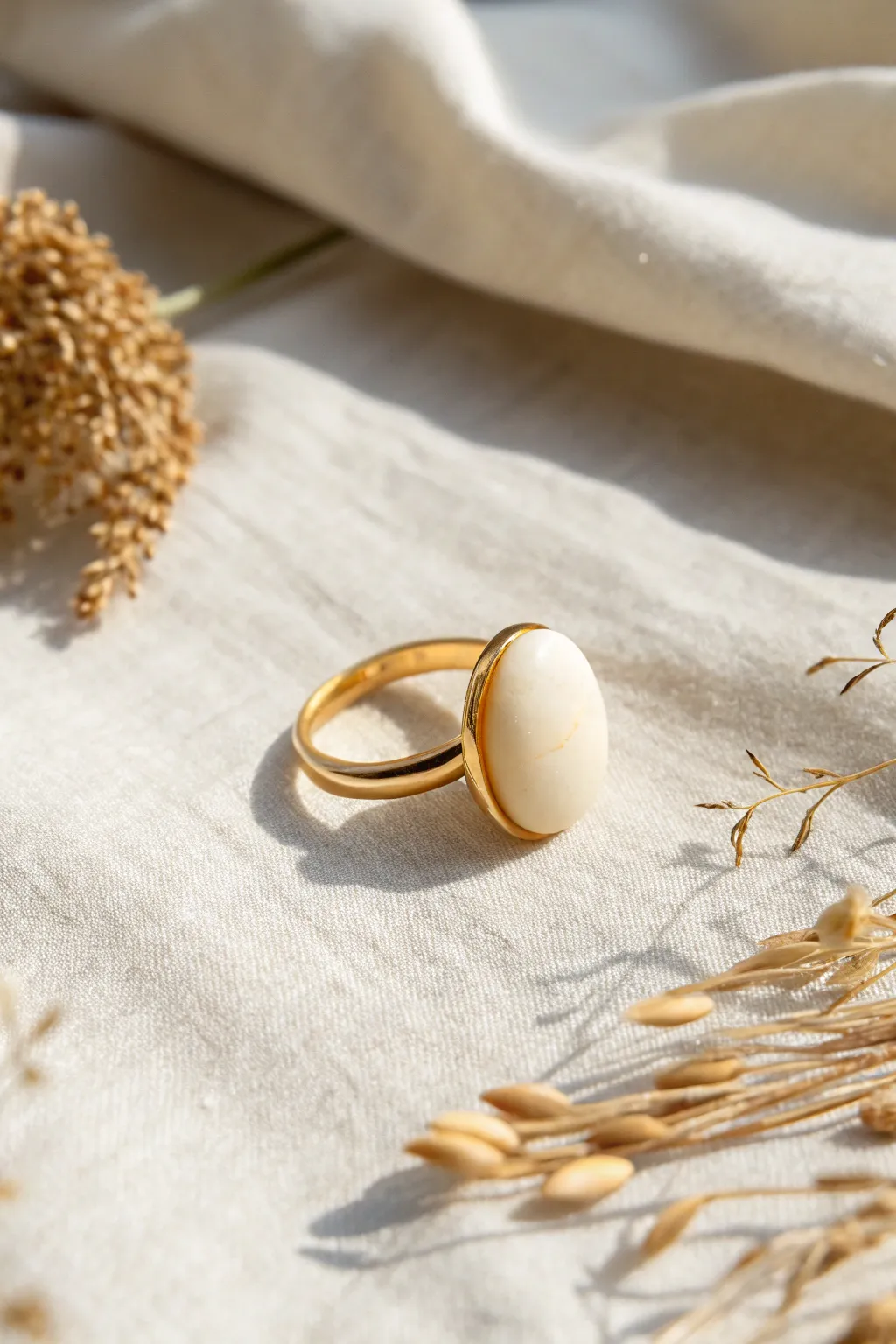
This elegant ring captures the organic beauty of a smooth river stone using nothing but polymer clay. It features a soft, creamy white cabochon set on a minimalist gold band, creating a piece that looks effortlessly high-end.
Step-by-Step
Materials
- White polymer clay
- Translucent polymer clay
- Beige or ecru polymer clay (tiny amount)
- Gold-plated ring blank with a flat pad or bezel cup (oval shape)
- Liquid polymer clay (clear or translucent)
- High-gloss glaze or UV resin
- Oval clay cutter (small, to match ring blank)
- Sandpaper (wet/dry, various grits)
- Buffing cloth or denim scrap
- Clay roller or pasta machine
- Ceramic tile or glass work surface
- Oven
Step 1: Creating the Faux Stone Blend
-
Prepare the Clays:
Start by conditioning your white and translucent clays separately. You want about 2 parts white to 1 part translucent to get that milky, semi-precious stone depth. -
Add a Tint:
To avoid a stark, plastic white look, mix a tiny pinch of beige or ecru clay into your white clay. You want a warm, bone-white tone rather than a bright refrigerator white. -
Marbling the Mix:
Combine your warm white and translucent clays. Twist, fold, and roll them together, but stop just before they are fully blended. Leaving slight streaks adds to the natural appearance. -
Forming the Sheet:
Roll your blended clay out into a thick slab, roughly 3mm to 4mm thick. This thickness ensures the ‘stone’ has a nice, high profile on the ring.
Loose Stone?
If the stone pops off the metal ring later, pop the stone off completely, remove old glue, and re-attach using a 2-part epoxy glue for the strongest possible permanent bond.
Step 2: Shaping the Cabochon
-
Cutting the Shape:
Select an oval cutter that matches the size of your ring blank’s pad. Press firmly into the slab to cut out your shape. -
Smoothing the Edges:
Gently gently lift the oval from your workspace. Use your fingertip to lightly tap and smooth the sharp bottom edge created by the cutter so it curves slightly underneath. -
Domed Surface:
With a light touch, smooth the top surface of the oval. Rub your finger over the top to create a gentle, pillowed dome shape rather than a flat plateau. -
Adding Veining (Optional):
If you want a hint of detail like the reference photo, take a needle tool and lightly score a very faint, short crack line on one side. Rub a tiny bit of brownish paint into it and wipe away the excess immediately. -
Baking:
Place your clay cabochon on a ceramic tile. Bake according to the manufacturer’s instructions for your specific brand of clay—usually around 275°F (135°C) for 30 minutes.
Step 3: Finishing and Assembly
-
Cooling Down:
Allow the clay piece to cool completely in the oven before removing it. This prevents the clay from becoming brittle due to thermal shock. -
Sanding for Smoothness:
Dip your piece in water and sand it lightly with fine-grit sandpaper (start at 400, move to 1000). This removes any fingerprints or lint. -
Buffing:
Rub the dry cabochon vigorously against a piece of denim or a buffing cloth. I find this friction creates a lovely satin sheen that looks very natural. -
Glazing:
For a glass-like finish, apply a thin layer of UV resin or high-gloss polymer clay glaze. Cure or dry as directed. -
Preparing the Ring Blank:
Take your gold ring blank and gently scuff the flat surface with coarse sandpaper. This texture helps the glue adhere better. -
Bonding:
Apply a drop of strong jewelry adhesive (like E6000) or a smear of liquid clay onto the ring pad. -
Final Set:
Press the finished clay stone firmly onto the ring blank. If using liquid clay, you must bake the entire ring again for 15 minutes to set the bond; if using glue, let it cure for 24 hours.
Perfect Dome
To get a perfectly smooth dome without sanding, cover the unbaked clay with cling wrap before using your cutter. The plastic rounds over the edges automatically as you cut down.
Slip on your new ring and enjoy the refined, minimalist look of your handmade jewelry
Polymer Clay Negative-Space Cutout Earrings
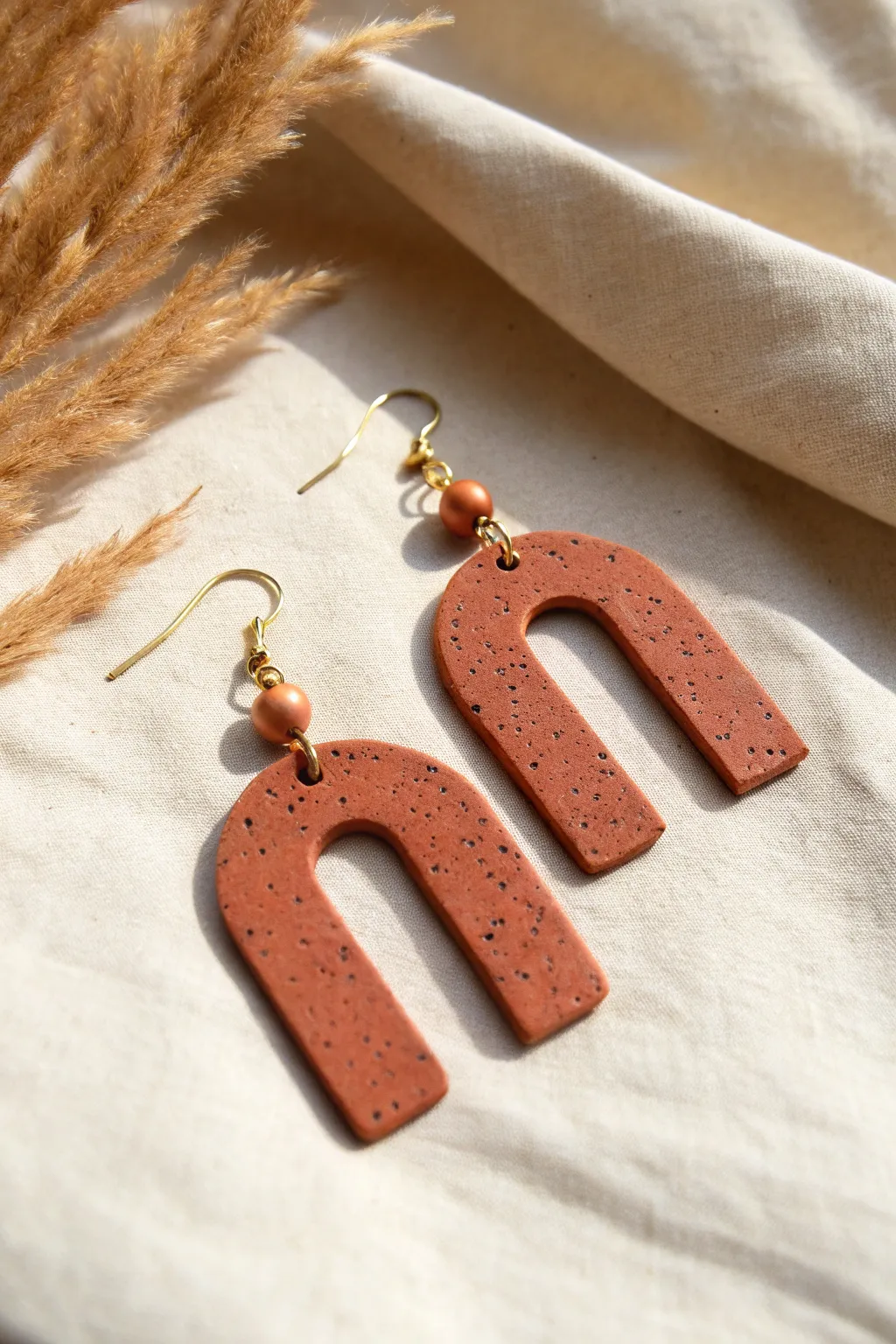
Embrace earthy tones and modern shapes with these stunning negative-space clay earrings. The speckled terracotta finish gives them a natural, stone-like aesthetic that mimics the warmth of pottery without the weight.
Step-by-Step Tutorial
Materials
- Terracotta or burnt orange polymer clay
- Fine black pepper or black embossing powder (for speckles)
- Wide U-shape or arch clay cutter
- Small round clay cutter or drinking straw (for negative space)
- Acrylic rolling pin or pasta machine
- X-Acto knife or clay blade
- Hand drill or small jewelry bit
- Gold finish ball-post earring hooks/wires
- Matching terracotta or gold spacer beads
- Jump rings (gold)
- Two pairs of jewelry pliers
- Oven and baking sheet
- Parchment paper
Step 1: Preparing the Clay
-
Condition the base:
Begin by slicing off a section of your terracotta polymer clay. Warm it between your palms, kneading and rolling it until it is soft, pliable, and free of any cracks. -
Create the faux-stone effect:
To achieve that beautiful speckled look seen in the photo, flatten your conditioned clay into a pancake. Sprinkle a pinch of fine black pepper or black embossing powder over the surface. -
Mix thoroughly:
Fold the clay over onto itself to trap the specks inside, then knead vigorously again. Repeat the rolling and folding process until the black specks are evenly distributed throughout the entire block. -
Roll out the slab:
Using your acrylic roller or setting your pasta machine to a medium-thick setting (about 3mm), roll out the clay into an even slab. You want these to have a bit of substance, so avoid going too thin.
Step 2: Cutting and Shaping
-
Cut the primary arch:
Place your large U-shape cutter onto the slab. Press down firmly and evenly to cut two identical arch shapes. If the clay sticks to the surface, I like to gently run a blade underneath to release it. -
Create the negative space:
This style relies on the ‘negative space’ cutout. Using a smaller U-cutter or freehanding with a blade, remove the inner portion of the arch to elongate the legs, making the ‘U’ deeper and more pronounced. -
Clean the edges:
Before baking, use your finger or a silicone tool dipped in a tiny bit of cornstarch or baby oil to gently smooth the sharp edges of your cut shapes. This reduces sanding time later. -
Add holes for hardware:
Using a needle tool or toothpick, pierce a hole at the very top center of each arch. Ensure the hole is large enough for your jump rings but not so close to the edge that the clay might break.
Spice Rack Secret
Using actual ground black pepper is cheaper and often looks more natural than glitter. Just don’t use coarse grind, or the chunks will ruin the smooth surface.
Step 3: Baking and Assembly
-
Bake the pieces:
Arrange your clay pieces on a parchment-lined baking sheet. Bake according to your specific clay brand’s package instructions—usually around 275°F (135°C) for 30 minutes for this thickness. -
Cool and inspect:
Allow the pieces to cool completely on the baking sheet to ensure structural integrity. Once cool, they harder and reach their final strength. -
Prep the bead connection:
Take a gold eye pin or a piece of wire and thread on your accent bead—choose a bead that matches the terracotta tone, like the ones shown here. Create loops on both ends of the bead link using round-nose pliers. -
Connect the components:
Open a jump ring with your pliers using a twisting motion (never pulling apart). Thread it through the top hole of your clay arch and connect it to the bottom loop of your bead link. -
Close the ring:
Twist the jump ring back into a closed circle, ensuring the wire ends meet perfectly so the clay doesn’t slip out. -
Attach the ear wire:
Finally, open the loop on your fish-hook earring wire. Slide it onto the top loop of your bead link and close it securely.
Level Up: Texture
Before cutting your shapes, gently press a piece of coarse sandpaper or a stiff toothbrush onto the raw clay slab to give it a realistic, pitted stone texture.
Wear your new creations with a cozy sweater or gift them to a friend who loves bohemian style
Polymer Clay Leaf-Imprint Oval Earrings
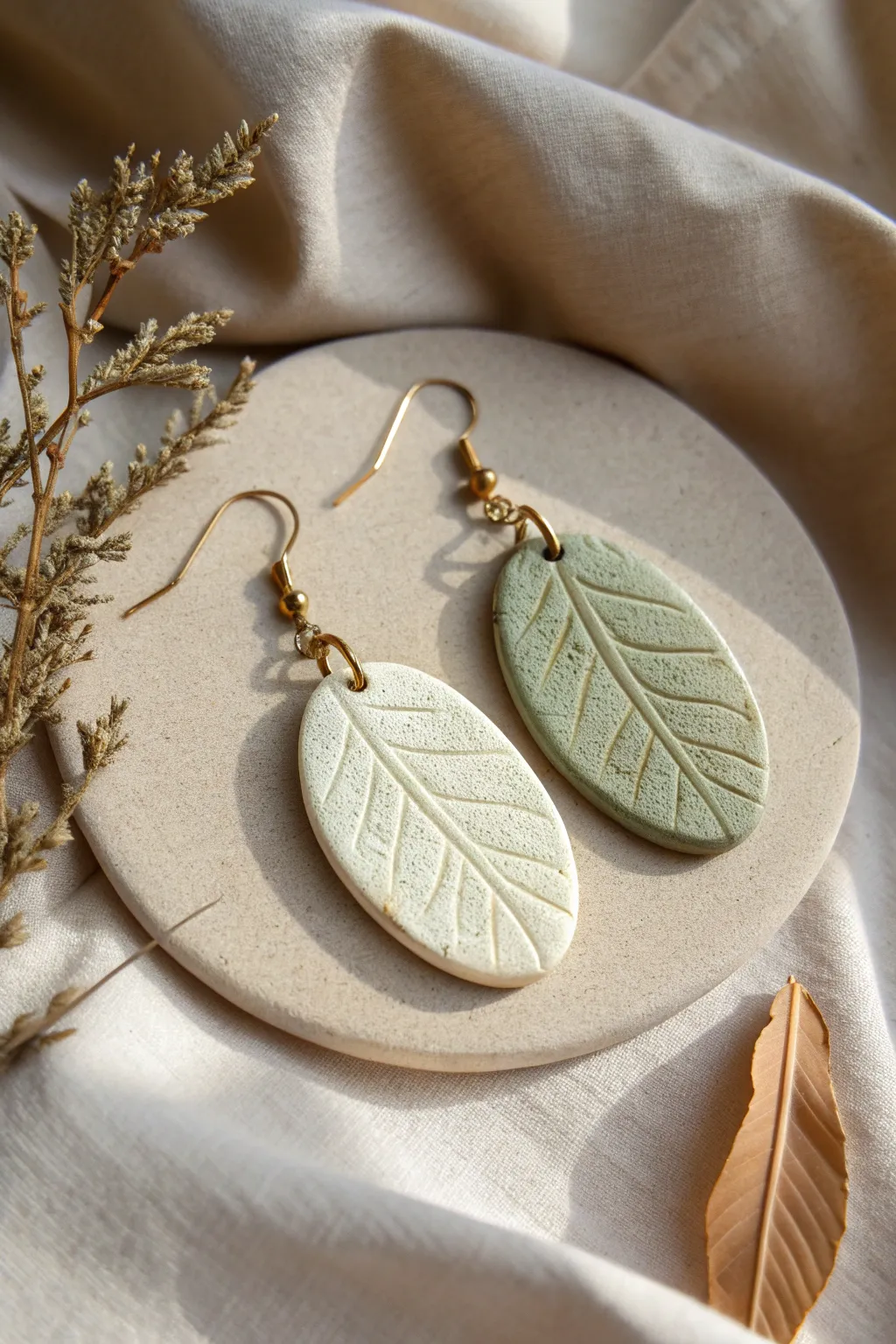
Embrace nature with these elegant oval earrings that feature delicate leaf veining pressed directly into the clay. The contrast between creamy ivory and sage green tones creates a beautifully organic look perfect for everyday wear.
Step-by-Step Guide
Materials
- Polymer clay in ivory or white
- Polymer clay in sage green (or mix green, white, and a touch of brown)
- Acrylic rolling pin or clay machine
- Oval clay cutter (approx. 1.5 – 2 inches long)
- Texture tool: A real leaf with deep veins, a leaf texture sheet, or a needle tool
- Small round cutter or piercing tool for holes
- Sandpaper (fine grit)
- 2 Gold earring hooks (fishhook style)
- 4 Gold jump rings
- Jewelry pliers (flat nose and round nose)
- Oven for baking
Step 1: Preparing the Clay Canvas
-
Condition the Clay:
Begin by thoroughly kneading your ivory and sage green polymer clay blocks separately until they are soft and pliable. This conditioning step prevents cracks during baking. -
Roll Out Slabs:
Use your acrylic rolling pin or a pasta machine to roll each color into a smooth, even slab. Aim for a thickness of roughly 3mm—thick enough to be sturdy but light enough to wear comfortably. -
Check for Smoothness:
Inspect the surface for air bubbles or lint. If you see a bubble, gently pierce it with a needle and smooth it over with your finger.
Step 2: Creating the Leaf Texture
-
Choose Your Method:
Decide how you will create the vein pattern. You can use a real leaf (backsides work best for texture), a rubber texture sheet, or draw it freehand. -
Impress or Draw the Veins:
If using a real leaf or stamp, press it firmly onto the clay slab. If drawing freehand like in the example, use a needle tool to gently score a central line down the length of where your oval will be. -
Detailing the Veins:
Using the needle tool, draw diagonal lines branching out from the center line to mimic leaf veins. Vary the pressure slightly to create a natural, organic feel rather than perfect geometry. -
Texturing the Surface:
To achieve the stone-like, matte finish seen in the photo, gently tap the surface of the clay with a toothbrush or a piece of coarse sandpaper before cutting. This removes the plastic shine.
Sticky Cuttings?
If your clay sticks to the oval cutter, dip the cutter into a small pile of cornstarch or water before pressing it into the clay. It will release cleanly every time.
Step 3: Cutting and Baking
-
Cut the Shapes:
Position your oval cutter over the textured area so the central vein runs vertically through the middle. Press down firmly to cut out your earring shapes. -
Refine Edges:
Gently lift the clay ovals. Smooth the cut edges with your fingertip to remove any harsh lines left by the cutter. -
Pierce Holes:
Using a small piercing tool or a toothpick, make a hole at the very top center of each oval. Ensure the hole is large enough for your jump rings but not too close to the edge. -
Bake:
Place your pieces on a ceramic tile or baking sheet lined with parchment paper. Bake according to your specific clay brand’s instructions (usually 275°F/130°C for 15-30 minutes). -
Cool Down:
Allow the pieces to cool completely in the oven or on the tray before handling them, as hot clay is fragile.
Antique Finish
To make the veins pop, rub a tiny bit of brown acrylic paint into the grooves after baking, then immediately wipe the surface clean with a damp cloth.
Step 4: Assembly
-
Open Jump Rings:
Using two pairs of pliers, twist your jump rings open sideways (never pull them apart). This keeps the circle shape intact. -
Attach the First Ring:
Slide one jump ring through the hole you pierced in the clay oval. Close it securely using the pliers. -
Add the Earring Hook:
Some creators prefer double jump rings for better movement. Attach a second jump ring to the first one, and slide the loop of the earring hook onto this second ring before closing it. -
Final Check:
Ensure all jump rings are closed tightly so the earrings don’t slip off. Repeat the process for the second earring.
Now you have a stunning, nature-inspired accessory ready to complement any outfit
Polymer Clay Scrap-Blend Confetti Set
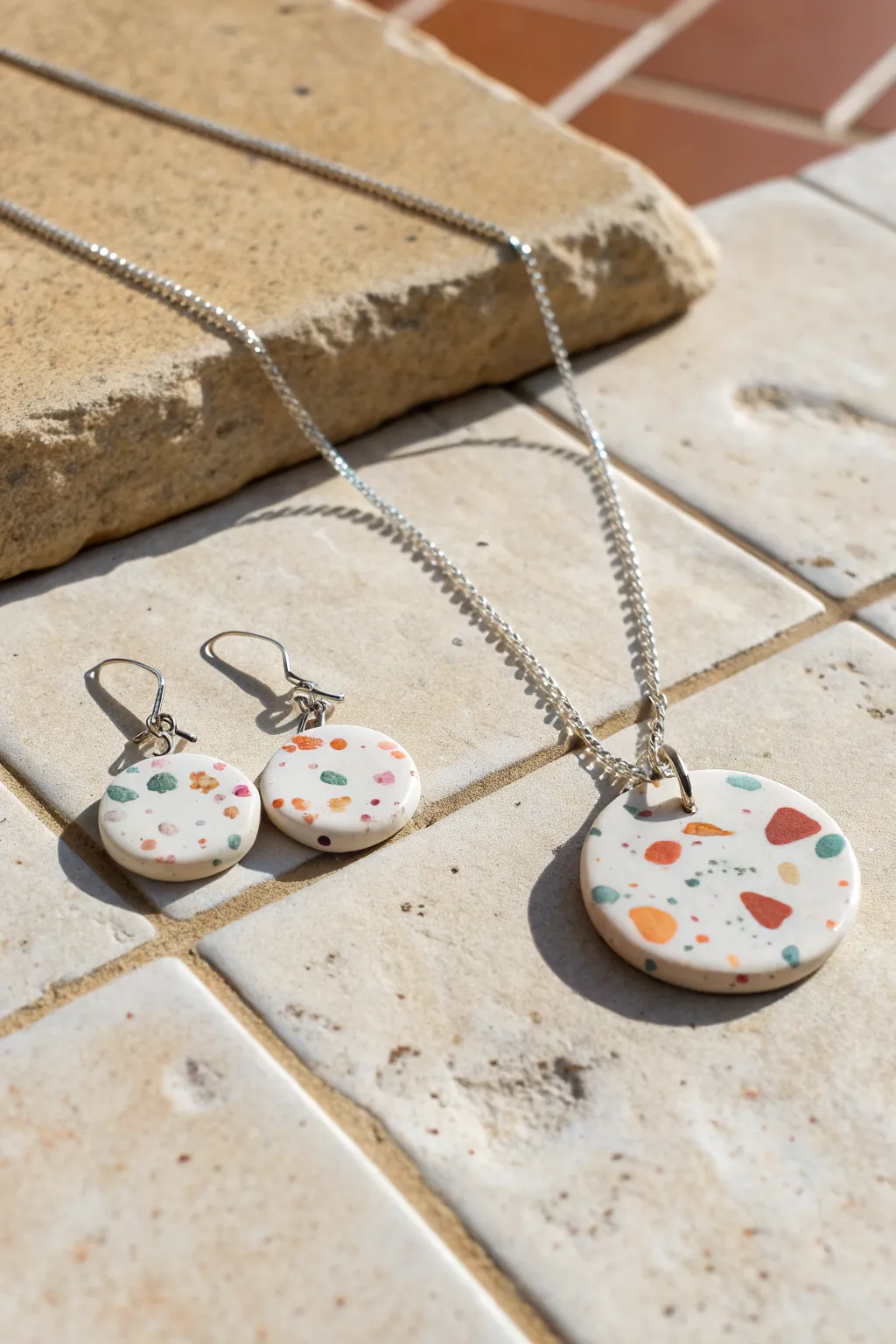
Transform leftover clay scraps into a chic, speckled jewelry set that mimics the look of high-end terrazzo stone. This necklace and earring trio features a crisp white base dotted with playful pops of teal, rust, and pink for a modern, artistic finish.
Detailed Instructions
Materials
- White polymer clay (approx. 2oz)
- Small scraps of colored polymer clay (teal, rust orange, pink, muted red)
- Acrylic rolling pin or clay machine
- Circle clay cutters (1 large for pendant, 2 small for earrings)
- X-acto knife or clay blade
- Parchment paper or ceramic tile work surface
- Hand drill or needle tool
- Sandpaper (various grits from 400 to 1000)
- 2 silver earring hooks
- Silver jump rings (various sizes)
- Silver necklace chain
- Jewelry pliers (flat nose and round nose)
- UV resin or gloss glaze (optional for finish)
Step 1: Prepping the Confetti
-
Create color sheets:
Take your colored clay scraps—teal, rust, pink, and red—and condition them until soft. Roll each color out into a very thin sheet, roughly the thickness of cardstock. -
Bake the color sheets:
Place these thin colored sheets on a baking tray lined with parchment paper. Bake them for about 10-15 minutes at the temperature recommended on your clay package. Let them cool completely; they must be brittle for the next step. -
Chop the confetti:
Once cool, use your blade or even your fingers to crumble and chop the baked sheets into tiny, jagged fragments. Aim for a mix of sizes, from dusty specks to slightly larger chunks, to replicate the authentic terrazzo look.
Clean Clay Tip
White clay picks up everything! Keep a pack of baby wipes or acetone nearby to clean your hands and tools often. Even tiny dust specks show up on white.
Step 2: Creating the Terrazzo Slab
-
Condition the white base:
Condition your white polymer clay thoroughly until it is pliable and smooth. Roll it into a thick sheet, about 4-5mm thick. This will be the sturdy base for your jewelry. -
Apply the confetti:
Sprinkle your chopped colored fragments generously over the surface of the white clay sheet. Don’t worry about placement being perfect; randomness is key to the style. -
Embed the chips:
Cover the clay with a piece of parchment paper to prevent sticking. Use your rolling pin to firmly press and roll over the clay. You want to push the colored chips down so they become flush with the white surface. -
Roll smooth:
Continue rolling until the surface is completely flat and the chips are fully integrated. I usually roll in different directions to ensure the slab stays even in thickness.
Air Bubble Trouble
If you see air bubbles after rolling your chips in, pierce them gently with a sharp blade and smooth the air out with your finger before baking.
Step 3: Cutting and Baking
-
Cut the shapes:
Use your large circle cutter to punch out one circle for the pendant. Use a smaller circle cutter to punch out two matching circles for the earrings. Press down firmly and give a little wiggle before lifting to get a clean cut. -
Smooth the edges:
Gently gently run your finger around the raw edges of your cut shapes to soften any harsh lines or jagged bits left by the cutter. -
Create holes:
Use a needle tool or a toothpick to poke a small hole near the top edge of each piece for the hardware. Make sure the hole is big enough for your jump rings but not too close to the edge. -
Final Bake:
Place your finished shapes on a baking sheet. Bake according to the manufacturer’s instructions (usually 275°F/135°C for 30-45 minutes). Tent with foil if you’re worried about the white clay scorching.
Step 4: Finishing Touches
-
Cool and inspect:
Let the pieces cool completely before handling. They should feel hard and durable. -
Sanding:
To reveal the true terrazzo effect, you’ll want to sand the surface. Start with 400 grit wet/dry sandpaper under running water and sand the face of the pieces. This removes the thin film of white clay that might be covering your colored chips. -
Refining:
Move up to higher grits like 600, 800, and 1000 to buff out scratches and create a buttery smooth matte finish. Rinse and dry the pieces thoroughly. -
Buffing (Optional):
If you prefer a shiny finish rather than matte, you can vigorously buff the pieces with a soft cloth like denim or microfiber, or apply a thin layer of gloss glaze. -
Assemble the pendant:
Using your flat nose pliers, open a large jump ring. Thread it through the hole in your large pendant circle and then loop it onto your silver chain. Close the jump ring securely. -
Assemble the earrings:
Open two smaller jump rings. Attach each small clay circle to an earring hook. Ensure the loop on the earring hook faces the right way so the terrazzo side faces forward.
Now you have a stunning, stone-effect set ready to wear or gift.