
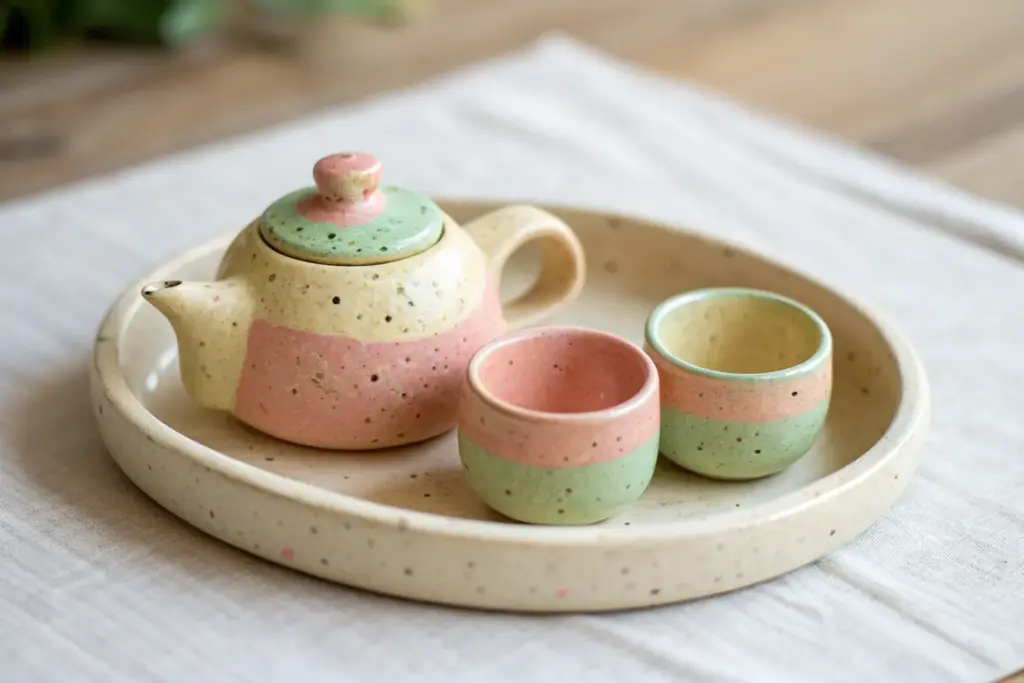
Clay sets are my favorite kind of project because you get that satisfying “collection” look without needing one massive, complicated build. With a simple air-dry clay or polymer clay setup, you can make a bunch of coordinated pieces that feel intentional and totally you.
Matching Clay Coaster Set
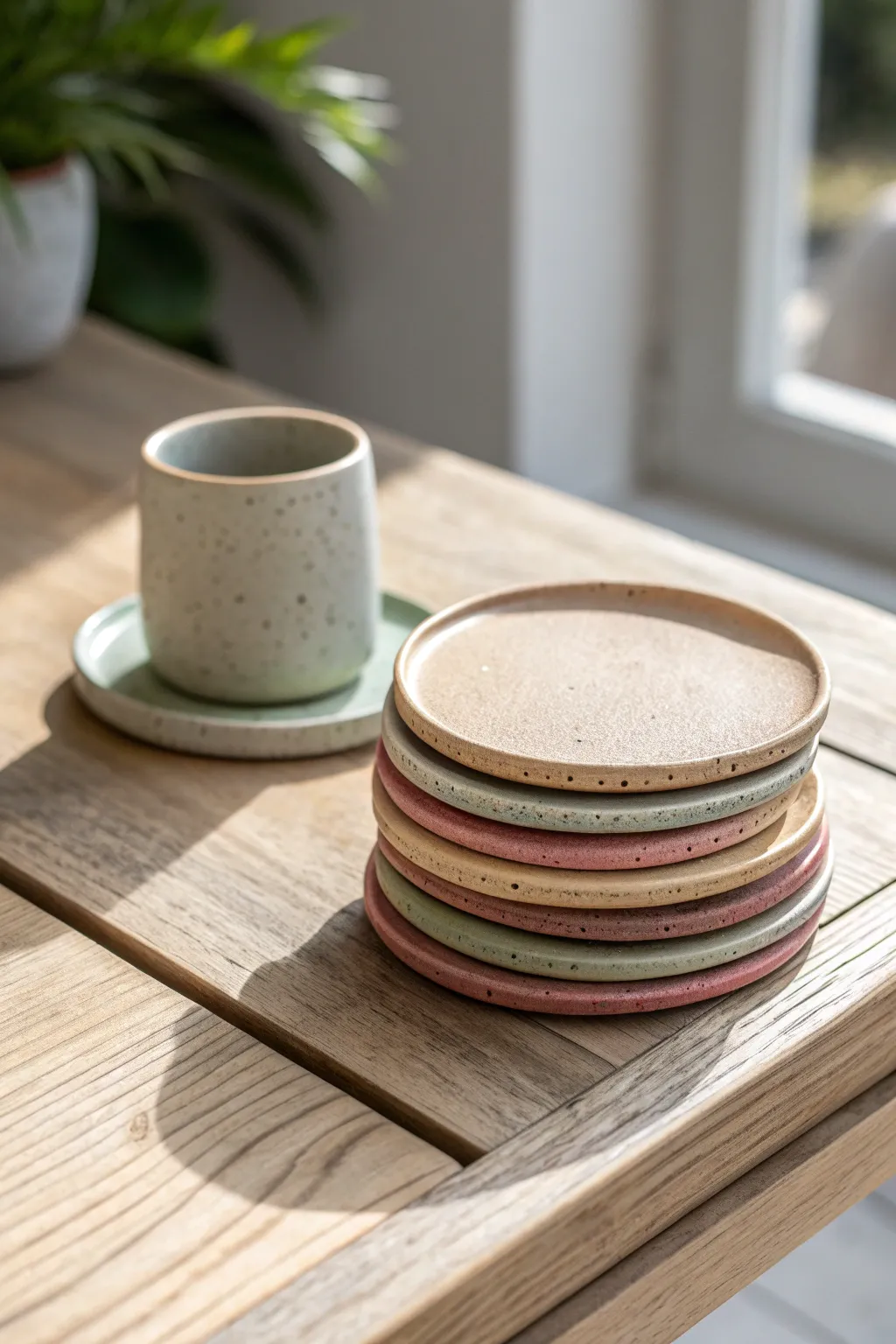
These minimalist, speckle-glazed coasters bring a touch of earthy elegance to your table with their muted sage, rose, and sand tones. The subtle lip around the edge keeps condensation contained while adding a sophisticated design detail that helps them stack beautifully.
Detailed Instructions
Materials
- Polymer clay or air-dry stoneware clay (white or light beige base)
- Acrylic rolling pin
- Circle cutter (approx. 3.5 – 4 inches)
- Fine-grit sandpaper (400-600 grit)
- Acrylic paints (muted sage green, dusty rose, sandy beige)
- Stiff bristle toothbrush or fan brush
- Dark brown or black acrylic paint (for speckles)
- Matte finish varnish or polyurethane sealer
- Smooth work surface or silicone mat
- Small sponge or modeling tool
- Bowl of water (if using air-dry clay)
Step 1: Shaping the Base
-
Prepare the Clay:
Begin by conditioning your clay. If using polymer, knead it until it’s pliable and warm. If using air-dry stoneware, ensure it is moist and free of air bubbles by wedging it briefly. -
Roll the Slab:
Use your acrylic rolling pin to roll the clay out into an even slab. Aim for a thickness of about 1/4 inch (6mm). You can use depth guides or wooden slats on either side of the clay to ensure perfectly even thickness. -
Cut the Circles:
Press your circle cutter firmly into the clay slab to create your coaster rounds. Lift the cutter straight up to avoid warping the shape. Repeat this for as many coasters as you wish to make—a set of 4 or 6 is standard. -
Smooth the Edges:
Dip your finger in a little water (for air-dry clay) or baby oil (for polymer) and run it gently around the cut edge to soften any sharp corners left by the cutter.
Warping Woes?
If air-dry coasters curl while drying, place a heavy book on top of them (sandwiching them between paper towels) once they are ‘leather hard’ to force them flat.
Step 2: Creating the Rim Detail
-
Define the Rim:
To create the slight raised lip seen in the photo, use a modeling tool or the back of a spoon. Gently press down into the center of the coaster, leaving about a 1/8th inch border untouched around the perimeter. -
Refine the Lip:
Work around the circle, compressing the center area slightly to make it lower than the rim. Keep the transition subtle; you don’t need a deep bowl shape, just a shallow depression to catch drips. -
Final Smooth:
Run a barely damp sponge over the entire surface to erase fingerprints and tool marks. This is crucial for that professional, matte-stone look. -
Drying or Baking:
Follow the instructions for your specific clay type. For polymer clay, bake on a tile or parchment paper at the recommended temperature. For air-dry clay, loosely cover with plastic wrap and let dry slowly over 24-48 hours to prevent curling. I find flipping them halfway through the drying process helps keep them perfectly flat.
Natural Stone Look
Mix dried tea leaves or cracked black pepper directly into the clay body before rolling it out. Sanding after drying will reveal these inclusions for real texture.
Step 3: Sanding and Painting
-
Sand for Smoothness:
Once fully cured or dry, take your fine-grit sandpaper and gently buff the edges and rims. The goal is to make the piece feel smooth to the touch, like tumbled stone. -
Mix Your Palette:
Prepare your base colors. Mix white with a tiny dot of green and brown for sage; white with red and brown for dusty rose; and white with yellow ochre for sand. Keep the tones muted and pastel. -
Apply Base Color:
Paint each coaster in a solid color, covering the top, sides, and bottom. Apply 2-3 thin coats for full opacity, allowing each layer to dry completely before adding the next. -
Prepare the Speckle:
Dilute a small amount of dark brown paint with water until it is the consistency of ink or thin cream. It needs to be fluid enough to flick easily. -
Flick the Speckles:
Dip a stiff toothbrush or fan brush into the diluted paint. Hold the brush over the coasters and run your thumb across the bristles to spray fine droplets onto the surface. Practice on a scrap piece of paper first to control the spray density. -
Protect the Finish:
After the speckles are totally dry, apply a matte varnish. This seals the paint and protects the coaster from moisture damage during use. Two thin coats are better than one thick coat.
Stack your finished set on the coffee table to admire your new functional art
Trinket Dish Trio
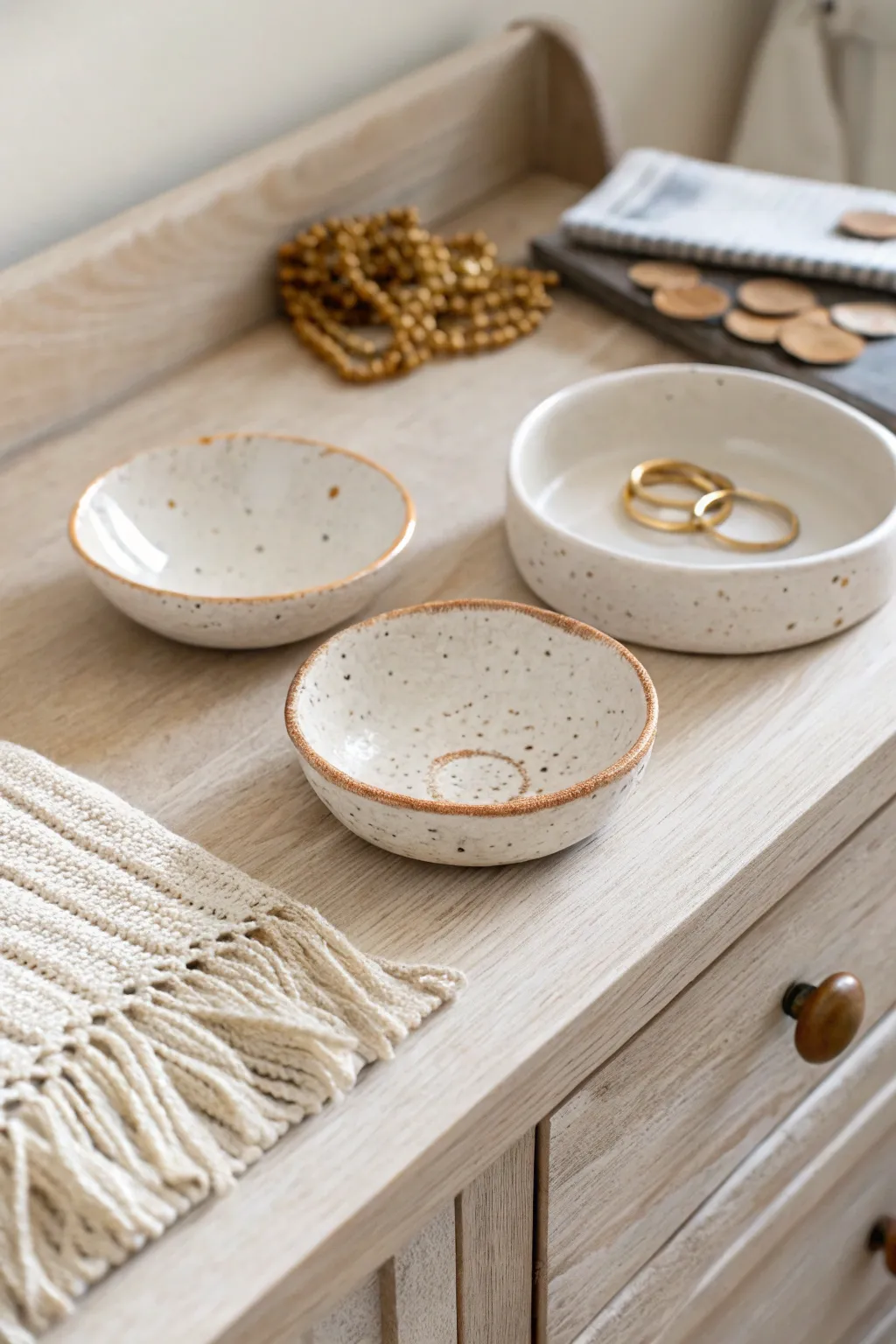
Create a sophisticated set of nesting dishes that mimic the look of expensive fired pottery without the need for a kiln. This tutorial walks you through shaping polymer or air-dry clay into an elegant trio, finished with a distinctive speckled glaze and a faux terra cotta rim.
Step-by-Step Guide
Materials
- White air-dry clay or polymer clay (approx. 1lb)
- Acrylic rolling pin
- Circle cutters or bowl templates (3 sizes)
- Sponge or soft paintbrush
- Sandpaper (fine grit)
- Tan/Caramel acrylic paint
- Dark brown or black acrylic paint
- Gloss varnish or clear resin
- Old toothbrush
- Water cup
Step 1: Shaping the Clay
-
Conditioning:
Begin by working your chosen clay in your hands until it becomes warm, pliable, and free of cracks. If you are using air-dry clay, keep a small bowl of water nearby to smooth out any dryness. -
Rolling out:
Roll your clay out on a non-stick surface or canvas mat. Aim for a consistent thickness of about 1/4 inch (6mm). Using depth guides on your rolling pin can really help keep this even. -
Cutting the base forms:
Cut out your three circles. For the larger flat dish, you’ll want a circle roughly 5-6 inches across. For the two smaller bowls, cut circles approximately 3-4 inches across. -
Forming the large dish:
For the wide dish, take your largest clay circle and build up the wall. You can do this by gently pinching the edge upward or by attaching a long strip of clay (a ‘coil’) around the perimeter and smoothing the seam completely. -
Refining the large dish shape:
Ensure the wall of the large dish stands vertically with a flat bottom, rather than curving like a bowl. Smooth the inside and outside seams with a slightly damp sponge to remove fingerprints. -
Shaping the small bowls:
For the two smaller circles, gently cup them in your palm to create a curved, concave shape. Alternatively, slump them over the bottom of a small dessert bowl or melon to get a perfect curve. -
Detailing the rims:
The rims in the reference image are slightly uneven and organic. Gently tap the edges with your finger to round them off so they aren’t sharp, but don’t worry about making them perfectly symmetrical. -
Drying or Baking:
If using polymer clay, bake according to package instructions. If using air-dry clay, allow the pieces to dry for 24-48 hours until fully hard and white. -
Sanding:
Once hardened, use fine-grit sandpaper to smooth any rough spots on the rims or bottoms. Wipe away all dust with a damp cloth before moving to painting.
Step 2: Painting and Finishing
-
Base coat (optional):
If your clay dried a bright white, leave it natural. If it looks grey/off, paint the entire surface with a warm creamy white acrylic paint and let dry completely. -
Creating the speckled effect:
Dilute a small amount of dark brown paint with water. Dip an old toothbrush into this mixture, limit the excess on a paper towel, and flick the bristles with your thumb to spray fine specks across the inside and outside of the dishes. -
Painting the rims:
Mix a warm tan or burnt sienna color to mimic terra cotta. Using a very fine detail brush, paint a thin line along the very edge of each rim. -
Adding the center detail:
For the smallest bowl, paint a small, imperfect circle in the center bottom using that same terra cotta color. I find dotting this line gently creates a more natural texture than a solid stroke. -
Sealing the work:
Once all paint is dry, apply a high-gloss varnish or a thin layer of resin. This is crucial to achieving that glazed ceramic look and protecting the paint.
Fixing Cracks
For air-dry clay cracks, mix a small amount of fresh clay with water to make a paste (slip). Fill the crack, smooth it over, and let it dry again before sanding.
Make it Functional
To make these truly waterproof and food-safe, skip the standard varnish and seal them with a certified food-safe epoxy resin once fully cured.
Arrange your beautiful new faux-ceramics on a vanity or side table to hold your favorite jewelry pieces.
Mini Pinch Pot Bowl Set
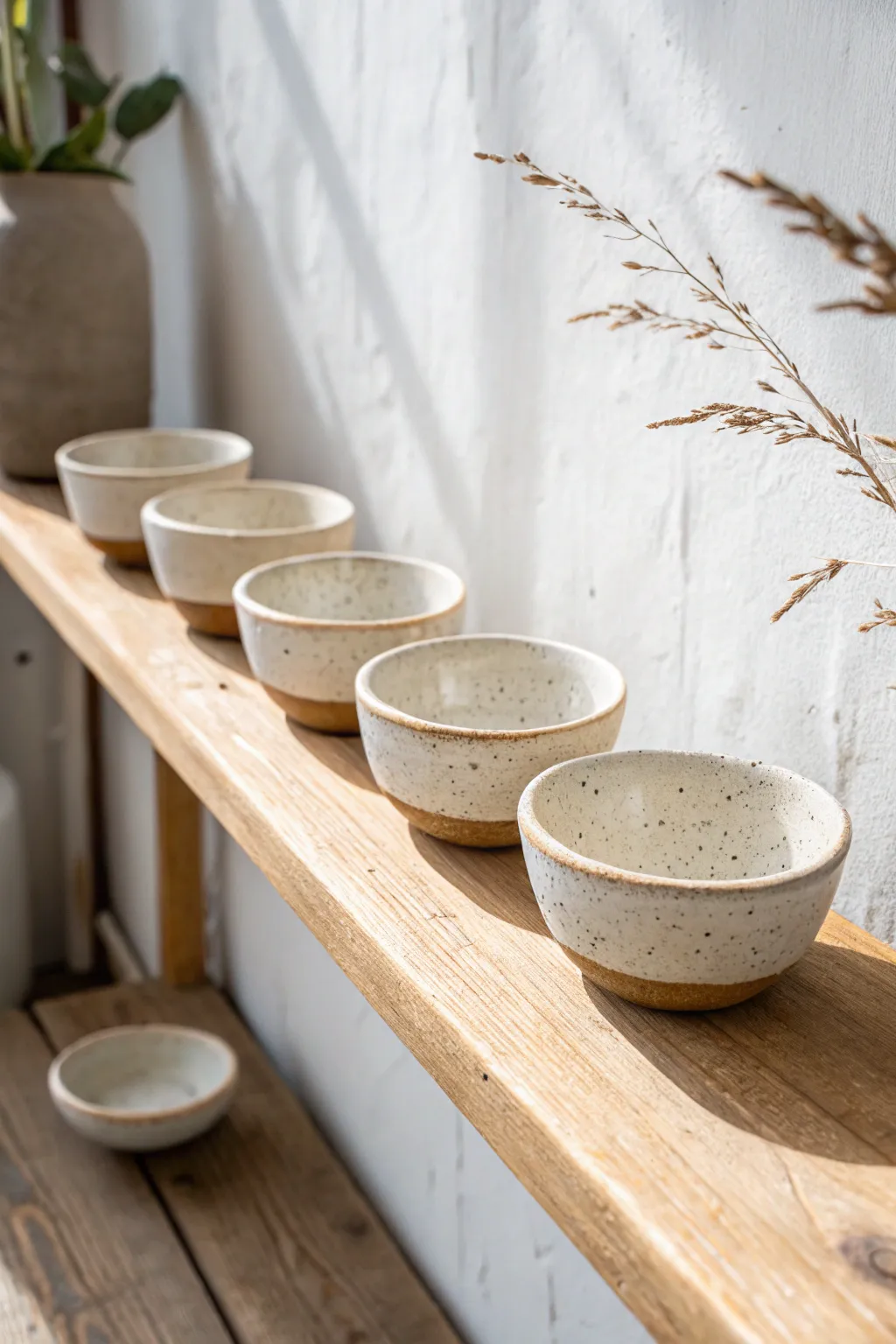
These charming mini bowls showcase the natural beauty of speckled clay bodies contrasted with a smooth, creamy glaze. The organic, slightly irregular shapes created by the pinch method make each piece perfectly unique for holding spices, jewelry, or sauces.
Step-by-Step
Materials
- Speckled stoneware clay (e.g., Laguna Speckled Buff)
- Pottery sponge
- Pin tool or needle tool
- Wooden modeling tool or ribbed kidney tool
- Wire clay cutter
- Cream or matte white glaze
- Sanding sponge (for greenware)
- Kiln access (bisque and glaze firing)
Step 1: Forming the Base Pots
-
Portion the Clay:
Begin by slicing off about 1.5 to 2 pounds of your speckled clay. Divide this evenly into 6 small balls, each roughly the size of a golf ball or a slightly larger tangerine. -
Shape the Spheres:
Roll each portion vigorously between your palms to create a smooth, tight sphere. Ensure there are no air pockets or significant creases in the clay surface. -
Open the Form:
Hold a clay ball in your non-dominant hand. Gently press your thumb into the center of the ball, stopping about a half-inch from the bottom to leave enough thickness for the base. -
Pinch the Walls:
Starting at the bottom and rotating the ball in your hand, gently pinch the clay between your thumb (inside) and fingers (outside). Work your way spiraling upward to thin the walls and widen the opening. -
Refine the Thickness:
Continue pinching until the walls are an even thickness, roughly 1/4 inch. Aim for a slightly vertical wall rather than a wide, flat bowl shape to match the image’s deep profile.
Step 2: Refining and Smoothing
-
Flatten the Base:
Gently tap the bottom of the pot against your work surface to create a flat, stable foot. This prevents wobbling and defines where the glaze line will eventually stop. -
Smooth the Rim:
Use a damp sponge or a strip of chamois leather to compress and smooth the rim of the pot. It should be rounded and comfortable to the touch, not sharp. -
Refine the Surface:
Take a flexible rib tool and gently scrape the exterior to remove fingerprint marks, giving the pot that smooth, wheel-thrown appearance while keeping its hand-built character. -
Dry to Leather Hard:
Set all the pots aside until they reach a leather-hard state. They should be firm enough to handle without deforming but still cool to the touch. -
Fettle and Cleanup:
Once leather hard, use a slightly damp sponge to do a final polish. Smooth out any remaining imperfections or rough spots on the bottom edge.
Compression is Key
When pinching, compress the rim frequently. This strengthens the weakest part of the pot and prevents small cracks from forming during the drying process.
Step 3: Glazing and Firing
-
Bisque Fire:
Load the thoroughly bone-dry pots into the kiln and fire to cone 04 (or your clay’s specific bisque temperature). This prepares the ceramic for glazing. -
Clean Bisqueware:
Wipe the fired pots down with a damp sponge to remove any kiln dust, which can prevent the glaze from adhering properly. -
Prepare the Glaze:
Stir your cream or white matte glaze thoroughly. If you are using a commercial dipping glaze, ensure it is the consistency of heavy cream. -
Dip the Pots:
Hold a pot by the foot (bottom section). Dip it upside down into the glaze, stopping about 3/4 of the way down. Hold for 3 seconds, then lift straight up and shake gently to remove drips. -
Clean the Line:
Once the glaze is dry to the touch, use a damp sponge to wipe the glaze line clean and straight. Ensure the bottom unglazed section is completely free of any glaze spots. -
Glaze Fire:
Load the pots back into the kiln, ensuring they don’t touch each other. Fire to the maturity temperature of your clay and glaze (typically cone 5 or 6 for stoneware). -
Sand the Bottom:
After the kiln has cooled and you’ve unloaded, use fine-grit sandpaper or a diamond sanding pad to briefly smooth the unglazed clay foot so it won’t scratch your furniture.
Add Texture
Before drying, press a piece of rough linen or canvas against the exterior walls. The glaze will break beautifully over the subtle fabric texture.
Now you have a stunning set of functional ceramics ready to grace your home or be gifted to a friend
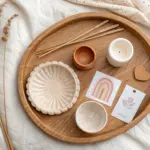
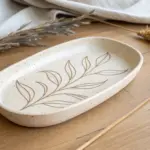
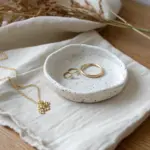
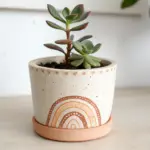
Ring Dish and Ring Cone Pair
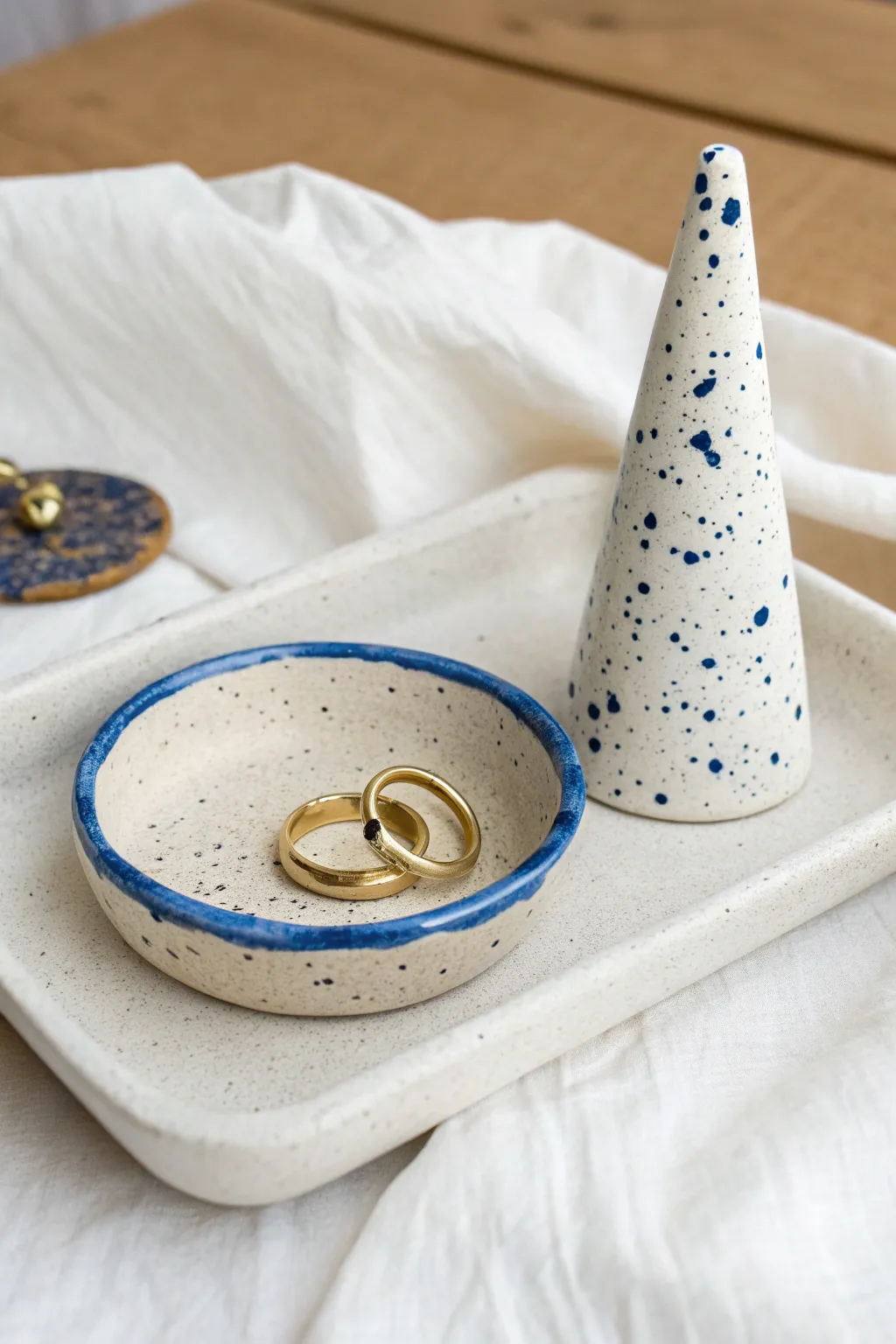
Create a sophisticated home for your favorite rings with this handmade pottery duo featuring a shallow trinket dish and a matching ring cone. The design highlights the natural beauty of speckled clay, accented with organic blue splatters and a painted rim for a modern, artistic finish.
Step-by-Step Guide
Materials
- White stoneware clay with speckles (or plain white clay)
- Rolling pin
- Canvas mat or cloth
- Circle cutter or bowl (approx. 3-4 inches)
- Sponge
- Loop tool or clay knife
- Paper cone template or thick paper
- Slip (clay mixed with water)
- Scoring tool or fork
- Cobalt blue underglaze
- Small round paintbrush
- Old toothbrush (for splattering)
- Clear transparent glaze
- Kiln (or air-dry clay alternatives if not firing)
Step 1: Shaping the Ring Dish
-
Roll the slab:
Begin by wedging your speckled clay to remove air bubbles, then roll it out on your canvas mat to an even thickness of about 1/4 inch. -
Cut the circle:
Place your circle cutter or a small bowl onto the slab and cut out a perfect circle. Remove the excess clay and set it aside for the cone. -
Lift the edges:
Gently lift the edges of the clay circle with your fingers, curving them upward to create a shallow wall. Smooth the curve with a damp sponge to eliminate any cracks. -
Refine the rim:
Using your thumb and forefinger, slightly compress and round the rim of the dish so it feels smooth. I find running a slightly damp sponge over the rim one last time gives it a professional look.
Fixing Wobbly Cones
If your cone tips over easily, tap the base firmly against the table while the clay is still plastic to flatten the bottom and lower the center of gravity.
Step 2: Forming the Ring Cone
-
Shape the clay cone:
Take a ball of clay and roll it into a thick coil. Slowly roll one end with more pressure to taper it into a cone shape. -
Refine the height:
Stand the cone up and check its height. If it needs to be taller or thinner, gently roll it on the table while pressing down on the wider base. -
Hollow the base (optional):
If your cone is quite thick, gently hollow out the bottom with a loop tool to ensure even drying and prevent explosions in the kiln. -
Smooth the surface:
Use a damp sponge or your fingers to smooth out any bumps on the cone’s surface, ensuring it sits flat and stable on the table.
Step 3: Decorating and Glazing
-
Bisque fire:
Allow your pieces to dry completely (bone dry) before firing them in the kiln for a bisque fire. -
Apply the rim color:
Once bisqued, dip a small round brush into cobalt blue underglaze. Carefully paint the rim of the dish. Let the brush naturally waiver slightly for an organic, handmade feel. -
Create the splatter effect:
Water down a small amount of the blue underglaze. Dip an old toothbrush into the mixture, then use your thumb to flick the bristles, spraying fine droplets onto both the dish and the cone. -
Let underglaze dry:
Allow the blue decoration to dry completely so it doesn’t smear during the glazing process. -
Apply clear glaze:
Dip the pieces into a clear transparent glaze or brush it on evenly. This will seal the clay and make the speckles pop. -
Wipe the bottoms:
Using a sponge, carefully wipe away any glaze from the bottom of the dish and the base of the cone to prevent them sticking to the kiln shelf. -
Final firing:
Place your pieces back in the kiln for the final glaze firing according to your clay and glaze specifications.
Go for Gold
After the final glaze firing, apply a gold luster overdraw to the rim of the dish or the tip of the cone. It requires a third, lower-temperature firing but adds luxe shine.
Arrange your jewelry on your new set and enjoy the handcrafted charm on your dresser

The Complete Guide to Pottery Troubleshooting
Uncover the most common ceramic mistakes—from cracking clay to failed glazes—and learn how to fix them fast.
Earring Organizer Set
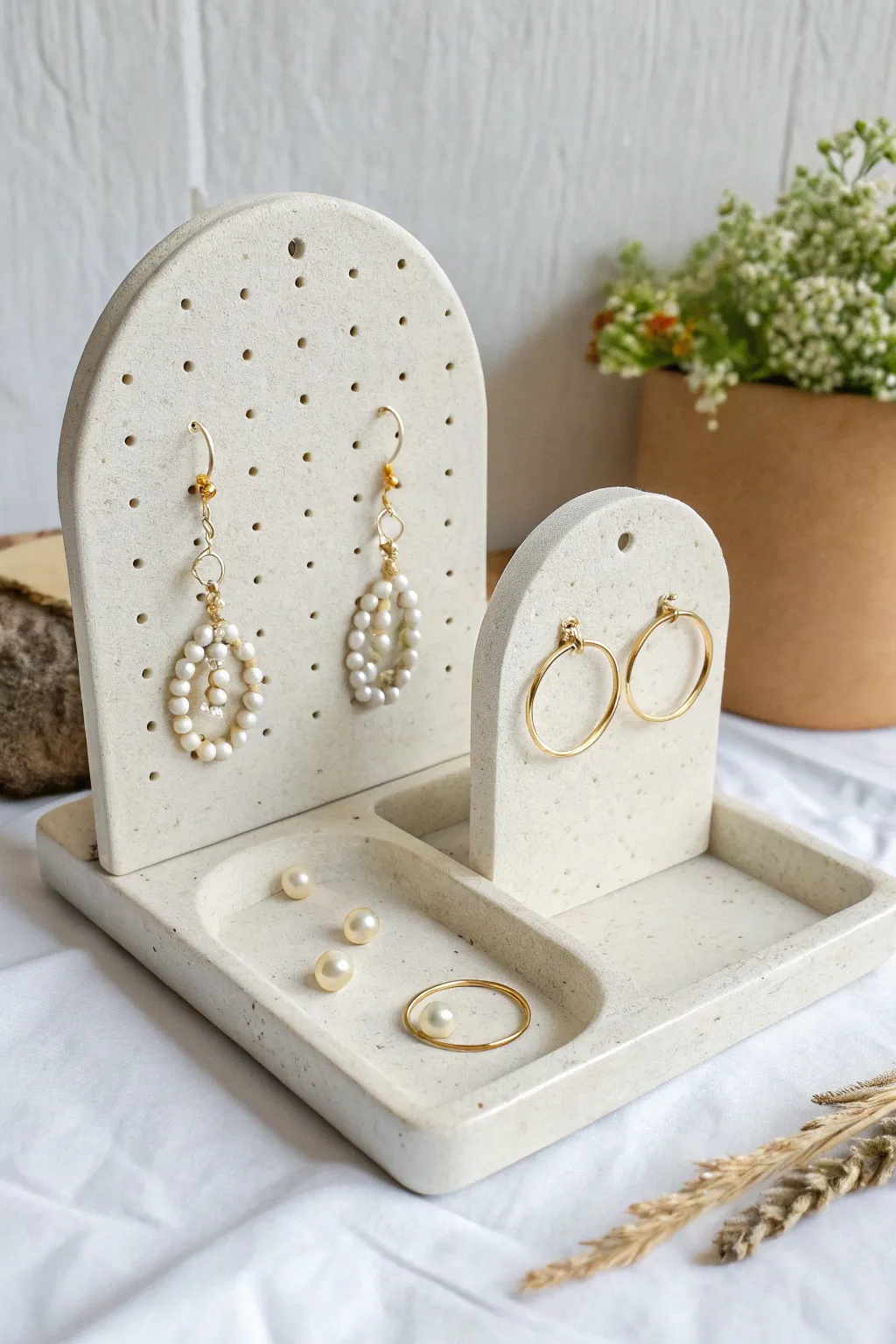
This elegant clay set combines modern curves with a functional design, featuring a dual-compartment tray and two arched stands for your favorite earrings. The faux-stone speckled finish gives it a high-end ceramic look without needing a kiln.
Step-by-Step Tutorial
Materials
- Polymer clay (white or beige)
- Black pepper or brown acrylic paint (for speckles)
- Clay rolling pin or pasta machine
- Craft knife or scalpel
- Cardstock or paper (for templates)
- Circle cutters or a small straw
- Sandpaper (fine grit)
- Ruler
- Strong craft glue or liquid clay
- Oven
Step 1: Preparation & Base
-
Prepare the clay:
Condition your white or beige polymer clay by kneading it until soft. To achieve that organic speckled look, knead in a generous pinch of ground black pepper or dried coffee grounds. If you prefer a painted look later, just use plain clay for now. -
Create templates:
Cut three paper templates: a large rectangle for the base (approx. 4×6 inches), a tall arch (approx. 4 inches high), and a smaller arch (approx. 2.5 inches high). Having these ready ensures your cuts will be symmetrical. -
Roll the base slab:
Roll out a thick slab of clay for the base tray, aiming for about 1/4 inch thickness. Use your rectangular template to cut the main shape with a craft knife. -
Form the rim:
Roll a long snake of clay and flatten it slightly. deeply score the edges of your rectangular base, apply a little liquid clay, and attach the flattened snake around the entire perimeter to create a raised rim. -
Add the divider:
Create a curved divider wall using another strip of clay. Shape it into a gentle ‘S’ or ‘C’ curve inside the tray to separate the space into two distinct sections, smoothing the seams down into the base so it looks like one solid piece. -
Smooth the tray:
Use a small amount of baby oil or water on your finger to smooth out any fingerprints or seams on the tray, paying special attention to where the walls meet the floor.
Uneven Arches?
If your arches won’t stand straight during gluing, propensity them up against a heavy book or spice jar while the adhesive cures to ensure a perfect 90-degree angle.
Step 2: Creating the Arches & Assembly
-
Cut the arches:
Roll out another slab of speckled clay, slightly thinner than the base (about 1/8 to 3/16 inch). Use your paper templates to cut out the large and small arch shapes. -
Perforate the large arch:
For the earring holder grid, take a small poking tool (like a toothpick or a very small straw). Create rows of evenly spaced holes across the entire surface of the tall arch. I find using a ruler as a guide helps keep the grid straight. -
Pierce the small arch:
For the smaller arch, poke just one or two holes near the top center if you plan to hang studs, or leave it solid if it’s primarily for draping hoops over the curved top. -
Initial bake:
Bake all three pieces (the tray and two arches) flat on a parchment-lined baking sheet according to your clay package’s instructions. Baking them flat ensures they don’t warp. -
Cool and sand:
Once fully cooled, lightly sand the edges of all pieces to remove any sharp burrs or lint. This step is crucial for that professional, stone-like finish. -
Mark placement:
Place the arches onto the tray to decide where they fit best. The tall arch usually sits at the back, and the shorter one in the middle or front. Mark these spots lightly with a pencil. -
Attach the arches:
Apply a line of strong super glue or heavy-duty craft adhesive to the bottom edge of each arch and press them firmly onto the marked spots in the tray. If you want a stronger bond, you can use a snake of fresh clay and liquid clay, then re-bake, but glue works well for display pieces. -
Optional speckle effect:
If you didn’t mix pepper into the clay earlier, mix a tiny bit of brown acrylic paint with water. Dip a toothbrush in the mixture and flick the bristles to spray fine speckles over the finished white piece.
Marble Finish
Mix translucent clay with white and a tiny bit of grey. The translucent clay adds depth, making the final piece look like genuine polished quartz or marble.
Arrange your favorite jewelry pieces on your new display and enjoy the organized aesthetic
Salt Pinch Bowl and Spoon Set
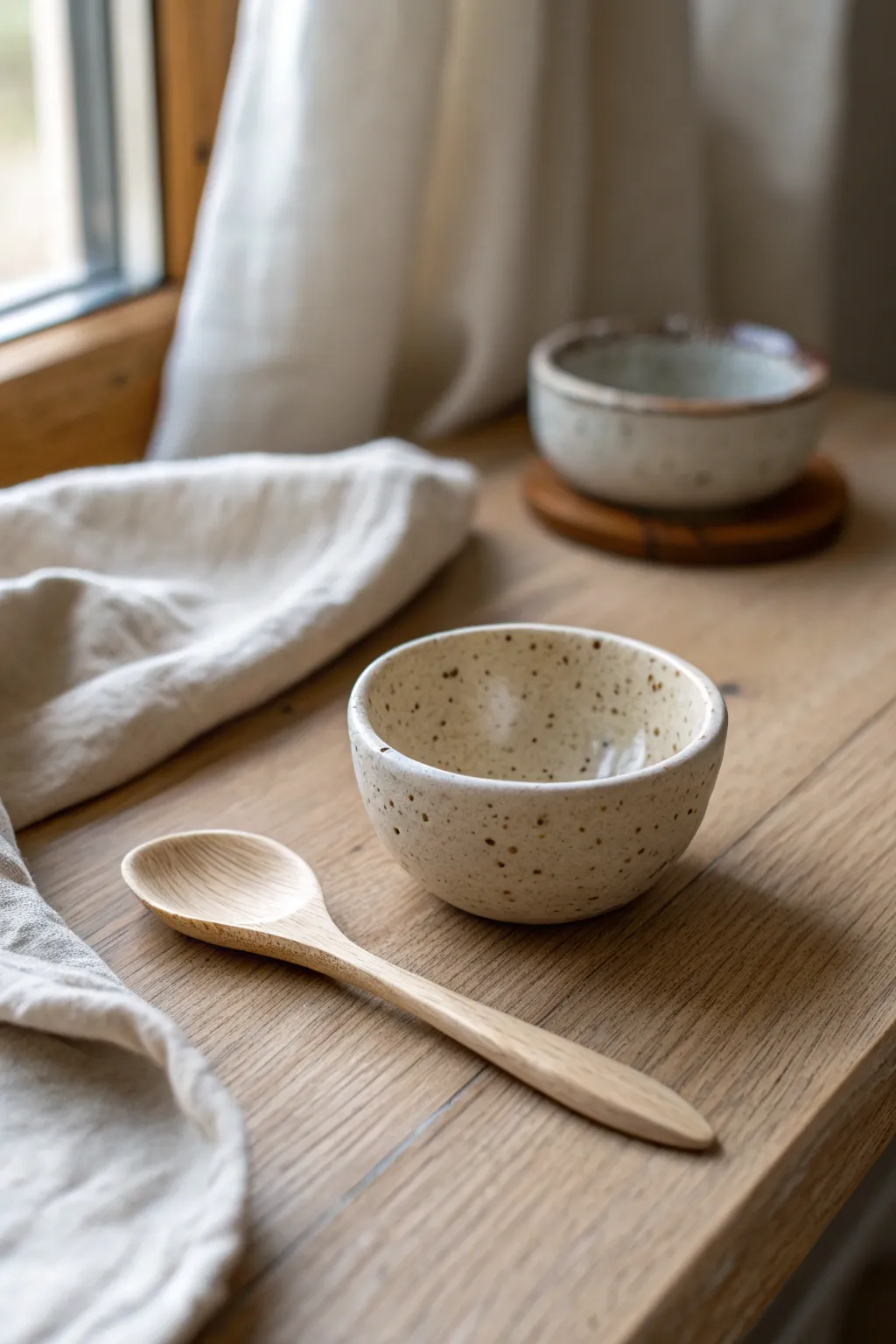
Create a charming, rustic addition to your kitchen counter with this handmade pinch bowl set. The speckled cream glaze gives it a lovely organic feel, perfect for keeping artisanal sea salt or spices close at hand.
Detailed Instructions
Materials
- White or buff stoneware clay
- Wooden carving tools
- Sponge
- Speckled cream or ‘oatmeal’ matte glaze
- Kiln (or access to a firing service)
- Small block of hardwood (like maple or oak – for the spoon)
- Small carving knife/whittling tool
- Sandpaper (grits 80, 150, 220, 400)
- Food-safe wood oil
Step 1: Forming the Bowl
-
Prep the clay:
Start with a ball of clay roughly the size of a tangerine. Wedge it thoroughly to remove any air bubbles, which helps the walls stay even during forming. -
Open the pinch pot:
Hold the clay in your non-dominant hand. Gently press your thumb into the center, stopping about a half-inch from the bottom. This base thickness is crucial for stability. -
Pinch the walls:
Using your thumb and fingers, gently pinch the clay walls while rotating the ball. Work from the bottom up, aiming for a consistent thickness of about 1/4 inch all around. -
Shape the rim:
As you pinch upward, allow the rim to flare slightly inward rather than outward for a cozy, contained shape. Gently compress the rim with your fingers to prevent cracking. -
Refine the surface:
Once the shape is set, use a damp sponge to smooth out distinct fingerprints, though leaving a few subtle marks adds to the handmade character. -
Dry to leather hard:
Set the bowl aside until it reaches a leather-hard state—firm enough to handle without deforming, but still cool to the touch. -
Base trimming:
Use a carving tool to slightly level the bottom so it sits flat without wobbling. You can carve a small foot ring if you prefer an elevated look.
Spotting Success
Using a clay body with iron pyrite spots naturally creates speckles through a white glaze. If using plain white clay, choose a ‘speckled’ glaze specifically.
Step 2: Carving the Spoon
-
Outline the shape:
While your clay dries, take your hardwood block and sketch the outline of a small spoon. Keep the handle simple and the bowl shallow. -
Rough carving:
Use your whittling knife to remove the bulk of the wood around your outline. Always carve away from your body for safety. -
Hollow the bowl:
Carefully scoop out the bowl of the spoon. Take shallow cuts; going too deep too fast can split the wood. -
Refine the handle:
Whittle the handle into a comfortable, rounded dowel shape that tapers gently toward the end. -
Sand until smooth:
Start with 80-grit sandpaper to shape, then progress through 150, 220, and finally 400-grit for an ultra-smooth finish. -
Seal the wood:
Rub a generous amount of food-safe oil into the spoon. Let it soak in, then wipe off the excess. This protects the wood and brings out the grain.
Wobbly Bowl?
If the bowl rocks after the bisque firing, use coarse sandpaper or a grinding stone on the bottom of the foot before glazing to level it out perfectly.
Step 3: Glazing and Firing
-
Bisque fire:
Once bone dry, fire the clay bowl to cone 04 (or your clay’s specific bisque temperature). -
Apply the glaze:
Dip the bowl into a speckled cream or oatmeal glaze. Ensure an even coat. If brushing, apply 2-3 layers, letting each dry briefly in between. -
Wipe the foot:
Use a damp sponge to thoroughly wipe any glaze off the bottom of the bowl so it doesn’t fuse to the kiln shelf. -
Glaze fire:
Fire the bowl again to cone 5/6 (mid-range) to mature the clay and melt the glaze into that beautiful speckled finish.
Fill your new bowl with flaky sea salt and enjoy the tactile pleasure of using your handmade set every time you cook

What Really Happens Inside the Kiln
Learn how time and temperature work together inside the kiln to transform clay into durable ceramic.
Incense Holder Collection
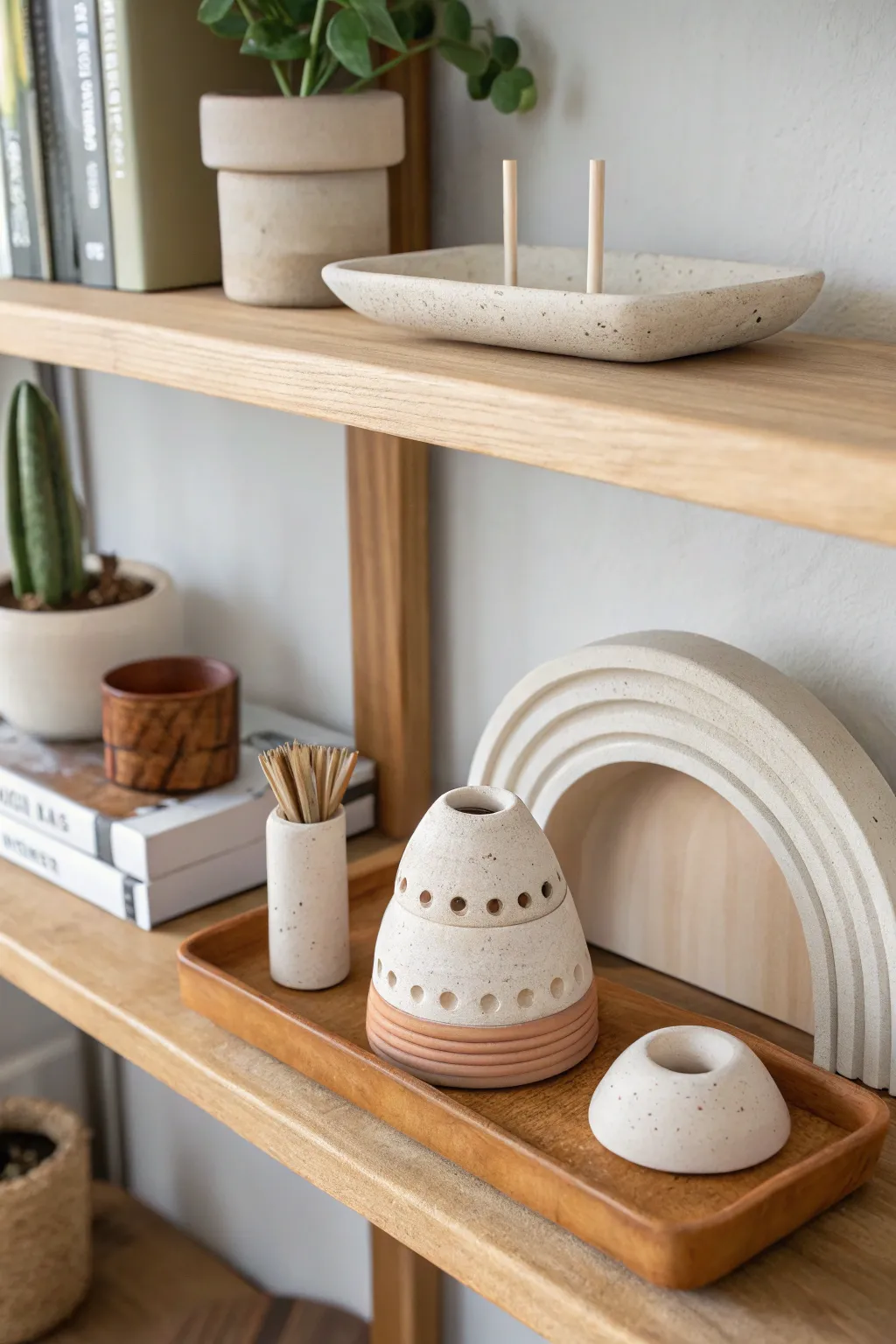
Create a calming, minimalist incense collection that combines raw, sandy stoneware textures with the warmth of terracotta. This tutorial guides you through sculpting a versatile cone storage jar with a perforated lid and a matching stick incense boat.
Step-by-Step Tutorial
Materials
- White or cream stoneware clay (speckled)
- Terracotta clay
- Pottery wheel (optional, can be hand-built)
- Wooden sculpting tools
- Needle tool
- Sponge
- Rolling pin
- Canvas mat
- Hole punch tool or straw
Step 1: Sculpting the Cone Holder
-
Prepare the Base:
Begin with the terracotta clay. Roll or throw a small, flat disc about 3-4 inches in diameter for the very bottom. Build up the walls slightly to create a shallow dish shape. -
Create the Ribbed Effect:
Using a coil method, add small ropes of terracotta clay on top of your base, smoothing the inside but leaving the outside coils visible. Gently round them with a wooden rib tool to create horizontal ridges. -
Switch to Speckled Clay:
Clean your hands thoroughly before handling the white clay to prevent staining. Shape a hollow, conical ‘beehive’ form that will sit comfortably on top of your terracotta base. -
Refine the Dome Shape:
Whether throwing on a wheel or pinching by hand, ensure the walls taper gently upward, leaving an open hole at the very peak for smoke to escape. -
Add Ventilation Holes:
While the clay is leather-hard, use a hole punch tool or a clean straw to pierce two rows of evenly spaced circles around the dome—one row near the bottom and one near the middle. -
Smooth the Edges:
Carefully sponge around each hole to remove any sharp burrs or clay crumbs.
Clean Joins
When switching clay bodies, wash tools and hands obsessively. Terracotta dust is potent and will leave orange smears on your pristine white speckled clay if you aren’t careful.
Step 2: Crafting the Incense Boat
-
Roll the Slab:
Roll out a slab of the speckled white clay to about 1/4 inch thickness on your canvas mat. -
Cut and Form:
Cut a long oval or rectangular shape. Gently lift the edges and curve them upward to create a shallow lip, pinching the corners slightly to create a boat shape. -
Refine the Rim:
Use a damp sponge to smooth the rim, ensuring it feels organic but polished. The goal is a soft, stone-like appearance.
Uneven Drying?
If the dome warps and doesn’t fit the terracotta base, lightly sand the bottom of the dome against a flat surface after it’s bone dry but before firing to level it out.
Step 3: Making the Match Holder
-
Form a Cylinder:
Using the remaining speckled clay, form a small, solid cylinder about 2.5 inches tall. -
Hollow the Center:
Press your thumb into the center to create a deep well, wide enough to hold a bundle of matches or toothpicks. -
Flatten the Base:
Tap the bottom firmly against your table to ensure it stands perfectly straight without wobbling.
Step 4: Finishing and Firing
-
Slow Drying:
Loosely cover all pieces with plastic and let them dry slowly over several days to prevent cracking, especially where the different clays meet if you joined them. -
Bisque Fire:
Fire the pieces to cone 04 (or according to your clay’s specific instructions) once they are bone dry. -
Glazing (Optional):
To maintain the matte, raw look shown in the image, you might skip a glossy glaze entirely. However, I often apply a clear matte glaze strictly to the inside of the incense holder for easier cleaning. -
Final Firing:
Fire the pieces a final time to the maturity temperature of your stoneware clay.
Now you have a serene, functional set ready for your favorite scents
Candle Holder Set in Mixed Heights
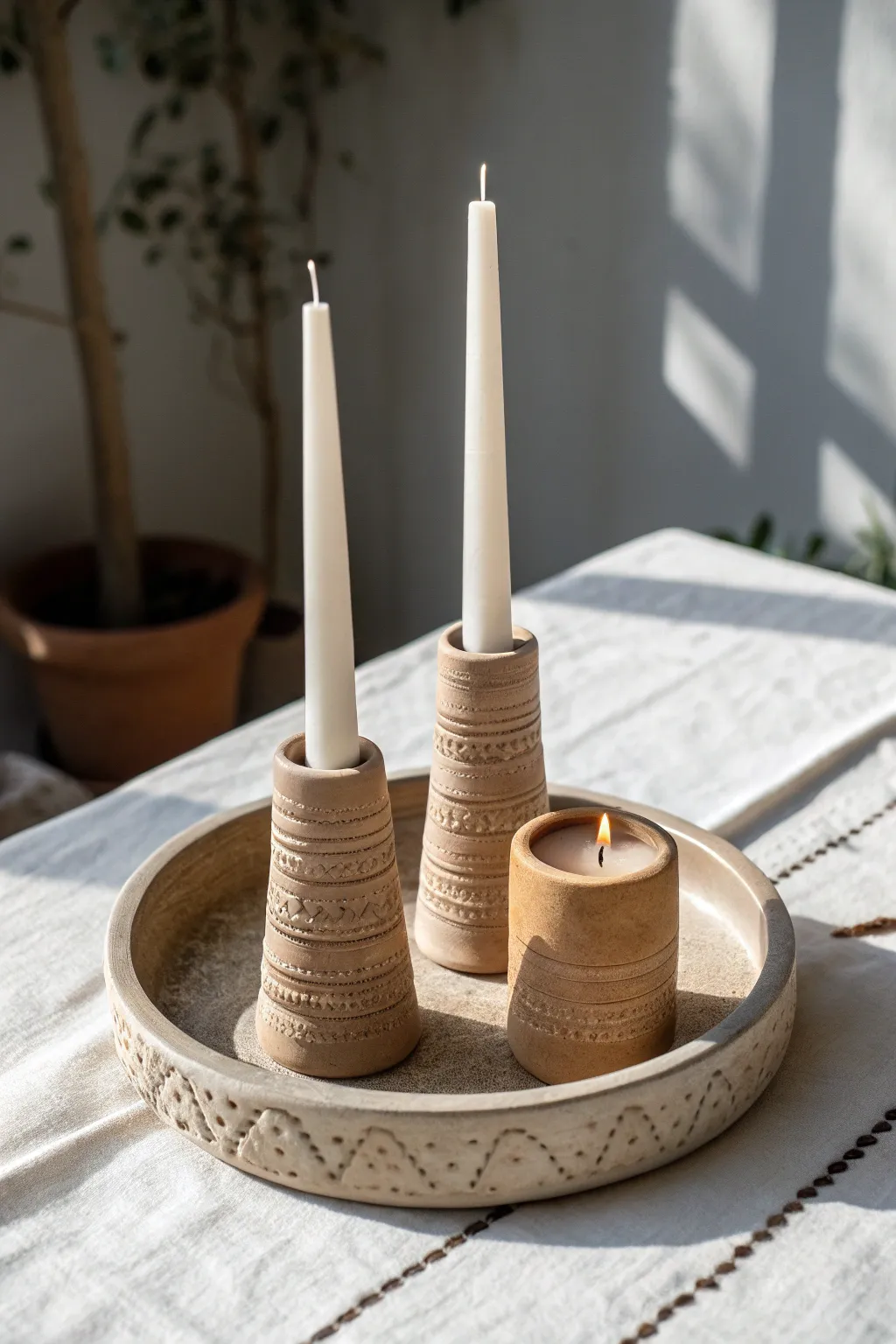
Create a serene atmosphere with this hand-built clay candle set, featuring varying heights to add architectural interest to your table. The natural beige stoneware and stamped geometric patterns give these pieces a timeless, artisanal charm perfect for cozy gatherings.
Step-by-Step
Materials
- Beige stoneware clay or air-dry clay (approx. 3-4 lbs)
- Rolling pin
- Clay knife or fettling knife
- Needle tool
- Canvas mat or work surface
- Slip (clay and water mixture)
- Scoring tool (or fork)
- Small geometric stamps or found objects (for texture)
- Wooden sculpting tools
- Sponge
- Cardboard or plastic tube (optional form support)
- Two taper candles (for sizing)
Step 1: Forming the Taper Holders
-
Prepare variable slabs:
Begin by wedging your clay thoroughly to remove air bubbles. Roll out a medium-thick slab, about 1/4 inch thick. Cut two rectangular strips that will become the cylinders for your taper holders. You want one slightly taller than the other, roughly 5 inches and 6 inches in height. -
Shape the cylinders:
Stand up your first strip and curl it into a cylinder. The trick is to create a slightly conical shape—narrower at the top and winder at the base for stability. If you’re struggling with the shape, you can wrap the clay loosely around a cardboard cone form. -
Join the seams:
Where the clay edges meet, deeply score both sides with your needle tool and apply a generous amount of slip. Press the edges firmly together. Use a wooden tool to smudge the clay across the seam on both the inside and outside until the line disappears. -
Cap the tops:
Roll a small snake of clay and form a ring that fits inside the top opening of your cylinder. This will hold the candle. Insert one of your actual taper candles briefly to ensure the opening is the perfect size, then remove it. -
Refine the shape:
Smooth the exterior with a damp sponge to remove fingerprints. Ensure the base is level by gently tapping the cylinder vertically on your work surface.
Step 2: Creating the Short Jar & Tray
-
Build the short holder:
Cut a third rectangular strip, shorter and wider this time, to create the jar-style holder. Form a cylinder about 3 inches tall and 3 inches wide using the same scoring and slipping method as before. Add a flat circular base to the bottom. -
Form the tray base:
Roll out a large, circular slab for the main tray, approximately 10-12 inches in diameter. Cut a long strip about 1.5 inches wide to serve as the rim. -
Assemble the tray:
Score and slip the outer edge of the circular base. Attach the rim, pressing firmly. Smooth the join on the inside curve so it looks seamless, giving it that professional wheel-thrown appearance.
Use a Ruler Tip
For straight horizontal bands, hold a tool steady at the right height and rotate the piece on a lazy susan instead of moving your hand.
Step 3: Detailing and Texture
-
Plan your patterns:
This project relies on repeating geometric bands. Use your needle tool to lightly scratch horizontal guide lines around the circumference of all three candle holders. -
Incise the lines:
Deepen your horizontal guide lines using a wooden modeling tool. Apply firm, even pressure to create distinct grooves that separate the pattern sections. -
Add stamped details:
Between the horizontal grooves, press in your textures. You can use the end of a paintbrush for small dots, or a triangular tool for the zigzag patterns seen on the tray rim. I like to alternate between rows of simple dashes and rows of complex geometric stamps. -
Texture the tray rim:
Don’t forget the tray! On the outer vertical rim, carve a simple repeating triangle or zigzag pattern using a carving tool. Add small drilled dots inside the triangles for extra detail. -
Final smoothing:
Check all rims and edges. Run a slightly damp sponge over any sharp bits of clay created during the carving process.
Level Up: Colored Slip
Before carving, brush a layer of white slip over the raw clay. When you carve the patterns, the darker clay body will reveal itself for high contrast.
Step 4: Finishing
-
Slow drying:
Cover your pieces loosely with plastic to let them dry slowly. This is crucial for the tall taper holders to prevent warping. -
Bisque fire:
Once bone dry, fire the pieces in a kiln to bisque temperature (usually Cone 04). If using air-dry clay, simply wait until completely hard (48-72 hours). -
Left raw or glazed:
To achieve the look in the photo, leave the exterior unglazed to show off the raw clay texture. You may choose to use a clear matte glaze on the inside of the tray for easier cleaning.
Arrange your trio on the tray and enjoy the warm, flickering glow of your handcrafted centerpiece

TRACK YOUR CERAMIC JOURNEY
Capture glaze tests, firing details, and creative progress—all in one simple printable. Make your projects easier to repeat and improve.
Desk Organizer Set
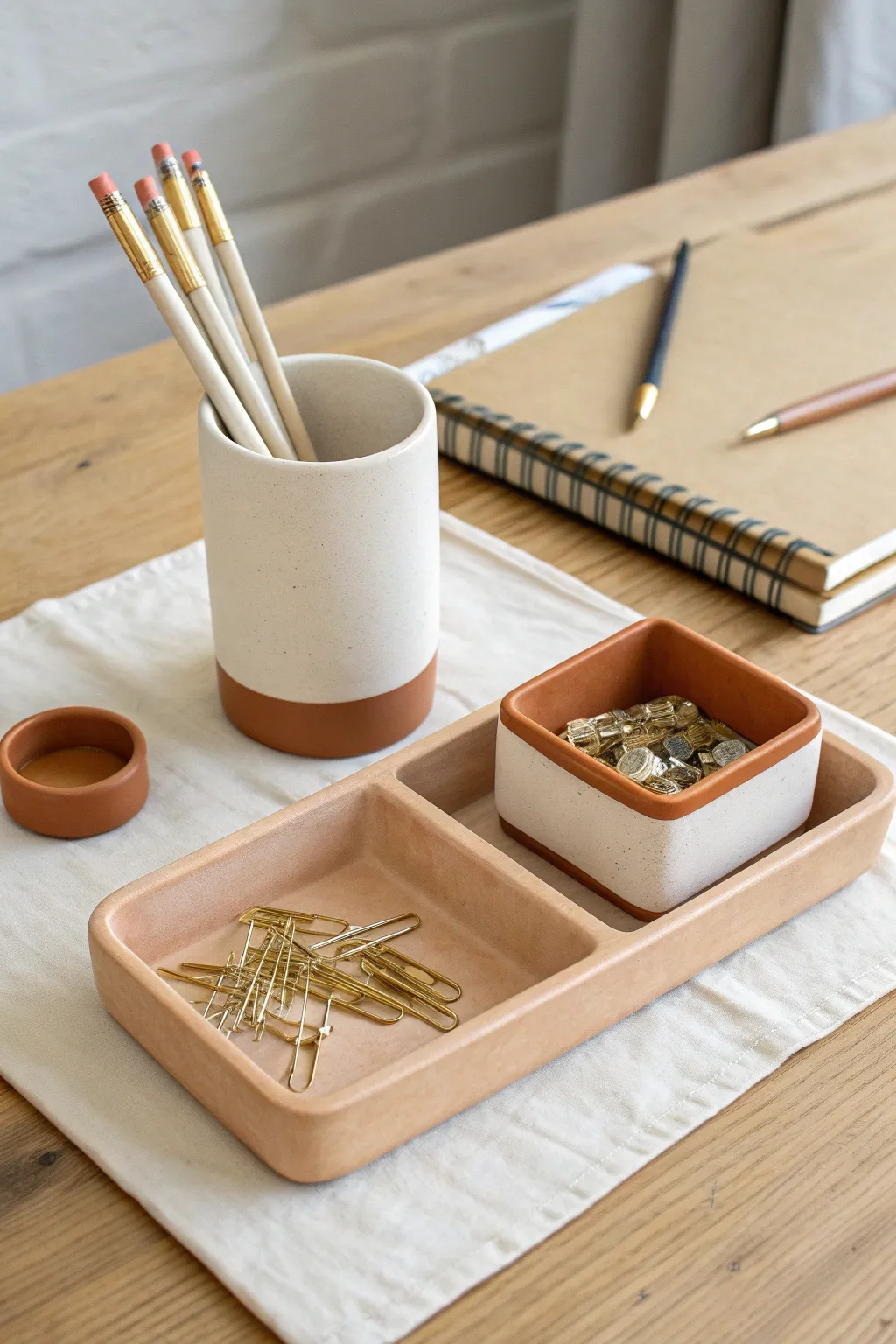
Bring structured calm to your workspace with this modern, multi-piece clay organizer set. Featuring a warm terracotta base paired with a speckled cream finish, these pieces offer a professional look that is surprisingly achievable at home.
How-To Guide
Materials
- Terracotta-colored polymer clay (approx. 4 blocks)
- Speckled granite or white polymer clay (approx. 2 blocks)
- Acrylic rolling pin
- Clay blade or craft knife
- Circle cutters (various sizes)
- Ruler
- Baking sheet and parchment paper
- Liquid polymer clay (translucent or matching color)
- Sandpaper (various grits from 400 to 1200)
- Matte varnish (optional)
Step 1: Creating the Dual-Section Tray
-
Condition the base clay:
Begin by conditioning your terracotta clay until it is soft and malleable. Roll it out into a large, even sheet approximately 1/4 inch thick to ensure creating a sturdy base. -
Cut the tray base:
Using a ruler and your blade, cut a large rectangle. For the size shown, aim for roughly 4 inches by 8 inches. Use your fingers to gently smooth the cut edges so they are rounded, not sharp. -
Form the side walls:
Roll a long snake of terracotta clay and flatten it into a strip about 3/4 inch high. Adhere this strip around the perimeter of your rectangular base. Blend the seams on the inside and outside thoroughly using a modeling tool or your finger to make it water-tight and seamless. -
Add the divider:
Cut a smaller strip of the same height to create the center divider. Place it roughly one-third of the way across the tray to create two distinct compartments—one square, one rectangular. Blend this piece securely into the floor and side walls. -
Refine the shape:
Once all walls are attached, use your fingers to gently pinch and curve the corners so they have a soft, rounded internal radius rather than a sharp 90-degree angle. This gives it the cast-ceramic look.
Seamless Smoothness
Use a little baby oil on your fingertips while smoothing the clay before baking. It melts away fingerprints and makes blending seams effortless.
Step 2: Sculpting the Square Container
-
Prepare the box base:
This small box is designed to fit inside the square section of your main tray. Measure the interior of that section and create a terracotta square base slightly smaller than those dimensions so it fits loosely. -
Construct the dual-tone walls:
Roll out a strip of speckled cream clay. Height should be about 1.5 inches. Wrap this around your terracotta base to form the four walls of the box. Seal the corner seam carefully. -
Add the terracotta rim:
Roll a thin snake or narrow strip of terracotta clay. Place this along the top rim of the white box walls. Press it down gently and smooth the transition so it looks like a dipped edge. -
Create the terracotta interior:
For a truly cohesive look, I like to line the inside of this box with a thin sheet of terracotta clay, pressing it against the white walls, or simply paint the inside later if you prefer a shortcut.
Faux Speckle Hack
Can’t find speckled clay? Knead clear or translucent clay with ground black pepper or dried used coffee grounds to create your own granite effect.
Step 3: Making the Pencil Cup
-
Create the cup base:
Roll out terracotta clay and cut a circle roughly 3 inches in diameter using a large circle cutter or a jar lid as a template. -
Build the two-tone cylinder:
You will need a tall rectangular strip for the body. Create a strip composed of a 1-inch band of terracotta at the bottom joined to a 3-inch band of speckled cream clay on top. Roll over the seam gently to bond them into a single sheet. -
Assemble the cup:
Wrap this two-tone strip around your circular base. Join the vertical seam by beveling the edges or smoothing the clay together. Use your fingers to blend the bottom of the wall onto the base circle. -
Create the small ring dish:
With leftover terracotta clay, form a small ball and press your thumb into the center to hollow it out. Flatten the bottom slightly so it sits stable, creating a tiny matching vessel for small items.
Step 4: Finishing Touches
-
Bake the pieces:
Arrange all your creations on a parchment-lined baking sheet. Bake according to your clay manufacturer’s instructions—usually around 275°F (135°C) for 30–45 minutes depending on thickness. -
Sand for a stone effect:
Once cool, wet-sand the pieces under running water. Start with 400 grit to remove fingerprints, and move to higher grits to get a super smooth, matte finish that resembles honed stone. -
Seal (Optional):
If you want extra durability, apply a very thin coat of matte varnish. Avoid glossy finishes to maintain the natural, earthen aesthetic shown in the photo.
Place your new set on your desk and enjoy the calm organization it brings to your creative space
Photo and Place Card Holder Set
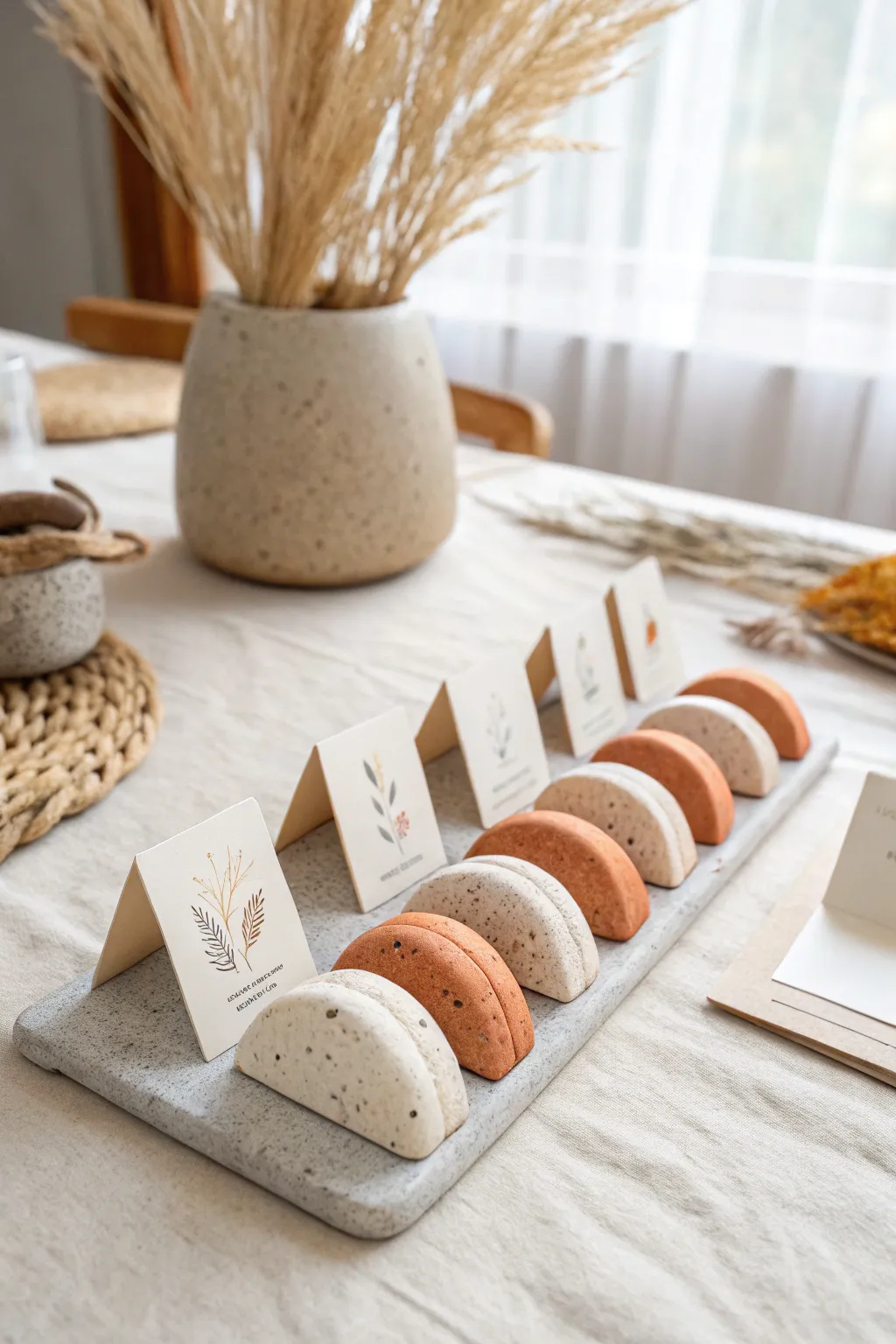
Bring an elegant, earthy touch to your table setting with this handmade clay set featuring semi-circular card holders and a matching display tray. The faux-granite finish gives these pieces a sophisticated stone look without the weight or cost.
Step-by-Step
Materials
- Polymer clay (white or beige base)
- Polymer clay (terracotta or burnt orange)
- Black pepper or sand (for speckling)
- Acrylic roller or rolling pin
- Round cookie cutter (approx. 2.5 – 3 inches diameter)
- Blade or craft knife
- Sandpaper (fine grit)
- Oven (for baking)
- Parchment paper
- Ruler
- Matte varnish (optional)
Step 1: Preparing the Faux Granite Clay
-
Condition the base clay:
Start by thoroughly conditioning your white or beige polymer clay until it is soft and pliable. Do the same separately for your terracotta colored clay. -
Add the speckles:
Flatten your conditioned clay and sprinkle a generous amount of coarse black pepper or clean sand onto it. I find that black pepper gives the most natural ‘granite’ look. -
Mix thoroughly:
Fold the clay over the inclusions and knead repeatedly until the specks are evenly distributed throughout the entire block. Repeat this process for both the light and dark clay colors.
Natural Speckle Hack
Instead of black pepper, try mixing in dried tea leaves or dried herbs (like crushed oregano) for a more organic, earthy green speckled appearance.
Step 2: Creating the Holders
-
Roll out the slab:
Roll your clay out to a thickness of approximately 1/4 inch (6mm). You want these to be thick enough to stand stably on their edge. -
Cut the circles:
Use your round cookie cutter to punch out several circles from both colors of clay. Aim for an even number if you want a balanced set. -
Halve the circles:
Using your blade, carefully cut each circle exactly in half to create semi-circle shapes. Ensure the cut edge is flat and straight. -
Smooth the edges:
Gently run your finger along the cut edges to soften any sharpness, but keep the bottom flat so it stands upright easily. -
Create the card slot:
Use the back of your blade or a credit card to press a shallow indentation into the top center of the curved edge. Alternatively, you can use two semi-circles sandwiched together with a spacer for a true slot, but the image shows solid blocks that likely use a slit or just balance the card against them. -
Form the slit (Optional):
If you want the card to sit firmly inside, carefully slice a slit into the top of the semi-circle about 1/4 inch deep using a thin blade.
Slit Collapsing?
If the card slot closes up during baking, fold a small piece of cardstock or index card and leave it inserted in the slit while baking to hold it open.
Step 3: Making the Tray
-
Prepare tray clay:
Take the remaining light-colored speckled clay (or mix more) and roll it out into a large, long rectangle. This needs to be slightly thicker, around 1/3 inch (8mm), for durability. -
Cut to size:
Using a ruler and blade, trim the clay into a neat rectangle long enough to hold all your card holders comfortably. -
Round the corners:
Use your craft knife or a small round cutter to gently round off the four corners of the tray for a softer, modern look.
Step 4: Finishing Touches
-
Bake carefully:
Place all pieces on a parchment-lined baking sheet. Bake according to your clay manufacturer’s instructions, usually around 275°F (130°C) for 30 minutes per 1/4 inch thickness. -
Cool down:
Allow the clay to cool completely in the oven with the door slightly ajar to prevent cracking from thermal shock. -
Sand for stone texture:
Once cool, lightly sand the surfaces with fine-grit sandpaper. This enhances the matte, stone-like texture and removes any fingerprints. -
Wash and dry:
Rinse off any sanding dust and dry the pieces thoroughly. -
Seal (Optional):
If these will be near food, apply a coat of matte varnish for protection, though leaving them raw preserves the realistic stone feel.
Now arrange your beautiful new holders on the tray and enjoy the refined, minimalist vibe they bring to your decor
Bud Vase Mini Set
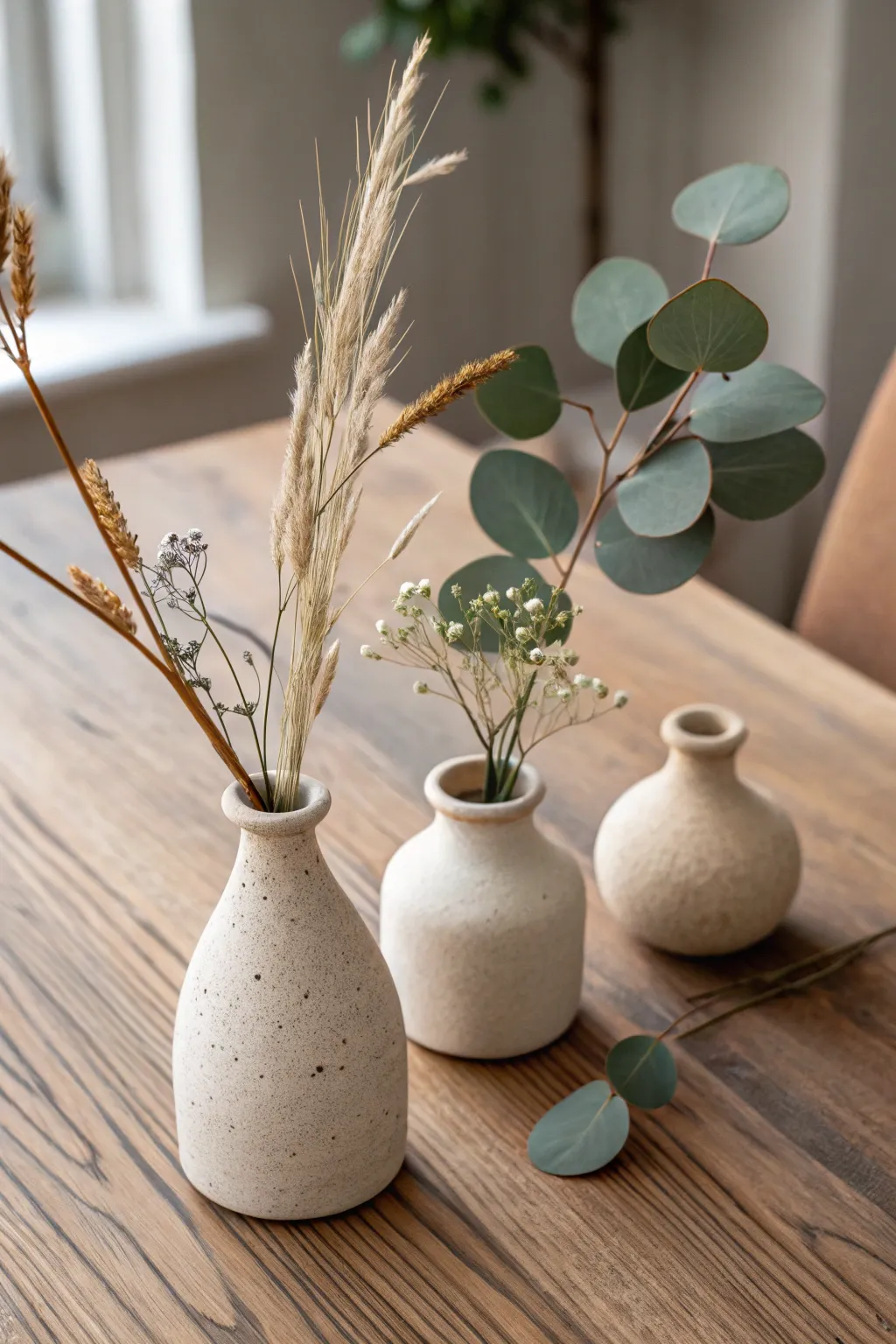
Create a charming set of mini bud vases that bring organic warmth to any table setting. These three distinct shapes—a tall bottle, a stout jar, and a rounded bulb—work together harmoniously thanks to their cohesive speckled clay body and matte finish.
Step-by-Step Tutorial
Materials
- Speckled stoneware clay (approx. 2 lbs)
- Pottery wheel
- Throwing sponge
- Needle tool
- Wire cutter
- Wooden modeling tool
- Rib tool (wooden or metal)
- Chamois leather strip
- Trimming tools
- Matte white or clear glaze (food safe if desired)
- Kiln
Step 1: Throwing the Tall Bottle
-
Prepare the clay:
Begin by wedging roughly 3/4 lb of speckled clay until it is uniform and free of air bubbles. Center it firmly on the wheel head. -
Open and lift:
Open the clay down to the base, leaving about a half-inch of thickness for the bottom. Pull the walls upward into a tall cylinder, keeping the diameter relatively narrow. -
Shape the belly:
From the inside, gently push the clay outward at the bottom third to create a subtle belly that tapers upward. -
Collar the neck:
Using both hands, gently collar the top section inwards to narrow the neck. Do this gradually to prevent the clay from buckling. -
Form the rim:
Once the neck is sufficiently narrow, use your thumb or a wooden tool to flare the very top lip outward, creating a small, rounded rim.
Clean Rims
Use a small strip of chamois leather held over the rim while the wheel spins to compress the lip and make it perfectly smooth.
Step 2: Throwing the Stout Jar
-
Center a smaller amount:
For the middle vase, use about 1/2 lb of clay. Center it low and wide compared to the first piece. -
Create the cylinder:
Pull the walls up, focusing on maintaining a slightly wider base. The height should be about two-thirds of your first vase. -
Round the shoulder:
Clean up the outside profile with a rib tool, pushing the shoulder in slightly to define a distinct transition from the body to the neck. -
Finish the lip:
Create a short, upright neck and finish with a rolled rim similar to the first vase to maintain stylistic unity.
Step 3: Throwing the Bulb Vase
-
Center the smallest portion:
Take the remaining clay (approx. 1/3 lb) and center it into a small mound. -
Shape a sphere:
Open the form and pull the walls, immediately shaping them into a bulbous, spherical body. Keep the opening quite small. -
Refine the neck:
This vase needs almost no neck height—just a small unexpected flare at the opening. Smooth the rim with a chamois piece.
Minimalist Finish
Try glazing only the inside of the vases. The raw, fired speckled clay on the outside looks incredibly modern and earthy.
Step 4: Trimming and Glazing
-
Drying:
Allow all three pieces to dry to a leather-hard state. I find covering them loosely with plastic overnight helps even out the moisture. -
Trimming the feet:
Invert each vase on the wheel (using a chuck for the tall one if necessary). Trim away excess weight from the bottom and carve a clean foot ring. -
Smooth the surface:
Before bisque firing, use a slightly damp sponge to wipe down the exterior. This exposes the natural grog or speckles in the clay body. -
Bisque fire:
Fire the pieces to cone 04 (or your clay’s specific bisque temperature). -
Apply glaze:
Dip the vases into a matte white or transparent glaze. If you want the raw clay texture to shine, you can leave the exterior unglazed and just glaze the interior for water tightness. -
Final firing:
Glaze fire to the maturity temperature of your clay (likely Cone 5 or 6 for stoneware).
Now you are ready to forage for some dried grasses or eucalyptus stems to complete the look
Magnet Set With Simple Icons
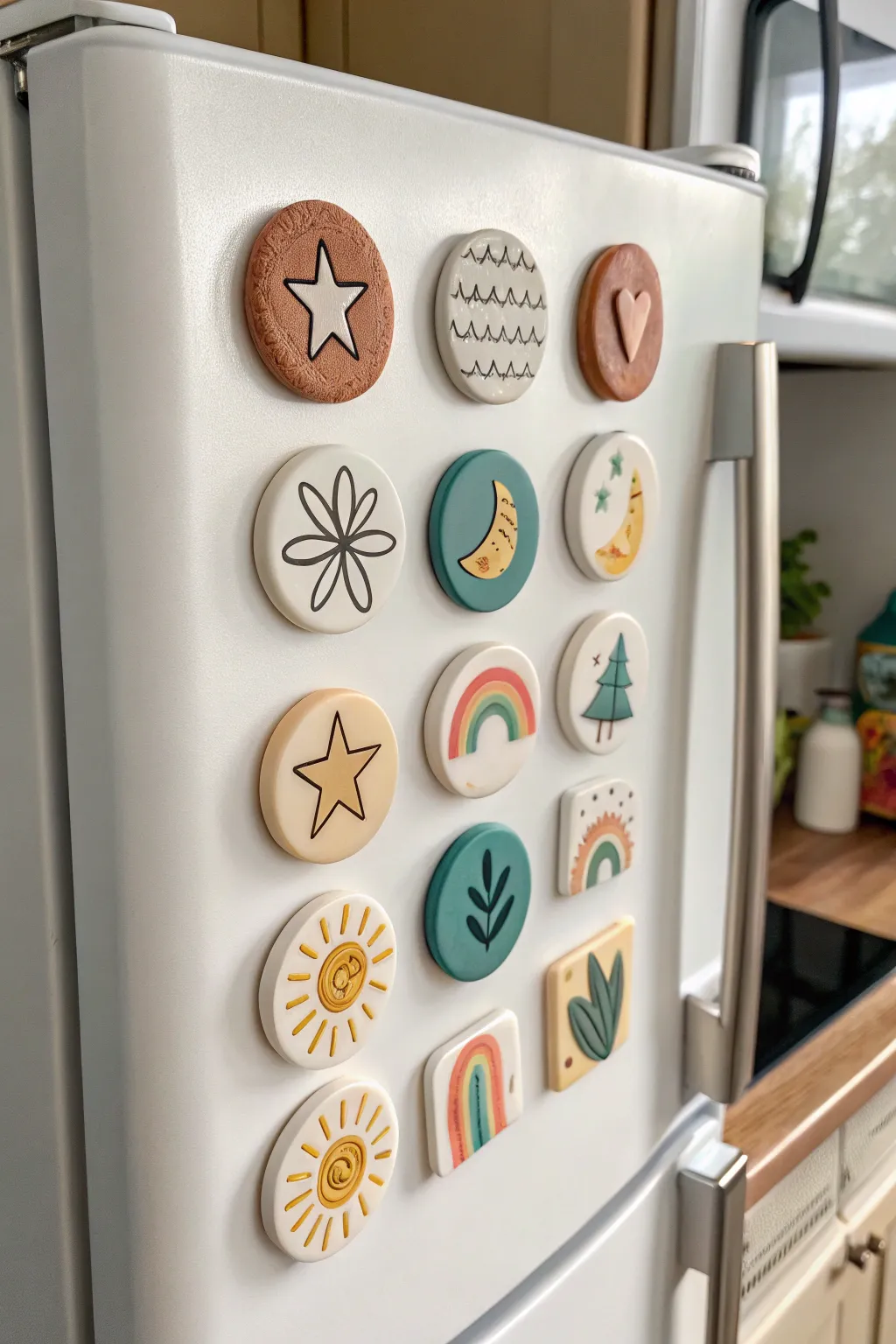
These charming polymer clay magnets combine earthy tones with simple, symbolic icons to bring a touch of bohemian flair to your kitchen. With a mix of embossed textures and raised relief details, this project is perfect for using up clay scraps while creating a cohesive, stylish set.
Step-by-Step Guide
Materials
- Polymer clay (white, terracotta, sage green, mustard yellow, beige, muted teal)
- Round clay cutter (approx. 1.5 inch diameter)
- Square clay cutter (approx. 1.5 inch)
- Acrylic rolling pin
- Parchment paper or ceramic tile work surface
- Texture sponge or sandpaper (optional)
- Small star cutter
- Needle tool or toothpick
- Super glue or E6000
- Strong round magnets (neodymium recommended)
- Oven for baking
Step 1: Base Preparation
-
Condition the clay:
Begin by conditioning each color of polymer clay in your hands until it is soft and pliable. This prevents cracking later. -
Roll the slabs:
Roll out your clay colors into slabs that are roughly 1/4 inch thick. You want them sturdy enough to hold a magnet but not too heavy. -
Cut the shapes:
Use your round and square cutters to punch out the base shapes. For the set shown, cut mostly circles in white, terracotta, and teal, plus a few squares in white. -
Texture the surface:
For the terracotta star and white wave magnets, gently press a texture sponge or coarse sandpaper onto the surface to give it a stone-like effect before baking.
Fixing Fingerprints
If you see fingerprints on your raw clay, lightly brush the surface with a little baby oil or cornstarch before baking to smooth them away instantly.
Step 2: Creating the Designs
-
Emboss linear designs:
For the flower magnet, use a needle tool to gently unwillingly carve the petal shapes into a white round base. Press deep enough to see the lines clearly but don’t cut all the way through. -
Make the wave pattern:
On a textured white circle, use the very tip of a small round cutter or a specialized U-shaped tool to imprint rows of small arches, creating a repetitive wave pattern. -
Cut out appliqué shapes:
Roll out thinner slabs (about 1/8 inch) of contrasting colors. Use small cutters or a craft knife to cut out stars, crescent moons, and hearts. -
Assemble the appliqués:
Gently press the cut-out shapes onto their base circles. The clay should stick on its own, but a tiny drop of liquid clay or translucent sculpey can ensure a permanent bond. -
Build the rainbow:
Roll tiny snakes of pink, yellow, and teal clay. Arch them together on a white base to form a rainbow, trimming the bottom edge flat with a blade. -
Create the sun design:
For the suns, press a small ball of yellow clay into the center of a white circle. Use a needle tool to imprint a swirl into the yellow center. -
Add sun rays:
Roll very thin little logs of yellow clay for the rays. Press them radially around the center sun, flattening them slightly so they adhere. -
Form the leaves:
Shape small teardrops of sage green clay. Flatten them slightly and use a needle tool to press a central vein down the middle. Arrange these on a teal or square beige base. -
Add doodle details:
For the moon designs, use a needle tool to scratch tiny stars or sleeping eyes directly onto the yellow crescent shape before placing it on the teal background.
Step 3: Finishing Up
-
Smooth the edges:
Before baking, run your finger gently around the rim of each magnet to smooth out any sharp edges left by the cutters. -
Bake the clay:
Place all pieces on a baking sheet lined with parchment paper. Bake according to your polymer clay package instructions—usually around 275°F (135°C) for 15-20 minutes. -
Cool down:
Allow the clay rounds to cool completely on the baking sheet. They will harden fully as they return to room temperature. -
Attach magnets:
Flip the cooled clay pieces over. Apply a strong dab of super glue or E6000 to the back and press a magnet firmly into the glue. -
Let the glue cure:
Allow the glue to cure undisturbed for at least 24 hours to ensure the magnets won’t pop off when you open the fridge.
Glossy Accents
After baking, apply a layer of UV resin or glossy embrace varnish just to the raised icons (like the heart or rainbow) to make them pop against the matte base.
Now you have a custom gallery of art right on your refrigerator door
Mini Succulent Pot Set
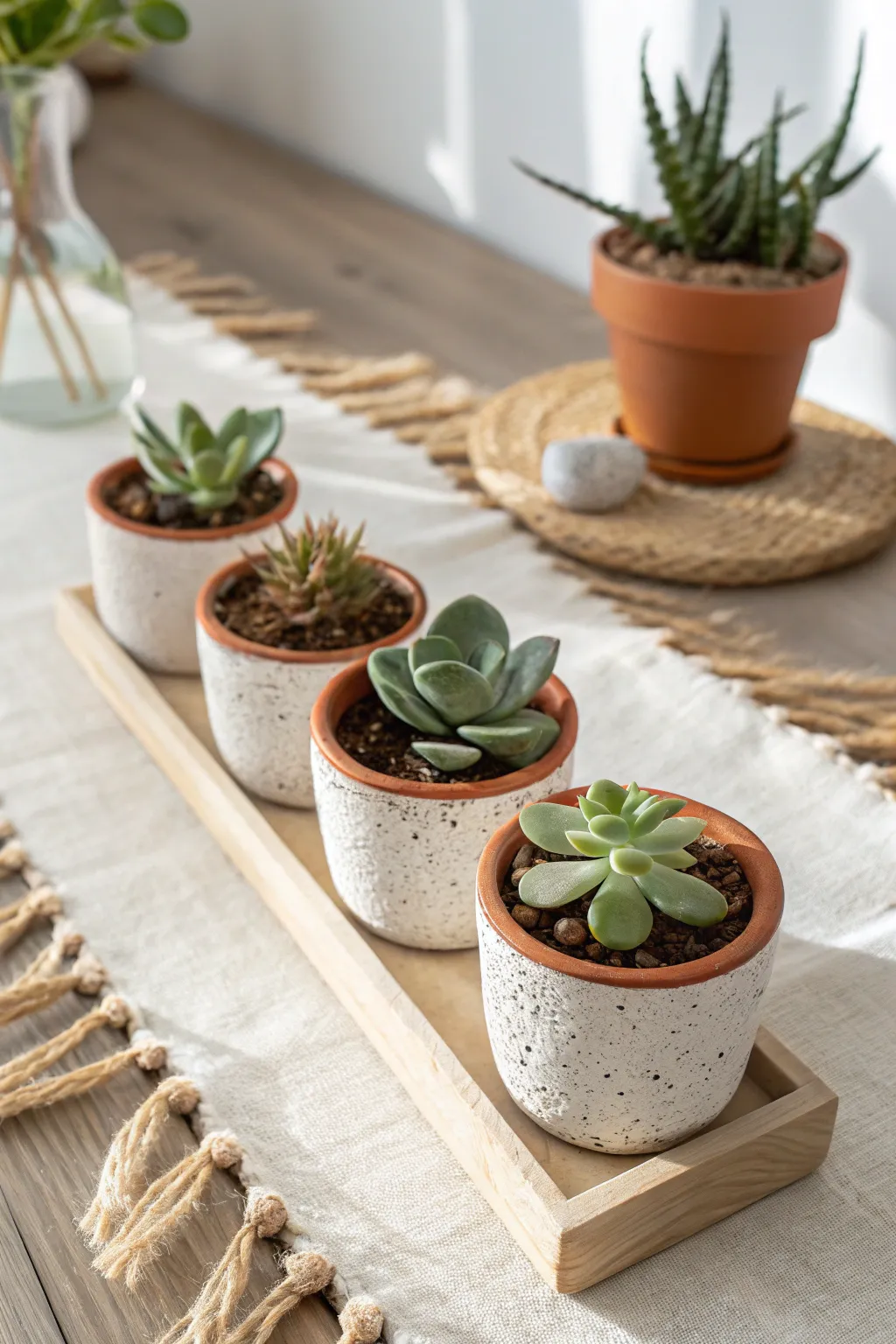
Bring desert chic into your home with these charming two-toned pots that mimic the look of speckled stoneware. This project uses basic terracotta pots as a base, transforming them with textured paint techniques to create a cohesive, modern set perfect for your favorite succulents.
Step-by-Step
Materials
- 4 small terracotta pots (2-3 inches diameter)
- White acrylic paint (matte finish)
- Black acrylic paint
- Sea sponge or stiff stippling brush
- Painter’s tape or masking tape
- Old toothbrush
- Cardboard box or drop cloth
- Matte spray sealant/varnish
- Small paintbrush
Step 1: Prepping the Base
-
Clean and Dry:
Begin by thoroughly wiping down your terracotta pots with a damp cloth to remove any manufacturing dust or oils. Let them dry completely before applying any tape or paint. -
Tape the Rim:
To achieve that distinct terracotta rim shown in the finish, you need to mask off the top edge. Place a strip of painter’s tape around the exterior rim of each pot, pressing down firmly to seal the edge so paint doesn’t bleed underneath. -
Protect the Interior:
Stuff a bit of newspaper or tape inside the rim to keep the interior clean, although a little overspray inside isn’t a disaster for a planter.
Uneven Speckles?
If you accidentally create large blobs instead of fine mist, quickly wipe the wet paint off with a damp paper towel and try again with less paint on the brush.
Step 2: Creating the Stone Texture
-
Apply the Base Coat:
Squeeze out a generous amount of white matte acrylic paint. Using a sea sponge or a stiff stippling brush, dab the paint onto the exposed terracotta body beneath the tape. Dabbing rather than brushing creates a subtle texture that resembles ceramic glazing. -
Add a Second Layer:
Once the first coat is dry to the touch (usually 15-20 minutes), apply a second coat using the same dabbing motion. Ensure full coverage so no orange clay peeks through the white section. -
Prepare Speckle Paint:
Mix a small amount of black acrylic paint with a few drops of water to thin it down. It should be the consistency of ink or heavy cream—fluid enough to splatter easily. -
Splatter Technique:
Place your white-painted pots inside a cardboard box to catch stray splashes. Dip an old toothbrush into the thinned black paint, hold it near the pots, and run your thumb across the bristles to flick tiny specks onto the white surface. -
Check Density:
Go slowly and rotate the pots frequently. You want an even distribution of speckles all around, but try to keep them fine and subtle to mimic natural stone inclusions. -
Dry Thoroughly:
Allow the speckled paint to dry completely. This usually takes about 30 minutes, but I like to give it an hour just to be safe before handling.
Step 3: Finishing and Assembly
-
Remove the Tape:
Calmly peel away the painter’s tape from the rim. Pull the tape at a 45-degree angle away from the painted edge to ensure a crisp line between the white body and the natural terracotta rim. -
Touch Up Edges:
If any white paint bled under the tape, carefully scrape it off with a craft knife or use a small brush with water to gently scrub it away while the paint is still relatively fresh. -
Seal the Finish:
Take the pots outside or to a well-ventilated area and spray them with a matte sealant. This protects the acrylic paint from moisture when you water your plants. -
Final Cure:
Let the sealant cure according to the manufacturer’s instructions, typically overnight, before planting. -
Planting:
Fill each pot with a well-draining succulent soil mix and gently nestle your chosen succulents into their new homes.
Tinted Stone Look
Mix a tiny drop of beige or grey into your white base coat before sponging it on. This creates a warmer ‘sandstone’ vibe rather than stark white.
Arrange your completed trio on a wooden tray for a stunning, minimalist display that brightens up any windowsill
Suncatcher Charm Set
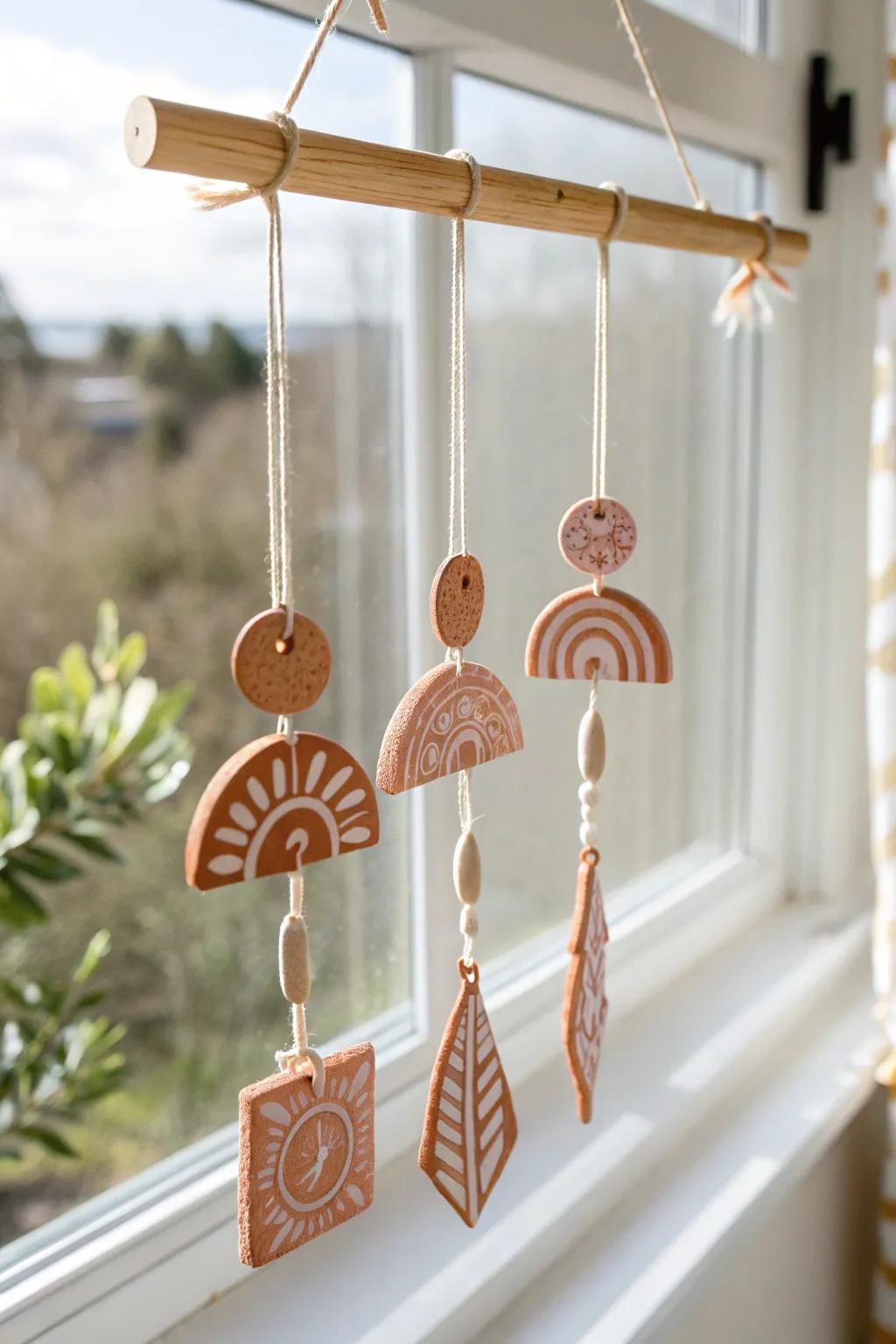
Bring earthy warmth to your window with this geometric clay mobile featuring hand-painted motifs. The combination of terracotta tones and crisp white lines creates a serene, bohemian aesthetic perfect for catching the afternoon light.
Step-by-Step Tutorial
Materials
- Air-dry clay (terracotta color) or oven-bake polymer clay
- Rolling pin
- Parchment paper or silicone mat
- Clay sculpting tools or a sharp craft knife
- Cookie cutters (circle, square, teardrop) – optional but helpful
- Drinking straw or skewer (for making string holes)
- White acrylic paint
- Fine-point paintbrush (size 0 or 00)
- Wooden dowel (approx. 12 inches long)
- Natural twine, hemp cord, or butchers twine
- Wooden beads (natural finish)
- Sandpaper (fine grit)
- Clear matte sealant spray (optional)
Step 1: Shaping the Clay Elements
-
Condition the clay:
Begin by kneading your terracotta clay until it’s soft, pliable, and free of cracks. If you are using air-dry clay, keep a small bowl of water nearby to smooth out any dry edges. -
Roll out the slab:
Place the clay on a sheet of parchment paper and roll it out to a consistent thickness of about 1/4 inch. If you struggle with even thickness, place two rulers on either side of the clay as guide rails for your rolling pin. -
Cut the geometric shapes:
You will need to cut three distinct sets of shapes to match the image. For the left strand: cut a small circle, a semi-circle, and a square. For the middle strand: a small circle, a semi-circle, and an elongated diamond or teardrop. For the right strand: a small circle, a semi-circle, and a leaf-like drop shape. -
Smooth the edges:
Dip your finger in a little water (for air-dry clay) or baby oil (for polymer) and gently run it along the cut edges of each shape to remove any burrs or sharpness. This gives the final piece a polished, professional look. -
Pierce holes for hanging:
Using a straw or skewer, poke holes through the clay for threading. Each piece needs a hole at the top and bottom, except for the very bottom charms (the square, diamond, and leaf), which only need a top hole. Ensure the holes are large enough for your twine to pass through easily.
Fixing Cracks
If air-dry clay cracks while drying, mix a tiny bit of fresh clay with water to make a paste (slip) and fill the crack. Smooth it over and let dry again.
Step 2: Painting and Assembly
-
Dry or bake the pieces:
Follow the instructions for your specific clay. If baking polymer clay, place the parchment paper directly on a baking sheet. For air-dry clay, allow 24-48 hours for drying, flipping the pieces occasionally to prevent curling. -
Sand imperfections:
Once fully cured and hard, lightly sand rough edges with fine-grit sandpaper. Wipe away any clay dust with a damp cloth or soft brush before painting. -
Paint the designs:
Using a fine-point brush and white acrylic paint, add the patterns. Paint sunburst rays on the semi-circles, rainbow arches on others, and geometric lines on the bottom charms. I prefer to keep my hand steady by resting my pinky finger on the table while painting these delicate lines. -
Let the paint cure:
Allow the white paint to dry completely. If you want extra durability, apply a light coat of matte sealant spray at this stage. -
Prepare the dowel:
Cut your wooden dowel to approximately 10-12 inches. Cut a long piece of twine (about 20 inches) to create the main hanger, tying it securely to both ends of the dowel. -
Assemble the left strand:
Cut a piece of twine roughly 18 inches long. Tie it to the dowel. Thread the small circle, knot underneath it to hold it in place, then the semi-circle (knot again), add a wooden bead, and finally tie on the square charm at the bottom. -
Assemble the middle strand:
Repeat the process for the center strand, ensuring it hangs slightly lower or higher than the first to create visual interest. Thread: small circle, semi-circle, wooden bead, and the elongated diamond charm. -
Assemble the right strand:
Finish with the third strand. Thread: small circle, semi-circle, wooden bead, and the final leaf-shaped charm. Adjust the knots as you go so the spacing looks balanced across all three strands. -
Trim excess twine:
Once you are happy with the lengths and knot security, trim any excess twine tail ends close to the knots for a clean finish.
Add Some Sparkle
Mix gold metallic paint with the white acrylic or use gold leaf on the accents to make the design catch the sunlight even more.
Find a sunny spot to hang your new creation and enjoy the cozy atmosphere it brings to the room
Polymer Clay Jewelry Capsule Set
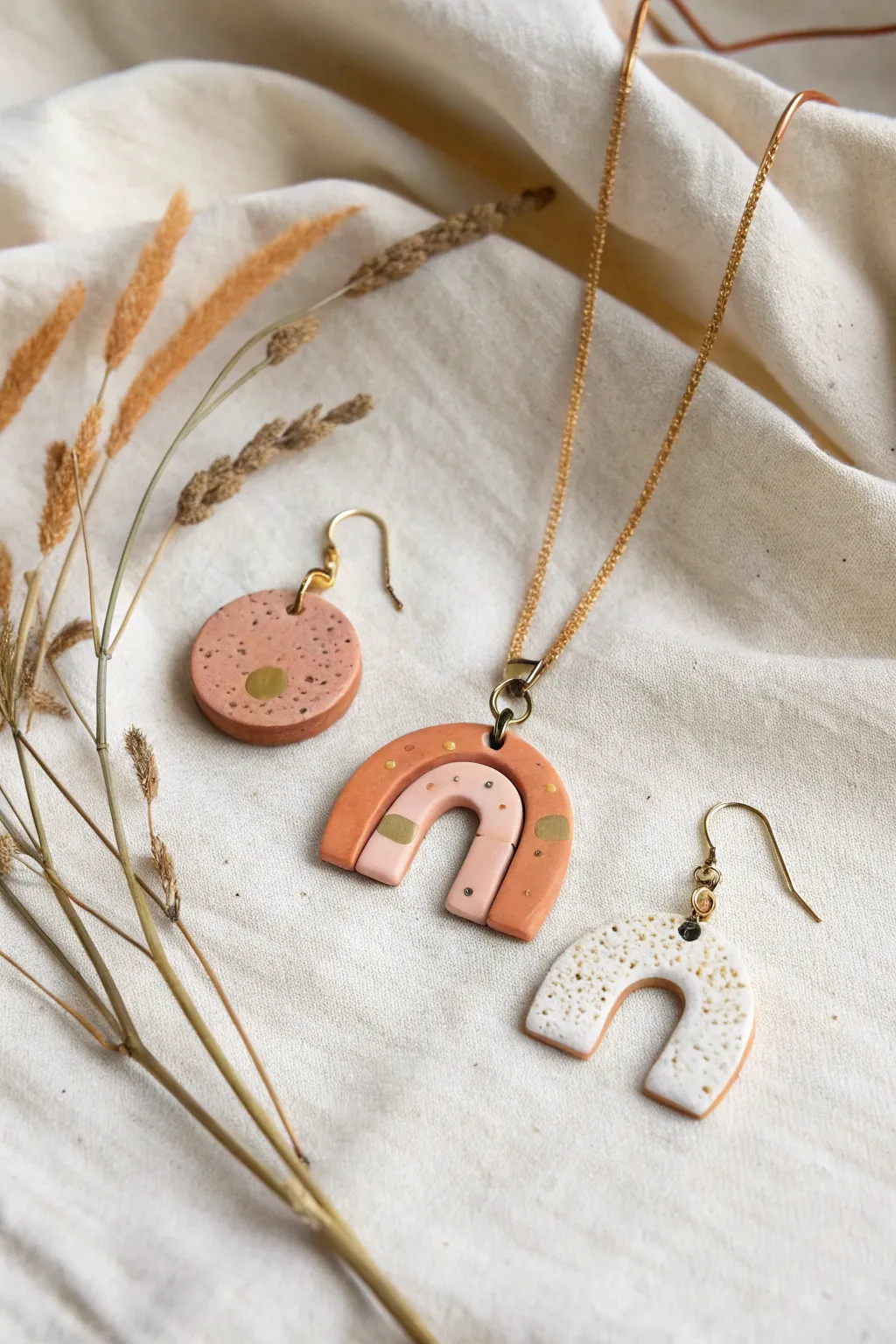
These delicate polymer clay pieces combine warm terracotta, soft blush, and speckled white for a cohesive, bohemian jewelry set. Featuring simple geometric shapes like circles and arches, the designs are elevated with textured speckling and hand-painted gold accents.
Detailed Instructions
Materials
- Polymer clay in terracotta, blush pink, and white
- Coarse black pepper or dark clay crumbs (for speckling)
- Acrylic rolling pin
- Circle cutter (approx. 1 inch)
- Small U-shaped or rainbow cutters (nested sizes)
- X-Acto knife or clay blade
- Gold leaf paint or gold acrylic paint
- Fine detail paintbrush
- Jump rings (gold finish)
- Earring hooks (gold finish)
- Necklace chain with clasp
- Jewelry pliers (round nose and flat nose)
- Small hand drill or needle tool
- Parchment paper and baking sheet
Step 1: Preparing the Speckled Clay
-
Condition the clay:
Start by kneading each color of polymer clay—terracotta, blush pink, and white—individually until they are soft and pliable. This prevents cracking later on. -
Add texture:
To create the organic, speckled stone look seen in the white and terracotta pieces, sprinkle a tiny pinch of coarse black pepper or dry, crumbly dark clay over the flattened sheets. -
Fold and roll:
Fold the clay over the speckles and roll it out, then fold again. Repeat this process until the speckles are evenly distributed throughout the clay body without blending colors. -
Roll to thickness:
Roll all your clay colors out into sheets of even thickness, approximately 3mm thick. I find playing cards stacked on either side of the roller help keep the thickness consistent.
Smooth Edge Secret
Before baking, dip your fingertip in a tiny bit of acetone or baby oil and gently rub the cut edges of your clay. It melts away fingerprints and jagged bits for a professional finish.
Step 2: Creating the Earrings
-
Cut the circle stud:
Using your circle cutter, stamp out a shape from the speckled terracotta clay. Smooth the edges gently with your fingertip to remove any stray bits. -
Cut the white arch:
From the speckled white clay, use a U-shaped cutter to punch out an arch shape. If you don’t have a cutter, you can trace a U-shape on paper and cut around it with your X-Acto knife. -
Create hanging holes:
Before baking, use a needle tool or toothpick to create holes for your hardware. For the circle, place the hole near the top edge. For the white arch, center the hole at the very peak of the arch.
Step 3: Assembling the Pendant
-
Cut the outer arch:
Cut a large arch shape from the plain (non-speckled) terracotta clay. This will be the main body of your pendant necklace. -
Cut the inner arch:
Using a smaller nested cutter, punch a smaller arch from the blush pink clay. It should fit snugly or sit slightly inside the terracotta arch. -
Join the pieces:
Gently press the pink arch inside the terracotta arch. You may need to apply a tiny amount of liquid clay or translucent sculpey as ‘glue’ on the seams to ensure they bond permanently during baking. -
Add the hardware loop:
Twist a small eye pin or create a loop with wire and insert it into the top center of the terracotta arch so the necklace can hang properly. -
Bake the batch:
Arrange all pieces on a parchment-lined baking sheet. Bake according to your brand of clay’s instructions (usually 275°F/135°C for 15-30 minutes per 1/4 inch thickness).
Make It a Matching Set
Create a matching ring by gluing a smaller terracotta circle onto a flat pad ring blank using E6000 glue after baking. Add a single gold dot to tie it all together.
Step 4: Finishing Touches
-
Cool down:
Allow the pieces to cool completely before handling. They are fragile when hot but harden as they return to room temperature. -
Paint gold details:
Dip a fine detail brush into your gold paint. Add a small off-center circle to the terracotta earring and tiny random dots to the necklace pendant for a touch of shimmer. -
Add geometric gold:
On the necklace, carefully paint small gold rectangles or dashes at the seam where the pink meets the terracotta, enhancing the connection point. -
Let paint dry:
Wait for the paint to dry fully. If you used an oil-based metallic, this might take longer than acrylics. -
Attach earring hooks:
Using your pliers, open a jump ring, slide it through the hole in your white arch earring, add the hook, and close it securely. Repeat for the circle earring. -
Assemble the necklace:
Thread your gold chain through the loop or jump ring attached to the top of your rainbow pendant.
Now you have a stunning, coordinated jewelry set ready to wear or gift
Marbled Bead and Charm Set
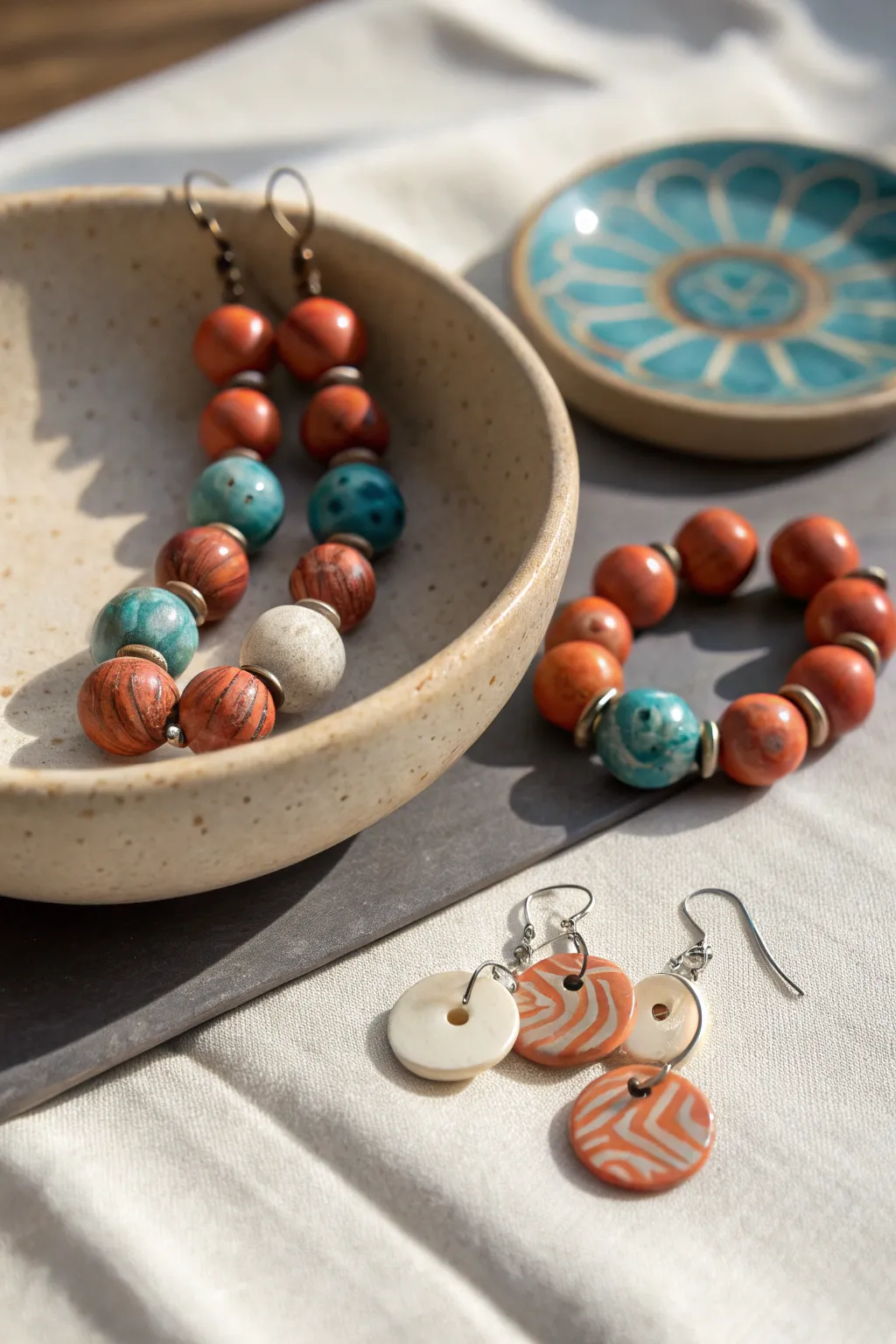
Create a unified artisanal jewelry set featuring a necklace, bracelet, and earrings using hand-rolled clay beads. The design combines earthy terracotta tones with striking turquoise accents and zebra-striped charms for a relaxed, bohemian aesthetic.
How-To Guide
Materials
- Polymer clay in terracotta (rust orange), turquoise, white, and translucent
- Acrylic rolling pin or clay pasta machine
- Silver metal spacer beads (various sizes)
- Small silver jump rings
- Earring hooks (silver)
- Eye pins and head pins
- Strong elastic cord (for bracelet)
- Toothpicks or bead reamer
- Round nose pliers
- Chain nose pliers
- Wire cutters
- Baking sheet and parchment paper
- Gloss glaze (optional)
Step 1: Crafting the Round Beads
-
Condition the clay:
Start by warming the terracotta and turquoise clays in your hands until they are soft and pliable. This step is crucial to prevent cracking later. -
Portion the clay:
Pinch off equal amounts of terracotta clay to form approximately 15-20 medium-sized balls. Do the same with the turquoise clay for about 5-6 balls. Consistency in size helps the finished jewelry look professional. -
Create the marble effect:
For the turquoise beads, take a tiny sliver of white or translucent clay and mix it partially into the blue to create subtle swirls. Don’t overmix; you want distinct veins of color. -
Roll spheres:
Roll each portion between your palms using a circular motion until you have perfectly smooth spheres. Applying gentle, even pressure eliminates fingerprints. -
Texture the terracotta:
To mimic the wood-like grain seen in the image, lightly score the surface of the terracotta beads with a needle tool or toothpick. Adding thin streaks of dark brown clay before rolling can also achieve this striped effect. -
Pierce holes:
Carefully insert a toothpick or bead pin through the center of each sphere. Twist gently as you push through to avoid deforming the round shape.
Fixing Fingerprints
Before baking, lightly brush your raw clay beads with a little cornstarch or baby oil. This smooths out accidental fingerprints for a pro finish.
Step 2: Making the Patterned Disc Charms
-
Prepare the zebra pattern:
Roll out a flat sheet of terracotta clay and a thinner sheet of white clay. Cut thin, irregular strips of the white clay. -
Layer the pattern:
Lay the white strips onto the terracotta sheet in a random, zebra-like pattern. Use your rolling pin to flatten the two colors together until the surface is completely smooth level. -
Cut the discs:
Use a small circle cutter to punch out four discs from your patterned sheet. Also punch out two plain white discs. -
Pierce the discs:
Use a smaller tool to create a hole near the top edge of each disc for the jump rings. For the white discs, create a larger, distinct center hole if desired for the focal point. -
Bake:
Arrange all your beads and discs on a parchment-lined baking sheet. Bake according to your clay manufacturer’s instructions (usually 275°F/135°C for 15-30 minutes).
Step 3: Assembling the Bracelet
-
layout the design:
Arrange your baked beads on a mat: alternate the terracotta beads with silver spacer beads. Place a turquoise accent bead as the focal point, flanked by spacers. -
String the beads:
Cut a length of elastic cord about 10 inches long. Thread your pattern onto the cord. I prefer to prestretch the elastic slightly before stringing to prevent sagging later. -
Tie the knot:
Tie a secure surgeon’s knot (right over left, left over right twice). Add a dab of glue to the knot before trimming the excess cord.
Go High Gloss
Apply a coat of UV resin or glossy water-based varnish to the turquoise beads after baking. This makes them look like real ceramic or polished stone.
Step 4: Assembling the Necklace & Earrings
-
Link the necklace beads:
Thread each bead onto an eye pin. creating a loop at the other end with round nose pliers. Connect these links together, alternating colors as shown in the bowl. -
Finish necklace ends:
Attach a chain or cord to the ends of your bead strand to reach your desired necklace length. -
Assemble the earrings:
Using small jump rings, attach the patterned clay discs to the plain white discs. Layer them so they stack interestingly. -
Attach hooks:
Open the loop on your earring hooks and attach them to the top jump ring of your assembled disc cluster. Close the loop securely.
Now you have a stunning, cohesive set of handmade jewelry ready to wear or gift
Tiny Play Food Set
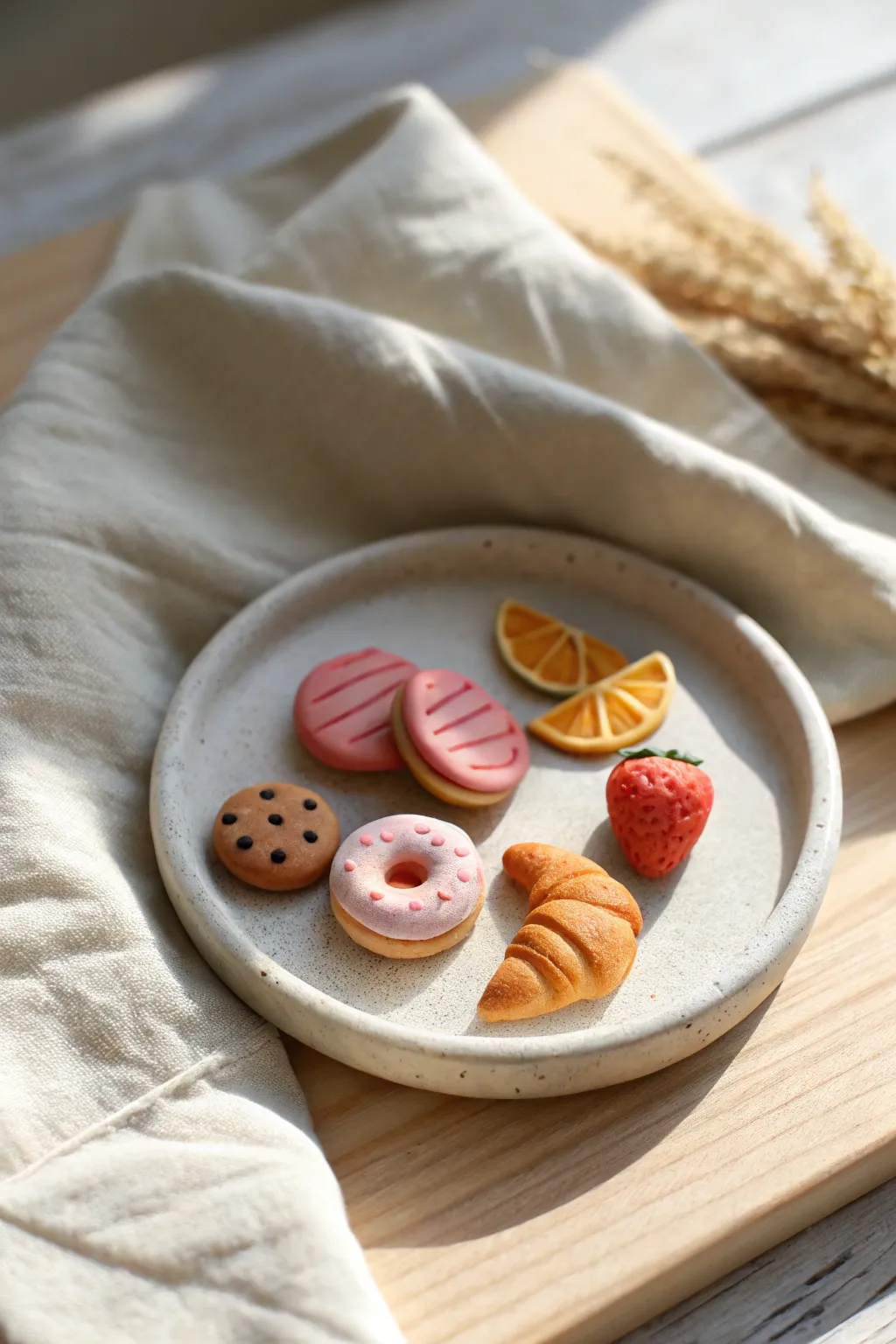
Recreate a charming collection of tiny treats perfect for a dollhouse or decorative display, featuring everything from a buttery croissant to a sweet pink donut. This project focuses on achieving realistic textures like baked pastry and citrus pulp using simple tools and soft, pastel clay tones.
Detailed Instructions
Materials
- Polymer clay (white, tranlucent, beige/tan, pink, orange, red, brown)
- Needle tool or toothpick
- Soft pastel chalks (brown, orange, red) for shading
- Small paintbrush
- Liquid polymer clay or gloss glaze (optional)
- Toothbrush or crumpled foil (for texturing)
- Small circle cutter
- Flexible blade or craft knife
Step 1: Shaping the Baked Goods
-
The Croissant:
Mix beige clay with a tiny bit of white to create a dough color. Roll a small log, tapering the ends to points. Flatten the center slightly and roll it up from the middle towards the tips, curving the overall shape into a crescent moon. -
Croissant Texture:
Using a needle tool, gently impress lines across the rolled sections to accentuate the layers. Dust a dry paintbrush with brown soft pastel shavings and lightly brush the top of the croissant to mimic a golden-baked finish. -
The Chocolate Chip Cookie:
Flatten a small ball of tan clay into a thick disc. Use a toothbrush or a ball of crumpled foil to tap the surface repeatedly, creating a realistic crumb texture. -
Adding Chips:
Roll tiny specks of dark brown clay into irregularly shaped balls. Press these firmly into the textured cookie surface, ensuring they look embedded rather than just sitting on top. -
The Donut:
Shape a ball of tan clay and flatten it slightly. Use a small tool or the end of a paintbrush to poke a hole through the center, smoothing the edges of the hole so the dough looks rounded. -
Donut Frosting:
Roll out a very thin sheet of light pink clay. Cut a wavy, irregular circle that is slightly smaller than the donut. Lay this on top of the tan base, smoothing the edges down so it looks like poured glaze. -
Donut Decoration:
Roll impossibly thin ‘snakes’ of darker pink clay and slice them into tiny segments to create sprinkles. Gently press these onto the pink frosting.
Pastel Shading Tip
For the realistic ‘baked’ look, apply shaved orange or brown pastel chalk with a dry brush *before* baking. The clay absorbs the pigment for a natural gradient.
Step 2: Crafting Fruit & Confections
-
Citrus Slices – The Rind:
Roll a snake of white clay and wrap it in a sheet of orange clay. Then wrap *that* cylinder in a thin sheet of white clay, and finally a thin sheet of yellow-orange skin color. -
Citrus Cane:
Reduce this cane by rolling it until it is quite thin, then slice it into segments. This is a basic method, but for the specific look in the photo, you can also sculpt individual segments: Make small wedges of orange clay, cover the sides in thin translucent white clay, and assemble them into a wheel before wrapping in the rind. -
Textures of Citrus:
Slice your cane or assembled wheel in half to make semi-circles. Use a needle tool to gently scratch and roughen the orange ‘meat’ of the fruit to simulate juicy pulp cells. -
The Strawberry:
Mold red clay into a teardrop shape. Using a needle tool, poke tiny, shallow holes all over the surface for seeds. I find it helpful to start from the bottom tip and work upwards in spiral rows. -
Strawberry Leaves:
Create a tiny star shape from green clay or darker teal clay as shown in the photo. Place this ‘calyx’ on the flat top of the strawberry and texture it slightly with a needle. -
Pink Macarons:
Roll out pink clay and cut two identical small circles. Texture the very bottom edge of each circle with your needle tool to create the ‘feet’ (the ruffly edge) of the macaron shell. -
Macaron Assembly:
Roll a small ball of white or pale yellow clay for the filling, flatten it, and sandwich it between the two pink shells. Press gently so they adhere without squishing the texture. -
Final Baking:
Arrange all your pieces on a tile or parchment paper. Bake according to your brand of polymer clay instructions (usually 275°F/135°C for 15-30 minutes). Let them cool completely before handling.
Level Up: Glossy Finishes
After baking, create contrast by brushing a satin or gloss glaze over just the strawberry and the orange slices to make them look juicy, while leaving the cookies matte.
Set out your miniature feast on a tiny plate or use them as adorable charms for jewelry
Handmade Chess Set With Simple Forms
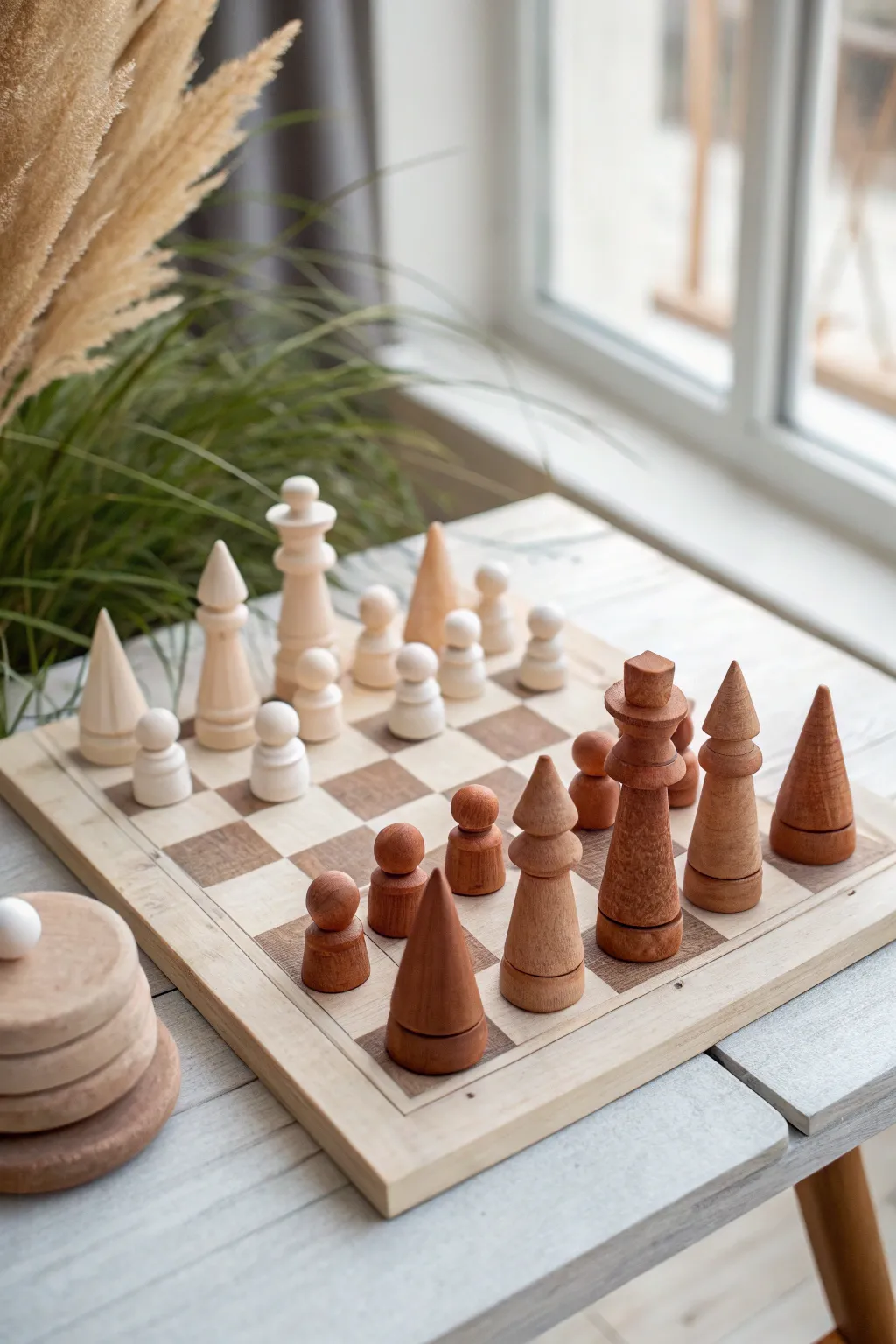
Reimagine the classic game of strategy with this sleek, minimalist chess set characterized by clean geometric forms and warm earth tones. While the original inspiration appears to be turned wood, we can achieve this same sophisticated, lathe-turned aesthetic using polymer or air-dry clay and simple shaping techniques.
Step-by-Step
Materials
- Polymer clay or air-dry clay (white/cream and terracotta/red-brown)
- Acrylic rolling pin
- Clay blades or sharp craft knife
- Geometric clay cutters (circles, small squares)
- Small pottery carving tools or needle tool
- Sandpaper (fine grit)
- Clear matte varnish or sealant
- Square wooden board
- Wood stain (light and dark)
- Painter’s tape
- Ruler
Step 1: Creating the Board
-
Prepare the Base:
Begin with a smooth, square wooden board. Sand the surface lightly to ensure it accepts the stain evenly. Wipe away any dust with a damp cloth. -
Grid Measurements:
Measure your board and divide the length by 8. Mark these intervals lightly with a pencil on all four sides to define your 8×8 grid. -
Masking Light Squares:
Using painter’s tape, carefully mask off the squares that will remain light. Ensure the tape edges are pressed down firmly to prevent stain bleeding. -
Staining Dark Squares:
Apply a dark wood stain to the exposed squares. Use a rag or sponge brush for an even coat. Let it dry completely before peeling off the tape. -
Finishing the Board:
Once dry, seal the entire board with a clear matte varnish to protect the surface during play.
Step 2: Sculpting the Pawns
-
Basic Pawn Shape:
Condition your clay until pliable. Roll small spheres for the pawn heads and slightly larger cylinders for the bodies. -
Assembling Pawns:
Press the sphere onto the cylinder. For the light team, create a classic ‘pawn’ shape by slightly tapering the cylinder neck. For the dark team, create a simpler, more conical shape as seen in the reference. -
Consistency Check:
Line up all 16 pawns (8 per color) to ensure they are roughly the same height. I find using a small ruler as a visual guide helps keep everything uniform.
Wobbly Pieces?
If your tall pieces (like Kings) feel unstable, embed a small washer or coin into the base of the clay before baking. This adds weight and stability.
Step 3: Sculpting Major Pieces
-
Rooks (Castles):
For the dark rooks, form a simple, sturdy cone shape. For the light rooks, shape a taller cone and score vertical lines to suggest brickwork or crenellations. -
Knights:
Keep the knights abstract. Create a base cylinder and top it with a simple, rounded cone or a sphere with a distinctive notch carved out to represent the horse’s muzzle. -
Bishops:
Roll taller, slender cones for the bishops. You can add a small collar of clay near the top to distinguish them from other pieces, mimicking the turned wood look. -
Queens:
The Queen should be the second tallest piece. Build a strong base, a tapered midsection, and a distinct crown element—either a sphere or a flattened disk on top. -
Kings:
Make the King the tallest piece. Replicate the reference by stacking geometric shapes: a base, a tall cylinder body, a ‘collar’ ring, and a crowning element like a small cross or finial spike.
Level Up: Felt Bases
Cut small circles of green or black felt and glue them to the bottom of each piece. This protects the board and gives that satisfying ‘slide’ during gameplay.
Step 4: Finishing Touches
-
Smoothing Surfaces:
Before baking or drying, use your finger dipped in a little oil (for polymer) or water (for air-dry) to smooth out any fingerprints. -
Baking or Drying:
Bake polymer clay according to package directions or let air-dry clay cure for at least 24-48 hours. -
Sanding:
Once fully cured, use fine-grit sandpaper to buff the pieces. This mimics the smooth texture of sanded wood. -
Staining Effect:
If using air-dry clay, paint the ‘dark’ set with a reddish-brown acrylic wash to simulate mahogany wood. Leave the light set natural or give it a cream wash. -
Sealing:
Finish all pieces with a matte sealant to protect them from handling oils and to unify the sheen of the set.
Set up your sleek new pieces on the board and invite a friend over for a match