
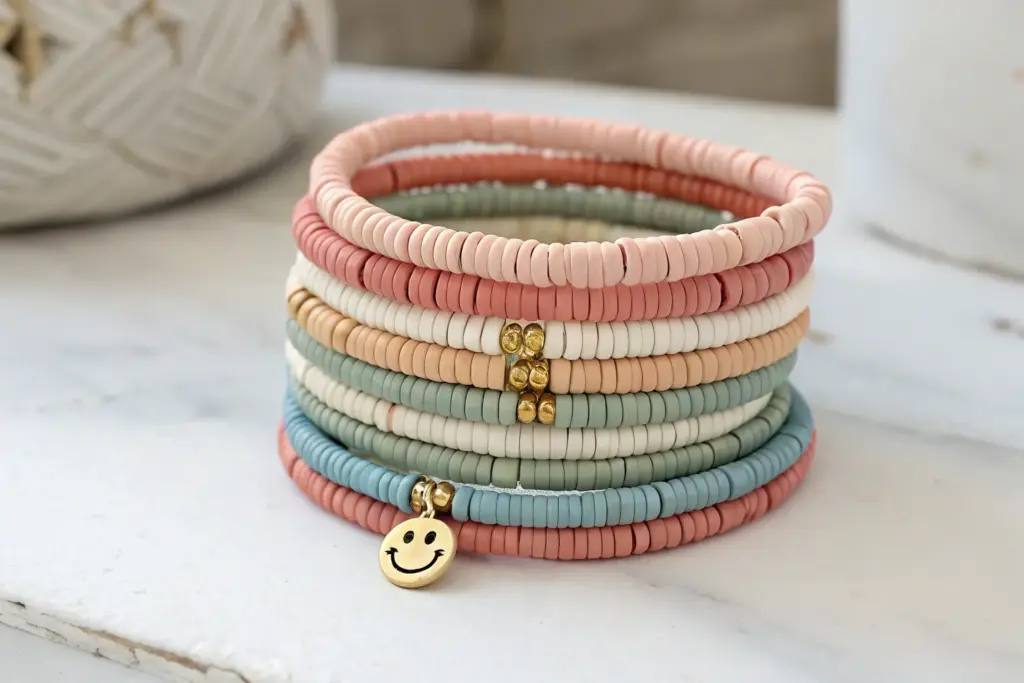
If you love that perfectly put-together look, clay bead bracelets are basically the easiest way to wear a curated color palette on your wrist. I’m sharing my favorite aesthetic clay bead bracelet ideas that feel trendy, harmonious, and totally stackable.
Classic Pastel Heishi Stack
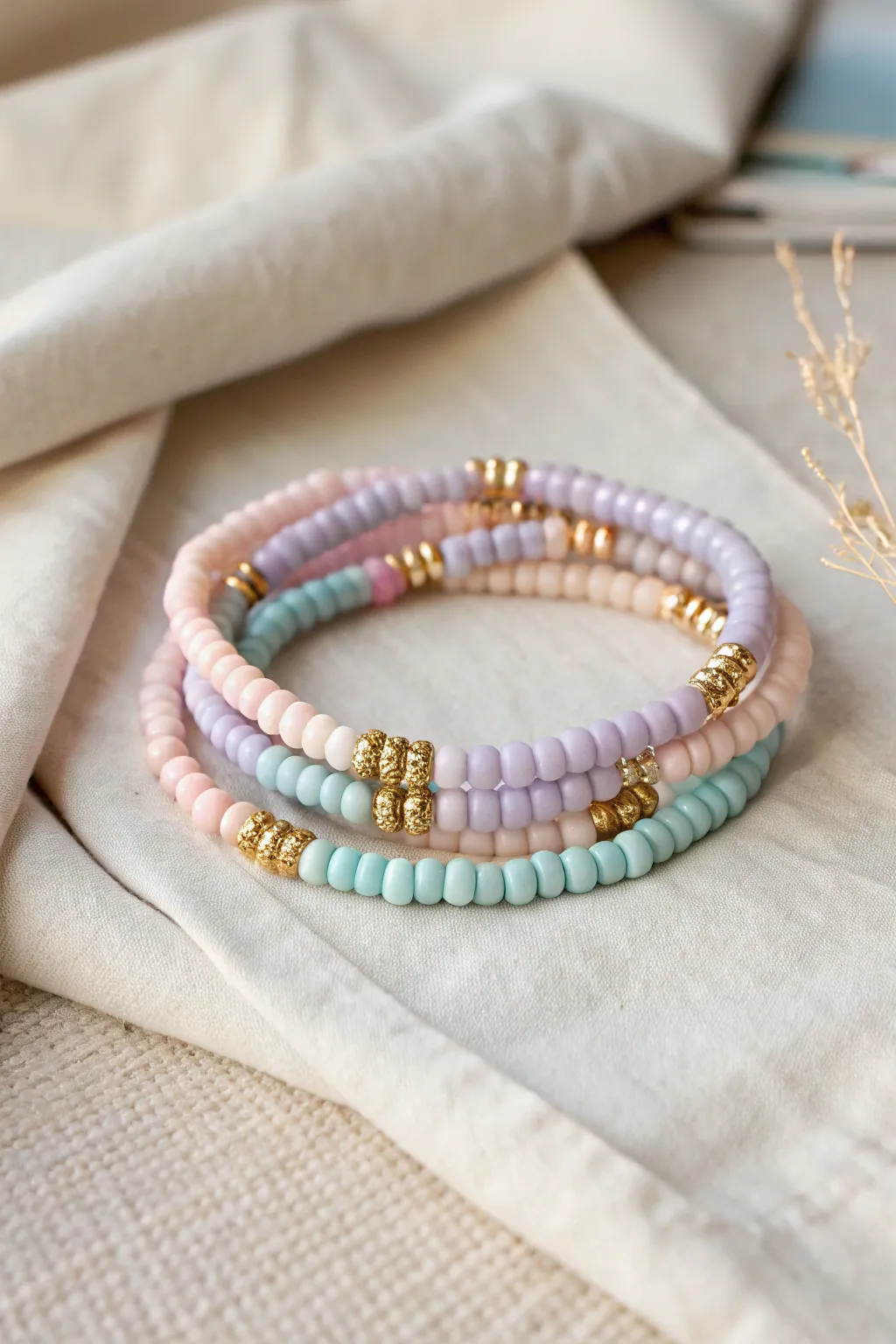
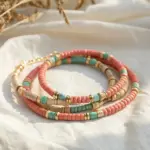
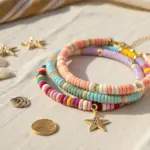
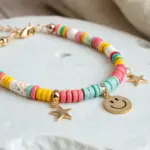
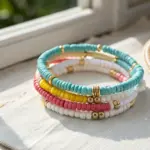
These soft, candy-colored bracelets bring a gentle pop of color to any outfit with their soothing pastel palette. Featuring a mix of matte polymer clay discs and textured gold accents, this stack is the perfect entry-level project for achieving that high-end boutique look.
Step-by-Step Guide
Materials
- Polymer clay Heishi beads (6mm or 4mm flat discs) in pastel pink
- Polymer clay Heishi beads in pastel lilac
- Polymer clay Heishi beads in pastel mint blue
- Textured gold spacer beads (disc or rondelle shape, approx 4-6mm)
- Strong elastic crystal string (0.7mm or 0.8mm recommended)
- Super glue or jewelry cement
- Scissors or jewelry nippers
- Bead stopper or tape
Step 1: Planning the Palette
-
Measure your wrist:
Wrap a piece of string around your wrist to find your size, then add about half an inch for a comfortable fit. Cut your elastic string to about 10-12 inches to give yourself plenty of room for tying knots later. -
Secure the end:
Attach a bead stopper or a piece of masking tape to one end of your elastic string. This prevents your beads from sliding off while you work, which is a lifesaver when working with these tiny discs. -
Plan the color block pattern:
For this design, color blocking is key. Decide on the order of your bracelets. Notice that in the reference, some bracelets are solid colors while others mix sections. Let’s aim for one primarily blue, one primarily pink, and one mixed or lilac.
Step 2: Stringing the Mint Bracelet
-
Start the mint base:
Begin threading the mint blue clay beads onto the elastic. Thread about 2 inches of solid blue beads. -
Add gold accents:
Slide on three textured gold spacer beads. These act as the focal point. Grouping them in threes creates a substantial, rich look compared to single spacers. -
Continue the pattern:
Continue threading mint beads until you reach the halfway point of your wrist measurement. You can add another cluster of three gold beads here if you want symmetrical sparkle. -
Finish the strand:
Fill the rest of the string with mint beads until you reach your measured length. Double-check the size by wrapping it loosely around your wrist.
Knot Slipping?
If your elastic knot feels insecure, try the ‘surgeon’s knot’ technique: loop the string through twice on the first pass instead of once. This added friction prevents the slippery crystal cord from undoing.
Step 3: Creating the Lilac & Pink Mix
-
Start with lilac:
For the second bracelet, start with your pastel lilac beads. Thread about 1.5 inches of beads. -
Insert gold spacers:
Add a pair of gold spacer beads. Unlike the blue bracelet, try using just two here for subtle variation in the stack. -
Switch to pink segments:
Thread a small section (about 0.5 inches) of pink beads, followed by one gold spacer, then switch back to lilac. This creates that charming ‘mixed’ look seen in the bottom layer of the reference image. -
Complete the length:
Continue alternating large sections of lilac with small accents of pink and gold until the bracelet matches the length of your first one.
Variation Idea
Add a few freshwater pearls or letter beads into the gold sections to personalize the stack. The irregular shape of pearls contrasts beautifully with the uniform heishi discs.
Step 4: Assembling the Pink Bracelet
-
Begin the pink strand:
On your third piece of elastic, start threading the pastel pink beads. Aim for a long, continuous section to anchor the warmth of the stack. -
Create a gold focal point:
At the center point (or randomly placed for asymmetry), add a cluster of four or five gold spacers. This heavier gold section draws the eye. -
Mix in a surprise color:
I like to add just three or four blue or lilac beads right next to the gold cluster. It visually ties this bracelet to the other two in the set. -
Finish beading:
Fill the rest of the strand with pink beads until it matches the length of the others.
Step 5: Securing the Stack
-
Pre-stretch the elastic:
Before tying, gently give each bracelet a little stretch. This ‘pre-stretching’ helps prevent the elastic from sagging or loosening after you wear it the first time. -
Tie the surgeon’s knot:
Remove the bead stopper. Cross the ends, loop one side under twice, and pull tight. Repeat this process to secure the knot firmly. -
Apply adhesive:
Dab a tiny drop of super glue or jewelry cement onto the knot. Let it dry completely before trimming. Be careful not to glue the beads to the string, just the knot itself. -
Hide the knot:
Trim the excess string close to the knot. If possible, gently slide the knot inside the hole of one of the gold beads (which usually have larger holes) to hide it completely.
Now slide on your new stack and enjoy the soft pastel vibes on your wrist
Clean Neutrals With Gold Spacers
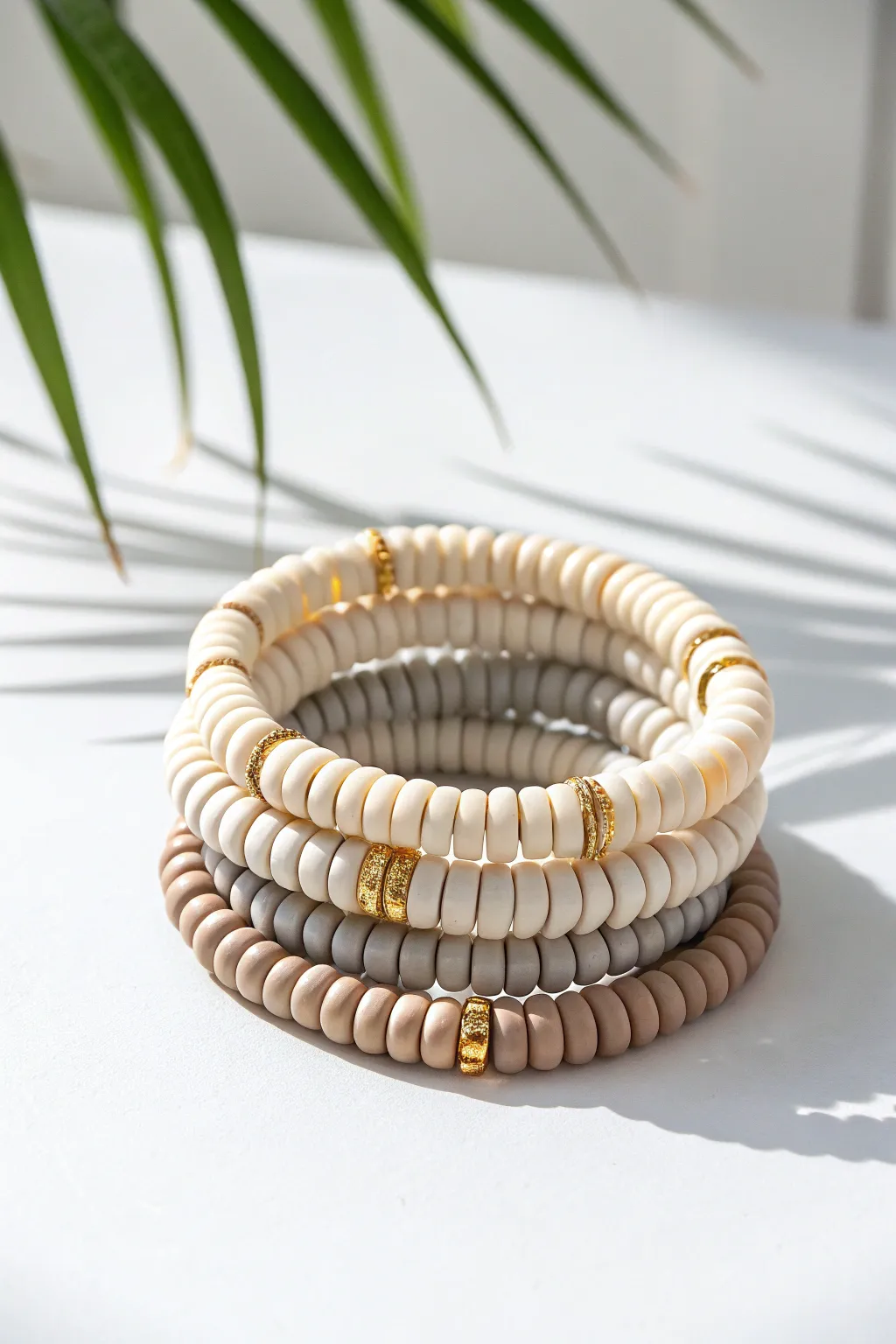
Elevate your accessory game with this sophisticated stack of neutral clay bead bracelets featuring elegant gold accents. The mix of cream, soft grey, and warm taupe tones creates a versatile palette that pairs beautifully with almost any outfit.
How-To Guide
Materials
- Polymer clay heishi beads (6mm or 4mm) in cream/off-white
- Polymer clay heishi beads in light grey or taupe
- Polymer clay heishi beads in light brown/tan
- Gold tone rhinestone spacer beads or textured gold connector rings (approx. 6mm)
- Strong elastic cord (0.8mm crystal string generally works best)
- Jewelry glue or clear nail polish
- Scissors
- Bead design board or masking tape
- Tape measure
Step 1: Planning and Prep
-
Measure your wrist:
Start by wrapping a tape measure around your wrist where you want the bracelets to sit. Note the measurement and add about 0.5 to 1 inch depending on how loose you like your fit. -
Prepare your workspace:
Lay out your bead design board or place a strip of masking tape sticky-side up on your table to help hold loose beads. Sort your clay heishi disks by color: cream, grey, and tan. -
Cut the elastic:
Cut four lengths of elastic cord, each about 10-12 inches long. Having extra length makes tying the final knots much easier than struggling with short ends. -
Pre-stretch the cord:
Give each piece of elastic a few gentle tugs. This pre-stretching helps prevent the bracelet from sagging or expanding permanently after you wear it a few times.
Step 2: Cream & Gold Designs
-
Start the cream layers:
We are making two cream-based bracelets for the top of the stack. Secure one end of your first elastic string with a piece of tape or a binder clip to stop beads falling off. -
String the base:
Thread on about 1.5 inches of cream heishi beads. The slight irregularity in the clay beads adds to the organic aesthetic. -
Add first gold accent:
Slide on a gold spacer bead. For the top bracelet shown, use a single gold ring, or two thin gold spacers placed back-to-back for a thicker look. -
Continue the pattern:
Add another section of cream beads, roughly equal in length to the first. Insert another gold spacer element. -
Finish the strand:
Repeat this pattern until the beaded section matches your wrist measurement. For the second cream bracelet, try spacing the gold beads slightly differently—perhaps grouping two gold rings together for variety.
Knot Security
If you don’t have jewelry glue, clear nail polish works great to seal the knot. Let it dry completely flexible before stretching.
Step 3: Grey & Tan Layers
-
Create the grey layer:
Grab your third piece of elastic. This time, use only the light grey or taupe beads. Thread them continuously until you reach the halfway point of your desired length. -
Insert the centerpiece:
Add a prominent gold spacer or a cluster of 3-4 thin gold rings right in the center of the grey strand. Then continue filling the strand with grey beads until finished. -
Build the tan bracelet:
For the bottom bracelet in the stack, use the light brown/tan clay beads. Simply string them one after another for a solid block of color. -
Add final sparkle:
Just like the grey layer, add a single textured gold bead or spacer near the center or randomly placed to tie the look together with the rest of the stack.
Texture Play
Mix matte and glossy clay beads within the same color family. The subtle difference catches the light beautifully.
Step 4: Finishing Touches
-
Secure the knots:
Remove the tape/clip. Bring the two ends of the elastic together, ensuring there are no gaps between the beads. -
Tie a surgeon’s knot:
Tie a standard overhand knot, but loop the end through twice before pulling tight. Repeat this knot 2-3 times for extra security. I usually pull the elastic quite tight here to ensure it holds. -
Hide the knot:
Apply a tiny dot of jewelry glue to the knot. Let it dry for a moment, then trim the excess string carefully. -
Tuck the ends:
If size permits, gently tug the elastic so the knot slides inside the hole of a neighboring bead, hiding it from view completely.
Stack them all together on your wrist for an effortlessly chic, neutral look that’s ready to go.
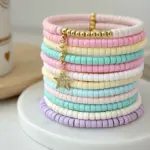
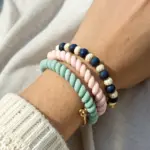
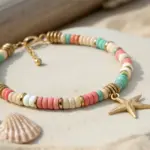
Beachy Blues and Sandy Tones
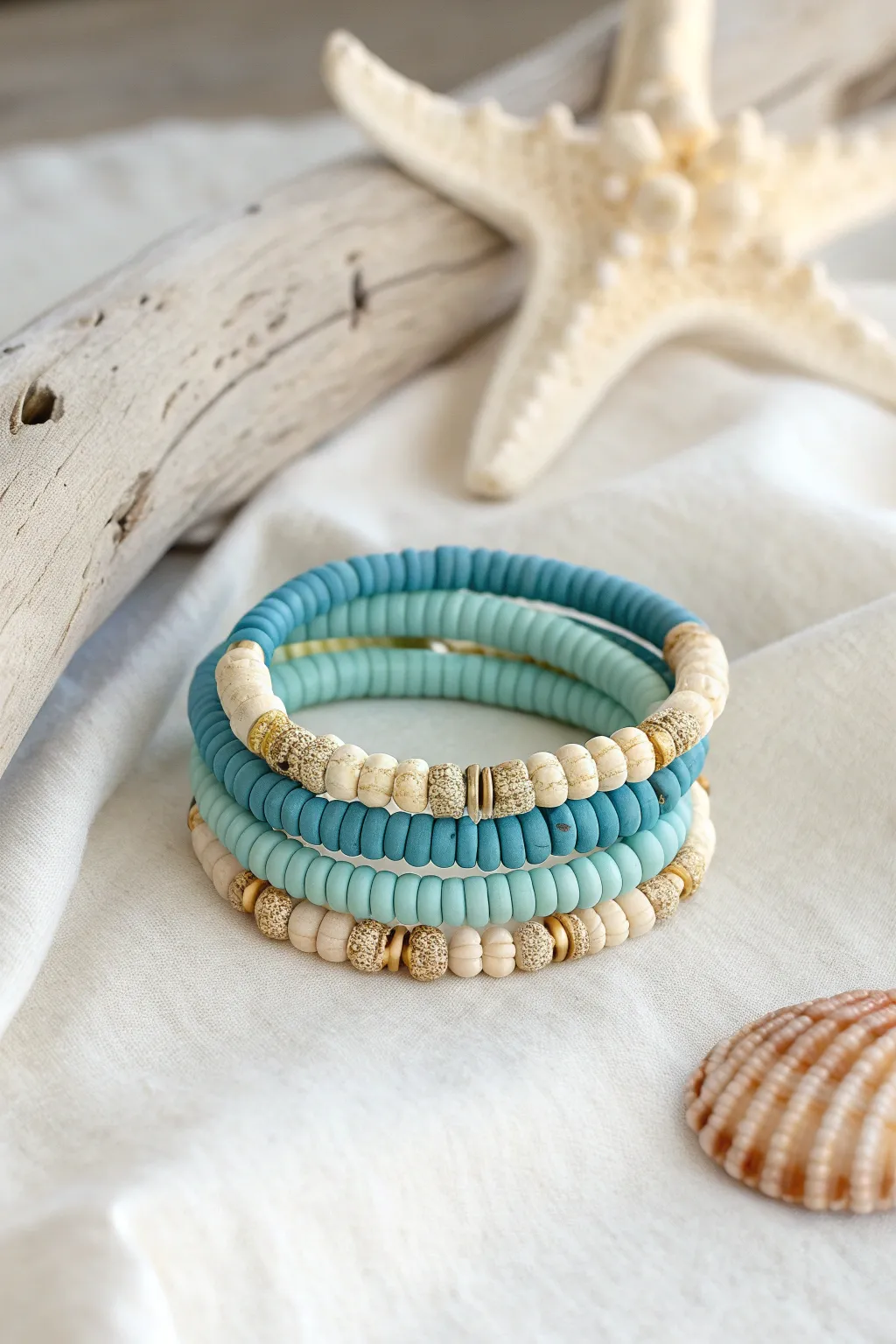
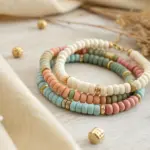
Capture the essence of a tranquil day at the shore with this stack of four coordinating bracelets featuring polymer clay heishi discs and textured accents. The blend of deep ocean blue, soft aqua, and sandy cream tones creates a versatile accessory perfect for summer styling.
Detailed Instructions
Materials
- Polymer clay heishi beads (approx. 6mm) in dark teal/petrol blue
- Polymer clay heishi beads (approx. 6mm) in light aqua/mint
- Cream or off-white round seed beads or small wooden beads (approx. 4-5mm)
- Gold tone heishi spacer beads (thin flat discs)
- Textured gold or bronzed accent beads (round or saucer shape)
- Strong elastic bead cord (0.8mm or 1mm recommended)
- Jewelry glue or clear nail polish
- Scissors
Step 1: Preparation
-
Measure your wrist:
Wrap a flexible measuring tape around your wrist where you want the bracelets to sit. Add about half an inch to this measurement for a comfortable fit that isn’t too tight. -
Cut the elastic:
Cut four pieces of elastic cord, making sure each is about 3-4 inches longer than your final bracelet size. This extra length is crucial for tying secure knots later. -
Secure the ends:
Place a piece of tape or a bead stopper on one end of each elastic strand to prevent your beads from sliding off while you work.
Knot Hiding Trick
If your knot won’t fit inside a bead, use a crimp cover or a specifically designed large-hole ‘knot cover’ bead in gold to turn the structural necessity into a decorative element.
Step 2: Creating the Solid Bands
-
Start the Dark Teal Bracelet:
For the first bracelet in the stack, begin threading the dark teal clay heishi beads onto your first elastic strand. -
Check the fit:
Continue adding teal beads until the beaded length matches your wrist measurement. Wrap it around your wrist to verify the fit before moving on. -
Start the Aqua Bracelet:
Repeat the process with the second elastic strand, using only the light aqua/mint heishi beads this time to create a solid monochromatic band. -
Verify sizing:
Ensure this aqua bracelet is exactly the same length as the teal one so they stack neatly together.
Step 3: Designing the Accent Strands
-
Plan the mixed pattern:
For the third and fourth bracelets, layout your pattern on a bead board or soft cloth first. The pattern shown uses sections of cream beads heavily accented with gold spacers. -
Thread the focal section:
On your third elastic, start threading the center focal point: a group of textured gold beads separated by thin gold spacers. -
Add cream sections:
On either side of your gold focal point, add a short run of 3-4 cream beads to create a soft transition. -
Incorporate color:
To tie the look together, add a small section of the teal or aqua heishi beads to the back or sides of this mixed strand. -
Balance with gold:
Insert single gold flat spacer beads between every few cream or clay beads to add a subtle sandy shimmer throughout the strand. -
Finish the strand:
Continue this alternating pattern of cream beads, gold accents, and occasional clay discs until you reach the desired length.
Uneven Tension?
If your bracelet twists or curls when laid flat, the elastic is too tight. Restring with slightly more slack so the beads drape fluidly rather than bunching up.
Step 4: Final Assembly
-
Pre-stretch the elastic:
Before tying, gently pull on the ends of the elastic cord for each bracelet. This pre-stretching prevents the bracelets from sagging after you wear them. -
Tie the surgeon’s knot:
Remove the tape or stopper. Cross the ends, loop one side under twice, pull tight, and then tie a standard overhand knot on top to secure it. -
Secure with glue:
I always add a tiny drop of jewelry glue or clear nail polish directly onto the knot. Let it dry completely for a few minutes. -
Hide the knot:
Once dry, trim the excess elastic close to the knot. Carefully slide a nearby bead (preferably one with a larger hole like the clay heishi) over the knot to conceal it. -
Review the stack:
Put all four bracelets on together. Adjust the rotation so the gold accents sit where you want them relative to the solid color bands.
Now you have a breezy, beach-ready set of bracelets that look just as good solo as they do stacked together
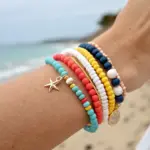
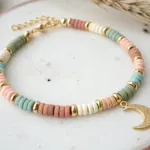
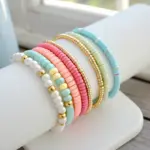
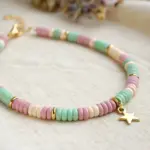
Soft Ombré Gradient Bracelet
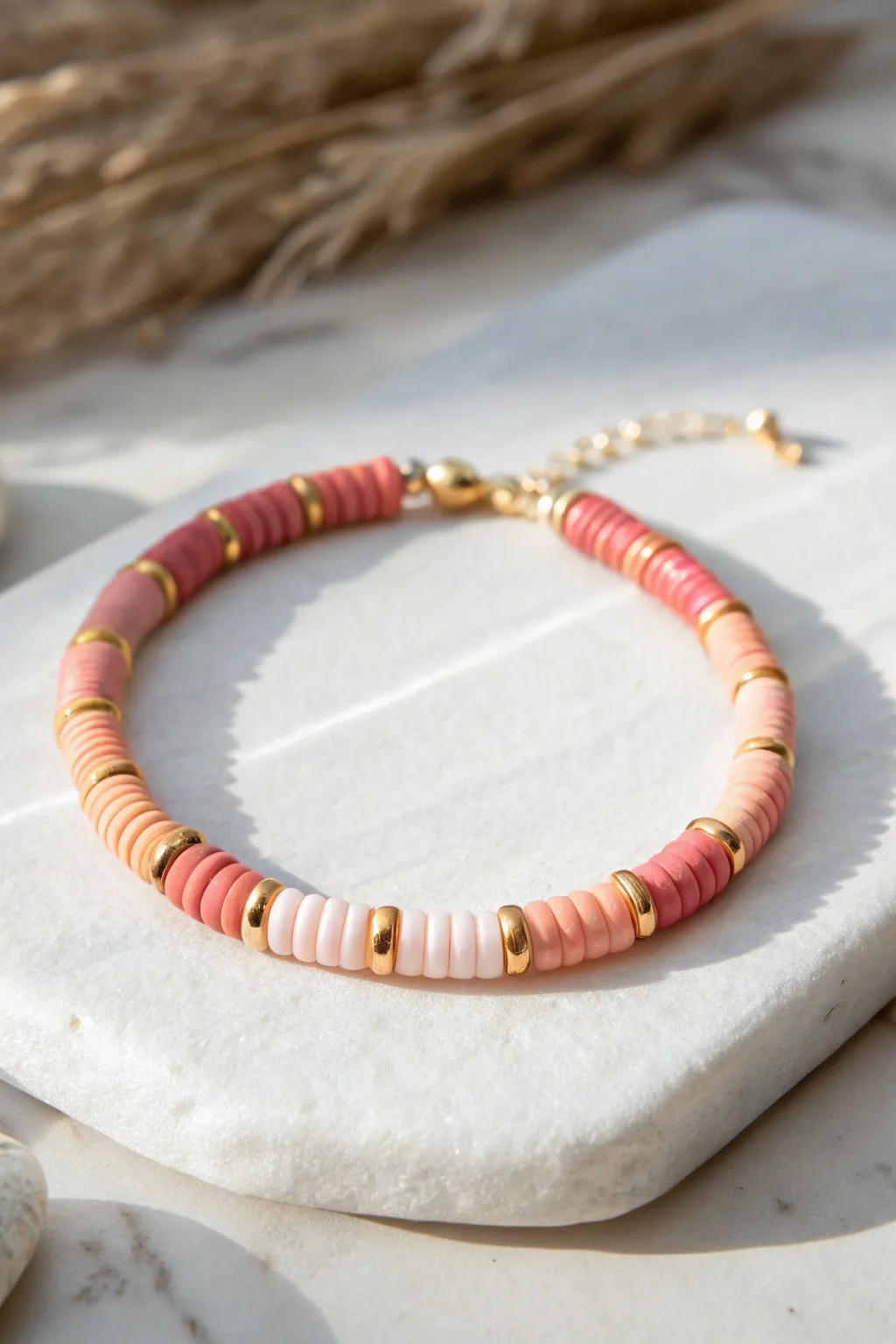
Capture the delicate transition of a sunset with this elegant clay bead bracelet featuring a seamless gradient from deep rose to soft blush. The addition of gold spacer beads elevates the look, making it a sophisticated accessory that pairs perfectly with both casual daywear and evening outfits.
Step-by-Step
Materials
- Polymer clay Heishi beads (6mm or 4mm) in: Deep Rose/Dark Pink
- Polymer clay Heishi beads in: Medium Coral/Salmon
- Polymer clay Heishi beads in: Light Peach/Blush
- Polymer clay Heishi beads in: Pale Pink/Off-White
- Gold tone metallic spacer beads (rounded disc or rondelle shape)
- Strong elastic beading cord (0.8mm recommended)
- Gold tone crimp beads or clam shell bead tips
- Gold tone lobster clasp and open jump rings
- Gold tone extender chain
- Jewelry pliers (round nose and flat nose)
- Scissors or bead snips
- Super glue or jewelry cement
Step 1: Planning and Sorting
-
Measure your wrist:
Before cutting any cord, wrap a piece of string around your wrist to find your comfortable size, then add about an inch for the clasp and ease. -
Sort your gradient:
Lay out your clay bead strands on a bead board or soft towel. Arrange them in order from the darkest rose color to the lightest white-pink shade to visualize the full ombre transition. -
Determine the pattern unit:
Analyze the pattern in the reference image. The sequence consists of roughly 6-8 clay beads of one color, followed by a gold spacer bead. This creates distinct ‘sections’ of color.
Step 2: Stringing the Ombré Design
-
Prepare the cord:
Cut a length of elastic cord about 10-12 inches long. This generous length makes it much easier to tie knots later without struggling. -
Secure the end:
I like to place a piece of tape or a bead stopper on one end of the cord so the beads don’t slide off while working. -
Start with the darkest shade:
Begin stringing your darkest rose beads. Thread about 6 to 8 beads onto the cord. -
Add first gold accent:
Slide on one gold metallic spacer bead. It should sit flush against the stack of clay beads. -
Repeat the dark section:
Add another set of the same dark rose beads (6-8 beads) followed by another gold spacer. This establishes the heavy end of the gradient. -
Transition to medium tone:
Switch to your medium coral/salmon colored beads. String a set of 6-8 beads, followed by a gold spacer. -
Continue the medium tone:
Add a second section of the medium coral beads and another gold spacer. Depending on your wrist size, you might do two or three sections of each color. -
Move to the light peach:
Now introduce the light peach or blush beads. String your standard count (6-8) and cap the section with a gold spacer. -
Finish with the lightest shade:
Thread on the pale pink or off-white beads for the center or end of the design (depending on if you want a mirrored gradient or a linear one). The image shows a linear fade, so end with your lightest sections. -
Check the length:
Wrap the unfinished strand around your wrist to ensure it covers the top and sides comfortably, leaving a small gap for the clasp hardware.
Uneven Tension?
If the bracelet feels stiff or kinks up, you strung it too tight. The beads need a tiny bit of wiggle room to curve around a wrist. Restring with slightly slacker tension for a fluid drape.
Step 3: Finishing Touches
-
Attach the first crimp:
Remove your tape or stopper. Thread a crimp bead (or clam shell tip) onto one end, followed by a jump ring attached to the lobster clasp. -
Secure the start:
Loop the cord back through the crimp bead and use flat nose pliers to squash the crimp flat, securing the wire. If using a clam shell, tie a knot inside and close the shell over it. -
Attach the extender chain:
On the other end of the bracelet, thread a crimp bead and the jump ring attached to the extender chain. -
Final securement:
Loop back through the crimp, pull tight enough so there are no gaps between beads but loose enough that the bracelet bends freely, and crush the crimp bead. -
Hide the tails:
Trim the excess cord close to the crimp beads. For extra security, you can add a tiny dot of super glue to the knots or crimps before trimming.
Go Luxe
Replace the standard gold spacers with gold-filled or 14k plated beads. They resist tarnish much better than standard craft metal, keeping your gradient bright for years.
Enjoy the gentle warmth of your new gradient accessory on your wrist

The Complete Guide to Pottery Troubleshooting
Uncover the most common ceramic mistakes—from cracking clay to failed glazes—and learn how to fix them fast.
Preppy Pops With Color Blocking
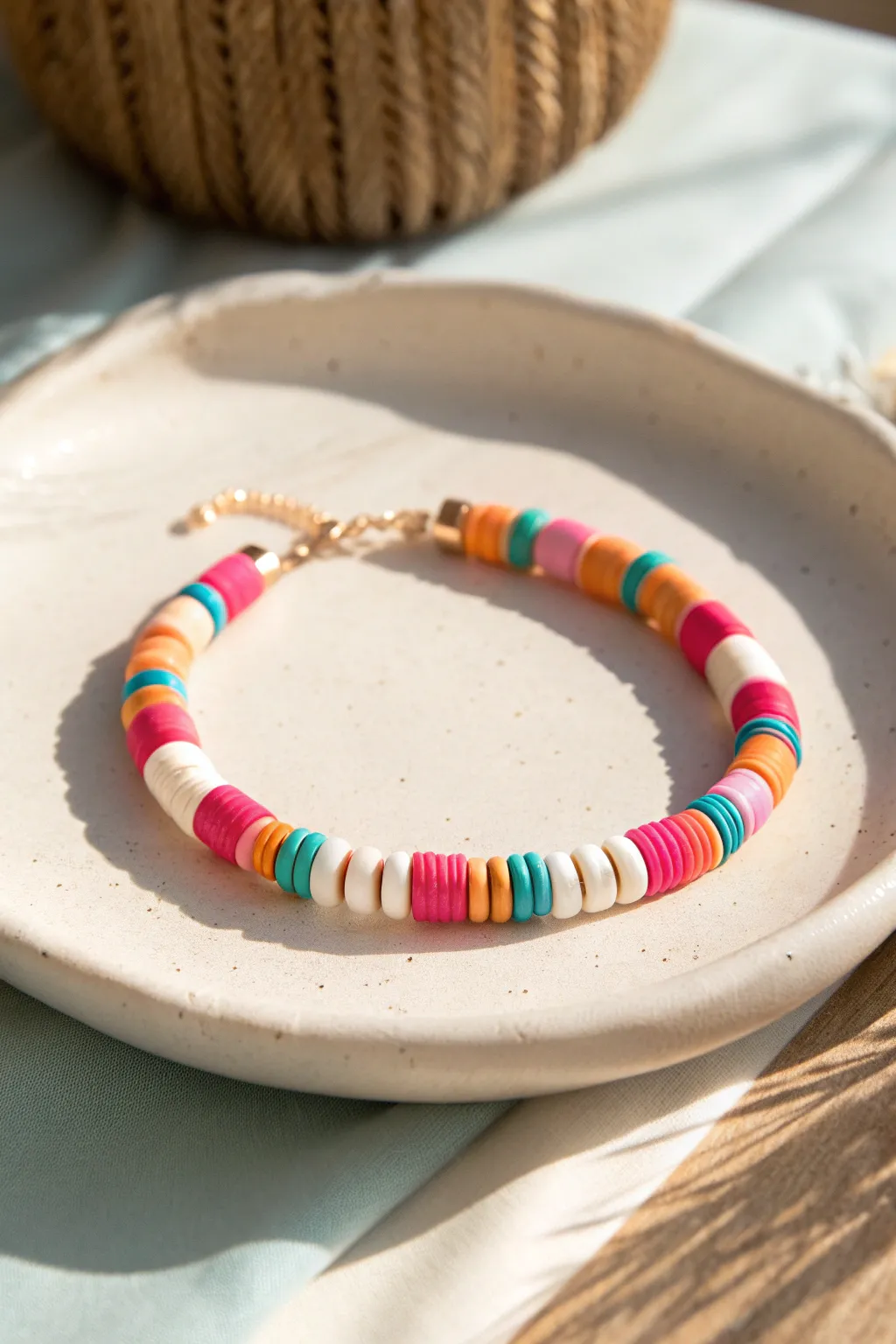
This trendy anklet or bracelet combines vibrant pops of hot pink, teal, and orange with crisp white sections for a preppy, summery look. The distinct color-blocking pattern gives it a sophisticated rhythm that feels intentional and stylish without being overly complicated.
Detailed Instructions
Materials
- Polymer clay Heishi beads (6mm disk beads) in: Hot Pink, Orange, Turquoise/Teal, White
- Gold tone flat disk spacer beads (approx. 4-6mm)
- Strong elastic bead cord (0.8mm or 1.0mm recommended)
- Gold tone crimp covers or clamshell bead tips
- Gold tone jump rings (4mm or 5mm)
- Gold tone lobster clasp and extension chain
- Jewelry pliers (chain nose and flat nose)
- Scissors or jewelry cutters
- Super glue or jewelry cement (optional)
Step 1: Planning and Prep
-
Measure your wrist:
Before cutting any cord, wrap a piece of string or measuring tape around your wrist or ankle to determine the desired length. Add about 1-2 inches to this measurement to account for the clasp and some breathing room. -
Cut the cord:
Cut a piece of elastic cord about 3-4 inches longer than your final measurement. This extra length is crucial for tying knots or attaching the hardware comfortably without losing beads. -
Pre-stretch the cord:
Give your elastic cord a few gentle tugs. Pre-stretching helps prevent the bracelet from loosening up after you’ve worn it a few times. -
Clip the end:
Place a bead stopper or simply a piece of strong tape on one end of the cord so your beads don’t slide off while you work.
Step 2: Creating the Pattern
-
Start with gold:
Thread on a gold crimp cover or bead tip first if you plan to use hardware, followed by a small gold spacer bead to start the design. -
First color block: Orange:
Begin your pattern with a section of orange beads. Use about 5-6 beads to create a distinct block of color. -
Transition to Turquoise:
Slide on about 3-4 turquoise beads. Notice how the blocks aren’t all exactly the same size; this slight variation keeps it dynamic. -
Add a pink pop:
Add a segment of hot pink beads. Aim for roughly 5-6 beads here to balance the orange section you started with. -
Incorporate neutrals:
Thread on a longer section of white beads, perhaps 6-8 disks. This white space acts as a palate cleanser between the vibrant colors. -
Repeat the rhythm:
Continue adding blocks of color. You don’t need to follow a strict A-B-C pattern. Try mixing up the order, like White -> Pink -> Turquoise -> Orange -> White. -
Check the fit:
Periodically wrap the strand around your wrist. Stop beading when the ends almost touch, keeping in mind the clasp will add about half an inch of length.
Loosey Goosey?
If your beads look uneven or gapped, you likely didn’t pull the elastic tight enough before knotting. The cord should be taut but not stretched to its limit when you tie it off.
Step 3: Finishing the Ends
-
Secure the final bead:
End your pattern with a gold flat spacer bead, mirroring the start of the bracelet. -
Attach the first crimp:
Thread the cord end through a clamshell bead tip or crimp bead. If using a clamshell, tie a secure double or surgeon’s knot inside the cup. -
Seal the knot:
Add a tiny drop of super glue or jewelry cement to the knot for extra security. I usually wait a minute for it to become tacky before closing the clamshell. -
Close the hardware:
Use your flat nose pliers to gently close the clamshell over the knot, or flatten the crimp bead securely. Trim any excess elastic tail close to the hardware. -
Repeat on the other side:
Remove your tape or bead stopper from the starting end and repeat the termination process with another bead tip or crimp. -
Add the clasp:
Open a jump ring with your pliers (twist it sideways, don’t pull apart). Slide it through the loop of your bead tip and attach the lobster clasp. Close the ring securely. -
Add the extension chain:
On the opposite end, use another jump ring to attach the extension chain. This makes the bracelet adjustable and easier to gift.
Go for Gold
Elevate the design by inserting a single gold disk bead between every color change. This adds a tiny metallic flash that makes the whole piece look more expensive.
Now you have a vibrant, custom accessory ready to stack with your other favorites.
Pearls Mixed Into Heishi
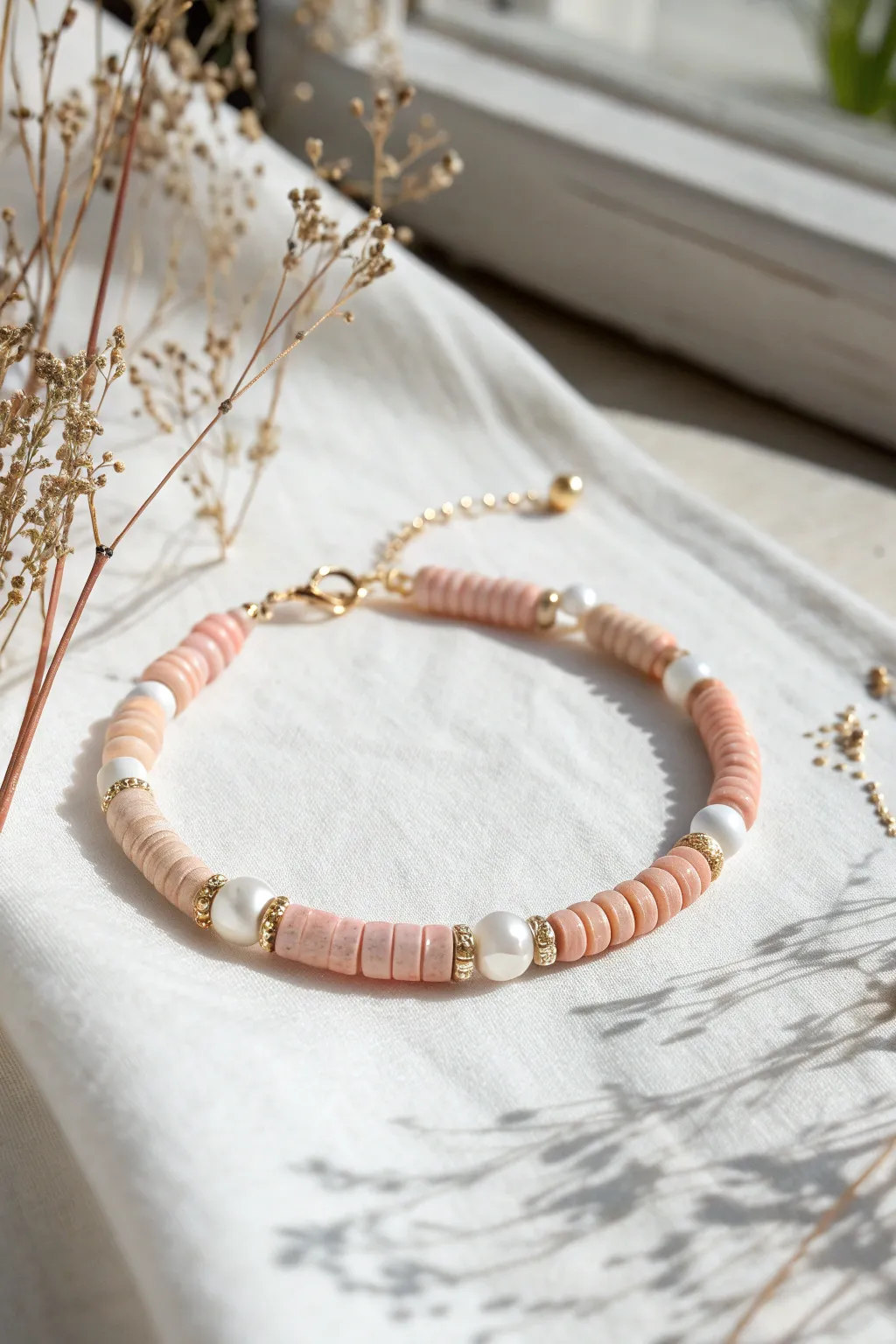
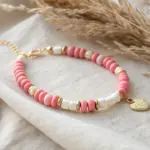
Blend the earthy texture of polymer clay discs with the classic elegance of freshwater pearls in this minimalist design. The soft peach tones and gold accents create a warm, versatile accessory perfect for stacking or wearing solo.
Step-by-Step Tutorial
Materials
- Peach or coral polymer clay heishi beads (6mm)
- Freshwater pearls (approx. 6-8mm, irregular shape)
- Gold saucer or spacer beads (textured/dimpled)
- Small gold bead caps (optional)
- Gold crimp beads
- Gold wire guards
- Gold jump rings
- Gold lobster clasp
- Gold extension chain with dangle charm
- Flexible beading wire (e.g., Soft Flex)
- Wire cutters
- Flat nose pliers
- Crimping tool or needle nose pliers
Step 1: Planning the Pattern
-
Measure your wrist:
Wrap a measuring tape comfortably around your wrist to determine your target length, aiming for about 6.5 to 7 inches for an average fit. -
Lay out the design:
Before stringing, lay your beads on a bead board or soft cloth. The pattern shown uses sections of approximately 8-10 peach heishi beads separated by focal pearl accents. -
Structure the accents:
Create the focal points by sandwiching a single freshwater pearl between two textured gold saucer beads. This gold framing elevates the pearl and adds a metallic sparkle.
Knotty Tip
Using a crimp cover over your flattened crimp beads makes them look like regular gold beads, giving your finish a truly professional, seamless look.
Step 2: Starting the Strand
-
Cut the wire:
Snip a piece of beading wire about 10-12 inches long. Having extra length makes it much easier to finish the ends without frustration. -
Attach the first clasp component:
Thread a crimp bead onto one end of the wire, followed by a wire guard. Loop the wire through the guard and back down into the crimp bead. -
Secure the jump ring:
Before tightening, slide a jump ring (attached to your extension chain) into the loop of the wire guard. I like to double-check that the loop moves freely. -
Crimp the bead:
Use your crimping tool to flatten the crimp bead securely, locking the wire in place. Trim the short tail of the excess wire close to the crimp.
Step 3: Stringing the Beads
-
Begin the sequence:
Start stringing with a section of the peach heishi beads. Thread on about 8 to 10 disks so they stack neatly against each other. -
Add a gold spacer:
Slide on one gold textured saucer bead. Ensure the textured side faces outward or looks consistent with your other spacers. -
Place the pearl:
Thread one freshwater pearl next. Its irregular, organic shape contrasts beautifully with the uniform clay discs. -
Finish the focal unit:
Add a second gold saucer bead immediately after the pearl to complete the frame. -
Repeat the pattern:
Continue stringing sections of heishi beads followed by the gold-framed pearl units. For a standard bracelet, you will likely repeat this sequence 4 or 5 times. -
Check the length:
Periodically wrap the strand around your wrist. Stop adding beads when you are about half an inch short of your desired finished length to account for the clasp.
Stiff Strand?
If the bracelet feels rigid, you pulled the wire too tight before crimping. Ideally, curve the bracelet into a circle before crimping to ensure proper slack.
Step 4: Finishing Touches
-
Prepare the final end:
Thread a crimp bead onto the remaining wire tail, followed by a wire guard. -
Attach the clasp:
Loop the wire through the guard and slide your gold lobster clasp into the guard’s loop before threading the wire back down through the crimp bead. -
Tighten the wire:
Pull the wire taut so there are no gaps between the beads, but leave just enough slack so the bracelet stays flexible and doesn’t get stiff. -
Final crimp:
Flatten the final crimp bead securely with your tool. Hide the excess wire tail by threading it back through the first few beads adjacent to the clasp before trimming. -
Add the charm:
If your extension chain doesn’t have a decorative end, attach a small gold ball or tiny pearl charm to the very end of the chain using a small jump ring.
Now you have a sophisticated piece of jewelry that perfectly balances matte textures with pearlescent shine

What Really Happens Inside the Kiln
Learn how time and temperature work together inside the kiln to transform clay into durable ceramic.
Minimal Name Bracelet in Black and White
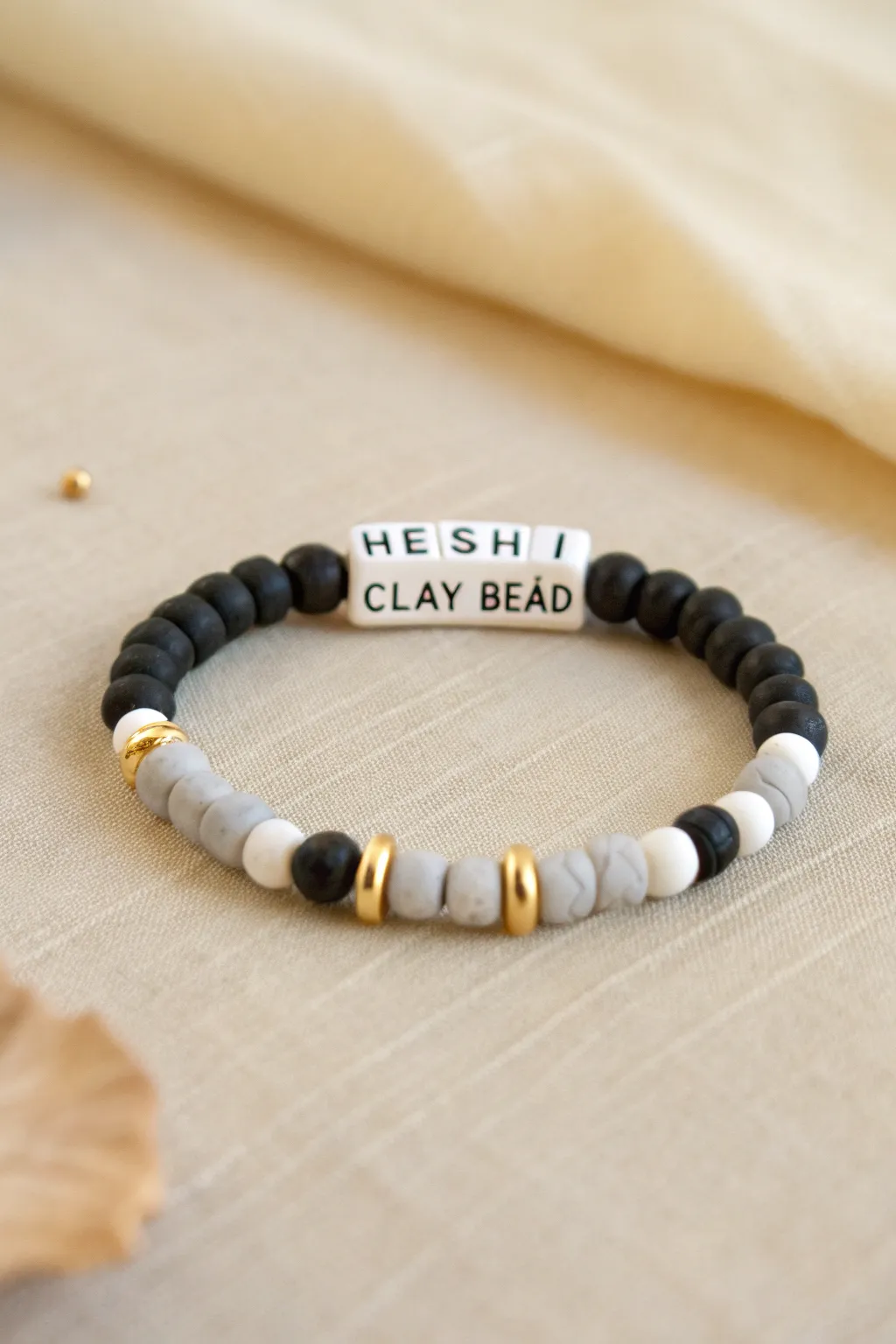
Embrace a sleek, modern aesthetic with this bold black and white clay bead bracelet featuring distinctive lettering. The contrast between the matte black beads, marble-effect accents, and gold spacers creates a sophisticated accessory perfect for stacking or wearing solo.
Detailed Instructions
Materials
- Black polymer clay heishi beads (6mm or 8mm)
- Grey/marble effect polymer clay heishi beads
- White polymer clay heishi beads
- Square white alphabet letter beads (block style)
- Square white spacer beads with custom text (optional, or use more letter beads)
- Gold tone metal spacer rings (curved/heishi style)
- Strong elastic stretch cord (0.8mm recommended)
- Super glue or jewelry adhesive
- Scissors
Step 1: Planning and Preparation
-
Measure your wrist:
Before cutting anything, wrap a piece of string around your wrist to find your size, then add about half an inch for a comfortable fit. -
Cut the elastic cord:
Cut a length of elastic cord about 10-12 inches long. Having extra length makes tying the final knot much easier than struggling with short ends. -
Pre-stretch the cord:
Give your elastic a few gentle tugs. This pre-stretching helps prevent the bracelet from sagging or loosening immediately after you wear it for the first time. -
Layout your design:
Lay out your beads on a bead board or a towel to visualize the pattern before threading. This prevents beads from rolling away and helps you spot any symmetry issues.
Knot Slipping?
If your elastic knot feels insecure, try knotting the cord while it’s under slight tension, or add a second knot on top of the first before gluing.
Step 2: Creating the Central Message
-
Thread the main text:
Start by threading your square letter beads. For this design, spell out your chosen word (like ‘HESHI’) clearly in the center. -
Add the bottom line text:
If you have a specialized wider bead with text like ‘CLAY BEAD’ as shown, thread that next. Alternatively, you can stack a second row of smaller letter beads if your cord allows, or stick to a single line of text.
Step 3: Building the Pattern
-
Start the dark sections:
On the right side of your text block, string approximately 4-5 black heishi beads. -
Repeat on the left:
Mirror this on the left side of the text block with another 4-5 black heishi beads to frame the words. -
Add transition beads:
Add a single white heishi bead on each side, followed by a gold spacer ring. -
Create the grey accent section:
Thread about 3-4 grey marble-effect beads on each side. These add a nice textural softness between the stark black and gold. -
Finish the accent pattern:
Add another gold spacer ring, a single black bead, another gold ring, and then a final transition of grey and white beads to complete the symmetrical focal area.
Use a Bead Stopper
Clip a small binder clip or tape a piece of masking tape to the end of your elastic while stringing to stop beads from sliding off the other end.
Step 4: Completing the Loop
-
Fill the rest of the strand:
Thread the remaining length of the bracelet with solid black heishi beads until you reach your measured length. I usually check the fit against my wrist one last time here. -
Tie the knot:
Bring the ends together and tie a tight surgeon’s knot (right over left, left over right) or a strong square knot. -
Secure with glue:
Apply a tiny dab of jewelry glue or super glue directly onto the knot. Be careful not to get glue on the patterned beads. -
Hide the knot:
Once the glue is tacky but not fully dry, slide an adjacent bead with a larger hole over the knot to conceal it. -
Trim the excess:
Once the glue is completely dry, use your scissors to snip off the excess elastic cord as close to the bead as possible.
Now you have a custom aesthetic piece ready to enhance your daily style
Smiley Charm Centerpiece Stack
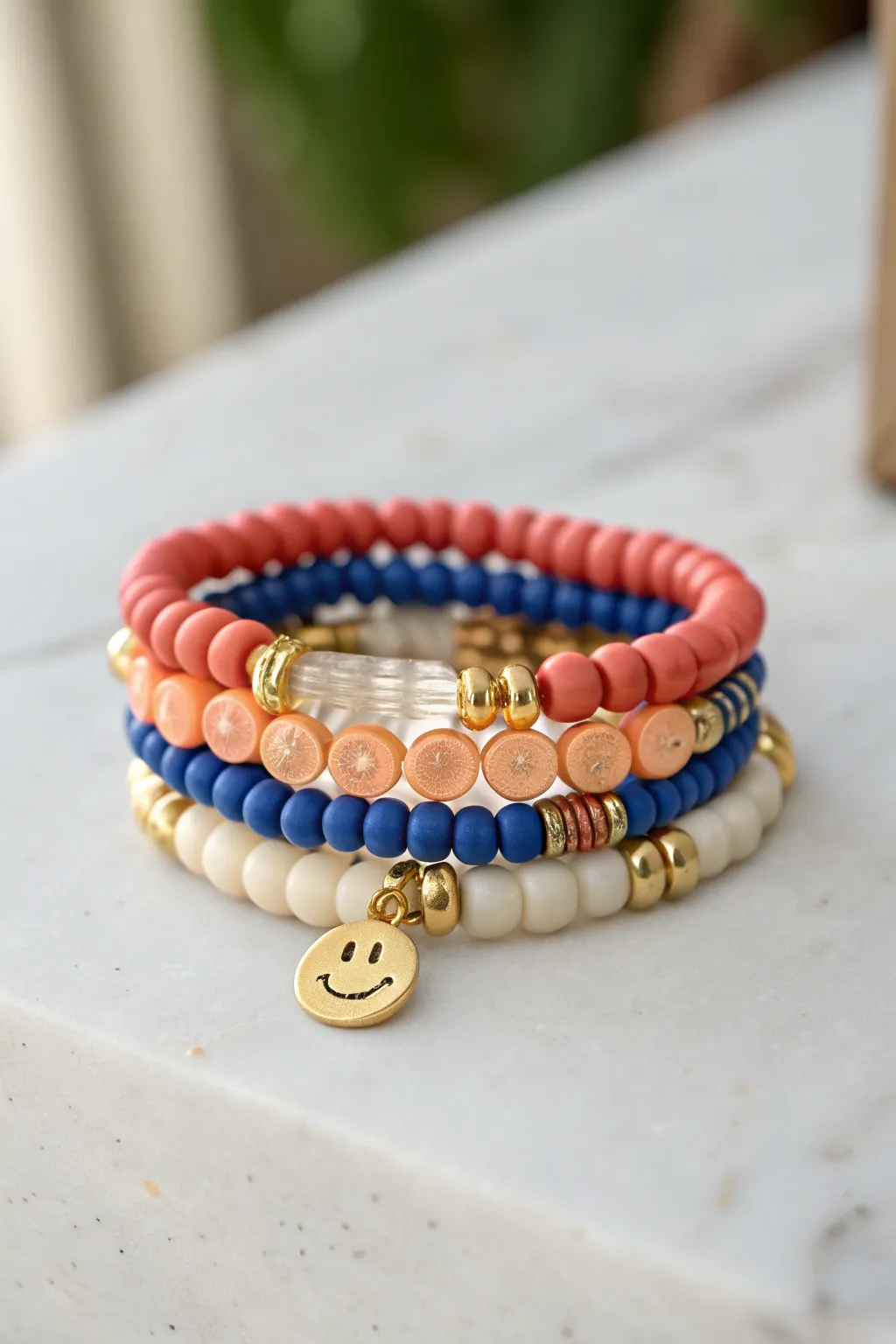
Brighten up your wrist with this cheerful, three-piece stack that features a mix of textures and colors. Anchored by a playful gold smiley face charm, this set combines matte heishi beads, classic rounds, and citrus-themed accents for a cohesive yet eclectic look.
Step-by-Step Tutorial
Materials
- Matte coral pink round beads (approx. 4-6mm)
- Matte navy blue round beads (approx. 4-6mm)
- Cream or off-white round beads (approx. 6-8mm)
- Orange citrus slice fimo/clay beads
- Gold smiley face charm
- Gold spacer beads (mix of small rounds and larger barrel/donut shapes)
- Clear or frosted crystal tube beads (optional centerpiece)
- Textured gold accent beads (corrugated discs)
- Elastic cord (0.8mm recommended)
- Jewelry glue or clear nail polish
- Scissors
Step 1: The Coral & Crystal Strand
-
Measure and Cut:
Cut a piece of elastic cord about 10-12 inches long. This gives you plenty of room to knot it later without struggling. -
Secure the End:
Place a piece of tape or a bead stopper on one end of your cord so your beads don’t slide off while you work. -
Start the Pattern:
Begin threading your matte coral pink beads. Thread about 2-3 inches worth of these beads to form one side of the bracelet. -
Add Gold Accents:
Slide on one gold barrel spacer bead followed by a small gold round bead to frame the centerpiece. -
Create the Centerpiece:
Thread on a clear or frosted crystal tube bead. If you can’t find a tube bead, a row of three clear round beads works beautifully here too. -
Finish the Pattern:
Mirror the gold accents on the other side of the crystal, then fill the rest of the cord with the coral beads until it fits your wrist perfectly.
Stretch Test
Pre-stretch your elastic cord by pulling it firmly a few times before stringing. This prevents the bracelet from sagging or loosening after the first few wears.
Step 2: The Citrus & Navy Strand
-
Prep the Second Cord:
Cut another length of elastic cord and secure the end just like before. -
Base Color:
Thread on your matte navy blue beads. Aim to cover about two-thirds of the bracelet’s length with just the blue beads. -
Transition to Citrus:
Add a small gold spacer bead to separate the blue section from your focal point. -
Add the Fruit Slices:
Thread on 5 to 6 orange citrus slice clay beads. These fimo beads add that fun pop of texture. -
Close the Loop:
Finish this strand by adding another gold spacer and verifying the fit against the first bracelet.
Step 3: The Cream & Smiley Strand
-
Start the Final Strand:
Cut your third piece of elastic. This bracelet uses slightly larger cream beads, so it will sit a bit bolder on the wrist. -
Thread the Base:
String your cream round beads until you are halfway around the desired length. -
Attach the Charm:
Slide on a decorative gold bead or bail, then the smiley face charm, followed by another matching gold bead to keep the charm centered. -
Add Texture:
I like to add a textured gold corrugated disc bead a few beads away from the charm for asymmetrical interest. -
Complete the Circle:
Finish stringing the cream beads until this bracelet matches the size of the previous two.
Make it Personal
Swap the citrus slices for letter beads to spell a name, or replace the clear crystal tube with a natural gemstone like rose quartz for added meaning.
Step 4: Finishing Touches
-
Tie the Knots:
For each bracelet, remove the tape/stopper and tie a secure surgeon’s knot (right over left, left over right, loop through twice). -
Secure with Glue:
Apply a tiny dab of jewelry glue to each knot. Pull the knot tight and let it dry for a few minutes. -
Hide the Knot:
Trim the excess cord close to the knot, then wiggle the adjacent bead over the knot to hide it inside.
Wear your new stack together for maximum impact or share them with friends for a matching moment

TRACK YOUR CERAMIC JOURNEY
Capture glaze tests, firing details, and creative progress—all in one simple printable. Make your projects easier to repeat and improve.
Tiny Fruit Accent for Sweet Summer Vibes
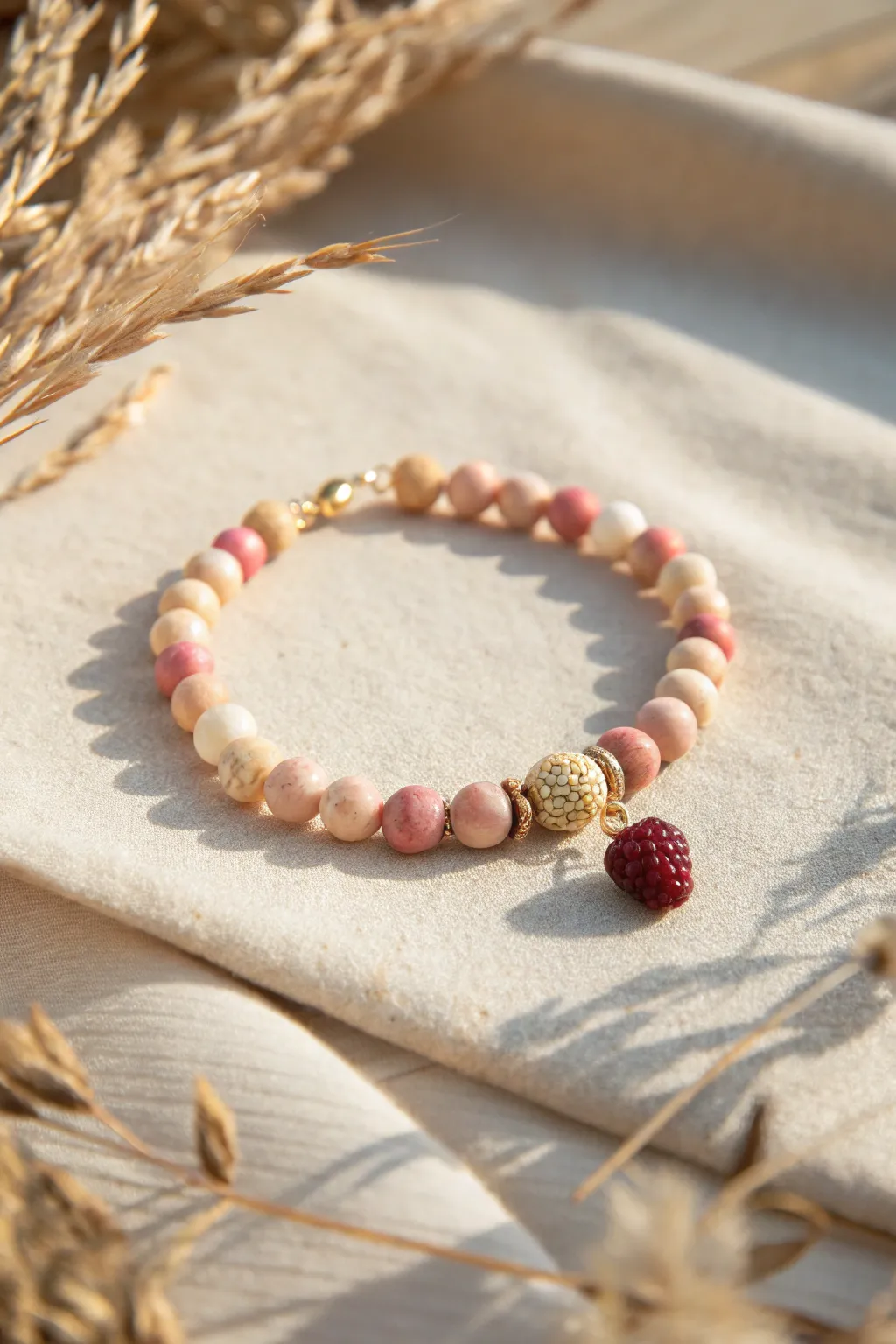
Capture the essence of a warm summer afternoon with this delicate beaded bracelet. Featuring varied shades of pink stone beads and a singular, juicy raspberry charm, it brings a touch of nature-inspired whimsy to any wrist stack.
How-To Guide
Materials
- 6mm or 8mm round gemstone beads (pink opal, rhodonite, or matte beige jasper mix)
- Stretch cord (0.8mm clear elastic)
- 1 large decorative round bead (textured cream/gold, approx 10mm)
- 2 flat gold spacer discs or heishi beads
- Gold tone jump ring (4mm-6mm)
- Small raspberry charm (polymer clay or enamel alloy)
- Small round crimp bead cover (gold tone)
- Jewelry adhesive (e.g., G-S Hypo Cement)
- Scissors
Step 1: Preparation
-
Measure your wrist:
Wrap a piece of string around your wrist to find your comfortable size, then add about an inch to account for the knotting process. Cut your stretch cord to this length plus a few extra inches for ease of handling. -
Pre-stretch the cord:
Hold both ends of your cut elastic and give it a few firm tugs. This crucial step prevents the finished bracelet from stretching out and sagging later on. -
Sort your stones:
Pour out your gemstone beads onto a bead mat or soft cloth. Separate them loosely by shade—pinks, beiges, and creams—so you can easily grab varied colors to create a random, organic pattern.
Natural Palette Tip
For that earthy aesthetic, mix matte finish beads with polished ones. Usually about a 50/50 mix creates the best texture.
Step 2: Stringing the Beads
-
Begin the sequence:
Start threading the round stone beads onto the elastic. Alternate the colors randomly (e.g., a dark pink followed by a cream, then a speckled beige) to mimic the natural variation seen in the photo. -
Check the length:
Pause periodically to wrap the strand around your wrist. You want to stop adding stone beads when the strand is about 1 inch shorter than your total desired circumference. -
Prepare the focal point:
Now, slide on one of the gold spacer discs. This will act as a frame for your larger centerpiece bead. -
Thread the focal bead:
Add the large, textured cream and gold bead. This bead is slightly larger than the rest and serves as the anchor for the charm dangle. -
Add the charm connector:
Before closing the framing, slide the raspberry charm onto the bracelet. Ensure the jump ring attached to the charm slides directly onto the elastic cord, sitting right next to the textured focal bead. -
Finish the focal section:
Slide on the second gold spacer disc to sandwhich the focal bead and the charm securely in place. -
Complete the circle:
Continue adding a few more stone beads if necessary to reach your final desired length. Double-check the fit one last time before securing.
Step 3: Securing the Knot
-
Tie the first knot:
Bring the two ends of the elastic together. Tie a simple overhand knot, pulling it tight enough so there are no gaps between beads, but not so tight that the bracelet buckles. -
Tie the surgeon’s knot:
Cross the ends again, but this time loop one end through the circle twice (instead of once) before pulling tight. This creates a secure surgeon’s knot. -
Apply adhesive:
Dab a tiny drop of jewelry glue directly onto the knot. I find a toothpick helps apply the glue clearly without getting it on the stones. -
Hide the knot:
While the glue is still tacky, carefully slide the knot inside the hole of the nearest large bead if possible. If the holes are too small, cover the knot with a gold crimp cover bead. -
Close the cover:
If using a crimp cover, gently squeeze it shut over the knot using pliers until it looks like a round gold bead. -
Trim excess cord:
Once the glue is fully dry (wait at least 15 minutes), use sharp scissors to trim the excess elastic tails as close to the bead/knot as possible.
Level Up: Texture
Swap the single focal bead for a genuine freshwater pearl or a carved wooden bead for an even more rustic, organic feel.
Now slip on your new accessory and enjoy the sweet pop of color it adds to your outfit
Cowrie Shell Focal for Coastal Aesthetic
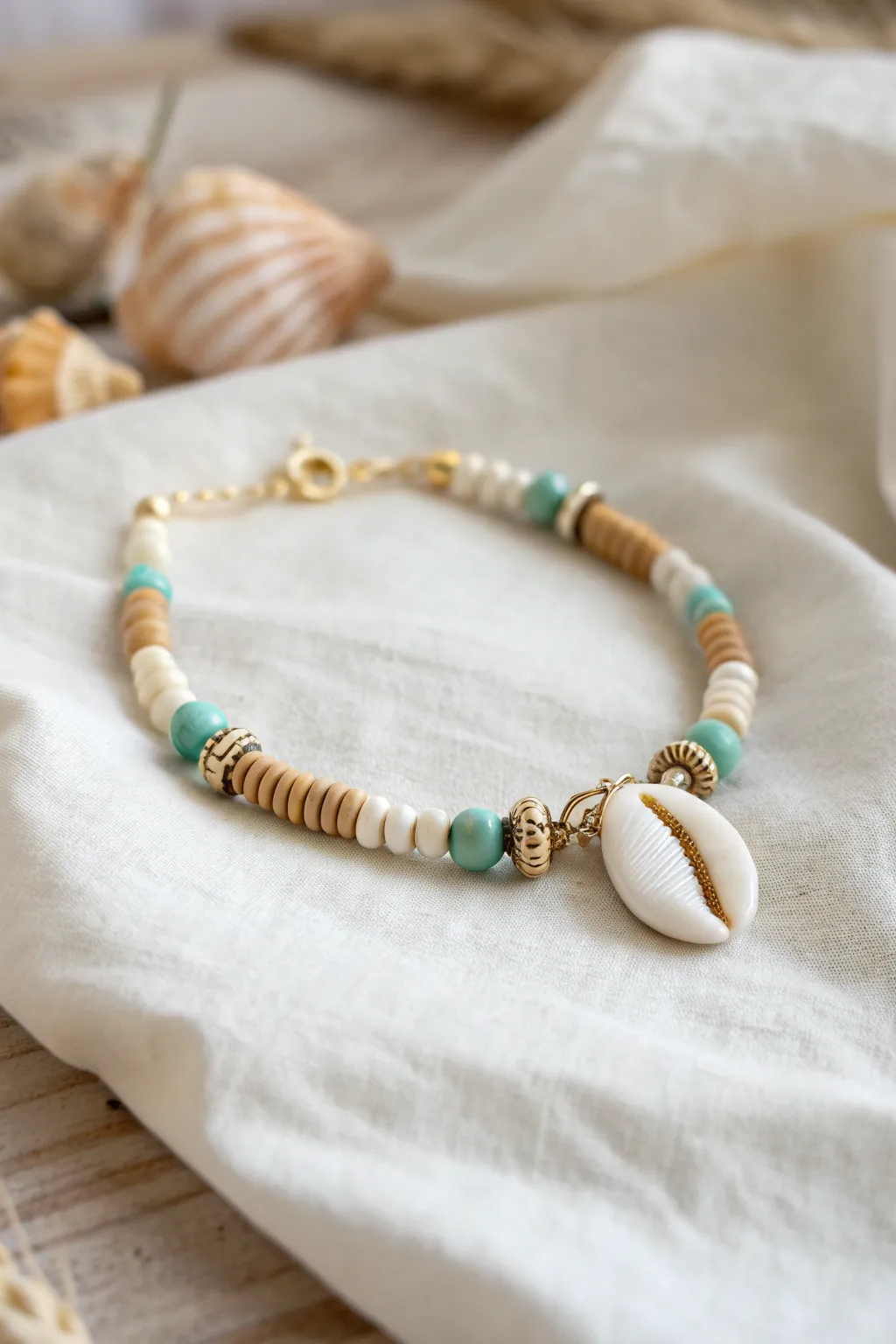
Capture the relaxed vibe of the coast with this beautifully textured bracelet, featuring neutral clay discs and a striking cowrie shell centerpiece. The mix of turquoise accents and gold detailing creates an elevated, beach-ready accessory perfect for summer styling.
Detailed Instructions
Materials
- Beige or tan flat clay heishi disc beads (approx. 4-6mm)
- White or cream flat clay heishi disc beads
- Turquoise round stone or glass beads (6mm)
- Gold tone patterned spacer beads (barrel or rondelle shape)
- Gold tone flat disc spacer beads
- Gold tone large hole spacer beads (to flank the shell)
- Natural cowrie shell bead (drilled or with jump ring attachment)
- Gold jump ring (approx. 6-8mm)
- Beading wire (such as Tiger Tail or flexible nylon-coated wire)
- 2 Crimp beads
- 2 Gold wire guardians (optional but recommended)
- Gold lobster claw clasp
- Gold extension chain
- Crimping pliers
- Wire cutters
- Chain nose pliers
Step 1: Preparation
-
Measure your wrist:
Before cutting any wire, wrap a piece of string around your wrist to find a comfortable fit. Add about an inch to this measurement to account for the bulk of the beads and the clasp assembly. -
Cut the wire:
Cut a length of beading wire that is about 3-4 inches longer than your final measurement. This extra length ensures you have plenty of room to work with the crimp beads and clasp without struggling. -
Prepare the focal shell:
If your cowrie shell isn’t already attached to a jump ring, carefully open a large gold jump ring using two pairs of pliers. Slide the ring through the hole in the shell. -
Add detail to the shell:
For the specific look in the photo, your cowrie shell has gold detailing inside the slit. You can achieve this by carefully painting the inner groove with a fine-tip gold paint pen or using a pre-made gold-embellished shell. -
Close the jump ring:
Twist the jump ring closed securely so the shell dangles freely. Set this focal piece aside for a moment while we start stringing.
Natural Texture
Mix different shades of beige/tan clay beads. Subtle variations in the neutral tones mimic the look of sand and make the bracelet look more high-end.
Step 2: Stringing the Pattern
-
Start the sequence:
Begin stringing from one end (we will attach the clasp later). Start with a small section of beige clay discs. Thread on about 6-8 of these flat beads to create a neutral base. -
Add the first accent:
Slide on one gold patterned spacer bead followed by a turquoise round bead. This introduces the first pop of color. -
Create the white section:
Follow the turquoise bead with a section of cream or white clay discs. Use approximately 5-6 beads here to create a distinct color block. -
Repeat the pattern:
Add another gold spacer, then a turquoise bead, and follow it with a longer section of beige clay discs (about 10-12 beads). This asymmetry adds to the organic, beachy feel. -
Build towards the center:
Continue alternating small groups of clay discs with the turquoise and gold accents. I like to lay the beads out on a design board first to ensure the pattern looks balanced before stringing them all. -
Add the focal point framing:
When you reach the center point, slide on a large, decorative gold bead. This will act as a ‘stop’ and frame for the shell charm. -
Attach the shell:
Thread the wire through the jump ring attached to your cowrie shell. The shell should hang comfortably in the middle of the strand. -
Complete the center:
Immediately slide on a second decorative gold bead to mirror the one on the other side. This sandwiches the shell charm and keeps it centered. -
Finish the second half:
Mirror the beading pattern you created on the first side, working backwards from the center. Ensure you end with a section of beige clay discs similar in length to your starting section.
Step 3: Finishing Touches
-
Secure the first end:
Slide a crimp bead onto one end of the wire. Thread the wire through a wire guardian (if using) and then through the loop of the lobster clasp. -
Loop back:
Pass the wire back down through the crimp bead and pull tight, leaving just a tiny bit of slack so the clasp can move. Use your crimping pliers to flatten or fold the crimp bead securely. -
Secure the second end:
Repeat the crimping process on the other end, attaching the extension chain instead of the clasp. Make sure the beads are snug but not so tight that the bracelet becomes stiff. -
Trim excess wire:
Use your flush cutters to trim the excess wire tails as close to the crimp beads as possible. Be careful not to cut the main wire holding the bracelet together. -
Final check:
Give the bracelet a gentle tug to test the strength of your crimps. Fasten the clasp and ensure the cowrie shell hangs correctly at the lowest point.
Stiff Bracelet?
If the bracelet feels rigid, you strung the beads too tightly. Leave a tiny gap (about 1mm) of bare wire before the final crimp to allow flexibility.
Now you have a stunning coastal accessory ready to wear with your favorite summer outfits
Starfish-Inspired Charm With Sunlit Neutrals
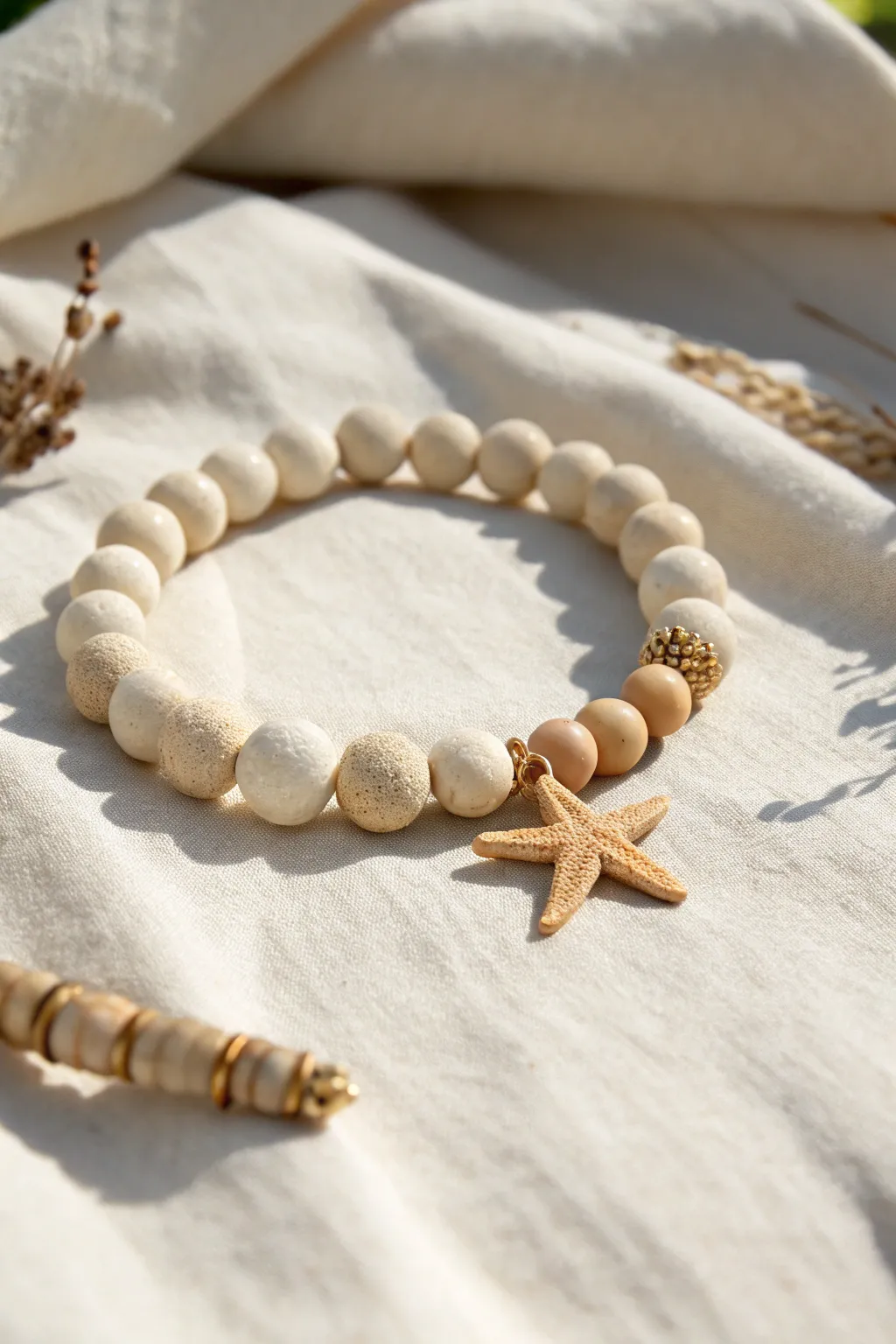
Capture the calm of a sunlit beach day with this elegant neutrals bracelet, featuring a tactile mix of smooth and porous beads finished with a realistic starfish charm. The soft sandy tones and subtle gold accents make this a versatile accessory for any summer outfit.
Step-by-Step Tutorial
Materials
- Elastic cord (0.7mm or 0.8mm clear stretch cord)
- White or cream wooden beads (10mm)
- Natural lava stone beads (white/cream, 10mm)
- Smooth beige/tan wooden or matte acrylic beads (8mm-10mm)
- Gold tone beaded spacer bead or textured round bead (8mm)
- Gold tone jump ring (6mm or 8mm)
- Realistic starfish charm (ceramic or resin)
- Bead stopper or painter’s tape
- Jewelry glue (e.g., G-S Hypo Cement)
- Scissors
Step 1: Planning and Preparation
-
Measure your wrist:
Before cutting any cord, wrap a measuring tape gently around your wrist to find your size. Add about 0.5 inches to this measurement for a comfortable fit. -
Cut the cord:
Cut a piece of elastic cord roughly 10-12 inches long. Having extra length makes tying the final knot significantly easier. -
Secure the end:
Attach a bead stopper or simply place a piece of painter’s tape on one end of the cord to prevent your carefully arranged beads from sliding off while you work. -
Plan your pattern:
Lay your beads out on a bead board or a soft towel. The pattern shown uses a large section of smooth cream beads, followed by textured lava beads, and finishes with a focal section of tan beads and the charm.
Step 2: Stringing the Main Beads
-
Start with smooth beads:
Begin by stringing approximately 12-14 of the smooth white/cream wooden beads. This section will form the back and sides of the bracelet. -
Transition to texture:
Add a textured lava stone bead. Notice in the design how the texture changes here; string about 2 or 3 of these porous beads to create a rugged, organic feel. -
Mix the textures:
Alternate a smooth bead, then another lava bead, and perhaps one more smooth bead. This irregular pattern mimics the natural scatter of shells on sand.
Use Essential Oils
Since this design uses porous lava stone beads, you can add 1-2 drops of your favorite essential oil to them. They will act as a natural diffuser throughout the day.
Step 3: Creating the Focal Point
-
Prepare the charm connection:
Open your gold jump ring using two pairs of pliers (or your fingers if it’s soft enough), twisting the ends away from each other rather than pulling apart. Slide your starfish charm onto the ring and close it securely. -
Add the tan accent beads:
String three of the smooth beige/tan beads. These act as a color bridge between the white beads and the gold accent. -
Hang the charm:
Thread the cord through the loop on your starfish charm (or the jump ring attached to it) so it sits directly next to the tan beads. -
Add the gold spacer:
Slide on the textured gold spacer bead immediately after the charm. This adds a hint of sun-kissed sparkle to the design. -
Finish the loop:
Add one or two final smooth cream beads to complete the circle, checking the length against your wrist one last time.
Knot Slipping?
If the elastic feels slippery, dust the knot area with a tiny bit of flour or cornstarch before tying. The friction helps the knot hold tight while you glue it.
Step 4: Finishing Touches
-
Pre-stretch the cord:
Before tying, give the ends of the elastic a few gentle pulls. This pre-stretching prevents the bracelet from sagging or loosening immediately after you wear it. -
Tie the knot:
Remove the tape or stopper. Tie a standard surgeon’s knot: cross right over left, wrap it twice, pull tight, then cross left over right and pull tight again. -
Apply adhesive:
Dab a tiny drop of jewelry glue directly onto the knot. I find using a toothpick helps apply the glue precisely without making a mess. -
Hide the knot:
While the glue is still slightly tacky, gently tug on the cord to slide the knot inside the hole of the nearest large wooden bead. -
Trim the excess:
Once dry, trim the excess cord tail close to the bead hole, being careful not to cut the main knot.
Enjoy the relaxed coastal vibe your new accessory brings to your daily style
Evil Eye Accent in a Curated Palette
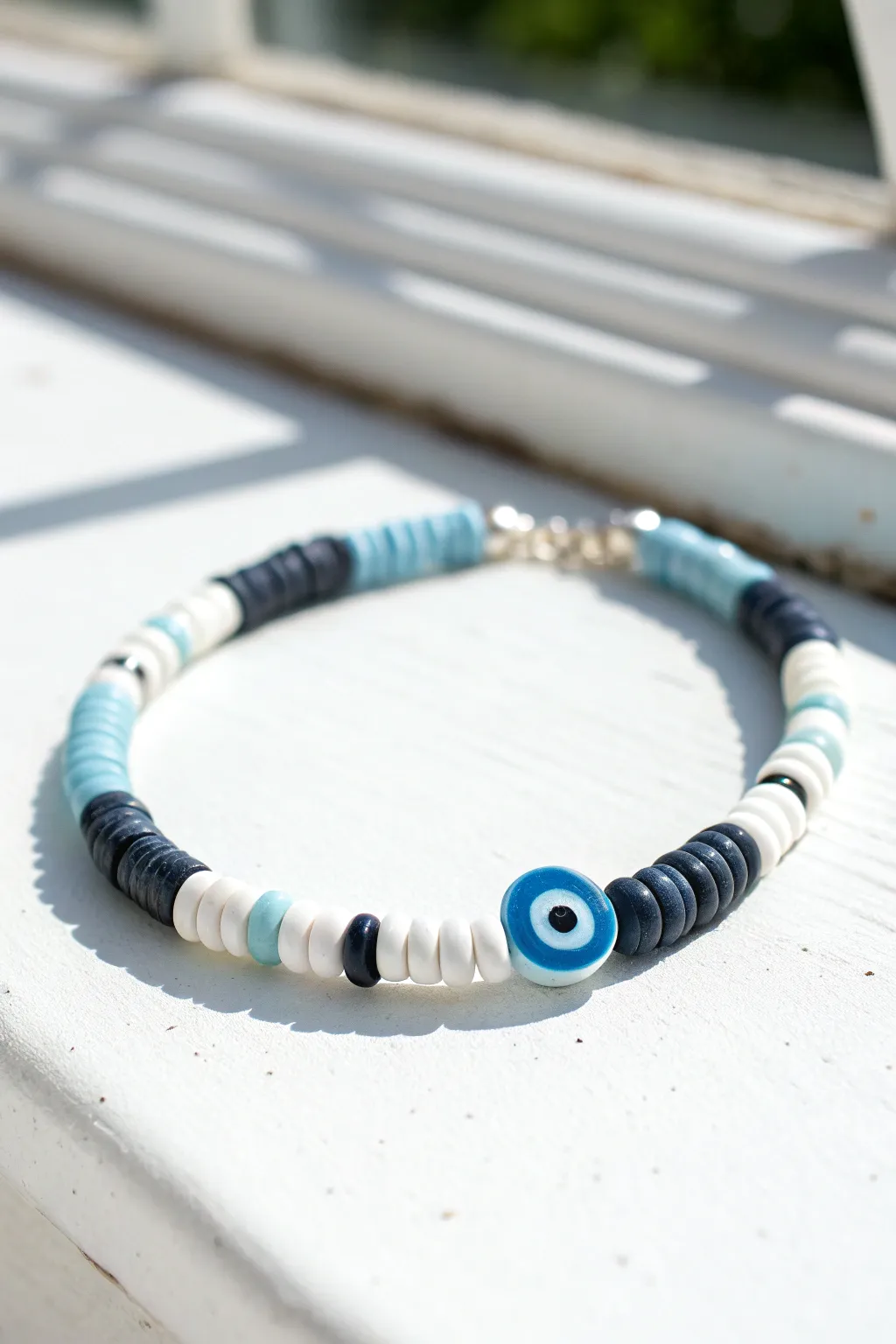
Channel serene ocean vibes with this elegant clay bead bracelet featuring a classic Evil Eye charm. The curated palette of navy, white, and sky blue creates a sophisticated gradient effect that elevates the simple Heishi style into a meaningful accessory.
Step-by-Step Guide
Materials
- Navy blue polymer clay heishi beads (6mm)
- White polymer clay heishi beads (6mm)
- Light blue/Sky blue polymer clay heishi beads (6mm)
- 1 Blue Evil Eye glass bead (flat round disc shape, approx 8-10mm)
- Elastic stretch cord (0.8mm or 1mm)
- Silver crimp beads (optional but recommended)
- Small silver jump rings
- Silver lobster clasp
- Jewelry glue (e.g., E6000 or G-S Hypo Cement)
- Scissors or jewelry nippers
- Chain nose pliers
- Bead design board or masking tape
Step 1: Planning the Pattern
-
Measure your wrist:
Wrap a measuring tape loosely around your wrist to determine the length. Add about 0.5 to 1 inch to this measurement depending on how loose you want the fit. -
Prepare the cord:
Cut a piece of elastic cord about 4 inches longer than your final bracelet length. This extra length makes tying the knot much easier later. -
Secure the end:
Attach a piece of masking tape to one end of the cord or use a bead stopper clip. This prevents your beads from sliding off while you work. -
Layout the design:
Visualize the pattern before stringing. The bracelet in the photo uses color-blocking rather than a random mix. The segments are roughly 1 inch long each, alternating between colors.
Step 2: Stringing the Core
-
Start with the center:
Thread the main attraction—the glass Evil Eye bead—onto the center of your cord. This ensures your focal point sits perfectly on top of your wrist. -
Build the immediate sides:
On the right side of the Evil Eye, string about 4-5 navy blue heishi beads. -
Mirror the left side:
Repeat the previous step on the left side of the Evil Eye, adding 4-5 navy blue heishi beads. I find mirroring as I go helps keep the design symmetrical. -
Add the white sections:
On both sides, following the navy beads, add a longer section of white beads. Aim for about 10-12 beads per side. -
Introduce the accent bead:
After the white section on the left side only, add a single navy bead followed by about 6-8 white beads to create that varied texture seen in the photo.
Knot Slipping?
If using a knot closure, pre-stretch your elastic cord before stringing. This prevents the bracelet from loosening immediately after you finish tying it.
Step 3: Creating the Color Blocks
-
Sky blue transition:
Add a section of light blue beads next. Thread about 15-20 light blue beads on one side. This creates a soft contrast against the stark navy and white. -
Navy block:
Follow the light blue with a solid block of navy beads, roughly the same length (15-20 beads). -
Repeat the pattern:
Continue adding blocks of color, alternating between white, light blue, and navy. Occasionally insert a single contrasting bead (like one navy bead in a white section) to mimic the spontaneous look of the original. -
Check the length:
Periodically wrap the strand around your wrist. Stop adding beads when the ends meet comfortably without stretching the cord.
Golden Hour Upgrade
Swap the silver hardware for gold vermeil accents. Add thin gold disc spacers between the color blocks to make the navy and white pop even more.
Step 4: Finishing Touches
-
Prepare for closure:
Once beaded to length, slide a crimp bead onto one end of the cord, followed by a jump ring. -
Loop back:
Thread the end of the cord back through the crimp bead to create a small loop holding the jump ring. -
Secure the crimp:
Use your pliers to flatten the crimp bead tightly. Trim the excess tail close to the crimp. -
Attach the clasp:
Repeat the crimp bead process on the other end, but loop the cord through the loop of the lobster clasp instead of a jump ring. -
Optional knot method:
If you don’t have clasps, simply remove the tape, tie a strong surgeon’s knot with the elastic, pull it tight, and secure the knot with a dab of jewelry glue before trimming the ends.
Now you have a stylish protective charm to wear daily or stack with other favorites
Earthy Sage and Terracotta Mix
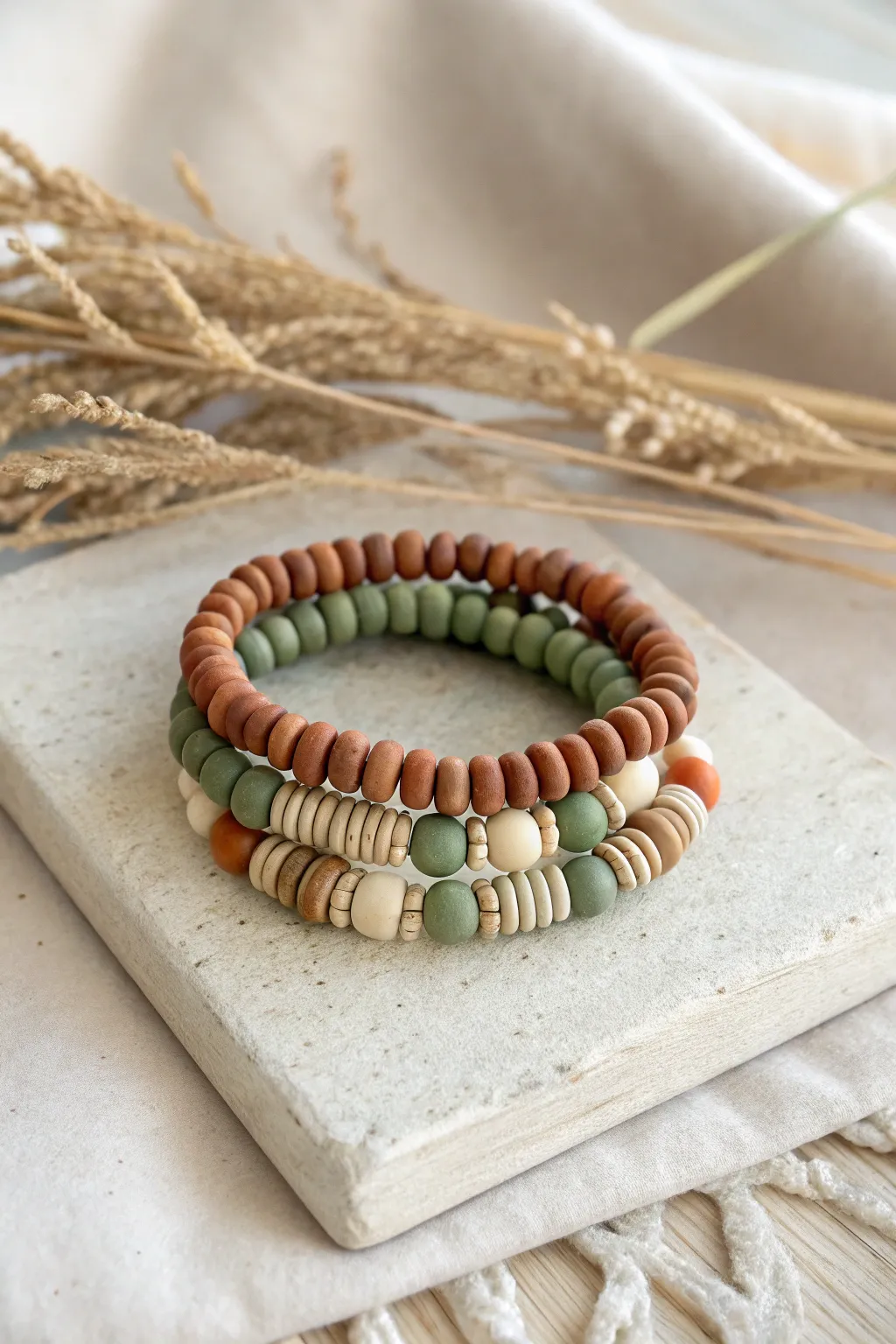
Capture the grounding warmth of nature with this set of three distinct polymer clay bracelets. Combining matte terracotta, muted sage greens, and varied textures creates a harmonious stack that works as well individually as it does together.
Detailed Instructions
Materials
- Polymer clay heishi beads (approx. 6mm) in matte terracotta/rust
- Polymer clay beads (heishi or rondelle style) in muted sage green
- Assorted accent beads: Creamrondelles, flat wooden discs, ribbed cream spacers
- Large round focal beads in cream and sage green (optional for texture)
- Strong elastic cord (0.8mm or 1mm)
- Super glue or jewelry cement
- Scissors
- Bead stopper or masking tape
- Beading needle (optional)
Step 1: The Terracotta Solid Bracelet
-
Measure and Cut:
Cut a piece of elastic cord about 10-12 inches long. This generous length makes tying the final knot much easier. Secure one end with a bead stopper or a piece of tape to prevent beads from sliding off. -
Stringing the Base:
Begin stringing the matte terracotta heishi beads. For this first bracelet, we are creating a solid block of color to anchor the set. I find simply dipping the cord end into a pile of beads works faster than picking them up one by one. -
Checking the Fit:
Continue adding beads until you have about 6.5 to 7 inches of length, or until it fits comfortably around your wrist without stretching. The beads should sit flush against each other but not be overly tight. -
Closing the Loop:
Tie a surgeon’s knot (right over left, left over right, and loop through again) to secure. Pull the elastic tight so the knot disappears inside a bead hole if possible. Add a tiny dab of super glue to the knot.
Step 2: The Sage Green Variation
-
Prepare the Cord:
Cut another 12-inch length of elastic and secure the end just as before. -
Creating the Pattern:
This bracelet uses primarily sage green beads but introduces subtle texture. Start by threading about 2 inches of sage green heishi beads. -
Adding Contrast:
Insert a small section of a slightly darker or lighter green bead, or perhaps a few thin wooden spacers, to break up the solidity, although the reference image shows a fairly consistent green loop which pairs beautifully with the others. -
Finishing the Second Bracelet:
Complete the strand to match the length of your terracotta bracelet. Tie off securely with a surgeon’s knot, glue, and trim the excess cord once dry.
Sticky Situation
If the knot keeps slipping undone before the glue dries, hold it tight with a pair of tweezers or a small binder clip for a minute to let the friction set.
Step 3: The Mixed Texture Centerpiece
-
Planning the Design:
This third bracelet is the complex focal piece. Lay out your beads on a tray first: you’ll need the cream ribbed spacers, flat wooden discs, round sage beads, and a few terracotta accents. -
Start with Texture:
Begin stringing with a repeating pattern. Try a sequence like: three thin rib-textured cream beads, one flat wooden disc, and one large round sage bead. -
Injecting Color:
Every third repetition, swap the sage bead for a round cream bead or a terracotta accent bead to tie the whole set together visually. -
Rhythm and Balance:
Focus on the ‘sandwich’ look shown in the image: grouping thin, coin-like beads between larger round anchor beads creates that distinct, chunky aesthetic. -
Final Adjustments:
Wrap the unfinished strand around your wrist to check the pattern alignment. You want the pattern to look continuous without an awkward gap where the ends meet. -
Secure the Knot:
Tie your final surgeon’s knot. For this bracelet, try to hide the knot inside one of the larger round beads, as their holes are usually more accommodating. -
Drying Time:
Let the glue cure fully on all three bracelets for at least 15 minutes before stretching them over your hand.
Natural Upgrade
Swap the wooden spacers for real coconut shell discs or sandalwood beads. They absorb essential oils well, turning your stack into a diffuser bracelet.
Enjoy wearing your new nature-inspired stack that brings a touch of calm to any outfit
Monochrome Stack With One Metallic Pop
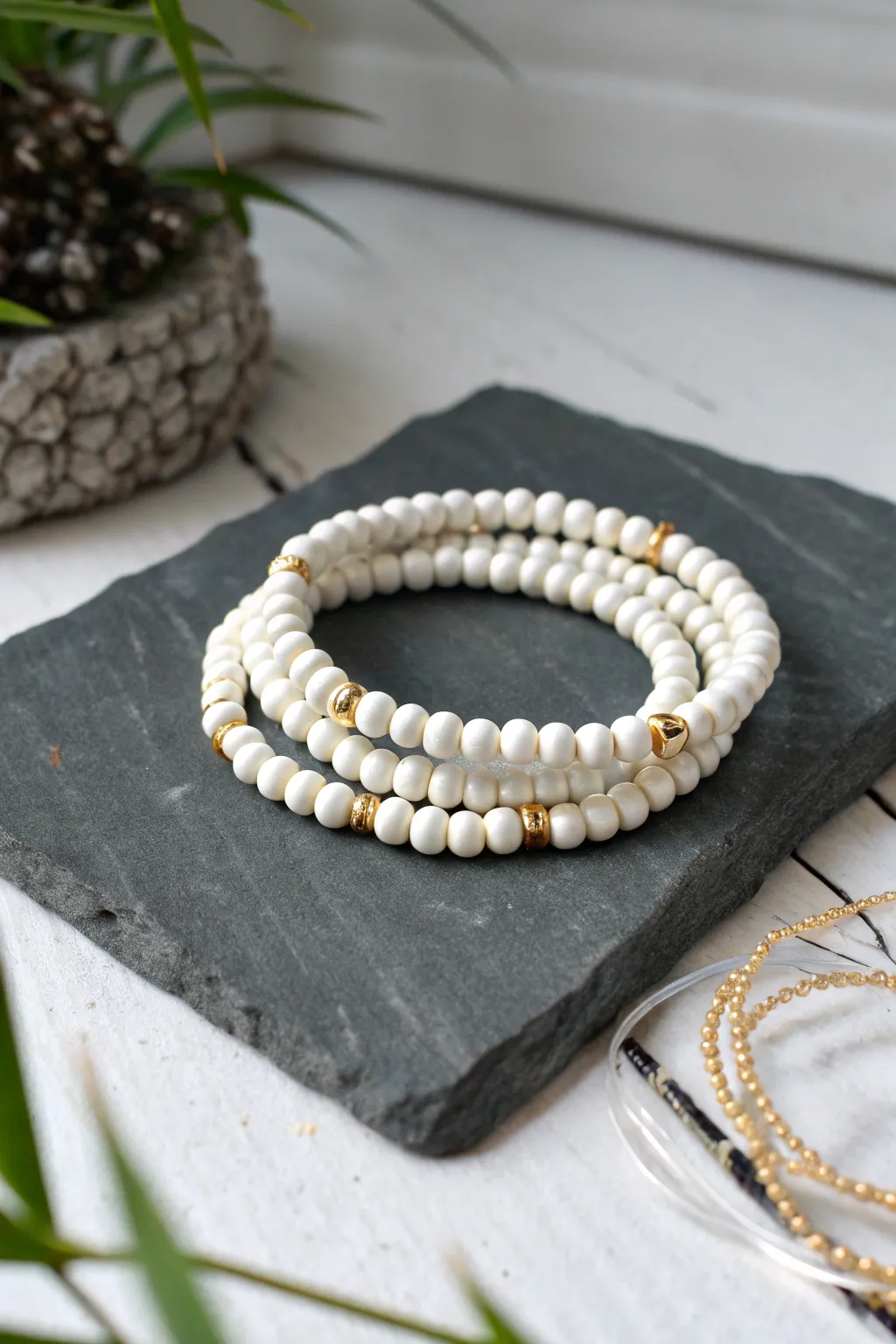
This elegant bracelet stack combines smooth, cream-colored wood or clay beads with strategically placed gold accents for a look that is both minimalist and luxurious. The set features three individual strands that can be worn together for a layered effect or separately for subtle charm.
How-To Guide
Materials
- 6mm-8mm cream or white round beads (wood, clay, or ceramic)
- Gold spacer beads (various shapes: faceted rondelle, round, distinct geometric)
- Strong elastic cord (0.8mm or 1mm)
- Jewelry glue or clear nail polish
- Scissors
Step 1: Planning Your Design
-
Measure your wrist:
Wrap a flexible measuring tape around your wrist to find your size. Add about 0.5 inches to this measurement to ensure the finished bracelets fit comfortably without being too tight. -
Cut the elastic:
Cut three separate lengths of elastic cord. I prefer to cut them about 3-4 inches longer than my final wrist measurement to give myself plenty of room for tying secure knots later. -
Pre-stretch the cord:
Hold each piece of elastic between your hands and give it a few firm tugs. This pre-stretching step helps prevent the bracelets from sagging or stretching out permanently after you wear them a few times.
Hiding the Knot
If the hole of your cream bead is too small to hide the knot, try hiding it inside one of the gold spacer beads instead, as metal beads often have larger bore holes.
Step 2: Creating the First Strand
-
Secure the end:
Place a piece of tape or a bead stopper on one end of your first elastic string so your beads don’t slide off while you work. -
Start the pattern:
Begin threading on your cream-colored base beads. String about 10 to 12 of these beads initially. -
Add first gold accent:
Slide on a faceted gold rondelle bead. This adds a subtle shimmer that catches the light differently than a smooth round bead. -
Continue the sequence:
Add another section of cream beads, roughly the same length as the first. This asymmetrical spacing keeps the design organic. -
Insert second metallic pop:
Add a smooth, round gold bead here. Varying the shapes of your metallic accents adds visual interest to the stack. -
Finish the strand:
Continue adding cream beads until you reach the desired length, ensuring you end with a cream bead so the gold spacer isn’t right next to the knot.
Step 3: Creating the Remaining Strands
-
String the second bracelet:
Repeat the process for the second bracelet, but try placing your gold accents at slightly different intervals. For this one, try using a slightly larger or more geometric gold bead as a focal point. -
Create the third bracelet:
For the final strand, keep it simple. use mostly cream beads with perhaps just one or two small gold accents hidden among them. -
Check the stack:
Before tying anything off, hold the ends of all three strands together around your wrist to see how the gold beads align. Adjust bead counts if necessary to ensure the metallic pops are scattered rather than clustered in one line.
Uneven Spacing?
Don’t stress about perfect symmetry. The beauty of this stack lies in the random placement of the gold beads; aim for ‘visual balance’ rather than distinct patterns.
Step 4: Finishing Touches
-
Tie the knots:
For each bracelet, remove the tape/stopper and bring the ends together. Tie a standard surgeon’s knot: cross right over left and loop under, then left over right and loop under twice. -
Secure the knots:
Pull the elastic tight so the knot is firm. Place a tiny drop of jewelry glue or clear nail polish directly onto the knot and let it dry for a few minutes. -
Hide the knot:
Once dry, trim the excess elastic close to the knot. Gently pull the adjacent bead over the knot to hide it inside, giving your bracelet a professional, seamless finish.
Slip your new stack onto your wrist and enjoy the minimalist elegance you created
Half-and-Half Split Color Bracelet
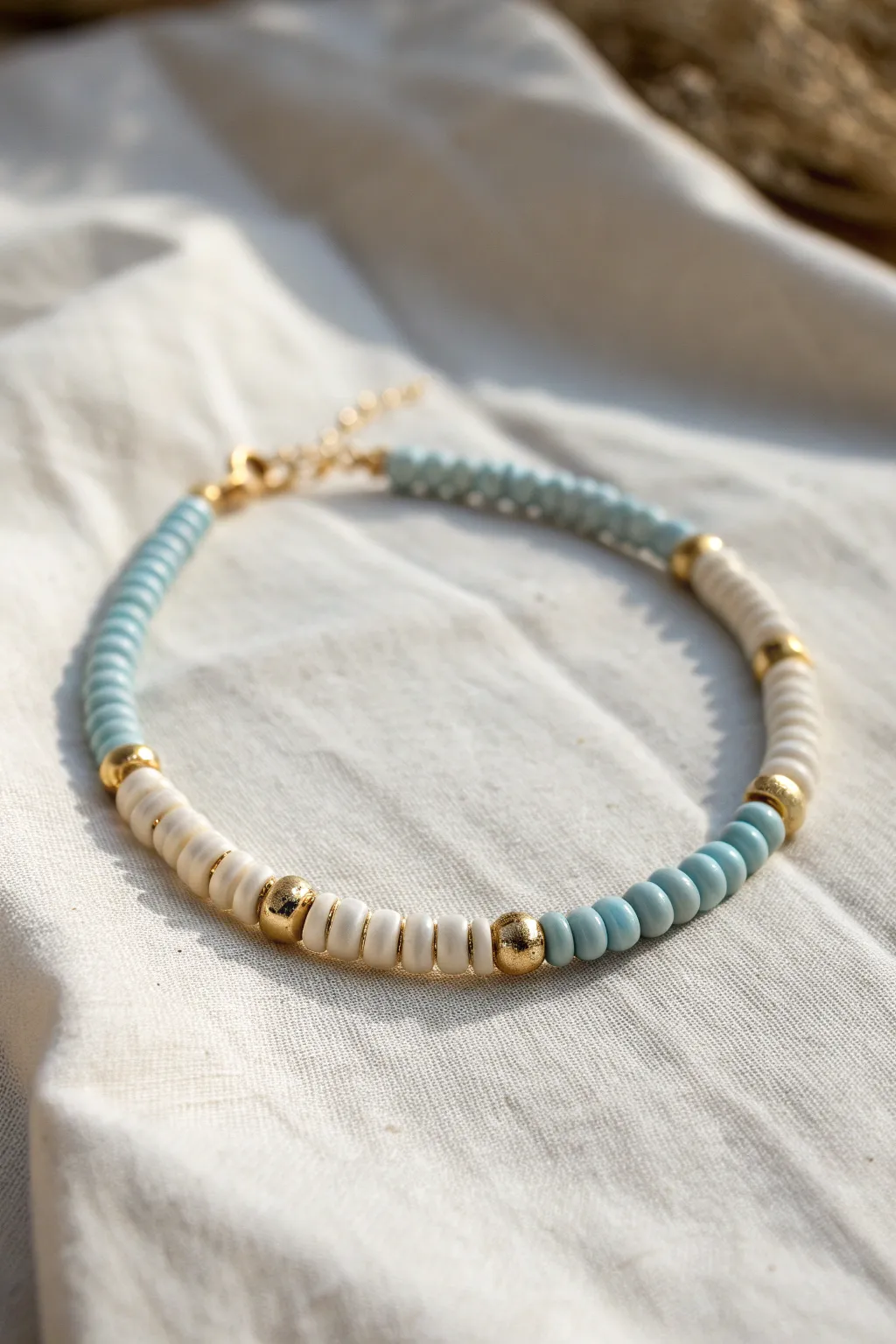
This elegant bracelet combines soft powder blue and creamy white clay beads separated by gleaming gold accents for a sophisticated, airy look. Its segmented design creates a lovely rhythm that feels both modern and timeless, perfect for stacking or wearing solo.
Detailed Instructions
Materials
- 4mm or 6mm heishi clay disc beads (Light Blue)
- 4mm or 6mm heishi clay disc beads (Cream/Off-White)
- 3mm-4mm round gold spacer beads (smooth finish)
- Elastic beading cord (0.5mm – 0.8mm, clear)
- Jewelry glue (e.g., G-S Hypo Cement) or clear nail polish
- Scissors
- Tape or bead stopper
- Gold tone crimp covers (optional but recommended for a polished finish)
- Gold tone jump rings and lobster clasp
- Chain extender (optional)
Step 1: Preparation
-
Measure your wrist:
Wrap a piece of string around your wrist to find your comfortable size. Add about half an inch to this measurement to allow for the beads’ bulk. -
Cut the cord:
Cut a length of elastic cord about 10-12 inches long. Having extra length makes tying the final knot much less frustrating. -
Secure the end:
Place a piece of tape or a bead stopper on one end of your cord so beads don’t slide off while you work.
Knot Slipping?
If your elastic knot feels loose, try pre-stretching the cord before you start beading. This removes the initial ‘slack’ and keeps the finished bracelet tight over time.
Step 2: Beading the Pattern
-
Start with Blue:
Begin by threading on a substantial section of the light blue clay beads. Aim for about 1.5 to 2 inches of just blue beads to create the first solid block of color. -
Add first gold accent:
Slide on one round gold spacer bead. This marks the transition between your color blocks. -
Create a Cream section:
Thread on approximately 8 to 10 cream-colored clay beads. This section should be shorter than your main blue section, creating visual variety. -
Second gold accent:
Add another round gold spacer bead after the cream section. -
Small Blue segment:
Now add a smaller segment of blue beads, perhaps 5 to 7 beads long. This breaks up the symmetry slightly. -
Third gold accent:
Place your third gold spacer bead onto the cord. -
Review the pattern:
Look at the rhythm you are creating. The bracelet in the image uses alternating sections of varying lengths separated by single gold beads. I like to lay the beads out on a mat first to visualize the balance. -
Continue the sequence:
Repeat a pattern of: Cream Section (8-10 beads) -> Gold Spacer -> Blue Section (8-10 beads) -> Gold Spacer. Continue until you are close to your desired length. -
Check the fit:
Carefully wrap the unfinished bracelet around your wrist. The ends should meet comfortably without stretching the elastic too tight.
Level Up: Texture Mix
Replace one of the solid color sections with freshwater pearls or clear crystal beads. This adds an organic, high-end texture contrast to the matte clay.
Step 3: Finishing Touches
-
Prepare the hardware:
Thread on a gold crimp bead (or simply prepare to knot if you aren’t using a clasp). For the professional look in the photo, string on a jump ring attached to one side of your clasp. -
Tie the knot:
Tie a strong surgeon’s knot (right over left, left over right) or a triple square knot. Pull the elastic tight so there are no gaps between beads. -
Secure the knot:
Apply a tiny dot of jewelry glue or clear nail polish to the knot. Let it dry for a few minutes to ensure it won’t slip. -
Hide the knot:
If possible, gently tug the knot inside one of the adjacent clay beads or the gold spacer to hide it. -
Attach the clasp:
If you are using a lobster clasp and extender chain like the image, attach these ends to the loops formed by your cord or jump rings now using pliers. -
Trim excess:
Cut off the excess elastic cord close to the knot (but not too close—leave about 1mm) once the glue is fully dry.
Slip on your new bracelet and enjoy the subtle pop of coastal color on your wrist
Checkerboard-Inspired Pattern in Heishi
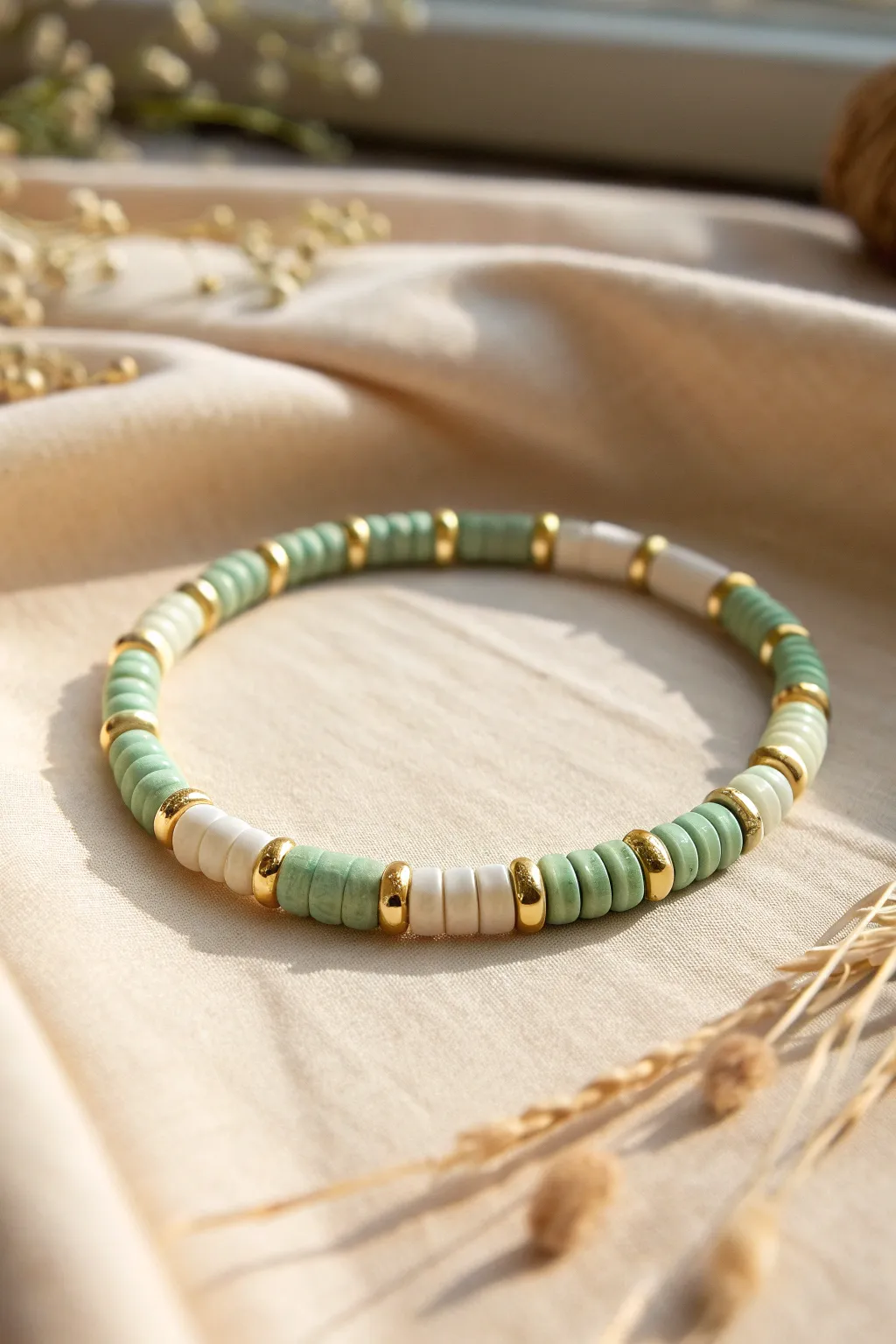
Embrace a serene, earthy aesthetic with this beautiful clay bead bracelet featuring alternating segments of sage green and cream. The gold accents add a touch of luxury, making this piece perfect for stacking or wearing as a subtle statement on its own.
Step-by-Step
Materials
- 6mm Heishi polymer clay beads (Sage Green)
- 6mm Heishi polymer clay beads (Cream/Off-White)
- 4mm-6mm Gold spacer beads (disc or rondelle shape)
- Elastic stretch cord (0.8mm recommended)
- Jewelry glue or clear nail polish
- Scissors
- Bead stopper or tape
Step 1: Preparation & Planning
-
Measure your wrist:
Wrap a flexible measuring tape around your wrist to find your size. Add about 0.5 to 1 inch to this measurement to ensure the bracelet fits comfortably without being too tight. -
Cut the cord:
Cut a piece of elastic cord approximately 10-12 inches long. Having this extra length makes it much easier to tie the final knot securely. -
Secure the end:
Attach a bead stopper to one end of the cord, or simply tape it down to your work surface so your beads don’t slide off while you work. -
Pre-stretch the cord:
Give the elastic cord a few gentle tugs. Pre-stretching helps prevent the bracelet from loosening up after you’ve worn it a few times.
Step 2: Beading the Pattern
-
Start with gold:
Thread a single gold spacer bead onto the cord. This acts as a clean separator to begin your pattern. -
First green segment:
String on three sage green Heishi clay beads. Make sure they sit flush against the gold spacer. -
Add a separator:
Add another gold spacer bead after the green trio. -
Create a cream segment:
Thread on three cream-colored Heishi beads, followed immediately by another gold spacer. -
Establish the rhythm:
Continue this alternating pattern: 3 green beads, 1 gold spacer, 3 cream beads, 1 gold spacer. This creates the structured ‘checkerboard’ look. -
Check the length:
Periodically wrap the strand around your wrist to check the fit. You want the ends to meet comfortably without gaps. -
Vary the segments (Optional):
If you look closely at the inspiration, some green sections are longer. Feel free to randomly insert a segment of 5 or 6 green beads to break up the uniformity for a more organic feel. -
Finish the strand:
End your pattern with a segment of beads (either green or cream) rather than a gold spacer, as your starting bead was gold. This ensures the pattern flows seamlessly when tied.
Knot Slipping?
If the elastic feels too slick for a single knot, try tying two separate surgeon’s knots on top of each other before applying glue for maximum security.
Step 3: Finishing Touches
-
Prepare to tie:
Remove the bead stopper or tape carefully, holding both ends of the elastic firmly. -
Tie the surgeon’s knot:
Cross the ends, wrap one side over and under twice, then unnecessary pull tight. This makes a very secure surgeon’s knot. -
Secure with glue:
I like to dab a tiny drop of jewelry glue or clear nail polish directly onto the knot. Let it dry for a a few minutes. -
Hide the knot:
If the hole of one of the neighboring gold beads is large enough, gently tug the elastic so the knot slides inside the bead to hide it. -
Trim excess:
Using sharp scissors, trim the excess cord ends close to the knot (or the bead hiding the knot), being careful not to nick the main bracelet cord.
Make it a Set
Create a matching stack by making two solid-colored bracelets—one fully sage green and one fully cream—using just a single gold bead as a focal point.
Now you have a chic, custom accessory ready to add a soft pop of color to your daily outfit
Sunset Palette Stack for Golden Hour Photos
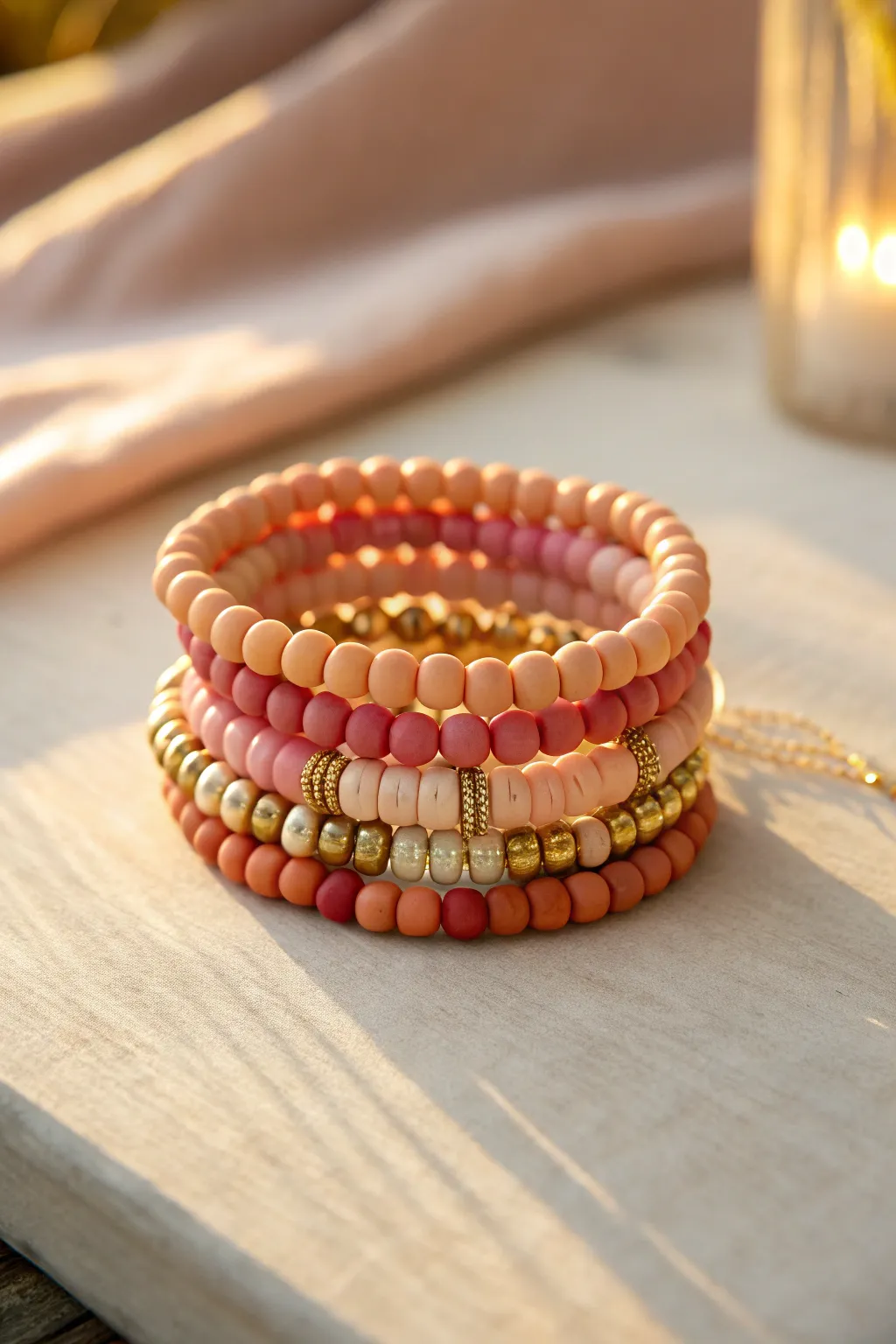
Capture the warmth of golden hour with this stunning multi-strand bracelet stack featuring a gradient of terracotta, peach, blush, and gold tones. The mix of matte polymer clay discs and shining metallic accents creates a sophisticated texture that glows beautifully in the light.
Step-by-Step Guide
Materials
- 6mm flat heishi polymer clay beads in terracotta/dark orange
- 6mm flat heishi polymer clay beads in peach/light orange
- 6mm flat heishi polymer clay beads in blush pink
- 8mm round matte acrylic or wood beads in blush
- 8mm round matte acrylic or wood beads in dark coral
- 4mm gold polish round metal spacer beads
- 6mm gold textured disc spacer beads (daisy spacers)
- Gold tube beads (approx. 4mm wide)
- 0.8mm clear elastic stretch cord
- Jewelry glue or clear nail polish
- Scissors
- Bead design board (optional but helpful)
- Small piece of tape
Step 1: Preparation & Planning
-
Measure your wrist:
Wrap a measuring tape loosely around your wrist to find your size. Add about 0.5 to 0.75 inches to this measurement so the bracelets fit comfortably without digging in. -
Prepare the cord:
Cut five strands of elastic cord, making each one about 10-12 inches long. This generous length gives you plenty of room to tie knots securely later. -
Secure the ends:
Place a small piece of tape or a binder clip on one end of each cord strand. This simple trick prevents your carefully arranged beads from sliding off while you work.
Step 2: Strand 1: The Peach Gradient
-
Start the pattern:
For the top bracelet, begin stringing the 6mm peach heishi beads. Thread about 2 inches of solid peach beads onto the cord. -
Interject gold accents:
Slide on three 4mm gold round spacers, followed by a small section (about 1 inch) of blush pink heishi beads, then three more gold spacers. -
Finish the strand:
Fill the rest of the strand with the peach heishi beads until you reach your target length.
Color Harmony Tip
To get that ‘sunset’ vibe, verify your bead colors in natural light before starting. Indoor bulbs can make peaches look like oranges and distort the gradient.
Step 3: Strand 2: The Mixed Texture
-
Mix bead types:
This strand combines textures. Alternate between ten blush pink heishi beads and one 8mm round matte blush bead. -
Create a focal section:
In the center of the bracelet, place a sequence of five flat gold daisy spacers to create a shiny metallic focal point against the soft pinks. -
Complete the length:
Continue the alternating pattern of ten heishi beads and one round bead until finished.
Knot Slipping?
If your elastic knots keep unravelling, try coating the knot area with a little Hypo Cement. It stays flexible when dry, unlike superglue which can make the cord brittle.
Step 4: Strand 3: The Golden Center
-
Base color framing:
String approximately 2.5 inches of the blush pink heishi beads. -
Add metallic detail:
This is the ‘hero’ bracelet. Slide on a gold daisy spacer, followed by a light beige tube bead, another gold daisy spacer, and then repeating this micro-pattern 4-5 times for a metallic block. -
Resume base color:
Finish the rest of the strand with the blush pink heishi beads.
Step 5: Strand 4: The Metallic Mix
-
Create a heavy metal look:
For this strand, you want more shine. String a random pattern of 4mm gold round beads mixed with white or cream heishi beads. -
Add rhythm:
I prefer to do patterns like: three gold beads, one white bead, three gold beads. This breaks up the clay texture of the rest of the stack.
Step 6: Strand 5: The Terracotta Anchor
-
Use the darkest tone:
Use the terracotta/dark orange heishi beads for the final bracelet to ground the palette. -
Incorporate round beads:
Every 1.5 inches, add a single 8mm dark coral round bead flanked by two gold daisy spacers to tie it visually to the other strands.
Step 7: Finishing Up
-
Pre-stretch the cords:
Before tying, give each bracelet a gentle tug. This pre-stretching helps prevent the elastic from loosening up completely the first time you wear it. -
Tie the surgeon’s knot:
Remove the tape and tie the ends together using a surgeon’s knot (right over left twice, then left over right once) and pull tight. -
Secure with adhesive:
Dab a tiny drop of jewelry glue or clear nail polish onto the knot. Let it dry completely before snipping off the excess cord. -
Hide the knot:
If possible, slide the knot inside the hole of a nearby bead to conceal it for a professional finish.
Slip on your new stack and enjoy the warm, glowing hues on your wrist
Matte-and-Shine Mix With Transparent Accents
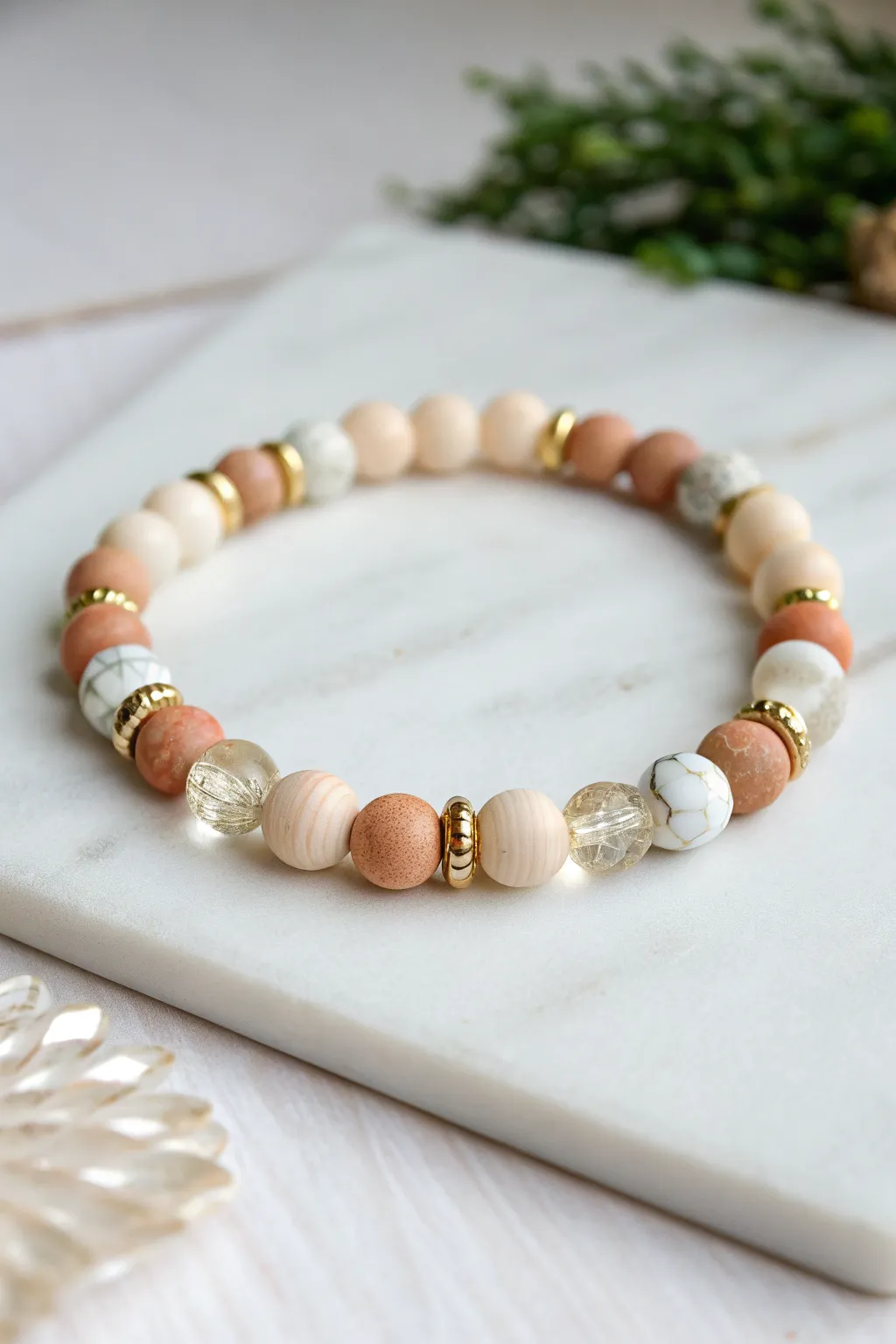
Embrace the natural beauty of textures with this bracelet that blends matte terracotta tones, smooth unfinished wood, and glossy stone accents. The mix of shine and organic finishes creates a sophisticated, earthy piece perfect for stacking or wearing solo.
Step-by-Step
Materials
- Stretch cord (0.8mm or 1mm)
- 8mm matte terracotta/peach round stone or high-quality polymer clay beads
- 8mm unfinished light wood beads
- 8mm white howlite beads (white with grey veining)
- 8mm transparent glass beads with gold foil/crackle effect
- Gold tone sophisticated spacer beads (rondelle or disc shape)
- Gold tone heishi or flat metal spacer beads
- Jewelry glue or clear nail polish
- Scissors
Step 1: Planning & Preparation
-
Measure your wrist:
Before you start stringing, wrap a piece of string around your wrist to find your comfortable size, adding about half an inch for ease. This ensures your bracelet won’t be too tight once the beads are added. -
Cut the cord:
Cut a length of stretch cord about 10-12 inches long. I always like to give myself plenty of extra room to tie the knot comfortably at the end. -
Pre-stretch the cord:
Hold both ends of the cord and give it a few gentle firm tugs. This pre-stretching prevents the bracelet from sagging or loosening up immediately after you wear it for the first time. -
Lay out your design:
On a bead board or a soft towel, lay out your beads in the intended pattern. This helps you visualize the symmetry without beads rolling away.
Sticky Situation
If the knot won’t fit inside a bead hole, don’t force it or the bead might crack. Just trim the ends very close and rotate the knot to the back.
Step 2: Creating the Pattern
-
Identify the focal point:
The pattern features a central repeating motif. Let’s start building from what will be the ‘front’ center of the bracelet. -
String the center sequence:
Thread on a matte terracotta bead, followed by a gold rondelle spacer, and then an unfinished wood bead. -
Add transparency:
Next, add a transparent gold-foil glass bead. This adds that lovely ‘matte-and-shine’ contrast mentioned in the section title. -
Insert the marble texture:
Thread on a white howlite bead. Follow this immediately with a terracotta bead and a flat gold heishi spacer. -
Repeat the marble texture:
After the spacer, add another white howlite bead. This creates a small transition section before the pattern shifts again. -
Mirror the sequence:
Continue the pattern by largely mirroring your beads or creating alternating sections. A good rhythm seen here is: Wood > Gold Spacer > Terracotta > White Howlite. -
Check the symmetry:
As you work your way around, try to alternate the matte terracotta beads with the smoother wood and glass beads to keep the textures balanced. -
Fill the length:
Continue threading beads until you reach the desired length. For a standard 7-inch wrist, you will likely need about 20-22 beads total. -
Double-check the fit:
Wrap the strung beads around your wrist to check the fit. There should be no large gaps between beads, but it shouldn’t squeeze your skin.
Scent Infusion
Since this design uses unfinished wood beads, you can add a drop of essential oil to them. They act as a natural diffuser for your favorite scent!
Step 3: Finishing Touches
-
Prepare the knot:
Bring the two ends of the cord together. Remove any slack so the beads are touching, but not so tight that they buckle. -
Tie a surgeon’s knot:
Cross right over left, then left over right and loop it through twice. This creates a secure surgeon’s knot which is less likely to slip than a standard square knot. -
Secure with glue:
Apply a tiny dab of jewelry glue or clear nail polish directly onto the knot. Let it dry for a minute or two to ensure the bond holds. -
Hide the knot:
Trim the excess cord ends to about 2mm. Gently pull the cord so the knot slides inside the hole of a neighboring bead (the wood beads usually have larger holes, making them perfect for this).
Now you have a beautifully textured bracelet ready to add a touch of earthiness to your daily outfit
Theme Stack Built Around One Statement Charm
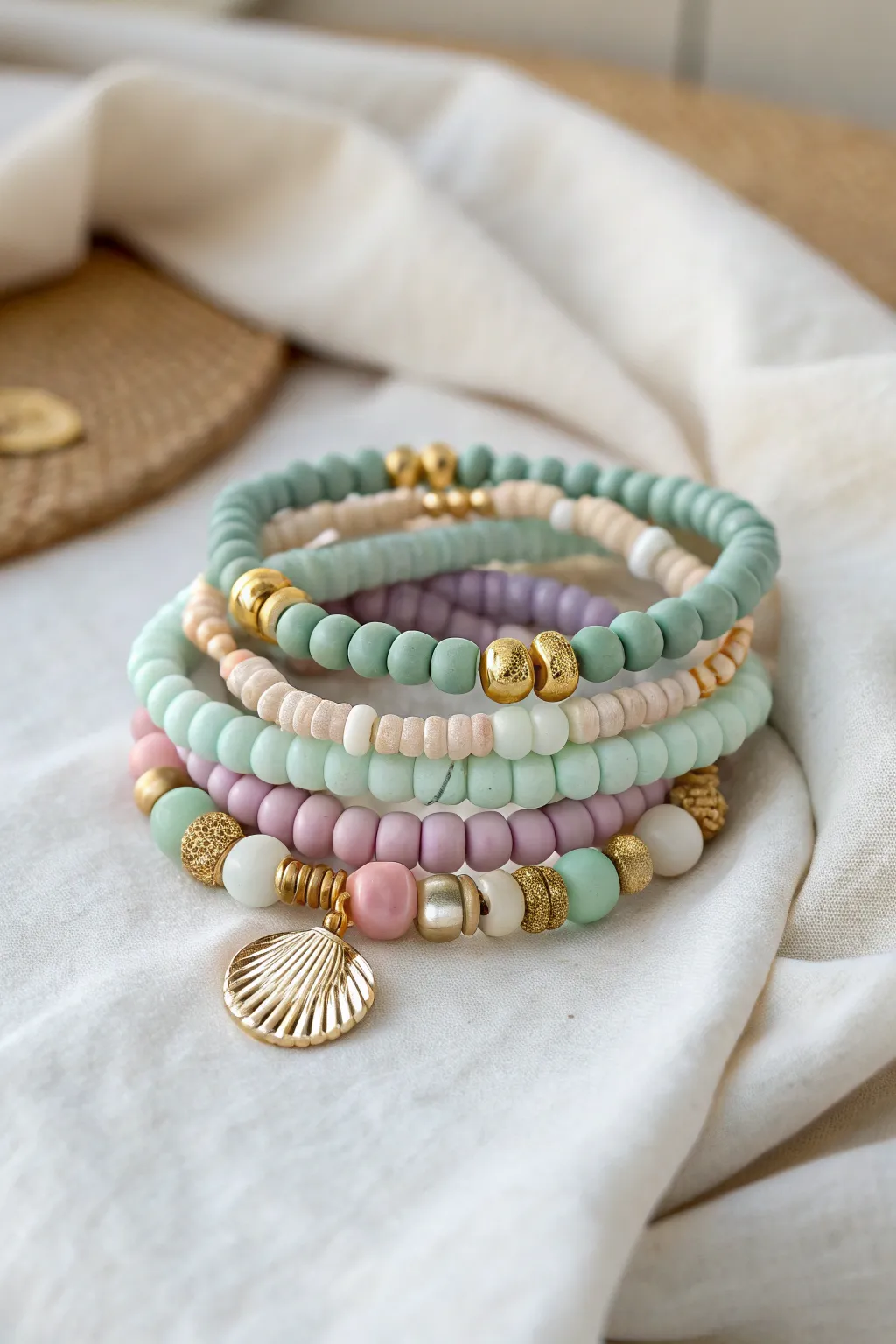
Capture the essence of a serene beach day with this coordinated stack of polymer clay bead bracelets centered around a striking gold shell charm. The soft pastel palette of sage greens, dusty pinks, and creams is elevated by textured gold accents for a luxe, bohemian feel.
Detailed Instructions
Materials
- Polymer clay Heishi beads (disc beads) in: sage green, mint green, dusty rose pink, cream/beige, and pastel purple
- Gold tone scallop shell charm with jump ring
- Gold spacer beads: smooth rounds, textured rounds, stardust balls, and small gold discs
- Elastic stretch cord (0.8mm or 1mm)
- Jewelry glue (GS Hypo Cement recommended)
- Scissors or jewelry snips
- Bead stopper or tape
- Beading needle (optional but helpful)
Step 1: Planning Your Palette
-
Analyze the stack:
Note that this look relies on five separate bracelets worn together. Four are simple repeating patterns, and one is the ‘hero’ bracelet holding the charm. -
Select your colors:
Pull out your clay discs in sage, mint, light lavender, cream, and dusty rose to make sure they harmonize well before stringing. -
Prepare the cord:
Cut five lengths of elastic cord, each about 10-12 inches long. This gives you plenty of room to tie knots later without struggling. -
Secure the ends:
Place a bead stopper or a piece of masking tape on one end of each cord so your beads don’t slide off while you work.
Knot Slipping?
If your elastic knots keep coming undone before the glue dries, try making the first loop of your knot, tightening it, and clamping it with a small binder clip while you prepare the second loop.
Step 2: Creating the Solid & Patterned Strands
-
Bracelet 1: The Sage Solid:
Start with the top-most bracelet. String sage green clay discs for the entire length, interrupted only by three small gold accent beads grouped in the center. -
Bracelet 2: The Cream Texture:
For the second strand, alternate small sections of cream/beige clay beads with single white beads to create a subtle striped effect. -
Add gold to the Cream strand:
Every inch or so, insert a flat gold disc spacer to break up the matte clay texture. -
Bracelet 3: The Mint & Gold:
Thread a long section of mint green beads. In the center, add two large gold beads flanking a central section of mint beads to duplicate the middle bracelet shown in the image. -
Bracelet 4: The Lavender Layer:
Create a strand primarily made of pastel lavender clay beads. Keep this one simple to balance the busier strands. -
Mix in subtle variation:
I occasionally like to sneak in a slightly darker purple bead every 10 beads to give the strand depth, though a solid color works perfectly too.
Step 3: The Hero Charm Bracelet
-
Start the focal strand:
This bracelet (the bottom one) is the most complex. Begin by stringing a random, organic mix of mint, pink, and white clay beads for the back half of the bracelet. -
Build the focal section:
As you reach the front center, stop using the clay discs. Switch to large, round beads: a white round bead, a textured gold ‘stardust’ bead, and a smooth pearl-finish bead. -
Add the charm connector:
Thread on a series of flat gold disc spacers—about 5 or 6 of them stacked together—to create a metallic cylinder. -
Attach the charm:
Open the jump ring on your gold scallop shell charm and attach it directly to the elastic cord in the middle of that stack of gold disc spacers. -
Mirror the design:
Finish the focal section by mirroring the beads you placed before the charm: a smooth pearl-finish bead, a textured gold bead, and a white round bead. -
Check the fit:
Wrap each bracelet around your wrist to ensure they sit comfortably. Add or remove clay discs from the back sections as needed.
Level Up: Texture Mix
Swap out some standard clay discs for faceted glass beads or matte stone beads in the same pastel colors. The contrast between soft clay and hard stone makes the stack look much more expensive.
Step 4: Finishing Touches
-
Pre-stretch the cord:
Give each strand a gentle tug before tying. This prevents the bracelet from stretching out permanently the first time you wear it. -
Tie the knots:
Tie a surgeon’s knot (right over left, left over right twice) for each bracelet. Pull tight. -
Secure with adhesive:
Dab a tiny drop of jewelry glue on each knot. Let this dry completely before trimming. -
Hide the knot:
Trim the excess cord close to the knot, then side the knot inside the hole of a nearby large bead if possible.
Wear your new stack all together for maximum impact or share them with friends for a coordinated look