
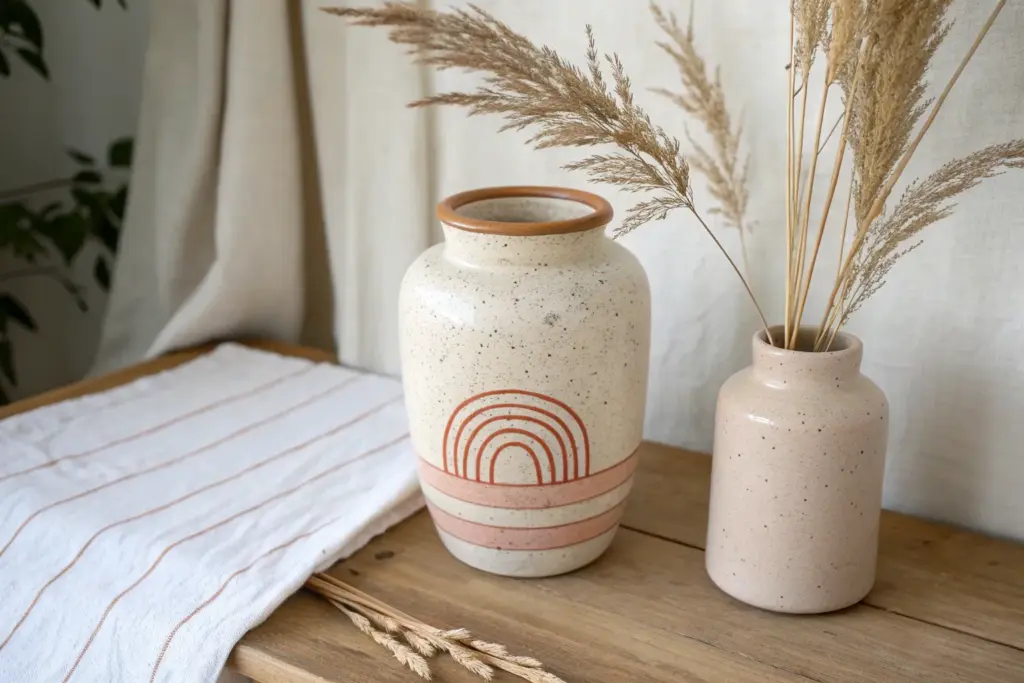
If you want clay vase ideas that look modern but still feel totally doable, you’re in the right headspace. These are my favorite easy vase projects to make when I’m craving quick wins and cute shelf decor.
Simple Coil Spiral Vase
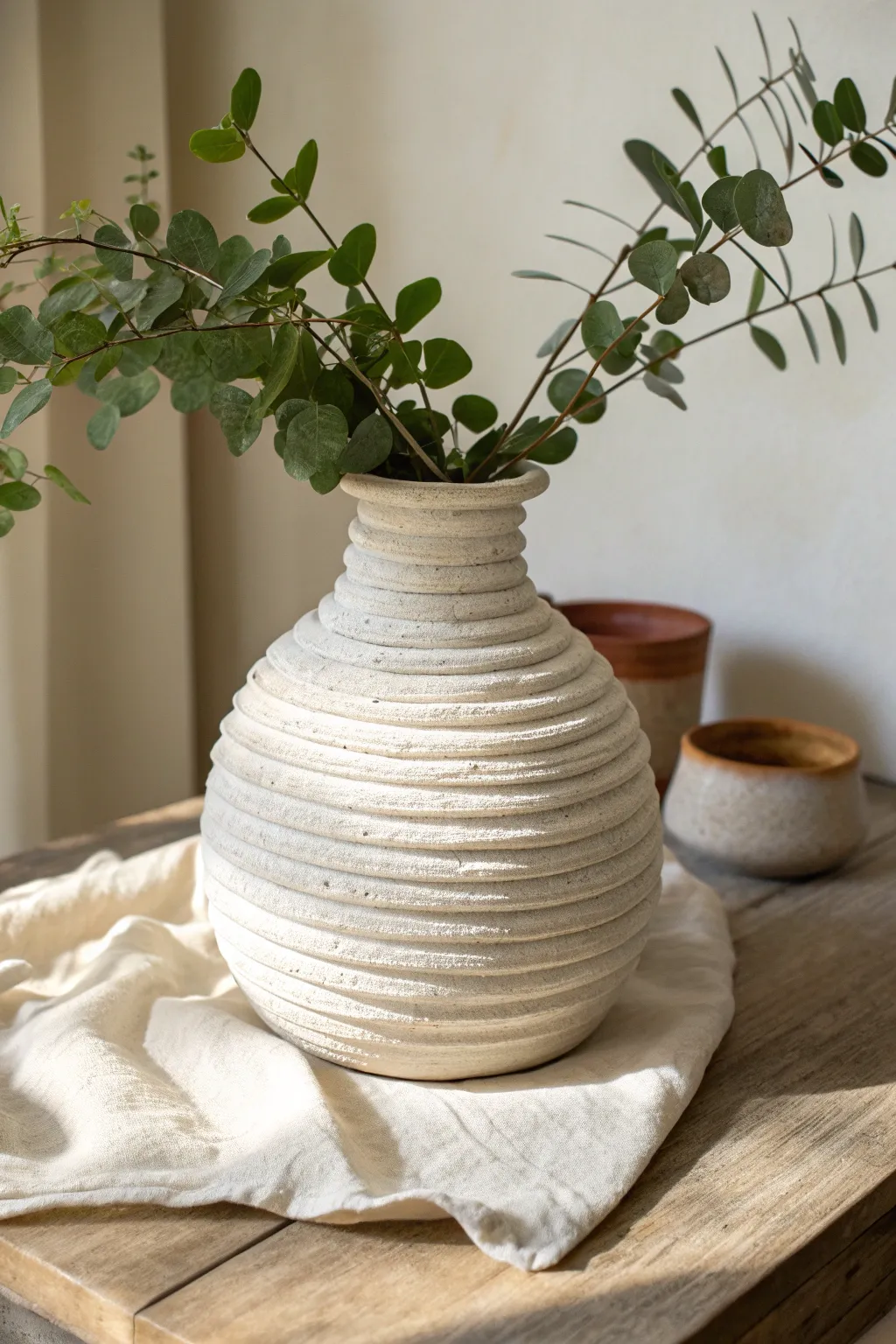
This project captures the charm of ancient pottery with a modern, textured twist, resulting in a stunning spherical vase perfect for dried eucalyptus. The horizontal ridges create a satisfying visual rhythm, while the matte, stony finish gives it an organic, earth-born feel.
Step-by-Step Guide
Materials
- Air-dry clay or stoneware clay (white or light beige)
- Clay rolling pin
- Slip (clay and water mixture)
- Scoring tool or old fork
- Modeling tool or wooden rib
- Sponge
- Canvas or cloth mat (for rolling)
- Wire cutter
- Sealant (acrylic or varnish)
Step 1: Forming the Base
-
Prepare the Clay:
Begin by wedging your clay thoroughly on a canvas mat to remove any air bubbles. This is crucial for structural integrity and prevents cracks later on. -
Roll the Base Slab:
Cut a small portion of clay and roll it into a flat slab about 1/2 inch thick. Use a round object or a compass to cut out a perfect circle, roughly 4-5 inches in diameter, to serve as the bottom of your vase. -
Create the First Coils:
Roll out several long ropes of clay, aiming for a thickness of about 3/4 inch. Try to keep them consistent, but don’t worry about perfection; slight variations add character.
Sagging Walls?
If your vase belly starts to slope or collapse, stuff the inside gently with crumpled newspaper or plastic bags to support the shape while it firms up.
Step 2: Building the Body
-
Attach the First Coil:
Score the outer edge of your base and the underside of your first coil. Apply a generous amount of slip. Lay the coil onto the base edge. -
Blend the Interior:
Once the coil is placed, use your thumb or a modeling tool to smear the clay from the coil down onto the base on the *inside* only. This bonds the pieces together without ruining the exterior texture. -
Expand the Form:
Continue adding coils, stacking each new one slightly outward from the one below it. This technique will create the widening ‘belly’ of the vase. -
Maintain the Ridges:
Unlike traditional coil pots where you smooth both sides, leave the outside coils visible. Gently press them together to ensure adherence, but don’t smooth them flat. -
Shape the Curve:
As you build upward, step back frequently to check the symmetry. Once you reach the widest point of the belly, begin stacking the coils slightly inward to narrow the form again. -
Structural Support:
If the clay starts to sag from the weight, pause and let the lower section stiffen for about 30 minutes before continuing to build upward.
Step 3: Refining the Neck and Finish
-
Form the Neck:
As the opening narrows significantly, switch to slightly thinner coils. Stack these vertically to create a short, upright neck section. -
Create the Rim:
For the final coil at the very top, flare it out just slightly to create a welcoming rim. Smooth the top edge with a slightly damp sponge so it’s pleasant to touch. -
Enhance the Texture:
I like to take a damp sponge and run it horizontally along the grooves. This softens any sharp edges while emphasizing that lovely ribbed pattern. -
Surface Distressing:
To mimic the stone-like look in the photo, lightly tap the exterior with a dry, coarse sponge or a crumpled ball of aluminum foil. This adds tiny pits and roughness. -
Initial Drying:
Loosely cover the vase with a plastic bag. This slow drying process is vital to prevent the coils from separating or cracking as the clay shrinks. -
Final Dry:
After 24 hours, remove the plastic and let it air dry completely. This may take 2-4 days depending on humidity and thickness. -
Firing or Sealing:
If using kiln clay, bisque fire and glaze as desired. For air-dry clay, apply a matte sealant to protect the surface and seal the interior if you plan to use fresh flowers.
Seamless Interior
Use a long-handled wooden spoon to smooth the inside coils as the vase gets taller and your hand no longer fits inside. A smooth interior adds immense strength.
Fill your beautiful new vessel with dried branches and enjoy the handmade warmth it brings to your space
Easy Slab-Box Vase With Straight Sides
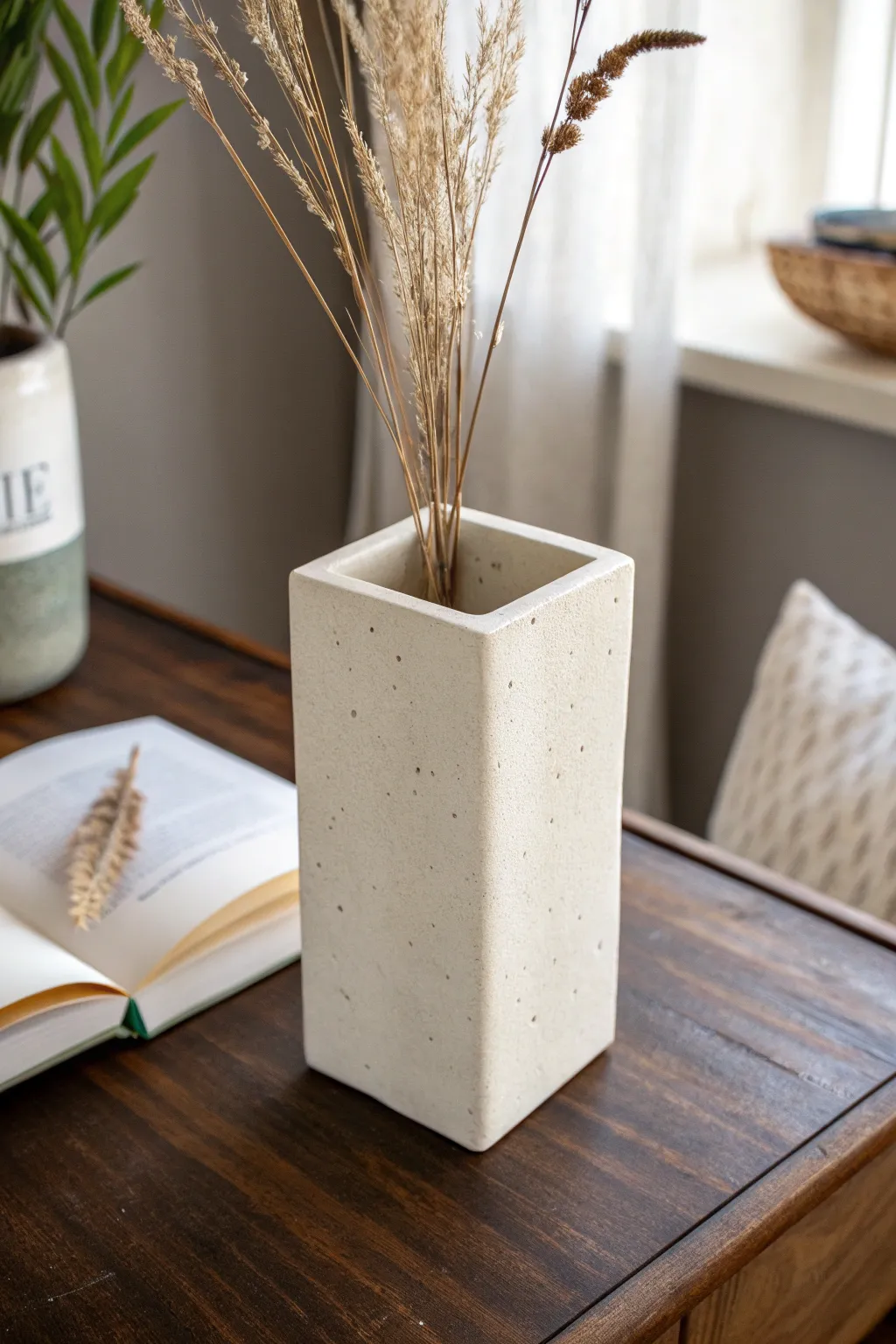
This project captures the essence of modern rustic design with a simple, tall rectangular form and a beautiful speckled finish that mimics natural stone or concrete. Using the slab-building technique, you can create sharp, clean lines that contrast wonderfully with the organic texture of dried grasses.
Step-by-Step
Materials
- White stoneware clay with grog or speckles
- Rolling pin
- Two long wooden guide strips (approx. 1/4 inch thick)
- Ruler
- Fettling knife or needle tool
- Slip (clay mixed with water)
- Scoring tool or serrated rib
- Soft sponge
- Matte white glaze (if your clay isn’t naturally white/speckled)
- Wooden paddle (optional)
Step 1: Preparing the Slabs
-
Roll out the clay:
Begin by sandwiching a generous portion of your white speckled clay between two wooden guide strips on a canvas surface. Roll the clay out firmly until it is perfectly even and matches the height of your guides, ensuring a consistent thickness for sturdy walls. -
Smooth the surface:
Before cutting, take a soft, slightly damp rib or a sponge and compress the surface of the clay slab. This removes canvas textures and aligns the clay particles, which helps prevent warping later. -
Measure your panels:
Using a ruler, lightly mark out your four side walls and one base piece. For this tall design, aim for four rectangles measuring approximately 3 inches wide by 8 inches tall, though you can adjust dimensions to your taste. -
Cut the shapes:
With a steady hand, use your fettling knife to cut along the ruler’s edge. Keep the knife vertical to ensure square edges, which makes assembly much easier. -
Let them firm up:
This is crucial: allow your cut slabs to dry to a ‘leather hard’ state. They should be stiff enough to hold their shape when stood up, but still soft enough to be joined without cracking.
Step 2: Assembling the Box
-
Score the edges:
Take your scoring tool and rough up the long vertical edges of your side panels and all four edges of the base piece. Be thorough here; a good texture is key to a strong bond. -
Apply slip:
Generously dab slip onto the scored areas. It should act like glue, filling in the texture you just created. -
Join the first corner:
Stand the base piece on your work surface. Attach one side wall to the base, then attach a second wall adjacent to it to form a corner. The support of the second wall will keep the first one upright. -
Complete the rectangle:
Attach the remaining two walls, pressing the scored seams firmly together. You should see a little bead of slip squeeze out from the joints, indicating a tight seal. -
Reinforce the interior:
Roll a very thin coil of clay and press it into the bottom interior seams where the walls meet the floor. Smooth this coil out with your finger or a modeling tool to ensure the vase is watertight.
Warped Walls?
If your walls start bowing inward or outward while building, the clay is likely too wet. Stuff the interior with crumpled newspaper to support the shape while it stiffens up.
Step 3: Refining and Finishing
-
Smooth the exterior seams:
On the outside corners, use a damp sponge or a metal rib to scrape away excess slip and blend the clay so the seam becomes invisible. You want the box to look like a solid block. -
Soften the rim:
The top edge can be quite sharp after cutting. Gently run a damp sponge or piece of chamois leather over the rim to slightly round it off, giving it a finished, professional look. -
Texturize (if needed):
If your clay is smooth and you want that concrete finish shown in the photo, gently tap the leather-hard surface with a stiff brush or a coarse sponge to create subtle pitting. -
Slow drying:
Cover the vase loosely with plastic for the first day to let the moisture equalize, then uncover it to dry completely before the bisque fire. -
Glazing:
After bisque firing, apply a matte white or opaque cream glaze. If your clay already has speckles (like a speckled buff), a transparent matte glaze will let those beautiful spots show through naturally.
Level Up: Faux Concrete
Mix a small amount of granular manganese or coarse black sand into your white clay body before rolling. When fired, these particles create distinct dark speckles for an authentic stone look.
Fill your new architectural vase with dried pampas grass or wheat for a stylish display that lasts all year
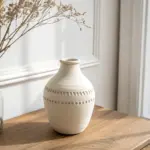
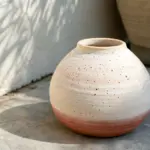
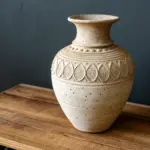
Pinch-Pot Bud Vase
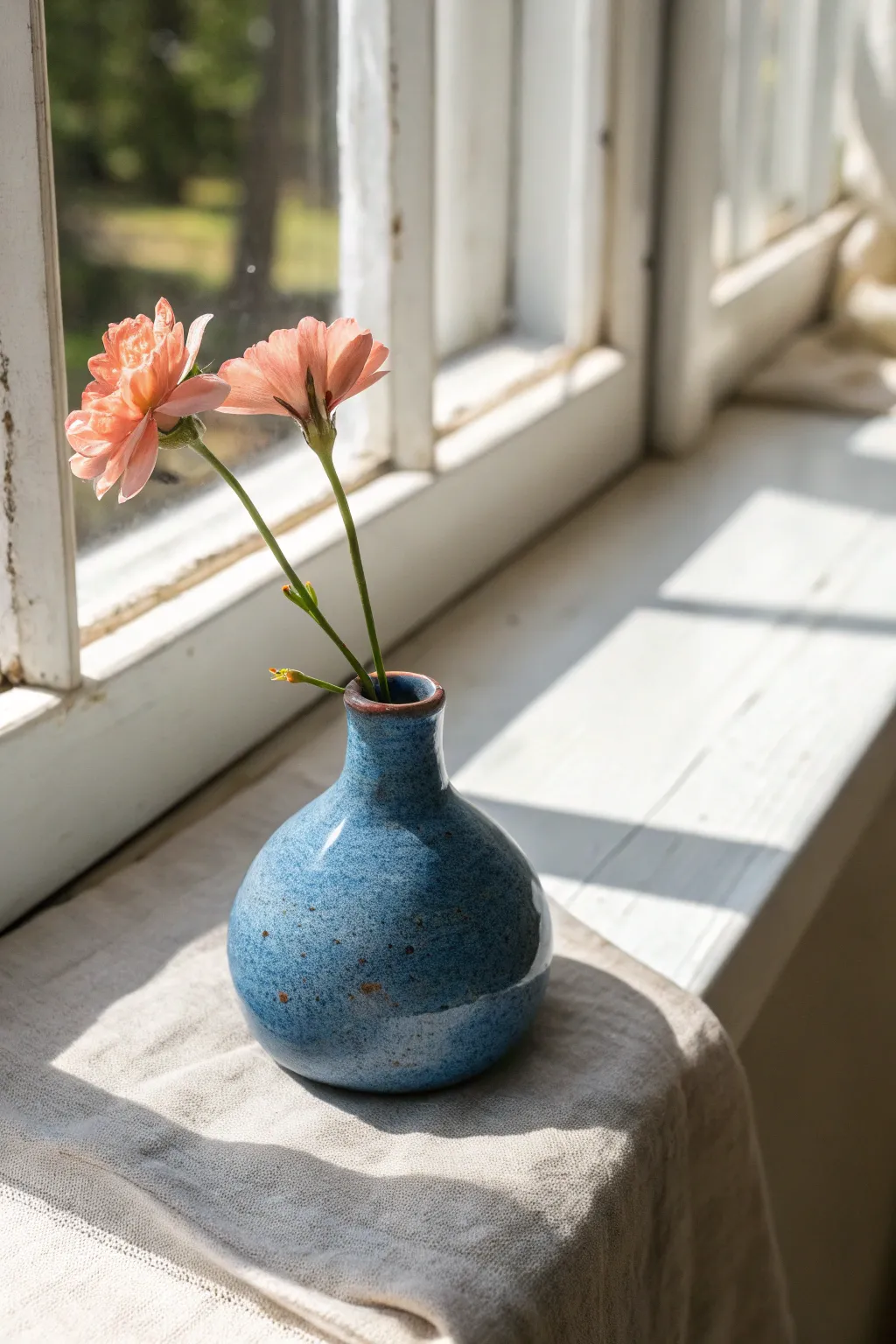
This charming little bud vase features a classic bulbous shape and a rich blue glaze with subtle speckles, perfect for holding a couple of delicate stems. It’s a wonderful introductory project for working with clay, utilizing simple pinch and coil techniques to create a functional piece of art.
How-To Guide
Materials
- Stoneware clay (speckled or white)
- Small sponge
- Pin tool or needle tool
- Wooden modeling tool
- Serrated rib or fork
- Small paintbrush
- Speckled blue glaze (e.g., cone 6 stoneware glaze)
- Water cup
- Turn table (optional)
Step 1: Forming the Base
-
Prepare the clay ball:
Start with a ball of clay roughly the size of a tangerine. Pat it between your hands to ensure it is round and smooth, removing any major cracks before you begin. -
Open the pot:
Hold the clay ball in one hand and push your thumb deep into the center, stopping about a half-inch from the bottom to leave enough thickness for the base. -
Pinch the walls:
Gently pinch the clay between your thumb and fingers, rotating the ball as you go. Work from the bottom up, thinning the walls evenly until you have a round cup shape. -
Shape the belly:
Continue pinching but encourage the walls to curve outward slightly to create that nice bulbous belly. I like to keep the rim slightly thicker at this stage to support the neck. -
Smooth the surface:
Use a slightly damp sponge to smooth out any heavy fingerprint marks on the exterior, while maintaining the organic hand-built feel.
Uneven Drying?
If the neck dries faster than the thick belly, cracks can form. loosely drape a piece of plastic over the rim to slow its drying while the base catches up.
Step 2: Adding the Neck
-
Roll a coil:
Roll a small snake of clay on your work surface, about the thickness of your pinky finger. This will become the neck of the vase. -
Score and slip:
Use your needle tool or serrated rib to scratch up the rim of your pinch pot and one side of the coil. Dab a little water or slip onto the scored areas. -
Attach the coil:
Place the coil on top of the rim found the opening. If the opening is too wide, slightly overlap the coil ends to cinch it in, or place the coil slightly on the inside edge. -
Blend the seams:
Use your thumb or a wooden tool to smear the clay from the coil down into the pot on the outside, and then smooth the inside seam upward. This ensures a strong bond. -
Shape the neck:
Gently pinch the attached coil upwards to heighten the neck. Use your fingers to flare the very top rim slightly outwards for that delicate finish shown in the photo. -
Refine the rim:
Use a damp sponge or a piece of chamois leather to compress and smooth the rim lip so it is rounded and pleasant to the touch.
Step 3: Glazing and Finishing
-
Dry thoroughly:
Allow your vase to dry slowly under plastic for a day, then uncover until bone dry. Bisque fire the piece according to your clay’s instructions. -
Prepare the glaze:
Stir your speckled blue glaze very well. The speckles often settle at the bottom, so ensure a good mix for an even effect. -
Glaze the interior:
Pour a small amount of glaze inside the vase, swirl it around to coat the entire inner surface, and pour the excess back into your container. -
Dip or paint the exterior:
Hold the vase by the foot (or use tongs) and dip it into the glaze bucket for 3 seconds. Alternatively, apply 3 flowing coats with a soft brush. -
Touch up the rim:
The rim in the photo has a lovely reddish-brown accent where the glaze thins. Carefully wipe the very edge with a sponge if you want to expose the clay body, or use a contrasting iron oxide wash just on the rim. -
Clean the foot:
Use a damp sponge to wipe any glaze off the very bottom of the vase so it won’t stick to the kiln shelf during firing. -
Final fire:
Fire the piece to the temperature recommended for your specific glaze (likely Cone 5 or 6) to achieve that glossy, watertight finish.
Add Texture
Before the clay dries, gently press a piece of coarse linen or lace into the belly. The glaze will pool in the texture, highlighting the pattern beautifully.
Once fired, fill your new vase with water and create a simple arrangement to brighten your windowsill
Bottle-Sleeve Clay Vase Cover
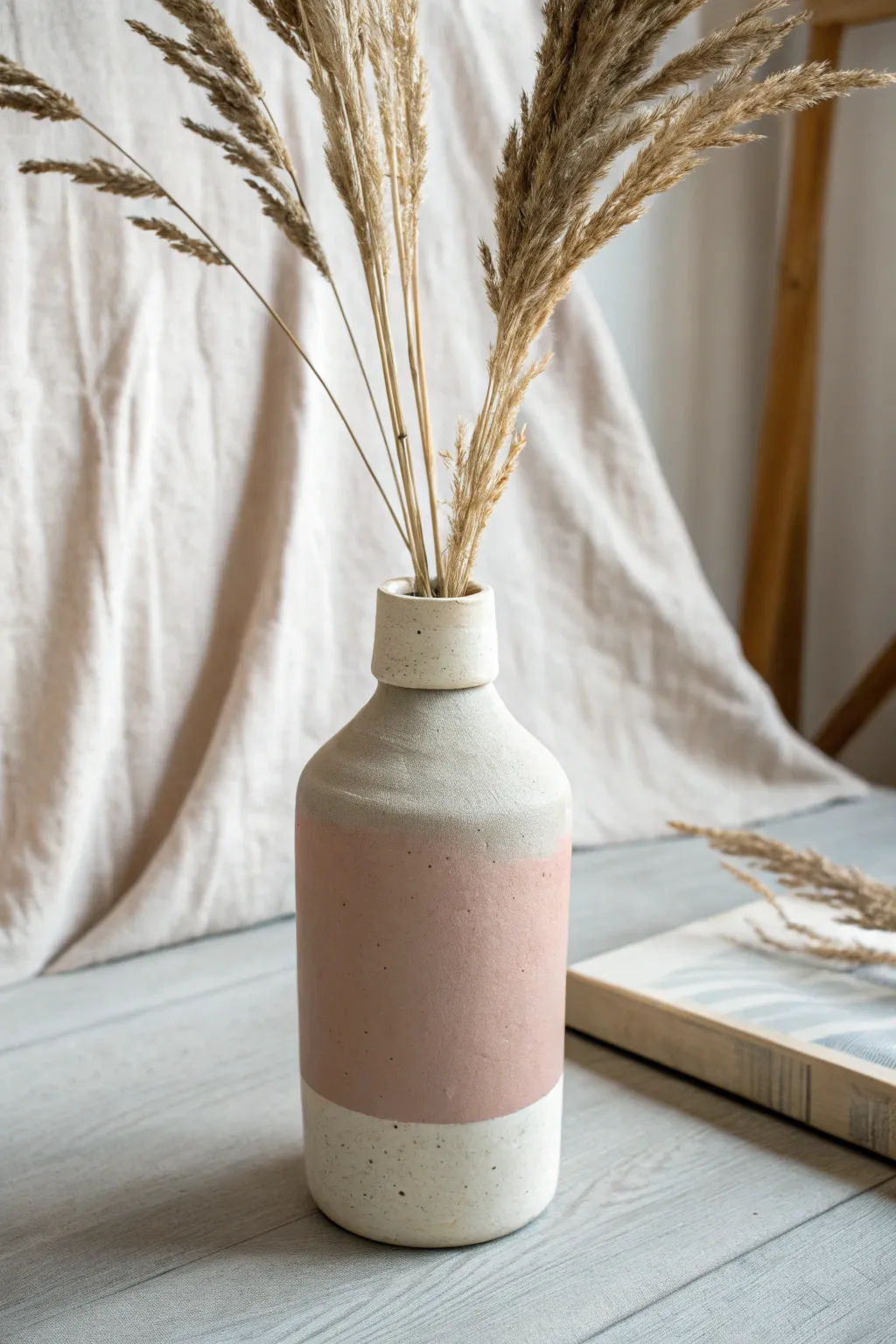
Transform a plain glass bottle into a high-end, minimalist decor piece using nothing but clay and paint. This tri-tone vase mimics the look of artisanal speckled pottery with a soft matte finish.
Step-by-Step Tutorial
Materials
- Glass bottle (recycled wine or oil bottle)
- Air-dry clay (white)
- Rolling pin
- Craft knife or scalpel
- Water in a small cup
- Sandpaper (fine grit)
- Acrylic paints (white, beige/cream, dusty pink/terracotta)
- Baking soda
- Paintbrushes (flat and detail)
- Black or brown acrylic paint (for speckles)
- Old toothbrush
- Clear matte sealer spray
Step 1: Creating the Clay Form
-
Prep the bottle:
Begin by thoroughly cleaning and drying your recycled glass bottle. Remove any labels or sticky residue with warm soapy water or sticker remover. -
Roll the clay:
Take a large chunk of air-dry clay and knead it until soft. Roll it out on a flat surface into a rectangular sheet roughly 1/4 inch thick. Ensure the sheet is wide enough to wrap fully around the bottle’s circumference. -
Wrap the main body:
Carefully lift your clay sheet and wrap it around the cylindrical part of the bottle. Cut away excess clay where the ends meet, creating a seam. -
Smooth the seam:
Dip your finger in a little water and rub the seam gently until the join disappears and the surface looks seamless. I find that a circular motion works best here. -
Shape the neck:
Add smaller pieces of rolled clay to the neck of the bottle. You can mold the shoulder transition by pressing the clay firmly against the glass, smoothing it downwards to join the main body. -
Add the rim detail:
Roll a small strip of clay and wrap it around the very top opening of the bottle to create a distinct, chunky mouth. Smooth this onto the neck clay so it looks like one cohesive piece. -
Refine the surface:
Wet your hands slightly and run them over the entire vase to smooth out bumps or fingerprints. The goal is a handmade, organic look, so perfect symmetry isn’t necessary. -
Dry completely:
Set the vase aside to dry for 24-48 hours. Turn it occasionally to ensure airflow reaches all sides. -
Sand for finish:
Once bone dry, use fine-grit sandpaper to buff away any rough patches or sharp ridges.
Step 2: Painting and Finishing
-
Mix textured paint:
Mix white acrylic paint with a teaspoon of baking soda. This thickens the paint and gives it that authentic, gritty ceramic texture. -
Base coat:
Apply the white baking soda mixture to the top neck section and the bottom third of the vase. Let this layer dry. -
Create the pink hue:
Mix your dusty pink or terracotta paint with a little baking soda and a touch of beige to mute the color. -
Paint the center band:
Carefully paint the middle section of the vase with your pink mixture. Use a steady hand to create a clean, straight line where the pink meets the white sections. -
Apply second coats:
Once the first layers are dry, apply a second coat to all sections to ensure the glass doesn’t show through and the color is solid. -
Prepare the speckle mix:
Water down a small amount of black or dark brown acrylic paint until it has an ink-like consistency. -
Splatter effect:
Dip an old toothbrush into the watered-down paint. Hold it near the vase and run your thumb across the bristles to flick tiny speckles onto the surface. -
Control the speckles:
Rotate the vase as you splatter to ensure even coverage. Focus some extra speckles on the white sections for contrast. -
Seal the work:
Finish by spraying the entire vase with a clear matte sealer to protect the paint and clay from moisture.
Cracks Appearing?
If small cracks appear while drying, mix a tiny amount of fresh clay with water to make a paste (slip) and fill them in with a finger.
Use Tape for Lines
For perfectly crisp lines between the pink and white sections, wrap painter’s tape around the dry bottle before adding the second color.
Place some dried pampas grass or wheat inside to complete your modern, earthy display

The Complete Guide to Pottery Troubleshooting
Uncover the most common ceramic mistakes—from cracking clay to failed glazes—and learn how to fix them fast.
Minimal Cylinder Vase With Soft Rim
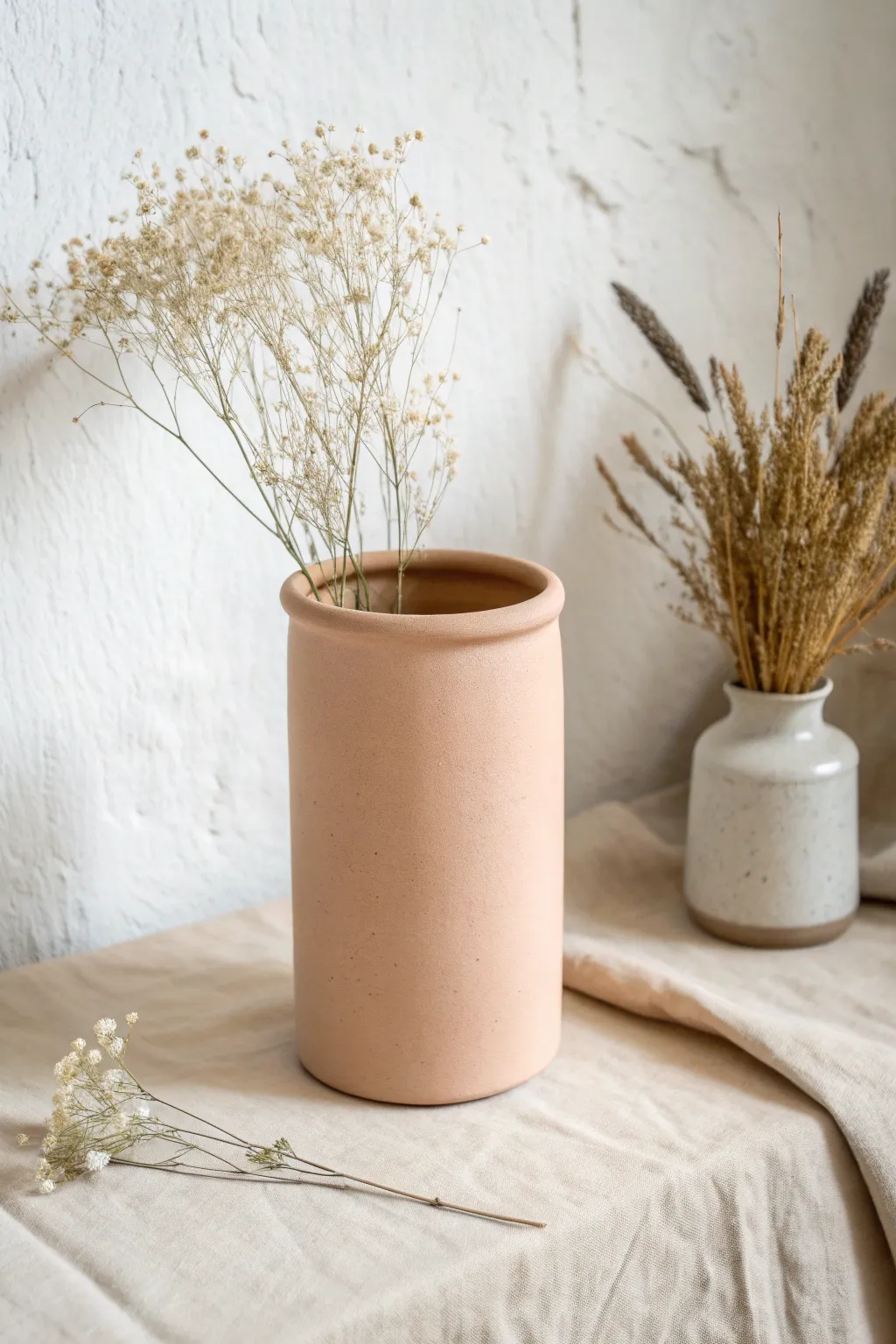
Embrace the beauty of simplicity with this tall, cylindrical vase featuring a distinctively soft, folded rim. Its matte, peach-toned finish mimics the warmth of raw terracotta, making it a perfect vessel for delicate dried stems like baby’s breath.
Step-by-Step Guide
Materials
- Air-dry clay (terracotta or white)
- Acrylic rolling pin
- Sharp clay knife or blade
- Large cylindrical form (like a poster tube or PVC pipe)
- Slip (clay mixed with water)
- Sponge
- Sandpaper (medium and fine grit)
- Matte peach or terracotta acrylic paint
- Baking soda (optional, for texture)
- Wide, flat paintbrush
- Matte varnish spray
Step 1: Forming the Base Structure
-
Prepare your workspace:
Lay down a piece of canvas or a silicone mat to prevent the clay from sticking to your table. If you are using a PVC pipe as a mold, wrap it in a layer of parchment paper so the clay slides off easily later. -
Roll out the slab:
Take a large chunk of air-dry clay and knead it briefly to warm it up. Roll it out into a large, rectangular slab about 1/4 inch thick. Try to keep the thickness consistent throughout to ensure even drying. -
Cut the cylinder wall:
Using a ruler and your sharp knife, cut a clean rectangle relative to the height you want your vase to be. Ensure the length is sufficient to wrap entirely around your cylindrical mold with a slight overlap. -
Wrap the form:
Carefully lift the clay slab and wrap it around your prepared tube mold. Bring the two short ends together. -
Score and slip the seam:
At the point where the clay ends overlap or meet, use your knife to scratch cross-hatch marks (scoring) on both joining surfaces. Apply a dab of slip (clay water) to act as glue. -
Blend the seam:
Press the seam together firmly. Use your fingers or a modeling tool to smooth the clay across the join line until it disappears completely. Smooth it on the outside, and stick your hand inside the tube to smooth the interior seam if possible. -
Create and attach the base:
Roll out a smaller piece of clay for the bottom. Place your wrapped cylinder (still on the mold) onto this slab and trace around it. Cut out the circle, score the edges, and attach it to the bottom of the cylinder, blending the clay upwards for a seamless connection.
Cracks Appearing?
If small hairline cracks appear while drying, don’t panic. Mix a thick paste of clay and water (slip), fill the crack, let it dry, and sand it smooth before painting.
Step 2: Refining the Rim and Surface
-
Create the folded rim:
Roll a separate coil of clay, about the thickness of a pencil. Score the top edge of your vase wall and adhere the coil strictly to the *outside* top edge. -
Blend the rim soft:
Using water and your fingers, smooth the coil so it integrates with the wall but remains thicker than the rest of the vase. Round it over the top to create that gentle, soft lip seen in the photo. -
Remove the mold:
Once the clay has stiffened slightly (usually after an hour or two), carefully slide the PVC pipe or tube out. Don’t wait until it’s fully dry, or the clay might shrink and crack around the rigid mold. -
Smooth with a sponge:
Take a slightly damp sponge and wipe down the entire exterior. This removes fingerprints and softens any harsh tooling marks. -
Allow to dry:
Let the vase dry completely for 24 to 48 hours. Keep it away from direct heat sources to prevent uneven drying and cracking. -
Sand for perfection:
Once bone dry, use medium grit sandpaper to level out any bumps. Switch to fine grit sandpaper to achieve a velvety smooth finish.
Step 3: Painting and Finishing
-
Mix the textured paint:
To recreate the earthy, stone-like look, mix your peach/terracotta acrylic paint with a teaspoon of baking soda. This adds a subtle graininess. -
Apply the first coat:
Using a wide, flat brush, apply the paint in horizontal strokes. I find that painting around the cylinder helps emphasize the round form. -
Layer for depth:
Let the first coat dry, then add a second coat to ensure simple, opaque coverage. Daub the brush slightly on the rim to enhance the texture there. -
Seal the work:
Since air-dry clay isn’t waterproof, seal the vase with a matte varnish spray. This protects the finish while keeping that dry, earthen aesthetic. -
Add floral elements:
Place dry florist foam or just gravity to hold your dried stems, such as the baby’s breath shown in the example.
Clean Cuts Pro Tip
For a perfectly straight top edge before adding the rim coil, wrap a piece of paper around the cylinder as a guide and slice along the paper’s edge with a needle tool.
Now you have a serene, modern vessel ready to display your favorite dried botanicals
Easy Two-Handle Mini Amphora Vase
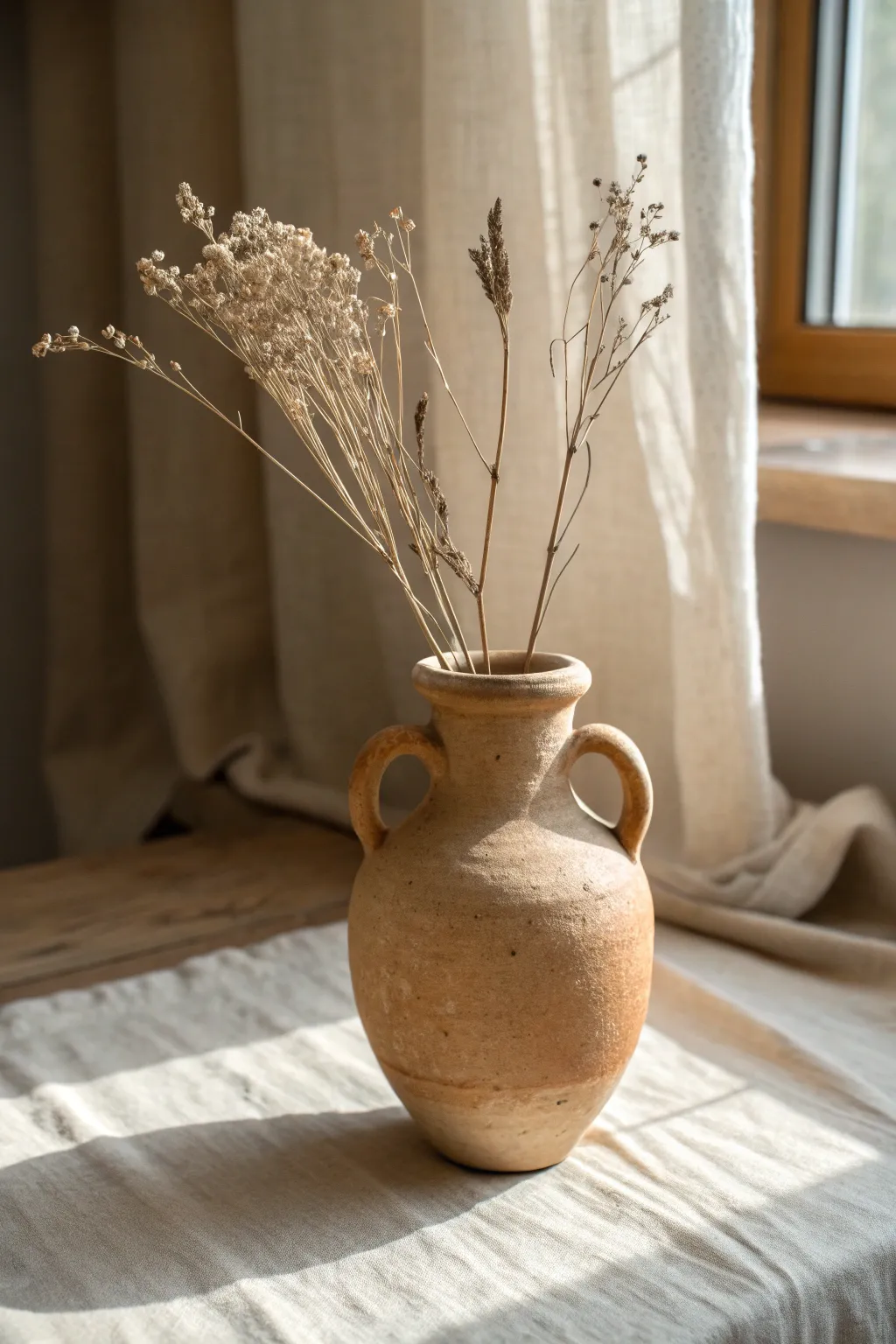
Capture the essence of antiquity with this rustic two-handled vase that perfectly complements dried florals. Its textured, warm terracotta finish and simple silhouette bring a touch of earthy Mediterranean charm to any sunlit windowsill.
How-To Guide
Materials
- Air-dry clay (terracotta color)
- Small bowl of water
- Loop tool or spoon
- Needle tool or toothpick
- Sponge
- Rolling pin
- Slip (clay mixed with water)
- Sandpaper (fine grit)
- Acrylic paint (burnt sienna, yellow ochre, and white)
- Matte sealant spray
Step 1: Building the Base Form
-
Create the heavy base:
Start with a ball of clay roughly the size of a large orange. Flatten the bottom slightly on your work surface to create a stable foot for the vase. -
Open the form:
Push your thumb into the center of the ball, leaving about half an inch of thickness at the bottom. Gently pinch the walls upwards while rotating the clay to establish the initial cup shape. -
Build height with coils:
Roll out snake-like coils of clay about half an inch thick. Score the rim of your base and the underside of the coil with your needle tool, apply a little water or slip, and stack the first coil on top. -
Blend the seams:
Using your thumb or a modeling tool, smudge the clay of the coil downward into the base wall on both the inside and outside until the seam disappears completely. -
Shape the belly:
Add two more coils, slightly widening the diameter as you go up to create the rounded ‘belly’ of the amphora. Smooth each layer thoroughly as you build. -
Narrow the neck:
For the next two coils, place them slightly inward to taper the form, creating the narrower neck section. I like to support the inside wall with one hand while shaping the outside to prevent collapse.
Uneven Texture Tip
Don’t over-smooth the clay with water. Leaving slight finger marks or sponge drags enhances the antique, excavated artifact vibe.
Step 2: Adding Details and Handles
-
Flare the rim:
Add a final coil at the top and gently flare it outwards with your wet fingers to create a distinct, rolled lip for the vase opening. -
Refine the surface:
Use a damp sponge to smooth out major bumps, but don’t aim for perfection. The charm of this piece lies in its handmade, slightly irregular texture. -
Roll handle coils:
Roll two smaller, even coils for the handles. Curve them into ‘C’ shapes or ‘ears’ that fit the scale of your vase. -
Attach the handles:
Score the attachment points on the vase—one near the rim and one on the shoulder. Score the ends of your handles, apply slip, and press them firmly into place. -
Secure the joints:
Use a small tool or your pinky finger to smooth the clay where the handle meets the body, ensuring a strong bond so they don’t pop off during drying. -
Dry thoroughly:
Let the vase sit in a draft-free area for 24-48 hours. Turn it occasionally to ensure even drying until the clay turns a lighter color and feels hard.
Step 3: Finishing the Look
-
Distress the texture:
Once dry, lightly sand the surface. If you want an aged look, you can scratch tiny nicks or pits into the surface with your needle tool before painting. -
Mix an aged wash:
Mix burnt sienna paint with a touch of yellow ochre and a lot of water to create a thin wash. Brush this over the entire vase. -
Add dusty highlights:
Dip a dry brush into a tiny amount of white paint. Wipe most of it off on a paper towel, then gently graze the raised textures and the rim to simulate dust and age. -
Seal the piece:
Finish with a coat of matte sealant spray to protect the paint and give the clay a unified, non-shiny finish consistent with old pottery.
Faux-Moss Effect
Dab tiny spots of diluted green paint into the crevices near the handles and base to simulate moss growth on an old garden pot.
Place your finished vase in a bright spot and fill it with dried grasses to complete the rustic display

What Really Happens Inside the Kiln
Learn how time and temperature work together inside the kiln to transform clay into durable ceramic.
Vertical Ribbed Texture Vase
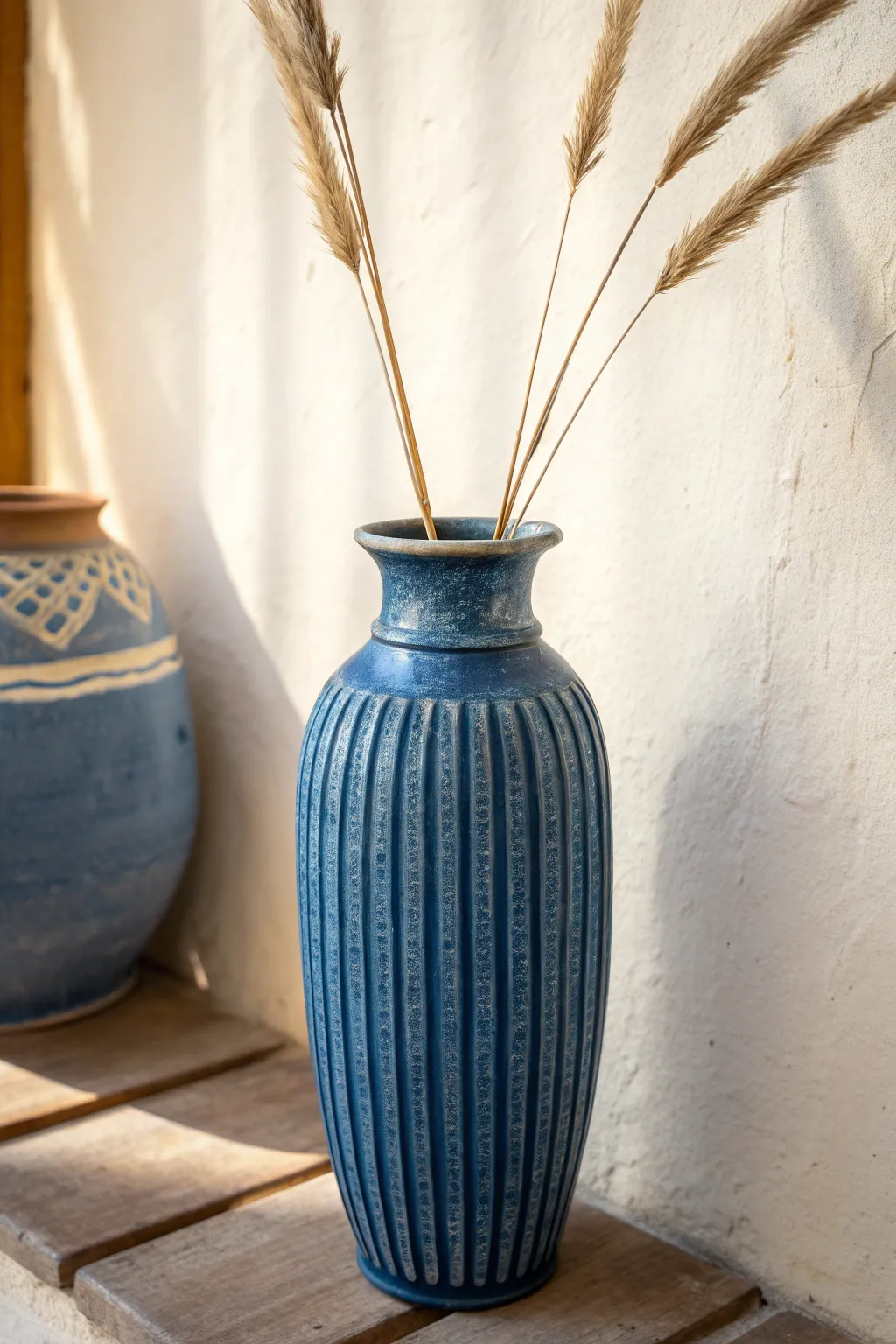
This project transforms simple clay into a striking decor piece that looks like an aged artisanal treasure. The tall, slender silhouette features deep vertical grooves and a layered blue finish that mimics the weathered charm of vintage pottery.
Step-by-Step
Materials
- Air-dry clay (approximately 2-3 lbs) or ceramic clay if firing
- Rolling pin
- Empty wine bottle or tall glass cylinder (to use as an armature)
- Plastic wrap
- Modeling tools (specifically a ribbon tool or looped tool)
- Sponge
- Water cup
- Acrylic paints (Navy blue, teal, white, and dark grey)
- Large flat paintbrush
- Dry brush or rag
- Clear matte sealant spray
Step 1: Building the Form
-
Prepare the armature:
Since this is a tall vase, support is crucial. Wrap your empty wine bottle or glass cylinder tightly in plastic wrap. This prevents the clay from sticking to the glass and makes removal easier later. -
Roll out the slab:
Roll your clay out into a large, rectangular slab about 1/4 to 1/2 inch thick. Ensure the slab is tall enough to cover the bottle up to the neck area. -
Wrap the cylinder:
Carefully lift the clay slab and wrap it around the bottle. Overlap the edges slightly where they meet. -
Join the seam:
Score the overlapping edges with a needle tool and add a little water (slip). Press them firmly together and smooth the seam down with your fingers or a rib tool until the join is invisible. -
Form the base:
Cut a circle of clay slightly larger than the bottle’s base. Score and slip the bottom edge of your clay cylinder and attach this circle, blending the clay upwards to seal the bottom. -
Shape the neck:
Mold the top of the clay inward around the bottle’s neck. Add a thick coil of clay to the rim to create that flared, sturdy mouth shown in the photo, blending it smoothly into the body.
Straight Line Hack
Struggling with vertical lines? Lightly press a piece of string into the wet clay from top to bottom to create a guide before carving your deep grooves.
Step 2: Texturing and Refining
-
Carve the ribs:
While the clay is still leather-hard (firm but damp), use a loop tool or the rounded end of a paintbrush handle to carve vertical lines. Start from just below the neck and drag straight down to the base. -
Refine the grooves:
Go over your vertical lines again to deepen them. Don’t worry about them being perfectly machine-straight; a little wobble adds to the handmade character. -
Initial drying:
Let the clay dry until it can hold its shape on its own. Gently slide the glass bottle out. If it sticks, wait a bit longer for the clay to shrink slightly away from the plastic wrap. -
Smooth the surface:
Once the armature is out, use a slightly damp sponge to soften any sharp burrs created during carving. Don’t scrub away your texture, just take the edge off. -
Full cure:
Allow the vase to dry completely. For air-dry clay, this usually takes 24-48 hours depending on humidity. The clay must be bone dry before painting.
Step 3: The Aged Paint Finish
-
Base coat:
Paint the entire exterior in a deep navy blue acrylic. Make sure to get the paint into every single groove and crack. Let this base layer dry fully. -
Dry brushing teal:
Mix a teal or lighter blue shade. remove most of the paint from your brush onto a paper towel, then lightly drag the brush horizontally across the ribs. This highlights the raised areas while keeping the grooves dark. -
Adding the ‘dusty’ look:
To mimic the worn finish in the photo, mix a watered-down white or light grey wash. Brush it over the vase and immediately wipe most of it off with a rag. The white pigmen will settle into the texture. -
Detailing the rim:
I like to add a subtle touch of brown or dark grey specifically around the flared rim to make it look like exposed stoneware where the glaze has ‘worn off’. -
Sealing the piece:
Finish with a clear matte spray sealant. This protects the paint job and gives the vase a professional, unified sheen without making it look like plastic.
Slumping Clay?
If the clay sags when you remove the bottle, it’s too wet. Put the support bottle back in immediately and let it firm up for another hour.
Fill your new textured vessel with dried ornamental grass for an effortless, earthy display
Dot-Impressed Polka Vase
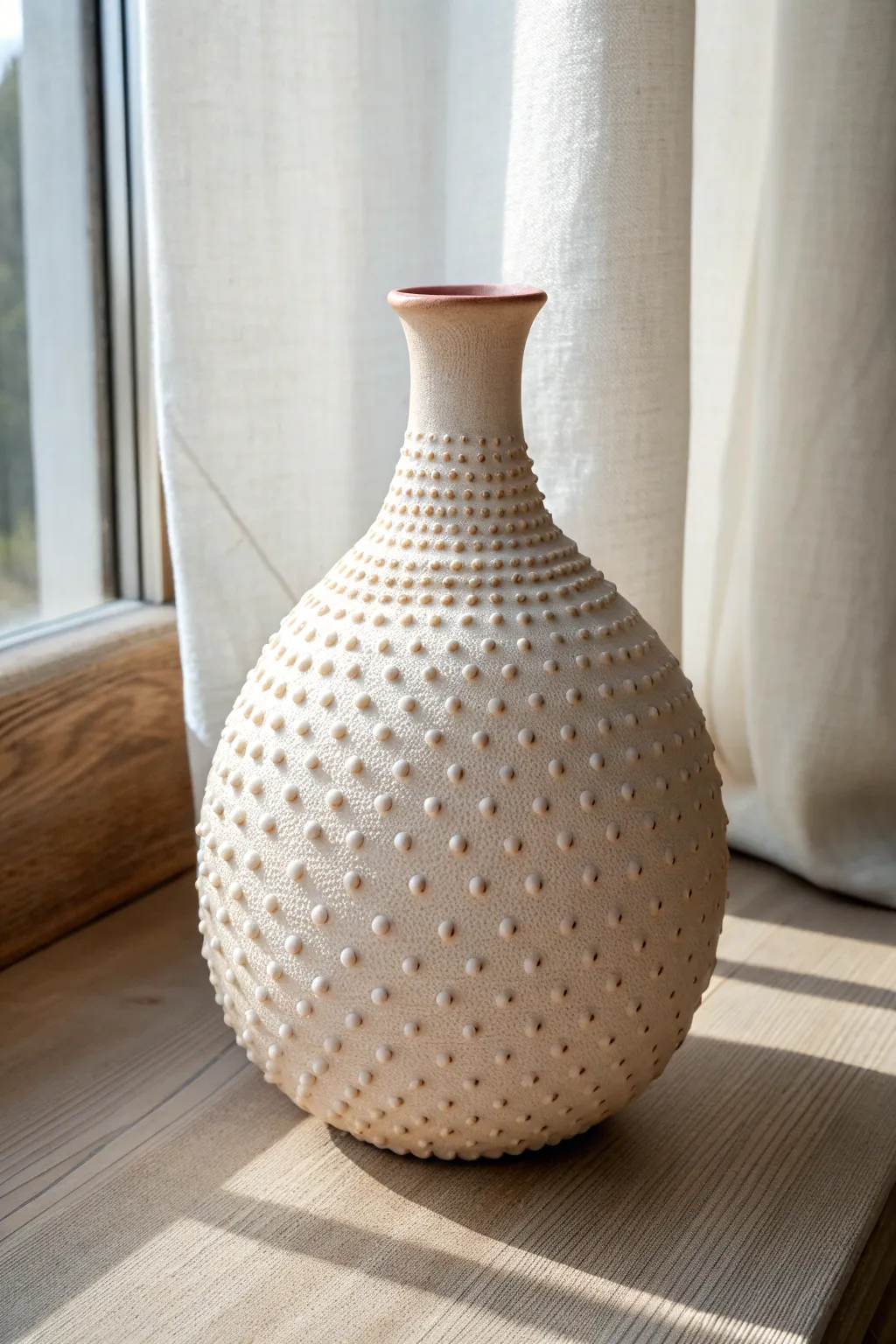
Transform simple clay into a sophisticated piece of decor with this tactile project that relies on repetition and rhythm. The finished vase features a pleasing organic shape covered in hundreds of tiny, raised nodes that catch the light beautifully.
How-To Guide
Materials
- Stoneware or pottery clay (white or light beige)
- Pottery wheel (optional, can be coil built)
- Wooden modeling tool or rib
- Slip (clay mixed with water)
- Sponge
- Cutting wire
- Slip trailer bottle or a small piping bag
- Clear matte glaze (optional)
- Terracotta colored stain or underglaze (for rim)
- Kiln
Step 1: Forming the Base Vessel
-
Prepare the Clay:
Begin by thoroughly wedging your clay to remove any air bubbles. You’ll need a substantial ball, about the size of a cantaloupe, to achieve the volume shown in the image. -
Center and Open:
Throw the ball onto your wheel head and center it perfectly. Open the clay up, creating a floor that isn’t too wide, as we want a bulbous, spherical body. -
Pull the Cylinder:
Pull the walls up into a tall, consistent cylinder. Don’t worry about the curve yet; just ensure the walls are even in thickness from top to bottom. -
Belly Out the Form:
Using a rib on the outside against your hand on the inside, gently push the belly of the vase outward. Aim for a wide, round bottom that tapers significantly as it goes up. -
Collar the Neck:
Slowly choke or ‘collar’ the top third of the clay inward to form the bottleneck. Do this vividly but slowly to avoid buckling the clay walls. -
Refine the Rim:
Flare the very top lip slightly outward for a classic finish. Smooth the rim with a chamois or a piece of plastic to ensure it is soft to the touch. -
Dry to Leather Hard:
Let the vase dry slowly until it reaches a leather-hard state. It needs to be firm enough to handle the surface decoration without warping.
Step 2: Creating the Dot Texture
-
Prepare Thick Slip:
Make a batch of thick styling slip using the same clay body. It should be the consistency of heavy frosting or toothpaste—stiff enough to hold a peak. -
Fill the Applicator:
Fill your slip trailer or piping bag with the thick slip. Test the flow on a scrap piece of clay to ensure it creates a clean, raised dot. -
Begin at the Neck:
Starting just below the neck curve, apply the first ring of small dots. Keep them evenly spaced. I find it easiest to work comfortably from the top down. -
Establish the Grid:
Apply the next row of dots. You can either stack them directly below the first row or stagger them in a brick pattern for a denser look. -
Adjust Dot Size:
As the vase widens at the belly, slightly increase the size of your dots or spacing to accommodate the larger surface area seamlessly. -
Cover the Body:
Continue piping rows of dots all the way down the vessel. Maintain a steady hand and consistent pressure on the slip trailer. -
Smooth the Peaks:
Once the dots have stiffened slightly (but aren’t dry), gently tap the sharp peaks with a slightly damp finger to round them off, creating that nubby, organic texture.
Slumping Dots?
If your dots are flattening or running down the side, your slip is too watery. Let the slip sit uncovered for an hour to thicken up, or add a pinch of dry crushed clay.
Step 3: Finishing and Firing
-
Rim Detail:
Apply a thin band of terracotta-colored underglaze or stain to the very top rim of the vase to recreate the subtle contrast seen in the photo. -
Bisque Fire:
Allow the vase to dry completely—this may take several days due to the added moisture from the slip dots. Bisque fire it according to your clay’s specifications. -
Glazing:
For the finish shown, apply a very thin clear matte glaze, or leave the exterior unglazed if your clay body is vitrified and you prefer the raw stone texture. -
Final Fire:
Fire the kiln specifically for your glaze/clay cone rating. Once cool, sand the bottom if necessary to protect your furniture.
Ombre Effect
Mix a tiny amount of mason stain into your slip halfway down the vase. This creates a gradient effect where the dots slowly change color toward the base.
Place your finished vase near a window where the sunlight can dance across the texture you’ve created

TRACK YOUR CERAMIC JOURNEY
Capture glaze tests, firing details, and creative progress—all in one simple printable. Make your projects easier to repeat and improve.
Squiggle Coil “Doodle” Vase
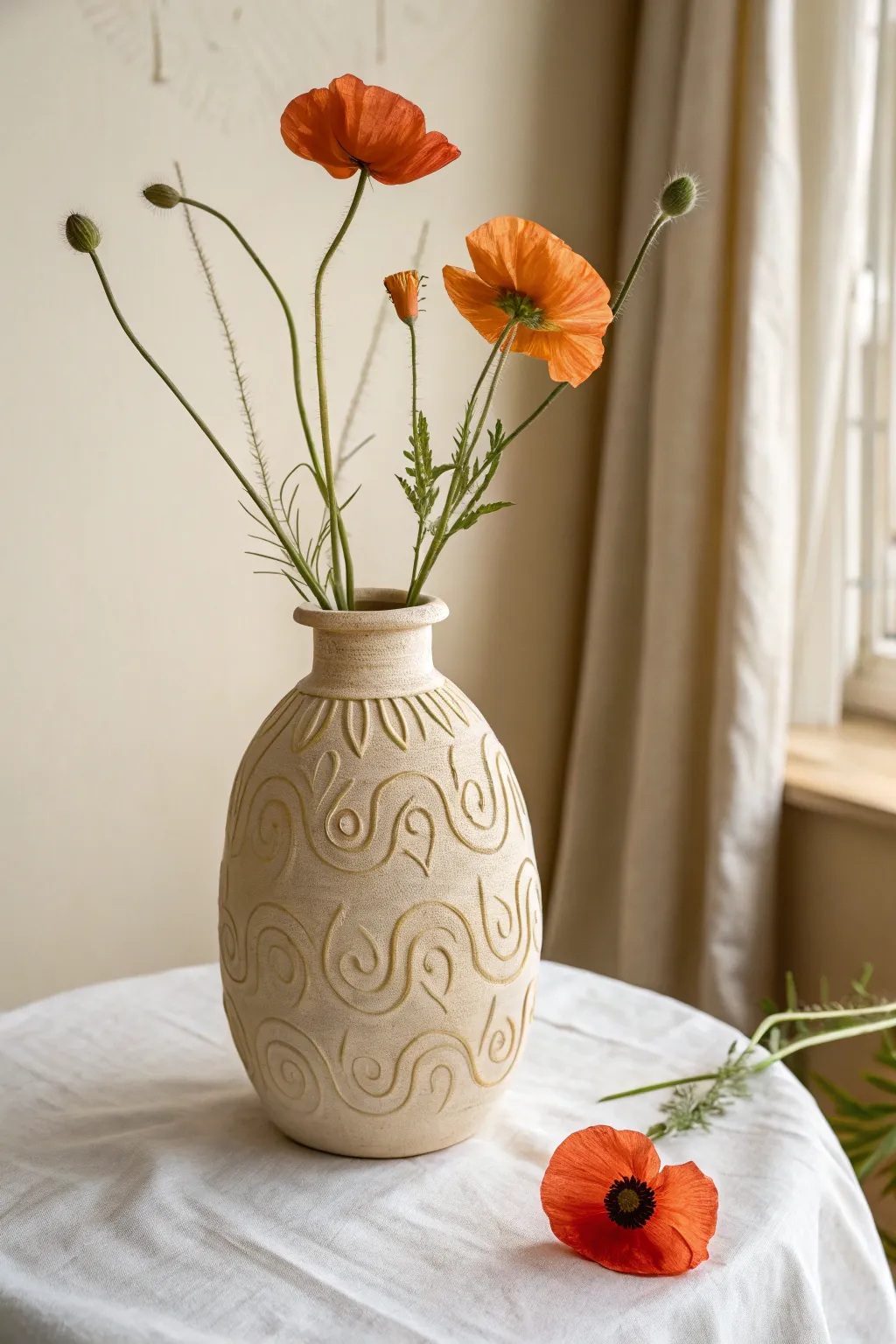
Bring a touch of organic whimsy to your home with this textured coil pot. Featuring a creamy beige finish and playful carved flourishes, this vase mimics the look of high-end wheel-thrown pottery using accessible hand-building techniques.
Step-by-Step
Materials
- Air-dry clay (white or light beige, approx. 1kg)
- Clay roller or rolling pin
- Carving tools (loop tool or a dull pencil)
- Small sponge
- Water cup
- Potter’s needle tool or toothpick
- Sandpaper (fine grit)
- Acrylic sealant or varnish (matte finish)
- Canvas mat or parchment paper (for working surface)
Step 1: Building the Base Form
-
Create the base:
Start by rolling out a circular slab of clay about a 1/2 inch thick and 4 inches wide. This will serve as the sturdy bottom of your vase. -
Prepare your coils:
Roll out several long, even snakes of clay, aiming for the thickness of a thick marker or your thumb. Keeping them consistent ensures your walls rise evenly. -
Start stacking:
Score the outer edge of your base and the bottom of your first coil. Apply a little water or slip (clay mush) and press the coil onto the base edge. -
Build the belly:
Continue stacking coils. To create the wider ‘belly’ shape of the vase seen in the photo, place each new coil slightly further outward than the one below it. -
Blend the coils:
As you build, use your thumb or a modeling tool to smudge the clay downwards on both the inside and outside, merging the coils together completely so no gaps remain. -
Taper the neck:
Once you reach the vase’s widest point, begin placing coils slightly inward to narrow the form towards the neck. Do this gradually for a smooth curve. -
Form the rim:
Add a final coil slightly flaring outward at the very top to create the distinct lip. Use your fingers to pinch and shape this rim so it looks deliberate and finished. -
Smooth the surface:
Take your time smoothing the exterior walls with a damp sponge or a kidney rib tool. You want a consistent canvas for your carving, though a little hand-built texture adds charm.
Cracks Appearing?
If small cracks form while drying, mix a tiny amount of clay with vinegar to make a paste. Fill the crack, smooth it over, and let it dry slowly under plastic.
Step 2: Carving and Finishing
-
Let it firm up:
Wait until the clay is ‘leather hard’—cool to the touch and firm, but not dry. If it’s too soft, the carving will drag; too dry, and it will chip. -
Map the design:
Using a needle tool, lightly scratch your squiggle pattern onto the surface. The design features repeating ‘S’ curves and loops that alternate directions. -
Carve the squiggles:
Using a small loop tool or a U-shaped gouge, carefully carve out the clay following your sketched lines. Maintain a consistent depth for a professional look. -
Add detailing:
Carve the petal-like shapes around the neck of the vase. These simple teardrop outlines help transition the pattern from the body to the rim. -
Clean the burrs:
I usually run a slightly damp finger over the carved lines to knock down any little clay crumbs or sharp edges created during the carving process. -
Dry thoroughly:
Allow the vase to dry completely. This can take 24 to 72 hours depending on humidity. The clay should turn a chalky, lighter color when fully dry. -
Sand for perfection:
Once bone dry, specifically sand the rim and any rough spots on the body. Be gentle near your carved squiggles to preserve their sharp edges. -
Seal the piece:
Apply a coat of matte acrylic varnish. This protects the clay and gives it that finished ceramic sheen without being overly glossy.
Color Wash
Before sealing, apply a watered-down brown acrylic paint into the grooves and wipe the surface clean. This highlights the carving depth instantly.
Pop in some dried flowers or faux poppies to enjoy your handmade masterpiece year-round
Striped Groove Vase With Simple Lines
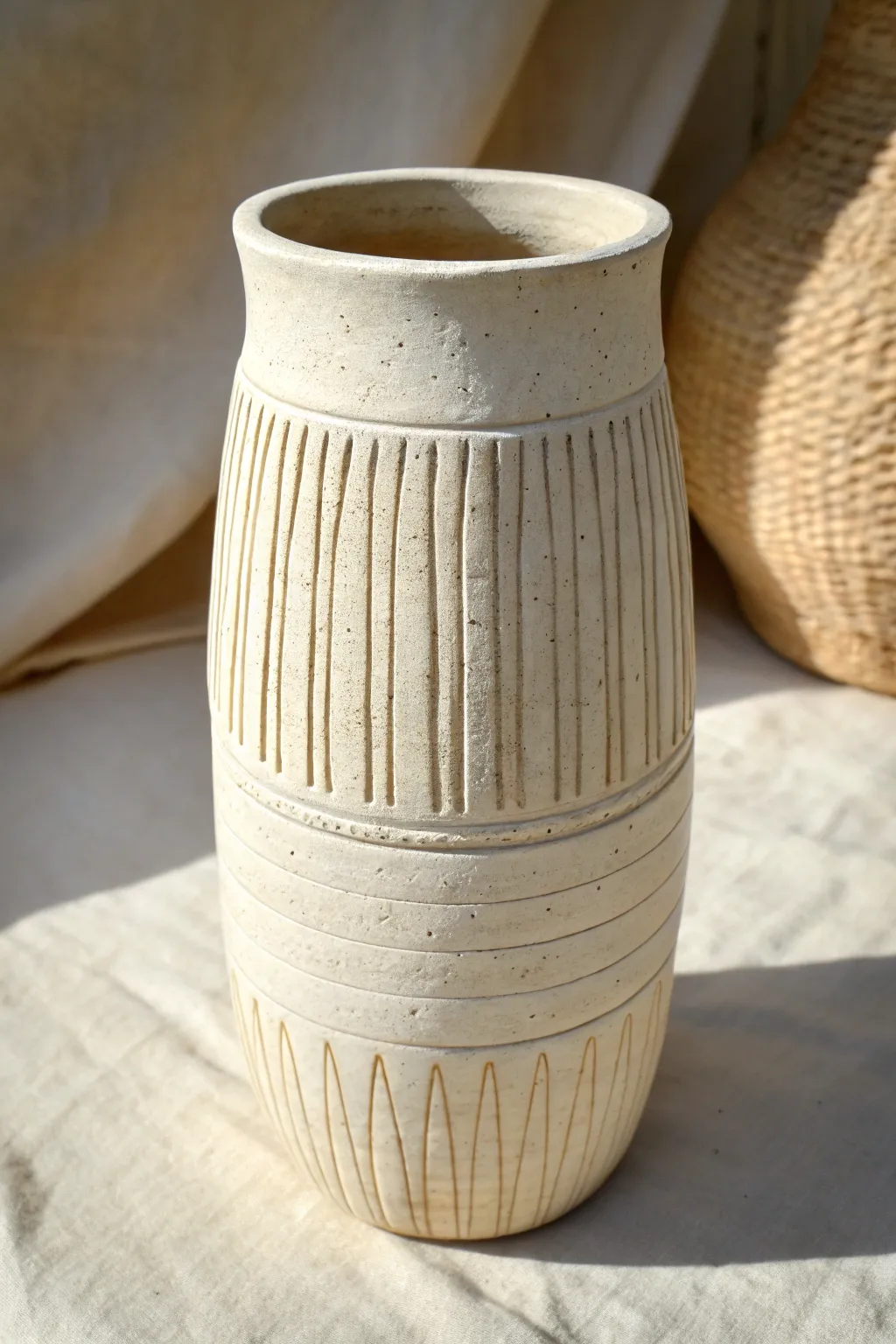
This rustic, elegant vase combines the timeless appeal of raw clay with thoughtful linear textures. By stacking different carving patterns—vertical stripes, horizontal bands, and petal-like loops—you create a piece that feels both modern and handmade.
How-To Guide
Materials
- Stoneware clay (smooth or with fine grog)
- Pottery wheel (or coil building supplies)
- Wire cutter
- Metal kidney rib
- Loop tool (medium size)
- Needle tool
- Wooden modeling tool
- Sponge
- Water
Step 1: Forming the Base Shape
-
Prepare your clay:
Begin by wedging about 3-4 pounds of stoneware clay thoroughly to remove air bubbles. Center the clay on your wheel head, ensuring it is anchored securely before opening. -
Open and pull the cylinder:
Open the centered clay and pull up a tall, straight cylinder. Aim for a unified thickness of about a quarter-inch throughout the wall to support the carving later. -
Shape the profile:
Gently collar the neck inward slightly to create a subtle curve at the top, and belly out the middle and bottom sections just enough to give the vase a soft volume. -
Refine the surface:
Use a metal kidney rib to compress and smooth the outside surface while the wheel is spinning. This removes throwing lines and creates a blank canvas for your texture. -
Define the sections:
Using a wooden modeling tool or the corner of your rib, lightly score two horizontal guidelines around the vase while it spins. Place one near the shoulder and one about a third of the way up from the bottom.
Clean Lines Tip
When carving vertical lines, pull the tool toward your body rather than pushing away. This gives you better control over straightness and depth.
Step 2: Carving the Textures
-
Leather hard stage:
Allow the vase to dry to a firm leather-hard state. The clay should be firm enough to hold its shape when touched but soft enough to carve without chipping. -
Vertical fluting:
Start with the main middle-upper section. Using a medium loop tool, carve vertical lines from your top guideline down to the middle guideline. Try to keep the spacing consistent, leaving a small ridge between each groove. -
Refining the stripes:
Run your finger or a slightly damp sponge over the starting and stopping points of your vertical lines to soften any harsh burrs or clay crumbs. -
Horizontal banding:
Move to the section directly below the vertical stripes. Using a needle tool or a fine point tool, carve 4-5 parallel horizontal lines around the circumference. You can do this by slowly rotating the wheel or banding wheel by hand. -
Sectioning the bottom:
For the bottom third of the vase, uses your needle tool to lightly sketch out spacing for the petal shapes. I usually mark the bottom edge first to ensure they are even. -
Carving the loops:
Use a small loop tool or a V-tip carving tool to cut out the long, U-shaped petal designs at the base. Start from the bottom foot and curve upward, meeting at a point before curving back down. -
Cleaning the grooves:
Wait for the carved bits to dry slightly (they will turn lighter in color), then use a dry paintbrush to sweep away the crumbs. This keeps the lines crisp without smearing the clay.
Pop of Contrast
Before the final firing, rub a dark oxide wash (like iron oxide) into the carved grooves and wipe away the excess to make the texture really pop.
Step 3: Finishing Touches
-
Smooth the rim:
Double-check the rim of the vase. Use a damp chamois or sponge to compress the top lip, ensuring it is smooth and pleasant to the touch. -
Dry slowly:
Cover the vase loosely with plastic for the first day to equalize moisture, then uncover it to let it dry completely to the bone-dry stage. -
Bisque fire:
Load the vase into the kiln for a bisque firing. -
Glazing decision:
To match the reference image, leave the exterior unglazed (or use a matte transparent glaze) to highlight the raw clay body. Glaze the interior with a liner glaze to make it waterproof.
Now you have a stunning, textural vessel ready to hold your favorite dried floral arrangements
Scalloped Rim Flower Vase
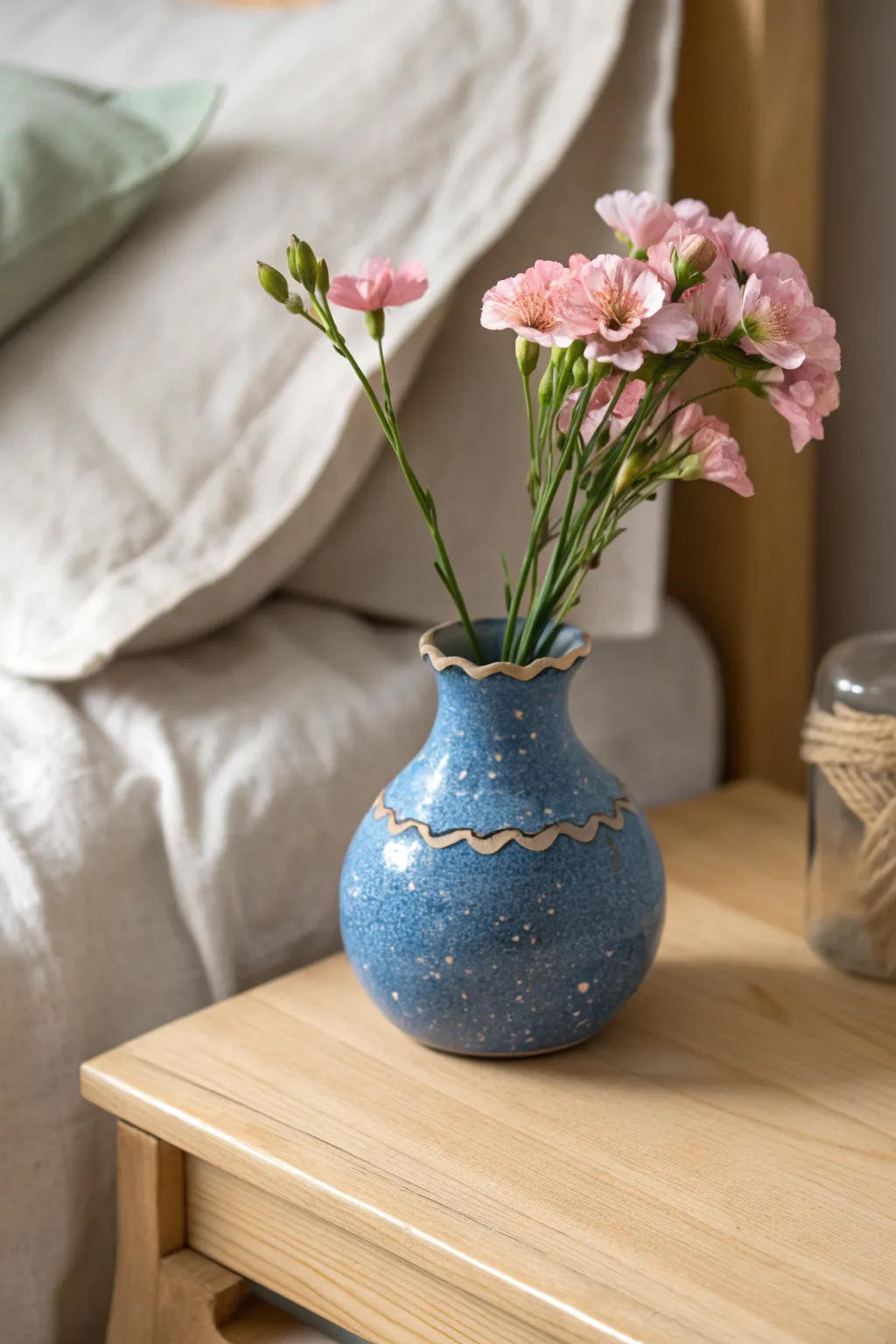
Create a charming, vintage-inspired bud vase that brings a touch of whimsy to any bedside table. This project features a distinctive scalloped rim and shoulder detail, finished with a beautiful speckled blue glaze that mimics starry stoneware.
Step-by-Step
Materials
- Air-dry clay or kiln-fire clay (white works best)
- Small rolling pin
- Pottery sponge
- Needle tool or toothpick
- Loop tool (for hollowing, if building solid)
- Small bowl relative to vase size (for water)
- Scoring tool or old toothbrush
- Slip (clay mixed with water)
- Acrylic paints (Royal Blue, White, Gold)
- Gloss varnish or clear spray sealant
- Old toothbrush (for speckling)
- Paintbrushes (medium flat and fine liner)
Step 1: Forming the Vase Body
-
Prepare the base:
Start with a ball of clay roughly the size of a large orange. Work it in your hands to remove air bubbles, then flatten the bottom slightly on your work surface to create a stable base. -
Pinch pot method:
Press your thumb into the center of the ball, leaving about half an inch at the bottom. Begin pinching the clay walls upwards and outwards, rotating the ball as you go to maintain an even thickness. -
Shape the belly:
Gently push the walls outward from the inside to create a round, bulbous shape for the lower half of the vase. Smooth the exterior with a slightly damp sponge to remove fingerprints. -
Create the neck:
As you move upward, begin angling your pinching inward to narrow the form, creating a distinct shoulder. Then, flare the clay back out slightly at the very top to form the neck and rim.
Cracking Clay?
If small cracks appear while the clay dries, mix a tiny bit of fresh clay with vinegar to make a paste and fill them in. Sand smooth once dry.
Step 2: Adding Scalloped Details
-
Carve the rim:
Using a needle tool, gently mark a wavy, scalloped pattern along the top edge of the rim. Once you are happy with the spacing, carefully cut away the excess clay following your line. -
Refine the edges:
Dip your finger or a sponge in water and smooth the cut edges of the scalloped rim so they are rounded and soft, rather than sharp. -
Make the decorative coil:
Roll a very thin coil of clay, about the thickness of a spaghetti noodle. This will become the decorative belt around the vase’s shoulder. -
Apply the shoulder detail:
Score the surface of the vase where the neck meets the body. Paint on a little slip, then lay your thin coil in a wavy pattern all the way around the circumference. -
Blend carefully:
Gently press the coil onto the vase to secure it, but try not to flatten it completely. You want that raised texture to remain visible.
Step 3: Finishing and Painting
-
Dry completely:
Allow your vase to dry for at least 24-48 hours. It should look chalky and feel room temperature (not cold) when fully dry. -
Base coat:
Paint the entire exterior of the vase with a rich royal blue acrylic paint. You may need two coats for full opacity. I find letting the first coat dry for 20 minutes prevents streaking. -
Highlight the scallops:
Using a fine liner brush and a creamy beige or light terracotta color, carefully paint the raised coil decoration and the very top edge of the rim to highlight the scallop shape. -
Create the speckles:
Dilute a small amount of white and gold paint with water. Dip an old toothbrush into the mixture, aim it at the vase, and run your thumb across the bristles to flick tiny splatters over the blue base. -
Seal the piece:
Once the paint is fully cured, apply a heavy coat of high-gloss varnish. This mimics the look of fired ceramic glaze and protects the paint. -
Waterproofing tip:
If using air-dry clay, remember it isn’t waterproof. Place a small glass or plastic vial inside the vase to hold the water and vivid fresh flowers.
Level Up: Texture
Before painting, gently press a piece of coarse fabric or sandpaper against the damp clay surface to give the vase a realistic stoneware texture.
Now your lovely handmade vase is ready to display a fresh bundle of bright pink carnations
Leaf-Stamped Texture Vase
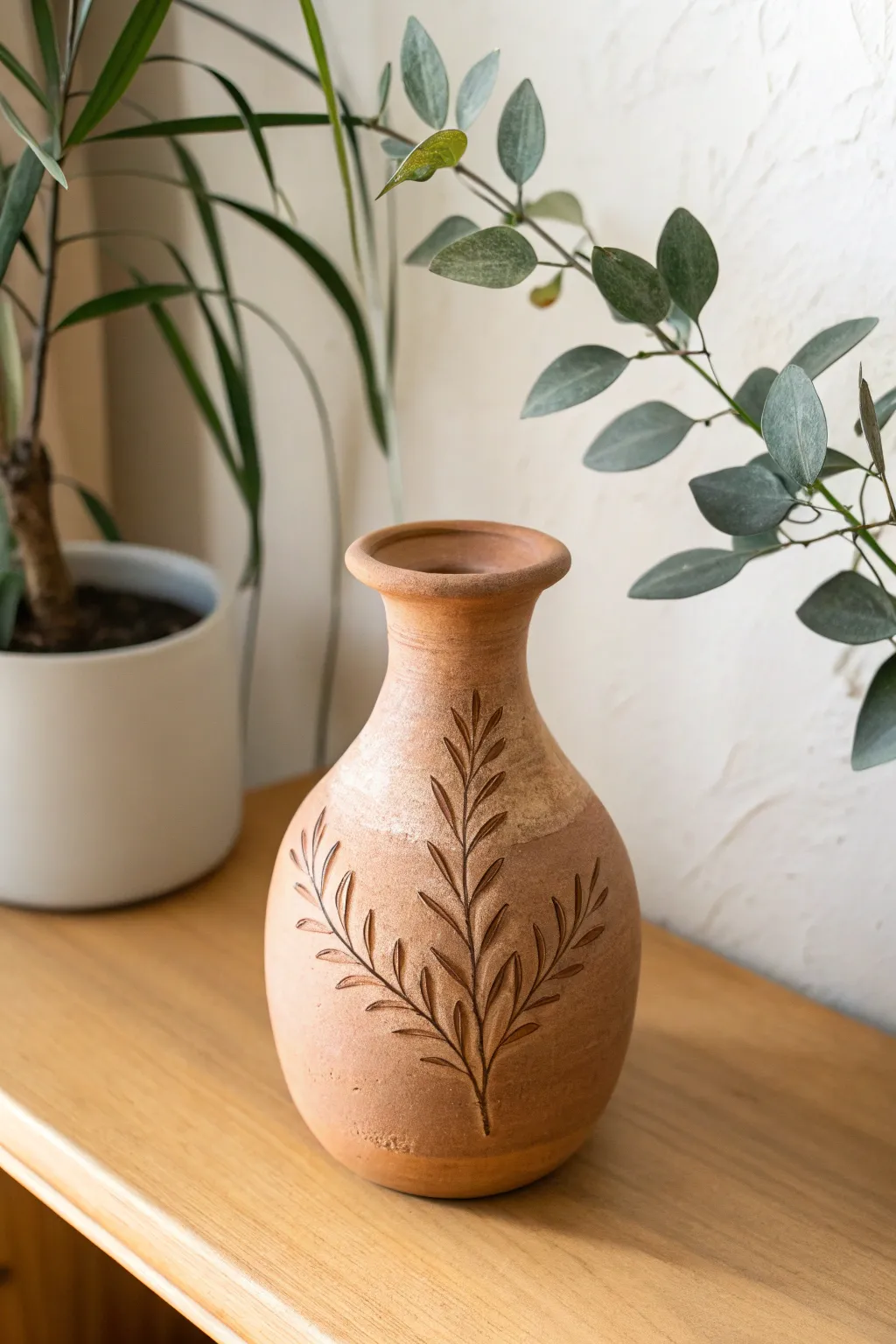
Bring texture and organic beauty to your home with this simple terracotta project that celebrates botanical forms. Using basic carving tools, you will transform a plain clay vessel into an earthy, fern-patterned masterpiece.
Detailed Instructions
Materials
- Earthenware or terracotta clay (approx 2-3 lbs)
- Pottery wheel (optional) or coil-building supplies
- Metal kidney rib
- Needle tool
- Wire loop carving tool (small)
- Small spray bottle with water
- Sponge
- Wooden modeling tool
- Clear matte sealer or transparent matte glaze (optional)
Step 1: Forming the Vessel
-
Prepare the clay:
Begin by wedging your terracotta clay thoroughly to remove any air bubbles. This ensures a consistent texture for carving later. -
Construct the base:
Whether you are throwing on a wheel or building with coils, create a rounded, bulbous base that tapers gently upward. Aim for a wall thickness of about a quarter-inch. -
Shape the neck:
Pull the clay inward to form a narrower neck, then flair the rim out slightly at the very top. This classic bottle shape provides a perfect canvas for the vertical leaf design. -
Refine the surface:
While the clay is still soft but holding its shape, use a metal kidney rib to smooth the exterior walls. Remove any fingerprints or major bumps. -
Let it firm up:
Allow the vase to dry to a ‘leather-hard’ state. This is crucial; the clay should be firm enough to handle without deforming but soft enough to carve into easily.
Clay Too Dry?
If the clay crumbles while carving, it’s too dry. Mist it lightly with water and wrap tight in plastic for 2 hours to rehydrate slightly before trying again.
Step 2: Creating the Texture & Pattern
-
Rough up the neck:
To achieve the textured band seen just below the rim, lightly scratch the surface with a serrated rib or a stiff brush. This creates a tactile contrast against the smooth body. -
Sketch the central stem:
Using a needle tool, very lightly scratch a curved vertical line up the center of the vase. This will serve as the spine for your fern engraving. -
Mark branching stems:
Lightly sketch symmetrical branches reaching upward and outward from the central spine. Keep the spacing even, widening slightly as you move up the vase. -
Carve the main stem:
Switch to your wire loop tool. Carefully carve out the central line you sketched, removing a thin strip of clay to create a recessed groove. -
Carve the leaves:
For the leaves, press the loop tool into the clay at the base of each leaf and pull outward, tapering the pressure to create a pointed tip. I find it helps to rotate the vase as I work to keep the angle comfortable. -
Add side branches:
Repeat the carving process for the side branches, creating smaller, distinctive leaf shapes that flow naturally from the main stems. -
Smooth the edges:
Once all carving is done, use a slightly damp finger or the wooden modeling tool to gently soften any sharp burrs created by the carving tools.
Level Up: White Slip
Brush a layer of white slip (liquid clay) near the neck before carving. When you scratch through it, the red terracotta will reveal a stunning two-tone contrast.
Step 3: Finishing Touches
-
Dry slowly:
Cover the vase loosely with plastic for a day, then uncover it to let it dry completely to the bone-dry stage. Slow drying prevents cracking. -
Bisque fire:
Fire the piece in a kiln to bisque temperature (usually barely Cone 04 or 06). This hardens the clay permanently. -
Apply a wash (optional):
If you want to highlight the carving, apply a diluted iron oxide wash over the design and wipe it back with a sponge, leaving the darker color just in the recesses. -
Final seal:
Finish with a clear matte glaze and fire again, or simply use a matte acrylic sealer if this vase is purely decorative and won’t hold water.
Place your finished vase near a window where the natural light can catch the textures of your carving
Faux Terracotta Painted Air-Dry Vase
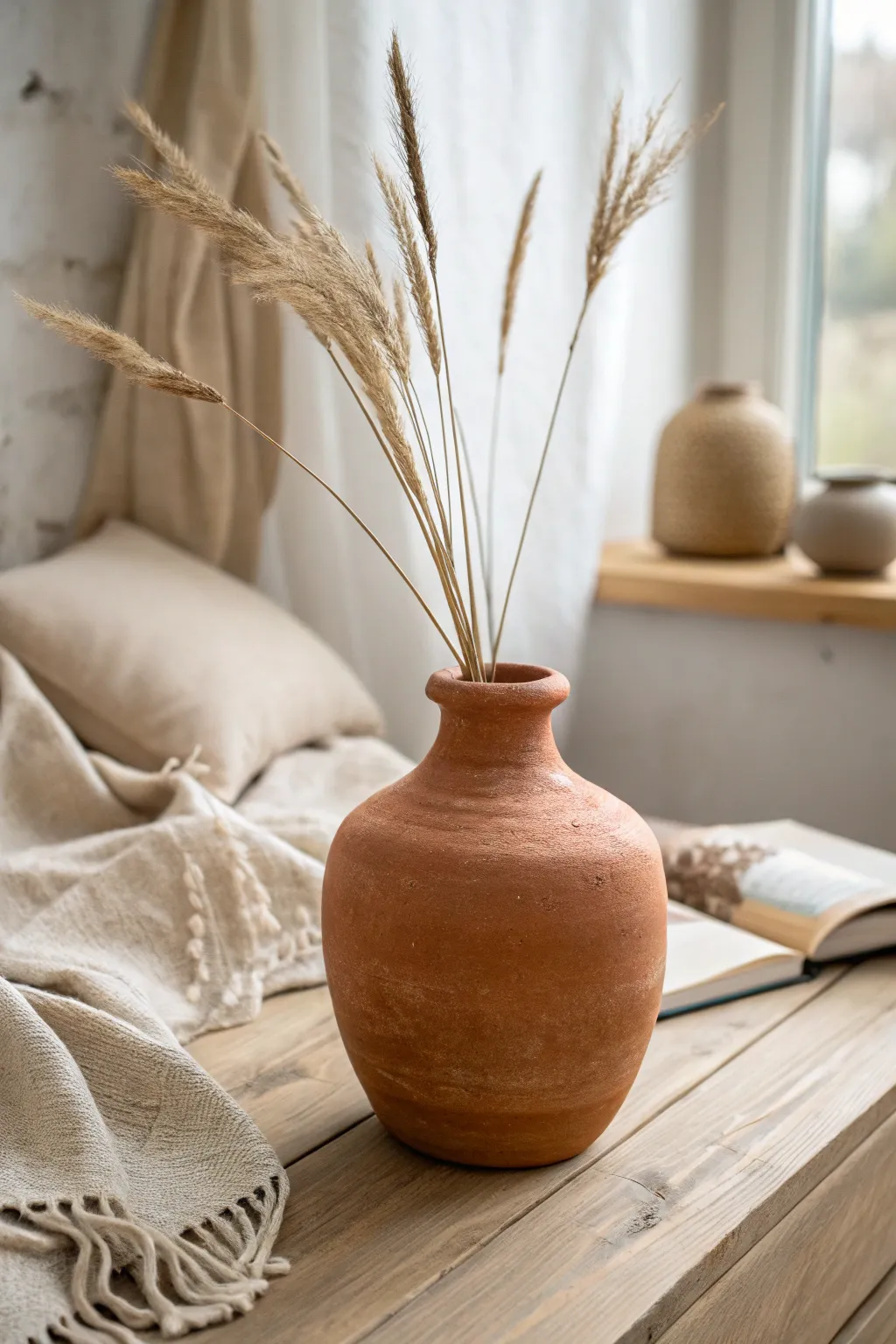
Transform a plain glass or ceramic vessel into a piece of rustic, aged pottery with this simple painting technique. Using baking soda to create grit and texture, you’ll achieve that authentic, sun-baked earth look perfect for displaying dried grasses.
Step-by-Step Tutorial
Materials
- Old glass or ceramic vase (thrifted handles well)
- Acrylic paint (Burnt Sienna, Tan, and White)
- Baking soda or baking powder
- Medium-sized flat paintbrush
- Paper plate or mixing palette
- Paper towels
- Matte sealer spray (optional)
- Fine-grit sandpaper (optional)
Step 1: Preparing the Mixture
-
Clean surface:
Begin by thoroughly cleaning your vase with warm soapy water to remove any dust or oils. Dry it completely with a lint-free cloth. -
Create base color:
Mix your primary terracotta shade on your palette. Combine about 70% Burnt Sienna with a small dollop of Tan to soften the harsh orange. Adjust with a tiny drop of white if you want a more sun-bleached look. -
Add texture agent:
Sprinkle baking soda directly into your wet paint mixture. Aim for a 1:1 ratio of paint to baking soda for a very thick, fluffy paste. -
Mix thoroughly:
Use your brush to fold the baking soda into the paint until it resembles a thick, mousse-like frosting. If it feels too stiff to spread, add a drop more paint, not water.
Crack Fix
If the heavy paint cracks while drying, don’t panic. Gently dab a little wet paint into the cracks and smooth it with your finger for an aged repair look.
Step 2: Building Texture
-
First coat application:
Apply the textured paint to the vase using horizontal strokes. Don’t worry about brush marks; they add to the handmade clay aesthetic. -
Cover the rim:
Paint slightly inside the top rim of the vase. This ensures the original material doesn’t show through when you arrange your flowers. -
Dab for grit:
While the paint is still wet, take your brush and gently dab or stipple over areas that look too smooth. This pulls the baking soda up to create a rougher, pot-stone surface. -
Initial dry time:
Let this first coat dry completely. Depending on humidity, this usually takes about 30 to 60 minutes. It will look chalky and matte as it dries.
Step 3: Layering and Detailing
-
Mix second batch:
Create a new batch of paint. I like to make this one slightly lighter or darker than the first layer to create natural clay variation. -
Second coat application:
Apply the second layer, focusing on filling any spots where the glass might still be peeking through. Use cross-hatching strokes for more organic texture. -
Create imperfections:
If the surface looks too uniform, add a pinch more baking soda to your remaining paint and dab it onto the belly of the vase to simulate built-up clay. -
Final dry:
Allow the vase to dry fully, ideally for several hours or overnight. The baking soda mixture needs to harden completely.
Ancient Patina
Rub a tiny bit of flour or cornstarch over the fully dried paint for a dusty, ancient finish. Seal afterward to keep the white dust in place.
Step 4: Finishing Touches
-
Highlighting (optional):
Once dry, take a very dry brush with a tiny amount of white or light tan paint. Lightly dust it over the highest textures to highlight the grit. -
Aging the piece:
To mimic the worn look in the photo, you can lightly wipe a damp paper towel over specific areas to gently distress the paint slightly. -
Seal the work:
For longevity, spray the vase with a clear matte sealer. This prevents the baking soda from flaking off over time. -
Final styling:
Fill your new vessel with dried reeds or wheat stalks to complete the rustic, natural aesthetic shown in the inspiration image.
Now you have a charming, textured vessel that brings a warm, earthy element to any corner of your home
Matte Pastel Color-Block Vase
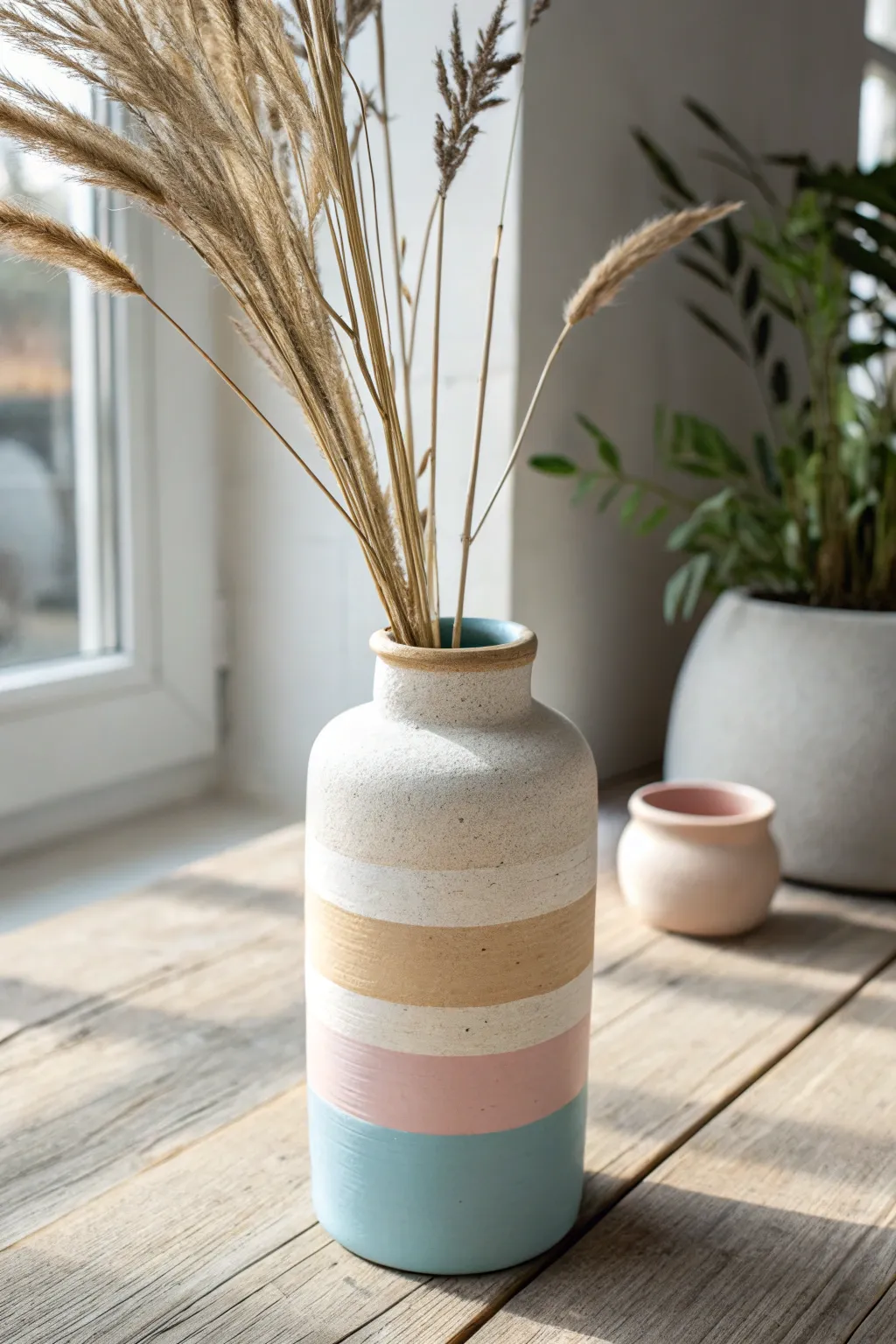
Bring a touch of modern desert chic into your home with this textural transformation. By mixing baking soda into acrylic paint, you can turn a plain glass bottle or ceramic vessel into a high-end, matte clay masterpiece featuring soft, earthy color blocking.
Detailed Instructions
Materials
- Glass bottle or smooth ceramic vase (cleaned)
- White primer spray paint (optional but recommended)
- Acrylic craft paints (White/Cream, Ochre/Mustard, Dusty Pink, Slate Blue)
- Baking soda (a generous amount)
- Palette or small cups for mixing
- Painter’s tape or wash tape
- Medium flat paintbrush
- Foam brush (optional)
- Damp cloth
Step 1: Preparation & Base Coat
-
Clean surface:
Begin by thoroughly cleaning your vase or recycled glass jar with warm soapy water to remove any grease or sticker residue. Dry it completely with a lint-free cloth. -
Prime the surface:
If your vessel is very smooth glass, apply a coat of spray primer to help the acrylic paint adhere better. Let this dry outside for about 30 minutes according to the can’s instructions. -
Mix texture medium:
Pour a generous dollop of your white/cream acrylic paint into a mixing cup. Slowly stir in baking soda until the consistency resembles fluffy frosting or thick mousse. -
Apply base layer:
Using a flat brush, apply this textured white mixture over the entire vase. Don’t worry about brushstrokes; the texture is the goal here. Cover heavily at the top neck area, as this will remain the top color block. -
Dry thoroughly:
Allow this initial heavy coat to dry completely. Since the paint is thick, this might take 1-2 hours. You can speed it up with a hair dryer on a cool setting if you’re impatient like me.
Step 2: Color Blocking
-
Plan your bands:
Visualize where your color bands will sit. You want roughly equal sections: cream at the top, ochre, pink, and blue at the bottom. You can use a pencil to lightly mark these lines if you need guidance. -
Tape the top line:
Place a strip of painter’s tape horizontally around the vase to define the bottom edge of the top cream section. Press the tape down firmly to prevent leaks. -
Mix ochre texture:
create your second color mix. Combine ochre or mustard yellow paint with baking soda. Aim for that same gritty, thick consistency to maintain the ‘clay’ look. -
Paint the second band:
Apply the textured ochre paint below your tape line. Paint downwards about 2-3 inches to create the yellow band. Ensure the texture matches the white section above. -
Remove tape while wet:
Carefully peel off the tape immediately after painting the yellow band. Peeling while wet helps keep the textured edge from tearing. -
Dry between layers:
Let the yellow band dry to the touch before moving on, usually about 20-30 minutes.
Grit Control
If the paint clumps too much, add a drop of water. If it’s too runny and not textured enough, simply add more baking soda until stiff.
Step 3: Finishing the Gradient
-
Mix the pink:
Mix your dusty pink acrylic paint with baking soda in a fresh cup. -
Apply pink band:
Paint the pink section directly below the yellow one. Since you aren’t using tape over the fresh yellow paint, use a steady hand or a smaller flat brush to cut in a neat line where the colors meet. -
Mix the blue:
Finally, mix the slate blue paint with baking soda for the bottom section. -
Paint the base:
Cover the bottom portion of the vase with the textured blue mixture. Make sure to paint slightly under the bottom rim so no original glass shows when the vase is sitting on a table. -
Refine the edges:
Look closely at your horizontal lines. If any look too messy, use a small detail brush with the appropriate color to gently touch up and straighten the transitions. -
Final cure:
Let the vase sit undisturbed overnight. The baking soda paint hardens into a convincing raw ceramic feel, but needs time to fully set. -
Clear coat (optional):
If you plan to handle the vase often, mist it with a matte clear sealant spray to prevent the baking soda texture from dusting off over time.
Level Up: Faux Stone
Before the paint dries, gently press a coarse sponge against the surface or speckle it with a toothbrush and thinned dark paint for a stone effect.
Pop in some dried pampas grass or wheat stems to perfectly complement the earthy tones of your new vessel
Terrazzo-Speckled Clay Vase
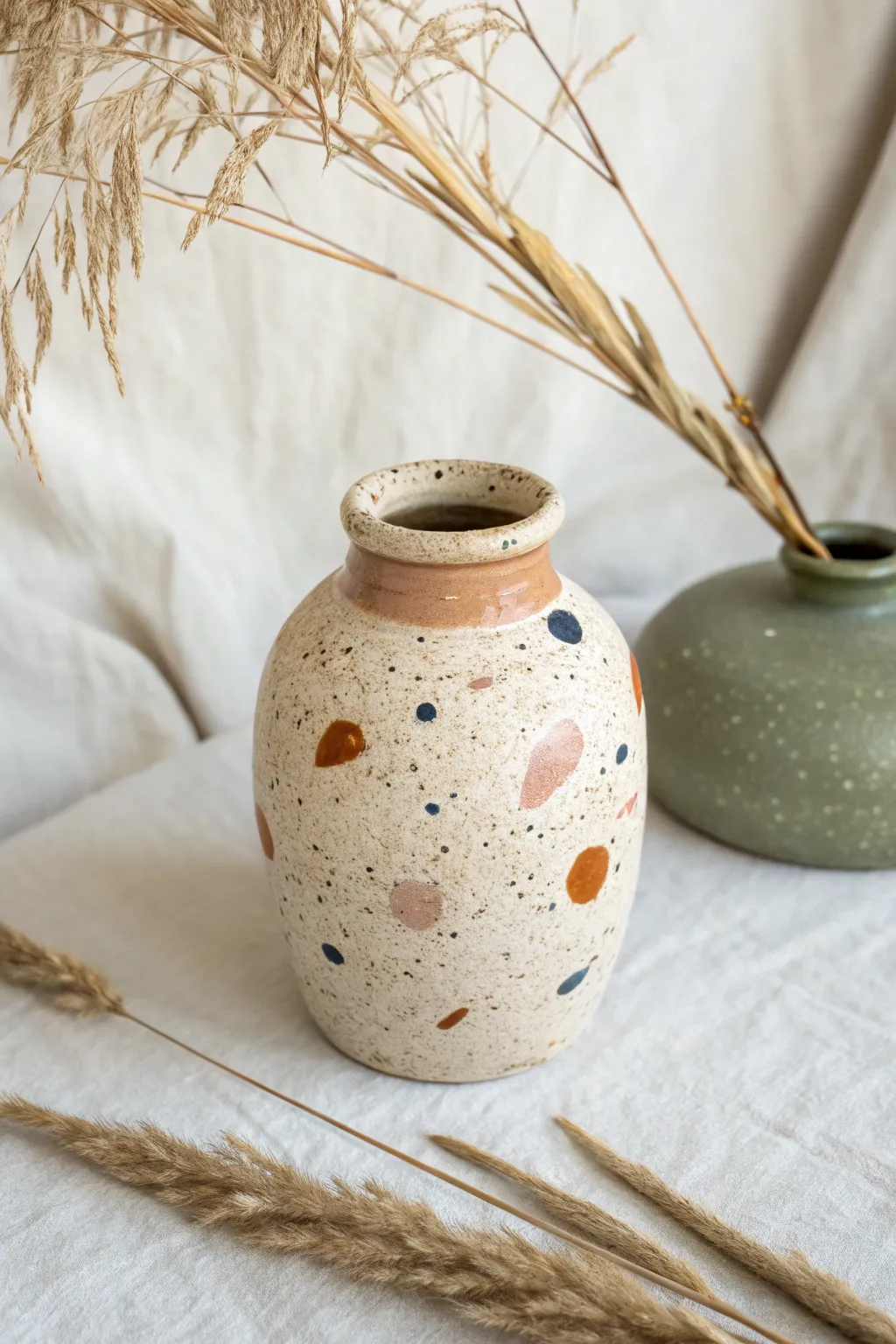
Bring a touch of modern earthiness to your decor with this faux terrazzo vase project that combines speckling techniques with bold, abstract shapes. The design features warm terracotta, deep blue, and soft blush tones scattered across a creamy, stone-like background for an authentic ceramic look.
Step-by-Step
Materials
- White or cream air-dry clay (approx. 1 kg)
- Acrylic paints (Cream, Terracotta, Navy Blue, Blush Pink, Burnt Sienna)
- Old toothbrush
- Small fine-point paintbrush
- Rolling pin
- Clay knife or craft blade
- Medium-grit sanding sponge
- Matte spray varnish or sealant
- Small bowl or jar (for use as a mold/armature)
- Water and sponge for smoothing
Step 1: Shaping the Vessel
-
Prepare the clay base:
Start by kneading your air-dry clay until it is soft and pliable. Roll out a flat, circular slab about 1/4 inch thick to serve as the bottom of the vase. -
Build the walls:
Using the coil method or slab building, construct the walls of the vase. For a smooth, rounded shape like the photo, I prefer rolling out a large rectangular slab and wrapping it around a temporary form (like a jar covered in plastic wrap) to get the initial height. -
Curve the silhouette:
Once the basic cylinder is formed, gently push the clay outwards from the inside to create a bulbous, rounded belly. Taper the clay inward as you reach the top to form the neck. -
Form the rim:
Create a distinct, slightly flared lip at the top opening. Use a wet finger to smooth the transition between the neck and this rolled rim, ensuring it looks intentional and sturdy. -
Smooth the surface:
Dip a sponge in a little water and wipe down the entire exterior. Remove any fingerprints, bumps, or seam lines to create a clean canvas for your painting later. -
Let it dry completely:
Allow the vase to dry for 24-48 hours. It should turn white and feel bone-dry to the touch. Once dry, lightly sand any remaining rough spots with a sanding sponge.
Splatter Control
Before flicking paint on the vase, test spray onto a piece of paper. This clears excess blobs from the bristles and ensures a fine, even mist of dots.
Step 2: Creating the Stone Effect
-
Apply base color:
Paint the entire vase (excluding the top rim for now) with a creamy beige acrylic paint. You may need two coats for full opacity. -
Create the splatter:
Mix a small amount of dark brown or black paint with water until it’s inky. Dip an old toothbrush into this mixture. -
Speckle the surface:
Hold the toothbrush a few inches from the vase and run your thumb across the bristles to flick tiny specks onto the surface. Rotate the vase to ensure even coverage, mimicking natural stoneware. -
Paint the rim:
Using a flat brush, carefully paint the top rim and the upper neck area with a solid coat of Burnt Sienna or terracotta paint. This creates a beautiful contrast against the speckled body.
Waterproof it!
Air-dry clay isn’t waterproof. Insert a cut plastic bottle or a glass jar inside your finished vase so you can display fresh flowers without melting the clay.
Step 3: Painting the Terrazzo Pattern
-
Plan your shapes:
Visualize where your larger terrazzo ‘chips’ will go. Keep them random and spaced out—don’t cluster them too tightly. -
Paint the large abstract shapes:
Using your fine paintbrush, paint irregular, organic shapes. Use Terracotta/Burnt Orange for the largest splashes, making them look like broken shards of tile. -
Add secondary colors:
Paint smaller, pebble-like shapes using the Blush Pink and Navy Blue paints. Vary the sizes, keeping some akin to small dots and others slightly larger and flatter. -
Layering details:
If a shape looks too flat, you can dab a slightly lighter or darker shade of the same color on top while it’s still wet to add dimension. -
Re-speckle (Optional):
If your painted shapes look too ‘clean’ sitting on top of the speckles, do a very light second pass of the toothbrush splatter over the painted shapes to integrate them into the stone texture. -
Seal the vase:
Once all paint is completely dry, spray the entire piece with a matte varnish. This protects the paint and unifies the sheen, making it look like glazed ceramic.
Now you have a stunning, heavy-weight decor piece that looks like it came straight from a pottery wheel
Easy Face Vase With Simple Features
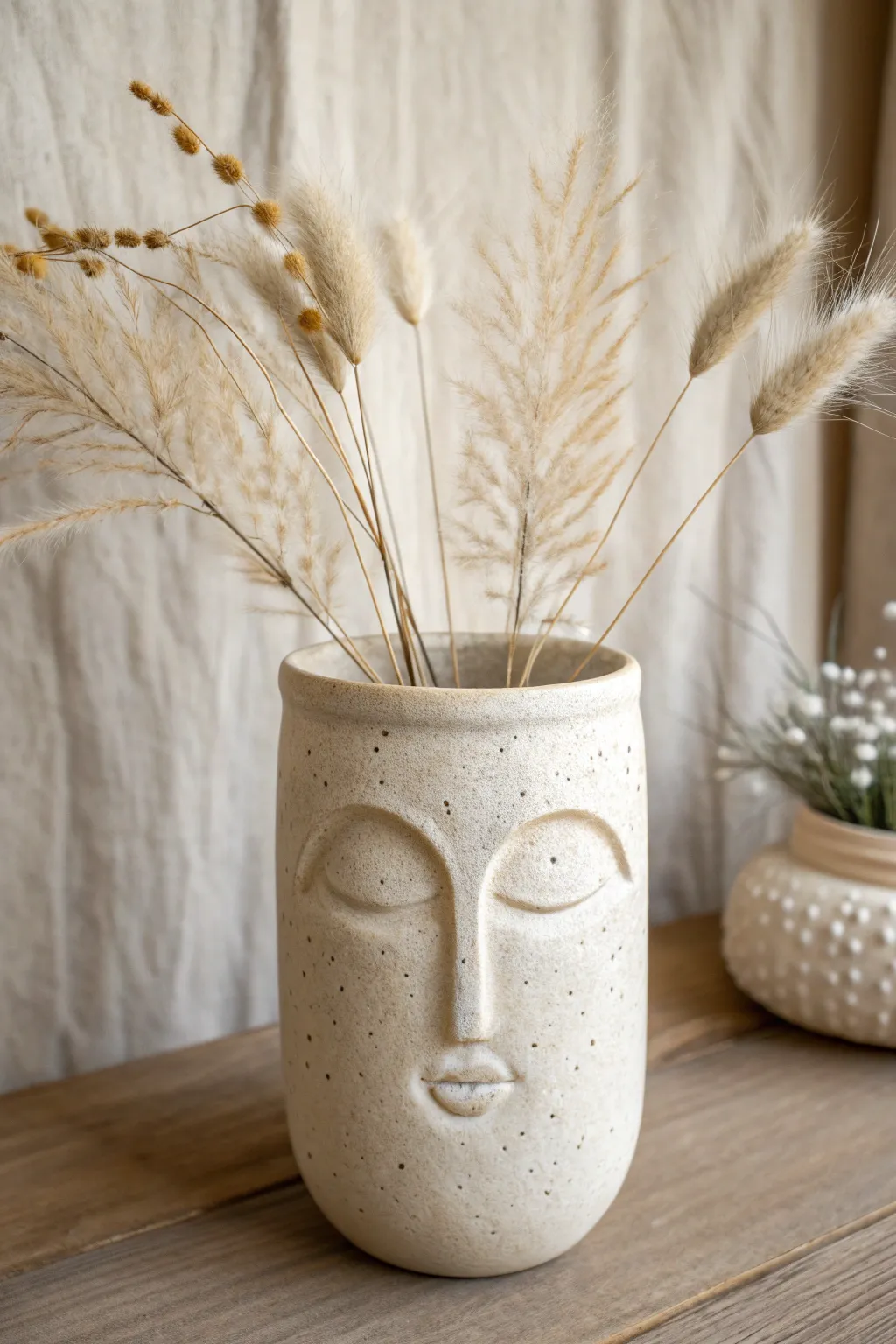
Sculpt a peaceful presence into your home decor with this wonderfully tactile clay project. This vase features a stylized, calming face with relief features and a speckled finish that mimics high-end stoneware.
How-To Guide
Materials
- Air-dry clay (white or light grey)
- Tall cylindrical container (glass jar or cardboard tube as armature)
- Rolling pin
- Clay cutting tool or knife
- Modeling tools (or a spoon and toothpick)
- Small bowl of water
- Fine-grit sandpaper
- Acrylic paint (cream or off-white)
- Acrylic paint (brown or black for speckling)
- Stiff bristle brush or old toothbrush
- Matte sealant spray
Step 1: Building the Base
-
Prepare the clay:
Begin by kneading your air-dry clay until it is warm and pliable. This prevents cracks later on. -
Roll out a slab:
Roll the clay into a large, even rectangular slab. Aim for a thickness of about 1/4 inch to ensure stability. -
Wrap the armature:
Take your cylindrical container (like a glass jar) and wrap the clay slab around it. Cut off any excess clay so the edges meet perfectly without overlapping too much. -
Seal the seam:
Score the edges where they meet by scratching cross-hatch marks, dab a little water on them, and press them firmly together. Smooth the seam with your finger until it disappears. -
Refine the rim:
Trim the top edge of the clay so it is even with the rim of your container. Smooth it down with a wet finger for a soft, rounded lip.
Step 2: Sculpting the Face
-
Mark the features:
Lightly sketch the position of the nose, eyebrows, and mouth directly onto the damp clay using a toothpick or modeling tool. -
Form the nose bridge:
Roll a small coil of clay for the nose. Attach it vertically where you marked the center, blending the sides smoothly into the main vase body so only the ridge stands out. -
Create the brow connection:
Add two curved coils above where the eyes will be, connecting them seamlessly to the top of the nose bridge. This T-shape forms the major structure of the face. -
Add eyelids:
Shape two almond-sized flattened pieces of clay. Place them beneath the brow ridges to serve as closed eyelids, blending the edges gently. -
Sculpt the lips:
Form a small oval for the mouth and attach it below the nose. Use a tool to press a horizontal line across the center, creating the separation between the upper and lower lip. -
Refine and smooth:
Dip your finger in water and gently rub over all the added features to soften hard lines. The face should look like it is emerging naturally from the vase.
Smooth Operator
Use a barely damp sponge during the final smoothing phase. It erases fingerprints better than your bare hands without over-wetting the clay.
Step 3: Finishing Touches
-
Let it dry:
Allow the vase to dry completely. This usually takes 24-48 hours depending on humidity. It should turn a lighter color when fully dry. -
Sand imperfections:
Once dry, use fine-grit sandpaper to gently smooth out any fingerprints, bumps, or rough edges on the rim and features. -
Base coat painting:
paint the entire vase with a cream or off-white acrylic paint. I usually apply two coats for a solid, opaque finish. -
Create the speckles:
Dilute a small amount of dark brown or black paint with water. Dip a stiff brush (or toothbrush) into it and flick the bristles with your thumb to spray tiny speckles over the vase. -
Control the splatter:
Test your flicking technique on a piece of paper first to ensure the dots are fine and not big blobs. -
Seal the work:
Protect your paint job with a coat of matte sealant spray. This gives it a professional, finished look and protects it from moisture.
Make It Stone
Mix baking soda into your acrylic paint before applying. It adds a gritty texture that makes the final piece look exactly like real stone or ceramic.
Fill your new creation with dried grasses or faux flowers to complete the serene aesthetic
Stacked Ring Donut Vase
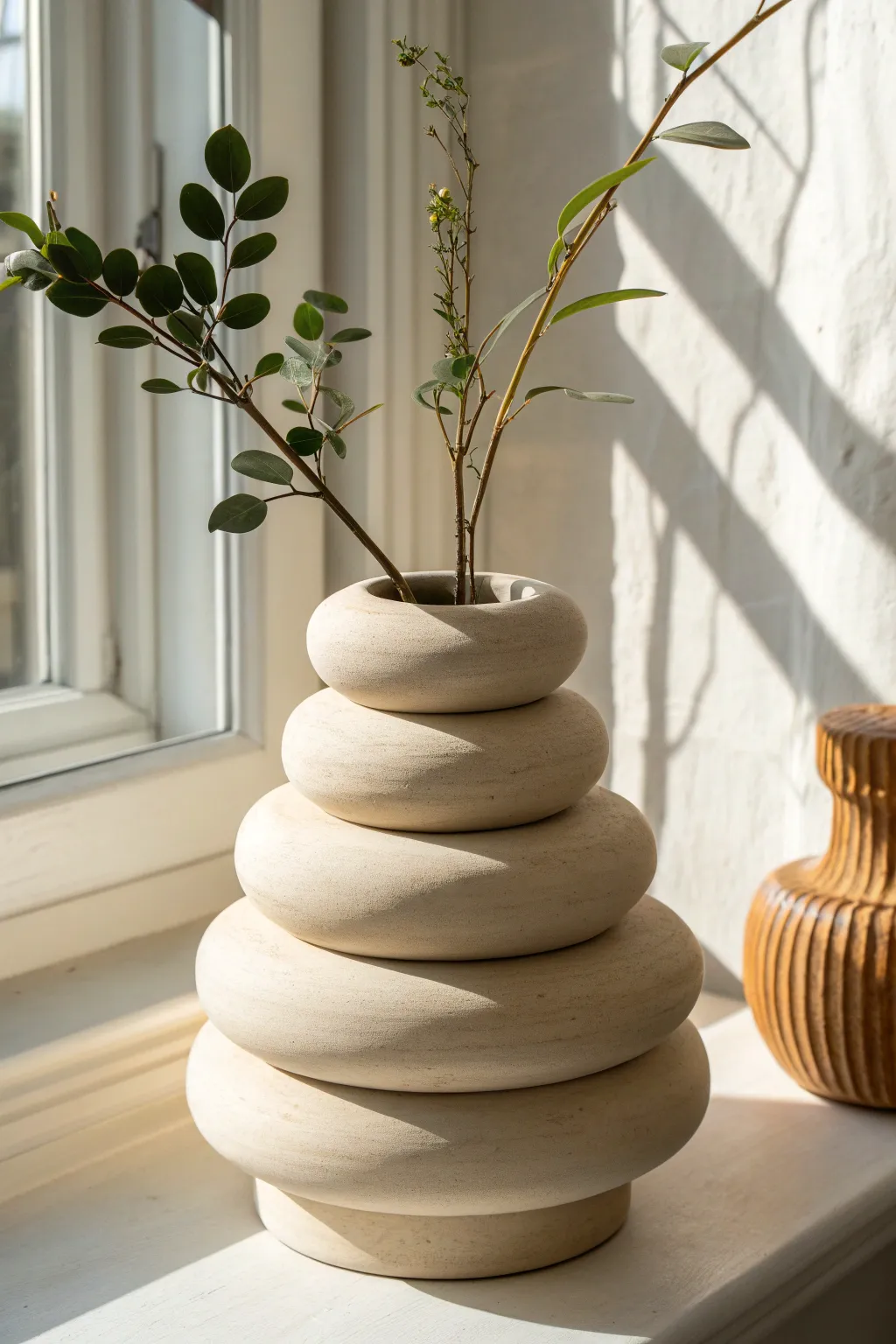
Embrace organic shapes with this striking vessel that mimics the look of stacked river stones or soft sandstone rings. Its graduated silhouette creates a beautiful sense of balance, perfect for displaying minimalist dried branches.
Step-by-Step Guide
Materials
- Air-dry clay (stone or sand colored) or ceramic clay if you access to a kiln
- Rolling pin
- Clay scoring tool or fork
- Slip (clay mixed with water)
- Circle cutters or varying size bowl rims
- Wooden sculpting tools
- Sponge
- Sandpaper (medium and fine grit)
- Matte sealant spray
Step 1: Forming the Base Rings
-
Prepare your clay:
Begin by wedging your clay thoroughly to remove air bubbles, then roll it into a series of thick, even coils. You want these coils quite chunky, roughly an inch in diameter. -
Create the base ring:
Take your largest coil and form a circle, joining the ends together. This will be the foundational ring, so ensure it is wide enough to support the structure. -
Shape the donut:
Smooth the seam where the coil ends meet until invisible. Use your fingers to gently round the edges, creating a soft, flattened donut shape rather than a perfect tube. -
Add the solid bottom:
Roll out a flat slab of clay and cut a circle slightly smaller than your base ring. Score and slip the edges, then attach this to the underside of your first ring to seal the vase bottom. -
Form graduating rings:
Create 4-5 additional rings, making each one slightly smaller in diameter than the last. Test stack them dry to check the tapered silhouette before attaching.
Weight Management
Don’t make the top rings too heavy. If the clay is soft, let the bottom rings stiffen for an hour before stacking the top ones to prevent sagging.
Step 2: Stacking and Constructing
-
Score the surfaces:
Take the base donut and the second largest ring. Heavily score (scratch) the top surface of the base and the bottom surface of the second ring. -
Apply slip:
Dab a generous amount of slip onto the scored areas. This acts as the glue that bonds the heavy clay sections together. -
Stack and press:
Place the second ring onto the base, pressing down firmly but carefully to avoid deforming the rounded edges. Give it a slight wiggle to lock the slip. -
Blend the interior:
With a long wooden tool or your finger, blend the clay on the *inside* of the rings together to create a watertight seal and structural integrity. I find this step crucial for stability. -
Continue upward:
Repeat the scoring, slipping, and stacking process for the remaining graduating rings, finishing with the smallest one at the very top.
Step 3: Refining and Finish
-
Smooth the exterior seams:
Unlike the inside, you want to keep the definition of each ‘stone’ on the outside. Do not smooth the outer rings together; instead, use a slightly damp sponge to clean up any slip that squeezed out. -
Refine the top opening:
Smooth the inner rim of the top ring so it is pleasant to the touch and looks finished. You can slope the clay slightly inward for a polished look. -
Add texture:
To mimic the sandstone look in the photo, gently dab the surface with a stiff bristle brush or a crumpled ball of aluminum foil while the clay is leather hard. -
Let it dry slowly:
Cover the vase loosely with plastic wrap and let it dry very slowly over 2-3 days to prevent cracking between the heavy layers. -
Sand for stone effect:
Once bone dry, sand the surface. Start with medium grit to remove imperfections, then fine grit to create that soft, weathered stone texture. -
Seal the piece:
Apply a clear matte sealant spray to protect the clay. If using air-dry clay, remember this vase will be for dried botanicals only, as it won’t be fully waterproof.
Faux Stone Finish
Mix a small amount of sand or dried coffee grounds into your clay body before sculpting. This creates gorgeous speckles and texture upon sanding.
Now you have a serene, sculptural piece that brings a touch of nature’s calm into your home
Wavy Cutout Vase for Dried Florals
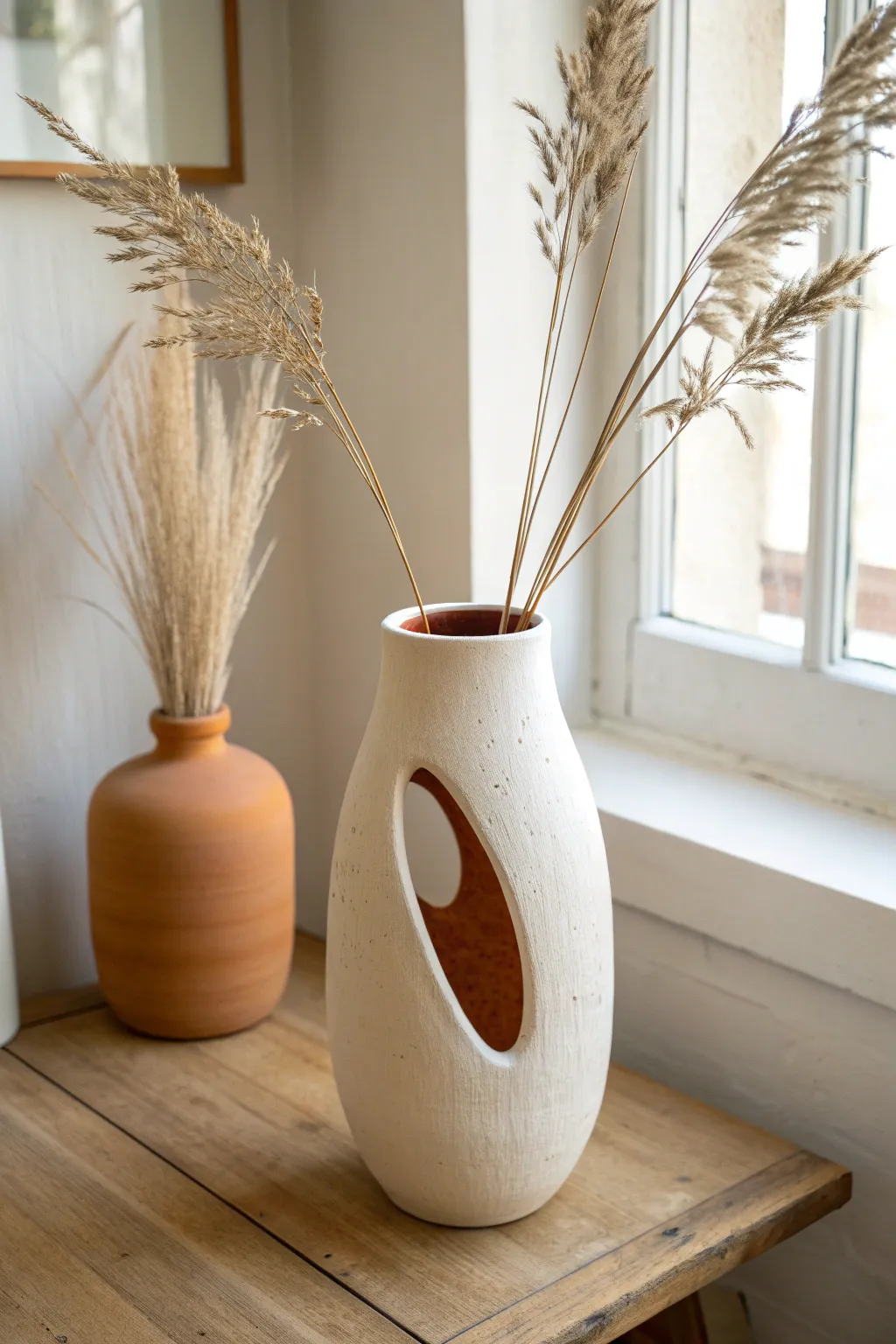
Embrace the beauty of negative space with this striking textured vase, featuring a bold organic cutout that reveals the warm terracotta interior. This project combines classic hand-building techniques with a modern sculptural twist, perfect for those long stems of pampas grass.
How-To Guide
Materials
- Terracotta air-dry clay or kiln-fire clay (approx. 3-4 lbs)
- Rolling pin
- Canvas mat or slab roller
- Flexible metal rib
- Needle tool
- Fettling knife
- Sponge
- Slip and scoring tool (fork or serrated rib)
- Matte white acrylic paint (or glaze if firing)
- Baking soda or textured medium (optional for paint)
- Medium paintbrush
- Sandpaper (fine grit)
Step 1: Building the Form
-
Prepare the slab:
Begin by rolling out a large slab of terracotta clay on your canvas mat. Aim for a consistent thickness of about 1/4 inch to ensure the walls are sturdy enough to stand tall. -
Cut the cylinder wall:
Using a ruler and needle tool, cut a large rectangle from your slab. The height of the rectangle will determine your vase height, and the length will determine the circumference. -
Form the cylinder:
Carefully lift the slab and curl it into a cylinder shape. Overlap the edges slightly or butt them against each other, depending on your preferred joining method. -
Join the seam:
Score both touching edges thoroughly and apply clay slip. Press the seam firmly together. I like to use a wooden tool to blend the clay across the join line until it disappears completely. -
Add the base:
Roll a small circular slab slightly larger than your cylinder’s diameter. Score and slip the bottom edge of your cylinder, place it on the circle, and blend the excess clay up the side of the wall to seal it. -
Shape the neck:
To achieve the tapered neck seen in the photo, gently collar the clay inward near the top. Use your hands to squeeze and guide the clay narrower as you rotate the piece slowly. -
Create the rim:
Once the neck is narrowed, trim the top edge with your needle tool to make it even. Smooth the rim with a damp chamois or sponge for a rounded finish.
Clean Cuts Pro-Tip
For the cleanest cutout hole, wait until the clay is firmly leather-hard. If it’s too wet, the walls will sag; too dry, and it might crack.
Step 2: Carving and Refining
-
Sketch the cutout:
Allow the clay to stiffen slightly to a ‘leather hard’ state. Using a needle tool, lightly sketch a large, organic oval or teardrop shape on the side of the vase. -
Cut the negative space:
Carefully trace your sketched line with a sharp fettling knife to remove the section of clay. Support the wall from the inside with your other hand to prevent it from collapsing. -
Refine the edges:
Use a damp sponge or your finger to smooth the cut edges of the hole. They should look deliberate and soft, not sharp or jagged. -
Dry completely:
Let the vase dry slowly away from direct heat or drafts. If using kiln clay, fire it now. If using air-dry clay, wait 24-48 hours until bone dry. -
Sand the surface:
Once fully dry, lightly sand the exterior to remove any bumps or fingerprints, creating a smooth canvas for the texture.
Level Up: Speckled Effect
Flick a stiff toothbrush loaded with watered-down brown or grey paint over the dried white surface to add realistic faux-stone speckles.
Step 3: Applying Texture and Color
-
Mix textured paint:
To recreate the gritty, stone-like finish in the image, mix white acrylic paint with a teaspoon of baking soda. This adds an instant ceramic texture. -
Paint the exterior:
Apply the white textured mixture to the outside of the vase only. Use vertical strokes to mimic wheel-thrown lines or pouncing motions for a stone look. -
Details on the cutout:
Carefully paint the rim of the cutout hole white, but stop exactly at the inner edge. You want the interior color to remain visible. -
Preserve the interior:
Leave the inside of the vase unpainted to show off the natural terracotta color. This contrast creates depth and visual interest through the cutout. -
Final touches:
If needed, do a second coat of white on the exterior for full opacity. Let it dry completely before arranging your dried florals.
Place your favorite dried ornamental grasses inside and enjoy the modern elegance this piece brings to your space