
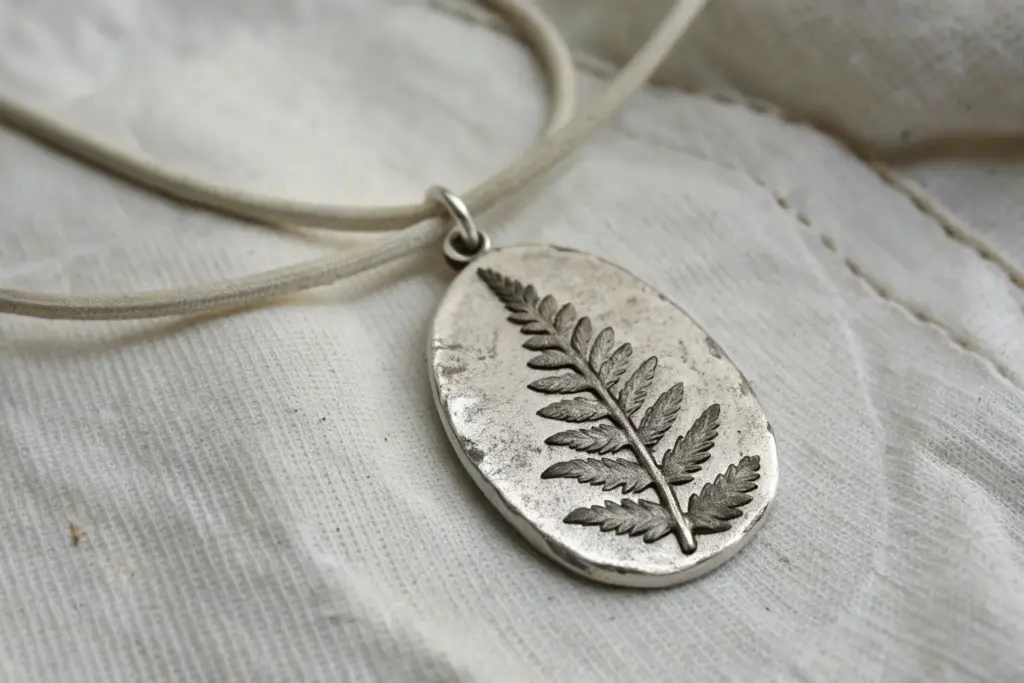
If you love the look of handmade silver with a little grit and soul, metal clay jewelry is basically magic—soft like clay at first, then fired into real metal. Here are my favorite idea-starters that lean into texture, botanical impressions, and those beautifully organic shapes that metal clay does so well.
Leaf-Imprint Pendant with Built-In Bail
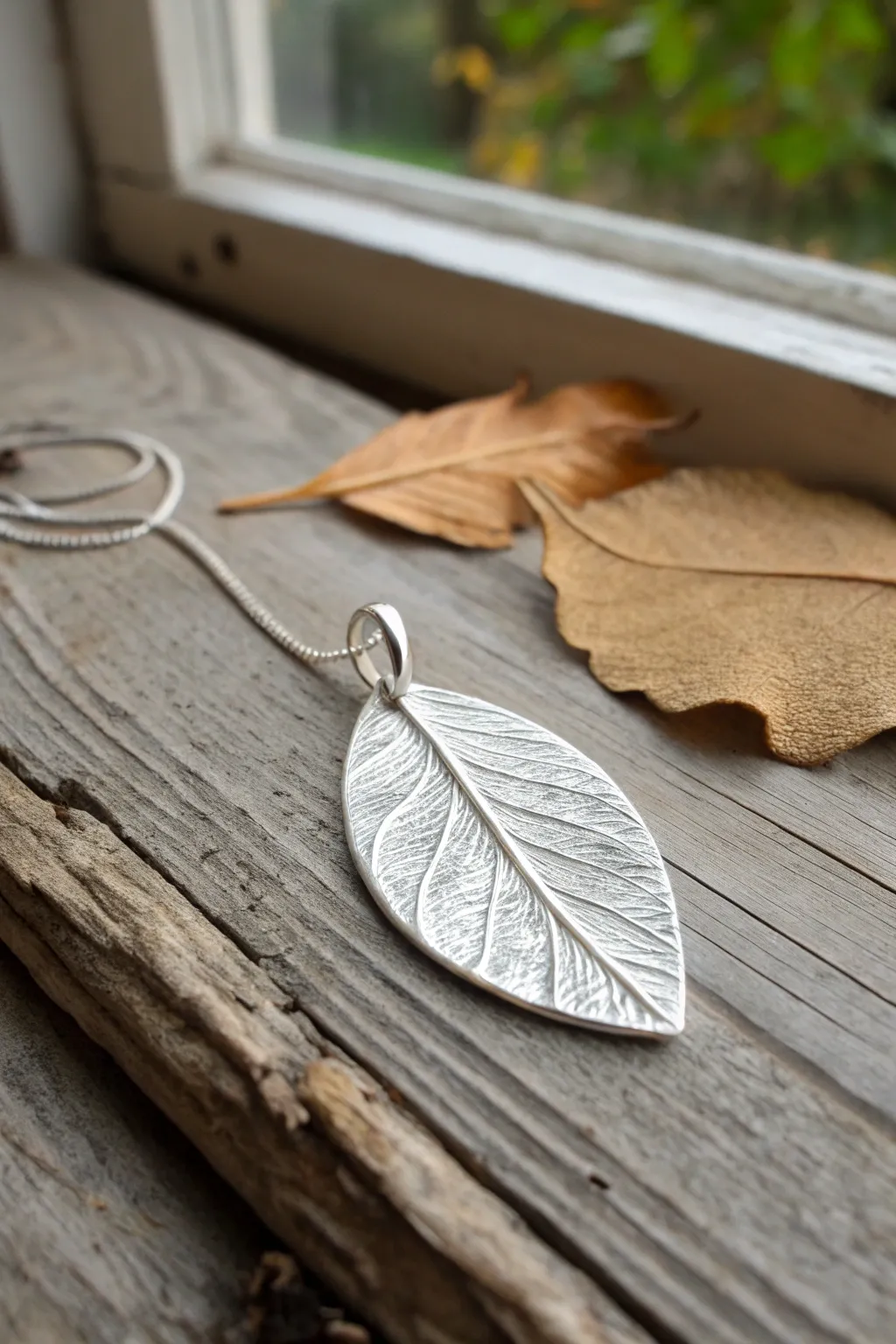
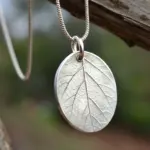
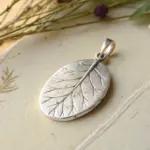
Capture the intricate beauty of nature by creating a fine silver pendant detailed with the texture of a real leaf. This project uses silver metal clay to transform organic fragility into a lasting, wearable keepsake with a seamlessly integrated bail.
Step-by-Step Tutorial
Materials
- Silver metal clay (approx. 7-10g)
- Fresh, deeply veined leaf (e.g., sage, hydrangea, or rose)
- Acrylic roller or smooth PVC pipe
- Playing cards or slat spacers (1mm and 1.5mm)
- Olive oil or Badger balm (release agent)
- Scalpel or craft knife
- Needle tool
- Small paintbrush and water
- Sanding sponges (fine and superfine)
- Butane torch or kiln
- Stainless steel brush
- Burnisher or agate tool
- Liver of sulfur (optional patina)
- Polishing cloth
Step 1: Preparation and Texturing
-
Prepare your workspace:
Set up a clean, smooth work surface, such as a Teflon sheet or a laminated card. Lightly coat your hands and the roller with a small amount of olive oil or badger balm to prevent the clay from sticking. -
Condition the clay:
Remove the metal clay from its package and knead it briefly in your hands. You want it to be pliable and crack-free, but minimize handling time to prevent it from drying out prematurely. -
Roll out the slab:
Place the clay between two stacks of playing cards (about 4-5 cards high) or use 1.5mm slat spacers. Roll the clay into an even slab. This thickness ensures the pendant is substantial enough to be durable after firing. -
Apply the leaf texture:
Select a fresh leaf with prominent veins on the underside. Place the leaf face down (vein side up) on your work surface, then place the clay slab on top of it. Roll over the clay firmly once to press the leaf texture deep into the silver.
Step 2: Shaping and Refining
-
Cut the shape:
Carefully peel the clay off the leaf. Using a needle tool or scalp, trace around the natural edge of the leaf impression. For a cleaner look like the example image, you can cut a simplified, smooth oval or marquise shape that frames the central vein structure. -
Form the bail:
Roll a small snake of clay about 2mm thick. Form it into a loop. Attach this loop to the top of your leaf shape using a tiny amount of water as ‘glue.’ Use a rubber-tipped tool or your finger to blend the seams completely so the bail looks like it grows out of the leaf. -
Smooth the edges:
Dip a small paintbrush in water and gently run it along the cut edges of the pendant to smooth out any raggedness. Be careful not to wash away the leaf texture you just created. -
Dry the piece:
Allow the clay to dry completely. You can place it on a mug warmer or in a dehydrator effectively. It is ready for the next step when it is bone dry and feels hard like plaster. -
Refine the dry clay:
Once dry, use sanding sponges to perfect the edges and the back of the pendant. Gently sand away any sharp spots or unevenness. This is the ‘greenware’ stage, and the clay is very fragile, so handle it with care. -
Clean dust:
Use a soft, dry brush to sweep away any sanding dust from the textured crevices. Any dust left in the veins will turn into solid silver and obscure the detail.
Cracking Clay?
If tiny cracks appear while rolling, your clay is too dry. Dab a drop of water on your finger and smooth it into the crack, or knead in a tiny spritz of water before rolling again.
Step 3: Firing and Finishing
-
Fire the pendant:
Place the piece on a firing brick. If using a torch, heat evenly until the piece glows a peachy-orange color. Hold this temperature for the time recommended by your clay manufacturer (usually 2-5 minutes). If using a kiln, fire according to the specific schedule for your clay type (often 1200°F for two hours). -
Quench and brush:
Once fired and cooled (or quenched in water if the specific clay allows), the silver will look white and matte. Scrub it vigorously with a stainless steel brush and a drop of dish soap to burnish the surface and reveal the metallic silver shine. -
Burnish for high shine:
For the specific look in the photo, take an agate burnisher or a polished steel tool and rub the high points of the leaf veins and the edges. This compresses the silver further and creates a mirror-like finish on the raised details. -
Add patina (optional):
To enhance the depth, dip the pendant in a warm liver of sulfur solution until it darkens. Rinse immediately. -
Final polish:
If you used patina, polish the surface again with a polishing cloth or fine steel wool. This removes the dark color from the high spots while leaving it in the deep veins, creating dramatic contrast.
Pro Tip: Paste Maker
Save your sanding dust! Mix it with a few drops of water in a small jar to create ‘paste.’ Use this paste to seamlessly attach the bail or fill in unwanted gaps before firing.
String your new silver leaf onto a delicate chain and enjoy wearing a piece of nature frozen in time.
Fern Frond Charm Necklace
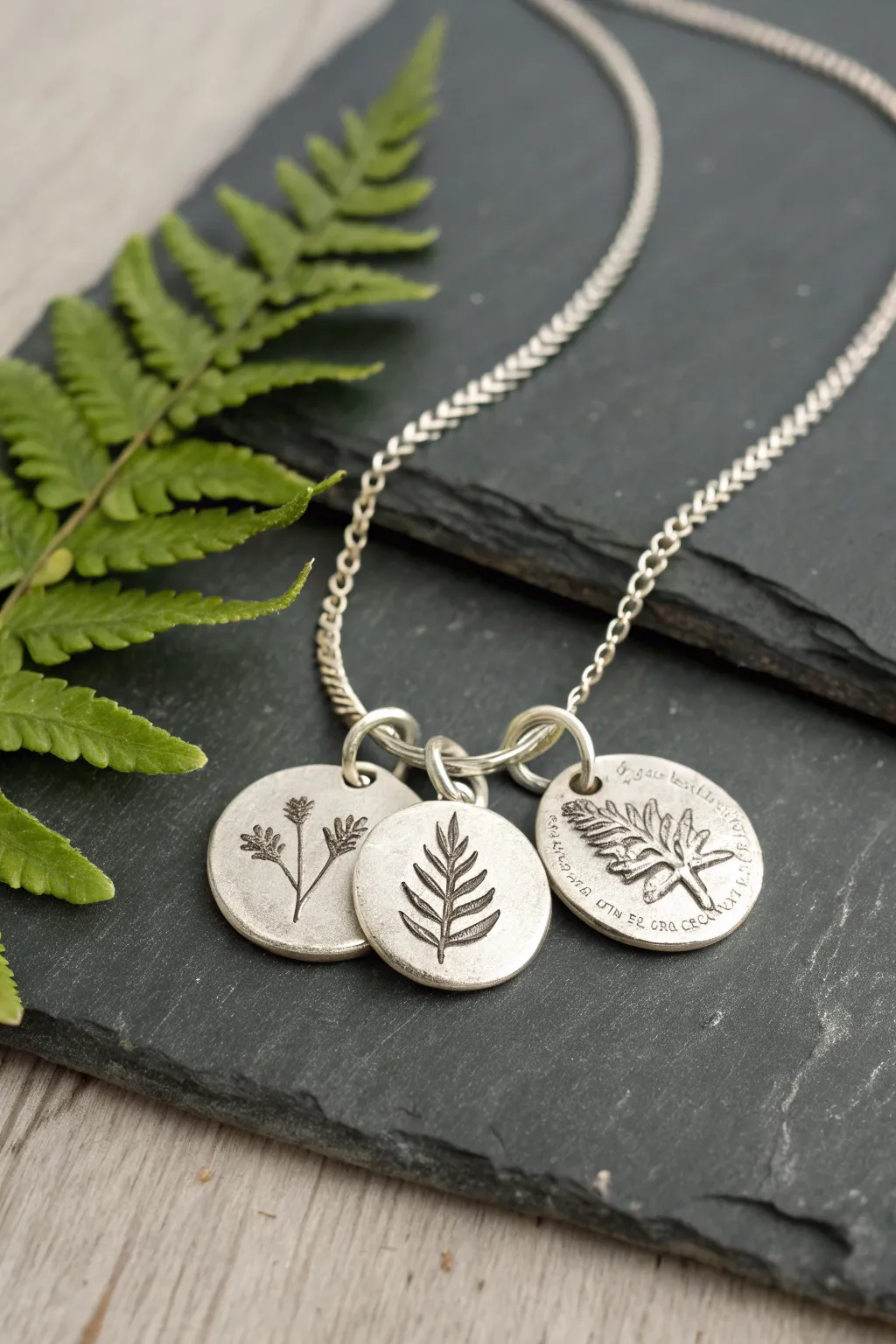
Capture the delicate details of nature forever in fine silver with this elegant charm necklace project. By pressing real or stamp-impressed fern motifs into metal clay, you can create a rustic yet refined set of heirloom-quality pendants.
Detailed Instructions
Materials
- Silver metal clay (approx. 10g-15g)
- Small rolling pin or acrylic roller
- Playing cards or texture slats (3 cards thick)
- Small round cutter (approx. 1.5 cm – 2 cm diameter)
- Olive oil or Badger balm (release agent)
- Rubber texture mat with fern/leaf designs OR distinct jewelry stamps
- Drinking straw or small drill bit
- Firing torch or kiln
- Stainless steel wire brush
- Liver of sulfur (patina)
- Polishing cloth and burnisher
- Jump rings and silver chain
- Fine grit sandpaper or sanding sponges
Step 1: Preparing and Shaping the Clay
-
Lubricate surfaces:
Begin by lightly coating your work surface, roller, and hands with olive oil or jewelry balm to prevent the metal clay from sticking. -
Roll the slab:
Take a lump of silver metal clay and knead it briefly to ensure it is pliable. Place it between two stacks of playing cards (about 3 cards high) and roll it flat with your acrylic roller for an even thickness. -
Texture the clay:
Apply a tiny bit of release agent to your fern texture mat or stamps. Press the texture firmly into the clay slab; if using a mat, you might want to roll over it once gently to get a deep impression without distorting the clay too much. -
Cut the shapes:
Position your small round cutter over the best parts of the imprinted design. Press down firmly to cut out your three circles, maximizing the use of your clay. -
Create holes:
While the clay is still wet, use a drinking straw or a small tool to punch a hole near the top edge of each circle for the jump rings. Make sure the hole isn’t too close to the edge to prevent breakage.
Cracked Clay?
If tiny cracks appear while rolling, your clay is drying out. Dab a tiny drop of water on your finger and smooth over the crack, or mix in a drop of water and reknead.
Step 2: Refining and Firing
-
Dry completely:
Allow the charms to dry fully. You can use a mug warmer or dehydrator to speed this up, but air drying for 24 hours is safest. The clay feels cold if it’s still wet. -
Sand the edges:
Once bone dry, use the fine-grit sandpaper or a sanding sponge to gently smooth the edges of the circles. Be careful not to sand away your botanical surface details. -
Fire the charms:
Place the dry pieces on a firing brick. If using a butane torch, heat evenly until the pieces glow a peachy-orange color and hold that temperature for the time recommended by your clay manufacturer (usually 2-3 minutes). If using a kiln, follow the standard silver clay firing schedule. -
Quench on cool:
Allow the pieces to cool completely on the block, or quench them in water if your specific clay brand allows for it. The silver will look white and matte at this stage.
Step 3: Finishing and Assembly
-
Brush the surface:
Vigorously brush the fired silver charms with a stainless steel wire brush. This compresses the surface and transforms the white matte finish into a gleaming silver shine. -
Apply patina:
Prepare a warm liver of sulfur solution. Dip the charms into the dark liquid until they turn a dark gray or gunmetal black. Rinse immediately in water to stop the reaction. -
Polish for contrast:
Use a polishing cloth or a sanding sponge to buff the high points of the charms. This reveals the bright silver surface while leaving the recessed fern veins dark, creating beautiful depth. -
Burnish edges:
For an extra professional touch, run a steel burnisher along the outer rim of each charm to make the edge mirror-bright. -
Assemble the necklace:
Open your jump rings with pliers and attach each charm. Thread a sterling silver chain through the jump rings to complete your woodland-inspired necklace.
Sharper Impressions
For the crispest lines, ink your rubber stamps with an embossing ink pad before pressing them into the clay. This acts as a release and seems to define the edges better.
Wear your trio of botanical charms with pride, knowing you’ve crafted a piece of fine silver jewelry by hand
Simple Textured Disc Stud Earrings
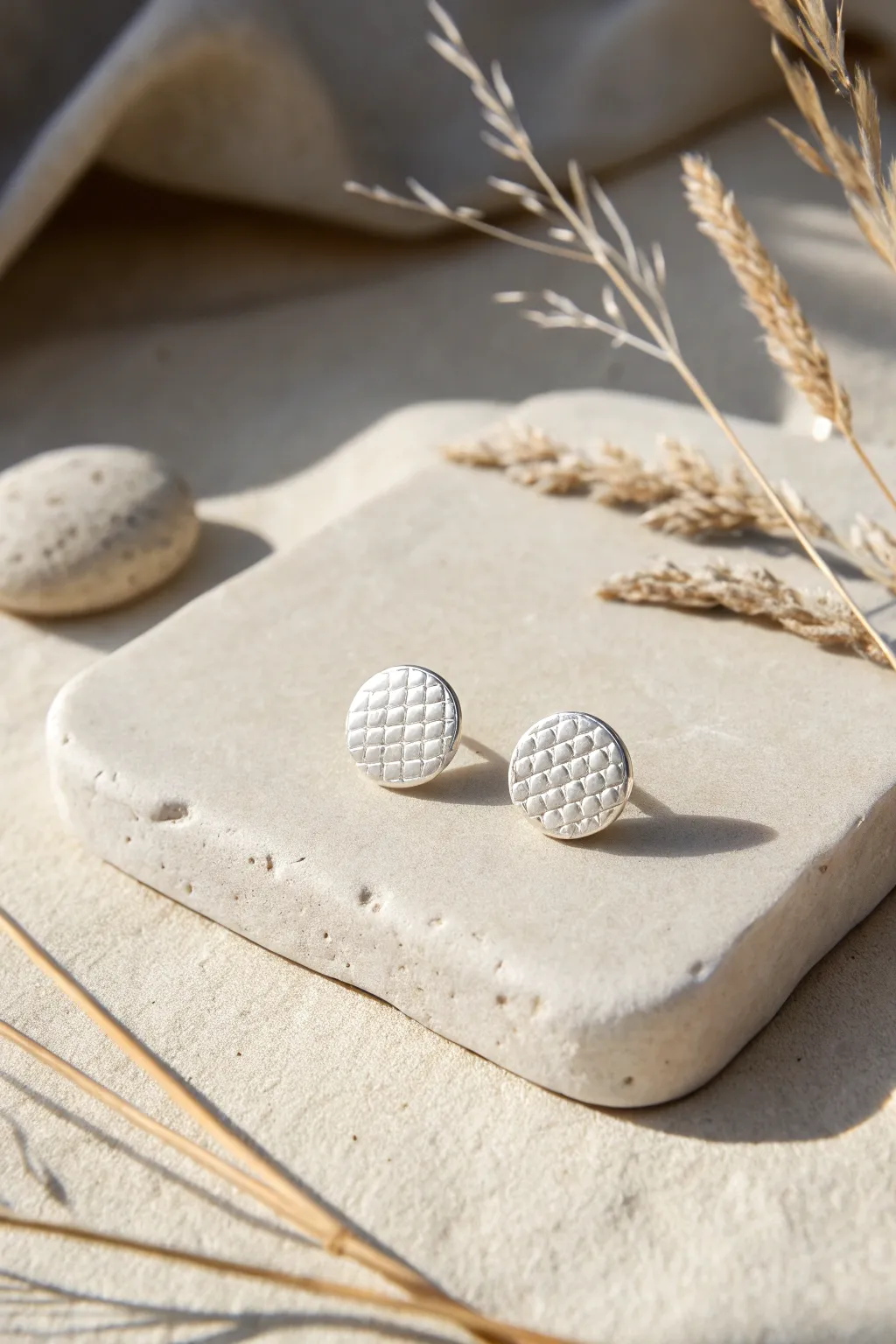
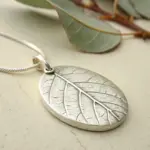
These elegant stud earrings feature a sophisticated quilted texture that catches the light beautifully. By using silver metal clay, you can transform a soft, moldable material into solid fine silver jewelry with a professional finish.
Step-by-Step Guide
Materials
- Silver metal clay (approx. 5-7g)
- Texture sheet (quilted, grid, or faux leather pattern)
- Small circle cutter (approx. 8-10mm)
- Acylic roller and spacer slats (1.5mm thick)
- Badger balm or olive oil (release agent)
- Needle tool or clay pick
- Sanding sponges (fine and superfine grits)
- Small paint brush and water
- Gas stovetop, butane torch, or kiln
- Sterling silver ear posts
- Two-part epoxy glue or soldering equipment (optional)
Step 1: Preparation and Texturing
-
Prepare your workspace:
Set up a clean, non-stick work surface like a Teflon sheet or a laminated card. Lightly coat your hands and your roller with a tiny amount of badger balm or olive oil to prevent the clay from sticking. -
Condition the clay:
Take a small lump of silver metal clay out of the package. Knead it quickly and gently in your fingers for a few seconds until it feels pliable and smooth, ensuring there are no cracks. -
Roll the slab:
Place the clay between two 1.5mm spacer slats. Using your acrylic roller, roll the clay out into a smooth, even slab. I like to lift and turn the clay once to ensure it isn’t sticking to the surface. -
Apply the texture:
Lightly oil your chosen texture sheet. Place the texture face down onto the clay slab (or the clay onto the texture, depending on your preference). Roll firmly over it once to imprint the quilted pattern deeply without thinning the clay too much.
Fixing Cracks
If you see tiny cracks appear while drying, mix a little clay dust with water to make a paste. Paint this ‘slip’ into the cracks, let dry, then sand smooth again
Step 2: Shaping and Refining
-
Cut the discs:
Position your small circle cutter over the most attractive part of the pattern. Press down firmly and give a slight twist to cut clean circles for your earrings. Cut two identical pieces. -
Remove excess clay:
carefully peel away the excess clay from around your cut circles. Quickly wrap this scrap clay in cling film and place it back in a moisture-sealed container to save for future projects. -
Refine the edges:
While the clay is still wet, use a damp paintbrush to gently smooth the very bottom edge where the cutter met the surface, but be careful not to blur your crisp texture on top. -
Dry the pieces:
Place your clay discs on a warming plate or allow them to air dry on a mesh screen for 24 hours. The clay must be bone dry before firing. It should feel hard and not cool to the touch. -
Sand and perfect:
Once dry, use a fine-grit sanding sponge to gently smooth the sides of the discs. Ensure the circle is perfect and the back is flat. Avoid sanding the textured top surface.
Antique Polish
oxidize the silver with liver of sulfur to turn it black, then polish the raised areas. The dark recesses will make the quilted pattern pop dramatically
Step 3: Firing and Finishing
-
Fire the clay:
Place the dried pieces on a firing brick. Using a butane torch, heat the pieces evenly until they glow a peachy-orange color. Hold this temperature for 2-3 minutes (or follow your specific clay brand’s firing schedule). Alternatively, kiln fire at 1650°F (900°C) for 2 hours. -
Cool down:
Allow the silver pieces to cool completely on the brick. Do not quench them in water, as thermal shock can sometimes weaken the metal structure. -
Brush the silver:
The fired pieces will be white (matte silver). Use a brass wire brush with a little soapy water to brush the surface vigorously. This burnishes the metal and brings out the silver shine. -
Polish high points:
To enhance the quilted look, use a polishing cloth or a burnishing tool to rub the raised ‘pillows’ of the texture, making them gleam while leaving the recesses slightly more matte. -
Attach posts:
Mix a small amount of strong two-part epoxy. Apply a dab to the flat pad of a sterling silver ear post and press it firmly onto the center of the back of the silver disc. Let it cure undisturbed for 24 hours.
Wear your new textured studs with pride knowing you sculpted pure silver with your own hands
Organic Dangle Earrings with Cutouts
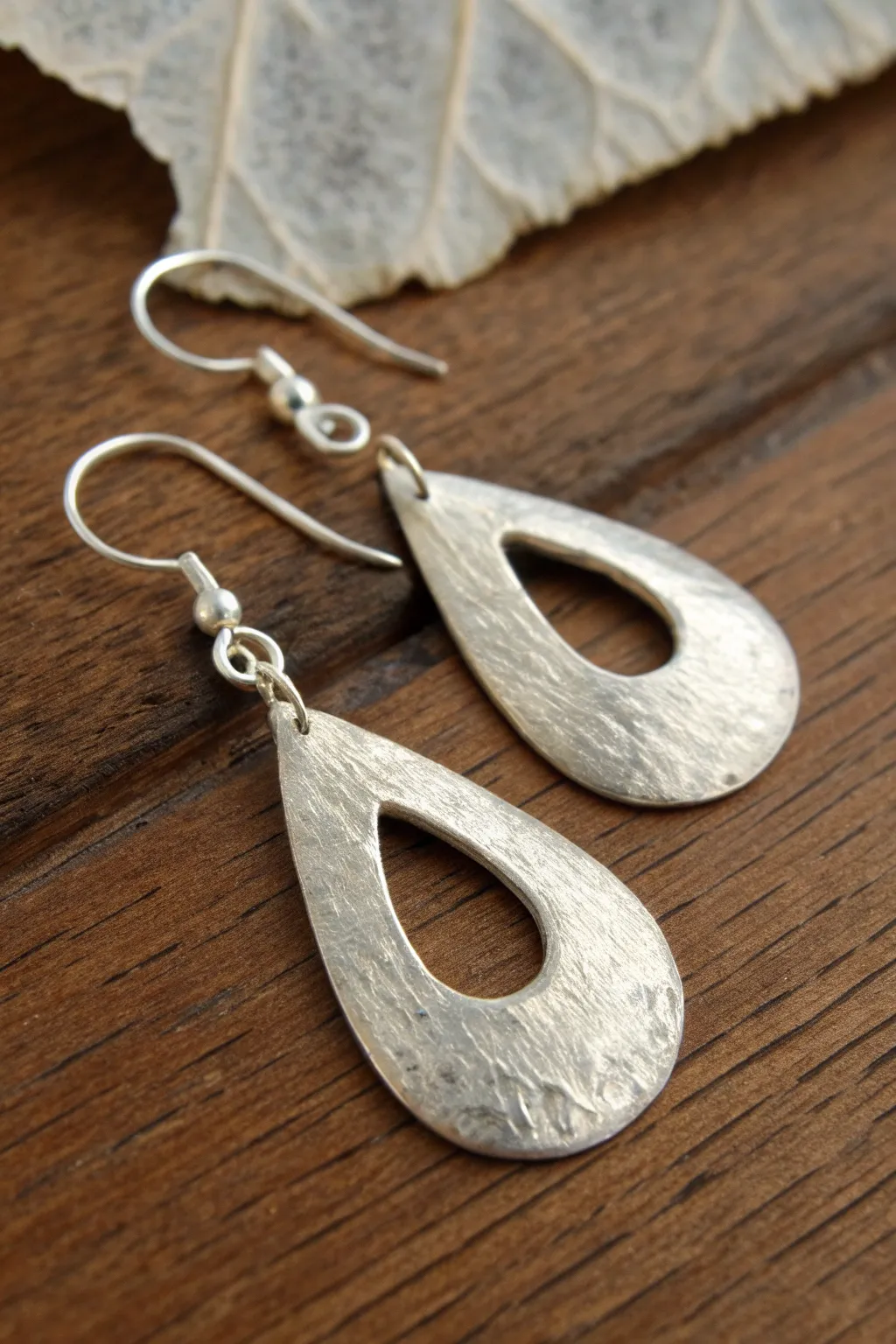
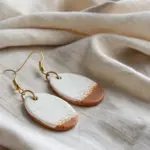
Embrace the beauty of organic imperfection with these elegant open-tear drop earrings. Using silver metal clay, you’ll create a textured, matte-finish piece that feels both rustic and refined, perfect for everyday wear.
How-To Guide
Materials
- Silver metal clay (approx. 7-10g)
- Small rolling pin
- Playing cards or slat spacers (3 cards thick)
- Teardrop shape cutters (two sizes: medium and small)
- Balm or olive oil (release agent)
- Texture sheet or stiff bristle brush
- Needle tool
- Small straw or drill bit (for jump ring hole)
- Sanding sponges (fine and superfine)
- Butane torch or kiln
- Brass wire brush
- Sterling silver ear wires
- Jump rings (sterling silver)
- Pliers (chain nose and flat nose)
- Firing block
Step 1: Shaping the Clay
-
Prepare your workspace:
Begin by lightly coating your work surface, rolling pin, and your hands with a tiny amount of balm or olive oil to prevent sticking. This is crucial for handling metal clay cleanly. -
Roll the clay:
Take your lump of silver clay and roll it into a ball. Place your spacers or playing cards on either side and roll the clay out into a smooth slab. A thickness of about 3 playing cards is ideal for durability. -
Add texture:
Before cutting, give the surface some character. You can press a gentle texture sheet into the clay, or for the look in the photo, lightly drag a stiff bristle brush across the surface to create fine, organic striations. -
Cut the main shape:
Using your larger teardrop cutter, press firmly into the clay to cut two identical shapes. If you don’t have cutters, you can trace a paper template with a needle tool. -
Create the cutout:
Position the smaller teardrop cutter inside the larger shape. I find eye-balling this usually works best for an organic feel, but you can measure to center it perfectly. Press down to remove the inner section. -
Make the suspension hole:
Use a small straw or a needle tool to create a hole at the very top point of the teardrop. Remember that metal clay shrinks, so make this hole slightly larger than you think you need for your jump ring. -
Refine the edges:
While the clay is still wet, gently smooth any rough edges with a slightly damp brush or your finger. This saves a lot of sanding time later.
Step 2: Firing and Finishing
-
Dry thoroughly:
Place your pieces on a warming plate or simply let them air dry for 24 hours. The pieces must be bone dry before firing; they should feel warm, not cool to the touch. -
Pre-fire sanding:
Once dry, gently sand the edges and the flat surfaces with a fine sanding sponge. Be very gentle as dry clay is brittle and can snap easily. -
Fire the pieces:
Place the pieces on a firing block. Using a butane torch, heat the pieces evenly until they glow a peachy-orange color. Hold this temperature for the time specified by your clay manufacturer (usually 2-3 minutes). Alternatively, kiln fire according to package directions. -
Cool and quench:
Allow the silver to cool naturally or quench in water if your specific clay type permits it. The pieces will look white and chaulky at this stage—this is normal. -
Brush finish:
Vigorously brush the fired pieces with a brass wire brush and a little soapy water. This removes the white crystallization and reveals the gleaming silver underneath. This step creates that lovely satin finish seen in the image. -
Burnish for highlights:
For extra dimension, run a smooth burnishing tool along the very edges of the teardrop to make them shine brighter than the textured face.
Broken Greenware?
If a piece snaps while sanding dry clay, don’t panic. Apply a dab of water to both broken edges, press together, and add a tiny smear of fresh paste. Let dry and sand again.
Step 3: Assembly
-
Open the jump rings:
Using two pairs of pliers, twist your sterling silver jump rings open sideways (never pull them apart). -
Attach the findings:
Thread the open jump ring through the hole in your fired silver piece, then loop on the ear wire. -
Close and secure:
Twist the jump ring closed again, ensuring the ends meet perfectly flush so the earring doesn’t slip off.
Pro Tip: Shrinkage
Metal clay shrinks 8-15% when fired. If you’re matching a specific size, create your wet clay shapes slightly larger than you want the final silver earrings to be.
Wear your new handcrafted silver dangles with pride, knowing you transformed soft clay into lasting metal

The Complete Guide to Pottery Troubleshooting
Uncover the most common ceramic mistakes—from cracking clay to failed glazes—and learn how to fix them fast.
Fingerprint Keepsake Necklace
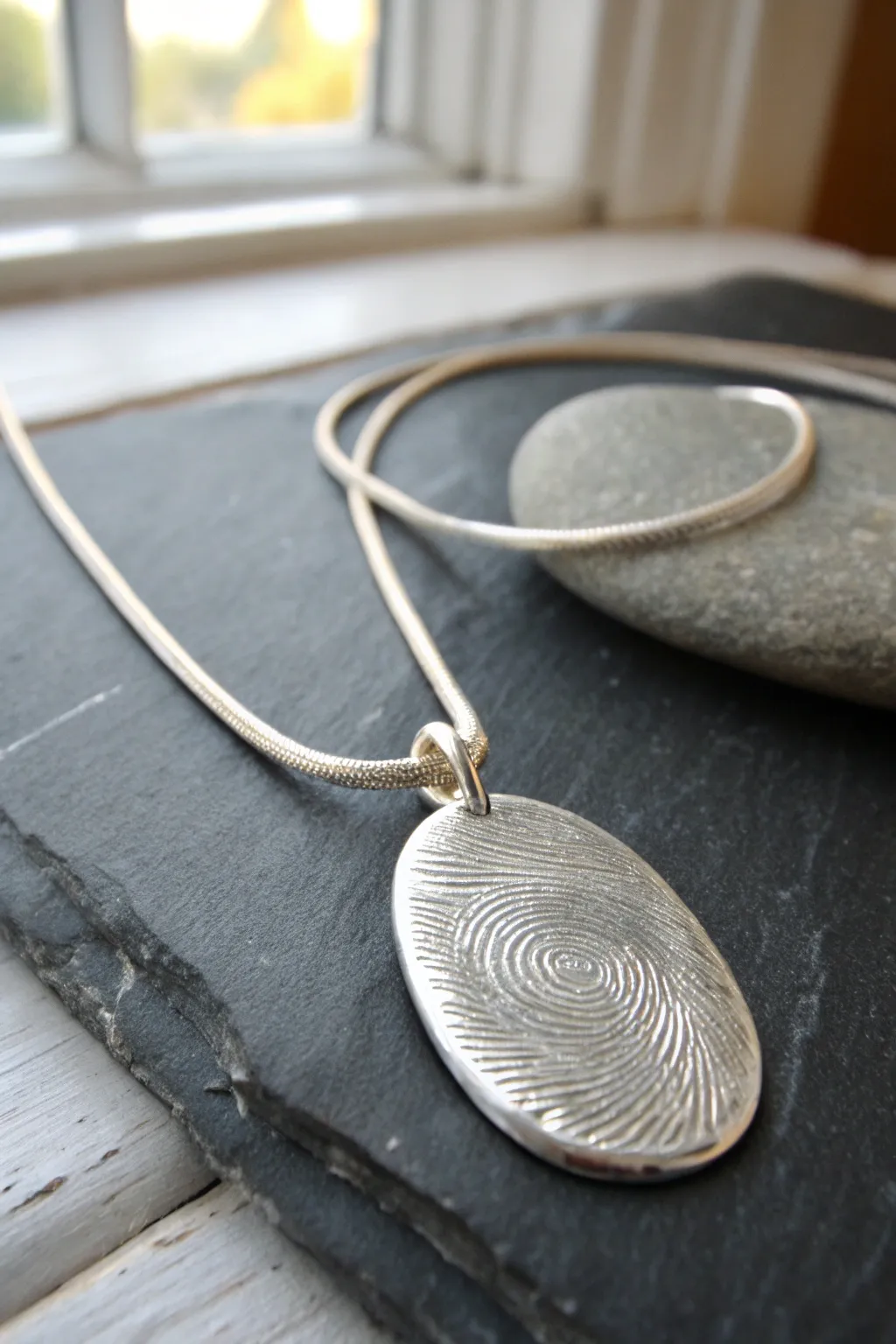
Capture a moment in time with this elegant, heirloom-quality pendant featuring a highly detailed fingerprint impression. The organic texture of the print contrasts beautifully with the shiny silver finish, making it a truly personal piece.
Step-by-Step
Materials
- Silver metal clay (approx. 7-10g lump)
- Olive oil or badger balm (release agent)
- A smooth work surface (Teflon sheet or playing card)
- Roller or acrylic brayer
- 1.5mm spacers or playing cards for thickness
- Oval shape cutter
- Small straw or drinking straw (for bail hole)
- Jump ring (heavy gauge sterling silver)
- Butane torch or kiln
- Stainless steel brush
- Agate burnisher
- Fine sandpaper or sanding sponges (various grits)
- Patina solution (Liver of Sulphur) – optional
- Polishing cloth
- Sterling silver snake chain
Step 1: Preparing the Clay
-
Condition your hands:
Before opening your clay, apply a very thin layer of olive oil or badger balm to your hands and your work surface. Metal clay dries out quickly, and this barrier helps prevent sticking and cracking. -
Shape the clay:
Remove the clay from the package and roll it into a smooth, crack-free ball between your palms. Work quickly to preserve moisture. -
Flatten the base:
Place your spacers (about 4-5 playing cards thick or 1.5mm) on either side of the clay ball. Use your roller to gently flatten the ball into an even slab.
Step 2: Capturing the Impression
-
Oil the finger:
Lightly oil the finger you intend to use. This is crucial—if the finger is dry, the clay will stick to the skin and ruin the impression when you pull away. -
Make the impression:
Press the finger firmly and steadily into the center of the clay slab. Rock it very slightly side-to-side to ensure the edges of the print are captured, then lift strictly straight up. -
Inspect the detail:
Look closely at the impression. You want deep, clear ridges. If it looks shallow or smudged, balled it up and try again immediately before the clay dries.
Cracked Clay Crisis?
If small cracks appear while rolling, your clay is too dry. Dab a tiny drop of water on the crack, smooth it with a rubber tool, and work faster.
Step 3: Shaping and Refining
-
Cut the shape:
Center your oval cutter over the best part of the fingerprint. Press down firmly to cut the shape, then remove the excess clay from around the outside. -
Add a bail hole:
Use a small straw or a tool to punch a hole near the top edge of the oval. Ensure there is at least 2-3mm of clay between the hole and the edge to prevent breakage. -
Dry completely:
Let the piece dry for at least 24 hours at room temperature, or place it on a cup warmer or dehydrator for about 30 minutes. It must be bone dry before firing. -
Pre-fire sanding:
Once dry, use fine-grit sandpaper or a sanding sponge to gently smooth the edges and the back. Do not sand the fingerprint surface itself, or you will lose the texture.
Personalize the Back
Before drying, use a needle tool or small letter stamps to add a name, date, or initials to the smooth back of the pendant for a hidden message.
Step 4: Firing and Finishing
-
Fire the piece:
Place the dry piece on a ceramic brick. Use a butane torch to heat the piece evenly until it glows a peachy-orange color. Hold this temperature for 2-3 minutes (or follow your specific clay brand’s kiln schedule). -
Cool and brush:
Allow the piece to cool naturally. It will look white and matte. Scrub it vigorously with a stainless steel brush and a little soapy water to reveal the silver shine. -
Burnish for shine:
For the high-shine look seen in the photo, rub the raised surfaces—specifically the rim and the back—with an agate burnisher. I like to run the burnisher over the fingerprint ridges gently to make them sparkle. -
Assembly:
Open a heavy-gauge sterling silver jump ring using jewelry pliers. Thread it through the hole you created and close it securely. -
Final polish:
Give the entire pendant a final rub with a polishing cloth to remove any tarnish or fingerprints from handling, and string it onto a silver snake chain.
Wear your custom silver keepsake with pride, knowing you’ve created a permanent record of a unique touch
Stamped Initial Tag Pendant
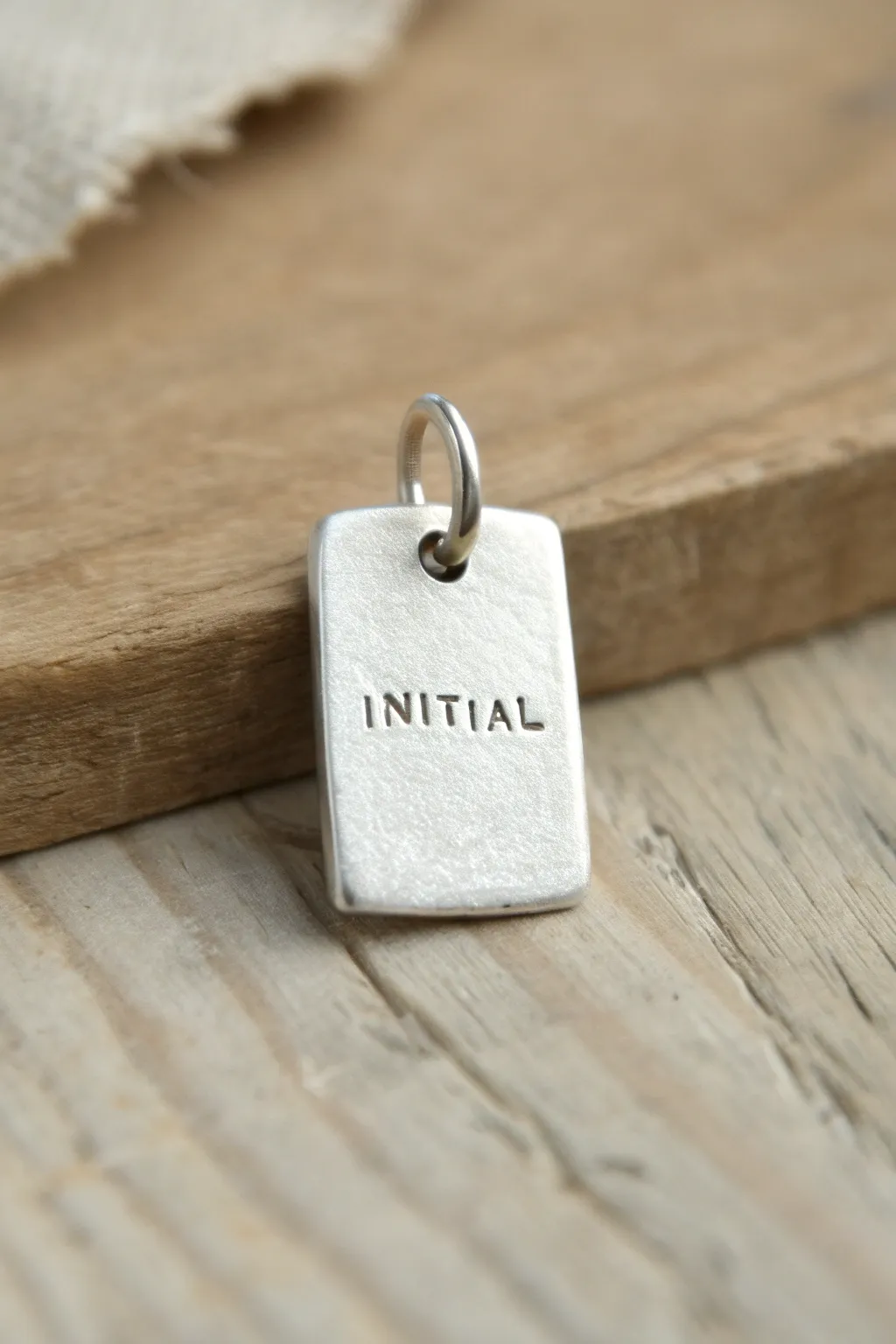
This elegant little pendant captures the raw, organic beauty of silver metal clay with a classic dog-tag silhouette. Its soft, brushed finish and deeply impressed lettering make it a perfect personalized keepsake or a thoughtful gift.
How-To Guide
Materials
- Silver metal clay (approx. 5-7g)
- Acrylic roller or PVC pipe section
- Playing cards or slat spacers (1mm thick)
- Clay release agent (olive oil or Badger Balm)
- Small rectangular shape cutter (approx. 15mm x 25mm)
- Alphabet stamp set (serif font)
- Drinking straw or 3mm round cutter
- Smooth work surface (Teflon sheet or tile)
- Sanding sponges (fine and superfine grit)
- Firing method (kiln or butane torch)
- Brass wire brush
- Agate burnisher (optional)
- Sterling silver jump ring (open, 5mm)
Step 1: Shaping the Clay
-
Prepare your workspace:
Start by lightly coating your work surface, your roller, and your hands with a tiny bit of olive oil or badger balm. This prevents the precious clay from sticking where you don’t want it. -
Condition the clay:
Take a lump of silver metal clay out of the package. Knead it quickly in your fingers for just a few seconds to ensure it’s pliable and free of cracks, but work fast to lock in moisture. -
Set the thickness:
Place a stack of playing cards (about 3-4 cards high) or 1mm spacers on either side of your clay ball to act as depth guides. -
Roll it out:
Roll the clay flat using your acrylic roller. Roll firmly and evenly until the roller rests on the spacers, ensuring a perfectly uniform slab. -
Cut the rectangle:
Position your rectangular cutter over the clay. Press down firmly and lift straight up. If the clay sticks inside the cutter, gently push it out from the top edge. -
Smooth the edges:
While the clay is still wet, wet your finger slightly and gently run it along the cut edges to soften the sharp angles left by the cutter. This saves sanding time later. -
Punch the hole:
Use a small drinking straw or a tiny circular cutter to punch a hole centered near the top edge. Twist the tool slightly as you lift to remove the plug of clay cleanly.
Step 2: Stamping and Refining
-
Align your letters:
Plan your word ‘INITIAL’. You can lightly mark a guide line on the clay using the edge of a card, or eyeball it if you prefer a more organic look. -
Impress the text:
Press your stamps straight down into the wet clay. Apply steady, even pressure—deep enough to leave a clear mark, but not so hard that you distort the rectangular shape. -
Dry completely:
Set the piece aside to dry. You can use a mug warmer or dehydrator to speed this up, but air drying for 24 hours works perfectly fine. The clay must be bone dry before firing. -
Refine the dry stage:
Once dry, the piece is in the ‘greenware’ stage. I prefer to do my main sanding here. Use fine-grit sanding sponges to smooth the flat surfaces and round the corners slightly for that soft, worn look seen in the photo. -
Clean dust:
Use a large, fluffy paintbrush to sweep away all sanding dust. Any dust left in the letters or on the surface will fuse into the metal during firing.
Stamp Alignment Trick
Tape your metal stamps together with clear tape before pressing them into the clay. This ensures your word is perfectly straight and the kerning is even.
Step 3: Firing and Finishing
-
Fire the piece:
Fire the pendant according to your clay manufacturer’s instructions. If torch firing, bring it to a glow and hold for the required time; if kiln firing, use the recommended schedule (usually around 1650°F / 900°C for 2 hours for maximum strength). -
Cool and brush:
After the piece has cooled completely, it will look white and powdery. Vigorously brush it with a brass wire brush and a little soapy water to reveal the silver shine underneath. -
Create the matte finish:
To achieve the specific satin finish in the image, avoid polishing to a mirror shine. Instead, buff gently with a superfine sanding sponge or steel wool in a circular motion. -
Burnish the edges:
For a subtle contrast, run an agate burnisher along just the very outer rim of the pendant to make the edges catch the light more than the matte face. -
Add hardware:
Twist open your sterling silver jump ring using two pairs of pliers. Thread it through the hole at the top and twist it closed until the ends meet perfectly flush.
Darken the Text
After firing, apply a drop of Liver of Sulfur patina into the letters, then polish the surface again. The high points will stay silver while the letters turn dark black.
Now you have a timeless silver charm ready to hang on a delicate chain

What Really Happens Inside the Kiln
Learn how time and temperature work together inside the kiln to transform clay into durable ceramic.
Rustic “Ancient Coin” Charm Bracelet
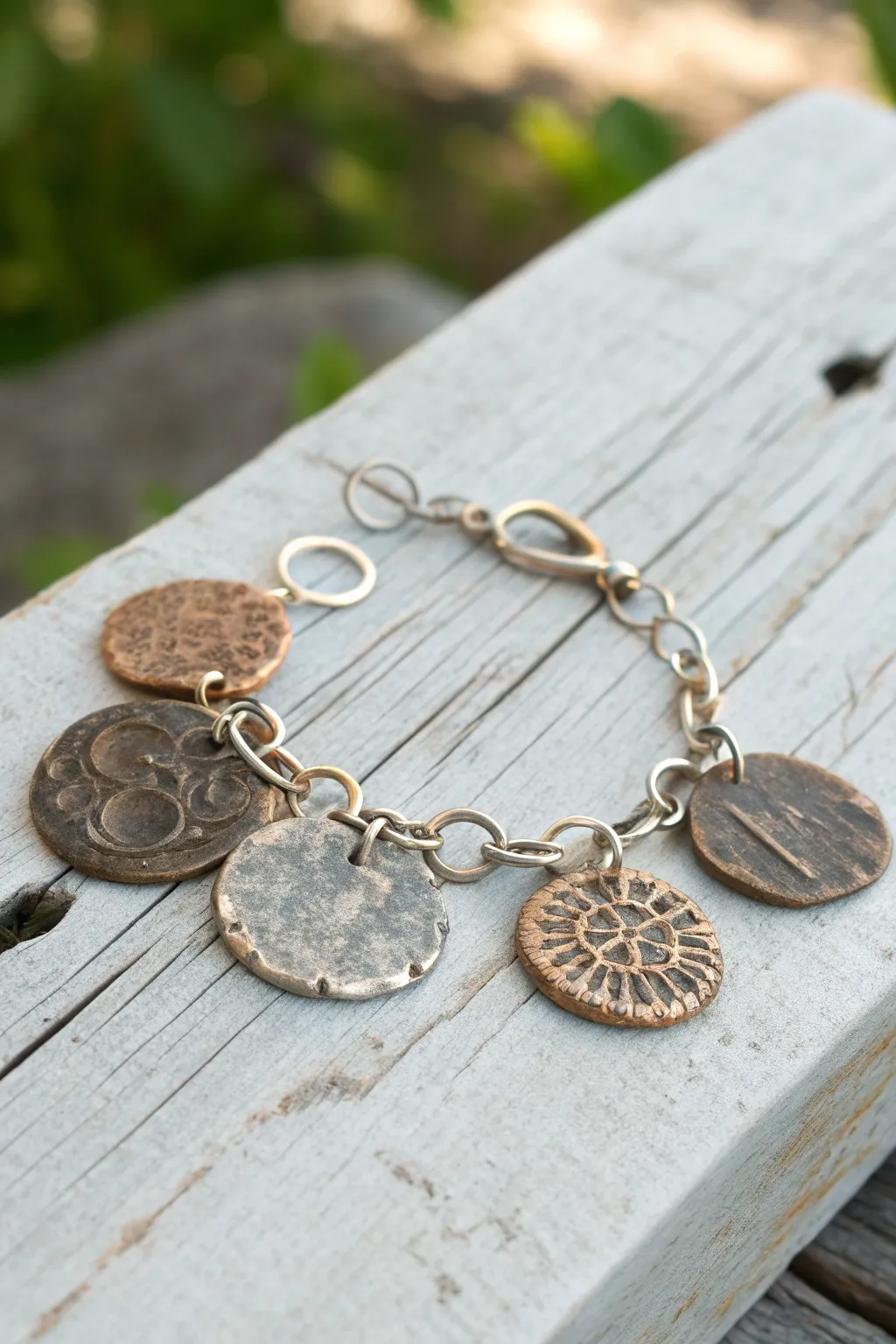
Channel the allure of ancient archaeological find with this rustic charm bracelet made from metal clay. Each charm is uniquely textured to resemble a weathered coin, then finished with a heavy patina to highlight the rugged, time-worn details.
Detailed Instructions
Materials
- Bronze or copper metal clay (approx 15-20g)
- Circle cutters (various small sizes)
- Texture sheets or stamps (geometric, floral, or hammered patterns)
- Straw or small drill bit (for holes)
- Non-stick work surface and roller
- Badger balm or olive oil (release agent)
- Sanding sponges (fine and superfine)
- Kiln or torch (depending on clay type)
- Midas Liver of Sulfur (or similar patina solution)
- Polishing cloth or rotary tool with polishing wheel
- Silver chain bracelet with lobster clasp
- Large jump rings (5-7 count)
Step 1: Shaping the Ancient Coins
-
Condition the Clay:
Begin by rubbing a small amount of badger balm or olive oil on your hands. Take your lump of metal clay and knead it firmly for a minute or two until it feels supple, smooth, and free of cracks. -
Roll the Slabs:
Place the clay on your non-stick work surface. Using slightly thicker guide slats (about 3-4 cards thick), roll the clay out into a uniform slab. We want these charms to feel substantial, like old minted currency. -
Texture the Surfaces:
Before cutting, press your textures into the clay. For the floral ‘wheel’ charm, press a circular stamp firmly. For the hammered look, gently tap the flat side of a tool or a textured mat onto the slab. I like to keep the pressure uneven to mimic natural wear. -
Cut the Rounds:
Select circle cutters in slightly varying sizes—ranging from a dime to a quarter. Cut out five distinct circles. Don’t worry if the edges aren’t perfect; slightly deformed circles add to the handcrafted appeal. -
Create the Loop Holes:
While the clay is still wet, use a small straw or a needle tool to punch a hole near the top edge of each charm. Ensure the hole is large enough to accommodate your heavy-gauge jump rings once the clay shrinks. -
Add Edge Detail:
For the plain coin shown in the center, use the edge of a credit card or a needle tool to make small notches around the rim. This mimics the ‘reeded’ edge of a coin that has been worn down over centuries. -
Dry Completely:
Set the charms aside on a warming plate or simply air dry them for 24 hours. The clay must be bone dry before firing to prevent exploding.
Cracking Up?
If edges crack while rolling, your clay is too dry. Dab a tiny bit of water on the crack, smooth it with a rubber shaper, and fold the clay to re-knead it before rolling again.
Step 2: Firing and Finishing
-
Refine the Greenware:
Once dry, gently sand the edges with a fine sanding sponge to remove any sharp burrs. However, avoid over-sanding the surface textures, as we want to preserve that rough, excavated look. -
Fire the Charms:
Place your pieces in a kiln buried in coconut carbon (if using bronze/copper clay) and fire according to the manufacturer’s specific schedule. If using torch-fireable clay, heat until the binder burns off and the piece glows the correct shade of orange. -
Brush Down:
After the pieces have cooled completely, scrub them vigorously with a brass wire brush and soapy water. This removes the oxidation layer and reveals the metal underneath. -
Apply Patina:
Prepare a hot Liver of Sulfur solution. Dip the charms into the dark liquid until they turn a deep, murky black or dark brown. Rinse instantly in cold water to stop the reaction. -
Polish and Highlight:
Using a polishing cloth or a rotary tool with a polishing wheel, buff the high points of the charms. This removes the black patina from the raised designs (like the wheel spokes and hammered ridges) while leaving the recesses dark for contrast. -
Assemble the Bracelet:
Open your large jump rings using two pairs of pliers. Thread a jump ring through the hole of each charm. -
Attach to Chain:
Attach the jump rings to the links of your silver chain, spacing them out evenly so they slightly overlap when worn. Close the jump rings securely.
Uneven is Better
Don’t aim for factory perfection. Intentionally pressing a texture deeper on one side makes the ‘coin’ look like it was unevenly struck in an ancient mint.
Now you have a piece of wearable history that looks like it was discovered on a dig site
Wide Textured Band Ring
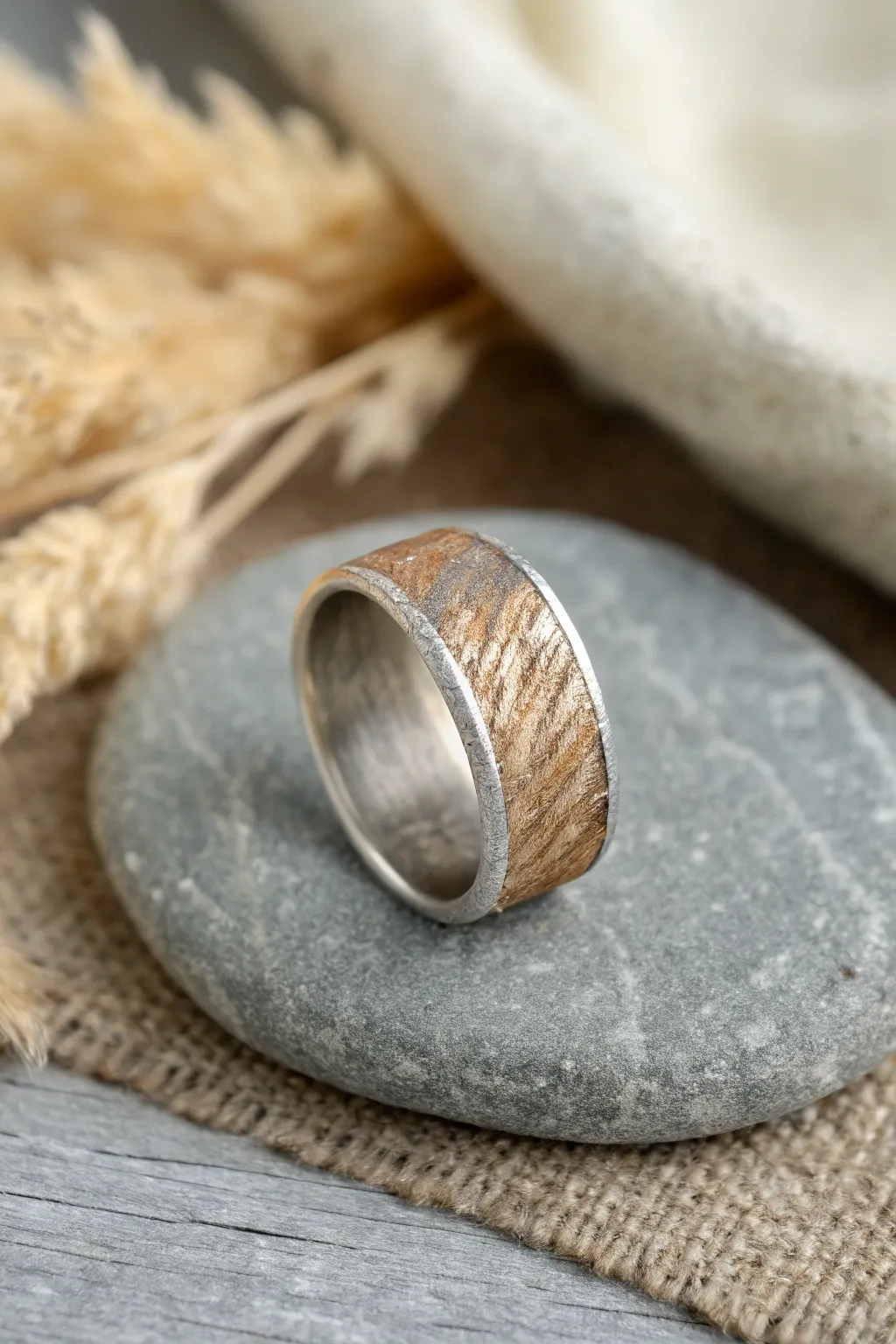
This project captures the organic beauty of nature with a wide-band ring featuring a rich, bark-like texture framed by smooth silver rails. The contrast between the rugged, patinated center and the clean edges creates a sophisticated yet earthy piece of jewelry perfect for everyday wear.
Step-by-Step Guide
Materials
- Silver metal clay (approx. 10-15g depending on ring size)
- Ring mandrel (stepped or straight)
- Post-it notes or cardstock strips
- Texture plate or real bark fragment
- Clay roller (acrylic or PVC pipe)
- Two spacers (1.5mm thickness)
- Needle tool or craft knife
- Small cup of water and paintbrush
- Sanding sponges (various grits) and needle files
- Kiln or butane torch
- Liver of Sulfur (patina gel)
- Polishing cloth or burnishing tool
- Olive oil or Badger balm (release agent)
Step 1: Preparation and Base Construction
-
Size your mandrel:
Wrap a Post-it note or strip of cardstock around your ring mandrel at the desired size mark to prevent the clay from sticking. Remember that metal clay shrinks during firing, so size up according to your specific clay brand’s shrinkage rate (usually 2-4 sizes larger). -
Condition the clay:
Remove your clay from the package and knead it briefly in your hands. If it feels dry, add a tiny drop of distilled water. You want a supple, smooth consistency that doesn’t crack when bent. -
Roll the main strip:
Lubricate your work surface and roller with a little olive oil. Place your 1.5mm spacers on either side of the clay and roll it out into a long, even strip. This will form the base of your ring. -
Texture the center:
Lightly oil your chosen texture plate—a wood grain or bark pattern works best for this look. Press the texture into the center of your strip, leaving the very edges smooth if possible, though we will add rails later. -
Trim to size:
Using a straight blade or needle tool, cut the strip to the desired width (about 8-10mm makes for a nice wide band) and ensure the length is sufficient to wrap around the mandrel with a slight overlap. -
Form the ring:
Wrap the clay strip around the paper-covered spot on your mandrel. Cut through both overlapping ends at a diagonal angle (a scarf joint) to create matching seams. -
Join the seam:
Apply a little water or clay paste (slip) to the cut edges. Press them gently together to bond. Smooth the seam on the inside of the ring so it disappears, but be careful not to mar the exterior texture.
Cracking Rails?
If your rail coils crack while bending them around the ring, your clay is too dry. Brush water over the crack and fill it with a bit of thick paste (syringe clay works great) before smoothing.
Step 2: Adding the Rails
-
Create clay snakes:
Roll out two thin, even coils (snakes) of fresh clay. These should be long enough to encircle the ring edges. Keep them consistent in thickness, roughly 1mm-1.5mm diameter. -
Attach the rails:
Paint a thin line of water along the top and bottom rims of your ring band on the mandrel. Gently place the coils onto these wet edges. This creates the raised ‘rail’ border seen in the photo. -
Blend the edges:
Using a damp paintbrush or a rubber shaper tool, blend the seam where the coil meets the inner band so it becomes one solid piece of metal. I usually re-smooth the outer edge of the coil slightly to keep it distinct from the textured center. -
Dry thoroughly:
Let the ring dry completely on the mandrel or a warmer. It must be bone dry before the next step. A dehydrator speeds this up significantly.
Gold Accent Effect
For the two-tone look in the photo, apply Keum Boo foil (24k gold) to the textured area after firing but before burnishing, bonding it with heat for a luxurious mixed-metal finish.
Step 3: Refining and Firing
-
Pre-fire refining:
Once dry, carefully remove the ring from the mandrel. Use fine sanding sponges to smooth the interior band and the top surfaces of the rails. Do not sand the bark texture in the center. -
Fire the piece:
Place the ring in a kiln or on a firing brick for torch firing. Follow the specific temperature and time instructions for your brand of clay (typically 1650°F / 900°C for at least two hours for maximum strength). -
Brush finish:
After the ring cools, brush it vigorously with a brass or stainless steel brush and soapy water. This burnishes the silver, turning it from white to a metallic shine.
Step 4: Patina and Finish
-
Apply patina:
Prepare a hot solution of Liver of Sulfur. Dip the ring or paint the solution onto the textured center. It will darken rapidly. -
Polish highlights:
Using a polishing cloth or a fine sanding pad, buff the raised rails and the high points of the bark texture. This removes the dark patina from the high spots, leaving the recessed areas dark and earthy brown for contrast. -
Tumbler finish (optional):
For extra durability and shine, tumble the ring with steel shot for an hour. This will work harden the silver and give the rails a brighter gleam.
Slip on your rugged new ring and enjoy the handcrafted weight of real silver on your finger.

TRACK YOUR CERAMIC JOURNEY
Capture glaze tests, firing details, and creative progress—all in one simple printable. Make your projects easier to repeat and improve.
Bezel-Set Cabochon Ring
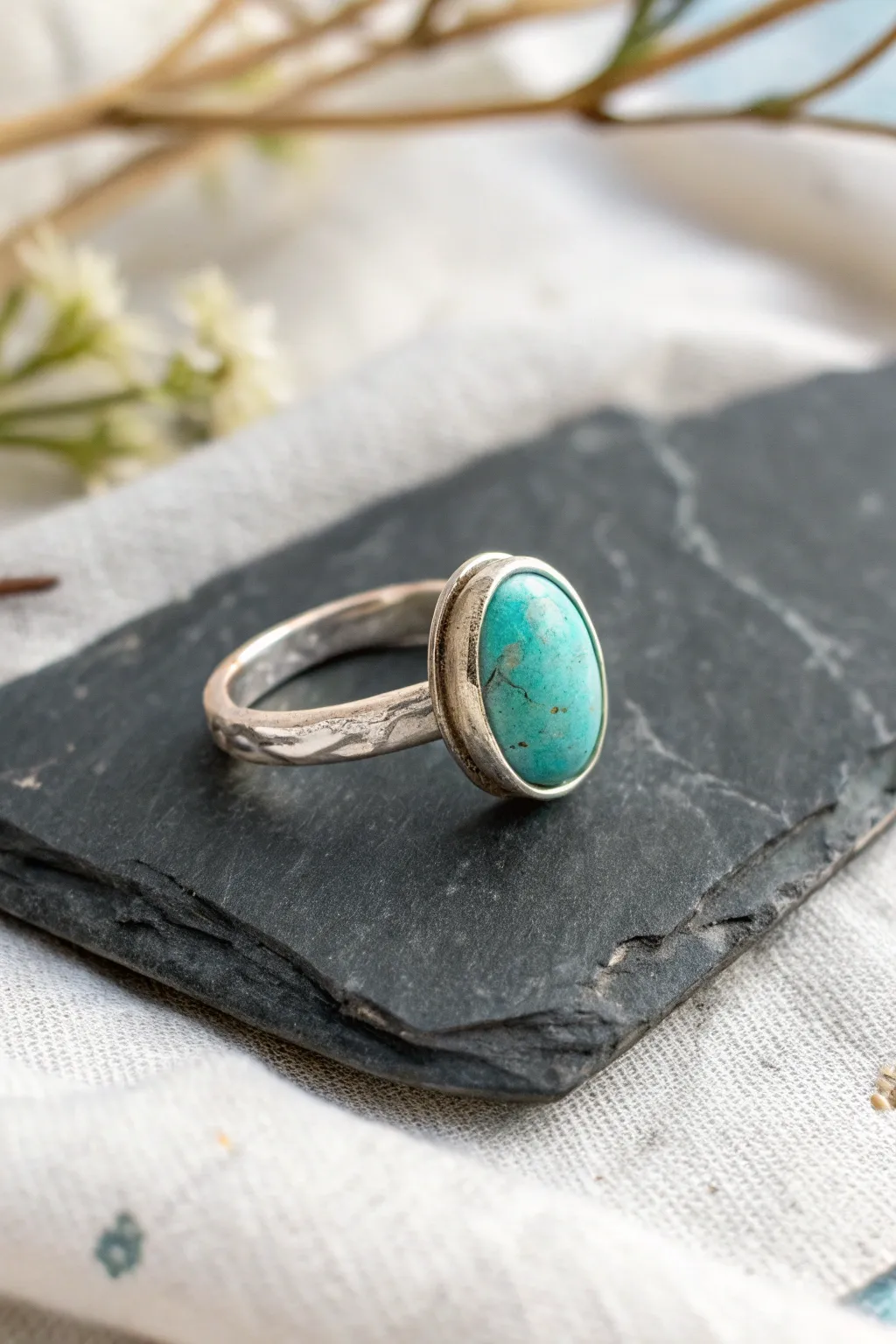
Embrace the organic charm of metal clay with this delightful turquoise ring project. Featuring a textured band and a seamless bezel setting, this design perfectly balances rugged craftsmanship with elegant simplicity.
Step-by-Step
Materials
- Silver metal clay (approx. 7g)
- Fine silver bezel wire (flat)
- Oval turquoise cabochon
- Ring mandrel
- Adhesive (Post-it) notes or specialized ring sizing paper
- Texture hammer or texture plate
- Clay roller and spacers
- Craft knife or needle tool
- Sanding sponges/pads
- Butane torch or kiln
- Agate burnisher
- Bezel pusher and rocker
- Liver of sulfur (optional for patina)
Step 1: Creating the Bezel Cup
-
Measure the stone:
Begin by wrapping your fine silver bezel wire around the turquoise cabochon. Ensure the fit is snug but accurate—not too tight, but with no visible gaps. Mark the overlap point with a fine-tip permanent marker. -
Cut and fuse:
Cut the wire cleanly at your mark using flush cutters so the ends butt together perfectly. I prefer to fuse the ends with a tiny dab of metal clay paste and torch fire it briefly to create a solid ring of silver, rather than soldering. -
Shape the cup:
Gently reshape the bezel ring into an oval to match your stone again to ensure it didn’t distort during firing. Place this ring onto a small rolled-out slab of fresh silver clay (about 2 cards thick) to create the floor of the setting. -
Trim the excess:
Using a scalpel or needle tool, trace around the outside of the bezel wire, cutting away the excess clay floor. Blend the clay floor up onto the side of the wire using a little water and a rubber shaper to ensure a seamless bond.
Shrinkage Math Trick
To calculate the sizing perfectly: Target Ring Size (mm) x Shrinkage Rate (e.g., 1.12 for 12%) = Size to make on the mandrel.
Step 2: Forming the Band
-
Calculate size:
Determine your ring size and account for shrinkage (usually 10-15% depending on clay brand). Wrap a sticky note or ring paper around the mandrel at your calculated shrinkage size. -
Roll the shank:
Roll out a snake of clay for the band, then flatten it slightly with a roller to a uniform thickness. Aim for about 3mm thick to allow for later hammering. -
Apply texture:
To achieve that rustic, hammered look seen in the photo, gently tap the wet clay strip with a texturing tool or press it onto a texture plate before wrapping it. Alternatively, leave it smooth now to hammer-finish after firing. -
Form the ring:
Wrap the strip around the prepared place on the mandrel. Cut through both overlapping ends at a 45-degree angle to create a scarf joint. Apply a little water or paste and press the ends together, smoothing the seam until it vanishes.
Stone Won’t Fit?
If the bezel shrank too much during firing, don’t force the stone. Use a small cylinder burr or sanding stick to carefully grind away the inner wall.
Step 3: Assembly and Firing
-
Dry components:
Allow both the band (on the mandrel or carefully removed) and the bezel cup to dry completely. A mug warmer is great for speeding this up. -
Attach the setting:
Using thick silver clay paste (slip), attach the dry bezel cup to the seam area of the dry ring band. Hold it in place for a minute to let the bond grab, then fill any gaps with a little more paste. -
Refining:
Once fully dry, gently sand any rough edges or fingerprints with fine grit sanding pads, being careful not to thin the bezel walls. -
Fire:
Fire the piece according to your clay manufacturer’s schedule. For a ring shank, a kiln firing is recommended for maximum strength, but a long torch firing is possible if done carefully.
Step 4: Setting and Finishing
-
Polish:
Brush the fired silver with a brass brush under soapy water to bring out the shine. If you didn’t texture the wet clay earlier, you can now lightly hammer the band against a steel mandrel for that faceted look. -
Set the stone:
Place your turquoise into the bezel cup. Using a bezel pusher, gently push the silver wall over the stone at the North, South, East, and West points first, then work around the perimeter to smooth the metal down securely. -
Burnish:
Run a curved agate burnisher along the top edge of the bezel wire to smooth out any tool marks and harden the metal against the gem. -
Patina:
For contrast, dip the ring in a warm liver of sulfur solution to darken the recesses of the texture. Buff the high points with a polishing cloth to make the silver pop.
Wear your handcrafted ring with pride knowing you’ve mastered the art of mixed-media metal clay construction
Stacking Rings with Syringe Details
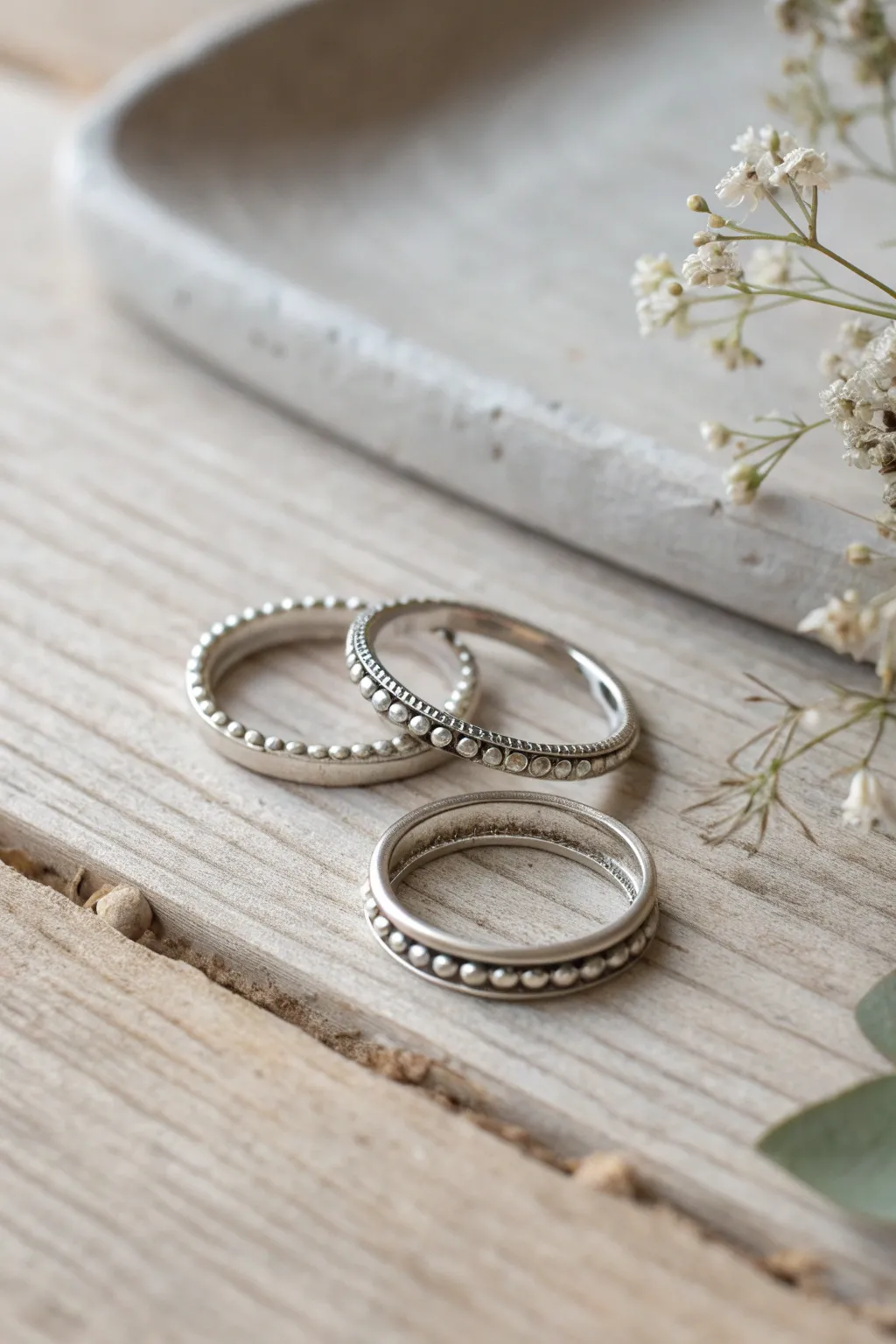
Create a set of delicate, textured stacking rings using the versatility of silver metal clay and syringe detailing. These rings feature beaded accents and organic lines that look stunning when worn together or mixed with your existing jewelry collection.
Step-by-Step Tutorial
Materials
- Silver metal clay (lump form, roughly 7-10g total)
- Silver metal clay syringe type (with green or blue nozzle)
- Ring sizing mandrel (wood or paper)
- Post-it note or sizing strip
- Rolling pin and spacers (1.5mm thick)
- Clay shaper or silicone tool
- Slip (paste made from clay and water)
- Fine grit sanding sponges (red/blue)
- Kiln or torch
- Stainless steel brush
- Polishing cloth and agate burnisher
Step 1: Forming the Base Bands
-
Measure ring size:
Wrap a strip of paper or a Post-it note around your finger to find the correct size. Mark the overlap, measure the length, and add roughly 10-15% to the length to account for metal clay shrinkage (check your specific clay’s packaging for exact shrinkage rates). -
Prepare the mandrel:
Wrap a Post-it note or piece of paper around the wooden ring mandrel at the position corresponding to your calculated shrinkage size. Secure it with a small piece of tape so the clay doesn’t stick to the wood. -
Roll the clay:
Condition your lump clay in your hands until it’s pliable. Place it on a non-stick surface between 1.5mm spacers and roll it out into a long snake or a flat strip, depending on whether you want a round or flat band profile. -
Cut to length:
If making a flat band, trim the edges with a tissue blade to create a clean strip about 3-4mm wide. If using a snake, ensure it is even in thickness along the entire length. -
Form the ring:
Wrap the clay strip or snake around the paper-covered mandrel. Cut through both overlapping ends at an angle (a scarf joint) to create plenty of surface area for joining. -
Seal the seam:
Apply a generous amount of slip to the cut ends and press them firmly together. Use a rubber shaper to smooth the seam completely so it disappears. Let the band dry on the mandrel for about 10-15 minutes until it’s firm enough to hold its shape but not bone dry.
Dots Falling Off?
If your syringe dots pop off after drying, the base likely wasn’t moist enough. Paint a thin layer of paste on the band right before applying the syringe clay to bond them.
Step 2: Applying Syringe Details
-
Prepare the syringe:
Ensure your syringe clay is flowing smoothly. I like to test a few dots on a spare piece of paper first to get a feel for the pressure needed. -
Mark the design guide:
Lightly dampen the surface of the dry ring band with a very small amount of water or watered-down slip. This helps the new clay adhere immediately. -
Pipe the center dots:
For the beaded ring style, hold the syringe tip perpendicular to the band. Gently squeeze to form a small ball of clay, then lift straight up to detach. Repeat this process around the entire circumference, keeping the spacing as even as possible. -
Create the rail texture:
For the ring with the rail detail (the top right one), extrude two very thin lines of clay along the outer edges of the band first. Let these dry slightly, then fill the channel between them with tiny syringe dots or a textured line. -
Refine the shapes:
If any dots have sharp peaks from lifting the syringe, wait until they are almost dry. Then, gently tap them with a slightly damp finger or clay shaper to round them over into perfect domes. -
Dry completely:
Allow the rings to dry completely. This can be done in a dehydrator or on a cup warmer for at least 30 minutes. The clay must be bone dry before firing.
Step 3: Refining and Finishing
-
Pre-fire sanding:
Once dry, very gently sand the inside of the ring and the edges with a fine sanding sponge. Be extremely careful not to sand off your syringe details. -
Repair imperfections:
Inspect the rings under a bright light. If there are any gaps between the syringe work and the base band, fill them carefully with a little extra slip and let dry again. -
Fire the rings:
Place the rings on a kiln shelf and fire according to your clay manufacturer’s schedule (typically around 1650°F / 900°C for 2 hours for maximum strength). If torch firing, bring the piece to a peach glow and hold for the recommended time. -
Brush finish:
After the rings have cooled, they will be white. Use a stainless steel brush (either hand-held or on a rotary tool) to burnish the surface until the silver shines through. -
Patina (optional):
To enhance the depth of the dots, you can apply a liver of sulfur solution to darken the recesses, then polish the high points back to bright silver. -
Final polish:
Rub the rings vigorously with a polishing cloth to bring out a high shine, focusing on the tops of the syringe beads to make them sparkle against the band.
Gemstone Accents
Before the clay dries, gently press small, kiln-safe cubic zirconia (2mm or smaller) into wet syringe mounds for a sparkling eternity band effect.
Now you have a custom set of stacking rings perfectly sized for your hand and ready to wear
Seashell Mold Pendant
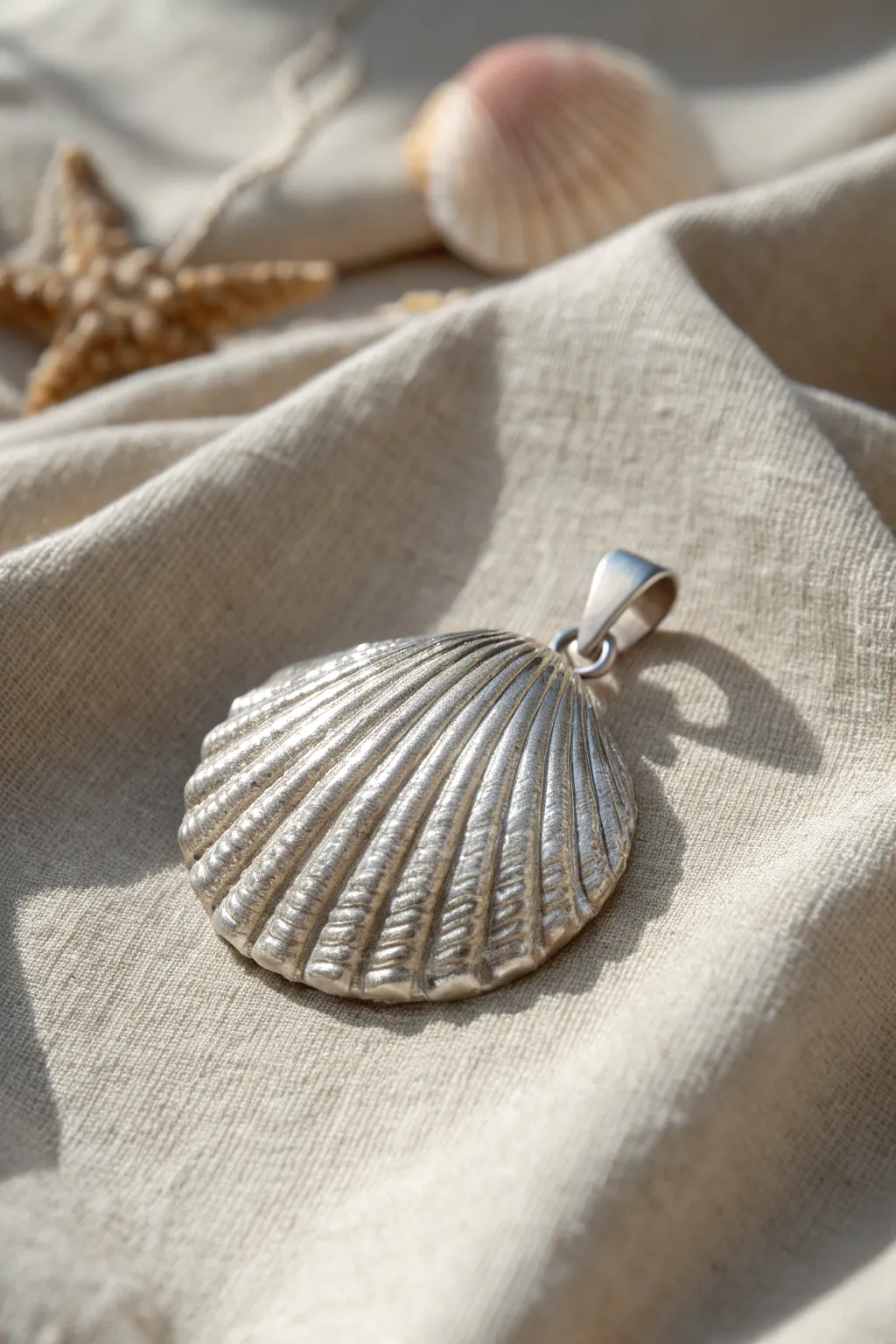
Capture the ephemeral beauty of the seaside with this stunning fine silver scallop shell pendant. By using real shells to create a mold, you can replicate nature’s intricate textures in a piece of jewelry that feels both organic and elegant.
Step-by-Step
Materials
- Fine silver metal clay (e.g., PMC3 or Art Clay Silver, approx. 10g package)
- Two-part molding compound (silicone putty)
- A clean, dry scallop shell (for the master model)
- Olive oil or Badger Balm (release agent)
- Roller and playing cards (or slat spacers)
- Texture tool or needle tool
- Sanding sponges (medium to superfine)
- Torch or kiln for firing
- Stainless steel wire brush
- Agate burnisher
- Sterling silver bail
- Silver solder paste and small torch (optional, for bail attachment)
- Liver of sulfur (patina) solution
Step 1: Creating the Mold
-
Select your shell:
Choose a scallop shell with deep, defined ridges. Ensure it is perfectly clean and dry. A shell about 1 to 1.5 inches wide works best for a pendant size. -
Mix the silicone:
Take equal parts of the two-part molding compound (yellow and blue usually, or white and purple). Knead them together quickly until the color is uniform and streak-free. -
Form the mold:
Roll the mixed putty into a smooth ball. Press your scallop shell firmly into the putty, ensuring the edges and ridges are deeply embedded but not pushed all the way through to the bottom. -
Cure the mold:
Allow the putty to set according to the manufacturer’s instructions (usually 15-20 minutes). Once firm to the touch, gently pop the shell out. The mold should have a crisp negative impression.
Step 2: Shaping the Clay
-
Lubricate the mold:
Apply a very thin layer of olive oil or Badger Balm to the inside of your silicone mold. This prevents the precious metal clay from sticking. -
Press the clay:
Open your package of silver metal clay. Take a ball slightly smaller than the mold cavity and press it firmly into the center of the mold. -
Fill the details:
Use your thumb or a flat tool to push the clay outward into the ridges. I find that starting from the center and pushing out prevents air pockets from getting trapped in the detailed grooves. -
Level the back:
The clay should just fill the mold without overflowing. Use a roller or a lightly oiled scraper to flatten the back surface of the clay inside the mold. -
Initial drying:
Let the clay dry in the mold for about an hour, or hold a hairdryer several inches away for a few minutes. You want it firm enough to remove without distorting, but not bone dry. -
Unmold deeply:
Gently flex the silicone mold to release the clay shell. Turn it over onto a piece of parchment paper or a Teflon sheet. -
Refine the shape:
While in the ‘leather hard’ stage, use a sharp needle tool or craft knife to trim away any ragged edges from the perimeter of the shell shape.
Clay Hydration Tip
Keep a small damp paintbrush handy while pressing the clay. Swipe it over any tiny cracks that form on the back immediately to ensure a flawless finish.
Step 3: Bail Attachment & Finishing
-
Prepare the bail site:
If you are embedding a wire loop directly into the wet clay (an easier method for beginners), insert a fine silver wire loop into the top of the shell now. Add a tiny dab of clay paste to secure it. If soldering a bail later (like the example photo), skip this step. -
Dry completely:
Allow the piece to dry fully. This can take 24 hours at room temperature or 20 minutes on a mug warmer. The clay must be bone dry before firing to prevent exploding. -
Sanding:
Use fine sanding sponges to smooth the back of the pendant and the edges. Do not sand the textured front face, or you will lose the shell detail. -
Firing:
Fire the piece using a kiln per the clay package instructions (typically 1200°F for two hours) or use a butane torch method until the piece glows a peachy-orange for the required time. -
Post-fire brushing:
The silver will look white and powdery after firing. Vigorously brush it with a stainless steel wire brush and a drop of dish soap to burnish the surface and reveal the metallic silver shine. -
Soldering the bail:
If you didn’t embed a wire, now is the time to solder a sterling bail to the top edge using silver solder paste and a torch. Pickle and clean the piece after soldering. -
Adding patina:
Dip the pendant in a warm liver of sulfur solution. This will turn the silver dark gray, highlighting the deep grooves of the shell ridges. -
Final polish:
Use a polishing cloth or fine steel wool to buff the high points of the ridges back to bright silver, leaving the dark patina in the recesses for contrast.
Get Creative
Embed a small cubic zirconia into the clay near the hinge of the shell before drying. It stays in place during firing for a touch of sparkle.
Now you have a timeless silver keepsake that carries the spirit of the ocean wherever you go
Coastal Texture Bar Necklace
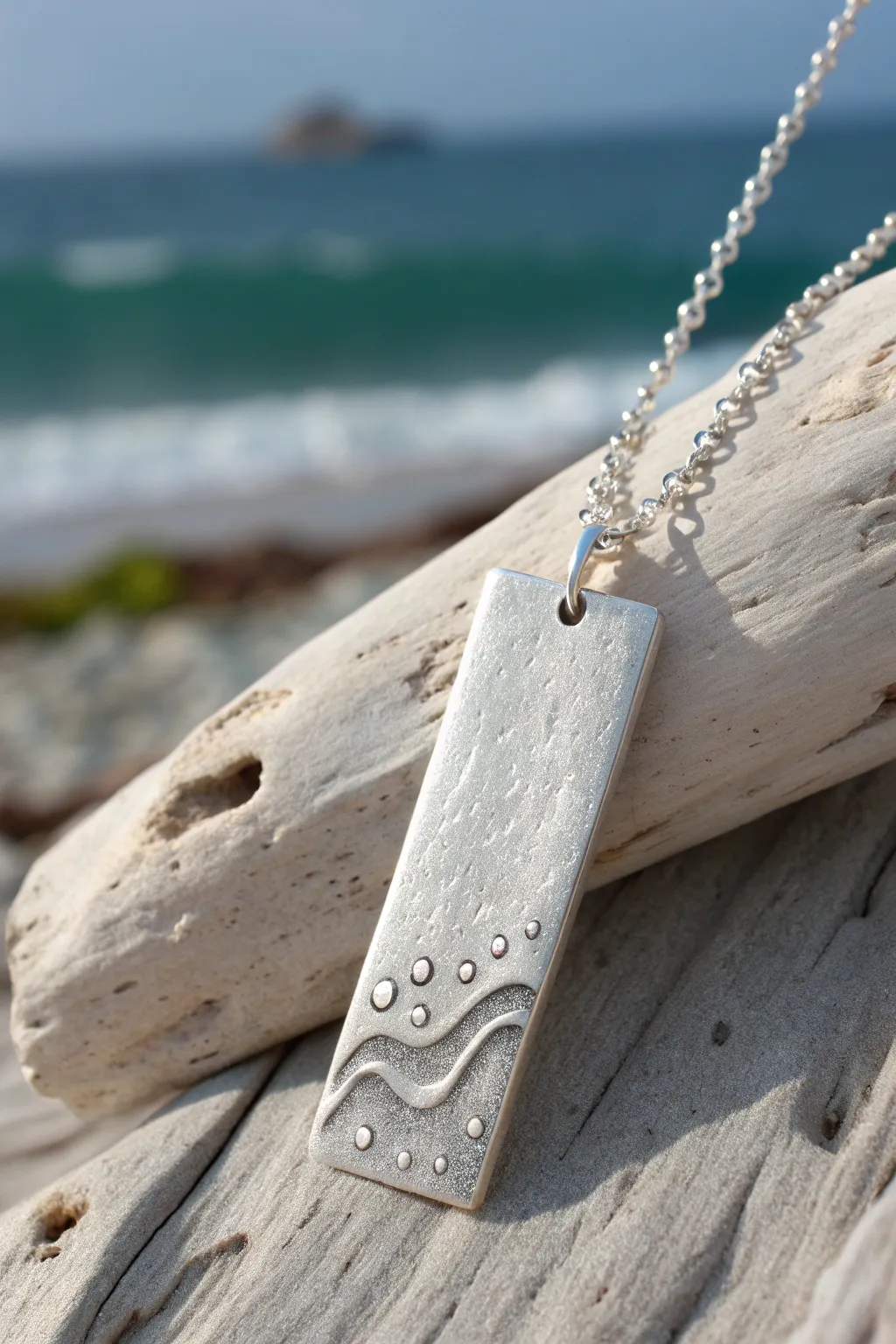
Capture the tranquil beauty of the shore with this sleek metal clay bar pendant. Featuring gentle wave motifs and bubbly textures, this project combines a matte satin finish with polished details for an elegant, organic look.
Detailed Instructions
Materials
- Silver metal clay (approx. 7-10g)
- Acrylic roller
- Playing cards (or slat spacers, 1.5mm thick)
- Clay cutter (long rectangular blade)
- Stylus tool or small ball burnisher
- Drinking straw (small diameter) or brass tube
- Needle tool
- Pin drill or small drill bit
- Sandpaper (various grits: 400, 600, 1000, 2000)
- Butane torch or kiln
- Brass wire brush
- Agate burnisher
- Silver jump ring
- Silver chain
- Olive oil or Badger balm (release agent)
- Work surface (Teflon sheet or laminated card)
Step 1: Shaping the Foundation
-
Prepare the workspace:
Begin by lightly greasing your work surface, acrylic roller, and hands with a tiny amount of olive oil or balm to prevent the clay from sticking. -
Condition the clay:
Take a lump of fresh silver metal clay and knead it gently in your palm for a few seconds to ensure it is pliable and free of cracks. -
Roll out the slab:
Place your spacer slats or a stack of roughly 4-5 playing cards on either side of the clay. Roll the clay into an even slab using the acrylic roller. -
Cut the rectangle:
Using a long, flexible, or rigid clay cutter, slice a clean, narrow rectangle. Aim for dimensions around 1 inch by 2.5 inches, though shrinkage will occur during firing. -
Smooth the edges:
Dip your finger in a little water and gently run it along the cut edges to round them slightly and remove any sharp burrs created by the blade. -
Create the hanging hole:
Use a small straw or a cutter to punch a hole at the top center of the rectangle. Ensure it’s at least 3mm away from the edge to provide structural strength.
Step 2: Adding Coastal Details
-
Sketch the wave design:
Using a needle tool with very light pressure, trace two wavy, parallel lines near the bottom third of the pendant to represent the tide coming in. -
Carve the wave channels:
Go back over your traced lines with slightly more pressure or a small carving tool to deepen the grooves, creating a distinct separation between the sections. -
Add texture bubbles:
Press the tip of a small ball burnisher or stylus into the clay just above the waves and near the bottom edge to create scattered ‘sea foam’ dots of varying sizes. -
Texture the upper surface:
For the main body of the pendant, gently tap the surface with a coarse sandpaper pad or a stiff bristle brush to create a subtle, sandy matte texture, avoiding the wave lines. -
Dry the piece:
Allow the clay to dry completely. You can use a dehydrator, a cup warmer, or just let it air dry for 24 hours. It must be bone dry before firing. -
Refine before firing:
Once dry, use 400-grit sandpaper to gently smooth the sides and corners. Use a pin drill to carefully clean out the hanging hole if it shrank or distorted.
Keep Clay Hydrated
Metal clay dries fast! Keep a damp paper towel or baby wipe nearby to cover any clay you aren’t immediately shaping to prevent cracking.
Step 3: Firing and Finishing
-
Fire the pendant:
Place the piece on a kiln brick. Fire with a butane torch for 2-3 minutes after the binder burns off (glowing orange), or kiln fire according to your clay brand’s specific schedule. -
Cool and quench:
Allow the piece to cool naturally, or quench it in water if your specific clay type permits fast cooling. -
Brush the surface:
The silver will look white and matte initially. Vigorously brush it with a brass wire brush and soapy water to reveal the silver shine. -
Establish the matte finish:
To recreate the photo’s look, sand the main flat surfaces with 600 then 1000 grit sandpaper. This removes the high shine and leaves a soft satin glow. -
Burnish the details:
I prefer to use an agate burnisher here to rub just the edges of the pendant and the raised wave lines, making them gleam brightly against the matte background. -
Assemble the necklace:
Open a heavy-gauge sterling silver jump ring using two pliers. Thread it through the top hole and attach your silver chain before closing the ring securely.
Oxidize for Contrast
Apply liver of sulfur gel to the depressed wave lines and recessed dots, then polish the high points. This darkens the grooves and makes the design pop.
Wear your handcrafted piece as a reminder of sunny days and soothing ocean rhythms.
Acorn Cap and Seed Pod Studs
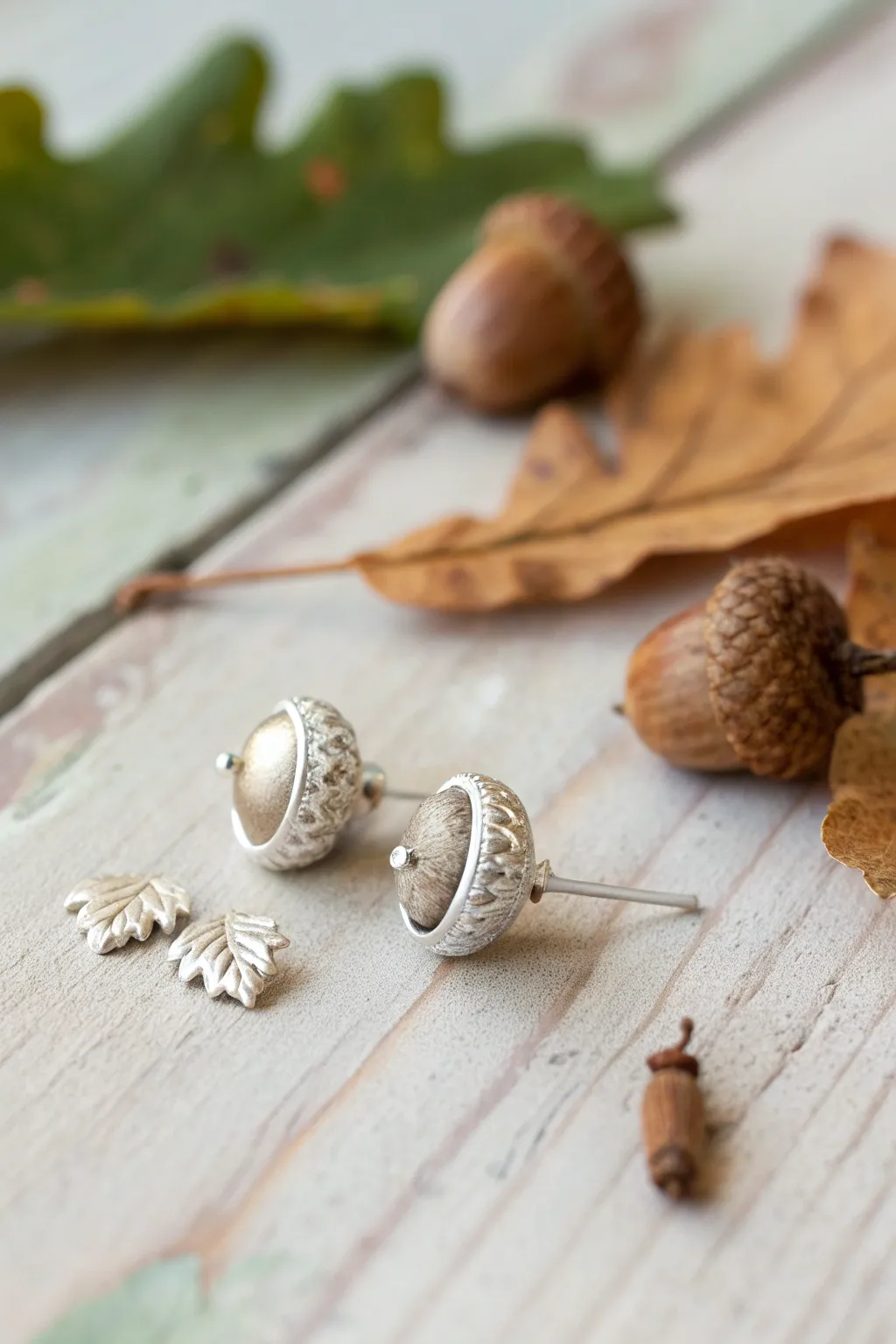
Capture the essence of autumn with these delicate mixed-metal acorn earrings featuring textured silver caps and a warm, golden-hued nut. The set is completed with tiny matching silver leaf charms, perfect for creating a cohesive woodland jewelry collection.
How-To Guide
Materials
- Silver metal clay (PMC or Art Clay Silver)
- Bronze or Gold metal clay (for the nut portion)
- Real acorn caps (small, for texture)
- Small spherical mold or ball tool
- Earring posts (sterling silver)
- Slip (paste form of metal clay)
- Fine paintbrush
- Torch or kiln
- Stainless steel brush
- Burnisher
- Two-part epoxy or strong jewelry adhesive
- Sanding sponges (fine and superfine)
Step 1: Creating the Acorn Nut
-
Form the Base:
Take a small amount of bronze or gold metal clay and roll it into a smooth ball. You want this to be the size of the inner nut, so keep it slightly smaller than your desired final acorn size to account for shrinkage. -
Shape the Nut:
Gently gently taper one end of the ball to create a slight point, mimicking the natural shape of an acorn. Smooth out any fingerprints with a damp brush. -
Add the Post Hole:
If you plan to set the ear post directly into the clay, create a small divot in the flat top of the acorn nut. Alternatively, if soldering later, ensure the top is perfectly flat. -
Dry Completely:
Set these base nuts aside to dry fully. Whether you use a dehydrator or air dry, ensure they are bone dry before firing to prevent cracking.
Step 2: Crafting the Silver Cap
-
Prepare the Mold:
Select a real acorn cap with a deep, distinct texture. Lightly oil it or use a release agent to prevent the silver clay from sticking. -
Impress the Texture:
Press a ball of silver metal clay firmly into the real acorn cap or create a mold of the cap first using two-part molding compound for easier release. Ensure the clay captures the crisscross pattern. -
Hollow the Cap:
While the clay is still in the mold (or immediately after removing), use a ball tool to verify the center is hollow and hemispherical, ready to accept the bronze nut later. -
Refine the Edges:
Carefully remove the silver clay cap. Use a knife or needle tool to trim the rim, giving it a slightly uneven, organic edge rather than a perfect circle. -
Add the Stem:
Roll a tiny snake of silver clay and attach a small segment to the center top of the cap using a dab of paste. Smooth the connection point so it looks seamless.
Shrinkage Rates
Bronze shrinks more than silver (approx 15-20% vs 10-12%). Start with a bronze nut slightly larger than you think you need to ensure it doesn’t end up rattling inside the silver cap.
Step 3: Assembly and Firing
-
Dry the Caps:
Allow the silver caps to dry completely. Once dry, gently sand the rim with a fine sanding sponge to smooth any sharp burrs. -
Fire the Bronze:
Bronze clay often requires a kiln firing in activated carbon. Follow the manufacturer’s specific firing schedule for your bronze clay brand. Fire the nuts first. -
Fire the Silver:
Fire the silver caps separately (unless your clays are compatible for co-firing). Torch firing works well for small silver pieces like these caps. -
Polish Components:
After firing, brush both the silver and bronze pieces with a stainless steel brush to bring out the metallic shine. I like to use a burnisher on the high points of the acorn cap to make the texture pop. -
Assemble Parts:
Test the fit of the bronze nut inside the silver cap. If the fit is good, mix a small amount of strong two-part epoxy and glue the nut securely into the cap. -
Attach Ear Posts:
Attach sterling silver earring posts to the back of the assembled acorns using high-strength epoxy or by soldering them to the bronze back (if you didn’t embed them during the clay stage).
Level_Up: Patina
Dip the finished silver caps in liver of sulfur (LOS) to darken the recesses of the texture. Polish afterward to reveal bright silver highlights against the dark background.
Step 4: Bonus: Leaf Charms
-
Texture the Clay:
To make the tiny leaves, roll a small slab of silver clay and press a real, small leaf into it to transfer the venation. -
Cut and Shape:
Use a needle tool to trace and cut out two small leaf shapes. Gently curve the edges upward to give them life and movement. -
Fire and Finish:
Dry, fire, and polish these alongside your acorn caps to complete the set.
Wear your mixed-metal woodland creations with pride or gift them as a stunning handmade token of the season
Fold-Formed Leaf Earrings
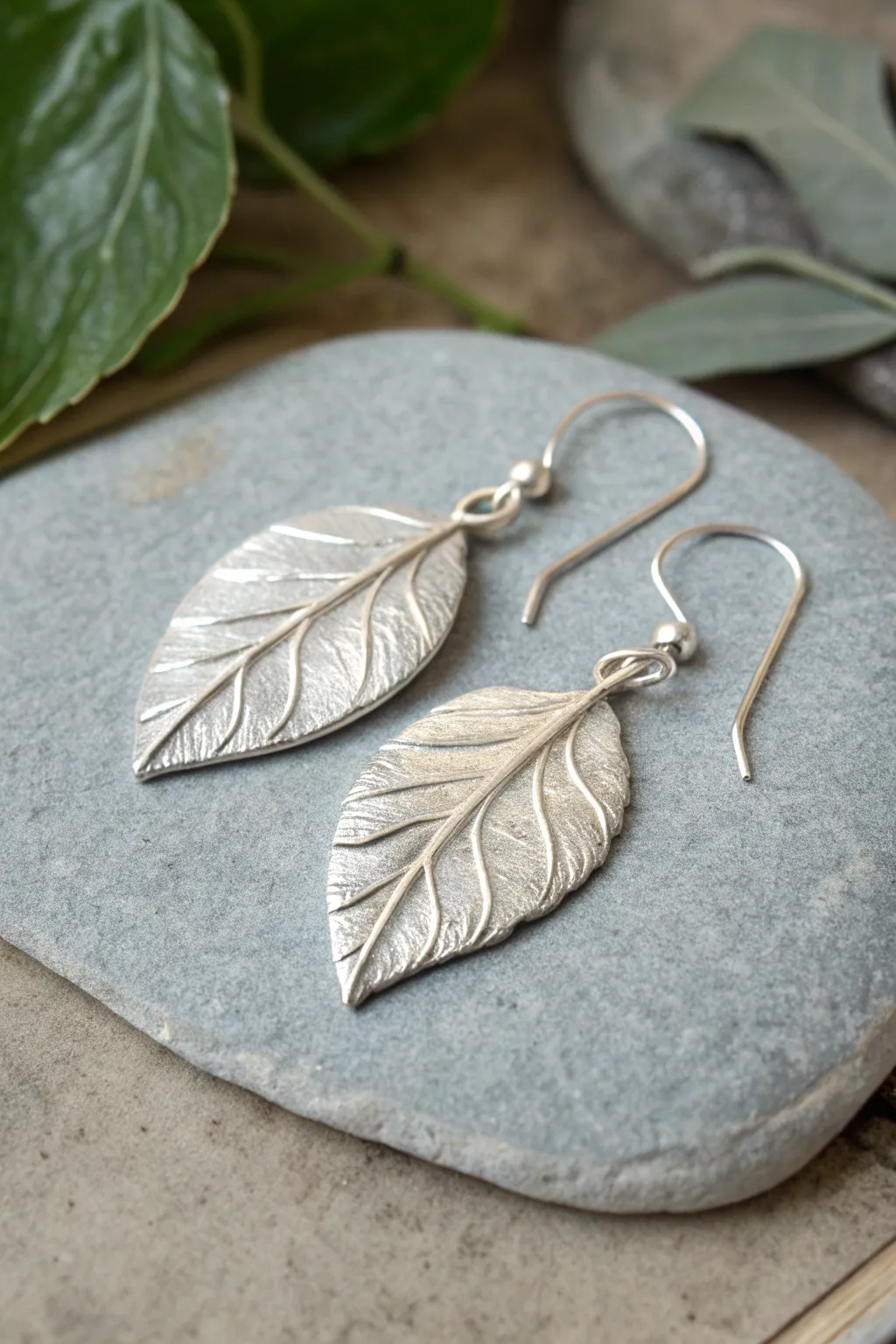
Capture the delicate details of nature forever in fine silver with these elegant leaf earrings. By using metal clay, you can take a fresh leaf and transform its unique vein structure into a stunning, textured piece of jewelry that drapes beautifully.
Detailed Instructions
Materials
- Silver metal clay (approx. 7-10g packet)
- Fresh, deeply veined leaves (e.g., hydrangea, sage, or mint)
- Badger balm or olive oil (release agent)
- Acrylic roller or small rolling pin
- Playing cards or spacers (1.5mm thickness)
- Needle tool or scalpel
- Small straw or pin drill
- Sanding sponges (fine and superfine)
- Kiln or butane torch
- Wire brush (brass or stainless steel)
- Burnisher or agate tool
- Sterling silver ear wires and jump rings
- Two flat nose pliers
- Work mat
Step 1: Creating the Leaf Impression
-
Prepare the workspace:
Begin by lightly coating your work surface, acrylic roller, and your hands with a small amount of badger balm or olive oil to prevent the clay from sticking. This step is crucial for working cleanly with silver clay. -
Roll out the clay:
Take your lump of silver clay and place it between two stacks of playing cards (about 3-4 cards high) or use 1.5mm spacers. Roll the clay out into a smooth slab that is slightly larger than the leaves you intend to use. -
Impress the texture:
Select a fresh leaf with prominent veins. Place the leaf vein-side down onto the clay. I prefer to place the leaf first, then gently roll over it once with the roller to press the texture deeply into the clay without distorting the shape too much. -
Cut the shape:
Instead of removing the leaf immediately, follow the natural outline of the leaf with a needle tool or a very sharp scalpel. Cut straight down to get a clean edge, removing the excess clay surrounding the leaf shape.
Use Fresh Leaves
For the crispest impression, use a leaf picked immediately before working. Dried leaves crack and won’t leave deep, defined veins in the clay.
Step 2: Refining and Shaping
-
Peel and reveal:
Carefully lift the edge of the real leaf and peel it away from the clay. Do this slowly to ensure you don’t stretch the clay or damage the intricate impression you just created. -
Create the hanging loop:
Using a small straw or a pin tool, create a hole at the stem end of the leaf. Ensure the hole is at least 2mm away from the edge to prevent breakage and large enough to accommodate your jump ring (remembering the clay will shrink). -
Add movement:
While the clay is still pliable, gently drape the clay leaves over a curved object like a thick dowel or a spoon handle. This slight curve makes the final earrings look more natural and organic than a flat piece. -
Dry consistently:
Allow the clay to dry completely. You can air dry for 24 hours or use a dehydrator/mug warmer to speed up the process. The clay must be bone dry before firing. -
Refine the edges:
Once bone dry, inspect the edges. Use a fine sanding sponge or a baby wipe to gently smooth any rough spots on the rim or back. Do not sand the textured front or you will lose the vein details.
Fixing Cracks
If you see hairline cracks while the clay is drying (greenware stage), mix a tiny bit of clay with water to make a paste and paint it into the crack to seal it.
Step 3: Firing and Finishing
-
Fire the pieces:
Place the dry leaves on a firing brick. If torch firing, heat evenly until the piece glows a peachy-orange color and hold that temperature for the time recommended by your clay manufacturer (usually 2-5 minutes). If kiln firing, follow the package schedule. -
Cool and brush:
After firing, the pieces will look white. Let them cool completely. Briskly brush the surface with a brass wire brush and soapy water. This removes the white crystallization and reveals the silver metal underneath. -
Burnish for shine:
To make the veins really pop against the matte texture, rub the raised areas (the veins) with a burnishing tool or agate stone. This polishes specific high points, creating lovely contrast. -
Assemble the finding:
Twist open a sterling silver jump ring using your two flat nose pliers. Thread it through the hole you made in the silver leaf. -
Attach the ear wire:
Before closing the jump ring, slide on the loop of your sterling silver ear wire. Ensure the earring faces forward properly. -
Final closure:
Close the jump ring securely by twisting the ends back together until they click or sit flush, ensuring there is no gap for the leaf to slip through.
Enjoy wearing your silver botanicals as they subtly catch the light
Spinner Ring with Stamped Pattern
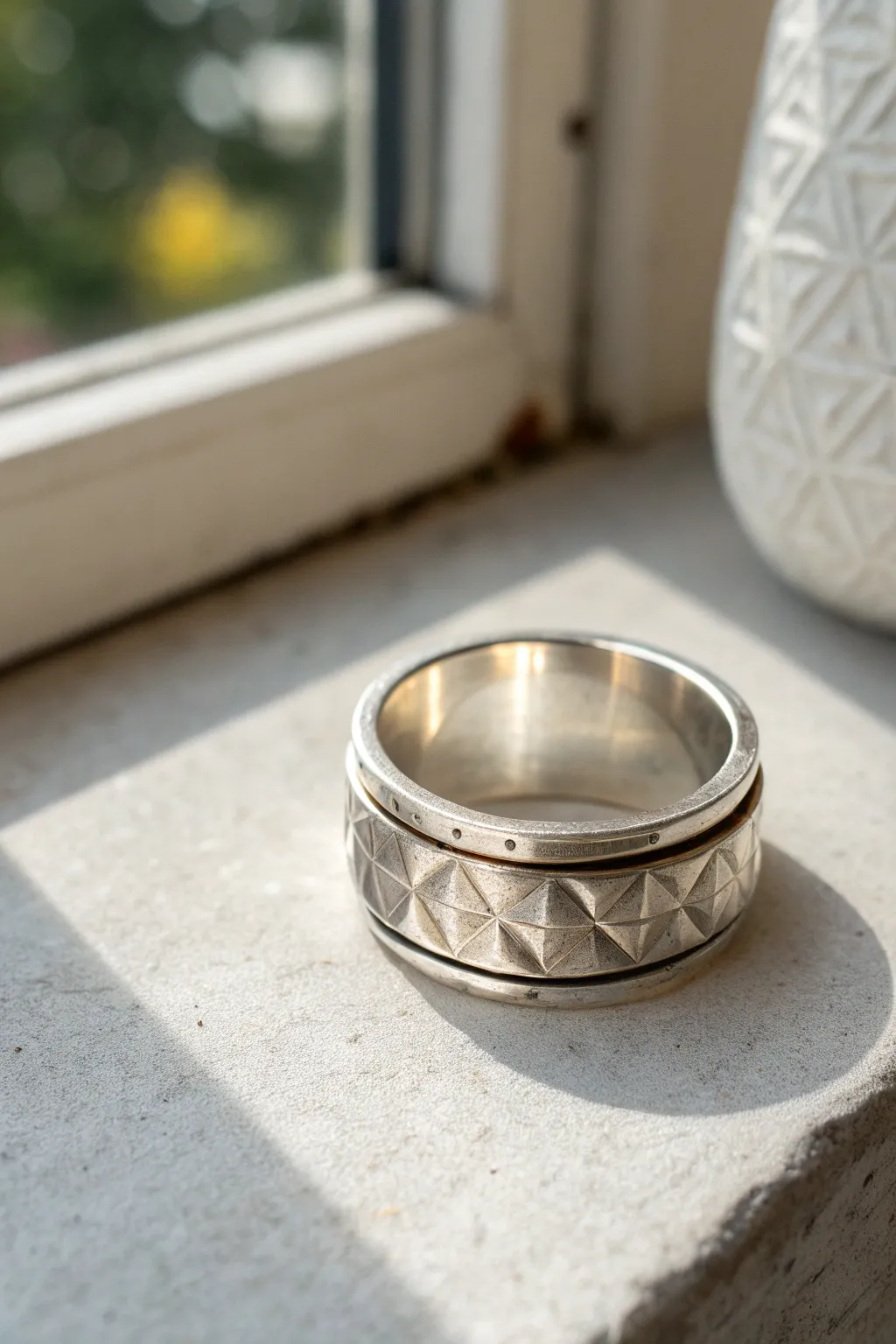
This satisfying fidget ring combines sleek modern lines with a textural, geometric spinning element. Using silver metal clay allows you to easily carve the diamond pattern before firing, resulting in a kinetic piece that looks professionally smithied.
Step-by-Step
Materials
- 20g Silver metal clay (Art Clay Silver or PMC3)
- Ring mandrel + sizing sticky notes
- Carving tools (needle tool, diamond-point carver)
- Clay roller and spacing slats (1.5mm and 1mm)
- Small geometric texture plate or stamp (diamond pattern)
- Olive oil/release agent
- Firing setup (kiln or torch)
- Sandpaper (various grits from 400 to 2000)
- Stainless steel brush
- Burnisher
- Liver of sulfur (optional for patina)
Step 1: Creating the Base Band
-
Size the Mandrel:
Determine your ring size and wrap a sticky note or sizing paper around the mandrel where that size sits. Remember that metal clay shrinks (usually 8-15%), so size up according to your specific clay brand’s shrinkage rate usually 2-3 sizes larger. -
Roll the Base Clay:
Lubricate your work surface and roller. Roll out a strip of clay using 1.5mm thick slats. This band needs to be wider than your spinner ring, so aim for about 10-12mm in width. -
Form the Ring:
Wrap the strip around the mandrel. Cut through both overlapping ends at a 45-degree angle for a clean join. Remove the excess clay. -
Seal the Seam:
Apply a little water or clay paste to the seam and gently press the ends together. Use a rubber shaper tool to smooth the join until it’s invisible, both outside and inside. -
Flare the Edges:
While the clay is still wet on the mandrel, gently flare the top and bottom edges outward slightly using a shaping tool or your finger. This flare will eventually keep the spinner band from falling off. -
Dry the Base:
Dry the wide band completely in a dehydrator or on a cup warmer on a low setting. Once bone dry, refine the edges with sandpaper to ensure they are even.
Shrinkage Woes?
If the spinner is too tight after firing, sand the *inside* of the spinner band or the *outside* of the base band to create clearance. It needs to spin freely before the final flaring step.
Step 2: Crafting the Spinner
-
Calculate Spinner Size:
Measure the *dry* diameter of your base ring. You need the spinning band (which is still wet clay) to shrink onto this base, but remain loose enough to spin. The math is tricky, but generally, making the spinner band 2 sizes larger than the *dry* base band works well. -
Roll the Spinner Band:
Roll out a thinner strip of clay (1mm thick). This strip should be narrower than your base band to fit between the flared edges. -
Texture the Pattern:
Since the diamond pattern is complex to carve by hand, I prefer pressing a geometric texture plate onto this strip while flat. Ensure the impression is deep and crisp. -
Form the Spinner Loop:
Wrap this textured strip around the mandrel (at the calculated larger size). Cut, join, and smooth the seam just like the first band. Be careful not to smudge your geometric pattern near the seam. -
Dry and Refine:
Allow the spinner band to dry completely. Gently sand the edges so it will sit flat against the base ring.
Step 3: Firing and Assembly
-
Fire the Components Separately:
Unlike traditional metalsmithing, with metal clay, you fire the pieces separately first. Fire both rings according to package directions (usually a kiln is best for structural rings). -
Assembly Preparation:
Slide the smaller spinner ring over the larger base ring. Wait, it doesn’t fit? Correct—the base ring edges aren’t fully flared yet. You may need to gently file the flares down just enough to force the spinner over, or use a rawhide mallet to gently tap it into place. -
Locking the Spinner:
Place the assembled rings on a steel mandrel. Using a hammering technique, gently strike the edges of the *base* ring (not the spinner) to flare them outwards further. This mechanical expansion traps the spinner ring permanently. -
Finishing Polish:
Brush the fired silver with a stainless steel brush to bring out the shine. Use varying grits of sandpaper or polishing papers to achieve a high-polish rim. -
Adding Patina:
Dip the ring in a warm liver of sulfur solution to darken the silver. This will turn the ring black. -
Highlighting the Design:
Using a polishing cloth or fine steel wool, buff the high points of the diamond pattern and the ring edges. This removes the black patina from the raised areas while leaving it in the recesses, creating that striking geometric contrast.
Recycled Clay Paste
Make your own ‘paste’ for joining seams by mixing clay dust from your sanding steps with a few drops of water and lavender oil. It’s stronger and matches your clay perfectly.
Give your new ring a spin and enjoy the calming motion of your handmade fidget jewelry
Woven Metal Clay Paper Pendant
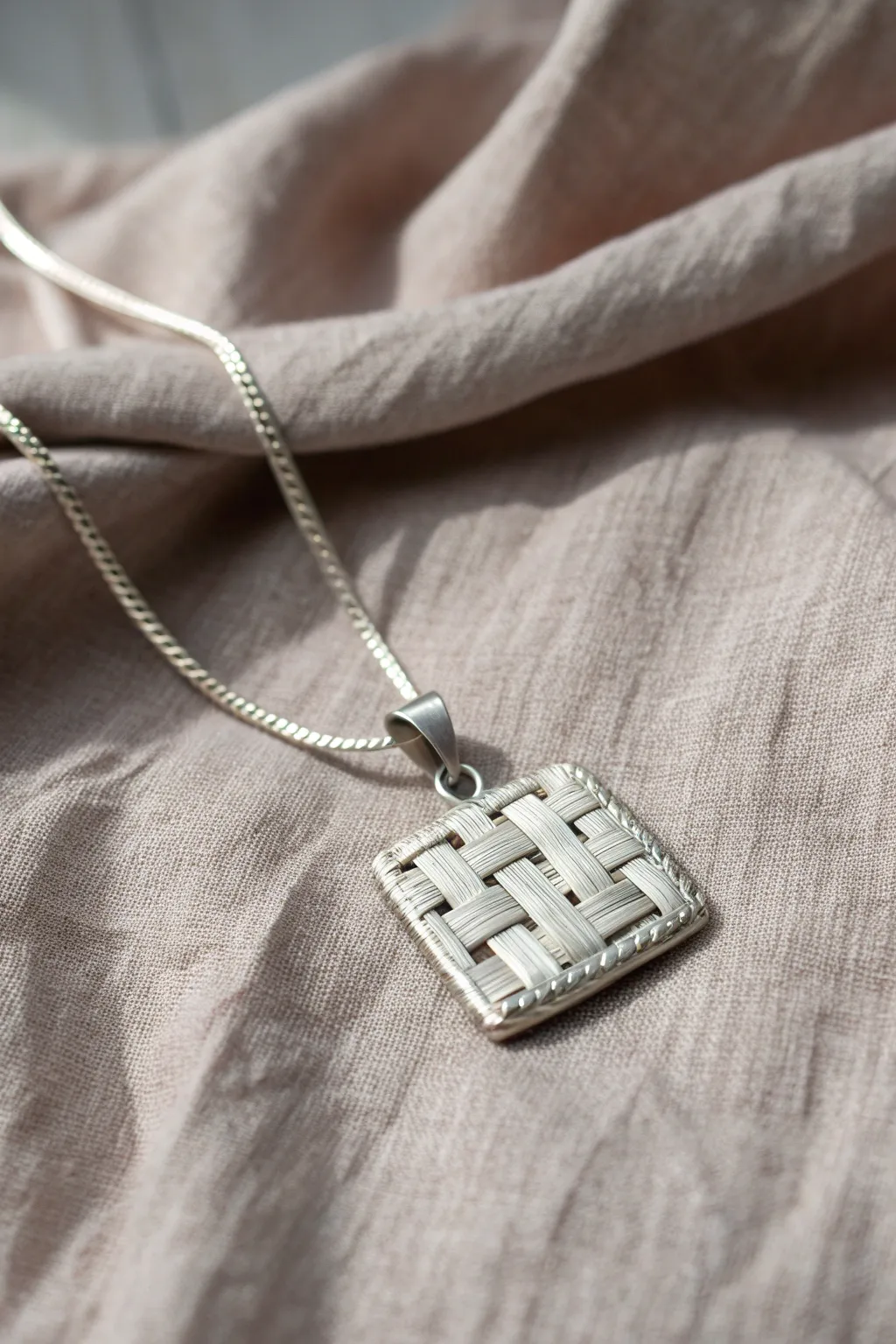
This elegant pendant transforms silver metal clay paper into a classic basket weave texture, framed by a delicate border. Even after firing, the fine details mimic the organic look of woven reeds, resulting in a sophisticated piece with tactile appeal.
Step-by-Step Tutorial
Materials
- Silver metal clay paper type (e.g., PMC+ Sheet or Art Clay Silver Paper Type)
- Silver metal clay paste (slip)
- Small amount of silver metal clay (lump form) for the bail
- Pencil and graph paper
- Craft knife or scalpel with a fresh blade
- Clay roller or playing cards for depth guides
- Fine-point needle tool
- Small paintbrush
- Olive oil or clay release agent
- Small ceramic kiln or butane torch
- Stainless steel brush
- Burnishing tool
- Liver of sulfur (optional for patina)
Step 1: Preparation & Cutting
-
Plan the design:
Begin by sketching a square on graph paper to determine the size of your pendant. A 1-inch square is a manageable starting size. Decide on the width of your ‘reeds’—usually around 3-4mm wide—and mark these guidelines. -
Prepare the silver paper:
Remove the silver metal clay paper from its package. NOTE: This material dries out extremely fast, so work quickly or keep it under plastic wrap when not actively cutting. -
Cut the strips:
Using a steel ruler and your craft knife, carefully slice the paper into uniform strips based on your graph paper measurements. You will need roughly 8-10 strips depending on your desired density. -
Cut the backing:
From the remaining paper clay sheet, cut a solid square that is slightly larger than your intended woven area. This will serve as the support base for the weave.
Moisture Control
Paper clay is very thirsty. Keep a damp sponge nearby to wipe your fingers, but don’t over-wet the clay or it will mush. Just a touch of water is enough to join pieces.
Step 2: Weaving the Center
-
Lay the vertical strips:
Place the square backing piece on your work surface. Lightly moisten it with a tiny amount of water or diluted paste. Lay your vertical strips down side-by-side, leaving a hairline gap between them for shrinkage allowance. -
Begin the weave:
Take a horizontal strip and weave it perpendicularly—over one vertical strip, under the next. I find using a needle tool or fine tweezers helps lift the fragile paper strips without tearing them. -
Continue the pattern:
Add the next horizontal strip, alternating the pattern (under, then over). Gently push it snugly against the first strip using the flat side of your knife blade to keep the weave tight. -
Secure the edges:
Once the square is fully woven, gently press down on the perimeter to tack the woven strips to the backing sheet. Apply a microscopic amount of paste between layers at the very edges to lock them in place. -
Trim the excess:
Once dried slightly, use your sharp scalpel to trim the uneven ends of the strips so you have a perfect, straight-edged square.
Create a “Rug” Look
Before weaving, texture your paper strips by gently pressing them onto sandpaper or a coarse fabric. This gives the finished silver a realistic fiber grain.
Step 3: Framing & Bail
-
Create the frame:
Roll out a small snake or coil of standard lump clay. It should be thin enough to frame the square without overwhelming the weave. -
Texture the frame:
For the rope-like effect seen in the photo, gently twist two very thin coils together, or use a texture plate to impress a pattern onto your strip before attaching it. -
Attach the frame:
Paint a line of silver paste around the raw edge of your woven square. Place the textured frame on top of this seam, mitering or blending the corners neatly. -
Add a bail:
Form a small tear-drop shaped loop from lump clay. Attach this to the top center of the frame using plenty of paste. Ensure the connection point is smooth and reinforced. -
Dry thoroughly:
Allow the entire piece to dry completely. A mug warmer or dehydrator can speed this up, but ensure no moisture remains inside the weave layers.
Step 4: Firing & Finishing
-
Fire the clay:
Fire the piece according to your clay manufacturer’s instructions. Usually, this involves kiln firing at around 1200°F (650°C), though paper clay burns off quickly, so ensure adequate ventilation. -
Cool and brush:
Once cool, the piece will look white and matte. Brush it vigorously with a stainless steel brush to bring out the silver shine. -
Burnish for highlights:
Use a smooth agate burnisher to rub the high points of the weave and the frame. This compresses the silver and creates the bright, reflective ‘over’ portions of the weave. -
Add patina (Optional):
To enhance depth, dip the pendant in a warm liver of sulfur solution. This darkens the recesses ‘under’ texture; polish the high points again to create contrast.
String your new silver basket-weave pendant on a snake chain and enjoy the fascinating texture you created by hand
Hollow Locket Pendant with Texture
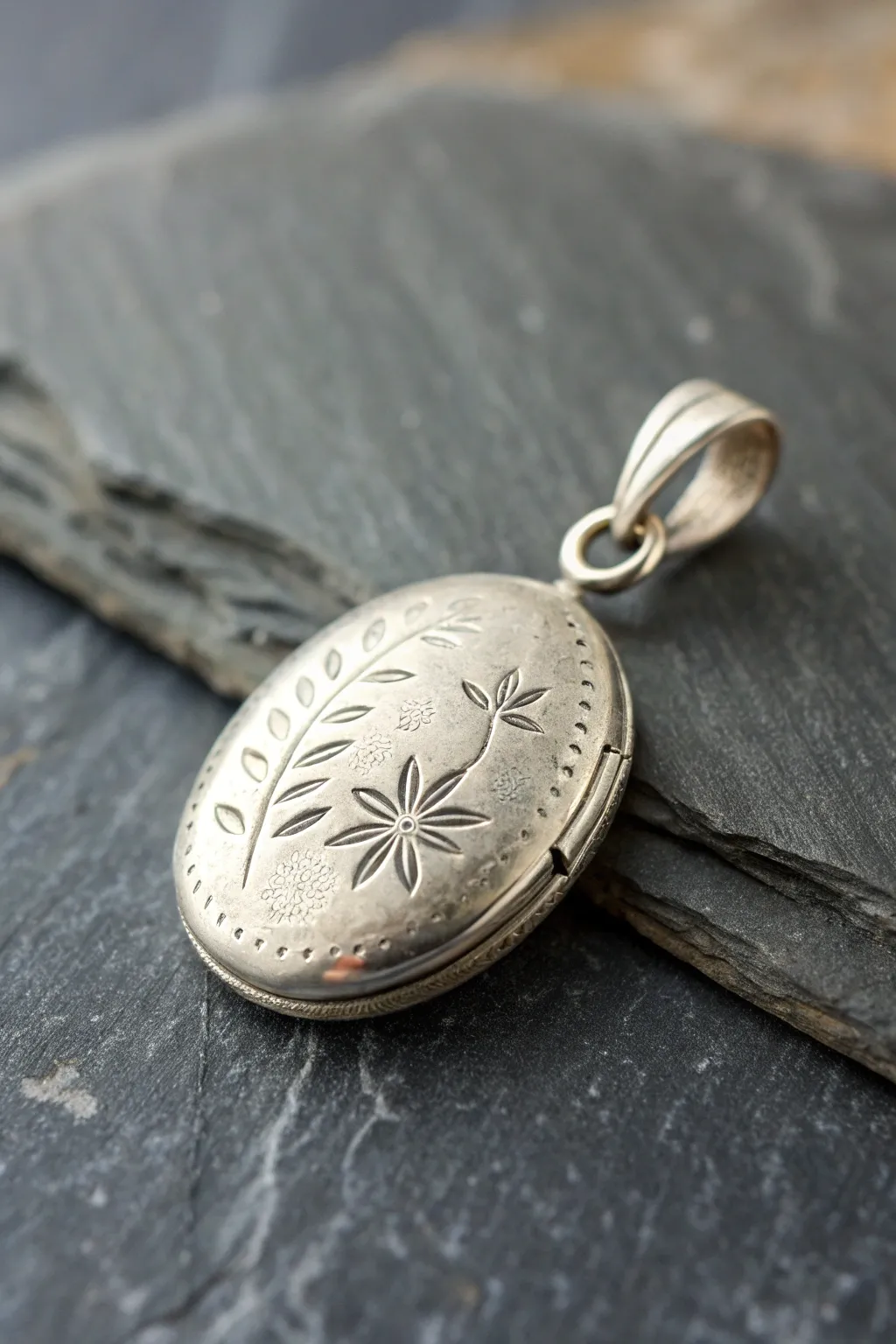
Capture the charm of antique keepsakes with this hollow metal clay locket featuring delicate floral imprints and a timeless oval shape. This intermediate project teaches you how to construct substantial, hollow forms that feel like heirlooms straight from the kiln.
Detailed Instructions
Materials
- Silver metal clay (approx. 20g)
- Small oval cutters (two sizes, slightly nested)
- Wood clay or cork clay (for the hollow core)
- Textured rolling plate or rubber stamp with floral motif
- Clay roller and spacers (1.5mm and 1mm)
- Needle tool and scalpel
- Fine-grit sandpaper or sanding sponges
- Silver paste (slip) and a small paintbrush
- Torch or kiln (kiln recommended for hollow forms)
- Burnishing tool and steel wool
- Liver of sulfur (patina)
- Sterling silver bail or large jump ring
Step 1: Forming the Core
-
Shape the Combustible Core:
Begin by shaping a piece of wood clay or cork clay into a flattened oval pillow shape. This will be the interior space of your locket, so ensure it is smooth and symmetrical. -
Refine the Core Shape:
Once the core material is completely dry, sand it gently to remove any lumps or sharp corners. The smoother your core, the cleaner the inside of your locket will be after firing.
Step 2: Creating the Shell
-
Roll the Back Sheet:
Roll out a sheet of silver metal clay to 1mm thickness using spacers. Place your dried core on top and trace around it, leaving a generous 2-3mm border, then cut this oval shape out. -
Texture the Front Sheet:
Roll a second sheet of clay to 1.5mm thickness. Lightly spray your floral texture mat or stamp with cool slip (release agent) and press it firmly into the clay to create the raised design shown in the image. -
Form the Top Dome:
Drape the textured clay sheet over the top of your dry core. Gently press the clay down around the sides of the core, being careful not to distort the floral pattern. -
Trim and Combine:
Trim the excess clay from the top dome so it meets the bottom sheet’s edge perfectly. Score the edges of both pieces and apply a generous amount of silver paste to the seam. -
Seal the Seam:
Press the edges together firmly to enclose the core. Use a rubber shaper or your finger to smooth the seam completely, blending the top and bottom layers into one unified object. -
Add Decorative Details:
Using a needle tool, gently impress small dots or dashes along the perimeter of the front face to mimic the beaded border seen in the photo.
Core Material Tip
Can’t find cork clay? A tightly shaped core of dry bread or paper maché works surprisingly well, as long as it burns away completely into ash.
Step 3: Refining and Firing
-
Attach the Bail:
Construct a loop from a small strip of clay or embed a fine silver wire loop at the top of the oval. Secure it well with paste, as this will hold the pendant’s weight. -
Dry Thoroughly:
Allow the piece to dry completely. This is critical for hollow forms; I usually leave it overnight or on a mug warmer for several hours to prevent steam explosions. -
Create a Vent Hole:
Drill a tiny, inconspicuous hole (perhaps on the bottom edge or hidden near the bail) to allow the combustion gases from the cork clay to escape during firing. -
Refine Before Firing:
Sand the edges and back of the dry locket with fine-grit sandpaper. Smooth out any scratches now, as they are much harder to remove after the metal sinters. -
Fire the Piece:
Kiln fire according to your clay brand’s instructions for hollow forms (usually a longer, hotter schedule to fully burn out the core). If torch firing, be extremely careful to heat slowly to burn off the core.
Seam Splitting?
If the seam cracks during drying, don’t panic. Fill the crack with fresh syringe type paste, let it dry, and sand it smooth again before firing.
Step 4: Finishing Touches
-
Wire Brush Finish:
Once cool, the locket will look white and matte. A brass wire brush gives it that first satin shine and compacts the surface. -
Simulate the Opening:
To mimic the look of a functioning locket without complex hinges, carefully use a jeweler’s saw to score a deep line around the side seam, creating the illusion of a lid. -
Apply Patina:
Prepare a warm liver of sulfur bath. Dip the locket until it turns dark gray, then rinse immediately in cold water to stop the reaction. -
Highlight the Texture:
Polish the raised floral areas and the main surface with steel wool or a polishing cloth, leaving the dark patina in the recessed lines and texture to make the design pop.
Wear your new vintage-style locket with pride, knowing you’ve created a hollow, lightweight treasure
Micro Mosaic Tile Pendant
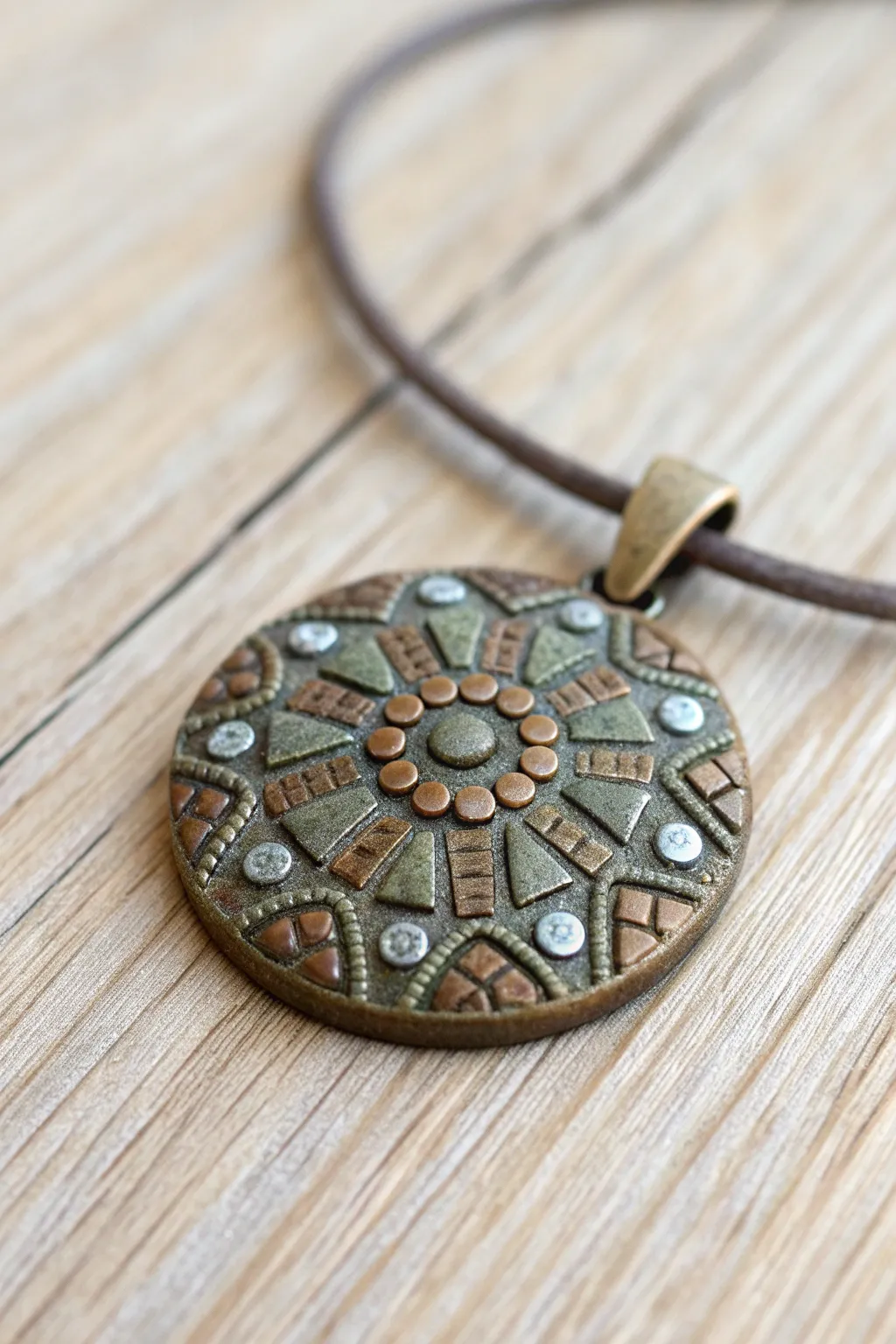
This rustic, circular pendant channels ancient artistry with its textured, mosaic-like patterns in warm metallic tones. Using metal clay techniques, you’ll create a piece that feels like a discovered artifact, featuring geometric bronze, copper, and silver elements.
Step-by-Step Guide
Materials
- Bronze metal clay (50g pack)
- Copper metal clay accents (or copper paste)
- Silver metal clay paste (syringe or pot)
- Circular clay cutter (approx. 40mm)
- Needle tool or scalpel
- Rubber shaping tools
- Small geometric cutters (triangles/squares) or stiff templates
- Texture plate or roller (smooth)
- Sanding sponges (various grits)
- Kiln or torch (depending on clay type)
- Liver of sulfur (patina)
- Polishing cloth
- Brass brush
- Leather cord and bail
Step 1: Base Construction
-
Roll the foundation:
Begin by conditioning your bronze metal clay until it is pliable and smooth. Roll it out on a non-stick surface or playing card to a uniform thickness of about 4 cards thick (approx. 1.5mm) to ensure durability. -
Cut the shape:
Use your circular cookie cutter to punch out the main pendant base. Keep the cutter in place for a moment and wiggle slightly to ensure a clean separation from the excess clay. -
Create the border:
Roll a very thin snake using the same bronze clay. Carefully drape this around the circumference of your circle to create a raised rim, using a little water and a rubber tool to blend the seam where the snake meets the base plate.
Shrinkage Check
Bronze clay shrinks 15-20% during firing. If you want a specific final size, cut your initial circle about 20% larger than the desired result.
Step 2: Mosaic Patterning
-
Establish the center:
Place a small ball of bronze clay in the direct center and flatten it slightly to create a focal dot. Surround this central dot with tiny spheres of clay, spaced evenly, to create the first inner ring. -
Form the rays:
Roll out a thin sheet of bronze clay (about 2 cards thick). Use a sharp blade or tiny triangle cutter to create elongated trapezoids or ‘rays.’ Arrange these radiating outward from the central dot cluster. -
Add square textures:
In the spaces between the rays, add rectangular blocks of clay. Use your needle tool to gently impress grid lines into these rectangles, giving them a woven or brick-like texture. -
Outer rim details:
Near the outer rim, add small arched shapes or triangles pointing inward. Ensure these elements touch the raised border you created earlier. -
Silver dot accents:
Using silver metal clay paste or a syringe, carefully deposit small droplets of silver into the negative spaces of the design, particularly around the outer ring and between the main geometric shapes. These will fire into bright silver contrasts.
Faux Stone Inlay
Leave some small recessed areas empty during construction. After firing, fill these divots with UV resin colored with turquoise pigment for a gem-like effect.
Step 3: Refining and Firing
-
Initial drying:
Allows the piece to dry completely on a warming plate or simply in the air for 24 hours. The clay must be bone dry before firing to prevent exploding. -
Pre-fire sanding:
Gently refine the edges and the back of the pendant with fine-grit sandpaper. Be very gentle with the top texture so you don’t rub away the delicate ‘mosaic’ details. -
Firing:
Fire the piece according to your specific bronze clay manufacturer’s instructions. Note that combining metals often requires a kiln firing in activated carbon to avoid oxidation issues. -
Brushing:
Once cool, remove the pendant from the carbon. It will look dull and possibly crusty. Scrub it vigorously with a brass brush and water to reveal the initial metallic luster.
Step 4: Finishing Touches
-
Applying patina:
Prepare a warm solution of Liver of Sulfur. Dip the pendant into the solution until it turns a dark, charcoal grey or black. Rinse immediately in cool water to stop the reaction. -
High-point polishing:
I prefer using a polishing cloth or a rotary tool with a polishing wheel for this step. Buff the raised surfaces vigorously. The patina will remain in the crevices, creating the deep shadows that make the separate ’tiles’ pop. -
Attach the bail:
Attach a bronze pinch bail to the top of the pendant. Make sure it is secure but has enough movement to hang naturally. -
Stringing:
Thread a simple brown leather cord through the bail to complement the earthy, rustic tones of the metal.
Wear your ancient-inspired medallion with pride on your next casual outing