
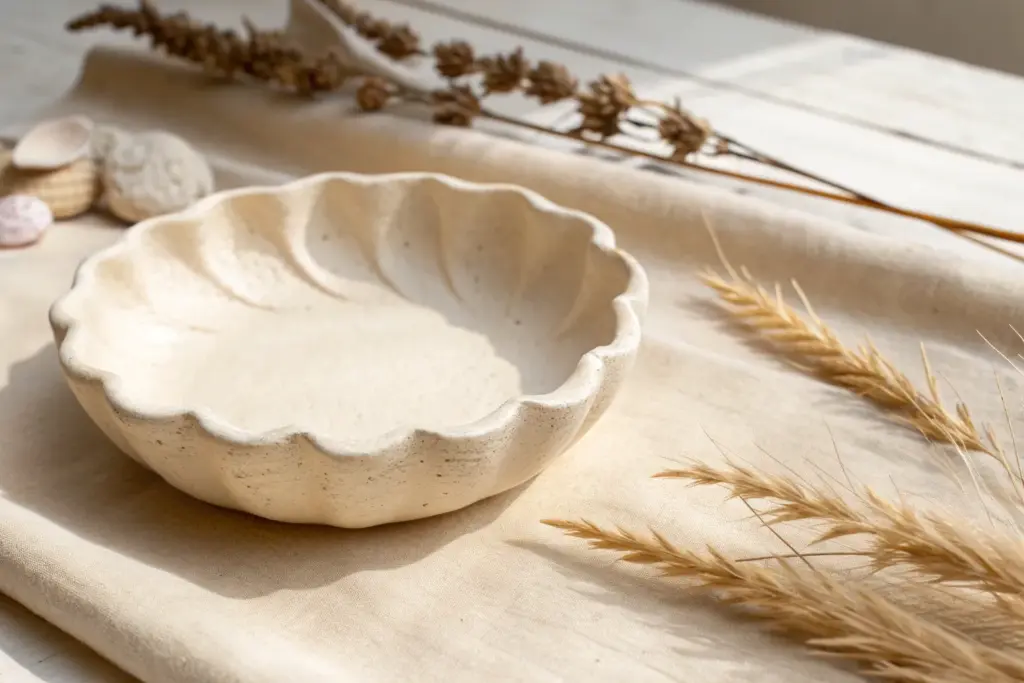
Whenever I’m stuck on what to make next, I reach for air clay because it lets you go from idea to finished piece without a kiln or a big setup. Here are my favorite air-dry clay design ideas—the kind you can knock out in a cozy afternoon and actually use around your home.
Minimal Trinket Dishes
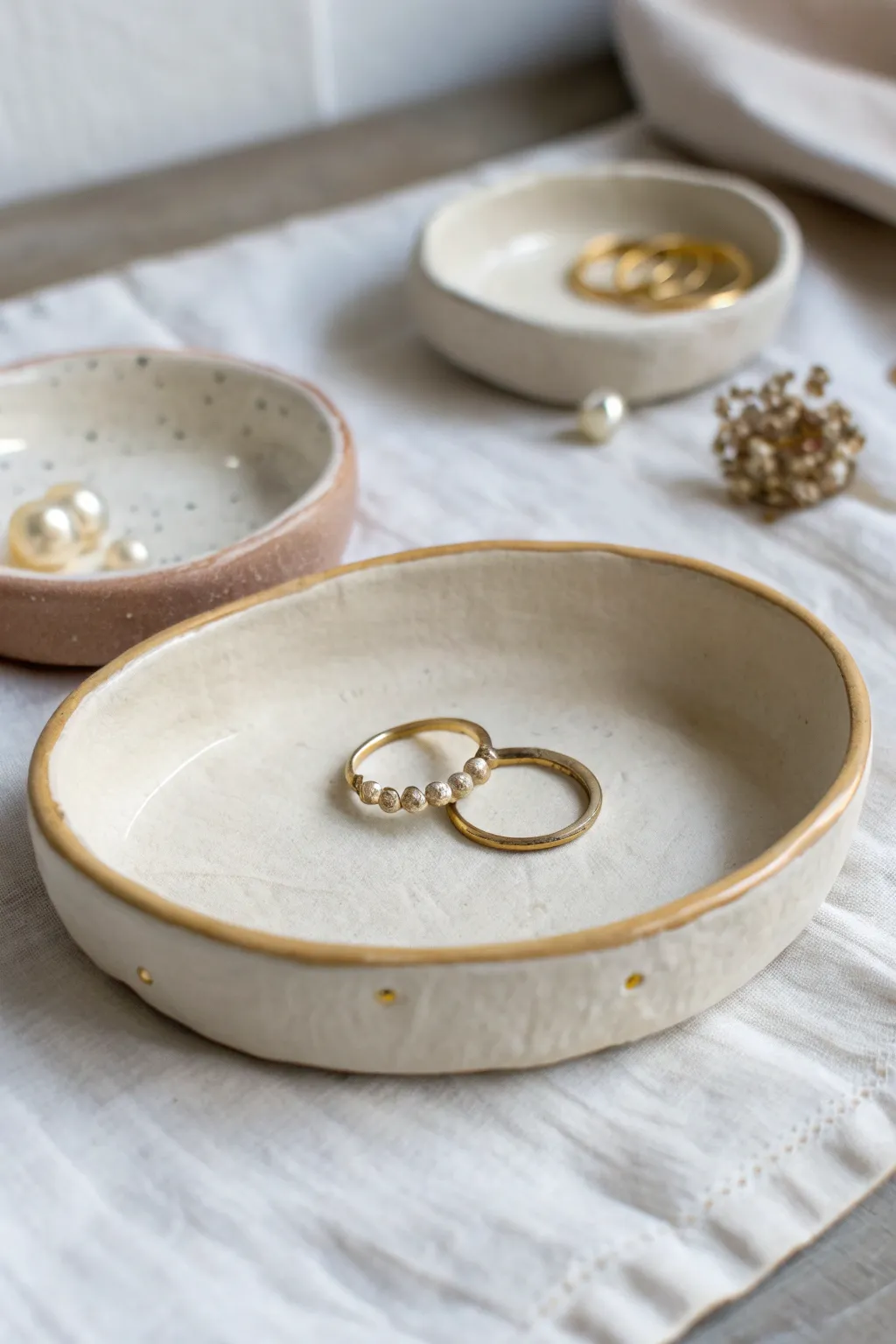
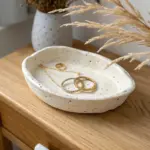
These elegant, handmade trinket dishes combine the organic feel of air-dry clay with a touch of luxury. Featuring a smooth, milky white finish and delicate gold accents, they are perfect for organizing your everyday rings and earrings.
Step-by-Step
Materials
- White polymer clay or high-quality air-dry clay
- Rolling pin or acrylic roller
- Small bowl or cookie cutter (for circle shape)
- Craft knife or scalpel
- Fine-grit sandpaper (400-600 grit)
- Small sponge
- Water
- Gold leaf paint or liquid gilding
- Fine detail paintbrush
- Clear gloss varnish or glaze (optional)
Step 1: Shaping the Base
-
Prepare the clay:
Begin by kneading a ball of white clay until it is soft, pliable, and free of cracks. If you are using air-dry clay and it feels dry, dip your fingers in a tiny bit of water to rehydrate it as you work. -
Roll out the slab:
Place the clay on a smooth surface or a silicone mat. Use your rolling pin to flatten the clay into a slab that is roughly 1/4 inch thick. Try to keep the thickness consistent across the entire piece for even drying. -
Cut the shape:
For the oval dish seen in the foreground, use a craft knife to freehand a soft, organic oval shape. For the circular background dishes, you can use a bowl rim or large cookie cutter as a template to cut a perfect circle. -
Smooth the edges (initial):
Dip your finger in water and run it gently along the cut edge of the clay to smooth down any sharpness or crumbs created by the knife.
Step 2: Forming the Dish
-
Lift the edges:
Gently lift the edges of your clay cutout with your fingertips, curving them upwards to create a shallow wall. You aren’t building a new wall, but rather bending the slab itself. -
Pinch for height:
To define the rim more clearly, lightly pinch around the perimeter. I find that rotating the piece slowly while pinching helps maintain a symmetrical height. -
Smooth the interior:
Use a slightly damp sponge to wipe the inside of the dish. This erases smooth out any fingerprints left from the pinching process and ensures a professional finish. -
Level the rim:
Flip the dish upside down gently on your work surface for just a moment to help level the top rim, then flip it back over and make final adjustments to the curve. -
Create texture (optional):
If you want the speckled look of the background dish, you can gently press coarse sand or dried coffee grounds into the wet clay now, or flick diluted brown paint on later. -
Dry the clay:
Set the dishes aside to dry completely. For air-dry clay, this usually takes 24-48 hours. Turn them over halfway through the process to ensure the bottom dries thoroughly.
Smooth Sponge Trick
Keep a piece of smooth, slightly damp cosmetic sponge nearby. Use it to gently buff the raw clay before drying—it removes fingerprints better than water alone.
Step 3: Refining and Sealing
-
Sand imperfections:
Once fully dry (and hard), use fine-grit sandpaper to gently buff away any rough spots on the rim or the exterior walls. Wipe away the dust with a dry cloth. -
Base seal (optional):
If your clay is very porous, apply a thin layer of matte varnish or a mixture of white glue and water to seal the surface before painting. Let this layer dry completely.
Make it Marble
Knead a small amount of gray or beige clay into your white base but stop before it blends fully. This creates beautiful, natural marble veins in your final dish.
Step 4: Adding Gold Accents
-
Prepare the gold paint:
Shake your liquid gilding or gold leaf paint well to ensure the metallic pigments are evenly distributed. -
Paint the rim:
Load a fine detail brush with gold paint. Carefully paint the very top edge of the rim. Don’t worry if it’s slightly uneven—this adds to the organic, handmade charm. -
Add decorative dots:
For the foreground design, use the very tip of your brush or a dotting tool. Dip it in gold paint and gently press small dots along the exterior side wall, spacing them out by about an inch. -
Create the speckled rim (variation):
For the pinkish-brown rim variation in the background, mix a terra-cotta acrylic paint and apply it to the rim instead of gold, blending it slightly down the outer wall. -
Final drying time:
Allow the paint to cure fully according to the manufacturer’s instructions. -
Seal the dish:
Finish by applying a coat of clear gloss glaze over the entire dish (or just the inside). This protects the clay from moisture and gives it that ceramic-like shine.
Place your new creations on your bedside table or vanity to add a custom, sophisticated spot for your favorite jewels
Cone Ring Holders
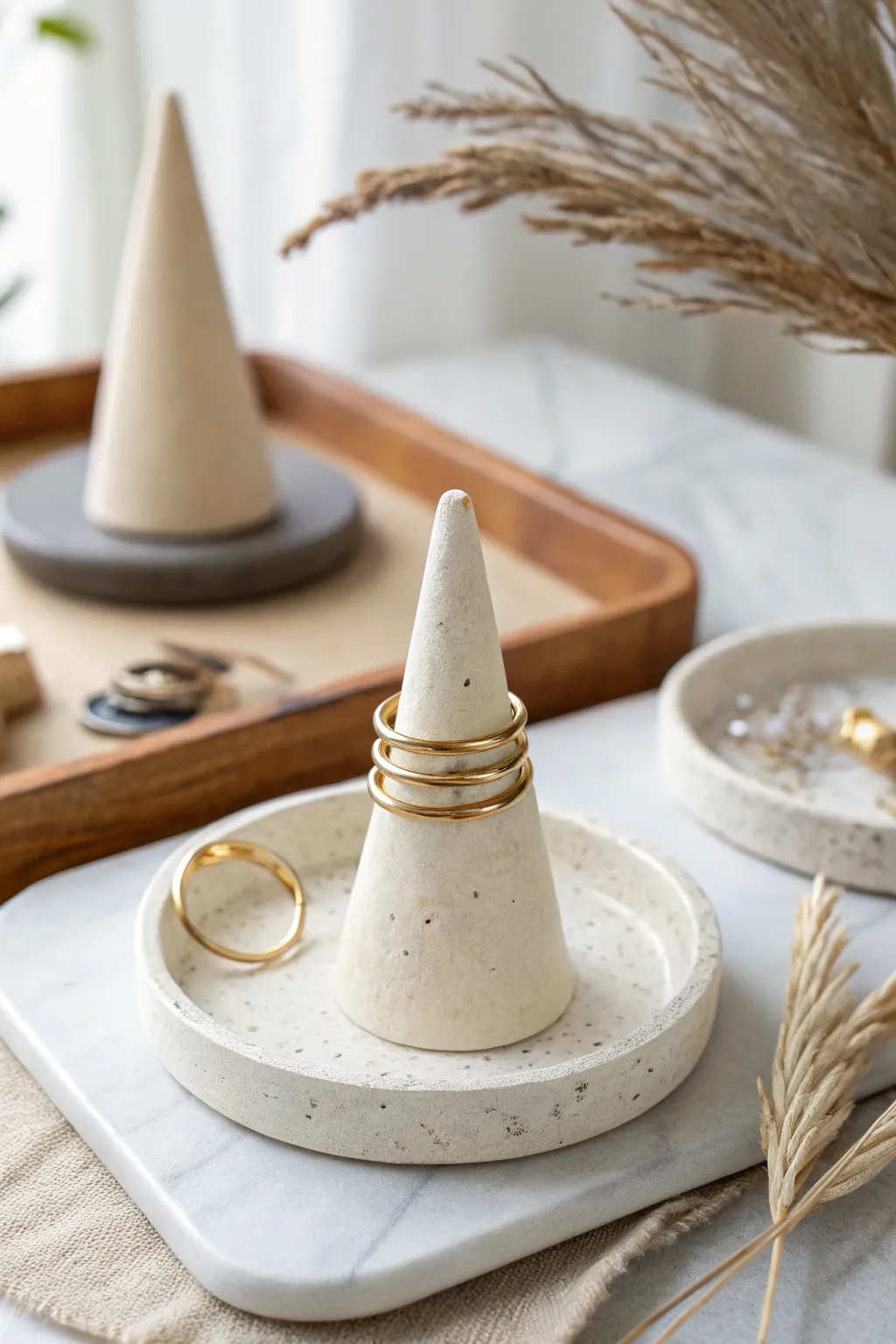
These minimalist ring holders combine a sleek conical shape with a matching catch-all dish for a modern, architectural look. The speckled finish mimics natural stone, turning simple air-dry clay into an elegant display piece for your favorite jewelry.
Step-by-Step Tutorial
Materials
- White air-dry clay
- Rolling pin
- Craft knife or clay wire cutter
- Sandpaper (medium and fine grit)
- Small bowl or cup (for circle template)
- Acrylic paint (black and brown)
- Old toothbrush or stiff bristle brush
- Cup of water
- Matte varnish or sealant
- Sponge or paper towel
Step 1: Shaping the Cone
-
Condition the clay:
Start by taking a generous handful of white air-dry clay. Knead it thoroughly in your hands to warm it up and ensure it’s pliable and free of air bubbles. -
Form the initial shape:
Roll the clay into a smooth ball first, then begin rolling it back and forth on your work surface while applying more pressure to one side. -
Refine the cone:
Continue rolling until you have a tapered cone shape. It should be wide enough at the base to be stable but narrow enough at the top to hold rings. Aim for about 3-4 inches in height. -
Flatten the base:
Once you like the taper, tap the bottom of the cone firmly against your table to create a perfectly flat base so it stands upright without wobbling. -
Smooth the surface:
Dip your finger in a tiny bit of water and run it over the cone to smooth out any fingerprints or cracks. Set this aside to dry.
Cracks Appearing?
If small cracks appear while drying, mix a tiny bit of fresh clay with water to make a ‘slip’ paste. Fill the cracks, smooth over, and let dry again before sanding.
Step 2: Creating the Base Dish
-
Roll the slab:
Take a second portion of clay and roll it out into a flat slab, approximately 1/4 inch thick. Keep the thickness consistent for even drying. -
Cut the circle:
Place your small bowl or circle template onto the clay slab and trace around it with your craft knife to cut out a perfect circle. -
Create the rim:
Roll a long, thin snake (coil) of clay. It should be long enough to go around the circumference of your clay circle. -
Attach the rim:
Score (scratch) the outer edge of the circle and the bottom of the coil. Add a dab of water as ‘glue’ and press the coil onto the edge of the base. -
Blend the seams:
Use your thumb or a modeling tool to smear the clay from the coil down into the base, blending the seam until it’s invisible on the inside. I find using a slightly damp sponge helps smooth this transition perfectly. -
Refine the exterior:
Repeat the blending process on the outside seam so the dish looks like one solid piece rather than two joined parts. -
verify the fit:
Gently place your cone in the center just to check the proportions, but don’t attach it yet. Remove the cone and let both pieces dry completely (24-48 hours).
Add Gold Accents
For a luxe touch, paint the very rim of the dish or the tip of the cone with metallic gold leaf paint after the speckles have dried but before you seal it.
Step 3: Finishing and Speckling
-
Sand for smoothness:
Once fully dry, use medium-grit sandpaper to remove any large bumps. Follow up with fine-grit sandpaper for a silky smooth, professional finish. -
Wipe down:
Use a slightly damp paper towel or sponge to remove all the sanding dust from both the cone and the dish. -
Prepare the splatter paint:
Mix a small amount of black and brown acrylic paint with water. You want a very fluid consistency, almost like ink. -
Apply the speckles:
Dip an old toothbrush into the watery paint mix. Hold it near the clay pieces and run your thumb across the bristles to flick tiny droplets onto the surface. -
Control the density:
Rotate the pieces to ensure even coverage. Go lighter for a subtle granite look or heavier for a terrazzo effect. -
Seal the project:
Allow the paint speckles to dry completely. Apply two coats of matte varnish to protect the clay and give it that finished stone appearance. -
Final assembly:
You can now place the cone freely in the dish, or if you prefer a permanent fixture, use a strong craft glue to secure the cone to the center of the dish.
Now you have a chic, functional sculpture ready to keep your rings organized and safe
Leaf-Imprint Catchall Bowls
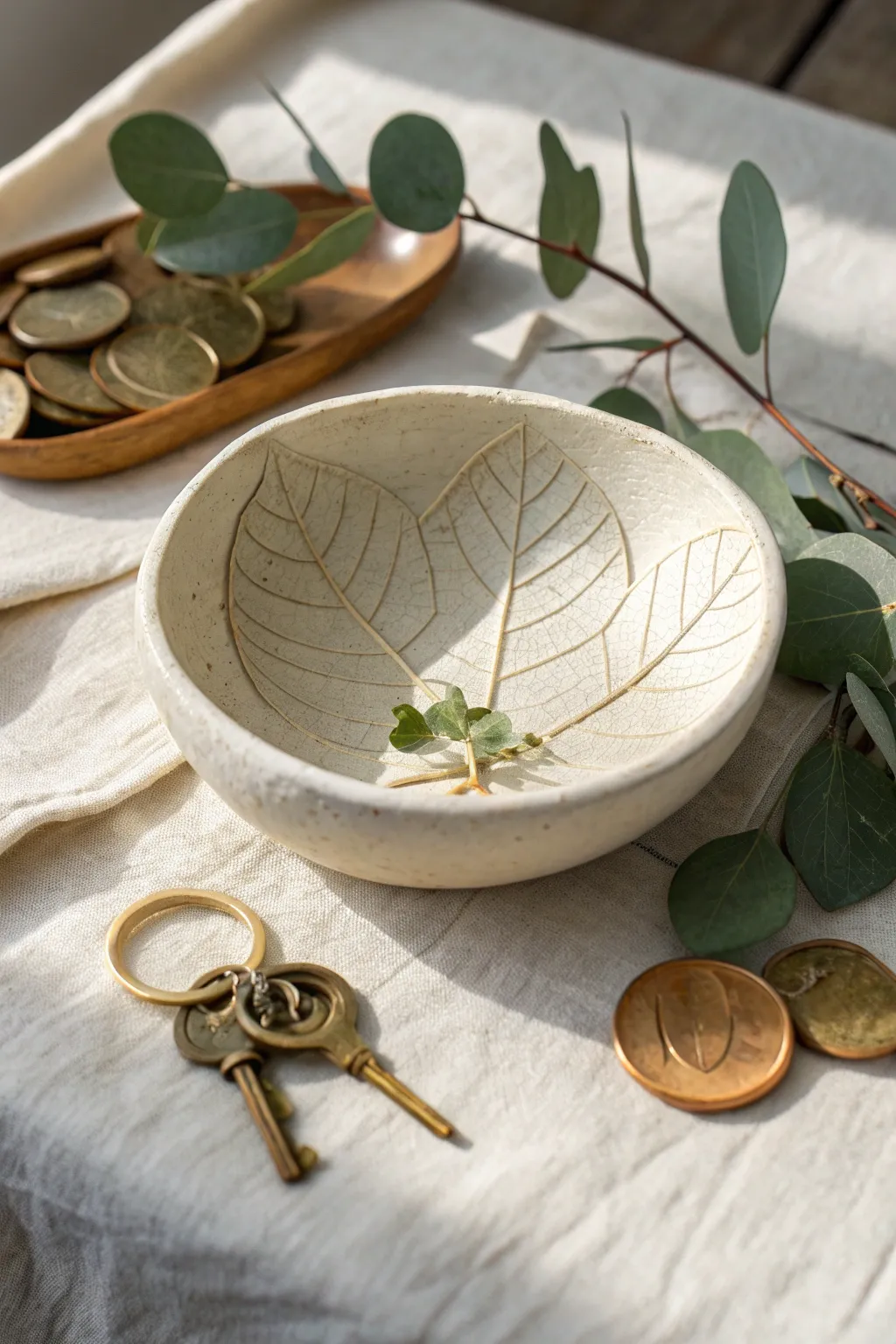
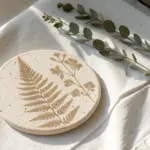
Capture the delicate beauty of nature with this elegant air-dry clay bowl featuring deep, realistic leaf impressions. The natural vein textures create a sophisticated catchall perfect for holding keys, jewelry, or simply admiring as part of your decor.
How-To Guide
Materials
- White air-dry clay (approximately 1 lb)
- 2-3 large, fresh leaves with prominent veins (hydrangea, maples, or grape leaves work well)
- Rolling pin
- Sharp craft knife or clay tool
- Small bowl (to use as a mold)
- Plastic wrap
- Fine-grit sandpaper (220-400 grit)
- Water and a small sponge
- Matte or satin clear sealant (varnish or Mod Podge)
Step 1: Preparation and Impression
-
Condition the Clay:
Begin by taking a chunk of air-dry clay and kneading it in your hands until it becomes warm and pliable. This conditioning prevents cracking later on. -
Roll out the Slab:
On a clean, flat surface, roll the clay out into an even circle. Aim for a thickness of about 1/4 inch—too thin and it will be fragile; too thick and it will look chunky. -
Clean the Surface:
Use a slightly damp sponge to smooth out any surface imperfections or rolling pin marks on the clay slab. -
Arrange the Leaves:
Select your fresh leaves. Place them vein-side down onto the clay slab in an overlapping pattern that pleases you, ensuring the stems meet near the center as shown in the photo. -
Imprint the Texture:
Gently roll your rolling pin over the leaves. Use firm, even pressure to push the veins deep into the clay, but be careful not to thin the slab further. I prefer to roll only once to avoid shifting the leaves. -
Revealing the Design:
Carefully peel back the leaves stem-first to reveal the detailed impressions. If any leaf debris sticks, gently pick it out with a needle tool.
Step 2: Shaping and Refining
-
Cut the Shape:
Using a craft knife, cut a clean circle around your leaf design. You can use a bowl rim as a template or cut freely for a more organic look. -
Prepare the Mold:
Take a separate bowl that will serve as your shaping mold. Line the inside of this bowl with plastic wrap to prevent the clay from sticking. -
Slump the Clay:
Gently lift your clay circle and place it inside the lined bowl. Let gravity help it slump into the curved shape. -
Smooth the Rim:
While the clay is soft, run a wet finger along the cut rim of the bowl to round off the sharp edges created by the knife. -
Initial Drying:
Let the bowl sit in the mold for about 24 hours. Don’t rush this; removing it too early can cause it to collapse. -
Remove and Dry:
Once the clay is leather-hard and holds its shape, remove it from the mold and peel off the plastic wrap. Set it upside down on a wire rack to let the bottom dry completely.
Cracking Up?
If small cracks appear while drying, mix a tiny bit of fresh clay with water to make a paste (slip) and fill them in. Smooth with a finger and let dry.
Step 3: Finishing Touches
-
Sanding:
Once bone dry (usually 48 hours total), check the rim. Use fine-grit sandpaper to buff away any remaining sharp spots or roughness for a professional finish. -
Cleaning:
Wipe away all sanding dust with a dry cloth or a slightly damp sponge. The surface needs to be dust-free for sealing. -
First Coat of Sealer:
Apply a thin layer of matte or satin sealant to the interior of the bowl. Dab the brush gently into the deep vein crevices to ensure they are sealed without pooling the varnish. -
Dry and Repeat:
Let the first coat dry according to the bottle instructions, then flip the bowl and seal the exterior. -
Final Coat:
Apply a second coat to the entire piece for durability, especially if you plan to use it for holding metal keys.
Go Green
Before sealing, create a watercolor wash with diluted green or brown acrylic paint. Brush it into the veins and wipe the surface to highlight the texture.
Now you have a stunning, nature-inspired vessel ready to organize your small treasures
Terrazzo-Style Coasters
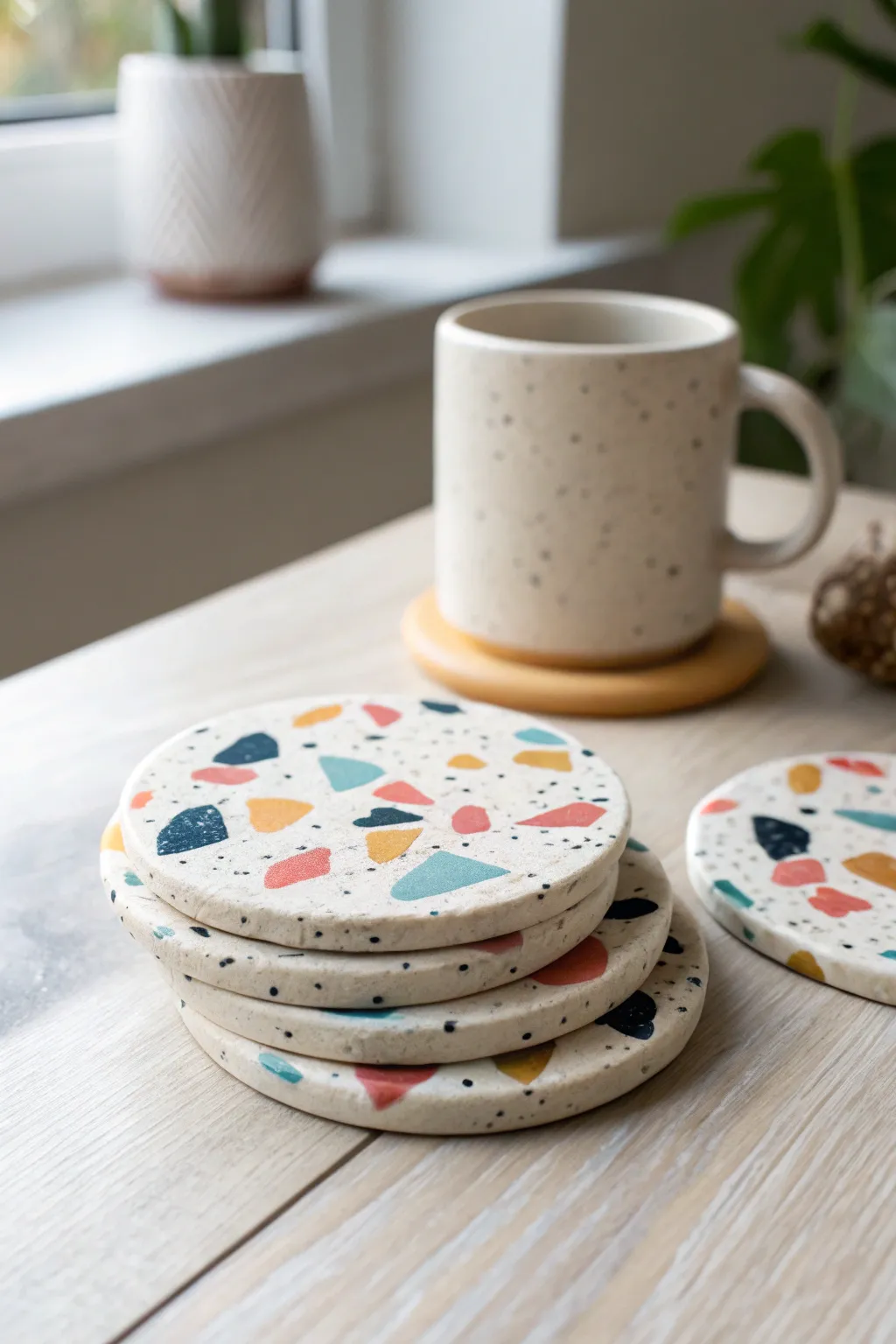
These sleek, modern coasters mimic the classic look of Italian terrazzo using versatile air-dry clay. With just a few simple techniques, you can achieve that high-end, speckled finish perfect for protecting your coffee table in style.
Step-by-Step Tutorial
Materials
- White or cream air-dry clay (base)
- Small amounts of colored air-dry clay (blue, yellow, pink, grey) OR acrylic paint to tint white clay
- Rolling pin or acrylic roller
- Round cookie cutter (approx. 4 inches) or a bowl to trace
- Fine-grit sandpaper (400 to 600 grit)
- Craft knife or clay slicer
- Acrylic rolling guides/slats (optional for even thickness)
- Matte or glossy varnish/sealant for waterproofing
- Parchment paper or a silicone mat
- Small bowl of water
Step 1: Prepping the Chips
-
Coloring the Clay:
If you don’t have pre-colored clay, start by taking small marble-sized balls of your white clay. Add a drop of acrylic paint to each—focus on creating a palette of navy blue, soft teal, mustard yellow, and rose pink—and knead thoroughly until the color is uniform. -
Flattening the Colors:
Roll each colored ball out very thinly onto your parchment paper. You want these ‘chips’ to be almost paper-thin so they integrate well later. -
Creating the Chips:
Once flattened, tear these colored sheets into random, jagged little pieces. Vary the sizes from tiny specks to larger triangles to capture that authentic terrazzo look. -
Set Aside:
Let these colored chips dry for about 10–15 minutes. They don’t need to be fully hard, but slightly leathery works best so they keep their sharp edges during the rolling process described next.
Clean Rolling
Place a sheet of parchment paper BETWEEN the rolling pin and the clay when embedding the chips. This prevents colors from smearing onto the white background.
Step 2: Forming the Coaster
-
Roll the Base:
Take a large handful of the white or cream clay and knead it until soft and pliable. Roll it out on your work surface to a thickness of about 1/4 inch (6mm). Using depth guides here really helps keep things even. -
Sprinkle the Chips:
Scatter your semi-dried colored chips onto the white clay slab. Aim for a random distribution, ensuring some chips overlap slightly and leaving negative space. -
Add Texture Details:
For that extra speckled detail seen in the photo, take a small pinch of black or dark grey clay, crumble it into tiny dust-like particles, and sprinkle these between the larger colored chips. -
Embed the Design:
Using your rolling pin, gently roll over the chips to press them into the white base. I like to roll in multiple directions here to ensure the chips stretch slightly and become flush with the surface. -
Smooth the Surface:
Continue rolling until the surface feels completely smooth and flat and the clay is back to your desired thickness.
Level Up
Add gold leaf flakes along with the colored chips before rolling. The metallic accent creates a luxe, modern twist that catches the light beautifully.
Step 3: Cutting and Finishing
-
Cut the Shape:
Place your round cutter or bowl template over the patterned clay. Press down firmly to cut out your circle. If using a bowl, trace around it carefully with your craft knife. -
Soften Edges:
Dip your finger in a little water and run it along the cut edges of the circle to smooth out any roughness or loose bits of clay. -
Drying:
Transfer the coaster to a clean sheet of parchment paper. To prevent curling, place a light book on top after about an hour, or flip the coaster over carefully every few hours. -
Wait:
Allow the clay to dry completely for 24–48 hours depending on humidity. It should feel lightweight and chalky when done. -
Sanding:
Once bone dry, take your fine-grit sandpaper and gently sand the surface. This removes the thin film of white clay that might be covering your colored chips, making the colors pop vibrantly. -
Sealing:
Apply 2-3 coats of a waterproof varnish or sealant. This is crucial for coasters to prevent water rings from ruining the clay.
Enjoy your stylish new décor and get ready to impress guests with your custom craftsmanship

What Really Happens Inside the Kiln
Learn how time and temperature work together inside the kiln to transform clay into durable ceramic.
Pinch Pots With Painted Rims
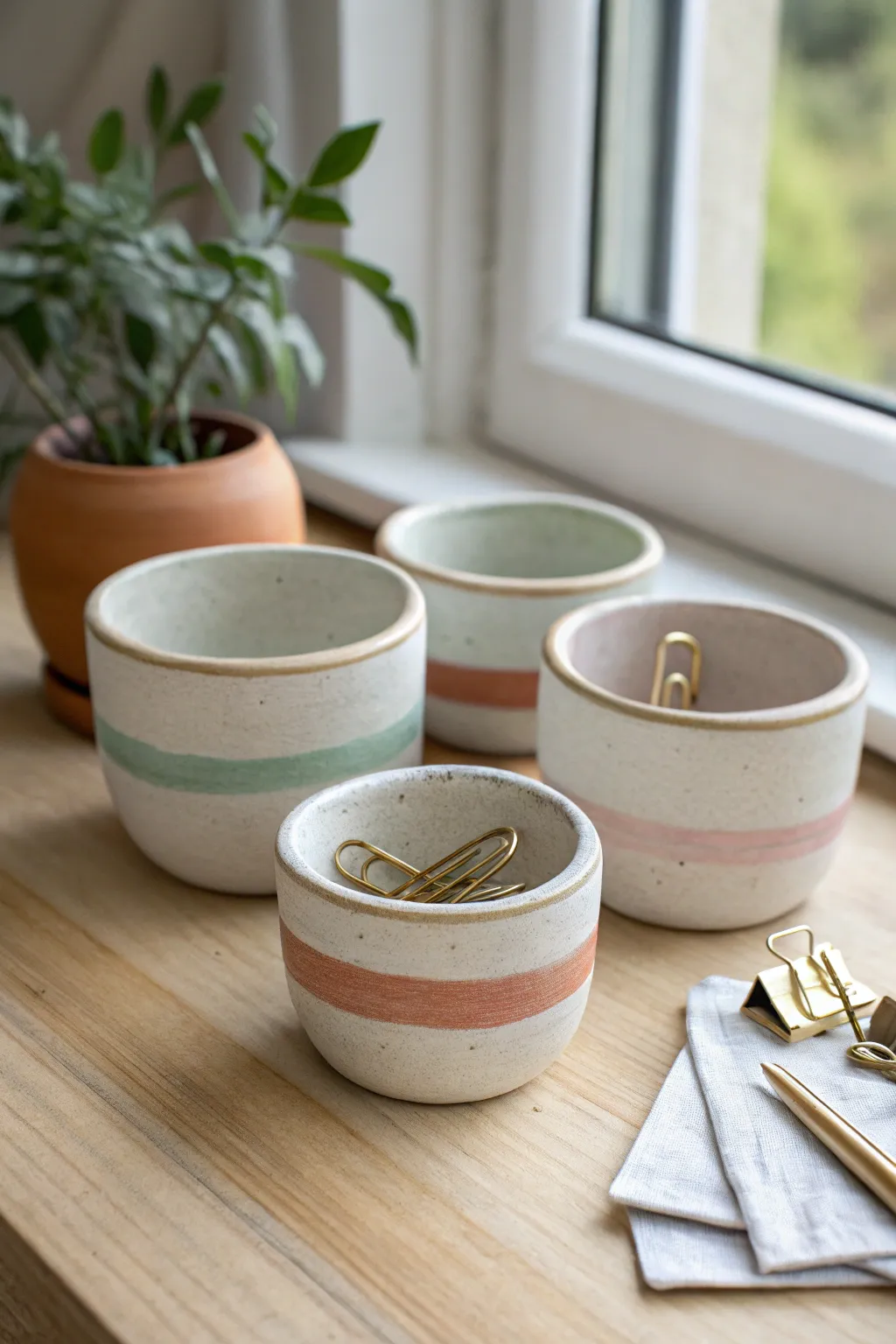
These charming, organically shaped pinch pots bring a touch of modern minimalism to any desk or windowsill. With their creamy clay texture, subtle pastel bands, and elegant gold rims, they serve as perfect organizers for small trinkets or tiny succulents.
Detailed Instructions
Materials
- White air-dry clay (approx. 500g)
- Small bowl of water
- Sponge
- Acrylic paints (terracotta, sage green, blush pink)
- Metallic gold paint or gold leaf pen
- Fine detail paintbrush
- Flat shader paintbrush (medium size)
- Acrylic matte varnish or sealant
- Rolling pin (optional)
- Sandpaper (fine grit)
Step 1: Shaping the Clay
-
Prepare the clay:
Start by kneading your air-dry clay until it is soft, pliable, and free of air bubbles. Divide the clay into four equal portions, rolling each into a smooth sphere about the size of a tangerine. -
Begin the pinch:
Hold a clay sphere in one hand. Press your thumb into the center, stopping about a half-inch from the bottom to create a sturdy base. -
Form the walls:
Gently pinch the clay between your thumb and fingers, rotating the ball as you work. Ideally, you want to pull the clay upwards to create vertical walls rather than a wide bowl shape. -
Refine the thickness:
Continue pinching and turning until the walls are an even thickness, roughly 1/4 inch throughout. Check that the bottom isn’t too thick compared to the sides. -
Flatten the base:
Tap the bottom of the pot firmly against your work surface. This creates a flat, stable base so the pot won’t wobble. -
Smooth the surface:
Dip your finger or a slightly damp sponge into water and run it over the exterior and interior to smooth out any fingerprints or cracks. Don’t use too much water, or the clay will become slimey. -
Dry completely:
Set the pots aside in a cool, dry place. Let them cure for 24-48 hours. Turn them upside down halfway through the drying process to ensure the bottom dries evenly.
Clean Lines Hack
If you struggle painting straight lines freehand, wrap a rubber band or painter’s tape around the pot to use as a guide for your colored stripe.
Step 2: Sanding and Decorating
-
Smooth imperfections:
Once fully hard, inspect your pots. Use fine-grit sandpaper to gently buff away any rough patches on the rim or exterior walls for a cleaner, ceramic-like finish. -
Wipe clean:
Use a slightly damp cloth or dry brush to remove all sanding dust. Dust can prevent paint from adhering properly. -
Mix your colors:
Prepare your palette with the pastel shades: terracotta, sage green, and blush pink. If your acrylics are too bright, mix in a tiny dot of white or grey to mute them. -
Paint the band:
Using the flat shader brush, paint a single, bold horizontal stripe around the lower third of each pot. I find that rotating the pot while holding the brush steady helps create a straighter line, though a slightly organic, uneven edge adds handmade charm. -
Let the bands dry:
Allow the colored bands to dry completely, which should take about 15-20 minutes depending on the thickness of the paint. -
Add the gold rim:
Take your fine detail brush and dip it into the metallic gold paint. carefully trace the very top edge of the rim. You can let the gold overlap slightly onto the outer and inner walls for a dipped look. -
Seal the work:
Once all paint is bone dry, apply a coat of matte acrylic varnish over the entire pot (inside and out). This protects the clay from moisture and gives it a finished fee. -
Final cure:
Let the varnish cure according to the bottle instructions before placing any items inside.
Waterproofing
Air clay isn’t waterproof. If using these for real plants, coat the inside with several layers of dishwasher-safe Mod Podge or use a plastic liner pot.
Arrange your new set on a shelf to enjoy that quiet sense of accomplishment
Bud Vases in Simple Shapes
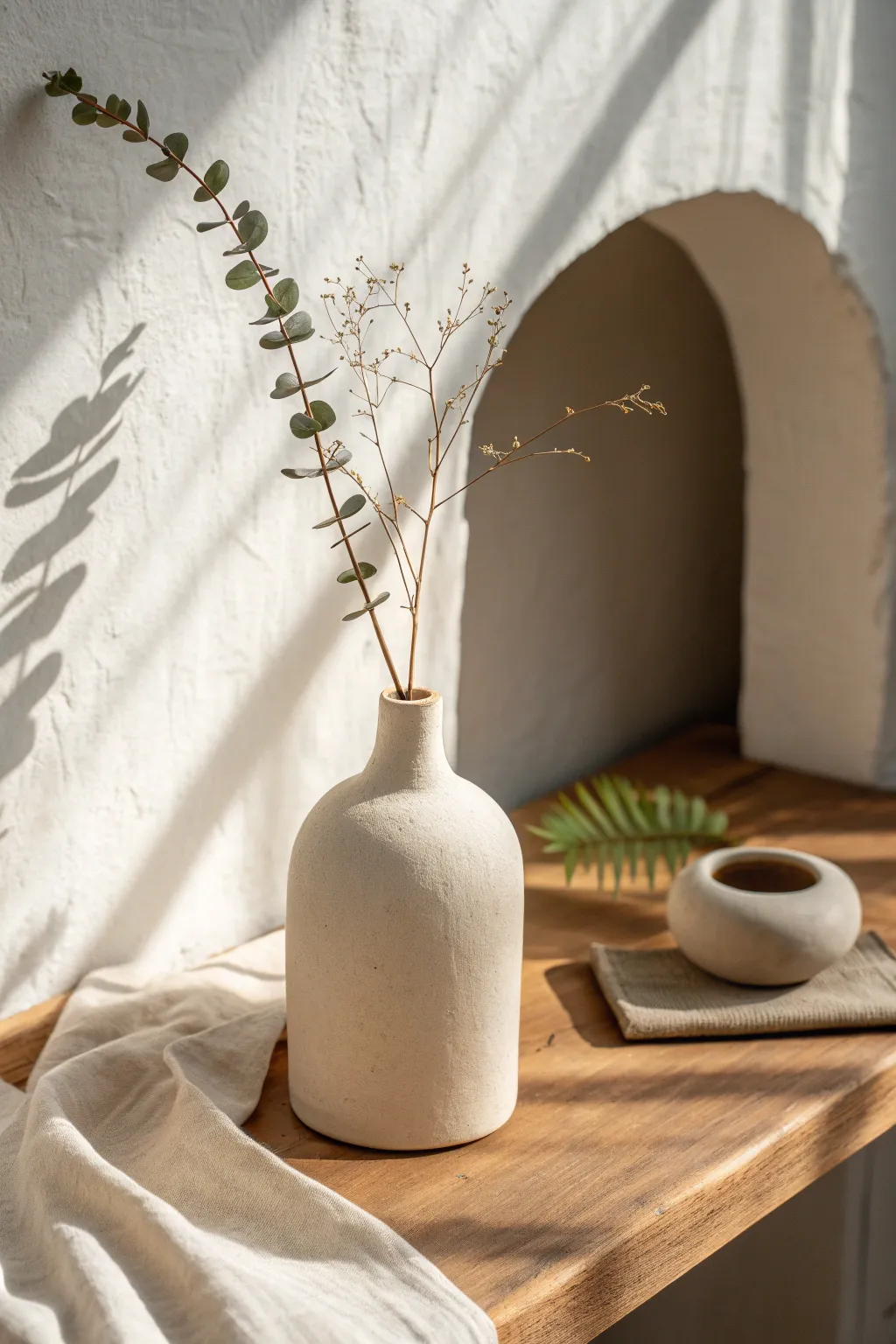
Embrace the beauty of imperfection with this elegantly simple bud vase, featuring a soft, organic shape and a textured matte finish. This project uses air-dry clay to create a calming, rustic vessel perfect for holding dried stems like eucalyptus or baby’s breath.
Step-by-Step Guide
Materials
- Air-dry clay (white or light grey)
- Rolling pin
- Craft knife or clay wire cutter
- Small cup of water
- Sponge or soft paintbrush
- Fine-grit sandpaper (220 grit)
- Acrylic paint (warm beige or cream)
- Baking soda (for texture)
- Matte spray varnish
- Glass bottle (acting as an internal armature, optional but recommended)
Step 1: Shaping the Base
-
Prepare the workspace:
Clear a flat surface and lay down a canvas cloth or parchment paper to prevent the clay from sticking. Knead a large ball of air-dry clay until it is warm and pliable. -
Form the main cylinder:
Roll your clay into a thick log. I stick my thumb into the center to begin opening it up, or if you are using a glass bottle insert for stability, flatten the clay into a slab instead. -
Wrap the armature (Method A):
If using a glass bottle insert for waterproofing, roll out a slab of clay about 1/4 inch thick. Wrap this slab entirely around the bottle, trimming away excess with your craft knife. -
Seal the seam:
Score the edges where the clay meets by scratching cross-hatch marks, add a dab of water, and press them firmly together to create a seamless join. -
Create the form (Method B):
If working without an insert for a dry-flower-only vase, pinch pot the clay upwards into a tall cylinder, keeping the walls relatively thick at the bottom for weight.
Cracks Appearing?
Make a ‘slip’ paste by mixing scraping of dry clay with water. Fill the cracks generous with this paste, let it dry, and then sand it smooth before painting.
Step 2: Refining the Silhouette
-
Smooth the body:
Dip your fingers in a little water and smooth out the main body of the vase. You want a consistent cylindrical shape that gently curves inward at the top. -
Form the shoulder:
Gently press the clay inward near the top third of the cylinder to create the ‘shoulder’ of the vase. This transition should be soft and gradual, not a sharp angle. -
Shape the neck:
Pull the clay upwards from the shoulder to form a narrow, vertical neck. It should be narrower than the main body but wide enough to hold a few stems. -
Level the rim:
Use your craft knife to slice the very top of the neck horizontally to create a clean, flat rim. Smooth the cut edge with wet fingertips so it isn’t sharp. -
Blend the surface:
Take a damp sponge and wipe down the entire exterior. Eliminate nearly all fingerprints, but don’t worry about perfect symmetry; the organic look is key.
Step 3: Drying and Finishing
-
Let it dry completely:
Place the vase in a cool, dry spot away from direct sunlight. Allow it to dry for 24-48 hours. Turn it occasionally to ensure even drying. -
Sand imperfections:
Once fully dry and hard, use fine-grit sandpaper to gently buff away any rough bumps or sharp ridges. Wipe away the dust with a dry cloth. -
Mix textured paint:
To achieve that stoneware look, mix 1 part baking soda into 2 parts beige acrylic paint. This creates a fluffy, textured mixture. -
Apply the first coat:
Paint the entire exterior of the vase using horizontal strokes. The baking soda mix will build up a beautiful, granular texture similar to unglazed ceramic. -
Add depth:
While the first coat is tacky, stipple (dab) the brush in areas to create uneven texture, enhancing the rustic feel. -
Seal the work:
After the paint is bone dry, spray the vase with a matte varnish. This protects the finish without adding an unwanted glossy shine.
Waterproofing Tip
Remember, standard air-dry clay dissolves in water. If you didn’t use a glass insert, this vase is strictly for dried florals like the eucalyptus shown.
Place your finished vase near a window where the light can catch the lovely texture you created

The Complete Guide to Pottery Troubleshooting
Uncover the most common ceramic mistakes—from cracking clay to failed glazes—and learn how to fix them fast.
Photo and Card Holders
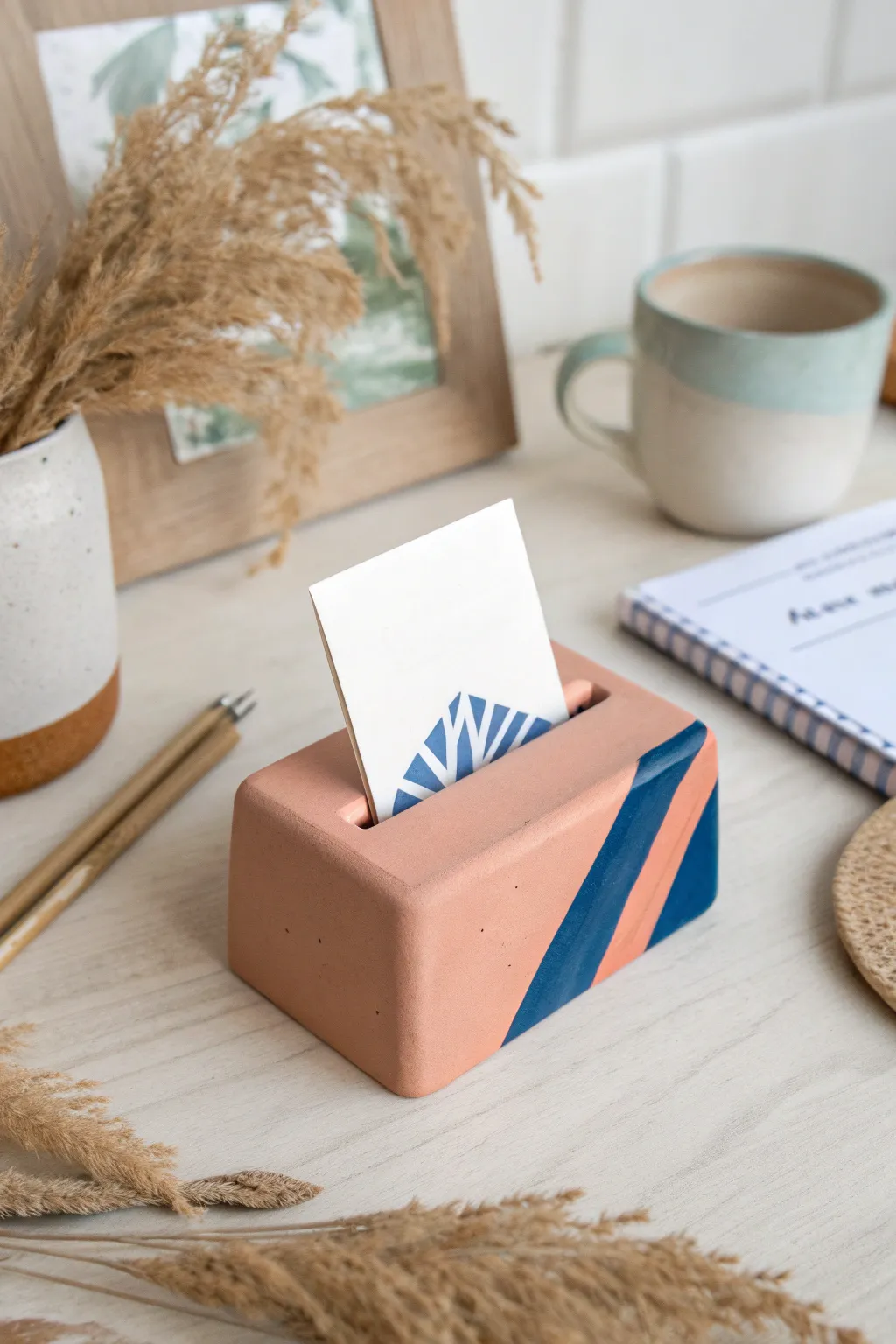
This minimalist card holder brings a pop of modern warmth to your desk with its matte peach finish and bold navy accent. Its sturdy rectangular form makes it perfect for displaying photos, business cards, or daily affirmations.
Step-by-Step
Materials
- White air-dry clay (approx. 300-400g)
- Rectangular rolling pin guide or wood blocks (approx. 2cm thick)
- Rolling pin
- Sharp clay knife or blade
- Sanding sponge (fine grit)
- Ruler
- Acrylic paint: Peach/Terracotta and Navy Blue
- Painters tape (low tack)
- Paintbrushes (flat and angled)
- Craft knife or thick cardstock (to create the slot)
- Matte varnish (optional)
Step 1: Shaping the Block
-
Condition the clay:
Begin by taking a substantial chunk of white air-dry clay. Knead it thoroughly in your hands to warm it up and remove any air pockets, ensuring a smooth, crack-free consistency. -
Form a rough rectangle:
Using your hands or by tapping it against your work surface, shape the clay into a rough rectangular brick. It doesn’t need to be perfect yet, just the general size you want. -
Create flat sides:
Place the clay between two guide blocks or wooden slats (about 4-5cm tall is ideal for this chunky look). Roll across the top to get an even height. -
Slice clean edges:
Using a long, sharp clay blade or a knife guided by a ruler, slice off the uneven sides to create straight, vertical walls. Aim for sharp 90-degree corners. -
Smooth the surfaces:
Dip your finger in a tiny bit of water and run it over the cut edges and the top face to smooth out any drag marks from the knife. Soften the sharpest corners slightly so they aren’t brittle. -
Create the slot:
While the clay is still damp, use a thick piece of cardstock or a fettling knife to press a slot into the center of the top face. Ensure it goes about 1-1.5cm deep but doesn’t warp the sides. -
Widen the opening:
Gently wiggle the tool back and forth to ensure the slot is wide enough to hold a card without being too tight. Inspect the edges of the slot and smooth them down if the clay lifted up. -
Allow to dry completely:
Set the block aside on a wire rack or a porous surface. Let it dry for at least 24-48 hours. Turn it over halfway through to ensure the bottom dries evenly.
Smooth Operator
To get walls as straight as the photo, lightly sand the dry clay on a flat sheet of sandpaper placed on your table before painting.
Step 2: Finishing and Painting
-
Sand for perfection:
Once fully dry, use a fine-grit sanding sponge to buff the entire surface. Focus on making the sides perfectly flat and the corners crisp. -
Dust off:
Wipe the block down with a slightly damp cloth to remove all clay dust. This is crucial for smooth paint application. -
Base coat mixing:
Mix a warm peach or terracotta color. I find adding a tiny drop of white to standard terracotta paint creates that soft, modern pastel look seen in the photo. -
Apply base color:
Paint the entire block with your custom peach mix. You will likely need 2–3 thin coats to get that solid, opaque finish. Let each coat dry fully before adding the next. -
Masking the design:
Once the peach base is 100% dry (give it extra time just to be safe), apply a strip of painter’s tape diagonally across one end of the block. -
Add the second stripe:
Place a second piece of tape parallel to the first, leaving a gap of about 1.5cm for the navy stripe. Press the edges of the tape down firmly to prevent bleed-under. -
Paint the accent:
Fill in the masked area with navy blue acrylic paint. Use a fairly dry brush to avoid forcing paint under the tape edges. -
Reveal the pattern:
Peel off the tape while the blue paint is still slightly tacky—this helps create a super sharp line. If there are any tiny bleeds, touch them up with the peach paint and a detailed brush. -
Seal the piece:
Spray final piece with a matte varnish to protect the paint while maintaining that velvety, non-glossy texture shown in the original design.
Level Up
Mix baking soda into your acrylic paint to give the holder a stone-like, textured finish that mimics real terracotta.
Now you have a stylish, handmade spot to showcase your favorite memories or motivational quotes
Moon Phase Wall Garlands
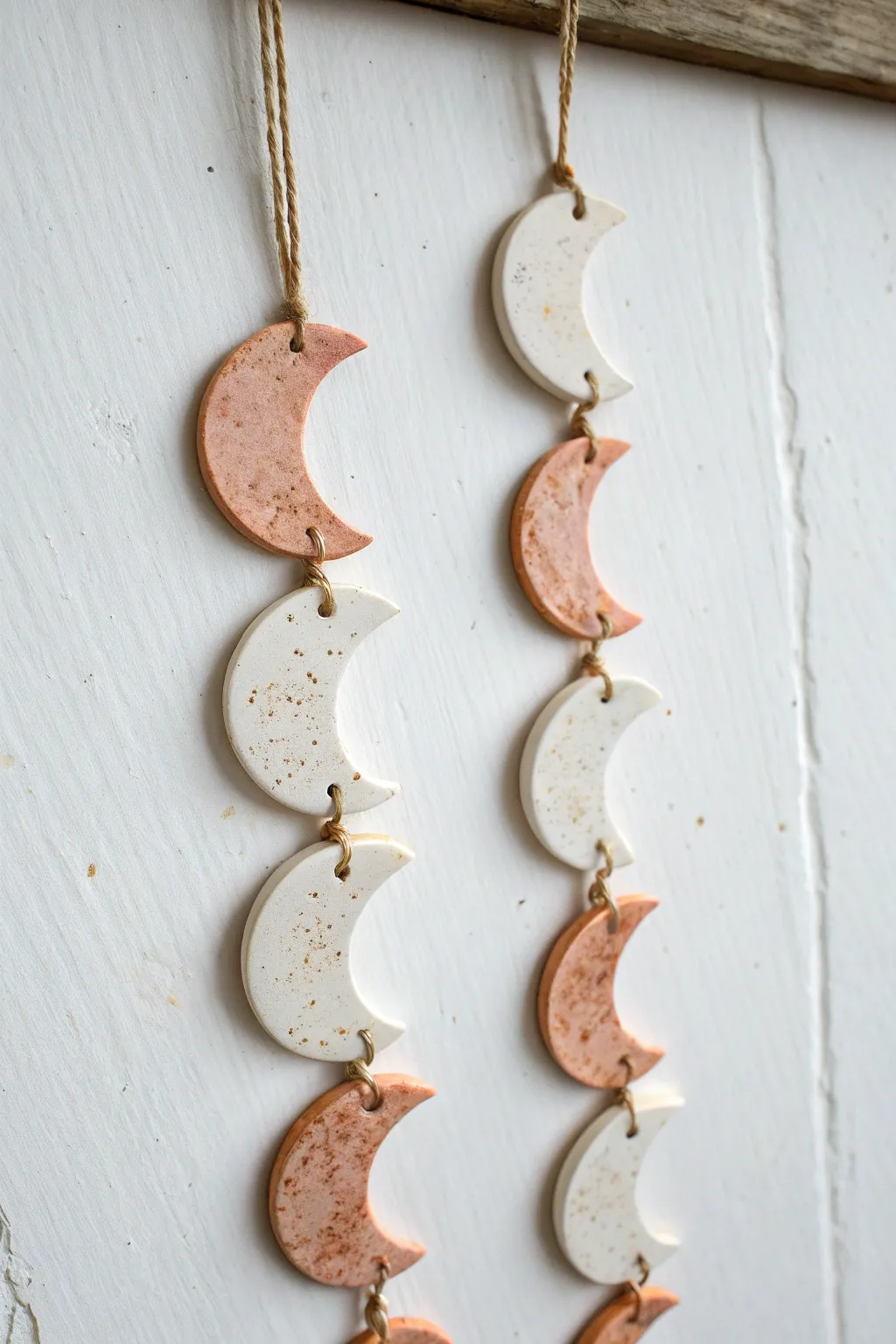
Capture the celestial beauty of the night sky with this earthy, minimalist wall garland. Featuring alternating shades of creamy white and warm terracotta, these crescent moons are finished with delicate gold speckling for a touch of subtle shimmer.
Step-by-Step Tutorial
Materials
- Air-dry clay (white)
- Acrylic paint (terracotta or burnt orange)
- Acrylic paint (gold metallic)
- Small rolling pin
- Round cookie cutter or a drinking glass (approx. 2-3 inches diameter)
- Knife or clay tool
- Dowel or drinking straw (for poking holes)
- Sandpaper (fine grit)
- Old toothbrush or stiffness paintbrush
- Jute twine or hemp cord
- Parchment paper or craft mat
Step 1: Planning and Mixing
-
Prepare your workspace:
Lay down parchment paper or a craft mat on a flat surface to prevent sticking. -
Create the clay colors:
Keep half of your clay in its natural white state. For the second color, take the remaining half and knead in a small amount of terracotta acrylic paint until the color is uniform throughout. I find adding paint gradually prevents the clay from getting too sticky. -
Condition the clay:
Knead both balls of clay separately until they are pliable, smooth, and free of cracks.
Step 2: Shaping the Moons
-
Roll out the clay:
Using your rolling pin, roll both the white and colored clay slabs to an even thickness, about 1/4 inch thick. -
Cut the primary circles:
Use your round cutter or glass to punch out full circles from both clay slabs. You will need roughly 4-5 circles of each color for a standard length garland. -
Form the crescents:
Take your cutter and overlap it onto the cut circles to slice away a portion, leaving behind a crescent moon shape. Experiment with how ‘full’ or ‘thin’ you want your moons to be. -
Smooth the edges:
Dip your finger in a little water and gently run it along the cut edges of each moon to smooth out any roughness or sharp corners. -
Create hanging holes:
Using a straw or a small dowel, poke two holes in each moon—one at the top tip and one at the bottom tip. Ensure the hole is not too close to the edge to prevent breakage.
Fixing Cracks
If hairline cracks appear while drying, mix a tiny bit of fresh clay with water to make a ‘slip’ paste. Fill the crack, smooth it over, and let it dry again.
Step 3: Finishing Touches
-
Dry the pieces:
Lay the moons flat on a clean surface to dry. Flip them over halfway through the drying process to ensure they dry evenly and don’t curl. This usually takes 24-48 hours depending on humidity. -
Sand for perfection:
Once fully dry and hard, use fine-grit sandpaper to gently buff away any remaining uneven edges or surface bumps. -
Apply the speckle:
Dilute a small amount of gold metallic paint with a drop of water. Dip an old toothbrush into the mixture. -
Splatter technique:
Hold the toothbrush over your clay pieces and run your thumb along the bristles to flick tiny distinct specks of gold onto the surface. Let the paint dry completely.
Add Texture
Before the clay dries, gently press a piece of lace or a textured fabric into the surface to give your moons a subtle, embossed pattern underneath the gold specks.
Step 4: Assembly
-
Prepare the cord:
Cut a long length of jute twine. Create a loop at the very top for hanging and secure it with a knot. -
Attach the first moon:
Thread the twine through the top hole of your first moon (from front to back) and tie a knot behind the clay to hold it in place. -
Connect the bottom:
thread the twine through the bottom hole of the same moon. Tie a knot immediately under the hole to secure the position. -
Spacing the moons:
Tie a new knot in the twine about 1-2 inches down from the previous moon. This knot will support the top hole of the next moon. -
Repeat and alternate:
Slide the next moon onto the twine, resting its top hole on the knot you just made. Continue this threading and knotting process, alternating colors, until all moons are attached.
Hang your finished garland near a window or bed to enjoy the calming celestial vibe you created

TRACK YOUR CERAMIC JOURNEY
Capture glaze tests, firing details, and creative progress—all in one simple printable. Make your projects easier to repeat and improve.
Scalloped Edge Bowls
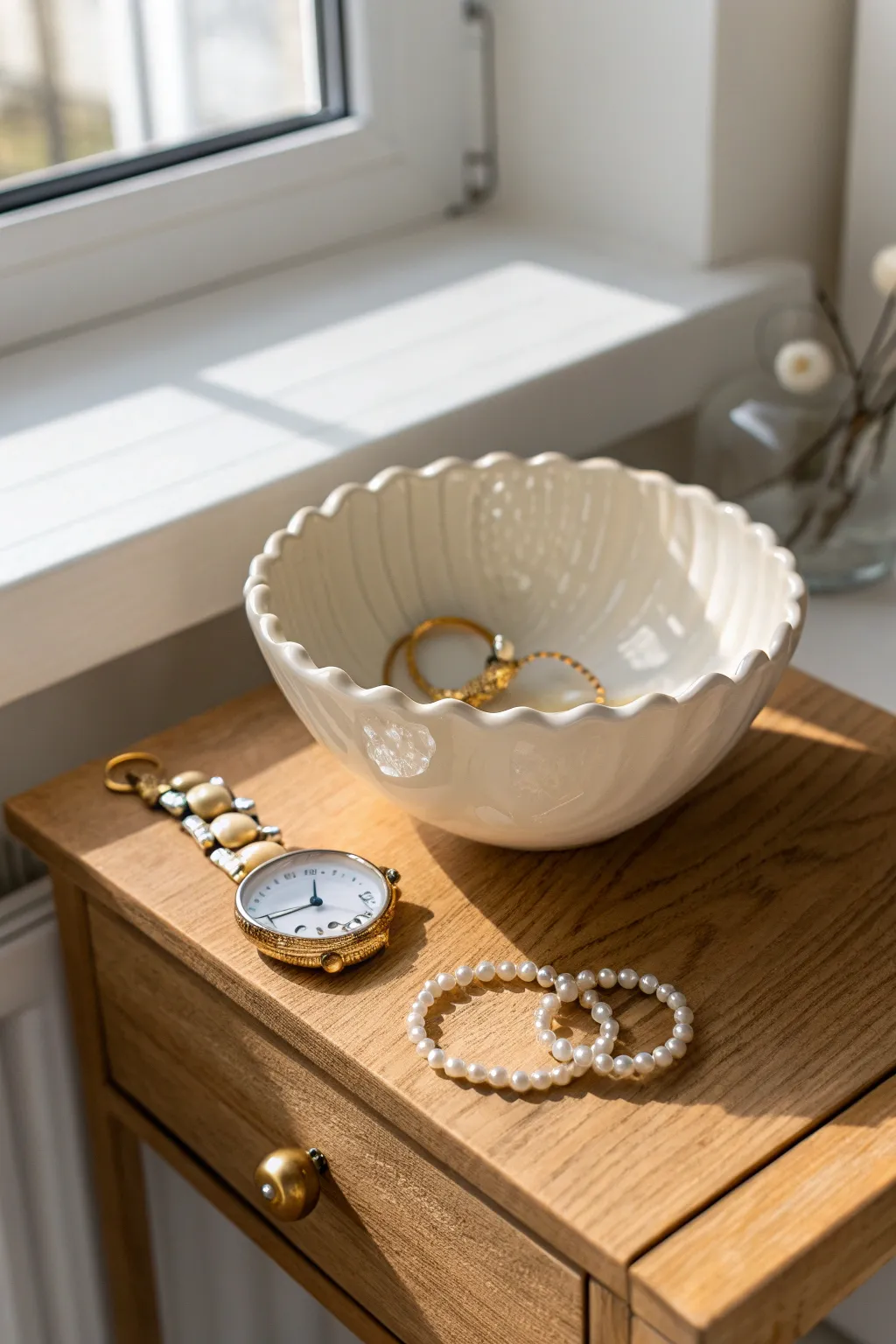
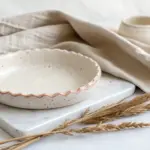
This elegant trinket bowl features a delicate scalloped rim and subtle fluting that mimics high-end ceramic ware. With its crisp white finish and glassy shine, it’s perfect for holding jewelry on a sunlit vanity.
Detailed Instructions
Materials
- White air-dry clay (fine grain preferred)
- Rolling pin
- Rolling guides or wooden slats (approx. 5mm thick)
- Medium-sized mixing bowl (for mold)
- Plastic wrap or cling film
- Round cookie cutter or bowl (slightly larger than mold)
- Modeling tool with a rounded tip or a paintbrush handle
- Sponge
- Water
- Fine-grit sandpaper (220-400 grit)
- White acrylic paint (optional)
- High-gloss varnish or resin
- Soft synthetic brush
Step 1: Shaping the Base
-
Prepare the Clay:
Begin by kneading a large handful of white air-dry clay until it is soft, pliable, and free of any air bubbles. If it feels dry, incorporate a drop or two of water. -
Roll the Slab:
Place the clay between two rolling guides to ensure an even thickness. Roll it out into a smooth slab approximately 5mm thick. Lift and turn the clay occasionally to prevent sticking. -
Cut the Circle:
Use a large round cutter or place a bowl upside down on the clay as a template. Cut a clean circle using a craft knife. This circle should be slightly larger than the mold you intend to use to account for the depth of the bowl. -
Prepare the Mold:
Take a medium-sized kitchen bowl to use as your slump mold. Cover the inside tightly with plastic wrap to prevent the clay from sticking, smoothing out any major wrinkles. -
Slump the Clay:
Gently lift your clay circle and center it inside the bowl mold. Allow gravity to pull it down, then softly press the clay against the bottom and sides to conform to the shape without stretching it too thin.
Step 2: Creating the Scallops
-
Mark the Rim:
Using a light touch, divide the rim visually into even sections. You can make tiny indentations to mark where each scallop peak will be. -
Form the Flutes:
Using a rounded modeling tool or the handle of a paintbrush, press gently into the clay at the rim’s edge to create the valleys of the scallops. I find pressing from the inside out gives a cleaner curve. -
Refine the Curves:
Use your fingers to gently pinch and round the peaks between the indentations you just made. The goal is a soft, waving edge rather than sharp points. -
Extend the Texture:
For that elegant fluted look, drag the rounded tool lightly from the valley of each scallop down towards the center of the bowl, fading the pressure as you go. This creates faint vertical ribs. -
Smooth the Edges:
Dip a small sponge in water and wring it out well. Gently wipe the rim and the interior surface to erase fingerprints and soften any harsh tool marks.
Smooth Operator
Keep a small bowl of water nearby while sculpting. Dip your finger in and run it over the rim frequently to prevent tiny cracks from forming as you shape the scallops.
Step 3: Finishing Touches
-
Initial Drying:
Let the bowl dry inside the mold for at least 24 hours. This ensures it holds its concave shape while the clay shrinks slightly. -
Remove and Dry Completely:
Once the clay is firm enough to hold its shape, carefully lift it out of the mold using the plastic wrap. Peel off the plastic and place the bowl on a wire rack to dry completely (another 24-48 hours depending on humidity). -
Sand for Smoothness:
Once bone dry, sand the entire surface with fine-grit sandpaper. Pay special attention to the scalloped rim, ensuring it feels smooth to the touch. Wipe away all dust with a slightly damp cloth. -
Paint (Optional):
If your dried clay looks off-white or grayish, apply two coats of high-quality white acrylic paint to achieve a pristine ceramic look. -
Apply Gloss Varnish:
To recreate that glassy, glazed appearance shown in the photo, apply a thick coat of high-gloss varnish. For an even glassier finish, you might use a two-part resin. -
Final Cure:
Allow the varnish or resin to cure fully in a dust-free environment before using the bowl for your jewelry.
Gilded Edge
After the white gloss dries, paint just the very edge of the scallops with liquid gold leaf or a gold paint marker for a luxurious, vintage-inspired detail.
Now you have a stunning, glossy vessel ready to display your favorite treasures
Textured Candle Holders
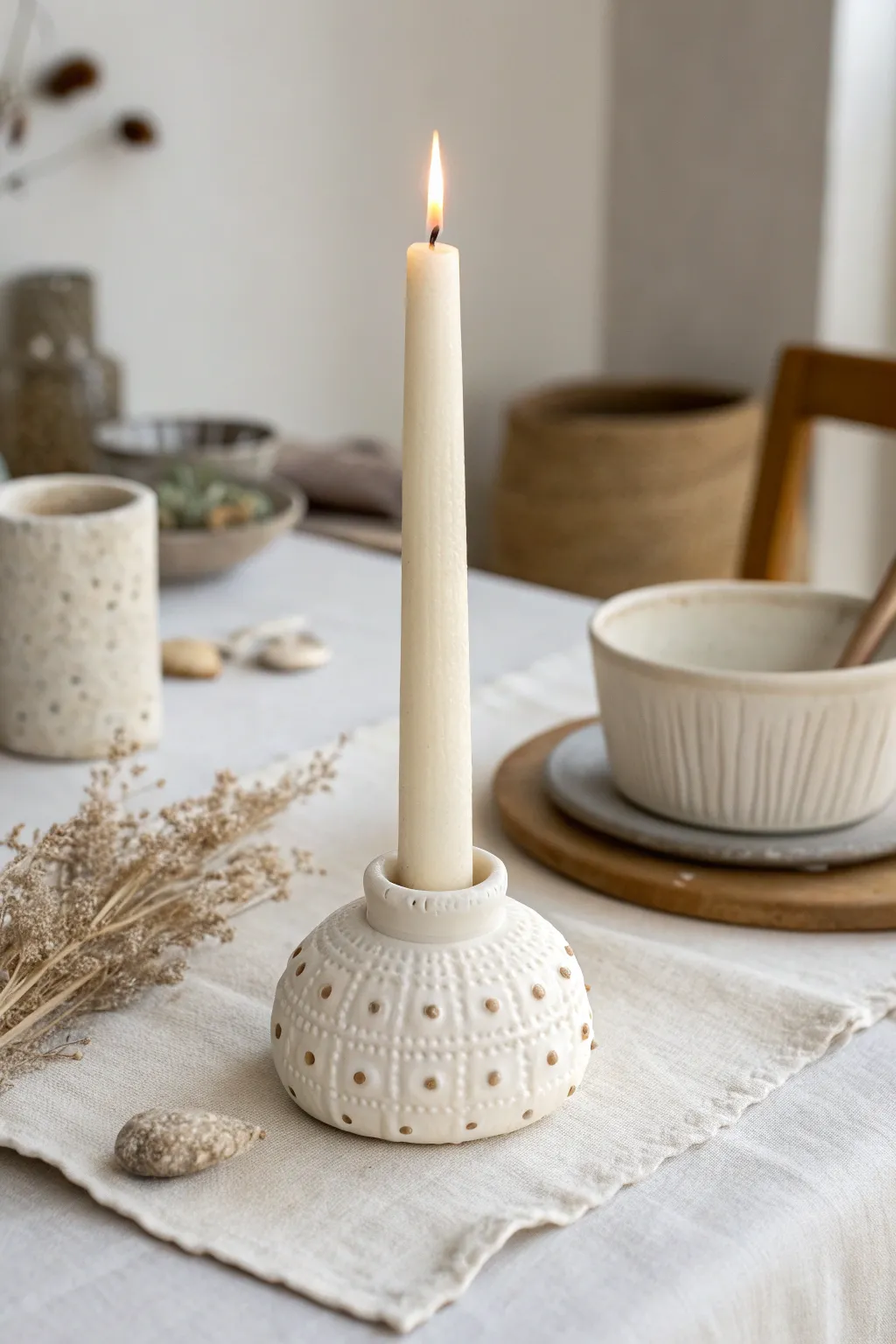
Create a stunning centerpiece that mimics the look of high-end ceramic pottery using simple air-dry clay. This project features a satisfyingly tactile dotted pattern and a soft, organic shape that adds warmth to any table setting.
Step-by-Step Guide
Materials
- White air-dry clay (approx. 500g)
- Rolling pin
- Clay knife or craft knife
- Small bowl of water
- Sponge
- Needle tool or toothpick
- Small round paintbrush handle (for indentations)
- Slip (clay mixed with water into a paste)
- Fine grit sandpaper
- Acrylic sealant (matte finish)
- Standard taper candle (for sizing)
Step 1: Forming the Base Structure
-
Prepare the clay:
Begin by conditioning your air-dry clay, kneading it in your hands until it is smooth, pliable, and free of cracks. -
Create the pinch pot:
Form a large ball of clay about the size of a grapefruit. Push your thumb into the center and gently pinch the walls while rotating the ball to create a thick, even bowl shape. -
Close the form:
Turn the bowl upside down on your work surface. Gently pat and smooth the clay downwards to create a dome shape, ensuring the bottom (which is now the top) is slightly flattened to accept the candle holder neck. -
Make the neck:
Roll a thick coil of clay. Wrap it around the base of your taper candle to measure the correct diameter, leaving just a tiny bit of wiggle room for shrinkage. -
Attach the neck:
Score (scratch) the top of your dome and the bottom of your coil ring. Apply a little water or slip, then press the coil firmly onto the center of the dome. -
Blend the seams:
Use your thumb or a modeling tool to smooth the clay from the neck down onto the dome, making the two pieces become one seamless unit. I like to support the inside of the neck with my pinky finger while blending. -
Smooth the surface:
Dip your sponge in a little water and wipe down the entire piece to remove fingerprints and create a smooth canvas for your texture.
Cracks happen
If small hairline cracks appear during drying, mix a tiny amount of fresh clay with water to make a thick paste and fill the cracks. Smooth over with a damp finger and let dry again.
Step 2: Adding the Texture
-
Map the grid:
Using a needle tool, very lightly lightly sketch vertical lines from the neck to the base, spacing them evenly around the dome. Then sketch horizontal rings to create a grid. -
Create indentations:
Use the rounded end of a small paintbrush or a dotting tool to press distinct holes along your sketched grid lines. Press deep enough to see texture, but not through the wall. -
Make clay dots:
Roll tiny, peppercorn-sized balls of clay. You will need enough to fill the alternating spaces in your grid pattern. -
Attach the dots:
Dip each tiny ball into your slip mixture and press it firmly onto the surface in the center of the grid squares. The slip acts as glue. -
Refine the neck:
Add a few indentations or tiny dots around the rim of the neck to tie the design together.
Sizing trick
Wrap the base of your taper candle in cling film before using it to size the neck. Keep it inserted while you blend the neck seam to ensure the opening stays perfectly round.
Step 3: Finishing Touches
-
Slow drying:
Place a plastic bag loosely over the piece for the first 24 hours to prevent cracking, then uncover and let it dry completely (24-48 more hours) until it turns chalky white. -
Sand imperfections:
Once bone dry, gently sand any rough spots, particularly around the bottom rim where it sat on the table. -
Seal the piece:
Apply a coat of matte acrylic sealant to protect the clay from moisture and give it a finished, ceramic feel.
Light your candle and enjoy the calm atmosphere your new handmade creation brings to the room
Modern Desk Organizer Trays
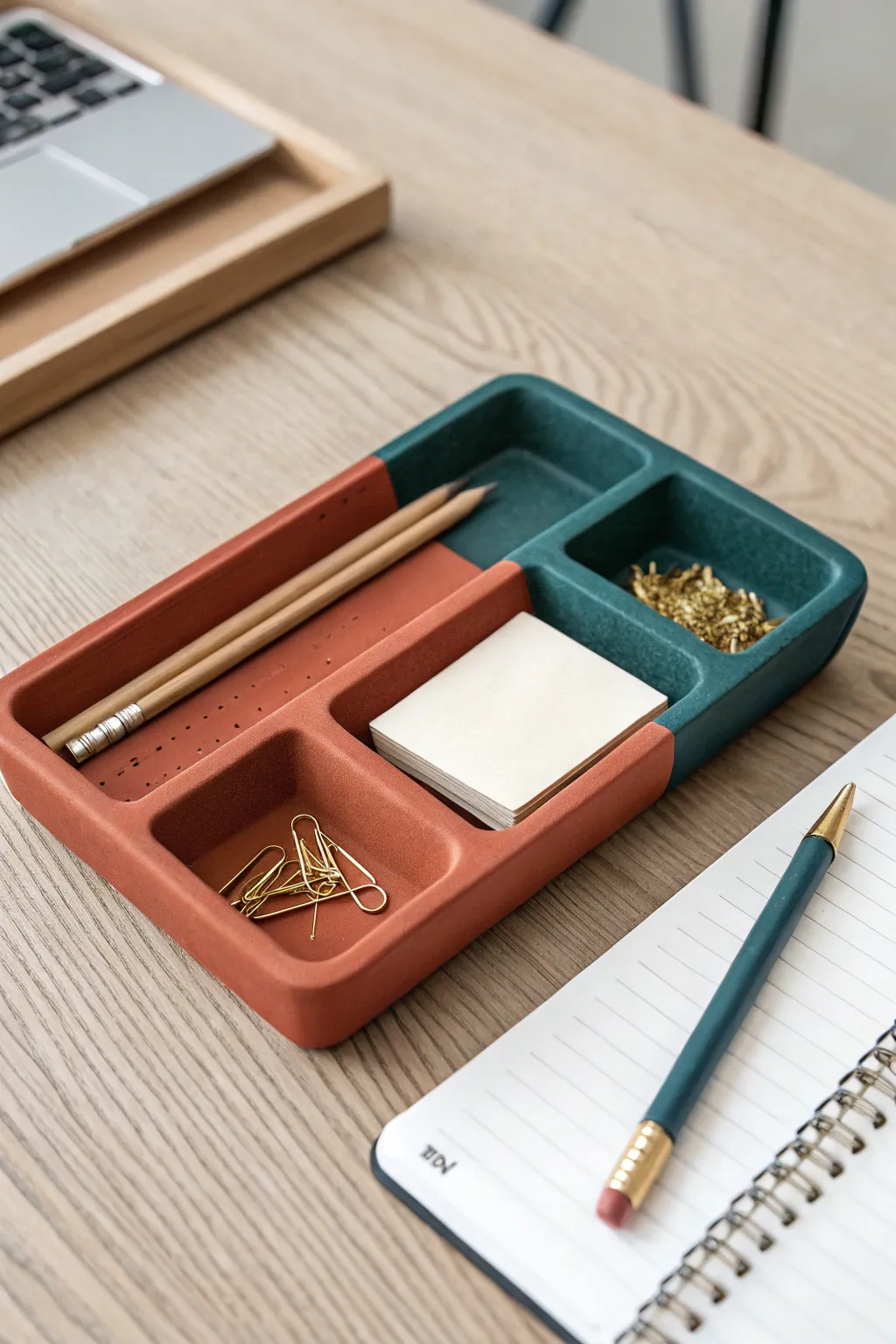
Elevate your workspace with this sleek, geometric organizer that combines warm terracotta and cool teal tones in a functional design. Its segmented compartments are perfect for keeping pencils, clips, and notes tidy while adding a pop of contemporary color to your desk.
Step-by-Step
Materials
- White polymer or premium air-dry clay (approx. 500g)
- Acrylic paints (terracotta/burnt sienna and deep teal/forest green)
- Rolling pin
- Cutting mat and craft knife
- Ruler
- Fine-grit sandpaper (220 and 400 grit)
- Small bowl of water
- Sponge or soft paintbrush
- Matte varnish or sealant
- Cardboard or foam core (for templates)
Step 1: Designing the Structure
-
Plan your layout:
Begin by deciding on the overall dimensions. A standard size for this tray is roughly 4 inches wide by 8 inches long. Sketch a layout with four compartments: one long slot for pencils, a square for sticky notes, and two smaller squares for loose items. -
Create templates:
Cut pieces of cardboard to serve as walls. You’ll need four outer walls and three inner divider walls. Make them about 0.75 inches high to match the shallow profile of the tray. -
Prepare the clay base:
Roll out a large slab of clay to a uniform thickness of about 1/4 inch. I like to use guide strips on either side of the rolling pin to ensure it is perfectly even. -
Cut the base:
Using your ruler and craft knife, cut a clean rectangle from the slab for the base of the tray. Smooth the edges with a damp finger to remove any drag marks from the knife.
Clean Lines Pro-Tip
Use high-quality painter’s tape (pressed down firmly) when painting the division line. Paint a thin layer of clear matte medium over the tape edge first to prevent any bleeding underneath.
Step 2: Building the Walls
-
Cut wall strips:
Roll out more clay to the same thickness as the base. Cut long strips that are roughly 1 inch tall. These will become your vertical dividers and outer walls. -
Score and slip:
Score the perimeter of your base and the bottom edge of your first wall strip using a needle tool or fork. Apply a small amount of water or liquid clay (slip) to the scored areas. -
Attach the outer border:
Press the outer walls firmly onto the base. Reinforce the inside seam by running a clay tool or your finger along the joint to merge the clay together seamlessly. -
Install dividers:
Measure and cut your interior divider strips. Place them according to your sketch—one long divider down the middle, and shorter walls to create the small compartments. Score, slip, and smooth the joints carefully. -
Refine the corners:
Use a damp sponge or finger to round over the sharp corners slightly. The actual tray has soft, rounded edges rather than sharp 90-degree angles, so focus on softening the top lips of the walls.
Warping Woes?
If the base of your tray curls up while drying, place a flat, heavy book on top of it (sandwiched between parchment paper) during the final stages of drying to force it flat again.
Step 3: Finishing and Coloring
-
Slow drying:
Let the piece dry slowly away from direct heat or sunlight for at least 24-48 hours. Turn it over gently halfway through if possible to let the bottom dry evenly. -
Sanding for smoothness:
Once bone dry, sand the entire piece. Start with 220 grit to remove big bumps, then switch to 400 grit for a silky smooth finish. Wipe away all dust with a slightly damp cloth. -
Mark the color zones:
Use a ruler and pencil to lightly mark the diagonal line where the colors will split. In this design, the terracotta section covers the pencil slot and one small bin, while the teal covers the rest. -
Paint the first section:
Mix your burnt sienna acrylic paint to get that rich terracotta look. Apply two opaque coats to the designated section, using a straight edge or masking tape to keep the dividing line crisp. -
Paint the second section:
Once the first color is dry, paint the remaining section in deep teal. Be very careful at the color junction; a steady hand here makes the design pop. -
Add texture (optional):
If you want the speckled look seen in the inspiration photo, flick a stiff toothbrush dipped in slightly watered-down dark grey paint over the surface. -
Seal:
Finish with a coat of matte spray varnish. This protects the paint from scratching and gives it that professional, store-bought finish.
Fill your new tray with your favorite stationery items and enjoy a more organized, stylish workspace
Alphabet Pinch Containers
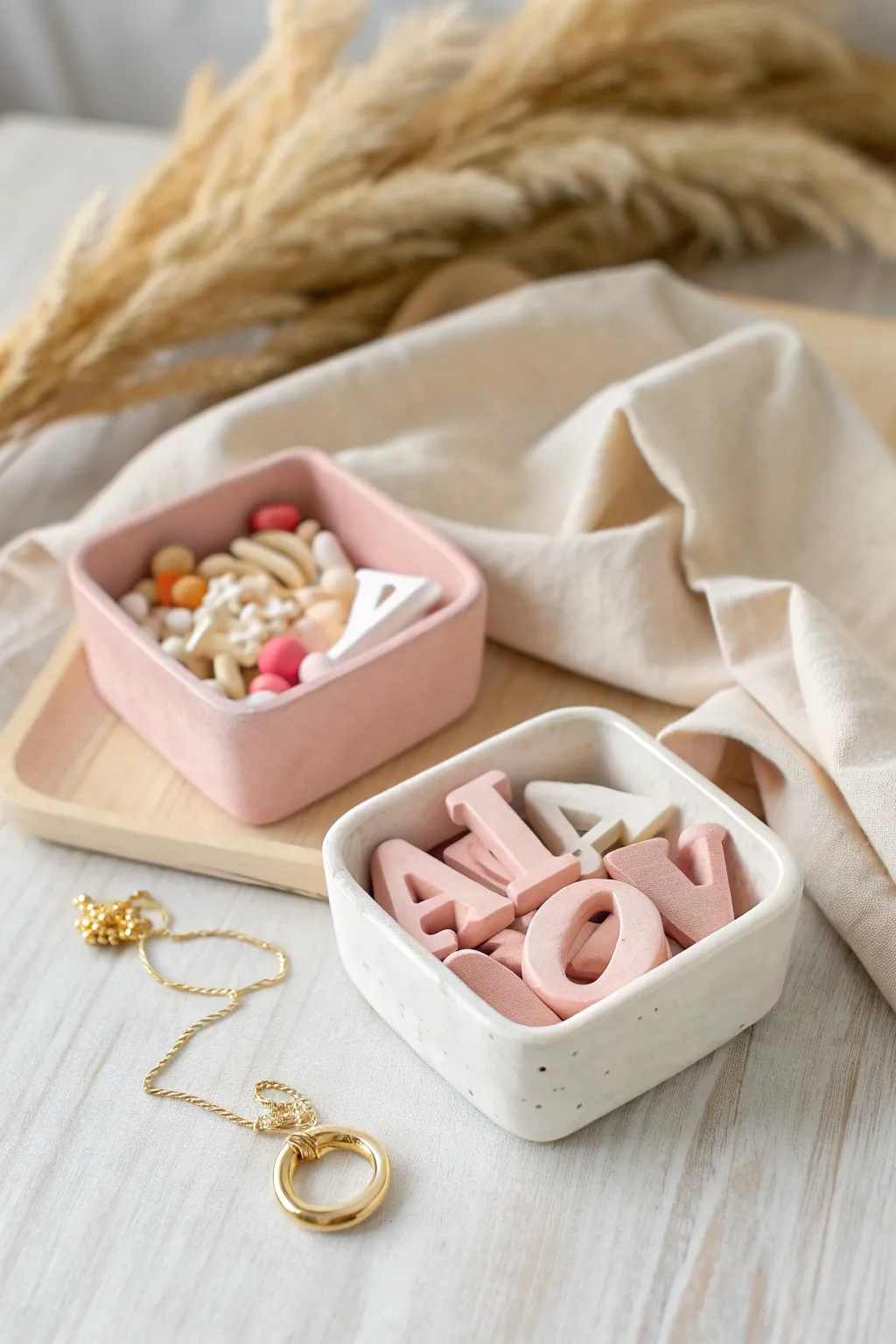
Create a charming set of personalized storage vessels that combine minimalist design with playful typography. These square pinch pots feature smooth, matte finishes in soft blush and speckled cream, perfect for holding jewelry or the clay letters themselves.
Detailed Instructions
Materials
- Air dry clay (white)
- Acrylic paint (blush pink, white, warm beige)
- Fine grit sandpaper
- Rolling pin
- Square cookie cutter (approx. 4 inches)
- Craft knife
- Alphabet silicone mold or small letter cutters
- Bowl of water
- Sponge
- Matte varnish or sealant
- Paintbrush (flat shader and detail brush)
- Old toothbrush (for speckling)
Step 1: Shaping the Square Bowls
-
Roll the slab:
Begin by conditioning your air dry clay until it is soft and pliable. Roll it out on a flat surface to an even thickness of about 1/4 inch. -
Cut the base:
Using your square cookie cutter or a craft knife and ruler, cut out two identical squares to serve as the bases for your bowls. -
Create the walls:
Roll out long strips of clay, maintaining the same 1/4 inch thickness. Cut these strips to be approximately 1.5 inches tall. -
Attach the walls:
Score the edges of your square base and the bottom edge of your clay strips. Apply a little water to the scored areas to create a slip. -
Shape the corners:
Gently press the strips onto the base, wrapping them around to form the square walls. Pinch the corners together where the strips meet to seal the shape. -
Smooth the seams:
Dip your finger in water and smooth out the seams on both the inside and outside of the bowl. I like to use a slightly damp sponge here to get a really flawless surface. -
Round the edges:
Gently soften the sharp top rim and the corners of the bowl with your fingertips so the final look is organic and soft rather than rigid. -
Dry the bowls:
Set the bowls aside to dry completely. This usually takes 24-48 hours depending on humidity. Flip them occasionally to ensure the bottom dries evenly.
Smooth Operator
Use a tiny amount of water on your fingertip to smooth clay edges before drying. It saves tons of sanding time later.
Step 2: Crafting the Letters
-
Form the alphabet:
While the bowls are drying, press fresh clay into your alphabet silicone molds. Alternatively, roll out a thin slab and use small cutters. -
Release and clean:
Carefully pop the letters out of the mold. Use a craft knife to trim away any excess clay bits or flashing for crisp outlines. -
Dry the letters:
Place the letters on a flat surface to dry. Since they are small, they should be ready to paint in a few hours.
Step 3: Sanding and Painting
-
Sand for smoothness:
Once the bowls are fully dry, use fine-grit sandpaper to buff away any fingerprints or rough patches. Wipe away the dust with a barely damp cloth. -
Paint the blush bowl:
Mix a small amount of warm beige into your pink acrylic paint to mute the tone. Apply two even coats to one bowl, covering the inside and outside completely. -
Paint the speckled bowl:
Paint the second bowl with a creamy white acrylic. Let it dry completely. -
Add the speckles:
Dilute a tiny drop of brown or black paint with water. Dip an old toothbrush into the mixture and run your thumb across the bristles to flick tiny speckles onto the white bowl. -
Paint the letters:
Paint your dried clay letters in coordinating shades—some pink, some white, and perhaps a few in beige for variety. -
Seal pieces:
Apply a coat of matte varnish to both the bowls and the letters to protect the finish and give them a professional, non-chalky look. -
Assemble display:
Once dry, fill your new bowls with the clay letters or use them to hold your favorite jewelry pieces.
Cracked Up?
If small cracks appear as the clay dries, mix a tiny bit of fresh clay with water to make a paste and fill the gaps, then sand smooth.
Enjoy styling your new handmade organizers on a vanity or desk for a touch of artisan charm
Beaded-Rim Jewelry Bowls
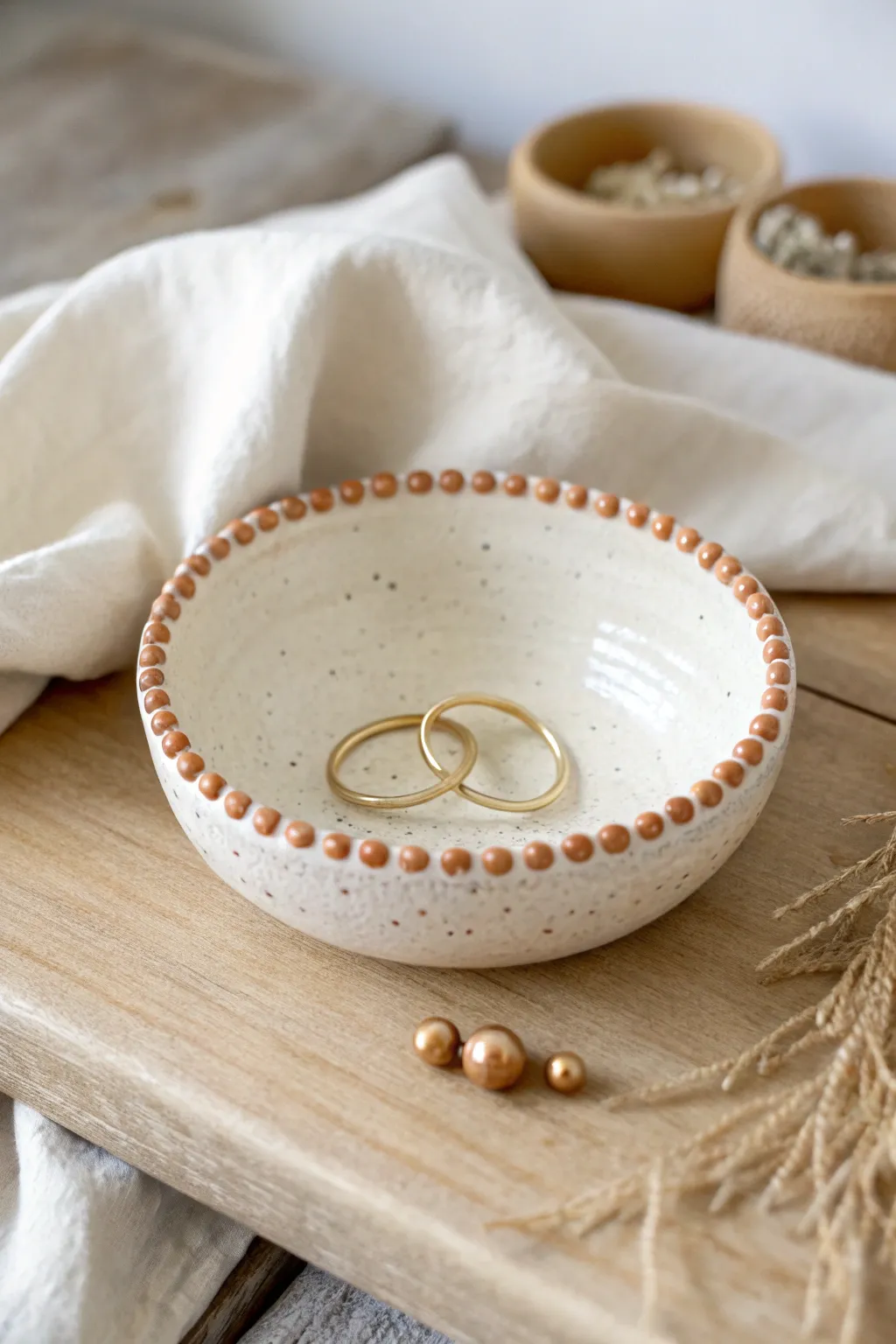
Elevate your vanity with this charming jewelry dish, featuring a delicate rim of copper-colored beads and a trendy speckled stoneware finish. This project perfectly mimics the look of high-end ceramic pottery using accessible air-dry clay.
Step-by-Step Guide
Materials
- White air-dry clay
- Rolling pin
- Small bowl (to use as a mold)
- Craft knife or clay cutter
- Sponge and water
- Acrylic paint (copper/metallic bronze)
- Acrylic paint (black or dark brown for speckles)
- Gloss varnish or sealant
- Fine detail paintbrush
- Old toothbrush
- Sandpaper (fine grit)
Step 1: Forming the Bowl
-
Prepare the Clay:
Start by kneading a handful of white air-dry clay until it is soft, pliable, and free of cracks. If it feels too dry, add a tiny drop of water. -
Roll the Slab:
Roll the clay out on a smooth surface to an even thickness of about 1/4 inch (6mm). Rotate the clay occasionally to ensure it doesn’t stick to your work surface. -
Cut the Circle:
Place your bowl mold upside down on the clay slab and trace around it with a craft knife to cut a perfect circle. -
Shape the Dish:
Gently lift the clay circle and place it inside your bowl mold. Press it down lightly so it takes the curved shape, but don’t press so hard that it gets stuck. Smooth the interior with a damp sponge.
Uneven Drying?
If the clay curls while drying, weigh the center down with a small bag of rice. Rotate the piece every few hours for airflow.
Step 2: Adding the Beaded Rim
-
Roll Tiny Balls:
Pinch off very small pieces of clay and roll them between your fingers to create tiny spheres. You will need roughly 40-50 beads, depending on the circumference of your bowl. -
Check for Consistency:
Try to keep the beads as uniform in size as possible, aiming for the size of a small pea or peppercorn. -
Score and Slip:
Using a needle tool or an old toothbrush, rough up the top rim of your clay bowl slightly. Apply a tiny amount of water or clay split (watery clay glue) to the rim. -
Attach the Beads:
Place the clay beads one by one onto the damp rim. Press them gently so they adhere firmly without losing their round shape. -
Blend the Seams:
On the outside edge (underneath the bead), you can use a sculpting tool to gently blend a tiny bit of the bead clay into the bowl rim for extra security, though this is optional. -
Drying:
Let the bowl dry inside the mold for at least 24-48 hours. Once the edges look white and chalky, carefully remove it from the mold and let the bottom dry completely.
Step 3: Decorating and Finishing
-
Smooth the Surface:
Once fully dry, lightly sand any rough edges or fingerprints on the main bowl surface with fine-grit sandpaper. Be very gentle around the beads. -
Create the Speckles:
Dilute a small drop of black or dark brown acrylic paint with water. Dip an old toothbrush into this mixture and flick the bristles with your thumb to spray fine speckles across the white bowl. -
Paint the Beads:
Using a fine detail brush and copper or metallic bronze acrylic paint, carefully paint each individual bead on the rim. Take your time to avoid getting metallic paint on the white bowl interior. -
Second Coat:
Apply a second coat of copper paint to the beads if necessary to get that rich, opaque luster shown in the photo. -
Seal the piece:
Finish by applying two coats of high-gloss varnish over the entire dish. This gives it that glazed ceramic look and protects the paint.
Faux Ceramic Look
Use ‘Triple Thick’ glaze instead of standard varnish. One heavy coat mimics kiln-fired pottery glass perfectly.
Now you have a sophisticated catch-all dish ready to hold your favorite rings and trinkets
Window Suncatcher Charms
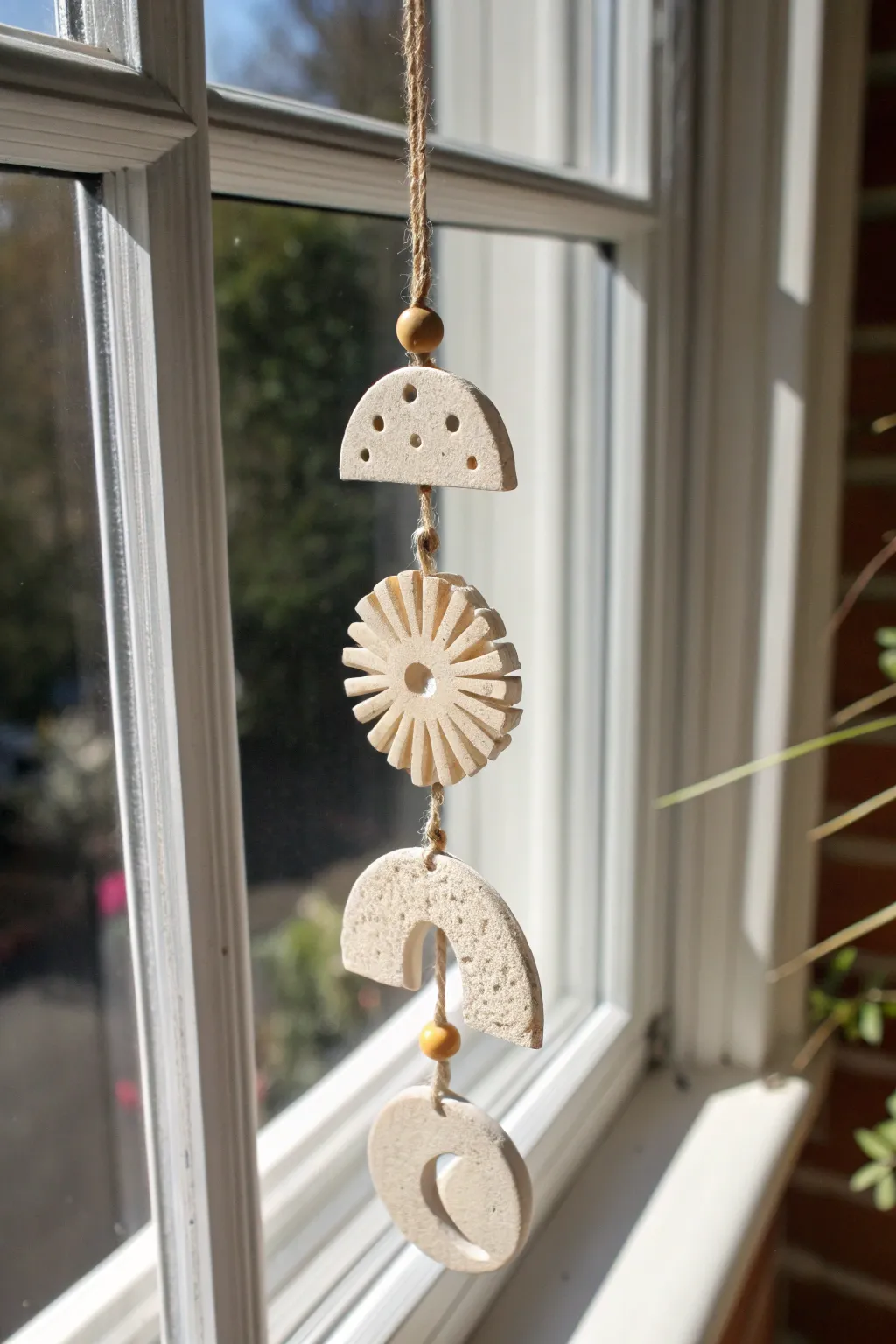
Bring earthy charm to your window with this textured air dry clay suncatcher. Featuring four distinct geometric tiers connected by rustic jute twine, this hanging mobile catches the sunlight beautifully while adding a modern bohemian touch to your decor.
Step-by-Step
Materials
- Air dry clay (white or stone-effect)
- Jute twine or hemp cord
- Rolling pin
- Carving tools or a knife
- Toothpick or skewer
- Small wooden beads (approx. 8-10mm)
- Sandpaper (fine grit)
- Small circular cookie cutter or bottle cap
- Ruler
Step 1: Shaping the Geometric Tiers
-
Condition the clay:
Begin by taking a handful of clay and kneading it in your hands until it is soft, pliable, and free of cracks. If you’re using stone-effect clay, ensure the grit is evenly distributed. -
Roll out a slab:
Use your rolling pin to flatten the clay into an even slab, aiming for a consistent thickness of about 1/4 inch (6mm) to ensure durability. -
Cut the top semicircle:
Cut a small circle about 2 inches wide using a cutter or freehand. Slice it exactly in half to create two semicircles. Reserve one for the top piece. -
Add texture to the top piece:
Using the end of a small paintbrush or a rounded tool, gently press five divots into the semicircle in a radial pattern to create the dotted design shown in the image. -
Create the sun shape:
Cut a larger circle, approximately 2.5 to 3 inches in diameter. Use a knife to slice small wedges out of the edge, creating a ray effect all around the perimeter. -
Detail the sun center:
Press a small circular indentation into the exact center of your sun shape, but do not punch all the way through. -
Form the arch:
Cut a thick arch shape, similar to a rainbow. It should have a flat bottom and a rounded top, with the legs of the arch being distinct and sturdy. -
Shape the bottom crescent:
For the final tier, roll a slightly flattened ball and use your fingers or a cutter to shape a thick, organic crescent moon or open donut shape. -
Pierce holes for hanging:
Use a skewer or toothpick to poke holes completely through each piece where the string will pass. The top semicircle needs a hole at top and bottom center; the sun and arch need vertical holes through their centers; the bottom piece only needs a top hole.
Clean Cuts
Before cutting your clay, lightly oil your knife or cutter with baby oil. It prevents dragging and keeps your geometric edges crisp and sharp.
Step 2: Drying and Assembly
-
Dry thoroughly:
Place all clay pieces on a flat surface lined with parchment paper. Let them dry for 24-48 hours, flipping them occasionally to prevent curling. -
Sand edges:
Once bone dry, use fine-grit sandpaper to gently smooth any rough edges or irregularities on the sides of your shapes. -
Prepare the twine:
Cut a long piece of jute twine, roughly 24 inches long. Tie a sturdy loop at the very top for hanging. -
Attach top bead and first tier:
Thread a wooden bead onto the twine, pushing it up near the loop. Tie a knot below it. Thread the twine down through the top hole of the semicircle and out the bottom hole. -
Secure the semicircle:
Tie a knot immediately underneath the semicircle so it rests securely without sliding down. -
Attach the sun tier:
Leave a gap of about 1.5 inches of exposed twine. Tie a knot, thread the twine through the center hole of the sun piece, and tie another knot immediately underneath it to lock it in place. -
String the arch:
Leave another 1.5-inch gap. Repeat the knotting process to attach the arch piece, ensuring it hangs level. -
Add final bead and bottom piece:
After the arch, slide on a second wooden bead and secure it with a knot. Finally, tie the bottom crescent shape onto the end of the twine and trim any excess string.
Textured Finishes
Mix dried coffee grounds or sand into your white clay before rolling. This mimics the speckled stone look without needing specialty paint.
Hang your new mobile in a sunny spot and enjoy the gentle movement of your handmade art
Tiny Fairy Garden Houses
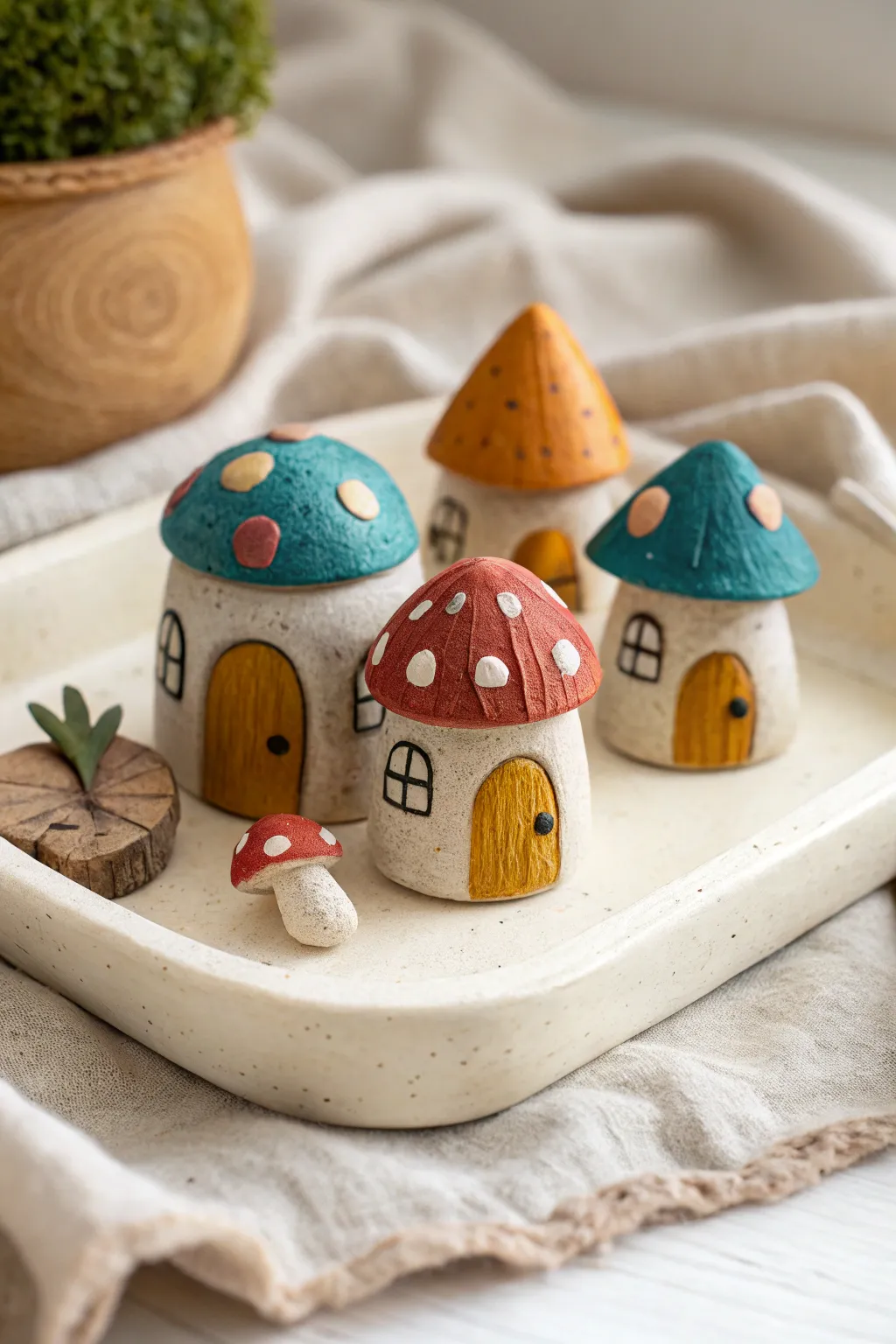
These miniature mushroom houses bring a touch of woodland magic to any shelf or tabletop, featuring adorably squat shapes and vibrant, textured roofs. Crafted from air-dry clay, they combine rustic charm with a delightful fairytale aesthetic perfect for beginners and seasoned crafters alike.
Detailed Instructions
Materials
- White specialized air-dry modelling clay (smoother texture)
- Acrylic paints (Teal/Turquoise, Burnt Orange, Mustard Yellow, White, Terracotta)
- Clay sculpting tools (specifically a small ball stylus and a needle tool)
- Rolling pin
- Small craft brushes (fine detail brush and flat shader)
- Water cup and paper towels
- Fine-grit sandpaper
- Matte varnish or sealant
Step 1: Shaping the Bases
-
Prepare the clay:
Start by conditioning a chunk of white air-dry clay in your hands until it’s pliable and smooth, ensuring there are no cracks. -
Form the cylinders:
Roll four separate balls of clay of varying sizes. Gently flatten the bottoms and roll them slightly into squat, thick cylinders. These will be the house walls. -
Taper the walls:
Gently pinch and smooth the upper edge of each cylinder so it tapers in slightly, creating a stable surface for the roof to sit on. -
Create the textures:
Using a crumpled ball of aluminum foil or a stiff-bristled toothbrush, gently tap the exterior of the wet clay walls to give them a stone-like, pitted texture. -
Define the doors:
Use a needle tool to lightly outline an arched doorway on the front of each house. Press a small, flattened oval of clay inside this outline to create a raised wooden door effect.
Step 2: Crafting the Roofs
-
Shape the caps:
Roll four new balls of clay, slightly wider than your house bases. This is where I like to experiment with shapes; make some conical and pointy, and others rounded and dome-like. -
Hollow the underside:
Press your thumb into the bottom of each roof shape to create a concave indentation. This ensures they will sit securely on top of the base walls. -
Add roof details:
For the pointy orange roof, keep the surface relatively smooth. For the teal and red roofs, press small, flattened discs of clay onto the surface to act as spots. -
Optional tiny mushroom:
Use your leftover scraps to make a tiny, solitary mushroom shape—just a small stem and a flat red cap—to accompany the houses. -
Drying time:
Set all pieces aside to dry completely for at least 24-48 hours. Turn them occasionally to ensure the bottoms dry evenly.
Stone Texture Trick
Before painting, rub a tiny bit of actual soil or dark pigment powder into the wet clay texture and wipe it off. It stays in the cracks for instant realism.
Step 3: Bringing it to Life with Color
-
Sand imperfections:
Once fully dry, use fine-grit sandpaper to gently smooth out any unwanted jagged edges or fingerprints, being careful not to remove your stone texture. -
Base coat the walls:
Dilute a very light beige or off-white acrylic paint with a little water. Apply a wash over the house bases, letting the paint settle into the textured pits for an aged look. -
Paint the roofs:
Paint the roofs in solid block colors: deep teal for the round ones, a burnt orange for the tall cone, and terracotta red for the small one. Apply two coats for opacity. -
Detail the spots:
Carefully paint the raised clay spots on the roofs. Use pastel pink or cream for the teal roofs, and bright white for the red mushroom roof. -
Create the wood doors:
Paint the raised door areas with a mustard or golden-yellow ochre. Once dry, use a very fine brush to paint thin vertical brown lines to simulate wood grain. -
Paint the windows:
Using a steady hand and a fine detail brush (or a black paint pen), draw small square windows with a cross-pane design directly onto the white walls. -
Add hardware:
Dip the tip of a toothpick or a small dotting tool into black paint and add a tiny doorknob to each yellow door. -
Seal the work:
Finish the project by applying a coat of matte varnish. This protects the paint and gives the clay a lovely high-quality ceramic feel without being too glossy.
Make it a Lantern
Before drying, use a straw to punch a hole through the bottom of the house base. You can place an LED tea light under it to make the windows glow.
Arrange your little village on a tray or shelf and enjoy the cozy atmosphere they create