
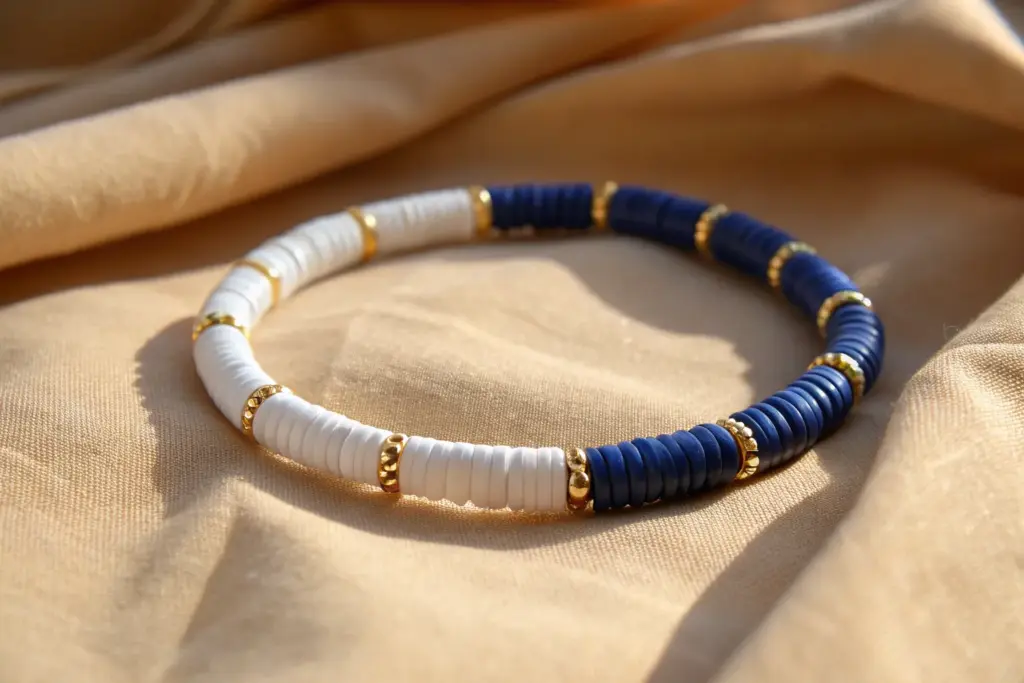
If you’re craving that calm, coastal feel on your wrist, blue and white clay bead bracelets are my go-to every single summer. I pulled together my favorite repeatable patterns and little upgrades so you can make a bracelet that feels effortless but still special.
Classic Blue-White Alternating Heishi
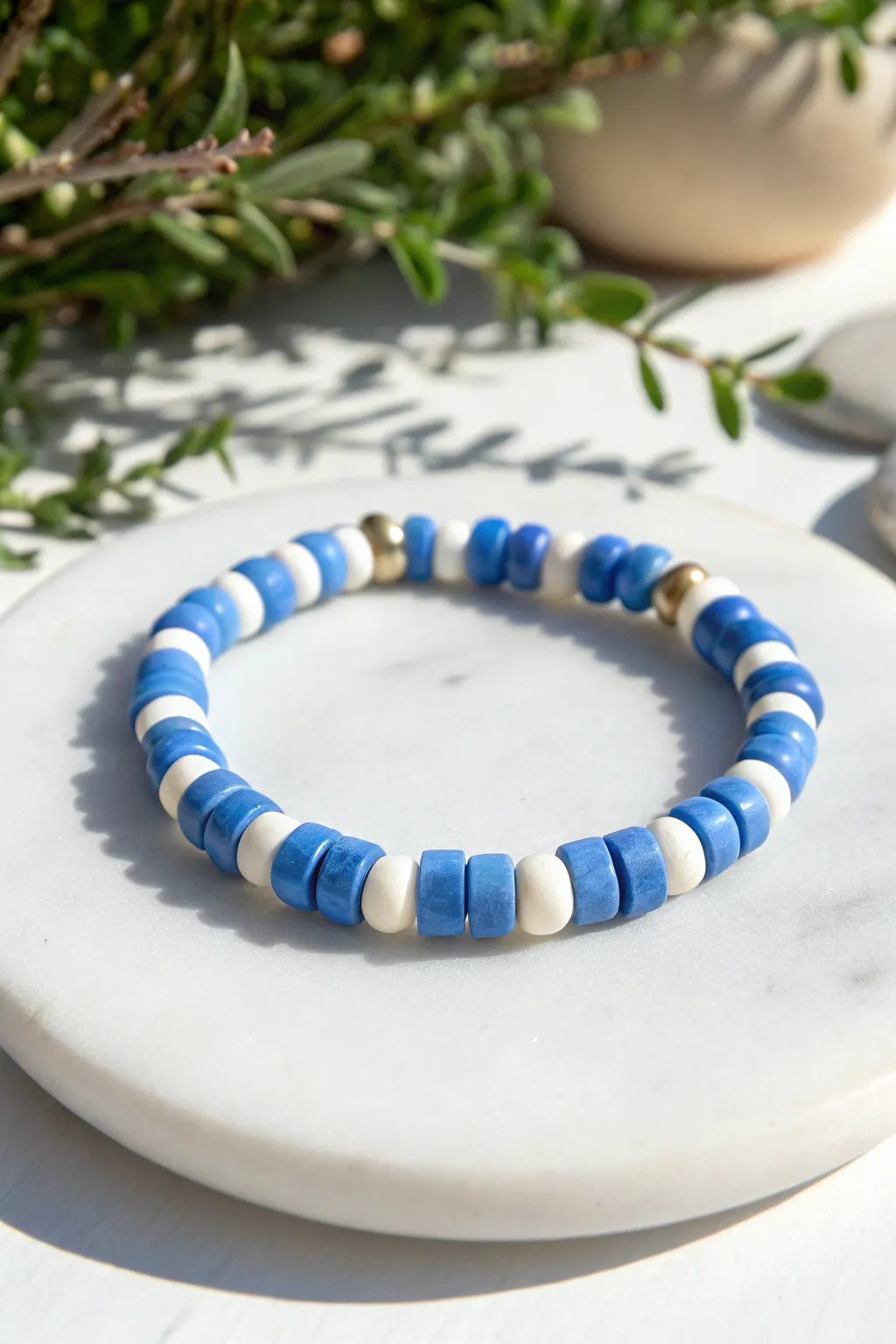
Evoke the calm of crashing waves and white foam with this classic blue and white heishi bead bracelet. The design uses an irregular alternating pattern punctuated by elegant gold accents for a fresh, nautical look.
Step-by-Step
Materials
- Blue polymer clay heishi beads (approx. 6mm)
- White polymer clay heishi beads (approx. 6mm)
- Small gold spacer beads (round or smooth cylinder metal beads)
- Stretch cord (0.8mm or 1mm depending on bead hole size)
- Jewelry glue or clear nail polish
- Scissors or jewelry snips
- Beading needle (optional, but helpful for stretchy cord)
- Bead sorting tray or a soft cloth to work on
- Tape or a binder clip
Step 1: Preparation & Planning
-
Measure your wrist:
Wrap a measuring tape around your wrist to find your size. Add about 0.5 inches to this measurement to ensure the bracelet fits comfortably without being too tight. -
Cut the cord:
Cut a piece of stretch cord about 10-12 inches long. Having this extra length makes tying the final knot much easier than struggling with short ends. -
Pre-stretch the cord:
Hold the cord between your hands and give it a few firm tugs. This pre-stretching prevents the bracelet from sagging or loosening up shortly after you finish it. -
Secure the end:
Place a piece of tape or a binder clip on one end of the cord. This acts as a stopper so your beads don’t slide right off while you are stringing them.
Knot Slipping?
If your elastic knot feels insecure, try a square knot instead. Right over left, left over right. Add a dab of GS Hypo Cement, which has a precision tip perfect for tiny knots.
Step 2: Creating the Pattern
-
Examine the sequence:
Look closely at the design. Rather than a simple 1-to-1 pattern, this bracelet groups beads together: typically two blue beads followed by one white bead. -
Start the sequence:
Designing on your tray first helps visualize the final look. Lay out a sequence of ‘two blue, one white’ to get started. -
Add variance:
To mimic the organic feel of the photo, occasionally swap the pattern. String three blue beads instead of two, or add two white beads together in a few spots. This breaks up the monotony. -
Insert gold accents:
Plan to insert a gold spacer bead roughly every 1.5 to 2 inches of length. In the image, these gold beads replace a white bead in the sequence, sitting between blue sections. -
Begin stringing:
Thread your beads onto the cord following your planned layout. I find using a collapsible eye needle makes picking up the flat heishi discs much faster. -
Check the fit:
Once you have strung enough beads to reach your target length, carefully wrap the strand around your wrist to check the fit. The ends should meet comfortably. -
Adjust length:
Add or remove a few beads if needed. Remember that the knot will take up a tiny amount of space, so a slightly loose fit is better than a tight one.
Step 3: Finishing Touches
-
Prepare to knot:
Remove the tape or clip from the end. Hold both ends of the cord securely so no beads escape. -
Tie the first knot:
Cross the ends and tie a simple overhand knot. Pull it tight, bringing the beads together until there are no gaps. -
The surgeon’s knot:
For the second knot, make a loop as if tying another overhand knot, but pass the tail end through the loop twice instead of once. This extra friction holds the elastic securely. -
Tighten securely:
Pull all four strands (the two tails and the two loop sides) firmly to cinch the knot down tight. -
glue the knot:
Apply a tiny dab of jewelry glue to the knot. Be careful not to get glue on the surrounding beads, as it can ruin the finish on the clay. -
Hide the knot:
Before the glue dries completely, slide the knot inside the hole of a nearby bead if the hole is large enough. This hides the mechanics for a professional finish. -
Trim excess:
Once the glue is dry, trim the excess cord ends close to the beads using sharp scissors.
Make it a Set
Create a matching stack by making two more bracelets: one entirely solid blue, and another mixing white beads with freshwater pearls for an upscale beach vibe.
Now you have a breezy seaside accessory ready to wear with your favorite summer outfits
Wide White Sections With Blue Pops
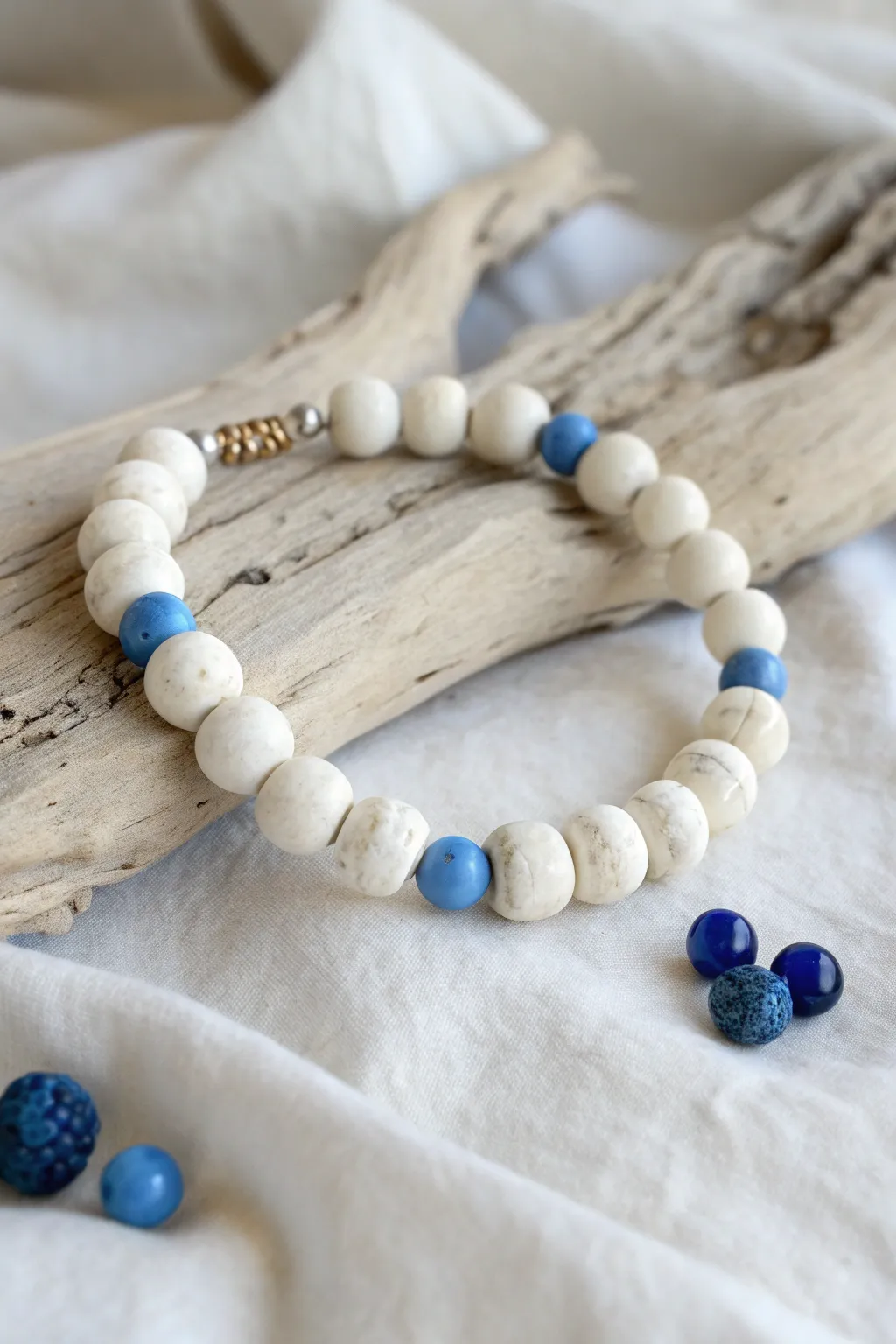
Evoke the feeling of a calm coastal day with this elegantly simple clay bead bracelet. By alternating wide sections of textured creamy white beads with single pops of vivid blue, you create a piece that feels both organic and modern.
Step-by-Step Guide
Materials
- Polymer clay in ‘White’ or ‘Ecru’
- Polymer clay in ‘Cobalt Blue’ or similar bright blue
- Acrylic roller or pasta machine
- Bead rolling tool (optional, for uniform size)
- Bamboo skewer, toothpick, or bead pins
- Baking sheet and parchment paper
- Elastic beading cord (0.8mm or 1mm recommended)
- Jewelry glue or clear nail polish
- Small metal accent beads (gold or silver)
- Sandpaper or a rough stone (to texturize)
- Oven (for baking clay)
Step 1: Creating the Clay Canvas
-
Condition the white clay:
Start by warming the white or ecru polymer clay in your hands. Knead it thoroughly until it is soft, pliable, and free of any air bubbles. -
Condition the blue clay:
Clean your hands or switch tools to avoid color transfer, then condition a smaller amount of the blue clay. -
Portion out the beads:
Roll your white clay into a thick log. Slice it into equal segments to ensure your beads are generally the same size. You will need roughly 18-22 white segments. -
Portion the blue accents:
Repeat the process with the blue clay on a much smaller scale. You only need about 4-5 blue segments for the ‘pops’ of color. -
Roll spheres:
Roll each segment between your palms to create round spheres. They don’t need to be mechanically perfect; a little organic variation adds to the charm.
Step 2: Adding Texture & Structure
-
Texturize the white beads:
To mimic the stone-like look in the photo, gently roll the white beads over a piece of coarse sandpaper or a clean rock surface. This removes fingerprints and adds a matte, earthy finish. -
Keep blue beads smooth:
Leave the blue beads smooth to create a visual contrast against the textured white beads, or texturize them very lightly if you prefer a unified matte look. -
Pierce the holes:
Using your skewer or bead pin, carefully pierce a hole through the center of each bead. I find twisting the tool gently as you push through prevents the bead from squashing. -
Baking time:
Arrangement the beads on a parchment-lined baking sheet. Bake according to your specific brand of clay’s instructions (usually around 275°F/135°C for 15-30 minutes). -
Cool down:
Allow the beads to cool completely before handling them. They harden fully as they return to room temperature.
Natural Stone Look
Mix a tiny pinch of black or brown clay (or even black pepper!) into your white clay before rolling. This creates subtle speckling for a faux-stone effect.
Step 3: Assembly & Finishing
-
Measure your cord:
Cut a length of elastic cord about 10-12 inches long. This gives you plenty of slack for tying knots later. -
Pre-stretch the elastic:
Give the elastic cord a few firm tugs. This pre-stretching step is crucial to prevent the bracelet from sagging after you wear it a few times. -
Start the pattern:
Begin stringing your beads. The pattern shown uses sections of 4 to 6 white beads, separated by a single blue bead. -
Adjust the fit:
Wrap the strand around your wrist to check the sizing. Add or remove white beads from the sections to get the perfect fit without disrupting the pattern. -
Add metal accents:
Finish the strand by adding a cluster of 3-4 small metal spacer beads. These act as a professional-looking cover for your knot. -
Tie the knot:
Tie a surgeon’s knot (right over left, left over right, looping through twice on the second pass). Pull it tight. -
Secure and trim:
Dab a tiny drop of jewelry glue on the knot. Once dry, trim the excess cord ends close to the knot, and tuck the knot inside one of the bead holes if possible.
Beads Flattening?
If beads flatten while piercing, refrigerate them for 10 minutes first. Cold clay holds its shape much better against the pressure of the tool.
Enjoy styling your new bracelet stack or gifting a piece of handmade coastal charm to a friend
Thin Blue Stripes on a White Base
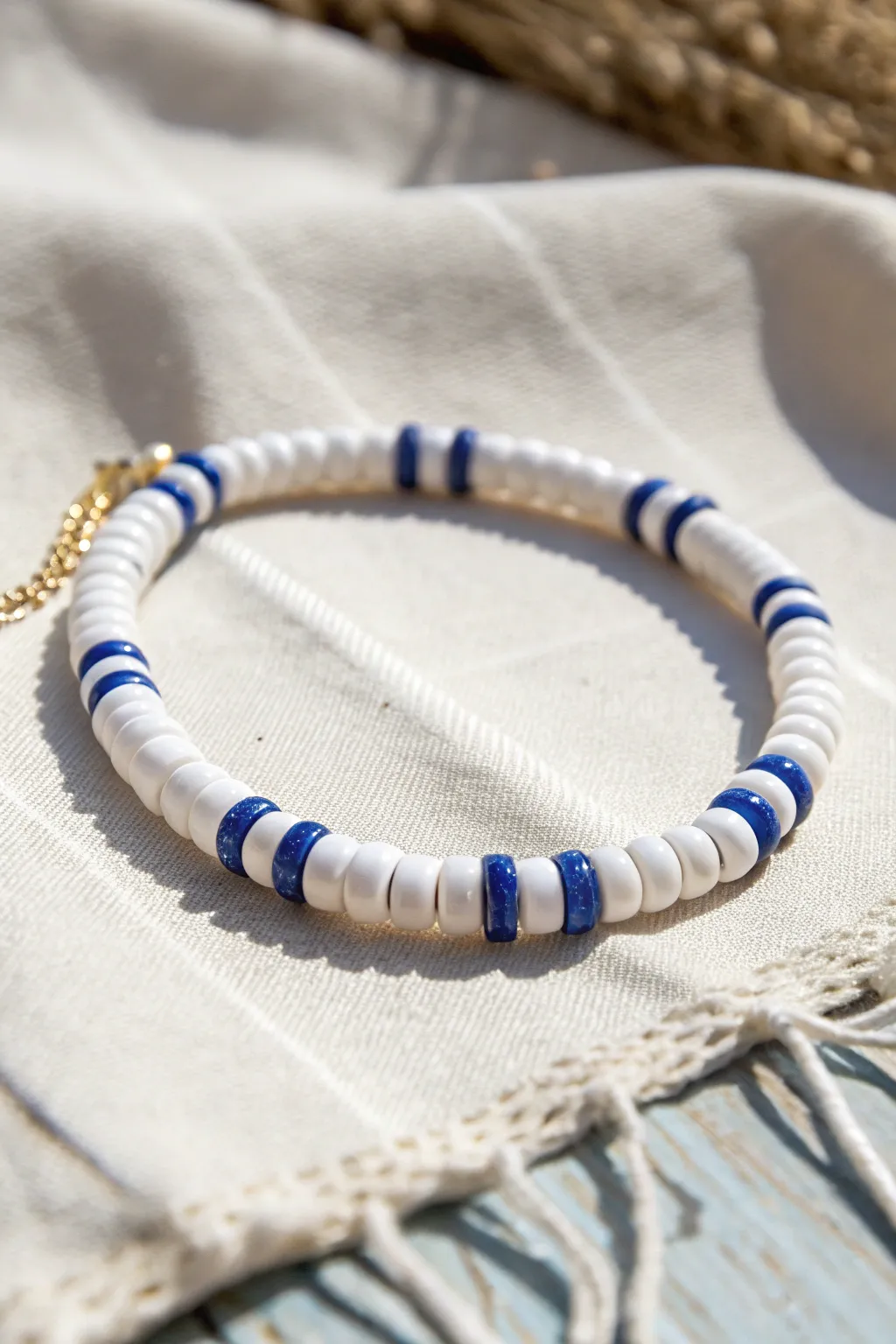
Evoke the breezy charm of the seaside with this crisp blue and white heishi bead bracelet. The design uses a simple repeating pattern of wide white sections punctuated by thin, vivid blue stripes for a clean, minimalist look.
Step-by-Step Tutorial
Materials
- White polymer clay heishi beads (6mm or similar)
- Cobalt or royal blue polymer clay heishi beads (6mm or similar)
- Stretch cord (0.8mm or 1mm thickness)
- Gold-plated crimp beads or knot covers (optional)
- Gold jump rings
- Gold lobster clasp
- Gold extension chain (optional)
- Jewelry adhesive (like E6000 or GS Hypo Cement)
- Scissors or jewelry wire cutters
- Flat nose pliers
- Bead stopper or tape
Step 1: Planning and Setup
-
Measure your wrist:
Before cutting any cord, wrap a measuring tape around your wrist to find your size. Add about 1-2 inches to this measurement to ensure you have plenty of slack for tying knots or attaching clasps. -
Cut the cord:
Cut a length of stretch cord based on your measurement. I usually cut a little extra just to be safe—it’s much easier to trim excess than to struggle with short ends. -
Secure the end:
Attach a bead stopper to one end of your cord. If you don’t have one, simply tape the end down to your work surface or tie a loose temporary knot so beads don’t slide off.
Uneven Stripes?
Clay beads vary slightly in thickness. If your stripes look uneven, try sorting beads beforehand or simply squeeze the beads together gently to compress any gaps.
Step 2: Beading the Pattern
-
Start with white:
Create your first block of white. Thread on approximately 8 to 10 white heishi beads. This establishes the clean, dominant base color of the bracelet. -
Add the first stripe:
Slide on a single blue bead, followed by one white bead, and then another single blue bead. This ‘blue-white-blue’ combo creates a distinct, double-stripe effect. -
Repeat the white block:
Thread on another segment of 8 to 10 white beads. Try to keep this count consistent with your first section for a symmetrical look. -
Create the second stripe:
Add the next stripe detail: one blue bead, one white bead, one blue bead. -
Continue the pattern:
Repeat this sequence—long white section followed by the blue-white-blue stripe detail—until the strand is long enough to wrap comfortably around your wrist. -
Check the fit:
carefully wrap the unfinished strand around your wrist. The ends should meet without stretching the cord, but it shouldn’t be too loose.
Easy Threading
Cut the tip of your elastic cord at a sharp 45-degree angle. This creates a pointed ‘needle’ end that slides through bead holes much faster without fraying.
Step 3: Finishing Touches
-
Prepare the clasp end:
If adding a clasp, thread a crimp bead onto one end, followed by a jump ring attached to the clasp. loop the cord back through the crimp bead. -
Secure the crimp:
Use your flat nose pliers to flatten the crimp bead securely. Trim the excess tail of the cord close to the crimp. -
Attach the other end:
On the other side of the bracelet, repeat the crimping process. Thread a crimp bead, then a jump ring (with an extension chain attached if desired), and loop back through. -
Tighten and crimp:
Pull the cord so there are no gaps between the beads, but not so tight that the bracelet buckles. Flatten the crimp bead with pliers. -
Knotting alternative:
If you prefer a continuous elastic bracelet without hardware, simply remove the bead stopper and tie the two ends together with a strong surgeon’s knot. -
Glue the knot:
Apply a tiny dot of jewelry adhesive to the knot to prevent it from slipping. Let it dry for a few minutes before trimming the tails. -
Hide the knot:
Gently tug the knot inside the hole of one of the adjacent white beads to hide it from view for a seamless finish.
Now you have a stylish, resort-ready stacking bracelet that pairs beautifully with denim or white linen
Navy-to-Sky Ombre Fade
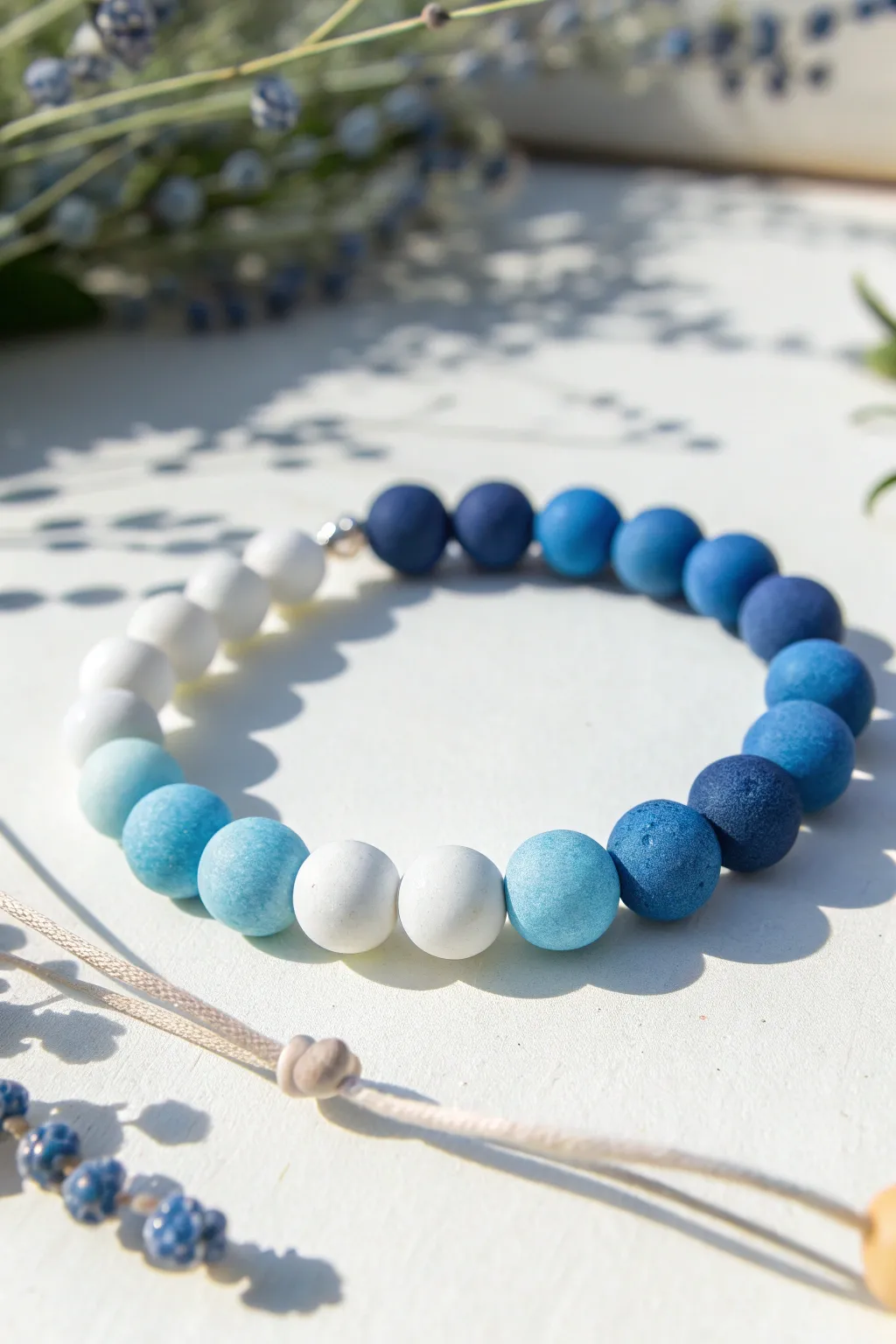
Capture the serene transition from deep ocean depths to fluffy clouds with this elegant ombre bracelet. Using a mix of matte beads in varying shades of blue and white, simple stringing creates a sophisticated gradient effect.
Step-by-Step Guide
Materials
- 10mm round matte polymer clay beads in 5 colors: Navy Blue, Royal Blue, Sky Blue, Baby Blue, and White
- Elastic cord (0.8mm or 1mm thickness)
- Hypo-allergic jewelry glue or clear nail polish
- Scissors
- Small crimp bead cover (silver, optional)
- Bead stopper or masking tape
- Ruler or measuring tape
Step 1: Preparation & Sorting
-
Measure your wrist:
Wrap a measuring tape comfortably around your wrist to determine the length needed. Add about 0.5 to 1 inch to this measurement depending on how loose you want the fit. -
Prepare the cord:
Cut a piece of elastic cord about 4 inches longer than your final bracelet length. This extra length makes tying the knot much easier later. -
Secure one end:
Place a bead stopper or simply a piece of masking tape on one end of your elastic cord to prevent beads from slipping off as you work. -
Lay out your gradient:
Before stringing, arrange your loose beads on a bead board or towel. Create a pattern that fades from dark to light on one side of the circle, then light to dark on the other side to mimic the image. For example: Navy > Royal > Sky > Baby > White > Baby > Sky > Royal > Navy.
Step 2: Stringing the Ombre Pattern
-
Start with the darkest shade:
Begin by threading 3-4 Navy Blue beads. These will act as the ‘anchor’ or the darkest point of your night sky at the back of the wrist. -
Transition to royal tones:
Add 2-3 Royal Blue beads next. Notice how the colors begin to interact; the slight shift in hue creates depth. -
Add mid-tones:
Thread on 2-3 Sky Blue (medium blue) beads. This is your bridge color between the deep shades and the upcoming pastels. -
Move to pastels:
Add 2-3 Baby Blue beads. The gradient should be visibly lightening now. -
The highlight section:
String 4-5 White beads. I like to make the white section slightly longer to serve as a focal point, brightening up the entire piece. -
Reverse the gradient:
Now, work backwards through your colors: add 2-3 Baby Blue beads, then 2-3 Sky Blue beads. -
Complete the circle:
Finish stringing with 2-3 Royal Blue beads. Bring the ends together to check the size against your wrist. -
Add a metal accent (optional):
If you wish to hide your knot later, you can add a small silver accent bead or crimp cover now at the very end of your strand.
Knot Slipping?
If your elastic knot feels insecure, try roughening the cord ends with sandpaper before tying. The slight texture helps the smooth elastic grip itself better for a tighter hold.
Step 3: Finishing Touches
-
Pre-stretch the cord:
Gently pull tightly on both ends of the elastic cord a few times. This pre-stretching step is crucial to prevent the bracelet from permanently stretching out the first time you wear it. -
Tie the knot:
Remove the tape or stopper. Tie a standard surgeon’s knot: cross right over left, then left over right twice. Pull tight to secure. -
Secure with glue:
Apply a tiny dot of jewelry glue directly onto the knot. Be careful not to get glue on the visible surface of the beads. -
Hide the knot:
While the glue is still tacky but not wet, gently pull the knot inside the hole of the nearest bead (or the metal accent bead if you used one). -
Trim excess cord:
Once the glue is fully dry (check manufacturer instructions), use your scissors to snip off the excess elastic tail as close to the bead as possible.
Level Up: Texture Mix
Swap the white clay beads for white porous lava stones. You can add a drop of essential oil to them, turning your ombre bracelet into a wearable aromatherapy diffuser.
Now you have a stunning gradient accessory that brings a calm, blue-sky vibe to any outfit

The Complete Guide to Pottery Troubleshooting
Uncover the most common ceramic mistakes—from cracking clay to failed glazes—and learn how to fix them fast.
Ocean-Inspired Blue-and-White Mix
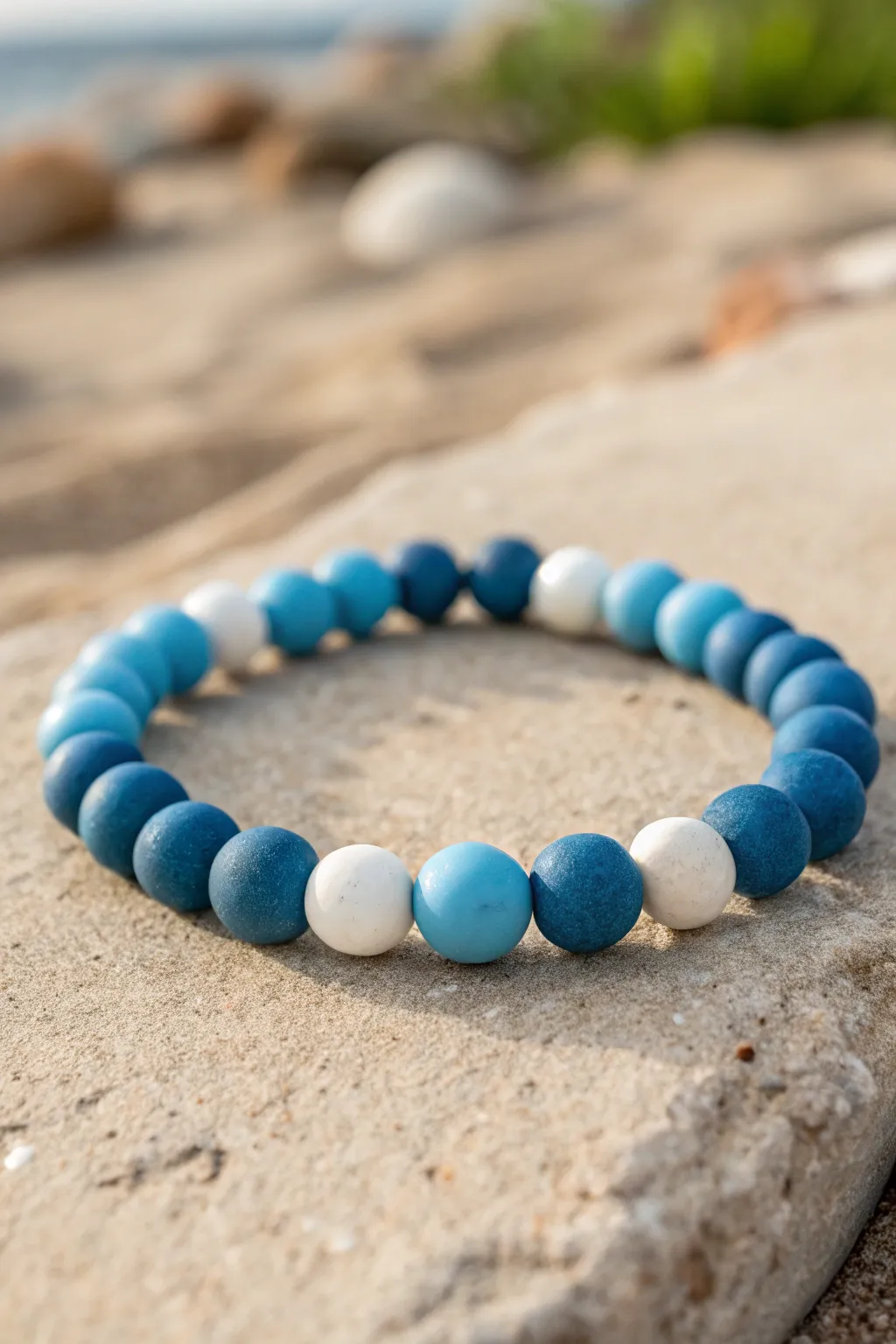
Capture the serene essence of crashing waves with this soothing blue and white beaded bracelet. By mixing matte textures and varying shades of oceanic blues, you’ll create a piece that feels like wearing a little piece of the beach on your wrist.
Detailed Instructions
Materials
- Matte round beads (8mm or 10mm) in dark navy blue
- Matte round beads (8mm or 10mm) in medium teal or ocean blue
- Matte round beads (8mm or 10mm) in light sky blue
- Matte round beads (8mm or 10mm) in creamy white
- Strong elastic beading cord (0.8mm or 1mm)
- Beading needle (optional but helpful)
- Scissors
Step 1: Planning the Pattern
-
Measure your wrist:
Wrap a piece of string around your wrist to find your comfortable size, then add about half an inch for a comfortable fit depending on how tight you like your jewelry. -
Lay out your supplies:
Place all your beads on a bead board or a soft towel to prevent them from rolling away while you work. -
Create the color groupings:
This design relies on distinct blocks of color rather than a truly random mix. Group your beads by shade to visualize the flow: dark navy, medium teal, light sky blue, and white. -
Establish the repeating sequence:
The pattern shown uses a specific rhythm: three to four dark navy beads, followed by a creamy white ‘spacer’, then a light sky blue bead, another creamy white spacer, and finally a few medium teal beads. -
Test the arrangeent:
Line the beads up in a circle on your working surface before stringing. This lets you adjust the number of beads in each color block so the gradient flows naturally around the circumference.
Step 2: Stringing the Beads
-
Prepare the cord:
Cut a length of elastic cord about 10-12 inches long. Having extra length makes the final knotting process much less frustrating. -
Pre-stretch the elastic:
Give the elastic cord a few firm tugs. This pre-stretching step helps prevent the bracelet from sagging or stretching out permanently after you wear it a few times. -
Start with the focal section:
Begin stringing with your patterned focal point: thread one white bead, then one light sky blue bead, and one white bead. This creates the bright highlight visible in the front of the design. -
Add the medium tones:
Next, string 3-4 medium teal beads on one side of your white/sky blue cluster. Mirror this on the other side if you want perfect symmetry, or continue in a circular pattern. -
Transition to darks:
Thread on your dark navy beads. I find that using slightly more of the darkest color at the ‘back’ of the bracelet anchors the design visually. -
Continue the pattern:
Keep adding beads according to your planned layout. You might want to break up long sections of blue with a single white bead occasionally to mimic sea foam. -
Check the length:
Wrap the strung beads around your wrist to check the fit. There should be no gaps between beads, but the elastic shouldn’t be stretched tight yet.
Knot Security
Add a tiny drop of flexible jewelry glue or clear nail polish to the knot before hiding it inside a bead. This ensures it won’t slip undone over time.
Step 3: Finishing Touches
-
Prepare to knot:
Bring the two ends of the elastic together, ensuring there is no slack on the cord between the beads. -
Tie the first knot:
Make a simple overhand knot, pulling it relatively tight to bring the beads snugly together. -
Secure with a surgeon’s knot:
For the second knot, loop the elastic through twice before pulling tight. This extra loop adds significant friction and security. -
Hide the knot:
If -
Hide the knot:
Trim the excess cord, leaving about 2mm of tail. Gently tug the bracelet so the knot pops inside the hole of a neighboring bead, making it invisible.
Texture Twist
Intersperse a few lava stone beads among the matte clay ones. They act as essential oil diffusers so you can carry a beachy scent with you.
Slip on your new bracelet and enjoy the calming coastal vibes it brings to your daily outfit
Pearl Accents With Blue and White
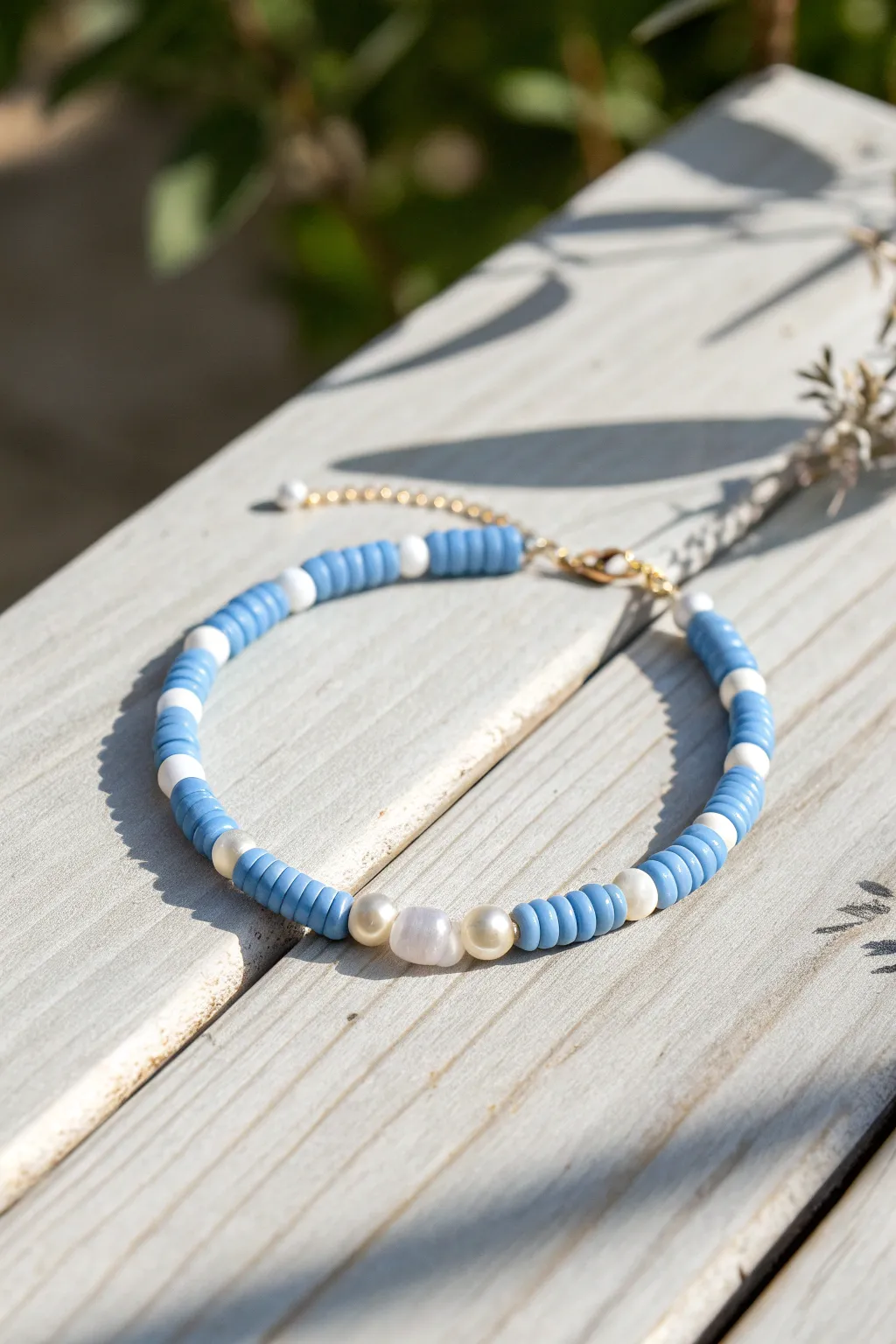
Capture the essence of a serene beach day with this beautiful blue and white design. Combining matte clay disc beads with lustrous pearl accents creates a sophisticated yet relaxed accessory that mimics the sky meeting the sea.
Step-by-Step
Materials
- Polymer clay Heishi beads (denim blue or cornflower blue)
- Small white spacer beads or white clay disc beads
- 2 medium round faux pearls (approx. 4-6mm)
- 1 slightly larger irregular freshwater pearl or baroque pearl (centerpiece)
- Gold beading wire or strong elastic cord (0.8mm)
- 2 gold crimp beads
- 2 gold wire guards (optional but recommended)
- Gold lobster clasp
- Gold extension chain with mini pearl dangle
- Jewelry pliers (flat nose and cutting pliers)
- Sewing needle or bead reamer (optional)
Step 1: Planning & Preparation
-
Measure your wrist:
Wrap a measuring tape loosely around your wrist to determine your ideal length. For most adults, a 6.5 to 7-inch length works well, especially with an extender chain. -
Cut the wire:
Cut a piece of beading wire about 10-12 inches long. Having extra length on both ends makes it much easier to finish the clasp later without struggling. -
Secure the first end:
Thread one crimp bead onto the wire, followed by a wire guard. Loop the wire through the wire guard and back down through the crimp bead. -
Attach the clasp:
Before flattening the crimp, slide your gold lobster clasp into the loop created by the wire guard. I find using a wire guard protects the wire from friction over time. -
Crimp firmly:
Use your flat nose pliers to flatten the crimp bead securely. Give it a gentle tug to ensure it holds tight.
Step 2: Stringing the Pattern
-
Start the sequence:
Begin threading your blue clay beads. String approximately 8-10 blue heishi beads to start the pattern near the clasp. -
Add first spacer:
Slide on one white spacer bead. This creates the first break in the blue color block. -
Build the rhythm:
Add 4 more blue heishi beads, followed by another white spacer. This 4-blue-to-1-white ratio will be your main pattern for the sides. -
Continue the pattern:
Repeat the ‘4 blue, 1 white’ sequence until you are about 1.5 inches away from the center of the bracelet length. -
Transition to center:
To frame the focal point, string a slightly longer section of blue beads—about 6 or 7 discs. -
Add the pearl accents:
Slide on one of your round medium pearls. Follow it with 4 to 5 blue heishi beads. -
Place the centerpiece:
Thread the large irregular freshwater pearl. This sits right in the middle as the star of the show. -
Mirror the design:
Add 4 to 5 blue heishi beads, then the second round medium pearl. -
Complete the second half:
Resume the pattern of 6-7 blue beads, a white spacer, and then the ‘4 blue, 1 white’ sequence until you reach the other end.
Pearl Hole Solution
Real pearls sometimes have tiny holes. If your wire won’t fit, use a bead reamer to gently enlarge the hole, or switch to a slightly thinner gauge wire just for the center section.
Step 3: Finishing Touches
-
Check the fit:
Wrap the unfinished bracelet around your wrist to verify the size. Adjust by adding or removing a few blue beads at the very end if needed. -
Prepare the closure:
Thread on a crimp bead and a wire guard. Pass the wire through the end loop of your extension chain. -
Loop it back:
Feed the wire back through the wire guard and down into the crimp bead. Pull it snug, but leave a tiny bit of slack so the bracelet moves fluidly. -
Final crimp:
Flatten the crimp bead firmly with your pliers. Make sure the wires are parallel inside the crimp for the strongest hold. -
Trim excess wire:
Snip off the excess wire tail close to the crimp bead. If possible, tuck the short sharp end inside the first few blue beads. -
Add a charm:
For that extra professional detail seen in the image, attach a tiny pearl to the end of the extender chain using a small jump ring.
Stiff Bracelet Fix
Don’t pull the final wire too tight before crimping! Lay the bracelet in a circle shape while tightening to ensure it has enough slack to drape comfortably around a round wrist.
Enjoy styling your new chic pearl-accented bracelet alongside your summer outfits


What Really Happens Inside the Kiln
Learn how time and temperature work together inside the kiln to transform clay into durable ceramic.
Sprinkled Metallic Spacers for Shine
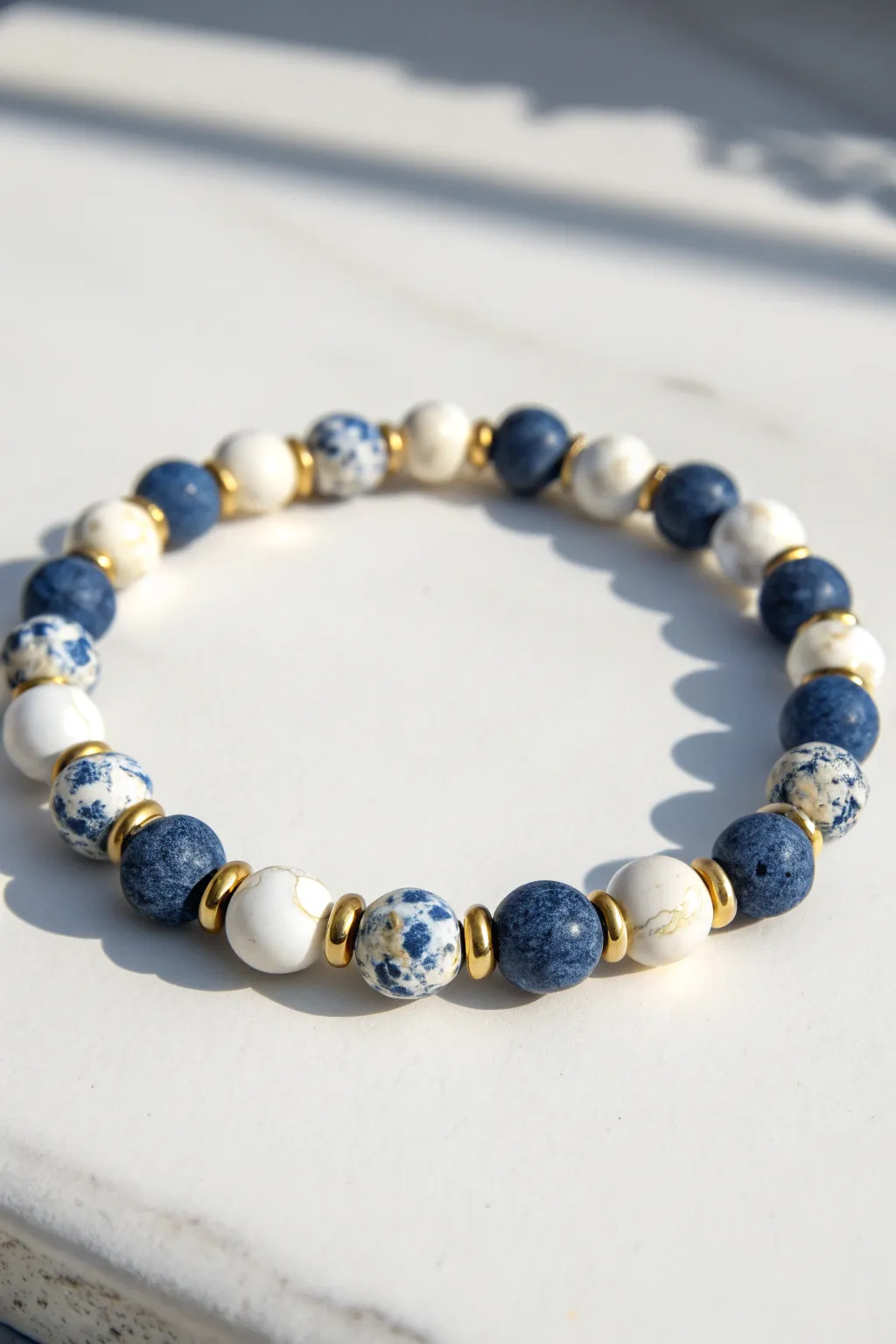
Elevate your bracelet stack with this sophisticated design that pairs deep royal blue with creamy marble textures. The strategic placement of gold disc spacers adds a rhythmic shine, creating a piece that feels both grounded and luxurious.
How-To Guide
Materials
- 8mm Royal Blue round stone beads (e.g., Lapis Lazuli, Sodalite, or dyed Jade)
- 8mm White Howlite or White Turquoise round beads
- 8mm Blue Spot Jasper or speckled blue/white beads
- 4mm or 5mm flat gold disc spacer beads (hematite or plated brass)
- 0.8mm clear elastic cord (high-quality strong stretch)
- Jewelry glue or clear nail polish
- Scissors
- Bead design board (optional), masking tape, or a small clamp
Step 1: Preparation & Design
-
Measure your wrist:
Wrap a measuring tape comfortably around your wrist to determine your size. Add about 0.5 to 1 inch to this measurement depending on how loose you like your fit. -
Prepare the cord:
Cut a piece of elastic cord about 10-12 inches long. This extra length is crucial for tying a secure knot later without struggling. -
Pre-stretch the elastic:
Hold both ends of the cut cord and give it a few firm (but not snapping) tugs. I consider this a vital step because it prevents the bracelet from loosening up significantly after the first few wears. -
Anchor the cord:
Place a piece of masking tape or a bead stopper on one end of the cord to prevent your beads from sliding off while you work. -
Layout your pattern:
On a bead board or soft towel, arrange your beads to test the sequence. The pattern in the image relies on a repeating trio: a solid blue bead, a speckled bead, and a solid white bead, separated by gold spacers.
Spacer Tip
If the hole of your 8mm stone bead is huge, double up your spacers. Using two thin gold discs instead of one prevents the spacer from getting swallowed inside the larger bead hole.
Step 2: Stringing the Beads
-
Start the sequence:
Begin by threading one flat gold spacer bead onto the elastic. This will be part of your knot-hiding strategy later. -
Add first focal bead:
Slide on a solid royal blue bead. -
Insert a spacer:
Add another gold disc spacer immediately after the blue bead. -
Add the speckled bead:
Thread on a blue and white speckled bead (like Blue Spot Jasper). This acts as a visual bridge between the solid dark and light tones. -
Add the next spacer:
Place another gold spacer next. -
Add the white bead:
Thread on a solid white bead followed by a gold spacer. -
Establish the rhythm:
Continue this specific rotation—Blue, Spacer, Speckled, Spacer, White, Spacer—until you reach your desired length. Check the fit by wrapping it around your wrist occasionally.
Mix It Up
Add a singular large gold nugget bead or a gold charm in place of one of the stone beads to create a distinct focal point or ‘front’ to the bracelet design.
Step 3: Finishing Touches
-
Check symmetry:
Ensure your pattern ends correctly so that when the loop is closed, the pattern continues seamlessly. You generally want to end just before the bead that matches your starting bead. -
Prepare to knot:
Remove the tape or stop-bead from the end. Bring the two ends of the elastic together carefully. -
Tie the first knot:
Tie a simple overhand knot, pulling it tight against the beads to remove any slack in the cord. -
Secure with a surgeon’s knot:
Tie a second knot, but this time loop the cord through twice before pulling tight. This is a surgeon’s knot and is much less likely to slip. -
Apply adhesive:
Apply a tiny dot of jewelry glue or clear nail polish directly onto the knot. Let it dry for a minute or two. -
Hide the knot:
Before the glue fully hardens (but is tacky enough to hold), gently tug the elastic so the knot slides inside the hole of the nearest large bead. Don’t try to hide it inside the flat gold spacer; the hole is often too small. -
Trim the excess:
Once the knot is hidden and glue is dry, trim the excess cord ends carefully with scissors, getting close to the bead without cutting the main knot.
Wear your finished creation as a reminder that simple patterns often create the most elegant results
Centered “Eye” Charm in Blue and White
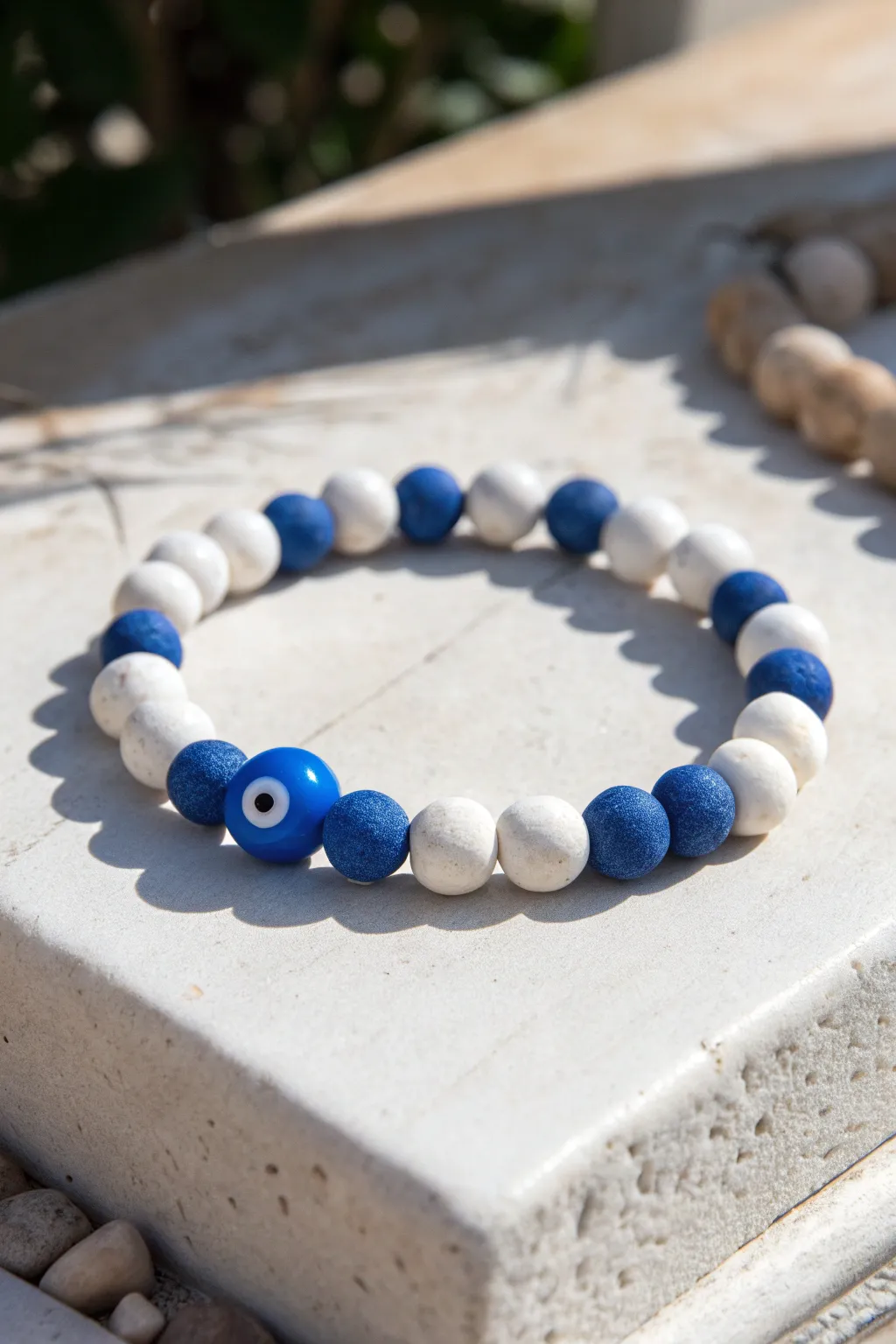
This striking bracelet balances the classic crispness of blue and white with the bohemian texture of clay and stone. Anchored by a traditional glass evil eye charm, it offers a stylish talisman believed to ward off negativity.
Detailed Instructions
Materials
- White round clay or porous stone beads (approx. 8-10mm)
- Dark blue textured round beads (approx. 8-10mm)
- One flat glass evil eye bead (blue, white, and black)
- Strong elastic beading cord (0.8mm or 1mm)
- Beading needle (optional but helpful)
- Scissors
- Jewelry glue or clear nail polish
- Bead stopper or tape
Step 1: Setting the Stage
-
Preparation:
Begin by cutting a length of elastic cord about 10-12 inches long. This gives you plenty of extra room for tying knots later without struggling with short ends. -
Secure the End:
Attach a bead stopper to one end of your cord, or simply use a piece of masking tape folded over the end. This prevents your beads from sliding off while you design your pattern. -
Stretch the Cord:
Before adding any beads, give your elastic cord a few firm tugs. This pre-stretching step is crucial because it prevents the bracelet from loosening up and sagging after you’ve worn it a few times.
Loose Knot Fix
If your slippery elastic knot refuses to stay tight while tying, ask a friend to hold his or her finger on the first overhand knot while you tie the second surgeon’s knot suitable for security.
Step 2: Designing the Pattern
-
Centerpiece First:
Thread your central evil eye bead onto the cord. Since this is the focal point, I like to start here and build outwards to ensure symmetry, or at least balance, on both sides. -
Framing the Eye:
Slide one dark blue textured bead onto the left side of the eye, and another onto the right side. This dark frame makes the lighter blue of the glass eye pop. -
Adding Contrast:
On the right side of your blue bead, add a white clay bead. Repeat this on the left side. You are now establishing the primary alternating rhythm of the bracelet. -
Building the Right Side:
Continue adding beads to the right side of the cord. The pattern shown here isn’t a strict 1-to-1 alternate. Try adding two white beads, then a blue one, or vary it slightly for an organic look. -
Balancing the Left:
Add a corresponding number of beads to the left side. It doesn’t have to be a perfect mirror image, but keeping the visual weight balanced helps the evil eye stay on top of your wrist. -
Establishing Length:
Continue threading beads—alternating between the textured blue and smooth white—until you reach the desired length. For an average adult wrist, you’ll need about 6.5 to 7 inches of beaded length. -
Checking the Fit:
Wrap the unfinished strand around your wrist to check the size. Ideally, the two ends should touch comfortably without stretching the elastic, but without leaving large gaps. -
Pattern Adjustment:
If the size is off, add or remove beads near the ends (furthest from the eye charm) so you don’t disturb the central design you created earlier.
Scented Stone
Since the white beads appear porous like lava stone or raw clay, you can add a drop of essential oil to them. They will act as a passive diffuser, carrying a subtle scent with you all day.
Step 3: Closing the Circle
-
Prepare for Knotting:
Remove the bead stopper or tape carefully. Hold both ends of the elastic firmly so the tension doesn’t snap the beads off. -
The First Tie:
Cross the right end over the left and pull tight to make a simple overhand knot. Pull it taut enough to bring the beads together, but not so tight that they bunch up. -
Surgeon’s Knot:
Now, tie a surgeon’s knot for security. Cross the ends again, but loop one end through the circle twice instead of just once. Pull this knot firmly and slowly to lock it in place. -
Securing the Knot:
For extra durability, apply a tiny dab of jewelry glue (or clear nail polish in a pinch) directly onto the knot. Let this dry for a minute or two. -
Hiding the Evidence:
Once the glue is tacky or dry, trim the excess elastic, leaving about 2-3mm of tail. If the hole of a neighboring bead is large enough, gently tug the knot inside it to hide it from view.
Slip your new talisman onto your wrist and enjoy the blend of texture and tradition

TRACK YOUR CERAMIC JOURNEY
Capture glaze tests, firing details, and creative progress—all in one simple printable. Make your projects easier to repeat and improve.
Name or Initials Framed in Blue-White
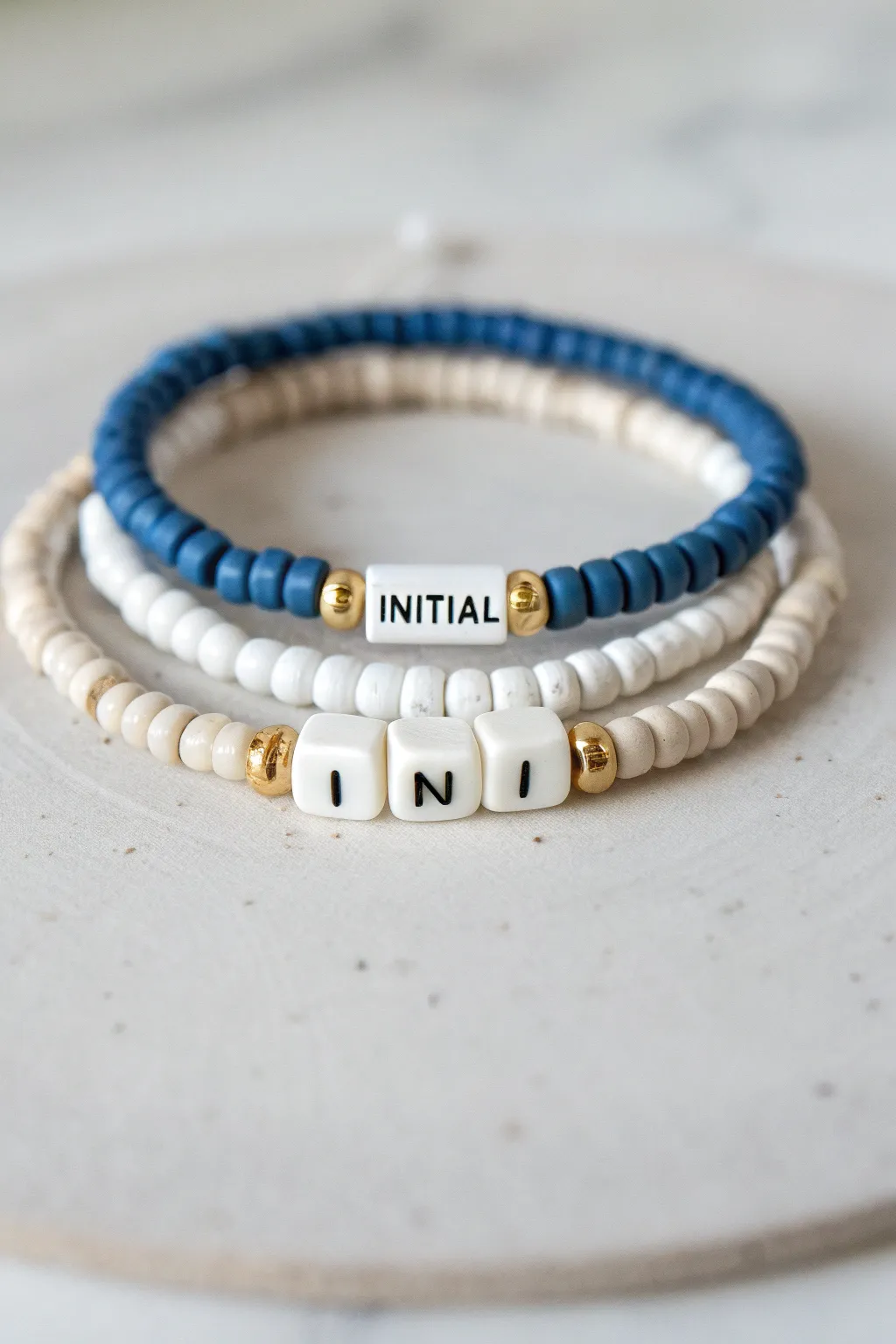
This stylish trio combines matte textures with personalized touches for a perfectly coordinated stack. Featuring a deep navy strand and two creamy white companions, this set frames your chosen initials with elegant gold accents.
Step-by-Step Tutorial
Materials
- Navy blue clay heishi beads (approx. 4-6mm)
- Cream or off-white clay heishi beads (approx. 4-6mm)
- White stone or shell rondelle beads (optional, for middle texture)
- Elastic beading cord (0.8mm recommended)
- Gold tone spacer beads (small rounds)
- Square white letter beads (spelling your chosen initials)
- Rectangular white word bead (e.g., ‘INITIAL’ or a name)
- Super glue or jewelry cement
- Scissors
Step 1: Planning and Measuring
-
Measure your wrist:
Wrap a flexible measuring tape around your wrist bone to determine your size. Add about half an inch to this measurement to ensure the bracelets fit comfortably without pinching. -
Prepare the cord:
Cut three lengths of elastic cord, each about 10-12 inches long. This extra length makes tying the final knots much easier. -
Pre-stretch the elastic:
Gently pull on each strand of elastic a few times. This helps prevent the bracelets from stretching out and becoming loose after you wear them for the first time.
Step 2: The Navy ‘Name’ Bracelet
-
Secure the end:
Place a piece of tape or a bead stopper on one end of your first cord to keep beads from sliding off while you work. -
Start the navy pattern:
Thread approximately 3 inches of navy blue heishi beads onto the cord. I like to double-check the length against my wrist occasionally as I work. -
Add the focal point:
Slide on one gold spacer bead, followed by your rectangular word bead (like ‘INITIAL’), and then another gold spacer bead to frame the text. -
Finish the strand:
Continue threading navy heishi beads on the other side until the total beaded length matches your wrist measurement.
Gold Preservation
Apply clear nail polish to your gold spacer beads before stringing. This creates a barrier that prevents rapid tarnishing from skin oils.
Step 3: The Cream Initial Bracelets
-
Texture variation:
For the second bracelet (the middle one in the stack), use the slightly more textured white stone or shell rondelle beads if you have them, or stick to the standard cream heishi beads. -
String the base:
Thread half of the required length using your white/cream beads. -
Insert the centerpiece:
Add your focal beads. Since the middle bracelet in the image has no text, you can either leave it solid or replicate the bottom bracelet’s style. -
Build the third bracelet:
For the bottom bracelet shown, start with your cream heishi beads for the first half. -
Add individual letters:
Slide on a gold spacer, your first square letter bead, your second letter, your third letter, and a final gold spacer. The gold adds a polished look that separates the letters from the clay beads. -
Complete the strand:
Finish stringing the cream heishi beads until you reach the desired length.
Letters Flipping?
If square letter beads flip over too much, string them tighter against the neighboring heishi beads, or use flat disc letters that sit flush.
Step 4: Finishing Touches
-
Check the fit:
Wrap each unfinished bracelet around your wrist one last time to ensure the letters are centered and the size is correct. -
Tie the surgeon’s knot:
Remove the tape/stopper. Cross the ends, loop one under twice, and pull tight. Repeat this knotting process 2-3 times for security. -
Secure with glue:
Dab a tiny drop of super glue or jewelry cement onto the knot. Let it dry completely before moving it. -
Hide the knot:
Once dry, trim the excess elastic close to the knot. Gently tug the beads so the knot slides inside the hole of a neighboring bead to hide it.
Enjoy mixing and matching your new custom stack with different outfits
Blue-White Checkerboard Pattern Beads
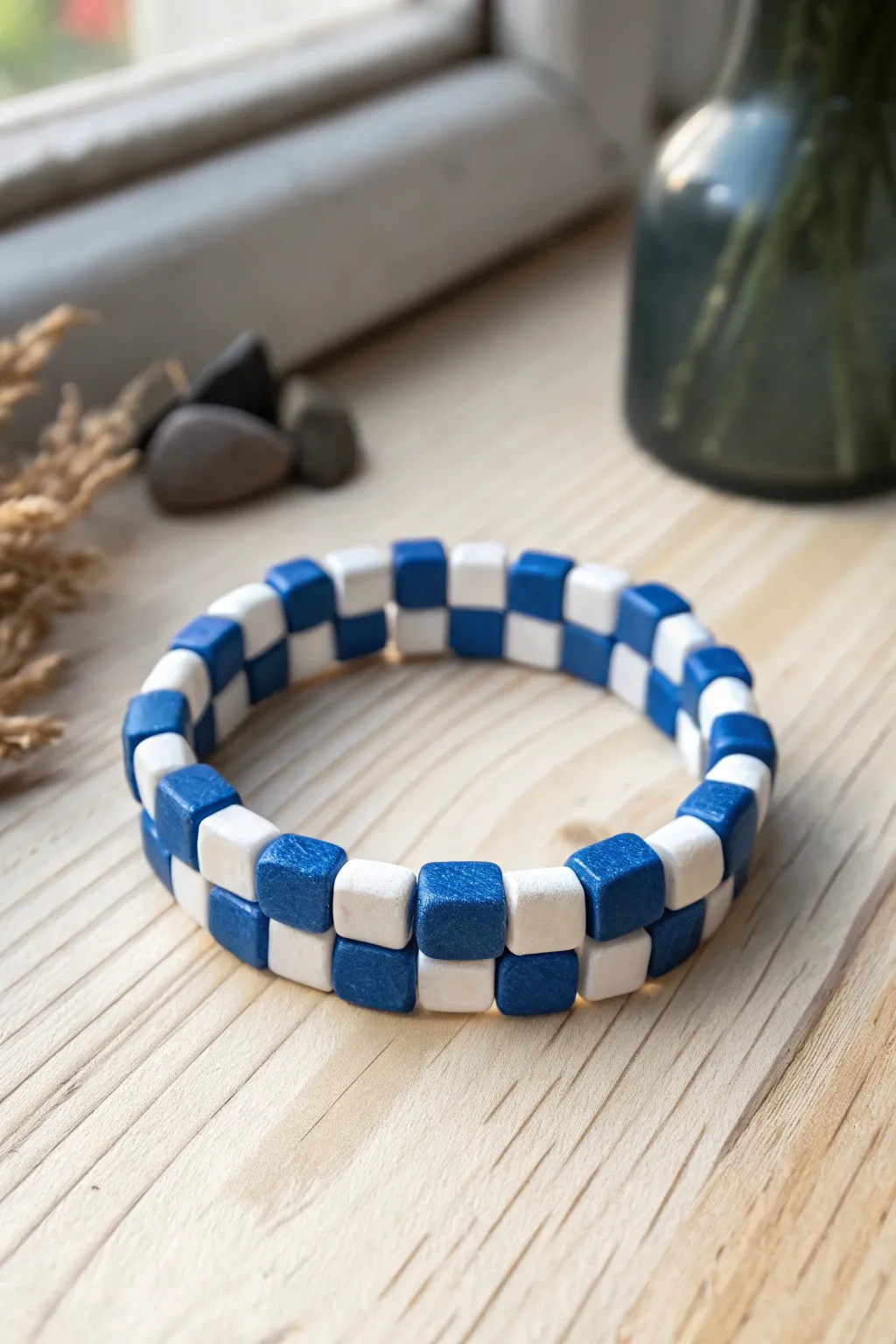
This striking bracelet creates a bold optical illusion with its classic blue and white checkerboard pattern, achieved not by painting, but by constructing a clever clay cane. The finished piece has a chunky, satisfying feel and a matte finish that looks professional and modern.
Step-by-Step Guide
Materials
- Polymer clay (Royal Blue and White)
- Clay blade or tissue blade
- Acrylic roller or pasta machine
- Ruler
- Strong elastic cord (0.8mm or 1mm)
- Super glue or jewelry glue
- Bead reamer or toothpick
- Oven for baking
- Sandpaper (400-800 grit, optional)
Step 1: Creating the Clay Logs
-
Condition the Clay:
Start by thoroughly conditioning your blue and white polymer clay separately until they are soft and pliable. This prevents cracking later. -
Form Square Logs:
Shape both the blue and white clay into square logs. You can do this by rolling them into cylinders first, then using your fingers or the work surface to flatten the sides. -
Refine the Shape:
Use your acrylic roller or two flat objects on either side of the clay log to compress it into a sharp, perfect square prism. Aim for a cross-section of about 1cm x 1cm. -
Cut to Length:
Lay the blue and white logs side by side. I find it easiest to trim them so they are exactly the same length, roughly 3 to 4 inches long.
Smudged Colors?
If blue smears onto white while cutting, wipe your blade with alcohol between every single slice. Chilling the cane in the fridge for 20 mins before slicing also helps keep lines crisp.
Step 2: Assembling the Checkerboard Cane
-
Join the Halves:
Place the blue log next to the white log and press them firmly together to create a rectangular block. -
Slice and Stack:
Cut this rectangle exactly in half lengthwise. You now have two identical bi-colored strips. -
Flip and Rejoin:
Stack one strip on top of the other, but flip it so the colors alternate (blue over white, white over blue). This forms your initial 4-part checkerboard block. -
Compress the Cane:
Gently squeeze the block from all sides to ensure the layers adhere completely. Rolling a smooth acrylic rod over the sides helps flatten any bumps. -
Slice into Segments:
Use your sharp tissue blade to slice the cane into equal segments. These slices will become your individual beads. -
Pierce the Beads:
Using a toothpick or a bead pin, carefully pierce a hole through the center of each square bead. Rotate the tool as you push to avoid distorting the square shape.
Pro Tip: Consistent Size
Use a pasta machine on its thickest setting to roll flat sheets, stack them to create your initial logs, and then shape. This ensures your blue and white sections are mathematically identical.
Step 3: Baking and Assembly
-
Bake the Beads:
Arrange your beads on a baking sheet or tile. Bake according to your brand’s specific instructions (usually around 275°F/135°C for 15-30 minutes). -
Cool Down:
Allow the beads to cool completely before handling. They are fragile when hot but harden as they cool. -
Optional Sanding:
If there are fingerprints or rough edges, lightly wet-sand the beads with fine-grit sandpaper for that smooth, professional matte look shown in the photo. -
Clean the Holes:
If the holes shrank slightly during baking, twist a small bead reamer or drill bit through them to clear the path for the cord. -
Stringing:
Measure a piece of elastic cord about 10 inches long. String your checkerboard beads until the bracelet fits comfortably around your wrist. -
Tying off:
Tie a secure surgeon’s knot (right over left, left over right twice). Pull the elastic tight to test the knot’s strength. -
Final Secure:
Add a tiny drop of super glue to the knot. Let it dry, trim the excess cord, and gently tuck the knot inside one of the bead holes.
Now you have a geometric accessory ready to add a pop of pattern to any outfit
Marbled Porcelain-Look Blue and White
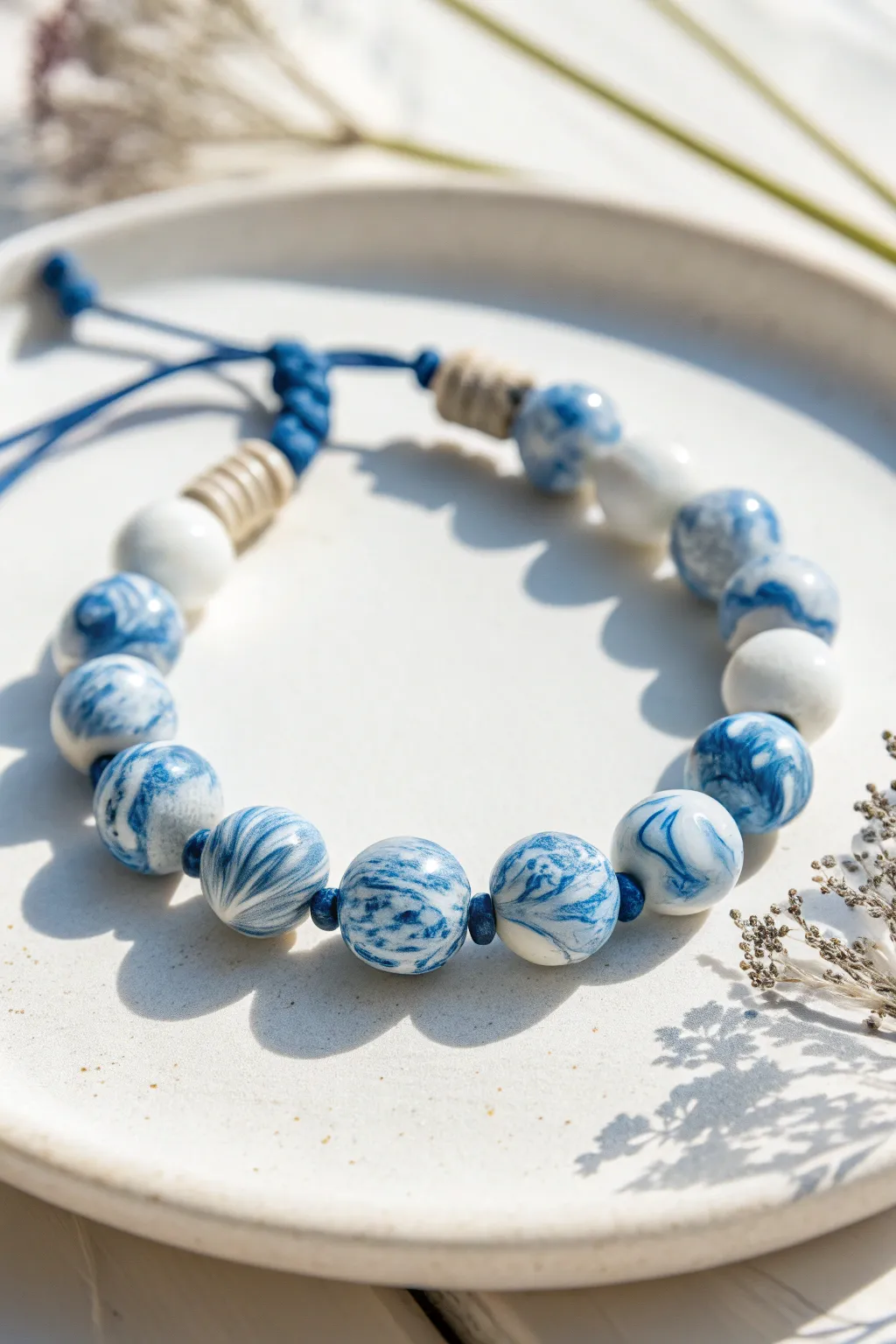
Capture the timeless elegance of fine china with this handcrafted polymer clay bracelet. The swirling blue and white patterns mimic classic Delftware, creating a sophisticated accessory that looks far more expensive than it is to make.
How-To Guide
Materials
- White polymer clay (e.g., Fimo, Sculpey)
- Dark blue polymer clay (navy or royal blue)
- Waxed cotton cord (1mm, dark blue)
- Acrylic roller
- Clay slicing blade
- Bead piercing tool or toothpick
- Gloss glaze or resin (for the porcelain shine)
- Paintbrush for glazing
- Oven for baking clay
- Small beige or tan cord (for coil accents)
- Scissors and lighter (optional, for sealing cord ends)
- Sandpaper (fine grit)
Step 1: Creating the Marbled Beads
-
Condition the clay:
Start by thoroughly kneading your white and dark blue polymer clay separately until both are soft, pliable, and warm to the touch. -
Create the base logs:
Roll the white clay into a thick log about 1 inch in diameter. Roll the blue clay into several much thinner snakes. -
Combine colors:
Lay the thin blue snakes lengthwise along the white log. Gently roll them together just enough so the blue sticks to the white surface. -
Twist and fold:
Twist the combined log like a candy cane to begin mixing the colors. Fold the log in half, roll it smooth, and twist again. -
Achieve the marbling:
Repeat the twist-fold-roll process 3-4 times. Stop before the colors blend completely into light blue; you want distinct swirls of white and dark blue. -
Portion the clay:
Roll the marbled clay into a uniform snake about ½ inch thick. Use your slicing blade to cut equal-sized segments for your beads. -
Roll into spheres:
Take each segment and roll it between your palms to form a smooth, round bead. I find that using light pressure helps keep the spherical shape without distorting the pattern. -
Pierce the holes:
Gently twist your piercing tool through the center of each bead. To prevent flattening, drill halfway through one side, then flip and urge the tool through the other side to meet in the middle. -
Create solid accents:
Make two smaller solid white beads and two very small solid blue spacer beads to add variety to your strand.
Muddy colors?
If your blue and white are blending into a solid baby blue, you over-mixed the clay. Stop twisting as soon as you see clear streaks. Keep the white clay cold to prevent too much bleeding.
Step 2: Baking and Finishing
-
Bake the beads:
Arranged your beads on a baking sheet or tile. Bake according to your clay package instructions (usually 230°F – 275°F for 15-30 minutes). Let them cool completely. -
Sand for smoothness:
Once cool, lightly wet-sand the beads with fine-grit sandpaper to remove any fingerprints or lint. -
Apply the glaze:
Coat each bead with a high-gloss glaze or a thin layer of UV resin to achieve that quintessential shiny ‘porcelain’ ceramic look. Let this dry or cure fully.
Step 3: Assembly and Knotting
-
Prepare the cord:
Cut a length of blue waxed cotton cord, approximately 18 inches long. Tie a simple overhand knot 4 inches from one end. -
Create the coil accents:
Take a short piece of beige cord. Wrap it tightly around the main blue cord just above your first knot to create a ‘coil’ look. Secure with a tiny dab of glue. -
String the beads:
Thread your beads onto the blue cord. Start with a solid white bead, then alternating marbled beads and optional solid blue micro-spacers. -
Finish the bead section:
Once all beads are added, create another beige coil wrap on the other side, mirroring the start. Tie a blue overhand knot to lock everything in place. -
Make the sliding closure:
Overlap the two tail ends of the blue cord. Use a separate piece of blue cord (about 6 inches) to tie a series of square macramé knots (a ‘cobra stitch’) over the overlapped tails. -
Trim and seal:
Trim the excess cord from your sliding knot and the tail ends. Tie small knots at the very ends of the tails to prevent them from slipping through.
Add gold leaf
Press tiny flecks of gold leaf onto the raw clay beads before rolling them final time. This adds a Kintsugi-inspired effect that looks stunning against the blue and white.
Wear your new bracelet with pride, enjoying the handcrafted charm of faux-ceramic art
Speckled White Beads With Blue Flecks
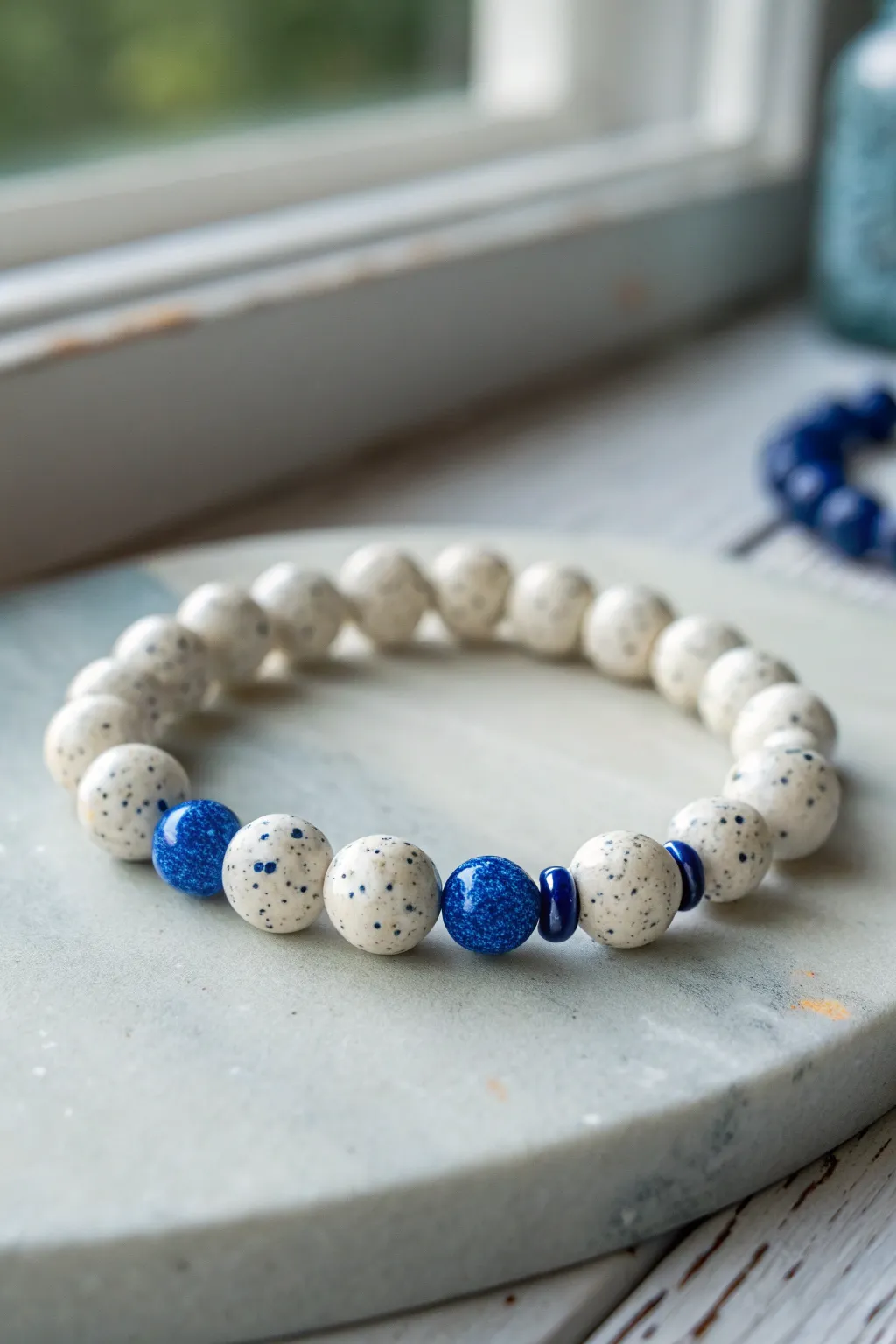
Embrace the crisp, clean aesthetic of pottery with this simple yet striking clay bead bracelet. The design pairs the organic feel of speckled white spheres with vivid blue accents for a look that feels both handcrafted and modern.
Detailed Instructions
Materials
- White or cream polymer clay
- Navy blue polymer clay
- Coarse black pepper or dried coffee grounds (for speckling)
- Gloss glaze or varnish
- Elastic beading cord (0.7mm to 1mm)
- Small round bead roller (optional but helpful)
- Beading needle
- Super glue or jewelry cement
- Small dark blue seed beads or spacer beads
- Oven for baking clay
- Toothpicks or bead reamer
Step 1: Crafting the Clay Beads
-
Condition the white clay:
Start by warming a generous block of white polymer clay in your hands until it becomes soft and pliable. This conditioning step is crucial to prevent cracks later on. -
Create the speckled mixture:
To achieve that authentic stoneware pottery look, flatten your white clay and sprinkle a small pinch of coarse black pepper or dried coffee grounds onto it. I prefer pepper for a cooler tone. -
Incorporate the speckles:
Fold the clay over the speckles and knead it thoroughly until the flecks are evenly distributed throughout the white base. -
Form the base beads:
Roll the speckled clay into a long, even log snake about the thickness of your thumb. Slice this log into equal pieces—aim for roughly 16-20 segments depending on your wrist size. -
Roll spheres:
Roll each segment between your palms to create smooth, round spheres. A bead roller is a great tool here if you want perfect uniformity, but hand-rolling adds rustic charm. -
Make the blue accent beads:
Condition a small amount of navy blue clay. Break off three pieces slightly smaller than your white beads and roll them into smooth spheres. -
Add texture to blue beads:
For the specific texture shown in the image, lightly dab the surface of the blue clay spheres with a coarse sponge or sandpaper before baking to give them a stone-like finish. -
Pierce the holes:
Use a toothpick or bead pin to carefully pierce a hole through the center of every bead. Rotate the bead as you push the tool through to avoid flattening the shape.
Step 2: Baking and Finishing
-
Bake the beads:
Arrange your beads on a baking sheet lined with parchment paper. Bake according to your brand of polymer clay’s instructions—usually around 275°F (135°C) for 15-30 minutes. -
Cool and inspect:
Allow the beads to cool completely. Check the holes to ensure they are clear; use a bead reamer or a small drill bit to clean out any blocked pathways. -
Glazing:
Apply a coat of gloss glaze to the blue beads to make them pop against the matte white beads. You can leave the white beads matte for contrast or glaze them too for a polished ceramic look.
Clean Piercing Hack
Let the shaped clay sit in the fridge for 10 minutes before piercing. The firmer clay won’t deform when you push the needle through.
Step 3: Assembly
-
Cut the cord:
Cut a length of elastic cord about 10-12 inches long. Pre-stretch the elastic by pulling on it gently a few times; this prevents the bracelet from loosening immediately after wear. -
Plan the pattern:
Lay out your design on a bead board or cloth. The sequence shown uses a continuous run of white speckled beads, interrupted by a focal section: one blue bead, one white, one blue, often separated by tiny dark spacer beads. -
String the beads:
Thread your beads onto the elastic cord. If the holes are tight, use a flexible beading needle. -
Insert spacers:
Don’t forget to add the tiny dark spacer beads on either side of the blue accent beads if you want to replicate the exact detail seen in the photo. -
Check the fit:
Wrap the strung beads around your wrist to check the size. Add or remove speckled white beads as needed to get a comfortable fit. -
Knot the cord:
Tie the ends of the elastic together using a surgeon’s knot (looping the cord through twice on the first pass). Pull it tight. -
Secure the knot:
Dab a tiny drop of super glue or jewelry cement onto the knot. Let it dry for a moment before trimming the excess cord tails. -
Hide the knot:
Gently pull the elastic so the knot slides inside the hole of one of the adjacent beads, hiding it from view.
Try A Marbled Effect
Mix a tiny amount of translucent clay into your white base. It adds depth that makes the faux-stone effect look incredibly realistic.
Now you have a stunning piece of jewelry that mimics the timeless beauty of speckled ceramic ware
Terrazzo Confetti in Blue and White
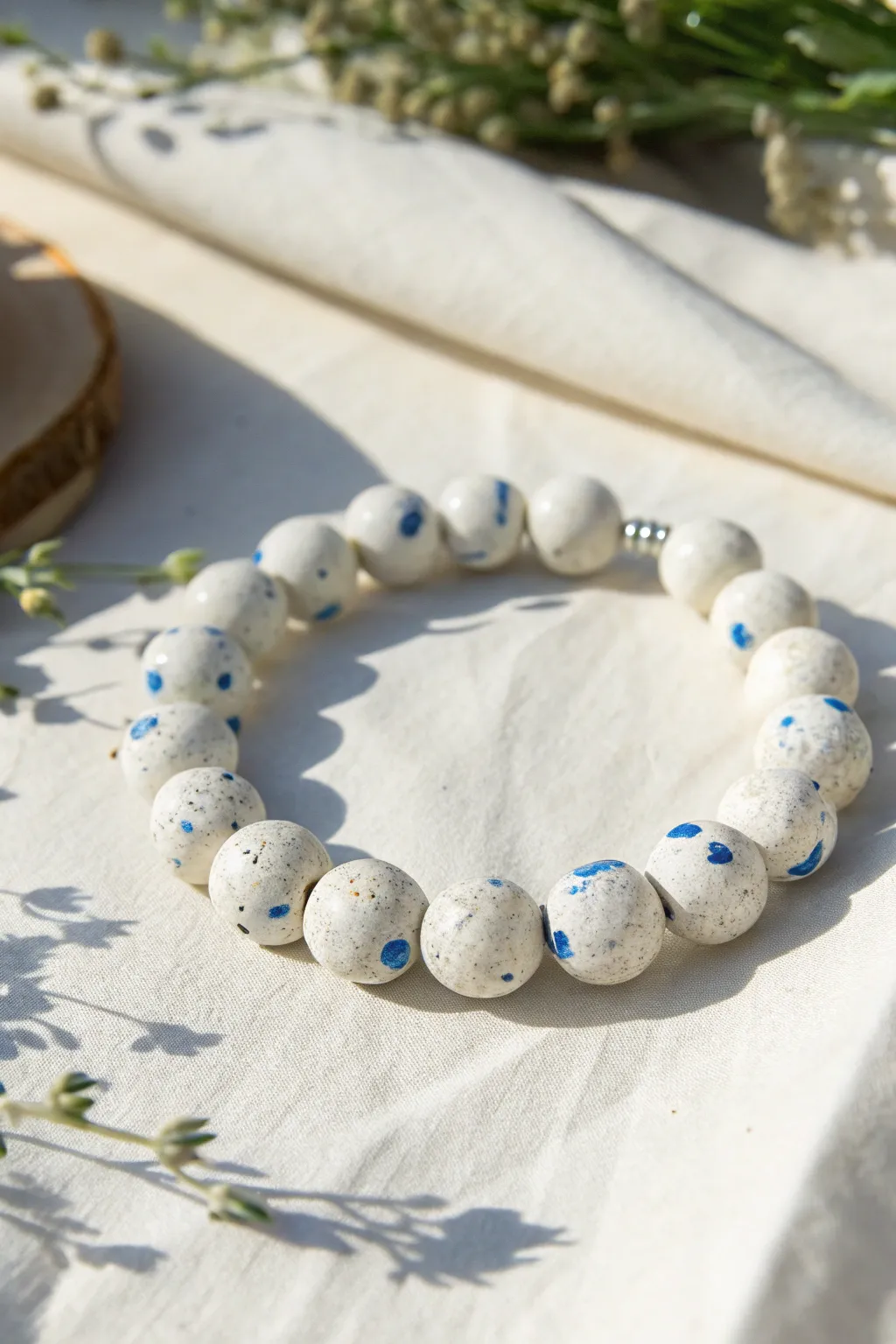
Capture the essence of scattered confetti with these delightful, handmade polymer clay beads featuring a classic white base and playful blue accents. The terrazzo-inspired pattern gives each bead a unique, organic look that feels both modern and timeless.
Step-by-Step
Materials
- White polymer clay (approx. 2oz)
- Bright royal blue polymer clay (small amount)
- Black polymer clay or black acrylic paint (for speckles)
- Toothbrush or stiff bristle brush (if using paint)
- Bead piercing pins or toothpicks
- Clear elastic cord (0.8mm or 1mm)
- Super glue or jewelry cement
- Scissors
Step 1: Preparing the Clay Base
-
Condition the white clay:
Start by warming up your white polymer clay in your hands. Knead and roll it until it becomes soft, pliable, and free of cracks. -
Create a log:
Roll the conditioned white clay into a long, even snake or log shape, roughly equal in thickness to the final size you want your beads to be. -
Portion the beads:
Using a blade or craft knife, slice the white log into equal segments. For a standard bracelet, you’ll want about 18–22 pieces, depending on your wrist size. -
Roll into spheres:
Take each segment and roll it between your palms to form smooth, round balls. Try to keep them as uniform as possible, but slight variations add charm.
Step 2: Adding the Terrazzo Details
-
Prepare the blue accents:
Condition a very small amount of blue clay. Flatten it into a paper-thin sheet using an acrylic roller or pasta machine on the thinnest setting. -
Make the ‘confetti’:
Tear tiny, irregular scraps from the blue sheet. You want random shapes and sizes—some larger triangles, some tiny specks. -
Apply the blue inclusions:
Pick up a white bead and gently press several blue scraps onto the surface. Don’t cover the whole bead; aim for about 3–5 blue spots per bead to keep the white base visible. -
Add subtle black speckles:
For the tiny grit look, you have two options. You can grate a tiny bit of cured black clay into dust and roll the beads in it, or I prefer to use a toothbrush to flick a very fine mist of diluted black acrylic paint onto the beads before baking. -
Integrate the pattern:
Once your blue scraps and speckles are applied, roll the bead between your palms again. This embeds the clay pieces flush with the surface, creating that smooth terrazzo effect.
Secret to Smoothness
Before baking, you can lightly dust your palms with cornstarch. This prevents fingerprints and helps the clay roll into a perfectly smooth sphere.
Step 3: Piercing and Baking
-
Pierce the holes:
Gently insert a piercing pin or toothpick through the center of each bead. Twist as you push through to avoid squashing the round shape. -
Refine the shape:
With the pin still inside, give the bead a final gentle roll to ensure it hasn’t become oval-shaped from the piercing. -
Prepare for baking:
Arrange your beads on a baking sheet lined with parchment paper or cardstock. You can bake them on the pins if you have a bead rack, or carefully slide them off. -
Bake the clay:
Bake according to your clay manufacturer’s instructions (usually 275°F/135°C for 15–30 minutes). Let them cool completely before handling.
Uneven Roll Fix
If your blue spots smudge when rolling, the clay might be too warm. Pop the beads in the fridge for 5 minutes before the final roll to firm them up.
Step 4: Assembly
-
Measure the cord:
Cut a piece of elastic cord about 10 inches long. Pre-stretch the elastic by pulling on it firmly a few times; this prevents the bracelet from loosening later. -
String the beads:
Thread your cooled beads onto the elastic cord. Check the length around your wrist occasionally to ensure a perfect fit. -
Tie the knot:
Tie a surgeon’s knot (right over left, left over right, threading through twice on the first pass). Pull it tight. -
Secure and trim:
Dab a tiny drop of super glue or jewelry cement onto the knot. Let it dry for a moment, then trim the excess cord ends close to the knot. -
Hide the knot:
Gently pull the elastic so the knot slides inside the hole of one of the beads, hiding it from view.
Enjoy wearing your new bracelet that looks just like polished stone
Hand-Painted Blue Dots on White Beads
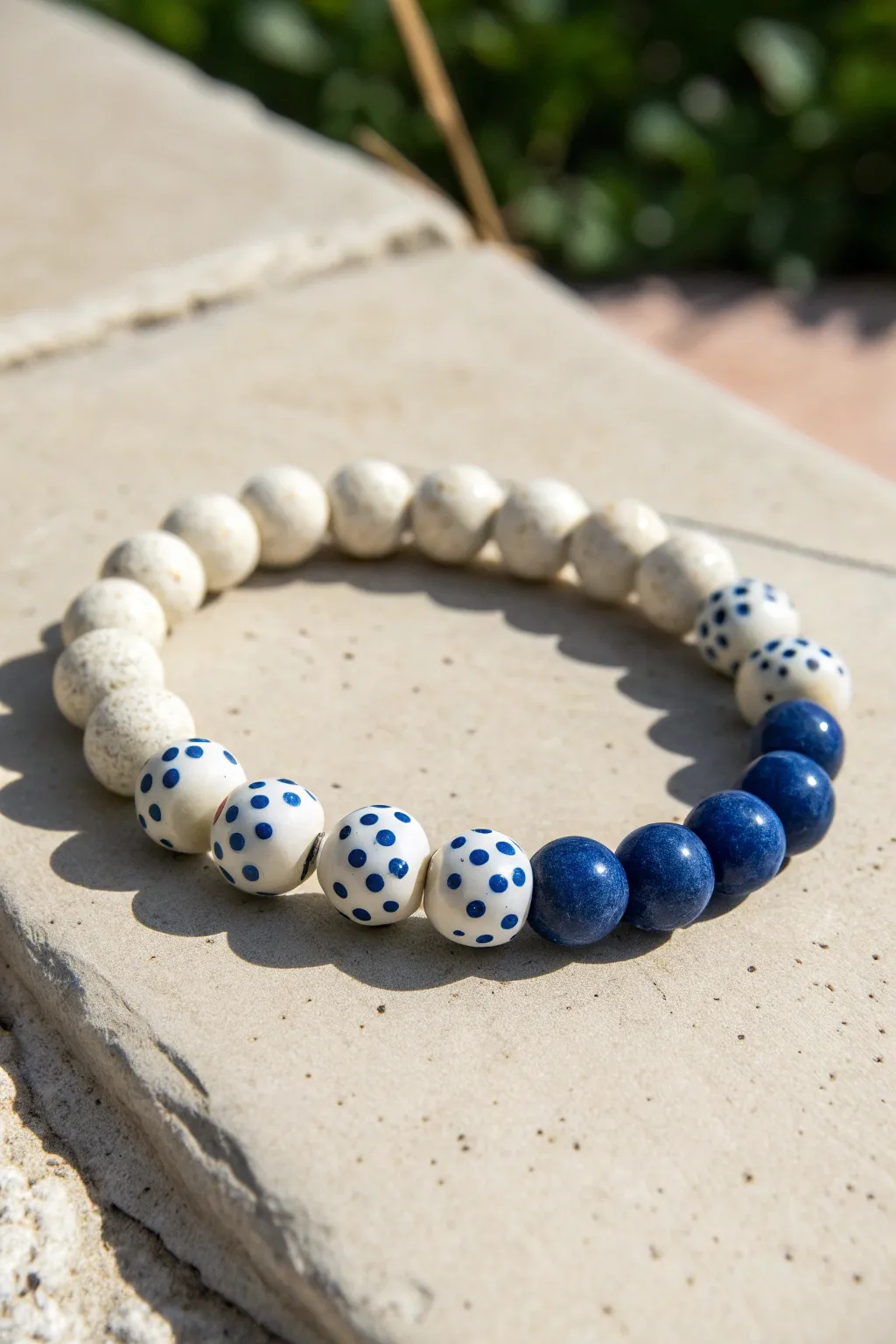
This charming bracelet combines natural textures with hand-painted details for a unique coastal look. The mix of raw, porous beads alongside glossy blue accents creates a delightful rhythm perfect for casual wear or stacking.
Step-by-Step Guide
Materials
- White or cream porous clay beads (approx. 10-12mm)
- Small round lapis lazuli or dark blue glazed ceramic beads (approx. 8mm)
- Cobalt blue acrylic paint or ceramic paint
- Fine-point paintbrush or dotting tool
- Strong elastic jewelry cord (0.7mm or 0.8mm)
- Super glue or jewelry cement
- Scissors
- Toothpicks or a skewer
- Small piece of styrofoam or clay (for drying)
Step 1: Painting the Feature Beads
-
Prepare your workspace:
Set up a clean, flat surface. Skewer the white clay beads onto toothpicks or a thin stick to make them easier to handle while painting. This keeps your fingers clean and prevents smudging. -
Load your tool:
Dip a fine-point brush or a metal dotting tool into your cobalt blue paint. You want just enough paint to form a droplet, but not so much that it will run down the bead. -
Create the first dot:
Gently touch the loaded tool to the center of a white bead. Lift straight up to leave a perfect, round circle. I like to start with this central dot to anchor the pattern. -
Build the pattern:
Rotate the bead and add more dots in a random but evenly spaced arrangement. Aim for 5-6 dots per bead to keep the design airy and not too crowded. -
Repeat the process:
Continue painting until you have about 6 or 7 dotted beads tailored to your wrist size. Leave the remaining white beads plain to create contrast. -
Let them dry:
Place the skewers into your styrofoam block or a lump of clay so the beads are suspended in the air. Allow the paint to cure completely according to the bottle instructions, usually about an hour.
Paint Troubleshooting
If your painted dots look messy or smear, the paint might be too thick. Thin it slightly with water for acrylics, or wipe the bead clean immediately and try again with a lighter touch.
Step 2: Designing the Layout
-
Measure your elastic:
Cut a piece of elastic cord about 10-12 inches long. This generous length makes tying the knot much easier later on. -
Pre-stretch the cord:
Give the elastic piece a few firm tugs. This crucial step prevents the bracelet from stretching out and becoming loose after the first few times you wear it. -
Plan your sequence:
Lay your beads out on a bead board or a soft towel. Start with the group of solid blue beads, followed by the hand-painted dotted beads. -
Finish the arrangement:
Complete the circle with the plain, unpainted white beads. This asymmetrical color blocking is key to the modern, stylish look of the bracelet.
Step 3: Stringing and Finishing
-
Begin stringing:
Thread the beads onto the elastic cord one by one, following your planned arrangement. Be careful not to let the other end slip; you can tape it to the table if needed. -
Check fit:
Once all beads are on, wrap the strand around your wrist. It should sit comfortably without pinching skin or drooping excessively. Add or remove plain white beads to adjust the size. -
Tie the knot:
Bring the two ends of the elastic together. Tie a surgeon’s knot (right over left, left over right, and loop through an extra time) and pull it tight. -
Secure the knot:
Apply a tiny dab of jewelry glue or super glue directly onto the knot. Wait a moment for it to become tacky before releasing tension. -
Hide the mechanics:
If the hole of one of the adjacent beads is large enough, gently tug the elastic to slide the knot inside the bead, hiding it from view. -
Trim excess:
Once the glue is fully dry, trim the excess elastic tails with scissors, getting as close to the knot as possible without cutting the knot itself.
Level Up: Texture
Mix a tiny amount of baking soda into your white paint before dotting. This creates a raised, 3D texture for the dots that mimics the feel of real ceramic glazing.
Slip on your new handcrafted accessory and enjoy the fresh, nautical vibe suitable for any season
Blue Wave Pattern Around the Bracelet
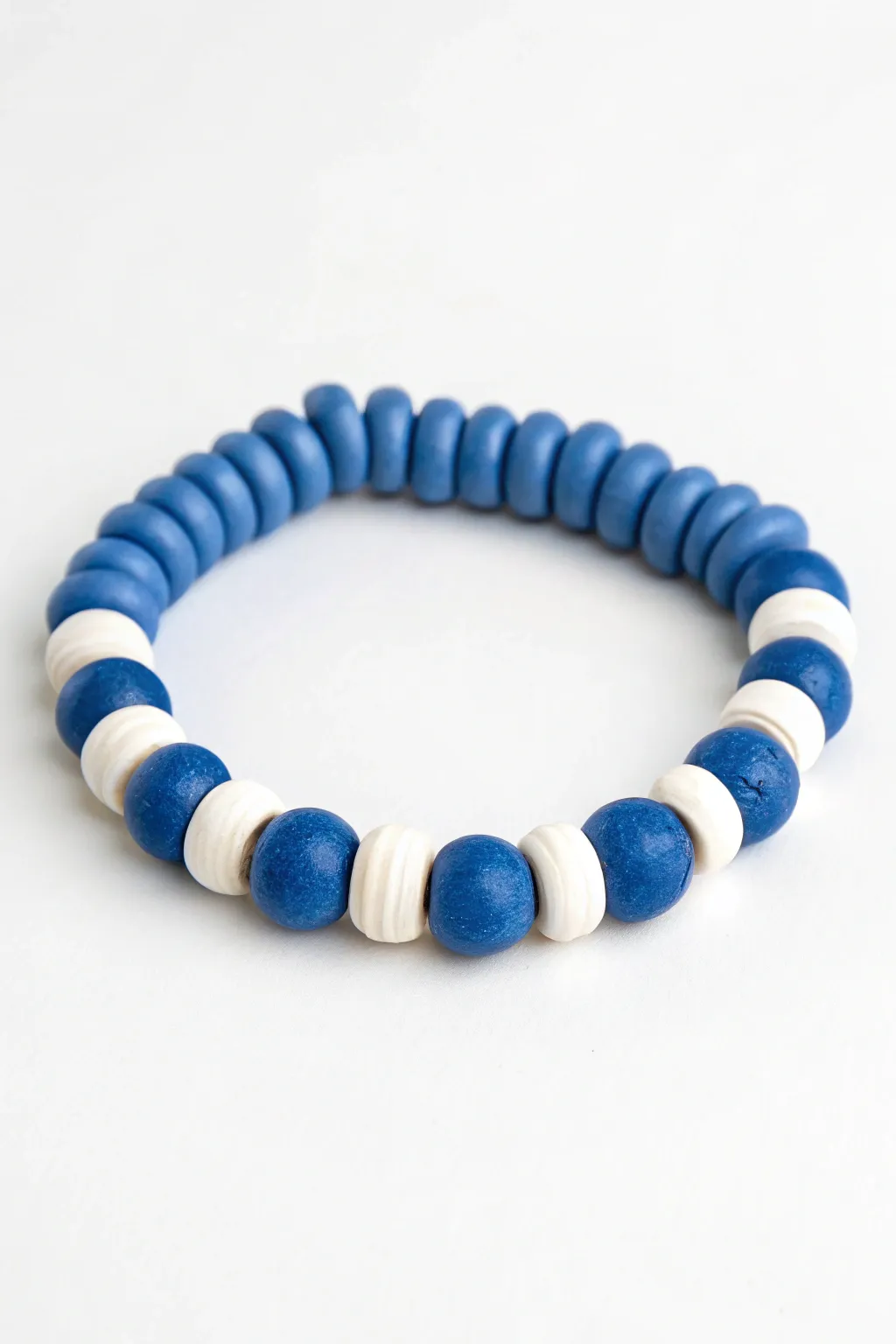
This striking bracelet combines the sleek texture of clay heishi discs with the rustic charm of wooden rounds for a mixed-media look. The design features a bold “half-and-half” composition that pairs a solid blue wave of discs with a classic nautical stripe pattern.
Detailed Instructions
Materials
- Blue polymer clay heishi beads (approx. 6mm)
- Small round blue wooden beads (approx. 8mm)
- White ribbed or rondelle bone/wood spacer beads (approx. 6-8mm)
- Elastic stretch cord (0.8mm or 1.0mm recommended)
- Scissors
- Hypo cement or clear jewelry glue
- Bead stopper or binder clip
- Ruler
Step 1: Preparation & Planning
-
Measure your wrist:
Wrap a flexible tape measure around your wrist to find your size. Add about 0.5 inches to this measurement to ensure a comfortable fit that isn’t too tight. -
Prepare the cord:
Cut a piece of elastic cord about 10-12 inches long. This extra length makes tying the final knot much easier without struggling against tension. -
Pre-stretch the elastic:
Hold the cord generally by the ends and give it several firm tugs. This “pre-stretching” prevents the bracelet from loosening up and sagging after you wear it a few times. -
Secure the end:
Attach a bead stopper or a simple binder clip to one end of your cut cord. This crucial step saves you from the frustration of beads sliding right off while you work.
Step 2: Creating the Solid Section
-
String the heishi base:
Begin by stringing the flat, blue polymer clay heishi beads. You want these to form roughly half of the bracelet’s total circumference. -
Check density:
As you add the clay discs, ensure they are sitting flush against each other without gaps, creating a solid, snake-like tube. -
Measure the half-point:
Stop stringing the clay beads once you have covered approximately 3 to 3.5 inches of the cord (for an average adult wrist). This creates the monochromatic back section of the design.
Hiding the Knot
Plan your stringing so the knot lands next to the large wooden beads. Their holes are usually bigger than the heishi beads, making it easier to pull the knot inside to hide it.
Step 3: Building the Patterned Section
-
Start the transition:
Switch to your larger beads. Slide on one blue round wooden bead to begin the second half of the design. -
Add the contrast:
Follow the blue round bead with a white ribbed spacer bead. The texture difference here is key to the design’s appeal. -
Continue the sequence:
Repeat the pattern: one blue round bead followed by one white ribbed bead. Continue this alternating sequence until you have nearly reached your desired total length. -
Finish the pattern:
I prefer to end this section with a blue round bead so that the pattern looks symmetrical when it meets the clay discs again, but ending on white works too depending on your fit. -
Verify the size:
Wrap the unfinished strand around your wrist to check the fit. The two ends should meet comfortably without stretching the elastic yet.
Stiff Bracelet?
If the finished bracelet feels rigid and doesn’t curve well, you strung the beads too tightly. Leave a tiny 1-2mm gap of slack before tying your knot to allow movement.
Step 4: Final Assembly
-
Remove the stopper:
Carefully remove the bead stopper or clip while firmly holding both ends of the elastic cord to prevent slippage. -
Tie the initial knot:
Cross the ends and make a simple overhand knot. Pull it tight near the beads to eliminate slack in the strand. -
Secure with a surgeon’s knot:
Make another loop like you are tying a shoe, but wrap the end through the loop twice instead of once. Pull this knot firmly to lock it in place. -
Add adhesive:
Apply a tiny drop of Hypo cement or jewelry glue directly onto the knot. Let it dry for a few minutes to ensure it won’t unravel. -
Trim the excess:
Once dry, use your scissors to snip the excess cord ends close to the knot. If possible, gently tug the knot inside one of the larger blue wooden beads to hide it.
Enjoy the rhythmic blend of textures on your new ocean-inspired accessory
Geometric Blue Chevron With White Breaks
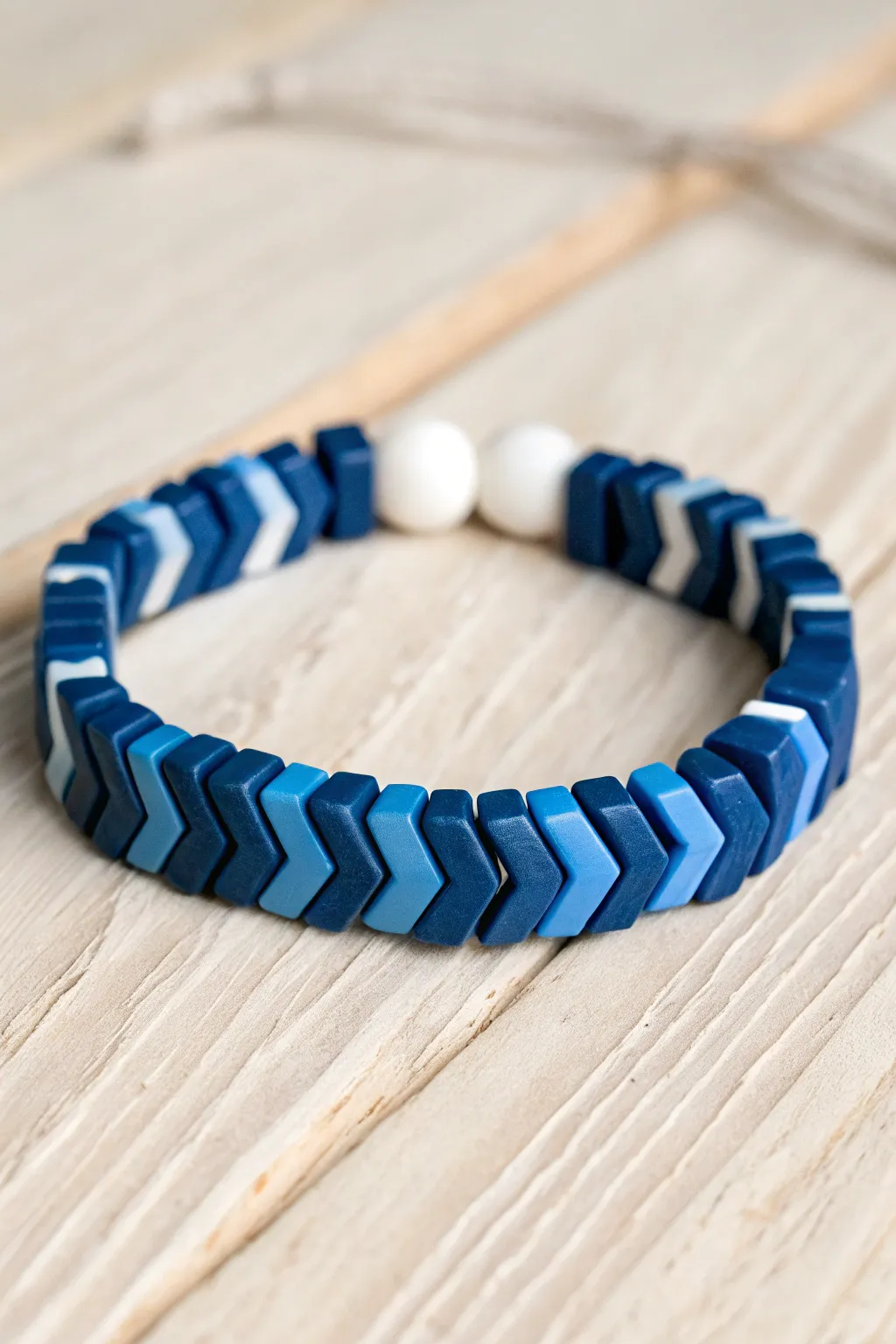
Achieve a sharp, geometric look with this striking chevron pattern bracelet. Combining deep navy and bright blue arrows with crisp white accents creates a modern, nautical-inspired accessory that is both durable and stylish.
How-To Guide
Materials
- Chevron-shaped beads in Dark Navy Blue
- Chevron-shaped beads in Bright Medium Blue
- Chevron-shaped beads in White
- 2 large round White beads (10mm-12mm)
- Strong elastic beading cord (0.8mm or 1mm)
- Scissors
- Super glue or jewelry glue (optional)
- Bead stopper or masking tape
Step 1: Planning and Preparation
-
Measure your cord:
Cut a piece of elastic beading cord approximately 10-12 inches long. This generous length gives you plenty of room to tie knots securely later without struggling. -
Secure the end:
Attach a bead stopper or simply fold a piece of masking tape over one end of your cord to prevent your chevrons from sliding off as you work. -
Sort your beads:
Separate your chevron beads by color into three piles: Dark Navy, Bright Blue, and White. Having them organized makes the patterning process much faster.
Uneven Chevrons?
If gaps appear between beads, check bead orientation. One flipped bead prevents nesting. Also, verify bead thickness; discard unusually thin or thick clay slices.
Step 2: Creating the Main Pattern
-
Start the sequence:
Begin threading your beads. The primary pattern block relies on alternating colors to create contrast. Start by sliding on two Dark Navy chevrons. -
Add color contrast:
Follow the navy beads with one Bright Blue chevron. Ensure all chevron arrows are pointing in the exact same direction so they nest together perfectly. -
Repeat the block:
Continue this specific ‘2 Navy + 1 Bright Blue’ pattern. Repeat this sequence about 5 or 6 times to create a solid segment of blue tones. -
Verify alignment:
Periodically push the beads together to check the fit. If any bead is flipped the wrong way, the arrows won’t interlock smoothly, leaving gaps.
Texture Twist
Replace the smooth round white beads with textured lava stones or faceted wooden beads to add a tactile contrast to the smooth polymer clay chevrons.
Step 3: Adding the White Accents
-
Insert the white break:
After your section of blue variations, add a single White chevron followed by a Dark Navy chevron, then another White chevron. This creates a bold visual break. -
Resume blue pattern:
Return to your main pattern of ‘2 Navy + 1 Bright Blue’. Continue threading until the beaded strand is about 1.5 inches short of your total desired wrist circumference. -
Second white accent:
Create another accent section on the opposite side if you wish, or keep the pattern asymmetrical as shown in the photo with occasional white dashes. -
Check the length:
Wrap the unfinished strand around your wrist. The ends shouldn’t touch yet because we still need to add the large focal beads.
Step 4: Finishing the Closure
-
Add focal beads:
Thread on the two large round White beads. These act as a comfortable joiner at the back or a focal point, depending on how you wear it. -
Prepare to knot:
Remove the tape or bead stopper carefully. Bring the two ends of the elastic together, ensuring there is no slack between the beads. -
Tie the knot:
Tie a surgeon’s knot (a square knot with an extra loop through). Pull the elastic tight; I recommend stretching it slightly as you pull to lock the knot in place. -
Secure and trim:
For extra security, place a tiny drop of jewelry glue on the knot. Let it dry for a minute before trimming the excess cord close to the knot. -
Hide the knot:
Gently gently tug the cord to slide the knot inside the hole of one of the large round white beads to hide it completely.
Slip on your new geometric accessory and enjoy the cool blue tones
Tile-Inspired Blue-and-White Motifs
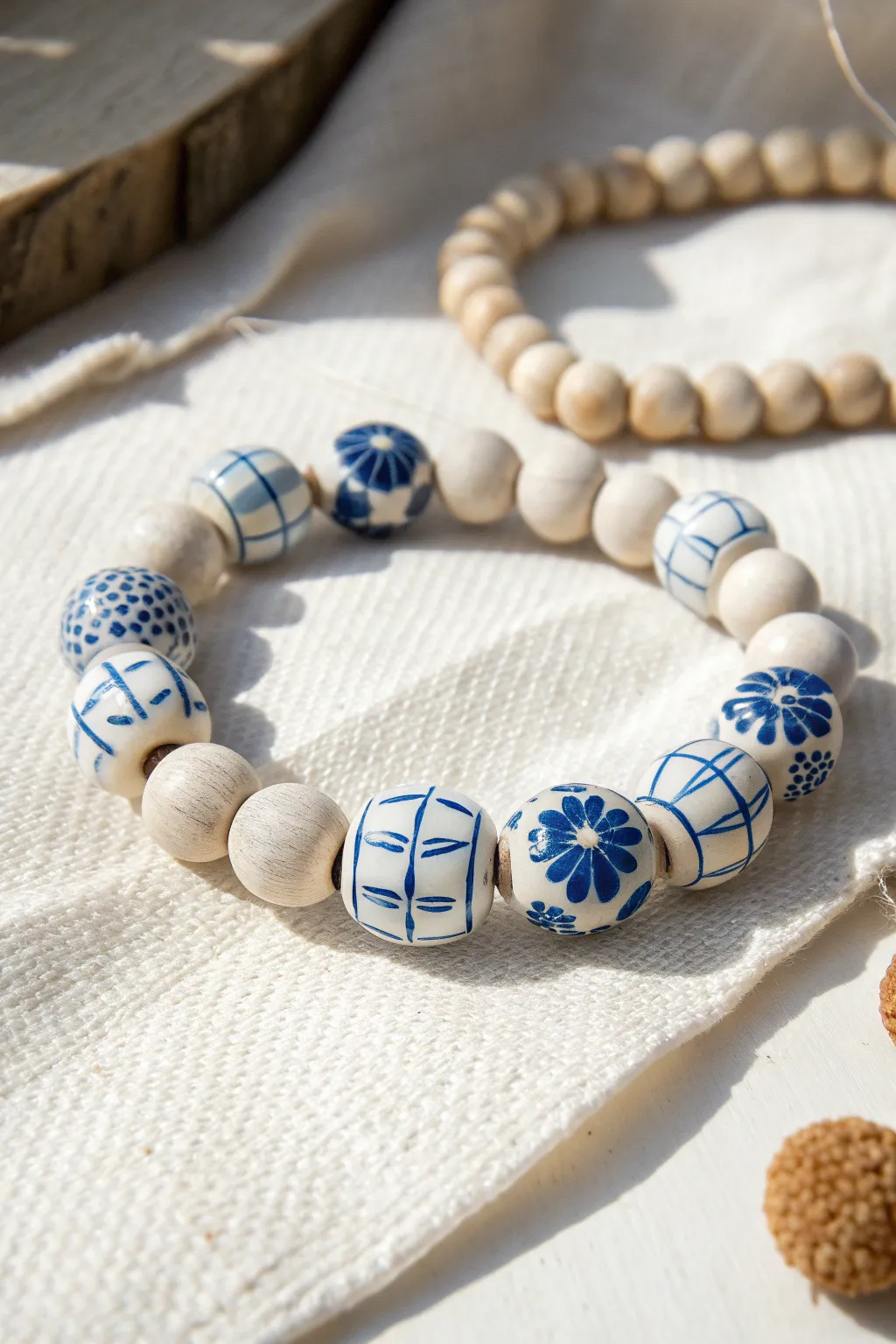
Capture the breezy elegance of seaside architecture with this striking blue and white bracelet featuring hand-painted wooden beads. This project combines natural wood textures with intricate tile-inspired motifs for a piece that feels both rustic and refined.
Step-by-Step Tutorial
Materials
- 20mm round unfinished wooden beads (approx. 8)
- 20mm round ceramic-look painted wooden beads (approx. 8)
- Fine-point blue paint marker or acrylic paint with a liner brush
- Clear matte or satin spray varnish
- Strong elastic cord (1mm diameter)
- Scissors
- Super glue or jewelry cement
- Bead reamer or awl (optional)
- Masking tape or painter’s tape
- Small wooden skewers
Step 1: Painting the Tile Motifs
-
Preparation:
Select about half of your wooden beads to be painted. If you are painting the designs yourself rather than buying pre-printed beads, slide these beads onto wooden skewers to hold them steady while you work. -
Base coat option:
While this specific project uses the natural light wood as the background, you could paint the beads a solid glossy white first for a true porcelain look. If doing so, apply two thin coats of white acrylic paint and let dry completely. -
Design planning:
Visualize three main patterns: a geometric grid, a floral starburst, and a dotted texture. Sketching these lightly with a pencil on the bead surface first can save heartache later. -
Painting the grid pattern:
For the grid beads, use your blue paint pen to draw vertical lines spanning from hole to hole. Intersect these with horizontal rings around the bead, creating a windowpane effect. -
Adding diagonals:
Inside the grid squares you just created, add small diagonal dashes or simple crosses to mimic classic Delftware tile patterns. -
Painting the floral motif:
On the next set of beads, paint a central six-petaled flower shape. I like to start with a center dot and pull the brush or pen outward for each petal to get that teardrop shape naturally. -
Painting the dotted texture:
For the third pattern style, gently stipple small clusters of dots. Keep them denser in one area and spaced out in others to create visual texture. -
Sealing the beads:
Once all paint is completely dry (give it at least an hour), spray the painted beads with a clear matte or satin varnish. This mimics the glazed look of ceramic and protects the design from rubbing off against your wrist.
Ink Bleeding into Wood?
If your paint pen bleeds into the wood grain, apply a clear matte sealer to the raw wood beads first. Let it dry, then paint your blue designs on top for crisp lines.
Step 2: Assembly
-
Measuring the cord:
Cut a piece of elastic cord about 10-12 inches long. This generous length makes tying the final knot much easier than fighting with short ends. -
Pre-stretching:
Grasp both ends of your elastic cord and give it a firm tug a few times. This pre-stretching prevents the bracelet from becoming loose and saggy after the first few wears. -
Securing the end:
Place a piece of masking tape over one end of the cord to act as a stopper so beads don’t slide off while you string them. -
Planning the layout:
Lay your beads out on a flat surface. Alternate between your new hand-painted ’tile’ beads and the plain natural wood beads. Arranging them in pairs (two painted, two plain) or an alternating 1-pattern/2-plain rhythm creates a nice organic flow. -
Stringing the beads:
Thread the beads onto the elastic cord according to your planned pattern. Check the length by wrapping it around your wrist; the large 20mm beads take up more inner circumference than small beads, so you might need a slightly longer strand than usual. -
Tying the knot:
Remove the tape and bring the ends together. Tie a surgeon’s knot: make a standard overhand knot, but pass the tail end through the loop twice instead of once before pulling tight. -
Securing the knot:
apply a tiny drop of super glue or jewelry cement directly onto the knot. Let it dry for a few minutes while holding the elastic taut. -
Hiding the mechanics:
Trim the excess cord ends to about 2mm. Gently tug the bracelet so the knot slides inside the hole of one of the adjacent wooden beads, hiding it from view completely.
Pro Tip: Custom Colors
Mix a tiny touch of white into your blue paint for the floral centers. This slight variation adds depth and makes the ‘ceramic’ effect look more hand-glazed and authentic.
Slip on your new bracelet and enjoy the timeless charm of blue and white patterns wherever you go
Double-Strand Blue and White Stack Pair
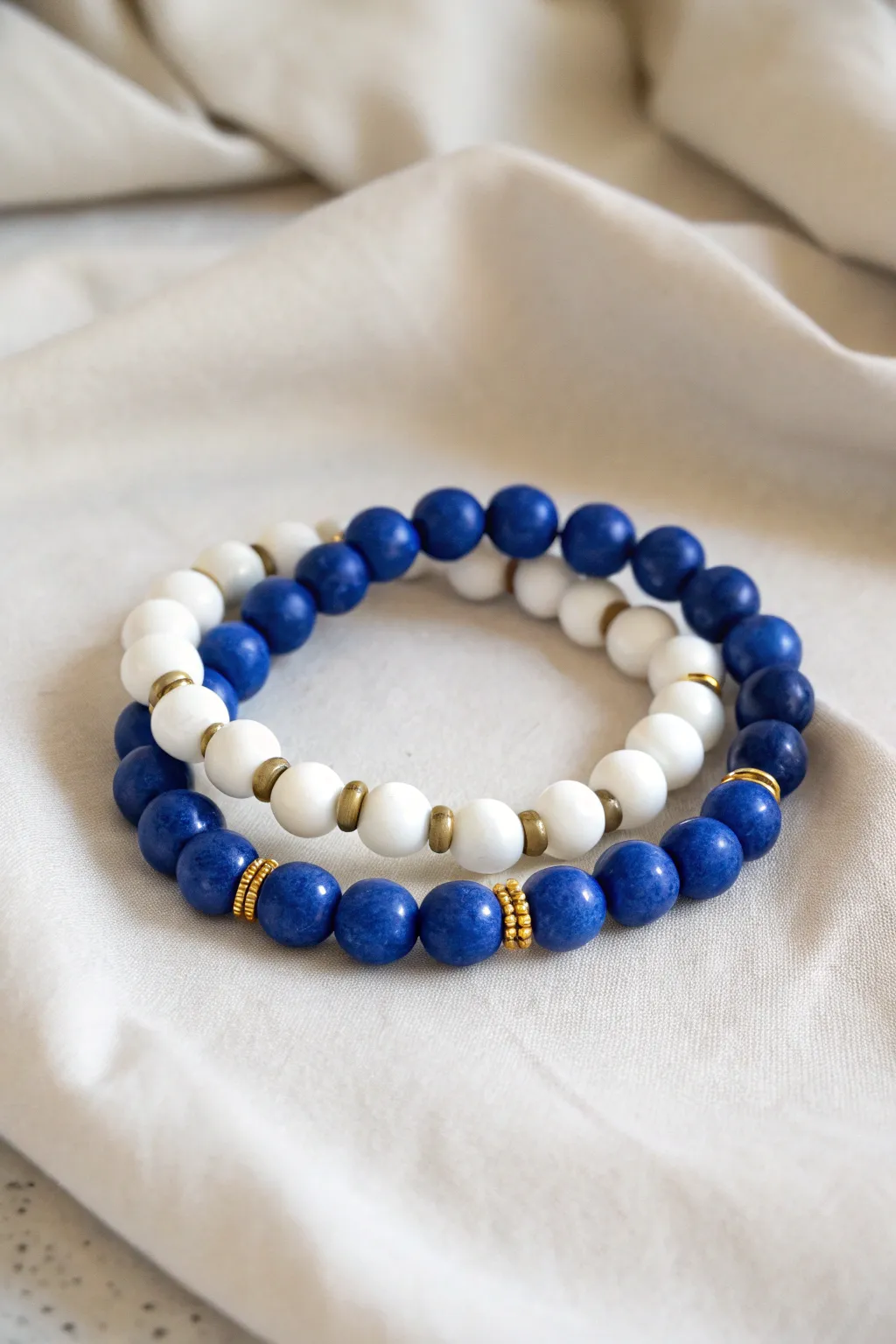
These two complementary bracelets strike the perfect balance between casual and chic, mixing deep navy blue with creamy white rounds. Whether worn together or shared with a friend, this easy stringing project creates a versatile accessory set.
Step-by-Step Guide
Materials
- Navy blue round stone or glass beads (8mm or 10mm)
- Creamy white round stone or glass beads (8mm or 10mm)
- Gold tone spacer beads (flat disc shaped)
- Gold tone spacer beads (ridged or textured rondelle shaped)
- Elastic cord (0.8mm or 1.0mm depending on bead hole size)
- Jewelry glue or clear nail polish
- Scissors
Step 1: Planning & Preparation
-
Measure your wrist:
Wrap a flexible measuring tape around your wrist to find your size. Add about half an inch to this measurement to ensure the bracelets sit comfortably without pinching. -
Prepare the elastic:
Cut two lengths of elastic cord, making each about 10-12 inches long. Having extra length makes the final knotting process much easier than struggling with short ends. -
Pre-stretch the cord:
Hold a piece of elastic firmly between your hands and give it a few gentle tugs. This pre-stretching step is crucial because it prevents the bracelet from sagging or loosening after you’ve worn it a few times.
Hiding the Knot
Use a bead with a slightly larger hole next to where you plan to tie your knot. This makes it much easier to pull the finished knot inside for a seamless look.
Step 2: Creating the White Strand
-
Arrange the pattern:
Lay out your white beads on a bead board or soft cloth. For the visual interest seen in the photo, you will create a pattern where white segments are separated by gold spacers. -
Start stringing:
Begin threading your white beads onto the first piece of elastic. String on four white beads to start. -
Add gold accents:
After the fourth white bead, slide on a flat gold disc spacer. This breaks up the white and adds a touch of metallic warmth. -
Create the alternating section:
For the back section of the bracelet (or the darker accent part), switch to blue beads. Thread on one blue bead, followed by a gold spacer, then another blue bead. This creates the mixed look visible in the top bracelet of the photo. -
Return to white:
Continue the pattern by adding another gold spacer and returning to segments of white beads. I usually string about 4-5 white beads between each spacer until the strand reaches the desired length. -
Check the fit:
Bring the ends of the elastic together carefully to form a circle around your wrist. Ensure the beads meet comfortably without gaps.
Step 3: Creating the Blue Strand
-
Plan the blue design:
For the second bracelet, the primary color will be navy blue. Lay out your blue beads. -
Begin stringing basics:
Thread a long sequence of blue beads onto your second piece of pre-stretched elastic. -
Insert textured accents:
Unlike the white strand which used flat discs, use the textured, ridged gold rondelles here. Place one gold rondelle, then a single blue bead, then another gold rondelle. Repeat this small cluster 2 or 3 times around the bracelet. -
Incorporate contrast:
To tie the two bracelets together visually, add a small section of white beads. Thread 3-4 white beads near the back or side of the loop so the colors echo the first bracelet. -
Verify sizing:
Wrap this second strand around your wrist to confirm it matches the size of the first bracelet perfectly.
Knot Slipping?
If your elastic feels slippery and the knot won’t hold, try rubbing the ends with a little beeswax or even plain chalk before tying to add friction.
Step 4: Finishing Touches
-
Tie the surgeon’s knot:
Take the two ends of one bracelet. Make a simple overhand knot, but do not pull tight yet. Make a second overhand knot, looping the end through twice instead of once. -
Tighten securely:
Pull the elastic ends firmly to tighten the knot. You should feel it lock into place. Do this for both bracelets. -
Secure with glue:
Apply a tiny drop of jewelry glue or clear nail polish directly onto the knot. Let this dry completely before moving on. -
Hide the knot:
Once the glue is dry, trim the excess elastic tails close to the knot. Gently tug the bracelet so the knot slides inside the hole of a neighboring bead, making it invisible.
Slip on your new stack and enjoy the classic coastal vibe they bring to your outfit