
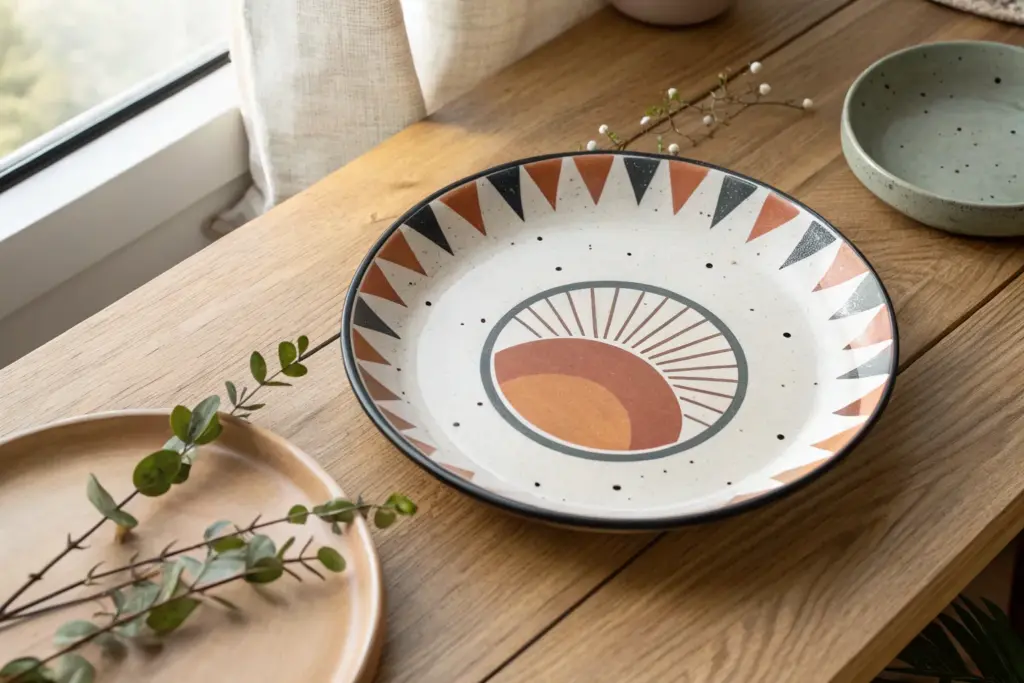
A plain clay plate is basically the coziest little canvas—practical, round, and begging for color. Here are my favorite clay plate painting ideas, starting with the classics and ending with a few playful twists that always get people excited.
Polka Dot Confetti
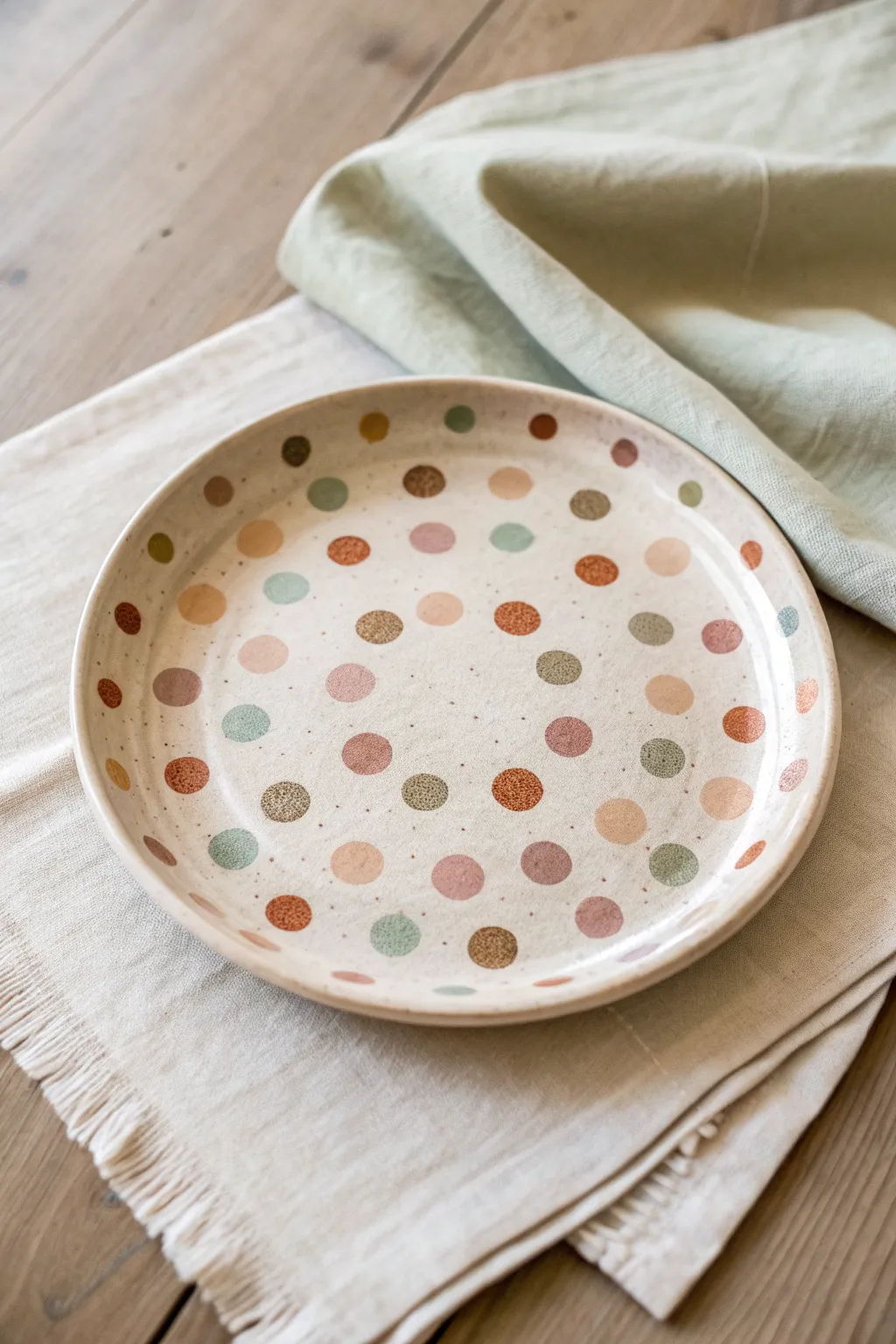
Embrace the imperfect charm of handmade ceramics with this confetti-style polka dot design. Using a palette of muted earth tones on a creamy speckled base, you’ll create a playful yet sophisticated piece perfect for cozy dining.
Step-by-Step Tutorial
Materials
- Bisque-fired ceramic plate (cream or speckled clay body recommended)
- Underglazes in earthy tones: Terracotta, Sage Green, Mauve, Mustard, Blush Pink
- Clear transparent glaze
- Round foam pouncers (assorted small sizes)
- Small round bristle brush (size 4 or 6)
- Old toothbrush (for splattering)
- Palette or small dishes for paint
- Damp sponge
- Clean water
Step 1: Preparation & Base
-
Clean the surface:
Begin by wiping down your bisque plate with a damp sponge. This removes any kiln dust or oils from handling that could prevent the underglaze from adhering properly. -
Prepare your palette:
Pour small puddles of your chosen underglaze colors—Mustard, Terracotta, Sage, and Mauve—onto a palette. Ensure the consistency is creamy, like melted ice cream. -
Add texture (optional):
If your plate is plain white clay but you want that speckled stoneware look shown in the image, dip an old toothbrush into diluted brown underglaze. Run your thumb over the bristles to flick tiny speckles across the entire surface.
Natural Texture
Don’t worry if the paint applies slightly unevenly. That variation adds to the rustic, organic aesthetic.
Step 2: Creating the Confetti
-
Start with the dominant color:
Choose your boldest color first, perhaps the terracotta or rust orange. Dip a small round foam pouncer into the paint, dab off the excess on a paper towel, and press it gently onto the plate. -
Establish the spacing:
Place these first few dots randomly but generously spaced apart. Avoid creating a grid; you want the placement to feel tossed like confetti. -
Switch to green tones:
Using a fresh pouncer or a cleaned brush, pick up the sage green. Nestle these dots into the empty spaces, varying the distance from the orange dots. -
Add soft neutrals:
Introduce the blush pink and mauve tones next. These softer colors create depth. If you are using a brush rather than a pouncer, focus on keeping the brush vertical to make round circles. -
Vary the dot sizes:
To mimic the reference image, ensure not all dots are identical. Use a smaller brush or the handle end of a paintbrush to add tiny accents of mustard yellow in the remaining gaps. -
Address the rim:
Don’t forget the curved rim of the plate. Allow some dots to sit right on the curve or even slightly over the edge to emphasize the three-dimensional form. -
Layering transparency:
For a watercolor effect like some of the dots in the image, dampen your brush slightly before dipping into the paint. This makes the dot slightly translucent, letting the clay body show through. -
Check density:
Step back and look at the overall balance. I find it helpful to squint at the plate to see if any areas look too empty or too clustered. -
Add final micro-dots:
Using a very fine detail brush or a toothpick, add the tinniest specks of dark brown or grey between the larger colored dots to enhance the ‘speckled clay’ illusion if you didn’t splatter the base earlier.
Mix It Up
Try layering a smaller dot of a different color on top of a larger, dry dot for a fun ‘bullseye’ confetti effect.
Step 3: Finishing & Firing
-
Dry completely:
Let the underglaze designs dry until they are chalky and no longer cool to the touch. This usually takes about 20-30 minutes. -
Dip in clear glaze:
Using handmade ceramic tongs, dip the entire plate into a bucket of clear, food-safe transparent glaze. Hold it there for just a second or two to ensure an even coat. -
Clean the foot:
Once the glaze is dry to the touch, wipe the bottom foot ring of the plate completely clean with a sponge so it doesn’t stick to the kiln shelf. -
Final fire:
Fire the plate in a kiln according to the clay and glaze manufacturer’s instructions (typically Cone 5 or 6 for stoneware).
Now you have a charming, speckled confetti plate ready to brighten up your next meal
Classic Rim Stripes
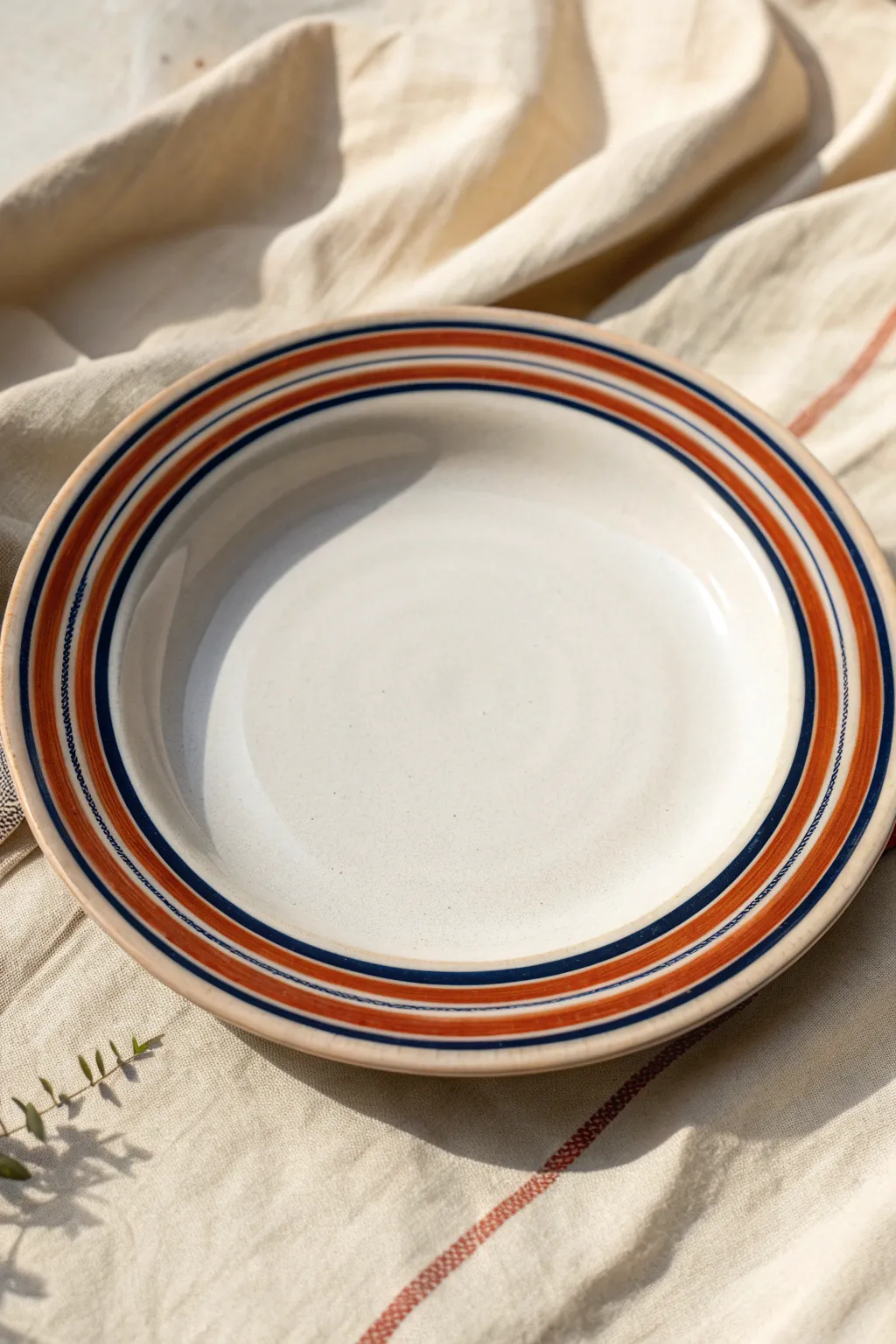
Achieve a sophisticated, pottery-wheel look with this classic rim stripe design feature. Combining deep navy and rustic orange bands creates a timeless palette that feels both vintage and modern, perfect for elevating simple ceramic ware.
How-To Guide
Materials
- Unfinished ceramic plate or bisque ware (wide rim style)
- Underglaze (Navy Blue)
- Underglaze (Rust/Burnt Orange)
- Clear ceramic glaze
- Pottery wheel or banding wheel
- Flat shader brush (size 6 or 8)
- Fine liner brush (size 0 or 1)
- Small sponge
- Water container
Step 1: Preparation and Setup
-
Clean surface:
Begin by wiping down your bisque plate with a slightly damp sponge. This removes any dust or oils that might repel the underglaze. -
Canter the plate:
Place your plate exactly in the center of your banding wheel or pottery wheel. Spin the wheel slowly to check alignment; if the plate wobbles, adjust it until it spins true. -
Prepare paints:
Dispense a small amount of navy and rust underglaze onto a palette. Add a drop of water if the consistency feels too thick; you want it to flow like heavy cream.
Steady Hand Secret
Can’t get a crisp line? Rest a wooden dowel across the wheel basin to support your wrist. This acts like a ‘mahl stick’ painters use, stabilizing your hand while the plate spins beneath.
Step 2: Painting the Blue Bands
-
Load the brush:
Saturate your flat shader brush with the navy blue underglaze. Ensure the bristles are fully coated but not dripping. -
Anchor your hand:
Position your hand firmly. I like to rest my elbow on the table and my painting hand against a steady support (or my other hand) to minimize shaking. -
Paint the inner thick band:
Spin the wheel at a steady, moderate pace. Touch the brush to the inner edge of the rim (closest to the food surface) and hold it perfectly still, letting the rotation of the plate create the clean line. -
Widen the band:
Apply slight pressure to widen this inner blue stripe until it’s about 1/4 inch thick. Apply a second coat immediately if the first looks streaky. -
Outer rim edge:
Using the same blue and technique, paint a very thin line right on the extreme outer edge of the plate’s rim to frame the design.
Step 3: Adding the Rust Accents
-
Switch brushes:
Clean your flat brush thoroughly or switch to a fresh medium-sized round brush for the orange color. -
Main rust band:
Create the bold orange stripe. Position your brush about 1/8 inch outward from the inner blue band you just painted. Spin the wheel and apply the rust color, aiming for a width slightly narrower than the thick blue band. -
Outer rust band:
Paint a second, thinner rust band closer to the outer edge of the rim, leaving a small gap of white space between it and the outer blue edge. -
Check opacity:
Rust pigments can sometimes be translucent. Stop the wheel and inspect color density; apply a second layer to the orange bands if the clay body shows through.
Vintage Texture
For an aged, earthy look, lightly sponge a diluted brown wash over the cream areas of the rim before sealing. It settles into texture and giving the piece warmth.
Step 4: Detailed Line Work
-
Load the fine liner:
Switch to your smallest fine liner brush and load it with navy blue. -
The middle accent:
Carefully paint a very thin pinstripe of navy blue right in the center of the white space left between the two rust orange bands. -
Inner definition:
Add one final, ultra-thin navy pinstripe between the inner thick blue band and the main rust band for extra definition. -
Clean up:
If any lines wobbled or smeared, use a damp, stiff brush or a specialized clay cleanup tool to gently scratch or wipe away the mistake while the wheel spins.
Step 5: Finishing
-
Dry completely:
Allow the underglaze to dry until it is chalky and matte to the touch. This usually takes about 15-20 minutes. -
Clear glaze application:
Dip or brush on a clear, food-safe ceramic glaze over the entire plate. Don’t worry if the design looks cloudy; the clear glaze will turn transparent in the kiln. -
Fire the piece:
Fire the plate in a kiln according to the clay and glaze manufacturer’s temperature guidelines (typically Cone 06, 5, or 6).
Once fired, your plate will display crisp, professional bands that look charming on any dinner table



Easy Doodle Icons
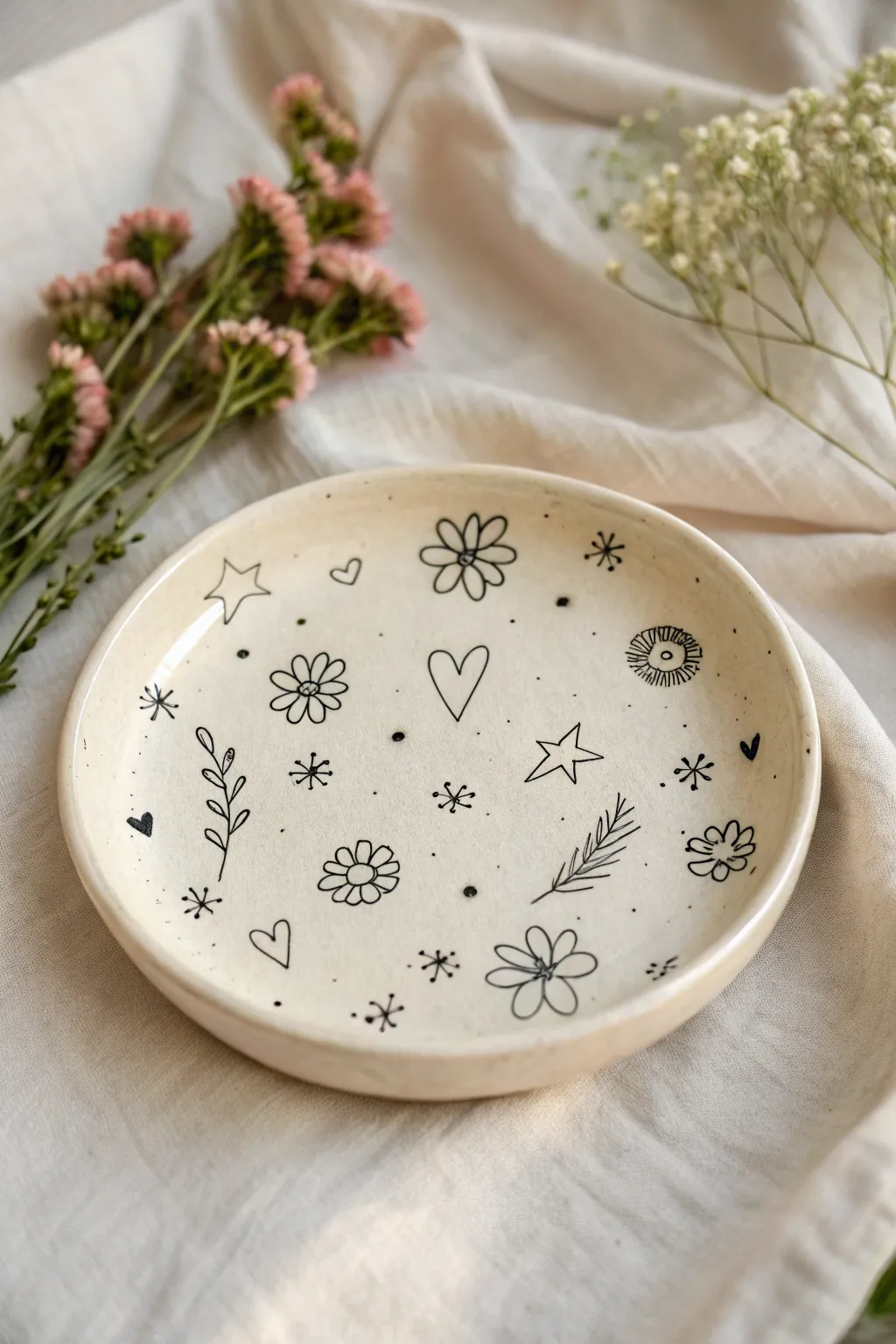
Transform a simple bisque plate into a charming piece of functional art with delicate, sketch-like illustrations. This project combines simple line work featuring flowers, hearts, and stars to create a gentle, nostalgic aesthetic perfect for trinkets or desserts.
Step-by-Step
Materials
- Bisque ceramic plate (medium size, approx. 6-8 inches)
- Black underglaze pencil or a fine-tip underglaze applicator bottle
- Clear dipping or brushing glaze
- Damp sponge
- Sketch paper and pencil (for planning)
- Kiln (or access to a firing service)
Step 1: Planning and Prep
-
Clean surface:
Begin by wiping down your bisque plate with a slightly damp sponge. This removes any dust or oils from handling that might interfere with the glaze application. -
Map out design:
On a piece of scratch paper, practice drawing the specific icons: five-petal daisies, open hearts, five-point stars, and simple fern leaves. This helps build muscle memory before touching the plate. -
Visualize placement:
Look at the plate and imagine a loose grid. You want to scatter the larger elements—the flowers and hearts—first, so they aren’t clustered too closely together.
Step 2: Drawing the Icons
-
Draw center flower:
Using your black underglaze pencil or fine applicator, draw a daisy near the upper center. Start with a small circle, then add roughly five looped petals around it. -
Add the central heart:
Directly in the middle of the plate, sketch a simple, open outline of a heart. Keep the lines thin and confident. -
Place the stars:
Draw three to four five-point stars scattered across the plate. I like to keep the lines slightly imperfect to maintain that hand-drawn, doodle charm. -
Create botanical elements:
Draw a fern-like leaf on the bottom right. Start with a central stem and add small, quick dashes for leaves on either side. -
Add the vine:
On the left side, draw a curving vertical line. Add small teardrop shapes along the stem to create a climbing vine look. -
Fill the gaps with flowers:
Draw three or four more daisies in the empty spaces. Vary their rotation slightly so they don’t all look identical. -
Sketch radial bursts:
Add small asterisk-style stars (* and ✽ shapes) in the remaining open areas. These act as medium-sized fillers between the main icons. -
Draw a sunburst:
Include a small circle with many tiny lines radiating outward near the right edge for a little variety in texture.
Pencil Smudge Control
Pencil underglaze smudges easily! Place a clean paper towel under your drawing hand to rest gently on the plate while you work on other sections.
Step 3: Details and Finishing
-
Add tiny hearts:
Draw a few very small hearts in the background. Specifically, color one or two of them in solid black to add visual weight and contrast. -
Sprinkle dots:
Look for any awkwardly large empty spaces. Place single black dots or tiny groups of three dots to tie the whole composition together. -
Check line work:
Review your doodles. If the underglaze pencil skipped or looks too faint in spots, gently go over those lines again to darken them. -
Remove dust:
If you used an underglaze pencil, limit how much you touch the surface as it can smudge. Gently blow away any pencil crumbs. -
Clear glaze application:
Once the underglaze is totally dry, apply your clear glaze. Use a fan brush for specific brushing glazes, or use dipping tongs if you have a dipping tank. -
Dry thoroughly:
Allow the clear glaze to dry completely according to the manufacturer’s instructions before moving it. -
Final Fire:
Fire the plate in the kiln to the appropriate cone temperature for your specific clay and glaze (usually cone 06 or cone 6).
Add a Pop of Color
Before the clear coat, use a translucent watercolor-style underglaze to add faint washes of pastel pink or yellow inside just the flower centers.
Once fired, you will have a durable, food-safe plate that showcases your personal artistic touch

Bold Color-Block Quarters
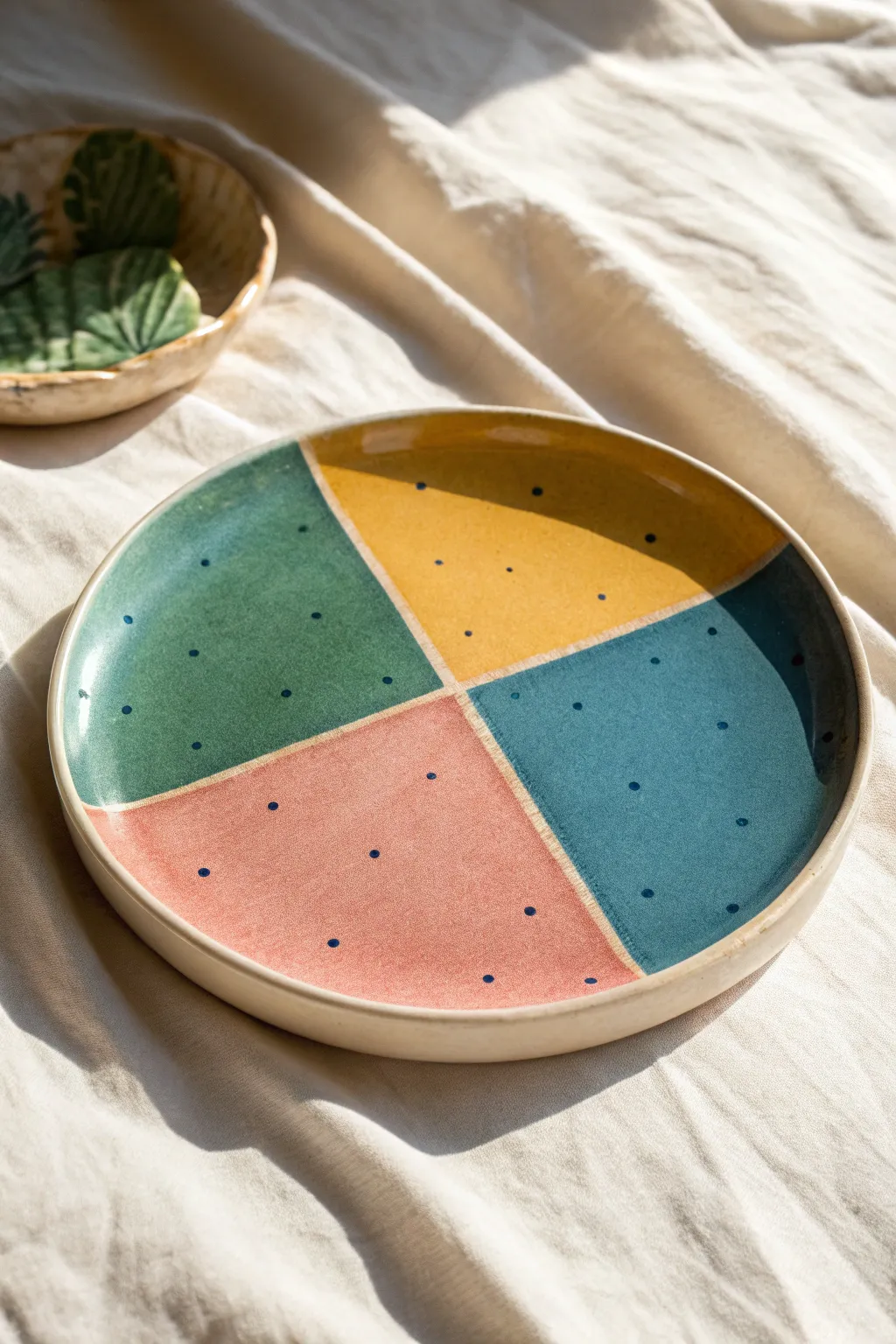
Transform a plain clay plate into a modern serving piece with this bold, geometric design featuring earthy quartered sections and whimsical polka dots. The unglazed lines between the colors add a lovely raw texture that highlights the handmade feel.
Step-by-Step Tutorial
Materials
- Bisque-fired ceramic plate (flat with a slight rim)
- Underglaze paints (Mustard Yellow, Terracotta Pink, Sage Green, Deep Teal)
- Painter’s tape or thin masking tape (1/8 inch width works best)
- Wide flat brush
- Small round brush or dotting tool
- Measuring tape
- Pencil
- Clear transparent glaze
- Kiln access
Step 1: Preparation & Mapping
-
Clean surface:
Begin by wiping down your bisque plate with a barely damp sponge to remove any dust or kiln debris. This ensures your glaze adheres properly. -
Find the center:
Using your measuring tape, measure across the diameter of the plate to find the exact center point. Mark this lightly with a pencil. -
Mark quadrants:
Draw two perpendicular lines intersecting at your center mark, effectively dividing the plate into four equal pie slices. Extend these lines up the rim of the plate. -
Apply tape:
Carefully place your thin masking tape directly over your pencil lines. Press down firmly to create a tight seal, which will keep the clay body exposed between the bold colors.
Step 2: Blocking in Color
-
First coat – Yellow:
Load your flat brush with the Mustard Yellow underglaze. Paint the top right quadrant, using smooth strokes from the center outward toward the rim. -
First coat – Pink:
Rinse your brush thoroughly. Paint the bottom left quadrant directly opposite the yellow one with the Terracotta Pink underglaze. -
First coat – Green:
Moving to the top left section, apply the Sage Green underglaze, ensuring you cover the surface evenly right up to the tape edge. -
First coat – Teal:
Fill the final bottom right quadrant with the Deep Teal underglaze. Let all sections dry until they are chalky and matte. -
Apply second coats:
Repeat the painting process for all four colors. Most underglazes need 2-3 coats for solid, opaque coverage, so be patient here. -
Check the rim:
Ensure you’ve carried each color up the side and over the edge of the rim for a professional finish. I find looking at the plate from side-on helps spot any missed patches.
Bleeding Edges?
If paint seeps under the tape, wait for it to fully dry. Then, gently scratch off the excess with a wooden skewer or needle tool to restore the sharp line.
Step 3: Detailing & Finishing
-
Add dots:
Dip the handle end of a small paintbrush or a dotting tool into the Deep Teal underglaze (or a dark navy blue). Gently press dots onto each colored quadrant in a random, scattered pattern. -
Remove tape:
Once the paint is dry to the touch but before firing, slowly peel back the masking tape. Pull it away at a sharp angle to reveal the crisp raw clay lines underneath. -
Clean up lines:
If any paint bled under the tape, use a crafting knife or a clean, stiff brush with a tiny bit of water to gently scrape or wipe it away, sharpening the geometric cross. -
Bisque fire (Optional):
Depending on your specific underglaze instructions, you may need a bisque fire now to set the colors. If using one-fire glazes, skip to the clear coat. -
Clear glaze application:
Apply a coat of clear transparent glaze over the entire face of the plate using a soft fan brush or by dipping. This seals the raw lines and makes the plate food-safe. -
Wipe the foot:
Use a sponge to wipe any glaze off the bottom foot ring of the plate so it doesn’t stick to the kiln shelf. -
Final Fire:
Fire the plate in the kiln according to the temperature guidelines for your specific clay and glaze choices.
Level Up: Texture
Before painting, carve patterns into one or two quadrants for tactile contrast. The glaze will pool in the recesses, creating depth.
Your finished plate is now ready to add a pop of artisan charm to your next dinner party

The Complete Guide to Pottery Troubleshooting
Uncover the most common ceramic mistakes—from cracking clay to failed glazes—and learn how to fix them fast.
Simple Floral Sprigs
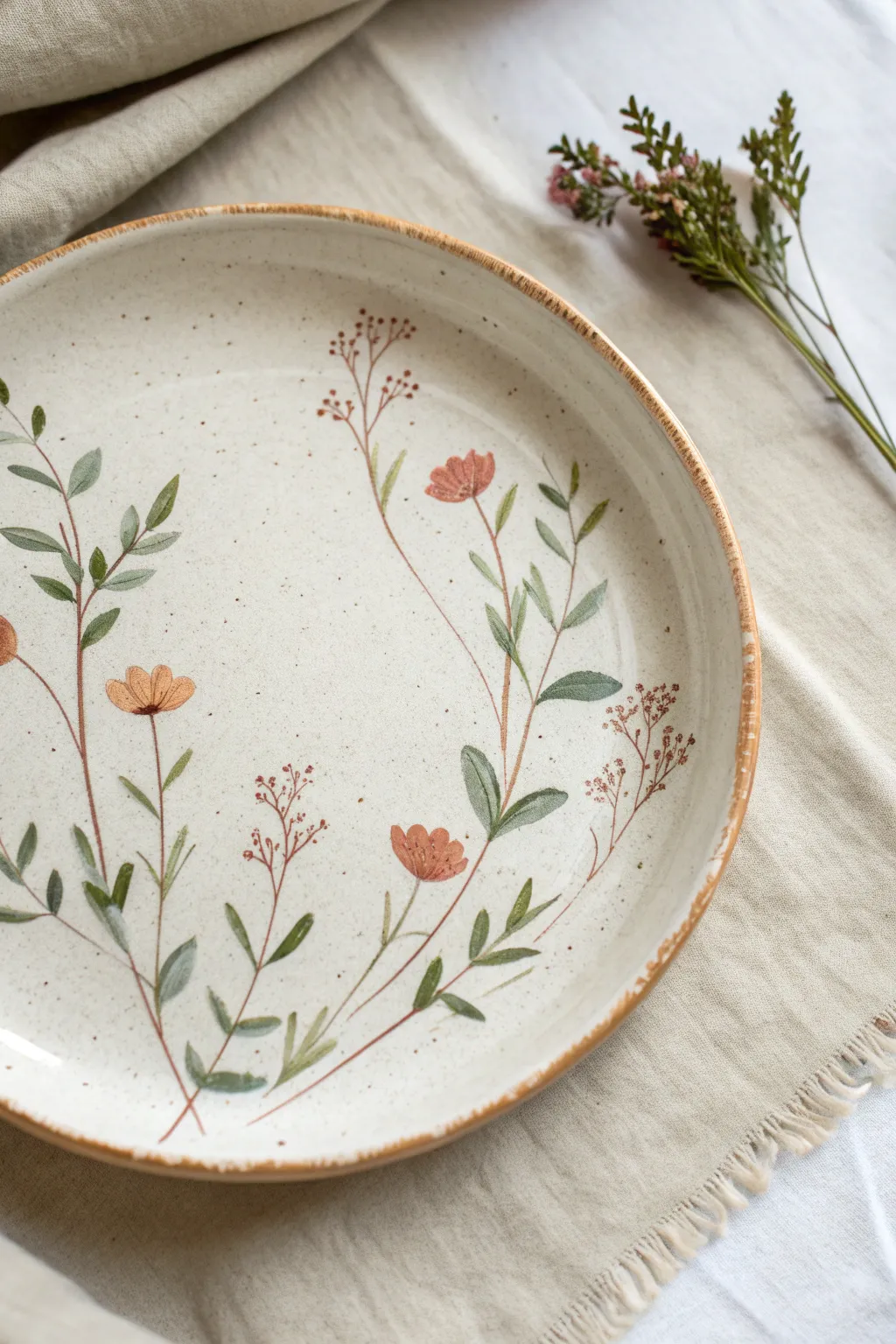
Embrace the natural beauty of pottery with this delicate floral design featuring wandering vines and soft, terracotta-hued blooms. The speckled background and organic brushstrokes give this piece a lovely, hand-forged aesthetic perfect for adding warmth to any table setting.
How-To Guide
Materials
- Bisque-fired ceramic plate (flat rim)
- Speckled cream or oatmeal glaze (underglaze compatible)
- Underglazes: Sage Green, Olive Green, Terracotta/Burnt Orange, Rust Brown
- Clear transparent glaze (food safe)
- Small round brushes (size 0 and 2)
- Fine liner brush (size 00 or 10/0)
- Palette for mixing
- Pencil (optional)
Step 1: Base Preparation
-
Apply base color:
Begin by applying 2-3 coats of your speckled cream glaze to the entire plate. Allow each coat to dry until it’s chalky to the touch before applying the next to ensure an even surface. -
Light sketching:
If you are nervous about freehanding, very lightly sketch the main curved stems using a pencil. Don’t worry about erasing mistakes; the graphite will burn off in the kiln.
Fixing Smears
If you smear a painted leaf while it’s wet, wait for it to fully dry. Then, gently scrape the mistake off with a toothpick before re-painting the spot.
Step 2: Painting the Vines
-
Mix stem color:
In your palette, mix a small amount of Rust Brown with Olive Green to create a woody, earthy stem color. It should be thin enough to flow smoothly. -
Draw the main stems:
Using the fine liner brush, paint two or three long, sweeping curves originating from the bottom left quadrant of the plate. Let them meander naturally towards the center and right side. -
Add secondary branches:
Add smaller, shorter stems branching off the main lines. Keep these lines very thin and whisper-light. -
Start the leaves:
Switch to your size 0 round brush. Load it with Sage Green for the primary leaf color. -
Paint basic leaves:
Using a ‘press and lift’ motion, paint almond-shaped leaves along the lower sections of the vines. Press down for the leaf body and lift sharply to create a point. -
Add depth with Olive:
While the Sage Green is still slightly damp, add a tiny touch of Olive Green to the base of random leaves. This wet-on-wet technique adds instant dimension. -
Varying leaf sizes:
As you move up the vine, make the leaves slightly smaller. I like to keep the arrangement asymmetrical to mimic nature.
Layering Transparency
Water down your underglaze slightly for the flower petals. This creates a semi-transparent watercolor effect that lets the speckles show through.
Step 3: Adding the Florals
-
Paint main blooms:
Using the size 2 brush and Terracotta underglaze, paint simple, cup-shaped flowers. You can achieve this by painting 3-4 gentle petal strokes that meet at a unified base. -
Detail the flower centers:
Once the orange petals are dry, use the Rust Brown on your liner brush to add tiny lines radiating from the center of each flower. -
Create berry sprigs:
Using the liner brush and the Rust Brown color, draw very fine, twiggy structures extending from the main vines, separate from the green leaves. -
Dot the berries:
Dip the tip of a brush handle or a dotting tool into the Rust Brown and add tiny dots to the ends of these twiggy sprigs to look like seeds or buds.
Step 4: Finishing Touches
-
Rim detail:
Dip a damp sponge or a wide brush lightly into the Rust Brown underglaze. Gently run it along the very edge of the plate rim to create that rustic, distressed border. -
Final inspection:
Check for any smudges. If you find stray glaze marks, carefully scrape them away with a clean craft knife or wipe with a damp cotton bud. -
Glazing:
Once all decoration is bone dry, carefully dip or brush a clear transparent glaze over the entire piece. -
Firing:
Fire the plate according to the clay and glaze manufacturer’s instructions (usually Cone 5 or 6 for stoneware).
Now you have a beautifully organic plate ready to showcase your favorite meal
Center Blossom Bouquet
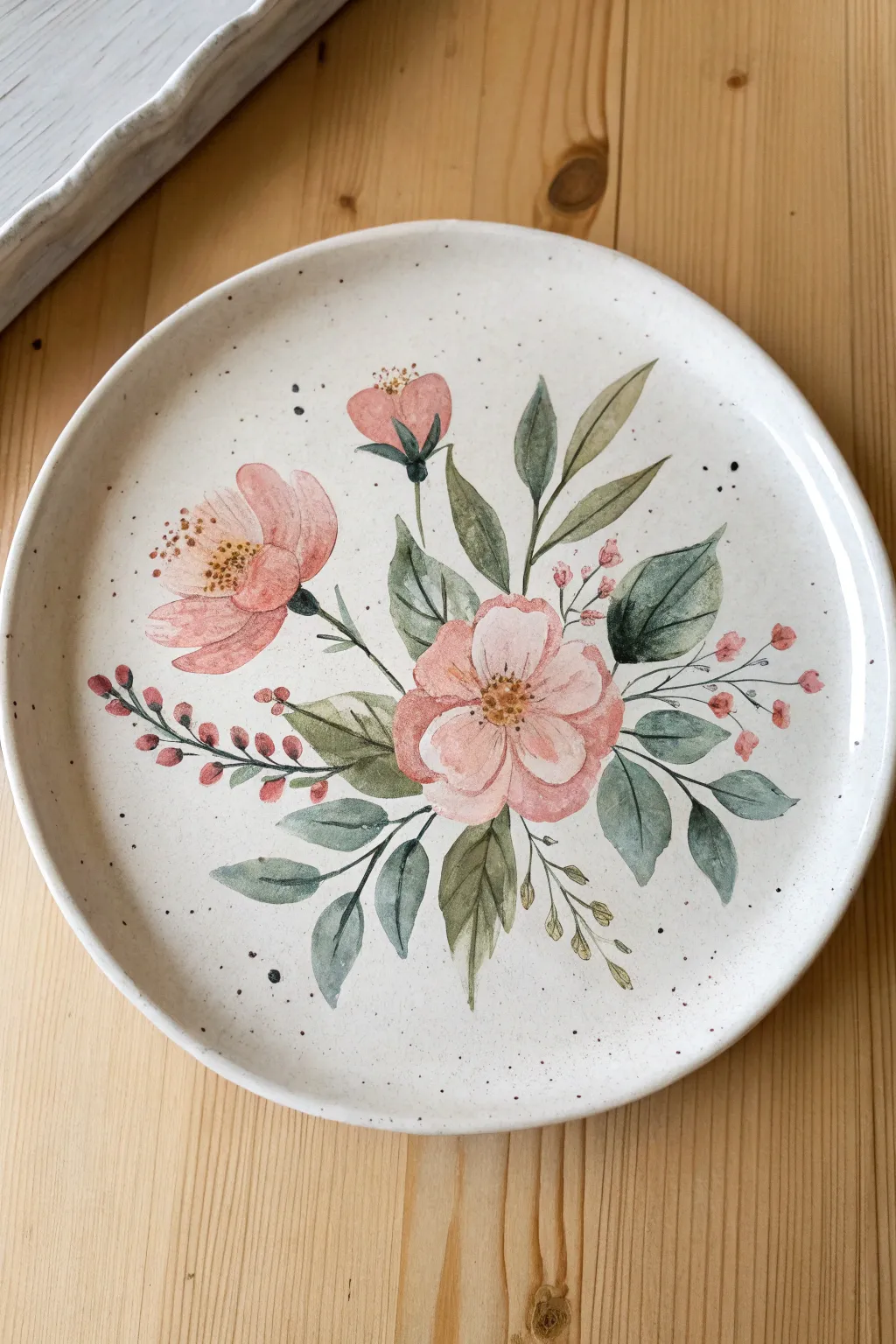
This tutorial guides you through painting a gentle, watercolor-style floral bouquet in the center of a speckled ceramic plate. With soft peaches, muted greens, and fine detailing, you will create a piece that feels both organic and elegantly handmade.
Step-by-Step Tutorial
Materials
- Bisque-fired ceramic plate (speckled clay body preferred)
- Underglazes: Peach, rose pink, olive green, sage green, dark forest green, brown, black
- Watercolor medium (or water for diluting underglazes)
- Round brushes (sizes 2, 4, 6)
- Fine liner brush (size 0 or 00)
- Palette for mixing
- Pencil for sketching
- Clear transparent glaze
- Kiln access
Step 1: Preparation and Sketching
-
Prepare the surface:
Wipe down your bisque plate with a damp sponge to remove any dust or oils. This ensures the underglaze adheres properly to the clay body. -
Plan the composition:
Lightly sketch the main floral elements directly onto the plate using a standard pencil. Don’t worry about erasing; the graphite will burn off in the kiln. Place the largest open bloom slightly off-center to the right. -
Add secondary blooms:
Draw the second, cup-shaped flower to the left, slightly higher than the main bloom. Add a small, closed bud floating above and between the two main flowers. -
Sketch the foliage:
Map out the stems connecting the flowers. Sketch large leaves radiating outward to create a loose, bouquet shape, ensuring you leave space for smaller filler sprigs later.
Step 2: Painting the Blooms
-
Mix the washes:
Dilute your peach and rose pink underglazes with water or a frit-based watercolor medium. You want a consistency similar to watercolor paint—translucent and fluid. -
Base coat the main flower:
Using a size 6 round brush, lay down a very pale wash of the peach pink for the petals of the large central flower. Keep the edges soft and don’t worry if the coverage isn’t perfectly even; that adds to the watercolor look. -
Layer the side flower:
Paint the cup-shaped flower on the left with a slightly more saturated rose tone. Start from the base of the petals and pull the color upward, letting it fade near the tips. -
Define the petals:
Once the initial washes are touch-dry, use a size 4 brush and a slightly stronger concentration of pink to paint the shadows and separations between petals. Focus on the centers where the petals meet. -
Paint the bud:
Fill in the small top bud with the rose pink mix. I like to keep the top edge of this bud specifically light to make it look like it’s catching the sun.
Watercolor Effect
Work in thin, watery layers. Unlike acrylics, underglaze drys lighter. Build up saturation slowly to keep that translucent, airy feel.
Step 3: Adding Greenery
-
Mix green tones:
Prepare a palette of greens ranging from pale sage to deep olive. Mixing a little brown into your green can help achieve those earthy, vintage tones seen in the reference. -
Paint the main leaves:
Using the size 4 brush, paint the larger leaves with the sage green mixture. Use a single stroke method: press down at the base of the leaf to widen the brush, then lift as you pull outward to create a point. -
Add depth to foliage:
While the sage green is still slightly damp, drop a tiny bit of darker forest green or olive into the base of the leaves and let it bleed naturally into the lighter color. -
Connect the stems:
Switch to a size 2 brush and use a dark olive green to paint the thin stems connecting the flowers and leaves. Keep your hand loose to avoid rigid lines. -
Create the delicate sprigs:
On the left side, paint the long, curved sprig with small berries. Use a brownish-red or deep pink for the small round tips and a dark green for the thin stem.
Level Up: Gold Luster
After the final glaze firing, add real gold luster accents to the stamens or leaf tips and fire a third time at a lower temp for distinct luxury.
Step 4: Fine Details and Finishing
-
Detail the flower centers:
Mix a warm yellow-ochre color. Using the tip of a small brush, stipple small dots into the center of the main open flower. -
Add stamens:
With a fine liner brush and dark brown underglaze, draw very delicate lines radiating from the yellow center. Add tiny dots at the ends of these lines for the anthers. -
Refine the leaves:
Use the liner brush and a diluted black or dark green to add very subtle veins to a few of the larger leaves. Don’t outline everything; just suggest detail. -
Add splatter texture:
To mimic the speckled clay look (or enhance it), verify your underglaze is black or dark brown. Load a stiff brush, hold it over the plate, and flick the bristles to create a fine mist of speckles across the design. -
Glaze and fire:
Allow the underglaze to dry completely (usually 24 hours). Dip or brush on a clear transparent glaze, then fire the piece according to your clay and glaze specifications.
Your finished plate will be a stunning, food-safe piece of art ready to display or use for special meals


What Really Happens Inside the Kiln
Learn how time and temperature work together inside the kiln to transform clay into durable ceramic.
Leafy Wreath Border
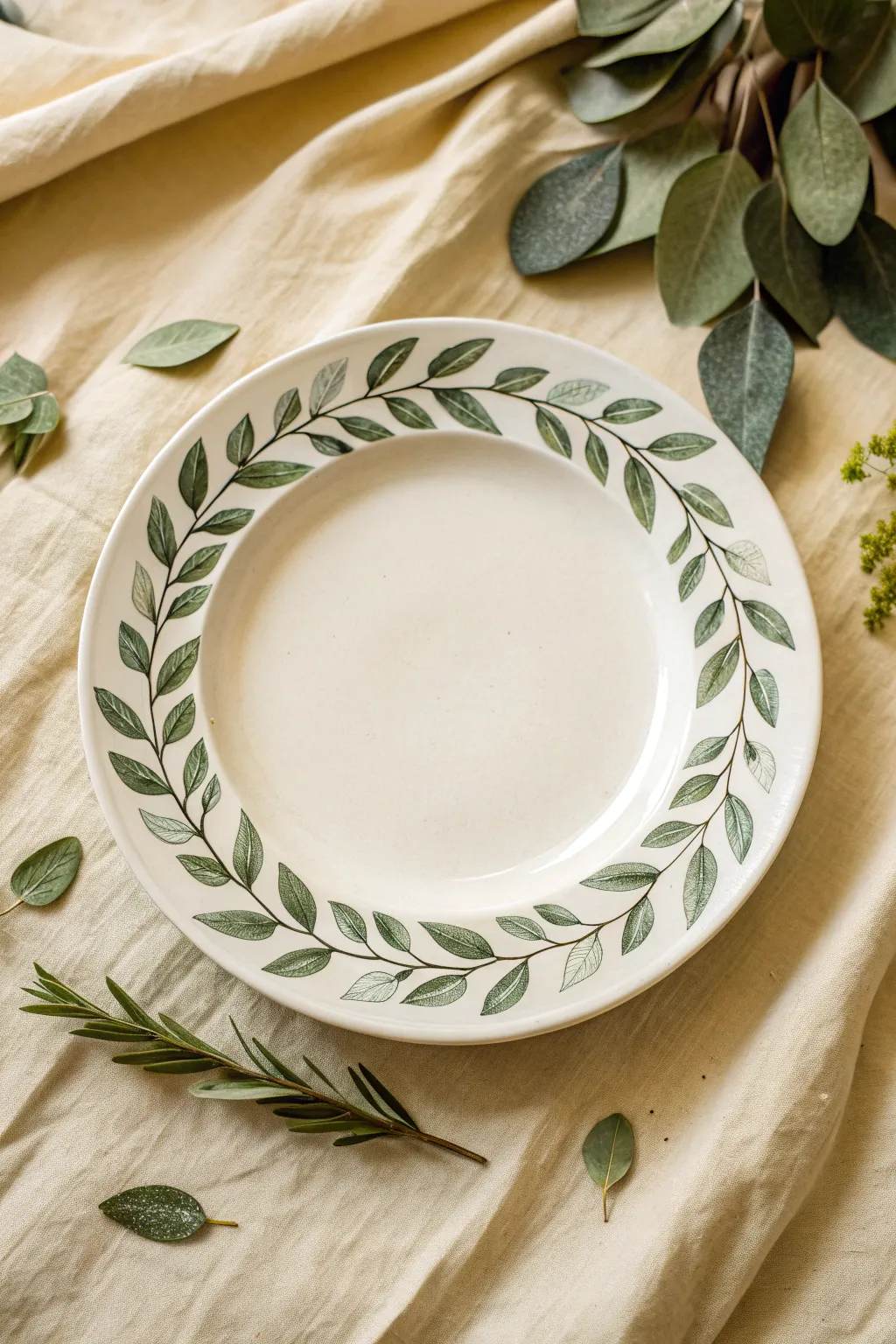
Transform a simple white plate into a piece of nature-inspired decor with this delicate leafy wreath design. The mix of solid watercolor-style leaves and fine line work creates an elegant, organic border perfect for display or light use.
How-To Guide
Materials
- White ceramic or glazed clay plate (smooth rim)
- Ceramic paints (Sage Green, Forest Green, Deep Olive)
- Fine liner brush (size 0 or 00)
- Small round brush (size 2 or 3)
- Rubbing alcohol and cotton pad
- Pencil (optional)
- Mixing palette
- Paper towels
- Oven (for curing, if required by paint type)
Step 1: Platform Preparation
-
Clean the Surface:
Before painting, wipe the rim of your plate thoroughly with rubbing alcohol on a cotton pad. This removes invisible oils or fingerprints that could prevent the ceramic paint from adhering properly. -
Plan the Vine Flow:
Visualize two main vines meeting at the bottom and curving up towards the top. You can lightly sketch a faint guide line using a pencil if you need help keeping the curve consistent, but freehanding often looks more natural.
Fixing Wobbly Lines
Make a mistake? While the paint is wet, use a clean, damp Q-tip to erase the error. For dry paint, gently scratch it off with a craft knife or fingernail.
Step 2: Painting the Base Vines
-
Mix Your Greens:
On your palette, place your sage green and deep olive paints. Create a third intermediate shade by mixing them together to add depth to your artwork. -
Draft the Stem:
Using the fine liner brush and your darkest green or brown-green mix, paint a very thin, continuous line circling the rim or the inner well of the plate. This will be the central vein for your wreath. -
Paint the First Leaves:
Switch to your round brush (size 2). Load it with the sage green paint. Press the belly of the brush down near the stem and lift as you pull away to create a tapered leaf shape. -
Alternate Direction:
Place the next leaf on the opposite side of the stem, slightly higher up. Continue this alternating pattern around the plate, but leave gaps every few inches for different leaf styles. -
Vary the Leaf Sizes:
To make the wreath look organic, paint some leaves slightly smaller and curved, as if they are young growth. Use the tip of the brush for these delicate additions.
Step 3: Adding Detail and Texture
-
Introduce Darker Leaves:
Clean your brush and switch to the Forest Green or Deep Olive shade. Fill in some of the empty gaps with solid dark leaves to create contrast against the lighter sage tones. -
Create Skeleton Leaves:
This step adds the illustrative charm seen in the photo. Using your fine liner brush and the darkest green paint, draw the *outline* of a leaf shape without filling it in. -
Draw Internal Veins:
Inside your outline-only leaves, sketch delicate veins. Draw a center line and tiny diagonal lines branching off. Keep your hand light; these lines should look like swift sketches. -
Add Veins to Solid Leaves:
Find the solid sage leaves you painted first. If they are dry to the touch, use the liner brush and dark green paint to add a very subtle central vein line down the middle of a few of them. -
Review and Refine:
Take a step back and look at the plate as a whole. If a section looks too sparse, add a tiny sprig or a single floating leaf to balance the composition. -
Clean Up Edges:
If you made any smudges or if a line went astray, use a damp cotton swab or a toothpick to gently scrape or wipe away the mistake before the paint fully sets.
Level Up: Gold Accents
Once the green layer is dry, add tiny dots of metallic gold ceramic paint near the stems to mimic berries or light-catching dewdrops for extra elegance.
Step 4: Finalizing the Piece
-
Allow to Dry:
Let the plate sit undisturbed for at least 24 hours. The surface must be completely dry before any heat setting occurs. -
Cure the Paint:
Follow the instructions on your specific ceramic paint bottle. Most require baking the plate in a standard oven (usually placing it in a cold oven, heating to 300°F-350°F, and baking for 30-40 minutes). -
Cool Down:
After the baking time is up, turn the oven off and leave the plate inside until it is completely cool. Removing it while hot can cause thermal shock and crack your ceramic.
Your hand-painted plate is now a lovely botanical accent ready to brighten your table setting
Citrus and Fruit Slices
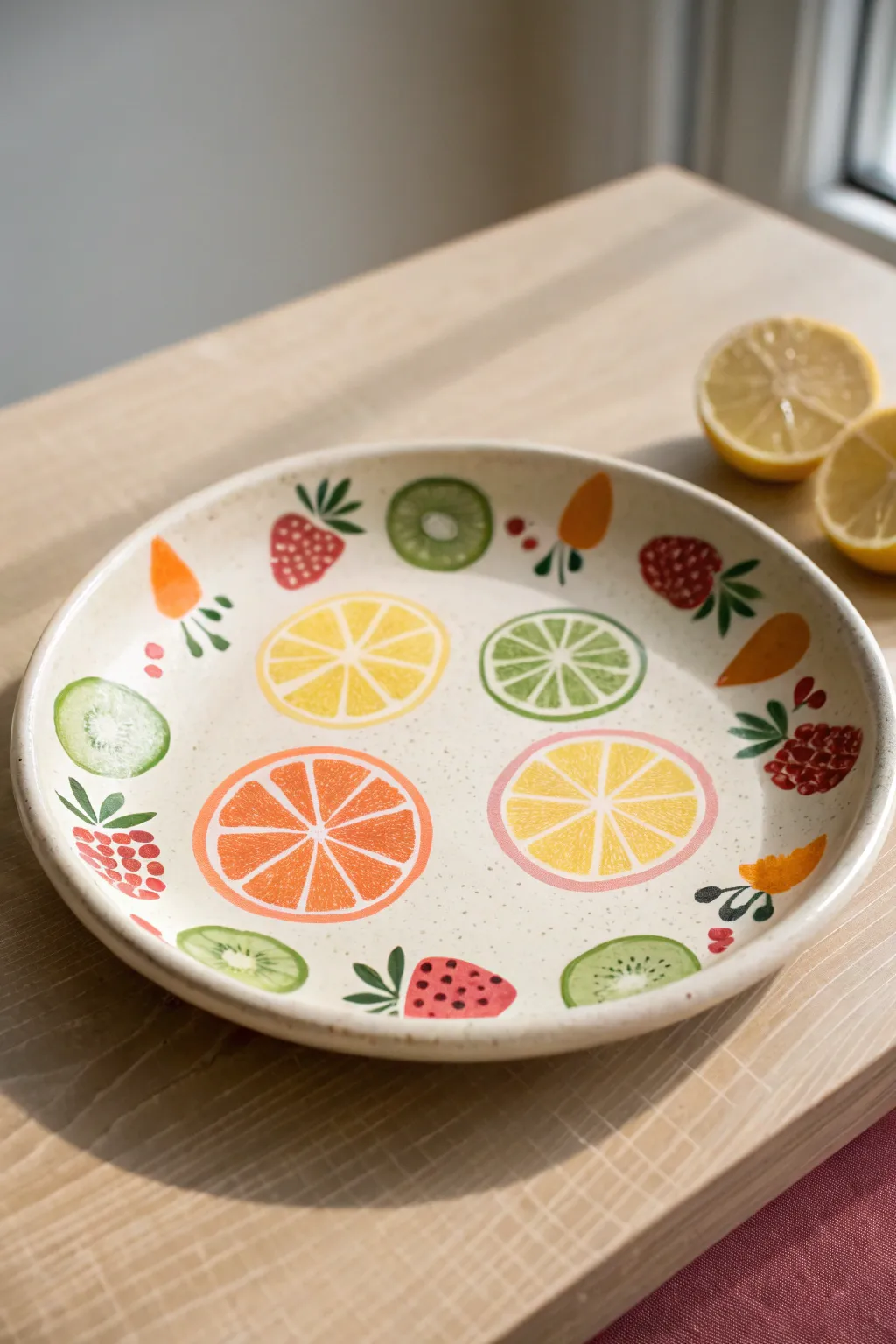
Brighten up your table setting with this cheerful clay plate design featuring vibrant citrus slices and a playful border of mini strawberries, kiwis, and veggies. The design uses a mix of bold central motifs and delicate rim details to create a cohesive, summery look that feels hand-painted and organic.
Detailed Instructions
Materials
- Bisque-fired ceramic plate or air-dry clay plate (white base)
- Acrylic paints or underglazes (yellow, bright orange, lime green, deep green, pink, red)
- Fine detail brushes (sizes 0 and 2)
- Small flat brush (size 4)
- Pencil for sketching
- Palette for mixing
- Clear glazing medium or sealant spray
- Paper towels
- Water cup
Step 1: Planning the Layout
-
Prepare surface:
Ensure your plate is clean, dry, and free of dust. If you are using raw clay, sand it smooth before painting. A white or cream base works best for making these colors pop. -
Mark the center:
Using a very light pencil touch, sketch four large circles in the center of the plate essentially forming a square. These will become your main citrus slices. -
Sketch the rim:
Around the rim, sketch smaller repeating motifs. Alternate between small strawberries, half-circles for kiwi slices, oval carrot shapes, and small blackberries or raspberries to create a varied rhythm.
Uneven Circles?
Don’t stress if your fruit circles aren’t perfect. Use the rim of a small cup or a jar lid as a stencil to trace perfect circles lightly in pencil before painting.
Step 2: Painting the Citrus Center
-
Base colors for citrus:
Start by painting the ‘rind’ of the four central circles. Use your size 4 brush to paint a thin outer ring for each: one orange, one yellow, one green, and one pink. -
Fill the segments:
Paint triangular wedges inside each circle to represent the fruit segments. Leave small white gaps between the wedges to act as the pith (the white part of the fruit). This negative space is crucial for the citrus look. -
Detail the orange:
For the orange slice, fill the wedges with a bright, saturated orange paint. Keep your strokes radiating from the center outward. -
Detail the lemon:
Fill the top lemon slice with sunny yellow wedges. I like to add a tiny drop of white to the yellow for the center of the wedges to add dimension. -
Detail the lime:
Paint the lime segments with a fresh lime green mixed with a touch of white. Ensure the white pith lines remain crisp. -
Detail the pink grapefruit:
For the pink grapefruit slice, use a soft pink for the rim but fill the segments with a slightly yellowish-orange tone, mimicking a pink lemonade aesthetic.
Step 3: Adding Rim Details
-
Kiwi slices:
Paint the small kiwi circles near the edge with a light green base. Once dry, use a darker green to paint a small center circle and tiny radiating lines. -
Strawberries & berries:
Fill the strawberry shapes with red and the blackberry shapes with a deep maroon or purple. Let these dry completely before adding seeds. -
Greenery accents:
Using your smallest detail brush (size 0) and deep green paint, add the leafy tops to the strawberries and carrots. Add small sprigs of leaves near the berries to fill empty white space. -
Seeds and specs:
With the tip of your detail brush, add tiny black dots to the kiwi slices and small white or yellow dots to the strawberries for seeds. Add tiny specks to the plate background if you want a speckled ceramic look.
Add Texture
Instead of flat color, sponge the paint lightly onto the fruit segments to mimic the juicy texture of real citrus pulp.
Step 4: Finishing Up
-
Clean up lines:
Check for any smudges. if you are using acrylics, you can carefully scratch away mistakes or paint over them with white. -
Seal the work:
Once fully dry (give it at least 24 hours), apply a clear glossy sealant or fire the glaze in a kiln according to your material’s instructions to make it food safe or durable.
Now you have a vibrant, custom piece of tableware ready for summer styling

TRACK YOUR CERAMIC JOURNEY
Capture glaze tests, firing details, and creative progress—all in one simple printable. Make your projects easier to repeat and improve.
Sweet Treat Illustration
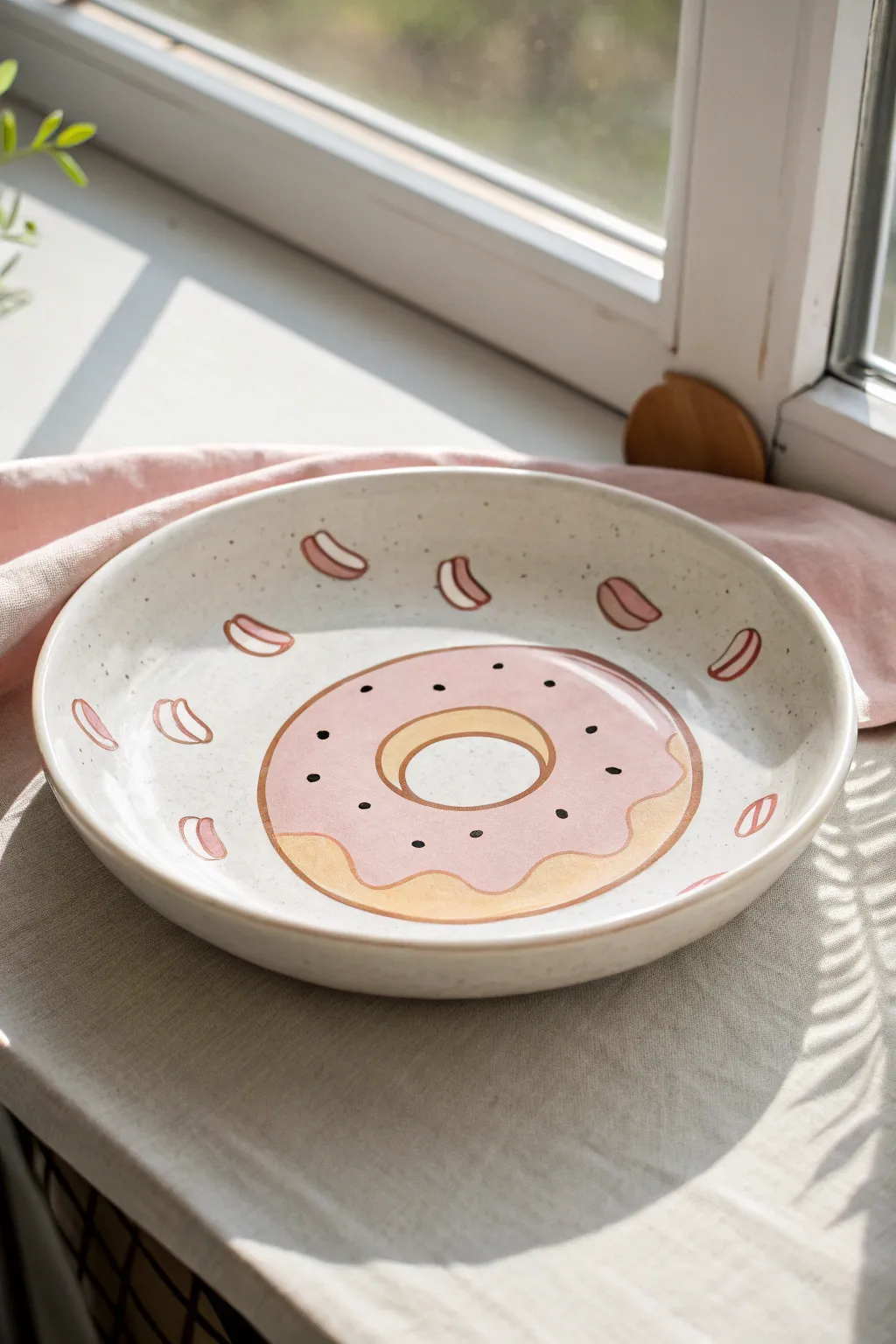
Treat your eyes to something sweet with this charming donut-themed plate design. Featuring a central frosted donut and playful floating candy bits, this project turns plain ceramic into a whimsical piece of functional art.
Step-by-Step Tutorial
Materials
- Bisque-fired ceramic plate (speckled clay body recommended)
- Underglaze paints (light pink, golden ochre/light brown, dark brown/black, white)
- Small round paintbrush (size 2 or 4)
- Fine liner brush (size 0 or 00)
- Pencil for sketching
- Clean water container
- Palette or small tray for mixing
- Clear dipping glaze
Step 1: Sketching the Design
-
Center the donut:
Begin by lightly sketching a large circle in the very center of your plate using a pencil. Don’t worry about erasing; the pencil graphite will burn off in the kiln. Add a smaller circle inside it to create the donut hole. -
Draft the frosting line:
Sketch a wavy, organic line inside the larger outer circle. This line represents the drippy edge of the frosting, so make it curved and uneven rather than perfectly round. -
Add floating details:
Around the rim of the plate, sketch 8-10 small crescent or bean shapes. These will be the floating candy bits or mini donut slices that frame the main design.
Step 2: Painting the Base Layers
-
Mix the pastry color:
On your palette, prepare a golden ochre or light brown underglaze. If it’s too dark, mix in a little white or yellow to get that perfectly baked dough color. -
Fill the donut base:
Paint the bottom section of the donut—the area between your wavy frosting line and the bottom edge of the outer circle—using the golden ochre mix. Also, paint the inner ring surrounding the donut hole. -
Paint the rim details:
Using the same pastry color, paint the outer curved edge of each small floating shape on the rim. Leave the inner section of these shapes blank for now. -
Apply the pink frosting:
Load a round brush with light pink underglaze. Fill in the entire top section of the donut, careful to stay within your wavy line and the outer edges. The pink should meet the golden brown sections cleanly. -
Fill rim details:
Use the pink underglaze to fill the inner section of the floating rim shapes, making them look like little frosted slices. -
Apply second coats:
Once the first layer is dry to the touch, apply a second coat of both the golden brown and pink underglazes. This ensures the colors will be opaque and vibrant after firing. -
Add highlights:
While the pink layer is drying, mix a tiny amount of white into your pink glaze. Add a few subtle, curved strokes on the upper right side of the pink frosting to suggest a glossy shine.
Uneven Coverage?
If you see brushstrokes in your dried underglaze, apply a third thin coat in the opposite direction (cross-hatching) to ensure a smooth, solid finish.
Step 3: Adding the Details
-
Outline the donut:
Switch to your fine liner brush and the dark brown or reddish-brown underglaze. Carefully outline the entire donut, including the outer edge, the inner hole, and the wavy frosting separation line. -
Outline rim elements:
Use the same fine brush to outline the small floating shapes on the rim. Add a dividing line between the pink and brown sections on these small bits to define the frosting layer. -
Add sprinkles:
Using the tip of your round brush or the back end of a paintbrush handle, dot small circles onto the pink frosting using dark brown or black underglaze to create chocolate sprinkles. -
Speckle effect (optional):
If your clay body isn’t naturally speckled, you can flick a toothbrush loaded with watered-down brown underglaze lightly over the plate to mimic the organic texture seen in the photo.
Steady Hand Pro-Tip
For crisp outlines, rest your pinky finger on a dry part of the plate to anchor your hand while painting with the fine liner brush.
Step 4: Finishing Up
-
Final inspection:
Check for any smudges or unwanted paint spots. Usually, these can be gently scraped away with a clean, stiff tool or a damp creativity sponge. -
Glaze application:
Once your underglaze design is completely bone dry, dip the entire plate into a clear transparent glaze to seal it and make it food-safe. -
Kiln firing:
Load the plate into the kiln and fire it according to the clay and glaze specifications (typically Cone 5 or 6 for stoneware).
Now you have a delightfully sweet plate ready for your next snack time
Black-and-White Checkerboard
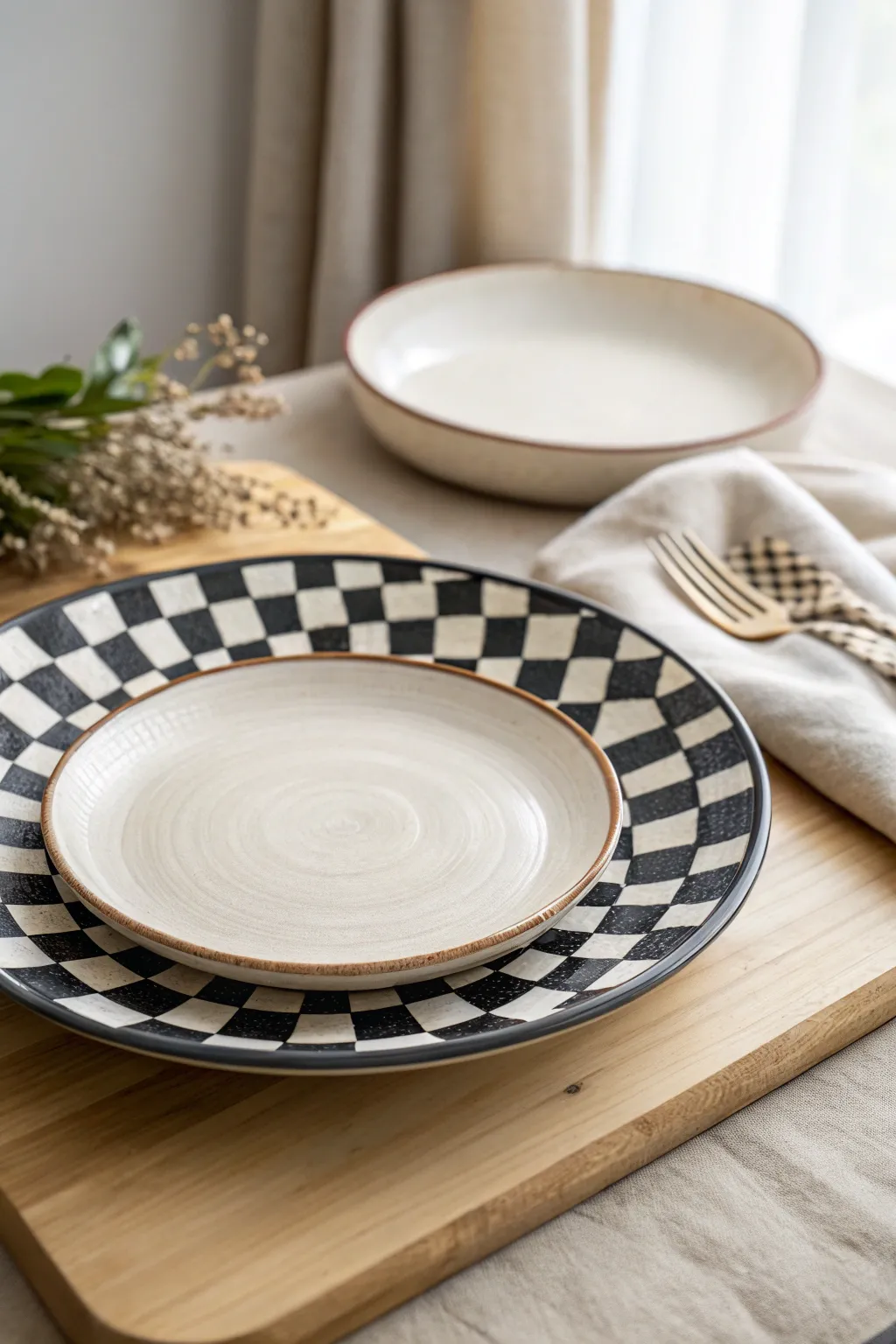
Bring a bold graphic touch to your table with this striking black-and-white checkerboard platter. The contrast between the geometric rim and the soft, organic cream center creates a sophisticated yet handmade aesthetic perfect for showcasing your culinary creations.
Step-by-Step Tutorial
Materials
- Large circular ceramic bisque plate (dinner size)
- Underglazes: Jet Black and Creamy White (or very pale beige)
- Pottery glaze: Transparent high-gloss (food safe)
- Pencil for sketching
- Soft fan brush (for base coats)
- Flat shader brush (size 6 or 8)
- Fine liner brush (for touch-ups)
- Flexible ruler or tape measure
- Compass or round template
- Bowl of water and sponge
Step 1: Planning and Sketching
-
Clean the bisque:
Before you begin, wipe down your bisque plate with a damp sponge to remove any dust or oils from handling. This ensures the underglaze adheres smoothly. -
Mark the center circle:
Using a compass or a round object as a template, lightly draw a circle in the center of the plate with a pencil. This will separate the plain eating surface from the decorative rim. -
Divide the rim:
Measure the circumference of the outer edge and the inner circle you just drew. Divide the rim area into even sections using your flexible ruler. Aim for segments about 1-1.5 inches wide. -
Draw radial lines:
Lightly sketch lines connecting your outer marks to the inner circle marks. These radial lines create the ‘slices’ of your checkerboard. -
Create the grid:
Draw 3-4 concentric circles within the rim area, spacing them evenly. The intersection of these circles and your radial lines forms the individual checks. Don’t worry about pencil marks; they burn off in the kiln.
Step 2: Painting the Design
-
Base coat the center:
Using a soft fan brush, apply three even coats of Creamy White underglaze to the center circle of the plate. Let each coat dry until it loses its sheen before applying the next. -
Start the checkerboard:
Load your flat shader brush with the Creamy White underglaze. Paint every other square in your grid white. I find it helpful to mark the ‘white’ squares with a tiny dot first so I don’t get confused. -
Apply white layers:
Continue until all the light squares have three solid coats of paint. This ensures a rich, opaque finish. -
Fill the black checks:
Switch to your Jet Black underglaze. Using a clean flat shader brush, carefully fill in the remaining squares. Be precise near the edges where the black meets the white. -
Refine the edges:
Once the main blocks are filled, use a fine liner brush with black underglaze to tidy up lines and crispen the corners. This step really makes the pattern pop. -
Paint the rim edge:
Take the black underglaze and carefully paint the very outer edge of the plate rim to frame the entire design. A steady hand or a banding wheel helps here. -
Create the inner border:
Using a very fine brush and a dark brown or rust-colored underglaze, paint a thin, delicate line around the circumference of the central cream circle. This adds a subtle, rustic separation.
Grid Master Tip
For perfectly spaced checks on a curved rim, divide the circle into quarters, then eighths, then sixteenths, rather than measuring inch by inch.
Step 3: Finishing Touches
-
Check for coverage:
Inspect your plate under good light. If any black areas look streaky, dab on a little extra paint to ensure solid coverage. -
Bisque fire:
Your piece needs to be bisque fired (typically to cone 04) to set the underglaze. Follow the firing instructions specific to your clay body. -
Glaze application:
Once fired and cooled, apply a clear, food-safe dipping or brushing glaze over the entire plate. Ensure the coat is even to prevent cloudiness. -
Final wipe:
Wipe the foot (bottom ring) of the plate clean with a wet sponge so it doesn’t stick to the kiln shelf. -
Final firing:
Fire the plate a final time to the temperature required by your clear glaze (often cone 05 or cone 6). Allow it to cool completely in the kiln before removing.
Make it a Set
Reverse the pattern for a matching side plate: paint the rim solid cream and create a mini black-and-white checkerboard circle in the very center.
Now you have a stunning, graphic statement piece ready to anchor your next dinner party setting
Geometric Triangle Mosaic
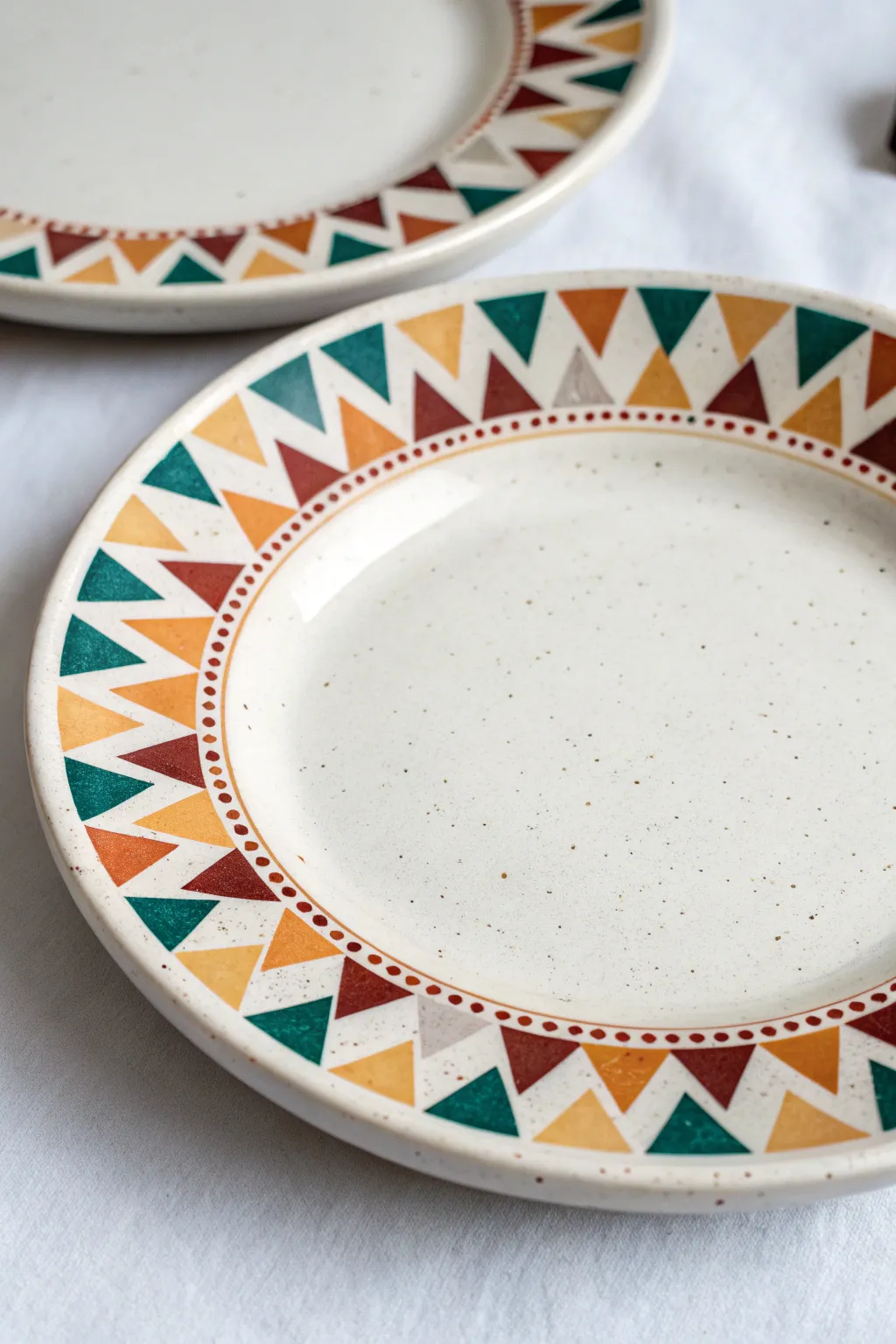
Transform a plain ceramic dish into a stunning piece of tableware with this rhythmic geometric pattern. Featuring warm earth tones like terracotta, teal, and burgundy, this triangle mosaic design adds a sophisticated yet handmade touch to any dining set.
Step-by-Step
Materials
- Bisque-fired ceramic plate (speckled clay preferred)
- Underglaze paints (Teal/Emerald, Burnt Orange, Burgundy, Mustard Yellow)
- Clear dipping glaze (food safe)
- Pencil
- Ruler or flexible measuring tape
- Medium flat brush (size 4 or 6)
- Small round detail brush (size 0 or 1)
- Damp sponge
- Kiln access
Step 1: Preparation and Mapping
-
Clean the Bisque:
Start by wiping your bisque-fired plate with a damp sponge. This removes any dust from the shelf that could prevent the underglaze from adhering properly. -
Define the Rim:
Using a pencil, lightly trace the inner edge where the rim meets the bowl of the plate. This line will serve as the base for your triangle pattern. -
Mark Intervals:
Measure the circumference of the rim. Divide this number by an even number (e.g., 24 or 30) to determine the width of your triangles. Mark these interval points along the outer edge of the plate. -
Mark Inner Intervals:
Make corresponding marks on the inner circle line you drew earlier, but offset them exactly halfway between the outer marks. This offset creates the zigzag effect. -
Connect the Dots:
Use your ruler to draw diagonal lines connecting the outer marks to the inner marks, forming a continuous zigzag pattern all the way around the rim.
Step 2: Painting the Pattern
-
Plan the Palette:
Designate a repeating color order for your triangles. The pattern in the image alternates between ‘pointing up’ and ‘pointing down’ triangles. A good sequence is Teal, Orange, Burgundy, Yellow. -
Fill the Teal Triangles:
Load your flat brush with the teal underglaze. Paint every fourth triangle (or based on your chosen sequence). Use the flat edge of the brush to get crisp lines against your pencil marks. -
Apply Second Coats:
Underglaze often needs three coats for opacity. Let the first teal layer dry until it’s matte, then apply a second and third coat. -
Paint the Orange Triangles:
Move to the next triangle in your sequence using the burnt orange color. Be careful where the colors touch; I find it helpful to leave a hairline gap that the clear glaze will fill later, rather than overlapping. -
Complete the Pattern:
Continue with the burgundy and mustard yellow sections until the entire rim is filled with the geometric mosaic. Apply 2-3 coats for each color. -
Tidy Up Edges:
If any paint went outside the lines, use a clean, stiff brush dipped in water to gently ‘erase’ the mistake by scrubbing it off.
Clean Lines Pro Tip
For ultra-crisp triangle edges, apply thin automotive masking tape (pinstriping tape) along your pencil lines before painting. Remove it when the paint is semi-dry.
Step 3: Details and Glazing
-
Add the Dot Border:
Dip the handle end of a paintbrush or a specialized dotting tool into the burgundy underglaze. -
Stamp the Dots:
Press a small dot just inside the inner circle line, placing one dot at the base of every downward-pointing triangle. Maintain consistent spacing. -
Bisque Fire (Optional):
If your studio recommends it, do a low-fire bisque specifically to set the underglaze. This prevents smearing during glazing. If not, let the decorated plate dry for 24 hours. -
Clear Glaze Application:
Dip the entire plate into a clear, food-safe glaze. Shake off excess drips and let it dry completely. -
Wipe the Foot:
Use a sponge to wipe all glaze off the bottom foot ring of the plate so it doesn’t fuse to the kiln shelf. -
Final Fire:
Fire the plate in the kiln according to the clay and glaze specifications (usually Cone 5 or 6 for stoneware).
Make It Speckled
If you don’t have speckled clay, simulate the look by flicking a toothbrush loaded with watered-down brown underglaze onto the white clay before painting.
Once fired, you will have a durable, dishwasher-safe plate ready for your next dinner party
Dot Mandala Sunburst
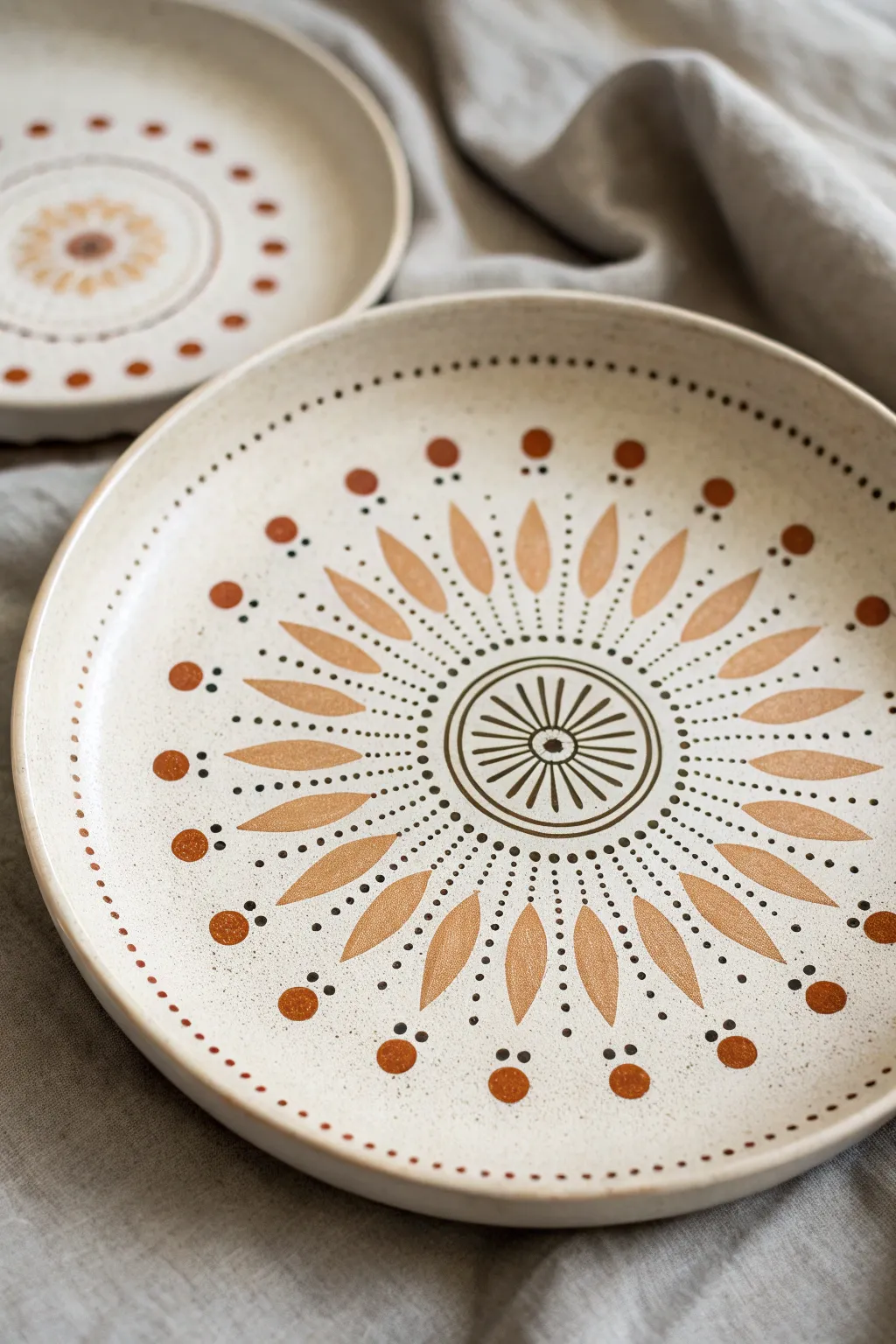
Embrace the warmth of nature with this intricate radial design that combines geometric precision with organic earth tones. Featuring a rhythmic pattern of petal shapes and delicate dot work, this project transforms a simple cream plate into a stunning bohemian centerpiece.
Step-by-Step Guide
Materials
- Bisque fired ceramic plate or ready-to-paint cream ceramic plate
- Ceramic paints or acrylic enamels (Rust/Terracotta, Beige/Sand, Dark Grey/Black)
- Fine liner brush (size 0 or 00)
- Flat shader brush (small)
- Dotting tools (various sizes from small to medium)
- Compass or circle template
- Pencil (very light graphite)
- Ruler
- Damp cloth or paper towels
- Clear ceramic glaze or sealant (optional, food-safe if needed)
Step 1: Preparation & Base Grid
-
Clean surface:
Begin by wiping the plate down thoroughly with a damp cloth to remove any dust or oils, ensuring a clean adhesion for the paint. -
Mark the center:
Find the exact center of your plate using a ruler. Mark it lightly with a pencil dot; this will be the anchor for your entire radial symmetry. -
Draft the guide circles:
Using a compass, lightly sketch a series of concentric circles radiating from the center. You’ll need a small inner circle for the hub, a wider band for the spokes, and an outer ring for the petal tips. -
Divide the pie:
Lightly draw lines dividing the plate into even sections (think of slicing a pizza). Aim for 16 or 32 equal slices to help space your petals evenly later on.
Step 2: Painting the Central Hub
-
Paint the center dot:
With a medium dotting tool, place a solid dark grey or black dot directly over your center mark. -
Create the inner ring:
Using a fine liner brush and the dark grey paint, draw two concentric rings around the center dot, leaving a small gap between them. -
Add the spokes:
Paint fine, straight lines radiating from the center dot to the inner ring, creating a wheel-spoke effect. Keep these lines thin and evenly spaced. -
Outline the hub border:
Paint a third, slightly thicker ring enclosing your wheel spokes. This defines the boundary between the geometric center and the organic petals.
Master the Dots
Consistency is key! Reload your dotting tool with fresh paint after every single dot to ensure they stay perfectly round and identical in size.
Step 3: The Petal Burst
-
Paint the leaves:
Using the beige or sand-colored paint and a small flat brush, paint pointed leaf shapes (long ovals) radiating outward. Use your pencil guides to ensure the tip of each leaf lands on the same concentric circle line. -
Add definition:
If the coverage looks thin, I prefer to let the first coat dry for about ten minutes before applying a second layer to make the beige pop against the cream background. -
Inner dot borders:
Switch to your smallest dotting tool. Dip it in dark grey paint and place a series of tiny dots closely together, outlining the curve between the central hub and the start of the petals. -
Outer leaf outlining:
Continue with the smallest dotting tool and dark grey paint. Create delicate lines of dots that extend from the leaf tips, radiating outward like antennas. -
Fill the gaps:
Between each beige leaf, use the very tip of a fine brush to add small rows of tiny grey dots that fan out, filling the negative space with texture.
Metallic Twist
Swap the beige petal paint for a metallic gold or copper acrylic. The shimmer adds a luxurious finish that catches the light beautifully.
Step 4: Outer Rim Details
-
Paint large terracotta accents:
Dip a medium-large dotting tool into the rust or terracotta paint. Place a bold dot at the outer edge of the design, aligned with the tip of every beige leaf. -
Add connecting dots:
Below each large terracotta dot, add two smaller dark grey dots leading back toward the leaf tip, creating a visual bridge. -
Create the heavy rim border:
Near the physical rim of the plate, create a continuous ring of small, dark grey dots using a consistent dipping rhythm to keep the size uniform. -
Review and refine:
Check your symmetry. If any dot looks too small, carefully dab a little more paint on top to round it out. -
Clean up guidelines:
Once the paint is completely dry (give it at least an hour), very gently erase any visible pencil marks with a kneaded eraser. -
Seal the work:
To protect your design, apply a clear glaze or sealant appropriate for your paint type. If this is for food use, ensure you use a certified food-safe ceramic finish and follow its curing instructions.
Now step back and admire the mesmerizing rhythm of your hand-painted creation
Soft Ombre Gradient Fade
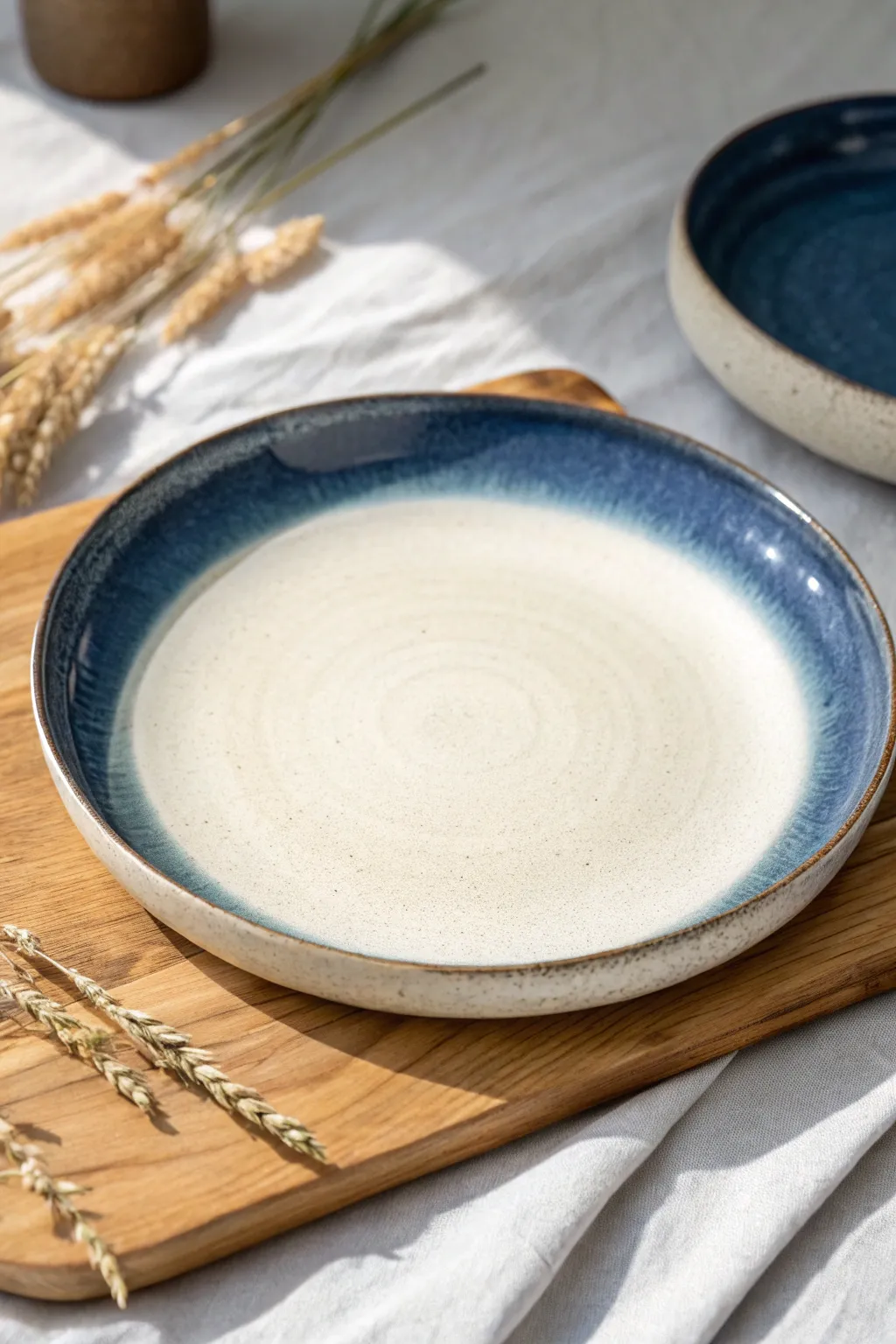
Capture the serene transition of deep ocean hughs meeting a sandy shore with this gorgeous gradient rim technique. This project highlights natural stoneware texture while adding a pop of sophisticated color that feels both modern and timeless.
How-To Guide
Materials
- Bisque-fired ceramic plate (cream or beige clay body preferred)
- Deep indigo underglaze
- Medium denim blue underglaze
- Glossy clear dipping or brushing glaze
- Fan brush (medium)
- Small blending sponge
- Potter’s wheel or turntable (banding wheel)
- Water bowl
- Speckled clay slip or speckled underglaze (optional)
Step 1: Preparation and Base
-
Clean surface:
Begin by wiping down your bisque-fired plate with a slightly damp sponge to remove any kiln dust or oils from your hands, ensuring a clean painting surface. -
Center the plate:
Place your plate precisely in the center of your banding wheel. Spin the wheel to double-check that the plate doesn’t wobble, which is crucial for even rim painting. -
Assess the clay body:
If your clay isn’t naturally speckled like the reference, you can flick a toothbrush loaded with thinned brown underglaze across the center to create subtle faux speckles.
Step 2: Building the Gradient
-
Load the dark hue:
Load your fan brush generously with the deep indigo underglaze. You want the bristles wet but not dripping. -
Apply the outer edge:
While spinning the banding wheel at a slow, steady pace, hold the brush against the very outer lip of the plate. Let the color flow onto the rim, extending inward about half an inch. -
Build opacity:
Apply a second or third coat to this outer edge immediately if it looks streaky; you want a solid, dark ring as your anchor. -
Start the transition:
Switch to the medium denim blue underglaze. While the wheel spins, apply this color directly next to the indigo band, slightly overlapping the wet edge. -
Use water for blending:
Dip your brush quickly in water, shaking off the excess. Gently drag the wet brush over the meeting point of the two blues to soften the line into a blur. -
Fade inward:
Clean your brush completely. With just water on the damp brush, touch the inner edge of the medium blue ring while spinning. -
Feather the edge:
Allow the water to pull the pigment toward the center of the plate, lifting the brush gradually as you move inward so the blue color feathers out into nothingness. -
Sponge blending:
If brush strokes are too visible, take a slightly damp blending sponge and gently dab the transition area while the wheel rotates to create a seamless, airbrushed look. -
Refine the spiral:
The reference image shows a spiral texture in the clay. If you want to highlight this, use a dry brush to lightly drag through the color while spinning, letting the texture catch the paint.
Fixing Hard Lines
If the gradient looks choppy, lightly mist the area with water and use a soft, dry mop brush to feather the harsh line while the wheel is spinning.
Step 3: Finishing and Glazing
-
Clean the bottom:
Use a sponge to wipe away any underglaze that may have dripped onto the foot ring or underside of the plate. -
Dry thoroughly:
Let the underglaze ombre dry completely. It should look chalky and matte before you proceed. -
Apply clear glaze:
Using a wide soft brush or a dipping method, coat the entire plate in a glossy clear glaze. This will make the colors pop and seal the ware. -
Check thickness:
Ensure the clear glaze isn’t too thick over the blue rim, as a very thick application can sometimes cause the delicate gradient to run or blur excessively. -
Final wipe:
Do one last check of the foot ring to ensure it is completely free of glaze, which would stick to the kiln shelf. -
Fire:
Load the plate into the kiln and fire to the temperature appropriate for your specific clay and glaze (usually Cone 5 or 6 for stoneware).
Textured Twist
Before painting, carve a spiral into the raw clay center. The glaze will pool slightly in the grooves, emphasizing the swirl pattern shown in the photo.
Once fired, the glossy finish will transform your gradient into a deep, watery horizon line perfect for framing your favorite meals
Ocean Wave Swirls
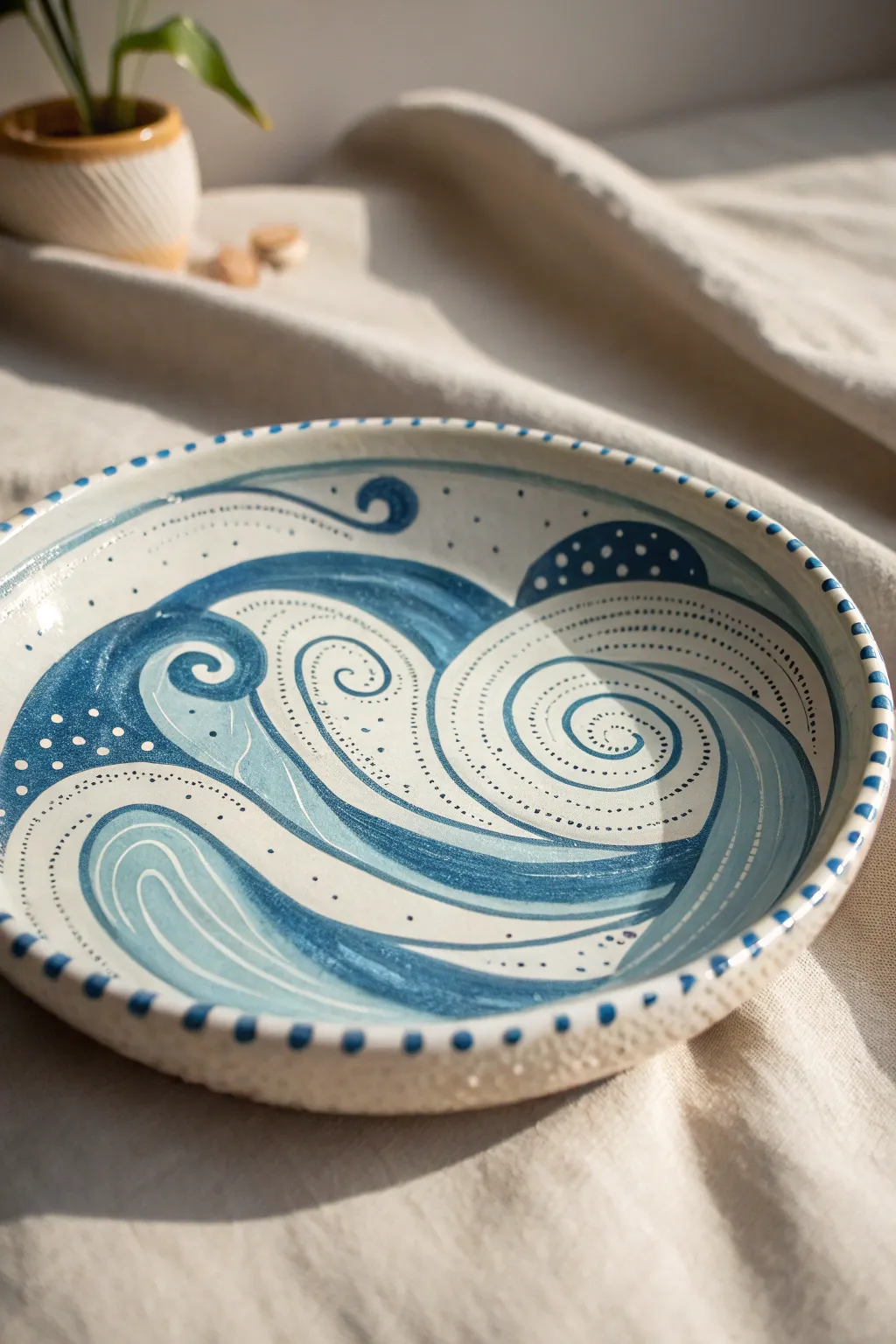
Capture the rhythmic energy of the ocean with this beautifully patterned bowl, featuring crashing waves and delicate dotted currents. The design combines bold sweeping strokes of cobalt and sky blue with intricate dot work for a piece that feels both dynamic and serene.
Step-by-Step
Materials
- Bisque fired ceramic bowl or shallow plate
- Ceramic underglazes or acrylic paints (Cobalt Blue, Sky Blue, White)
- Small round paintbrush (size 2 or 4)
- Fine liner brush (size 0 or 00)
- Pencil for sketching
- Water cup and paper towels
- Clear glaze (if firing) or varnish (if using acrylics)
Step 1: Planning the Flow
-
Sketch the primary waves:
Begin by lightly sketching the main wave shapes onto your bowl with a pencil. Draw three large, swooping curves that start from different edges and curl inward towards the center, creating a spiral-like composition. -
Outline the sections:
Within each large wave shape, lightly draw internal lines to separate the dark blue ‘water’ sections from the lighter, dotted ‘spume’ or foam swirls. Think of this like a topographic map of the ocean surface. -
Divide the central spiral:
Focus on the largest swirl on the right side. Sketch concentric spiral lines that follow the initial curve, creating tracks where your dot patterns will eventually go.
Step 2: Adding the Deep Blue
-
Paint the dark masses:
Using your round brush and Cobalt Blue, fill in the deepest sections of the waves. These are typically the areas under the crest of the wave. Apply the paint smoothly, following the curve of your sketch lines to maintain the sense of motion. -
Add secondary curls:
Paint the smaller, hook-shaped curls near the rim and center in the same Cobalt Blue. I like to keep my brush fairly wet here to ensure crisp, fluid edges on these curves. -
Create the rising wave:
Identify the large wave shape on the left side. Paint thick, sweeping bands of Cobalt Blue that curve upward, leaving gaps of white space in between for lighter colors later. -
Detail the rim dots:
Before moving to lighter colors, use the tip of your round brush to dab small Cobalt Blue dots along the very top edge of the bowl’s rim. Space them evenly, about a quarter-inch apart.
Uneven Dots?
If brush dots are tricky, use the non-brush end of a paintbrush, a toothpick, or a specialized dotting tool. Dip it in paint and press straight down for perfect circles.
Step 3: Layering Lighter Tones
-
Mix a mid-tone blue:
Mix a small amount of Cobalt Blue with White to create a medium ‘ocean’ blue. Use this color to paint thin stripes adjacent to your dark blue sections, adding depth and transition to the water. -
Add sky blue accents:
Switch to pure Sky Blue or a very light blue mix. Paint the filled-in areas inside the smaller curls and the lighter bands of the water on the left side of the plate. -
Refine the edges:
Use the Sky Blue to clean up any rough edges on your dark blue shapes, creating a sharp contrast where the deep water meets the lighter foam areas.
Level Up: Hidden details
Paint a tiny starfish or shell silhouette hidden amongst the waves in a contrasting color like coral or gold for a fun ‘seek and find’ element.
Step 4: Intricate Dot Work
-
Start the spiral dots:
Pick up your fine liner brush and the Cobalt Blue paint. In the large right-hand spiral, begin painting tiny dots along the sketch lines you made earlier. Keep your hand steady and the dots small. -
Vary the dot density:
For a dynamic look, create rows of dots that sit between the painted blue bands. Some rows can be densely packed, while others can be more spaced out to mimic spraying water. -
Embellish the foam:
On the white sections of the waves (the foam), add sparse, tiny dots in Cobalt Blue. These should look like scattered droplets, so avoid perfect lines here and let them be a bit random. -
Add white highlights:
If you are working on a dark clay body or want extra pop, use White paint to add tiny dots on top of the widest dark blue sections. This mimics the sparkle of sunlight on the water. -
Rim texture check:
Go back to the rim. If you want a more framed look, add a second, smaller dot of Sky Blue between each Cobalt Blue dot you painted earlier.
Step 5: Finishing Touches
-
Erase guidelines:
If you used a pencil for sketching and the paint is fully dry (or if using underglaze, before firing), gently rub away any visible graphite marks. If firing, the kiln will burn these away automatically. -
Glaze application:
If this piece is ceramic, apply a coat of clear dipping glaze or brush-on glaze to seal the design and make it food safe. Ensure the paint is bone dry before this step to avoid smearing. -
Final cure or fire:
Fire the piece in a kiln according to your clay and glaze specifications, or if using acrylics on a decorative piece, apply a glossy varnish to simulate that wet, ceramic look.
Once fired or sealed, your bowl will hold the movement of the ocean forever in its design
Night Sky Galaxy Speckles
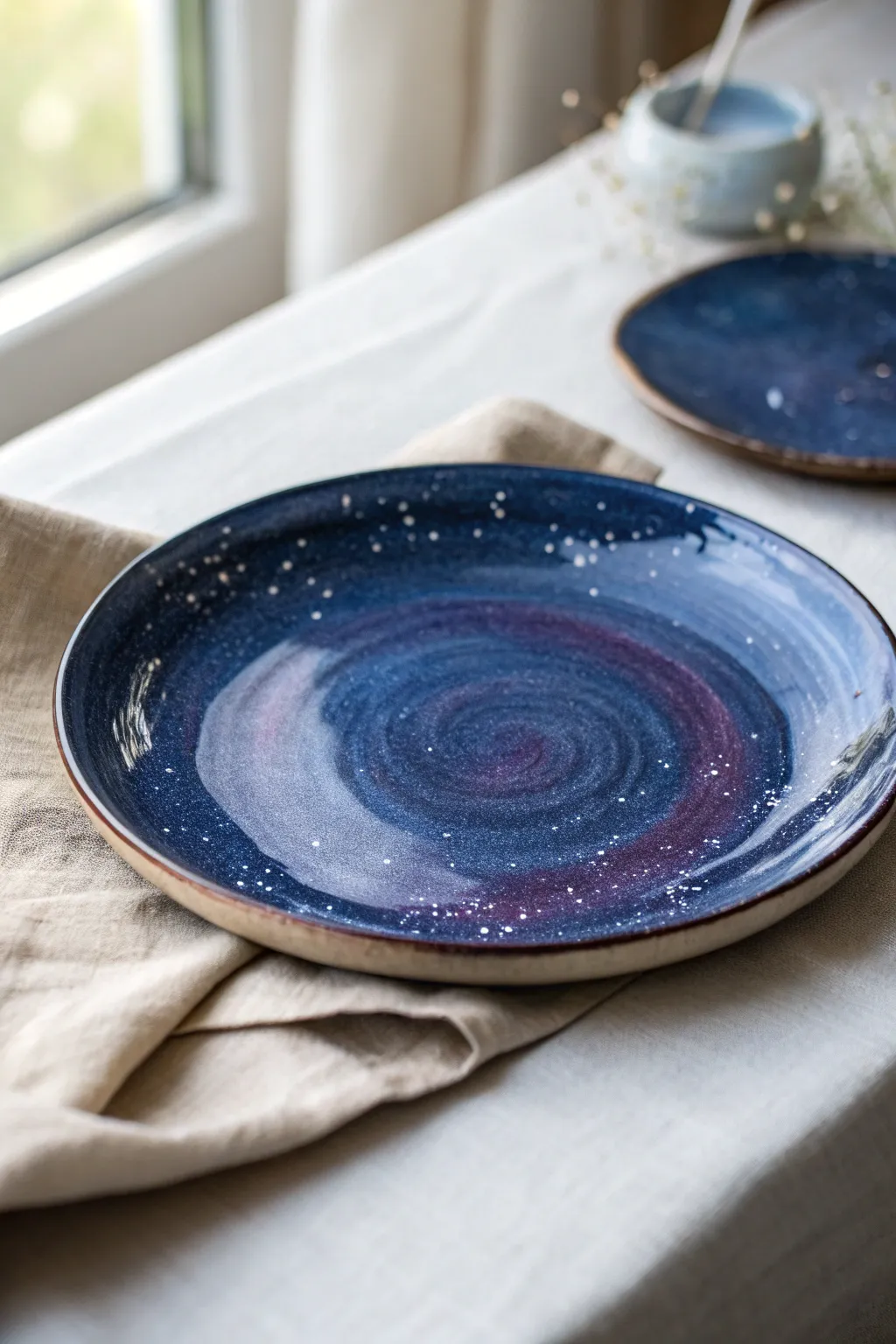
Capture the mysteries of the universe right on your dinnerware with this mesmerizing galaxy-themed plate. Using a blend of deep blues, purples, and strategic splattering, you will create a glossy, starry expanse that makes every meal feel like an interstellar event.
Step-by-Step Tutorial
Materials
- Bisque-fired ceramic plate (flat rimless shape works best)
- Dark blue ceramic glaze (e.g., Midnight Blue)
- Purple ceramic glaze (e.g., Deep Violet)
- Light blue or milky white ceramic glaze
- Bright white ceramic glaze or underglaze
- Fan brush
- Standard round brush (size 6 or 8)
- Toothbrush (for spatter)
- Sponge
- Lazy Susan or banding wheel (optional but helpful)
- Clear dipping glaze (if using underglazes)
- Wax resist (optional)
Step 1: Preparation & Base Coat
-
Clean the bisque:
Begin by wiping down your bisque-fired plate with a barely damp sponge. This removes any kiln dust or oils from your hands that might prevent the glaze from adhering properly. -
Protect the rim:
If you want that exposed clay rim shown in the photo, careful application is key. You can either apply wax resist to the very edge of the rim now or simply be very mindful not to paint over the edge later. -
Apply the first dark layer:
Load a fan brush with your darkest blue glaze. Apply a smooth, even coat across the entire face of the plate, stopping just short of the rim. -
Let it dry:
Wait until the first coat loses its sheen and is dry to the touch before proceeding. This usually takes about 10-15 minutes. -
Apply second dark layer:
Apply a second coat of the dark blue glaze. This ensures a deep, opaque background that resembles the void of space.
Glaze Thickness Hack
Glaze consistency matters! If your stars look like blobs, your white glaze is too thick. If they disappear during firing, it was too thin. Aim for the texture of melted ice cream.
Step 2: Creating the Nebula
-
Load the purple glaze:
While the second blue layer is still practically damp, pick up your purple glaze with a round brush. -
Swirl the center:
Paint a loose, spiral motion starting from the center of the plate and working outward about halfway. You don’t want a perfect circle; an organic, imperfect swirl looks more natural. -
Add light blue accents:
Cleaning your brush, dip into the light blue or milky white glaze. lightly dragging it through parts of the purple section to create dimension. -
Blend the cosmos:
I prefer to use a slightly damp sponge or a dry soft brush to gently gently feather the edges where the purple meets the dark blue. This stops the colors from looking like stripes and makes them look like drifting gas clouds. -
Check for movement:
If you have a banding wheel, give it a slow spin while holding a Brush loaded with a touch of lighter glaze against the surface to create those sweeping motion lines seen in the reference.
Step 3: The Starry Finish
-
Prepare the stars:
Pour a small amount of bright white glaze onto a palette. It essentially needs to be slightly thinned with a drop of water so it flicks easily. -
Load the toothbrush:
Dip the bristles of an old toothbrush into the thinned white glaze. Test the consistency on a piece of paper first to ensure you get dots, not globs. -
Flick the stars:
Hold the toothbrush over the plate and run your thumb across the bristles to spray fine droplets onto the surface. Concentrate some speckles over the lighter ‘nebula’ areas for contrast. -
Add larger stars:
Use the handle end of a paintbrush, dip it in white glaze, and gently dot a few larger stars here and there to create variety in your galaxy. -
Clean the rim:
Take a damp sponge and firmly wipe the rim of the plate to ensure no stray glaze drips remain on the exposed clay edge. This creates that clean, rustic frame. -
Check the foot:
Flip the plate carefully and ensure the bottom foot ring is completely free of glaze so it doesn’t fuse to the kiln shelf. -
Fire the piece:
Load the plate into the kiln. Fire it according to the specific cone temperature recommended on your glaze bottles (usually Cone 5 or 6 for this type of glossy finish).
Cosmic Depth
For a 3D effect, layer clear glaze with tiny amounts of glittery mica powder over just the dark blue sections before the final firing to add extra shimmer.
Once the kiln cools, you will have a stunning, food-safe piece of the galaxy ready for your table
Terrazzo Speckle Sprinkle
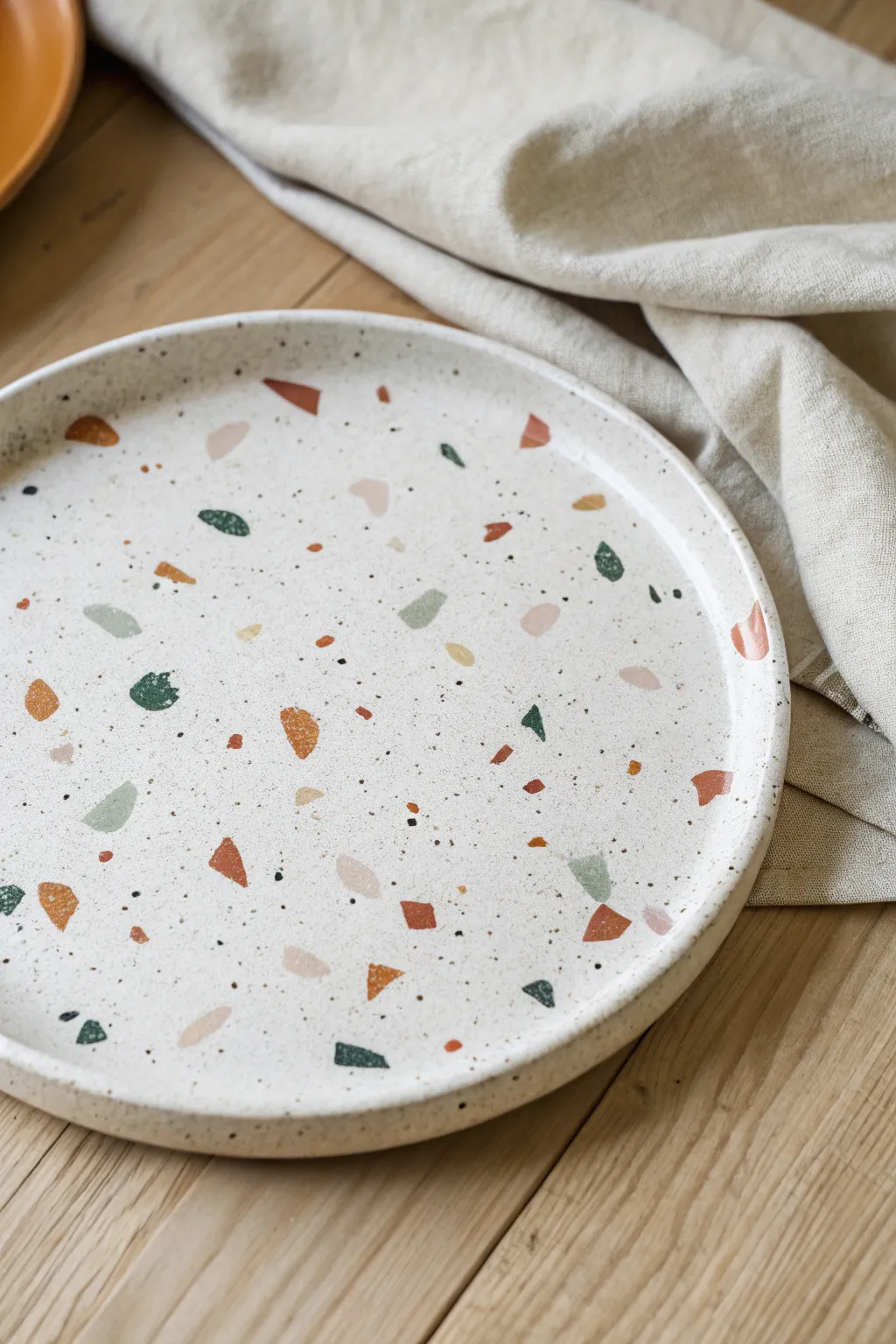
Embrace the playful yet sophisticated look of terrazzo without the heavy stonework. This project transforms a simple clay dish into a trendy statement piece featuring scattered organic shapes in earth tones and subtle speckling.
How-To Guide
Materials
- Air-dry clay or polymer clay (white/cream base)
- Rolling pin
- Circle clay cutter or a bowl to trace
- Sandpaper (fine grit)
- Acrylic paints (Terracotta, Sage Green, Blush Pink, Mustard Yellow, Black)
- Small flat brush
- Old toothbrush or stiff bristle brush
- Sealant/Varnish (Gloss or Matte)
- Palette for mixing
Step 1: Shaping the Base
-
Prepare the Clay:
Start by kneading your white or cream clay until it is soft and pliable. This ensures there are no air bubbles trapped inside which could cause cracking later. -
Roll it Out:
Roll the clay flat on a clean surface to a uniform thickness of about 1/4 inch. Creating an even surface now is easier than sanding it down later. -
Cut the Circle:
Use a large circle cutter or place a bowl upside down on the clay to trace and cut out your perfect circle shape with a craft knife. -
Form the Rim:
Gently lift the edges of the circle to create a shallow rim. Smooth the edges with a bit of water on your finger to soften any sharp cuts. -
Dry Completely:
Allow the plate to dry fully according to the clay package instructions. This usually takes 24-48 hours. Once dry, lightly sand any rough spots for a smooth canvas.
Randomness Rule
Avoid patterns! Rotate the plate constantly while painting the shapes. If you notice a line forming, break it up with a different color or size.
Step 2: Painting the Terrazzo
-
Mix Your Palette:
Prepare your acrylic colors. You’ll need muted, earthy tones: a deep terracotta, a soft sage green, a pale blush pink, and a mustard yellow. Keep them distinct on your palette. -
Paint the Large Shapes:
Using a small flat brush, paint irregular, angular shapes scattered across the plate. Think of these as broken tile pieces—triangles, trapezoids, and shards. -
Distribute Colors:
I like to work one color at a time to ensure an even distribution. Start with the boldest color (terracotta) and place them randomly, leaving plenty of white space. -
Add Secondary Colors:
Follow up with the sage green and mustard shapes. Vary the sizes significantly; some should be large focal points, while others are tiny fragments. -
Layer the Pastel:
Fill in some gaps with the blush pink shapes. These softer tones add depth and keep the design from feeling too heavy. -
Let Shapes Dry:
Allow these painted shapes to dry completely before moving to the speckling phase so the colors don’t bleed or smear.
Splatter Control
Test your splatter on a piece of paper first. If the drops are too big and gloopy, your paint is too thick. Add water drop by drop until fine.
Step 3: The Speckle & Seal
-
Prepare the Splatter:
Dilute a small amount of black acrylic paint with a few drops of water until it has an inky consistency. -
The Toothbrush Trick:
Dip an old toothbrush into the watered-down black paint. hold it over the plate and run your thumb across the bristles to flick tiny specks onto the surface. -
Repeat with Colors:
For a richer texture, repeat the splatter process with diluted terracotta or grey paint. This mimics the grit found in real stone. -
Clean the Edges:
If any paint ended up where you didn’t want it (like the underside), wipe it away quickly with a damp cloth or wait for it to dry and sand it off. -
Seal the Deal:
Once the paint is fully cured, apply a coat of varnish. A matte varnish looks more like natural stone, while gloss gives a polished ceramic look. -
Final Cure:
Let the varnish cure completely before using the plate for jewelry or décor.
Now you have a chic, speckled catch-all that brings a touch of modern artistry to your table or vanity
Faux Stained-Glass Outlines
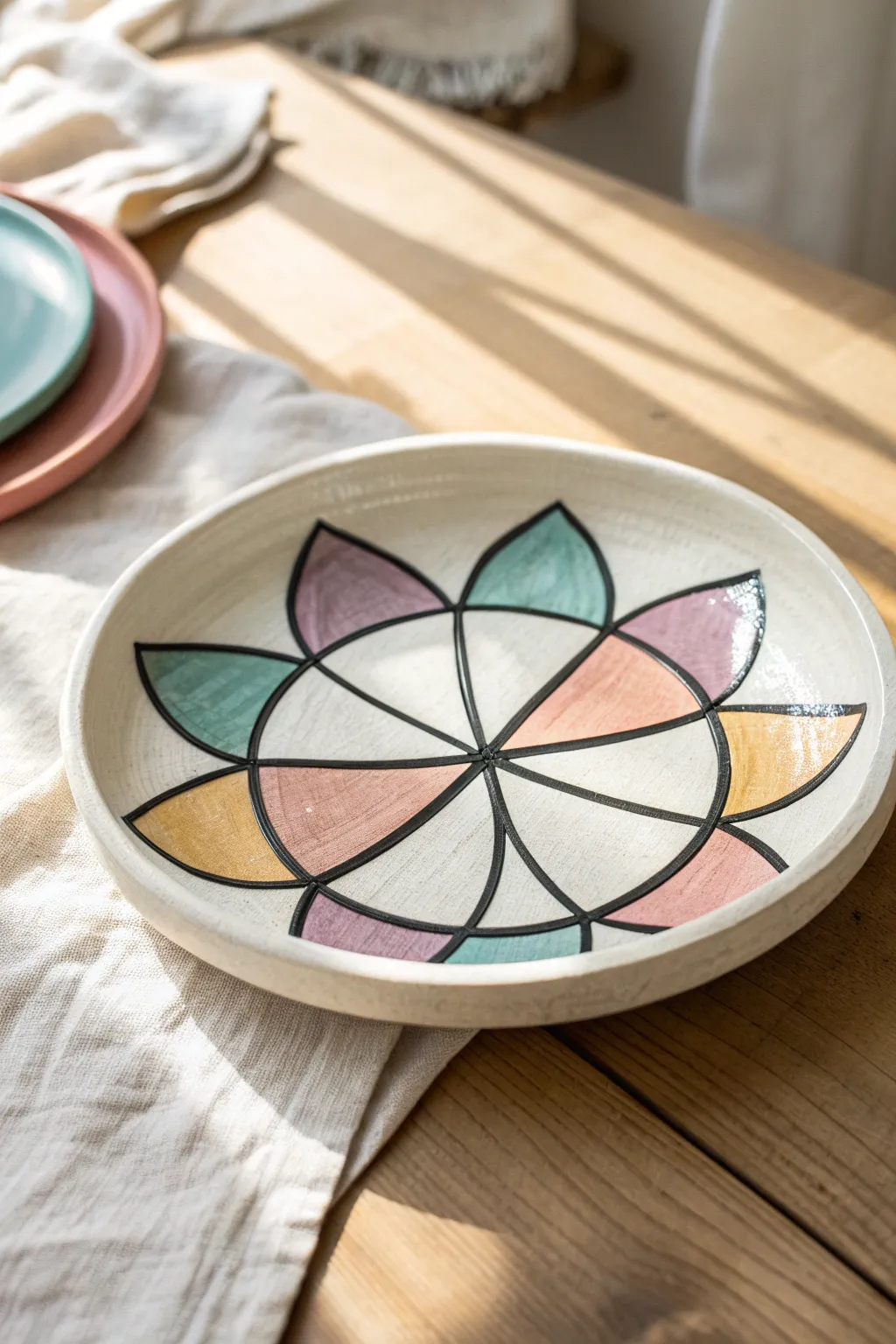
Capture the elegant look of leaded glass on simple pottery with this striking geometric design. By using raised black relief paint for the outlines and soft, translucent glazes or acrylics for the fill, you’ll create a sophisticated centerpiece that feels both modern and handmade.
Step-by-Step Guide
Materials
- Unfinished bisque ceramic shallow bowl (approx. 8-10 inches)
- Pencil for sketching
- Dimensional fabric paint or relief outliner paint (Black)
- Acrylic paints or ceramic glazes (Muted Teal, Dusty Rose, Peach, Mustard Yellow, Cream/White)
- Clear gloss varnish (polyurethane or resin-based)
- Medium flat paintbrush
- Small round detail brush
- Paper plate or palette
- Ruler or protractor (optional but helpful)
Step 1: Planning the Design
-
Prep the surface:
Ensure your ceramic bowl is clean and free of dust. Wipe it down with a slightly damp cloth and let it dry completely before starting. -
Find the center:
Lightly mark the exact center of the bowl with a pencil. This small dot will be the anchor for your entire radial pattern. -
Draw the main axes:
Using a ruler if possible (or freehand for a more organic look), lightly sketch four lines intersecting at the center point to create eight equal pie-slice sections. -
Sketch the inner circle:
Draw a large circle that connects the midpoints of your pie slices. This creates the rounded inner characteristic of the petals. -
Form the petals:
Sketch the pointed tips of the petals extending outward from that inner circle section. Imagine a large flower bloom expanding towards the rim. -
Refine the geometry:
Go over your pencil lines to ensure the shapes curve nicely. You want a distinct central flower shape composed of these segmented petals.
Steady Hand Trick
Rest your pinky finger on a dry part of the bowl while piping lines. This anchors your hand, giving you much smoother control over the squeeze bottle.
Step 2: Creating the Relief Outline
-
Test the flow:
Before applying directly to the bowl, squeeze a bit of your dimensional black paint onto a scrap paper to ensure it comes out smoothly without air bubbles. -
Apply the main outlines:
Start tracing your pencil lines with the black dimensional paint. Keep clear, steady pressure on the bottle to maintain a consistent line thickness. -
Work from center out:
I find it easiest to outline the center intersection first, then work my way out to the petal tips to avoid smudging wet paint with my hand. -
Clean up edges:
If a line goes astray, quickly wipe it away with a damp Q-tip or wait for it to dry and scrape it off with a craft knife. -
Let it cure:
Allow the black outline to dry completely. This creates the ‘dam’ that will hold your colors, mimicking real stained glass lead lines. This usually takes 2-4 hours.
Step 3: Painting the Sections
-
Mix your palette:
Prepare your acrylic paints or glazes. You’ll want a diluted consistency—slightly watery—to let the brushstrokes show through, creating that handmade ceramic texture. -
Paint the first color group:
Start with the teal color. Paint two opposite petals (or every fourth section depending on your preferred symmetry). Keep the paint inside the black ‘lead’ lines. -
Add the warm tones:
Move on to the dusty rose or mauve sections. Apply the paint in smooth strokes, filling the designated segments. -
Complete the petals:
Fill the remaining petal sections with peach and mustard yellow. Alternating warm and cool tones gives the design balance. -
Paint the negative space:
Use a cream or off-white paint for the background sections between the petals and the center wheel. This negative space makes the colors pop. -
Second coat (optional):
If the colors look too transparent after drying, add a second light wash. However, some translucency adds to the stained glass effect.
Glassy Effect Level Up
Mix a tiny drop of clear gloss medium directly into your acrylic paints. This makes the color slightly more transparent and shiny, just like real colored glass.
Step 4: Finishing Touches
-
Dry completely:
Let all the paint dry fully, ideally overnight, to ensure no moisture is trapped under the varnish. -
Apply gloss varnish:
Brush a thick, even coat of high-gloss varnish over the entire inside of the bowl. This seals the design and gives it that shiny, glass-like finish. -
Final cure:
Allow the varnish to cure according to the bottle instructions before handling or displaying your new art piece.
Place your finished bowl on a stand or table where the sunlight can catch that glossy surface and show off your handiwork
Sgraffito Scratch-Through Details
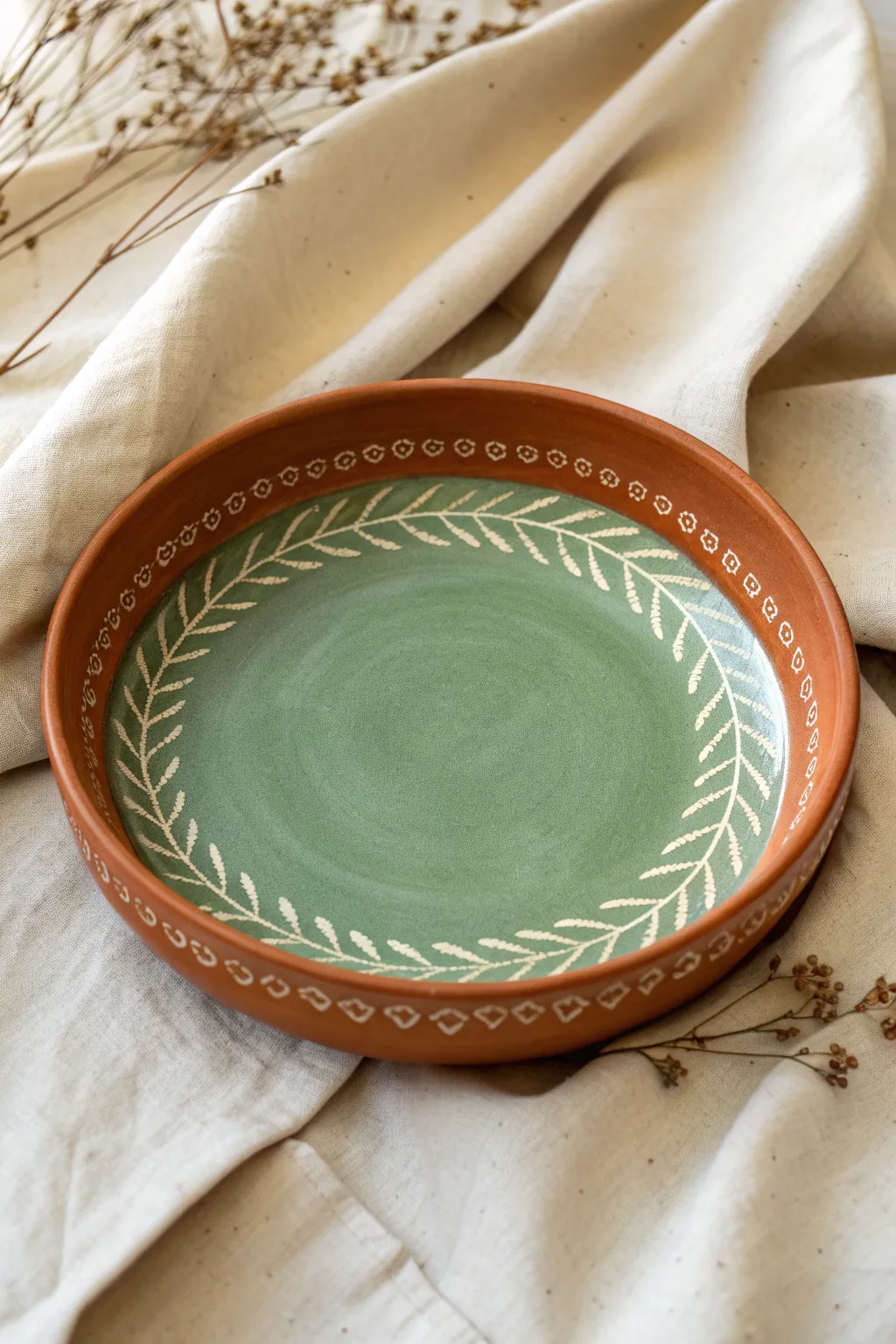
Embrace the rustic charm of sgraffito with this terracotta plate featuring a delicate, scratched-through leaf design. The contrast between the warm red clay body and the cool sage green underglaze creates an organic, nature-inspired centerpiece.
Step-by-Step Tutorial
Materials
- Red earthenware or terracotta clay plate (leather-hard state)
- Sage green underglaze
- Soft fan brush or wide hake brush
- Sgraffito loop tool (small)
- Needle tool
- Carving tool with a small U-shaped tip
- Pencil (optional)
- Clear transparent glaze
- Kiln for firing
- Damp sponge
Step 1: Preparation and Base Coat
-
Assess clay state:
Ensure your terracotta plate is in a ‘leather-hard’ state. It should be firm enough to hold its shape without warping but soft enough to carve into easily. -
Clean the surface:
Gently wipe the interior surface with a slightly damp sponge to remove any dust or crumbled clay bits that might interfere with the underglaze application. -
Mix the underglaze:
Shake your sage green underglaze thoroughly. If it feels too thick, thin it slightly with water until it reaches a heavy cream consistency. -
Apply the first coat:
Using a soft fan brush, apply a smooth, even coat of sage green underglaze to the interior basin of the plate. I like to brush in one consistent direction for this first layer. -
Layering for opacity:
Wait until the first coat loses its sheen (is dry to touch), then apply a second coat, brushing perpendicular to the first layer to ensure solid coverage. Repeat for a third coat if necessary. -
Drying time:
Let the underglaze dry until it is no longer tacky but the clay beneath is still leather hard. Do not let it become bone dry, or the chipping will be brittle.
Step 2: Carving the Wreath Design
-
Plan the layout:
Visualize a circle roughly one inch inward from the rim. You can lightly sketch this guide using a dull pencil; the graphite will burn off in the kiln. -
Carve the main stem:
Using a needle tool or very fine loop tool, scratch a continuous, circular line to form the central vine of the wreath. Keep the pressure steady to reveal the red clay beneath. -
Adding initial leaves:
Switch to a small U-shaped carving tool. Starting at the top of your circle, carve small, leaf-like dashes extending outward from the main stem. -
Creating direction:
Angle your leaves so they point in the direction the vine is growing. Alternate sides—one leaf pointing in, one point out—as you work your way around the circle. -
Varying leaf shapes:
To make the wreath feel organic, vary the pressure slightly. Press harder at the base of the leaf and lift up quickly at the tip to create a tapered point. -
Reviewing the pattern:
Step back and look at the spacing. Add smaller filler leaves or tiny scratched dots in any gaps that look too empty. -
Cleaning debris:
Use a large, dry soft brush to gently sweep away the clay ‘crumbs’ created by carving. Do not blow on them, as clay dust is harmful to inhale.
Chipped Lines?
If your carved lines look jagged or chip off in chunks, the clay is too dry. Mist it lightly with water, wrap it in plastic, and let it rest for an hour to rehydrate before trying again.
Step 3: Border Details and Finishing
-
Carving the rim pattern:
On the raised rim of the terracotta plate (which should remain unglazed), use your needle tool to carve a repeating geometric pattern directly into the raw clay. -
Detailing the rim:
Create small diamond shapes or simple circles spaced evenly around the circumference. Between the shapes, add small dots or dashes to tie the border together. -
Painting the rim details:
Dip a very fine detail brush into white underglaze (or use white slip) and carefully fill in the carved recesses on the rim to make the pattern pop against the red clay. -
Clean up the rim:
If any white slip went outside the lines, wait for it to dry stiff, then gently scrape the excess off with a pottery rib or knife. -
Bisque fire:
Allow the entire piece to dry slowly to the bone-dry stage. Fire the piece in a bisque kiln (usually Cone 04) to harden the clay and set the underglaze. -
Clear glaze application:
After bisque firing, sponge the piece clean. Apply a clear transparent glaze over the green interior section to make the color vibrant and food-safe. You can leave the outer rim matte or glaze it as well. -
Final firing:
Fire the plate a second time to the maturation temperature of your specific clay and glaze (e.g., Cone 06 or Cone 6).
Clean Lines Pro-Tip
When carving sgraffito, hold your tool like a pencil but keep your wrist rigid. Move the plate on a banding wheel instead of moving your hand—this creates smoother, more confident curves.
Now you have a stunning botanical plate that highlights the beautiful contrast between raw earth and vibrant color