
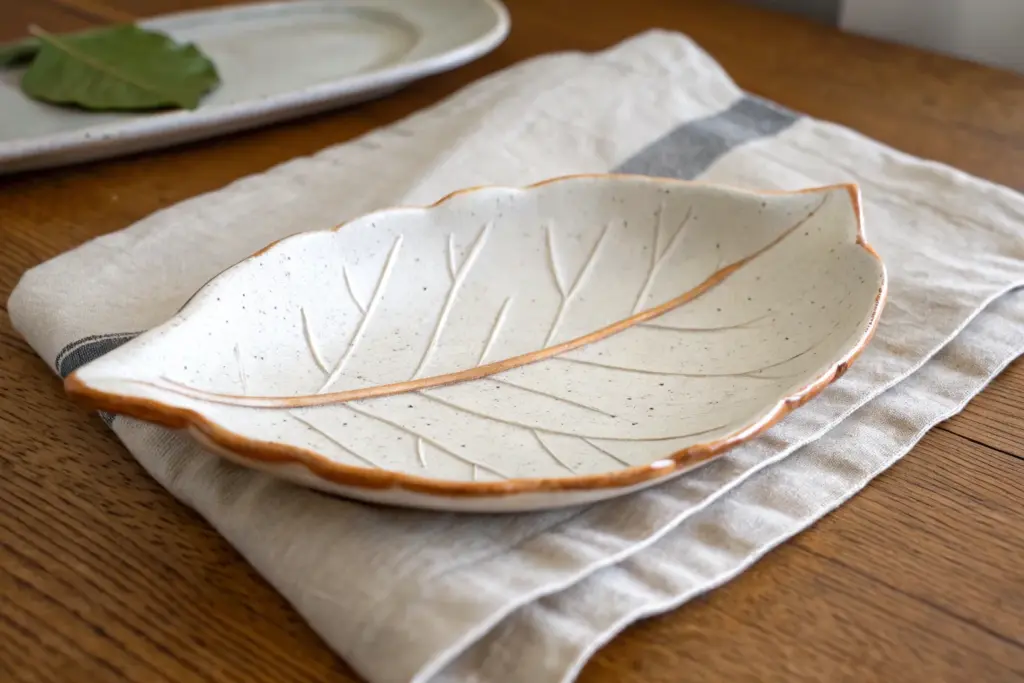
Whenever someone tells me they want air dry clay projects that feel doable in one cozy afternoon, I always point them toward small, satisfying pieces with simple shapes and big payoff. These easy clay art ideas are all about cute, useful results you can make at your kitchen table—no kiln needed.
Minimalist Trinket Dish
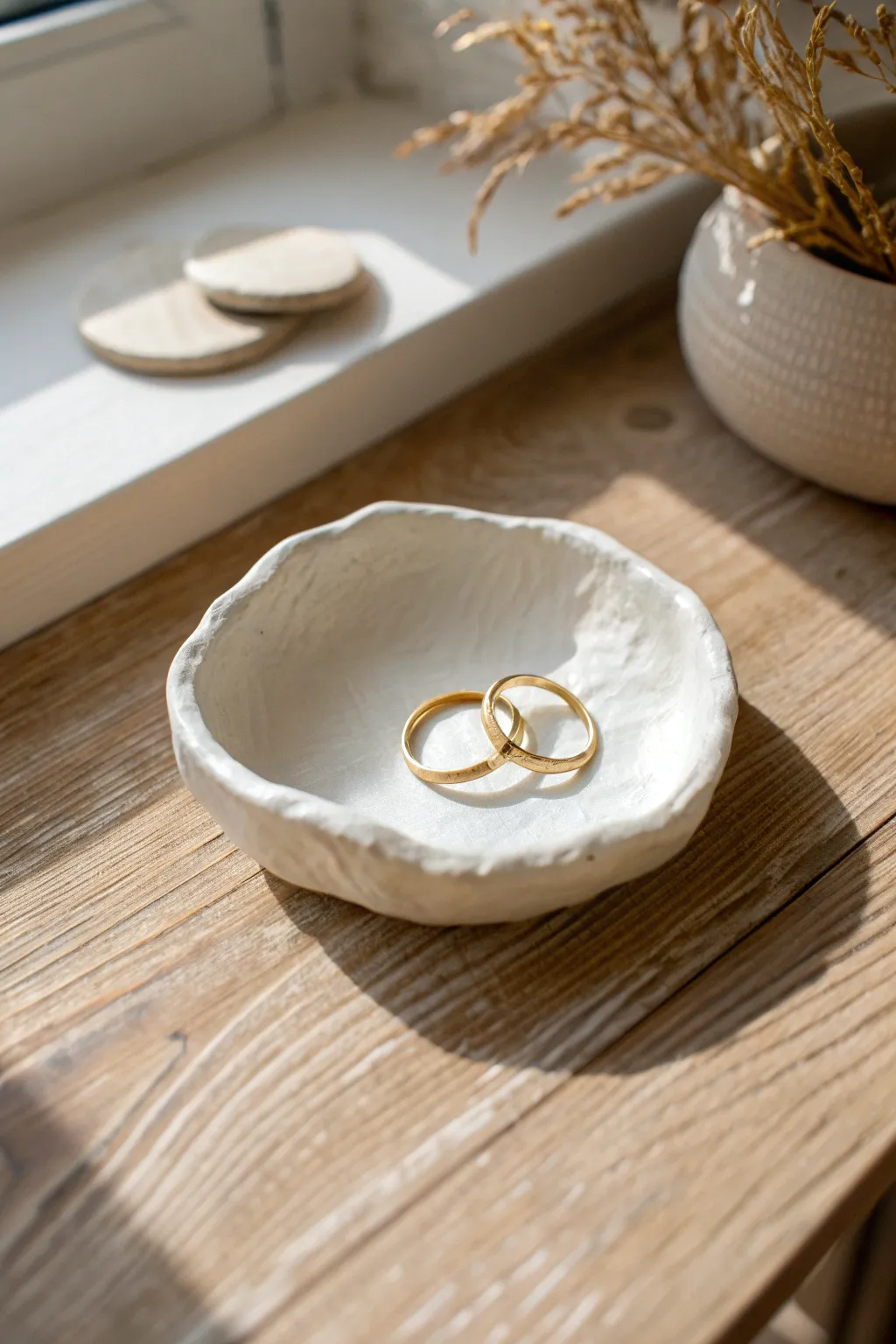
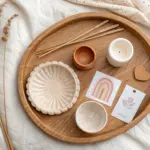
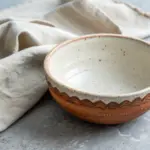
Capture the beauty of imperfection with this organically shaped trinket dish. Its uneven, textured rim and natural white finish create a serene spot for your favorite jewelry pieces.
Step-by-Step Guide
Materials
- White air-dry clay
- Rolling pin or smooth glass jar
- Parchment paper or non-stick work mat
- Small bowl using as a slump mold (optional)
- Small sponge
- Cup of water
- Sandpaper (fine grit)
- Clear matte varnish or sealant (optional)
- Modeling tool or butter knife
Step 1: Preparation & Rolling
-
Prepare your workspace:
Lay down a sheet of parchment paper or a silicone mat. This prevents the clay from sticking to your table and makes clean-up much easier later. -
Condition the clay:
Take a handful of air-dry clay, roughly the size of a tangerine. Knead it in your hands for a minute or two until it feels warm, pliable, and free of any lumps. -
Form a ball:
Roll the conditioned clay into a smooth ball between your palms. Try to smooth out any major cracks before you start flattening it. -
Begin flattening:
Place the ball in the center of your parchment paper. Using the heel of your hand, gently press down to create a thick puck shape. -
Roll it out:
Using your rolling pin, roll the clay out to an even thickness of about 1/4 inch (6mm). Rotate the clay periodically to keep the shape relatively circular, though perfection isn’t the goal here.
Cracks appeared?
Mix a tiny bit of fresh clay with water to make a paste (slip). Fill the crack, smooth it over with a wet finger, and let it dry again.
Step 2: Shaping the Form
-
Create the rough rim:
Instead of cutting a perfect circle with a cutter, use your fingers or a modeling tool to tear away small bits of the edge if it looks too uniform. We want a natural, organic perimeter. -
Lift the edges:
Gently lift the edges of the clay slab upwards to start forming a bowl shape. Cup the clay in your hands, pressing the center down slightly with your thumbs while curling the sides up. -
Pinch the walls:
Slowly work your way around the rim, pinching the walls to thin them slightly and give them height. I like to vary the pressure here to create that lovely undulating, uneven wave along the top edge. -
Smooth the interior:
Dip your finger into a little water and run it along the inside of the bowl to smooth out any harsh fingerprints or cracks that formed during lifting. Don’t use too much water, or the clay will get mushy. -
Enhance the texture:
For that specific rustic look seen in the photo, deliberately leave the rim a bit chunky and rough. You can press gently with your thumb along the top edge to create slight indentations.
Gilded Edge
Once fully dry and sealed, paint just the very rim with liquid gold leaf or metallic gold paint for a luxurious, modern contrast.
Step 3: Refining & Drying
-
Sponge finish:
Dampen your small sponge and squeeze it out well. Lightly dab and swipe over the entire surface to soften any sharp jagged bits while keeping the organic texture intact. -
Final shaping check:
Set the dish down on your flat surface. If the bottom rocks, gently press the center down from the inside to flatten the base so it sits stable. -
Start the drying process:
Leave the dish to dry in a cool, dry place away from direct sunlight. To prevent warping, rotate the dish every few hours during the first day so air reaches all sides evenly. -
Flip for drying:
After about 24 hours, when the top feels firm and leather-hard, generally flip the dish upside down carefully. This allows the bottom center to dry completely. -
Full cure time:
Allow the piece to dry for another 24-48 hours until the clay turns a distinctive chalky white color and feels room temperature (not cold to the touch).
Step 4: Finishing Touches
-
Light sanding:
Once bone dry, take your fine-grit sandpaper and very gently sand any extremely sharp peaks on the rim that might scratch you. Keep the sanding minimal to preserve the handmade character. -
Dust off:
Use a soft dry brush or a cloth to wipe away all the clay dust from sanding. -
Seal the piece:
Apply a thin coat of matte varnish or sealant to protect the clay from moisture and stains. This will also give it a slightly more finished, professional feel without making it glossy.
Now you have a calm, minimalist piece to organize your daily treasures
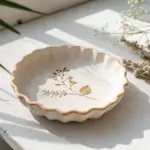
Pressed Leaf Catchall Bowl
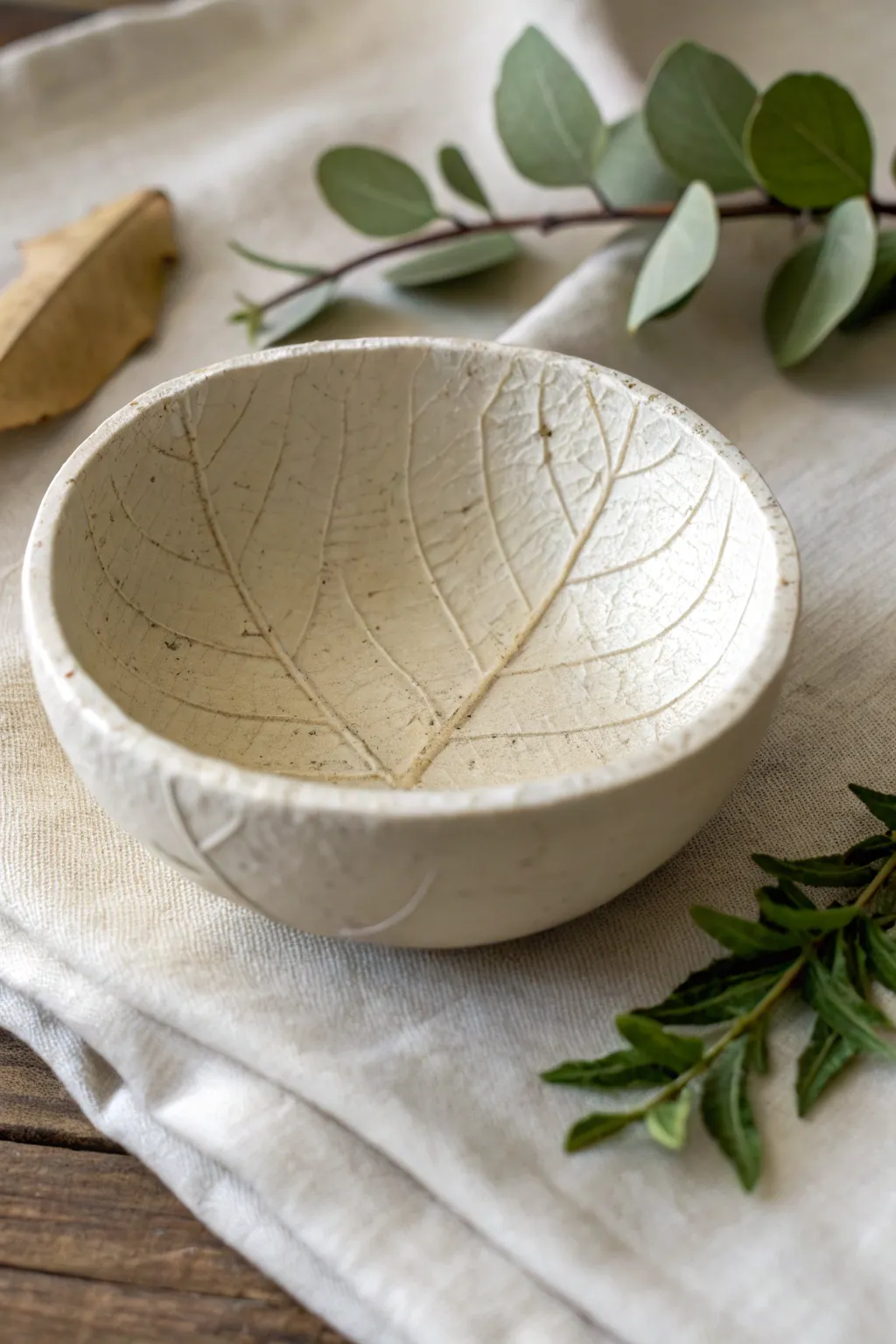
Capture the delicate beauty of nature forever with this simple yet stunning pressed leaf bowl. The finished piece features intricate vein patterns embedded directly into the clay, creating an elegant organic vessel perfect for holding jewelry or keys.
Step-by-Step Tutorial
Materials
- White polymer or air-dry clay (smooth texture)
- Small rolling pin
- Large, deeply veined fresh leaf (hydrangea or hosta work well)
- Craft knife or needle tool
- Small bowl (to use as a mold)
- Plastic wrap
- Fine-grit sandpaper (220-400 grit)
- Water in a small cup
- Sponge
- Clear matte acrylic sealer (optional)
Step 1: Preparing the Clay
-
Condition the clay:
Begin by working a handful of air-dry clay in your hands until it becomes soft, pliable, and free of cracks. Warm clay is much easier to impress. -
Roll it out:
Place the clay on a smooth surface or a silicone mat. Use your rolling pin to flatten it into an even circle, aiming for a consistent thickness of about 1/4 inch. -
Check for bubbles:
Inspect the surface for any air bubbles. If you spot one, gently pierce it with a needle tool and smooth the area over with your finger.
Cracks appeared?
Mix a tiny amount of fresh clay with water to create a paste (slip). Fill cracks, smooth with a finger, and let dry again.
Step 2: Creating the Texture
-
Position the leaf:
Place your chosen leaf vein-side down onto the center of the rolled clay. The vein side is usually the underside of the leaf and provides the crispest impression. -
Embed the leaf:
Gently roll over the leaf with the rolling pin. Apply firm, even pressure to ensure the veins push deep into the clay, but be careful not to make the slab paper-thin. -
Reveal the pattern:
Find the stem of the leaf and carefully peel it away from the clay to reveal the intricate botanical print left behind.
Add color definition
Mix watered-down brown acrylic paint, brush it into the veins, and wipe the surface immediately to antique the texture.
Step 3: Shaping the Bowl
-
Cut the shape:
Place a circular template or a small bowl upside down over the textured clay to guide your size. Use a craft knife to cut a clean circle around the patterned area. -
Smooth the edges:
Dip your finger in a little bit of water and run it along the cut rim of the clay circle. This softens the sharp cut edge for a more professional finish. -
Prepare the mold:
Line the inside of a small kitchen bowl with plastic wrap. This prevents sticking and helps you lift the clay out later. -
Form the curve:
Gently lift your clay circle and place it inside the lined bowl. Press it down very lightly so it takes the curved shape of the bowl bottom. Don’t press too hard or you might flatten the texture.
Step 4: Finishing Touches
-
Initial drying:
Let the clay sit in the bowl mold for at least 24 hours in a cool, dry place. Avoid direct sunlight which can cause cracking. -
Remove and flip:
Once the clay is firm enough to hold its shape (leather hard), gently lift it out of the bowl using the plastic wrap. Remove the wrap and place the clay upside down to let the bottom dry completely. -
Full cure:
Allow another 24 to 48 hours for the clay to dry fully. It should feel room temperature to the touch, not cool. -
Sand imperfections:
Use fine-grit sandpaper to gently smooth any rough spots on the rim or the exterior of the bowl. Be careful not to sand over the interior leaf texture. -
Clean up:
Wipe away any clay dust with a slightly damp sponge or cloth. -
Seal the piece:
To protect your bowl from moisture and stains, brush on a thin layer of clear matte acrylic sealer or varnish. This will preserve the natural white look shown in the inspiration image.
Place your new nature-inspired bowl on a side table to enjoy its organic elegance every day
Flower-Shaped Coaster Set
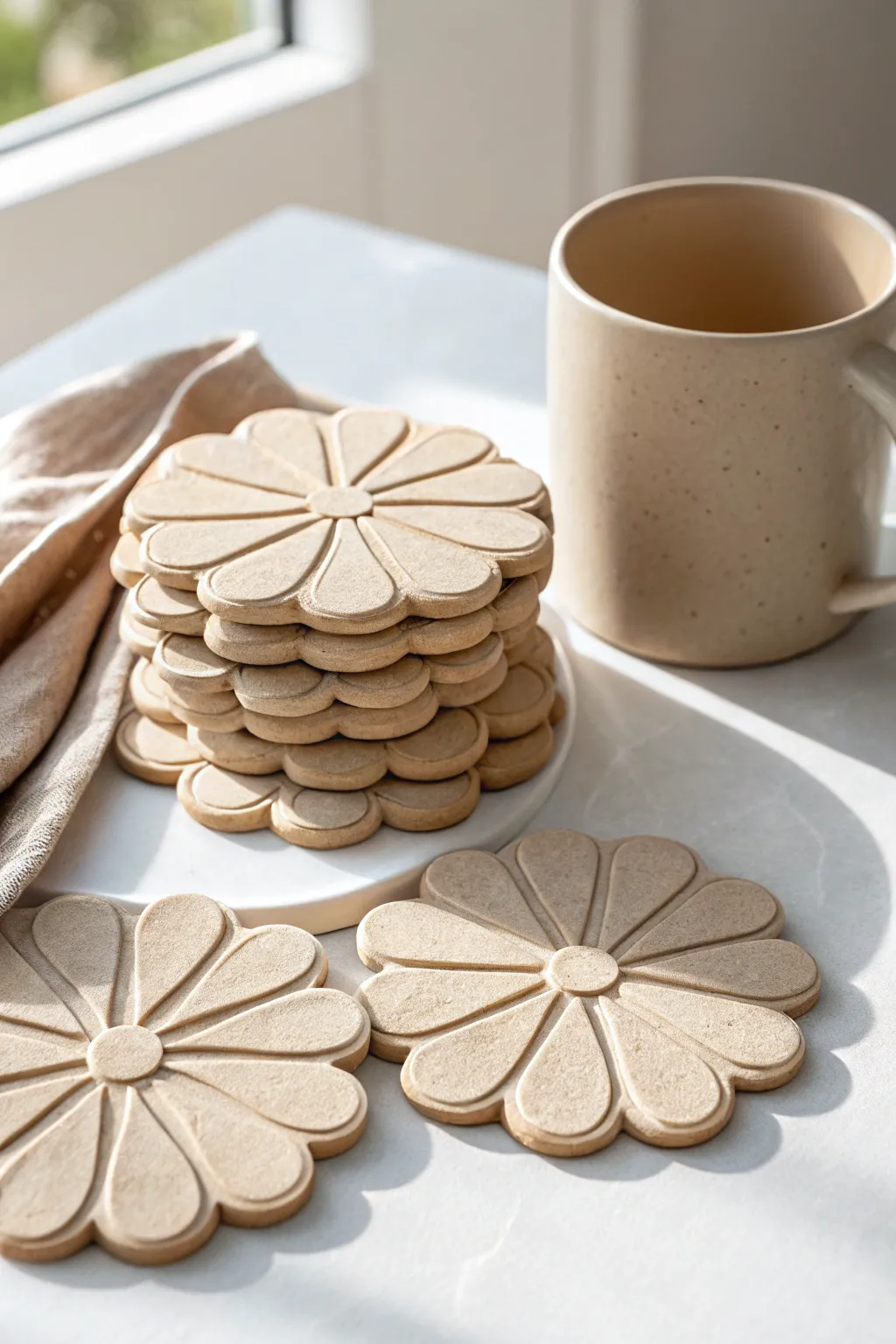
Bring a touch of organic warmth to your coffee table with this stackable set of daisy-shaped coasters. Their natural, unglazed finish and simple relief pattern create a minimalist boho aesthetic that looks far higher-end than the simple materials used.
How-To Guide
Materials
- Air-dry clay (warm beige or natural stone color)
- Rolling pin
- Parchment paper or canvas mat
- Circle layout tool or compass
- Paper template (flower shape)
- Craft knife or scalpel
- Modeling tool (rounded tip)
- Sponge
- Fine-grit sandpaper (220 and 400 grit)
- Matte spray varnish or clay sealer
- Small bowl of water
Step 1: Shaping the Clay
-
Prepare the workspace:
Lay down your parchment paper or canvas mat to prevent sticking. Taping the corners down helps keep everything stable while you work. -
Condition the clay:
Take a generous handful of air-dry clay and knead it in your hands until it becomes warm and pliable. This minimizes the risk of cracks forming later. -
Roll out the slab:
Use your rolling pin to create a smooth, even slab about 1/4 inch (6-7mm) thick. Rotate the clay periodically so it doesn’t stick to the surface. -
Create a template:
Draw a simple flower shape on paper—about 4 inches in diameter with rounded petals—and cut it out. Place this lightly on top of your rolled clay. -
Cut the outline:
Holding the craft knife vertically, carefully trace around your paper template to cut out the flower shape. Remove the excess clay and set it aside for the next coaster. -
Smooth the edges:
Dip your finger in a little water and gently run it along the cut edges to soften the sharp angles. You want a clean, but rounded, look.
Fixing Cracks
If hairline cracks appear during drying, fear not. Mix a tiny bit of fresh clay with water to make a paste (slip) and fill the crack, then sand smooth once dry.
Step 2: Adding the Details
-
Mark the center:
Find the center of your flower shape and gently press a small circle tool or bottle cap lightly into the clay to mark the center disk. Don’t cut through; just make an indentation. -
Indent the petals:
Using a rounded modeling tool, press radiating lines from the center circle out towards the dip between each petal. This creates the individual petal definition. -
Deepen the relief:
Go over your lines a second time to ensure the grooves are deep enough to remain visible after sanding. I usually press a bit firmly here to get that distinct ridge effect. -
Refine the surface:
Take a slightly damp sponge and very lightly wipe the top surface. This smooths out any fingerprints or tool marks without erasing your sculpted lines. -
Create the set:
Repeat the cutting and sculpting process until you have a stack of 4-6 coasters. Try to keep the thickness consistent across all pieces.
Step 3: Finishing Touches
-
Slow drying:
Place the coasters on a wire rack or leave them on parchment paper, flipping them gently every few hours. Let them dry for 24-48 hours away from direct heat to prevent warping. -
Initial sanding:
Once bone dry, use the 220-grit sandpaper to smooth the edges and flat surfaces. Work in circular motions to avoid scratching. -
Detail sanding:
Fold a small piece of sandpaper to get into the grooves between petals and refine the indented lines. -
Final polish:
Switch to 400-grit sandpaper for a final pass. This makes the clay feel incredibly smooth and velvety to the touch. -
Seal the piece:
Apply two light coats of matte spray varnish or a waterproof sealer. This is crucial for coasters to prevent water rings and stains while maintaining that natural look.
Level Up
After sealing, glue a thin circle of cork or felt to the bottom of each coaster. This protects your table and adds a professional, finished weight.
Stack your new creations on your coffee table and enjoy the modern, handmade charm they bring to your space.

Easy Pinch Pots
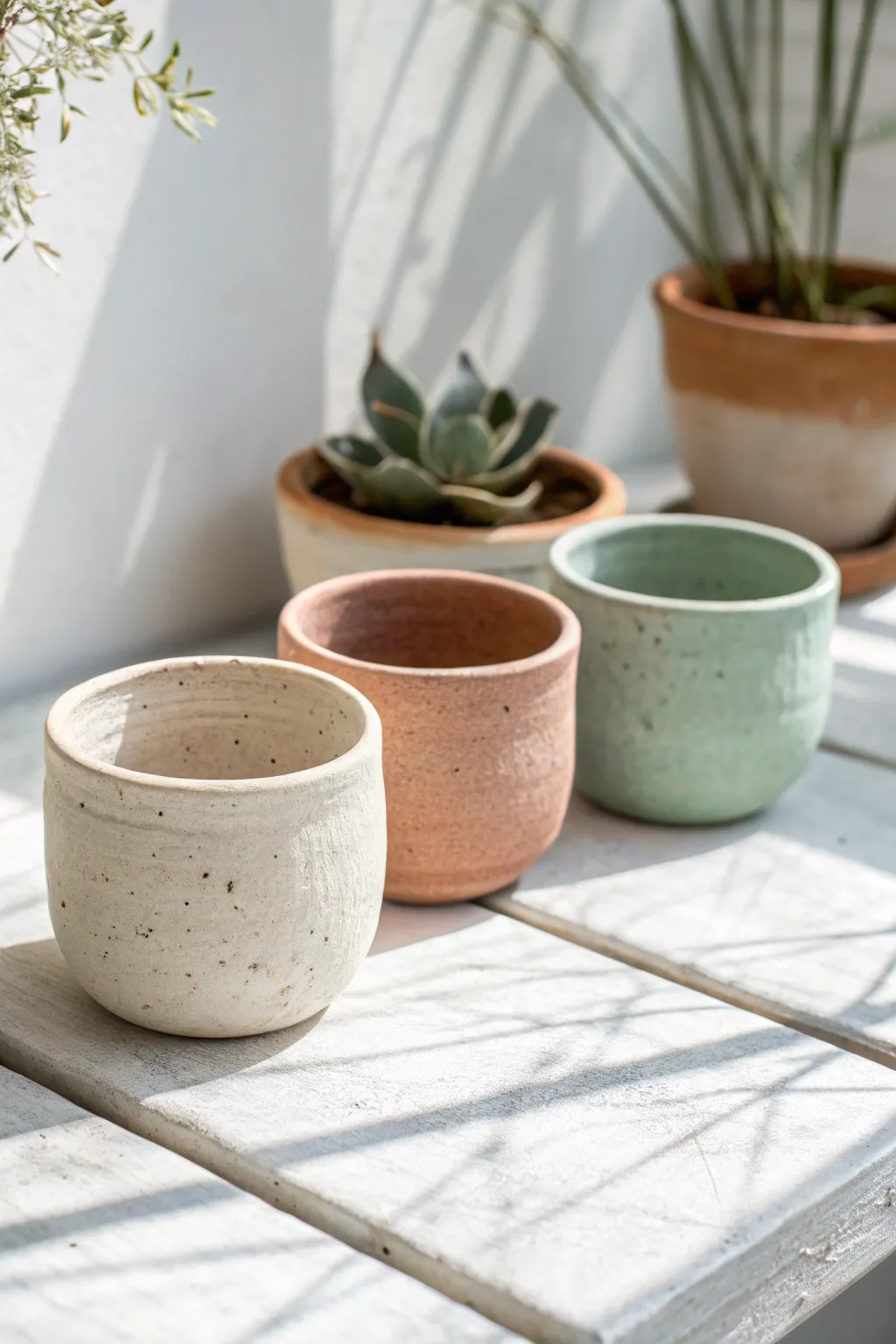
These charming, minimalist vessels capture the earthy look of high-fire ceramics without requiring a kiln. Using simple hand-building techniques and a speckled paint effect, you’ll create a trio of pots in soothing tones of cream, terracotta, and sage.
Step-by-Step
Materials
- Air dry clay (white or grey)
- Acrylic paints (matte finish: cream, terracotta, sage green)
- Dark brown or black acrylic paint (for speckling)
- Old toothbrush
- Small bowl of water
- Sponge
- Fine-grit sandpaper (220 grit)
- Matte varnish or sealant
- Modeling tools (optional)
Step 1: Shaping the Clay
-
Prepare your clay:
Cut off a chunk of air dry clay about the size of a tennis ball. Knead it in your hands for a minute to warm it up and make it pliable, ensuring there are no air bubbles trapped inside. -
Create a sphere:
Roll the clay between your palms or against a flat surface to form a smooth, tight ball. Try to smooth out any major lines or cracks at this stage. -
Start the pinch:
Hold the ball in your non-dominant hand. Push your thumb gently into the center of the ball, stopping about a half-inch from the bottom. This determines the base thickness. -
Pinch the walls:
Using your thumb on the inside and fingers on the outside, gently pinch and rotate the clay. Work your way from the bottom up towards the rim. -
Maintain thickness:
Aim for a uniform wall thickness of about a quarter-inch. As you pinch, avoid making the rim too thin, as this makes it fragile. -
Flatten the base:
Once the basic cup shape is formed, gently tap the bottom of the pot against your table to create a flat, stable base so it won’t wobble. -
Smooth the surface:
Dip your finger in a little water and run it over the clay to smooth out fingerprints and cracks. You can also use a slightly damp sponge for a unifying texture. -
Refine the rim:
I like to dampen my thumb and run it along the rim to soften any sharp edges, giving it that handmade pottery look. -
Let it dry:
Place your pot in a safe spot to dry for 24-48 hours. Turn it upside down halfway through the drying process to ensure the bottom dries evenly.
Clean Edges Pro Tip
Keep a bowl of water nearby while shaping. If the rim starts to crack as you expand the pot, immediately dampen the crack and smooth it over with your finger to prevent it from splitting further.
Step 2: Decorating and Finishing
-
Sand for smoothness:
Once fully dry and hard, use 220-grit sandpaper to buff away any remaining rough spots or uneven ridges, rubbing in a circular motion. -
Wipe clean:
Use a dry brush or cloth to remove all sanding dust before painting. Dust will prevent the paint from sticking properly. -
Base coat painting:
Paint each pot a solid color—one cream, one terracotta, and one sage green. You may need two coats for full opacity, letting the paint dry completely between layers. -
Prepare the speckles:
Dilute a small amount of dark brown or black acrylic paint with water until it has a fluid, ink-like consistency. -
Apply the speckle effect:
Dip an old toothbrush into the diluted paint. Hold it near the pots and run your thumb across the bristles to flick tiny droplets onto the surface. -
Control the spray:
Practice on a piece of paper first to get the density right. Rotate the pots to ensure the speckles are distributed evenly around all sides. -
Seal the work:
After the paint is bone dry, apply a coat of matte varnish. This mimics the look of unglazed stoneware and protects the surface.
Faux-Glaze Level Up
Paint the inside with a high-gloss varnish while keeping the outside matte. This creates a realistic contrast that mimics a functional, glazed ceramic interior.
Enjoy displaying your beautiful, faux-ceramic creations as a centerpiece or small planter set

The Complete Guide to Pottery Troubleshooting
Uncover the most common ceramic mistakes—from cracking clay to failed glazes—and learn how to fix them fast.
Ring Cone Holder
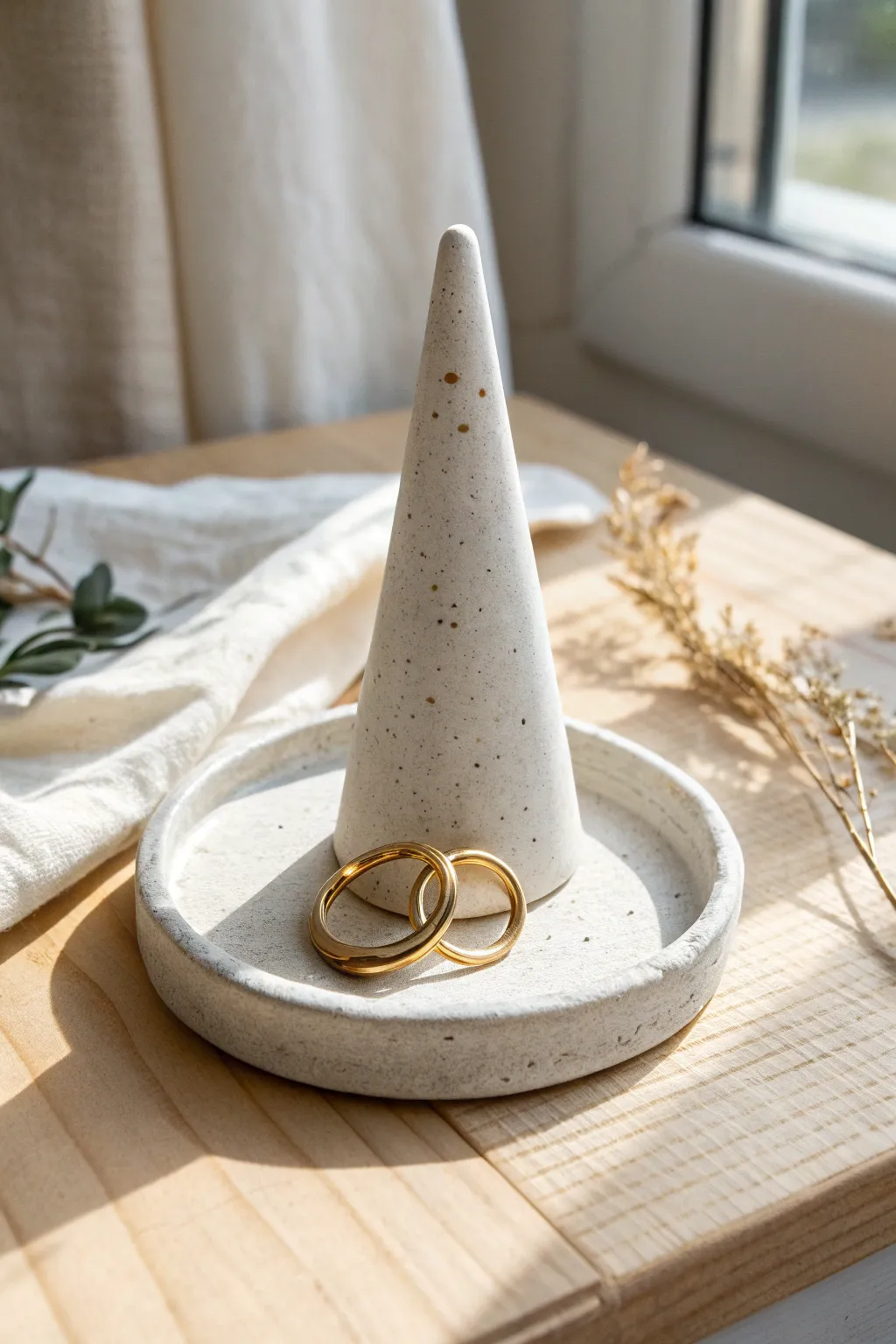
This minimalist jewelry stand combines a sleek conical shape with a shallow catch-all dish, perfect for keeping your favorite rings organized. The speckled finish mimics the high-end look of terrazzo or raw concrete while using accessible air dry clay.
Detailed Instructions
Materials
- White air dry clay
- Dried coffee grounds or decorative dark sand
- Rolling pin
- Clay knife or craft blade
- Small bowl or round cookie cutter (approx. 4 inches)
- Water and a sponge
- Fine-grit sandpaper
- Clear matte acrylic varnish
- Strong craft glue (e.g., E6000)
Step 1: Preparing the Clay
-
Condition the clay:
Begin by taking a substantial chunk of white air dry clay. Knead it thoroughly in your hands to warm it up and make it pliable. -
Add texture:
Flatten the clay slightly and sprinkle in your dried coffee grounds or dark sand. Knead the clay repeatedly, folding it over itself until the speckles are evenly distributed throughout the mass.
Cracking Up?
If small cracks appear while drying, mix a tiny bit of fresh clay with water to make a paste (slip) and fill the cracks. Smooth it over and sand once dry.
Step 2: Forming the Cone
-
Create the base shape:
Separate about a third of the clay for the cone. Roll this piece into a smooth ball first to eliminate major cracks. -
Roll the cone:
Place the ball on your work surface. Using the flat of your hand, roll the clay back and forth while applying more pressure to one side to naturally form a tapered cone shape. -
Refine the height:
Stand the cone up. If it’s too short, gently roll it again to elongate it. Aim for a height of about 3 to 4 inches. -
Flatten the bottom:
Tap the base of the cone repeatedly against your table to ensure it creates a perfectly flat, stable surface. Smooth the sides with a damp finger to remove fingerprints.
Golden Touch
Paint the very tip of the cone or the rim of the dish with liquid gold leaf for a luxurious, modern accent that contrasts with the faux stone.
Step 3: Creating the Tray
-
Roll out the slab:
Take the remaining clay and roll it out into a slab about 1/4 inch thick. Try to keep the thickness consistent for even drying. -
Cut the circle:
Place your bowl or round cutter on the slab and cut out a perfect circle. Remove the excess clay. -
Form the rim:
Roll a long, thin snake of clay from your scraps. Place this snake along the top outer edge of your clay circle. -
Blend the rim:
Using a modeling tool or your finger, blend the clay snake downward into the base circle on both the inside and outside so there is no visible seam. -
Smooth the surfaces:
I like to use a slightly damp sponge here to run over the rim and the flat base, ensuring everything is unified and smooth.
Step 4: Assembly and Finish
-
Initial drying:
Let both pieces dry separately for about 24-48 hours. Turn the tray over halfway through so the bottom dries evenly. -
Sanding:
Once bone dry, use fine-grit sandpaper to gently smooth out any bumps on the cone and the rim of the tray. Wipe away the dust. -
Attaching the pieces:
Apply a dab of strong craft glue to the bottom of the cone. Center it perfectly within the tray and press down firmly. -
Sealing:
Apply a thin coat of clear matte varnish to the entire piece. This protects the clay from moisture and seals in the coffee grounds. -
Final cure:
Allow the varnish and glue to cure completely according to the manufacturer’s instructions before placing any jewelry on it.
Now you have a chic, modern display piece that looks beautiful on any vanity or bedside table
Stamped Pattern Tiles
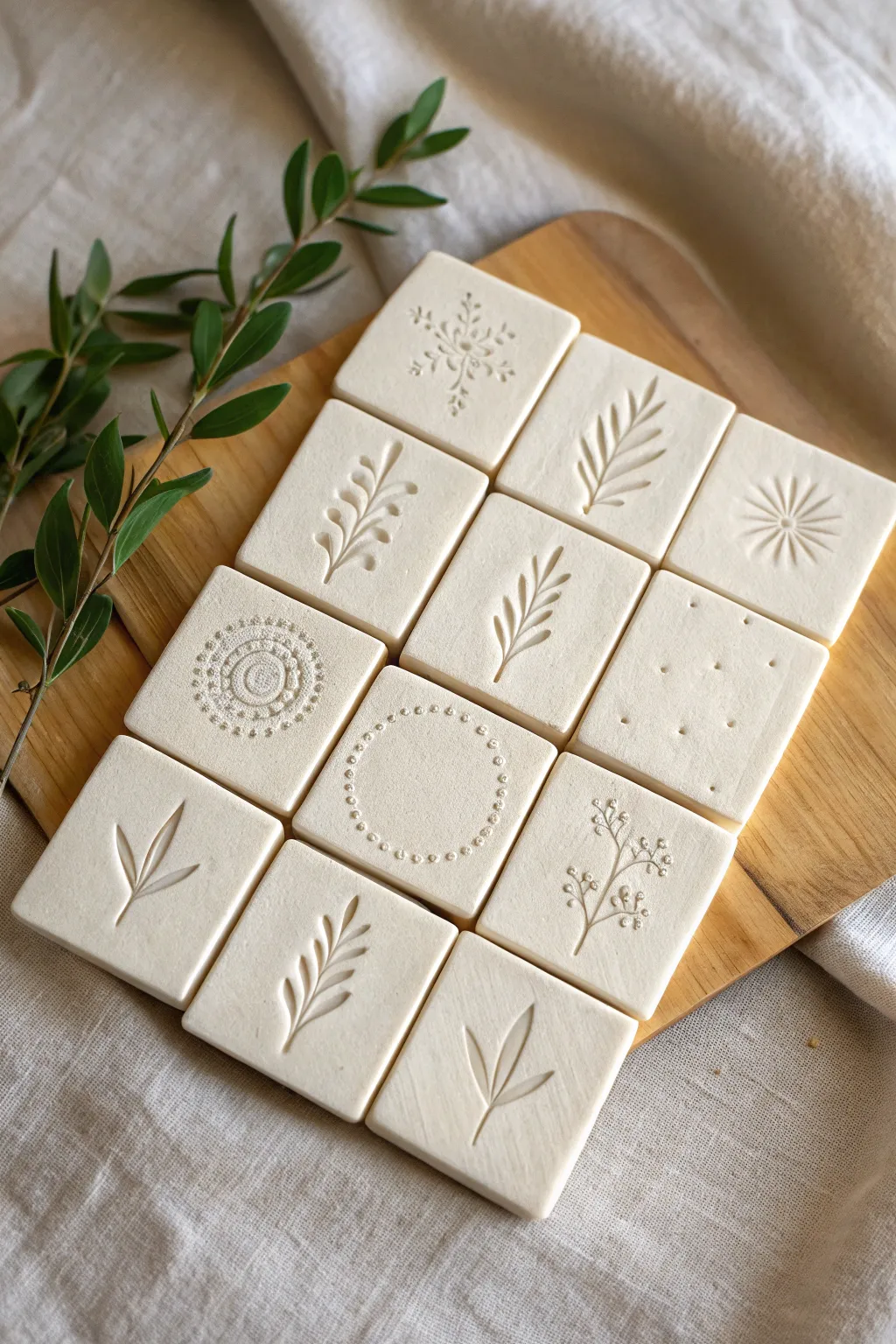
These elegant, minimalist clay coasters or decorative tiles bring a touch of nature indoors with delicate impressed patterns. Using white air-dry clay and simple stamps or found foliage, you’ll create a cohesive set of textured squares that look like high-end ceramics.
Step-by-Step Guide
Materials
- White classic air-dry clay
- Rolling pin (acrylic or wooden)
- Clean, smooth work surface (or canvas mat)
- Square cookie cutter (approx. 3×3 or 4×4 inches)
- Assorted texture stamps (botanical leaf designs, geometric dots, mandalas)
- Fine-grit sandpaper
- Small bowl of water
- Palette knife or thin spatula
Step 1: Clay Preparation
-
Condition the clay:
Cut off a substantial block of air-dry clay and begin kneading it in your hands. You want it warm and pliable to prevent cracking later. -
Roll it out:
Place the clay on your work mat. If the clay feels sticky, you can lightly dust the surface with cornstarch. Roll the clay out into an even slab about 1/4 inch (6mm) thick. I prefer to roll from the center outward to ensure uniform thickness. -
Smooth the surface:
Dip your finger in a tiny bit of water and glide it over the clay slab to remove any fabric impressions or small imperfections. A smooth canvas now is crucial for a clean print later.
Step 2: Creating the Tiles
-
Cut the shapes:
Press your square cookie cutter firmly into the clay slab. Wiggle it slightly to ensure a clean cut, then lift it away. Repeat until you have as many squares as your slab allows. -
Clean the edges:
Peel away the excess clay from around the squares. Use a wet finger to gently smooth the sharp edges of each square so they look finished and soft rather than jagged. -
Select your stamps:
Gather your botanical and geometric stamps. If you don’t have rubber stamps, look for actual sturdy leaves or stems with interesting veins. -
Plan the composition:
Before pressing, decide where the design will go. Centered designs (like the wreaths) look classic, while off-center sprigs (like the branching leaves) feel organic and modern. -
Press the designs:
Gently but firmly press your chosen stamp into a tile. Apply even pressure over the whole surface of the stamp to catch the fine details. Lift the stamp straight up to avoid smudging the clay. -
Vary the patterns:
Create a mixed set like the photo by using different stamps on each tile. Try a single fern leaf on one, a wreath on the next, and a simple geometric dot pattern on another. -
Add detail touches:
For the geometric tiles, you can use the blunt end of a skewer or a small rounded tool to manually poke holes or indentations if you don’t have a specific stamp for that pattern.
Clean Release Tip
If your stamp is sticking to the clay, lightly dust the stamp face with cornstarch or brush it with a tiny amount of baby oil before pressing.
Step 3: Finishing
-
Prepare for drying:
Carefully slide a palette knife under each tile to lift them off the work surface without distorting their square shape. -
Initial drying phase:
Place the tiles on a wire rack or a piece of parchment paper. Let them air dry away from direct sunlight or heat sources, which can cause cracking. -
Flip for flatness:
After about 12 hours, flip the tiles over. This helps them dry evenly on both sides and prevents the corners from curling up. -
Full cure:
Allow the tiles to dry completely for 24-48 hours. They should feel hard, dry, and room temperature (not cool) to the touch. -
Sand the imperfections:
Once fully dry, take a piece of fine-grit sandpaper and very gently buff the edges and corners to make them perfectly smooth. -
Optional sealing:
If you plan to use these as coasters, apply a coat of matte acrylic varnish to protect the clay from moisture.
Add Subtle Depth
After drying, mix a tiny bit of brown paint with water (a wash) and brush it into the grooves, then wipe the surface clean to highlight the texture.
Arrange your beautiful new set of tiles on a wooden board or mount them in a shadow box for a stunning, textured display


What Really Happens Inside the Kiln
Learn how time and temperature work together inside the kiln to transform clay into durable ceramic.
Cute Face Magnets
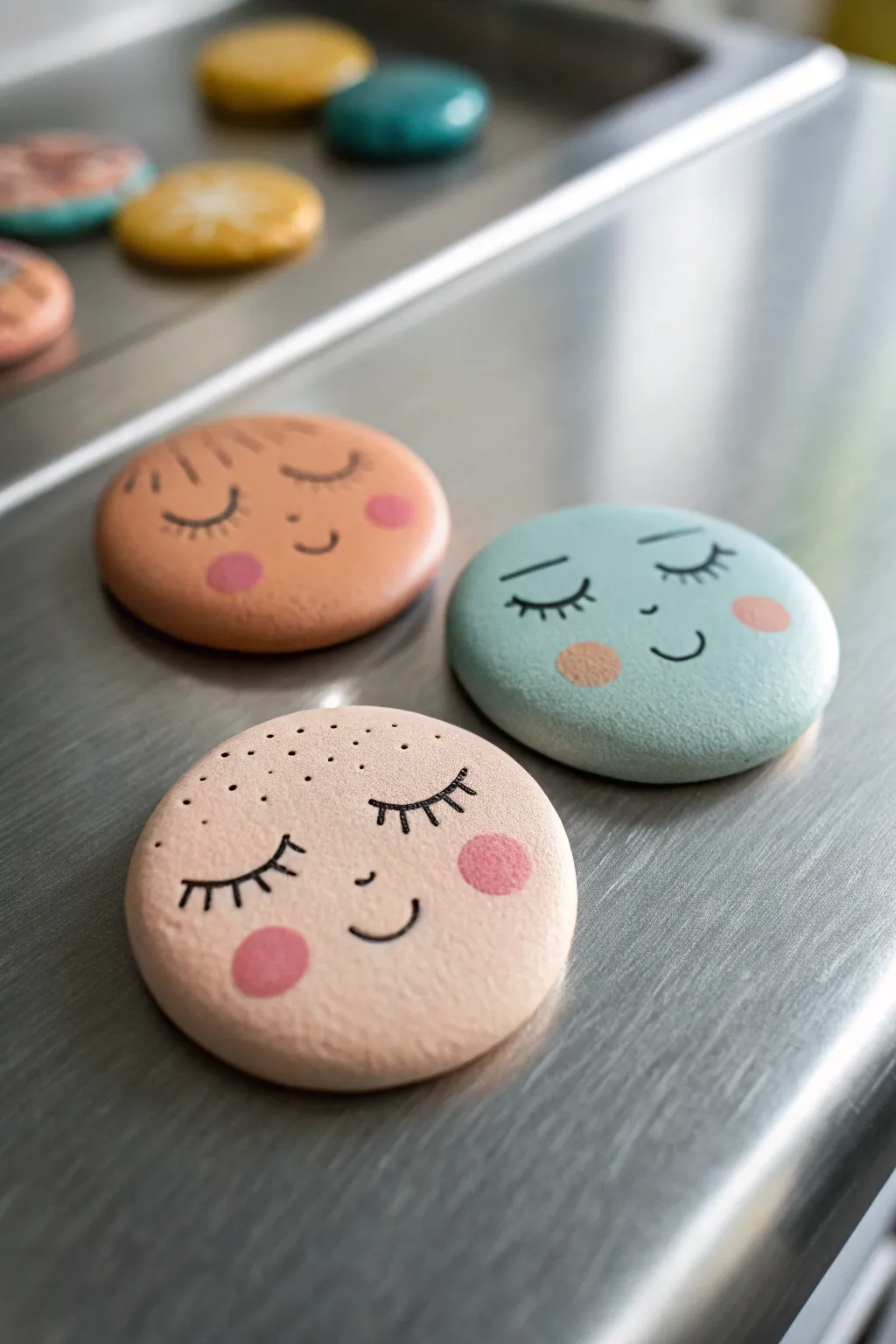
These sleepy, serene magnets bring a gentle touch of personality to your fridge or magnetic board. With their smooth, stone-like finish and sweet expressions, they look like high-end boutique decor but are deceptively simple to craft at home using air dry clay.
Step-by-Step Guide
Materials
- White or terracotta air dry clay
- Rolling pin
- fRound cookie cutter (approx. 2-3 inches)
- Sandpaper (fine grit)
- Acrylic paints (terracotta, sage green, pale pink, blush pink)
- Fine detail paint brushes
- Black fine-tip paint pen or permanent marker
- Strong round craft magnets
- Super glue or E6000
- Matte varnish or sealant
- Toothpick or needle tool (optional for texture)
Step 1: Shaping the Base
-
Condition the Clay:
Begin by taking a handful of air dry clay and kneading it in your hands until it feels soft, warm, and pliable. This helps prevent cracks later on. -
Roll it Out:
Roll the clay onto a smooth surface to a thickness of about 1/4 to 1/2 inch. You want them thick enough to hold the magnet but thin enough not to be too heavy. -
Cut the Circles:
Use a round cookie cutter to punch out your shapes. If you don’t have a cutter, the rim of a small glass works perfectly. -
Smooth the Edges:
Dip your finger in a tiny bit of water and run it around the circumference of each circle to smooth out any rough cutting marks. I like to gently round the top edge so it looks more like a river stone than a sharp cookie. -
Optional Texture:
For the pale pink face shown in the image, use a needle tool or toothpick to gently poke tiny dots along the ‘forehead’ area to simulate hair texture. -
Let it Dry:
Place your clay circles on a wire rack or parchment paper. allow them to dry for at least 24-48 hours, flipping them halfway through so the bottom dries evenly.
Step 2: Painting and Finishing
-
Sand for Smoothness:
Once fully dry and hard, take a piece of fine-grit sandpaper and lightly buff the surface and edges to remove any imperfections. -
Base Coat:
Paint the entire surface of each circle with your chosen base colors—terracotta, sage green, or pale pink. You may need two coats for opaque coverage. -
Dry Base Layer:
Ensure the base coat is completely bone dry before attempting the facial details to prevent the ink from bleeding. -
Draw the Eyes:
Using a fine-tip black paint pen, carefully draw two curved lines for closed eyelids. Add tiny lashes pointing downward for a sleeping, peaceful look. -
Add the Nose and Mouth:
Draw a tiny ‘u’ shape for the nose and a wider curve for a gentle smile. Keep the lines thin and delicate. -
Rosy Cheeks:
Dip a small round brush (or even a Q-tip) into a slightly darker shade of pink or coral paint. Dab perfect circles onto the cheeks. The ‘stamp’ method works better here than brushing. -
Adding Hair Details:
For the terracotta face, use a darker brown paint or marker to draw simple lines at the top for hair strands. -
Seal the Surface:
Protect your artwork with a coat of matte varnish. This keeps the colors vibrant and protects the clay from moisture. -
Attach the Magnet:
Flip the dry face over. Apply a drop of strong glue (like E6000) to the center of the back and press your magnet firmly into place. -
Final Cure:
Let the glue set according to the package instructions before placing your new friend on the fridge.
Fixing Clay Cracks
If small cracks appear during drying, create a ‘slip’ by mixing a little clay with water into a paste. Rub it into the cracks, let dry, and sand smooth.
Pro Tip: Hair Texture
Instead of drawing hair later, use a clean toothbrush to gently tap the ‘hair’ area of the wet clay for a subtle, stippled texture before drying.
Enjoy arranging your peaceful little gallery on your refrigerator door
Easy Alphabet Tags
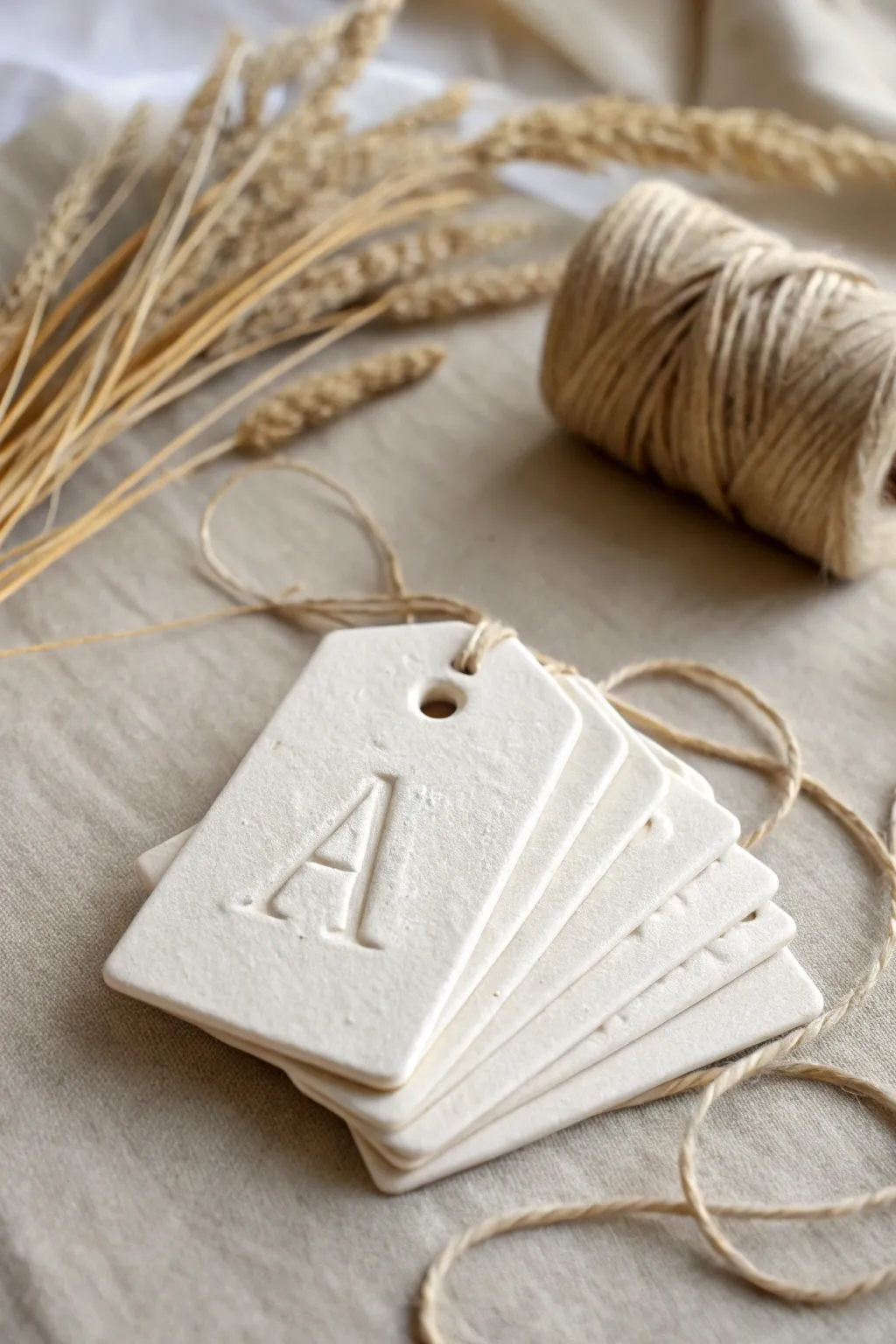
Elevate your gift wrapping or create personalized place settings with these sophisticated, minimalist clay tags. The clean, white finish paired with rustic jute twine creates a timeless look that feels both organic and refined.
How-To Guide
Materials
- White air-dry clay
- Rolling pin
- Parchment paper or canvas mat
- Sharp craft knife or scalpel
- Ruler
- Alphabet stamp set (serif font)
- Drinking straw or small round cutter
- Fine grit sandpaper (optional)
- Small bowl of water
- Jute twine
Step 1: Preparation & Rolling
-
Prepare your workspace:
Lay down a sheet of parchment paper or a canvas mat to prevent the clay from sticking to your table. Take a handful of air-dry clay and knead it gently until it’s pliable and smooth. -
Roll the slab:
Roll out the clay to an even thickness of about 1/4 inch (approx. 5-6mm). Try to keep the thickness consistent across the entire slab to ensure the tags dry evenly. -
Smooth the surface:
Dip your finger in a tiny bit of water and gently run it over the clay surface to remove any canvas textures or fingerprints. Let the clay sit for about 10 minutes to firm up slightly, which makes cutting cleaner.
Fixing Cracks
Make a ‘slip’ by mixing a tiny bit of clay with water into a paste. Smear this into any small cracks that appear during drying, smooth it out, and let dry again.
Step 2: Shaping & Stamping
-
Cut the rectangles:
Using a ruler and your craft knife, cut out rectangles approximately 2 inches wide by 3.5 inches tall. Don’t worry about the angled corners yet; just focus on getting straight, clean sides. -
Create the tag shape:
To create the classic tag shape, measure about 0.5 inches down from the top corners and make a mark. Then, measure 0.5 inches inward from the top corners. Connect these points with a straight cut to slice off the corners. -
Make the hole:
Take a drinking straw or a small round clay cutter and press it firmly into the top center of the tag to create the hole for stringing. Twist the straw slightly as you pull it out to remove the clay plug cleanly. -
Soften the edges:
Dip your finger in water again and very gently run it along all cut edges of the tag. This rounds them off slightly and gives the piece a professional, finished look rather than a sharp, jagged one. -
Stamp the initial:
Select your desired letter from the alphabet stamp set. Position it carefully in the visual center of the tag (below the string hole). Press down firmly and evenly, but not so hard that you distort the tag’s shape. -
Optional texture:
I sometimes like to tap the surface very lightly with a piece of linen fabric before this step if I want a textured background, but for the smooth look shown here, skip straight to drying.
Gilded Edge
Once fully dry, dip a small brush in liquid gold leaf or metallic acrylic paint and run it along just the outer rim of the tag for a hint of luxury.
Step 3: Drying & Finishing
-
Initial drying:
Place your finished tags on a clean sheet of parchment paper. Store them in a cool, dry place away from direct sunlight, which can cause cracking. -
Flip occasionally:
After about 12 hours, flip the tags over. This is crucial for keeping them flat, as air-dry clay tends to curl up towards the side exposed to air. -
Full cure:
Allow the tags to dry completely for another 24-48 hours. The clay will turn from a cool grey-white to a bright, bone white when fully dry. -
Sand imperfections:
If there are any rough burrs on the edges or inside the string hole, take a fine-grit sandpaper and gently buff them away. Wipe off the dust with a dry cloth. -
Add the twine:
Cut a length of jute twine, about 8-10 inches long. Thread one end through the hole. -
Tie the knot:
Bring the two ends of the twine together and tie a simple overhand knot or a loop knot, depending on how you plan to attach the tag to your gift.
Now you have a set of beautiful handmade tags ready to add a personal touch to any present

TRACK YOUR CERAMIC JOURNEY
Capture glaze tests, firing details, and creative progress—all in one simple printable. Make your projects easier to repeat and improve.
Terrazzo-Style Coasters
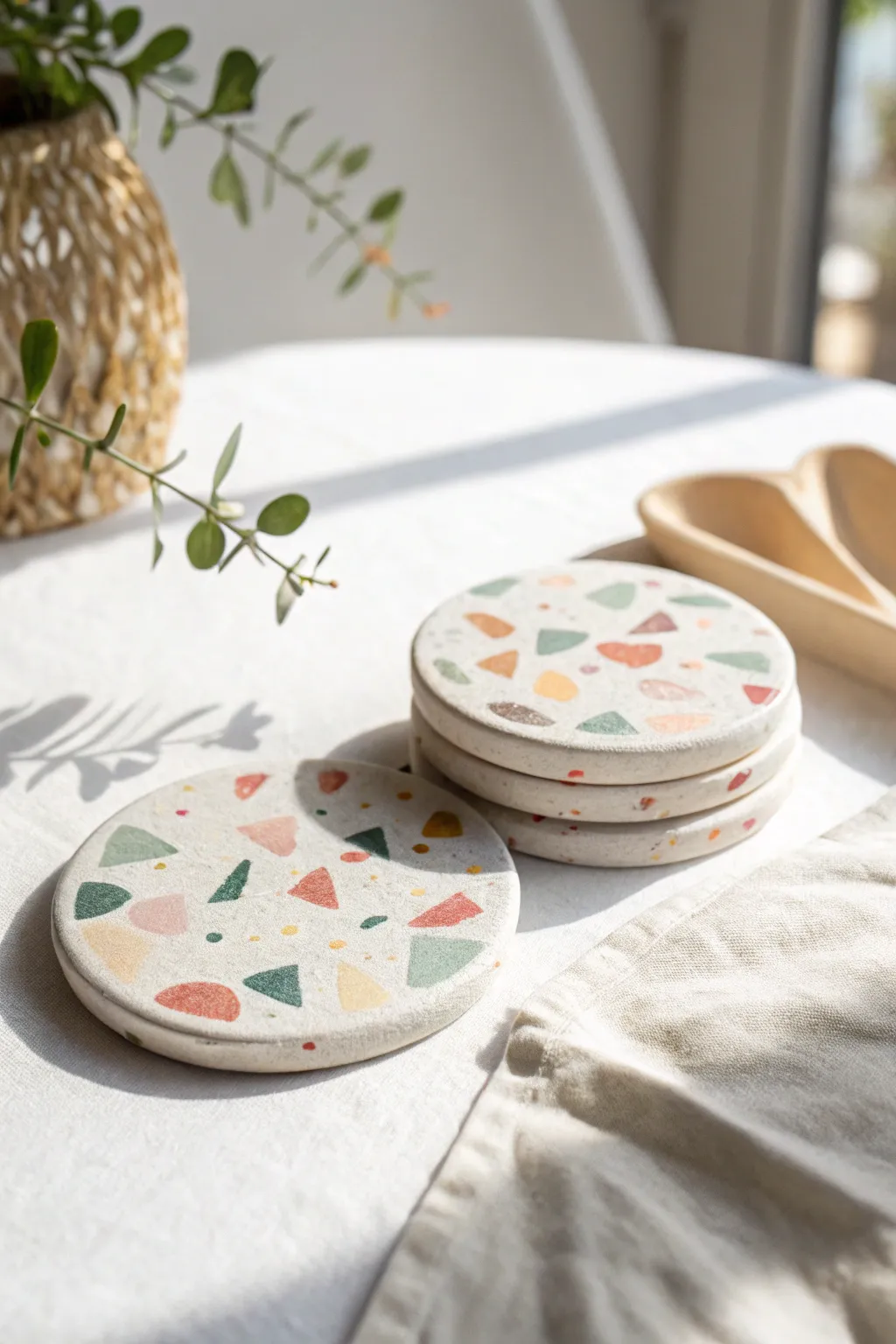
Bring a touch of modern Italian design to your coffee table with these trendy terrazzo-style coasters. By mixing colored clay chips into a neutral base, you’ll create a sophisticated, speckled stone effect that is surprisingly easy to achieve at home.
Step-by-Step
Materials
- White or cream air dry clay (1kg block)
- Acrylic paints (terracotta, sage green, mustard yellow, peach)
- Rolling pin
- Circle cookie cutter (approx. 4 inches) or a glass/jar to trace
- Craft knife or exacto knife
- Baking paper or non-stick mat
- Fine grit sandpaper
- Gloss or matte varnish/sealant for clay
- Small bowl relative to mixing colors
Step 1: Creating the Color Chips
-
Portion the clay:
Start by pinching off four small balls of white clay, roughly the size of a walnut each. These will become your colorful mix-ins. -
Mix in colors:
Add a drop of acrylic paint to each small ball—terracotta, sage green, mustard, and peach. Knead the clay thoroughly until the pigment is fully incorporated and the color is solid. Wear gloves if you want to keep your hands clean. -
Flatten the colored clay:
Roll each colored ball out very thinly on your work surface, aiming for about 1-2mm thickness. They don’t need to be perfect shapes. -
Cut the chips:
Let these colored sheets sit for about 10-15 minutes to stiffen slightly, then use your craft knife or scissors to cut them into random, jagged little triangles and shards. Vary the sizes for a natural look. -
Dry the chips:
Set these colored chips aside to dry until they are leathery and firm, though they don’t need to be bone dry.
Clean Rolling Tip
Place a sheet of parchment paper over the chips before the final roll. This prevents the colors from smearing across the white background.
Step 2: Forming the Base
-
Prepare the base clay:
Take a large chunk of white clay and roll it into a thick slab, roughly 1cm thick. Keep the shape somewhat irregular but wide enough to cut your coasters from. -
Apply the chips:
Scatter your dried colored chips generously over the top of the white clay slab. Press them gently into the surface with your fingers so they stick. -
Embed the pattern:
Use the rolling pin to roll over the slab again. This will press the colored chips flat into the white base, creating a seamless surface. Roll until the slab is about 5-7mm thick. -
Inspect the surface:
If there are large gaps between chips, you can press a few more colored shards into the empty white spaces and gently roll over them again.
Step 3: Cutting and Finishing
-
Cut the circles:
Place your circle cutter or a round guide onto the patterned slab. Press down firmly to cut out your coaster shapes. I find twisting the cutter slightly helps release the clay cleanly. -
Smooth the edges:
Lift the excess clay away. Dip your finger in a little water and run it around the circumference of each coaster to smooth out any rough cutting marks. -
Drying phase:
Transfer the coasters to a flat board covered in baking paper. Let them dry for 24-48 hours. Flip them over halfway through the drying process to prevent curling. -
Sand for clarity:
Once fully dry, the surface might look a bit hazy. Use fine sandpaper to sand the top surface. This removes the thin layer of white clay film and reveals the bold colors of the embedded chips. -
Dust off:
Wipe the coasters thoroughly with a slightly damp cloth or a dry brush to remove all sanding dust. -
Seal:
Apply two coats of varnish or sealant to protect the coasters from moisture. Allow the first coat to dry completely before applying the second.
Make It Splash-Proof
Since these are coasters, use a waterproof resin or dishwasher-safe Mod Podge for the final coat to handle condensation from cold drinks.
Now you have a stunning set of geometric coasters ready to protect your tabletops in style
Beaded Trinket Dishes
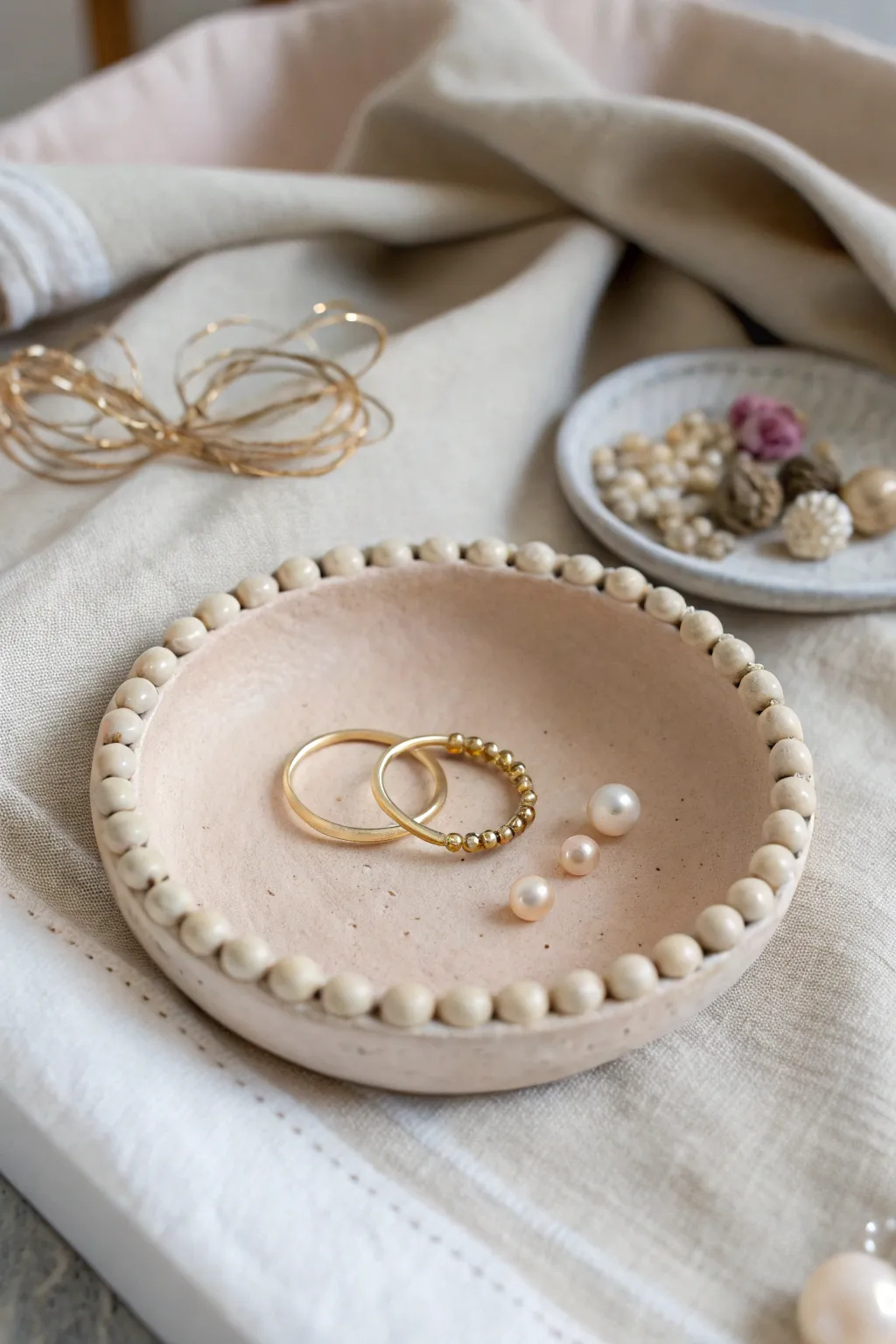
This elegant trinket dish combines a smooth, minimalist base with a charming beaded border that looks surprisingly sophisticated. The natural, unpainted finish highlights the texture of the clay, making it a perfect spot to hold delicate gold rings and freshwater pearls.
Step-by-Step Guide
Materials
- White or natural air dry clay
- Rolling pin
- Circle cutter (cookie cutter or a bowl rim)
- Small bowl (to use as a mold)
- Craft knife
- Sponge
- Small cup of water
- Clear matte varnish or sealant
- Sandpaper (fine grit)
- Parchment paper
Step 1: Shaping the Base
-
Prepare your clay:
Cut a portion of air dry clay from your block. Knead it in your hands for a minute or two until it is warm, pliable, and free of air bubbles. -
Roll out the slab:
Place the clay on a sheet of parchment paper. Use your rolling pin to flatten it into an even slab, aiming for a thickness of about 1/4 inch (6mm). If the clay sticks, you can lightly dust your roller with cornstarch. -
Cut the circle:
Press your circle cutter or a bowl rim firmly into the clay to cut out a clean circle. This will form the main body of your dish. -
Smooth the edges:
Dip your finger in a little water and run it along the cut edge of the circle to smooth out any roughness or sharp ridges left by the cutter. -
Form the curve:
Gently lift your clay circle and drape it inside your small bowl mold. I find that pressing it gently into the bottom helps it take shape without distorting. Don’t press too hard, or the clay might stick.
Fixing Bead Gaps
If gaps appear between beads as the clay shrinks during drying, fill them with a mix of clay dust and white glue, then smooth over with a damp brush.
Step 2: Creating the Beaded Rim
-
Roll tiny spheres:
Pinch off very small amounts of clay and roll them between your palms or fingers to create tiny spheres. These will be your beads. Aim for a consistent size, roughly like a small pea or peppercorn. -
Check the quantity:
Continue rolling beads until you have enough to circle the entire circumference of your dish. It helps to lay them out next to the mold to visualize spacing. -
Score the rim:
Using your craft knife or a needle tool, make tiny hatch marks (scoring) all along the top edge of the clay dish sitting in the mold. This rough texture helps the beads attach securely. -
Apply slip:
Dab a small amount of water or liquid clay (slip) onto the scored area of the rim. This acts as your glue. -
Attach the beads:
One by one, press the clay beads firmly onto the dampened rim. Ensure they touch each other snuggly to form a continuous ring. -
Blend slightly:
For extra durability, you can take a small modeling tool and gently blend the bottom of each bead into the rim on the *outside* edge, though keeping them fully round works if you use enough slip. -
Refine the shape:
Once all beads are attached, gently press down on them with a flat finger to ensure they are level and uniform.
Step 3: Finishing Touches
-
Initial dry:
Let the dish dry inside the bowl mold for about 24 hours. This prevents the curved shape from slumping while the clay is wettest. -
Remove and dry completely:
Carefully remove the dish from the mold. Place it on a wire rack to allow air to circulate underneath. Let it dry for another 24-48 hours until the clay creates a hollow sound when tapped. -
Sand imperfections:
Once fully bone dry, use fine-grit sandpaper to gently smooth any rough spots on the bottom or inside curve. Be very gentle around the beaded rim. -
Clean dust:
Wipe the piece with a slightly damp sponge or cloth to remove all sanding dust before sealing. -
Seal the piece:
Apply a coat of clear matte varnish to protect the clay from moisture and dirt. This will keep that lovely natural matte look shown in the photo.
Level Up: Gold Accents
For a luxe touch, paint just the beaded rim with liquid gold leaf or metallic acrylic paint after the clay is fully dry and sealed.
Now you have a stylish spot to display your favorite rings and keepsakes
Simple Incense Dish
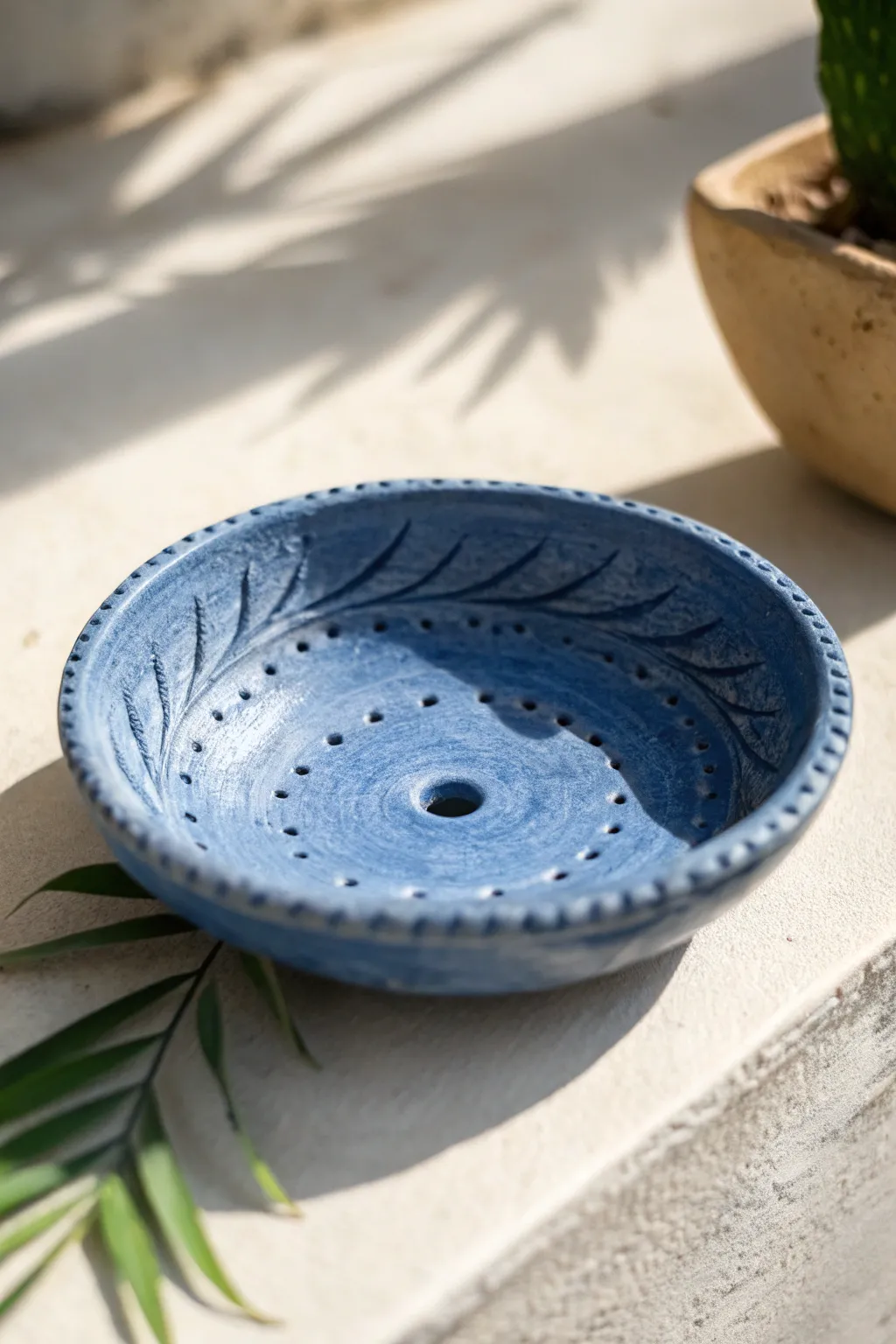
This charming, rustic incense dish combines a functional catch-all shape with delicate carved details. The weathered blue finish gives it the look of handmade pottery without needing a kiln.
Step-by-Step Tutorial
Materials
- Air dry clay (white or terracotta)
- Hollow rolling pin
- Small bowl (to use as a slump mold)
- Needle tool or toothpick
- Carving tool or loop tool
- Small circular cutter (or a straw)
- Sponge
- Acrylic paints: Navy blue, white, and a touch of black
- Matte varnish or sealant
- Sandpaper (fine grit)
Step 1: Forming the Dish
-
Roll the clay:
Begin by conditioning a handful of air dry clay until it’s pliable. Roll it out on a flat surface to an even thickness of about 1/4 inch. -
Cut the circle:
Find a bowl or round object slightly larger than your desired finished size. Place it upside down on the clay and cut around it to create a perfect circle. -
Use a slump mold:
Take your small bowl and drape the clay circle inside it. Gently press the clay down to conform to the bowl’s curve, smoothing out any edges. -
Define the rim:
While the clay is in the mold, use your fingers to slightly thicken and round the very edge of the rim so it feels substantial. -
Create the drain hole:
Find the exact center of the dish. Use a straw or a small circular cutter to punch a clean hole right in the middle. This will hold your incense stick later.
Smooth Moves
To get rid of fingerprints before drying, dip your finger in a tiny bit of water and run it over the clay surface in a circular motion.
Step 2: Adding Texture & Detail
-
Mark the dot ring:
Using a needle tool or the blunt end of a skewer, press a ring of small, evenly spaced indentations about an inch outward from the center hole. -
Carve the leaves:
Using a loop tool or a sharp carving tool, gently carve curved lines extending from the dot ring up toward the rim. These should look like stylized palm fronds or wheat stalks. -
Add rim details:
To mimic the beaded edge seen in the photo, take a small tool with a rounded tip and press indentations all along the very top edge of the rim. -
Refine the texture:
I like to take a damp sponge and very lightly wipe over the carvings. This softens sharp edges and gives the piece a worn, pottery-like feel. -
Dry completely:
Let the dish dry in the mold for about 24 hours, then pop it out and let it dry upside down for another 24 hours until bone dry and white.
Incense Options
Make the center hole slightly larger than your incense sticks. Clay shrinks as it dries, and you don’t want the opening to become too tight.
Step 3: Painting & Finishing
-
Sand edges:
Once fully dry, use fine-grit sandpaper to smooth out any rough spots on the rim or the underside of the dish. -
Base coat:
Mix a deep navy blue acrylic paint. Apply a solid base coat over the entire dish, ensuring you get paint into all the carved grooves. -
Create a wash:
Mix a lighter blue (blue plus white) and thin it significantly with water. Brush this wash over the dry base coat. -
Distress finish:
While the lighter wash is still wet, use a paper towel or sponge to wipe most of it off the surface. The lighter color will stay in the grooves, highlighting your texture. -
Dry brush highlights:
Dip a dry stiff brush into a tiny amount of white paint. Whisk it lightly over the raised textures and rim to create that weathered, frosted look. -
Seal:
Finish with a coat of matte varnish to protect the clay and lock in the paint.
Now you have a serene spot to burn your favorite scents and enjoy a moment of calm
Modern Candle Holder
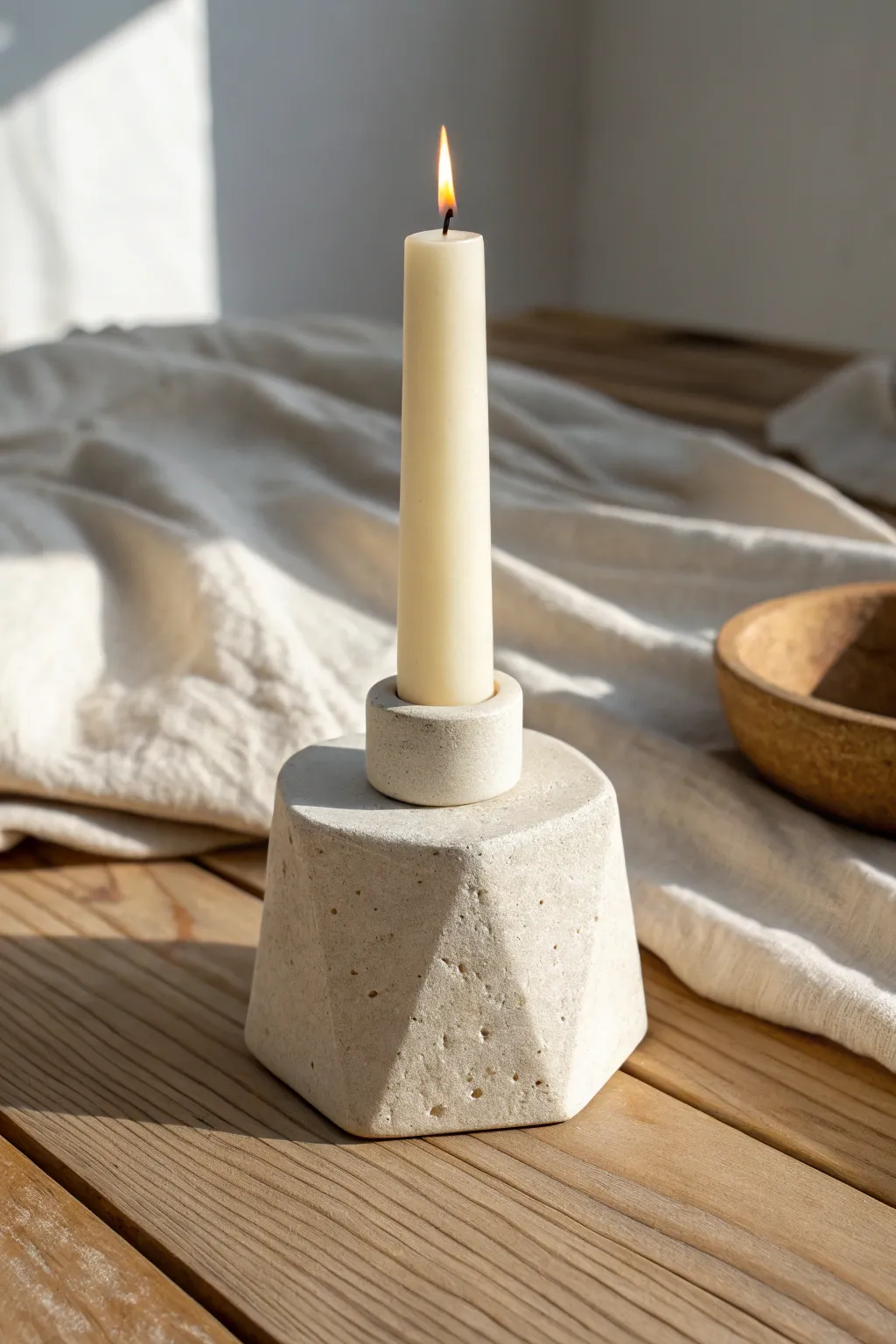
Bring a touch of architectural elegance to your space with this faceted candle holder that mimics the look of natural travertine. The clean lines and textured finish create a high-end aesthetic that fits perfectly with minimalist or bohemian decor styles.
Step-by-Step Guide
Materials
- Air dry clay (white or stone color)
- Acrylic rolling pin
- Sharp crafting knife or scalpel
- Taper candle (for sizing)
- Ruler
- Sandpaper (medium and fine grit)
- Small cup of water
- Old toothbrush or stiff bristle brush
- Ground black pepper or sand (optional for texture)
- Matte sealant or varnish
Step 1: Preparation & Base Construction
-
Tone the clay:
Begin by conditioning your clay. If you want that speckled, stone-like appearance shown in the photo, knead a pinch of ground black pepper or clean fine sand directly into the white clay. This creates a natural texture that looks stunning once dry. -
Form the main block:
Form a large ball of clay, roughly the size of a grapefruit. Slam it onto your work surface a few times to remove air pockets and flatten the bottom. -
Shape the rough prism:
Using your hands or a flat tool, gently paddle the sides of the ball to create a rough, sturdy base shape that tapers slightly toward the top. It doesn’t need to be perfect yet; just aim for a solid, heavy bottom for stability. -
Create the top surface:
Flatten the very top of your shape by pressing it against your work surface or slicing it cleanly with a wire tool or long blade. This creates the platform where the candle cup will sit.
Stone Effect
Mix dried coffee grounds or sand into your white clay before sculpting. When you sand the dry piece later, these specks reveal themselves beautifully.
Step 2: Faceting the Design
-
Cut the first facet:
Take your sharp knife and slice a thin, angled section off one side of the base. Start your cut from about halfway up the form and slice downwards and outwards. -
Repeat around the perimeter:
Continue slicing away sections around the base to create a geometric, faceted look. Vary the angles slightly to get that organic, chiseled stone aesthetic. I find that rotate the piece constantly helps keep the overall shape balanced. -
Refine the edges:
Use a little water on your finger to smooth any jagged bits left by the knife, but keep the edges relatively sharp to maintain the geometric style. -
Add surface texture:
For that porous, travertine look, take an old toothbrush or a stiff brush and tap the bristles gently against the clay surface. You can also poke a few tiny, deeper holes with a needle tool to simulate natural stone pockmarks.
Step 3: Adding the Candle Cup
-
Roll a coil:
Roll a thick snake of remaining clay, about 1 inch (2.5 cm) high. This will become the collar that holds the candle. -
Form the ring:
Wrap this coil around the base of your actual taper candle to get the correct inner diameter. Cut the ends and join them smoothly to form a seamless ring. Remove the candle gently. -
Attach the collar:
Score the top of your geometric base and the bottom of your clay ring with a needle tool. Apply a little water or slip to the scored areas. -
Secure the join:
Press the ring firmly onto the center of the base. Use a small modeling tool to smooth the clay where the ring meets the base, blending the seam so it looks like one solid piece. -
Check the fit:
Briefly insert your candle again to ensure the cup hasn’t warped during attachment. Give it a wiggle to make sure it stands straight, then remove it immediately.
Cracks happen?
If small hairline cracks appear during drying, mix a tiny amount of fresh clay with water to make a paste and fill them in, then sand smooth once dry.
Step 4: Finishing Touches
-
Initial drying:
Let the piece dry slowly away from direct sunlight or heat sources. This shape is thick, so I recommend covering it loosely with plastic wrap for the first 24 hours to prevent cracking. -
Full cure:
Remove the plastic and let it air dry completely. This might take 2-4 days depending on humidity. The clay will turn lighter and feel distinctively dry and hard. -
Sanding:
Once fully dry, use fine-grit sandpaper to refine the facets. You can sand away any sharp burrs, but remember to preserve the texture you created earlier. -
Sealing:
Apply a coat of matte varnish or sealant. This protects the clay and gives it a finished look without adding an unnatural gloss.
Place your favorite taper candle inside and enjoy the warm glow of your handmade modern decor
Clay Charm Keychain
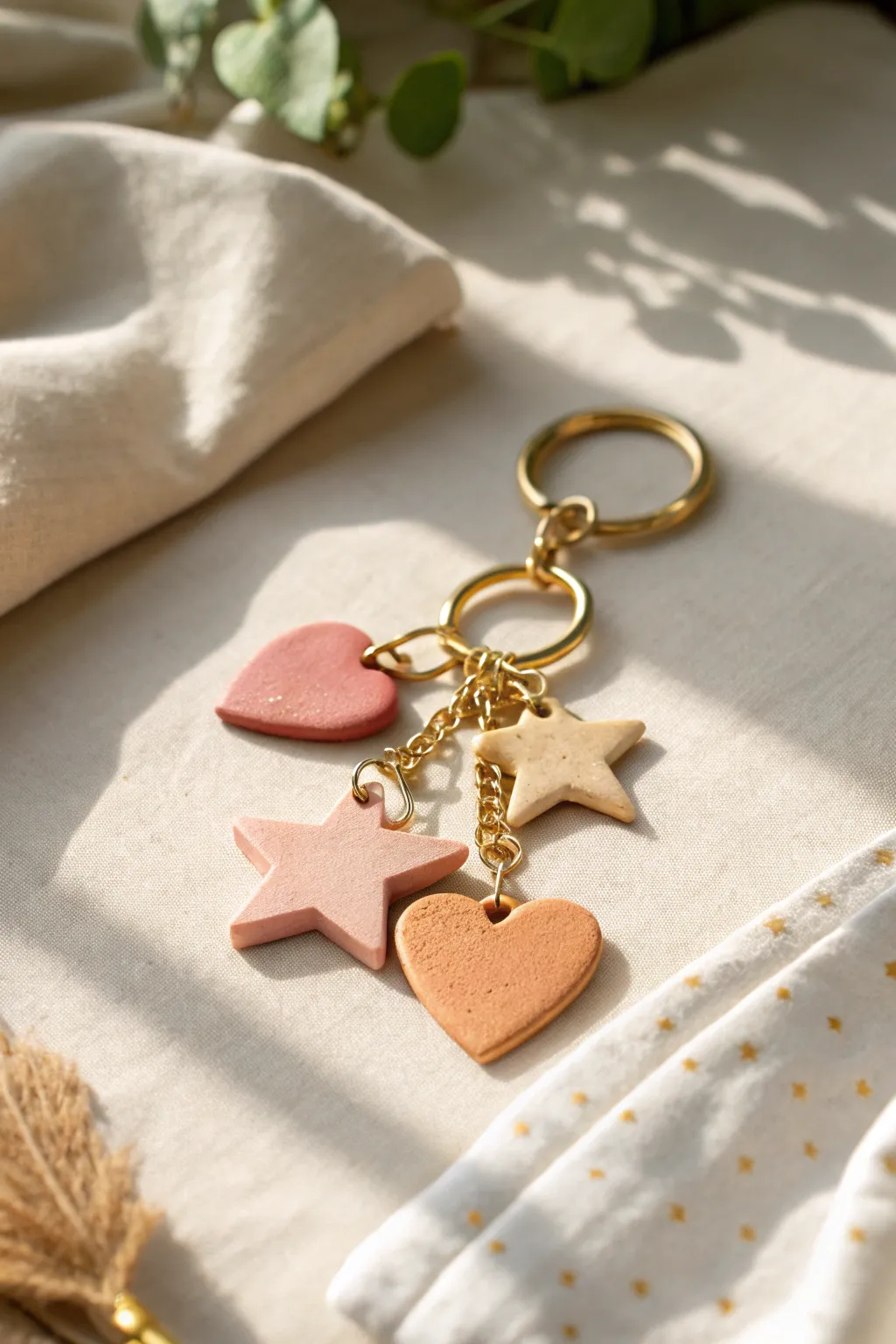
Create a trendy, personalized accessory with this simple yet stylish keychain project. Featuring matte clay stars and hearts in a warm, earthy color palette, these charms add a touch of handmade elegance to your keys or bag.
Step-by-Step
Materials
- Air dry clay (white or pre-colored in terracotta/pink tones)
- Acrylic paints (terracotta, blush pink, beige) if using white clay
- Small heart and star cookie cutters (approx. 1 inch)
- Rolling pin
- Gold keychain ring with chain and jump rings
- Jewelry pliers (needle nose and flat nose)
- Small drinking straw or toothpick (for poking holes)
- Fine-grit sandpaper
- Matte varnish or sealant (optional)
- Parchment paper or craft mat
Step 1: Shaping the Charms
-
Prepare the clay surface:
Lay down parchment paper or a craft mat on your work surface to prevent sticking. Take a handful of air dry clay and knead it in your hands until it is soft, pliable, and free of cracks. -
Roll out the slab:
Using a rolling pin, flatten the clay to an even thickness. You want it to be about 1/4 inch thick—thick enough to be durable, but not too heavy. -
Cut the shapes:
Press your star and heart cookie cutters firmly into the clay. For this specific look, aim for two stars and two hearts of similar sizes. -
Smooth the edges:
After lifting the shapes away from the excess clay, dip your finger in a tiny bit of water and gently run it along the cut edges to smooth out any roughness or stray clay bits. -
Create hanging holes:
Before the clay adheres or dries, use a small drinking straw or a toothpick to punch a hole near the top of each shape. Ensure the hole is big enough for your jump rings but not too close to the edge to prevent breaking.
Smooth Surface Secret
Use a rolling pin with depth guide rings to ensure your clay slab is perfectly even. This prevents lumpy charms that might dry unevenly.
Step 2: Drying and Refining
-
Let them dry:
Place your clay shapes on a flat surface in a cool, dry area. Allow them to dry completely for at least 24-48 hours. I find flipping them over halfway through the drying process helps them dry flat without curling. -
Sand for perfection:
Once fully cured and hard, check for any sharp edges. Use a piece of fine-grit sandpaper to gently buff the sides and surfaces until they feel smooth to the touch. -
Clean dust:
Wipe the charms with a dry cloth or a soft brush to remove any clay dust from sanding before moving on to painting.
Step 3: Painting and Finishing
-
Mix your palette:
Prepare your acrylic paints. To match the image, mix a warm terracotta orange, a soft blush pink, and a neutral beige or cream color. -
Apply the base coat:
Paint each charm in a solid color. Create variety by painting one heart terracotta, one star pink, and the other charms in alternating shades. It usually takes two thin coats for full, opaque coverage. -
Seal the charms:
To protect the paint from chipping, brush on a layer of matte varnish or sealant. A matte finish is key to keeping that natural, earthy aesthetic shown in the photo.
Fixing Cracks
If you see tiny hairline cracks as the clay dries, mix a tiny bit of fresh wet clay with water to make a paste and smooth it into the cracks like spackle.
Step 4: Assembly
-
Prepare the hardware:
Gather your gold keychain ring and four large jump rings. Using your pliers, gently twist the jump rings open sideways (never pull them apart). -
Attach rings to charms:
Slide an open jump ring through the hole of your first clay charm. Before closing it, determine if you need an extension chain to vary the lengths. -
Vary the lengths:
To get the clustered look, cut small segments of gold chain in different lengths (short, medium, and long). Attach one end of a chain segment to the charm’s jump ring and close it securely. -
Connecticut to the main ring:
Attach the other end of each chain segment to the main large jump ring or the bottom loop of the keychain hardware. If you aren’t using chains, simply attach the jump rings directly to the main hardware. -
Final check:
Hold up the keychain to check how the charms fall. Ensure all jump rings are tightly closed so your beautiful charms stay secure.
Now you have a charming, earth-toned accessory ready to organize your keys in style
Napkin Rings With Texture
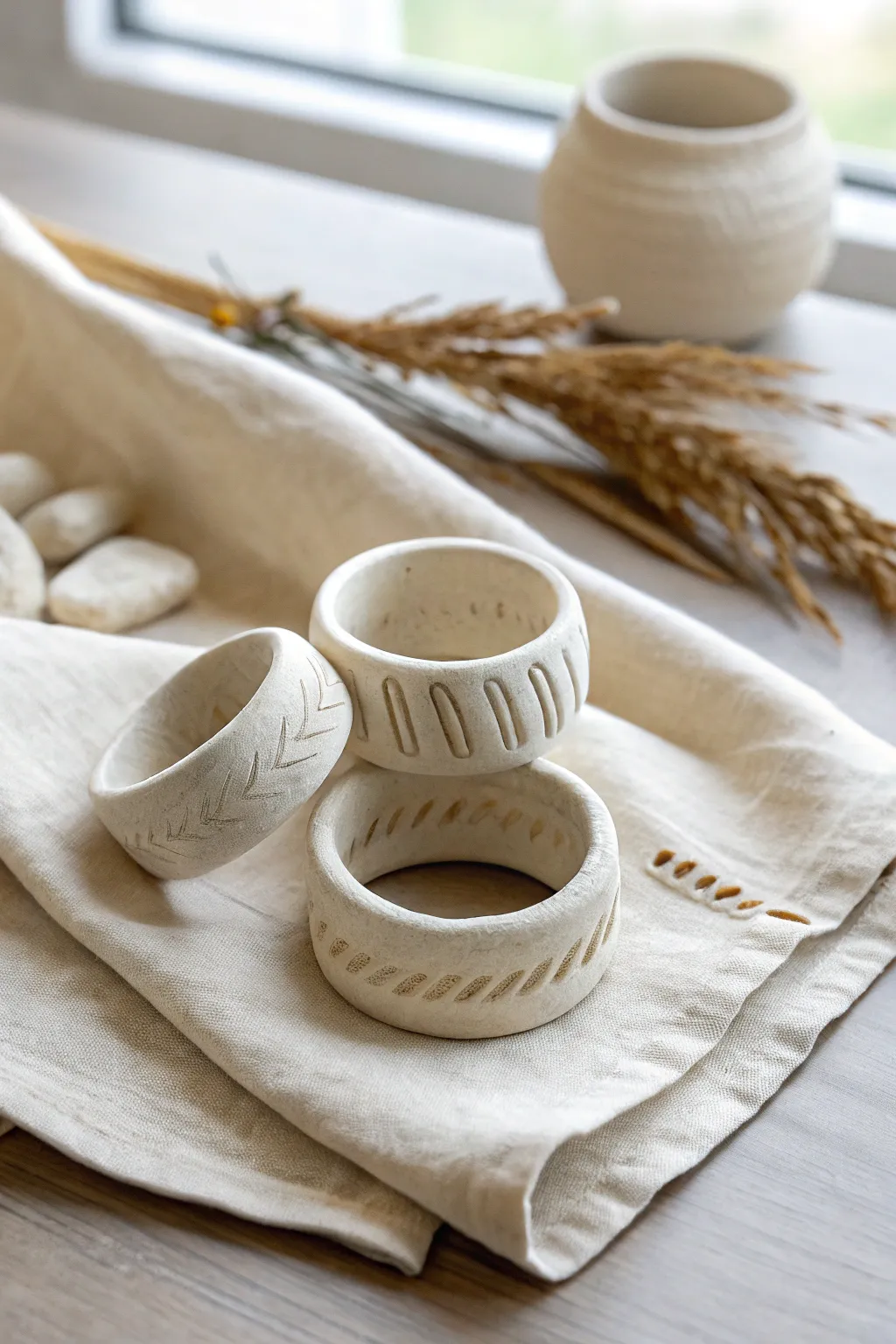
Bring an earthy, handmade touch to your table setting with these beautifully textured napkin rings. Using air dry clay, you can easily create custom designs that look like high-end ceramic stoneware.
Step-by-Step Tutorial
Materials
- White or cream air dry clay
- Rolling pin
- Cardboard toilet paper roll or PVC pipe scrap (approx 1.5-inch diameter)
- Craft knife or sharp blade
- Ruler
- Modeling tool with a small loop or oval tip
- Needle tool or toothpick
- Small bowl of water
- Fine-grit sandpaper
- Matte varnish (optional)
Step 1: Preparing the Base
-
Roll the clay:
Begin by taking a handful of air dry clay and kneading it until soft and pliable. Use your rolling pin to flatten it into an even slab, approximately 1/4 inch thick. Try to keep the thickness consistent for durability. -
Measure and cut strips:
Using a ruler and craft knife, cut three long rectangular strips from your clay slab. Each strip should be about 1.5 inches wide and roughly 6 inches long. -
Prepare the form:
Cover your cardboard tube or PVC pipe with a small piece of parchment paper or plastic wrap. This prevents the clay from sticking to the mold as it dries. -
Form the rings:
Wrap one clay strip around the prepared tube. Cut off any excess overlap with your craft knife so the two ends meet perfectly flush. -
Join the seams:
Score the raw edges where they meet by scratching cross-hatch marks with your needle tool. Dab a little water on the scored area to create a slip. -
Smooth the connection:
Press the ends together firmly. Use your finger or a modeling tool to smooth the seam on both the outside and inside until the join is invisible. Repeat this process for all three rings, keeping them on the tube for stability while you work.
Clean Cuts Matter
Wipe your craft knife blade with a damp cloth between cuts. Sticky clay residue on the blade can drag and tear your edges, making seams harder to hide.
Step 2: Adding Texture
-
Create the oval pattern:
For the first ring design, take a loop tool or the rounded end of a paintbrush. Press it gently into the clay at regular intervals around the circumference to create vertical oval indentations. Don’t press all the way through; just enough to make a distinct mark. -
Create the herringbone pattern:
On the second ring, use a needle tool or a small knife tip to carve a herringbone or chevron pattern. Draw short diagonal lines meeting at a central point, repeating the `V` shape horizontally around the ring. -
Create the diagonal dash pattern:
For the third ring, simply press the side of a small, flat tool or a popsicle stick into the clay at an angle. Create a row of diagonal dashes that circle the top and bottom edges of the ring. -
Refine the edges:
While the clay is still on the form, gently tap the top and bottom rims with a wet finger to smooth any sharp edges or roughness. -
Initial drying:
Allow the rings to sit on the form for about 1-2 hours until they are leather-hard—firm enough to hold their shape but not fully dry. -
Remove from form:
Carefully slide the rings off the tube. If they resist, gently twist them. I like to let this happen slowly to avoid distorting the circle.
Step 3: Finishing Touches
-
Full dry:
Place the rings on a wire rack or a piece of parchment paper in a cool, dry place. Let them dry completely, which typically takes 24 to 48 hours depending on humidity. Flip them occasionally for even airflow. -
Sanding:
Once bone dry, use fine-grit sandpaper to smooth out any unevenness on the rims or the interior seam. Be gentle to avoid scratching off your textured designs. -
Dust off:
Wipe the rings down with a slightly damp cloth or a dry soft brush to remove all fine sanding dust. -
Sealing:
Apply a coat of matte varnish or sealant to protect the clay from moisture and stains, especially if they will be near food. Let the sealer cure fully before use.
Make It a Set
Mix a tiny amount of acrylic paint into your wet clay before rolling to create a marbled stone effect, or adhere small dried flowers before sealing.
Arrange these charming rings on your linen napkins to set a welcoming, nature-inspired table for your next gathering
Air Plant Pod Decor
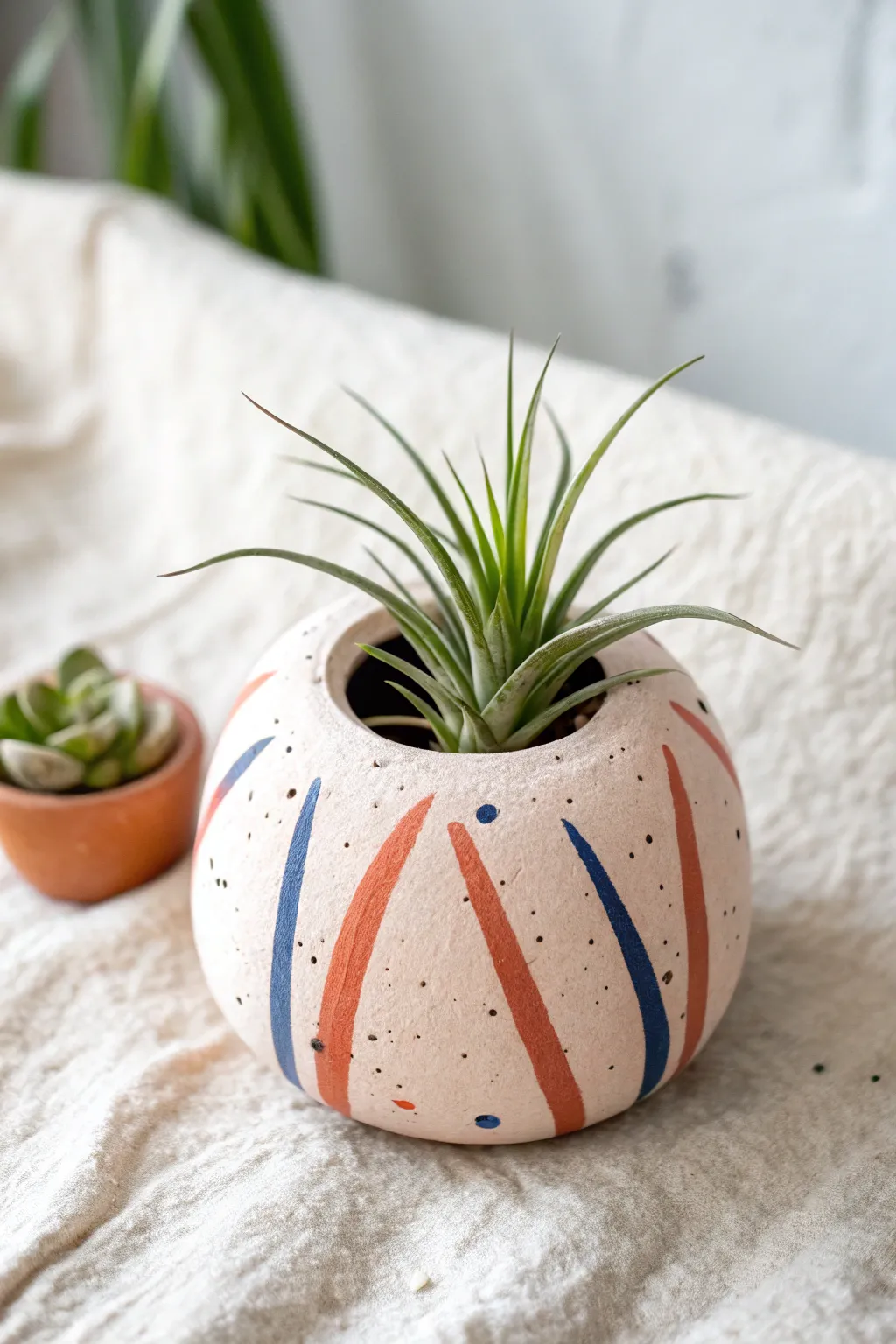
This charming, orb-shaped planter features playful abstract stripes and speckles that bring a modern, artistic touch to your desk or shelf. It’s perfectly sized to cradle a spiky air plant, making it a low-maintenance and stylish piece of decor.
Step-by-Step
Materials
- Air dry clay (white or light stone color)
- Pinch pot tools (optional, fingers work great)
- Sponge and water
- Sandpaper (fine grit)
- Acrylic paints (terracotta orange, deep blue, black)
- Fine detail paintbrush
- Small flat paintbrush
- Clear matte varnish or sealant
- Rolling pin
Step 1: Shaping the Sphere
-
Condition the clay:
Start by taking a handful of air dry clay, roughly the size of a tennis ball. Knead it in your hands to warm it up and ensure it’s pliable and free of air bubbles. -
Create a smooth ball:
Roll the clay between your palms or on a clean surface until you have a perfectly round, smooth sphere. -
Start the pinch pot:
Hold the sphere in one hand and gently press your thumb into the center, creating an opening. Don’t push all the way through; leave about a half-inch of clay at the base. -
Pinch the walls:
Using your thumb on the inside and fingers on the outside, gently pinch and rotate the clay to thin out the walls. Aim for an even thickness of about 1/4 inch all around. -
Close the form:
Instead of widening the opening like a bowl, gently curve the top edges inward as you pinch. You want to maintain a spherical shape with a smaller opening at the top to hold the plant snugly. -
Flatten the base:
Tap the bottom of your sphere gently on your work surface to create a small, flat spot so the pod sits stably without rolling away. -
Smooth the surface:
Dip your finger or a small sponge in water and run it over the exterior and the rim to smooth out any cracks or fingerprints. -
Let it dry:
Place the pod in a safe, dry spot away from direct sunlight. Allow it to dry completely for 24-48 hours until it turns a lighter color and feels hard to the touch.
Smoother Curves
To get that perfect inward curve at the rim, cup both hands around the outside of the sphere while rotating it, gently pressing the top edge inward.
Step 2: Designing and Finishing
-
Sand for perfection:
Once fully dry, use fine-grit sandpaper to gently buff the exterior. This removes any lingering bumps and creates a silky canvas for your paint. -
Wipe clean:
Use a barely damp cloth or dry brush to remove all the sanding dust from the surface before you start painting. -
Mix your colors:
Prepare your palette with a warm terracotta orange and a deep navy blue. If your paints are too thick, I usually thin them with a drop of water for smoother strokes. -
Paint the orange stripes:
Take your flat brush and paint vertical, slightly curved stripes of terracotta orange. Space them out around the sphere, varying the length slightly for an organic look. -
Add the blue accents:
Using the same brush (cleaned) or a similar size, paint deep blue stripes in the spaces between the orange ones. These can be slightly thinner or shorter to create visual rhythm. -
Create the speckles:
Dip a fine detail brush or even a toothpick into black paint. Gently dot the surface randomly around the stripes. Vary the pressure to create different sized specks. -
Add colored dots:
For extra detail, add a few tiny dots of blue or orange near the bottom or top of the stripes using the tip of your smallest brush. -
Seal the piece:
Once the paint is completely dry, apply a coat of clear matte varnish. This protects the clay from moisture and gives the colors a nice finish. -
Insert your plant:
After the varnish has cured, nestle your air plant gently into the top opening, ensuring the leaves can breathe freely.
Texture Twist
Before drying, gently roll the outside of your pot over a piece of linen or canvas to imprint a subtle fabric texture into the clay surface.
Place your finished pod in a bright spot and enjoy your new handmade greenery display
Moon Phase Hanging
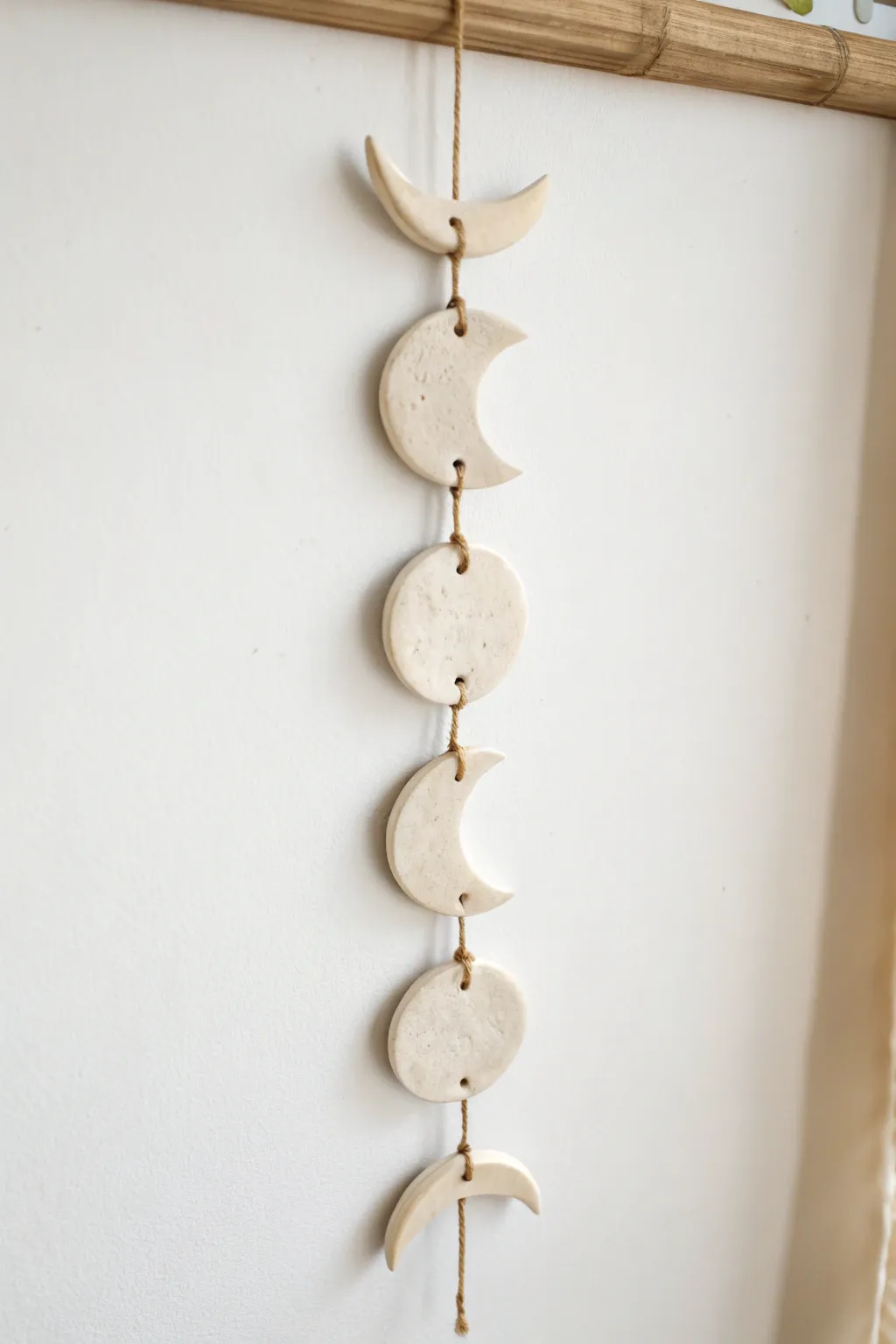
Bring a touch of cosmic magic into your home with this minimalist moon phase wall hanging. Using simple air dry clay and natural twine, you’ll create a vertical mobile that captures the lunar cycle in a soft, textured cream finish.
Step-by-Step Tutorial
Materials
- White or natural air dry clay
- Rolling pin or smooth glass jar
- Circle cookie cutters (various sizes optional, but one main size needed)
- Knife or clay cutting tool
- Natural jute twine or hemp cord
- Wooden dowel, smooth stick, or piece of bamboo (approx. 12 inches)
- Straw or skewer (for poking holes)
- Fine-grit sandpaper
- Bowl of water
- Parchment paper or baking mat
Step 1: Shaping the Moons
-
Prepare your workspace:
Lay down parchment paper or a silicone mat to prevent stickiness. Take a large handful of air dry clay and knead it until it’s soft, pliable, and free of cracks. -
Roll the clay slab:
Using your rolling pin, flatten the clay to an even thickness of about 1/4 inch. Try to keep it consistent so all your moons define the shadows equally. -
Cut the primary circles:
Cut out five identical circles using your cookie cutter. These will be the base for all your different phases. -
Create the full moons:
Set aside two of the circles; these will remain whole to represent the full or gibbous phases (or simply as spacers depending on your preferred pattern). In the reference image, the central piece is a full circle. -
Carve the crescent shapes:
Take the remaining three circles. Use the same cookie cutter you used for the original shape and offset it over the clay circle to slice away a portion, creating a crescent moon shape. Repeat this to create top and bottom crescents. -
Refine the edges:
Dip your finger in a little water and gently smooth the cut edges of every piece. This removes sharp ridges and gives the clay that soft, stone-like appearance.
Cracked Clay?
If small cracks appear while drying, don’t panic. Mix a tiny bit of fresh clay with water to make a paste (slip) and fill in the cracks, then smooth over with your finger.
Step 2: Details & Assembly
-
pierce the hanging holes:
Using a straw or skewer, poke holes in each piece. For the top and bottom crescents, you usually only need one hole (centered vertically). For the middle pieces, poke a hole at the very top and very bottom edge so they can be strung together. -
Let them dry:
Place your clay pieces on a flat surface away from direct heat. Let them dry for 24-48 hours. I usually flip them over halfway through so the bottom dries evenly. -
Sand for smoothness:
Once fully bone-dry, lightly sand any rough edges or uneven surfaces with fine-grit sandpaper until they feel smooth to the touch. -
Cut the twine:
Measure a long piece of jute twine, at least 3 feet long (you can trim the excess later). -
Start from the bottom:
Tie a secure double knot at the end of your twine. Thread your bottom-most crescent moon onto the twine so it rests on the knot. -
Knot and spacing:
Decide how much space you want between moons (about 1.5 inches looks nice). Tie a knot at that distance above the first moon to act as a stopper for the next piece. -
Thread the middle pieces:
Thread the twine through the bottom hole of the next clay piece and up through the top hole. The clay piece should rest on the knot you just made. -
Repeat the pattern:
Continue tying knots at even intervals and threading your moons in order: bottom crescent, lower gibbous/half, full moon, upper gibbous/half, top crescent. -
Attach to the support:
After the final top crescent is threaded, tie the remaining length of twine securely to the center of your wooden dowel or bamboo stick. -
Add a hanger:
Cut an extra piece of twine and tie it to both ends of the wooden dowel to create a triangle shape for hanging the mobile on the wall.
Keep it Straight
To ensure your moons hang straight and don’t spin wildly, apply a tiny dab of clear craft glue where the twine enters the clay hole to lock it in place.
Now your lunar cycle is caught in time, ready to add a peaceful rhythm to your favorite room