
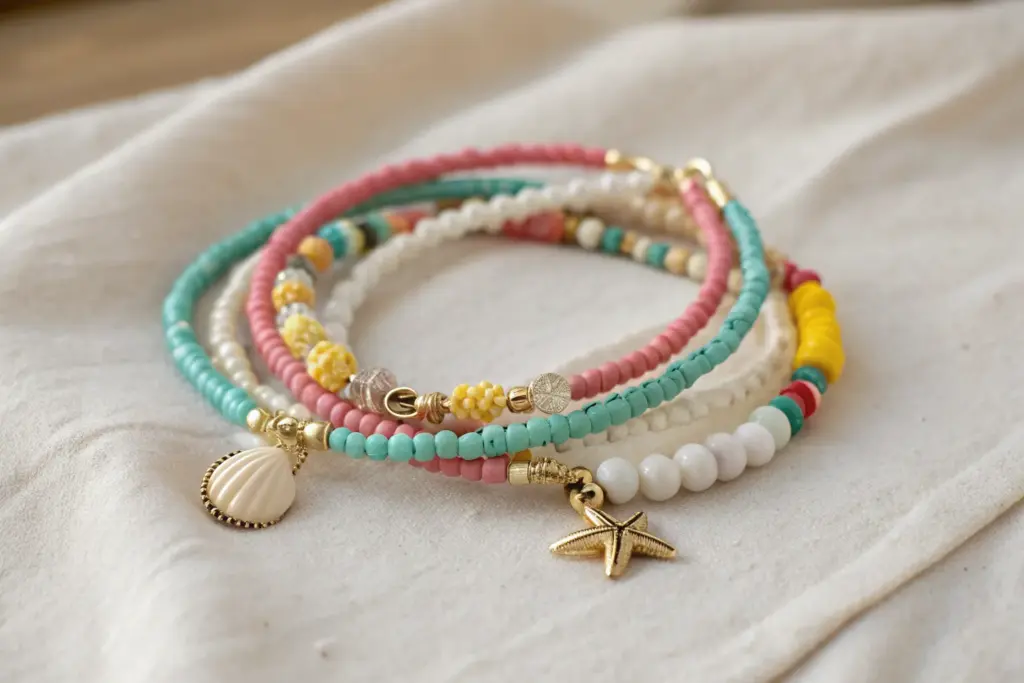
When I’m craving that sun-and-salt kind of joy, I reach for polymer clay bead bracelets in breezy coastal colors. Here are my favorite cute beach design ideas that feel like a mini vacation right on your wrist.
Classic Turquoise and White Mix
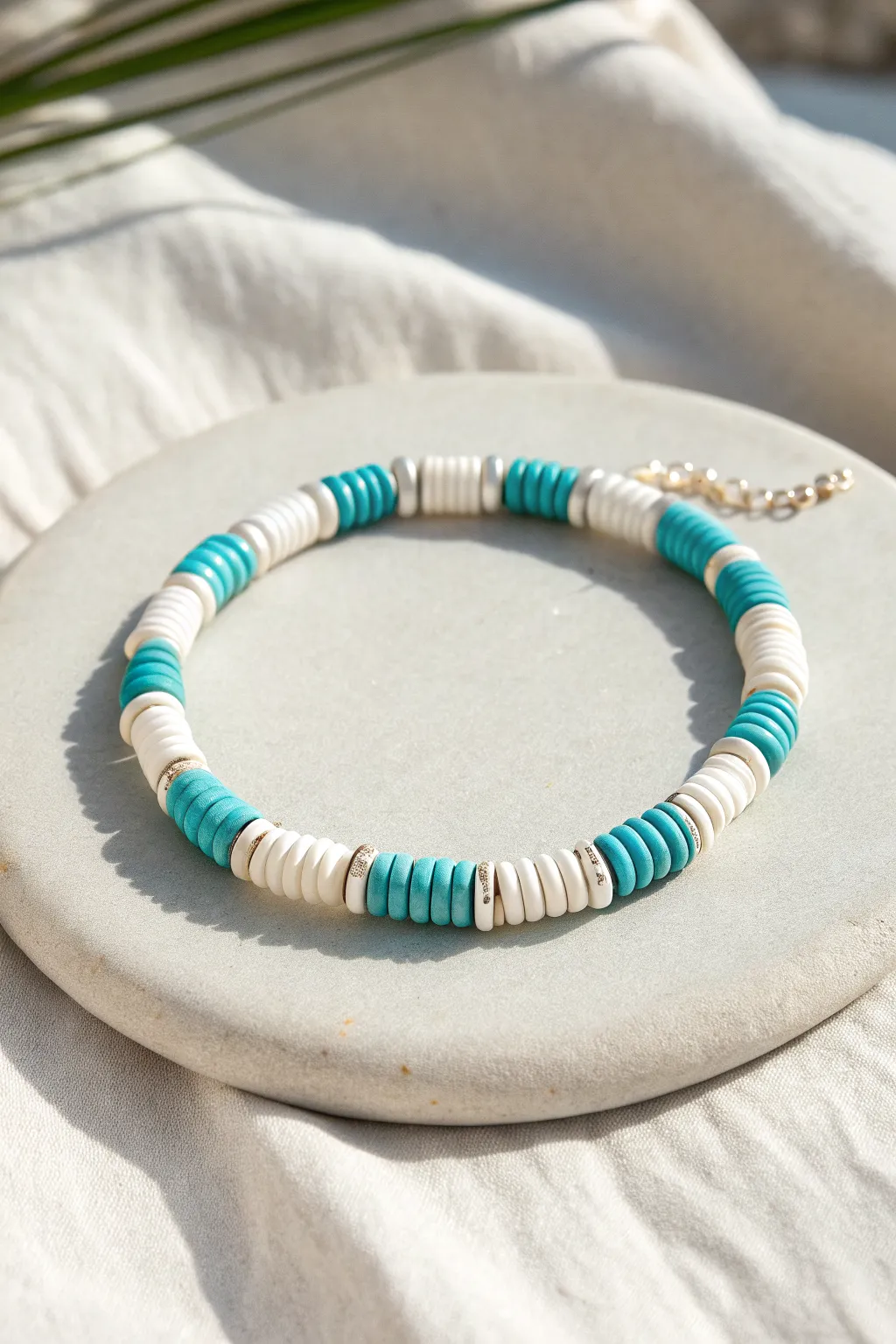
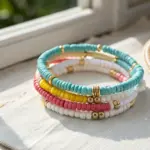
Evoke the refreshing vibes of a clear summer sky and white sandy beaches with this striking Heishi bead bracelet. The alternating pattern of cool turquoise and crisp white, punctuated by subtle metallic accents, creates a sophisticated yet relaxed accessory perfect for any coastal outfit.
How-To Guide
Materials
- High-quality polymer clay Heishi disc beads (6mm or 4mm) in turquoise blue
- High-quality polymer clay Heishi disc beads (6mm or 4mm) in clean white
- Metallic silver spacer beads (flat disc or slightly rounded hex shape)
- Small metallic silver spacer nuggets or textured discs
- Strong, clear elastic cord (0.7mm or 0.8mm)
- Beading needle (optional but helpful)
- Scissors or precision wire cutters
- Clear jewelry adhesive (e.g., E6000 or specialized knot glue)
- Gold finish extender chain and lobster clasp (optional, if you prefer a clasp over stretch)
- Crimp beads and crimping pliers (only if adding a clasp)
Step 1: Preparation & First Segments
-
Measure and Cut:
Begin by measuring your wrist circumference. Cut a length of elastic cord about 3-4 inches longer than your wrist measurement to allow plenty of room for tying the final knot. -
Pre-stretch the Cord:
Give your elastic cord a few gentle tugs. This is a crucial step I always do to prevent the bracelet from stretching out permanently after the first wear. -
Secure the End:
Place a piece of tape or a bead stopper on one end of the cord so your beads don’t slide right off while you work. -
Begin the Pattern:
Start with a block of white beads. Thread approximately 5-6 white Heishi discs onto the cord. -
Add the First Spacer:
Slide on one of the larger metallic silver spacer beads. This marks the transition between color blocks. -
Turquoise Block:
Thread on a contrasting block of 5-6 turquoise Heishi beads. Aim to keep the length of this block roughly equal to the white block for symmetry.
Step 2: Building the Rhythm
-
Introduce Texture:
After the turquoise block, add another silver spacer. Then, start your next white block. -
Create a Central Focal Point:
Halfway through the bracelet design, you can create the visual ‘center’ seen in the photo. Thread a slightly longer run of turquoise beads, perhaps 8-10 discs. -
Insert Detail Spacers:
Instead of the smooth silver spacer, use the textured or ‘nugget’ style silver spacer here for a bit of tactile variety. -
Continue the Sequence:
Resume the alternating pattern: a block of white, a silver spacer, a block of turquoise, and a silver spacer. -
Check the Length:
Periodically wrap the strand around your wrist to check the fit. The beads occupy space on the inside of the circle, so it will fit tighter than the bare cord did. -
Adjust Symmetry:
Ensure your final block of beads complements the starting block so the pattern flows seamlessly when connected.
Sticky Situation
If your elastic keeps slipping while tying the knot, try dabbing the knot with a bit of clear nail polish if you don’t have superglue. It hardens quickly and helps grip the slippery cord.
Step 3: Closing the Circle
-
Prepare to Knot:
Once the desired length is reached, remove the tape or bead stopper. Bring the two ends of the cord together carefully. -
Tie the Knot:
Tie a surgeon’s knot. This involves looping the cord through twice on the first pass of the knot before pulling tight, which adds extra security. -
Secure with Glue:
Dab a tiny droplet of jewelry adhesive directly onto the knot. Wait a moment for it to become tacky before releasing tension. -
Hide the Evidence:
If the hole of one of your silver spacer beads is large enough, try to gently shimmy the knot inside it to conceal it. If not, tuck it inside a clay bead. -
Trim Excess:
Using sharp scissors, trim the excess tails of the elastic cord close to the knot, being careful not to snip the main cord.
Level Up The Look
Add a single personalized touch by swapping one white section for letter beads spelling a word like ‘OCEAN’ or ‘WAVE’ for a custom summer touch.
Step 4: Optional: Clasp Method
-
Attaching Hardware:
If you are using the clasp shown in the background of the inspiration photo instead of elastic: thread a crimp bead onto the wire, loop it through the jump ring of your clasp, and thread it back through the crimp bead. -
Crimping Down:
Use crimping pliers to flatten the crimp bead securely. Repeat this process on the other end with the extender chain after beading is complete.
Enjoy wearing your new bracelet stacked with other textures or simply on its own for a clean pop of color
Cowrie Shell Center Statement
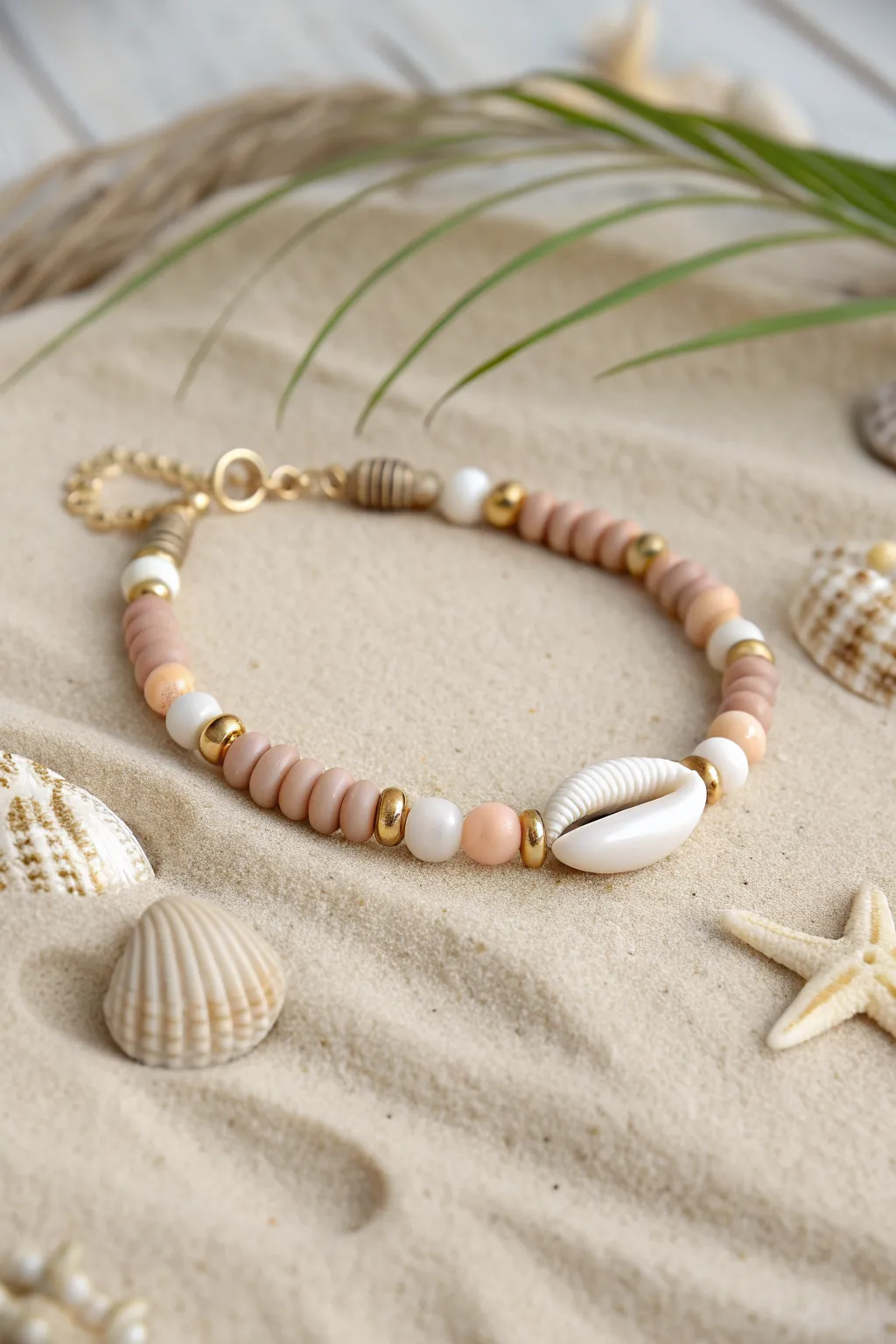
Capture the essence of a serene beach walk with this delicate beaded bracelet, featuring a stunning cowrie shell focal point. Combining warm beige clay heishi beads with crisp white accents and gleaming gold spacers creates a sophisticated yet relaxed summer accessory.
Detailed Instructions
Materials
- Beading wire (approx. 10 inches)
- Beige/Peach polymer clay heishi beads (6mm)
- White opaque round beads (6mm)
- Gold tone metal spacer beads (thick rounded style)
- Gold tone crimp beads (2)
- Small gold tone jump rings (2)
- Gold tone lobster clasp
- Gold tone extension chain
- Cowrie shell bead (pre-drilled or sliced back)
- Wire cutters
- Flat nose pliers
- Crimping tool (optional but recommended)
Step 1: Preparation
-
Cut the Wire:
Cut a length of beading wire approximately 10 to 12 inches long. This gives you plenty of extra room to work with the clasp without beads sliding off. -
Secure the First End:
Slide a crimp bead onto one end of the wire, followed by a jump ring or a wire guardian if you prefer extra durability. -
Create a Loop:
Pass the tail of the wire back through the crimp bead, creating a small loop that holds the jump ring. -
Crimp It:
Use your crimping tool or flat nose pliers to flatten the crimp bead securely. I like to give it a gentle tug to ensure it won’t slip. -
Attach Chain:
Open a jump ring using your pliers and attach the extension chain to the loop you just created. Close the jump ring securely.
Shell Selection
Choose a shell with a flat, sliced back so it sits flush against your wrist rather than rolling around.
Step 2: Beading the Pattern
-
Start the Pattern:
Begin threading beads onto the open end of the wire. Start with a distinctive decorative bead, such as a textured gold barrel bead or a stack of smaller gold discs, to hide the crimp. -
First White Accent:
Add one round white bead followed by a thick gold spacer bead. -
Heishi Section 1:
String on about 8 to 10 of the beige clay heishi beads. This forms the first side segment. -
Second White Accent:
Add a round white bead, another gold spacer bead, and then a second round white bead to create a small visually interesting break. -
Heishi Section 2:
Add another segment of beige heishi beads. Use slightly fewer here, perhaps 4 to 6, to vary the rhythm before the centerpiece. -
Center Prep:
Place one gold spacer bead, one round white bead, and a final gold spacer bead on the wire to frame the shell.
Step 3: The Centerpiece
-
Add the Shell:
Thread your wire through the cowrie shell bead. Ensure the shell sits face up and centered. -
Mirror the Frame:
Immediately after the shell, add a gold spacer bead, a round white bead, and another gold spacer bead. This mirrors the pattern from the other side perfectly.
Anklet Adaptation
Add 2 inches of extra heishi beads to turn this into a matching summer anklet perfect for sandals.
Step 4: Finishing the Loop
-
Reverse Design:
Repeat the beading pattern in reverse order: short heishi section, white bead accent group, long heishi section, and final white accent. -
Check Length:
Wrap the bracelet around your wrist to check the fit. Add or remove a few heishi beads at the ends if necessary to get the perfect size. -
Add Ending Crimp:
Slide on your second crimp bead followed by a jump ring. -
Secure the End:
Pass the wire back through the crimp bead and through the first few beads of your design. Pull tight to remove slack, but leave enough flexibility for the bracelet to curve. -
Final Crimp:
Flatten the crimp bead securely with your pliers. -
Trim Wire:
Trim the excess wire tail close to the beads using your flush cutters. -
Attach Clasp:
Open the jump ring on this end and slide on your lobster clasp. Close the jump ring tightly.
Now you have a beautiful piece of the ocean to wear wherever you go
Starfish Charm Beach Babe
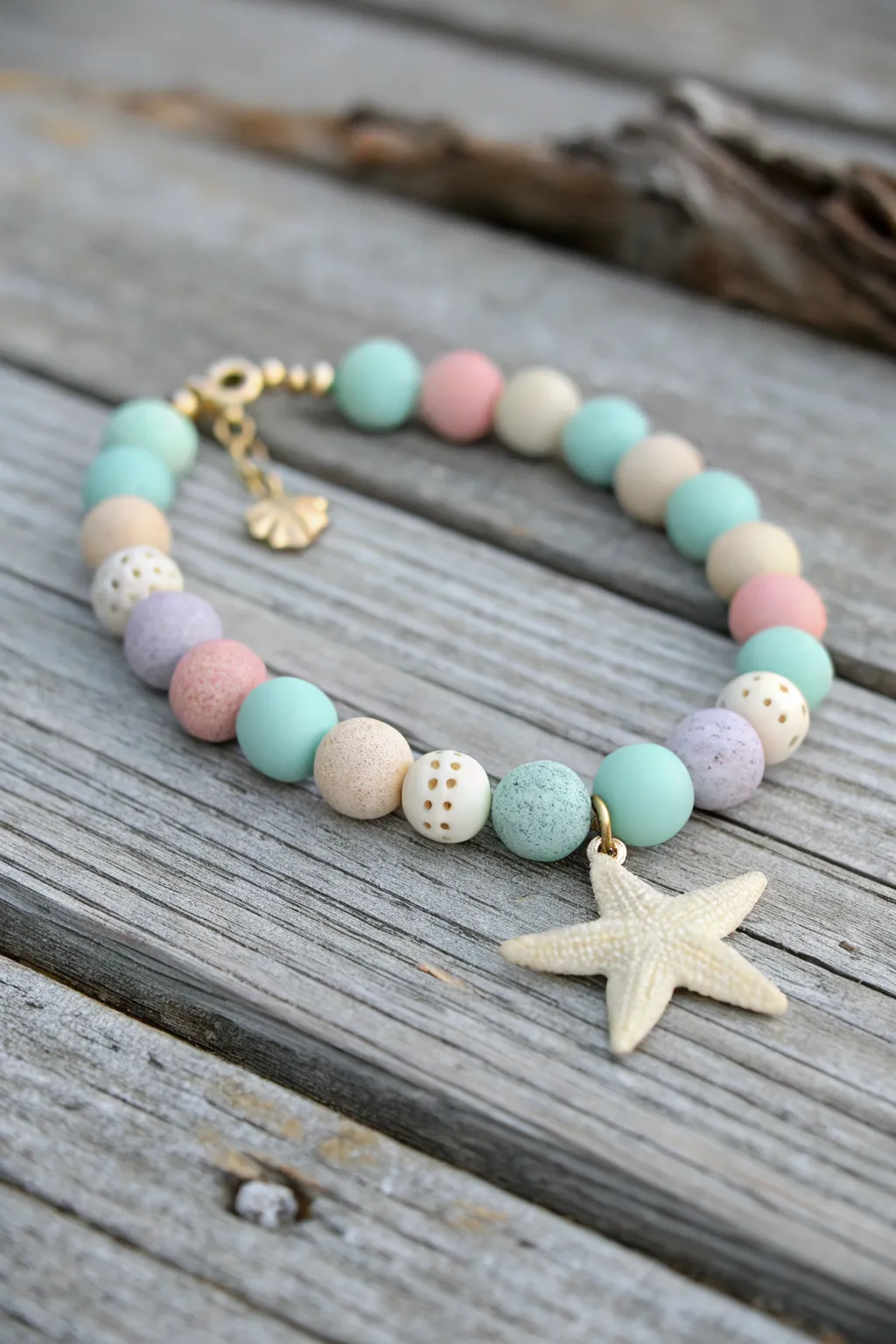
Capture the breezy elegance of a coastal day with this charming beaded bracelet featuring a realistic starfish charm. The soft matte beads in sea glass hues of mint, lavender, and sandy peach create a soothing palette perfect for any beach lover.
Step-by-Step Guide
Materials
- Matte polymer clay or ceramic beads (10mm round): Mint Green
- Matte polymer clay or ceramic beads (10mm round): Pale Pink
- Matte polymer clay or ceramic beads (10mm round): Lavender
- Matte polymer clay or ceramic beads (10mm round): Sandy Beige
- Speckled/stone-effect beads (10mm round) in matching pastel tones
- Textured cream beads with gold dots (10mm round)
- Small gold spacer beads (2-3mm)
- Resin or ceramic white starfish charm
- Gold jump ring (6-8mm)
- Elastic beading cord (0.8mm clear)
- Jewelry glue (e.g., E6000 or G-S Hypo Cement)
- Gold clam shell bead tip (optional, if using clasp)
- Gold extender chain with lobster clasp and small shell dangle
- Scissors
Step 1: Planning and Preparation
-
Measure your wrist:
Before you begin, wrap a piece of string around your wrist to find the comfortable length, then add about half an inch for ease. This ensures your bracelet won’t be too tight. -
Cut the cord:
Cut a length of elastic cord about 10-12 inches long. I always like to have extra room on the ends to make tying the final knot much easier without fumbling. -
Attach the clasp (Optional):
If you are using a clasp like the one in the photo, attach one end of your cord to a gold clam shell tip or crimp bead now. If you prefer a simple stretch bracelet, you can skip straight to beading.
Knot Slipping?
If your elastic knot feels insecure, try pre-stretching the cord firmly before stringing. This removes slack so the knot holds tension better later.
Step 2: Stringing the Pattern
-
Secure the end:
Place a piece of tape or a bead stopper on the end of your cord so your beads don’t slide off while you work. -
Start the sequence:
Begin threading your beads. Start with a small gold spacer bead followed by a smooth mint green bead. -
Build the pattern:
Alternate colors randomly to mimic the organic feel of sea glass. Use a mix of smooth matte beads and the speckled stone-effect beads. Try a pattern like: Pink, Beige, Mint (Smooth), Lavender (Speckled). -
Integrate texture:
Every 4 or 5 colored beads, add one of the textured cream beads with gold dots. This breaks up the color blocks and adds a unique element to the design. -
Create the focal point:
When you reach the halfway point of your bracelet length, string the large Starfish charm. To do this, attach the charm to a gold jump ring first, then thread the cord through the jump ring so the starfish dangles freely. -
Continue the pattern:
Resume your beading pattern on the other side of the charm, trying to mirror the general color balance of the first half without making it perfectly symmetrical. -
Check fit:
Wrap the strand around your wrist to check the size. Add or remove beads as necessary until it fits comfortably.
Ocean Scent
Use porous lava stone beads for the speckled ones. Add a drop of coconut or sea salt essential oil to them for a bracelet that smells like the beach.
Step 3: Finishing Touches
-
End the strand:
Finish with a small gold spacer bead to match the beginning of your strand. -
Tie the knot:
Remove the tape or bead stopper. Bring both ends of the elastic together and tie a strong surgeon’s knot (right over left, left over right, and pull tight). -
Secure with glue:
Apply a tiny dot of jewelry glue to the knot. Let it dry for a few minutes to ensure it won’t slip undone. -
Hide the knot:
If possible, gently tug the elastic so the knot slides inside the hole of the nearest large bead. This gives it a professional, seamless finish. -
Trim excess:
Once the glue is fully cured, trim off the excess cord tails close to the bead. -
Add the extender chain:
If you used a clasp system, use jump rings to attach the lobster clasp to one end and the extender chain to the other. Attach the tiny gold shell charm to the very end of the extender chain for an extra detailed touch.
Now you have a serene accessory ready to pair with your favorite summer outfits
Sunset Ombre Fade
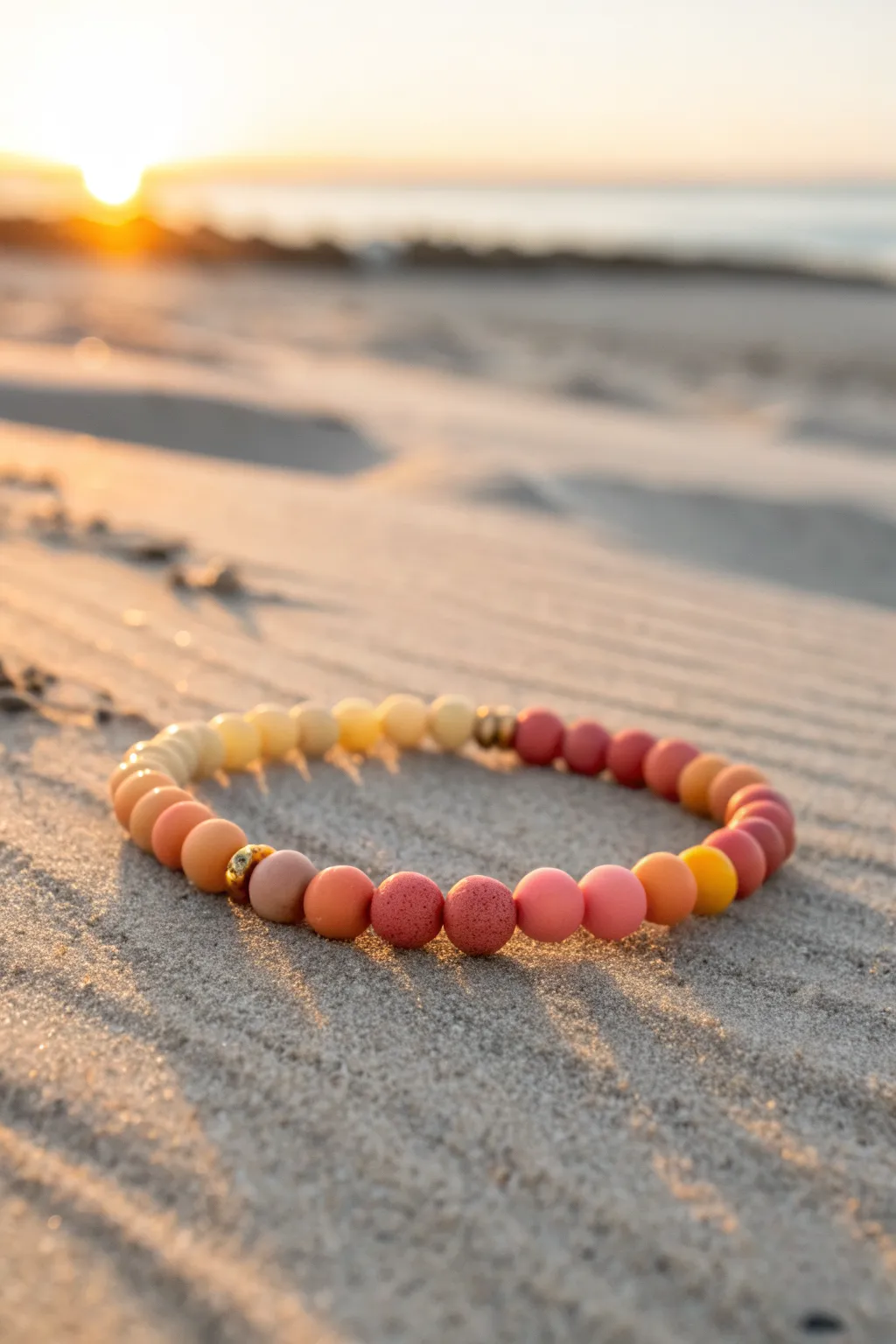
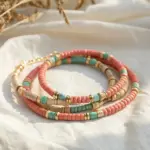
Capture the magic of a golden hour sunset with this stunning ombre bead bracelet. The soft transition from pale yellows to deep berry tones mimics the sky meeting the ocean, creating a serene accessory perfect for any beach lover.
How-To Guide
Materials
- Matte polymer clay beads (8mm round) in pale yellow, peach, coral, terra cotta, and berry red
- Elastic stretch cord (0.7mm or 0.8mm)
- Small gold disc spacer beads (heishi style)
- One medium gold focal bead or charm (optional)
- Beading needle (collapsible eye)
- Jewelry glue or clear nail polish
- Scissors
Step 1: Planning and Sorting
-
Sort your spectrum:
Begin by laying out your beads on a soft surface or bead board. Group them by color family to visualize the gradient: start with the palest yellow, move to peach, then orange, terra cotta, and finally deep pink or red. -
Establish the pattern:
Decide on your ombre flow. For a continuous loop like the photo, you’ll want the colors to fade into each other rather than switch abruptly. A good sequence is about 3-5 beads of each shade before transitioning to the next slightly darker hue. -
Incorporate accents:
Select spots for your metallic elements. In this design, a gold accent bead sits nicely between the deepest red and the lightest yellow, acting as a visual anchor where the cycle restarts.
Seamless Gradient Trick
To make the color fade ultra-realistic, use ‘bridge’ beads. Mix one bead of the previous color into the first two beads of the new color group to blur the lines.
Step 2: Stringing the Ombre
-
Prepare the cord:
Cut a piece of elastic cord about 10-12 inches long. This generous length makes tying the knot much easier later. Pre-stretch the cord by pulling it gently a few times to prevent sagging. -
Secure the end:
Place a piece of tape or a bead stopper clip on one end of the cord so your beads don’t slide off while you work. -
Start with lightness:
Thread your beading needle onto the cord. Begin stringing with your lightest yellow beads. Add about four or five beads to establish the ‘sun’ portion of the gradient. -
Transition to peach:
Add the peach or light orange beads next. I like to blend the transition slightly by adding one peach bead, one yellow, and then fully switching to peach for a softer fade. -
Deepen the color:
Continue stringing the coral and terra cotta beads. Watch the gradient develop; it should look like the darkening sky. -
Add texture:
Notice how some beads in the photo have a speckled texture like lava stone or textured clay? If you have these, intersperse them in the darker orange section for tactile variety. -
Finish the spectrum:
String your darkest berry or deep red beads. This completes the ‘sunset’ timeline from bright light to dusk. -
Insert the gold anchor:
Slide on your gold spacer beads or a small gold focal bead right at the end. This metallic touch separates the darkest color from the lightest when the circle joins, adding a touch of elegance. -
Check the fit:
Wrap the unfinished strand around your wrist. It should sit comfortably without digging in or drooping too much. Add or remove a bead from each color section if you need to adjust the size while keeping the pattern balanced.
Knot Slipping?
If your elastic knot feels loose, don’t just pull harder. Add a second simple overhand knot on top of the surgeon’s knot before gluing for maximum security.
Step 3: Finishing Touches
-
Prepare for the knot:
Remove the needle and the tape/stopper from the ends carefully. Bring the two ends of the cord together. -
Tie the surgeon’s knot:
Perform a surgeon’s knot: cross left over right and loop under, then cross right over left and loop under twice. This extra loop provides the necessary friction to hold the elastic. -
Tighten securely:
Pull all four strands (the two tail ends and the two loop sides) firmly to cinch the knot down tight. You should feel the elastic stretch slightly as it locks. -
Lock it in:
Apply a tiny dab of jewelry glue (or clear nail polish in a pinch) directly onto the knot. Let it dry for a few minutes before touching it. -
Hide the ends:
Once the glue is tacky or dry, trim the excess cord ends to about 2mm. If possible, gently tug the knot inside the hole of the adjacent gold bead to hide it completely.
Slip on your new bracelet and carry the warmth of a summer evening with you wherever you go

The Complete Guide to Pottery Troubleshooting
Uncover the most common ceramic mistakes—from cracking clay to failed glazes—and learn how to fix them fast.
Ocean Wave Stripes
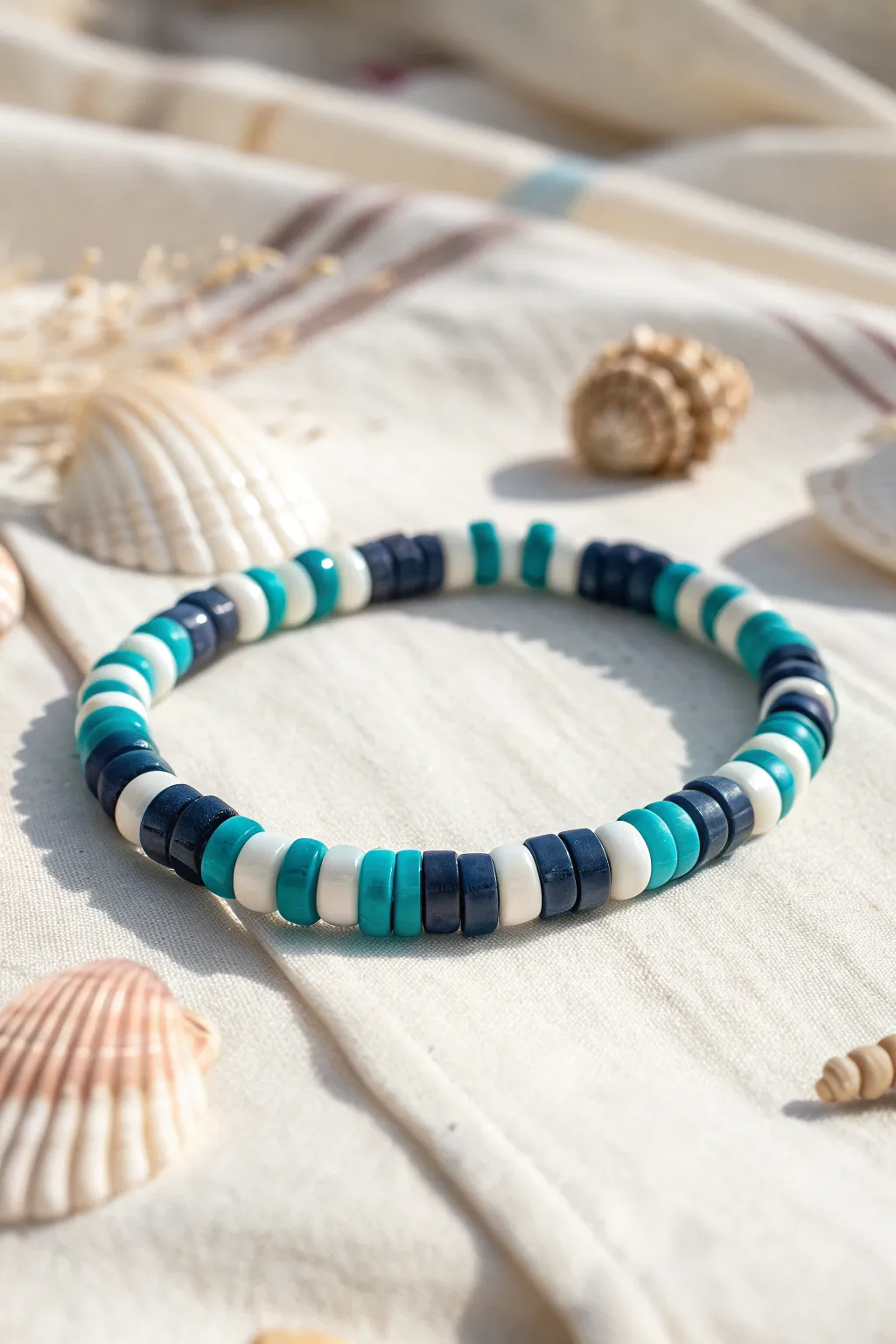
Bring the calming rhythm of the tides to your wrist with this classic striped heishi bead bracelet. Featuring a crisp pattern of navy, teal, and white, this accessory captures the essence of ocean waves crashing on sandy shores.
Step-by-Step
Materials
- Elastic stretch cord (0.8mm or 1.0mm size)
- 6mm polymer clay disc beads (heishi beads) in Navy Blue
- 6mm polymer clay disc beads in Teal/Turquoise
- 6mm polymer clay disc beads in White/Cream
- Scissors or jewelry snips
- Super glue or jewelry cement (optional)
- Bead stopper or painter’s tape
- Ruler or tape measure
Step 1: Planning and Prep
-
Measure your wrist:
Wrap a flexible tape measure around your wrist where you want the bracelet to sit. Note the measurement and add about half an inch for a comfortable fit. -
Cut the cord:
Cut a length of elastic cord about 10-12 inches long. Having plenty of extra slack makes tying the final knot much easier without fumbling. -
Secure the end:
Attach a bead stopper to one end of the cord. If you don’t have one, a piece of painter’s tape folded over the end works perfectly to keep beads from sliding off. -
Stretch the cord:
Give the elastic cord a few gentle tugs before you start beading. This pre-stretching helps prevent the bracelet from sagging or loosening up after you wear it a few times.
Smooth Seams
To make the knot disappear easier, use a slightly larger bore bead or a metal crimp bead next to the knot to hide it neatly inside.
Step 2: Beading the Pattern
-
Understand the pattern:
This design relies on a recurring block pattern. The core sequence is: 2 Navy, 2 White, 2 Teal, 2 White. -
Start the sequence:
Thread on two navy blue beads. Make sure they nest against each other flatly so there are no gaps. -
Add the contrast:
Slide on two white spacer beads next. These act as the ‘foam’ between your ocean colors. -
Introduce the teal:
Add two teal (or turquoise) beads. This vibrant pop of color lightens the mood of the darker navy. -
Complete the first block:
Finish the first pattern unit by adding two more white beads. Your sequence on the string should now look like: Navy-Navy-White-White-Teal-Teal-White-White. -
Repeat the pattern:
Continue repeating this 8-bead sequence. I find it helpful to lay out a small pile of each color nearby so I can pick them up rhythmically without breaking focus. -
Check the length:
Periodically wrap the strand around your wrist to check the size. Stop adding beads when the ends meet comfortably without stretching the cord tight. -
Verify the pattern end:
Try to end your pattern so that when the bracelet is tied, the design flows seamlessly. For example, if you started with Navy, try to end with the last set of White beads.
Step 3: Finishing Touches
-
Prepare to tie:
Remove the bead stopper or tape carefully, holding both ends of the elastic firmly so no beads escape. -
Tie the first knot:
Cross the ends and tie a simple overhand knot. Pull it tight, but be gentle so you don’t snap the elastic. -
Secure with a surgeon’s knot:
Tie a second knot, but loop the end through the circle twice (instead of once) before pulling tight. This creates a secure surgeon’s knot. -
Glue the knot:
Dab a tiny drop of super glue or jewelry cement directly onto the knot. Let it dry completely for a minute or two. -
Hide the knot:
Once the glue is dry, trim the excess cord ends close to the knot using your scissors. Gently tug the bracelet to slide the knot inside the hole of the nearest bead to hide it.
Knot Slipping?
If the elastic feels slippery, dust the knot area with a tiny bit of cornstarch or baby powder before tying to add grip.
Slip on your new bracelet and enjoy the cool, coastal vibes every time you check the time
Gold-Accent Sun Glint Spacers
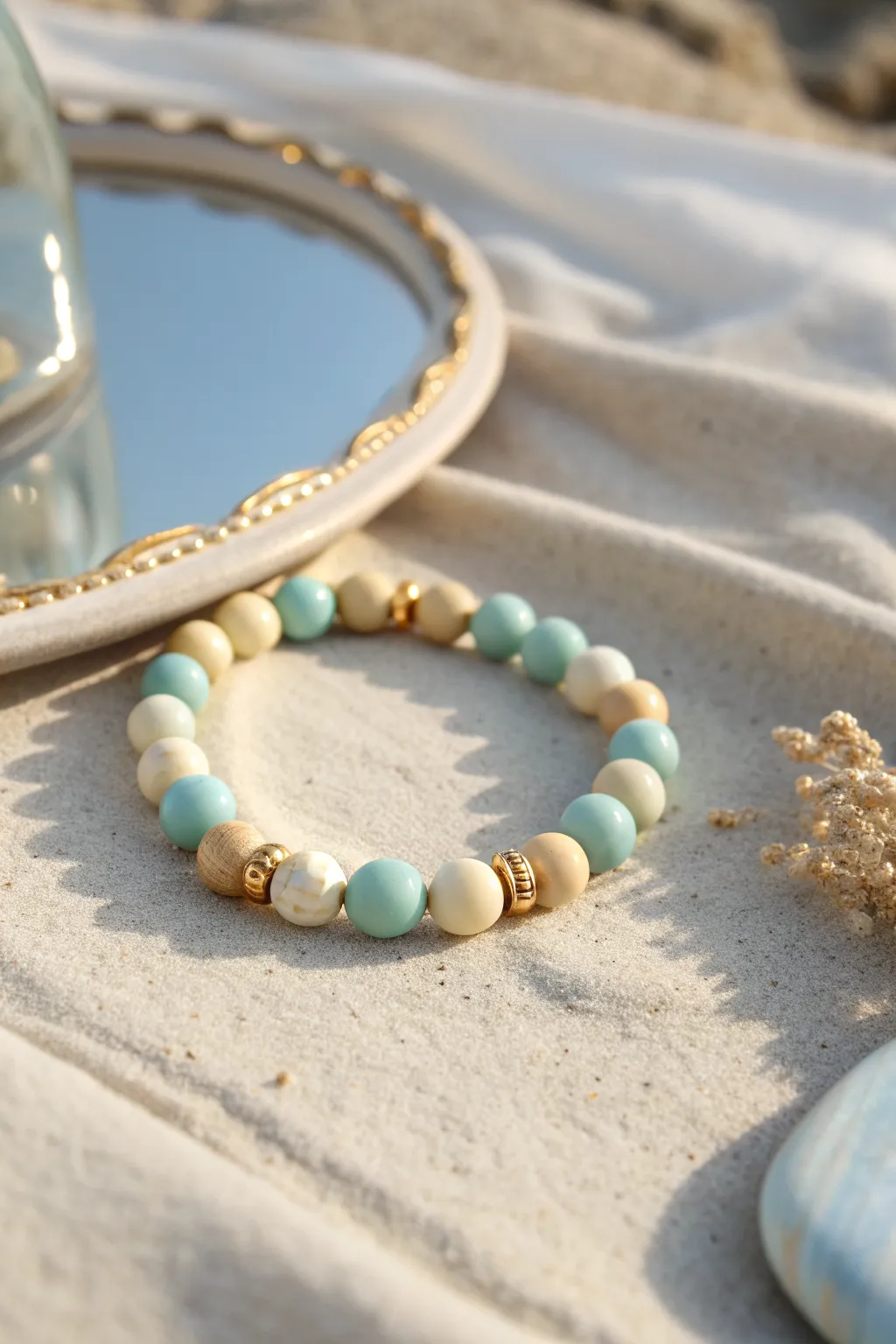
Capture the serene palette of sand and sea with this elegant stretch bracelet featuring a soothing rhythm of cream and aqua beads. The addition of textured gold spacers and unique feature beads gives it a sophisticated, sun-kissed finish perfect for any beach day.
How-To Guide
Materials
- Elastic jewelry cord (0.7mm or 0.8mm)
- Round beads (8mm or 10mm) in matte aqua blue
- Round beads (8mm or 10mm) in creamy off-white/beige
- Two textured gold spacer beads (tire or lantern shape)
- One small plain gold spacer bead
- One light wood bead (approx. 10mm)
- One faceted white stone or patterned focal bead
- Jewelry glue or clear nail polish
- Scissors
Step 1: Preparation
-
Measure the wrist:
Before you begin, wrap a piece of string around your wrist to find the desired length. Add about half an inch to this measurement to ensure the bracelet sits comfortably without pinching. -
Pre-stretch the cord:
Cut a length of elastic cord about 10-12 inches long. Give it a few gentle tugs to pre-stretch it; this prevents the bracelet from loosening up permanently after you wear it the first time. -
Secure the end:
Attach a bead stopper or simply place a piece of tape on one end of your cord to stop your beads from sliding off while you design your pattern.
Knot Hiding Trick
If the knot won’t fit inside a bead hole, widen the hole of one specific bead slightly using a bead reamer tool before stringing it near the end.
Step 2: Beading the Pattern
-
Start the main sequence:
Using your main round beads, string one cream bead followed by one aqua bead. I like to repeat this alternating pattern for about one-third of the bracelet’s length. -
Create a visual break:
Add two cream beads consecutively, followed by two aqua beads. This slight irregularity creates a more organic, natural look compared to a strict 1-1 pattern. -
Continue the rhythm:
Return to alternating one cream and one aqua bead until you have filled approximately two-thirds of your measured length. -
Insert the small gold spacer:
Slide on the small, smooth gold spacer bead. This subtle flash of metal acts as a connector between the standard pattern and the focal point. -
Add more base beads:
Thread two more cream beads and one aqua bead onto the cord following the small spacer.
Loose Elastic?
If the bracelet feels loose immediately, you didn’t pre-stretch the cord enough. Re-tie it tighter, stretching firmly as you make the knot.
Step 3: Creating the Focal Section
-
First gold accent:
Slide on the first large, textured gold spacer bead. This frames the special feature beads. -
Add the wood element:
Place the light wood bead next to the gold spacer. The natural texture adds warmth and contrast to the smooth stone or clay beads. -
Add the focal bead:
Thread on your faceted white stone or patterned feature bead. This acts as the centerpiece of this specific segment. -
Closing gold accent:
Finish the focal section by adding the second textured gold spacer bead, mirroring the first one. -
Complete the loop:
Fill any remaining space on your cord with alternating cream and aqua beads until the strand meets your wrist measurement. -
Check the fit:
Wrap the beaded strand around your wrist to ensure the ends meet comfortably without gaps. Add or remove a bead if necessary.
Step 4: Finishing Touches
-
Tie the knot:
Remove the tape or stopper. Bring the two ends of the cord together and tie a strong surgeon’s knot (loop the cord through twice before pulling tight). -
Secure with glue:
Apply a tiny dab of jewelry glue or clear nail polish directly onto the knot. This is crucial for preventing the slippery elastic from coming undone. -
Hide the knot:
Ideally, pull the knot gently inside the hole of the nearest large bead (like the wood bead or a neighboring cream bead) while the glue is still slightly tacky. -
Trim excess:
Once the glue is fully dry, trim the excess cord tails close to the bead hole, being careful not to cut the main knot.
Now your wrist carries a stylish little piece of the shoreline wherever you go

What Really Happens Inside the Kiln
Learn how time and temperature work together inside the kiln to transform clay into durable ceramic.
Sea Glass-Inspired Pastels
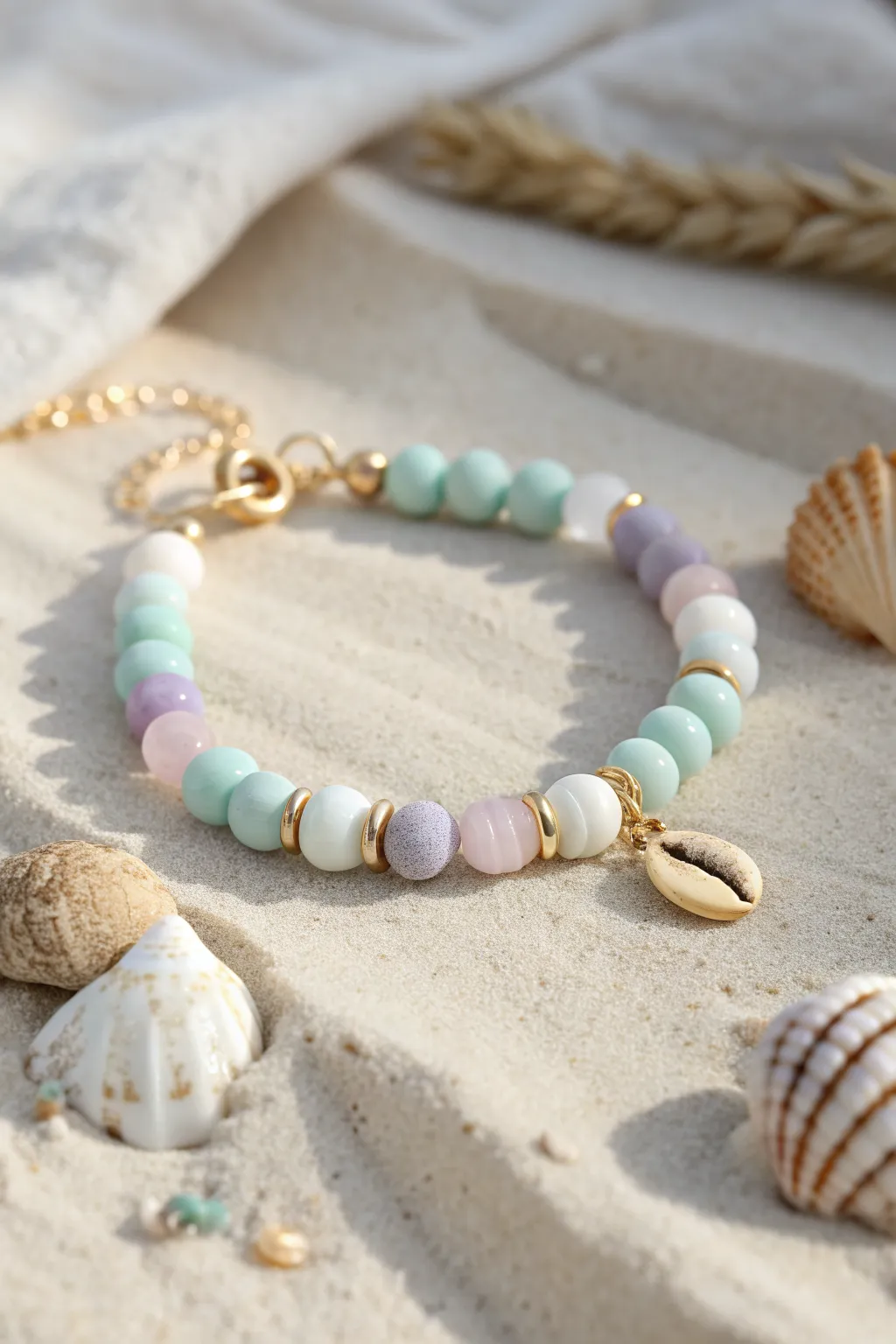
Evoke the gentle hues of sea glass with this delicate bracelet, featuring soft mint, lavender, and cloudy white beads accented by gold spacers. The centerpiece is a stunning gold-edged cowrie shell that instantly transports you to the shoreline.
Step-by-Step Guide
Materials
- 6mm round glass beads (matte mint green)
- 6mm round glass beads (matte lavender/lilac)
- 6mm round glass beads (matte pale pink)
- 6mm round glass beads (milky white)
- Gold tone disc spacer beads (heishi style)
- Natural cowrie shell charm with gold electroplating/edging
- Gold beaded toggle clasp or lobster clasp with extender chain
- 2 small gold jump rings (4mm or 5mm)
- Beading wire (preferably 7-strand or 19-strand, gold color)
- 2 gold crimp beads
- 2 gold crimp bead covers (optional)
- Wire cutters
- Crimping pliers
- Chain nose pliers
- Bead design board or soft cloth
Step 1: Planning and Preparation
-
Lay out the pattern:
Begin by arranging your beads on a design board. The core pattern shown here relies on blocks of color rather than a deeply repetitive sequence. -
Establish the center:
Place your gold-edged cowrie shell charm in the middle of your layout. Flank it immediately with one large gold spacer bead, followed by a milky white bead on the right and a pale pink bead on the left. -
Build the left side:
Moving outwards to the left from the center pink bead, add a gold spacer, a white bead, another gold spacer, then a block of mint green (2 beads), lavender (1 bead), and mint green (4 beads). -
Build the right side:
Moving outwards to the right from the center white bead, add a gold spacer, a mint green bead, a gold spacer, then a block of mint green (2 beads), white (1 bead), lavender (1 bead), pink (1 bead), and white (1 bead). -
Adjust length:
This asymmetrical, organic arrangement mimics found sea stones. Continue adding beads to the ends until the total length is about 6.5 to 7 inches, or your desired wrist size minus the clasp length.
Fixing Stiff Wire
If your finished bracelet feels rigid and won’t drape nicely, you overtightened the wire. You need to restring it, leaving a hair-width gap between beads so they can rotate.
Step 2: Stringing the Bracelet
-
Cut the wire:
Cut a piece of beading wire approximately 10-12 inches long. This gives you plenty of slack to work with on both ends. -
Attach the first clasp end:
Thread a crimp bead onto one end of the wire, followed by the jump ring attached to your lobster clasp (or the clasp itself). -
Secure the wire:
Loop the wire back through the crimp bead to create a small loop holding the clasp. Use your crimping pliers to flatten or fold the crimp bead securely. I like to give it a gentle tug to ensure it holds. -
Start beading:
Thread the short tail of the wire into the first few beads to hide it. Begin stringing your pattern from left to right. -
Insert the spacers:
As you bead, ensure the flat gold spacer beads are oriented correctly so they sit flush against the round glass beads. -
Add the charm:
When you reach the center point, thread the wire through the integral loop of the cowrie shell charm. Ensure the gold edging is facing outward/upward. -
Complete the strand:
Finish stringing the remaining beads according to your layout.
Step 3: Finishing Touches
-
Prepare the second end:
Thread a crimp bead onto the remaining wire tail, followed by the jump ring for your extender chain or the other half of your toggle clasp. -
Loop and tighten:
Feed the wire back through the crimp bead and into the last 2-3 beads of your bracelet design. Pull the wire to tighten slightly. -
Check the tension:
Before crimping, curve the bracelet into a circle. If the wire is too tight while straight, the bracelet will be stiff and kinked when worn. Ensure there is a tiny bit of wiggle room. -
Crimp firmly:
Use your crimping pliers to secure the final crimp bead. Trim the excess wire tail flush with the bead hole using flush cutters. -
Cover the crimps (optional):
If you are using crimp covers, carefully place them over the flattened crimp beads and gently squeeze them shut with pliers to look like round gold beads.
Level Up: Texture
Swap the plain matte beads for frosted quartz or recycled glass beads. The imperfect surfaces catch the light beautifully and enhance the sea-glass vibe.
Wear your new pastel creation stacked with gold bangles for the perfect seaside summer look
Sand and Foam Neutrals
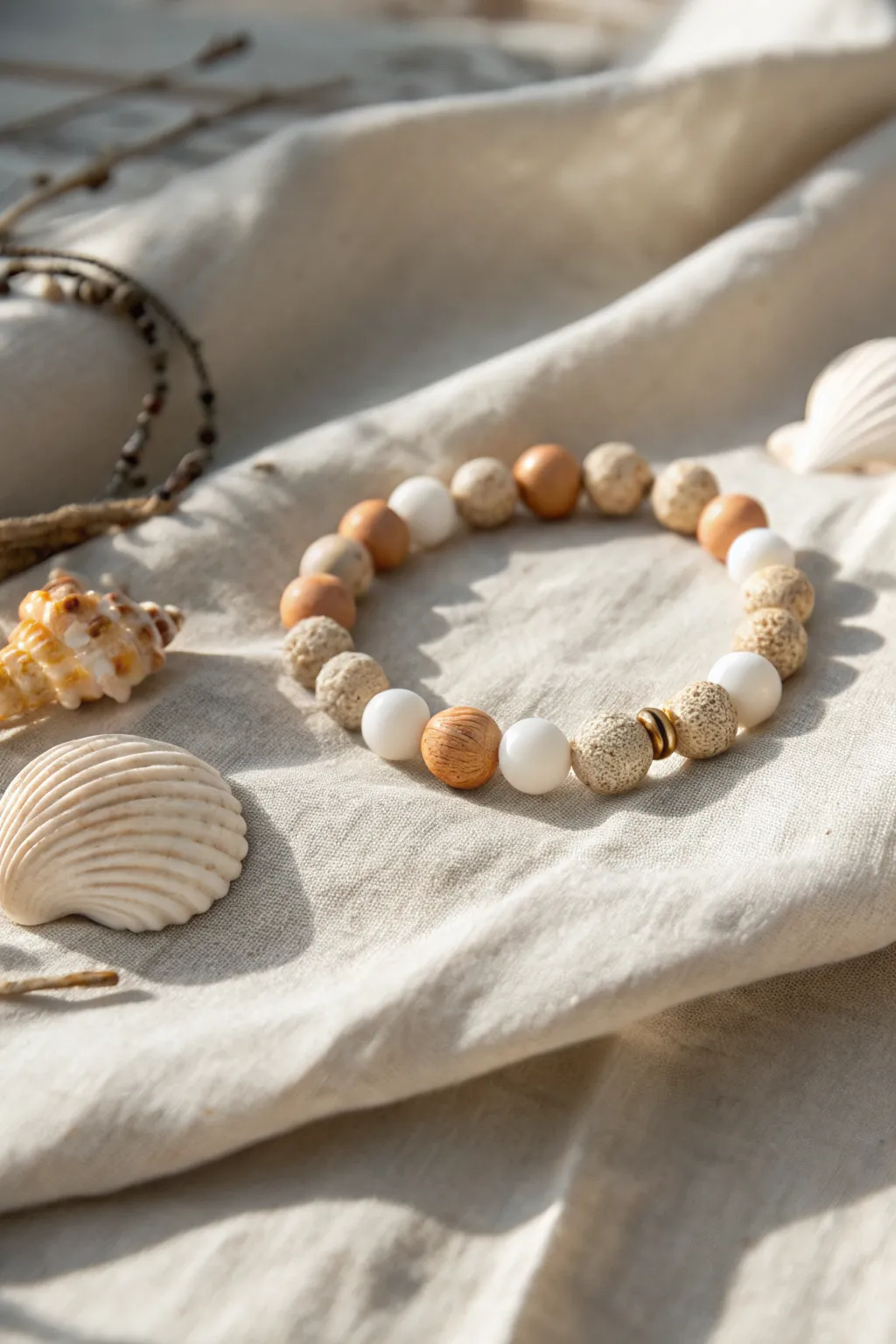
Capture the serene palette of sand dunes and sea foam with this textured, neutral-toned bracelet. Mixing porous lava stones, smooth white rounds, and warm wood accents creates a sophisticated beachy accessory perfect for stacking.
How-To Guide
Materials
- Beige/Sand colored porous beads (8mm and 10mm lava rock or pumice)
- White smooth round beads (8mm, agate or glass)
- Light brown wood beads (10mm)
- Medium brown polished beads (10mm, wood or tiger eye)
- Small gold spacer discs or rondelles
- Elastic stretch cord (0.8mm clear)
- Beading needle (optional but helpful)
- Scissors
- Hypo cement or strong jewelry glue
- Bead design board or soft cloth
Step 1: Preparation & Design
-
Measure your wrist:
Before cutting any cord, wrap a measuring tape around your wrist to find your size. Add about 0.5 inches to this measurement for a comfortable fit. -
Prep the elastic:
Cut a piece of elastic cord about 10-12 inches long. This generous length gives you plenty of room to tie knots without struggling. -
Stretch the cord:
Gently pull on your length of elastic cord several times. Pre-stretching prevents the bracelet from sagging or loosening up after you wear it a few times. -
Plan your layout:
Lay your beads out on a bead board or a towel to visualize the pattern. For this look, aim for an asymmetrical but balanced mix of textures rather than a strict repeating pattern.
Natural Scents Pro-Tip
Since this design uses porous lava stone beads, add a drop of essential oil (like coconut or ocean breeze) to them. They act as a natural diffuser!
Step 2: Stringing the Pattern
-
Start the sequence:
Begin by feeding one large beige porous bead onto the elastic. If the hole is rough, a bead reamer can help smooth it out first. -
Add the focal accent:
Slide on a white smooth bead, then a gold spacer disc, followed by another beige porous bead. This metallic touch adds a hint of elegance. -
String the wood section:
Thread a large light-colored wood bead next to a glossy white bead. The contrast between matte and shiny surfaces is key to this design. -
Build the gradient:
Continue adding beads, transitioning from the lighter beige stones into the warmer medium-brown polished beads. Grouping 2-3 similar colors together creates a nice ombré effect. -
Incorporate texture variation:
Mix in your smaller 8mm porous beads between the larger smooth ones. This size variation keeps the bracelet looking organic and less manufactured. -
Check the length:
Periodically wrap the strand around your wrist. You want the ends to touch comfortably without stretching the beads apart. -
Finish the strand:
End your stringing pattern with a bead that has a larger hole, like one of the wooden ones or porous lava beads. This will be crucial for hiding the knot later.
Step 3: Finishing Touches
-
Tie the first knot:
Bring the two ends of the elastic together carefully. Tie a simple overhand knot, pulling tight enough to remove slack but not so tight that the bracelet puckers. -
Secure with a surgeon’s knot:
Tie a second knot, but loop the elastic through twice before pulling tight. This extra loop creates a surgeon’s knot which is much less likely to slip. -
Tighten the bond:
Pull firmly on all four strands (the two loose ends and the bracelet loop itself) to lock the knot securely in place. -
Apply adhesive:
Dab a tiny drop of Hypo cement or jewelry glue directly onto the knot. I find waiting about 30 seconds for it to get tacky helps it set better. -
Hide the knot:
While the glue is still wet, gently pull the elastic so the knot slides inside the large-hole bead you saved for the end. This hides the mechanics for a seamless finish. -
Trim the excess:
Once the glue is fully dry (check your glue’s instructions), trim the excess elastic tails with sharp scissors. Be careful not to nick the main cord.
Charm Level Up
Attach a small gold seashell or starfish charm onto a jump ring next to the gold spacer disc to emphasize the beach theme even more.
Enjoy wearing your handcrafted piece of the relaxed shoreline wherever you go

TRACK YOUR CERAMIC JOURNEY
Capture glaze tests, firing details, and creative progress—all in one simple printable. Make your projects easier to repeat and improve.
Palm Leaf Green and Ocean Blue
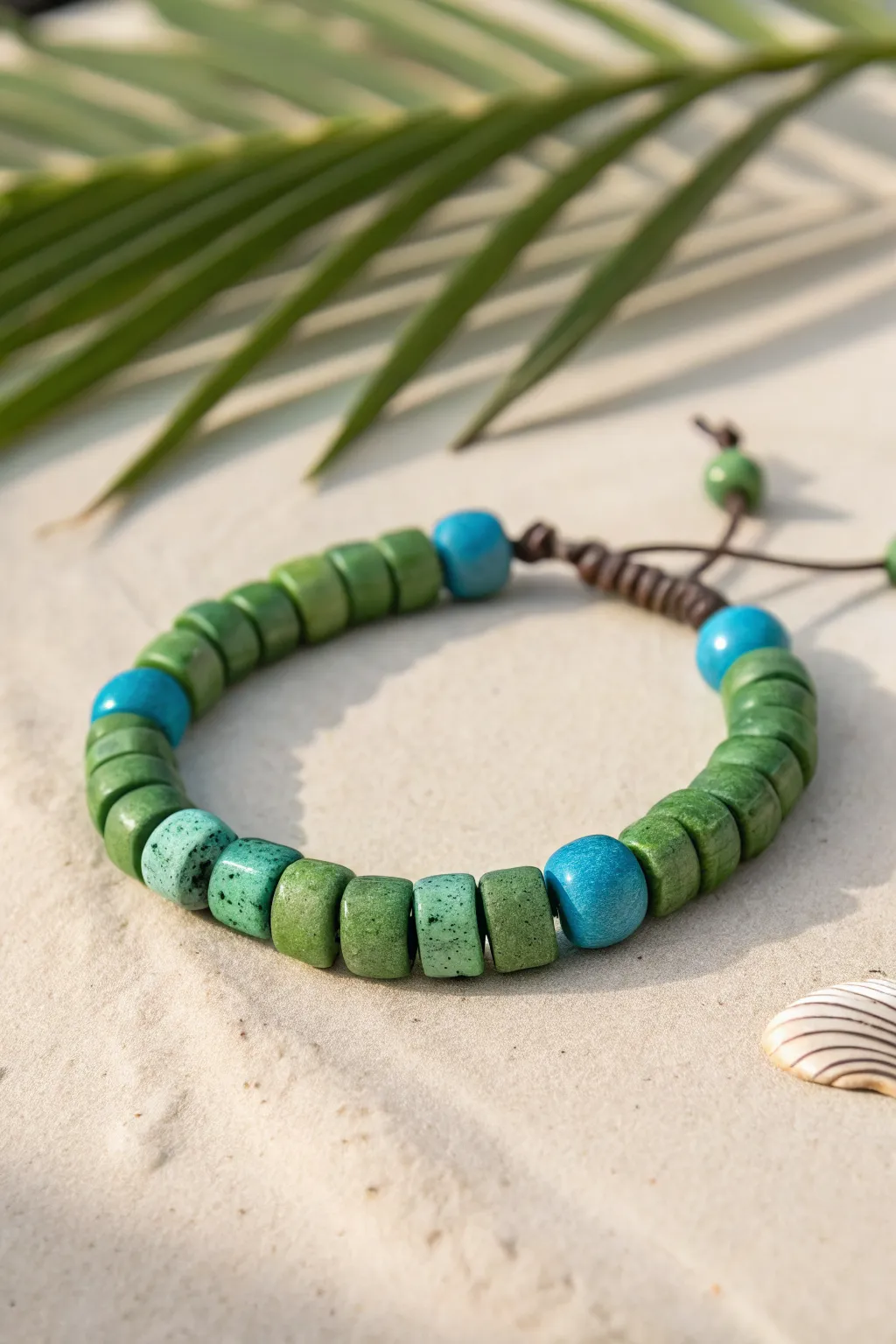
Capture the essence of a serene shoreline with this earthy bracelet, blending palm leaf greens with striking ocean blue accents. The textured clay beads and adjustable cord knot give it a relaxed, artisanal feel perfect for beach days.
Detailed Instructions
Materials
- Polymer clay (olive green, forest green, light teal/mint with speckles, bright ocean blue)
- Caning blade or sharp craft knife
- Bead rolling tool or clear acrylic block
- Toothpick or bead needle (thick enough for your cord)
- 1mm brown waxed cotton or hemp cord
- Sandpaper (fine grit)
- Oven for baking
- Ruler
- Scissors
- Lighter (optional, for sealing cord ends)
Step 1: Creating the Clay Beads
-
Condition the Clay:
Begin by conditioning each color of polymer clay separately. Knead them warm in your hands until they are soft and pliable, ensuring there are no air bubbles. -
Form the Base Logs:
Roll the olive green and forest green clays into even snake-like logs, approximately 1cm in diameter. Do the same for your speckled light teal clay. -
Prepare the Blue Accents:
Roll the bright ocean blue clay into a slightly smaller log. You will need fewer of these, so a shorter length is sufficient. -
Slice the Clay:
Using your blade, slice the green and teal logs into equal segments, about 5-6mm thick. Aim for consistency, but slight variations add to the organic look. -
Shape the Cylinders:
Take each slice and gently roll it between your fingers or against your work surface to smooth the edges, forming a neat cylinder shape rather than a sharp-edged disc. -
Pierce the Holes:
Carefully insert a toothpick or bead pin through the center of each cylinder. Rotate the bead gently as you push through to prevent squashing the shape. -
Create the Blue Rounds:
Take your blue clay segments and roll them into spheres rather than cylinders. Pierce these as well, ensuring the hole is large enough for the cord to pass through twice. -
Bake the Beads:
Arrange all beads on a baking sheet or tile. Bake according to your polymer clay manufacturer’s instructions (usually around 275°F/130°C for 15-30 minutes). -
Cool and Finish:
Let the beads cool completely. I like to lightly sand the ends of the cylinders if they feel too rough or uneven.
Mix Your Own Speckles
To get that speckled eggshell effect on the teal beads, knead in a tiny pinch of black pepper or black embossing powder into the raw clay before rolling.
Step 2: Assembly and Knotting
-
Cut the Cord:
Cut a length of brown waxed cord approximately 24 inches long. This generous length allows plenty of room for knotting. -
Plan the Pattern:
Lay out your beads on a table to design your pattern. The image uses blocks of 6-7 dark green cylinders, separated by a blue round bead, then a mix of speckled teal and greens. -
String the Beads:
Thread the beads onto the cord in your chosen order. Center the design on the cord. -
Tie End Knots:
Once all beads are on, tie a simple overhand knot snugly against the last bead on both ends of the beaded section to keep them in place. -
Cross the Cords:
Bring the two tail ends of the cord together, overlapping them so they run parallel to each other in opposite directions. -
Start the Sliding Knot:
Cut a separate 10-inch piece of cord. Lay it under the two overlapped main cords. Step 1 of a square macramé knot is to bring the left end over the main cords and under the right end. -
Complete the Knot:
Tie a series of square knots (macramé flat knots) around the two main cords until you have a closure about 1cm long. -
Secure the Closure:
Pull the knot ends tight. Trim the excess from the knotting cord (not the main bracelet cords) and carefully melt the tips with a lighter or use a dab of glue to seal. -
Add Decorative Ends:
Thread one small leftover bead onto each of the main tail cords. Tie a knot at the very end to secure these stopper beads. -
Final Adjustments:
Trim any excess tail cord beyond the stopper knots and test the sliding mechanism to ensure it moves smoothly but stays secure.
Hole Distortion?
If your beads squish when piercing them, let the raw clay sit inside the fridge for 10 minutes to firm up before drilling the hole with your toothpick.
Slip on your new bracelet and enjoy the feeling of carrying a piece of the coast with you everywhere you go
Tidal Pool Speckle Mix
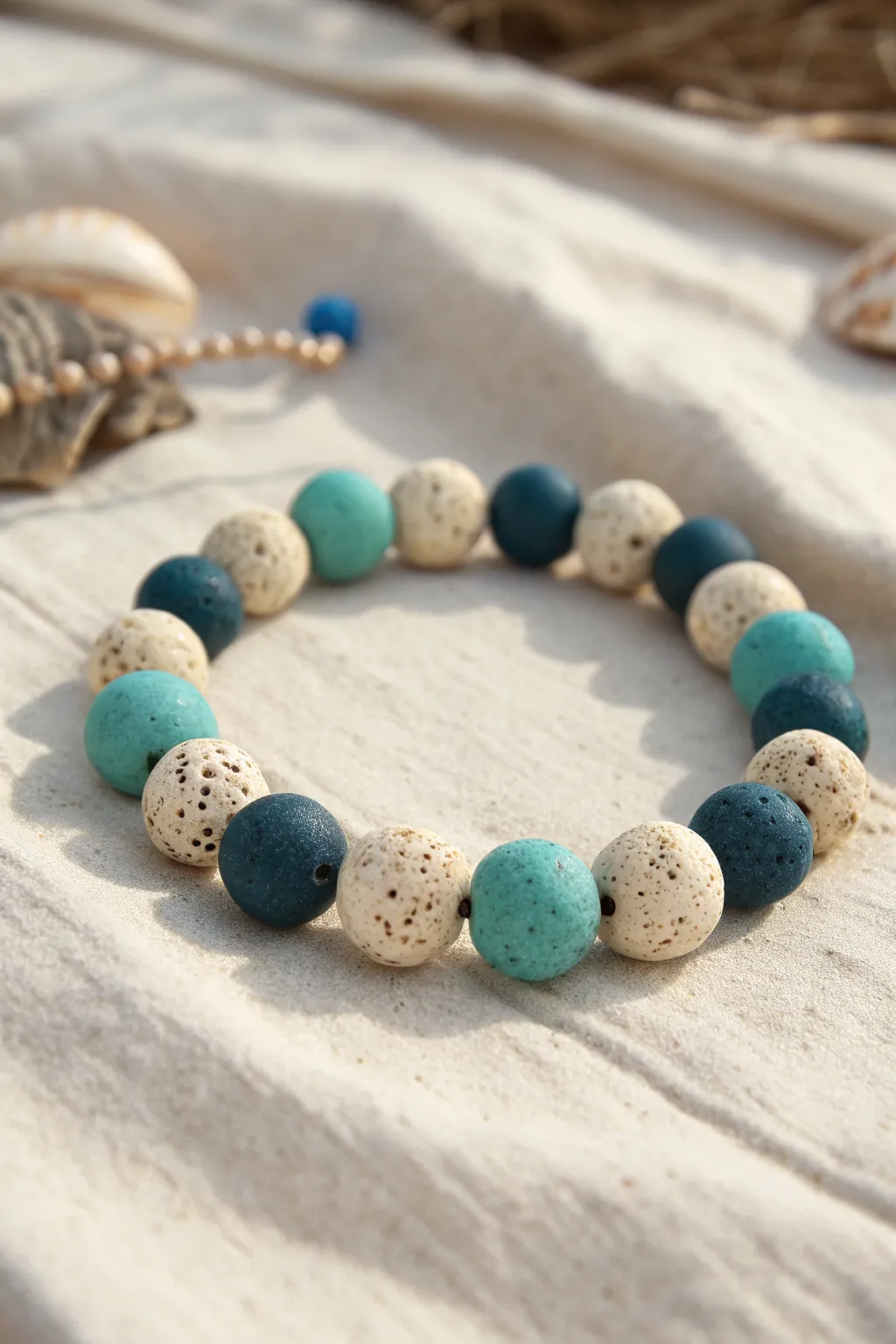
Capture the essence of a rocky tidal pool with this simple yet striking bracelet design. Using porous, lava-style beads in cool aquatic tones mixed with sandy cream, you’ll create a durable accessory perfect for casual beach days.
How-To Guide
Materials
- 8mm cream-colored lava rock beads (porous/speckled)
- 8mm turquoise blue lava rock beads
- 8mm deep teal/navy lava rock beads
- 0.8mm elastic stretch cord (clear or match the darker beads)
- Jewelry adhesive or super glue
- Scissors
- Bead stopper or tape
Step 1: Design & Preparation
-
Measure your wrist:
Wrap a measuring tape loosely around your wrist to determine the circumference. Add about 0.5 inches to this measurement to ensure a comfortable fit that isn’t too tight. -
Cut the cord:
Cut a piece of elastic cord about 10-12 inches long. Having extra length makes the final knotting process much easier and prevents beads from slipping off prematurely. -
Pre-stretch the elastic:
Hold the cord ends firmly and give the string a few firm tugs. This pre-stretching technique is crucial because it prevents the bracelet from sagging or expanding permanently after the first few wears. -
Secure one end:
Place a bead stopper or simply use a piece of tape on one end of your cord so your beads don’t roll away as you work. -
Plan your pattern:
Lay out your beads on a flat surface or bead board. The pattern in the image follows a loose sequence: Cream, Blue, Cream, Teal. It repeats somewhat organically, so don’t stress about perfect symmetry.
Step 2: Stringing the Beads
-
inspect the holes:
Before stringing, quickly check that the drill holes on your lava beads are clear. Sometimes these natural-style beads have jagged internal edges that can fray elastic. -
Start with a dark bead:
Thread a deep teal bead onto the cord first. Starting with a darker bead is a clever trick because it hides the knot knot better if the hole is slightly larger. -
Add the first cream bead:
Slide on a cream speckled bead next to the teal one, pushing it down towards the stopper. -
Introduce the turquoise:
Thread a bright turquoise bead next. This creates that pop of ‘shallow water’ color against the ‘deep water’ teal. -
Establish the rhythm:
Continue adding beads in a repeating sequence of Cream -> Teal -> Cream -> Turquoise. I find this alternating light-dark pattern mimics the dappled light on ocean water. -
Check the fit:
Once you have strung about 20-22 beads (or enough to reach your target length), wrap the strand around your wrist to test the sizing. It should sit comfortably without pinching skin or sliding too far up the arm.
Sticky Situation
If you accidentally get glue on a lava bead, don’t wipe it! Let it dry completely, then gently file or sand the hardened glue spot away with an emery board.
Step 3: Finishing Touches
-
Prepare to knot:
Remove the bead stopper or tape carefully, holding both ends of the elastic securely so no beads escape. -
Tie the first knot:
Cross the ends and tie a standard overhand knot, pulling it gently down so the beads nestle together snugly but aren’t rigid. -
Tie a surgeon’s knot:
For the second knot, create a loop and pass the end through it twice before pulling tight. This extra pass creates friction that prevents the elastic from slipping undone. -
Apply adhesive:
Place a very small drop of jewelry glue or super glue directly onto the knot. Be careful not to get glue on the neighboring beads, as it can discolor the porous stone. -
Hide the knot:
While the glue is still slightly tacky, pull the elastic firmly so the knot slides inside the hole of the nearest teal bead. This makes the finish look seamless and professional. -
Trim the excess:
Once the glue is fully dry (wait at least 15 minutes), use your scissors to snip the excess cord ends as close to the bead hole as possible without nicking the knot itself.
Scent Infusion
Since lava beads are naturally porous, you can add a single drop of essential oil (like coconut or sea salt) to the cream beads for a scented accessory.
Slip on your new bracelet and enjoy carrying a little piece of the shoreline with you wherever you go
Pearl Touch Mermaid Vibes
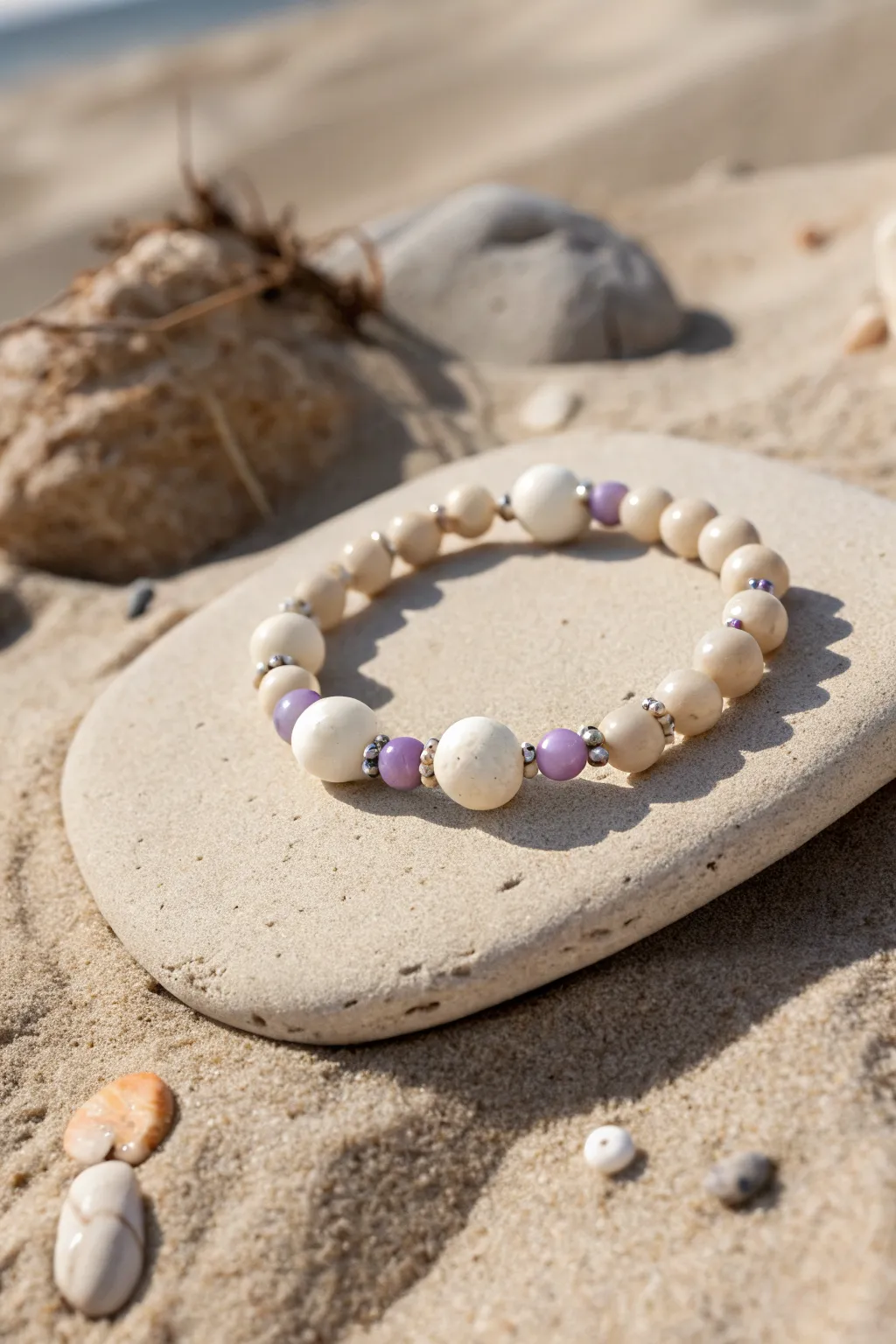
Capture the serene essence of the shoreline with this elegant beaded bracelet. Combining creamy bone-colored beads with soft lavender accents and silver spacers, this accessory feels like a treasure washed up from a mermaid’s cove.
Detailed Instructions
Materials
- Cream/off-white round clay or bone beads (approx. 8mm)
- Larger white round beads (approx. 10mm)
- Lavender/purple round beads (approx. 4-6mm)
- Small silver floral spacer beads
- Tiny silver seed beads or crimp covers (optional)
- Strong elastic stretch cord (0.8mm or 1mm)
- Jewelry glue or clear nail polish
- Scissors
Step 1: Preparation
-
Measure your wrist:
Wrap a piece of string around your wrist to find your comfortable size, then add about half an inch for a comfortable fit. -
Cut the cord:
Cut a length of elastic cord about 10-12 inches long. Having extra length makes tying the final knot much easier than struggling with short ends. -
Pre-stretch the elastic:
Hold both ends of your cut elastic and give it a few firm tugs. This pre-stretching prevents the bracelet from sagging or loosening shortly after you start wearing it. -
Secure the end:
Place a piece of tape or a bead stopper clip on one end of the cord so your beads don’t slide right off while you work.
Knot Security
When tightening your final knot, pull all four strands (the two tail ends and the two bracelet sides) simultaneously to lock it tight.
Step 2: Creating the Pattern
-
Start with the main beads:
Begin stringing the creamy 8mm beads. Thread on approximately 5 or 6 of them to form the back section of the bracelet. -
Add a spacer:
Slide on a small silver spacer bead. This metallic touch breaks up the matte texture of the clay beads. -
Introduce the lavender:
Thread on one of the smaller lavender beads, followed by another silver spacer. -
Place a large focal bead:
Add one of the larger 10mm white focal beads. Notice how this change in size creates a lovely rhythm in the design. -
Repeat the accent segment:
Follow the focal bead with a silver spacer, a lavender bead, and another silver spacer. -
Continue the pattern:
Add 2-3 of the standard cream beads, then repeat the accent sequence (spacer, lavender, spacer, large white bead) until you have three distinct focal points, or adjust based on your wrist size.
Ocean Ombré Upgrade
Swap the solid lavender beads for a gradient of sea glass colors—use pale blue, teal, and soft purple for a true ocean wave effect.
Step 3: The Finishing Touches
-
Check the fit:
Wrap the unfinished strand around your wrist to ensure it fits comfortably. Add or remove cream beads from the ends as needed to get the perfect length. -
Tie the knot:
Bring the two ends of the elastic together. Tie a surgeon’s knot: simple overhand knot, but loop the end through twice before pulling tight. -
Secure with glue:
Apply a tiny dot of jewelry glue or clear nail polish directly onto the knot. This is crucial for longevity. -
Hide the knot:
While the glue is still tacky, gently pull the knot inside the hole of the nearest large bead if possible. This gives it a professional, seamless finish. -
Trim the excess:
Once the glue is fully dry, carefully trim the excess elastic cord close to the bead.
Slip on your new bracelet and enjoy that touch of coastal calm wherever you go
Mini Charm Cluster Boardwalk Style
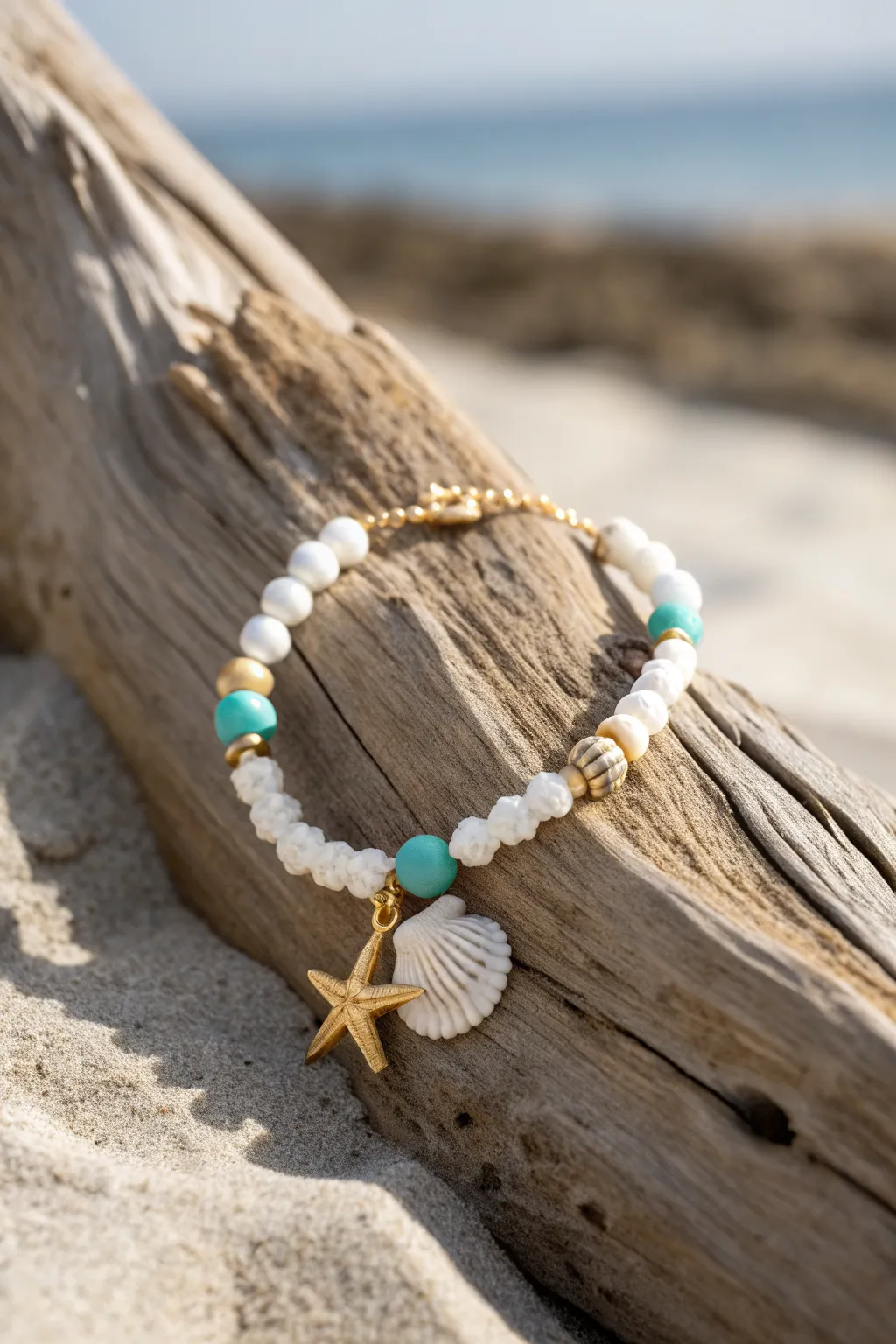
Capture the essence of a perfect beach day with this elegant yet playful bracelet design. Combining textured white beads, pops of turquoise, and classic maritime charms creates a piece that feels like a wearable souvenir from the boardwalk.
Step-by-Step Guide
Materials
- White round beads (approx. 6mm, shell or smooth stone)
- White textured heishi beads or crushed shell chips
- Turquoise round beads (6mm)
- Gold spacer beads
- One decorative gold striped focal bead
- Gold starfish charm
- White clam shell charm
- Gold beading wire or strong stretch cord
- Gold jewelry chain (small link)
- Gold jump rings (4mm and 6mm)
- Crimp beads and crimp covers (if using wire)
- Jewelry pliers (flat nose and chain nose)
- Wire cutters
Step 1: Preparation & Bead Layout
-
Measure your wrist:
Start by measuring your wrist with a piece of string or a soft tape measure. Add about half an inch to this measurement to ensure the bracelet isn’t too tight once all the chunky beads are added. -
Visualize the pattern:
Lay out a bead board or a soft towel to arrange your design. The pattern is asymmetrical, so organizing it first is crucial. You want the charms to sit opposite the clasp. -
Prepare the center cluster:
Identify the center point of your design. This is where your turquoise focal bead and the two charms—the gold starfish and white shell—will hang. Place them in the middle of your workspace.
Loose Beads?
If your beads are sliding too much or the wire is exposed, add tiny gold seed beads between the larger stones. This acts as a buffer and helps the bracelet curve naturally around your wrist.
Step 2: Stringing the Left Side
-
Secure the wire:
Cut a length of beading wire about 10 inches long. Secure one end with a piece of tape or a bead stopper so your work doesn’t slide off as you string. -
Start with texture:
Begin stringing from the center moving outward to the left. Thread on about 1 to 1.5 inches of the textured white heishi beads or crushed shell chips. These provide a nice rustic contrast to the smooth beads. -
Add gold accents:
Slide on a gold spacer bead, followed by a turquoise round bead, and then another gold spacer. This frames the color pop beautifully. -
Transition to rounds:
Add three smooth white round beads. Follow this with a single gold spacer. -
Finish the left side:
Continue with three to four more smooth white round beads until you reach near the end of your measured length for this side.
Step 3: Stringing the Right Side
-
Return to center:
Now, go back to the other end of your wire (or continue if you are stringing straight through). Place your central turquoise bead. -
Attach the charms:
Using two jump rings, attach the gold starfish and the white shell charm directly onto the wire next to the central turquoise bead, or slide them onto a jump ring that you then thread onto the wire. -
Mirror the texture:
Thread on a section of the white textured heishi beads or chips, matching the length of the section on the left side. -
Add the striped bead:
Slide on the decorative gold striped bead. This unique element breaks up the symmetry and adds a touch of sophistication. -
Complete the pattern:
Finish this side with a mix of smooth white round beads and a turquoise bead, ensuring the total length matches your wrist measurement.
Make It a Set
Create matching hoop earrings by threading just the textured white chips and a turquoise bead onto gold hoop wires. It ties the whole beach look together perfectly.
Step 4: Finishing Touches
-
Add crimp beads:
Thread a crimp bead onto one end of the wire, followed by a small length of gold chain (about 1-2 inches) which acts as an extender. -
Loop and secure:
Loop the wire back through the crimp bead and pull it tight, leaving a tiny loop for wiggle room. Use your flat nose pliers to squash the crimp bead flat effectively securing the wire. -
Cover the crimp:
Take a gold crimp cover and place it over the flattened crimp bead. Gently squeeze it closed with pliers to make it look like a smooth gold bead. -
Attach the clasp:
On the opposite end of the bracelet, repeat the crimping process, but instead of chain, attach your lobster clasp or spring ring. -
Double check security:
Give the bracelet a gentle tug to ensure all crimps are holding tight. Trim any excess wire tails close to the beads.
Slip on your new creation and enjoy the summery vibes no matter the season
Beach Bracelet Stack Set
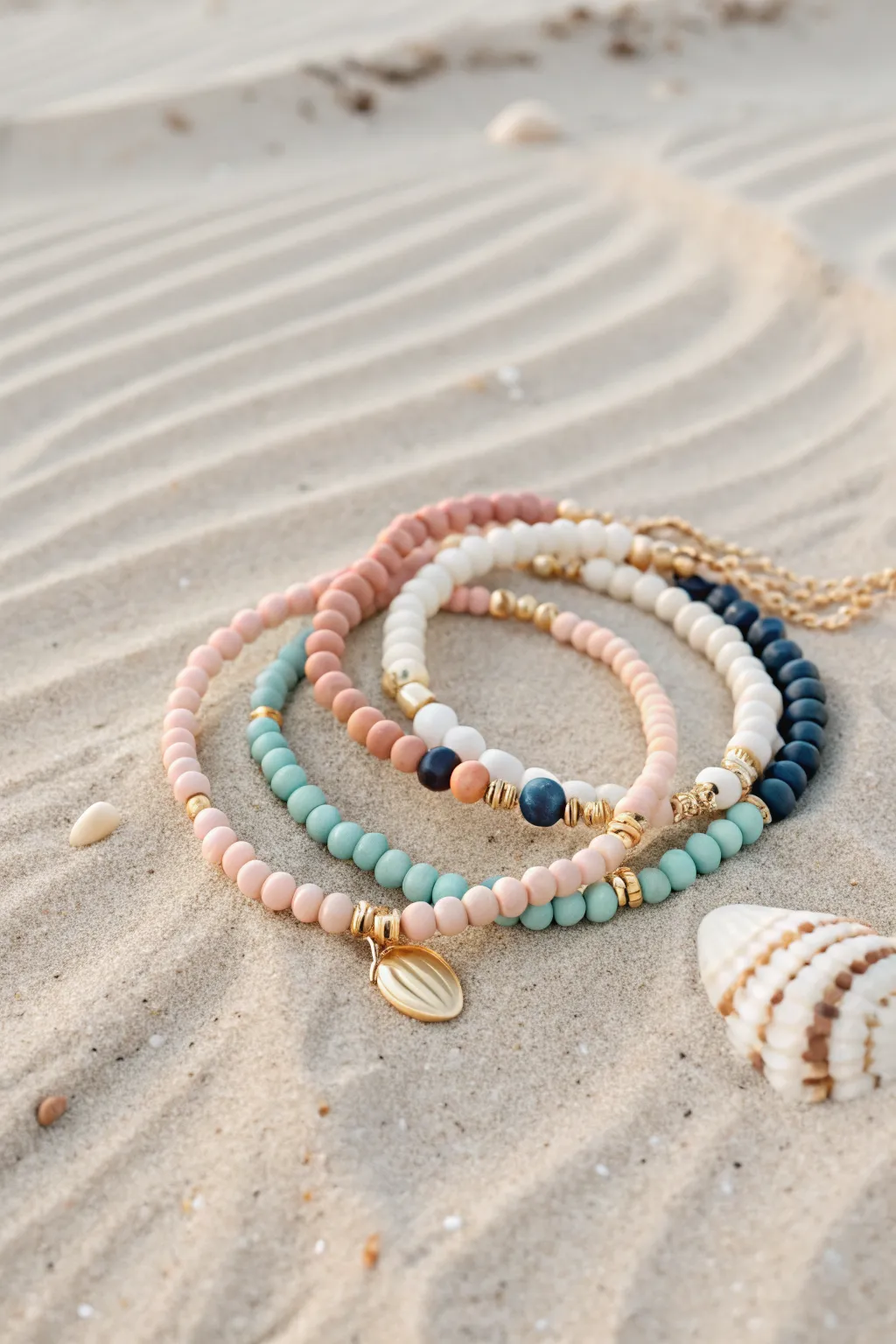
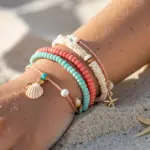
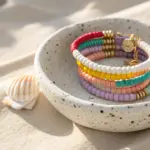
Capture the essence of a serene beach day with this beautiful stack of layered stretch bracelets. Combining soft pastels, deep navy accents, and gold textures, this set is perfect for casual summer wear.
How-To Guide
Materials
- 4mm round matte beads (pale pink, teal/mint, white, terracotta/dusty rose, navy blue)
- Small gold spacer beads (round and disc shapes)
- Gold tone accent beads (faceted or textured)
- Gold finish shell charm with loop
- Gold jump ring
- Gold extension chain (optional)
- 0.8mm clear elastic stretch cord
- Jewelry glue (like E6000 or GS Hypo Cement)
- Scissors
- Bead stopper or tape
- Flat nose pliers
Step 1: Planning the Stack
-
Design your palette:
Lay out your bead colors on a bead board or soft cloth. This stack relies on a mix of solid color strands and mixed strands. You will be making three distinct bracelets that wear well together. -
Measure your wrist:
Wrap a measuring tape loosely around your wrist. Add about half an inch to this measurement to ensure the bracelets sit comfortably without pinching. -
Prepare the cord:
Cut three lengths of elastic cord, each about 10-12 inches long. This gives you plenty of extra room for tying knots later. -
Secure the ends:
Place a bead stopper or a piece of tape on one end of each cord string to prevent beads from sliding off while you work.
Knot Hiding Trick
Make sure one bead near the end has a larger hole (like a metal spacer) to easily hide your elastic knot inside.
Step 2: Bracelet 1: The Charm Strand
-
String the base color:
For the bottom bracelet shown, begin stringing the pale pink matte beads. Fill about 1/3 of your desired length. -
Add the focal section:
Switch to the teal/mint beads for the center section. String enough teal beads to cover the front of your wrist (approx. 2-3 inches). -
Add gold spacers:
Insert small gold disc spacers occasionally between the teal beads to add texture and shine, just like in the photo. -
Finish the strand:
Complete the strand with more pale pink beads until you reach your measured length. -
Attach the charm:
Use your flat nose pliers to open a jump ring. Slide on the gold shell charm, hook it onto the center of the teal section between two beads, and close the ring securely.
Step 3: Bracelet 2: The Mixed Accent Strand
-
Start the pattern:
This middle strand uses a mix. Start with white matte beads for about an inch. -
Create color blocks:
Transition to sections of terracotta or dusty rose beads. Separate these sections with gold faceted accent beads. -
Add the navy contrast:
In the center section, add a small grouping of navy blue beads flanked by white beads to create a striking focal point. -
Balance with gold:
Add slightly larger gold beads on either side of the navy section to frame it. I find this really elevates the look. -
Check symmetry:
Continue the pattern in reverse or randomly until the strand matches the length of your first bracelet.
Preventing Gap Stretching
Pre-stretch your elastic cord by pulling it firmly a few times before stringing. This stops the bracelet from sagging later.
Step 4: Bracelet 3: The Darker Tone (Top)
-
Create the base:
The top strand often features the darkest or most solid colors. String a long section of white beads first. -
Add the navy sequence:
Switch to the navy blue beads for the majority of the remaining length, offering a deep contrast to the pastels. -
Incorporate chain detail:
If you want to mimic the dangling chain look in the photo, slide a small segment of gold extension chain onto the cord near the back of the bracelet. -
Final sizing check:
Hold all three bracelets together around your wrist to ensure they sit nicely as a stack.
Step 5: Finishing Touches
-
Tie the surgeon’s knot:
Take the ends of your first bracelet’s cord. Cross right over left, then left over right and loop it through twice. -
Tighten securely:
Pull all four strands (the two tails and the two loop sides) tight to secure the knot close to the beads. -
Apply adhesive:
Dab a tiny amount of jewelry glue onto the knot. Let it dry for a minute so it becomes tacky but solid. -
Hide the knot:
Trim the excess cord ends carefully. Ideally, slide the knot inside the hole of a neighboring bead to hide it completely. -
Repeat for all:
Repeat the tying and gluing process for the remaining two bracelets.
Slip on your new stack and enjoy the breezy coastal vibes perfectly matched to your style
Glow-In-The-Dark Sea Sparkle
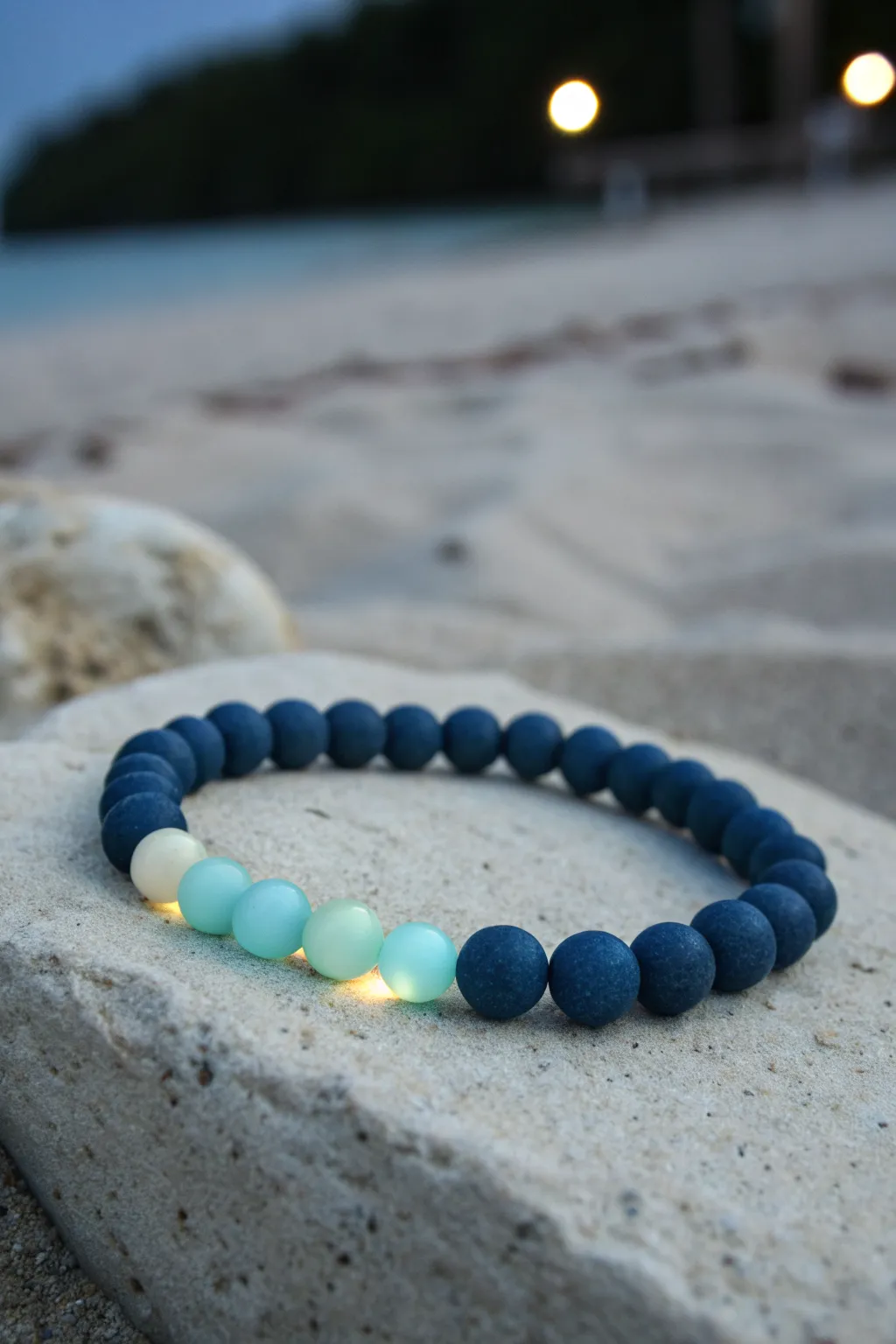
Capture the magic of bioluminescent waves lapping at the shore with this simple yet stunning bracelet design. By combining deep sea-blue matte beads with specific glow-in-the-dark accents, you can recreate the serene mood of a midnight beach walk right on your wrist.
Step-by-Step Tutorial
Materials
- Matte dark blue polymer clay beads (8mm or 10mm round)
- Pastel turquoise glow-in-the-dark acrylic beads (8mm or 10mm)
- Pale cream/white glow-in-the-dark acrylic beads (8mm or 10mm)
- Strong elastic stretch cord (0.8mm clear)
- Jewelry glue or clear nail polish
- Scissors
Step 1: Planning and Preparation
-
Measure your wrist:
Before you begin stringing, take a length of cord and wrap it loosely around your wrist to determine the desired fit. Add about 3-4 inches of extra length to this measurement to ensure you have plenty of room for tying the finishing knot. -
Cut the cord:
Cut your elastic cord to the calculated length using your scissors. It is always better to have too much cord than too little, so be generous. -
Pre-stretch the elastic:
This is a crucial step often missed: hold the ends of your cut cord and pull firmly several times. Pre-stretching the elastic now prevents the bracelet from loosening and sagging after you wear it a few times. -
Secure one end:
Place a piece of strong tape over one end of the cord, or clip a binder clip to it. This acts as a stopper so your beads don’t slide right off the other side while you work.
Step 2: Creating the Sea Pattern
-
Lay out your design:
Arrange your beads on a flat surface or a bead board. The design features a dominant run of dark matte blue beads, interrupted by a focal section of lighter colors. -
Start with the ‘Deep Sea’:
Begin by threading about 8 to 10 of the matte dark blue beads onto the cord. The textured matte finish gives a beautiful, rock-like contrast to the glowing beads. -
Add the first transition bead:
Thread on one pastel turquoise glow-in-the-dark bead. This represents the shallow water beginning to light up. -
Create the focal point:
Add your pale cream or white glow-in-the-dark bead next. This lightest bead acts as the center of the highlight. -
Complete the highlight:
Follow the cream bead with another one or two pastel turquoise beads. I like to vary the number slightly depending on wrist size, but keep the lighter colors clustered together. -
Finish the loop:
Fill the rest of the cord with your remaining dark blue matte beads until you reach the desired bracelet length. Check the fit by wrapping it around your wrist before tying.
Knot Slipping?
If your elastic knot refuses to stay tight while gluing, have a friend hold their finger on the first crossover while you tie the second, or use a bead stopper clip.
Step 3: Finishing Touches
-
Prepare the knot:
Remove the tape or clip from the end. Bring both ends of the cord together, ensuring there are no gaps between the beads. -
Tie a surgeon’s knot:
Cross the ends like a regular shoelace styling, but loop one end through twice instead of once. Pull tight, then repeat the process to secure it firmly. -
Apply adhesive:
Add a tiny drop of jewelry glue or clear nail polish directly onto the knot. This prevents the slick elastic from gradually working itself loose. -
Hide the knot:
While the glue is still slightly tacky, gently pull the cord so the knot slides inside the hole of one of the adjacent beads. This hides the mechanics and makes the bracelet look professional. -
Trim excess cord:
Once the glue is fully dry, carefully trim the excess tails of the elastic cord as close to the bead hole as possible without nipping the main knot. -
Charge the glow:
Set your finished bracelet under a bright lamp or in direct sunlight for a few minutes to activate the luminescent beads.
Wave Gradient
Make the glow gradient smoother by using 5 highlight beads: Dark Teal > Turquoise > White > Turquoise > Dark Teal, before switching back to the navy matte beads.
Now you have a piece of the ocean’s mystery ready to wear for your next evening adventure
Beach Coordinates Color Code
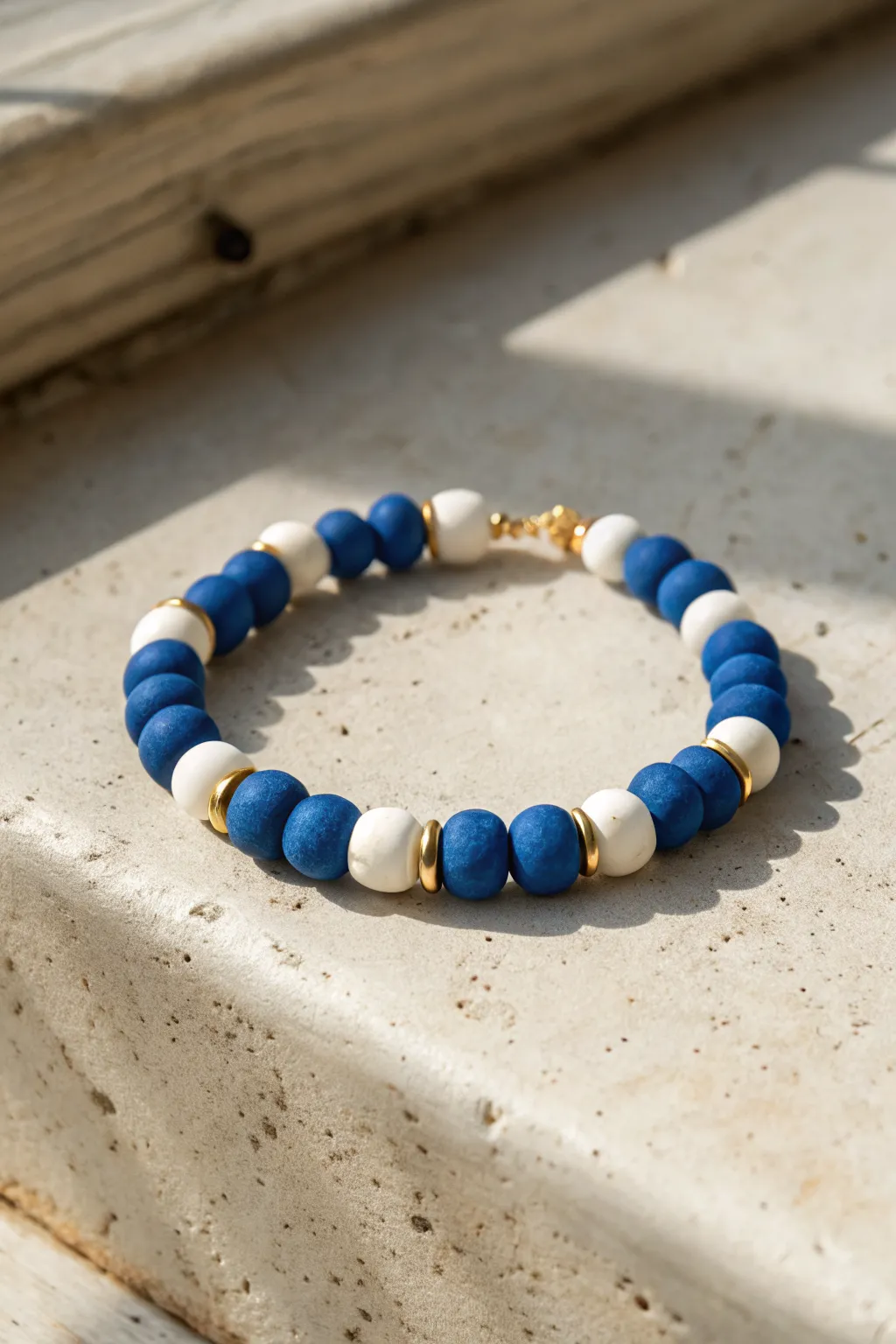
Capture the essence of a crisp day at sea with this striking bracelet featuring matte clay beads in deep cobalt and creamy white. The addition of subtle gold accents gives it an upscale, finished look perfect for stacking or wearing solo.
Detailed Instructions
Materials
- 8mm round polymer clay beads (matte cobalt blue)
- 8mm round polymer clay beads (matte white)
- 4mm gold flat disc spacers (heishi style)
- Gold crimp beads (2mm)
- Gold wire guardians (2)
- Small gold lobster clasp and jump ring
- Flexible beading wire (e.g., Soft Flex or Tigertail)
- Crimping pliers
- Wire cutters
- Bead stopper or tape
Step 1: Preparation & Pattern Design
-
Measure your wrist:
Before cutting any wire, measure your wrist with a flexible measuring tape and add about 1/2 to 3/4 of an inch to find your ideal bracelet length. This accounts for the bulk of the 8mm beads. -
Cut the beading wire:
Cut a piece of beading wire approximately 10-12 inches long. This extra length gives you plenty of room to finish the ends comfortably without struggling. -
Secure one end:
Attach a bead stopper to one end of the wire. If you don’t have one, a piece of strong tape folded over the end works perfectly to keep beads from sliding off. -
Understand the pattern unit:
Study the pattern shown: The main motif is a segment of two blue beads. These segments are separated by white beads. Notice specifically that the white beads are flanked by gold spacers.
Spacer Size Matters
If your gold spacers are flipping sideways or getting swallowed by the clay beads, try using two spacers stacked together or opt for slightly wider 5mm discs.
Step 2: Stringing the Beads
-
Start the sequence:
Begin stringing with two matte blue beads. This will be the center of a blue section. -
Add the first accent:
Slide on one gold disc spacer, followed by one white round clay bead, and then another gold disc spacer. This creates the white accent cluster. -
Add a blue section:
Thread on two blue beads. I usually double-check at this point that the matte finish is consistent on both beads. -
Repeat the pattern:
Continue the pattern: gold spacer, white bead, gold spacer, then two blue beads. Repeat this sequence until you are within an inch of your desired length. -
Check the fit:
Wrap the strung wire around your wrist to check the sizing. Remember the clasp will add a small amount of length. -
Adjust symmetry:
Try to end the pattern symmetrically if possible. For example, if you started with two blue beads, ending with a white accent section often looks balanced.
Matte Finish Care
Matte clay beads can absorb oils. Coat them lightly with a matte varnish before stringing to keep them pristine and prevent staining.
Step 3: Finishing the Ends
-
String the first crimp:
On the end without the bead stopper, slide on a gold crimp bead followed by a wire guardian. -
Attach the clasp:
Feed the wire through the guardian loops and hook your lobster clasp onto the guardian. Thread the wire back down through the crimp bead and the first regular bead on your strand. -
Secure the first crimp:
Pull the wire tight so there is no slack, but not so tight the bracelet gets stiff. Use your crimping pliers to flatten or fold the crimp bead securely. -
Trim excess wire:
Use your wire cutters to trim the short tail of wire as close to the beads as possible. -
Finish the second end:
Remove the bead stopper from the other end. Slide on a crimp bead and wire guardian. Attach a jump ring to this guardian. -
Final secure:
Thread the wire back through the crimp bead and pull tight to remove slack. Crimp the bead securely and trim the final wire tail.
Enjoy wearing your sophisticated new accessory that brings a touch of coastal elegance to any outfit