
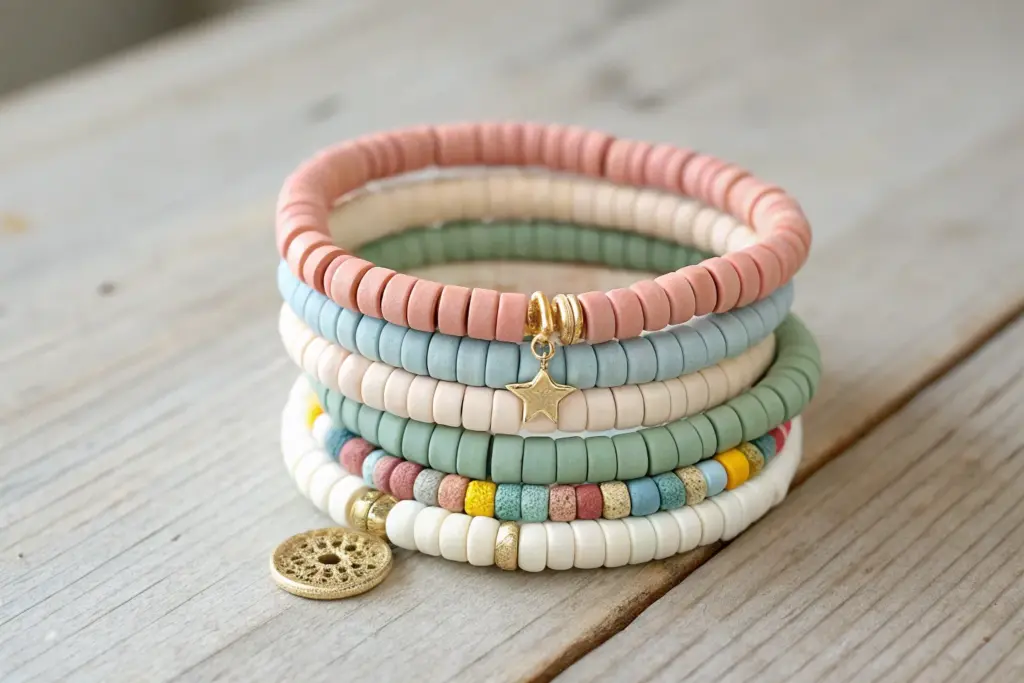
When you want a cute jewelry win without complicated tools, clay bead projects are my go-to every time. These easy ideas are all about simple patterns, fun color combos, and little upgrades that make a basic strand feel totally finished.
Clay Bead Color-Block Bracelet
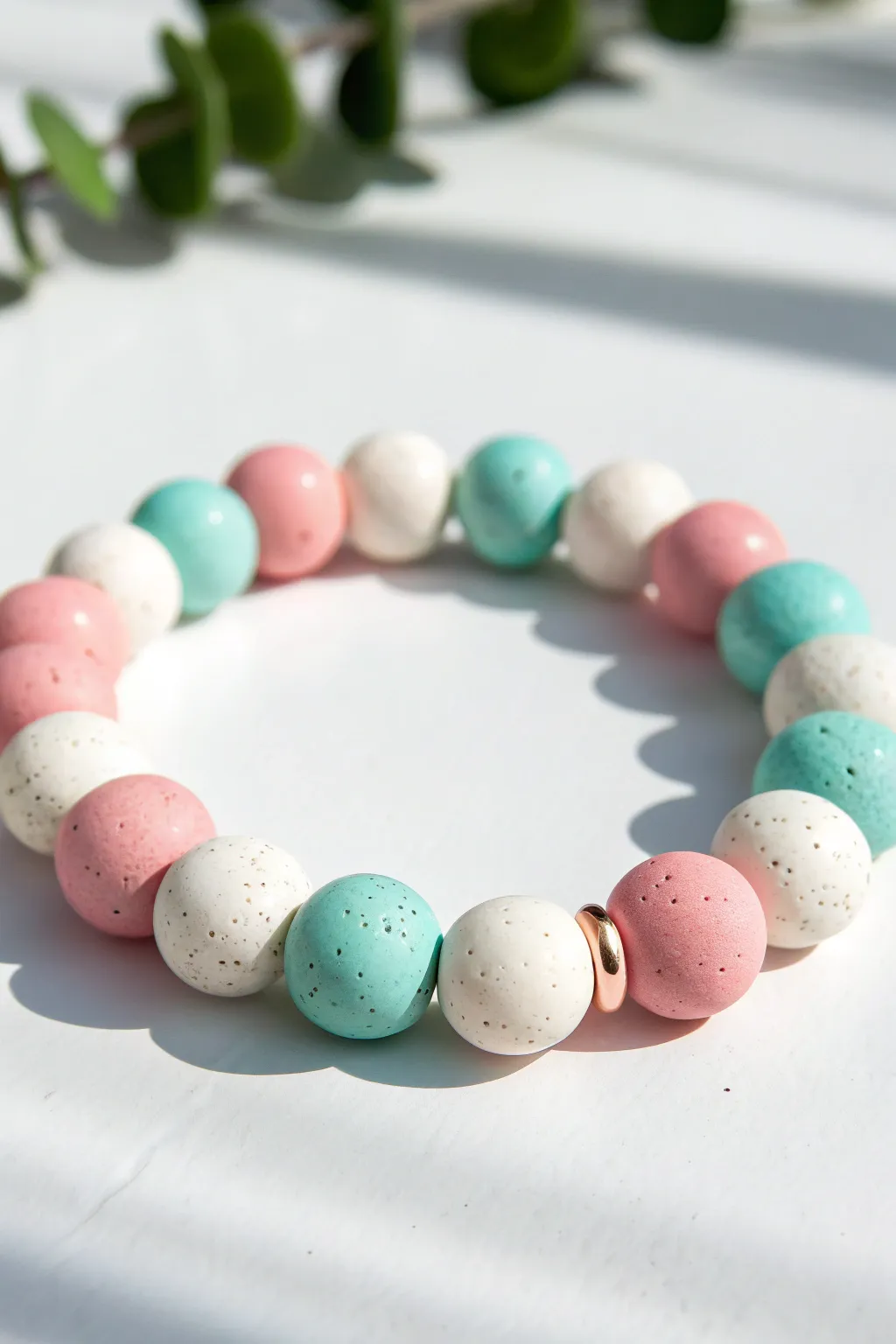
Recreate the charm of ceramic stone with polymer clay beads in this sweet pastel project. Featuring a speckled finish and a touch of metallic shine, this bracelet offers a high-end boutique look you can easily make at home.
Step-by-Step Guide
Materials
- White polymer clay (approx. 2oz)
- Pastel pink polymer clay
- Mint or teal polymer clay
- Coarse black pepper or black embossing powder (for speckling)
- Rose gold spacer bead or jump ring
- Elastic beading cord (0.7mm or 0.8mm)
- Bead piercing pin or toothpick
- Clear nail polish or jewelry glue
- Rolling pin or acrylic roller
- Clay slicer or knife
- Baking sheet
- Parchment paper
Step 1: Preparing the Speckled Clay
-
Condition the white clay:
Start by kneading the white polymer clay until it is soft and pliable. This warmth helps prevent cracks later. -
Add the speckles:
Sprinkle a very small pinch of coarse ground black pepper or black embossing powder onto the flattened white clay. Fold the clay over itself. -
Distribute the texture:
Knead the clay thoroughly again. Continue folding and pressing until the black specks are evenly distributed throughout the white block. -
Mix the pastel colors:
Repeat the speckling process with your pink and mint clays separately. If you want a softer look, you can mix a little of the speckled white clay into your colored clays to lighten them.
Step 2: Forming the Beads
-
Create a log:
Roll your speckled white clay into a long, even snake, aiming for a consistent thickness of about 1/2 inch. -
Segment evenly:
Using your clay slicer, cut the log into equal-sized segments. Keeping these uniform ensures all your beads will be the same size. -
Roll spheres:
Take a segment and roll it between your palms to create a smooth, round ball. I find a light circular motion creates the best sphere. -
Repeat for colors:
Repeat the rolling and cutting process for your pink and mint clays, creating enough beads to wrap around your wrist (usually 18-22 beads total). -
Pierce the holes:
Gently hold a clay ball and push your piercing tool through the center. twist the tool slightly as you push to avoid squishing the shape. -
Check the exit:
Once the tool pokes through, pull it out and re-insert it from the other side to ensure the hole is clean and wide enough for your cord.
Make Them Lighter
To save clay and reduce weight, scrunch up a small ball of aluminum foil and wrap your clay around it. This creates a lightweight core perfect for chunky beads.
Step 3: Baking and Assembly
-
Arrange for baking:
Place your pierced beads onto a baking sheet lined with parchment paper. If you have a bead rack, use it, otherwise, simply rest them on a specific side. -
Bake the clay:
Bake according to your clay manufacturer’s instructions (typically 275°F for 15-30 minutes). Let them cool completely before handling. -
Arrange the pattern:
Lay out your cooled beads on a table. Create your color-block pattern (e.g., two white, one teal, two white, one pink) to see how they look before stringing. -
Start stringing:
Cut a piece of elastic cord about 10 inches long. Don’t stretch it yet. Thread your beads in your chosen pattern. -
Add the accent:
Slide the rose gold spacer bead onto the cord at a focal point in your pattern. -
Tie the knot:
Bring the ends of the elastic together and tie a strong surgeon’s knot (right over left, left over right). Pull tight to secure. -
Trim and finish:
Dab a tiny drop of glue or clear nail polish on the knot to seal it. Once dry, snip the excess cord closely and tuck the knot inside a neighboring bead.
Matte Finish magic
Gently sand baked beads with fine-grit sandpaper (1000+) under running water. This removes fingerprints and creates a professional, velvety stone texture.
Wear your new color-block bracelet stacked with others or let it shine on its own as a simple statement piece
Clay Bead Random Confetti Mix
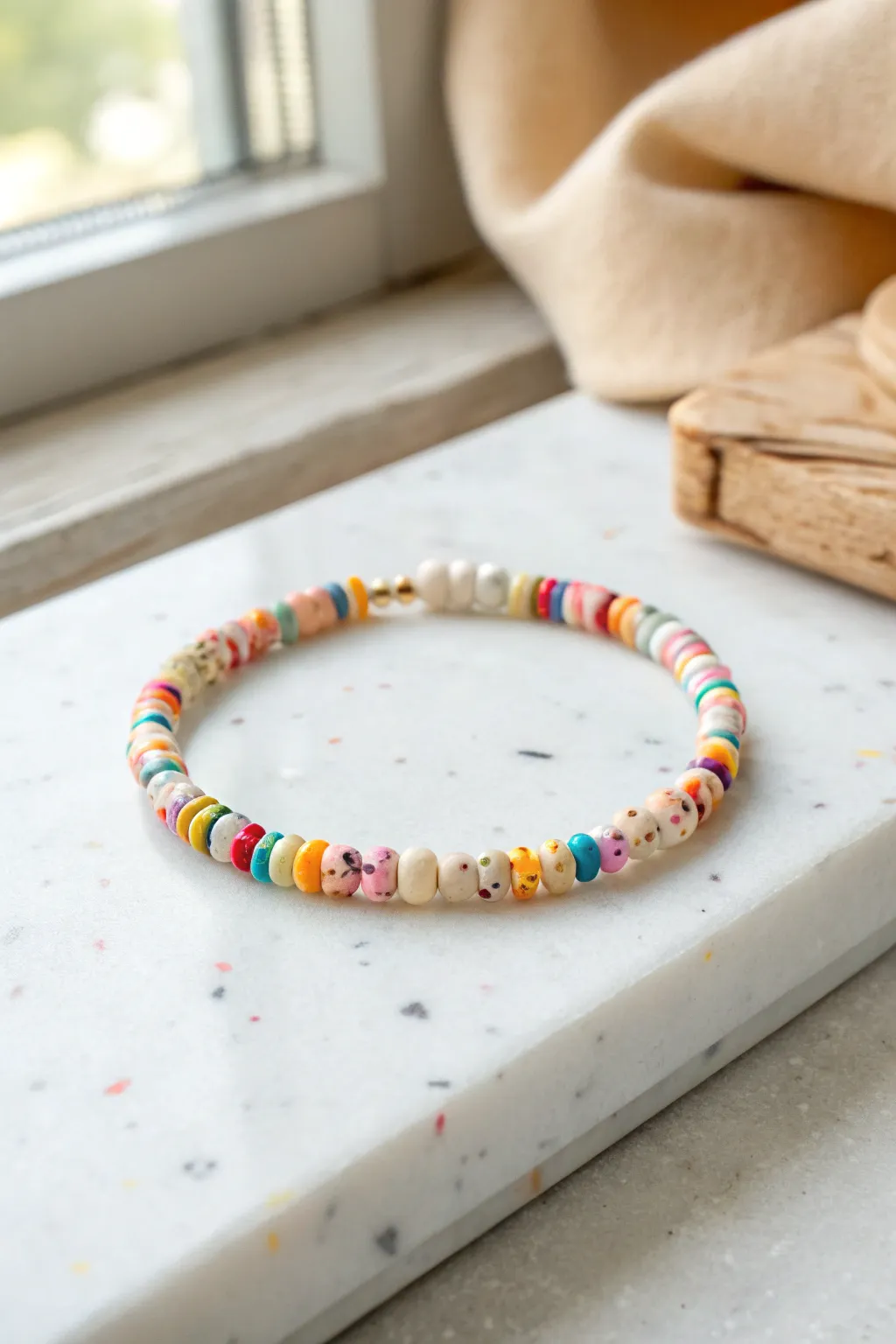
Embrace the imperfect charm of handmade jewelry with this delightful confetti-style bracelet. Using chunky, organic clay beads in a random mix of cream, vibrant colors, and speckled textures creates a laid-back accessory perfect for stacking.
Step-by-Step
Materials
- Polymer clay in various colors (white, cream, yellow, pink, blue, red, teal)
- Black or brown acrylic paint (for speckles)
- Small paintbrush or toothbrush
- Elastic beading cord (0.8mm or 1mm)
- Super glue or jewelry cement
- Gold spacing bead (optional)
- Clay roller or pasta machine
- Small circular cutter or straw (for shaping beads)
- Toothpick or bead piercer
- Baking sheet and parchment paper
- Scissors
Step 1: Creating the Clay Canes
-
Condition the base clay:
Begin by kneading your white or cream polymer clay until it is soft and pliable. This will act as the primary base for your speckled beads. -
Mix solid colors:
Condition small amounts of your colorful clays—yellow, pink, teal, red, and blue. You want a diverse palette to create that random confetti look. -
Create speckled effects:
To mimic the stone-like texture seen in the photo, take a small portion of cream clay and mix in tiny flecks of black or brown clay, or even black pepper, kneading just enough to distribute the specks without blending the colors entirely. -
Form the logs:
Roll each color of clay into a thin snake or log shape, aiming for a diameter of about 4-5mm depending on how chunky you want your final beads.
Smoother Bead Holes
To avoid squishing beads while piercing, let the raw clay sit for 20 mins to firm up slightly, or pierce them while they are still on the table rather than holding them.
Step 2: Shaping and Baking Beads
-
Slice the beads:
Using a sharp clay blade, slice the logs into small discs. Vary the thickness slightly—some thin like heishi beads, some thicker like donuts—to achieve that organic, handmade feel. -
Pierce the holes:
Gently pierce the center of each disc with a toothpick or bead pin. I find giving the toothpick a little twist as it goes through helps keep the bead round without squashing it. -
Smooth the edges:
Once pierced, lightly roll the edge of each bead between your fingers to soften any sharp cuts and enhance the rounded, pebble-like shape. -
Bake the beads:
Arrange your raw beads on a parchment-lined baking sheet. Bake according to your polymer clay package instructions (usually around 275°F/135°C for 15-30 minutes). -
Add painted details:
After the beads have cooled completely, create a splatter effect on the solid cream beads. Dip a stiff brush or toothbrush into watered-down acrylic paint and flick tiny droplets onto a few selected beads for extra texture. -
Seal the paint:
Let the paint dry fully, then consider applying a thin matte varnish to protect the speckled finish if you plan on wearing this in water.
Step 3: Assembly
-
Measure your cord:
Cut a piece of elastic cord about 10-12 inches long. This gives you plenty of extra room for tying knots without struggling with tension. -
Pre-stretch the elastic:
Give your elastic cord a few firm tugs before stringing. This step is crucial preventing the bracelet from stretching out and becoming loose after the first wear. -
Plan your pattern:
Lay your beads out on a bead board or towel. Aim for a ‘planned random’ look: mix solid brights with neutrals and speckled beads, ensuring no two identical colors are right next to each other. -
Start stringing:
Thread the beads onto the elastic. If you are using a gold accent bead, I like to place it near where the knot will be to help disguise the join later. -
Check the fit:
Wrap the strung beads around your wrist to check the size. Add or remove beads until it sits comfortably without digging into your skin. -
Tie the knot:
Tie a surrealist knot or a square knot (right over left, left over right). Pull the elastic tight so the beads bunch together snugly. -
Secure and finish:
Apply a tiny drop of super glue or jewelry cement directly onto the knot. Allow it to dry for a few seconds before trimming the excess cord tails close to the knot.
Matte Finish Magic
For a true ceramic look, gently sand your baked beads with high-grit sandpaper or buff them with denim fabric to remove fingerprints and create a soft matte sheen.
Enjoy wearing your unique, color-splashed creation alongside your favorite watch or bangles
Clay Bead Simple Stripe Pattern
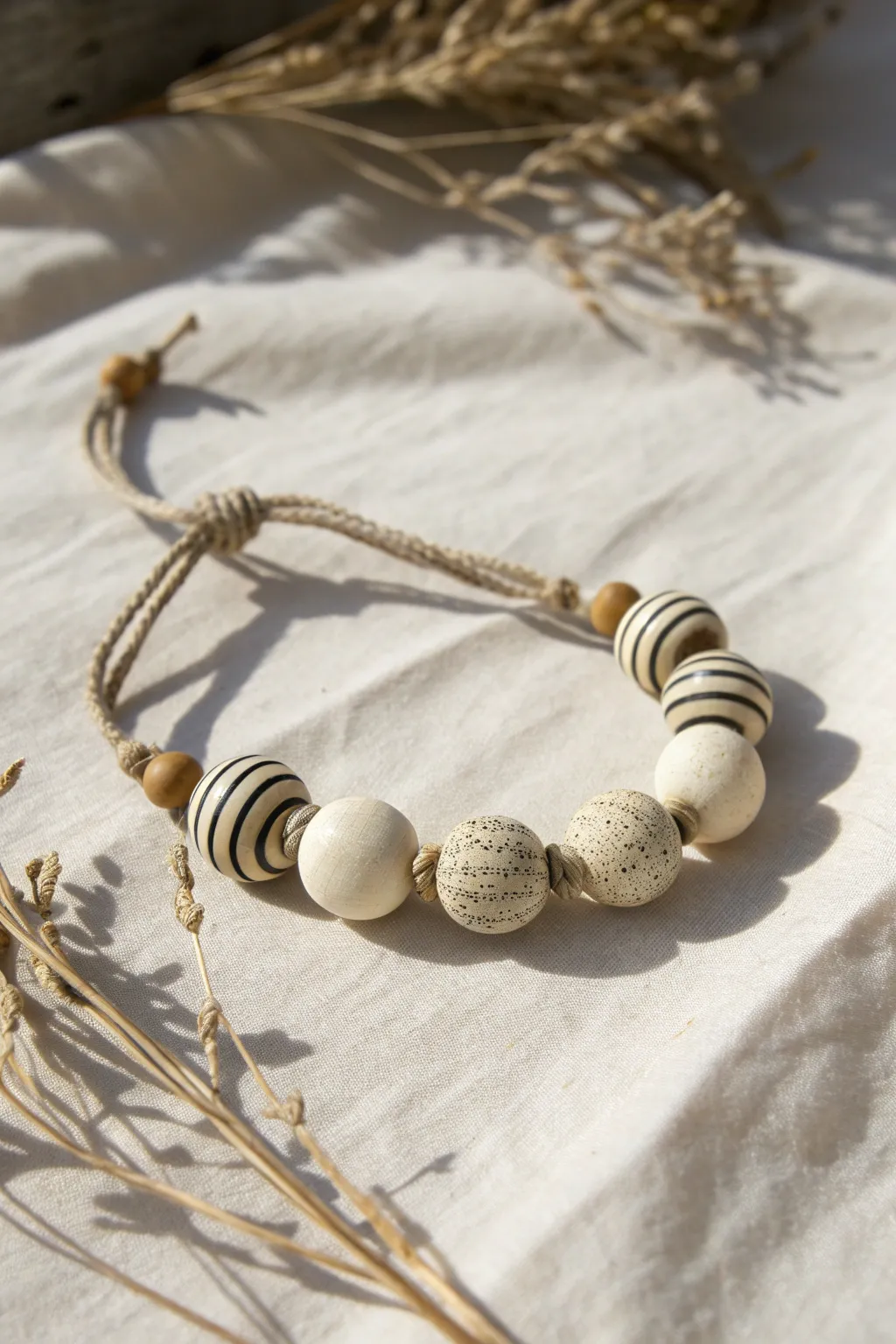
Embrace a natural, earthy aesthetic with this beautiful clay bead necklace that combines raw textures with clean, modern lines. Featuring hand-rolled beads with speckled and striped details strung on natural cord, this piece is a perfect introduction to customizable jewelry making.
How-To Guide
Materials
- White or cream polymer clay (or air-dry clay)
- Black acrylic paint
- Fine-grit sandpaper
- Pointed tool (toothpick, skewer, or bead reamer)
- Small flat paintbrush
- Old toothbrush (for speckling)
- Natural hemp or jute cord (approx. 2mm thick)
- Scissors
- Clear matte varnish (optional)
- Small wooden beads (optional, for closure)
Step 1: Creating the Bead Base
-
Condition the Clay:
Begin by warming your polymer clay in your hands, kneading it until it is soft, pliable, and free of cracks. If you are using air-dry clay, ensure it is moist. -
Portion the Beads:
Divide your clay into equal portions. For the necklace shown, you will need approximately 7 large beads (about 1 inch in diameter) and 2 smaller beads for the ends. -
Roll Spheres:
Roll each portion between your palms to create smooth, round spheres. Don’t worry about perfect symmetry; slight organic variations add to the charm. -
Pierce the Holes:
Using a skewer or thick needle tool, carefully pierce a hole through the center of each bead. Rotate the tool gently as you push through to prevent warping the shape. -
Widen the Channel:
Since we will be using thick cord, make sure the holes are generous. Wiggle your tool slightly to widen the channel. -
Cure or Dry:
Bake your polymer clay beads according to the package instructions, or let your air-dry clay set completely (usually 24-48 hours depending on humidity).
Step 2: Adding Patterns & Finish
-
Smooth the Surface:
Once hardened and cooled, lightly sand the beads with fine-grit sandpaper to remove any fingerprints or rough edges. -
Paint the Stripes:
Select 3 or 4 beads for the striped design. Using a small flat brush and black acrylic paint, carefully paint horizontal bands around the circumference of the bead. You can vary the thickness for interest. -
Create speckles:
For the speckled beads, dip an old toothbrush into slightly watered-down black paint. Run your thumb across the bristles to flick tiny splatters onto 2 of your plain beads. -
Leave Some Plain:
Keep at least one central bead completely plain cream/white to act as a visual anchor in the pattern. -
Seal:
Once the paint is fully dry, apply a thin coat of matte varnish to protect the design, especially if using air-dry clay.
Clean Stripes
To get straighter lines on round beads, place the bead on a spinning object (like a lazy Susan or a drill on low speed) and hold your brush steady against it.
Step 3: Assembly
-
Cut the Cord:
Cut a length of hemp or jute cord roughly 28 inches long, depending on your desired necklace drop. -
Start the Sequence:
String your beads in a symmetrical pattern. Based on the photo, follow this order: Striped, Plain, Speckled, Speckled, Plain, Striped. -
Add Knot Spacers:
Between each large bead, tie a simple overhand knot with the cord. Slide the knot tight against the bead before adding the next one. This keeps them separated and adds texture. -
Secure the Ends:
Tie a secure knot at both ends of the beaded section to keep the main beads in place. -
Create the Closure:
For the adjustable sliding knot shown in the back, overlap the two ends of your cord. Use a separate shorter piece of cord to tie a series of macramé square knots (or a simple wrapping knot) around the overlapped section. -
Add End Stoppers:
Thread a small wooden or clay bead onto the very tips of the hanging cords. Tie a knot below each effectively stopping them from sliding through the closure mechanism. -
Trim Excess:
Trim any loose ends from your knots and dab a tiny bit of glue on the knots for extra security.
Color Pop
Replace the black paint with terracotta or sage green for a softer look, or mix metallic gold flakes into your plain clay for a luxe marble effect.
Now you have a stunning, artisanal necklace ready to wear or gift
Clay Bead Rainbow Order Stack
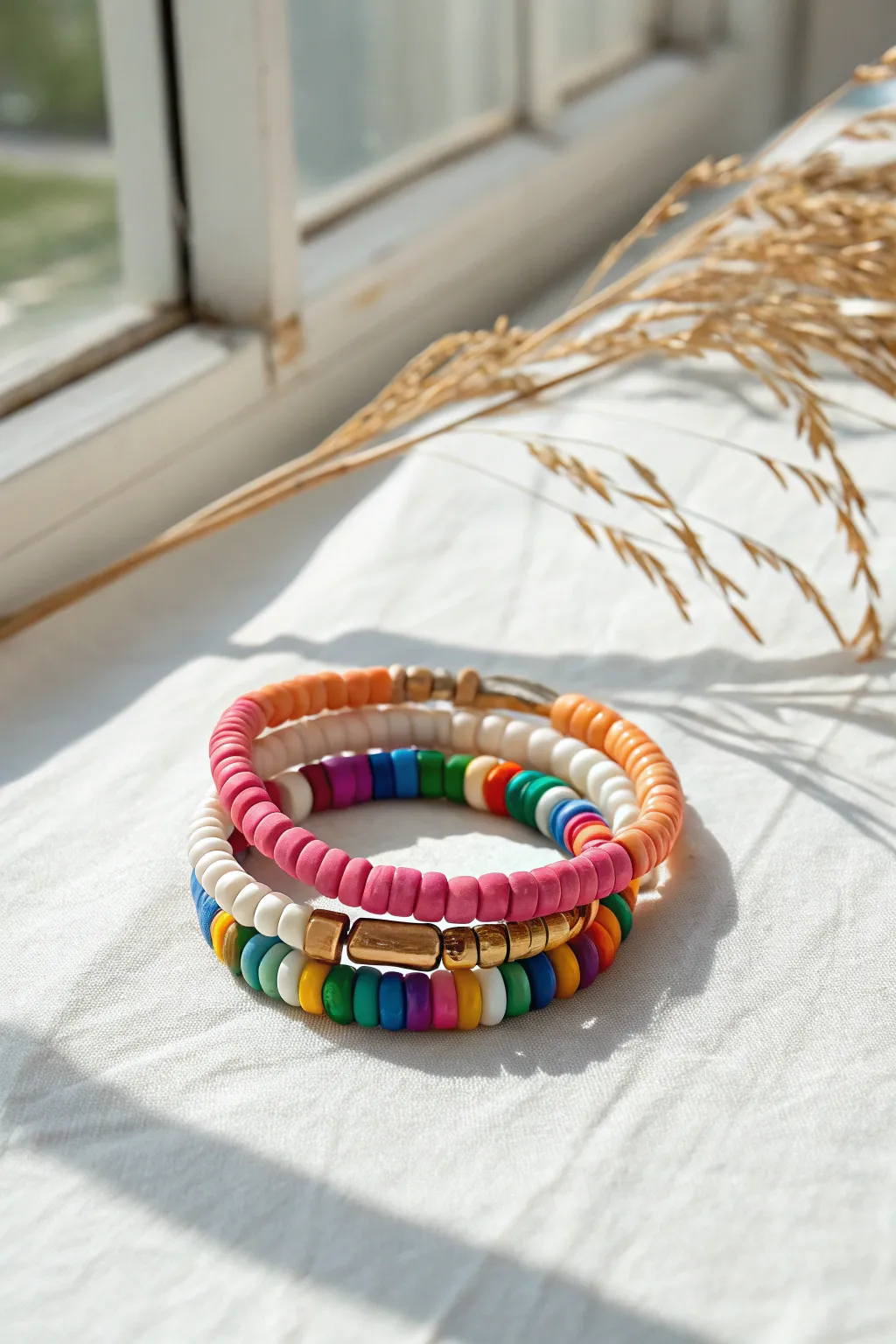
These three interlocking bracelets create a vibrant pop of color perfect for stacking alongside your watch or other jewelry. By mixing solid blocks of color with a playful rainbow pattern, you get a textured, bohemian look that feels both casual and polished.
Step-by-Step Guide
Materials
- Polymer clay Heishi disc beads (6mm or similar)
- Colors: Hot pink, light pink, orange, yellow, green, blue, purple, white
- Gold spacer beads (tube style and small geometric)
- Strong elastic jewelry cord (0.8mm recommended)
- Jewelry glue or clear nail polish
- Scissors
- Bead stopper or tape
Step 1: The Pink Ombré Bracelet
-
Measure your cord:
Cut a piece of elastic cord about 10-12 inches long. This gives you plenty of extra room for tying knots later. -
Secure the end:
Place a bead stopper or a piece of tape on one end of the cord to prevent your hard work from sliding off. -
Start the pattern:
Begin threading the hot pink disc beads. Add about 2 inches of just this bold pink color. -
Transition colors:
Switch to your orange beads. Thread another section roughly 1.5 inches long to create a color-blocked effect. -
Complete the circle:
Finish the strand by adding white clay beads until the bracelet is the correct size for your wrist (usually 6.5 to 7 inches total). -
Add a gold accent:
Before tying it off, slip on one small gold spacer bead to hide the knot joint later. -
Tie and secure:
Tie a strong surgeon’s knot (right over left, left over right), pull tight, dot with glue, and slide the knot inside the gold bead if possible. Let dry before trimming tails.
Step 2: The Rainbow Mix Bracelet
-
Prep the cord:
Cut another 10-12 inch length of elastic and secure the end again. -
Create color clusters:
This pattern relies on small groups. Thread 3 red beads, then 3 orange beads, followed by 3 yellow beads. -
Continue the spectrum:
Keep the pattern going with 3 green, 3 blue, and 3 purple/indigo beads. -
Repeat freely:
Repeat this rainbow sequence around the entire bracelet. I like to occasionally vary the number (maybe 2 or 4 beads) to make it look a bit more organic. -
Break it up:
Halfway through, add a small section of white beads (about 5-6) to give the eye a resting place, then resume the rainbow clusters. -
Finish and knot:
Check the fit against the first bracelet, tie your secure surgeon’s knot, glue, and trim the excess cord.
Stretch Test It
Before tying your final knot, pre-stretch the elastic slightly. This prevents the bracelet from loosening up and sagging after the first few times you wear it.
Step 3: The White & Gold Accent Bracelet
-
Start with neutrals:
Cut your third cord. Begin threading straight white disc beads for about 2 inches. -
Insert the focal point:
Thread on a sequence of gold accents: one gold disc, one gold rectangle tube bead, and another gold disc. -
Add color pops:
On either side of this gold section, add a tiny pattern of rainbow beads—just one of each color (red, orange, yellow, blue) to tie it into the other bracelets. -
Fill the rest:
Fill the remainder of the strand with white beads until it matches the size of the previous two. -
Final assembly:
Tie your final knot securely. Add a dot of glue for longevity. -
Stack them up:
Once the glue is fully dry on all three, stack them on your wrist to see how the patterns play off each other.
Go Geometric
Swap the round gold spacer beads for small gold cubes or hexagon nuts from a hardware store for an edgier, industrial vibe on the accent bracelet.
Now you have a custom stacked set ready to brighten up any outfit

The Complete Guide to Pottery Troubleshooting
Uncover the most common ceramic mistakes—from cracking clay to failed glazes—and learn how to fix them fast.
Clay Bead Ombre Fade Bracelet
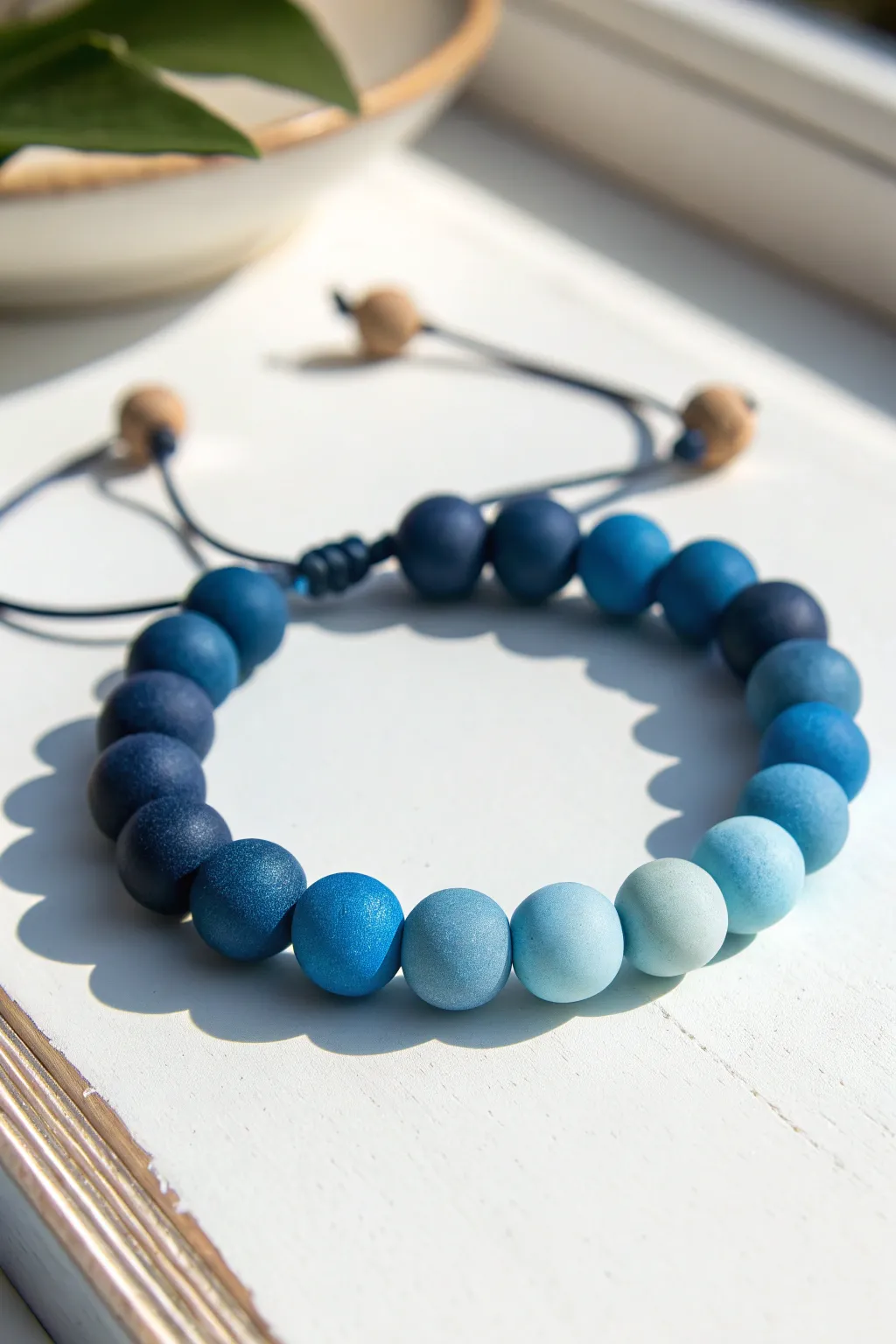
Capture the serene transition of ocean depths to icy shallows with this elegant ombre bracelet. Using polymer clay allows you to mix custom shades creating a perfectly seamless gradient that simple store-bought beads can’t match.
How-To Guide
Materials
- Polymer clay (Navy Blue, White, and optional Black)
- Bead roller tool (or a small flat surface)
- Toothpicks or a bead piercing pin
- Baking sheet and parchment paper
- Waxed cotton cord or nylon beading cord (1mm, dark blue or black)
- 2 small wooden accent beads
- Scissors
- Lighter (to seal cord ends)
- Wet/dry sandpaper (400 and 800 grit)
Step 1: Mixing the Gradient
-
Prepare your base colors:
Start by conditioning your navy blue and white polymer clay until soft and pliable. If you want an even darker starting shade, mix a tiny speck of black into a portion of the navy blue. -
Create the darkest shade:
Set aside a marble-sized ball of your pure navy blue clay. This will be your darkest anchor color for the ombre sequence. -
Mix the first mid-tone:
Take a portion of navy blue and mix in a very small amount of white clay (about a 4:1 ratio). Knead thoroughly until the color is solid and streak-free. -
Create lighter progressive variations:
Continue this process, creating 4-5 distinct balls of clay. For each subsequent ball, increase the proportion of white clay significantly. Your final ball should be almost white with just a hint of blue. -
Arrange the spectrum:
Line up your mixed clay balls in order from darkest to lightest to ensure the transition looks smooth before you start rolling individual beads.
Step 2: Rolling and Baking
-
Portion the beads:
Pinch off roughly equal amounts of clay from each color ball. You will likely need 2-3 beads of each specific shade to make a full bracelet. -
Roll spheres:
Roll each pinch of clay between your palms or use a bead roller to create perfectly smooth, round spheres. Aim for a diameter between 8mm and 10mm. -
Pierce the holes:
Gently twist a toothpick or piercing pin through the center of each bead. Rotate the bead as you push to prevent flattening slightly. I find twisting the toothpick as I pull it back out helps keep the hole clean. -
Refine the shape:
If the piercing distorted the sphere, gently roll it again lightly between your fingers with the toothpick still inside. -
Bake the beads:
Arrange the beads on a parchment-lined baking sheet. Bake according to your polymer clay package instructions (usually 275°F/135°C for 15-30 minutes). -
Sand for a matte finish:
Once cool, briefly sand the beads under running water using 400 and then 800 grit sandpaper. This gives them that professional, soft matte texture seen in the photo.
Pro Tip: Consistent Sizing
Use a small circle cutter or a measuring spoon to portion out the raw clay before rolling. This ensures every single bead is exactly the same size.
Step 3: Assembly and Knotting
-
Cut the cord:
Cut a piece of your waxed cord about 24 inches long. This gives you plenty of slack for the sliding knot mechanism. -
String the gradient:
Thread your beads onto the center of the cord. Pay close attention to the order: start with your lightest beads in the center, transitioning to the darkest on the outsides (or follow the continuous loop gradient shown in the photo). -
Check the fit:
Wrap the beaded section around your wrist to ensure the beads cover the top and sides of your wrist comfortably without being too tight. -
Form the closure loop:
Bring the two cord ends together, overlapping them so they lay parallel to each other, creating a circle. -
Learn the square knot:
Cut a separate short piece of cord (about 8 inches). Use this piece to tie a series of square macrame knots *over* the two overlapped main cords. This sliding knot allows the bracelet to expand and tighten. -
Secure the slider:
Once your knot section is about 0.5 inches long, trim the excess from the *tying* cord (not the main bracelet cords) and carefully melt the tips with a lighter to fuse the knot so it doesn’t unravel. -
Add stopper beads:
Thread one small wooden bead onto each loose end of the main bracelet cord. Tie a simple overhand knot after each wooden bead to keep it in place. -
Final trim:
Trim any excess cord past the wooden bead knots and lightly singe the ends to prevent fraying.
Troubleshooting: Fingerprints
If you see fingerprints on your raw clay beads, lightly dust your palms with cornstarch before the final roll, or gently buff them out with baby oil.
Enjoy the custom color transition of your handmade accessory
Clay Bead and Gold-Tone Spacer Rhythm
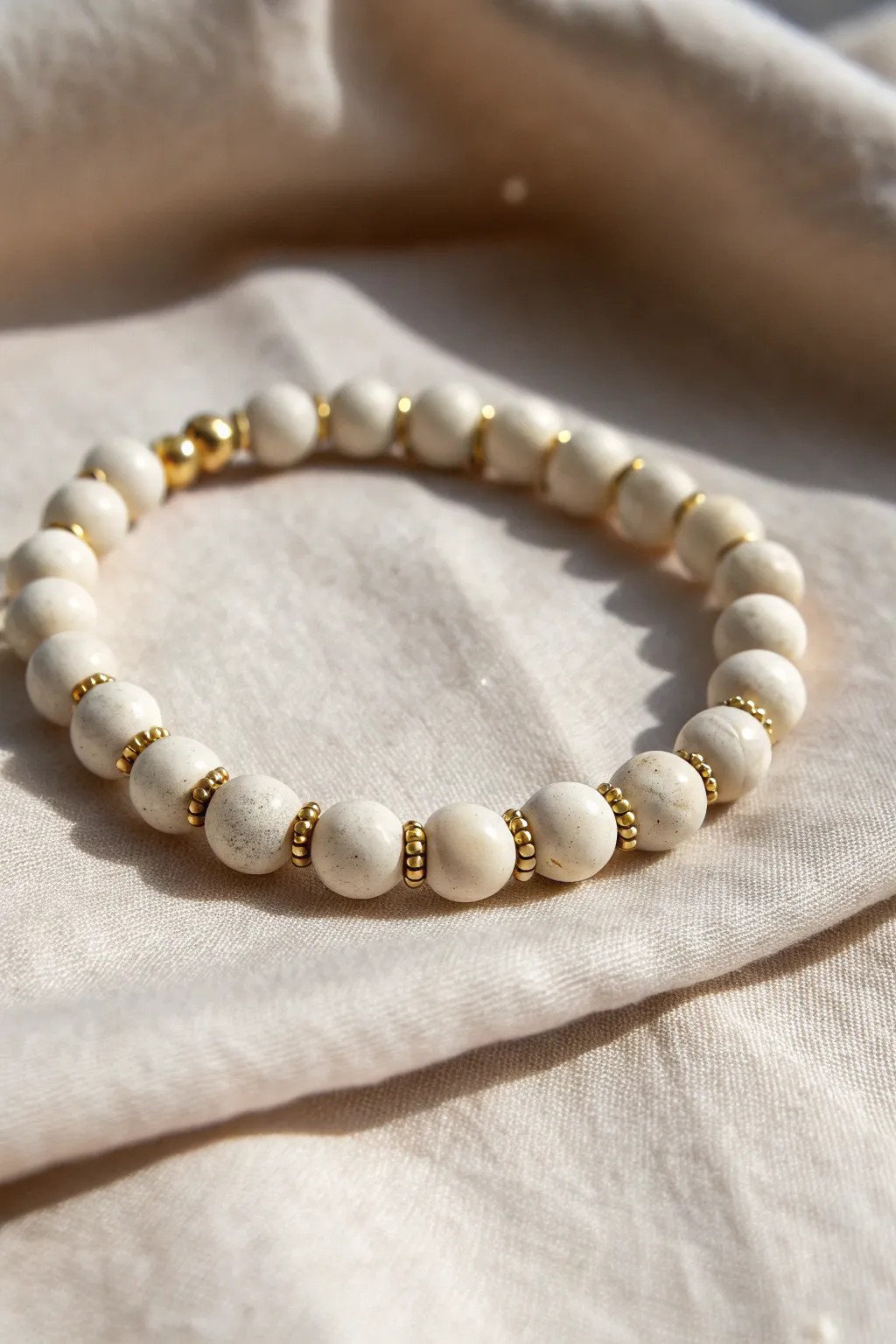
This elegant bracelet balances rustic charm with a touch of luxury by alternating speckled cream clay beads with metallic gold accents. The thoughtful spacing creates a lovely visual rhythm that looks sophisticated yet remains effortless to style.
Step-by-Step
Materials
- White or cream polymer clay
- Coarse black pepper or brown acrylic paint (for speckles)
- Gold-tone spacer beads (small discs or rondelles)
- Larger gold-tone accent beads (round)
- Elastic beading cord (0.7mm or 0.8mm)
- Bead rolling tool or clear acrylic block
- Toothpick or bead piercing pin
- Super glue or jewelry cement
- Scissors
- Oven for baking clay
Step 1: Crafting the Clay Beads
-
Condition the clay:
Begin by warming the white or cream polymer clay in your hands, kneading it until it is soft and malleable. -
Add texture:
To achieve the organic, speckled stone look seen in the photo, mix a tiny pinch of coarse black pepper into the clay. Alternatively, you can flick diluted brown paint onto the beads after baking, but I find mixing pepper directly into the raw clay creates a more natural stone effect. -
Portion the clay:
Roll the clay into a specific log shape and slice it into equal segments to ensure your beads are generally the same size. -
Roll spheres:
Take each segment and roll it between your palms to form smooth spheres. -
Refine the shape:
For perfectly round beads, place the spheres under a clear acrylic block or a flat rolling tool and gently rotate them in a circular motion on your work surface. -
Pierce the holes:
Carefully insert a toothpick or piercing pin through the center of each bead. Twist the pin gently as you push to avoid squashing the sphere shape. -
Bake the beads:
Arrange your clay beads on a baking sheet or tile. Bake them according to the manufacturer’s instructions on your clay package (usually between 230°F and 275°F for 15-30 minutes). -
Cool down:
Let the beads cool completely before handling them; they harden fully as they return to room temperature.
Glaze for Shine
Want a polished stone look? After baking and cooling, apply a thin layer of satin or gloss water-based varnish to the clay beads to make the speckles pop.
Step 2: Assembling the Bracelet
-
Measure the cord:
Cut a length of elastic cord about 10-12 inches long. This gives you plenty of extra room to tie the knot comfortably. -
Pre-stretch the elastic:
Give the cord a few gentle tugs. This is a crucial step that prevents the bracelet from stretching out permanently after the first wear. -
Secure the end:
Place a piece of tape or a bead stopper on one end of the cord to stop beads from sliding off while you work. -
Start the pattern:
Begin threading your beads. Looking at the design, the main pattern is one clay bead followed by one flat gold spacer. -
Check the spacing:
Continue the alternating pattern—clay, spacer, clay, spacer—for the majority of the bracelet length. -
Create the focal point:
Create the unique gold accent section shown in the image by adding two or three round gold beads in a row, interrupting the spacer pattern. -
Verify the sizing:
Wrap the strand around your wrist to check the fit. Add or remove beads as needed to ensure it sits comfortably without digging in. -
Tie the knot:
Remove the tape and tie a surgeon’s knot (a square knot with an extra loop through) to secure the ends tightly together. -
Secure with glue:
Dab a tiny drop of super glue or jewelry cement onto the knot itself. Allow it to dry for a moment. -
Hide the knot:
Trim the excess cord ends carefully, leaving about 1mm. Gently tug the bracelet so the knot slides inside the hole of one of the clay beads to hide it.
Metal Mix-Up
Try mixing metals for a modern twist. Use copper spacers instead of gold, or alternate between silver and gold spacers for a mixed-metal accessory stack.
Slip on your new handcrafted accessory and enjoy the custom fit you created

What Really Happens Inside the Kiln
Learn how time and temperature work together inside the kiln to transform clay into durable ceramic.
Clay Bead Name Bracelet With Letters
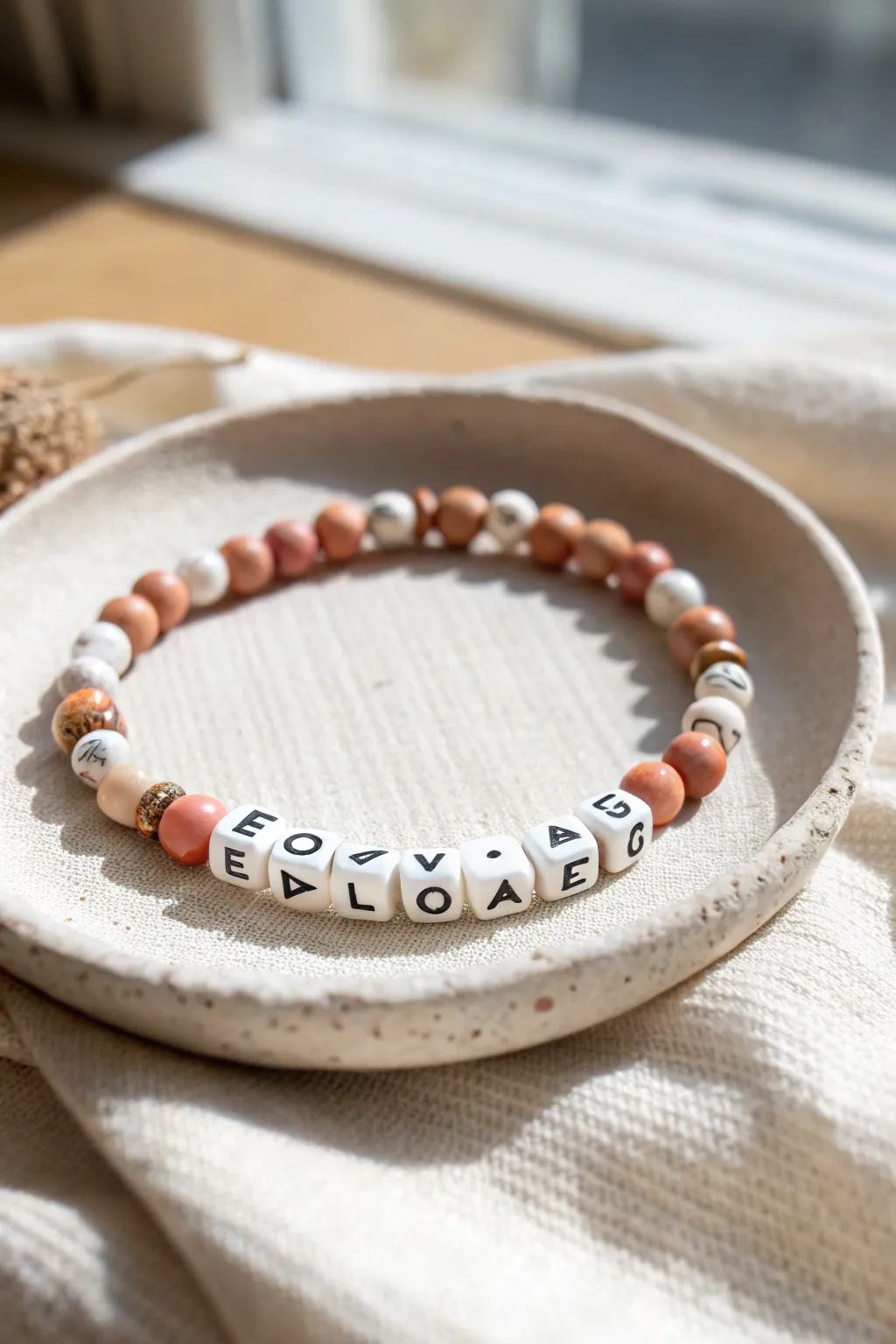
Create a personalized accessory that blends natural tones with a custom message using this charming clay bead bracelet. The mix of terracotta, matte stone, and bold letter beads gives it a grounded yet modern aesthetic perfect for stacking or wearing solo.
Step-by-Step Tutorial
Materials
- Elastic stretch string (0.7mm or 0.8mm)
- White rounded square letter beads (black text)
- 8mm round clay or stone beads (terracotta/rust color)
- 8mm round beads (matte white/marble pattern)
- 8mm round beads (light tan/sand color)
- Small gold spacer beads (optional)
- Scissors
- Super glue or jewelry cement
- Beading needle (optional)
- Masking tape or bead stopper
Step 1: Preparation & Design
-
Measure your wrist:
Wrap a piece of string around your wrist to determine the comfortable length, then add about 3-4 inches excess for tying knots later. -
Cut the elastic:
Cut your elastic cord based on the measurement you just took. It’s always better to have too much string than too little. -
Secure the end:
Place a piece of masking tape or a bead stopper on one end of the elastic to prevent beads from sliding off while you work. -
Plan your message:
Select the letter beads for your chosen word or name. The example shows a random assortment, but you might want to spell out ‘LOVE’, a name, or initials. -
Layout the pattern:
Lay out your beads on a flat surface or bead board. Create a repeating pattern with the round beads: try alternating one terracotta, one white marble, and one tan bead to mimic the organic look in the photo.
Knot Security
Pre-stretch your elastic cord by pulling on it firmly a few times before stringing. This prevents the bracelet from drooping or becoming loose after you wear it for the first time.
Step 2: Stringing the Beads
-
Start the pattern:
Begin threading the round beads onto the elastic. I like to start with about 6-8 decorative beads before adding the letter section to ensure the text sits centered on the wrist. -
Mix textures:
As you string, pay attention to the variety. Include a few speckled or uniquely patterned beads if you have them, just like the marbled ones seen in the image. -
Add the letters:
Thread your letter beads onto the cord. Ensure they are all facing the correct direction so your word is legible when worn. -
Finish the loop:
Continue adding the round earth-tone beads in your alternating pattern until the bracelet reaches your desired length. -
Check the fit:
Carefully wrap the un-knotted strand around your wrist to check that it fits comfortably without stretching the elastic too tight.
Step 3: Finishing Touches
-
Prepare to tie:
Remove the tape or bead stopper from the end, being very careful not to drop the string. -
Tie the first knot:
Cross the two ends of the elastic and tie a simple overhand knot. Pull it gently to bring the beads together, ensuring there are no large gaps. -
Secure with a surgeon’s knot:
For the second knot, make loop, pass the tail through twice instead of once, and pull tight. This extra friction helps hold the elastic securely. -
Apply adhesive:
Dab a tiny drop of super glue or jewelry cement directly onto the knot. This prevents it from slipping over time. -
Hide the knot:
While the glue is still slightly tacky but not wet, slide a nearby bead with a larger hole over the knot to conceal it. -
Dry completely:
Let the glue dry undisturbed for at least 15-20 minutes before wearing the bracelet. -
Trim excess:
Once fully dry, use your scissors to snip off the excess elastic tails as close to the bead/knot as possible.
Texture Twist
Incorporate wooden beads or rough lava stones alongside the smooth clay beads. This adds a tactile element and makes the bracelet double as an essential oil diffuser.
Now you have a custom, earth-toned bracelet ready to add a personalized touch to your daily style
Clay Bead Simple Word Mantra
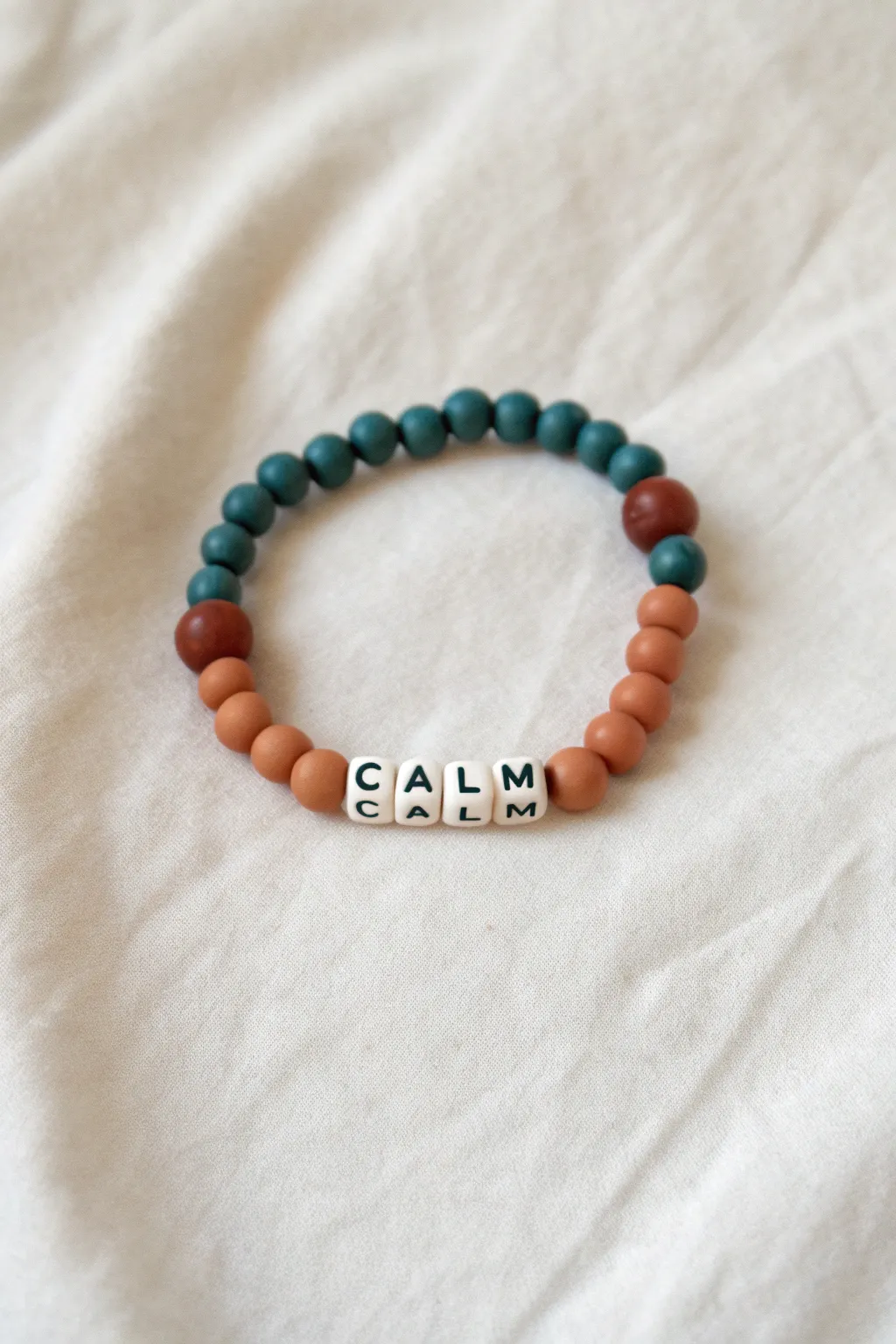
Find your center with this soothing beaded bracelet featuring earthy tones and a simple, powerful mantra. The matte finish of the clay beads paired with the crisp letter blocks creates a modern, grounding accessory perfect for daily wear.
Step-by-Step
Materials
- Polymer clay (teal or dark forest green)
- Polymer clay (terracotta or burnt sienna)
- Polymer clay (dark reddish-brown)
- Square white alphabet beads (C, A, L, M)
- Elastic stretch cord (0.8mm or 1mm)
- Bead rolling tool or clear acrylic block
- Toothpicks or a bead piercing pin
- Super glue or jewelry cement
- Scissors
Step 1: Prepping the Clay Beads
-
Condition the teal clay:
Start by taking a small portion of your teal or dark green polymer clay working it in your hands until it becomes soft and pliable. -
Form equal portions:
Roll the conditioned clay into a thin log or snake. Use a blade to slice off roughly 15 equal-sized segments to ensure your beads end up uniform. -
Roll the spheres:
Take each small segment and roll it between your palms or using a bead roller to create perfectly round spheres. -
Create the holes:
Carefully poke a hole through the center of each sphere using a toothpick. Gently twist the toothpick as you push through to avoid squishing the round shape. -
Repeat for terracotta:
Clean your hands, then repeat the conditioning, cutting, and rolling process with the terracotta clay. You will need about 7-8 of these beads. -
Make accent beads:
Using the dark reddish-brown clay, create two slightly larger spherical beads to serve as separators between the color blocks. -
Bake the beads:
Bake all your clay beads according to the package instructions (usually around 275°F or 130°C for 15-30 minutes). I usually let them cool completely inside the oven to prevent cracking.
Smooth Operator
To remove fingerprints from your raw clay beads before baking, lightly brush them with a tiny amount of cornstarch or baby powder.
Step 2: Assembling the Design
-
Measure the cord:
Cut a length of elastic cord about 10-12 inches long. This gives you plenty of extra room for tying knots later. -
Pre-stretch the elastic:
Give the elastic cord a few firm tugs. This pre-stretching step is crucial to prevent the bracelet from sagging after you wear it a few times. -
Secure the end:
Place a piece of tape or a binder clip on one end of the cord so your beads don’t slide off while you are working. -
Start with the mantra:
Thread your alphabet beads onto the cord first. Spell out ‘CALM’, ensuring the letters are facing the correct direction. -
Add first terracotta section:
On the right side of the ‘M’, thread about 3-4 terracotta beads. -
Add second terracotta section:
On the left side of the ‘C’, thread the remaining 3-4 terracotta beads to frame the word. -
Place accent beads:
Add one dark reddish-brown accent bead to each end of your terracotta sections. These act as a visual transition to the teal color. -
Finish with teal:
Fill the rest of the bracelet length with your teal beads. You can check the fit around your wrist periodically to see if you need more or fewer beads.
Make It Glossy
For a different look, apply a coat of gloss glaze or clear nail polish to the finished clay beads to make the colors pop against the matte letters.
Step 3: Finishing Touches
-
Tie the knot:
Once you are happy with the size, bring the two ends together. Tie a surgeon’s knot (right over left, left over right) and pull tight. -
Secure with glue:
Add a tiny drop of super glue or jewelry cement directly onto the knot. This ensures it won’t unravel over time. -
Hide the knot:
While the glue is still slightly wet, gently pull the knot inside one of the adjacent clay beads or alphabet beads to hide it. -
Trim excess:
Wait for the glue to dry fully, then use scissors to trim the excess cord ends close to the bead hole.
Now you have a gentle reminder to stay grounded right on your wrist

TRACK YOUR CERAMIC JOURNEY
Capture glaze tests, firing details, and creative progress—all in one simple printable. Make your projects easier to repeat and improve.
Clay Bead Bracelet With One Center Charm
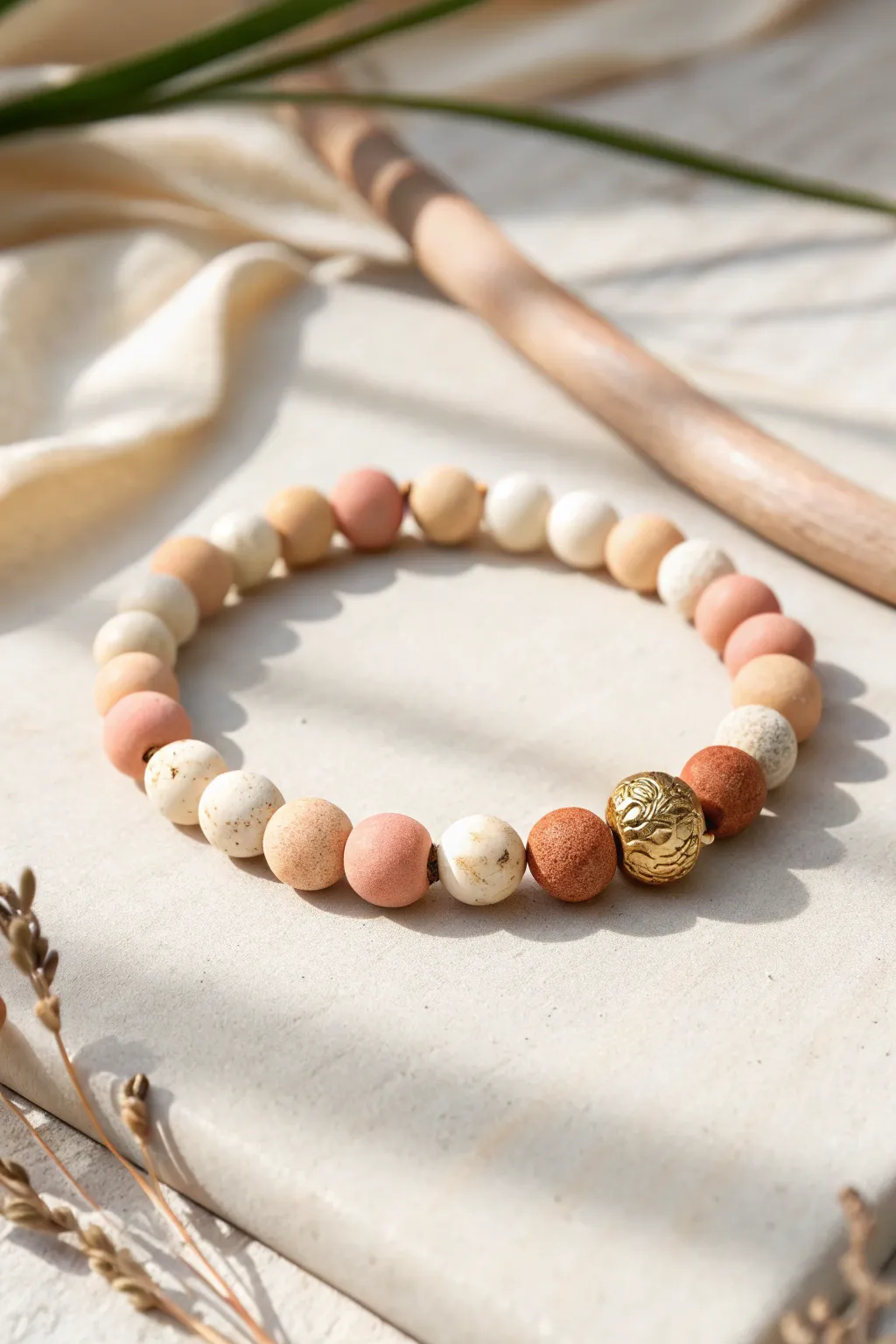
This project combines the organic warmth of hand-rolled clay beads with a touch of sophistication. By mixing soft hues like terracotta, cream, and peach with a striking gold focal bead, you’ll create a bracelet that feels both grounded and luxurious.
Step-by-Step Guide
Materials
- Polymer clay in white, translucent, terracotta, and ochre/yellow oxide
- Gold focal bead (approx. 10-12mm, textured)
- Sandpaper or salt (for texturing)
- Elastic cord (0.8mm or 1mm)
- Bead reamer or toothpick
- Super glue or jewelry knot cement
- Baking sheet and parchment paper
- Oven
Step 1: Crafting the Clay Base
-
Mix your colors:
Creating this palette requires custom mixing. Start by creating four distinct balls of clay: pure white, a soft cream (white mixed with a tiny dot of yellow), a dusty rose/peach (white mixed with a small amount of terracotta), and a deeper rust color. -
Create the speckled stone effect:
To achieve that natural, stony look seen in the photo, add inclusions to your clay mixes. I like to grate a tiny bit of baked brown clay or mix in actual black pepper or dried coffee grounds into the white and cream clay balls. -
Portion the clay:
Roll each color variation into a long snake about 1cm thick. Slice these snakes into equal segments to ensure uniform bead sizes. -
Roll individual beads:
Take each segment and roll it between your palms to form a smooth sphere. Aim for beads that are approximately 8-10mm in diameter. -
Add surface texture:
The beads in the image have a matte, organic surface. Lightly roll your unbaked beads over a piece of coarse sandpaper or a textured fabric to remove fingerprints and add that earthy grit.
Uneven Sizes?
If your hand-rolled beads vary too much in size, try using a small circle cookie cutter or a dedicated bead-rolling tool to measure exact amounts of clay for each sphere.
Step 2: Baking and Prep
-
Pierce the holes:
Using a toothpick or a bead piercing pin, carefully poke a hole through the center of each bead. Rotate the bead as you push through to prevent it from squishing out of round. -
Refine the shape:
Inspect each bead after piercing. Gently reshape them if the piercing tool caused any distortion, ensuring the hole remains open and clear. -
Bake the beads:
Arrange your clay beads on a baking sheet lined with parchment paper. Follow the temperature instructions on your specific brand of polymer clay, usually baking for 15-20 minutes. -
Cool down:
Let the beads cool completely on the tray. Polymer clay is slightly soft when hot and hardens as it cools, so patience here ensures durability. -
Ream the holes:
Once hardened, use a bead reamer or a small drill bit to clean out the bead holes, removing any internal debris so the elastic slides through smoothly.
Scent Infusion
Since these are unglazed clay beads, they work perfectly as essential oil diffusers. Add a drop of lavender or sandalwood to the porous clay beads for a wearable scent.
Step 3: Assembly and Finishing
-
Layout your design:
Place your gold focal bead in the center of your workspace. Arrange the clay beads on either side, creating an ombré or random pattern of creams, peaches, and rusts that pleases your eye. -
Measure the elastic:
Cut a piece of elastic cord about 10-12 inches long. This extra length makes tying the final knot much easier than fighting with short ends. -
Pre-stretch the cord:
Give your elastic cord a few firm tugs before stringing. This prevents the bracelet from loosening up and sagging after you wear it a few times. -
String the beads:
Thread your beads onto the elastic, following your laid-out pattern. Add the gold focal bead last so it sits centrally when you tie the knot. -
Tie the surgeon’s knot:
Bring the two ends of the elastic together. Cross right over left, then left over right and loop it through twice (a surgeon’s knot). Pull tight to secure. -
Glue and hide:
Apply a tiny drop of super glue or jewelry cement to the knot for extra security. Once dry, create a little tension and tuck the knot inside the hole of the large gold bead or one of the clay beads. -
Trim excess:
Snip off the remaining elastic tails carefully, ensuring you don’t cut the main cord.
Enjoy the calming process of creating this accessory and the natural beauty it adds to your wrist
Clay Bead Smiley Accent Pop
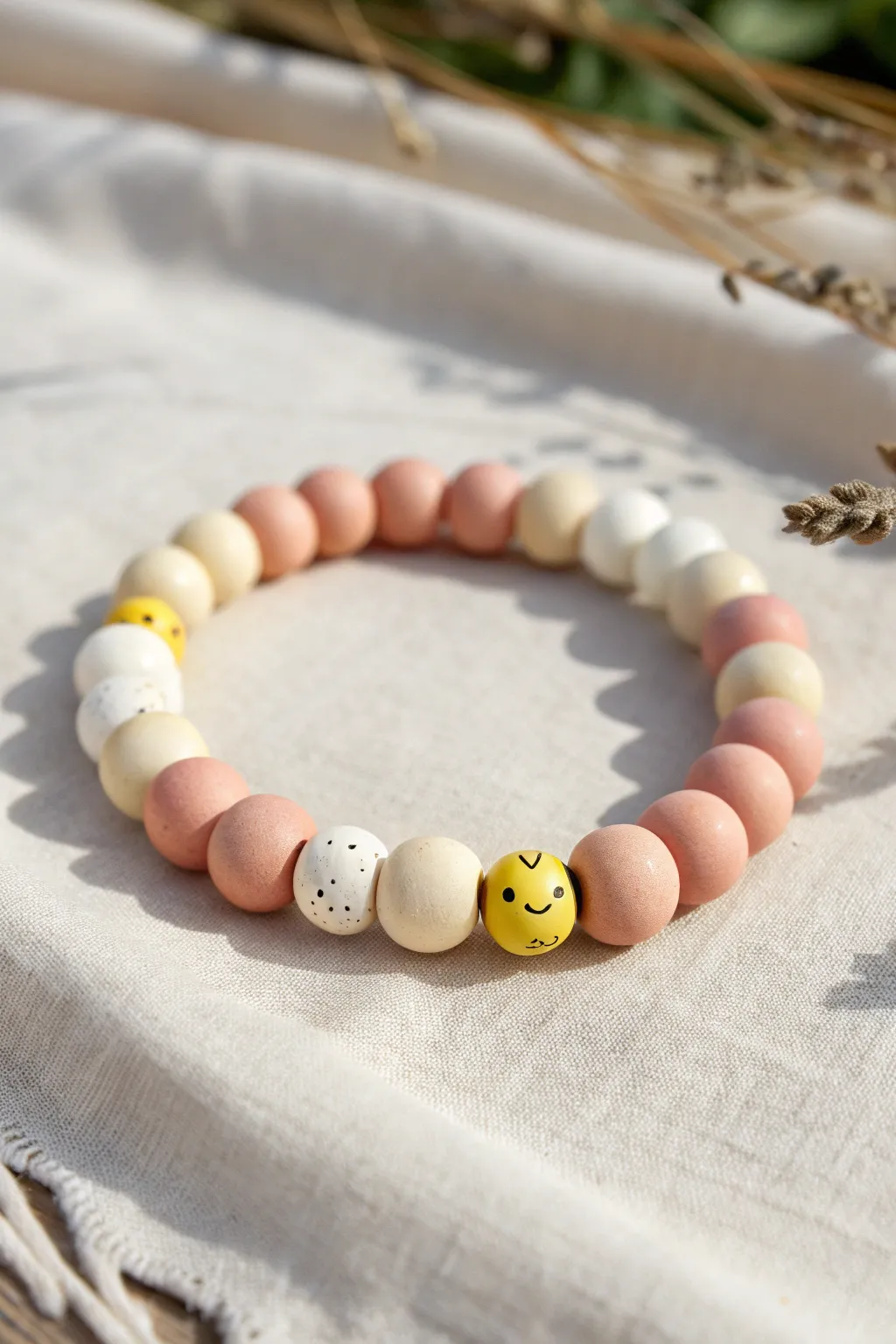
This cheerful bracelet combines soft, matte textures with a playful pop of personality, perfect for adding a bit of sunshine to your wrist stack. The mix of muted terracotta, cream, and sunny yellow creates a sophisticated yet whimsical accessory.
Detailed Instructions
Materials
- Polymer clay (terracotta/salmon pink, cream/off-white, sunny yellow, white)
- Black acrylic paint or a fine-tip permanent marker
- Speckled clay or black pepper/dried tea leaves (for the speckled bead effect)
- Bead roller tool (optional but helpful for uniform size)
- Toothpicks or a bead piercing pin
- Elastic cord (0.8mm or 1mm)
- Super glue or jewelry cement
- Oven for baking clay
- Baking sheet and parchment paper
- Gloss glaze (optional, for just the painted areas)
Step 1: Forming the Clay Beads
-
Condition the Clay:
Start by warming up your polymer clay colors in your hands until they are soft and pliable. You’ll need primarily the salmon pink and cream colors, with small amounts of yellow and white. -
Measure the Portions:
To ensure your beads are all the same size, roll the clay into snakes of even thickness, then cut them into equal segments—about the size of a large pea. -
Roll the Basic Beads:
Take each segment of pink and cream clay and roll it between your palms. Use a gentle circular motion until they are perfectly round spheres. -
Create the Speckled Bead:
For the white speckled bead, mix a tiny pinch of black pepper, dried tea leaves, or black glitter into a small ball of white clay. Roll it until the specks are distributed, then form it into a sphere. -
Make the Smiley Base:
Take your yellow clay segments (you’ll need two for this design) and roll them into smooth spheres just like the others. -
Pierce the Holes:
Using a toothpick or bead pin, carefully pierce a hole through the center of each bead. I find twisting the toothpick as you push helps prevent the bead from squishing out of shape. -
Check the Shape:
After piercing, the beads might look a little oval. Gently roll them between your fingers one last time to regain that perfect roundness without closing the hole.
Smooth Operator
To remove fingerprints from your raw clay beads before baking, lightly dust your fingers with cornstarch or baby powder and give them a final gentle roll.
Step 2: Baking and Decorating
-
Arranging for Bake:
String your raw beads onto a bead rack or place them on a parchment-lined baking sheet. Make sure they aren’t touching each other so they don’t fuse together. -
Bake the Clay:
Bake according to your polymer clay package instructions (usually around 275°F/135°C for 15-30 minutes). Let them cool completely before handling. -
Paint the Faces:
Once cool, use a fine-tip black marker or a very thin brush with black acrylic paint to draw the smiley faces on the yellow beads. Keep the design simple: two dots for eyes and a small curved line for a smile, maybe a tiny cheek mark. -
Seal the Design:
Allow the paint to dry fully. If you want the faces to last longer, dab a tiny amount of glaze just over the drawn area, leaving the rest of the bead matte.
Step 3: Assembly
-
Cut the Elastic:
measure a piece of elastic cord about 10-12 inches long. This gives you plenty of extra room for tying knots later. -
Pre-stretch the Cord:
Give the elastic a few firm tugs. This pre-stretching step is crucial because it prevents the bracelet from drooping or loosening after the first time you wear it. -
Plan Your Pattern:
Lay out your beads on a surface. The pattern shown uses blocks of pink, followed by cream, with the special beads (smiley, speckled) used as focal points spaced apart. -
String the Beads:
Thread the beads onto the elastic. I like to secure one end with a piece of tape or a bead stopper so they don’t slide off while I’m working. -
Tie the Knot:
Once all beads are on, bring the ends together. Tie a surgeon’s knot (right over left twice, then left over right) and pull tight. -
Secure the Knot:
Put a tiny drop of super glue or jewelry cement on the knot. Let it dry for a few minutes. -
Hide the Knot:
Trim the excess elastic close to the knot, then gently pull the cord so the knot slides inside the hole of a neighboring bead, hiding it from view.
Hole Distortion?
If the bead flattens while piercing, let the clay rest in the fridge for 10 minutes to firm up. Cold clay holds its shape better against the pressure of the tool.
Wear your new smiley bracelet as a solo statement or stack it up for a personalized look
Clay Bead Fruit Slice Mix-In
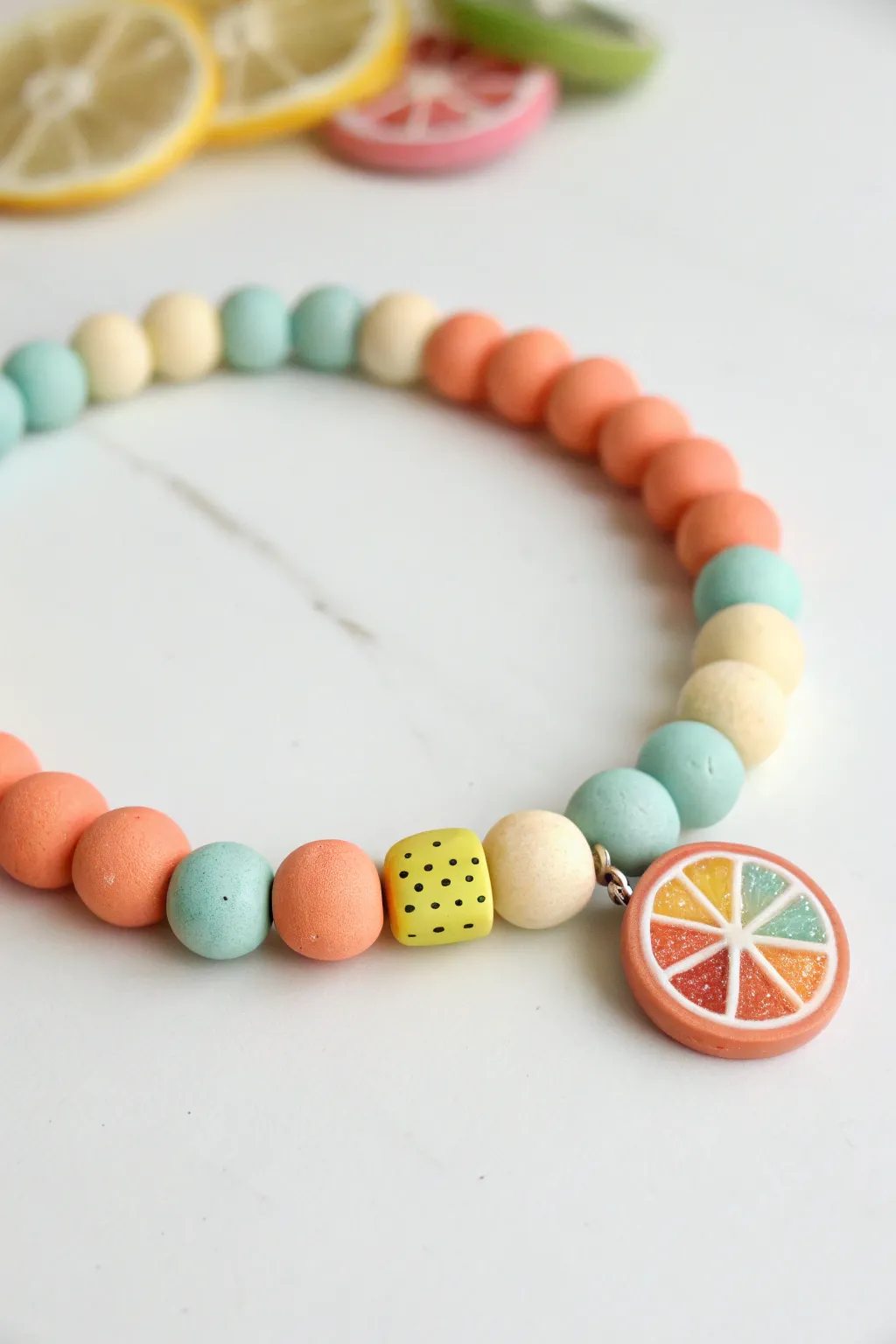
Bring a burst of summer sweetness to your jewelry collection with this vibrant beaded bracelet featuring a juicy citrus slice charm. The combination of matte, hand-rolled clay beads and a unique patterned accent bead creates a playful accessory perfect for sunny days.
Step-by-Step Tutorial
Materials
- Polymer clay (orange, teal/mint, cream, yellow, black)
- Clay rolling pin or pasta machine
- Circle clay cutter (small)
- Needle tool or toothpick
- Eye pin
- Jump ring
- Stringing cord (elastic or non-elastic)
- Super glue (optional)
- Gloss glaze (optional for fruit slice)
Step 1: Making the Round Beads
-
Condition the clay:
Begin by conditioning your polymer clay in teal, peach/orange, and cream colors. Knead each color separately until it is soft and pliable. -
Portion the clay:
To ensure uniform bead sizes, roll each color into a thick log or snake of the same diameter. Slice equal segments off the log using a tissue blade or knife. -
Roll spheres:
Take each sliced segment and roll it between your palms. Use a gentle circular motion to create smooth, round spheres. I like to check them against each other occasionally to keep the sizing consistent. -
Pierce the beads:
Before baking, carefully pierce a hole through the center of each bead using a needle tool or toothpick. Rotate the tool as you push through to prevent squashing the bead’s round shape. -
Refine the shape:
After piercing, the hole might distort the bead slightly. Gently roll the bead between your fingers one last time to smooth out the area around the hole.
Step 2: Creating the Accent Beads
-
Form the cube base:
Roll a small ball of yellow clay and gently press it against a flat surface on six sides to form a soft cube shape. -
Add the texture:
Using the very tip of your needle tool or a fine dotting tool, press small indentations into the sides of the cube to create a perforated look. -
Fill the dots:
Take tiny flecks of black clay, roll them into microscopic balls, and press them into the indentations for a contrasting polkadot effect. -
Pierce the cube:
Create a hole through the center of the cube bead just as you did with the round beads.
Baking Pro Tip
To prevent flat spots on your round beads, bake them on a bed of cornstarch or threaded onto a skewer suspended over cut grooves in an aluminum foil tray.
Step 3: Crafting the Fruit Slice Pendant
-
Prepare the segments:
Create small triangular wedges in various citrus colors—orange, yellow, and a darker teal. These will be the fruit segments. -
Outline with pith:
Roll out a very thin sheet of white or cream clay. Wrap each triangular wedge in this thin white sheet to create the separation lines (pith). -
Assemble the wheel:
Arrange the wrapped triangles into a circle, pointing the tips toward the center like pizza slices. Gently press them together so they adhere. -
Wrap the rind:
Roll a strip of orange clay and wrap it around the entire circle of segments to form the outer skin of the fruit. -
Texture the fruit:
Use a toothbrush or a needle tool to gently stipple the surface of the colored segments, giving them a realistic juicy texture. -
Insert hardware:
Trim a short metal eye pin and insert the straight end into the top of the fruit slice (into the rind) so the loop remains visible. Secure with a tiny dab of liquid clay if available.
Level Up: Scented Jewelry
Mix a tiny drop of essential oil (like lemon or orange) into the clay of the fruit pendant before baking to make your bracelet smell as citrusy as it looks.
Step 4: Baking and Assembly
-
Bake the clay:
Arrange all your beads and the pendant on a baking sheet lined with parchment paper or cardstock. Bake according to your polymer clay package instructions (usually around 275°F/135°C for 15-30 minutes). -
Cool and finish:
Allow the clay to cool completely. If you want a shiny finish on the fruit flesh, brush a little gloss glaze just on the colored segments. -
String the beads:
Begin threading your beads onto your chosen cord. Following the pattern in the image, group colors together—several orange, then teal, then cream—rather than a strict alternating pattern. -
Add the pendant:
Thread the string through the yellow cube bead, then string a jump ring attached to your fruit pendant, and continue beading. -
Tie it off:
Once you reach the desired length, tie a secure surgeon’s knot with the elastic cord. A drop of super glue on the knot will ensure it stays put.
Enjoy wearing your handmade bracelet that captures the zest and color of summer fruits
Clay Bead Bracelet With Pearl-Look Rounds
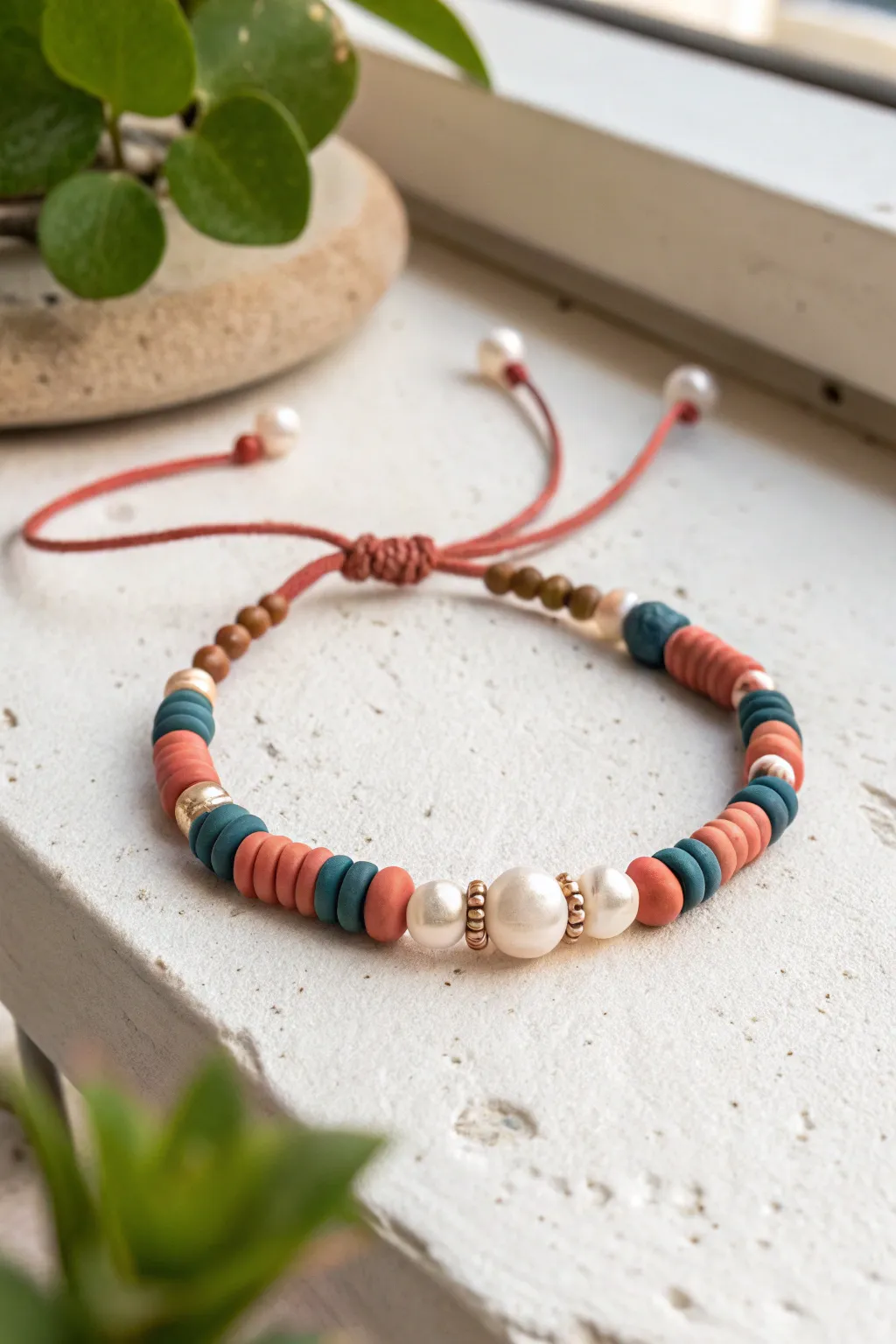
This charming bracelet blends earthy tones with the classic elegance of pearls for a versatile accessory that feels both relaxed and refined. The warm terracotta and teal clay beads are beautifully punctuated by a central pearl cluster, all strung on a durable, adjustable cord.
Step-by-Step Guide
Materials
- Rust/terracotta heishi clay beads (approx. 4-5mm)
- Deep teal/petrol heishi clay beads (approx. 4-5mm)
- 3 Round pearl-look beads (1 large central, 2 medium side beads)
- 2 Small pearl-look accent beads (for the closure)
- 2 Flat pearl-look or mother-of-pearl spacer beads
- 2 Gold-tone textured heishi spacer beads (metal)
- Small round gold spacer beads (for the center cluster)
- Small brown wooden or seed beads (approx. 3mm)
- Waxed polyester cord (rust or burnt orange color, 1mm thickness)
- Scissors
- Lighter (to seal cord ends)
- Tape or clipboard (to hold work in place)
Step 1: Preparation & Centerpiece
-
Cut the Cord:
Start by cutting a piece of your waxed polyester cord to about 20 inches in length. This generous length gives you plenty of room for the adjustable sliding knot later. -
Prepare the Ends:
Use a lighter to quickly melt the very tips of your cord. Roll them between your fingers (carefully!) while warm to create a stiff, needle-like point. This makes stringing much easier without a needle. -
Start the Center Cluster:
Thread the large central pearl onto the cord first. -
Add Spacers and Pearls:
On either side of the large pearl, thread on a small gold spacer bead, followed by a medium-sized pearl bead. -
Secure the Center:
Slide this little group to the exact middle of your cord length. This forms the focal point of your design.
Uneven Knotting?
If your twisting square knots start spiraling instead of laying flat, you may be tying the same overhand knot repeatedly. Remember to alternate left-over-right and right-over-left.
Step 2: Creating the Pattern
-
First Color Block:
Working outwards from the pearl cluster on the right side, add one rust heishi bead, then two teal heishi beads. -
Mirror the Left Side:
Repeat that exact sequence on the left side of the cluster: one rust, then two teal beads. -
Build the Rust Section:
On the right side, add five to six rust heishi beads. Follow this with a single gold textured spacer bead. -
Left Side Rust Section:
Do the same on the left: add five to six rust heishi beads and one gold textured spacer. -
The Teal Accent:
On the right side, thread on three teal heishi beads. Then, add a single flat pearl spacer bead. -
Left Side Teal Accent:
Mirror this on the left: three teal heishi beads followed by the flat pearl spacer. -
Final Clay Sequence:
On the right side again, bring in the contrast by adding a larger block of rust beads (about 6-8), followed by a small block of teal (3 beads). -
Complete the Left Pattern:
Finish the clay bead section on the left by matching that sequence: 6-8 rust beads and 3 teal beads. -
Taper with Wood:
To transition from the bold clay beads to the closure, add about 5-6 small brown wooden beads to each end of the bracelet.
Switch It Up
Swap the central pearl for a polished gemstone like turquoise or agate for an earthier vibe, or use gold letter beads to spell a name between the color blocks.
Step 3: The Adjustable Closure
-
Prepare for Knotting:
Gather both ends of the cord and cross them over each other to form a circle shape with the bracelet. -
Cut a Knotting Cord:
Cut a separate, short piece of cord (about 8 inches). Place it under the two crossed bracelet cords. -
Start the Square Knot:
Tie a series of square macramé knots around the two main cords. I find about 5 or 6 complete knots create a sturdy enough sliding mechanism. -
Finish the Slider:
Trim the excess tails of the knotting cord close to the knot (but don’t cut your main bracelet cords!). Carefully melt the cut ends with a lighter to fuse them into the knot. -
Add End Charms:
On one of the dangling tail cords, thread a small pearl accent bead. Tie an overhand knot right at the tip to secure it, and trim close. -
Final Touch:
Repeat on the other tail cord: add the pearl, knot the end, and trim. Ensure the tails are even in length when the bracelet is fully open.
Now you have a stylish, handcrafted bracelet ready to stack or wear solo
Clay Bead Micro-Spacer Pattern
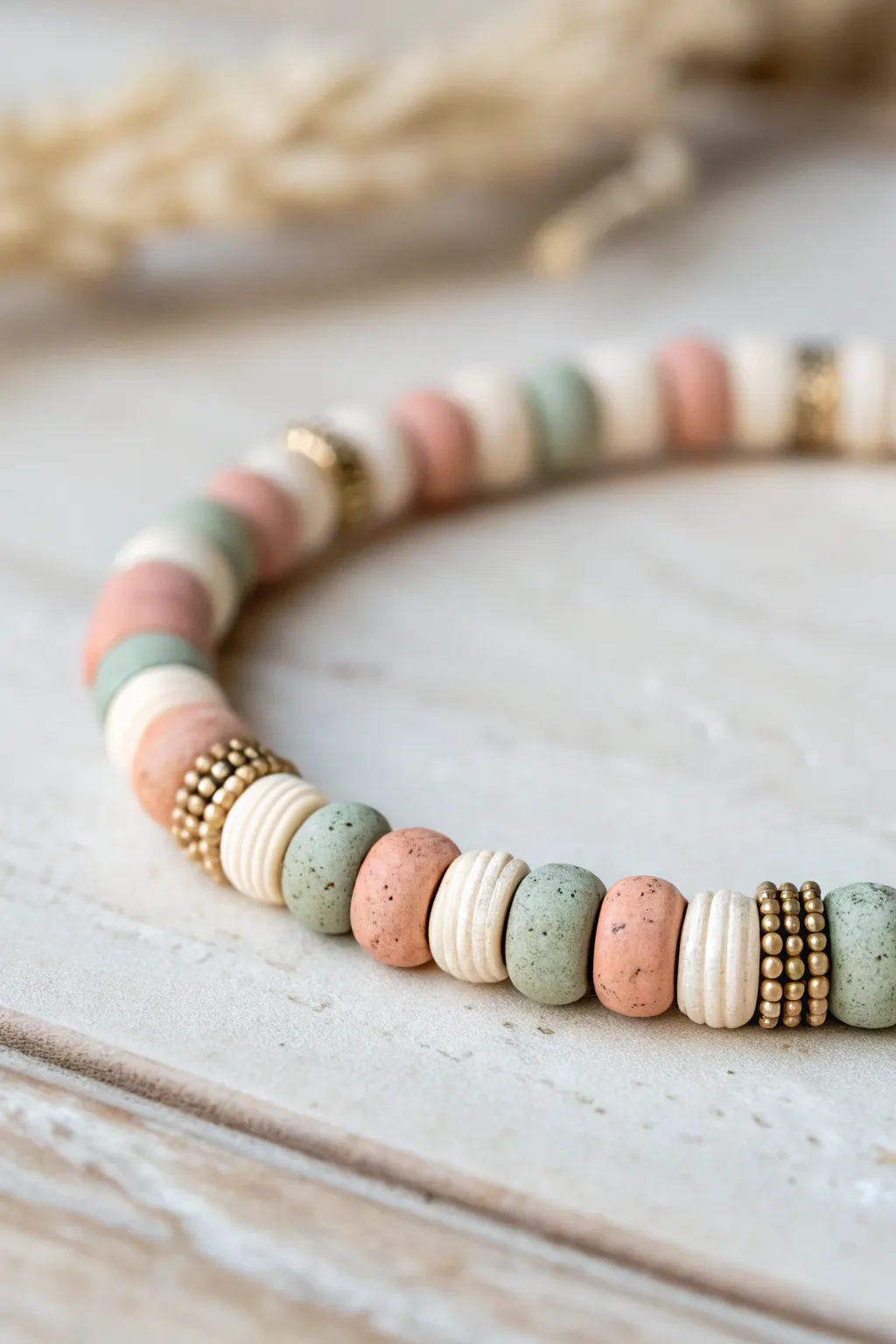
Achieve a sophisticated, earthy look with this polymer clay bracelet pattern. Combining textured heishi beads with sleek gold spacers creates a rhythm that feels both handmade and high-end.
Step-by-Step
Materials
- Polymer clay (Speckled Mint Green, Speckled Coral Pink, Cream/White)
- Small gold spacer beads (smooth or faceted)
- Gold daisy spacer beads (or textured wheel spacers)
- Elastic cord (0.8mm or 1mm)
- Clay extruder or rolling pin
- Small circle cutter (approx. 8-10mm)
- Needle tool or bead piercing pins
- Super glue or jewelry cement
- Ruler
- Baking sheet and parchment paper
- Bead reamer (optional)
Step 1: Creating the Clay Heishi Beads
-
Condition the clay:
Start by thoroughly conditioning your three colors of polymer clay—speckled mint, speckled coral, and cream—until they are soft and pliable. This prevents cracking later. -
Roll out sheets:
Roll each color into a thick slab, approximately 4-5mm thick. Uniform thickness is key for that chunky heishi look, so use depth guides if you have them. -
Cut the discs:
Using your small circle cutter, punch out an equal number of discs from the mint and coral clay. These will be your main colored focal beads. -
Create the ribbed texture:
For the cream beads, gently roll the edge of the cut discs against a fine comb or use a texture tool to create horizontal ridges along the outer side. This mimics the ribbed look in the photo. -
Pierce the holes:
Carefully pierce the center of each bead using a needle tool. I find that twisting the tool while pushing through minimizes distortion of the bead’s round shape. -
Smooth the edges:
Gently tap the edges of the beads with your finger to soften any sharp cuts from the cutter, giving them a more organic, tumbled stone appearance. -
Bake the beads:
Arrange the beads on a parchment-lined baking sheet. Bake according to your specific clay brand’s instructions (usually 275°F/130°C for 15-30 minutes). -
Cool and inspect:
Allow the beads to cool completely before handling. Check that the holes are clear; use a bead reamer or small drill bit to clean them out if necessary.
Hole Distortion?
If piercing the clay squashes your bead shape, try refrigerating the raw clay discs for 10 minutes prior to piercing. The firmer clay resists deformation.
Step 2: Assembly and Finishing
-
Measure the cord:
Cut a length of elastic cord about 10-12 inches long. This gives you plenty of slack for tying the knot later. -
Pre-stretch the elastic:
Give the elastic cord a few firm tugs. This pre-stretching step is crucial to prevent the bracelet from sagging after you wear it a few times. -
Begin the pattern:
Start stringing your beads. The core pattern unit is: Mint, Cream, Coral, Cream. Repeat this sequence. -
Insert the spacers:
Every few repetitions of the color pattern (or wherever you want a visual break), insert your gold accents. The photo uses stacks of 3-4 gold daisy spacers to create metallic bands. -
Alternative spacing:
You can also place single flat gold spacers between the clay beads occasionally to add subtle shimmer without breaking the color flow entirely. -
Check the fit:
Wrap the unfinished strand around your wrist to check the size. Add or remove pattern units until it sits comfortably without being too tight. -
Tie the knot:
Tie a surgeon’s knot (a square knot with an extra loop through). Pull the elastic tight enough that the beads bunch slightly, ensuring no gaps show when worn. -
Secure the knot:
Apply a tiny dot of jewelry glue or super glue specifically to the knot. Let it dry for a few seconds. -
Hide the knot:
Trim the excess cord ends to about 2mm. Gently tug the bracelet so the knot slides inside the hole of one of the larger clay beads to hide it.
Make It Matte
After baking, lightly sand the colored beads with fine-grit sandpaper (1000 grit) to remove fingerprints and enhance that organic, stone-like matte finish.
Now you have a custom accessory that brings a touch of artisan charm to any outfit
Clay Bead Best-Friend Matching Set
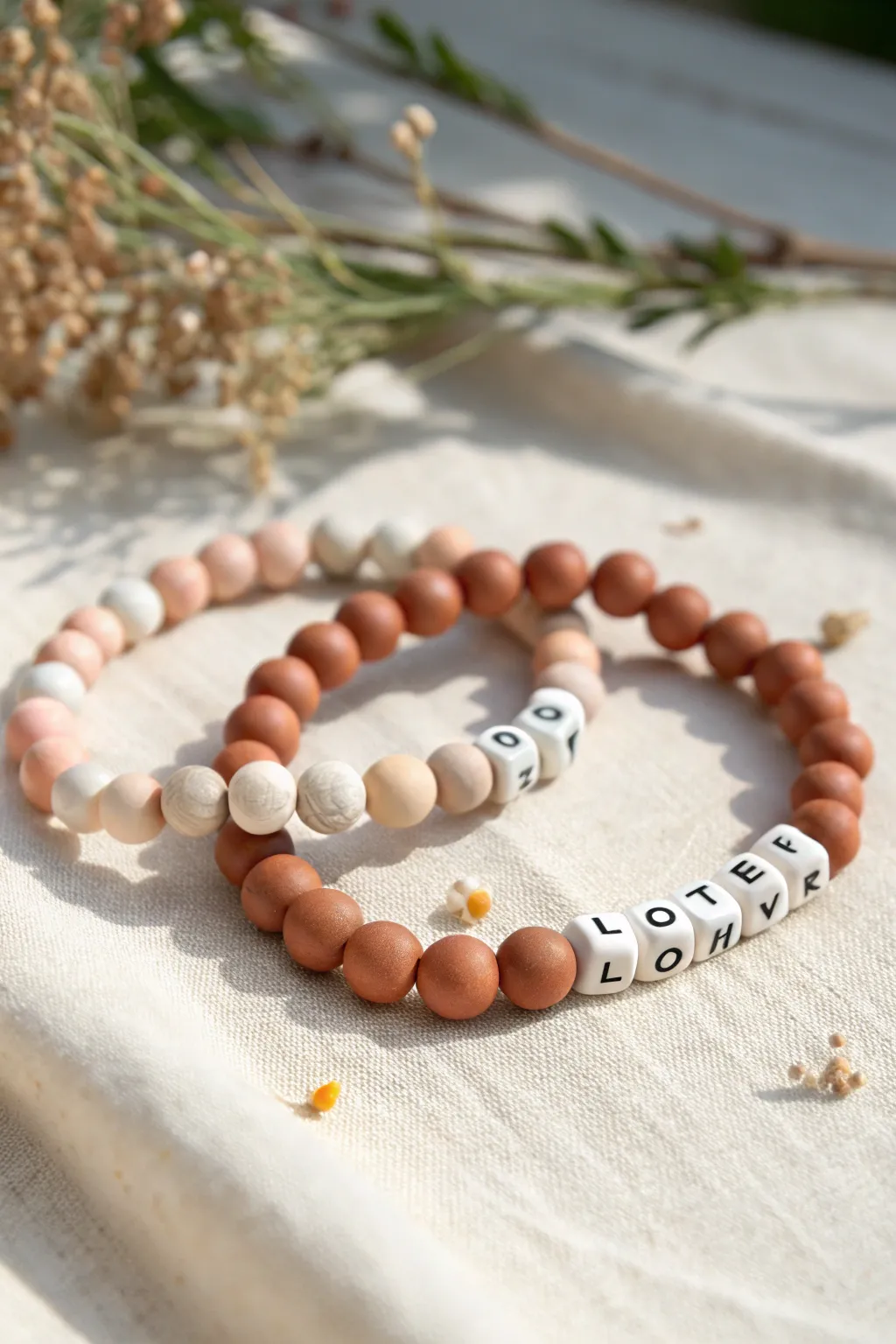
Celebrate friendship with this set of two complementary bracelets featuring warm, earthy hues and personalized letter beads. The matte finish of the polymer clay beads gives them a sophisticated, organic look that pairs perfectly with the crisp white letter cubes.
Step-by-Step Guide
Materials
- Polymer clay in terracotta/rust, peach/blush, beige, sand, and white/cream colors
- Elastic stretch cord (0.8mm or 1mm)
- White cube letter beads (set spelling ‘LOVER’ or personalized names)
- Small rolling texturing tool or sandpaper (for matte finish)
- Bead reamer or toothpick
- Super glue or jewelry cement
- Scissors
- ruler
- Baking sheet and parchment paper
Step 1: Making the Clay Beads
-
Prepare the clay:
Begin by conditioning each color of polymer clay separately. Knead them in your hands until they are soft and pliable to prevent cracking later. -
Portion for uniform size:
Roll each color into a long, even snake about 1cm thick. Use a blade to slice the snake into equal-sized segments to ensure your finished beads are consistent. -
Roll into spheres:
Take each segment and roll it between your palms to create a smooth, perfect sphere. Light pressure is best to keep them round. -
Create the marble effect:
For the swirled beads seen on the lighter bracelet, twist small snakes of white and beige together, fold, and roll until marbled. Don’t over-mix, or the distinct lines will disappear. -
Add texture:
To achieve the matte, stone-like texture visible in the photo, gently roll the unbaked beads over fine-grit sandpaper or tap them lightly with a toothbrush. -
Pierce the holes:
Using a toothpick or bead needle, carefully pierce a hole through the center of each bead. I find twisting the tool as you push through helps prevent the bead from squashing. -
Bake the beads:
Arrange the beads on a parchment-lined baking sheet. Bake according to your clay package instructions (usually around 275°F/135°C for 15-30 minutes). Let them cool completely before handling.
Sticky Situation?
If the knot won’t slide inside a bead, use a bead reamer to slightly widen the hole of the bead adjacent to the knot. Do this gently to avoid cracking the baked clay.
Step 2: Assembling the Bracelets
-
Measure the cord:
Cut a length of elastic cord about 10-12 inches long. This gives you plenty of extra room for tying knots without struggling. -
Planning the layout: ‘Rust’ Bracelet:
For the darker bracelet, arrange the deep terracotta beads as the primary color. Intersperse a few peach and beige beads near the center focal point to create a gradient effect leading to the letters. -
Planning the layout: ‘Blush’ Bracelet:
For the lighter bracelet, alternate between the blush, white, and marbled beige beads. Use the darker rust beads sparingly as accents to tie the two designs together visually. -
Stringing the beads:
Thread the beads onto the elastic cord following your planned pattern. When you reach the center, add your letter beads. The example spells ‘LOVER’ and ‘MOON’ (implied), but initials work great too. -
Check the fit:
Wrap the unfinished strand around your wrist to check the sizing. Add or remove clay beads from the ends until it fits comfortably. -
The surgeon’s knot:
Tie the ends together using a surgeon’s knot: make a standard overhand knot, but loop the end through the circle an extra time before pulling tight. This prevents slipping. -
Secure the knot:
Stretch the cord slightly to seat the knot firmly. Apply a tiny drop of super glue or jewelry cement directly onto the knot. -
Hide the knot:
Before the glue fully sets, quickly slide one of the larger clay beads over the knot to hide it inside. Trim the excess cord ends close to the bead.
Natural Polish
After baking, buff the beads with a piece of denim fabric. It adds a slight sheen without looking glossy, enhancing that natural stone aesthetic shown in the photo.
Now you have a stylish set of bracelets ready to gift to your favorite person
Clay Bead School-Notebook Colorway
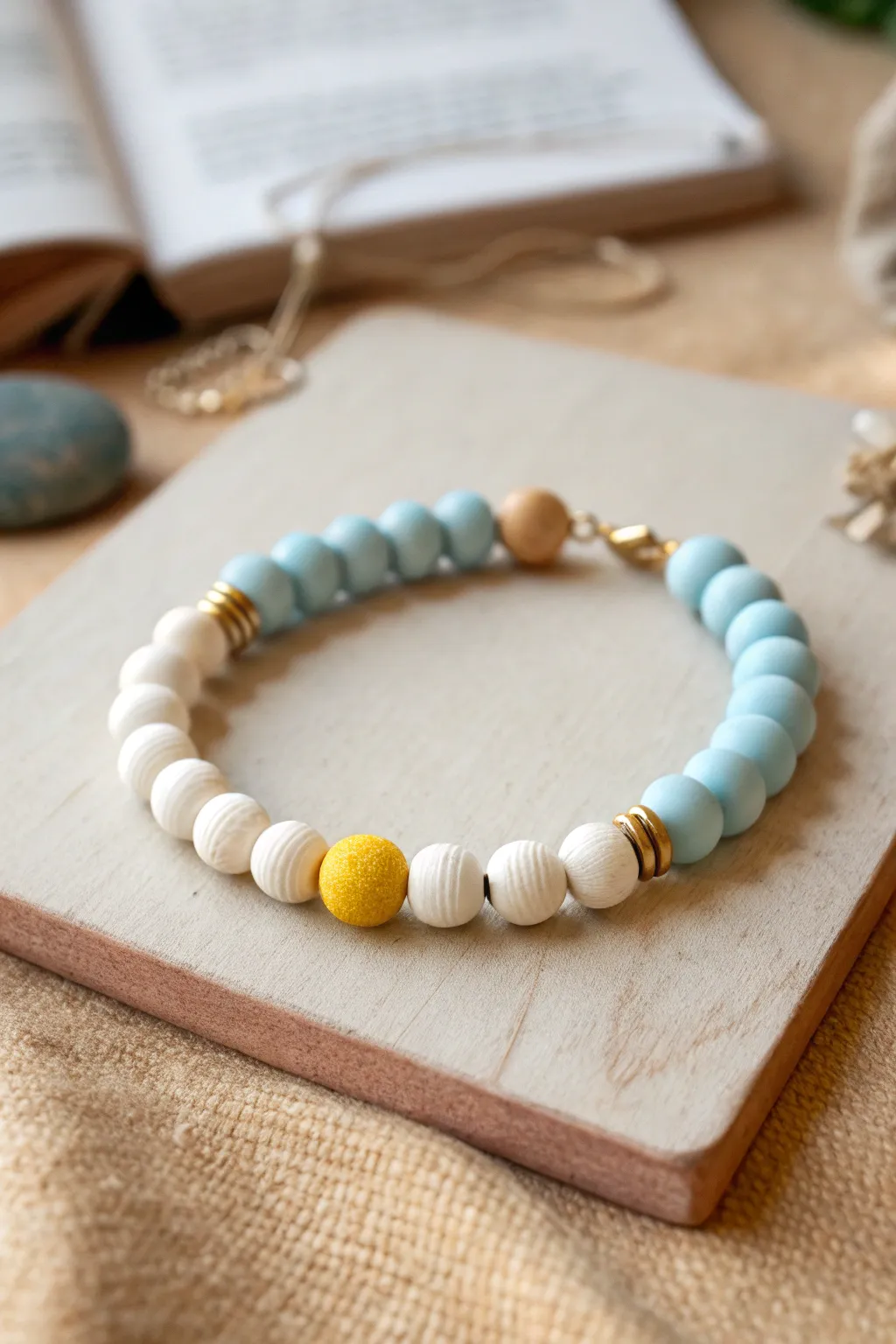
Capture the nostalgic feel of school days with this simple yet charming polymer clay bracelet. Its matte finish and classic color combination of soft blue, white, and a pop of yellow bring to mind fresh notebook paper and No. 2 pencils.
How-To Guide
Materials
- Polymer clay in pastel blue, white, and sunny yellow
- Wooden bead (approx. 8-10mm)
- Small gold spacer beads or rings (4 pieces)
- Beading elastic cord (0.8mm)
- Gold tone lobster clasp and jump ring
- Bead reamer or toothpick
- Roller or pasta machine for clay
- Texture sponge or sandpaper (optional)
- Clay cutting blade
- Gloss glaze (optional, only if you prefer shine)
- Super glue or jewelry glue
Step 1: Creating the Blue Beads
-
Condition the Blue Clay:
Start by warming the pastel blue polymer clay in your hands until it becomes soft and pliable. This conditioning step is crucial to prevent cracking later. -
Form a Log:
Roll the blue clay into a consistent snake or log shape on your work surface, aiming for a thickness of about 1cm. -
Cut Equal Segments:
Using your clay blade, slice the log into equal segments to ensure all your beads end up the same size. You will need roughly 12-14 segments for the blue sections. -
Roll into Spheres:
Take each blue segment and roll it between your palms using a gentle circular motion until they form perfectly smooth balls. -
Pierce the Beads:
Carefully poke a hole through the center of each blue sphere using a bead reamer or a toothpick. I like to rotate the bead slightly as I push through to keep the shape round.
Step 2: Making White and Yellow Accents
-
Prepare White Clay:
Repeat the conditioning and rolling process with the white clay. You’ll need about 6-8 beads, depending on your desired length. -
Add Texture:
For the specific look in the photo, the white beads have a subtle ribbed texture. You can achieve this by gently rolling the finished white spheres over a fine-tooth comb or using a sculpting tool to press light lines around the circumference. -
Create the Yellow Bead:
Make a single bead from the yellow clay, slightly larger than the others if you want it to stand out. -
Texture the Yellow Bead:
Before baking, tap the surface of the yellow bead with a piece of sandpaper or a stiff brush to give it that distinct, porous ‘sponge’ texture seen in the image. -
Bake the Beads:
Arrange all your clay beads on a parchment-lined baking sheet or a bead rack. Bake according to your clay manufacturer’s instructions (usually 275°F/135°C for 15-30 minutes). -
Cool Down:
Allow the beads to cool completely before handling. They harden as they cool.
Clean Hands, Clean Clay
White clay picks up lint instantly! Always wash your hands thoroughly and wipe down your work surface with rubbing alcohol before handling white clay to keep it pristine.
Step 3: Assembly
-
Measure the Elastic:
Cut a piece of elastic cord about 10-12 inches long. This gives you plenty of room to tie knots without struggling. -
Start Stringing:
Begin threading your beads. Start with the wooden bead, which will hide your knot later, followed by the clasp attachment if you are using a non-standard closure, or simply begin your pattern. -
Follow the Pattern:
Recreate the pattern: thread your smooth blue beads first to cover about half the wrist. Then add two gold spacer rings. -
Add the Focal Section:
After the gold spacers, thread the textured white beads. In the middle of the white section, place your single textured yellow bead. -
Complete the Circle:
Finish the white section, add two more gold spacer rings, and then finish any remaining length with blue beads until the bracelet fits your wrist comfortably. -
Tie the Knot:
Tie a strong surgeon’s knot (right over left, left over right) with the elastic. Pull it tight. -
Secure and Hide:
Place a tiny drop of jewelry glue on the knot. Once dry, trim the excess cord and gently tug the elastic so the knot hides inside the hole of the wooden bead or one of the larger clay beads.
Matte Finish Magic
To get that soft, matte finish on your beads, lightly buff them with a piece of denim or a high-grit sanding sponge after baking instead of using a glossy glaze.
Enjoy wearing your handcrafted accessory that brings a stylish touch to everyday outfits
Clay Bead Holiday Color Mini Stack
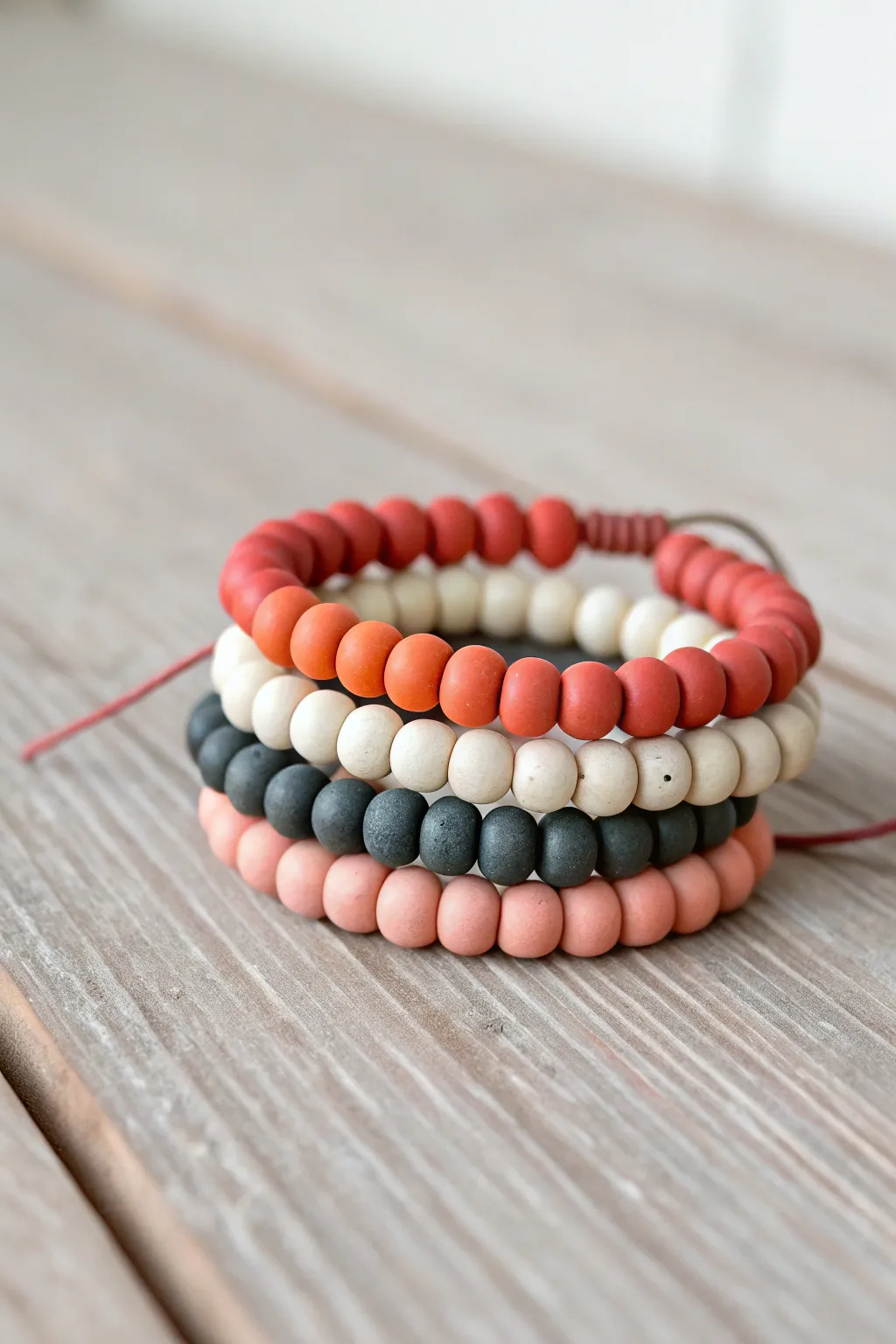
Capture the warmth of the season with this mini stack of handcrafted polymer clay bead bracelets. Featuring a muted palette of terracotta, cream, charcoal, and soft pink, these adjustable bracelets offer a sophisticated, minimalist take on festive accessories.
Detailed Instructions
Materials
- Polymer clay (terracotta, cream/white, dark charcoal grey, muted pink)
- Acrylic rolling pin or clay pasta machine
- Small circle cutter (approx. 6-8mm diameter)
- Toothpick, knitting needle, or bead piercing pin
- Medium grit sandpaper (optional)
- Waxed cotton or nylon cord (0.8mm or 1mm in reddish-brown)
- Parchment paper-lined baking sheet
- Oven (for baking clay)
- Scissors
- Lighter (for sealing cord ends)
- Ruler
Step 1: Crafting the Clay Beads
-
Condition the clay:
Start by warming the polymer clay in your hands. Knead each color block—terracotta, cream, charcoal, and pink—separately until they are soft and pliable to prevent cracking later. -
Roll out sheets:
Using your acrylic roller or pasta machine, roll each color into a slab of even thickness. Aim for about 3-4mm distinct thickness to get that chunky heishi bead look seen in the photo. -
Cut the shapes:
Take your small circle cutter and punch out as many rounds as possible from each color slab. You will need roughly 30-40 beads per bracelet depending on your wrist size. -
Smooth the edges:
Gently pick up each clay distinct and run your fingertip around the circumference to smooth out any harsh ridges left by the cutter. This gives them a softer, tumbled appearance. -
Pierce the holes:
Using a toothpick or bead pin, carefully poke a hole through the exact center of each disk. I find that twisting the tool gently as you push through helps keep the bead round without distorting the shape. -
Bake the beads:
Arrange the beads on a parchment-lined baking sheet, ensuring they aren’t touching. Bake according to your brand of clay’s instructions (usually around 275°F/130°C for 15-30 minutes). Let them cool completely before handling.
Keep Them Round
To prevent fingerprint smudges or distortion while piercing holes, try piercing the beads while they are still on the work surface, then lift them off gently with a blade.
Step 2: Assembling the Bracelets
-
Prepare the cord:
Cut a length of waxed cord approximately 12-14 inches long for your first bracelet. This gives you plenty of slack for the sliding knot closure. -
String the beads:
Thread your cooled beads onto the cord. For this specific mini stack, keep each bracelet a solid color rather than mixing them. String enough beads to cover the top and sides of your wrist, leaving the underside bare for the closure. -
Check the fit:
Wrap the beaded section around your wrist to verify the length. The beads should end just before the sides of your wrist turn into the underside. -
Create stoppage knots:
Tie a simple overhand knot tightly against the last bead on both ends of the strand. This keeps the row of beads secure and centred.
Texture Twist
Before baking, gently roll the raw beads over a piece of coarse sandpaper or a texture sheet to give them a stone-like, matte surface instead of a shiny plastic finish.
Step 3: Creating the Adjustable Closure
-
Form the circle:
Bring the two tail ends of the cord together so they overlap parallel to each other, forming a circle shape with the bracelet. -
Prepare the knotting cord:
Cut a separate small piece of the same waxed cord, about 6 inches long. This will be used to create the sliding square knot. -
Tie the square knot base:
Place the short cord underneath the two overlapping bracelet strands. Tie a basic overhand knot to secure it, centered over the overlapped area. -
Start the macramé braid:
Take the right end of the knotting cord, pass it over the bracelet strands but under the left knotting cord. Then take the left end, go under the bracelet strands and up through the loop on the right. -
Complete the square knot:
Pull tight. Repeat the process, starting with the left side first this time. Continue alternating sides for 3-4 full knots until you have a sturdy little macramé band like the one shown in the image. -
Trim and seal:
Snip off the excess tails of the knotting cord (not the bracelet cords!). Carefully use a lighter to melt the very tips of the cut nylon so the knot creates a permanent bond and doesn’t fray. -
Finish the tails:
Tie a small knot at the very end of each bracelet tail cord so the adjustable knot can’t slide all the way off. Trim any excess beyond these end knots. -
Repeat for the stack:
Repeat the assembly process for the remaining three colors to complete your set.
Now slide on your stack and enjoy the rustic charm of your handmade accessories
Clay Bead Team-Color Spirit Bracelet
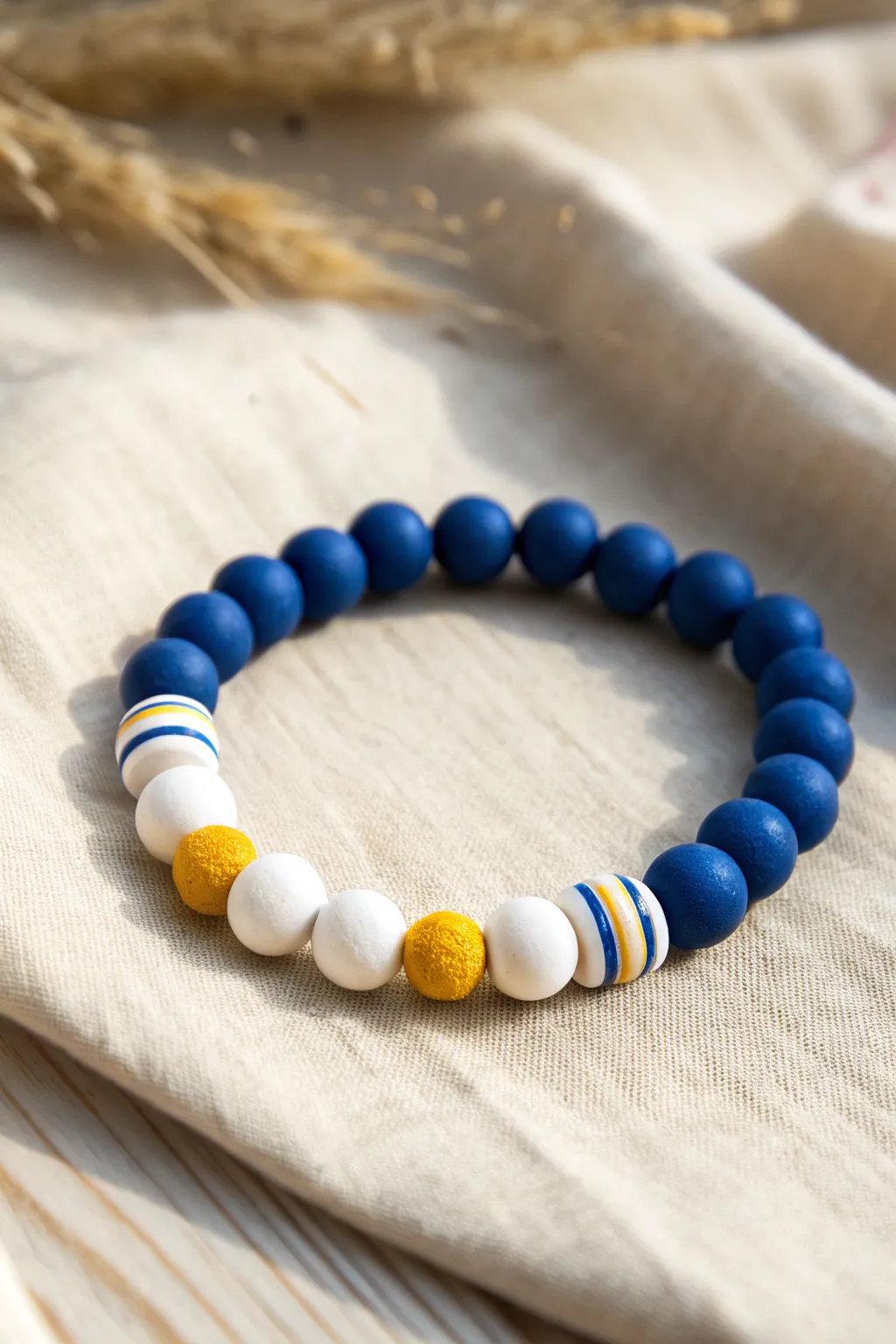
Show off your team pride with this custom polymer clay bracelet featuring matte blue beads and sporty accents. The combination of solid colors, textured yellow spacers, and hand-painted stripes gives this piece a polished, professional look perfect for game day.
Step-by-Step Tutorial
Materials
- Polymer clay (Dark Blue, White, Golden Yellow)
- Acrylic rolling pin
- Circle clay cutter (small, approx. 1cm)
- Elastic beading cord (0.8mm or 1mm)
- Bead piercing pins or toothpicks
- Baking sheet and parchment paper
- Oven
- Needle nose pliers (optional)
- Super glue or jewelry cement
- Fine detail paintbrush
- Acrylic paint (Dark Blue, Yellow)
- Coarse sandpaper or salt (for texturing)
- Matte varathane or clay sealer (optional)
Step 1: Prepping the Solid Beads
-
Condition the Blue Clay:
Start by warming up your dark blue polymer clay in your hands until it is soft and pliable. Roll it into a smooth, even log on your work surface to prepare for cutting. -
Section and Roll:
Slice the blue log into equal-sized segments to ensure your beads are uniform. Take each segment and roll it between your palms to create perfectly round spheres about the size of a large pea. You will need about 18-20 blue beads. -
Create White Beads:
Clean your hands thoroughly to avoid color transfer, then repeat the conditioning and rolling process with white clay. Create 4 smooth white spheres the same size as your blue beads. -
Pierce the Beads:
Gently pierce each sphere with a bead pin or toothpick to create the stringing hole. Rotate the pin as you push through to keep the shape round, effectively reaming out the hole slightly.
Uneven Stripes?
If painting stripes is tricky, use thin strips of colored clay instead. Wrap them around the raw white bead and roll gently to fuse them flat before baking.
Step 2: Creating Accent Beads
-
Texture the Yellow Clay:
Condition your golden yellow clay. To get that distinct textured look seen in the photo, roll your yellow spheres over coarse sandpaper or gently press coarse salt into the surface (which you can wash off after baking). -
Form the Striped Beads:
Create two slightly cylindrical white beads to serve as the base for your stripes. Gently flatten the ends so they sit flush against their neighbors. -
Bake the Beads:
Arrangement your beads on a parchment-lined baking sheet. Bake according to the manufacturer’s instructions for your specific brand of clay—usually 275°F (135°C) for 15-30 minutes. -
Cool Down:
Once baked, I like to let the beads cool completely in the oven with the door cracked open. This creates a stronger bead less prone to cracking.
Team Texture
Mix glitter into the yellow clay or use a stiff toothbrush to stipple the surface for a ‘flocked’ jersey texture effect just like a real mascot uniform.
Step 3: Detailing and Assembly
-
Paint the Stripes:
Take your two white cylindrical beads and a fine detail brush. Carefully paint a thin yellow stripe flanked by two thin blue stripes around the circumference. You can put the bead on a toothpick and spin it for cleaner lines. -
Seal (Optional):
If you want extra durability for your painted stripes, apply a very thin coat of matte sealer over the paint once it is fully dry. -
Layout the Design:
Lay out your beads on a bead board or towel to verify the pattern. The focal section follows this order: Striped, White, Textured Yellow, White, White, Textured Yellow, White, Striped. -
String the Focal Section:
Cut a length of elastic cord about 10 inches long. Start by threading on the focal section you just laid out. -
add the Blue Base:
String the dark blue matte beads onto the remaining cord length until the bracelet reaches your desired wrist size (usually 6.5 to 7 inches). -
Check the Fit:
Wrap the unfinished strand around your wrist to ensure it fits comfortably without being too tight or too loose, adding or removing blue beads as needed. -
Tie the Knot:
Tie a surgeon’s knot (looping the elastic through twice on the first pass) and pull it tight. Add a tiny drop of super glue or jewelry cement to the knot for security. -
Hide the Knot:
Once the glue is dry, trim the excess cord ends and gently tug the knot inside the hole of one of the adjacent blue beads to hide it.
Wear your team colors proudly or gift this spirit bracelet to a fellow fan to gear up for the next big game
Clay Bead Pastel Preppy Stack
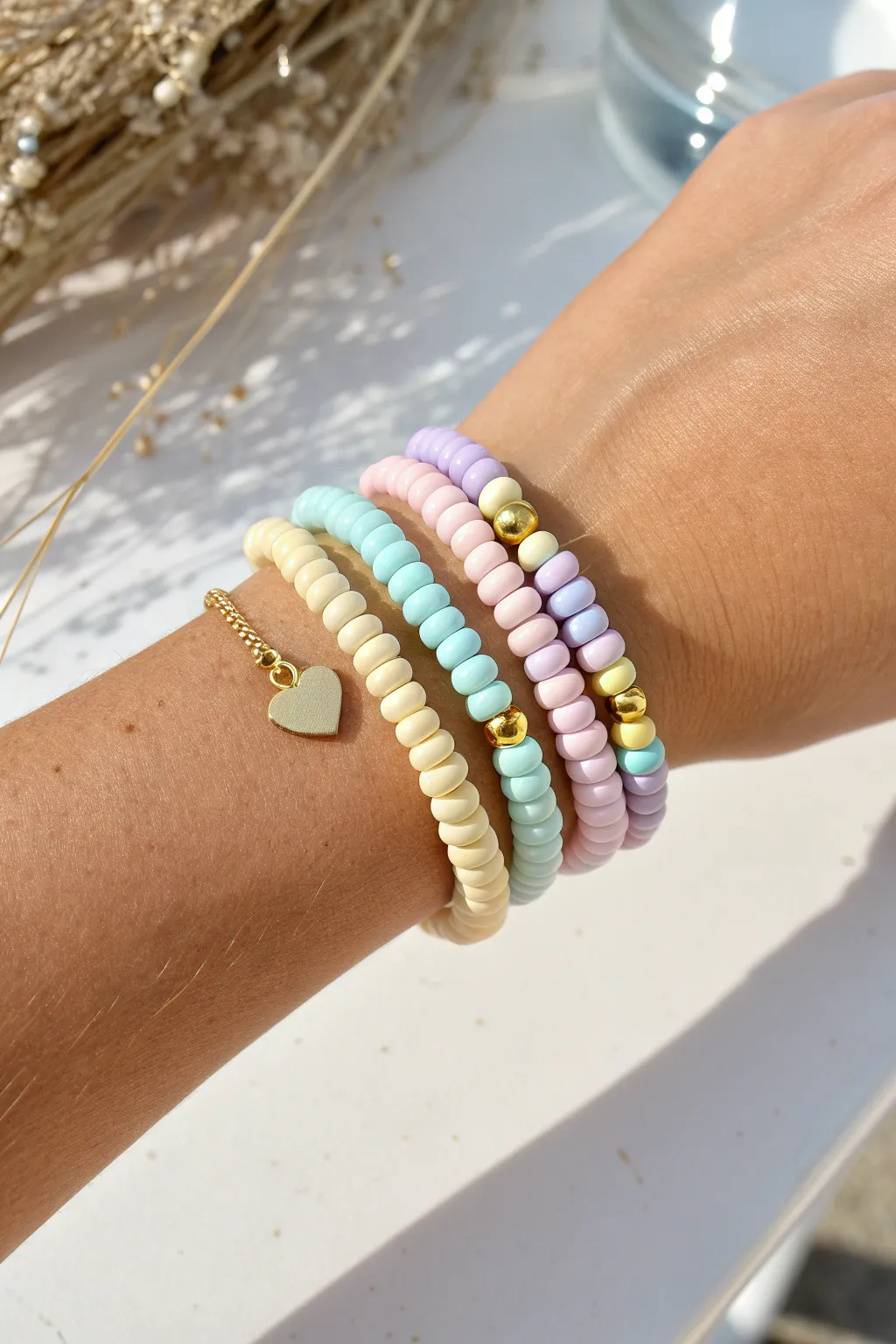
Embrace the soft, cheerful vibes of spring with this delightful stack of four stretch bracelets. Featuring a creamy palette of yellow, mint, pink, and lilac heishi beads, this set is elevated by gold accents and a sweet heart charm for that perfect preppy finish.
Detailed Instructions
Materials
- Polymer clay heishi beads (6mm or 4mm) in pastel yellow
- Polymer clay heishi beads in mint green
- Polymer clay heishi beads in pastel pink
- Polymer clay heishi beads in lavender/lilac
- Gold round spacer beads (approx. 4mm)
- Small gold heart charm
- Gold jump ring (4mm or 5mm)
- Elastic stretch cord (0.8mm clear)
- Jewelry glue or clear nail polish
- Scissors
Step 1: Planning and Prep
-
Measure your wrist:
Wrap a piece of string around your wrist to find your size, then add about half an inch for a comfortable fit. Cut four strands of elastic cord, making sure each is about 3-4 inches longer than your measurement to allow room for tying knots. -
Pre-stretch the cord:
Give each piece of elastic a firm but gentle tug before you start beading. This helps prevent the bracelets from stretching out and becoming loose after you wear them for the first time.
Step 2: Creating the Solid Color Strands
-
Start the yellow layer:
Begin threading the pastel yellow heishi beads onto your first cord. I like to continuously check the length against my wrist as I go. -
Add the charm accent:
Once the yellow strand is complete, open a gold jump ring using your fingers or pliers. Slide the gold heart charm onto it, then loop the jump ring onto the bracelet cord before closing it securely. -
Build the mint layer:
For the second bracelet, thread on your mint green clay beads until you reach the half-way point of your desired length. -
Insert gold spacer:
Slide on a single gold round spacer bead to act as a center focal point. Continue adding mint beads until the strand matches the length of the yellow one. -
Create the pink layer:
Repeat the process with the pastel pink beads. Just like the mint strand, thread halfway, add one gold spacer bead, and finish with the remaining pink beads.
Sticky Situation
If your knot keeps slipping while trying to glue it, use a piece of tape or a binder clip to hold one side of the elastic to your table while you manipulate the other side.
Step 3: The Mixed Purple Strand
-
Begin the pattern:
This final bracelet has a subtle pattern. Start by threading on your lavender heishi beads. -
Add the center detail:
At the halfway mark, add a small section of accent beads. Thread one pastel yellow bead, followed by one gold spacer bead, and another pastel yellow bead. -
Finish the strand:
Complete the rest of the bracelet using the lavender beads. This creates a cohesive look that ties the yellow and purple strands together visually.
Charm Up
Add variety by swapping the single heart for multiple scattered charms or use letter beads to spell out a word like ‘LOVE’ or ‘HOPE’ within the yellow strand.
Step 4: Finishing Touches
-
Tie the knots:
For each bracelet, tie the ends together using a surgeon’s knot. Make a regular overhand knot, but loop the end through twice before pulling tight. -
Secure with glue:
Place a tiny drop of jewelry glue or clear nail polish directly onto the knot. Let this dry completely to ensure your creation doesn’t unravel. -
Hide the ends:
Once dry, trim the excess elastic close to the knot. If the hole of a nearby bead is large enough, gently tuck the knot inside for a seamless, professional appearance.
Slip on your colorful stack and enjoy the instant brighten-up for any outfit
Easy DIY Marbled Clay Beads
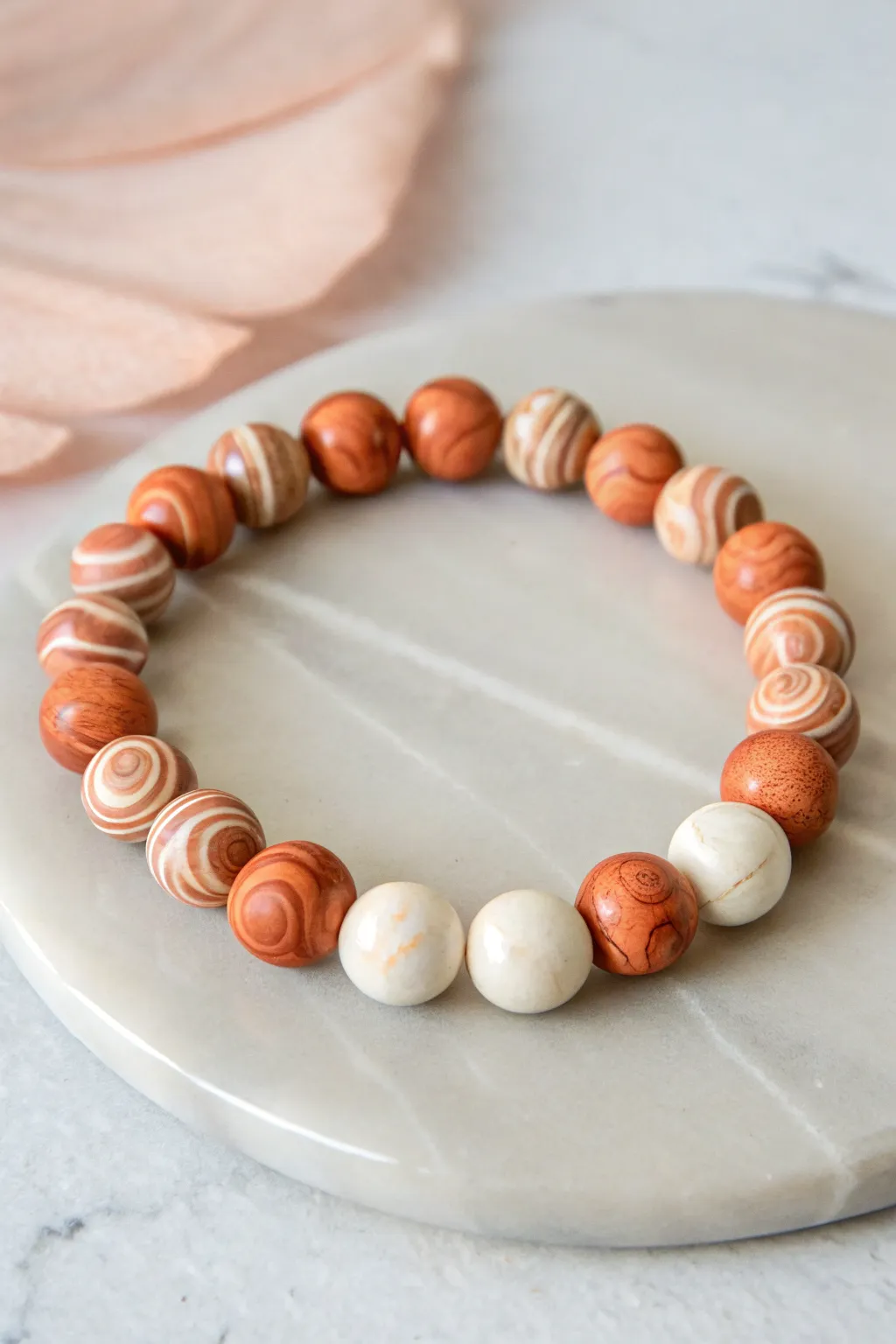
Achieve the sophisticated look of polished agate or jasper using simple polymer clay techniques. These beads feature warm, earthy swirls of rust and cream that mimic natural stone patterns, perfect for creating understated yet elegant jewelry.
Step-by-Step Guide
Materials
- Polymer clay (terracotta/rust color)
- Polymer clay (white or cream color)
- Polymer clay (beige or sand color)
- Acrylic roller or pasta machine
- Tissue blade or craft knife
- Pointed bead piercing tool or toothpick
- Baking sheet with parchment paper
- Beading elastic or cord
- Wet/dry sandpaper (400, 600, 800 grits)
- Gloss glaze or resin (optional)
Step 1: Creating the Marbled Cane
-
Condition the Clay:
Start by kneading each color of polymer clay separately until they are soft and pliable. You will want roughly equal parts of the rust and cream, with slightly less of the beige. -
Create Snakes:
Roll each conditioned color into a long snake about 1/2 inch thick. -
Twist Together:
Gather your three snakes and twist them together into one large rope. Fold this rope in half and twist it again. -
Roll and Compress:
Roll the twisted rope on your work surface to smooth it out and compress the colors. Lengthen it back out to its original length. -
Repeat the Twist:
Fold the rope in half again and twist. Do this process about 2-3 times total. Be careful not to over-mix; you want distinct stripes, not a muddy brown color. -
Create a Block:
Squish your marbled snake into a rough rectangular block shape rather than a tube.
Step 2: Forming the Beads
-
Slice the Clay:
Using your tissue blade, cut the block into equal-sized segments. The size of the segment determines the size of the finished bead. -
Roll Spheres:
Take a segment and roll it swiftly between your palms. This initial roll creates the ball shape. -
Shape the Swirls:
Look at the pattern on the bead. I usually manipulate the clay slightly with my fingers to ensure the swirl lines run horizontally around the bead’s equator, mimicking the strata seen in natural stones. -
Smooth the Surface:
Roll the bead gently again to smooth out any fingerprints. For ultra-smooth beads, wear latex gloves or lightly cornstarch your hands. -
Create Accent Beads:
To match the photo, create a few beads that are solid cream or just slightly marbled with beige to break up the pattern.
Muddy Colors?
If your swirls are blending into a single brown shade, you over-kneaded. Stop rolling sooner next time. The colors should look distinct like candy stripes before you form the ball.
Step 3: Baking and Finishing
-
Pierce the Holes:
Gently twist your piercing tool through the center of each bead while it is still raw. Rotate the bead as you pierce to keep the hole centered and prevent distortion. -
Bake:
Arrange the beads on a parchment-lined baking sheet. Bake according to your brand’s package instructions (usually 275°F or 135°C for 15-30 minutes). -
Cool Down:
Let the beads cool completely before handling them. They harden fully as they cool. -
Sand for Polish:
Use wet/dry sandpaper under a trickle of water. Start with 400 grit to remove blemishes, then move to 600 and 800 for a satin finish. -
Buff or Glaze:
Vigorously rub the beads with denim or a soft cloth to buff them to a natural sheen. Alternatively, apply a thin coat of gloss glaze if you prefer a high-shine, ‘wet’ look. -
String the Bracelet:
Thread your finished beads onto flexible elastic cord, alternating the swirled beads with the plainer cream ones for balance. Knot the elastic securely to finish.
Add Texture
Before baking, roll your raw beads gently over a piece of coarse sandpaper or a clean stone surface. This embeds a subtle, realistic pitting texture found in real rocks.
Wear your new bracelet stacked with other natural gemstone jewelry for an earthy, bohemian style
Stamped Texture Clay Bead Bracelet
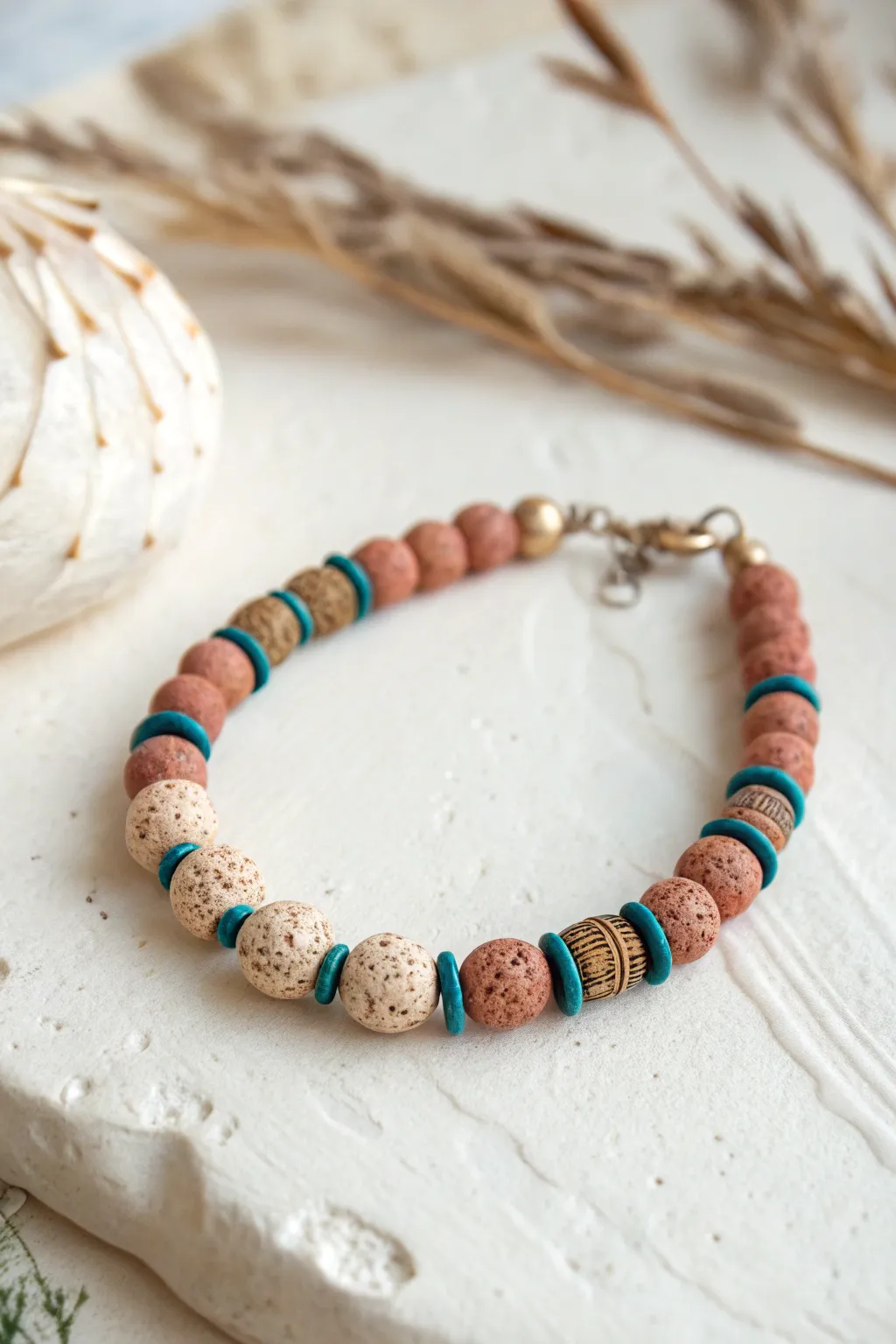
This rustic, nature-inspired bracelet combines the earthy warmth of terracotta and cream clay with pops of vibrant turquoise. By adding simple stamped textures to your handmade beads, you can create a piece that feels both ancient and effortlessly modern.
How-To Guide
Materials
- Polymer or air-dry clay (Terracotta, Cream/Unbleached, Dark Brown, Teal)
- Bead piercing tool or toothpick
- Sandpaper or a rough stone for texturing
- Carving tool or needle tool
- Jewelry wire or sturdy beading cord
- Gold finish lobster clasp
- Gold finish jump rings
- Two gold crimp beads
- Jewelry pliers
- Oven (if using polymer clay)
Step 1: Shaping the Clay Beads
-
Prepare the Earth Tones:
Condition your terracotta and cream clays separately until they are soft and pliable. Roll them into even logs to make portions easier to measure. -
Roll Spheres:
Cut consistent segments from your clay logs and roll them between your palms to create smooth, round spheres. You will need about 4-5 cream beads and 12-14 terracotta beads, depending on your wrist size. -
Create the Focal Beads:
Using a slightly darker brown clay, roll 2-3 beads of the same size as the others. These will serve as accent points in the pattern. -
Make the Spacers:
Roll out a thin snake of teal clay.Slice very small, thin discs from this snake and gently smooth the edges with your finger to create flat spacer beads. You need enough to place one between every main bead.
Fixing Distortion
If beads squish while piercing holes, let them sit in the fridge (polymer) or air (air-dry) for 15 mins to firm up before trying again.
Step 2: Texturing and Curing
-
Apply Speckled Texture:
For the cream and terracotta beads, gently roll them over a piece of coarse sandpaper or a rough stone surface. This imitates the look of natural volcanic rock or sandstone. -
Carve the Focal Beads:
Take your brown accent beads and use a needle tool to carve horizontal and vertical lines around the circumference. I like to make these lines slightly deep so they hold contrast later. -
Piercing the Holes:
Carefully pierce the center of each bead with your bead tool or toothpick. Rotate the tool as you push through to prevent the bead from squashing. -
Curing Process:
Bake the beads according to your specific clay package instructions. If using air-dry clay, allow them to sit undisturbed for 24-48 hours until fully hardened. -
Highlight the Texture (Optional):
Once cool, you can rub a tiny bit of dark acrylic paint into the carved grooves of the brown beads and wipe away the excess to make the pattern pop.
Level Up: Salt Technique
Roll raw beads in coarse sea salt before baking. After curing, wash the beads to dissolve the salt, leaving deep, realistic craters like lava stone.
Step 3: Assembly
-
Start the Strand:
Cut a length of beading wire or cord. Secure one end by threading on a crimp bead and a jump ring, then looping the wire back through the crimp bead and flattening it with pliers. -
Begin Patterning:
Start threading your beads. Begin with a section of terracotta beads separated by teal spacers. -
Add the Focal Section:
Transition to the cream beads for the center section of the bracelet, continuing to use the teal spacers between each one. -
Insert Carved Beads:
Place the carved brown beads strategically where the color transitions happen, for example, between the terracotta and cream sections. -
Check the Length:
Wrap the strand around your wrist to check the fit. Add or remove terracotta beads at the ends to adjust the size. -
Close the Bracelet:
Thread a crimp bead and the lobster clasp onto the open end. Loop the wire back through the crimp bead, pull it taut (but not stiff), and crush the crimp bead with pliers. -
Trim Excess:
Snip off any remaining tail wire close to the crimp bead for a clean finish.
Now you have a stunning, earth-toned bracelet ready to wear or gift