
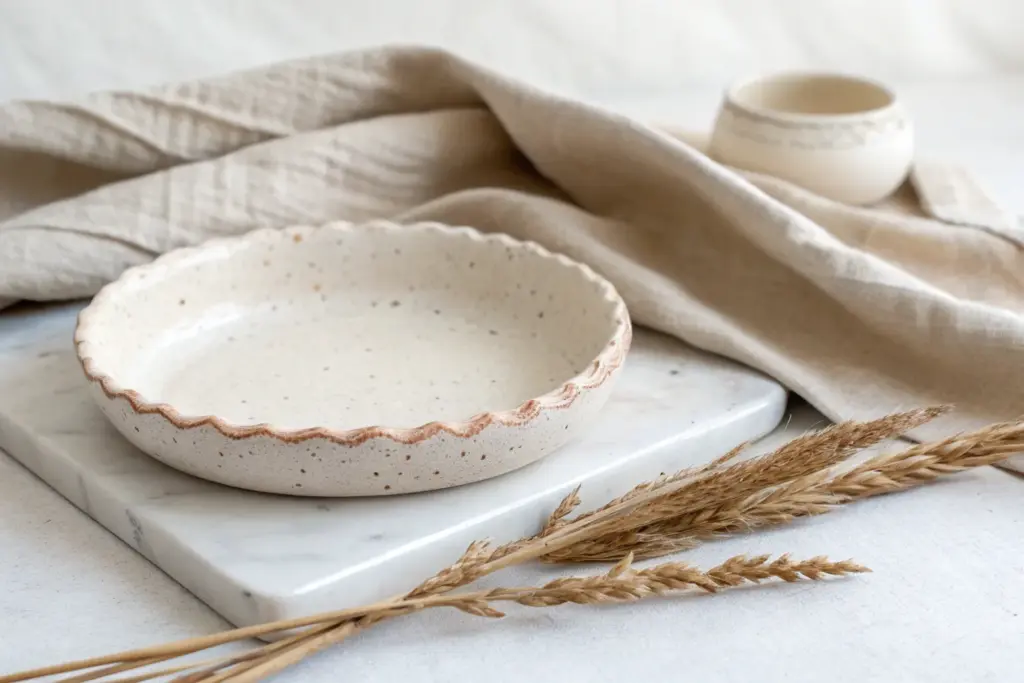
Whenever I’m craving a low-mess creative win, I reach for air-dry clay—it’s the easiest way to turn a plain tabletop into a mini studio day. Here are my favorite air clay craft ideas that look polished, feel doable, and don’t require any fancy equipment.
Stamped Trinket Dish
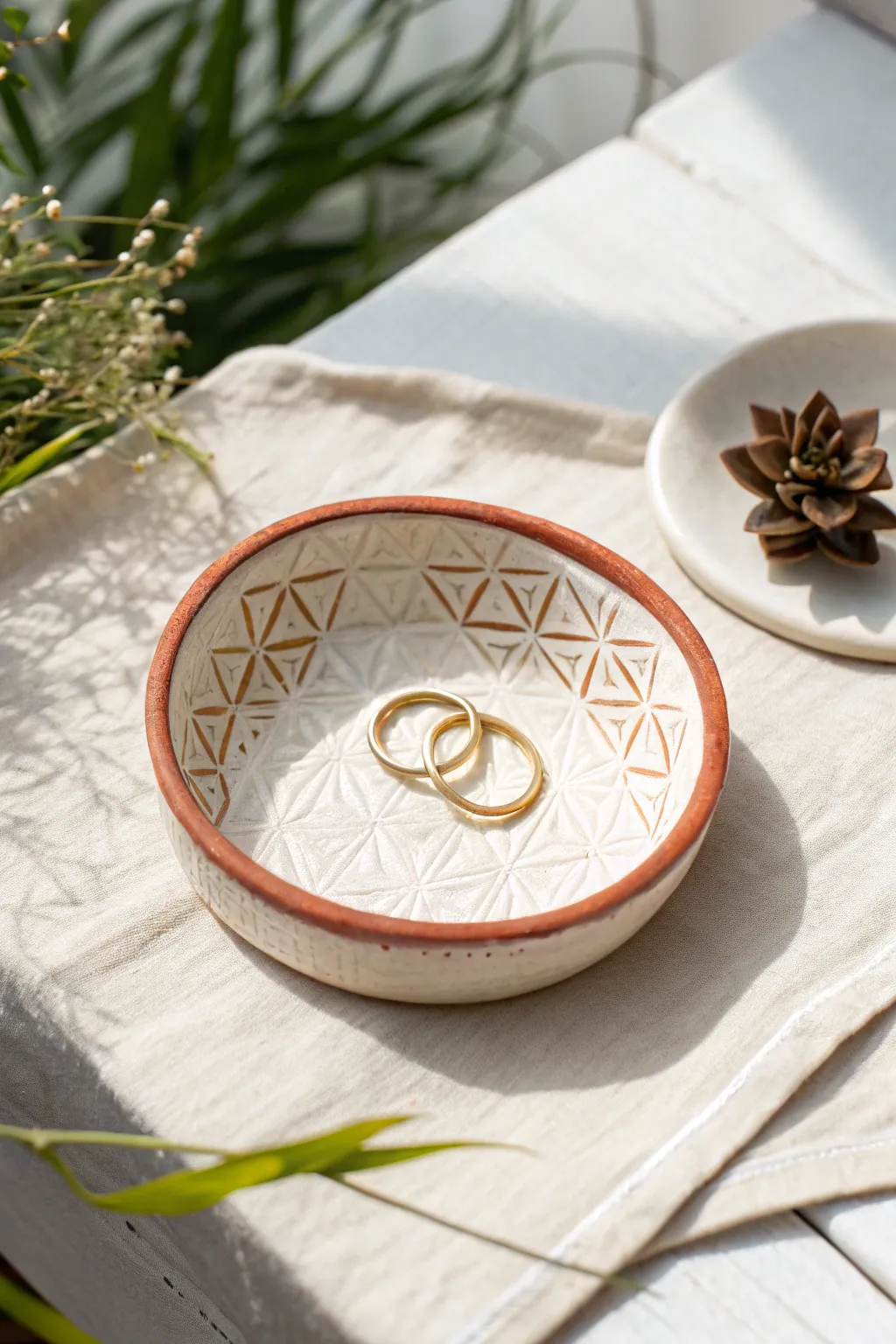
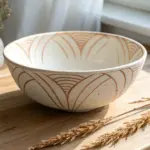
Transform simple air-dry clay into an elegant jewelry holder featuring a mesmerizing, geometric pattern. This project combines the raw, matte texture of pottery with warm terracotta accents for a bohemian-chic finish.
How-To Guide
Materials
- Air-dry clay (white or cream)
- Clay rolling pin
- Circle cutter or a small bowl (approx. 4-5 inches)
- Small geometric stamp or linocut tool (triangle shape)
- Shallow bowl (for forming)
- Sandpaper (fine grit)
- Terracotta acrylic paint
- Warm brown acrylic paint (optional wash)
- Small paintbrush
- Gloss or matte varnish
- Sponge or paper towel
Step 1: Prepping the Clay Base
-
Condition the Clay:
Begin by kneading a handful of air-dry clay until it feels soft, warm, and pliable. This prevents cracks from forming later. -
Roll it Out:
Roll your clay out on a smooth surface or canvas cloth to a thickness of about 1/4 inch (6mm). Aim for an even thickness across the entire slab to ensure consistent drying. -
Cut the Shape:
Place your circle cutter or an upside-down bowl onto the clay slab. -
Refine the Edge:
Use a sharp knife or needle tool to trace around your template, then peel away the excess clay. Dip your finger in a little water and smooth the cut edge to round it off nicely.
Step 2: Creating the Pattern
-
Plan the Center:
Find the approximate center of your clay circle. You don’t need to mark it heavily, just eye it carefully as your starting point. -
First Stamp:
Using a small triangle stamp (or a custom linocut stamp), press firmly into the center of the clay circle. -
Build the Geometry:
Align the next stamp directly against one side of the first triangle. Continue stamping in a radial pattern, working outward from the center. -
Complete the Texture:
Keep stamping until the pattern reaches about half an inch from the edge. Don’t worry if the pattern distorts slightly toward the edges; it adds to the handmade charm. -
Form the Dish:
Gently lift your clay circle and place it inside a shallow bowl. Press it down softly so it takes the curve of the bowl, which will act as a mold. -
Drying Time:
Allow the clay to dry completely in the mold. This usually takes 24-48 hours depending on humidity. I like to rotate the bowl occasionally to help air reach all sides.
Cracks happen!
If small hairline cracks appear during drying, mix a tiny bit of fresh clay with water to make a paste (slip) and fill them in before sanding.
Step 3: Finishing Touches
-
Sanding:
Once bone dry, remove the dish from the mold. Gently sand any rough edges or sharp points on the rim with fine-grit sandpaper. -
Painting the Rim:
Dip a small brush into terracotta acrylic paint. Carefully paint the top rim of the dish. -
Create a Wash:
Mix a tiny drop of warm brown or terracotta paint with plenty of water to create a very sheer wash. -
Enhance the Pattern:
Brush this wash over the stamped area, letting the pigment settle into the deep grooves. -
Wipe Back:
Immediately use a damp sponge or paper towel to wipe the surface flat. This leaves the color inside the stamped lines while keeping the raised surface light. -
Seal the piece:
Finish by applying a coat of matte or satin varnish to protect the clay from moisture and give it a professional sheen.
Make it yours
Instead of a generic stamp, use items from nature like seed pods or the end of a pinecone to press organic textures into the clay.
Now you have a beautiful, custom-stamped vessel perfect for holding your favorite rings or trinkets
Leaf-Imprint Ring Dish
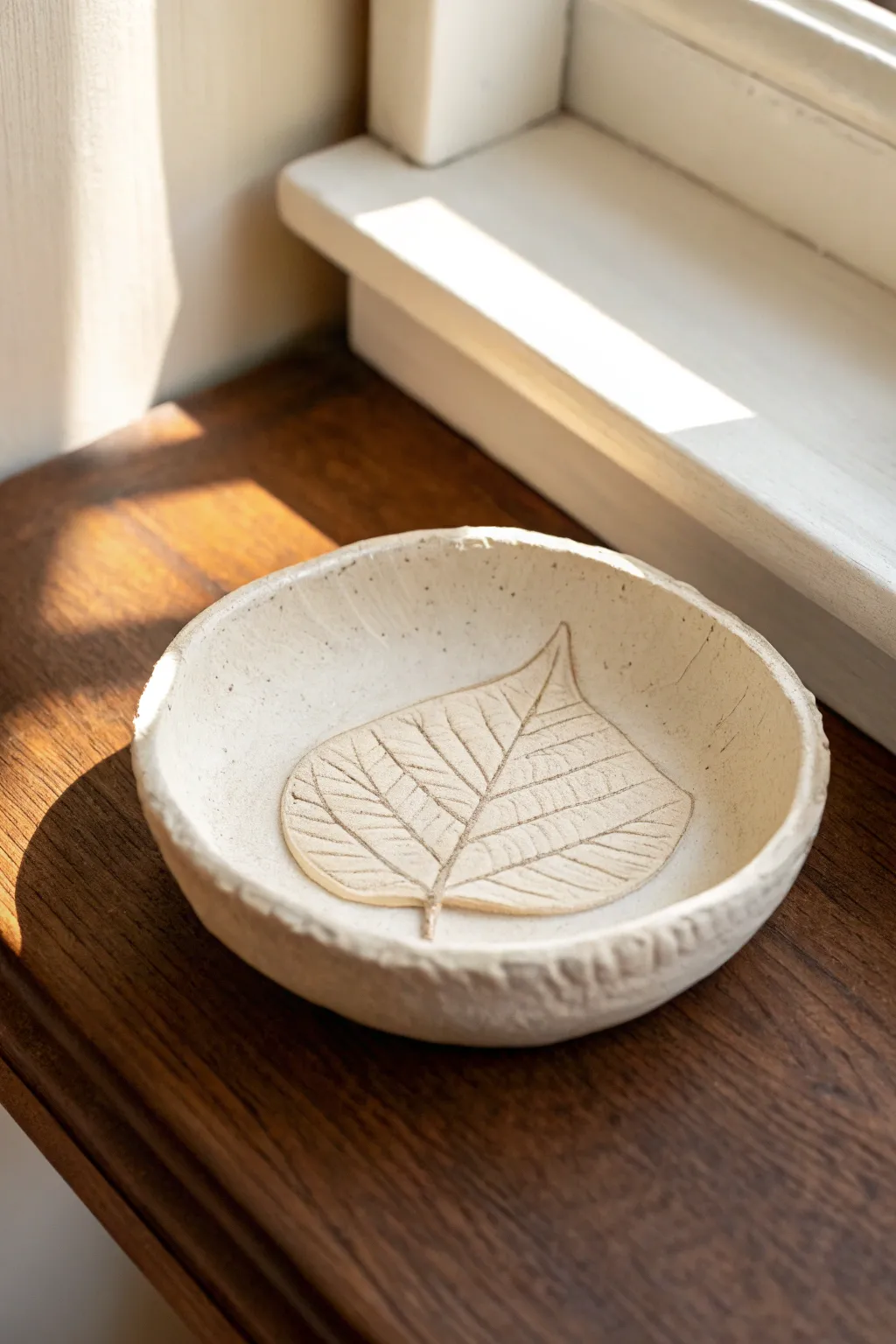
Capture the delicate details of nature forever with this simple yet stunning air-dry clay project. This shallow dish features a realistic leaf impression and a rustic, textured rim, making it the perfect organic spot to hold your favorite rings or earrings.
Step-by-Step Tutorial
Materials
- White or natural air-dry clay
- Rolling pin or smooth glass jar
- A fresh leaf with distinct veins (like hydrangea, rose, or ivy)
- Small bowl or saucer (for shaping)
- Craft knife or needle tool
- Small sponge
- Fine-grit sandpaper (optional)
- Acrylic sealer or matte varnish
- Piece of parchment paper or canvas mat
Step 1: Preparing the Base
-
Wedge the clay:
Start by grabbing a handful of air-dry clay roughly the size of a tennis ball. Knead it in your hands for a minute to warm it up and remove any air bubbles, which helps prevent cracking later. -
Roll it out:
Place the clay on your parchment paper or canvas mat. Use your rolling pin to flatten the clay into a slab that is roughly 1/4 inch thick. Try to keep the thickness consistent across the entire surface. -
Smooth the surface:
If you see any wrinkles or cracks on the surface, dip your finger in a tiny bit of water and gently smooth them out. You want a pristine canvas for your leaf print.
Sticky Leaf?
If the leaf sticks to the clay and tears upon removal, let the clay dry for just 10-15 minutes before pressing. Also, ensure the leaf is fresh and green, not dry and brittle.
Step 2: Creating the Impression
-
Select your leaf:
Choose a leaf with a prominent vein structure on the back side. The underside of the leaf almost always gives a clearer, deeper print than the top. -
Position the leaf:
Place the leaf vein-side down onto the center of your rolled clay slab. Press it lightly with your fingers to tack it in place. -
Roll the impression:
Take your rolling pin and roll gently but firmly over the leaf one or two times. Do not roll back and forth repeatedly, as this might shift the leaf and ghost the image. Just commit to one strong pass. -
Remove the leaf:
Carefully find the stem or the edge of the leaf. I like to use a needle tool to lift just the very edge, then slowly peel the leaf away to reveal the intricate veins left behind.
Step 3: Shaping the Bowl
-
Determine the size:
Find a bowl or round object that is slightly larger than the leaf impression you just made. This will serve as your cutting template. -
Cut the circle:
Place your template gently over the impression, centering the leaf. Use your craft knife to trace around the template and cut out your clay circle. -
Texture the rim:
Instead of smoothing the cut edge perfectly, use your fingers or a stiff brush to tap the edges. This creates that rustic, organic texture seen in the photo rather than a sharp, manufactured edge. -
Form the curve:
Pick up your clay circle and gently drape it into a shallow bowl or saucer. Let gravity help it slump into a curved shape. -
Refine the shape:
Gently press the clay against the bowl’s curve, ensuring the leaf design stays centered. If the edges crack slightly while bending, smooth them with a damp finger for a weathered look.
Color Wash
Mix a tiny drop of brown or green acrylic paint with water. Brush it over the dry texture and wipe it back immediately with a cloth to highlight the veins.
Step 4: Finishing Touches
-
First drying phase:
Let the dish dry inside the mold (the bowl) for about 24 hours. This ensures it holds its curved shape while the clay creates its initial bond. -
Remove and flip:
Once the top feels dry to the touch, carefully pop the clay out of the bowl. Flip it over and set it on a wire rack so the bottom can dry completely. This usually takes another 24 to 48 hours. -
Sanding (optional):
If there are any sharp jagged bits on the rim that you don’t like, very lightly sand them down with fine-grit sandpaper. Be careful not to sand over the leaf texture. -
Seal the piece:
Since air-dry clay isn’t waterproof, apply a coat of matte varnish or acrylic sealer. Use a soft brush to get the sealer into the deep grooves of the leaf veins. -
Final cure:
Allow the sealer to cure fully according to the bottle instructions before placing any jewelry inside.
Place this lovely little dish on a windowsill or bedside table to enjoy a touch of nature every day


Painted Pinch-Pot Catchall
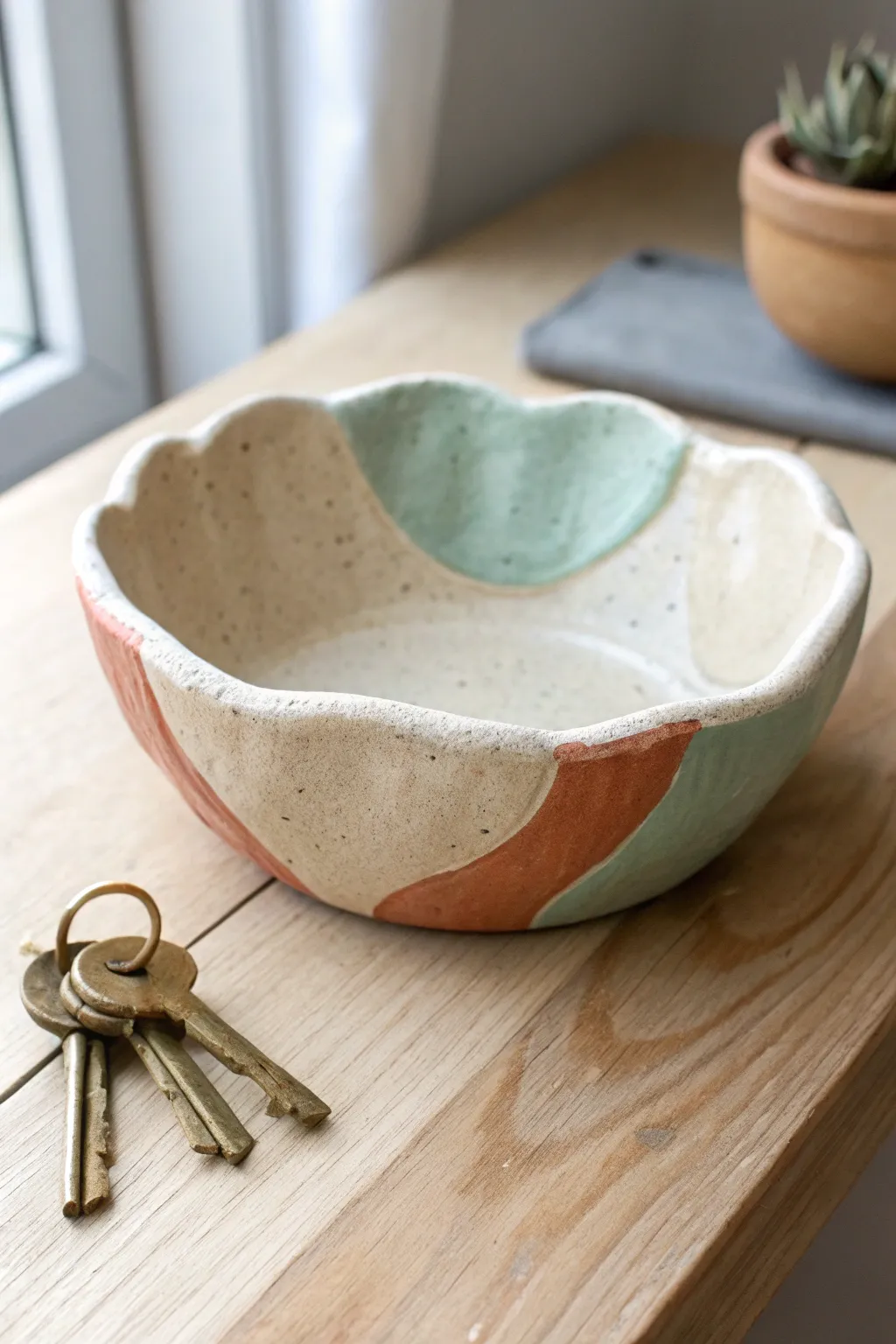
This charming catchall mimics the wavy, effortless look of handmade ceramics with a soft, speckled finish. Using air-dry clay, you’ll sculpt a simple organic shape and paint it with soothing pastel blocks to create a gentle, modern home for your keys or trinkets.
How-To Guide
Materials
- White air-dry clay (approx. 1 lb)
- Acrylic paints (terracotta, sage green, cream/off-white, dark brown)
- Matte mod podge or acrylic varnish
- Rolling pin
- Small bowl (for a mold, optional)
- Sandpaper (fine grit)
- Small sponge or old toothbrush
- Flat paintbrush (medium size)
- Cup of water
Step 1: Sculpting the Form
-
Prepare the clay:
Start by kneading a tennis-ball-sized lump of air-dry clay until it is warm and pliable. This conditioning helps prevent cracks later on. -
Create a slab:
Roll the clay out into a thick, even circle, aiming for a thickness of about a quarter-inch. -
Form the pinch pot base:
Gently lift the edges of the circle to curve them upwards. You can drape the clay over an upside-down bowl to help establish the initial curve, or form it freely in your hands. -
Build the walls:
Using your thumb and fingers, pinch the walls to thin them out slightly and extend the height. Keep the movement rhythmic to maintain an even thickness. -
Shape the wavy rim:
Instead of smoothing the rim perfectly flat, gently push down in some areas and pull up in others to create soft, organic undulations. The goal is an imperfect, flower-like silhouette. -
Smooth the surface:
Dip your finger in a tiny bit of water and run it over the clay to smooth out any rough fingerprints or harsh creases. I like to focus on the inside curve to ensure a seamless look. -
Dry thoroughly:
Set the bowl aside in a cool, dry place. Let it cure for at least 24-48 hours until it puts off no cold moisture to the touch.
Smooth Operator
To get a truly ceramic look, dip your finger in water while smoothing the clay, but allow the ‘slurry’ to dry on the surface rather than wiping it off.
Step 2: Painting & Finishing
-
Sand imperfections:
Once fully dry, lightly sand the rim and any bumps on the exterior using fine-grit sandpaper. Wipe away the dust with a barely damp cloth. -
Apply base coat:
Paint the entire bowl—inside and out—with a coat of cream or off-white acrylic paint. This provides a neutral canvas and seals the porous clay slightly. -
Draft the color blocks:
Visualize where your color patches will go. The design features large, abstract blobs that wrap over the rim. -
Paint the first section:
Load your brush with the terracotta color. Paint a large, curved section on the exterior, letting the paint wrap over the rim and continue down into the interior. -
Add the second color:
Using the sage green, paint another large, fluid section adjacent to the terracotta. Leave a thick channel of the cream base coat visible between the colors to create separation. -
Refine the shapes:
Go back over your edges to make sure the curves are smooth and deliberate. The colors should look like large, soft puzzle pieces that don’t quite touch. -
Create the speckle effect:
Mix a small amount of dark brown paint with a drop of water to thin it. Dip an old toothbrush or a stiff bristled brush into the mixture. -
Splatter paint:
Run your thumb over the bristles to flick tiny specks of brown paint across the entire bowl. Practice on scrap paper first to control the spray. -
Seal the piece:
Allow the paint to dry completely. Apply a coat of matte varnish or Mod Podge to protect the finish and give it that soft ceramic sheen.
Glossy Glaze Look
Swap the matte varnish for a high-gloss Triple Thick glaze. This makes the air clay look exactly like kiln-fired pottery with a shiny finish.
Place your new catchall near the door and enjoy the handmade warmth it brings to your daily routine

Flower-Shaped Coasters
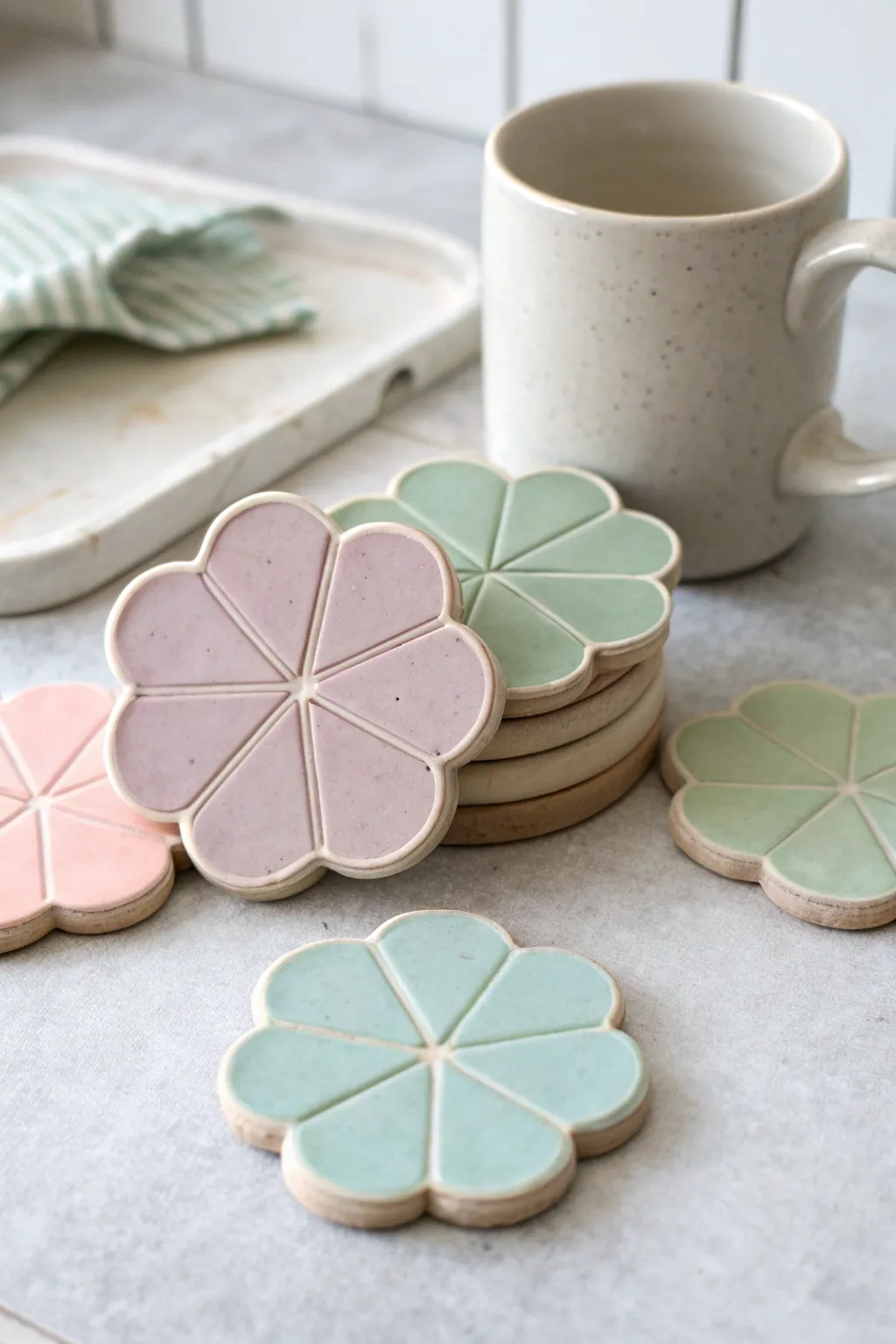
These charming flower-shaped coasters add a soft, elegant touch to your coffee table with their pastel hues and distinct raised outlines. The project mimics the look of high-end ceramics using accessible air-dry clay, perfect for a relaxing afternoon craft session.
Step-by-Step
Materials
- White air-dry clay (smooth texture)
- Rolling pin
- Parchment paper or silicone mat
- Flower-shaped cookie cutter (approx. 3.5-4 inches)
- Clay carving tool or blunt knife
- Ruler
- Fine-grit sandpaper (220 grit)
- Acrylic paints (pastel pink, sage green, lavender, cream/white)
- Small flat paintbrush
- Very fine detail paintbrush
- Glossy varnish or sealant (waterproof)
- Small bowl of water
- Sponge
Step 1: Shaping the Base
-
Prepare the Clay:
Take a handful of air-dry clay and knead it briefly until it is warm and pliable. This conditioning step helps prevent cracks from forming later as the clay dries. -
Roll it Out:
Place your clay between two sheets of parchment paper to prevent sticking. Roll it out to an even thickness of about 1/4 inch (6mm). Aim for a uniform slab so your coaster sits flat. -
Cut the Shape:
Press your flower-shaped cookie cutter firmly into the clay slab. Wiggle it slightly to ensure a clean cut, then gently remove the excess clay from around the shape before lifting the cutter. -
Smooth the Edges:
Dip your finger into a little water and gently run it along the cut edges of the flower to smooth out any roughness or loose bits of clay left by the cutter.
Warped While Drying?
If the clay curls up, slightly dampen the concave side and place it under a heavy book (with parchment paper in between) for a few hours to flatten it back out.
Step 2: Detailing and Drying
-
Mark the Center:
Using a blunt tool or the back of a paintbrush, make a very shallow indentation exactly in the center of the flower to serve as your guide for the petals. -
Carve the Lines:
Use a ruler and a carving tool to press straight lines radiating from the center point to the valley between each petal. Press deep enough to create a distinct groove, but be careful not to slice all the way through the clay. -
Create the Raise:
To enhance the ‘outline’ effect seen in the photo, gently run a damp modeling tool along the grooves you just made to widen them slightly and smooth the inner edges, creating a defined separation between petals. -
Initial Drying:
Place the coasters on a flat surface lined with clean parchment paper. Let them air dry for 24-48 hours. I like to flip them over halfway through the drying time to ensure the bottoms dry evenly and minimize warping. -
Sanding:
Once fully dry and hard, use fine-grit sandpaper to gently buff the edges and surface. Focus on smoothing out any sharp ridges around the rim for a professional finish. Wipe away dust with a damp sponge.
Faux Ceramic Look
For a glassy, high-end finish, use a two-part epoxy resin instead of standard varnish for your final coat. It creates a thick, durable, glass-like layer.
Step 3: Painting and Sealing
-
Base Coat:
Paint the entire coaster, including the grooves and edges, with a creamy off-white acrylic paint. This unifies the surface and acts as a primer for the pastel colors. -
Paint the Petals:
Select your pastel color (like lavender or sage). Using a small flat brush, carefully fill in the petal sections. Try to avoid getting paint into the deep grooves; we want those to remain the creamy base color. -
Clean Up Lines:
If you accidentally got pastel paint in the grooves, use your very fine detail brush with the cream paint to re-trace the lines, creating that crisp, outlined look. -
Speckling (Optional):
To mimic the ceramic look in the photo, dip an old toothbrush in watered-down brown or grey paint and flick a very fine mist of speckles over the surface. -
Seal Phase One:
Apply a coat of glossy varnish to the top and sides of the coaster. Let it dry completely according to the manufacturer’s instructions. -
Final Seal:
Apply a second and third coat of waterproof sealant. Since these are coasters, this step is crucial to protect the clay from moisture/condensation from cups.
Once sealed and cured, your lovely floral coasters are ready to protect your surfaces with handmade charm

What Really Happens Inside the Kiln
Learn how time and temperature work together inside the kiln to transform clay into durable ceramic.
Speckled Terrazzo Coasters
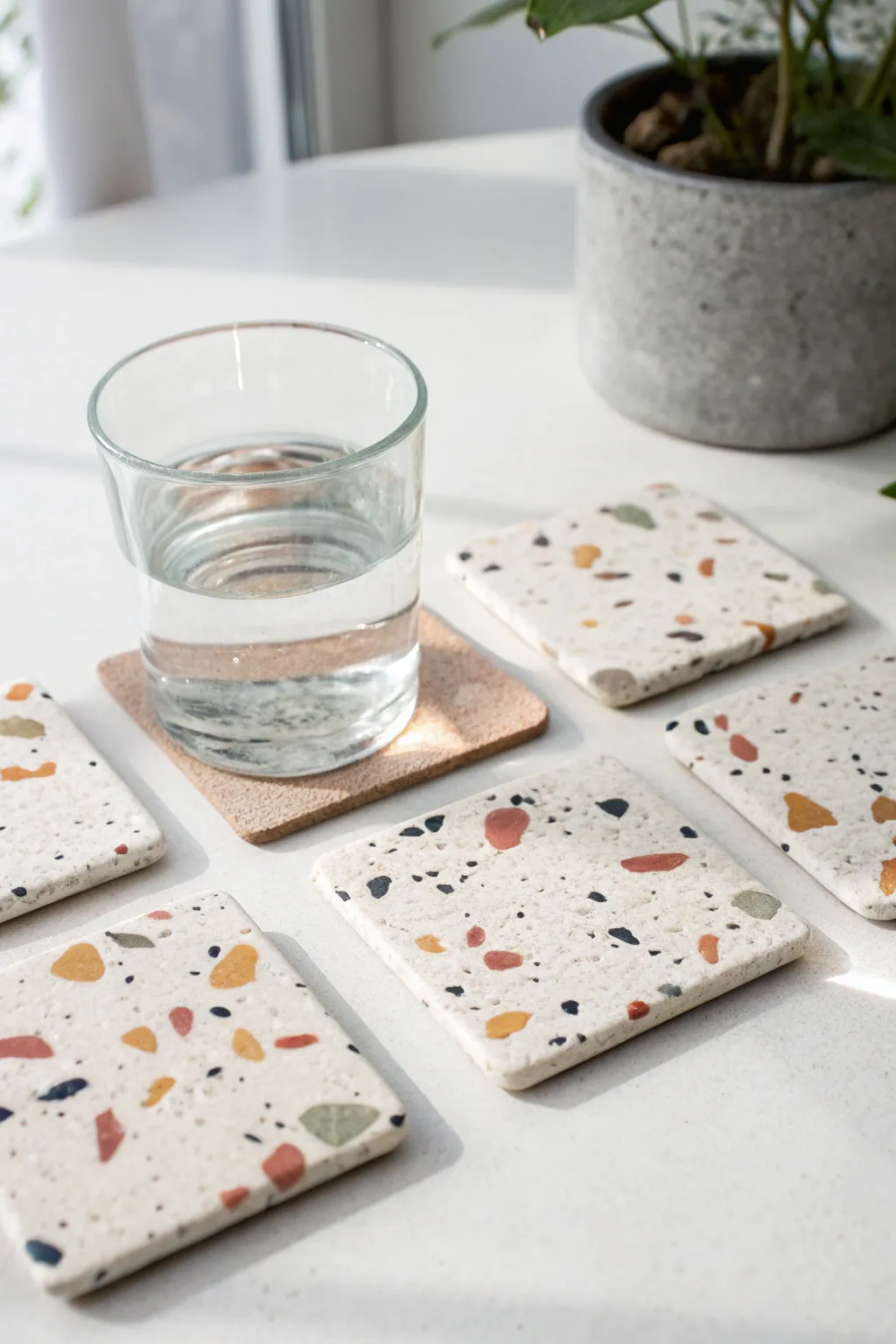
Bring the timeless elegance of Italian terrazzo into your home with these chic, handmade coasters. By mixing colored clay fragments into a plain base, you can create a sophisticated speckled pattern that looks just like real stone.
Detailed Instructions
Materials
- White or cream air-dry clay (base)
- Small amounts of colored air-dry clay (terracotta, mustard, sage green, black)
- Acrylic rolling pin
- Square cookie cutter or sharp craft knife
- Ruler
- Sandpaper (medium and fine grit)
- Matte or satin varnish/sealant
- Paintbrush
- Water (for smoothing)
- Cork sheet or felt backing (optional)
Step 1: Preparing the ‘Chips’
-
Create color slabs:
Take your small portions of colored clay—terracotta, mustard yellow, sage green, and black work beautifully together. Roll each color out into a very thin sheet, about 1-2mm thick. -
Let them dry:
Allow these thin sheets to dry completely. Since they are so thin, this usually only takes about an hour or so. They need to be brittle. -
Make the chips:
Once dry, break the colored sheets into small, irregular fragments. Aim for a variety of sizes, from tiny specks to larger chunks, to mimic authentic terrazzo.
Clean Cuts
Apply a tiny bit of plastic wrap over the clay before pressing down with a cookie cutter. This creates a pleasing ‘pillowed’ edge that requires less sanding later.
Step 2: Forming the Coaster Base
-
Condition the white clay:
Take a large ball of white or cream air-dry clay and knead it until it is soft and pliable. If it feels dry, wet your hands slightly. -
Initial rolling:
Roll out the white clay into a slab that is slightly thicker than your desired final coaster thickness, perhaps around 8mm. -
Add the chips:
Scatter your prepared colored clay chips generously over the surface of the white slab. Press them gently so they stick. -
Embed the pattern:
Use your rolling pin to roll over the slab again firmly. This will push the colored chips into the white clay, creating a flush surface. -
Check the underside:
I like to flip the slab over and add a few chips to the bottom side as well, just so the piece looks finished from every angle, then roll again.
Step 3: Cutting and Refining
-
Cut the shape:
Using a square cookie cutter or a ruler and craft knife, cut out your coaster shapes. A standard coaster size is roughly 10x10cm (4×4 inches). -
Smooth the edges:
Dip your finger in a little water and run it along the cut edges to smooth out any roughness or sharpness from the knife. -
Dry properly:
Place the coasters on a flat surface to dry. To prevent curling, flip them over every 12 hours. Let them dry for at least 24-48 hours until rock hard.
Warping Woes?
If your coasters curl while drying, slightly dampen the concave side and place them under a heavy book (with parchment paper in between) overnight to flatten them out.
Step 4: Finishing Touches
-
Sand the surface:
This is the satisfying part. Sand the top surface vigorously with medium-grit sandpaper. This reveals the crisp, clean shapes of the colored chips hidden just below the white clay film. -
Refine the finish:
Switch to a fine-grit sandpaper to buff the surface until it feels smooth to the touch. Dust off any powder with a dry cloth. -
Seal the coaster:
Apply 2-3 coats of a waterproof matte or satin varnish. This is crucial for coasters, as unsealed clay will absorb condensation from glasses. -
Add backing:
For a professional feel and to protect your table, glue a square of cork sheet or felt to the bottom of the coaster.
Enjoy styling your coffee table with these modern, durable accessories
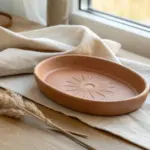
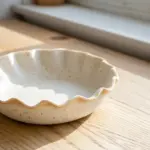
Beaded-Edge Jewelry Tray
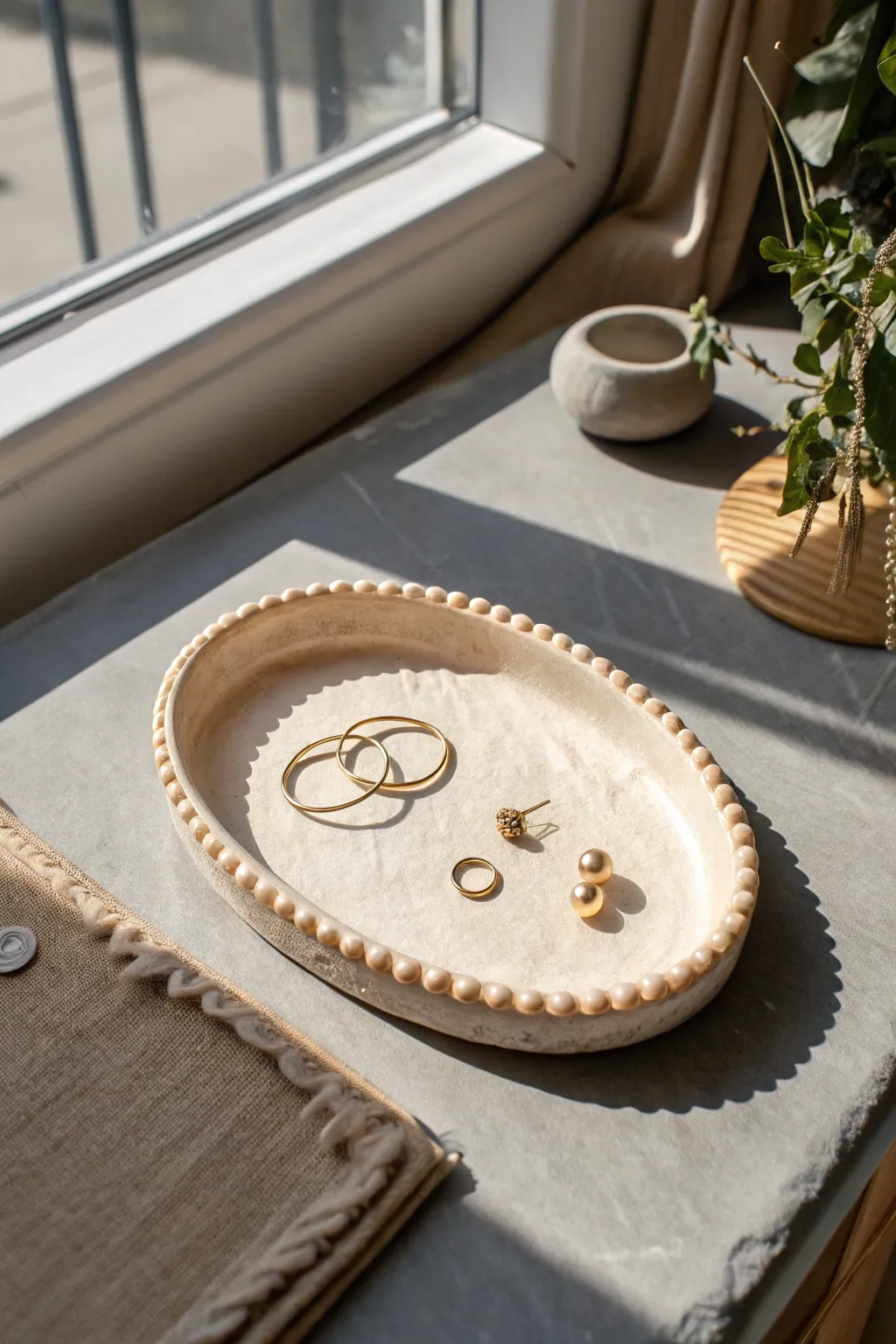
Elevate your vanity with this chic, minimalist jewelry dish featuring a charming beaded rim. The natural, stone-like finish and organic oval shape make it the perfect resting place for your daily gold accents.
Step-by-Step
Materials
- White or cream-colored air-dry clay
- Rolling pin
- Oval template (paper or cardboard)
- Craft knife or clay cutter
- Small bowl of water
- Sponge or fine grit sandpaper
- Acrylic sealant (matte finish)
Step 1: Shaping the Base
-
Prepare the Clay:
Begin by conditioning a large ball of air-dry clay in your hands until it warms up and becomes pliable without cracking. -
Roll the Slab:
Roll the clay out on a smooth work surface to a uniform thickness of about 1/4 inch. If you want a super smooth back, roll it onto a piece of canvas or parchment paper. -
Cut the Oval:
Place your oval paper template onto the rolled slab. Use a craft knife to trace around the edge, cutting out the base shape cleanly. -
Create the Lip:
Roll a long snake of clay, approximately 1/3 inch thick. This coil needs to be long enough to go around the entire circumference of your oval base. -
Attach the Wall:
Score the outer edge of the base and the bottom of your coil with a cross-hatch pattern. Apply a little water to these scratched areas to create a slip. -
Blend the Seams:
Press the coil onto the base edge firmly. Use your thumb or a modeling tool to smear the clay from the inside of the coil down onto the base so they become one solid piece with no visible seam on the interior. -
Refine the Wall:
Smooth out the exterior seam as well. Gently pinch the wall upwards to ensure it stands about half an inch high, keeping a consistent thickness.
Cracks Appearing?
If you see hairline cracks while drying, mix a tiny bit of clay with water to make a paste (slip) and fill them in, then sand smooth once dry.
Step 2: Adding the Beaded Detail
-
Roll Small Spheres:
This is the meditative part: roll dozens of tiny, pea-sized balls of clay. Try to keep them as consistent in size as possible for a uniform look. -
Score the Rim:
Lightly score the very top edge of your tray’s wall and dampen it slightly with your wet finger or a brush. -
Place the Beads:
Gently press each small clay ball onto the rim, sitting them side-by-side. I find it helps to support the wall from the inside with one finger while pressing the bead down with the other. -
Secure the Beads:
Once a bead is placed, use a very small amount of water to smooth the underside of the bead into the rim slightly, just enough so it won’t pop off when dry, but not so much that you lose the spherical shape. -
Check Symmetry:
Continue until the entire rim is covered. If you have a gap at the end that’s too small for a full bead, gently adjust the spacing of the previous few beads to execute a seamless fit. -
Smooth the Texture:
Dip a soft brush or your finger in water and very lightly run it over the interior of the tray to remove any fingerprints or tool marks.
Step 3: Finishing Touches
-
Drying Time:
Allow the tray to dry slowly in a cool, dry place for 24-48 hours. Turn it over halfway through if possible to let the bottom dry evenly. -
Sand and Refine:
Once bone dry, use fine-grit sandpaper to gently buff away any sharp edges or rough patches on the rim or base. -
Apply Sealant:
Finish by applying a coat of matte acrylic sealant. This protects the clay from moisture and gives it that finished, stone-ware appearance shown in the photo.
Stone Effect
For a speckled ceramic look, mix dried tea leaves or black pepper into the clay before rolling, or flick brown paint onto the dry piece.
Now you have a stunning, custom piece to hold your favorite treasures on your dresser



The Complete Guide to Pottery Troubleshooting
Uncover the most common ceramic mistakes—from cracking clay to failed glazes—and learn how to fix them fast.
Ring Cone Holder
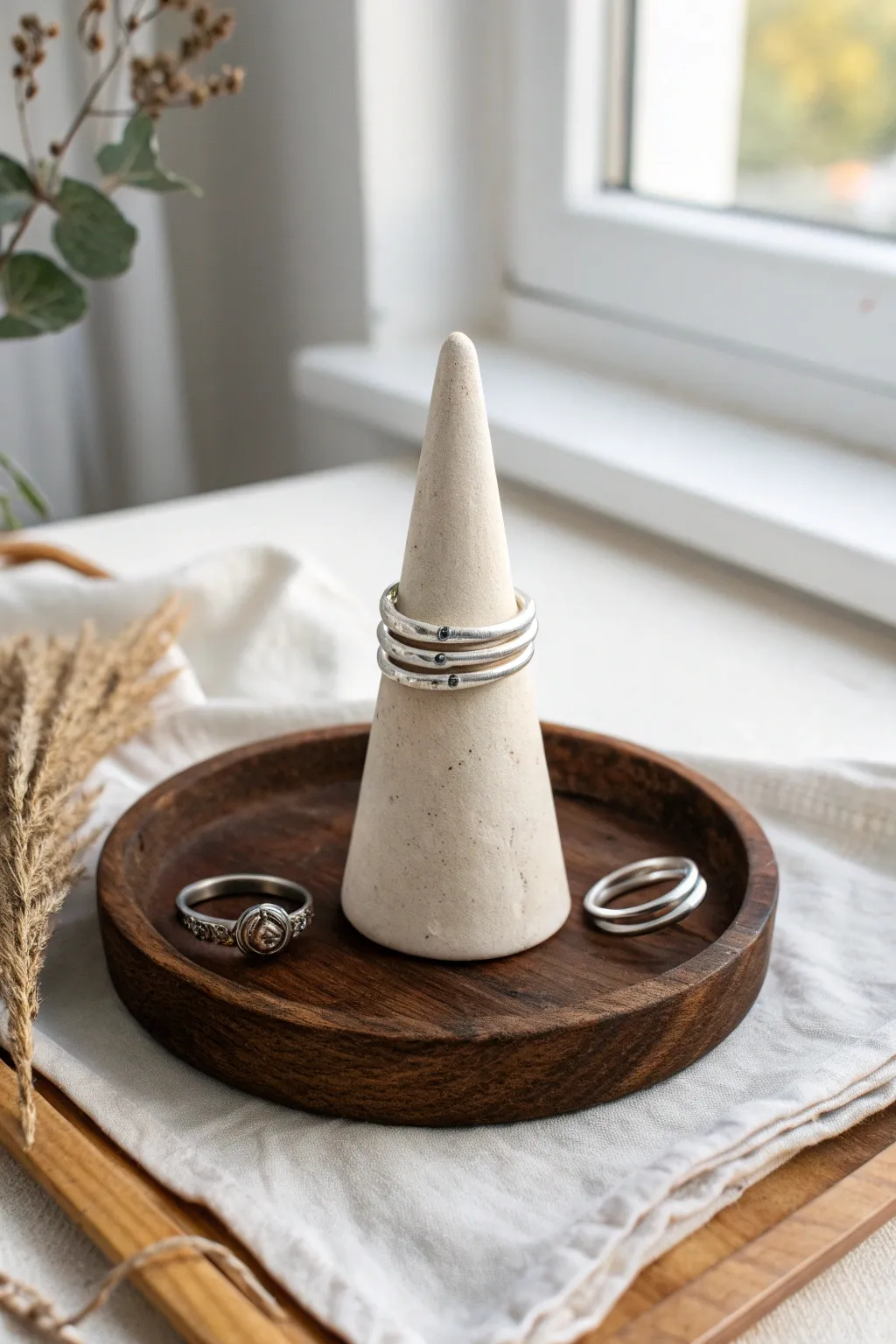
Create a sleek and functional jewelry display with this minimalist ring cone project. The natural off-white tone of the air-dry clay mimics the look of unglazed ceramics or stone, providing a sophisticated resting place for your favorite bands.
Step-by-Step Guide
Materials
- White or natural air-dry clay
- Rolling pin
- Parchment paper or craft mat
- Sharp craft knife or clay blade
- Bowl of water
- Sponge
- Fine-grit sandpaper (220-400 grit)
- Matte varnish or sealant (optional)
Step 1: Shaping the Form
-
Condition the Clay:
Begin by taking a chunk of air-dry clay roughly the size of a golf ball. Knead it in your hands for a few minutes until it is warm, pliable, and free of any air bubbles. -
Form a Sphere:
Roll your conditioned clay between your palms to create a smooth, tight ball. Aim for a surface without cracks. -
Begin the Cone Shape:
Place the ball on your work surface. Using the flat of your palm, begin rolling the clay back and forth while applying more pressure to one side than the other. -
Refine the Taper:
Continue rolling, gradually extending the shape until you have a tapered cone that is wider at the bottom and comes to a gentle point at the top. -
Flatten the Base:
Once the cone is roughly the height you want (about 3-4 inches usually works well), stand it upright. Gently press it down onto your work surface to create a completely flat, stable base so it won’t wobble. -
Check Symmetry:
Rotate the cone while looking at it from eye level. Nudge the tip gently if it’s leaning; you want a nice symmetrical posture.
Cracks Appearing?
If small cracks form while drying, mix a tiny bit of fresh clay with water to make a paste (slip) and fill them in, then sand smooth once dry.
Step 2: Smoothing and Drying
-
Initial Smoothing:
Dip your finger into a little bit of water and run it over the surface of the cone to smooth out fingerprints and minor bumps. Don’t use too much water, or the clay will become slimey. -
Fixing the Base Edge:
Pay attention to where the cone meets the table. Run your finger along this bottom edge to slightly round it off so it isn’t sharp or ragged. -
Refining the Tip:
Gently pinch and smooth the very top point. It doesn’t need to be needle-sharp—a slightly rounded soft point looks more like natural stone. -
Slow Drying:
Set the cone aside in a cool, dry place away from direct sunlight. Let it dry for at least 24-48 hours. I find that rotating it every few hours helps it dry evenly without warping. -
Check Dryness:
The clay is ready when it feels room temperature to the touch (not cold) and looks lighter in color.
Step 3: Finishing Touches
-
Sanding:
Once fully dry, take your fine-grit sandpaper and gently sand the entire surface. This removes any tiny imperfections and gives it that smooth, manufactured look. -
Sanding the Base:
Don’t forget to lightly sand the flat bottom to ensure it sits perfectly flush on a table. -
Dusting Off:
Wipe the cone down thoroughly with a slightly damp sponge or cloth to remove all loose clay dust. -
Texturing (Optional):
If you want the speckled stone look seen in the photo, you can flick a toothbrush with thinned grey or brown paint lightly over the surface, though natural clay often has its own lovely grit. -
Sealing:
Apply a thin coat of matte varnish or sealant to protect the clay from moisture and oils from your hands. Let this cure completely before adding your rings.
Marble Effect
Mix a small amount of grey or black clay into your white clay but don’t fully blend it. Stop when streaks are visible for a faux marble look.
Place your new sculptural holder on your vanity and stack your favorite rings.
Earring Display Slab
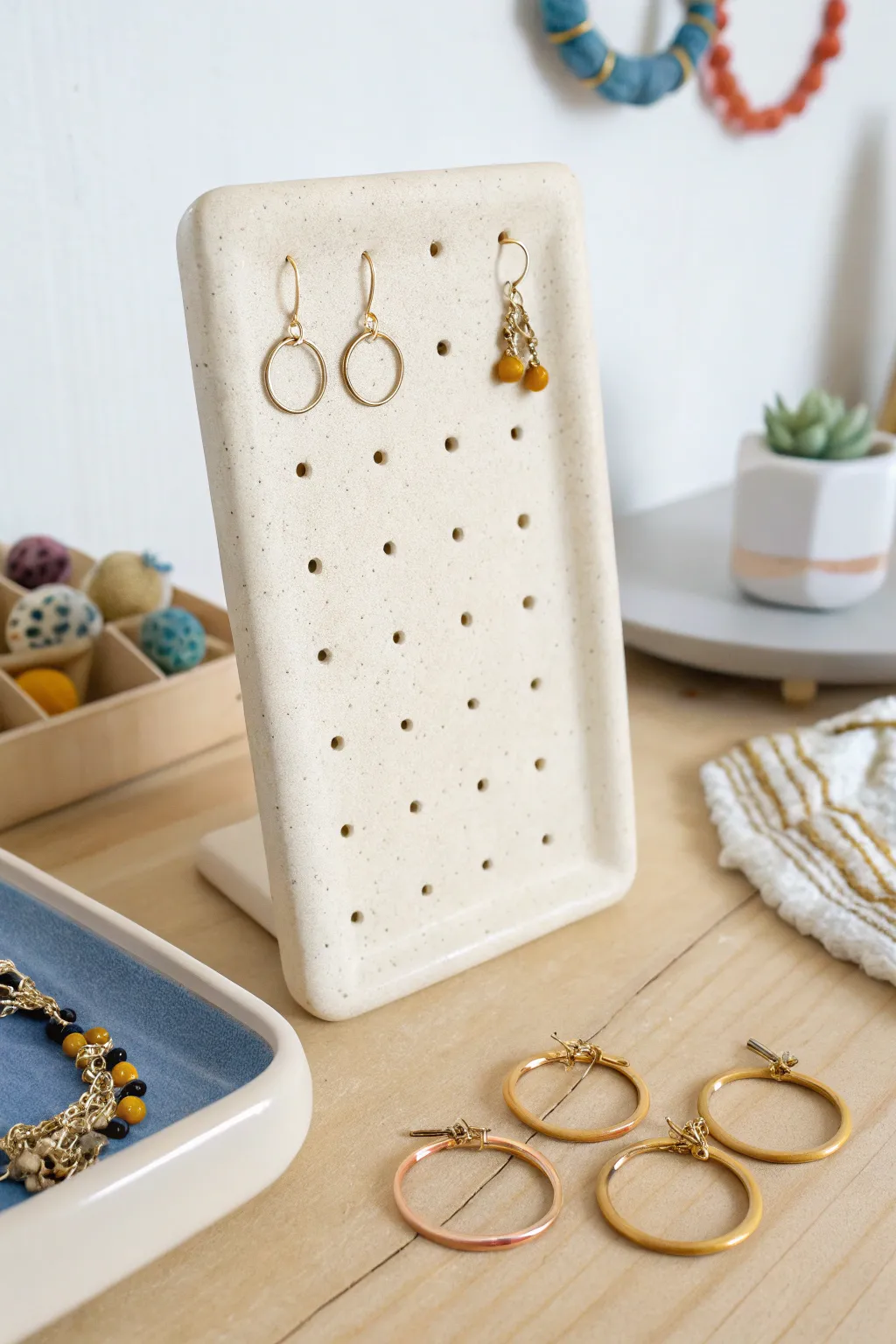
This minimalist earring display combines functionality with a trendy, organic aesthetic. With its creamy, speckled finish and simple geometric shape, it looks like high-end ceramic but is easily made at home without a kiln.
How-To Guide
Materials
- Air dry clay (white or cream)
- Acrylic rolling pin
- Coarse black pepper or sand (for speckling)
- Craft knife or clay slicing blade
- Wooden skewer or toothpick
- Small bowl of water
- Fine grit sandpaper (320-400 grit)
- Matte spray varnish or sealant
- Ruler
- Wax paper or silicone mat (work surface)
Step 1: Preparing and Shaping the Clay
-
Mix the speckles:
Begin by conditioning a large ball of air dry clay in your hands until soft. Flatten it slightly and sprinkle a pinch of coarse black pepper or clean sand into the center. Knead the clay thoroughly to distribute the ‘speckles’ evenly throughout the white base. -
Roll the slab:
Place your conditioned clay on a piece of wax paper or a silicone mat. Using an acrylic roller, roll the clay out into a uniform slab. Aim for a thickness of about 1/4 inch (6mm) to ensure the stand is sturdy enough to hold jewelry without bending. -
Cut the main rectangle:
Use a ruler and a craft knife to cut a clean rectangle from the slab. A size of approximately 4 x 7 inches works well for a standard display, but you can adjust this based on your collection needs. -
Create the base:
From the remaining scraps of rolled clay, cut a smaller rectangle to serve as the structural base. This should be the same width as your main slab but only about 2 inches deep. This L-shaped support is crucial for stability. -
Smooth the edges:
Dip your finger in a small bowl of water and gently run it along all the cut edges of both rectangles. This softens the sharp cuts and prevents cracking as the clay dries.
Step 2: Adding Functionality and Assembly
-
Mark hole placement:
Lay the main rectangle flat. Using a ruler, lightly press small guide indentations where you want your earring holes to be. A grid pattern looks cleanest, spacing them about 1 inch apart vertically and horizontally. -
Pierce the holes:
Take your wooden skewer and pierce straight through the clay at each marked spot. Give the skewer a tiny wiggle to make the hole slightly larger than you think you need, as clay shrinks slightly when drying. -
Score the connection points:
On the back of the main slab (near the bottom edge) and along one long edge of the base piece, use your knife to make cross-hatch scratches. This scoring texture helps the pieces bond. -
Apply slip:
Mix a tiny bit of clay with water to create a paste called ‘slip.’ Dab this onto your scored areas. -
Join the pieces:
Press the scored edge of the base piece firmly against the back of the main slab at a 90-degree angle to create an L-shape stand. You may need to prop the vertical slab against a heavy book while working. -
Reinforce the seam:
Roll a very thin snake of clay and press it into the inside corner where the two pieces meet. Smooth this coil out with a wet finger to create a seamless, strong joint.
Clean Cuts Only
Before cutting your rectangles, rub a tiny bit of lotion or oil on your knife blade. This prevents the clay from dragging and gives you much sharper, straighter edges.
Step 3: Finishing Touches
-
Let it dry:
Allow the stand to dry completely. This usually takes 24-48 hours depending on humidity. Keep it propped up against a support (like a box) so the upright slab doesn’t slump backward while wet. -
Check dryness:
The clay will turn lighter in color and feel room temperature (not cold) when fully dry. -
Sand for perfection:
Once bone dry, take your fine-grit sandpaper and gently sand the edges and surface. Focus on smoothing out any fingerprints or rough spots on your connection joint. -
Clear the holes:
If any clay burrs are blocking your earring holes after sanding, gently twist the skewer through them one last time to clear the dust. -
Seal the piece:
In a well-ventilated area, spray the entire stand with a matte varnish. This seals the clay, makes it wipeable, and keeps the pepper flakes from brushing off over time.
Color Pop
For a terrazzo effect, instead of pepper, mix in tiny chopped bits of colored dried clay before rolling. Sanding after drying will reveal the colorful flecks inside.
Now you have a chic, custom organizer ready to showcase your favorite jewelry

TRACK YOUR CERAMIC JOURNEY
Capture glaze tests, firing details, and creative progress—all in one simple printable. Make your projects easier to repeat and improve.
Minimal Desk Organizer Tray
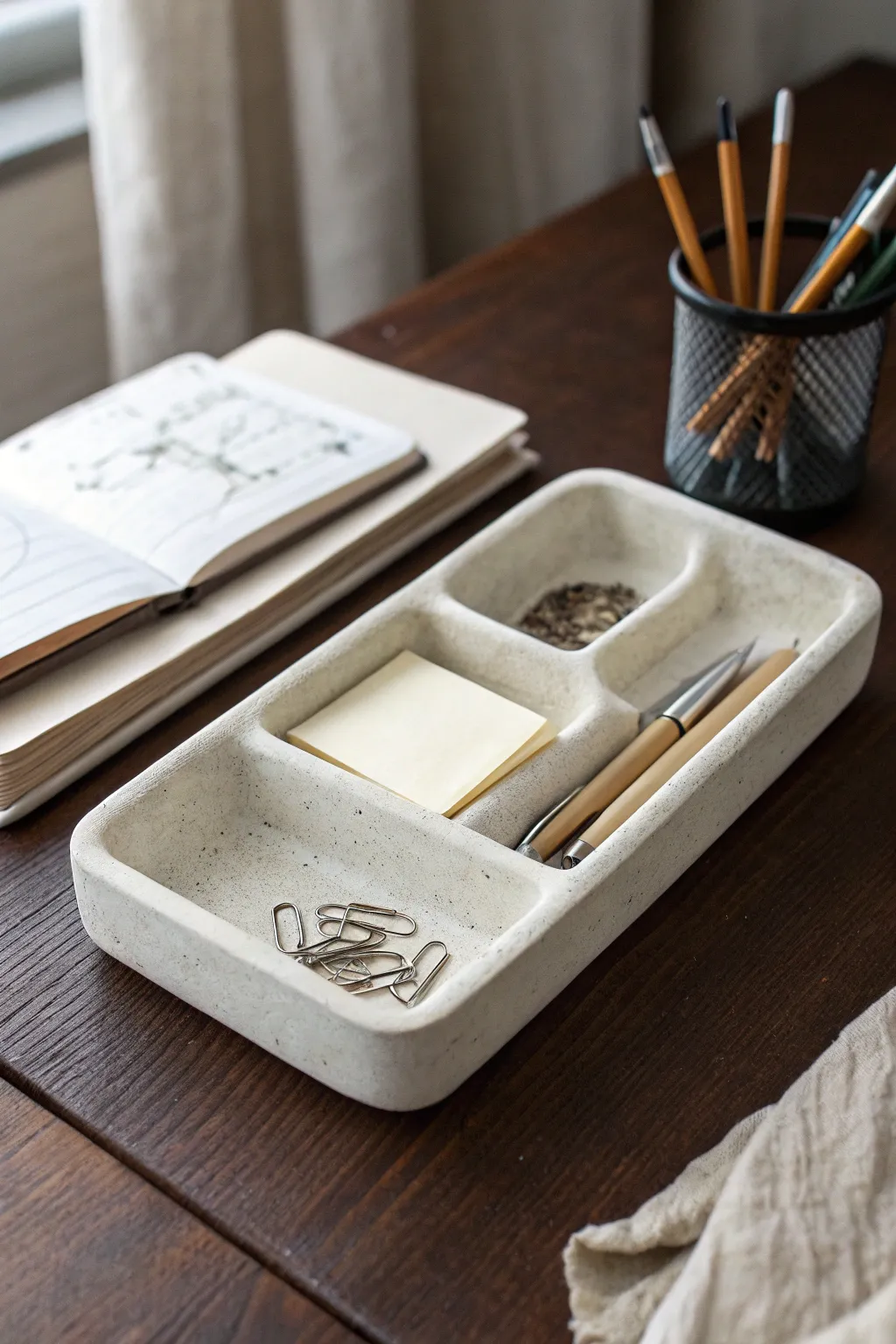
Bring a sense of calm to your workspace with this effortlessly chic desk organizer. Its smooth, stone-like texture and soft speckled finish make it look like a high-end ceramic piece, perfect for decluttering small office essentials.
Detailed Instructions
Materials
- White air-dry clay (approx 500g)
- Rolling pin with guide rings (or two slats of equal thickness)
- Craft knife or clay cutter
- Ruler
- Small bowl of water
- Smooth work surface or clay mat
- Sandpaper (medium and fine grit)
- Used coffee grounds or black pepper
- Acrylic sealer (matte finish)
Step 1: Preparing the Base
-
Condition the clay:
Start by kneading your white air-dry clay thoroughly until it’s pliable and smooth. If it feels a bit stiff, dip your fingers in water and work the moisture in. -
Mix in the speckles:
To achieve that faux-stone look, sprinkle a pinch of used dried coffee grounds or coarse black pepper onto the clay block. Fold and knead the clay repeatedly to distribute the specks evenly throughout the mass. -
Roll the slab:
Place the clay on your work surface. Using a rolling pin (preferably with 1/4 inch guide rings to ensure even thickness), roll out a large rectangular slab. This will form the entire structure. -
Cut the base:
Measure and cut a rectangle approximately 4 inches by 10 inches. This will be the bottom of your tray. Save the excess clay for the walls and dividers.
Step 2: Building the Structure
-
Create the walls:
Collect the remaining clay and re-roll it to the same 1/4 inch thickness. Cut long strips that are about 1 inch wide. These will become your outer walls. -
Score and slip:
Using your craft knife or a needle tool, scratch cross-hatch marks (scoring) along the outer edges of your base rectangle. Do the same to the bottom edge of your wall strips. Apply a dab of water (slip) to these roughed-up areas. -
Attach outer walls:
Press the wall strips firmly onto the base edges. Where the strips meet at the corners, score and slip the ends to join them securely. -
Smooth the seams:
This is crucial for structural integrity. Use your finger or a clay modeling tool to blend the clay from the wall down onto the base, both on the inside and outside. I find a slightly damp finger works best to erase the seam completely.
Smooth Seams Tip
Use the back of a spoon dipped in water to burnish and smooth the inside corners where fingers can’t reach. It compacts the clay and makes the join stronger.
Step 3: Creating Compartments
-
Draft the layout:
Looking at the reference, mark lightly where your dividers will go. You need one long vertical divider running about two-thirds of the tray length, and two horizontal ones to create the specific sections. -
Cut divider strips:
Cut more 1-inch wide strips from your rolled clay. Measure them against the inside width of your tray to ensure a snug fit. -
Install the main divider:
Score and slip the contact points, then place the long central divider. Use a tool to smooth the clay into the bottom base and the side walls, creating seamless transitions. -
Add cross sections:
Add the smaller perpendicular dividers to create the four distinct compartments shown: a large one for pens, a square for notes, and two smaller catch-alls. -
Refine the edges:
Dip your finger in water and run it along the top rims of all walls and dividers. Gently round them off so they aren’t sharp or jagged.
Make It Marble
Instead of coffee grounds, mix a very small amount of grey or black clay into the white clay but don’t fully blend it. Stop when you see streaks for a marbled effect.
Step 4: Finishing Touches
-
Slow drying:
Place your tray in a cool, dry spot away from direct sunlight. To prevent warping, you can loosely cover it with plastic wrap for the first 24 hours creates a slow, even dry. -
Wait patiently:
Let the clay dry completely for 48 to 72 hours. The clay will turn from a cool grey-white to a bone-white color when fully dry. -
Sand for smoothness:
Once bone dry, take your sanding paper outside (wear a mask for dust). Start with medium grit to level any bumps, then finish with fine grit for a buttery soft surface. -
Clean and seal:
Wipe away all dust with a slightly damp cloth or sponge. Apply 1-2 coats of a matte acrylic sealer to protect the tray from stains and moisture while keeping that raw clay aesthetic.
Once sealed and dried, your desk is ready for a stylish upgrade
Modern Photo Holder Stand
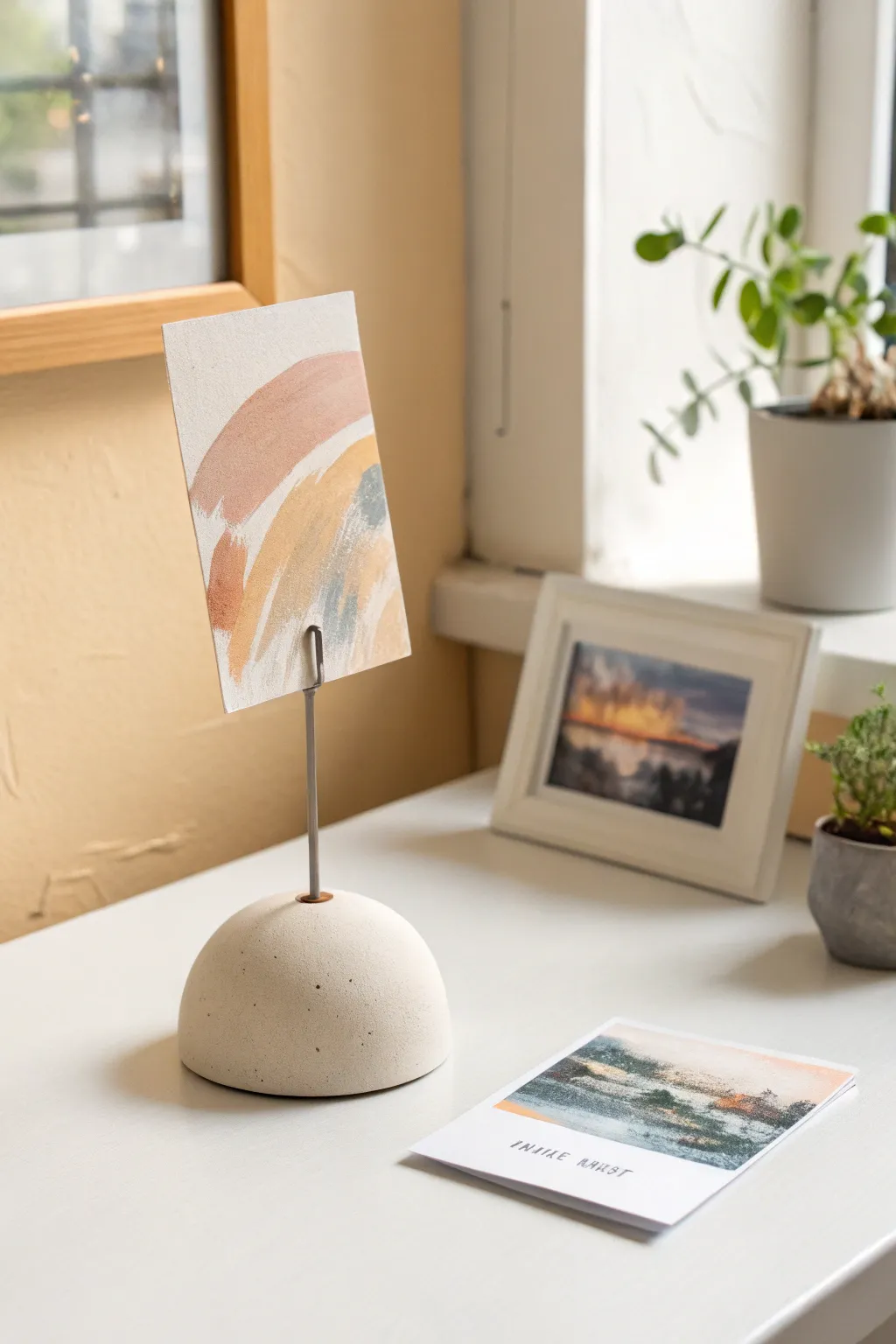
This sleek, modern photo holder combines the industrial look of concrete with the soft, organic feel of watercolor art. It features a weighted clay hemisphere base that anchors a simple wire clip, perfect for displaying your favorite postcards or mini-prints.
Step-by-Step
Materials
- White or light grey air-dry clay (stone effect optional)
- Medium gauge crafting wire (silver or galvanized)
- Wire cutters
- Needle-nose pliers
- Sandpaper (fine grit)
- Small rolling pin or smooth jar
- Watercolor paper (heavyweight, 300gsm)
- Watercolor paints (terracotta, ochre, soft blue)
- Flat shader brush
- Small bowl relative to desired dome size (for shaping)
- Clear matte varnish (optional)
Step 1: Sculpting the Base
-
Condition the Clay:
Begin by taking a handful of air-dry clay roughly the size of a tennis ball. Knead it thoroughly in your hands to warm it up and remove any air bubbles, which prevents cracking later. -
Form a Sphere:
Roll the clay between your palms or on a clean work surface until you have a smooth, perfect sphere. Take your time here to smooth out any seams or wrinkles. -
Create the Dome:
Gently press the sphere down onto your table to create a flat bottom. You want a distinct hemisphere shape, so use a flat object like a hardback book to press down evenly if needed. -
Refine the Shape:
I like to use a little water on my fingertips to smooth out the surface of the dome. Wipe away any fingerprints and ensure the curve is symmetrical from all angles. -
Add Texture (Optional):
To mimic the concrete look in the photo, you can gently tap the surface with an old toothbrush or a crumpled ball of foil to add tiny pits and texture.
Cracks happen?
If small cracks appear as the clay dries, don’t panic. Mix a tiny bit of fresh clay with water to make a paste, fill the crack, and smooth it over.
Step 2: Creating the Wire Mechanism
-
Cut the Wire:
Using your wire cutters, snip a length of wire approximately 6 to 8 inches long. It’s better to cut it slightly too long than too short. -
Bend the Clip:
At one end of the wire, use your needle-nose pliers create a tight ‘U’ shape. Then, bend the wire back down alongside the stem to create a paperclip-style loop that will hold the photo. -
Straighten the Stem:
Ensure the main stem of the wire extends straight down from the clip mechanism. Adjust with your fingers so it stands perfectly vertical. -
Insert the Wire:
While the clay is still wet, carefully push the straight end of the wire into the center of the dome. Insert it deeply enough to be stable, but stop before hitting the bottom. -
Secure the Entry Point:
The clay might push up slightly around the wire. Gently smooth the clay back down around the insertion point to create a seamless seal.
Step 3: Drying and Finishing
-
Let it Cure:
Allow the clay to dry undisturbed for at least 24 to 48 hours. Avoid placing it near direct heat sources to prevent cracking. -
Sand for Smoothness:
Once fully hard, use fine-grit sandpaper to buff the surface. Focus on the bottom edge to ensure it sits perfectly flat on your desk. -
Clean Up:
Wipe away any sanding dust with a slightly damp cloth or a dry soft brush.
Level Up: Terrazzo Style
Knead tiny chips of dried, colored clay into your fresh white clay before shaping. Sanding later will reveal a beautiful terrazzo pattern.
Step 4: Creating the Abstract Art
-
Prepare the Paper:
Cut your watercolor paper to a size that balances well with your holder, roughly 4×6 inches. -
Mix Your Palette:
Dilute your paints to create soft, translucent washes. You’ll need a warm terracotta pink, a muted mustard yellow, and a watered-down grey-blue. -
Paint the Arches:
Using a flat shader brush, paint a broad, sweeping arch with the terracotta color. Let the brush skip slightly on the paper for a textured, dry-brush effect. -
Layer the Colors:
Add a darker yellow stroke nestled inside or overlapping the pink curve. Finish with a few marks of blue-grey near the bottom corner. -
Assemble:
Once the paint is completely dry, slide your custom artwork into the wire clip of your new modern stand.
Place this stylish holder on a windowsill or desk to add a touch of handmade charm to your space
Incense Holder With Groove
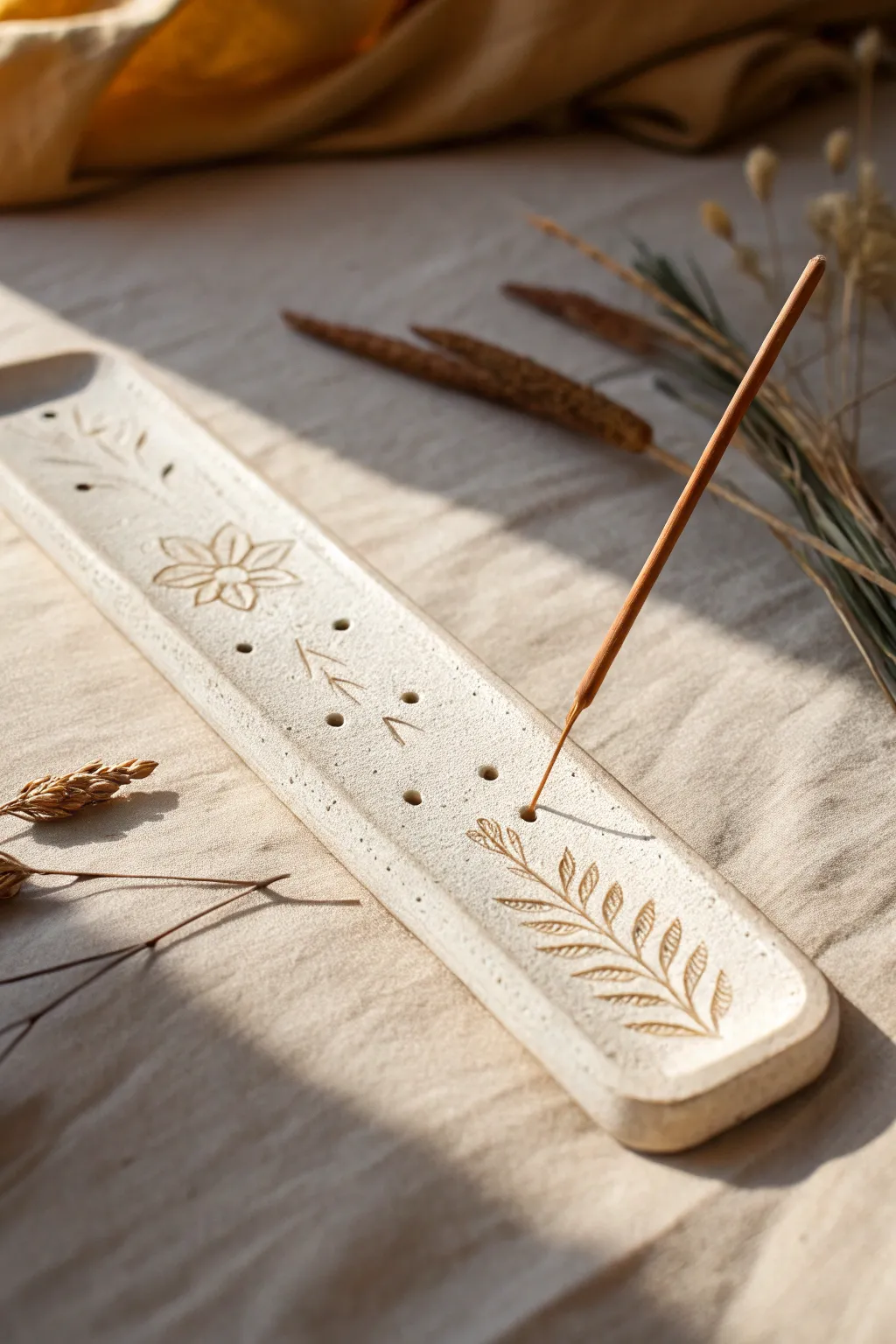
This elegant incense holder combines functionality with natural beauty, featuring delicate botanical carvings and a speckled stone-like finish. Its long, grooved shape catches ash perfectly while offering multiple placement options for your favorite scents.
Detailed Instructions
Materials
- Air-dry clay (white or stone effect)
- Rolling pin
- Ruler
- Craft knife or scalpel
- Needle tool or toothpick
- Carving tool or small loop tool
- Sanding sponge or fine-grit sandpaper
- Small bowl of water
- Acrylic rolling guides or two pencils (optional)
- Varnish or sealant (matte finish)
Step 1: Shaping the Base
-
Prepare the clay:
Begin by kneading a generous amount of air-dry clay until it is soft, pliable, and free of air bubbles. If you want the speckled look shown in the image but only have plain clay, mix in some dried tea leaves or sand during this stage. -
Roll the slab:
Roll out the clay into a long, rectangular slab. Aim for a thickness of about 1/4 to 1/2 inch. Using rolling guides or pencils on either side of your dough can help ensure an even thickness throughout. -
Cut the rectangle:
Using a ruler and your craft knife, cut a clean rectangle approximately 10-12 inches long and 2-3 inches wide. You can adjust these dimensions based on the length of the incense sticks you typically use. -
Round the corners:
Use your fingers or the craft knife to gently round off the four sharp corners of the rectangle. Dip your finger in a little water to smooth these cut edges so they look soft and organic. -
Create the groove:
To create the shallow depression for catching ash, gently press your thumbs into the center of the slab and work your way down the length. Leave a raised rim around the entire perimeter about 1/4 inch wide. -
Smooth the surface:
Once the depression is formed, use a slightly damp sponge or your finger to smooth out any fingerprints or uneven bumps in the clay bed. The surface needs to be relatively flat for the carving step.
Angle Check
Make sure your incense hole is angled correctly. Before drying, insert a stick to test if it hovers over the tray. If it points too high, ash will miss the catcher.
Step 2: Detailing and Finishing
-
Plan the design:
Lightly trace your botanical design onto the clay surface using a needle tool. I find it helpful to sketch a flower at one end, a large frond at the other, and small connecting elements in the middle. -
Carve the flower:
Using a small carving tool or the needle tool, deepen the lines of your flower design. Press firmly to create visible grooves that will catch the light, but be careful not to pierce through the bottom. -
Carve the frond:
Move to the opposite end and carve the large leaf frond. Mimic the V-shaped pattern of the veins shown in the reference image for a cohesive look. -
Add decorative holes:
Using a tool with a specific diameter (like the back of a paintbrush or a straw), press small decorative circles or dots into the clay between the floral elements to add texture and visual interest. -
Pierce the incense holder:
Select a spot near the bottom of your frond design to puncture the main hole for the incense stick. Insert your incense stick (or a tool of similar size) at a slight angle so the stick will lean over the tray, not stand straight up. -
Dry partially:
Let the piece dry for about an hour until it is leather-hard. This state allows you to clean up any rough carving burrs without smudging the design. -
Clean up details:
Gently brush away any clay crumbs created during carving. You can use a soft dry brush to sweep out the grooves of your botanical drawings. -
Let it dry completely:
Allow the clay to dry fully for 24-48 hours, keeping it away from direct heat sources to prevent warping. Turn it over occasionally to ensure the bottom dries evenly. -
Sand the piece:
Once bone dry, take your sanding sponge and gently sand the edges and the top surface. This enhances the stone-like texture and removes any remaining sharp spots. -
Seal:
Apply a coat of matte varnish or sealant to protect the clay from ash stains and humidity. Let the sealant cure completely before your first use.
Warping Woes?
If the long tray starts to curl up while drying, gently weigh down the ends with light books (using paper in between) during the leather-hard stage to flatten it back out.
Now you have a serene, custom-made sanctuary for your incense rituals that looks beautiful even when not in use
Tea Light Candle Holder Set
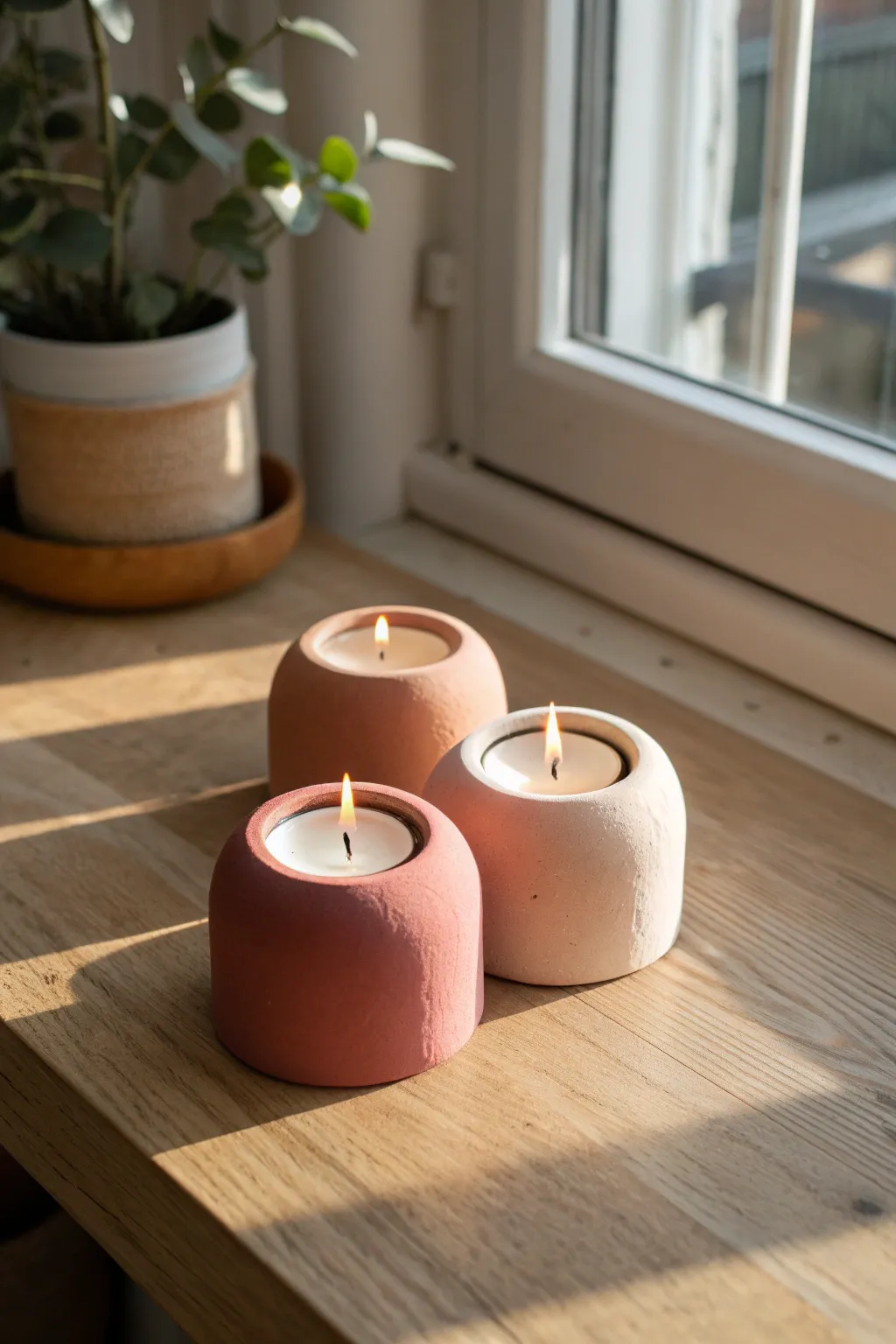
Create a cozy, modern atmosphere with these smooth, rounded candle holders in soft earth tones. Their matte finish and organic shape make them look like high-end ceramic pieces, perfect for adding warmth to a sunny windowsill.
Step-by-Step Guide
Materials
- Air-dry clay (white or terracotta)
- Standard tea light candle (for sizing)
- Acrylic paints (terracotta, dusty rose, warm white)
- Baking soda (to create texture)
- Rolling pin
- Sharp knife or clay cutter
- Small bowl of water
- Fine-grit sandpaper
- Sponge or soft paintbrush
Step 1: Shaping the Base
-
Portion the clay:
Cut off a chunk of air-dry clay roughly the size of a tennis ball for each holder. Determine how many you want to make—a set of three looks lovely together. -
Condition the material:
Knead the clay in your hands for a minute or two until it feels warm and pliable, which helps prevent cracks later. -
Form a sphere:
Roll the clay between your palms or on a smooth surface to create a tight, smooth ball. Try to eliminate any major fold lines. -
Create the heavy base:
Gently tap the ball onto your work surface to flatten the bottom. You want a sturdy, flat base so the candle holder won’t tip over. -
Flatten the top:
Slightly press down on the top of the sphere to create a flat canvas for your tea light hole, but keep the overall shape rounded.
Step 2: Creating the Opening
-
Size the hole:
Take a spare tea light candle (metal casing and all) and press it gently into the center of the top to mark the diameter. -
Carve the space:
Using a modeling tool or a small spoon, carefully scoop out the clay inside your marked circle. Test fit the tea light frequently; you want it to sit flush with the top rim. -
Smooth the walls:
Dip your finger in water and run it along the inner walls and the top rim of the hole to smooth out any rough carving marks. -
Refine the exterior:
Use a damp sponge to wipe down the outside of the sphere, smoothing fingerprints and ensuring a seamless, pebble-like finish. -
Dry completely:
Let the holders air dry for 24 to 48 hours. I find turning them upside down halfway through helps slightly, but be careful not to dent the top.
Crack Control
If you spot tiny cracks while drying, mix a small amount of fresh clay with water to make a ‘slip’ paste. Fill the cracks, smooth over, and let dry again.
Step 3: Finishing and Painting
-
Sand for perfection:
Once bone dry, use fine-grit sandpaper to gently buff away any remaining imperfections or bumps. Wipe away the dust with a dry cloth. -
Mix earthy tones:
Prepare your palette. For the terracotta look, mix burnt sienna with a touch of white. For the rose, mix red, brown, and plenty of white. Keep one plain warm white. -
Create the texture:
Mix a teaspoon of baking soda into your acrylic paint. This is the secret to achieving that trendy, matte ceramic texture seen in the photo. -
Base coat:
Apply the first layer of baking soda paint. It will look thick and gritty, but that is intended. -
Second coat:
Allow the first coat to dry, then apply a second layer for opaque, rich color coverage. -
Seal (optional):
If you plan to use these often, a matte spray varnish can protect the paint, though bare baking soda paint looks the most like pottery.
Speckled Stone Effect
For a granite look, flick a stiff toothbrush loaded with watered-down brown or grey paint over the finished pieces before sealing.
Place your smooth, colorful holders in a sunlit spot and enjoy the warmth they bring to the room
Mini Succulent Planter
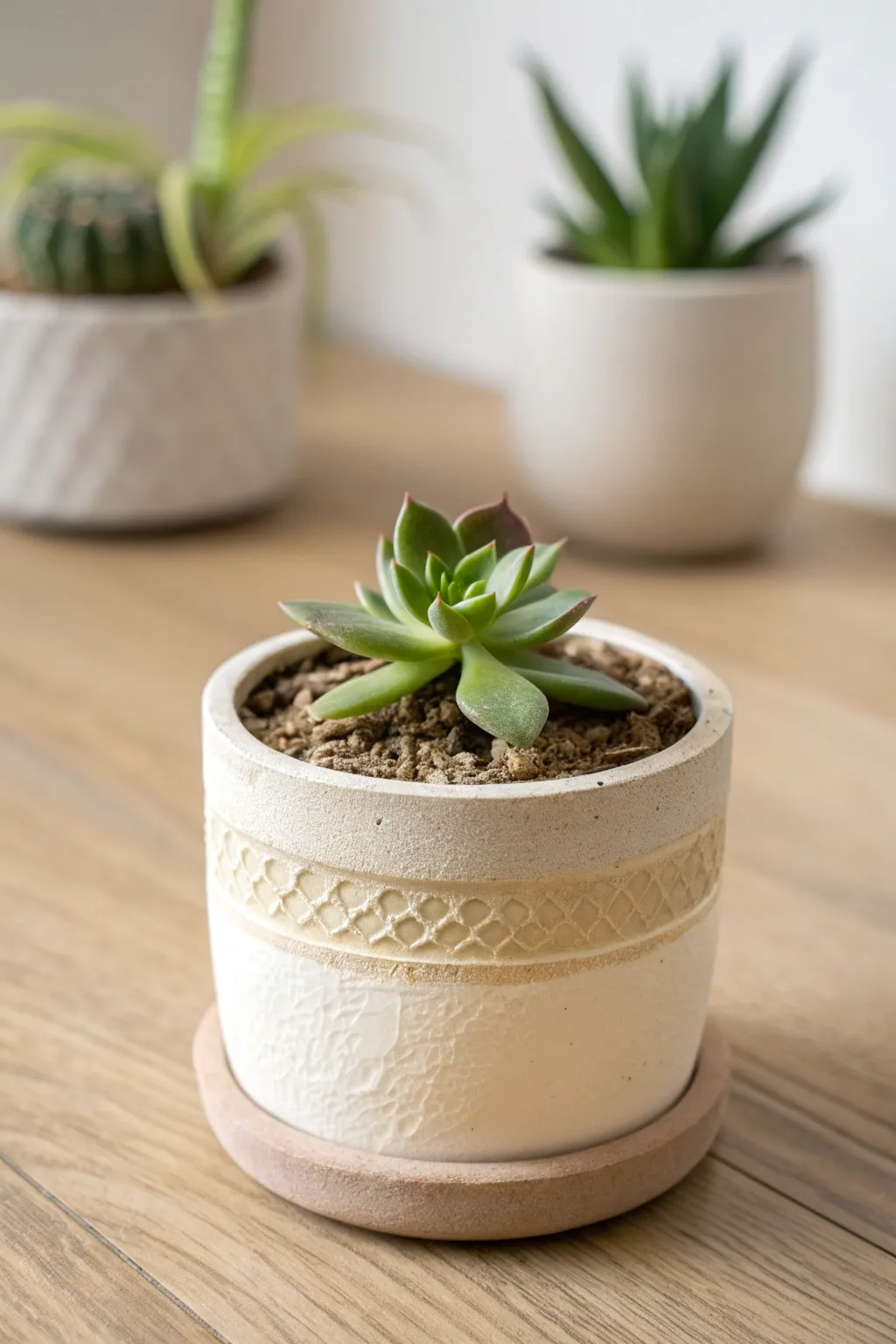
Bring a touch of desert chic to your desk with this petite clay planter featuring elegant carved details and a crackle-finish base. Its dual-texture design makes it look like sleek, high-end pottery, but it comes together surprisingly easily.
How-To Guide
Materials
- White specialized pottery air-dry clay (or standard white air-dry clay)
- Small rolling pin
- Circle cutters (various sizes) or a round jar to trace
- Rectangular clay template or ruler
- Craft knife or scalpel
- Stylus tool or blunt toothpick
- Small cup of water
- Slip (clay mixed with water)
- Fine-grit sandpaper
- Textured sponge or foil ball
- Acrylic paints (Cream, Beige)
- Gloss or matte varnish sealer
Step 1: Forming the Base Structure
-
Roll the slab:
Begin by wedging your clay to remove air bubbles, then roll it out to a consistent thickness of about 1/4 inch. You want it sturdy enough to hold soil later. -
Cut the components:
Using a circle cutter or tracing around a jar, cut out a 3-inch circle for the base. Next, measure the circumference of that circle and cut a rectangular strip of clay that length plus a half-inch for overlap. The strip should be about 3 inches tall. -
Score and slip:
Score (scratch) the outer edge of your circle base and one long edge of your rectangular strip. Apply a generous amount of slip to these roughed-up areas. -
Assemble the cylinder:
Wrap the rectangular strip around the circle base, pressing the scored areas together firmly. Where the rectangle ends meet, score and slip the vertical seam, blending the clay together with a modeling tool or your finger until the join is invisible. -
Smooth the interior:
Run a wet finger along the inside bottom seam to ensure a watertight seal. I like to roll a thin ‘snake’ of clay and press it into this interior corner for extra reinforcement.
Step 2: Adding Texture and Detail
-
Create the texture band:
Measure about one inch down from the top rim. Using a ruler and a light touch with your needle tool, mark two parallel lines around the circumference to define the decorative band area. -
Carve the lattice:
Inside your marked band, use a small stylus or a dull pencil to gently press diagonal lines in one direction, then cross them with diagonal lines in the opposite direction to create a diamond lattice pattern. -
Texture the bottom:
For the area below the lattice band, lightly press a crumpled ball of aluminum foil or a coarse sponge against the clay. This mimics the crackled, rough stone look seen in the photo. -
Refine the surface:
Keep the top inch of the pot (above the band) relatively smooth, just using a slightly damp sponge to even out any fingerprints. -
Make the saucer:
Roll out a small amount of leftover clay. Cut a circle slightly larger than your pot’s base. Slightly curl up the edges to form a shallow dish shape.
Pro Tip: Clean Lines
Use a piece of dental floss to cut your clay slab off the table after rolling. It slices underneath cleanly without distorting the shape like peeling it up with your fingers would.
Step 3: Finishing Touches
-
Allow to dry:
Let both the pot and saucer dry slowly away from direct heat for 24-48 hours. Turn them occasionally to ensure even drying. -
Sand imperfections:
Once fully dry and white, use fine-grit sandpaper to smooth the top rim and any sharp edges on the saucer. -
Base coat:
Paint the textured band area with a beige or sand-colored acrylic paint. Wipe away excess paint with a paper towel immediately so the color stays mostly in the recessed diamond lines. -
Add crackle effect:
Dry brush a tiny amount of off-white or cream paint over the rough bottom texture to highlight the peaks and enhance the stone effect. -
Seal carefully:
Apply two to three coats of waterproof varnish to the inside and outside. This is crucial if you plan to put a real plant inside.
Level Up: Drainage
Before the clay dries, use a straw to punch a clean hole in the center of the pot’s bottom. Proper drainage is essential for succulents to thrive without root rot.
Pop in your favorite succulent and enjoy this handmade piece of desert-inspired decor.
Tiny Air Plant Pods
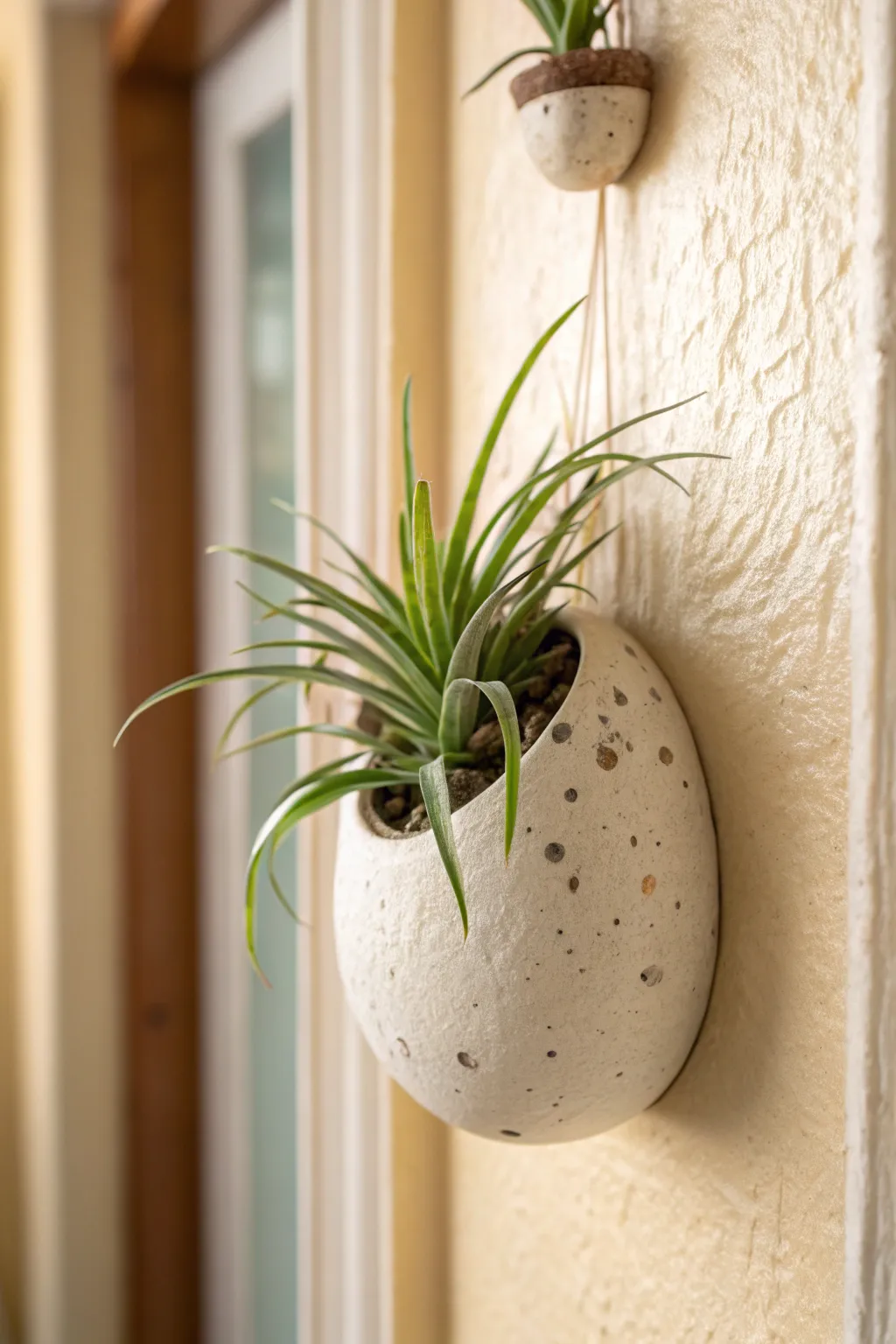
These charming, egg-shaped vessels add a touch of modern organic style to any vertical space. Modeled from air-dry clay and finished with a natural speckled texture, they are perfectly sized to cradle your favorite tillandsia without needing any soil.
Step-by-Step
Materials
- White polymer or air-dry clay
- Rolling pin
- Aluminum foil
- Small bowl of water
- Pottery needle tool or toothpick
- Sponges (one smooth, one textured)
- Sandpaper (fine grit)
- Small straw or specialized hole punch tool
- Acrylic paints (black, metallic gold, cream)
- Old toothbrush
- Matte spray varnish or sealant
- Hemp cord or twine for hanging
- Air plants
Step 1: Forming the Base
-
Prepare the armature:
Crumple a piece of aluminum foil into a tight ball, then shape it slightly into an egg or oval form. This will act as the core support while your clay dries so the pod remains hollow and lightweight. -
Condition the clay:
Take a handful of white air-dry clay and knead it until it’s soft and pliable. If it feels too stiff, dip your fingers in a tiny bit of water to loosen it up. -
Roll a slab:
Use your rolling pin to flatten the clay into a slab that is roughly 1/4 inch thick. Aim for an even thickness to ensure the pod dries uniformly. -
Cover the mold:
Drape the clay slab over your foil form. Gently smooth the clay down around the foil, cutting away excess clay at the bottom where the seams meet. Blend the seams together using a little water on your fingertip until they are invisible.
Fixing Cracks
Cracks happen! Mix a tiny bit of fresh wet clay with water to create a paste (slip). Fill the crack, smooth it over with a finger, and let it dry again before sanding.
Step 2: Sculpting and Refining
-
Create the opening:
Decide where the opening for the plant should be—angled slightly upward works best. Use your needle tool to slice an oval section out of the top-front of the pod. -
Remove the core:
Once the clay has stiffened slightly (usually after an hour), carefully hook the foil inside and pull it out through the opening. If the clay is still too soft, wait a bit longer to prevent collapsing. -
Smooth the interior:
Dip your finger in water and smooth out the inside walls of the pod. This doesn’t have to be perfect, but removing rough ridges makes it safer for delicate plant leaves. -
Refine the rim:
Using a slightly damp sponge, run it around the cut edge of the opening to soften the sharp angles into a nice, rounded lip. -
Add hanging holes:
Use a straw or a hole punch tool to create two holes near the back rim of the opening. Ensure they are level with each other so the pod hangs straight. -
Dry completely:
Set the pod aside to dry. I prefer to let this sit for at least 24-48 hours, turning it occasionally to expose all sides to the air.
Make it Waterproof
For real durability, swap air-dry clay for polymer clay. Bake it according to package instructions, and the final vessel will be waterproof and much stronger.
Step 3: Finishing Touches
-
Sand the surface:
Once bone dry, take fine-grit sandpaper and gently sand the exterior. You want a smooth, matte finish that feels like stone. -
Create the speckle mix:
Dilute a small mount of black acrylic paint with water until it is very runny. Do the same with a metallic gold paint in a separate container. -
Apply the splatter:
Dip an old toothbrush into the watery black paint. hold it near the pod and run your thumb across the bristles to flick tiny specks onto the surface. Repeat this sparingly with the gold paint for dimension. -
Seal the piece:
To protect the clay from moisture (since air plants retain water), coat the entire pod, inside and out, with a matte spray sealant or varnish. -
Add the hardware:
Cut a length of hemp cord. Feed the ends through the holes from the outside in, tying secure knots on the interior of the pod to lock them in place.
Hang your new miniature pod near a sunny window and enjoy the floating greenery.
Cute Face Fridge Magnets
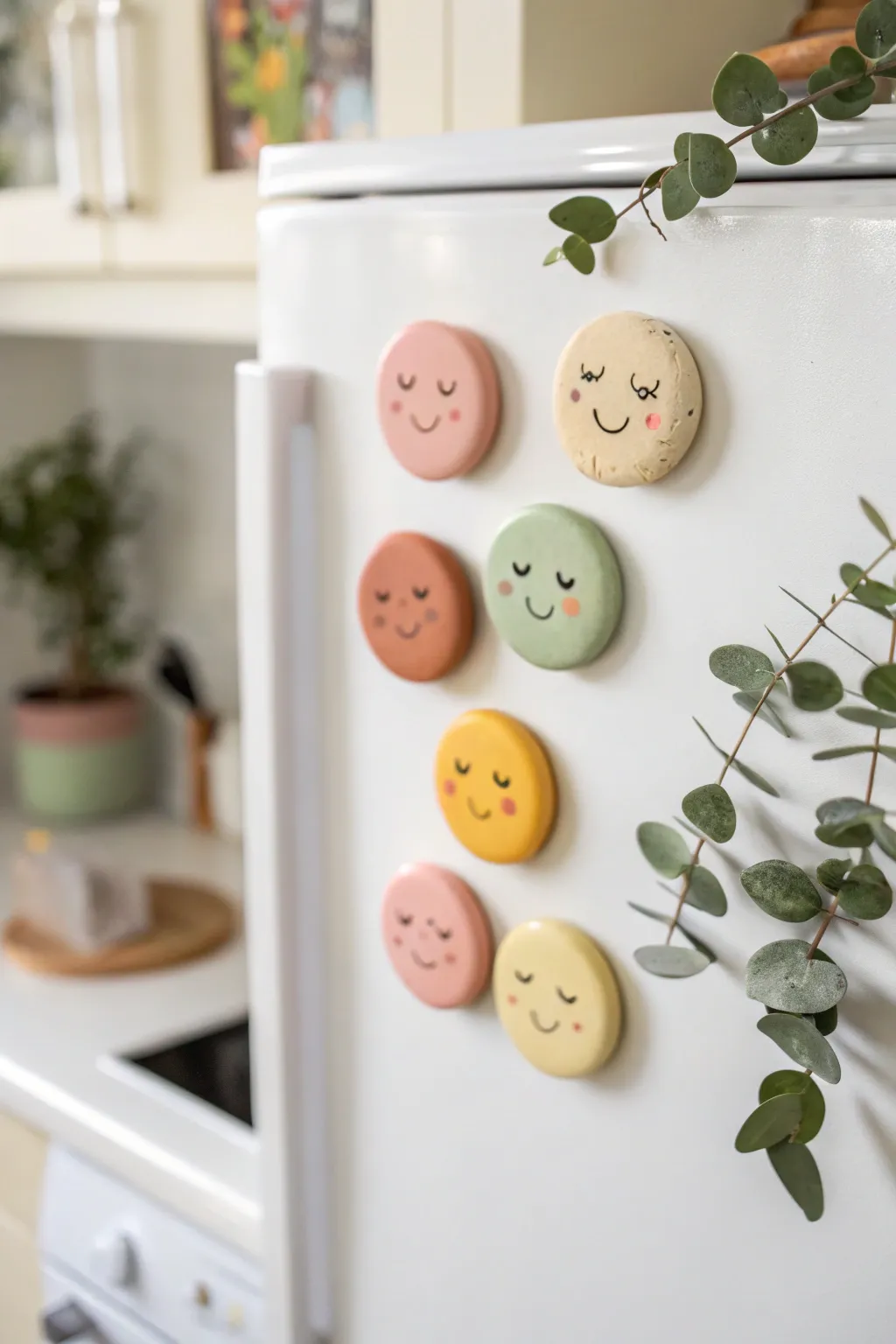
These charming, pastel-colored fridge magnets add a dose of happiness to any kitchen with their sweet, sleepy expressions. Crafted from air-dry clay, they resemble soft macarons or cookies and are incredibly simple to customize.
Step-by-Step Guide
Materials
- Air-dry clay (white)
- Acrylic paints (pastel pink, peach, sage green, yellow, cream)
- Fine-point black paint pen or thin liner brush
- Small round magnets
- Strong craft glue (E6000 or super glue)
- Rolling pin or smooth glass jar
- Circle cookie cutter (approx. 1.5 – 2 inches)
- Sandpaper (fine grit)
- Matte varnish or sealant
Step 1: Shaping the Bases
-
Condition the clay:
Begin by taking a chunk of white air-dry clay and kneading it in your hands until it feels soft, warm, and pliable without any cracks. -
Roll it out:
On a clean, non-stick surface, use a rolling pin to flatten the clay. Aim for a thickness of about 1/4 inch (6mm) to give the magnets a nice, chunky feel similar to the ones pattern in the photo. -
Cut the circles:
Press your circle cookie cutter firmly into the clay to create uniform rounds. If you don’t have a cutter, I sometimes just use the rim of a small glass or jar. -
Smooth the edges:
Dip your finger in a tiny bit of water and gently run it around the circumference of each circle to smooth down any sharp ridges left by the cutter. -
Dry completely:
Place your clay circles on a flat surface lined with parchment paper. Let them dry for 24-48 hours, flipping them halfway through to ensure the bottoms dry evenly and don’t curl. -
Sand for perfection:
Once fully rock-hard, use a piece of fine-grit sandpaper to buff away any remaining roughness on the edges or surface, creating a smooth canvas for your paint.
Smooth Surface Secret
If your clay looks fibrous after sanding, wipe it with a slightly damp sponge or baby wipe before painting to mat down any loose fibers.
Step 2: Adding Color and Character
-
Mix pastel shades:
Prepare your palette by mixing white acrylic paint with small drops of your primary colors to create soft, muted pastels like the sage green, dusty rose, and sunny yellow shown in the example. -
Apply base coat:
Paint the entire front and sides of each clay circle. You will likely need two coats to get an opaque, solid finish. Let the paint dry completely between layers. -
Sketch the faces:
Before committing with ink, lightly pencil in the facial features. Notice how the eyes are wide-set, curved ‘U’ shapes for a sleepy look, and the smiles are small and centered. -
Draw the features:
Using a fine-point black paint pen, carefully trace over your pencil lines. Since the surface is painted clay, use a light touch to keep the line weight consistent. -
Add eyelashes:
For the sleepy eyes, add two or three tiny, delicate lashes pointing downward or outward from the curved eye line. -
Paint rosy cheeks:
Dip the back end of a paintbrush or a toothpick into pink paint. Dot this gently onto the cheeks. For variability, paint small clusters of three dots for ‘freckles’ on some faces and solid pink circles on others. -
Let the details set:
Allow the facial features to dry completely to prevent smudging during the sealing process.
Step 3: Finishing Touches
-
Seal the artwork:
Apply a layer of matte varnish over the top and sides. This protects the paint from kitchen humidity and gives the magnets a professional finish without excessive shine. -
Prepare the back:
Flip the dry clay discs over. Apply a generous dab of strong craft glue to the center of the unpainted back. -
Attach the magnet:
Press the round magnet firmly into the glue. Hold it for 30 seconds to ensure a good initial bond. -
Final cure:
Let the glue cure according to the package instructions (usually overnight) before sticking them to your fridge.
Make Them 3D
Before drying, press tiny balls of clay onto the ‘ears’ area to turn the circles into bear or cat shapes for an animal-themed set.
Now you have a cheerful set of custom magnets ready to hold up your grocery lists and photos
Mini Animal Charms
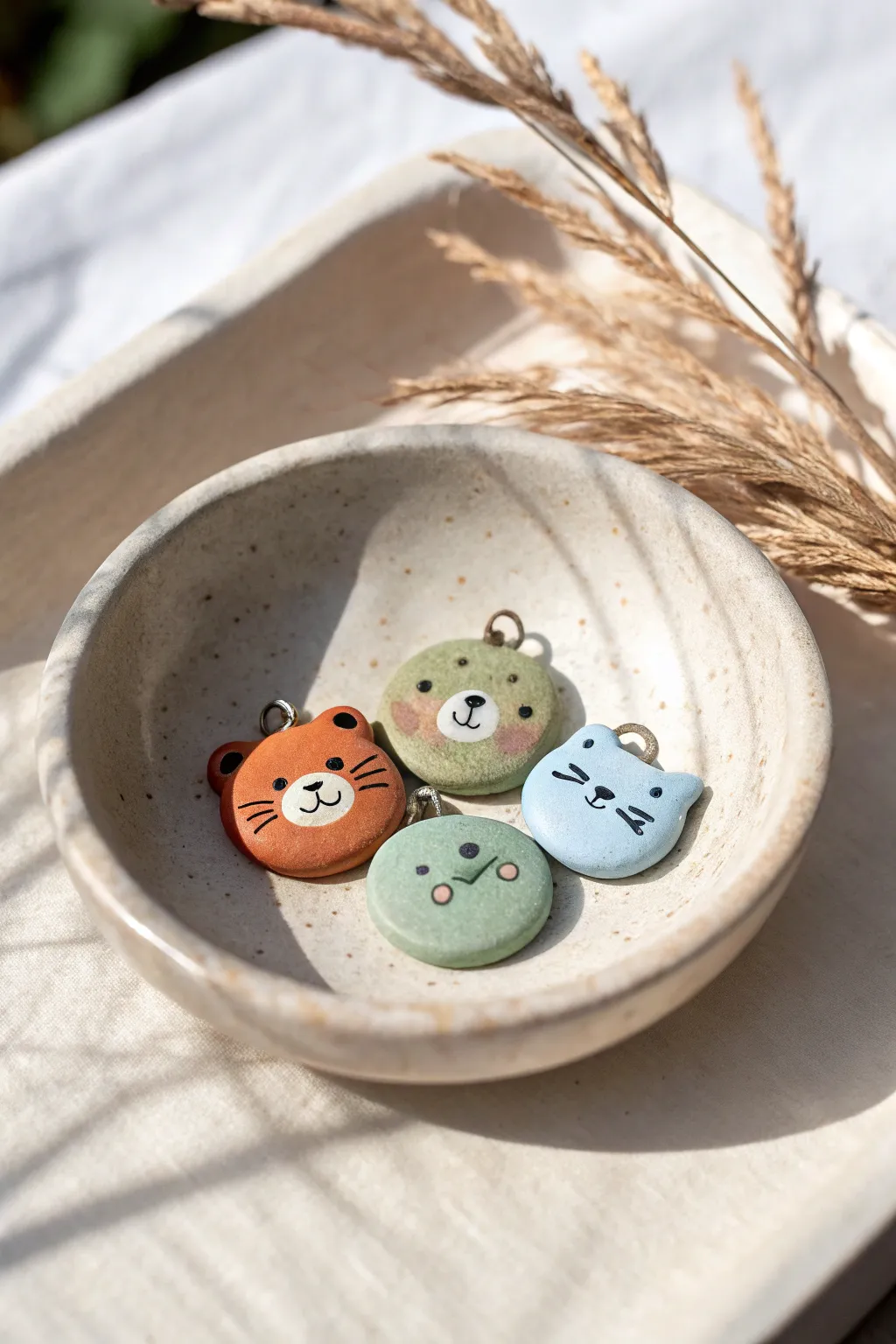
Create a set of adorable, pocket-sized companions with these simple air clay animal charms. Featuring a tiger, bear, cat, and frog, these matte-finish pieces are perfect for keychains or sweet handmade gifts.
Step-by-Step
Materials
- White air-dry clay
- Acrylic paints (orange, green, sage green, light blue, black, white, pink)
- Small round cutter (approx. 1 inch) or a small bottle cap
- Detail paintbrush (00 or 000 size)
- Eye screw pins or sturdy jump rings
- Rolling pin
- Fine-grit sandpaper
- Matte varnish or sealant
- Needle tool or toothpick
- Water cup
Step 1: Shaping the Bases
-
Condition the Clay:
Begin by kneading a small amount of air-dry clay until it is soft, pliable, and free of cracks. If it feels too dry, dip your finger in water and work it in. -
Technique: Rolling:
Roll the clay out on a smooth surface to an even thickness of about 1/4 inch (6mm). Using guides like popsicle sticks on either side can help keep the thickness uniform. -
Cut the Circles:
Use your small round cutter to punch out four circles. These will form the main faces of your animals. -
Smooth the Edges:
Dip your finger in a little water and gently run it around the circumference of each circle to soften the sharp cut edge created by the cutter. -
Add Ears:
Pinch off tiny, equal-sized bits of fresh clay. Roll them into balls and press them gently onto the top edges of the circles to shape ears—triangles for the cat and tiger, semi-circles for the bear. The frog/green character is just a simple circle, so you can skip ears for that one. -
Secure the Hardware:
While the clay is still wet, carefully insert an eye screw pin into the top center of each charm. I find rotating it slowly as you push helps it grip better without squishing the shape.
Keep it Clean
Keep a pack of wet wipes or a damp cloth nearby. Wiping your hands between clay shaping and painting colors prevents accidental smudges on your masterpiece.
Step 2: Refining and Drying
-
Smooth Connections:
Use a modeling tool or your finger to blend the seams where the ears attach to the head, ensuring they are one solid piece. -
Drying Time:
Place the charms on a flat, clean surface to dry. This typically takes 24-48 hours depending on humidity. Flip them over halfway through to ensure the back dries evenly. -
Sanding:
Once fully cured and hard, use fine-grit sandpaper to gently buff away any fingerprints or rough textures on the surface and edges.
Make it Sparkle
For a magical touch, mix a tiny amount of mica powder into your varnish or use a gloss glaze just on the eyes and nose to make the features pop against the matte face.
Step 3: Painting the Faces
-
Teal Cat Base:
Mix a soft light blue acrylic paint and cover the entire cat charm (including the ears). Apply two thin coats for opaque coverage. -
Bear and Frog Bases:
Paint the bear a muted sage green and the frog/round character a lighter mint green. Let these base coats dry completely before adding details. -
Tiger Base:
Paint the final charm with a warm, burnt orange color. -
Adding Muzzles:
For the tiger and bear, paint a small white oval or circle in the lower center of the face to create a muzzle area. -
Painting Eyes and Noses:
Using your smallest detail brush and black paint, add tiny dot eyes and small noses. For the cat, draw straight line whiskers; for the tiger, add three short stripes on each cheek. -
Rosy Cheeks:
Dilute a tiny drop of pink paint with water to make a glaze, or use a fairly dry brush to dab soft pink cheeks onto the bear and outlines for the frog’s cheeks. -
Final Sealing:
To protect your paint work, apply a layer of matte varnish over each charm. This seals the acrylic and gives it that professional, finished look.
String these little friends onto a cord or attach a keyring for a charming daily accessory that smiles back at you
Alphabet Gift Tags
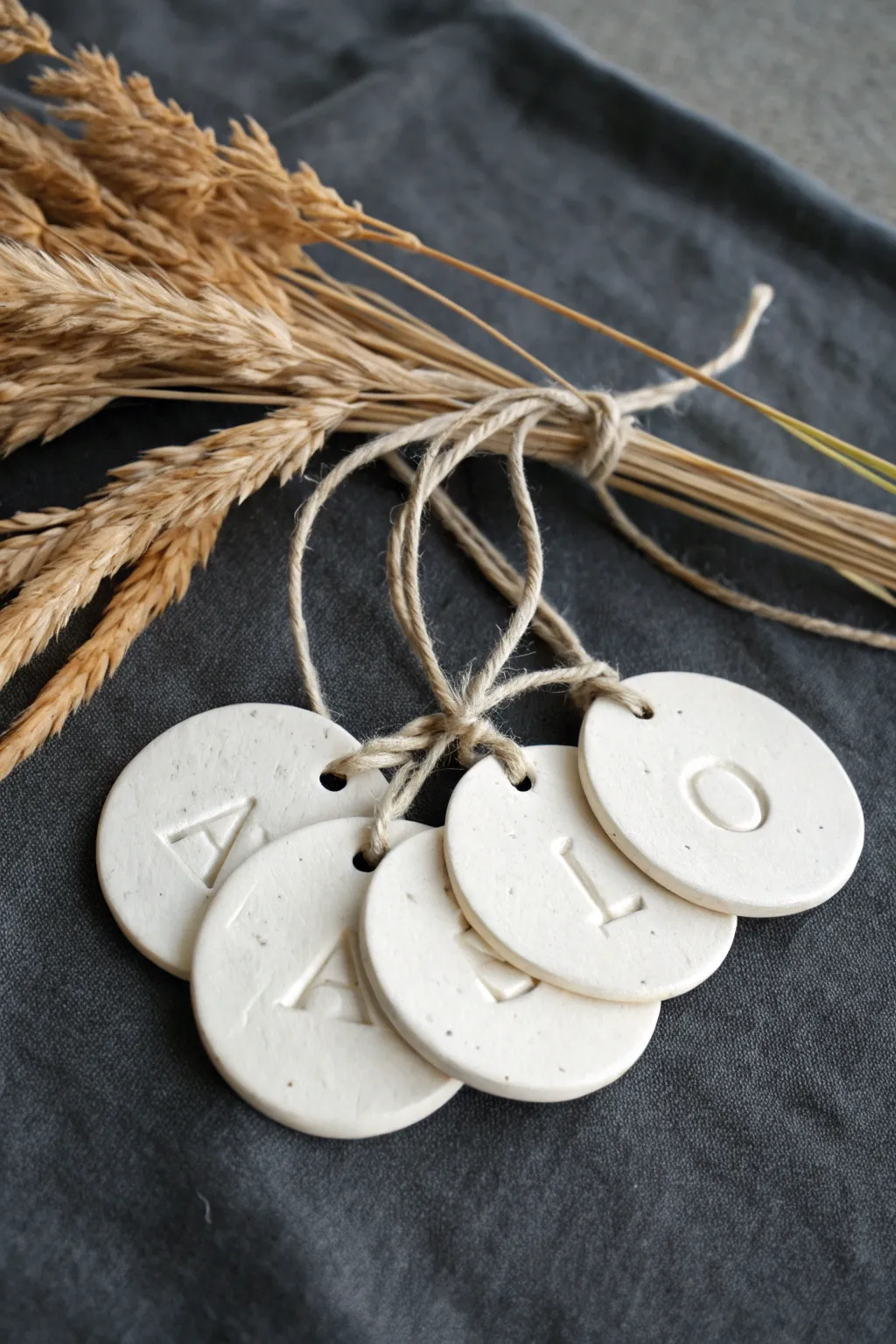
These elegant clay tags bring a personalized, organic touch to any gift or home décor arrangement, featuring a satisfyingly smooth finish and crisp lettering. Tied with simple jute twine and paired with dried naturals, they create a beautiful balance of texture and simplicity.
How-To Guide
Materials
- White air-dry clay (e.g., DAS or Crayola Air Dry)
- Rolling pin or acrylic roller
- Circle cookie cutter (approx. 2 inches diameter)
- Letter stamps or individual letter press set
- Jute twine or rustic hemp cord
- Straw, skewer, or specific hole-punch tool for clay
- Fine-grit sandpaper (optional)
- Small bowl of water
- Parchment paper or canvas work surface
- Sponge or soft cloth
Step 1: Preparing the Clay Bases
-
Condition the clay:
Begin by taking a handful of white air-dry clay. Knead it in your hands for a minute or two until it is warm, pliable, and free of any air bubbles. -
Roll it out:
Place the clay on a sheet of parchment paper or a canvas mat to prevent sticking. Use a rolling pin to flatten the clay to an even thickness, aiming for about 1/4 inch (6mm) thick. -
Check consistency:
Ensure the thickness is uniform across the slab so your tags dry evenly and don’t warp later. -
Cut the circles:
Press your circle cookie cutter firmly into the clay slab. Give it a tiny wiggle before lifting to ensure a clean cut. -
Release the shapes:
Carefully peel away the excess clay from around the circles. If the circles stick to the surface, gently slide a thin blade or spatula underneath to lift them without distorting their shape. -
Smooth the edges:
Dip your finger into a small bowl of water and gently run it around the circumference of each circle to smooth out any rough cutting marks or jagged bits.
Cracks appearing?
If small cracks form while drying, mix a tiny bit of fresh clay with water to make a paste (slip) and fill them in, then smooth over.
Step 2: Adding Details
-
Create the hanging hole:
Use a straw or a skewer to punch a hole near the top edge of each circle. A drinking straw works best because it removes the core of the clay cleanly rather than just pushing it aside. -
Clean the hole:
If the straw left any ragged edges on the back, gently smooth them down with your wet finger. -
Position your stamps:
Select the letters you wish to use. Center the stamp visually on the lower two-thirds or center of the circle, leaving enough clearance from the hanging hole. -
Press the letters:
Press the letter stamp firmly and evenly into the clay. You want a deep, distinct impression, but be careful not to push all the way through the back. -
Refine the surface:
Sometimes stamping creates a slightly raised ridge around the letter. I like to lightly tap this back down with a fingertip for a perfectly flush surface.
Pro Tip: Depth Check
Dust your letter stamps with a tiny bit of cornstarch before pressing them into the clay to prevent them from sticking and tearing the letter walls.
Step 3: Drying and Assembly
-
Initial drying phase:
Lay the tags flat on a clean piece of parchment paper or a wire cooling rack. Let them sit undisturbed in a dry, room-temperature area. -
Flip for even drying:
After about 12 hours, flip the tags over. This helps air reach both sides evenly and significantly reduces the chance of curling. -
Evaluate dryness:
Wait another 12 to 24 hours. The tags are fully dry when they feel lightweight, chalky, and are no longer cool to the touch. -
Sand imperfections:
Once fully dry, take a piece of fine-grit sandpaper and very gently buff the edges or surface if you want a buttery-smooth finish. Wipe away the dust with a dry cloth. -
Prepare the twine:
Cut lengths of jute twine, approximately 8-10 inches long for each tag. -
Tie the loops:
Thread a piece of twine through the hole of a tag. Bring the ends together and tie a simple overhand knot near the ends to create a large loop. -
Attach to botanicals:
Gather your dried wheat or floral stems into a bouquet. Loop the tags around the stems and secure them by passing the tag back through its own twine loop (a larks head knot) or simply tying them around the bundle as shown in the photo.
These charming tags are now ready to add a handcrafted feel to your gifts or serve as lovely seasonal decor
Moon Phase Wall Hanging
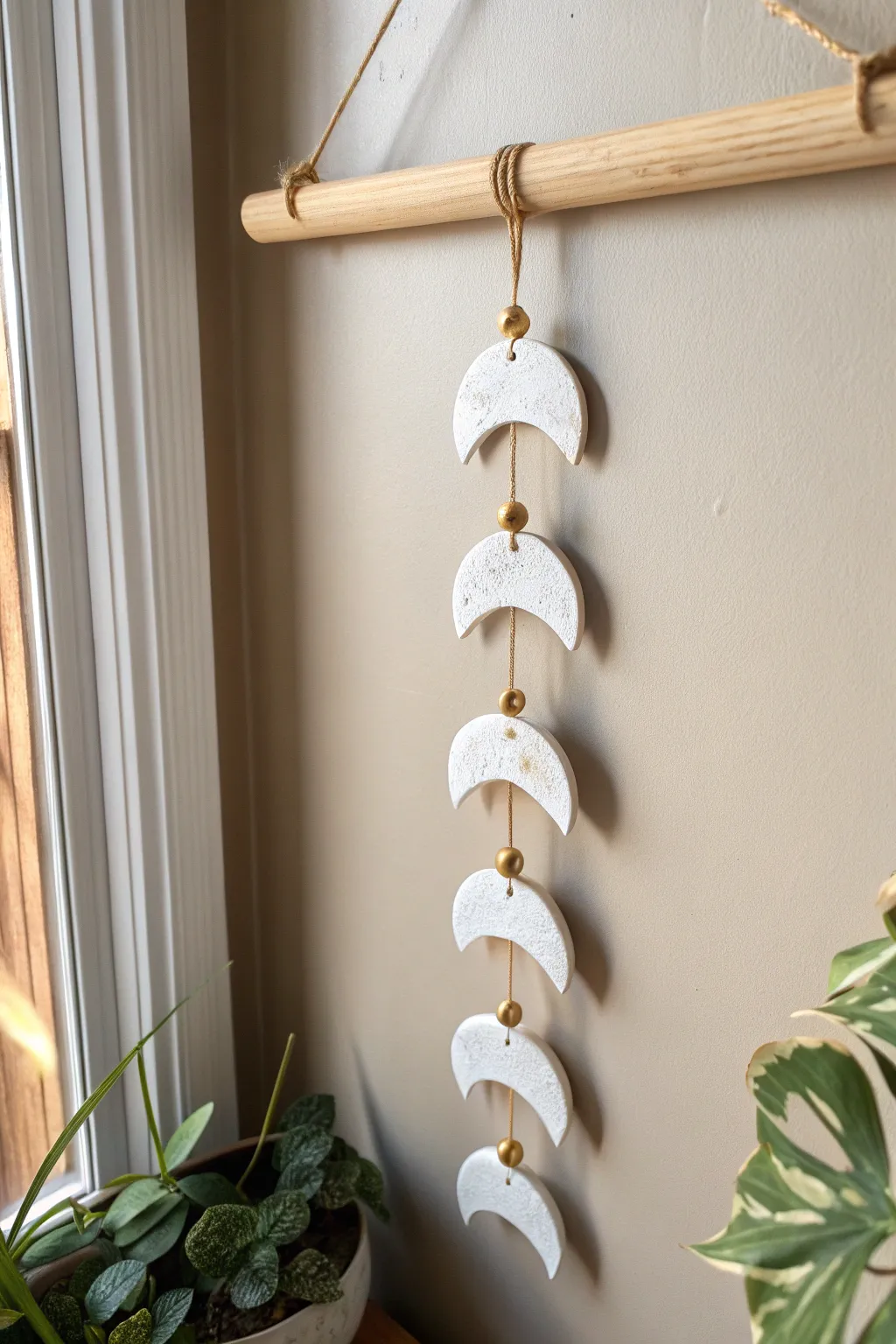
Bring celestial charm to your walls with this vertical moon phase garland. Using simple air dry clay, this project features six textured crescents strung together with gold beads for a minimalist, modern aesthetic.
Step-by-Step Guide
Materials
- White, air-dry clay
- Rolling pin
- Circle cookie cutter (approx. 3 inches) or a glass
- Smaller circle cutter or glass (for creating the crescent shape)
- Wooden dowel (approx. 12-14 inches long)
- Natural jute twine or gold cord
- 6 gold wooden beads
- Darning needle or toothpick
- Fine grit sandpaper
- Gold paint (optional for splatters)
- Clear sealant spray (optional)
Step 1: Shaping the Moons
-
Prepare your clay:
Take a chunk of air dry clay and knead it in your hands to warm it up and remove air bubbles. This ensures a smooth, crack-free surface later on. -
Roll it out:
Using your rolling pin, flatten the clay on a clean surface until it is an even thickness, roughly 1/4 inch thick. Don’t go too thin, or the moons might be fragile. -
Cut the primary circles:
Use your larger circle cutter or the rim of a glass to punch out six full circles from the rolled clay. -
Form the crescents:
Take your smaller circle cutter and position it off-center over one of your clay circles to cut away a section, leaving behind a crescent moon shape. Repeat this for all six circles. -
Smooth the edges:
Dip your finger in a little water and gently run it along the cut edges of each moon to smooth out any roughness or sharp corners. I find this step crucial for a polished professional look. -
Create hanging holes:
Using a toothpick or darning needle, pierce a hole through the top center AND the bottom center of the first five moons. For the bottom-most moon, you only need one hole at the top. -
Add texture:
To mimic the moon’s surface, gently dab the wet clay with a crumpled piece of aluminum foil or a textured sponge. This creates a subtle, organic crater effect.
Warping Woes?
If your moons curl while drying, place a heavy book on them once they are partially dry (leather hard) to flatten them back out gently.
Step 2: Finishing and Assembly
-
Dry completely:
Lay your moons flat on a drying rack or parchment paper. Let them air dry for at least 24-48 hours, flipping them occasionally to ensure even drying and prevent warping. -
Sand and perfect:
Once fully hard, use fine grit sandpaper to gently sand away any imperfections on the edges. Be gentle, especially near the tips of the crescents. -
Optional gold splatter:
If you want a hint of shimmer like in the photo, dip a toothbrush in gold paint and flick the bristles over the moons for a subtle splatter effect. Let the paint dry. -
Prepare the dowel:
Cut a piece of jute twine about 2 feet long. Tie one end securely to the left side of your wooden dowel and the other end to the right side to create the hanger. -
Start the center cord:
Cut a long piece of twine, roughly 3 or 4 feet to be safe. Tie the top end securely to the center of the wooden dowel using a lark’s head knot or a simple double knot. -
Add the first bead:
Thread one gold bead onto the hanging twine and slide it all the way up so it sits just below the dowel knot. You may need to wrap a bit of tape around the twine end to help it pass through the bead. -
Attach the top moon:
Thread the twine through the top hole of your first moon, running the string down the back of the crescent, and out through the bottom hole. -
Secure the position:
Tie a small knot directly underneath the bottom hole of the moon to keep it in place, or simply let gravity hold it if your cord is thick enough. Thread on your next gold bead. -
Continue stringing:
Repeat the process: add a bead, thread through top hole, run down back, thread out bottom hole, add next bead. Keep the spacing consistent between each moon—about 1 to 2 inches looks balanced. -
Attach the final moon:
For the last crescent, thread the twine through the single top hole. Tie a secure double knot hidden behind the moon or add a final bead inside the curve to anchor it. -
Trim excess:
Snip off any excess twine at the very bottom. You can add a drop of glue to the final knot to ensure it never comes undone.
Pro Tip: Clean Lines
Sand the edges of your dried clay pieces with an emery board or nail file. It’s much easier to handle than a loose sheet of sandpaper for curves.
Hang your new lunar artwork near a window to catch the light and enjoy the serene vibes
Geometric Hanging Mobile
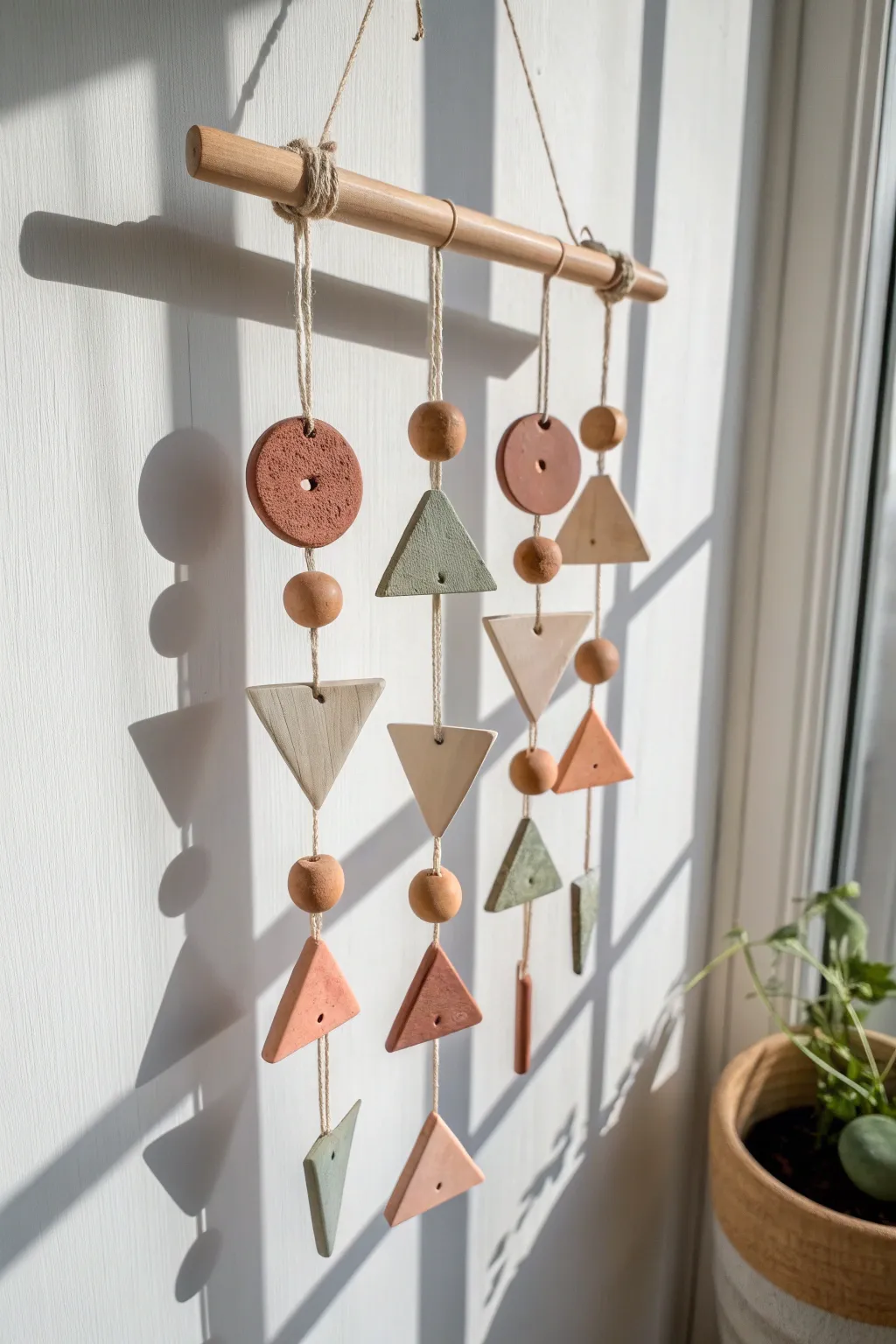
Add a touch of modern bohemian charm to your space with this earthy, geometric wall hanging. Featuring soft terracotta, sage, and cream tones, this mobile balances textured circles and triangles for a calming, sculptural piece.
How-To Guide
Materials
- Air-dry clay (white and terracotta)
- Acrylic paints (sage green, peach, beige)
- Rolling pin
- Knife or clay cutting tool
- Cookie cutters (circle) or a glass
- Ruler or straight edge
- Straw or skewer (for poking holes)
- Sandpaper (fine grit)
- Wooden dowel (approx. 12-16 inches)
- Jute twine or hemp cord
- Scissors
Step 1: Preparing the Clay Shapes
-
Roll out the clay:
Begin by rolling out your air-dry clay on a clean, flat surface to an even thickness of about 1/4 inch. If you are using white clay and want colored pieces without painting later, you can knead acrylic paint directly into the wet clay now, though painting after drying often yields crisper edges. -
Cut the circles:
Use a round cookie cutter or the rim of a small glass to cut out several circles. For the specific look in the photo, you’ll need about 2-3 flat circles. You can also hand-roll spherical beads for variety. -
Cut the triangles:
Using a ruler and a knife, cut out various triangle shapes. Aim for a mix of sizes: large equilateral triangles, elongated isosceles triangles, and smaller accent triangles. Cutting freehand gives them an organic, handmade feel. -
Create texture (optional):
Before the clay dries, you can gently press a piece of rough fabric or a sponge onto some of the shapes, particularly the circles, to give them a stone-like texture. -
Poke the holes:
This step is crucial. Using a straw or a skewer, poke a hole through the center of your flat circles. For the triangles, poke a hole near the top point and another hole in the center of the bottom edge so they can be strung together vertically. -
Form the beads:
Roll small bits of clay into balls to create spherical beads. Use a skewer to pierce a hole straight through the center of each bead. Make sure the hole is wide enough for your twine to pass through easily.
Step 2: Finishing and Assembly
-
Dry the pieces:
Lay all your clay pieces flat on a piece of parchment paper or a wire rack. Allow them to dry completely according to the package instructions, which usually takes 24-48 hours depending on humidity. -
Sand the edges:
Once fully dry, take fine-grit sandpaper and gently smooth any rough edges or irregularities on your shapes. This gives the final piece a polished, professional look. -
Paint the shapes:
If you didn’t color your clay beforehand, paint your shapes now. Use earthy tones like sage green, soft peach, beige, and keep some natural terracotta if available. I like to apply two thin coats for opaque, even coverage. -
Seal the clay:
To protect your work, apply a matte varnish or sealant over the painted pieces. This prevents chipping and makes the colors pop slightly. -
Cut the twine:
Cut four lengths of jute twine, each about 24-30 inches long. You will also need a separate piece for the main hanging loop attached to the dowel. -
Attach twine to dowel:
Tie each of the four long pieces of twine onto the wooden dowel using a simple lark’s head knot or a secure double knot. Space them evenly along the rod. -
String the first column:
Start with the leftmost string. Thread on a flat terracotta circle, secure it with a knot underneath if needed, or loop the twine through it. Add a wooden or clay bead, then tie on a large beige triangle below it. Continue adding shapes, tying knots below each piece to hold it in place. -
Build the pattern:
Repeat the stringing process for the remaining three strands. Vary the order of shapes (bead, triangle, circle) and colors to recreate the asymmetrical rhythm shown in the image. Ensure the pieces hang straight by checking the balance as you go. -
Secure the ends:
Once you reach the bottom of a strand (ending with a triangle typically), tie a tight double knot underneath the final shape and trim any excess twine closely. -
Add the hanger:
Tie a piece of twine to both ends of the wooden dowel to create a triangle hanger. Adjust the length so it hangs at your desired height.
Cracking Clay?
If small cracks appear while drying, mix a tiny bit of fresh clay with water to make a paste (slip) and fill in the cracks. Smooth it over with your finger and let dry again.
Knotting Secret
Hide the knots that hold pieces in place! If the hole is large enough, tuck the knot inside the bead or shape’s hole so the components look like they are floating.
Hang your new geometric art near a window to watch the shadows play throughout the day
Handmade Domino Tile Set
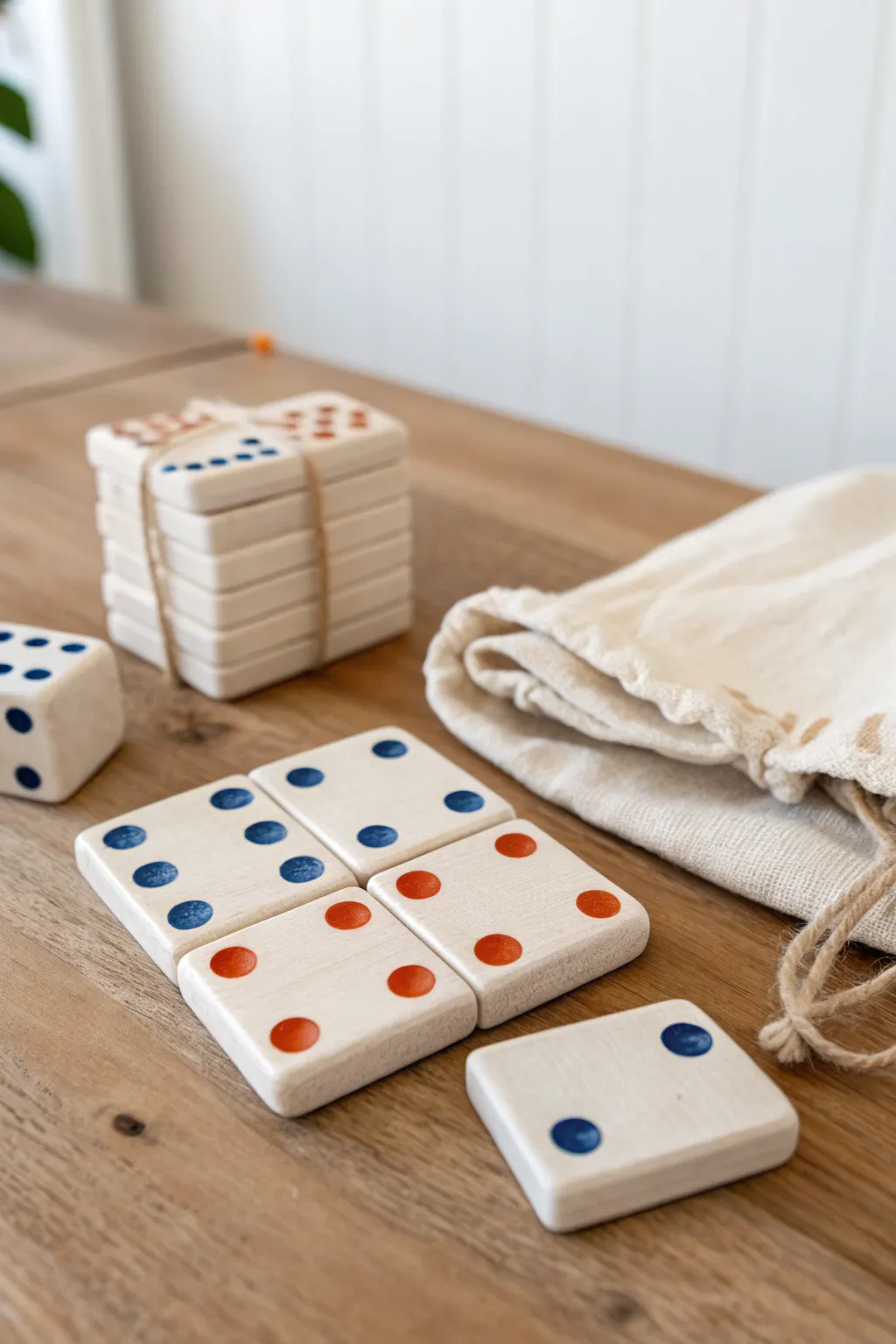
Reimagine family game night with this tactile, handmade domino set crafted from air-dry clay. These thick, creamy-white tiles feature vibrant oversized dots stamped in classic blue and orange for a charmingly rustic finish.
Step-by-Step Tutorial
Materials
- White air-dry clay (approximately 1kg)
- Rolling pin
- Two wooden rulers or guide sticks (6mm-8mm thickness)
- Small rectangular clay cutter or craft knife
- Sandpaper (medium and fine grit)
- Acrylic paint (Deep Blue and Burnt Orange)
- Small round sponge dauber or the flat end of a dowel
- Clear matte acrylic sealant spray
- Parchment paper or non-stick silicone mat
Step 1: Shaping the Tiles
-
Condition the Clay:
Begin by taking a large chunk of air-dry clay and kneading it in your hands until it becomes pliable and warm. If the clay feels dry or cracks easily, add a drop or two of water to smooth it out. -
Set Up Guides:
Place your two wooden rulers or guide sticks on either side of your workspace on top of parchment paper. These will ensure your clay is rolled to a consistent, thick slab, which is crucial for that chunky domino look. -
Roll the Slab:
Place the kneaded clay between the guides and use your rolling pin to flatten it. Roll firmly until the pin rests on the guides, creating a perfectly even surface. -
Cut the Shapes:
Using a rectangular cutter or a sharp craft knife and a straight edge, cut out 28 identical rectangles. A standard domino size is roughly 1 inch by 2 inches, but feel free to make these slightly larger for easier handling. -
Soften the Edges:
Before the clay dries, dip your finger in a little water and gently run it along the sharp cut edges of each tile to round them off slightly. This prevents sharp corners later. -
Initial Drying Phase:
arrange the tiles on a clean sheet of parchment paper, leaving space between each one to allow airflow. Let them dry for about 24 hours on one side. -
Flip and Dry:
Turn all the tiles over to ensure the bottoms dry evenly. Clay shrinks as it dries, so flipping them helps prevent warping. Allow another 24-48 hours until they are completely hard and bone-dry.
Step 2: Finishing and Painting
-
Sand for Smoothness:
Once fully cured, use medium-grit sandpaper to level out any bumps on the surface or sides. Follow up with fine-grit sandpaper for a silky smooth finish. -
Create a Stamping Tool:
Find a dowel or the handle end of a paintbrush that matches the size of the dots in the photo. Alternatively, a small round sponge dauber works well for perfect circles. -
Plan Your numbers:
It helps to keep a picture of a standard domino set nearby so you know exactly which number combinations to stamp on your 28 tiles. -
Stamp the Blue Dots:
Dip your tool into the deep blue acrylic paint. Stamp the dots onto the appropriate tiles, pressing straightforwardly down and lifting straight up to keep the circle crisp. I find it easiest to do all the blue numbers first before switching colors. -
Stamp the Orange Dots:
Clean your tool or switch to a fresh one, then repeat the stamping process with the burnt orange paint for the remaining number combinations. -
Let Paint Cure:
Allow the painted dots to dry completely. If the paint looks a bit transparent, you can carefully stamp a second layer over the first once dry. -
Seal the Project:
Take the tiles to a well-ventilated area and spray them with a clear matte sealant. This protects the clay from moisture and prevents the paint from chipping during intense game nights.
Fixing the Curl
If your tiles warp while drying, slightly dampen the concave side and place them under a heavy book overnight to flatten them back out.
Travel Ready
Sew a simple drawstring bag from unbleached cotton or linen to store your set, making it perfect for camping trips or picnics.
Gather your friends and enjoy the satisfying clack of your new handmade game set