
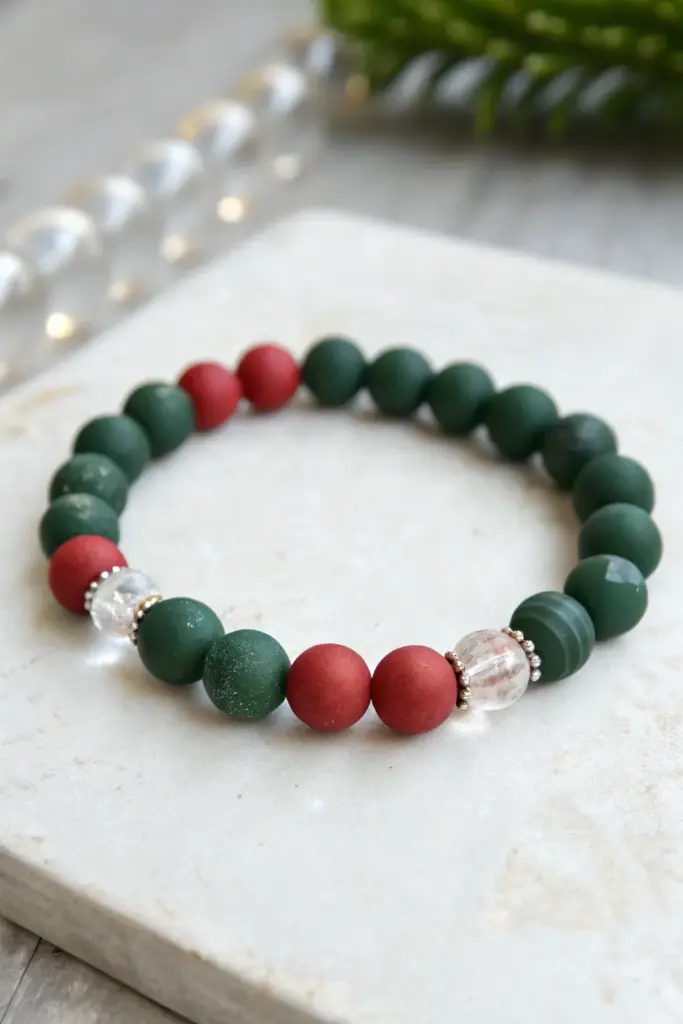
When I’m craving a quick holiday project, Christmas clay bead bracelets are my go-to because they’re colorful, relaxing, and ridiculously giftable. Here are my favorite Christmas clay bead bracelet ideas—from classic red, green, and white patterns to cute letter bead phrases and festive charms.
Classic Candy Cane Stripe Bracelet
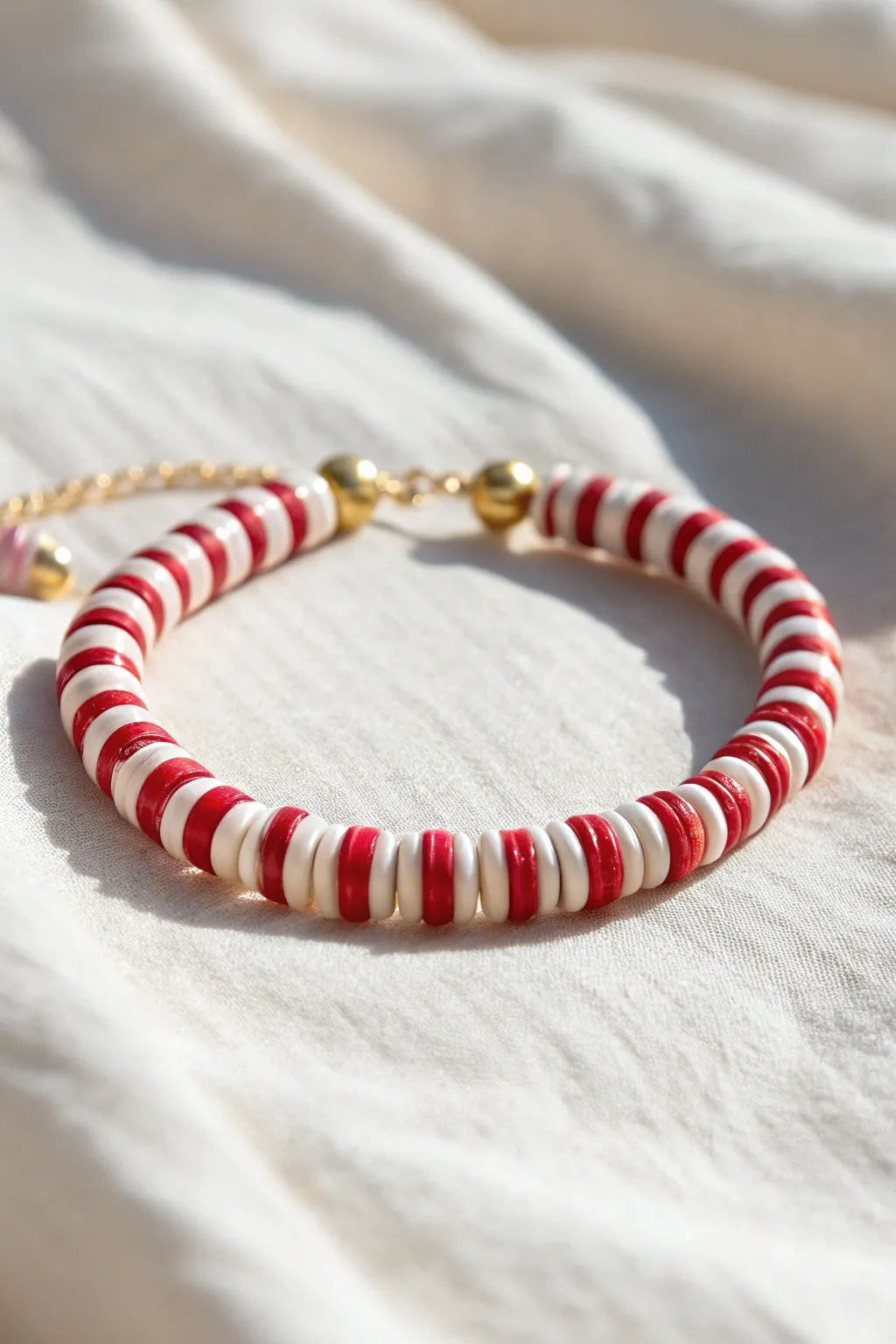
Capture the nostalgic sweetness of a holiday classic with this simple yet striking beaded bracelet. Featuring alternating red and white clay heishi beads accented by gleaming gold hardware, this accessory adds a polished pop of festive cheer to any outfit.
Step-by-Step
Materials
- Red polymer clay heishi disc beads (6mm)
- White or cream polymer clay heishi disc beads (6mm)
- Strong elastic bead cord (0.8mm clear)
- Small gold round spacer beads (3-4mm)
- Gold crimp beads or crimp tubes
- Gold jump rings
- Gold lobster clasp
- Gold extension chain (optional)
- Small gold charm (optional for chain end)
- Jewelry pliers (needle nose and flat nose)
- Scissors or bead snippers
- Super glue or jewelry cement
Step 1: Preparation and Pattern Planning
-
Measure your wrist:
Wrap a flexible tape measure around your wrist to find your size. Add about half an inch to this measurement to ensure the bracelet isn’t too tight once all the bulky beads are added. -
Cut the cord:
Snip a piece of elastic cord about 10-12 inches long. Having this extra length makes it much easier to tie knots or attach clasps without fumbling with tiny ends. -
Secure the end:
Attach a piece of tape or a bead stopper to one end of your cord. This prevents your hard work from sliding right off while you are stringing the pattern. -
Plan the stripe width:
Look closely at the example image; the pattern isn’t just one-by-one. It uses groups of two or three beads of the same color to create thicker, bolder stripes. Decide if you want a 2-red, 2-white pattern or a 3-red, 3-white pattern.
Stripe Stability Tip
Occasionally flex the bracelet while stringing. Clay beads can sometimes stick together; flexing ensures the bracelet will drape naturally on your wrist rather than staying stiff.
Step 2: Stringing the Design
-
Begin the beadwork:
Start by sliding on a gold crimp bead followed by a larger gold round spacer bead. This will act as the anchor point near your clasp later. -
Start the first stripe:
Thread on two red clay heishi beads. Ensure they sit flush against each other so the color looks solid. -
Alternate colors:
Switch to white and thread on two white heishi beads. Push them down to meet the red ones. -
Establish the rhythm:
Continue this pattern—two red, two white—creating a consistent ‘candy cane’ stripe effect. Keep tension consistent but not tight. -
Check the length:
Periodically wrap the strand around your wrist. You want the beaded section to cover most of your wrist but leave room for the hardware closures. -
Finish the bead run:
Once you reach the desired length, end the pattern symmetrically if possible (e.g., if you started with red, try to end with white). -
Add the final gold accent:
Slide on another large gold round spacer bead to mirror the beginning of the bracelet. -
Add the final crimp:
Thread on your last gold crimp bead. Don’t crimp it down just yet.
Step 3: Attaching Clasp and Finishing
-
Loop the end:
Take the end of the elastic cord and thread it back through the crimp bead to create a small loop. If you prefer a more durable finish, thread it through a wire guardian first. -
Secure the crimp:
Use your flat nose pliers to squash the crimp bead firmly flat, locking the loop in place. Trim the excess elastic tail close to the crimp. -
Repeat on the other side:
Remove your tape/stopper from the starting end. Thread that tail back through the starting crimp bead to make a loop, pull it snug against the gold bead, and crimp it flat. -
Open a jump ring:
Using two pairs of pliers, twist (don’t pull) a gold jump ring open. -
Attach the clasp:
Hook the open jump ring onto one of your elastic loops and slide onto the lobster clasp. Close the jump ring securely by twisting it back. -
Attach the extender chain:
On the opposite loop, use another jump ring to attach your gold extension chain. This allows for adjustable sizing. -
Optional charm addition:
For a cute detail seen in similar styles, attach a tiny bead or charm to the very end of the extender chain using a small jump ring.
Raise the Bar
Add a singular personalized touch by swapping one segment of white stripes for gold letter beads spell out ‘JOY’ or ‘NOEL’ in the center.
Slip on your new festive stripes and enjoy the perfect touch of holiday spirit on your wrist
Red, Green, and White Color-Block Bracelet
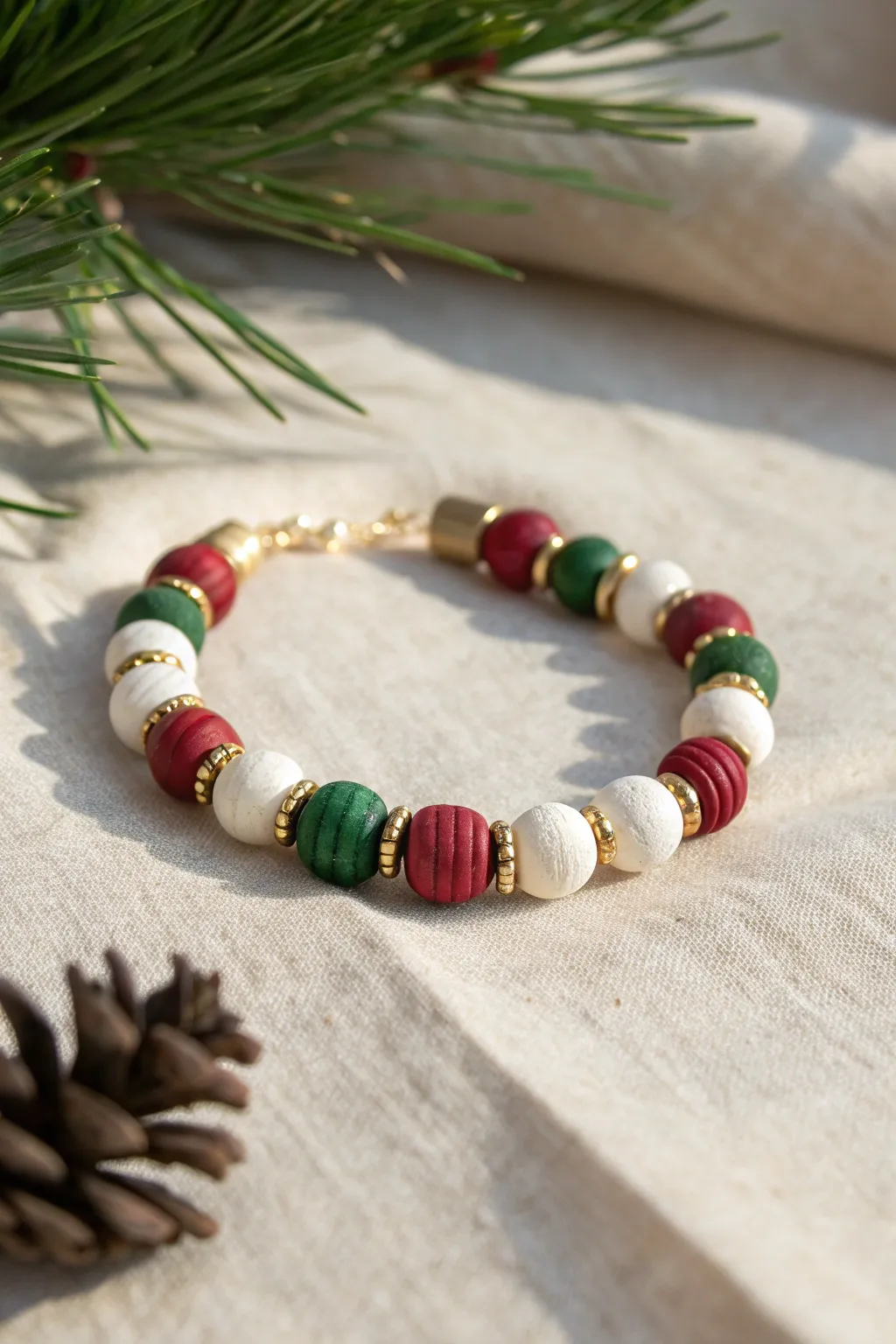
This elegant bracelet balances classic Christmas red, deep forest green, and snowy white polymer clay beads separated by shimmering gold spacers. The unique ridged texture of the clay beads adds a sophisticated touch, making it perfect for holiday parties or cozy winter evenings.
Step-by-Step Guide
Materials
- Polymer clay (Deep Red, Forest Green, White)
- Gold tone heishi spacer beads (approx. 4-5mm diameter)
- Small gold seed beads (optional, for closure area)
- Stretch cord (0.8mm or 1mm)
- Jewelry glue or heavy-duty super glue
- Gold ribbon crimp ends (cord ends)
- Gold lobster clasp and jump rings
- Rolling pin or pasta machine for clay
- Comb or textured rolling tool
- Bead piercing pin or needle
- Baking sheet and oven
Step 1: Creating the Textured Clay Beads
-
Condition the clay:
Start by thoroughly kneading your red, green, and white polymer clay separately until each color is soft and pliable. This prevents cracking later. -
Form the base log:
Roll each color into a smooth, even log or snake, aiming for a thickness of about 10-12mm, or the desired diameter of your finished bead. -
Add texture:
To achieve the ribbed look seen in the photo, gently roll a fine-toothed tool across the surface of your clay log. I like to use the side of a clean texturing comb or even the threads of a screw to gently press in those parallel lines. -
Cut the segments:
Using a sharp tissue blade, slice the textured logs into even segments. These should be roughly 8-10mm wide to create a slightly flattened barrel shape rather than a perfect sphere. -
Round the edges:
Pick up each bead carefully so you don’t squash the texture and gently tap the cut ends with your finger to soften the sharp edges. -
Pierce the holes:
Use a bead piercing pin to create a hole through the center of each bead. Twist the pin as you push through to avoid distorting the shape. -
Bake the beads:
Arrange your beads on a baking sheet lined with parchment paper. Bake according to your specific clay manufacturer’s instructions (usually 275°F/135°C for 15-30 minutes). -
Cool down:
Allow the beads to cool completely before stringing; they are fragile when warm and the plasticizer needs to set.
Step 2: Assembling the Design
-
Prepare the cord:
Cut a length of stretch cord about 10 inches long. This gives you plenty of extra room to work with the ends. -
String the first gold spacer:
Start by threading on one of the textured gold heishi spacers. This will sit between your clay beads. -
Begin the pattern:
Thread on a red clay bead, followed immediately by another gold spacer. -
Establish the sequence:
Follow the sequence shown in the image: Gold spacer, Red Clay, Gold spacer, White Clay, Gold spacer, Green Clay. -
Check the symmetry:
Continue repeating this pattern until the bracelet reaches your desired length. Notice how the gold spacers act as punctuation marks between every single color change. -
Verify length:
Wrap the beaded strand around your wrist to check the fit. It should sit comfortably without gaps, but remember the clasp will add about half an inch.
Sticky Situation?
If your clay is sticking to the texturing tool, lightly dust the raw clay log with a tiny amount of cornstarch or dip your tool in water before rolling over the surface.
Step 3: Finishing the Bracelet
-
Slide on crimp ends:
Instead of a simple knot, this design uses cord ends for a professional finish. Slide a gold cord end cap onto one side of the elastic. -
Secure the cord:
Tie a strong overhand knot at the very end of the cord, apply a dab of jewelry glue to the knot, and pull it firmly inside the end cap. -
Close the crimp:
Use jewelry pliers to gently flatten or crimp the end cap down over the knot/cord to secure it in place. -
Repeat on the other side:
Repeat this process for the other end of the bracelet, ensuring the beads are snug but not so tight that the bracelet stiffens up. -
Attach hardware:
Open a jump ring using two pairs of pliers. Attach it to one of the cord ends and slide on the lobster clasp before closing the ring. -
Final connection:
Attach a simple jump ring or a short extender chain to the cord end on the opposite side to receive the clasp.
Pro Tip: Consistent Sizes
To get perfectly identical bead sizes, roll your clay sheet to a specific thickness first, cut uniform strips, and then roll those strips into your logs.
Enjoy wearing your sophisticated handmade holiday accessory or gifting it to a lucky friend
Merry Letter Bead Center Bracelet
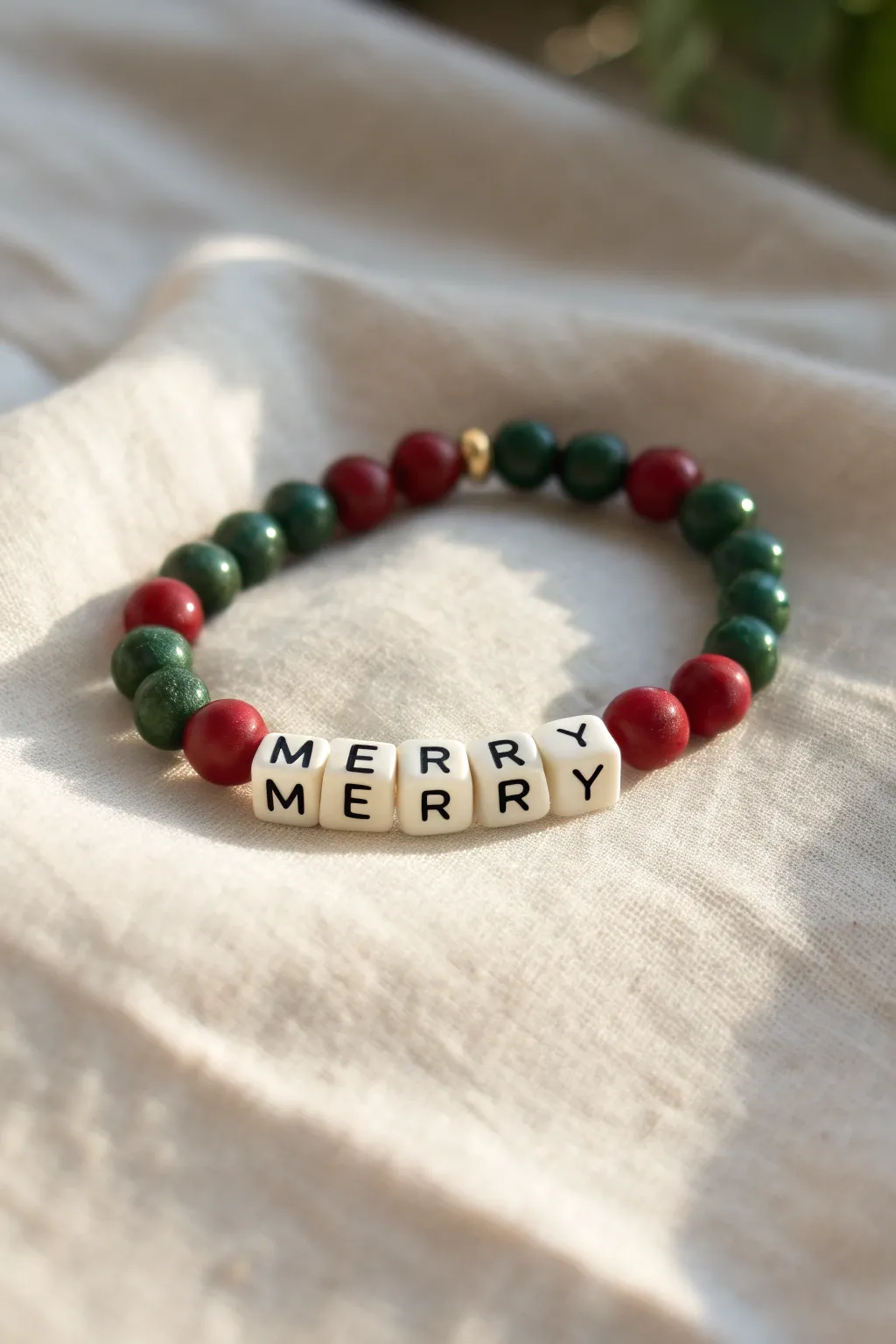
Capture the festive spirit with this classically colored beaded bracelet featuring a bold letter centerpiece. The combination of deep red and forest green round beads with crisp white letter cubes creates a timeless holiday accessory that’s perfect for stacking or gifting.
How-To Guide
Materials
- Dark red round beads (6mm or 8mm, wood or matte stone)
- Forest green round beads (6mm or 8mm, wood or matte stone)
- White square letter beads spelling MERRY
- One small gold spacer bead
- Elastic jewelry cord (0.7mm or 0.8mm)
- Scissors
- Super glue or jewelry cement (optional)
- Bead stopper or tape
Step 1: Planning the Layout
-
Measure your cord:
Cut a piece of elastic cord about 10-12 inches long. This gives you plenty of extra room to tie knots without struggling. -
Secure the end:
Place a bead stopper or a piece of tape on one end of the cord so beads don’t slide off while you work. -
Arrange the word:
Locate your five letter beads: M, E, R, R, and Y. Lay them out on your workspace to ensure they are in the correct order before stringing.
Knot Slipping?
If your elastic knot feels insecure, try tying a simple overhand knot with the two tail ends first, then separate the strands and tie them again for extra grip.
Step 2: Stringing the Core
-
Start the center:
Thread the letter beads onto the cord in order: M, E, R, R, Y. Double-check that they are all facing the same direction up-and-down. -
Add first flanks:
On the right side of the ‘Y’, slide on one red bead, followed by one green bead. I like to check the fit against the letter bead here to make sure the hole sizes look proportional. -
Balance the left:
On the left side of the ‘M’, mirror that pattern by adding one red bead followed by one green bead.
Mix It Up
Swap the standard green beads for matte jasper or moss agate stones to give the bracelet a heavier, more luxurious feel and varied texture.
Step 3: Creating the Pattern
-
Establish the sequence:
The main pattern for the band is alternating groups. String two green beads, then one red bead. -
Repeat the sequence:
Continue this pattern—two green, one red, two green, one red—working outwards from one side. -
Mirror the design:
Whatever pattern you build on the right side, try to roughly mirror on the left side to keep the word ‘MERRY’ centered on your wrist. -
Insert the accent:
About halfway through the back section of the bracelet, slide on the single small gold spacer bead. This adds a subtle flash of shine. -
Fill to length:
Continue adding red and green beads until the bracelet measures about 7 inches (or your desired wrist size). -
Check the fit:
Wrap the unfinished strand around your wrist. The ends should touch comfortably without stretching the elastic too tight.
Step 4: Finishing Touches
-
Pre-stretch the cord:
Gently pull on both ends of the elastic cord a few times. This pre-stretching prevents the bracelet from becoming loose after the first wear. -
Prepare to knot:
Remove the bead stopper or tape carefully, holding both ends of the cord firmly. -
Tie the knot:
Tie a surgeon’s knot: cross the ends, loop one under, then cross again and loop under twice before pulling tight. -
Secure the bond:
Add a tiny dab of super glue or jewelry cement directly onto the knot. Let it dry for a minute. -
Hide the knot:
If one of your beads has a larger hole, carefully tug the cord so the knot slides inside that bead, hiding it from view. -
Trim the excess:
Use your scissors to trim the extra cord ends close to the knot (or the bead hiding the knot), being careful not to cut the main loop.
Now slip on your festive creation and enjoy the holiday cheer it brings to your outfit
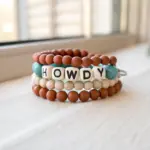
Joy and Bright Message Stack
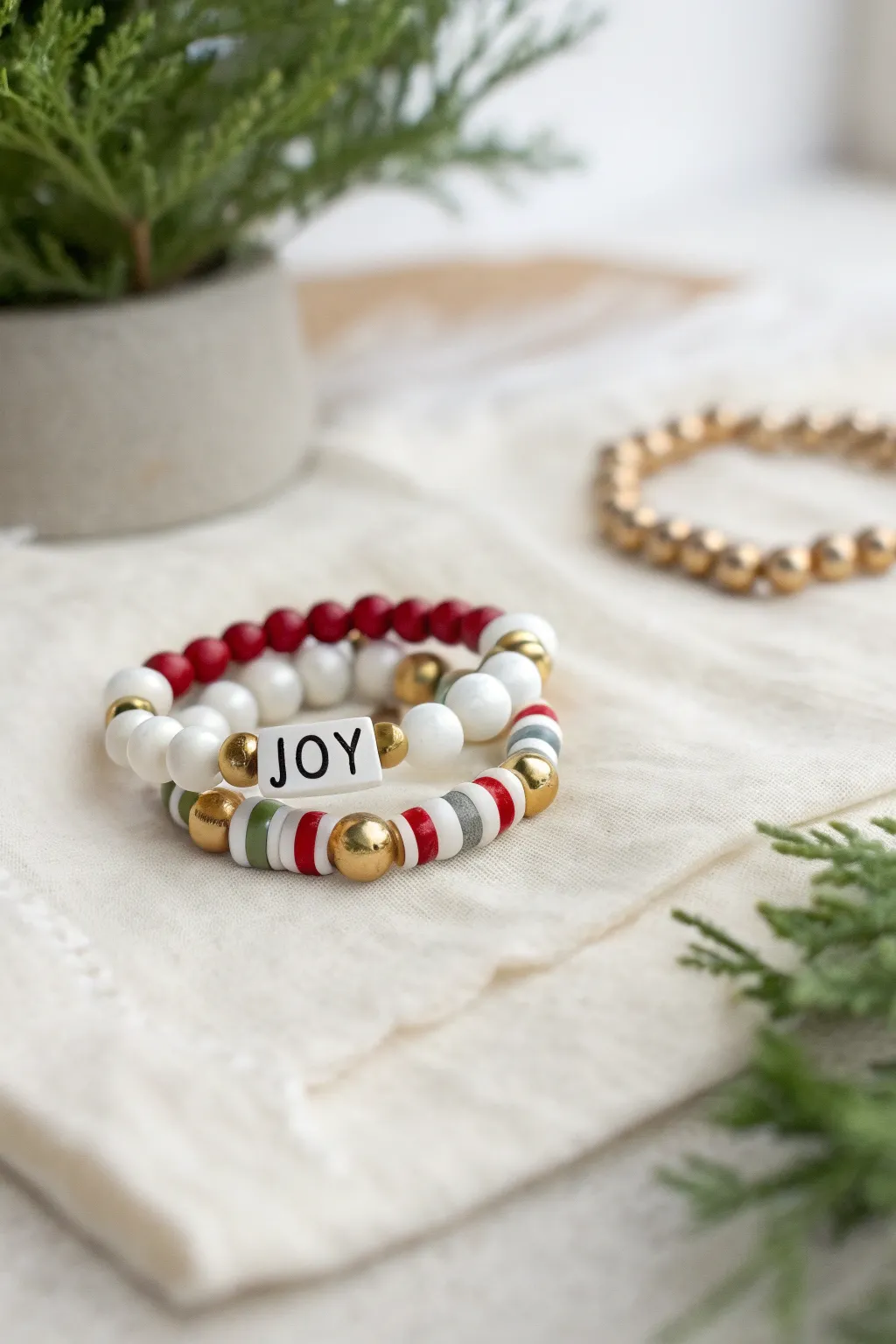
Spread a little holiday cheer right on your wrist with this delightful duo of beaded stretch bracelets. The combination of classic red and white beads with a modern heishi clay stack featuring a sweet ‘JOY’ sentiment makes for a festive accessory that pairs perfectly with cozy sweaters.
Detailed Instructions
Materials
- Red wood or acrylic round beads (6mm or 8mm)
- White or pearlescent round beads (8mm and 10mm)
- Gold spherical spacer beads (various sizes: 4mm, 6mm, and 8mm)
- Flat Heishi clay disc beads in red, white, sage green, and grey
- Square white letter beads (J, O, Y)
- Elastic stretch cord (0.7mm or 0.8mm)
- Jewelry glue or clear nail polish
- Scissors
Step 1: Planning Your Designs
-
Measure and cut:
Cut two pieces of elastic cord to approximately 10 inches each. This gives you plenty of extra room for tying knots later without struggling with slippery ends. -
Pre-stretch the cord:
Give each piece of elastic a few gentle tugs. Pre-stretching prevents the bracelets from sagging or loosening up immediately after you finish them, keeping that fit nice and snug. -
Secure the end:
Place a piece of tape on one end of your first cord, or attach a bead stopper clip if you have one, to stop beads from sliding off while you work.
Step 2: Creating the ‘JOY’ Bracelet
-
Start the pattern:
Begin stringing your beads with a pattern of white pearlescent rounds. I like to alternate between larger 10mm beads and slightly smaller 8mm beads to create texture. -
Incorporate gold accents:
Next to the white beads, add a small 4mm gold spacer, followed by a larger 8mm gold bead, and then another small 4mm gold spacer. This gold cluster adds a touch of elegance. -
Add the joyful message:
Thread on your square letter beads to spell out ‘JOY’. Make sure they are all facing the correct direction and are upright before moving on. -
Mirror the design:
After the ‘Y’, repeat the gold cluster sequence (small gold, large gold, small gold) to frame the word perfectly. -
Complete the loop:
Fill the rest of the strand with your white pearlescent beads until the bracelet measures roughly 6.5 to 7 inches, or fits comfortably around your wrist.
Sticky Situation
If your knot won’t hide inside a bead hole, don’t force it or the string might snap. Instead, position the knot next to a gold spacer bead where it is less visible.
Step 3: Crafting the Heishi Stack
-
Prepare the second cord:
Secure your second piece of elastic just like the first one, readying it for the colorful clay discs. -
Build the clay segments:
Create small color-blocked sections using the flat Heishi beads. String about 3-4 white discs, followed by 3-4 red discs, then a single grey or silver disc for contrast. -
Add sage green:
Introduce a small section of sage green discs every few inches to break up the traditional red and white candy cane look. -
Incorporate round beads:
Interperse the flat discs with round red wooden beads and mid-sized gold spacer beads. Try placing a gold bead between color transitions to make them pop. -
Check the length:
Ideally, this bracelet should be the exact same length as your ‘JOY’ bracelet so they stack neatly without one drooping lower than the other.
Make it Sparkle
Swap the solid red wooden beads for faceted red crystal or glass beads. They catch the Christmas tree lights beautifully and add a dressier vibe to the stack.
Step 4: Finishing Touches
-
Tie the knots:
Remove the tape or stopper. Bring the ends together and tie a surgeon’s knot (loop the right end over the left and pull through twice) for extra security. -
Tighten securely:
Pull the elastic ends firmly from all four directions (the two tail ends and the two bracelet loops) to tighten the knot completely. -
Secure with glue:
Apply a tiny dab of jewelry glue or clear nail polish directly onto the knot. Let this dry for a few minutes before trimming. -
Trim and hide:
Cut the excess elastic tail close to the knot, leaving about 1mm. If possible, gently tug the knot inside one of the larger beads to hide it from view.
Slip your new festive stack on your wrist and enjoy the holiday season in style

The Complete Guide to Pottery Troubleshooting
Uncover the most common ceramic mistakes—from cracking clay to failed glazes—and learn how to fix them fast.
Gold Spacer Sparkle Rhythm Pattern
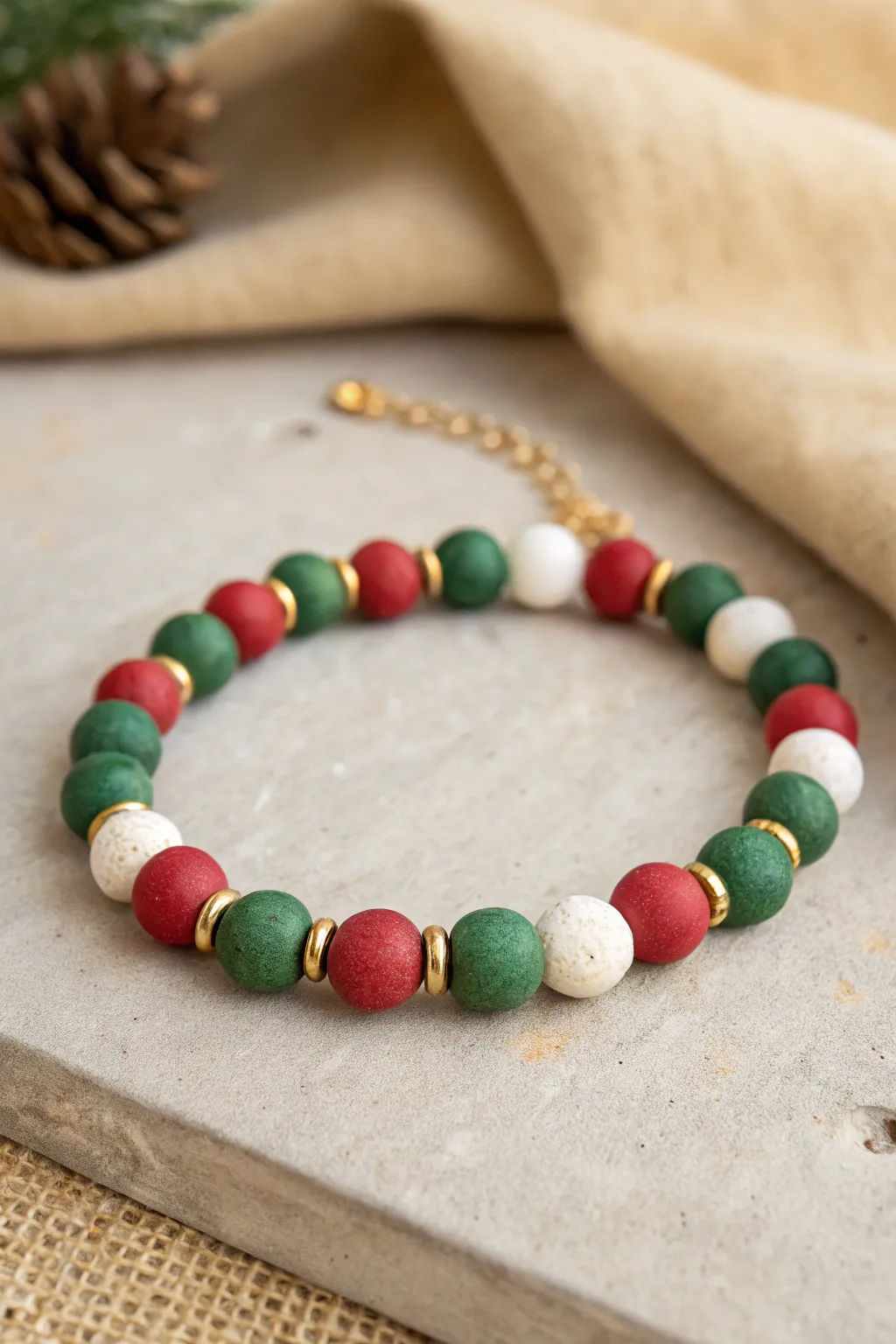
This elegant bracelet balances classic Christmas colors with the sophisticated shimmer of gold spacers. The matte finish of the clay-style beads gives it a modern, tactile appeal that pairs beautifully with cozy holiday sweaters.
Step-by-Step
Materials
- Matte round beads (approx 8mm) in deep red, forest green, and white lava stone or speckled clay
- Gold tone metal spacer beads (disc or rondelle shape, approx 4-5mm)
- Gold tone jewelry wire or strong beading elastic (0.8mm)
- Gold tone lobster clasp and jump rings
- Gold tone extender chain
- 2 Crimp beads (gold)
- 2 Crimp covers (optional, gold)
- Crimping pliers
- Wire cutters
- Bead design board or soft cloth
Step 1: Planning the Pattern
-
Observe the rhythm:
Before stringing, lay your pattern out on a bead board. The core pattern shown here isn’t a strict ‘1-2-1’ repeat but a flowing mix. Notice the recurring motif: a pair of colored beads separated by a gold spacer. -
Draft the sequence:
A good starting sequence to mimic the photo is: Green, Gold Spacer, Red, Gold Spacer, Green. Occasionally interrupt this with what looks like a white ‘snow’ bead. -
Refine the layout:
Create visual interest by not spacing every single bead. Notice in the image how some sections have two colored beads touching, while others are separated by gold. For example, try placing a white bead, then a sequence of Green-Gold-Red-Gold-Green. -
Measure the length:
Lay out enough beads to cover about 6.5 to 7 inches, or your desired wrist size, keeping in mind the clasp will add length.
Loosey Goosey?
If the bracelet feels too stiff, you likely pulled the wire too tight before crimping. Leave a tiny 1-2mm of slack in the wire to allow the beads to roll and sit comfortably.
Step 2: Stringing the Bracelet
-
Prepare the wire:
Cut a piece of beading wire about 10-12 inches long. This gives you plenty of extra room to work with the crimps without frustration. -
Secure the start:
Thread one crimp bead onto the wire, followed by a jump ring (or the loop of your lobster clasp directly). Loop the wire back through the crimp bead. -
Crimp firmly:
Use your crimping pliers to flatten the crimp bead securely, locking the loop in place. I like to give a gentle tug to ensure it holds before moving on. -
Begin beading:
Thread your beads onto the wire according to your layout. Start with a solid color bead to hide the wire tail. -
Insert the tail:
Tuck the short excess tail of wire into the first 2-3 beads as you string them. This hides the sharp end and adds security. -
Add the spacers:
As you string, ensure the gold spacers are oriented correctly. If they are disc-shaped, make sure they sit flat between the round beads. -
Check the fit:
Once all beads are strung, wrap it around your wrist or a sizing cone to check the fit. The beads take up inner circumference, so it might fit snugly than the wire alone implies.
Step 3: Finishing Touches
-
Prepare the end crimp:
Thread a crimp bead onto the end of the wire, followed by the jump ring attached to your extender chain. -
Creating the loop:
Pass the wire back down through the crimp bead and into the last 1-2 beads of your design. -
Tighten the slack:
Pull the wire taut so there are no gaps between beads, but not so tight that the bracelet becomes stiff and rigid. It needs to drape comfortably. -
Final crimp:
Use your pliers to flatten this final crimp bead securely. -
Trim excess wire:
Use flush cutters to trim the remaining tail wire as close to the bead hole as possible so it doesn’t scratch the skin. -
Cover with crimp covers:
For a professional finish, place a gold crimp cover over the flattened crimp beads and gently squeeze it shut until it looks like a round gold bead.
Texture Twist
Swap the plain red/green beads for ‘frosted’ or ‘sugar’ texture beads to mimic glistening snow, enhancing the festive winter feel.
Now you have a timeless holiday accessory ready to wear or gift
Mini Christmas Tree Charm Bracelet
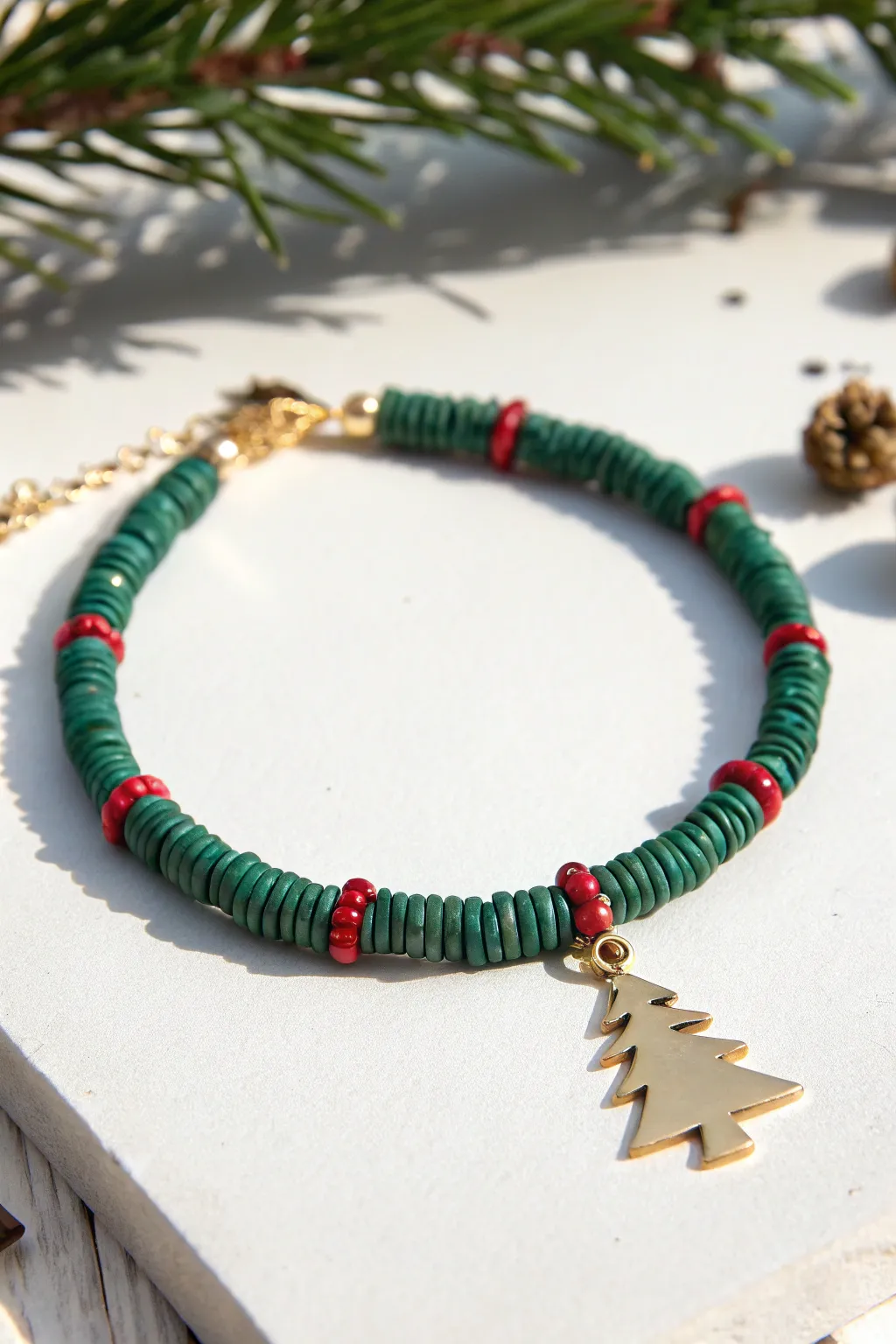
Celebrate the festive season with a sophisticated twist on the classic friendship bracelet, featuring deep forest green clay discs and pops of berry red. A gleaming gold Christmas tree charm adds the perfect touch of holiday magic to this stackable accessory.
Step-by-Step Tutorial
Materials
- Dark green polymer clay heishi beads (6mm or similar)
- Small red seed beads (approx. 8/0 or 10/0)
- Gold-tone flat Christmas tree charm
- Gold jump rings (4mm and 6mm)
- Beading wire or strong stretch cord (based on preference, but wire with a clasp is shown)
- Gold lobster clasp
- Gold extender chain
- 2 Gold crimp beads (if using wire)
- 2 Gold clam shell bead tips or wire guardians (optional for finish)
- Jewelry pliers (flat nose and round nose)
- Wire cutters
- Beading mat or tray
Step 1: Planning and Prep
-
Measure your wrist:
Wrap a flexible measuring tape around your wrist to find your size. Add about half an inch to this measurement to ensure a comfortable fit, especially since heishi beads can take up a bit of inner circumference. -
Cut the cord:
Cut a piece of beading wire approximately 10 inches long. This gives you plenty of extra room to work with the clasps without struggling to hold onto tiny ends. -
Secure one end:
To prevent beads from sliding off while you work, clamp a bead stopper or a piece of tape to one end of your wire. Alternatively, you can attach the first part of your clasp now. -
Attach the first crimp:
Thread a crimp bead and a wire guardian onto the wire. Isolate the clasp loop in the guardian, thread the wire back through the crimp bead, and flatten it securely with your flat nose pliers.
Uneven Blocks?
Count your heishi beads exactly for each section. If the clay discs vary slightly in thickness (which is common!), measure by length (e.g., 1 inch) rather than counting beads for symmetry.
Step 2: Stringing the Pattern
-
Start the green base:
Begin stringing your dark green heishi beads. You’ll want to add about 10 to 12 discs for the first section. This creates a solid block of color to start. -
Add the first red accent:
Slide on one small red seed bead. This tiny pop of color breaks up the green and mimics holly berries. -
Establish the rhythm:
Continue the pattern: string a block of 10-12 green heishi beads, followed by a single red seed bead. -
Check the midpoint:
Pause when you have reached the halfway point of your desired bracelet length. This is crucial for proper charm placement. -
Create the charm station:
At the center, change the pattern slightly. String your block of green beads, but instead of just one red bead, add two red seed beads side-by-side. -
Insert the jump ring holder:
Between those two center red beads, you can either place the jump ring directly over the wire now, or simply leave the space to attach it later. I find attaching the charm at the very end prevents it from scratching as I work, so just ensure the two red beads are in place. -
Finish the strand:
Continue your original pattern (10-12 green beads, 1 red bead) until you reach your total desired length minus the length of the clasp.
Step 3: Finishing Touches
-
Secure the end:
Thread a crimp bead and your wire guardian onto the remaining tail. Loop the wire back through the crimp bead. -
Tighten and crimp:
Pull the wire tight so there are no gaps between your heishi beads, but leave just enough slack so the bracelet moves fluidly like fabric rather than a stiff rod. Flatten the crimp bead firmly. -
Trim excess wire:
Use your flush cutters to snip the excess wire tail as close to the crimp bead as possible for a neat finish. -
Attach hardware:
Use your pliers to open a small jump ring. Hook it through the wire guardian loop on one side and attach your lobster clasp. Close the ring securely. -
Add the extender:
Repeat the jump ring process on the other end, but this time attach the chain extender. This makes the bracelet adjustable for gifts. -
Prepare the charm:
Open a 6mm gold jump ring using two pairs of pliers (twist sideways, don’t pull apart). Thread it through the hole in your gold Christmas tree charm. -
Mount the charm:
Locate that pair of red seed beads at the center of your bracelet. Hook the charm’s jump ring over the exposed beading wire between the two red beads and close the ring tightly.
Level Up: Festive Texture
Replace the solid gold charm with an enamel one for more color, or swap every third green section with white heishi beads to create a candy cane stripe effect.
Now you have a chic, minimalist holiday accessory ready to wear or gift

What Really Happens Inside the Kiln
Learn how time and temperature work together inside the kiln to transform clay into durable ceramic.
Snowflake Charm With Icy Whites
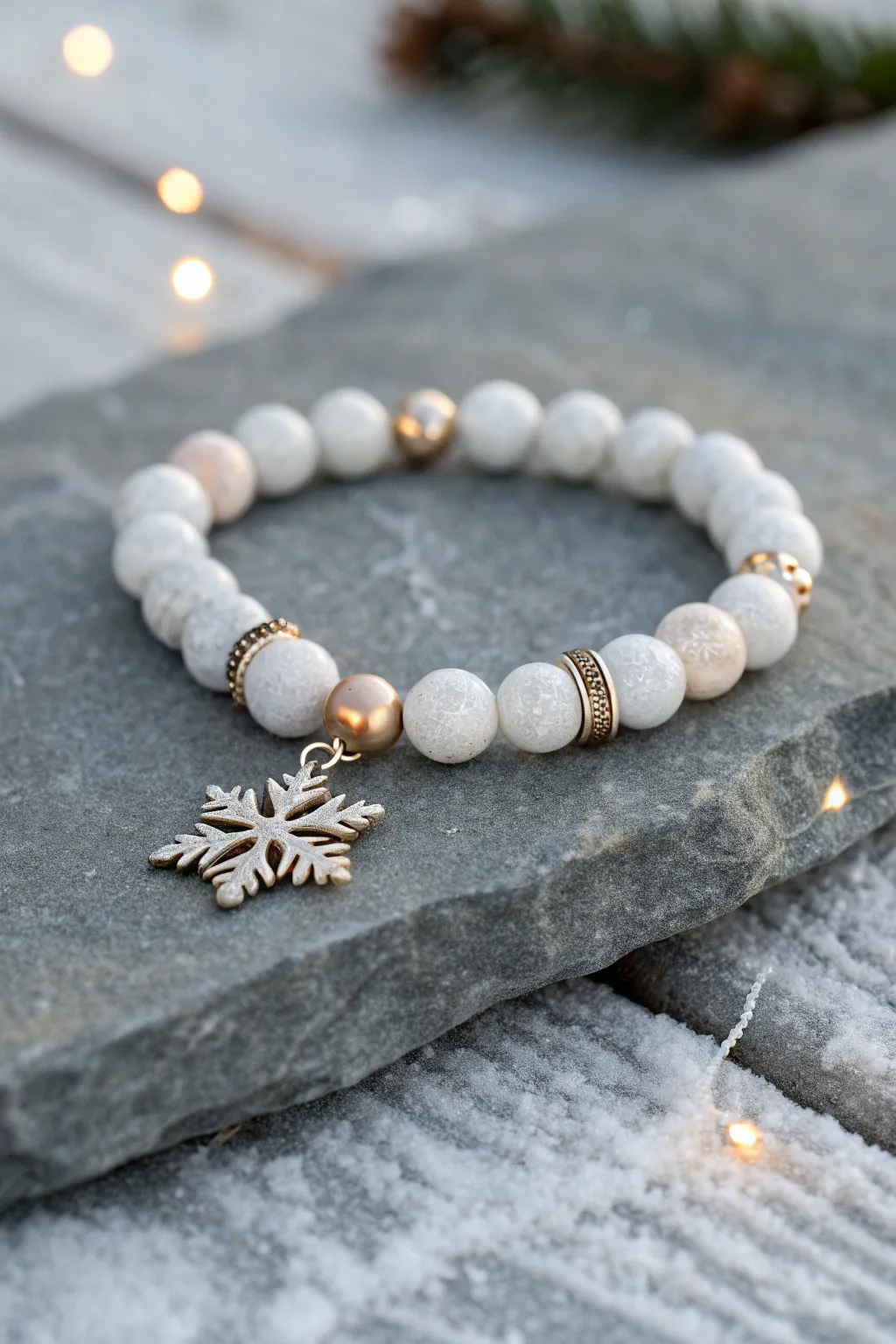
Capture the delicate beauty of a winter flurry with this elegant bracelet design. Featuring icy crackle quartz-style beads and warm rose gold accents, this piece centers around a striking snowflake charm for a sophisticated holiday accessory.
How-To Guide
Materials
- 10mm white crackle glass or agate beads (approx. 16-18 count)
- 8mm rose gold metallic spacer beads (4 count)
- Gold or rose gold rhinestone rondelle spacer beads (2 count)
- Rose gold snowflake pendant charm
- Large-hole rose gold bead (to act as a bail carrier) or a jump ring
- Strong elastic beading cord (0.8mm or 1mm recommended)
- Jewelry adhesive (e.g., G-S Hypo Cement)
- Scissors
Step 1: Preparation and Planning
-
Measure your wrist:
Before cutting any cord, wrap a measuring tape around your wrist to find your size. Add about 0.5 inches to this measurement for a comfortable fit that isn’t too tight. -
Cut the elastic cord:
Cut a piece of elastic cord approximately 10-12 inches long. Is usually prefer to have plenty of extra length on both ends to make tying the final knot much easier without struggling. -
Pre-stretch the cord:
Hold both ends of your cut elastic and give it a few firm tugs. This pre-stretching step helps prevent the bracelet from sagging or loosening up immediately after you’ve made it. -
Plan your pattern:
Lay your beads out on a bead board or a towel to visualize the design. The pattern shown uses a central focal point with the charm carrier, flanked by crackle beads and specific spacer accents.
Step 2: Stringing the Design
-
Start the sequence:
Begin by threading the large rose gold bead that will hold your charm onto the center of the cord. This will ensure your design stays symmetrical as you add beads to each side. -
Attach the snowflake charm:
Using a jump ring, attach your snowflake pendant to the loop of the central rose gold bead you just strung. If your bead doesn’t have a loop, slide the jump ring directly onto the cord next to the central bead. -
Add immediate side beads:
Thread one white crackle bead on the left side of the center bead, and one on the right side. This frames your focal point. -
Insert sparkly spacers:
Next, slide a rhinestone rondelle spacer onto each side of the white crackle beads. These add that festive holiday sparkle that mimics glistening snow. -
Continue the pattern:
Add three more white crackle beads to both the left and right sides of the bracelet. -
Place rose gold accents:
Add a plain metallic rose gold spacer bead to each side now. This breaks up the white texture and ties in with the charm color. -
Finish the bead circumference:
String the remaining white crackle beads onto the ends until you reach your desired length. Check the fit by wrapping the incomplete strand around your wrist. -
Add final metallic beads:
If needed for sizing or visual balance, add one last metallic rose gold bead to each end. This creates a nice finisher near where the knot will be hidden.
Knot Hiding Trick
If your bead holes are too small to hide the knot, finish the bracelet next to a large-hole metal spacer bead specifically chosen to conceal the knot easily.
Step 3: Finishing Touches
-
Tie the first knot:
Bring the two ends of the elastic together and tie a basic overhand knot, pulling it tight so there are no gaps between the beads. -
Secure with a surgeon’s knot:
Tie a second knot, but this time loop the elastic through twice before pulling tight. This is a surgeon’s knot and is much more secure for stretchy jewelry. -
Apply adhesive:
Dab a tiny drop of G-S Hypo Cement or jewelry glue directly onto the knot. Be careful not to get glue on the visible parts of the beads. -
Hide the knot:
While the glue is still slightly tacky, pull the elastic firmly so the knot slides inside the hole of one of the adjacent large-hole beads. -
Trim the excess:
Once the glue has fully dried (wait at least 15 minutes), use your scissors to trim the excess tail ends of the elastic cord as close to the bead hole as possible.
Elastic Issues?
If your elastic keeps snapping while tying, switch to a multi-strand fabric-covered elastic cord, which is more durable than clear monofilament.
Slip on your frosty new creation and enjoy the winter sparkle on your wrist
Reindeer-Inspired Brown and Red Bracelet
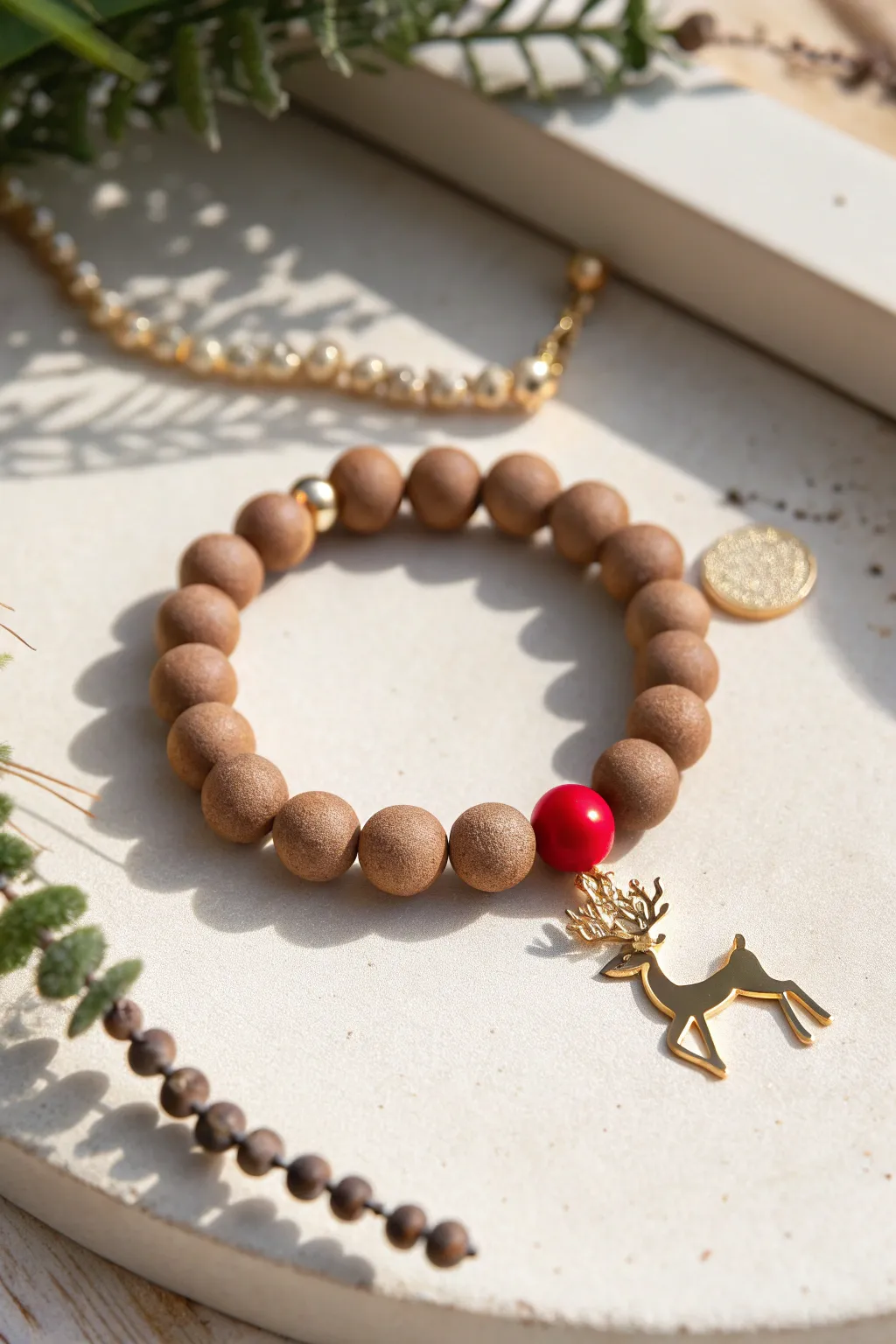
Capture the rustic charm of the holidays with this elegant yet playful reindeer-themed bracelet. Combining matte earth tones with a single pop of vibrant red and a golden charm, this piece offers a sophisticated nod to everyone’s favorite guiding light.
Step-by-Step
Materials
- Light brown polymer clay (or pre-made 8-10mm textured brown clay beads)
- One bright red glossy round bead (same size as brown beads, acrylic or glass)
- Gold reindeer charm with a jump ring
- One small gold spacer bead (round or cylindrical)
- Stretch cord (0.8mm or 1mm clear elastic)
- Super glue or jewelry adhesive
- Scissors
- Beading needle (optional but helpful)
- Chain nose pliers
- Bead design board or ruler
Step 1: Preparing Your Materials
-
Measure the cord:
Cut a length of stretch cord about 10-12 inches long. Having this extra length makes tying the final knot much easier without fumbling. -
Pre-stretch the elastic:
Hold the cord firmly at both ends and give it a few gentle tugs. This is a crucial step that prevents your bracelet from stretching out and sagging after the first time you wear it. -
Plan your layout:
Lay out your beads on a soft cloth or bead board. You will need enough brown clay beads to wrap around your wrist, minus about one inch to account for the accent bead and charm area.
Knot Slipping?
If your surgeon’s knot feels loose, try tying a regular overhand knot first, then the surgeon’s knot on top. The extra friction helps hold slippery elastic in place while you glue.
Step 2: Stringing the Design
-
Start with brown beads:
Thread approximately half of your brown clay beads onto the elastic cord. If the holes are small, using a collapsible eye needle can speed this process up significantly. -
Add the gold spacer:
Slide on the small gold spacer bead. This subtle metallic touch breaks up the matte texture of the clay beads and adds a hint of luxury. -
Finish the brown section:
String the remaining brown clay beads. Double-check the length by wrapping it loosely around your wrist; the ends should just barely meet or have a small gap for the final accents. -
The Rudolph nose:
Add the single bright red glossy bead now. This represents the iconic red nose and serves as the visual anchor for the charm we will add next.
Level Up: Texture Play
Swap the plain red bead for a red velvet-finish bead or a sparkly red crystal. The difference in texture will make the ‘nose’ pop even more against the matte brown clay.
Step 3: Attaching the Charm & Finishing
-
Prepare the charm:
Using your chain nose pliers, locate the opening on the gold reindeer’s jump ring. Twist it open sideways—never pull it apart—to preserve its circular shape. -
Secure the charm:
Assuming your charm doesn’t slide directly onto the cord, hook the jump ring onto the cord right next to the red bead. If the charm has a built-in loop large enough for the cord, you can thread it directly. -
Check the fit:
Bring the two ends of the cord together to form a circle. Ensure the bracelet fits comfortably on your wrist without digging in or drooping too low. -
Tie the knot:
Tie a surgeon’s knot to secure the bracelet. I prefer to pull the elastic taut while tightening the knot to ensure there are no gaps between the beads. -
Cement the knot:
Apply a tiny drop of super glue or jewelry adhesive directly onto the knot. Be careful not to get glue on the surrounding beads, as it can ruin their finish. -
Hide the knot:
While the glue is still slightly tacky but not wet, gently pull the knot inside the hole of the adjacent red bead or one of the brown clay beads to conceal it. -
Trim the ends:
Once the glue is fully dry, use sharp scissors to trim the excess cord as close to the bead hole as possible without nicking the knot itself.
Now you have a charming festive accessory that blends rustic textures with holiday cheer

TRACK YOUR CERAMIC JOURNEY
Capture glaze tests, firing details, and creative progress—all in one simple printable. Make your projects easier to repeat and improve.
Jingle Bell Dangle Bracelet
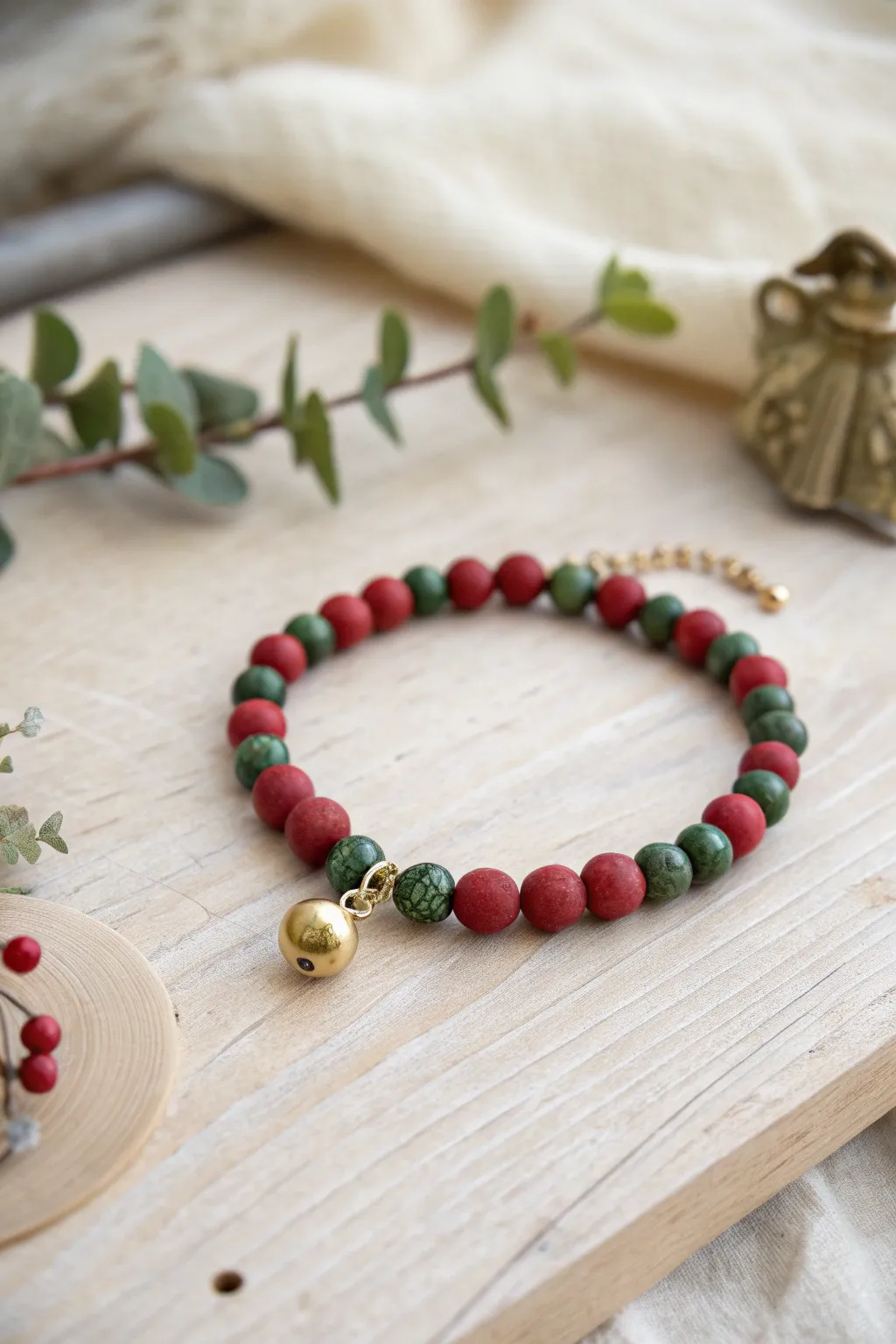
Embrace the classic colors of the season with this rustic yet elegant beaded bracelet. Featuring matte red and textured green beads alongside a charming gold jingle bell, this accessory adds a festive sound and style to any holiday outfit.
Detailed Instructions
Materials
- Red matte round beads (looks like polymer clay or dyed stone, approx. 6mm-8mm)
- Green textured round beads (looks like dragon vein agate or faux-stone clay, approx. 6mm-8mm)
- Gold jingle bell charm (approx. 10mm)
- Small gold jump ring (4mm-6mm)
- Elastic beading cord (clear, 0.7mm or 0.8mm strength)
- Jewelry adhesive (e.g., G-S Hypo Cement or super glue gel)
- Scissors or bead snips
- Tape or bead stopper
- Gold chain extender and clasp (optional, if not making it purely elastic)
Step 1: Preparation
-
Measure the cord:
Cut a length of elastic cord about 10-12 inches long. Having extra length makes tying the final knot significantly easier than struggling with short ends. -
Secure the end:
Place a piece of tape over one end of the cord or attach a bead stopper. I find this prevents beads from sliding off accidentally while you work on your design. -
Prepare the focal charm:
Locate your gold jingle bell charm. Using two pairs of pliers (or your fingers if the metal is soft enough), gently twist open the gold jump ring. -
Attach the bell:
Slide the loop of the jingle bell onto the open jump ring, then close the ring securely so the gap is completely flush.
Step 2: Beading the Pattern
-
Start the center:
Thread the jump ring with the attached bell onto the elastic cord. Let it slide down to the stopper; this will be the center point of your bracelet. -
Begin the sequence:
On the right side of the bell, thread one green textured bead followed by three red matte beads. -
Mirror the left side:
On the left side of the bell (you’ll need to remove the stopper temporarily or scoot the bell up), add one green bead. Now re-secure the end so you can focus on one side at a time. -
Establish the rhythm:
Continue the pattern on the right side: add one green bead, then two red beads. This creates a slightly irregular, organic feel compared to a strict 1-to-1 pattern. -
Continue beading:
Add another green bead, then two red beads. Repeat a pattern of alternating green and red sections. -
Check the symmetry:
Go back to the left side of the bracelet to balance the weight. Add your red beads and green beads to match the visual length of the right side. -
Inspect textures:
Look closely at your green beads. If they have ‘veins’ or cracking patterns, rotate them slightly as you string them so the most interesting sides face outward. -
Size testing:
Wrap the strand around your wrist to check the fit. The ends should touch comfortably without stretching the elastic too tight. -
Adjust length:
Add or remove red beads at the very ends (near where the knot will be) to reach your desired circumference. The back of the bracelet is the best place to make length adjustments.
Knot Security Pro-Tip
Don’t cut your tails immediately after gluing! Wait 15 minutes for the glue to cure completely. Cutting too soon can cause the knot to spring open.
Step 3: Finishing Touches
-
Pre-stretch the cord:
Gently pull tightly on both ends of the elastic a few times. This pre-stretching step helps prevent the bracelet from sagging or loosening after the first time you wear it. -
Tie the knot:
Remove the tape or stopper. Bring the two ends together and tie a surgeon’s knot (right over left, then left over right twice). -
Tighten securely:
Pull the cords firmly to tighten the knot. You should feel the elastic give slightly as the knot creates a small, tight ball. -
Apply adhesive:
Dab a tiny drop of jewelry adhesive directly onto the knot. This ensures it won’t slip undone over time. -
Hide the knot:
While the glue is still slightly tacky but not wet, slide the nearest bead over the knot to hide it inside the bead hole. -
Trim the excess:
Once the glue is fully dry, use your small scissors or snips to trim the remaining cord tails as close to the bead hole as possible.
Level Up: Adjustable Fit
Instead of a knot, crimp the ends onto wire guards and attach a gold extension chain. This creates a boutique look and fits more wrist sizes.
Now you have a charming, jingling accessory ready to celebrate the season
Santa Hat Color Pop Bracelet
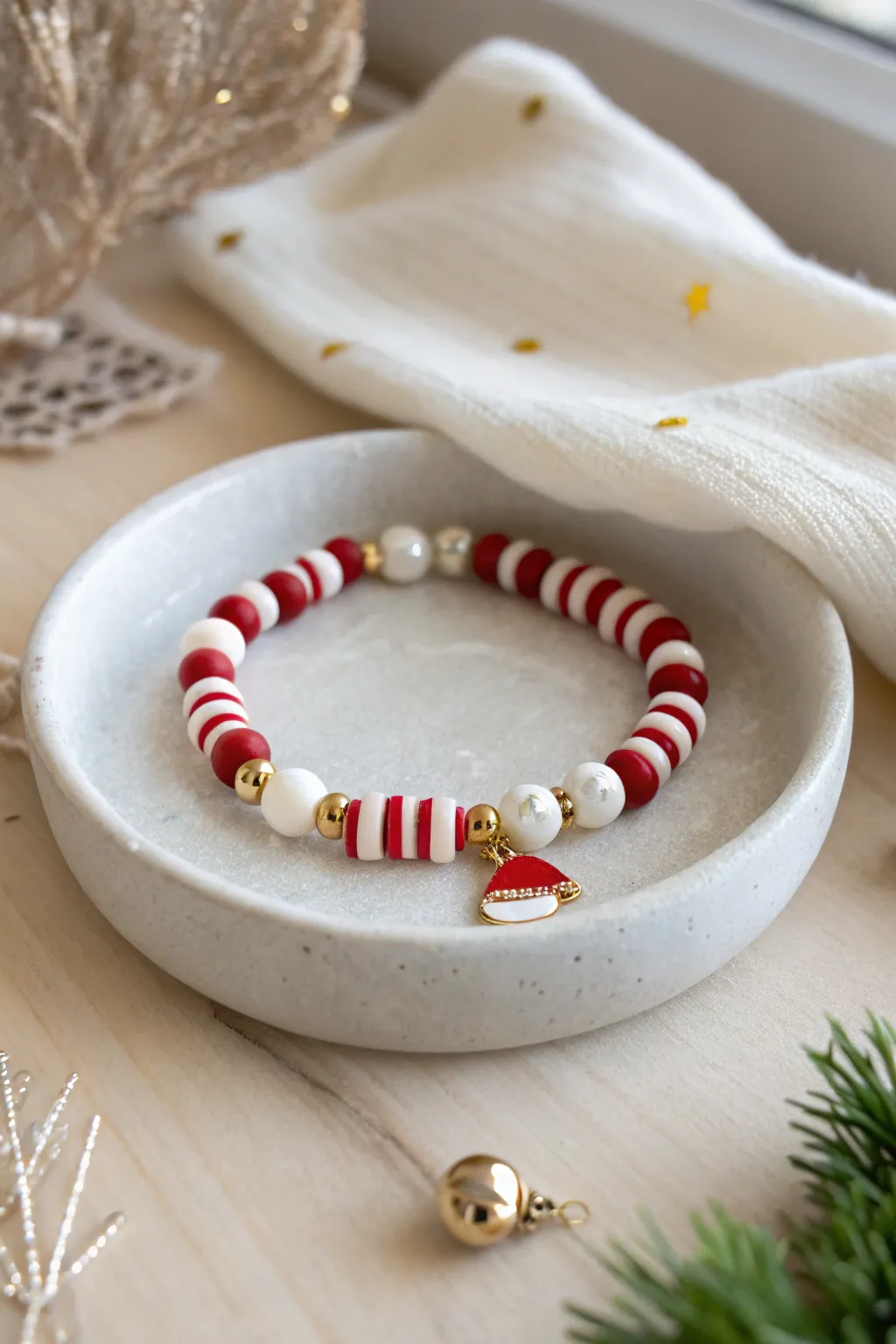
Celebrate the festive spirit with this charming beaded bracelet featuring classic candy cane stripes and a playful twist. The combination of matte clay heishi beads, shimmering pearls, and a dainty enamel Santa hat charm makes for the perfect holiday accessory.
Step-by-Step Guide
Materials
- Red polymer clay heishi beads (disc beads, approx. 6mm)
- White polymer clay heishi beads (disc beads, approx. 6mm)
- 4 large white faux pearl beads (approx. 8mm)
- Small gold bead spacers (approx. 3-4mm, round)
- Gold enamel Santa hat charm
- Gold jump ring (4-6mm)
- Clear elastic bead cord (0.8mm recommended for durability)
- Jewelry adhesive or super glue
- Scissors
Step 1: Planning Key Sections
-
Measure your wrist:
Cut a piece of elastic cord about 10-12 inches long. This extra length is crucial for tying a secure knot later without struggling. -
Pre-stretch the cord:
Gently pull the elastic cord a few times to pre-stretch it. This prevents the bracelet from stretching out and becoming loose after the first time you wear it. -
Secure the end:
Attach a piece of tape or a bead stopper to one end of the cord so your beads don’t slide off while you are working.
Step 2: Creating the Focal Point
-
Start the center sequence:
Begin by threading on one large white pearl bead followed by a small gold spacer bead. -
Add the charm section:
Thread on a sequence of three red heishi beads, then three white heishi beads. This creates a bold striped block. -
Insert the charm:
Thread your Santa hat charm onto a jump ring if it isn’t already attached, then slide the jump ring directly onto the cord. -
Complete the center symmetry:
Mirror the pattern by adding another block of three white heishi beads, followed by three red heishi beads. -
Finish the focal area:
Add a small gold spacer bead followed by a large white pearl bead to complete the central feature.
Knot Slipping?
If the elastic feels slippery, try degreasing the ends with a little rubbing alcohol before tying, or use a square knot followed by a surgeon’s knot for extra grip.
Step 3: Beading the Strap
-
Establish the main pattern:
For the rest of the bracelet, you will create an alternating pattern. Thread one red heishi bead, then one white heishi bead. -
Continue the stripe:
Repeat this single alternating pattern (red, white, red, white) until you have covered about 1.5 inches of the cord. -
Add a decorative break:
Slide on a large white pearl bead. -
Build the back section:
Resume the single red-and-white alternating pattern for the back of the wrist. Continue this until the bracelet is nearly the correct size for your wrist. -
Add the final pearl:
Place the last large white pearl bead onto the cord. -
Connect to the start:
Fill in any remaining gap with the red-and-white alternating pattern until the beads meet the first pearl you strung in the beginning.
Charm Placement Tip
When adding the charm, ensure the jump ring is closed tightly. If there’s a gap, the thin elastic cord can slip out, causing you to lose your festive Santa hat.
Step 4: Finishing Up
-
Check the fit:
Wrap the beaded cord around your wrist to ensure it fits comfortably. Add or remove a few heishi beads if necessary. -
Prepare the knot:
Remove the tape or bead stopper carefully while holding both ends of the elastic. -
Tie the knot:
Tie a surgeon’s knot (right over left, left over right) and pull tight. I like to pull the elastic taught while tightening to ensure it locks in place. -
Secure with glue:
Add a tiny drop of jewelry adhesive to the knot. Let it dry completely before moving on. -
Hide the knot:
Trim the excess cord ends close to the knot, then carefuly tuck the knot inside the hole of one of the large pearl beads or a gold spacer if the hole allows.
Now your wrist is ready for the holiday season with a pop of cheerful Christmas color
Stocking Charm Cozy Palette Bracelet
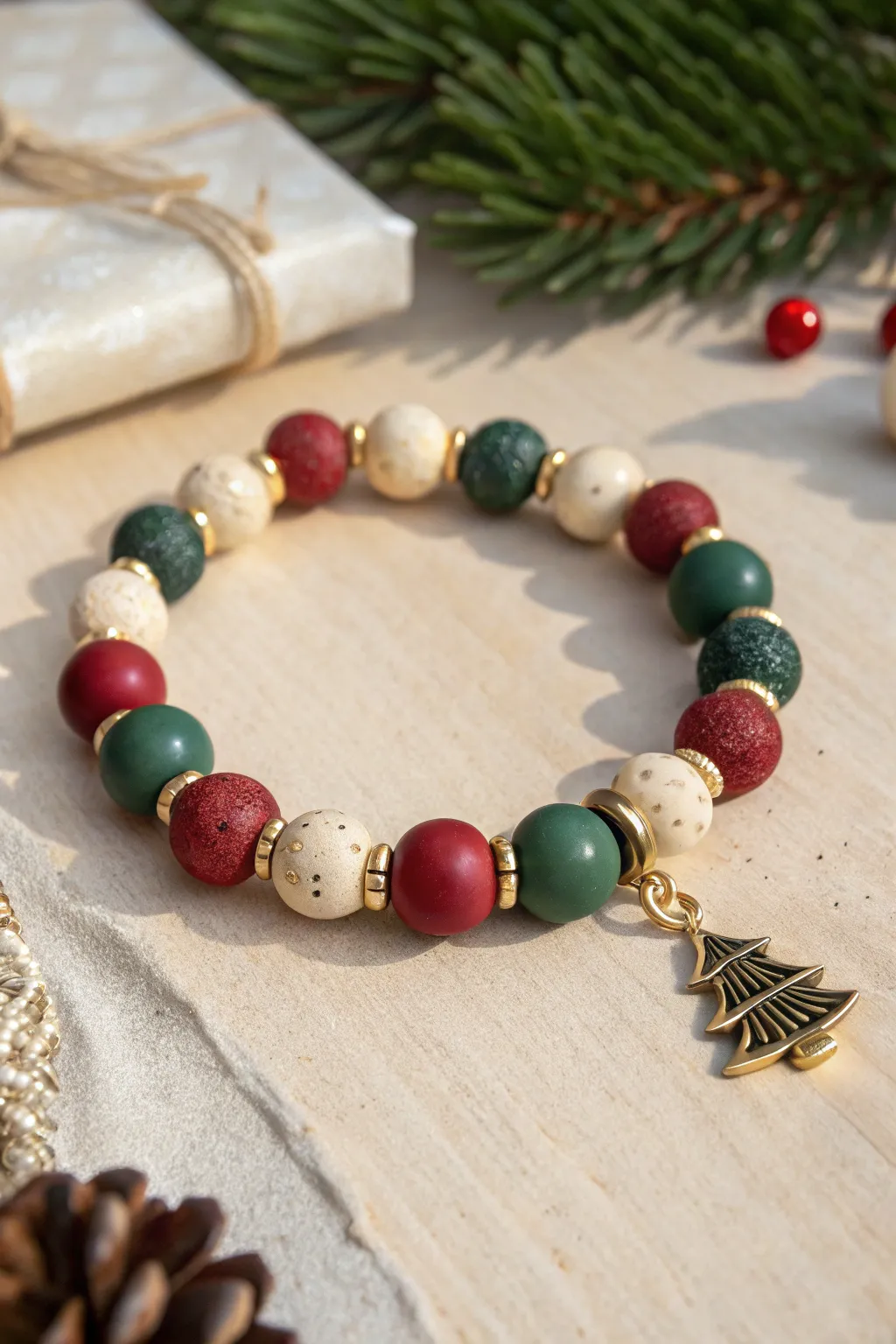
Embrace the warmth of the holidays with this charming beaded bracelet featuring a rustic palette of deep berry, forest green, and speckled cream. The addition of subtle gold accents and a sweet Christmas tree charm makes this piece feel like a cozy winter evening by the fire.
Step-by-Step
Materials
- Polymer clay (Deep Berry Red, Forest Green, Antique White/Ecru)
- Black acrylic paint (for speckling)
- Old toothbrush (for speckling)
- Gold tone metal spacer beads (small discs or rondelles)
- Gold tone jump ring (6mm or 8mm)
- Gold tone Christmas tree charm
- Elastic stretch cord (0.8mm or 1mm)
- Bead reamer or toothpick
- Super glue or jewelry cement
- Scissors
- Baking sheet and parchment paper
- Oven
Step 1: Crafting the Clay Beads
-
Condition the Clay:
Begin by thoroughly conditioning your three colors of polymer clay—berry red, forest green, and antique white—kneading them until they are soft and pliable. -
Create Uniform Portions:
Roll each color into a long, even snake shape. Slice the logs into equal-sized segments to ensure your beads will be consistent in size; aim for about 10-12mm diameter beads. -
Roll the Rounds:
Take each segment and roll it strictly between your palms in a circular motion to create smooth, perfect spheres. -
Add Texture (Optional):
For the rustic look seen in the photo, gently roll the spheres over fine sandpaper or texture them lightly with a sponge to remove the manufactured sheen. -
Speckle the Cream Beads:
Lay your cream-colored beads on a piece of paper. Dip an old toothbrush into slightly watered-down black acrylic paint and flick the bristles with your thumb to mist tiny speckles onto the clay. -
Pierce the Beads:
Once the paint is dry, use a bead reamer or a toothpick to carefully pierce a hole through the center of every bead. Rotate the tool as you push through to prevent squashing the round shape. -
Bake the Clay:
Arrange the beads on a parchment-lined baking sheet and bake according to your clay manufacturer’s instructions (usually 275°F/135°C for 15-30 minutes). Let them cool completely before handling.
Step 2: Assembly and Design
-
Prepare the Elastic:
Cut a length of elastic cord about 10-12 inches long. I like to pre-stretch the cord by pulling it firmly a few times; this prevents the bracelet from loosening up later. -
Secure the End:
Place a piece of tape or a binder clip on one end of the cord to stop beads from sliding off while you design. -
Plan the Pattern:
Lay out your beads on a design board or towel. The pattern in the image generally follows a sequence of ‘Color A – Gold Spacer – Color B,’ but note how the colors rotate between green, red, and cream randomly for an organic feel. -
String the Beads:
Begin threading your beads onto the elastic. Insert a gold spacer bead frequently between the clay beads, specifically placing them between every bead or every other bead as desired. -
Add the Charm Carrier:
Choose a spot for your focal point. Instead of a regular spacer, thread a slightly larger gold bead or a bail carrier bead where the charm will eventually hang. -
Check the Fit:
Wrap the strand around your wrist to check the size. Add or remove beads as necessary, ensuring the design ends in a way that will look seamless when tied. -
Knot the Cord:
Remove the tape/clip and tie the two ends together using a surgeon’s knot (loop the right end over the left and through twice, then pull tight). Repeat with a standard overhand knot for security. -
Secure with Glue:
Apply a tiny drop of super glue or jewelry cement directly onto the knot. Let it dry for a distinct moment before trimming the excess tail thread. -
Hide the Knot:
If possible, gently tug the elastic so the knot slides inside the convenient hole of one of the clay beads or a larger gold spacer to hide it from view. -
Attach the Charm:
Open your gold jump ring using two pairs of pliers (twist sideways, don’t pull apart). Slide on the tree charm and loop it onto the carrier bead or the elastic between beads, then close the jump ring securely.
Smoother Sliding
If the clay bead holes feel rough inside after baking, run a piece of floss or thin cord back and forth through the hole to smooth it out before stringing. This protects your elastic from fraying.
Scented Clay
Before baking, mix a tiny drop of cinnamon or pine essential oil into the clay itself. The porous clay grabs the scent, making your bracelet smell faintly of Christmas while you wear it.
You now have a wonderfully festive accessory that captures the rustic elegance of the season
Peppermint Swirl Disc Pattern Bracelet
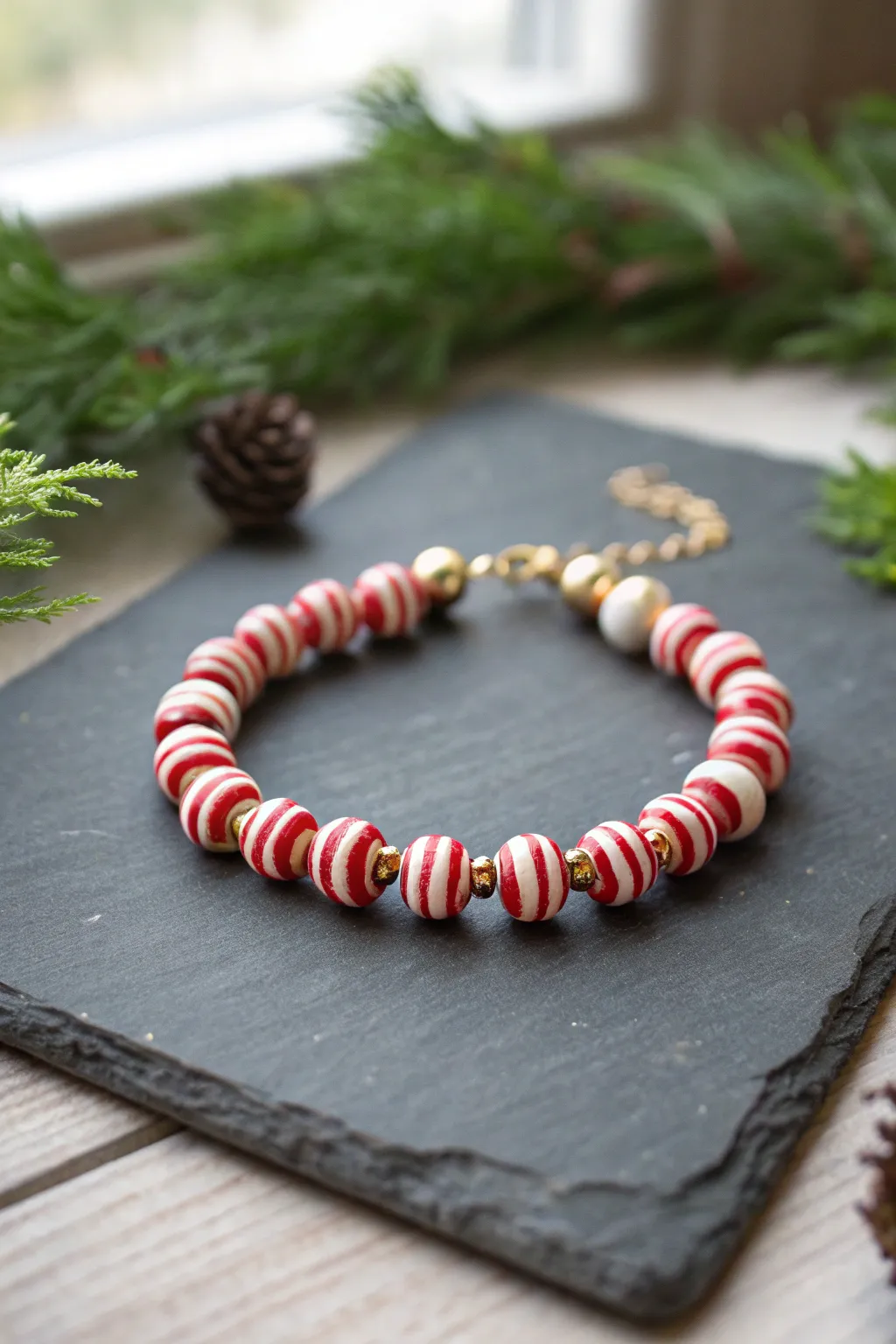
Capture the classic sweetness of the holidays with this delightful beaded bracelet featuring hand-painted clay beads. The alternating red and white stripes create a nostalgic peppermint look, perfectly accented by elegant gold spacers for a touch of festive warmth.
How-To Guide
Materials
- White polymer clay (approx. 2oz block)
- Red acrylic paint (bright cherry or candy apple red)
- Gold seed beads or small gold spacer beads (approx. 2-3mm)
- 2 larger gold accent beads (6-8mm)
- 1 large white or pearl accent bead (8-10mm)
- Beading elastic cord (0.8mm clear)
- Fine detail paintbrush (size 0 or 00)
- High-gloss varnish or glaze for polymer clay
- Toothpicks or a bead raceme for painting
- Jewelry adhesive (e.g., E6000 or GS Hypo Cement)
- Gold jump rings and lobster clasp
- Crimp beads (optional for closure)
- Chain extender (optional)
Step 1: Crafting the Clay Beads
-
Condition the white clay:
Start by warming the white polymer clay in your hands, kneading it until it is soft, pliable, and free of cracks. -
Form the spheres:
Roll the clay into a long, even log or snake. Use a blade to slice equal-sized segments to ensure your beads are uniform. I usually aim for pieces about the size of a large pea. -
Roll individual beads:
Take each segment and roll it between your palms to create a smooth, perfect sphere. You will need about 18-22 beads depending on your wrist size. -
Pierce the holes:
Gently twist a toothpick or needle tool through the center of each sphere to create the bead hole. Carefully reshape the ball if it gets slightly squished during this process. -
Bake the clay:
Arrange your beads on a baking sheet lined with parchment paper or cardstock. Bake according to the manufacturer’s instructions on your clay package (usually around 275°F/130°C for 15-30 minutes). -
Cool completely:
Allow the beads to cool down fully before moving to the painting stage; painting on warm clay can affect how the paint adheres.
Step 2: Painting the Peppermint Pattern
-
Mount beads for painting:
Place each bead onto a toothpick. This gives you a handle to hold while painting and lets you reach all sides without smudging. -
Paint the red stripes:
Using your fine detail brush and red acrylic paint, carefully draw vertical stripes around the circumference of the bead. Leave equal white spaces between the red stripes to mimic a peppermint candy. -
Refine the lines:
Don’t worry if the lines aren’t machine-perfect; a little hand-painted charm adds character. If you make a big mistake, wipe it quickly with a damp cloth or paint over it with white once dry. -
Add a glossy finish:
Once the paint is completely dry, apply a coat of high-gloss varnish. This seals the paint and gives the beads that realistic, hard-candy shine.
Striping Secret
Rest your painting hand’s pinky finger on the table for stability. Rotate the toothpick (with the bead on it) rather than moving the brush to get straighter lines.
Step 3: Assembly
-
Measure your cord:
Cut a length of beading elastic about 10 inches long. This gives you plenty of extra room to work with the knots and clasps. -
String the pattern:
Start threading your beads. Alternate one hand-painted peppermint bead with one small gold spacer bead continuously. -
Add the focal accents:
When you have strung enough beads to almost encircle your wrist, add one large gold bead, followed by the large white pearl bead, and then the second large gold bead. These act as end-caps near the closure. -
Check the fit:
Wrap the strand around your wrist to verify the length. Add or remove peppermint/spacer combos as needed. -
Attach the closure hardware:
Thread a crimp bead onto one end, followed by a jump ring attached to your lobster clasp. Loop the wire back through the crimp bead and clamp it down tight. -
Finish the other end:
Repeat the crimping process on the other end, attaching the chain extender or a jump ring for the clasp to hook onto. -
Secure the knots:
If using just elastic knots instead of crimps, tie a strong surgeon’s knot, pull it tight, and add a tiny dot of jewelry adhesive to the knot before trimming the excess cord.
Candy Cane Twist
Instead of vertical lines, paint the red stripes at a slight diagonal angle. This creates a ‘swirl’ effect that looks even more like traditional peppermint candies.
Now you have a sweet, festive accessory ready to wear for the holiday season
Holly Berry Accent Bracelet
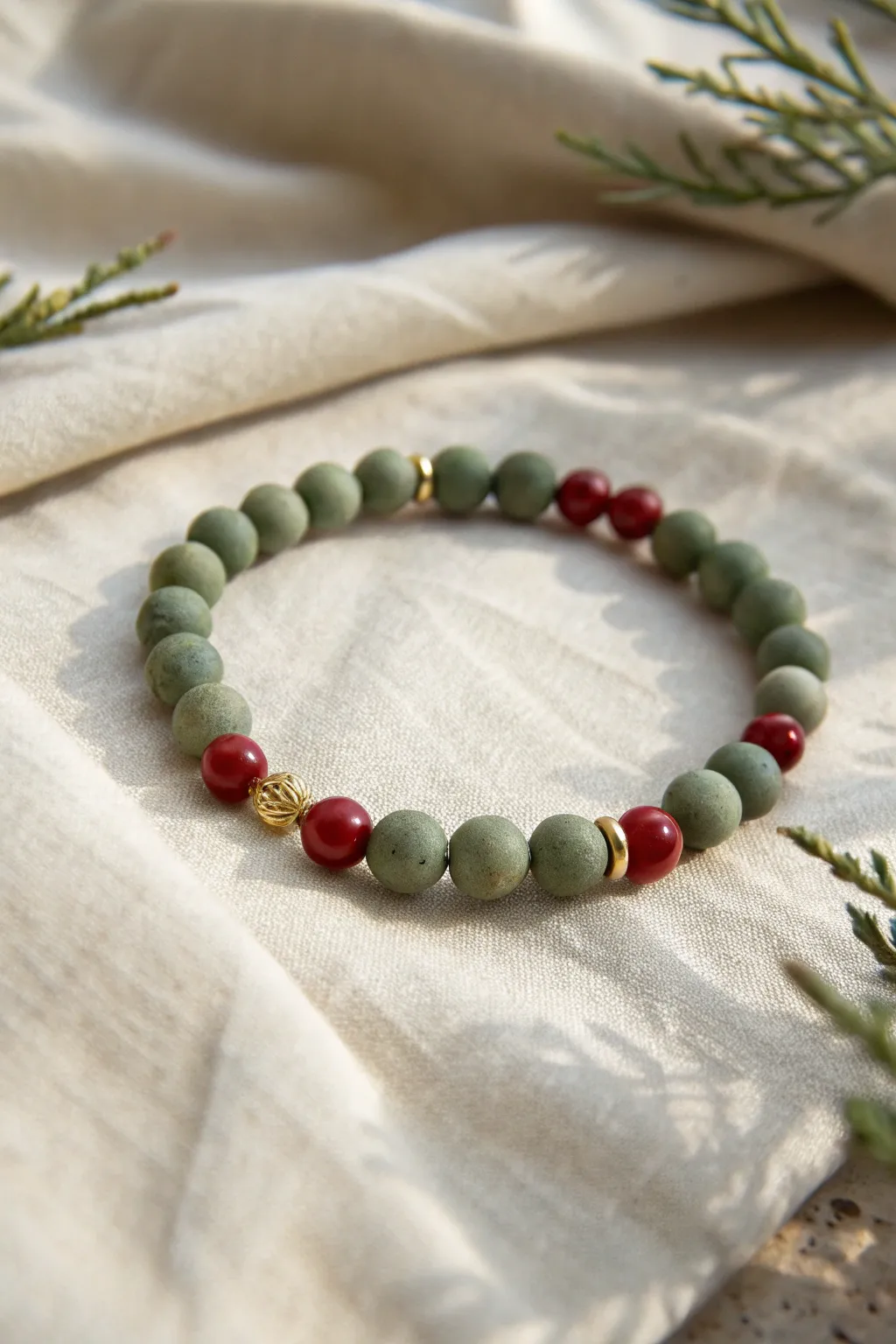
Evoke the classic spirit of the holidays with this elegant bracelet that pairs matte sage green beads with vibrant red accents reminiscent of holly berries. The scattered gold details add a touch of warmth and luxury, making it a perfect accessory for festive gatherings.
Step-by-Step Guide
Materials
- Approx. 22-26 matte sage green round stone or clay beads (8mm)
- 6 glossy red agate or glass round beads (6mm or 8mm)
- 2 small gold-plated spacer rings (heishi style)
- 1 detailed gold filigree or hollow round bead (8mm)
- Strong elastic stretch cord (0.8mm or 1mm)
- Jewelry adhesive or clear nail polish
- Scissors
Step 1: Preparation
-
Measure your wrist:
Wrap a measuring tape loosely around your wrist to determine the circumference. Add about 0.5 to 1 inch to this measurement depending on how loose you want the fit. -
Cut the cord:
Cut a length of elastic cord about 10-12 inches long. Having extra length makes tying the final knot much easier without fumbling. -
Pre-stretch the elastic:
Hold the cord at both ends and give it several firm tugs. This pre-stretching prevents the bracelet from sagging or expanding permanently after the first few wears. -
Secure one end:
Attach a piece of tape or a bead stopper to one end of the cord so your beads don’t slide off while you are working.
Stone Selection Tip
For the most authentic look, use ‘matte moss agate’ or ‘matte aventurine’ for the green beads. Their natural texture mimics leaves better than shiny glass.
Step 2: Stringing the Pattern
-
Start with green:
Begin by threading about 8 to 10 of the matte green beads onto the cord. This will form the back section of the bracelet. -
Add the first gold accent:
Slide on one of the flat gold spacer rings followed by two more matte green beads. -
Create the first berry cluster:
Thread on two of the glossy red beads side-by-side. These represent the first cluster of holly berries. -
Continue the pattern:
Add approximately 5 to 7 more green beads. This section creates visual space between your berry clusters. -
Add the second berry cluster:
Thread on another pair of glossy red beads. -
Transition to the focal point:
Add about 4 green beads, bringing you towards the center focal area of the design. -
Create the centerpiece:
String on one red bead, followed by your ornate gold filigree bead, and then one more red bead. This acts as the main decorative element.
Elastic Issues?
If your knot keeps slipping, try a doubled cord method or use a ‘square knot’ followed by a ‘surgeon’s knot’ for extra security before gluing.
Step 3: Closing the Bracelet
-
Finish the symmetry:
Depending on your wrist size, add 2-3 more green beads and the final gold spacer ring to balance the design before checking the fit. -
Test the size:
Wrap the beaded strand around your wrist. If there are gaps, add more green beads; if it’s too loose, remove one or two. -
Tie the surgeon’s knot:
Remove the tape/stopper. Cross the ends, loop one side under twice, and pull tight. I prefer to do this slowly to ensure the elastic doesn’t snap back. -
Secure the knot:
Apply a tiny dab of jewelry adhesive to the knot. Let it dry for a moment before trimming the excess cord close to the knot. -
Hide the knot:
gently pull on the beads so the knot slides inside the hole of the nearest large bead, hiding it from view.
Enjoy wearing your handmade festive accessory that captures the subtle beauty of nature during the holidays
Wreath-Inspired Charm Bracelet
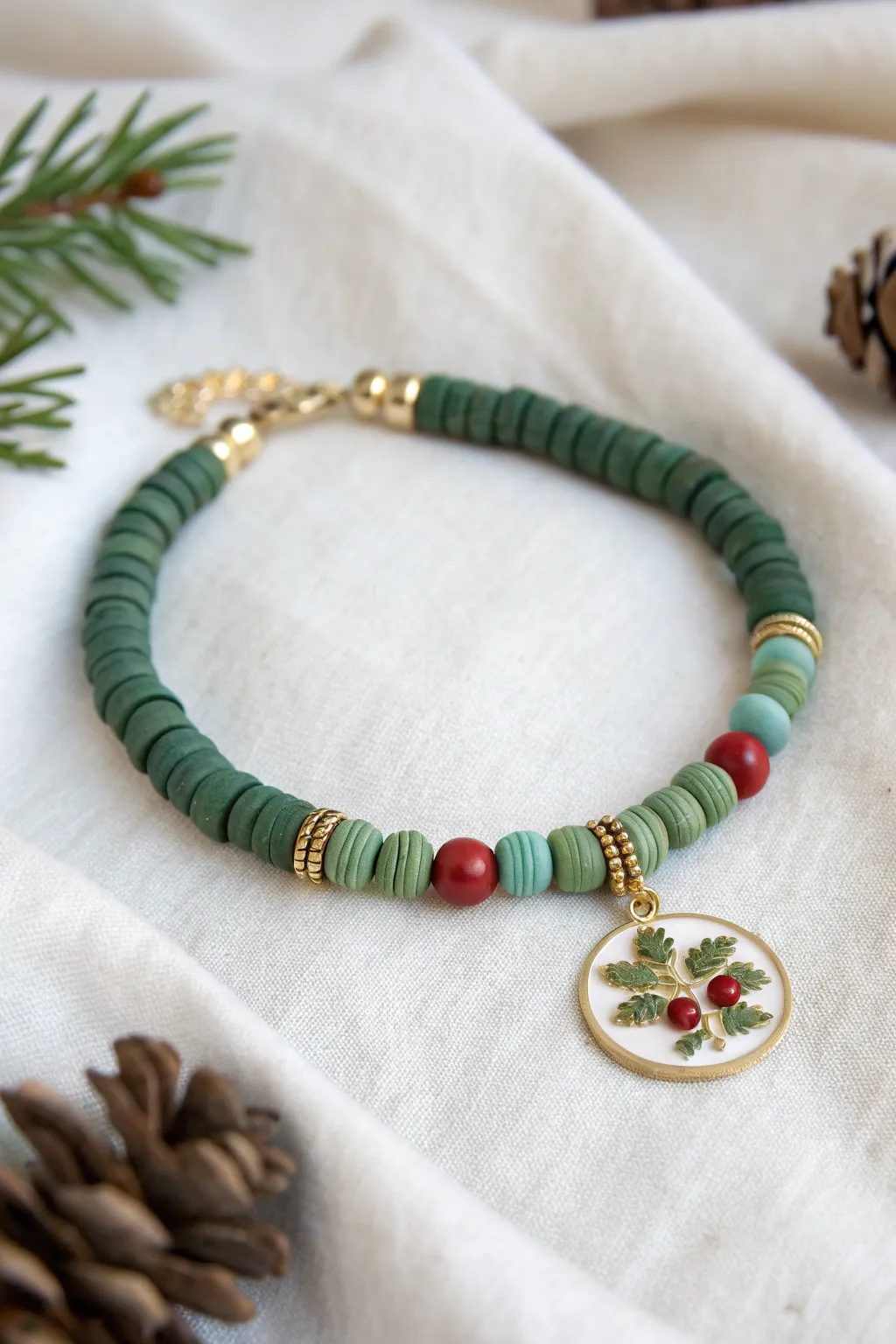
Capture the evergreen elegance of a holiday wreath with this sophisticated beaded bracelet. Featuring matte clay beads in varying shades of forest and sage green, accented with pops of berry red and a delicate holly charm, this piece is a subtle nod to festive traditions.
Step-by-Step Tutorial
Materials
- Polymer clay heishi beads (dark forest green, sage green, teal)
- Small round red beads (wood or clay, approx. 6mm)
- Gold tone spacer beads (various textures: ridged rings, small rondelles)
- Round gold-rimmed pendant bezel (approx. 20mm)
- White polymer clay or UV resin
- Small holly leaf and berry charms or miniature clay canes
- Gold finish lobster clasp
- Gold finish extension chain
- 2 Gold crimp ends
- Jump rings (4mm and 6mm)
- Beading wire (gold color preferred)
- Jewelry pliers (round nose and chain nose)
- Wire cutters
Step 1: Creating the Holly Charm
-
Prepare the Bezel:
Start with a clean, empty gold-rimmed circular bezel. If you are using UV resin, mix a drop of white pigment into clear resin until opaque. If using polymer clay, press a thin, smooth layer of white clay into the base of the bezel. -
Arrange the Botanicals:
Carefully place your miniature holly leaves and berries onto the white background. You can use pre-made metal charms with the loops snipped off, or tiny polymer clay sculpted elements. Arrange them in a central cluster. -
Secure the Design:
If using resin, cure under a UV lamp for 60-90 seconds until hard. If using polymer clay, bake the bezel according to the clay manufacturer’s instructions (usually 275°F for 15 minutes) and let it cool completely. -
Add the Jump Ring:
Once cool, attach a 6mm gold jump ring to the top loop of the charm so it’s ready to hang.
Don’t Rush the Layout
Lay out your bead pattern on a bead board or towel before stringing. This ensures your charm lands exactly in the middle.
Step 2: Stringing the Bracelet
-
Measure and Cut:
Cut a piece of beading wire about 9 inches long. This gives you plenty of extra room to work with the crimps later. -
Start the Strand:
Attach one crimp end to the wire. Thread the wire through the crimp, loop it back, and squeeze tightly with your pliers to secure the starting point. -
The Main Green Section:
Begin threading the dark forest green heishi beads. You’ll want a solid run of these to form the back and sides of the bracelet—roughly 3-4 inches depending on wrist size. -
First Accent Transition:
Add a textured gold ring spacer, followed by about five sage green heishi beads. This creates a visual break from the dark green. -
Adding the Berry:
Slide on one of the round red beads. I find that sandwiching this round bead between two flat heishi beads helps sit straight. -
Create the Focal Area:
After the first red berry, add a short section of mixed greens—alternating between teal and sage heishi beads—followed by another decorative gold spacer. -
Central Charm Holder:
Thread on a slightly larger gold spacer or a dedicated bail bead. This is where your charm will hang. -
Mirror the Pattern:
Repeat the previous pattern in reverse: gold spacer, mixed green section, red berry bead, sage green section, and finally the gold ring spacer. -
Finish the Strand:
Complete the length of the bracelet with a final run of dark forest green heishi beads to match the beginning side.
Add Sparkle
Mix in a few gold-flecked quartz beads alongside the green heishi discs to simulate snow glistening on pine needles.
Step 3: Assembly & Finishing
-
Secure the End:
Thread the end of the wire through the second crimp tube and part of the clasp attachment. Loop back through the crimp bead and pull tight, leaving just a tiny bit of slack so the beads can move. -
Crimp and Trim:
Flatten the crimp tube securely with your pliers. Trim the excess wire tail as close to the crimp as possible. -
Attach Hardware:
Open a jump ring and attach the lobster clasp to one end of the bracelet. On the other end, use a jump ring to attach the extension chain. -
Hang the Charm:
Open the jump ring on your prepared holly charm created in phase one. Hook it onto the central gold spacer or bail you placed earlier. -
Final Check:
Close the jump ring securely, ensuring there is no gap for the charm to slip through. Give the bracelet a gentle tug test to ensure all crimps are holding.
This charming accessory is now ready to wrap around your wrist for the holiday season
Gingerbread-Inspired Neutral Bracelet
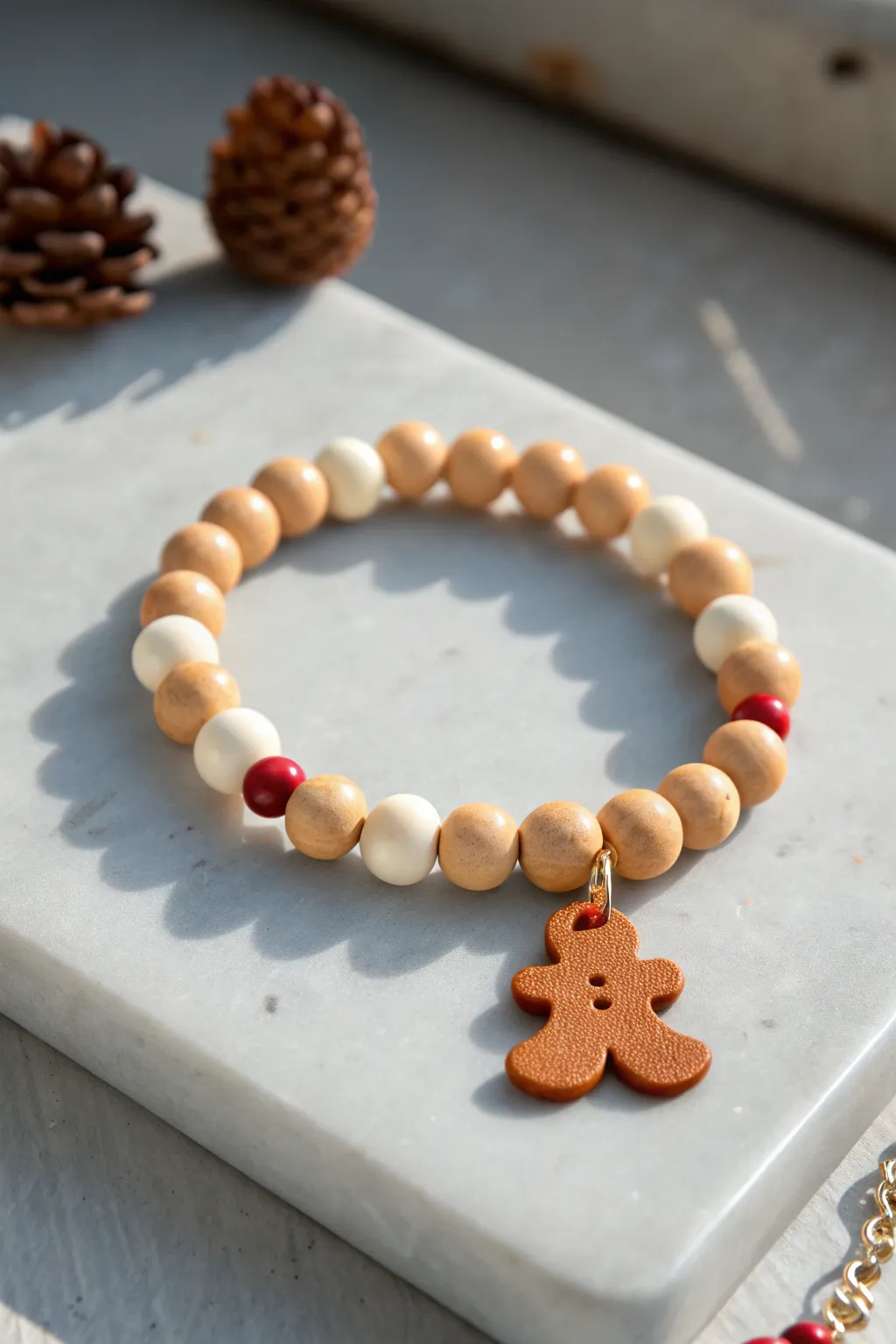
Capture the cozy warmth of holiday baking with this charming beaded bracelet featuring natural wood tones and a focal gingerbread man. The mix of unfinished wood, creamy accents, and pops of berry red creates a sophisticated yet festive accessory perfect for the season.
How-To Guide
Materials
- Elastic beading cord (0.8mm or 1mm thickness)
- Natural wood beads (approx. 10-12mm)
- Cream/off-white round beads (approx. 10-12mm)
- Small red distinct beads (approx. 6-8mm)
- Gingerbread man charm (polymer clay or acrylic)
- Gold jump ring (6mm or 8mm)
- Jewelry adhesive or clear nail polish
- Scissors or jewelry snips
- Two jewelry pliers (flat nose or bent nose)
- Beading needle (optional but helpful)
Step 1: Preparation & Planning
-
Measure your wrist:
Before cutting any string, measure your wrist to determine the correct size. Add about 1/2 to 1 inch to this measurement depending on how loose you like your fit. -
Cut the cord:
Cut a piece of elastic cord about 10-12 inches long. Having this extra length makes tying the final knot much easier than fighting with short ends. -
Pre-stretch the elastic:
Gently pull tight on the elastic cord several times. This pre-stretching prevents the bracelet from sagging or expanding permanently after you wear it a few times. -
Secure one end:
Place a piece of tape or a bead stopper clip on one end of your cord so your beads don’t slide right off while you work. -
Lay out the design:
Arrange your beads on a layout board or towel. The pattern shown uses a base of natural wood beads interspersed with cream beads every 3-4 wooden ones, with red accents flanking the cream sections near the clasp area.
Step 2: Creating the Focal Point
-
Inspect the charm:
Check your gingerbread man charm. If it has a loop molded into it, you are ready. If it’s a flat cabochon, you may need to carefully drill a small hole at the top or glue a bail onto the back. -
Open the jump ring:
Using two pairs of pliers, grip the jump ring on either side of the split. Twist one hand forward and one backward to open the ring sideways—never pull it apart horizontally, which weakens the metal. -
Attach the charm:
Slide the open jump ring through the loop on the gingerbread man charm. -
Close the ring:
Using the same twisting motion with your pliers, bring the ends of the jump ring back together until they are perfectly flush and touch completely.
Knot Hiding Secrets
Make sure the bead adjacent to your knot has a larger hole (like the wood beads). The knot will struggle to fit inside the smaller red or cream acrylic beads.
Step 3: Stringing the Beads
-
Start stringing:
Begin threading your beads onto the elastic. I prefer to start just to the side of where the charm will hang so the knot ends up hidden inside a wood bead later. -
Follow the pattern:
Recreate the distinct pattern: mainly wood beads, with cream spacer beads placed symmetrically. Looking at the reference, notice the red beads are placed specifically next to cream beads for high contrast. -
Add the charm:
When you reach the center point of your design, slide the jump ring (with the gingerbread man attached) onto the elastic cord just like a regular bead. -
Finish the strand:
Continue adding beads until you reach your desired length. Check the fit by wrapping it around your wrist; the beads should touch comfortably without gaps.
Scented Variation
Use unfinished wood beads and add a drop of gingerbread or cinnamon essential oil to them. The porous wood absorbs the scent, making your bracelet smell like Christmas cookies.
Step 4: Finishing Touches
-
Prepare to knot:
Remove the tape or stopper from the end. Bring the two ends of the elastic together carefully. -
Tie the surgeon’s knot:
Tie a standard overhand knot, but loop the end through twice instead of once before pulling tight. This extra friction holds the elastic securely. -
Tighten the knot:
Pull the cords firmly to cinch the knot down. Repeat with one or two more standard knots on top for extra security. -
Secure with glue:
Dab a tiny drop of jewelry adhesive or clear nail polish onto the knot. Let it dry for a few minutes to ensure it won’t slip. -
Hide the knot:
Trim the excess elastic ends close to the knot (but not too close!). Gently pull the adjacent bead over the knot to hide it inside.
Slip on your sweet new accessory and enjoy the subtle holiday spirit it brings to your outfit
Pearl-Mixed Dressy Christmas Bracelet
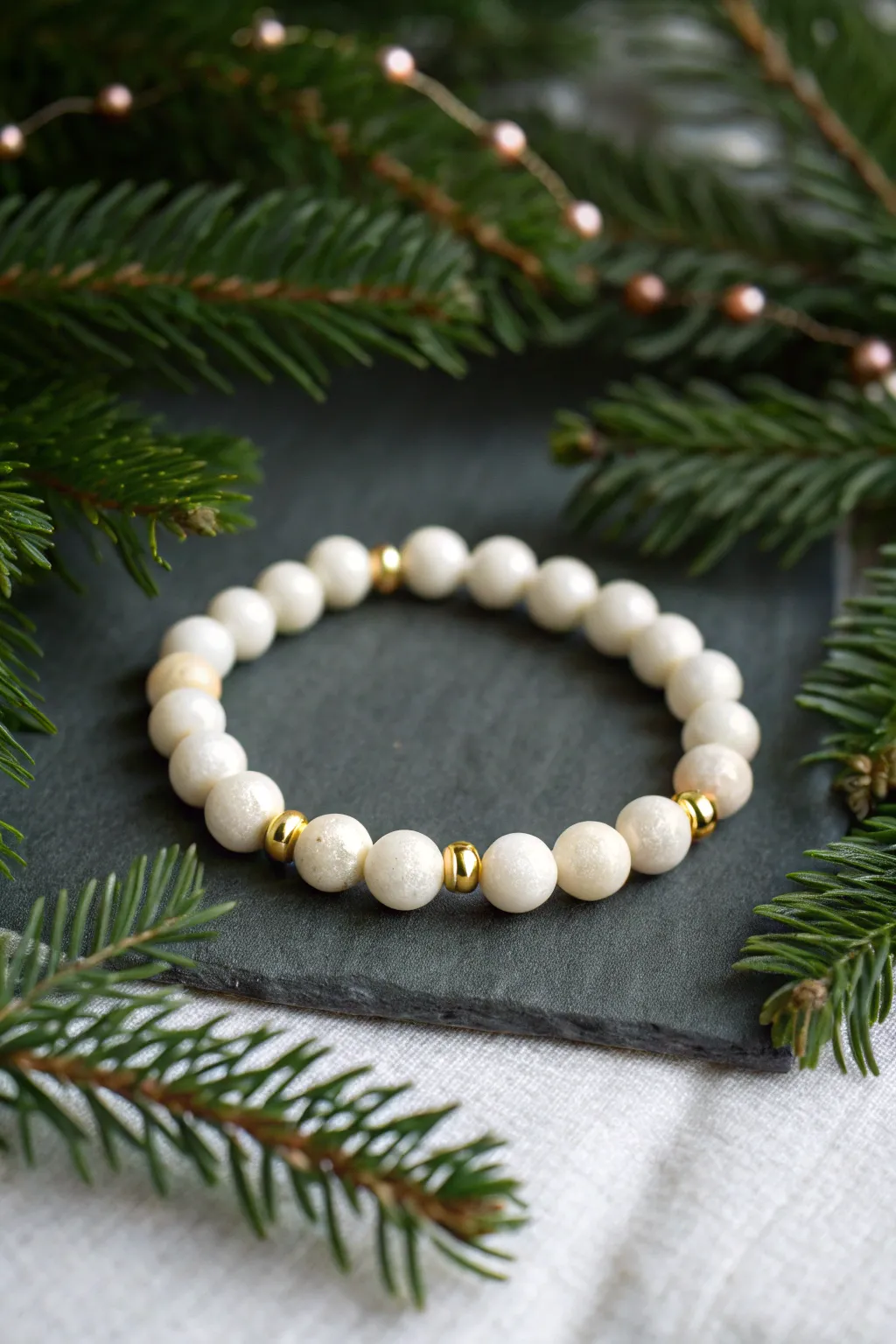
This sophisticated bracelet captures the quiet beauty of a snowy Christmas morning with its shimmering white beads and warm gold accents. It is a simple yet stunning piece that pairs perfectly with holiday attire or makes a thoughtful handmade gift.
Step-by-Step
Materials
- 8mm white shimmer round beads (polar white or moonstone effect)
- Small gold disc spacer beads (heishi or cylindrical style)
- Stretch cord (0.8mm or 1mm)
- Jewelry glue or super glue
- Scissors
- Bead stopper or tape
- Jewelry pliers (optional, for hiding knots)
Step 1: Preparation & Bead Selection
-
Measure your wrist:
Before cutting anything, take a moment to measure your wrist size unless you are making a standard 7-inch gift size. -
Cut the cord:
Cut a piece of stretch cord about 10-12 inches long. Having extra length makes tying the final knot much easier without fumbling. -
Pre-stretch the cord:
Hold the cord ends firmly and give the string a few gentle tugs. This pre-stretching prevents the bracelet from sagging after you wear it a few times. -
Secure the end:
Place a bead stopper or a piece of tape on one end of the cord so your beads don’t slide off while you work. -
Plan the pattern:
Lay out your beads on a soft cloth or bead board. For this exact look, you’ll need mostly white beads interspersed with gold spacers in a balanced rhythm.
Step 2: Stringing the Design
-
Start the sequence:
Begin by threading three white shimmer beads onto the cord. -
Add first gold accent:
Slide on one gold spacer bead. These gold accents act as little highlights that break up the white and add a festive touch. -
Continue the pattern:
Add three more white shimmer beads followed by another gold spacer. -
Create the focal section:
Looking at the design, you have a recurring pattern of three white beads, one gold spacer, three white beads, one gold spacer. -
Check the length:
Wrap the strand around your wrist occasionally to check the fit. You want it snug but not tight. I usually aim for about 22-24 beads total for an average adult wrist. -
Adjust the pattern:
If you need to adjust size, add or remove white beads from the back section (where the knot will be) rather than disrupting the gold spacing in the front. -
Final bead placement:
Ensure your pattern ends in a way that will look seamless when tied. Ideally, finish with a white bead so it meets the starting white bead, or adjust so the knot hides inside a gold spacer if the hole is large enough.
Knot Hiding Trick
If your bead holes are too small to hide the knot, simply start and end your bracelet next to a gold spacer. Gold beads often have larger holes than stone or clay beads.
Step 3: Finishing Touches
-
Prepare to tie:
Remove the bead stopper or tape carefully, bringing both ends of the cord together. -
Tie the surgeon’s knot:
Cross the ends, wrap one end around the other twice, and pull tight. This extra wrap creates friction that holds the elastic much better than a standard knot. -
Add security:
Tie a second standard overhand knot on top of the surgeon’s knot for extra security. -
Secure with glue:
Dab a tiny drop of jewelry glue or super glue onto the knot. Be careful not to get glue on the beads themselves, as it can cloud the finish. -
Hide the knot:
While the glue is still slightly tacky, gently pull the cord so the knot slides inside the hole of the nearest bead. -
Trim the excess:
Once the glue is fully dried, use sharp scissors to trim the excess cord as close to the bead hole as possible.
Festive Upgrade
Add a single small gold star charm or a tiny pearl dangle near one of the gold spacers for an extra jingle of Christmas cheer.
Slip on your shimmering new bracelet and enjoy the subtle holiday sparkle it brings to your wrist
Crystal Ice Spacer Winter Bracelet
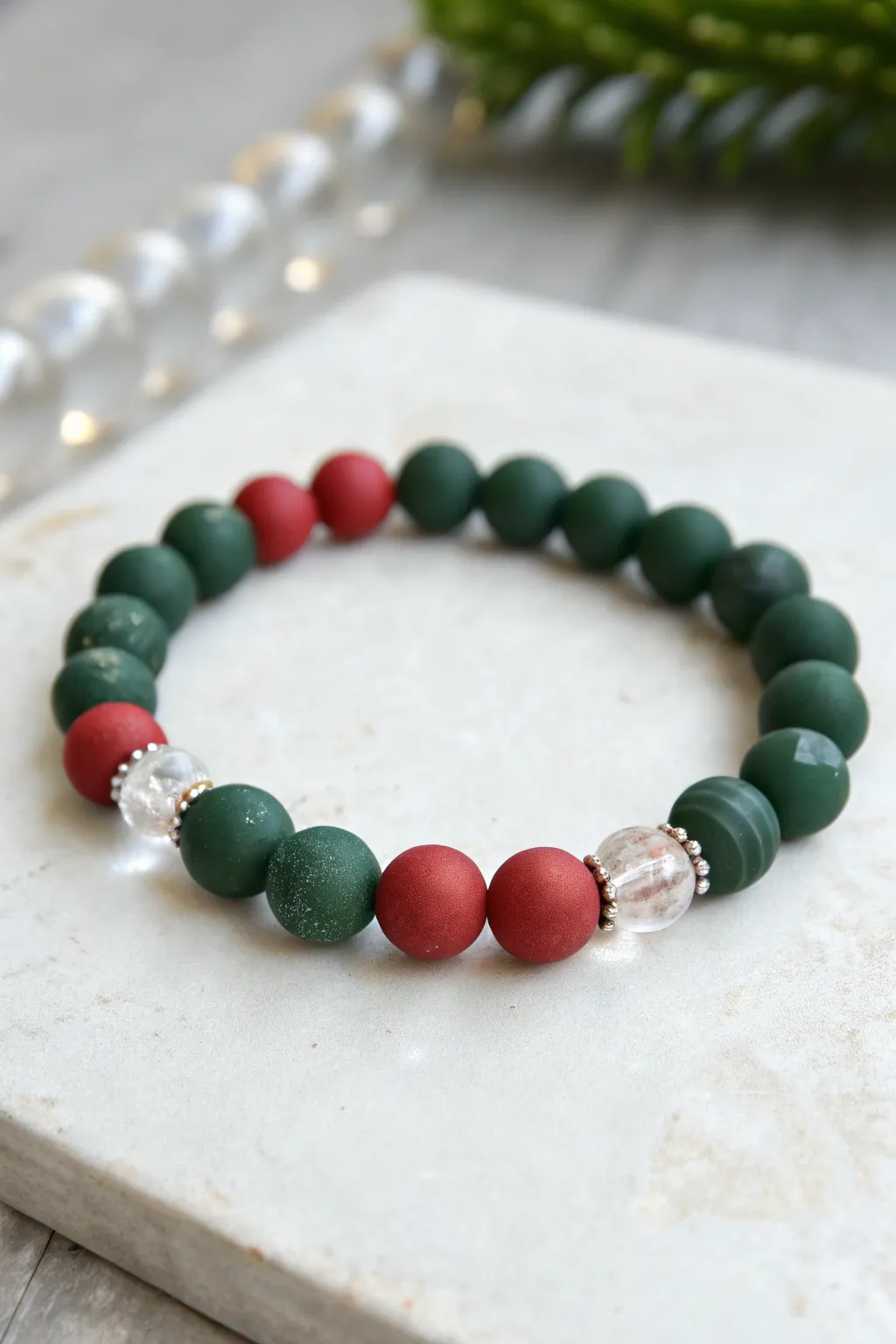
Capture the festive spirit with this sophisticated winter bracelet that pairs velvety matte finish beads with sparkling crystal accents. The contrast between the deep evergreen, vibrant berry red, and icy clear quartzes creates a stunning holiday accessory that isn’t too loud.
Step-by-Step Tutorial
Materials
- Matte finish round beads (8mm or 10mm) – Dark Forest Green
- Matte finish round beads (8mm or 10mm) – Berry Red
- Crackle quartz or clear crystal rounded beads (matching size)
- Small silver daisy spacers or rondelle spacers
- Elastic beading cord (0.8mm or 1.0mm recommended)
- Beading needle (optional, but helpful)
- Jewelry glue or clear nail polish
- Scissors
Step 1: Preparation
-
Measure your wrist:
Before cutting any cord, wrap a measuring tape around your wrist to find your size. Add about 3-4 inches to this measurement to ensure you have enough slack for tying the final knot comfortably. -
Pre-stretch the cord:
Cut your length of elastic cord. Hold it firmly at both ends and give it a few gentle tugs. This pre-stretching step helps prevent the bracelet from sagging or loosening up after you’ve worn it a few times. -
Plan your pattern:
Lay out your beads on a bead board or a soft towel to visualize the design. The pattern shown uses a dominant green base with specific focal points of red and clear ‘ice’ beads.
Step 2: Creating the Pattern
-
Start with the focal section:
Begin by selecting two matte red beads. Thread them onto the center of your cord. These will act as the bright ‘holly berries’ at the front of the bracelet. -
Add the icy accents:
On either side of your two red beads, add a silver daisy spacer followed by a clear crackle quartz bead. Then, add another silver spacer after each quartz bead. This frames the ‘ice’ beautifully. -
Transition to green:
Now, thread two matte green beads on the right side of your centerpiece, and two matte green beads on the left side. -
Create the secondary red accent:
String a single matte red bead on the left side (after the initial two greens). Then, thread a single red bead on the right side. This balances the color distribution. -
Fill the rest:
Continue stringing the matte green beads onto both ends until you reach your desired length. For a standard fit, the back section is usually entirely green. -
Check the fit:
Wrap the unfinished strand around your wrist to verify the size. It should sit comfortably without pinching your skin or sliding off too easily.
Knot Security Tip
Don’t cut the tails immediately! Leave about 1 cm of cord after tying. Wear the bracelet for a day to ensure the knot holds, then trim completely.
Step 3: Finishing Touches
-
Prepare the knot:
Bring the two ends of the elastic cord together. Remove any slack so the beads touch, but don’t pull so tight that the bracelet buckles. -
Tie the surgeon’s knot:
Cross the right end over the left, resembling the first step of tying a shoelace. Then, loop the top strand through the knot a second time before pulling it tight. This creates a secure surgeon’s knot. -
Secure with glue:
Apply a tiny dot of jewelry glue or clear nail polish directly onto the knot. I prefer to pull the knot slightly apart to get the glue right into the fibers, then pull it tight again. -
Hide the mechanism:
While the glue is still slightly tacky but not wet, gently pull the cord so the knot slides inside the hole of the nearest bead. This hides the join seamlessly. -
Trim the excess:
Once the glue is fully dry (wait at least 15 minutes), use your scissors to trim the excess cord ends as close to the bead hole as possible without cutting the knot itself.
Winter Texture Mix
Swap the matte green beads for frosted white agate or wooden beads to change the vibe from ‘forest floor’ to ‘snowy cabin’ instantly.
Now you have a frosty, festive accessory ready to wear for the holiday season