
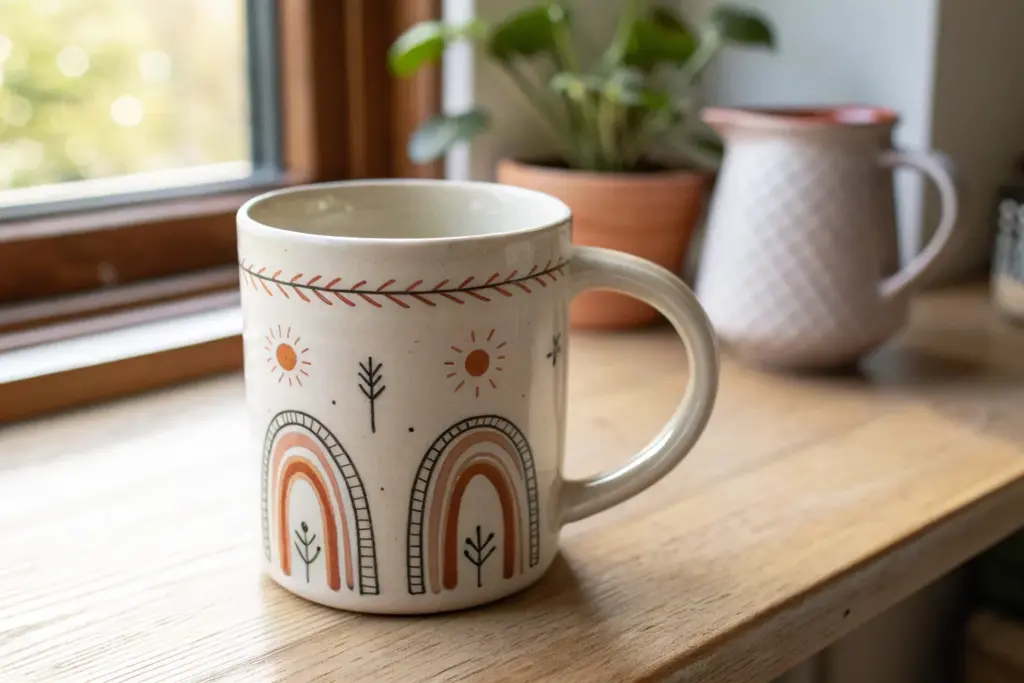
A plain clay piece is basically a blank canvas, and clay painting is my favorite way to make it feel instantly personal. Below are my go-to pottery painting ideas that look amazing on everything from a simple plate to a little planter, without needing fancy skills.
Polka Dot Pop
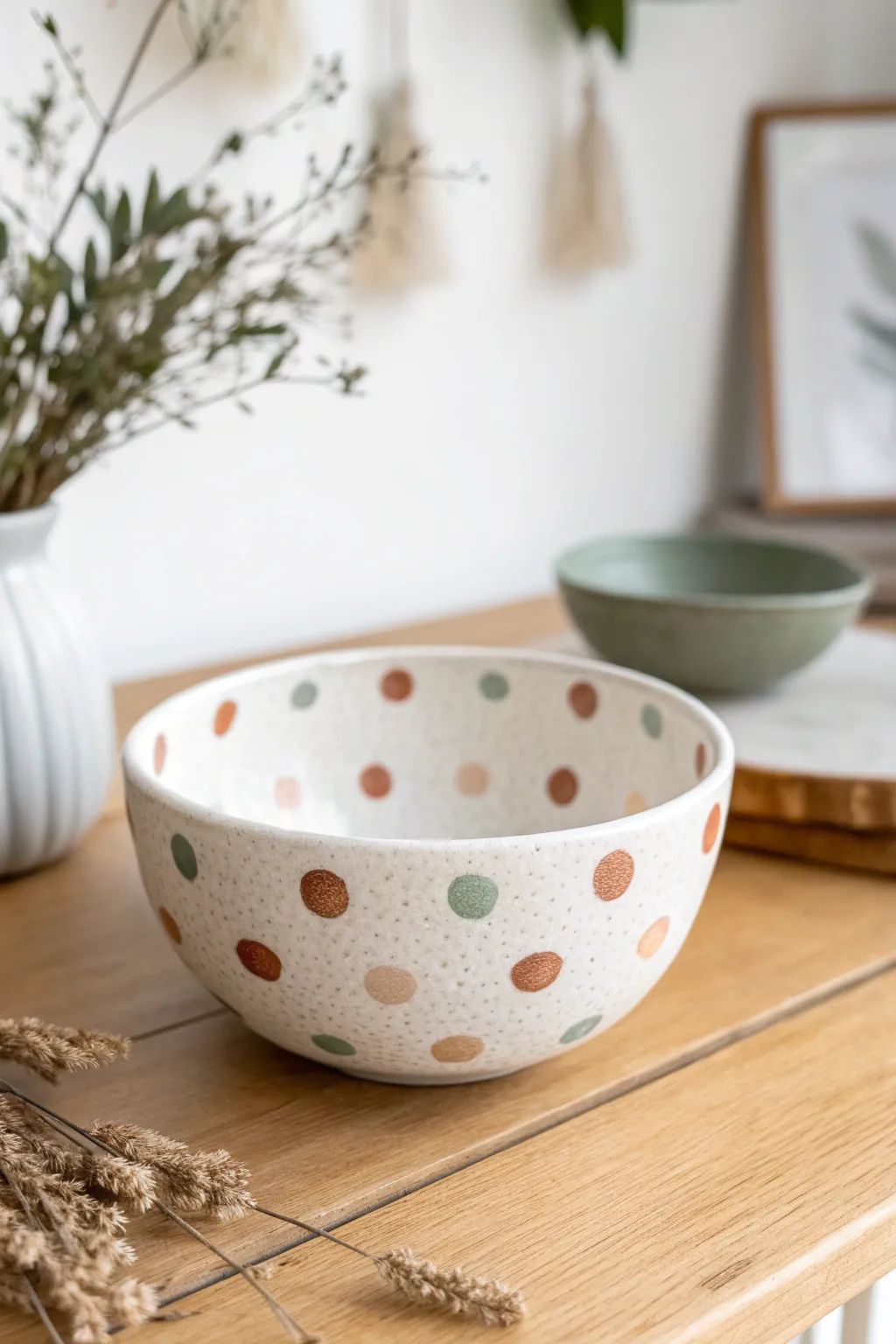
Embrace the imperfect charm of handmade pottery with this earthy, warm-toned polka dot bowl. The combination of a speckled clay body (or faux-speckle effect) and soft, muted circles creates a cozy, modern rustic vibe perfect for any table.
Step-by-Step Guide
Materials
- Air-dry clay or kiln-fire clay (white or light grey)
- Speckled glaze (if kiln firing) or acrylic paints for faux finish
- Rolling pin
- Bowl mold (an existing bowl to form over)
- Plastic wrap
- Sponge
- Round sponge brushes (various small sizes) or circle stencils
- Earth-tone craft paints or underglazes (sage green, rust, mocha, tan)
- Clear sealant (varnish or mod podge) or clear transparent glaze
- Fine grit sandpaper
- Toothbrush (optional for faux speckles)
Step 1: Forming the Base
-
Prepare the Clay:
Begin by wedging your clay to remove any air bubbles. If you are using stoneware clay that already has speckles, you are ahead of the game. For air-dry clay, simply condition it until it is pliable and smooth. -
Roll out the Slab:
Roll your clay out into a large, even slab, approximately 1/4 inch thick. Aim for a consistent thickness to ensure even drying and to prevent cracking later on. -
Prepare the Mold:
Select a bowl from your cupboard that has the shape you want to replicate. Cover the inside of this bowl with plastic wrap, smoothing it out as much as possible to minimize wrinkles in the clay surface. -
Shape the Vessel:
Gently lift your clay slab and drape it into the mold. Press the clay firmly against the sides and bottom, trimming away the excess clay at the rim with a needle tool or knife. -
Refine the Rim:
Use a slightly damp sponge to smooth the rim of the bowl. You can leave it slightly uneven for that organic, handmade look seen in the photo, or perfect it for a sharper edge. -
Initial Dry:
Let the clay sit in the mold until it is leather-hard (firm enough to hold its shape but not fully dry). Once firm, carefully remove it from the mold and peel away the plastic wrap. -
Smooth and Sand:
Allow the bowl to dry completely. Once bone dry, use fine-grit sandpaper to gently smooth out any rough patches, especially around the rim and the exterior curve. Wipe away all dust with a barely damp cloth.
Pro Tip: Perfect Circles
If you struggle with freehand circles, use the eraser end of a pencil as a stamp. Dip it in paint and press straight down for a perfectly round, small dot every time.
Step 2: Decoration & Painting
-
Base Coat:
If you are using air-dry clay, paint the entire bowl (inside and out) with a creamy off-white acrylic paint. Apply two coats for solid opacity. -
Faux Speckling (Optional):
To mimic the speckled stoneware look on plain clay, dip an old toothbrush into watered-down brown or grey paint. Run your thumb over the bristles to flick tiny splatters across the bowl’s surface. Let this dry completely. -
Select Your Palette:
Mix a palette of earthy tones. You’ll want a muted sage green, a warm rust orange, a deep mocha brown, and a soft beige-pink. Keeping the values similar helps the pattern feel cohesive. -
Plan the Placement:
Visualize a random but balanced pattern. I find it helpful to start painting the largest dots first to anchor the design, before filling in gaps with smaller ones. -
Paint the Dots:
Use a round sponge dauber or a round-tipped brush to apply the dots. Press gently to create the circle. Don’t worry if they aren’t perfect circles; the hand-painted variation adds character. -
Vary the Colors:
Switch colors frequently as you work around the bowl to ensure no two identical colors are clumped together. Paint dots on both the exterior and the interior walls. -
Overlap the Rim:
Allow some of the pattern to sit near the rim, but avoid crowding it too much. The negative space is just as important as the polka dots. -
Second Coats:
Depending on the opacity of your paint or underglaze, you might need to dab a second layer on the dots once the first is dry to make the colors pop.
Step 3: Finishing Touches
-
Seal or Fire:
For kiln-fired clay, dip in clear glaze and fire according to your clay body’s temperature. For air-dry clay, apply a coat of glossy or satin varnish to seal the paint and mimic the sheen of ceramic glaze. -
Final Cure:
Let the sealant cure for at least 24 hours in a dust-free area before using your bowl for display.
Trouble: Smudged Dots?
If you accidentally smudge a wet dot, wait for it to fully dry. Then, gently sand the smudge away or paint over it with your base cream color before re-painting the dot.
Now you have a charming, speckled vessel ready to hold your trinkets or simply look beautiful on a shelf
Clean Stripes and Bands
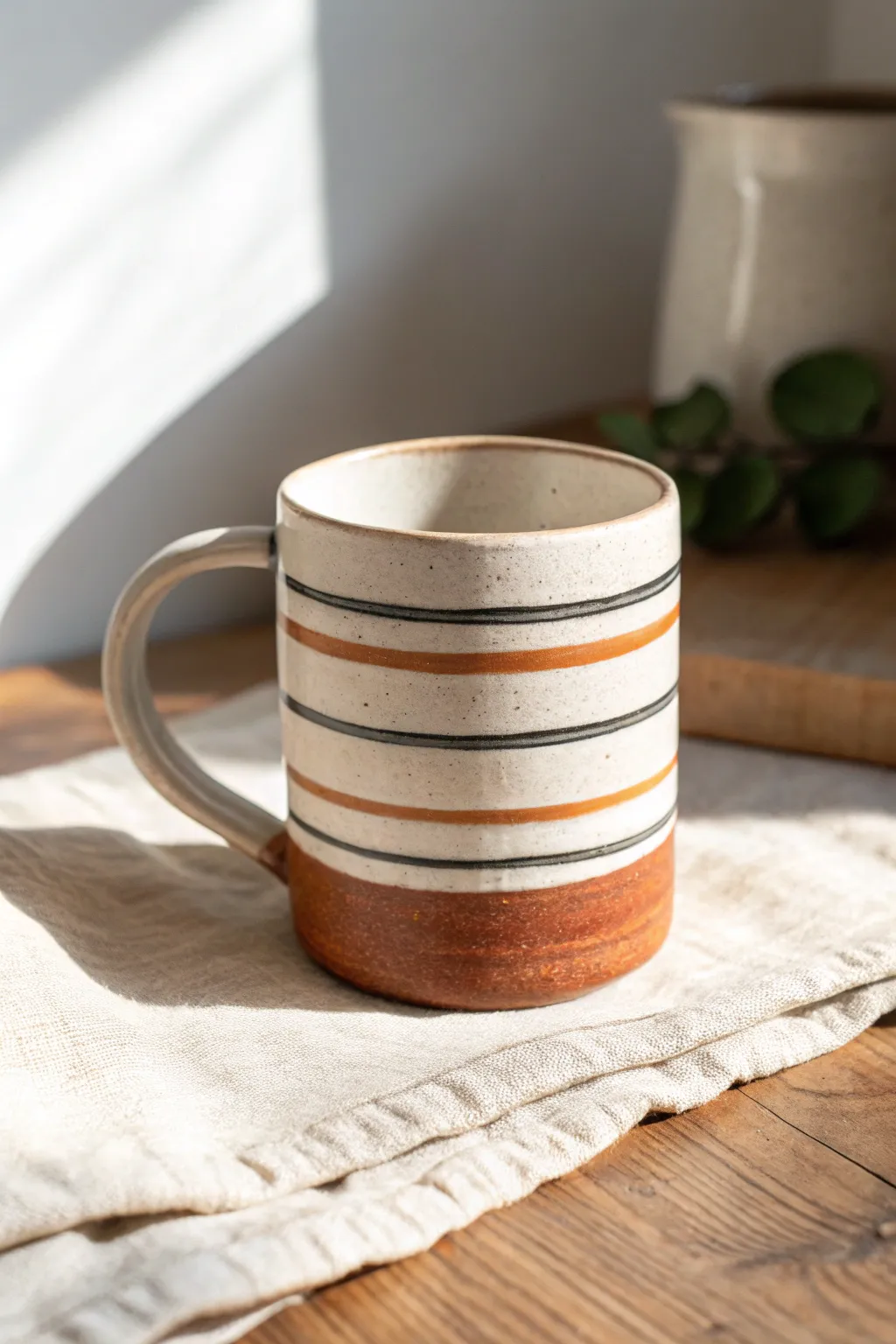
This project combines the rustic warmth of exposed clay with simple, modern geometry. By glazing simple bands of ochre and charcoal against a creamy speckled base, you can achieve a timeless design that feels both cozy and contemporary.
Step-by-Step Tutorial
Materials
- Wheel-thrown or hand-built mug (leather hard)
- Speckled stoneware clay body
- Liquid wax resist
- Sponge
- Cream/White matte glaze
- Iron oxide wash or ochre underglaze
- Black underglaze or stain
- Fine liner brush
- Medium soft brush
- Potter’s wheel or banding wheel
Step 1: Preparation & Masking
-
Surface Prep:
Begin with your bisque-fired mug, ensuring it is clean and free of dust by wiping it down with a slightly damp sponge. -
Wax the Base:
Apply a generous coat of wax resist to the bottom third of the mug’s exterior. The goal is to leave the raw, speckled clay exposed at the bottom for that lovely textural contrast. -
Clean the Line:
Once the wax is dry (it should feel tacky but not wet), use a damp sponge to wipe away any stray drips near the wax edge to ensure a sharp transition line.
Step 2: Applying the Base Glaze
-
Dip Glazing:
Hold the mug by the foot (or using dipping tongs if you prefer) and dip the interior first, coating it fully with your cream matte glaze. -
Exterior Dipping:
Dip the exterior of the mug into the cream glaze, stopping exactly where your wax resist line begins. -
Drying Time:
Allow the glaze to set until it is powdery to the touch. I usually wait about 20 minutes to ensure the surface is stable enough for painting.
Steady Hands Pro-Tip
Rest your pinky finger against the banding wheel base or a stable stack of books while you paint. This anchors your hand, creating much smoother, straighter lines as the wheel turns.
Step 3: Painting the Stripes
-
Setup:
Place your glazed mug on a banding wheel. Center it as best as possible to make painting continuous lines easier. -
First Black Ring:
Load a fine liner brush with black underglaze. Spin the wheel slowly and steadily while touching the brush about an inch below the rim to create your first thin charcoal line. -
The Ochre Band:
Switch to a slightly thicker medium brush loaded with iron oxide wash or ochre underglaze. -
Apply the Middle Stripe:
Spin the wheel again and apply the ochre stripe about half an inch below your black line. Let the brush drag smoothly to get even coverage. -
Second Black Ring:
Clean your fine liner brush and reload it with black underglaze. Paint a second thin charcoal line below the ochre band. -
Lower Ochre Band:
Create the final, lower stripe using the ochre color again. Position it closer to the bottom edge of the white glaze. -
Third Black Ring:
Finish the banding pattern with one final thin black line just below the second ochre band. -
Refining Edges:
If any glaze dripped onto the waxed raw clay section during handling, carefully scrape it away with a fettling knife or clean sponge.
Level Up: Texture Play
Before the first firing, carve shallow grooves where you plan to paint the stripes. The glaze will pool slightly in these recesses, adding tactile dimension to your painted bands.
Step 4: The Rustic Handle & Rim
-
Rim Detail:
Using a very lightly loaded brush or sponge with the ochre oxide, gently dab the very rim of the mug to give it a toasted look. -
Handle Wash:
If you want the handle to match the bands, brush a very diluted wash of the cream glaze over it, allowing the clay speckles to show through prominently. -
Final Fire:
Load the kiln and fire to the maturation temperature of your specific clay body (likely Cone 5 or 6 for stoneware).
Enjoy your morning coffee in a mug that perfectly balances clean design with raw, natural beauty



Classic Checkerboard
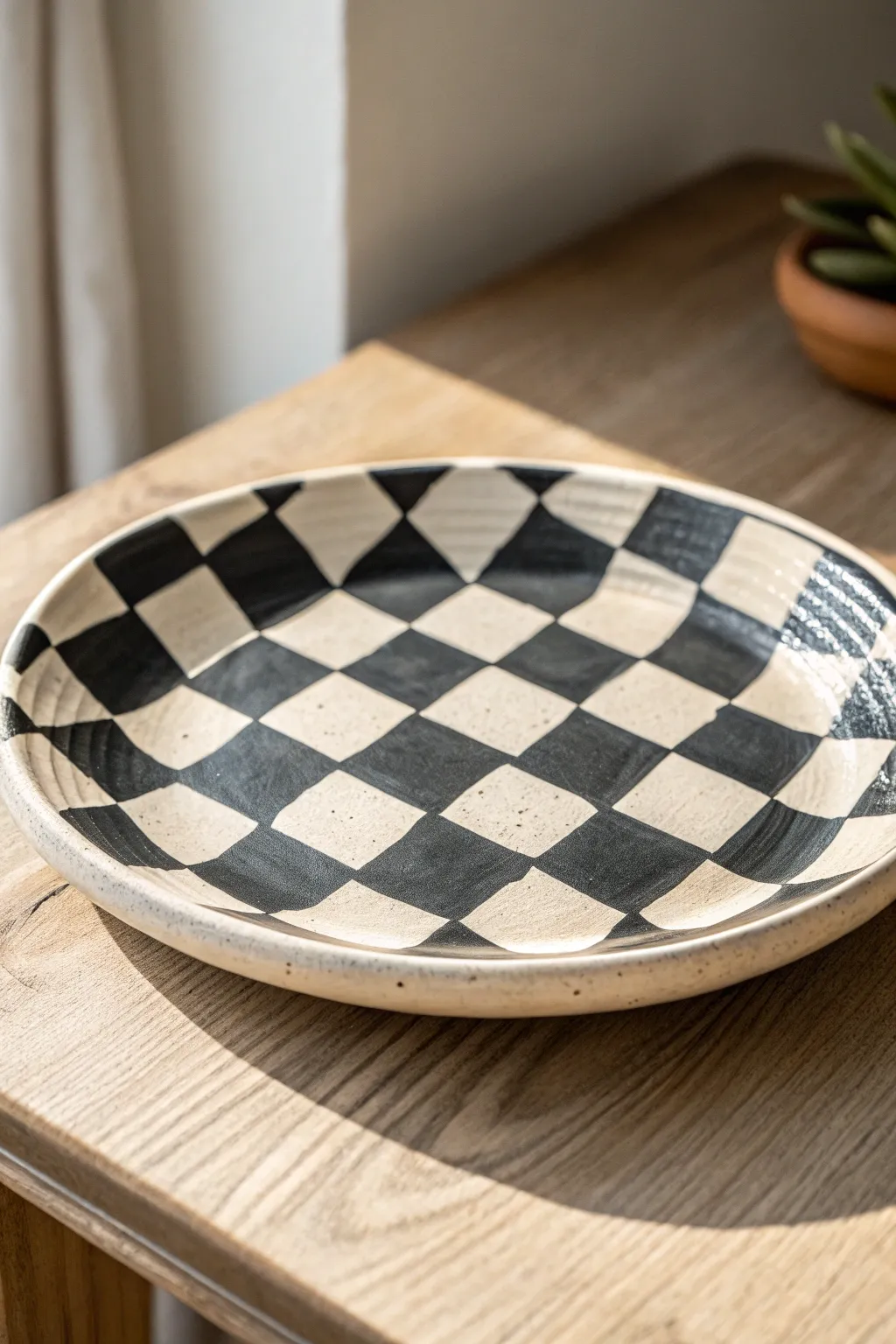
Embrace the beauty of imperfection with this hand-painted ceramic plate featuring a bold, contrasting checkerboard design. The slightly wavy lines and organic feel give this piece a trendy, artisanal look that fits perfectly in a modern home.
How-To Guide
Materials
- Bisque-fired ceramic plate or air-dry clay plate (pre-made and dried)
- Black underglaze (for fired ceramics) or black acrylic paint (for air-dry)
- White underglaze or acrylic paint (optional, if base isn’t white)
- Flat shader brush (size 6 or 8)
- Fine liner brush
- Pencil
- Drafting compass or circular object (optional)
- Flexible ruler or measuring tape
- Clear glaze (food safe if intended for eating) or glossy varnish
Step 1: Preparation & Mapping
-
Surface prep:
Begin with a clean, dust-free plate. If you are using bisque ware, wipe it down with a damp sponge to remove any kiln dust. For air-dry clay, ensure the surface is sanded smooth. -
Establish the center:
Find the approximate center of your plate. It doesn’t need to be mathematically perfect—part of the charm is the hand-drawn feel—but mark a light dot with your pencil as a reference point. -
Draw concentric circles:
Using a compass or by tracing circular objects of varying sizes, lightly sketch 3 to 4 concentric rings radiating from the center out to the rim. Adjust the spacing so the ‘checks’ will be roughly square-shaped. -
Mark the radial lines:
Sketch straight lines cutting across the plate through the center point, like cutting a pizza. Start with a vertical and horizontal line to make a cross, then divide each quadrant in half again. Extend these lines all the way over the rim. -
Refine the grid:
Look at your grid. The curved lines intersecting with the straight lines create the checkerboard spaces. Lightly mark an ‘X’ in every other space so you know exactly which ones to paint black.
Fixing Smudges
Make a mistake? If using underglaze, scratch the black error off gently with a needle tool once dry. For acrylics, paint over the smudge with white opaque paint.
Step 2: Painting the Design
-
Outline the black squares:
Dip your fine liner brush into the black underglaze or paint. Carefully outline the edges of the first square where you marked an ‘X’. I find it easier to work from the center outward to avoid smudging. -
Fill the centers:
Switch to your flat shader brush.Load it with black paint and fill in the square you just outlined. The flat edge of the brush helps keep the lines crisp against your initial outline. -
Continue the pattern:
Move to the next marked square in the ring and repeat the outlining and filling process. Work methodically around the plate. -
Handle the rim:
When you reach the edge, paint the shape over the curve of the rim. This gives the piece a finished, professional look from all angles. -
Clean up edges:
Once the black squares are blocked in, use your liner brush to touch up any corners or shaky lines. Remember, a little wobble adds character, so don’t stress about laser precision. -
Optional white touch-up:
If your clay body is off-white or you want a starker contrast, paint the alternating ’empty’ squares with white paint or underglaze now. -
Let it dry completely:
Allow the paint or underglaze to dry fully. For acrylics, this might take an hour; for underglaze, wait until it is chalky and dry to the touch.
Keep A Steady Hand
Anchor your pinky finger on a dry spot of the plate while painting. This creates a pivot point and stabilizes your brush strokes significantly.
Step 3: Finishing
-
Apply the finish:
If using ceramic glazes, dip or brush on a clear transparent glaze over the entire piece. If using acrylics on a decorative plate, apply a coat of high-gloss varnish. -
Final cure or fire:
Fire the piece in a kiln according to your clay and glaze specifications. For air-dry projects, let the varnish cure for at least 24 hours in a dust-free area.
Place your finished plate on a textured wood surface to really make that graphic pattern pop
Modern Color Blocking
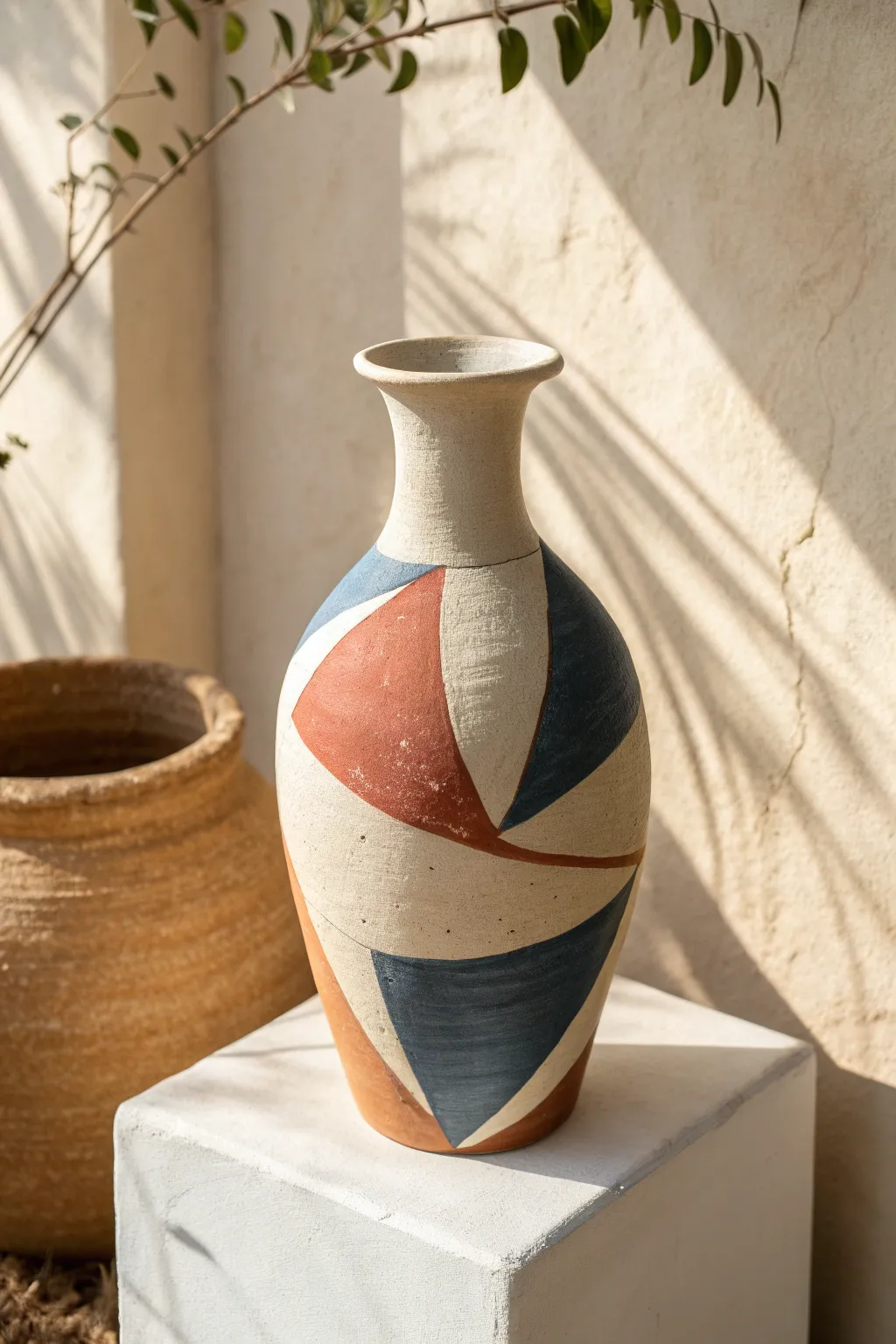
Transform a plain ceramic vase into a stunning piece of modern decor with this bold color-blocking technique. The interplay of deep navy, warm terracotta, and creamy white creates a sophisticated, earthy aesthetic that feels both contemporary and timeless.
Step-by-Step Tutorial
Materials
- Bisque or unglazed ceramic vase (smooth silhouette works best)
- Acrylic paints (Navy Blue, Terracotta/Burnt Sienna, Cream/Off-White)
- Pencil
- Masking tape or painter’s tape (various widths)
- Flat paintbrushes (medium and small)
- Detail brush
- Matte varnish or sealant
- Palette or mixing plate
- Water cup and paper towels
- Fine-grit sandpaper (optional)
Step 1: Preparation & Planning
-
Clean surface:
Start with a clean, dry vase. Wipe it down with a damp cloth to remove any dust or oils that might interfere with paint adhesion. -
Smooth imperfections:
If your vessel has any rough bumps that might disrupt clean lines, lightly sand them down with fine-grit sandpaper and wipe away the dust. -
Sketch the design:
Using a light pencil grip, sketch your geometric pattern directly onto the vase. Focus on large, intersecting triangles and sweeping curves. Don’t worry about perfection; these lines are just guides. -
Map out colors:
To avoid confusion later, lightly mark each section with a letter representing the color (e.g., ‘N’ for navy, ‘T’ for terracotta, ‘C’ for cream). This helps visualize the final balance.
Step 2: Painting the Base & Light Tones
-
Apply the cream base:
Start by painting the sections designated for the lightest color (cream/off-white). It’s easier to paint darker colors over light ones than vice-versa. Use a flat brush for smooth coverage. -
Second coat:
Let the first layer dry completely, then apply a second coat of cream to ensure opacity and eliminate streaks. -
Tape for straight lines:
Once the cream sections are fully dry (give it at least an hour), use painter’s tape to mask off the edges where straight lines will meet darker colors. Press the tape edges down firmly to prevent bleeding.
Crisp Line Secrets
If paint bleeds under your tape, let it dry fully. Then, scrape the excess away gently with a craft knife or fingernail for a razor-sharp edge.
Step 3: Adding Deep Hues
-
Paint the terracotta:
Load your medium flat brush with the terracotta paint. Apply it to the designated triangular sections. I find that painting away from the tape edge helps prevent paint from seeping underneath. -
Refine the edges:
For curved lines where tape is harder to use, switch to a steady hand and a smaller flat brush. Carefully cut in the edge of the terracotta shape against the raw clay or cream background. -
Apply the navy blue:
Move on to the navy blue sections. These dark areas provide the crucial contrast that makes the design pop. Apply two thin coats rather than one thick glob for the best finish. -
Connect the points:
Pay special attention to where the tips of the triangles meet. Use a detail brush to ensure these points are sharp and crisp, not rounded or messy.
Pro Tip: Curved Lines
For smooth curves, don’t use tape. Instead, draw the curve with a pencil, then use a specialized ‘filbert’ brush which has a rounded tip perfect for painting arcs.
Step 4: Finishing Touches
-
Remove tape:
Carefully peel away any masking tape while the final coat of paint is still slightly tacky but mostly dry. Pulling at a 45-degree angle usually gives the cleanest line. -
Touch up:
Inspect your lines. If any paint bled under the tape, use your detail brush and the background color to tidy up the edges. -
Leave negative space:
Notice how the bottom of the design showcases the raw clay color. Ensure you’ve left some of the original vase texture visible at the base or neck to maintain an organic feel. -
Seal the work:
Once the vase is completely dry (cure for 24 hours), apply a clear matte varnish. This protects the paint from chipping and unifies the finish without adding unwanted shine.
Place your new vase in a sunny spot where the light can play off the geometric angles and matte textures

The Complete Guide to Pottery Troubleshooting
Uncover the most common ceramic mistakes—from cracking clay to failed glazes—and learn how to fix them fast.
Soft Ombre Fade
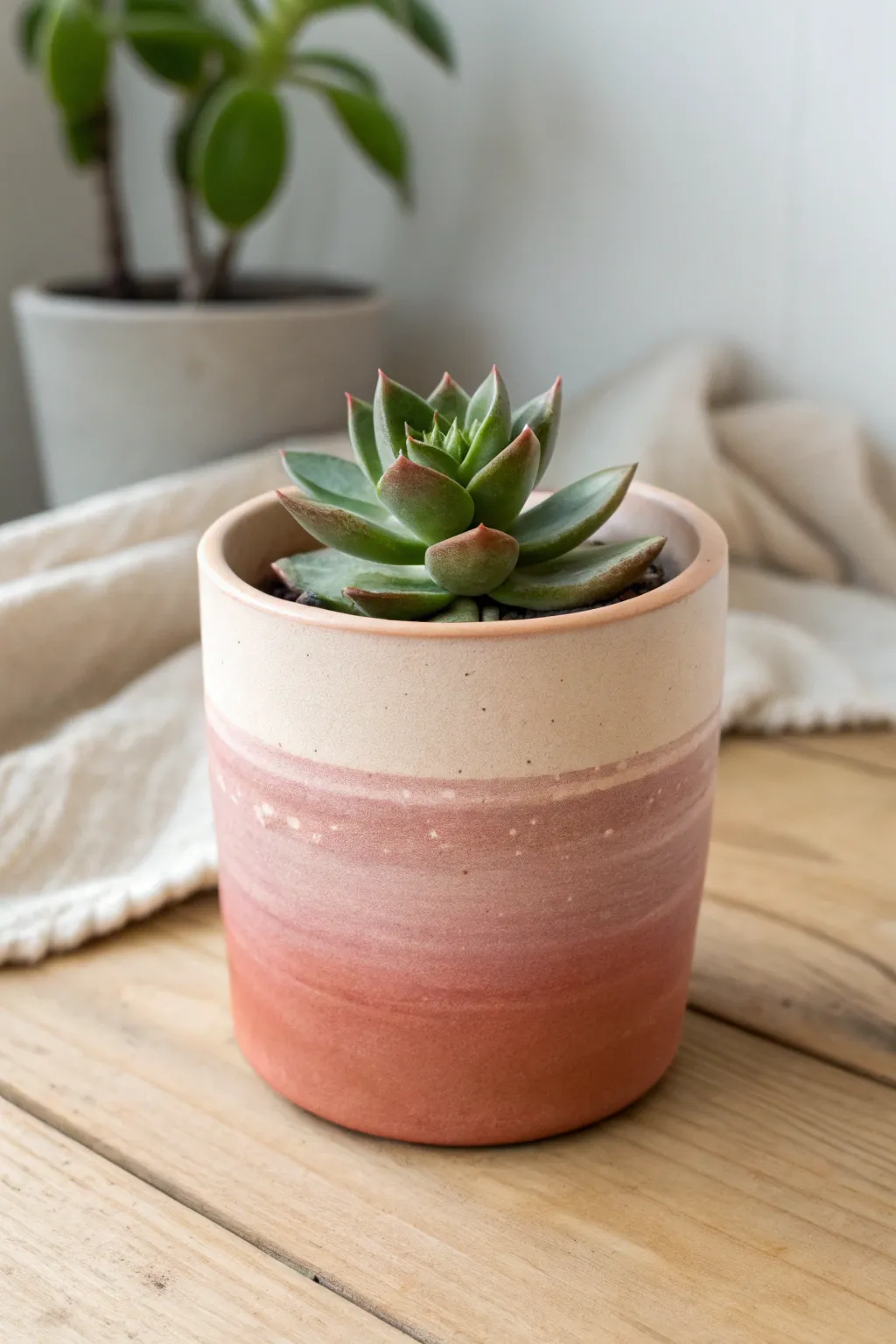
Transform a plain terracotta pot into a piece of modern art with this gentle, sunset-inspired gradient. The soft transition from creamy beige to warm terracotta creates a sophisticated look that perfectly complements the green hues of succulents.
Step-by-Step
Materials
- Clean terracotta pot (cleaned and dried)
- Acrylic paint: Cream or Warm White
- Acrylic paint: Blush Pink or Dusty Rose
- Acrylic paint: Terracotta or Burnt Sienna
- Wide flat paintbrush (synthetic bristles)
- Medium soft blending brush or makeup sponge
- Palette or paper plate
- Painter’s tape (optional)
- Cup of water and paper towels
- Matte spray sealer
Step 1: Base Preparation
-
Clean surface:
Before you begin, wipe down your terracotta pot with a damp cloth to remove any dust or oils. Let it dry completely. If the pot is old, give it a good scrub with warm soapy water first. -
Tape the rim (optional):
If you want the very top rim or the inside to remain natural clay, apply painter’s tape just inside the lip. I prefer to leave the inside unpainted for better water absorption for the plants. -
Mix the base color:
Pour a generous amount of your Cream or Warm White acrylic paint onto your palette. You want a smooth consistency, so add a tiny drop of water if the paint feels too thick. -
Apply the top layer:
Using your wide flat brush, paint the top third of the pot with the cream color. Paint in horizontal strokes, going all the way around. -
Feather the edge:
On the bottom edge of this cream section, use a lighter hand to create an uneven, feathered edge rather than a straight line. This will make blending easier later.
Wet-on-Wet is Key
Work quickly! Acrylics dry fast. If the paint dries before you blend, lightly mist the pot with water to reactivate the surface for smoother gradients.
Step 2: Creating the Ombre Sections
-
Mix the mid-tone:
On your palette, mix a transition shade. Combine equal parts of your Cream paint with the Blush Pink/Dusty Rose. You want a soft, muted pink creates a bridge between the light top and dark bottom. -
Apply the middle band:
Paint the middle section of the pot with this mixed pink shade. Overlap slightly with the feathered edge of the cream section above. -
Applying the bottom tone:
For the bottom third, use your darkest color—the Terracotta or Burnt Sienna. Paint from the base upward, stopping just before you hit the wet pink middle section. -
Connecting the colors:
Now, bring that dark terracotta paint up to meet the pink middle section. Again, let the brush strokes be loose where the colors meet.
Metallic Accent
Once the ombre is dry, paint a thin gold or copper rim around the very top edge of the pot for a chic, high-end finish.
Step 3: The Blending Technique
-
Prepare the blending brush:
Switch to a clean, slightly damp soft blending brush or a dry makeup sponge. Ensure it’s not dripping wet, just barely moist. -
Blend the upper transition:
Working while the paint is still wet is crucial here. Gently tap or sweep the brush horizontally where the cream meets the pink. Back and forth strokes help the colors marry. -
Clean brush check:
Wipe your blending brush on a paper towel immediately if it picks up too much of one color. You don’t want to drag the dark pink all the way up into the pure cream area. -
Blend the lower transition:
Move to the border between the pink and the dark terracotta. Use the same horizontal sweeping motion to blur the line. I like to let the darker color creep up slightly for a grounded look. -
Adding texture (optional):
If your blend looks too streaky, dab the transition area gently with a sponge. This creates a soft, stippled texture similar to the reference image. -
Let it dry:
Allow the first coat to dry completely for about 20-30 minutes. Don’t panic if it looks sheer; acrylics often need layers.
Step 4: Finishing Touches
-
Assess and refine:
Look at your dried pot. If the colors aren’t opaque enough, repeat the banding process with a second coat, following the same blending steps. -
Create the splatter effect:
Dilute a tiny bit of white paint with water. Load an old toothbrush or stiff brush, and flick the bristles with your thumb to create tiny, subtle speckles over the pink and red sections. -
Final drying time:
Let the pot cure fully, preferably overnight if you applied thick layers. -
Seal the work:
Take the pot outside and spray it with a clear matte sealer. This protects the paint from water damage when you water your plant.
Once sealed and planted, this warm gradient pot will bring a calming, earthy aesthetic to your windowsill
Easy Wildflowers
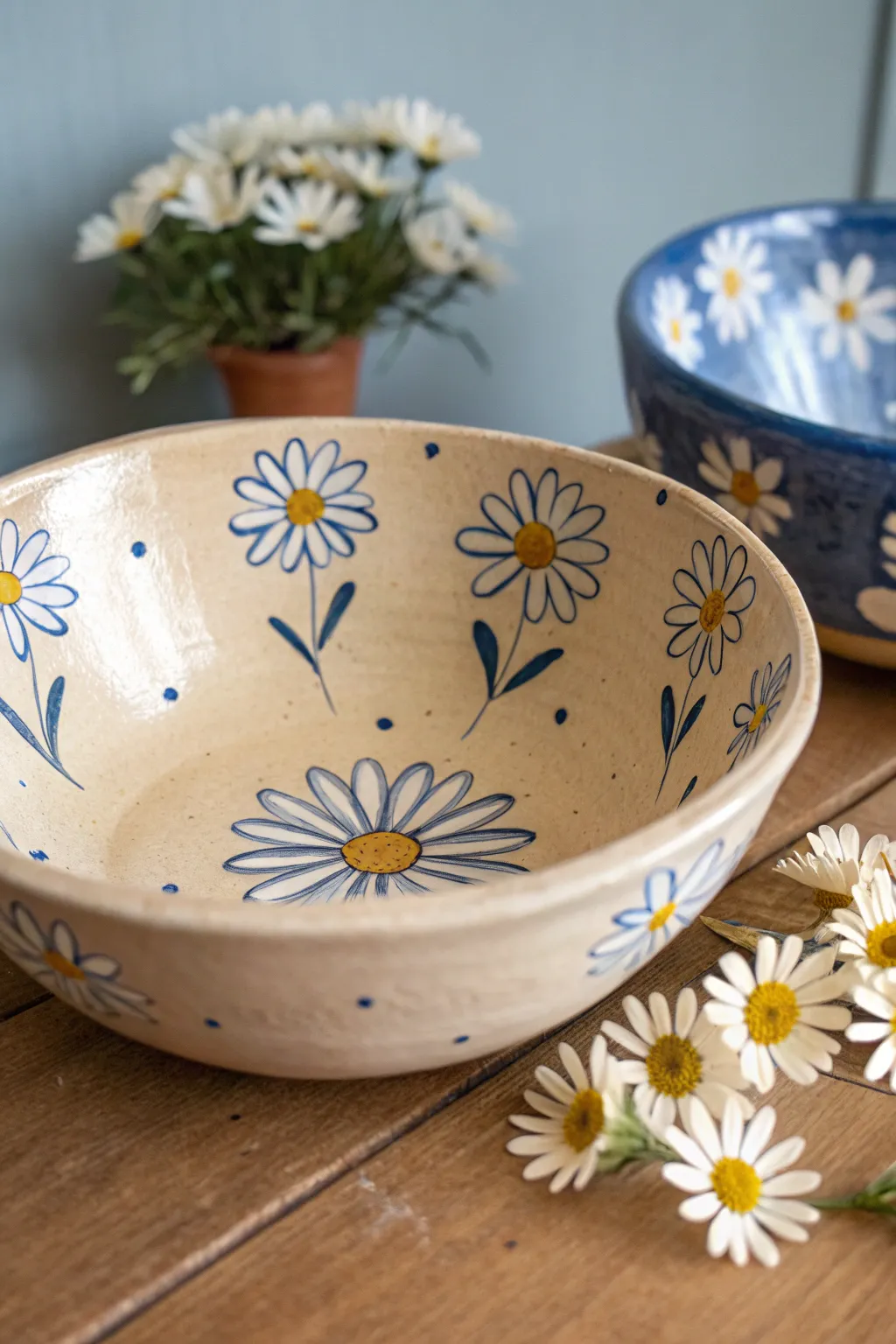
Bring the charm of a summer meadow to your table with this delightful hand-painted wildflowers bowl. Combining a rustic cream base with simple, outlined daisy motifs, this project offers a perfect introduction to ceramic surface decoration.
How-To Guide
Materials
- Bisque-fired ceramic bowl (low-fire earthenware or stoneware)
- Cream or off-white underglaze (for the base)
- Cobalt blue underglaze (for outlines/stems)
- Golden yellow underglaze (for flower centers)
- Clear transparent glaze
- Wide soft fan brush (for base coat)
- Fine liner brush (size 0 or 00)
- Round detail brush (size 2 or 4)
- Pencil (for sketching)
- Sponge and water
Step 1: Preparing the Canvas
-
Clean the Bisque:
Start by gently wiping your bisque-fired bowl with a damp sponge. This removes any dust or oils from handling that might resist the glaze application. -
Apply the Base Coat:
Using a wide fan brush, apply a coat of cream or off-white underglaze to the entire interior and exterior of the bowl. Ensure your brush strokes are long and smooth to minimize texture. -
Layering for Opacity:
Let the first coat dry until it’s chalky to the touch, then apply a second and third coat. Alternate the direction of your brush strokes with each layer (horizontal then vertical) to achieve a solid, opaque background. -
Sketch the Layout:
Once the underglaze is completely dry, lightly sketch your daisy placement with a pencil. Plan for one large central flower at the bottom and 4-5 stems rising up the sides. Don’t worry about mistakes; the graphite will burn off in the kiln.
Smudged Lines?
If your blue lines smear while applying the clear glaze, try sponge-dabbing the glaze on first. Let it dry, then brush the remaining coats over the hardened layer.
Step 2: Painting the Wildflowers
-
Outline the Petals:
Load your fine liner brush with cobalt blue underglaze thinned slightly with water for better flow. Carefully trace the petals of your sketched daisies. Keep the lines somewhat loose and organic rather than perfectly geometric. -
Add Inner Details:
Draw single lines down the center of each petal to give them dimension. This simple detail transforms a basic shape into a recognizable flower. -
Paint the Centers:
Using the round detail brush, fill the center circle of each daisy with golden yellow underglaze. I like to dab the paint on rather than brush it to create a slightly textured, pollen-like appearance. -
Connect with Stems:
Switch back to your liner brush and the blue underglaze. Draw thin, elegant stems flowing downwards from the side flowers toward the center of the bowl. -
Add Leaves:
Paint simple, elongated leaves attached to the stems. Fill these leaves in solidly with blue, unlike the hollow outlined petals, to create visual contrast. -
The Bottom Bloom:
For the large flower at the very bottom of the bowl, ensure the petals radiate outward evenly. The blue outlines should be crisp against the cream background.
Pro Tip: Line Consistency
Mix a tiny drop of gum solution or glycerin into your blue underglaze. This helps the liner brush glide smoothly for longer, unbroken petal outlines.
Step 3: Finishing Touches & Glazing
-
Dot Accents:
Dip the non-brush end (the handle tip) of a paintbrush into the blue underglaze. Gently dot random spots in the empty negative spaces around the flowers to add a playful, confetti-like texture. -
Exterior Check:
If desired, repeat a few partial flower motifs on the exterior of the bowl near the rim, as if the wildflowers are spilling over the edge. -
Detailed Center Specs:
Once the yellow centers are dry, use the very tip of your liner brush to add tiny brown or orange specks onto the yellow for added realism and depth. -
Bisque Fire (Optional):
If your studio practice requires it, fire the piece again to set the underglaze. Otherwise, proceed directly to glazing if using a one-fire safe method. -
Clear Glaze Application:
Apply a coat of clear transparent glaze over the entire piece. Do this carefully—dab the glaze on rather than dragging the brush, so you don’t smear your blue lines. -
Final Fire:
Fire the bowl in the kiln according to the clay and glaze manufacturer’s temperature guidelines (usually cone 04, 05, or 06 depending on your materials).
Once fired, you will have a durable, food-safe bowl perfect for serving summer salads or morning cereal



What Really Happens Inside the Kiln
Learn how time and temperature work together inside the kiln to transform clay into durable ceramic.
Botanical Leaf Sprigs
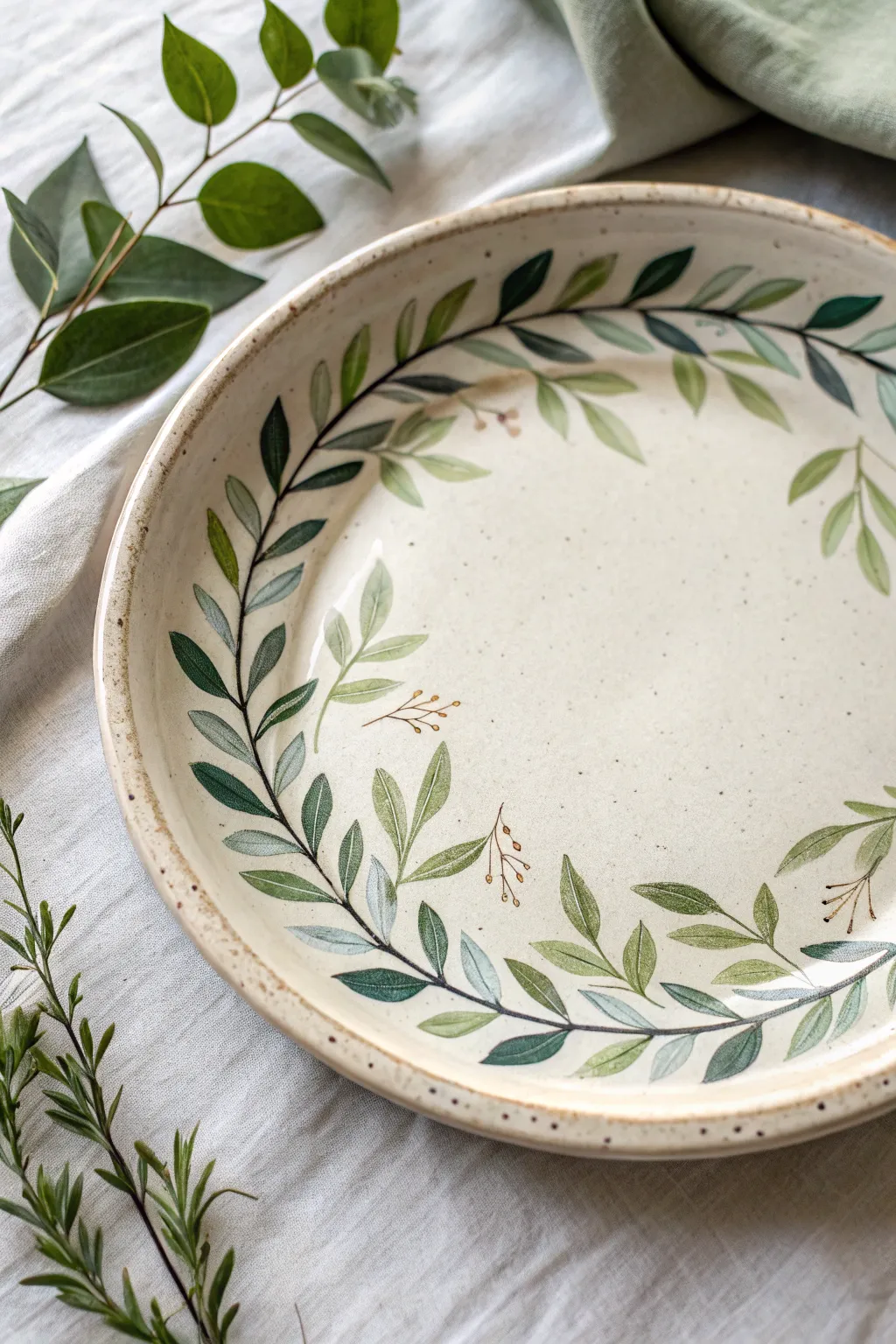
Bring the calming essence of nature to your table with this hand-painted ceramic project. Featuring a delicate wreath of olive and eucalyptus-inspired leaves, this design uses variegated greens to create depth on a speckled, creamy base.
Step-by-Step
Materials
- Bisque ceramic plate or shallow bowl (stoneware preferred)
- Underglazes: Hunter Green, Sage Green, Olive Green, Mint
- Underglaze pencil (light brown or grey) or standard HB pencil
- Round watercolor brushes (sizes 2, 4, and 6)
- Liner brush (size 0 or 00)
- Speckled glossy clear glaze (or regular clear glaze if using speckled clay)
- Sponge and water bowl
- Palette for mixing
Step 1: Planning and Sketching
-
Prep the surface:
Begin by wiping down your bisque plate with a damp sponge. This removes any dust that could prevent the glaze from adhering properly and gives you a clean canvas. -
Map the main stem:
Using a pencil, lightly sketch a continuous, Wavy line that circles the inner well of the plate. It doesn’t need to be a perfect circle; a slightly organic, undulating line mimics real vines better. -
Add branch offshoots:
Draw small, curved lines branching off your main stem every inch or so. Alternate the direction of these branches—some pointing inward towards the center, others outward towards the rim. -
Sketch leaf placements:
Lightly outline the leaf shapes on your branches. Aim for a mix of elongated almond shapes and slightly rounded oval leaves to create variety.
Brush Loading Secret
Double-load the brush! Dip one corner in dark green and the other in light green. When you press and twist, it creates instant, realistic shading.
Step 2: Painting the Foliage
-
Mix your greens:
Squeeze out your four shades of green underglaze onto a palette. I like to mix a tiny bit of the Hunter Green with the Sage to create a transitional mid-tone color. -
Paint the dark leaves first:
Using a size 4 brush, fill in scattered leaves with the Hunter Green. Focus these darker leaves closer to the main stem to anchor the design visually. -
Layer in mid-tones:
Switch to your Olive Green. Paint leaves adjacent to the dark ones, allowing the colors to occasionally touch if wet, or stay separate for a crisp look. -
Add light accents:
Use the Mint or lightest Sage color for the tips of the branches. These lighter leaves give the impression of new growth and add brightness to the wreath. -
Create variation:
For some leaves, load one side of your brush with dark green and the other with light green. Paint the leaf in a single stroke to create a beautiful, natural gradient. -
Define the stems:
With your fine liner brush and the darkest green (or a dark brown/black mix), retrace the main stem line and connect all the floating leaves to the vine. -
Paint fine vein details:
Once the base leaf layers are dry to the touch, use the liner brush to add a very thin center vein to the larger leaves using a contrasting green shade.
Step 3: Final Details and Glazing
-
Add delicate seed sprays:
Mix a diluted brown or golden-brown underglaze. Using the very tip of your liner brush, paint tiny, hair-thin stems shooting off the main vine. -
Dot the seeds:
Add microscopic dots at the ends of these thin brown stems to represent seeds or buds. Keep these sparse to avoid cluttering the design. -
Check the rim:
Inspect the outer rim of the plate. You can add a very faint wash of brown or beige sponge-dabbed along the edge to give it that rustic, toasted look seen in the photo. -
Speckle effect (optional):
If your clay body isn’t naturally speckled, load an old toothbrush with thinned brown underglaze and flick it lightly over the plate to create faux speckles. -
Clear glaze application:
once the underglaze is bonedry, dip or brush on your clear glaze. If you want the speckles shown in the image and didn’t paint them, ensure you use a ‘speckled’ clear glaze. -
Fire the piece:
Fire the plate in a kiln according to the clay and glaze manufacturer’s instructions (typically Cone 5 or 6 for stoneware).
Level Up: Gold Luster
After the final firing, detail the tiny seed pods with real gold luster overglaze and fire again at a lower cone (usually 018) for a luxurious metallic pop.
Once fired, you will have a durable, food-safe piece of art perfect for serving salads or displaying as decor
Citrus and Fruit Slices
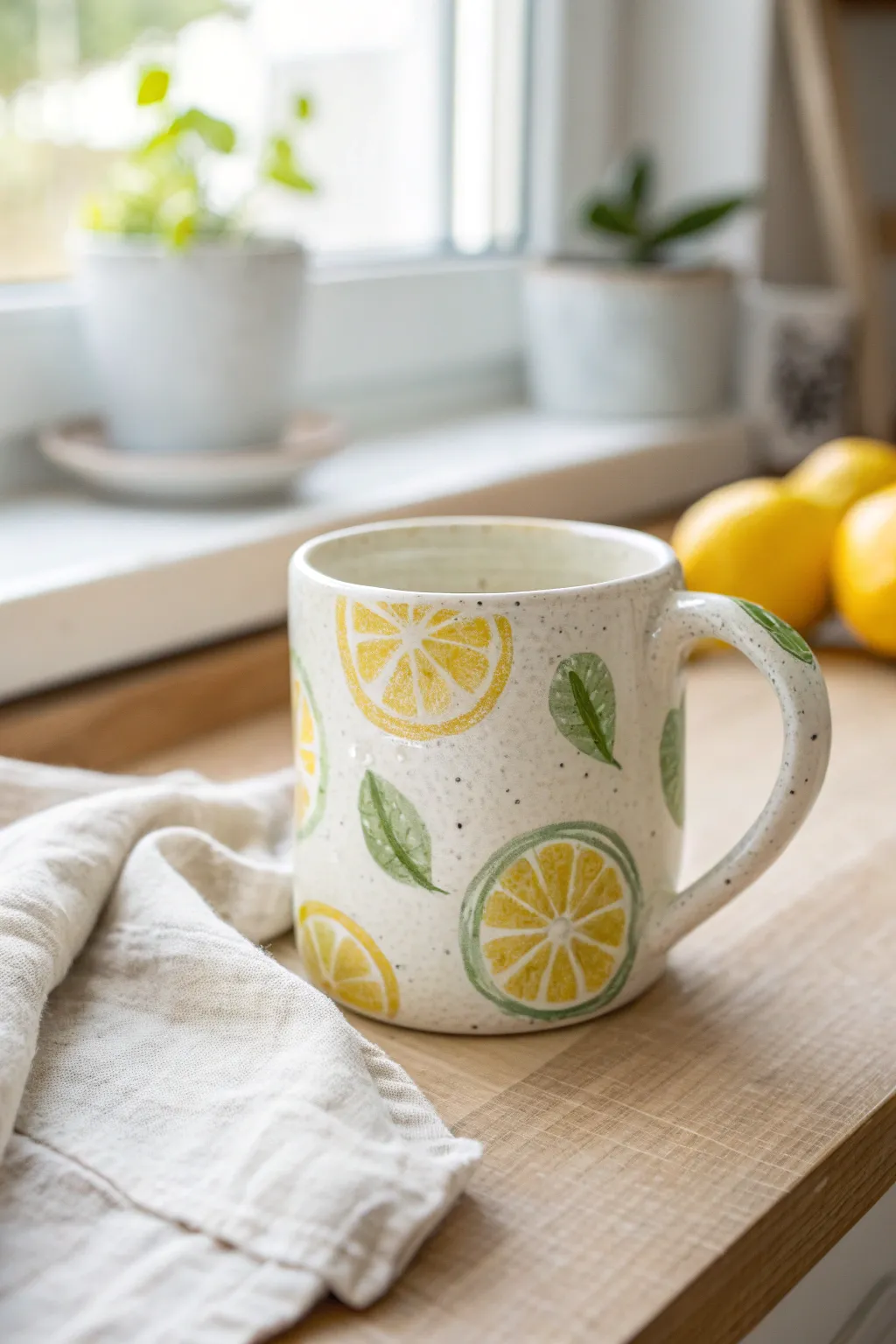
Brighten up your morning coffee routine with this refreshing citrus-themed mug design. Using creamy underglazes on speckled clay, you create translucent-looking fruit slices that pop against the rustic background.
Step-by-Step Tutorial
Materials
- Bisque-fired ceramic mug (preferably speckled clay)
- Underglazes: Lemon Yellow, Golden Yellow, Sage Green, Bright White
- Small round detail brush (size 0 or 1)
- Medium round brush (size 4 or 6)
- Pencil for sketching
- Clear transparent glaze
- Clean water and sponge
- Palette for mixing
Step 1: Preparation & Sketching
-
Clean surface:
Before starting, wipe your bisque mug down with a slightly damp sponge. This removes any dust that could prevent the underglaze from adhering properly. -
Plan placement:
Visualize where your citrus slices will sit. A random, scattered pattern usually looks best, with some slices overlapping the rim or disappearing near the handle. -
Sketch the outlines:
Lightly draw circles and half-circles directly onto the bisque using a graphite pencil. Don’t worry about mistakes; the pencil lead burns off completely in the kiln. -
Add leaf details:
Draw simple, pointed oval shapes near some of the fruit slices to represent leaves. Vary their direction to give the design movement and flow.
Uneven Coverage?
If your yellow looks streaky, you likely need more layers. Yellow underglaze is often translucent. Apply 3 even coats, letting each dry fully, for solid opacity.
Step 2: Painting the Citrus
-
Base layer for fruit:
Load your medium round brush with Lemon Yellow underglaze. Paint the interior of your circular sketches, leaving a deliberate ring of unpainted clay for the rind. -
Create segment definition:
While the yellow is still damp, I like to gently lift a bit of color or paint thin lines of white to suggest the individual juicy segments of the fruit. -
Add depth:
Mix a tiny amount of Golden Yellow into your Lemon Yellow. Dab this slightly darker shade near the bottom edges of the segments to create a sense of volume and ripeness. -
Paint the rind:
Using the detail brush, paint a thin ring of white or very pale yellow around the fruit flesh. Follow this with a slightly thicker outer ring of yellow to complete the peel. -
Lime variations:
For variety, paint a few slices using a mix of Sage Green and Yellow to create limes. Use the same segmenting technique but keep the tones fresher and greener. -
Leaf base color:
Fill in your leaf sketches with the Sage Green underglaze. Apply two to three coats to ensure the green is opaque and vibrant after firing. -
Leaf veins:
Once the green base is dry, use your smallest detail brush and a slightly darker green (or mix a dot of black into your sage) to paint a central vein and small stems.
Step 3: Finishing Touches
-
Handle details:
Don’t forget the handle! Continue the pattern by painting a small leaf or a sliver of fruit wrapping around the curve. -
Clean up:
If any underglaze smudged onto the background where you want bare clay, gently scratch it off with a needle tool or wipe carefully with a clean, damp brush. -
Drying:
Let the underglazes dry completely. They should look chalky and matte to the touch before you move to the glazing stage. -
Dip glazing:
Dip the entire mug into a clear, transparent glaze. This seals the clay and makes the colors vibrant and food-safe. -
Final wipe:
Wipe the foot of the mug (the bottom ring where it sits) completely clean of glaze to prevent it from sticking to the kiln shelf. -
Fire:
Fire the mug to the temperature recommended for your specific clay and glaze combination.
Textured Rind
For a tactile ‘zest’ feel, use a slip trailer to pipe the outer yellow rind line. This creates a slightly raised texture you can feel when holding the mug.
Enjoy your handmade creation with a warm cup of tea and admire how the speckled clay brings the fruit to life

TRACK YOUR CERAMIC JOURNEY
Capture glaze tests, firing details, and creative progress—all in one simple printable. Make your projects easier to repeat and improve.
Geometric Tape-Resist Shapes
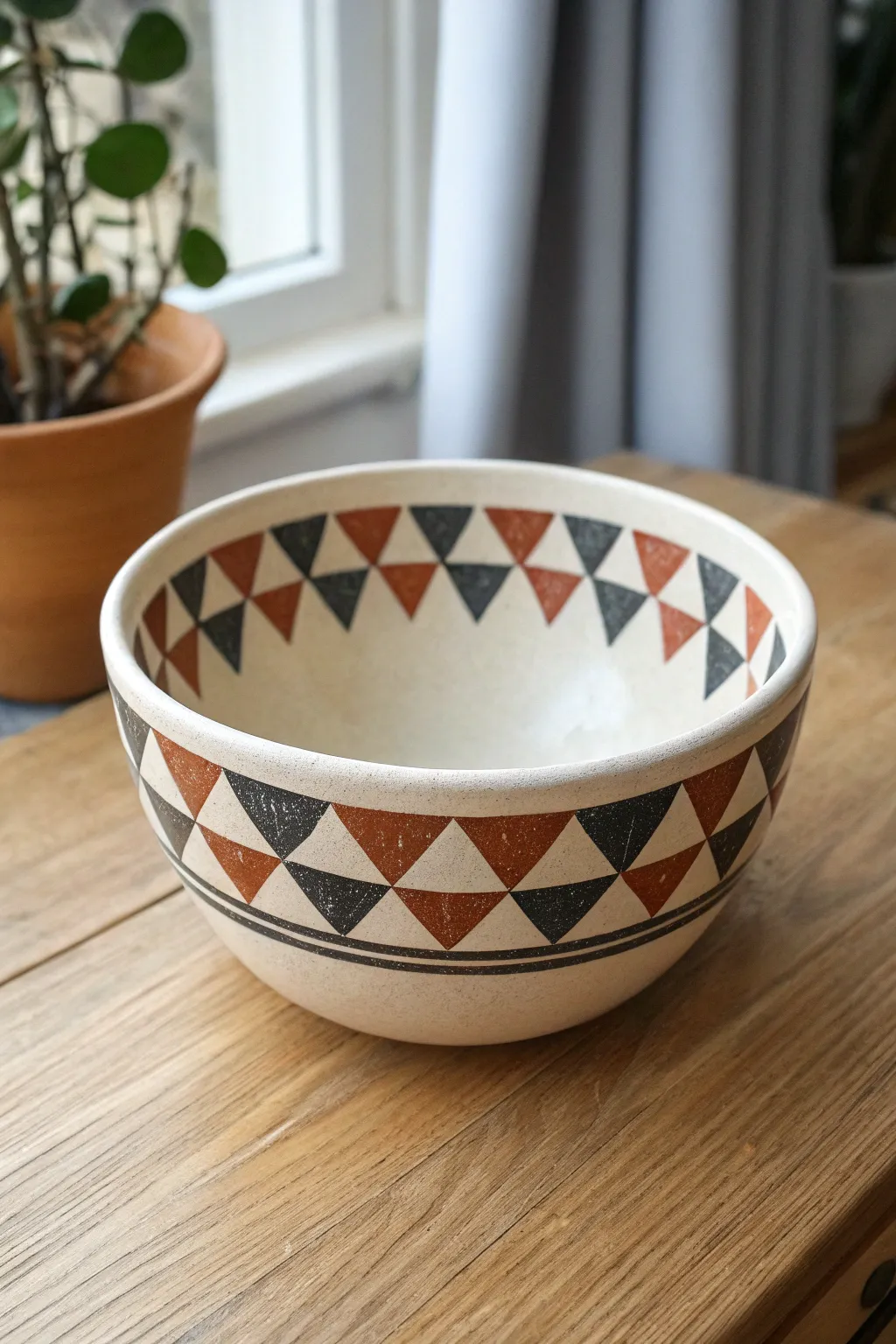
Transform a plain ceramic bisque bowl into a statement piece with this bold geometric design. Using a simple tape-resist method, you’ll create crisp, interlocking triangles in contrasting rust and charcoal tones for a modern, earthy look.
Detailed Instructions
Materials
- Ceramic bisque bowl (smooth, wide shape)
- Painter’s tape or dedicated masking tape (1/4 inch width is ideal)
- Underglazes: Rust/Terracotta, Charcoal/Dark Grey, Cream/Off-White
- Clear dipping or brush-on glaze
- Flat shader brushes (small and medium)
- Fine liner brush
- Scissors or craft knife
- Clean sponge and water
- Pencil
Step 1: Preparation & Base Coat
-
Clean surface:
Wipe down your entire bisque bowl with a damp sponge to remove any dust or kiln firing residue, which can repel glaze. -
Apply base color:
Using a soft, wide brush, apply three even coats of Cream or Off-White underglaze to the entire bowl (inside and out). Let the glaze dry until it’s chalky and matte between each coat. -
Full dry:
Allow the base coats to dry completely, preferably overnight or for several hours, so the tape won’t peel up the underglaze later.
Step 2: Taping the Geometry
-
Mark the bands:
Lightly trace a horizontal line around the circumference of the bowl where you want the top of your pattern to start and the bottom to end. Use a banding wheel if you have one for a steady line. -
Create the grid:
Apply strips of tape diagonally across the marked band area to form the first set of slanted lines. Try to keep the spacing consistent. -
Cross the lines:
Apply a second set of diagonal tape strips in the opposite direction, crossing over the first set. This creates a diamond grid pattern. -
Cut the triangles:
This is the trickiest part: identify the triangles you want to keep as the ‘background’ color. Use an X-Acto knife or craft blade to very gently slice and remove sections of tape, leaving tape only where you want the cream lines to remain between your colored triangles. -
Seal edges:
Run your fingernail or the back of a spoon firmly over all tape edges to ensure a tight seal and prevent color bleeding.
Bleeding Lines?
If underglaze seeps under the tape, wait until it’s bone dry. Then, gently scratch the excess off with a wooden toothpick or needle tool to restore the sharp edge without damaging the base.
Step 3: Painting the Pattern
-
Color planning:
Decide on your pattern sequence. This design alternates upward-pointing rust triangles with downward-pointing charcoal triangles. -
Paint rust triangles:
Using a small flat shader brush, fill in the specific triangles designated for the Rust color. Apply 2-3 coats for solid opacity. -
Paint charcoal triangles:
Switch brushes and fill in the remaining triangles with the Charcoal/Dark Grey underglaze. Be careful not to paint over the tape boundaries too messily, though the tape protects the lines. -
Inside pattern:
Repeat the taping and painting process on the upper interior rim of the bowl if you want the design to carry through to the inside. -
Add stripe detail:
Below the main pattern on the exterior, use a fine liner brush and the banding wheel to paint two thin, parallel charcoal lines circling the bowl.
Level Up: Texture
Before removing the tape, gently sponge the painted triangles with a slightly lighter shade of the same color to add a stone-like depth and mottled texture to the clean geometry.
Step 4: Finishing
-
Remove tape:
Once the colored underglaze is dry to the touch but not bone dry, carefully peel away the tape strips. I find pulling at a 45-degree angle works best to avoid chipping. -
Clean up:
Use a specialized cleanup tool or a tiny scratch knife to gently scrape away any spots where glaze might have bled under the tape. -
Clear glaze:
Once fully dry, dip the bowl into a clear glaze (or brush on 2-3 coats of clear brushing glaze). -
Fire:
Fire the piece in the kiln according to the clay and glaze manufacturer’s temperature guidelines (usually Cone 06 or Cone 6 depending on your materials).
Your finished bowl will have a beautiful, professional-looking geometric band that contrasts perfectly with the natural clay aesthetic
Dot Mandala Medallion
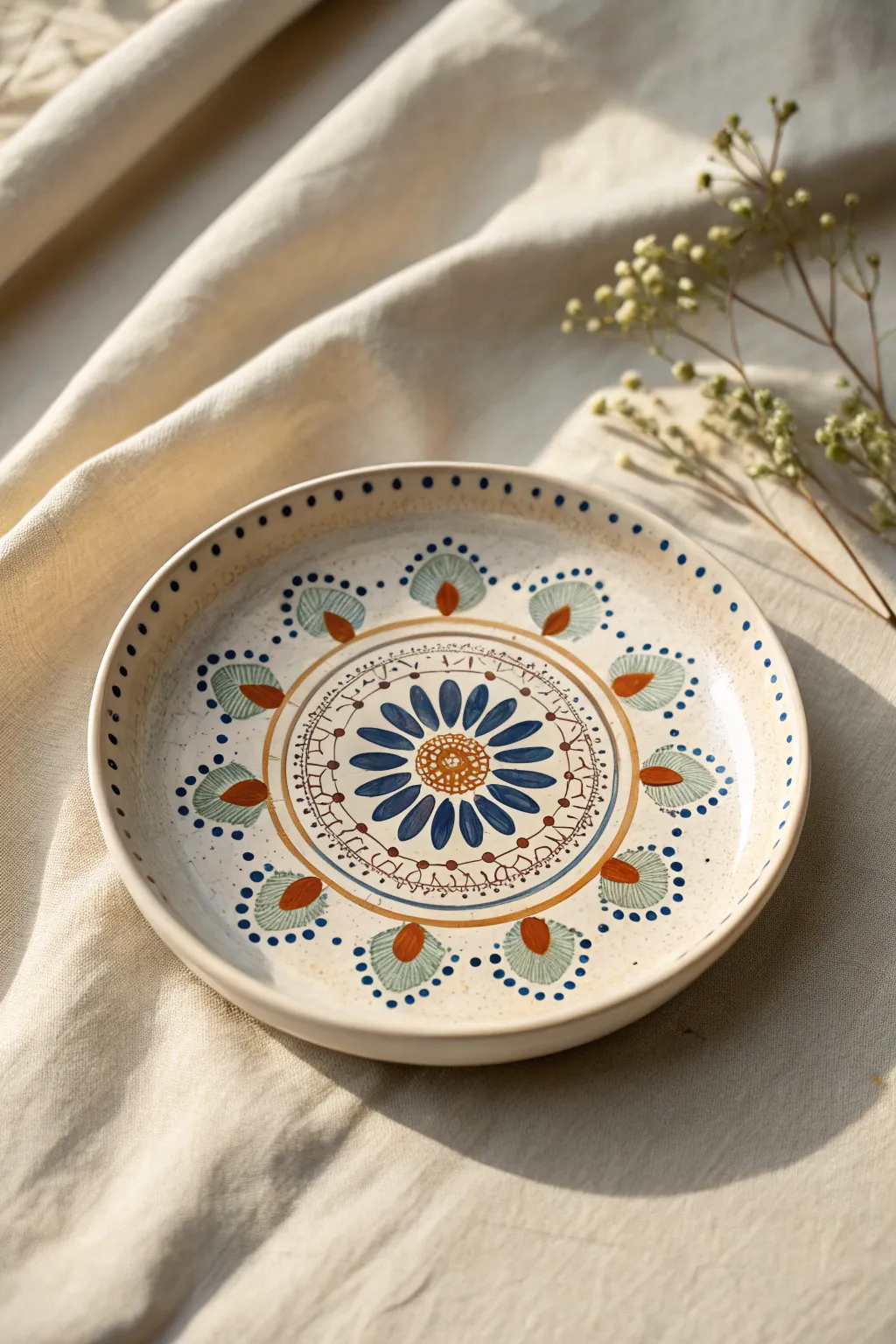
Bring warmth and intricate detail to plain ceramics with this folksy, mandala-inspired design. The pattern radiates outward from a central floral burst, combining precise linework with soft, earthy petals for a piece that feels both handcrafted and elegant.
Step-by-Step Tutorial
Materials
- Round bisque clay plate or ceramic bowl
- Acrylic paints (Dark Blue, Terracotta/Burnt Orange, White/Cream, Black)
- Fine tip detail brushes (sizes 0 and 00)
- Small round brush (size 2)
- Dotting tools or toothpicks
- Compass or round objects for tracing
- Pencil
- Clear acrylic sealant (matte or glossy)
Step 1: Planning and Base
-
Surface prep:
Begin with a clean, dry bisque plate. If using a raw terracotta saucer, apply a base coat of watered-down cream acrylic to create that antique, glazed look shown in the image. Let it dry completely. -
Marking the center:
Find the exact center of your plate. Using a compass or by lightly tracing circular objects, draw four faint concentric circles: a small inner hub, a slightly larger circle for the flower tips, a mid-ring for the secondary border, and a wider ring for the outer petals. -
Drafting the flower:
In the innermost circle, lightly sketch 12-14 elongated teardrop shapes radiating outward. This will guide your main central flower painting.
Step 2: The Central Medallion
-
Painting the flower:
Load your size 2 brush with dark blue paint. Fill in the teardrop petals you sketched, ensuring the pointed ends aim toward the center but don’t quite touch. -
The honeycomb center:
Mix a small amount of terracotta with a dot of yellow or cream to brighten it. Paint the very center circle solid. Once dry, use your finest brush (00) and thinned white paint to create the tiny, intricate honeycomb grid pattern on top of the orange center. -
Adding definition lines:
Using a very steady hand or a fine liner brush with diluted black or dark brown paint, draw a thin ring connecting the outer tips of your blue petals. Draw a second, slightly wider ring about 1cm further out. -
Creating the latticework:
Between these two dark rings, paint a delicate zigzag or cross-hatch pattern using ultra-fine lines. This mimics the woven look seen in the reference.
Uneven Circles?
If your concentric circles look wobbly, use a paper plate or bowl as a tracing template. It’s much easier than freehanding and ensures perfect symmetry for the mandala structure.
Step 3: Outer Rings and Details
-
Painting the outer border line:
Paint a thicker terracotta ring encircling your latticework section. This adds a bold pop of warmth that defines the central medallion. -
Planning the outer leaves:
Mark out even spacing for the large outer elements. You want about 10-12 large fan shapes around the perimeter. -
Painting the fans:
Mix a very pale sage or diluted blue-grey. Paint the large ‘fan’ or ‘shell’ shapes. These should be wider at the outer edge and taper slightly inward. -
Adding the leaf centers:
Once the pale fans are dry, paint a bold terracotta teardrop inside each one. The contrast between the pale background and the dark orange center is key to this look. -
Detailing the fans:
Using your size 0 brush with dark blue paint, add tiny radiating lines inside the pale fan shape, extending from the orange center outward like eyelashes.
Level Up: Texture
For the center honeycomb or outer dots, try using ‘puff paint’ or dimensional fabric paint. This will give physically raised texture to the ceramic surface.
Step 4: Final Dots and Accents
-
Inner ring dots:
Take a dotting tool or the back of a paintbrush dipped in dark blue. Place a series of evenly spaced dots around the terracotta ring you painted earlier. -
Fan contour dots:
Using the same dark blue, carefully place tiny dots creating an arch over each outer fan shape. This frames them beautifully. -
Rim detailing:
Finish the perimeter of the plate by placing dark blue dots along the very rim. I find that grouping them in small clusters or spacing them singly creates a rhythmic border. -
Cleanup and seal:
Erase any visible pencil marks once the paint is fully cured. Finally, apply a coat of clear acrylic sealant to protect your work and give it a finished sheen.
Display your beautiful new plate on a stand or hang it on the wall to add a touch of artisan charm to your room
Bold Animal Prints
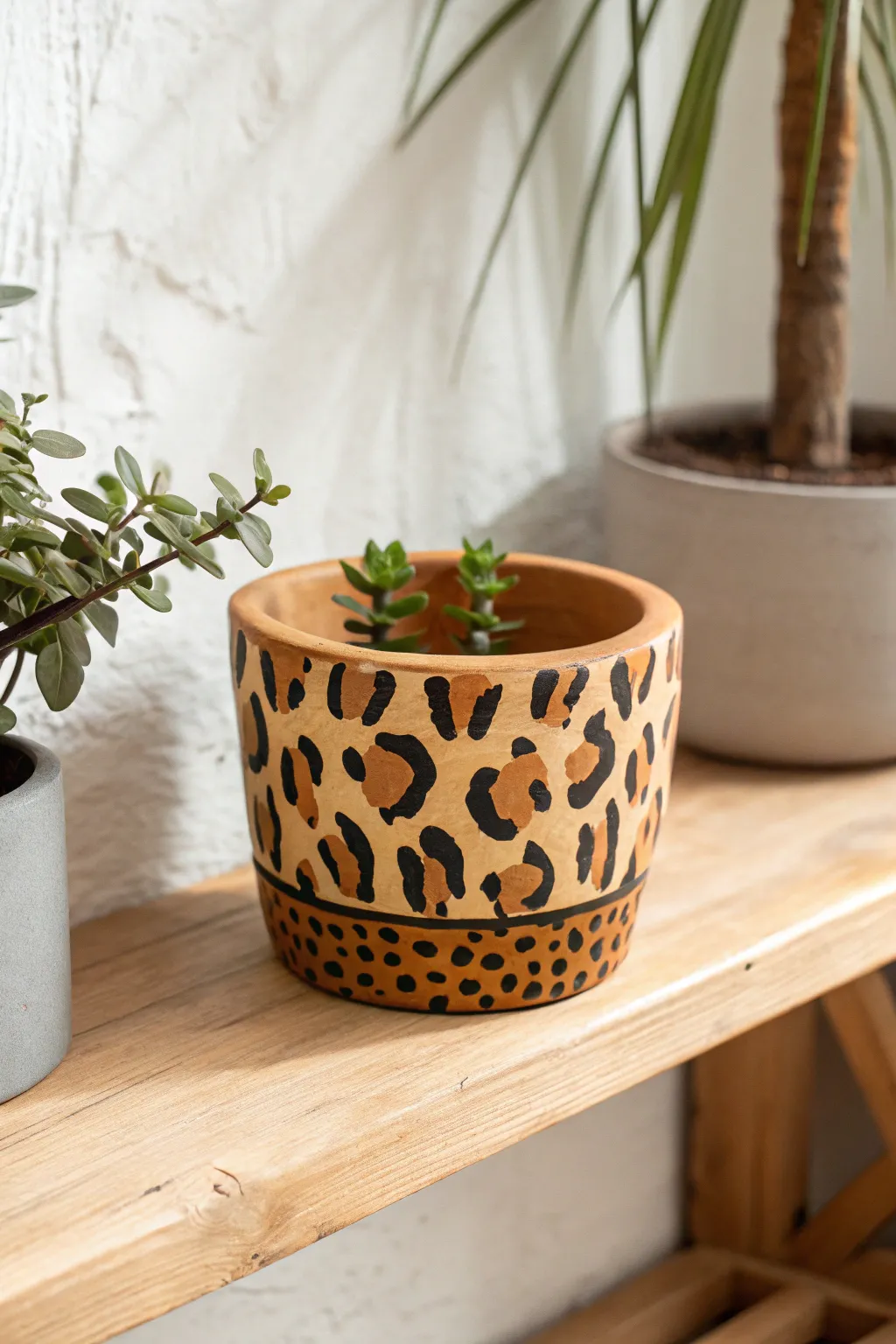
Transform a plain terracotta pot into a statement piece with this bold, two-toned leopard print design. This project combines classic animal print motifs with stylized minimalism for a chic, jungle-inspired home for your succulents.
How-To Guide
Materials
- Terracotta pot (clean and dry)
- Acrylic craft paints: Creamy beige/tan, medium caramel brown, and black
- Flat paintbrush (medium size)
- Round paintbrush (small size)
- Detail liner brush
- Matte or satin sealant spray
- Palette or paper plate
- Water cup
Step 1: Base Coat Preparation
-
Clean the surface:
Before painting, ensure your terracotta pot is free of dust and debris. If it’s an old pot, scrub it well and let it dry completely to ensure the paint adheres properly. -
Paint the background:
Using your medium flat brush, apply a coat of creamy beige or tan paint to the entire exterior of the pot. Don’t forget to paint the inner rim down to the soil line for a polished look. -
Let it dry and repeat:
Terracotta is porous and soaks up paint quickly. Once the first layer is dry to the touch, apply a second coat to get a solid, opaque background color.
Step 2: Creating the Leopard Spots
-
Paint the inner spots:
Switch to your medium caramel brown paint. Using a small round brush, dab irregular, organic shapes randomly around the top three-quarters of the pot. -
Vary the shapes:
Keep these brown blobs loose and unperfect—some can be oval, some round, and others slightly triangular. Leave plenty of beige background space between them. -
Outline the spots:
Once the brown spots are dry, take your small round brush loaded with black paint. Paint broken outlines around the brown shapes. -
Create the rosette shape:
Instead of circling the brown spot completely, paint two or three separate C-shaped brackets or parenthesis marks around the edges. This creates that classic rosette look. -
Fill the gaps:
Look for large empty spaces between your rosettes. Fill these gaps with small, solid black markings—little dots, dashes, or irregular triangles to balance the pattern.
Spot Perfection
Don’t overthink the rosettes! Leopard spots look best when they are irregular and “messy.” Shake your hand slightly while painting the black outlines for a more organic, distinct texture.
Step 3: Adding the Lower Detail
-
Define the sections:
Decide where you want the pattern to change. About one-quarter up from the bottom, paint a continuous, horizontal black line around the circumference of the pot using a steady hand and a flat brush edge. -
Paint the lower background:
Below this black line, fill in the bottom section with the same caramel brown used for the centers of your leopard spots. Apply two coats if necessary for full coverage. -
Add the dots:
Using a small round brush or the back end of a paintbrush handle dipped in black paint, create rows of simple black dots over the caramel base. -
Stagger the pattern:
Start with a row of dots just under the black dividing line. For the next row down, offset the dots so they sit between the dots of the row above, creating a brick-lay pattern.
Uneven Lines?
If painting the horizontal dividing line freehand is difficult, wrap a detailed rubber band around the pot to guide you, or lightly sketch the line with a pencil while resting your arm on a table.
Step 4: Finishing Touches
-
Check for errors:
Rotate the pot and look for any spots you might have smudged or missed. You can touch up the beige background carefully with a small brush if needed. -
Let it cure:
Allow the paint to dry completely, ideally overnight. This ensures no moisture is trapped under the sealant. -
Seal the artwork:
In a well-ventilated area, spray the entire pot with a clear matte or satin sealant. This protects your hard work from water damage when you water your plants.
Pop your favorite succulent inside and enjoy your customized bit of indoor jungle
Whimsical Character Faces

Bring a sense of calm to your morning routine with this adorable handleless mug featuring a slumbering cloud character. The speckled cream finish provides a warm, organic backdrop for the whimsical face and delicate pastel raindrops.
Step-by-Step Guide
Materials
- Bisque-fired ceramic cup (handleless)
- Speckled off-white glaze (or clear glaze with speckles)
- Underglazes: Light Blue, Pink, Black
- Small round detail brush
- Medium flat brush
- Fan brush (for glaze application)
- Pencil
- Clear transparent glaze (if base glaze isn’t self-sealing)
- Kiln access
Step 1: Planning and Base Coating
-
Surface prep:
Begin by wiping down your bisque-fired cup with a slightly damp sponge to remove any kiln dust ensuring a clean painting surface. -
Drafting the design:
Lightly sketch the outline of a fluffy, wide cloud shape near the bottom third of the cup using a pencil. Start the cloud relatively low to leave plenty of ‘sky’ space above. -
Adding features:
Inside the cloud outline, sketch two U-shaped curves for closed eyes, a small smile in the center, and plan two circular spots for cheeks. -
Marking raindrops:
Below the cloud, sketch two staggered rows of small teardrop shapes to represent falling rain.
Clean Lines Pro-Tip
For the crispest face details, use an underglaze applicator bottle with a fine metal tip instead of a brush. It draws like a pen!
Step 2: Painting the Character
-
Filling the cloud:
Using a medium brush and light blue underglaze, fill in the entire cloud shape. Apply thin, even strokes to avoid ridges. -
Building opacity:
Once the first blue layer is dry to the touch, apply a second and possibly third coat until the color is solid and opaque. -
Painting raindrops:
Switch to a smaller brush and fill in the teardrop shapes below the cloud with pink underglaze. I like to keep these quite faint for a delicate look. -
Adding cheeks:
Using the same pink underglaze, paint two small circles on the cloud for the rosy cheeks. -
Detailing the face:
With your finest detail brush and black underglaze, carefully trace over the sleeping eyes and the smiling mouth. -
Cleaning edges:
If any lines went astray, you can gently scratch away the excess dried underglaze with a toothpick or a clean, stiff brush.
Step 3: Glazing and Finishing
-
Wax resist application:
Carefully apply wax resist over your painted cloud, raindrops, and facial features. This prevents the outer speckles and top glaze from obscuring your artwork. -
Drying the resist:
Allow the wax resist to dry completely before moving on to the main glazing step. -
Applying speckles part 1:
If your base glaze contains speckles, skip this. If not, use a stiff brush or toothbrush with black underglaze to flick tiny splatters across the cup. -
Adding stars:
Dip the tip of a toothpick or the handle end of a brush into dark blue or black underglaze and dot random ‘stars’ around the upper part of the cup. -
Base glazing:
Apply your speckled cream or off-white glaze over the entire cup (inside and out), brushing right over the waxed areas. -
Wiping back:
Immediately use a clean, damp sponge to wipe any glaze beads off the waxed cloud design so the underglaze colors shine through clearly. -
Final check:
Check the bottom rim of the cup to ensure no glaze is on the foot, which would stick to the kiln shelf. -
Firing:
Fire the piece in the kiln according to the specific temperature requirements of your chosen clay and glaze combination.
Level Up: 3D Texture
Use slip-trailing to create the cloud shape before the first firing. This gives the cloud a raised, puffy texture you can feel.
Once fired, fill your new cup with hot cocoa and enjoy the soothing vibes
Silhouette Sunset Scene
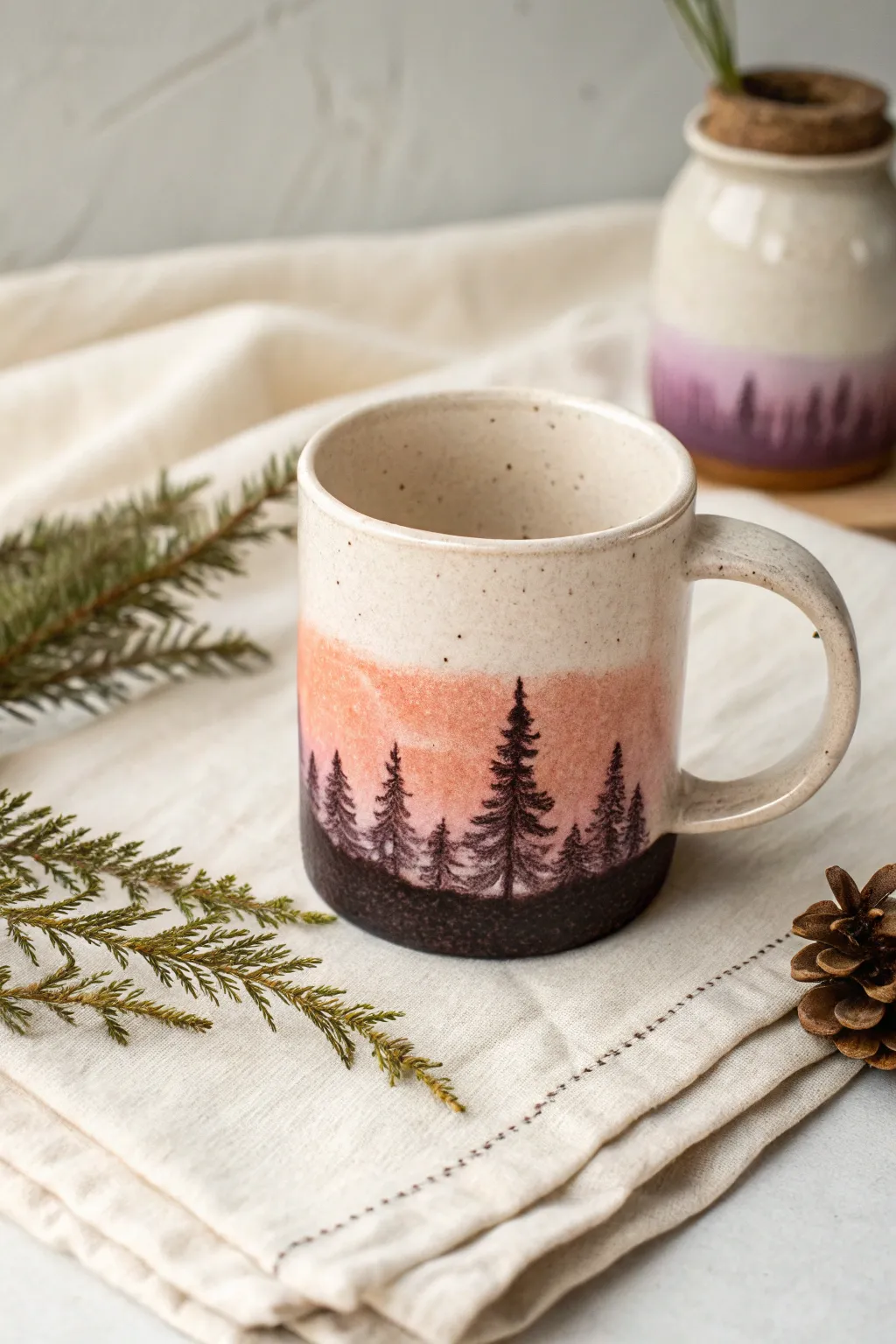
Capture the serene beauty of twilight in the woods with this ceramic painting project. By blending soft sunset hues and layering stark pine tree silhouettes, you can transform a plain bisqueware mug into a cozy work of functional art.
Step-by-Step
Materials
- Bisqueware mug (straight-sided works best)
- Underglazes: Cream/Speckled White, Soft Peach/Salmon, Dusty Mauve/Pink, Dark Brown/Black
- Fan brush or wide soft glaze brush
- Fine liner brush (size 0 or 00)
- Small round brush (size 2)
- Sponge
- Water container
- Clear dipping glaze (for finishing)
Step 1: Base Preparation
-
Clean the surface:
Begin by wiping down your bisqueware mug with a slightly damp sponge. This removes any kiln dust or oils from your hands that might resist the glaze. -
Apply the base coat:
Using a fan brush, apply three even coats of a speckled cream or white underglaze to the entire mug, including the handle and interior. Allow each coat to dry until it’s chalky to the touch before adding the next.
Gradient Secrets
If your gradient looks too stripey, slightly dilute your underglazes with water. Thinner layers are much easier to blend than thick, creamy ones.
Step 2: Creating the Sunset Gradient
-
Mix the transition color:
On your palette, mix a small amount of the cream underglaze with your soft peach color. You want a very subtle tint to start the transition just below the mug’s rim. -
Apply the peach band:
Load a clean, wide brush with the peach/salmon underglaze. Paint a horizontal band around the middle of the mug. Use long, continuous strokes to keep the layer smooth. -
Add the mauve layer:
While the peach layer is still slightly damp, introduce the dusty mauve color just below it. Painting wet-on-wet helps blend the two colors seamlessly. -
Blend the horizon:
Use a damp, clean brush to feather the edges where the peach meets the mauve, creating a soft, misty gradient rather than hard stripes. I find that lightly tapping the brush can help blur stubborn lines. -
Darken the base:
At the very bottom of the mug, apply your darkest brown or black underglaze. Blend this upward slightly into the mauve to create the deep shadows of the forest floor. -
Let it dry completely:
The background gradient needs to be bone dry before you start the delicate tree work. Give it at least 15-20 minutes.
Add a Moon
Before painting the trees, use a wax resist or a small circle of masking tape in the upper sky area to preserve a crisp white moon amidst the sunset.
Step 3: Painting the Silhouette
-
Anchor the trees:
Load your fine liner brush with the dark brown/black underglaze. Paint vertical lines of varying heights around the mug to establish where your tree trunks will stand. -
Start the tops:
Starting at the very top of a trunk line, use the tip of the brush to dab tiny, horizontal dashes. These should be very narrow at the peak. -
Widen the branches:
Working your way down the trunk, make your horizontal dabbing strokes gradually wider. Use a slightly jagged, zigzag motion to mimic natural pine needles. -
Vary texture:
Don’t make the trees perfect triangles. Leave small gaps between some branches and make some sides uneven for a more realistic, organic look. -
Fill the ground:
Once the trees are painted, switch to a small round brush. Stipple (dab repeatedly) dark underglaze along the bottom edge where the trees meet the dark base to simulate undergrowth and ground texture. -
Check for opacity:
The silhouettes need to be solid. If the peach background is showing through your trees, carefully apply a second coat of dark underglaze to the trunks and thickest branches.
Step 4: Finishing
-
Final drying:
Allow the entire design to dry completely, ideally overnight, to ensure the underglaze is stable. -
Clear glaze:
Dip the mug into a clear transparent glaze. This will seal the design and make the colors pop and become glossy after firing. -
Fire the piece:
Fire the mug in the kiln according to the clay and glaze specifications (typically cone 5 or 6 for stoneware).
Now you have a stunning, functional piece of pottery that brings the quiet of the forest to your morning coffee routine
Sgraffito Scratch-Back Details
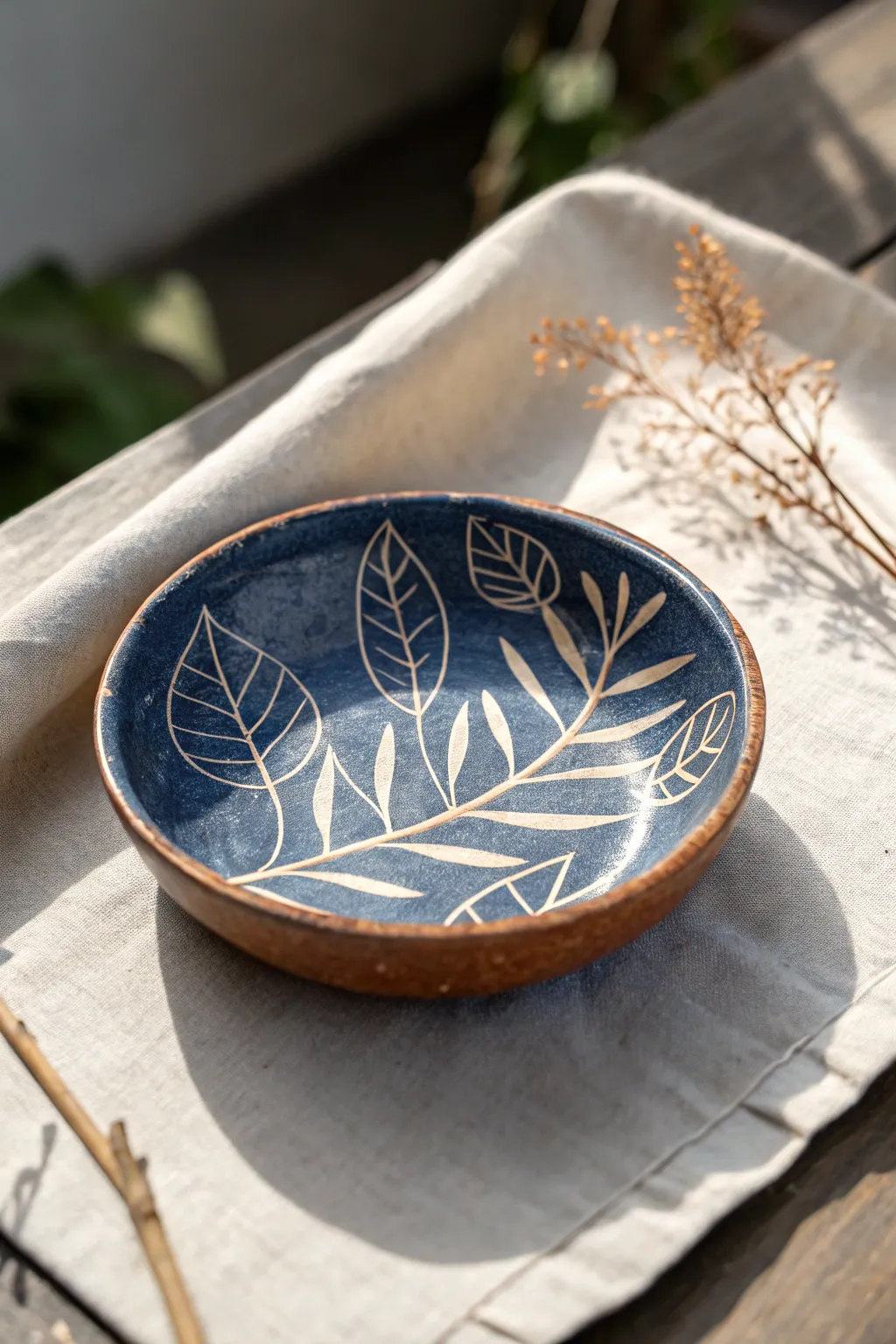
This elegant project contrasts deep indigo underglaze against warm, natural clay using the classic sgraffito technique. By carving away surface color to reveal the clay body underneath, you will create striking, crisp botanical illustrations with beautiful depth.
Detailed Instructions
Materials
- Leather-hard clay bowl (terracotta or buff stoneware)
- Deep indigo or navy blue underglaze
- Wide hake or fan brush
- Loop tool (small)
- Needle tool or sgraffito stylus
- Soft rib
- Band styling wheel (optional but helpful)
- Clear transparent glaze
- Sponge
Step 1: Preparation & Underglazing
-
Surface refinement:
Begin with your bowl in a leather-hard state. It should be firm enough to hold its shape but soft enough to carve. Use a soft rib to smooth the interior surface, removing any throwing rings or grog marks that might interrupt your design. -
Cleaning the rim:
Wipe the rim gently with a damp sponge to ensure a clean, rounded edge before applying any color. -
First coat application:
Using a wide hake or fan brush, apply a generous layer of deep indigo underglaze to the entire interior of the bowl. Stop exactly at the rim’s edge to keep the exterior natural. -
Layering for opacity:
Allow the first coat to lose its wet sheen, then apply a second coat in a cross-hatch direction (perpendicular to your first strokes). This ensures solid, opaque coverage without brushstreaks. -
Final coat:
Apply a third coat if your underglaze brand is translucent. Let the piece dry until it returns to a true leather-hard state—the surface should not be tacky, but the clay shouldn’t be bone dry.
Step 2: Carving the Design
-
Planning the stem:
Lightly sketch the main central stem using a very soft pencil or a dull tool. Draw a curved line sweeping across the bottom of the bowl, extending partially up the sides. -
Adding leaf placements:
Mark the positions for your leaves. Alternate them along the stem, varying their sizes to fit the curvature of the bowl naturally. -
Carving the main stem:
Using a small loop tool or a specialized sgraffito tool, scratch away the blue underglaze along your stem line. Apply firm, consistent pressure to reveal the cream-colored clay body beneath. -
Outlining the leaves:
Switch to a finer point tool, like a needle tool or fine stylus. Carve the outline of each leaf shape. Keep your lines confident and fluid; hesitation causes jittery marks. -
Creating the midribs:
Draw a central vein (midrib) down the center of each leaf outline, connecting it back to the main stem. -
Adding veins:
Carve delicate, angled veins branching off the midribs. I find it easiest to pull the tool from the center outward toward the leaf edge for a tapered look. -
Thickening specific lines:
Go back over the main stem and the outlines of the larger leaves to slightly thicken those lines. This variation in line weight adds visual interest and prevents the design from looking flat.
Clean Lines Pro-Tip
Work from the center of the bowl outward towards the rim. This prevents your hand from resting on and smudging the areas you’ve already carved.
Step 3: Finishing Touches
-
Cleanup:
Use a soft, dry brush to gently sweep away the clay crumbs (burrs) created by carving. Do not wipe with a sponge, or you will smear blue pigment into your crisp white lines. -
Rim check:
If any blue underglaze accidentally got onto the rim during handling, gently scrape it away with a fettling knife for a crisp border. -
Bisque firing:
Allow the bowl to dry completely to bone dry, then bisque fire it according to your clay body’s specifications. -
Glazing:
Dip or brush the interior with a clear gloss or satin transparent glaze to seal the surface and make the blue pop. You can leave the exterior unglazed for textural contrast or glaze it clear as well. -
Final firing:
Fire the piece a second time to the maturation temperature of your glaze and clay.
Flaking Concerns?
If the underglaze chips off instead of shaving smoothly, your clay is too dry. Mist it lightly with water and cover with plastic for an hour before trying again.
Once fired, the contrast between the dark interior and the bright carved lines will make this a stunning centerpiece for any table
Galaxy Night Sky Speckles
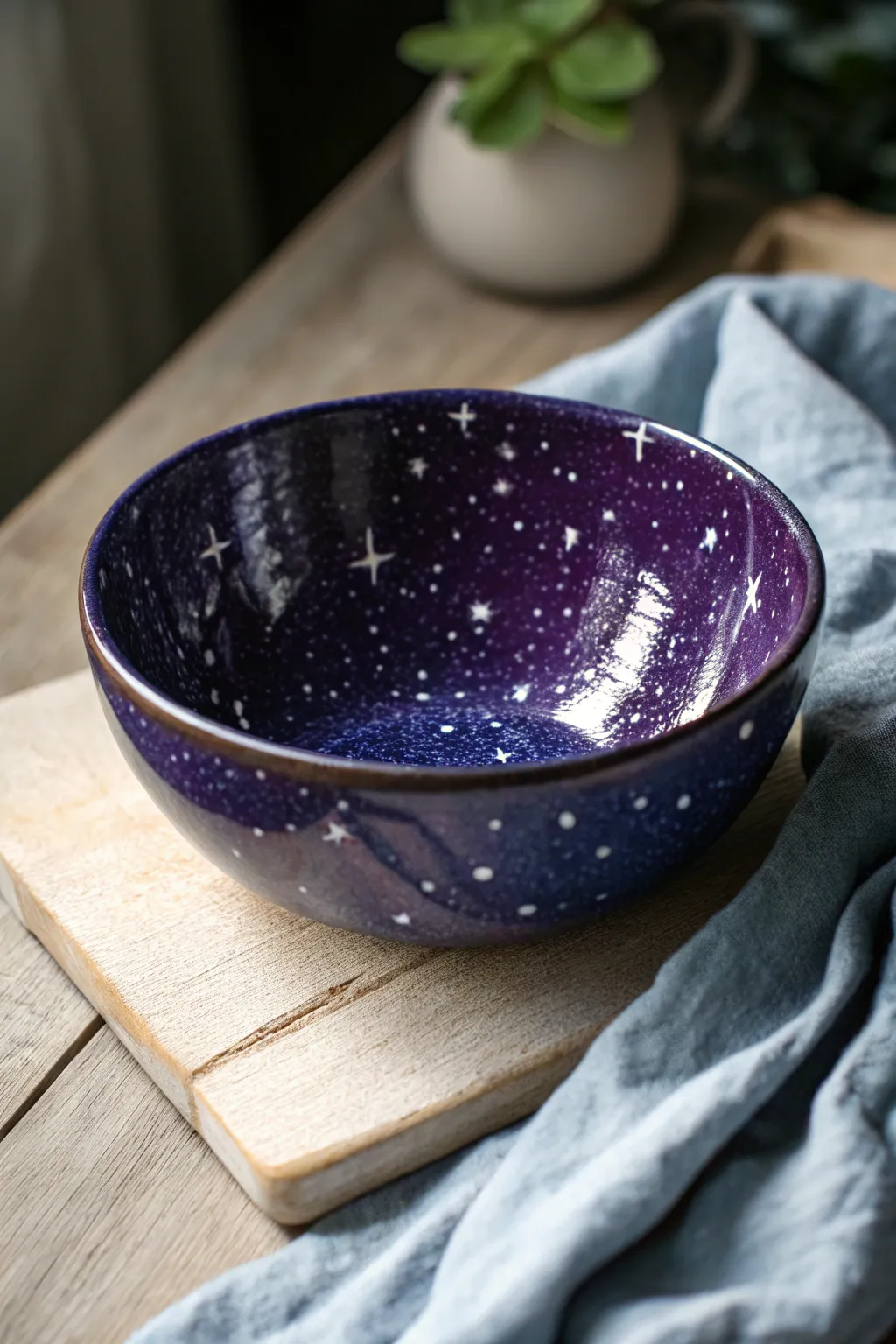
Transform a plain clay bowl into a window to the cosmos with this stunning galaxy-inspired design. Deep indigo glazes meet splatter techniques to create a mesmerizing, starry finish that feels both magical and modern.
How-To Guide
Materials
- Bisque-fired ceramic bowl (or high-quality air-dry clay bowl)
- Deep violet or indigo ceramic glaze (or acrylic paint)
- Black glaze or paint for shading
- White underglaze or high-flow white acrylic paint
- Clear high-gloss glaze or sealant
- Wide flat brush for base coats
- Old toothbrush or stiff fan brush for splatter
- Fine liner brush (size 0 or 00)
- Small sponge
- Palette or mixing tray
- Water cup and paper towels
Step 1: Setting the Atmosphere
-
Clean surface:
Begin by wiping down your bisque bowl with a slightly damp sponge to remove any kiln dust or oils that might resist the paint. -
Base application:
Load your wide flat brush with the deep violet or indigo color. Apply a smooth, even coat over the entire interior and exterior of the bowl. -
Second coat:
Once the first layer is dry to the touch, apply a second coat to ensure rich opacity. You want the deep purple to be solid and dark, resembling the night sky. -
Deepening the void:
While the purple is still slightly wet, I like to mix a tiny drop of black into the indigo on my palette. Dab this darker shade into the bottom center of the bowl and blend outwards to create depth. -
Rim definition:
Use a small brush to carefully paint the rim. You can either continue the indigo or mix a slightly darker brownish-black tone to frame the artwork, as seen in the reference.
Fixing Big Splatters
Accidentally flicked a giant blob of white? Don’t panic. Quickly dab it up with a corner of a paper towel, then paint over the spot with your base purple color.
Step 2: Creating the Galaxy
-
Prep for splatter:
Dilute a small amount of white paint or underglaze with water until it reaches an ink-like consistency. It needs to flow easily from bristles. -
Testing technique:
Before hitting the bowl, test your splatter on a piece of paper. The goal is fine mist, not giant globs. -
The starfield:
Dip an old toothbrush into the thinned white paint.Point the bristles toward the bowl’s interior and run your thumb across them to flick a spray of tiny white dots across the purple surface. -
Varying density:
Concentrate some splatters in specific areas to mimic the Milky Way, leaving other areas darker for contrast. -
Exterior stars:
Don’t forget the outside of the bowl. Repeat the splatter process on the exterior, turning the bowl to catch all angles. -
Drying time:
Allow the splatter layer to dry completely before moving on to detail work to avoid smudging your stars.
Step 3: Celestial Details & Finishing
-
Painting large stars:
Take your fine liner brush and dip it into undiluted white. Paint small crosses or four-pointed stars randomly among the mist. -
Adding variation:
Vary the size of your hand-painted stars. Some should be tiny pinpricks, while others should have slightly elongated points to look like they are twinkling. -
Highlighting:
Add a few slightly larger round dots near the cross-stars to represent brighter planets or stars. -
Clay rim clean-up:
If you are leaving the very bottom foot of the bowl unpainted for a raw clay look, wipe away any accidental drips with a clean, damp sponge. -
Clear coat application:
If using acrylics on air-dry clay, apply two to three coats of high-gloss varnish. If using ceramic glazes, dip or brush on a clear transparent glaze. -
Final cure:
Let the piece dry or fire it in the kiln according to your specific clay instructions. The glossy finish will make the white stars pop against the dark purple.
Level Up: Metallic Magic
Mix a tiny amount of gold or silver mica powder into your clear coat or use a metallic overglaze for the rim to give the piece an elegant, gilded edge.
Now you have a piece of the universe right in your hands to hold your favorite trinkets or snacks