
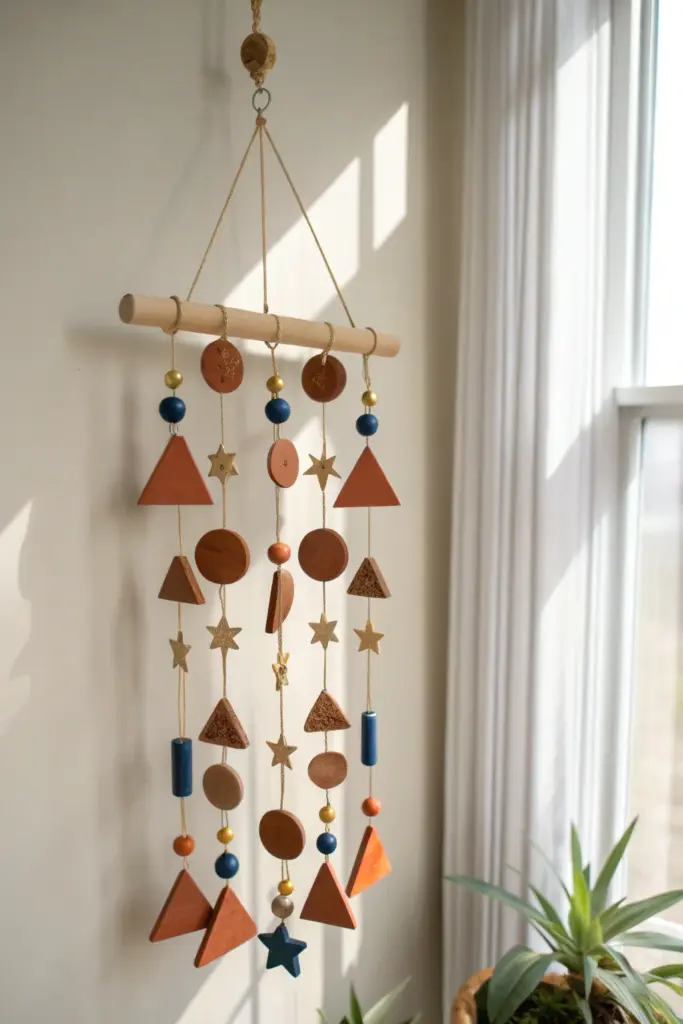
Whenever I’m stuck, I grab a lump of air-dry clay or polymer clay and let small, colorful ideas lead the way. Here are my favorite creative clay art projects—starting with the classics and ending with the extra-fun, slightly unexpected ones.
Colorful Pinch-Pot Trinket Dishes
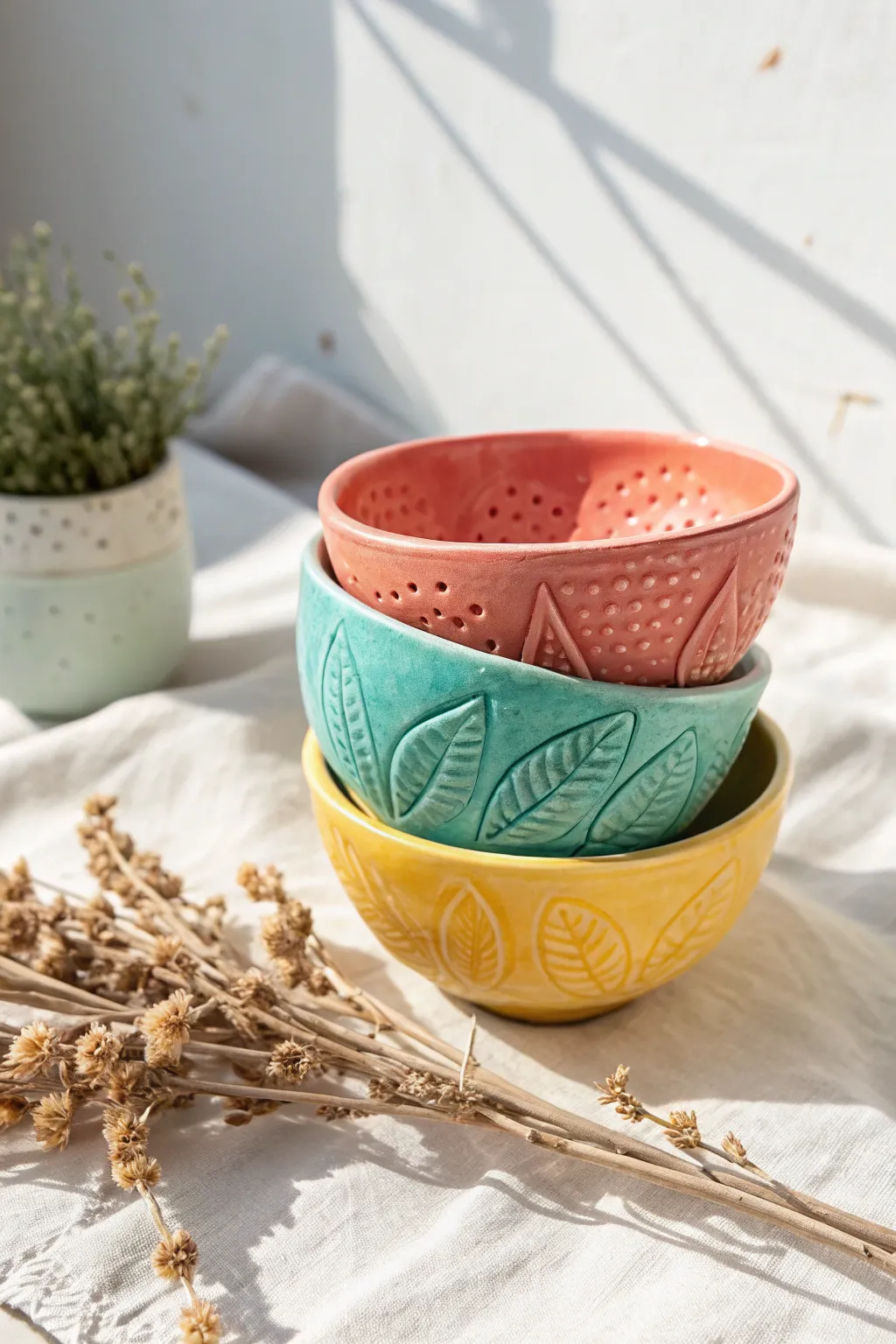
These charming, nesting trinket dishes showcase organic textures and vibrant glazes, perfect for holding jewelry or small treasures. The technique uses simple pinch-pot construction elevated by carved leaf motifs and indented patterns that catch the glaze beautifully.
Detailed Instructions
Materials
- White earthenware or stoneware clay
- Pottery sponge
- Modeling tool (curved wooden or plastic rib)
- Needle tool or scoring tool
- Loop carving tool (small U-shape)
- Hole punch tool or small drill bit (optional for dot texture)
- Underglazes: Coral Pink, Teal/Turquoise, Mustard Yellow
- Clear transparent glaze
- Kiln (or air-dry clay + acrylics + varnish for a decorative-only version)
- Flat work surface or banding wheel
Step 1: Forming the Base Pots
-
Prepare the Clay:
Start by wedging your white clay thoroughly to remove any air bubbles. Divide the clay into three balls, making each one slightly smaller than the last to ensure they will nest comfortably once finished. -
Create the First Pinch Pot:
Take the largest ball and push your thumb firmly into the center, stopping about a half-inch from the bottom to create a thick base. -
Pinch the Walls:
Using your thumb on the inside and fingers on the outside, gently pinch and rotate the clay. Work your way from the bottom up evenly, thinning the walls until they are about a quarter-inch thick. -
Shape the Rim:
Smooth the rim with a damp sponge or a piece of chamois leather to ensure it isn’t sharp art rough. Aim for a slightly flared opening, which helps with the nesting look. -
Repeat for All Sizes:
Repeat the pinching process for the medium and small clay balls. Periodically test-stack them gently to make sure the size gradation looks pleasing and balanced. -
Smooth the Surfaces:
Use a flexible rib tool to smooth the exterior and interior surfaces, removing your fingerprints while maintaining that handmade, slightly organic roundness.
Step 2: Carving & Texturing
-
Initial Drying:
Let the bowls dry to a ‘leather hard’ state. They should be firm enough to hold their shape without deforming when handled, but still cool to the touch and carveable. -
Sketch the Leaves:
Using a needle tool, very lightly sketch the outline of large leaves wrapping around the exterior of the medium and large bowls. I like to vary the angles so the movement feels natural. -
Carve the Veins:
Take your small loop tool and carefully carve out the leaf shapes. Remove the negative space or simply outline the leaf deeply, then use the needle tool to draw the central vein and side veins inside each leaf. -
Add Dotted Texture:
For the smallest bowl (or inside the carved leaves as shown in the top pink bowl), create a texture of small indentations. Press the blunt end of a small paintbrush or a dedicated dotting tool into the clay repeatedly. -
Refine the Carvings:
Once the carving is done, run a finger or a slightly damp brush over the raised edges to soften any sharp clay burs or crumbs left behind by the loop tool. -
Bisque Fire:
Allow the bowls to dry completely (bone dry). Fire them in the kiln to cone 04 (or according to your clay body’s instructions) for the bisque firing.
Uneven Walls?
If one side of your pinch pot feels thicker, gently pinch that area while supporting the opposite side. Don’t overwork it, or the clay might become fatigued and crack.
Step 3: Glazing & Finishing
-
Wipe Down:
After the bowls come out of the kiln, wipe them with a damp sponge to remove any kiln dust that might prevent the glaze from adhering properly. -
Apply First Underglaze:
Paint the largest bowl with the mustard yellow underglaze. Apply 2-3 coats for full opacity, letting each coat dry briefly in between. -
Glaze Remaining Bowls:
Apply turquoise underglaze to the medium bowl and coral pink to the smallest bowl. Be sure to work the glaze into the carved veins and dotted indentations. -
Sponge Back (Optional):
For a rustic look that highlights the texture, you can gently wipe a damp sponge over the raised areas to reveal a bit of the white clay underneath, leaving the color deepest in the carved recesses. -
Clear Glaze Coat:
Once the underglaze is dry, dip or brush a clear transparent glaze over the entire piece to make it food-safe and shiny. -
Final Firing:
Load the kiln for the glaze firing (usually cone 05 or 06 depending on your materials). Ensure the bowls aren’t touching each other during this firing.
Try Wax Resist
Brush liquid wax over your carved leaf designs before glazing. The glaze will resist the waxed areas, leaving the raw clay texture exposed for a beautiful matte contrast.
Stack your finished set near a sunny window to let those glaze textures really shine.

Flower-Shaped Clay Coasters
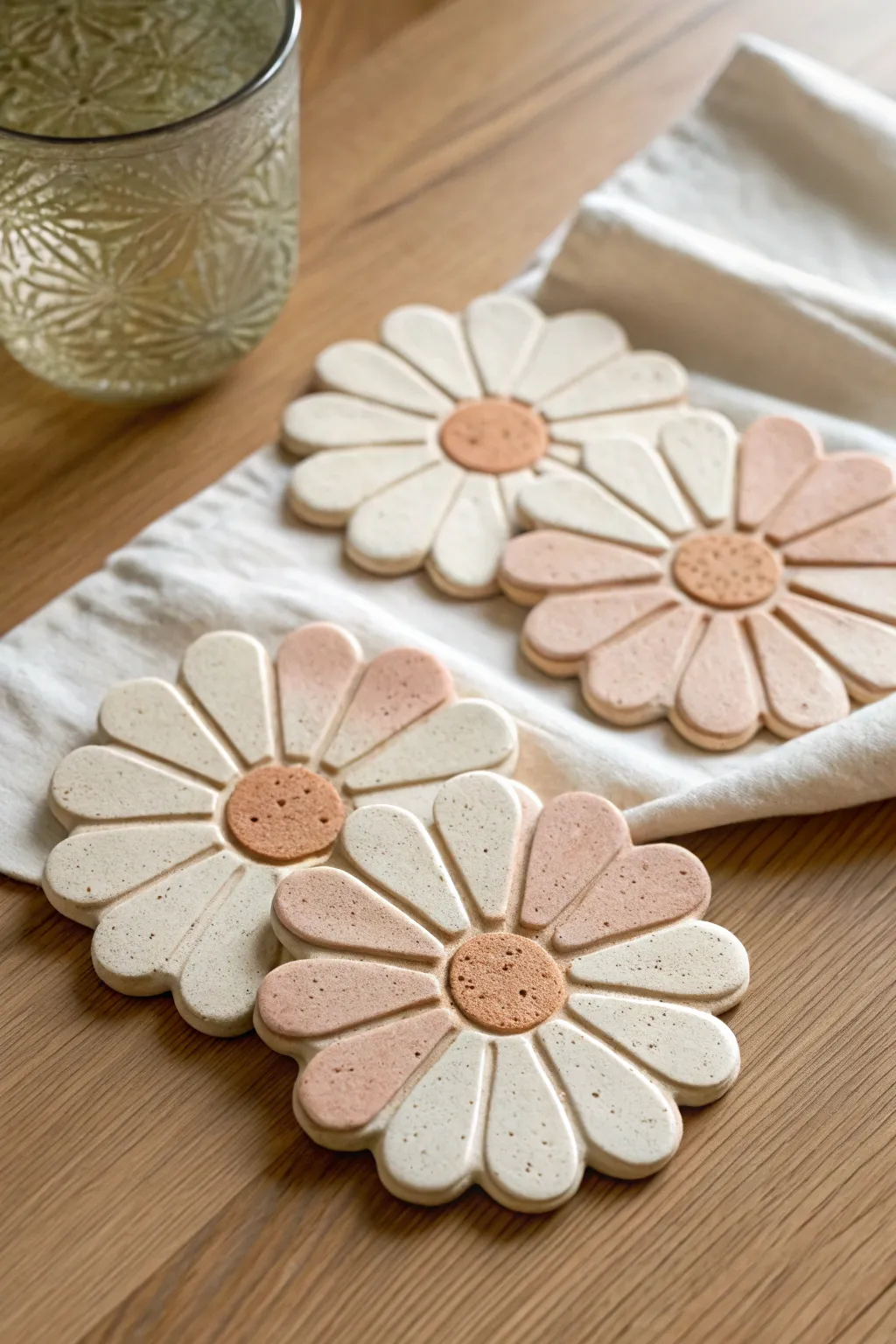
Bring the blooming freshness of springtime to your coffee table with these charming flower-shaped coasters. Featuring a delightful speckled stoneware look and soft blush accents, they offer a functional piece of art that protects surfaces while adding aesthetic cheer.
How-To Guide
Materials
- White polymer clay or air-dry clay
- Speckled clay (or black pepper/dried coffee grounds to mix in)
- Parchment paper or silicone mat
- Rolling pin
- Cookie cutter (round, approx. 3.5 inches)
- Small round cutter (approx. 1 inch for center)
- Clay carving tools or a butter knife
- Acrylic paints (Soft pink, terracotta/orange, cream)
- Paintbrushes (fine and medium)
- Texture sponge or toothbrush
- Gloss or matte varnish (waterproof sealant)
- Sandpaper (fine grit)
Step 1: Preparing the Clay Base
-
Mix the Speckles:
If you aren’t using pre-speckled clay, knead a small pinch of cracked black pepper or dried coffee grounds into your white clay. Work it thoroughly until the speckles are evenly distributed for that faux-stone effect. -
Roll the Slab:
Place your clay on a sheet of parchment paper. Roll it out into an even slab, aiming for a consistent thickness of about 1/4 inch to ensure the coasters are durable. -
Cut the Base Shape:
Use your large round cookie cutter to stamp out a perfect circle for each coaster. If you don’t have a cutter, trace around a mug and cut carefully with a craft knife.
Step 2: Sculpting the Flower
-
Refine the Edges:
Dip your finger in a little water (for air-dry clay) or baby oil (for polymer) and smooth the cut edges of your circle to remove any sharpness. -
Mark the Center:
Lightly press the smaller round cutter or a bottle cap into the exact center of the clay circle. Do not cut all the way through; just make an indentation to guide your petal placement. -
Divide the Petals:
Visualize the circle like a clock face. Make light guide marks at 12, 3, 6, and 9 o’clock. Then, mark two evenly spaced points between each of those main lines. -
Cut Petal Grooves:
Using your knife tool, cut straight lines from the outer edge towards the center circle, stopping precisely at the indented ring you made earlier. -
Shape the Petal Tips:
This is the crucial shaping step. Using your fingers or a modeling tool, gently round off the corners of each wedge to create soft, curved petal tips rather than sharp square edges. -
Add Dimension:
Press a thin tool or the back of a knife gently down the center of each petal to create a subtle vein, if desired, or simply leave them smooth for a modern look as shown in the photo.
Natural Stone Look
For ultra-realism, mix different sizes of dried tea leaves or sand into the clay. This varies the speckle size better than just using pepper.
Step 3: Adding Texture and Detail
-
Create the Center:
Roll a small ball of clay, flatten it into a disc, and press it firmly into the center indentation. This adds a slight 3D relief to the flower heart. -
Texturize the Center:
Take a clean toothbrush or a texture tool and tap it repeatedly onto the center disc to create a pitted, pollen-like texture. -
Final Smooth:
Give the entire piece one last look. Smooth out any fingerprints or rough tool marks with a damp finger or soft brush. -
Drying or Baking:
Follow the instructions for your specific clay. Bake polymer clay according to package temperature, or let air-dry clay sit for 24-48 hours until fully hard and white.
Preventing warping
If air-drying, flip the coasters over every 6-8 hours. Drying evenly on both sides prevents the edges from curling upward like a bowl.
Step 4: Painting and Finishing
-
Sanding:
Once fully cured, use fine-grit sandpaper to gently buff the edges and surface for a professional, smooth finish. -
Mixing Colors:
Prepare a watered-down wash of terracotta paint for the center and soft blush pink for the petals. I find a wash looks more natural than opaque paint for this style. -
Painting the Blush:
Apply the blush paint to half of the petals on each flower, or alternate petals for variety. Leave some petals the natural speckled clay color. -
Painting the Center:
Dab the terracotta paint onto the textured center. Wipe off the excess almost immediately with a paper towel to let the color settle into the texture pits while highlighting the relief. -
Sealing:
Since these are coasters, sealing is mandatory. Apply 2-3 layers of a waterproof varnish (polyurethane or resin), allowing proper drying time between coats.
Place a glass of lemonade on your new creation and enjoy the summery vibe year-round

Easy Coil Bowl With a Textured Rim
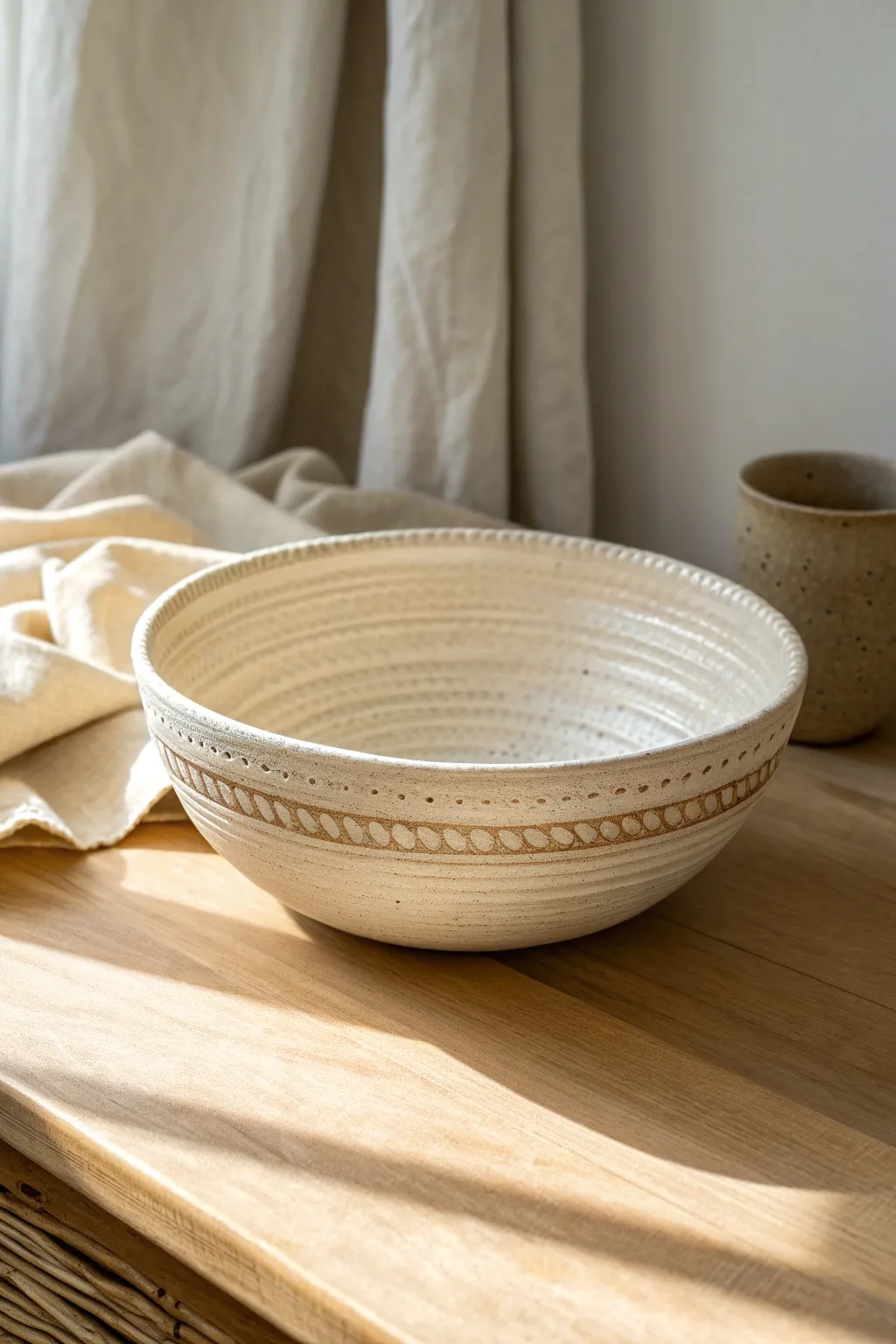
Learn to craft this stunningly simple cream-colored bowl, characterized by its subtle coil texture and a delicate, stamped rim pattern. The finished piece radiates a rustic, handmade warmth perfect for holding fruit or simply resting on a shelf.
Step-by-Step Tutorial
Materials
- Light-colored stoneware clay (smooth or with fine grog)
- Clay scoring tool or fork
- Slip (clay mixed with water)
- Wooden modeling tool
- Flat, smooth work surface or banding wheel
- Small circular texture tool (like a straw or stamp)
- Small rectangular or oval texture stamp
- Rolling pin
- Sponge
- Transparent matte or satin glaze
- Carving tool (optional)
Step 1: Forming the Base
-
Prepare the Base Slab:
Begin by rolling out a slab of clay to about 1/4 inch thickness. Use a circular template or a small bowl to cut out a perfect circle, roughly 4-5 inches in diameter, to serve as the floor of your bowl. -
Refine the Edge:
Smooth the cut edges of your base circle with a damp sponge or your finger to remove any sharp burrs left from cutting. -
Create Your First Coils:
Roll out several long, even snakes of clay on your table. Aim for a thickness similar to a pencil or your pinky finger. Keeping them consistent will maximize the evenness of your bowl walls.
Uneven Walls?
If one side starts getting higher than the other, simply pinch the lower section to thin and raise it slightly, or tap the high side down gently.
Step 2: Building the Walls
-
Score and Slip:
Take your scoring tool and roughen the outer edge of the base circle. Apply a generous dab of slip to the roughened area to act as glue. -
Attach the First Coil:
Place your first coil directly onto the scored edge of the base. Gently press it down. -
Blend the Seams:
Using your thumb or a wooden tool, smear the clay from the inside of the coil down onto the base to lock it in. I usually blend downwards on the inside for strength, while leaving the outside coils visible for that textured look shown in the photo. -
Continue Building Up:
Score the top of the previous coil, add slip, and layer the next coil on top. As you stack them, slightly overlap the coils outward to widen the bowl’s shape as it grows taller. -
Smoothing the Interior:
While keeping the exterior coil texture largely intact, use a rib tool or curved scraper on the inside of the bowl to compress the walls and create a smooth, functional inner surface. -
Refining the Exterior Profile:
Gently paddle the outside of the bowl with a wooden spoon or flat paddle to ensure the curve is continuous and not lumpy, being careful not to completely flatten those beautiful horizontal lines.
Step 3: Adding the Decorative Rim
-
Build the Final Section:
Once the bowl reaches your desired height (around 4-5 inches), add a final, slightly thicker coil for the rim. Flatten this top coil slightly with your thumb to create a band about 1/2 inch wide. -
Smooth the Rim Band:
Run a damp sponge around this flattened band to ensure it is sleek and receptive to texture. This band will host the primary decorative pattern. -
Stamp the Main Pattern:
Using a small oval or rectangular stamp tool, press a repeating pattern horizontally around the center of this flattened band. Press firmly enough to create depth but support the wall from the inside with your other hand to prevent warping. -
Add Dot Accents:
Use a small, round tool—like the end of a paintbrush or a coffee stirrer—to press tiny dots just above the main stamped band. This creates that delicate dotted border seen near the lip. -
Final Cleanup:
Look over the piece for any sharp crumbs of clay created by the stamping and brush them away with a soft, dry brush.
Textural Depth
Rub iron oxide wash into the stamped rim before glazing. Wipe it off the surface so it stays only in the crevices for a rich, antique contrast.
Step 4: Firing and Glazing
-
Bisque Fire:
Allow the bowl to dry slowly under plastic for a few days to prevent cracking, then bisque fire it in a kiln according to your clay body’s specifications. -
Apply Glaze:
Dip or brush a transparent cream or off-white glaze over the piece. A glaze that breaks over texture is ideal here—it will settle into the stamped recesses, highlighting the pattern with a darker tone, just like the image. -
Wipe Back (Optional):
If your glaze is thick, gently wipe the raised surfaces of the textured rim with a damp sponge. This reveals the raw clay color on the high points while leaving glaze in the crevices. -
Final Firing:
Fire the piece a second time to the glaze’s maturation temperature.
Place your finished bowl in a spot with natural light to let the shadows play across the beautiful coil ridges
Simple Slab-Built Catchall Tray
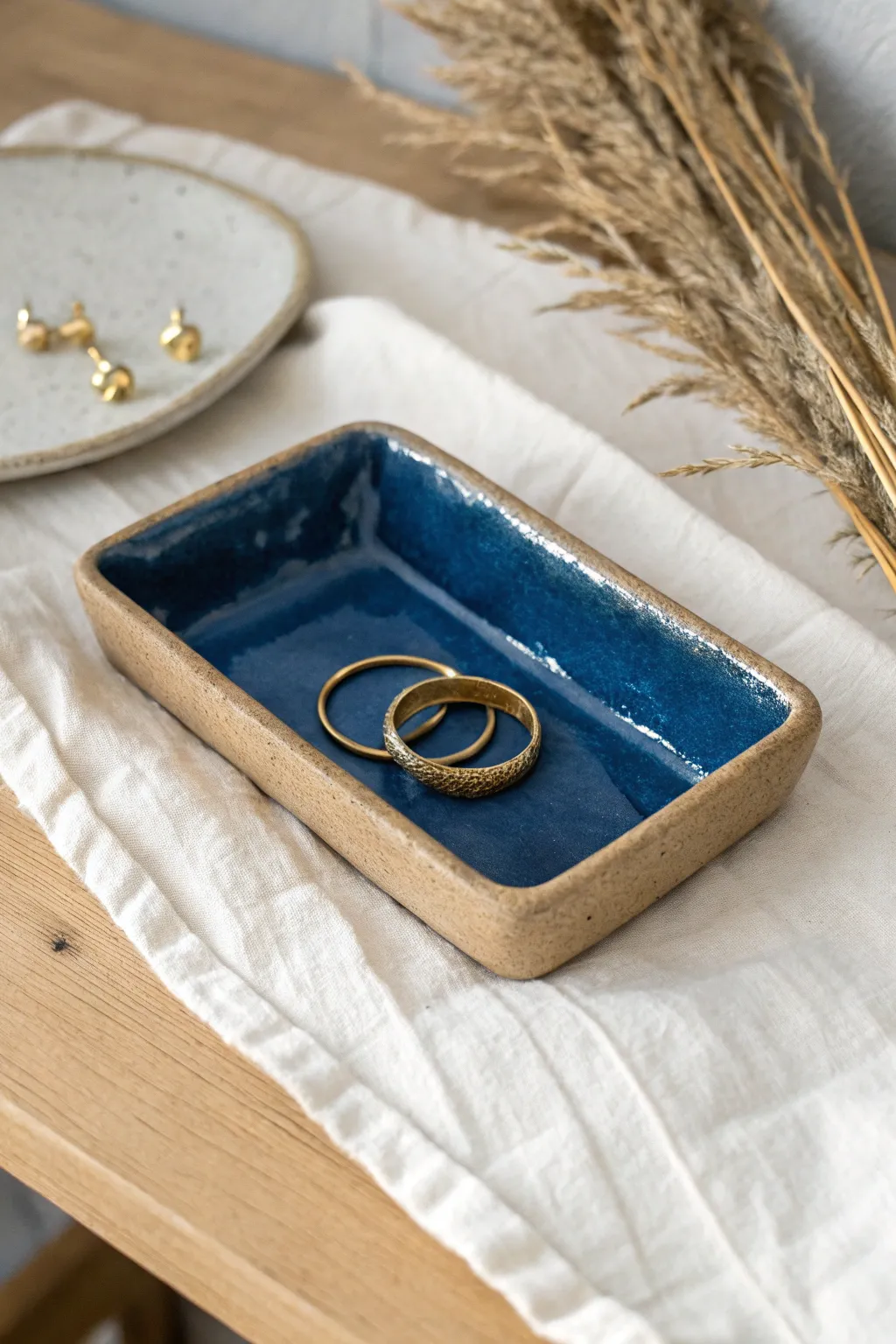
This elegant rectangular tray combines the raw, earthy texture of speckled stoneware with a stunning pool of deep blue glaze. Perfect for holding rings or keys, its slab-built construction gives it a modern, handmade feel that showcases the beautiful contrast between matte clay and glossy interior.
Step-by-Step
Materials
- Speckled stoneware clay (mid-fire)
- Rolling pin
- Two wooden guide slats (approx. 1/4 inch thick)
- Canvas or heavy cloth workspace
- Needle tool or fettling knife
- Rectangular paper template (approx. 4×6 inches)
- Scoring tool (serrated rib or fork)
- Slip (clay and water slurry)
- Sponge
- Deep blue/teal gloss glaze
- Glaze brush
Step 1: Creating the Base Slab
-
Prepare the Clay:
Begin by wedging a ball of speckled stoneware clay to remove any air bubbles and ensure an even consistency. -
Set Up Guides:
Place your canvas on a flat surface and arrange the two wooden guide slats on either side of your clay ball. These will ensure your slab is perfectly even in thickness. -
Roll the Slab:
Use the rolling pin to flatten the clay, resting the pin on the wooden slats as you roll. Continue until the pin rides smoothly on the guides. -
Smooth the Surface:
Before cutting, take a slightly damp rib tool or a smooth sponge and compress the clay surface. This removes the canvas texture and aligns the clay particles to prevent warping. -
Cut the Base:
Place your rectangular paper template onto the slab. holding it steady, trace around the edge with a needle tool or fettling knife to cut out your tray floor.
Warping Walls?
If walls sag while building, the clay is too soft. Let the slab strips dry to ‘leather hard’ for 30 minutes before attaching them to the base.
Step 2: Building the Walls
-
Cut the Wall Strips:
From the remaining slab, cut long strips that act as the walls. These should be about 3/4 inch tall to match the low profile shown in the photo. -
Score the Edges:
Rough up the outer top edge of your rectangular base and the bottom edge of your wall strips using a scoring tool or fork. -
Apply Slip:
Dab a generous amount of slip onto the scored areas. This muddy mixture acts as the glue for your clay usage. -
Attach the Walls:
Place the strips on top of the base edge, pressing down firmly to bond them. I like to overlap the corners slightly and then trim the excess for a tight fit. -
Reinforce Seams:
Use a modeling tool or your finger to smooth the clay from the wall down onto the base on the interior, and from the base up onto the wall on the exterior. -
Refine the Shape:
Once assembled, gently pinch the corners to create a subtle rounded softness rather than a sharp angle. -
Smooth the Rim:
Run a damp sponge or chamois over the top rim to round it off perfectly, ensuring it’s comfortable to touch.
Step 3: Firing and Glazing
-
Bisque Fire:
Allow the tray to dry slowly under loose plastic for a few days, then let it fully dry uncovered before bisque firing it in the kiln to cone 04. -
Wax the Exterior:
Since we want that beautiful raw clay look on the outside, carefully apply wax resist to the entire outer surface and the top rim. -
Apply Glaze:
Pour a glossy deep blue or teal glaze into the interior. Swirl it around to coat the bottom and corners evenly, then pour out the excess. -
Clean Up:
Wipe away any glaze beads that might be sitting on the waxed rim with a damp sponge to keep that line crisp. -
Glaze Fire:
Fire the piece again to the maturation temperature of your specific clay and glaze, likely cone 5 or 6.
Clean Glaze Lines
For that perfect separation between raw clay and blue glaze, clean the rim with a damp sponge immediately after pouring the glaze out.
Place your finished tray on a dresser or nightstand and enjoy the functional beauty of your handiwork

The Complete Guide to Pottery Troubleshooting
Uncover the most common ceramic mistakes—from cracking clay to failed glazes—and learn how to fix them fast.
Tiny Polymer Clay Earrings in Bold Shapes
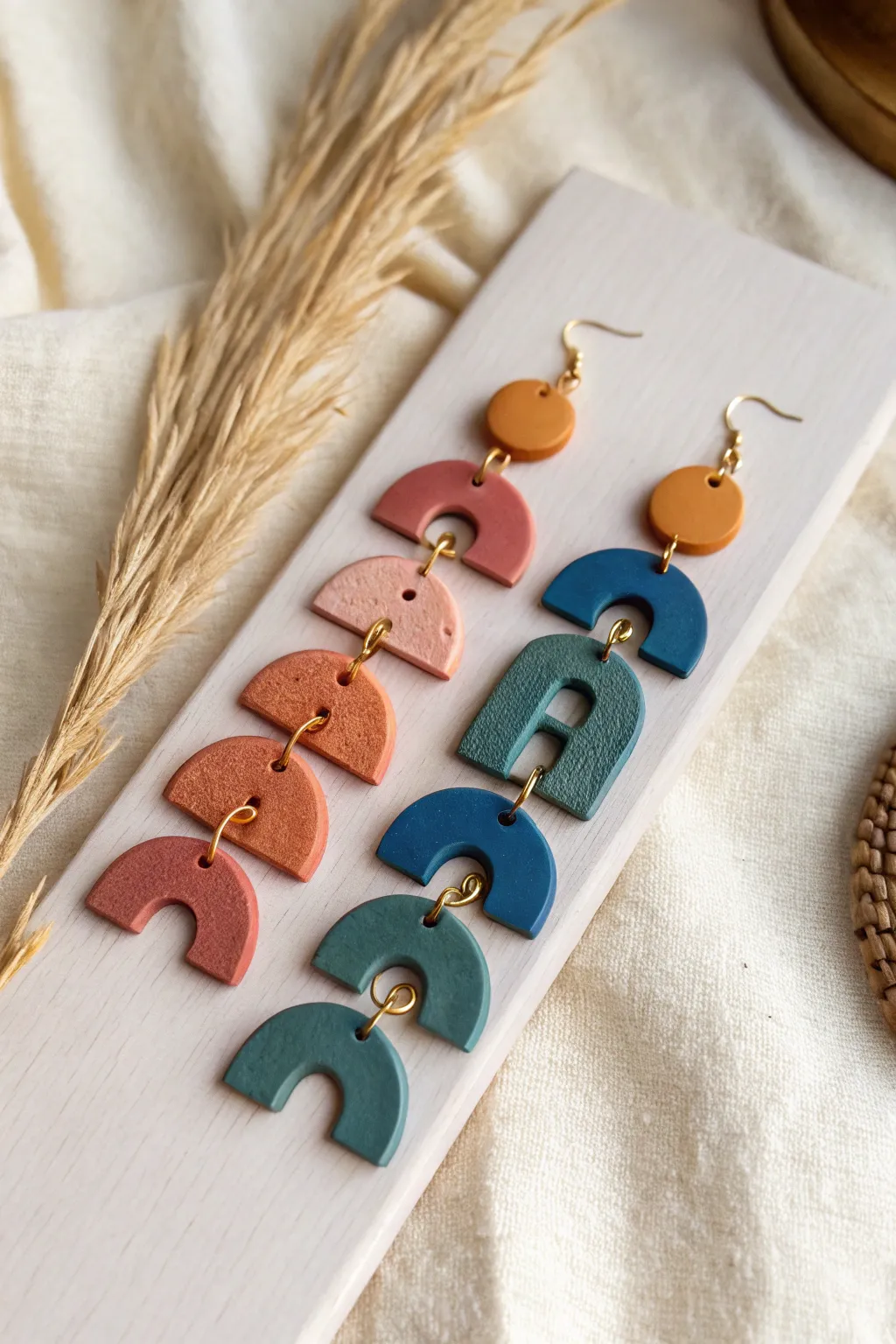
These stunningly long, multi-tiered earrings combine earthy terracotta tones with deep blues and teals in a modern arch design. The textured matte finish gives them a sophisticated, handcrafted feel perfect for casual or dressy looks.
How-To Guide
Materials
- Polymer clay in: mustard yellow, terracotta/rust, blush pink, teal green, navy blue
- Acrylic roller or pasta machine
- Arch-shaped clay cutters (3 sizes: small medium, large)
- Small circle cutter (approx. 10mm)
- Jump rings (gold, approx. 6mm and 8mm)
- Earring hooks (gold)
- Needle tool or toothpick
- Fine-grit sandpaper (optional)
- Pliers (jewelry round-nose and flat-nose)
- Baking sheet and parchment paper
- Texture sponge or sandpaper (for texturing raw clay)
Step 1: Clay Preparation & Cutting
-
Condition the Colour Palette:
Begin by conditioning each color of polymer clay separately. Knead the clay in your hands until it is soft, pliable, and warm. For the left earring, you’ll need mustard, terracotta, blush, and rust. For the right earring, prepare mustard, navy blue, teal, and a deep blue-green mix. -
Roll Out Slabs:
Roll each color into a slab of even thickness, aiming for about 3mm. A pasta machine is ideal for consistency, but an acrylic roller with depth guides works perfectly too. -
Add Texture:
Before cutting, gently press a piece of coarse sandpaper or a texture sponge onto the surface of your clay slabs. This creates that lovely organic, matte stone effect visible in the photo. -
Cut the Connector Circles:
Use your small circle cutter to punch out two mustard yellow circles. These will be the very top pieces that connect to the earring hook. -
Cut the Left Earring Components:
For the warm-toned earring, cut the following shapes: one small terracotta arch, one blush pink semicircle (cut a circle and slice it in half), one rust semicircle, another terracotta semicircle, and finally a small terracotta arch for the bottom. -
Cut the Right Earring Components:
For the cool-toned earring, cut these shapes from top to bottom: one medium navy blue arch, one teal green arch, one navy blue arch, one teal green arch, and finally a small teal arch. Refer to the image to match the graduated sizes.
Step 2: Assembly & Baking
-
Pierce Connections:
Use a needle tool to create holes for your jump rings. Be careful not to make them too close to the edge. The top circles need a hole at the top (for the hook) and bottom. Middle pieces need holes at the top and bottom center. The final bottom pieces only need a top hole. -
Smooth the Edges:
Before baking, run your finger gently around the cut edges to smooth any harsh lines or jagged bits created by the cutters. I find a little cornstarch on my finger helps prevent prints. -
Bake the Clay:
Arrange all your pieces on a parchment-lined baking sheet. Bake according to your brand of clay’s instructions—usually around 275°F (135°C) for 30-45 minutes. Tent with foil to prevent scorching. -
Cool and Sand:
Let the pieces cool completely. If any rough edges remain, lightly sand them with fine-grit sandpaper for a professional finish.
Fixing Broken Clay
If a piece snaps after baking, it was likely under-baked. For a fix, apply a tiny dab of liquid polymer clay or superglue to the break and rebake for 10 minutes.
Step 3: Final Construction
-
Open Jump Rings:
Using two pairs of pliers, twist your jump rings open laterally (side-to-side), never pulling them apart. This keeps the circle shape intact. -
Connect the Chains:
Start assembling the tiers. Connect the bottom piece to the one above it using a jump ring. Continue working your way up the chain, meticulously closing each ring securely. -
Attach the Hooks:
Finally, attach the earring hook to the top of the mustard circles using a small jump ring. -
Clean Up:
Wipe the finished earrings with a soft cloth or a tiny bit of baby oil to remove any sanding dust and bring out the color depth.
Easy Stone Texture
Don’t have a texture mat? An old toothbrush or a crumpled ball of aluminum foil rolled over the clay surface creates an amazing faux-stone texture instantly.
Wear your long, linear art pieces with pride and enjoy the creative statement they make
Charm-Style Keychains With Initials and Icons
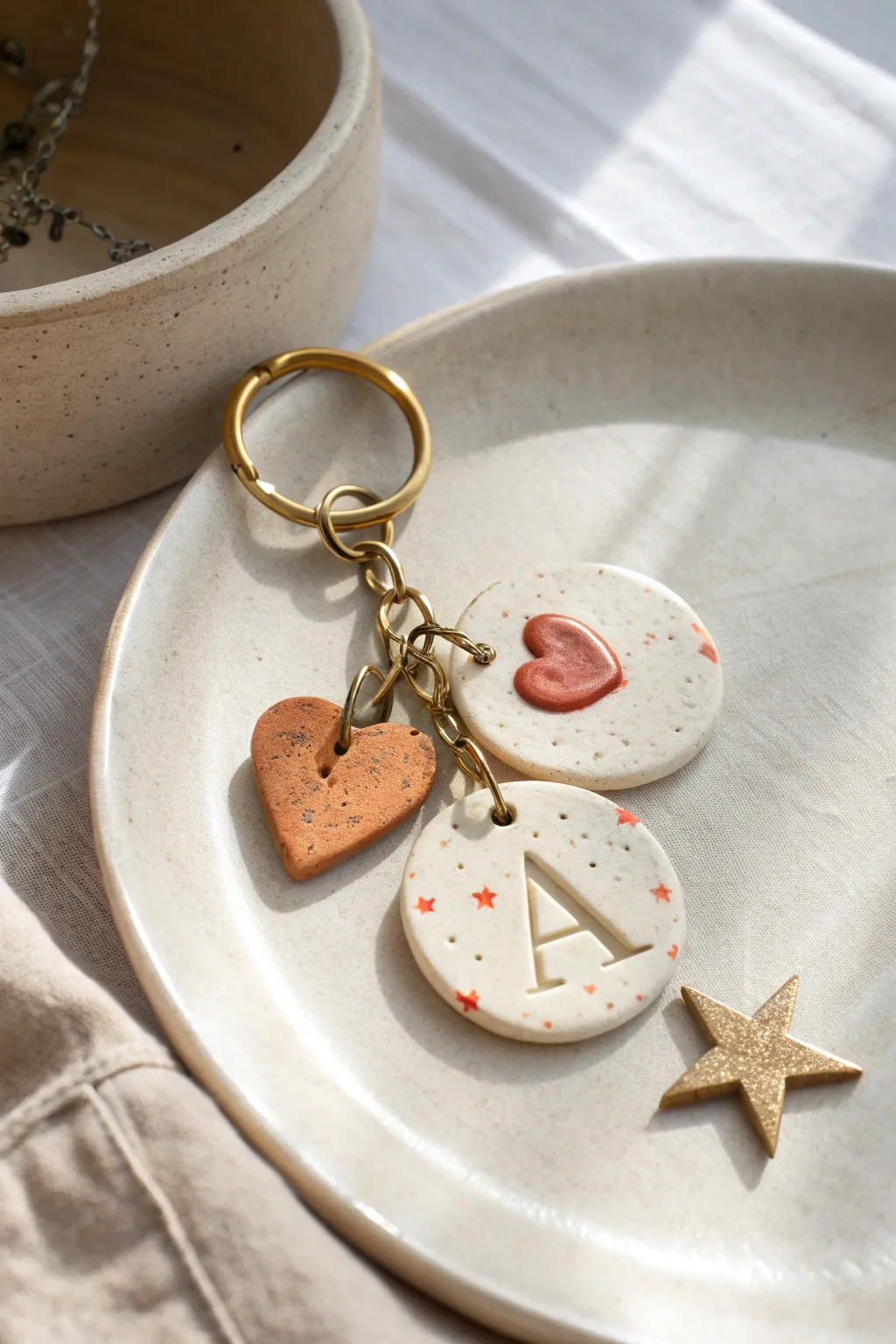
Create a personalized accessory with this charming multi-element polymer clay keychain. Featuring speckled finishes, stamped initials, and sweet heart motifs, this project combines earthy tones with gold hardware for a modern, handmade look.
Detailed Instructions
Materials
- White polymer clay (with speckles/granite effect)
- Terracotta or warm brown polymer clay
- Red-brown polymer clay for the heart icon
- Acrylic rolling pin
- Small round cutter (approx. 1.5 inch)
- Small heart cutter (approx. 1 inch)
- Letter stamp set
- Tiny star stamp or fine tip tool
- Jump rings (gold finish)
- Keyring and chain hardware (gold finish)
- Hand drill or needle tool
- Gloss glaze (optional)
- Baking sheet and parchment paper
- Sandpaper (fine grit)
Step 1: Shaping the Clay Charms
-
Condition the clay:
Start by warming up your speckled white and terracotta clays in your hands until they are soft and pliable. This conditioning prevents cracks later. -
Roll out the base:
Roll your speckled white clay into a flat slab, approximately 3-4mm thick. Aim for an even surface to ensure the charms look substantial. -
Cut the circles:
Using your small round cutter, punch out two circles from the white slab. These will become the backing for your initial and the heart icon. -
Create the terracotta heart:
Roll out a slab of the terracotta clay to a similar thickness. Use the small heart cutter to cut out a standalone heart charm. Gently smooth the edges with your finger to round them off slightly. -
Punch holes:
Using a needle tool or a very small straw, create a hole near the top of each of the three shapes. Ensure the hole is large enough for your jump rings but not so close to the edge that the clay might break.
Clean Impressions
Dust your letter stamps with cornstarch before pressing them into the clay. This prevents the clay from sticking inside the crevices of the letter.
Step 2: Adding Details & Icons
-
Make the raised heart:
Take a tiny pinch of the red-brown clay and roll it into a ball, then flatten it slightly. shape it into a small heart by hand or use a tiny cutter. -
Attach the heart:
Press this small red heart firmly onto the center of one of your white circles. You can add a drop of liquid clay or bake-and-bond if you want extra security, though firm pressure usually works well on raw clay. -
Stamp the initial:
Select the letter ‘A’ (or your chosen initial) from your stamp set. Press it firmly into the center of the second white circle to create a clean impression. -
Add star details:
Using a tiny star stamp or the tip of a detailing tool, impress small star shapes around the letter ‘A’. If you want them colored, you can gently rub a tiny amount of red acrylic paint or crushed pastel into the impressions before baking. -
Distress the terracotta heart:
To match the speckled look, you can lightly stipple the surface of the terracotta heart with an old toothbrush or add tiny black pepper flakes into the clay before baking for texture.
Glitter Variation
Instead of a metal star, create a clay star using translucent clay mixed with fine gold glitter for a custom sparkly charm.
Step 3: Baking & Assembly
-
Bake the pieces:
Arrange your clay pieces on a parchment-lined baking sheet. Bake according to your polymer clay package instructions (typically 275°F/135°C for 15-30 minutes). -
Cool and finish:
Let the pieces cool completely. If any edges are sharp, gently sand them with fine-grit sandpaper for a smooth finish. -
Seal the heart:
For a glossy finish like the one in the photo, apply a coat of gloss glaze only to the small raised red heart icon. Leave the rest of the clay matte for contrast. -
Open jump rings:
Using two pairs of jewelry pliers, twist your gold jump rings open sideways (never pull them apart outward). -
Attach to chain:
Thread a jump ring through the hole of the initial charm and attach it to the lowest link of your keychain chain. Close the ring securely. -
Attach remaining charms:
Attach the heart icon circle and the terracotta heart charm to higher links on the chain using their own jump rings, creating a staggered cluster effect. -
Add a metal star:
If you have a pre-made gold star charm, add this to the bottom of the cluster to catch the light and add an extra texture element.
Clip your new custom keychain onto your bag or keys and enjoy your handmade art every day


What Really Happens Inside the Kiln
Learn how time and temperature work together inside the kiln to transform clay into durable ceramic.
Cute Animal Figurines From Basic Shapes
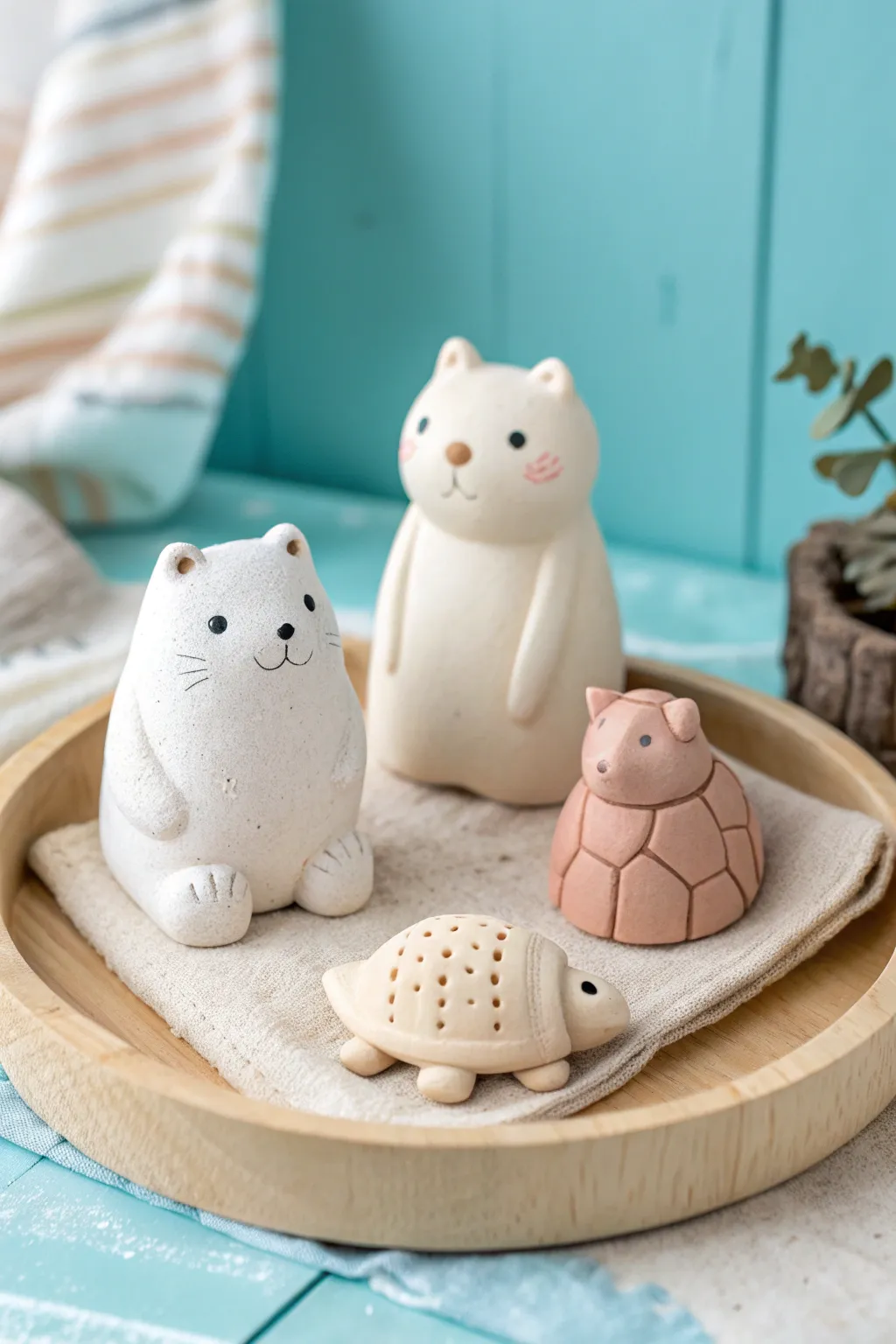
Learn to sculpt this charming quartet of minimalist animal figurines, featuring soft white cats and earthy tortoises. Their simple, rounded forms combined with delicate facial details make for a serene display perfect for any bookshelf or desk.
Step-by-Step Guide
Materials
- Air-dry clay (white and terracotta/peach)
- Acrylic paints (black, white, pink)
- Fine-point paintbrush or toothpick
- Sculpting tools (needle tool, small ball tool)
- Water cup
- Fine-grit sandpaper
- Matte varnish (optional)
Step 1: Shaping the White Cats
-
Forming the Body:
Start with a generous ball of white clay. Roll it into a smooth teardrop shape, flattening the bottom so it stands securely. The taller cat needs a more elongated pear shape, while the sitting one is slightly shorter and rounder. -
Creating Ears:
Pinch the top of the head gently on both sides to form two small, triangular ears. For the sitting cat, I like to use a small ball tool to make a tiny indentation inside each ear for depth. -
Adding Arms:
Roll two thin ‘snake’ shapes of clay for the arms. Attach them vertically along the sides of the body, blending the upper seam smoothly into the torso so they look like they are resting by the animal’s side. -
Sculpting Paws:
For the shorter sitting cat, attach two small, flattened ovals at the bottom front for feet. Use a knife tool or toothpick to press three lines into each foot to define the toes. -
Texturing:
Before the clay dries, check for any fingerprints. You can gently pat the surface with a slightly damp sponge to create a soft, stone-like texture rather than perfect smoothness.
Smooth Seams
dip your finger in water (or vinegar for polymer clay) and run it over where two clay pieces join. This creates a seamlessly bonded surface.
Step 2: Sculpting the Terracotta Friends
-
The Pangolin Base:
Take a piece of peach or terracotta-tinted clay and roll a medium-sized ball. Slightly flatten the bottom. -
Adding the Shell Pattern:
Carefully score a geometric shell pattern onto the back using a needle tool. Create intersecting lines to mimic hexagonal plates or scales reaching down towards the base. -
Head and Ears:
Attach a smaller sphere to the front for the head. Add two tiny, pinched triangles for ears on top of this head segment. -
The Turtle Body:
For the smallest figurine, form a flattened oval of white or light beige clay. -
Turtle Details:
Poke a grid of small holes across the top of the shell using a needle tool for texture. Attach four tiny balls for feet underneath and a small rounded nub for the head peeking out the front.
Step 3: Refining and Painting
-
Drying and Sanding:
Allow all four pieces to dry completely for at least 24-48 hours. Once hard, lightly sand any rough bottoms or sharp edges with fine-grit sandpaper. -
Painting Faces:
Using a very fine brush or toothpick dipped in black paint, add two small dots for eyes on each animal. Keep them wide-set for cuteness. -
Noses and Mouths:
For the cats, paint a tiny inverted ‘Y’ shape for the nose and mouth. The taller cat gets a simple brown or pink nose dot. -
Blush and Whiskers:
Dry brush a tiny amount of pink paint onto the cheeks of the taller cat. Add three very thin whisker lines to the sitting cat using a fine liner brush. -
Final Sealing:
Protect your work with a coat of matte varnish to preserve the natural, earthy look of the clay.
A Functional Twist
Poke several holes in the top of the turtle or cats before drying to turn them into adorable incense stick holders or dried flower vases.
Arrange your new clay family on a wooden tray or cloth coaster to complete the cozy aesthetic
Smiling Octopus or Jellyfish Desk Buddy
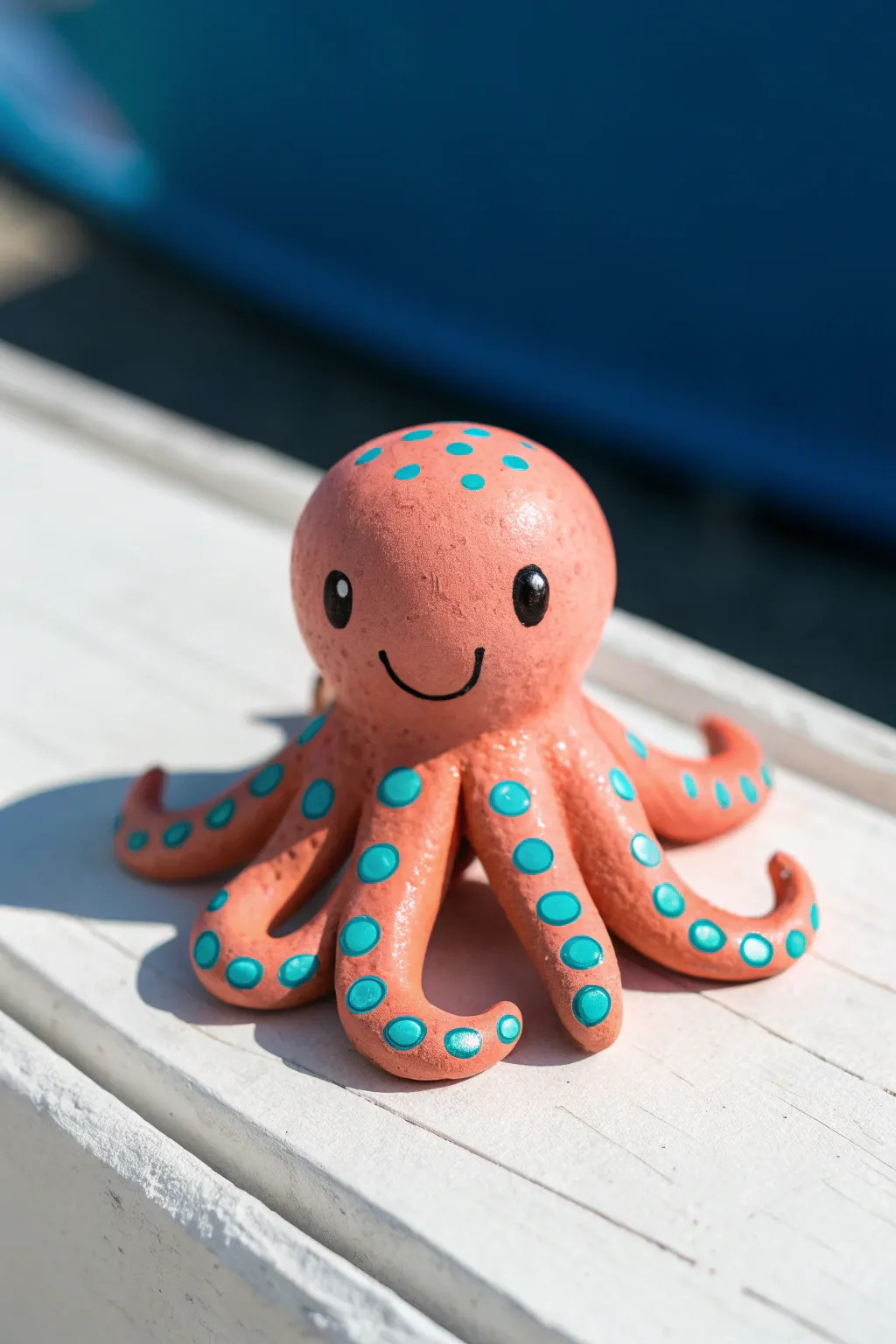
Brighten up your workspace with this charming, salmon-pink octopus sculpted from polymer clay. With its cheerful smile and vibrant teal suction cups, this little cephalopod is as fun to make as it is to display.
Step-by-Step Tutorial
Materials
- Polymer clay (Salmon/Peach or mix White with Orange/Pink)
- Polymer clay (Teal or Turquoise)
- Black acrylic paint
- Small ball stylus tool
- Needle tool or toothpick
- Fine detail paintbrush
- Gloss glaze or varnish (optional)
- Aluminum foil (for armature)
- Clay roller or pasta machine
Step 1: Forming the Base
-
Prepare the Core:
Start by scrunching a small piece of aluminum foil into a tight ball, about the size of a walnut. This reduces the amount of clay needed and keeps the head lightweight. -
Mix the Head Color:
Condition your salmon or peach-colored clay until it is soft and pliable. If you are mixing custom colors, I prefer to blend white with a touch of orange and pink until I reach that soft coral shade. -
Shape the Head:
Roll a smooth sheet of the pink clay and wrap it fully around your foil core, ensuring there are no air bubbles trapped underneath. Roll it between your palms until it is a perfect sphere. -
Smooth the Surface:
Gently rub out any seams or fingerprints on the sphere to create a clean, matte surface for the face.
Loose Legs?
If tentacles keep falling off during sculpting, use a tiny drop of liquid polymer clay (Bake & Bond) as glue between the pieces before pressing them together.
Step 2: Sculpting the Tentacles
-
Create Tentacle Logs:
Roll out eight tapered logs of the same pink clay. They should be thicker at one end (where they attach to the body) and curl into a point at the other. -
Arrange the Base:
Place the eight tentacles in a circle underneath the head sphere, pressing them firmly together at the center so they form a starburst shape. -
Attach the Head:
Press the head sphere firmly onto the center of the ring of tentacles. Use a modeling tool to smooth the clay from the tentacles upward onto the head so it becomes one solid unit. -
Draft the Pose:
Gently curl the tips of the tentacles upward. Give each one a slightly different wave or twist to make the octopus look like it’s resting naturally.
Step 3: Adding Details
-
Make the Dots:
Condition your teal clay and roll it into a very thin snake. Slice off tiny, equal-sized pieces and roll them into miniature balls. -
Apply Head Spots:
Press a few of the tiny teal balls onto the top of the octopus’s head, flattening them slightly so they look like flush polka dots. -
Create Suction Cups:
Place lines of teal balls running down the top-facing side of each tentacle. Gently press them flat against the pink clay. -
Indent the Suckers:
Using a small ball stylus tool, press into the center of each teal tentacle dot. This creates the ring-like appearance of a suction cup. -
Carve the Smile:
Use a needle tool or the edge of a spoon-shaped tool to gently carve a curved smile into the face area. Make it deep enough to hold paint later. -
Bake the Piece:
Bake the sculpture according to your specific clay manufacturer’s instructions (usually 275°F/135°C for 15-30 minutes). Let it cool completely.
Make it Functional
Before baking, insert a stiff wire loop into the top of the head to turn your octopus into a photo holder or note clip for your desk.
Step 4: Painting and Finishing
-
Paint the Eyes:
Use black acrylic paint and a fine detail brush to paint two large, oval eyes. Add a tiny white highlight dot to each eye once the black is dry for extra cuteness. -
Define the Mouth:
Carefully run a very thin line of black paint inside the carved smile groove to make the expression pop. -
Seal the Work:
Apply a coat of gloss glaze or varnish over the entire piece if you want a shiny, wet look, or just over the eyes to keep them bright.
Enjoy the company of your new cheerful clay friend on your desk or shelf

TRACK YOUR CERAMIC JOURNEY
Capture glaze tests, firing details, and creative progress—all in one simple printable. Make your projects easier to repeat and improve.
Whimsical Mushroom Mini Sculptures
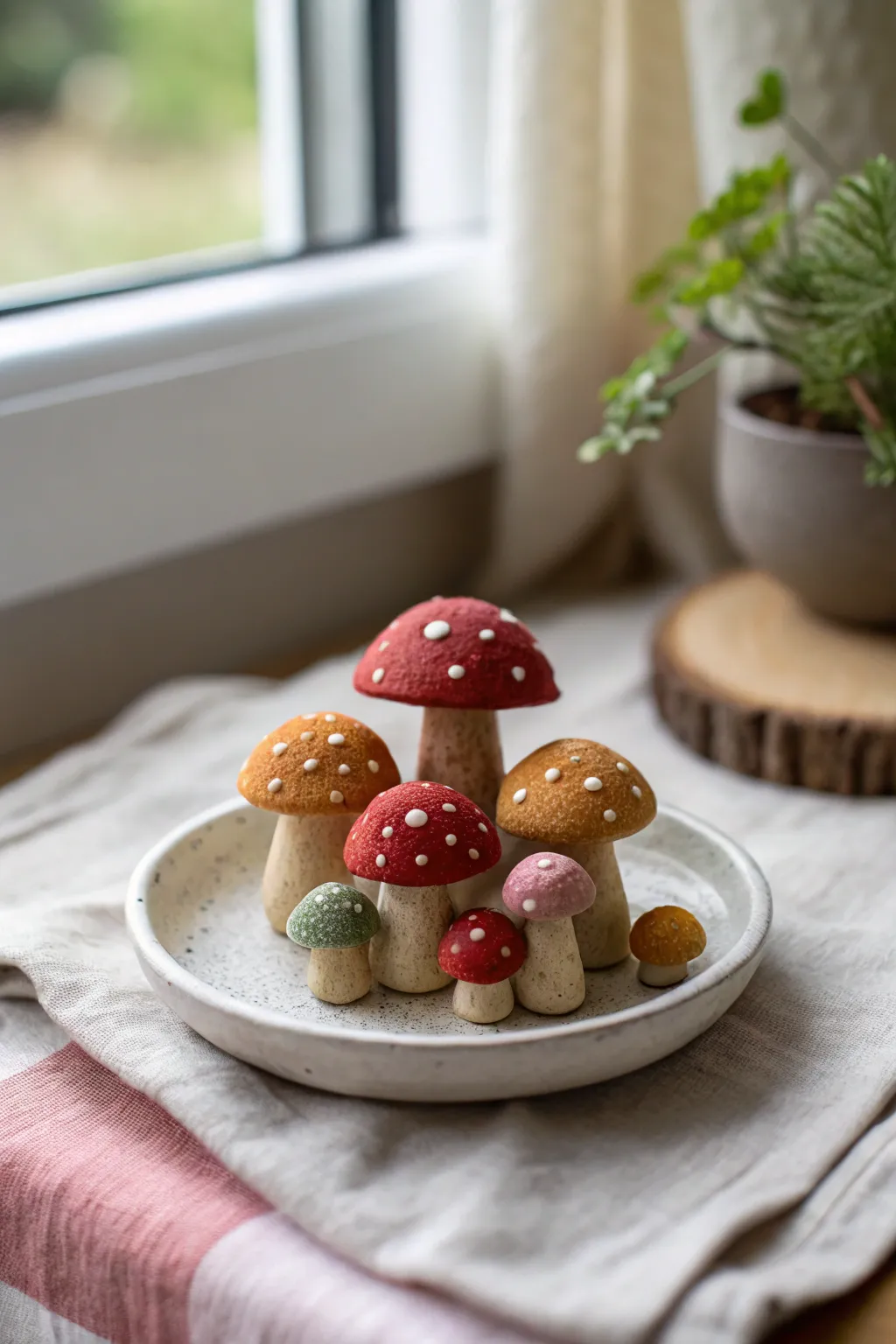
Bring a touch of the enchanted forest indoors with these charming woodland sculptures. Crafted from clay, these mushrooms feature delightful textures and a vibrant, speckled color palette that look perfect clustered on a shelf or windowsill.
Detailed Instructions
Materials
- Polymer clay (white or beige for stems)
- Polymer clay (red, brown, ochre, green, pink, yellow for caps)
- Small dotting tool or toothpick
- Liquid polymer clay or strong craft glue
- Translucent liquid clay (optional for texture)
- Soft pastel chalks (browns and grays for shading)
- Small stiff-bristle brush (like an old toothbrush)
- Acrylic paint (white)
- Small detail paintbrush
- Baking sheet and parchment paper
- Fine-grit sandpaper
Step 1: Shaping the Stems
-
Prepare the stem clay:
Start by conditioning your white or beige polymer clay until it is soft and pliable. Roll it into a smooth log about a half-inch thick. -
Cut to size:
Cut the clay log into varying lengths, ranging from tiny ¼-inch nubs to taller 1.5-inch stalks. Creating a variety of heights adds visual interest to the final grouping. -
Form the base shapes:
Take each piece and roll it slightly thicker at the bottom to create a stable base. Gently taper the top so it’s slightly narrower where the cap will sit. -
Texture the surface:
To mimic organic mushroom stalks, roll the clay gently over fine-grit sandpaper or tap it lightly with a stiff-bristle brush. This removes fingerprints and adds a subtle, earthy grain. -
Pre-bake shading:
For realistic depth, I like to brush a tiny amount of brown soft pastel powder near the base of each stem. This makes them look like they’ve just been plucked from soil.
Fixing Wobbly Bases
If a mushroom keeps tipping over after baking, sand the bottom flat with heavy-grit sandpaper or glue a small metal washer to the base for hidden weight.
Step 2: Creating the Caps
-
Ball the colored clay:
Condition your colored clays—red, ochre, forest green, and dusty pink. Roll them into balls corresponding to the size of your stems. -
Shape the domes:
Press your thumb gently into the underside of each ball to create a domed cap shape. Smooth out the edges so the curve is continuous and organic. -
Texturizing technique:
To get that slightly velvety, porous look seen in the photo, gently tap the surface of the caps with an old toothbrush or a crumpled piece of aluminum foil. Do this lightly so you don’t deform the shape. -
Attach caps to stems:
Apply a tiny drop of liquid polymer clay or bake-and-bond to the top of a stem. Press the corresponding cap firmly onto the stem, ensuring a secure connection. -
Final adjustments:
Double-check that your mushrooms can stand upright on their own. If one is wobbly, gently press the base flat against your work surface again.
Make a Fairy Scene
Create a display base by covering a jar lid with clay and moss. Glue your mushroom cluster to it for a permanent, portable mini-garden.
Step 3: Detailing and Baking
-
Adding the dots:
Take a tiny bit of white clay and roll extremely small balls. Press these onto the mushroom caps in random patterns. Alternatively, you can paint these after baking, but clay dots add better dimension. -
Refining the texture:
Using a needle tool or toothpick, gently stipple the white dots so they blend slightly into the texture of the cap rather than just sitting on top. -
Grouping check:
Arrange all your sculptures on your baking surface to ensure the sizes look good together, but keep them separated so they don’t fuse during baking. -
Baking process:
Bake the mushrooms according to the manufacturer’s instructions for your specific brand of clay (usually 275°F for 15-30 minutes). -
Cooling down:
Let the mushrooms cool completely in the oven before moving them. This tempering process makes the clay stronger and less brittle. -
Final painted touches:
If you want brighter white spots, dip a fine detail brush or a toothpick into white acrylic paint and carefully dab over the clay dots you made earlier. -
Sealing the work:
Finish by applying a matte varnish to protect the surface while maintaining a natural, non-glossy appearance.
Arranged on a simple ceramic dish, your colorful grove is ready to brighten up any corner of your home
Face Planters With Clay Feature Details
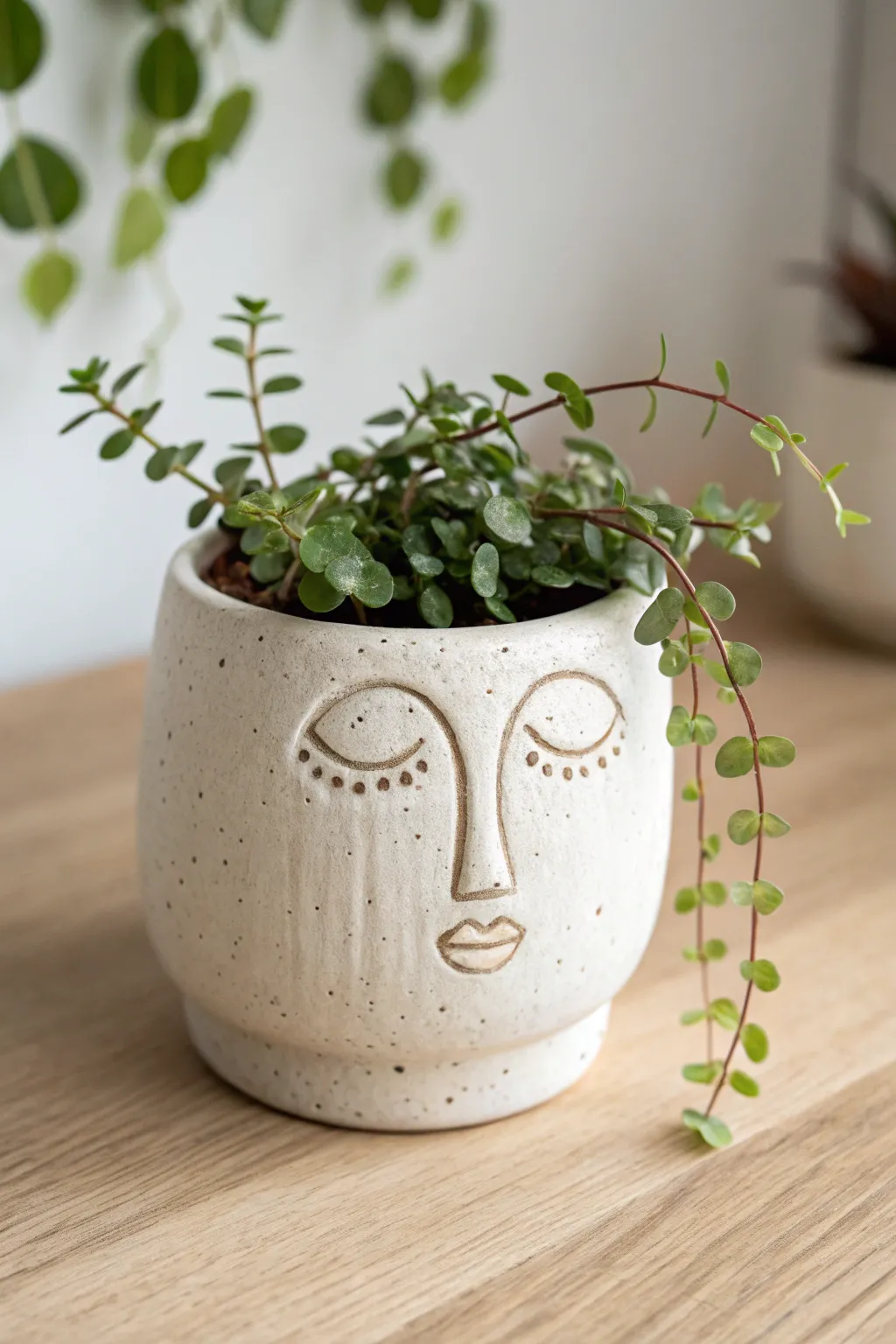
This project transforms a simple vessel into a peaceful character using hand-sculpted details and thoughtful texture. The finished planter features a gentle, sleeping face with carved features and a speckled matte glaze that gives it a wonderfully earthy, artisan feel.
Step-by-Step Tutorial
Materials
- White stoneware or earthenware clay
- Rolling pin
- Pottery wheel (optional) or slab-building tools
- Needle tool
- Loop carving tool
- Small sponge
- Slip (liquid clay)
- Speckled matte white glaze
- Thin paintbrush or underglaze pencil (soft brown)
- Kiln
Step 1: Forming the Base Vessel
-
Prepare the clay:
Begin by wedging your white clay thoroughly to remove any air bubbles, ensuring a smooth consistency for building. -
Shape the main cylinder:
Using a pottery wheel or slab-building technique, form a rounded cylinder. Aim for a shape that curves gently inwards at the bottom to create a foot. -
Refine the rim:
Smooth the top rim with a damp sponge or chamois to ensure it is comfortable to touch and visually soft, not sharp. -
Create the foot ring:
Trim or coil-build a distinct foot at the base. This slight indentation separates the ‘chin’ from the table surface, giving the pot a lifted, elegant look.
Depth Perception
Make your carving slightly deeper than you think necessary. Glaze tends to pool and fill shallow lines, blurring your design.
Step 2: Sculpting the Features
-
Map out the face:
Lightly trace the position of the eyes, nose, and mouth onto the leather-hard clay using a needle tool. Keep the design symmetrical and centered. -
Add the nose volume:
Score the nose area and attach a small, elongated triangle of clay. Smooth the edges down aggressively so the nose emerges seamlessly from the pot’s surface rather than looking stuck on. -
Refine the nose bridge:
Carve gently firmly around the sides of the nose to define the bridge, ensuring it connects elegantly to the brow line. -
Carve the eyes:
Using a needle tool or small loop tool, carve two deep, curved arcs for the closed eyelids. The depth is crucial here; it preserves the line art after glazing. -
Add the lashes:
Press a series of small, evenly spaced dots or tiny dashes just below the eyelid arcs to represent eyelashes. I find a tool with a blunt, rounded tip works best for these soft indentations. -
Sculpt the lips:
Outline the lips lightly, then use a carving tool to recess the area slightly. Define the cupid’s bow and the separation between the lips with confident, single strokes.
Plant pairing
Plant a trailing succulent like ‘String of Turtles’ or ‘String of Pearls’ to simulate flowing hair tumbling around the face.
Step 3: Finishing and Glazing
-
Bisque fire:
Allow the pot to dry slowly and completely before firing it in the kiln to bisque temperature (usually Cone 04). -
Accentuate the lines:
Before glazing, rub a wash of iron oxide or brown underglaze into the carved lines of the eyes, nose, and mouth. Wipe away the excess with a damp sponge so color remains only in the recesses. -
Apply the glaze:
Dip or brush your speckled matte white glaze over the entire piece. The speckles in the glaze add that lovely organic texture seen in the photo. -
Check the thickness:
Ensure the glaze isn’t too thick near the carved features, or it might obscure the delicate facial details. -
Clean the foot:
Wipe the bottom of the foot ring completely clean of glaze to prevent sticking to the kiln shelf. -
Final firing:
Fire the piece again to the maturation temperature of your specific glaze (typically Cone 5 or 6 for stoneware).
Now your serene planter is ready to bring a sense of calm and character to your indoor garden
Magnetic Mini Bud Vases for Tiny Flowers
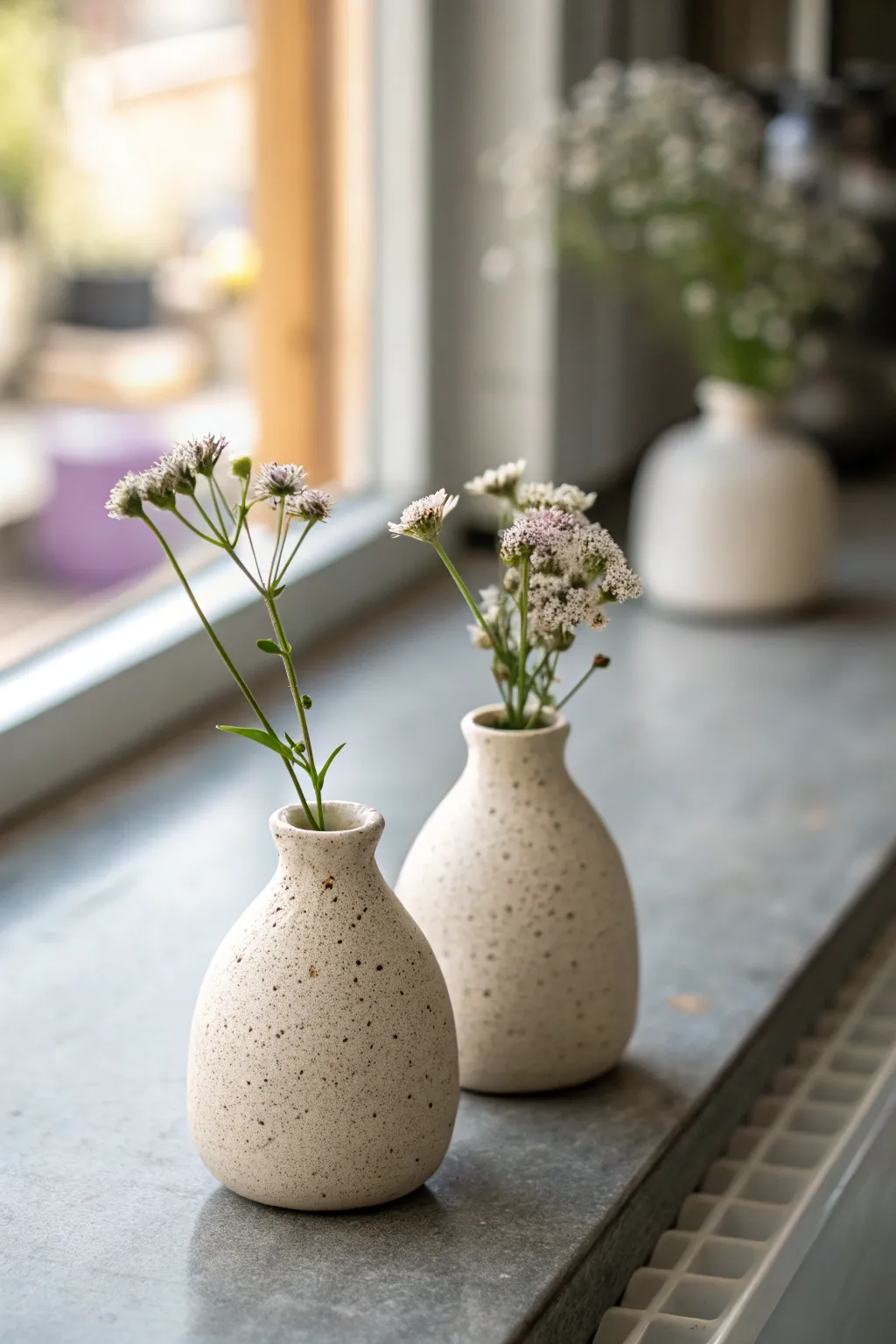
Bring the charm of wildflowers indoors with these delicate, speckled ceramic bud vases that fit perfectly on any windowsill. Their organic shape and textured matte finish give them a timeless, handcrafted appeal that highlights even the simplest blooms.
How-To Guide
Materials
- White stoneware clay (preferably with speckles or grog)
- Pottery wheel (or can be hand-built)
- Small magnets (neodymium recommended)
- Strong two-part epoxy adhesive
- Sponge and bucket of water
- Wire cutter
- Loop trimming tool
- Needle tool
- Matte white or cream glaze
- Small kiln (unless using air-dry clay alternatives)
Step 1: Throwing the Forms
-
Prepare the Clay:
Begin by wedging a small ball of clay, roughly the size of a golf ball or a large marble. Since these are miniatures, you don’t need much material. -
Center on the Wheel:
Place your clay humps on the wheel head. I find it easier to throw these ‘off the hump’—meaning centering a large mound of clay and throwing multiple small pots from the top of it—but you can also center individual small balls. -
Open the Clay:
Using your thumbs, gently press into the center of the spinning clay to create the opening. Keep the walls thick enough to support the narrow neck later. -
Pull the Walls:
Gently pull the clay upward to form a cylinder. Aim for a height of about 2 to 3 inches. The base should be wider than the top to create that classic bottle shape. -
Shape the Belly:
Apply gentle pressure from the inside to bulge the bottom half outward, creating a rounded belly while keeping the rim narrow. -
Collar the Neck:
Using both hands, gently squeeze the upper portion of the clay inward to narrow the neck. Do this slowly to avoid twisting the clay. -
Refine the Rim:
Use a chamois or a wet fingertip to smooth and compress the lip of the vase. A slight flare at the very top adds elegance. -
Cut and Release:
Use a needle tool to create an undercut at the base of your vase. Then, slide your wire cutter underneath and carefully lift the vase off the wheel.
Magnet Slipping?
If the magnet slides while the glue dries, use a piece of painter’s tape to hold it tight against the ceramic until the epoxy fully cures.
Step 2: Trimming and Finishing
-
Leather Hard Stage:
Allow the vases to dry until they are ‘leather hard’—firm to the touch but still carveable. -
Create the Flat Back:
Since these are magnetic vases intended to stick to surfaces or sit flush, use a sharp fettling knife or wire tool to slice a flat plane on one side of the vase body. -
Hollow the Spot for Magnet:
On the flat surface you just created, gently carve a shallow recess using a small loop tool. This indentation will house the magnet later so it sits flush. -
Smooth the Edges:
Take a damp sponge and gently wipe down the entire piece, softening any sharp edges from the trimming process and revealing the speckles in the clay. -
Bisque Fire:
Load the bone-dry vases into the kiln for a bisque firing (usually Cone 04 or 06, depending on your clay).
Make it a Set
Create a trio of vases with varying heights and belly shapes. Different silhouettes clustered together look amazing on a fridge or magnetic board.
Step 3: Glazing and Assembly
-
Apply Wax Resist:
Paint a small circle of wax resist over the recessed area where the magnet will go. This prevents glaze from adhering there, ensuring a strong bond for the glue later. -
Dip into Glaze:
Dip the vase into a matte white or cream glaze. Shake off excess drips immediately. Make sure the glaze is not too thick, or it might obscure the lovely clay speckles. -
Clean the Foot:
Wipe the bottom of the vase clean with a sponge so it doesn’t stick to the kiln shelf. -
Glaze Fire:
Fire the vases again to the maturity temperature of your clay and glaze combination. -
Attach the Magnet:
Once fully cooled, mix a small amount of strong two-part epoxy. Apply a dot to the unglazed recess and press your magnet firmly into place. Let it cure completely before use.
Pop in a few sprigs of baby’s breath or wildflowers and enjoy your miniature floating garden
Ring Cone or Hand-Shaped Ring Holder
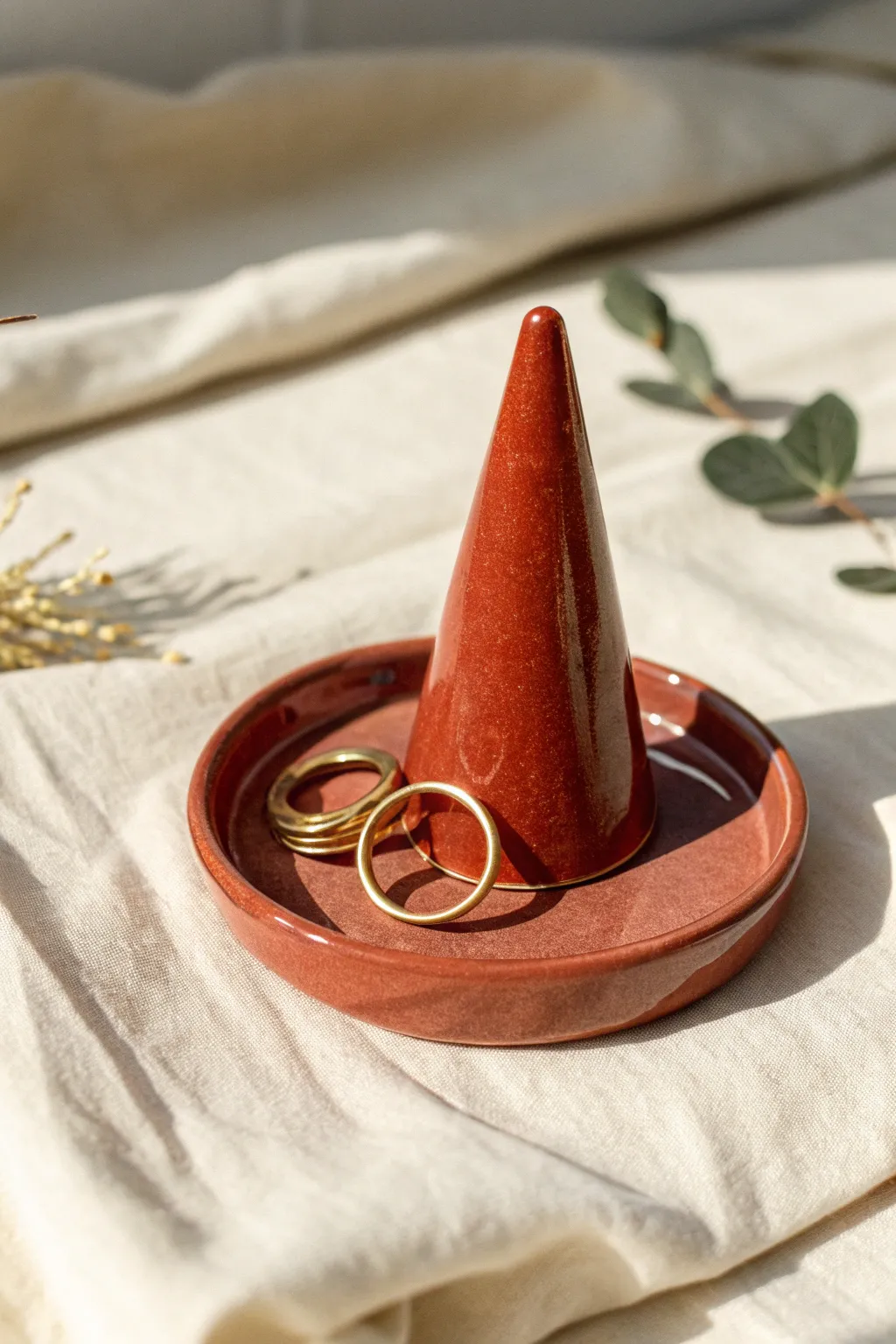
This elegant ring holder combines a classic ring dish with a central cone for stacking bands, all finished in a warm, glossy rust-red glaze. It’s a functional yet minimalist piece that keeps your jewelry organized and looks stunning on a vanity.
Step-by-Step Guide
Materials
- Red earthenware or terracotta clay
- Rolling pin
- Clay knife or needle tool
- Small circular cookie cutter (approx. 3-4 inches)
- Small sponge
- Scoring tool (or fork)
- Slip (clay mixed with water)
- Clear glossy glaze
- Kiln (or access to a firing service)
- Paintbrush for glazing
- Small bowl of water
Step 1: Forming the Base Dish
-
Prepare the slab:
Cut a manageable chunk of your reddish clay and wedge it briefly to remove air bubbles. Use your rolling pin to roll it out into an even slab, aiming for about 1/4 inch thickness. -
Cut the circle:
Place your circular cookie cutter or a round template onto the slab and press down firmly to cut out the base shape. Remove the excess clay around the circle. -
Smooth the edges:
Dip your finger or a small sponge in a little water and run it gently around the cut edge of the circle. This removes any sharp angles or burrs left by the cutter. -
Lift the rim:
Gently pinch the outer edge of the circle upwards to create a slight rim. You want a shallow lip that will keep stray earrings from rolling off. Smooth the transition between the flat base and the raised rim with your thumb.
Hollow It Out
For thicker cones, push a pencil up into the bottom center before attaching. This removes bulk, prevents explosions in the kiln, and speeds up drying.
Step 2: Creating the Cone
-
Shape a coil:
Take a separate piece of clay and roll it into a thick log or fat coil between your hands. -
Form the cone:
Stand the log up and begin rolling it gently on your work surface while applying more pressure near the top. This tapering motion will start forming a cone shape. -
Refine the surface:
Once you have the general cone shape, use your fingers to smooth out any lumps. The cone should be tall enough to hold several rings but not so wide at the base that it crowds the dish. -
Check the fit:
Place the cone in the center of your dish to check proportions. If it looks too bulky, shave off some clay with your knife or keep rolling to elongate it. -
Flatten the bottom:
Tap the bottom of the cone firmly on the table to create a perfectly flat surface for attachment.
Uneven Glaze?
If your clear glaze looks milky after firing, it may be too thick. Thin slightly with water next time, or check that your kiln reached the correct temp.
Step 3: Assembly and Finishing
-
Mark binding spots:
Use your needle tool to lightly mark the center of the dish where the cone will sit. This outlines your attachment area. -
Score the surfaces:
Using your scoring tool, cross-hatch the marked center of the dish and the bottom of the cone. Creating this rough texture is crucial for a strong bond. -
Apply slip:
Dab a generous amount of slip onto both scored areas. It acts like glue for the clay. -
Attach the cone:
Press the cone firmly onto the center of the dish. Give it a slight wiggle to lock the scored particles together and release any trapped air. -
Blend the seam:
Use a small modeling tool or your fingertip to smooth the seam where the cone meets the dish. I like to run a slightly damp brush around this join to make it look seamless. -
Final smooth:
Go over the entire piece with a barely damp sponge to remove fingerprints and ensure the surface is pristine before drying. -
Dry slowly:
Cover the piece loosely with plastic for the first day to let the moisture equalize, then uncover it to dry completely. This prevents the rim from warping. -
Bisque fire:
Once bone dry, fire the piece in a kiln to bisque temperature (usually Cone 04). This hardens the clay permanently. -
Glaze application:
Wipe the bisque piece with a damp sponge to remove dust. Apply 2-3 coats of clear glossy glaze. Since the clay itself provides the rich color, a clear glaze will enhance the natural red tone. -
Glaze firing:
Fire the piece again to the glaze maturity temperature specified on your glaze bottle. This melts the glass coating into that shiny, durable finish.
Once cooled from the kiln, your sleek ring cone is ready to elegantly display your favorite jewelry pieces
Photo and Recipe Card Holders With a Twist
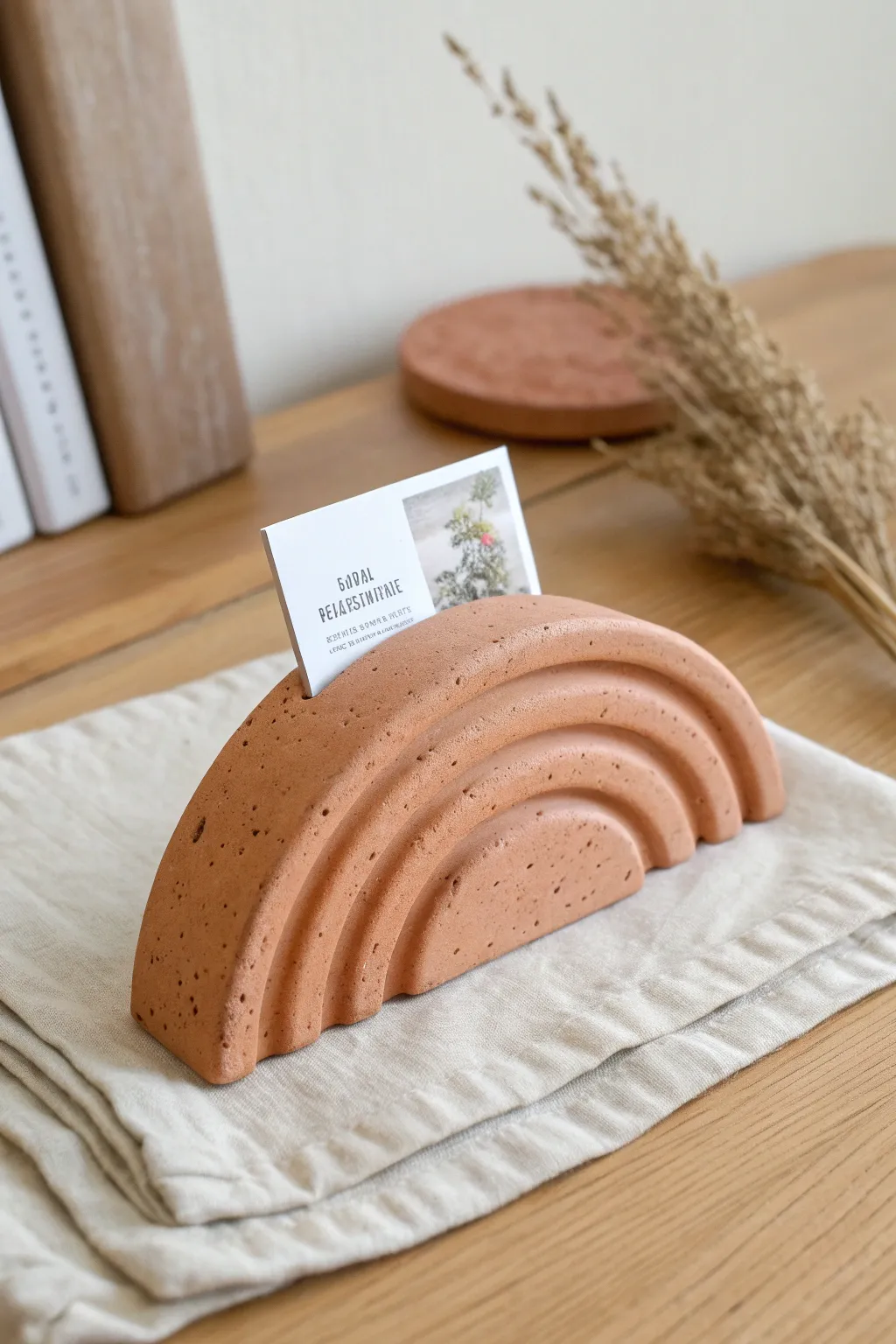
Bring a touch of playful warmth to your desk with this structured, rainbow-shaped card holder. Crafted with a lovely speckled terracotta clay, its concentric arches provide a sturdy and stylish base for your favorite photos or recipe cards.
Detailed Instructions
Materials
- Terracotta colored polymer clay (or air-dry clay with pigment)
- Black pepper or dried coffee grounds (for speckled effect, optional)
- Rolling pin or clay machine
- Sharp clay blade or X-Acto knife
- Circle cutters (various sizes) or a compass
- Ruler
- Sandpaper (fine grit)
- Optional: Clay extruder (for very precise arches)
- Baking sheet and parchment paper (if using polymer clay)
Step 1: Preparation & Base Creation
-
Prepare the Clay:
Begin by conditioning your terracotta clay until it’s soft and pliable. If your clay is a solid color and you want that lovely speckled texture seen in the photo, knead in a small pinch of cracked black pepper or dried coffee grounds now. -
Roll the Slab:
Roll out a portion of the clay into a flat slab, approximately 1/4 inch thick. This will serve as the backing to hold the arches together, though it will be mostly hidden. -
Cut the Base Shape:
Cut a semi-circle from this slab. This semi-circle determines the overall final size of your holder, so choose a size that fits your intended space.
Cracking Arches?
If the clay cracks while bending it into an arch, it likely needs more conditioning. Warm it in your hands longer or mix in a drop of clay softener.
Step 2: Forming the Arches
-
Roll the Coil:
Take a large chunk of clay and roll it into a very long, thick snake. You want this coil to have a square or rectangular cross-section rather than round, so gently flatten the sides against your work surface. -
Refine the Shape:
I prefer to use a straight edge or ruler to press against the sides of the long strip to ensure it has sharp, clean edges and a consistent width of about 1/2 inch. -
Create the Core:
Cut a small semi-circle piece for the very center ‘sun’ of the rainbow. Place this at the bottom center of your base slab. -
Measure the first Arch:
Take your rectangular clay strip and curve it gently over the center core piece to measure the length needed. -
Cut and Place:
Cut the strip to size and press it firmly against the core piece. Use a tiny bit of liquid clay or water (depending on your clay type) to bond them. -
Repeat for Outer Arches:
Continue this process, measuring, cutting, and placing strips to form the subsequent rainbow layers. The example shows three concentric arches surrounding the solid core. -
Ensure Flush Edges:
Once all layers are assembled, stand the piece up on its flat bottom edge and press down gently to ensure it sits perfectly flat.
Color Block Variation
Make each arch a slightly different shade of terracotta or muted earth tone. Mix white or black into your base color to create a gradient effect.
Step 3: Adding the Functionality
-
Create the Slot:
This is the crucial step. Use a thick piece of cardstock or a thin ruler to press a groove into the top of the rainbow. -
Check Depth:
Make sure the groove goes deep enough to hold a card securely, but not so deep that it splits the clay apart. aim for about 1/2 inch depth. -
Widen Slightly:
Wiggle your tool slightly front-to-back to ensure the opening is wide enough for your intended cards. -
Smooth the Edges:
Use your finger or a silicone smoothing tool to soften any harsh ridges created by pressing the slot, blending the clay back into the curve.
Step 4: Finishing
-
Texturing:
To enhance the raw stone look, you can gently tap the surface with a stiff toothbrush or a crumpled ball of aluminum foil. -
Final Inspection:
Look over the piece for any fingerprints or lint. Use a little baby oil on your finger to smooth these away if using polymer clay. -
Cure the Piece:
Bake according to your polymer clay package instructions, or let it air dry for 24-48 hours if using air-dry clay. -
Sanding:
Once fully cured and cooled, use fine-grit sandpaper to smooth out the bottom edge or any rough spots on the curves. -
Seal (Optional):
Leave it matte for a natural look, or apply a matte varnish if you want extra protection against handling.
Now slide in your favorite recipe or photo and enjoy the artisanal vibe this holder adds to your space
Happy Little Magnets With Simple Faces
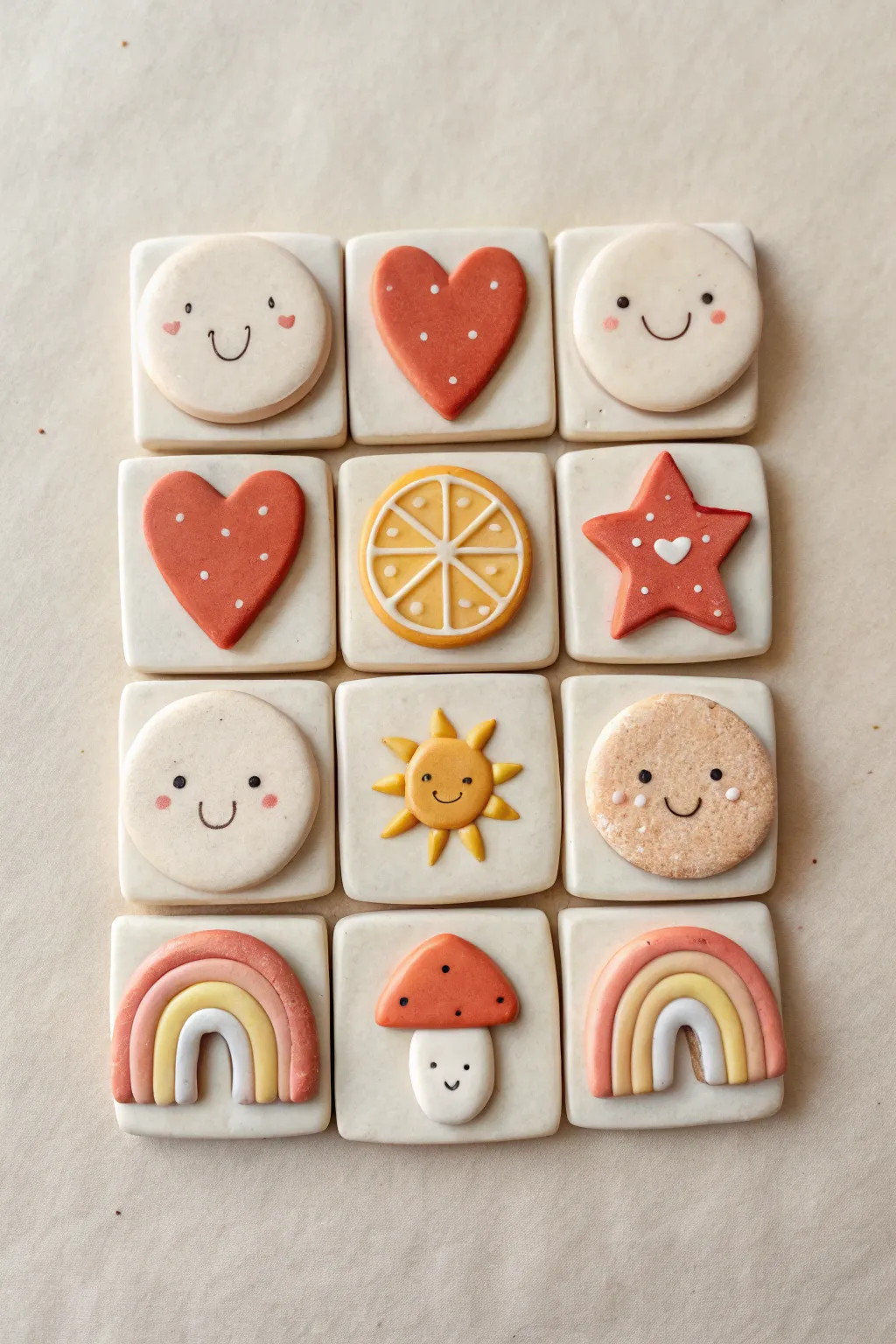
Create a charming grid of personality-filled clay tiles that work beautifully as magnets or decorative accents. These warm-toned, matte-finish squares feature simple smiling faces alongside classic motifs like rainbows, hearts, and suns for a cohesive, cheerful collection.
How-To Guide
Materials
- White or cream polymer clay
- Colored polymer clay (terracotta, mustard yellow, light pink, beige)
- Square cookie cutter (approx. 1.5 inches)
- Small round cutters (various sizes)
- Clay roller or pasta machine
- Needle tool or toothpick
- Ball stylus tool
- Black acrylic paint or fine-tip black marker
- Small magnets (optional)
- Super glue (if using magnets)
- Oven and baking sheet
Step 1: Base Preparation
-
Condition the base clay:
Start by kneading your white or cream clay until it is soft and pliable. This warm-up prevents cracking later. -
Roll the sheet:
Roll the white clay out to a consistent thickness, about 1/4 inch. If you have a pasta machine, use a medium setting; otherwise, rolling pin guides help keep it even. -
Cut the squares:
Using your square cutter, punch out 12 identical squares. Place them gently on a parchment-lined baking sheet, spacing them out slightly.
Step 2: Sculpting the Motifs
-
Create the faces:
For the simple round faces, cut circles from beige or cream clay that fit comfortably inside the squares. Gently press them onto the center of three or four tiles. -
Form the hearts:
Roll out terracotta or rust-colored clay. Cut or hand-shape two hearts. Place one centrally on a square. I like to press tiny white clay dots into the surface of one heart before adhering it for a patterned look. -
Build the citrus slice:
Cut a circle of yellow clay. Add a thin rim of white clay around it. Use your needle tool to slice distinct ‘segments’ into the yellow circle, and lay thin strips of white clay into those grooves. -
Shape the sun:
Make a small yellow circle for the sun’s face. Roll tiny teardrop shapes for rays and arrange them radially around the central circle on a tile. -
Construct rainbows:
Roll thin snakes of terracotta, yellow, and white clay. Arch them snugly together to form rainbows. Trim the bottom edges straight with a blade before placing them on the squares. -
Make the mushroom:
Shape a small white stalk and a red cap. Press them onto a tile, ensuring the cap overlaps the stalk slightly. Add tiny black clay dots or indentations to the red cap for texture. -
Add the star:
Cut a five-point star from reddish clay. Press a tiny white clay heart into the center for a cute detail.
Fixing Smudges
If dust or fingerprints get on light clay, dip a q-tip in rubbing alcohol and gently wipe the raw clay surface before baking.
Step 3: Detailing and Baking
-
Add facial features:
Using a needle tool or small ball stylus, gently indent eye sockets and smile lines into the clay faces while it’s still raw. This guides your painting later. -
Smooth edges:
Do a final check of all edges. Run a clean finger along the sides of the squares to soften any sharp cuts from the cutters. -
Bake the project:
Bake the tiles according to your clay package instructions (usually 275°F for 15-30 minutes). Let them cool completely on the tray to harden. -
Paint details:
Once cool, use a very fine brush with black acrylic paint (or a marker) to fill in the eyes and smiles. Add tiny rosy cheeks using diluted pink paint or legitimate blush powder. -
Finish the assembly:
If turning these into magnets, flip the cooled tiles over and glue small round magnets to the center of each back.
Glossy Pop
Add a drop of UV resin or glossy glaze specifically to the eyes or the heart motifs to make them shine against the matte background.
Arrange your finished tiles on the fridge or a metal board to enjoy their cheerful expressions every day
Round Clay Medallion Mini Scene
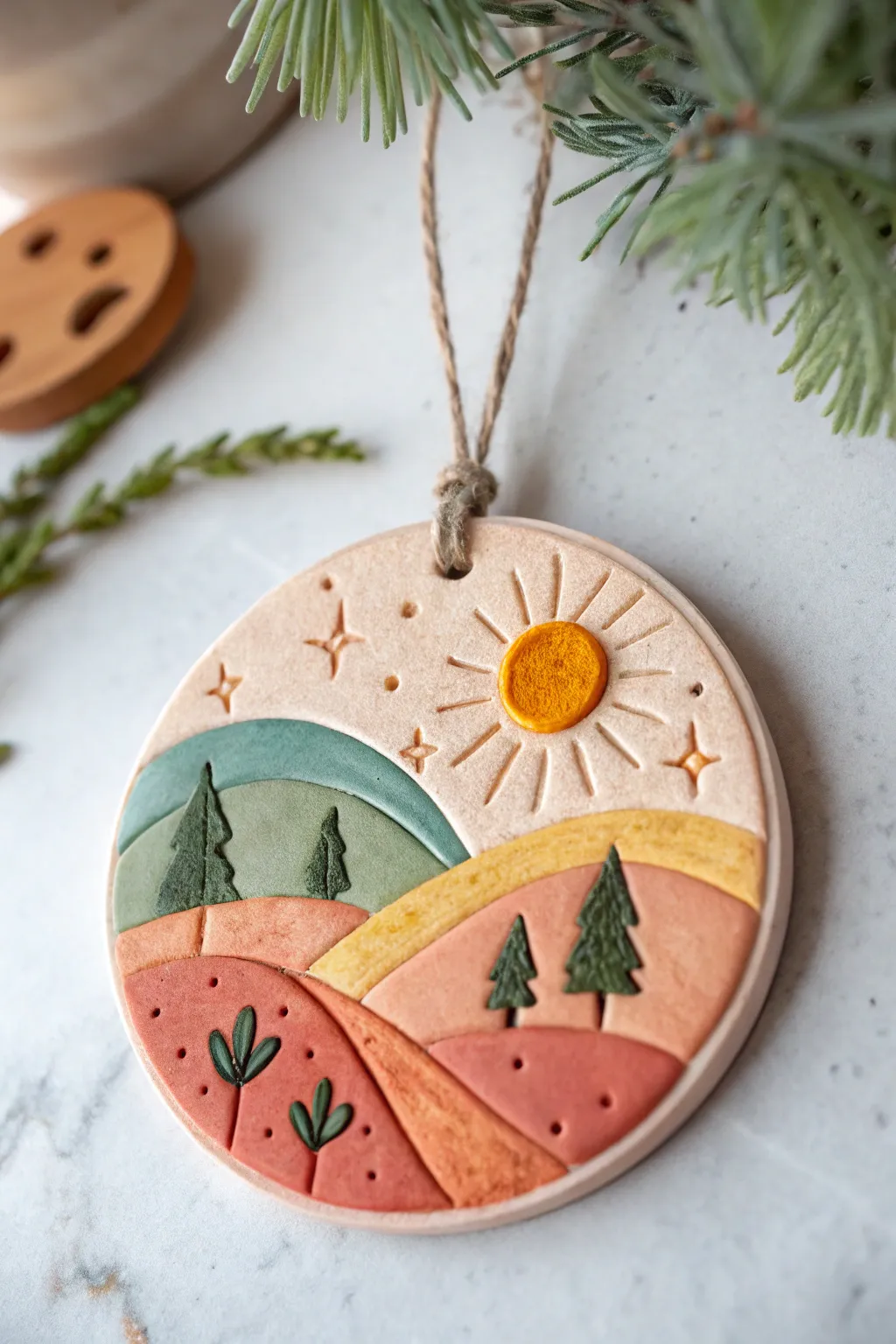
This charming, earthy medallion captures a stylized landscape with rolling hills, pine trees, and a radiant sun. Perfect as a wall hanging, holiday ornament, or unique gift tag, it uses simple layering techniques to create depth and texture.
Step-by-Step Tutorial
Materials
- Polymer clay (beige/ecru, terracotta, sage green, forest green, mustard yellow)
- Circle clay cutter (approx. 3-4 inches)
- Rolling pin or clay machine
- Needle tool or toothpick
- Small craft knife (X-Acto)
- Twine or jute cord
- Dotted embossing tool (optional)
- Acrylic paints (optional, if using white clay)
- Matte varnish
Step 1: Base Preparation
-
Condition the base clay:
Start by kneading a good amount of your beige or ecru colored clay until it is soft and pliable. This will serve as your sky and backplate. -
Roll the slab:
Roll the clay out onto a smooth surface to an even thickness of about 1/4 inch. Ensure it’s thick enough to support the layers without warping. -
Cut the medallion:
Use your circle cutter to punch out a perfect round shape. Smooth the edges with your finger to remove any harsh lines left by the cutter. -
Make the hanging hole:
Using a tool or a straw, create a clean hole near the top edge for the twine. Make sure there is enough clay above the hole so it doesn’t tear later.
Step 2: Layering the Landscape
-
Create the sun:
Take a small ball of mustard yellow clay and flatten it into a small disc. Place this in the upper right quadrant of your sky. -
Texture the sun:
Gently tap the surface of the sun with a toothbrush or stiff brush to give it that stippled, rough texture. -
Add sun rays:
Using a needle tool, carefully press radiating lines into the beige background clay surrounding the yellow sun disc. -
Form the background hills:
Roll out thin sheets of sage green and a lighter green clay. Cut gentle curved hill shapes that fit the width of your circle. -
Attach the green hills:
Place these green pieces on the left side, slightly overlapping, to create the distant mountains. Trim the edges to match the circle’s curve perfectly. -
Create the foreground slopes:
Roll out terracotta and mustard yellow clay. Cut swooping, curvy shapes to represent the rolling fields in the foreground. -
Layer the fields:
Position the yellow strip below the green hills, then layer the terracotta sections at the very bottom. Use your knife to trim the excess clay flush with the circle’s edge. -
Add dividing lines:
Gently press deep lines between the color sections with your needle tool to define the borders of the hills strongly.
Clean Cuts
If your clay cutter is sticking, dust it lightly with cornstarch or dip it in water before cutting. This ensures a sharp, clean edge.
Step 3: Details & Finishing
-
Sculpt tiny trees:
Roll tiny triangles of forest green clay. Placing them on the hills, use a needle tool to drag texture downward, mimicking pine needles. -
Plant the vegetation:
For the bottom red hill, form tiny teardrop shapes from dark green clay. Press two or three together to look like small sprouting plants. -
Emboss the details:
I like to use a small dotting tool to poke small holes in the terracotta clay for added texture. You can also press star shapes or simple crosses into the sky. -
Bake the piece:
Follow the baking instructions on your specific package of polymer clay. Usually, this is around 275°F (130°C) for 15-30 minutes. -
Cool and seal:
Let the piece cool completely. Apply a thin coat of matte varnish to protect the clay and unify the finish without making it too glossy. -
String it up:
Cut a length of jute twine, thread it through the top hole, and secure it with a lark’s head knot or a simple loop.
Mixed Media Magic
After baking, rub a little diluted dark brown acrylic paint into the grooves and wipe off the excess to create an antique, weathered look.
Now you have a miniature world captured in clay that brings a touch of nature indoors
Faux Terrazzo Clay Tiles and Coasters
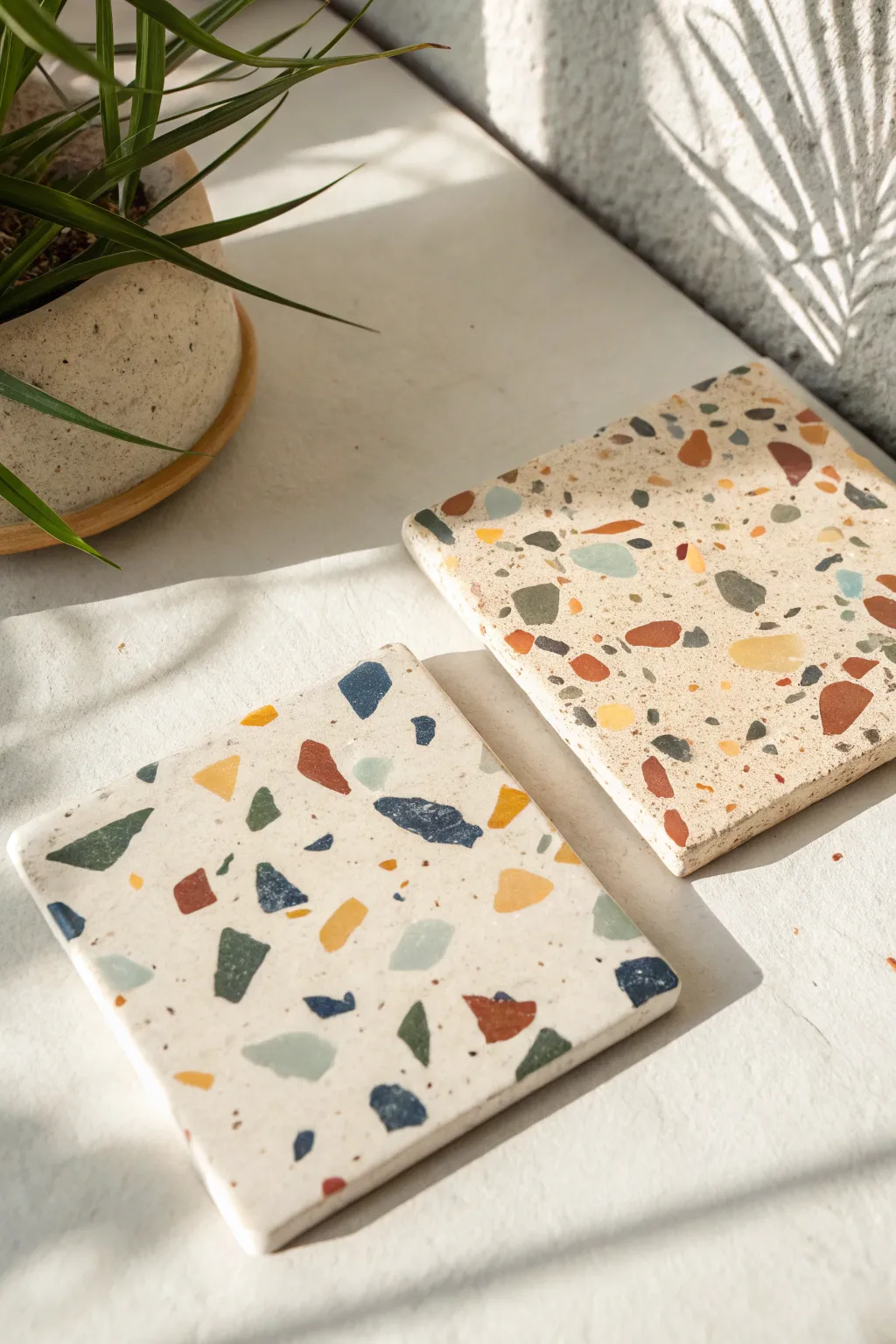
These stylish coasters mimic the classic Italian terrazzo flooring technique using polymer clay for a fraction of the cost. With scattered chips of muted terracotta, navy, and mustard set against a creamy white base, this beginner-friendly project adds a sophisticated, artisanal touch to your coffee table.
Detailed Instructions
Materials
- Polymer clay (white/cream for the base)
- Polymer clay (assorted colors: terracotta, mustard yellow, sage green, navy blue, grey)
- Acrylic rolling pin or pasta machine
- Square cookie cutter (approx. 4 inches) or craft knife and ruler
- Parchment paper or ceramic tile (work surface)
- Sandpaper (grits looking for: 400, 600, and 1000 wet/dry)
- Bowl of water
- Clay slicer or sharp blade
- Oven for baking
- Matte spray varnish (optional)
Step 1: Prepping the ‘Chips’
-
Roll colored clay:
Start by conditioning your colored clay blocks (terracotta, mustard, navy, etc.) separately until they are soft. Roll each color into a thin sheet, roughly 1-2mm thick. Don’t worry about perfect shapes here. -
Bake the sheets:
Place your thin colored sheets onto a baking tray lined with parchment paper. Bake them for roughly 10-15 minutes at the temperature recommended on your clay packaging. Partial baking makes them easier to chop into sharp shards. -
Cool and crumble:
Let the baked sheets cool completely until they are hard. Once cool, break them into large chunks with your hands, then use a clay slicer or knife to chop them into irregular, jagged chips of varying sizes. Mixing sizes creates a more authentic terrazzo look. -
Create a chip mix:
Combine all your chopped colored bits into a bowl. Give them a gentle toss to ensure the colors are evenly distributed for later use.
Clean Cuts
To avoid warping the square shape when cutting thick clay, place a sheet of cling film over the clay slab before pressing your cutter down. This creates softly rounded edges that require less sanding.
Step 2: Forming the Base
-
Condition main clay:
Take a large block of your white or cream clay. Condition it thoroughly by kneading until it’s pliable and warm, ensuring no air bubbles are trapped inside. -
Roll the slab:
Roll the white clay out into a thick, even slab. Aim for a thickness of about 4-5mm to ensure the coasters feel substantial and sturdy. -
Add the chips:
Scatter your pre-baked colored chips generously over the top surface of the raw white clay slab. Don’t be shy—cover significantly more area than you think is necessary, as rolling spreads them out. -
Embed the texture:
Cover the slab with a piece of parchment paper to prevent sticking. Use your rolling pin to firmly press the chips down into the white clay until the surface feels relatively flat again. -
Roll smooth:
Continue rolling over the parchment paper in multiple directions to smooth the surface and integrate the chips fully. -
Cut the shapes:
Remove the parchment paper. Using your square cutter or a ruler and craft knife, cut out your coaster shapes. Clean up the edges slightly with your fingertip.
Add Sparkle
For a glamorous twist, mix small flakes of gold or copper leaf in with your colored clay chips before embedding them. The metal specks will shine beautifully once sanded.
Step 3: Baking and Finishing
-
Final bake:
Place your cut squares onto a baking tile or parchment-lined tray. Bake for the full duration recommended by the manufacturer (usually 30 minutes per 1/4 inch of thickness) to ensure strength. -
Cool down:
Allow the coasters to cool fully inside the oven with the door cracked, or remove and weigh them down with a heavy book while cooling to prevent warping. -
Prepare for sanding:
Prepare a small bowl of water with a drop of dish soap. Wet sanding is crucial here—it keeps clay dust out of the air and produces a smoother finish. -
Coarse sanding:
Start with your 400 grit sandpaper. Dip the paper and coaster in water and sand the surface in circular motions. This layer removes the thin film of white clay covering your colored chips, revealing the bright terrazzo pattern beneath. -
Refining the surface:
Move on to 600 grit, and finally 1000 grit, continuing the wet sanding process. The surface should feel incredibly smooth, like polished stone. -
Clean up:
Rinse the coasters under cool water to remove all milky residue and pat them dry with a lint-free towel. -
Optional sealing:
If you want extra protection against stains, apply a light coat of matte spray varnish, though well-sanded polymer clay is naturally quite durable and water-resistant on its own.
Enjoy your chic handcrafted coasters.
Marbled Clay Ornaments With Swirly Color
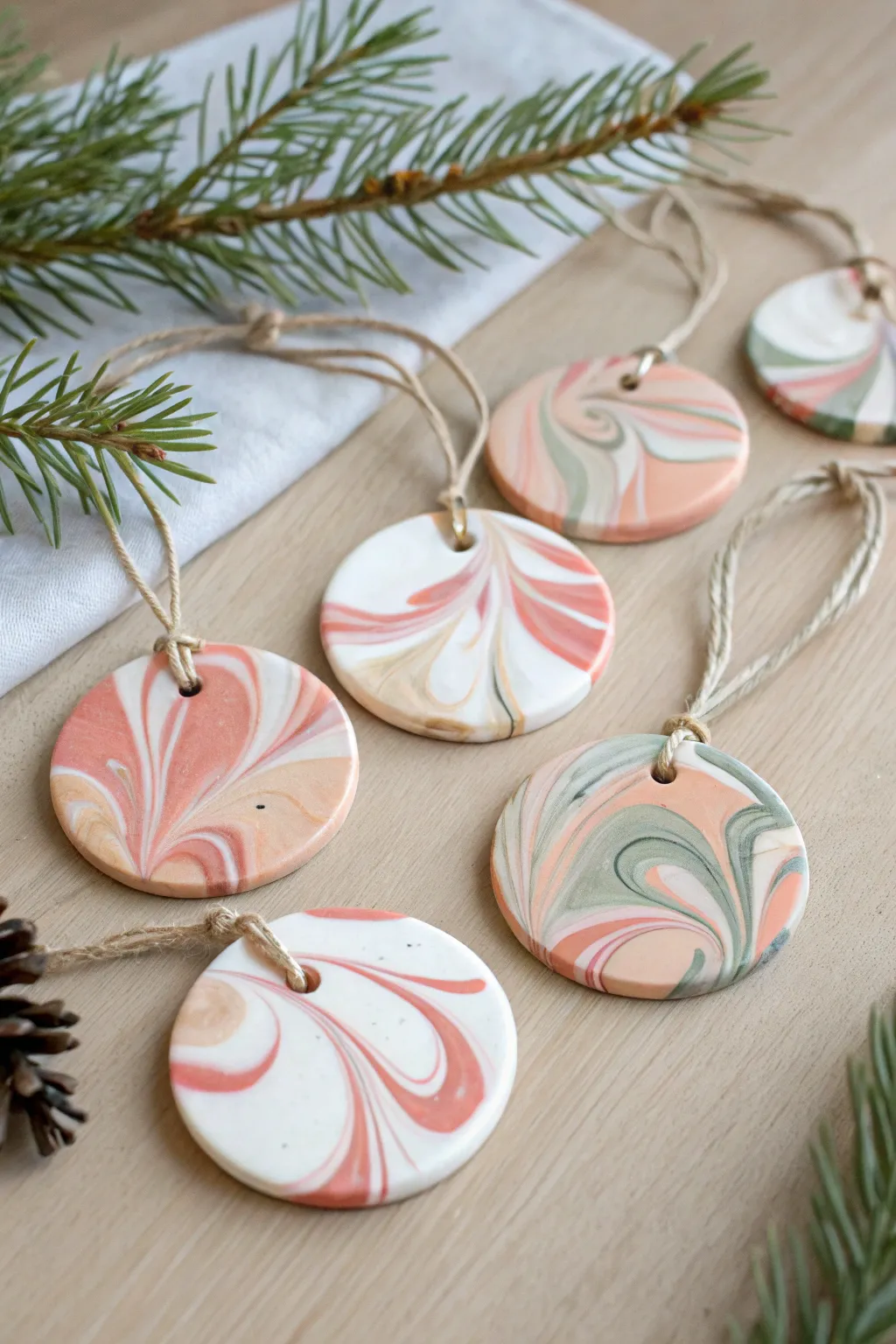
Elevate your holiday decor with these sophisticated, minimalist clay ornaments featuring a mesmerizing marbled effect. The soft blends of peach, sage green, and white create a modern, organic look that feels both festive and timeless.
How-To Guide
Materials
- Polymer clay (white, peach/coral, sage green, beige)
- Acrylic rolling pin
- Round cookie cutter (approx. 2-3 inches)
- Parchment paper or baking mat
- Toothpick, straw, or small circular clay cutter (for the hole)
- Jute twine or thin hemp cord
- Sandpaper (fine grit)
- Baking sheet
- Gloss or matte glaze (optional)
Step 1: Prepping the Clay
-
Condition the clay:
Start by taking chunks of your white, peach, sage green, and beige polymer clay. Use your hands to knead and warm up each color individually until they are soft and pliable. -
Create clay snakes:
Roll each color into a long, thin rope or ‘snake’ about 5 inches long. You’ll want about twice as much white clay as the colored clays to keep the overall look light and airy. -
Combine the ropes:
Gather your snakes of clay and twist them together into one large, thick rope. It should look like a multicolored candy cane at this stage.
Clean Cuts
If your cookie cutter is sticking, dip it lightly in cornstarch or flour before pressing into the clay. This helps the cutter release cleanly without distorting the round shape.
Step 2: Creating the Marble Effect
-
Fold and twist:
Take your twisted rope, fold it in half, and twist it again. This step begins to blend the colors. Repeat this fold-and-twist motion 2-3 times. -
Don’t overmix:
Be careful not to over-knead the clay while twisting; if you mix too much, the colors will turn muddy instead of showing distinct swirls. You want clear separation between the white and the colors. -
Form a ball:
Once you are happy with how the colors are interacting, roll the entire mass into a smooth ball. -
Roll it out:
Place the ball on your parchment paper or baking mat. Using the acrylic rolling pin, roll the clay out into a flat slab, approximately 1/4 inch thick. Rotate the clay frequently to ensure an even thickness.
Gilded Edges
For a glamorous touch, use a small paintbrush to apply liquid gold leaf paint specifically to the outer rim of the fired ornament. This adds a subtle, high-end sparkle.
Step 3: Cutting and Refining
-
Select your pattern:
Look at your rolled slab and identify the areas with the most beautiful swirls. Position your round cookie cutter over these ‘hero’ spots to capture the best designs. -
Cut the shapes:
Press the cutter firmly down into the clay. Give it a tiny wiggle before lifting to ensure a clean cut. -
Peel away excess:
Gently peel away the scrap clay from around your cut circles. You can re-roll these scraps to make more ornaments, though the marbling will become finer and more blended. -
Smooth the edges:
If the edges of your circles are slightly rough from the cutter, gently run your finger along the rim to smooth them down before baking. -
Create the hanging hole:
Use a straw or a small circular cutter to punch a hole near the top edge of each ornament. Make sure it’s not too close to the edge to prevent breaking, but high enough to hang nicely.
Step 4: Baking and Assembly
-
Bake the ornaments:
Transfer the parchment paper with the ornaments onto a baking sheet. Bake according to the specific temperature and time instructions on your package of polymer clay (usually around 275°F for 15-30 minutes). -
Cool down:
Remove the tray from the oven and let the ornaments cool completely on a flat surface. They will harden fully as they cool. -
Light sanding:
Once cool, inspect the edges. I like to use a bit of fine-grit sandpaper to buff away any remaining rough spots or fingerprints for a truly professional finish. -
Add a finish (optional):
If you prefer a shiny look, brush a thin layer of gloss glaze over the surface. For the matte look seen in the photo, leave the clay raw or use a matte varnish. -
Attach the twine:
Cut a length of jute twine or hemp cord (about 8 inches). Thread it through the hole. -
Secure the loop:
Tie the ends of the twine together in a simple overhand knot near the ends to create a secure loop for hanging.
Hang these beauties on your tree or use them as sophisticated gift tags for your holiday presents
Millefiori-Inspired Pattern Slices
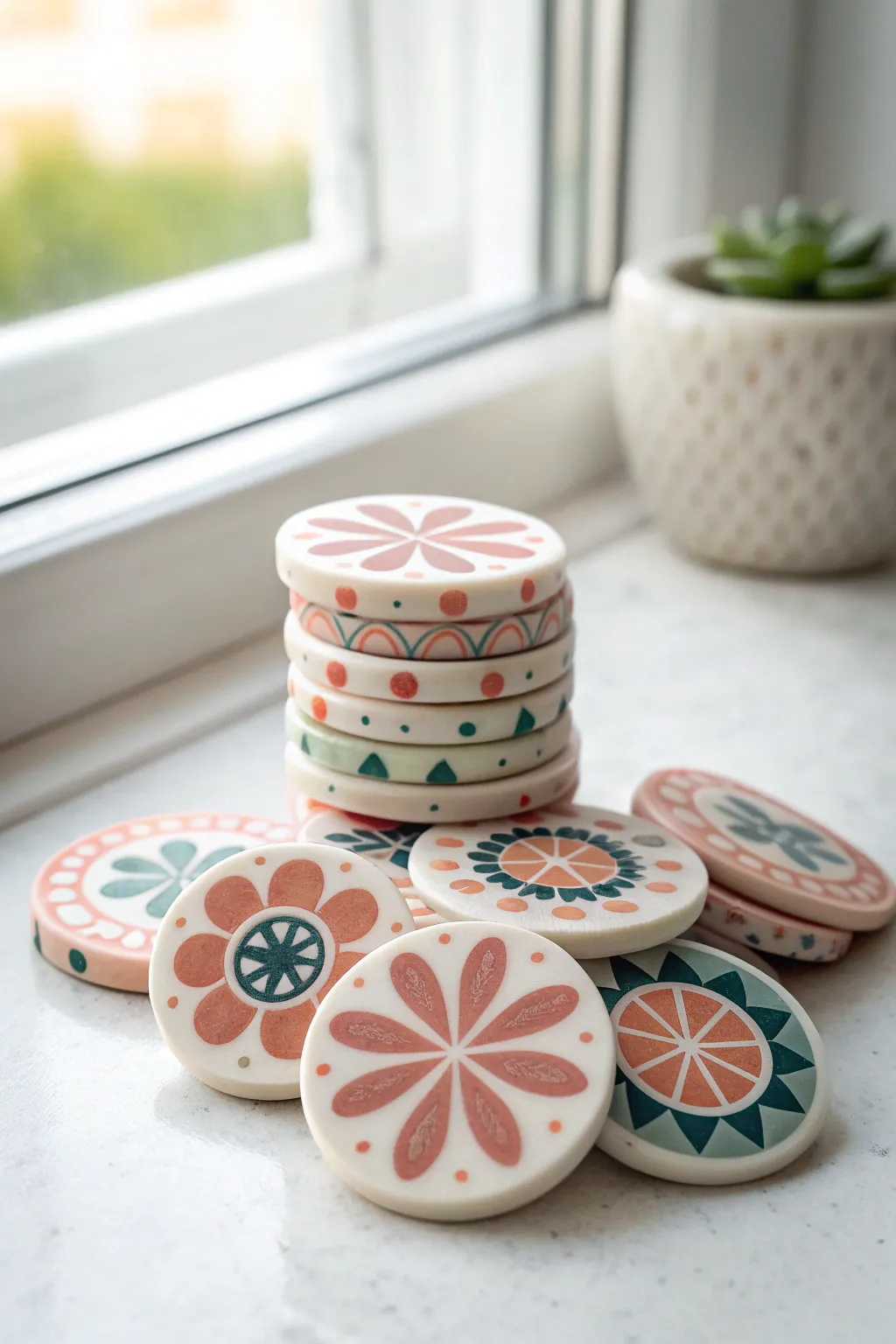
These charming, smooth discs feature intricate floral and geometric patterns built directly into the clay using a simplified millefiori technique. With a soft color palette of terracotta, sage green, and cream, they make perfect magnets, game pieces, or even unique jewelry components.
Step-by-Step Guide
Materials
- Polymer clay (white/translucent, terracotta, sage green, dark teal)
- Clay roller or pasta machine
- Tissue blade or sharp craft knife
- Small circular cutter (approx. 1.5 – 2 inches)
- Acrylic roller
- Ceramic tile or glass work surface
- Oven for baking
- Optional: Sandpaper (high grit)
- Optional: Matte varnish
Step 1: Preparing the Canes
-
Condition the Clay:
Begin by thoroughly conditioning your polymer clay blocks until they are soft and pliable. This is crucial for preventing cracks later on. -
Create a Bullseye Cane:
To make the flower centers or simple geometric spots, roll a thick snake of terracotta clay. Wrap it in a thin sheet of white clay, smoothing the seam so it disappears. -
Build Petal Canes:
For the teardrop petals seen in the large flower design, form a log of pink or terracotta clay. Pinch one side along the entire length to create a teardrop cross-section. -
Wrap the Petals:
Wrap this teardrop log in a thin layer of white clay. When these are eventually sliced, the white outline will define the petal shape clearly. -
Assemble the Flower Cane:
Take your bullseye center and arrange your petal canes around it. Fill the small gaps between petals with small triangles of white clay (the background color) to maintain a circular shape. -
Reduce the Canes:
Gently squeeze and roll your assembled large cane to reduce its diameter. It’s best to start in the middle and work your way out to the ends to avoid distortion. -
Create Accent Canes:
Repeat this process with different colors like sage green and teal to create smaller geometric canes, simple stripes, or triangles for variety.
Clean Cuts Only
Rotate your cane slightly after every cut. This prevents the bottom of the cane from flattening out and keeps your circular designs perfectly round.
Step 2: Slicing and Assembling
-
Prepare the Base:
Roll out a thick sheet of white or cream clay (about 1/4 inch thick). This will serve as the substantial base for your slices. -
Slice the Pattern Canes:
Using your tissue blade, slice very thin, even cross-sections from your various pattern canes. I find chilling the cane in the fridge for 10 minutes helps get a crisp slice without squishing the design. -
Arrange the Pattern:
Place these thin slices onto your thick base sheet. You can arrange them in a repeating grid or create a single large focal flower for each disc. -
Roll Smooth:
Place a piece of deli paper or parchment over the clay. Gently use your acrylic roller to press the pattern slices into the base until the surface is completely level and unified. -
Cut the Discs:
Position your circular cutter over your favorite parts of the pattern and press down firmly to cut out your coin shapes. -
Smooth the Edges:
Lift the circles and gently run your finger around the rim to soften the cut edge. You want a smooth, clean finish similar to a polished stone.
Make Them Functional
Glue strong neodymium magnets to the back for fridge decor, or drill a small hole before baking to turn these into striking pendants or keychains.
Step 3: Baking and Finishing
-
Bake:
Place your clay discs on a ceramic tile or baking sheet lined with parchment paper. Bake according to your specific clay brand’s instructions (usually 275°F for 15-30 minutes). -
Cool Down:
Allow the pieces to cool completely in the oven with the door slightly ajar to prevent thermal shock and cracking. -
Sand for Smoothness:
Once cool, use high-grit wet/dry sandpaper (start at 400 and go up to 1000) under water to sand the surface and edges until they feel silky smooth. -
Buff or Seal:
For a natural look, simply buff the clay with a denim cloth. If you prefer protection, apply a very thin layer of matte varnish.
Now you have a pile of beautiful, patterned art stones ready to display or gift
Carved Cutout Lantern Wraps for Cozy Light
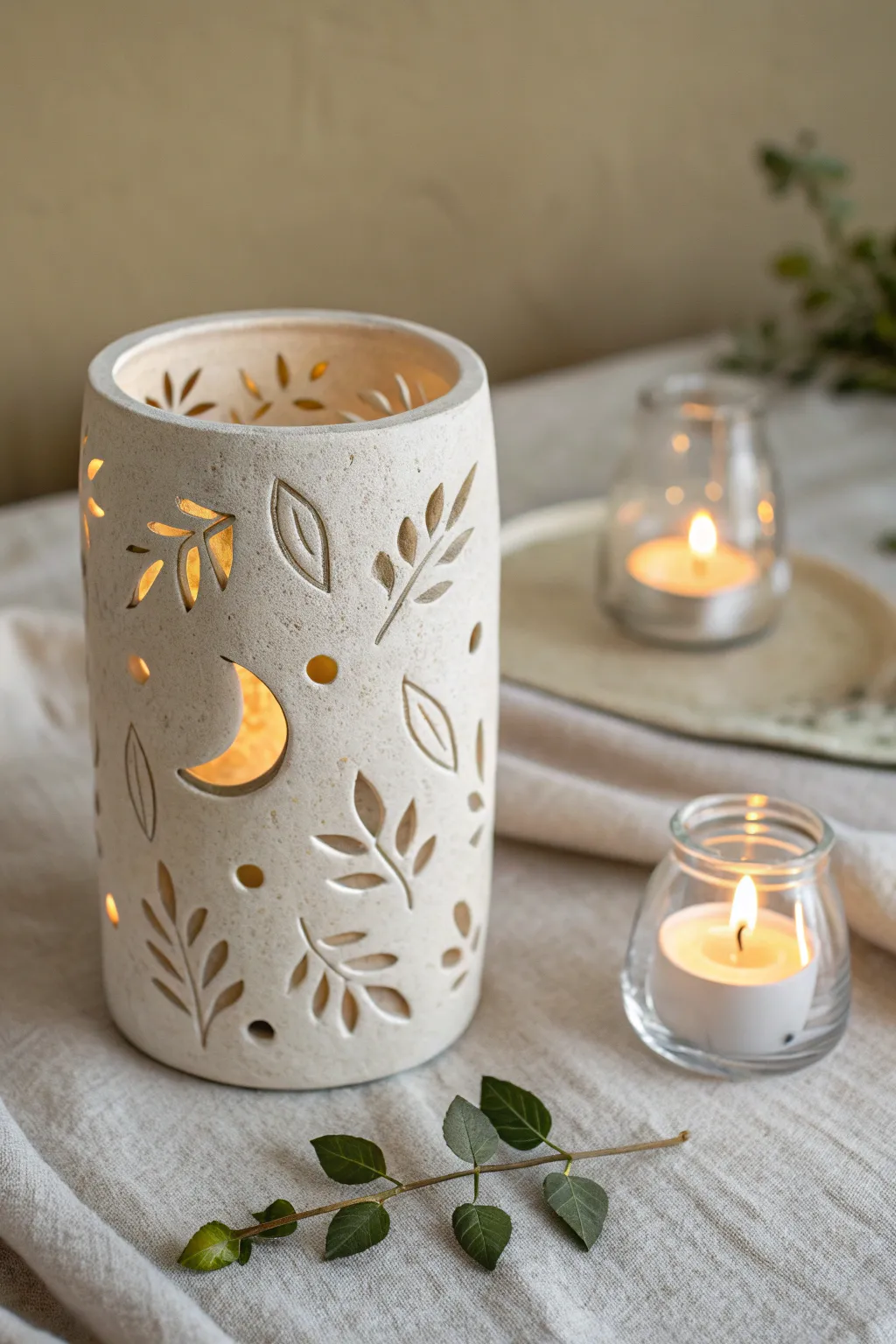
Bring a soft, magical glow to your evenings with this hand-built ceramic lantern, featuring delicate leaf and moon cutouts that cast dancing shadows. This speckled stoneware clay cylinder combines rustic texture with refined carving for a piece that looks beautiful both lit and unlit.
Detailed Instructions
Materials
- Speckled stoneware clay (approx. 2-3 lbs)
- Wooden rolling pin
- Canvas mat or slab roller
- Cylindrical form (PVC pipe or large can wrapped in newspaper)
- Needle tool
- Fettling knife
- X-Acto knife or sharp detail carving tool
- Small circular cutters (optional)
- Scoring tool (serrated rib)
- Slip (clay mixed with water)
- Sponge
- Flexible rib (rubber or metal)
- Matte white or clear glaze
Step 1: Preparing the Slab
-
Wedge the Clay:
Begin by thoroughly wedging your stoneware clay to remove air bubbles and ensure a uniform consistency, which prevents cracking later. -
Roll Out the Slab:
On your canvas mat, roll the clay out into a long, rectangular slab. Aim for an even thickness of about 1/4 inch to ensure structural stability without being too heavy. -
Smooth the Surface:
Compress the clay on both sides using a flexible rib. This realigns the clay particles to prevent warping and creates that smooth, stone-like finish visible in the photo. -
Trim to Size:
Measure the circumference of your cylindrical form. Cut the clay slab into a sharp rectangle that is slightly longer than that circumference to allow for a bevel joint.
Slumping Walls?
If the clay collapses while carving, it’s too wet. Stop immediately and let it sit uncovered for 30-60 minutes until it holds its shape firmly when touched.
Step 2: Forming the Cylinder
-
Bevel the Edges:
Cut the two short ends of your rectangle at a 45-degree angle. They should slant in opposite directions so they overlap perfectly when wrapped. -
Wrap the Form:
Carefully lift your slab and wrap it around your cylindrical mold (the newspaper-covered pipe/can). Bring the beveled edges together gently. -
Join the Seam:
Score the beveled edges deeply and apply a generous amount of slip. Press the ends together firmly. -
Blend the Joint:
Use your thumb or a wooden modeling tool to smooth the seam on the outside until it is invisible. I usually rub a rib over the area to ensure the texture matches the rest of the cylinder. -
Refine the Top Rim:
While still on the form, use a damp sponge to round off the top rim so it isn’t sharp or jagged.
Step 3: Carving the Design
-
Initial Drying:
Allow the cylinder to stiffen slightly to a ‘leather hard’ state. It should be firm enough to hold its shape without the mold but soft enough to carve easily. -
Sketch the Pattern:
Using a needle tool, lightly scratch your design onto the surface. Plan for a mix of larger leaf shapes, branches, small berries (circles), and a crescent moon feature. -
Cut the Shapes:
Use your X-Acto knife or sharp carving tool to cut completely through the wall of the clay. Follow your outlines, keeping the knife perpendicular to the surface. -
Remove Clay:
Gently push the cutout pieces inward or pull them out with the needle tool. Be careful not to distort the surrounding clay walls. -
Refine Leaf Veins:
For the leaves that aren’t fully cut out, use a carving tool to incise vein details or outline leaf shapes on the surface without cutting through, adding depth. -
Clean the Edges:
Once all cuts are made, wait for the clay to dry a bit more, then use a damp sponge or soft brush to smooth the sharp edges of your cutouts.
Level Up: Texture
Before cutting, gently press a real leaf or piece of lace into the soft clay slab to emboss a secondary texture that will catch the glaze beautifully.
Step 4: Firing and Glazing
-
Bisque Fire:
Let the lantern dry completely (slowly, under loose plastic if your environment is dry) before bisque firing it to cone 04. -
Apply Glaze:
Dip or brush, applying a matte white glaze or a transparent glaze if you want the natural speckled clay body to show through prominently. -
Clean the Cutouts:
Check every hole and cutout to ensure no glaze has bridged the gaps. Wipe away excess drips with a small brush. -
Final Fire:
Glaze fire the piece to the temperature appropriate for your clay and glaze (likely cone 5 or 6 for stoneware).
Once fired, place a tea light inside and watch your carved garden come to life with warm, flickering light
Kinetic Clay Mobile With Balanced Shapes
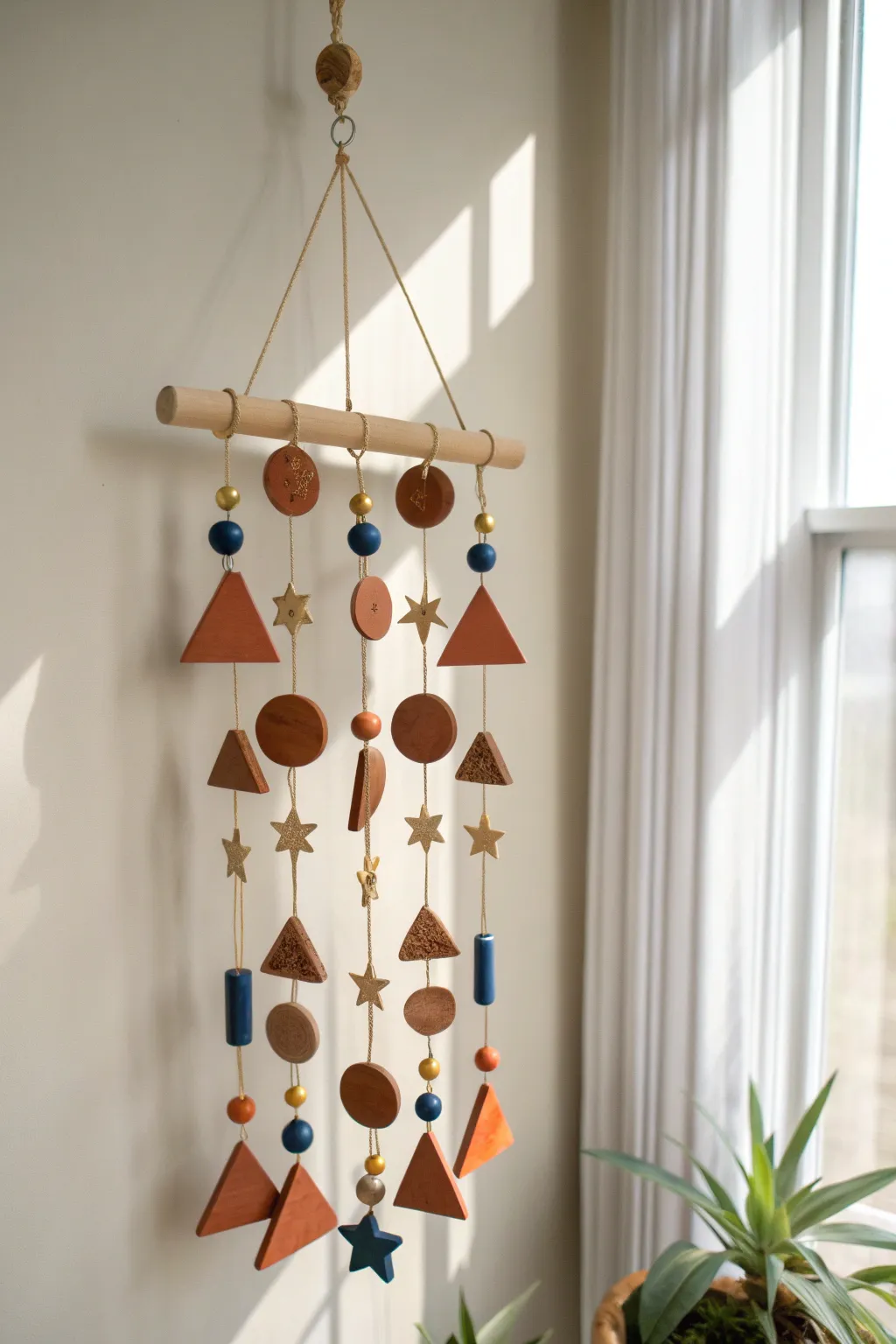
Bring a touch of celestial charm into your home with this balanced kinetic mobile featuring earthy terracotta triangles, deep blue accents, and glimmering gold stars. This project combines polymer or air-dry clay with simple stringing techniques to create a piece that gently dances in the sunlight.
How-To Guide
Materials
- Polymer clay or air-dry clay (terracotta, deep blue, white/natural)
- Acrylic paint (gold metallic, deep blue/navy)
- Rolling pin
- Clay cutters (triangle, multiple circle sizes, star)
- Wooden dowel (approx. 12-14 inches)
- Natural jute twine or gold embroidery thread
- Wooden beads (various sizes, round and cylindrical)
- Fine-grit sandpaper
- Needle tool or toothpick
- Gloss varnish or sealant (optional)
- Scissors
Step 1: Prepping and Shaping the Clay
-
Condition the clay:
Begin by kneading your terracotta and contrasting clay until it is soft and pliable. If you are using plain white clay for everything, you will paint it later, but starting with colored polymer clay saves time. -
Roll out slabs:
Roll your clay out to a consistent thickness of about 1/4 inch (6mm). Using guide rings on your rolling pin can help ensure every piece is even, which is crucial for the mobile’s balance. -
Cut geometric shapes:
Press your cutters firmly into the clay. For this design, you need approximately 6-8 large triangles, 6-8 medium circles, and several smaller stars. Don’t forget to cut a few small cylinders by hand or use a specialized bead roller. -
Create holes:
Before the clay hardens, use your needle tool or a toothpick to poke holes through the shapes. For the flat suspended pieces, poke a hole near the top and bottom edge. For stars acting as spacers, a single vertical hole through the center works best. -
Refine edges:
Dip your finger in a little water (for air-dry clay) or baby oil (for polymer) and smooth the cut edges to remove any jagged bits. I always take an extra moment here to make the finish look professional.
Step 2: Firing and Decoration
-
Cure or dry:
Bake your polymer clay pieces according to the package instructions (usually 275°F for 15-30 mins) or let air-dry clay sit for 24-48 hours until fully hardened. -
Sand for smoothness:
Once cool and hard, gently gently sand the edges with fine-grit sandpaper to perfect the geometric silhouettes. -
Paint accent pieces:
Using a small brush, paint the cylindrical beads deep navy blue. Paint the clay stars with metallic gold acrylic. You can also add gold speckles or details to a few circular clay pieces for texture. -
Seal the pieces:
For a finished look, coat your painted pieces (or all pieces) with a thin layer of matte or gloss varnish to protect the surface.
Uneven Hanging?
If the mobile leans heavily, tape a small coin or washer to the back of a shape on the lighter side as a hidden counterweight.
Step 3: Assembly and Balancing
-
Cut suspension strings:
Cut five lengths of twine, each about 24 inches long to give yourself plenty of slack for knotting. -
Start the center strand:
Tie a large washer or knot at the bottom of one string. Thread on a large terracotta triangle, then a spacer bead, then a circle. Continue patterning upwards, securing components with knots underneath each piece so they stay at fixed heights. -
Create side strands:
Repeat the stringing process for the remaining four strands. Vary the order of shapes—place triangles higher on some and lower on others to create visual interest. -
Attach to dowel:
Tie each finished decorative strand onto the wooden dowel. Space them evenly apart, ensuring the heaviest strands are closer to the center to maintain horizontal balance. -
Create the hanger:
Cut a final piece of heavy twine. Tie it to both ends of the dowel to create a triangle hanger. Find the center point of this hanging string and tie a loop for mounting to the ceiling or wall hook. -
Final adjustments:
Hang the mobile up temporarily. If it tilts, slide the strand attachment points slightly left or right on the dowel until the bar hangs perfectly level.
Level Up: Texture
Press textured fabric or lace into the damp clay before cutting your shapes to add intricate surface patterns without painting.
Enjoy the calming movement of your new kinetic art piece as it settles into its space