
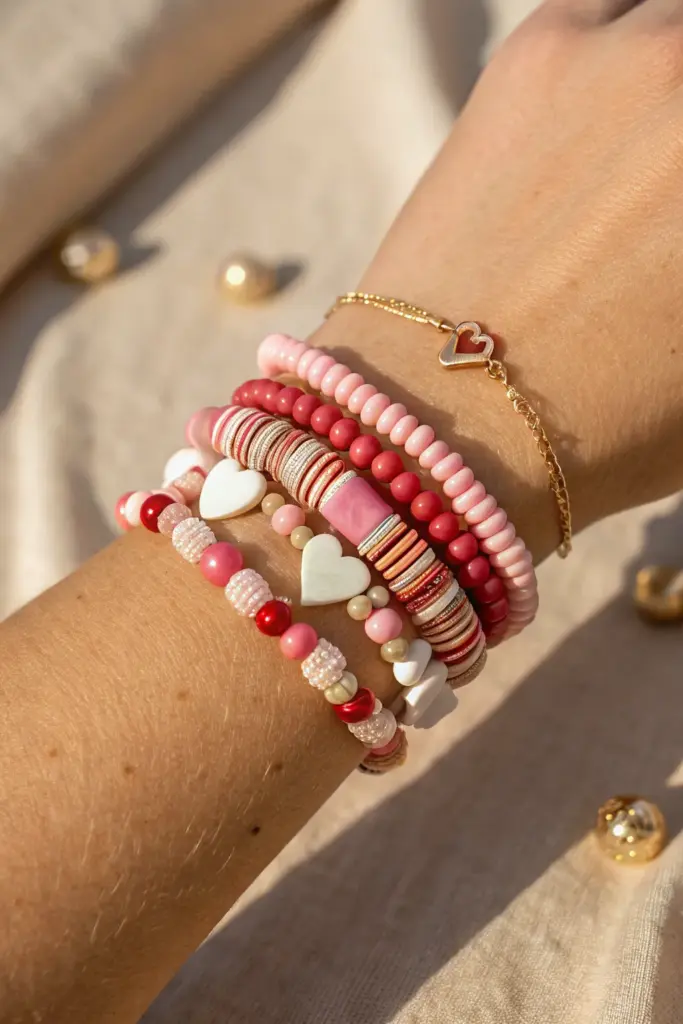
If you’re craving something sweet-but-wearable, Valentine’s clay bead bracelets are the easiest little love note you can make with your own hands. Here are my favorite cute Valentine ideas—classic first, then a few playful twists once you’re warmed up.
Pink-to-Red Ombre Heishi Stack
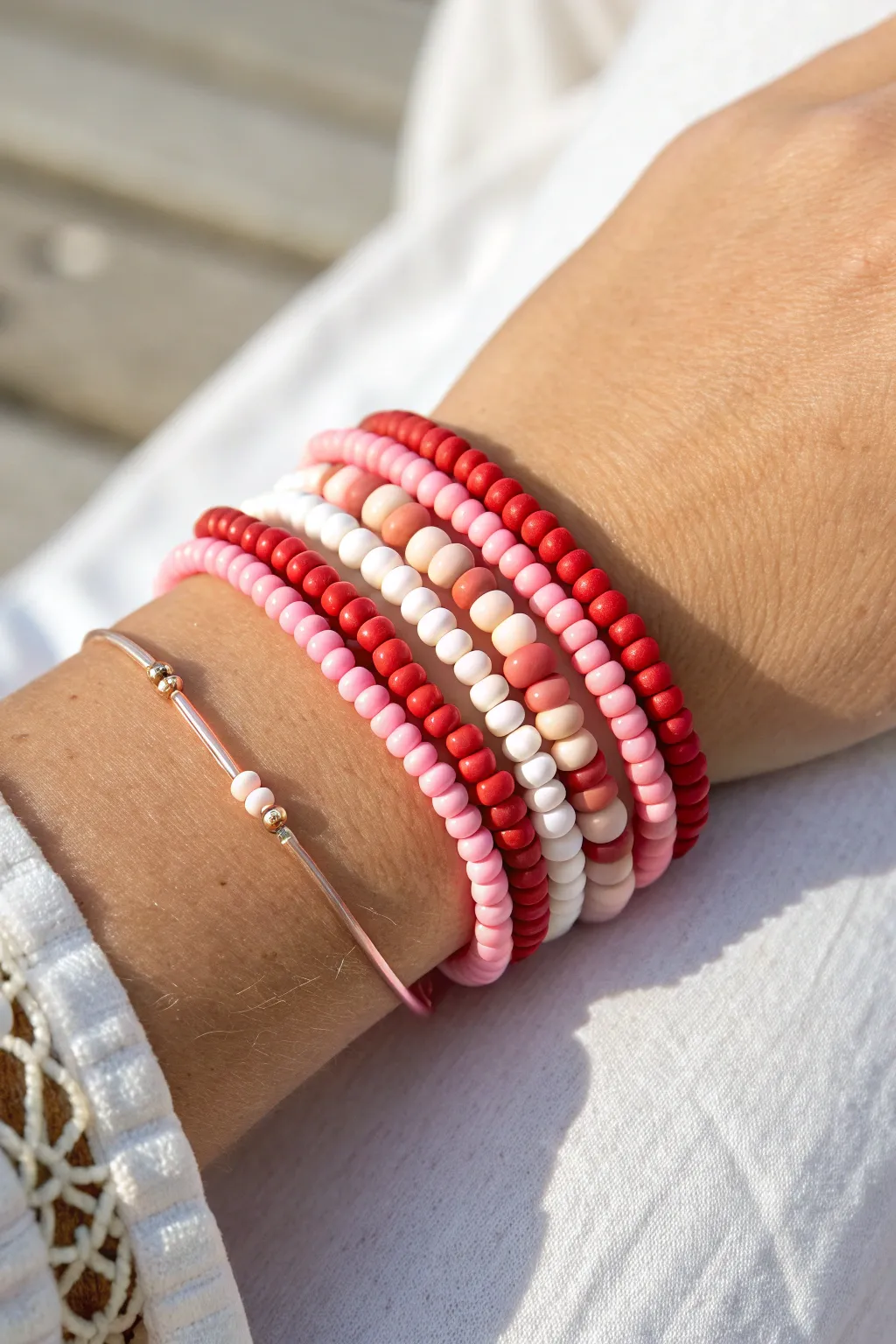
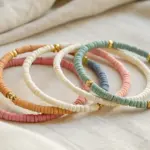
This stunning arm candy combines the casual charm of clay heishi beads with a touch of minimalist gold elegance. By stacking shades from deep crimson to soft blush, you create a rich, textured gradient perfect for Valentine’s Day or everyday wear.
Step-by-Step
Materials
- 4mm or 6mm heishi clay disc beads (dark red, bright pink, light pink, white/cream)
- Stretch cord (0.8mm or 1mm thickness)
- Gold-filled tube beads (curved)
- Small gold accent beads (2-3mm)
- 3mm gold spacer beads
- Jewelry glue or clear nail polish
- Scissors
Step 1: Red & Pink Solid Strands
-
Measure your wrist:
Before cutting anything, wrap a piece of string around your wrist to find your comfortable size. Add about 1/2 inch to this measurement so the bracelets aren’t too tight. -
Cut the cord:
Cut a piece of stretch cord about 10-12 inches long. Having this extra length makes tying the final knots much easier than struggling with short ends. -
Pre-stretch the cord:
Give your cut piece of cord a few firm tugs. This is a crucial step I always do because it prevents the bracelet from stretching out and becoming loose after only a few wears. -
String the red bracelet:
Begin threading your dark red heishi beads onto the cord. Keep adding them until you reach your measured length minus a tiny bit for the knot. -
Tie it off:
Secure the bracelet with a surgeon’s knot (loop left over right twice, then right over left). Pull it tight. -
Repeat for pinks:
Create two more solid-color bracelets using the same method: one using the bright pink beads and another using the light blush pink beads.
Knot Slipping?
If your stretch cord knots handle slippery, try a ‘surgeon’s knot’. Loop the cord through twice on the first pass instead of once. A dab of GS Hypo Cement on the knot seals the deal permanently.
Step 2: The Mixed Gradient Strand
-
Plan the pattern:
For the multi-colored bracelet, lay out your beads first. We want a random but balanced mix of white, cream, blush, coral, and red. -
Create sections:
Instead of total randomness, try stringing small sections of 3-5 beads of similar tones, then switching colors. This creates that chunky, organic texture seen in the photo. -
String the mix:
Thread your mixed pattern until it matches the length of your solid bracelets. Check the fit against your wrist to ensure they stack nicely. -
Secure the mix:
Tie off this fourth beaded bracelet with a strong knot, dab the knot with a tiny drop of jewelry glue, and trim the excess cord once dry.
Level Up: Personalize It
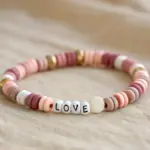
Swap the random mixed section beads for letter beads to spell out ‘LOVE’ or ‘XOXO’. Gold-lettered beads on white discs would coordinate perfectly with the gold tube bracelet.
Step 3: The Gold Accent Bangle
-
Prepare the gold components:
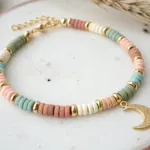
For the thin metallic bracelet, we are using curved gold tube beads and tiny gold spheres to create a delicate rigid look. -
Start the pattern:
Thread a long curved gold tube bead onto a new piece of stretch cord. -
Add separators:
Add a small gold spacer, then a 3mm gold bead (or pearl), and another spacer. This creates the little detail station seen in the reference. -
Finish the perimeter:
Continue adding curved tube beads separated by small round gold beads until the circle is complete. -
Hide the knot:
Tie your final surgeon’s knot very tightly. Trim the ends close and gently pull the knot inside one of the curved tube beads to hide it completely from view.
Slide your beautiful new stack onto your wrist and enjoy the pop of happy color
Classic Red, White, and Pink Stripes
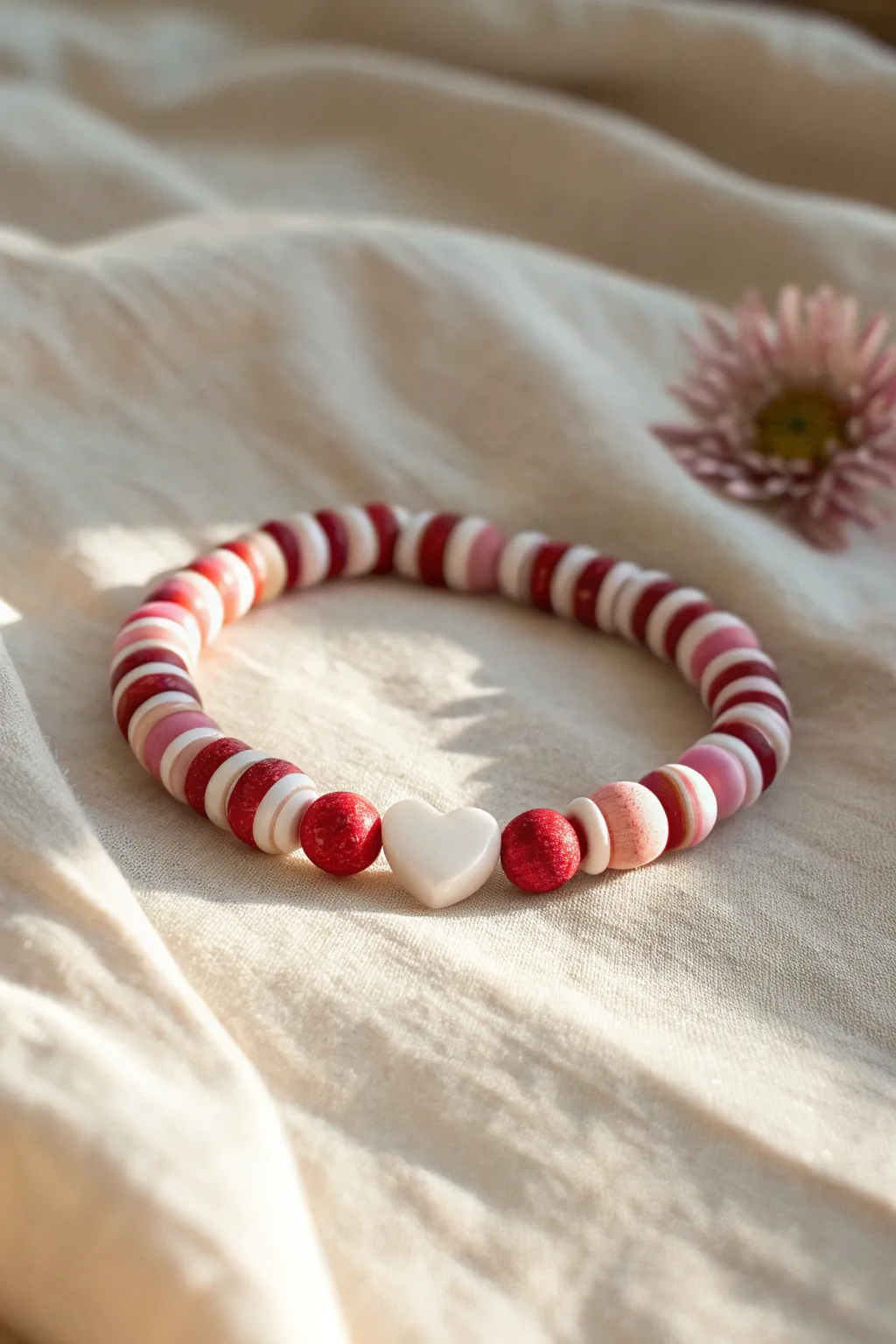
Embrace the classic romance of Valentine’s Day with this darling repeating pattern bracelet. Featuring a central pearlescent heart flanked by a bold sequence of red, pink, and white Heishi beads, it is the perfect accessory for February 14th.
Detailed Instructions
Materials
- Elastic cord (0.7mm or 0.8mm thick)
- White clay Heishi beads (flat discs)
- Red clay Heishi beads
- Pink clay Heishi beads
- Light pink/blush clay Heishi beads
- Two 8mm red glitter round beads
- One 10mm white pearlescent heart bead
- Scissors
Step 1: Preparation
-
Measure the cord:
Cut a piece of elastic cord about 9-10 inches long. This gives you plenty of extra room for tying knots later without the beads slipping off. -
Pre-stretch the elastic:
Tug firmly on both ends of the elastic cord a few times. This pre-stretching step is crucial because it prevents the bracelet from drooping or loosening immediately after you wear it. -
Secure one end:
Place a piece of masking tape over one end of the cord or attach a binder clip. This acts as a ‘bead stopper’ so your hard work doesn’t slide right off while you’re stringing.
Step 2: Creating the Centerpiece
-
String the heart:
Locate the exact center of your cord and thread on the white pearlescent heart bead. This will ensure your design stays symmetrical as you build outward. -
Add accent beads:
On the right side of the heart, thread one red glitter round bead. Repeat this on the left side of the heart so the heart is now framed by the two sparkly red spheres. -
Start the transition:
On the right side, next to the glitter bead, add one white Heishi disc followed by a blush pink Heishi disc. -
Mirror the transition:
Whatever you do to the right side, immediately do to the left. Add one white Heishi disc and one blush pink Heishi disc to the left side of your centerpiece.
Clean Cuts Only
When cutting your elastic cord, ensure your scissors are very sharp. Dull scissors fray elastic, making it nearly impossible to thread through the tiny holes of clay disc beads.
Step 3: Building the Pattern
-
Establish the stripe sequence:
The main pattern for the strap consists of repeating blocks. Thread the following sequence on one side: two red discs, one white disc, two pink discs, and one white disc. -
Repeat the block:
Continue this pattern: Red-Red-White-Pink-Pink-White. I find it helpful to lay these small pattern blocks out on a bead board first to check for mistakes. -
Fill the first side:
Keep repeating the sequence until that side of the bracelet reaches about halfway around your wrist measurement. -
Replicate on the second side:
Move to the other side of the central heart and repeat the exact same pattern sequence: Red-Red-White-Pink-Pink-White. -
Check the fit:
Wrap the unfinished strand around your wrist. The ends should meet comfortably without gaps, but shouldn’t be loose. Add or remove a pattern block if necessary for size.
Discs Sticking Together?
Heishi beads often stick together in the package. If you accidentally string two thin white discs thinking it’s one, roll the bracelet between your palms to separate them and check width.
Step 4: Finishing Touches
-
Prepare to tie:
Remove the tape or clip from the end. Bring both ends of the elastic together carefully. -
Tie a surgeon’s knot:
Cross the ends like a standard overhand knot, but loop the top string through the circle a second time before pulling tight. This creates extra friction. -
Secure the knot:
Make a second standard knot on top of the surgeon’s knot and pull very tight. Optional: Put a tiny dab of jewelry glue or clear nail polish on the knot for extra security. -
Hide the knot:
Trim the excess elastic close to the knot (but leave about 1-2mm). Gently pull the cord so the knot slides inside the hole of one of the nearest larger beads if possible.
Slip on your new striped creation and enjoy the festive pop of color on your wrist
“LOVE” Letter Bead Centerpiece
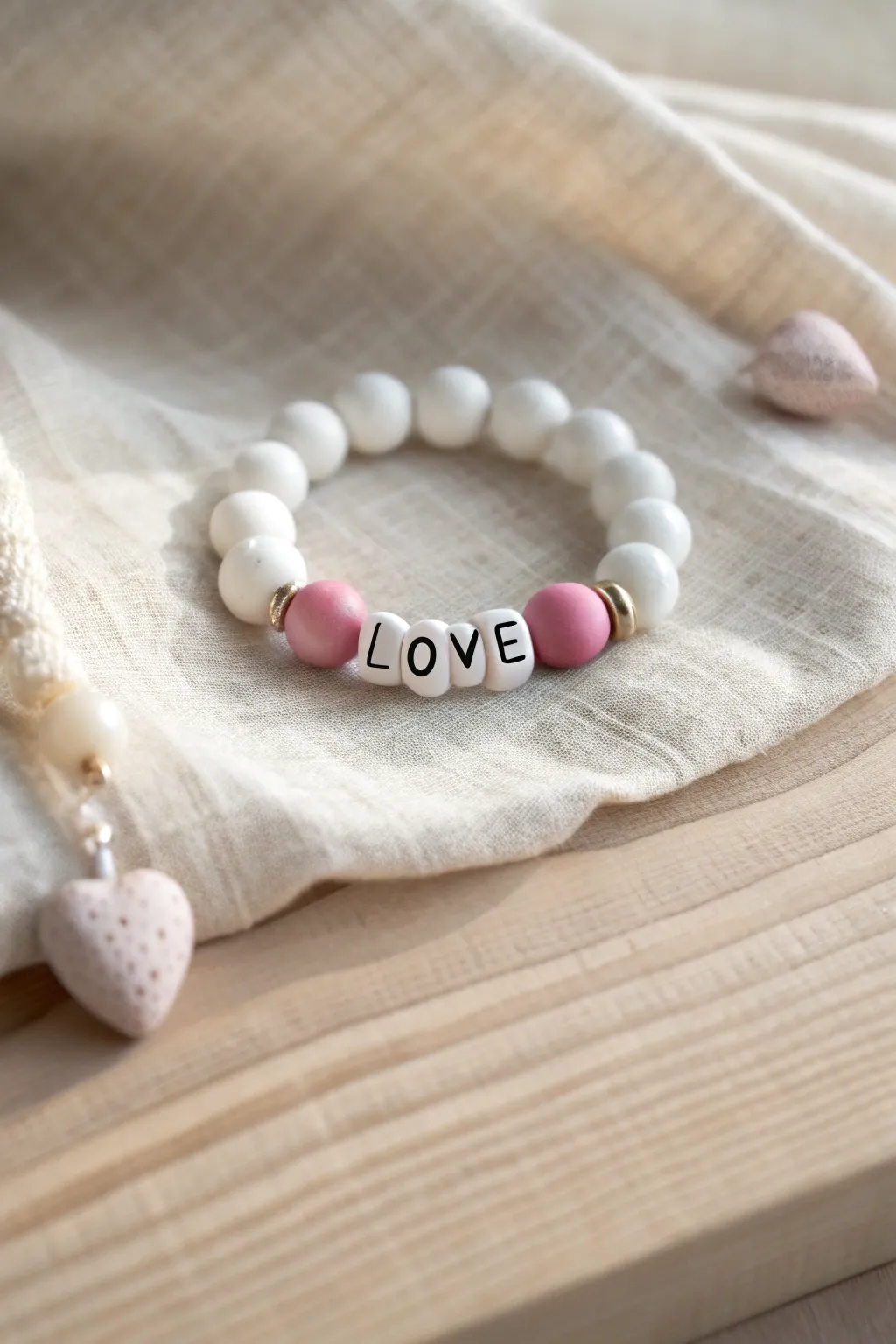
This charming bracelet combines classic elegance with a sweet message, making it a perfect handmade gift for Valentine’s Day. Featuring soft white beads, touches of dusty pink, and a bold “LOVE” centerpiece, this design is both minimalist and meaningful.
How-To Guide
Materials
- Durable elastic stretch cord (0.8mm recommended)
- 12-14 Round white beads (10mm or 12mm size, wooden or matte acrylic)
- 2 Round pink accent beads (similar size to white beads, matte finish)
- 4 White square letter beads spelling L-O-V-E
- 2 Gold spacer discs or rondelles
- Scissors
- Super glue or jewelry cement (e.g., G-S Hypo Cement)
- Bead stopper or painters tape
- Optional: Bead reamer
Step 1: Preparation
-
Determine sizing:
Before cutting your cord, measure your wrist. A standard bracelet length is about 7 inches, but add at least 3 extra inches to your cord length for comfortable knotting later. -
Secure the end:
Cut your elastic cord to the desired length. Attach a bead stopper or simply place a piece of painter’s tape on one end to prevent your beads from sliding off while you design. -
Stretch the cord:
I always like to pre-stretch the elastic cord gently a few times before stringing. This simple trick prevents the bracelet from sagging or expanding too much after the first few wears.
Hiding the Knot
If the knot hole on your bead is too small, use a bead reamer to gently widen the opening of the bead adjacent to the knot.
Step 2: Stringing the Design
-
Start with the base:
Begin by stringing the majority of your white round beads. For an average wrist, you will likely thread 10 to 12 of these beads first to form the back of the bracelet. -
Add the first accent:
Now, slide on one of the gold spacer discs, followed immediately by one of the dusty pink round beads. This creates a polished transition into the centerpiece. -
Thread the message:
String the letter beads in order: L, O, V, and E. Double-check that all letters are facing the correct direction and are right-side-up before proceeding. -
Complete the symmetry:
Mirror the other side of the centerpiece by adding the second pink round bead, followed by the second gold spacer disc. -
Final sizing check:
Wrap the unfinished strand around your wrist to check the fit. If it’s too tight, add another white bead or two to the ends; if it’s loose, remove one.
Letters Flipping?
If your letter beads keep flipping upside down, try using a slightly thicker elastic cord to fill the bead hole more snugly.
Step 3: Finishing Touches
-
Prepare to tie:
Remove the bead stopper or tape carefully, holding both ends of the elastic firmly. Bring the ends together to close the circle. -
The surgeon’s knot:
Tie a surgeon’s knot for maximum security. This is like a standard overhand knot, but you loop the cord through twice before pulling tight. -
Tighten the knot:
Pull all four strands (the two tail ends and the two bracelet sides) firmly to cinch the knot down. You want it tight enough that there are no gaps between beads. -
Apply adhesive:
Dab a tiny drop of jewelry cement or super glue directly onto the knot. Let this sit for a moment to become tacky and start setting. -
Hide the knot:
Generally, you can tug the knot gently so it slides inside the hole of the nearest white bead, hiding it from view completely. -
Trim the excess:
Once the designs feel secure and the glue is dry, use sharp scissors to trim the excess cord tails as close to the bead hole as possible without nicking the knot itself.
Your lovely bracelet is now ready to wear or gift to someone special this Valentine’s Day
Dainty White Bracelet With One Red Heart
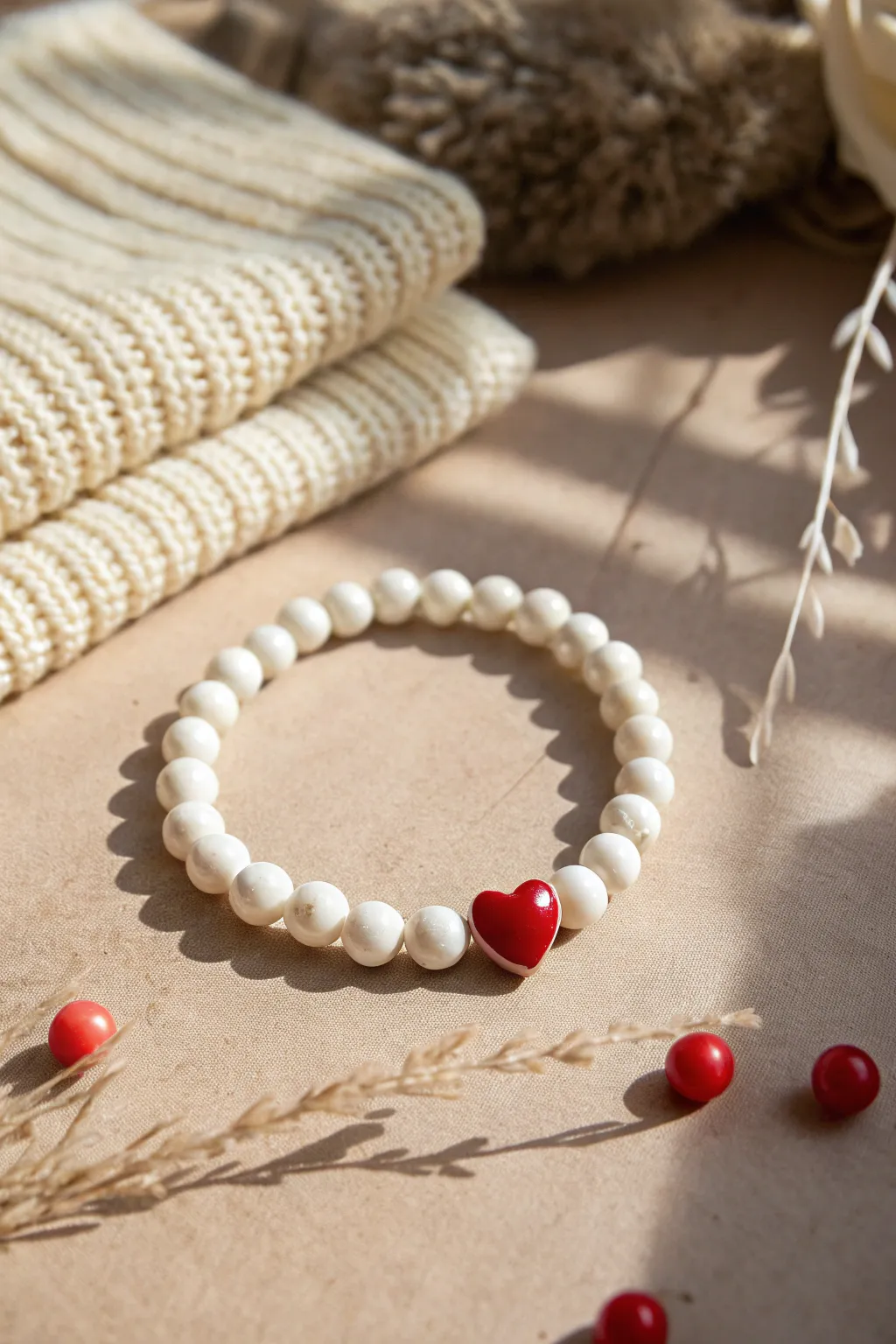
Embrace simplicity this Valentine’s Day with a dainty bracelet that lets a single pop of color speak volumes. Creamy white spherical beads provide a classic backdrop for a lone, glossy red heart, creating an accessory that balances subtle elegance with romantic charm.
Detailed Instructions
Materials
- Cream/off-white round beads (approx. 6mm or 8mm), likely stone or ceramic
- One red heart-shaped bead (ceramic or polymer clay)
- Elastic stretch cord (0.8mm recommended)
- Jewelry glue or clear nail polish
- Scissors
- Tape or bead stopper
- Ruler or measuring tape
Step 1: Preparation & Sizing
-
Measure your wrist:
Before cutting any cord, wrap a measuring tape gently around your wrist to get an accurate circumference. Add about half an inch to this measurement for a comfortable fit that isn’t too tight. -
Cut the cord:
Cut a length of elastic cord about 10-12 inches long. Having this extra length makes tying the knot at the end much less frustrating than working with short ends. -
Pre-stretch the elastic:
Hold the cord firmly at both ends and give it a few gentle tugs. Pre-stretching helps prevent the bracelet from loosening up and sagging after you’ve worn it a few times. -
Secure the end:
Place a piece of tape or a bead stopper on one end of your cut cord. This crucial step ensures your beads don’t slide right off the other side while you are stringing them.
Knot Slipping?
If your elastic knot refuses to stay tight while glueing, ask a friend to hold his finger on the first loop of the knot while you tie the second, or use a dab of clear polish to hold it temporarily.
Step 2: Stringing the Beads
-
Plan your layout:
Lay out your beads on a soft surface or bead board. Place the red heart in the center and arrange equal numbers of white beads on either side to visualize the final size. -
Start with white beads:
Begin threading the cream-colored round beads onto the elastic cord. String about half of the total number of white beads you estimated you’d need. -
Add the focal point:
Slide the red heart bead onto the cord. Ensure the heart is oriented correctly so it sits flat against the wrist rather than twisting sideways. -
Finish the bead strand:
Continue threading the remaining white beads. Occasionally wrap the strand around your wrist to check the fit; you want the ends to meet comfortably without gaps but without digging into your skin. -
Verify symmetry:
Before tying off, double-check that the heart sits exactly where you want it. I usually count the beads on either side of the heart just to be sure it’s perfectly centered.
Step 3: Finishing Touches
-
Prepare the knot:
Remove the tape or bead stopper carefully, holding both ends of the elastic cord securely so no beads escape. -
Tie a surgeon’s knot:
Cross the right end over the left, loop it under, and pull tight. Then, cross the left end over the right, loop it under, and loop it under a second time before pulling tight. -
Secure with glue:
Apply a tiny drop of jewelry glue or clear nail polish directly onto the knot. This prevents the elastic from slipping over time and adds durability. -
Hide the knot:
While the glue is still slightly tacky but not wet, gently pull the knot inside the hole of the nearest white bead or the heart bead itself if the hole is large enough. -
Trim the excess:
Once the glue is fully dry, use your scissors to snip the excess cord ends close to the bead, ensuring they don’t poke out.
Make a Stack
Create a matching set by making two additional bracelets: one using only the cream beads, and another alternating three white beads with one smaller gold spacer bead for added texture.
Now you have a charming, handmade accessory perfect for gifting or adding a romantic touch to your daily outfit

The Complete Guide to Pottery Troubleshooting
Uncover the most common ceramic mistakes—from cracking clay to failed glazes—and learn how to fix them fast.
Gold Spacer “Sprinkle” Valentine Bracelet
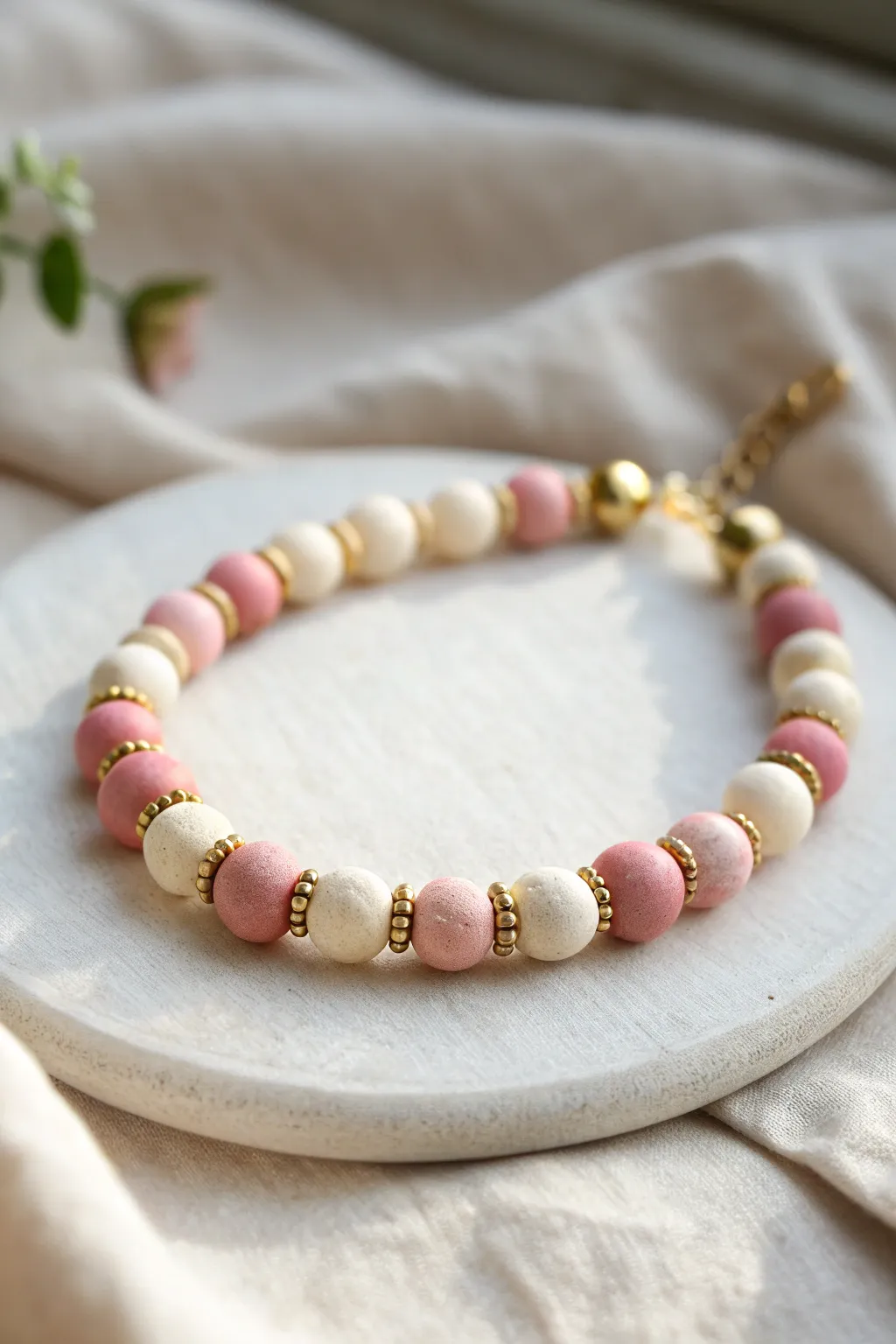
Enhance your accessory game with this charming polymer clay bracelet that combines soft matte pastels with luxe gold accents. The unique texture of these beads mimics the feel of unglazed ceramic, while the gold spacer beads add a touch of sophistication perfect for a Valentine’s aesthetic.
Step-by-Step Guide
Materials
- Polymer clay (Soft Pink/Dusty Rose)
- Polymer clay (Cream/Off-White)
- Polymer clay (Deep Rose/Mauve)
- Medium-sized gold spacer beads (round or saucer shape)
- Small gold seed beads or micro spacers
- Elastic beading cord (approx. 0.8mm)
- Jewelry clam shell tips (gold)
- Crimp beads
- Jump rings and lobster clasp
- Extension chain (optional)
- Bead rolling tool or acrylic block
- Toothpick or bead reamer
- Oven and baking sheet
- Pliers and scissors
Step 1: Crafting the Clay Beads
-
Condition the Clay:
Begin by thoroughly conditioning your three colors of polymer clay—cream, dusty rose, and mauve—until they are soft and pliable. Warm clay helps prevent cracking during the rolling process later. -
Measure Equal Portions:
Pinch off small pieces of clay for your beads. To ensure uniformity, roll each color into a long snake of even thickness and slice off equal segments using a tissue blade or knife. -
Hand-Roll Spheres:
Take each clay segment and roll it between your palms to form a smooth sphere. These beads should be roughly 8-10mm in diameter. -
Refine the Shape:
I like to use an acrylic block to gently roll the balls against a flat surface for a perfect spherical shape without fingerprints; aim for a matte, slightly organic finish rather than a high gloss. -
Create Texture:
To mimic the speckled, stone-like texture seen in the photo, gently roll the unbaked beads over a piece of sandpaper or tap them lightly with a stiff toothbrush. -
Pierce the Beads:
Using a bead pin or the thick end of a needle, carefully pierce a hole through the center of each sphere. Rotate the bead as you push the needle through to avoid distorting the shape. -
Bake the Clay:
Arrange your beads on a baking sheet lined with cardstock or parchment to prevent shiny spots. Bake according to your clay manufacturer’s instructions, usually around 275°F (130°C) for 15-30 minutes. -
Cool Down:
Allow the beads to cool completely before handling them. They will harden fully as they return to room temperature.
Step 2: Assembling the Bracelet
-
Prepare the Cord:
Cut a length of elastic cord about 10 inches long to give yourself plenty of room to work. Pre-stretch the cord by pulling it gently a few times to prevent it from sagging later. -
Plan the Pattern:
Lay out your design on a bead board or cloth. Simply alternate your clay beads (cream, then pink, then mauve) to create a soft gradient effect or random mix. -
Begin Stringing:
Start stringing your beads. The key to this look is the spacing: place a larger gold spacer bead between every single clay bead. -
Add Detail Spacers:
For certain sections, specifically between the focal beads, sandwich the larger gold spacer with two tiny gold seed beads on either side to create the stacked metallic look shown in the image. -
Check the Length:
Wrap the strand around your wrist to check the fit. Add or remove beads as necessary, keeping the alternating pattern intact. -
Secure the Ends:
Thread a crimp bead onto one end of the cord, followed by a clam shell tip. Loop the cord back through the crimp bead and pull tight. -
Crimp and Trim:
Use flat-nose pliers to flatten the crimp bead securely. Trim the excess tail of the elastic cord close to the crimp. -
Close the Clam Shell:
Slide the clam shell tip up over the crimped bead and gently close the two halves together using your pliers to hide the knot/crimp mechanism. -
Repeat on the Other Side:
Repeat the crimping and clam shell process on the other end of the bracelet, ensuring the tension is firm but not so tight that the bracelet buckles. -
Attach Hardware:
Open a jump ring using two pairs of pliers. Attach it to the loop of one clam shell tip and slide on your lobster clasp before closing the ring. -
Add Extension Chain:
On the opposite end, attach another jump ring and connect your extension chain. I recommend adding a small gold charm or a leftover clay bead to the end of the chain for a professional finish.
Sticky Situation?
If your clay feels too sticky or soft to handle, leach out excess plasticizer by pressing the raw clay between two sheets of plain white printer paper for 30 minutes before rolling.
Mix It Up
For a ‘cookies and cream’ effect on the white beads, mix in a tiny pinch of cracked black pepper or black glitter into the raw clay before rolling your spheres.
Now you have a sophisticated, boutique-style piece ready to wear or gift.
Heart-Bead Station Bracelet
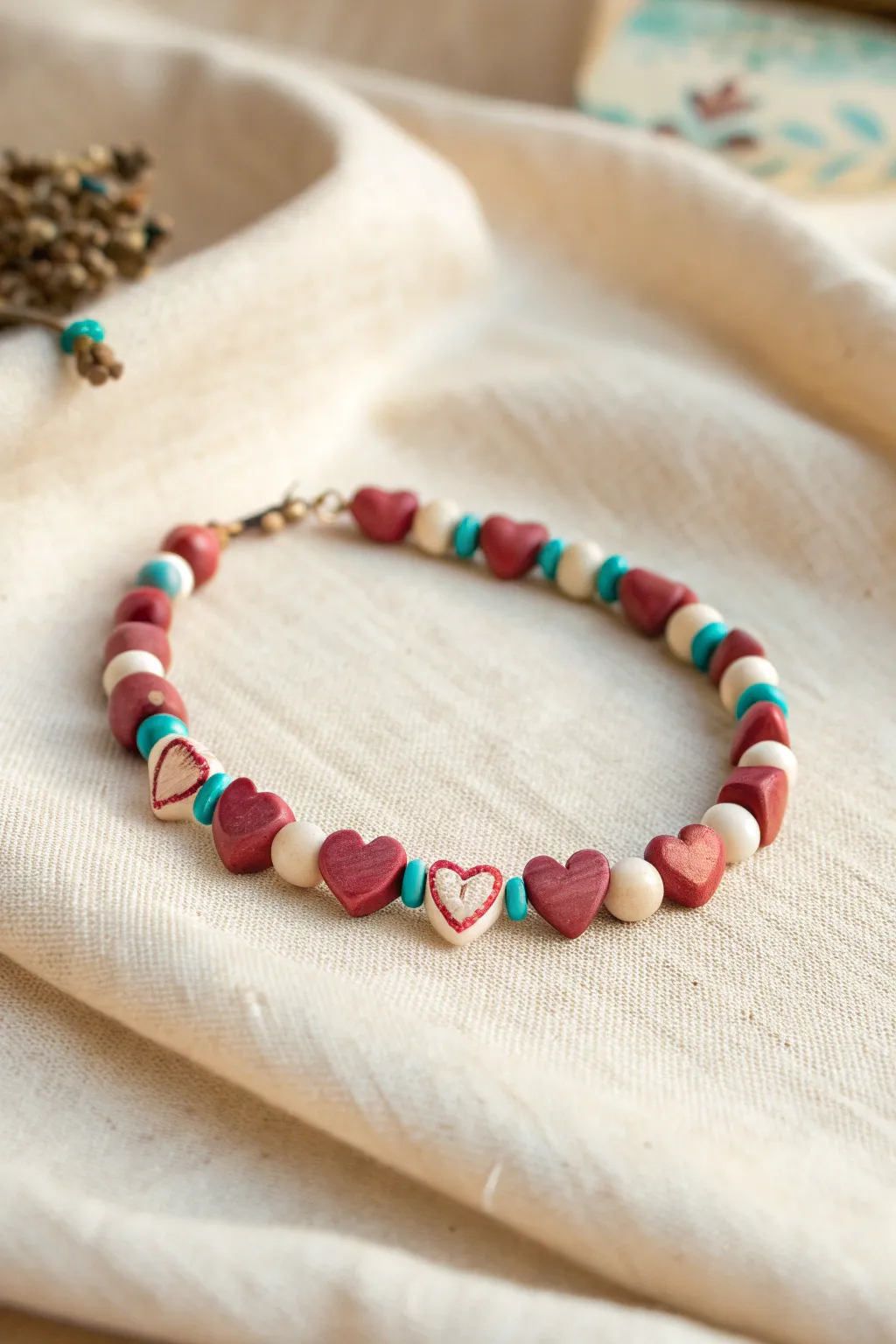
This charming bracelet combines matte-finished clay hearts in deep reds and creamy whites with pops of turquoise for a natural, slightly boho Valentine’s look. The pattern alternates between solid hearts and unique stamped feature beads, creating a lovely rhythm around the wrist.
Detailed Instructions
Materials
- Polymer clay (Deep Crimson, Cream/White, and a scrap of Turquoise)
- Small heart-shaped clay cutters (approx. 1cm)
- Round clay bead roller or palm rolling technique
- Headpins or piercing tool (toothpick/needle tool)
- Beading wire or strong stretch cord (0.8mm)
- Crimp beads and crimp tool (if using wire)
- Lobster claw clasp and jump rings
- Tiny turquoise spacer beads (glass seed beads or handmade clay discs)
- Small heart stamp or carving tool
- Red acrylic paint (for the stamped detail)
- Matte varnish (optional)
Step 1: Sculpting the Clay Beads
-
Condition the Clay:
Begin by thoroughly conditioning your Deep Crimson and Cream polymer clay until it is soft and pliable. This prevents cracking later. -
Create the Red Hearts:
Roll a sheet of the Deep Crimson clay to about 3-4mm thickness. Use your small heart cutter to punch out approximately 8-10 hearts. Smooth the sharp edges gently with your finger. -
Pierce the Red Hearts:
Carefully insert a piercing pin or needle tool horizontally through the side of each heart. Twist gently as you push through to avoid distorting the shape. -
Make the Feature Hearts:
Using the Cream clay, cut out 2-3 heart shapes just like the red ones. These will be your focal points. Pierce them horizontally as well. -
Stamp the Centers:
On the cream hearts, gently press a smaller heart stamp into the center to create an indentation. If you don’t have a stamp, use a needle tool to carefully carve a small heart outline. -
Roll the Round Spacers:
Roll small portions of the Cream clay into perfect spheres, roughly 6mm in diameter. You’ll need about 10-12 of these depending on your wrist size. -
Create Turquoise Discs:
Roll a very thin snake of turquoise clay and slice off tiny discs, or simply use store-bought turquoise seed beads if you prefer uniformity. Pierce the clay discs if making them by hand. -
Bake:
Arrange all your beads on a baking sheet lined with parchment paper. Bake according to your polymer clay package instructions (usually 275°F/135°C for 15-30 minutes). Let them cool completely.
Distorted Hearts?
If piercing the hearts squishes them, try letting the clay ‘rest’ and cool in the fridge for 10 minutes before piercing, or drill the holes after baking with a small hand drill.
Step 2: Painting and Assembly
-
Highlight the Stamped Hearts:
Take a tiny amount of red acrylic paint and brush it into the indented heart on your cream beads. I usually wipe the surface immediately with a damp paper towel, leaving paint only in the recesses. -
Sealing (Optional):
If you want extra durability, apply a thin coat of matte varnish to the beads. Avoid glossy finishes to keep the natural, rustic look shown in the photo. -
Prepare the Stringing Material:
Cut a length of beading wire about 10 inches long. Attach one end to a crimp bead and a jump ring (or one half of your clasp), securing it tightly with crimping pliers. -
Begin the Pattern:
Start threading your beads. The pattern shown generally follows this sequence: one red heart, one cream round bead, one turquoise spacer, one feature cream heart, one turquoise spacer, one cream round bead. -
Adjust the Rhythm:
Feel free to vary the pattern slightly. Notice how the original design sometimes places a red heart directly next to a cream round bead without a turquoise spacer. The key is balance. -
Check the Length:
Wrap the unfinished strand around your wrist to check the fit. Add or remove beads as necessary, keeping the pattern symmetrical if possible. -
Secure the End:
Thread the remaining end through a crimp bead and the lobster claw clasp. Loop the wire back through the crimp bead and pull tight. -
Final Crimp:
Use your crimping pliers to flatten the crimp bead securely. Trim any excess wire close to the bead.
Make it a Set
Use leftover red hearts to make matching dangle earrings. Attach a jump ring to the top lobe of the heart instead of piercing it sideways for a sweet drop style.
Now you have a charming, handcrafted accessory perfect for stacking or gifting to someone special

What Really Happens Inside the Kiln
Learn how time and temperature work together inside the kiln to transform clay into durable ceramic.
Split-Half Color Block With Heart Center
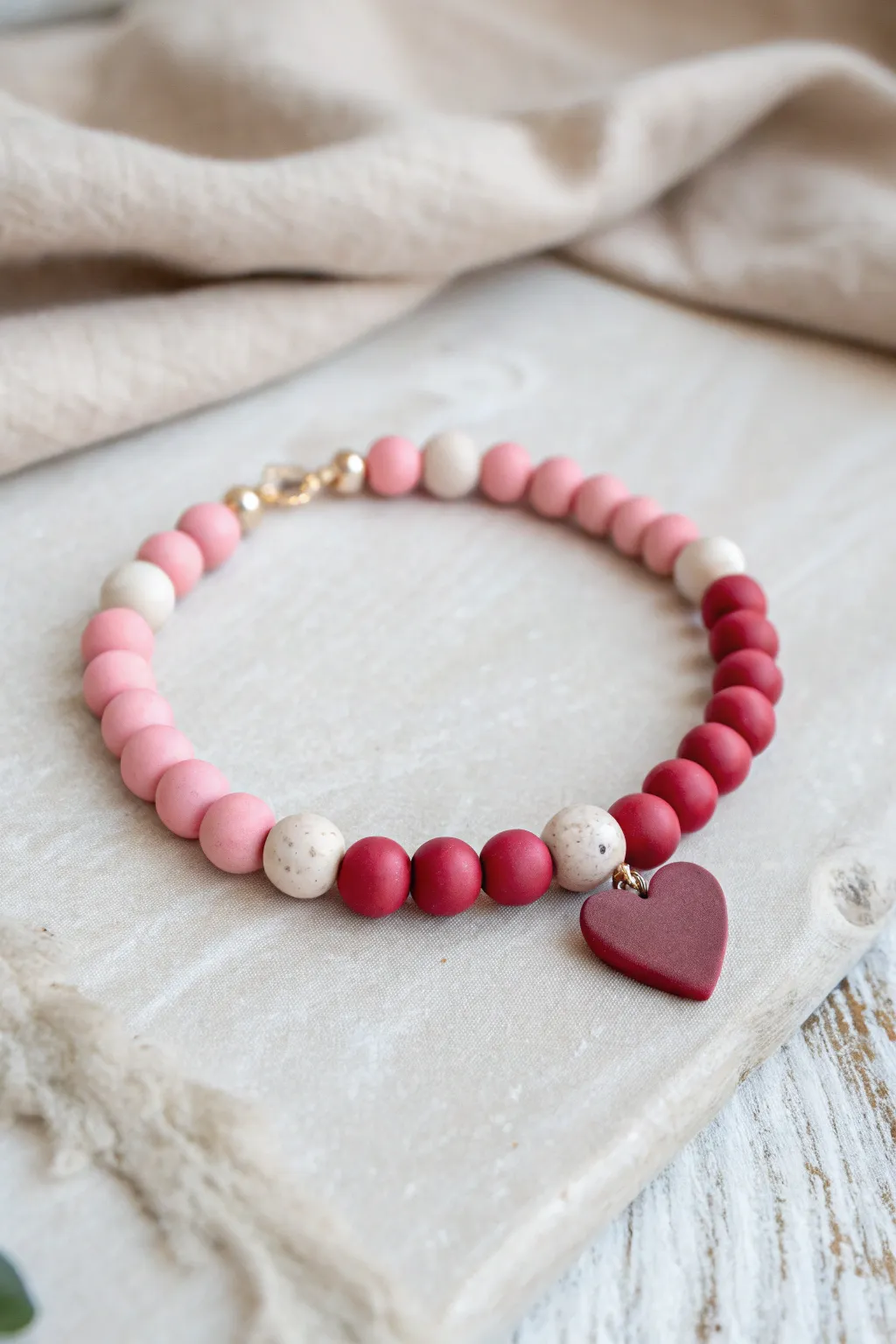
This charming bracelet features a lovely split-tone design, balancing soft blush pinks on one side with deep, romantic reds on the other. A dangling clay heart charm ties the look together, making it a perfect handmade accessory for Valentine’s Day or simply showing some love.
Step-by-Step
Materials
- Polymer clay (light pink, deep red/maroon, and white/granite effect)
- Elastic beading cord (clear, 0.8mm)
- Gold jump ring (5mm or 6mm)
- 2 small gold crimp beads (optional but recommended)
- Gold lobster clasp and jump ring for closure (or just knotting)
- Bead rolling tool or a flat acrylic block
- Toothpick, needle tool, or bead piercing pins
- Small heart-shaped clay cutter (approx. 1cm)
- Jewelry pliers (needle nose)
- Super glue or jewelry adhesive
- Cornstarch or baby powder (to prevent sticking)
- Oven and baking sheet
Step 1: Crafting the Clay Beads
-
Condition the Clay:
Begin by thoroughly conditioning your polymer clay colors separately. Take the light pink, deep red, and the speckled white clay and knead them until soft and pliable. -
Portion the Beads:
Roll small equal-sized balls of clay for your beads. For a standard bracelet, you will need roughly 10-12 light pink beads, 13-15 deep red beads, and about 4 speckled white beads. -
Roll Smooth Spheres:
I find using a bead roller creates the most uniform shape, but you can also roll them gently between your palms to create smooth, round spheres approximately 6-8mm in diameter. -
Pierce the Holes:
Using a needle tool or toothpick, carefully pierce a hole through the center of each bead. Twist the tool gently as you push through to avoid distorting the round shape. -
Create the Heart Charm:
Roll out a small slab of the deep red clay to about 3mm thickness. Use your small heart cutter to punch out a heart shape. -
Add the Charm Hole:
Before baking, pierce a small hole near the top of one of the heart’s lobes (or the center top) large enough to fit your jump ring. -
Bake the Components:
Arrange all beads and the heart charm on a baking sheet lined with parchment paper. Bake according to your specific brand of polymer clay’s instructions (usually around 275°F/130°C for 15-30 minutes). -
Cool Down:
Let the beads cool completely before handling them; they harden fully as they return to room temperature.
Fixing Distortion
If beads squish while piercing, let the clay rest for 10 minutes to firm up (leaching) or refrigerate briefly before piercing holes.
Step 2: Assembling the Bracelet
-
Cut the Cord:
Cut a piece of elastic cord about 10-12 inches long. This gives you plenty of extra slack to tie knots comfortably. -
Attach the Clasp First:
Thread a crimp bead and one half of your clasp (like the jump ring side) onto one end. Loop the cord back through the crimp bead and flatten it with pliers to secure the start of your strand. -
Start the Pink Side:
String approximately 11-12 light pink beads onto the cord. -
Add Accent Beads:
Add one speckled white bead, followed by one deep red bead, then one more speckled white bead. This creates a transition zone. -
String the Red Side:
Continue stringing with the deep red beads until the bracelet reaches your desired length. -
Add Final Accents:
Finish the strand with two speckled white beads or a mix of light pink and white to balance the design near the clasp. -
Attach the Heart Charm:
Open a gold jump ring using your pliers. Slide the baked clay heart onto the ring, then hook the ring onto the cord between the two central speckled beads (or wherever you prefer the focal point). -
Close the Jump Ring:
Use pliers to gently twist the jump ring closed so the gap disappears and the charm stays secure. -
Adding the Clasp:
On the finishing end, thread a crimp bead and the lobster clasp. Loop the cord back through the crimp bead, pull clear of slack, and flatten the crimp bead securely. -
Final Knot (Optional):
If you aren’t using crimps and clasps, tie a strong surgeon’s knot with the elastic, pull it tight, and secure it with a tiny dab of super glue before trimming the excess tails.
Add Some Shine
Brush a thin layer of gloss glaze or UV resin over just the heart charm after baking to make it pop against the matte beads.
Now you have a custom color-blocked bracelet ready to wear or gift to someone special
Mini Charm Drop Heart Bracelet
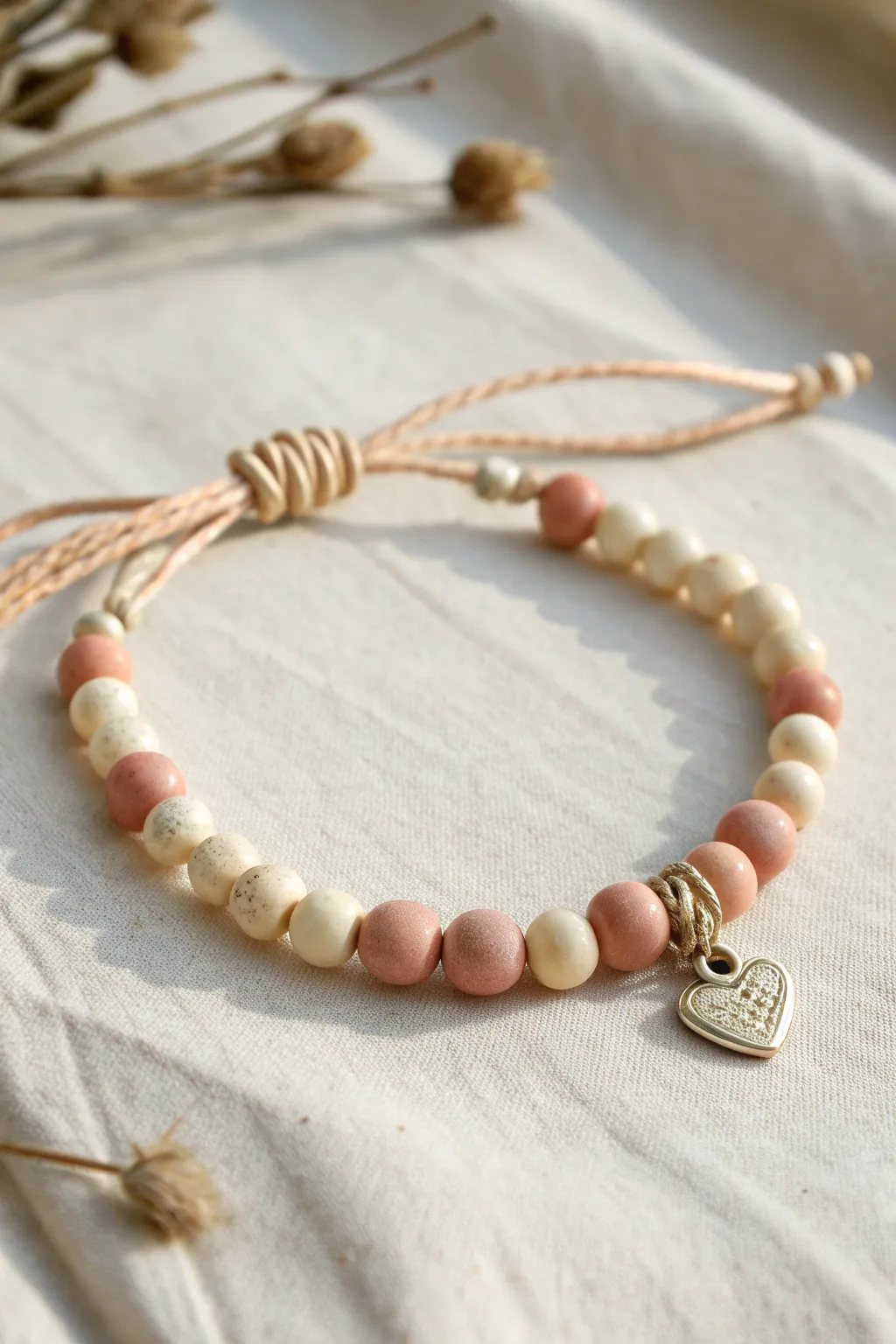
This delicate bracelet combines soft matte textures with a romantic color palette, perfect for a subtle Valentine’s accessory. The adjustable macramé closure ensures a comfortable fit for any wrist size while the gold heart charm adds a lovely focal point.
How-To Guide
Materials
- 6mm round matte polymer clay beads (dusty rose)
- 6mm round matte polymer clay beads (cream with speckles)
- 1mm light beige waxed cotton cord
- Gold-tone heart charm with jump ring
- Scissors
- Tape or clipboard
- Bead reamer or large needle (optional)
- Clear jewelry glue or clear nail polish
Step 1: Preparation & Charm Placement
-
Cut the cord:
Begin by cutting a piece of waxed cotton cord approximately 18 inches long. This generous length allows plenty of room for knotting and the adjustable closure. -
Secure the cord:
Tape one end of your cord down to a table or secure it under the clip of a clipboard. This tension makes stringing much easier. -
Center the charm:
Thread your gold heart charm onto the cord. If the charm’s loop is large enough, thread the cord through directly; otherwise, use a jump ring to attach it. -
Create the focal knot:
Slide the charm to the approximate center of the cord. Tie a simple overhand knot with the cord loops tight against the charm’s attachment ring. This keeps the charm dangling securely in the middle.
Step 2: The Beading Pattern
-
Plan your pattern:
The pattern shown uses a mix of solid dusty rose beads and speckled cream beads. A nice sequence is alternating small groups: two rose, two cream, or a 1-1 pattern near the charm. -
Start the left side:
Thread beads onto the left side of the charm knot. Start with a rose bead, followed by a cream bead. Continue adding beads until you have about 2.5 to 3 inches of beading on this side. -
Start the right side:
Repeat the process on the right side of the charm, mirroring your pattern if you prefer symmetry. I like to double-check the length periodically by wrapping it around my wrist. -
Secure the beads:
Once you are happy with the beaded length (usually about 6 inches total for an average wrist), tie an overhand knot snugly against the last bead on both ends to hold everything in place. -
Add accent end beads:
Slide a single small bead or a smaller knotting bead onto each tail of the cord, leaving about 2 inches of space from the main beaded section, then tie a knot after it to keep it on. This adds a decorative touch to the ties.
Sticky Slider?
If your square knot closure is too tight to slide easily, gently roll the knot between your fingers to loosen the fibers slightly, or apply a tiny bit of beeswax to the tails.
Step 3: The Sliding Closure
-
Shape the bracelet:
Bring the two ends of the bracelet together so they overlap, forming a circle. The tails should be pointing in opposite directions. -
Prepare the knotting cord:
Cut a fresh piece of waxed cord, about 10 inches long. This will become your sliding ‘square knot’ closure. -
Position the knotting cord:
Place the center of this new 10-inch cord underneath the two overlapping bracelet tails. -
Tie the first half-knot:
Take the right end of the knotting cord, pass it over the bracelet tails and under the left knotting cord. Pull tight to create a basic starting knot around the tails. -
Start the macramé square knot:
Cross the right knotting strand over the bracelet tails. Take the left knotting strand, go over the right strand, under the bracelet tails, and up through the loop created by the right strand. -
Complete the square knot:
Pull both knotting strands tight. Now repeat the process starting with the left strand: Left strand over tails, right strand over left, under tails, and up through the loop. -
Build the closure length:
Continue alternating left and right starting sides for your square knots until the closure is about 0.5 inches long. The knots should be firm but allow the bracelet tails to slide through. -
Trim and seal:
Trim the excess ends of the knotting cord (not the bracelet tails!) very close to the knots. Apply a tiny dot of jewelry glue to the cut ends to prevent fraying. -
Final adjustment:
Trim the main bracelet tails to your desired length and knot the very tips to prevent fraying. Test the sliding mechanism gently to ensure it moves smoothly.
Make it Luxe
Swap the central knot for two gold crimp beads on either side of the charm, or add tiny gold spacer beads between every third clay bead for extra sparkle.
Now you have a charming, adjustable bracelet ready to be gifted or stacked with your other favorite pieces

TRACK YOUR CERAMIC JOURNEY
Capture glaze tests, firing details, and creative progress—all in one simple printable. Make your projects easier to repeat and improve.
Speckled Strawberry-Cream Valentine Beads
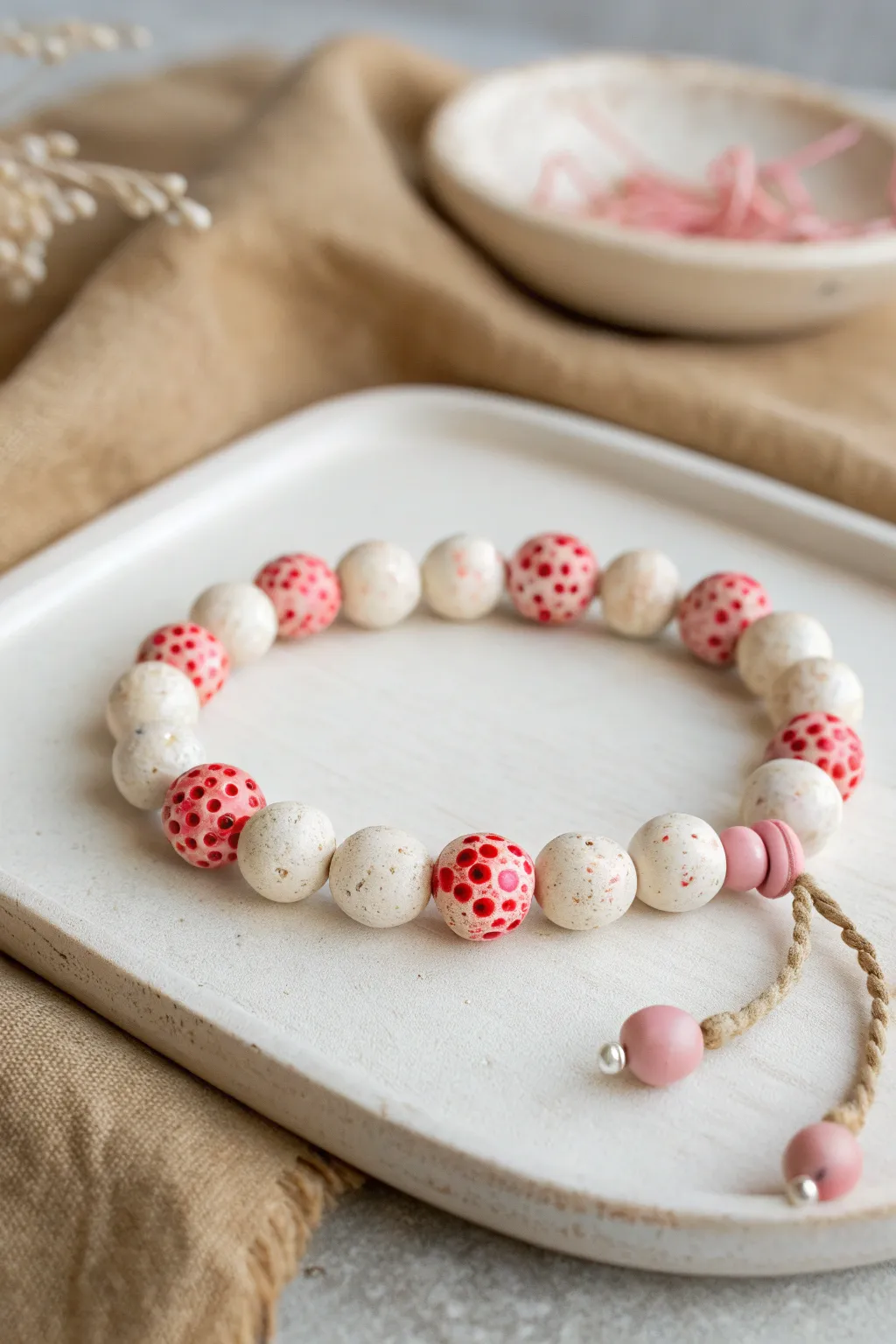
Create a delightful wrist accessory that looks good enough to eat with this polymer clay project inspired by strawberry ice cream and vanilla bean specks. The combination of textured white spheres and vibrant, pitted red accent beads creates a charmingly rustic yet modern Valentine’s aesthetic.
Detailed Instructions
Materials
- White polymer clay (cernit or fimo soft)
- Red polymer clay
- Translucent liquid clay (optional)
- Small round piping tip or straw (for bead sizing)
- Toothpick or bead reamer
- Clean toothbrush or stiff bristle brush
- Ground black pepper or dried vanilla bean specks
- Small dotting tool or needle tool
- Light pink acrylic paint (optional)
- Gloss varnish
- Hemp cord or waxed cotton string (beige)
- Two small pink wooden or clay beads for tassel ends
- One medium pink connector bead (flat disc shape)
Step 1: Crafting the Vanilla Bean Beads
-
Prepare the clay:
Begin by conditioning your white polymer clay until it is soft and pliable. Flatten it into a sheet. -
Add the texture:
Sprinkle a very small amount of ground black pepper or real dried vanilla bean seeds onto the flattened white clay. Fold the clay over and knead it thoroughly to distribute the specks evenly throughout the dough. This creates that authentic ‘stone’ or ‘vanilla bean’ look. -
Measure portions:
Roll the speckled clay into a long log of even thickness. Use a blade to cut equal segments, or punch circles out of a thick slab using a small cutter to ensure every bead is the same size. -
Roll into spheres:
Roll each segment between your palms to create smooth, round spheres. You will need about 12-14 of these white beads depending on your wrist size. -
Texture the surface:
Gently tap the surface of each white bead with a clean toothbrush or a ball of crumpled aluminum foil. You don’t want deep indentations, just a matte, slightly porous texture resembling ceramic.
Hole Distortion Tip
To prevent your round beads from squishing into ovals when piercing them, put them in the fridge for 15 minutes before making the holes.
Step 2: Creating the Strawberry Accent Beads
-
Form the red base:
Condition your red polymer clay. To get the specific pinkish-red hue in the photo, I like to mix a tiny bit of white into the red. Roll this into a log and cut segments similar in size to your white beads. -
Shape the red spheres:
Roll these segments into smooth spheres. You will need roughly 6-8 red beads to intersperse around the bracelet. -
Create the crater effect:
Using a small ball stylus or a blunt needle tool, press varying sizes of indentations all over the surface of the red beads. Press deep enough to create a ‘crater’ but not so deep you deform the sphere. -
Apply the exterior color:
Carefully roll the red beads in a very thin layer of white clay powder or lightly dry-brush them with white acrylic paint *before* baking if you want the surface to look frosted, while keeping the inside of the dots red. Alternatively, make the bead white and press red clay into the holes, but the photo suggests a white wash over red clay or a complex cane technique. -
Simplified Technique:
A stronger way to achieve the look in the photo: Form the bead from red clay. Then, press the end of a small tube (like a stripped wire casing) into the clay to remove tiny plugs, revealing the texture, or simply use a dotting tool to push in many patterned holes.
Scented Jewelry
Mix a drop of vanilla or strawberry essential oil into the clay while conditioning. Since polymer clay is porous, it will hold a faint, sweet scent!
Step 3: Baking and Assembly
-
Pierce the holes:
Before baking, use a toothpick or bead pin to pierce a hole through the center of every bead. Rotate the bead as you push to keep the shape round. -
Bake the clay:
Arrange all beads on a tile or baking sheet. Bake according to your clay manufacturer’s instructions (usually 230°F – 275°F for 15-30 minutes). -
Cool and finish:
Let the beads cool completely. If you want a slight shine like the photo, brush a thin layer of satin or gloss varnish over the strawberry beads, leaving the vanilla ones matte. -
Prepare the cord:
Cut a length of beige hemp cord (about 12 inches). Fold it in half if you want a double-strand look, or use a single thick strand. Tie a knot at one end leaving a loop if you want a toggle closure, or prepare for a sliding knot. -
String the pattern:
Thread the beads onto the cord. The pattern in the image alternates: two white beads, one red bead, two white, one red. Follow this around until the length fits your wrist comfortably. -
Add the focal connector:
At the end of the strand, thread on the flat pink disc bead. This acts as a stopper and a decorative transition to the closure strings. -
Create the tassels:
Tie a secure knot after the last bead. Leave two dangling ends of the cord, about 2 inches long. -
Attach end beads:
Thread a smaller solid pink bead onto the end of each dangling cord tail. Knot the cord securely underneath each bead to hold it in place and trim any excess.
Wear your delicious-looking creation with pride or gift it to a sweet friend
Marbled Pink Rose Valentine Bracelet
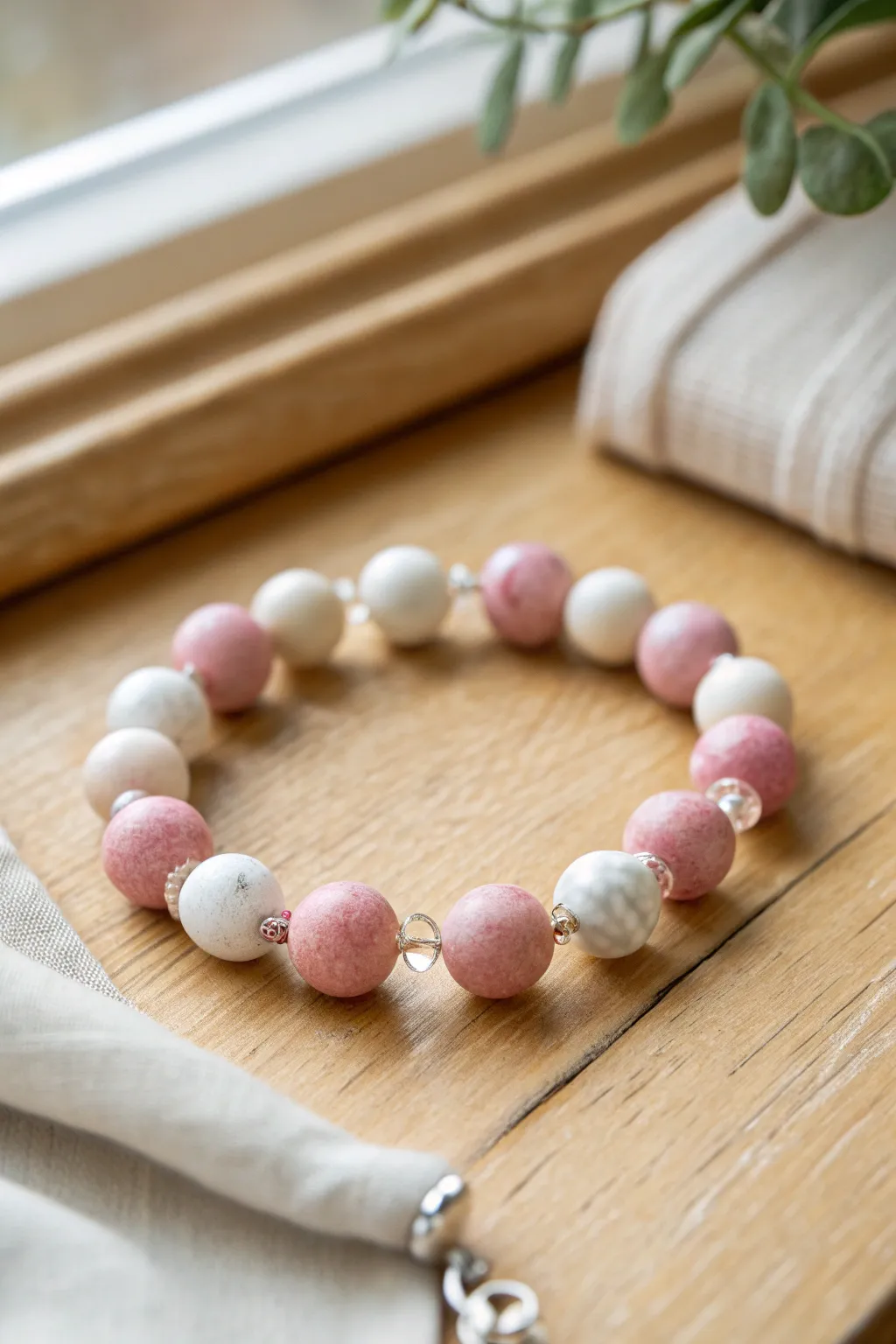
Soft pink hues meet gentle marbled whites in this romantic beaded bracelet that captures the sweetness of Valentine’s day. The polymer clay beads offer a lovely matte texture, while subtle silver accents add just the right amount of shimmer to your wrist.
How-To Guide
Materials
- Polymer clay in White, translucent, and a dusty Rose Pink
- Silver or clear glass seed beads (size 11/0 or 8/0)
- Stretch cord (0.8mm or 1mm thickness)
- Acrylic roller or pasta machine
- Bead piercing pins or toothpicks
- Jewelry adhesive or super glue
- Scissors or wire cutters
- Baking sheet and parchment paper
- Wet/dry sandpaper (400 and 800 grit)
Step 1: Creating the Clay Canes
-
Condition the Clay:
Begin by conditioning your white and rose pink polymer clay separately. Knead them warm in your hands until they are soft and pliable, which prevents cracking later. -
Mix Custom Pinks:
To get the natural variation seen in the photo, create two shades of pink. Keep one as your base rose color. For the second, mix a small amount of white into the rose clay to create a lighter, softer pink tone. -
Create the Marble Mix:
Roll a snake of white clay and a very thin snake of grey or translucent clay. Twist them together gently. Fold the twist in half and twist again, but stop before the colors fully blend—you want distinct veining to mimic the stone look.
Step 2: Forming the Beads
-
Measure Uniform Portions:
Roll your clay blends into logs of equal thickness. Use a blade to slice off equal-sized segments. This ensures all your beads will be roughly the same size, about 10-12mm in diameter. -
Roll Spheres:
Take each segment and roll it between your palms. Use a gentle circular motion to form smooth, round spheres. I find that lightly dusting my hands with cornstarch helps prevent fingerprints. -
Texture the Pink Beads:
For the dusty, textured look seen in the pink beads, gently roll them over a piece of coarse sandpaper or dab them lightly with a stiff toothbrush before baking. -
Pierce the Holes:
While the clay is still raw, carefully insert a bead piercing pin or toothpick through the center of each sphere. Rotate the pin as you push to avoid squashing the bead’s shape. -
Bake the Beads:
Arrange your beads on a parchment-lined baking sheet. Bake according to your clay manufacturer’s instructions (usually around 275°F/135°C for 15-30 minutes per 1/4 inch of thickness). -
Cool and Sand:
Allow the beads to cool completely. Once hard, use wet sandpaper to smooth out any fingerprints or rough edges around the holes, giving them a professional matte finish.
Uneven Shapes?
If your hand-rolled beads aren’t perfectly round, use a bead roller tool for consistency, or embrace the organic shape for a rustic look.
Step 3: Assembly
-
Prepare the Cord:
Cut a length of stretch cord about 10 inches long. Pre-stretch the cord by pulling it gently a few times; this prevents the bracelet from sagging after you wear it. -
Secure One End:
Place a piece of tape or a bead stopper on one end of the cord so your beads don’t slide off while you work. -
Begin Stringing:
Start threading your beads. Follow the pattern from the image: alternate between your white marbled beads and pink beads. -
Add Spacers:
Insert a tiny silver or clear seed bead between every 2-3 large clay beads. This small detail separates the colors and adds a delicate sparkle. -
Check the Size:
Wrap the strand around your wrist to check the fit. Add or remove beads as necessary, keeping the pattern consistent. -
Tie the Knot:
Remove the tape and bring the two ends together. Tie a surgeon’s knot (a square knot with an extra loop through) and pull it tight. -
Secure the Knot:
Apply a tiny drop of jewelry adhesive to the knot. Let it dry for a moment before trimming the excess cord, leaving about 2mm tails. -
Hide the Knot:
Gently pull the cord so the knot slides inside the hole of one of the larger clay beads, hiding it from view.
Add a Charm
Attach a small silver heart charm or a stamped initial tag to one of the spacer sections for a personalized Valentine’s touch.
Slip this lovely accessory onto your wrist and enjoy the handmade charm of your new favorite piece
Tiny Clay Rose Bead Accent
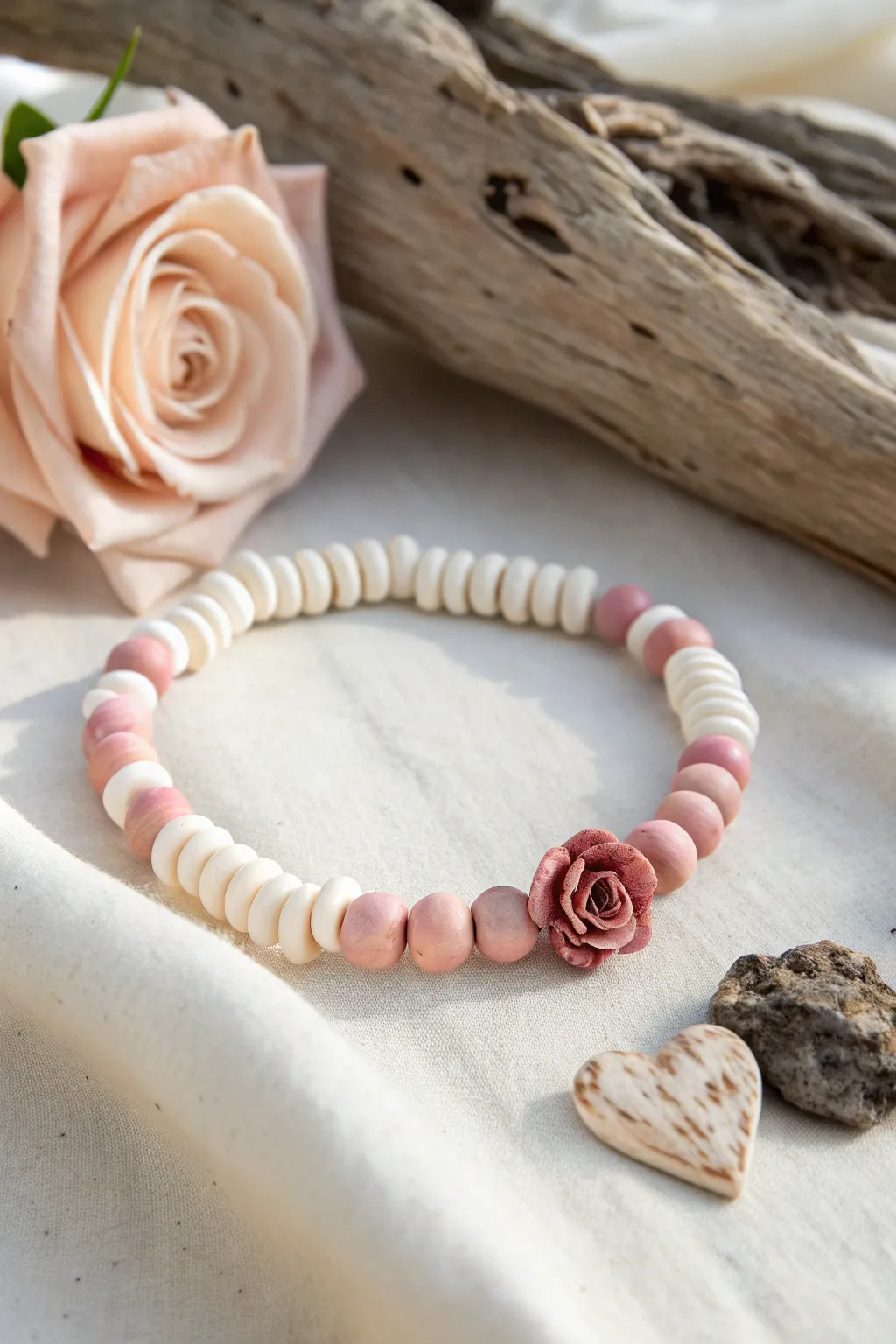
This delicate bracelet balances rustic textures with sweet Valentine’s hues, featuring a focal clay rose bead surrounded by bands of matte pink rounds and creamy white heishi discs. It’s the perfect mix of boho chic and romantic softness, ideal for a subtle nod to the season of love.
Step-by-Step Tutorial
Materials
- Polymer clay (dusty rose/mauve color)
- Polymer clay (cream/white color) or pre-made white heishi beads
- Polymer clay (matte pink) or pre-made matte round beads (6mm)
- Strong elastic bead cord (0.7mm or 0.8mm)
- Super glue or jewelry cement
- Clay tools (needle tool, small ball tool)
- Bead reamer (optional)
- Scissors
Step 1: Sculpting the Rose Focal Bead
-
Prepare the clay:
Condition a small amount of dusty rose polymer clay until it is soft and pliable. Roll it into a tiny snake, pinch off five to seven very small pieces, and flatten them into thin, petal-like ovals with your fingertips. -
Form the center:
Take the smallest flattened oval and roll it tightly into a spiral to create the center bud of the rose. -
Add petals:
Wrap the next petal around the bud, positioning the center of the petal over the seam of the bud. Gently flair the top edge outward slightly. -
Build the bloom:
Continue adding petals in an overlapping spiral pattern. Keep the base somewhat flat and ensure the petals are blended at the bottom so the rose stays together. -
Pierce the bead:
Once you are happy with the size (aim for about 8-10mm), carefully use a needle tool to pierce a hole horizontally through the base of the rose. Rotate the tool gently to ensure the hole is clean and wide enough for your cord. -
Detailing texture:
For that matte, realistic look seen in the photo, you can gently lightly tap the surface with a piece of sandpaper or a toothbrush before baking to remove any glossy fingerprints. -
Bake the rose:
Bake the clay rose according to the manufacturer’s instructions on your clay package. Let it cool completely before handling.
Step 2: Creating the Heishi Beads (Optional Step)
-
Roll the snake:
If you are making your own white disc beads instead of buying them, roll conditioned cream clay into a snake with the same diameter as your desired bead size. -
Slice delicately:
Use a sharp tissue blade to slice thin, even discs. Pierce the center of each with a needle tool. Bake these alongside your rose.
Needle Tool Trick
When piercing the rose bead, twist the needle as you push through rather than just pressing. This prevents the delicate flower shape from squishing.
Step 3: Assembling the Design
-
Measure the cord:
Cut a piece of elastic cord about 10-12 inches long. I always like to pre-stretch the elastic by pulling it firmly a few times; this prevents the bracelet from loosening up later. -
Start with the focal:
Thread your cooled clay rose onto the center of the cord. -
Add the pink rounds:
On the immediate left and right of the rose, add three to four matte pink round beads (6mm). This frames the flower beautifully. -
Add white spacers:
On both sides, add a segment of white heishi/disc beads. Thread about 10-12 discs to create a substantial white section. -
Create the pink pattern:
Following the white section, add a alternating pattern: one pink round bead, followed by one white disc bead. Repeat this ‘pink-white-pink’ pattern for about an inch. -
Finish the back:
Fill the rest of the bracelet length with the white heishi beads until it fits comfortably around your wrist. -
Check the fit:
Wrap the loose ends around your wrist to ensure the size is correct. Add or remove white discs at the back as needed. -
Secure the knot:
Tie a surgeon’s knot (right over left twice, pull tight; left over right once, pull tight). Dot the knot with a tiny drop of super glue. -
Hide the knot:
Once the glue is tacky but mostly dry, trim the excess cord and gently tug the knot inside one of the larger pink round beads or the hole of the rose if it fits.
Rustic Speckle Effect
Mix a tiny amount of black pepper or brown acrylic paint into your cream clay before rolling the heishi beads for an organic, stone-like speckled look.
Now you have a charming, handcrafted accessory ready to wear or gift.
Cupid Arrow Color Pattern Bracelet
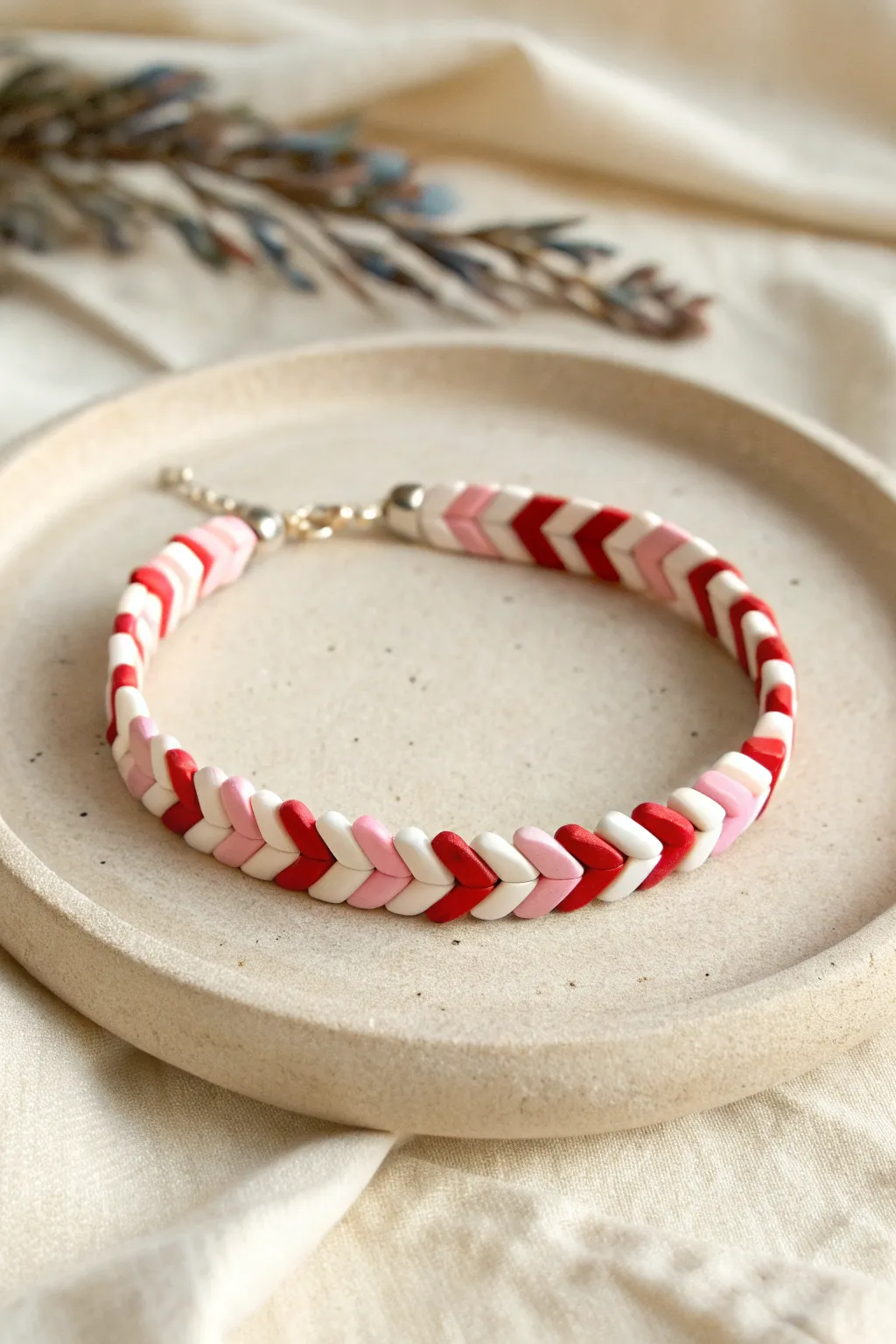
Capture the romance of Valentine’s Day with this striking chevron-patterned bracelet that mimics the flight of Cupid’s arrows. Using specialized two-hole beads, you’ll create a sleek, interlocking herringbone design in a classic palette of red, pink, and white.
How-To Guide
Materials
- SuperDuo or similar 2-hole oval/chevron beads (Red, Pink, White)
- Beading thread (e.g., Fireline or Nymo in white)
- 2 Beading needles (size 10 or 12)
- 2 Jump rings (gold or silver tone)
- Lobster clasp and extension chain
- 2 Bead tips or calm shell covers (optional but recommended for a clean finish)
- Scissors
Step 1: Setting Up the Foundation
-
Prepare your thread:
Cut a comfortable length of beading thread, approximately 4 feet. Creating this pattern works best with a two-needle method, so thread a needle onto each end of the single piece of thread. -
Attach the clasp anchor:
StringTo the center of your thread a closed jump ring or the loop of your clasp. If using a bead tip, string that on first, followed by a seed bead or a knot to secure it inside the cup. -
Start the first row:
Pick up two beads of your first color (e.g., Pink) with your left needle. Pass the right needle through the unused second hole of those same two beads. Pull tight so the beads stack side-by-side horizontally.
Uneven Arrows?
If beads aren’t nesting, check for burrs on the edges. Lightly file rough spots with an emery board so they stack flush.
Step 2: Creating the Chevron Pattern
-
Forming the V-shape:
To get that distinct arrow look, the beads need to angle. The image shows a pattern where beads nest into each other. For this specific ‘arrow’ look, we are essentially mimicking a herringbone stitch using shaped beads. -
Adding the next color:
Pick up a Red bead on the left needle and a Red bead on the right needle. Let them slide down to the previous row. -
Cross and secure:
This is the crucial step: To make them angle like an arrow point, you might need to add a single bead in the center that both needles cross through, or simply pass your needles through the *outer* holes of the new beads, then cross back through the inner holes. -
Simplify the stitch:
Actually, looking closely at the image, these appear to be specialized V-shaped clay beads or single-hole chevron beads strung simply. If using single-hole chevron beads, simply string them one after another: White, Red, Pink. -
Nesting the beads:
If you are using the single-hole chevron beads shown in the photo, ensure each bead ‘nests’ perfectly into the V-shape of the previous one. The concave bottom of the new bead should sit flush against the convex top of the previous bead. -
Repeating the sequence:
Follow the color pattern shown: segments of solid colors (white, pink, red) alternating with mixed sections. For example, string 5 white, then 5 red, then 5 pink. -
Checking the tension:
Keep the tension tight enough that no thread shows between the beads, but loose enough that the bracelet curves comfortably around a wrist without appearing stiff.
Level Up: Ombré Effect
Create a gradient by transitioning slowly: 3 red, 1 pink, 2 red, 2 pink, 1 red, 3 pink. It adds a sophisticated flow.
Step 3: Finishing Touches
-
Measuring length:
Wrap the strand around your wrist periodically. Remember that the clasp assembly will add about half an inch to the total length. -
Securing the end:
Once you reach the desired length, thread both ends through a bead tip or clam shell cover. Tie several secure overhand knots against the base of the bead tip. -
Adding glue:
I always add a tiny drop of jeweler’s glue or clear nail polish to the knot before closing the clam shell to ensure it never slips. -
Closing the hardware:
Close the bead tip over the knot using flat-nose pliers. Attach the extension chain or jump ring to the loop on the bead tip. -
Final inspection:
Lay the bracelet flat on a table to ensure the chevron pattern hasn’t twisted during the clasp attachment. The arrows should all point uniformly in one direction.
Now you have a stunning, geometric bracelet ready to wear or gift to someone special
Heart Checkerboard Pattern Pop
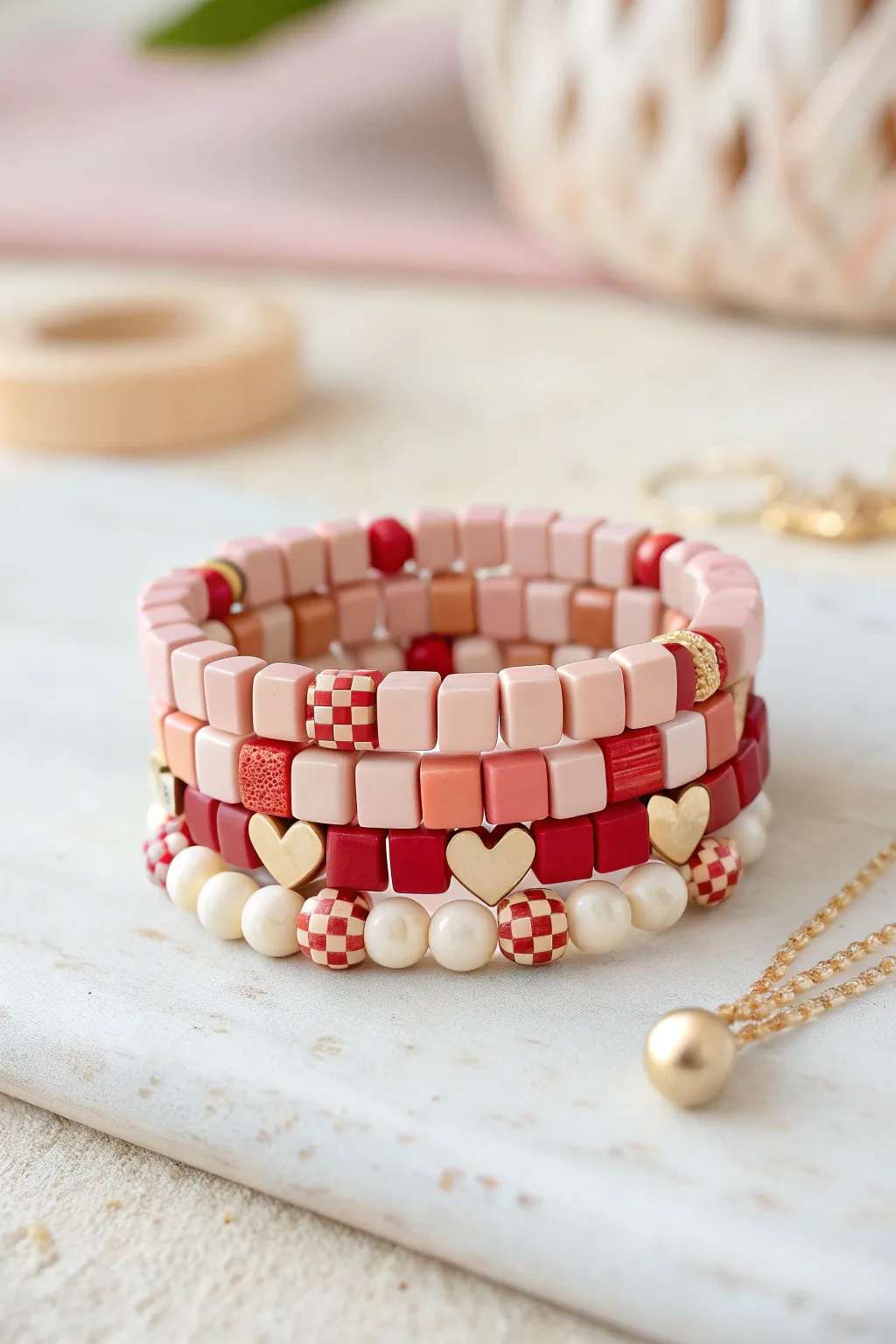
This charming bracelet stack combines soft pink hues with bold red accents and playful patterns for the perfect Valentine’s accessory. You’ll create three distinct strands that mix square Heishi beads, gold heart charms, and fun checkerboard details.
Step-by-Step Tutorial
Materials
- Elastic stretch cord (0.8mm or 1mm)
- Square/cube polymer clay beads in pale pink
- Square/cube polymer clay beads in coral/peach
- Square/cube polymer clay beads in deep red
- Round pearl beads (approx. 8mm)
- Checkerboard print round beads (red/white)
- Checkerboard print square beads (red/pink)
- Gold heart charm beads (center drilled)
- Small gold spacer beads or textured accent beads
- Super glue or jewelry adhesive
- Scissors
Step 1: Strand 1: The Pink Ombré Square Stack
-
Prepare the cord:
Cut a piece of elastic cord about 10 inches long. This gives you plenty of room to knot it later without struggling. Pre-stretch the elastic slightly by pulling on both ends. -
Start with solids:
Thread about 10-12 pale pink square beads onto the cord. Follow this with a small section of alternating colors: one coral bead, one small gold spacer, and back to pink. -
Add the focal point:
Slide on a special accent bead. In the top bracelet shown, there’s a unique square bead with a red-and-pink checkerboard pattern. If you don’t have this exact bead, a dark red square bead flanked by gold spacers works well too. -
Finish the pattern:
Continue stringing pale pink square beads until the bracelet reaches your desired length (usually about 6.5 to 7 inches for an average wrist). Add one final deep red bead near the end for a pop of contrast. -
Secure the knot:
Tie a strong surgeon’s knot (right over left, left over right). Add a tiny dot of super glue to the knot, let it dry for a moment, and trim the excess cord close to the knot.
Step 2: Strand 2: The Red & Gold Heart Layer
-
Create the base:
Cut another 10-inch length of cord. This strand focuses on deeper tones. String about 15-20 deep red square beads to form the back section of the bracelet. -
Insert the hearts:
Now for the centerpiece. Thread on a deep red square bead, followed by a gold heart charm bead. Repeat this pattern: red bead, gold heart, red bead, gold heart. -
Mix in contrasting texture:
Between some of the red sections near the front, swap in a textured coral square bead to break up the solid red line. This adds visual interest and ties it to the other bracelets. -
Complete the loop:
Finish the strand with more deep red square beads until it matches the length of your first bracelet. Test the fit against your wrist. -
tie and hide:
Knot the elastic securely as before. If the hole of one of your square beads is large enough, try to gently pull the knot inside the bead to hide it.
Knot Slipping?
If your elastic knots untie themselves, use a surgeon’s knot but add a second loop on the first pass. Always pull all four strands tight (tail ends and bracelet loops) to lock it.
Step 3: Strand 3: The Pearl & Checkered Mix
-
Start styling the final strand:
Cut your third piece of cord. This layer uses round beads for a shape contrast. Begin by threading three creamy white pearl beads. -
Add the fun pattern:
Slide on one round red-and-cream checkerboard bead. This playful print is the signature element of the set. -
Create the rhythm:
Continue the pattern: three pearls, one checkerboard bead, three pearls. Keep this rhythm going around the entire length of the bracelet. -
Check the stack:
Before tying, hold this strand up against the first two. Make sure all three are roughly the same size so they sit comfortably together on your arm without one feeling too tight. -
Finalize the set:
Tie your final knot, glue it for security, and trim the ends. I like to tug the knot firmly before gluing to ensure it won’t slip.
Mix It Up
Swap the gold hearts for letter beads to spell out ‘LOVE’ or ‘XOXO’ on the middle red strand for a personalized message version of this stack.
Stack them all up on your wrist for a sweet, coordinated look that pops
Mismatch Valentine Stack With One Theme
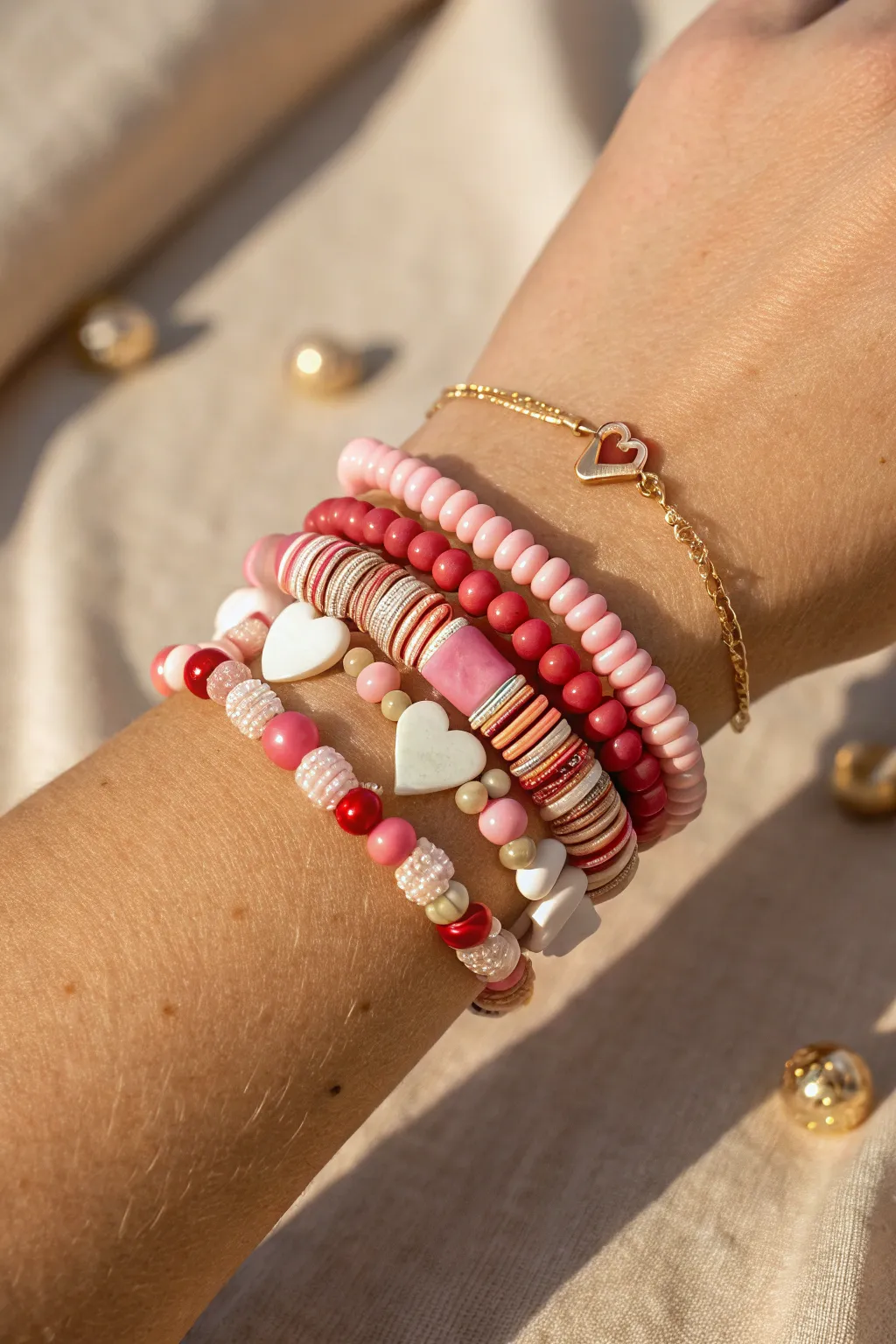
Create a charming, eclectic stack of Valentine’s Day bracelets that blends varied textures like polymer clay, glass pearls, and gold chain for a sophisticated yet playful look. This mismatched set relies on a cohesive palette of pinks, reds, and creams to tie different bead shapes together seamlessly.
How-To Guide
Materials
- Elastic cord (0.8mm or 1mm)
- Small gold curb chain
- Gold finish heart connector charm
- Small gold jump rings and lobster clasp
- Flat round polymer clay heishi beads (dark pink, light pink, white/red stripe, solid red)
- Round glass or acrylic beads (varying sizes: 4mm, 6mm, 8mm) in pink gradients
- Heart-shaped shell or acrylic beads (white)
- Gold spacer beads and small accent beads
- Super glue or jewelry cement
- Scissors and jewelry pliers
Step 1: The Gold Chain Layer
-
Measure the chain:
Begin by measuring the gold curb chain against your wrist. You want a comfortable fit that isn’t too tight, accounting for the length of the clasp and the charm connector. -
Cut into sections:
Using your jewelry pliers (wire cutters), snip the chain into two equal halves. This is where your heart charm will sit. -
Attach the heart connector:
Use small jump rings to attach one end of each chain segment to the loops on either side of the gold heart connector charm. Ensure your jump rings are closed tightly so the chain doesn’t slip out. -
Add the clasp:
On the remaining free ends of the chain, attach a jump ring to one side and a lobster clasp to the other to complete the first delicate layer.
Knot Security
Hide your elastic knot by sliding it inside the hole of a larger bead (like one of the hearts) immediately after applying glue.
Step 2: The Gradient Pink Strand
-
Prepare the elastic:
Cut a piece of elastic cord about 10 inches long. Pre-stretching it gently helps prevent the bracelet from growing loose later. -
String the gradient:
Thread on round, smooth beads in a single color family—start with darker matte reds, transition to medium pinks, and finish with lighter blush tones to create an ombre effect. -
Secure the strand:
Check the size on your wrist, tie a sturdy surgeon’s knot, apply a tiny dab of glue to the knot, and trim the excess cord once dry.
Add Personalized Charms
Attach a small gold initial charm to the chain layer or slip a letter bead into the clay stack to create a custom name bracelet.
Step 3: The Texture & Clay Mix
-
Start the focal bead pattern:
Pattern this strand by starting with a white heart bead as the centerpiece. Flank it with small gold spacer beads or tiny pearls to make it pop. -
Add clay heishi sections:
String sections of striped polymer clay heishi beads (like the white/red candy stripe pattern seen in the image) on either side of the center heart. -
Incorporate contrast beads:
Break up the flat clay discs by adding a larger, rectangular pink bead or a different texture every inch or so to keep the ‘mismatched’ vibe strong. -
Finish the loop:
Continue the pattern until the strand fits, knot securely, glue, and trim.
Step 4: The Mixed Shape Accent
-
Create a scattered pattern:
For the final strand, embrace irregularity. Alternate between faceted sparkly beads, opaque round pink beads, and small white spacer beads. -
Insert heart charms:
Add one or two more white heart beads, but place them asymmetrically rather than right in the center. -
Add deep red accents:
Periodically string a single deep red pearl or glass bead to visually tie this bracelet back to the darker tones in the gradient strand. -
Final assembly:
Tie off this final mismatched strand with a surgeon’s knot, ensuring all strands are roughly the same size for a neat stack.
Now layer them all together for a festive, texture-rich wrist stack that celebrates the season of love