
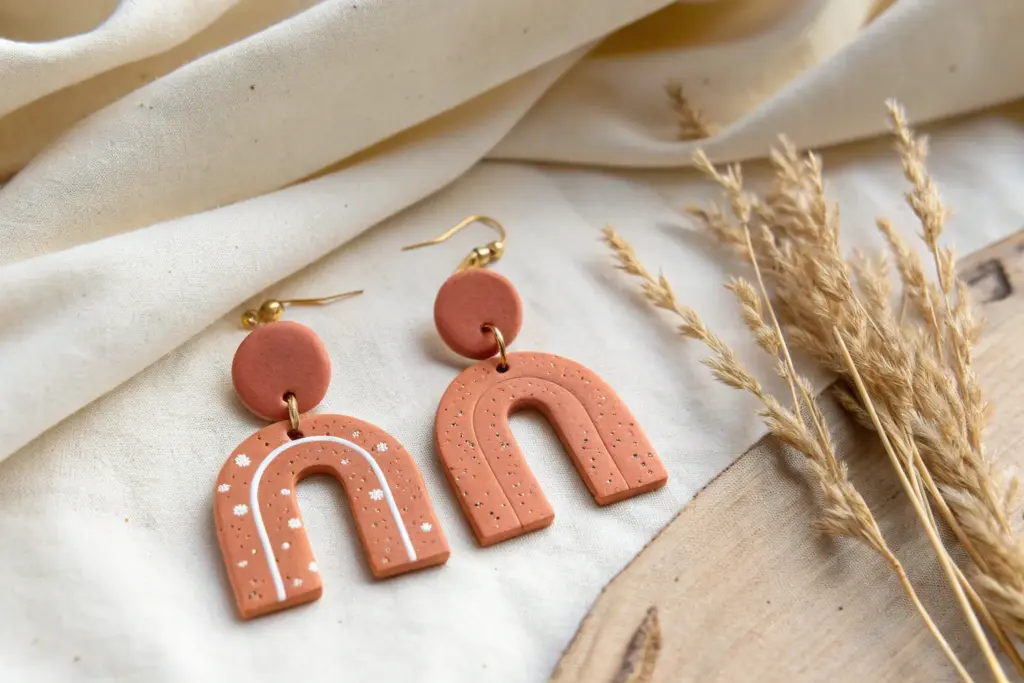
Whenever I’m craving a quick win at my studio table, I reach for clay and make a fresh pair of DIY clay earrings. These ideas are meant to be fun, doable, and totally mix-and-match, whether you’re working with polymer clay earrings or experimenting with air-dry clay.
Classic Arch Dangles
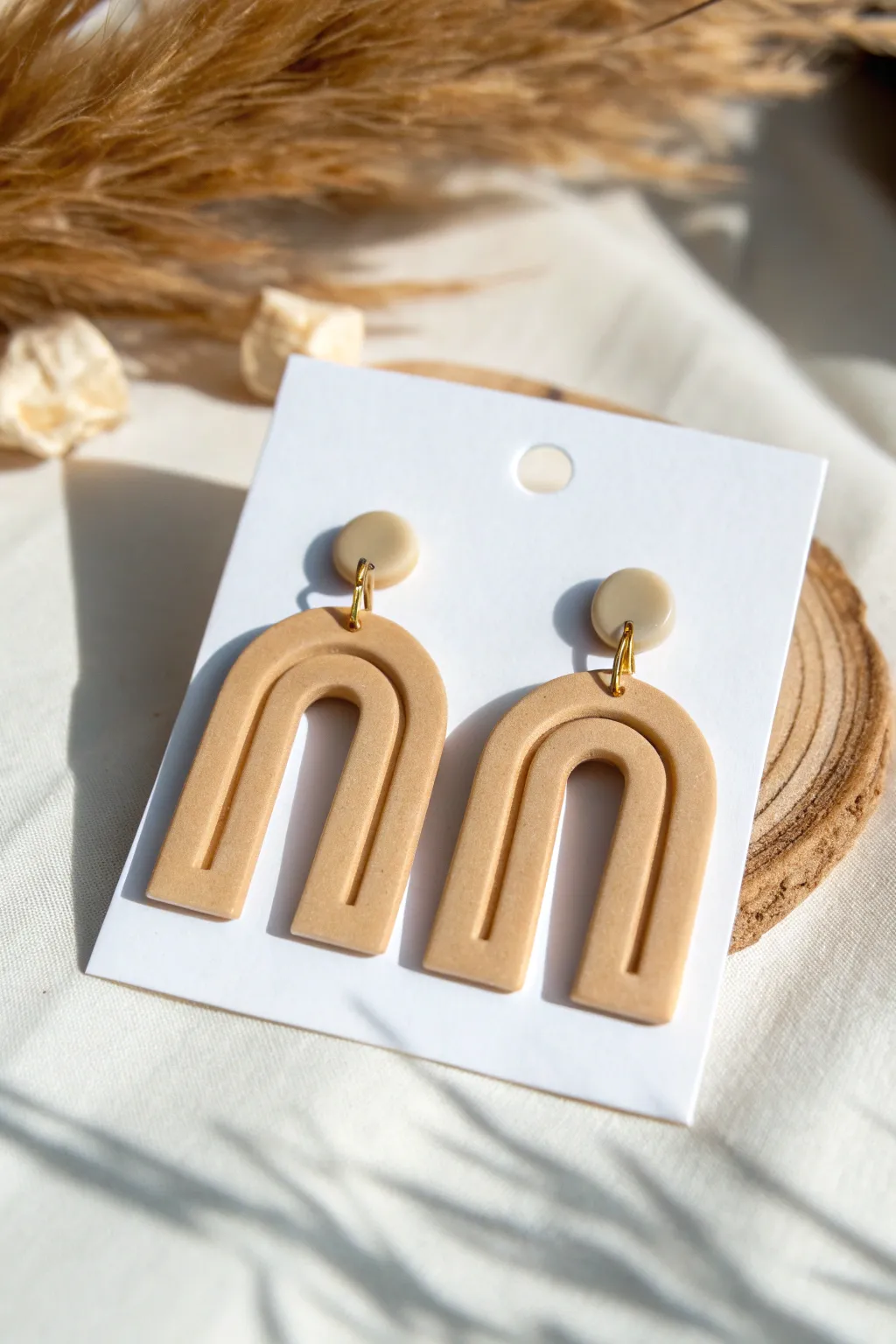
These understated beige arch earrings bring a touch of warm, neutral elegance to any outfit with their clean lines and subtle texture. The design features a classic elongated U-shape with a unique central groove detailing that adds depth without complicating the minimalist aesthetic.
Step-by-Step
Materials
- Beige or tan polymer clay
- Acrylic rolling pin
- U-shaped clay cutter (elongated arch)
- Small circular clay cutter (approx. 1cm)
- Needle tool or detailing tool
- Tissue blade or X-Acto knife
- Smooth ceramic tile or glass work surface
- Oven (conventional or toaster)
- Parchment paper
- Hand drill or pin vibe
- 2 Gold jump rings (6mm or 7mm)
- 2 Flat-pad earring posts
- Strong jewelry glue (e.g., E6000 or Loctite Gel)
- Fine grit sandpaper (optional)
Step 1: Shaping the Clay
-
Condition the clay:
Start by warming the beige polymer clay in your hands. Knead and roll it repeatedly until it is soft, pliable, and free of any air bubbles or cracks. -
Roll out the slab:
Place the conditioned clay on your smooth work surface. Use the acrylic rolling pin to roll it out into an even slab, aiming for a consistent thickness of about 3mm to 4mm. I find using depth guides on either side helps keep it perfectly level. -
Cut the arches:
Press your U-shaped cutter firmly into the clay slab to create two identical arch shapes. Lift the cutter straight up to avoid distorting the edges. -
Cut the stud tops:
Using the small circular cutter, punch out two circles from the remaining clay slab. These will serve as the top studs that sit on the earlobe. -
Refine the edges:
Gently run your finger or a specialized smoothing tool along the cut edges of all four pieces to soften any sharpness left by the cutters.
Step 2: Detailing and Baking
-
Mark the center groove:
This is the signature detail of this design. Take your needle tool or a dull carving tool and carefully press a line into the center of the arch shape. -
Follow the curve:
Continue pressing the tool gently, tracing the U-shape. Do not cut all the way through; you simply want to create an indentation that mimics a smaller arch nested inside the larger one. -
Smooth the groove:
If the needle tool raised any tiny jagged bits of clay, gently pat them down with your fingertip so the indentation looks clean and deliberate. -
Create connection holes:
Use a needle tool or toothpick to pierce a hole at the very top center of each large arch. Ensure the hole is large enough for your jump rings to pass through later. -
Add holes to studs:
Pierce a corresponding hole near the bottom edge of each circular stud piece. -
Bake the pieces:
Transfer all four clay pieces onto a baking sheet lined with parchment paper. Bake according to the manufacturer’s instructions on your specific package of clay (usually around 275°F/135°C for 15-30 minutes). -
Cool down:
Once the baking time is up, remove the tray from the oven and let the clay cool completely before handling. It hardens fully as it cools.
Clean Lines Tip
Before cutting your shapes, lay a piece of plastic cling wrap over the clay. Press the cutter down through the plastic. This creates softly rounded edges that require almost no sanding later.
Step 3: Assembly
-
Sand edges (optional):
If there are any rough spots or fingerprints, lightly sand the edges and back of the pieces with fine-grit sandpaper, then wipe clean with a damp cloth. -
Attach earring posts:
Apply a tiny dot of strong jewelry glue to the back of the circular stud pieces, near the top (opposite the hole). Press the flat pad of the earring post onto the glue and let it cure fully. -
Open jump rings:
Use two pairs of jewelry pliers to twist a gold jump ring open sideways. Never pull the circle apart; always twist the ends away from each other. -
Connect the pieces:
Slide the open jump ring through the hole in the arch and the hole in the stud. Close the jump ring by twisting the ends back together until they meet flush. -
Final check:
Ensure all connections are secure and the earring posts are firmly attached before wearing.
Fixing Fingerprints
If you notice fingerprints on your raw clay before baking, dip a Q-tip in a tiny bit of rubbing alcohol or acetone and gently brush it over the surface to melt the imperfections away.
Enjoy wearing your sophisticated new arch earrings or gift them to a friend who loves neutral tones

Terrazzo Speckle Drops
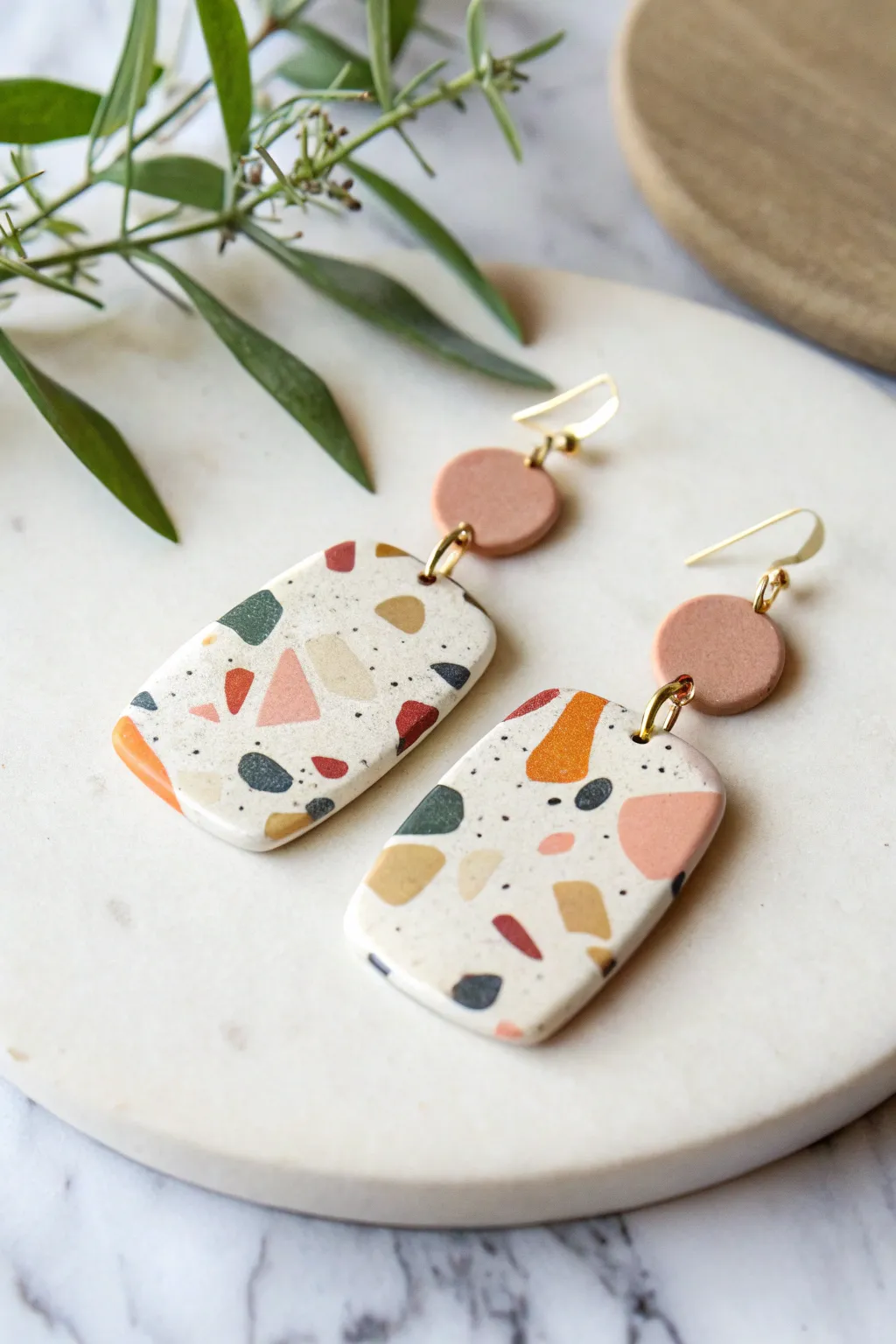
Capture the trendy aesthetic of terrazzo flooring in a lightweight, wearable form with these chic polymer clay earrings. The combination of a neutral base with earthy pops of terracotta, mustard, and sage creates a versatile accessory perfect for everyday wear.
How-To Guide
Materials
- Polymer clay (White or Ecru for the base)
- Polymer clay (Terracotta, Mustard Yellow, Dark Teal/Sage, Black)
- Acrylic rolling pin or clay machine
- Clay cutters (small circle approx. 10mm, rounded rectangle approx. 40mm)
- X-Acto knife or tissue blade
- Parchment paper or ceramic tile
- Two gold jump rings (6mm)
- Two gold earring hooks or ball posts
- Jewelry pliers
- Hand drill or pin vibe with small bit
- Fine grit sandpaper (400-1000 grit)
- Oven for baking
Step 1: Creating the Terrazzo Pattern
-
Condition the base:
Start by thoroughly conditioning your white or ecru clay until it is soft and pliable. Roll it out into a thick, even slab, about 3-4mm thick. This will be the canvas for your design. -
Prepare the chips:
Take small amounts of your colored clays (terracotta, mustard, teal). Roll them into very thin sheets, much thinner than your base slab. -
Tear the clay:
Using your fingers or a craft knife, tear or cut these thin colored sheets into jagged, irregular fragments. Aim for a variety of sizes, from tiny specks to medium-sized chunks. -
Add black speckles:
For the black details, I find it easiest to roll a tiny snake of black clay and slice off almost microscopic bits, or grate a baked piece of black clay for a dusty, speckled effect. -
Apply the pattern:
Gently place your colored fragments onto the white base slab. scatter them randomly, leaving plenty of negative space between pieces. Don’t overthink the placement; random looks more authentic. -
Embed the design:
Place a sheet of parchment paper over the slab to prevent sticking. Use your rolling pin to gently roll over the clay, pressing the colored chips flat until they are flush with the white base surface.
Smudged Colors?
If your colored chips are smearing during the rolling phase, let the clay sit in the fridge or freezer for 5-10 minutes to firm up before rolling the pattern flat.
Step 2: Cutting and Baking
-
Cut the drops:
Position your rounded rectangle cutter over the most pleasing sections of your terrazzo pattern. Press down firmly to cut out two drop shapes. -
Create the top studs:
Roll out a plain sheet of the terracotta-colored clay. Use your small circle cutter to punch out two circles for the top component of the earrings. -
Smooth the edges:
Before baking, gently run your finger along the cut edges of all four pieces to soften any sharp ridges left by the cutters. -
Pierce holes:
Using a needle tool or toothpick, carefully poke a hole near the top of the rectangle pieces and near the bottom lip of the circular pieces. Ensure the hole is large enough for your jump rings. -
Bake:
Place all pieces on a ceramic tile or baking sheet lined with parchment paper. Bake according to your brand of clay’s specific instructions (usually 275°F/135°C for 15-30 minutes). -
Cool down:
Allow the clay to cool completely in the oven or on a wire rack before handling. Warm clay is fragile.
Make It Shine
For a glossy ceramic look, coat the baked and sanded pieces with a thin layer of UV resin or glossy polyurethane varnish. Cure or dry fully.
Step 3: Finishing and Assembly
-
Sand for smoothness:
Once cool, use fine-grit sandpaper under running water to gently sand the surface and edges. This reveals the crisp lines of the terrazzo chips and removes fingerprints. -
Clean up:
Wash the pieces with a bit of soapy water to remove sanding dust and dry them thoroughly with a soft cloth. -
Open jump rings:
Use two pairs of jewelry pliers to twist your jump rings open laterally. Never pull them apart outward, as this weakens the metal. -
Connect pieces:
Slide the jump ring through the hole in the rectangular drop, then loop on the terracotta circle. Close the jump ring securely with your pliers. -
Attach hooks:
Open the small loop on your earring hook. Thread it through the existing hole in the terracotta circle (or add a second jump ring if needed for orientation) and close it tight.
Now you have a stunning pair of statement earrings that look professionally crafted and ready to elevate any outfit
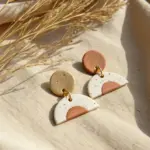
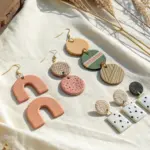
Soft Marble Swirl Slabs
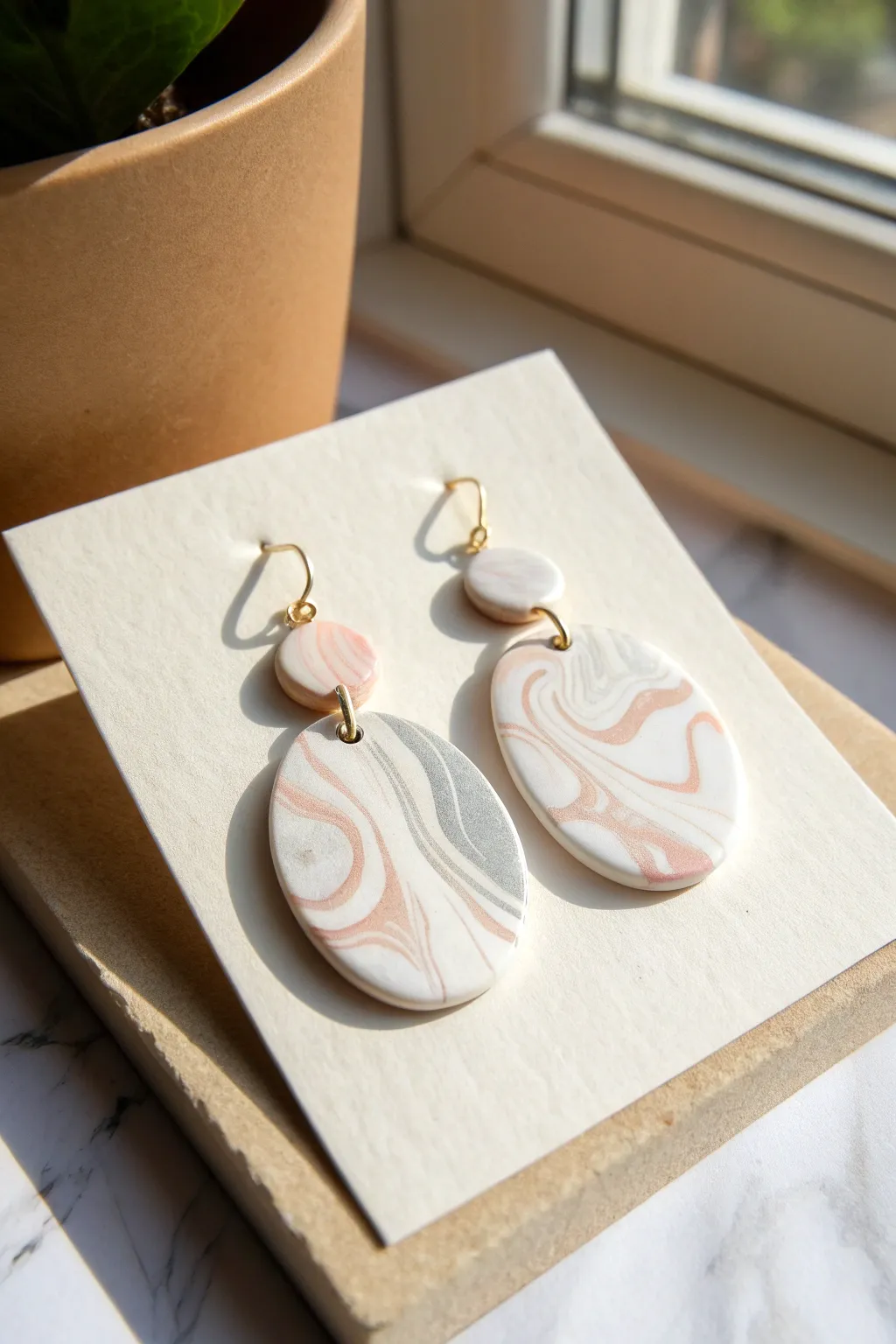
These sophisticated earrings feature a delicate, flowing marble pattern that mimics natural stone with soft peach and silver tones swirling through a creamy white base. The finish is smooth and matte, giving them a modern, high-end look perfect for everyday wear.
Step-by-Step
Materials
- Polymer clay (White, Peach/Soft Pink, Silver/Grey)
- Clay roller or pasta machine
- Tissue blade or craft knife
- Oval shape cutter (approx. 1.5 inch)
- Small circle cutter (approx. 0.5 inch)
- Hand drill or pin vibe with small bit
- Sandpaper (various grits from 400 to 1000)
- Two gold earring hooks
- Four gold jump rings
- Jewelry pliers
- Ceramic tile or baking sheet
- Oven
Step 1: Conditioning and Coloring
-
Condition the clay:
Begin by thoroughly conditioning your white polymer clay until it is soft and pliable. Do the same for your peach and silver clays. Warm clay is essential for a smooth marble effect without cracking. -
Prepare the base:
Roll the white clay into a thick log. This will be the dominant color, so ensure you have significantly more white than the accent colors. -
Create accent snakes:
Roll very thin snakes of the peach and silver clay. These should be much thinner than your white log. -
Combine the colors:
Lay the thin peach and silver snakes lengthwise along the white log. Gently twist the entire bundle like a candy cane to start integrating the colors.
Clean Cuts Tip
Place a sheet of plastic wrap over the clay slab before pressing your cutters down. This creates a rounded ‘domed’ edge on the pieces, reducing the need for sanding later.
Step 2: Marbling and Shaping
-
Create the swirl:
Fold the twisted log in half and roll it out again. Repeat this twist, fold, and roll process several times. Stop when you see beautiful streaks, but be careful not to over-mix, or the colors will turn muddy. -
Form a slab:
Ball up your marbled clay and flatten it onto your work surface. Use your roller or pasta machine to roll it into a slab approximately 3mm thick. I like to roll in different directions to distort the swirl pattern organically. -
Select your pattern:
Inspect the slab for the most pleasing swirls. Position your oval and circle cutters over these areas to capture the best fluid lines. -
Cut the shapes:
Press the cutters firmly into the clay. You will need two large ovals and two smaller circles. Leave the shapes on the tile or baking surface to avoid distorting them while lifting.
Step 3: Baking and Finishing
-
Smooth the edges:
Before baking, gently run your finger along the edges of the cut shapes to soften any harsh cutter marks or clay burrs. -
Bake the pieces:
Bake the clay pieces according to the manufacturer’s instructions on the package. Usually, this is around 275°F (135°C) for 30 minutes, but check your specific brand. -
Cool down:
Allow the pieces to cool completely on the baking sheet before handling them to ensure they harden fully. -
Sand for perfection:
Sand the edges and the surface lightly with wet sandpaper, starting with a lower grit and moving to a higher grit. This achieves that professional, stone-like matte finish shown in the photo. -
Drill holes:
Using a hand drill or pin vise, carefully drill a hole at the top of each oval and at the top and bottom of each circle piece. Ensure the holes are close to the edge but leave enough material for strength.
Metallic Accent
Add flecks of gold leaf to the clay slab right before the final roll. The gold will embed into the surface, adding a luxurious shimmer that complements the marble.
Step 4: Assembly
-
Open jump rings:
Use two pairs of pliers to twist your jump rings open laterally (never pull them apart). -
Connect the pieces:
Thread a jump ring through the top of the oval and the bottom of the circle, then close it securely. -
Attach the hook:
Open the loop on the earring hook (or use a second jump ring) and attach it to the top hole of the circle piece. -
Final check:
Double-check that all loops are closed tightly so the pieces don’t slip apart.
Wear your new marble creations with pride, knowing each earring has a pattern entirely unique to you
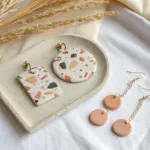
Color-Blocked Rectangle Bars
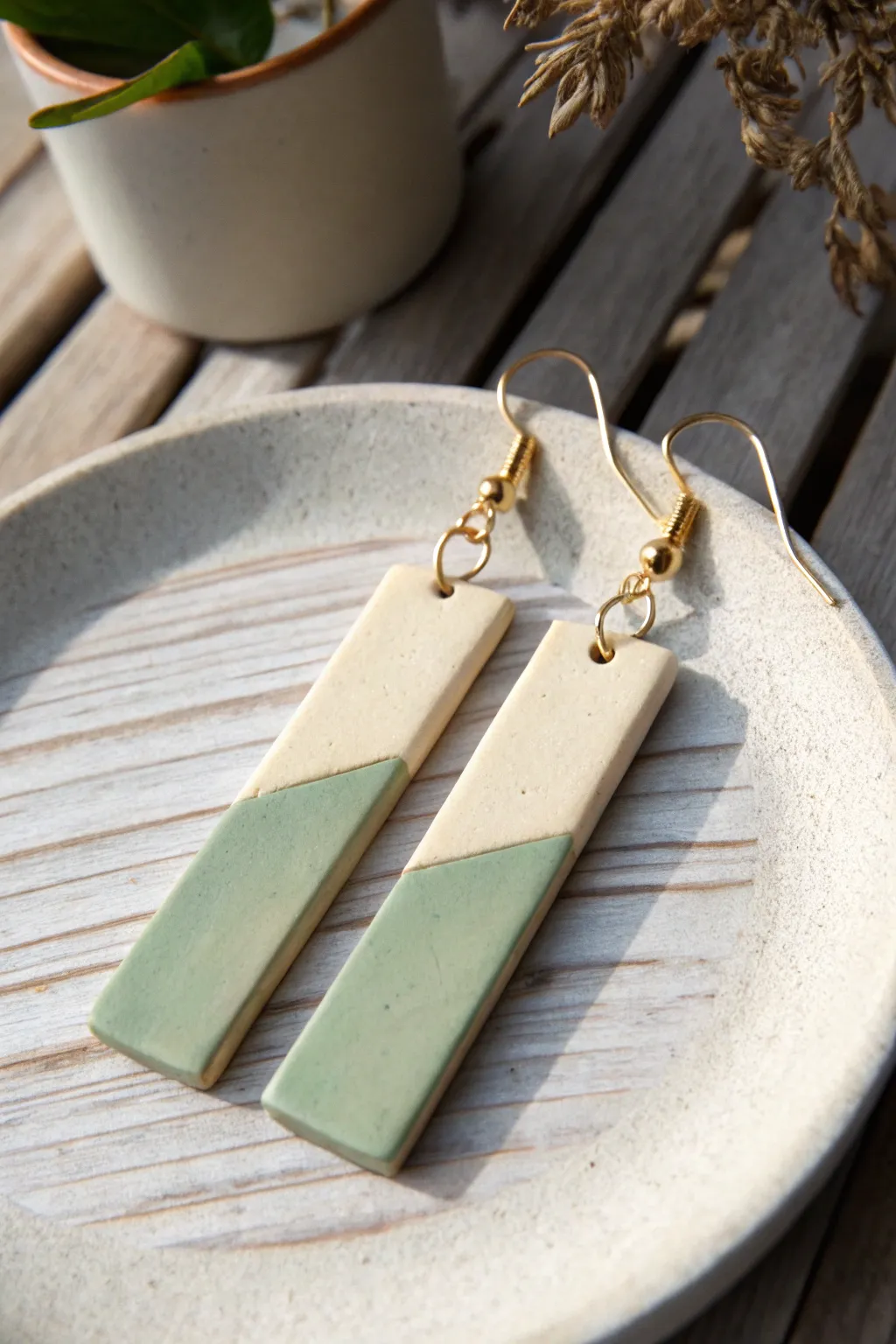
Embrace minimalist chic with these elegant rectangle bar earrings featuring a modern diagonal color-block design. The soothing combination of creamy beige and muted sage green creates a versatile accessory perfect for everyday wear.
How-To Guide
Materials
- Polymer clay (cream/beige color)
- Polymer clay (sage green color)
- Acrylic rolling pin or pasta machine
- Tissue blade or flexible clay slicer
- Rectangle clay cutter (approx. 2 inches long) or ruler and craft knife
- Hand drill or pin vibe with small bit
- 2 Gold jump rings (6mm)
- 2 Gold earring hooks (fishhook style)
- Needle nose pliers
- Flat nose pliers
- Fine grit sandpaper (400-1000 grit, optional)
- Ceramic tile or baking sheet
- Parchment paper
Step 1: Preparing the Clay
-
Condition the clay:
Start by warming up your cream and sage green clay separately in your hands. Knead and roll each color until it is soft, pliable, and free of any air bubbles. -
Roll out sheets:
Using your acrylic roller or pasta machine, roll both colors of clay out into sheets of even thickness. Aim for a thickness of about 3mm—sturdy enough to hold shape but light enough for ears. -
Check for imperfections:
Inspect the surface of your rolled sheets. Gently smooth out any fingerprints or lint; I find lightly brushing the surface with cornstarch can prevent stickiness during cutting.
Step 2: Creating the Color Block
-
Cut diagonal edges:
Take your tissue blade and make a long, straight diagonal cut across both the cream and the sage green clay sheets. The angle of this cut will determine the slant on your finished earring. -
Join the seams:
Place the cut edge of the sage green clay against the cut edge of the cream clay. Press them together on your work surface gently but firmly so they adhere to each other. -
Smooth the back:
Flip the joined clay sheet over. To ensure a strong bond, gently drag your finger or a smoothing tool across the seam to blend the clays together slightly on the back side. -
Final roll:
Flip the sheet back to the front side. Gently roll over the seam one last time with your roller to ensure the surface is perfectly flat and the join is seamless.
Seamless Seams
Place a sheet of parchment paper over the joined clay before doing the final roll. This prevents the roller from dragging colors into each other and keeps the join crisp.
Step 3: Cutting and Baking
-
Position the cutter:
Using your rectangle cutter (or a ruler and knife), position it over the joined clay. Align it so the diagonal seam runs through the lower third of the rectangle shape. -
Cut the shapes:
Press the cutter down firmly to cut out your two earring bars. If using a knife, measure carefully to ensure both bars are exactly the same width and length. -
Prepare for baking:
Carefully transfer your cut rectangles onto a ceramic tile or a baking sheet lined with parchment paper. -
Pierce holes:
Before baking, use a needle tool or toothpick to poke a hole centered near the very top of each rectangle. Alternatively, you can drill these after baking for precision. -
Bake the clay:
Bake the pieces according to the specific temperature and time directions on your brand of polymer clay packaging. Usually, this is around 275°F (135°C) for 30 minutes. -
Cool down:
Once baked, turn off the oven and let the pieces cool partially inside before removing them to cool completely at room temperature.
Clay Too Soft?
If your clay is getting sticky and warping when you try to lift it, pop the rolled sheet in the fridge for 10 minutes. The cold firms it up for cleaner cuts.
Step 4: Finishing Touches
-
Sand edges:
Check the edges of your cooled bars. If they are sharp or rough, dip your sandpaper in water and gently wet-sand the edges until smooth. -
Open jump rings:
Use two pairs of pliers to twist open your gold jump rings. Remember to twist the ends away from each other (front to back), not pull them apart sideways. -
Attach findings:
Slide the open jump ring through the hole at the top of the clay bar. Before closing, thread the gold earring hook onto the jump ring as well. -
Secure closure:
Use your pliers to twist the jump ring back into a closed position, ensuring the ends meet perfectly so the hook doesn’t slip out. -
Final polish:
Wipe the finished earrings with a soft cloth to remove any sanding dust or fingerprints, leaving a clean matte finish.
Now you have a stunning pair of geometric earrings ready to elevate any outfit with a touch of handmade charm

The Complete Guide to Pottery Troubleshooting
Uncover the most common ceramic mistakes—from cracking clay to failed glazes—and learn how to fix them fast.
Minimalist Teardrop Dangles
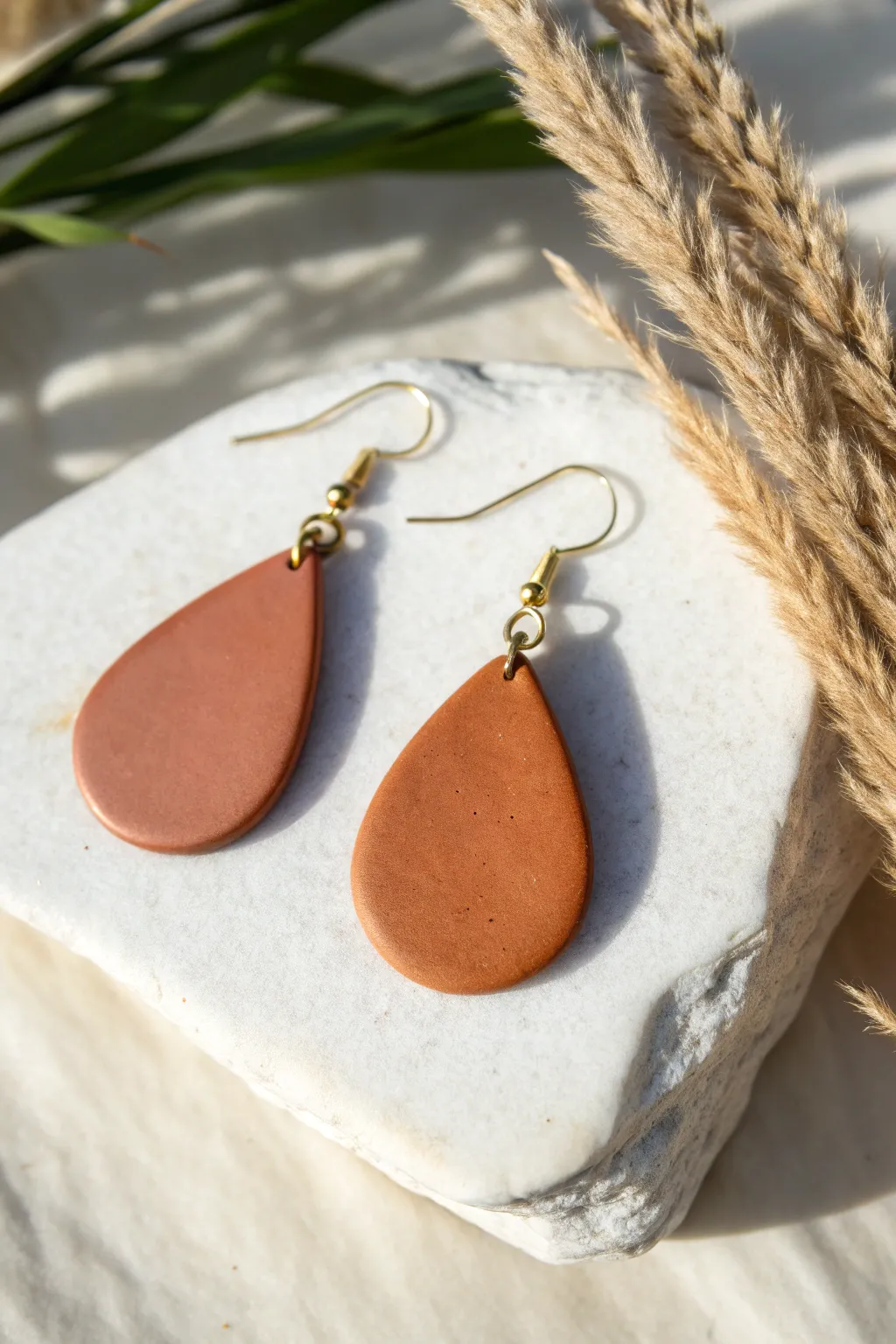
Embrace earthy elegance with these minimalist teardrop dangles that mimic the warm, rustic look of real terracotta. The simple silhouette combined with a rich, clay-red hue makes them a versatile accessory perfect for everyday wear or dressing up a boho outfit.
Step-by-Step
Materials
- Polymer clay (Terracotta or Rust color)
- Black pepper or brown acrylic paint (optional for speckles)
- Acrylic rolling pin or pasta machine
- Teardrop clay cutter (medium size)
- Ceramic tile or glass work surface
- Hand drill or needle tool
- Fine-grit sandpaper (400-800 grit)
- 2 Gold jump rings (6mm)
- 2 Gold fishhook ear wires
- Jewelry pliers (flat nose and chain nose)
- Oven
Step 1: Conditioning and Shaping
-
Warm up the clay:
Begin by slicing off a chunk of your terracotta-colored polymer clay. Work it thoroughly between your hands, rolling and squishing it until it becomes soft, pliable, and warm to the touch. -
Add texture (optional):
If your clay is a solid flat color and you want that organic, speckled pottery look shown in the photo, sprinkle a tiny pinch of ground black pepper into the clay now. Knead it in until it’s evenly distributed. -
Roll it out:
Place the conditioned clay on your ceramic tile or glass surface. Using your acrylic rolling pin, roll the clay out to a uniform thickness, aiming for about 3mm or 1/8th of an inch. A pasta machine set to a medium-thick setting works wonders for consistency. -
Check for bubbles:
Inspect the surface for any air bubbles. If you spot one, gently pierce it with a needle tool and smooth the area over with your finger before proceeding. -
Cut the shapes:
Press your teardrop cutter firmly into the clay sheet. Give it a tiny wiggle to ensure it cuts all the way through to the work surface, then lift it straight up. -
Smooth the edges:
Before baking, gently run your finger along the cut edges of the teardrops to soften any harsh lines or clay burrs left by the cutter. This saves you sanding time later. -
Create holes:
Using a needle tool or a small straw, poke a hole at the very top point of each teardrop. Make sure the hole is big enough for your jump ring but not too close to the edge to prevent tearing.
Step 2: Baking and Finishing
-
Bake the clay:
Arrange your clay pieces on a baking sheet lined with parchment paper. Bake according to the manufacturer’s instructions on your specific package of clay—usually around 275°F (135°C) for 30 minutes. -
Cool down:
Once the baking time is up, turn off the oven and open the door slightly. Let the pieces cool down completely before handling them; they are fragile when hot. -
Sand for perfection:
Dip your fine-grit sandpaper in a little water and gently sand the edges of the cured clay. This wet-sanding technique keeps dust down and creates a buttery smooth finish on the rim. -
Buff surface:
I like to give the face of the earring a quick buff with a soft denim cloth or a clean piece of paper to restore a slight sheen if the sanding made it too dusty.
Clean Cuts Only
dip your cutter intocornstarch or water before pressing into the clay. This acts as a release agent, preventing the clay from sticking inside the cutter.
Step 3: Assembly
-
Open jump rings:
Hold a jump ring with two pairs of pliers. Twist one hand forward and the other backward to open the ring sideways—never pull it apart outwards, as this weakens the metal. -
Attach the clay:
Slide the open jump ring through the hole you created in the top of the terracotta teardrop. -
Add the hook:
While the jump ring is still open, loop on the gold fishhook ear wire. Ensure the hook is facing the correct direction so the front of the earring will face forward. -
Close the ring:
Use your pliers to twist the jump ring back into a closed position, wiggling it slightly until the two ends meet perfectly flush. -
Repeat:
Repeat the assembly process for the second earring, ensuring the lengths hang evenly.
Fingerprint Fixer
Did you leave fingerprints? Before baking, lightly dip a Q-tip in rubbing alcohol or acetone and gently brush it over the surface to melt away prints.
Wear your new earthy creations with pride, knowing they add a perfect touch of handmade warmth to your style
Stacked Geometric Tiers
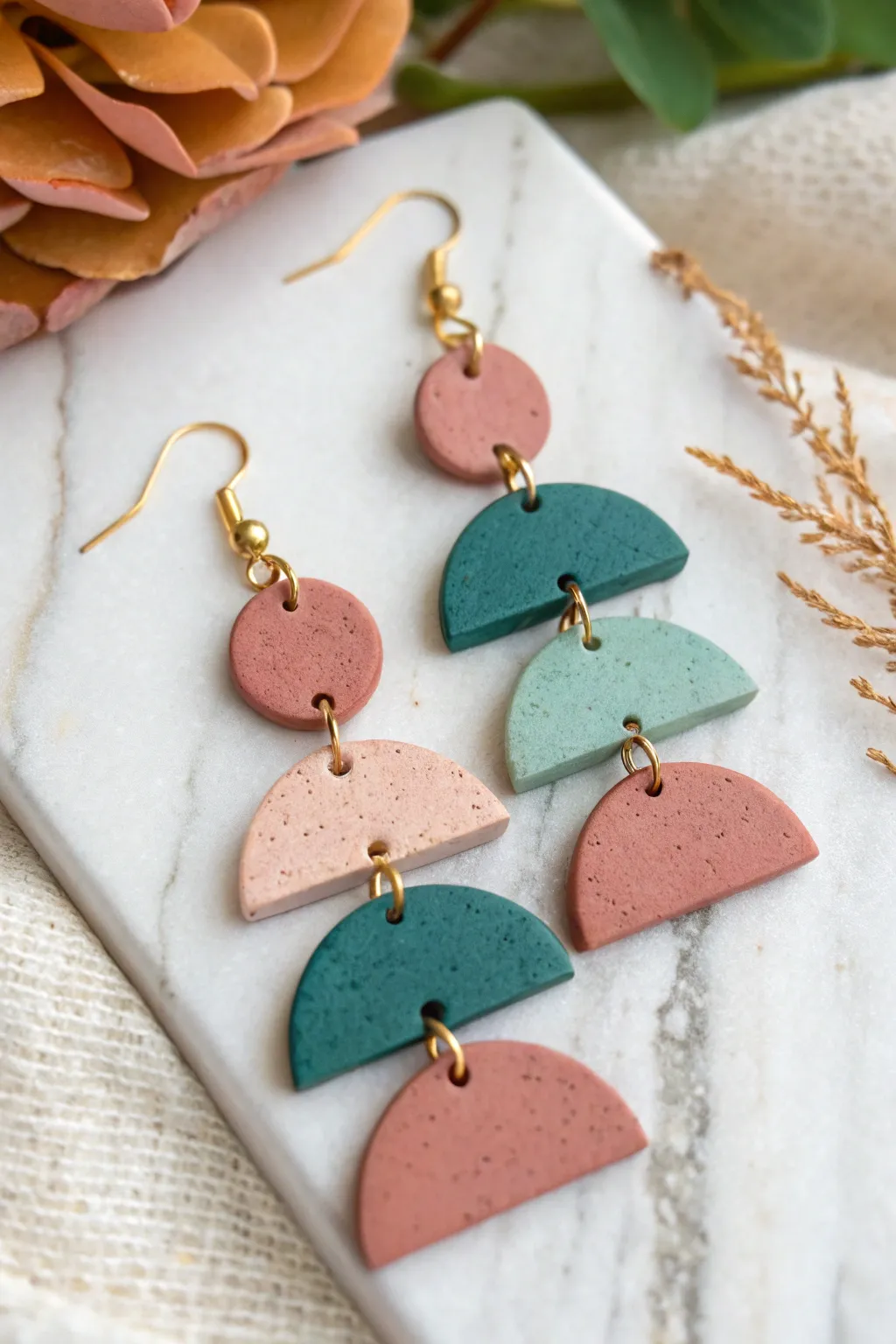
Embrace the earthy, bohemian aesthetic with these stacked geometric earrings featuring a beautiful speckled stone finish. The mix of dusty terracotta, deep teal, mint, and blush creates a harmonious palette perfect for modern jewelry lovers.
Detailed Instructions
Materials
- Polymer clay in four shades: terracotta/dusty pink, deep teal, light sage/mint, and pale blush
- Coarse black pepper or black embossing powder (for speckling)
- Acrylic roller or clay pasta machine
- Circle cutters in two sizes (approx. 10mm and 20-25mm)
- Tissue blade or sharp craft knife
- Oven-bake clay adhesive (optional but helpful)
- Hand drill or needle tool for piercing holes
- Fine grit sandpaper (400-1000 grit)
- Gold jump rings (6mm or 7mm)
- Gold earring hooks
- 2 pairs of jewelry pliers
- Parchment paper and baking sheet
Step 1: Preparing the Clay
-
Condition the clay:
Begin by warming and kneading each color of polymer clay in your hands until it becomes soft and pliable. This conditioning step is crucial to prevent cracking later. -
Create the speckles:
To achieve that faux-stone granite look, flatten your conditioned clay slightly and sprinkle a pinch of ground black pepper or black embossing powder over it. -
Incorporate the texture:
Fold the clay over the speckles and knead thoroughly until the black flecks are evenly distributed throughout the color. Repeat this for all four clay colors. -
Roll out slabs:
Using an acrylic roller or a pasta machine on a medium setting (around 3mm thick), roll each color into a smooth, even slab. I find laying the clay on parchment paper prevents it from sticking to the work surface.
Step 2: Cutting and Shaping
-
Cut the top circles:
Use your smallest circle cutter to punch out two circles from the terracotta clay. These will be the top studs connecting to the ear hook. -
Create the semi-circles:
Use the larger circle cutter to punch out circles from all four colors. You will need enough to create the tiered stacks shown. -
Slice into arches:
Take your large circles and use a sharp tissue blade to cut them exactly in half, creating semi-circles. For the design shown, you need teal, mint, blush, and terracotta semi-circles. -
Refine the edges:
Gently smooth the cut edges with your fingertip to remove any harsh lines or loose bits of clay before baking. -
Pierce assembly holes:
Using a needle tool, poke holes for the jump rings. The top circle needs one hole at the bottom (and one at the top if not gluing a post). The middle arches need holes at the distinct top center and bottom center. The bottom arch only needs a top center hole.
Stone Effect Secret
Don’t have pepper? You can also use dry, used coffee grounds or craft sand mixed into the clay for a coarser, more rugged texture.
Step 3: Baking and Finishing
-
Bake the pieces:
Arrange all your clay shapes on a parchment-lined baking sheet. Bake according to your brand of clay’s instructions (usually 275°F/135°C for 30 minutes). -
Cool down:
Allow the pieces to cool completely on the baking sheet. Do not attempt to handle them while hot as the clay is fragile until fully cooled. -
Sand for smoothness:
Once cool, use fine-grit sandpaper to gently buff the edges and flat surfaces. This gives the ‘stone’ texture a professional, matte finish. -
Drill holes (optional):
If your pre-drilled holes closed up during baking, use a small hand drill to carefully reopen them.
Fixing Fingerprints
If you see fingerprints before baking, lightly brush the raw clay with a little baby oil or cornstarch to smooth them away instantly.
Step 4: Assembly
-
Open jump rings:
Hold a jump ring with two pairs of pliers. Twist one hand away from you and the other toward you to open the ring sideways—never pull it apart outward. -
Connect the tiers:
Thread an open jump ring through the bottom of the small top circle and the top of the first semi-circle (teal). Close the ring securely using the reverse twisting motion. -
Continue the stack:
Use jump rings to connect the subsequent layers: teal to mint (or blush), and then the final bottom tier. Refer to the image for specific color ordering. -
Attach the ear hooks:
Finally, attach the gold earring hook to the very top of the small terracotta circle using a jump ring.
Now you have a stunning pair of statement earrings ready to wear or gift.



What Really Happens Inside the Kiln
Learn how time and temperature work together inside the kiln to transform clay into durable ceramic.
Organic Blob Statement Drops
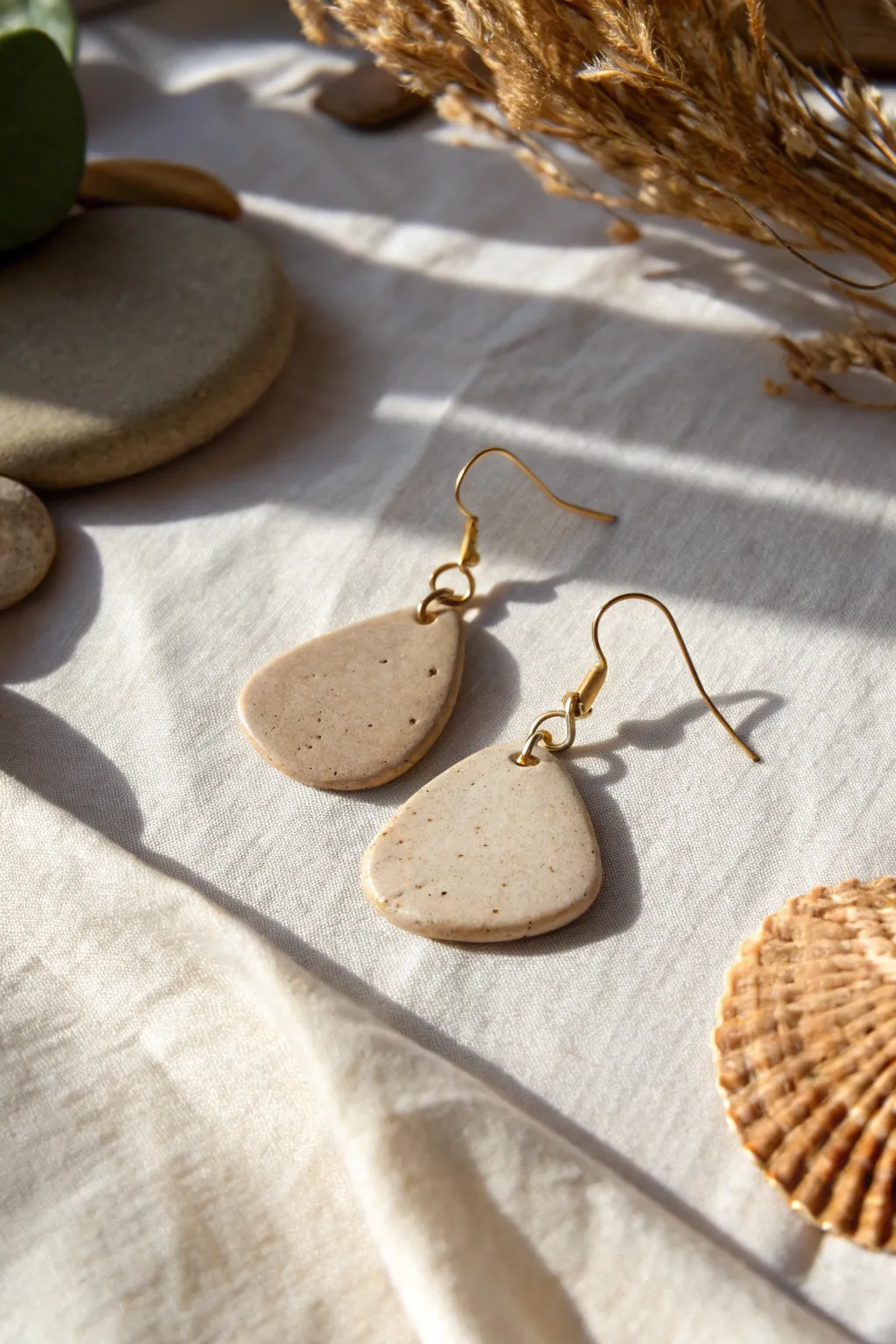
Embrace the beauty of imperfection with these organic, pebble-inspired statement drops. Their speckled texture and soft asymmetrical curves mimic natural stones found along a riverbed, offering an earthy elegance that pairs perfectly with linen and neutrals.
How-To Guide
Materials
- Polymer clay (white or beige base)
- Black pepper or dried coffee grounds (for speckling)
- Acrylic rolling pin
- Parchment paper or ceramic tile work surface
- Tear-drop shaped cutter (optional) or X-Acto knife
- Hand drill or needle tool
- Fine-grit sandpaper (400 to 1000 grit)
- Gloss or semi-gloss polyurethane varnish
- Small soft brush for glazing
- Gold finish earring hooks (fishhook style)
- Jump rings (4mm or 6mm, gold finish)
- Jewelry pliers (flat nose and round nose)
- Oven for baking
Step 1: Preparing the Clay
-
Condition the base:
Begin by taking a block of beige or white polymer clay. Warm it in your hands, kneading thoroughly until it becomes soft and pliable, ensuring there are no air bubbles trapped inside. -
Add texture:
To achieve that natural, stony look, sprinkle a small pinch of ground black pepper or dried coffee grounds onto your flattened clay. Fold the clay over itself and knead again to distribute the speckles evenly throughout the mass. -
Roll it out:
Place your clay on a piece of parchment paper or a smooth ceramic tile. Using your acrylic rolling pin, roll the clay out to an even thickness of about 3mm to 4mm—thick enough to be durable but light enough for ears.
Fixing Cloudy Finish
If your gloss looks cloudy or sticky after drying, the varnish may have reacted with the clay. Ensure you use a water-based polyurethane varnish specifically compatible with polymer clay.
Step 2: Shaping and Baking
-
Cut the rough shape:
If you have a large teardrop cutter, press it into the clay. If you want a truly organic look like the photo, use an X-Acto knife or a needle tool to freehand a rounded, asymmetrical drop shape. -
Soften the edges:
Lift the shapes gently. Dip your finger in a tiny bit of rubbing alcohol or cornstarch and gently rub the cut edges to smooth them down, removing any sharp angles or cutter marks. -
Piercing the hole:
Using a needle tool or a small cocktail stick, poke a hole near the top narrow point of each earring. Make sure the hole is big enough for your jump rings, but leave at least 2mm of clay above the hole for strength. -
Check for imperfections:
Give the surface a final scan for lint or fingerprints. Just gently buff them out with your finger before baking. -
Bake the pieces:
Place the clay pieces (still on their tile or parchment) onto a baking sheet. Bake according to your specific brand of polymer clay’s instructions—usually around 275°F (130°C) for 30 minutes. -
Cool down:
Remove from the oven and let the pieces cool completely before handling them. They will be slightly soft when hot but harden as they cool.
Step 3: Finishing Touches
-
Sanding:
Once cool, submerge the pieces in a shallow bowl of water. Use wet/dry sandpaper to gently sand the edges and the flat surfaces for an ultra-smooth, professional finish. -
Cleaning:
Wash off any clay dust with water and mild soap, then dry thoroughly with a lint-free cloth. -
Glazing:
To get that ceramic-like shine, apply a thin, even coat of gloss varnish using a soft brush. I prefer to do one side first, let it dry, and then flip to do the other side. -
Second coat:
If you want a deeper glass-like finish, apply a second thin coat of varnish once the first is dry to the touch, watching for drips along the edges.
Texture Pro Tip
For an even more realistic stone look, mix translucent clay with your beige base (50/50 ratio). This adds depth and makes the speckles look suspended inside the ‘stone’.
Step 4: Assembly
-
Open the jump ring:
Take a gold jump ring and hold it with two pairs of pliers. Twist the ring open sideways (never pull it apart outwards) to preserve its circle shape. -
Connect the hook:
Slide the clay piece onto the open jump ring, then loop the bottom of the fishhook ear wire onto the ring as well. -
Close the ring:
Twist the jump ring back into a closed position using your pliers, ensuring the two ends meet perfectly flush so the hook doesn’t slip out. -
Repeat:
Follow the same assembly steps for the second earring.
You now have a chic pair of nature-inspired earrings ready to wear or gift.
Scalloped Fan Earrings
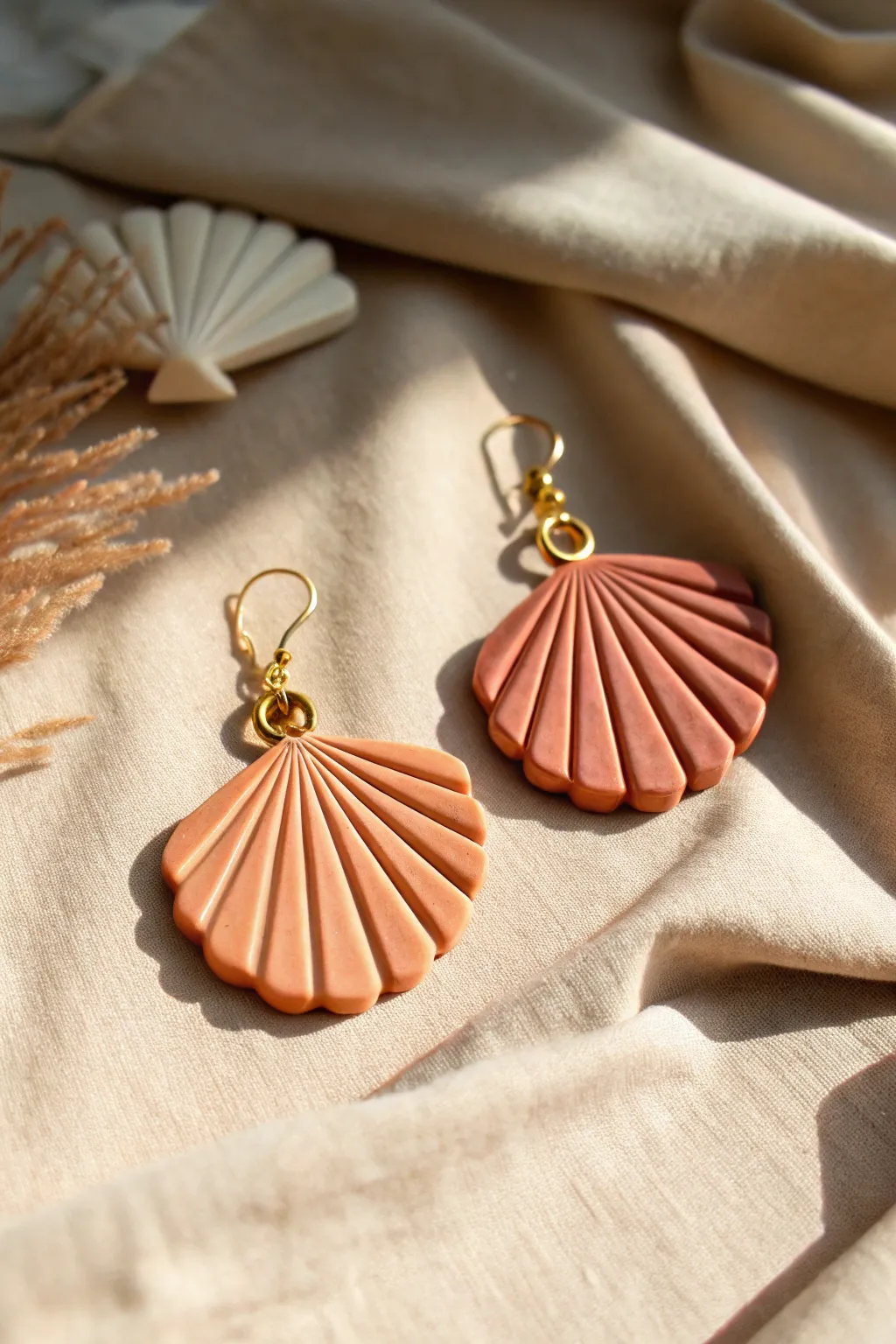
Capture the warmth of a summer sunset with these elegant fan-shaped earrings that channel vintage Art Deco vibes. The dusty peach clay and textured ridges create a sophisticated yet earthy accessory perfect for everyday wear.
Step-by-Step
Materials
- Polymer clay (terracotta, dusty peach, or burnt orange)
- Acrylic rolling pin
- Tissue blade or X-Acto knife
- Needle tool or toothpick
- Small circle cutter (approx. 5mm)
- Sandpaper (400-600 grit)
- 2 Gold jump rings (6-8mm)
- 2 Gold earring hooks
- Jewelry pliers
- Ceramic tile or baking sheet
- Oven
Step 1: Clay Preparation & Shaping
-
Condition the clay:
Begin by thoroughly kneading your terracotta polymer clay until it is soft and pliable. This warmth prevents cracking later on. -
Roll out a slab:
Using your acrylic rolling pin, flatten the clay into an even slab. Aim for a medium thickness, roughly 3-4mm, so the earrings feel substantial but not heavy. -
Cut the basic shape:
If you have a specialized fan cutter, use it now. If not, cut a circle using a round cutter (about 1.5 inches diameter) and then use your blade to trim off the bottom third to create a flat edge, or leave it round for a full shell look. -
Refine the outline:
With your blade, gently taper the sides toward the top point to create a subtle fan shape that widens at the bottom. -
Create the scallops:
Use a very small circle cutter or the rounded end of a tool to press tiny indentations along the bottom curved edge, creating that classic scalloped silhouette.
Uneven Ridges?
If your lines look wobbly, lay a piece of plastic wrap over the clay before pressing your tool down. This softens the lines and forgives minor shakes.
Step 2: Adding Texture & Details
-
Mark the guide:
Lightly press a small dot near the top center of the shape; this will be the convergence point for all your fan lines. -
Sculpt the center line:
Take your needle tool or the back of a craft knife and gently press a line from your top guide dot straight down to the center of the bottom edge. -
Add radiating lines:
Continue pressing lines from that same top point out to each scallop on the bottom edge. I find it helpful to work outward from the center to keep things symmetrical. -
Deepen the grooves:
Go over your lines again to make the grooves defined and distinct, ensuring they look like intentionally sculpted ridges rather than surface scratches. -
Smooth the edges:
Run your finger gently over the textured lines to soften any sharp burrs of clay that may have risen up during sculpting. -
Pierce the holes:
Use a needle tool or small straw to punch a hole right at the top apex of the fan. Make sure the hole is large enough for your heavy-gauge jump rings.
Level Up: Golden Touch
After baking, highlight the raised ridges with a tiny amount of gold mica powder or metallic wax rub for a luxurious, gilded antique effect.
Step 3: Baking & Assembly
-
Bake the pieces:
Place your clay pieces on a ceramic tile or baking sheet lined with parchment paper. Bake according to your brand’s specific instructions (usually 275°F/135°C for 30 minutes). -
Cool down:
Let the pieces cool completely inside the oven or on the tile before handling them to ensure they reach full hardness. -
Sand the edges:
Once cool, inspect the edges. If there are any rough spots, gently wet-sand the sides with fine-grit sandpaper for a polished professional finish. -
Open the jump rings:
Using two pairs of pliers, twist your gold jump rings open sideways (never pull them apart outward). -
Attach hardware:
Thread the open jump ring through the hole at the top of the clay fan, then hook on your earring finding. -
Close and finish:
Twist the jump ring closed securely until the ends meet perfectly flush.
Enjoy styling these beauties with a simple linen shirt to let the texture truly shine

TRACK YOUR CERAMIC JOURNEY
Capture glaze tests, firing details, and creative progress—all in one simple printable. Make your projects easier to repeat and improve.
Leaf Imprint Botanical Drops
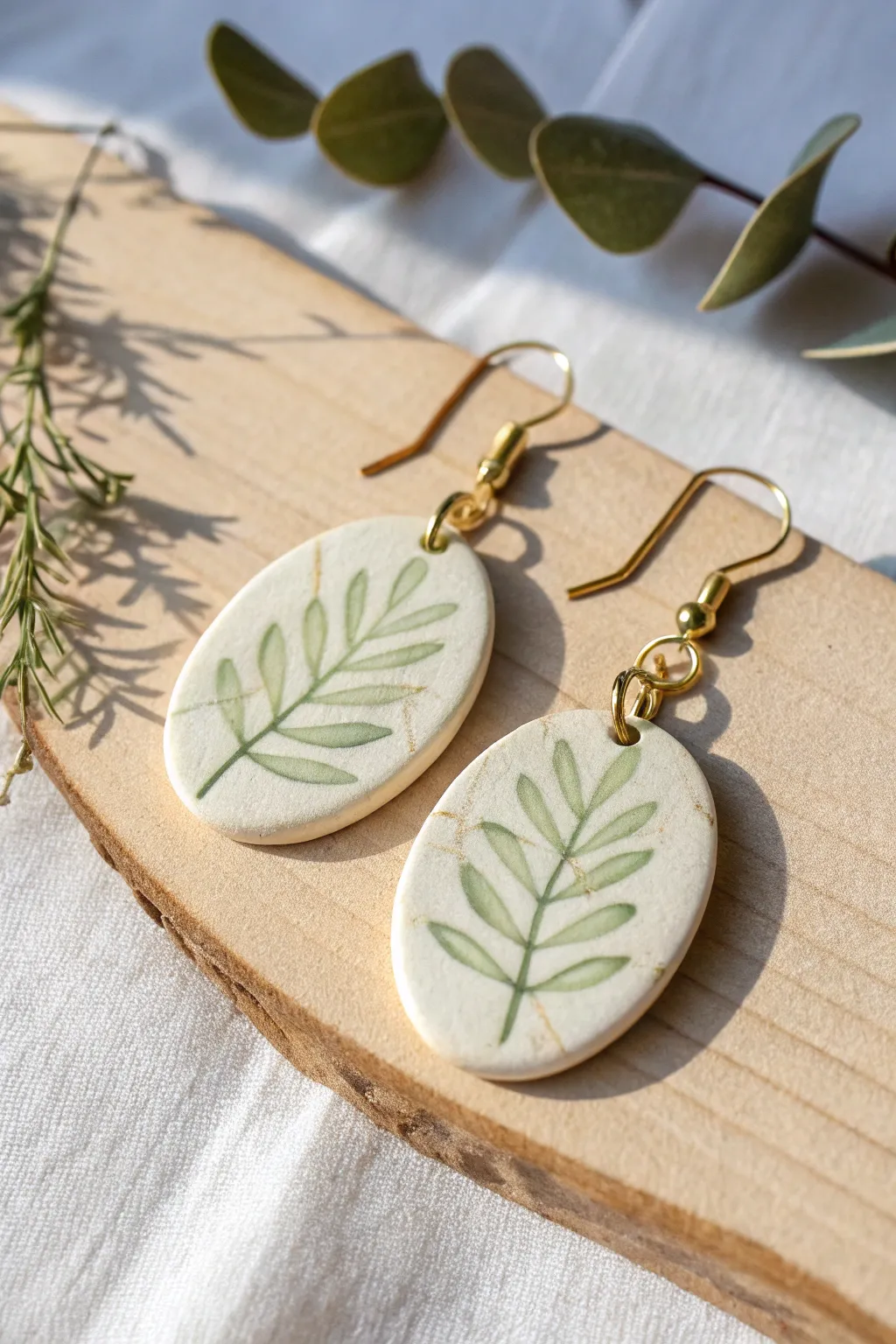
Capture the delicate beauty of nature with these oval polymer clay earrings featuring a subtle fern leaf design. The soft white background and organic green hues create a timeless botanical accessory that pairs perfectly with casual or dressy outfits.
Step-by-Step Tutorial
Materials
- White polymer clay (like Sculpey Premo or Fimo Soft)
- Acrylic rolling pin
- Oval clay cutter (approximately 1.5 inches tall)
- Real fern leaves or similar small botanical sprigs (fresh or pressed)
- Green acrylic paint (sap green or olive)
- Fine detail paintbrush
- Gold acrylic paint or metallic gold leaf flakes (optional for cracks)
- Clay texture sponge or sandpaper (for finishing)
- Hand drill or needle tool
- 2 Gold earring hooks
- 4 Gold jump rings (6mm)
- Jewelry pliers (flat nose and round nose)
- Gloss or matte varnish for polymer clay
- Baking sheet and parchment paper
Step 1: Preparing the Clay Base
-
Condition the clay:
Start by taking a block of white polymer clay and kneading it in your hands until it becomes soft and pliable. This conditioning step is crucial to prevent cracks during baking. -
Roll out the slab:
Using your acrylic rolling pin, roll the conditioned clay out on a smooth surface. Aim for an even thickness of about 3mm—thick enough to be sturdy but light enough for earrings. -
Texture the surface (optional):
For a more organic, stone-like feel, lightly press a piece of sandpaper or a texture sponge onto the clay surface. This removes the shiny, manufactured look of raw clay.
Clean Edges Pro-Tip
Before baking, gently rub a tiny amount of cornstarch or baby powder along the raw cut edges with your finger to smooth out any ragged bits.
Step 2: Creating the Botanical Imprint
-
Select your botanicals:
Pick small fern fronds that fit within the size of your oval cutter. Fresh leaves work best for deep impressions, while dried ones offer finer details. -
Press the leaves:
Gently lay the fern leaf onto the clay slab. Use your rolling pin to firmly roll over the leaf once, embedding it slightly into the clay surface. -
Remove the leaf:
Carefully lift the leaf away using a needle tool or tweezers. You should see a clear, depressed impression of the botanical structure left in the clay. -
Cut the shapes:
Position your oval cutter over the imprinted area so the leaf design is centered or artistically off-center. Press down firmly to cut out your earring shape. -
Punch holes:
While the clay is still raw, use a needle tool or a small straw to punch a hole near the top of each oval for the jump rings. Ensure the hole is at least 2mm from the edge.
Step 3: Enhancing the Design
-
Bake the clay:
Place your cut shapes on a baking sheet lined with parchment paper. Bake according to your clay package instructions (usually 275°F/135°C for 15-30 minutes). Let them cool completely. -
Highlight the imprint:
Dip a fine paintbrush into watered-down green acrylic paint. Carefully paint into the depressed leaf impression. The paint will naturally pool in the deeper veins. -
Wipe away excess:
Before the paint dries completely, lightly wipe the surface with a damp paper towel or baby wipe. This leaves pigment inside the imprint while cleaning the raised surface, creating a crisp design. -
Add gold details:
I like to add a touch of faux-kintsugi character here. Use a tiny bit of gold paint to create thin, crack-like lines intersecting the leaf or near the edges for an antique look. -
Seal the piece:
Once the paint is fully dry, apply a thin coat of polymer clay varnish. A matte finish looks very natural, while gloss will make the green pop more.
Level Up: Resin Finish
Apply a layer of UV resin over the top after painting. It cures hard and glossy in minutes under a UV lamp, giving a professional ceramic-like finish.
Step 4: Assembly
-
Open jump rings:
Using two pairs of pliers, twist your jump rings open laterally (top to bottom twist, never pull apart). -
Attach the hook:
Slide one open jump ring through the hole in your clay piece. Add the loop of the earring hook onto the jump ring as well. -
Close the ring:
Twist the jump ring back into a closed position, ensuring the ends meet flush so the hook doesn’t slip out. -
Repeat:
Repeat the assembly process for the second earring to complete your pair.
Now you have a stunning pair of nature-inspired earrings ready to wear or gift.
Checkerboard Tile Dangles
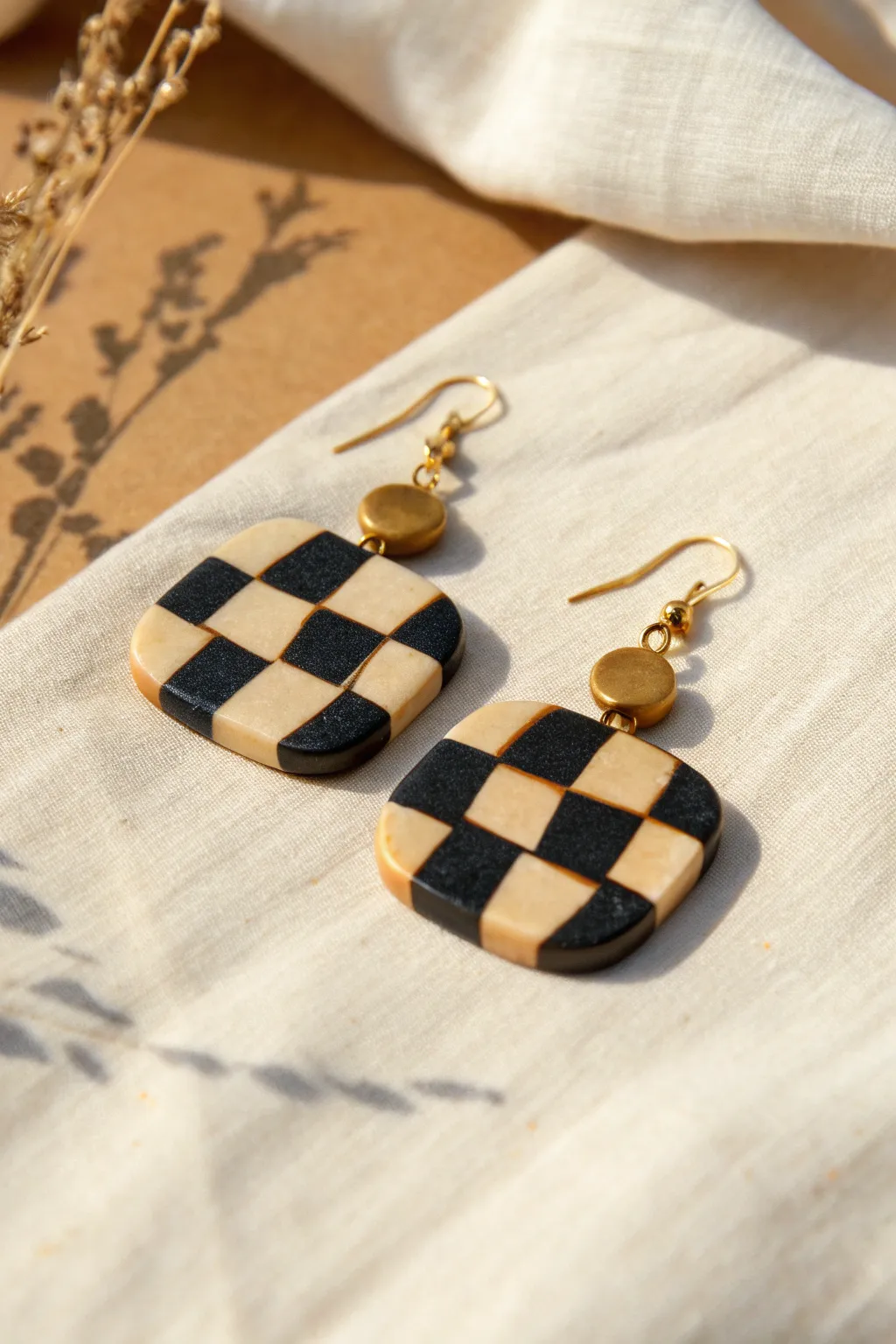
Embrace a modern, minimalist aesthetic with these black and beige checkerboard earrings that pair with just about anything. The geometric design mimics the look of high-end tile work, while the gold connectors add a warm, sophisticated finish.
Step-by-Step
Materials
- Polymer clay (black)
- Polymer clay (beige or light tan)
- Polymer clay (gold or antique brass color)
- Square clay cutter (approx. 1 inch)
- Small circle clay cutter (approx. 0.3 inch)
- Tissue blade or clay slicer
- Rolling pin or pasta machine
- Gold jump rings (4 small)
- Earring hooks (gold tone)
- Jewelry pliers
- Hand drill or needle tool
- UV resin or gloss glaze (optional)
Step 1: Prepping the Cane
-
Condition the Clay:
Start by warming up your black and beige clays separately in your hands until they are soft and pliable. This step is crucial to prevent cracking later. -
Create Slabs:
Roll both the black and beige clay into thick slabs of equal thickness, aiming for about 4-5mm thick. A pasta machine set to a medium-thick setting is helpful for consistency. -
Cut Strips:
Using your tissue blade, cut clear, straight strips from both color slabs. They should all be exactly the same width. I find measuring this against a marked grid mat helps keep things precise. -
Stack the Logs:
Create a square log by stacking the strips in an alternating pattern: one beige, one black, one beige. Make a second stack that is opposite: black, beige, black. -
Form the Checkerboard:
Press these stacks together gently to adhere them, then slice them vertically. Reassemble these slices so the colors offset each other, creating that classic checkerboard grid.
Step 2: Shaping and Baking
-
Cut the Main Shape:
Lay your checkerboard slab flat on your work surface. Use your square cutter to punch out two shapes, ensuring the grid lines are running parallel to the cutter edges. -
Smooth the Edges:
Gently tap the edges with your finger to soften any harsh cut lines. If the pattern distorted slightly, you can gently reshape the square with the flat side of your blade. -
Make the Connectors:
Roll out a small amount of gold or antique brass-colored clay. It should be slightly thinner than your main squares. -
Cut the Circles:
Using the small circle cutter, punch out two discs. These will serve as the bridge between the hook and the main dangle. -
Add Holes:
Using a needle tool, poke holes in the top center of the squares and both the top and bottom of the gold circles. Ensure the holes are large enough for your jump rings. -
Bake:
Place all pieces on a ceramic tile or baking sheet lined with parchment paper. Bake according to your specific clay brand’s temperature instructions, usually for about 30-45 minutes.
Clean Cuts Matter
Chill your clay slab in the fridge for 10 minutes before using cutters. Cold clay is firmer and distorts less, keeping your checkerboard lines straight.
Step 3: Assembly & Finishing
-
Cool Down:
Allow the pieces to cool completely inside the oven or on a cooling rack before handling, as warm clay is fragile. -
Optional Sanding:
If there are any rough spots on the sides, lightly sand them with fine-grit wet sandpaper for a professional finish. -
Optional Glaze:
For a glossy ’tile’ look like the image, add a thin layer of UV resin or gloss varnish to the checkerboard squares and cure it. -
Open Jump Rings:
Use two pairs of pliers to twist open your jump rings. Never pull them apart; always twist sideways to preserve their circle shape. -
Connect Pieces:
Loop a jump ring through the top of the square and the bottom of the gold circle. Close the ring securely. -
Attach Hooks:
Add the second jump ring to the top of the gold circle, attach your earring hook, and close it tight.
Go Retro with Color
Swap the beige for a burnt orange or mustard yellow. A warmer palette instantly transforms these from modern neutral to a funky 70s-inspired accessory.
Wear your new geometric statement pieces with a cozy sweater or a simple t-shirt to let the pattern pop.
Polka Dot Confetti Pops
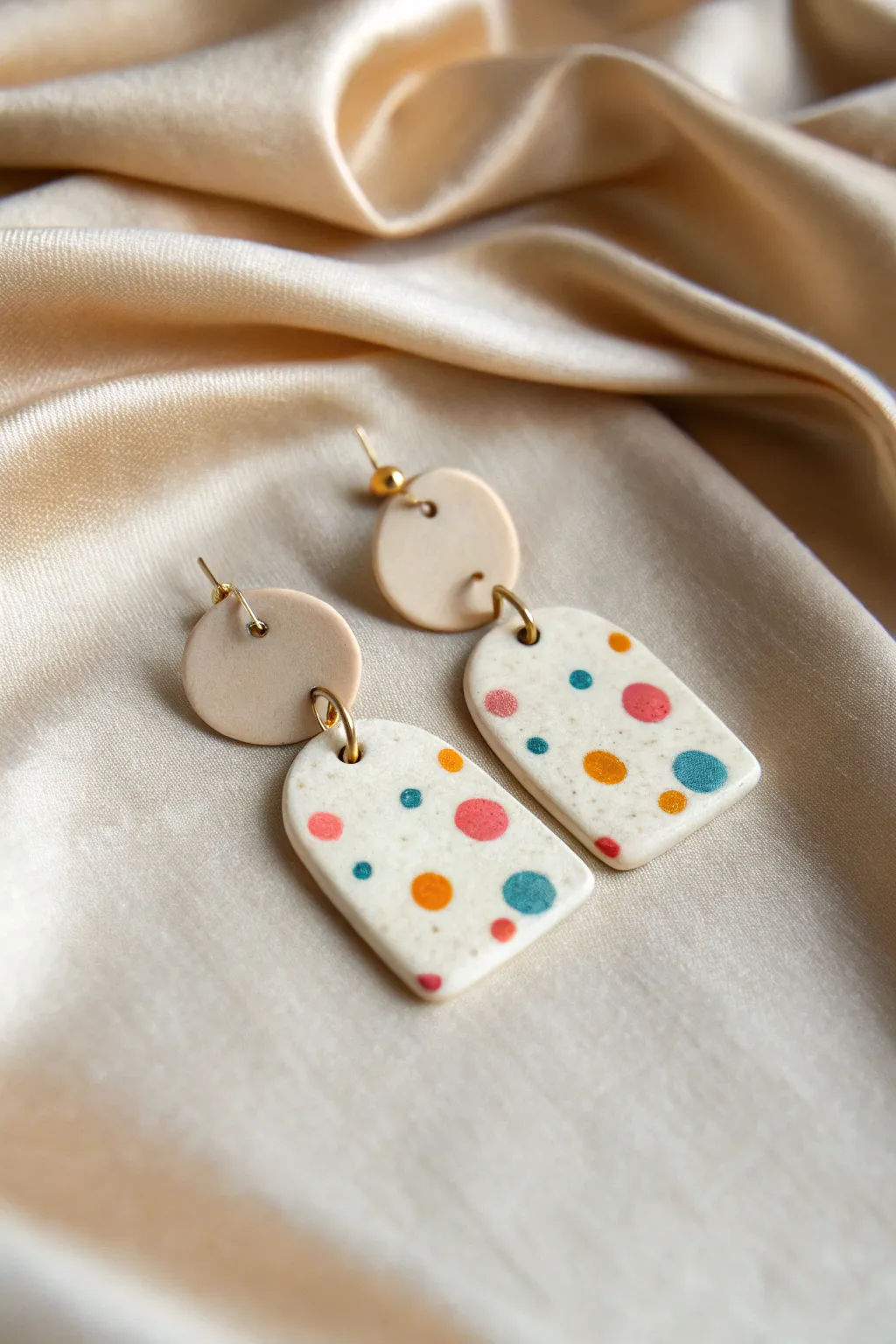
These playful polymer clay earrings feature a classic arch shape adorned with a festive confetti pattern of colorful dots. The gentle cream base makes the vibrant pops of teal, orange, mustard, and salmon pink truly shine, creating a versatile accessory perfect for brightening up any outfit.
Step-by-Step Tutorial
Materials
- Polymer clay (beige/ecru, white, black/pepper for speckles, teal, orange, mustard yellow, salmon pink)
- Acrylic rolling pin or pasta machine
- Circle clay cutter (approx. 10-12mm)
- Arch clay cutter (approx. 30mm height)
- Sharp tissue blade
- Jump rings (gold finish)
- Earring posts and backs (gold finish)
- Jewelry pliers (flat nose and round nose)
- Hand drill or needle tool
- Super glue or UV resin (optional for securing posts)
- Fine grit sandpaper (optional)
Step 1: Prepping the Clay Base
-
Condition the clay:
Start by warming up your beige or ecru polymer clay in your hands until it’s soft and pliable. Do the same for a pure white block. -
Mix the speckle base:
To create the organic, speckled stone look of the bottom piece, take your white clay and mix in a tiny pinhead-sized amount of black or ‘pepper’ colored clay. Knead thoroughly until the specks are evenly distributed but not blended into a grey color. -
Roll out the sheets:
Using your acrylic roller or pasta machine on a medium setting (approx. 2-3mm thick), roll out the solid beige clay. This will be for the top studs. -
Roll the speckle sheet:
Roll out your speckled white mixture to the same thickness. This will serve as the canvas for your colorful confetti dots.
Smudged dots?
If your colored dots smear when rolling them flat, let the colored clay leach on paper for 20 mins first. This removes oil, making the clay firmer and less likely to drag.
Step 2: Creating the Confetti Pattern
-
Prepare the colors:
Take very small amounts of your accent colors—teal, orange, mustard, and salmon pink—and roll them into thin snakes or flat sheets. -
Punch miniature dots:
You can either use a tiny micro-cutter to punch out small circles or simply pinch off tiny bits of clay and roll them into balls with your fingertips. -
Apply the dots:
Gently place these colored dots randomly onto your rolled-out speckled white sheet. Leave some empty space between them so the background shows through beautifully. -
Flatten the pattern:
Cover the clay sheet with a piece of parchment or wax paper. Gently roll over it with your acrylic rolling pin to embed the dots flush into the base clay so the surface is smooth and even.
Pro Tip: Consistent Thickness
Use playing cards as depth guides! Place a stack of 3-4 cards on either side of your clay while rolling. The rolling pin rests on the cards, ensuring a perfectly even slab.
Step 3: Cutting and Baking
-
Cut the studs:
Use your circle cutter to punch out two shapes from the plain beige sheet. These will form the top part of the earring. -
Cut the drops:
Position your arch cutter over the best parts of your confetti-patterned sheet and press down firmly to cut out two matching shapes. -
Smooth the edges:
Before baking, gently run your finger along the cut edges of the clay to smooth out any harsh lines or burrs. -
Add holes:
Using a needle tool or toothpick, carefully poke a hole at the very bottom of each beige circle and the top center of each confetti arch. Ensure the holes are large enough for your jump rings. -
Bake:
Place your clay pieces on a ceramic tile or baking sheet lined with parchment paper. Bake according to your brand of polymer clay instructions (usually around 275°F/130°C for 15-30 minutes). -
Cool down:
Let the pieces cool completely before handling them. If you notice any rough spots after baking, you can lightly sand them under running water.
Step 4: Assembly
-
Attach the posts:
Glue the flat earring posts to the back of the beige circles, positioning them slightly above the center so the earring hangs well. -
Connect the pieces:
Open a gold jump ring using your two pliers (twist apart, don’t pull). Thread it through the hole in the speckled arch and the hole in the beige circle. -
Close the rings:
Twist the jump ring back into a closed position, ensuring the ends meet perfectly so the pieces don’t slip out. -
Final check:
Double-check that all connections are secure and the posts are firmly attached before wearing your new art.
Enjoy wearing your vibrant, custom-made confetti earrings that are sure to start conversations
Negative-Space Cutout Arches
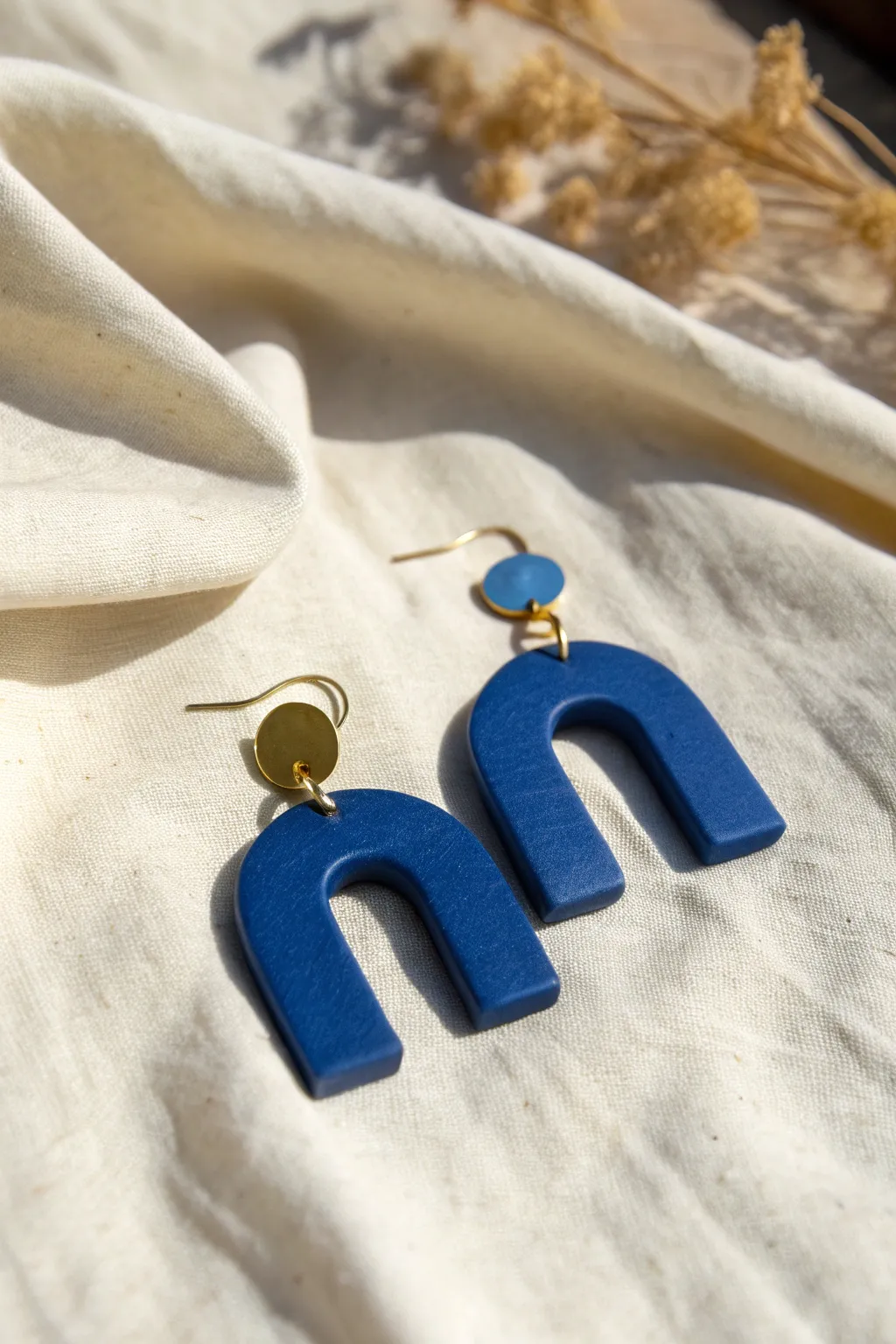
Create a stunning pair of statement earrings featuring a bold, U-shaped arch design in a deep denim blue. These polymer clay earrings offer a lovely play on negative space, accented with mismatched tops—one brass and one miniature clay circle—for a contemporary, asymmetrical look.
How-To Guide
Materials
- Polymer clay (Denim or deep blue)
- Acrylic rolling pin
- U-shaped clay cutter (medium size)
- Small circle clay cutter (approx. 6-8mm)
- Flat-back brass circle post (approx. 10mm)
- Earring posts and backs
- Gold jump rings (6mm or 7mm)
- Jewelry pliers (flat nose and round nose)
- Hand drill or needle tool
- Super glue (gel formula recommended)
- Cornstarch or water (for release)
- Parchment paper or ceramic tile
Step 1: Preparing the Clay
-
Condition the clay:
Begin by warming the blue polymer clay in your hands. Knead it thoroughly until it is soft, pliable, and free of any cracks or air bubbles. -
Roll out the slab:
Place the clay on a smooth work surface or ceramic tile. Using your acrylic rolling pin, roll the clay out to an even thickness of about 3mm to 4mm. You want them thick enough to be sturdy but not heavy. -
Smooth the surface:
Inspect the clay slab for lint or fingerprints. Gently rub a tiny bit of cornstarch over the surface so your cutters don’t stick.
Step 2: Cutting the Shapes
-
Cut the main arches:
Press your U-shaped cutter firmly into the clay slab. Make two identical arch shapes. If the clay sticks inside the cutter, gently push it out using a soft brush. -
Cut the connector piece:
Using your small circle cutter, cut out one small circle from the same blue slab. This will serve as the top stud for one of the earrings. -
Refine the edges:
Before baking, I like to gently smooth the raw edges with a fingertip dipped in a little water or baby oil to remove any sharp bits or drag marks from the cutter. -
Create holes:
Use a needle tool or toothpick to pierce a hole at the top center of each arch. For the small blue circle, pierce a hole near the bottom edge. Ensure the holes are large enough for your jump rings.
Smooth Cuts Trick
Place a piece of plastic wrap securely over your clay slab before pressing your cutters down. This creates a lovely, rounded ‘pillow’ edge rather than a sharp, harsh angle.
Step 3: Baking and Assembly
-
Bake the pieces:
Place your clay shapes on parchment paper on a baking sheet. Bake according to the manufacturer’s instructions for your specific brand of clay (usually around 275°F/135°C for 15-30 minutes). -
Cool down:
Once baked, remove the tray from the oven and let the pieces cool completely. Do not handle them while hot, as the clay is still slightly soft. -
Sand (optional):
If there are any rough spots on the edges, you can lightly sand them with fine-grit wet sandpaper for a professional finish. -
Drill if needed:
If your pre-made holes closed up slightly during baking, use a small hand drill to carefully reopen them. -
Attach the brass post:
Take one of the blue arches. Using two pliers, twist open a jump ring. Loop it through the hole in the arch and the loop on the brass circle component. Close the ring securely. -
Attach the clay post:
For the second earring, use a jump ring to connect the remaining blue arch to the small blue clay circle you made. -
Glue the earring backs:
Flip the blue clay circle over. Apply a small dot of gel super glue to the pad of an earring post and press it against the back of the clay circle. -
Secure the brass stud:
Depending on your brass component style, you may need to glue a post to the back of it as well, or it may already have a post integrated. If gluing, hold it in place for 30 seconds to set. -
Final dry time:
Allow the glue to cure fully (usually 24 hours for maximum strength) before trying on your new creations.
Texture Play
Before cutting your arches, press a piece of lace, a texture sheet, or even a leaf into the clay slab to imprint a subtle pattern onto the surface.
Enjoy wearing your sophisticated, geometric earrings that are sure to be a conversation starter
Faux Stone Granite Finish
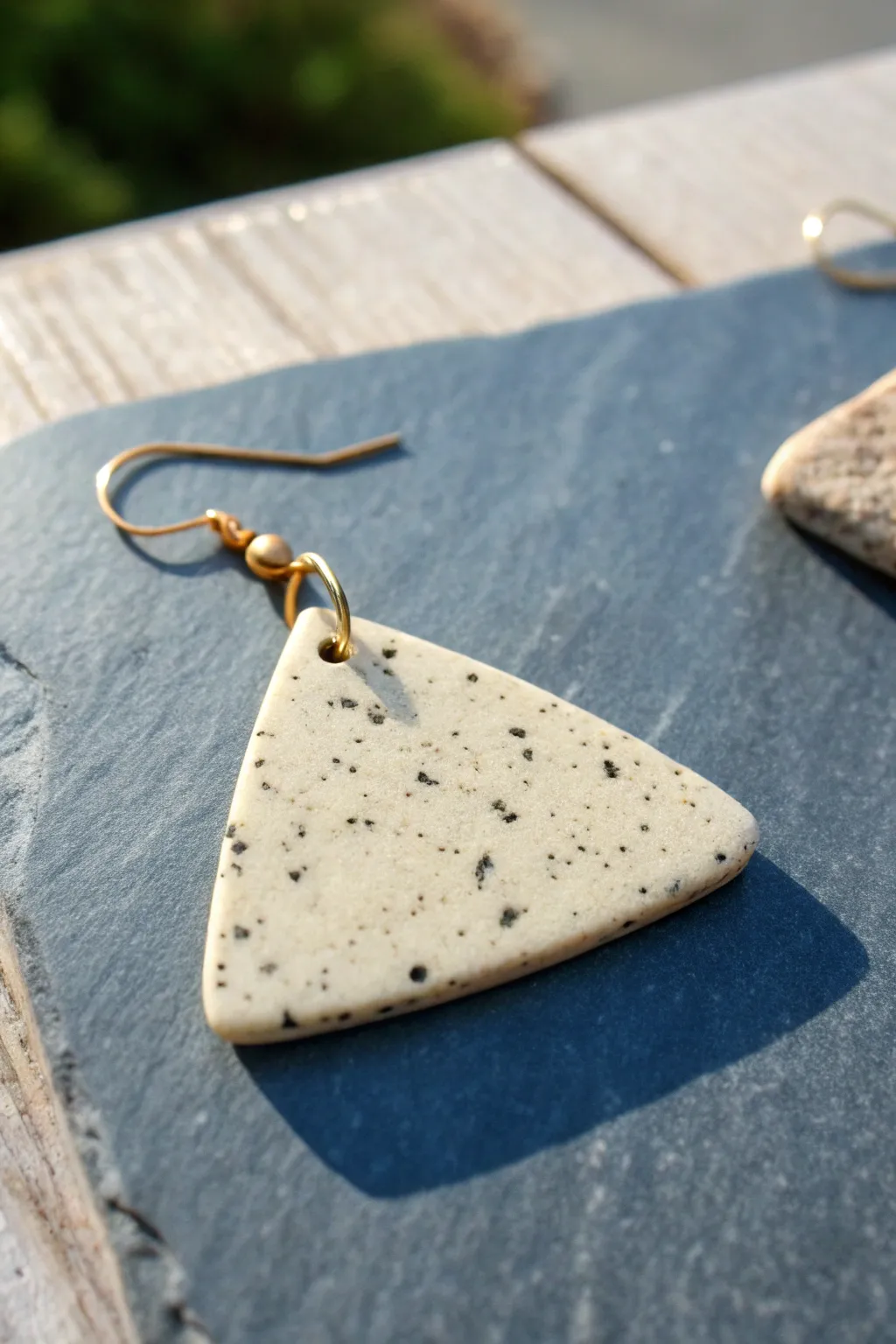
Achieve the sophisticated look of polished granite without the weight by using clever polymer clay techniques. This project creates a chic, speckled finish that mimics natural stone almost perfectly.
Step-by-Step Tutorial
Materials
- White or beige polymer clay (base)
- Black coarse pepper (freshly ground)
- Black acrylic paint
- Liquid clay or translucent liquid sculpey
- Rolling pin or pasta machine
- Triangle clay cutter (medium to large size)
- Toothpick or pin tool
- Fine grit sandpaper (400-800 grit)
- Matte or satin polyurethane varnish
- Gold jewelry pliers
- Gold jump rings (6mm or 7mm)
- Gold fish hook ear wires
- Oven baking sheet and parchment paper
Step 1: Preparing the Speckled Clay
-
Condition the base:
Start by warming up your white or beige polymer clay in your hands until it is soft and pliable. This ensures you won’t have cracks later. -
Add texture:
Flatten the clay slightly and sprinkle a generous amount of freshly ground black pepper onto the surface. The coarse grains mimic the organic imperfections of real granite. -
Incorporate the flecks:
Fold the clay over to trap the pepper inside and knead it thoroughly. Continue folding and kneading until the black specks are evenly distributed throughout the entire block. -
Add dimension with paint:
For deeper, varied speckles, take a very small amount of black acrylic paint on a toothbrush or stiff brush. Flick tiny droplets onto the clay, let them dry for a minute, and then fold the clay again to mix these distinct paint flecks in with the pepper.
Pepper Protocol
Use coarse ground pepper, not fine dust. Fine pepper can tint the clay grey, whereas coarse grinds keep the base color clean with distinct specks.
Step 2: Shaping and Baking
-
Roll out the slab:
Roll your mixed clay flat on a clean surface. Aim for a thickness of about 3mm to 4mm—thick enough to be sturdy, but thin enough to be lightweight. -
Cut the shapes:
Press your triangle cutter firmly into the clay slab. Wiggle it slightly and lift straight up to get a clean cut. Repeat for the second earring. -
Smooth the edges:
Gently run your finger along the cut edges of the triangles to soften any sharp ridges left by the cutter. This makes the final piece look more like tumbled stone. -
Create the hole:
Using a toothpick or a small circular cutter, punch a hole near the top point of the triangle. Ensure the hole is centered and at least 3mm away from the edge to prevent breakage. -
Bake the pieces:
Place your triangles on a parchment-lined baking sheet. Bake according to your brand of clay’s instructions—usually around 275°F (135°C) for 30 minutes. Let them cool completely before handling.
Step 3: Finishing Touches
-
Sanding for stone effect:
Once cool, wet sand the surface and edges using fine-grit sandpaper. I prefer doing this under running water to keep dust down. This step is crucial for achieving that smooth, honed rock texture. -
Rinse and dry:
Wash off any sanding residue or loose pepper grains with soap and water, then pat completely dry with a lint-free cloth. -
Seal the surface:
Apply a thin layer of matte or satin varnish to seal the exposed pepper and protect the clay. A matte finish looks most like natural raw granite, while satin mimics a polished countertop. -
Open the jump ring:
Using two pairs of jewelry pliers, grip a gold jump ring. Twist one hand forward and one backward to open the ring sideways (never pull it apart). -
Attach the hardware:
Slide the open jump ring through the hole in your clay triangle. Before closing it, hook the loop of your ear wire onto the jump ring. -
Close the ring:
Use your pliers to twist the jump ring ends back together until they meet perfectly flush, securing your beautiful new earring.
Luxurious Accents
Mix in a tiny pinch of gold leaf flakes or translucent glitter into the clay body for a subtle shimmer that catches the light like real quartz veins.
Enjoy wearing your sophisticated, lightweight stone-effect jewelry with any outfit
Raised Dot Texture Statements
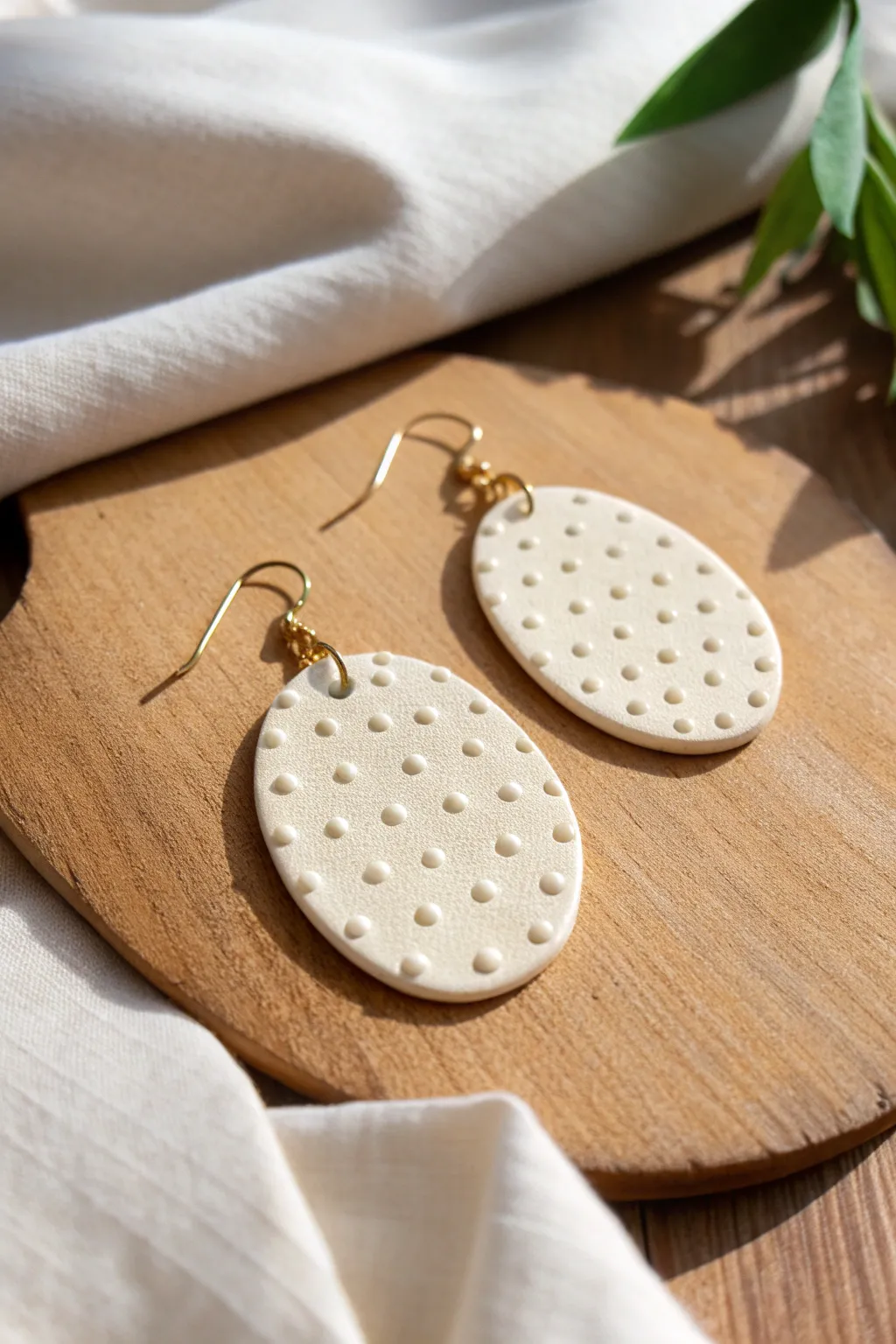
These elegant oval earrings combine a soft, neutral cream base with a playful, tactile twist. The raised dot texture adds surprising dimension to a minimal design, making them versatile enough for everyday wear or special occasions.
Step-by-Step Guide
Materials
- Polymer clay (cream, white, or light beige)
- Acrylic rolling pin or pasta machine
- Oval clay cutter (medium to large size)
- Liquid polymer clay (translucent or matching cream)
- Needle tool or toothpick
- Dotting tool or ball stylus (small size)
- Ceramic tile or baking sheet with parchment paper
- Hand drill or Dremel with small bit
- Jump rings (gold)
- Earring hooks (gold)
- Flat nose pliers
- Fine grit sandpaper (optional)
Step 1: Preparing the Base
-
Condition the Clay:
Begin by warming your cream-colored polymer clay in your hands. Knead it thoroughly until it is soft, pliable, and free of any air bubbles. -
Roll out the Slab:
Using an acrylic rolling pin or a pasta machine on a medium setting, roll the clay out into a smooth slab. Aim for a thickness of about 3mm—thick enough to be sturdy but light enough for comfortable wear. -
Check for Smootheness:
Inspect the surface for lint or fingerprints. Gently wipe the surface with a bit of rubbing alcohol or cornstarch if you need to smooth it out further. -
Cut the Shapes:
Press your oval cutter firmly into the clay slab. Give it a tiny wiggle before lifting to ensure a clean cut. -
Refine the Edges:
Carefully lift the ovals from your work surface. If the edges are slightly rough, gently smooth them with your fingertip to create a professional finish.
Sticky Situation?
If your clay paste dots are too runny and spreading out, your mixture has too much liquid clay. Add a tiny crumb of solid raw clay back into the mix to thicken it up.
Step 2: Creating the Texture
-
Mix the Dotting Paste:
Take a small pea-sized amount of your leftover solid clay and mix it vigorously with a few drops of liquid polymer clay. -
Achieve Consistency:
Continually mix and chop the clay paste until it reaches a consistency similar to thick frosting or heavy whipped cream. It needs to hold its shape without spreading. -
Load the Tool:
Dip your small dotting tool or the tip of a toothpick into your clay paste mixture. -
apply the First Row:
Starting at the center of the oval to ensure symmetry, gently touch the loaded tool to the raw clay surface to deposit a small, raised bead. I find it helpful to create a vertical center line of dots first. -
Complete the Pattern:
Work outward from your center line, placing dots in a grid or offset brick pattern. Keep the spacing consistent, leaving about 2-3mm between each raised dot. -
Check Dot Height:
Inspect your work from the side. The dots should be prominent bumps, not flat circles. Add a tiny bit more paste to any that look deflated. -
Pre-Bake Hole (Optional):
If you prefer not to drill later, use a needle tool or straw to poke a hole near the top of the oval now, ensuring ample space from the edge.
Step 3: Baking and Assembly
-
Baking Setup:
Place your textured ovals on a ceramic tile or a baking sheet lined with parchment paper. -
Tent with Foil:
Cover the earrings loosely with aluminum foil to prevent the white clay from scorching or yellowing during the bake. -
Bake:
Bake in a preheated oven according to your clay manufacturer’s specific instructions (usually around 275°F/130°C for 30-45 minutes). -
Cool Down:
Allow the pieces to cool completely inside the oven or on the counter. The clay hardens fully as it cools. -
Drill Holes:
If you didn’t pierce them before baking, use a hand drill or Dremel to carefully drill a hole at the top center of each oval. -
Attach Jump Rings:
Using two pairs of pliers, twist open a jump ring laterally. Thread it through the hole in the clay. -
Add Hooks:
Loop your gold earring hook onto the open jump ring. -
Secure the Closure:
Gently twist the jump ring closed again, ensuring the ends meet flush so the hook doesn’t slip out.
Clean Cuts Pro Tip
Place a sheet of plastic wrap over the clay slab before pressing your oval cutter down. This creates a lovely beveled modification to the edges perfectly rounded.
Enjoy styling these sophisticated textured drops with your favorite outfit
Mismatch Pair Story Sets
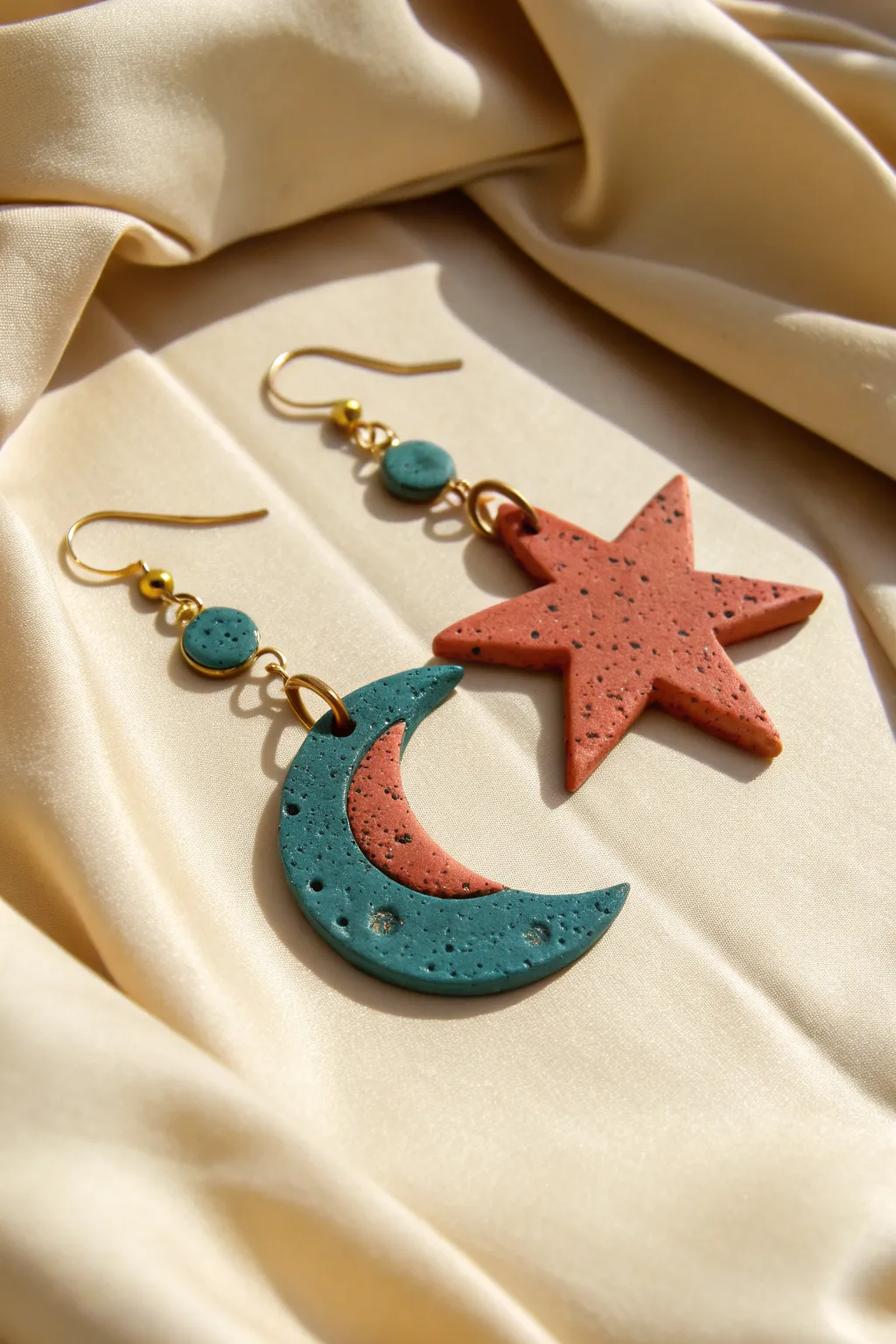
Embrace the beauty of asymmetry with this charming mismatched set featuring a star and crescent moon. The design combines a deep teal with a warm terracotta hue, speckled for a natural, pottery-like finish that catches the light beautifully.
Step-by-Step Tutorial
Materials
- Polymer clay (Teal/Emerald Green and Terracotta/Warm Brown)
- Black pepper or black embossing powder (for speckles)
- Gold glitter (fine)
- Rolling pin or pasta machine
- Shape cutters: Large star, Middle-sized moon, Small circle
- X-acto knife or clay blade
- Hand drill or needle tool
- Gold jump rings (6mm)
- Gold earring hooks
- Jewelry pliers
- Parchment paper
- Oven
Step 1: Preparing the Patterned Clay
-
Condition the clay:
Begin by warming up your teal and terracotta polymer clay blocks in your hands until they are soft and pliable. This conditioning step is crucial to prevent cracking later. -
Add texture:
Flatten each color slightly. Sprinkle a pinch of coarsely ground black pepper or black embossing powder onto the clay. Add a very faint dusting of fine gold glitter for a subtle shimmer. -
Incorporate the flecks:
Fold the clay over the speckles and knead it thoroughly until the black spots and glitter are evenly distributed throughout the material. Do this separately for each color. -
Roll it out:
Using an acrylic roller or a pasta machine on a medium setting (approx. 3mm thick), roll out both clay colors into smooth, even slabs.
Sticky Cutters?
If your clay keeps getting stuck inside your plastic or metal cutters, dip the cutter into a small pile of cornstarch or water before pressing it into the clay slab.
Step 2: Cutting and Shaping
-
Cut the star:
Press your large star cutter firmly into the terracotta slab. Give it a gentle wiggle to ensure a clean cut, then lift it away. -
Cut the moon base:
Use your crescent moon cutter on the teal slab. This will form the main body of the moon earring. -
Create the inner moon accent:
Cut another moon shape, this time from the terracotta clay. Using a slightly smaller round cutter or your blade, trim this terracotta piece so it fits snugly inside the curve of the teal moon. -
Cut the connector beads:
Use your smallest circle cutter to punch out two small discs from the teal clay. These will serve as the connectors between the hooks and the main pendants. -
Assemble the two-tone moon:
Gently press the trimmed terracotta moon piece onto the inner curve of the teal moon. Smooth the seam lightly with your finger or a silicone tool so they bond together. -
Piercing holes:
Before baking, use a needle tool to create holes for your jump rings. You’ll need holes at the top of the star, the top of the moon, and the top and bottom of both small teal circles.
Step 3: Baking and Assembly
-
Bake the pieces:
Arrange all your clay pieces on a baking sheet lined with parchment paper. Bake according to your brand of polymer clay’s instructions (usually 275°F/135°C for about 30 minutes). -
Cool down:
Let the pieces cool completely on the baking sheet. They are fragile while warm, so patience here really pays off. -
Inspect and refine:
Once cool, check for any rough edges. You can gently sand them with high-grit sandpaper if needed for a polished look. -
Open jump rings:
Using two pairs of jewelry pliers, twist your gold jump rings open laterally (top to bottom, never pulling apart). -
Connect the star:
Attach a jump ring to the top of the star, loop it through the bottom hole of a teal circle, and close. Add another ring to the top of the circle and attach the earring hook. -
Connect the moon:
Repeat the process for the moon side: jump ring through the moon piece, connect to the teal circle, then another ring to the hook. -
Final check:
Ensure all jump rings are closed tightly so there are no gaps for components to slip through.
Pro Tip: Surface Texture
To get that ‘stone’ look, gently tap the surface of the unbaked clay with an old toothbrush or a piece of crumpled aluminum foil. It stops the clay from looking too plastic.
Wear your celestial creation with pride and enjoy the unique charm of handcrafted jewelry