
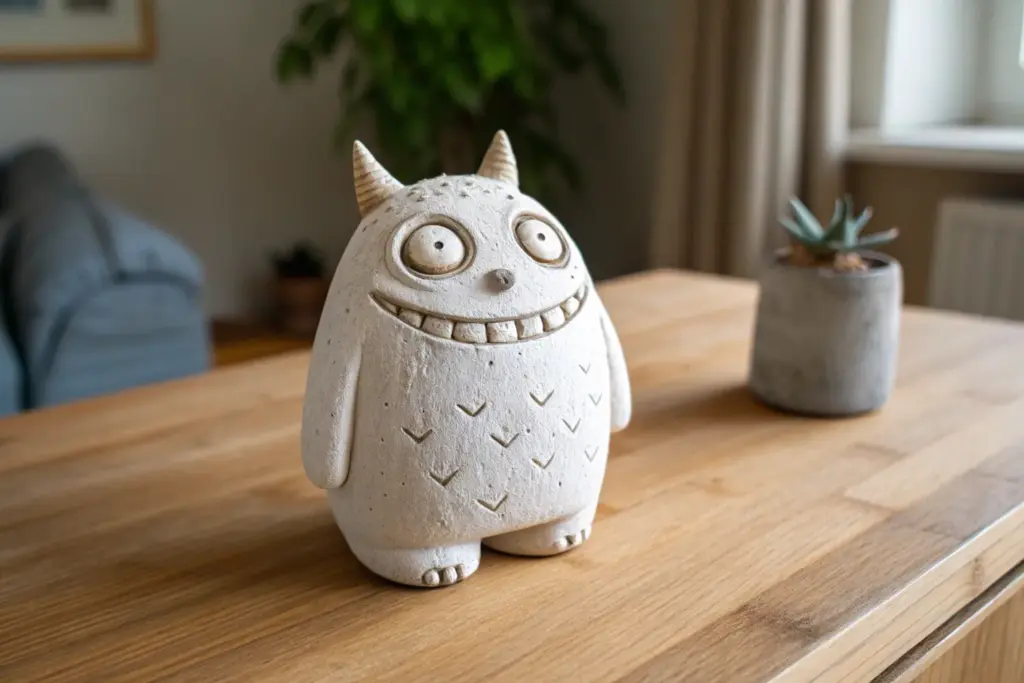
Whenever my clay projects start feeling a little too “serious,” I make something that’s purely for a laugh. These funny clay ideas are all about goofy faces, odd little personalities, and everyday objects that suddenly feel like they have opinions.
Pinch-Pot Blob Monsters With Wide-Eyed Faces
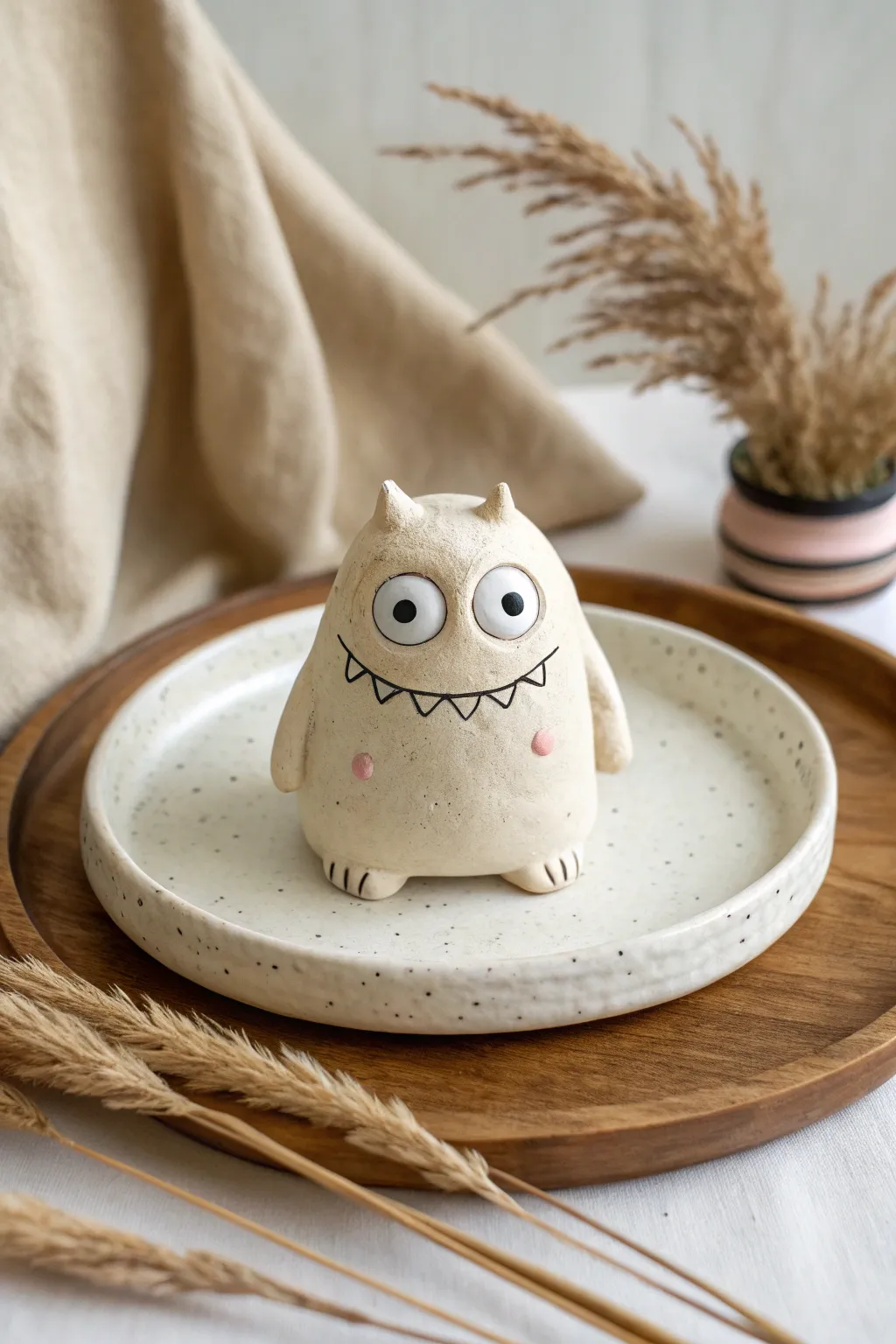
This charming little creature starts as a simple lump of clay and transforms into a personality-filled desk companion with wide, staring eyes and a mischievous grin. With its textured, creamy finish and tiny horns, it’s a delightful project perfect for beginners looking to practice pinch pot techniques.
Step-by-Step Tutorial
Materials
- White classic air-dry clay or polymer clay (beige/off-white)
- Small bowl of water (for smoothing)
- Clay sculpting tools (needle tool, smoothing tool)
- Black fine-point marker or acrylic paint
- Pink acrylic paint
- Two small black beads (optional for pupils) or black paint
- Clear matte varnish or sealant
- Small paintbrush
Step 1: Shaping the Base Body
-
Form the initial ball:
Start with a handful of clay, about the size of a tennis ball. Roll it firmly between your palms until you have a smooth, crack-free sphere. -
Create the pinch pot:
Hold the ball in one hand and press your thumb into the center, stopping before you poke through the bottom. Gently pinch and rotate the clay walls to thin them out creating a hollow interior. -
Shape the ‘Blob’:
Once hollowed, place the opening face down on your work surface. Gently squeeze and mold the clay into a pear shape—wider at the bottom and slightly tapered at the top. -
Smooth the surface:
Dip your finger in a tiny bit of water and run it over the exterior to remove any fingerprints or cracks. You want a slightly organic, matte texture rather than perfectly polished glass.
Taming Cracks
If you see hairline cracks while drying, mix a tiny bit of fresh clay with water to make a paste (slip) and fill them in with a brush.
Step 2: Adding Features and Limbs
-
Form the feet:
Roll two small, marble-sized balls of clay. Flatten the bottoms slightly and attach them to the front base of the body. Blend the back of the feet into the body so they stick firmly. -
Add toe details:
Use a needle tool or a dull knife to press three small vertical lines into the front of each foot to imply toes. -
Create the arms:
Roll two sausage shapes, slightly thicker at one end. Attach the thinner ends to the sides of the body, blending the clay seams carefully so the arms look seamless. -
Make the horns:
Pinch two tiny triangles of clay from the very top of the head. Refine them into small, conical horns. I find it helps to wet my fingertips just slightly to get those points sharp. -
Sculpt the eyes:
Roll two white balls of clay for the eyes. These should be fairly large to get that ‘wide-eyed’ look. Flatten them slightly and press them onto the upper face, side-by-side. -
Refine the pupils:
Press a small indentation into the center of each eye. You can place a small black bead here now, or leave it indented to paint black later.
Texturizing Pro Tip
Before drying, dab the clay body gently with an old toothbrush or a stiff sponge to give it a realistic stone-like or fuzzy texture.
Step 3: Finishing Touches
-
Dry the sculpture:
Let your monster dry completely according to your clay’s package instructions. Air-dry clay usually needs 24-48 hours. -
Paint the pupils:
If you didn’t use beads, use a fine tip brush and black acrylic paint to fill in the pupils. Make them slightly different sizes for a sillier expression. -
Draw the mouth:
Using a fine-point black marker or a very steady hand with black paint, draw a curved line across the belly. Add small downward pointing triangles along the line to create jagged teeth. -
Add rosy cheeks:
Dip the back end of a paintbrush into pink acrylic paint. Dot it gently onto the cheeks, just below and to the side of the mouth curve. -
Seal the piece:
finish the project by applying a coat of matte varnish. This protects the painted details and gives the clay a finished, professional look without making it too shiny.
Place your new monster friend on a shelf or desk where its goofy smile can brighten your day
Big-Mouth Toothbrush Holder That Looks Like It’s Screaming
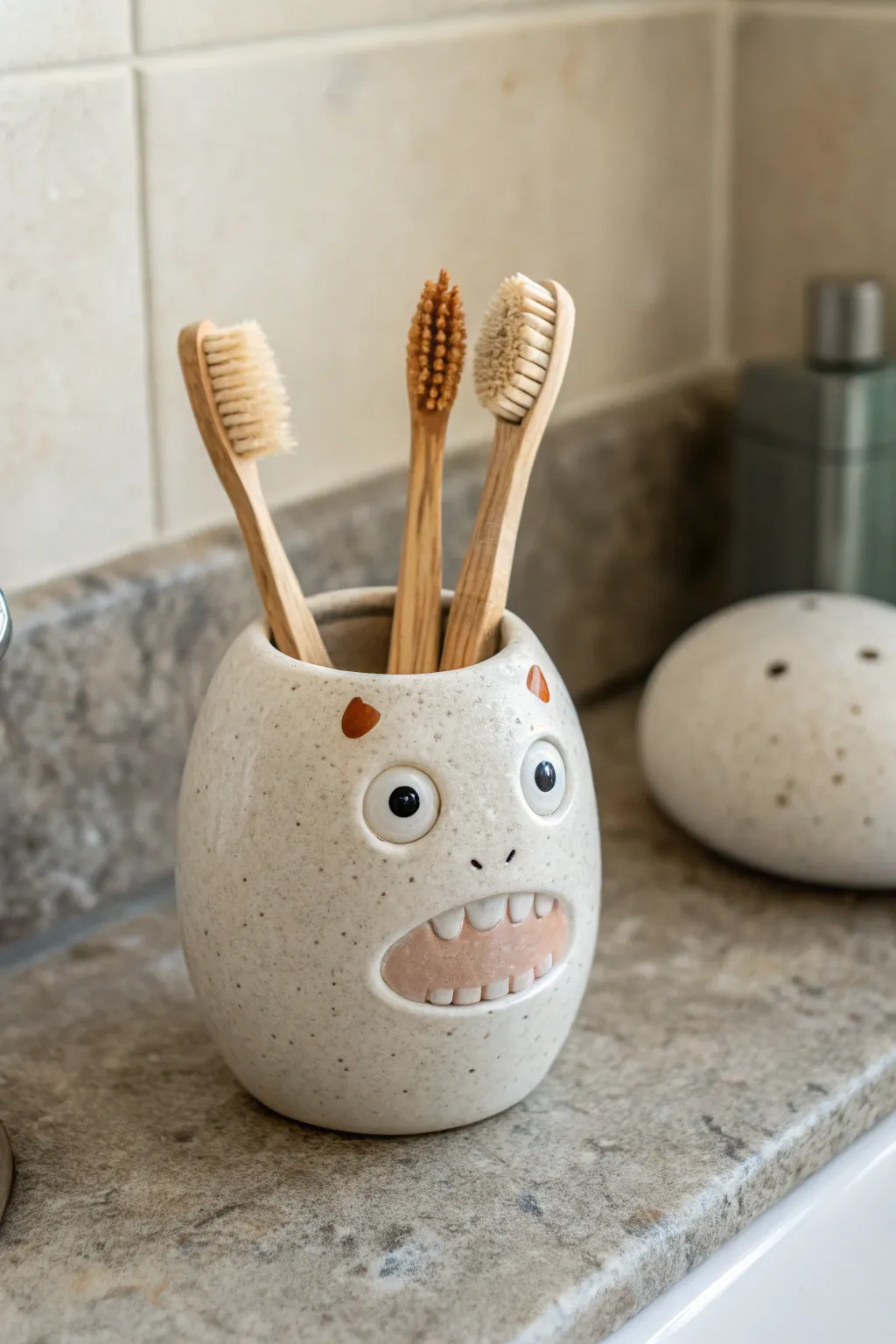
Add some personality to your bathroom counter with this quirky, open-mouthed creature that holds your toothbrushes. Its speckled finish, tiny horns, and wide-eyed expression turn a mundane utility item into a hilarious piece of functional art.
Detailed Instructions
Materials
- Speckled stoneware clay (or white clay with speckles)
- Pottery wheel (or slab roller/rolling pin for hand-building)
- Needle tool
- Loop tool for carving
- Slip and scoring tool
- Underglazes (black, reddish-brown, pink)
- Clear glaze
- Small fine-point paintbrush
- Sponge
Step 1: Forming the Body
-
Prepare the base:
Start by wedging your speckled clay thoroughly to remove air bubbles. This project works best with about 1-1.5 lbs of clay depending on how large you want the final holder to be. -
Shape the cylinder:
Throw a basic cylinder on the wheel, or if you are hand-building, roll out a slab and form a tube. Aim for a slightly bulbous shape—wider in the middle and slightly tapered at the top rim to give it a head-like appearance. -
Close the form (optional):
You can choose to throw it as an enclosed form (like a bottle) and cut the top later, but for this specific look, simply smooth the rim while keeping it open for the toothbrushes. -
Refine the shape:
Use a rib tool to smooth the exterior walls. I prefer to leave the walls slightly thick to allow for the deep carving of the mouth later without punching through. -
Leather hard drying:
Let the piece dry to a leather-hard state. It needs to be firm enough to handle without warping but soft enough to carve and attach additions.
Step 2: Sculpting the Face
-
Mark the features:
Lightly sketch the position of the eyes and the large oval mouth using your needle tool. The mouth should sit in the lower third of the body. -
Carve the mouth cavity:
Using a loop tool, gently carve out the interior area of the mouth. You want to create a recessed space, leaving a raised lip around the edge to define the opening. -
Sculpt the teeth:
Instead of adding teeth separately, carefully crave *away* the clay inside the mouth area, leaving a ridge for the top and bottom teeth. Use a small knife to define the individual square teeth shapes. -
Refine the gums:
Smooth the area behind the teeth to create the ‘gum’ surface. Ensure the transition from the lips to the teeth is clean and sharp. -
Create the eyes:
Roll two small balls of clay for the eyes. Score and slip the area above the mouth, then firmly press the balls onto the body. Flatten them slightly so they look like discs rather than spheres. -
Punch the pupils:
Use the back of a small paintbrush or a detail tool to make a tiny indentation in the center of each eye. This adds depth and makes painting the pupils easier later. -
Add the horns:
Form two tiny cone shapes for the horns. Score and slip two spots near the upper rim of the holder, then attach the horns securely, smoothing the seams so they look seamless. -
Poke the nostrils:
Use a small needle tool or toothpick to poke two tiny holes between the eyes and mouth for the nostrils.
Clean Teeth Trick
Apply liquid wax resist over the white teeth before glazing or painting the gums. This keeps the teeth perfectly white and makes it easy to wipe away stray pink underglaze.
Step 3: Painting and Glazing
-
Bisque fire:
Once the piece is bone dry, load it into the kiln for a bisque firing. -
Paint the horns:
Apply a reddish-brown underglaze to the tiny horns. Being precise here keeps the character looking neat. -
Detail the mouth:
Paint the gum area inside the mouth with a soft pink underglaze. Be careful not to get pink on the white teeth ridges. -
Define the eyes:
Use a fine detail brush and black underglaze to fill in the pupil indentations you made earlier. A steady hand is key here. -
Apply clear glaze:
Dip the entire piece into a clear glaze (transparent). This will make the speckled clay body shine and seal the underglaze details without obscuring them. -
Final firing:
Fire the piece again to your clay’s maturity temperature (usually Cone 5 or 6 for stoneware) to finish the project.
Make It Glossy
For extra ‘wet’ looking eyes and mouth, add a dab of high-gloss clear glaze just to the eyes and tongue area, while leaving the rest of the body matte or satin.
Place your new ceramic friend by the sink and enjoy the extra company while you brush your teeth

Derpy Desk Pencil Cup With Tiny Arms
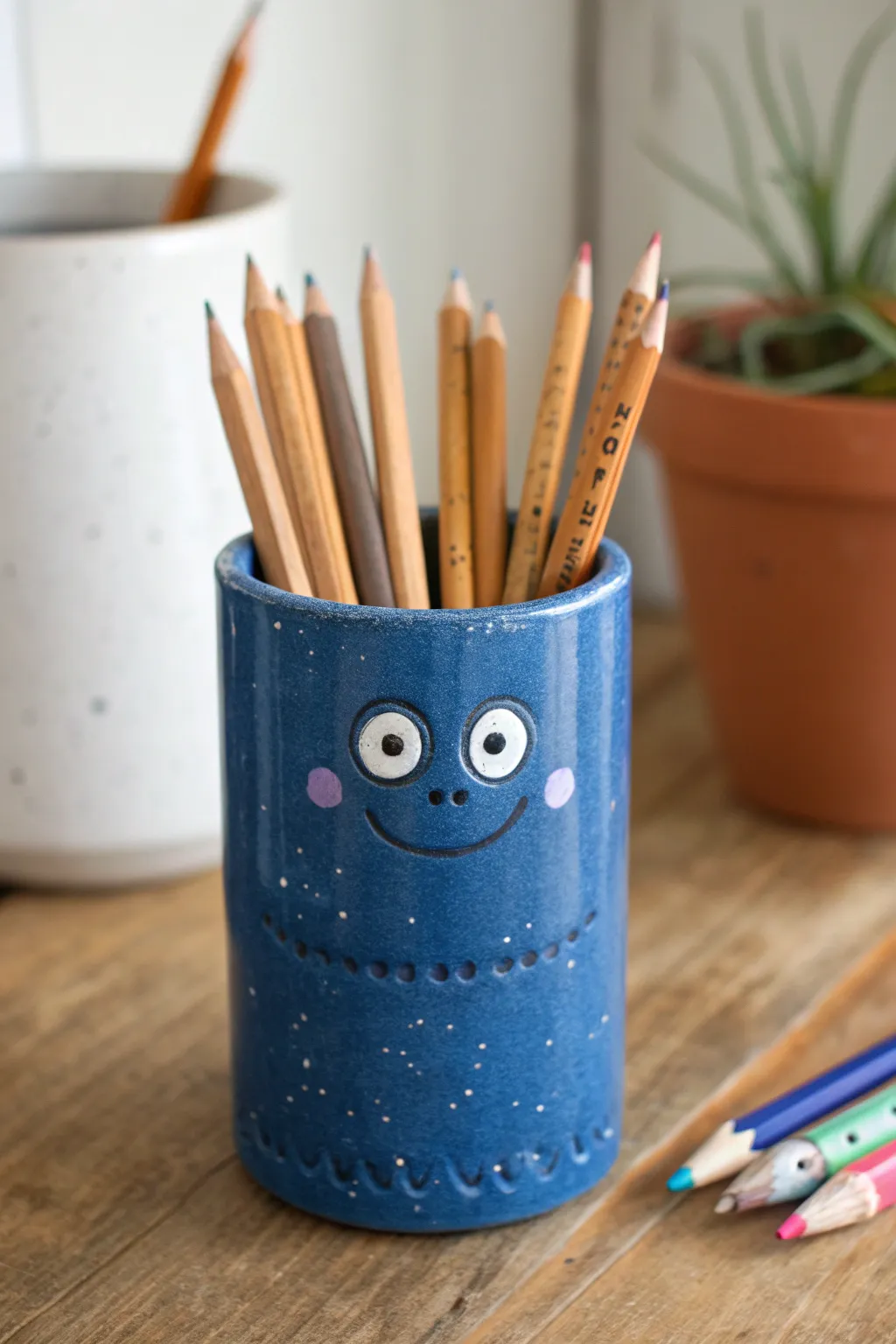
Brighten up your workspace with this delightfully goofy pencil cup that’s as functional as it is charming. The speckled blue glaze and wide-eyed expression give this little desk buddy a ton of personality while keeping your supplies organized.
Step-by-Step
Materials
- Stoneware clay (smooth body)
- Non-stick rolling mat
- Rolling pin
- Clay knife or fettling knife
- Needle tool
- Slip and scoring tool
- Cylindrical form (like a PVC pipe or rolling pin) for shaping
- Blue speckled glaze (food safe recommended)
- Underglazes: White, Black, Lavender/Pink
- Small round paintbrushes
- Sponge
- Clear transparent glaze (optional, over underglaze)
Step 1: Building the Cylinder
-
Roll the slab:
Begin by wedging your clay to remove air bubbles, then roll it out into an even slab about 1/4 inch thick. A consistent thickness ensures the cup won’t warp in the kiln. -
Cut the rectangle:
Measure and cut a rectangle from your slab based on how tall and wide you want your cup. A standard size is roughly 5 inches tall by 10 inches long. -
Cut the base:
Roll a small separate piece of clay for the base. Place your cylindrical form on top and cut a circle slightly larger than the diameter of your form to account for attachment. -
Bevel the edges:
On the short sides of your large rectangle, cut the edges at a 45-degree angle. This beveling helps create a seamless join when you roll the clay into a tube. -
Score and slip:
Score the beveled edges aggressively and apply slip. Roll the rectangle into a cylinder, pressing the beveled edges together firmly to create a strong seam. -
Attach the base:
Score and slip the bottom edge of your cylinder and the outer edge of your circular base. Press them together, smoothing the clay up from the base onto the wall to seal it completely.
Step 2: Adding Details & Texture
-
Smooth the seam:
Use a rib tool or damp sponge to smooth out the vertical seam on your cylinder until it is invisible. Ensure the rim is rounded and smooth as well. -
Create the ‘arms’:
Instead of attaching separate arms for this specific look, use a small loop tool to carve a subtle, low-relief curvy line near the bottom third of the cup. This suggests tiny arms wrapped around the body or a decorative scalloped pattern. -
Add texture dots:
Along that scalloped line you just carved, gently press the back end of a paintbrush into the clay to create a row of small, indented dimples for extra texture. -
Dry slowly:
Cover the cup loosely with plastic and let it dry slowly to the leather-hard stage, then uncover until bone dry. Perform your bisque fire according to your clay’s specifications.
Master the Eyes
For perfectly round eyes, dip the back of a large drill bit or dowel into the white underglaze and stamp it onto the surface instead of brushing.
Step 3: Glazing the Face
-
Base glaze application:
Dip the entire bisque-fired cup into a speckled blue glaze. Ensure an even coat. If you don’t have a dipping tank, brushing on three even coats works too. -
Clear the face area:
While the blue glaze is powdery but dry, gently wipe away a small oval area where the eyes will go if you prefer painting directly on bisque, or simply plan to paint the underglaze right over the raw glaze (check your product instructions for compatibility). -
Paint the eyes:
Using white owner-glaze or underglaze, paint two large, touching circles for the eyes. Apply 2-3 coats to ensure the blue doesn’t show through. -
Add pupils:
Once the white is dry, use a fine-tip brush and black underglaze to add small black pupils. Place them slightly off-center to achieve that ‘derpy’ look. -
Cheeks and smile:
Dab two small circles of lavender or pink underglaze for the rosy cheeks. Use a very fine liner brush to paint a simple U-shaped smile and two tiny dots for nostrils. -
Final fire:
Fire the piece again to your glaze manufacturer’s recommended temperature (likely Cone 5 or 6). I always double-check that no glaze is on the bottom of the pot before loading the kiln.
Bubbling Glaze?
If your painted eyes bubble during firing, the underglaze was likely applied too thickly. Next time, thin it slightly with water and apply more thin layers.
Now fill up your new friend with pencils and enjoy the giggles every time you reach for a writing tool

Overreacting Expression Fridge Magnets
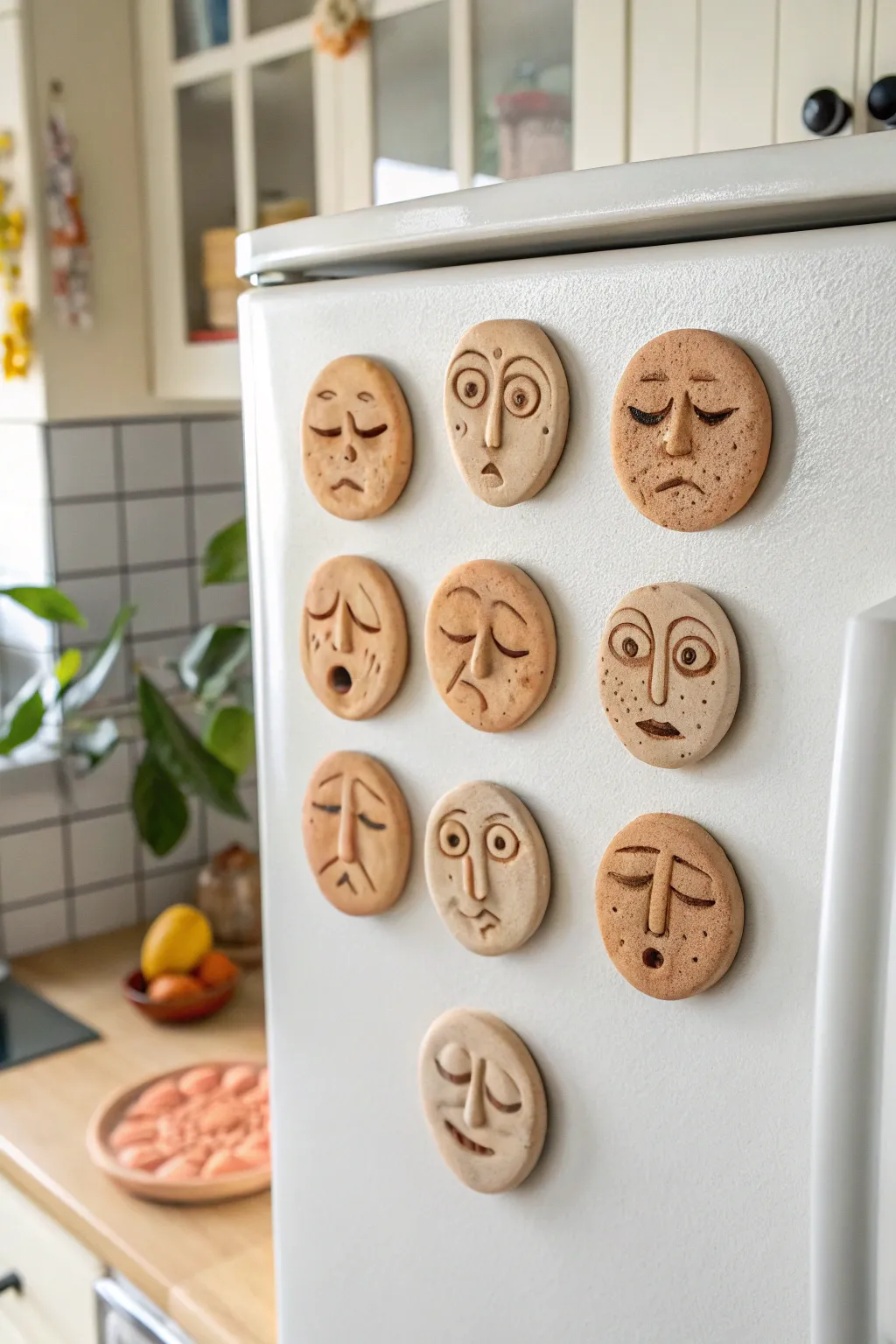
These hilarious “overreacting” face magnets add a touch of theatrical personality to your kitchen appliances. Using simple sculpting techniques and varied clay tones, you’ll create a gallery of dramatic expressions that range from shocked disbelief to utter despair.
Step-by-Step
Materials
- Polymer clay or air-dry clay (in translucent white, cream, and terra cotta colors)
- Round cookie cutter (approx. 2 inches)
- Small magnets (neodymium preferred)
- Super glue (cyanoacrylate)
- Needle tool or toothpick
- Small loop tool or clay carving set
- Acrylic rolling pin
- Brown acrylic paint (for antiquing)
- Paper towels
- Parchment paper
Step 1: Forming the Base
-
Condition the clay:
Begin by kneading your chosen clay colors until they are soft and pliable. If you want that speckled look seen in some faces, mix a pinch of black pepper or dried coffee grounds into the cream clay. -
Roll out the slab:
On a sheet of parchment paper, roll your clay out to an even thickness of about 1/4 inch. Avoid making them too thin, or the facial features won’t have enough depth. -
Cut the circles:
Use your round cookie cutter to punch out several discs. Gently smooth the sharp edges cut by the cutter with your fingertip for a softer, organic look. -
Warp the shapes:
Don’t leave them perfectly round. Gently squeeze or pull the circles slightly to create oval or egg-like head shapes. This asymmetry adds to the funny character.
Clay Cracking?
If air-dry clay cracks while drying, mix a tiny bit of fresh clay with water to make a paste (slip) and smooth it into the cracks with a brush.
Step 2: Sculpting the Drama
-
Add nose structure:
Roll a small snake or teardrop of clay and press it onto the center of a face. Blend the edges into the base clay using your finger or a modeling tool so strictly the nose bridge protrudes. -
Carve the eyes:
For shocked expressions, use a small loop tool to carve out circular sockets, then place tiny balls of clay inside for eyeballs. For sad or tired faces, carve shallow U-shapes or horizontal slits. -
Define the pupils:
Use the tip of a needle tool to poke deep holes for pupils. I find placing them slightly off-center makes the expression look more unhinged and dramatic. -
Sculpt the mouth:
This is where the ‘overreacting’ happens. Use the loop tool to carve deep frowns, open O-mouths of horror, or skeptical thin lines. Deep carving creates better shadows later. -
Add expressive lines:
Use your needle tool to gently etch worry lines on the forehead, bags under the eyes, or dimples. These fine details bring the emotion to life. -
Create eyebrows:
You can either carve thin arched lines above the eyes or roll tiny snakes of clay and attach them for raised, surprised eyebrows. Ensure they are firmly blended so they don’t pop off.
Step 3: Finishing and Assembly
-
Bake or dry:
Follow your clay manufacturer’s instructions. If baking polymer clay, place the parchment paper directly on a baking sheet to prevent shiny spots. -
Cool down:
Let the pieces cool completely before handling. This ensures the clay hardens properly and prevents burns. -
Apply an antique wash:
To make the details pop, water down some brown acrylic paint. Brush it over the entire face, ensuring it gets into the carved crevices. -
Wipe away excess:
Immediately use a damp paper towel to wipe the paint off the surface. The paint will remain in the eyes, mouths, and wrinkle lines, highlighting the sculpture. -
Dry the paint:
Allow the paint to dry fully. The faces should look weather-beaten and stony rather than freshly painted. -
Attach the magnet:
Flip the faces over. Apply a drop of super glue to the back and press a magnet firmly into place. Hold for 30 seconds to set.
Level Up: Hair & Hats
Before baking, press texture sheets onto the top of the head for ‘hair,’ or sculpt tiny clay beanies to give your dramatic characters specific personas.
Now your fridge has a whole cast of characters ready to react to whatever snack you choose

The Complete Guide to Pottery Troubleshooting
Uncover the most common ceramic mistakes—from cracking clay to failed glazes—and learn how to fix them fast.
Wonky Cup With a Mustache and Judgmental Eyebrows

This charming handmade mug features a speckled creamy finish and a distinguished handlebar mustache that brings instant personality to your morning coffee. The simple black dot eyes add a touch of sweet innocence, making every sip feel like you’re hanging out with a quiet, classy friend.
Step-by-Step
Materials
- White stoneware clay body (cone 6)
- Speckled cream glaze (food safe)
- Black underglaze
- Brown underglaze
- Small fine-point paintbrush
- Pottery wheel (or slab roller for hand-building)
- Rib tool
- Wire cutter
- Trimming tools
- Sponge
- Clear transparent glaze (optional, if cream glaze isn’t glossy enough)
Step 1: Forming the Cup
-
Wedge the clay:
Begin by thoroughly wedging about 1 pound of white stoneware clay to remove air bubbles and ensure particle alignment. -
Center and open:
Throw the clay onto the wheel head and center it. Open the clay to establish the floor of your mug, keeping it flat and roughly 3 inches wide. -
Pull the walls:
Pull the walls up to create a cylinder. Aim for a slightly straight-sided shape with a gentle curve at the bottom, mimicking the classic coffee cup silhouette in the reference. -
Refine the rim:
Compress the rim with a chamois or your finger to make it smooth and pleasant to drink from. -
Dry to leather hard:
Wire the pot off the wheel and let it dry slowly until it reaches a leather-hard state, where it is firm enough to handle without warping.
Step 2: Trimming and Surface Prep
-
Trim the foot:
Invert the cup on the wheel and trim the bottom to create a neat foot ring. This lifts the form slightly and gives it a finished look. -
Smooth the surface:
Use a finishing sponge to smooth out any throwing lines if you prefer the sleek look shown in the photo, though leaving slight texture can add character. -
Bisque fire:
Load your bone-dry mug into the kiln for a bisque firing (usually Cone 04) to prepare it for glazing.
Smudged Mustache?
If your underglaze smears when applying wax, let it dry longer. Underglaze needs to be bone dry before the resist touches it.
Step 3: Painting the Face
-
Position the features:
Lightly sketch the position of the eyes and mustache with a pencil. The graphite will burn off in the kiln, so don’t worry about mistakes. -
Paint the mustache outline:
Using a very fine brush and brown underglaze, outline the handlebar mustache shape. The tips should curl upward slightly for that dapper look. -
Fill the mustache:
Carefully fill in the mustache with the brown underglaze. To add depth like the image, I like to paint thin, sweeping lines following the curve of the ‘hair’ rather than a solid block of color. -
Add the eyes:
Dip the handle end of a paintbrush into black underglaze and dot it onto the mug for perfectly round eyes. Place them fairly wide apart above the mustache. -
Wax resist:
Once the underglaze is completely dry, apply a coat of wax resist over the eyes and mustache. This prevents the main glaze from covering your design.
Pro Tip: Texture Depth
Use a needle tool to lightly scratch ‘hair’ lines through the brown underglaze before firing to reveal the white clay beneath for extra detail.
Step 4: Glazing and Final Fire
-
Mix the glaze:
Stir your speckled cream glaze thoroughly. You want the speckles evenly distributed throughout the bucket for that confetti-like effect. -
Dip the mug:
Using glazing tongs or your hand, dip the entire mug into the cream glaze for about 3 seconds. Shake off excess drips as you pull it out. -
Clean the resist:
Use a damp sponge to gently wipe any beads of cream glaze off the waxed mustache and eye areas so the underglaze shows through clearly. -
Clean the foot:
Wipe the bottom foot ring completely clean of glaze to prevent the mug from sticking to the kiln shelf. -
Glaze fire:
Fire the mug to maturity (Cone 6 for stoneware). Let the kiln cool completely before opening. -
Sand the bottom:
Once cool, use a sanding pad or diamond block to smooth the unglazed foot ring so it won’t scratch your table.
Fill your new wonky friend with your favorite hot beverage and enjoy the company
Spoon Rest That’s a Screaming Little Creature
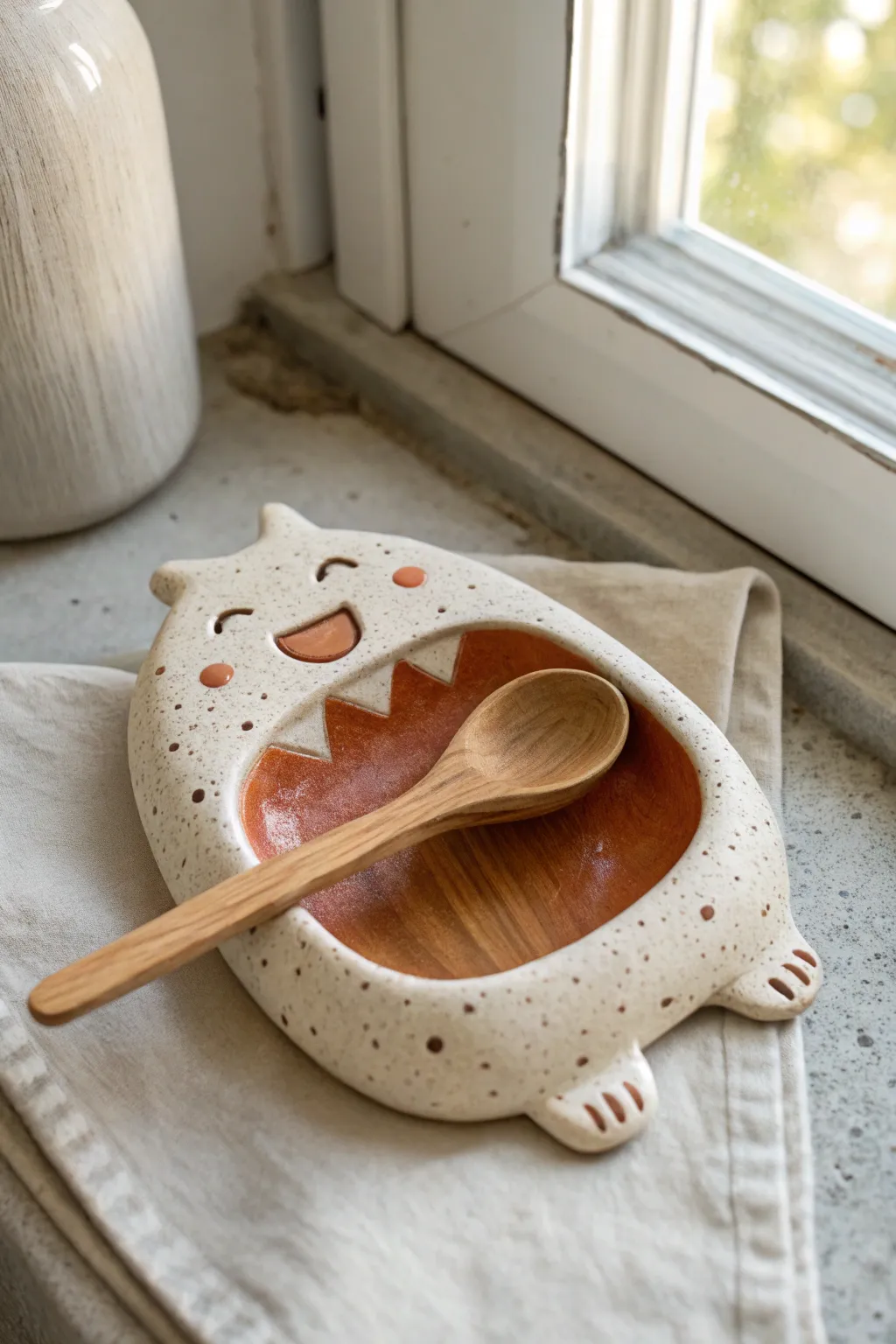
Add a touch of whimsy to your stovetop with this adorable ceramic spoon rest that looks like a screaming little monster. Its wide, open mouth serves as the perfect catch-all for messy spoons, while its speckled finish and cute expression make it a delightful kitchen companion.
How-To Guide
Materials
- White stoneware clay with speckles (or plain white clay)
- Rolling pin
- Guide sticks or slats (approx. 1/4 inch thick)
- Needle tool or fettling knife
- Rib tool (kidney shaped, rubber or metal)
- Small loop tool
- Sponge
- Slip (clay mixed with water)
- Scoring tool (or an old toothbrush)
- Underglaze (black and terracotta/rust orange)
- Clear transparent glaze
- Kiln (or access to a firing service)
Step 1: Shaping the Body
-
Roll the slab:
Begin by wedging your clay to remove air bubbles. Place the clay between your guide sticks and roll it out into a smooth, even slab about 1/4 inch thick. I find that flipping the slab once or twice during rolling helps keep it from sticking to the canvas. -
Trace the shape:
Using a needle tool, lightly sketch an oval shape onto the slab. At the top of the oval, sketch two small pointed triangles for ears. Don’t cut just yet; refine the shape until it looks like a plump egg with ears. -
Cut the outline:
Once satisfied with your sketch, cut cleanly along the line with your fettling knife. Remove the excess clay and set it aside for the details later. -
Smooth the edges:
Dip your finger or a small sponge in water and gently run it along the cut edges of the slab to round them off. This prevents sharp edges after firing and gives the monster a softer, friendlier look.
Warping Woes?
Slabs can warp if they dry unevenly. Dry your monster slowly under loose plastic or a weighted board for the first day to keep it flat.
Step 2: Creating the Mouth
-
Define the mouth area:
Visualizing the lower half of the monster’s body, lightly trace a large semi-circle. This will be the open mouth where the spoon rests. Leave a rim of about 1/2 inch of flat clay around the bottom edge. -
Create the depression:
Gently press down inside the traced semi-circle with your thumb to create a shallow bowl. Alternatively, for a deeper spoon rest, you can use a coil building method: add a coil around the mouth perimeter and blend it outwards to build up the walls. -
Refine the interior:
Use a damp sponge or a rubber rib to smooth the inside of the depression. You want a nice curve so that sauce or soup can be easily wiped away later. -
Add the teeth:
Roll a small, thin strip of clay. Cut small triangles from it to make teeth. Score and slip the top edge of the mouth depression (inside the rim) and attach the teeth pointing downward. Blend the back of the teeth into the main body so they don’t pop off.
Step 3: Adding Character
-
Form the feet:
Take two small balls of scrap clay and flatten them slightly into rounded tabs. Score and slip the bottom corners of the monster’s body and attach these tabs for feet. -
Detail the claws:
Using a wooden modeling tool or the dull side of your knife, press three small indentations into each foot to represent toes or claws. -
Sculpt the face:
Roll a very tiny coil for a smaller, smiling mouth and attach it above the open mouth area. For the cheeks, you can either paint them later or attach tiny flattened discs of clay now for a 3D effect. -
Carve the eyes:
Use a small loop tool or needle tool to carve two crescent shapes for happy, squinting eyes. Ensure they are positioned symmetrically near the top ears.
Texture Time
Before cutting your shape, roll a textured fabric or doily over the slab to give the monster’s skin a unique, bumpy pattern.
Step 4: Glazing and Finishing
-
Bisque fire:
Let your monster dry slowly and completely. Once bone dry, fire the piece to bisque temperature (usually cone 04) to prepare it for glazing. -
Apply underglaze:
Paint the inside of the large ‘mouth’ depression with the terracotta/rust orange underglaze. Paint the cheeks and the lips of the small smiling mouth with the same color. Use black underglaze to carefully fill in the carved eye lines. -
Wax resist (optional):
If you want the raw speckled clay texture on the outside, apply wax resist to the unpainted areas. Otherwise, proceed to the next step. -
Clear glaze:
Dip the entire piece in a clear transparent glaze, or brush a clear coat over the top. This will make the clay body shiny and food-safe while letting the natural speckles show through. -
Final wipe:
Use a sponge to wipe the foot of the piece (the underside) completely clean of glaze so it doesn’t stick to the kiln shelf. -
Glaze fire:
Fire the piece again to the maturation temperature of your specific clay and glaze (often cone 5 or 6 for stoneware).
Now you have a charming little kitchen helper ready for your next culinary adventure


What Really Happens Inside the Kiln
Learn how time and temperature work together inside the kiln to transform clay into durable ceramic.
Animal Bookends That Look Like They’re Struggling
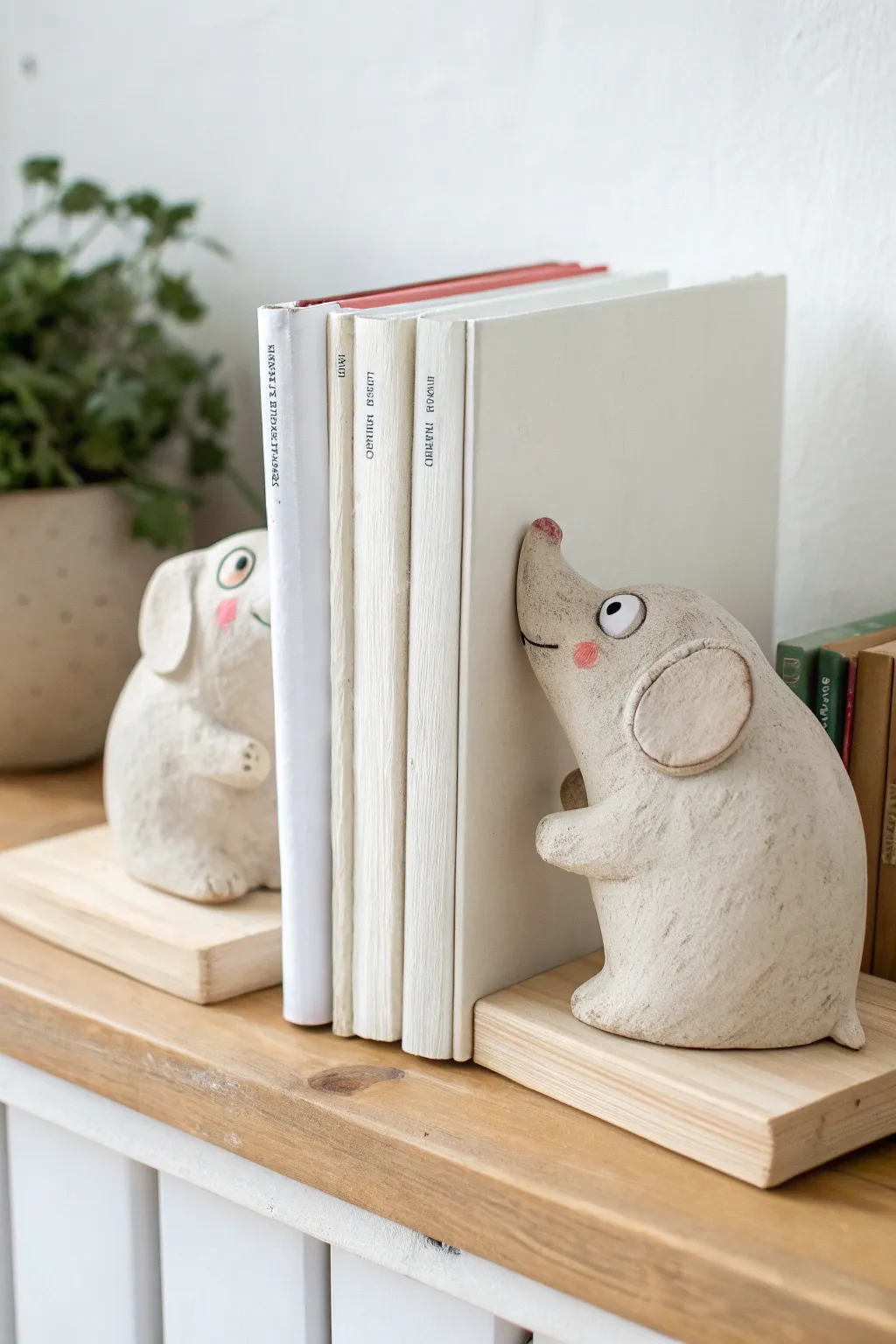
These delightful, slightly distressed clay bookends feature charming animal characters that appear to be putting their backs into holding up your favorite reads. The finished pieces combine sturdy wooden bases with textured, hand-built clay figures for a functional yet humorous shelf accent.
Step-by-Step Guide
Materials
- White stoneware or earthenware clay (groggy for texture)
- Two sturdy wooden rectangles (approx. 4″ x 6″ x 1″)
- Slip and scoring tool
- Modeling tools (wooden knife, needle tool)
- Rolling pin
- Underglazes (light pink, black, white)
- Clear matte glaze
- Strong epoxy glue like E6000
- Sandpaper
Step 1: Sculpting the Bodies
-
Form the base shapes:
Start with two equal lumps of clay, roughly the size of a grapefruit. Wedge them well to remove air bubbles. Shape each into a pear-like form with a flattened bottom so they sit stable and upright. -
Refine the posture:
Gently push the ‘belly’ forward on one side and flatten the back area slightly where the creature will lean against the books. You want them to look like they are straining slightly under weight. -
Pull the snouts:
From the top tapered end, gently pull and smooth the clay upwards to create a long, upturned snout. Avoid making it too thin, as it needs to endure the firing process. -
Add the feet:
Roll small coils of clay for the feet. Score and slip the contact points on the main body, then attach the feet at the bottom front, blending the seams completely so they look like part of the main form. -
Attach the arms:
Create stubby arm shapes. Score and slip the ‘shoulders’ and attach the arms so they stick out slightly, as if ready to push against a surface. Blend the clay smoothly with your wooden tool.
Step 2: Adding Details & Texture
-
Create the ears:
Roll out a small slab of clay and cut two oval shapes for ears. Score the sides of the head and attach the ears securely. I like to press the center of the ear slightly to give it dimension. -
Sculpt the eyes:
Roll tiny balls of clay for the eyes. Press them onto the face, flattening them slightly. Use a needle tool to create a tiny defined pupil indent if you plan to paint it later, or leave it smooth. -
Refine facial features:
Use a needle tool or a thin blade to slice a small, curved smile just under the snout. Keep the expression simple and slightly goofy. -
Texturize the surface:
Take a stiff bristle brush or a serrated kidney tool and gently scratch the entire surface of the animal (except the eyes) to create a fur-like or weathered texture. -
Dry slowly:
Cover the figures loosely with plastic and let them dry slowly over several days to the bone-dry stage. This prevents cracking, especially where appendages are joined.
Wobbly Figures?
If the clay figure rocks on the wood base before gluing, tape a sheet of sandpaper to a flat table and rub the ceramic bottom against it to create a perfectly flat surface.
Step 3: Firing & Finishing
-
Bisque fire:
Fire the pieces to cone 04 (or according to your clay’s instructions) in a kiln. -
Apply underglaze details:
Once bisqued, mix a watery black underglaze wash. Brush it over the textured body and immediately wipe it back with a damp sponge. This will leave dark pigment in the crevices to highlight the texture. -
Paint the face:
Using a small brush, paint the eyes white with black pupils. Dab a soft circle of pink underglaze on the cheeks for a blush effect and a touch on the tip of the nose. -
Glaze and final fire:
Apply a coat of clear matte glaze over the entire piece to seal it without making it too shiny. Fire the pieces again to the appropriate temperature for your glaze. -
Prepare the wood bases:
While the ceramics are cooling, sand your wooden blocks until smooth. You can leave them natural or apply a light clear varnish for protection. -
Assemble the bookends:
Apply a generous amount of strong epoxy glue to the bottom of the ceramic figures. Press them firmly onto the center of the wooden blocks. -
Final cure:
Allow the glue to cure for at least 24 hours before testing them with books. The weight of the ceramic plus the wood provides the necessary stability.
Level Up: Weighted Base
Drill holes into the bottom of the wood bases and insert lead weights or heavy fishing sinkers, then seal with wood filler. This adds extra mass for holding heavy hardcovers.
Now you have a pair of quirky companions to guard your library shelves
Soap Dish With a Tongue Drip Tray
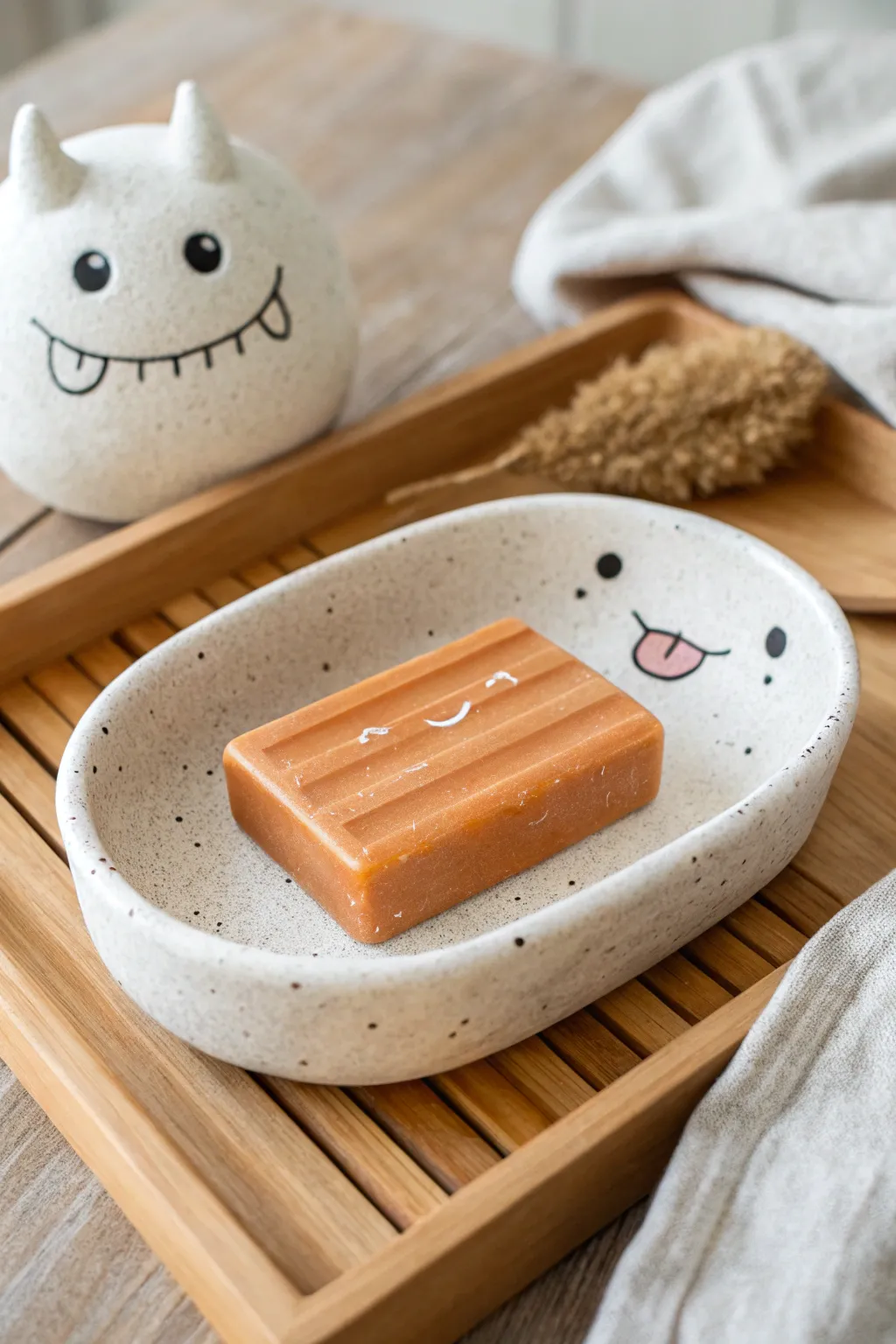
Add a touch of whimsy to your bathroom sink with this speckled ceramic soap dish featuring a playful, painted face. This shallow, oval vessel perfectly cradles a bar of soap while its tiny painted tongue adds a dash of personality to your morning routine.
Detailed Instructions
Materials
- White stoneware or polymer clay (speckled effect preferred)
- Black underglaze or acrylic paint
- Pink underglaze or acrylic paint
- Rolling pin
- Oval template or cookie cutter (approx. 5-6 inches wide)
- Sponge or smoothing tool
- Small round paintbrush
- Clear waterproof sealant (if using polymer clay) or clear glaze (if firing ceramic)
- Fettling knife or craft blade
- Small bowl relative to dish size (for slump molding)
Step 1: Shaping the Base
-
Prepare the Clay:
Start by wedging your speckled clay to remove air bubbles. If you don’t have pre-speckled clay, you can mix in cracked pepper or dried coffee grounds into polymer clay for a similar faux-stone effect. -
Roll the Slab:
Roll the clay out into an even slab, aiming for a thickness of about 1/4 inch. Ensure the thickness is consistent to prevent warping during drying or baking. -
Cut the Shape:
Place your oval template onto the slab. Using your fettling knife or craft blade, carefully cut around the template to create a clean oval shape. -
Smooth the Edges:
Dip your finger or a sponge in a little water (or clay softener) and gently run it along the cut rim to round off any sharp edges. -
Create the Curve:
Gently lift the clay oval and place it inside a shallow bowl or over a curved form to give it a slight dish shape. I like to press gently from the center outward to ensure it takes the form without cracking. -
Refine the Rim:
While it sits in the mold, use your thumb to slightly thicken and round the upper rim, giving it that substantial, handmade pottery feel. -
Initial Drying/Baking:
If using ceramic clay, let it dry to a leather-hard state. If using polymer clay, bake it according to the package instructions while it’s still on the oven-safe form to keep its shape.
Keep it Steady
To prevent the dish from wobbling, press the bottom gently onto a flat table while the clay is still inside the drying mold to create a flat ‘foot’ area.
Step 2: Adding the Personality
-
Draft the Face:
Once the dish is firm (leather hard for ceramics, cooled for polymer), lightly sketch the facial features with a pencil. Position the eyes wide apart on the right side and draw a u-shaped smile with a small tongue sticking out. -
Paint the Eyes:
Using a fine-tip brush and black underglaze (or acrylic), paint two solid black circles for the eyes. Add smaller dots around the cheeks for freckles or texture. -
Detail the Smile:
Carefully paint a thin, curved black line for the mouth, connecting the tongue area. -
Paint the Tongue:
Fill in the tongue shape with a soft pink color. You might need two coats to ensure the speckled background doesn’t show through too much. -
Clean Up:
If you made any smudges, gently scrape them away with a craft knife or wipe with a damp Q-tip before the paint sets completely.
Drainage Holes
Poke 3 small holes in the center before drying. Place the dish on a matching saucer so soapy water drains out the ‘mouth’ or bottom keeps the bar dry.
Step 3: Finishing Touches
-
Bisque Fire (Ceramics Only):
If working with real pottery, fire the piece to bisque temperature now that the underglaze is dry. -
Glazing:
Apply a coat of clear glaze over the entire dish. For polymer clay, brush on a durable, waterproof varnish or resin to protect the paint from water and soap scum. -
Final Fire or Cure:
Fire the ceramic piece a final time. For polymer clay with resin, cure under a UV lamp or let the varnish dry completely in a dust-free area for 24 hours. -
Sand the Bottom:
Once fully cured or fired, check the bottom of the dish. If it rocks or feels rough, lightly sand it on a flat surface to ensure it sits perfectly still on your countertop.
Now you have a delightfully quirky spot to rest your soap that is sure to make guests smile

TRACK YOUR CERAMIC JOURNEY
Capture glaze tests, firing details, and creative progress—all in one simple printable. Make your projects easier to repeat and improve.
The Odd Couple: Two Tiny Friends in an Awkward Hug
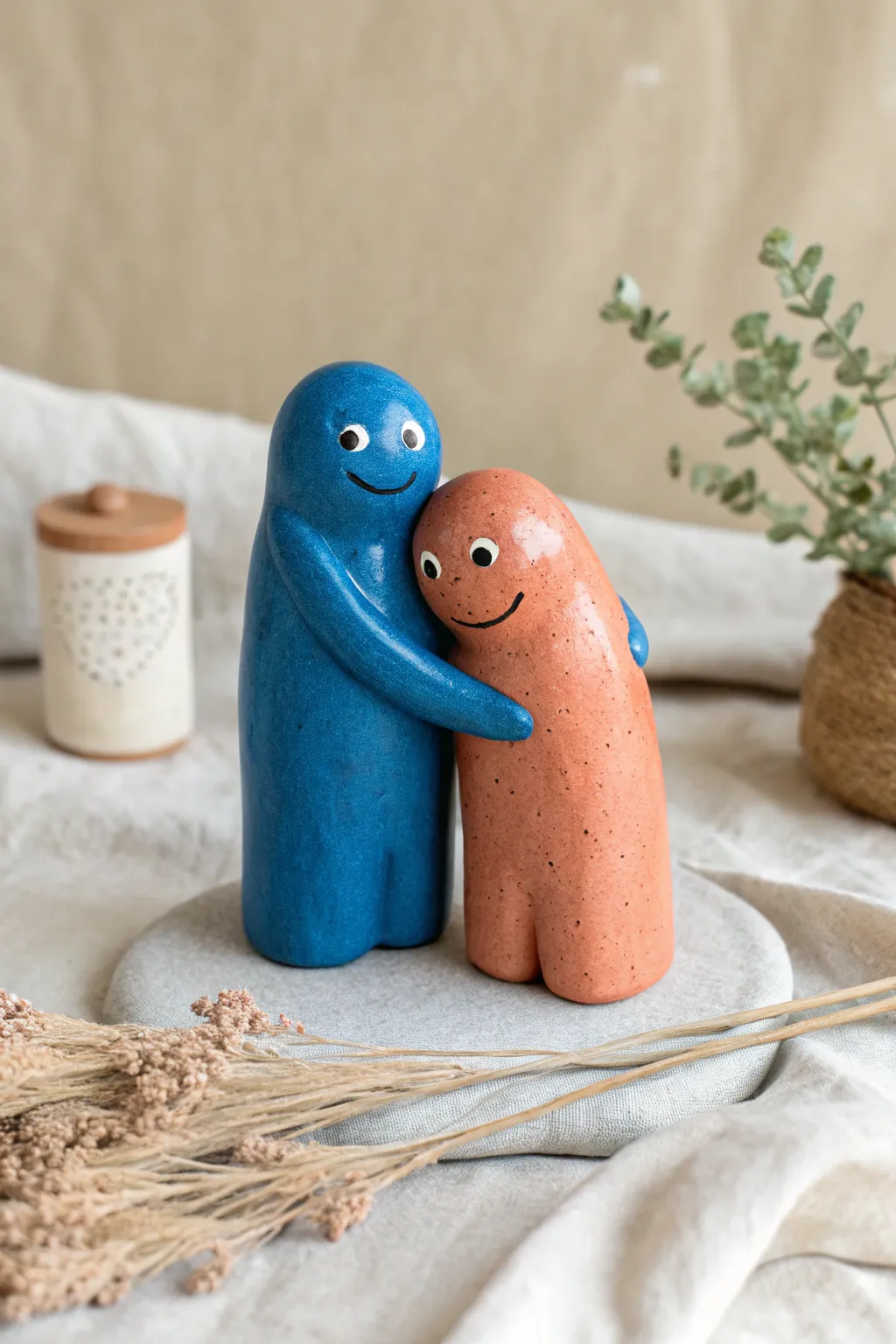
Create this heartwarming pair of blob-like buddies locked in a permanent, slightly awkward embrace. These charming clay figures feature a smooth, glossy finish and simple expressions that perfectly capture the feeling of comfort.
Step-by-Step Tutorial
Materials
- Polymer clay (Blue and Orange/Peach colors)
- Faux granite or speckled polymer clay (or black glitter for DIY speckles)
- Acrylic rolling pin
- Sculpting tools (needle tool, blending tool)
- Small pre-made googly eyes (or white and black clay for DIY eyes)
- Black acrylic paint
- Fine detail paintbrush
- Gloss glaze or varnish
- Baking sheet and parchment paper
- Wet wipes (for cleaning hands)
Step 1: Shaping the Bodies
-
Prepare the clay:
Begin by conditioning your blue and orange clay separately. Knead them until they are soft and pliable. If you want that stone-like speckled effect seen in the photo, mix a very small amount of faux granite clay or a pinch of black glitter into both colors now. -
Form the blue base:
Roll the blue clay into a thick cylinder. Smooth the top into a rounded dome shape for the head. This figure should be slightly taller than its partner. -
Form the orange base:
Repeat the process with the orange clay, making a slightly shorter, stouter cylinder with a rounded top. This will be the friend being hugged. -
Create the feet:
At the bottom of each cylinder, use a modeling tool or your finger to press a small vertical indentation in the center. This suggests two legs without sculpting detailed feet, giving them a cute, grounded look. -
Position the hug:
Place the two figures side-by-side on your work surface. Lean the orange figure slightly into the blue one so their bodies touch naturally.
Arm won’t stick?
If the blue arm keeps falling off the orange body before baking, use a drop of ‘Bake & Bond’ or liquid polymer clay as an adhesive between the two different colored clays.
Step 2: Sculpting the Embrace
-
Make the arm:
Roll a small snake of blue clay for the arm. It needs to be long enough to wrap from the blue figure’s side across the orange figure’s chest. -
Attach the arm:
Press one end of the blue snake onto the side of the blue body. Gently curve it around the orange figure so the ‘hand’ rests near the center of the orange chest. -
Blend the seams:
Using a blending tool or the back of your fingernail, smooth the clay where the shoulder attaches to the blue body. The arm should look like it grows out of the shape, not just stuck on top. -
Add the blue hand:
Flatten the end of the arm slightly against the orange clay to mimic a hand resting. You don’t need fingers; a rounded nub works perfectly for this style. -
Create the orange arm (optional):
If you want the hug returned, create a smaller orange snake and attach it to the back of the blue figure, though in this design, the orange figure seems happy just to be held.
Step 3: Finishing Details
-
Smooth everything out:
Before baking, do a final pass with a tiny bit of baby oil on your finger to remove any fingerprints or dust. I find this really helps achieve that professional finish. -
Bake the figures:
Place your friends on a parchment-lined baking sheet. Bake according to your polymer clay package instructions (usually 275°F/135°C for 15-30 minutes depending on thickness). -
Cool down:
Let the clay cool completely before handling. It is fragile while warm. -
Add the eyes:
Glue on two small googly eyes to each face. Place them slightly wide apart to enhance the quirky, cute expression. -
Paint the smiles:
Using your finest brush and black acrylic paint, add a simple curved line for a smile. The blue figure gets a confident smirk, while the orange one looks content. -
Apply gloss:
Coat the entire sculpture in a layer of gloss glaze. This protects the paint and gives the clay that wet, ceramic-like shine shown in the image.
Color Swap
Try marbling two colors together for each figure before sculpting to create a psychedelic or agate-stone version of these hugging friends.
Once dry, place your new clay companions on a shelf where their hug can brighten your day
Cable Holder That Looks Like It’s Biting the Cord
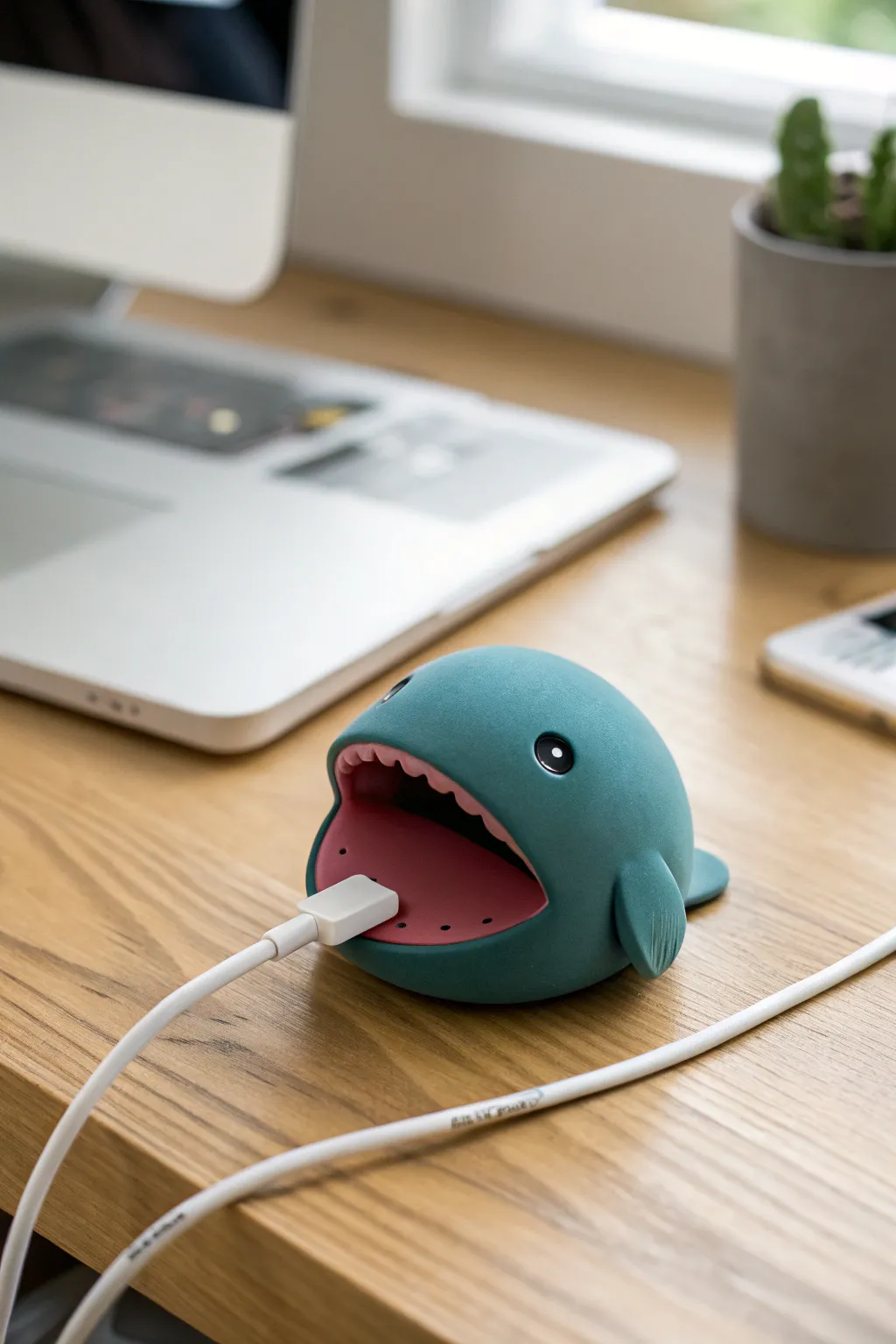
Keep your cords tidy with this adorable, wide-mouthed shark that looks like it’s taking a big bite out of your charging cable. This functional desk accessory combines humor with utility, featuring a smooth teal finish and a cheeky pink interior.
Detailed Instructions
Materials
- Polymer clay (teal/blue-green)
- Polymer clay (dusty pink)
- Polymer clay (white)
- Polymer clay (black)
- Clay sculpting tools (ball stylus, needle tool)
- Acrylic roller
- Cable (for sizing)
- Aluminum foil
- Oven and baking tray
- Matte varnish (optional)
- Super glue (optional)
Step 1: Forming the Base Body
-
Create the core:
Crumple a small ball of aluminum foil slightly smaller than a golf ball to use as the core. This saves clay and keeps the figurine lightweight. -
Condition the clay:
Take a generous amount of teal polymer clay and knead it until it is soft and pliable. Roll it into a smooth sheet about 1/4 inch thick. -
Cover the core:
Wrap the teal clay sheet around the foil ball, smoothing out all seams. Shape it into a slightly flattened, rounded dome shape resembling a whale or shark head. -
Create the mouth opening:
Using a blunt sculpting tool or your thumb, press a large, deep indent into the front of the shape where the mouth will go. It needs to be wide and deep enough to act as the ‘cave’ for the cable.
Step 2: Interior Details
-
Prepare the pink clay:
Condition the dusty pink clay and roll it into a thin sheet. -
Line the mouth:
Cut a piece of the pink clay to fit inside the indented mouth area. Press it gently against the teal walls, smoothing the edges so it looks seamless against the outer skin. -
Make the tongue:
Shape a flat, rounded piece of pink clay for the tongue. Place it on the bottom floor of the mouth cavity. -
Texture the tongue:
Use a needle tool or small ball stylus to poke tiny dots across the surface of the tongue for a realistic texture.
Weight It Down
Add a heavy metal nut or washer inside the foil core at the base. This lowers the center of gravity so the cable weight won’t tip the shark over.
Step 3: The Cable Bite Mechanism
-
Add teeth:
Take another strip of pink clay (or white, if you prefer bone-colored teeth) and shape tiny, rounded triangles. Attach a row of these to the upper inside rim of the mouth. -
Size the gap:
Grab the actual charging cable you plan to use. Gently press the connector head into the mouth to ensure the opening is tall enough, but don’t leave it in while baking. -
Create the cord slot:
At the very bottom center of the lower lip/jaw, make a small, semi-circular notch. This helps the cord sit flat when the shark is resting on the table.
Clay Too Soft?
If your clay gets too warm and sticky to hold detail, pop it in the fridge for 10 minutes. This firms it up, making it easier to carve teeth.
Step 4: External Features
-
Shape the fins:
Form two small, flat teardrop shapes from the teal clay for the side fins. Attach them low on the sides of the body. -
Add the tail:
Create a small, flat triangle for the tail fin and attach it to the back center of the body. -
Texture the fins:
Use a straight edge or knife tool to gently press lines into the fins to mimic cartilage structure. -
Make eyes:
Roll two small balls of black clay. Flatten them slightly and press them onto the sides of the head, above the mouth corners. -
Add eye highlights:
Roll two incredibly tiny specks of white clay. Press one onto the upper right corner of each black eye pupil to give it a spark of life.
Step 5: Finishing Up
-
Smooth the surface:
Check the entire teal surface for fingerprints. I like to use a tiny bit of baby oil on my finger to smooth these away perfectly before baking. -
Bake the project:
Bake the shark according to your clay package instructions (usually around 275°F/130°C for 15-30 minutes). Let it cool completely. -
Optional varnish:
If you want extra durability or a matte look, brush on a thin layer of polymer clay varnish.
Now you have a hungry little desk companion ready to chomp on your messy cables