
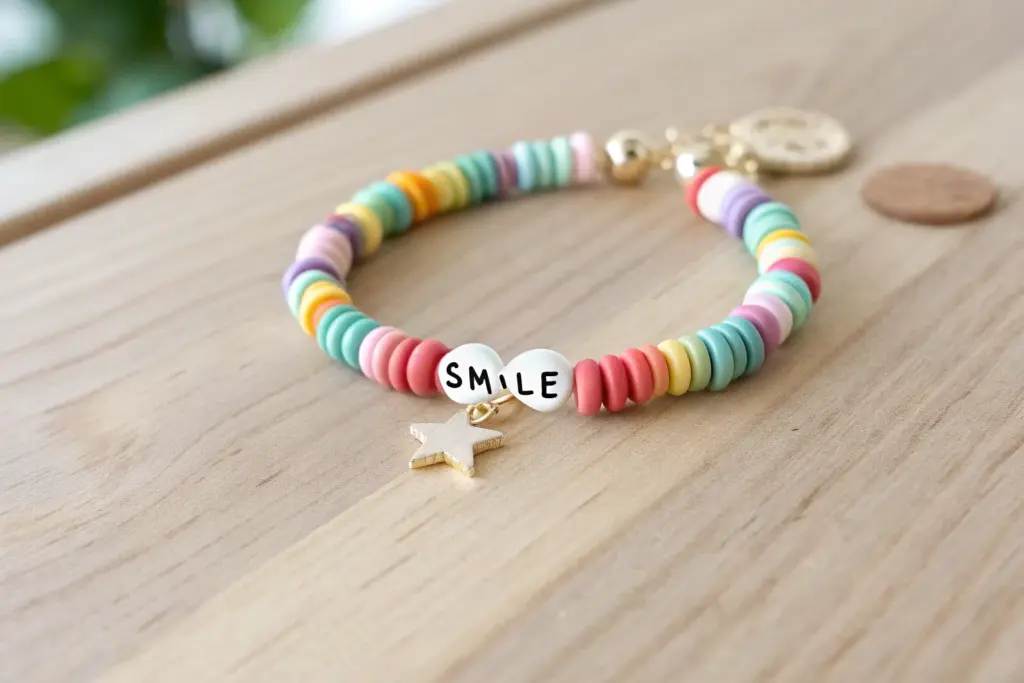
If you’ve got a kiddo who loves color and tiny treasures, clay bead bracelets are basically the perfect “I made this!” project. I’m sharing my favorite kids’ clay bead bracelet ideas that feel trendy, easy to copy, and totally mix-and-match for big bracelet-stack energy.
Name-and-Nickname Letter Bracelet
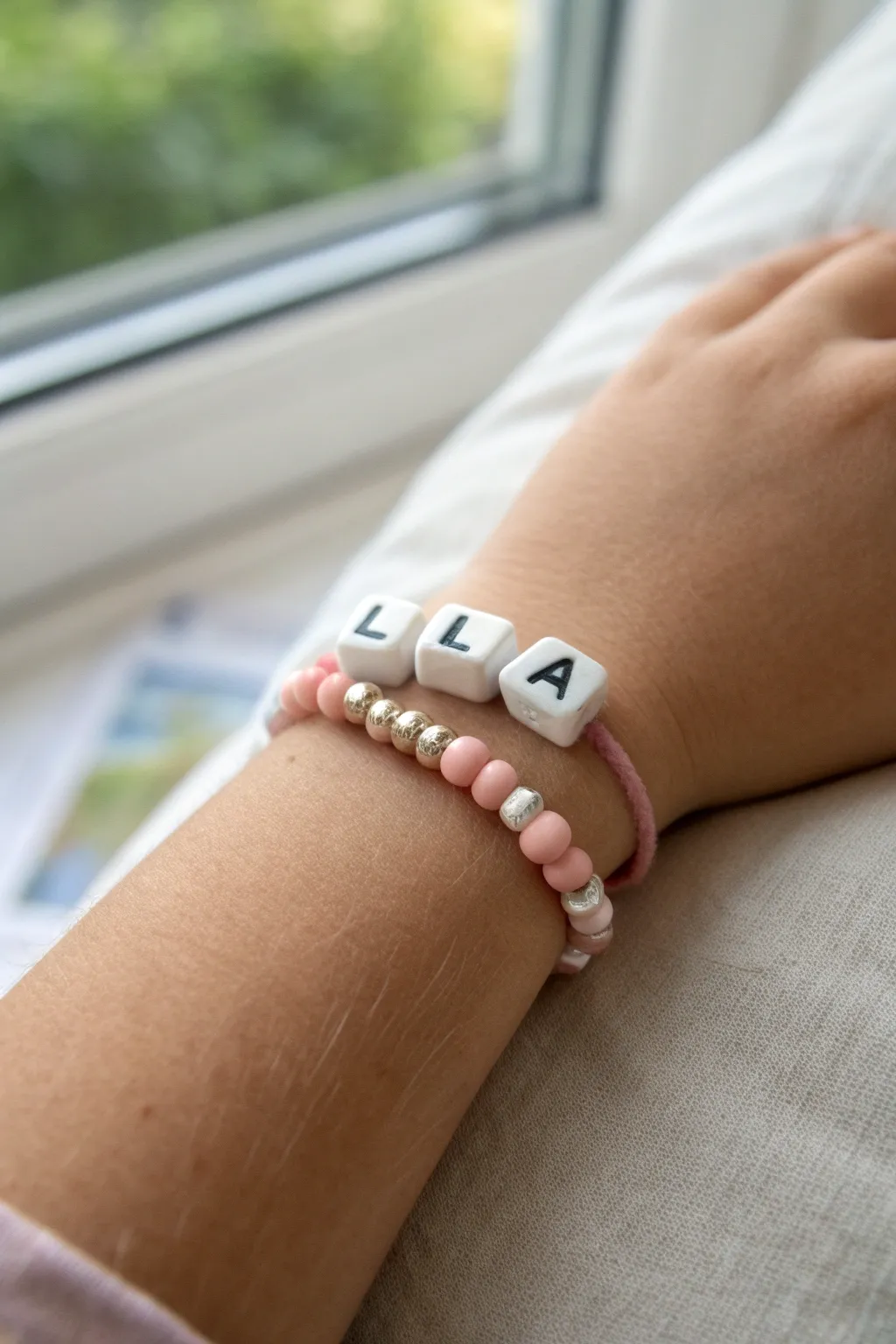
This adorable duo combines a classic letter bead bracelet with a textured beaded strand for a personalized look. The soft pink tones mixed with mixed metals create a charming accessory that’s perfect for trading or gifting.
Detailed Instructions
Materials
- Pink suede or faux suede cord (1mm-2mm thickness)
- White square alphabet beads (black lettering)
- Matte pink pony beads or clay beads (6mm-8mm)
- Gold textured spacer beads (6mm)
- Silver textured spacer beads (6mm)
- Clear elastic bead cord (0.8mm)
- Scissors
- Jewelry glue or clear nail polish
- Tape or a clipboard
Step 1: The Personalized Cord Bracelet
-
Measure and cut:
Cut a piece of pink suede cord roughly 10 inches long. This gives you plenty of extra room for tying visible knots later. -
Secure the end:
Before threading, tie a loose overhand knot about 3 inches from one end. This stops beads from sliding off while you work. -
Select your letters:
Choose the letter beads for your name or nickname. In our example, we are using ‘L’, ‘L’, and ‘A’ for a short, snappy focal point. -
Thread the cord:
Slide the letter beads onto the pink cord. Because suede cord has friction, you may need to twist the cord slightly as you push it through the bead holes. -
Center the name:
Position the letter beads exactly in the middle of the cord length. -
Knot the other side:
Tie another overhand knot flush against the last letter bead to keep the name centered and secure. I find it helpful to use a toothpick to push the knot close to the bead before tightening. -
Finish the closure:
Wrap the bracelet around the wrist to check the fit, then tie the two loose ends together in a secure double knot.
Fraying Ends?
If the pink suede cord is fraying and hard to thread, dab the tip with a little clear nail polish and let it harden into a stiff ‘needle’ point.
Step 2: The Mixed Metal Beaded Strand
-
Prepare the elastic:
Cut a piece of clear elastic cord about 10 inches long. Pre-stretch it by pulling gently on both ends to prevent the finished bracelet from sagging later. -
Start the pattern:
Begin threading your beads. Start with three or four matte pink round beads to establish the base color. -
Add gold texture:
Slide on three gold textured spacer beads. These add a nice metallic pop against the soft pink. -
Resume base color:
Add another section of the pink matte beads. About five or six beads create a good visual break. -
Add silver accent:
Now, thread on a silver spacer bead followed by a pink bead, and then another silver spacer. Note how the metal tones are mixed for a carefree look. -
Continue patterning:
Continue adding pink beads until you reach the desired length for the wrist, aiming for about 6 to 6.5 inches typically for a child. -
Tie the knot:
Bring the ends of the elastic together. Tie a surgeon’s knot (a regular overhand knot, but loop the end through twice before pulling tight). -
Secure the knot:
Place a tiny dot of jewelry glue on the knot. Let it dry completely before trimming the excess elastic close to the knot. -
Hide the mechanism:
Gently tug the bracelet so the knot slides inside one of the larger pink beads, hiding it from view.
Add a Charm
Make it extra special by attaching a small gold star or heart charm to the elastic bracelet between the metallic spacer beads.
Now you have a charming stack that looks effortless and stylish
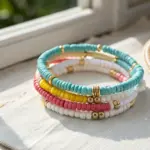
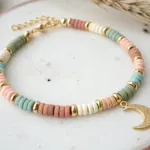
Classic Color-Block Bands
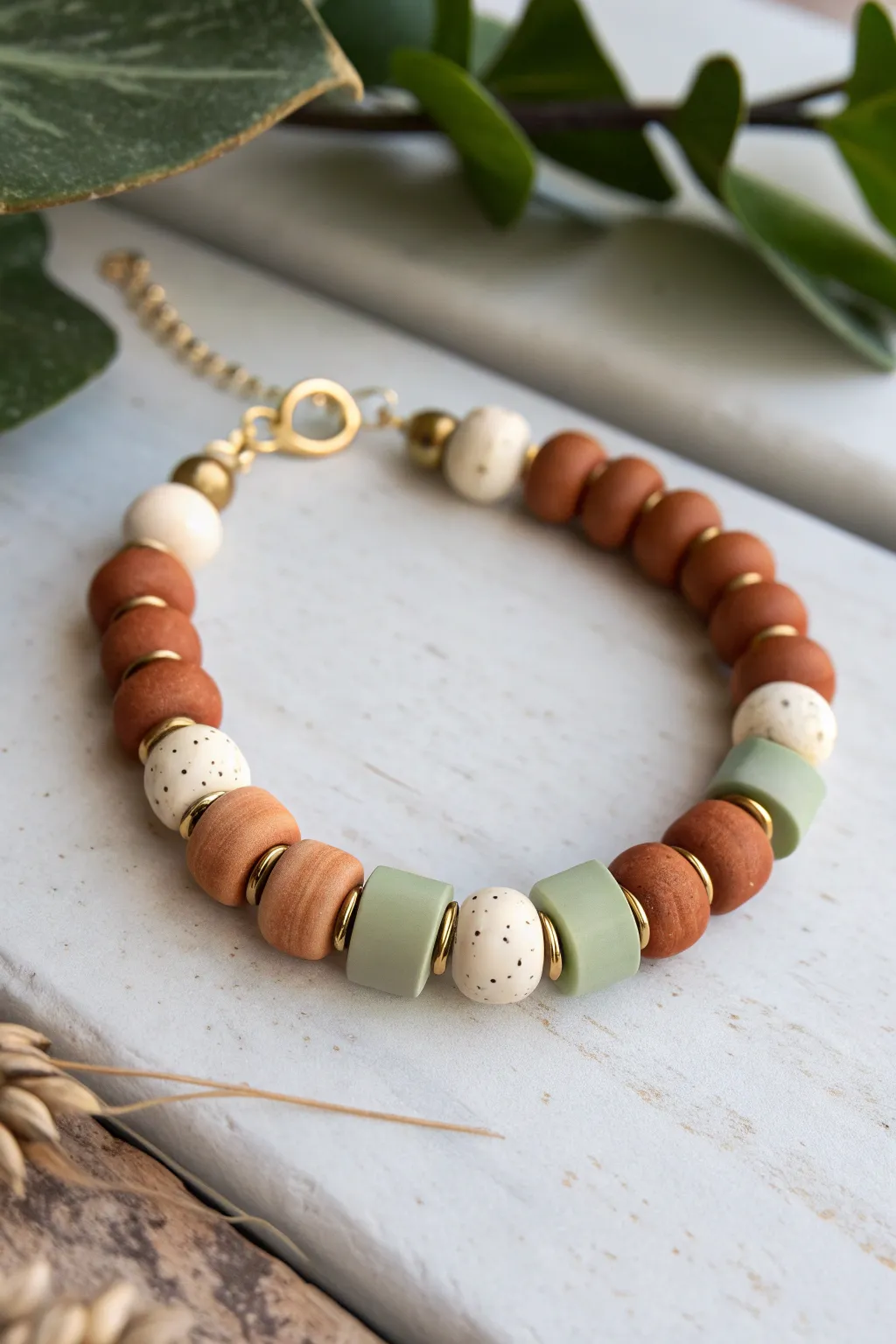
Embrace earthy tones with this sophisticated yet simple design that mimics the look of high-end ceramic jewelry. The mix of warm terracotta, soft sage green, and speckled cream beads creates a natural palette perfect for everyday wear.
Step-by-Step
Materials
- Polymer clay round beads (terracotta/rust color)
- Polymer clay Heishi or tube beads (sage green)
- Speckled polymer clay round beads (cream/white)
- Gold tone flat spacer beads or disc beads
- Gold tone bead stopper crimp bead
- Gold tone lobster clasp
- Gold tone extender chain
- Beading wire or strong jewelry elastic (0.5mm – 0.8mm)
- Jewelry pliers (flat nose and cutting pliers)
- Crimp beads or knots (depending on wire choice)
Step 1: Planning the Pattern
-
Lay out the palette:
Begin by sorting your beads into piles: the reddish-brown terracotta rounds, the sage green tubes, the speckled cream rounds, and your gold spacers. -
Design the focal section:
Find the center of your design. For this specific look, arrange one speckled cream bead, flanked by a gold spacer on each side, then a sage green tube bead on each side of those. -
Expand the pattern:
Continue outwards from the center. After the green tubes, place another gold spacer, then a terracotta bead. Repeat this ‘spacer-terracotta’ rhythm as you move away from the center to create symmetry.
Step 2: Stringing the Beads
-
Prepare the wire:
Cut a piece of beading wire or elastic about 9-10 inches long. This gives you plenty of extra room to work with the clasp without dropping beads. -
Secure the end:
If using wire, thread a crimp bead and your lobster clasp onto one end. Loop the wire back through the crimp bead and use your flat nose pliers to squash the crimp bead tight. -
Start stringing:
Begin threading your beads following the pattern you laid out. I usually start from one end of the design rather than the middle so I don’t have to re-string anything. -
Check the spacers:
Be mindful of the gold spacers. In this design, they are placed between almost every distinct bead change, particularly flanking the green tubes and separating the terracotta sections. -
Create the side sections:
Once the central detailed section is done, fill out the rest of the bracelet length primarily with the terracotta beads separated by gold spacers to keep the focus on the middle. -
Add accent beads:
Notice near the ends of the strand in the image, there is an occasional speckled cream bead or a gold accent bead to break up the terracotta uniformity. Add these now.
Uneven Spacing?
If gaps appear between beads when the bracelet curves, your wire is too tight. Restring with a tiny bit of slack to allow the beads to rotate freely.
Step 3: Finishing Touches
-
Measure the fit:
Wrap the unfinished strand around your wrist. You want it to sit comfortably without pinching, remembering that the clasp will add about half an inch to the length. -
Prepare the closure:
Thread a crimp bead onto the open end of the wire. -
Attach the extender:
Thread the loop of your gold extender chain (or a jump ring) onto the wire after the crimp bead. -
Loop back:
Take the end of the wire and pass it back through the crimp bead, creating a snug loop around the extender chain contact point. -
Secure the crimp:
Pull the wire tight so there are no large gaps between beads, but not so tight the bracelet creates stiff angles. Use your pliers to flatten the crimp bead firmly. -
Trim excess wire:
Use your cutting pliers to snip the remaining tail of the wire as close to the crimp bead as possible for a clean finish. -
Final inspection:
Give the bracelet a gentle tug to ensure the crimps are holding securely and the beads move fluidly.
Level Up: Texture
Use polymer clay to make your own beads! allow you to roll them in coarse salt or sand before baking to create that authentic pitted, stone-like texture.
Now you have a stunning, nature-inspired accessory ready to complement any outfit
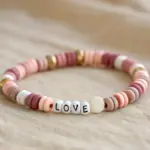
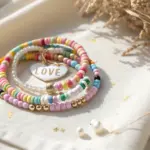
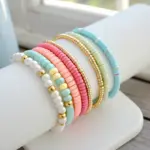
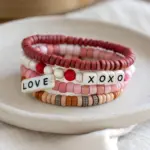
Bead Soup Happy Mix
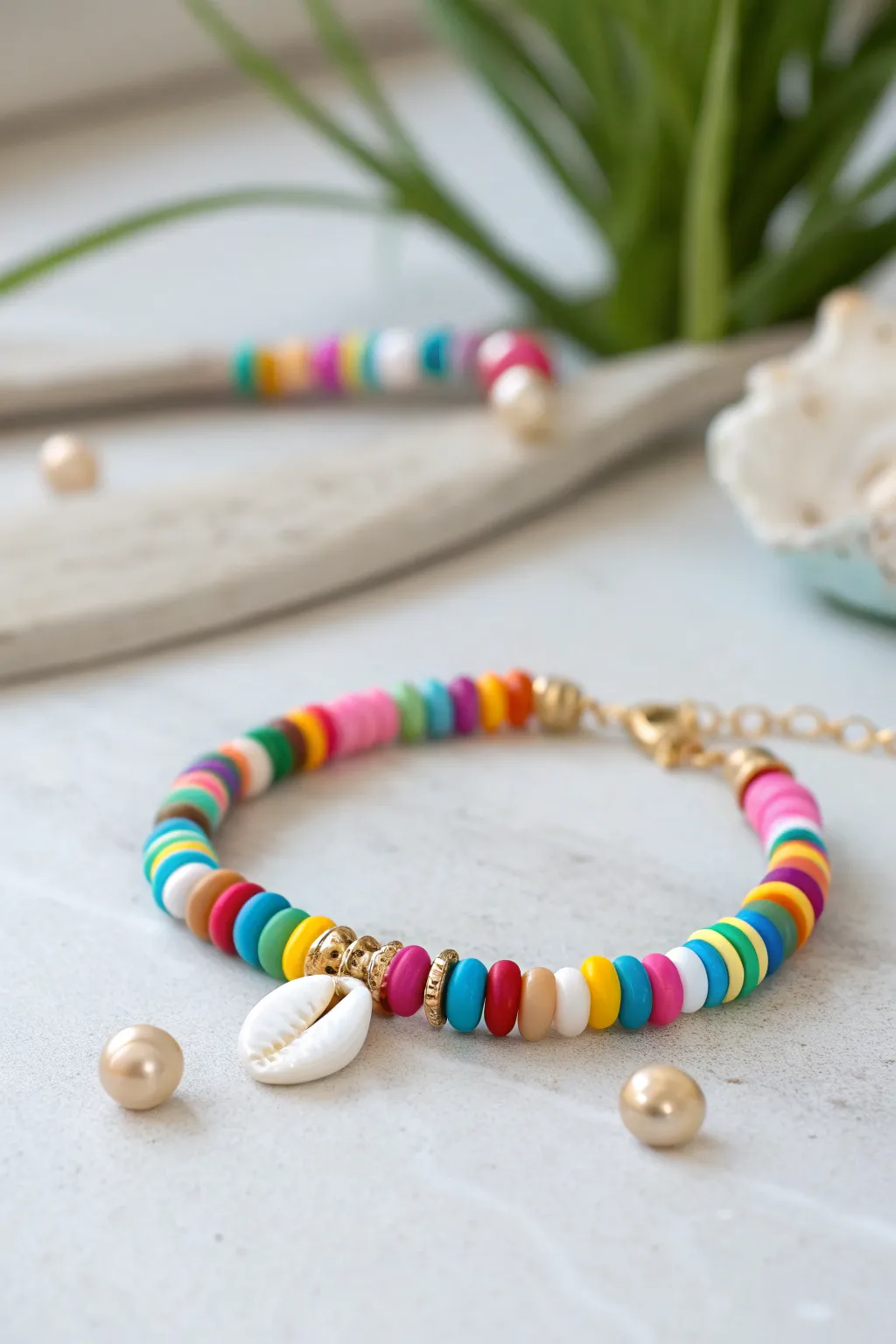
Embrace a playful, beachy vibe with this vibrant bracelet that mixes a rainbow of clay heishi beads with a classic cowrie shell centerpiece. The “bead soup” style means you don’t have to worry about a strict pattern—just grab your favorite colors and string away.
How-To Guide
Materials
- Polymer clay heishi disc beads (assorted colors: pink, blue, yellow, green, white, red, brown)
- White cowrie shell bead (pre-drilled or with a loop)
- Gold-tone spacer beads (small rounds or decorative discs)
- Gold jump rings (4mm and 6mm)
- Gold lobster clasp
- Gold extension chain (optional but recommended for sizing)
- Elastic beading cord (0.8mm) or beading wire with crimp beads
- Scissors or wire cutters
- Jewelry pliers (flat nose and round nose)
- Super glue or jewelry cement (if using elastic)
Step 1: Preparation & Centerpiece
-
Measure your wrist:
Wrap a piece of string around your wrist to find the desired length. Add about 1/2 inch to this measurement so the bracelet isn’t too tight. -
Cut the cord:
Cut a piece of elastic cord or beading wire about 10 inches long. This gives you plenty of extra room to tie knots or attach clasps later without struggling. -
Secure one end:
If you are using beading wire, crimp a bead onto one end with a jump ring. If using elastic, simply place a piece of tape over one end or clip it with a binder clip so beads don’t slide off while you work. -
Prepare the shell:
Locate your cowrie shell. If your shell has two holes (top and bottom), you’ll thread the cord through both. If it creates a charm with a single loop at the top, attach a gold jump ring to that loop now. -
Thread the center:
Slide your cowrie shell onto the middle of your cord. This will be the focal point of the bracelet.
Shell Sit Issues?
If the cowrie shell flips over constantly, try threading it tightly with two strands of elastic, or glue a flat felt circle to the back to give it more grip against the skin.
Step 2: Stringing the Bead Soup
-
Add gold accents:
On either side of the cowrie shell, thread on two or three gold spacer beads. This adds a polished transition between the natural shell and the colorful clay. -
Start the mix:
Begin adding your clay heishi beads. I prefer to reach into my bead mix blindly to get a truly random ‘soup’ look, rather than overthinking the color order. -
Create variation:
As you string, try to avoid placing more than two of the exact same color next to each other. Mix bold colors like hot pink and teal with neutrals like white and tan. -
Check the length:
Periodically hold the bracelet against your wrist or a ruler. You want to bead equal lengths on both sides of the shell until you reach your target size. -
Symmetry check:
Ensure the cowrie shell stays roughly in the middle by adding roughly the same amount of beads to the left and right sides of the string.
Step 3: Finishing Touches
-
Add end spacers:
Once you’ve reached the right length, add one final gold spacer bead on each end to frame the colorful section neatly. -
Tie the knot or crimp:
If using elastic: Tie a surgeon’s knot (right over left, left over right, looping through twice). Pull it tight. If using wire: Thread a crimp bead onto the end, loop the wire through your clasp component, go back through the crimp bead, and squash it flat with pliers. -
Add the hardware:
If you used the elastic method, you can simply hide the knot inside a bead or cover it with a crimp cover. If you want a professional clasp like the image, attach your pre-crimped loops to a jump ring on one side and a lobster clasp on the other. -
Attach extension chain:
Open a jump ring using your pliers and attach the extension chain to the side opposite the lobster clasp. This makes the bracelet adjustable for growing kids. -
Secure the ends:
For elastic bracelets, place a tiny dot of super glue on the knot before trimming the excess cord. Let it dry completely for a few minutes. -
Trim excess:
Carefully snip off any extra string or wire as close to the bead or knot as possible, being careful not to cut your main knot.
Perfect Randomness
Make a pre-mixed pile of beads in a small bowl before you start. Scooping from a pre-shuffled mix is faster and prevents you from accidentally making patterns.
Now you have a summery accessory ready for your next beach day or pool party
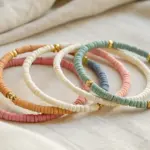
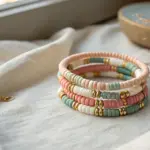
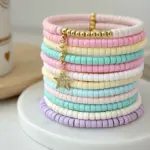
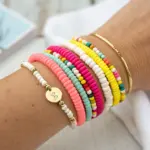
Smiley Face Center Pop
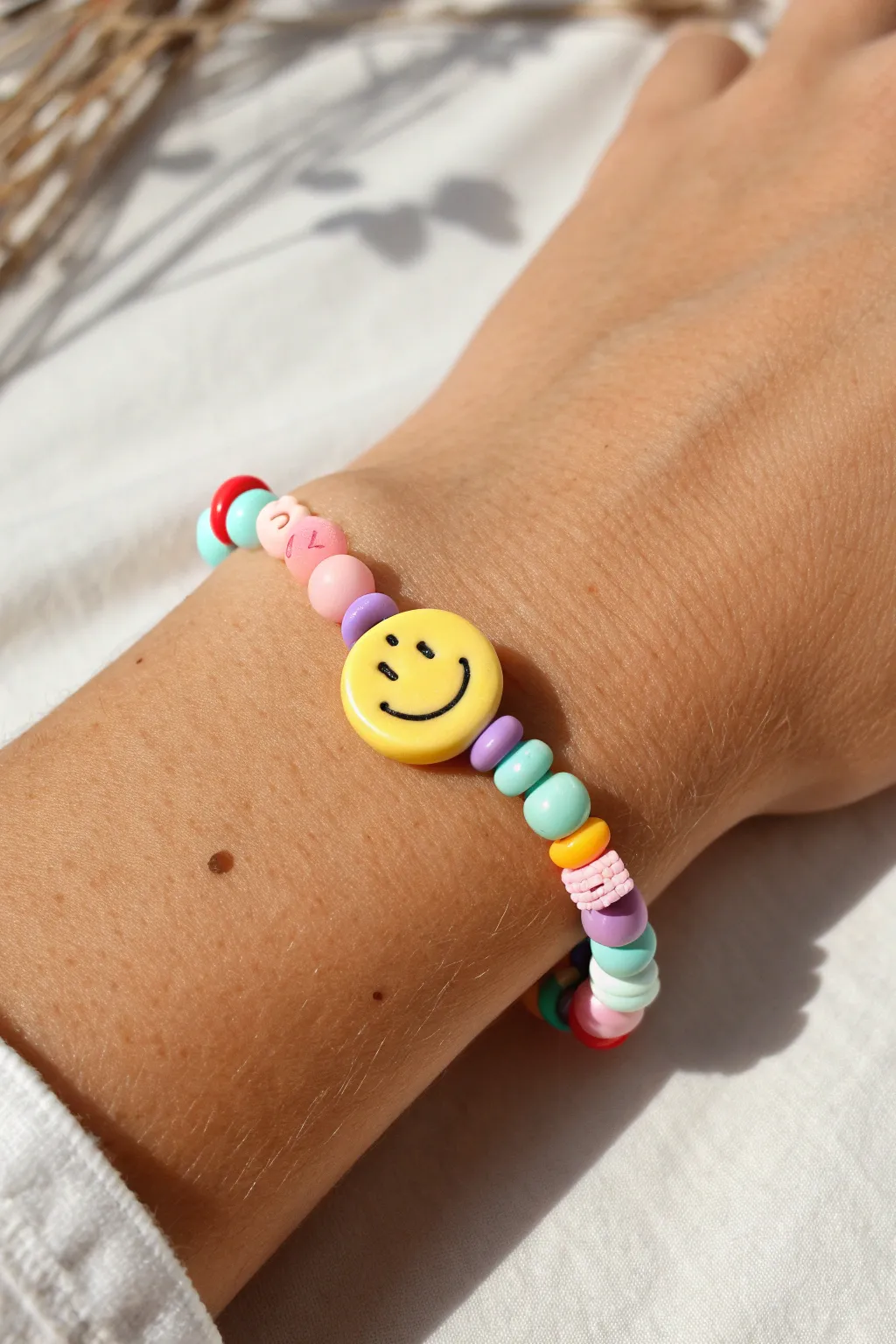
Bring a little sunshine to your wrist with this cheerful, mixed-media design. Featuring a bold smiley face centerpiece flanked by pastel clay discs and vibrant round beads, this bracelet is a perfect mood booster for any day.
Detailed Instructions
Materials
- Elastic stretch cord (0.8mm recommended)
- Large yellow smiley face acrylic bead
- Heishi polymer clay beads (pink, purple, aqua, mint)
- Round acrylic beads (6mm or 8mm) in aqua, purple, pink, and yellow
- Small red spacer bead or seed bead
- Scissors
- Bead stopper or tape
- Jewelry glue (optional)
Step 1: Planning and Preparation
-
Measure your cord:
Cut a piece of elastic cord about 10-12 inches long. It’s always better to have too much string than not enough when you’re trying to tie the final knot. -
Secure the end:
Attach a bead stopper to one end of your cord, or simply tape it down to your table. This prevents your beads from sliding off while you design. -
Layout your pattern:
Before threading, lay out your beads on a design board or a towel. The smiley face will be the exact center. Arrange the beads symmetrically radiating outward from that center point to ensure a balanced look.
Knot Hiding Trick
Make sure one of the beads near the ends has a large hole (like the pony beads). Try to slide your knot inside this bead to hide it completely.
Step 2: Starting the Design
-
Thread the center bead:
Start by threading your large yellow smiley face bead onto the cord. Slide it to the middle of your workspace. -
Add first flankers:
On the left side of the smiley face, add one purple round bead. Do exactly the same on the right side. -
Create texture variation:
Next to the purple bead on the right side, add one aqua pony bead followed by a glossy mint green round bead. -
Mirror the left side:
On the left side of the smiley face (after the purple bead), add a strand of about 4-5 pink heishi clay beads to create a block of soft color.
Texture Twist
Mix finishes! Combine matte rubber beads with glossy acrylics and textured clay discs to make the bracelet feel more tactile and expensive.
Step 3: Building the Sides
-
Right side continuation:
Continuing on the right side, add a small yellow spacer bead, followed by a stack of about four light pink heishi clay beads. -
Add large beads to the right:
Finish the right section of the visible pattern with a purple round bead, an aqua heishi bead, and a white/mint round bead. -
Left side continuation:
Back on the left side, after your pink heishi segment, add a single purple clay bead to act as a spacer. -
Add pink round bead:
Thread a large matte pink round bead onto the left side next. -
Finish left pattern:
Complete the visible left section with a pattern of: one mint heishi bead, one red spacer bead, and one aqua pony bead.
Step 4: Finishing the Bracelet
-
Check the length:
Wrap the unfinished beaded strand around your wrist to check the size. If you need more length, continue adding colorful clay discs to the back section until it fits comfortably. -
Pre-stretch the cord:
Give the elastic a gentle tug from both ends. This ‘pre-stretching’ helps prevent the bracelet from sagging or loosening up immediately after you wear it. -
Tie the knot:
Remove the tape or stopper. Tie a surgeon’s knot (right over left, left over right, and loop the top strand through twice) to secure the bracelet. -
Secure and trim:
Add a tiny dab of jewelry glue to the knot if desired. I usually let this dry for a minute before trimming the excess tail ends close to the knot.
Enjoy wearing your happy new accessory combined with other stackable bands

The Complete Guide to Pottery Troubleshooting
Uncover the most common ceramic mistakes—from cracking clay to failed glazes—and learn how to fix them fast.
Daisy Spacer Garden Bracelet
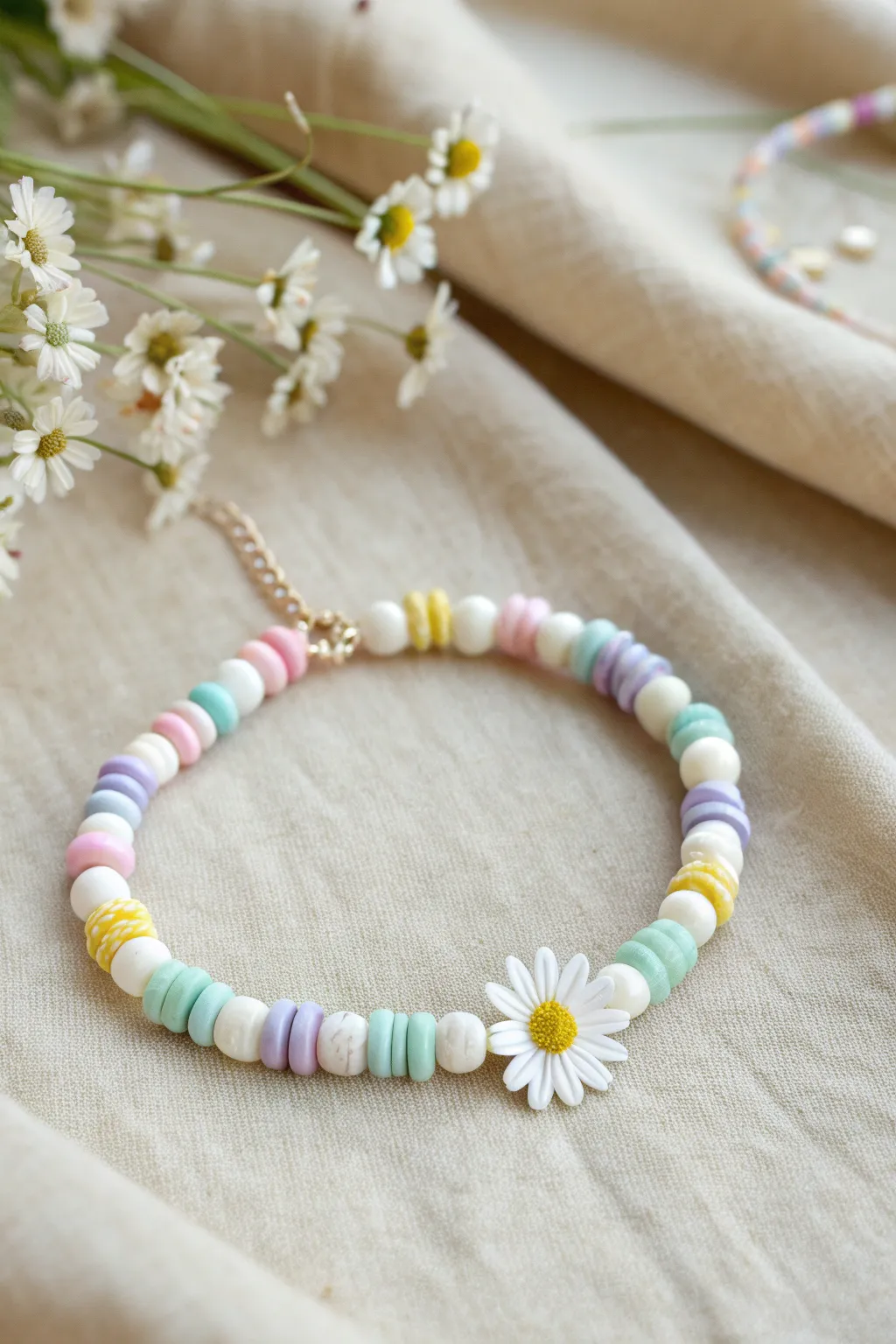
Bring the freshness of a spring garden to your wrist with this delightful beaded project. Featuring soft pastel clay discs and a charming daisy focal point, this bracelet balances playful textures with an elegant, airy design.
Step-by-Step Guide
Materials
- Polymer clay heishi disc beads (mint green, pale pink, lavender, light yellow, sky blue)
- White round beads (approx. 4-6mm, acrylic or ceramic)
- Textured yellow round beads (approx. 6mm)
- White marble-effect round beads (optional alternative to plain white)
- White daisy charm with yellow center (acrylic or enamel)
- Elastic stretch cord (0.8mm recommended)
- Gold-tone jump ring (4-6mm)
- Gold-tone crimp beads or knot covers
- Jewelry pliers (flat nose)
- Scissors
- Beading needle (optional, for easier threading)
Step 1: Preparation
-
Measure and Cut:
Cut a piece of elastic cord about 10-12 inches long. This generous length prevents the beads from sliding off while you work and gives you plenty of room to tie a secure knot later. -
Pre-stretch the Cord:
Hold the ends of the cord and give it a few firm (but not breaking) tugs. Pre-stretching ensures your finished bracelet won’t sag or loosen immediately after the first wear. -
Secure the End:
Place a piece of tape over one end of the cord or attach a bead stopper clip to keep your design safe while you string.
Pattern Harmony
Mix up texture! This bracelet shines because it mixes flat clay discs with smooth round beads. I love using matte finish round beads against the heishi discs.
Step 2: Designing the Pattern
-
Lay Out the Sequence:
Before threading, lay your beads on a bead board or a piece of felt to visualize the pattern. This design relies on alternating sections of color. -
Identify the Rhythm:
Notice the pattern in the photo: it typically uses blocks of 2-3 clay disc beads of a single color, separated by a single white round bead. -
Prepare the Focal Point:
If your daisy charm has a loop at the top, open a jump ring with your pliers, slide on the charm, and close the ring securely. If the charm has a hole through the center (like a bead), it’s ready to go.
Step 3: Stringing the Beads
-
Start the First Section:
Begin threading with a white round bead followed by two mint green clay discs. I find starting near the focal point helps center the design later. -
Add the Daisy:
Slide your daisy charm onto the cord. Ensure it sits facing outward if it has a specific front side. -
Create Symmetry:
Immediately follow the daisy with two mint green clay discs and another white round bead to mirror the other side. -
Build the Pastel Blocks:
Continue the pattern: add a white round bead, followed by 2-3 discs of lavender, then another white bead. -
Introduce Texture:
Occasionally swap a plain colorful block for a textured yellow bead or a marble-effect bead to add visual interest, as seen in the inspiration photo. -
Vary the Colors:
Rotate through your soft colors—pink, blue, yellow, mint—keeping the white round beads as separators between each color block. -
Check the Fit:
Wrap the strand around your wrist occasionally. Stop adding beads when the ends touch comfortably without stretching the cord.
Sticky Situation
If clay discs stick together, gently roll the stack between your thumb and finger to separate them before stringing. Don’t pull them apart forcefully.
Step 4: Finishing Touches
-
Tie the Knot:
Remove the tape or clip. Tie the two ends together using a strong surgeon’s knot (right over left, left over right, and pull tight). -
Secure with Glue:
Dab a tiny drop of jewelry glue or clear nail polish onto the knot to prevent it from slipping over time. -
Hide the Knot:
If the hole of one of your white round beads is large enough, gently tug the elastic so the knot slides inside the bead, hiding it from view. -
Trim Excess:
Once the glue is dry, use your scissors to trim the excess cord ends close to the knot.
Slip on your new floral accessory and enjoy the spring vibes all year round
Fruit Salad Charm Bracelet
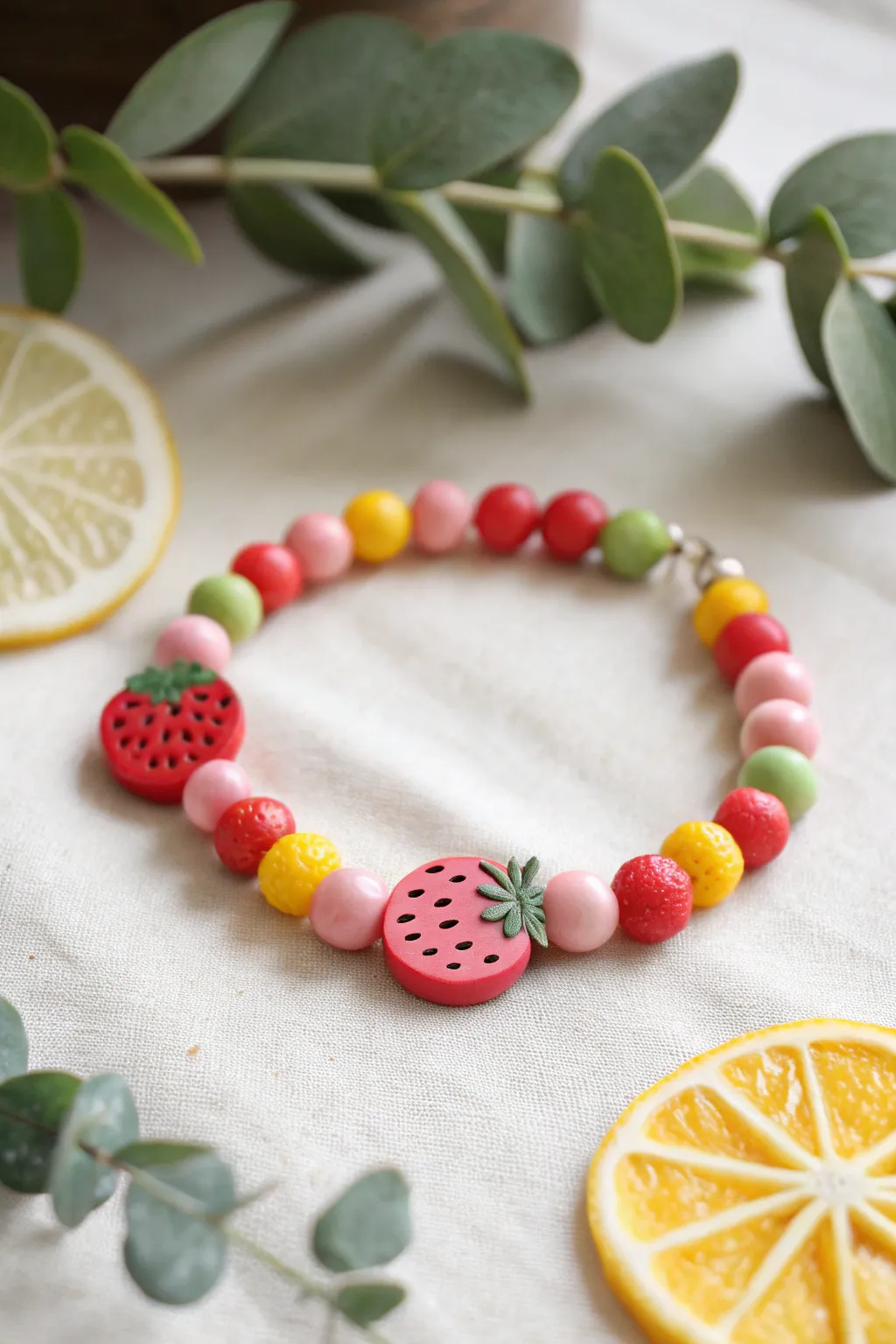
This cheerful accessory captures the essence of summer with a delightful mix of vibrant round beads and charming strawberry accents. The playful combination of red, pink, yellow, and green creates a fresh, fruity palette perfect for sunny days.
Detailed Instructions
Materials
- Polymer clay (red, pink, yellow, lighter green, darker green)
- Beading elastic cord (0.8mm)
- Clay tools (rolling pin, small round cutter)
- Needle tool or toothpick
- Jewelry clasp and jump rings (silver)
- Super glue (gel type recommended)
- Texture sponge or sandpaper (optional)
- Acrylic paint (black)
- Fine detail paintbrush
Step 1: Crafting the Beads
-
Color Palettes:
Begin by conditioning all your polymer clay colors. You’ll need distinct portions of bright red, pale pink, sunshine yellow, and a soft lime green to match the bracelet’s scheme. -
Rolling Basic Beads:
Roll small balls of clay in your palms to create approximately 20-25 uniform round beads (about 6-8mm in diameter). Make sure you have a balanced mix of all four base colors. -
Texturing (Optional):
For a more tactile finish like the red and yellow beads in the image, gently roll the unbaked clay balls over a piece of sandpaper or a texture sponge to give them a pitted, fruit-skin appearance. -
Creating the Flat Strawberry:
Roll a small disk of red clay, slightly thicker than a coin. Press the edges gently so they aren’t sharp. -
Adding Seeds:
Using a needle tool, press small indentations into the flat red disk to mimic strawberry seeds. Keep them somewhat random but evenly spaced. -
Strawberry Leaf Detail:
Shape a tiny star or flower shape from dark green clay. Place this on the top edge of your red disk to represent the leafy calyx. -
Making the Whole Strawberry Charm:
Create a slightly larger, flattened strawberry shape (more oval/triangular) from red clay. Add seed indentations just like the slice. -
Leaf Topper:
Add a textured green leaf top to this second charm as well, ensuring it sits securely on the curve of the ‘fruit’. -
Piercing the Holes:
carefully pierce a hole through the center of every round bead using a needle tool. For the strawberry charms, pierce horizontally through the sides so they will lay flat against the wrist. -
Baking:
Arrange all pieces on a baking sheet or tile. Bake according to your brand of polymer clay’s instructions (usually 275°F/135°C for 15-30 minutes). Let them cool completely.
Uneven Clay Beads
If your beads look fingerprints or distorted after piercing, refrigerate them for 10 minutes before piercing. The firmer clay holds its shape much better.
Step 2: Painting and Assembly
-
Defining the Seeds:
Once cool, take your fine paintbrush and a tiny amount of black acrylic paint. Dab paint into the seed indentations of your strawberry charms. -
Wiping Clean:
Immediately wipe the surface of the strawberries with a damp paper towel. The paint will stay in the recessed holes but come off the surface, creating perfect little seeds. -
Preparing the Cord:
Cut a length of elastic cord about 10 inches long. I like to tape one end down to the table so beads don’t slide off while I’m working. -
Pattern Layout:
Lay out your beads on a cloth. Start threading them, alternating colors randomly (e.g., green, red, pink, yellow). Place the round beads first. -
Adding Charms:
Thread the flat strawberry slice at the center point of the bracelet. Continue beating, adding the second strawberry charm about 4-5 beads away from the first one for visual balance. -
Finishing the Loop:
Once all beads are strung and the length fits the wrist comfortably, bring the ends together. -
Tying the Knot:
Tie a secure surgeon’s knot (right over left twice, pull tight; left over right twice, pull tight). Add a tiny dot of super glue to the knot for security. -
Attaching Clasp (Optional):
Alternatively, instead of knotting the elastic closed, tie each end of the elastic to a jump ring and attach a silver clasp as seen in the photo for a changeable fit. -
Final Trim:
Trim any excess cord close to the knot or clasp, and tuck the tail inside a neighboring bead if possible.
Citrus Twist
Expand the fruit salad theme by making orange or lemon slices using the translucent clay technique—wrap a yellow cane in white skin for a realistic rind effect.
Now you have a sweet, fruity accessory ready to brighten up any outfit
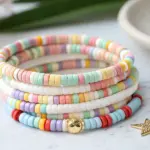
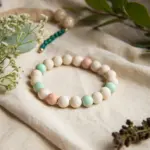
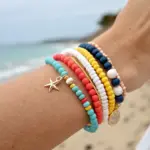

What Really Happens Inside the Kiln
Learn how time and temperature work together inside the kiln to transform clay into durable ceramic.
Pastel Preppy Mix
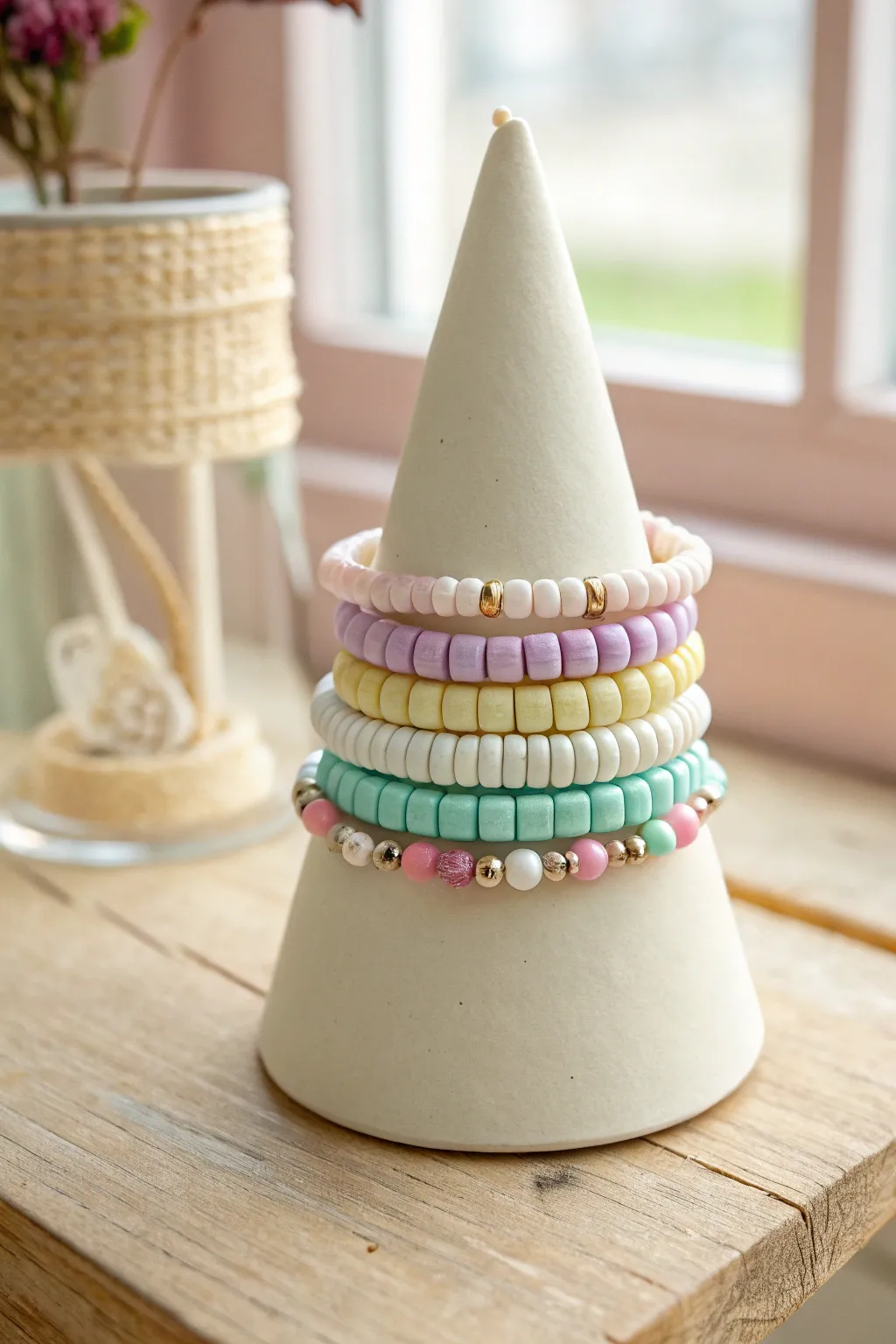
Bring a soft touch of spring to your accessory collection with this charming stack of pastel bracelets. Featuring a mix of matte tube beads, classic heishi discs, and shiny gold accents, this set is perfect for mixing and matching.
Step-by-Step
Materials
- Elastic cord (0.8mm clear stretch string)
- Pastel pink tube beads or heishi beads
- Lavender purple tube beads
- Pastel yellow tube beads
- White tube beads
- Teal/mint green tube beads
- Small gold spacer beads (round and disc shapes)
- Small pink acrylic beads
- Small white acrylic beads
- Super glue or jewelry cement
- Scissors
- Bead stopper or tape
Step 1: Planning & Prep
-
Measure your wrist:
Wrap a piece of string around your wrist to find the circumference, then add about an inch to ensure a comfortable fit. -
Cut the elastic:
Cut five lengths of elastic cord, each about 10 inches long. I always like to give myself plenty of extra room for tying knots later. -
Secure the ends:
Attach a bead stopper or a piece of tape to one end of each string so your beads don’t slide off while you work.
Step 2: The Pink & Gold Halo
-
Start the first strand:
Thread your pale pink tube beads onto the first string until you have covered about a third of the desired length. -
Add gold accents:
Slide on a small gold spacer bead, followed by three more pink beads, and then another gold spacer creates a nice focal point. -
Finish the strand:
Continue adding pink beads until you reach the full length needed for your wrist.
Knot Slipping?
If your elastic knots feel slippery, try switching to a square knot followed by a simple overhand knot. Pull tight until the elastic becomes slightly thinner.
Step 3: The Solid Pastel Layers
-
Create the Lavender layer:
For the second bracelet, string largely uninterrupted lavender tube beads. These slightly thicker, matte beads give the stack great texture. -
Build the Sunshine layer:
Repeat the previous process using your pastel yellow beads for the third bracelet. -
Add the White spacer:
Create the fourth bracelet using stark white tube beads. This one acts as a ‘palette cleanser’ between the colors, making the pastels pop. -
String the Mint layer:
For the fifth bracelet, use the mint green or teal tube beads to complete the classic color block look.
Charm It Up
Personalize the white ‘spacer’ bracelet by adding gold letter beads to spell out a name or a short phrase like ‘SUMMER’ or ‘BESTIE’ in the center.
Step 4: The Mixed Bead Finale
-
Design the bottom strand:
For the final bracelet, create a playful pattern alternating between round beads rather than tubes. -
Alternate colors:
Thread a pattern of one pink acrylic bead, a gold spacer, a white bead, and another gold spacer. -
Add variety:
Mix in a few textured or slightly larger metallic beads occasionally to make this bottom layer the most detailed of the bunch.
Step 5: Finishing Touches
-
Pre-stretch the cord:
Before tying, gently pull on the ends of each bracelet to pre-stretch the elastic; this prevents it from loosening up later. -
Tie the knots:
Remove the tape/stopper and tie a sturdy surgeon’s knot (right over left, left over right) for each bracelet. -
Secure with glue:
Dab a tiny drop of super glue or jewelry cement onto each knot and let it dry completely before trimming the excess string close to the bead.
Now you have a breezy, coordinated set ready to wear all at once or share with friends
Gold Spacer Shine Lines
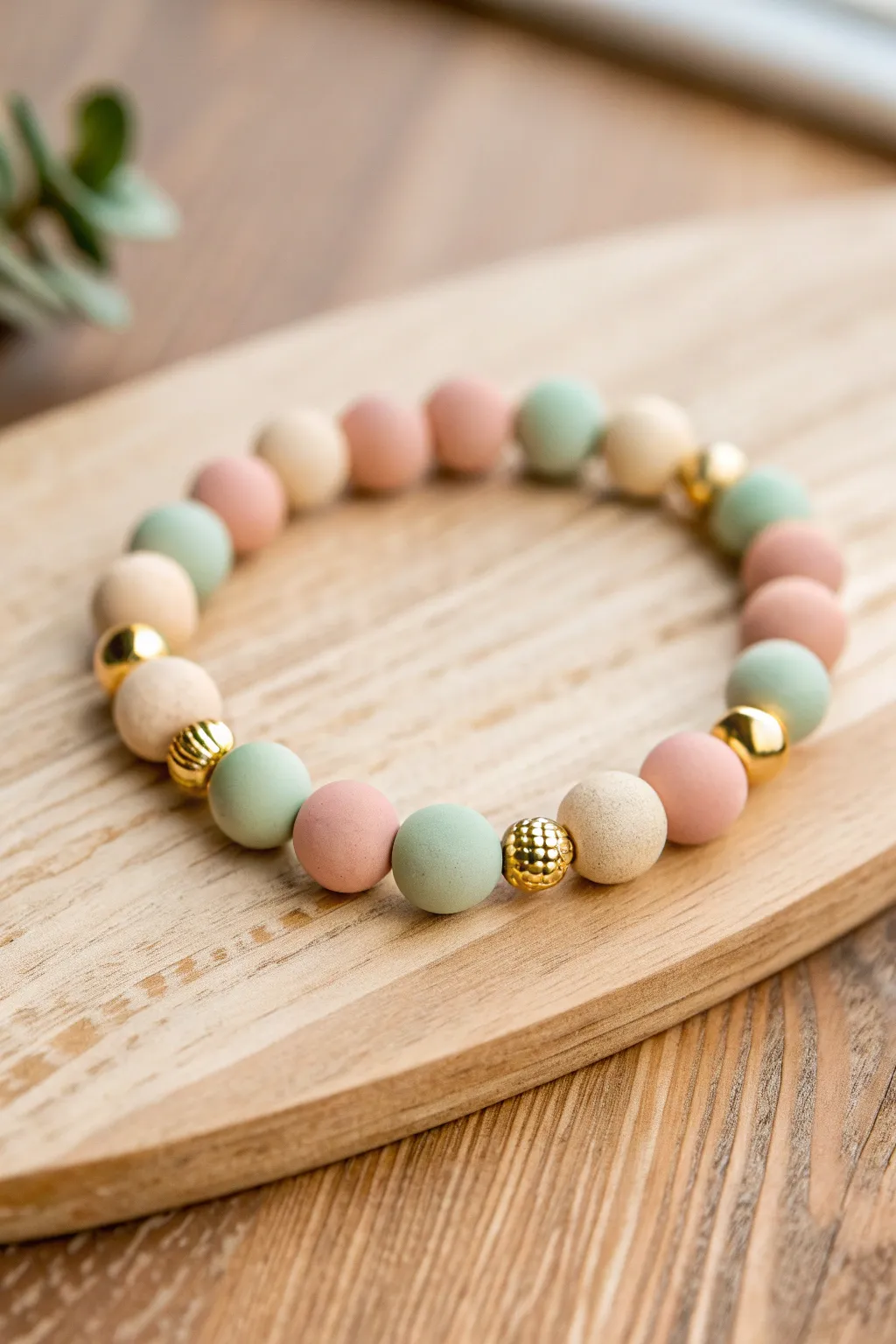
This elegant yet playful bracelet combines soft matte clay beads in muted pastels with striking gold accents for a sophisticated finish. The pattern creates a lovely rhythm of color that looks equally great on a child’s wrist or stacked with other favorites.
Step-by-Step Guide
Materials
- Matte polymer clay beads (10mm or 12mm round): sage green, dusty rose/pink, sand/beige
- Gold tone spacer beads (various): smooth round gold beads, textured or faceted gold beads
- Elastic cord (0.8mm or 1.0mm depending on bead hole size)
- Scissors
- Jewelry glue or clear nail polish
- Bead stopper or tape
Step 1: Preparation & Planning
-
Measure the wrist:
Before cutting any string, measure the intended wrist size. For a standard child’s bracelet, aim for about 6-6.5 inches, or 7 inches for an adult. -
Prepare the elastic:
Cut a piece of elastic cord about 10-12 inches long. This generous length gives you plenty of room to tie knots without struggling. -
Secure the end:
Attach a bead stopper or simply place a piece of tape on one end of the elastic to prevent beads from sliding off while you design. -
Sorting materials:
Layout your beads by color. You will need roughly equal amounts of sage green, dusty rose, and sand beads, plus a handful of mixed gold accents.
Step 2: Beading the Pattern
-
Establish the repeating unit:
The core visual rhythm of this bracelet relies on alternating colors separated occasionally by gold. A good starting sequence is three matte beads followed by a gold spacer. -
String the first sequence:
Thread a sand bead, followed by a dusty rose bead, and then a sage green bead onto the elastic. -
Add a gold accent:
Slide on one of your shiny gold spacer beads. Using a textured or ‘stardust’ finish bead here adds a nice contrast to the smooth matte clay. -
Begin the second sequence:
Continue the pattern but shift the colors slightly if you want a random look, or stick to the sand-pink-green order. Thread two or three more matte beads. -
Insert a smooth gold bead:
For variety, use a smooth, high-shine gold round bead this time instead of a textured one. This mix of texture keeps the eye moving. -
Continue beading:
Repeat the process of adding 2-3 matte pastel beads followed by a gold spacer. I prefer to mix up the color order occasionally so it doesn’t look too rigid. -
Check the spacing:
Pause periodically to look at your pattern. Ensure you aren’t placing two gold beads too close together unless that is a specific design choice you want to make. -
Verify the length:
Wrap the unfinished strand around the wrist to check the fit. Add or remove beads until the ends meet comfortably without stretching the elastic tight. -
Final bead adjustment:
Ensure your pattern ends in a way that will look seamless when tied. If you started with a sand bead, try to end with a green or pink bead or a gold spacer so two identical beads don’t touch.
Hiding the Knot
Plan ahead by placing a bead with a larger hole (like the wooden or gold ones) at one end. This makes it effortless to tuck the finished knot inside for a seamless look.
Step 3: Finishing Up
-
Pre-stretch the cord:
Gently pull on both ends of the elastic cord to pre-stretch it. This prevents the bracelet from sagging or loosening permanently after the first wear. -
Remove the stopper:
Carefully take off the bead stopper or tape, holding both ends of the elastic firmly so no beads escape. -
Tie the first knot:
Cross the ends and tie a simple overhand knot, pulling it down tight against the beads. -
Secure with a surgeon’s knot:
Tie a second knot, but loop the elastic through twice before pulling tight. This is a surgeon’s knot and is much more secure for elastic jewelry. -
Apply adhesive:
Dab a tiny drop of jewelry glue or clear nail polish onto the knot. Let it dry for a distinct moment to ensure the knot is permanently sealed. -
Hide the knot:
Ideally, pull the knot inside the hole of a neighboring bead to hide it. This works best if one of your beads has a slightly larger hole. -
Trim the excess:
Once the glue is fully dry, use sharp scissors to trim the excess elastic tail close to the bead, being careful not to cut the main cord.
Make It a Set
Create a matching “mommy and me” set by making a smaller version with just two colors, or swap the gold beads for silver spacers for a cooler toned variation.
Slip on your beautiful new accessory and enjoy the soft textures and golden shine

TRACK YOUR CERAMIC JOURNEY
Capture glaze tests, firing details, and creative progress—all in one simple printable. Make your projects easier to repeat and improve.
Sunset Ombre Fade
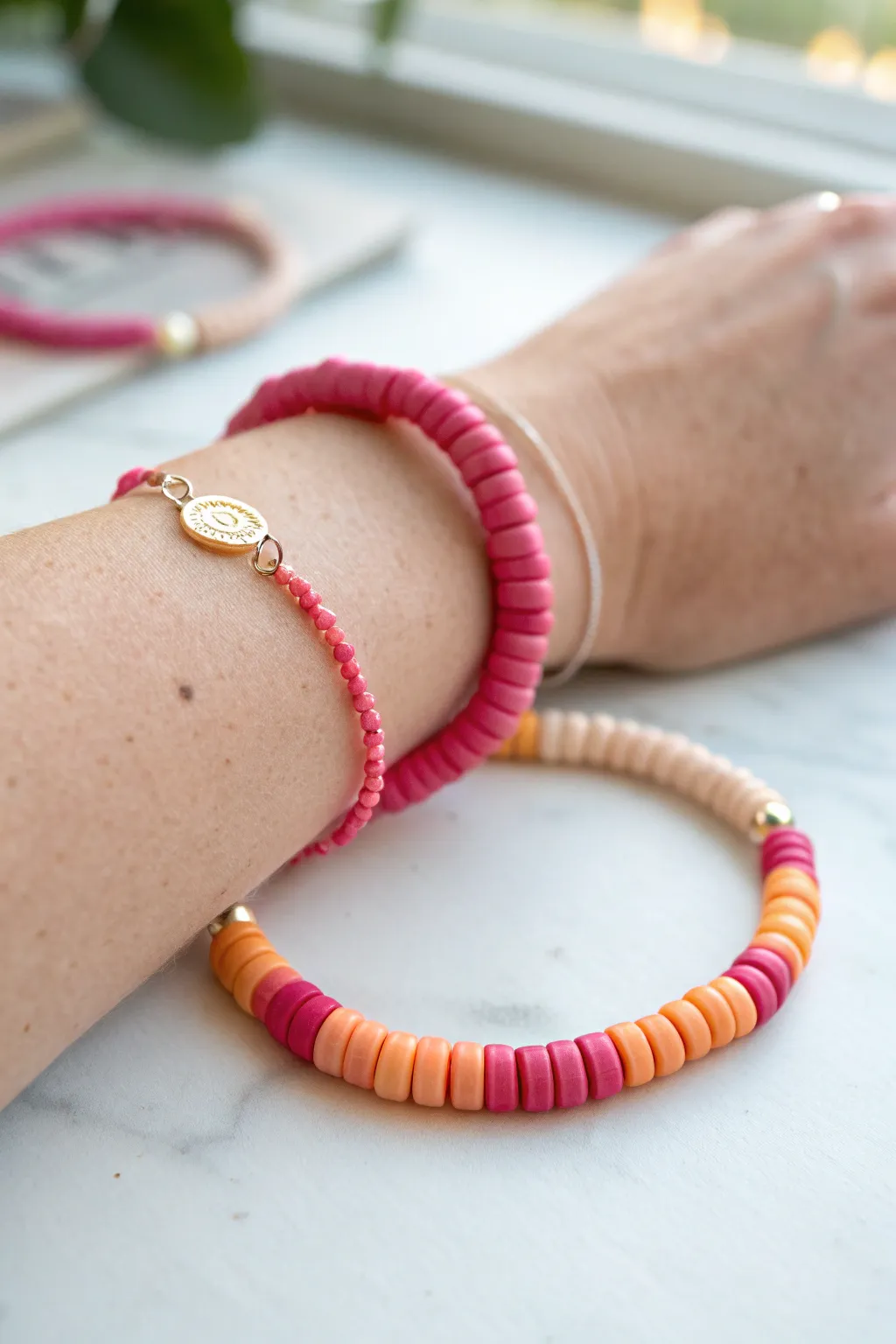
Capture the warmth of dusk on your wrist with this stunning polymer clay bead bracelet, featuring a seamless gradient from deep magenta to soft cream. It’s a surprisingly simple project that relies on pattern repetition to create a sophisticated, high-end look.
Step-by-Step
Materials
- Polymer clay heishi beads (flat disc beads) in: deep magenta/raspberry, bright pink, coral orange, peach, and cream/tan
- Elastic beading cord (0.8mm or 1mm recommended)
- 2 small gold spacer beads (round or nugget style)
- Super glue or jewelry adhesive
- Scissors
- Bead stopper or masking tape
Step 1: Planning Your Ombre Pattern
-
Sort your colors:
Before stringing a single bead, lay out your clay discs in color order on a bead board or flat surface. You want to arrange them from dark to light: Deep Magenta -> Bright Pink -> Coral -> Peach -> Cream. Seeing the gradient laid out helps ensure the transition looks smooth. -
Determine segment length:
For the specific look in the photo, you won’t just mix beads randomly. You will create distinct blocks of color. Plan to use about 5-8 beads per color block to get that chunky, defined stripe effect. -
Prepare the cord:
Cut a piece of elastic cord about 10-12 inches long. This gives you plenty of extra room for tying knots later without struggling with slippery ends.
Hide the Knot
If your gold bead has a larger hole than the clay beads, plan your pattern so the knot ends up inside the gold bead. It makes for a much cleaner finish.
Step 2: Stringing the Fade
-
Secure the end:
Place a bead stopper or simply fold a piece of masking tape over one end of your elastic cord to prevent beads from sliding off as you work. -
Start with the darkest shade:
Begin stringing with your darkest color—the deep magenta or raspberry shade. Thread on about 6-8 discs. Check the length; this block should be roughly a quarter-inch long. -
Transition to the next tone:
Switch to your bright pink beads. Thread on the same amount (6-8 beads) to keep the color blocks uniform in visual weight. -
Add the coral section:
Move to the orange-coral hue. String a matching set of 6-8 beads. At this point, you should start seeing the ‘sunset’ effect taking shape. -
Continue to the lightest colors:
Add your block of peach beads, followed by the block of cream/tan beads. This completes one full ‘wave’ of the ombre fade. -
Reverse or repeat:
You have a choice here based on your preference. To match the image exactly, you are creating a mirrored pattern. After the cream section, start working backward through the colors: Peach -> Coral -> Bright Pink -> Magenta. Alternatively, you can just start the dark magenta again for a repeating wave. -
Add the gold accent:
Once you have completed your color pattern and the clear blocks are defined, thread on a small gold spacer bead. This adds a flash of metallic shine that elevates the clay texture. -
Create the second half:
Repeat the entire color blocking process for the second half of the bracelet. Keep checking the length against your wrist as you go. -
Finish the strand:
End the strand with your second gold spacer bead. This ensures that when you tie the bracelet, the gold accents sit nicely between color transitions or serve as the focal point at the closure.
Uneven Blocks?
Clay discs vary slightly in thickness. Instead of counting beads, measure the length of each color block (e.g., 1cm each) to keep the stripes visually even.
Step 3: Finishing Touches
-
Check the fit:
Wrap the unfinished strand around your wrist. The ends should meet comfortably without stretching the elastic too much. Add or remove a few beads from the final color blocks if you need to adjust the size. -
Pre-stretch the cord:
Hold both ends of the elastic and give the bracelet a gentle tug. I always do this to ‘pre-stretch’ the elastic, which prevents the bracelet from sagging or loosening up immediately after you wear it. -
Tie the knot:
Remove the tape or bead stopper. Tie a standard square knot (right over left, left over right). Pull the elastic tight so the beads bunch together snugly. -
Secure with glue:
Ideally, place a tiny dab of super glue or jewelry adhesive right on the knot. Be careful not to get glue on the clay beads themselves, as it can discolor them. -
Hide the knot:
While the glue is still slightly tacky but not wet, slide one of the gold spacer beads (or the hole of a neighboring clay bead) over the knot to conceal it. -
Trim the excess:
Once the glue is fully dry, use sharp scissors to trim the excess elastic cord as close to the bead as possible without snipping the knot itself.
Now you have a vibrant, summer-ready accessory that looks professional enough to gift or sell
Mini Stripe Pattern Repeat
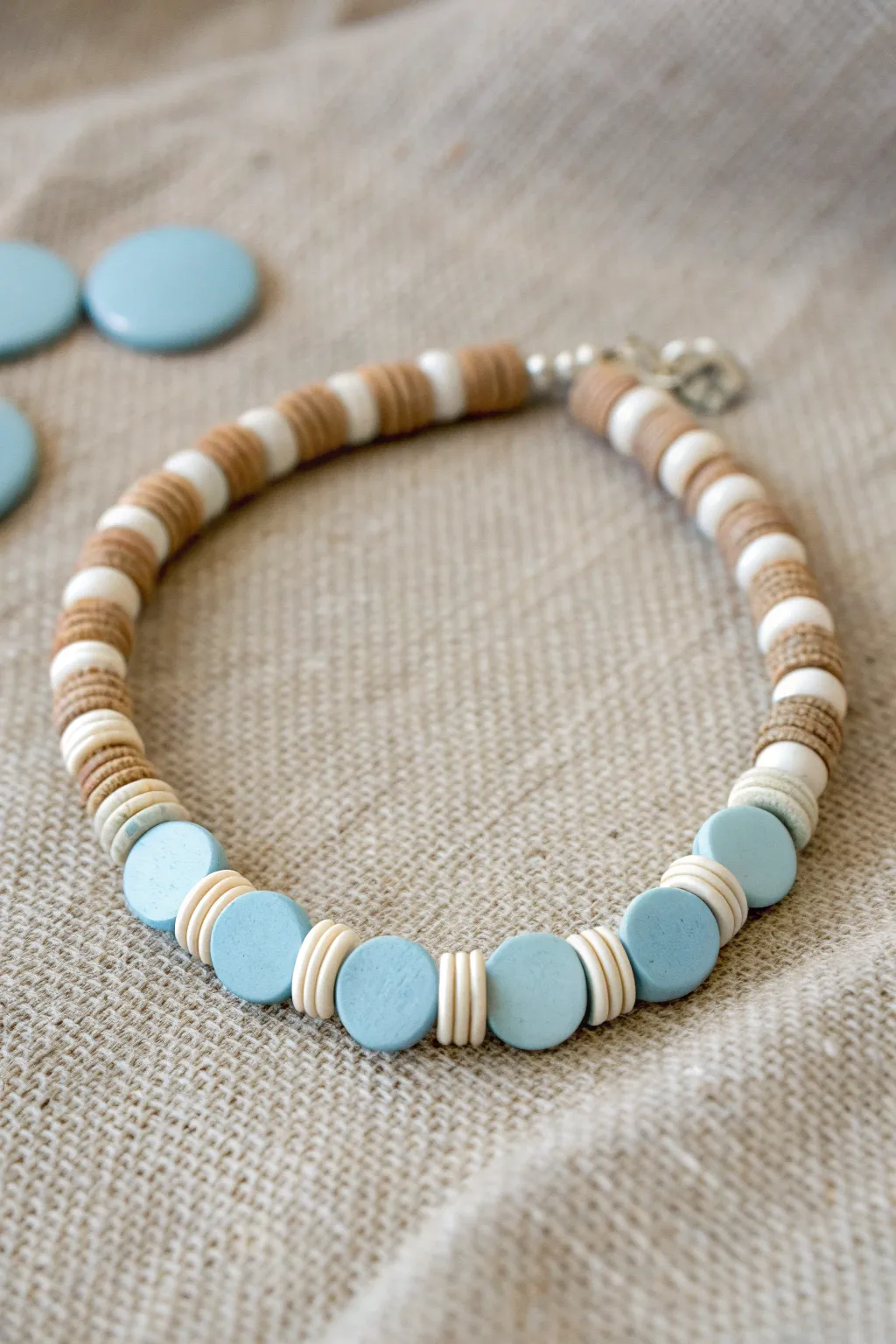
This trendy bracelet design mixes the smooth finish of blue polymer clay beads with the organic, ribbed texture of brown spacers for a sophisticated yet playful look. It’s a fantastic pattern study for kids, combining different bead profiles into a cohesive, beach-ready accessory.
Detailed Instructions
Materials
- Elastic beading cord (0.8mm or 1mm)
- Light blue flat disc beads (Heishi style, roughly 8mm)
- Cream or off-white flat disc beads (Heishi style, roughly 6mm)
- Brown ribbed disc beads (can be coconut shell, wood, or textured polymer)
- Small silver crimp bead cover (optional)
- Silver jump ring and lobster clasp (optional, if not just tying)
- Scissors
Step 1: Preparation
-
Measure the wrist:
Cut a length of elastic cord about 10-12 inches long. This gives you plenty of extra room for tying knots without struggling against a tight cord. -
Organize your beads:
Pour your beads into separate small bowls or piles on a bead mat. Having the cream, brown, and blue beads separated makes the specific counting patterns much faster to execute. -
Secure the end:
Attach a piece of tape to one end of your elastic cord or use a bead stopper clip. This prevents your beads from sliding off while you work on the pattern.
Knot Hiding Trick
If the knot won’t fit inside a bead, widen the bead’s hole slightly with a bead reamer or a thick needle before sliding it over the knot.
Step 2: The Main Pattern
-
Start the brown section:
Begin stringing with the brown and cream pattern. Thread on approximately 4 or 5 of the brown ribbed beads. -
Add a spacer:
Slide on one single cream-colored disc bead. This acts as a bright highlight between the darker textured sections. -
Repeat the texture:
Add another set of 4 to 5 brown ribbed beads followed by another single cream spacer. You are creating a repeating stripe pattern here. -
Check the length:
Continue this alternating brown-and-cream pattern until you have covered about two-thirds of the bracelet’s total length. Drape it over a wrist to check that the patterned section sits nicely across the top.
Step 3: The Blue Horizon Section
-
Transition to blue:
Now, switch your pattern completely. Thread on one of the larger light blue flat disc beads. -
Create the spacing:
Instead of a single spacer, use a stack of 3 to 4 cream disc beads next. This creates a wider white stripe that complements the larger size of the blue bead. -
Continue the blue pattern:
Add another blue disc, followed by another stack of 3 to 4 cream beads. Repeat this sequence for the remaining third of the bracelet. -
Verify the fit:
Bring the two ends together delicately to ensure the bracelet fits comfortably around the wrist without gaps. If it’s too tight, add one more sequence of blue and cream.
Curving Correctly
Flat disc beads can stiffen up. Roll the finished bracelet between your palms to help the beads settle and curve naturally.
Step 4: Finishing Touches
-
Prepare to knot:
Remove the tape or bead stopper from the end carefully, holding the cord tight so the beads remain snug. -
Tie the knot:
Tie a strong surgeon’s knot (right over left, left over right) with the elastic. Pull it tight, stretching the elastic slightly as you pull to lock the knot in place. -
Glaze the knot (optional):
I like to add a tiny dab of jewelry glue or clear nail polish to the knot for extra security. Let it dry for a minute before trimming. -
Hide the knot:
Trim the excess cord close to the knot. Gently tug the bracelet so the knot slides inside the hole of one of the larger blue beads or a wider stack of cream beads to hide it. -
Add hardware (alternative):
If you prefer a clasp (as seen in the inspiration), crimp the ends onto jump rings instead of tying, and attach your lobster clasp and tag.
Slip on your newly crafted accessory and enjoy the tactile mix of textures and smooth colors
Neon Pop on Black-and-White
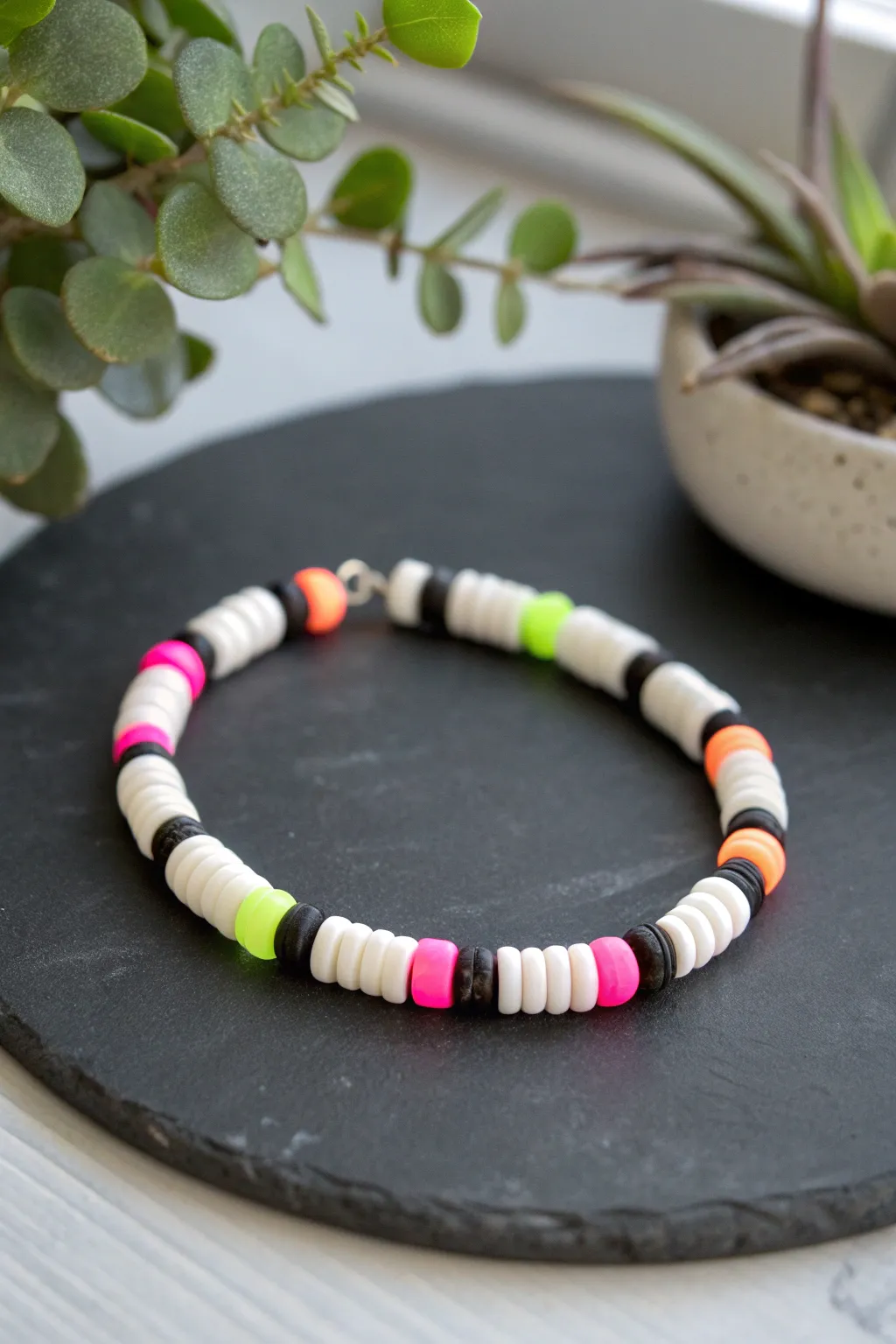
Contrast is the name of the game with this energetic design, featuring stark black and white sections interrupted by jolts of electric neon color. These flat clay heishi beads are incredibly satisfying to string together, creating a smooth, modern accessory that feels great on the wrist and looks even better.
How-To Guide
Materials
- 6mm flat disc polymer clay beads (white)
- 6mm flat disc polymer clay beads (black)
- 6mm flat disc polymer clay beads (neon pink, neon orange, neon yellow)
- 0.8mm clear elastic string cord
- Jewelry glue or clear nail polish
- Scissors
- Small bead stopper or binder clip (optional)
- Tweezers or bead spinner (optional)
Step 1: Preparation and Setup
-
Measure and Cut:
Begin by unspooling a length of elastic cord. Measure about 10-12 inches to ensure you have plenty of slack for tying knots later. -
Secure the End:
Attach a small bead stopper or simply use a piece of strong tape or a binder clip on one end of the cord. This prevents your beads from sliding right off as you work. -
Sort Your Colors:
Pour small piles of your white, black, and three neon colors onto your workspace or a bead mat. Having them separated makes the patterning process much faster.
Keep it Random
Don’t stress about counting perfectly! The charm of this style comes from varying the white sections between 3, 4, and 5 beads for an organic look.
Step 2: Pattern Construction
-
The Foundation Sequence:
Start with a block of white beads. Thread on approximately 4-5 white discs. -
First Contrast:
Follow the white section immediately with a single black bead to create a sharp dividing line. -
Add a Neon Pop:
Add your first color accent. Place 2-3 beads of neon orange onto the string. -
Close the Segment:
Capsule the color by adding another single black bead. -
White Spacer:
Thread on another segment of white beads, keeping it slightly irregular—maybe 3 beads this time. -
Second Color Block:
Add a black bead, followed by 2-3 neon pink beads, and another black bead. -
Midway Check:
Pause to check the spacing. The goal isn’t perfect symmetry, but rather a balanced distribution of the neon ‘pops’ separated by clean white space. -
Continue the Pattern:
Repeat the previous steps, alternating which neon color you use (orange, pink, yellow) and varying the length of the white sections between 3 and 6 beads. -
Black Accents:
I like to occasionally place two black beads together or a small section of black to break up the white dominance. -
Checking Length:
Once you have strung about 6 to 6.5 inches of beads (or your specific wrist measurement), wrap it around your wrist to check the fit. -
Final Adjustments:
Add or remove a few white spacer beads at the end to ensure the pattern meets seamlessly without a double-color collision.
Step 3: Finishing Touches
-
Pre-stretch the Cord:
Before tying, give the ends of the elastic a gentle tug. This pre-stretches the material so the bracelet won’t sag after the first wear. -
Tie the Knot:
Remove the stopper and tie a surgeon’s knot (a square knot with an extra loop through) to secure the ends tight against the beads. -
Secure with Glue:
Place a tiny drop of jewelry glue or clear nail polish directly onto the knot. Let this dry for at least 15 minutes. -
Hide the Evidence:
Trim the excess string close to the knot, leaving about 2mm. Gently tug the bracelet so the knot slides inside the hole of a neighboring bead, hiding it from view.
Knot Slipping?
If your elastic knot feels loose, try a ‘surgeon’s knot.’ Loop the string through twice on the first pass before pulling tight for extra grip.
Now you have a striking, high-contrast accessory that pairs perfectly with casual wear
Team Colors Word Bracelet
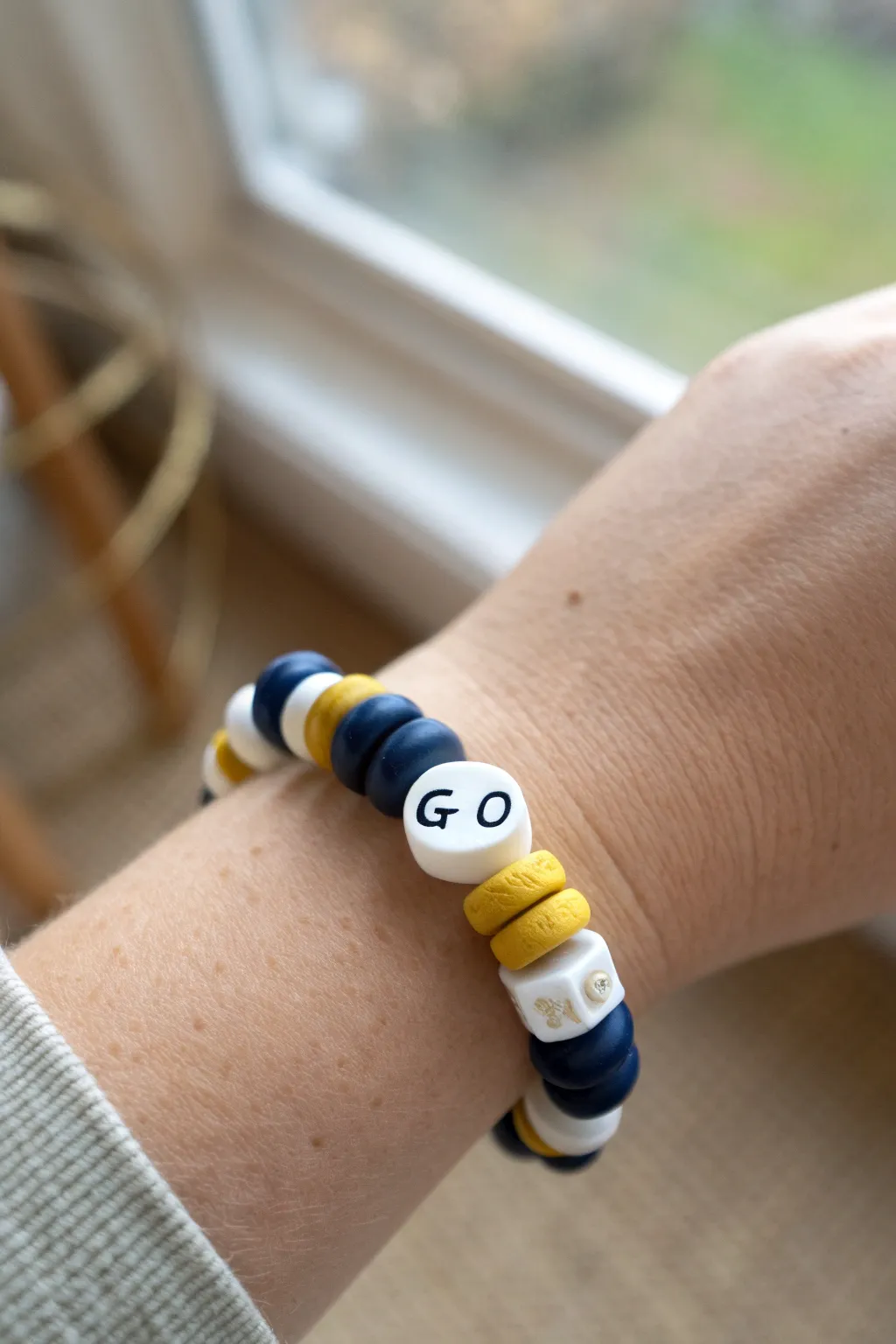
Show off your team spirit with this custom clay bead bracelet that pairs classic sport colors with a motivating message. The chunky heishi beads and gold accents give it a professional finish that looks great stacked or worn solo.
Step-by-Step
Materials
- Navy blue polymer clay disc beads (heishi)
- Mustard or gold-yellow polymer clay disc beads
- White polymer clay disc beads
- White round letter beads (G and O)
- White square accent bead with gold foil icon (optional)
- Elastic cord (0.8mm recommended)
- Scissors
- Super glue or jewelry cement
- Bead stopper or tape
- Ruler or measuring tape
Step 1: Planning & Setup
-
Measure your wrist:
Start by measuring the wrist where the bracelet will sit. Add about half an inch to this measurement to ensure the bracelet isn’t too tight. -
Cut the cord:
Cut a piece of elastic cord about 10-12 inches long. Having extra length makes tying the final knot much easier than struggling with short ends. -
Secure the end:
Attach a bead stopper to one end of your elastic cord to prevent beads from sliding off while you work. If you don’t have a stopper, a simple piece of masking tape folded over the end works perfectly. -
Plan your pattern:
Lay out on a table or bead board the sequence you want to create. The pattern in the photo uses color blocking: groups of blues, followed by white spacers, then yellows, leading up to the central word.
Keep It Tidy
Use a specialized bead sorting tray or even a velvet mat to keep those thin clay discs from rolling away or flipping over while you try to thread them.
Step 2: Stringing the Beads
-
Start the first section:
Begin threading your navy blue clay discs. Add about 5-6 beads to create a solid block of dark color. -
Add a white transition:
Slide on one or two white clay discs. These act as crisp separators between your main team colors. -
String the second color:
Thread on 3-4 mustard yellow clay beads. I find creating slightly different lengths for each color block adds a nice organic rhythm to the design. -
Repeat the pattern:
Continue alternating your navy blocks, white spacers, and yellow blocks until you have filled about half the length of your measured wrist size. -
Prepare the center:
Before adding the focal point, add a slightly larger block of navy beads (about 4 beads) to frame the letters.
Step 3: The Focal Point
-
Add the first letter:
Thread the letter ‘G’ bead onto the cord, ensuring it is facing the correct direction so it aligns with the ‘O’. -
Add the second letter:
Thread the letter ‘O’ bead right next to the ‘G’. Check that they sit comfortably against the flat clay beads. -
Frame the word:
Immediately following the ‘O’, add a block of two yellow clay beads to brighten the area around the word. -
Insert the accent bead:
Slide on the white square accent bead with the gold detail. This adds a little sparkle and breaks up the round shapes.
Knot Slipping?
If your elastic knot comes undone, try a ‘surgeon’s knot.’ It’s like a square knot, but you loop the elastic through twice on the first pass for extra friction.
Step 4: Finishing Up
-
Complete the loop:
Continue your pattern of navy, white, and yellow blocks on the other side of the focal point until the bracelet reaches your desired length. -
Check fit:
Wrap the strand around your wrist to check the size. Ideally, the ends should meet comfortably without stretching the elastic. -
Tie the knot:
Remove the bead stopper or tape. Tie a square knot (right over left, left over right) and pull it tight. I like to stretch the elastic slightly while pulling to lock the knot in place. -
Glue the knot:
Apply a tiny drop of super glue or jewelry cement to the knot for extra security. Let it dry for a minute. -
Hide and trim:
If flexible enough, gently tug the elastic so the knot slides inside the hole of a nearby bead. Trim the excess cord ends close to the beads.
Now you have a spirited accessory ready for game day
Holiday Color Combo Bracelet
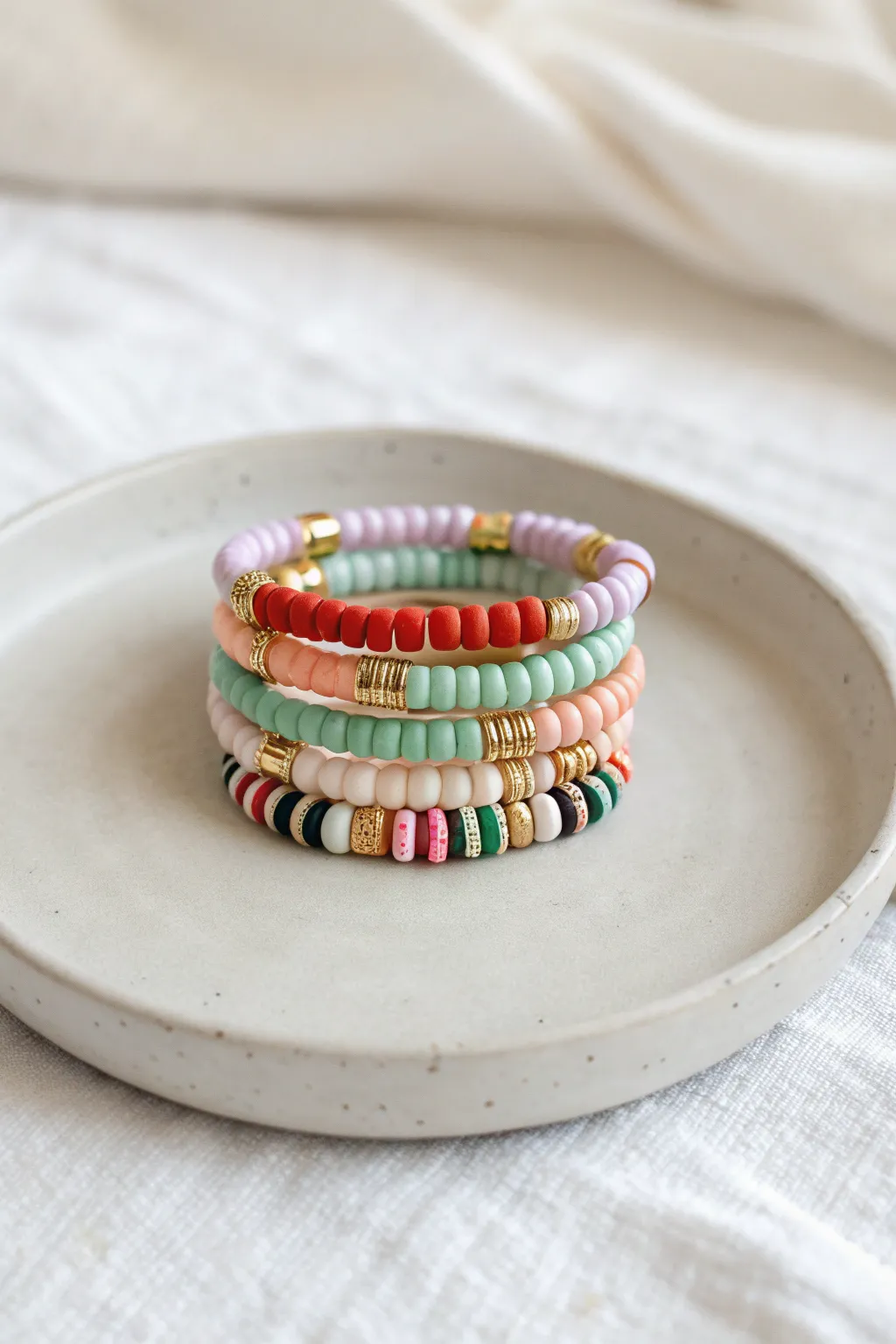
These cheerful bracelets add a pop of color to any outfit with their vibrant clay discs and shimmering gold accents. The design features a mix of solid color strands and a playful multi-colored bottom layer for a cohesive yet eclectic holiday look.
How-To Guide
Materials
- Polymer clay heishi beads (vinyl disc beads) in: light purple, mint green, bright red, peach/coral, light beige/ivory, dark green, black
- Gold spacer beads (various styles: textured rondelles, smooth rounds, small discs)
- Elastic stretch cord (0.8mm or 1mm thickness recommended)
- Superglue or jewelry glue
- Scissors
- Beading needle (optional but helpful for kids)
- Masking tape or bead stopper
Step 1: Preparation
-
Measure and Cut:
Begin by measuring the wrist size. Cut a piece of elastic cord about 3-4 inches longer than the wrist measurement to allow plenty of room for knotting. Repeat this for as many bracelets as you plan to make; this stack features six unique strands. -
Secure the End:
To prevent beads from sliding off while you work, place a piece of masking tape on one end of your elastic cord, or use a specific bead stopper tool.
Knot Security Tip
Use a surgeon’s knot for extra security: it’s like a square knot, but you loop the cord through twice on the first pass before pulling tight.
Step 2: Designing the Solid Strands
-
Purple & Green Strand:
Start your first bracelet with light purple clay beads. String about 10-15 beads, then add a gold textured rondelle spacer. Continue this pattern but switch to mint green beads halfway through if you want a two-tone look, or keep them separate. -
Bold Red Strand:
For the striking red bracelet, use bright red heishi beads. Break up the solid color by inserting a gold spacer bead every inch or so. I find that grouping 2-3 small gold disc beads together creates a nice focal point. -
Mint & Peach Layers:
Create the next two strands using mint green and peach/coral beads. For these, use larger stacked gold spacers. Slide on about 20 colored beads, then add a stack of 3-4 flat gold disc spacers to create a ‘cuff’ look. -
Ivory Accent:
Thread the light beige or ivory beads for a neutral balancing strand. Use smaller, intricate gold textured beads sparingly here to keep the look soft and elegant.
Add a Charm
Customize the stack by adding a small gold star, snowflake, or initial charm to just one of the bracelets.
Step 3: The Multi-Color ‘Party’ Strand
-
Pattern Planning:
The bottom bracelet in the stack is the most complex. It uses a random or set pattern of all the colors used previously, plus dark green, black, and white. -
Stringing the Mix:
Alternate small groups of colors. Try this sequence: 3 red stripe beads, a gold spacer, 3 black beads, 3 white beads, a gold spacer, and then 3 pink or green beads. Keep the color groups small (2-4 beads each) to create a confetti effect.
Step 4: Finishing Touches
-
Check the Length:
Wrap each strand around the wrist to ensure a comfortable fit. The beads should sit flush against the skin without pinching or leaving large gaps where the elastic shows. -
Pre-Stretch the Elastic:
Give the elastic a gentle tug before tying. This pre-stretching step helps prevent the bracelet from expanding and becoming loose immediately after the first wear. -
Tie the Knot:
Remove the tape/stopper. Tie a standard square knot (right over left, left over right). Pull it very tight. -
Secure with Glue:
Dab a tiny drop of superglue or jewelry cement directly onto the knot. Let it dry completely before moving it. -
Hide the Knot:
If your bead holes are large enough, gently tug the elastic so the knot slides inside one of the adjacent beads or gold spacers to hide it. -
Trim Excess:
Once the glue is fully dry, use your small scissors to trim the excess elastic tails close to the knot.
Enjoy mixing and matching your new colorful bracelet stack with your favorite festive outfits
Best Friends Split Phrase Set
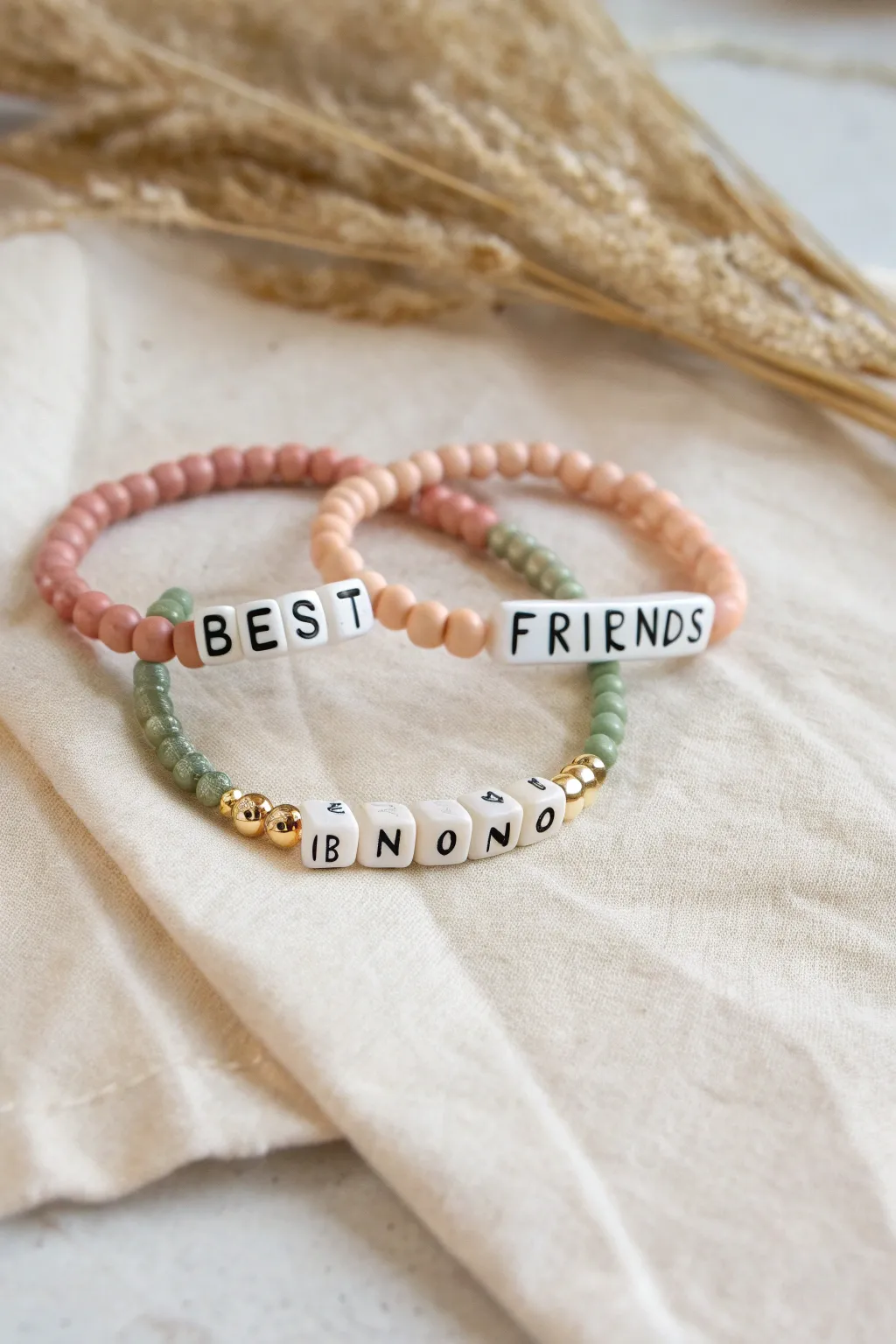
Celebrate friendship with this charming set of three complementary bracelets that look beautiful stacked together or shared among a group. The design features a lovely combination of matte clay beads in earthy pinks and greens alongside crisp white letter beads and touches of metallic gold.
Step-by-Step Guide
Materials
- Elastic cord (0.8mm or 1mm thickness)
- Matte round beads (approx. 6-8mm) in dusty rose/terracotta
- Matte round beads (approx. 6-8mm) in peach/blush
- Small round speckled/textured beads (approx. 4mm) in sage green
- White rectangular letter beads with black text (spelling BEST and FRIENDS)
- White square letter beads with black text (spelling IB NONO or custom phrase)
- Gold tone crimp beads or small spacer beads
- Gold tone round spacer beads (approx. 4mm)
- Scissors
- Strong craft glue or jewelry cement
- Bead stopper or tape
Step 1: The ‘BEST’ Bracelet
-
Prepare the elastic:
Cut a piece of elastic cord about 10-12 inches long. This gives you plenty of extra room for tying knots later. -
Secure the end:
Place a bead stopper or a piece of masking tape on one end of the cord to prevent your beads from sliding off while you work. -
Start the pattern:
Begin stringing the dusty rose matte beads. You will need enough to cover about half of your wrist circumference. -
Add the focal point:
Slide on the white rectangular letter beads to spell ‘BEST’. Ensure the letters are facing the correct direction. -
Finish the loop:
Continue stringing the dusty rose beads on the other side of the word until the bracelet reaches your desired length.
Knot Security
Hide your knot inside one of the larger clay beads, not the letter beads. The clay bead holes are usually larger and accommodate the knot better.
Step 2: The ‘FRIENDS’ Bracelet
-
Switch colors:
Cut a new length of elastic cord and secure the end just like before. This time, you will be using the peach or blush matte beads. -
String the base:
Thread the peach beads until you have covered roughly half the length needed for the bracelet. -
Insert the word:
Add the rectangular letter beads to spell ‘FRIENDS’. Double-check your spelling before moving on. -
Add contrast:
Instead of finishing with peach, switch to the small sage green beads for the remaining section. This creates a stylish color-blocked effect.
Golden Glamour
Add thin gold disc spacers between every 3rd or 4th colored bead on the solid strands to add a subtle shimmer throughout the entire stack.
Step 3: The Accent Bracelet
-
Begin the third strand:
Prepare your final piece of elastic. Start stringing with the small sage green speckled beads. -
Create the gold frame:
Once you reach the center point, slide on two or three gold round spacer beads. These act as a shiny frame for your text. -
Add the square letters:
Thread on your square letter beads. The example uses cryptic letters, but you can spell a name or initials here. -
Close the frame:
After the last letter bead, add two or three more gold spacer beads to symmetry match the other side. -
Complete the circle:
Finish stringing the rest of the bracelet with the sage green beads.
Step 4: Finishing Touches
-
Check the fit:
Wrap each bracelet around your wrist to ensure they fit comfortably. They should be snug but not tight. -
Knot the elastic:
Remove the tape or stopper. Tie a strong surgeon’s knot (right over left, left over right) for each bracelet. I like to pull the elastic tight as I knot it to pre-stretch it slightly. -
Secure with glue:
Dab a tiny dot of jewelry cement or super glue onto the knot to prevent it from slipping. -
Hide the knot:
Once the glue is tacky but not fully set, trim the excess cord and gently tug the knot inside the hole of a nearby bead to hide it.
Enjoy wearing your custom stack or gifting the matching half to your best friend
Tassel Tie-Off Bracelet
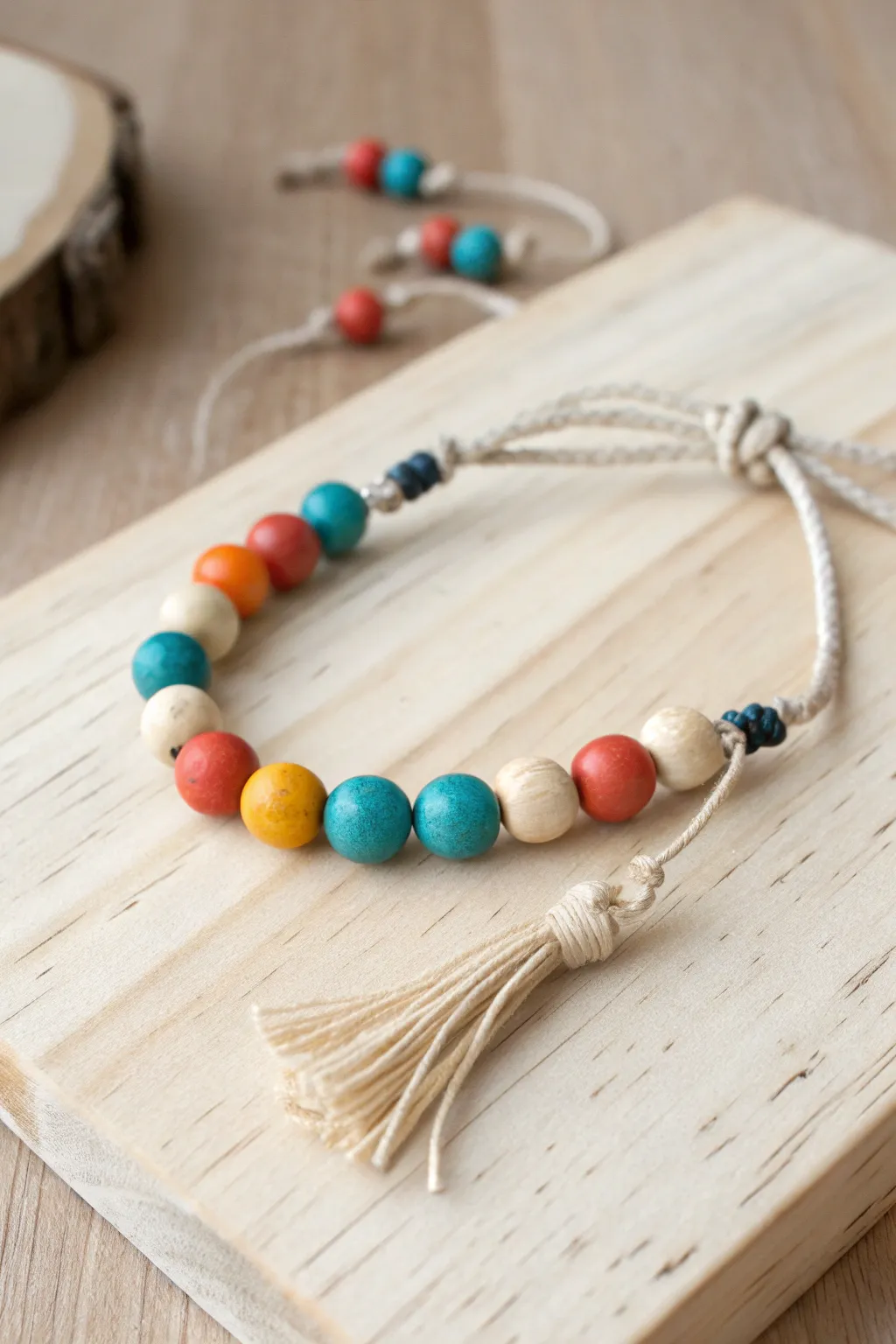
This earthy, bohemian bracelet combines the rustic texture of natural cord with pops of vibrant color from clay or wooden beads. With its adjustable slide knot and charming tassel detail, it makes for a delightful accessory that captures a relaxed, beachy vibe.
Step-by-Step
Materials
- Natural hemp or waxed cotton cord (approx. 2mm thick)
- Round clay or wooden beads (assorted colors: teal, red, orange, yellow, cream)
- Smaller spacer beads (dark blue or black)
- Scissors
- Tape or clipboard (to hold work in place)
- Small crochet hook or needle (optional, for threading beads)
Step 1: Preparation and Braiding
-
Cut Your Cords:
Cut three strands of your natural cord, each measuring about 30 inches long. This generous length ensures you have enough for the braiding, the main bead section, and the finishing tassels. -
Secure the End:
Gather your strands together. Leave about a 4-inch tail at the top and tie a simple overhand knot to bundle them together. Tape this knot down to a table or easier handling. -
Start the Braid:
Begin braiding the three strands together tightly. Continue this braid for approximately 2 to 3 inches; this section will form one side of the bracelet strap leading up to the beads. -
Knot the Transition:
Once the braided section is long enough, tie a tight overhand knot with all three strands to secure the braid. This knot acts as a stopper before your beadwork begins.
Clean Cord Ends
Wrap the very tip of your cord tightly with a small piece of masking tape before threading. This acts like a shoelace aglet and makes sliding beads on much easier.
Step 2: Adding the Beads
-
Select the Center Strand:
Separate your three strands. Identify the center strand to be your bead carrier. It needs to be the one that threads most easily. -
Thread Spacer Beads:
Slide one or two small dark spacer beads onto the center strand. Push them snugly against the knot you just made. -
String the Main Beads:
Begin threading your larger colored beads in a random or patterned order. For the look in the photo, try mixing teal, cream, orange, and red. String about 12-14 beads total. -
Secure with Spacers:
Finish the beaded section by adding another set of small dark spacer beads at the end of the run. -
Rejoin the Strands:
Bring the two outer strands (which you didn’t bead) parallel to the beaded strand. They should run alongside the beads, framing them slightly. -
Knot to Close:
Gather all three strands together again immediately after the last spacer bead. Tie a tight overhand knot right up against the beads to lock them in place.
Step 3: Finishing and Tassel
-
Braid the Second Side:
Like the beginning, braid the remaining lengths of the three strands for another 2 to 3 inches to match the first side. -
Tie Off the End:
Secure this second braided section with an overhand knot. -
Create the Closure:
Bring the two braided ends of the bracelet together to form a circle. You can tie them together using a square knot or create a sliding knot closure if you prefer adjustability. -
Make the Tassel Bundle:
To make the decorative tassel, cut several short lengths of cord (about 4 inches long). Fold them in half over one of the loose cord ends hanging from your closure knot. -
Secure the Tassel Head:
Take a separate piece of thin cord or a single ply of your main cord. Wrap it tightly around the top of the folded bundle to create the ‘head’ of the tassel. Tie it off securely and tuck the ends inside. -
Trim the Tassel:
Using sharp scissors, trim the bottom of the tassel strands so they are even and uniform. I like to comb the strands out slightly with my fingers first to ensure a neat cut.
Color Pop
Paint plain wooden beads with acrylics before stringing. Use a toothpick to hold the bead while painting to keep your fingers clean and the coverage even.
Now you have a charming, handmade accessory perfect for stacking or gifting to a friend
Glow-in-the-Dark Night Bracelet
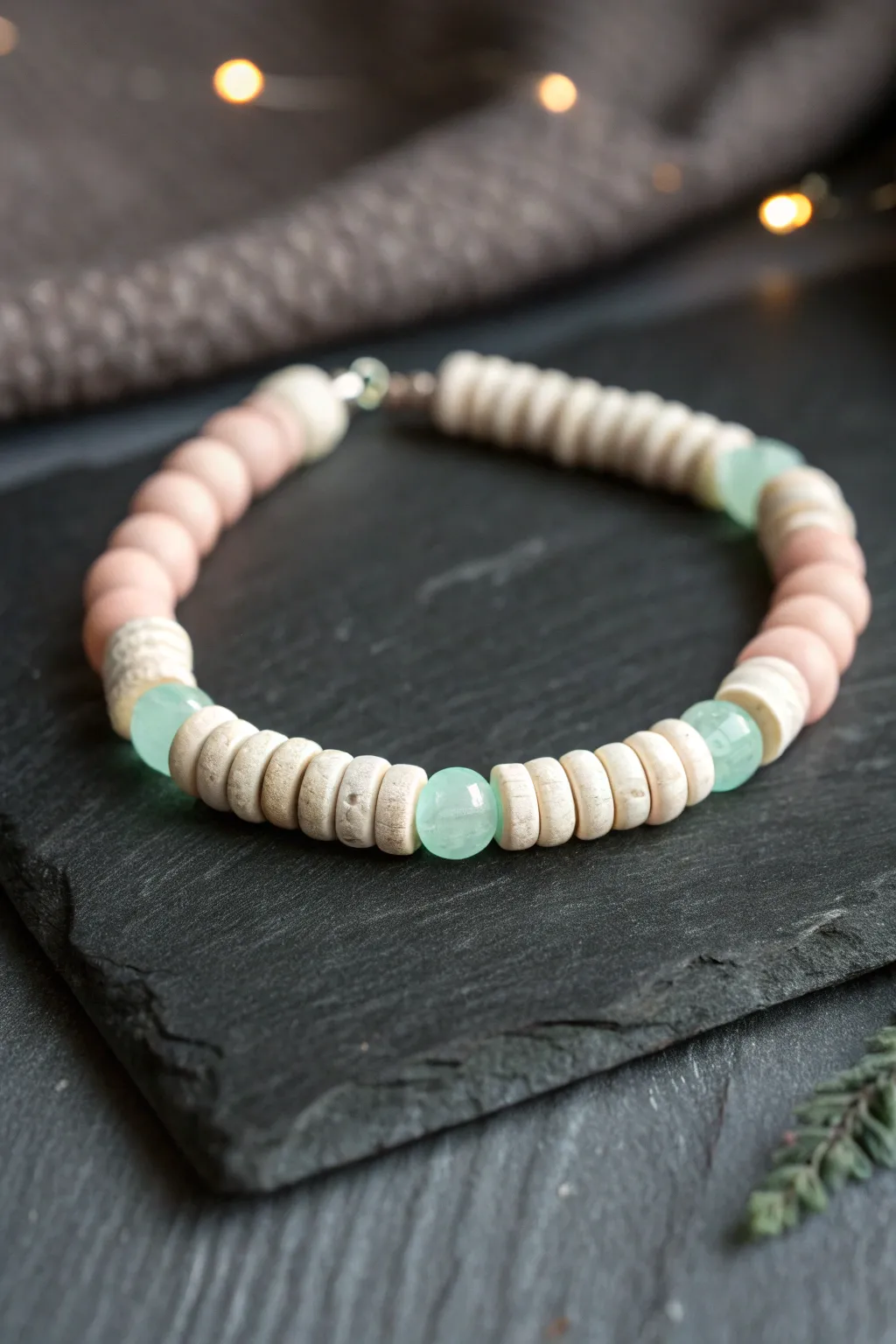
This elegant yet playful bracelet combines the natural warmth of wooden textures with the soft, magical luminescence of glow-in-the-dark accents. The alternating pattern of matte pink rounds, creamy heishi discs, and translucent green focal beads creates a balanced rhythm perfect for evening wear or a fun sleepover accessory.
Step-by-Step Tutorial
Materials
- Matte pink round wooden beads (approx. 8-10mm)
- Cream/white coconut shell or wood heishi (disc) beads
- Translucent pale green glow-in-the-dark round beads (approx. 8mm)
- Stretch cord (0.8mm clear elastic)
- Beading needle (optional but helpful)
- Scissors
- Jewelry glue or clear nail polish
- Measuring tape
- Bead stopper or masking tape
Step 1: Planning and Preparation
-
Measure and Cut:
Cut a length of stretch cord about 10-12 inches long. This generous length gives you plenty of room to tie knots without struggling against tension. -
Secure the End:
Attach a bead stopper or simply place a piece of masking tape folded over one end of the cord to prevent your beads from sliding off while you design. -
Stretch the Cord:
I always pre-stretch the elastic by pulling it firmly a few times. This prevents the bracelet from loosening up and sagging after the first few times you wear it.
Charging Your Beads
To maximize the glow effect, let the finished bracelet sit under a bright LED lamp or in direct sunlight for 5-10 minutes before wearing it in the dark.
Step 2: Creating the Pattern
-
Start with Symmetry:
We will build this bracelet in segments. Start by threading on 5 to 7 of the cream heishi disc beads. These flat discs act as spacers and add a wonderful texture change. -
Add a Glow Bead:
Slide on one translucent green glow-in-the-dark bead. This will sit centered between your sections of disc beads. -
Repeat Discs:
Add another set of 5 to 7 cream heishi discs to mirror the first set, sandwiching the glow bead. -
Transition to Pink:
Now, switch to the matte pink round wooden beads. Thread on about 6 to 8 of these beads to create a solid block of soft color. -
Insert a Spacer Section:
Create a small visual break by adding a short stack of heishi discs—use about 3 or 4 here—followed by another glow-in-the-dark green bead. -
Complete the Spacer:
Follow that green bead with another 3 or 4 heishi discs. -
Add More Pink:
Thread on another segment of 6 to 8 matte pink wood beads. Check your length against your wrist; the pattern shown uses roughly equal blocks of pink beads separated by the detailed spacers. -
The Centerpiece Section:
For the focal point shown in the front of the image, create a longer pattern: 3 heishi beads, 1 glow bead, 3 heishi beads, 1 glow bead, and 3 heishi beads. -
Final Check:
Wrap the strand around your wrist to verify the fit. The beads should touch comfortably without digging into the skin or leaving large gaps where the cord shows.
Knot Slipping Out?
If the knot won’t stay hidden inside a bead, try widening a specific bead hole slightly with a bead reamer, or ensure you are using heishi beads near the glues knot.
Step 3: Finishing Touches
-
Prepare to Tie:
Remove the bead stopper or tape carefully. Bring the two ends of the cord together, ensuring there is no slack between the beads. -
Tie the Knot:
Tie a surgeon’s knot (right over left, left over right) and pull it tight. The elastic should stretch slightly as you secure it. -
Secure with Glue:
Apply a tiny dab of jewelry glue or clear nail polish directly onto the knot. This is crucial for longevity, especially with slippery elastic. -
Hide the Knot:
While the glue is still slightly tacky but not wet, gently pull the cord so the knot slides inside the hole of one of the larger pink or green beads. -
Trim Excess:
Once the glue is fully dry, trim the excess tails of the cord close to the bead hole. Be careful not to nick the main knot.
Enjoy watching your new accessory light up when the lights go down
Interchangeable Charm Center
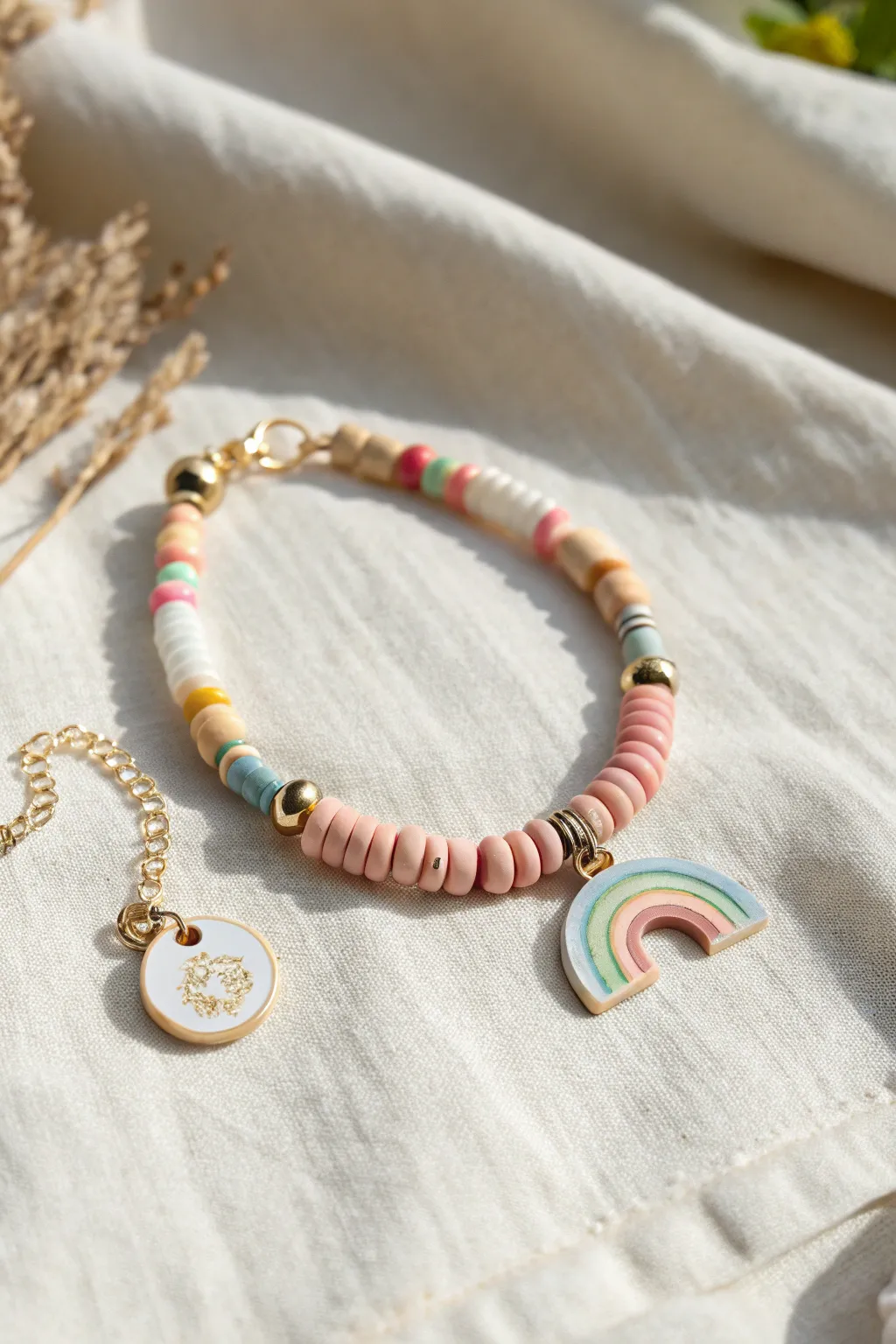
This sweet, adjustable bracelet combines soft pastel clay beads with gold accents and a darling rainbow charm as the centerpiece. It features a cheerful yet muted color palette that’s perfect for adding a touch of whimsy to any kid’s outfit.
Step-by-Step Guide
Materials
- Polymer clay heishi beads (pink, white, cream, mint green, salmon/coral, tan/wood-tone)
- Gold spherical spacer beads (4mm and 6mm)
- Small gold disc spacer beads
- Pastel rainbow charm with gold jump ring
- Gold lobster clasp
- Gold extension chain (approx. 2 inches)
- White or rainbow disc charm (for the extension chain)
- Beading wire or strong fishing line (0.3mm-0.4mm)
- 2 gold crimp beads
- 2 gold crimp bead covers (optional but recommended for a clean finish)
- Jewelry pliers (flat nose and chain nose)
- Wire cutters
Step 1: Planning and First Steps
-
Measure and cut:
Cut a piece of beading wire about 9-10 inches long. This gives you plenty of extra room to work with the ends, even for a smaller child’s wrist. -
Secure the first end:
Thread a crimp bead onto one end of the wire, followed by the lobster clasp. Loop the wire back through the crimp bead to create a small loop holding the clasp. -
Crimp firmly:
Use your flat nose pliers to smash the crimp bead flat, ensuring the wire is secure. If you’re using a crimp cover, gently close it over the flattened crimp bead now to make it look like a round gold bead.
Sticky Charms?
If the rainbow charm gets stuck and won’t dangle freely, add two tiny gold metal seed beads on either side of the charm’s jump ring to act as smooth ‘bearings’.
Step 2: Beading the Pattern
-
Start the sequence:
Begin threading your beads. Start with a large 6mm gold ball bead to anchor the design visually near the clasp. -
Create the first color block:
Thread on a random mix of pastel clay beads—alternating between tan, pink, mint, and cream. Use short sections of 3-5 beads of the same color, separated by a single contrasting bead. -
Add texture:
About one inch in, slide on a flat gold spacer disc followed by a small 4mm gold ball bead, then another flat disc. This breaks up the clay texture nicely. -
Continue the pattern:
Resume the clay bead pattern. Focus on the salmon/coral color for a longer stretch here, perhaps 8-10 beads. -
Mid-point accent:
Thread on a darker teal or blue clay bead followed by a large 6mm gold ball bead. This acts as a visual halfway marker before you reach the charm section.
Make It Yours
Personalize the extension chain charm! Instead of a plain disc, attach a tiny initial charm or a birthstone crystal for a custom touch.
Step 3: Adding the Charm Center
-
Build the charm support:
The charm sits on a bed of pink beads. Thread approximately 10-12 coral-pink heishi beads onto the wire. -
Attach the rainbow:
Slide the gold jump ring attached to your rainbow charm directly onto the wire. It should sit loosely and move freely along the beads. -
Finish the center section:
Add another 3-4 coral-pink beads after the charm so it feels centered within that color block. -
Mirror the gold:
Add a gold disc spacer, a 4mm gold ball, and another disc spacer to mirror what you did on the first half of the bracelet.
Step 4: Finishing the Bracelet
-
Complete the length:
Finish stringing the beads in a mixed pattern (creams, tans, and pops of mint) until the beaded section measures about 5.5 to 6 inches (or your desired wrist size). -
End with gold:
Finish the bead string with one final large 6mm gold ball bead. -
Prepare the extension chain:
Take your extension chain and use a small jump ring to attach the decorative white disc charm to the very end of the chain links. I like to do this before attaching the chain to the main bracelet. -
Secure the second end:
Thread a crimp bead onto the remaining wire end, followed by the loop of your extension chain. -
Loop and crimp:
Pass the wire back through the crimp bead and pull tight so there are no gaps in the beads, but not so tight the bracelet stays stiff. Flatten the crimp bead with pliers. -
Trim excess wire:
Use wire cutters to snip off the tail of the wire as close to the bead as possible. You can tuck the tiny end into the adjacent beads for safety. -
Double check:
Give the bracelet a gentle tug to ensure your crimps are holding fast and the charm hangs correctly.
Now you have a charming, boutique-style accessory ready to wear or gift
Secret Color Code Message Bracelet
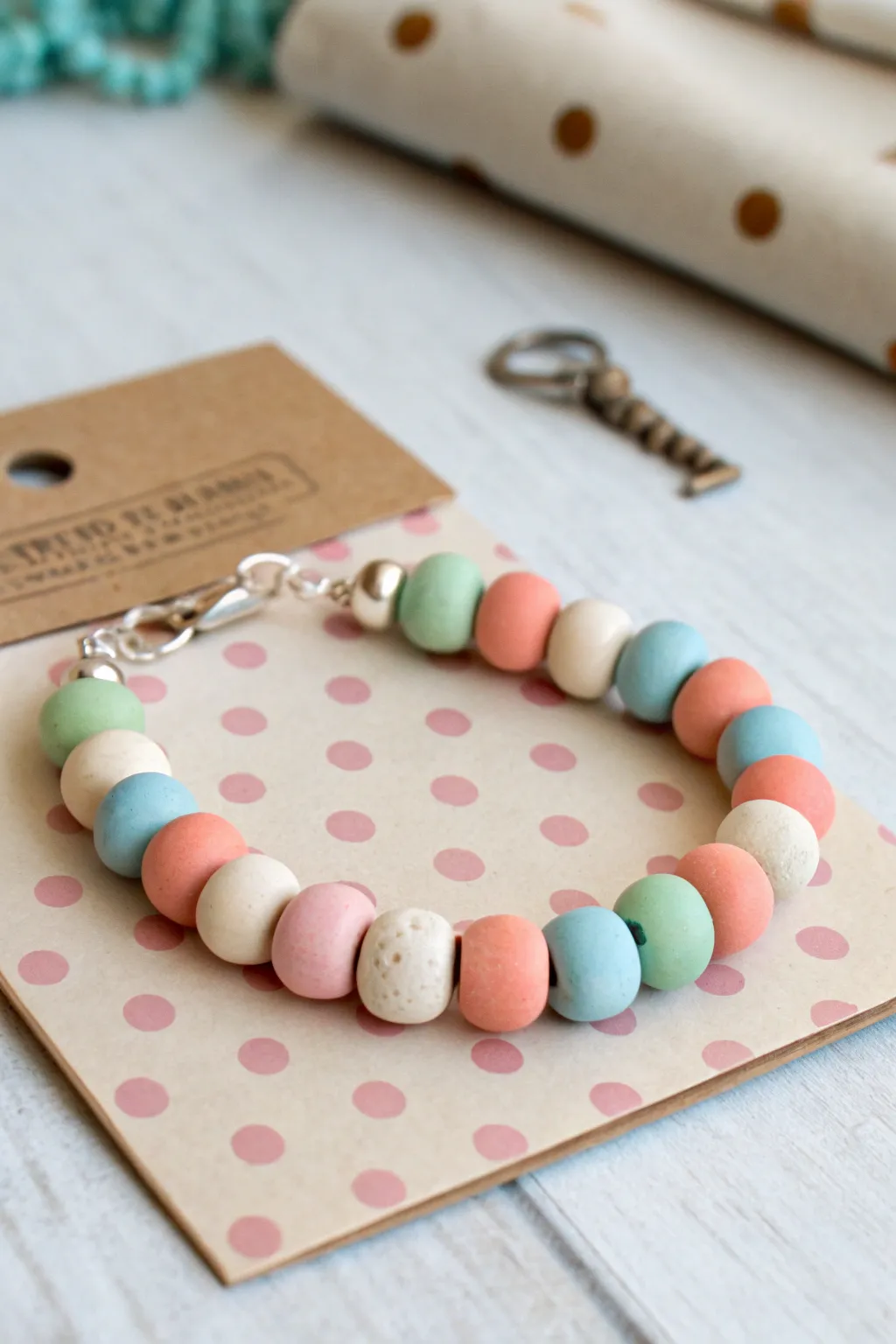
Transform a simple accessory into a hidden message with this clever color-coded bracelet project. Using soft, muted tones of handmade polymer clay beads, you can spell out a secret name or phrase that only the wearer knows how to decode.
Step-by-Step
Materials
- Polymer clay (mint green, peach/coral, white, light blue, baby pink)
- Silver spacer beads (small, round)
- Beading wire or strong jewelry cord
- 2 small silver crimp beads
- Silver lobster clasp
- Silver jump ring
- Jewelry pliers (flat nose and wire cutters)
- Toothpick or bead piercing tool
- Cookie sheet and parchment paper
- Small letter stamps (optional, for the packaging key)
- Kraft paper cardstock (for the display card)
Step 1: Crafting the Clay Beads
-
Condition the clay:
Begin by taking small portions of your polymer clay colors: mint green, peach, white, light blue, and pink. Knead each color separately in your hands until soft and pliable. -
Form the base balls:
Pinch off small pieces of clay, roughly the size of a large pea. Roll them between your palms to create smooth, round spheres. Aim for a diameter of about 8-10mm. -
Establish your code:
Decide on your secret message (like ‘BFF’ or a name). Assign one clay color to represent each letter you need, or create a full alphabet key if you plan to make many bracelets. -
Create the holes:
While the clay balls are still soft, gently pierce the center of each bead using a toothpick. Rotate the toothpick as you push through to prevent squashing the bead’s shape. -
Texturize (optional):
For the white beads, recreate the porous texture seen in the photo by gently tapping the surface with a stiff toothbrush or a crumpled ball of foil before baking. -
Bake the beads:
Arrange your pierced beads on a parchment-lined cookie sheet. Bake according to your brand of polymer clay instructions (usually around 275°F or 135°C for 15-30 minutes). I prefer to bake them slightly longer at a lower temp to prevent scorching the light colors. -
Cool down:
Once baked, remove the tray from the oven and let the beads cool completely before handling. They will harden fully as they cool.
Uneven Bead Holes?
If the toothpick exit holes are messy or sharp after baking, use a small craft drill bit or a round needle file to gently ream and smooth the opening.
Step 2: Assembling the Bracelet
-
Cut the wire:
Measure your wrist and cut a length of beading wire about 3 inches longer than you need to allow room for crimping. -
Start the clasp:
Thread one crimp bead onto the wire, followed by the jump ring or one half of the clasp. Loop the wire back through the crimp bead. -
Secure the start:
Use your flat nose pliers to squash the crimp bead firmly, securing the wire loop. Trim the excess short tail of wire. -
Add a spacer:
String on a small silver spacer bead first to give the design a professional finish right next to the clasp. -
String the message:
Thread your cooled clay beads onto the wire in the specific color order dictated by your secret code. Mix in spacer beads occasionally if you want to separate words. -
Check the fit:
Wrap the unfinished strand around your wrist to verify the length. Add or remove beads as necessary for a comfortable fit. -
Finish the strand:
Once the beading is done, add a final silver spacer bead. -
Attach the closure:
Thread on your second crimp bead and the lobster clasp. Loop the wire back through the crimp bead and pull it snug against the last bead (but not too tight, or the bracelet will be stiff). -
Secure the end:
Flatten the final crimp bead with your pliers to lock everything in place and trim the excess wire close to the crimp.
Step 3: Creating the Decoder Card
-
Cut the cardstock:
Cut a piece of kraft cardstock into a rectangle, roughly 3 inches by 4 inches. -
Punch holes:
Use a hole punch to create two holes near the top corners of the card. These will hold the bracelet. -
Add decorative paper:
Glue a strip of polka-dot or patterned paper to the bottom two-thirds of the card to create a cute background for the bracelet. -
Mount the bracelet:
Open the clasp and feed the bracelet ends through the punched holes from the front to the back, clasping it behind the card to hold it in place.
Level Up: Morse Code
Instead of assigning one color per letter, use round beads for dots and long cylinder beads for dashes to spell out Morse code messages.
Now you have a stylish accessory that carries a secret meaning wherever you go