
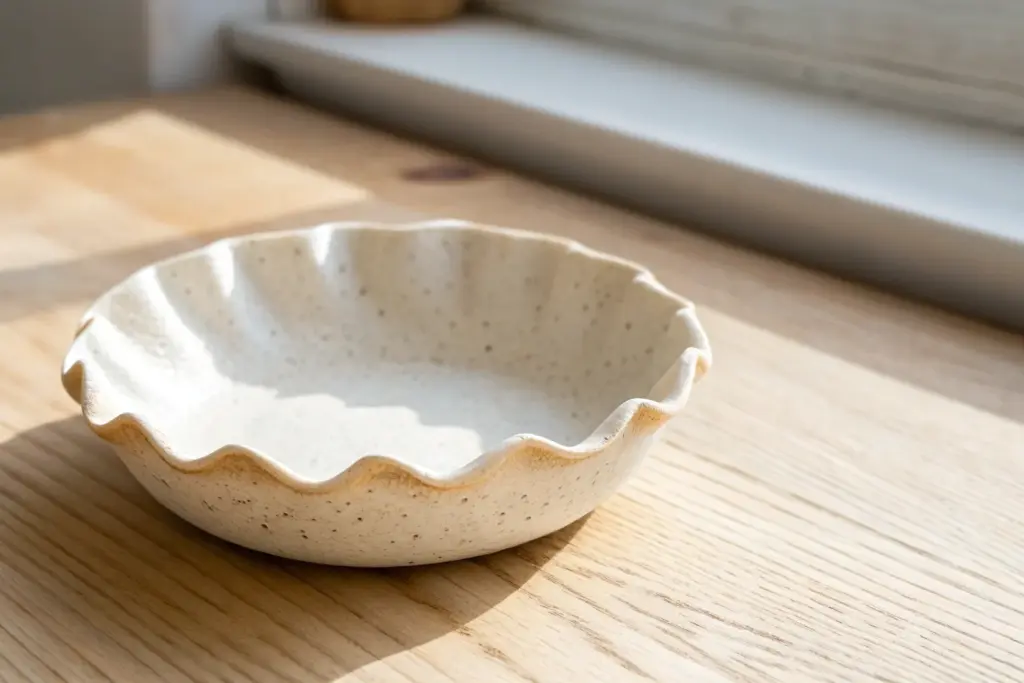
If you love the look of handmade pottery but want something lightweight and easy to shape, paper clay is going to be your new best friend. I keep a batch around because it’s forgiving, dries strong, and turns simple scraps into seriously cute decor.
Simple Paper Clay Pinch Bowls
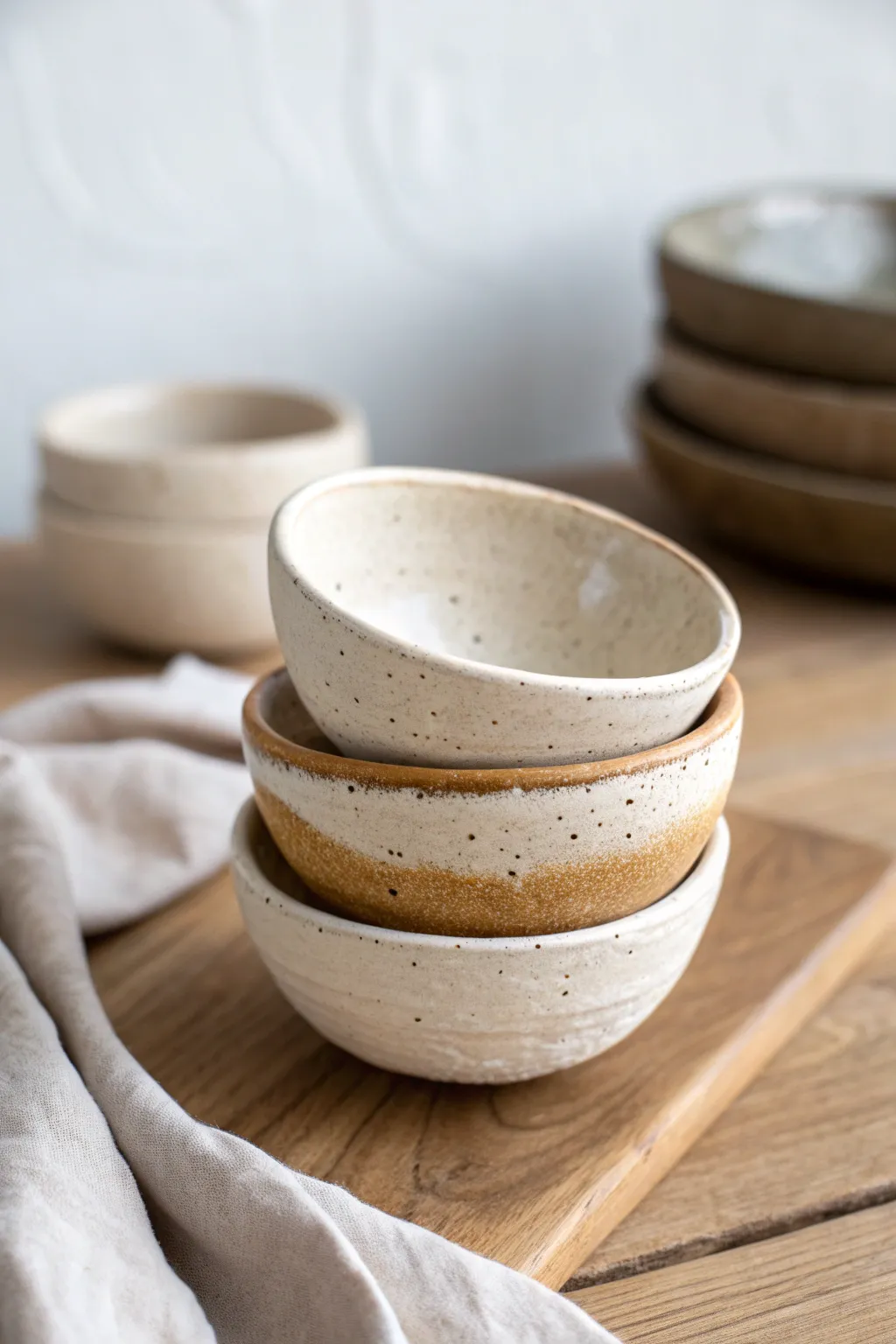
Achieve the organic warmth of wheel-thrown stoneware without a kiln using this versatile paper clay technique. Steps such as adding coffee grounds for texture and layering paint create a convincing ceramic-like stack that is perfect for holding trinkets or dry goods.
Detailed Instructions
Materials
- Air-dry paper clay (white or cream)
- Dried coffee grounds (used or fresh, fine grind)
- Small bowl of water
- Sponge
- Fine-grit sandpaper (220 grit)
- Acrylic paints (Cream, Burnt Sienna, Raw Umber, White)
- Matte finishing varnish or sealant
- Paintbrushes (soft bristle)
- Old toothbrush (for speckling)
Step 1: Prepping and Shaping
-
Prepare the clay:
Begin by taking a handful of paper clay and kneading it to improved pliability. If you want built-in texture, knead a teaspoon of dried coffee grounds directly into the white clay body now, or save them for surface decoration later. -
Form the ball:
Roll the clay into a smooth, tight sphere about the size of a tennis ball. Ensure there are no major cracks or seams by smoothing the surface with a slightly damp finger. -
Start the pinch:
Hold the sphere in one hand and gently press your thumb into the center, stopping about a half-inch from the bottom to leave a sturdy base. -
Shape the walls:
Rotate the ball slowly while pinching the clay between your thumb and fingers. Work your way from the bottom up, aiming for an even thickness of roughly 1/4 inch throughout the walls. -
Refine the rim:
The rim often gets thin or uneven during pinching. Gently tap the rim upside down on your work surface to flatten it slightly, then smooth the edge with a damp sponge for a professional, rounded look. -
Smooth the exterior:
Wet your fingers slightly and run them over the exterior and interior surfaces to erase fingerprints. I find that a soft, damp sponge works wonders here to get that ‘thrown’ pottery smoothness.
Smoother Surfaces
Keep a small bowl of water nearby while pinching. If the clay starts to crack at the edges, immediately smooth it over with a wet finger to re-bond the fibers.
Step 2: Drying and Sanding
-
Let it dry:
Place your bowls on a wire rack to air dry. This usually takes 24-48 hours depending on humidity. Rotate them occasionally so the bottoms dry evenly. -
Check for cracks:
Once fully dry (cool to the touch usually means it’s still wet), inspect for cracks. Fill any small fissures with a slip made of fresh clay mixed with a little water. -
Sand the surface:
Use 220-grit sandpaper to buff the entire bowl. Focus on the rim and any bumps on the exterior. Wipe away the dust with a barely damp cloth.
Waterproofing
Paper clay isn’t food safe or waterproof naturally. To make these usable for dry snacks, use a food-safe resin as your final coat (check labels carefully).
Step 3: Painting and Finishing
-
Base coat:
Mix a warm Cream acrylic paint with a tiny dot of Raw Umber to create an off-white stoneware color. Apply two coats to the entire bowl, letting it dry between layers. -
Create the dipped effect:
For the two-tone bowl shown in the middle of the stack, mix Burnt Sienna with a touch of Golden Ochre. Paint the bottom half of the bowl, allowing the top edge of this color band to be slightly organic and wavy. -
Add faux texture:
To mimic the speckled clay body, dilute a tiny amount of Raw Umber paint with water. Dip an old toothbrush into this mixture and run your thumb over the bristles to flick tiny specks onto the bowls. -
Layer the specks:
Repeat the splatter technique with diluted White paint, especially over the darker bottom section, to add depth and realism to the ‘glaze’ effect. -
Highlight the rim:
Use a dry brush with a very small amount of Burnt Sienna to lightly graze the rim of the bowls. This mimics the way glaze often breaks/thins at the edge of fired pottery. -
Seal the work:
Apply a coat of matte varnish to protect the surface. Paper clay is porous, so a good sealant is crucial if you want them to be durable. -
Final drying:
Allow the varnish to cure completely according to the manufacturer’s instructions before stacking or using your new bowls.
Enjoy styling these beautifully rustic bowls on your coffee table or shelves.
Textured Paper Clay Ring Dishes
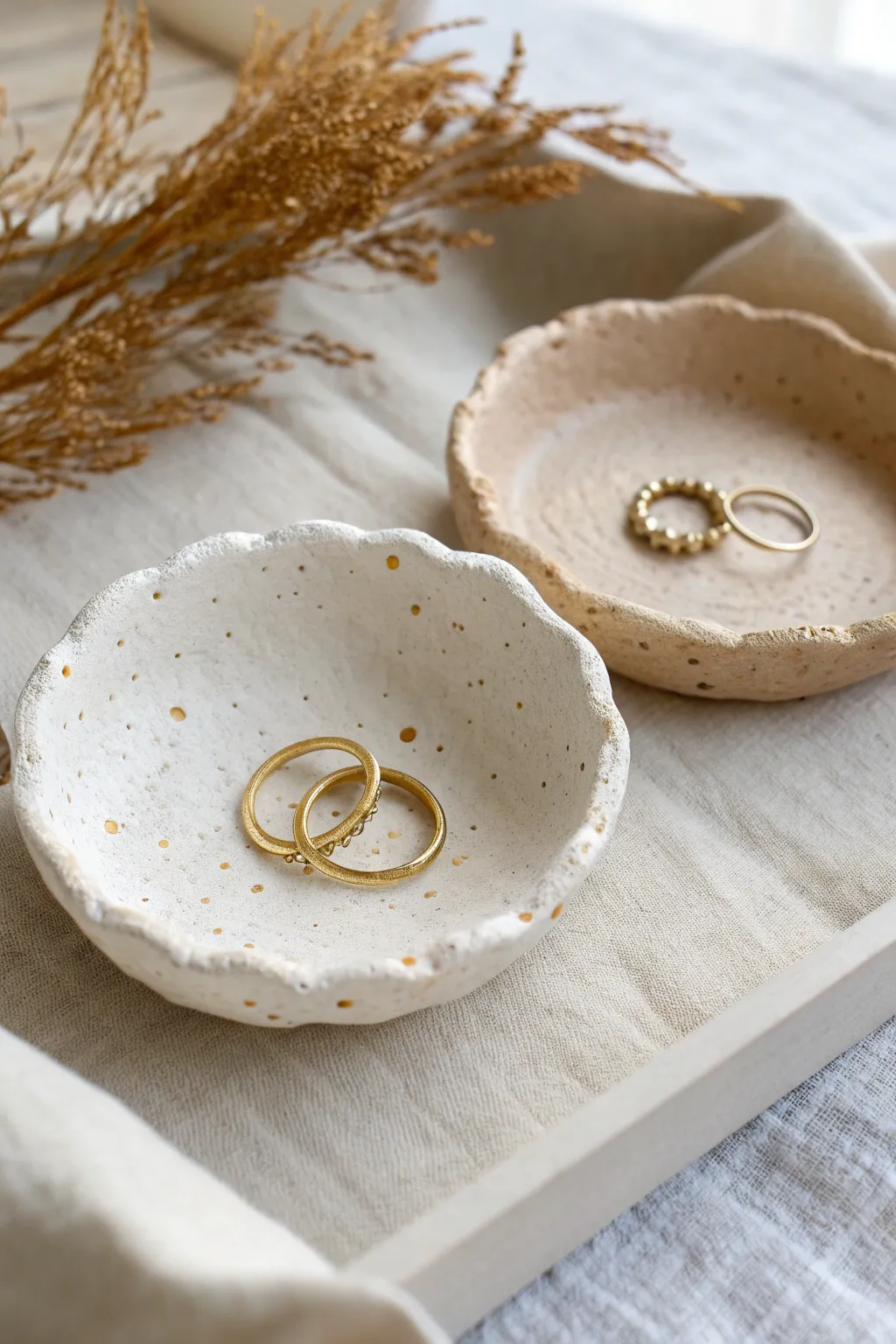
These charmingly imperfect trinket dishes combine the raw, organic texture of paper clay with elegant touches of gold. They are lightweight yet durable, featuring hand-formed ruffled edges and subtle speckling that makes each piece entirely one-of-a-kind.
How-To Guide
Materials
- Air-dry paper clay (white)
- Small bowl or sphere (for molding)
- Plastic wrap
- Rolling pin
- Fine-grit sandpaper (220 grit)
- Acrylic paint (warm beige or terracotta for the second dish)
- Gold metallic paint or liquid gold leaf
- Small, stiff bristle brush or toothbrush (for splattering)
- Clear matte varnish or sealant
- Detail paintbrush
- Water and sponge
Step 1: Shaping the Clay
-
Prepare your clay:
Start by grabbing a handful of air-dry paper clay. Knead it in your hands for a minute to warm it up and ensure it’s pliable and free of air bubbles or dry clumps. -
Roll it out:
On a clean, flat surface, roll the clay out to a thickness of about 1/4 inch. You want it substantial enough to be sturdy but thin enough to look delicate. -
Create the circle:
Use a round cookie cutter or the rim of a drinking glass to cut out a circle. Don’t worry if the edges get a bit messy; we want an organic look. -
Prepare the mold:
Take a small bowl or a styrofoam ball and cover it tightly with plastic wrap. This prevents the clay from sticking to your mold as it dries. -
Form the dish:
Gently drape your clay circle over the bottom of your wrapped mold. Press it down lightly to take the curved shape, smoothing the center with your palm.
Keep it clean
Paper clay picks up dust easily. Keep a damp sponge nearby to wipe your hands constantly while shaping to keep the white clay pristine.
Step 2: Texturing and Refining
-
Create the rim:
Using your fingertips, gently pinch and push the edges of the clay upward and slightly outward. Create an uneven, wavy pattern to mimic the natural look seen in the photo. -
Add surface texture:
To get that specific pitted texture, take an old toothbrush or a crumpled ball of aluminum foil relative to the scale of the dish and press it gently into the wet clay surface repeatedly. -
Poke details:
For deeper pores, use a toothpick or a needle tool to randomly poke small holes into the surface. Don’t go all the way through; just create small divots for visual interest. -
Dry completely:
Leave the clay on the mold for at least 24 hours. Once the outside feels dry, carefully pop it off the mold and let the inside dry for another 12-24 hours until fully hardened. -
Sand edges:
Once fully dry, take your fine-grit sandpaper and very gently smooth the rim. You don’t want to remove the wavy shape, just take off any sharp or snaggy bits.
Step 3: Painting and Finishing
-
Base coat (Optional):
For the beige dish, mix a drop of brown acrylic into white paint to create a warm stone color. Paint the entire dish, front and back, and let it dry. For the white dish, you can leave the raw clay or seal it with white gesso. -
Prepare the splatter:
Squeeze a small amount of liquid gold leaf or metallic gold paint onto a palette. If you are using acrylic, thin it slightly with a drop of water so it flows easily. -
Create the speckles:
Dip a stiff brush or toothbrush into the gold. Hold it over the dish and flick the bristles with your thumb to spray fine gold droplets across the interior. -
Add larger spots:
For the more prominent gold dots seen in the white dish, use the back end of a small paintbrush dipped in gold to dot specific areas intentionally. -
Seal the work:
Once the paint is completely dry, apply a coat of matte varnish. This seals the porous paper clay and protects your jewelry from any rough texture.
Try a watercolor wash
Before splattering gold, add a very watery wash of diluted brown paint into the textures and wipe it back to make the details pop.
Place your favorite rings inside to see how the gold highlights gently catch the light
Leaf-Imprint Paper Clay Trinket Trays
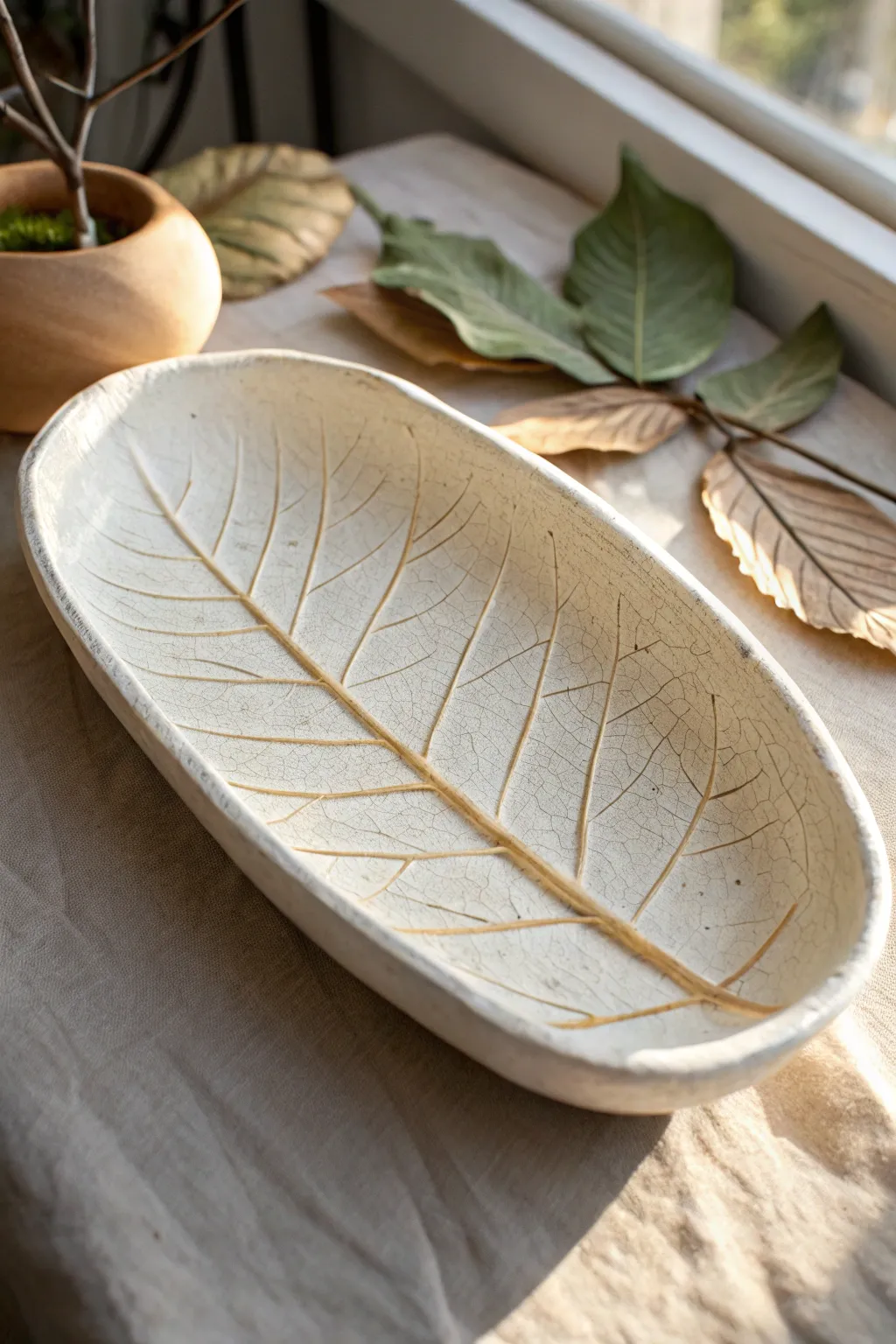
Capture the delicate beauty of nature in this rustic, long oval trinket dish. With its realistic vein textures and subtle antique staining, it makes for a perfect organic accent piece or a thoughtful handmade gift.
Step-by-Step Tutorial
Materials
- White paper clay (air-dry)
- Small rolling pin
- Large, fresh leaf with prominent veins (like Walnut, Hickory, or Magnolia)
- Craft knife or scalpel
- Small bowl relative to your leaf size (for shaping)
- Sandpaper (fine grit)
- Brown acrylic paint or antiquing medium
- Water
- Paper towels or soft rag
- Small paintbrush
- Matte varnish or sealant
Step 1: Preparing the Clay Slab
-
Condition the clay:
Begin by kneading a handful of paper clay until it is warm, pliable, and free of cracks. -
Initial rolling:
Roll the clay out into an oval shape on a smooth, non-stick surface or canvas cloth. aim for a thickness of about 1/4 inch (6mm). -
Smooth the surface:
Rub a tiny amount of water over the surface of the clay with your finger to remove any small wrinkles or textures from the rolling pin.
Vein Definition Tip
If your fresh leaf isn’t stiff enough to leave a mark, putting it in the freezer for 10 minutes can harden the veins just enough for a sharper impression.
Step 2: Creating the Impression
-
Position the leaf:
Place your chosen leaf face-down onto the center of the clay slab. The underside of the leaf usually has the most prominent veins, which gives the best impression. -
Pressing the texture:
Gently roll your rolling pin over the leaf. Apply firm, even pressure to push the veins deep into the paper clay without thinning the slab too much. -
Check the depth:
Carefully lift one edge of the leaf to peek at the impression. If the lines are faint, lay it back down and press harder with your fingertips along the vein lines. -
Remove the botanical:
Slowly peel the leaf away from the clay to reveal the intricate skeletal pattern.
Step 3: Shaping and Curing
-
Cut the perimeter:
Using a craft knife, cut a clean oval shape around the leaf impression, leaving about a half-inch border of smooth clay around the textured area. -
Soften the edges:
Dip your finger in water and run it along the cut rim of the clay to round off the sharp edges. -
Form the curve:
Lift the oval slab and drape it inside a shallow bowl or a curved form to give it a slightly cupped, dish-like shape. -
Drying time:
Allow the clay to dry completely in a warm, dry spot. I usually give this at least 24-48 hours, flipping it carefully halfway through to ensure the bottom dries too. -
Refining:
Once bone dry, lightly sand the rim and bottom with fine-grit sandpaper to remove any roughness.
Gilded Upgrade
Instead of brown paint, fill the vein impressions with gold metallic liquid leaf or wax paste for a luxurious, high-end jewelry store aesthetic.
Step 4: Finishing Touches
-
Create a wash:
Mix a small amount of brown acrylic paint with water (about a 1:4 ratio) to create a watery stain. -
Apply the color:
Brush the watery brown wash over the entire textured area, ensuring the liquid flows into the deep recesses of the leaf veins. -
Wipe back:
Immediately wipe the high points of the surface with a damp paper towel. The paint will stay trapped in the veins, highlighting the pattern, while the rest remains mostly white. -
Detail the rim:
Use a nearly dry brush with a tiny bit of un-watered brown paint to distress the very edge of the rim for a rustic look. -
Seal the piece:
Protect your tray by applying two thin coats of matte varnish, allowing it to dry fully between applications.
Place your new tray on a dresser or windowsill to enjoy its organic charm every day
Scalloped-Edge Paper Clay Catchall Dish
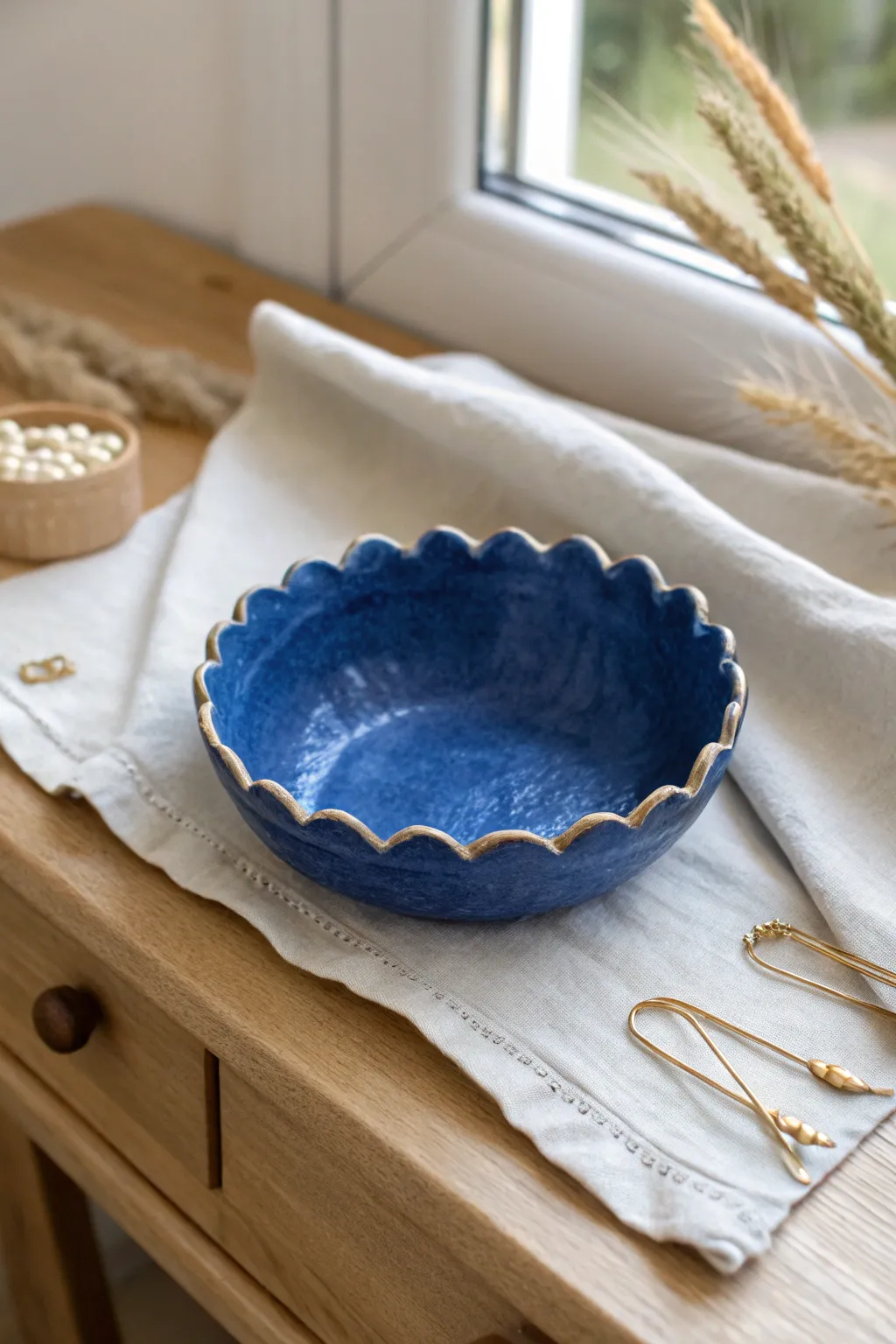
Transform humble paper clay into this stunning, organic catchall dish featuring a deep lapis lazuli hue. The hand-formed scalloped edge and gilded rim give it an upscale, artisanal pottery feel without requiring a kiln.
Step-by-Step Guide
Materials
- Air-dry paper clay (white)
- Rolling pin
- Medium-sized bowl (to use as a mold)
- Plastic wrap
- Round cookie cutter or drinking glass (approx. 1-1.5 inches diameter)
- Craft knife or clay tool
- Sanding sponge (fine grit)
- Acrylic paint (Deep royal blue/Cobalt)
- Gesso (optional but recommended)
- Gold leaf paint or liquid gilding
- Small flat paintbrush
- Fine liner brush
- Gloss varnish or sealant
Step 1: Shaping the Base
-
Prepare the workspace:
Lay down a non-stick mat or parchment paper to prevent sticking. Take a large ball of paper clay and knead it briefly until it is pliable and smooth. -
Roll out the slab:
Using your rolling pin, roll the clay out into an even circle. Aim for a thickness of about 1/4 inch (4-5mm). If you want a more rustic texture like the example, don’t worry about getting it perfectly smooth. -
Size the disc:
Place your bowl upside down on the clay to gauge the size. Cut a rough circle about 2 inches wider than the bowl’s rim to allow for the dish depth. -
Create the scalloped edge:
Using a small round cookie cutter or the rim of a small glass, press half-circles along the outer edge of your clay disc. Work your way around the entire circumference until you have a continuous flower-like shape. -
Refine the cuts:
Remove the excess clay from between the scallops. Use a finger dipped in a little water to smooth any sharp, jagged edges created by the cutter.
Step 2: Forming and Drying
-
Prepare the mold:
Cover the outside of your mold bowl with plastic wrap. This ensures the clay won’t stick to the bowl as it dries. -
Drape the clay:
Carefully lift your scalloped clay disc and drape it over the upside-down bowl. Gently press the center down so it conforms to the bowl’s shape. -
Adjust the scallops:
As the clay drapes, the scallops might flatten against the bowl. Gently flare them outward slightly with your fingers to maintain that open, flower-petal look seen in the photo. -
Initial dry time:
Let the clay sit on the mold for about 24 hours. I like to place it in a cool, dry spot away from direct sunlight to prevent cracking. -
Remove from mold:
Once the outside feels firm to the touch, carefully pop it off the bowl and peel away the plastic wrap. The inside will likely still be damp. -
Finish drying:
Flip the dish right-side up and let it continue drying for another 12-24 hours until it is bone dry and turns a bright white color.
Smooth Operator
Use a damp sponge to smooth the raw clay edges before it dries. It’s much easier to fix imperfections on wet clay than to sand them out of dry paper clay.
Step 3: Color and Details
-
Sand the surface:
Use a fine-grit sanding sponge to gently smooth the rim and any rough patches on the interior. Wipe away all dust with a slightly damp cloth. -
Prime with Gesso:
Apply a coat of white gesso to seal the paper clay. This helps the blue paint adhere evenly and prevents the porous clay from soaking up too much pigment. -
Apply base color:
Paint the entire dish—inside and out—with your deep royal blue acrylic paint. You will likely need 2-3 coats for full opacity, letting each coat dry completely in between. -
Add texture (optional):
To mimic the stone-like texture in the photo, dab the wet paint with a dry sponge or crumpled paper towel before it dries completely. -
Paint the rim:
Dip a fine liner brush into liquid gold gilding. Carefully paint the very edge of the scallops. Allow the gold to travel slightly over the lip onto the inside and outside edges for a clearer definition. -
Varnish:
Once all paint is fully cured, apply a coat of gloss varnish. This deepens the blue color, protects the finish, and gives it a ceramic-like sheen.
Speckled Finish
Before varnishing, dip a toothbrush in diluted white or black paint and flick it over the blue surface for a trendy stoneware pottery speckle effect.
Place your new dish on a console table to hold jewelry or keys and enjoy the pop of color

The Complete Guide to Pottery Troubleshooting
Uncover the most common ceramic mistakes—from cracking clay to failed glazes—and learn how to fix them fast.
Mini Paper Clay Pots for Desk Storage
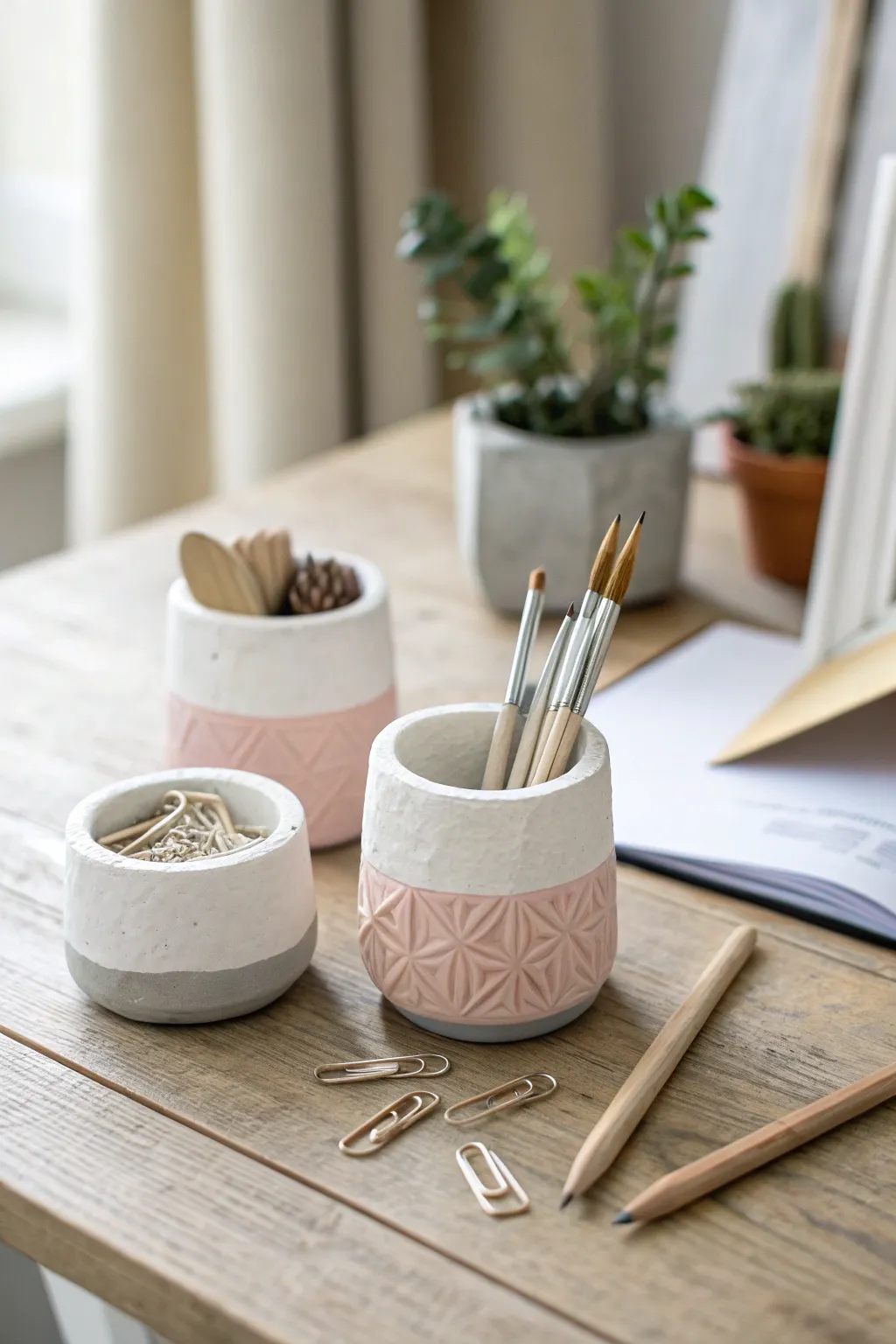
Bring clarity and calm to your workspace with this set of dual-tone storage pots crafted from durable paper clay. Featuring a white upper finish and textured pastel bases, these vessels are perfect for corralling brushes, pins, and small stationery items.
Step-by-Step
Materials
- Air-dry paper clay package (white)
- Small rolling pin
- Geometric texture mat or detailed stamp
- Cookie cutters or round forms (various diameters)
- Small knife or clay tool
- Sanding sponge (fine grit)
- Acrylic paints: white, soft pink, light grey
- Paintbrushes: medium flat brush and fine detail brush
- Painter’s tape
- Clear matte varnish or sealant
- Water cup and sponge for smoothing
Step 1: Prepping and Rolling the Clay
-
Condition the clay:
Begin by taking a generous amount of paper clay and kneading it in your hands until it feels warm, pliable, and free of cracks. -
Roll the base sheet:
Roll your clay out on a smooth, non-stick surface until it is approximately a quarter-inch thick, ensuring an even consistency throughout. -
Add texture:
Press your geometric texture mat firmly into the rolled clay surface to imprint the diamond or star pattern shown on the pink pots.
Step 2: Constructing the Vessels
-
Cut the walls:
Using a ruler and knife, cut rectangular strips from your textured clay; the length should equal the circumference of your desired pot size. -
Form the cylinder:
Wrap a clay strip around a temporary form (like a jar or tube wrapped in parchment paper) to create the cylindrical wall. -
Join the seam:
Score the overlapping edges, add a dab of water, and blend the seam together smoothly; try to hide the join within the textured pattern if possible. -
Create the base:
Roll a separate piece of untextured clay and use a round cutter to create a circle that matches your cylinder’s diameter. -
Attach the bottom:
Score the bottom edge of your cylinder and the edge of the circle base, then press them together firmly. -
Smooth the interior:
Reaching inside, use a slightly damp finger or modeling tool to smooth the connection point between the wall and the floor so it is water-tight and sturdy. -
Refine the rim:
Trim the top rim with your knife to ensure it is level, then soften the sharp edge with a wet fingertip.
Seamless Merges
When joining the clay seam, use a ‘slip’ mixture (clay dissolved in a little water) as glue. This creates a much stronger bond than water alone.
Step 3: Finishing and Painting
-
Dry thoroughly:
Allow the pots to air dry completely for 24-48 hours; turn them occasionally to ensure air reaches the bottom. -
Sand imperfections:
Once bone dry, use a fine-grit sanding sponge to smooth the top rim and any rough patches on the interior. -
Base coat interior:
Paint the inside of the pots white to give a clean, finished look. -
Tape the design:
Apply painter’s tape horizontally around the middle of the pot to create a crisp line separating the top and bottom sections. -
Paint the upper section:
Apply white acrylic paint to the top half of the exterior, using two coats if necessary for full opacity. -
Paint the textured base:
Remove the tape carefully, then tape over the dried white section; paint the bottom textured area with your soft pink or grey mixture, dabbing paint into the geometric grooves. -
Highlighting (Optional):
If you want the texture to pop, very lightly dry-brush a slightly lighter shade over the raised geometric details. -
Seal the work:
Protect your desk organizers with a coat of clear matte varnish to prevent scuffs and moisture damage.
Gradient Effect
Instead of a harsh line, use a sponge to dab the pink paint slightly upward into the white section for a soft, trendy ombré transition.
Arrange your brushes and clips inside your new pots to instantly declutter your creative space
Paper Clay Planter Covers for Small Pots
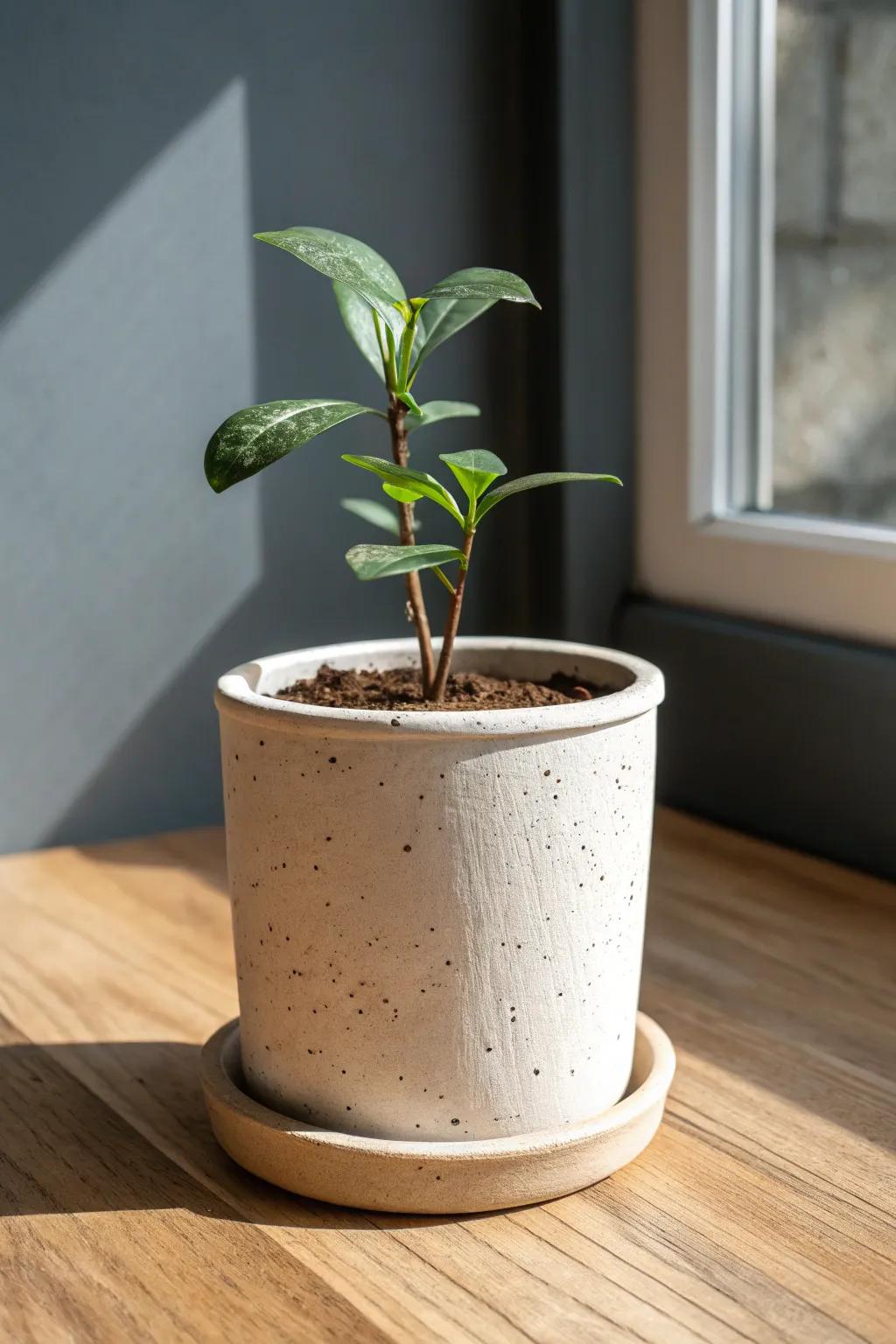
Transform a plain plastic nursery pot or a small glass jar into a chic, minimalist planter that mimics the look of high-end speckled ceramic stoneware. This project uses paper clay modeling to add structure and texture, finished with a clever splatter technique to achieve that trendy granite aesthetic.
Detailed Instructions
Materials
- Paper clay (air-dry)
- Small plastic nursery pot or glass jar (as a base)
- Rolling pin
- Craft knife
- Small bowl of water
- Sanding sponge (fine grit)
- White acrylic paint (matte)
- Black acrylic paint
- Stiff bristle brush or old toothbrush
- Matte spray varnish or sealant
- Clay sculpting tool or butter knife
Step 1: Preparation and Base Layer
-
Clean your base:
Begin by thoroughly cleaning and drying the plastic nursery pot or glass jar you are using as your armature. This ensures the clay adheres properly without sliding off. -
Condition the clay:
Take a large handful of paper clay and knead it until it is soft, pliable, and free of cracks. If it feels too dry, dip your fingers in water and work the moisture in. -
Roll out a slab:
Use your rolling pin to flatten the clay into a long, rectangular slab. Aim for a thickness of about 1/4 inch, ensuring it is long enough to wrap entirely around the circumference of your base pot. -
Wrap the pot:
Carefully lift the clay slab and wrap it around the exterior of your pot. Press it firmly against the surface to eliminate air pockets.
Uneven Splatter?
If you get a large, unwanted black blob, quickly dab it gently with a dry paper towel while wet. Once dry, just touch it up with a tiny bit of white paint.
Step 2: Sculpting the Form
-
Create the seam:
Where the two ends of the clay meet, overlap them slightly and use your craft knife to cut a straight vertical line through both layers. Remove the excess clay pieces. -
Join the edges:
Score the cut edges with a sculpting tool, apply a dab of water, and press them together. Smooth the seam with your finger until it is invisible. -
Build the rim:
At the top of the pot, you might notice the clay is uneven. Fold the excess clay over the rim of the base pot, pressing it down inside to create a clean, finished lip. Smooth this top edge with a wet finger to round it off. -
Refine the shape:
Roll the pot gently on your work surface to ensure the sides are straight. I find using a wet sponge here helps burnish the surface and removes any prominent fingerprints. -
Check the bottom:
Ensure the bottom edge of the clay is flush with the base of the pot so it sits flat. If using a nursery pot with drainage holes, make sure you haven’t accidentally blocked them with clay.
Step 3: Finishing and Painting
-
The drying phase:
Let the pot dry completely. This usually takes 24-48 hours depending on humidity. Rotate the pot occasionally so all sides dry evenly. -
Sand for smoothness:
Once fully dry and hard, use a fine-grit sanding sponge to gently buff the surface. Focus on the rim and the vertical seam to make it feel like polished stone. -
Wipe down:
Use a slightly damp cloth to remove all clay dust created by sagging steps before you start painting. -
Apply base coat:
Paint the entire exterior (and the inner rim) with matte white acrylic paint. You may need two coats to get a solid, opaque finish that hides the clay’s natural color. -
Prepare the speckle:
Dilute a small amount of black acrylic paint with water. It should be the consistency of ink or heavy cream—thin enough to fly off a brush but thick enough to hold color. -
Splatter technique:
Dip a stiff bristle brush or old toothbrush into the black mixture. Hold it about 6 inches from the pot and use your thumb to flick the bristles, spraying fine droplets onto the white surface. -
Vary the texture:
Rotate the pot as you splatter to ensure even coverage. Don’t worry if some spots are larger than others; this irregularity mimics natural stone perfectly. -
Seal the work:
Allow the paint to dry completely. Finally, spray the entire piece with a matte varnish to protect the surface from moisture during watering.
Matching Saucer
Don’t stop at the pot! Use leftover clay to form a shallow disc. Press the pot into it to size it, let dry, and paint with the same technique for a matching set.
Now you have a custom, modern planter ready to house your favorite cutting or succulent


What Really Happens Inside the Kiln
Learn how time and temperature work together inside the kiln to transform clay into durable ceramic.
Minimal Paper Clay Bud Vases
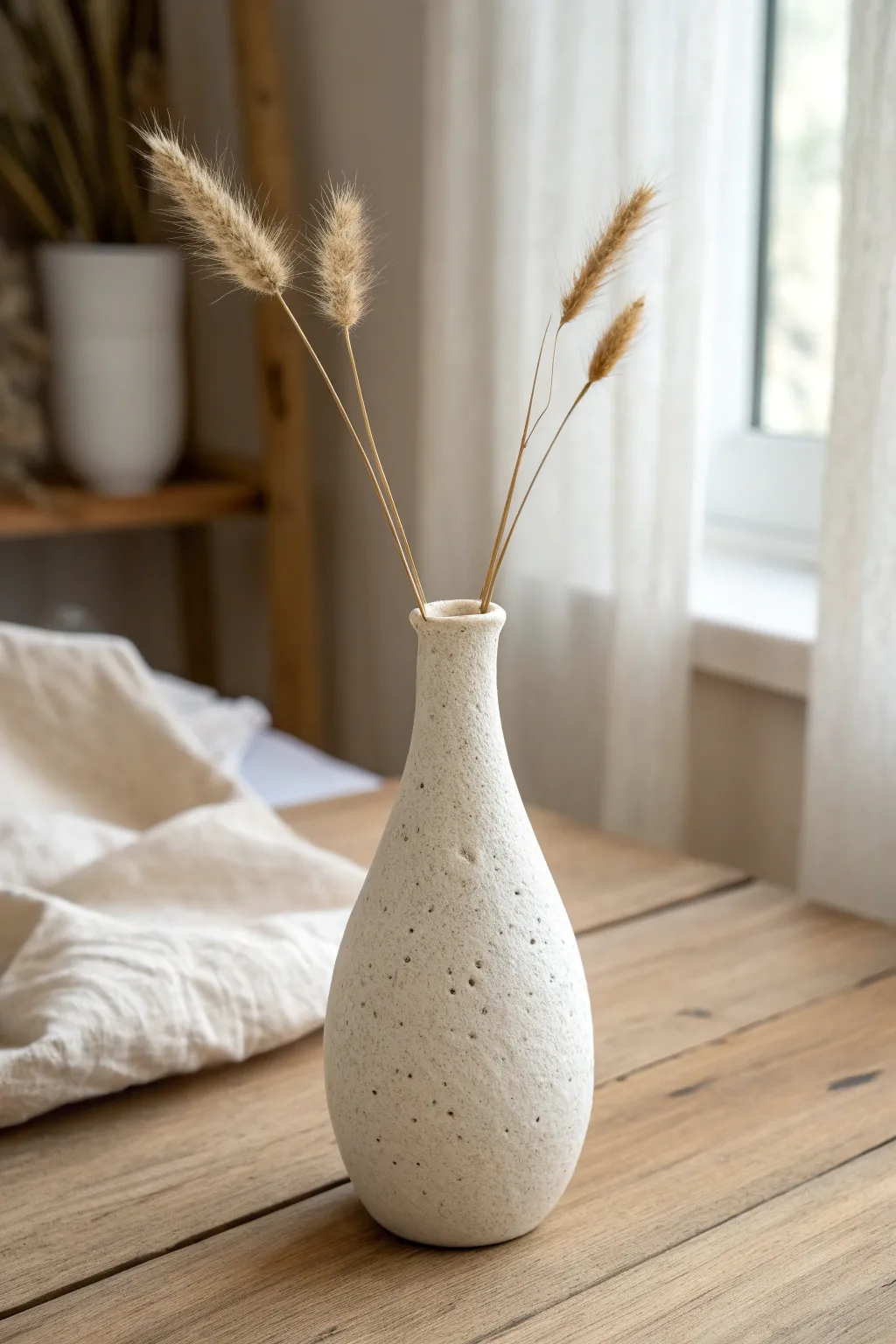
Capture the organic beauty of ceramic stoneware without needing a kiln using simple paper clay. This project results in a beautifully textured, teardrop-shaped bud vase with a faux-stone finish perfect for displaying dried botanicals.
Step-by-Step
Materials
- Air-dry paper clay (white)
- Small glass bottle or narrow jar (armature)
- Acrylic paints (warm white, beige, dark brown/black)
- Rolling pin
- Parchment paper
- Water in a small cup
- Craft knife or clay tool
- Old toothbrush
- Fine-grit sandpaper (220 grit)
- Matte varnish or sealant
Step 1: Forming the Base
-
Prepare the Armature:
Select a tall, narrow glass bottle to serve as the internal structure, which ensures the vase is watertight and stable. Clean and dry the exterior thoroughly before beginning. -
Roll the Clay:
Take a large handful of paper clay and knead it briefly to wake up the fibers. Roll it out on parchment paper into a slab approximately 1/4 inch thick. -
Wrap the Bottle:
Cut a rectangle from the slab that is tall enough to cover the bottle and wide enough to wrap around it. Gently lift the clay and wrap it around the glass armature. -
Seal the Seam:
Where the clay edges meet, score the edges with a craft knife and apply a dab of water. Press them together firmly and smooth the seam with your thumb until it disappears. -
Shape the Neck:
Extend the clay slightly past the top of the bottle rim. Pinch and curve this excess clay inward to create a tapered neck that hides the glass lip, smoothing it downwards for a seamless transition.
Cracked Clay?
Paper clay shrinks as it dries. If cracks appear, mix a small amount of fresh clay with water to make a paste (slip) and fill the cracks, then smooth over.
Step 2: Sculpting the Silhouette
-
Build the Bulb:
To create the teardrop shape shown in the photo, add extra clay to the bottom third of the vase. Roll a thick coil of clay and blend it onto the lower section to bulk it out. -
Smooth the Transition:
Use a little water on your fingers to drag the clay from the bulky bottom upwards, creating a gradual slope. The goal is a heavy bottom that tapers elegantly into a slender neck. -
Refine the Surface:
Dip your fingers in water and run them over the entire surface. While we want texture later, the base form should be lump-free and symmetrical. -
Add Texture:
Before the clay dries, take a crumpled ball of aluminum foil or a stiff bristle brush and gently press it randomly into the surface to create a pitted, organic stone texture. -
Initial Drying:
Let the vase sit undisturbed for 24-48 hours. I find placing it away from direct heat prevents cracking. Rotate it occasionally so all sides dry evenly.
Natural Hues
Mix dried tea leaves or coffee grounds directly into the wet clay before sculpting. As it dries, these organic bits create natural, embedded texture.
Step 3: Faux Stone Finish
-
Sand Imperfections:
Once fully bone dry, lightly sand any sharp ridges or awkward bumps with fine-grit sandpaper. Wipe away the dust with a slightly damp cloth. -
Base Coat:
Mix a warm white acrylic paint with a tiny drop of beige. Apply an even coat over the entire vase to seal the paper clay and provide a uniform color. -
Create the Speckle Mix:
Dilute a small amount of dark brown or black acrylic paint with water until it is very runny, almost like ink. -
Splatter Technique:
Dip an old toothbrush into the watered-down dark paint. Holding the brush near the vase, run your thumb across the bristles to flick tiny speckles onto the surface. -
Vary the Density:
Rotate the vase as you splatter. Allow some areas to have denser speckling than others to mimic natural granite or sandstone. -
Seal the Work:
After the paint is completely dry, apply a coat of matte varnish. This protects the finish and gives it that soft, ceramic feel.
Place your favorite dried grasses inside and enjoy the calm, earthy vibe this piece adds to your space
Boho Paper Clay Wall Hanging Shapes
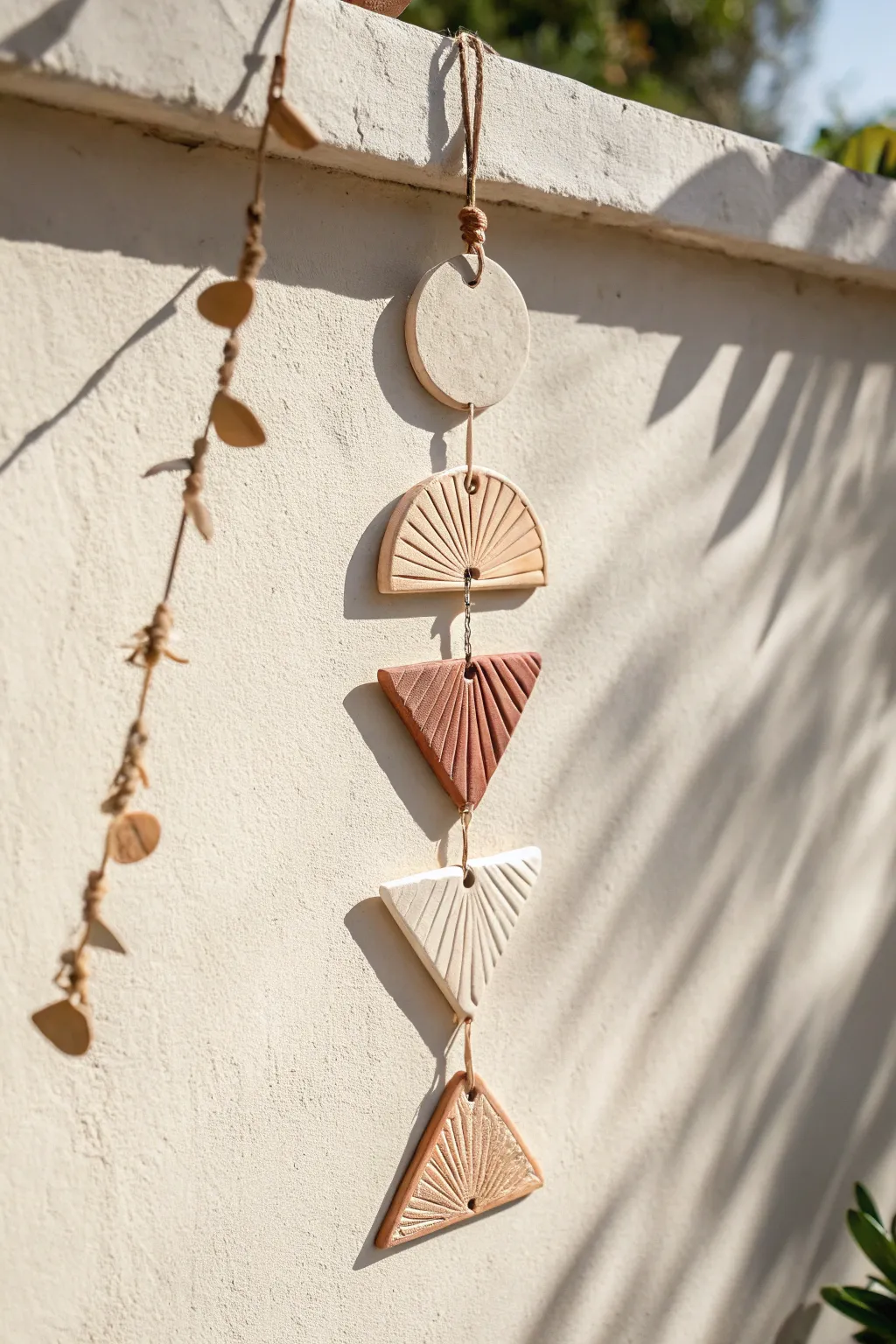
Bring a touch of desert warmth to your space with this textured boho wall hanging. Simple geometric clay shapes, etched with sunburst lines and strung on natural jute, create a relaxed and earthy piece of art.
Step-by-Step Guide
Materials
- Paper clay or air-dry clay (white/neutral base)
- Acrylic paints (terracotta, cream, beige, light gold)
- Rolling pin
- Parchment paper or canvas mat
- Cookie cutters or templates (circle, semi-circle, triangles)
- Needle tool or toothpick
- Straw or small dowel (for holes)
- Fine-grit sandpaper
- Natural jute twine or hemp cord
- Small paintbrush
- Scissors
Step 1: Shaping the Clay Elements
-
Prepare your workspace:
Lay down parchment paper or a canvas mat to prevent the clay from sticking. Tape the corners down so it doesn’t shift while you work. -
Roll out the slab:
Take a generous handful of paper clay and knead it briefly until pliable. Roll it out to an even thickness of about 1/4 inch. For a uniform look, you can place guide strips of wood on either side of your roller. -
Cut the basic shapes:
Cut out your main five shapes. You will need one medium circle, one semi-circle, and three equal-sized triangles. Use cookie cutters if you have them, or simply cut around paper templates with a craft knife. -
Pierce the hanging holes:
Using a straw or a small dowel, poke holes for connecting the pieces. The top circle needs holes at the top and bottom. The semi-circle and the middle triangle need holes at the center top and center bottom edges. The bottom triangle only needs a hole at the top. -
Smooth the edges:
Dip your finger in a little water and gently run it along the cut edges of each shape to soften any sharpness or stray clay bits.
Warped Clay?
If your pieces start curling up while drying, place a heavy book on top of them once they are partially dry (leather-hard) to flatten them back out.
Step 2: Adding Texture and drying
-
Etch the sunbursts:
The charm of this piece lies in the texture. Using a needle tool or toothpick, gently carve radiating lines into the semi-circle and the three triangles. Start from the point where the hole is (or the flat edge for the semi-circle) and fan outwards like sun rays. Leave the top circle plain. -
Dry the pieces:
Let the shapes dry completely on a flat surface. Depending on humidity and clay thickness, this usually takes 24-48 hours. Flip them occasionally to ensure even drying and prevent warping. -
Sand imperfections:
Once fully dry and hard, take a piece of fine-grit sandpaper and lightly buff the edges and surface. This cleans up any rough spots from the cutting phase.
Step 3: Painting and Finishing
-
Paint the base colors:
Decide on your palette. I like to keep the top circle natural or cream. Paint the semi-circle a soft beige or warm sand color. -
Add accent colors:
Paint the first inverted triangle a deep terracotta or rust color. Keep the middle inverted triangle a creamy white. For the bottom triangle, mix a beige with a hint of gold or light brown for subtle contrast. -
Highlight the etchings:
To make the carved lines pop, you can do a light wash. Mix a tiny bit of darker paint with water, brush it over the textured areas, and quickly wipe the surface with a paper towel. The darker paint will stay in the grooves. -
Seal the unexpected:
If you want extra durability, apply a matte varnish over all pieces. This preserves the matte, earthy look while protecting the clay.
Make it Shine
Mix a small amount of baking soda into your acrylic paint before applying. This creates a gritty, stone-like texture that looks like real ceramic pottery.
Step 4: Assembly
-
Start the main string:
Cut a long piece of jute twine, about 3 feet to be safe. Fold it in half to create a loop at the top for hanging, tying a knot about 3 inches down. This knot will sit just above the top circle. -
Thread the top circle:
Pass the two loose ends of the twine through the top hole of the circle, running them down the back and out through the bottom hole. -
Tie spacing knots:
Before adding the next shape, tie a simple overhand knot with the twine strands right below the circle to hold it in place. Measure about 1-2 inches of space, then tie another knot where the next shape creates a resting point. -
Attaching the semi-circle:
Thread the twine through the top hole of the semi-circle. Since this shape hangs horizontally, you might need to knot the twine above and below the hole to keep it level, or simply let it rest on a knot below. -
Connect the triangles:
Continue threading down through the inverted terracotta triangle, then the cream triangle, and finally the bottom beige triangle. Use knots between each shape to maintain consistent spacing. -
Create the side garland (optional):
For the leafy vine seen on the left, cut small leaf shapes from scrap clay. Poke holes in them, dry, and paint gold or brown. Knot them onto a separate vertical piece of twine at random intervals.
Hang your new mobile near a window where the light can catch the subtle textures of the clay.

TRACK YOUR CERAMIC JOURNEY
Capture glaze tests, firing details, and creative progress—all in one simple printable. Make your projects easier to repeat and improve.
Neutral Paper Clay Rainbow Decor
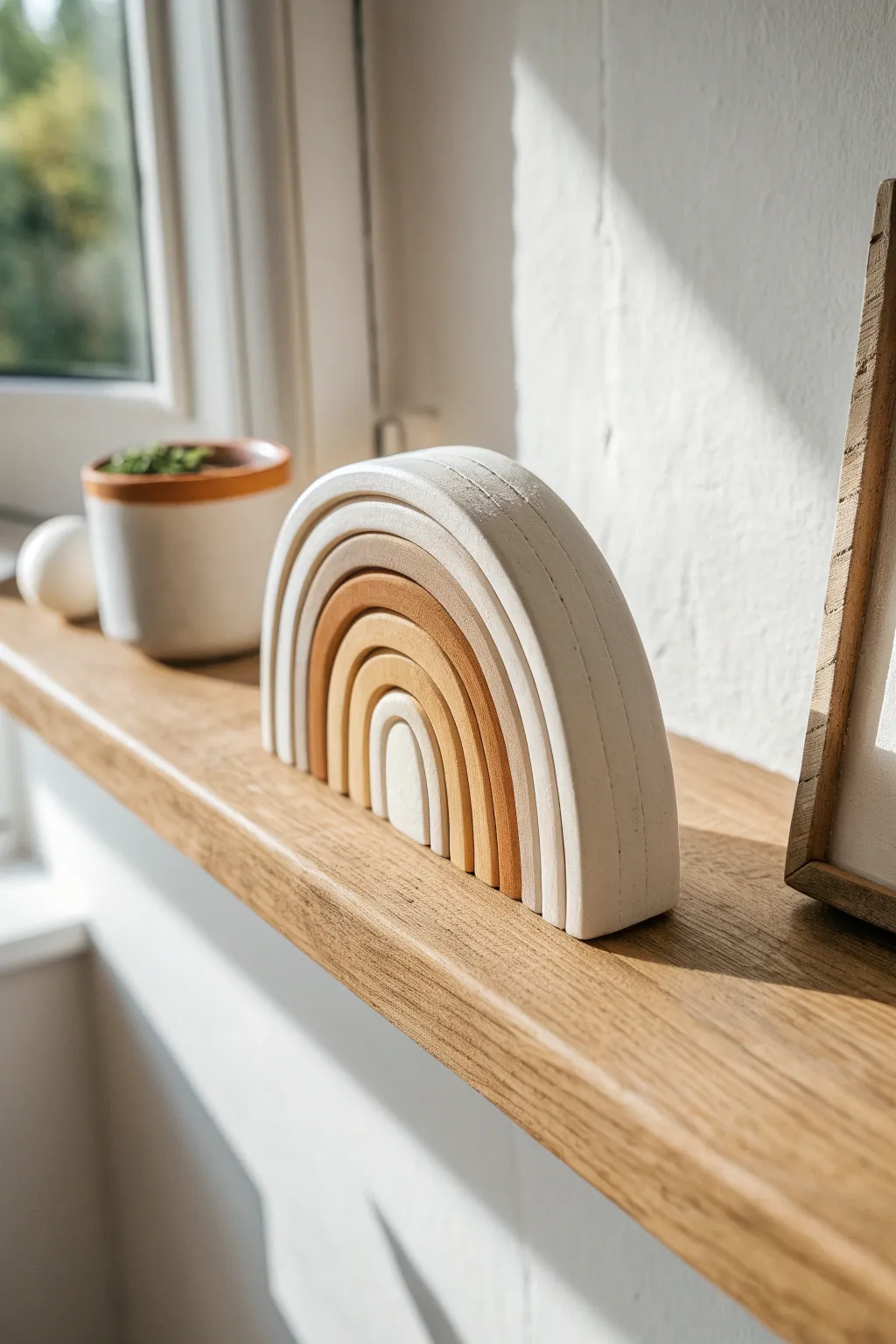
Embrace the calm of neutral tones with this minimalist rainbow sculpture that adds a touch of modern bohemian style to any shelf. Crafted from paper clay for a smooth, matte finish, this piece uses a palette of creams, tans, and terracotta to create warmth without overwhelming your space.
Step-by-Step
Materials
- Air-dry paper clay (white)
- Rolling pin
- Sharp crafting knife or X-Acto blade
- Ruler
- Parchment paper or silicone mat
- Small cup of water
- Fine-grit sandpaper (220-400 grit)
- Acrylic paints (White, Cream/Beige, Terracotta/Burnt Sienna, Tan)
- Flat paintbrushes (medium and small)
- Palette for mixing
- Matte varnish (optional)
Step 1: Shaping the Arches
-
Prepare your workspace:
Lay down parchment paper or a silicone mat on a flat surface. This prevents the clay from sticking and ensures the back of your rainbow remains smooth. -
Condition the clay:
Take a large chunk of paper clay and knead it in your hands for a minute until it feels soft and pliable. This removes air bubbles and makes it easier to roll. -
Roll out the slab:
Use your rolling pin to flatten the clay into a large slab. Aim for an even thickness of about 1/2 to 3/4 of an inch. You want it thick enough to stand up on its own once dry. -
Cut the base strip:
Using your ruler and craft knife, cut a long, straight strip of clay. This strip should be about 3/4 inch wide. This will be your smallest, innermost arch. -
Form the first arch:
Gently curve this strip into a tight U-shape. Place it flat on your parchment paper. Trim the bottom ends with your knife so they sit perfectly flush and straight. -
Create subsequent strips:
Cut four more strips from your clay slab, keeping the width consistent with the first one. It helps to start with longer strips than you think you need. -
Build the rainbow:
Take the second strip and mould it over the first arch. Apply a tiny bit of water to the side touching the first arch to help them adhere slightly, though we will separate them later if painting individually. For a solid piece, score and slip the touching edges. -
Complete the stack:
Continue curving the remaining three strips over the stack, ensuring each one fits snugly against the previous layer. You should have five arches total. -
Trim the base:
Take your long ruler and place it across the bottom of the entire rainbow stack. Use your knife to slice straight across all layers at once, creating a perfectly flat bottom so the sculpture will stand upright.
Step 2: Refining and Painting
-
Allow to dry:
Let the rainbow dry completely. Depending on humidity and thickness, this usually takes 24-48 hours. Flip it over gently halfway through to ensure the back dries evenly. -
Separate and smooth:
If you didn’t bond the layers, carefully separate the arches now. Use fine-grit sandpaper to smooth out any rough edges, fingerprints, or knife marks on the faces and sides. -
Sand the bottom:
Pay special attention to the bottom edge. Sanding this flat is crucial for stability. -
Mix your palette:
Prepare your acrylic paints. You’ll need four distinct shades: a pure white, a soft cream, a warm tan, and a deeper terracotta. I like to mix a little white into the terracotta to keep it muted. -
Paint the outer arch:
Paint the largest, outermost arch in pure white. Apply thin, even coats, letting them dry in between to avoid brushstrokes. -
Paint the middle layers:
Move inward. Paint the second arch with your soft cream/beige mix. Then, paint the third arch with the warm tan color. -
Paint the inner layers:
Paint the fourth arch with the terracotta shade. Finally, for the smallest center arch, go back to the white or cream color for contrast. -
Assemble:
Once the paint is bone dry, reassemble the rainbow. Use a strong craft glue or super glue between the arches to permanently fuse them together into a single unit. -
Seal (Optional):
If desired, apply a layer of matte varnish to protect the paint and give it a finished look, though leaving the raw matte paint finish is often preferred for this style.
Smooth Surface Secret
Apply a tiny bit of water to your fingertip and run it over the clay before it dries. This smooths out micro-cracks better than sanding later.
Wobbly Rainbow?
If the dried piece rocks or won’t stand, tape sandpaper to a table and rub the entire base of the glued rainbow back and forth until perfectly flat.
Place your finished rainbow on a sunny windowsill or shelf where the neutral tones can warm up the room
Stamped Paper Clay Name Plaques
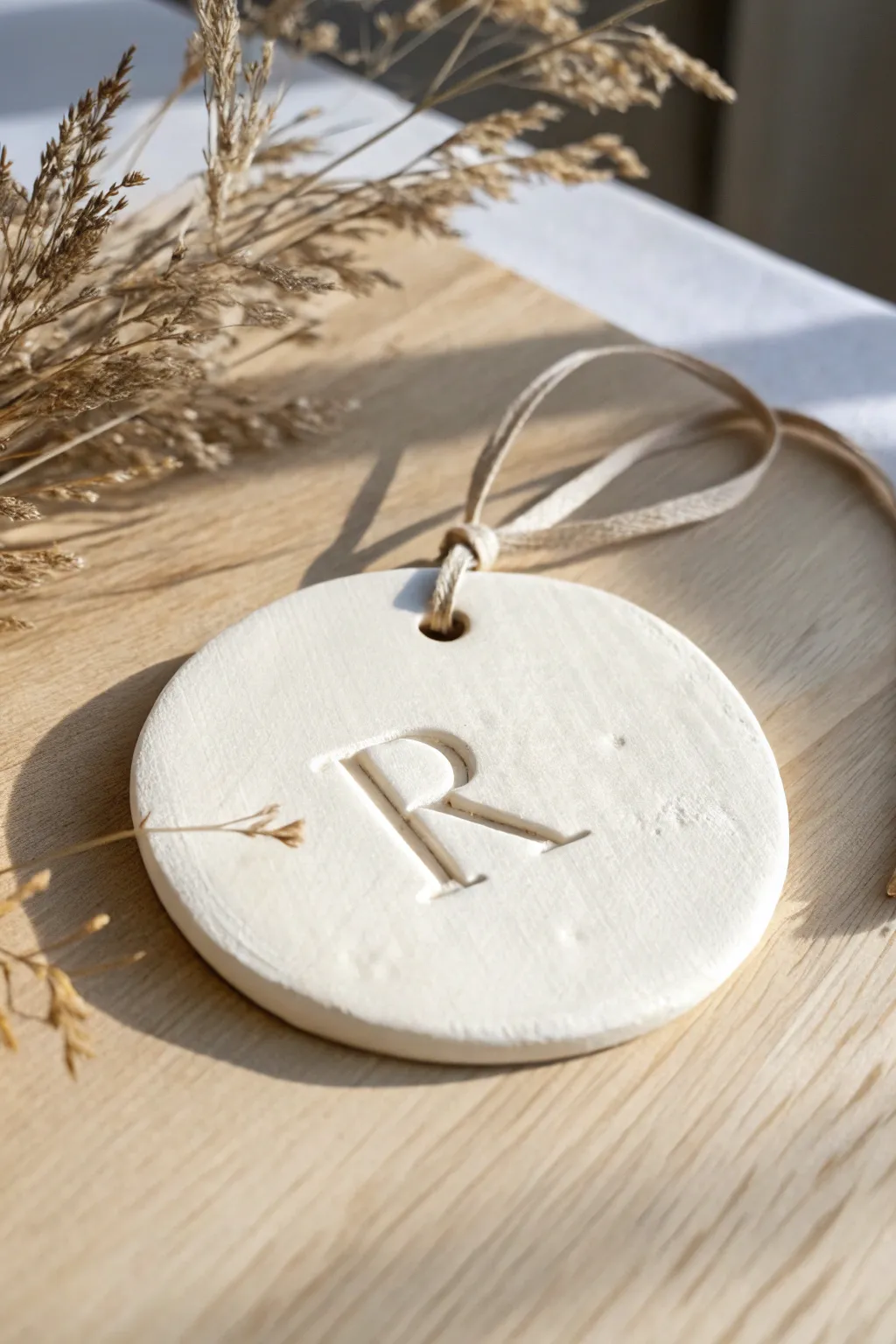
These elegant, understated clay tags add a personal touch to gifts or home decor with their smooth, stone-like texture and clean typography. The simple circular design showcases a single initial, making them perfect for place settings, stocking tags, or minimalist ornaments.
Step-by-Step Tutorial
Materials
- White paper clay or air-dry clay
- Rolling pin
- Parchment paper or non-stick craft mat
- Round cookie cutter (approx. 3 inches)
- Letter stamp set (large serif font)
- Straw or small circle cutter (for the hole)
- Fine grit sandpaper (200-400 grit)
- Small bowl of water
- Cotton ribbon or twine
- Sponge or sanding sponge
Step 1: Shaping the Clay Base
-
Prepare the workspace:
Lay down your parchment paper or non-stick mat on a flat, stable surface to prevent the clay from sticking as you work. -
Condition the clay:
Take a handful of white paper clay and knead it warm in your hands for a minute until it feels pliable and smooth. This helps reduce cracking later on. -
Roll the slab:
Place the clay ball on your mat and roll it out evenly using the rolling pin. You want a consistent thickness of about 1/4 inch—not too thin, or it might curl. -
Cut the circle:
Press your round cookie cutter firmly into the rolled clay. Give it a tiny wiggle to separate it from the excess clay, then lift the cutter straight up. -
Smooth the edges:
Dip your finger into a little bit of water and gently run it around the cut edge of the circle to soften any sharp ridges left by the cutter.
Step 2: Stamping and Detailing
-
Position the stamp:
Select your letter stamp. Hover it over the center of the clay circle to ensure your alignment is perfectly centered before pressing down. -
Make the impression:
Press the stamp firmly and evenly into the clay. Don’t press all the way through; you just want a clear, deep debossed impression. -
Create the hanging hole:
Use a straw or a small circular tool to punch a hole near the top edge of the circle. Make sure it’s centered above your letter. -
Refine the surface:
If the stamping process created any uneven bulges, gently tap the surface with your finger to flatten it out without distorting the letter. -
Initial drying phase:
Move the parchment paper with the clay onto a drying rack. Let it sit undisturbed for about 24 to 48 hours. I find flipping it over halfway through helps it dry flat.
Use Water Sparingly
When smoothing edges, use barely damp fingers. Too much water weakens paper clay and can cause warping or longer drying times.
Step 3: Finishing Touches
-
Sand for smoothness:
Once fully bone-dry, take your fine-grit sandpaper and gently sand the edges and surface. Focus on removing any tiny burrs around the hole or the rim. -
Dust off debris:
Wipe the ornament with a dry, soft cloth or a large brush to remove the fine clay dust created from sanding. -
Seal (Optional):
For a more durable finish, you can apply a completely matte varnish, though leaving it raw gives it that lovely stony texture shown in the image. -
Prepare the tie:
Cut a length of cotton ribbon or twine, approximately 8-10 inches long. -
Thread the loop:
Fold the ribbon in half and push the folded loop through the hole from front to back. -
Secure the knot:
Pass the loose ends of the ribbon through the loop you just pushed through the hole and pull tight to create a lark’s head knot at the base.
Gilded Inlay
For a luxe upgrade, paint the inside of the stamped letter with liquid gold leaf or metallic watercolor after the clay has dried.
Hang your personalized creation on a gift bag or branch and enjoy its simple handmade charm
Paper Clay Gift Tags and Toppers
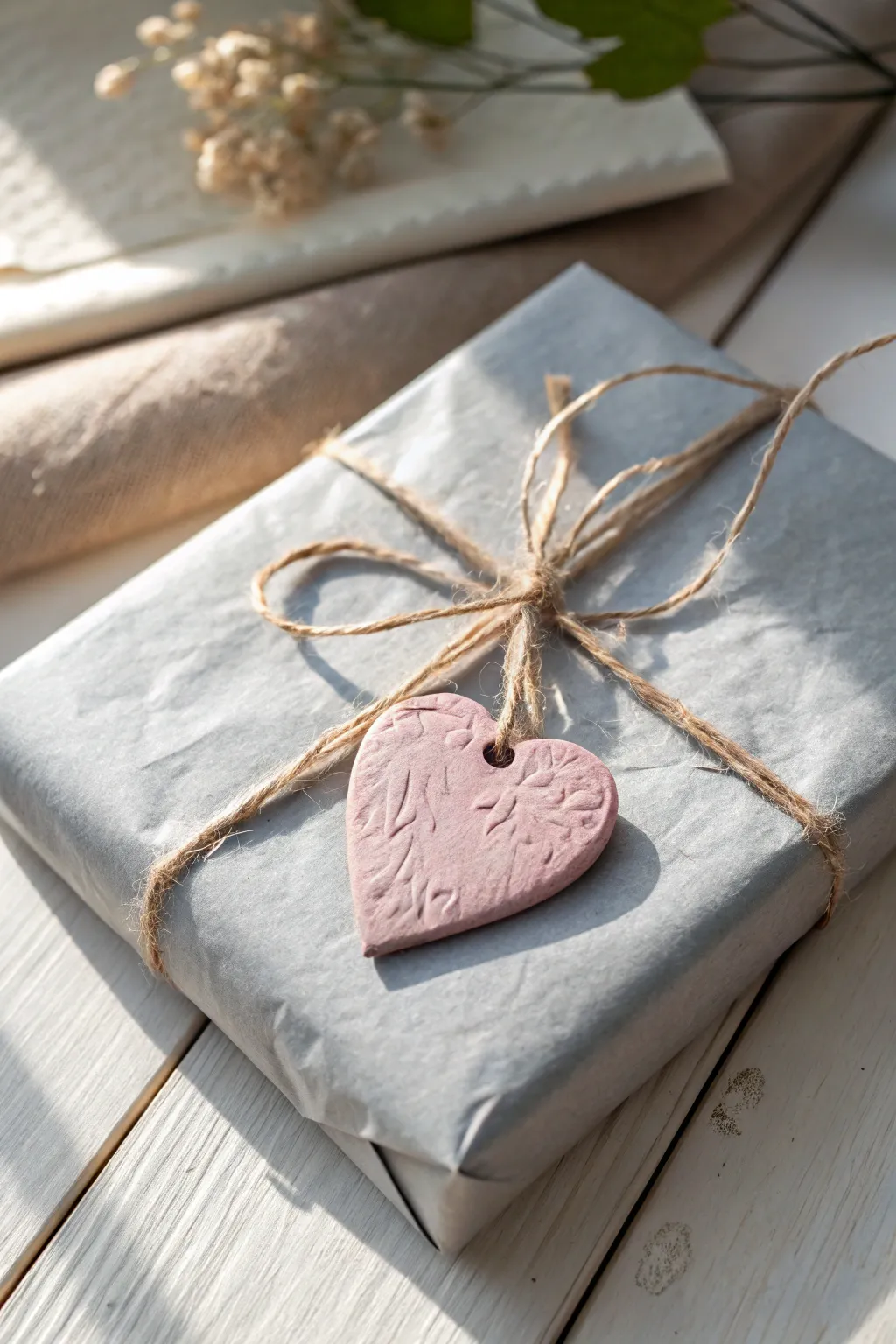
Add a rustic, heartfelt touch to your gift wrapping with this textured paper clay heart tag. Dyed a soft dusty mauve and stamped with delicate botanical impressions, it serves as a beautiful keepsake long after the present is opened.
Detailed Instructions
Materials
- Paper clay (air dry)
- Acrylic paint (mauve or dusty pink)
- Jute twine
- Rolling pin
- Heart-shaped cookie cutter
- Fresh or dried leaves/flowers for texture
- Small straw or skewer (for the hole)
- Fine-grit sandpaper
- Wax paper or craft mat
Step 1: Preparing the Clay
-
Tint the clay:
Start by taking a handful of white paper clay. Add a small drop of mauve or dusty pink acrylic paint directly into the clay mass. -
Knead thoroughly:
Fold and knead the clay repeatedly until the color is completely uniform. If the color is too pale, add another tiny drop, but remember that paper clay often dries slightly lighter than it looks when wet. -
Prevent sticking:
Lay down a sheet of wax paper or a dedicated craft mat to protect your surface and prevent sticking. -
Roll it out:
Using a rolling pin, flatten the clay to an even thickness of about 1/4 inch. You want it substantial enough to be durable but thin enough to look delicate.
Sticky Situation?
If the clay sticks to your botanical elements, lightly dust the leaf with cornstarch before pressing it into the wet clay.
Step 2: Adding Texture and Shape
-
Position the botanicals:
Select a piece of greenery with distinct veins—a fern frond or a strongly veined leaf works best. Place it vein-side down onto your rolled clay slab. -
Press the design:
Gently roll over the leaf with your rolling pin once or twice. Applying firm, even pressure ensures the intricate details transfer without distorting the clay slab too much. -
Reveal the pattern:
Carefully lift the leaf away from the clay to reveal the imprinted botanical texture. -
Cut the heart:
Position your heart-shaped cookie cutter over the most interesting part of the texture. Press down firmly to cut the shape. -
Remove excess:
Peel away the excess clay from around the heart shape. I like to keep these scraps in an airtight container for smaller projects later. -
Create the hole:
Use a small straw or a skewer to poke a hole near the top center of the heart. Make sure the hole is wide enough to accommodate your jute twine later.
Step 3: Finishing Touches
-
Smooth the edges:
Dip your finger in a little water and gently run it along the cut edges of the heart to soften any harsh lines or jagged bits left by the cutter. -
Let it dry:
Place the heart on a drying rack or a fresh sheet of paper. Allow it to air dry completely, which usually takes 24 to 48 hours depending on humidity. -
Flip occasionally:
During the drying process, flip the heart over every few hours to prevent it from curling as moisture evaporates. -
Light sanding:
Once fully dry and hard, inspect the edges. If there are any rough spots, gently buff them away with fine-grit sandpaper. -
Thread the twine:
Cut a length of rough jute twine. Fold it in half and thread the loop through the hole in the heart. -
Secure the tag:
Pull the loose ends of the twine through the loop to create a lark’s head knot, securing the tag to the string. -
Wrap the gift:
Wrap your gift in crumpled grey or neutral paper for a textured look. Tie the twine around the package, finishing with a simple bow that showcases your handmade tag front and center.
Natural Texture
Don’t have fresh leaves? Use a piece of lace, a rubber stamp, or even the texture of a sweater to create interesting patterns.
This simple, handmade touch transforms any gift into something truly personal
Lightweight Paper Clay Statement Earrings
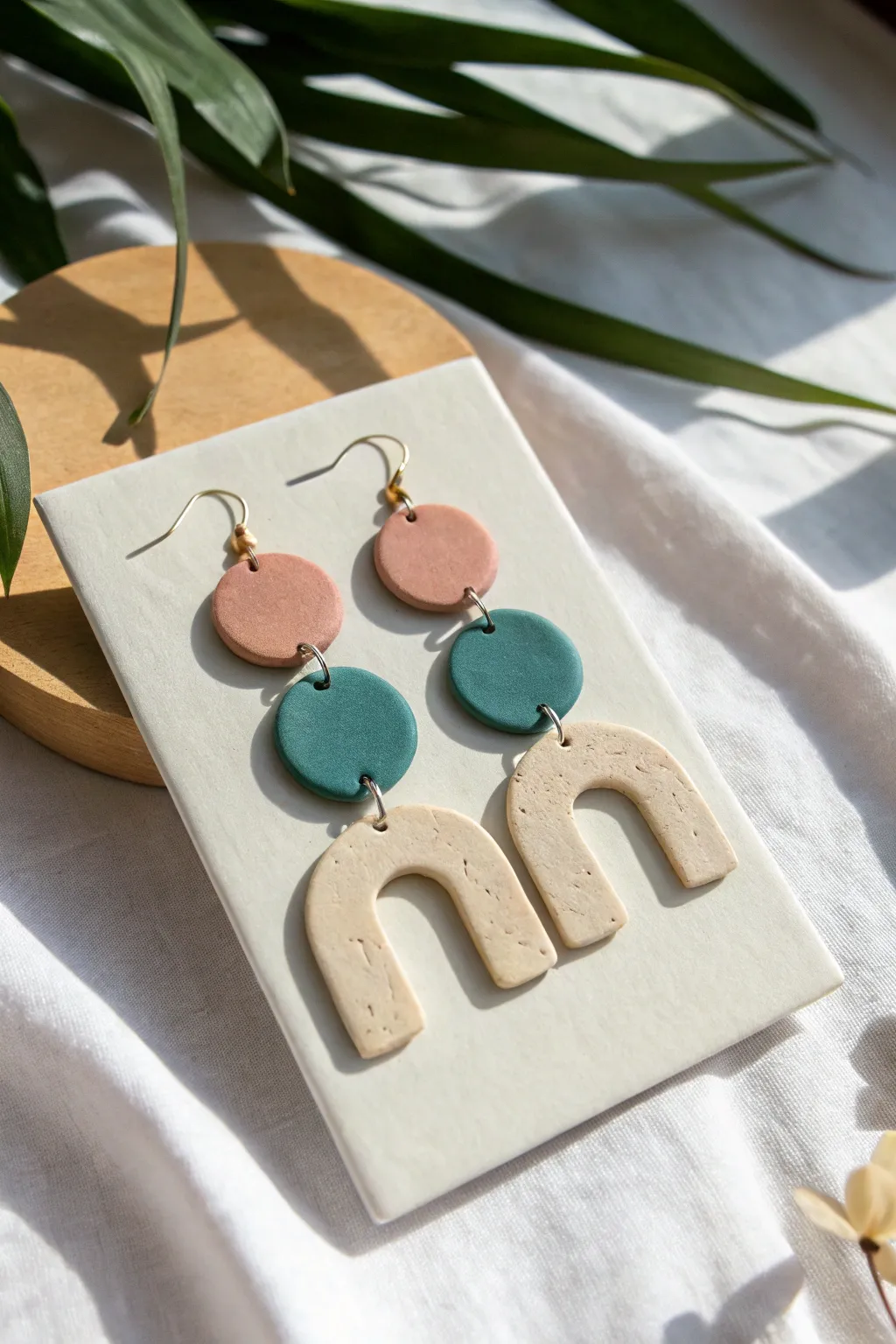
These lightweight statement earrings combine earthy tones with modern geometric shapes for a truly chic accessory. The speckled cream arches paired with muted pink and teal circles create a balanced, organic look that feels both handmade and professional.
How-To Guide
Materials
- Paper clay or lightweight polymer clay
- Rolling pin or acrylic roller
- Circle cutters (approx. 1cm and 1.5cm diameter)
- Arch cutter or craft knife
- Acrylic paints (terracotta pink, teal green, cream/beige)
- Stiff bristle toothbrush or speckle medium
- Hand drill or needle tool
- Jump rings (gold or silver)
- Fishhook ear wires
- Jewelry pliers (flat nose and round nose)
- Fine grit sandpaper
- Matte varnish (optional)
Step 1: Shaping the Clay
-
Condition the clay:
Start by kneading a manageable chunk of paper clay in your hands until it becomes soft, pliable, and free of cracks. -
Roll it out:
Place the clay on a smooth, non-stick surface. Use your rolling pin to flatten it into an even slab, aiming for a thickness of about 3-4mm. Guides or playing cards stacked on either side can help you keep it level. -
Cut the top circles:
Using your smaller circle cutter (around 1cm), press firmly into the clay to cut out two discs. These will be the top tier of your earrings. -
Cut the middle circles:
Switch to the slightly larger circle cutter (around 1.5cm) and cut out two more discs. This creates the middle tier. -
Create the arches:
Use an arch-shaped cutter to punch out two U-shaped pieces. If you don’t have a specific cutter, lightly sketch the shape onto the clay with a needle tool and carefully cut it out with a craft knife. -
Pierce the holes:
While the clay is still wet, use a needle tool to poke holes for the jump rings. Place one hole at the top and bottom of each circle, and one hole at the top center of each arch. Ensure they aren’t too close to the edge to prevent breakage. -
Smooth the edges:
Dip your finger in a little water and gently run it along the cut edges of your shapes to smooth out any roughness or stray clay bits. -
Let it dry:
Set all your clay pieces aside on a flat surface to dry completely. Depending on your brand of paper clay and humidity, this could take 24-48 hours. Flip them halfway through for even drying.
Step 2: Color & Texture
-
Sand for perfection:
Once bone dry, take fine-grit sandpaper and gently buff the edges and surfaces. This step is crucial for that professional, polished finish. -
Paint the top circles:
Mix a muted terracotta or dusty pink acrylic paint. Apply an even coat to the smallest circles, covering the front, back, and sides. Let them dry. -
Paint the middle circles:
Using a deep teal or sea-green shade, paint the larger circles. Two thin coats are usually better than one thick coat to avoid brushstrokes. -
Base coat the arches:
Paint the arch shapes with a cream or beige color. I find a creamy off-white works best as a neutral base. -
Add the speckles:
To achieve the stone-like texture on the arches, load an old toothbrush with slightly watered-down brown or black paint. Run your thumb over the bristles to flick tiny specks onto the cream surface. Practice on paper first to control the spray. -
Seal (Optional):
For extra durability, apply a thin layer of matte varnish over all dry pieces. This protects the paint from scratching and moisture.
Uneven Clay?
If your clay dried slightly warped, you can try sandwiching the drying pieces between two flat wooden boards with a heavy book on top.
Step 3: Assembly
-
Open jump rings:
Using two pairs of pliers, twist your jump rings open sideways (never pull them apart). This maintains their circular shape when closed. -
Connect the tiers:
Thread an open jump ring through the top hole of an arch and the bottom hole of a teal circle. Close the ring securely. Repeat to connect the top of the teal circle to the bottom of the pink circle. -
Attach ear wires:
Open the small loop on your fishhook ear wire. Slide on the top hole of the pink circle, ensuring the earring faces forward, then close the loop.
Level Up: Gold Detail
Add a touch of luxury by painting the very edges of the circles with liquid gold leaf or a gold paint pen after assembly for a gilded look.
Now you have a stunning pair of geometric earrings ready to wear or gift.
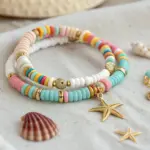
Paper Clay Beads for Simple Jewelry
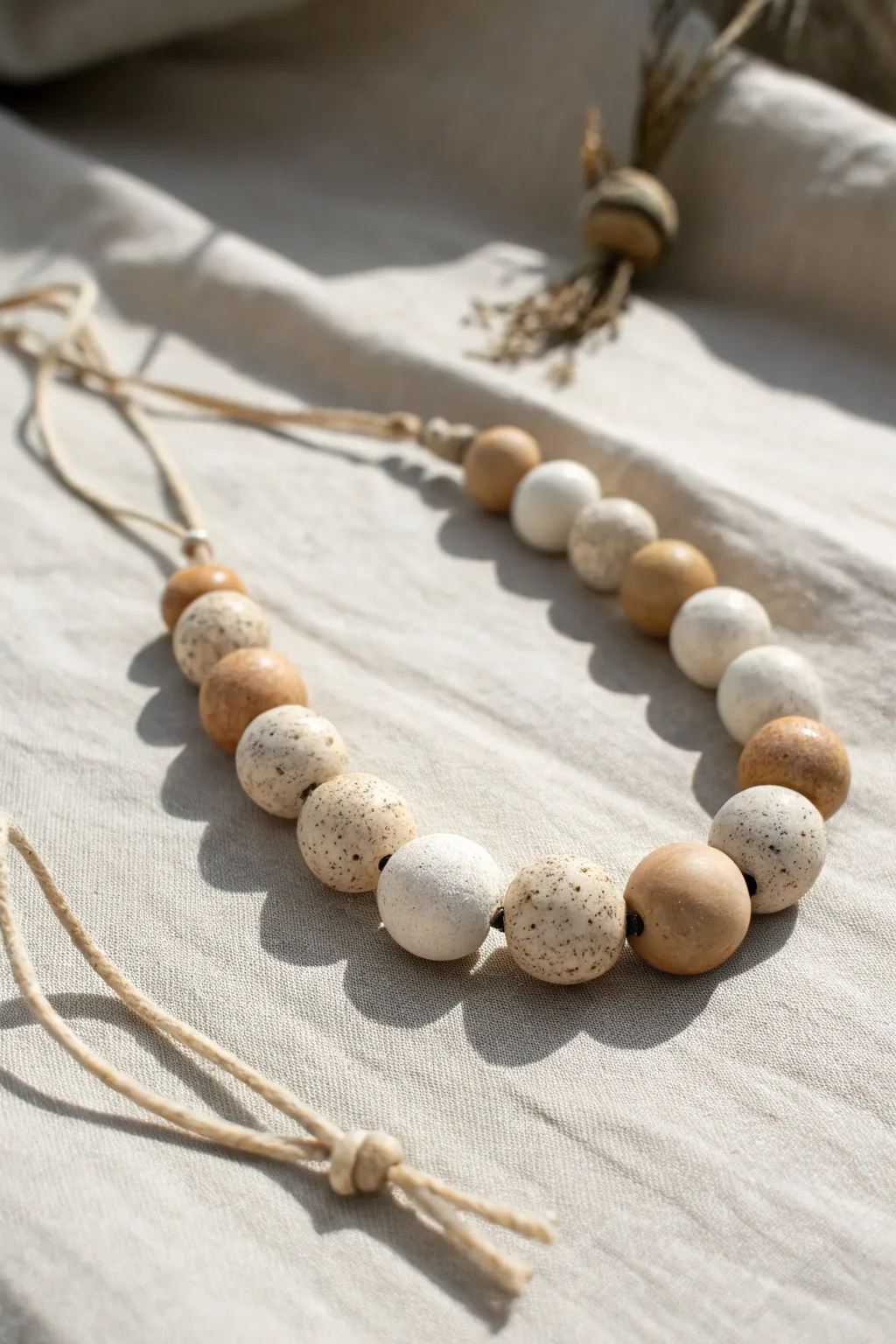
This rustic necklace combines the organic texture of paper clay with soft, natural tones for a piece that feels both modern and grounded. The speckled finish mimics stone or ceramic, making these lightweight beads a perfect addition to your everyday wardrobe.
Step-by-Step Tutorial
Materials
- Paper clay (air dry)
- Acrylic paints (terracotta/tan, white, dark brown/black)
- Small paintbrush
- Old toothbrush (for splattering)
- Wooden skewers or toothpicks
- Sandpaper (fine grit)
- Hemp cord or leather cord (natural beige)
- Scissors
- Water cup
Step 1: Shaping the Beads
-
Prepare the Clay:
Start by conditioning a chunk of paper clay in your hands. Knead it until it is smooth and pliable, ensuring there are no dry cracks before you begin shaping. -
Divide Portions:
Pinch off roughly equal amounts of clay for your beads. For this design, you will need about 15-17 beads. Keep them modest in size, roughly 2 cm in diameter, though I like to vary the sizes slightly for a more organic feel. -
Roll Spheres:
Roll each portion of clay between your palms to form a smooth sphere. If the clay feels too dry, dip your fingers in a tiny bit of water to smooth out surface fissures. -
Create Holes:
While the beads are still soft to the touch, gently pierce the center of each sphere with a wooden skewer or toothpick. Rotate the skewer as you push through to create a clean, distinct channel for the cord. -
Double-Check Openings:
Make sure the hole is wide enough for your specific cord. Wiggle the skewer slightly to enlarge the opening if you’re using a thicker hemp rope. -
Dry Completely:
Leave the beads on the skewers or lay them on a drying rack. Allow them to air dry completely, which usually takes 24-48 hours depending on humidity. Rotate them occasionally to ensure even drying. -
Smooth the Surface:
Once fully hardened, use fine-grit sandpaper to gently buff away any rough spots or fingerprints. Wipe away the dust with a slightly damp cloth.
Uneven Holes?
If bead holes shrink or distort during drying, use a small drill bit or a round needle file to gently re-open and clean them out before stringing.
Step 2: Painting & Texturing
-
Base Coat – Tan Beads:
Select about 6-8 beads to be your darker accent color. Paint them with a terracotta or warm tan acrylic paint. You may need two thin coats for opaque coverage. -
Base Coat – White Beads:
Paint the remaining beads with a matte white or cream acrylic paint. Leave one or two strictly white if you want variety, but most will get the speckled treatment next. -
Prepare Speckle Paint:
Mix a small amount of dark brown or black paint with a few drops of water. You want a very fluid, inky consistency that flicks easily. -
Apply Speckles:
Load an old toothbrush with the watery dark paint. Hold it over your dried white beads and run your thumb across the bristles to flick tiny specks onto the surface. Practice on a scrap paper first to control the spray. -
Subtle Speckling on Tan:
Do the same speckling technique lightly on the tan beads if desired, though keep it more subtle than the white ones to mimic natural stone textures. -
Seal (Optional):
If you want extra durability, apply a clear matte varnish over the beads once the paint is bone dry. This protects the finish from skin oils.
Natural Stone Look
Mix a tiny pinch of dried coffee grounds or sand directly into the white clay before shaping. It adds authentic grit and texture without needing paint.
Step 3: Assembly
-
Cut the Cord:
Cut a length of natural hemp cord, about 30 inches long, or however long you want the necklace to hang. -
Knot One End:
Use a simple overhand knot at one end of the cord if you aren’t doing an adjustable closure, or just prepare your stringing setup. -
String the Pattern:
Thread your beads onto the cord. Follow the pattern in the reference: alternate between the tan beads and the speckled cream beads, placing the largest speckled bead in the very center as a focal point. -
Secure the Beads:
Once all beads are strung, verify the arrangement looks balanced. You can tie small knots on either side of the bead group if you want them to stay centered, or leave them free-floating. -
Create Closure:
Tie the two loose ends of the cord together using sliding knots for an adjustable length, or a simple decorative knot if you prefer a fixed length.
Enjoy wearing your new handcrafted accessory that brings a touch of nature to your style
Paper Clay Keychains With Pressed Letters
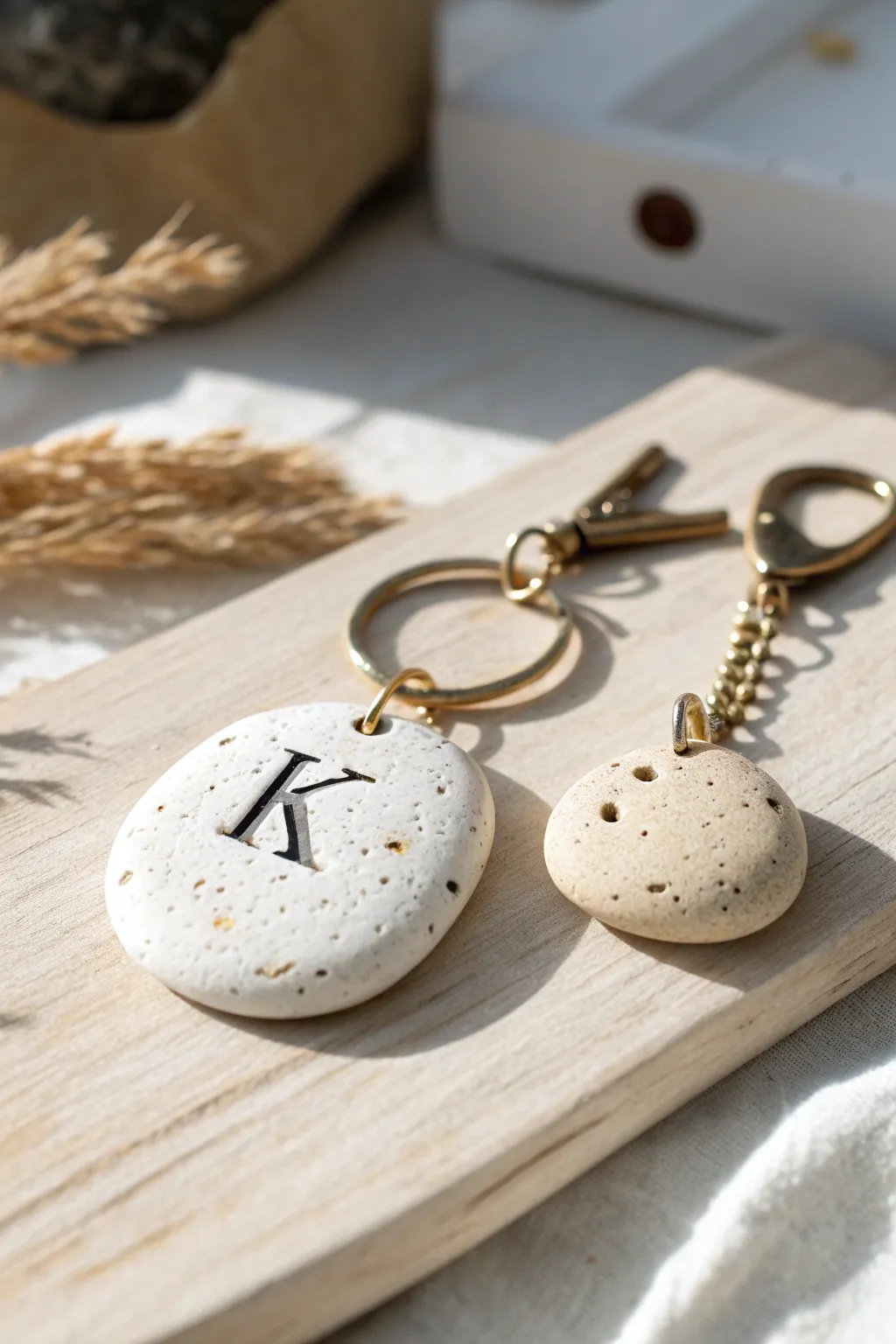
These simple yet elegant keychains feature a raw, organic texture and minimalist letter impressions that look stylish on any set of keys. Using air-dry paper clay allows you to achieve a stone-like appearance without the need for a heavy-duty kiln or complex equipment.
Step-by-Step Guide
Materials
- Air-dry paper clay (white or cream)
- Letter stamps (metal or rubber)
- Rolling pin
- Parchment paper or non-stick craft mat
- Round cookie cutter (approx. 2 inches)
- Small metal eyelet screws
- Gold or brass keychain hardware (split rings and lobster clasps)
- Needle-nose pliers
- Fine grit sandpaper (320 or 400 grit)
- Black acrylic paint
- Small detail brush
- Paper towel
Step 1: Shaping the Clay
-
Condition the Clay:
Begin by taking a handful of paper clay and kneading it in your hands. This activates the fibers and makes the material pliable and smooth, reducing the chance of cracks later on. -
Roll it Out:
Place the clay on a sheet of parchment paper to prevent sticking. Use your rolling pin to flatten the clay to a uniform thickness, aiming for about 1/4 inch thick. This thickness ensures the keychain is durable but not too heavy. -
Cut the Circles:
Press your round cookie cutter firmly into the rolled clay. Depending on how many keychains you want, cut multiple circles. Remove the excess clay from around the circles rather than lifting the circles themselves to maintain their perfect shape. -
Smooth the Edges:
Dip your finger in a tiny bit of water and gently run it along the cut edge of the clay circle to soften the sharp angle left by the cutter. You want a slightly rounded, stone-like edge.
Loose Eyelet Screw?
If the screw feels loose after the clay dries, unscrew it, add a drop of super glue or strong craft adhesive to the threads, and screw it back into the same hole for a permanent hold.
Step 2: Adding Details & Hardware
-
Stamp the Initial:
Position your letter stamp in the center of the clay circle. Press down firmly and evenly, ensuring you go deep enough to leave a clear impression but not so deep that you distort the back of the clay. -
Add Texture (Optional):
For the secondary charm shown in the image, or to add texture to the main piece, gently press a rough stone or crumpled foil against the clay surface to create those tiny, natural-looking pits. -
Insert the Eyelet:
While the clay is still wet, carefully screw the small metal eyelet into the top edge of the circle. I find it helpful to start the hole with a needle first to ensure the clay doesn’t bulge or crack as the screw goes in. -
Dry Completely:
Set your pieces aside in a warm, dry place. Allow them to dry for at least 24-48 hours. Turn them over halfway through the drying process to ensure moisture escapes evenly from both sides.
Step 3: Finishing Touches
-
Sand the Imperfections:
Once fully dry, the clay will be white and hard. Use fine-grit sandpaper to lightly buff the surface and edges, removing any unwanted bumps or fingerprints. -
Paint the Letter:
Using a small detail brush, fill the impressed letter with black acrylic paint. Don’t worry if you get paint outside the lines at this stage. -
Wipe the Excess:
Immediately after painting, use a slightly damp paper towel to wipe the surface flat across the clay. This removes the paint from the high points but leaves the black pigment deep inside the stamped letter for crisp contrast. -
Add Speckles:
To recreate the stone effect in the photo, dilute a tiny bit of brown or black paint with water. Dip a toothbrush in it and flick the bristles with your thumb to spray very fine speckles over the dried clay. -
Allow Final Dry:
Let the paint and speckles dry completely, which should only take about 15 minutes.
Add a Glaze
For a polished look and extra protection against moisture, finish the piece with a coat of matte or satin varnish. This helps seal the porous clay against dirty keys.
Step 4: Assembly
-
Prepare the Jump Ring:
Using your needle-nose pliers, carefully twist open the small jump ring or the link at the end of your keychain hardware. -
Attach the Clay:
Thread the open ring through the eyelet screw that is embedded in your clay piece. -
Close the Hardware:
Use the pliers to twist the ring back into a closed position, ensuring the ends meet perfectly so the clay charm doesn’t slip off.
Now you have a personalized, minimalist accessory ready to organize your keys or gift to a friend.
Paper Clay Magnets With Tiny Icons
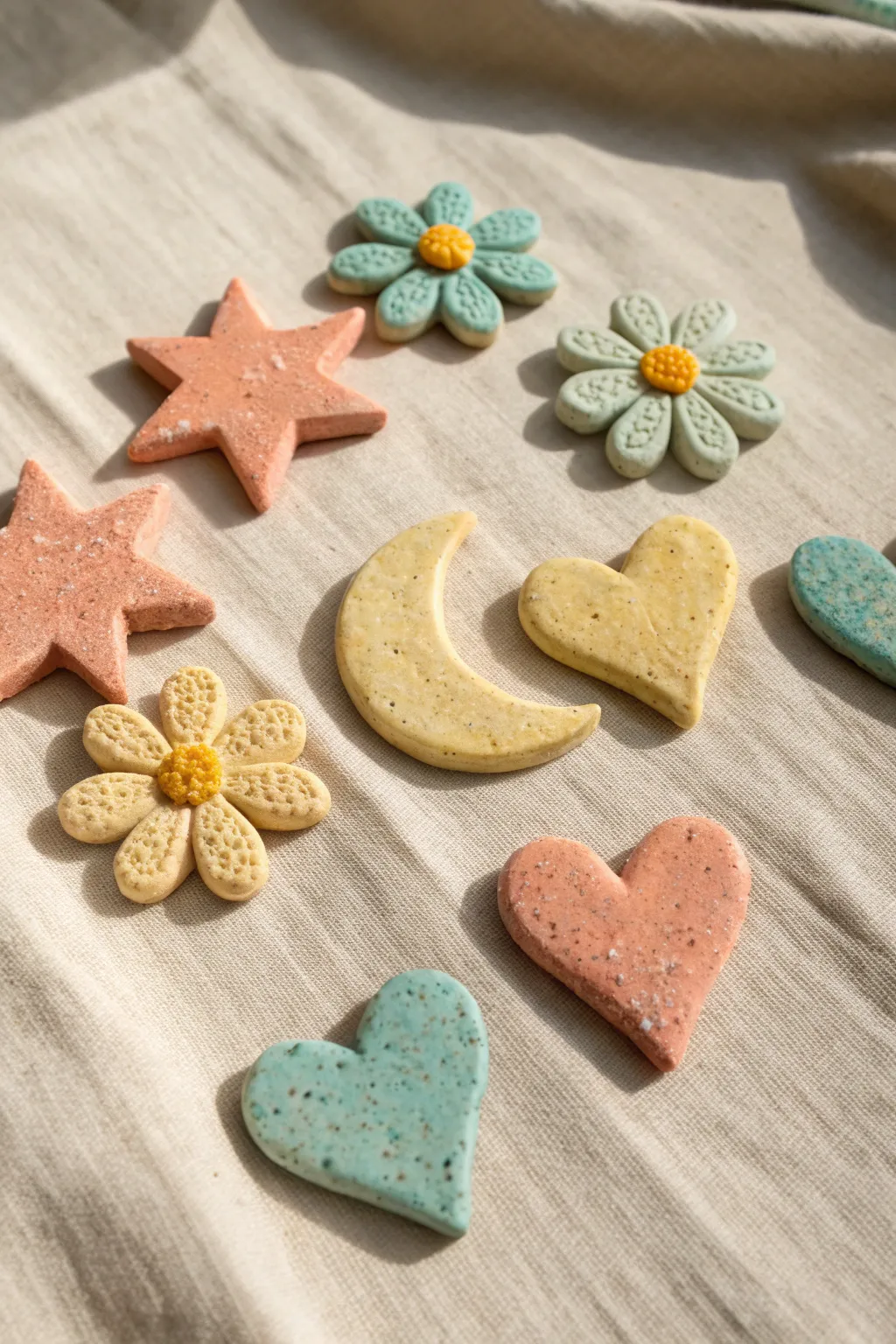
Bring a touch of handmade charm to your fridge or magnetic board with these delightful, speckled clay shapes. Mimicking soft pastel cookies, this project features celestial bodies and sweet floral motifs that are as fun to sculpt as they are to display.
Step-by-Step
Materials
- White creative paper clay
- Acrylic paints (pastel pink, teal, yellow, sage green)
- Small cookie cutters (star, heart, flower, moon)
- Rolling pin
- Parchment paper or craft mat
- Toothpick or needle tool
- Small magnets
- Strong craft glue (E6000 or similar)
- Fine-grit sandpaper
- Matte sealant spray or varnish
- Coarse salt or speckled sand (optional for texture)
- Small paintbrushes
- Plastic wrap (optional)
Step 1: Preparing the Clay Base
-
Prepare your workspace:
Lay down parchment paper or a non-stick craft mat to prevent the clay from sticking to your table. -
Condition the clay:
Take a chunk of white paper clay and knead it in your hands until it becomes soft, pliable, and free of cracks. -
Add color directly:
Instead of painting later, mix acrylic paint directly into the raw clay. Add a pea-sized amount of pastel pink to a ball of clay and knead until the color is uniform. -
Repeat for other colors:
Create separate balls of clay for each color you want: sage green, soft yellow, and teal. Wash your hands between colors to keep the shades pure. -
Add texture:
To achieve the speckled ‘stone’ look seen in the photo, sprinkle a tiny pinch of coarse salt, pepper, or crafting sand into the clay and knead it through evenly.
Natural Speckling
Mix dried tea leaves or coffee grounds into the wet clay for a gorgeous, organic speckled texture that mimics real stone.
Step 2: Shaping the Icons
-
Roll it out:
Use a rolling pin to flatten your first colored clay ball to a thickness of about 1/4 inch (6mm). This thickness ensures they are sturdy enough for magnets. -
Cut the shapes:
Press your chosen cookie cutters firmly into the rolled clay. Wiggle them slightly to ensure a clean cut, then lift the cutter. -
Soften the edges:
The cutters may leave sharp edges. Dip your finger in a little water and gently smooth the rims of the shapes for a rounded, organic finish. -
Create the flowers:
For the two-tone flowers, cut a flower shape from sage or cream clay. Then, roll a tiny ball of yellow clay and press it into the center. -
Detail the flower center:
Use a needle tool or toothpick to prick the yellow center repeatedly, creating a pollen-like texture. -
Detail the petals:
Use the side of your needle tool or a dull knife to gently press indentations into each petal, mimicking veins or separations. -
Sculpt the moon:
If you don’t have a moon cutter, use a round cutter, then shift it over and cut again to create a crescent shape.
Preventing Cracks
If you see tiny cracks forming as the clay dries, smooth a small amount of water or fresh wet clay paste over the crack immediately.
Step 3: Finishing Touches
-
Dry the pieces:
Place all your shapes on a drying rack or clean parchment paper. Let them air dry for 24-48 hours. I find flipping them halfway through prevents warping. -
Sand imperfections:
Once fully dry and hard, use fine-grit sandpaper to gently smooth away any rough burrs on the edges. -
Seal the surface:
Apply a coat of matte varnish or spray sealant to protect the clay from moisture and dirt while keeping that natural, stony look. -
Attach magnets:
Apply a dab of strong craft glue to the back of each dried shape. -
Press and hold:
Press a small magnet firmly into the glue on the back. Let the glue cure completely according to package instructions before placing them on your fridge.
Now your space will have a lovely pop of pastel texture tailored perfectly to your style
Paper Clay Photo Frames With Imprinted Texture
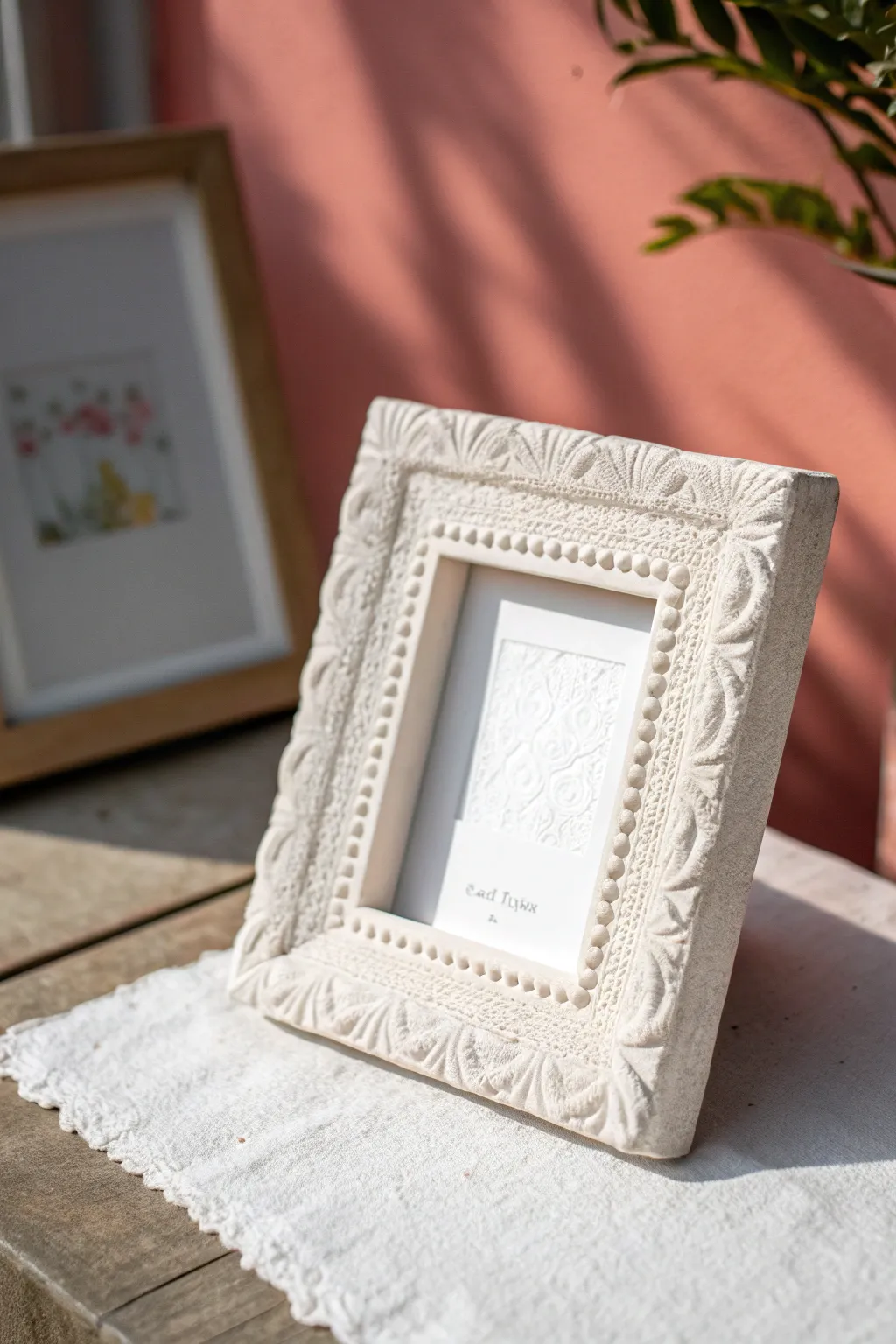
Transform a simple wooden frame into a sculptural piece of decor with the forgiving nature of paper clay. This project features intricate lace-like borders and a beaded inner edge, all achieved through simple stamping and pressing techniques that mimic carved stone.
Detailed Instructions
Materials
- Paper clay (air-dry)
- Flat, wide wooden picture frame (as a base)
- PVA glue (white craft glue)
- Rolling pin
- Parchment paper or non-stick craft mat
- Sculpting tools (needle tool, ball stylus)
- Texture stamps or found objects (lace, buttons, or patterned rolling pin)
- Water in a small cup
- Fine-grit sandpaper
- Acrylic matte medium or varnish (optional for sealing)
- Craft knife
Step 1: Preparing the Base
-
Prep the frame:
Remove the glass and backing from your wooden frame. Lightly sand the wood surface to roughen it up, which helps the clay adhere better. -
Apply adhesive:
Brush a generous layer of PVA glue over the entire front face and outer edges of the wooden frame. Let it get tacky for a minute or two.
Step 2: Applying the Clay Layer
-
Roll the clay:
Take a large chunk of paper clay and knead it until soft. Roll it out on parchment paper into a long, flat slab about 1/4 inch thick. You may need to do this in strips if you don’t have enough clay to cover the whole frame in one go. -
Cover the frame:
Lay the clay strips over the glued frame. Press down firmly to eliminate air bubbles between the wood and the clay. Smooth the seams where pieces of clay meet by wetting your finger and blending the edges together until invisible. -
Trim the excess:
Use a craft knife to trim away excess clay from the very inner opening where the glass sits and the outer back edge. You want clean, straight lines that follow the frame’s shape. -
Smooth the surface:
Dip your fingers in a little water and glide them over the clay surface to create a perfectly smooth, flat slate for your textures.
Clean Impressions
If your embossing tool sticks to the clay, dust the tool lightly with cornstarch or baby powder before pressing it down. This ensures a crisp release every time.
Step 3: Creating the Textures
-
Mark the borders:
Using a ruler and a needle tool, lightly score a guide line creating a rectangle inside the frame face. This separates your outer patterned border from the inner detail area. -
Imprint the outer border:
For the leaf-life pattern on the outer edge, use a sculpting tool or a custom stamp. Press the tool into the wet clay at an angle, repeating the motif rhythmically all around the perimeter. I find pushing slightly outward helps create that nice beveled edge look. -
Refine the corners:
Pay special attention to the corners. Miter the pattern by pressing a diagonal line or distinct motif where the horizontal and vertical sides meet, ensuring the design flows naturally. -
Add the inner texture:
For the section just inside your scored line, press a piece of coarse fabric, burlap, or a textured stamp gently into the clay to give it a subtle, stone-like pitted surface.
Antique Wash
Dilute brown acrylic paint with water (1:10 ratio) and brush it over the dried texture. Wipe it back immediately with a damp cloth to leave shadow in the crevices.
Step 4: Adding the Beaded Detail
-
Roll small balls:
Roll tiny, consistent spheres of clay between your fingers. These will become the beaded border surrounding the photo opening. -
Attach the beads:
Paint a thin line of water or slip (clay mixed with water) along the innermost edge of the frame. Place the tiny balls one by one into this line, pressing them gently so they flatten slightly at the bottom and adhere. -
Uniformity check:
Look over your beaded line. If any beads are too large or small, swap them out now while the clay is still workable. Use a small tool to nudge them into a straight, tight line.
Step 5: Finishing Touches
-
Slow drying:
Allow the frame to dry slowly away from direct heat or sunlight to prevent warping. This usually takes 24-48 hours depending on thickness. Flip it occasionally if possible to let air reach the wood side. -
Sanding:
Once bone dry, use fine-grit sandpaper to gently smooth any sharp peaks or rough patches, especially on the outer edges. -
Seal or paint:
Leave the clay raw for a matte, plaster look as seen in the photo, or apply a clear matte varnish to protect it from dust. If you prefer color, a light whitewash can enhance the texture without hiding it.
Place your favorite photo inside and display your handcrafted frame on a sunlit table to let the shadows play across the textures
Geometric Paper Clay Coasters
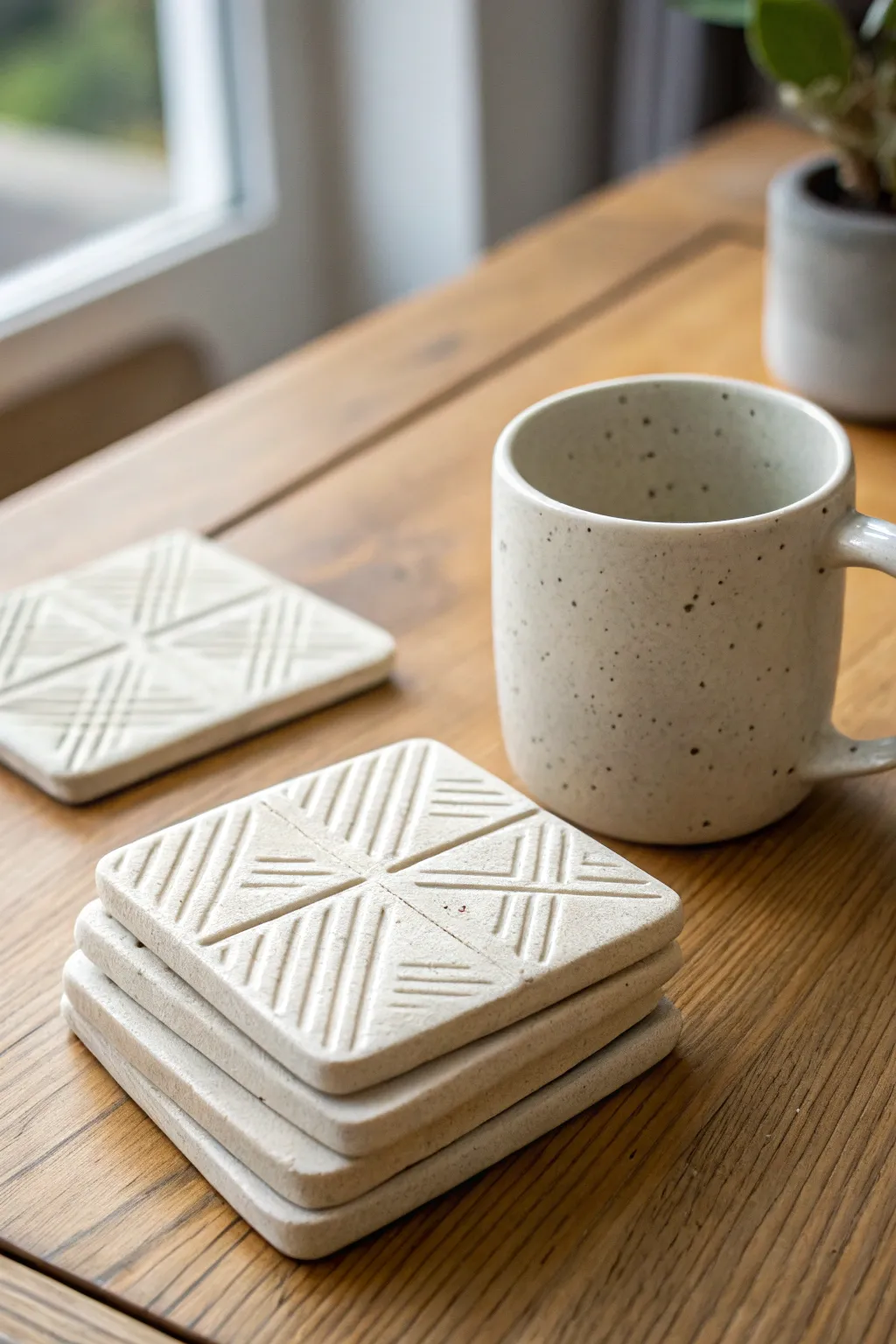
Create a stunning set of faux-stone coasters that bring a touch of earthy, geometric elegance to your coffee table. These sturdy squares feature deeply carved linear patterns and a subtle speckled finish that mimics high-end ceramic stoneware without the need for a kiln.
Step-by-Step
Materials
- Air-dry paper clay (white or light grey)
- Rolling pin
- Two wooden guide strips (approx. 5-6mm thick)
- Square cookie cutter (approx. 4 inches) or a knife and ruler
- Carving tool, needle tool, or dull knife
- Fine-grit sandpaper (220 grit)
- Acrylic paint (black/dark brown) and an old toothbrush
- Matte spray varnish or water-resistant sealant
- Small bowl of water
- Canvas mat or parchment paper
Step 1: Preparation and Shaping
-
Prepare the workspace:
Lay down your canvas mat or parchment paper. Tape down your wooden guide strips parallel to each other, slightly wider than the width of your desired coasters. -
Condition the clay:
Take a large chunk of paper clay and knead it well in your hands. You want it warm and pliable to prevent internal cracks during drying. -
Roll the slab:
Place the clay between your guide strips. Use a rolling pin to flatten the clay until the roller rests on the guides, ensuring a perfectly even thickness across the entire slab. -
Cut the squares:
Using your square cookie cutter, punch out your coaster shapes. If you don’t have a cutter, measure 4×4 inch squares with a ruler and carefully cut them out with a craft knife. -
Smooth the edges:
Dip your finger in a little water and gently run it along the cut edges of each square to soften any sharp corners or burrs left by the cutter.
Warp Warning!
If coasters curl while drying, slightly dampen the concave side and place them under a heavy book overnight to flatten them back out.
Step 2: Creating the Design
-
Mark the center:
Lightly find the center of your square coaster. Use a ruler to gently press a very faint ‘X’ from corner to corner to guide your pattern placement. -
Divide into quadrants:
Using your carving tool and ruler, press a deep, straight line vertically down the center and horizontally across the center, dividing the square into four smaller equal squares. -
Carve the diagonals:
In each of the four quadrants, carve a diagonal line connecting the outer corner to the center cross. This creates eight triangular sections overall. -
Add the stripes:
Inside each triangular section, carve parallel lines that follow the angle of the main diagonal dividers. Keep the pressure consistent for clean, deep grooves. -
Refine the lines:
Go back over your carved lines with the tool to remove any clay crumbs. I find it helpful to slightly widen the grooves at this stage so the paint doesn’t clog them later. -
Initial drying:
Place the coasters on a wire rack or mesh screen to air dry for 24-48 hours. Flip them occasionally to prevent curling as the moisture evaporates.
Step 3: Finishing Touches
-
Sand the surface:
Once fully bone dry, use fine-grit sandpaper to smooth the top surface and edges. This will make the geometric pattern sharp and crisp. -
Dust off:
Wipe the coasters thoroughly with a barely damp cloth or a dry brush to remove all sanding dust from the crevices. -
Create the speckle mix:
Dilute a small amount of black or dark brown acrylic paint with water until it has an inky, fluid consistency. -
Apply the speckles:
Dip an old toothbrush into the paint mixture. Hold it over the coasters and run your thumb across the bristles to flick tiny droplets onto the clay surface. -
Layer the effect:
Let the first layer of speckles dry for a minute, then add a second pass if you want a dense, stone-like appearance. Vary your distance for different dot sizes. -
Seal the coasters:
In a well-ventilated area, spray the coasters with a matte sealant. Apply 2-3 thin coats, allowing drying time in between, to make them water-resistant.
Cork Bottoms
Glue a sheet of thin adhesive cork to the bottom of each coaster. It protects your table and adds a professional, non-slip finish.
Stack your new creations on the table and enjoy the modern, handmade texture they add to your space
Faux Tile Paper Clay Wall Plaques
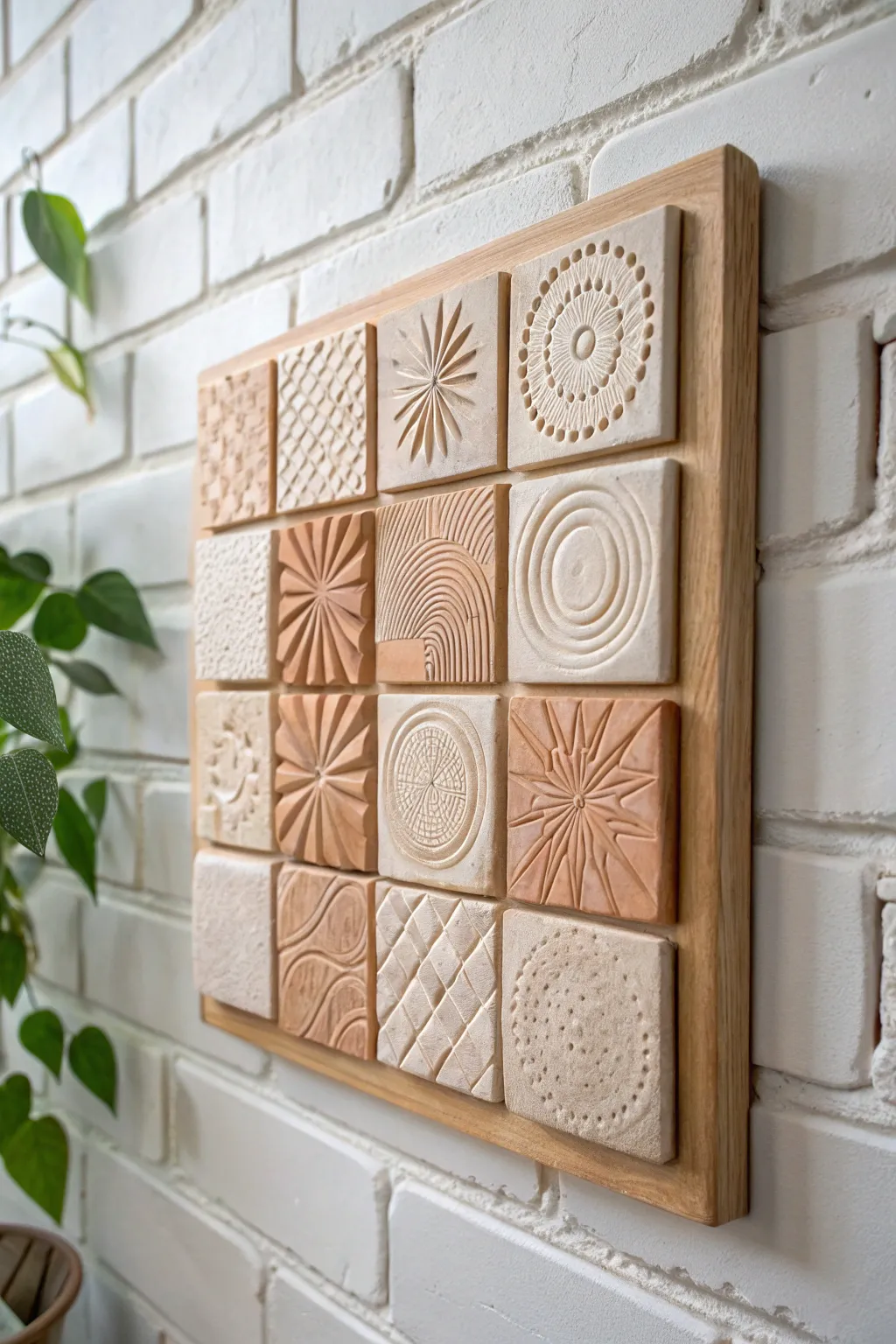
Create the high-end look of ceramic relief tiles using lightweight paper clay in this striking wall art project. The alternating patterns of sunbursts, concentric circles, and geometric textures bring depth and modern Bohemian charm to any space without the need for a kiln.
Step-by-Step Guide
Materials
- Air-dry paper clay (white)
- Acrylic paint or clay tint (terracotta/burnt sienna)
- Square cookie cutter (approx. 3-4 inches)
- Rolling pin
- Two long wooden dowels or rulers (for thickness guides)
- Sculpting tools (needle tool, loop tool, ball styluses)
- Found objects for texture (textured rolling pin, lace, stamps)
- Plywood backing board (square, sized to fit your grid)
- Wood trim (oak or pine) for the frame
- Strong craft glue or construction adhesive
- Sandpaper (medium and fine grit)
- Matte varnish or sealant
- Sawtooth hanger
Step 1: Preparation & Clay Coloring
-
Plan your grid:
Decide on your layout. The project shown uses a 4×4 grid (16 tiles total). Sketch out a rough plan of which textures will go where to ensure a balanced composition. -
Tint the clay:
Divide your paper clay block in half. Keep one half white. Knead a generous amount of terracotta or burnt sienna acrylic paint into the other half until the color is uniform and resembles natural earthenware. -
Set up a rolling station:
Place your wooden dowels or rulers on your work surface about 6 inches apart. These will act as rails for your rolling pin to ensure every tile is exactly the same thickness.
Prevent Curling
Paper clay shrinks and curls as it dries. Flip your tiles over carefully every few hours during the first day of drying to ensure both sides lose moisture evenly.
Step 2: Creating the Tiles
-
Roll out the slabs:
Roll out the white clay first, resting the rolling pin on your guide rails. Repeat with the terracotta clay. You want a smooth, even slab for each. -
Cut the shapes:
Using your square cookie cutter, cut out 8 squares from the white clay and 8 from the terracotta clay. Carefully lift away the excess. -
Smooth the edges:
Dip your finger in a little water and gently run it along the cut edges of each square to remove any burrs or sharpness. They should look soft and finished.
Step 3: Texturing
-
Create the sunbursts:
For the star/sunburst patterns, use a needle tool or knife to gently carve lines radiating from the center. Press deeper near the center and lighter toward the edges for depth. -
Imprint concentric circles:
Press bottle caps, jar lids, or round cookie cutters of varying sizes gently into the clay to create perfect ring patterns without carving. -
Add stippling details:
Use a ball stylus or the blunt end of a skewer to poke rows of small holes. This looks great as a border on the circular designs or as a filling texture. -
Carve geometric hatching:
Using a fettling knife or sculpting tool, carve diagonal cross-hatch lines. Vary the pressure to make the grooves look organic and hand-carved. -
Dry the tiles:
Place all tiles on a wire rack or a board covered with parchment paper. To prevent curling, I like to place a light board on top of them once the surface is dry to the touch. Let them dry fully for 24-48 hours.
Level Up: Mixed Media
Add gold leaf accents inside the carved grooves of the sunburst patterns after sealing for a touch of luxe glamour that catches the light.
Step 4: Assembly & Finishing
-
Sand for perfection:
Once bone dry, lightly sand the edges and surfaces with fine-grit sandpaper to remove any unwanted roughness. Wipe away dust with a dry brush or tack cloth. -
Seal the tiles:
Apply a thin coat of matte varnish to each tile. This protects the paper clay from moisture and gives them a consistent finish resembling unglazed ceramic. -
Prepare the backing:
Cut your plywood backing board to size, leaving a small border if you plan to frame it. Sand the wood smooth. -
Attach the frame:
Cut your wood trim to frame the plywood backing. Glue and clamp the trim to the edges of the plywood to create a nice shadow-box effect. -
Dry run layout:
Arrange your dried tiles on the backing board. Shuffle them around until you are happy with the mix of colors and textures. -
Glue in place:
Apply a strong construction adhesive or heavy-duty craft glue to the back of each tile and press firmly onto the board. Use a spacer (like a coin or piece of cardboard) to keep the gaps between tiles consistent. -
Install hardware:
Flip the entire piece over and attach a sawtooth hanger to the top center of the wooden backframe.
Now you have a stunning, gallery-worthy piece of textured art ready to hang using simple materials
Paper Clay Over Recycled Forms for Big Decor
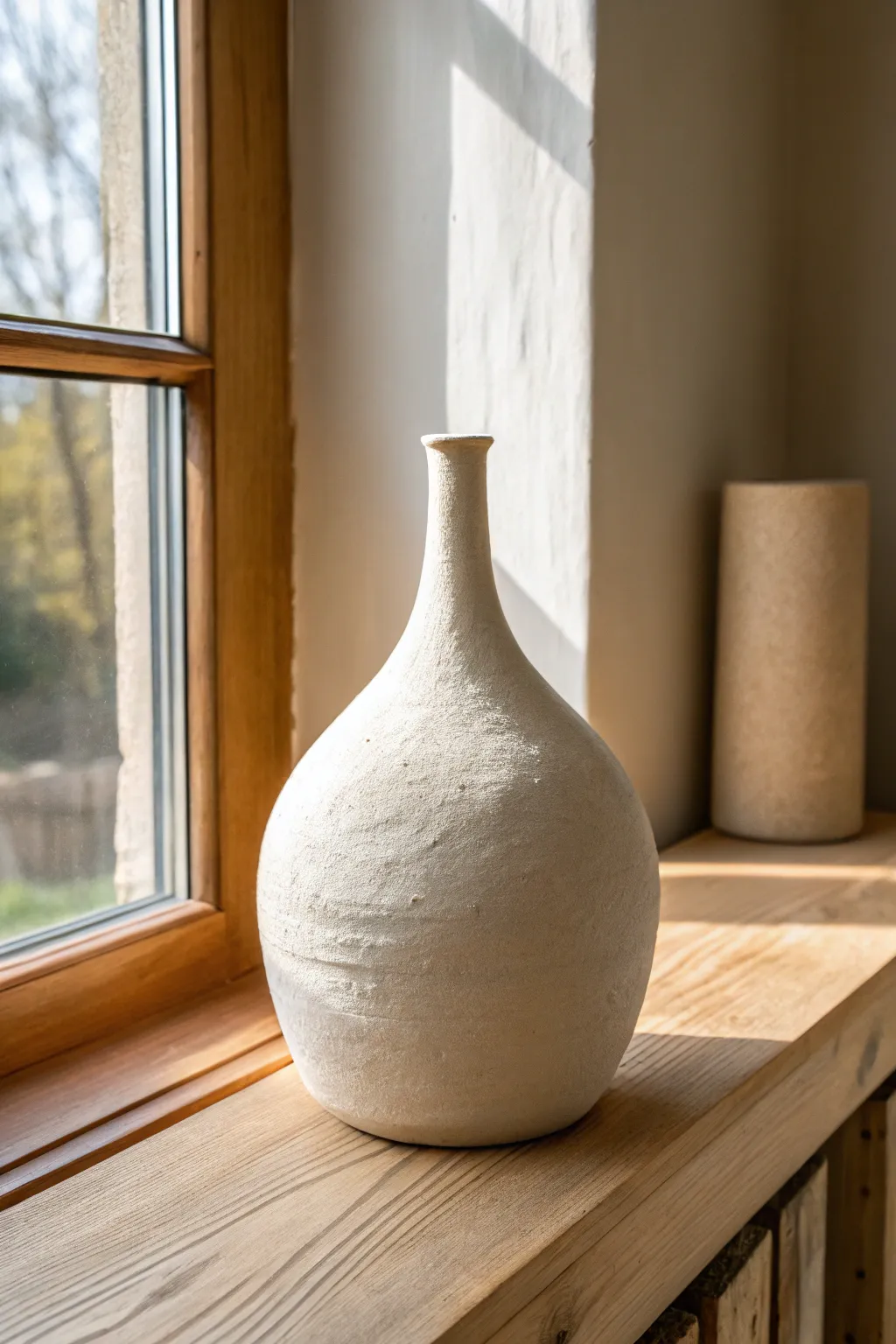
Transform humble recyclables into a stunning, high-end decor piece that mimics the look of raw stoneware. This project uses a sturdy base form covered in paper clay to achieve that trendy, organic texture without the need for a kiln.
Detailed Instructions
Materials
- Recycled glass bottle (long neck)
- Large plastic soda bottle or round plastic container (for the base)
- Masking tape or painter’s tape
- Paper clay (store-bought or homemade mix of joint compound and toilet paper)
- Craft knife or sturdy scissors
- Bowl of water
- Sponge
- Fine-grit sandpaper (optional)
- Matte spray sealer
Step 1: Building the Armature
-
Select your forms:
Find a tall glass bottle with a slender neck for the top section and a larger, bulbous container (like a 2-liter soda bottle or a balloon) for the bottom to match the vase’s silhouette. -
Cut the base:
If using a soda bottle, carefully cut off the top tapering part so you are left with the round bottom section. This will serve as the wide belly of the vase. -
Join the pieces:
Center the glass bottle inside or on top of your base container. Secure them firmly together using plenty of masking tape. Don’t worry about looks here; structure is key. -
Create the slope:
Use crumpled newspaper or aluminum foil to bridge the gap between the wide base and the skinny neck. Tape over this padding to create a smooth, gradual shoulder curve. -
Wrap it up:
Cover the entire armature in a layer of masking tape. The paper clay adheres much better to the texture of tape than to slick plastic or glass.
Cracking Up?
Minor cracks are normal as paper clay shrinks. Mix a tiny bit of fresh clay with water to make a paste (slip) and fill the cracks, then smooth over.
Step 2: Applying Paper Clay
-
Prepare the clay:
Knead your paper clay until it’s pliable. I like to keep a small bowl of water nearby to wet my fingers, which stops the clay from sticking to my hands. -
Apply the first layer:
Take small chunks of clay and flatten them against the form. Aim for a thickness of about 1/4 inch, pressing firmly to ensure it bonds with the tape layer. -
Smooth the seams:
As you add more patches of clay, blend the edges together with a wet finger so you don’t have distinct separation lines, creating a unified surface. -
Refine the lip:
Pay special attention to the rim of the vase. Roll a small coil of clay, place it on the very top, and smooth it down to create a finished, slightly flared lip. -
Initial drying:
Let this base layer dry completely. This might take 24-48 hours depending on humidity. It will shrink slightly as it dries.
Step 3: Texturing and Finishing
-
Add the texture layer:
Apply a second, thinner layer of paper clay. This time, don’t aim for smoothness. Dab the surface with a damp sponge or stipple it with a stiff brush to create that pitted, stone-like look. -
Create horizontal movement:
While the clay is wet, gently drag your fingers or a modeling tool horizontally around the belly of the vase to mimic the throwing lines found on wheel-thrown pottery. -
Check the silhouette:
Step back and look at the vase profile. If there are unintentional lumps, press them down now while the material is still workable. -
Final dry:
Allow the vase to dry thoroughly. It should feel room temperature to the touch; if it feels cold, it still holds moisture. -
Sanding (optional):
If the texture is too aggressive in spots, lightly scuff it with fine-grit sandpaper to knock down sharp peaks while keeping the rustic charm. -
Seal the piece:
Spray the entire vase with a matte sealer. Since paper clay isn’t waterproof, this step is vital if you not planning to paint it, though remember this vase is for dry flowers only.
Stone Effects
Mix a small amount of sand or dried coffee grounds into your clay batch before applying the final layer for an authentic, gritty stone texture.
Place your sculptural vessel on a sunlit windowsill to highlight the beautiful, organic shadows created by the texture