
When I started firing my first pottery pieces years ago, the kiln felt like a mysterious black box—I’d load in soft clay, turn some dials, and hope for the best. The real turning point came when I learned that firing isn’t just about reaching a number on a dial; it’s about understanding what happens inside each piece as temperature and time work together to permanently transform clay into ceramic.
Understanding Heat Work: Why Temperature Alone Isn’t Enough
The most important concept in kiln firing is heat work—the combined effect of temperature and time. Think of it like baking: you can’t bake a cake at twice the temperature in half the time and expect the same result. Clay needs time at specific temperatures for chemical reactions to complete properly.
This is why potters use pyrometric cones rather than relying solely on kiln thermometers. Cones are small pyramid-shaped indicators made from ceramic materials engineered to bend and melt at precise heat work levels. A cone responds to both temperature and duration, just like your clay and glazes do. The cone system uses numbers ranging from 022 (lowest) to 14 (highest), with an unusual quirk: there’s no cone zero, and cones with a “0” prefix (like cone 06) are actually lower temperatures than their non-prefixed counterparts (cone 6).
Most potters set up three cones for each firing: a guide cone (one number below target), a firing cone (the target), and a guard cone (one number above). When the guide cone bends, you know you’re close. When the firing cone bends to horizontal, you’ve reached your target heat work. If the guard cone bends, you’ve overfired.




The Three Main Firing Ranges

Pottery firing falls into three broad temperature categories, each suited to different clay bodies and producing distinct results.
Low-fire (Earthenware): Cone 06 to Cone 04 (1830–1945°F / 1000–1060°C)
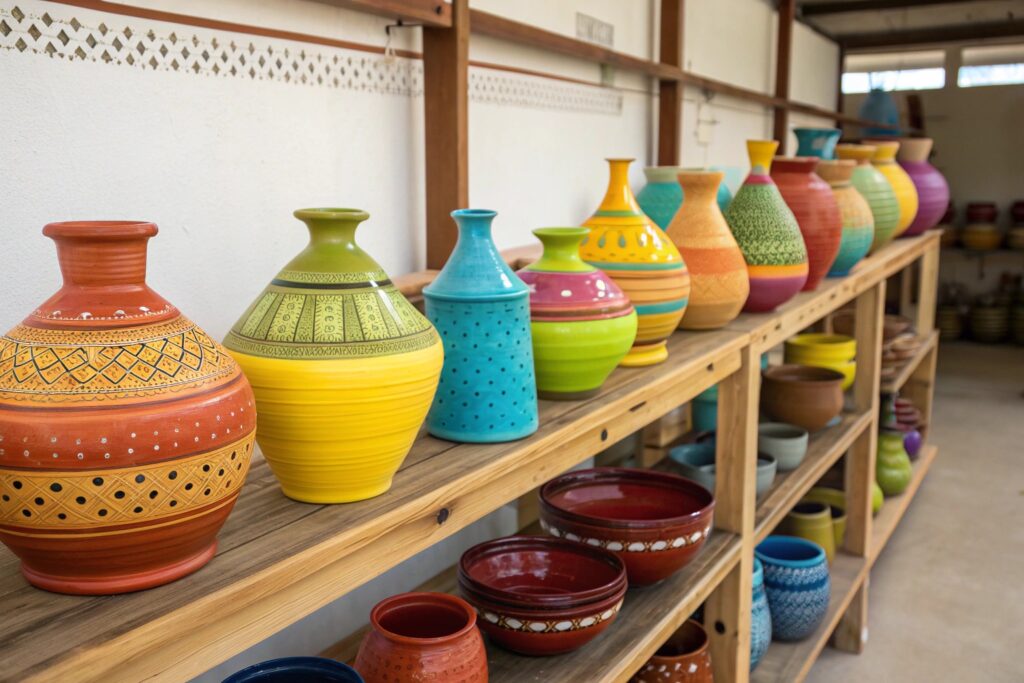
Low-fire pottery includes traditional earthenware and terracotta. At these temperatures, clay sinters—the particles bond together at contact points—but doesn’t fully vitrify. The result is porous, absorbent ceramic that requires glazing for functional use. Earthenware produces warm, earthy colors ranging from buff to deep red-brown, depending on iron content. While beautiful for decorative work and planters, earthenware isn’t ideal for dinnerware unless properly glazed, as it remains permeable to liquids.
Mid-range (Stoneware): Cone 4 to Cone 7 (2100–2280°F / 1150–1250°C)
This has become the most popular firing range for studio potters. Mid-range stoneware reaches true vitrification—the point where clay particles fuse together and glass-forming materials melt to fill the spaces between particles, creating a dense, waterproof structure. Cone 6 (approximately 2232°F/1220°C) is especially common because it offers excellent strength and durability while being gentler on kiln elements than high-fire temperatures. I fire almost exclusively at cone 6 in my studio, and the range of available glazes and surface effects is extraordinary.
High-fire (Stoneware/Porcelain): Cone 8 to Cone 10+ (2300–2381°F / 1260–1305°C)
Traditional stoneware and porcelain are fired at these elevated temperatures. High-fire produces the most durable, fully vitrified ceramics with exceptionally low porosity. Porcelain, which contains high percentages of kaolin (white clay mineral), typically fires to cone 10 and above, achieving its characteristic translucency and glass-like surface. The trade-off for this superior strength is increased energy costs and faster wear on kiln elements.



The Bisque Firing: First Transformation
Every pottery piece undergoes at least two firings. The first is bisque firing, which transforms fragile, bone-dry greenware into durable ceramic that can be handled, glazed, and fired again.
Preparing for Bisque

Before loading the kiln, pottery must be completely bone-dry. Even pieces that feel dry to the touch can contain moisture deep in the clay walls. Trapped water is dangerous—when heated above 212°F (100°C), water converts to steam and expands rapidly, potentially causing explosions in the kiln.
The Water Smoking Stage (Room Temperature to 250°F / 120°C)
The firing schedule begins with a slow preheat phase called “water smoking” or “candling.” Some potters leave their kilns at very low temperatures (around 122°F/50°C) overnight to drive out all mechanical water—the physical moisture remaining in the clay. Even though this is well below water’s boiling point, the extended time allows moisture to evaporate gently without creating steam pressure.
Industry standards suggest water smoking can effectively occur between 140–260°C (284–500°F) for well-dried ware, though studio potters typically proceed more conservatively. The key is heating slowly enough that water molecules have time to migrate through the clay walls and escape as vapor.
Organic Burnout (250–900°F / 120–480°C)
Between 300–800°C (572–1472°F), organic materials burn away. These include natural impurities in clay, plus any paper, wax, or other materials used during forming. This stage requires adequate ventilation—your kiln needs oxygen circulation to completely combust these materials. If they don’t burn out before the clay surface seals, trapped carbon can cause black coring or bloating later.
Chemical Water Release (660–950°F / 350–510°C)
Around 350°C (660°F), something profound happens: chemically bonded water—molecules actually integrated into the clay’s crystalline structure—begins to release. This is permanent. Once chemical water departs, clay can never be reconstituted back to workable material. Your pottery has officially crossed the threshold from clay to ceramic.
Quartz Inversion (1063°F / 573°C)
At exactly 573°C, quartz crystals in the clay undergo a structural change from alpha to beta form, expanding approximately 0.5–2% in the process. This is why bisque firing schedules slow down around this temperature—rapid heating through quartz inversion can cause cracking. The same caution applies during cooling, as the process reverses.
Interestingly, some ceramic scientists debate how much quartz inversion affects finished ware. Since firing converts much quartz to glass, less remains to undergo inversion during subsequent firings. Still, it’s wise to heat and cool slowly through this range, especially with thick-walled pieces.
Sintering Begins (900°F+ / 480°C+)
Above 800°C, sintering accelerates. Clay particles begin bonding at contact points through atomic diffusion—atoms become mobile and migrate across particle boundaries, fusing them together. The pottery becomes denser and shrinks as particles pack more tightly. Importantly, sintering occurs below melting temperatures; the particles remain solid while forming permanent bonds.
Target Bisque Temperature
Most potters bisque fire between cone 08 and cone 04 (approximately 1650–1945°F / 900–1060°C). The choice depends on intended use:
- Soft bisque (cone 08–06): More porous, absorbs glaze readily, easier to sand or carve after firing
- Hard bisque (cone 04): Sturdier handling, less glaze absorption, better for underglaze work
After bisque firing, your pieces will have a chalky, porous texture. They’re strong enough to handle confidently but still absorbent enough to accept glaze application easily.




The Glaze Firing: Achieving Maturation
The second firing brings clay and glaze to their final maturation temperature. This is where you’ll fire to your target cone based on your clay body and glazes.
Initial Heating (Room Temperature to 1800°F / 980°C)
Glaze firings can generally heat faster than bisque firings since mechanical water and organic materials are already gone. However, if you’ve applied thick glaze layers, some moisture was introduced during glazing. A moderate heating rate of 150–200°F (80–100°C) per hour through the early stages is common, though schedules vary.
Critical Temperature Zone (1800–2200°F / 980–1200°C)
As you approach maturation temperature, several crucial processes occur:
Glaze melting begins: Glass-forming materials in the glaze start melting, creating a liquid layer on the pottery surface. Different glaze components melt at different temperatures—this is why glaze chemistry matters.
Clay vitrification accelerates: Above 1000°C, clay bodies begin true vitrification. Glass-forming materials within the clay (feldspar, silica) become molten and flow into the spaces between clay particles. When this glassy liquid solidifies during cooling, it creates an impermeable structure. Each clay body has a specific vitrification temperature; firing too low leaves it weak and absorbent, while firing too high causes warping, bloating, or melting.
Mullite and cristobalite formation: Between 1100–1200°C, new crystalline structures form. Mullite and cristobalite (types of silica) develop as clay converts partially to glass. These crystals contribute to strength and thermal properties of the finished ceramic.
The Soak: Holding at Temperature

Many potters include a “soak” or “hold” at peak temperature—keeping the kiln at target temperature for 10–30 minutes. Soaking allows glazes to mature fully, gases to escape, and surfaces to smooth. I typically soak for 15 minutes at 1260°C for my stoneware glaze firings. This small adjustment can mean the difference between a matte, underfired surface and properly glossy, mature glaze.
Be careful not to oversoak at high temperatures, though. Extended soaking can cause already-mature glazes to run excessively or develop surface defects.
Cooling: The Often-Overlooked Critical Stage

How you cool your kiln affects your results as much as the heating schedule. Most studio potters use “natural cooling”—simply turning off the kiln and letting it cool at its own rate. This typically takes 12–24 hours depending on kiln size.
Critical Cooling Points
Cristobalite inversion (428°F / 220°C): Cristobalite crystals formed during high-temperature firing contract rapidly by about 3% at this point during cooling. This is actually beneficial—it puts glazes into compression, helping prevent crazing. However, rapid cooling through this zone can cause dunting (cooling cracks), especially in pieces with thick walls or uneven sections.
Quartz inversion reversed (1063°F / 573°C): On cooling, quartz reverts from beta to alpha structure, contracting again. Slow cooling through this range prevents thermal shock.
When to Open the Kiln
Never open a kiln above 200°C (392°F). Introducing cool air to hot pottery causes thermal shock—rapid, uneven contraction that creates cracks. I wait until my kiln reads below 150°F before cracking the lid, and even then, I open it gradually. Patience during cooling has saved me from heartbreaking losses.
Common Firing Schedules
Here’s a practical example of firing schedules I use regularly:
Bisque Firing to Cone 04:
| Segment | Rate | Target Temperature | Soak Time |
|---|---|---|---|
| 1 | 60°C/hour | 200°C | 1 hour |
| 2 | 120°C/hour | 600°C | None |
| 3 | 180°C/hour | 1000°C | None |
| 4 | 90°C/hour | 1060°C | 10 minutes |
Glaze Firing to Cone 6:
| Segment | Rate | Target Temperature | Soak Time |
|---|---|---|---|
| 1 | 100°C/hour | 200°C | None |
| 2 | 150°C/hour | 1000°C | None |
| 3 | 120°C/hour | 1220°C | 15 minutes |
These schedules work for my mid-range stoneware and standard glaze applications, but you’ll develop your own preferences based on your clay bodies, kiln characteristics, and desired effects.



Understanding Vitrification and Maturation
Vitrification is the holy grail of pottery firing—the point where clay transforms into a dense, waterproof ceramic. But what exactly happens?
As temperature rises, feldspars and other fluxes in the clay begin melting around 1000–1100°C. These molten materials flow between clay particles, filling pores and binding everything together. When cooling, this glass phase solidifies, creating an impermeable matrix. The clay has “matured.”
Each clay body has a specific vitrification range—a temperature window where it achieves optimal strength and density without deforming. Fire below this range and you get weak, porous ceramics. Fire above it and you risk bloating, warping, or complete melting.
The distinction between sintering and vitrification is important: sintering bonds solid particles through atomic diffusion without melting, while vitrification involves actual melting and glass formation. Most fired ceramics involve both processes working together.
Atmosphere: Oxidation vs. Reduction
Firing atmosphere profoundly affects final appearance, especially glaze colors. Electric kilns always fire in oxidation—there’s abundant oxygen and no manipulation of atmosphere is possible. Gas, wood, and other fuel-burning kilns can create reduction atmospheres.
Oxidation firing occurs when there’s excess oxygen. Combustion is complete, creating clean blue flames. Metals in clay and glazes oxidize fully, producing bright, clean colors—copper becomes green, iron produces warm browns and yellows.
Reduction firing occurs when oxygen is limited (by restricting airflow or adding excess fuel). Incomplete combustion creates carbon monoxide and soot, which pull oxygen out of clay and glaze surfaces. This “reduces” metal oxides, dramatically changing colors—copper turns deep red, iron produces rich blacks and greens, and white clay bodies can develop grey or blue tones.
Potters often combine both atmospheres in a single firing, perhaps firing in oxidation until cone 012, then switching to reduction for the final temperature climb to achieve specific glaze effects.
Common Beginner Mistakes and How to Avoid Them
After years of teaching and firing, I’ve seen the same mistakes repeatedly:
1. Underfired ware
Signs include chalky glaze surfaces, insufficient glaze melt, weak clay body, and high porosity. The clay hasn’t reached vitrification. Solution: Check your cones—your kiln’s digital controller may be inaccurate. Fire to the temperature your clay body requires, not just a round number.
2. Overfiring and bloating
Overfired clay becomes brittle, glazes run excessively, and pieces may bloat—swelling with trapped gas bubbles. This happens when clay exceeds its maximum firing temperature or when organic materials remain trapped by early glaze melting. The clay becomes overly soft, and expanding gases cause swelling.
Prevention: Know your clay body’s firing range. Ensure thorough bisque firing to burn out all organics. Don’t exceed the recommended cone for your clay.
3. Thermal shock and dunting
Opening the kiln too soon or cooling too rapidly causes cracks—either dramatic splits (dunts) or fine crazing in the glaze. These occur at critical temperature points (cristobalite inversion at 220°C, quartz inversion at 573°C) when the clay undergoes structural changes.
Prevention: Let the kiln cool naturally. Don’t open above 200°C. Avoid rapid temperature changes. If you have thick pieces or sculptural work with varying wall thickness, slow down heating and cooling rates even more.
4. Wrong clay for wrong temperature
Firing earthenware to stoneware temperatures causes melting—potentially destroying your kiln shelves and elements. Firing stoneware at earthenware temperatures leaves it weak and underfired. Always match clay body to appropriate firing range.
5. Incorrect cone selection
Using cone 06 when you meant cone 6 (or vice versa) is surprisingly common. The “0” prefix indicates lower temperatures. Cone 06 is approximately 1830°F; cone 6 is 2232°F—that’s a 400-degree difference!
Kiln Loading Tips
Proper loading affects firing results:
- Bisque firing: Pieces can touch and even stack inside each other (bowls nested in bowls) since there’s no glaze to stick
- Glaze firing: Maintain 1/4–1/2 inch clearance between all glazed pieces. Glaze expands and can cause pieces to stick together
- Stilt placement: Support heavy or wide pieces with kiln stilts to prevent warping during firing
- Shelf placement: Use pyrometric cones on different shelves—top, middle, bottom—to monitor heat distribution. Kilns often fire unevenly.