
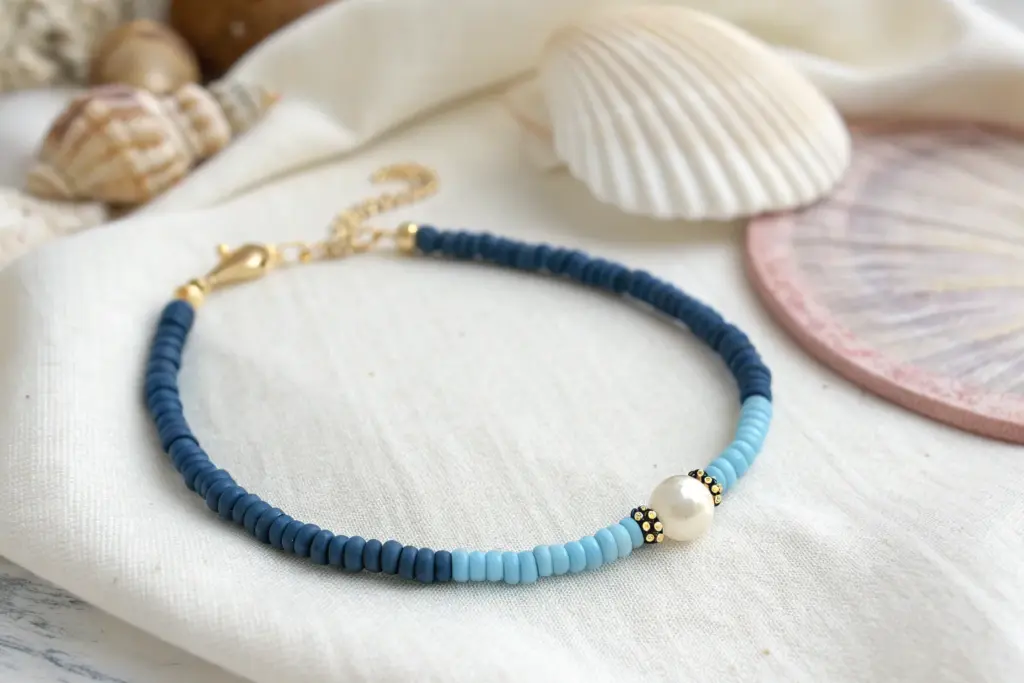
Whenever I’m craving a calm, clean color palette at my studio table, I reach for blue clay beads first. Here are my favorite aesthetic clay bead bracelet ideas in blue—from classic, beachy staples to a few playful twists you can totally make your own.
Classic Sky Blue and White Stack
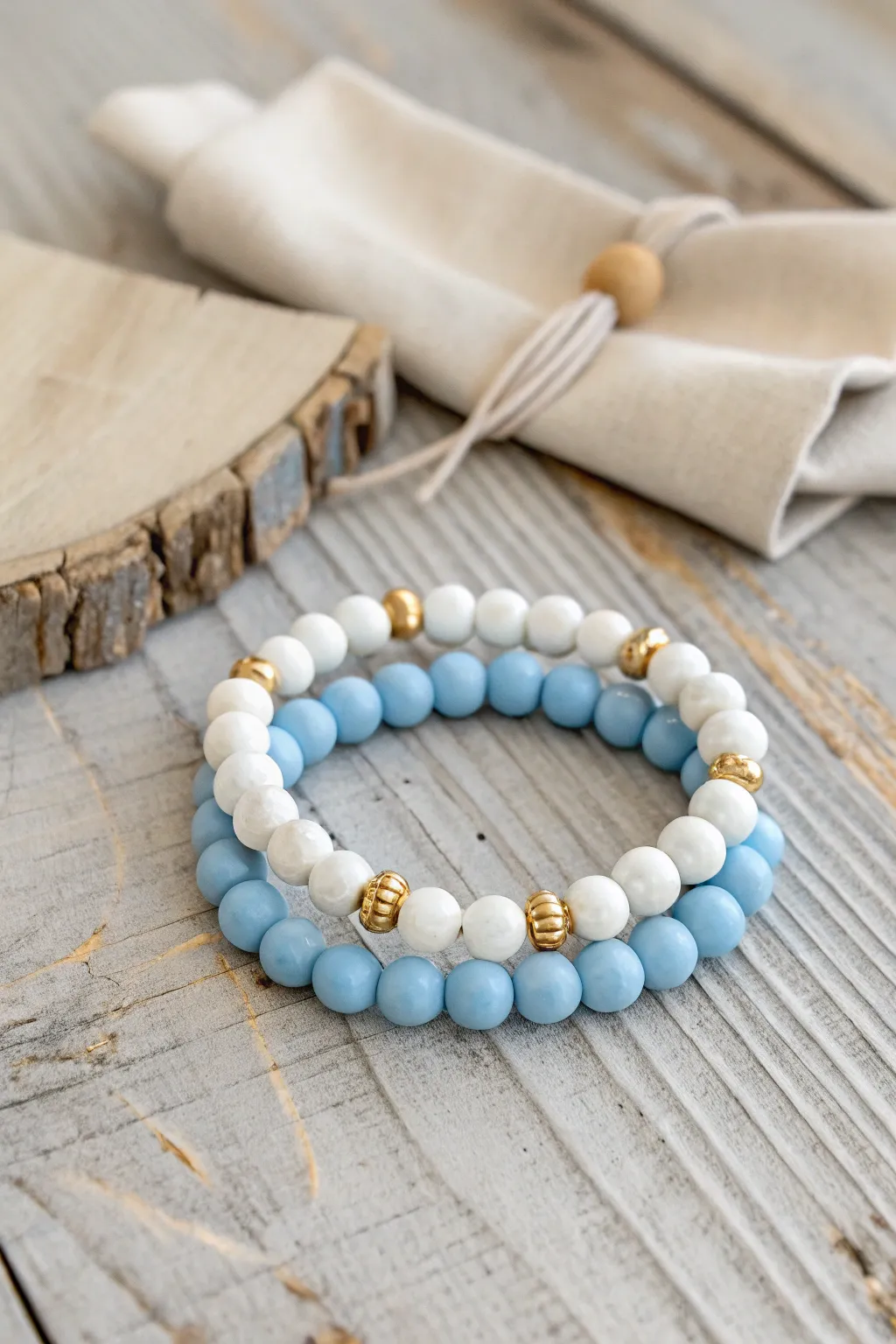
Capture the serene beauty of a summer sky with this elegant bracelet duo featuring smooth sky-blue beads and crisp white accents. With touches of gold adding a hint of luxury, these two bracelets are designed to be worn together for a fresh, classic look.
Step-by-Step Guide
Materials
- 8mm sky blue round beads (polished stone like angelite, blue jade, or high-quality glass/acrylic)
- 8mm white round beads (white jade, milky quartz, or polished glass)
- Gold spacer beads (large decorative rondelle or lantern shape)
- Small gold round accent beads (approx. 4mm)
- Strong elastic stretch cord (0.8mm or 1mm recommended)
- Beading needle (optional but helpful)
- Scissors
- Hypo-cement or clear jewelry glue
- Bead stopper or tape
Step 1: Creating the Solid Blue Bracelet
-
Measure and Cut:
Cut a piece of elastic cord about 10-12 inches long. This generous length gives you plenty of room to tie knots without struggling against tension. -
Prepare the Cord:
Pre-stretch your elastic cord by pulling it firmly several times. This prevents the bracelet from sagging or loosening after you wear it for the first time. -
Secure the End:
Place a bead stopper or a piece of masking tape on one end of the cord so your beads don’t slide off while you work. -
String the Blue Beads:
Thread your sky-blue beads onto the cord one by one. For a standard wrist size, you will likely need between 20 to 24 beads, depending on your wrist measurement. -
Check the Fit:
Wrap the strand around your wrist to check the sizing. It should sit comfortably without pinching your skin or sliding too far down your hand. -
Tie the Knot:
Remove the bead stopper and tie a surgeon’s knot (loop the right end over the left, then loop it through a second time before pulling tight). Pull the knot firmly. -
Secure and Hide:
Dab a tiny drop of jewelry glue on the knot. Once slightly tacky, slide the knot inside the hole of the nearest bead to hide it. Trim the excess cord ends close to the bead.
Knot Security
When tightening your elastic knot, pull on the bead strand itself, not just the tail ends. This tightens the internal slack and makes the bracelet more durable.
Step 2: Creating the White & Gold Bracelet
-
Start the Second Cord:
Cut and pre-stretch another 10-12 inch piece of elastic cord, just as you did for the first bracelet. Secure one end. -
Begin Patterning:
Start by threading three or four 8mm white beads onto the cord. -
Add Gold Accents:
Slide on one of your large gold decorative spacer beads. Follow this immediately with a white bead, then another gold spacer. -
Continue the Rhythm:
Resume stringing white beads. Create sections of 4-6 white beads separated by single or double gold accents. I like to randomize the spacing slightly for an organic look, or keep it strictly mathematical for symmetry. -
Incorporate Small Spacers:
If you are using the smaller 4mm gold beads, place them on either side of a large gold spacer to create a tapered metallic focal point. -
Verify Length:
Compare this strand against the blue bracelet you just finished. They should be the exact same circumference to stack neatly. -
Final Knotting:
Tie a secure surgeon’s knot. Be careful not to trap any beads inside the knot loop as you tighten it. -
Glue and Finish:
Apply a drop of glue to the knot, let it set for a moment, and trim the excess cord. Try to hide this knot inside one of the larger gold spacers if the hole creates enough clearance.
Level Up The Look
Add a single blue bead into the white bracelet’s pattern, or a single white bead into the blue bracelet, to visually link the two pieces together.
Slip these on your wrist to enjoy a touch of calm, blue-sky elegance every day
Ocean Ombre Heishi Gradient
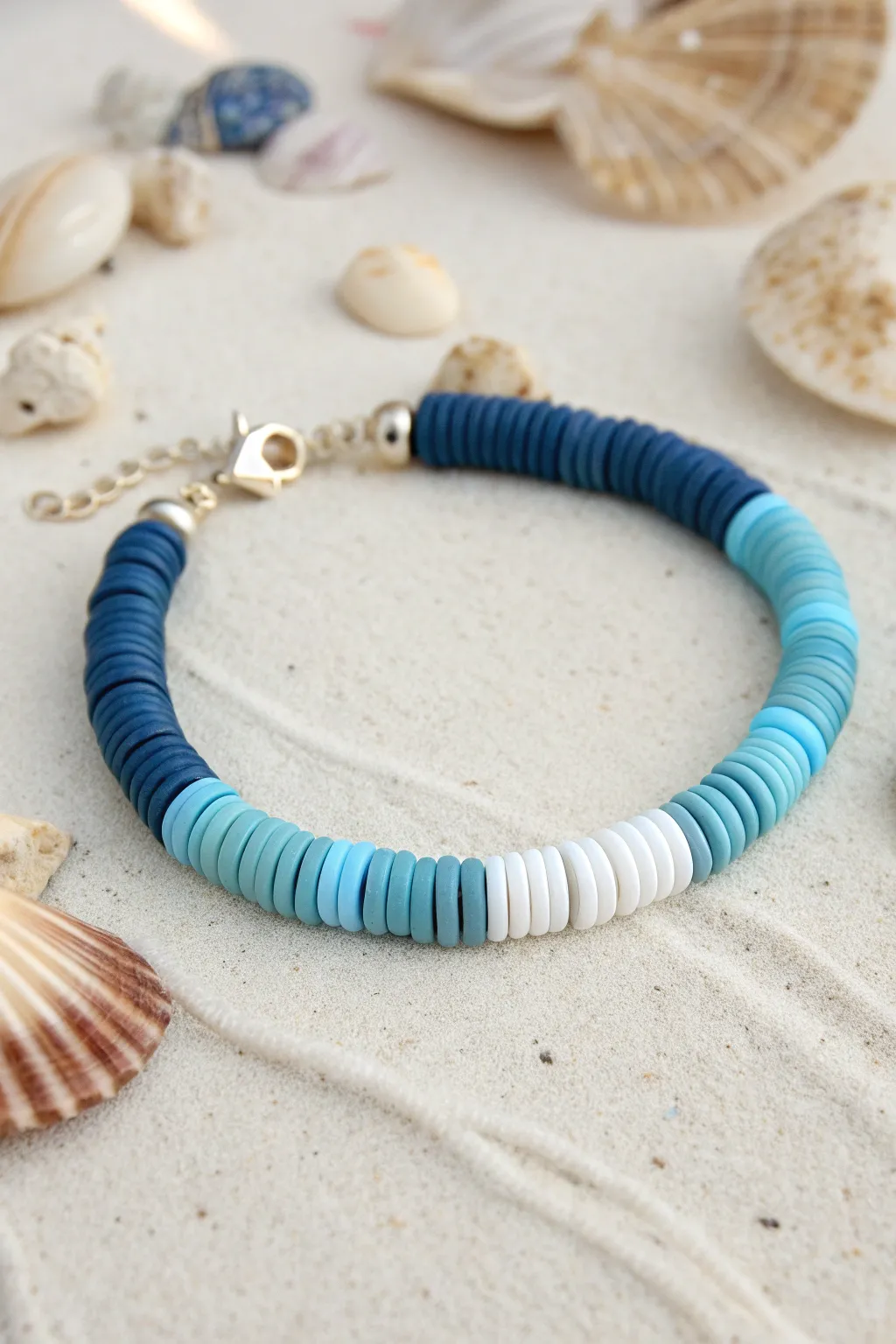
Capture the serene transition of deep ocean waters to foamy white shores with this simple yet stunning ombre bracelet. Using flat polymer clay heishi beads, you’ll create a seamless gradient that looks perfect stacked or worn solo.
Detailed Instructions
Materials
- 6mm Polymer clay heishi beads (Navy Blue)
- 6mm Polymer clay heishi beads (Teal or Slate Blue)
- 6mm Polymer clay heishi beads (Sky Blue or Aqua)
- 6mm Polymer clay heishi beads (White)
- 0.8mm clear elastic cord
- 2 Gold crimp covers (3mm or 4mm)
- 2 small gold spacer beads (round)
- 1 Gold lobster clasp
- 1 Gold extension chain
- Jewelry pliers (flat nose)
- Scissors or jewelry cutters
- Bead stopper or tape
- Super glue (optional)
Step 1: Preparation
-
Measure your cord:
Cut a piece of elastic cord about 10-12 inches long. This gives you plenty of extra room to tie knots without struggling. -
Secure the end:
Attach a bead stopper or a piece of masking tape to one end of the cord so your beads don’t slide off while you work. -
Sort your gradient:
Lay out your bead colors in order on a tray or mat: Navy, Teal, Sky Blue, and White. Seeing the progression helps visualize the ombre effect before you start stringing.
Step 2: Creating the Pattern
-
Start with the deep ocean:
Begin by stringing approximately 1.5 inches of the Navy Blue heishi beads. This forms the darkest section of your bracelet. -
Transition to mid-tones:
Add about 1 inch of the Teal (or Slate Blue) beads. This middle color bridges the gap between the deep sea and the lighter shallows. -
Add the shallows:
String on about 1 inch of the Sky Blue beads. Keep checking the length against your wrist to ensure the proportions look balanced. -
Create the white cap:
Add a short section—about 0.5 to 0.75 inches—of White beads. This represents the crashing wave or sea foam and acts as a highlight in the pattern. -
Reverse the gradient:
Now, mirror the pattern backward to complete the circle. String another 1 inch of Sky Blue beads immediately after the white section. -
Finish the color run:
Follow the Sky Blue with another 1 inch section of Teal beads. You should now be back to where you started, ready to join with the dark blue section. -
Check the fit:
Wrap the unfinished strand around your wrist. If it’s too short, add more Navy Blue beads to the ends; the dark section usually sits at the back of the wrist near the clasp.
Seamless Ombre Tip
To make the gradient even smoother, mix the beads at the transition points. For example, alternate one Teal and one Sky Blue bead for a few millimeters between solid color blocks.
Step 3: Hardware & Finishing
-
Add gold accents:
Slide one small gold round spacer bead onto each end of the beaded strand. This adds a polished, professional touch next to the clasp. -
Tie the knot:
This bracelet uses a standard clasp rather than just a knot. Tie the elastic cord directly onto the loop of the lobster clasp on one side using a secure surgeon’s knot. -
Secure the knot:
Add a tiny drop of super glue to the knot for extra security. I like to let this dry for a minute before proceeding so it doesn’t stick to the beads. -
Hide the knot:
Place a gold crimp cover over the knot you just made. Using your flat nose pliers, gently squeeze the crimp cover shut until it looks like a round gold bead. -
Attach the extension chain:
Repeat the tying process on the other end of the cord, attaching the extension chain instead of the clasp. -
Final crimp cover:
Secure the second knot with glue, trim any excess cord close to the knot, and cover it with the second gold crimp cover. Press it gently closed. -
Final inspection:
Give the bracelet a gentle tug to ensure your knots are holding and the crimp covers are securely closed.
Textured Twist
Replace the single gold spacer beads with cowrie shells or a small pearl charm dangling near the clasp for an extra beachy vibe.
Now you have a piece of the ocean to wear on your wrist every day
Navy With Gold-Style Spacer Accents
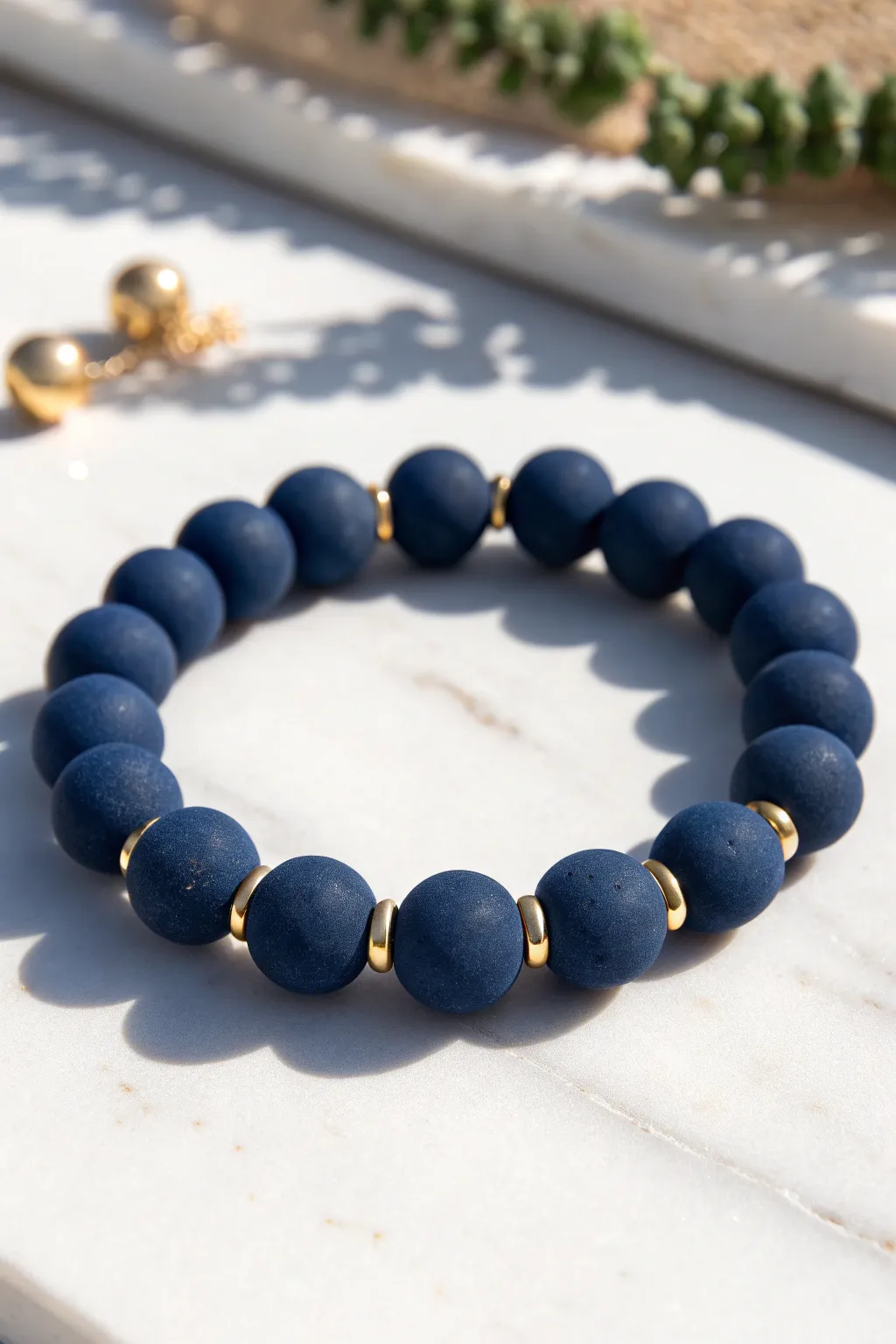
Capture the elegance of a midnight sky with this sophisticated deep blue bracelet. The matte finish of the navy beads contrasts beautifully with shiny gold spacer discs for a piece that looks expensive but is simple to string.
How-To Guide
Materials
- Matte navy blue round beads (8mm or 10mm, approx. 20 beads)
- Gold tone flat spacer beads or heishi beads (approx. 4-6mm diameter)
- Stretch elastic cord (0.8mm or 1mm thickness)
- Jewelry adhesive or clear nail polish
- Scissors
Step 1: Planning Your Design
-
Measure your wrist:
Wrap a flexible measuring tape around your wrist where you want the bracelet to sit. Note this measurement and add about half an inch for a comfortable fit. -
Lay out the pattern:
On a bead board or soft towel, begin arranging your matte navy beads in a line to visualize the final length. -
Insert the gold accents:
Look at the project image—the gold accents aren’t placed between every single bead. Create a pattern by placing gold spacers between every fourth or fifth navy bead, or focus them just on the front section. -
Refine the spacing:
For the specific look in the photo, group the gold spacers in pairs or singles periodically. Try placing a gold spacer, a navy bead, a gold spacer, and then several navy beads in a row.
Step 2: Stringing the Bracelet
-
Prepare the cord:
Cut a piece of elastic cord about 12 inches long. Having extra length makes tying the final knot much easier than struggling with short ends. -
Pre-stretch the elastic:
I always give the elastic a few firm tugs before stringing. This pre-stretching prevents the bracelet from sagging or loosening up immediately after you wear it. -
Secure the end:
Attach a piece of tape or a binder clip to one end of the cord so your beads don’t slide right off while you work. -
Start stringing:
thread your beads onto the elastic following the pattern you laid out. Start with a navy bead rather than a gold spacer to hide the knot more easily later. -
Check the spacing:
Continue adding beads until you have strung enough to match your wrist measurement. -
Test the fit:
carefully bring the two ends together and wrap the strand around your wrist. It should sit comfortably without pinching your skin or sliding off your hand too easily.
Knot Slipping Out?
If the knot won’t stay inside the bead, the bead hole might be too small. Try re-stringing so the knot lands next to a bead with a larger hole.
Step 3: Finishing Touches
-
Prepare for the knot:
Remove the tape or clip from the end of the cord. Hold both ends securely so the tension is even. -
Tie the knot:
Tie a surgeon’s knot (a standard overhand knot, but loop the end through twice before pulling tight). This provides extra grip for slick elastic cording. -
Tighten securely:
Pull the cords tight, but be careful not to snap the elastic. You want the beads to touch snugly without buckling. -
Add security:
Apply a tiny dab of jewelry glue or clear nail polish directly onto the knot. Let this dry completely before moving on. -
Hide the knot:
Once the glue is dry, trim the excess cord ends to about 2mm. Gently pull the cord so the knot slides inside the hole of the nearest navy bead, making it invisible.
Add a Focal Point
Swap one navy bead for a large gold bead or a charm in the center to turn this simple stacker into a statement piece.
Slide on your new bracelet and enjoy the classic navy and gold combination for any occasion
Matte and Glossy Blue Mix
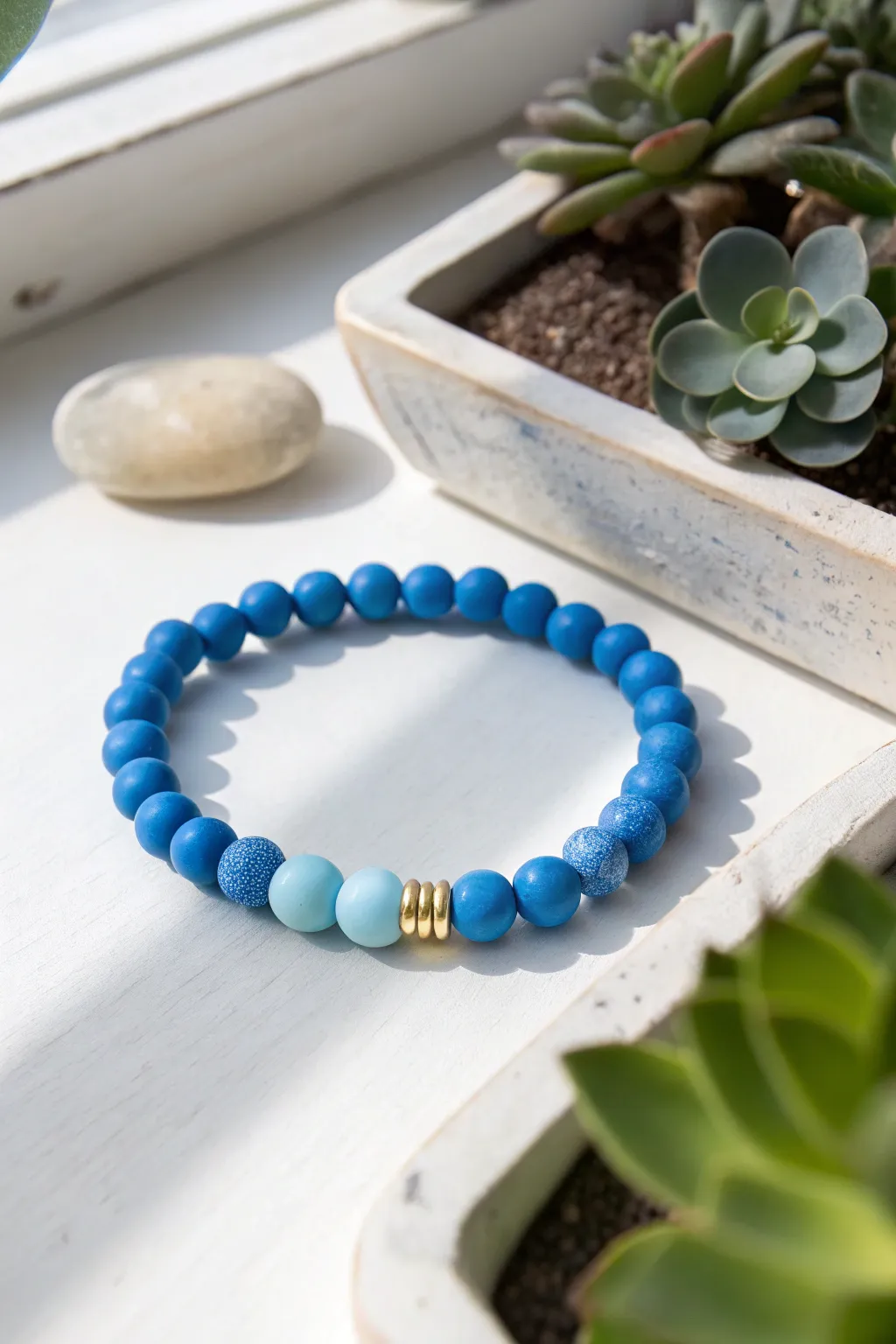
Capture the calming hues of the ocean with this serene bracelet design that plays with texture and tone. By mixing solid matte beads with speckled accents and light blue highlights, you create a sophisticated accessory perfect for stacking or wearing solo.
Step-by-Step
Materials
- Matte royal blue round beads (approx. 8mm)
- Speckled or textured blue round beads (approx. 8mm)
- Light blue/aqua matte round beads (approx. 8mm)
- Gold plated ring spacer beads (x3)
- Clear elastic bead cord (0.8mm or 1mm)
- Jewelry glue or clear nail polish
- Scissors
- Bead stopper or tape
- Ruler
Step 1: Preparation and Design
-
Measure your wrist:
Wrap a flexible measuring tape around your wrist to determine the circumference. Add about 0.5 to 1 inch to this measurement depending on how loose you want the fit. -
Cut the cord:
Cut a piece of elastic cord about 10-12 inches long. Having this extra length makes tying the final knot much easier than struggling with short ends. -
Secure the end:
Place a bead stopper or simply a piece of tape on one end of your cut cord to prevent beads from sliding off while you work. -
Pre-stretch the cord:
Hold the cord at both ends and give it a few gentle tugs. This pre-stretching helps prevent the bracelet from sagging or loosening permanently after the first few wears.
Knot Hiding Trick
Make sure the bead hole next to your knot is large enough to hide it. If using small-hole beads, plan to finish next to a larger hole bead.
Step 2: Stringing the Pattern
-
Start the main color:
Begin by stringing the solid matte royal blue beads. You will need roughly 20-22 beads for the main body, depending on your wrist size. -
Add first texture:
Slide on one of the speckled or textured blue beads. Looking at the design, this acts as a transition point. -
Add the focal section:
Now, add one light blue matte bead. This lighter color draws the eye to the center detail. -
Insert gold spacers:
Thread on the three gold ring spacer beads. These metallic accents add a touch of elegance and break up the matte finishes. -
Mirror the pattern:
Place the second light blue matte bead immediately after the gold spacers. -
Finish the transition:
Add the second speckled/textured blue bead to complete the focal symmetry. -
Check the sizing:
Wrap the unfinished strand around your wrist to check the fit. If it’s too tight, add more solid royal blue beads to the ends; if too loose, remove a couple.
Gap Prevention
If you see cord showing between beads, your elastic is too loose. Re-tie firmly, squeezing beads together, but don’t pull so hard the cord puckers.
Step 3: Finishing Touches
-
Prepare to tie:
Remove the bead stopper or tape carefully, holding both ends of the elastic cord securely. -
Tie the first knot:
Cross the ends and make a simple overhand knot. Pull it tight, bringing the beads together so there are no gaps. -
Secure with a surgeon’s knot:
For the second knot, loop the cord through twice before pulling tight. This extra loop creates a surgeon’s knot which is much more secure for elastic jewelry. -
Apply adhesive:
I always use a tiny dab of jewelry glue or clear nail polish directly on the knot to ensure it doesn’t slip over time. Let it dry for a minute. -
Hide the knot:
Trim the excess cord ends, leaving about 2mm. Gently tug the cord to slide the knot inside the hole of the nearest bead to hide it completely.
Enjoy the cool, calming vibes of your new handmade blue bracelet

The Complete Guide to Pottery Troubleshooting
Uncover the most common ceramic mistakes—from cracking clay to failed glazes—and learn how to fix them fast.
Blue and Pearl-Inspired Coastal Combo
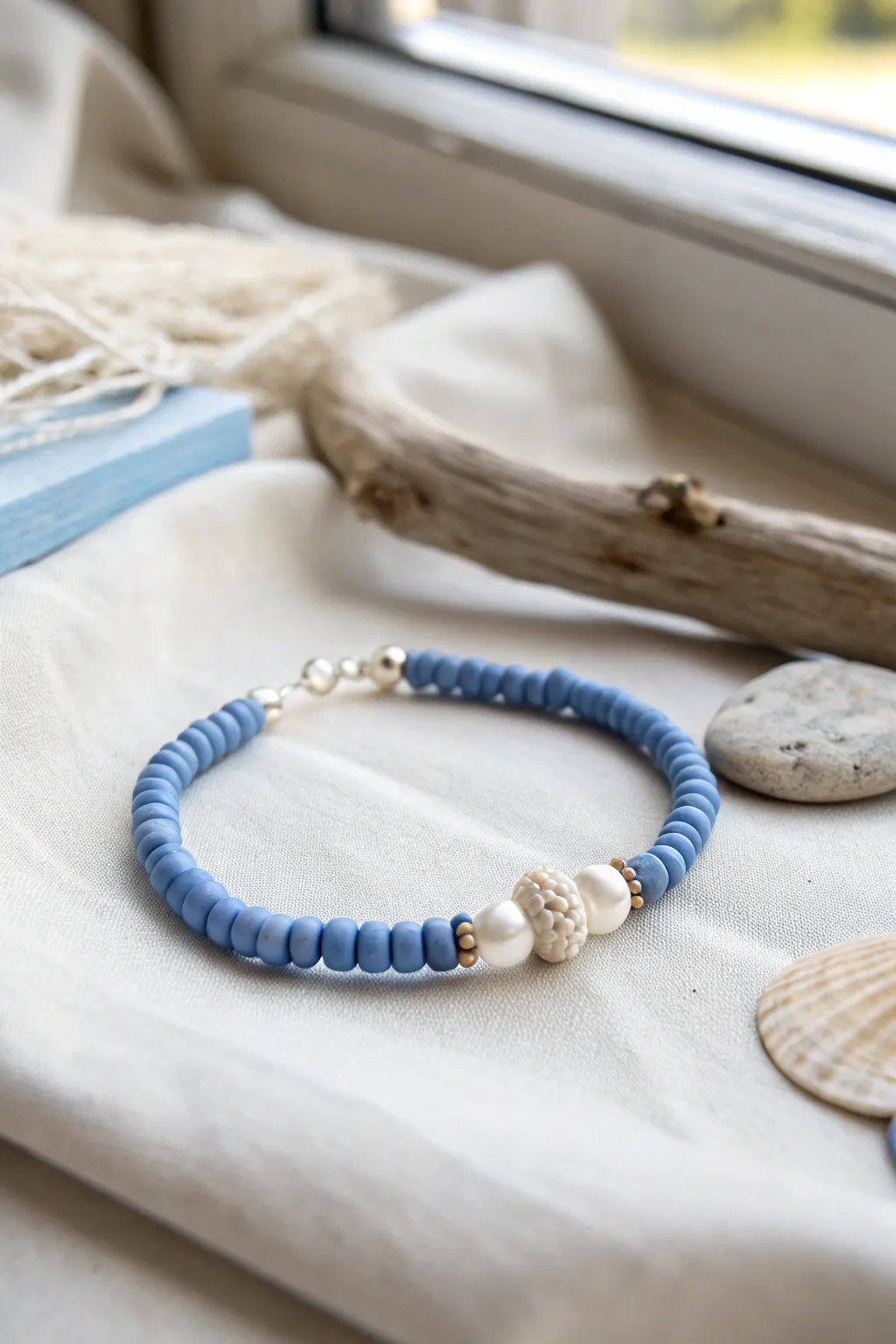
Capture the serene essence of the ocean with this elegant combination of matte blue beads and lustrous freshwater pearls. The textured focal bead adds a touch of coral-inspired charm, making this piece perfect for sandy beaches or casual summer days.
Step-by-Step Guide
Materials
- Matte periwinkle blue beads (approx. 4-5mm, clay or glass)
- Two freshwater pearls (potato or semi-round shape)
- One textured beige/cream focal bead (berry bead or carved bone)
- Small gold or brass spacer beads (tiny seed beads or metal discs)
- Silver crimp beads
- Silver wire guards (optional but recommended)
- Silver lobster clasp and jump ring
- Beading wire (such as flexible 49-strand)
- Crimping pliers
- Wire cutters
- Ruler
Step 1: Planning the Design
-
Measure your wrist:
Before cutting any wire, wrap a measuring tape around your wrist to find your size, then add about half an inch for a comfortable fit. -
Gather your materials:
Lay out your pearls, the textured focal bead, and the blue base beads on a bead mat or soft cloth so they don’t roll away. -
Check the central pattern:
Arrange the focal point on your table to see how it looks: place one gold spacer, a pearl, the textured center bead, another pearl, and a final gold spacer in a line.
Loose Beads?
If your bracelet feels too stiff, you likely pulled the wire too tight before crimping. Leave a tiny gap (about 1mm) of bare wire near the clasp to allow beads to drape naturally
Step 2: Stringing the Bracelet
-
Cut the wire:
Snip a piece of beading wire about 10-12 inches long. This gives you plenty of extra room to work with the clasps. -
Attach the first clasp end:
Thread a crimp bead onto the wire, followed by a wire guard (if using) and your jump ring or chain tab. Loop the wire back through the crimp bead. -
Secure the crimp:
Use your crimping pliers to flatten or fold the crimp bead securely. Give it a gentle tug to ensure it holds tight. -
Cover the tail:
As you start stringing the first few beads, tuck the short tail of the wire inside them for a clean finish. -
Start the blue section:
Begin threading on your matte blue beads. You’ll want to string enough to cover almost half of your total desired bracelet length. -
Add the first spacer:
Slide on one tiny gold spacer bead to act as a separator before the focal section. -
Add the first pearl:
Thread one freshwater pearl next to the spacer. Its organic shape contrasts beautifully with the uniform blue beads. -
Place the centerpiece:
Add your textured cream ‘berry’ bead or focal bead right in the middle. -
Complete the focal trio:
Mirror the design by adding the second freshwater pearl followed by the second gold spacer bead. -
Finish the blue section:
Resume stringing the matte blue beads until the bracelet reaches your desired total length.
Step 3: Finishing Touches
-
Prepare the final crimp:
Thread a crimp bead onto the end of the wire, followed by the wire guard and the lobster clasp. -
Create the loop:
Pass the wire back through the crimp bead and into the last few blue beads you strung. -
Check the tension:
Pull the wire snug, but ensure the bracelet remains flexible; if it’s too tight, it will be stiff and uncomfortable to wear. -
Crimp and trim:
Flatten the final crimp bead with your pliers. I usually trim the excess wire as close to the beads as possible with flush cutters for a professional look. -
Final inspection:
Wiggle the bracelet to make sure the beads sit nicely and the connections are secure before wearing.
Level Up The Look
Swap the matte blue beads for varying shades of sea glass chips or ombre clay discs to create a more textured, ‘found object’ aesthetic that mimics a day at the beach
Enjoy wearing your handcrafted piece of the seaside wherever you go
Blue-and-White Stripe Rhythm
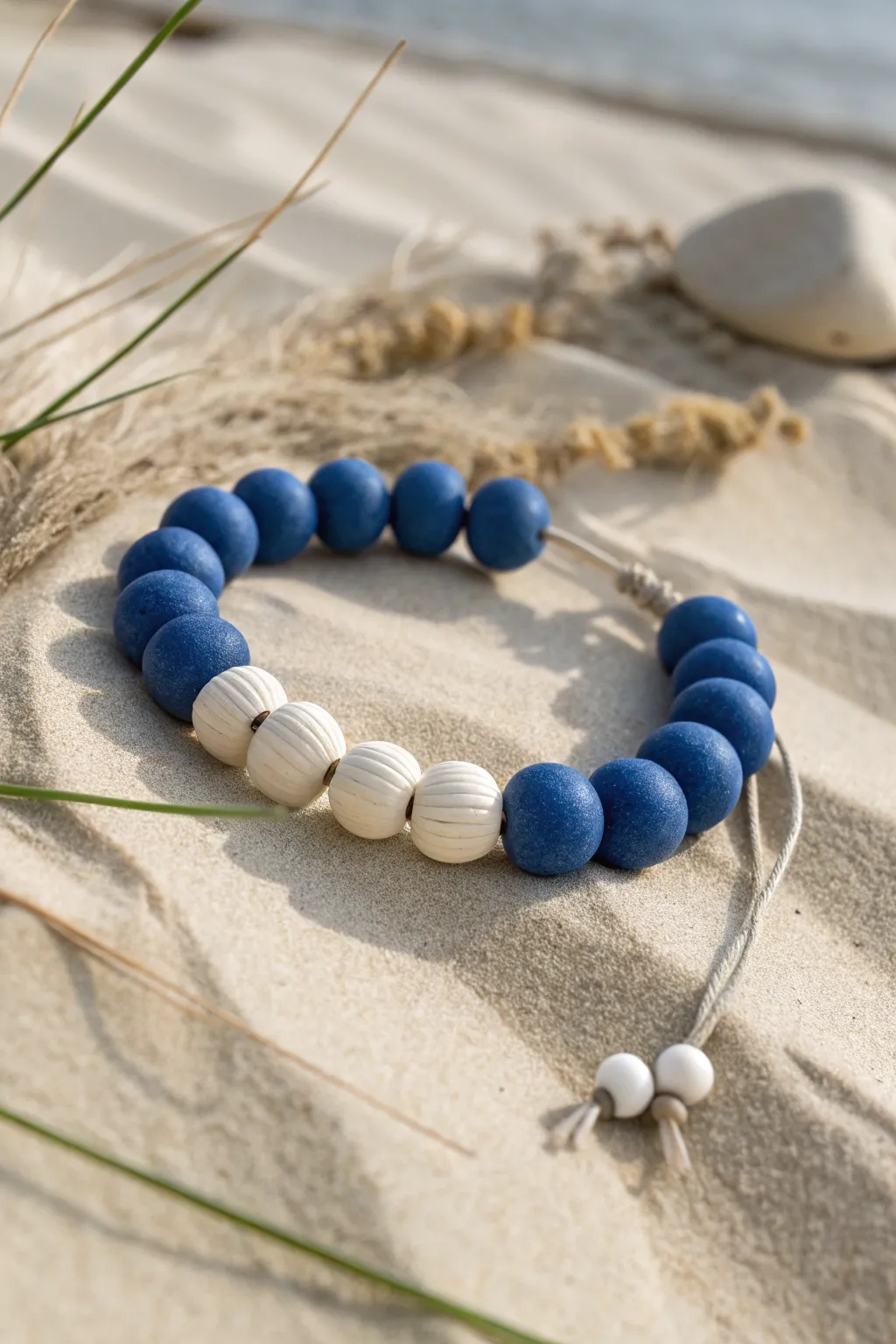
Capture the serene vibe of the seashore with this textured polymer clay bracelet. Featuring matte indigo and grooved white beads, this accessory balances bold color with organic, rhythmic patterns perfect for summer styling.
Detailed Instructions
Materials
- Polymer clay (Deep Indigo Blue)
- Polymer clay (White)
- Bead rolling tool (or acrylic block)
- Texture tool or needle tool (for grooves)
- Bead piercer or thick needle
- Waxed cotton cord (Light Beige or Cream, approx. 1mm)
- Scissors
- Measuring tape
- Baking sheet and parchment paper
- Oven (for curing clay)
Step 1: Crafting the Blue Beads
-
Condition the clay:
Start by warming up your deep indigo polymer clay in your hands until it is pliable and smooth. This prevents cracking later. -
Portion the clay:
Roll the blue clay into a uniform log or snake, then slice it into equal segments to ensure your beads are all the same size. -
Roll into spheres:
Take each segment and roll it between your palms to create a smooth, round sphere. You will need approximately 14-16 blue beads depending on your wrist size. -
Create the matte texture:
To achieve the look in the photo, gently roll the spheres on a piece of coarse sandpaper or use a stiff-bristled toothbrush to stipple the surface slightly. This removes the ‘plastic’ shine. -
Pierce the holes:
Using your bead piercer, carefully create a hole through the center of each blue bead. I find twisting the tool as you push helps maintain the round shape.
Texture Pro Tip
For the grooved white beads, roll the bead across a fine-tooth comb instead of pressing individual lines. This creates perfectly even spacing in seconds.
Step 2: Sculpting the Textured White Beads
-
Prepare white clay:
Condition your white polymer clay and portion out four equal segments, aiming for a size slightly smaller than the blue beads. -
Form the base shape:
Roll these segments into spheres, then flatten the sides ever so slightly to create a thick rondelle shape. -
Add grooved details:
Using a needle tool or a dull knife edge, press vertical indentation lines around the circumference of the white beads. Space them evenly to create a ribbed, pumpkin-like texture. -
Pierce the white beads:
Create center holes in these white beads just as you did with the blue ones, ensuring the hole runs perpendicular to the grooved lines. -
Bake the beads:
Arrange all beads on a parchment-lined baking sheet and bake according to your clay package instructions (usually 275°F/135°C for 15-30 minutes). Let them cool completely.
Step 3: Assembly & Knotting
-
Cut the cord:
Cut a length of waxed cotton cord about 20 inches long. This gives you plenty of room for the adjustable closure. -
String the pattern:
Feed your beads onto the cord. Start with about 7 blue beads, add the 4 texture white beads in the center, and finish with the remaining 7 blue beads. -
Secure the ends:
Tie a simple overhand knot tightly against the last bead on both ends of the strand to keep the beads in place. -
Create the sliding knot:
Bring the two cord ends together so they overlap. Cut a separate piece of cord (about 6 inches) and tie a square knot or macramé sliding knot around the overlapped strands. -
Trim and finish:
Tie small decorative knots at the very tips of the cord tails, adding a small bead if desired, and trim any excess cord. Determine the fit and adjust the slider.
Level Up: Salt Wash
Before baking, lightly brush the blue beads with white acrylic paint and immediately wipe it off. Ideally the paint stays in the texture for a weathered look.
Step 4: Final Touches
-
Inspect the knots:
Give the sliding mechanism a few test pulls to ensure it moves smoothly but stays secure. -
Clean the beads:
If there is any residual dust or fingerprints, gently wipe the beads with a damp cloth or a tiny bit of rubbing alcohol. -
Add final beads:
For an authentic look, I like to create two tiny white mini-beads for the cord ends (as seen in the photo) to give the drawstring pull a polished finish.
Slip on your new bracelet and enjoy the breezy coastal aesthetic you have created with your own hands

What Really Happens Inside the Kiln
Learn how time and temperature work together inside the kiln to transform clay into durable ceramic.
Tri-Tone Blue Color Blocking
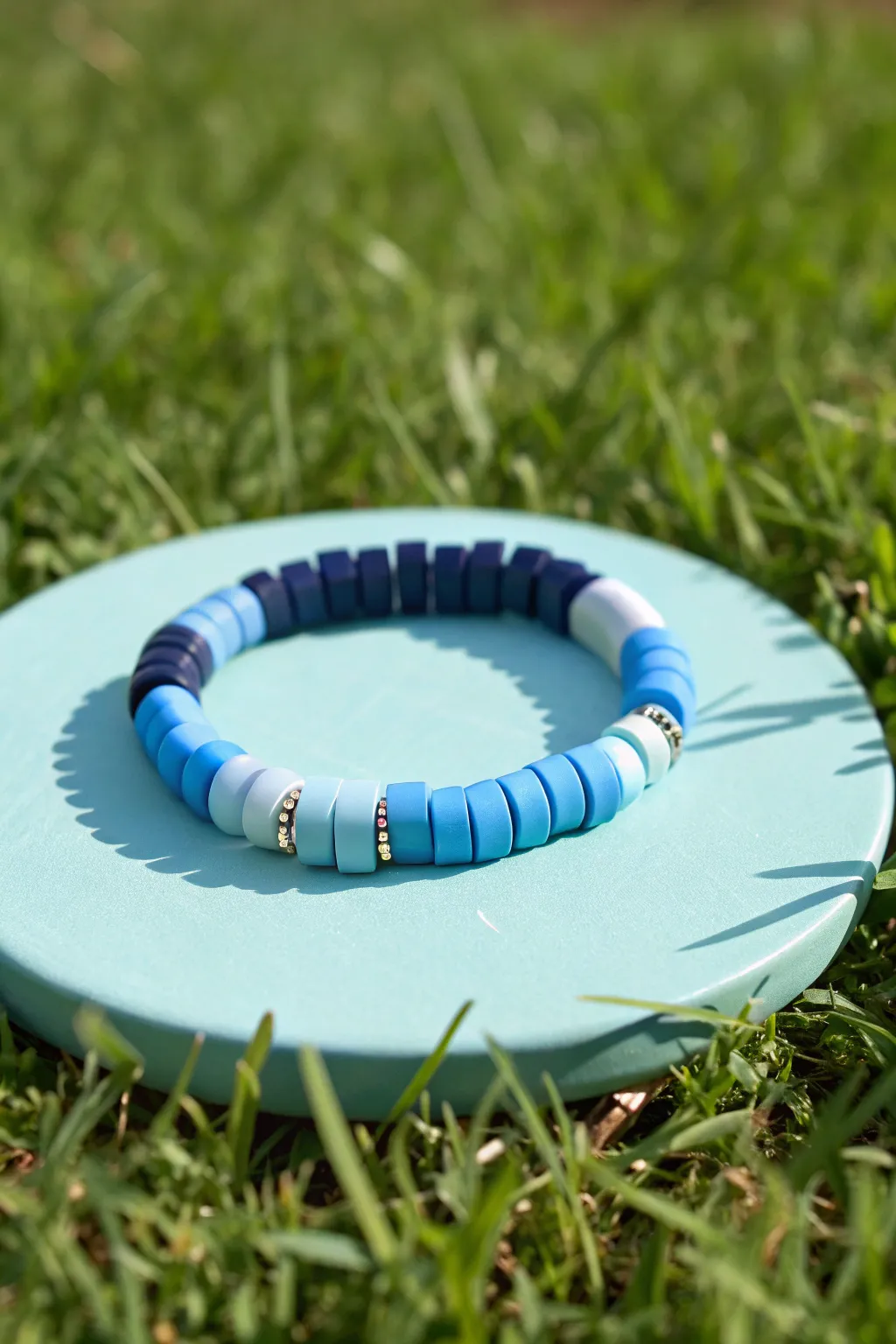
Embrace cool, coastal vibes with this rhythmically patterned clay bead bracelet featuring three harmonious shades of blue. The distinct color-blocking creates a modern, geometric look that pairs perfectly with denim or summer whites.
How-To Guide
Materials
- Polymer clay Heishi beads (flat disc beads) in Navy Blue
- Polymer clay Heishi beads in Bright Blue
- Polymer clay Heishi beads in Baby Blue
- 4-6 Gold rhinestone spacer beads (rondelle shape)
- Stretch cord (0.8mm or 1mm thickness)
- Scissors
- Super glue or jewelry cement
- Bead stopper or tape
- Ruler
Step 1: Preparation & Setup
-
Measure your cord:
Cut a piece of stretch cord about 10-12 inches long. This generous length gives you plenty of room to tie knots later without struggling. -
Secure the end:
Place a bead stopper or simply a piece of tape on one end of the cord to prevent your colorful beads from sliding right off as you work. -
Pre-stretch the cord:
Give your elastic cord a few gentle tugs before you start. This ‘pre-stretching’ helps prevent the bracelet from sagging or loosening up immediately after you wear it.
Loose Knot?
If your elastic knot slips, try pre-stretching the cord more aggressively before stringing. The surgeon’s knot is key—looping twice really locks it in place
Step 2: Creating the Pattern
-
Start with the darkest shade:
Begin by stringing approximately 10-12 Navy Blue clay beads. This creates the first solid block of deep color. -
Add a transitional accent:
Slide on one Baby Blue bead, followed by a gold rhinestone spacer, and then two more Baby Blue beads. This little lighter interruption adds sparkle before the next big block. -
String the medium block:
Add your section of Bright Blue beads. Aim for about 10 beads here to maintain a balanced look with the first section. -
Insert the second accent:
Repeat the accent pattern: one rhinestone spacer followed by a single Baby Blue bead. This acts as a separator between the medium and light sections. -
Create the lightest block:
Thread on a section of about 8-10 Baby Blue beads. I like to check the length against my wrist here to see if the sizing is on track. -
Add final sparkle:
Place another gold rhinestone spacer, followed by a small cluster of 2-3 Bright Blue beads. -
Complete the circle:
Finish stringing by adding a final block of Bright Blue beads until the total beaded length is about 6.5 to 7 inches, or whatever fits your wrist comfortably.
Step 3: Finishing Touches
-
Check the fit:
Wrap the beaded strand around your wrist. The ends should meet comfortably without gaps, but shouldn’t be too tight that it pinches. -
Prepare for the knot:
Remove the tape or bead stopper carefully while holding the loose ends of the cord firmly. -
Tie the surgeon’s knot:
Cross the ends like a normal knot, but loop the top finish through the circle twice before pulling tight. This extra loop adds significant security. -
Secure the knot:
Pull the cord ends firmly to tighten the knot. Apply a tiny dot of super glue or jewelry cement directly onto the knot. -
Hide the mechanics:
While the glue is still slightly wet, slide an adjacent clay bead over the knot to hide it inside. Let it dry completely. -
Trim the excess:
Once the glue is fully dry, use your scissors to trim the excess cord tails as close to the beads as possible without cutting the knot itself.
Clean Cuts
When trimming the extra cord, tension the elastic slightly away from the beads. This helps the cut end retract back inside the bead hole for a seamless finish
Now you have a stunning custom accessory ready to add a pop of blue to your daily outfit
Blue Smiley Pop Bracelet
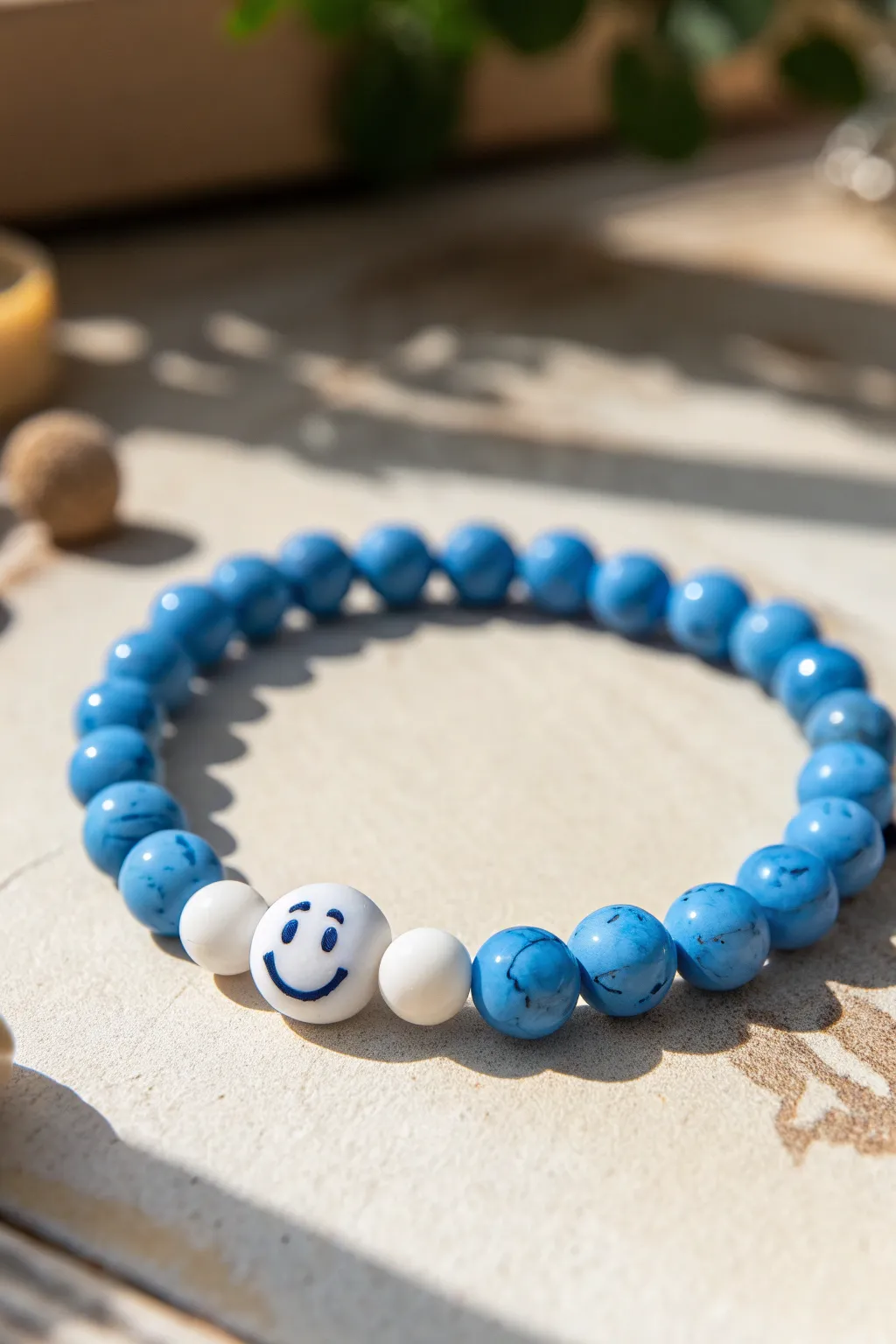
Brighten your wrist stack with this cheerful design that combines saturated azure tones with a classic playful motif. The contrast between the veined blue stone beads and the clean white smiley face creates a modern, beachy vibe perfect for everyday wear.
Detailed Instructions
Materials
- 8mm blue turquoise or dyed howlite beads (approx. 20-22 beads)
- 8mm white acrylic or glass round beads (2 beads)
- 10mm or 12mm flat round or spherical white bead with blue smiley face print
- 0.8mm clear elastic stretch cord
- Jewelry glue or clear nail polish
- Scissors
- Tape or bead stopper
- Ruler
Step 1: Preparation
-
Measure your wrist:
Wrap a flexible measuring tape or a strip of paper around your wrist to find your size. Add about half an inch to this measurement for a comfortable fit that isn’t too tight. -
Cut the cord:
Cut a piece of elastic cord roughly 10-12 inches long. Having extra length makes tying the finishing knots much easier than struggling with short ends. -
Pre-stretch the elastic:
Before stringing, give your elastic cord a few firm tugs. This helps prevent the bracelet from stretching out and becoming loose after the first time you wear it. -
Secure the end:
Attach a piece of tape or a bead stopper to one end of the cord. This simple step saves you from the frustration of beads sliding right off while you work.
Step 2: Creating the Design
-
Start the blue pattern:
Begin stringing your blue turquoise beads. You’ll want to string about half of your total blue beads first to ensure the smiley face ends up centered opposite the knot, or just string the majority so the knot can be hidden near the focal point. -
Add the first accent:
Slide on one of the plain white round spacer beads. This creates a clean visual break between the textured blue stones and the focal bead. -
Place the focal bead:
Thread your smiley face bead. Orient it carefully; if the hole runs top-to-bottom, make sure the face is upright relative to how you want to read it. -
Complete the center cluster:
Add the second plain white round bead immediately after the smiley face. This frames your centerpiece symmetrically. -
Finish the blue strand:
Continue stringing the remaining blue beads until you reach your desired length. Wrap the strand around your wrist to check the fit before tying.
Knot Slipping?
If your elastic is slippery, dust the knot area with a tiny bit of rosin powder before tying, or roughen the ends with sandpaper for better grip.
Step 3: Finishing Touches
-
Prepare to knot:
Remove the tape or bead stopper carefully while holding both ends of the elastic securely. -
Tie the first knot:
Cross the ends and make a simple overhand knot. Pull it tight enough to bring the beads together so there are no gaps, but not so tight that the bracelet buckles. -
Secure with a surgeon’s knot:
For the second knot, create a loop as if tying an overhand knot, but pass the tail end through the loop twice instead of once. Pull firmly to lock it in place. -
Glue the knot:
Apply a tiny dab of jewelry glue or clear nail polish directly onto the knot. I prefer to use a toothpick for this to avoid getting glue on the beads themselves. -
Hide the knot:
While the glue is still slightly tacky but not wet, gently pull the knot inside the hole of the nearest blue bead. If the hole is too small, just let it rest discreetly between two beads. -
Trim the ends:
Once the glue is fully dry, use your scissors to trim the excess elastic cord close to the knot, being careful not to nick the main cord.
Texture Twist
Swap the polished blue beads for matte finish stones or frosted glass beads to give the bracelet a softer, more tactile beach glass feel.
Wear your new creation with pride and let that little smile be a reminder to stay positive throughout your day

TRACK YOUR CERAMIC JOURNEY
Capture glaze tests, firing details, and creative progress—all in one simple printable. Make your projects easier to repeat and improve.
Seashell Charm With Blue Heishi Base
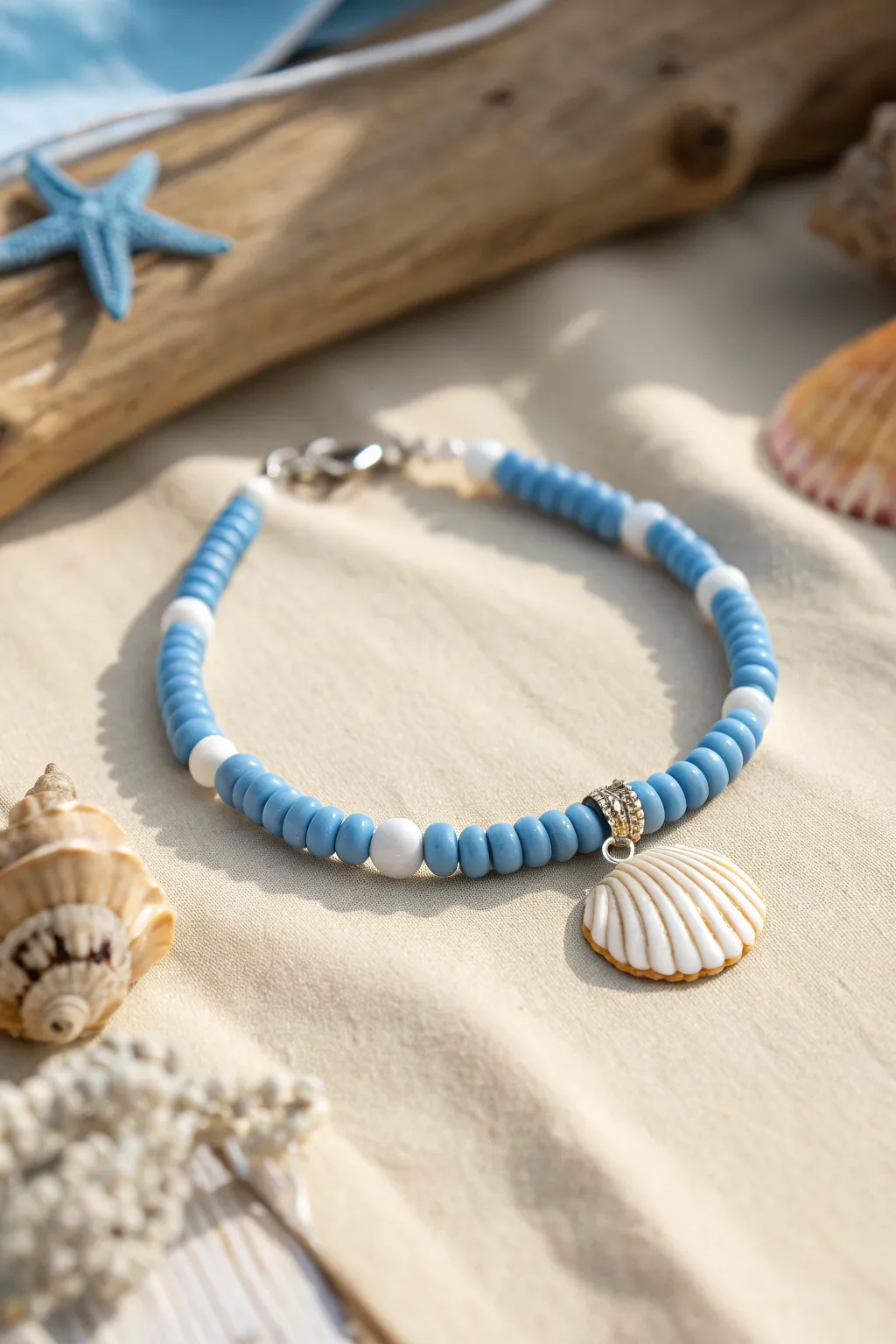
Capture the essence of a serene beach day with this beautiful blue clay bead bracelet featuring a classic white seashell charm. The rhythm of cornflower blue heishi beads broken up by pristine white spacers creates a wave-like pattern that’s perfect for summer styling.
Step-by-Step Tutorial
Materials
- 6mm Heishi polymer clay beads (Cornflower Blue)
- 6mm Heishi polymer clay beads (White)
- White or cream seashell charm (synthetic or drilled natural shell)
- Silver jump ring (6-8mm)
- Silver textured bail or bead hanger (optional but recommended for the charm)
- Elastic beading cord (0.8mm clear)
- Silver lobster clasp
- Silver jump ring (closed or split ring) for clasp attachment
- 2 small crimp beads (silver)
- Jewelry pliers (flat nose)
- Scissors
- Super glue or jewelry cement
Step 1: Preparation
-
Measure the Cord:
Cut a length of elastic cord about 10-12 inches long. This generous length gives you plenty of room to tie knots without struggling against tension. -
Secure the End:
To prevent beads from sliding off while you work, place a piece of tape on one end of your cord or attach a binder clip. -
Prepare the Charm:
If your seashell charm doesn’t have a bail pre-attached, open a silver jump ring using two pairs of pliers (twist, don’t pull apart). Slide the shell onto the ring, add a decorative textured bail if you have one, and close the ring securely.
Step 2: Beading the Pattern
-
Start the Sequence:
Thread on a section of the cornflower blue heishi beads. Looking at the design, you’ll want a cluster of about 6 to 8 blue beads to start. -
Add the Spacer:
Slide on one single white heishi bead. This acts as a refreshing visual break in the blue pattern. -
Repeat the Pattern:
Continue this alternating rhythm: thread 6-8 blue beads, followed by 1 white bead. Repeat this sequence until you have completed roughly half of your desired bracelet length. -
Center the Charm:
Once you hit the halfway point, slide your prepared seashell charm onto the cord. Ensure the concave side of the shell (or the patterned side) is facing the direction you prefer for wear. -
Finish the Beading:
Mirror your pattern on the other side of the charm. Continue the sequence of 6-8 blue beads followed by a single white bead until individual sections match perfectly. -
Check the Fit:
Wrap the unfinished strand around your wrist to check the size. It should sit comfortably without pinching skin, keeping in mind the clasp will add about half an inch of length.
Knot Slipping?
If you aren’t using crimps and prefer knotting, use a surgeon’s knot (looping twice) and dab it with clear nail polish or Hypo Cement to fuse the elastic permanently.
Step 3: Closing the Bracelet
-
Add First Crimp and Clasp:
Remove your tape or clip. On one end, slide on a crimp bead followed by the lobster clasp. Thread the cord back through the crimp bead to create a small loop holding the clasp. -
Secure First End:
Use your flat nose pliers to squash the crimp bead flat, locking the clasp in place. Trim the short excess tail of the cord close to the crimp. -
Add Second Crimp and Ring:
On the other open end of the cord, slide on your second crimp bead followed by a closed jump ring. -
Loop and Tighten:
Thread the cord back through the crimp bead. Pull the cord to tighten the loop, ensuring there are no large gaps between your beads, but leave just a tiny bit of slack so the bracelet remains flexible. -
Final Secure:
Flatten the second crimp bead firmly with your pliers. I usually add a tiny dot of super glue over the crimped beads for extra security before the next step. -
Trim Excess:
Once the glue is dry (if used), carefully trim the remaining excess cord close to the crimp bead. Don’t cut it flush; leave about 1mm to prevent slippage.
Pattern Pro Tip
Lay out your beads on a specialized bead board or a textured towel before stringing. This stops them from rolling away and lets you visualize equal spacing for the charm.
Slip on your new bracelet and enjoy the subtle seaside vibes it brings to your outfit
Starfish Charm and Aqua Mix
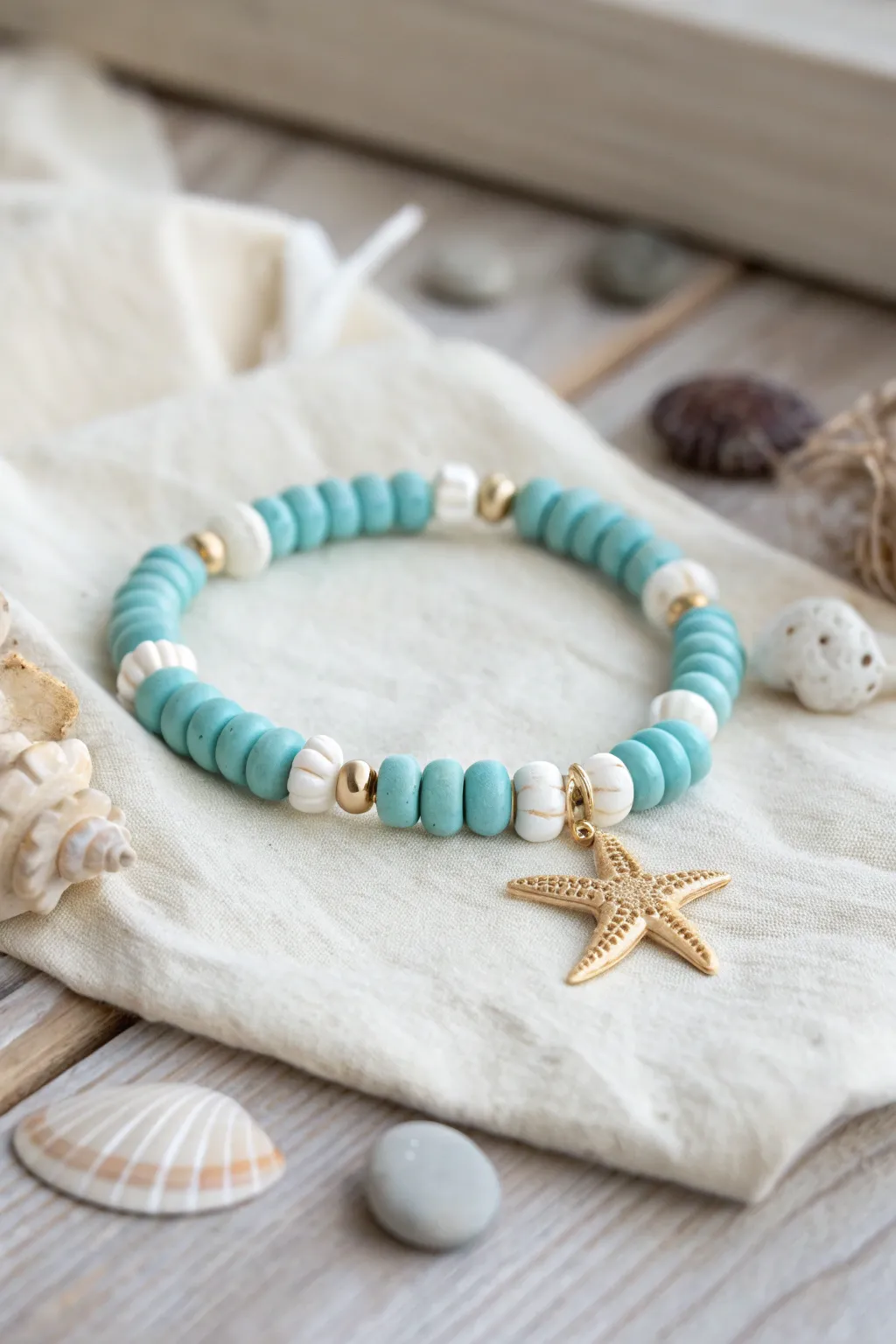
Bring the serene vibes of the seaside to your wrist with this aqua clay bead bracelet featuring a golden starfish charm. The mix of textured white spacers and smooth turquoise discs creates a breezy, sophisticated look perfect for summer days.
Step-by-Step Guide
Materials
- Aqua/turquoise polymer clay heishi beads (approx. 6mm)
- White or cream textured ceramic, shell, or clay spacer beads (rondelle shape with ridges)
- Small gold round spacer beads (3-4mm, brass or gold-plated)
- Gold starfish charm with open jump ring
- Elastic stretch cord (0.8mm clear)
- Jewelry glue (e.g., G-S Hypo Cement)
- Scissors
- Bead stopper or tape
- Chain nose pliers (optional, for the jump ring)
Step 1: Preparation & Planning
-
Measure and cut:
Begin by measuring your wrist with a flexible measuring tape. Cut a piece of elastic cord about 3-4 inches longer than your wrist measurement to give yourself plenty of room for tying knots later. -
Secure the end:
Attach a bead stopper to one end of your cut elastic cord. If you don’t have a bead stopper, a simple piece of masking tape folded over the end works perfectly to keep beads from sliding off. -
Pre-stretch the cord:
Give your elastic cord a few gentle tugs. This pre-stretching step is crucial as it helps prevent the bracelet from stretching out and becoming loose after you’ve started wearing it. -
Sort your beads:
Lay out your beads on a soft surface or bead mat. Group them by type: the aqua clay discs, the textured white spacers, and the gold rounds so they are easy to grab.
Knot Security Trick
When tightening your elastic knot, pull slowly and steadily. Jerking quickly can weaken or snap the cord rubber. Slow tension sets the knot firmly.
Step 2: Creating the Pattern
-
Start the main segment:
Thread on approximately 6 to 8 aqua clay heishi beads. This creates the primary block of color for your pattern. -
Add the textured accent:
Slide on one of the white textured spacer beads. These add a wonderful organic feel that contrasts nicely with the smooth clay discs. -
Insert the gold detail:
Follow the white bead immediately with a small gold round spacer bead for a touch of metallic shine. -
Complete the accent:
Add another white textured spacer bead. This brackets the gold bead between two white ones, creating a symmetrical accent point. -
Repeat the pattern:
Go back to threading your block of 6-8 aqua clay beads. Continue this sequence—aqua block, white spacer, gold bead, white spacer—until the strand is long enough to wrap comfortably around your wrist. -
Check the fit:
Once you think you have enough length, carefully wrap the beaded cord around your wrist to check the fit. It should sit comfortably without digging in or drooping too much.
Oceanic Gradient
Instead of solid aqua blocks, try mixing three shades of blue clay beads within each section to create a subtle ombré water effect.
Step 3: Adding the Charm
-
Locate the center point:
Identify one of the gold spacer beads that acts as a center point or focal area where you want the charm to hang. It’s best if this is near the middle of the bracelet when laid flat. -
Open the jump ring:
Use your pliers to gently twist the jump ring on the starfish charm open. Remember to twist the ends away from each other sideways rather than pulling them apart, to maintain the ring’s circular shape. -
Attach the charm:
Slip the open jump ring onto the bracelet cord right next to your chosen gold spacer bead, or hook it directly onto the gold spacer bead itself if the fit allows. -
Close the ring:
Use the pliers to twist the jump ring back into a closed position, ensuring the ends meet flush so the charm won’t slip off.
Step 4: Finishing Touches
-
Prepare to knot:
Remove the bead stopper or tape from the end of the cord, being careful not to let any beads slide off. Bring the two ends of the elastic together. -
Tie the surgeon’s knot:
Tie a surgeon’s knot. Start with a regular overhand knot, but loop the end through the circle a second time before pulling tight. This extra loop adds significant security. -
Tighten the knot:
Pull the cords tight to secure the knot. I find it helpful to pull all four strands (the two tails and the two bracelet sides) gently to really cinch it down properly. -
Apply glue:
Dab a tiny drop of jewelry glue like G-S Hypo Cement onto the knot. This prevents it from unraveling over time. -
Hide the knot:
While the glue is still a bit tacky but not wet, slide the nearest aqua bead or white spacer over the knot to hide it inside the bead hole. -
Trim excess cord:
Once the glue has fully dried (check your glue’s instructions for timing), use your scissors to trim the excess elastic tails as close to the bead as possible without cutting the knot.
Now your beach-ready accessory feels like a little piece of vacation you can wear every day
Sea Turtle Charm With Deep Blue Contrast
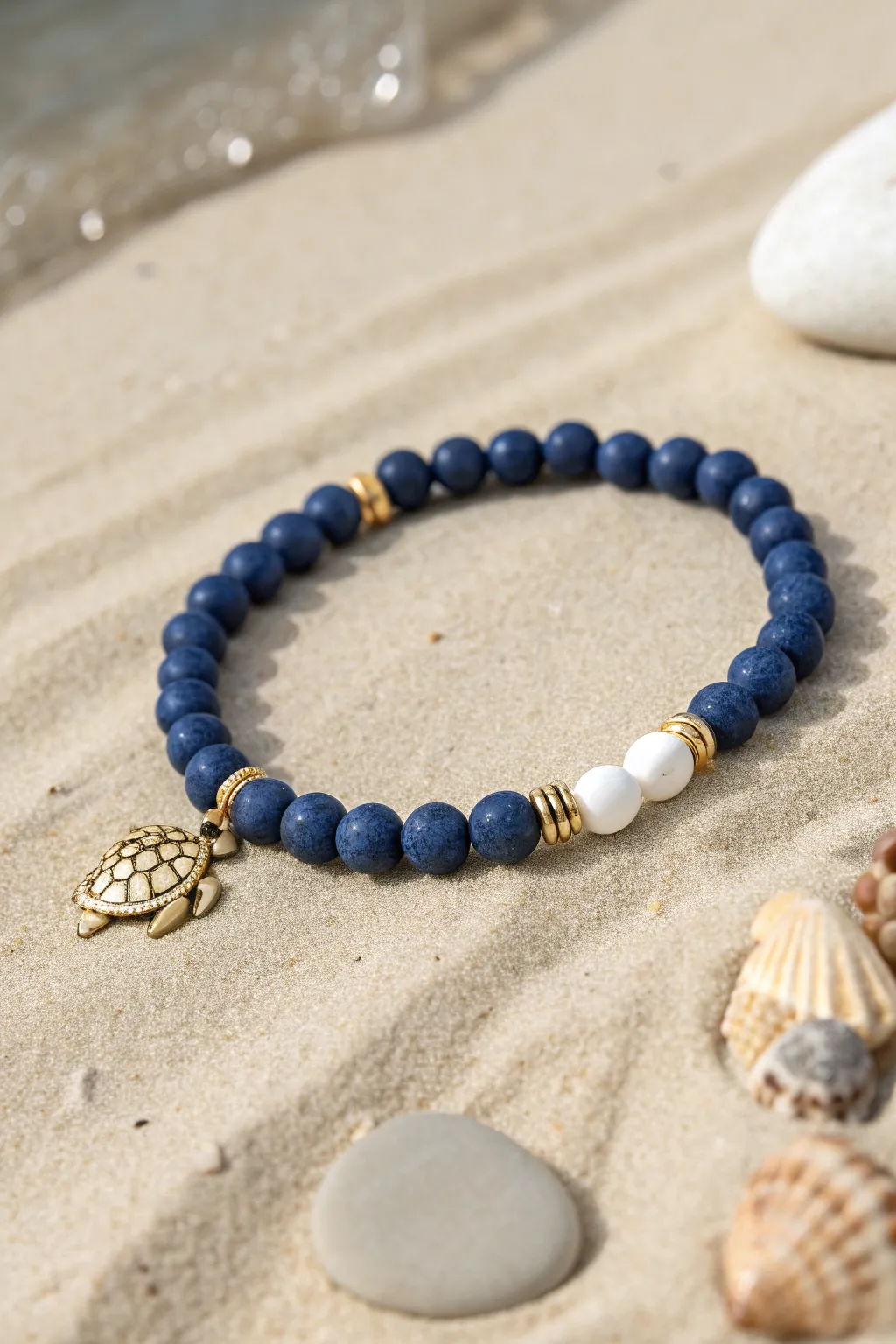
Capture the spirit of the sea with this elegant bracelet that pairs matte navy blue beads with creamy white accents and a whimsical gold turtle charm. The rich contrast of gold against the deep blue creates a sophisticated look perfect for beach days or everyday wear.
Detailed Instructions
Materials
- Matte dark blue round beads (6mm or 8mm, polymer clay or stone)
- 2 Large white round beads (slightly larger than blue beads, smooth finish)
- Gold sea turtle charm with attachment loop
- 4 Gold flat disc spacer beads (heishi style)
- 1 Large gold bail or jump ring (for the charm)
- Small gold accent rings or spacers (optional, between blue beads)
- Strong elastic bead cord (0.8mm recommended)
- Jewelry glue or clear nail polish
- Scissors
Step 1: Planning and Preparation
-
Measure your wrist:
Before cutting any string, wrap a measuring tape loosely around your wrist to determine the needed length. Add about an inch to this measurement to prepare your elastic cord, ensuring you have enough room for tying the knot later. -
Select your beads:
Lay out your matte blue beads on a bead board or a soft towel. This prevents them from rolling away and helps you visualize the pattern before threading. -
Prepare the focal point:
Identify the center of your design. This will be the section featuring the white beads and the gold spacers, sitting opposite the turtle charm for a balanced weight distribution.
Knot Slipping?
If your elastic knot feels insecure, try a surgeon’s knot: loop the cord through twice on the first pass instead of once for extra grip.
Step 2: Creating the Pattern
-
Start threading the blue base:
Begin by stringing approximately 10 to 12 of the dark blue matte beads onto your elastic cord. This will form one side of the bracelet. -
Add first gold accent:
Slide on one of the small gold accents or a single gold disc spacer if you are including them within the blue run, as seen on the left side of the reference image. -
Continue the blue run:
Thread another segment of blue beads. The exact number will depend on your wrist size, but keep it symmetrical with the first section you created.
Step 3: Adding the Accents
-
Construct the white segment:
Now, slide on three gold disc spacer beads stacked together. Follow this immediately with the two large white round beads. -
Finish the white segment:
After the second white bead, add another stack of two or three gold disc spacers to bracket the white section perfectly. -
Resume blue threading:
Return to your blue beads, adding the remainder of the strand until the bracelet is nearly the correct length for your wrist.
Pro Tip: Bead Holes
Use a bead reamer to gently smooth the inside edges of clay beads; sharp edges inside the hole can fray your elastic over time.
Step 4: Attaching the Charm
-
Prepare the charm attachment:
Locate the midpoint of your blue beads, opposite the white accent section. If your charm has a jump ring, ensure it is closed tightly. If using a bail, slide it onto the cord now. -
Position the turtle:
Place the gold turtle charm between two gold spacer beads or a specialized gold bead with a hanging loop. I like to double-check that the turtle faces outward when worn. -
Verify sizing:
Wrap the unfinished strand around your wrist one last time to check the fit. It should sit comfortably without pinching skin or drooping excessively.
Step 5: Finishing Touches
-
Pre-stretch the cord:
Gently pull on both ends of the elastic cord several times. This ‘pre-stretching’ step is crucial as it prevents the bracelet from stretching out and becoming loose after the first few wears. -
Tie the knot:
Tie a surgical knot or a square knot securely. Pull the elastic tight to ensure the beads sit flush against each other with no gaps visible. -
Secure with glue:
Apply a tiny drop of jewelry glue or clear nail polish directly onto the knot. Allow it to dry completely before touching it again. -
Hide the knot:
Once the glue is dry, trim the excess cord ends close to the knot. Gently pull the adjacent bead over the knot to hide it inside for a professional, seamless finish.
Slip on your new ocean-inspired accessory and enjoy the calm vibes it brings to your day
Blue-and-White Protective Eye Focal
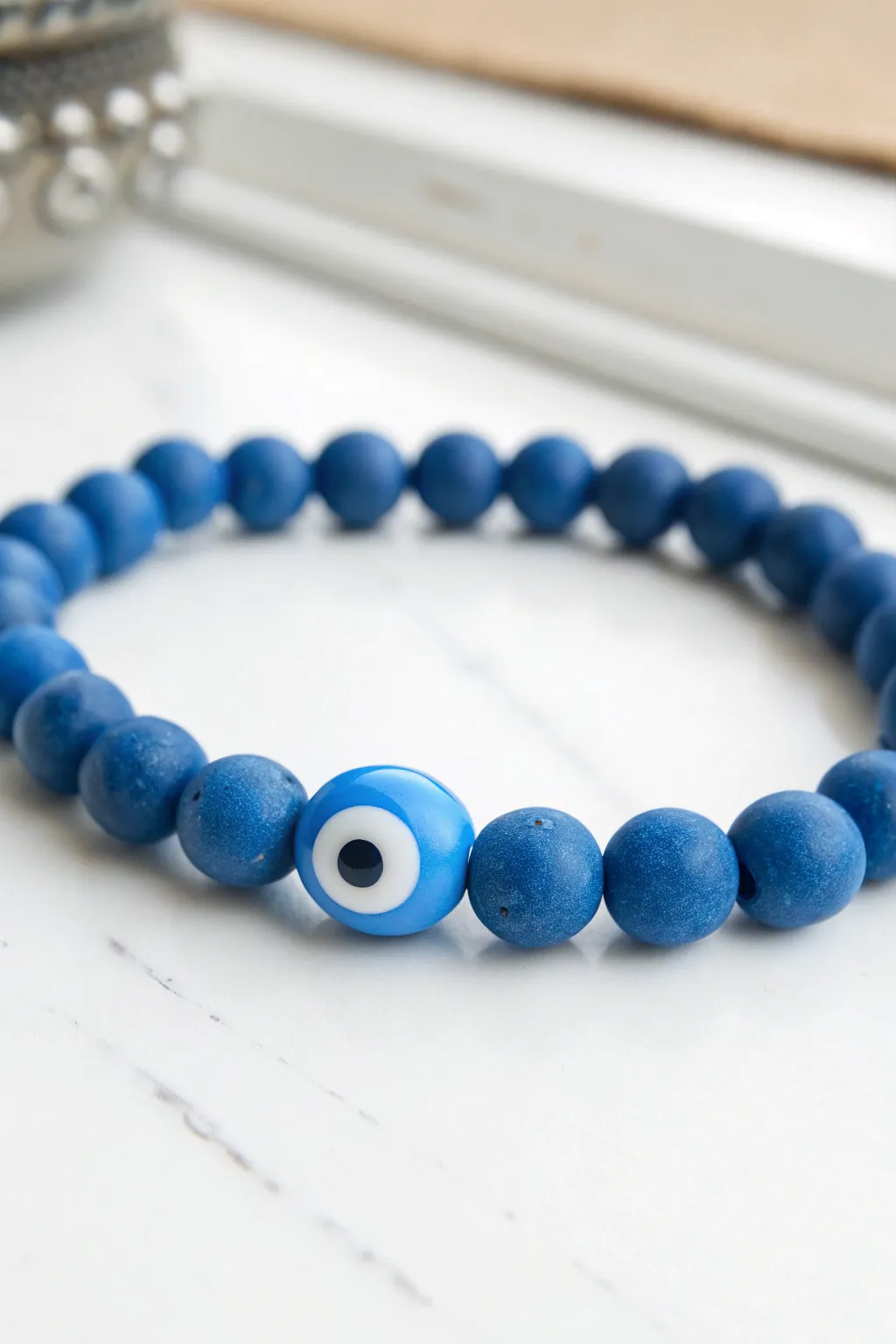
Embrace a classic symbolic look with this deep blue matte beaded bracelet featuring a striking evil eye focal bead. The contrast between the smooth, glossy center bead and the textured matte surrounding beads creates a sophisticated and protective accessory.
Step-by-Step Tutorial
Materials
- 10mm matte royal blue agate or clay beads (approx. 20-22 beads)
- 10-12mm glossy glass evil eye bead (blue, white, and black)
- 0.8mm clear elastic cord (stretch magic or similar)
- Jewelry adhesive or clear nail polish
- Scissors
Step 1: Preparation
-
Measure your wrist:
Wrap a piece of string or a soft measuring tape around your wrist to find your size. Add about half an inch to this measurement to ensure the bracelet sits comfortably without pinching. -
Cut the elastic:
Cut a length of your 0.8mm elastic cord to about 12 inches. I always cut a bit more than necessary because it makes the final knotting process much less frustrating. -
Pre-stretch the cord:
Hold both ends of the elastic and give it a firm tug several times. This pre-stretching step helps prevent the bracelet from sagging or loosening immediately after you wear it. -
Secure one end:
Place a piece of tape or a bead stopper clip on one end of the cord so your beads don’t slide off while you are working.
Step 2: Stringing the Design
-
Start with blue beads:
Looking at the design, we need to balance the focal bead. Thread approximately 10 of the matte blue beads onto the cord first. -
Add the focal point:
Slide on your glossy evil eye bead. Orient it so the ‘eye’ pattern faces outward, parallel to the hole direction, though many round glass beads have the pattern on both sides. -
Complete the circle:
Thread the remaining matte blue beads onto the other side of the eye bead. Continue adding beads until the length matches your measured wrist size. -
Check the fit:
carefully wrap the unfinished strand around your wrist to check the sizing. The ends should meet comfortably. Add or remove a matte blue bead if the fit is too tight or too loose. -
Inspect bead texture:
Before tying, give a quick look to ensure no beads are chipped. The beauty of this piece relies on that uniform matte ‘frosted’ look of the blue beads.
Knot Slipping?
If your elastic knot keeps unraveling while you tie, try rubbing the ends with a little beeswax or even chalk to create friction before knotting.
Step 3: Finishing Touches
-
Prepare the knot:
Remove the tape or bead stopper. Bring the two ends of the elastic together, ensuring the beads are pushed close with no gaps. -
Tie a surgeon’s knot:
Cross the ends right over left, then wrap the right end through the loop twice instead of just once. Pull tight. -
The second pass:
Now cross left over right and pull through. Pull the elastic cords firmly away from each other to tighten the knot securely down between the beads. -
Apply adhesive:
Dab a tiny drop of jewelry glue or clear nail polish directly onto the knot. This prevents it from slipping over time. -
Hide the knot:
While the glue is still slightly tacky but not wet, slide the nearest matte bead over the knot to conceal it inside the bead hole. -
Trim excess cord:
Once the glue is fully dry, use sharp scissors to trim the excess elastic tails as close to the bead as possible without nicking the knot itself.
Pro Tip: Hole Size
Since you need to hide the knot, ensure at least one of your matte beads has a slightly larger hole than the others to easily swallow the knot.
Now you have a stylish protective charm to wear daily or stack with other favorites
Tiny Blue Flower Bead Accents
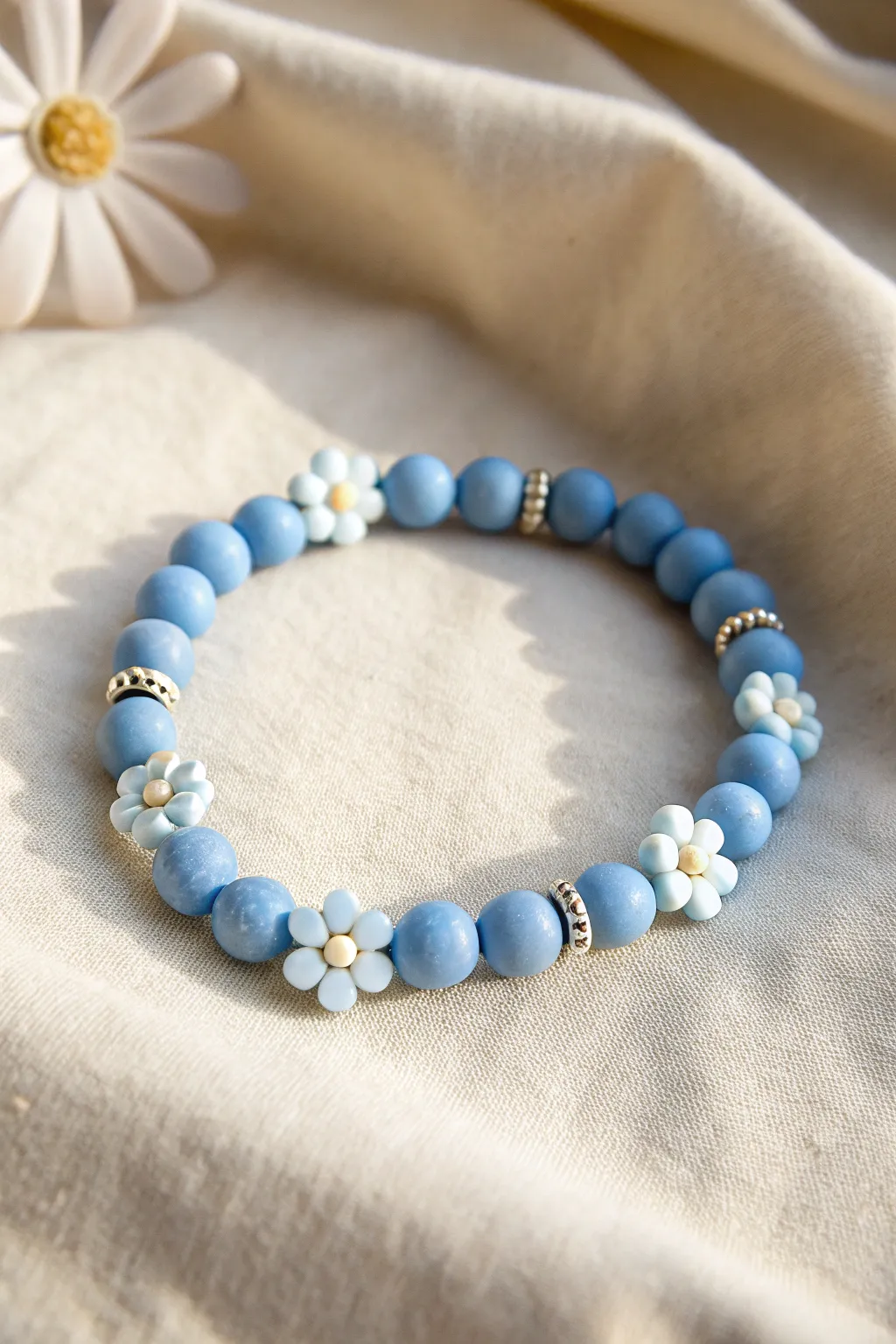
Capture the essence of spring with this delightful beaded bracelet, featuring matte blue beads interspersed with charming polymer clay daisies. The soft, powdery blue hue combined with the textured silver spacers creates a piece that feels both playful and sophisticated.
Step-by-Step Guide
Materials
- Matte finish light blue round beads (approx. 8mm)
- Polymer clay daisy spacer beads (white petals, yellow center, approx. 8-10mm)
- Silver-tone rondelle spacer beads (textured or rhinestone-edged)
- Elastic stretch cord (0.8mm or 1mm clear)
- Jewelry glue or clear nail polish
- Scissors
Step 1: Planning and Setup
-
Measure your wrist:
Before you begin stringing, measure your wrist to determine the needed length. Add about half an inch to an inch for a comfortable fit, depending on how loose you like your bracelets. -
Cut the cord:
Snip a piece of elastic cord about 10-12 inches long. Having this extra length makes tying the final knot significantly easier than working with a short tail. -
Pre-stretch the elastic:
Gently pull the elastic cord a few times before starting. This pre-stretching step is crucial because it helps prevent the bracelet from slowly stretching out and becoming loose after you wear it a few times. -
Secure the end:
Place a piece of tape or a bead stopper on one end of the cord so your beads don’t slide right off while you work. I usually just use a small piece of masking tape folded over itself.
Hiding the Knot
Plan your pattern so the knot ends up next to one of the larger blue round beads rather than the flat daisy; the hole in the round bead is usually larger and hides the knot better.
Step 2: Creating the Pattern
-
Start with blue beads:
Begin your pattern by threading on two of the matte blue round beads. These serve as the foundation of the color scheme. -
Add a daisy:
Slide on one of the white polymer clay daisy beads. Ensure the flat side sits flush against the round blue bead. -
Follow with blue beads:
Add two more matte blue round beads after the daisy. -
Insert silver spacer:
Thread on a silver rondelle spacer. This metallic element breaks up the matte texture and adds a tiny bit of shine. -
Continue the sequence:
Repeat the sequence: two blue beads, one daisy, two blue beads, and one silver spacer. This specific rhythm creates the balanced look seen in the photo. -
Check the fit:
Continue adding beads until you have wrapped the cord around your wrist to check the length. The ends should touch comfortably without stretching the elastic tight. -
Adjust the pattern:
If the bracelet is too short or long, add or remove beads near the ends. Try to finish close to a silver spacer or a plain blue bead set so the pattern looks continuous when tied.
Step 3: Finishing Touches
-
Remove the stopper:
Carefully take off the tape or bead stopper from the end, holding both ends of the cord firmly so nothing falls off. -
Tie the first knot:
Tie a simple overhand knot to bring the beads together into a circle. Pull it tight enough that there are no gaps between beads, but not so tight that the bracelet puckers. -
The surgeon’s knot:
Tie a second knot, preferably a surgeon’s knot. To do this, cross the cords and loop one end through twice instead of just once before pulling tight. -
Apply adhesive:
Dab a tiny drop of jewelry glue or clear nail polish directly onto the knot. This seals the elastic and prevents it from unraveling over time. -
Let it dry:
Allow the glue to dry completely for a few minutes before trimming. -
Trim excess cord:
Snip off the excess elastic tails, leaving about 2-3mm. Do not cut right up against the knot, or it might slip undone. -
Hide the knot:
Gently tug on the bracelet to slide the knot inside the hole of the nearest blue bead or silver spacer to hide it completely from view.
Pastel Variation
Swap the monochrome blue for a gradient effect using beads in ombre shades—dark blue, medium, and light blue—between the daisies for a more dynamic look.
Now you have a charming floral accessory ready to stack with other pieces or wear as a solo statement
Blue Marble-Swirl Statement Beads
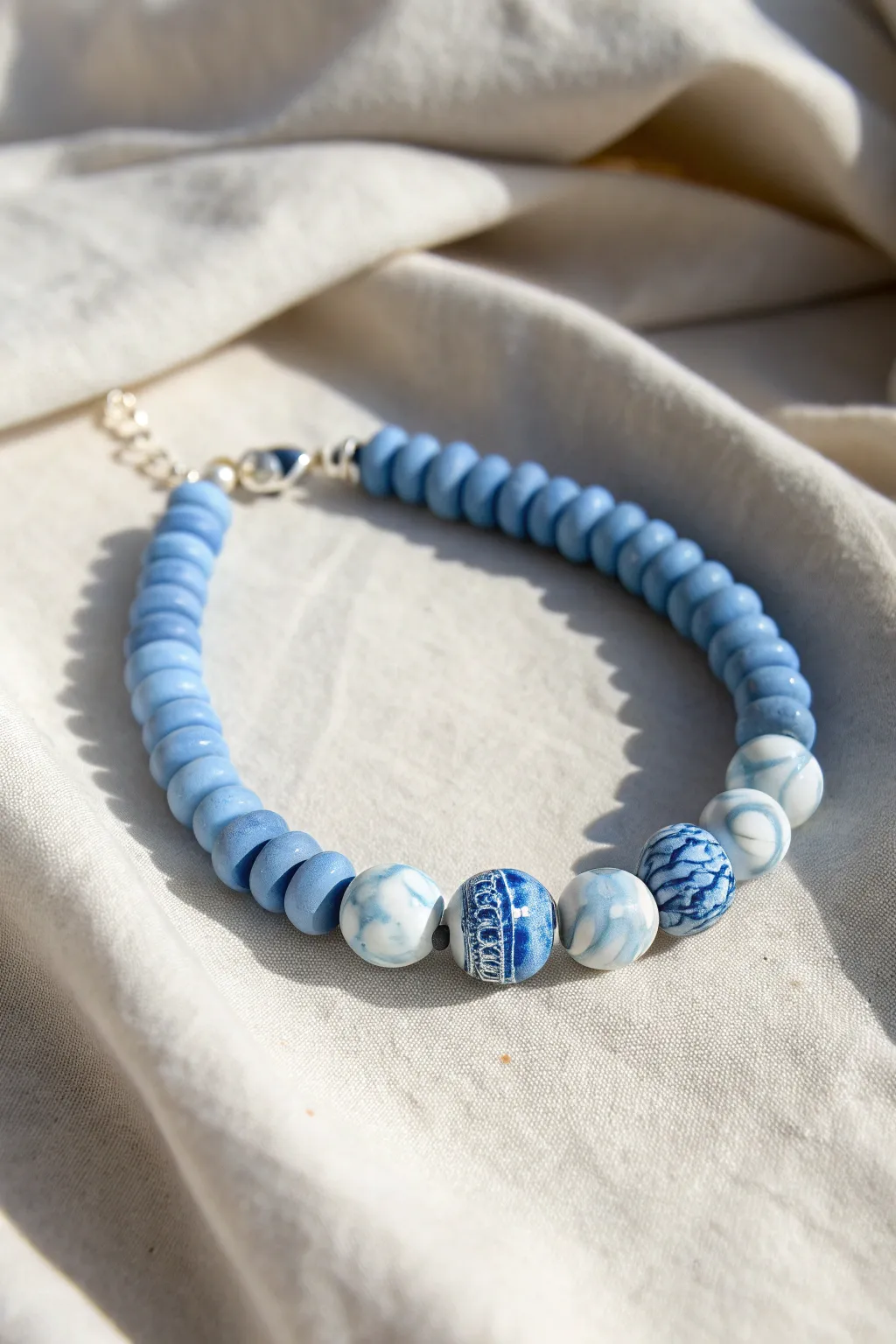
Evoke the serene feeling of ocean waves with this stunning polymer clay bracelet. By combining simple heishi disk beads with intricate marbled and patterned focal beads, you create a piece that feels both handcrafted and sophisticated.
How-To Guide
Materials
- Polymer clay in light blue, white, and translucent
- Acrylic roller
- Clay extruder with a small circle disc
- Tissue blade or craft knife
- Needle tool or bead piercing pins
- Fine-grit wet/dry sandpaper (400-800 grit)
- Beading wire (tigertail or similar)
- Crimp beads
- Clasp (lobster claw) and jump rings
- Round nose pliers
- Flat nose pliers
- Wire cutters
- Optional: Texture sheet or silkscreen for the patterned bead
- Acrylic paint (dark blue) if using silkscreen
Step 1: Creating the Heishi Beads
-
Condition the Clay:
Begin by thoroughly conditioning your light blue polymer clay until it is soft and pliable. This prevents cracking later. -
Extrude a Snake:
Load the conditioned blue clay into your extruder fitted with a circle disc (approx. 5-7mm diameter). Extrude a long, smooth snake of clay. -
Slice the Disks:
Lay the snake on your work surface. Let it rest for a few minutes so it isn’t too soft. Using your tissue blade, slice thin, even disks from the snake. -
Pierce the Beads:
I prefer to use a bead piercing pin for this step. Gently poke a hole through the center of each disk. If the disk deforms, gently reshape it with your fingers. -
Bake the batch:
Arrange all your heishi beads on a baking sheet or tile. Bake according to your clay manufacturer’s instructions (usually 275°F/130°C for 30 minutes).
Sticky Situation?
If your clay is sticking to the table while rolling snakes, dust your surface lightly with cornstarch or baby powder. It washes off easily after baking.
Step 2: Crafting the Feature Beads
-
Marbling Technique:
Combine equal parts white and light blue clay with a sliver of translucent. Twist them together to create a rough log. -
Refining the Marble:
Fold the log in half and twist again. Repeat this 2-3 times—don’t overmix, or the colors will blend into a solid light blue instead of swirling. -
Forming Round Beads:
Pinch off chunks of your marbled cane and roll them between your palms to create smooth spheres about 10-12mm in diameter. Make 4-5 of these. -
Creating the Patterned Bead (Center):
For the center bead with the intricate pattern, roll a sheet of blue clay flat. Use a silkscreen or texture sheet with dark blue acrylic paint to apply a pattern. -
Applying the Pattern:
Allow the paint to dry completely. Cut a circle from the patterned sheet and carefully wrap it around a base ball of scrap clay, smoothing the seams so they disappear. -
Creating the Textured Bead:
For the darker blue textured bead, roll a ball of blue clay and gently roll it over a coarse sandpaper or a specific texture sponge to create organic indentations. -
Enhancing Texture:
To make the texture pop like in the photo, lightly brush white mica powder or dry-brush white paint over the raised areas before baking. -
Piercing and Baking:
Pierce holes through all your large feature beads. Bake them alongside the heishi beads according to instructions.
Step 3: Assembly
-
Sanding and Buffing:
Once cooled, wet-sand the feature beads lightly to remove fingerprints. Leave them with a matte finish to match the organic look. -
Stringing the Design:
Cut a length of beading wire. Attach one end to a clasp using a crimp bead and pliers. Begin threading your beads. -
Creating the Pattern:
Thread a long section of the blue heishi beads first (about 25-30 beads). Then, add your feature beads: marble, texture, patterned center, texture, marble. -
Finishing the Loop:
Finish the strand with another section of 25-30 heishi beads to mirror the other side. -
Securing the Bracelet:
Thread a crimp bead and a jump ring (or chain extender) onto the end. Loop the wire back through the crimp bead and several heishi beads. -
Final Crimp:
Use your flat nose pliers to flatten the crimp bead securely. Trim the excess wire close to the beads.
Pro Tip: Perfect Centers
For perfectly centered holes, refrigerate your raw beads for 15 minutes before piercing. The firmer clay resists squishing while you push the needle through.
Wear your new creation with pride, knowing each bead was hand-formed by you
Midnight Galaxy Blue With Speckled Highlights
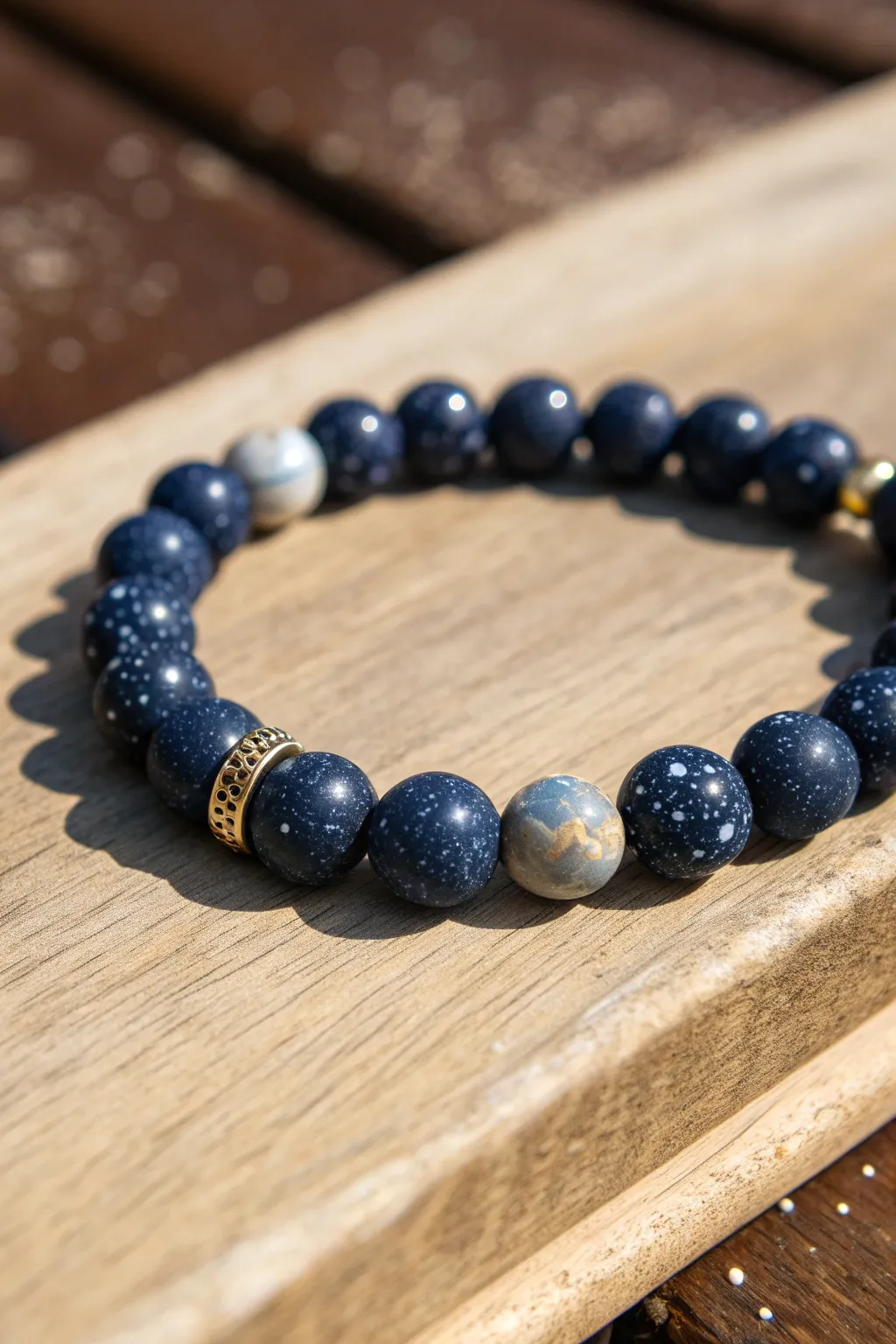
Capture the magic of a starry night sky with this stunning beaded bracelet featuring deep navy speckled beads and grounding grey accents. This design balances the celestial shimmer of galaxy-inspired beads with earthy tones and elegant gold hardware for sophisticated everyday wear.
Step-by-Step
Materials
- Navy blue speckled polymer clay beads (8mm or 10mm) OR Blue Sandstone gemstone beads
- Grey gemstone accent beads (e.g., Grey Jasper or Agate, 8mm or 10mm)
- Gold tone patterned spacer beads (tube or wheel shape)
- Small gold round accent bead (approx 4mm)
- Strong elastic beading cord (0.8mm-1mm thickness)
- Jewelry adhesive or clear nail polish
- Scissors
Step 1: Preparation
-
Measure your wrist:
Wrap a flexible tape measure or string around your wrist to find your size. Add about 0.5 inches to this measurement to ensure the bracelet fits comfortably without pinching. -
Cut the cord:
Cut a piece of elastic cord roughly 10-12 inches long. Having extra length makes tying the final knot significantly easier than struggling with short ends. -
Pre-stretch the elastic:
Gently pull tightly on the elastic cord several times. This pre-stretching step is crucial because it prevents the bracelet from sagging or loosening immediately after you finish making it. -
Secure the end:
Attach a piece of tape or a bead stopper to one end of your cord. This acts as a safety anchor so your beads don’t slide right off while you are working.
Step 2: Designing and Stringing
-
Plan your pattern:
Lay out your beads on a bead board or a towel to visualize the design. The pattern shown uses a base of the navy galaxy beads with specific accent points. -
Start with the main color:
Begin by threading about 5 or 6 of the dark blue speckled beads onto the cord. These will form one side of the bracelet. -
Add the gold spacer:
Slide on one of the gold patterned spacer beads. This metallic element adds a touch of elegance and breaks up the dark color. -
Thread the first accents:
Following the gold spacer, add another 3 to 4 blue speckled beads, then introduce one of the grey gemstone beads. This grey bead acts as a subtle planetary highlight. -
Continue the pattern:
Add another small section of 3 blue speckled beads. I usually double-check the length against my wrist at this point to see if I need to adjust the bead count. -
Add the second grey accent:
Thread on your second grey gemstone bead. Placing the grey beads opposite or asymmetrical to each other creates visual interest. -
Finish the bead stringing:
Complete the circle by adding the remaining blue speckled beads until you reach the desired length. -
Insert the gold round bead:
Add the small 4mm gold round bead last. This bead is excellent for hiding the knot later, so placing it at the very end is strategic.
Knot Hiding Trick
If your main beads have small holes, use a dedicated ‘crimp cover’ or a specifically larger-hole metal bead next to the knot to easily hide it inside.
Step 3: Finishing Touches
-
Check the fit:
Wrap the unfinished strand around your wrist one last time. It should feel snug but not tight. Add or remove a blue bead if necessary. -
Tie the first knot:
Remove the tape or stopper. Bring the two ends together and tie a simple overhand knot, pulling it gently to bring the beads together without bunching them. -
Secure with a surgeon’s knot:
Tie a second knot, but loop the elastic through twice instead of once (a surgeon’s knot). Pull this very tight to secure the bracelet. -
Apply adhesive:
Place a tiny drop of jewelry glue or clear nail polish directly onto the knot. This prevents it from slipping over time. -
Hide the knot:
While the glue is still slightly tacky but not wet, pull the elastic so the knot slides inside the hole of the adjacent bead (ideally the gold round bead or a large blue one). -
Trim the excess:
Once dry, carefully trim the excess elastic cord close to the bead hole using sharp scissors. Be careful not to nick the main cord.
Elastic Issues?
If the elastic frays while stringing, apply a dab of fast-drying super glue to the very tip of the cord to stiffen it into a makeshift needle.
Slip on your new celestial accessory and enjoy the sparkle of your handcrafted galaxy bracelet.