
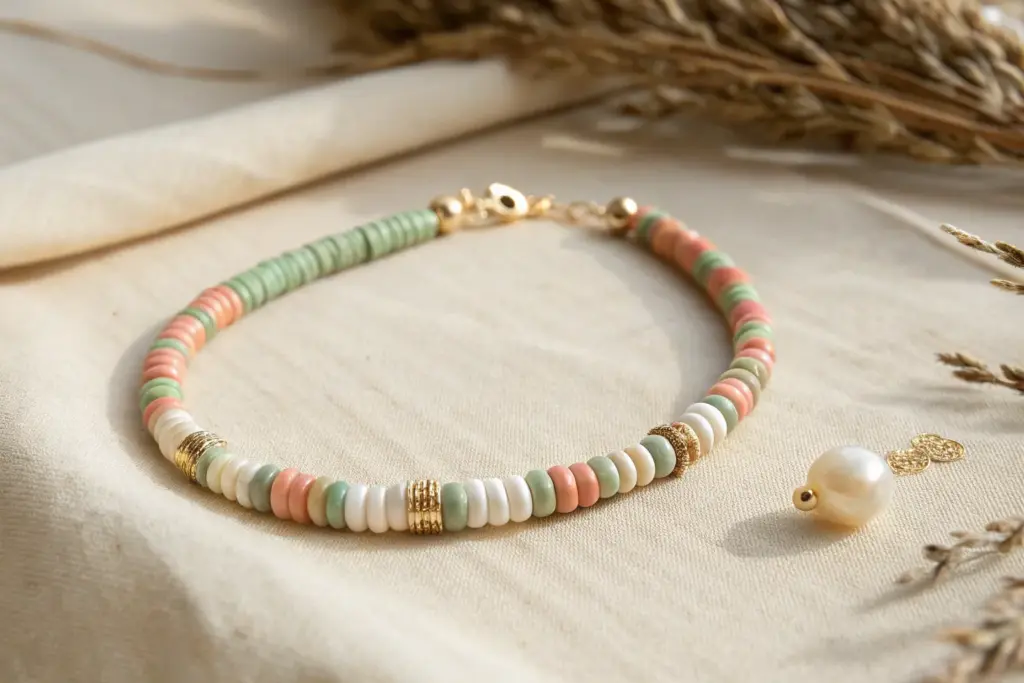
When I want a quick win in the studio, I reach for clay bead bracelets because the designs can be cute even when they’re super, super simple. Here are my favorite beginner-friendly heishi bead patterns that look polished without complicated counting or fancy tools.
Solid Color Heishi Bead Bracelet
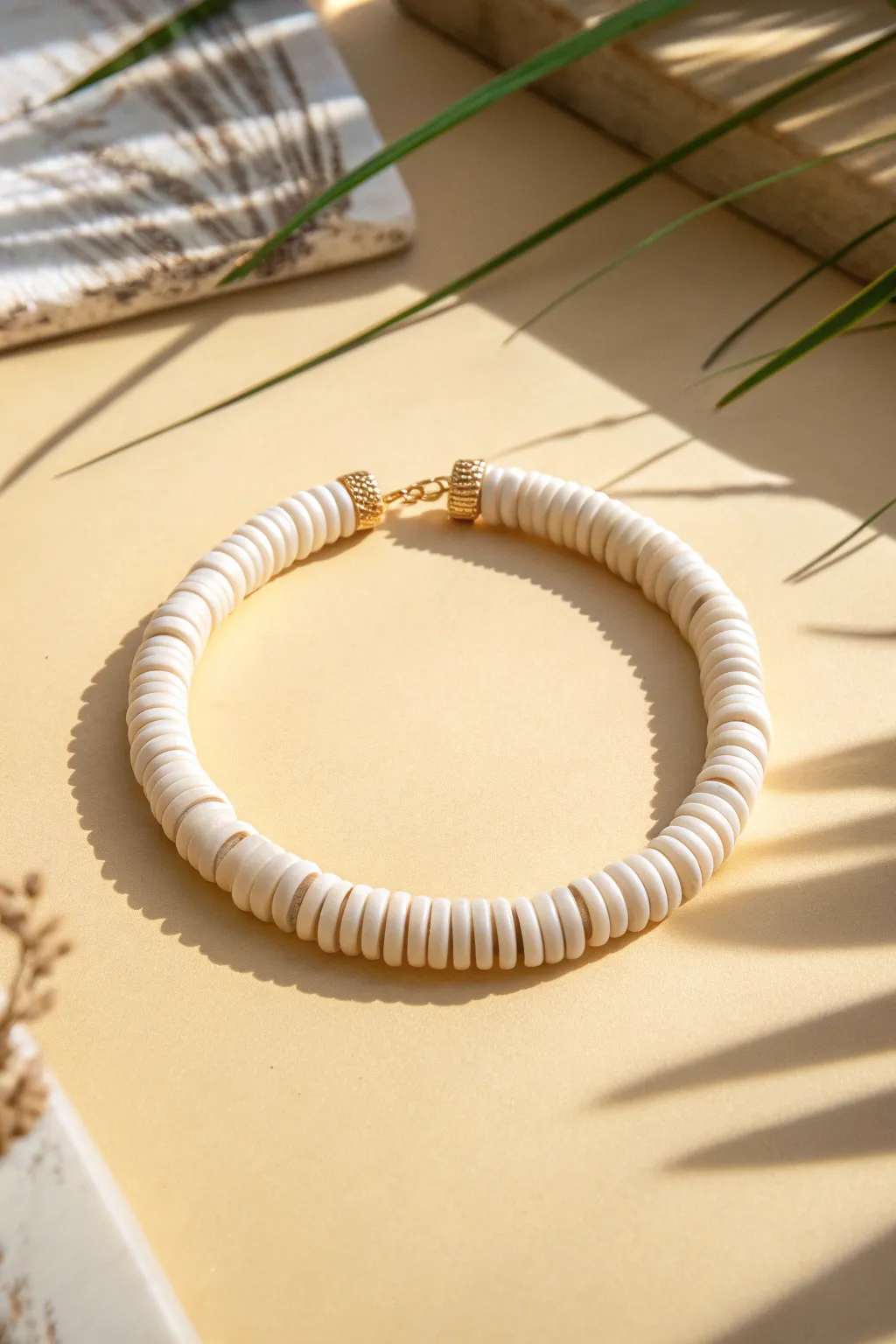
Embrace minimalist elegance with this solid cream-colored bracelet that captures the essence of a serene beach day. The uniform clay discs create a smooth, satisfying texture, while gold accents add just the right touch of luxury near the clasp.
Step-by-Step Guide
Materials
- 6mm Cream or off-white polymer clay heishi beads (approx. 1 strand)
- Gold plated crimp end caps (tube style) or crimp beads
- 2 Gold jump rings (4mm or 5mm)
- Gold lobster clasp
- Beading wire (such as flexible 7-strand or 19-strand wire)
- Wire cutters
- Flat nose pliers
- Rule or measuring tape
Step 1: Preparing the Base
-
Measure your wrist:
Wrap a measuring tape comfortably around your wrist to find your size. Add about 1/2 inch to this measurement to account for the thickness of the heishi beads and to allow for some movement. -
Cut the wire:
Using your wire cutters, snip a piece of beading wire that is roughly 4 inches longer than your final desired length. This extra length is crucial for attaching the clasp without frustration. -
Secure the first end:
Thread one end of your wire into the small hole of a gold tube-style crimp end cap. -
Crimp the cap:
Use your flat nose pliers to firmly squash the middle section of the crimp tube. Give the wire a gentle tug to ensure it is locked tightly inside the cap.
Smooth Operator
If your heishi beads look uneven, roll the finished strand between your palms before attaching the second clasp. This helps align the discs perfectly.
Step 2: Stringing the Design
-
Sort your beads:
Pour a small pile of your cream heishi beads onto a beading mat or tray. Check for any broken or misshapen discs and set those aside to keep the strand looking uniform. -
Start stringing:
Begin threading the clay discs onto the wire. I find it fastest to pick up 3-4 beads at a time directly from the mat rather than one by one. -
Check the fit:
Periodically hold the strand up to your wrist or against a ruler. Continue adding beads until the beaded section is about 1/2 inch shorter than your total target length, as the clasp assembly will add the rest. -
Keep it tight:
Push the beads down toward the finished end periodically to minimize gaps, but don’t pack them so tightly that the bracelet becomes stiff.
Metallic Pop
Add 3-4 flat gold spacer beads randomly throughout the white strand or exactly in the center to break up the color and catch the light.
Step 3: Finishing Touches
-
Add the second end cap:
Thread the remaining open end of the wire into the second gold crimp end cap. -
Position the cap:
Slide the cap down until it touches the last clay bead. Ensure there is no exposed wire between the beads and the cap, but leave a tiny hair’s breadth of space so the bracelet remains flexible. -
Crimp the second end:
Use your flat nose pliers to crush the crimp tube securely onto the wire. -
Trim excess wire:
Take your wire cutters and snip off the excess tail of wire sticking out of the crimp cap. Get as close to the metal as possible for a clean finish. -
Open the jump rings:
Grip a jump ring with two pairs of pliers (or your fingers and one pair). Twist the ring open laterally—like opening a door—rather than pulling the ends apart. -
Attach the clasp:
Hook the open jump ring onto the loop of the first end cap and add the lobster clasp before twisting the ring closed. -
Finish the other side:
Repeat the process with the second jump ring on the other end cap. This ring will serve as the connection point for the lobster clasp. -
Final verify:
Fasten the clasp and check the connections. Give each jump ring a quick inspection to ensure they are fully closed so the hardware won’t slip off.
Now you have a versatile accessory perfect for stacking or wearing solo
Two-Tone Color-Block Bracelet
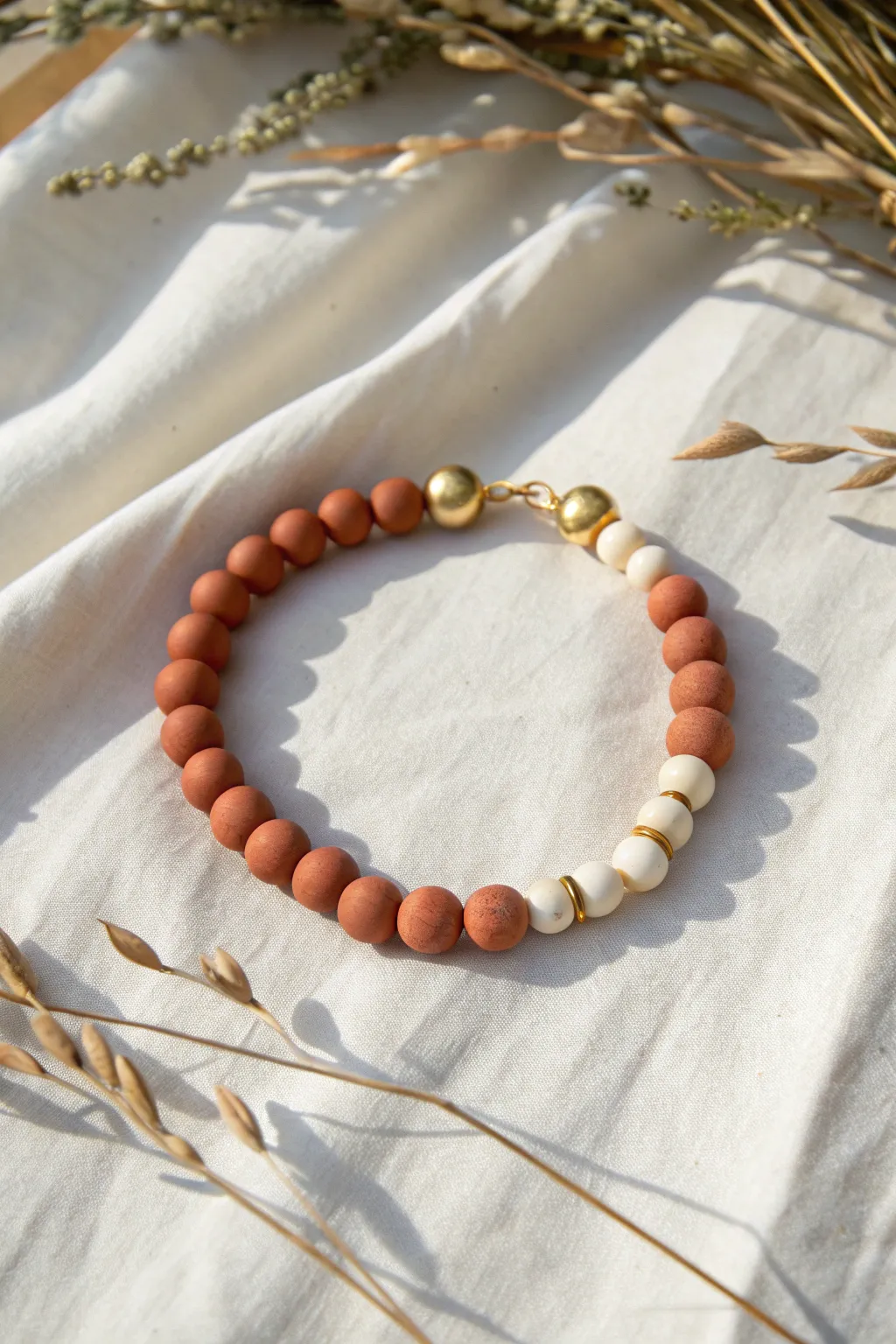
Embrace a natural, minimalist aesthetic with this striking two-tone bracelet design. By combining matte terracotta clay beads with smooth cream accents and touches of gold, you create a piece that feels both rustic and refined.
How-To Guide
Materials
- Matte terracotta-colored round clay beads (approx. 8-10mm)
- Cream or off-white round beads (stone, bone, or clay, approx. 6-8mm)
- Two large gold metal accent beads (approx. 10mm, smooth finish)
- Four small gold spacer discs or flat heishi beads
- Strong beaded jewelry elastic cord (0.8mm or 1mm recommended)
- Jewelry glue or clear nail polish
- Scissors
Step 1: Planning and Preparation
-
Measure your wrist:
Before cutting anything, wrap a piece of string or a soft measuring tape around your wrist to find your ideal fit. Add about half an inch to this measurement so the chunky beads don’t feel too tight. -
Prepare the cord:
Cut a length of elastic cord about 10-12 inches long. Having extra length makes the final knotting process much less frustrating than working with short ends. -
Pre-stretch the elastic:
Gently pull on your length of elastic cord several times. This ‘pre-stretching’ helps prevent the bracelet from sagging or loosening up immediately after you finish making it. -
Lay out the design:
Arrange your beads on a bead board or a soft towel to visualize the pattern before stringing. The design features a large block of terracotta color followed by a smaller segment of cream and gold.
Step 2: Stringing the Color Blocks
-
Start with the focal point:
Begin by stringing one of the large gold metal accent beads onto the cord. This will eventually hide the knot, so it’s a great place to start. -
Begin the terracotta section:
Thread on your clay terracotta beads. Looking at the reference, you’ll want a long, continuous run of these. For an average wrist, this usually takes about 16 to 18 beads. -
Check the length:
Pause and wrap the strung terracotta beads around your wrist. They should cover roughly three-quarters of the bracelet’s total circumference. -
Add the first spacer:
Slide on one tiny gold spacer disc immediately after the last terracotta bead. -
Start the cream section:
Thread on two of your cream or off-white beads. These lighter beads act as a fresh contrast to the warm earth tones. -
Add a mid-section spacer:
Place another small gold spacer disc after the two cream beads. -
Continue the cream pattern:
Add two more cream beads followed by a third gold spacer. -
Finish the white block:
Add the final two cream beads to complete the lighter segment of the bracelet. -
Final gold touches:
Add the last small gold spacer disc, followed by the second large gold metal bead.
Knot Mastery
Don’t cut the tails too short immediately! Let the glue dry completely first, then pull the elastic slightly while cutting so the end snaps back inside the bead hole.
Step 3: Finishing and Securing
-
Verify the fit:
Bring the two ends of the elastic together, completing the circle. Test the fit on your wrist one last time ensuring the two large gold beads meet perfectly without gaps. -
Tie the first knot:
Cross the ends of the elastic and tie a simple overhand knot, pulling it tight to bring the beads snugly together. -
Secure with a surgeon’s knot:
For the second knot, loop the elastic through twice instead of just once before pulling tight. This extra loop creates a surgeon’s knot which is much less likely to slip. -
Apply adhesive:
Place a tiny drop of jewelry glue or clear nail polish directly onto the knot. I find using a toothpick helps apply the glue precisely without getting it on the beads. -
Hide the knot:
While the glue is still tacky, gently tug on the cord to pull the knot inside one of the large gold metal beads. This hides the mechanics and gives a professional finish. -
Trim the excess:
Once the glue has fully dried (wait at least 15 minutes), use sharp scissors to trim the excess elastic cord close to the bead hole.
Textural Twist
Swap the smooth cream beads for rough, raw wood beads or faceted white turquoise to add even more tactile contrast against the matte clay.
Wear your new bracelet alone for a subtle statement or stack it with gold bangles for a richer look
Easy 3-Color Stripe Repeat
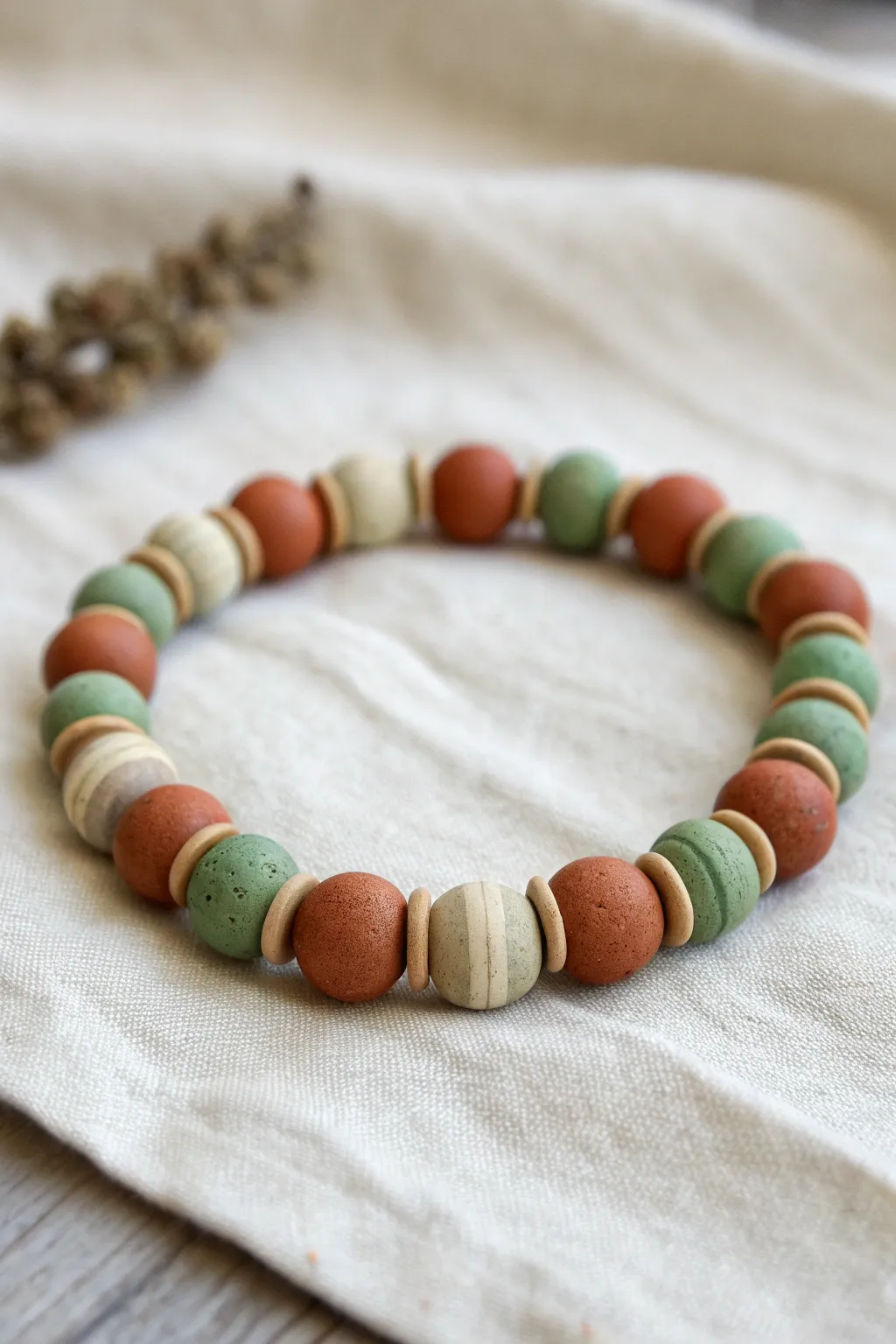
This rustic bracelet combines warm terracotta tones with cool sage greens and striped neutrals for a perfectly balanced accessories. The hand-rolled polymer clay beads give it an organic, artisanal texture that feels both modern and timeless.
Step-by-Step
Materials
- Polymer clay in terracotta
- Polymer clay in sage green
- Polymer clay in oatmeal or cream
- Polymer clay in taupe or light grey (for stripes)
- Elastic stretch cord (0.8mm or 1mm)
- Beading needle (optional)
- Small acrylic roller or clay machine
- Craft knife or tissue blade
- Toothpick or bead piercing pin
- Baking sheet and parchment paper
- Super glue or jewelry cement
Step 1: Creating the Solid Beads
-
Condition the clay:
Start by warming up your terracotta and sage green polymer clay in your hands until soft and pliable. -
Roll logs:
Roll each color into a long, even snake or log shape, approximately 1/2 inch in diameter. -
Cut equal segments:
Using your craft knife, slice the logs into equal segments to ensure your finished beads are roughly the same size. -
Roll spheres:
Take each segment and roll it between your palms to form a smooth ball. Don’t worry about perfection; a slightly organic shape adds to the charm. -
Add texture (optional):
For that matte, stone-like look seen in the photo, I sometimes gently tap the surface with a toothbrush or piece of sandpaper before baking.
Step 2: Making the Striped & Spacer Beads
-
Prepare striping colors:
Roll out a small sheet of oatmeal clay and a thinner sheet of taupe clay. -
Layer the sheets:
Stack the taupe sheet on top of the oatmeal sheet, then cut a slice through both layers to get a striped cross-section. -
Form striped beads:
Wrap this layered slice around a small core of scrap clay and roll it into a ball until the seams smooth out and the stripes look integrated. -
Create spacer discs:
Roll a thin snake of the oatmeal clay, slice off tiny discs, and gently flatten them with your thumb to create the small spacers that go between the larger beads.
Stone Texture Trick
Mix black pepper or dried used coffee grounds into your clay before rolling to create realistic stone-like speckles.
Step 3: Piercing and Baking
-
Pierce holes:
Gently twist a toothpick or piercing tool through the center of each bead. Twist as you push to avoid squishing the shape. -
Correct the exit hole:
Once the tool pokes through, carefully pull it out and re-insert it from the other side to smooth out any rough edges. -
Arrange for baking:
Place all beads on a parchment-lined baking sheet. For rounder beads, you can bake them on a bed of cornstarch or accordion-folded paper to prevent flat spots. -
Bake:
Bake according to your clay manufacturer’s instructions, typically around 275°F (135°C) for 15-30 minutes. -
Cool down:
Let the beads cool completely before handling to ensure they harden fully.
Make It a Set
Create a matching necklace using larger versions of the striped focal beads and smaller wooden beads.
Step 4: Assembly
-
Measure cord:
Cut a piece of elastic cord about 10-12 inches long to give yourself plenty of room to tie knots. -
Pre-stretch elastic:
Give the elastic piece a few firm tugs. This prevents the bracelet from stretching out permanently after wearing it. -
String the pattern:
Thread your beads, alternating between the colored spheres and the flat oatmeal spacers. Follow a pattern like Terracotta, Spacer, Green, Spacer, Striped Bead, Spacer. -
Check the fit:
Wrap the strand around your wrist to check the size, adding or removing beads as needed. -
Tie the knot:
Tie a secure surgeon’s knot (right over left, left over right, loop through twice). Pull tight. -
Secure and trim:
Add a tiny drop of super glue to the knot, let it dry for a moment, and trim the excess cord ends.
Wear your new bracelet stacked with other textures for a effortless bohemian vibe
Classic Rainbow Order Bracelet
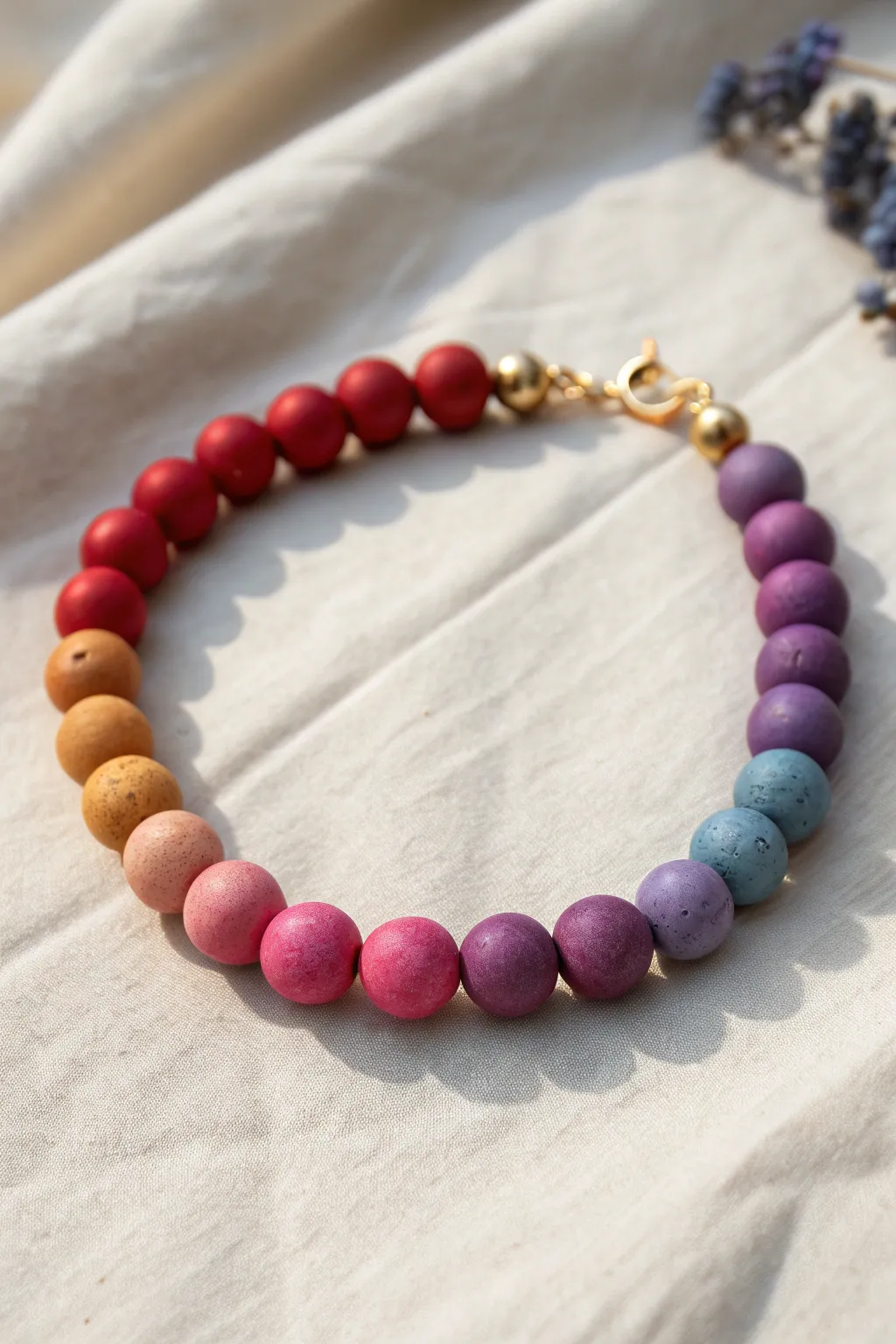
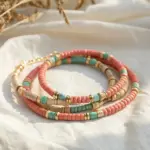
This project captures the warmth of a sunset and the cool of dusk in a single, wearable loop. Using polymer clay to create matte, textured beads, you’ll arrange them in a sophisticated color gradient finished with elegant gold hardware.
Step-by-Step Guide
Materials
- Polymer clay in: deep red, orange, yellow-ochre, light pink, magenta, purple, periwinkle blue, and plum
- Gold-filled lobster clasp and jump rings
- Two gold-filled crimp beads (or crimp tubes)
- Two gold bead covers (optional but recommended)
- Two 4mm gold spacer beads
- Flexible beading wire (gold or clear)
- Beading pliers (chain nose and crimping pliers)
- Wire cutters
- Toothpick or bead reamer
- Sandpaper or denim fabric (for texturing)
Step 1: Prepping the Clay Beads
-
Conditioning color blocks:
Begin by conditioning your polymer clay blocks individually by kneading them until they are soft and pliable. You want a distinct palette: deep red, burnt orange, golden yellow, pale coral, rosy pink, berry magenta, deep plum, violet, and a dusty blue. -
Mixing custom shades:
To achieve the specific matte, earthy look in the photo, avoid using straight-out-of-the-packet neon brights. I like to mix a tiny pinch of brown or beige into the yellow and orange clays to tone them down into ‘spicier’ shades. -
Portioning the clay:
Roll each color into a consistent ‘snake’ or log of the same thickness. Slice off equal-sized segments from each log to ensure your finished beads are uniform in size. -
Rolling the spheres:
Roll each sliced segment between your palms to form smooth, round spheres approximately 8-10mm in diameter. -
Adding subtle texture:
The beads in the image aren’t perfectly glossy; they have an organic feel. Before baking, gently roll the spheres over a piece of sandpaper or rough denim to give them a subtle, stone-like texture. -
Piercing the beads:
Use a toothpick or a bead pin to pierce a hole through the center of each sphere. Gently rotate the tool as you push through to avoid squishing the bead’s round shape.
Step 2: Baking and Sorting
-
Baking the beads:
Arrange your pierced beads on a baking sheet lined with parchment paper. Bake according to your specific polymer clay manufacturer’s instructions (usually around 275°F or 135°C for 15-30 minutes). -
Cooling down:
Allow the beads to cool completely before handling them. They harden fully as they return to room temperature. -
Planning the gradient:
Lay out your bead board or a soft towel. Arrange your beads in the order shown in the reference: start with the deep reds, transition to orange/ochre, then to the lighter pink/coral tones, moving into magentas, purples, and finally the blue/violet shades.
Fixing Wonky Holes
If your bead holes shrank or distorted during baking, don’t force the needle. Use a small hand drill or a bead reamer to gently widen the channel after the clay has cooled completely.
Step 3: Assembly
-
Measuring wire:
Cut a length of beading wire about 10 inches long. This gives you plenty of extra room to work with the clasps. -
Attaching the first clasp end:
Thread a crimp bead onto one end of the wire. Loop the wire through the small ring of your lobster clasp, then thread it back through the crimp bead. -
Securing the start:
Use your crimping pliers to flatten the crimp bead securely. I prefer to cover this crimp with a gold bead cover or simply slide a 4mm gold spacer bead over the crimp tail for a cleaner look as seen in the photo. -
Stringing the gradient:
Begin threading your clay beads onto the wire. Follow your laid-out pattern: Red group -> Orange/Yellow group -> Pink group -> Purple group -> Blue/Violet group. -
Checking the fit:
Once all clay beads are strung, wrap the bracelet around your wrist to check the length. Add or remove beads to adjust sizing, keeping the color transition smooth. -
Adding the final gold accent:
Slide on your second 4mm gold metal spacer bead. This gold accent helps frame the clay beads and hides the mechanical connection. -
Preparing the final closure:
Thread on your second crimp bead, then loop the wire through a closed gold jump ring (the receiving end for the clasp). -
Securing the end:
Feed the wire tail back through the crimp bead and the first few clay beads. Pull everything snug—but not rigid—so the bracelet drapes naturally. -
Final crimp:
Crimp the bead firmly with your pliers. Trim the excess wire tail flush with the beads so no sharp end pokes out.
Terrazzo Twist
Before rolling your beads, chop up tiny bits of contrasting colored clay (like black or white) and mix them into your main colors for a speckled, terrazzo stone effect.
Now you have a stunning gradient piece that adds a pop of sophisticated color to any wrist stack

The Complete Guide to Pottery Troubleshooting
Uncover the most common ceramic mistakes—from cracking clay to failed glazes—and learn how to fix them fast.
Soft Pastel Clay Bead Mix
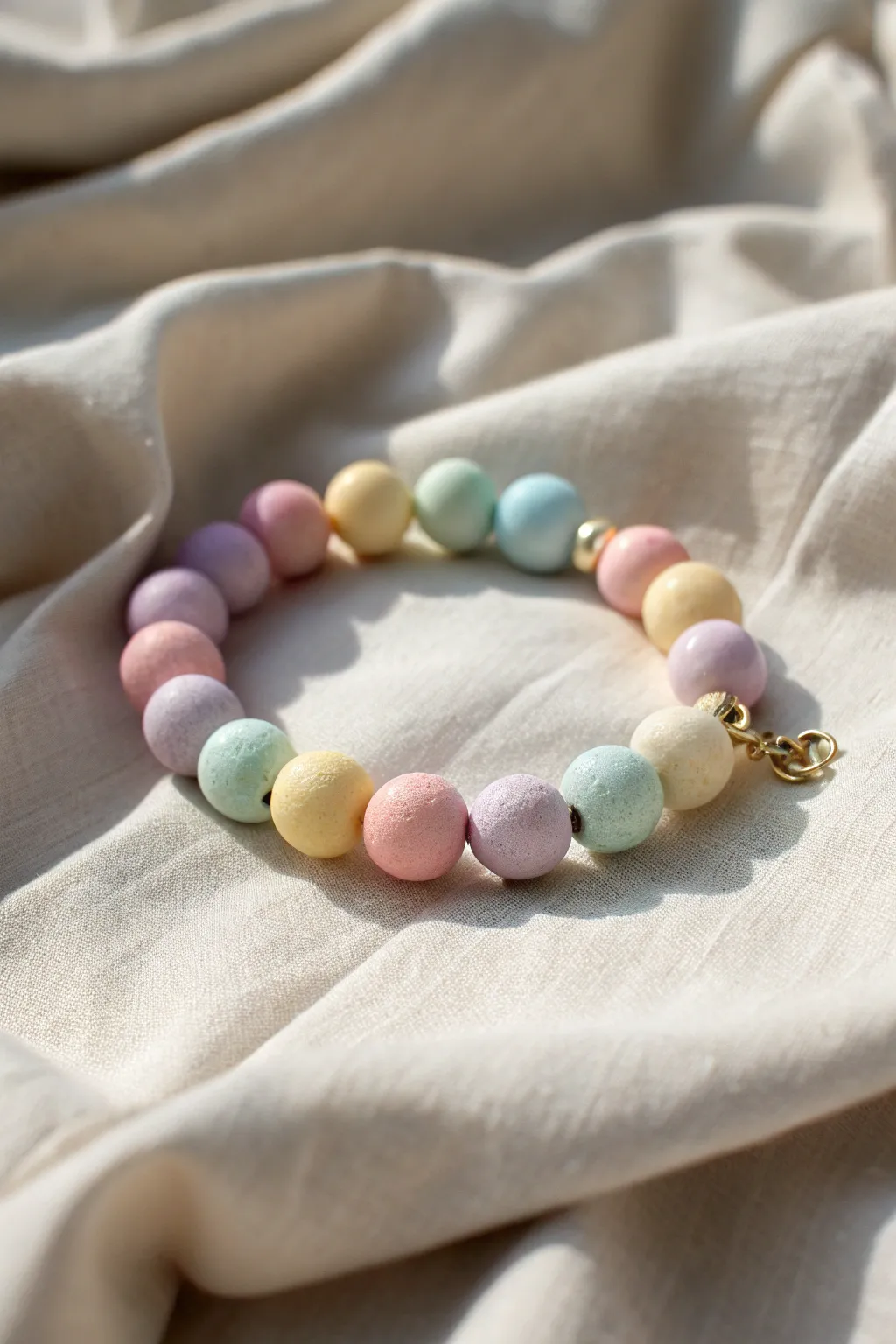
Capture the soft, airy essence of spring with this delicate polymer clay bracelet. Featuring a matte, textured finish and a soothing palette of muted rainbows, this accessory is the perfect touch of gentle color for any outfit.
Step-by-Step Tutorial
Materials
- Polymer clay in pastel pink, yellow, mint green, sage green, light blue, and lavender
- Rolling pin or pasta machine
- Small round bead roller (approx. 10mm)
- Toothpick or bead piercing pin
- Course sandpaper or salt (for texture)
- Baking tray and parchment paper
- Elastic jewelry cord (0.8mm)
- Small gold accent spacer beads
- Gold tone jump rings and a tiny charm (optional)
- Super glue or jewelry cement
- Scissors
Step 1: Prepping the Clay Palette
-
Condition the Clay:
Begin by taking small amounts of each pastel polymer clay color. Knead them individually in your hands until they are soft, pliable, and free of cracks. -
Mix Custom Shades:
If your colors look too vibrant, mix in a tiny pinch of white clay to soften them, or a speck of translucent clay to give them a lighter, airy feel closer to the image. -
Create Uniform Portions:
Roll each color into a uniform snake or log about 1/2 inch thick. Slice off equal segments from each log to ensure your finished beads will be roughly the same size.
Sticky Texturing?
If clay sticks to your texturing tool (sandpaper/toothbrush), dust the tool lightly with cornstarch or water before pressing it into the raw bead.
Step 2: Forming and Texturing Beads
-
Roll into Spheres:
Take a clay segment and roll it between your palms to form a rough ball. For more precision, place it inside a bead roller and slide the top part back and forth until you have a perfect sphere. -
Pierce the Holes:
Holding the bead gently (so you don’t squash it), twist a toothpick or piercing pin through the center. I find it helpful to twist halfway from one side, then meet the hole from the other side to prevent distortion. -
Add the Texture:
The beads in the photo have a sugary, stone-like texture. Roll your raw clay beads gently over coarse sandpaper or dab them lightly with a toothbrush to create this matte, pitted surface. -
Repeat for All Colors:
Continue rolling and texturing until you have about 18-20 beads total, depending on wrist size. Aim for a mix of approximately 3 beads per color.
Step 3: Baking and Finishing
-
Arrange on Tray:
Place your beads on a baking tray lined with parchment paper. If you have a bead rack, use it; otherwise, nestle them into an accordion-folded piece of paper to keep them from developing flat spots. -
Bake:
Bake according to your clay manufacturer’s instructions (usually 275°F/130°C for 15-30 minutes). Let them cool completely before handling. -
Buff (Optional):
Once cool, if any sharp edges remain around the holes, lightly sand them away. Do not add glaze; we want to keep that signature matte finish.
Sugary Texture Hack
Make ‘faux stone’ beads by mixing real black pepper or colored craft sand directly into the clay before rolling for natural speckled depth.
Step 4: Assembly
-
Plan the Pattern:
Lay out your beads on a specialized bead board or a soft towel. The pattern shown uses a random-but-balanced mix: pink-purple-mint-yellow-blue. Experiment until the flow looks pleasing. -
Add Accents:
Choose one specific spot in the pattern to insert a small gold spacer bead, which adds a touch of shine amidst the matte finish. -
String the Beads:
Cut a piece of elastic cord about 10 inches long. Pre-stretch it by pulling firmly a few times. Thread your beads onto the cord following your planned sequence. -
Add Hardware:
If you are including the charm shown in the image, slide the jump ring onto the cord between two beads near the end of your strand. -
Tie the Knot:
Tie a surgeon’s knot (right over left, left over right twice). Pull the knot tight while pushing the beads together to remove gaps. -
Secure and Trim:
Dab a tiny drop of super glue onto the knot. Let it dry for a moment, then trim the excess cord ends carefully using sharp scissors. -
Hide the Knot:
Gently pull the elastic until the knot slips inside the hole of the nearest bead, making the finish invisible.
Now you have a wonderfully tactile, matte-finish bracelet that captures the softness of pastel clouds
Neutral Minimalist Palette Bracelet
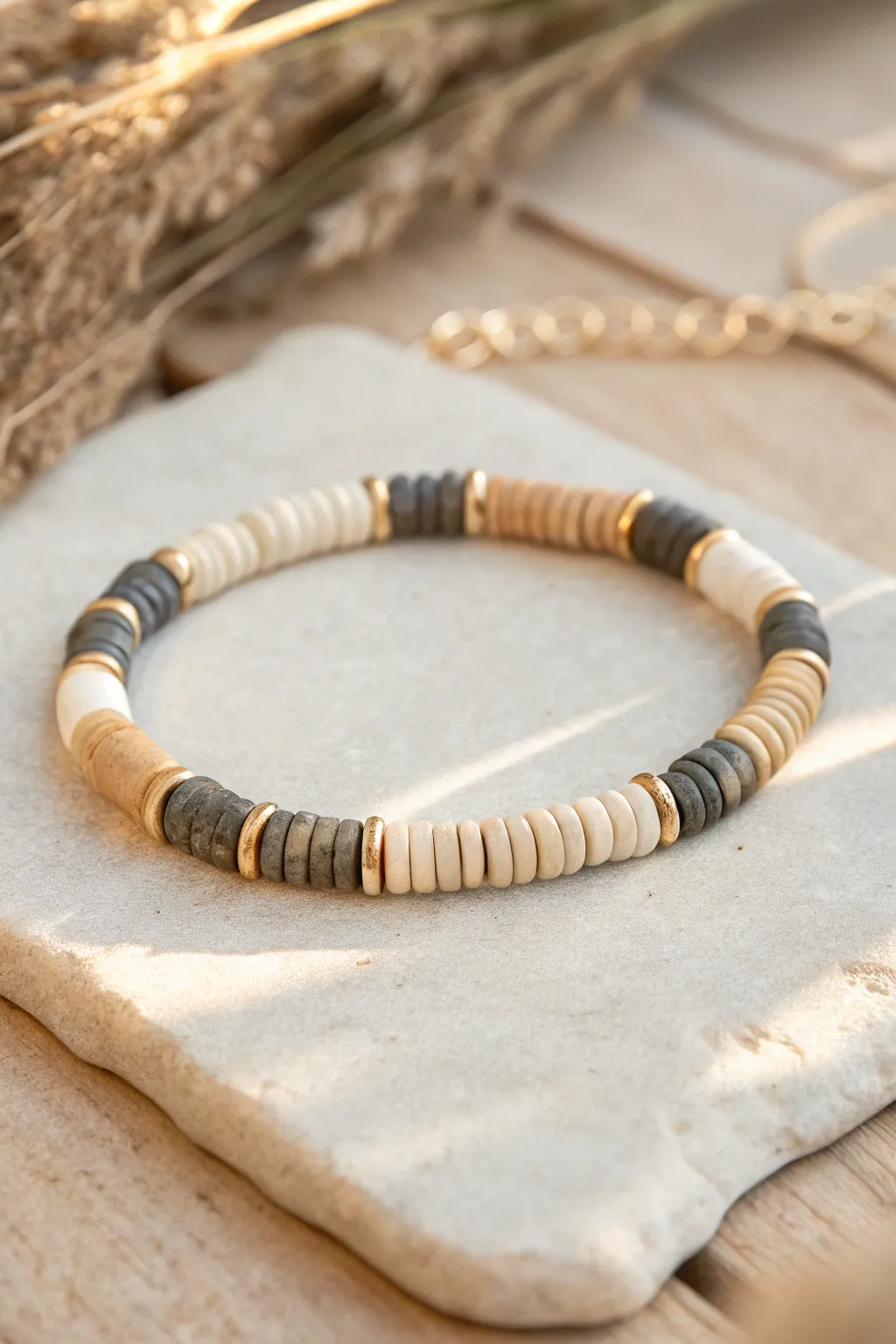
Embrace the understated elegance of nature with this minimalist clay bead bracelet, featuring alternating segments of charcoal, cream, and sand tones. The subtle rhythm of disc beads separated by warm gold accents creates a versatile accessory perfect for everyday wear.
Step-by-Step
Materials
- Polymer clay Heishi disc beads in ‘Charcoal Grey’
- Polymer clay Heishi disc beads in ‘Cream’ or ‘Off-White’
- Polymer clay Heishi disc beads in ‘Sand’ or ‘Beige’
- Gold tone spacer beads (flat disc or ring shape, approx. 4-5mm)
- Stretch cord (0.8mm clear elastic)
- Super glue or jewelry cement
- Scissors
Step 1: Preparation
-
Measure the Cord:
Cut a piece of stretch cord about 10-12 inches long. This generous length gives you plenty of room to tie knots without struggling against tension later. -
Pre-stretch the Elastic:
Holding both ends of the cord, give it a few gentle but firm tugs. This pre-stretching helps prevent the bracelet from sagging or loosening immediately after you wear it for the first time. -
Secure one End:
Attach a bead stopper or simply place a piece of tape on one end of your cord to stop beads from sliding off while you work. I find a simple piece of masking tape works wonders here.
Seamless Spacing
If a spacer bead has a large hole, try hiding your final knot inside it rather than a clay bead. Metal beads often have larger openings.
Step 2: Stringing the Pattern
-
Start the Sequence:
Begin your pattern by threading on a gold spacer bead. This will act as the anchor for your repeating color blocks. -
Create a Grey Segment:
Thread on approximately 6 to 8 ‘Charcoal Grey’ clay disc beads. The number depends on the thickness of your specific beads, but aim for a segment length of about 1/2 inch. -
Add a Divider:
Slide on another single gold spacer bead to cap the grey section. -
Create a Cream Segment:
Thread on roughly 8 to 10 ‘Cream’ clay disc beads. You want this light section to be slightly longer than the grey one for visual balance, creating a nice airy feel. -
Add a Divider:
Add a gold spacer bead after the cream section. -
Create a Grey Segment:
Repeat the grey block, adding another 6 to 8 ‘Charcoal Grey’ beads followed by a gold spacer. -
Create a Sand Segment:
Now introduce the third color. Thread on about 8 to 10 ‘Sand’ or ‘Beige’ beads, aiming to match the length of your cream segment. -
Add a Divider:
Cap the sand section with a gold spacer bead. -
Short Grey Segment:
Add a shorter segment of ‘Charcoal Grey’ beads, perhaps just 4 or 5 this time, followed by a gold spacer. Varying segment lengths slightly keeps the design organic. -
Continue the Flow:
Continue rotating through your colors (Cream, Grey, Sand) separated by gold spacers until the beaded length measures your wrist size (usually around 6.5 to 7 inches). -
Check the Fit:
Wrap the beaded strand around your wrist to check the size. Ideally, the ends should meet comfortably without gaps, and the pattern should resolve nicely.
Step 3: Finishing Up
-
Tie the First Knot:
Remove the tape or stopper. Bring both ends of the elastic together and tie a simple overhand knot, pulling it tight against the beads to remove slack. -
Secure with a Surgeon’s Knot:
Tie a surgeon’s knot for extra security. Loop the ends as if tying a regular knot, but pass the tail through the loop twice before pulling tight. -
Cement the Knot:
Carefully dab a tiny drop of super glue or jewelry cement onto the knot. Let it dry for a minute. Be careful not to glue the knot to the beads themselves. -
Hide the Knot:
Trim the excess elastic close to the knot. Gently pull on the bracelet so the knot slides inside the hole of the nearest large bead to hide it.
Wobbly Segments?
If sections look uneven, ensure your clay discs are consistent thickness. ‘Cull’ or remove any distinctively thin or wedge-shaped beads before stringing.
Now you have a serene, nature-inspired accessory ready to complement any outfit


What Really Happens Inside the Kiln
Learn how time and temperature work together inside the kiln to transform clay into durable ceramic.
Gold Spacer Bead Every Ten
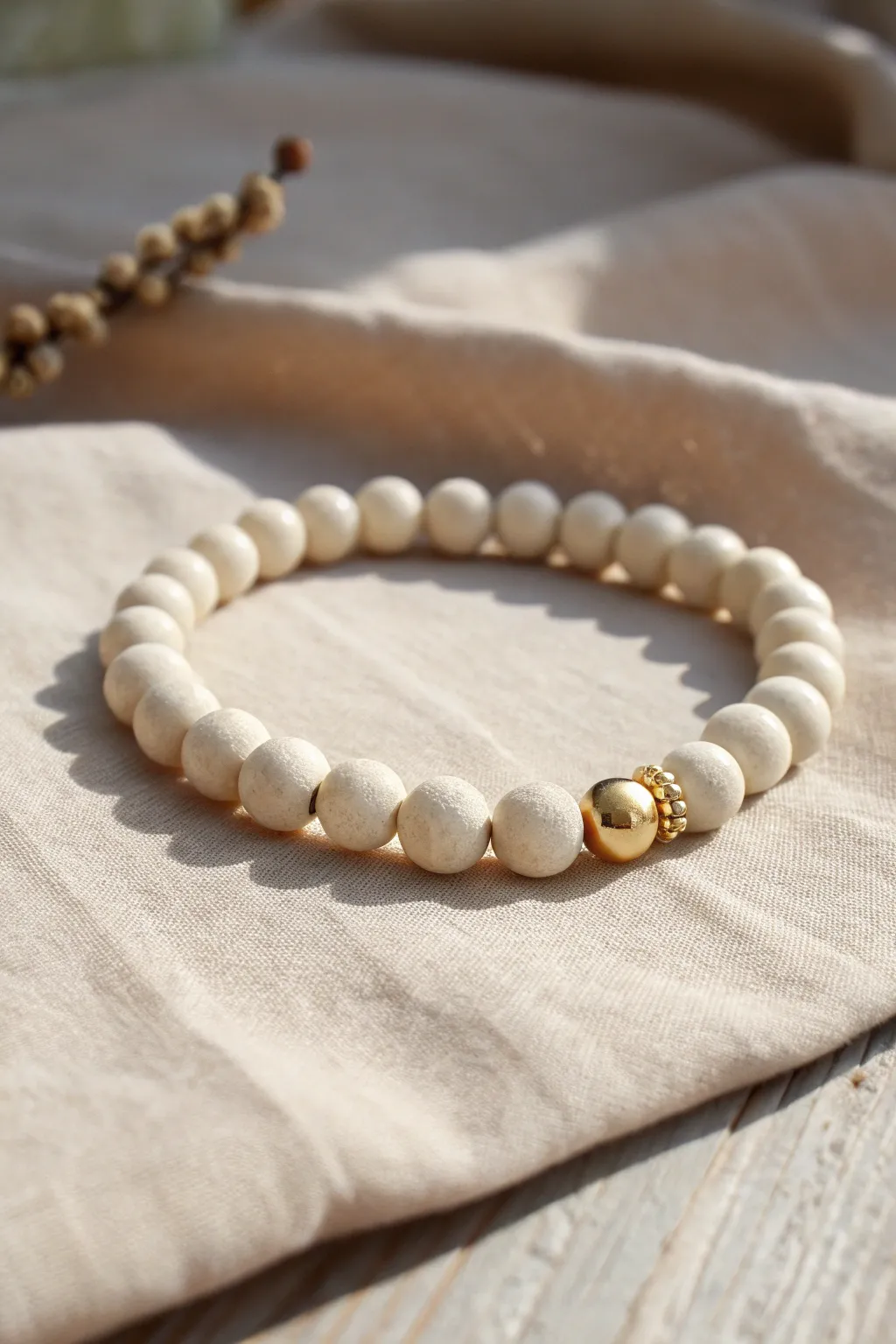
Embrace minimalist elegance with this textured clay bead bracelet that features a striking metallic focal point. The soft, unfinished look of the cream beads contrasts beautifully with the high-shine gold, creating a sophisticated accessory suitable for everyday wear.
How-To Guide
Materials
- 8mm – 10mm beige/cream matte round beads (polymer clay, unglazed ceramic, or matte gemstone)
- 1 large (10mm) smooth gold spacer bead
- 1 textured gold daisy spacer or ring bead
- Strong elastic cord (0.8mm or 1mm)
- Jewelry glue or clear nail polish
- Scissors
Step 1: Preparation
-
Measure your wrist:
Wrap a piece of string or a soft measuring tape around your wrist to find your size. Add about half an inch to this measurement to ensure the bracelet fits comfortably without pinching. -
Prepare the cord:
Cut a length of elastic cord about 10-12 inches long. Having extra length makes the final knotting process much easier than struggling with short ends. -
Pre-stretch the elastic:
Give your cut piece of elastic a few gentle tugs. This crucial step prevents the bracelet from stretching out and becoming loose immediately after you finish making it.
Knot Hiding Tip
If the knot won’t fit into the bead hole, start your stringing with the bead that has the largest opening. This ensures the knot ends up next to the most accommodating bead.
Step 2: Design & Stringing
-
Secure the end:
Place a piece of tape or a binder clip on one end of your elastic cord to stop the beads from sliding off while you work. -
Begin the bead pattern:
Start threading your matte cream beads onto the cord. Since the pattern relies on a single focal point, you will string the majority of the bracelet with just these base beads first. -
Check the length:
Periodically wrap the strand around your wrist. Continue adding the cream beads until you have covered almost the entire circumference of your wrist minus about half an inch for the accent beads. -
Insert the gold spacer:
Slide on the textured gold daisy spacer or ring bead. This smaller gold element acts as a bridge between the matte texture and the large smooth bead. -
Add the focal bead:
Thread the large, smooth gold round bead next. This should sit snugly against the textured spacer. -
Complete the circle:
Bring the two ends of your elastic together to check the final size. If it feels too tight, add one more cream bead; if it’s too loose, remove one.
Step 3: Finishing
-
Tie the first knot:
Remove the tape or clip. Holding both ends of the elastic, cross right over left and pull tightly to bring the beads into a circle. -
Secure with a surgeon’s knot:
Cross the ends again, but this time loop the end through the circle twice before pulling tight. I find this creates a much more secure hold than a standard square knot. -
Tighten properly:
Pull the elastic ends firmly away from each other to tighten the knot. Then, manipulate the beads near the knot to ensure there are no gaps. -
Apply adhesive:
Dab a tiny drop of jewelry glue or clear nail polish directly onto the knot. This prevents it from slipping over time. -
Hide the knot:
Ideally, you should try to pull the knot inside the hole of the large gold bead or one of the adjacent clay beads while the glue is still tacky. -
Trim the excess:
Once the glue is dry, use your scissors to snip off the excess elastic. Be careful not to cut firmly against the knot itself; leave a tiny tail if you couldn’t hide the knot inside a bead.
Mixed Metals
Try alternating gold and silver spacers on either side of the focal bead for a trendy two-tone look that matches all your other jewelry.
Enjoy the refined simplicity of your new bracelet, perfectly balanced between rustic texture and metallic shine
Single Center Charm Bracelet
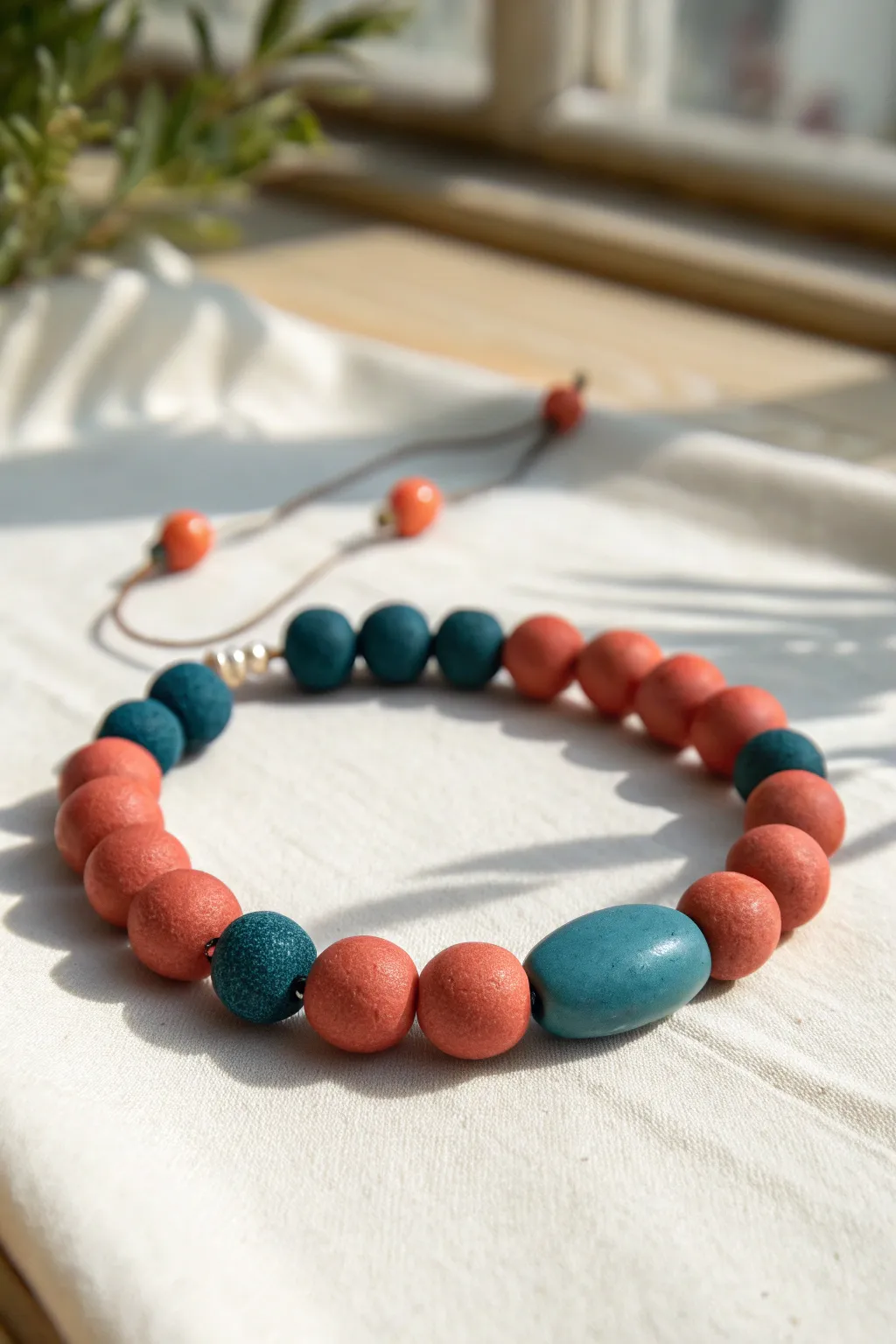
Embrace earthy elegance with this beaded design featuring matte clay beads in warm salmon and deep teal tones. The standout feature is a singular, elongated oval bead that serves as a modern, minimalist charm.
Step-by-Step Guide
Materials
- Polymer clay (Terracotta/Salmon color)
- Polymer clay (Deep Teal color)
- Waxed cotton cord or hemp cord (brown, 1mm thickness)
- Small gold spacer beads (optional)
- Beading needle (large eye)
- Scissors
- Ruler
- Baking sheet and parchment paper
- Toothpick or bead piercing tool
- Oven (for baking clay)
Step 1: Crafting the Clay Beads
-
Condition the clay:
Start by warming up your polymer clay in your hands. Knead the terracotta and teal clays separately until they are soft, pliable, and free of cracks. -
Form the round beads:
Pinch off small pieces of clay—about the size of a large pea. Roll them between your palms to create smooth, consistent spheres. You will need approximately 15-18 terracotta spheres and 6 teal spheres. -
Create the focal bead:
Take a larger chunk of the teal clay. Roll it into a ball first, then gently roll it back and forth on your work surface to elongate it into a smooth oval shape, roughly 2cm long. -
Make the end beads:
Form two smaller terracotta spheres and one very small teal sphere for the closure mechanism. -
Pierce the beads:
Using a toothpick or a dedicated piercing tool, carefully poke a hole through the center of each bead. For the oval focal bead, pierce it lengthwise. Give the tool a little wiggle to ensure the hole is wide enough for your cord. -
Bake the clay:
Arrangement the beads on a parchment-lined baking sheet. Bake them according to the specific temperature and time instructions on your clay package. Let them cool completely before handling.
Step 2: Stringing the Design
-
Prepare the cord:
Cut a piece of waxed cord roughly 20 inches long. This extra length helps immensely when tying the adjustable knots later. -
Start the pattern:
Thread your cord onto a large-eye needle. Begin by stringing the large teal oval bead; slide it to the very center of your cord. -
Build the right side:
On the right side of the oval bead, thread one terracotta bead, followed by one teal sphere. -
Continue the right sequence:
String approximately 7-8 terracotta beads. Finish this side with 2-3 teal beads and finally a few tiny gold spacer beads if you are using them. -
Build the left side:
Moving to the left side of the oval bead, mirror the beginning by adding one terracotta bead followed by one teal sphere. -
Finish the left sequence:
Add about 7-8 terracotta beads to match the other side. This creates an asymmetrical look where one end has a block of teal and the other is mostly terracotta. -
Check the fit:
Wrap the beaded section around your wrist. The beads should cover the top and sides of your wrist, leaving a gap of cord underneath for the closure.
Hole Distortion?
If piercing the clay squishes the bead’s shape, let the clay sit in the fridge for 10 minutes to firm up before piercing, or gently re-roll the bead while it’s on the toothpick.
Step 3: Creating the Adjustable Closure
-
Secure the ends:
Tie a simple overhand knot immediately after the last bead on both ends to keep the beads from sliding off the main design area. -
Cross the cords:
Bring the two cord ends together so they overlap and run parallel to each other. -
Add the slider bead:
Thread both tail ends through the single small teal bead you made earlier. It should be a snug fit; this bead acts as the slider to tighten the bracelet. -
Add stopper beads:
On the very end of each cord tail, thread one of the small terracotta spheres you set aside. -
Knot and trim:
Tie a firm knot after each stopper bead and trim off any excess cord. I usually leave just a tiny bit of fray at the end for texture.
Pro Tip: Matte Finish
To get that powdery, organic look seen in the photo, gently sand your baked beads with a fine-grit sanding sponge. It removes fingerprints and dulls any shine.
Now you have a stylish, handcrafted accessory that adds a perfect pop of organic color to your wrist

TRACK YOUR CERAMIC JOURNEY
Capture glaze tests, firing details, and creative progress—all in one simple printable. Make your projects easier to repeat and improve.
Centered Initial Bead Bracelet
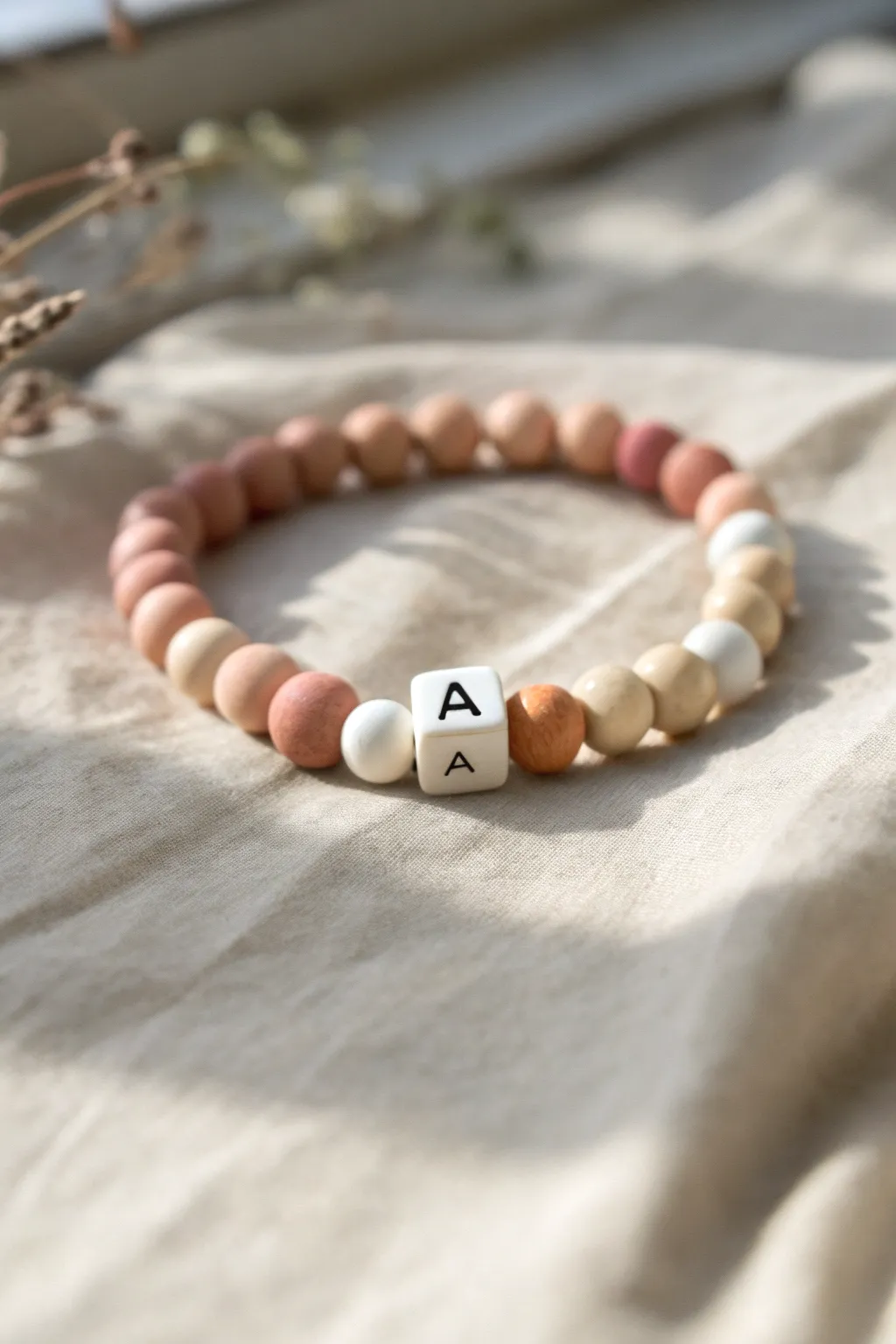
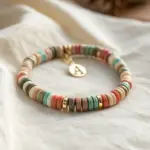
Create a personalized accessory that feels both rustic and modern with this simple beaded bracelet. Featuring a central initial flanked by a soothing gradient of matte terracotta, blush, and cream beads, this piece is perfect for everyday wear.
Step-by-Step
Materials
- Stretchy elastic jewelry cord (0.8mm or 1mm)
- Square white alphabet bead (your choice of letter)
- 6mm or 8mm matte round beads (polymer clay or wood)
- Bead colors: Muted terracotta/dark pink
- Bead colors: Light blush pink
- Bead colors: Cream or off-white
- Bead colors: Natural light wood tone
- Single round accent bead (slightly larger, natural wood finish)
- Scissors
- Jewelry glue or clear nail polish
- Beading needle (optional but helpful for thick cords)
- Tape or binder clip
Step 1: Preparation & Planning
-
Measure the cord:
Cut a piece of elastic cord about 10-12 inches long. This generous length gives you plenty of room to tie knots without struggling against tension. -
Secure the end:
Attach a piece of tape or a binder clip to one end of your cord. This simple trick prevents your beads from sliding right off onto the floor while you work. -
Pre-stretch the elastic:
Gently pull on the elastic cord a few times to stretch it out. Pre-stretching helps prevent the bracelet from sagging or becoming loose after the first few wears. -
Plan your pattern:
Lay your beads out on a bead board or soft cloth. Identify the ‘A’ alphabet bead as your center point.
Knot Slipping?
If your elastic knot feels slippery, dab the knot with clear nail polish or specialized jewelry glue. Let it dry completely before sliding a bead over it to lock it in place.
Step 2: Stringing the Design
-
Start the center sequence:
Thread the square alphabet bead onto the cord so it sits roughly in the middle. -
Add immediate side accents:
On the immediate left side of the letter, string one round white bead. On the immediate right side, string one darker, natural wood-tone bead to create a slight asymmetrical interest, just like the reference photo. -
Build the right side:
Continue stringing onto the right side. Add two cream-colored beads, followed by two light tan wooden beads. -
Complete the right gradient:
Finish the right side sequence by adding two white beads, then transitioning into the pinks. String about 8-10 muted terracotta or dark pink beads to form the back half of the loop. -
Build the left side:
Go back to the left side of the letter bead. Add one muted terracotta bead immediately after the white accent bead you placed earlier. -
Add lighter pink tones:
String two light blush pink beads next, creating a soft transition. -
Balance the colors:
Add another muted terracotta bead to bring the deeper color back in, then follow with a sequence of the dark pink/terracotta beads until this side meets the length of the other side. -
Check the fit:
Wrap the unfinished strand around your wrist. The ends should meet comfortably without gaps, but shouldn’t be loose. Add or remove the dark pink ‘back’ beads as needed to adjust the size.
Step 3: Finishing Touches
-
Prepare to tie:
Remove the tape or clip from the end carefully, holding both ends of the elastic firmly. -
Tie the first knot:
Bring the ends together and tie a simple overhand knot. Pull it tight, but be gentle so you don’t snap the cord. -
Secure with a surgeon’s knot:
Tie a second knot, but this time loop the cord through twice before pulling tight. This is a surgeon’s knot and offers much better security. -
Hide the knot:
Before snipping the ends, stretch the cord slightly to expose the knot, apply a tiny dab of jewelry glue, and slide one of the larger-hole beads over the knot to hide it inside. -
Trim the excess:
Once the glue is tacky or dry, use your scissors to trim the excess cord ends close to the bead—but careful not to cut your main knot.
Pro Tip: Matte Textures
To get the exact look in the photo, ensure your clay beads have a ‘matte’ or ‘soft touch’ finish rather than glossy. It gives that sophisticated, earthy vibe.
Wear your initial bracelet solo for a minimalist look or stack it with other earth-toned pieces to complete the set
Short Word Letter Bead Bracelet
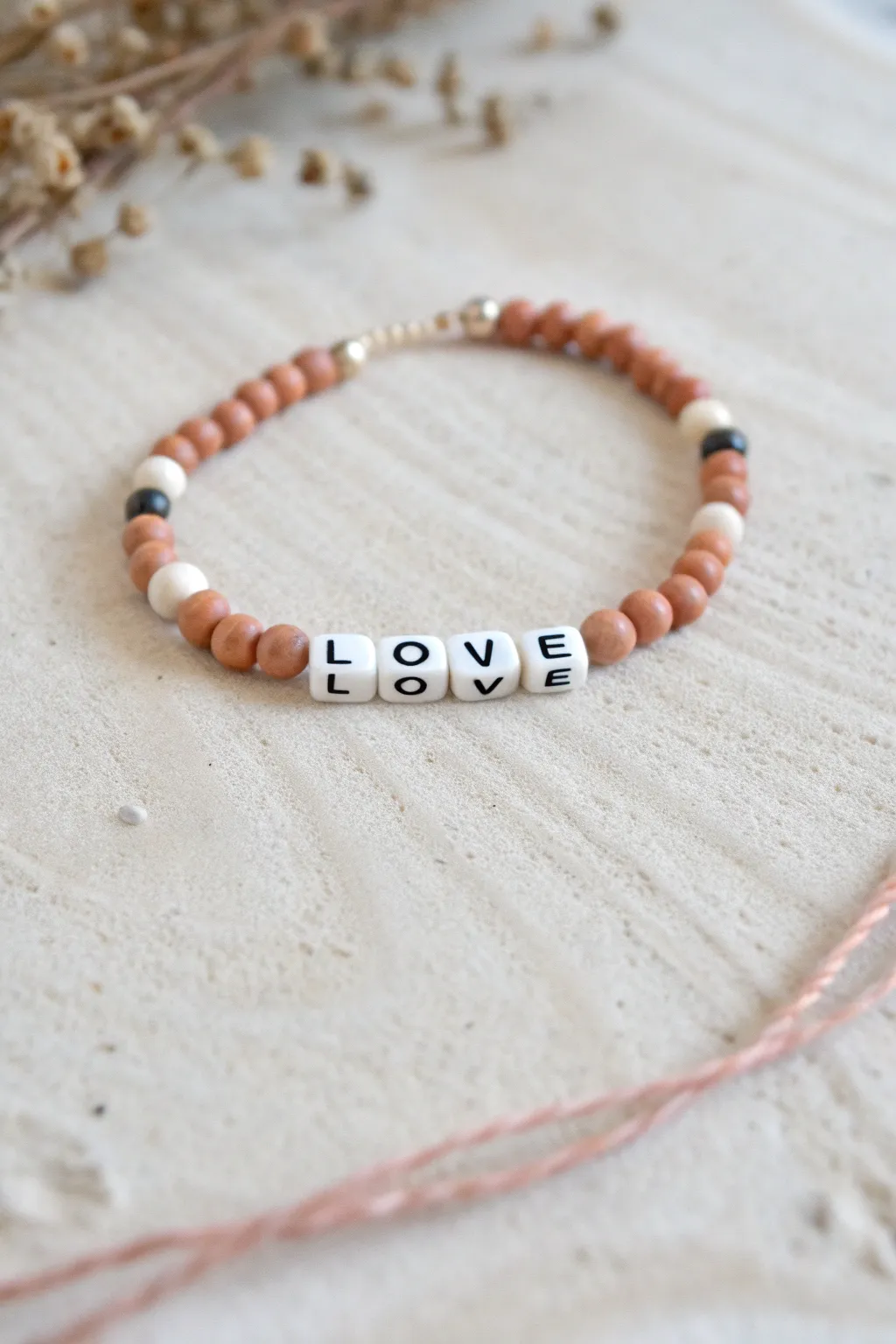
Embrace a natural, grounded aesthetic with this simple yet charming beaded bracelet. Combining matte brown clay beads with crisp white letter blocks, this accessory spells out a sweet sentiment in a style perfect for everyday wear.
How-To Guide
Materials
- Matte brown/terracotta polymer clay beads (6mm or similar)
- White or ivory accent beads (6mm)
- Black accent beads (6mm)
- Square white letter beads spelling ‘L’, ‘O’, ‘V’, ‘E’
- Small gold spacer beads or crimp covers (3mm)
- Clear elastic beading cord (0.7mm or 0.8mm)
- Scissors
Step 1: Planning and Preparation
-
Measure your wrist:
Cut a piece of elastic cord about 10-12 inches long. This generous length gives you plenty of room to tie knots without feeling cramped. -
Pre-stretch the cord:
Firmly pull the elastic cord a few times before adding any beads. This prevents the bracelet from stretching out permanently after you wear it a few times. -
Lay out the design:
On a bead board or a piece of felt, arrange your letter beads in the center to spell ‘LOVE’. This helps visualize the final look before stringing. -
Prepare the side patterns:
To the left and right of the word ‘LOVE’, place about 3-4 brown clay beads as a buffer. Then, plan your accent sections: a white bead, a black bead, another white bead, followed by a long run of brown beads.
Knot Slipping?
If your elastic knot feels insecure, apply a tiny dab of jewelry glue or clear nail polish directly onto the knot before hiding it inside a bead.
Step 2: Stringing the Beads
-
Start the center:
Begin by stringing the letter beads. Thread L, O, V, and E onto the center of your cord. -
Add the immediate spacers:
On the right side of the ‘E’, slide on 4 brown clay beads. Then do the same on the left side of the ‘L’. -
Create the accent pattern:
On both ends, add one white bead, followed by one black bead, and then another white bead. This creates a symmetrical pop of contrast on either side of the focal word. -
Fill in the rest:
Continue adding brown clay beads to both sides evenly until the bracelet reaches your desired length. I find it helpful to wrap it around my wrist occasionally to check the fit. -
Add metallic ends:
Finish the ends of the beaded section with small gold spacer beads or crimp covers. These add a finished, professional look right where the knot will be.
Level Up: Texture Mix
Swap the plain brown clay beads for sandalwood or wooden beads to add a subtle scent and a lighter, more organic texture to the piece.
Step 3: Finishing Up
-
Preparing to knot:
Bring the two ends of the cord together, ensuring the beads are pushed snugly against each other so there are no large gaps. -
Tie a surgeon’s knot:
Cross the ends like a standard knot, but loop the top string through the bottom loop twice instead of once. Pull tight. -
Secure the knot:
Tie a second overhand knot on top of the first one to lock it in place. Pull the elastic firmly—you want the knot to be as small and tight as possible. -
Hide the knot:
If possible, carefully tuck the knot inside one of the adjacent clay beads or the gold spacer. -
Trim excess cord:
Use your scissors to trim the excess elastic, but leave tiny tails (about 1-2mm) just in case the knot settles slightly.
Now you have a custom, handmade accent piece ready to stack or wear solo
Black-and-White Alternating Heishi
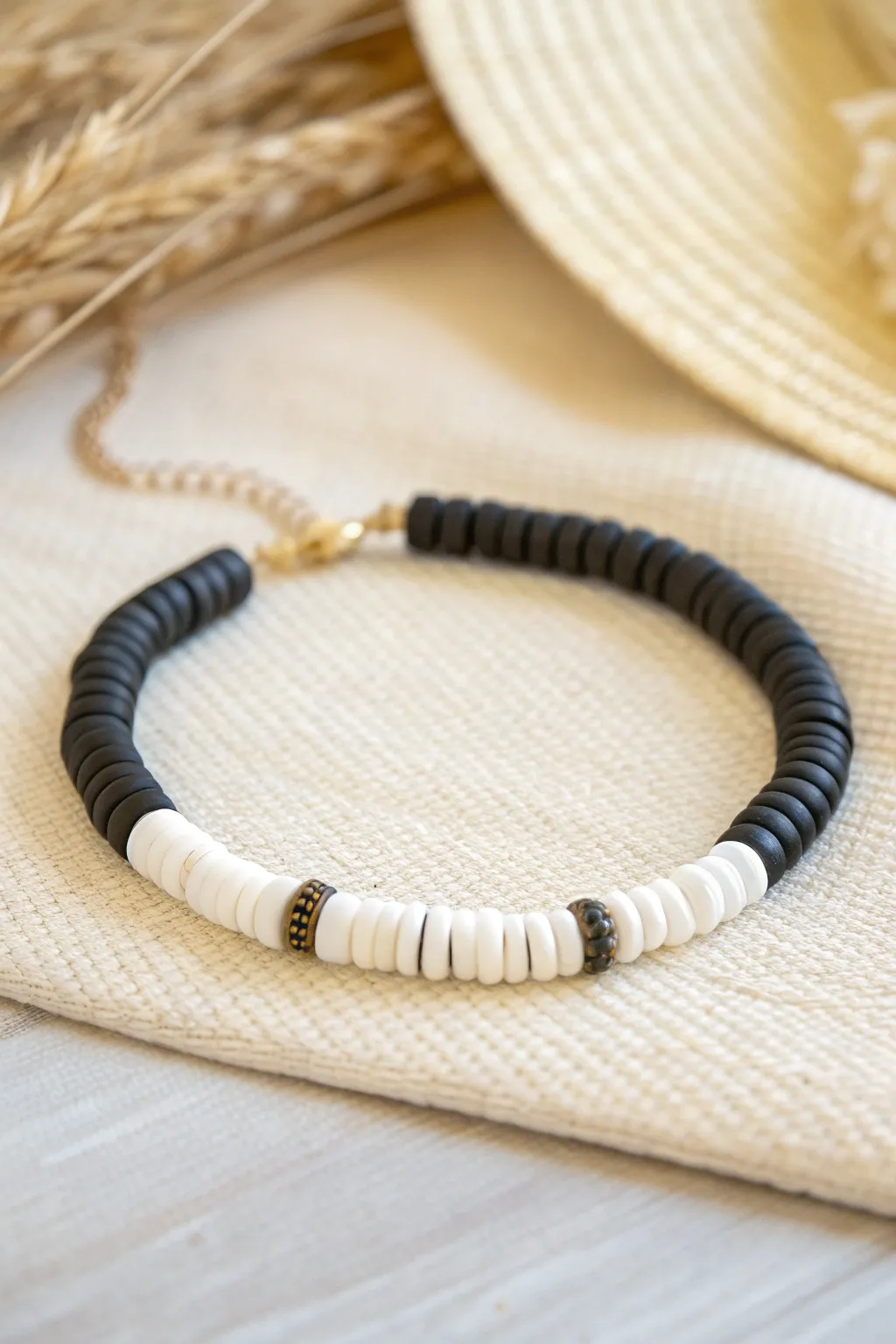
Achieve a sleek, high-end look with this minimalist bracelet design featuring matte black and white clay disc beads. The subtle addition of metallic spacer beads adds just the right amount of texture to this versatile accessory.
Step-by-Step Tutorial
Materials
- 6mm black flat round polymer clay (Heishi) beads
- 6mm white flat round polymer clay (Heishi) beads
- 2 rondelle metallic spacer beads (copper or antique gold tone with granulated design)
- Beading wire (0.38mm or 0.45mm nylon-coated stainless steel)
- 2 small crimp beads (gold tone)
- 2 crimp bead covers (gold tone)
- 2 wire guards (gold tone)
- Lobster clasp (gold tone)
- Extension chain (gold tone)
- Flat nose pliers
- Crimping pliers
- Wire cutters
- Bead stopper or tape
Step 1: Preparation and Design Layout
-
Measure your materials:
Cut a strand of beading wire approximately 10 inches long. This generous length gives you plenty of wiggle room for handling the clasp ends later. -
Secure the end:
Attach a bead stopper or a piece of masking tape to one end of the wire to prevent your beads from sliding off while you work. -
Plan the pattern:
Visualize the center section first. This design relies on a block of white beads flanked by decorative spacers, with the rest of the strand in solid black.
Smooth Moves
To prevent the clay beads from flipping or sitting awkwardly, gently roll the finished strand between your palms before crimping. This helps them nesting perfectly flat.
Step 2: Stringing the Beads
-
Start with black:
Begin stringing the black Heishi beads. You want enough to cover about 40% of the bracelet’s total circumference. For a standard 7-inch bracelet, this is roughly 2.5 to 3 inches of black beads. -
Add transition beads:
Once the initial black section is complete, add about 3 to 4 white clay beads. These act as a small buffer before the metallic accent. -
Insert the first spacer:
Slide on one of your metallic rondelle spacer beads. Ensure the textured or granulated side is visible if the bead has a specific orientation. -
create the focal point:
String the main block of white Heishi beads. You’ll want about 10 to 12 beads here to create a distinct white bar at the front of the wrist. -
Add the second spacer:
Place the second metallic spacer bead onto the wire, framing the white centerpiece. -
Mirror the transition:
Add the same number of white buffer beads (3 to 4) that you used on the other side of the first spacer to keep the design symmetrical. -
Finish with black:
Resume stringing black Heishi beads until the bracelet reaches your desired length minus about half an inch (to account for the clasp). -
Check the fit:
Wrap the unfinished strand around your wrist to verify the size. I usually aim for a slightly loose fit since these flat beads stack densely.
Gap Issues?
If you notice gaps between beads after crimping, you likely didn’t pull the wire taut enough. Stringing requires tension; pull the wire firmly before crushing that final crimp.
Step 3: Attaching the Clasp
-
Remove the stopper:
Carefully remove the bead stopper, holding the wire ends firmly so no beads escape. -
Thread the first crimp:
On one end, slide on a crimp bead followed by a wire guard. -
Secure the clasp:
Thread the wire through the guard and loop the lobster clasp onto the guard. Pass the wire tail back down through the crimp bead. -
Crimp firmly:
Use your crimping pliers to flatten the crimp bead securely, locking the wire in place. Trim the excess wire tail close to the bead. -
Cover the crimp:
Place a crimp cover over the flattened crimp bead and gently close it with flat-nose pliers to make it look like a seamless gold bead. -
Repeat for the other side:
On the opposite end, add a crimp bead and wire guard. Loop the extension chain onto the guard. -
Tighten and crimp:
Pass the wire back through the crimp bead and pull it taut so there are no gaps between the clay beads, but not so tight that the bracelet becomes stiff. Crimp and trim. -
Final finish:
Add the second crimp cover to this end to complete the professional look.
You now have a sophisticated piece of jewelry that looks great stacked or worn solo
Single-Hue Ombre Gradient
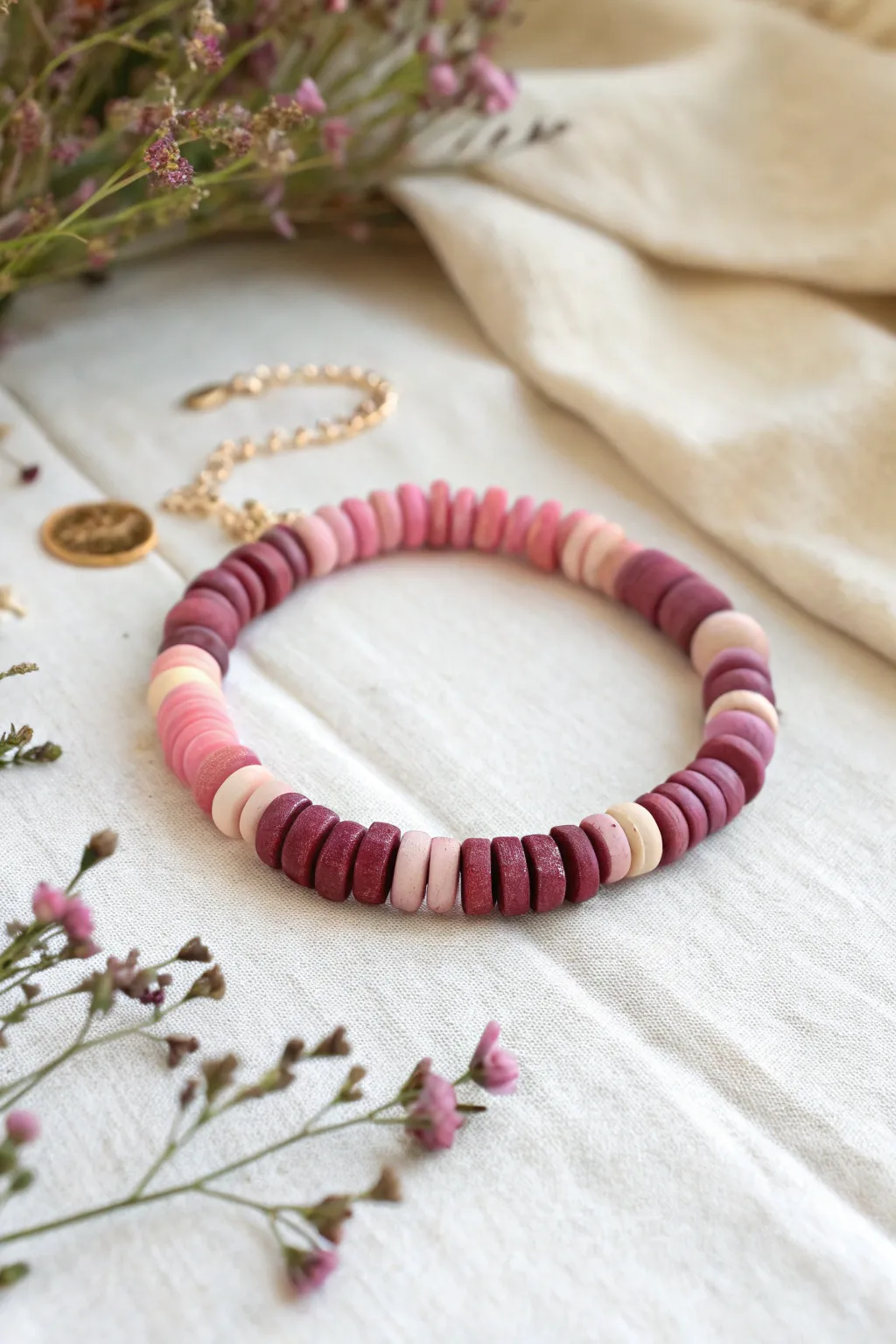
This charming bracelet features a delightful mix of handmade disc beads in varying shades of berry, rose, and cream. The subtle gradient effect creates a sophisticated yet playful accessory perfect for adding a pop of color to any outfit.
Detailed Instructions
Materials
- Polymer clay in deep burgundy, mauve, bright pink, pale pink, and white
- Gold bracelet chain extender with lobster clasp
- Gold jump rings (4mm or 5mm)
- Beading wire or strong elastic cord
- Crimp beads (if using wire)
- Small round clay cutter (approx. 6-8mm diameter)
- Rolling pin or pasta machine
- Toothpick or bead piercing pin
- Flat nose pliers
- Baking sheet and parchment paper
- Oven
Step 1: Clay Preparation
-
Condition the Clay:
Begin by softening each block of polymer clay in your hands until it becomes pliable and easy to work with. -
Mix Custom Shades:
To achieve the rich variety seen in the photo, don’t just use straight colors. Mix a little white into your burgundy to soften it, or blend bright pink with a touch of mauve. Aim for at least 5 distinct shades ranging from deep wine to creamy white. -
Roll Out Sheets:
Roll each color out into a flat sheet. You want these slightly thick—about 2-3mm—to give the beads a substantial, disc-like profile rather than being paper-thin wafers.
Distorted Circles?
If your circles squish into ovals when piercing them, try letting the raw clay discs sit in the fridge for 10 minutes to harden slightly before poking the holes.
Step 2: Creating the Beads
-
Cut Discs:
Using your small round cutter, punch out numerous circles from each color sheet. You will need roughly 40-50 beads for a standard wrist size, but make extras just in case. -
Smooth the Edges:
Gently pick up each disc and run your finger around the edge to smooth out any harsh cut lines or ragged bits left by the cutter. -
Texture Option:
Notice some beads in the image have a slight sparkle or texture? You can achieve this by lightly rolling a few of the darker burgundy discs in fine glitter or salt before baking (wash salt off after baking) for a subtle stone effect. -
Pierce the Centers:
Carefully poke a hole through the exact center of each disc using a toothpick or pin. Twist the tool gently as you push through to avoid distorting the circle shape. -
Bake:
Arrange your beads on a parchment-lined baking sheet. Bake according to your clay manufacturer’s instructions (usually 275°F/135°C for 15-30 minutes). Let them cool completely before handling.
Pro Tip: Consistent Thickness
Use playing cards as depth guides! Place a stack of 3-4 cards on either side of your clay while rolling to ensure every sheet is exactly the same thickness.
Step 3: Assembly
-
Plan the Pattern:
Lay your cooled beads out on a flat surface. The pattern in the image isn’t a strict linear gradient; it groups similar colors. Try arranging 5-6 dark burgundy beads, followed by 2-3 medium pinks, then a cream accent, transitioning back to dark. -
Prepare the Stringing Material:
Cut a length of beading wire or elastic about 10 inches long to give yourself plenty of room to work. -
Start Stringing:
Thread your beads onto the wire in your chosen order. I find it helpful to double-check the length against my wrist halfway through to ensure the sizing is correct. -
Add Hardware:
Once all beads are strung, thread a crimp bead onto one end, followed by a jump ring attached to one side of your chain extender. -
Secure the End:
Loop the wire back through the crimp bead and pull tight, ensuring there are no gaps between beads. Use your flat nose pliers to squash the crimp bead flat, securing the wire. -
Finish the Second Side:
Repeat the crimping process on the other end of the bracelet, attaching the other side of the chain extender or clasp. -
Trim Excess:
Snip off any excess wire sticking out from your crimp beads. You can tuck a tiny tail of wire back into the adjacent clay beads for a cleaner finish.
Now you have a stunning, custom-colored accessory ready to wear or gift to a friend
One Pop-of-Color Accent Bead
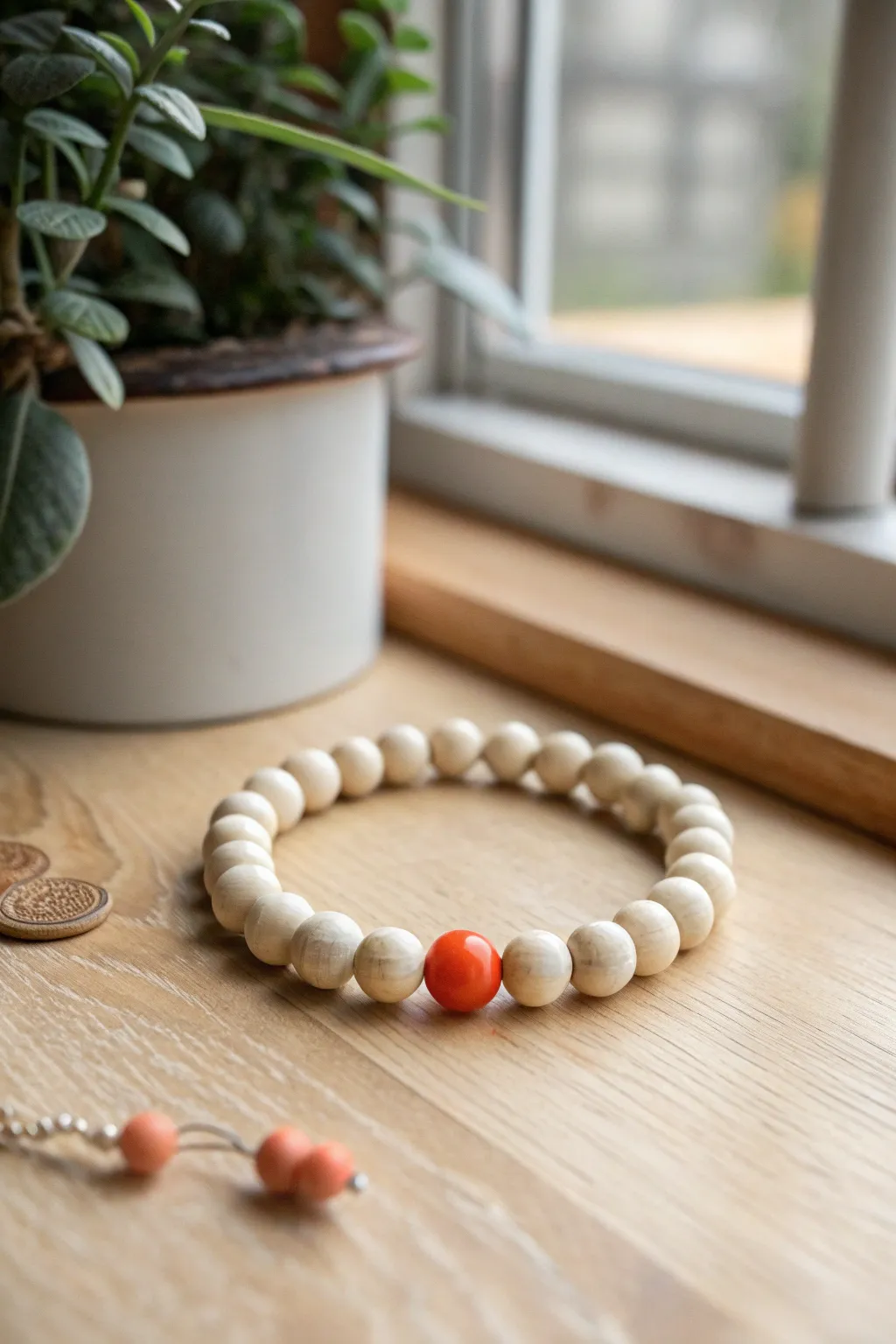
This elegant tutorial brings natural tones and a vibrant focal point together, showcasing how powerful simplicity can be. By pairing smooth, unfinished wooden beads with a single glossy tangerine accent, you create a bracelet that feels organic yet striking.
How-To Guide
Materials
- 20-22 round unfinished natural wooden beads (approx. 10mm-12mm)
- 1 glossy red-orange round ceramic or acrylic bead (same size as wood beads)
- Strong elastic cord (0.8mm or 1mm clear)
- Scissors
- Jewelry glue or clear nail polish
- Beading needle (optional, for easier threading)
- Masking tape or bead stopper
Step 1: Preparation
-
Measure your wrist:
Begin by wrapping a measuring tape loosely around your wrist to determine the desired length. Add about 0.5 inches to this measurement to ensure a comfortable fit that isn’t too tight. -
Calculate bead count:
Lay out your wooden beads along a ruler to match your measured length, keeping the size of your accent bead in mind. For a standard adult wrist, you will typically need between 20 and 22 beads of 10mm size. -
Prepare the cord:
Cut a piece of elastic cord roughly 10-12 inches long. This generous length gives you plenty of room to tie a secure knot later without struggling with short ends. -
Pre-stretch the elastic:
Gently pull on the elastic cord a few times to pre-stretch it. This crucial step prevents the bracelet from drooping or stretching out permanently after you wear it for the first time. -
Secure the end:
Place a piece of masking tape or a bead stopper on one end of the cord. This simple anchor prevents your beads from sliding off while you work.
Knot Security
If the knot won’t fit inside a bead hole, apply glue and let it dry completely before trimming. Simply rotate the knot to the back of your wrist when wearing.
Step 2: Stringing the Design
-
Start with wood:
Begin threading the natural wooden beads onto the cord one by one. I usually string about half of the total wooden beads first to position the accent exactly in the middle. -
Add the accent:
Slide on your single glossy orange bead. This ‘pop-of-color’ creates the focal point of the jewelry piece. -
Finish the strand:
Continue threading the remaining wooden beads until your strand reaches the desired length. Check the symmetry if you want the knot to be hidden exactly opposite the colored bead, though with a full circle, the orientation will shift naturally. -
Test the fit:
Carefully wrap the unknotted strand around your wrist to check the sizing. The beads should touch comfortably without pinching your skin or leaving large gaps.
Layered Texture
Create a stack by making two more bracelets: one entirely of wood, and one combining wood with a different textured accent, like a lava stone or metal spacer.
Step 3: Finishing Touches
-
Prepare for the knot:
Remove the tape or bead stopper carefully while holding both ends of the elastic securely. -
Tie the first loop:
Cross the ends and make a simple overhand knot, pulling it tight enough so there is no slack between the beads but not so tight that the bracelet creates a rigid wave. -
Secure with a surgeon’s knot:
For the second knot, loop the elastic through twice before pulling tight. This creates a surgeon’s knot, which is much less likely to slip than a standard square knot. -
Add adhesive:
Apply a tiny drop of jewelry glue or clear nail polish directly onto the knot. Allow it to dry for a few moments to fuse the elastic strands together. -
Hide the knot:
Once the glue is tacky but not fully hard, pull gently on the beads to slide the knot inside the hole of the nearest wooden bead. This creates a seamless, professional finish. -
Final trim:
Trim the excess cord ends carefully with sharp scissors, getting as close to the bead hole as possible without cutting the main knot.
Slip on your new bracelet to enjoy a touch of natural warmth with a cheerful burst of color
Tiny Bead Cluster Focal Point
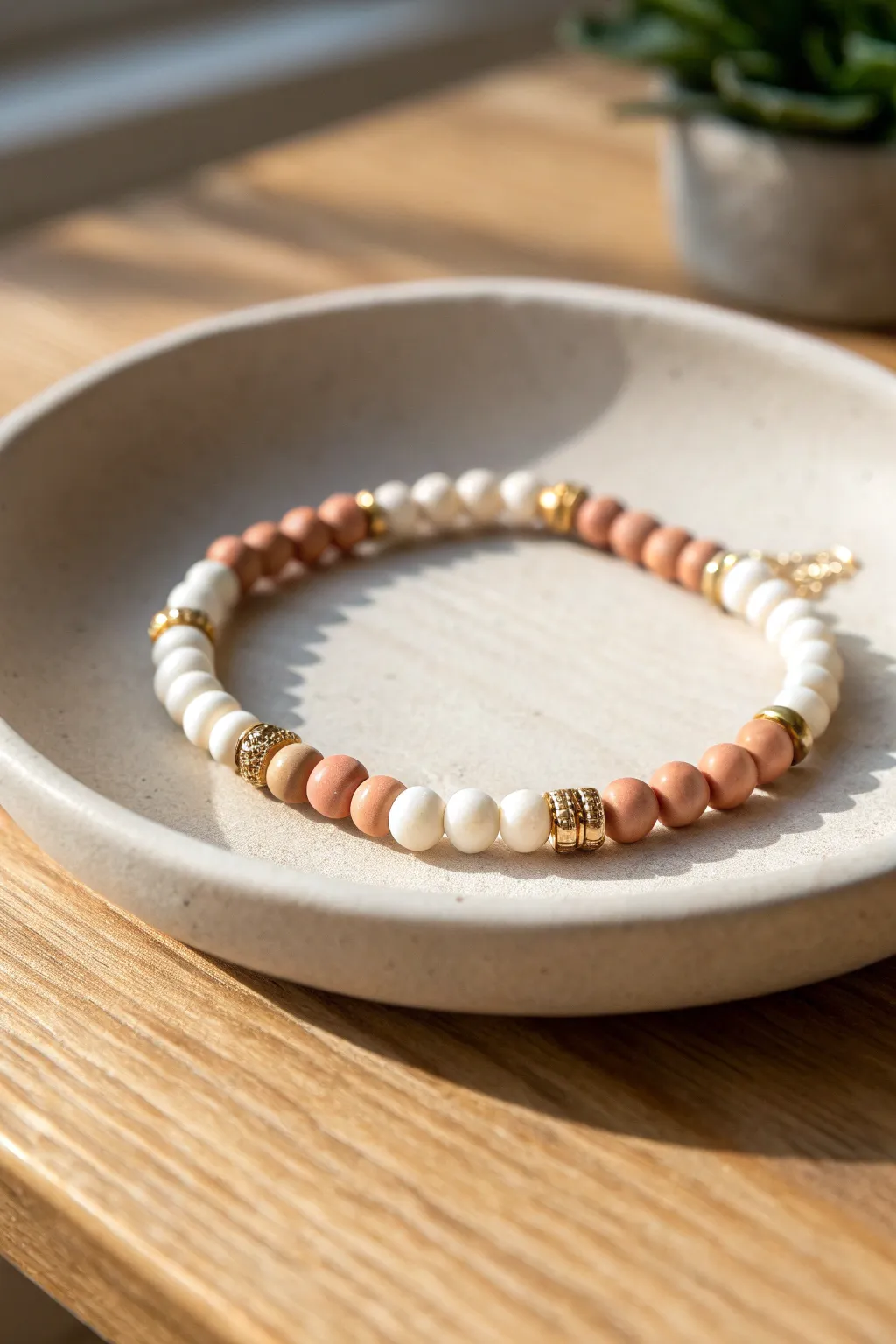
This elegant bracelet balances earthy, matte tones with the gentle sheen of pearlescent beads and bright gold accents. The unique rhythm of alternating color blocks creates a sophisticated yet relaxed accessory perfect for stacking or wearing solo.
Step-by-Step Tutorial
Materials
- Matte terracotta or peach polymer clay beads (6mm or 8mm round)
- White or ivory pearlescent glass/stone beads (6mm or 8mm round)
- Gold daisy spacers or small heishi beads
- Textured gold rondelle spacer beads (larger diameter than the main beads)
- Plain gold rondelle beads
- Strong elastic stretch cord (0.8mm or 1mm)
- Jewelry glue (e.g., G-S Hypo Cement)
- Scissors
Step 1: Planning the Pattern
-
Measure your wrist:
Wrap a piece of string around your wrist to find your size, then add about half an inch for a comfortable fit. Cut a piece of elastic cord about 10-12 inches long to give yourself plenty of room to tie knots later. -
Pre-stretch the cord:
Give your elastic cord a few firm tugs before you start stringing. I always do this to prevent the bracelet from stretching out and becoming loose after the first few wears. -
Visualize the layout:
Lay your beads out on a bead board or a textured cloth to plan the pattern. The design relies on blocks of color separated by gold accents rather than a strict 1-to-1 alternation.
Knot Pro Tip
For invisible finishing, drill the hole of one bead slightly larger using a bead reamer. This ensures the knot can easily slide inside and disappear completely.
Step 2: Stringing the Beads
-
Start with the focal section:
Begin stringing with a cluster of three white beads to establish your first ‘light’ section. -
Add gold texture:
Slide on one of the textured gold rondelle spacers. These wider, detailed gold beads act as the primary dividers between your color blocks. -
Create a terracotta block:
String three to four matte terracotta beads. This earthy tone provides a beautiful contrast to the white segments. -
Transition with gold:
Add a small, plain gold spacer bead or a gold daisy spacer after the terracotta group. -
Build a mixed section:
String a smaller segment of white beads—perhaps just two or three—followed by another plain gold spacer. -
Center focus:
Place three terracotta beads sandwiched between two large, textured gold rondelles. This creates a bold ‘station’ on the bracelet that draws the eye. -
Continue the pattern:
Mirror your pattern or continue creating alternating blocks of 3-5 beads in white and terracotta, separating distinct sections with your gold spacers. -
Check the length:
Periodically wrap the strand around your wrist. You want the ends to touch comfortably without gaps, but without squeezing your skin. -
Adjust symmetry:
If you need to add or remove length, try to do it evenly on both ends of the strand so your focal gold beads remain somewhat centered when worn.
Level Up The Look
Add a small gold charm, like a leaf or a tiny tassel, attached to a jump ring near one of the larger gold rondelles for extra movement and sparkle.
Step 3: Finishing the Bracelet
-
Pre-knot tension check:
Bring the two ends of the elastic together and verify the size one last time. Ensure there is no slack in the line between the beads. -
Tie the first knot:
Tie a simple overhand knot essentially just crossing left over right and pulling tight to bring the beads into a circle. -
Secure with a surgeon’s knot:
For the second knot, loop the elastic through twice before pulling tight. This extra loop creates a friction knot that is much less likely to slip. -
Reinforce with glue:
Place a tiny drop of flexible jewelry glue directly onto the knot. Be careful not to get glue on the neighboring beads, as it can mar the matte finish of the clay. -
Hide the knot:
While the glue is still slightly tacky but not wet, slide the nearest large-hole bead (preferably one of the gold spacers) over the knot to conceal it. -
Trim the excess:
Once the glue has fully cured (check your glue’s instructions), use sharp scissors to trim the elastic tails as close to the bead/knot as possible.
Slip your new handmade accessory onto your wrist and enjoy the warm, earthy elegance it adds to your outfit
Mix Discs and Tube Clay Beads
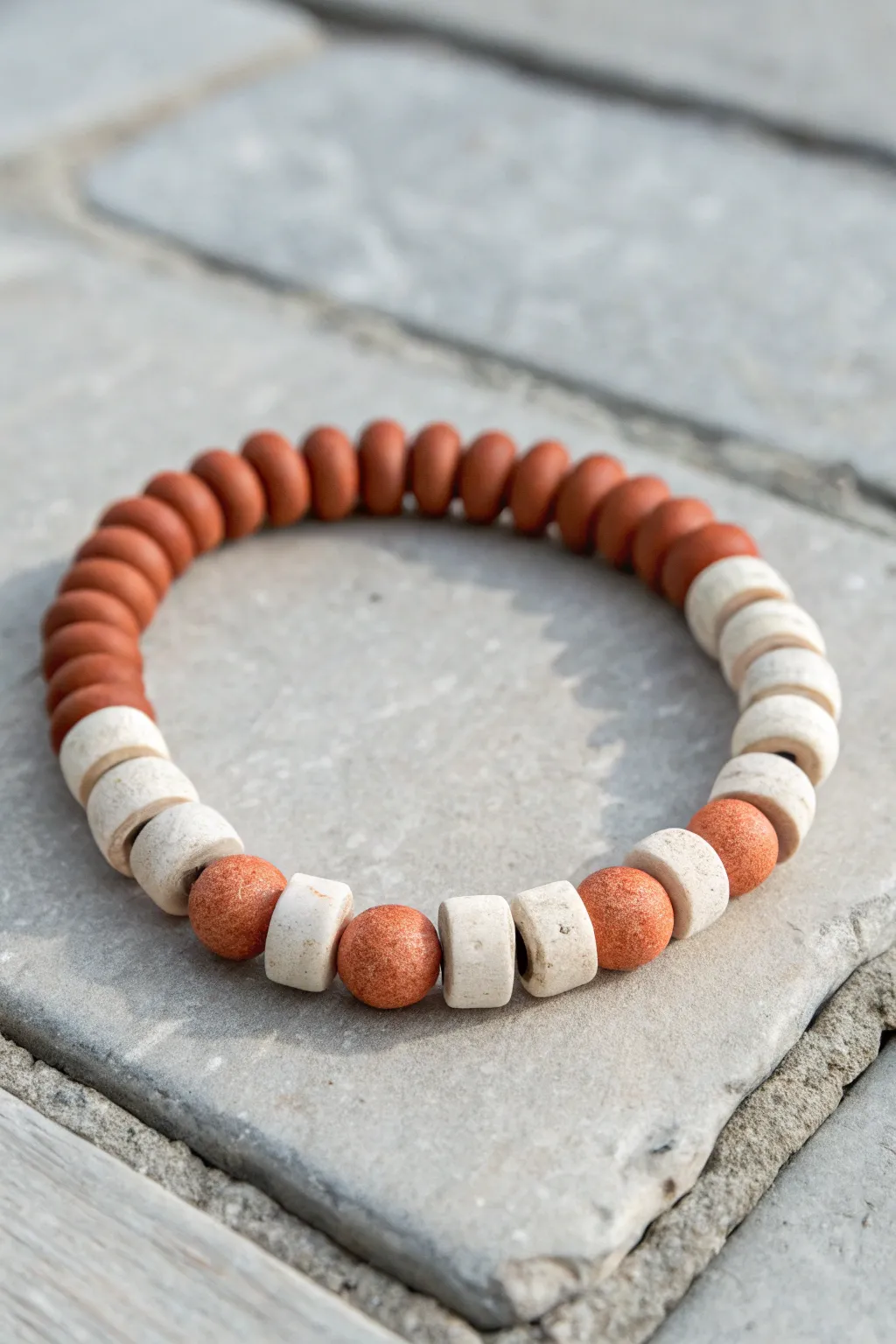
This rustic bracelet balances the earthy warmth of terracotta-colored polymer clay with cool, speckled cream accents. By alternating flat discs with chunky tube beads and round spheres, the design achieves a satisfying texture that feels both modern and grounded.
How-To Guide
Materials
- Terracotta polymer clay (burnt orange/reddish-brown)
- Cream or off-white polymer clay
- Speckled granite polymer clay (or black glitter/ground pepper)
- Stretchy jewelry cord (0.8mm or 1mm)
- Clay roller or pasta machine
- Small circular clay cutter (approx. 6-8mm)
- Needle tool or toothpick
- Clay knife or tissue blade
- Superglue or jewelry glue
- Oven for baking
Step 1: Creating the Terracotta Discs
-
Condition the clay:
Start by warming up your terracotta-colored clay in your hands until it is pliable and smooth. Rolling it into a ball and flattening it a few times helps get the right consistency. -
Roll out a sheet:
Using a roller or pasta machine, roll the terracotta clay into a uniform sheet about 3mm thick. You want these discs to have a bit of substance, not be paper-thin. -
Cut the discs:
Use your small circular cutter to punch out roughly 25-30 discs. This will form the main solid-colored section of the bracelet. -
Poke the center holes:
Gently use a needle tool or toothpick to create a hole in the exact center of each disc. Wiggle the tool slightly to ensure the hole is large enough for your cord.
Hole Distortion?
If your tube beads squish when piercing them, try refrigerating the clay log for 10 minutes first. This hardens it slightly, allowing the needle to slide through without deforming the shape.
Step 2: Forming the Cream Tubes and Spheres
-
Mix the speckled clay:
Take your cream clay. To get the speckled look seen in the photo, mix in a tiny amount of granite-effect clay. Alternatively, I like to knead in a pinch of actual black pepper or loose black glitter for a natural texture. -
Roll a snake for tubes:
Roll a portion of the cream clay into a thick log or snake, matching the diameter of your terracotta discs (approx. 6-8mm thick). -
Slice the tubes:
Use your blade to slice the log into small sections. You need about 10-12 short tube beads. Keep them relatively short, roughly 4-5mm in length. -
Pierce the tubes:
Carefully push your needle tool lengthwise through the center of each tube bead. Spin the bead on the tool to smooth the opening. -
Roll the accent spheres:
With the remaining terracotta clay, roll 4-5 round sphere beads. These should be slightly larger than the tube beads to create visual interest in the mixed pattern section.
Step 3: Baking and Assembly
-
Bake the beads:
Arrange all your pieces on a baking tile or parchment-lined tray. Bake according to your brand of polymer clay instructions (usually 275°F/135°C for 15-30 minutes). Let them cool completely. -
Prepare the cord:
Cut a length of stretchy cord about 10-12 inches long. This gives you plenty of extra room for tying knots later. -
String the solid section:
Thread the terracotta discs onto the cord one by one. Group them all together to form a solid block of color that will cover about half the wrist. -
Begin the transition:
After the terracotta block, add three cream tube beads in a row to start the transition. -
Create the mixed pattern:
Now, alternate your beads to mimic the photo: string one terracotta sphere, followed by one cream tube. Repeat this sphere-tube pattern until you have used all your accent beads. -
Finish with tubes:
End the pattern with a final group of three cream tube beads, mirroring the transition you made on the other side. -
Check the fit:
Wrap the strand around your wrist to check the size. If it’s too loose, remove a couple of disc beads; if too tight, add an extra sphere-tube combo. -
Tie the knot:
Pull the cord ends tight to remove slack. Tie a surgeon’s knot (right over left, left over right) or a strong square knot. -
Secure and trim:
Add a tiny dab of superglue to the knot to prevent slipping. Once dry, trim the excess cord ends close to the knot and tuck the knot inside one of the larger tube beads.
Make It Matte
For a powdery, stone-like finish visible in the photo, lightly sand the baked beads with fine-grit sandpaper or a buffing block. This removes fingerprints and dulls any plastic sheen.
Now flip your wrist to watch the satisfying shift from structured discs to playful spheres and tubes
Simple Clay Bead Bracelet Stack Set
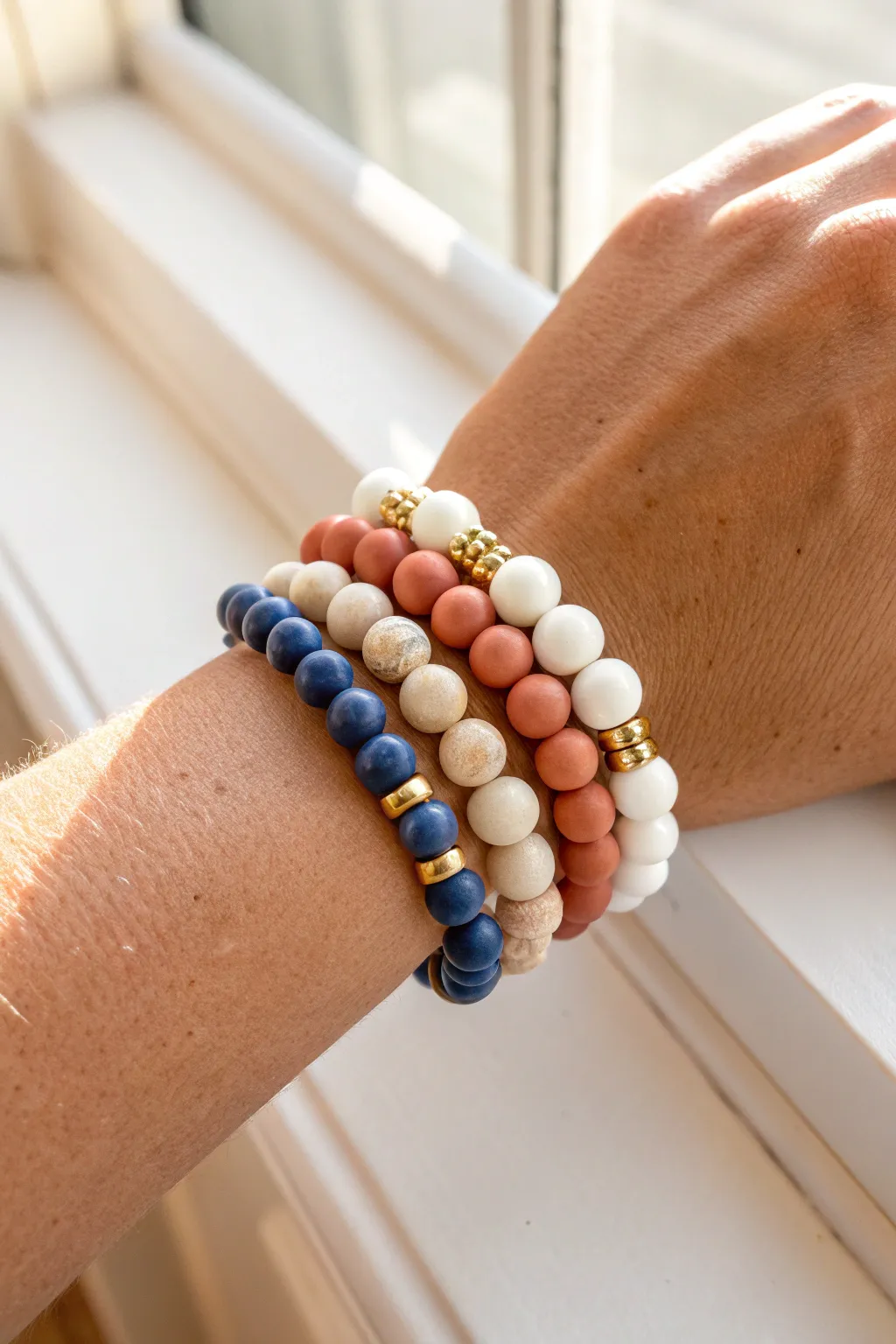
Achieve a sophisticated, bohemian look with this set of four coordinated stretch bracelets featuring a mix of matte textures and glossy gold accents. The combination of navy, sand, terracotta, and white creates a balanced palette perfect for everyday wear.
Step-by-Step Guide
Materials
- Navy blue matte round beads (8mm to 10mm)
- Sand/beige matte round agate or jasper beads (8mm to 10mm)
- Terracotta/peach matte round beads (8mm to 10mm)
- White milky quartz or glossy acrylic round beads (8mm to 10mm)
- Gold disc spacer beads
- Gold textured/faceted round spacer beads
- Gold hexagon or flat washer spacer beads
- Elastic stretch cord (0.8mm or 1.0mm)
- Super glue or jewelry cement
- Scissors
Step 1: Preparation
-
Measure your wrist:
Wrap a piece of string around your wrist to find your size, then add about 1/2 inch to that measurement for a comfortable fit. -
Pre-stretch the cord:
Cut four pieces of elastic cord, each about 10-12 inches long. Give each piece a firm tug to pre-stretch it; this prevents the bracelets from stretching out and becoming loose later on. -
Secure the ends:
Attach a bead stopper or simply place a piece of tape on one end of each cord to keep your beads from sliding off while you design.
Knot Slipping Out?
If the knot won’t stay inside a bead, widen the bead hole slightly with a bead reamer, or try pulling the knot into a metal spacer bead which often has a larger opening.
Step 2: Navy & Gold Bracelet
-
Start the blue pattern:
Thread approximately 10-12 navy blue matte beads onto your first cord. -
Add gold accents:
Slide on three flat gold hexagon or washer-style spacers. I like to sandwich these between regular beads to create a metallic focal point. -
Finish the blue strand:
Continue adding navy beads until you reach your target wrist length.
Clean Glue Application
Apply glue to the knot with the tip of a toothpick or a straightened paperclip. This prevents glue from flooding the elastic and making it brittle and prone to snapping.
Step 3: Sand & Stone Bracelet
-
Begin the beige strand:
This bracelet uses the speckled sand-colored beads. Start by threading a majority of the beads onto the cord. -
Insert a focal bead:
Instead of a cluster, find one bead that has slightly more unique markings or texture to act as a subtle centerpiece if desired, though a uniform look works well too. -
Check sizing:
Wrap this strand around your wrist alongside the blue one to ensure they are consistent in size before tying off.
Step 4: Terracotta Matte Bracelet
-
Thread the peach beads:
Using the terracotta or peach matte beads, string almost the entire length of the bracelet. -
Create a gold center:
This strand looks great without distinct spacers, relying purely on the matte color pop, but you can add a single gold disc bead near the knot to hide it later.
Step 5: White & Gold Highlight Bracelet
-
String white beads:
Thread your white beads. Since these are often slightly glossier than the matte stones, they provide a nice visual break. -
Create gold sections:
Break up the white beads by inserting small groups of gold textured spacers. Try adding three small gold disc beads every 5 or 6 white beads for a patterned look.
Step 6: Finishing the Set
-
Tie the surgeon’s knot:
For the first bracelet, remove the tape/stopper. Cross the ends, loop one under twice, and pull tight. Make a standard overhand knot on top of that to secure it. -
Secure with glue:
Place a tiny drop of super glue or jewelry cement directly on the knot. Let it dry for a minute. -
Hide the knot:
Carefully pull the knot inside the hole of the nearest bead. This is why having beads with large enough holes is helpful. -
Trim excess cord:
Once the glue is fully set and the knot is hidden, trim the remaining tails of the elastic cord close to the bead. -
Repeat for all bracelets:
Repeat the tying, gluing, and hiding process for the remaining three bracelets in your stack.
Now you have a stunning, texturally rich stack of bracelets ready to wear together or mix and match individually