
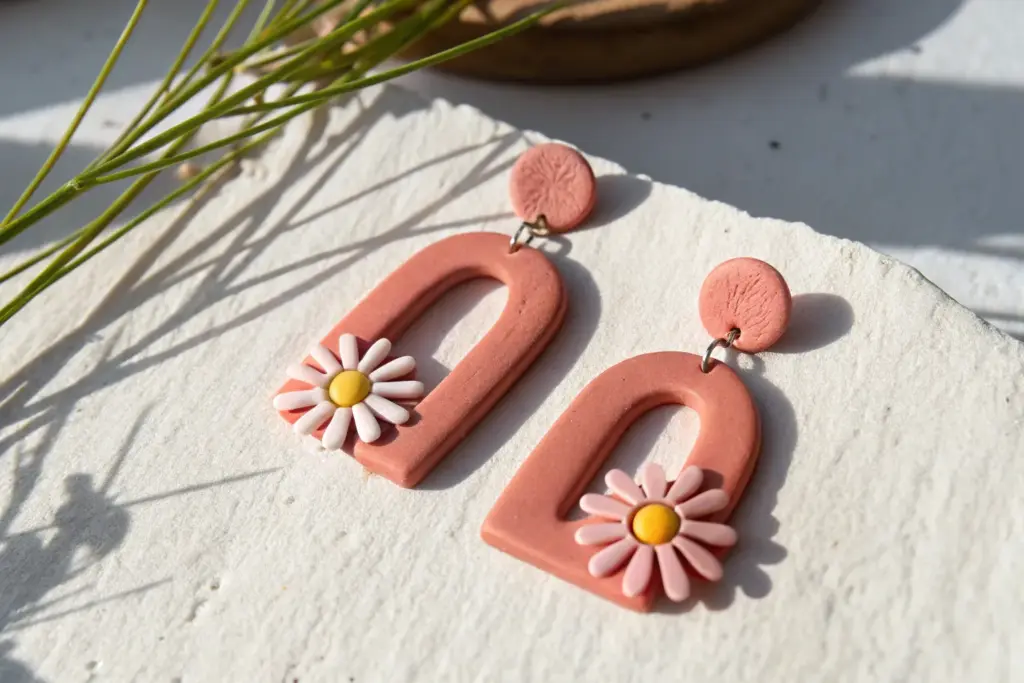
If you’ve been itching to make clay earrings that feel trendy but still totally you, you’re in the right headspace. I pulled together my favorite design directions—from classic shapes to playful statement pieces—so you can find your next “make-it-tonight” pair in minutes.
Classic Rainbow Arch Dangles
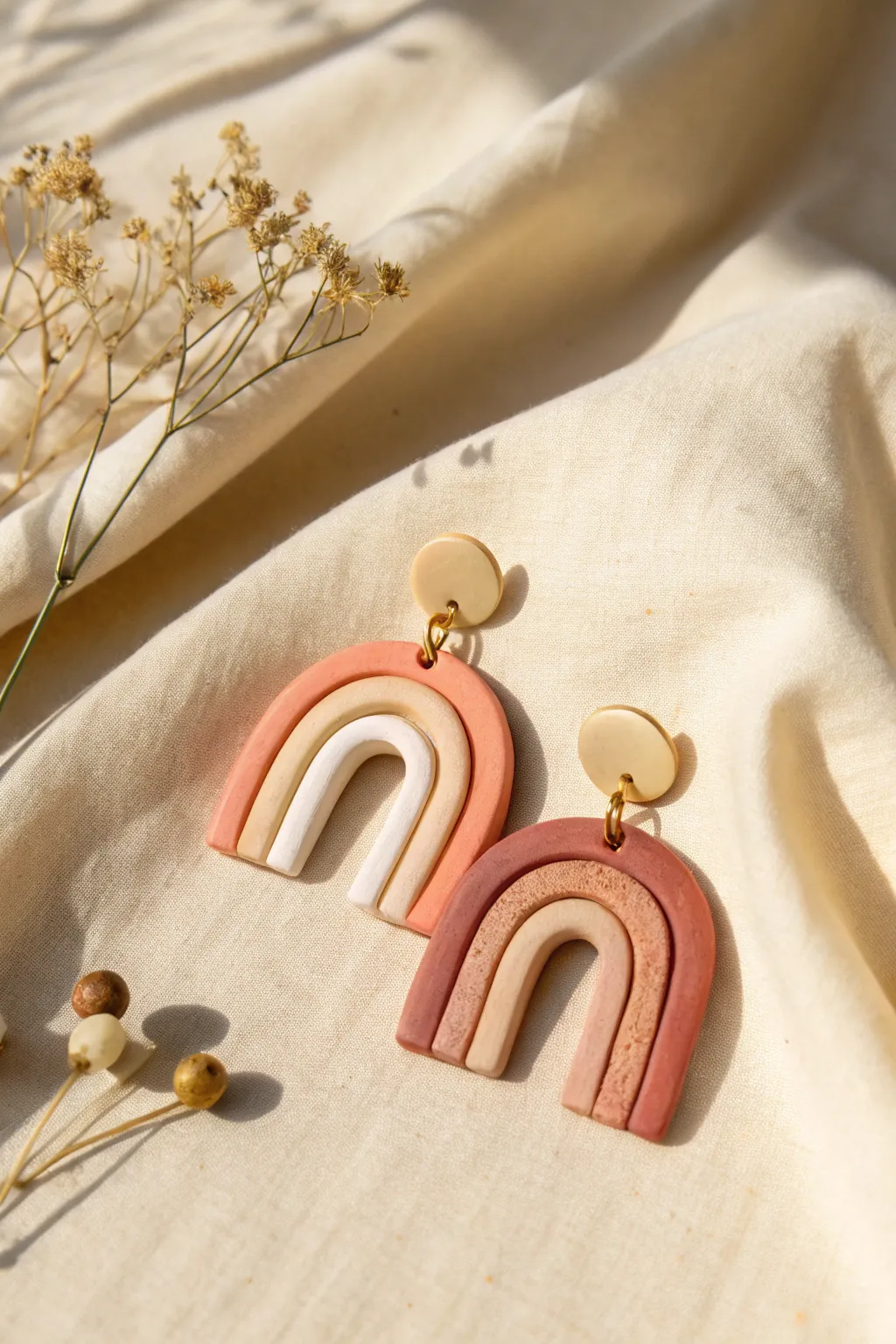
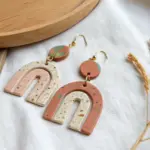
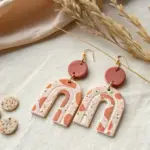
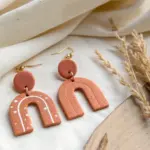
Create a stunning pair of polymer clay earrings featuring a trendy, muted arch design. This project combines smooth and textured finishes in warm, earthy tones like coral, terra-cotta, and cream for a sophisticated bohemian look.
How-To Guide
Materials
- Polymer clay in coral/salmon, cream/beige, white, and terra-cotta/mauve
- Granite or speckled effect polymer clay (or coarse black pepper)
- Acrylic roller or pasta machine
- Clay extruder with medium round disc (optional but recommended)
- Clean ceramic tile or glass work surface
- Flexible tissue blade
- Liquid polymer clay (Bake & Bond)
- Two round clay cutters (approx. 10mm for studs)
- Hand drill or pin vice
- Jump rings (gold)
- Earring posts and backs
- Super glue or UV resin
- Jewelry pliers
Step 1: Prepping the Clay
-
Condition the Clay:
Begin by thoroughly kneading each color of clay separately until it is soft and pliable. This prevents cracking later on. -
Create the Speckled Blend:
For the textured arch seen in the darker earring, take a small amount of tan clay and mix in a pinch of granite clay or very fine black pepper to create a stone-like effect. -
Form Snakes:
Roll each color into a long, even snake. For the most consistent results, I love using a clay extruder, but hand-rolling works if you keep the pressure even.
Gaps Between Arches?
If your coils separate after baking, use a tiny amount of liquid clay in the gaps and rebake for 10 minutes, or ensure you press coils firmly together before slicing the bottom.
Step 2: Assembling the Arches
-
Form the First Arch:
Take your inner color (e.g., the white snake) and curve it into a tight ‘U’ shape on your work tile. -
Layer the Arches:
Apply a very thin line of liquid polymer clay along the outer edge of that first ‘U’ to act as glue. -
Add the Middle Layer:
Wrap the middle color snake snugly around the first one, gently pressing them together to ensure no gaps remain. -
Complete the Outer Layer:
Repeat the process with liquid clay and your final outer color snake (coral or terra-cotta), wrapping it around the exterior to finish the rainbow shape. -
Trim the Base:
Use your flexible tissue blade to slice straight across the bottom of the rainbow, creating a clean, flat base where all the arches end evenly.
Texturizing Tip
Before baking, gently roll a piece of sandpaper or a toothbrush over one of the color bands to give it a rough, realistic stone texture contrasting the smooth bands.
Step 3: Making the Studs
-
Roll a Sheet:
Roll out a small slab of beige or cream clay to about 2-3mm thickness. -
Cut the Circles:
Use your small round cutter to punch out two circles. These will become the top stud component that holds the earring post.
Step 4: Baking and Drillling
-
Pierce Holes:
Before baking, use a needle tool to poke a hole at the very top center of your main rainbow arch. Alternatively, you can drill this after baking for neatness. -
Add Stud Holes:
Poke a corresponding hole near the bottom edge of your round stud pieces. -
Bake the Pieces:
Bake all clay components according to the manufacturer’s instructions (usually 275°F/130°C for 30-45 minutes). Tent with foil to prevent scorching. -
Cool and Finish:
Let the pieces cool completely. If you didn’t pierce holes earlier, use a hand drill to carefully make holes for the jump rings now.
Step 5: Final Assembly
-
Attach Jump Rings:
Twist open a gold jump ring using two pairs of pliers. Thread it through the hole in the rainbow and the hole in the stud, then close it tightly. -
Secure the Posts:
Apply a dab of super glue or UV resin to the back of the round stud pieces and press the flat pad of the earring post onto it. -
Final Set:
Allow the glue to cure fully before wearing to ensure the post is secure.
Now you have a chic, handmade accessory that adds a perfect pop of earthy color to any outfit
Terrazzo Speckle Slab Earrings
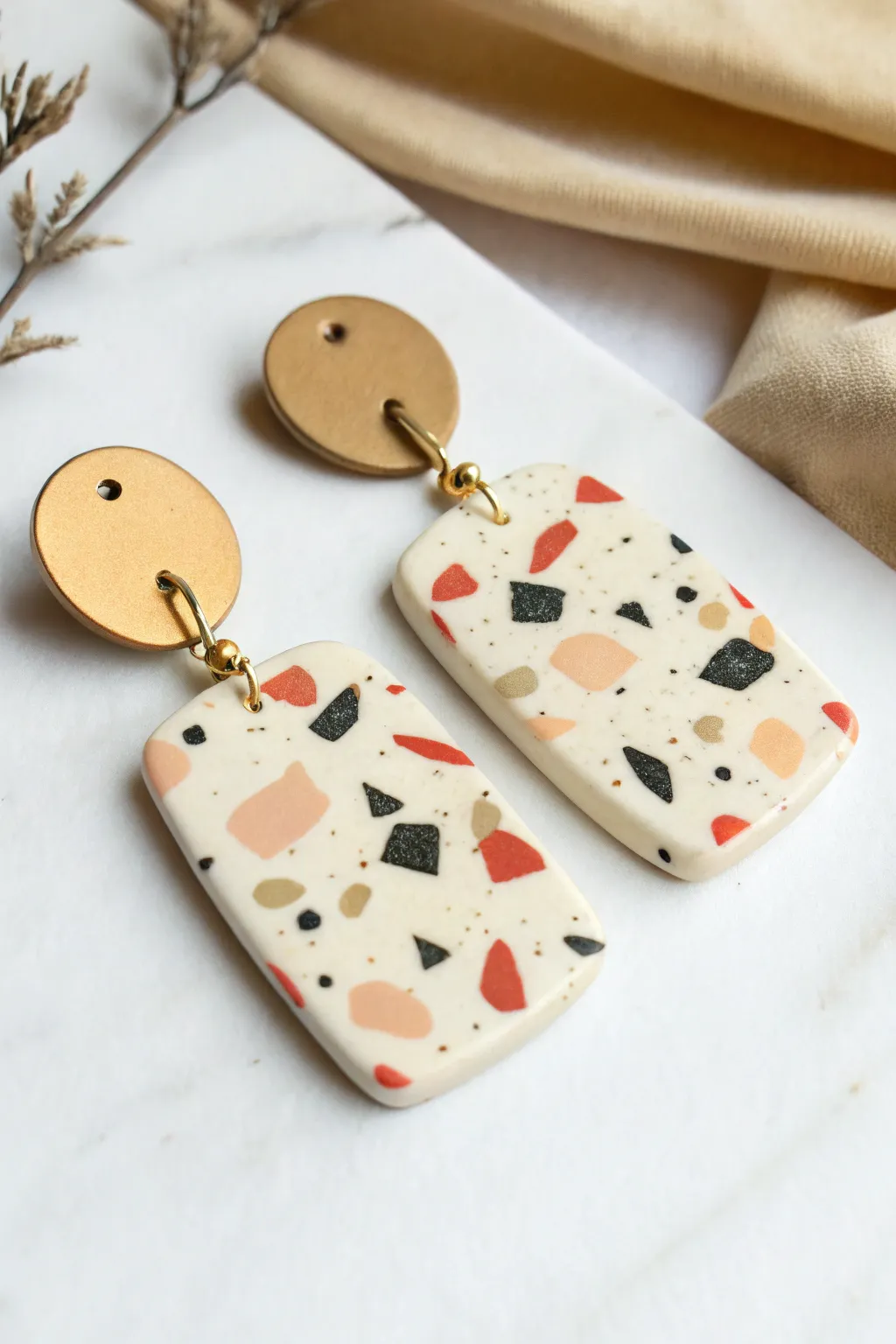
These sophisticated dangles combine a creamy base with fragments of black, burnt orange, beige, and peach for a chic, modern terrazzo effect. Finished with a shiny resin coat and elegant gold studs, they bring an artistic touch to any outfit.
Step-by-Step
Materials
- Polymer clay (Cream/White, Black, Burnt Orange, Beige, Peach, Gold)
- Acrylic rolling pin or pasta machine
- Tissue blade or sharp clay knife
- Rectangle clay cutter (approx. 1.5 inches)
- Small circle clay cutter (approx. 0.5 inches)
- UV resin or gloss glaze
- UV lamp (if using resin)
- Hand drill or pin vibe
- Jump rings (gold)
- Jewelry pliers
- Ceramic tile or baking sheet
- Sandpaper (various grits)
Step 1: Prepping the Clay
-
Condition the base:
Start by thoroughly conditioning your cream or white polymer clay until it is soft and pliable. Roll it out into a slab that is roughly 3mm thick. This will serve as your canvas. -
Prepare colored chips:
Condition small amounts of black, burnt orange, beige, and peach clay. Roll these colors out into very thin sheets, much thinner than your base slab. -
Create the terrazzo mix:
Using your tissue blade, chop the thin colored sheets into tiny, irregular fragments. Aim for a variety of shapes—triangles, squares, and slivers—to keep the pattern organic. I like to keep the black pieces slightly smaller for contrast.
Step 2: Creating the Slab
-
Apply the pattern:
Scatter the colored clay chips randomly over your cream base slab. Don’t overthink placement; the beauty of terrazzo is its randomness. Leave some negative space to let the cream background shine through. -
Embed the chips:
Place a piece of parchment or wax paper over the slab to prevent sticking. Gently roll over the surface with your acrylic roller to press the colored chips flat into the base clay until the surface is completely smooth. -
Add subtle texture:
For extra detail, you can sprinkle tiny specks of black pepper or black embossing powder and roll again, though the clay chips alone create a beautiful look.
Smudged Colors?
If your colored chips smear when rolling, your clay might be too warm or soft. Pop the chipped slab in the fridge for 10 minutes before the final roll.
Step 3: Golden Studs
-
Condition gold clay:
Take your gold-colored polymer clay and condition it well. Roll it out to a similar thickness as your terrazzo slab (approx. 3mm). -
Cut the circles:
Use your small circle cutter to punch out two discs. These will form the top stud part of the earring. -
Pierce holes:
While the clay is raw, carefully use a needle tool or toothpick to create a small hole near the bottom edge of each gold circle. This is where the jump ring will connect later.
Level Up: Texture
Use textured gold leaf instead of gold clay for the top stud. Apply leaf to raw clay, crackle it by stretching, then seal with resin for a luxe finish.
Step 4: Cutting and Baking
-
The main shapes:
Return to your terrazzo slab. Use the rectangle cutter to punch out two identical rectangle shapes. Try to capture an area with a nice distribution of colors. -
Pierce the rectangles:
Create a hole near the top center of each rectangle. Ensure the hole is far enough from the edge so it won’t tear, but close enough for the jump ring to reach. -
Smooth the edges:
Before baking, gently run your finger along the cut edges of all pieces to soften distinct ridges. This saves sanding time later. -
Bake:
Place all clay pieces on a ceramic tile or a baking sheet lined with paper. Bake according to your clay manufacturer’s instructions (usually 275°F/135°C for 30-45 minutes).
Step 5: Finishing and Assembly
-
Cool and sand:
Allow the clay to cool completely. Dip your sandpaper in water and lightly sand the edges and back to ensure a professional finish. -
Apply glaze:
To achieve the glossy look in the photo, apply a thin layer of UV resin to the front surface of the terrazzo rectangles and gold circles. Spread it to the edges with a toothpick or brush. -
Cure the glaze:
Place the pieces under a UV lamp for 2-3 minutes until the resin is hard and non-tacky. If using regular gloss varnish, let it air dry for the recommended time. -
Assemble:
Use your pliers to open a gold jump ring. Thread it through the hole in the rectangle and the hole in the gold circle, then close the ring securely. -
Attach posts:
Finally, glue earring posts to the back of the gold circles using strong jewelry glue or a dab of resin. Let it cure fully before wearing.
Wear your new modern art pieces with pride or gift them to a friend who loves unique accessories
Minimal Half-Moon Drops
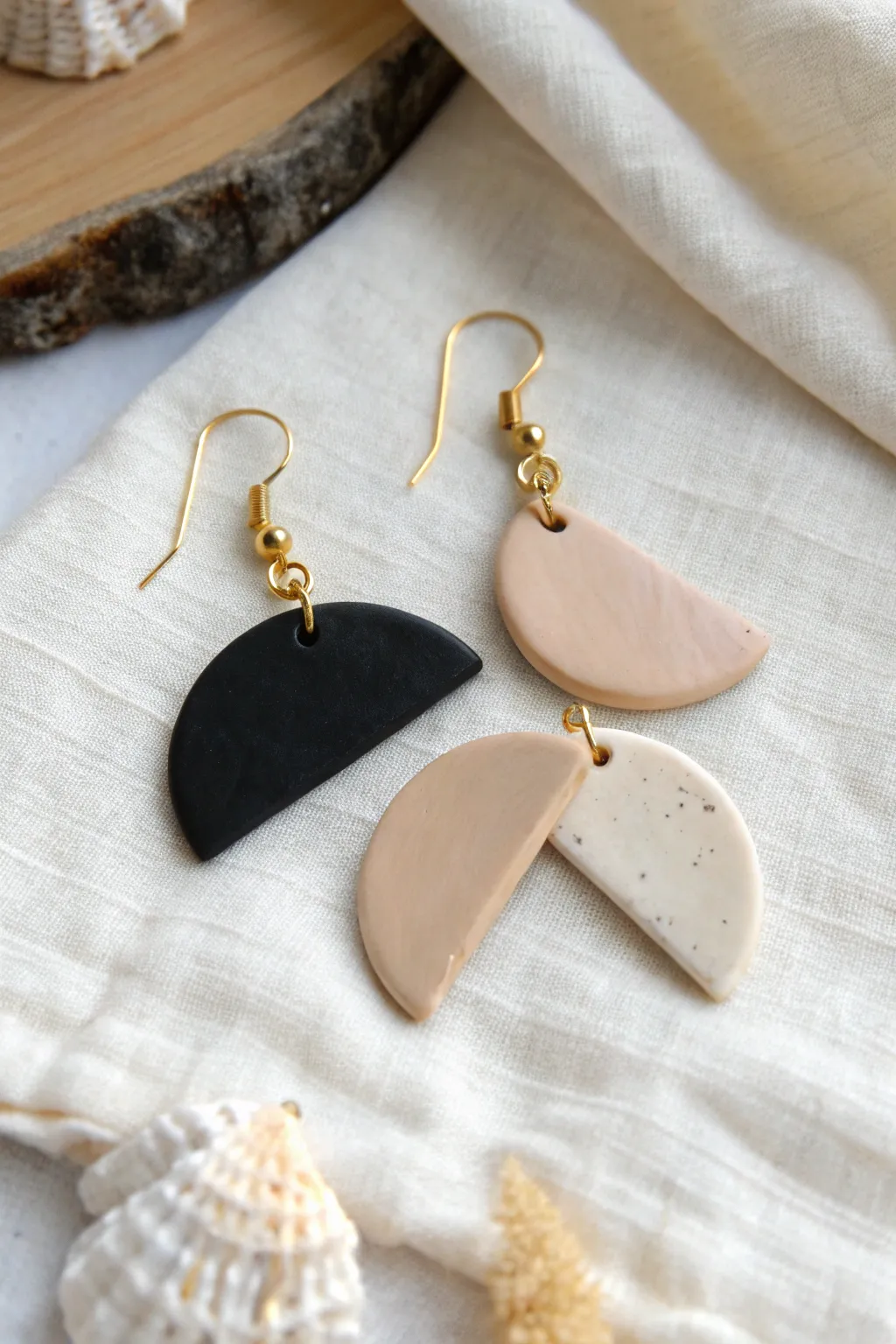
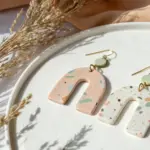
Embrace the beauty of simplicity with these elegant polymer clay earrings featuring a clean, geometric silhouette. Their understated half-moon shape and versatile neutral palette make them the perfect everyday accessory, easy to customize with different patterns.
Step-by-Step Guide
Materials
- Polymer clay (Black, Beige/Tan, White, and Black Speckles/Pepper)
- Acrylic rolling pin or clay pasta machine
- Circle clay cutters (approx. 1.5 – 2 inch diameter)
- Tissue blade or flexible clay slicer
- Hand drill or pin vibe
- Parchment paper or ceramic tile for baking
- Gold jump rings (6mm or 8mm)
- Gold fishhook ear wires
- Flat nose jewelry pliers
- Fine grit sandpaper (optional)
- Clay oven
Step 1: Conditioning and Shaping the Clay
-
Prepare the Colors:
Start by conditioning your clay. Knead the black block until it is soft and pliable. Repeat this process separately for the beige clay. For the speckled look, mix a small amount of black pepper or black glitter into white clay, or use pre-mixed granite-effect clay. -
Roll the Sheets:
Using your acrylic roller or pasta machine, roll out the black clay into a sheet approximately 3mm thick. Do the same for the beige and the speckled white clay, ensuring all sheets are uniform in thickness so the earrings bake evenly. -
Cut the Base Circles:
Place your circle cutter on the clay sheet and press down firmly to cut out your shapes. You will need one full circle for every pair of single-color earrings you plan to make. Lift the cutter carefully to avoid warping. -
Create the Half-Moons:
Using your tissue blade, slice each circle directly in half. Make sure your blade is perfectly straight to create a clean horizon line. Separate the halves gently.
Step 2: Creating the Split Design
-
Prepare the Split Components:
For the two-toned earring seen in the image, take one half-moon of beige clay and one half-moon of speckled white clay. Cut each of these half-moons in half vertically so you have quarter-circle wedges. -
Join the Seams:
Place a beige wedge next to a speckled wedge on your work surface. Gently push the straight vertical edges together so they touch. Smooth the seam with your finger or a roller to bond them into a single half-moon shape without distorting the outer curve. -
Drill the Holes:
Before baking, use a toothpick or small tool to poke a hole near the top center of the straight edge on each piece. Ensure the hole is large enough for your jump rings but not too close to the edge to prevent tearing.
Bubbles in your clay?
Slice visible air bubbles with a blade and smooth them before baking. If bubbles appear after baking, sanding is your best friend to flatten the surface.
Step 3: Baking and Assembly
-
Bake the Clay:
Arrange your clay pieces on a ceramic tile or baking sheet lined with parchment paper. Bake according to your specific clay brand’s instructions (usually around 275°F/135°C for 30 minutes). I prefer to tent foil over them to prevent surface scorching. -
Cool and Sand:
Let the pieces cool completely inside the oven or on a wire rack. Once hard, inspect the edges. If there are any rough spots or fingerprints, lightly sand them with fine-grit sandpaper under running water. -
Open the Jump Rings:
Using two pairs of pliers (or pliers and your fingers), twist a gold jump ring open. Always twist the ends away from each other sideways, never pull them apart, to maintain the circle’s strength. -
Attach the Hardware:
Slide the open jump ring through the hole in the clay piece. Before closing it, loop the bottom of a gold fishhook ear wire onto the jump ring. -
Secure the Closure:
Twist the jump ring back into its closed position, ensuring the ends meet flush with no gap. Repeat this process for all your earring pieces to complete the set.
Clean Seams
When joining two colors for the split design, use a little liquid translucent clay as ‘glue’ on the edges before pressing them together for a stronger bond.
Step 4: Finishing Touches
-
Final Polish:
Wipe the finished earrings with a soft cloth to remove any sanding dust or residue. Your minimalist half-moon drops are now ready to wear.
Enjoy styling these versatile geometric pieces with your favorite casual outfits or gifting them to a lucky friend.
Marbled Swirl Statement Pieces
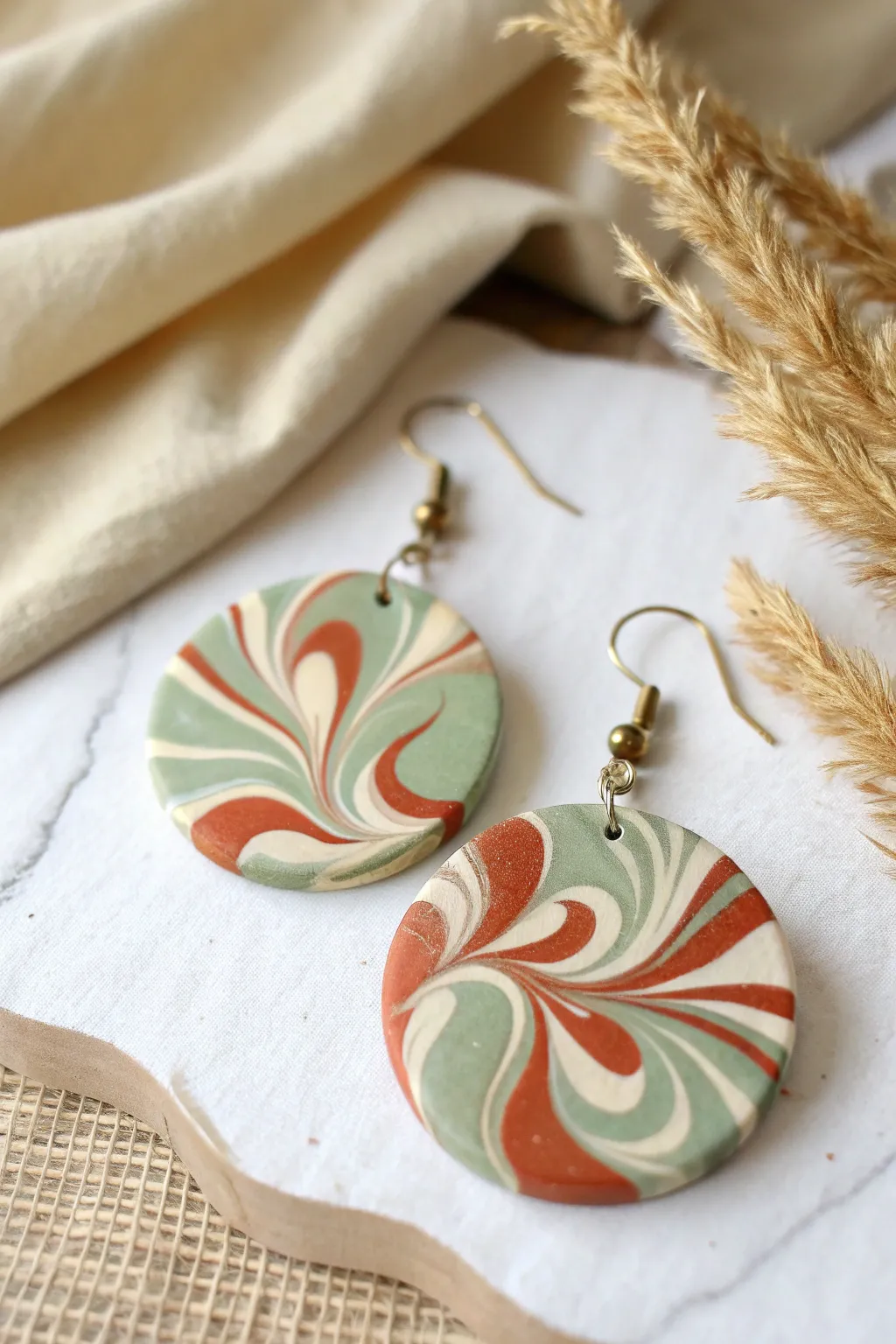
Capture the essence of relaxed bohemian style with these gorgeous marbled earrings featuring a soothing palette of sage green, rust, and cream. The mesmerizing swirl pattern ensures no two pieces are exactly alike, giving you a truly one-of-a-kind accessory.
Detailed Instructions
Materials
- Polymer clay (Sage Green, Terracotta/Rust, Cream/Ecru)
- Acrylic roller or pasta machine
- Tissue blade or craft knife
- Round clay cutter (approx. 1.5 – 2 inches)
- Small needle tool or toothpick
- Hand drill or dremel with small bit
- Gold-tone earring hooks
- Gold-tone jump rings
- Jewelry pliers
- Parchment paper or ceramic tile
Step 1: Conditioning & Mixing
-
Condition the Clay:
Begin by thoroughly kneading each color of polymer clay separately. You want the clay to be warm and pliable so it doesn’t crack when you roll it out. -
Make the Logs:
Roll each color into a long snake-like log. Aim for logs that are about 3-4 inches long and 1/4 inch thick. -
Combine the Colors:
Gently twist the three logs together like a rope. Don’t over-twist just yet; simply get them combined into one thick strand. -
Fold and Roll:
Fold the twisted rope in half and roll it out into a log again. Repeat this twist, fold, and roll process about 3-4 times. Be careful not to over-mix, or the colors will turn muddy instead of distinct swirls.
Step 2: Creating the Pattern
-
Form the Slab:
Roll your marbled log into a loose ball, compressing the lines together. -
Flatten the Clay:
Using your acrylic roller or pasta machine, flatten the ball into a slab approximately 3mm thick. Roll in different directions to stretch the pattern organically. -
Select Your Area:
Inspect your slab for the most pleasing swirl patterns. Look for areas where the rust, sage, and cream intersect dynamically. -
Cut the Shapes:
Press your round circle cutter firmly into the chosen areas of the slab. Give the cutter a slight wiggle before lifting to ensure a clean cut. -
Smooth the Edges:
Gently run your finger along the rim of the cut circles to smooth out any rough edges or stray bits of clay.
Clean Cuts Only
Place a piece of cling film or plastic wrap over the clay before using your cutter. This creates a beautifully domed edge and prevents sticking.
Step 3: Baking & Assembly
-
Punch Holes:
Use a needle tool to create a small hole near the top edge of each circle for the jump ring. Ensure the hole is big enough for your hardware but not so close to the edge that it breaks. -
Bake:
Place your pieces on a ceramic tile or parchment-lined baking sheet. Bake according to your brand of clay’s instructions (usually 275°F/135°C for 30 minutes). -
Cool Down:
Allow the pieces to cool completely inside the oven or on a wire rack. Polymer clay is strongest once fully cooled. -
Drill (Optional):
If you didn’t punch holes before baking, or if the holes shrunk, use a hand drill to create the opening now. -
Open Jump Ring:
Using two pairs of pliers, twist a jump ring open sideways (never pull it apart). -
Attach Hook:
Thread the jump ring through the hole in the clay piece, then loop the earring hook onto the jump ring. -
Close and Finish:
Twist the jump ring closed securely so there is no gap. Repeat for the second earring.
Air Bubble Blues
If you see air bubbles trapped in the surface before baking, gently pierce them with a needle tool and smooth the clay down with your finger to flatten.
Wear your new statement earrings with a simple outfit to let the colors really pop

The Complete Guide to Pottery Troubleshooting
Uncover the most common ceramic mistakes—from cracking clay to failed glazes—and learn how to fix them fast.
Daisy-Topped Dangles
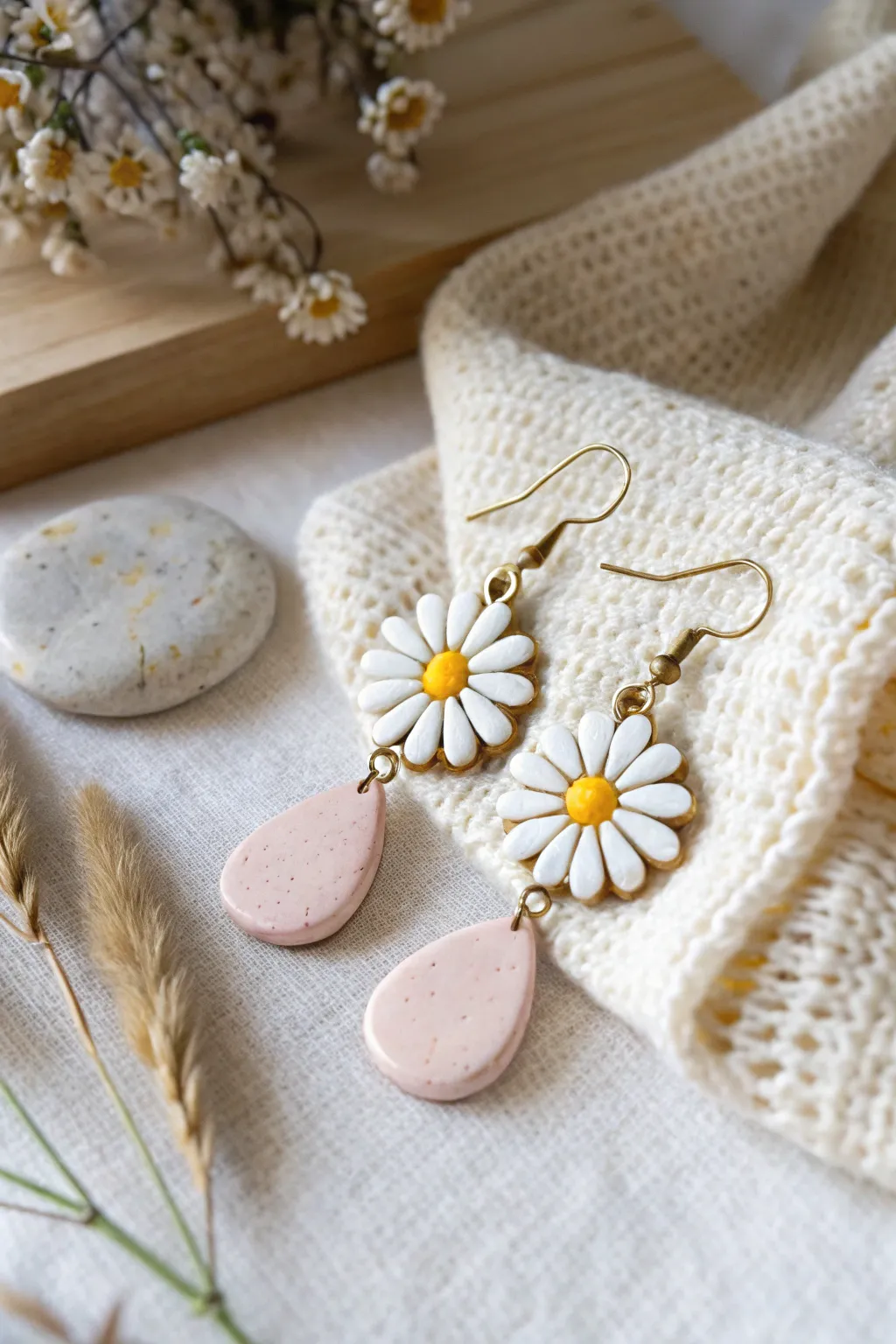
These charming earrings feature a cheerful white daisy connector anchored by a soft pink teardrop dangle. The result is a lighthearted, floral accessory perfect for adding a touch of spring to any outfit.
Step-by-Step Guide
Materials
- White polymer clay
- Yellow polymer clay
- Pale pink polymer clay (speckled effect optional)
- Black or brown acrylic paint (for antiquing)
- Texture tool or toothpick
- Small teardrop cutter (approx. 1 inch)
- Small daisy cutter or flower mold
- Rolling pin or pasta machine
- Clay knife
- Needle tool
- Jump rings (gold tone)
- Fishhook earring wires (gold tone)
- Jewelry pliers
- Hand drill or small bit
- Gloss glaze (optional)
Step 1: Sculpting the Daisies
-
Condition the white clay:
Start by kneading the white polymer clay until it is soft and pliable, then roll it out to a medium thickness, about 2-3mm. -
Cut the flower shapes:
Use a small daisy cutter to punch out two identical flower shapes. If you don’t have a cutter, you can hand-sculpt individual petals and arrange them in a circle. -
Add texture:
Using a needle tool or a dull knife edge, gently press a central line down the length of each petal to create realistic vein details. -
Create the center:
Roll two small balls of yellow clay. Flatten them slightly and press them firmly into the center of your white daisies. -
Detail the center:
Take a texture tool, toothpick, or old toothbrush and stipple the yellow centers to give them a pollen-like texture. -
Create connection holes:
Use your needle tool to pierce a hole through the top petal (for the ear wire) and the bottom petal (for the teardrop). Ensure the holes are large enough for your jump rings.
Uneven Petals?
If your daisy cutter sticks, dip it in cornstarch before cutting. If petals warp while lifting, freeze the clay sheet for 5 mins before cutting.
Step 2: Creating the Teardrops
-
Prepare the pink clay:
Condition your pale pink clay. If you want the speckled look seen in the photo, mix in a tiny pinch of black pepper or black glitter before rolling it out. -
Cut the teardrops:
Roll the clay to the same thickness as your flowers. Use your teardrop cutter to punch out two shapes. -
Smooth the edges:
Running a finger dipped in a little cornstarch or baby oil along the cut edges helps smooth away any roughness before baking. -
Pierce the top:
Make a single hole at the very top point of each teardrop using your needle tool. -
Bake the pieces:
Arrange all four clay pieces (two flowers, two teardrops) on a baking sheet lined with parchment paper. Bake according to your clay manufacturer’s instructions, usually around 275°F (135°C) for 15-30 minutes.
Step 3: Assembly & Finishing
-
Antique the edges (Optional):
To achieve the vintage look in the photo, wipe a very small amount of diluted brown acrylic paint over the edges of the petals and wipe off the excess immediately with a wet cloth. -
Attach the teardrop:
Open a jump ring using your pliers. Thread it through the hole in a pink teardrop and the bottom hole of a daisy, then close the ring securely. -
Attach the ear wire:
Open the loop on your fishhook earring wire (or use a second jump ring if needed) and attach it to the top hole of the daisy. -
Final check:
Repeat the assembly for the second earring and ensure all jump rings are closed tightly so pieces don’t slip out.
Granite Effect
Mix translucent clay with the pink and add ground black pepper or dried tea leaves. This creates a realistic stone-like speckled finish.
Enjoy wearing your fresh floral creations that capture the sweetness of a sunny garden
3D Floral Appliqué Earrings
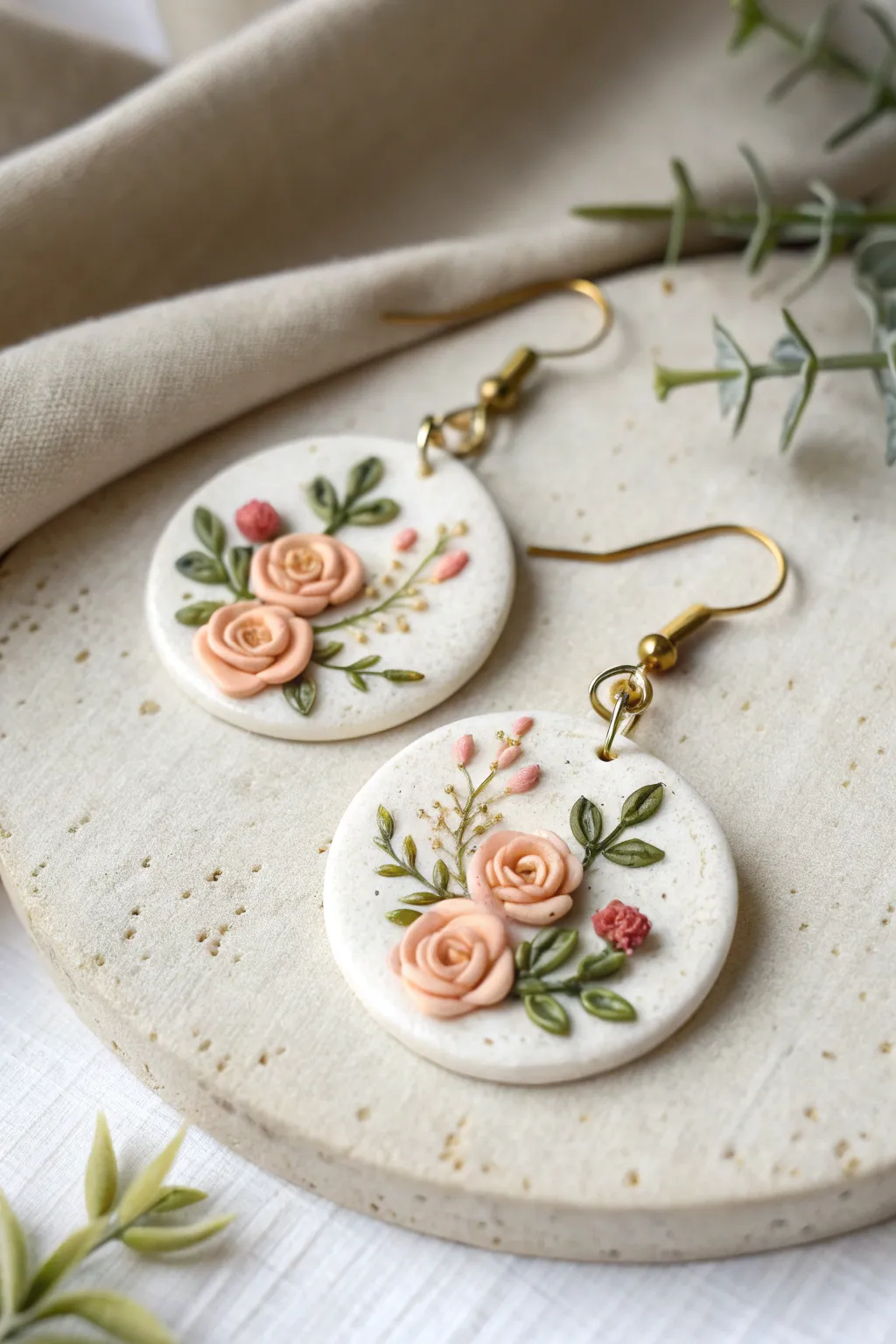
These delicate polymer clay earrings feature a romantic, slightly vintage aesthetic with miniature 3D roses sculpted directly onto a speckled cream base. The intricate appliqué work creates a beautiful texture that feels like wearable porcelain art.
Step-by-Step
Materials
- Polymer clay (colors: speckled white/granite, peach/soft pink for roses, olive green for leaves)
- Small circular clay cutter (approx. 3-4cm)
- Needle tool or toothpick
- Ball stylus tool (small)
- Flexible clay blade
- Gold acrylic paint or mica powder (mixed with alcohol)
- Fine detail paintbrush (00 or 000 size)
- Gloss or matte polyurethane varnish (optional)
- Gold earring hooks and jump rings
- Hand drill or small drill bit
- Jewelry pliers
Step 1: Preparing the Base
-
Condition the base clay:
Start by conditioning your speckled white or granite-effect clay until it is pliable. Roll it out into a sheet approximately 3mm thick; you want it sturdy but not too heavy for the ears. -
Cut the shapes:
Using your circular cutter, cut out two identical circles. Gently smooth the edges with your finger to remove any stray bits of clay or sharp ridges. -
Pre-drill holes:
Use a needle tool or toothpick to poke a small hole near the top edge of each circle for the jump rings later. Make sure the hole is big enough for your hardware, accounting for slight shrinkage during baking.
Sticky Situation?
If the tiny petals stick to your fingers, dust your fingertips lightly with cornstarch or use a silicone tool to manipulate the clay instead of skin.
Step 2: Sculpting the Floral Appliqué
-
Mix your rose color:
Take a small amount of peach or soft pink clay. If the color is too bright, mix in a tiny pinhead amount of beige or white to soften it for that vintage look seen in the photo. -
Form the rose centers:
Roll a very tiny log of pink clay and flatten it slightly. Roll this strip into a tight coil to create the very center bud of the rose. Place this onto the white base. -
Create rose petals:
To build the rose, roll tiny balls of pink clay (about the size of a poppy seed). Flatten them between your fingers into thin ovals. Press these petals gently around the center coil, overlapping them slightly as you go. -
Sculpt two roses per earring:
Repeat the process to create a second, slightly smaller rose next to the first one. Position them slightly off-center on the lower half of the circle for a balanced composition. -
Shape the leaves:
Condition your olive green clay. Roll a very thin snake and slice off tiny segments. Roll these into teardrop shapes, then flatten them. -
Attach the greenery:
Using your needle tool to pick them up, press the leaves onto the base around the roses. Use the needle tool to impress a center vein into each leaf, which helps secure the clay to the base. -
Add bud accents:
Roll incredibly small spheres of a slightly darker pink or red clay to simulate tiny berry buds. Place a cluster of 2-3 near the roses or on the ends of branch areas. -
Sculpt thin stems:
Roll extremely thin, thread-like snakes of green or brown clay to connect the floating buds to the main bouquet, pressing them down gently with a silicone tool or finger.
Gilded Edges
For a more refined look, try painting the very outer rim of the circular white base with gold liquid leaf. It frames the artwork beautifully.
Step 3: Finishing Touches
-
Add painted details:
Before baking (if using heat-safe mica) or after baking (if using acrylic), use your fine brush to paint delicate gold stems or leaves that weave between the 3D clay elements. The gold adds a touch of elegance. -
Bake carefully:
Place the earrings on a ceramic tile or baking sheet in a room-temperature oven. Follow your clay package directions for temperature, baking for at least 30-40 minutes to ensure strength. -
Cool and varnish:
Let the pieces cool completely. If desired, apply a thin coat of matte varnish to protect the paint and clay, or leave them raw for a stone-like texture. -
Assembly:
Open a gold jump ring using your pliers (twist, don’t pull). Thread it through the pre-made hole in the clay and attach the earring hook. -
Secure the hardware:
Close the jump ring tightly, ensuring the gap is fully sealed so the hook doesn’t slip out.
Wear your miniature garden masterpieces with pride and enjoy the compliments on your handiwork

What Really Happens Inside the Kiln
Learn how time and temperature work together inside the kiln to transform clay into durable ceramic.
Leaf-Imprint Botanical Drops
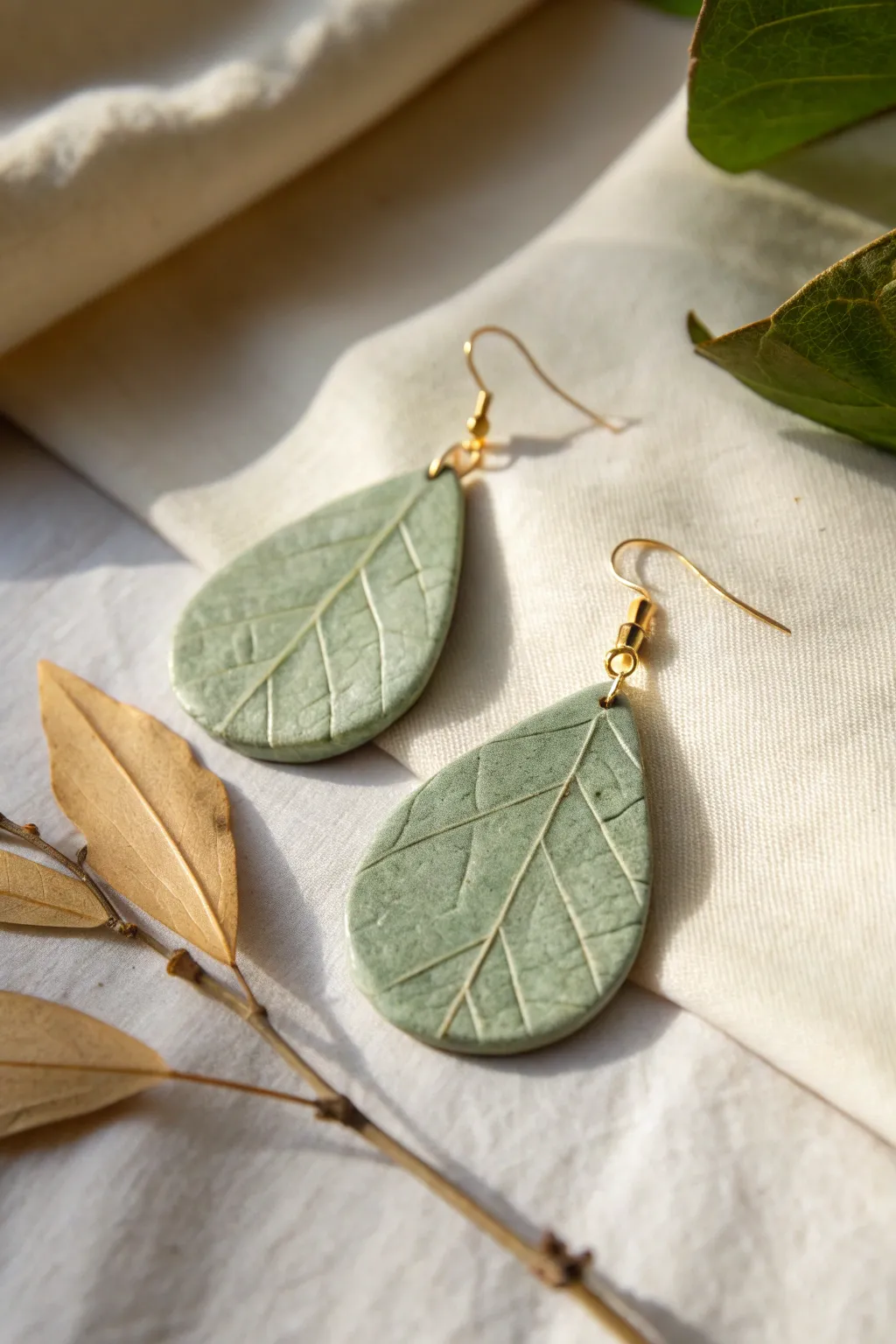
Capture the delicate beauty of nature with these understated polymer clay earrings. Featuring a soft sage green hue and realistic leaf vein impressions, they offer a sophisticated botanical touch to any outfit.
Step-by-Step Guide
Materials
- Sage green polymer clay (or mix green, white, and a touch of brown)
- Fresh leaves with prominent veins (e.g., hydrangea, mint, or sage leaves)
- Teardrop-shaped clay cutter (approx. 1.5 – 2 inches)
- Acrylic rolling pin or clay machine
- Ceramic tile or baking sheet
- Parchment paper
- Needle tool or toothpick
- Sandpaper (fine grit, 400-800)
- Gold earring hooks (French wires)
- Gold jump rings (6mm)
- Jewelry pliers (flat nose and round nose)
- Oven (if using polymer clay)
Step 1: Preparing the Clay
-
Condition the clay:
Start by warming the polymer clay in your hands, kneading it thoroughly until it is soft, pliable, and free of any air bubbles. This ensures a strong finished piece. -
Roll out the slab:
Using your acrylic rolling pin or a clay machine on a medium setting, roll the clay out into an even slab. Aim for a thickness of about 3mm—thick enough to be sturdy but thin enough to be lightweight. -
Check for imperfections:
Inspect the surface of your clay slab. Gently smooth out any fingerprints or dust specks with your finger before moving on to the texturing phase.
Leaves Sticking?
If leaves stick to the raw clay, lightly dust the vein side with cornstarch or brush with a tiny bit of water before rolling. This acts as a release agent.
Step 2: Creating the Texture
-
Select your botanicals:
Choose fresh leaves that aren’t too dry or brittle. Leaves with thick, raised veins on the back work best for creating a deep, visible impression. -
Position the leaves:
Place your selected leaves vein-side down onto the clay slab. Arrange them so that the most interesting vein patterns will fall within the area you plan to cut. -
Imprint the pattern:
Gently roll over the leaves with your rolling pin. Apply firm, even pressure to push the veins into the clay without thinning the slab too much. -
Reveal the design:
Carefully peel the leaves off the clay. Do this slowly to ensure no plant matter gets stuck in the clay; use tweezers if a small piece remains.
Step 3: Cutting and Baking
-
Cut the shapes:
Position your teardrop cutter over the most detailed section of the leaf print. Press down firmly to cut out your earring shapes. If you don’t have a cutter, you can trace a teardrop template with a craft knife. -
Smooth the edges:
Before baking, gently run your finger along the cut edges of the clay to smooth down any jagged bits or harsh lines. -
Pierce holes:
Using a needle tool or toothpick, create a small hole at the top point of each teardrop. Make sure the hole is large enough for your jump rings but not too close to the edge. -
Bake the pieces:
Place your clay pieces on a parchment-lined baking sheet or ceramic tile. Bake according to the manufacturer’s instructions for your specific brand of clay (usually around 275°F or 135°C for 15-30 minutes). -
Cool down:
Once baked, turn off the oven and let the pieces cool completely inside or on a wire rack. Don’t handle them while hot as they might be slightly flexible.
Highlight the Veins
After baking, rub a little white or diluted brown acrylic paint into the veins and wipe the surface immediately. The paint stays in the grooves, popping the texture.
Step 4: Finishing and Assembly
-
Sand for perfection:
Dip your fine-grit sandpaper in water and gently sand the edges of the cured clay pieces. This removes any remaining sharp spots and gives a professional, smooth finish. -
Wash and dry:
Rinse the clay pieces to remove any sanding dust and pat them dry with a soft cloth. -
Open the jump rings:
Hold a jump ring with two pairs of pliers. Twist the ends away from each other (one forward, one back) rather than pulling them apart, to maintain the circle’s shape. -
Attach the findings:
Thread the open jump ring through the hole in the clay piece, then loop the earring hook onto the jump ring. -
Close the rings:
Use your pliers to twist the jump ring ends back together until they meet seamlessly. Repeat for the second earring.
Enjoy wearing your unique, nature-inspired creations that capture a fleeting moment in clay
Textured Boho Organic Shapes
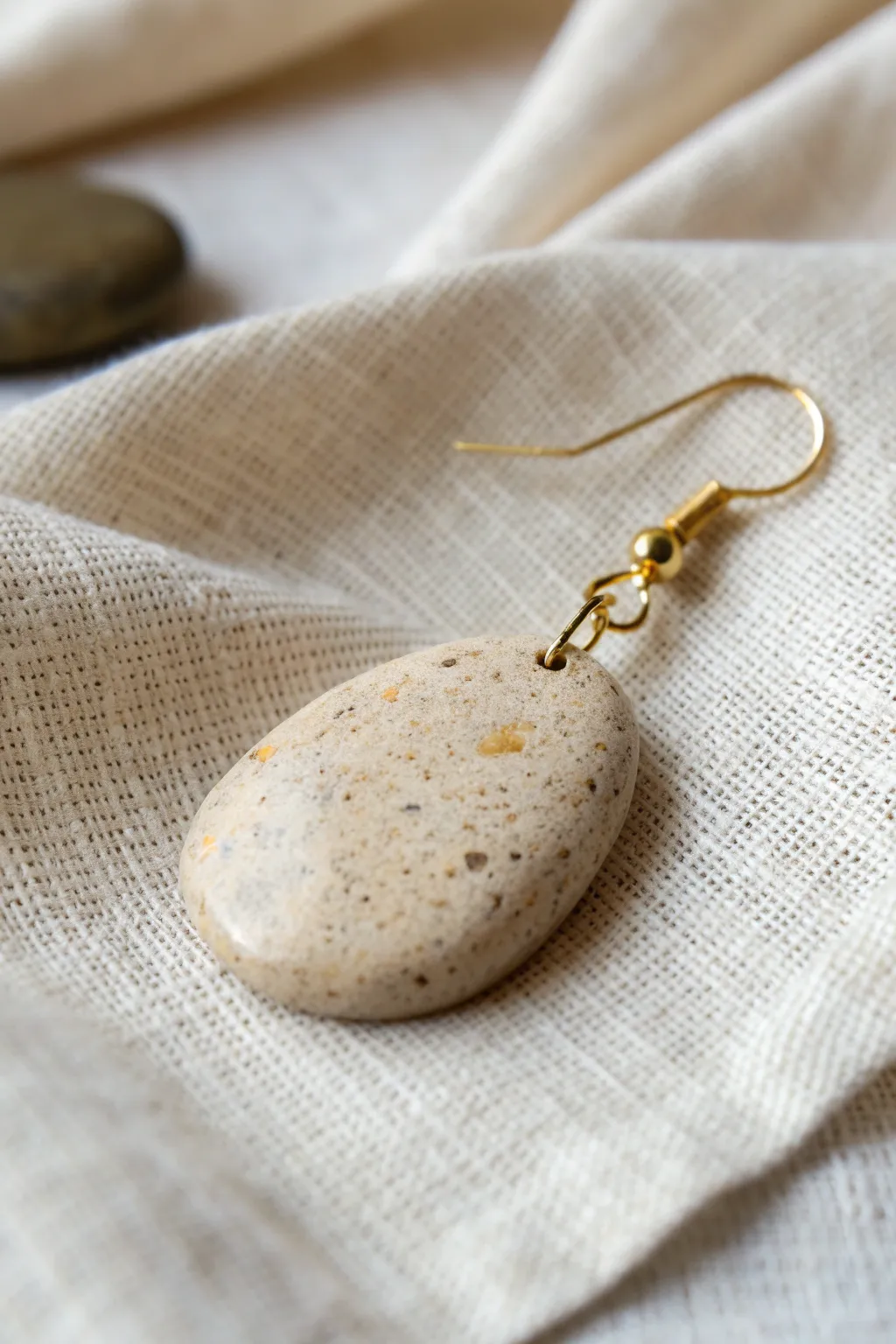
Capture the raw beauty of nature with these organic, stone-inspired clay earrings. This project creates a deceptively realistic granite texture using polymer clay and simple spice cabinet ingredients for a high-end boho look.
Detailed Instructions
Materials
- Beige or translucent polymer clay (granite or sand color)
- Ground black pepper
- Dried oregano or crushed herbs (optional for texture)
- Small gold leaf flakes or gold glitter (very fine)
- Acrylic rolling pin
- Oval or teardrop clay cutter (approx. 1 inch)
- Needle tool or toothpick
- Fine grit sandpaper (400-800 grit)
- UV resin or glossy varnish (optional)
- Gold finish fish-hook ear wires
- Small gold jump rings (4-6mm)
- Jewelry pliers (round nose and flat nose)
Step 1: Mixing the Faux Stone
-
Condition the base:
Start by warming up a small block of beige or sand-colored polymer clay in your hands until it becomes soft and pliable. -
Add the ‘sediment’:
Flatten the clay into a pancake and sprinkle a generous pinch of ground black pepper onto the surface. -
Incorporate gold flecks:
Add a very small amount of gold leaf flakes or fine gold glitter. Don’t overdo it; you want subtle mineral deposits, not a disco ball. -
Mix and marble:
Fold the clay over on itself and knead thoroughly. Continue twisting and folding until the pepper specks and gold are evenly distributed throughout the block. -
Roll it out:
Using your acrylic rolling pin, flatten the mixed clay to a thickness of about 3-4mm. A slightly thicker slab helps mimic the weight and feel of a real river stone.
Stone Effect Pro-Tip
Mix a tiny crumb of translucent clay into your beige base. It adds depth that makes the faux granite look less ‘plastic’ and more like real mineral quartz.
Step 2: Shaping and Baking
-
Cut the forms:
Press your oval or teardrop cutter firmly into the clay slab to cut out your shapes. Lift the cutter straight up to ensure clean edges. -
Soften the edges:
Gently tap the edges of the cut clay with your finger to round them off slightly. We want to avoid sharp, manufactured-looking angles in favor of a tumbled stone appearance. -
Pierce the hole:
Use a needle tool or toothpick to create a hole near the top, narrow end of the oval. Make sure the hole is big enough for your jump ring to move freely. -
Bake the pieces:
Place the clay shapes on a ceramic tile or baking sheet lined with parchment paper. Bake according to the manufacturer’s instructions for your specific brand of clay (usually 275°F/135°C for 15-30 minutes). -
Cool down:
Allow the clay to cool completely before handling. It will still be slightly soft when hot but hardens as it reaches room temperature.
Level Up: Beach Glass
Try this same technique but with translucent sea-green or blue clay. Sand firmly after baking to create a frosted, tumbled sea glass appearance.
Step 3: Finishing and Assembly
-
Sand for realism:
Once cool, use fine-grit sandpaper to buff the surface and edges. This removes fingerprints and exposes the pepper and gold inclusions better, enhancing the stone effect. -
Polish or seal (Optional):
For a ‘wet stone’ look, apply a thin layer of gloss varnish or UV resin. I prefer to leave it matte or semi-gloss to keep that earthy, dry river rock texture. -
Open the jump ring:
Grip a gold jump ring with two pairs of smooth-jawed pliers. Twist the ends away from each other (side-to-side) to open it without distorting the circle. -
Attach the stone:
Slide the open jump ring through the hole you pierced in the clay stone. -
Add the hook:
Before closing the ring, slip the loop of your gold fish-hook ear wire onto the jump ring. -
Secure the closure:
Use your pliers to twist the jump ring ends back together until they meet perfectly flush, securing your earring.
Pair these understated beauties with a linen shirt for the ultimate natural aesthetic

TRACK YOUR CERAMIC JOURNEY
Capture glaze tests, firing details, and creative progress—all in one simple printable. Make your projects easier to repeat and improve.
Chunky Hoop Illusion Earrings
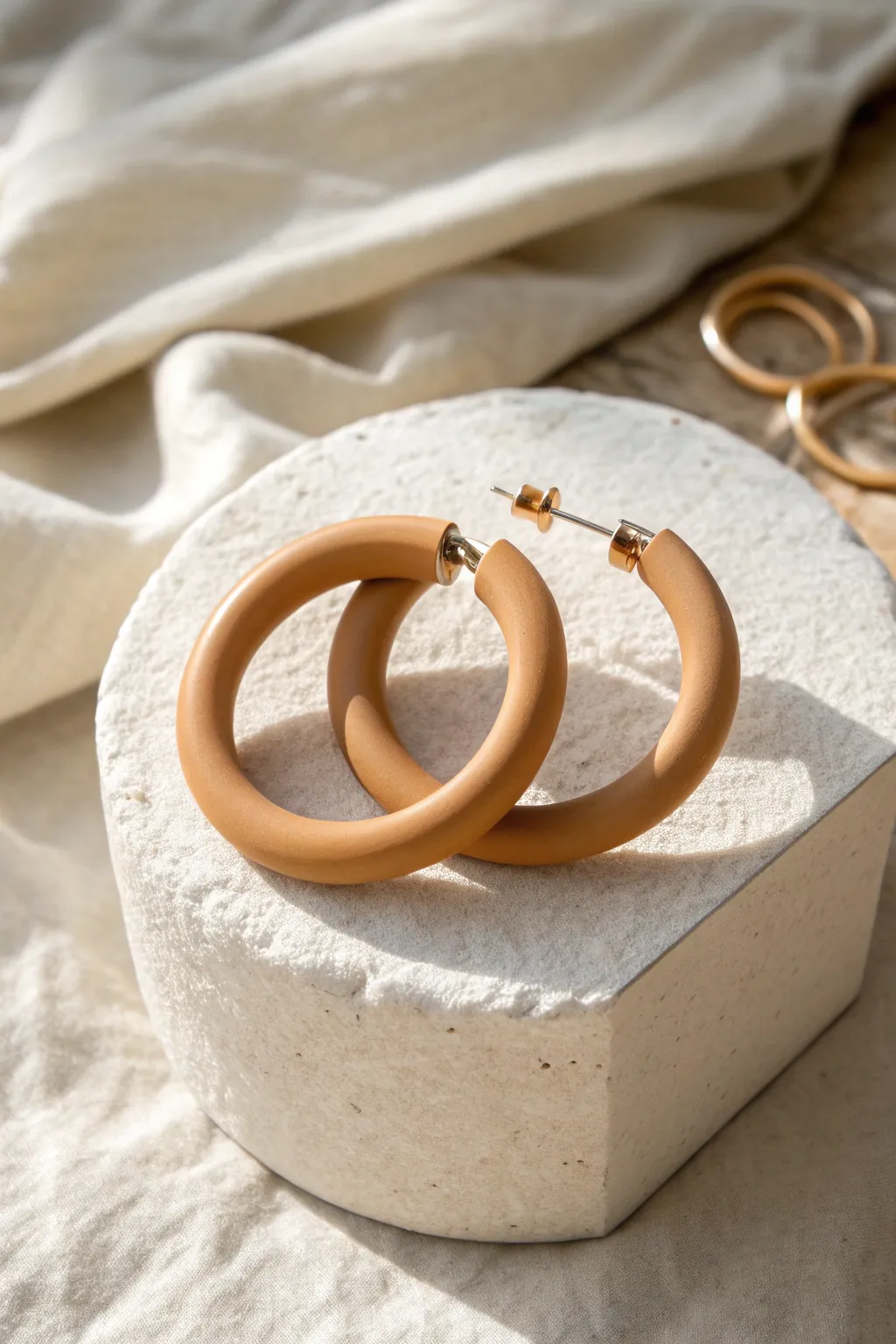
Embrace minimalist chic with these perfectly rounded, caramel-toned illusion hoop earrings. Made from polymer clay, these chunky loops offer the bold look of a full hoop with the lightweight comfort of a classic stud.
Step-by-Step Guide
Materials
- Polymer clay (Caramel or Tan color)
- Acrylic roller or pasta machine
- Circle cutters (approx. 40mm and 25mm)
- Small circle cutter (approx. 5-7mm for post connection)
- Flat earring posts with butterfly backs
- Liquid polymer clay or bake-and-bond
- Super glue (gel based)
- Fine grit sandpaper (400-1000 grit)
- Ceramic tile or glass baking sheet
- Clay blade or craft knife
- Oven
Step 1: Shaping the Base
-
Condition the clay:
Begin by thoroughly conditioning your caramel-colored clay until it is soft and malleable. Warm clay is essential for avoiding cracks in chunky designs. -
Roll a thick slab:
Roll your clay out into a thick, even sheet. For that substantial ‘chunky’ look seen in the photo, aim for a thickness of about 4mm to 5mm. -
Cut the outer circles:
Using your largest circle cutter (around 40mm), punch out two clean circles. Make sure to press firmly so the cutter goes all the way through to your work surface. -
Cut the inner circles:
Center the medium-sized cutter (25mm) inside the clay circles you just made and remove the center. You should now have two thick, flat donut shapes. -
Smooth the edges:
Before baking, use your finger or a smoothing tool to gently round over the sharp, cut edges of the clay donuts. We want a tubular, organic look, not a flat, stamped look. -
Create the gap:
Take your clay blade and make a single vertical slice through the top of each ring. Gently pry the ends apart slightly to create a ‘C’ shape. The gap should be roughly 5mm wide.
Smooth Operator
To get perfectly rounded edges without sanding forever, use a piece of cling film over the clay before pressing down your cutters.
Step 2: Hardware Integration
-
Prepare the connection point:
Using the same clay, roll a small snake and cut two tiny cylinders that match the thickness of your hoops. These will become the invisible bridge for the earring post. -
Embed the post:
I like to press the flat head of the metal earring post gently into one of the open ends of the ‘C’ shape, creating a small indentation. -
Secure the post:
Apply a tiny dot of liquid clay or bake-and-bond to that indentation. Place the metal post back in, then cover the flat pad completely with a small disc of clay to sandwich it inside. -
Smooth the join:
Blend the clay covering the post seamlessly into the main hoop body, ensuring the metal post sticks straight up. This creates the ‘illusion’ that the hoop goes through the ear.
Step 3: Finishing Touches
-
Final tactile smoothing:
Do one last check for fingerprints. A little bit of cornstarch on your fingertip can help you buff away prints without distorting the shape. -
Bake the pieces:
Place your hoops on a ceramic tile and bake according to your clay package instructions. Since these are thick, ensure you bake for the full recommended time to ensure durability. -
Cool down:
Allow the earrings to cool completely inside the oven if possible; this gradual cooling helps prevent brittleness. -
Sanding for matte finish:
Once cool, wet sand the pieces lightly with high-grit sandpaper to remove any shine and achieve that velvety matte texture shown in the image. -
Reinforce (Optional):
For extra security, you can add a drop of super glue at the base of the metal post where it emerges from the clay, just to ensure it never wiggles loose.
Texture Twist
Before baking, roll the unbaked hoops gently over coarse sandpaper or concrete to give them a stone-like surface texture.
Pop these neutral staples into your jewelry rotation for an effortlessly polished look
Simple Color-Block Geometrics
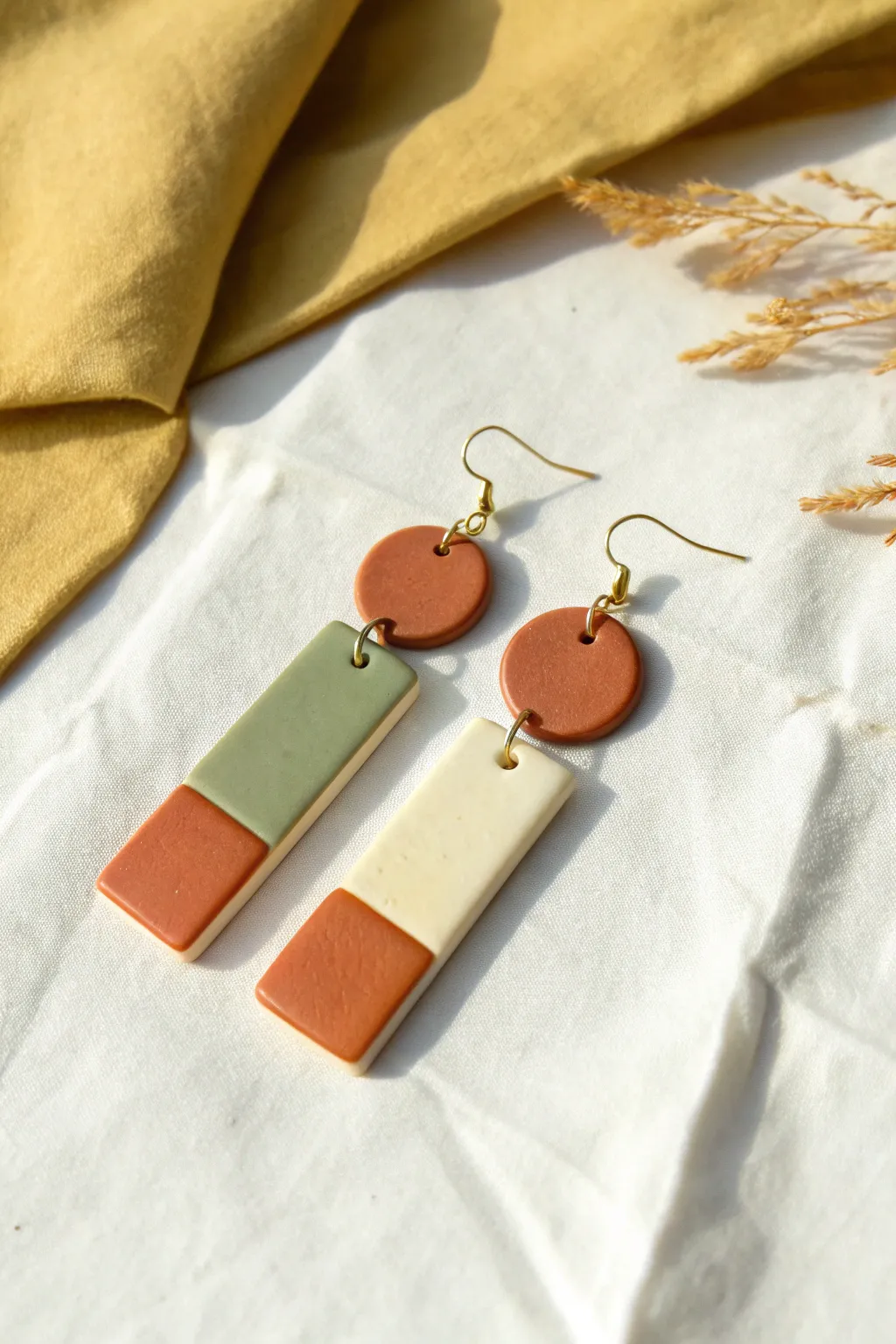
Embrace the beauty of modern asymmetry with these stunning polymer clay earrings, featuring a warm, earthy color palette of terracotta, sage green, and cream. The distinct color-blocking technique creates a clean, sophisticated look that pairs perfectly with boho or minimalist wardrobes.
Step-by-Step Tutorial
Materials
- Polymer clay in Terracotta, Sage Green, and Cream/Beige
- Rolling pin or pasta machine
- Tissue blade or flexible clay slicer
- Small circle cutter (approx. 10-12mm)
- Rectangle cutter (or a ruler and knife)
- Small jump rings (gold finish)
- Earring hooks (gold finish)
- Hand drill or needle tool
- Jewelry pliers
- Parchment paper or ceramic tile
Step 1: Prepping and Conditioning
-
Condition the clay:
Begin by taking your three colors of polymer clay—terracotta, sage green, and cream—and kneading them individually until they are soft and pliable. This conditioning step is crucial to prevent cracking later. -
Roll out slabs:
Roll each color out into a flat sheet. Aim for a thickness of about 3mm to 4mm. A pasta machine is great for consistency, but a rolling pin with depth guides works perfectly well too.
Sticky Seams?
If the clay colors won’t stick together at the seam, apply a tiny amount of liquid polymer clay (Bake & Bond) to the edges before pressing them together.
Step 2: Creating the Components
-
Cut the top circles:
Using your small circle cutter, punch out two identical circles from the terracotta clay slab. These will form the stud or top connector portion of the earrings. -
Cut the rectangles:
For the bottom part, you need to create the main rectangular shapes. You can either use a rectangular cutter or slice long strips with your tissue blade. You want two main rectangles of equal size—one from cream clay and one from sage green clay. -
Slice the accents:
Cut a smaller square or short rectangle from the terracotta clay slab. This needs to be the same width as your cream and sage rectangles. -
Use the splice technique:
Take your main sage green rectangle and your main cream rectangle. Using your blade, cut off the bottom third of each. -
assemble the mismatched pair:
Replace the bottom third you just cut off with the terracotta segment. Press the terracotta piece gently against the cut edge of the sage and cream pieces. The clay should stick together with light pressure. -
Smooth the seams:
Place a piece of parchment paper over your joined rectangles. Gently rub tight circles over the seam with your finger or a smoothing tool to fuse the clays together without distorting the straight edges. -
Refine the edges:
If the fusing caused the sides to bulge slightly, use your sharp tissue blade to trim the long edges straight again so the block looks uniform.
Make It Glossy
After baking and cooling, apply a thin coat of UV resin or water-based gloss varnish to the clay surface for a high-shine, ceramic-like finish.
Step 3: Finishing and Assembly
-
Pierce holes:
Before baking, use a needle tool to poke a hole near the top center of each rectangle and near the top and bottom of the terracotta circles. If you prefer precision, you can drill these after baking instead. -
Baking:
Transfer your pieces to a baking sheet lined with parchment paper. Bake according to your specific clay brand’s instructions (usually around 275°F/130°C for 15-30 minutes). -
Cooling down:
Let the pieces cool completely before handling. I like to let them sit in the turned-off oven for a while to anneal the clay, making it stronger. -
Open the jump rings:
Using two pairs of pliers, twist your jump rings open laterally (side-to-side, never pulling apart). -
Connect the tiers:
Thread an open jump ring through the top hole of the rectangle and the bottom hole of the terracotta circle. Close the ring securely. -
Attach the hooks:
Open the loop at the base of your gold earring hook. Slide it through the top hole of the terracotta circle and close it tight. -
Final check:
Double-check that all jump rings are fully closed so your pieces don’t slip out while wearing them.
Now you have a chic pair of geometric earrings ready to elevate any outfit
Multi-Tiered Linked Dangles
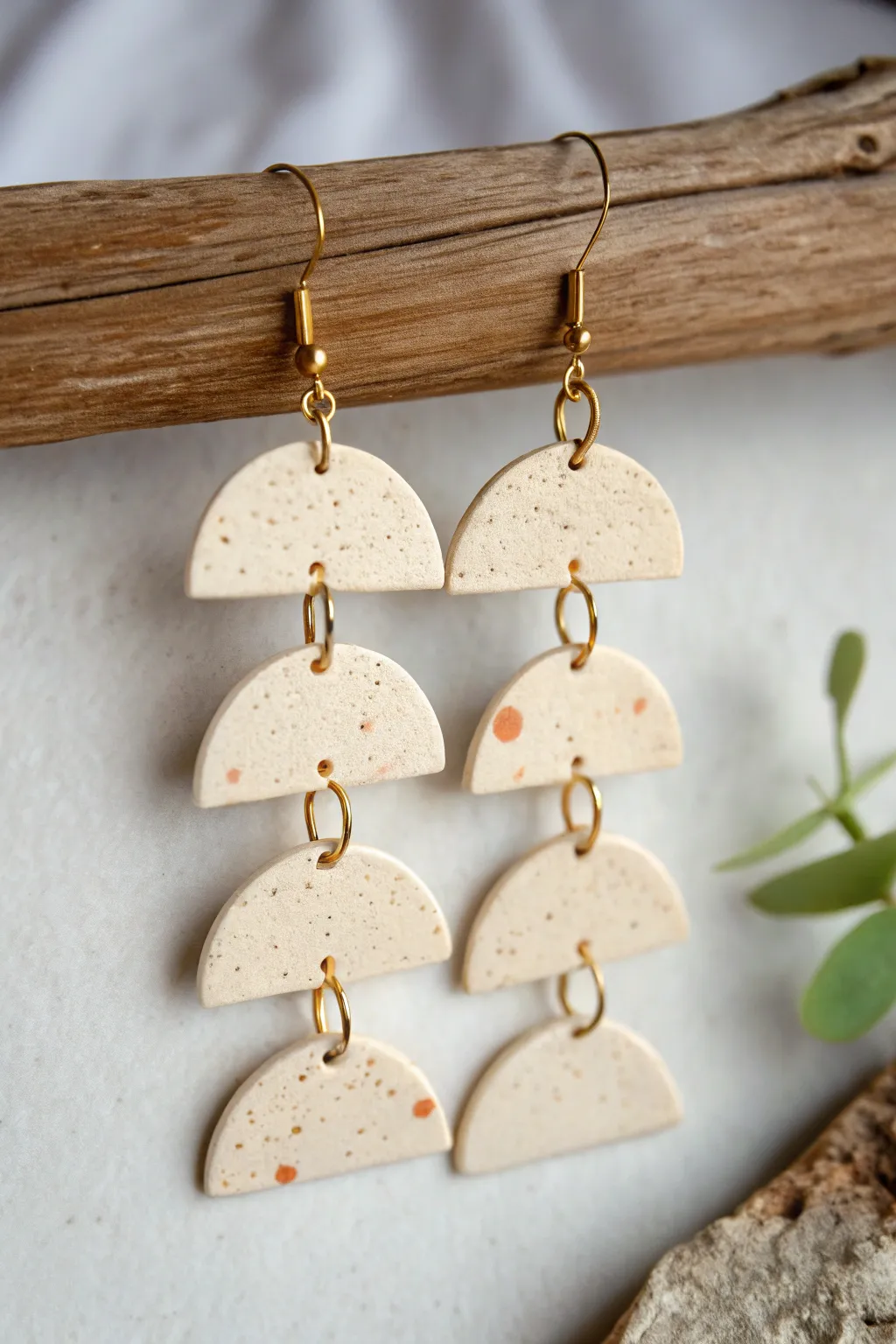
Create a stunning cascade of shapes with these multi-tiered polymer clay earrings featuring a soft, speckled cream finish. The vertical linkage of four identical semi-circles gives them lovely movement and a sophisticated, architectural vibe.
How-To Guide
Materials
- Speckled cream or granite polymer clay (PREMO or Fimo Effect)
- Small amount of terracotta or orange polymer clay (for custom flecks)
- Pasta machine or acrylic roller
- Semi-circle clay cutter (consistent size)
- Small circular cutter or needle tool (for holes)
- Gold jump rings (approx 6-8mm)
- 2 Gold earring hooks
- Jewelry pliers (flat nose and round nose)
- Ceramic tile or baking sheet
- Sandpaper or Dremel tool (optional)
Step 1: Prepare the Speckled Clay
-
Condition the base:
Begin by thoroughly conditioning your speckled cream clay. Knead it in your hands until it is pliable and warm. If you are using a pasta machine, run it through several times on the widest setting. -
Add custom details:
To achieve the look in the photo, take a very small pinch of terracotta-colored clay. Chop it into tiny, almost dust-like crumbs using a craft blade. Sprinkle these crumbs randomly over your conditioned cream clay sheet. -
Roll flat:
Run the clay through your pasta machine one last time (or roll with an acrylic roller) to embed the orange flecks into the surface. Aim for a distinct thickness—about 2-3mm works well for durability without being too heavy.
Hole Placement Trick
Use a grid ruler or graph paper under your work surface (like glass) to line up your cutter perfectly vertical before punching holes.
Step 2: Cut and Drill
-
Cut the shapes:
Place your clay sheet on a ceramic tile or work surface. Using your semi-circle cutter, punch out eight identical shapes. Wiggle the cutter slightly before lifting to ensure a clean edge. -
Mark hole placement:
For these tiered dangles, hole placement is critical. For the top three tiers, you need a hole at the top center of the curve and a hole at the bottom center of the flat edge. For the bottom-most tier, you only need a top hole. -
Pierce the holes:
Use a small circular cutter or a needle tool to create the holes. Ensure they are not too close to the edge to prevent breaking—about 2-3mm from the edge is safe. I prefer using a tiny hollow cutter for cleaner holes that lessen post-bake sanding. -
Smooth edges:
Before baking, gently run your finger dipped in a little cornstarch or water along the cut edges of the clay to smooth out any harsh lines or fingerprints. -
Bake:
Bake the pieces on your tile according to the manufacturer’s instructions for your specific brand of clay. Usually, this is around 275°F (130°C) for 30 minutes. Let them cool completely before handling.
Step 3: Assembly
-
Open jump rings:
Using two pairs of pliers, twist your jump rings open laterally (side-to-side, not pulling apart). This maintains the circle’s shape. -
Connect the tiers:
Start from the bottom. Connect the bottom semi-circle to the one above it by threading an open jump ring through their respective holes. Close the jump ring securely so there is no gap. -
Continue linking:
Repeat the process, moving upward until all four semi-circles are linked in a vertical chain. Check that all ‘flat’ sides are facing down and curved sides are facing up. -
Attach the hook:
Open the small loop on your earring hook (or use a small jump ring if needed) and attach it to the top hole of the highest semi-circle. -
Final check:
Repeat the assembly for the second earring. double-check that all jump rings are tightly closed so your pieces don’t slip off.
Texture Twist
Before baking, gently press a piece of coarse sandpaper or a toothbrush onto the surface to give the clay a realistic stone-like texture.
Now you have a stylish pair of architectural earrings ready to wear or gift.
Faux Stone and Granite Looks
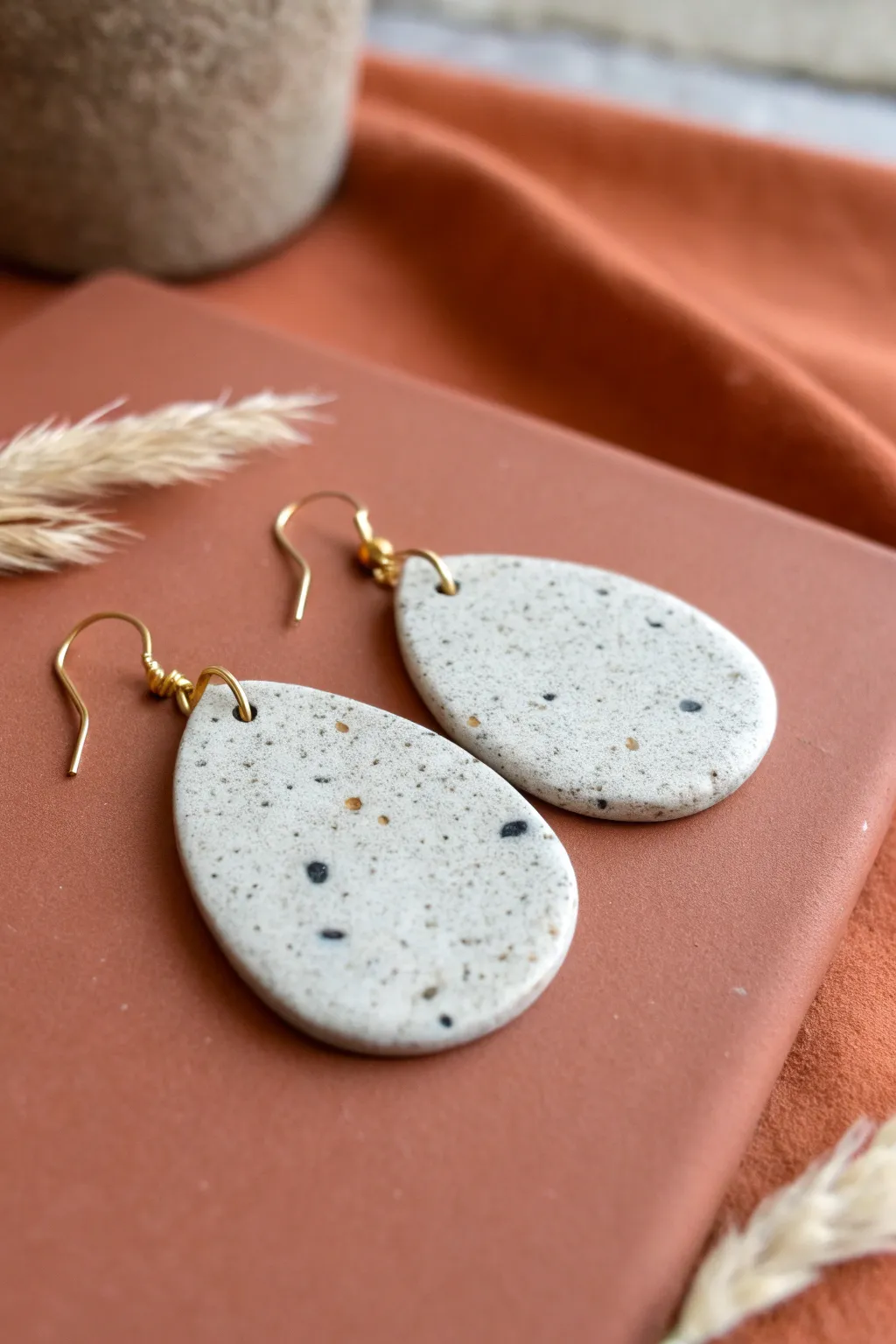
Achieve a sophisticated, natural aesthetic with these polymer clay earrings that mimic the look of granite stone. The subtle black and brown speckles against a creamy white base make these versatile pieces perfect for everyday wear.
Step-by-Step Tutorial
Materials
- White or translucent white polymer clay
- Coarse ground black pepper
- dried oregano or tea leaves (finely crushed)
- Gold craft sand (very fine)
- Acrylic rolling pin
- Teardrop clay cutter (medium to large)
- Hand drill or needle tool
- Gold earring hooks (fishhook style)
- Jump rings (gold, 4-6mm)
- Jewelry pliers
- Fine-grit sandpaper (400 to 1000 grit)
- Matte varnish (optional)
Step 1: Prepping the Clay
-
Condition the base:
Start by conditioning your white polymer clay until it is soft and malleable. If you want a more translucent, stone-like depth, mix one part white clay with one part translucent clay. -
Add texture elements:
Flatten the conditioned clay into a pancake. Sprinkle a pinch of coarse black pepper over the surface for the primary black specks. -
Incorporate earth tones:
Add a very small pinch of crushed dried oregano or tea leaves. This adds organic brownish-green flecks that make the ‘stone’ look realistic. -
Add subtle sparkle:
Sprinkle a tiny amount of gold craft sand onto the clay. This gives the faux granite a mineral-like shimmer without looking glittery. -
Fold and mix:
Fold the clay over onto itself to trap the inclusions. Knead the clay repeatedly to distribute the spices and sand evenly throughout the block. I usually check the cross-section to ensure the speckles go all the way through.
Sticky Situation?
If clay sticks to your cutter, dip the cutter in cornstarch or water before pressing down. This acts as a release agent for clean cuts.
Step 2: Shaping and Baking
-
Roll the slab:
Using your acrylic rolling pin, roll the clay out to a uniform thickness, ideally around 3mm to 4mm. Use depth guides if you have them to keep it perfectly even. -
Check the surface:
Look closely at your slab. If any large chunks of pepper or herbs are protruding too much, gently pick them off or press them deeper with a light roll. -
Cut the shapes:
Press your teardrop cutter firmly into the clay slab. Wiggle it slightly before lifting to release the shape cleanly. -
Smooth the edges:
Gently rub your finger along the cut edges of the teardrops to remove any loose bits of clay or sharp ridges before baking. This saves sanding time later. -
Create holes:
Use a needle tool to pierce a hole at the narrow top of each teardrop. Ensure the hole is large enough for your jump rings but not too close to the edge. -
Bake the pieces:
Place the shapes on a ceramic tile or baking sheet lined with parchment paper. Bake according to your clay manufacturer’s instructions, usually around 275°F (130°C) for 30 minutes. -
Cool down:
Let the pieces cool completely inside the oven or on a wire rack before handling them to prevent warping.
Step 3: Finishing Touches
-
Sand the surface:
Wet sandpaper works best here. Under running water, gently sand the edges and surface with fine-grit sandpaper to reveal more of the speckled inclusions. -
Seal (Optional):
If you want to protect the organic inclusions, brush on a very thin layer of matte varnish. This keeps the natural stone look without adding high gloss. -
Open jump rings:
Using two pairs of jewelry pliers, twist a gold jump ring open sideways (never pull it apart). -
Attach hardware:
Slide the jump ring through the hole in the clay teardrop, then thread the loop of the earring hook onto the jump ring. -
Close the ring:
Twist the jump ring back into a closed position using your pliers until the ends meet perfectly flush.
Make it Luxe
Add gold leaf flakes into the clay mixture instead of sand. The larger metallic chunks create a high-end quartz vein effect.
Your beautiful faux granite earrings are now ready to add an earthy elegance to your jewelry collection
Mokume-Inspired Layered Patterns
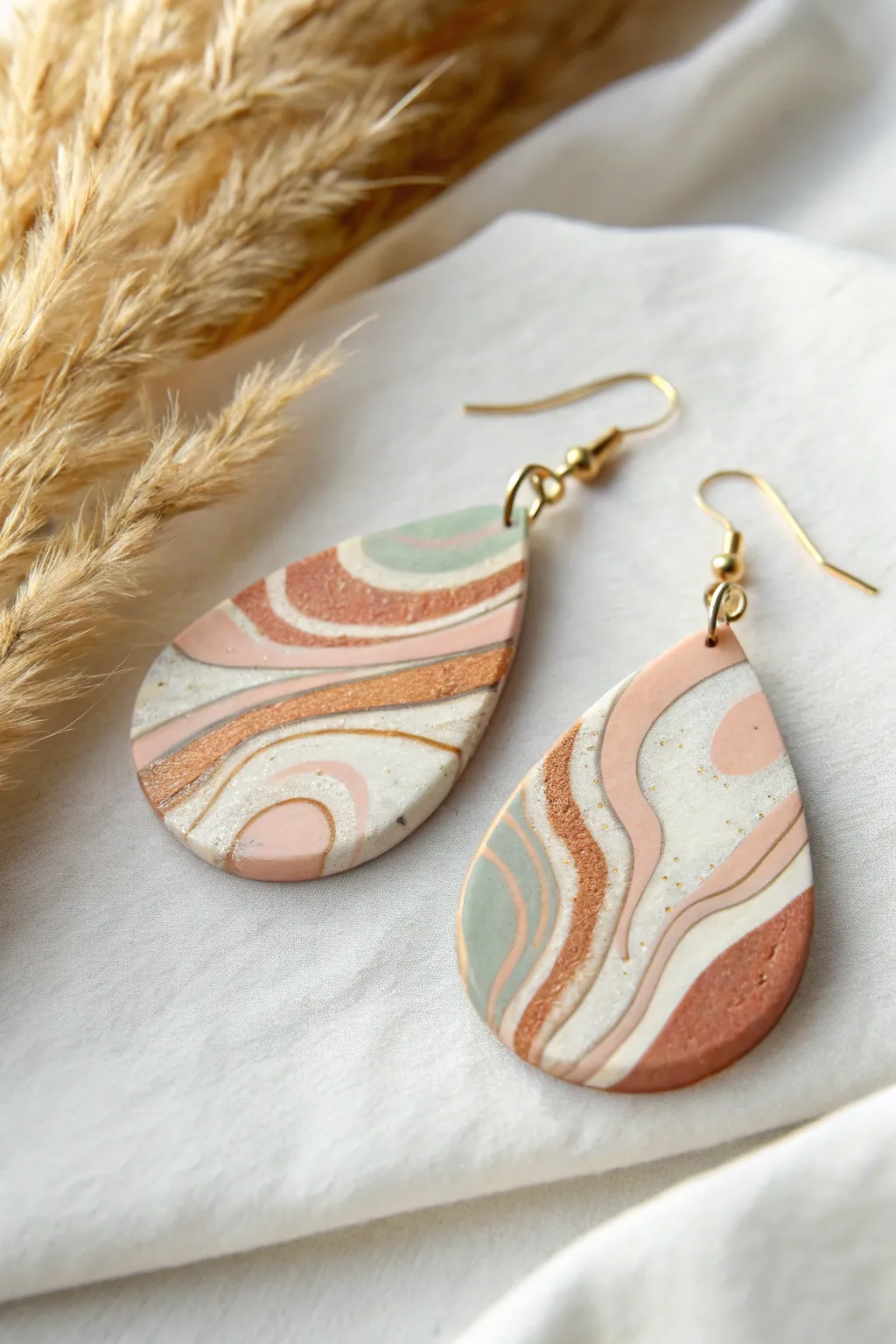
Soft pastels bump into rich earth tones in these stunning agate-inspired teardrop earrings. The organic, wavy lines create a sophisticated marble effect that looks incredibly high-end but stems from a surprisingly simple clay stacking technique.
Step-by-Step
Materials
- Polymer clay in varying shades: white/cream (granite effect if possible), terracotta, peach/blush, dusty mint green, and metallic gold
- Rolling pin or pasta machine
- Tissue blade or very sharp craft knife
- Teardrop-shaped clay cutter (approx. 1.5 – 2 inches)
- Small circle cutter (for jump ring holes)
- Sandpaper (various grits: 400, 600, 1000)
- Polishing compound or UV resin (optional for gloss)
- Gold-toned earring hooks and jump rings
- Jewelry pliers
- Ceramic tile or baking sheet
Step 1: Preparing the Slab
-
Condition the clay:
Start by thoroughly conditioning each color of polymer clay until it is pliable and warm. You’ll need about equal amounts of white, terracotta, peach, mint, and gold. -
Roll out sheets:
Roll each color into a flat sheet. If you’re using a pasta machine, I usually aim for a medium setting (around number 3 or 4). They don’t need to be perfectly uniform in thickness, as variety adds character. -
Stack the layers:
Stack your sheets of colored clay on top of one another. The order doesn’t matter too much, but try to alternate between light and dark colors for better contrast later. -
Compress the block:
Gently roll over your stack to compress the layers together, ensuring no air bubbles are trapped between the sheets. Trim the edges to make a neat rectangular block.
Muddy Colors?
If your pattern looks smeared rather than crisp, your blade might be dull or your clay too warm. Chill the clay block in the fridge for 10 minutes before slicing.
Step 2: Creating the Pattern
-
Distort the layers:
This is the fun part: use the handle of a paintbrush or a rounded tool to push indentations into the top of the stack. Press down deep, almost to the bottom, creating a landscape of hills and valleys. -
Slice the slab:
Take your flexible tissue blade. Holding it slightly curved and very flat against the clay surface, carefully shave off thin horizontal slices from the top of your textured block. -
Reveal the magic:
As you slice away the bumps, you will reveal the concentric, wavy rings of color hidden beneath. Continue shaving until the entire surface is flat and you have a pattern you love. -
Smooth the surface:
Place a piece of parchment paper or plastic wrap over your patterned slab and gently burnish it with a roller or your finger to ensure the surface is perfectly smooth and seamless.
Step 3: Cutting and Baking
-
Cut the shapes:
Position your teardrop cutter over the sections of the slab with the most interesting swirls. Press down firmly to cut out two shapes. -
Mirror the design:
Try to find two areas that look somewhat harmonious together, or cut from the same section of pattern to make them feel like a matched set. -
Piercing holes:
Use a small circle cutter or a needle tool to create a hole at the very top point of the teardrop. Make sure it’s not too close to the edge to prevent breakage. -
Bake:
Transfer your cut pieces to a ceramic tile or baking sheet. Bake according to your polymer clay manufacturer’s instructions—usually around 275°F (135°C) for 30–60 minutes.
Add Subtle Sparkle
Mix a tiny amount of translucent clay with glitter into your white layer. It creates depth and mimics the quartz-like look of real stone.
Step 4: Finishing Touches
-
Cool down:
Allow the clay pieces to cool completely inside the oven or on the counter before handling them to ensure maximum durability. -
Sand edges:
Dip your sandpaper in water and gently sand the edges and back of the earrings. Start with 400 grit to remove rough spots, then work up to 1000 grit for a silky finish. -
Buff or glaze:
For that soft matte finish seen in the photo, buff the surface vigorously with a soft cloth or denim. If you prefer high shine, add a thin layer of UV resin or glaze now. -
Assemble hardware:
Using two pairs of pliers, twist open a jump ring. Thread it through the hole in the clay and loop on the earring hook. -
Close the ring:
Twist the jump ring closed carefully so the ends meet perfectly flush. Repeat for the second earring.
Wear your new earthy, patterned creations with pride creating a sophisticated boho look for any outfit
Translucent Jelly-Style Accents
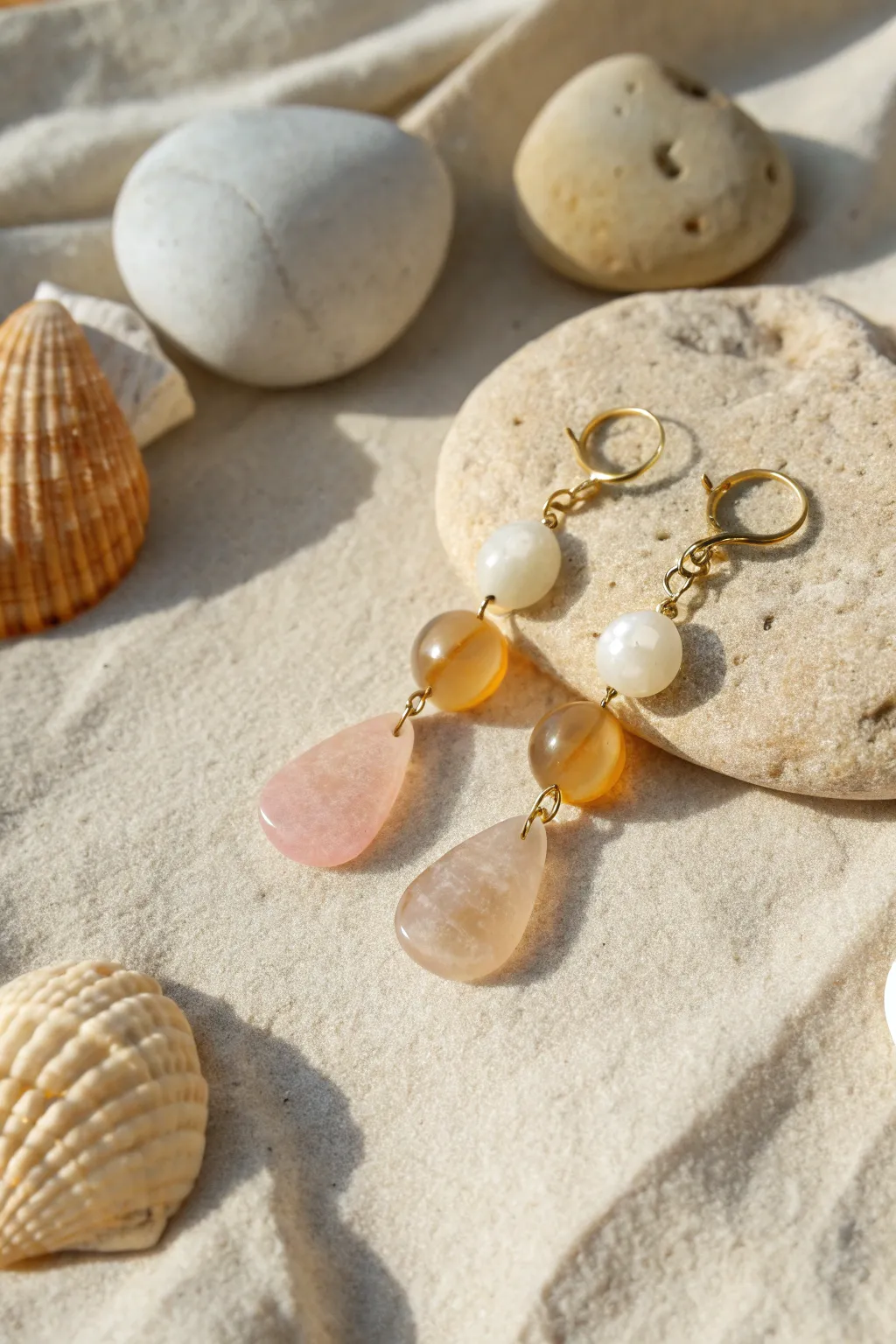
Capture the soft, hazy look of sea glass with these elegant polymer clay earrings featuring translucent jelly-style beads. The design combines creamy whites, warm amber tones, and soft blush pinks in a tiered drop arrangement that catches the light beautifully.
Detailed Instructions
Materials
- Translucent polymer clay (white or uncolored)
- Alcohol inks (amber/honey, blush pink/rose, and pearl white)
- Liquid polymer clay (translucent)
- Eye pins (gold-tone)
- Jump rings (gold-tone, small)
- Lever-back earring hooks (gold-tone)
- Round nose pliers
- Chain nose pliers
- Wire cutters
- Bead rollers (round)
- Teardrop cutter or craft knife
- Gloss or semi-gloss varnish
- Small baking tile or parchment paper
- Sandpaper (wet/dry, various grits up to 1000)
Step 1: Creating the Jelly Clay Colors
-
Condition the translucent clay:
Start by conditioning your translucent polymer clay thoroughly until it is soft and pliable. This step is crucial for preventing ‘plaques’ or mooning in the final baked pieces. Divide the clay into three equal portions. -
Mix the Pearl White:
Take the first portion and add a very small drop of white alcohol ink or mix in a tiny, pin-head amount of white opaque clay. You want it to look milky and pearlescent, not solid white. -
Create the Amber Tone:
For the middle bead, take the second portion and mix in a drop of amber or honey-colored alcohol ink. Knead well until the color is uniform. It should look like transparent honey. -
Mix the Blush Pink:
For the teardrop pendant, take the final portion and mix in a tiny amount of rose or blush pink alcohol ink. Aim for a very subtle, watery pink rather than a saturated heavy color.
Cloudy Translucents?
If your beads look milky after baking, the oven temp was likely too low. Use an oven thermometer to ensure precise heat, and quench in ice water right after baking to shock the clay clear.
Step 2: Forming the Beads
-
Roll the top beads:
Pinch off two small, pea-sized amounts of the Pearl White mixture. Roll them between your palms or use a bead roller to create two perfect spheres. -
Pierce the white beads:
Gently insert an eye pin or a piercing tool through the center of each white bead. Set them aside on your baking tile. -
Form the middle beads:
Take the Amber clay and form two slightly larger spheres. Alternatively, you can flatten these slightly into thick rondelles if you prefer that shape. -
Pierce the amber beads:
Pierce these beads through the center just like the white ones. I find rotating the pin as I push creates a cleaner hole without distorting the shape.
Add Some Sea Sparkle
Mix tiny flakes of gold leaf or iridescent glitter into the amber and pink clay layers before rolling. This mimics sun catching the sand inside sea glass.
Step 3: Sculpting the Teardrops
-
Shape the base:
Take the pink clay and roll two balls slightly larger than the amber ones. Roll one side of each ball between your fingers to elongate it into a cone shape. -
Flatten the teardrop:
Gently press the cone flat onto your work surface to create a teardrop pendant shape. Use your fingers to smooth and round the edges so they look like worn glass, not sharp-cut clay. -
Insert the top attachment:
Insert an eye pin into the top (narrow end) of the teardrop. Trim the wire if it’s too long, but ensure enough is embedded for security. A touch of liquid clay on the wire helps it bond permanently.
Step 4: Baking and Finishing
-
Bake the components:
Arrange all pieces on your tile and bake according to your clay manufacturer’s instructions. For translucent clay, I often quench them in ice water immediately after baking to maximize transparency. -
Sand for a distressed look:
Once cool, use wet/dry sandpaper to gently buff the surface. This removes fingerprints and gives that authentic ‘sea glass’ texture. -
Apply varnish:
Coat each bead and teardrop with a thin layer of gloss or semi-gloss varnish to enhance the jelly-like transparency. -
Create loops:
Trim the eye pin wires extending from the round beads to about 1cm. Use round nose pliers to curl these ends into loops, creating links. -
Assemble the tier:
Connect the components in order: attach the white bead to the amber bead, and the amber bead for the pink teardrop, closing the loops securely. -
Attach the hardware:
Open the loop at the very top of the white bead link and attach your gold lever-back earring hook.
Now you have a stunning pair of faux gemstone earrings ready for a beach day or brunch
Whimsical Mushroom Dangle Pairs
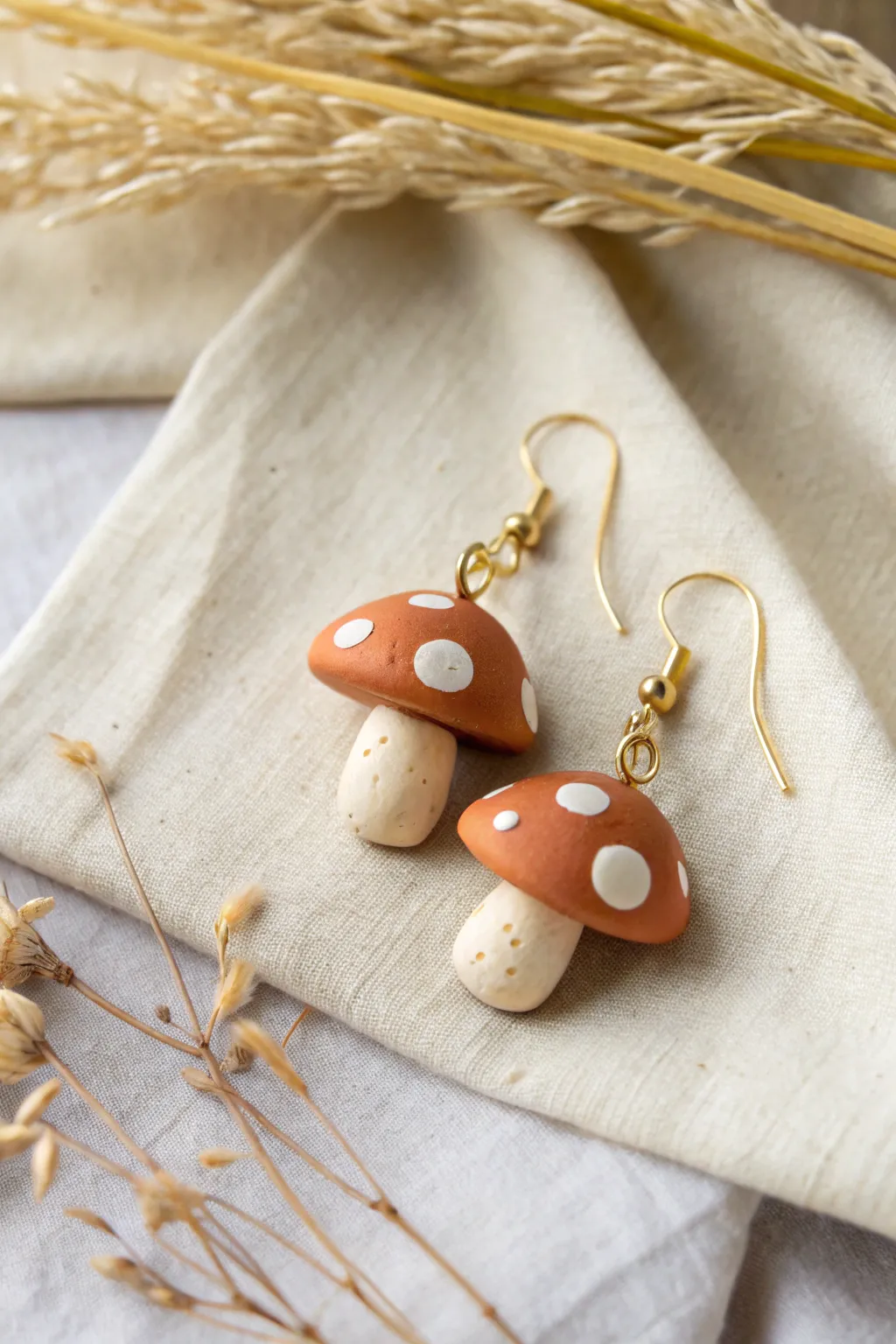
These charming toadstools bring a touch of woodland magic to your jewelry collection. With their rusty red caps and speckled white stems, they perfectly capture the whimsical feel of an autumn forest floor.
Step-by-Step Guide
Materials
- Rust-colored polymer clay (e.g., terracotta or burnt orange)
- Beige or off-white polymer clay
- White acrylic paint
- Small detail paintbrush or dotting tool
- Needle tool or toothpick
- Eye pins (gold-tone)
- Earring hooks (gold-tone)
- Jump rings (gold-tone, optional depending on assembly preference)
- Round nose pliers
- Wire cutters
- Baking sheet
- Oven or toaster oven
Step 1: Sculpting the Caps
-
Condition the Rust Clay:
Start by warming about a marble-sized amount of rust-colored clay in your hands until it becomes soft and pliable. -
Form the Circles:
Divide your clay into two equal pieces and roll each into a smooth ball to ensure your earrings will be symmetrical. -
Shape the Dome:
Gently press each ball onto your work surface to flatten the bottom. Use your finger to smooth the top into a rounded, dome-like mushroom cap shape. -
Soften the Edges:
Run your finger around the bottom rim of the cap to round off any sharp edges, giving it a natural, organic look.
Sticky Situation?
If your clay is getting fingerprints or attracting dust, wipe it gently with a little rubbing alcohol on a cotton swab before baking to smooth it out.
Step 2: Creating the Stems
-
Condition the Beige Clay:
Take a slightly smaller amount of beige or off-white clay and condition it thoroughly. -
Roll Short Logs:
Divide this clay into two equal portions and roll them into short, thick logs. These will be sturdy stems to support the caps. -
Round the Bases:
Gently round the bottom end of each stem so it looks like it was plucked from the earth, rather than cut straight across. -
Texturing the Stems:
Using a needle tool, poke random, shallow holes all over the surface of the stems. This mimics the porous texture of real fungi. -
Joining the Pieces:
Press the flat top of each stem firmly into the center of the flat underside of each red cap. You can use a tiny dab of liquid clay here if you want extra security.
Add Some Shine
Coat the red caps with a gloss glaze after the paint dries. This makes them look wet and dewy, enhancing the contrast with the matte texture of the stem.
Step 3: Assembly & Baking
-
Insert Eye Pins:
Trim your eye pins to the appropriate length so they don’t poke through the bottom. Push the pin straight down through the center top of the red cap into the stem. -
Bake the Clay:
Place your mushrooms upright on a baking sheet. Bake according to your specific brand of polymer clay’s instructions (usually 275°F/135°C for 15-30 minutes). -
Cool Completely:
Let the mushrooms cool fully before moving to the next step; the clay hardens as it cools. -
Paint the Dots:
Using a very fine brush or dotting tool, apply scattered white spots onto the red caps. Vary the sizes slightly for a realistic appearance. -
Let Paint Dry:
Allow the acrylic paint to dry completely. I like to let this sit for about an hour to ensure no smudging occurs.
Step 4: Finishing Touches
-
Attach Hardware:
Use your pliers to open the loop on your earring hooks by twisting sideways. -
Connect to Mushroom:
Thread the earring hook loop through the eye pin loop on top of the mushroom. -
Secure the Loop:
Twist the earring hook loop closed again with your pliers, ensuring a tight seal so the mushroom doesn’t slip off. -
Final Inspection:
Check that the eye pins are secure and the paint is dry before trying them on.
Enjoy wearing your tiny piece of the forest wherever you go
Playful Mini Food Stud Sets
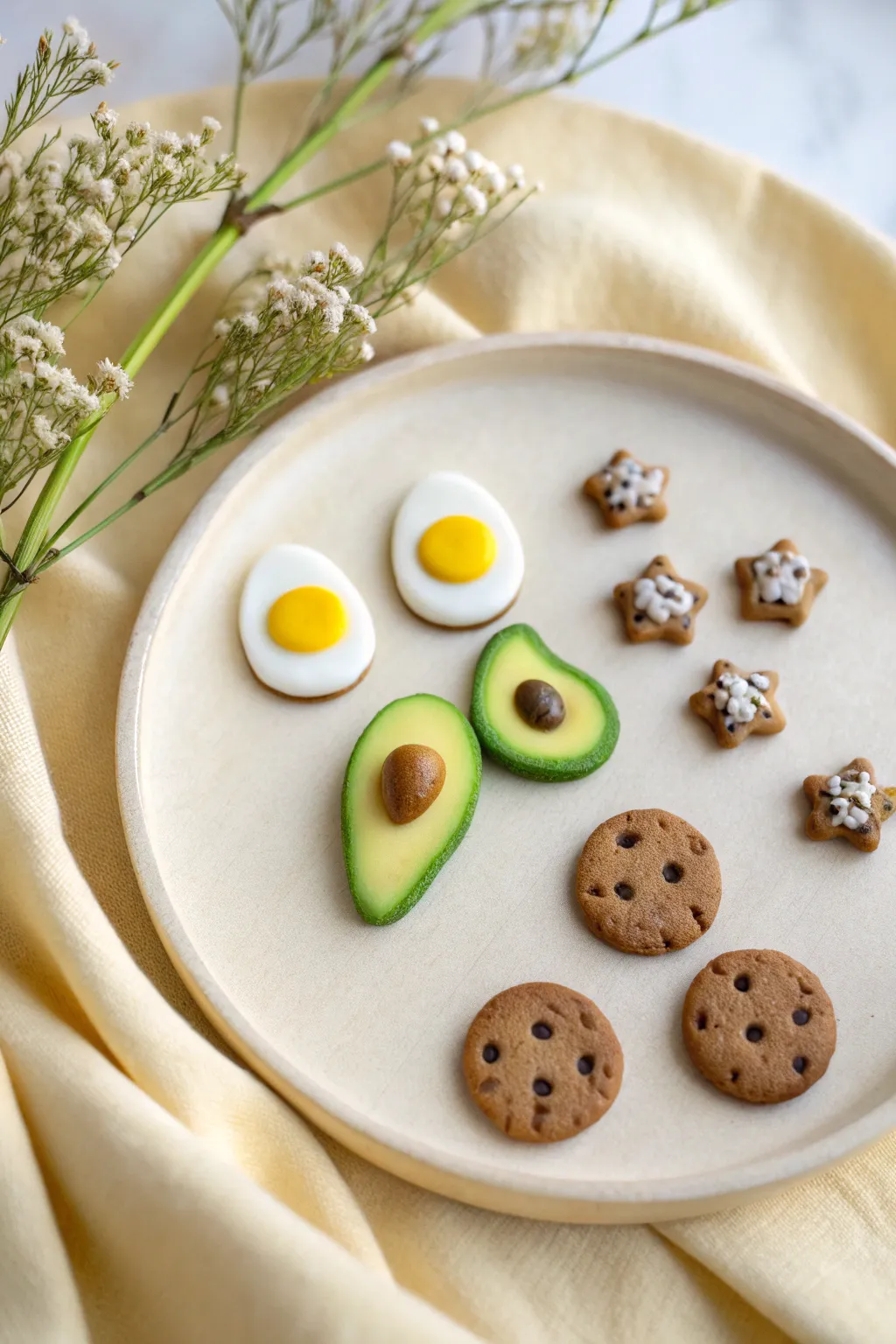
Transform your love for breakfast into wearable art with this delightful set of miniature food earrings. Featuring sunny-side-up eggs, creamy avocados, and two types of tiny cookies, these polymer clay creations are perfect for mixing and matching.
Step-by-Step
Materials
- Polymer clay (white, yellow, translucent, various browns, green, black)
- Liquid polymer clay (white and translucent)
- Chalk pastels (brown, orange, yellow-green)
- Needle tool or toothpick
- Ball stylus tools (various sizes)
- Small star cutter (approx. 1cm)
- Small circle cutter or straw
- Soft paintbrush
- Toothbrush (for texture)
- Sandpaper or nail buffer
- Blade or X-Acto knife
- Earring posts and superglue (E6000 recommended)
- Gloss glaze (optional)
Step 1: Sunny-Side-Up Eggs
-
Base shape:
Condition white polymer clay until soft. Roll it into a small sheet about 2-3mm thick. Use a small oval cutter or simply hand-shape irregular ovals to mimic natural egg whites. -
Adding the yolk:
Condition a small amount of bright yellow clay. Roll tiny balls for the yolks. -
Assembly:
Pres slight indentations into the white bases using a large ball stylus. Place the yellow yolk balls into these indents and gently press down to adhere them, flattening the tops slightly so they aren’t perfect spheres.
Avocado skin tricks
If wrapping the dark green skin is difficult, bake the avocado flesh first, then paint the rim with dark green acrylic paint after it cools.
Step 2: Avocado Halves
-
Creating the color gradient:
Mix green clay with a bit of yellow and translucent clay for the flesh. Create a tear-drop shape. For the outer skin, wrap a very thin layer of dark green clay around the outside edge. -
Pit preparation:
For the pit, mix brown clay with a touch of translucent. Roll it into an oval shape. -
Shaping the avocado:
Cut your green teardrop in half lengthwise to create two flat faces. Press a large ball tool into the center of each half to create the cavity. -
Adding texture and details:
Place the brown pit into one half. For the empty half, use the ball tool to smooth the indentation. Gently texture the light green flesh with a toothbrush to simulate real avocado texture. -
Final shading:
Brush a tiny amount of yellow-green chalk pastel dust near the center of the flesh to enhance the gradient effect.
Realistic texture tip
Don’t over-smooth your clay! Fingerprints are bad, but subtle imperfections make food miniatures look much more organic and realistic.
Step 3: Chocolate Chip Cookies
-
Dough preparation:
Mix tan clay with a speck of translucent and white. Roll into tiny balls and flatten them slightly with your finger. -
Texturing:
Vigorously tap the surface of the flattened dough with a toothbrush or crumpled aluminum foil to create a baked crumb texture. -
Shading:
Shave some orange-brown chalk pastel into a powder. Dust the edges of the cookies with a soft brush to give them a ‘golden baked’ look. -
Adding chips:
Roll extremely tiny snakes of dark brown or black clay. Slice off tiny specks and press them randomly into the cookie surfaces using a needle tool.
Step 4: Star-Shaped Sweets
-
Cutting stars:
Roll out a sheet of gingerbread-colored clay (brown mixed with a little orange). Use a small star cutter to punch out shapes. -
Easing edges:
Gently tap the edges of the stars with your finger to round them off slightly so they look baked rather than sharp-cut. -
Icing effect:
Mix white liquid clay with a tiny bit of solid white clay to create a thick paste. Dab this onto the center of the stars using a needle tool. -
Sprinkles:
While the liquid clay is wet, drop tiny specks of white and black clay on top as sprinkles.
Step 5: Finishing Touches
-
Baking:
Arrange all your pieces on a ceramic tile or baking sheet lined with parchment paper. Bake according to your clay manufacturer’s instructions (usually 275°F/130°C for 15-30 minutes). -
Cooling and glazing:
Let the pieces cool completely. If desired, apply a gloss glaze only to the egg yolks and the avocado pits for a realistic shine. -
Mounting:
Sand the backs of the pieces lightly to roughen them up. Apply a drop of strong glue and attach the earring posts. Let them cure fully before wearing.
Now you have a charming breakfast set ready to wear or gift to your favorite foodie friend