
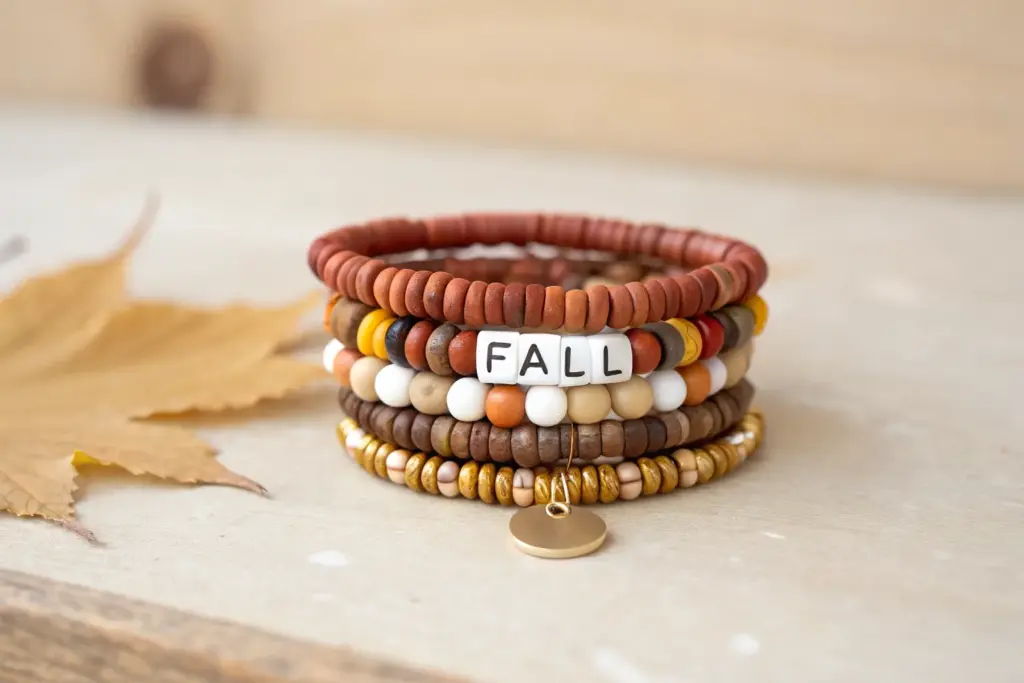
Fall is my favorite excuse to pull out all the warm, cozy colors and turn them into wearable little clay stories. If you love making bracelets, these fall clay bracelet ideas will give you tons of mix-and-match inspiration for stacks, charms, and seasonal color combos.
Classic Fall Heishi Color Stack
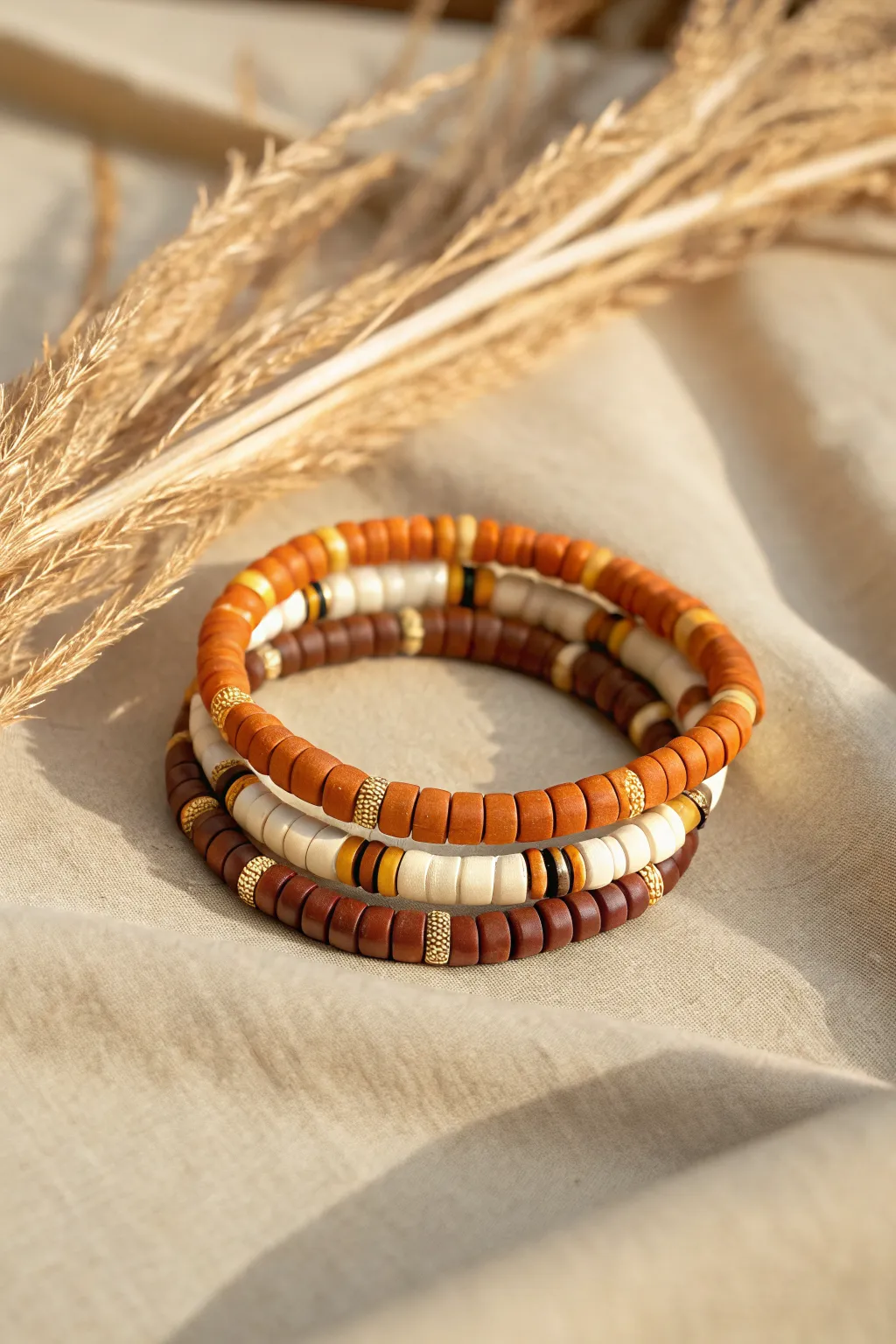
Capture the essence of the changing leaves with this warm and rustic bracelet trio. Featuring a cozy palette of burnt orange, creamy vanilla, and deep chocolate brown, these heishi bead strands are perfectly punctuated with varied gold spacers for a touch of elegance.
Detailed Instructions
Materials
- Polymer clay heishi beads (6mm or 4mm disk beads) in Burnt Orange
- Polymer clay heishi beads in Cream/Off-White
- Polymer clay heishi beads in Dark Chocolate Brown
- Gold tone spacer beads (various styles: textured rondelles, smooth rings, fluted disks)
- Small black flat washer beads (accent)
- Mustard yellow heishi beads (accent)
- Strong elastic cord (0.8mm or 1mm recommended)
- Jewelry glue or clear nail polish
- Scissors / Nippers
- Beading needle (collapsible eye) – optional
- Tape or bead stopper
Step 1: Preparation
-
Measure and specific:
Begin by measuring your wrist with a soft tape measure. Add roughly half an inch to this measurement to determine your ideal beaded length for a comfortable fit. -
Prepare the cord:
Cut three strands of elastic cord, each about 10-12 inches long. This extra length is crucial for tying secure knots later. -
Pre-stretch:
Give each piece of elastic a firm tug three or four times. I like to do this immediately because it prevents the bracelet from stretching out and becoming loose after the first wear. -
Secure the ends:
Place a bead stopper or a piece of masking tape on one end of each cord to prevent your beads from sliding off while you work.
Step 2: Creating the Orange Strand
-
Establish the pattern:
For the top bracelet shown, string about 1 inch of solid burnt orange heishi beads as your base. -
Add gold accents:
Slide on a textured gold rondelle spacer. Follow this with a small section (about 5-6 beads) of cream heishi beads. -
Create the focal detail:
Add a thin black washer bead, a single mustard yellow bead, and another black washer bead for a high-contrast stripe. -
Mirror the pattern:
Add another 5-6 cream beads and finish this segment with a textured gold spacer. -
Complete the strand:
Fill the rest of the cord with the burnt orange beads until you reach your measured length.
Fixing Gaps
If your bracelet shows elastic when stretched, you tied it too loosely. Retie tightly so the cord is under slight tension when resting.
Step 3: Creating the Cream Strand
-
Base layer:
For the middle bracelet, begin stringing the cream/off-white heishi beads. This will be the dominant color. -
Add contrast sections:
After about 1.5 inches of cream, interrupt the pattern with a segment of dark brown beads. Here, use a thin, smooth gold ring on either side of the brown section to define it. -
Insert detailed spacers:
Continue with cream beads. At irregular intervals (or centered, if you prefer symmetry), add a wider, textured gold spacer bead. -
Mix textutes:
If you have slightly different shades of cream or beige, mixing them randomly in this strand adds nice organic depth similar to the photo.
Level Up: Texture
Mix in wooden spacer beads alongside the gold. The wood grain complements the matte clay for an even more rustic, natural autumn vibe.
Step 4: Creating the Brown Strand
-
String the darkest hue:
For the bottom bracelet, start with the dark chocolate brown heishi beads. -
Insert gold breaks:
Every 1 to 1.5 inches, place a textured gold barrel or rondelle bead. This breaks up the dark color so it doesn’t look too heavy. -
Add stripe detail:
Create a focal point by adding a sequence: one mustard yellow bead, two black spacers, and three cream beads, flanked by gold rings. -
Verify length:
Once finished, hold all three strands up to your wrist (or your measuring tape) to ensure they are consistent in length.
Step 5: Finishing Touches
-
Tie the knot:
Remove the tape or stopper. Bring the two ends of the orange bracelet together and tie a surgeon’s knot (right over left, left over right, looping the top strand through twice). -
Secure with glue:
Tighten the knot firmly. Apply a tiny dot of jewelry glue or clear nail polish directly onto the knot. -
Hide the mechanics:
If the hole of a neighboring bead is large enough, gently tug the knot inside it to hide it. Otherwise, let the glue dry completely. -
Trim excess:
Use your scissors to trim the excess cord ends close to the knot, being careful not to cut the knot itself. Repeat the finishing process for the cream and brown bracelets.
Stack them together on your wrist for an instant seasonal update to your wardrobe
Burnt Orange and Cream Color Blocking
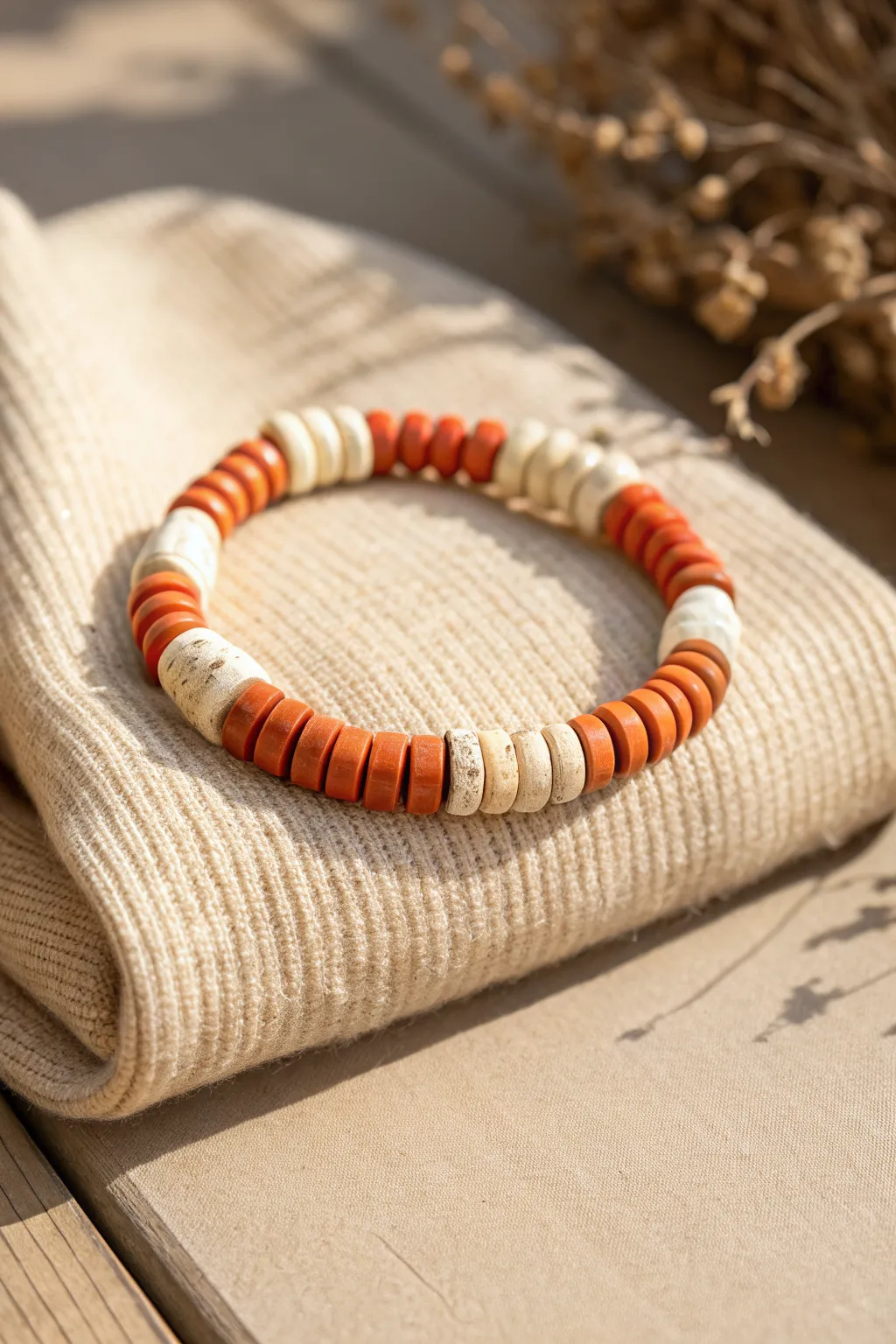
Capture the essence of autumn with this warm, textural heishi bead bracelet. The alternating blocks of deep burnt orange and speckled cream clay create a cozy, color-blocked accessory that pairs perfectly with fall knitwear.
How-To Guide
Materials
- Polymer clay in Burnt Orange
- Polymer clay in Translucent or White
- Black pepper or dried coffee grounds (for speckling)
- Acrylic rolling pin or pasta machine
- Small round clay cutter (8-10mm diameter)
- Toothpick or bead piercing pin
- Flexible heavy-duty beading elastic (0.8mm or 1mm)
- Super glue or jewelry cement
- Baking sheet and parchment paper
- Wet/dry sandpaper (400 and 600 grit)
- Blade or craft knife
Step 1: Preparing the Clay
-
Condition the orange clay:
Start by warming the burnt orange polymer clay in your hands, kneading it thoroughly until it is soft and pliable. -
Roll out the orange slab:
Using your acrylic roller or pasta machine, roll the orange clay into a uniform sheet about 3mm thick. Aim for consistency here to ensure your beads look professional. -
Prepare the speckled cream mix:
Take your white or translucent clay and knead it until soft. To achieve that natural, bone-like look seen in the photo, sprinkle in a pinch of ground black pepper or dried coffee grounds. -
Knead in the speckles:
Fold the clay over the speckles and knead repeatedly until the particles are evenly distributed throughout the white clay. -
Roll the cream slab:
Roll out your speckled cream clay to the same 3mm thickness as your orange sheet so the beads match in size.
Step 2: Cutting and Piercing
-
Cut the discs:
Using your small round cutter, punch out as many circles as possible from both clay sheets. For a bracelet like this, you’ll likely need about 30-40 orange discs and 20-25 cream discs. -
Pierce the holes:
Gently pick up a clay disc without distorting its shape. Using a toothpick or bead pin, poke a hole directly through the center. -
Refine the hole:
Creating a clean hole is crucial; I find giving the toothpick a little twist as it goes through prevents the clay from dragging. -
Bake the beads:
Arrange your raw beads on a baking sheet lined with parchment paper. Bake according to the manufacturer’s instructions (usually 275°F/135°C for 15-30 minutes). -
Cool down:
Remove the beads from the oven and let them cool completely before handling them. They will harden as they cool.
Smooth Edges Trick
Stack 10 raw clay discs on a metal skewer and roll the whole stack on a flat surface to smooth the edges before baking.
Step 3: Sanding and Assembly
-
Sand the edges:
Once cool, take a few beads at a time and rub their edges against 400 grit sandpaper to smooth out any cutter marks or sharp edges, giving them that tumbled heishi look. -
Refine finish:
Follow up with 600 grit sandpaper for a smoother finish if desired, though a little texture adds to the rustic charm. -
Plan the pattern:
Lay out your beads on a flat surface to plan your color blocking. The pattern shown uses blocks of roughly 8-10 orange beads separated by blocks of 3-5 cream beads. -
String the beads:
Cut a piece of elastic cord about 10 inches long. Thread your beads onto the elastic following your planned pattern. -
Check the fit:
Wrap the strand around your wrist to check the sizing. Add or remove beads as needed to ensure a comfortable fit. -
Tie the knot:
Tie a strong surgeon’s knot (right over left, left over right) to secure the bracelet. Pull the elastic tight enough so there are no gaps between beads, but not so tight that the bracelet buckles. -
Secure and trim:
Apply a tiny dot of super glue to the knot to ensure it holds forever. Let it dry for a moment, then trim the excess elastic ends close to the knot.
Level Up: Texture
Before baking, gently roll a piece of rough sandpaper or a stiff brush over the clay surface to mimic a stone texture.
Enjoy styling your new handmade accessory with your favorite warm sweaters this season
Golden Spacers for Warm Autumn Shine
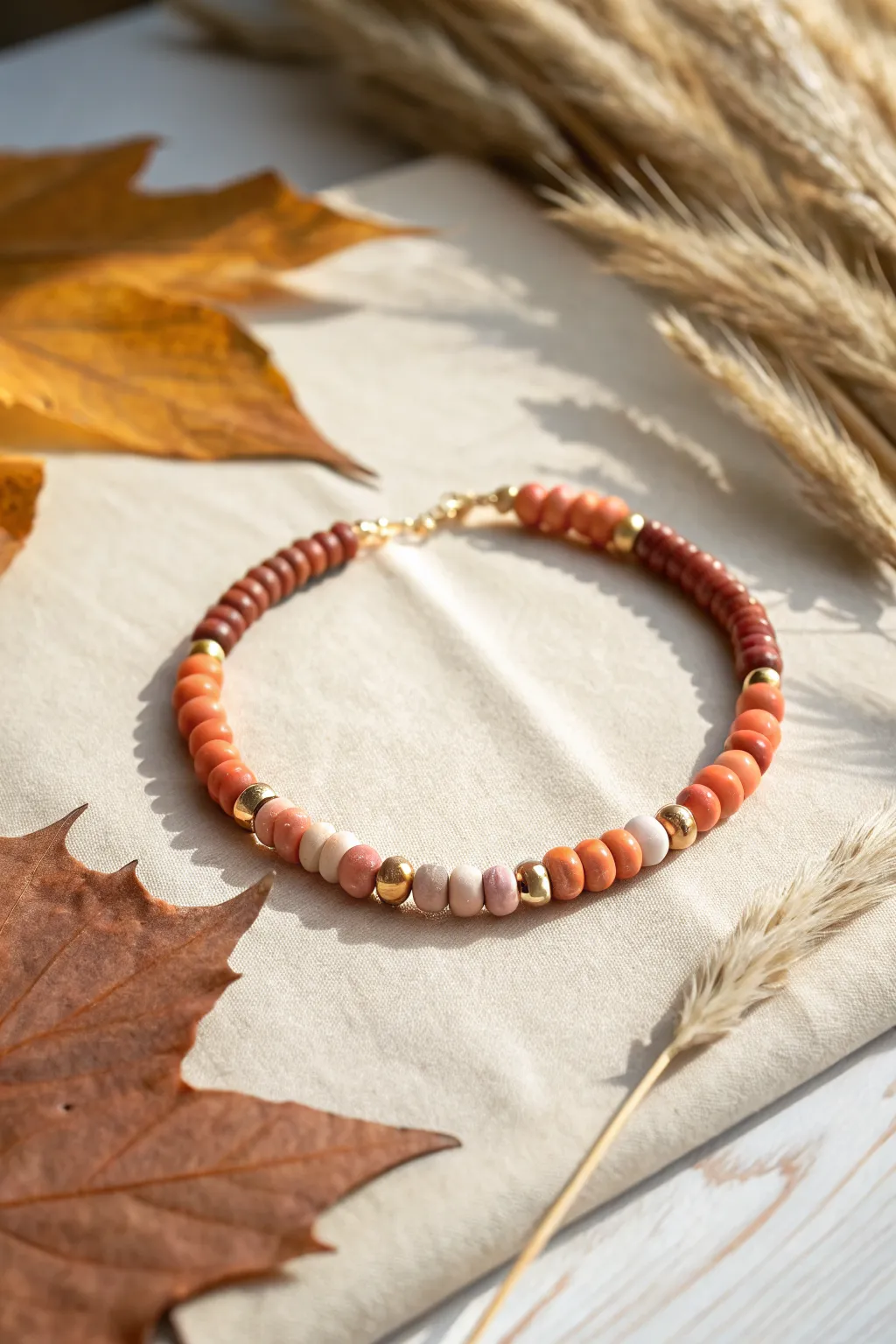
Capture the essence of a crisp autumn sunset with this beaded bracelet featuring a warm gradient of clay beads. The strategic placement of bright gold spacers adds a touch of elegance that catches the light beautifully against the matte finish of the clay.
Step-by-Step Guide
Materials
- 6mm Polymer clay heishi beads (Dark Rust/Burgundy)
- 6mm Polymer clay heishi beads (Burnt Orange)
- 6mm Polymer clay heishi beads (Terracotta/Coral)
- 6mm Polymer clay heishi beads (Peach/Beige)
- 6mm Polymer clay heishi beads (Soft Pink/Dusty Rose)
- 4mm or 5mm Round gold spacer beads
- Gold tone lobster clasp
- Gold tone jump rings (4mm and 6mm)
- Elastic beading cord (0.8mm) or beading wire
- Scissors or jewelry wire cutters
- Flat nose pliers
- Super glue or jewelry cement (optional)
- Bead stopper or tape
Step 1: Planning and Preparation
-
Measure your wrist:
Wrap a measuring tape loosely around your wrist to determine the desired length. Add about 0.5 to 1 inch to this measurement to ensure a comfortable fit that isn’t too tight. -
Cut the cord:
Cut a piece of elastic cord or beading wire about 10-12 inches long. Having this extra length makes it much easier to tie knots or attach clasps at the end without struggling. -
Secure the end:
Attach a bead stopper or simply place a piece of masking tape on one end of your cord. This prevents your carefully arranged beads from sliding off while you work. -
Sort your gradient:
Layout your clay beads on a flat surface in the order of the gradient: Dark Rust, Burnt Orange, Terracotta, Peach, and finally Dusty Rose. Seeing them laid out helps visualize the transition.
Gold Symmetry Trick
Count your beads exactly! When mirroring the pattern from the center out, matching the bead count on left and right sides perfectly makes the gold spacers look intentional and high-end.
Step 2: Creating the Pattern
-
Start the dark section:
Begin threading the darkest beads (Dark Rust) onto the cord. You will need a substantial section here, approximately 1.5 to 2 inches of ust these dark beads to form the back of the bracelet. -
First transition:
After the dark block, slide on one gold spacer bead. Then, add about 5-6 beads of the Dark Rust color again. -
Shift to Burnt Orange:
Add a gold spacer, followed by your first section of Burnt Orange beads. Thread on about 4-5 of these. -
Second transition:
Place another gold spacer. Now, switch to the Terracotta/Coral shade. Add 4-5 of these beads. Notice how the colors are starting to lighten as you move toward the front center. -
Approaching the center:
Slide on a gold spacer, followed by 3-4 Peach/Beige beads. As we get closer to the focal point, I like to separate the color blocks slightly more frequently with gold.
Step 3: The Focal Point
-
Center details:
Add a gold spacer. Now, create the center highlight mixing the lightest colors. Thread 2 Peach beads, one gold spacer, then 2 Dusty Rose beads. -
Mirror the pattern:
Now you will work in reverse to complete the other side. Add a gold spacer, then 2 Peach beads. -
Reverse the gradient:
Add a gold spacer, then 3-4 Terracotta beads. Continue mirroring the pattern you created on the first side, moving back through the Burnt Orange to the Dark Rust sections. -
Check the length:
Once you have mirrored the pattern back to the dark rust beads, wrap the bracelet around your wrist to check the fit. Add or remove dark rust beads at the very ends to adjust the final size.
Knot Slipping?
If your elastic knot keeps coming undone before you glue it, try a surgeon’s knot. Loop the elastic through the knot twice instead of once on the first pass for extra friction.
Step 4: Finishing Touches
-
Attach the first jump ring:
If using wire and a clasp: Thread a crimp bead (if using) and a jump ring onto one end. Loop the wire back through the crimp bead and tighten. If using elastic: simply prepare to tie off. -
Tie the knot:
For elastic, remove the tape and tie a sturdy surgeon’s knot (right over left, left over right, looping through twice). Pull it tight gently but firmly to secure the tension. -
Secure the knot:
Place a tiny drop of super glue or jewelry cement on the knot to ensure it doesn’t slip. Let this dry for a moment before trimming the excess cord. -
Hide the knot:
Gently pull the elastic so the knot slides inside one of the larger-hole beads next to it. This gives your bracelet a seamless, professional finish. -
Attach hardware (optional):
If you are using a clasp instead of continuous elastic, use your flat nose pliers to open a jump ring, attach your lobster clasp to one end, and close the ring securely.
Now you have a stunning, warm-toned accessory ready to compliment your favorite oversized sweater.
Candy Corn-Inspired Fall Palette
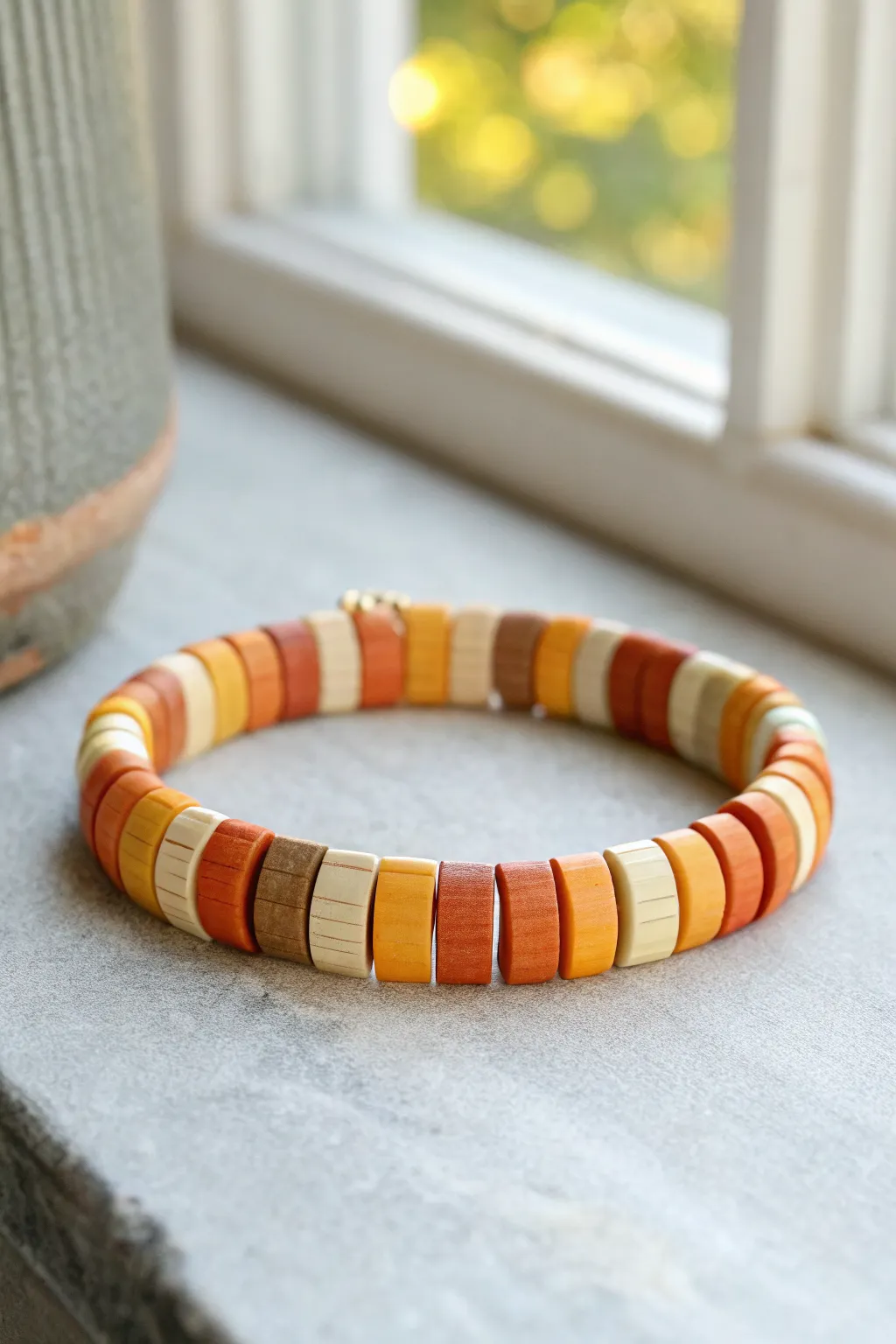
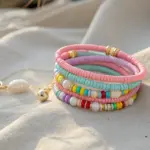
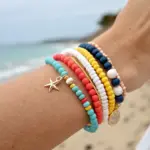
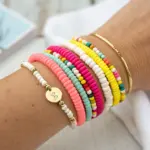
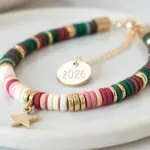
Embrace the changing seasons with this warm, rustic bracelet featuring a palette reminiscent of iconic autumnal treats. Using flat heishi-style clay beads in shades of cream, pumpkin orange, golden yellow, and deep russet, this accessory adds a subtle pop of fall color to any cozy outfit.
Step-by-Step Guide
Materials
- Polymer clay in four colors: Cream/Off-white, Pumpkin Orange, Golden Yellow, and Russet Brown
- Rolling pin or clay machine
- Round clay cutter (approx. 8mm-10mm diameter)
- Needle tool or toothpick
- Stretch magic cord or durable clear elastic string (.8mm)
- Super glue or jewelry cement
- Baking sheet and parchment paper
- Oven (for curing clay)
- Measuring tape (optional)
- Beading needle (optional)
Step 1: Prepping and Cutting the Clay
-
Condition the clay:
Start by warming up each color of polymer clay in your hands. Knead them individually until they are soft, pliable, and free of cracks. -
Roll out sheets:
Using a rolling pin or a pasta machine on a thick setting, roll each color out into a slab. Aim for a distinct thickness of about 3mm to 4mm so the beads look chunky and substantial. -
Cut the discs:
Take your small round cutter and punch out numerous circles from each color sheet. You will need roughly 40-50 beads total for a standard wrist, so cut a few extras of each shade. -
Smooth the edges:
Gently pick up each clay circle and run your finger around the edge to smooth out any sharp ridges left by the cutter. This gives the finished bead a more polished, stone-like feel.
Natural Texture
Before baking, gently roll a textured sponge or piece of sandpaper over the clay surface. This removes fingerprints and adds a matte, organic stone finish.
Step 2: Creating the Bead Holes
-
Center the holes:
Place the clay discs flat on your work surface. Using a needle tool or a toothpick, pierce a hole directly through the center of each circle. -
Widen gently:
Give the tool a little wiggle as you pierce through to ensure the hole is wide enough for your elastic cord. Be careful not to distort the round shape of the bead. -
Refine the shape:
If the pressure of piercing flattened the bead slightly, gently nudge the sides back into a perfect circle with your fingertips.
Add Some Shine
Intersperse a few gold spacer beads or a single gold charm between the clay discs to elevate the look and catch the autumn sunlight.
Step 3: Baking and Finishing
-
Prepare for baking:
Line a baking sheet with parchment paper. Arrange your raw clay beads on the sheet, ensuring they aren’t touching each other so they bake evenly. -
Bake the beads:
Bake according to your specific clay manufacturer’s instructions—usually around 275°F (135°C) for 15-30 minutes. I prefer to bake them a little longer at a lower temp to prevent scorching the lighter cream color. -
Cool down:
Remove the tray from the oven and let the beads cool completely. Do not handle them while hot, as they are still slightly soft and can deform.
Step 4: Assembly
-
Cut the cord:
Cut a piece of elastic cord about 10-12 inches long. This extra length makes tying the knot much easier later. -
Pre-stretch the elastic:
Give the cord a few firm tugs. This pre-stretching step is crucial to prevent the bracelet from loosening up effectively after you first wear it. -
Plan your pattern:
Visualize your ‘candy corn’ gradient. Try a repeating sequence like: Cream, Yellow, Orange, Russet, Orange, Yellow. Lay them out on a bead board or towel to test the look. -
String the beads:
Thread the beads onto the elastic cord following your planned pattern. Continue until the beaded section measures the circumference of your wrist. -
Check the fit:
Wrap the strand around your wrist to verify sizing. Add or remove a few beads as necessary for a comfortable fit. -
Tie the knot:
Tie a secure surgeon’s knot (right over left, left over right twice). Pull the elastic tight to close any gaps between beads. -
Secure and trim:
Place a tiny drop of super glue or jewelry cement on the knot to lock it in place. Let it dry for a minute, then trim the excess cord ends close to the knot. -
Hide the knot:
Gently pull the elastic so the knot slides inside the hole of one of the adjacent beads, hiding it from view.
Slip on your new bracelet and enjoy the warm, harvest vibes it brings to your day

The Complete Guide to Pottery Troubleshooting
Uncover the most common ceramic mistakes—from cracking clay to failed glazes—and learn how to fix them fast.
FALL Word Bracelet in Earth Tones
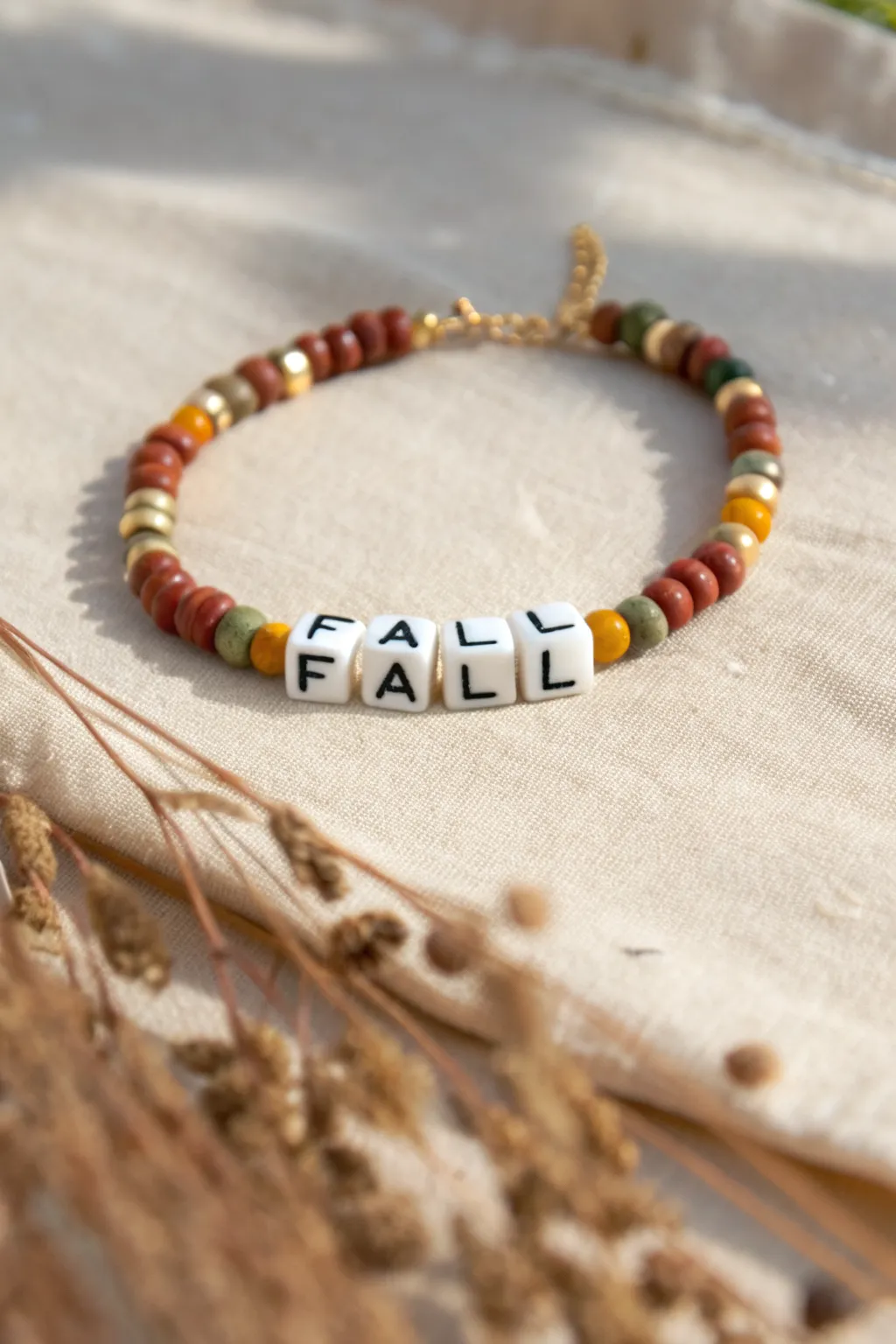
Embrace the cozy vibes of autumn with this simple yet charming beaded bracelet featuring rich, earthy tones. The combination of rust reds, muted greens, and golden accents perfectly frames the central “FALL” message, making it a subtle seasonal statement piece.
Step-by-Step Tutorial
Materials
- Elastic jewelry cord (0.5mm – 0.8mm)
- White square alphabet beads (letters F, A, L, L)
- Small round beads in rust red/terracotta (approx. 4mm)
- Small round beads in olive green (approx. 4mm)
- Small round beads in mustard yellow (approx. 4mm)
- Gold spacer beads (small round or disc shape)
- Jewelry glue or clear nail polish
- Scissors
- Tape or bead stopper
- Gold crimp bead covers (optional, for a polished finish)
- Gold jump rings and clasp (optional, if not making it stretchy)
Step 1: Preparation & Planning
-
Measure and cut:
Cut a piece of elastic cord about 9-10 inches long. This gives you plenty of extra room to tie the knot comfortably without losing beads. -
Secure the end:
Place a piece of tape or a bead stopper on one end of the cord to prevent your beads from sliding off while you work. -
Sort your palette:
Lay out your beads on a bead board or soft cloth. Group them by color: rust red, olive green, mustard yellow, and gold. Having them separated makes the patterning process much smoother.
Knot Security Tip
When using elastic cord, pull the knot tight from all four strands (the two tails and the two bracelet sides) to ensure it locks in place firmly.
Step 2: Stringing the Design
-
Start the center:
Locate the middle of your cord. Thread on the alphabet beads to spell “FALL”. Double-check that all letters are facing the correct way up. -
First color transition:
On the right side of the letter L, add one mustard yellow bead followed by one olive green bead. -
Mirror the left side:
Repeat that exact sequence on the left side of the letter F: one mustard yellow bead, then one olive green bead. -
Begin the main pattern:
On the right side, add a sequence of three rust red beads. This creates the primary color block. -
Add metallic accents:
Follow the three red beads with a single gold spacer bead, then one olive green bead, then another gold spacer bead. -
Continue the pattern right:
Add three more rust red beads. Follow this with a small variation: one gold bead, one mustard bead, and another gold bead. -
Build the left side:
Go back to the left side of your bracelet. Mirror the pattern you just created: three rust red beads, gold spacer, olive green bead, gold spacer. -
Lengthen the left side:
Continue mirroring the right side: add three rust red beads, followed by a gold bead, a mustard bead, and another gold bead. -
Fill the length:
Continue adding groups of 2-3 rust red beads separated by single accent beads (gold, olive, or mustard) on both ends until the bracelet reaches your desired wrist size (usually about 6.5 – 7 inches total length). -
Check the fit:
Wrap the unfinished strand around your wrist to check the size. Remember the knot will take up a tiny bit of space, so don’t make it too tight.
Texture Twist
Swap the plain round olive beads for matte or frosted finish stone beads. The texture contrast against the shiny gold looks incredibly high-end.
Step 3: Finishing Touches
-
Prepare to tie:
Remove the tape or stopper carefully, holding both ends of the elastic firmly. -
Pre-stretch:
I always give the cord a gentle tug before tying. This pre-stretches the elastic so the bracelet won’t loosen up immediately after you wear it. -
Knot securely:
Tie a surgeon’s knot (right over left, left over right twice). Pull the ends tight to secure the knot. -
Seal the deal:
Apply a tiny dab of jewelry glue or clear nail polish directly onto the knot. Let it dry completely before moving. -
Hide the knot:
If one of your beads has a large enough hole, gently slide it over the knot to hide it. Trim the excess cord ends close to the knot. -
Optional clasp finish:
If you used non-stretchy string and crimp beads, now is the time to attach your jump rings and gold clasp to the ends using pliers.
Slip this bracelet on with your favorite sweater for an instant touch of seasonal warmth
Pumpkin Charm Centerpiece Bracelet
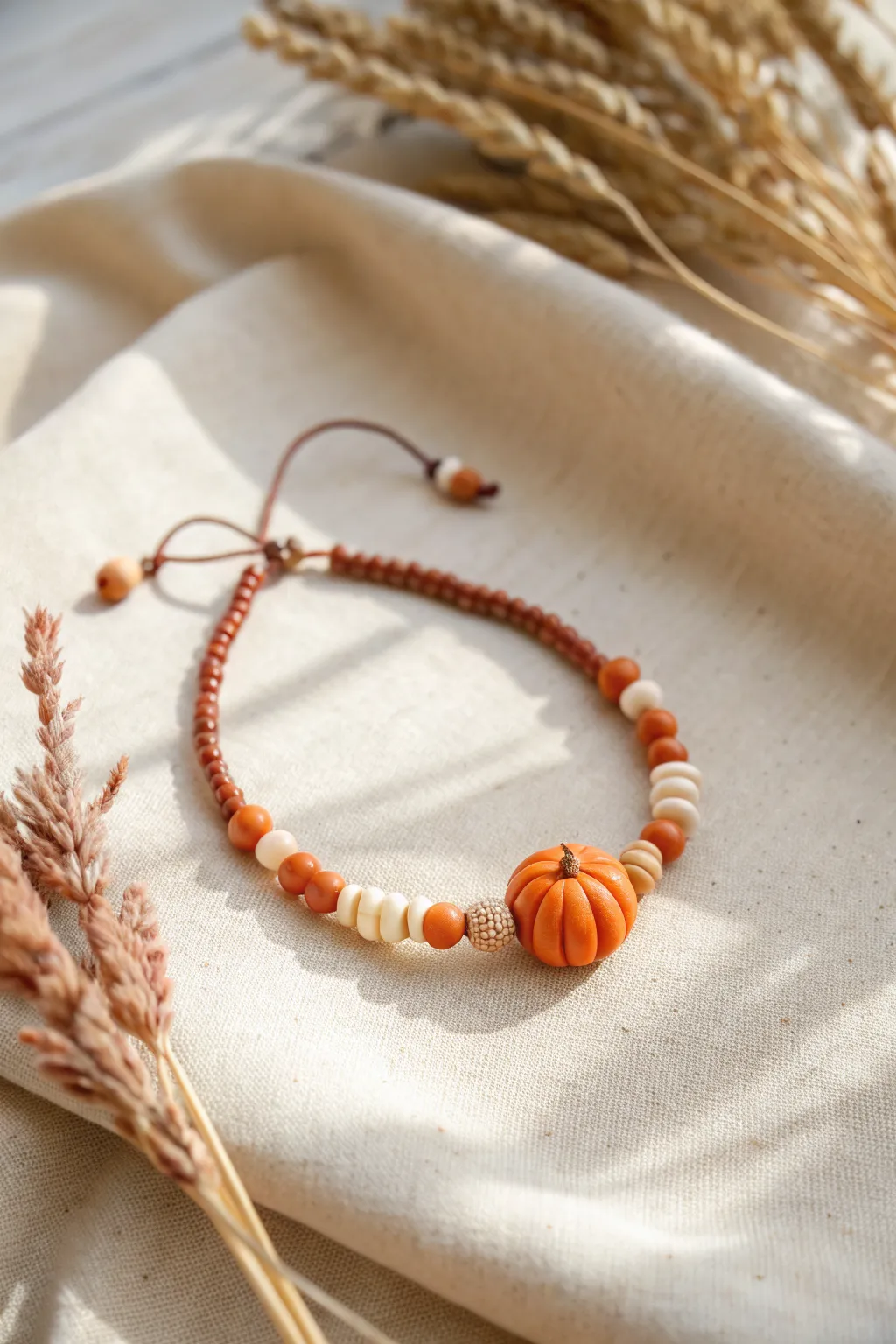
Capture the essence of autumn with this darling handcrafted bracelet starring a miniature sculpted pumpkin. Combining earthy tones of burnt orange and cream with a simple macramé finish makes for a cozy accessory perfect for sweater weather.
Step-by-Step
Materials
- Polymer clay (burnt orange, green/brown for stem)
- Small dotting tool or toothpick
- Headpin or eye pin (cut short)
- Gloss glaze (optional)
- Thin brown nylon jewelry cord (approx. 0.8mm)
- Rust/brown seed beads (size 8/0 or 6/0)
- Burnt orange round beads (approx. 6mm)
- Cream heishi or disc beads
- Textured gold or beige spacer beads
- Wooden bead for closure (optional)
- Scissors and lighter
Step 1: Sculpting the Pumpkin Centerpiece
-
Form the base:
Condition a small piece of burnt orange polymer clay until soft and pliable. Roll it into a smooth ball approximately 10-12mm in diameter, slightly flattened on the top and bottom. -
Create the segments:
Using a needle tool, toothpick, or the side of a credit card, gently press vertical indentations around the outside of the ball. I like to start by dividing it into quarters, then dividing those sections again to ensure even spacing. -
Refine the shape:
Use your finger to soften the sharp edges of the indentations so the pumpkin segments look plump and organic rather than sliced. -
Add the stem:
Take a tiny pinch of brown or green clay and roll it into a small cone. Press this into the top center indentation of your pumpkin. Use a needle tool to add texture to the stem for a realistic look. -
Pierce the bead:
Carefully push a headpin or piercing tool horizontally through the center of the pumpkin. Gently wiggle it to ensure the hole is large enough for your cord, then remove the tool before baking to avoid sticking, or bake with the pin in place if it’s oven-safe. -
Bake and finish:
Bake the clay pumpkin according to the manufacturer’s instructions (usually 275°F for 15-30 minutes). Once cooled, you can apply a light coat of gloss glaze to make the color pop.
Natural Texture
Before baking, gently roll your raw clay pumpkin over a piece of canvas or denim fabric. This imitates real pumpkin skin texture better than smooth fingerprints.
Step 2: Stringing the Design
-
Prepare the cord:
Cut a piece of nylon cord about 18 inches long. Burn the tip slightly with a lighter and roll it between your fingers (carefully!) to create a stiff ‘needle’ for easier stringing. -
Center the pumpkin:
Thread your baked pumpkin bead onto the cord and slide it to the exact middle. -
Pattern the sides:
On the right side of the pumpkin, add beads in this order: one textured spacer, one orange round bead, three cream disc beads, two orange round beads, one cream round bead, and one orange round bead. -
Mirror the pattern:
Repeat that exact sequence on the left side of the pumpkin to create symmetry. -
Fill the length:
Continue stringing the smaller rust-colored seed beads on both sides until the beaded section covers about 6 inches of the cord (or fits your wrist size). -
Secure the beads:
Tie a simple overhand knot immediately after the last seed bead on both ends to keep the design in place.
Level Up: Vine Details
Make a tiny coil of green clay and wrap it around a toothpick to create a spiraled vine. Attach this next to the stem before baking for extra detail.
Step 3: Creating the Adjustable Closure
-
Form the circle:
Cross the two tail ends of the cord over each other to form a circle shape with the bracelet. -
Start the square knots:
Cut a separate scrap piece of cord (about 8 inches). Place it under the two crossed tail cords. Tie a macramé square knot sequence around the overlapping tails. -
Finish the slider:
Continue tying square knots for about half an inch. Pull them tight, trim the excess from your scrap cord (not the bracelet tails!), and carefully melt the cut ends to seal the knot. -
Add end beads:
Thread a small wooden bead or seed bead onto the very end of each bracelet tail. Tie a knot below the bead to secure it and trim the excess cord.
Now you have a charming piece of handmade jewelry ready to wear for your next pumpkin patch visit

What Really Happens Inside the Kiln
Learn how time and temperature work together inside the kiln to transform clay into durable ceramic.
Maple Leaf Bead Bracelet Accent
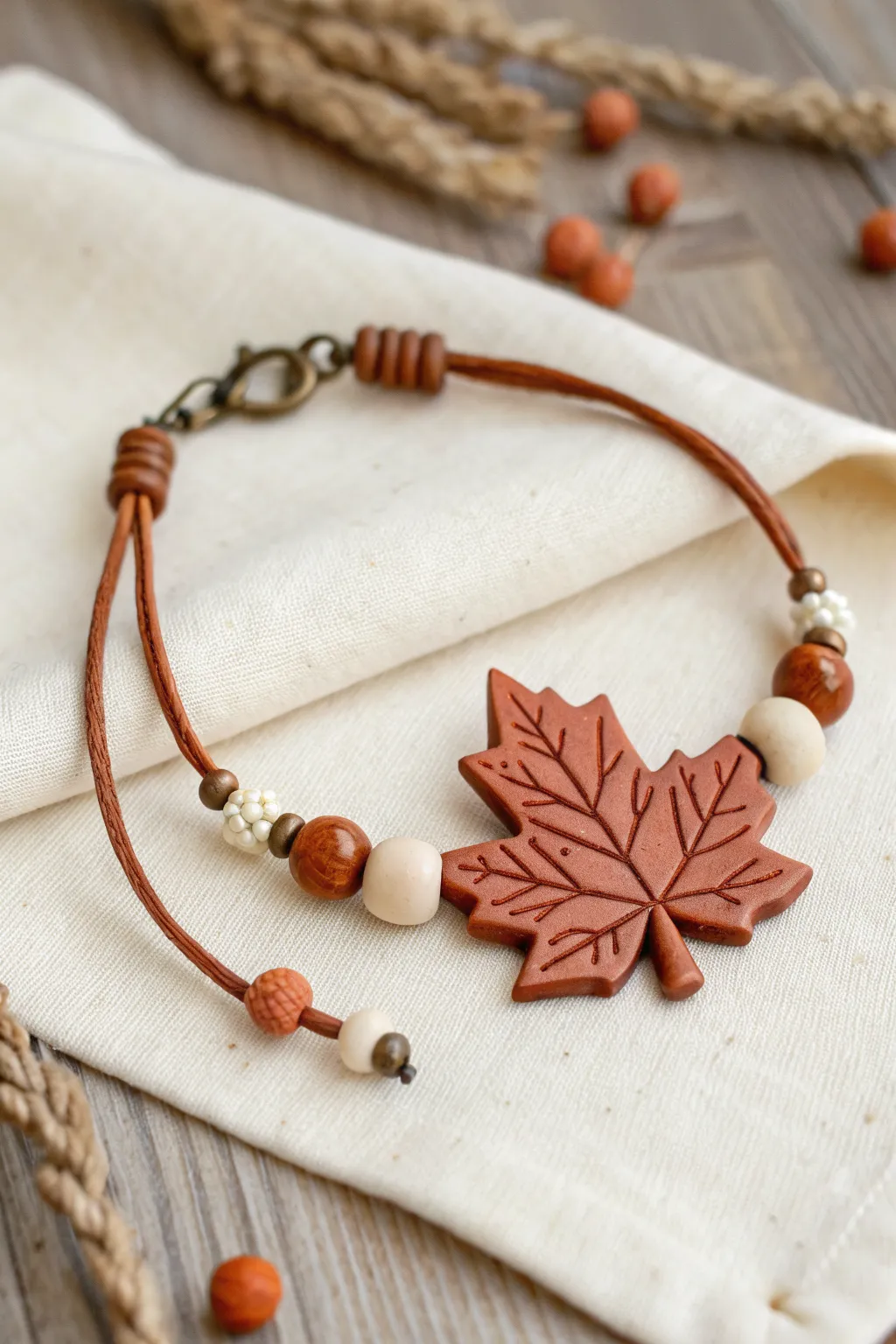
Capture the essence of autumn with this charming leather cord bracelet anchored by a handcrafted clay maple leaf. The rich terracotta tones paired with natural wood and cream accents create a warm, earthy accessory perfect for sweater weather.
How-To Guide
Materials
- Terracotta-colored polymer clay
- Maple leaf clay cutter (small/medium size)
- Needle tool or clay detailing tool
- Leather cord (approx. 1.5mm – 2mm thick, warm brown)
- Small wooden beads (approx. 6-8mm, reddish-brown)
- Cream-colored round beads (ceramic or wood)
- Small bronze or antiqued gold seed beads/spacers
- White seed beads (optional, for floral clusters)
- Lobster clasp and jump rings (antique bronze finish)
- Jewelry wire or leather crimp coil ends (approx. 4)
- Pliers (round nose and flat nose)
- Awl or toothpick (for piercing holes)
- Oven for baking clay
Step 1: Sculpting the Maple Leaf
-
Condition the clay:
Start by warming the terracotta polymer clay in your hands until it becomes soft and pliable. Roll it out into a smooth sheet, approximately 3-4mm thick, ensuring there are no air bubbles. -
Cut the shape:
Press your maple leaf cutter firmly into the clay sheet. If you don’t have a cutter, you can print a small leaf template and carefully trace around it with a craft knife. -
Add texture details:
Using a needle tool, gently score the veins of the leaf. Start with a central line down the middle, then branch out towards each point of the leaf to mimic realistic veins. -
Create the heavy outline:
To match the reference photo’s style, lightly press the needle tool along the perimeter of the veins to create a slightly indented, graphical look rather than just thin scratches. -
Pierce the bead hole:
This is crucial: using an awl or thick needle, carefully pierce a hole horizontally through the top section of the leaf (near the stem connection) so it can hang or slide onto the cord. Ensure the hole is wide enough for your leather cord. -
Bake the clay:
Place your leaf on a baking sheet lined with parchment paper. Bake according to the manufacturer’s instructions on your clay package. Let it cool completely before handling.
Clay Texture Tip
Before baking, gently rub a tiny bit of cornstarch or baby oil over the clay leaf to smooth out any fingerprints without erasing your vein details.
Step 2: Assembling the Bracelet
-
Cut the leather cords:
Cut two lengths of leather cord. One should be the full circumference of your wrist plus 2 inches; the other is a shorter decorative piece if you want the double-strand look shown on the left side. -
Center the leaf:
Thread the main long cord through the hole in your cooled clay maple leaf. Center the leaf on the cord. -
Add flanking beads:
On the right side of the leaf, thread one cream bead, followed by a reddish-brown wooden bead. Add a small cluster of bronze spacer beads or a small knot to hold them in place. -
String the left side:
On the left side of the leaf, mirror the pattern slightly but add variety. Thread a cream bead, a wooden bead, and perhaps a small cluster of white seed beads to add that textural contrast seen in the image. -
Attach the secondary cord:
To create the double-strand effect visible on the left, lay the shorter piece of leather next to your main beaded cord. Use a coil crimp end or wrap wire tightly to join them together a few inches away from the leaf. -
Secure the ends:
Gather both ends of the leather cords on one side (trimming them to equal lengths) and insert them into a leather crimp coil end or fold-over cord end. Do the same for the other side. -
Crimp firmly:
Use your flat nose pliers to squeeze the crimp coils efficiently so the leather cannot slip out. I always give a gentle tug here just to be sure it’s secure. -
Add closure hardware:
Open a jump ring with your pliers and attach the lobster clasp to one end of the bracelet. Attach a closed jump ring or extender chain to the opposite end. -
Add dangling details (Optional):
The image shows cute dangling ends. Instead of crimping everything at the clasp, you can knot the leather at the clasp and let the excess tail hang down, finishing those tails with a single small wooden or berry-like bead knotted at the very tip.
Seasonal Sparkle
Brush a tiny amount of gold mica powder or metallic acrylic paint over the raised veins of the leaf after baking to make the details catch the light.
Now you have a cozy, handcrafted accessory ready to wear for your next autumn walk
Acorn Details in Neutral Clay Tones
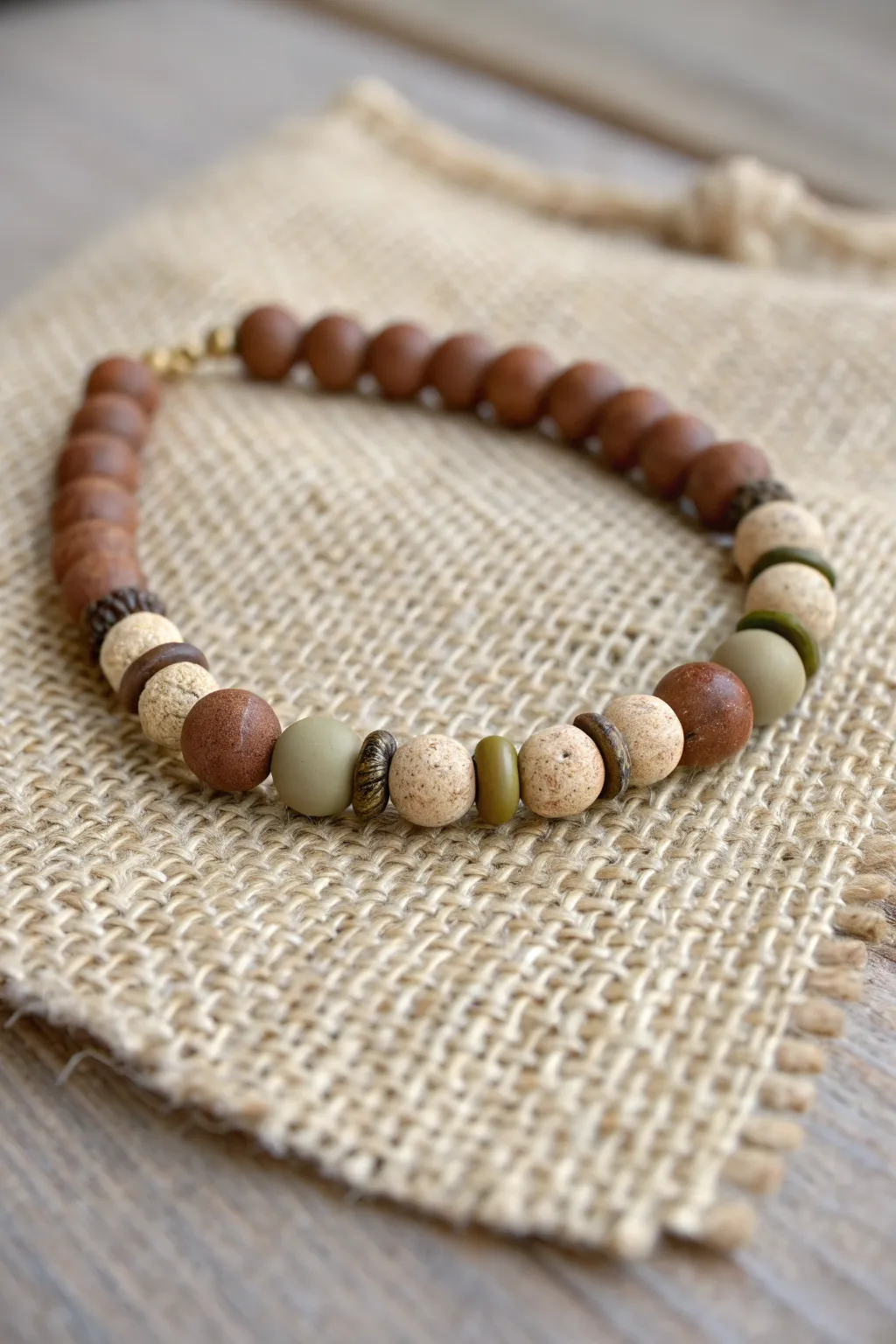
Capture the subtle beauty of autumn with this stunning bracelet featuring acorn-inspired details and warm neutral tones. By combining textured polymer clay beads with earthy solids, you’ll create a sophisticated accessory perfect for the harvest season.
Step-by-Step Guide
Materials
- Polymer clay in deep brown (e.g., Burnt Umber)
- Polymer clay in beige or ecru
- Polymer clay in matte olive green
- Coarse black pepper or brown acrylic paint (for speckling)
- Gold or bronze metallic disc spacers (textured)
- Dark brown or bronze heishi accent beads
- Elastic beading cord (0.8mm or 1mm)
- Beading needle (optional)
- Clay roller or pasta machine
- Small bead piercing tool or toothpick
- Super glue or jewelry cement
Step 1: Crafting the Speckled Acorn Nut Beads
-
Prepare the speckled clay:
Start by conditioning your beige or ecru polymer clay until it is soft and pliable. To achieve that gorgeous natural stone look, mix in a pinch of coarse black pepper or dry tea leaves into the clay. -
Roll the beads:
Pinch off small, even amounts of the speckled clay mixture. Roll them between your palms to create smooth spheres, aiming for about 8-10mm in diameter. -
Texture the surface (optional):
If you want the extra rustic texture shown in the photo, gently roll the unbaked beads over a piece of coarse sandpaper or a clean toothbrush to impart a subtle pitting effect. -
Pierce the holes:
Carefully insert your bead piercing pin through the center of each sphere. Rotate the pin as you push to prevent flattening the bead’s shape.
Fixing Wonky Holes
If your bead holes distort while piercing, let the clay sit for 10 minutes to firm up slightly before piercing. Twist the tool constantly as you push through.
Step 2: Creating the Solid Tone Beads
-
Form the brown wood-look beads:
Take your deep brown clay and roll a long snake. Cut equal segments and roll them into spheres slightly smaller or equal in size to your speckled beads. -
Create the olive accents:
Condition the matte olive green clay. Create just 2-3 focal beads in this color to serve as earthy accents near the center of your design. -
Bake the clay:
Arrangement your pierced raw beads on a baking sheet lined with parchment paper. Bake according to your specific brand’s instructions (usually around 275°F for 15-30 minutes) and let them cool completely.
Step 3: Assembly and Stringing
-
Prepare the cord:
Cut a length of elastic cord about 10-12 inches long. I always pre-stretch the elastic by pulling it firmly a few times; this prevents the bracelet from sagging later. -
Start with the back section:
Thread a sequence of about 10-12 deep brown beads to form the back portion of the bracelet that sits against your wrist. -
Begin the transition:
Add a textured metallic spacer or a dark heishi bead after the brown section to signal the start of the detailed front panel. -
Create the acorn cap effect:
Thread on a speckled beige bead followed immediately by a flat, dark brown spacer or heishi bead. This pairing mimics the look of an acorn nut and its cap. -
Build the focal pattern:
Continue the pattern by alternating solid brown beads, olive accents, and your speckled ‘acorn’ pairings. Use the metallic ribbed spacers to separate key focal beads for a touch of elegance. -
Check the fit:
Wrap the strand around your wrist to check the sizing. Depending on your wrist size, you may need to add or remove a few solid brown beads from the back section. -
Secure the knot:
Tie the ends of the elastic cord together using a surgeon’s knot (right over left, left over right, looped twice). Pull tight. -
Finalize:
Apply a tiny drop of super glue or jewelry cement to the knot for security. Let it dry completely before trimming the excess cord, tucking the knot inside a neighboring bead if the hole is large enough.
Level Up: Real Wood Scent
Mix a drop of cedar or sandalwood essential oil into the dark brown clay before baking. The bracelet will carry a faint, real-forest scent when worn.
Enjoy styling this delightfully earthy piece with your favorite cozy sweaters this season

TRACK YOUR CERAMIC JOURNEY
Capture glaze tests, firing details, and creative progress—all in one simple printable. Make your projects easier to repeat and improve.
Apple Orchard Red and Cream Combo
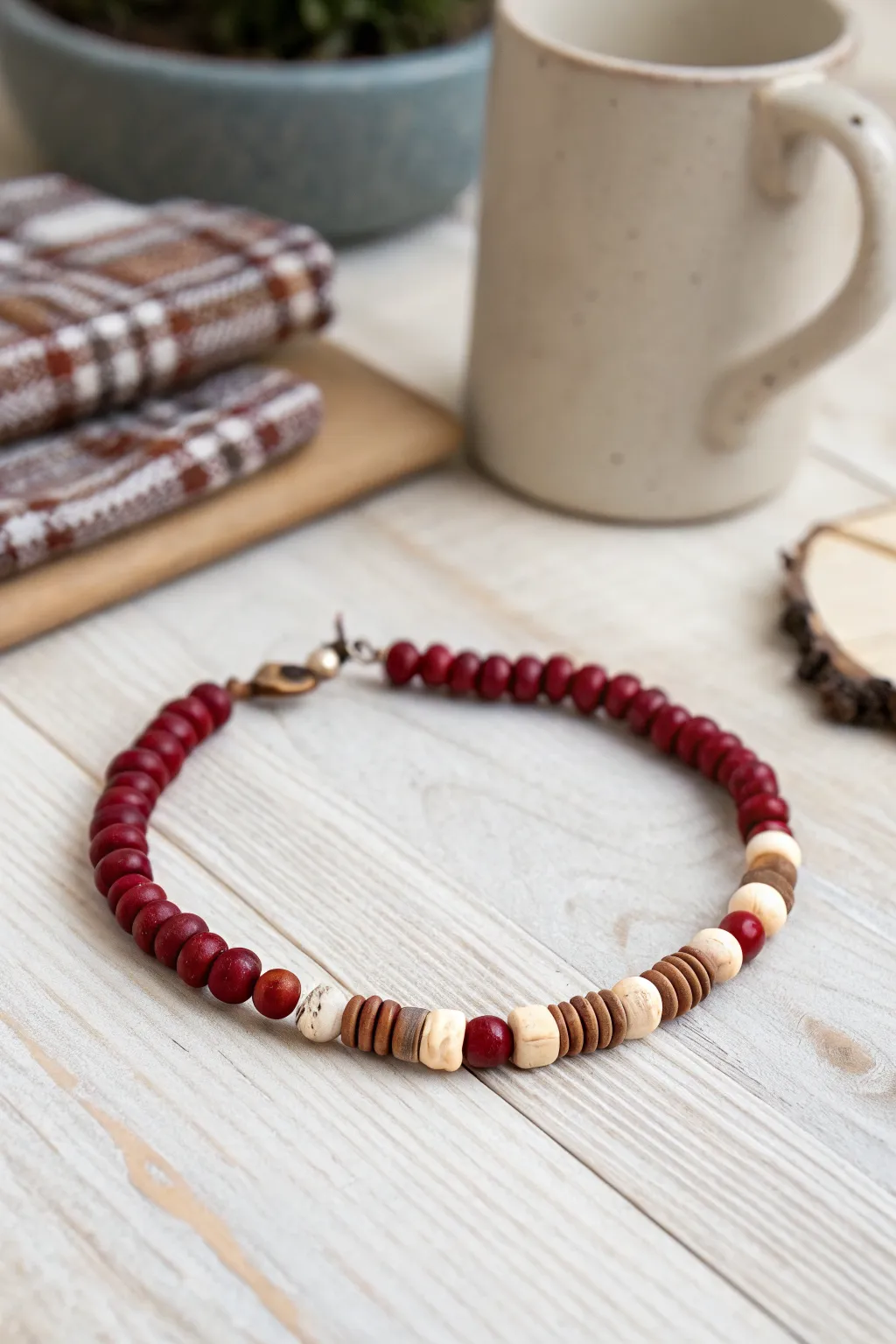
Capture the essence of an autumn harvest with this warm, rustic bracelet featuring deep red beads paired with creamy accents and natural wood tones. The simple pattern evokes cozy flannels and apple picking, making it a perfect accessory for the season.
How-To Guide
Materials
- Deep red round wooden or polymer clay beads (approx. 6mm)
- Cream/off-white irregular heishi or tube beads (bone or wood style)
- Brown coconut shell or wood disc spacer beads
- Beading wire (flexible, 7-strand nylon coated)
- Antique bronze lobster clasp
- Antique bronze jump ring
- 2 Crimp beads (antique bronze or copper)
- Wire cutters
- Crimping pliers
Step 1: Setting the Foundation
-
Measure and Cut:
Begin by measuring your wrist and adding about 3-4 inches to that measurement. This extra length accounts for the clasp and gives you enough room to work comfortably. -
Prepare the Wire:
Cut your beading wire to the measured length using your wire cutters. I like to lay the wire flat for a moment to let it relax if it’s been tightly coiled. -
Secure the First Crimp:
Thread one crimp bead onto the end of the wire, followed by the jump ring. Loop the wire back through the crimp bead to create a small loop holding the ring. -
Crimp to Lock:
Use your crimping pliers to flatten the crimp bead securely. Give the jump ring a gentle tug to ensure the wire doesn’t slip.
Natural Texture
Use wood or bone beads for the cream sections instead of glass or plastic. Their matte, porous surface adds authentic rustic charm.
Step 2: Creating the Bead Pattern
-
Start with Red:
String approximately 15 to 20 of the deep red round beads. This section will form one side of the bracelet that sits towards the back/side of the wrist. -
Transition Element:
Add one cream-colored irregular bead to start the focal pattern section. -
Wood Spacer Accent:
Slide on three of the thin brown disc spacer beads. These add a nice textural contrast against the smooth red beads. -
Alternating Pattern Part 1:
Add another cream bead, followed by a single red round bead to break up the neutral tones. -
Center Neutral Block:
Thread on a cream bead, then stack five or six brown disc spacers together. This creates a darker, textured “stripe” in the design. -
Alternating Pattern Part 2:
Mirror the previous step by adding a cream bead, sending us back toward the red accent. -
Second Red Accent:
Place one red round bead. -
Closing the Focal Section:
Finish the central pattern with a cream bead, three brown disc spacers, and a final cream bead. -
Finish with Red:
Fill the rest of the wire with the deep red round beads until you reach your desired total length.
Layered Look
Make two more bracelets: one entirely of the brown disc spacers and one entirely of cream beads to wear as a stacked set.
Step 3: Finishing Touches
-
Prepare the Clasp End:
Thread the second crimp bead onto the remaining tail of wire. -
Attach the Clasp:
Visualizing the closure, slide the antique bronze lobster clasp onto the wire after the crimp bead. -
Loop Back:
Take the end of the wire and pass it back through the crimp bead and into the first few red beads for a clean finish. -
Pull Tight:
Pull the wire snug so the loop around the clasp is small but still has enough movement to hinge freely. Check that the beads aren’t too stiff—the bracelet needs to drape naturally. -
Final Crimp:
Use the crimping pliers to crush the final crimp bead securely in place. -
Trim Excess:
Using the flush side of your wire cutters, trim the excess wire tail as close to the beads as possible without nicking your work.
Slip on your new bracelet and enjoy the subtle touch of autumn warmth on your wrist
Cranberry and Cocoa Minimal Bracelet
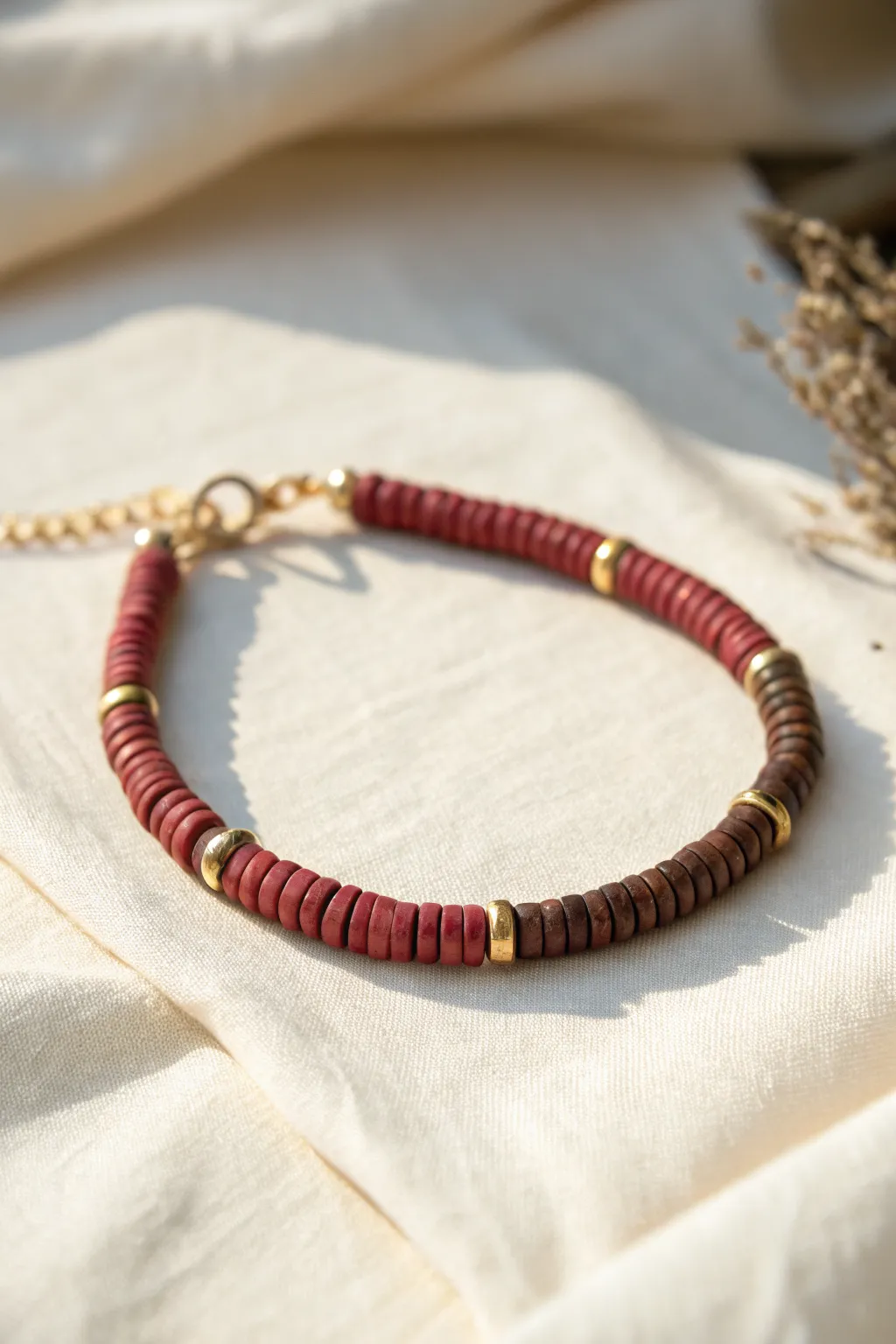
Capture the warmth of autumn with this sophisticated heishi bead bracelet featuring rich cranberry tones offset by sections of deep cocoa brown. The addition of subtle gold spacer beads elevates the look from casual beach wear to refined fall accessory.
Step-by-Step Guide
Materials
- Polymer clay heishi beads (4mm-6mm) in cranberry red
- Polymer clay heishi beads (4mm-6mm) in dark cocoa brown
- Gold tone metallic spacer beads or flat discs
- Gold plated lobster clasp
- Gold plated jump rings (open)
- Gold plated extension chain (optional)
- Beading wire (flex wire) or strong elastic cord
- Crimp beads (gold)
- Crimp bead covers (gold)
- Flat nose pliers
- Wire cutters
- Beading tray or cloth
Step 1: Planning and Preparation
-
Measure your wrist:
Before you begin, measure your wrist with a flexible measuring tape and add about half an inch to determine your desired finished length. -
Sort your beads:
Pour out a small amount of your cranberry, cocoa, and gold beads onto a beading tray or a soft cloth so they don’t roll away. -
Establish the pattern:
Looking at the design, notice the distinct color blocking. The pattern isn’t random; it uses sections of color separated by gold accents. A good ratio is roughly 1.5 inches of cranberry beads to 1 inch of cocoa beads. -
Prepare the wire:
Cut a piece of beading wire approximately 9-10 inches long. This gives you plenty of extra room to work with the clasp without struggling.
Step 2: Stringing the Bracelet
-
Secure the first end:
Thread a crimp bead onto one end of your wire, followed by a jump ring or the loop of your extension chain. -
Crimp the loop:
Loop the wire back through the crimp bead to create a small loop securing the chain. Use your flat nose pliers to squash the crimp bead firmly flat. I like to give it a gentle tug to ensure it holds. -
Hide the crimp (optional):
If you are using crimp covers, place one over the flattened crimp bead and gently close it with pliers so it looks like a round gold bead. -
Start with Cranberry:
Begin stringing your cranberry red heishi clay beads. Thread them on one by one until you have a section about 1 to 1.5 inches long. -
Add the first gold accent:
Slide on a single gold spacer bead. This metallic break is essential for the high-end look. -
Transition to Cocoa:
Now, switch to the cocoa brown clay beads. String a section slightly shorter than your red section, perhaps about 0.75 to 1 inch. -
Second gold accent:
Add another gold spacer bead at the end of the brown section. -
Resume Cranberry:
Switch back to the cranberry beads for another long section. Continue this alternating pattern (Red – Gold – Brown – Gold) until you reach your measured length. -
Check the fit:
Wrap the unfinished strand around your wrist to verify the size. Remember the clasp will add a tiny bit of length.
Uneven Sections?
Don’t stress about perfect math. If one color section is slightly longer than another, it adds to the organic, handmade charm. Just ensure the gold spacers are placed consistently.
Step 3: Finishing Touches
-
Prepare the final crimp:
Thread a crimp bead onto the open end of the wire. -
Add the clasp:
Slide the lobster clasp onto the wire after the crimp bead. -
Create the closing loop:
Feed the tail of the wire back down through the crimp bead and through the first few clay beads on the strand. Pull the wire tight so the clasp sits snug against the beads, but leave just a tiny bit of slack so the bracelet doesn’t become stiff. -
Secure the end:
Flatten the final crimp bead with your pliers to lock everything in place. -
Trim excess wire:
Using your flush cutters, snip off the excess tail of wire as close to the beads as possible so it doesn’t poke you. -
Add final crimp cover:
Place a crimp cover over this last visible crimp bead and verify that everything is secure.
Level Up: Texture Mix
Replace one section of clay beads with small wooden beads or tiny faceted garnet gemstones to add interesting texture variation while keeping the warm fall color palette.
Now you have a gorgeous, autumn-inspired accessory ready to pair with your favorite cozy sweater
Forest and Harvest Green Accent Stack
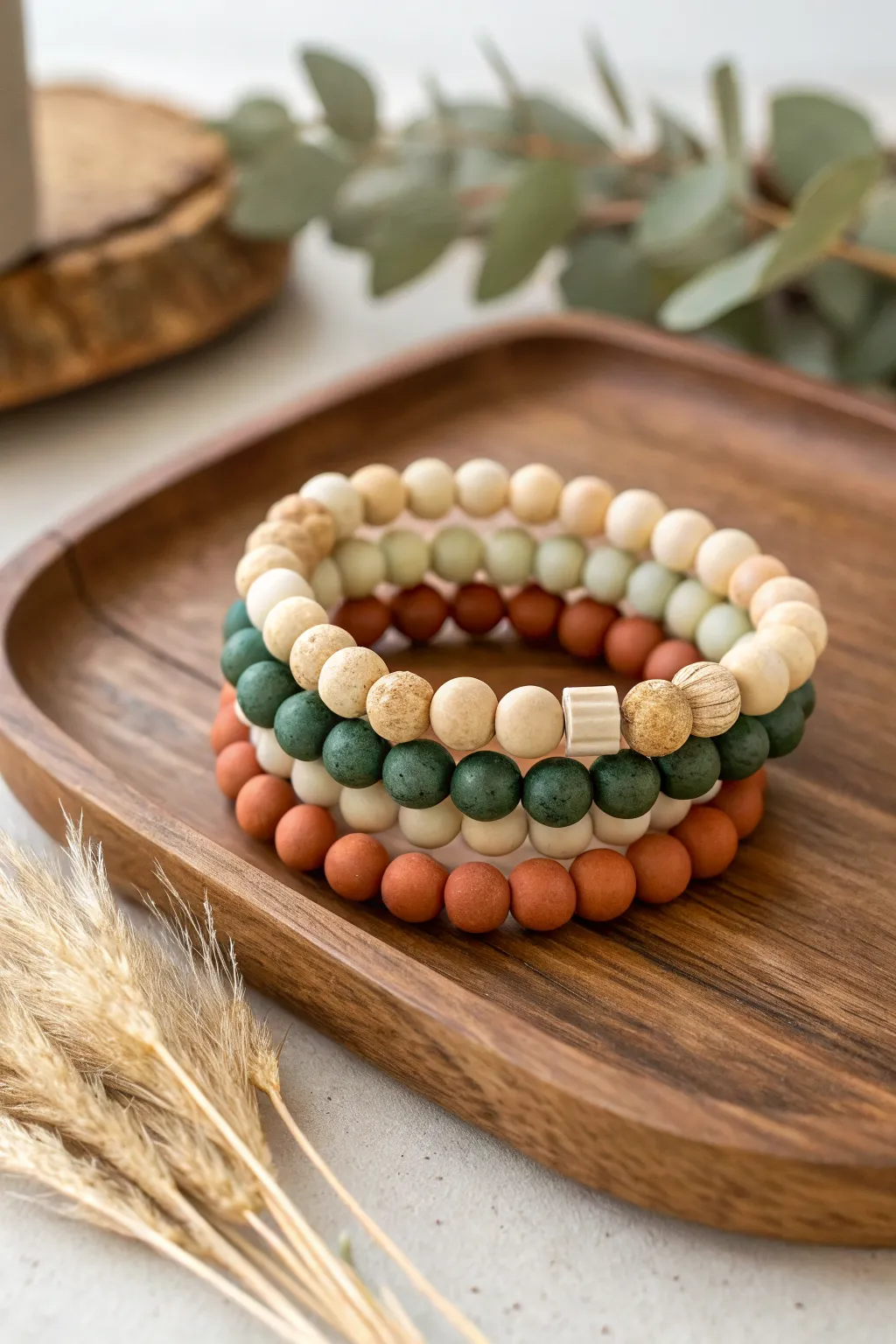
Capture the essence of an autumn walk with this trio of polymer clay bracelets featuring deep forest greens, warm terra cotta, and speckled sandy hues. The combination of matte clay textures and geometric focal beads creates a sophisticated, nature-inspired accessory set perfect for the season.
How-To Guide
Materials
- Polymer clay in Terra Cotta/Rust
- Polymer clay in Forest Green
- Polymer clay in Beige or Sand
- Polymer clay in Translucent or Granite (for speckling)
- Acrylic roller or pasta machine
- Small circular clay cutter (approx. 10-12mm)
- Needle tool or bead piercing pins
- Bead rack or baking sheet with parchment paper
- Coarse sandpaper or salt (for texturing)
- Flexible bead stringing elastic (0.8mm)
- Jewelry glue (e.g., G-S Hypo Cement)
- Work surface (glass or ceramic tile)
- Wet/dry sandpaper (400-800 grit)
- Optional: Cornstarch (to prevent sticking)
Step 1: Creating the Clay Colors
-
Condition the clay:
Start by thoroughly conditioning your terra cotta, forest green, and beige clay blocks until they are soft and pliable. Warm clay prevents cracking later. -
Mix the speckled beige:
To create the organic, grainy look of the lightest beads, mix 3 parts beige clay with 1 part translucent or granite-effect clay. Knead them together until the speckles are evenly distributed. -
Create the textured stone look:
For the tan/brown focal beads, mix a small amount of beige with a tiny pinch of brown. Don’t overmix; leave slight swirls. Roll this ball over coarse sandpaper or a textured sponge to imprint a natural, stone-like surface.
Fixing Fingerprints
If you see prints after baking, don’t worry. A quick rub with acetone on a cotton swab smooths them out fast without heavy sanding.
Step 2: Rolling and Shaping Beads
-
Roll consistent sheets:
Roll out your terra cotta, green, and speckled beige clays into thick sheets, roughly 1/4 inch thick. Using a pasta machine on the widest setting ensures every bead is the same size. -
Cut the bead portions:
Use your small circular cutter to punch out circles from the clay sheets. This volume-based method guarantees that each bead will be uniform in size once rolled. -
Hand-roll spheres:
Take each punched circle and roll it firmly between your palms. Use a circular motion to create perfect, smooth spheres. I find that lightly dusting my hands with cornstarch helps keep the clay from getting sticky during this repetitive step. -
Form the focal accents:
For the middle bracelet, create one rectangular geometric bead using the speckled beige mix. Shape a small block approx. 8mm wide by 4mm thick, ensuring the edges are squared off but slightly softened. -
Pierce the holes:
Allow the beads to sit for about 15 minutes to firm up slightly. Then, gently twist a needle tool through the center of each sphere. Rotate the bead to ensure the hole stays centered and doesn’t distort the shape.
Pro Tip: Matte Finish
Avoid glazing these beads. The natural, unglazed matte texture of polymer clay looks more high-end and mimics the stone aesthetic best.
Step 3: Baking and Finishing
-
Prepare for baking:
Place your beads on a bead rack suspended over a tray, or arrange them on a bed of baking soda or pleated parchment paper to prevent flat spots forming on the bottom. -
Bake the batch:
Bake according to your clay manufacturer’s instructions, typically around 275°F (135°C) for 45-60 minutes. Longer baking times generally yield stronger beads. -
Cool and sand:
Let the beads cool completely. Use wet/dry sandpaper under running water to buff away any fingerprints or slight irregularities, aiming for a smooth, matte finish. -
Buffing:
Rub the beads vigorously with a piece of denim or a soft cotton cloth. This doesn’t add high gloss but enhances the depth of the color and gives them a professional sheen.
Step 4: Assembly
-
Design the first strand:
String the terra cotta beads onto your elastic cord. Test the length around your wrist, adding beads until it fits comfortably without stretching. -
Design the second strand:
String the forest green beads. For visual interest, you can intersperse a few speckled beige beads as separators, or keep it solid green depending on your preference. -
Assemble the focal strand:
For the main mixed bracelet, follow a pattern: 5-6 speckled beige beads, followed by your textured stone beads, the geometric rectangle bead, and repeat or mirror the pattern to finish the loop. -
Tie the knots:
Pre-stretch your elastic cord firmly. Tie a surgeon’s knot (looping twice on the first pass) and pull tight. Secure the knot with a tiny dab of jewelry glue. -
Hide the knot:
While the glue is still tacky, gently slide the knot inside the hole of the nearest bead to conceal it ensuring a seamless finish.
Enjoy styling these versatile bracelets with your favorite cozy sweaters for a complete autumn look
Rustic Speckled Clay Bead Look
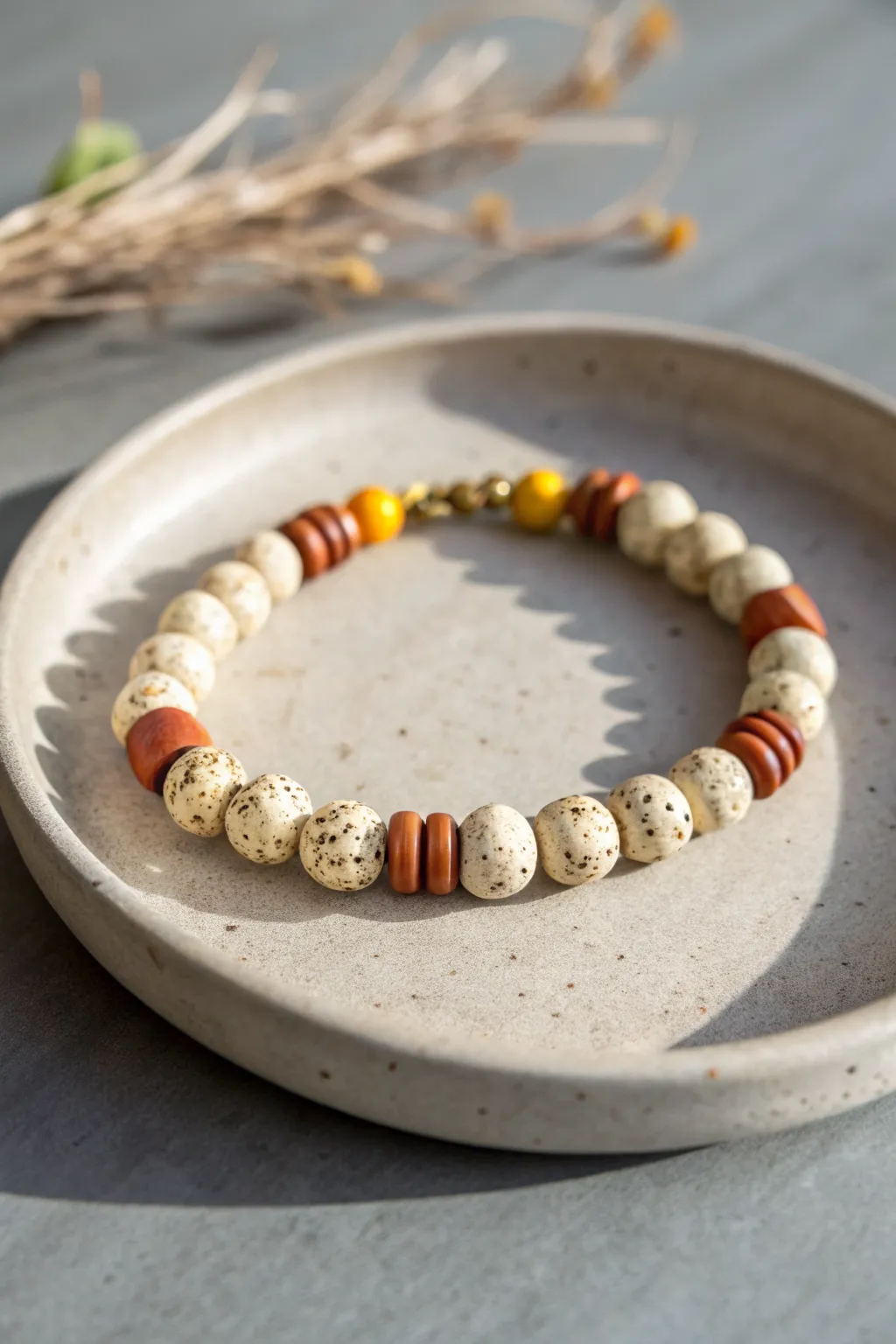
Bring the rustic charm of autumn to your wrist with this earthy, handmade bead bracelet. The speckled vanilla clay creates a beautiful organic texture that pairs perfectly with warm sienna and mustard accents for a cozy fall accessory.
Step-by-Step Guide
Materials
- Polymer clay (colors: Vanilla or White, Sienna/Rust, Mustard Yellow)
- Black pepper or dried coffee grounds (for speckling)
- Beading elastic cord or wire
- Gold magnetic clasp or toggle clasp
- Gold crimp beads
- Acrylic rolling pin
- Toothpicks or a bead piercing tool
- Small round cutter or shape cutters
- Baking sheet with parchment paper
- Jewelry pliers
- Wet sandpaper or denim fabric (for finishing)
Step 1: Creating the Speckled Clay
-
Condition the white clay:
Start by warming up your vanilla or white polymer clay in your hands until it becomes soft and pliable. Good conditioning is essential to prevent cracks during baking. -
Add the speckles:
Flatten the white clay into a pancake. Sprinkle a pinch of coarsely ground black pepper or dried coffee grounds onto the surface. This creates that natural, stone-like ceramic look. -
Mix thoroughly:
Fold the clay over the speckles and knead it repeatedly until the particles are evenly distributed throughout the batch. Add more if you want a denser pattern.
Step 2: Forming the Beads
-
Roll the main beads:
Pinch off equal-sized pieces of your speckled mixture. Roll them between your palms to create smooth, round spheres. Aim for about 12-14 beads, roughly 10mm in size. -
Create the spacer discs:
Condition the sienna or rust-colored clay. Roll it out into a thin snake or log. Use a blade to slice thin, even discs. These act as the warm, wooden-looking spacers between the larger beads. -
Make the accent beads:
Take a small amount of mustard yellow clay. Roll two slightly smaller round beads that will frame your clasp area, adding a pop of bright fall color. -
Pierce the holes:
Using a toothpick or a dedicated bead piercing tool, carefully poke a hole through the center of every bead. I find twisting the tool gently as you push through helps keep the bead shape from distorting. -
Refine the shape:
After piercing, gently re-roll the beads between your fingers just a touch to smooth out any fingerprints or distortion caused by the hole-making process.
Distorted Holes?
If your bead holes are squishing shut during piercing, try letting the rolled clay beads sit in the fridge for 10 minutes to firm up before poking them.
Step 3: Baking and Assembly
-
Bake the beads:
Arrange your beads on a baking sheet lined with parchment paper. Bake according to your polymer clay package instructions (usually around 275°F or 135°C for 15-30 minutes). -
Cool and buff:
Let the beads cool completely. For a truly professional finish, buff them lightly with a piece of denim or wet sandpaper to create a smooth, matte stone texture. -
Start the stringing:
Cut a length of beading elastic or wire. Secure one end with a crimp bead and one half of your gold clasp using your jewelry pliers. -
Create the pattern:
Begin stringing your beads. Start with a yellow accent bead, then alternate between the large speckled spheres and the flat rust spacer discs. Follow the pattern seen in the image: use pairs of rust discs between groups of speckled beads. -
Close the loop:
Finish with the second yellow accent bead. Thread the end through a crimp bead and the other half of the clasp. -
Secure the bracelet:
Loop the wire back through the crimp bead and flatten it firmly with pliers. Trim any excess wire close to the bead for a clean look.
Add a Glaze
For a glossy ceramic look instead of matte stone, apply a coat of water-based polyurethane varnish or UV resin to the speckled beads after baking.
Enjoy wearing your handcrafted piece of autumn art
Plaid-Inspired Pattern in Clay Colors
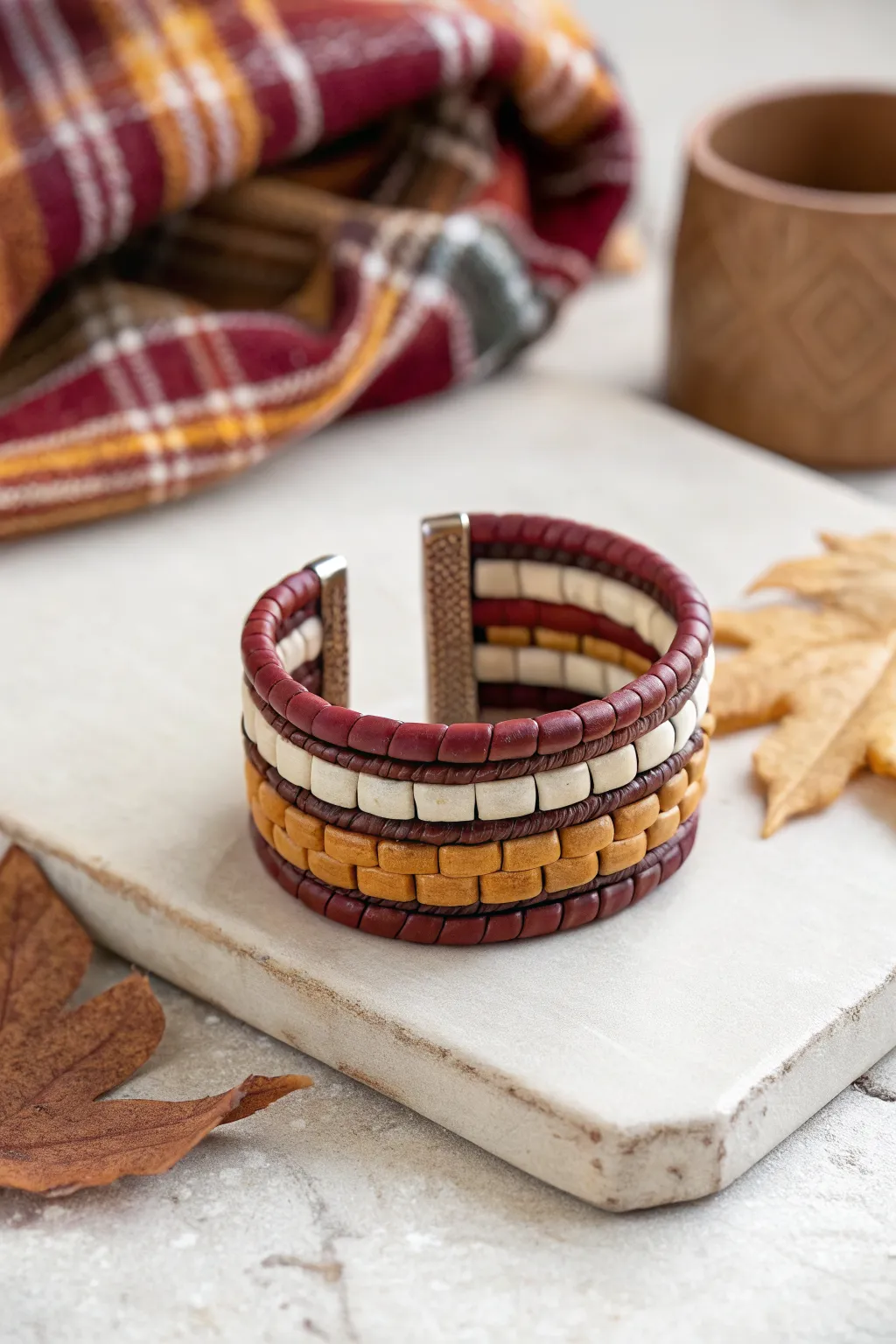
Capture the cozy essence of a fall flannel shirt with this multi-strand polymer clay bracelet. By combining rich burgundy, cream, and mustard yellow beads in alternating textures, you’ll create a structured cuff that pairs perfectly with your autumn wardrobe.
Step-by-Step Tutorial
Materials
- Polymer clay (burgundy, cream/white, golden yellow/mustard, dark brown)
- Wide metal cuff bracelet blank (with holes) or 5-strand slide clasp and memory wire
- Clay extruder or bead roller (optional but helpful)
- Beading wire (flexible nylon-coated)
- Crimp beads and crimp styling tool
- Clay slicer blade
- Headpins or strong jewelry adhesive
- Oven for baking
- Sandpaper (fine grit)
Step 1: Prepping Your Clay Components
-
Condition the Clay:
Begin by thoroughly conditioning your polymer clay blocks until they are soft and pliable. You will need roughly equal amounts of burgundy, cream, and mustard yellow, plus a smaller amount of dark brown. -
Form the Base Cord:
Roll out long, thin snakes of the burgundy clay. You want these to be uniform in thickness, about 2-3mm wide. I like to use a clay extruder here to ensure they are perfectly even. -
Cut the Spacers:
Slice the burgundy snakes into small, disc-like beads. These will act as the ‘heishi’ style beads that border the top and bottom of your cuff.
Step 2: Creating the Tile Beads
-
Roll the Cream Layer:
Take your cream clay and roll it into a square log roughly 5mm thick. Use your slicing blade to cut this log into uniform square tiles. -
Pierce the Cream Tiles:
Carefully poke a hole through the center of each cream tile using a needle tool or bead pin. Ensure the hole is large enough for your beading wire. -
Shape the Mustard Bricks:
Process the mustard yellow clay similarly, but shape the log to be slightly wider and flatter before slicing. These should resemble small rectangular bricks. -
Add Texture:
Gently press a piece of coarse fabric or sandpaper onto the surface of the mustard bricks to give them a subtle, matte texture before piercing holes through them side-to-side. -
Make Dark Spacers:
Create very thin, flat spacer discs from the dark brown clay. These will sit between the layers of the main beads to add definition. -
Bake the Components:
Arrange all your pierced beads and discs on a baking sheet or tile. Bake according to your clay manufacturer’s instructions (usually 275°F/135°C for 15-30 minutes) and let them cool completely.
Alignment Woes
If beads bunch up when curving the bracelet, try adding tiny seed beads between the larger clay tiles. This acts as a hinge, giving the stiff tiles room to pivot.
Step 3: Assembling the Cuff
-
Prepare the Frame:
If using a metal cuff blank with vertical bars, secure one end of your beading wires to the first bar. You will need five distinct strands. -
String the Top Strand:
On the top and bottom wires, thread your baked burgundy heishi beads. Pack them tightly enough to hide the wire but loose enough to maintain flexibility. -
Create the Second Layer:
On the second wire down, thread the square cream tiles. If needed, add a tiny dark brown spacer bead between every few tiles to create variation. -
Build the Center:
For the middle strand, use a thin cord of dark brown clay or string small dark spacer beads to create a dividing line between the cream and yellow sections. -
String the Brick Layer:
Thread the rectangular mustard yellow bricks onto the fourth wire. Align them so they sit flat against the strand above them. -
Check the Fit:
Periodically curve the bracelet around your wrist or a mandrel. The inner strands (closest to skin) effectively become shorter when curved, so you may need fewer beads on the inside layers. -
Secure the Ends:
Once all five strands are filled to the desired length, feed the wires through the holes of the closing vertical bar or slide clasp. -
Crimp and Trim:
Pull the wires taut (but not stiff!), slide on crimp beads, and flatten them securely with your crimping tool. Trim any excess wire flush with the crimp.
Autumn Texture
Before baking, lightly brush mica powder in gold or bronze over the textured mustard tiles. This highlights the pattern and adds a subtle fall shimmer.
Wear this structured piece with your favorite sweater to bring a touch of handcrafted warmth to cool autumn days
Textured Beads Mixed Into Fall Heishi
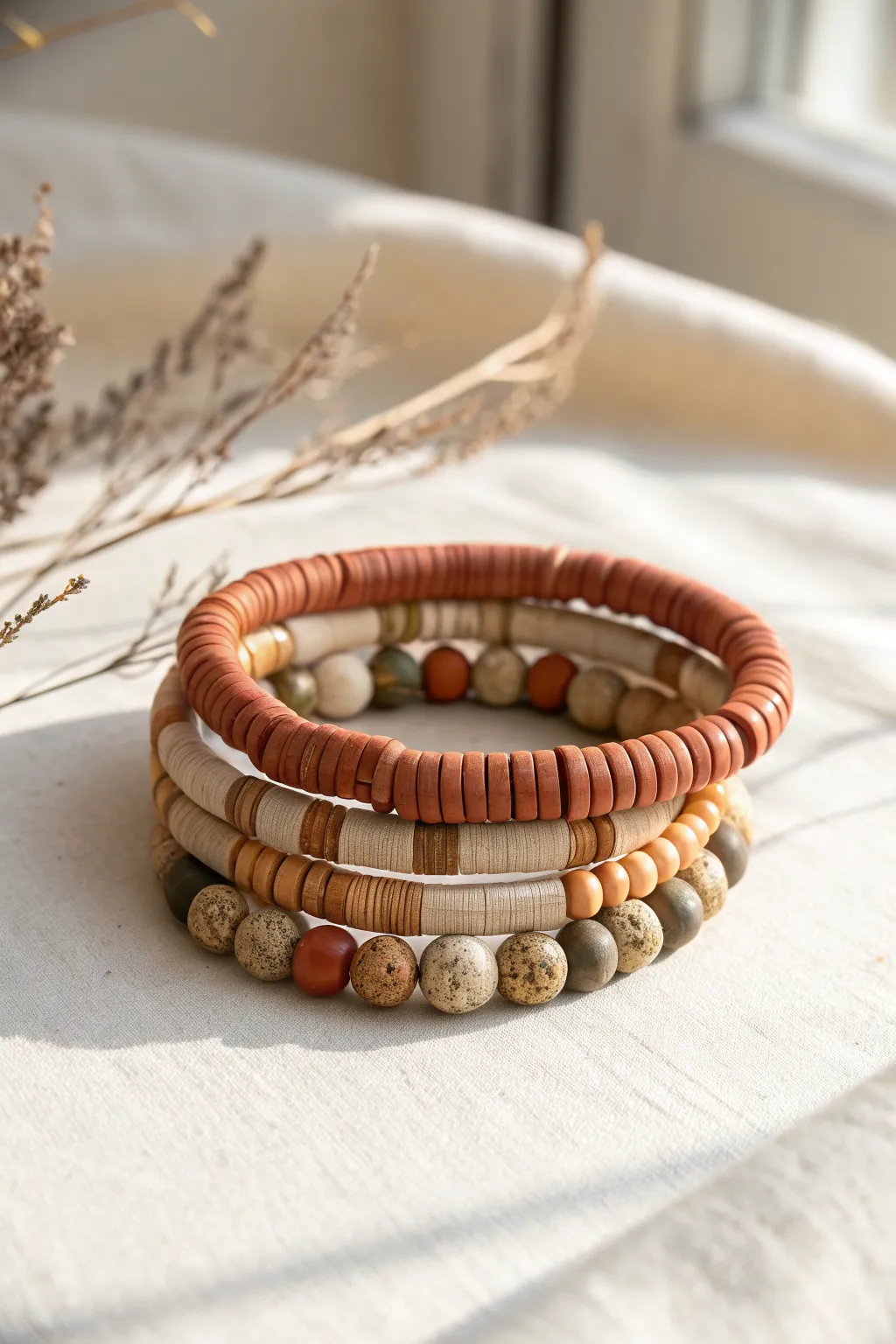
Capture the essence of autumn with this warm, textural bracelet trio. By mixing matte heishi discs with speckled stone beads and wooden accents, you’ll create a layered look that balances modern trends with rustic charm.
Step-by-Step
Materials
- Polymer clay heishi beads (terracotta/rust orange)
- Polymer clay heishi beads (cream/off-white)
- Wooden spacer discs (thin, light brown)
- Speckled round stone beads (8mm or 10mm, like Dalmatian jasper or Picture jasper)
- Round wooden beads (8mm, natural finish)
- Accent beads: Red jasper, tiger eye, or carnelian (8mm)
- Elastic jewelers cord (0.8mm or 1.0mm)
- Super glue or G-S Hypo Cement
- Scissors
Step 1: The Terracotta Heishi Band
-
Measure your cord:
Cut a piece of elastic cord about 10-12 inches long. This generous length makes tying the final knot much easier without losing tension. -
Pre-stretch the elastic:
Before stringing, give your elastic cord a few firm tugs. This pre-stretching prevents the bracelet from loosening up after the first few wears. -
Establish the base:
Begin threading your terracotta orange heishi beads. Aim to cover about two-thirds of the bracelet’s length with just this solid color to create a bold, saturated block. -
Insert the focal section:
Add visual interest to this solid band by interrupting the pattern. Thread on a mix of 3-4 cream heishi beads, followed by one round bead (like tiger eye or wood), a few more cream discs, another round bead, and finish with cream discs. -
Finish the loop:
Continue adding terracotta heishi beads until the strand measures approximately 6.5 to 7 inches (or your desired wrist size). -
Secure the strand:
Tie a surgeon’s knot (right over left, left over right, and loop through twice). Add a tiny dab of glue to the knot, pull it tight, and trim the excess cord once dry. Hide the knot inside a bead hole if possible.
Knot Security
Use a flexible adhesive like G-S Hypo Cement on your knots. Unlike super glue, it won’t make the elastic brittle and prone to snapping over time.
Step 2: The Cream & Wood Pattern
-
Start the second strand:
Cut another 10-12 inch length of cord and pre-stretch it just like the first one. -
Create striped segments:
String approximately 1 inch of cream-colored heishi beads. I find that keeping these sections uniform creates a cleaner final look. -
Add wooden spacers:
Slide on 3-5 thin, light brown wooden spacer discs. These should be roughly the same diameter as the heishi beads but offer a different texture. -
Repeat the rhythm:
Continue this pattern—1 inch of cream heishi followed by a small stack of wooden spacers—for about three-quarters of the bracelet. -
Transition to round beads:
For the back section (the part that sits under the wrist), switch to round wooden beads or smooth peach-colored stone beads. -
Tie it off:
Check the length against the first bracelet to ensure they stack nicely. Knot securely with a surgeon’s knot, glue, and trim.
Elevate the Look
Add a single brass or gold-filled spacer bead between the stone sections. The metallic shine contrasts beautifully with the matte clay and rough stone.
Step 3: The Stone & Speckle Accent
-
Prepare the final cord:
Prepare your last piece of elastic cord. This bracelet will be heavier due to the stone beads, so ensure your elastic is in good condition. -
Sort your stones:
Lay out your round speckled stone beads (like Picture jasper) and your solid accent beads (red jasper or dark grey stone) to plan the color flow. -
String the foundation:
Thread the speckled stone beads onto the cord. These earthly, spotted textures anchor the whole stack. -
Incorporate color pops:
Every 4 or 5 speckled beads, insert a solid color bead—a deep red jasper or a dark forest green stone works beautifully here. -
Mix shapes slightly:
If you have slightly smaller wooden rounds, intersperse one or two between the larger stones to prevent the bracelet from looking too bulky. -
Final assembly:
once the strand reaches your target length, tie your final surgeon’s knot. Pull extremely tight, as the weight of the stones requires a very secure bond. -
Hide the knot:
Because stone beads usually have large holes, slide the knot inside one of the adjacent beads to conceal it completely.
Slip on your new stack to add an instant touch of cozy, autumnal texture to your outfit
Charm Cluster Bracelet for Autumn Icons
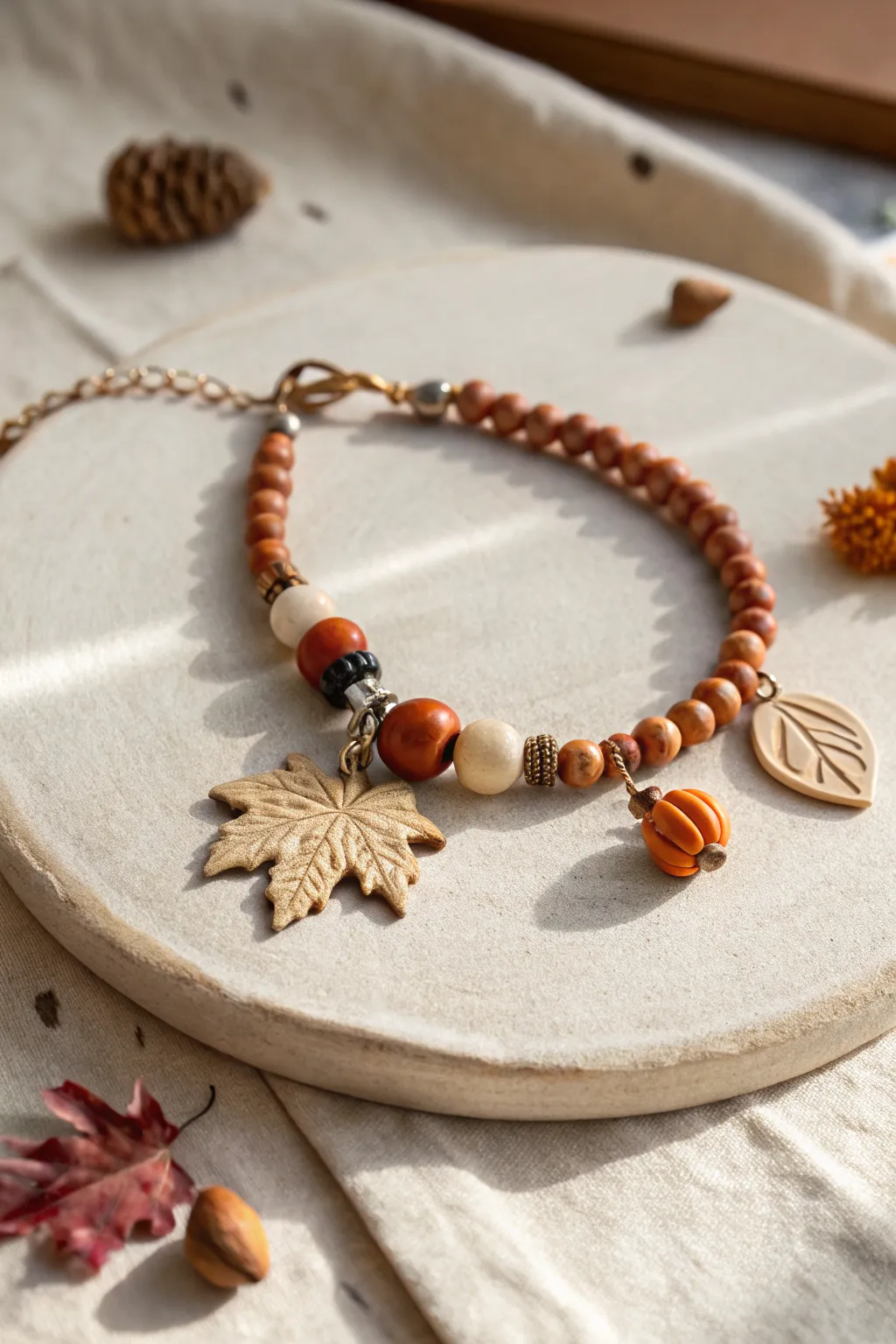
Capture the cozy essence of fall with this charming beaded bracelet featuring handmade clay icons. With a show-stopping gold leaf pendant, a petite pumpkin, and warm earth-toned beads, this accessory is like wearing a crisp October afternoon on your wrist.
Step-by-Step Tutorial
Materials
- Polymer clay in beige/gold, bright orange, cream, deep rust, and brown
- Gold mica powder or gold acrylic paint
- Headpins and eye pins (gold finish)
- Jump rings (gold finish, various sizes)
- Beading wire or strong stretch cord
- Crimp beads and lobster clasp (if using wire)
- Round-nose pliers, chain-nose pliers, and wire cutters
- Clay texture tools (needle tool, flexible blade)
- Small bead roller (optional)
- Gloss varnish or resin (optional)
Step 1: Sculpting the Charms
-
Create the large maple leaf:
Condition a piece of beige clay about the size of a quarter. Flatten it into a pancake about 3mm thick. -
Shape the leaf:
Use a needle tool or small craft knife to cut out a classic maple leaf shape with five points. Don’t worry about perfection; natural leaves are irregular. -
Add texture:
Gently press a needle tool into the clay to draw the veins, starting from the center and branching out to each leaf point. Dust the entire surface with gold mica powder for a shimmering metallic finish. -
Insert hardware:
Carefully insert a gold eye pin into the top of the leaf stem. Smooth the clay around the wire to secure it. -
Sculpt the pumpkin:
Roll a pea-sized ball of orange clay. Use a needle tool to press vertical indentations all around the ball to create ribs. -
Finish the pumpkin:
Add a tiny speck of brown clay to the top for a stem. Insert a headpin straight down through the center of the pumpkin. -
Make the sleek leaf charm:
Form a teardrop shape from beige clay. Flatten it and carve stylized vein lines. Pierce a hole at the top for a jump ring later.
Step 2: Creating the Clay Beads
-
Roll the spacer beads:
Mix brown and rust-colored clays to create small, spherical beads. Aim for about 4-5mm in diameter. I like to use a bead roller here for consistency. -
Create accent beads:
Make a few slightly larger beads (6-8mm) in cream, rust, and orange to serve as focal points near the charms. -
Poke holes:
Before baking, use a toothpick or bead piercer to create holes in all your round beads. Twist the tool as you push through to avoid squashing the shape.
Mica Management
Apply mica powder BEFORE baking. The unbaked clay acts as an adhesive, gripping the powder for a permanent metallic sheen that won’t rub off.
Step 3: Baking and Assembly
-
Bake everything:
Place all charms and beads on a tile or baking sheet. Follow your clay package instructions for temperature and time (usually around 275°F for 15-30 minutes). Let them cool completely. -
Prepare the charms:
Snip the pumpkin’s headpin to leave about 1cm exposed. Use round-nose pliers to curl this wire into a loop. -
Start stringing:
Cut your beading wire to size (wrist circumference + 2 inches). Crimp one end to a jump ring and half of your clasp. -
Pattern the beads:
Begin stringing the small brown beads. About halfway through, add your larger accent beads (cream, rust, orange) and gold spacer beads if you have them. -
Attach the main charm:
In the center of the accent bead section, thread the loop of your large maple leaf charm directly onto the wire. -
Add flanking charms:
Continue beading, adding the pumpkin and teardrop leaf charms using jump rings attached between beads on either side of the center. -
Close the loop:
Finish stringing the remaining small beads until the bracelet fits. Crimp the other end to the second half of your clasp.
Make it Organic
Marble your brown beads with a tiny bit of black or gold clay. This creates a wood-grain effect that looks incredible against the solid orange pumpkin.
Wear your cozy new autumn accessory with your favorite sweater and enjoy the season
Moody Twilight Fall Palette Bracelet
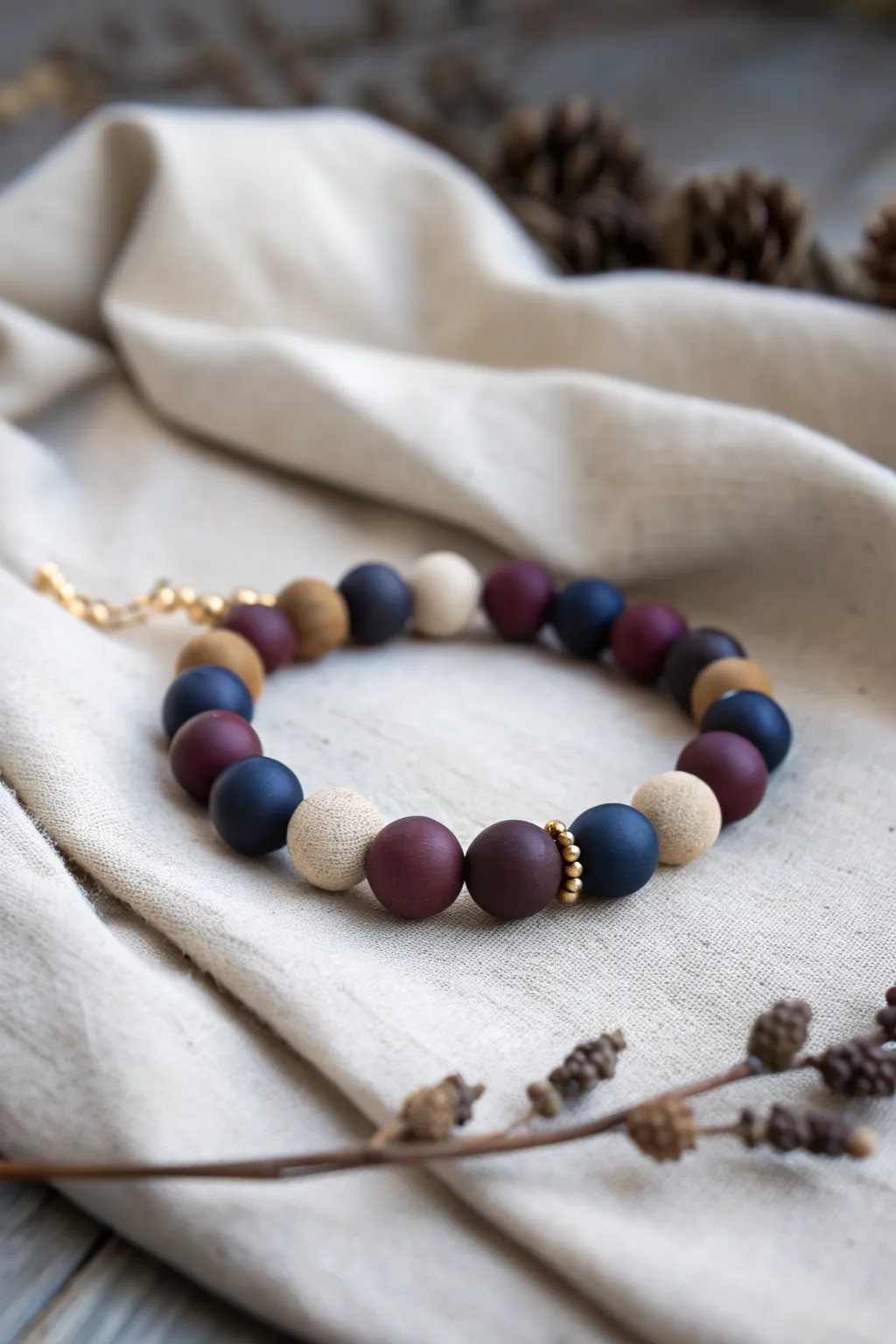
Capture the serene transition from autumn sunset to evening with this sophisticated beaded bracelet. Featuring a rich, moody palette of deep wines, navy blues, and soft sands, this accessory brings a touch of elegant grit to your fall wardrobe.
Step-by-Step Guide
Materials
- Polymer clay in deep burgundy/wine
- Polymer clay in navy blue
- Polymer clay in beige or sand (some with granite effect)
- Polymer clay in mustard or tan
- Gold seed beads or spacer beads
- Gold jewelry wire
- Gold lobster clasp and extender chain
- 2 crimp beads
- Bead reamer tool or large needle
- Clay roller or pasta machine
- Baking sheet and parchment paper
- Wet/dry sandpaper (400-800 grit)
- Wire cutters and crimping pliers
Step 1: Prepping and Mixing the Clay
-
Condition the Clay:
Begin by kneading each block of polymer clay separately until it is soft and pliable. This conditioning step is crucial to prevent cracks during baking. -
Create Custom Shades:
To achieve that specific ‘moody twilight’ look, you might need to mix colors. Simply blend a tiny dot of black into your blue for a deep navy, or mix red and blue with a touch of brown for that perfect plum wine shade. -
Texture the Sand Beads:
For the beige beads, I like to use a ‘granite’ style clay or mix in a tiny amount of ground black pepper or dried translucent clay shavings to give them that organic, speckled stone look visible in the photo. -
Measure Uniform Portions:
Roll your conditioned clay into logs of equal thickness. Slice equal segments from the logs to ensure all your finished beads will be roughly the same size.
Step 2: Forming and Piercing
-
Roll the Spheres:
Take each clay segment and roll it between your palms. Use a gentle circular motion to create smooth, even spheres about 10-12mm in diameter. -
Refine the Surface:
Inspect each bead for fingerprints. You can gently buff them out with a light touch or wear latex gloves during the rolling process to keep them pristine. -
Pierce the Holes:
Using your bead reamer or a thick needle, carefully pierce a hole through the center of each sphere. A twisting motion helps the tool glide through without squashing the bead’s shape. -
Check Alignment:
Once pierced, look through the hole to ensure it’s clean and centered. If the exit hole looks messy, smooth the clay back down around the opening.
Smooth Surface Secret
Before baking, lightly dust your raw clay beads with cornstarch. This allows you to smooth out fingerprints effortlessly and gives a silky texture.
Step 3: Baking and Finishing
-
Arrange for Baking:
Place your raw beads onto a baking sheet lined with parchment paper. To treat the round shape delicately, you can nestle them into a zig-zag folded piece of cardstock so they don’t develop a flat spot. -
Bake the Beads:
Bake according to your specific clay brand’s instructions (usually around 275°F or 135°C for 20-30 minutes). Let them cool completely before handling. -
Sand for Matte Effect:
Once cool, use wet/dry sandpaper under running water to gently sand the surface of each bead. This removes any fingerprints and gives them that velvety, matte finish seen in the image. -
Clean the Holes:
Run your bead reamer through the holes one last time to clear out any bead-baking residue or dust.
Level Up: Scented Jewelry
Use porous lava stone beads for the black/navy accents instead of clay. You can then drop essential oils onto them for a portable aromatherapy diffuser.
Step 4: Assembly
-
Cut the Wire:
Cut a length of jewelry wire approximately 9 inches long. This gives you plenty of extra room to work with the clasp attachments. -
Attach the First Clasp:
Thread a crimp bead onto one end of the wire, followed by the lobster clasp. Loop the wire back through the crimp bead and use your pliers to flatten the crimp securely. -
Plan the Pattern:
Lay out your beads on a calm surface to finalize the pattern. The example follows a loose sequence: Wine, Navy, Sand, Wine, Navy… interspersed occasionally with the mustard accent beads. -
String the Beads:
Thread all your clay beads onto the wire. Notice in the project photo there is a small cluster of gold spacer beads acting as a focal point; add 3-4 gold spacers between two of the clay beads near the center. -
Close the Loop:
Once all beads are strung, add a crimp bead and the extender chain to the open end. Thread the wire back through the crimp and the first few clay beads, pull taut (but not stiff), and crimp shut. -
Trim Excess:
Trim any excess tail wire close to the beads so it doesn’t poke the wearer.
Enjoy the rhythmic click of your handmade beads as you wear your new autumn accessory with pride